EP4114736B1 - Beinauflage eines fluggastsitzes mit einer vorrichtung - Google Patents
Beinauflage eines fluggastsitzes mit einer vorrichtung Download PDFInfo
- Publication number
- EP4114736B1 EP4114736B1 EP21714315.5A EP21714315A EP4114736B1 EP 4114736 B1 EP4114736 B1 EP 4114736B1 EP 21714315 A EP21714315 A EP 21714315A EP 4114736 B1 EP4114736 B1 EP 4114736B1
- Authority
- EP
- European Patent Office
- Prior art keywords
- housing half
- housing
- closed position
- legrest
- spring
- Prior art date
- Legal status (The legal status is an assumption and is not a legal conclusion. Google has not performed a legal analysis and makes no representation as to the accuracy of the status listed.)
- Active
Links
Images


Classifications
-
- B—PERFORMING OPERATIONS; TRANSPORTING
- B64—AIRCRAFT; AVIATION; COSMONAUTICS
- B64D—EQUIPMENT FOR FITTING IN OR TO AIRCRAFT; FLIGHT SUITS; PARACHUTES; ARRANGEMENT OR MOUNTING OF POWER PLANTS OR PROPULSION TRANSMISSIONS IN AIRCRAFT
- B64D11/00—Passenger or crew accommodation; Flight-deck installations not otherwise provided for
- B64D11/06—Arrangements of seats, or adaptations or details specially adapted for aircraft seats
- B64D11/0627—Seats combined with storage means
- B64D11/0629—Seats combined with storage means the storage means being specially adapted for emergency equipment
- B64D11/0631—Seats combined with storage means the storage means being specially adapted for emergency equipment for life vests
-
- B—PERFORMING OPERATIONS; TRANSPORTING
- B60—VEHICLES IN GENERAL
- B60N—SEATS SPECIALLY ADAPTED FOR VEHICLES; VEHICLE PASSENGER ACCOMMODATION NOT OTHERWISE PROVIDED FOR
- B60N2/00—Seats specially adapted for vehicles; Arrangement or mounting of seats in vehicles
- B60N2/90—Details or parts not otherwise provided for
- B60N2/995—Lower-leg-rests, e.g. calf-rests
-
- B—PERFORMING OPERATIONS; TRANSPORTING
- B64—AIRCRAFT; AVIATION; COSMONAUTICS
- B64D—EQUIPMENT FOR FITTING IN OR TO AIRCRAFT; FLIGHT SUITS; PARACHUTES; ARRANGEMENT OR MOUNTING OF POWER PLANTS OR PROPULSION TRANSMISSIONS IN AIRCRAFT
- B64D11/00—Passenger or crew accommodation; Flight-deck installations not otherwise provided for
- B64D11/06—Arrangements of seats, or adaptations or details specially adapted for aircraft seats
- B64D11/0639—Arrangements of seats, or adaptations or details specially adapted for aircraft seats with features for adjustment or converting of seats
- B64D11/0643—Adjustable foot or leg rests
-
- B—PERFORMING OPERATIONS; TRANSPORTING
- B64—AIRCRAFT; AVIATION; COSMONAUTICS
- B64D—EQUIPMENT FOR FITTING IN OR TO AIRCRAFT; FLIGHT SUITS; PARACHUTES; ARRANGEMENT OR MOUNTING OF POWER PLANTS OR PROPULSION TRANSMISSIONS IN AIRCRAFT
- B64D11/00—Passenger or crew accommodation; Flight-deck installations not otherwise provided for
- B64D11/06—Arrangements of seats, or adaptations or details specially adapted for aircraft seats
- B64D11/0647—Seats characterised by special upholstery or cushioning features
-
- B—PERFORMING OPERATIONS; TRANSPORTING
- B64—AIRCRAFT; AVIATION; COSMONAUTICS
- B64D—EQUIPMENT FOR FITTING IN OR TO AIRCRAFT; FLIGHT SUITS; PARACHUTES; ARRANGEMENT OR MOUNTING OF POWER PLANTS OR PROPULSION TRANSMISSIONS IN AIRCRAFT
- B64D25/00—Emergency apparatus or devices, not otherwise provided for
- B64D25/02—Supports or holding means for living bodies
- B64D25/04—Seat modifications
Definitions
- a passenger seat with accommodation for a life jacket is known.
- the life jacket is accommodated under a seat of the passenger seat or below the armrest in a life jacket holder.
- the disadvantage of these known accommodation locations for the life jacket is that if the life jacket is stored below the armrest, for example, storage space for other components of the passenger seat, e.g. multimedia components, is limited or the life jacket is comparatively difficult to access.
- the life jacket is not accessible if the life jacket is placed under the seat of the passenger seat in a passenger seat with a leg rest.
- a passenger seat is known with an accommodation option for a life jacket arranged on the passenger seat.
- a passenger seat with a leg support is known.
- a retraction device for retracting a movable furniture part is known.
- the invention is based on the object of providing an improved accommodation option for a life jacket on a passenger seat.
- to provide a device for mounting on the passenger seat by means of which access to a life jacket is facilitated and storage space is advantageously released for further components of the passenger seat.
- the invention is based on a leg rest for a passenger seat, the leg rest having a device.
- the leg rest is present as a passenger seat leg rest.
- the passenger seat advantageously comprises a movable leg rest, which can be pivoted from a basic position into a rest position and vice versa.
- the leg rest is swung out on the passenger seat in such a way that a passenger who uses the passenger seat can rest his legs on the leg rest.
- the passenger seat comprises a base frame on which a seat base and a backrest of the passenger seat are arranged.
- the seat base and the backrest are movable relative to the base frame or parts of the base frame.
- the device comprises a housing, the housing having a first and a second housing half, the two housing halves being pivotally connected to one another, the housing being designed in such a way that a life jacket for a passenger can be accommodated therein can be stowed away, the device being arranged on a basic structure of the leg rest, the device having a spring device, the first housing half being force-loaded relative to the second housing half by a spring force of the spring device, so that the first housing half moves from an open position relative to the second housing half is movable in the direction of a closed position relative to the second housing half.
- the first housing half can be moved from an open position towards the closed position relative to the second housing half by the spring force of the spring device. It is also conceivable that the first housing half is movable relative to the second housing half from the open position in the direction of the closed position against the spring force of the spring device. For example, a movement of the first housing half relative to the second housing half from an open position towards the closed position is a closing movement in the closing direction. For example, movement of the first housing half relative to the second housing half from the closed position toward an open position is an opening movement in the opening direction.
- the passenger seat includes a leg rest that is movably arranged on the base frame or on a part of the base frame.
- the basic structure of the leg rest is designed as a frame or as a support structure of the leg rest.
- a cushion or upholstery of the leg rest can be arranged on the basic structure of the leg rest.
- the basic structure supports the cushion against a force or load from a passenger seat user.
- the leg rest is movably connected to the remaining passenger seat, in particular to the base frame, in particular exclusively via the basic structure.
- the life jacket is advantageously designed as an aircraft life jacket, in particular as a passenger seat life jacket.
- the second housing half comprises a holding device in order to fix the life jacket in the arranged state on the second housing half.
- the life jacket can be hooked or pushed into the second housing half through the holding device.
- a usable surface of the passenger seat is the surface of the passenger seat that a user or passenger of the passenger seat touches during normal use, e.g. on which he sits or on which he or a part of his body leans, e.g. on which he puts or rests his legs.
- the housing halves are designed to be solid, stable and/or rigid.
- the housing halves are made of metal and/or a sturdy plastic.
- the housing halves are made exclusively of metal and/or a sturdy plastic.
- a cushion and/or a seat cover e.g. part of an upholstery
- the seat cover and/or the upholstery can be attached using a hook and eye band, a so-called Velcro band.
- the seat cover and/or the cushion can be glued or clamped to the first housing half.
- the seat cover and/or the cushion can be detachably arranged on the first housing half.
- the first housing half, in particular the device directly has or forms a seat cover and/or a cushion.
- the device is arranged on the leg rest instead of a cushion for the leg rest.
- the device is arranged next to a pad and/or between pads of the leg rest on the leg rest.
- the leg rest comprises further cushioning elements in addition to the device and, for example, in addition to the cushioning elements of the cushioning arranged on the device.
- the further cushioning elements together with the cushioning elements present on the device form a cushion or padding of the leg rest.
- a single closed position of the two housing halves relative to one another For example, in the closed position, the two housing halves are pivoted or rotated maximally towards each other about a pivot axis, in a closing direction. It is also conceivable that a first closed position exists in which the two housing halves move towards one another and can be fixed relative to one another in the first closed position by means of a locking mechanism. It is also conceivable that a second closed position exists, with the first housing half being pivotable from the first closed position in the closing direction into the second closed position. This makes it possible, for example, to implement a touch latch mechanism for opening the housing.
- the device comprises a stop element on which one of the two housing halves, in particular the first housing half, rests in the maximum open position.
- the two housing halves are permanently connected to one another. This means that in an emergency, when a user needs to access the life jacket, the device can be opened reliably and safely. This also makes it possible to accommodate the life jacket in a comparatively safe manner in the device, in which the life jacket is comparatively securely protected, for example against unauthorized access.
- the spring device has two spring elements. This makes it possible to realize redundancy of the spring device. In addition, this means a Tilting of the housing halves is avoided when the housing halves move relative to one another.
- the spring device comprises exactly two spring elements.
- a spring element is designed as a spring, for example as a torsion spring or as a helical spring.
- the spring elements of the spring device are advantageously present on the device at a distance from one another.
- each housing half has a main side element, with side elements projecting transversely thereto being present on each of the main side elements, with two side elements of a main side element being spaced apart from one another and opposite one another, with a distance from the two spaced and opposite side elements of the first housing half is greater than a distance from the two spaced and opposite side elements of the second housing half, so that in the closed position of the first housing half, the side elements of the first and second housing halves are present in an overlapping manner.
- the life jacket can advantageously be arranged in an inaccessible manner inside the housing.
- the housing is thereby designed to be comparatively stable, so that no object can be introduced into the housing when the housing is in the closed position.
- the two housing halves enclose the interior of the housing in the closed position.
- the two housing halves form a cavity inside in the closed position.
- the life jacket can advantageously be accommodated in the cavity of the housing.
- they enclose Main side elements and the side elements of the housing halves in the closed position the interior, in particular the cavity.
- the main side elements and the side elements of the housing halves completely enclose the interior, in particular the cavity, in the closed position.
- each housing half is arranged in a rectangular shape.
- two side elements of a housing half are, for example, directly connected to one another.
- each housing half is in the form of a half-shell or half-shell-shaped.
- the main side element of the second housing half is present, in particular, directly adjacent to the basic structure of the leg rest. It is also conceivable that the basic structure of the leg rest forms the main side element of the second half of the housing.
- the second housing half, in particular the main side element of the second housing half is riveted, welded, soldered or glued to the basic structure.
- the first housing half and the second housing half are connected to one another by means of a pivot bearing.
- a side element of the first housing half is connected to a side element of the second housing half by means of the pivot bearing.
- the pivot bearing has a single pivot bearing axis, which extends from a side element of the first housing half to a further side element of the first housing half that is opposite and spaced from the side element.
- each pivot bearing comprising a pivot bearing axis, the two pivot bearing axes forming a common pivot axis.
- the two pivot bearings are spaced apart from one another.
- a first pivot bearing of the two pivot bearings connects a first side element of the first housing half to a first side element of the second housing half and a second pivot bearing of the two pivot bearings connects a second side element of the first housing half to a second side element of the second housing half.
- the first and second side elements of the first and second housing halves are each opposite and spaced apart from one another.
- the spring device is advantageously present in the area of the pivot bearing. It is conceivable that the spring device is formed on the pivot bearing. For example, a spring element encloses the pivot bearing axis of the pivot bearing. It is also conceivable that the spring element is supported with a first end on the first housing half and with a second end, for example, on the second housing half, so that the two housing halves are present in at least one position relative to one another and are subjected to force by a spring force of the spring element. It is also conceivable that in addition to or instead of being supported on the second housing half, the spring element is supported with its second end on the basic structure.
- the spring element is supported with the first end on the main side element and/or on a side element of the first housing half and with the second end on the main side element of the second housing half and/or on a side element of the second housing half and/or on the basic structure of the leg rest.
- the spring element is connected in a fixed position with its first end to the main side element and/or to a side element of the first housing half.
- the spring element is connected in a fixed position with its second end to the main side element of the second housing half and/or to the side element of the second housing half and/or to the basic structure of the leg rest.
- one end of the spring element is suspended and/or clamped and/or welded and/or glued to one of the preceding elements of the device.
- the device has a locking mechanism, the locking mechanism fixing the two housing halves relative to one another in the closed position, the locking mechanism comprising a pulling element, the locking mechanism being designed in such a way that parts of the locking mechanism are pulled in such a way by pulling on the pulling element can be moved so that the housing halves are separated from each other in the area of the locking mechanism.
- pulling on the tension element movement of the first housing half relative to the second housing half from the closed state to an open state is enabled.
- the tension element is flexible. It is conceivable that the tension element is present as a leash or as a band.
- the tension element is designed as a fabric band or as a plastic band.
- the tension element is present through a through opening in the main side element of the first housing half.
- the main side element of the second housing half is an integral one Is part of the basic structure of the leg rest. This simplifies the manufacture and/or assembly of the leg rest.
- the device is advantageously arranged directly on the basic structure of the leg rest.
- the device or parts of the device are an integral part of the basic structure of the leg rest.
- the side elements of the second housing half are arranged in particular directly on the basic structure of the leg rest when the device is in the arranged state.
- the side elements of the second housing half are inextricably connected to the basic structure, for example present integrally with the basic structure. It is also conceivable that the side elements of the second housing half are glued, screwed and/or riveted to the basic structure.
- the second housing half is in particular permanently connected to the basic structure of the leg rest.
- leg rest in the closed position of the first housing half, the spring force of the spring device pushes the first housing half towards an open position of the first housing half relative to the second housing half. This results in an automatic opening movement of the housing.
- the spring device uses its spring force to push the first housing half from the closed position relative to the second housing half by a pivoting range between 5° and 25° into an, in particular first, open position relative to the second housing half, for example with the locking mechanism released.
- leg rest is that in the closed position of the first housing half relative to the second housing half, the spring force of the spring device pushes the first housing half in the direction of the closed position of the first housing half relative to the second housing half, so that the spring force of the spring device corresponds to a movement force moving the first housing half from the closed position to an open position relative to the second housing half counteracts.
- the device is designed such that the two housing halves are advantageously held in the closed position or, in particular, are moved automatically into the closed position by means of the spring force. This advantageously keeps an area of movement in the area of the leg rest free, particularly in the event of an evacuation. For example, by designing the leg rest in this way, a tripping hazard due to the first housing half being in the open position relative to the second housing half is comparatively reduced.
- the device is designed in such a way that when the locking mechanism is released, the first housing half can be moved from the closed position into an open position relative to the second housing half by a user's force.
- the first housing half can be moved from the closed position into an open position relative to the second housing half by a force from a user against the spring force of the spring device.
- the spring force of the spring device moves the first housing half in the direction of closed position of the first housing half relative to the second housing half.
- the spring force of the spring device pushes the first housing half towards the closed position.
- the spring device is present in such a way that the spring device moves the first housing half from an open position, in particular from any open position, into the closed position due to its spring force.
- the spring force of the spring device pushes the first housing half from a second open position relative to the second housing half in the direction of the closed position of the first housing half into a first open position. This allows a user to access an object inside the housing when the locking mechanism is released, while at the same time reducing the risk of tripping.
- An opening area can advantageously be defined, which, starting from the closed position, defines a pivoting state of the first housing half relative to the second housing half in the opening direction.
- the opening range is advantageously 0° and takes on a positive value in the opening direction.
- the first housing half can be pivoted relative to the second housing half starting from the closed position in the opening direction by an opening range or by an angular range of up to 45° or 50°, for example up to the maximum open position. It is conceivable that the first or the second open position is designed as an area in which the first housing half can be pivoted relative to the second housing half.
- the first housing half is pivoted away from the closed position relative to the second housing half in an opening range of 15° to 30°. It is conceivable that the first housing half in the first open position is pivoted away from the closed position relative to the second housing half in an opening range of 15° to 25°, in an opening range of 15° to 20° or in an opening range of 20° to 25° is available. For example, in the first open position the first housing half is pivoted away from the closed position by an angular range of 15°, 20°, 25° or 30° relative to the second housing half.
- the first housing half in the second open position, is pivoted away from the closed position relative to the second housing half in an opening range of 30° to 50°. It is conceivable that the first housing half in the second open position in an opening range of 30° to 45°, in an opening range of 30° to 40°, in an opening range of 35° to 45° or in an opening range of 35° to 40 ° is pivoted away from the closed position relative to the second housing half.
- the first housing half is pivoted away from the closed position by an angular range of 30°, 35°, 40°, 45° or 50° relative to the second housing half.
- the device in particular the second housing half and/or the basic structure, advantageously comprises a stop element on which the first housing half has a Stop element of the first housing half is in an open position.
- the first housing half has the maximum open position relative to the second housing half in the struck or standing state.
- the stop member and/or the stop element defines the maximum open position.
- the spring device is designed in such a way that the first housing half can be moved from an open position, in particular from the maximum open position, towards the closed position by means of the spring force, the spring device being present in such a way that the first Housing half does not reach the closed position due to the spring force of the spring device and / or the first housing half cannot be moved from an open position into the closed position by means of the spring force of the spring device.
- the spring device is designed and arranged on the device in such a way that the spring device moves the first housing half from the closed position relative to the second housing half into an open position, for example into the first open position, due to the spring force of the spring device in the opening direction. moves and wherein the spring device moves the first housing half from the second open position relative to the second housing half in the closing direction into a further open position, for example into the first open position, due to the spring force of the spring device. It is conceivable that the first housing half is acted upon by the spring force of the spring device both in the closed position and in the second open position. Imaginable is also that in the first open position no spring force of the spring device acts on the first housing half.
- the spring device is designed in such a way that the first housing half can be completely moved from an open position, for example from the maximum open position, into the closed position by means of the spring force in the closing direction.
- the first housing half comprises a through opening, so that a viewing element can be brought outwards from an interior of the housing through the through opening.
- the viewing element is visible to a viewer from the outside without opening the housing.
- the device advantageously comprises a fixing element in order to fix the viewing element in the inserted state at the through opening on the housing.
- the through opening is designed, for example, as a slot. It is also conceivable that a release strap of a closure mechanism of the housing can be brought out through the through opening.
- the visual element advantageously includes information.
- the information is designed as a color marking, for example as a color, which the visual element has.
- the visual element has information in the form of an imprint and/or a sticker.
- the information includes, for example, a date, for example a date on the print and/or on the sticker. It is also conceivable that the information is present in the form of a bar code and/or a bar code.
- the viewing element is part of an object that can be accommodated inside the device or inside the housing, for example the life jacket.
- the viewing element is inseparably connected to the object, e.g. the life jacket, and/or packaging of the object.
- the visual element is designed as a label.
- the device has an information device, wherein information about what is located inside the housing of the device can be attached to the information device.
- the information is, for example, a best-before date.
- the information is present, for example, as a color marking on the information device.
- the information device is designed as a viewing window. It is conceivable that the visual element includes the information.
- the device has a sealing device so that a seal can be attached to the device.
- the seal can be attached to the device in the closed position of the housing.
- the housing is designed in such a way that in the arranged state of the seal, by moving the two housing halves relative to one another from the closed position to an open position, the seal is destroyed or the seal prevents the housing from being opened.
- the sealing device advantageously comprises two securing elements which can be connected to one another by the seal in the closed position of the housing.
- a securing element includes, for example, an eyelet.
- the securing elements are projecting like flags on the housing or on the Leg rest can be arranged.
- a first of the securing elements is arranged, in particular in a non-detachable manner, directly on the first housing half, for example glued, screwed and/or riveted.
- a second securing element of the sealing device is arranged, for example, in a non-detachable manner on the basic structure of the leg rest.
- the second securing element is glued, screwed and/or riveted to the basic structure.
- the second securing element is arranged directly on the basic structure.
- An advantageous embodiment of the invention is a passenger seat with a leg rest according to one of the previously mentioned variants.
- the leg rest is pivotally movable on the passenger seat.
- a further advantageous modification of the invention is a row of seats with at least two passenger seats as mentioned above.
- a further advantageous embodiment of the invention is an aircraft with a passenger seat or with a row of seats or with a leg rest according to one of the previously mentioned variants.
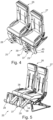
- Figure 1 shows a seat row 1 with a seating direction 2 with two passenger seats 3 and 4.
- position and direction information such as front, back, top and bottom refer to the seat direction 2 and the usable state of seat row 1.
- the passenger seat 3 has a seat base 5, a backrest 6 and an enclosure 7 on the back of the backrest 6. Following a front end region of the seat base 5, there is a preferably foldable or pivotable leg rest 8, which can be folded about a horizontal axis.
- the passenger seat 4 includes a seat base 9, a backrest 10, an enclosure 11 and a leg rest 12.
- the seat bottom 5, 9, the backrests 6, 10 and the leg rests 8, 12 include preferably ergonomically shaped padding.
- the passenger seats 3 and 4 can be mounted on a cabin floor 14 of a flight cabin of an associated aircraft (not shown) via two support legs 13 (only one visible).
- the support leg 13 has a mounting point 17 on a lower end region 15 of a front strut 16 and a further mounting point 18 on a lower end region 19 a rear strut 20.
- a strut element 21 is provided between the end regions 15 and 19.
- the row of seats 1 preferably also has an outer armrest 22 on the side of the passenger seat 3 and an outer armrest 23 on the side of the passenger seat 4. Between the two passenger seats 3 and 4 there is preferably a console 24 at the level of the two outer armrests 22 and 23, which can also be used by a passenger as an armrest.
- the associated backrest 6 or 10 is advantageously arranged in a shell shape of the respective housing 7 or 11.
- the backrest 6 or 10 is preferably movably guided in the housing 7 or 11 for setting different tilting positions, for example together with the associated slidably mounted seat base 5 or 9.
- FIG. 2 to 4 Another row of seats 25 with passenger seats 26, 27 is shown.
- the row of seats 25 corresponds to the row of seats 1, with the passenger seats 26, 27 of the row of seats 25 differing from the passenger seats 3, 4 of the row of seats 1, for example, only in a different design of the leg supports 28, 29 of the passenger seats 26, 27.
- the enclosure as well as the armrests and the console are kept invisible in seat row 25 compared to seat row 1.
- the passenger seats 26, 27 of the seat row 25 each include a leg rest 28, 29, a seat bottom 30, 31, a backrest 32, 33, and support legs 34 (only one support leg shown in the figures).
- the leg rests 28, 29 are advantageously constructed identically, which is why the structure of the leg rests 28, 29 is described below using the leg rest 29 as an example:
- the leg rest 29 advantageously comprises, among other things, a first side cushion 35 and a second side cushion 36, as well as a device 37.
- the device 37 comprises a first housing half 38 and a second housing half 39 (see also Figure 5 ).
- leg rests 28, 29 are shown in different states on the passenger seats 26, 27.
- the leg rests 28, 29 are shown in a folded leg rest state on the passenger seats 26, 27.
- the passenger seats 26, 27 are in an upright usable state.
- the leg rests 28, 29 are shown in an unfolded leg rest state on the passenger seats 26, 27.
- the passenger seats 26, 27 are in a reclining state.
- a user of one of the passenger seats 26, 27 can place or rest his legs on a usable surface 42, 43 of the leg rests 28, 29.
- leg rest 29 is shown in the folded leg rest state on the passenger seat 27 and in Figure 5 the leg rest 29 is in the unfolded leg rest state
- Passenger seat 27 is shown, with the first housing half 38 of the device 37 being in an open position relative to the second housing half 39. It is also shown that a life jacket 45 is arranged in an inner cavity 44 of the device 37.
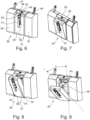
- leg rest 29 of the passenger seat 27 is shown in different perspective views.
- the leg rest 29 is shown, which includes the device 37, with the first housing half 38 and the second housing half 39.
- the leg rest 29 further comprises the cushions 35, 36 and two connecting elements 46, 47, by means of which the leg rest 29 can be pivotably arranged on the remaining passenger seat 27.
- the device 37 on the first housing half 38 comprises a tension element of a closure mechanism 40, for example in the form of a tab 41.
- the first housing half 38 comprises a through opening in the form of a slot 52.
- the tab 41 starts from a rear side of the first housing half 38, which delimits the cavity 44, is passed through the slot 52.
- a sealing device 48 is also present on the device 37.
- the sealing device 48 advantageously has a first eyelet 49 and a second eyelet 50, which are in the closed position of the housing halves 38, 39, as in Figure 6 shown can be connected with a seal (not shown).
- the first eyelet 49 is advantageously attached to the first housing half 38.
- the second is Eyelet 50 attached to the leg rest 29, in particular a basic structure 51 of the leg rest 29 (see also Figures 10, 11 ).
- the device 37 advantageously comprises an information device in the form of a recess 53.
- the recess 53 is formed on an outside 54 of the first housing half 38.
- the recess 53 is set back on the outside 54, in particular in the direction of the cavity 44 or in the direction of the second housing half 39.
- the recess 53 is set back to the usable surface 43 on the first housing half 38.
- the information device has a second through opening in the form of a second slot 55.
- a viewing element 56 of the life jacket 45 can be passed through the second slot 55, so that in the closed position of the first housing half 38 relative to the second housing half 39, the viewing element 56 is present in the recess 53.
- the information device includes a fixing element 57 in order to fix the viewing element 56 in the recess 53.
- the first housing half 38 is present so that it can be pivoted relative to the second housing half 39 by an angular range ⁇ from the closed position to an open position (see also Figure 9 ) and/or vice versa.
- the angle ⁇ is advantageously 0°.
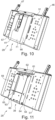
- the leg rest 29 is shown, with the pads 35 and 36 being kept invisible. Also is in Figure 10 the life jacket 45 not shown. In Figure 10 it is shown that the Leg rest 29 has the basic structure 51 to which the connecting members 46, 47 are attached.
- the basic structure 51 is advantageously designed in the form of a plate, for example as a metal plate.
- Figure 11 corresponds to the leg rest.29 Figure 10 , where in Figure 11 the first housing half 38 is kept invisible.
- the basic structure 51 of the leg rest 29, the second housing half 39 being attached to the basic structure 51.
- the second housing half 39 comprises two long side elements 58, 59 and two short side elements 60, 61.
- the side elements 58 to 61 are directly attached to the base structure 51, for example screwed or riveted.
- the basic structure 51 forms a main side element 62 of the second housing half 39.
- two pivot bearing axes 63, 64 are present on the second housing half 39. By means of the pivot bearing axes 63, 64, for example, the first housing half 38 can be pivotally connected to the second housing half 39.
- a pivot bearing axis 63 is formed on a long side element 59 and the other pivot bearing axis 64 on the other long side element 58.
- the second housing half 39 comprises a holding element in the form of a crossbar 65, which extends between the two long side elements 58, 59 and on these is arranged.
- a life jacket arranged on the second housing half 39 is advantageously held on the second housing half 39 and thus prevents the life jacket from accidentally falling out of the device 37.
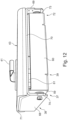
- the device 37 is shown without remaining parts of the leg rest 29.
- the basic structure 51 and thus the main side element 62 is in Figure 12 not shown.
- side cushioning elements 66, 67 of the first housing half 38 are shown in Figure 12 Shown is the second housing half 39 with the short side element 60 and the long side element 59.
- the first housing half 38 is shown, which includes a first long side element 68 and a second long side element 69, as well as a main side element 70.
- the long side elements 68, 69 and the main side element 70 of the first housing half 38 are advantageously present in one piece.
- the cushioning elements 66, 67 (see Figure 10 ) attached.
- a further cushioning element 71 is attached to the main side element 70.
- the device 37 includes a spring device 72, which has spring elements 73 and 74.
- the spring elements 73, 74 are arranged, for example, on the pivot bearing axes 63 and 64, respectively.
- the spring elements 73, 74 are advantageously present between a side element 58 or 59 of the second housing half 39 and a side element 68 or 69 of the first housing half 38.
- the first housing half 38 is pivotally connected to the long side elements 58, 59 of the second housing half 39.
Landscapes
- Engineering & Computer Science (AREA)
- Aviation & Aerospace Engineering (AREA)
- Transportation (AREA)
- Mechanical Engineering (AREA)
- Business, Economics & Management (AREA)
- Emergency Management (AREA)
- Seats For Vehicles (AREA)
- Passenger Equipment (AREA)
Description
- Ein Fluggastsitz mit einer Unterbringungsmöglichkeit für eine Schwimmweste ist bekannt. Bei bekannten Fluggastsitzen ist die Schwimmweste unter einer Sitzfläche des Fluggastsitzes oder unterhalb der Armlehne in einer Schwimmwestenaufnahme untergebracht.
- Nachteilig an diesen bekannten Unterbringungsorten für die Schwimmweste ist, dass bei einer Unterbringung der Schwimmweste unterhalb der Armlehne beispielsweise Stauraum für andere Komponenten des Fluggastsitz, z.B. Multimedia-Komponenten, beschränkt ist oder die Schwimmweste vergleichsweise schwer zugänglich ist. Beispielsweise ist eine Zugänglichkeit der Schwimmweste bei einer Unterbringung der Schwimmweste unter der Sitzfläche des Fluggastsitz bei einem Fluggastsitz mit Beinauflage nicht gegeben.
- Aus der
DE 199 44 619 A1 und aus derWO 2016/184597 A1 sind ein Fluggastsitz mit einer an dem Fluggastsitz angeordneten Unterbringungsmöglichkeit für eine Schwimmweste bekannt. Aus derWO 2015/189721 A2 ist ein Fluggastsitz mit einer Beinabstützung bekannt. Aus derWO 2017/083894 A1 ist eine Einzugsvorrichtung zum Einziehen eines bewegbaren Möbelteils bekannt. - Der Erfindung liegt die Aufgabe zugrunde eine verbesserte Unterbringungsmöglichkeit für eine Schwimmweste an einem Fluggastsitz bereitzustellen. Insbesondere eine Vorrichtung zur Montage am Fluggastsitz bereitzustellen, mittels welcher ein Zugang zu einer Schwimmweste erleichtert ist und vorteilhafterweise Stauraum für weitere Komponenten des Fluggastsitz freigegeben ist.
- Diese Aufgabe wird durch die Merkmale des Anspruchs 1 gelöst.
- In den abhängigen Ansprüchen sind vorteilhafte und zweckmäßige Ausführungsformen der Erfindung angegeben.
- Die Erfindung geht von einer Beinauflage für einen Fluggastsitz aus, wobei die Beinauflage eine Vorrichtung aufweist. Beispielsweise ist die Beinauflage als eine Fluggastsitz-Beinauflage vorhanden.
- Vorteilhafterweise umfasst der Fluggastsitz eine bewegliche Beinauflage, welche aus einer Grundposition in eine Ruheposition schwenkbar ist und umgekehrt. Bevorzugterweise ist die Beinauflage in der Ruheposition derart ausgeschwenkt am Fluggastsitz vorhanden, dass ein Fluggast, welcher den Fluggastsitz nutzt, seine Beine an der Beinauflage auflegen kann.
- Beispielsweise umfasst der Fluggastsitz ein Grundgestell, an welchem ein Sitzboden und eine Rückenlehne des Fluggassitz angeordnet sind. Vorteilhafterweise sind der Sitzboden und die Rückenlehne beweglich zum Grundgestell oder zu Teilen des Grundgestells vorhanden.
- Der Kern der Erfindung ist darin zu sehen, dass die Vorrichtung ein Gehäuse umfasst, wobei das Gehäuse eine erste und eine zweite Gehäusehälfte aufweist, wobei die beiden Gehäusehälften schwenkbeweglich miteinander verbunden sind, wobei das Gehäuse derart ausgebildet ist, dass eine Schwimmweste für einen Fluggast darin verstaubar ist, wobei die Vorrichtung an einer Grundstruktur der Beinauflage angeordnet ist, wobei die Vorrichtung eine Federvorrichtung aufweist, wobei die erste Gehäusehälfte durch eine Federkraft der Federvorrichtung gegenüber der zweiten Gehäusehälfte kraftbeaufschlagt vorhanden ist, sodass die erste Gehäusehälfte aus einer geöffneten Position relativ zur zweiten Gehäusehälfte in Richtung einer geschlossenen Position relativ zur zweiten Gehäusehälfte bewegbar ist.
- Beispielsweise ist die erste Gehäusehälfte durch die Federkraft der Federvorrichtung aus einer geöffneten Position in Richtung der geschlossenen Position relativ zur zweiten Gehäusehälfte bewegbar. Denkbar ist auch, dass die erste Gehäusehälfte entgegen der Federkraft der Federvorrichtung aus der geöffneten Position in Richtung der geschlossenen Position relativ zur zweiten Gehäusehälfte bewegbar vorhanden ist. Beispielsweise ist eine Bewegung der ersten Gehäusehälfte relativ zur zweiten Gehäusehälfte aus einer geöffneten Position in Richtung der geschlossenen Position eine Schließbewegung in Schließrichtung. Zum Beispiel ist eine Bewegung der ersten Gehäusehälfte relativ zur zweiten Gehäusehälfte aus der geschlossenen Position in Richtung einer geöffneten Position eine Öffnungsbewegung in Öffnungsrichtung.
- Beispielsweise umfasst der Fluggastsitz eine am Grundgestell oder eine an einem Teil des Grundgestells beweglich angeordnete Beinauflage. Vorteilhafterweise ist die Grundstruktur der Beinauflage als ein Rahmen oder als eine Stützstruktur der Beinauflage ausgebildet. Zum Beispiel ist an der Grundstruktur der Beinauflage ein Polster bzw. eine Polsterung der Beinauflage anordenbar. Vorteilhafterweise stützt die Grundstruktur das Polster gegen eine Kraft oder eine Belastung eines Fluggastsitz-Nutzers ab. Bevorzugterweise ist die Beinauflage, insbesondere ausschließlich über die Grundstruktur, mit dem verbleibenden Fluggastsitz, insbesondere mit dem Grundgestell, beweglich verbunden.
- Vorteilhafterweise ist die Schwimmweste als eine Flugzeug-Schwimmweste ausgebildet, insbesondere als eine Fluggastsitz-Schwimmweste. Beispielsweise umfasst die zweite Gehäusehälfte eine Haltevorrichtung, um die Schwimmweste im angeordneten Zustand an der zweiten Gehäusehälfte festzulegen. Zum Beispiel ist die Schwimmweste an der zweiten Gehäusehälfte durch die Haltevorrichtung an die zweiten Gehäusehälfte einhängbar oder einschiebbar.
- Bevorzugterweise ist eine Nutzfläche des Fluggastsitzes die Fläche des Fluggastsitzes, welche ein Nutzeroder Fluggast des Fluggastsitzes bei üblichem Gebrauch berührt, z.B. auf welcher er sitzt oder an welche er sich bzw. ein Körperteil anlehnt, z.B. an welche er seine Beine anlegt oder auflegt.
- Vorteilhaferweise sind die Gehäusehälften fest, stabil und/oder starr ausgebildet. Beispielsweise sind die Gehäusehälften aus Metall und/oder einem stabilen Kunststoff ausgebildet. Zum Beispiel sind die Gehäusehälften ausschließlich aus Metall und/oder einem stabilen Kunststoff ausgebildet.
- Beispielsweise ist ein Polster und/oder ein Sitzbezug, z.B. ein Teil einer Polsterung, an der ersten Gehäusehälfte anordenbar. Beispielsweise ist der Sitzbezug und/oder das Polster mittels eines Haken- und Ösenbands, eines sogenannten Klettbands anklettbar vorhanden. Denkbar ist auch, dass der Sitzbezug und/oder das Polster an der ersten Gehäusehälfte anklebbar oder anklemmbar vorhanden ist. Vorteilhafterweise ist der Sitzbezug und/oder das Polster lösbar an der ersten Gehäusehälfte anordenbar. Vorstellbar ist auch, dass die erste Gehäusehälfte, insbesondere die Vorrichtung, unmittelbar einen Sitzbezug und/oder ein Polster aufweist oder bildet.
- Vorteilhafterweise ist die Vorrichtung an Stelle eines Polsters der Beinauflage an die Beinauflage angeordnet. Beispielsweise ist die Vorrichtung neben einem Polster und/oder zwischen Polstern der Beinauflage an der Beinauflage angeordnet. Vorteilhafterweise umfasst die Beinauflage zusätzlich zur Vorrichtung und beispielsweise zusätzlich zur an der Vorrichtung angeordneten Polsterelementen des Polsters weitere Polsterelemente. Vorteilhafterweise bilden die weiteren Polsterelemente zusammen mit den an der Vorrichtung vorhandenen Polsterelementen ein Polster oder eine Polsterung der Beinauflage.
- Vorteilhafterweise existiert eine einzige geschlossene Position der beiden Gehäusehälften relativ zueinander. Beispielsweise sind die beiden Gehäusehälften in der geschlossenen Position um eine Schwenkachse, in eine Schließrichtung, maximal aufeinander zugeschwenkt oder zugedreht vorhanden. Denkbar ist auch, dass eine erste geschlossene Position existiert, in welcher die beiden Gehäusehälften aufeinander zubewegt vorhanden und mittels einer Verschlussmechanik in der ersten geschlossenen Position relativ zueinander festlegbar sind. Vorstellbar ist weiterhin, dass eine zweite geschlossene Position existiert, wobei die erste Gehäusehälfte aus der ersten geschlossenen Position in Schließrichtung in die zweite geschlossene Position schwenkbar ist. Hierdurch ist beispielsweise ein Touch-Latch-Mechanismus zum Öffnen des Gehäuses realisierbar.
- Bevorzugterweise existieren eine Vielzahl von geöffneten Positionen der beiden Gehäusehälften zueinander. Insbesondere existiert eine einzige geöffnete Position, die maximal geöffnete Position, in welcher diebeiden Gehäusehälften maximal voneinander weggeschwenkt vorhanden sind. Beispielsweise umfasst die Vorrichtung ein Anschlagsorgan, an welchem eine der beiden Gehäusehälften, insbesondere die erste Gehäusehälfte in der maximal geöffneten Position ansteht.
- Außerdem wird vorgeschlagen, dass die beiden Gehäusehälften unlösbar miteinander verbunden sind. Hierdurch ist im Notfall, wenn ein Nutzer auf die Schwimmweste zugreifen muss, eine Öffnung der Vorrichtung zuverlässig und sicher realisierbar. Ebenfalls ist hierdurch eine vergleichsweise sichere Unterbringung der Schwimmweste in der Vorrichtung realisierbar, bei welcher die Schwimmweste, z.B. gegenüber unerlaubtem Zugriff, vergleichsweise sicher geschützt ist.
- Von Vorteil erweist sich auch, dass die Federvorrichtung zwei Federelemente aufweist. Hierdurch ist eine Redundanz der Federvorrichtung realisierbar. Außerdem ist dadurch ein Verkanten der Gehäusehälften bei einer Bewegung der Gehäusehälften relativ zueinander vermieden.
- Vorteilhafterweise umfasst die Federvorrichtung genau zwei Federelemente. Beispielsweise ist ein Federelement als eine Feder, z.B. als Schenkelfeder oder als eine Schraubenfeder, ausgebildet. Vorteilhafterweise sind die Federelemente der Federvorrichtung voneinander beabstandet an der Vorrichtung vorhanden.
- Von Vorteil erweist sich außerdem, dass jede Gehäusehälfte ein Hauptseitenelement aufweist, wobei an jedem der Hauptseitenelemente quer dazu abstehende Seitenelemente vorhanden sind, wobei zwei Seitenelemente eines Hauptseitenelements voneinander beabstandet und gegenüberliegend ausgebildet sind, wobei ein Abstand von den zwei beabstandeten und gegenüberliegenden Seitenelementen der ersten Gehäusehälfte größer ist, als ein Abstand von den zwei beabstandeten und gegenüberliegenden Seitenelementen der zweiten Gehäusehälfte, sodass in der geschlossenen Position der ersten Gehäusehälfte, die Seitenelemente der ersten und der zweiten Gehäusehälfte überlappend vorhanden sind. Hierdurch ist in der geschlossenen Position des Gehäuses die Schwimmweste vorteilhafterweise unzugänglich im Inneren des Gehäuses anordenbar. Beispielsweise ist das Gehäuse hierdurch vergleichsweise stabil ausgebildet, sodass in der geschlossenen Position des Gehäuses kein Gegenstand in das Gehäuse einbringbar ist. Bevorzugterweise umschließen die beiden Gehäusehälften in der geschlossenen Position das Innere des Gehäuses. Vorteilhafterweise bilden die beiden Gehäusehälften in der geschlossenen Position im Inneren einen Hohlraum. Vorteilhafterweise ist im Hohlraum des Gehäuses die Schwimmweste unterbringbar. Beispielsweise umschließen die Hauptseitenelemente und die Seitenelemente der Gehäusehälften in der geschlossenen Position das Innere, insbesondere den Hohlraum. Vorteilhafterweise umschließen die Hauptseitenelemente und die Seitenelemente der Gehäusehälften in der geschlossenen Position das Innere, insbesondere den Hohlraum, vollständig.
- Vorteilhafterweise sind an jeder Gehäusehälfte vier Seitenelemente vorhanden. Beispielsweise sind die Seitenelemente rechteckförmig angeordnet. Vorteilhafterweise sind jeweils zwei Seitenelemente einer Gehäusehälfte beispielsweise unmittelbar miteinander verbunden. Vorteilhafterweise ist jede Gehäusehälfte in Form einer Halbschale oder halbschalenförmig vorhanden.
- Bevorzugterweise ist das Hauptseitenelement der zweiten Gehäusehälfte insbesondere unmittelbar anliegend an der Grundstruktur der Beinauflage vorhanden. Vorstellbar ist auch, dass die Grundstruktur der Beinauflage das Hauptseitenelement der zweiten Gehäusehälfte bildet. Beispielsweise ist die zweite Gehäusehälfte, insbesondere das Hauptseitenelement der zweiten Gehäusehälfte, mit der Grundstruktur vernietet, verschweißt, verlötet oder verklebt.
- Bevorzugterweise sind die erste Gehäusehälfte und die zweite Gehäusehälfte mittels eines Schwenklagers miteinander verbunden. Beispielsweise ist ein Seitenelement der ersten Gehäusehälfte mit einem Seitenelement der zweiten Gehäusehälfte mittels des Schwenklagers verbunden. Denkbar ist, dass das Schwenklager eine einzige Schwenklagerachse aufweist, welche sich von einem Seitenelement der ersten Gehäusehälfte zu einem dem Seitenelement gegenüberliegendes und beabstandetes, weiteres Seitenelement der ersten Gehäusehälfte erstreckt.
- Vorteilhafterweise sind zwei Schwenklager vorhanden, wobei jedes Schwenklager eine Schwenklagerachse umfasst, wobei die beiden Schwenklagerachsen eine gemeinsame Schwenkachse bilden. Beispielsweise sind die zwei Schwenklager voneinander beabstandet vorhanden. Bevorzugterweise verbindet ein erstes Schwenklager der beiden Schwenklager ein erstes Seitenelement der ersten Gehäusehälfte mit einem ersten Seitenelement der zweiten Gehäusehälfte und ein zweites Schwenklager der beiden Schwenklager ein zweites Seitenelement der ersten Gehäusehälfte mit einem zweiten Seitenelement der zweiten Gehäusehälfte. Beispielsweise sind die ersten und zweiten Seitenelemente der ersten und zweiten Gehäusehälften jeweils gegenüberliegend und beabstandet zueinander vorhanden.
- Vorteilhafterweise ist die Federvorrichtung im Bereich des Schwenklagers vorhanden. Denkbar ist, dass die Federvorrichtung am Schwenklager ausgebildet ist. Beispielsweise umschließt ein Federelement die Schwenklagerachse des Schwenklagers. Vorstellbar ist weiterhin, dass das Federelement sich mit einem ersten Ende an der ersten Gehäusehälfte und mit einem zweiten Ende z.B. an der zweiten Gehäusehälfte abstützt, sodass die beiden Gehäusehälften in zumindest einer Relativposition zueinander durch eine Federkraft des Federelements kraftbeaufschlagt vorhanden sind. Denkbar ist auch, dass zusätzlich oder statt der Abstützung an der zweiten Gehäusehälfte das Federelement sich mit seinem zweiten Ende an der Grundstruktur abstützt. Beispielsweise stützt sich das Federelement mit dem ersten Ende am Hauptseitenelement und/oder an einem Seitenelement der ersten Gehäusehälfte und mit dem zweiten Ende am Hauptseitenelement der zweiten Gehäusehälfte und/oder an einem Seitenelement der zweiten Gehäusehälfte und/oder an der Grundstruktur der Beinauflage ab.
- Vorteilhafterweise ist das Federelement mit seinem ersten Ende mit dem Hauptseitenelement und/oder mit einem Seitenelement der ersten Gehäusehälfte positionsfest verbunden. Zum Beispiel ist das Federelement mit seinem zweiten Ende mit dem Hauptseitenelement der zweiten Gehäusehälfte und/oder mit dem Seitenelement der zweiten Gehäusehälfte und/oder mit der Grundstruktur der Beinauflage positionsfest verbunden. Beispielsweise ist ein Ende des Federelements an einem der vorangegangenen Elemente der Vorrichtung eingehängt und/oder angeklemmt und/oder angeschweißt und/oder angeklebt vorhanden.
- Weiter erweist es sich von Vorteil, dass die Vorrichtung eine Verschlussmechanik aufweist, wobei die Verschlussmechanik die beiden Gehäusehälften in der geschlossenen Position zueinander festlegt, wobei die Verschlussmechanik ein Zugelement umfasst, wobei die Verschlussmechanik derart ausgebildet ist, dass durch Ziehen am Zugelement Teile der Verschlussmechanik derart bewegt werden, dass die Gehäusehälften im Bereich der Verschlussmechanik voneinander gelöst sind. Durch Ziehen am Zugelement ist ein Bewegen der ersten Gehäusehälfte relativ zur zweiten Gehäusehälfte vom geschlossenen Zustand in einen geöffneten Zustand freigegeben.
- Beispielsweise ist das Zugelement flexibel vorhanden. Denkbar ist, dass das Zugelement als eine Leine oder als ein Band vorhanden ist. Z.B. ist das Zugelement als ein Stoffband oder als ein Kunststoffband ausgebildet. Beispielsweise ist das Zugelement durch eine Durchgangsöffnung des Hauptseitenelements der ersten Gehäusehälfte durchgeführt vorhanden.
- Außerdem erweist es sich von Vorteil, dass das Hauptseitenelement der zweiten Gehäusehälfte ein integraler Bestandteil der Grundstruktur der Beinauflage ist. Hierdurch ist eine Herstellung und/oder Montage der Beinauflage vereinfacht. Vorteilhafterweise ist die Vorrichtung unmittelbar an der Grundstruktur der Beinauflage angeordnet. Beispielsweise ist die Vorrichtung oder sind Teile der Vorrichtung integraler Bestandteil der Grundstruktur der Beinauflage.
- Vorteilhafterweise sind die Seitenelemente der zweiten Gehäusehälfte im angeordneten Zustand der Vorrichtung insbesondere unmittelbar an die Grundstruktur der Beinauflage angeordnet. Beispielsweise sind die Seitenelemente der zweiten Gehäusehälfte unlösbar mit der Grundstruktur verbunden, z.B. integral mit der Grundstruktur vorhanden. Denkbar ist auch, dass die Seitenelemente der zweiten Gehäusehälfte an die Grundstruktur angeklebt, angeschraubt und/oder angenietet vorhanden sind. Beispielsweise ist die zweite Gehäusehälfte insbesondere unlösbar mit der Grundstruktur der Beinauflage verbunden.
- Eine vorteilhafte Modifikation der Beinauflage ist, dass in der geschlossenen Position der ersten Gehäusehälfte die Federkraft der Federvorrichtung die erste Gehäusehälfte in Richtung einer geöffneten Position der ersten Gehäusehälfte relativ zur zweiten Gehäusehälfte drängt. Hierdurch ist eine automatische Öffnungsbewegung des Gehäuses realisiert.
- Beispielsweise drängt die Federvorrichtung mit ihrer Federkraft die erste Gehäusehälfte aus der geschlossenen Position relativ zur zweiten Gehäusehälfte um einen Schwenkbereich zwischen 5° und 25° in eine, insbesondere erste, geöffnete Position relativ zur zweiten Gehäusehälfte, z.B. bei gelöster Verschlussmechanik.
- Eine weitere denkbare Ausführungsform der Beinauflage ist, dass in der geschlossenen Position der ersten Gehäusehälfte relativ zur zweiten Gehäusehälfte die Federkraft der Federvorrichtung die erste Gehäusehälfte in Richtung der geschlossenen Position der ersten Gehäusehälfte relativ zur zweiten Gehäusehälfte drängt, sodass die Federkraft der Federvorrichtung einer Bewegungskraft, um die erste Gehäusehälfte von der geschlossenen Position in eine geöffnete Position relativ zur zweiten Gehäusehälfte zu bewegen, entgegenwirkt. Hierdurch ist die Vorrichtung derart ausgebildet, dass die beiden Gehäusehälften vorteilhafterweise in der geschlossenen Position gehalten sind oder insbesondere automatisch, mittels der Federkraft, in die geschlossene Position bewegt werden. Vorteilhafterweise ist hierdurch ein Bewegungsbereich im Bereich der Beinauflage freigehalten, insbesondere im Evakuierungsfall. Beispielsweise ist durch eine derartige Ausbildung der Beinauflage eine Stolperfalle, aufgrund der ersten Gehäusehälfte in der geöffneten Position relativ zur zweiten Gehäusehälfte, vergleichsweise vermindert.
- Vorteilhafterweise ist die Vorrichtung derart ausgebildet, dass bei gelöster Verschlussmechanik die erste Gehäusehälfte aus der geschlossenen Position durch eine Kraft eines Benutzer in eine geöffnete Position relativ zur zweiten Gehäusehälfte bewegbar ist. Beispielsweise ist die erste Gehäusehälfte aus der geschlossenen Position durch eine Kraft eines Benutzer entgegen der Federkraft der Federvorrichtung in eine geöffnete Position relativ zur zweiten Gehäusehälfte bewegbar.
- Ebenfalls erweist es sich von Vorteil, dass in einer geöffneten Position der ersten Gehäusehälfte die Federkraft der Federvorrichtung die erste Gehäusehälfte in Richtung der geschlossenen Position der ersten Gehäusehälfte relativ zur zweiten Gehäusehälfte drängt. Bevorzugterweise drängt in jeder geöffneten Position der ersten Gehäusehälfte die Federkraft der Federvorrichtung die erste Gehäusehälfte in Richtung der geschlossenen Position. Vorteilhafterweise ist die Federvorrichtung derart vorhanden, dass die Federvorrichtung aufgrund ihrer Federkraft die erste Gehäusehälfte aus einer geöffneten Position, insbesondere aus jeder geöffneten Position, in die geschlossene Position bewegt.
- Weiter wird vorgeschlagen, dass die Federkraft der Federvorrichtung die erste Gehäusehälfte aus einer zweiten geöffneten Position relativ zur zweiten Gehäusehälfte in Richtung der geschlossenen Position der ersten Gehäusehälfte in eine erste geöffnete Position drängt. Hierdurch ist bei gelöster Verschlussmechanik ein Zugriff eines Nutzers auf einen Gegenstand im Inneren des Gehäuses realisiert, bei gleichzeitiger Verminderung einer Stolperfalle.
- Vorteilhafterweise ist ein Öffnungsbereich definierbar, welcher ausgehend von der geschlossenen Position einen Schwenkzustand der ersten Gehäusehälfte relativ zur zweiten Gehäusehälfte in Öffnungsrichtung definiert. In der geschlossenen Position ist der Öffnungsbereich vorteilhafterweise 0° und nimmt in Öffnungsrichtung einen positiven Wert an. Beispielsweise ist die erste Gehäusehälfte relativ zur zweiten Gehäusehälfte ausgehend von der geschlossenen Position in Öffnungsrichtung um einen Öffnungsbereich oder um einen Winkelbereich von bis zu 45° oder 50° schwenkbar, z.B. bis zu der maximal geöffneten Position. Vorstellbar ist, dass die erste oder die zweite geöffnete Position als ein Bereich ausgebildet ist, in welchen die erste Gehäusehälfte relativ zur zweiten Gehäusehälfte schwenkbar ist.
- Bevorzugterweise ist die erste Gehäusehälfte in der ersten geöffnete Position in einem Öffnungsbereich von 15° bis 30° aus der geschlossenen Position relativ zur zweiten Gehäusehälfte weggeschwenkt vorhanden. Denkbar ist, dass die erste Gehäusehälfte in der ersten geöffneten Position in einem Öffnungsbereich von 15° bis 25°, in einem Öffnungsbereich von 15° bis 20° oder in einem Öffnungsbereich von 20° bis 25° aus der geschlossenen Position relativ zur zweiten Gehäusehälfte weggeschwenkt vorhanden ist. Beispielsweise ist die erste Gehäusehälfte in der ersten geöffneten Position um einen Winkelbereich von 15°, 20°, 25° oder 30° relativ zur zweiten Gehäusehälfte von der geschlossenen Position weggeschwenkt vorhanden.
- Vorteilhafterweise ist die erste Gehäusehälfte in der zweiten geöffneten Position in einem Öffnungsbereich von 30° bis 50° aus der geschlossenen Position relativ zur zweiten Gehäusehälfte weggeschwenkt vorhanden. Denkbar ist, dass die erste Gehäusehälfte in der zweiten geöffneten Position in einem Öffnungsbereich von 30° bis 45°, in einem Öffnungsbereich von 30° bis 40°, in einem Öffnungsbereich von 35° bis 45° oder in einem Öffnungsbereich von 35° bis 40° aus der geschlossenen Position relativ zur zweiten Gehäusehälfte weggeschwenkt vorhanden ist. Beispielsweise ist die erste Gehäusehälfte in der zweiten geöffneten Position um einen Winkelbereich von 30°, 35°, 40°, 45° oder 50° relativ zur zweiten Gehäusehälfte von der geschlossenen Position weggeschwenkt vorhanden.
- Vorteilhafterweise umfasst die Vorrichtung, insbesondere die zweite Gehäusehälfte und/oder die Grundstruktur ein Anschlagsorgan, an welchem die erste Gehäusehälfte mit einem Anschlagselement der ersten Gehäusehälfte in einer geöffneten Position ansteht. Vorteilhafterweise weist die erste Gehäusehälfte im angeschlagenen oder anstehenden Zustand die maximal geöffneten Position relativ zur zweiten Gehäusehälfte auf. Beispielsweise definiert das Anschlagsorgan und/oder das Anschlagselement die maximal geöffnete Position.
- Von Vorteil erweist sich auch, dass die Federvorrichtung derart ausgebildet ist, dass die erste Gehäusehälfte aus einer geöffneten Position, insbesondere aus der maximal geöffneten Position, mittels der Federkraft in Richtung der geschlossenen Position bewegbar ist, wobei die Federvorrichtung derart vorhanden ist, dass die erste Gehäusehälfte aufgrund der Federkraft der Federvorrichtung die geschlossene Position nicht erreicht und/oder die erste Gehäusehälfte mittels der Federkraft der Federvorrichtung aus einer geöffneten Position nicht in die geschlossene Position bewegbar ist.
- In einer vorteilhaften Ausführungsform der Beinauflage ist die Federvorrichtung derart ausgebildet und an der Vorrichtung angeordnet, dass die Federvorrichtung die erste Gehäusehälfte aus der geschlossenen Position relativ zur zweiten Gehäusehälfte aufgrund der Federkraft der Federvorrichtung in Öffnungsrichtung in eine geöffnete Position, z.B. in die erste geöffnete Position, bewegt und wobei die Federvorrichtung die erste Gehäusehälfte aus der zweiten geöffneten Position relativ zur zweiten Gehäusehälfte aufgrund der Federkraft der Federvorrichtung in Schließrichtung in eine weitere geöffnete Position, z.B. in die erste geöffnete Position, bewegt. Denkbar ist, dass die erste Gehäusehälfte sowohl in der geschlossenen Position als auch in der zweiten geöffneten Position durch die Federkraft der Federvorrichtung kraftbeaufschlagt vorhanden ist. Vorstellbar ist weiterhin, dass in der ersten geöffneten Position keine Federkraft der Federvorrichtung auf die erste Gehäusehälfte wirkt.
- Vorstellbar ist aber auch, dass die Federvorrichtung derart ausgebildet ist, dass die erste Gehäusehälfte aus einer geöffneten Position, z.B. aus der maximal geöffneten Position, mittels der Federkraft in Schließrichtung vollständig in die geschlossene Position bewegbar ist.
- Bevorzugterweise umfasst die erste Gehäusehälfte eine Durchgangsöffnung, sodass ein Sichtelement von einem Inneren des Gehäuses durch die Durchgangsöffnung nach außen bringbar ist. Hierdurch ist das Sichtelement für einen Betrachter von außen, ohne Öffnen des Gehäuse sichtbar vorhanden. Vorteilhafterweise umfasst die Vorrichtung ein Fixierungsorgan, um das Sichtelement im durchgeführten Zustand an der Durchgangsöffnung am Gehäuse festzulegen. Die Durchgangsöffnung ist beispielsweise als ein Schlitz ausgebildet. Vorstellbar ist auch, dass durch die Durchgangsöffnung ein Auslöseband einer Verschlussmechanik des Gehäuses nach außen bringbar ist.
- Vorteilhafterweise umfasst das Sichtelement eine Information. Beispielsweise ist die Information als eine Farbmarkierung, z.B. als eine Farbe ausgebildet, welche das Sichtelement aufweist. Denkbar ist jedoch auch, dass das Sichtelement eine Information in Form eines Aufdrucks und/oder eines Aufklebers aufweist. Die Information umfasst beispielsweise ein Datum, z.B. ein Datum auf dem Aufdruck und/oder auf dem Aufkleber. Vorstellbar ist weiter, dass die Information in Form eines Strichcodes und/oder eines Barcodes vorhanden ist.
- Bevorzugterweise ist das Sichtelement Bestandteil eines im Inneren der Vorrichtung oder im Inneren des Gehäuses unterbringbaren Gegenstands, z.B. der Schwimmweste. Vorteilhafterweise ist das Sichtelement unlösbar mit dem Gegenstand, z.B. der Schwimmweste, und/oder einer Verpackung des Gegenstands verbunden. Beispielsweise ist das Sichtelement als ein Etikett ausgebildet.
- Beispielsweise weist die Vorrichtung eine Informationseinrichtung auf, wobei an die Informationseinrichtung eine Information über das im Inneren des Gehäuses der Vorrichtung Befindliche anbringbar ist. Die Information ist beispielsweise ein Mindesthaltbarkeitsdatum. Die Information ist beispielsweise als eine Farbmarkierung an der Informationseinrichtung vorhanden. Beispielsweise ist die Informationseinrichtung als ein Sichtfenster ausgebildet. Vorstellbar ist, dass das Sichtelement die Information umfasst.
- Von Vorteil ist auch, dass die Vorrichtung eine Siegeleinrichtung aufweist, sodass an die Vorrichtung ein Siegel anbringbar ist. Vorteilhafterweise ist in der geschlossenen Position des Gehäuses das Siegel an die Vorrichtung anbringbar. Beispielsweise ist das Gehäuse in einer Weise ausgebildet, dass im angeordneten Zustand des Siegels, durch Bewegen der beiden Gehäusehälften relativ zueinander aus der geschlossenen Position in eine geöffneten Position das Siegel zerstört wird oder das Siegel ein Öffnen des Gehäuses verhindert. Vorteilhafterweise umfasst die Siegeleinrichtung zwei Sicherungselemente, welche durch das Siegel in der geschlossenen Position des Gehäuses miteinander verbindbar sind. Ein Sicherungselement umfasst beispielsweise eine Öse. Beispielsweise sind die Sicherungselemente fahnenartig abstehend am Gehäuse oder an der Beinauflage anordenbar. Beispielsweise ist ein erstes der Sicherungselemente insbesondere unmittelbar an die erste Gehäusehälfte insbesondere unlösbar angeordnet, z.B. angeklebt, angeschraubt und/oder angenietet. Von Vorteil erweist sich auch, dass ein zweites Sicherungselement der Siegeleinrichtung an die Grundstruktur der Beinauflage z.B. unlösbar angeordnet ist. Beispielsweise ist das zweite Sicherungselement an die Grundststruktur angeklebt, angeschraubt und/oder angenietet. Zum Beispiel ist das zweite Sicherungselment unmittelbar an die Grundstruktur angeordnet.
- Eine vorteilhafte Ausführungsform der Erfindung ist ein Fluggastsitz mit einer Beinauflage nach einem der vorangegangen genannten Varianten. Vorteilhafterweise ist die Beinauflage schwenkbeweglich am Fluggastsitz vorhanden.
- Eine weitere vorteilhafte Modifikation der Erfindung ist eine Sitzreihe mit mindestens zwei Fluggastsitzen wie vorangegangen genannt.
- Eine weitere vorteilhafte Ausführungsform der Erfindung ist ein Flugzeug mit einem Fluggastsitz oder mit einer Sitzreihe oder mit einer Beinauflage nach einem der vorangegangen genannten Varianten.
- Ein Ausführungsbeispiel wird anhand der nachstehenden schematischen Zeichnungen unter Angabe von weiteren Einzelheiten und Vorteilen näher erläutert.
- Es zeigen:
- Figur 1
- in einer perspektivischen Ansicht von schräg vorne oben eine Sitzreihe mit zwei Fluggastsitzen jeweils umfassend einen Sitzboden, eine Rückenlehne samt rückseitiger Umhausung und eine Beinauflage,
- Figuren 2 bis 5
- in unterschiedlichen perspektivischen Ansichten von schräg vorne oben eine weitere Sitzreihe mit zwei Fluggastsitzen mit einer erfindungsgemäßen Beinauflage in verschiedenen Beinauflagepositionen,
- Figuren 6 bis 9
- in unterschiedlichen perspektivischen Ansichten von schräg vorne eine Beinauflage, wobei eine erste Gehäusehälfte einer Vorrichtung der Beinauflage sich in verschiedenen Zuständen relativ zu einer zweiten Gehäusehälfte befindet,
- Figur 10
- eine perspektivische Ansicht von schräg vorne auf die Beinauflage gemäß
Figur 6 , wobei seitliche Polster der Beinauflage unsichtbar gehalten sind, - Figur 11
- eine perspektivische Ansicht von schräg vorne auf die Beinauflage gemäß
Figur 10 , wobei zusätzlich die erste Gehäusehälfte mit Polster unsichtbar gehalten ist und - Figur 12
- eine perspektivische Ansicht von schräg seitlich unten auf die Vorrichtung der Beinauflage gemäß
Figur 10 , wobei die Grundstruktur der Beinauflage und seitliche Polsterungen der Vorrichtung unsichtbar gehalten sind. -
Figur 1 zeigt eine Sitzreihe 1 mit einer Sitzrichtung 2 mit zwei Fluggastsitzen 3 und 4. Nachfolgend beziehen sich Positions- und Richtungsangaben wie vorne, hinten, oben und unten auf die Sitzrichtung 2 und den Nutzzustand der Sitzreihe 1. - Beide Fluggastsitze 3 und 4 sind entsprechend aufgebaut. Der Fluggastsitz 3 weist einen Sitzboden 5, eine Rückenlehne 6 und eine zur Rückenlehne 6 rückseitige Umhausung 7 auf. Im Anschluss an einen vorne liegenden Endbereich des Sitzbodens 5 ist eine vorzugsweise klappbare oder schwenkbare Beinauflage 8 vorhanden, die um eine horizontale Achse klappbar ist.
- Dementsprechend umfasst der Fluggastsitz 4 einen Sitzboden 9, eine Rückenlehne 10, eine Umhausung 11 und eine Beinauflage 12.
- Die Sitzboden 5, 9, die Rückenlehnen 6, 10 und die Beinauflagen 8, 12 umfassen eine vorzugsweise ergonomisch geformte Polsterung.
- Beispielsweise sind die Fluggastsitze 3 und 4 über zwei Stützbeine 13 (nur einer sichtbar) an einem Kabinenboden 14 einer Flugkabine eines dazugehörigen Flugzeuges (nicht gezeigt) montierbar. Das Stützbein 13 weist hierfür an einem unteren Endbereich 15 einer vorderen Strebe 16 eine Montagestelle 17 und eine weitere Montagestelle 18 an einem unteren Endbereich 19 einer hinteren Strebe 20 auf. Zwischen den Endbereichen 15 und 19 ist ein Verstrebungselement 21 vorgesehen.
- Bevorzugterweise weist die Sitzreihe 1 zudem eine äußere Armlehne 22 seitlich am Fluggastsitz 3 und eine äußere Armlehne 23 seitlich am Fluggastsitz 4 auf. Zwischen den beiden Fluggastsitzen 3 und 4 ist vorzugsweise auf Höhe der beiden äußeren Armlehnen 22 und 23 eine Konsole 24 vorhanden, welche von einem Fluggast ebenfalls als Armauflage genutzt werden kann.
- Vorteilhafterweise ist in einer Schalenform der jeweiligen Umhausung 7 bzw. 11 die jeweils dazugehörige Rückenlehne 6 bzw. 10 angeordnet. Die Rückenlehne 6 bzw. 10 ist vorzugsweise zur Einstellung von unterschiedlichen Kippstellungen beweglich in der Umhausung 7 bzw. 11 geführt, beispielsweise zusammen mit dem dazugehörigen verschiebbar gelagerten Sitzboden 5 bzw. 9.
- Bevorzugterweise umfassen die in der
Figur 1 gezeigten Fluggastsitze 3, 4 die in den folgendenFiguren 2 bis 12 gezeigten und untenstehend beschriebenen Beinauflagen mit Vorrichtung. - In den
Figuren 2 bis 4 ist eine weitere Sitzreihe 25 mit Fluggastsitzen 26, 27 gezeigt. Vorteilhafterweise entspricht die Sitzreihe 25 der Sitzreihe 1, wobei die Fluggastsitze 26, 27 der Sitzreihe 25 sich beispielsweise ausschließlich in einer unterschiedlichen Ausgestaltung der Beinauflagen 28, 29 der Fluggastsitze 26, 27 von den Fluggastsitzen 3, 4 der Sitzreihe 1 unterscheiden. Beispielsweise ist in denFiguren 2 bis 4 entsprechend bei der Sitzreihe 25 gegenüber der Sitzreihe 1 die Umhausung sowie die Armlehnen und die Konsole unsichtbar gehalten. - Vorteilhafterweise umfassen die Fluggastsitze 26, 27 der Sitzreihe 25 jeweils eine Beinauflagen 28, 29, einen Sitzboden 30, 31, eine Rückenlehne 32, 33, sowie Stützbeine 34 (nur eine Stützbein in den Figuren gezeigt).
- Vorteilhafterweise sind die Beinauflagen 28, 29 identisch aufgebaut, weshalb der Aufbau der Beinauflagen 28, 29 im Folgenden exemplarisch an der Beinauflage 29 beschrieben wird:
Die Beinauflage 29 umfasst vorteilhafterweise unter anderem ein erstes seitliches Polster 35 und ein zweites seitliches Polster 36, sowie eine Vorrichtung 37. Die Vorrichtung 37 umfasst eine erste Gehäusehälfte 38 und eine zweite Gehäusehälfte 39 (siehe auchFigur 5 ). - In den
Figuren 2 bis 5 sind die Beinauflagen 28, 29 in unterschiedlichen Zuständen an den Fluggastsitzen 26, 27 gezeigt. InFigur 2 sind die Beinauflagen 28, 29 in einem eingeklappten Beinauflagezustand an den Fluggastsitzen 26, 27 gezeigt. Im eingeklappten Beinauflagezustand der Beinauflagen 28, 29 befinden sich die Fluggastsitze 26, 27 in einem aufrechten Nutzzustand. InFigur 3 sind die Beinauflagen 28, 29 in einem ausgeklappten Beinauflagezustand an den Fluggastsitzen 26, 27 gezeigt. Im ausgeklappten Beinauflagezustand der Beinauflagen 28, 29 befinden sich die Fluggastsitze 26, 27 in einem Liegezustand. Im Liegezustand kann ein Nutzer einer der Fluggastsitze 26, 27 seine Beine auf eine Nutzfläche 42, 43 der Beinauflagen 28, 29 auflegen oder anlegen. - In
Figur 4 ist die Beinauflage 29 im eingeklappten Beinauflagezustand am Fluggastsitz 27 dargestellt und inFigur 5 ist die Beinauflage 29 im ausklappten Beinauflagezustand am Fluggastsitz 27 dargestellt, wobei jeweils die erste Gehäusehälfte 38 der Vorrichtung 37 in eine geöffnete Position relativ zur zweiten Gehäusehälfte 39 vorhanden ist. Gezeigt ist außerdem, dass in einem inneren Hohlraum 44 der Vorrichtung 37 eine Schwimmweste 45 angeordnet ist. - In den
Figuren 6 bis 9 ist die Beinauflage 29 des Fluggastsitz 27 in unterschiedlichen perspektivischen Ansichten gezeigt. - In
Figur 6 ist die Beinauflage 29 gezeigt, welche die Vorrichtung 37, mit der ersten Gehäusehälfte 38 und der zweiten Gehäusehälfte 39 umfasst. Weiter umfasst die Beinauflage 29 die Polster 35, 36 sowie zwei Anbindungsorgane 46, 47, mittels welchen die Beinauflage 29 schwenkbeweglich am verbleibenden Fluggastsitz 27 anordenbar ist. Vorteilhafterweise umfasst die Vorrichtung 37 an der ersten Gehäusehälfte 38 ein Zugelement einer Verschlussmechanik 40, beispielsweise in Form einer Lasche 41. Beispielsweise umfasst die erste Gehäusehälfte.38 eine Durchgangsöffnung in Form eines Schlitz 52. Vorteilhafterweise ist die Lasche 41 ausgehend von einer Rückseite der ersten Gehäusehälfte 38, welche den Hohlraum 44 begrenzt, durch den Schlitz 52 hindurchgeführt vorhanden. Hierdurch kann ein Nutzer durch ziehen an der Lasche 41 die Verschlussmechanik 40 auslösen, insbesondere öffnen. - Bevorzugterweise ist an der Vorrichtung 37 außerdem eine Siegeleinrichtung 48 vorhanden. Vorteilhafterweise weist die Siegeleinrichtung 48 eine erste Öse 49 und eine zweite Öse 50 auf, welche in der geschlossenen Position der Gehäusehälften 38, 39, wie in
Figur 6 gezeigt, mit einem Siegel (nicht dargestellt) verbindbar sind. Vorteilhafterweise ist die erste Öse 49 an der ersten Gehäusehälfte 38 befestigt. Beispielsweise ist die zweite Öse 50 an der Beinauflage 29 befestigt, insbesondere einer Grundstruktur 51 der Beinauflage 29 (siehe auchFiguren 10, 11 ). - Vorteilhafterweise umfasst die Vorrichtung 37 eine Informationseinrichtung in Form einer Aussparung 53. Beispielsweise ist die Aussparung 53 an einer Außenseite 54 der ersten Gehäusehälfte 38 ausgebildet. Zum Beispiel ist die Aussparung 53 zurückversetzt an der Außenseite 54 vorhanden, insbesondere in Richtung des Hohlraums 44 bzw. in Richtung der zweiten Gehäusehälfte 39. Vorteilhafterweise ist die Aussparung 53 zurückversetzt zur Nutzfläche 43 an der ersten Gehäusehälfte 38 ausgebildet. Vorteilhaft ist weiterhin, dass die Informationseinrichtung eine zweite Durchgangsöffnung in Form eines zweiten Schlitz 55 aufweist. Beispielsweise ist durch den zweiten Schlitz 55 ein Sichtelement 56 der Schwimmweste 45 hindurchführbar, sodass in der geschlossenen Position der ersten Gehäusehälfte 38 relativ zur zweiten Gehäusehälfte 39 das Sichtelement 56 in der Aussparung 53 vorhanden ist. Beispielsweise umfasst die Informationseinrichtung ein Fixierungsorgan 57, um das Sichtelement 56 in der Aussparung 53 festzulegen.
- Bevorzugterweise ist die erste Gehäusehälfte 38 relativ zur zweiten Gehäusehälfte 39 um einen Winkelbereich α von der geschlossenen Position in eine geöffnete Position schwenkbar vorhanden (siehe auch
Figur 9 ) und/oder umgekehrt. In der geschlossenen Position der ersten Gehäusehälfte 38 relativ zur zweiten Gehäusehälfte 39 ist der Winkel α vorteilhafterweise 0°. - In
Figur 10 ist die Beinauflage 29 gezeigt, wobei die Polster 35 und 36 unsichtbar gehalten sind. Ebenfalls ist inFigur 10 die Schwimmweste 45 nicht gezeigt. InFigur 10 gezeigt ist, dass die Beinauflage 29 die Grundstruktur 51 aufweist, an welcher die Anbindungsorgane 46, 47 befestigt sind. Die Grundstruktur 51 ist vorteilhafterweise plattenförmig ausgebildet, zum Beispiel als eine Metallplatte. -
Figur 11 entspricht der Beinauflage.29 gemäßFigur 10 , wobei inFigur 11 die erste Gehäusehälfte 38 unsichtbar gehalten ist. Gezeigt ist inFigur 11 die Grundstruktur 51 der Beinauflage 29, wobei an der Grundstruktur 51 die zweite Gehäusehälfte 39 befestigt ist. Die zweite Gehäusehälfte 39 umfasst zwei lange Seitenelemente 58, 59, sowie zwei kurze Seitenelemente 60, 61. Vorteilhafterweise sind die Seitenelemente 58 bis 61 an der Grundstruktur 51 unmittelbar befestigt, z.B. angeschraubt oder angenietet. Beispielsweise bildet die Grundstruktur 51 dabei ein Hauptseitenelement 62 der zweiten Gehäusehälfte 39. Beispielsweise sind an der zweiten Gehäusehälfte 39 zwei Schwenklagerachsen 63, 64 vorhanden. Mittels den Schwenklagerachsen 63, 64 ist beispielsweise die erste Gehäusehälfte 38 schwenkbar mit der zweiten Gehäusehälfte 39 verbindbar. Vorteilhafterweise ist eine Schwenklagerachse 63 an einem langen Seitenelement 59 ausgebildet und die andere Schwenklagerachse 64 am anderen langen Seitenelement 58. Beispielsweise umfasst die zweite Gehäusehälfte 39 ein Halteorgan in Form eines Querbügels 65, welcher sich zwischen den beiden langen Seitenelementen 58, 59 erstreckt und an diesen angeordnet ist. Mittels des Querbügels 65 ist vorteilhafterweise eine an die zweite Gehäusehälfte 39 angeordnete Schwimmweste an der zweiten Gehäusehälfte 39 gehalten und damit ein unbeabsichtigtes Herausfallen der Schwimmweste aus der Vorrichtung 37 verhindert. - In
Figur 12 ist die Vorrichtung 37 ohne verbleibende Teile der Beinauflage 29 dargestellt. Somit ist unter anderem die Grundstruktur 51 und damit das Hauptseitenelement 62 inFigur 12 nicht dargestellt. Ebenfalls nicht gezeigt sind seitliche Polsterelemente 66, 67 der ersten Gehäusehälfte 38 (siehe auchFigur 10 ). InFigur 12 gezeigt ist die zweite Gehäusehälfte 39 mit den kurzen Seitenelement 60 und dem langen Seitenelement 59. Weiter ist inFigur 12 die erste Gehäusehälfte 38 gezeigt, welche ein erstes langes Seitenelement 68 und ein zweites langes Seitenelement 69, sowie ein Hauptseitenelement 70 umfasst. Vorteilhafterweise sind die langen Seitenelemente 68, 69, sowie das Hauptseitenelement 70 der ersten Gehäusehälfte 38 einstückig vorhanden. Im angeordneten Zustand an der Beinauflage 29 sind an den langen Seitenelementen 68, 69 die Polsterelemente 66, 67 (sieheFigur 10 ) befestigt. Vorteilhafterweise ist am Hauptseitenelement 70 ein weiteres Polsterelement 71 befestigt. - Beispielsweise umfasst die Vorrichtung 37 eine Federvorrichtung 72, welche Federelemente 73 und 74 aufweist. Die Federelemente 73, 74 sind beispielsweise an den Schwenklagerachsen 63 bzw. 64 angeordnet. Vorteilhafterweise sind die Federelemente 73, 74 zwischen einem Seitenelement 58 bzw. 59 der zweiten Gehäusehälfte 39 und einem Seitenelement 68 bzw. 69 der ersten Gehäusehälfte 38 vorhanden. Beispielsweise ist die erste Gehäusehälfte 38 schwenkbeweglich an den langen Seitenelementen 58, 59 der zweiten Gehäusehälfte 39 angelenkt.
-
1 Sitzreihe 2 Sitzrichtung 40 Verschlussmechanik 3 - 4 Fluggastsitz 41 Lasche 5, 9 Sitzboden 42 - 43 Nutzfläche 6, 10 Rückenlehne 44 Hohlraum 7 Umhausung 45 Schwimmweste 8 , 12 Beinauflage 46 - 47 Anbindungsorgan 11 Umhausung 48 Siegeleinrichtung 13 Stützbein 49 - 50 Öse 14 Kabinenboden 51 Grundstruktur 15, 19 Endbereich 52 Schlitz 16, 20 Strebe 53 Aussparung 17 - 18 Montagestelle 54 Außenseite 21 Verstrebungselement 55 Schlitz 22 - 23 Armlehne 56 Sichtelement 24 Konsole 57 Fixierungsorgan 25 Sitzreihe 58 - 61 Seitenelement 26 - 27 Fluggastsitz 62 Hauptseitenelement 28 - 29 Beinauflage 63 - 64 Schwenklagerachse 30 - 31 Sitzboden 65 Querbügel 32 - 33 Rückenlehne 66 - 67 Polsterelement 34 Stützbein 68 - 69 Seitenelement 35 - 36 Polster 70 Hauptseitenelement 37 Vorrichtung 71 Polsterelement 38 - 39 Gehäusehälfte 72 Federvorrichtung 73 - 74 Federelement
Claims (14)
- Beinauflage (29) für eine-sn Fluggastsitz (27), wobei die Beinauflage (29) eine Vorrichtung (37) aufweist, wobei die Vorrichtung (37) ein Gehäuse umfasst, wobei das Gehäuse eine erste und eine zweite Gehäusehälfte (38, 39) aufweist, wobei die beiden Gehäusehälften (38, 39) schwenkbeweglich miteinander verbunden sind, wobei das Gehäuse derart ausgebildet ist, dass eine Schwimmweste (45) für einen Fluggast darin verstaubar ist, wobei die Vorrichtung (37) an einer Grundstruktur (51) der Beinauflage (29) angeordnet ist, wobei die erste Gehäusehälfte (38) durch eine Federkraft einer Federvorrichtung (72) der Vorrichtung (37) gegenüber der zweiten Gehäusehälfte (39) kraftbeaufschlagt vorhanden ist, sodass die erste Gehäusehälfte (38) aus einer geöffneten Position relativ zur zweiten Gehäusehälfte (39) in Richtung einer geschlossenen Position relativ zur zweiten Gehäusehälfte (39) bewegbar ist.
- Beinauflage (29) nach dem vorangegangenen Anspruch 1, wobei die beiden Gehäusehälften (38, 39) unlösbar miteinander verbunden sind.
- Beinauflage (29) nach einem der vorangegangenen Ansprüche, wobei die Federvorrichtung (72) zwei Federelemente (73, 74) aufweist.
- Beinauflage (29) nach einem der vorangegangenen Ansprüche, wobei jede Gehäusehälfte (38, 39) ein Hauptseitenelement (62, 70) aufweist, wobei an jedem der Hauptseitenelemente (62, 70) quer dazu abstehende Seitenelemente (58 - 61, 68, 69) vorhanden sind, wobei zwei Seitenelemente (58 - 61, 68, 69) einer Gehäusehälfte (58 - 61, 68, 69) voneinander beabstandet und gegenüberliegend ausgebildet sind, wobei ein Abstand von den zwei beabstandeten und gegenüberliegenden Seitenelementen (68, 69) einer ersten der Gehäusehälften (38) größer ist, als ein Abstand von den zwei beabstandeten und gegenüberliegenden Seitenelementen (58, 59) einer zweiten der Gehäusehälften (39), sodass in der geschlossenen Position der ersten Gehäusehälfte (38) , die Seitenelemente (58 - 61, 68, 69) der ersten und der zweiten Gehäusehälfte (38, 39) überlappend vorhanden sind.
- Beinauflage (29) nach einem der vorangegangenen Ansprüche, wobei die Vorrichtung (37) eine Verschlussmechanik (40) aufweist, wobei die Verschlussmechanik (40) die beiden Gehäusehälften (38, 39) in der geschlossenen Position zueinander festlegt, wobei die Verschlussmechanik (40) ein Zugelement (41) umfasst, wobei die Verschlussmechanik (40) derart ausgebildet ist, dass durch Ziehen am Zugelement (41) Teile der Verschlussmechanik (40) derart bewegt werden, dass die Gehäusehälften (38, 39) im Bereich der Verschlussmechanik (40) voneinander gelöst sind.
- Beinauflage (29) nach einem der vorangegangenen Ansprüche, wobei das Hauptseitenelement (62) der zweiten Gehäusehälfte (39) ein integraler Bestandteil der Grundstruktur (51) der Beinauflage (29) ist.
- Beinauflage (29) nach einem der vorangegangenen Ansprüche, wobei die Vorrichtung (37) derart ausgebildet ist, dass in der geschlossenen Position der ersten Gehäusehälfte (38) die Federkraft der Federvorrichtung (72) die erste Gehäusehälfte (38) in Richtung einer geöffneten Position der ersten Gehäusehälfte (38) relativ zur zweiten Gehäusehälfte (39) drängt.
- Beinauflage (29) nach einem der vorangegangenen Ansprüche, wobei die Vorrichtung (37) derart ausgebildet ist, dass in der geschlossenen Position der ersten Gehäusehälfte (38) die Federkraft der Federvorrichtung (72) die erste Gehäusehälfte (38) in Richtung der geschlossenen Position der ersten Gehäusehälfte (38) relativ zur zweiten Gehäusehälfte (39) drängt, sodass die Federkraft der Federvorrichtung (72) einer Bewegungskraft entgegenwirkt, welche aufzubringen ist, um die erste Gehäusehälfte (38) von der geschlossenen Position in eine geöffnete Position relativ zur zweiten Gehäusehälfte (39) zu bewegen.
- Beinauflage (29) nach einem der vorangegangenen Ansprüche, wobei die Vorrichtung (37) derart ausgebildet ist, dass in einer geöffneten Position der ersten Gehäusehälfte (38) die Federkraft der Federvorrichtung (72) die erste Gehäusehälfte (38) in Richtung der geschlossenen Position der ersten Gehäusehälfte relativ zur zweiten Gehäusehälfte (39) drängt.
- Beinauflage (29) nach einem der vorangegangenen Ansprüche, wobei die Vorrichtung (37) derart ausgebildet ist, dass die Federkraft der Federvorrichtung (72) die erste Gehäusehälfte (38) aus einer zweiten geöffneten Position relativ zur zweiten Gehäusehälfte (39) in Richtung der geschlossenen Position der ersten Gehäusehälfte (38) in eine erste geöffnete Position drängt.
- Beinauflage (29) nach einem der vorangegangenen Ansprüche, wobei die Vorrichtung (37) derart ausgebildet ist, insbesondere dass die Federvorrichtung (72) derart ausgebildet ist, dass die erste Gehäusehälfte (38) aus einer geöffneten Position mittels der Federkraft in Richtung der geschlossenen Position bewegbar ist, wobei die erste Gehäusehälfte (38) mittels der Federkraft der Federvorrichtung (72) aus einer geöffneten Position nicht in die geschlossene Position bewegbar ist.
- Fluggastsitz (27) mit einer Beinauflage (29) nach einem der vorangegangenen Ansprüche.
- Sitzreihe (25) mit mindestens zwei Fluggastsitzen (26, 27) nach dem vorhergehenden Anspruch 12.
- Flugzeug mit einem Fluggastsitz (26, 27) nach dem vorangegangenen Anspruch 12 oder mit einer Sitzreihe (25) nach dem vorangegangenen Anspruch 13 oder mit einer Beinauflage (29) nach einem der vorangegangenen Ansprüche 1 bis 11.
Applications Claiming Priority (2)
| Application Number | Priority Date | Filing Date | Title |
|---|---|---|---|
| DE102020106033.5A DE102020106033A1 (de) | 2020-03-05 | 2020-03-05 | Beinauflage eines Fluggastsitzes mit einer Vorrichtung |
| PCT/EP2021/055124 WO2021175819A1 (de) | 2020-03-05 | 2021-03-02 | Beinauflage eines fluggastsitzes mit einer vorrichtung |
Publications (2)
| Publication Number | Publication Date |
|---|---|
| EP4114736A1 EP4114736A1 (de) | 2023-01-11 |
| EP4114736B1 true EP4114736B1 (de) | 2024-02-21 |
Family
ID=75223309
Family Applications (1)
| Application Number | Title | Priority Date | Filing Date |
|---|---|---|---|
| EP21714315.5A Active EP4114736B1 (de) | 2020-03-05 | 2021-03-02 | Beinauflage eines fluggastsitzes mit einer vorrichtung |
Country Status (5)
| Country | Link |
|---|---|
| US (1) | US11820514B2 (de) |
| EP (1) | EP4114736B1 (de) |
| CN (1) | CN115335289B (de) |
| DE (1) | DE102020106033A1 (de) |
| WO (1) | WO2021175819A1 (de) |
Families Citing this family (3)
| Publication number | Priority date | Publication date | Assignee | Title |
|---|---|---|---|---|
| DE102020106032A1 (de) * | 2020-03-05 | 2021-09-09 | Zim Flugsitz Gmbh | Beinauflage eines Fluggastsitzes mit einer Vorrichtung |
| US12420934B2 (en) * | 2023-04-11 | 2025-09-23 | B/E Aerospace, Inc. | Pilot sleeper seat with integrated rudder controls and lockout function |
| US12503235B2 (en) * | 2023-08-25 | 2025-12-23 | Textron Innovations Inc. | Life vest container, method for assembling a life vest container and method for removing a life vest from a life vest container |
Family Cites Families (18)
| Publication number | Priority date | Publication date | Assignee | Title |
|---|---|---|---|---|
| US5335882A (en) * | 1993-05-10 | 1994-08-09 | Frank Bonacci | Combination seat cushion and life vest particularly adapted to an aircraft chair |
| KR19980024167U (ko) * | 1996-10-31 | 1998-07-25 | 양재신 | 자동차의 발받침장치 |
| DE19944619A1 (de) | 1999-09-17 | 2001-04-05 | Recaro Aircraft Seating Gmbh | Fluggastsitz mit integrierter Schwimmweste |
| CA2750767C (en) | 2009-01-30 | 2018-04-10 | Air New Zealand Limited | Seating arrangement, seat unit, tray table and seating system |
| CN102126454B (zh) * | 2011-01-31 | 2012-12-12 | 上海延锋江森座椅有限公司 | 一种具有翻转腿托的座椅 |
| WO2015189721A2 (en) | 2014-06-11 | 2015-12-17 | Air New Zealand Limited | Tamper evident storage |
| EP2965990A1 (de) * | 2014-07-08 | 2016-01-13 | Airbus Operations GmbH | Passagiersitz für ein Transportmittel |
| US9751631B2 (en) | 2015-04-23 | 2017-09-05 | PAC Seating Systems, Inc. | Reduced profile legrest for a seat |
| DE102015107988A1 (de) | 2015-05-20 | 2016-11-24 | Recaro Aircraft Seating Gmbh & Co. Kg | Fluggastsitzvorrichtung |
| CN106696781A (zh) * | 2015-07-23 | 2017-05-24 | 珠海上盟汽车用品有限公司 | 带腿托座椅及座椅组合 |
| DE102015116593A1 (de) | 2015-09-30 | 2017-03-30 | Recaro Aircraft Seating Gmbh & Co. Kg | Sitzvorrichtung |
| AT517603B1 (de) * | 2015-11-20 | 2017-03-15 | Blum Gmbh Julius | Einzugsvorrichtung für bewegbare Möbelteile |
| GB2546086B (en) | 2016-01-07 | 2021-03-03 | Zodiac Seats Uk Ltd | Aircraft seat with integrated life vest storage |
| DE102016108288A1 (de) | 2016-05-04 | 2017-11-09 | Recaro Aircraft Seating Gmbh & Co. Kg | Rettungswestentasche |
| KR101827419B1 (ko) | 2016-10-17 | 2018-02-09 | 현대다이모스(주) | 뒤틀림 방지 기능을 갖는 레그레스트 |
| FR3064555B1 (fr) | 2017-04-04 | 2019-06-14 | Stelia Aerospace | Fauteuil convertible avec repose jambes ou sans repose jambes et procede de conversion |
| US10640269B2 (en) | 2017-09-12 | 2020-05-05 | The Boeing Company | Method for detecting a breach of a barrier or stowage container |
| US11148812B2 (en) | 2019-01-03 | 2021-10-19 | Textron Innovations, Inc. | Upholstery-guided footrest |
-
2020
- 2020-03-05 DE DE102020106033.5A patent/DE102020106033A1/de not_active Withdrawn
-
2021
- 2021-03-02 CN CN202180019102.6A patent/CN115335289B/zh active Active
- 2021-03-02 WO PCT/EP2021/055124 patent/WO2021175819A1/de not_active Ceased
- 2021-03-02 EP EP21714315.5A patent/EP4114736B1/de active Active
-
2022
- 2022-08-26 US US17/822,441 patent/US11820514B2/en active Active
Also Published As
| Publication number | Publication date |
|---|---|
| CN115335289B (zh) | 2024-02-02 |
| EP4114736A1 (de) | 2023-01-11 |
| US20230002061A1 (en) | 2023-01-05 |
| CN115335289A (zh) | 2022-11-11 |
| WO2021175819A1 (de) | 2021-09-10 |
| US11820514B2 (en) | 2023-11-21 |
| DE102020106033A1 (de) | 2021-09-09 |
Similar Documents
| Publication | Publication Date | Title |
|---|---|---|
| EP4114736B1 (de) | Beinauflage eines fluggastsitzes mit einer vorrichtung | |
| DE102006017797B4 (de) | Fahrzeugsitz-Löseanordnung | |
| DE10024537B4 (de) | Arretiervorrichtung für eine Rückenlehne | |
| DE69624638T2 (de) | Sitzneigungseinstellungsvorrichtung | |
| EP4114735B1 (de) | Beinauflage eines fluggastsitzes mit einer vorrichtung | |
| DE69319245T2 (de) | Druckenergieabsorptionsmechanismus für eine vorrichtung zum verriegeln einer verstellbaren rückenlehne | |
| EP2066527B1 (de) | Fahrzeugsitz mit drehbarer und im wesentlichen verlagerbaren rückenlehne | |
| DE3445353A1 (de) | Fahrzeugsitz | |
| DE202014011356U1 (de) | Kindersicherheitssitzanordnungen | |
| DE2507092A1 (de) | Fahrzeugsitz mit vorklappbarer rueckenlehne | |
| DE69505923T2 (de) | Fahrzeug-Sicherheitsgurtsystem | |
| DE102016104902B4 (de) | Trägheitsverriegelung für eine Mittelarmlehne | |
| DE69104451T2 (de) | Fahrzeug und geteilte Klapprückenlehne für einen Fahrzeugsitz. | |
| DE10247131A1 (de) | Fahrzeugsitz | |
| DE102009003633A1 (de) | Kofferraumplatte und Befestigungsstruktur für die Kofferraumplatte | |
| DE102007059641A1 (de) | Fahrzeugsitz für ein Kraftfahrzeug | |
| DE102004061852B4 (de) | Vorrichtung zum Umklappen eines Sitzes eines Fahrzeugs | |
| DE69504945T2 (de) | Gelenkiger Sitz mit beweglicher Polsterung für Landfahrzeuge | |
| DE102011116709A1 (de) | Verriegelungs- und Neigungsverstellanordnung, insbesondere Lehnenschloss | |
| DE112008002844B4 (de) | Aufhängungsmechanismus mit integriertem Verkippungsmechanismus | |
| DE69702837T2 (de) | Schwenkbarer Sitz mit verschiebbarer Seitengrifffreigabe | |
| DE102009039422B4 (de) | Kopfstütze | |
| DE102020210015B4 (de) | Fahrzeugsitzsystem | |
| DE60220499T2 (de) | Neigungsverstellvorrichtung für einen fahrzeugsitz mit einer gleitsperrklinke | |
| DE10328504B3 (de) | Entriegelungsvorrichtung für einen Fahrzeugsitz |
Legal Events
| Date | Code | Title | Description |
|---|---|---|---|
| STAA | Information on the status of an ep patent application or granted ep patent |
Free format text: STATUS: UNKNOWN |
|
| STAA | Information on the status of an ep patent application or granted ep patent |
Free format text: STATUS: THE INTERNATIONAL PUBLICATION HAS BEEN MADE |
|
| PUAI | Public reference made under article 153(3) epc to a published international application that has entered the european phase |
Free format text: ORIGINAL CODE: 0009012 |
|
| STAA | Information on the status of an ep patent application or granted ep patent |
Free format text: STATUS: REQUEST FOR EXAMINATION WAS MADE |
|
| 17P | Request for examination filed |
Effective date: 20220729 |
|
| AK | Designated contracting states |
Kind code of ref document: A1 Designated state(s): AL AT BE BG CH CY CZ DE DK EE ES FI FR GB GR HR HU IE IS IT LI LT LU LV MC MK MT NL NO PL PT RO RS SE SI SK SM TR |
|
| DAV | Request for validation of the european patent (deleted) | ||
| DAX | Request for extension of the european patent (deleted) | ||
| GRAP | Despatch of communication of intention to grant a patent |
Free format text: ORIGINAL CODE: EPIDOSNIGR1 |
|
| STAA | Information on the status of an ep patent application or granted ep patent |
Free format text: STATUS: GRANT OF PATENT IS INTENDED |
|
| INTG | Intention to grant announced |
Effective date: 20230927 |
|
| GRAS | Grant fee paid |
Free format text: ORIGINAL CODE: EPIDOSNIGR3 |
|
| GRAA | (expected) grant |
Free format text: ORIGINAL CODE: 0009210 |
|
| STAA | Information on the status of an ep patent application or granted ep patent |
Free format text: STATUS: THE PATENT HAS BEEN GRANTED |
|
| AK | Designated contracting states |
Kind code of ref document: B1 Designated state(s): AL AT BE BG CH CY CZ DE DK EE ES FI FR GB GR HR HU IE IS IT LI LT LU LV MC MK MT NL NO PL PT RO RS SE SI SK SM TR |
|
| REG | Reference to a national code |
Ref country code: GB Ref legal event code: FG4D Free format text: NOT ENGLISH |
|
| REG | Reference to a national code |
Ref country code: CH Ref legal event code: EP |
|
| REG | Reference to a national code |
Ref country code: IE Ref legal event code: FG4D Free format text: LANGUAGE OF EP DOCUMENT: GERMAN |
|
| REG | Reference to a national code |
Ref country code: DE Ref legal event code: R096 Ref document number: 502021002763 Country of ref document: DE |
|
| REG | Reference to a national code |
Ref country code: LT Ref legal event code: MG9D |
|
| REG | Reference to a national code |
Ref country code: NL Ref legal event code: MP Effective date: 20240221 |
|
| PG25 | Lapsed in a contracting state [announced via postgrant information from national office to epo] |
Ref country code: IS Free format text: LAPSE BECAUSE OF FAILURE TO SUBMIT A TRANSLATION OF THE DESCRIPTION OR TO PAY THE FEE WITHIN THE PRESCRIBED TIME-LIMIT Effective date: 20240621 |
|
| PG25 | Lapsed in a contracting state [announced via postgrant information from national office to epo] |
Ref country code: LT Free format text: LAPSE BECAUSE OF FAILURE TO SUBMIT A TRANSLATION OF THE DESCRIPTION OR TO PAY THE FEE WITHIN THE PRESCRIBED TIME-LIMIT Effective date: 20240221 |
|
| PG25 | Lapsed in a contracting state [announced via postgrant information from national office to epo] |
Ref country code: GR Free format text: LAPSE BECAUSE OF FAILURE TO SUBMIT A TRANSLATION OF THE DESCRIPTION OR TO PAY THE FEE WITHIN THE PRESCRIBED TIME-LIMIT Effective date: 20240522 |
|
| PG25 | Lapsed in a contracting state [announced via postgrant information from national office to epo] |
Ref country code: HR Free format text: LAPSE BECAUSE OF FAILURE TO SUBMIT A TRANSLATION OF THE DESCRIPTION OR TO PAY THE FEE WITHIN THE PRESCRIBED TIME-LIMIT Effective date: 20240221 Ref country code: NL Free format text: LAPSE BECAUSE OF FAILURE TO SUBMIT A TRANSLATION OF THE DESCRIPTION OR TO PAY THE FEE WITHIN THE PRESCRIBED TIME-LIMIT Effective date: 20240221 Ref country code: RS Free format text: LAPSE BECAUSE OF FAILURE TO SUBMIT A TRANSLATION OF THE DESCRIPTION OR TO PAY THE FEE WITHIN THE PRESCRIBED TIME-LIMIT Effective date: 20240521 |
|
| PG25 | Lapsed in a contracting state [announced via postgrant information from national office to epo] |
Ref country code: ES Free format text: LAPSE BECAUSE OF FAILURE TO SUBMIT A TRANSLATION OF THE DESCRIPTION OR TO PAY THE FEE WITHIN THE PRESCRIBED TIME-LIMIT Effective date: 20240221 |
|
| PG25 | Lapsed in a contracting state [announced via postgrant information from national office to epo] |
Ref country code: RS Free format text: LAPSE BECAUSE OF FAILURE TO SUBMIT A TRANSLATION OF THE DESCRIPTION OR TO PAY THE FEE WITHIN THE PRESCRIBED TIME-LIMIT Effective date: 20240521 Ref country code: NO Free format text: LAPSE BECAUSE OF FAILURE TO SUBMIT A TRANSLATION OF THE DESCRIPTION OR TO PAY THE FEE WITHIN THE PRESCRIBED TIME-LIMIT Effective date: 20240521 Ref country code: NL Free format text: LAPSE BECAUSE OF FAILURE TO SUBMIT A TRANSLATION OF THE DESCRIPTION OR TO PAY THE FEE WITHIN THE PRESCRIBED TIME-LIMIT Effective date: 20240221 Ref country code: LT Free format text: LAPSE BECAUSE OF FAILURE TO SUBMIT A TRANSLATION OF THE DESCRIPTION OR TO PAY THE FEE WITHIN THE PRESCRIBED TIME-LIMIT Effective date: 20240221 Ref country code: IS Free format text: LAPSE BECAUSE OF FAILURE TO SUBMIT A TRANSLATION OF THE DESCRIPTION OR TO PAY THE FEE WITHIN THE PRESCRIBED TIME-LIMIT Effective date: 20240621 Ref country code: HR Free format text: LAPSE BECAUSE OF FAILURE TO SUBMIT A TRANSLATION OF THE DESCRIPTION OR TO PAY THE FEE WITHIN THE PRESCRIBED TIME-LIMIT Effective date: 20240221 Ref country code: GR Free format text: LAPSE BECAUSE OF FAILURE TO SUBMIT A TRANSLATION OF THE DESCRIPTION OR TO PAY THE FEE WITHIN THE PRESCRIBED TIME-LIMIT Effective date: 20240522 Ref country code: FI Free format text: LAPSE BECAUSE OF FAILURE TO SUBMIT A TRANSLATION OF THE DESCRIPTION OR TO PAY THE FEE WITHIN THE PRESCRIBED TIME-LIMIT Effective date: 20240221 Ref country code: ES Free format text: LAPSE BECAUSE OF FAILURE TO SUBMIT A TRANSLATION OF THE DESCRIPTION OR TO PAY THE FEE WITHIN THE PRESCRIBED TIME-LIMIT Effective date: 20240221 Ref country code: BG Free format text: LAPSE BECAUSE OF FAILURE TO SUBMIT A TRANSLATION OF THE DESCRIPTION OR TO PAY THE FEE WITHIN THE PRESCRIBED TIME-LIMIT Effective date: 20240221 |
|
| PG25 | Lapsed in a contracting state [announced via postgrant information from national office to epo] |
Ref country code: PT Free format text: LAPSE BECAUSE OF FAILURE TO SUBMIT A TRANSLATION OF THE DESCRIPTION OR TO PAY THE FEE WITHIN THE PRESCRIBED TIME-LIMIT Effective date: 20240621 Ref country code: PL Free format text: LAPSE BECAUSE OF FAILURE TO SUBMIT A TRANSLATION OF THE DESCRIPTION OR TO PAY THE FEE WITHIN THE PRESCRIBED TIME-LIMIT Effective date: 20240221 |
|
| PG25 | Lapsed in a contracting state [announced via postgrant information from national office to epo] |
Ref country code: SE Free format text: LAPSE BECAUSE OF FAILURE TO SUBMIT A TRANSLATION OF THE DESCRIPTION OR TO PAY THE FEE WITHIN THE PRESCRIBED TIME-LIMIT Effective date: 20240221 Ref country code: PT Free format text: LAPSE BECAUSE OF FAILURE TO SUBMIT A TRANSLATION OF THE DESCRIPTION OR TO PAY THE FEE WITHIN THE PRESCRIBED TIME-LIMIT Effective date: 20240621 Ref country code: PL Free format text: LAPSE BECAUSE OF FAILURE TO SUBMIT A TRANSLATION OF THE DESCRIPTION OR TO PAY THE FEE WITHIN THE PRESCRIBED TIME-LIMIT Effective date: 20240221 Ref country code: LV Free format text: LAPSE BECAUSE OF FAILURE TO SUBMIT A TRANSLATION OF THE DESCRIPTION OR TO PAY THE FEE WITHIN THE PRESCRIBED TIME-LIMIT Effective date: 20240221 |
|
| PG25 | Lapsed in a contracting state [announced via postgrant information from national office to epo] |
Ref country code: DK Free format text: LAPSE BECAUSE OF FAILURE TO SUBMIT A TRANSLATION OF THE DESCRIPTION OR TO PAY THE FEE WITHIN THE PRESCRIBED TIME-LIMIT Effective date: 20240221 |
|
| PG25 | Lapsed in a contracting state [announced via postgrant information from national office to epo] |
Ref country code: SM Free format text: LAPSE BECAUSE OF FAILURE TO SUBMIT A TRANSLATION OF THE DESCRIPTION OR TO PAY THE FEE WITHIN THE PRESCRIBED TIME-LIMIT Effective date: 20240221 |
|
| PG25 | Lapsed in a contracting state [announced via postgrant information from national office to epo] |
Ref country code: CZ Free format text: LAPSE BECAUSE OF FAILURE TO SUBMIT A TRANSLATION OF THE DESCRIPTION OR TO PAY THE FEE WITHIN THE PRESCRIBED TIME-LIMIT Effective date: 20240221 Ref country code: EE Free format text: LAPSE BECAUSE OF FAILURE TO SUBMIT A TRANSLATION OF THE DESCRIPTION OR TO PAY THE FEE WITHIN THE PRESCRIBED TIME-LIMIT Effective date: 20240221 |
|
| PG25 | Lapsed in a contracting state [announced via postgrant information from national office to epo] |
Ref country code: SK Free format text: LAPSE BECAUSE OF FAILURE TO SUBMIT A TRANSLATION OF THE DESCRIPTION OR TO PAY THE FEE WITHIN THE PRESCRIBED TIME-LIMIT Effective date: 20240221 |
|
| PG25 | Lapsed in a contracting state [announced via postgrant information from national office to epo] |
Ref country code: SM Free format text: LAPSE BECAUSE OF FAILURE TO SUBMIT A TRANSLATION OF THE DESCRIPTION OR TO PAY THE FEE WITHIN THE PRESCRIBED TIME-LIMIT Effective date: 20240221 Ref country code: SK Free format text: LAPSE BECAUSE OF FAILURE TO SUBMIT A TRANSLATION OF THE DESCRIPTION OR TO PAY THE FEE WITHIN THE PRESCRIBED TIME-LIMIT Effective date: 20240221 Ref country code: RO Free format text: LAPSE BECAUSE OF FAILURE TO SUBMIT A TRANSLATION OF THE DESCRIPTION OR TO PAY THE FEE WITHIN THE PRESCRIBED TIME-LIMIT Effective date: 20240221 Ref country code: EE Free format text: LAPSE BECAUSE OF FAILURE TO SUBMIT A TRANSLATION OF THE DESCRIPTION OR TO PAY THE FEE WITHIN THE PRESCRIBED TIME-LIMIT Effective date: 20240221 Ref country code: DK Free format text: LAPSE BECAUSE OF FAILURE TO SUBMIT A TRANSLATION OF THE DESCRIPTION OR TO PAY THE FEE WITHIN THE PRESCRIBED TIME-LIMIT Effective date: 20240221 Ref country code: CZ Free format text: LAPSE BECAUSE OF FAILURE TO SUBMIT A TRANSLATION OF THE DESCRIPTION OR TO PAY THE FEE WITHIN THE PRESCRIBED TIME-LIMIT Effective date: 20240221 |
|
| REG | Reference to a national code |
Ref country code: CH Ref legal event code: PL |
|
| PG25 | Lapsed in a contracting state [announced via postgrant information from national office to epo] |
Ref country code: LU Free format text: LAPSE BECAUSE OF NON-PAYMENT OF DUE FEES Effective date: 20240302 |
|
| PG25 | Lapsed in a contracting state [announced via postgrant information from national office to epo] |
Ref country code: MC Free format text: LAPSE BECAUSE OF FAILURE TO SUBMIT A TRANSLATION OF THE DESCRIPTION OR TO PAY THE FEE WITHIN THE PRESCRIBED TIME-LIMIT Effective date: 20240221 |
|
| REG | Reference to a national code |
Ref country code: DE Ref legal event code: R097 Ref document number: 502021002763 Country of ref document: DE |
|
| PG25 | Lapsed in a contracting state [announced via postgrant information from national office to epo] |
Ref country code: MC Free format text: LAPSE BECAUSE OF FAILURE TO SUBMIT A TRANSLATION OF THE DESCRIPTION OR TO PAY THE FEE WITHIN THE PRESCRIBED TIME-LIMIT Effective date: 20240221 Ref country code: LU Free format text: LAPSE BECAUSE OF NON-PAYMENT OF DUE FEES Effective date: 20240302 |
|
| REG | Reference to a national code |
Ref country code: BE Ref legal event code: MM Effective date: 20240331 |
|
| PLBE | No opposition filed within time limit |
Free format text: ORIGINAL CODE: 0009261 |
|
| STAA | Information on the status of an ep patent application or granted ep patent |
Free format text: STATUS: NO OPPOSITION FILED WITHIN TIME LIMIT |
|
| PG25 | Lapsed in a contracting state [announced via postgrant information from national office to epo] |
Ref country code: BE Free format text: LAPSE BECAUSE OF NON-PAYMENT OF DUE FEES Effective date: 20240331 |
|
| PG25 | Lapsed in a contracting state [announced via postgrant information from national office to epo] |
Ref country code: IE Free format text: LAPSE BECAUSE OF NON-PAYMENT OF DUE FEES Effective date: 20240302 |
|
| 26N | No opposition filed |
Effective date: 20241122 |
|
| PG25 | Lapsed in a contracting state [announced via postgrant information from national office to epo] |
Ref country code: IE Free format text: LAPSE BECAUSE OF NON-PAYMENT OF DUE FEES Effective date: 20240302 Ref country code: BE Free format text: LAPSE BECAUSE OF NON-PAYMENT OF DUE FEES Effective date: 20240331 Ref country code: CH Free format text: LAPSE BECAUSE OF NON-PAYMENT OF DUE FEES Effective date: 20240331 |
|
| REG | Reference to a national code |
Ref country code: DE Ref legal event code: R082 Ref document number: 502021002763 Country of ref document: DE Representative=s name: RAVENSPAT PATENTANWAELTE PARTNERSCHAFT MBB, DE |
|
| PGFP | Annual fee paid to national office [announced via postgrant information from national office to epo] |
Ref country code: DE Payment date: 20250319 Year of fee payment: 5 |
|
| PG25 | Lapsed in a contracting state [announced via postgrant information from national office to epo] |
Ref country code: SI Free format text: LAPSE BECAUSE OF FAILURE TO SUBMIT A TRANSLATION OF THE DESCRIPTION OR TO PAY THE FEE WITHIN THE PRESCRIBED TIME-LIMIT Effective date: 20240221 |
|
| PGFP | Annual fee paid to national office [announced via postgrant information from national office to epo] |
Ref country code: AT Payment date: 20250417 Year of fee payment: 5 |
|
| PGFP | Annual fee paid to national office [announced via postgrant information from national office to epo] |
Ref country code: GB Payment date: 20250324 Year of fee payment: 5 |
|
| PGFP | Annual fee paid to national office [announced via postgrant information from national office to epo] |
Ref country code: IT Payment date: 20250331 Year of fee payment: 5 |
|
| PG25 | Lapsed in a contracting state [announced via postgrant information from national office to epo] |
Ref country code: CY Free format text: LAPSE BECAUSE OF FAILURE TO SUBMIT A TRANSLATION OF THE DESCRIPTION OR TO PAY THE FEE WITHIN THE PRESCRIBED TIME-LIMIT; INVALID AB INITIO Effective date: 20210302 |
|
| PG25 | Lapsed in a contracting state [announced via postgrant information from national office to epo] |
Ref country code: HU Free format text: LAPSE BECAUSE OF FAILURE TO SUBMIT A TRANSLATION OF THE DESCRIPTION OR TO PAY THE FEE WITHIN THE PRESCRIBED TIME-LIMIT; INVALID AB INITIO Effective date: 20210302 |
|
| PG25 | Lapsed in a contracting state [announced via postgrant information from national office to epo] |
Ref country code: TR Free format text: LAPSE BECAUSE OF FAILURE TO SUBMIT A TRANSLATION OF THE DESCRIPTION OR TO PAY THE FEE WITHIN THE PRESCRIBED TIME-LIMIT Effective date: 20240221 |
|
| PGFP | Annual fee paid to national office [announced via postgrant information from national office to epo] |
Ref country code: FR Payment date: 20260324 Year of fee payment: 6 |