EP4098502B1 - Verfahren und vorrichtung zum wiedereinscheren auf eine zielfahrspur nach einem überholvorgang - Google Patents
Verfahren und vorrichtung zum wiedereinscheren auf eine zielfahrspur nach einem überholvorgang Download PDFInfo
- Publication number
- EP4098502B1 EP4098502B1 EP22164892.6A EP22164892A EP4098502B1 EP 4098502 B1 EP4098502 B1 EP 4098502B1 EP 22164892 A EP22164892 A EP 22164892A EP 4098502 B1 EP4098502 B1 EP 4098502B1
- Authority
- EP
- European Patent Office
- Prior art keywords
- cruise control
- lane
- control system
- moving back
- turn signal
- Prior art date
- Legal status (The legal status is an assumption and is not a legal conclusion. Google has not performed a legal analysis and makes no representation as to the accuracy of the status listed.)
- Active
Links
Images
Classifications
-
- B—PERFORMING OPERATIONS; TRANSPORTING
- B60—VEHICLES IN GENERAL
- B60W—CONJOINT CONTROL OF VEHICLE SUB-UNITS OF DIFFERENT TYPE OR DIFFERENT FUNCTION; CONTROL SYSTEMS SPECIALLY ADAPTED FOR HYBRID VEHICLES; ROAD VEHICLE DRIVE CONTROL SYSTEMS FOR PURPOSES NOT RELATED TO THE CONTROL OF A PARTICULAR SUB-UNIT
- B60W30/00—Purposes of road vehicle drive control systems not related to the control of a particular sub-unit, e.g. of systems using conjoint control of vehicle sub-units
- B60W30/14—Adaptive cruise control
-
- B—PERFORMING OPERATIONS; TRANSPORTING
- B60—VEHICLES IN GENERAL
- B60W—CONJOINT CONTROL OF VEHICLE SUB-UNITS OF DIFFERENT TYPE OR DIFFERENT FUNCTION; CONTROL SYSTEMS SPECIALLY ADAPTED FOR HYBRID VEHICLES; ROAD VEHICLE DRIVE CONTROL SYSTEMS FOR PURPOSES NOT RELATED TO THE CONTROL OF A PARTICULAR SUB-UNIT
- B60W30/00—Purposes of road vehicle drive control systems not related to the control of a particular sub-unit, e.g. of systems using conjoint control of vehicle sub-units
- B60W30/14—Adaptive cruise control
- B60W30/143—Speed control
-
- B—PERFORMING OPERATIONS; TRANSPORTING
- B60—VEHICLES IN GENERAL
- B60W—CONJOINT CONTROL OF VEHICLE SUB-UNITS OF DIFFERENT TYPE OR DIFFERENT FUNCTION; CONTROL SYSTEMS SPECIALLY ADAPTED FOR HYBRID VEHICLES; ROAD VEHICLE DRIVE CONTROL SYSTEMS FOR PURPOSES NOT RELATED TO THE CONTROL OF A PARTICULAR SUB-UNIT
- B60W30/00—Purposes of road vehicle drive control systems not related to the control of a particular sub-unit, e.g. of systems using conjoint control of vehicle sub-units
- B60W30/14—Adaptive cruise control
- B60W30/143—Speed control
- B60W30/146—Speed limiting
-
- B—PERFORMING OPERATIONS; TRANSPORTING
- B60—VEHICLES IN GENERAL
- B60W—CONJOINT CONTROL OF VEHICLE SUB-UNITS OF DIFFERENT TYPE OR DIFFERENT FUNCTION; CONTROL SYSTEMS SPECIALLY ADAPTED FOR HYBRID VEHICLES; ROAD VEHICLE DRIVE CONTROL SYSTEMS FOR PURPOSES NOT RELATED TO THE CONTROL OF A PARTICULAR SUB-UNIT
- B60W30/00—Purposes of road vehicle drive control systems not related to the control of a particular sub-unit, e.g. of systems using conjoint control of vehicle sub-units
- B60W30/18—Propelling the vehicle
- B60W30/18009—Propelling the vehicle related to particular drive situations
- B60W30/18163—Lane change; Overtaking manoeuvres
-
- B—PERFORMING OPERATIONS; TRANSPORTING
- B60—VEHICLES IN GENERAL
- B60W—CONJOINT CONTROL OF VEHICLE SUB-UNITS OF DIFFERENT TYPE OR DIFFERENT FUNCTION; CONTROL SYSTEMS SPECIALLY ADAPTED FOR HYBRID VEHICLES; ROAD VEHICLE DRIVE CONTROL SYSTEMS FOR PURPOSES NOT RELATED TO THE CONTROL OF A PARTICULAR SUB-UNIT
- B60W50/00—Details of control systems for road vehicle drive control not related to the control of a particular sub-unit, e.g. process diagnostic or vehicle driver interfaces
- B60W50/02—Ensuring safety in case of control system failures, e.g. by diagnosing, circumventing or fixing failures
- B60W50/038—Limiting the input power, torque or speed
-
- B—PERFORMING OPERATIONS; TRANSPORTING
- B60—VEHICLES IN GENERAL
- B60W—CONJOINT CONTROL OF VEHICLE SUB-UNITS OF DIFFERENT TYPE OR DIFFERENT FUNCTION; CONTROL SYSTEMS SPECIALLY ADAPTED FOR HYBRID VEHICLES; ROAD VEHICLE DRIVE CONTROL SYSTEMS FOR PURPOSES NOT RELATED TO THE CONTROL OF A PARTICULAR SUB-UNIT
- B60W2300/00—Indexing codes relating to the type of vehicle
- B60W2300/36—Cycles; Motorcycles; Scooters
-
- B—PERFORMING OPERATIONS; TRANSPORTING
- B60—VEHICLES IN GENERAL
- B60W—CONJOINT CONTROL OF VEHICLE SUB-UNITS OF DIFFERENT TYPE OR DIFFERENT FUNCTION; CONTROL SYSTEMS SPECIALLY ADAPTED FOR HYBRID VEHICLES; ROAD VEHICLE DRIVE CONTROL SYSTEMS FOR PURPOSES NOT RELATED TO THE CONTROL OF A PARTICULAR SUB-UNIT
- B60W2540/00—Input parameters relating to occupants
- B60W2540/20—Direction indicator values
-
- B—PERFORMING OPERATIONS; TRANSPORTING
- B60—VEHICLES IN GENERAL
- B60W—CONJOINT CONTROL OF VEHICLE SUB-UNITS OF DIFFERENT TYPE OR DIFFERENT FUNCTION; CONTROL SYSTEMS SPECIALLY ADAPTED FOR HYBRID VEHICLES; ROAD VEHICLE DRIVE CONTROL SYSTEMS FOR PURPOSES NOT RELATED TO THE CONTROL OF A PARTICULAR SUB-UNIT
- B60W2554/00—Input parameters relating to objects
- B60W2554/40—Dynamic objects, e.g. animals, windblown objects
- B60W2554/404—Characteristics
- B60W2554/4042—Longitudinal speed
Definitions
- a method for driver-independent adjustment of the longitudinal acceleration of a single-track motor vehicle in which - by means of an environmental sensor system the vehicle ahead of the single-track motor vehicle is determined and defined as the target object, by means of the same or a different environmental sensor system driving dynamics data of the target object are determined, depending on the driving dynamics data the longitudinal acceleration of the single-track motor vehicle is adjusted, it is determined whether the target object is still being detected by the environmental sensor system and in the event that the target object is no longer detected the speed of the single-track motor vehicle is adjusted to a predetermined value, wherein the speed is brought closer to the predetermined value in such a way that a predetermined acceleration limit value is not exceeded.
- the DE 197 04 854 A1 a method for re-entering a target lane after overtaking on a multi-lane roadway for a motor vehicle equipped with an automatic speed and/or distance control system is known, in which an actuation of a direction indicator is detected and, depending on this, is switched to an operating state which facilitates re-entering.
- An advantageous embodiment of the invention is characterized in that the current acceleration is maintained during this operating state.
- An advantageous embodiment of the invention is characterized in that during this operating state, the acceleration of the vehicle in front traveling in the target lane is determined and adopted by means of an environmental sensor system.
- an advantageous embodiment of the invention is characterized in that the direction indicator is the one that signals a change from an inside lane to a lane further outside the lane. In countries with right-hand traffic, this is the direction indicator that indicates a vehicle movement to the right and is also activated when re-entering. In countries with left-hand traffic, this is the direction indicator that indicates a left-hand movement.
- the method is only carried out or the switchover to an operating state that facilitates re-entering or merging only takes place if a predetermined operating mode that can be activated and deactivated is activated in the speed and/or distance control system.
- An advantageous embodiment of the invention is characterized in that the operating element is the indicator lever.
- An advantageous embodiment of the invention is characterized in that the single-track motor vehicle is a motorcycle.
- the invention further comprises a device containing means designed to carry out the method according to the invention.
- a device containing means designed to carry out the method according to the invention is, in particular, a control unit in which the program code for carrying out the method according to the invention is stored.
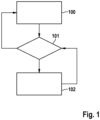
- the drawing includes Fig. 1 .
- Fig. 1 the basic sequence of the method according to the invention is shown.
- Speed and/or distance control systems are typically used on multi-lane roads, such as highways. Cyclists and motorcyclists often travel in groups on such roads and want to stay together as much as possible. The behavior of conventional speed and/or distance control systems often makes this difficult.
- This re-entry process can be made more difficult for the second vehicle and the other vehicles in the group if the speed and/or distance control system is activated.
- the first vehicle in front of the second vehicle is in the left overtaking lane and is controlled by its speed and/or distance control system.
- Distance control system selected as target object i.e. the speed and/or distance control system of the second motorcycle automatically adjusts its distance, speed and acceleration to the behavior of the motorcycle in front.
- the speed and/or distance control system of the second motorcycle After the first motorcycle in front of the truck has moved back to the right, the speed and/or distance control system of the second motorcycle has lost its target in the overtaking lane.
- the system now sees the overtaking lane it is still in as a clear lane and, depending on the settings of the speed and/or distance control system, it can now also accelerate more strongly, independent of the driver, as it is unaware of the driver's desire to move into the right-hand lane soon.
- This stronger acceleration and higher speed of the motorcycle makes it more difficult for the driver to move into the gap between the first motorcycle and the overtaken truck, and it may therefore be safer to stay in the overtaking lane and also overtake the first motorcycle. This changes the driving order in the group.
- the speed and/or distance control system is intended to switch to an operating state that facilitates re-merging.
- the acceleration of the motorcycle can be limited to a low value, e.g. 0.5 m/s 2 , so that the resulting lower speed makes it easier to cut in.
- This limitation remains in effect as long as the rider operates the indicator lever.
- the cruise control and/or distance control system returns to its usual behavior.
- the motorcycle has already reached the right-hand lane again and the first motorcycle is automatically selected as the target object for the system as intended.
- Fig. 1 The basic sequence of the method according to the invention is shown. After starting the method in block 100, it is then determined in block 101 whether the control element for the turn signal has been actuated. If this is the case, the speed and/or distance control system is switched to re-engagement mode in block 102. If this is not the case, the program returns to block 100. After block 102, the program returns to block 101 to determine whether the control element is still actuated.
Landscapes
- Engineering & Computer Science (AREA)
- Automation & Control Theory (AREA)
- Transportation (AREA)
- Mechanical Engineering (AREA)
- Human Computer Interaction (AREA)
- Control Of Driving Devices And Active Controlling Of Vehicle (AREA)
- Controls For Constant Speed Travelling (AREA)
Description
- Aus der
DE 10 2019 208 484 A1 ist ein Verfahren zur fahrerunabhängigen Einstellung der Längsbeschleunigung eines einspurigen Kraftfahrzeugs bekannt, bei dem- mittels einer Umfeldsensorik das dem einspurigen Kraftfahrzeug vorausfahrende Vorderfahrzeug ermittelt und als Zielobjekt festgelegt wird, mittels derselben oder einer anderen Umfeldsensorik fahrdynamische Daten des Zielobjekts ermittelt werden, abhängig von den fahrdynamischen Daten die Längsbeschleunigung des einspurigen Kraftfahrzeugs eingestellt wird, ermittelt wird, ob das Zielobjekt mittels der Umfeldsensorik noch erfasst wird und für den Fall, dass das Zielobjekt nicht mehr erfasst wird, die Geschwindigkeit des einspurigen Kraftfahrzeugs auf einen vorgegebenen Wert eingestellt wird, wobei die Heranführung der Geschwindigkeit auf den vorgegebenen Wert derart erfolgt, dass ein vorgegebener Beschleunigungsgrenzwert nicht überschritten wird. - Ferner ist aus der
DE 197 04 854 A1 ein Verfahren zum Wiedereinscheren auf eine Zielfahrspur nach einem Überholvorgang auf einer mehrspurigen Fahrbahn für ein mit einem automatischen Geschwindigkeits- und/oder Abstandsregelungssystem ausgestattetes Kraftfahrzeug bekannt, bei welchem eine Betätigung eines Fahrtrichtungsanzeigers ermittelt und abhängig davon in einen das Wiedereinscheren erleichternden Betriebszustand geschaltet wird. - Ein ähnliches Verfahren ist auch aus der
WO 99/30919 A1 - Darüber hinaus ist aus der
DE 10 2019 205 881 A1 ein Geschwindigkeitsregelsystem für ein einspuriges Fahrzeug bekannt. - Die Erfindung betrifft ein Verfahren zum Einscheren bzw. Wiedereinscheren auf eine Zielfahrspur insbesondere nach einem Überholvorgang auf einer mehrspurigen Fahrbahn für ein mit einem automatischen Geschwindigkeits- und/oder Abstandsregelungssystem ausgestattetes einspuriges Kraftfahrzeug bei aktiviertem Geschwindigkeits- und/oder Abstandsregelungssystem, bei dem
- das Vorliegen einer momentanen Betätigung eines Bedienelements für einen Fahrtrichtungsanzeiger ermittelt wird und
- während der Betätigungsdauer des Bedienelements das Geschwindigkeits- und/oder Abstandsregelungssystem in einen das Wiedereinscheren bzw. Einscheren erleichternden Betriebszustand geschaltet wird.
- Eine vorteilhafte Ausgestaltung der Erfindung ist dadurch gekennzeichnet, dass während dieses Betriebszustands die momentane Beschleunigung beibehalten wird.
- Eine vorteilhafte Ausgestaltung der Erfindung ist dadurch gekennzeichnet, dass während dieses Betriebszustands mittels einer Umfeldsensorik die Beschleunigung des auf der Zielfahrspur fahrenden Vorderfahrzeugs ermittelt und übernommen wird.
- Eine vorteilhafte Ausgestaltung der Erfindung ist dadurch gekennzeichnet, dass es sich bei dem Fahrtrichtungsanzeiger um denjenigen Fahrtrichtungsanzeiger handelt, welcher einen Wechsel von einer fahrbahninneren Spur in eine weiter fahrbahnaußen gelegene Spur signalisiert. In Ländern mit Rechtsverkehr handelt es sich dabei um den eine Fahrzeugbewegung nach rechts ankündigenden Fahrtrichtungsanzeiger, welcher auch bei einem Wiedereinscheren aktiviert wird. In Ländern mit Linksverkehr handelt es sich um den eine Linksbewegung ankündigenden Fahrtrichtungsanzeiger.
- Erfindungsgemäß erfolgt die Durchführung des Verfahrens nur dann bzw. findet die Umschaltung in einen das Wiedereinscheren bzw. Einscheren erleichternden Betriebszustand nur dann statt, wenn beim Geschwindigkeits- und/oder Abstandsregelungssystem ein aktivier- und deaktivierbarer vorgegebener Betriebsmodus aktiviert ist.
- Eine vorteilhafte Ausgestaltung der Erfindung ist dadurch gekennzeichnet, dass es sich bei dem Bedienelement um den Blinkerhebel handelt.
- Eine vorteilhafte Ausgestaltung der Erfindung ist dadurch gekennzeichnet, dass es sich bei dem einspurigen Kraftfahrzeug um ein Motorrad handelt.
- Weiter umfasst die Erfindung eine Vorrichtung, enthaltend Mittel, die zur Durchführung der erfindungsgemäßen Verfahren ausgestaltet sind. Dabei handelt es sich insbesondere um ein Steuergerät, in welchem der Programmcode zur Durchführung der erfindungsgemäßen Verfahren hinterlegt ist.
- Die Zeichnung umfasst
Fig. 1 . - In
Fig. 1 ist der grundlegende Ablauf des erfindungsgemäßen Verfahrens dargestellt. - Geschwindigkeits- und/oder Abstandsregelungssysteme werden zumeist auf mehrspurigen Straßen wie z.B. Autobahnen eingesetzt. Zweirad- oder Motorradfahrer sind auf solchen Straßen häufig in Gruppen unterwegs und wollen soweit möglich auch als Gruppe zusammenbleiben. Das Verhalten üblicher Geschwindigkeits- und/oder Abstandsregelungssysteme erschwert häufig dieses Zusammenbleiben.
- Als Beispiel kann z.B. der Fall betrachtet werden, in welcher eine Gruppe von Motorradfahrern hintereinander einen auf dem rechten Fahrstreifen fahrenden LKW überholt, dazu nacheinander auf den linken Fahrstreifen wechselt und ebenso beabsichtigt, nach jeweiligem Überholen des LKW wieder hintereinander auf den rechten Fahrstreifen einzuscheren.
- Dieser Wiedereinschervorgang kann bei einem aktiviertem Geschwindigkeits- und/oder Abstandsregelungssystem für das zweite Fahrzeug und die weiteren Fahrzeuge der Gruppe erschwert werden. Während des Überholvorgangs befindet sich das erste Fahrzeug vor dem zweiten Fahrzeug auf dem linken Überholstreifen und wird von dessen Geschwindigkeits- und/oder Abstandsregelungssystem als Zielobjekt ausgewählt, d.h. das Geschwindigkeits- und/oder Abstandsregelungssystem des zweiten Motorrads passt dessen Abstand, Geschwindigkeit und Beschleunigung dem Verhalten des vorausfahrenden Motorrads automatisch an.
- Nachdem das erste Motorrad vor dem LKW wieder nach rechts eingeschert ist, hat das Geschwindigkeits- und/oder Abstandsregelungssystem des zweiten Motorrads sein Zielobjekt auf dem Überholstreifen verloren. Für das System scheint nunmehr der Überholstreifen, auf dem es sich noch befindet, als freie Fahrspur und abhängig von den Einstellungen des Geschwindigkeits- und/oder Abstandsregelungssystem kann dieses jetzt auch eine stärkere fahrerunabhängige Beschleunigung durchführen, da es den Wunsch des Fahrers nach einem baldigen Wechsel auf die rechte Fahrspur nicht kennt. Diese stärkere Beschleunigung und höhere Geschwindigkeit des Motorrads erschwert es dem Fahrer in die Lücke zwischen ersten Motorrad und dem überholten LKW einzuscheren und es ist dadurch möglicherweise sicherer, auf dem Überholstreifen zu bleiben und auch das erste Motorrad zu überholen. Dadurch wird die Fahrreihenfolge in der Gruppe abgeändert.
- Sobald und solange des Fahrers des zweiten Motorrads den Blinkerhebel zur Signalisierung des beabsichtigten Einscherens betätigt ist es deshalb vorgesehen, dass das Geschwindigkeits- und/oder Abstandsregelungssystem in einen das Wiedereinscheren erleichternden Betriebszustand wechselt.
- In diesem Betriebszustand kann z.B. in einer einfachen Ausführungsform die Beschleunigung des Motorrads auf einen geringen Wert, z.B. 0.5 m/s2, begrenzt werden, so dass die dadurch auch geringere Geschwindigkeit das Einscheren erleichtert. Diese Begrenzung erfolgt, solange der Fahrer den Blinkerhebel betätigt. Sobald das Fahrer den Blinkerhebel loslässt, stellt sich wieder das gewohnte übliche Verhalten des Geschwindigkeits- und/oder Abstandsregelungssystems ein. Üblicherweise hat das Motorrad dann den rechten Fahrstreifen bereits wieder erreicht und das erste Motorrad wird wieder automatisch wie beabsichtigt als Zielobjekt für das System ausgewählt.
- In einer etwas komplexeren Ausführungsform ist es auch denkbar, dass während der Betätigung des Blinkerhebels automatisch das nächste auf der rechten Fahrspur vor dem eigenen Fahrzeug befindliche Fahrzeug als Zielobjekt für das Geschwindigkeits- und/oder Abstandsregelungssystem ausgewählt wird. Dies ist dann normalerweise das erste Motorrad, welches den Überholvorgang bereits abgeschlossen hat. Diese Ausgestaltung hat den Vorteil, dass nach Loslassen des Blinkerhebels bei Erreichen der rechten Fahrspur sich das Fahrverhalten des Motorrads nicht wesentlich ändert, weil dann natürlicherweise das vorausfahrende erste Motorrad als Zielobjekt vom Geschwindigkeits- und/oder Abstandsregelungssystem ausgewählt wird.
- In
Fig. 1 ist der grundlegende Ablauf des erfindungsgemäßen Verfahrens dargestellt. Nach dem Start des Verfahrens in Block 100 wird anschließend in Block 101 ermittelt, ob eine Betätigung des Bedienelements für den Fahrtrichtungsanzeiger vorliegt. Ist dies der Fall, dann wird in Block 102 das Geschwindigkeits- und/oder Abstandsregelungssystem in einen Wiedereinschermodus geschaltet. Ist dies nicht der Fall, dann wird zu Block 100 zurückgekehrt. Nach Block 102 wird zu Block 101 zurückgekehrt, um zu ermitteln, ob das Bedienelement weiterhin betätigt ist.
Claims (7)
- Verfahren zum Wiedereinscheren auf eine Zielfahrspur nach einem Überholvorgang auf einer mehrspurigen Fahrbahn für ein mit einem automatischen Geschwindigkeits- und/oder Abstandsregelungssystem ausgestattetes einspuriges Kraftfahrzeug bei aktiviertem Geschwindigkeits- und/oder Abstandsregelungssystem, bei dem- das Vorliegen einer momentanen Betätigung eines Bedienelements für einen Fahrtrichtungsanzeiger ermittelt wird (101) und- während der Betätigungsdauer des Bedienelements das Geschwindigkeits- und/oder Abstandsregelungssystem in einen das Wiedereinscheren erleichternden Betriebszustand geschaltet wird (102),dadurch gekennzeichnet, dass die Umschaltung in den das Wiedereinscheren erleichternden Betriebszustand nur dann stattfindet, wenn beim Geschwindigkeits- und/oder Abstandsregelungssystem ein aktivier- und deaktivierbarer vorgegebener Betriebsmodus aktiviert ist.
- Verfahren nach Anspruch 1, dadurch gekennzeichnet, dass während dieses Betriebszustands die momentane Beschleunigung beibehalten wird.
- Verfahren nach Anspruch 1, dadurch gekennzeichnet, dass während dieses Betriebszustands mittels einer Umfeldsensorik die Beschleunigung des auf der Zielfahrspur fahrenden Vorderfahrzeugs ermittelt und übernommen wird.
- Verfahren nach Anspruch 1, dadurch gekennzeichnet, dass es sich bei dem Fahrtrichtungsanzeiger um denjenigen Fahrtrichtungsanzeiger handelt, welcher einen Wechsel von einer fahrbahninneren Spur in eine weiter fahrbahnaußen gelegene Spur signalisiert.
- Verfahren nach Anspruch 1, dadurch gekennzeichnet, dass es sich bei dem Bedienelement um den Blinkerhebel handelt.
- Verfahren nach Anspruch 1, dadurch gekennzeichnet, dass es sich bei dem einspurigen Kraftfahrzeug um ein Motorrad handelt.
- Vorrichtung, enthaltend Mittel, die zur Durchführung eines Verfahrens gemäß einem der Ansprüche 1 - 6 ausgestaltet ist.
Applications Claiming Priority (1)
| Application Number | Priority Date | Filing Date | Title |
|---|---|---|---|
| DE102021205600.8A DE102021205600A1 (de) | 2021-06-02 | 2021-06-02 | Verfahren und Vorrichtung zum Wiedereinscheren auf eine Zielfahrspur nach einem Überholvorgang |
Publications (2)
| Publication Number | Publication Date |
|---|---|
| EP4098502A1 EP4098502A1 (de) | 2022-12-07 |
| EP4098502B1 true EP4098502B1 (de) | 2025-05-07 |
Family
ID=81325686
Family Applications (1)
| Application Number | Title | Priority Date | Filing Date |
|---|---|---|---|
| EP22164892.6A Active EP4098502B1 (de) | 2021-06-02 | 2022-03-29 | Verfahren und vorrichtung zum wiedereinscheren auf eine zielfahrspur nach einem überholvorgang |
Country Status (2)
| Country | Link |
|---|---|
| EP (1) | EP4098502B1 (de) |
| DE (1) | DE102021205600A1 (de) |
Family Cites Families (6)
| Publication number | Priority date | Publication date | Assignee | Title |
|---|---|---|---|---|
| DE4200694B4 (de) * | 1992-01-14 | 2004-04-29 | Robert Bosch Gmbh | Verfahren zur Geschwindigkeits- und Abstandsregelung eines Fahrzeugs |
| DE19704854A1 (de) * | 1997-02-10 | 1998-08-13 | Itt Mfg Enterprises Inc | Verfahren und Vorrichtung zur Regelung der Längsdynamik eines Fahrzeugs |
| US6353788B1 (en) * | 1997-12-15 | 2002-03-05 | Robert Bosch Gmbh | Method for regulating speed and distance during passing maneuvers |
| DE102017205506A1 (de) * | 2017-03-31 | 2018-10-04 | Robert Bosch Gmbh | Verfahren und Vorrichtung zur Abstandsregelung für ein einspuriges Kraftfahrzeug |
| DE102019205881A1 (de) * | 2019-04-25 | 2020-10-29 | Robert Bosch Gmbh | Verfahren und Vorrichtung zur automatischen Einstellung eines Geschwindigkeits- oder Abstandsregelungssystems eines einspurigen Kraftfahrzeugs |
| DE102019208484A1 (de) | 2019-06-11 | 2020-12-17 | Robert Bosch Gmbh | Verfahren und Vorrichtung zur fahrerunabhängigen Einstellung der Längsbeschleunigung eines einspurigen Kraftfahrzeugs |
-
2021
- 2021-06-02 DE DE102021205600.8A patent/DE102021205600A1/de active Pending
-
2022
- 2022-03-29 EP EP22164892.6A patent/EP4098502B1/de active Active
Also Published As
| Publication number | Publication date |
|---|---|
| DE102021205600A1 (de) | 2022-12-08 |
| EP4098502A1 (de) | 2022-12-07 |
Similar Documents
| Publication | Publication Date | Title |
|---|---|---|
| EP1485283B1 (de) | Spurwechselassistent für kraftfahrzeuge | |
| EP2819871B1 (de) | Verfahren zum betrieb eines fahrerassistenzsystems zur autonomen längs- und/oder querregelung eines fahrzeugs und fahrerassistenzsystem, das nach einem derartigen verfahren arbeitet | |
| EP3504109A1 (de) | Spurwechselassistenzsystem und -verfahren zum automatisierten durchführen mehrfacher spurwechsel | |
| DE102011016770A1 (de) | Verfahren zur Unterstützung eines Fahrers eines Fahrzeugs bei einem Fahrspurwechsel und Vorrichtung zur Durchführung des Verfahrens | |
| WO2019215051A1 (de) | Fahrerassistenzsystem und verfahren zum automatisierten fahren mit automatisierter längsführung | |
| DE102009008403A1 (de) | Verfahren zur Steuerung und Regelung des Verkehrsflusses | |
| DE102011109697A1 (de) | Verfahren zum Betreiben eines Kraftfahrzeuges und Fahrerassistenzsystem zur Durchführung des Verfahrens | |
| WO2006053655A1 (de) | Verfahren zur kollisionsvermeidung oder kollisionsfolgenminderung und vorrichtung zur durchführung des verfahrens | |
| DE102009048789A1 (de) | Verfahren zur Querführung eines Kraftfahrzeugs | |
| WO2014023650A1 (de) | Verfahren zum betreiben eines kraftfahrzeugs während einer vollautomatischen fahrzeugführung | |
| WO2018019800A1 (de) | Verfahren und vorrichtung zur ausführung eines zumindest teilweise automatisierten fahr-manövers | |
| DE102011011120B4 (de) | Verfahren und Vorrichtung zum Unterstützen eines Fahrspurwechsels | |
| DE102008021154B4 (de) | Unterstützungssystem und Verfahren zur Entlastung des Fahrers bei der Bedienung eines Kraftfahrzeuges und mit einem Unterstützungssystem ausgestattetes Kraftfahrzeug | |
| EP1924461B1 (de) | Abstandsbezogenes fahrgeschwindigkeitsregelsystem | |
| DE102004047081A1 (de) | Fahrerassistenzsystem mit Bildverarbeitungseinrichtung | |
| DE102011103603A1 (de) | Unterstützen eines Fahrers eines Kraftfahrzeugs bei einem synchronen Überholen in einer Gegenverkehrssituation | |
| EP4098502B1 (de) | Verfahren und vorrichtung zum wiedereinscheren auf eine zielfahrspur nach einem überholvorgang | |
| DE102022104785A1 (de) | Verbessertes Überholmanöver zum Überholen eines vorausfahrenden Drittfahrzeugs | |
| EP4341140B1 (de) | Verfahren und vorrichtung zur aktivierung einer überholassistenzfunktion eines einspurigen kraftfahrzeugs | |
| EP1915271A1 (de) | Verfahren zum deaktivieren einer automatischen losfahrfunktion eines abstandsbezogenen fahrgeschwindigkeitsregelsystems | |
| EP1345790B1 (de) | Fahrzeug mit wenigstens einem sensor zur detektion des fahrzeugumfelds | |
| DE102022208272A1 (de) | Verfahren zum Betrieb eines Fahrerassistenzsystems | |
| DE102022201641A1 (de) | Verfahren zum Durchführen eines Nothaltemanövers eines zumindest teilweise assistiert betriebenen Kraftfahrzeugs auf einer mehrspurigen Straße, Computerprogrammprodukt sowie Nothalteassistenzsystem | |
| DE10045944A1 (de) | Verfahren zur Regelung des Abstandes und/oder der Geschwindigkeit eines Fahrzeuges bei einem Üerholvorgang | |
| DE102016214096A1 (de) | Verfahren zur Steuerung eines zumindest teilautomatisierten Fahrens |
Legal Events
| Date | Code | Title | Description |
|---|---|---|---|
| PUAI | Public reference made under article 153(3) epc to a published international application that has entered the european phase |
Free format text: ORIGINAL CODE: 0009012 |
|
| STAA | Information on the status of an ep patent application or granted ep patent |
Free format text: STATUS: THE APPLICATION HAS BEEN PUBLISHED |
|
| AK | Designated contracting states |
Kind code of ref document: A1 Designated state(s): AL AT BE BG CH CY CZ DE DK EE ES FI FR GB GR HR HU IE IS IT LI LT LU LV MC MK MT NL NO PL PT RO RS SE SI SK SM TR |
|
| STAA | Information on the status of an ep patent application or granted ep patent |
Free format text: STATUS: REQUEST FOR EXAMINATION WAS MADE |
|
| 17P | Request for examination filed |
Effective date: 20230607 |
|
| RBV | Designated contracting states (corrected) |
Designated state(s): AL AT BE BG CH CY CZ DE DK EE ES FI FR GB GR HR HU IE IS IT LI LT LU LV MC MK MT NL NO PL PT RO RS SE SI SK SM TR |
|
| GRAP | Despatch of communication of intention to grant a patent |
Free format text: ORIGINAL CODE: EPIDOSNIGR1 |
|
| STAA | Information on the status of an ep patent application or granted ep patent |
Free format text: STATUS: GRANT OF PATENT IS INTENDED |
|
| INTG | Intention to grant announced |
Effective date: 20241122 |
|
| GRAS | Grant fee paid |
Free format text: ORIGINAL CODE: EPIDOSNIGR3 |
|
| GRAA | (expected) grant |
Free format text: ORIGINAL CODE: 0009210 |
|
| STAA | Information on the status of an ep patent application or granted ep patent |
Free format text: STATUS: THE PATENT HAS BEEN GRANTED |
|
| AK | Designated contracting states |
Kind code of ref document: B1 Designated state(s): AL AT BE BG CH CY CZ DE DK EE ES FI FR GB GR HR HU IE IS IT LI LT LU LV MC MK MT NL NO PL PT RO RS SE SI SK SM TR |
|
| REG | Reference to a national code |
Ref country code: GB Ref legal event code: FG4D Free format text: NOT ENGLISH |
|
| REG | Reference to a national code |
Ref country code: CH Ref legal event code: EP |
|
| REG | Reference to a national code |
Ref country code: DE Ref legal event code: R096 Ref document number: 502022003835 Country of ref document: DE |
|
| REG | Reference to a national code |
Ref country code: IE Ref legal event code: FG4D Free format text: LANGUAGE OF EP DOCUMENT: GERMAN |
|
| REG | Reference to a national code |
Ref country code: NL Ref legal event code: MP Effective date: 20250507 |
|
| PG25 | Lapsed in a contracting state [announced via postgrant information from national office to epo] |
Ref country code: FI Free format text: LAPSE BECAUSE OF FAILURE TO SUBMIT A TRANSLATION OF THE DESCRIPTION OR TO PAY THE FEE WITHIN THE PRESCRIBED TIME-LIMIT Effective date: 20250507 Ref country code: PT Free format text: LAPSE BECAUSE OF FAILURE TO SUBMIT A TRANSLATION OF THE DESCRIPTION OR TO PAY THE FEE WITHIN THE PRESCRIBED TIME-LIMIT Effective date: 20250908 Ref country code: ES Free format text: LAPSE BECAUSE OF FAILURE TO SUBMIT A TRANSLATION OF THE DESCRIPTION OR TO PAY THE FEE WITHIN THE PRESCRIBED TIME-LIMIT Effective date: 20250507 |
|
| REG | Reference to a national code |
Ref country code: LT Ref legal event code: MG9D |
|
| PG25 | Lapsed in a contracting state [announced via postgrant information from national office to epo] |
Ref country code: NO Free format text: LAPSE BECAUSE OF FAILURE TO SUBMIT A TRANSLATION OF THE DESCRIPTION OR TO PAY THE FEE WITHIN THE PRESCRIBED TIME-LIMIT Effective date: 20250807 Ref country code: GR Free format text: LAPSE BECAUSE OF FAILURE TO SUBMIT A TRANSLATION OF THE DESCRIPTION OR TO PAY THE FEE WITHIN THE PRESCRIBED TIME-LIMIT Effective date: 20250808 |
|
| PG25 | Lapsed in a contracting state [announced via postgrant information from national office to epo] |
Ref country code: NL Free format text: LAPSE BECAUSE OF FAILURE TO SUBMIT A TRANSLATION OF THE DESCRIPTION OR TO PAY THE FEE WITHIN THE PRESCRIBED TIME-LIMIT Effective date: 20250507 Ref country code: PL Free format text: LAPSE BECAUSE OF FAILURE TO SUBMIT A TRANSLATION OF THE DESCRIPTION OR TO PAY THE FEE WITHIN THE PRESCRIBED TIME-LIMIT Effective date: 20250507 |
|
| PG25 | Lapsed in a contracting state [announced via postgrant information from national office to epo] |
Ref country code: BG Free format text: LAPSE BECAUSE OF FAILURE TO SUBMIT A TRANSLATION OF THE DESCRIPTION OR TO PAY THE FEE WITHIN THE PRESCRIBED TIME-LIMIT Effective date: 20250507 |
|
| PG25 | Lapsed in a contracting state [announced via postgrant information from national office to epo] |
Ref country code: HR Free format text: LAPSE BECAUSE OF FAILURE TO SUBMIT A TRANSLATION OF THE DESCRIPTION OR TO PAY THE FEE WITHIN THE PRESCRIBED TIME-LIMIT Effective date: 20250507 |
|
| PG25 | Lapsed in a contracting state [announced via postgrant information from national office to epo] |
Ref country code: RS Free format text: LAPSE BECAUSE OF FAILURE TO SUBMIT A TRANSLATION OF THE DESCRIPTION OR TO PAY THE FEE WITHIN THE PRESCRIBED TIME-LIMIT Effective date: 20250807 |
|
| PG25 | Lapsed in a contracting state [announced via postgrant information from national office to epo] |
Ref country code: IS Free format text: LAPSE BECAUSE OF FAILURE TO SUBMIT A TRANSLATION OF THE DESCRIPTION OR TO PAY THE FEE WITHIN THE PRESCRIBED TIME-LIMIT Effective date: 20250907 |
|
| PG25 | Lapsed in a contracting state [announced via postgrant information from national office to epo] |
Ref country code: LV Free format text: LAPSE BECAUSE OF FAILURE TO SUBMIT A TRANSLATION OF THE DESCRIPTION OR TO PAY THE FEE WITHIN THE PRESCRIBED TIME-LIMIT Effective date: 20250507 |
|
| PG25 | Lapsed in a contracting state [announced via postgrant information from national office to epo] |
Ref country code: SM Free format text: LAPSE BECAUSE OF FAILURE TO SUBMIT A TRANSLATION OF THE DESCRIPTION OR TO PAY THE FEE WITHIN THE PRESCRIBED TIME-LIMIT Effective date: 20250507 Ref country code: DK Free format text: LAPSE BECAUSE OF FAILURE TO SUBMIT A TRANSLATION OF THE DESCRIPTION OR TO PAY THE FEE WITHIN THE PRESCRIBED TIME-LIMIT Effective date: 20250507 |
|
| PG25 | Lapsed in a contracting state [announced via postgrant information from national office to epo] |
Ref country code: CZ Free format text: LAPSE BECAUSE OF FAILURE TO SUBMIT A TRANSLATION OF THE DESCRIPTION OR TO PAY THE FEE WITHIN THE PRESCRIBED TIME-LIMIT Effective date: 20250507 |
|
| PG25 | Lapsed in a contracting state [announced via postgrant information from national office to epo] |
Ref country code: EE Free format text: LAPSE BECAUSE OF FAILURE TO SUBMIT A TRANSLATION OF THE DESCRIPTION OR TO PAY THE FEE WITHIN THE PRESCRIBED TIME-LIMIT Effective date: 20250507 |
|
| PG25 | Lapsed in a contracting state [announced via postgrant information from national office to epo] |
Ref country code: SK Free format text: LAPSE BECAUSE OF FAILURE TO SUBMIT A TRANSLATION OF THE DESCRIPTION OR TO PAY THE FEE WITHIN THE PRESCRIBED TIME-LIMIT Effective date: 20250507 |
|
| REG | Reference to a national code |
Ref country code: DE Ref legal event code: R097 Ref document number: 502022003835 Country of ref document: DE |
|
| PLBE | No opposition filed within time limit |
Free format text: ORIGINAL CODE: 0009261 |
|
| STAA | Information on the status of an ep patent application or granted ep patent |
Free format text: STATUS: NO OPPOSITION FILED WITHIN TIME LIMIT |
|
| REG | Reference to a national code |
Ref country code: CH Ref legal event code: L10 Free format text: ST27 STATUS EVENT CODE: U-0-0-L10-L00 (AS PROVIDED BY THE NATIONAL OFFICE) Effective date: 20260318 |
|
| PGFP | Annual fee paid to national office [announced via postgrant information from national office to epo] |
Ref country code: AT Payment date: 20260301 Year of fee payment: 5 |
|
| 26N | No opposition filed |
Effective date: 20260210 |