EP4095165A1 - Polyester-polyethermodifizierte polybutadiene und verfahren zu deren herstellung - Google Patents
Polyester-polyethermodifizierte polybutadiene und verfahren zu deren herstellung Download PDFInfo
- Publication number
- EP4095165A1 EP4095165A1 EP22174789.2A EP22174789A EP4095165A1 EP 4095165 A1 EP4095165 A1 EP 4095165A1 EP 22174789 A EP22174789 A EP 22174789A EP 4095165 A1 EP4095165 A1 EP 4095165A1
- Authority
- EP
- European Patent Office
- Prior art keywords
- group
- polybutadiene
- mol
- polyether
- functional
- Prior art date
- Legal status (The legal status is an assumption and is not a legal conclusion. Google has not performed a legal analysis and makes no representation as to the accuracy of the status listed.)
- Granted
Links
Classifications
-
- C—CHEMISTRY; METALLURGY
- C08—ORGANIC MACROMOLECULAR COMPOUNDS; THEIR PREPARATION OR CHEMICAL WORKING-UP; COMPOSITIONS BASED THEREON
- C08L—COMPOSITIONS OF MACROMOLECULAR COMPOUNDS
- C08L9/00—Compositions of homopolymers or copolymers of conjugated diene hydrocarbons
-
- C—CHEMISTRY; METALLURGY
- C08—ORGANIC MACROMOLECULAR COMPOUNDS; THEIR PREPARATION OR CHEMICAL WORKING-UP; COMPOSITIONS BASED THEREON
- C08F—MACROMOLECULAR COMPOUNDS OBTAINED BY REACTIONS ONLY INVOLVING CARBON-TO-CARBON UNSATURATED BONDS
- C08F8/00—Chemical modification by after-treatment
- C08F8/08—Epoxidation
-
- C—CHEMISTRY; METALLURGY
- C08—ORGANIC MACROMOLECULAR COMPOUNDS; THEIR PREPARATION OR CHEMICAL WORKING-UP; COMPOSITIONS BASED THEREON
- C08C—TREATMENT OR CHEMICAL MODIFICATION OF RUBBERS
- C08C19/00—Chemical modification of rubber
- C08C19/04—Oxidation
- C08C19/06—Epoxidation
-
- C—CHEMISTRY; METALLURGY
- C08—ORGANIC MACROMOLECULAR COMPOUNDS; THEIR PREPARATION OR CHEMICAL WORKING-UP; COMPOSITIONS BASED THEREON
- C08C—TREATMENT OR CHEMICAL MODIFICATION OF RUBBERS
- C08C19/00—Chemical modification of rubber
- C08C19/30—Addition of a reagent which reacts with a hetero atom or a group containing hetero atoms of the macromolecule
- C08C19/34—Addition of a reagent which reacts with a hetero atom or a group containing hetero atoms of the macromolecule reacting with oxygen or oxygen-containing groups
- C08C19/40—Addition of a reagent which reacts with a hetero atom or a group containing hetero atoms of the macromolecule reacting with oxygen or oxygen-containing groups with epoxy radicals
-
- C—CHEMISTRY; METALLURGY
- C08—ORGANIC MACROMOLECULAR COMPOUNDS; THEIR PREPARATION OR CHEMICAL WORKING-UP; COMPOSITIONS BASED THEREON
- C08F—MACROMOLECULAR COMPOUNDS OBTAINED BY REACTIONS ONLY INVOLVING CARBON-TO-CARBON UNSATURATED BONDS
- C08F136/00—Homopolymers of compounds having one or more unsaturated aliphatic radicals, at least one having two or more carbon-to-carbon double bonds
- C08F136/02—Homopolymers of compounds having one or more unsaturated aliphatic radicals, at least one having two or more carbon-to-carbon double bonds the radical having only two carbon-to-carbon double bonds
- C08F136/04—Homopolymers of compounds having one or more unsaturated aliphatic radicals, at least one having two or more carbon-to-carbon double bonds the radical having only two carbon-to-carbon double bonds conjugated
- C08F136/06—Butadiene
-
- C—CHEMISTRY; METALLURGY
- C08—ORGANIC MACROMOLECULAR COMPOUNDS; THEIR PREPARATION OR CHEMICAL WORKING-UP; COMPOSITIONS BASED THEREON
- C08F—MACROMOLECULAR COMPOUNDS OBTAINED BY REACTIONS ONLY INVOLVING CARBON-TO-CARBON UNSATURATED BONDS
- C08F8/00—Chemical modification by after-treatment
-
- C—CHEMISTRY; METALLURGY
- C08—ORGANIC MACROMOLECULAR COMPOUNDS; THEIR PREPARATION OR CHEMICAL WORKING-UP; COMPOSITIONS BASED THEREON
- C08G—MACROMOLECULAR COMPOUNDS OBTAINED OTHERWISE THAN BY REACTIONS ONLY INVOLVING UNSATURATED CARBON-TO-CARBON BONDS
- C08G59/00—Polycondensates containing more than one epoxy group per molecule; Macromolecules obtained by polymerising compounds containing more than one epoxy group per molecule using curing agents or catalysts which react with the epoxy groups
- C08G59/02—Polycondensates containing more than one epoxy group per molecule
- C08G59/027—Polycondensates containing more than one epoxy group per molecule obtained by epoxidation of unsaturated precursor, e.g. polymer or monomer
-
- C—CHEMISTRY; METALLURGY
- C08—ORGANIC MACROMOLECULAR COMPOUNDS; THEIR PREPARATION OR CHEMICAL WORKING-UP; COMPOSITIONS BASED THEREON
- C08G—MACROMOLECULAR COMPOUNDS OBTAINED OTHERWISE THAN BY REACTIONS ONLY INVOLVING UNSATURATED CARBON-TO-CARBON BONDS
- C08G59/00—Polycondensates containing more than one epoxy group per molecule; Macromolecules obtained by polymerising compounds containing more than one epoxy group per molecule using curing agents or catalysts which react with the epoxy groups
- C08G59/14—Polycondensates modified by chemical after-treatment
- C08G59/1433—Polycondensates modified by chemical after-treatment with organic low-molecular-weight compounds
- C08G59/1438—Polycondensates modified by chemical after-treatment with organic low-molecular-weight compounds containing oxygen
- C08G59/1444—Monoalcohols
-
- C—CHEMISTRY; METALLURGY
- C08—ORGANIC MACROMOLECULAR COMPOUNDS; THEIR PREPARATION OR CHEMICAL WORKING-UP; COMPOSITIONS BASED THEREON
- C08G—MACROMOLECULAR COMPOUNDS OBTAINED OTHERWISE THAN BY REACTIONS ONLY INVOLVING UNSATURATED CARBON-TO-CARBON BONDS
- C08G59/00—Polycondensates containing more than one epoxy group per molecule; Macromolecules obtained by polymerising compounds containing more than one epoxy group per molecule using curing agents or catalysts which react with the epoxy groups
- C08G59/14—Polycondensates modified by chemical after-treatment
- C08G59/1433—Polycondensates modified by chemical after-treatment with organic low-molecular-weight compounds
- C08G59/1438—Polycondensates modified by chemical after-treatment with organic low-molecular-weight compounds containing oxygen
- C08G59/1455—Monocarboxylic acids, anhydrides, halides, or low-molecular-weight esters thereof
-
- C—CHEMISTRY; METALLURGY
- C08—ORGANIC MACROMOLECULAR COMPOUNDS; THEIR PREPARATION OR CHEMICAL WORKING-UP; COMPOSITIONS BASED THEREON
- C08G—MACROMOLECULAR COMPOUNDS OBTAINED OTHERWISE THAN BY REACTIONS ONLY INVOLVING UNSATURATED CARBON-TO-CARBON BONDS
- C08G63/00—Macromolecular compounds obtained by reactions forming a carboxylic ester link in the main chain of the macromolecule
- C08G63/02—Polyesters derived from hydroxycarboxylic acids or from polycarboxylic acids and polyhydroxy compounds
- C08G63/06—Polyesters derived from hydroxycarboxylic acids or from polycarboxylic acids and polyhydroxy compounds derived from hydroxycarboxylic acids
- C08G63/08—Lactones or lactides
-
- C—CHEMISTRY; METALLURGY
- C08—ORGANIC MACROMOLECULAR COMPOUNDS; THEIR PREPARATION OR CHEMICAL WORKING-UP; COMPOSITIONS BASED THEREON
- C08G—MACROMOLECULAR COMPOUNDS OBTAINED OTHERWISE THAN BY REACTIONS ONLY INVOLVING UNSATURATED CARBON-TO-CARBON BONDS
- C08G63/00—Macromolecular compounds obtained by reactions forming a carboxylic ester link in the main chain of the macromolecule
- C08G63/66—Polyesters containing oxygen in the form of ether groups
- C08G63/664—Polyesters containing oxygen in the form of ether groups derived from hydroxy carboxylic acids
-
- C—CHEMISTRY; METALLURGY
- C08—ORGANIC MACROMOLECULAR COMPOUNDS; THEIR PREPARATION OR CHEMICAL WORKING-UP; COMPOSITIONS BASED THEREON
- C08G—MACROMOLECULAR COMPOUNDS OBTAINED OTHERWISE THAN BY REACTIONS ONLY INVOLVING UNSATURATED CARBON-TO-CARBON BONDS
- C08G65/00—Macromolecular compounds obtained by reactions forming an ether link in the main chain of the macromolecule
- C08G65/02—Macromolecular compounds obtained by reactions forming an ether link in the main chain of the macromolecule from cyclic ethers by opening of the heterocyclic ring
- C08G65/26—Macromolecular compounds obtained by reactions forming an ether link in the main chain of the macromolecule from cyclic ethers by opening of the heterocyclic ring from cyclic ethers and other compounds
- C08G65/2603—Macromolecular compounds obtained by reactions forming an ether link in the main chain of the macromolecule from cyclic ethers by opening of the heterocyclic ring from cyclic ethers and other compounds the other compounds containing oxygen
- C08G65/2606—Macromolecular compounds obtained by reactions forming an ether link in the main chain of the macromolecule from cyclic ethers by opening of the heterocyclic ring from cyclic ethers and other compounds the other compounds containing oxygen containing hydroxyl groups
-
- C—CHEMISTRY; METALLURGY
- C08—ORGANIC MACROMOLECULAR COMPOUNDS; THEIR PREPARATION OR CHEMICAL WORKING-UP; COMPOSITIONS BASED THEREON
- C08G—MACROMOLECULAR COMPOUNDS OBTAINED OTHERWISE THAN BY REACTIONS ONLY INVOLVING UNSATURATED CARBON-TO-CARBON BONDS
- C08G65/00—Macromolecular compounds obtained by reactions forming an ether link in the main chain of the macromolecule
- C08G65/02—Macromolecular compounds obtained by reactions forming an ether link in the main chain of the macromolecule from cyclic ethers by opening of the heterocyclic ring
- C08G65/26—Macromolecular compounds obtained by reactions forming an ether link in the main chain of the macromolecule from cyclic ethers by opening of the heterocyclic ring from cyclic ethers and other compounds
- C08G65/2603—Macromolecular compounds obtained by reactions forming an ether link in the main chain of the macromolecule from cyclic ethers by opening of the heterocyclic ring from cyclic ethers and other compounds the other compounds containing oxygen
- C08G65/2606—Macromolecular compounds obtained by reactions forming an ether link in the main chain of the macromolecule from cyclic ethers by opening of the heterocyclic ring from cyclic ethers and other compounds the other compounds containing oxygen containing hydroxyl groups
- C08G65/2609—Macromolecular compounds obtained by reactions forming an ether link in the main chain of the macromolecule from cyclic ethers by opening of the heterocyclic ring from cyclic ethers and other compounds the other compounds containing oxygen containing hydroxyl groups containing aliphatic hydroxyl groups
-
- C—CHEMISTRY; METALLURGY
- C09—DYES; PAINTS; POLISHES; NATURAL RESINS; ADHESIVES; COMPOSITIONS NOT OTHERWISE PROVIDED FOR; APPLICATIONS OF MATERIALS NOT OTHERWISE PROVIDED FOR
- C09D—COATING COMPOSITIONS, e.g. PAINTS, VARNISHES OR LACQUERS; FILLING PASTES; CHEMICAL PAINT OR INK REMOVERS; INKS; CORRECTING FLUIDS; WOODSTAINS; PASTES OR SOLIDS FOR COLOURING OR PRINTING; USE OF MATERIALS THEREFOR
- C09D7/00—Features of coating compositions, not provided for in group C09D5/00; Processes for incorporating ingredients in coating compositions
- C09D7/40—Additives
- C09D7/65—Additives macromolecular
Definitions
- the present invention relates to polybutadienes modified with polyester-polyether at the comb (side) and their production processes and their use.
- Polybutadienes with lateral polyether radicals are known and are produced according to the prior art, for example by reacting reactive, functionalized polybutadienes with polyethers. How to describe Q.Gao et. al. in Macromolecular Chemistry and Physics (2013), 214(15), 1677-1687 amphiphilic polymer comb structures prepared by grafting polyethylene glycol onto a polybutadiene backbone. According to JP2011038003 polybutadienes functionalized with maleic anhydride units are reacted with amino-terminated polyethers. Maleinized polybutadienes are formed with comb-positioned polyether residues which are attached via an amide or imide group.
- the alkoxylation of laterally hydroxy-functional polybutadienes is also known. How to describe Q.Gao et. al. in Macromolecular Chemistry and Physics (2013), 214(15), 1677-1687 the preparation of a pendant polyether-modified polybutadiene by alkoxylation of a pendant hydroxy-functional polybutadiene with ethylene oxide.
- the laterally hydroxy-functional polybutadiene used is prepared first by epoxidizing a polybutadiene, then reacting the epoxidized polybutadiene with a lithium-polybutadiene compound and finally protonating the reaction product with HCl-acidic methanol.
- the prior art has not yet disclosed a process for the preparation of preferably linear polybutadienes with lateral polyether chains by a simple, direct alkoxylation reaction of laterally hydroxy-functional polybutadienes with alkylene oxides, the laterally hydroxy-functional polybutadienes being obtained from epoxy-functional polybutadienes without using organometallic compounds such as lithium polybutadiene, are made known.
- the prior art has so far not disclosed any process for the preparation of linear polybutadienes with polyether chains in a comb position by a simple, direct alkoxylation reaction with alkylene oxides.
- amine-functional polybutadienes are not very suitable as starter compounds for the alkoxylation, since they often give the products an undesirable basic character, give rise to discoloration or, for example, inhibit alkoxylation catalysts such as double metal cyanides.
- the WO 2016/142249 A1 is aimed at the production of glassy polymers by adding water or alcohols with 1 to 4 carbon atoms to the epoxide groups of polybutadiene and is limited to the production of OH-functional polybutadienes with low molecular weights of 300 to 2000 g/mol and a high content from 50% to 80% of 1,2-vinylic and 1,2-cyclovinylic double bonds.
- Polybutadienes and modified polybutadienes are often used as reactive components or formulation components, for example in order to render polymers hydrophobic or to make them more flexible and improve mechanical properties.
- alkoxylated polyether-modified polybutadienes are currently limited by the fact that they are limited to a few available triblock structures. So far there has been no possibility of varying the chemical structure of the polyether-modified polybutadienes within wide limits. In addition, there is no simple manufacturing process for such polymers.
- the polyether-modified polybutadienes according to the invention can therefore be obtained by direct alkoxylation of laterally hydroxy-functional polybutadienes and have lateral (comb) polyether radicals.
- esterified polyether-modified polybutadienes according to the invention for example as an adhesion promoter, could be further increased.
- the ester group is preferably formed by reacting the radicals B with compounds selected from the group consisting of cyclic anhydrides, dilactides, lactones or cyclic carbonates as monomers or comonomers.
- the compound comprises repeating units selected from the group consisting of the residues
- cyclic anhydrides pure or in any mixtures, are preferred, selected from the group consisting of saturated, unsaturated or aromatic cyclic dicarboxylic acid anhydrides, preferably succinic anhydride, oct(en)yl, dec(en)yl and dodec(en)yl succinic anhydride, maleic anhydride , itaconic anhydride, glutaric anhydride, adipic anhydride, citraconic anhydride, trimellitic anhydride, phthalic anhydride, hexahydro-, tetrahydro-, dihydro-, methylhexahydro- and methyltetrahydrophthalic anhydride.
- lactones pure or in any mixtures, selected from the group consisting of valerolactones, caprolactones and butyrolactones, which can be unsubstituted or substituted with alkyl groups, preferably methyl groups, preferably ⁇ -caprolactone or ⁇ -valerolactone.
- the polyester-polyether-modified polybutadiene is a linear polybutadiene modified at the comb (side) with polyether moieties modified with at least one ester group. It is therefore preferred that the polyester-polyether-modified polybutadiene has a linear polybutadiene backbone and lateral polyether radicals which have at least one ester group.
- the radicals R 1 , R 2 and R 3 can each independently be linear or branched, saturated or unsaturated, aliphatic or aromatic, substituted or unsubstituted.
- radical R 4 is a hydrogen
- the sum of all repeating units (U), (V) and (W) divided by the sum of all repeating units (U), (V), (W), (X), (Y) and (Z) of the at least one polyester-polyether-modified polybutadiene (G) from >0% to 70%, preferably from 1% to 50%, more preferably from 2% to 40%, even more preferably from 3% to 30%, particularly preferably from 4% is up to 20%.
- the number-average molar mass M n , weight-average molar mass M w and polydispersity of the polybutadiene part of the polyester-polyether-modified polybutadiene are arbitrary.
- the polybutadiene part is understood to mean the part of the polyester-polyether-modified polybutadiene which originates from the polybutadiene used according to the process.
- the number-average molar mass M n of the polybutadiene part of the polyester-polyether-modified polybutadiene is from 200 g/mol to 20,000 g/mol, preferably from 500 g/mol to 10,000 g/mol, particularly preferably from 700 g/mol to 5000 g / mole.
- the number-average molar mass M n of the polybutadiene part of the polyester-polyether-modified polybutadiene is from 2100 g/mol to 20000 g/mol, particularly preferably from 2200 g/mol to 10000 g/mol, very particularly preferably from 2300 g/mol is up to 5000 g/mol.
- the number-average molar mass M n of the polybutadiene part is defined as the number-average molar mass M n of the underlying polybutadiene.
- polyester-polyether-modified polybutadiene has a number average of 5 to 360, particularly preferably 10 to 180, very particularly preferably 15 to 90 repeating units, the repeating units being from the group consisting of (U), (V), (W ), (X), (Y) and (Z) are selected.
- the polyester-polyether-modified polybutadiene has a number average of 35 to 360, particularly preferably 40 to 180, very particularly preferably 45 to 90 repeating units, the repeating units being from the group consisting of (U), (V), (W ), (X), (Y) and (Z) are selected.
- polyester-polyether-modified polybutadienes are characterized in that 0% to 80%, preferably 0% to 30%, particularly preferably 0% to 10% and very particularly preferably 0% to 5% of the double bonds 1, are 2-vinyl double bonds and 20% to 100%, preferably 70% to 100%, particularly preferably 90% to 100% and very particularly preferably 95% to 100% of the double bonds present are 1,4 double bonds.
- polyester-polyether-modified polybutadienes which are derived from the above-described polybutadienes Polyvest® 110 and Polyvest® 130 from Evonik Industries AG/Evonik Operations GmbH and Lithene ultra AL and Lithene ActiV 50 from Synthomer PLC.
- the molar mass and the polydispersity of the radicals B are arbitrary. However, it is preferred that the mean molar mass of the radicals B is from 100 g/mol to 20,000 g/mol, preferably from 200 g/mol to 15,000 g/mol, particularly preferably from 400 g/mol to 10,000 g/mol.
- the average molar mass of the radicals B can be based on the number of OH groups of the monomers used from the weight used hydroxy-functional polybutadiene (E) are calculated. If, for example, 40 g of ethylene oxide are used and the amount of hydroxy-functional polybutadiene (E) used has 0.05 mol of OH groups, the average molar mass of the radical B is 800 g/mol.
- polyester-polyether-modified polybutadienes are liquid, pasty or solid.
- the number-average molar mass M n of the polyester-polyether-modified polybutadienes is preferably from 1000 g/mol to 6000 g/mol, more preferably from 1500 g/mol to 5000 g/mol, particularly preferably from 2000 g/mol to 4000 g/mol.
- the polydispersity of the at least one polyester-polyether-modified polybutadiene is preferably M w /M n from 1.5 to 10, more preferably from 2 to 9, particularly preferably from 3 to 8.
- a further object of the invention is to provide a process for preparing preferably linear polybutadienes which are modified in the comb (side) with polyether radicals which have at least one ester group.
- the process should enable very simple process engineering access to preferably linear polybutadienes with lateral polyether radicals and be feasible, for example, without the use of organolithium compounds.
- the polyether-modified polybutadienes should also be obtainable by direct alkoxylation of laterally hydroxy-functional polybutadienes. There was also the task of providing improved, laterally hydroxy-functional polybutadienes as precursors and chain starters for the alkoxylation in the process.
- polybutadienes with a high content of 1,4-units and a low content of vinylic 1,2-units after epoxidation with hydrogen peroxide easily under acid-catalyzed ring opening with OH-functional compounds in lateral OH-functional polybutadienes (polybutadienols) convert and then alkoxylate with alkylene oxides.
- the formulas set forth in this invention describe compounds or radicals made up of repeating units, such as repeating fragments, blocks or monomeric units, and may have a molecular weight distribution.
- the frequency of the repeating units is indicated by indices.
- the subscripts used in the formulas are to be regarded as statistical mean values (number means).
- the index numbers used and the value ranges of the specified indices are understood to be mean values of the possible statistical distribution of the structures actually present and/or their mixtures.
- the various fragments or repeating units of the compounds described in the following formulas (1) to (5) can be randomly distributed.
- Statistical distributions are built up in blocks with any number of blocks and any sequence or are subject to a randomized distribution, they can also be built up alternatingly, or also form a gradient via the chain, if one exists, in particular they can also form all mixed forms , where groups of different distributions may follow one another. All permutations of repeating units are included in the formulas below.
- compounds such as polybutadienes (A), epoxy-functional polybutadienes (C), hydroxy-functional polybutadienes (E), polyether-modified polybutadienes (G) or polyether-polyester-modified polybutadiene (H).
- a catalyst can preferably serve as initiator of the anionic ring-opening polymerization for step d). All common catalysts can be used.
- Bases or acids, metal salts, metal akoxide or metal compounds can preferably be used as catalysts.
- metal alkoxides are zirconium butoxide, tetraisopropyl titanate, tetrabutyl titanate or titanium(IV) 2-ethylhexyl oxide.
- Metal salts are, for example, zinc acetates, potassium acetates, lithium acetates, sodium acetates, calcium acetates, barium acetates, magnesium acetates, copper acetates, cobalt acetates or zinc/bismuth carboxylates.
- Acid catalysts are z. B. to toluenesulfonic acid or trifluoroacetic acid.
- Tin chloride Tin chloride, tin octylate, dibutyltin dilaurate or monobutyltin oxide can also be used.
- the process according to the invention makes it possible for the first time to modify linear polybutadienes by a simple direct alkoxylation of the lateral OH groups with comb-positioned polyether radicals.
- the chain length and monomer sequence in the polyether radical can vary widely be varied.
- the average number of polyether radicals bonded to the polybutadiene can be adjusted in a targeted manner via the degree of epoxidation and the hydroxyl functionalization, and opens up a large structural variety for the hydroxy-functional polybutadienes (E).
- the grafting (grafting) of polyethers onto polybutadiene which is known in the prior art, rarely takes place quantitatively in practice and the reaction products usually contain free fractions of polyethers and optionally unfunctionalized polybutadienes.
- the above-described addition of OH-functional polyethers via their OH group to epoxidized polybutadienes is also usually incomplete and the products contain residual, unreacted epoxide groups. If the polyethers are used in excess, the residual content of epoxide groups can be reduced, but the excess polyethers remain in the product since they cannot be removed by distillation.
- a catalyst can preferably serve as initiator of the anionic ring-opening polymerization for step d).
- Bases or acids, metal salts, metal akoxide or metal compounds can be used as catalysts.
- metal alkoxides are zirconium butoxide, tetraisopropyl titanate, tetrabutyl titanate or titanium(IV) 2-ethylhexyl oxide.
- Metal salts are, for example, zinc acetates, potassium acetates, lithium acetates, sodium acetates, calcium acetates, barium acetates, magnesium acetates, copper acetates, cobalt acetates or zinc/bismuth carboxylates.
- Acid catalysts are z. B. to toluenesulfonic acid or trifluoroacetic acid.
- Tin chloride, tin octylate, dibutyltin dilaurate or monobutyltin oxide can also be used.
- the polybutadienes with comb-positioned polyester-polyether radicals which can be obtained according to the invention are preferably essentially free of residual epoxide groups.
- the product of the process according to the invention preferably contains essentially no free polyether fractions. Preferably, essentially all of the polyethers are chemically attached to the polybutadiene via an ether linkage. The products of the process according to the invention thus differ significantly from the compounds hitherto known from the prior art by virtue of their increased purity.
- the compound based on linear polybutadienes was preferably prepared for the composition according to the invention.
- the compound for the composition according to the invention preferably has no lateral (comb) polybutadienes.
- the compound preferably has exclusively lateral (comb) repeating units (U), (V) and/or (W).
- step a) of the process of the invention at least one polybutadiene (A) is reacted with at least one epoxidation reagent (B) to form at least one epoxy-functional polybutadiene (C).
- the polybutadienes (A) are polymers of buta-1,3-diene.
- the polymerization of the buta-1,3-diene monomers essentially takes place with 1,4- and/or 1,2-linkage.
- a 1,4-linkage leads to so-called 1,4- trans units and/or 1,4- cis units, which are also collectively referred to as 1,4-units.
- a 1,2 linkage leads to so-called 1,2 units.
- the 1,2-units carry a vinyl group and are also referred to as vinylic 1,2-units.
- the 1,2-units are also referred to as "(X)", the 1,4- trans units as "(Y)” and the 1,4- cis units as "(Z)”. :
- the double bonds contained in the units are referred to analogously as 1,4- trans double bonds, 1,4- cis double bonds or 1,2 double bonds or 1,2-vinyl double bonds.
- the 1,4- trans double bonds and 1,4- cis double bonds are also collectively referred to as 1,4-double bonds.
- the polybutadienes (A) are therefore unmodified polybutadienes.
- the polybutadienes (A) and their preparation processes are known to those skilled in the art. The preparation preferably takes place by means of a free-radical, an anionic or a coordinative chain polymerization.
- the free-radical chain polymerization is preferably carried out as an emulsion polymerization. This leads to a statistical occurrence of the three units mentioned. At low reaction temperatures (approx. 5 °C) the proportion of vinyl groups decreases.
- the initiation is preferably carried out with potassium peroxodisulphate and iron salts or with hydrogen peroxide.
- the chain polymerisation is preferably initiated with butyllithium.
- the polybutadiene (A) thus obtained contains about 40% 1,4- cis units and 50% 1,4- trans units.
- Ziegler-Natta catalysts in particular stereospecific Ziegler-Natta catalysts, which lead to a polybutadiene (A) having a high proportion of 1,4- cis units.
- branched polybutadienes (A) can also form as a result of secondary or subsequent reactions, such as, for example, a subsequent reaction of the double bonds of the resulting 1,2- and 1,4-units of the polybutadiene.
- the polybutadienes (A) used according to the invention are preferably linear, ie unbranched, polybutadienes. It is also possible for the polybutadienes to have small proportions of units other than 1,2 units, 1,4 trans units or 1,4 cis units.
- the mass fraction of the sum of 1,2 units, 1,4 trans units and 1,4 cis units is at least 80%, preferably at least 90%, in particular at least 99% based on the total mass of the at least one polybutadiene (A), ie based on the total mass of all polybutadienes (A) used.
- Polybutadienes (A) which contain 0% to 80% 1,2 units and 20% to 100% 1,4 units, preferably 0% to 30% 1,2 units and 70% are preferably used for the process according to the invention. to 100% 1,4 units, more preferably 0% to 10% 1,2 units and 90% to 100% 1,4 units, and most preferably 0% to 5% 1,2 units and 95% up to 100% 1,4 units based on the sum of 1,2 units and 1,4 units.
- 0% to 80% are 1,2-vinyl double bonds and 20% to 100% are 1,4 double bonds
- preferably 0% to 30% are 1,2-vinyl - Double bonds and 70% to 100% 1,4 double bonds, particularly preferably 0% to 10% 1,2-vinyl double bonds and 90% to 100% 1,4 double bonds, particularly preferably 0% to 5%
- 2-vinyl double bonds and 95% to 100% are 1,4-double bonds.
- polybutadienes (A) of the formula (1) with a content of 0% to 80% 1,2-vinyl double bonds (index x) and 20% to 100% 1,4 double bonds (sum of the indices y and z), preferably 0% to 30% 1,2- Vinyl double bonds and 70% to 100% 1,4 double bonds, more preferably with 0% to 10% 1,2-vinyl double bonds and 90% to 100% 1,4 double bonds, most preferably with 0% to 5 % 1,2 vinyl double bonds and 95% to 100% 1,4 double bonds used.
- the ratio of 1,4- trans double bonds (index y) and 1,4- cis double bonds (index z) is arbitrary.
- the indices x, y and z reflect the number of the particular butadiene unit in the polybutadiene (A). These are numerical averages (number averages) over all of the polybutadiene polymers of the at least one polybutadiene (A).
- the average molar mass and polydispersity of the polybutadienes (A) of the formula (1) used are arbitrary.
- the number-average molar mass M n of the at least one polybutadiene (A) is from 200 g/mol to 20,000 g/mol, preferably from 500 g/mol to 10,000 g/mol, particularly preferably from 700 g/mol to 5000 g / mole.
- the number-average molar mass M n of the at least one polybutadiene (A) is from 2100 g/mol to 20000 g/mol, particularly preferably from 2200 g/mol to 10000 g/mol, very particularly preferably from 2300 g/mol is up to 5000 g/mol.
- the number-average molar mass M n , the weight-average molar mass M w and the polydispersity (M w /M n ) are preferably determined by means of gel permeation chromatography (GPC), as described in the examples.
- the at least one polybutadiene (A) has a number average of 5 to 360, particularly preferably 10 to 180, very particularly preferably 15 to 90 units selected from the group consisting of 1,2-units, 1,4- cis - units and 1,4- trans units.
- the at least one polybutadiene (A) has a number average of 35 to 360, particularly preferably 40 to 180, very particularly preferably 45 to 90 units selected from the group consisting of 1,2-units, 1,4- cis - units and 1,4- trans units.
- the viscosity of the polybutadienes (A) used is 50 to 50,000 mPas, preferably 100 to 10,000 mPas, in particular 500 to 5000 mPas (determined according to DIN EN ISO 3219:1994-10).
- the degree of epoxidation is determined quantitatively, for example using 13 C-NMR spectroscopy or epoxide number titration (determination of the epoxide equivalent in accordance with DIN EN ISO 3001:1999) and can be determined in relation to the process conditions, in particular the amount of hydrogen peroxide used to the submitted amount of double bonds in the polybutadiene, can be adjusted in a targeted and reproducible manner.
- step a) of the method according to the invention >0% to 70%, preferably 1% to 50%, more preferably 2% to 40%, even more preferably 3% to 30% and particularly preferably 4% to 20% of all double bonds of the at least one polybutadiene (A) are epoxidized.
- the epoxidation reagent (B) is selected from the group of peroxycarboxylic acids (percarboxylic acids, peracids), preferably from the group consisting of meta -chloroperbenzoic acid, peroxyacetic acid (peracetic acid) and peroxyformic acid (performic acid), in particular peroxyformic acid (performic acid).
- peroxycarboxylic acids are preferably formed in situ from the corresponding carboxylic acid and hydrogen peroxide.
- the at least one epoxidation reagent (B) contains performic acid, which is preferably formed in situ from formic acid and hydrogen peroxide.
- the epoxidation of the at least one polybutadiene (A) takes place randomly over the polybutadiene chain, preferably at the 1,4 double bonds.
- An epoxidation of the 1,2-double bonds can also take place and also takes place at these randomly distributed over the polybutadiene chain.
- epoxidation of the 1,2 double bonds is disadvantageous compared to epoxidation of the 1,4 double bonds.
- the reaction product thus contains epoxy-functional polybutadiene polymers which differ from one another in their degree of epoxidation. All degrees of epoxidation given are therefore to be understood as mean values.
- stabilizers or antioxidants during the process according to the invention for stabilizing the starting materials, intermediates and products, in order to avoid undesired polymerization reactions of the double bonds.
- Suitable for this purpose are, for example, the sterically hindered phenols known to those skilled in the art, commercially available, for example, as Anox® 20, Iganox® 1010 (BASF), Irganox® 1076 (BASF) and Irganox® 1135 (BASF). It is also preferred to carry out the entire production process under an inert atmosphere, for example under nitrogen.
- the unmodified starting materials ie the at least one polybutadiene (A), as well as the polyether-modified finished products according to the invention, ie the at least one polyether-modified polybutadiene (G) or (K), should preferably be stored with the exclusion of air if possible.
- step b) of the process according to the invention the at least one epoxy-functional polybutadiene (C) is reacted with at least one hydroxy-functional compound (D) to form at least one hydroxy-functional polybutadiene (E).
- reaction an addition (addition reaction) of the at least one hydroxy-functional compound (D) to the at least one epoxy-functional polybutadiene (C) takes place.
- the reaction therefore takes place with the formation of one or more covalent bonds between the at least one hydroxy-functional compound (D) and the at least one epoxy-functional polybutadiene (C).
- the reaction preferably (at least ideally) comprises a reaction step in which a nucleophilic attack of at least one hydroxy group of the at least one hydroxy-functional compounds (D) on at least one epoxy group of the at least one epoxy-functional polybutadiene (C) occurs with ring opening of this at least one epoxy group.
- Hydroxy-functional compounds (D) can be selected, for example, from the group consisting of alcohols, carboxylic acids and water. Preference is given to the at least one hydroxy-functional compound (D) from the group of monofunctional alcohols having 1 to 6 carbon atoms, more preferably from the group of monofunctional alcohols having 2 to 4 carbon atoms, particularly preferably from the group consisting of ethanol, 1-propanol, isopropanol (iso-propanol), 1-butanol, 2-butanol and isobutanol (iso-butanol).
- any mixtures of these alcohols can also be used. However, it is particularly preferred that methanol is not used as the hydroxy-functional compound (D). Water is also suitable as the hydroxy-functional compound (D). Water can be used alone or as a mixture with one or more other hydroxy-functional compounds (D). For example, mixtures of alcohol and water or mixtures of carboxylic acid and water can be used in step b). It is therefore not necessary to dry and free the at least one hydroxy-functional compound (D), such as alcohol or carboxylic acid, from water.
- the molar ratio of the OH groups of the hydroxy-functional compound (D) to the epoxide groups of the epoxy-functional polybutadiene (C) can be varied within a wide range. However, preference is given to using the hydroxy-functional compounds (D) in a stoichiometric excess, based on the stoichiometric ratio of hydroxy groups to the epoxide groups of the epoxy-functional polybutadiene (C), in order to achieve quantitative conversion of all epoxide groups.
- step b) the total number of hydroxy groups of all hydroxy-functional compounds (D) to the total number of epoxide groups of all epoxy-functional polybutadienes (C) is from >1:1 to 50:1, more preferably from 2:1 to 35:1 , more preferably 3:1 bis 30:1, more preferably from 3:1 to 25:1.
- the excess of compound (D) can be removed, for example by distillation, and reused if necessary.
- the reaction takes place in the presence of at least one acidic catalyst.
- the catalyst is either homogeneously soluble in the reaction mixture or distributed heterogeneously as a solid, such as sulfonic acid ion exchangers.
- Catalysts such as sulfuric acid, sulfonic acids and trifluoroacetic acid are preferred for the purposes of the invention, and trifluoromethanesulfonic acid is particularly preferred.
- an acid more preferably sulfuric acid, sulfonic acids and/or trifluoroacetic acid, particularly preferably trifluoromethanesulfonic acid, is used as the catalyst.
- the reaction of the at least one epoxy-functional polybutadiene (C) with the at least one hydroxy-functional compound (D) in the presence of an acidic catalyst preferably takes place in the temperature range from 20 °C to 120 °C and is increased by the boiling point of the hydroxy-functional compound (D) or when using several hydroxy-functional compounds (D) by the boiling point of the most volatile hydroxy-functional compound (D).
- the reaction is preferably carried out at from 50.degree. C. to 90.degree.
- the components are stirred for a few hours until the epoxide groups have reacted as completely as possible.
- the analysis for epoxide groups can be carried out either by NMR spectroscopic analysis or by known methods of epoxide number titration (as described in the examples).
- the reaction conditions in step b) are preferably chosen such that more than 97% of the epoxide groups generated in step a) are reacted with ring opening. It is particularly preferred that no more epoxide groups are detectable in the product from step b), ie in the at least one hydroxy-functional polybutadiene (E).
- the acidic reaction mixture is neutralized.
- any basic neutralizing agent can be added for this purpose.
- the neutralization is preferably carried out with sodium bicarbonate, in solid form or as an aqueous solution. Any excess hydroxy-functional compounds (D) and any water are preferably removed by distillation and precipitated salts are filtered off if necessary.
- aqueous sodium bicarbonate solution is preferred here, since lighter-colored products are obtained in this way.
- the at least one hydroxy-functional polybutadiene (E) has 20% to 100%, preferably 70% to 100%, more preferably 90% to 100%, particularly preferably 95% to 100% repeating units of the formula (2a) based on the Sum of the repeating units of the formulas (2a), (2b) and (2c).
- the proportion of the repeating units of the formulas (2a), (2b) and (2c) taken together is >0% to 70%, preferably 1% to 50%, more preferably 2% to 40%, even more preferably 3 % to 30% and particularly preferably 4% to 20%, based on the total number of all repeating units of the at least one hydroxy-functional polybutadiene (E). Accordingly, it is preferred that the degree of hydroxylation is >0% to 70%, preferably 1% to 50%, more preferably 2% to 40%, even more preferably 3% to 30% and particularly preferably 4% to 20%.
- the degree of hydroxylation of the hydroxy-functional polybutadiene (E) corresponds to the degree of epoxidation of the corresponding epoxy-functional polybutadiene (C).
- step c) of the process of the invention the at least one hydroxy-functional polybutadiene (E) is reacted with at least one epoxy-functional compound (F) to form at least one polyether-modified polybutadiene (G).
- the at least one hydroxy-functional polybutadiene (E) from step b) serves in step c) as a starter compound for the reaction with the at least one epoxy-functional compound (F).
- the at least one epoxy-functional compound (F) (hereinafter also referred to simply as "monomer” or “epoxide monomer” or “epoxide”), in a polyaddition reaction to the OH groups of the at least one hydroxy-functional Added polybutadiene (E).
- the polyether-modified polybutadiene (G) is preferably a linear polybutadiene which is modified with polyether radicals at the comb (sides). It is therefore preferred that the polyether-modified polybutadiene (G) has a linear polybutadiene backbone and lateral polyether radicals.
- the reaction in step c) is preferably an alkoxylation reaction, ie a polyaddition of alkylene oxides onto the at least one hydroxy-functional polybutadiene (E).
- the reaction in step c) can also be carried out with glycidyl compounds as an alternative or in addition to the alkylene oxides.
- the at least one epoxy-functional compound used in step c) is from the group of alkylene oxides, preferably from the group of alkylene oxides having 2 to 18 carbon atoms, more preferably from the group of alkylene oxides having 2 to 8 carbon atoms is selected from the group consisting of ethylene oxide, propylene oxide, 1-butylene oxide, cis -2-butylene oxide, trans -2-butylene oxide, isobutylene oxide and styrene oxide; and/or that the at least one epoxy-functional compound used in step c) is from the group of glycidyl compounds, preferably from the group of monofunctional glycidyl compounds, particularly preferably from the group consisting of phenyl glycidyl ether, o-cresyl glycidyl ether, tert-butylphenyl glycidyl ether, allyl glycidyl ether, butyl glycidyl ether
- the monomers can optionally be added individually in pure form, alternately one after the other in any metering order, but also mixed at the same time.
- the sequence of the monomer units in the resulting polyether chain is therefore subject to a blockwise distribution or a statistical distribution or a gradual distribution in the end product.
- the method according to the invention builds up lateral polyether chains on the polybutadiene, which are characterized in that they can be produced in a targeted and reproducible manner in terms of structure and molar mass.
- the sequence of the monomer units can be varied within wide limits by the order in which they are added.
- the molar masses of the lateral polyether radicals can be varied within wide limits in the process according to the invention and can be controlled in a targeted and reproducible manner via the molar ratio of the added monomers in relation to the OH groups of the at least one hydroxy-functional polybutadiene (E) from step b).
- polyether-modified polybutadienes (G) prepared according to the invention are preferably characterized in that they contain radicals B bonded to the polybutadiene structure via an ether group according to the formulas (3a), (3b) and (3c),
- the radical A in the formulas (3a), (3b) and (3c) originates from the compound A—OH, ie the hydroxy-functional compound (D) used in step b).
- the radical A in the formulas (3a), (3b) and (3c) is independently H or a radical B.
- A is an alkyl radical having 1 to 6 carbon atoms. If, for example, a carboxylic acid is used as the hydroxy-functional compound (D), then A is an acyl radical. However, if water is used as the hydroxy-functional compound (D), then A in formulas (3a), (3b) and (3c) is a radical B in the case of reaction with one or more epoxy-functional compound (F), and remains in the case of non-reaction A Hydrogen. Exactly one lateral radical --OB results from each reacted lateral hydroxyl group.
- the radical B is in turn made up of one or more monomers, preferably of more than one monomer, of the at least one epoxy-functional compound (F) used.
- alkoxylation catalysts known to those skilled in the art can in principle be used, for example basic catalysts such as alkali metal hydroxides, alkali metal alcoholates, amines, guanidines, amidines, phosphorus compounds such as triphenylphosphine, and also acidic and Lewis acidic catalysts such as SnCl 4 , SnCl 2 , SnF 2 , BF 3 and BF 3 complexes, as well as double metal cyanide (DMC) catalysts.
- basic catalysts such as alkali metal hydroxides, alkali metal alcoholates, amines, guanidines, amidines, phosphorus compounds such as triphenylphosphine, and also acidic and Lewis acidic catalysts such as SnCl 4 , SnCl 2 , SnF 2 , BF 3 and BF 3 complexes, as well as double metal cyanide (DMC) catalysts.
- DMC double metal cyanide
- the reactor partially filled with the starter and catalyst is rendered inert, for example with nitrogen. This is done, for example, by repeatedly evacuating and supplying nitrogen in alternation. It is advantageous to evacuate the reactor to below 200 mbar after the final injection of nitrogen.
- the addition of the first quantity of epoxide monomer thus preferably takes place in the evacuated reactor.
- the monomers are metered in with stirring and, if necessary, cooling in order to dissipate the heat of reaction released and to maintain the preselected reaction temperature.
- the at least one hydroxy-functional polybutadiene (E) serves as the starter, or a polyether-modified polybutadiene (G) already prepared by the process of the invention can also be used as the starter, as described further below.
- Zinc/cobalt DMC catalysts are preferably used, in particular those which contain zinc hexacyanocobaltate(III).
- the catalysts can be amorphous or crystalline.
- the catalyst concentration is preferably >0 wppm to 1000 wppm, preferably >0 wppm to 700 wppm, particularly preferably 10 wppm to 500 wppm, based on the total mass of the products formed.
- the catalyst is preferably metered into the reactor only once. This should preferably be clean, dry and free from basic contaminants that could inhibit the DMC catalyst.
- the amount of catalyst should preferably be adjusted so that there is sufficient catalytic activity for the process.
- the catalyst can be metered in as a solid or in the form of a catalyst suspension. If a suspension is used, the OH-functional starter is particularly suitable as a suspending agent.
- the catalyst In order to start the DMC-catalyzed conversion, it can be advantageous to first activate the catalyst with a portion of the at least one epoxy-functional compound (F), preferably selected from the group of alkylene oxides, in particular with propylene oxide and/or ethylene oxide. To The alkoxylation reaction can be started with the continuous addition of monomer.
- F epoxy-functional compound
- the reaction temperature in the case of a DMC-catalyzed reaction in step c) is preferably 60.degree. C. to 200.degree. C., more preferably 90.degree. C. to 160.degree. C. and particularly preferably 100.degree. C. to 140.degree.
- the internal pressure of the reactor in the case of a DMC-catalyzed reaction in step c) is preferably from 0.02 bar to 100 bar, more preferably from 0.05 bar to 20 bar, particularly preferably from 0.1 bar to 10 bar (absolute).
- a DMC-catalyzed reaction in step c) is particularly preferably carried out at a temperature of from 100° C. to 140° C. and a pressure of from 0.1 bar to 10 bar.
- the reaction can, for example, be carried out in a suitable solvent for the purpose of reducing the viscosity.
- an after-reaction preferably follows to complete the conversion.
- the after-reaction can be carried out, for example, by further reaction under reaction conditions (i.e. maintaining the temperature, for example) without adding starting materials.
- the DMC catalyst usually remains in the reaction mixture.
- Unreacted epoxides and any other volatile components can be removed after the reaction by vacuum distillation, steam or gas stripping or other deodorization methods.
- the finished product is finally filtered at ⁇ 100 °C to remove any turbidity that may be present.
- basic catalysts can also be used according to the invention in step c).
- Alkali metal alkoxides such as sodium methoxide and potassium methoxide, which are added as a solid or in the form of their methanolic solutions, are particularly suitable.
- all alkali metal hydroxides in particular sodium hydroxide and potassium hydroxide, can be used, both as a solid and, for example, as an aqueous or alcoholic solution.
- basic nitrogen compounds preferably amines, guanidines and amidines, particularly preferably tertiary amines such as trimethylamine and triethylamine, can also be used according to the invention.
- the basic catalysts in a concentration of> 0 mol% to 100 mol%, preferably> 0 mol% to 50 mol%, particularly preferably 3 mol% to 40 mol% based on the amount of Use OH groups of the starter.
- the reaction temperature in the case of a base-catalyzed reaction in step c) is preferably 80° C. to 200° C., more preferably 90° C. to 160° C. and particularly preferably 100° C. to 160° C.
- the internal pressure of the reactor in the case of a base-catalyzed reaction in step c) is preferably from 0.2 bar to 100 bar, more preferably from 0.5 bar to 20 bar, particularly preferably from 1 bar to 10 bar (absolute).
- the base-catalyzed reaction in step c) is particularly preferably carried out at a temperature of from 100° C. to 160° C. and a pressure of from 1 bar to 10 bar.
- the reaction can optionally be carried out in a suitable solvent.
- an after-reaction preferably follows to complete the conversion.
- the after-reaction can be carried out, for example, by further reaction under reaction conditions without adding starting materials.
- Unreacted epoxides and any other volatile components can be removed after the reaction by vacuum distillation, steam or gas stripping or other deodorization methods. Volatile catalysts such as amines are removed in the process.
- Acids such as phosphoric acid or sulfuric acid or carboxylic acids such as acetic acid and lactic acid are added to neutralize the basic raw products.
- the amount of acid used depends on the amount of basic catalyst previously used.
- the basic polybutadiene with lateral polyether radicals is stirred in the presence of the acid at preferably 40.degree. C. to 95.degree. C. and then dry-distilled in a vacuum distillation at ⁇ 100 mbar and 80.degree. C. to 130.degree.
- the neutralized product is preferably filtered at ⁇ 100 °C to remove precipitated salts.
- the end products according to the invention have a water content of ⁇ 0.2% (specified as a mass fraction based on the total mass of the end product) and an acid number of ⁇ 0.5 mg KOH/g and are practically phosphate-free.
- polyether-modified polybutadienes (G) from step c) prepared according to the invention carry one at each end of their lateral polyether radicals OH group and are therefore in turn suitable as a starter for the construction of higher molecular weight secondary products. According to the invention, they represent precursors and starter compounds for the synthesis of polybutadienes with relatively long polyether radicals.
- a product produced with the aid of DMC catalysis according to step c) can be alkoxylated, optionally by means of DMC catalysis or using one of the abovementioned basic or acidic catalysts, by renewed addition of epoxide monomers.
- further DMC catalyst can be added, e.g. to increase the reaction rate during chain extension.
- a product from step c) produced with base catalysis can be alkoxylated to higher molar masses either with base, acid or by means of DMC catalysis.
- the neutralization is advantageously dispensed with if it is intended to react the basic precursor further with base-catalyzed monomers.
- further basic catalyst can be added, e.g. to increase the reaction rate during chain extension.
- step d) the at least one polyether-modified polybutadiene (G) is reacted with at least one compound (I) to give at least one polyester-polyether-modified polybutadiene (H).
- radicals B of the polyether-modified polybutadiene (G), which have terminal hydroxyl groups, are further reacted terminally to form ester groups.
- di-lactides or cyclic anhydrides pure or in any mixtures, are selected from the group consisting of saturated, unsaturated or aromatic cyclic dicarboxylic acid anhydrides, preferably succinic anhydride, oct(en)yl, dec(en)yl and dodec(en).
- )ylsuccinic anhydride maleic anhydride, itaconic anhydride, glutaric anhydride, adipic anhydride, citraconic anhydride, trimellitic anhydride, phthalic anhydride, hexahydro-, tetrahydro-, dihydro-, methylhexahydro- and methyltetrahydrophthalic anhydride and/or lactones, pure or in any mixtures, are selected from the group consisting of valerolactones, Caprolactones and butyrolactones, which are unsubstituted or provided with organic radicals, preferably methyl groups, can be substituted, preferably ⁇ -caprolactone or ⁇ -valerolactone.
- cyclic carbonates known to the person skilled in the art, obtainable via the insertion of CO2 into epoxides, can be used as cyclic carbonates, pure or in any mixtures.
- Carbonates derived from glycidyl ethers are preferably used.
- Propylene carbonate and ethylene carbonate are particularly preferably used.
- the monomers can optionally be added individually in pure form, alternately one after the other in any metering order, but also mixed at the same time.
- the sequence of the monomer units in the resulting polyester chain is therefore subject to a blockwise distribution or a statistical distribution or a gradual distribution in the end product.
- step e) the color of the at least one polyether-modified polybutadiene (G) is lightened.
- step e) the color of the at least one polyester-polyether-modified polybutadiene (H) is lightened.
- the lightening can also take place after step c) of the process according to the invention and the color of the at least one polyether-modified polybutadiene (G) is lightened.
- the color can be lightened, for example, by adding activated charcoal, preferably in a suitable solvent, or by treatment with hydrogen peroxide.
- the lightening of the color can preferably be determined via the Gardner color number (determined according to DIN EN ISO 4630).
- the Gardner color number of the polyether-modified polybutadiene (G) is reduced by at least 1, preferably by at least 2, as a result of the color brightening.
- Particular preference is given to polyether-modified polybutadienes (G) with a Gardner color number of not more than 3, in particular not more than 2.5.
- reactors for the process according to the invention can be used as reactors for the process according to the invention.
- the reaction can be carried out continuously, semi-continuously or in batches in a manner known from process engineering and can be flexibly matched to the existing production facilities.
- jet loop reactors with gas phase and internal heat exchanger tubes, as in WO 01/062826 described are used.
- gas-phase-free loop reactors can be used.
- composition of the invention is preferably used for producing coating materials, paints and varnishes, as a printing ink or inkjet ink, or else sealants and adhesives.
- the invention also relates to the use of the compound according to the invention with at least one repeating unit (U)*, (V)* and/or (W)* as an adhesion promoter, defoamer, dispersing additive, Wetting agents, hydrophobing, rheology, slip, plasticizing additives or other additives for the paint and coatings sector.
- at least one repeating unit (U)*, (V)* and/or (W)* as an adhesion promoter, defoamer, dispersing additive, Wetting agents, hydrophobing, rheology, slip, plasticizing additives or other additives for the paint and coatings sector.
- the compounds according to the invention can preferably be used in 1K coating systems or 2K coating systems, in melamine baking systems, room or high-temperature systems, UV systems. After the addition of the substances according to the invention, these are checked with regard to the adhesion-improving properties on various substrates.
- the substrate is metal, concrete, wood, and/or a composite material such as e.g. B. glass fiber and / or carbon fiber composite material, steel (differently alloyed and / or post-treated), aluminum, mineral substrates such as glass, dimensionally stable plastics and / or duromers.
- a composite material such as e.g. B. glass fiber and / or carbon fiber composite material, steel (differently alloyed and / or post-treated), aluminum, mineral substrates such as glass, dimensionally stable plastics and / or duromers.
- metal substrates includes the following, but not exhaustive, materials: Hot and cold-rolled steel with and without post-treatment. Steels that have not been post-treated are degreased before use using special cleaners, for example from GARDOBOND ® .
- a chemical solution for example from GARDOBOND ® Type 26, can be applied as the first layer. This can be sprayed (S) or dipped (T).
- the post-treatment can usually be carried out with an inorganic conversion layer based on phosphating, alkaline passivation or chromating. This can be done by fire or electrolytic galvanizing.
- an aqueous solution of zinc phosphate can be used. This forms a layer of tertiary zinc phosphate or zinc iron phosphate.
- phosphating can also be carried out.
- an aqueous solution containing primary alkali phosphates is used.
- These sheets can be obtained, for example, from the company Q- LAB® as type RI.
- Another chemical rinsing solution is then used for passivation to ensure a closed protective layer on the metal.
- Deionized water or various rinsing solutions such as Gardolene ® D60, D86 or D6800, are usually used.
- Aluminum is mostly cold-rolled according to grade AlMg 1 G 18, for example from GARDOBOND ® Type AA 5005A or grade AlMg0.4Si1.2 (automotive specification) from GARDOBOND ® Type AA6016.
- the surface is treated with an aqueous chromating solution containing chromic acid.
- These sheets are available, among others, from the company Q- LAB® as type AL.
- galvanized steel can also be further treated with this method.
- glass is understood to mean inorganic silicate glasses, for example borosilicate glass or soda-lime glass, which are used, for example, as beverage bottles. These are usually provided with labels or, more recently, directly printed.
- dimensionally stable plastics includes the following, but not exhaustive, polymers: acrylonitrile butadiene styrene (ABS), polyamide (PA), polymethyl methacrylate (PMMA), polycarbonate (PC), polyethylene terephthalate (PET), polyethylene (PE) , polypropylene (PP), polystyrene (PS), polyetheretherketone PEEK), polyvinyl chloride (PVC).
- ABS acrylonitrile butadiene styrene
- PA polyamide
- PMMA polymethyl methacrylate
- PC polycarbonate
- PET polyethylene terephthalate
- PET polyethylene
- PE polypropylene
- PP polystyrene
- PS polystyrene
- PEEK polyetheretherketone PEEK
- PVC polyvinyl chloride
- Polypropylene (PP) polyethylene
- PE synthetic rubber mixtures of ethylene propylene diene (EPDM).
- the film-forming polymer preferably contains no functional groups, since the film is formed by physical drying, or double bonds if the drying is carried out by a mixture of oxidative curing and physical drying.
- the film-forming polymer which dries purely physically, is preferably selected from the group of acrylate polymers, for example from EVONIK® with the trade name Degalan. If a polymer is preferred which additionally hardens by oxidation, it is typically selected from the group of alkyd binders. Chemically, these belong to the group of polyesters and are formed by the condensation of alcohols and polybasic acids with the addition of fatty acids to modify the properties. A distinction is made between these according to the level of oil content, which controls the drying behavior. With an oil content of less than 40%, one speaks of a short-oil alkyd, which dries in the air. With an oil content between 40 and 60% one speaks of a medium-oil alkyd resin, which is oven-drying. If the oil content is above 60%, a non-drying alkyd is obtained.
- a short-oil, air-drying alkyd resin for example from WORLEEKyd® , is preferably used in the formulation according to the invention.
- the polymerization takes place under the influence of oxygen via the double bonds of the unsaturated fatty acid ester.
- the polyunsaturated ⁇ -linolenic acid is usually used to accelerate hardening. These are preferably octoates. For example, to cobalt or calcium octoate.
- an Octa- Soligen® Cobalt 6 and an Octa- Soligen® Calcium 10 are used in combination with a new type of siccative Borchi® OXY -Coat from BORCHERS® .
- cobalt octoates with the trade names Octa-Soligen ® Cobalt 10 or Octa-Soligen ® Cobalt 12 are also conceivable.
- Manganese 10 or zirconium octoates under the trade name Octa-Soligen ® Zirconium 18 from BORCHERS ® are also from BORCHERS ® .
- Manganese (AKDRY Mn Octoate 6%) and Zirconium Octoate are also from the AMERICAN company ELEMENTS ® available.
- Calcium octoates are also available from PATCHEM ® LTD under the tradename Calcium Octoate 10%.
- siccatives based on barium, cerium, lithium or strontium can be used.
- Modern drying agents based on metal soaps of various carboxylic acids are also available today.
- 2-ethylhexanoic acid for example from BORCHERS ® under the trade name Octa-Soligen ® 203.
- anti-skinning agents based on, for example, ketoximes, substituted phenols or aldoximes are added. These form reversible complexes with the siccatives.
- Oximes are available, for example, from BODO M ⁇ LLER® CHEMIE under the trade names Dura® MEKO or Duroxim P, or from FISHER SCIENTIFIC® under the trade name Alfa Aesar® 2 butanone oxime.
- Xylene is preferably used in the formulation according to the invention.
- the use of aliphatic hydrocarbons is also conceivable.
- the film-forming polymer preferably contains functional groups which are reactive with an isocyanate-containing hardener, an amine-containing hardener or with a catalyst.
- the film-forming polymer is preferably selected from the group consisting of hydroxy-functional acrylate polymers, polyester polymers, polyurethane polymers and/or polyether polymers, polyoxypropylene amines, amino-functional acrylate polymers or polyester polymers and polycarbamates, which react with an isocyanate-containing hardener.
- such polymers possess reactive hydroxy groups.
- Polymers with several hydroxy-functional groups are particularly preferably used.
- Hydroxy-functional acrylates are available, inter alia, from Allnex® under the trade names MACRYNAL® or SETALUX® .
- Examples of hydroxy-functional polyesters are commercially available, inter alia, under the trade names DESMOPHEN® or SETAL® .
- Useful and commercially available hydroxy-functional polyethers are available, inter alia, under the brand names TERATHANE® or POLYMEG® .
- the tested two-component coating according to the invention preferably has a hardener that is selected from the group of aliphatic or cycloaliphatic isocyanates.
- isocyanate hardeners are monomeric isocyanates, polymeric isocyanates and isocyanate prepolymers. Polyisocyanates are compared to monomeric isocyanates because of their lower Toxicity preferred. Examples of polyisocyanates are isocyanurates, uretdiones and biurets based on diphenylmethane diisocyanate (MDI), toluene diisocyanate (TDI), hexamethylene diisocyanate (HDI) and isophorone diisocyanate (IPDI). Examples of commercially available products are under the brand name DESMODUR® from Covestro or VESTANAT from Evonik Industries.
- Well-known products are DESMODUR ® N3200, DESMODUR ® N3300, DESMODUR ® N3600 DESMODUR ® N75, DESMODUR ® XP2580, DESMODUR ® Z4470, DESMODUR ® XP2565 and DESMODUR ® VL from Covestro. Further examples are VESTANAT® HAT 2500 LV, VESTANAT® HB 2640 LV or VESTANAT® T 1890E from Evonik Industries. Examples of isocyanate prepolymers are DESMODUR® E XP 2863, DESMODUR® XP 2599 or DESMODUR® XP 2406 from Covestro. Other isocyanate prepolymers known to those skilled in the art can be used.
- catalysts for curing can be used.
- the following catalysts selected from organic Sn(IV), Sn(II), Zn, Bi compounds or tertiary amines, can be used.
- Catalysts are preferably selected from the group of organotin catalysts, titanates or zirconates, organometallic compounds of aluminum, iron, calcium, magnesium, zinc or bismuth, Lewis acids or organic acids/bases, linear or cyclic amidines, guanidines or amines or a mixture thereof deployed.
- Vorzugseise Eatat als Härtungs-Katalysatoren organische Zinntagen, wie zB Dibutylzinndiacetylacetonat, Dibutylzinndiacetat, Dibutylzinndioctoat, oder Dioctylzinndilaurat, Dioctylzinndiacetylacetonat, Dioctylzinndiketanoat, Dioctylstannoxan, Dioctylzinnoxid, facedzugt Dioctylzinndiacetylacetonat, Dioctylzinndilaurat, Dioctylzinndiketanoat, Dioctylstannoxan, Dioctylzinndicarboxylat, Dioctylzinnoxid, subject Hopkinst Dioctylzinndicarboxylat und Dioctylzinndilaurat.
- zinc salts such as zinc octoate, zinc acetylacetonate and zinc 2-ethylcaproate, or tetraalkylammonium compounds such as N,N,N-trimethyl-N-2-hydroxypropylammonium hydroxide, N,N,N-trimethyl-N-2-hydroxypropylammonium -2-ethylhexanoate or choline-2-ethylhexanoate can be used.
- the use of zinc octoate (zinc 2-ethylhexanoate) and the tetraalkylammonium compounds is preferred, and zinc octoate is particularly preferred.
- bismuth catalysts for example TIB Kat (TIB Mannheim) or Borchi® catalysts
- titanates for example titanium(IV) isopropylate
- iron(III) compounds for example iron(III) acetylacetonate
- aluminum compounds such as aluminum triisopropylate, aluminum tri-sec butylate and other alkoxides as well as aluminum acetylacetonate
- calcium compounds such as calcium disodium ethylenediaminetetraacetate or calcium diacetylacetonate
- amines for example triethylamine, tributylamine, 1,4-diazabicyclo[2.2.2]octane, 1,8-diazabicyclo[5.4.0]undec- 7-ene, 1,5-diazabicyclo[4.3.0]non-5-ene, N,N-bis(N,N-dimethyl-2-aminoethyl)methylamine, N,N-dimethylcyclohexylamine
- organic or inorganic Brönsted acids such as acetic acid, trifluoroacetic acid, methanesulfonic acid, p-toluenesulfonic acid or benzoyl chloride, hydrochloric acid, phosphoric acid and their mono- and/or diesters, such as butyl phosphate, (iso)propyl phosphate, Dibutyl phosphate, etc. are preferred as catalysts.
- Organic and organosilicon compounds bearing guanidine groups are further preferred. Of course, combinations of several catalysts can also be used.
- photolatent bases can also be used as catalysts, as in the WO 2005/100482 are described.
- the curing catalyst is preferably used in amounts of 0.01 to 5.0% by weight, preferably 0.05 to 4.0% by weight and particularly preferably 0.1 to 3% by weight, based on the total mass of the curable composition deployed.
- solvents can also be useful.
- the solvents can serve, for example, to reduce the viscosity of the non-crosslinked binder or to promote absorption onto the surface.
- all solvents and solvent mixtures can be considered as solvents.
- a suitable solvent can be selected from the group of alkanes, alkenes, alkynes, benzene and aromatics with aliphatic and aromatic substituents, carboxylic acid esters, linear and cyclic ethers and at high pressures also carbon dioxide, halogenated aliphatic or aromatic hydrocarbons, ketones or aldehydes, Lactones ( ⁇ -butyrolactone), lactams (e.g.
- N-methyl-2-pyrrolidone N-methyl-2-pyrrolidone
- nitriles nitro compounds
- tertiary carboxamides dimethylformamide
- urea derivatives such as tetramethyl urea or dimethylpropylene urea (DMPU)
- sulfoxides such as dimethyl sulfoxide (DMSO)
- sulfones such as sulfolane
- Carbonic acid esters such as dimethyl carbonate or ethylene carbonate.
- protic solvents such as water, methanol, ethanol, n- and isopropanol and other alcohols, primary and secondary amines, carboxylic acids and their esters, and also anhydrides, primary and secondary amides such as formamide.
- Solvents such as ethers, e.g. t-butyl methyl ether, esters, such as ethyl acetate or n-butyl acetate, tert-butyl acetate or diethyl carbonate, and alcohols, such as ethanol and the various regioisomers of propanol and butanol, are preferred in the field of coating applications.
- preferred solvents are aromatic and/or aliphatic solvents such as benzene, toluene or naphtha fractions.
- one or more substances can also be added, selected from the group consisting of co-crosslinkers, flame retardants, deaerators, hardeners, antimicrobial and preservatives, dyes, colorants and pigments, antifreeze, fungicides, spray aids, wetting agents, fragrances, light stabilizers, radical scavengers , UV absorbers and stabilizers, in particular stabilizers against thermal and/or chemical stress and/or stress from ultraviolet and visible light.
- UV stabilizers are preferably known products based on hindered phenolic systems or benzotriazoles.
- the amount you use depends on the degree of stabilization required.
- Pigments based on titanium dioxide and other white pigments inorganic color pigments such as iron oxides, chromium pigments, ultramarine pigments, organic color pigments such as azo pigments, phthalocyanine pigments, perylene pigments, quinacridone pigments, and also carbon blacks are suitable for coloring coatings.
- the typical anti-corrosion pigments such as zinc phosphate, are also used to improve the anti-corrosion protection.
- Fillers are preferably precipitated or ground chalk, inorganic carbonates in general, precipitated or ground silicates, precipitated or pyrogenic silicic acids, glass powder, hollow glass spheres (so-called bubbles), metal oxides such as TiO 2 , Al 2 O 3 , natural or precipitated barium sulfates, ground quartz , sand, aluminum trihydrate, talc, mica, powdered christobalite, reinforcing fibers such as glass fibers or carbon fibers, long or short-fibered wollastonites, cork, carbon black or graphite. Fillers that have been rendered hydrophobic can advantageously be used, since these products introduce less water and improve the storage stability of the formulations.
- the film-forming polymers are preferably selected from the group of acrylates and methacrylates. In most cases, a mixture of, for example, a polyether acrylate from BASF with the trade name Laromer LR 8945® and a polyester acrylate from BASF® with the trade name Laromer LR8799 or Laromer LR8800 is used.
- Hexadiol diacrylate or trimethylolpropane triacrylate can be used as reactive solvents.
- GPC measurements to determine the polydispersity (M w /M n ), the weight-average molar mass (M w ) and the number-average molar mass (M n ) were carried out under the following measurement conditions: column combination SDV 1000/10000 ⁇ (length 65 cm), temperature 30 °C, THF as mobile phase, flow rate 1 ml/min, sample concentration 10 g/l, RI detector, evaluation against polypropylene glycol standard.
- the content of epoxide groups was determined with the aid of 13 C-NMR spectroscopy.
- a Bruker Avance 400 NMR spectrometer was used.
- the samples were dissolved in deuterochloroform.
- the epoxide content is defined as the proportion of epoxidized butadiene units in mol % based on all of the repeating units contained in the sample. This corresponds to the number of epoxide groups in the epoxidized polybutadiene divided by the number of double bonds in the polybutadiene used.
- the acid number was determined using a titration method based on DIN EN ISO 2114.
- steps a) - c) were carried out.
- the first example regarding the weighing of the component is described as an example.
- the weights and parameters used for the intermediate products and end products can be found in the respective tables.
- Table 1 shows the weight, reaction conditions and evaluations. For better reading, the designation of Examples A1 - A5 was also retained for Tables 2 and 3. ⁇ b>Table 1: Epoxidized polybutadiene ⁇ /b> Polybutadiene [g] conc.
- the epoxidized polybutadiene A1 from step a) was used to prepare a hydroxylated polybutadiene.
- the degree of hydroxylation is the number of OH groups in the OH-functional polybutadiene divided by the number of double bonds in the polybutadiene used in step a).
- 1400 g of the epoxidized polybutadiene in 1400 g of isobutanol were placed in a 5 L four-necked flask under a nitrogen atmosphere and stirred with 80 wppm of trifluoromethanesulfonic acid (based on the mass of epoxidized polybutadiene). The mixture was then heated to 70° C. and stirred at this temperature for 6 hours.
- reaction mixture clears up. After the reaction had ended, it was cooled to room temperature and the solution was saturated by adding 21.4 g. NaHCO 3 solution. neutralized. It was heated to 115 ° C and excess water and excess alcohol were i.Vac. distilled off. The alcohol recovered by distillation and possibly dried can be reused in subsequent syntheses. The drying of the abdest. Isobutanol can be done, for example, by distillation or by adding drying agents such as molecular sieves. 1455 g of a brownish product were obtained, to which 1000 ppm Iganox® 1135 was added and stored under nitrogen.
- Step d) Preparation of the polyester-polyether-modified polybutadienes according to the invention by esterification of the alkoxylated polybutadiene
- the compatibility test is determined by means of a visual assessment of the paint film using the scale (Table 5).
- Table 6 Raw materials for the paint formulations trade name Chemical description purpose of use company Degalan® 64/12 Air drying linear polyacrylate Film-forming polymer Evonik Macrynal® SM 510/60 LG Hydroxy functional polyacrylate Film-forming polymer Allnes Setal® 1603 Hydroxyl-containing polyester Film-forming polymer Allnex Desmodur® N 3200 polyisocyanate Harder Covestro Desmodur® N 3600 polyisocyanate Harder Covestro butyl acetate butyl acetate solvent Sigma-Aldrich butyl diclocol acetate butyl diclocol acetate solvent Solvesso 100 Aromatic hydrocarbon in the distillation range 166°C-181°C solvent burning day Hydrosol A 170 aromatic hydrocarbon solvent DHC Solvent Chemie GmbH xylene Isomeric mixture of aromatic hydrocarbons solvent Sigma-Aldrich methoxypropyl acetate carboxylic acid ester solvent Sigma-Aldrich TIB CAT ® 318 dioctyltin di
- the components (P1+P8) with the amounts listed in Table 3 were extrapolated to 2kg and weighed in a 2.5L tin can.
- the mixture was stirred under the Dispermat from Getzmann, device type CV2-SIP, a dispersing disk with a diameter of 8 cm and a rotational speed of 500 rpm for 20 minutes.
- comparative examples VGA1, VGA2, VGA4 and PV 110 (Polyvest ® 110), 20 g each of the paint formulations E1 to E3 (in the 2K systems including hardener) were placed in a 50 ml PP screw-top can (Dürrmann GmbH & Co KG, 85664 Hohenlinden) and mixed using a speed mixer for two minutes at 2000 revolutions per minute (Hauschild Engineering, type DAC 150 FVZ). The prepared paint formulations were then applied to various substrates using a 100 ⁇ m spiral doctor blade so that a dry film thickness of approx. 40 ⁇ m was achieved. E1 was applied to glass. E2 has been applied to glass, ABS and aluminium.
- E3 was applied to Stahl A36 Q-Panels.
- the applied substrates were dried or cured at room temperature (23° C.) overnight and then at 60° C. for 2 days.
- Table 7 Composition of 100 g of the paint formulations ⁇ /b> Position P raw materials [g] E1 E2 E3 1 Degalan® 64/12 30.0 2 Macrynal® SM 510/60 LG 60.1 3 Setal® 1603 55.7 4 Desmodur® N 3600 30.6 5 Desmodur® N 3200 21.3 6 methoxypropyl acetate 4.6 7 butyl acetate 70 5.5 11.1 8th Solvesso 100 3.4 9 Hydrosol A 170 1.1 10 butyl diglycol acetate 1.1 11 xylene 4.2 12 TIB CAT ® 318 0.3 13 TIB CAT ® 218 0.3 14 TEGO® Flow 300 0.5 15 TEGO® Airex 990 0.1 0.1
- the paint formulation E1 as the zero reference showed no adhesion to glass.
- Comparative example PV 110 showed comparable adhesion, but the paint film was cloudy and had specks and/or pinholes.
- the paint formulations E2 according to the invention on glass exhibited better adhesion than that in the comparative examples.
- the compatibility is at least better than that of the PV110.
- the paint formulation with the non-esterified polyether-modified polybutadiene did not adhere as well to glass as that of the PPA2.
- paint formulations E3 according to the invention on steel showed their superiority over the unesterified polyether-modified polybutadienes and the known PV 110 both in their adhesion properties and in their compatibility.
Landscapes
- Chemical & Material Sciences (AREA)
- Health & Medical Sciences (AREA)
- Organic Chemistry (AREA)
- Chemical Kinetics & Catalysis (AREA)
- Medicinal Chemistry (AREA)
- Polymers & Plastics (AREA)
- General Chemical & Material Sciences (AREA)
- Emergency Medicine (AREA)
- Engineering & Computer Science (AREA)
- Materials Engineering (AREA)
- Wood Science & Technology (AREA)
- Life Sciences & Earth Sciences (AREA)
- Addition Polymer Or Copolymer, Post-Treatments, Or Chemical Modifications (AREA)
- Polyethers (AREA)
- Other Resins Obtained By Reactions Not Involving Carbon-To-Carbon Unsaturated Bonds (AREA)
- Paints Or Removers (AREA)
- Inks, Pencil-Leads, Or Crayons (AREA)
- Adhesives Or Adhesive Processes (AREA)
- Polyesters Or Polycarbonates (AREA)
Abstract
Description
- Die vorliegende Erfindung betrifft kammständig (seitständig) mit Polyester-Polyethermodifizierte Polybutadiene und deren Herstellungsverfahren sowie deren Verwendung.
- Polybutadiene mit seitständigen Polyetherresten sind bekannt und werden nach dem Stand der Technik beispielsweise durch eine Umsetzung von reaktiven, funktionalisierten Polybutadienen mit Polyethern hergestellt. So beschreiben Q. Gao et. al. in Macromolecular Chemistry and Physics (2013), 214(15), 1677-1687 amphiphile Polymer-Kammstrukturen, die durch Graften (Pfropfen) von Polyethylenglycol an eine Polybutadien-Hauptkette hergestellt werden. Gemäß
JP 2011038003 JP 2002105209 US 4994621 A beschreibt beispielsweise die Alkoxylierung von hydroxylterminierten Polybutadienen mit Ethylenoxid und Propylenoxid in Gegenwart von Tetramethylammoniumhydroxid.EP 2003156 A1 führt aus, dass die alkalisch katalysierte Alkoxylierung von OH-terminierten Polybutadienen strukturell bedingt und durch die schlechte Löslichkeit alkalischer Katalysatoren kaum möglich ist und bevorzugt stattdessen die Doppelmetallcyanid (DMC)-Katalyse. Die Verwendung OH-terminierter Polybutadiene in der Alkoxylierung führt ausschließlich zu Polyether-Polybutadien-Polyether-Triblockstrukturen. Dieser Blockaufbau ist lautEP 2003156 A1 verantwortlich für die schlechte Mischbarkeit mit anderen Reaktionskomponenten bei der Herstellung von Polyurethanen. - Neben der Alkoxylierung von OH-terminierten Polybutadienen ist auch die Alkoxylierung von seitständig hydroxyfunktionellen Polybutadienen bekannt. So beschreiben Q. Gao et. al. in Macromolecular Chemistry and Physics (2013), 214(15), 1677-1687 die Herstellung eines seitständig polyethermodifizierten Polybutadiens durch Alkoxylierung eines seitständig hydroxyfunktionellen Polybutadiens mit Ethylenoxid. Die Herstellung des dabei eingesetzten seitständig hydroxyfunktionellen Polybutadiens erfolgt zunächst durch Epoxidierung eines Polybutadiens, anschließender Umsetzung des epoxidierten Polybutadiens mit einer Lithium-Polybutadien-Verbindung und schließlich Protonierung des Reaktionsprodukts mit HCl-saurem Methanol. Dieses Verfahren führt zu einem Polybutadien mit sowohl seitständigen Polyetherresten als auch seitständigen Polybutadienresten. Da hier je einem Polyetherrest immer auch ein Polybutadienrest gegenübersteht, führt dieses Verfahren zu polyethermodifizierten Polybutadienen mit niedrigen HLB-Werten (HLB ~ hydrophilic lipophilic balance). Zudem sind die polyethermodifizierten Polybutadiene im Polybutadienteil verzweigt. Polyethermodifizierte Polybutadiene mit höheren HLB-Werten und/oder unverzweigtem Polybutadienteil sind durch dieses Verfahren nicht herstellbar. Ein weiterer Nachteil des Verfahrens ist die Verwendung von metallorganischen Verbindungen (n-BuLi und Lithium-Polybutadien), die aufgrund ihrer hohen Luft- und Feuchtigkeitsempfindlichkeit besondere Anforderungen an die Prozessführung stellt. Dies erschwert die industrielle Umsetzung dieses Verfahrens. Aus dem Stand der Technik ist bislang kein Verfahren zur Herstellung von vorzugsweise linearen Polybutadienen mit seitständigen Polyetherketten durch eine einfache, direkte Alkoxylierungsreaktion von seitständig hydroxyfunktionellen Polybutadienen mit Alkylenoxiden, wobei die seitständig hydroxyfunktionellen Polybutadiene aus epoxyfunktionellen Polybutadienen ohne Verwendung von metallorganischen Verbindungen, wie Lithium-Polybutadien, hergestellt werden, bekannt. Zusammenfassend bleibt festzuhalten, dass aus dem Stand der Technik bislang kein Verfahren zur Herstellung von linearen Polybutadienen mit kammständigen Polyetherketten durch eine einfache, direkte Alkoxylierungsreaktion mit Alkylenoxiden bekannt ist.
- Die chemische Modifizierung von Polybutadien mit Hilfe der Epoxidierung und Folgereaktionen ist aus der Literatur bekannt. Die Epoxidringöffnung findet meist durch eine Reaktion mit Aminen statt.
JP 53117030 DE 2943879 beschreiben die Addition von Ethanolamin bzw. Diethanolamin,EP 351135 DE 3305964 die Umsetzung der Epoxidgruppen mit Dimethylamin.DD 206286 DE 3442200 die Addition von C6-C22 Carbonsäuren an epoxidiertes Polybutadien. Eine weitere Alkoxylierung der Reaktionsprodukte wird in diesen Schriften nicht offenbart. Amin-funktionelle Polybutadiene sind im Sinne der vorliegenden Erfindung als Startverbindungen für die Alkoxylierung wenig geeignet, da sie den Produkten einen oft unerwünschten basischen Charakter verleihen, Anlass zu Verfärbungen geben oder z.B. Alkoxylierungskatalysatoren wie Doppelmetallcyanide inhibieren. - Die Addition von Alkoholen und Wasser an epoxidiertes Polybutadien scheint laut Stand der Technik ungleich schwieriger als die Addition von Aminen und Carbonsäuren zu sein. Qing Gao et. al. beschreiben in J. Macromol. Sci., Part A: Pure and Applied Chemistry (2013), 50, 297-301 die Trifluormethansulfonsäure-katalysierte Addition von Wasser an epoxidierte Polybutadiene in THF. Die
WO 2016/142249 A1 zielt auf die Herstellung glasartiger Polymere durch Addition von Wasser oder Alkoholen mit 1 bis 4 C-Atomen an die Epoxidgruppen von Polybutadien ab und beschränkt sich auf die Herstellung von OH-funktionellen Polybutadienen mit niedrigen Molmassen von 300 bis 2000 g/mol und einem hohem Gehalt von 50 % bis 80 % an 1,2-vinylischen und 1,2-cyclovinylischen Doppelbindungen. - Polybutadiene und modifizierte Polybutadiene werden vielfach als Reaktivkomponente oder Formulierungsbestandteil eingesetzt, um z.B. Polymere hydrophob auszustatten oder zu flexibilisieren und die mechanischen Eigenschaften zu verbessern. Den Einsatzmöglichkeiten alkoxylierter Polyethermodifizierter Polybutadiene sind derzeit jedoch durch die Beschränkung auf wenige verfügbare Triblockstrukturen häufig Grenzen gesetzt. Es fehlt bisher die Möglichkeit, den chemischen Aufbau der polyethermodifizierten Polybutadiene in weiten Grenzen zu variieren. Zudem gibt es kein einfaches Herstellverfahren für solche Polymere.
- Die bisher unveröffentlichten europäischen Patentanmeldung
EP 19212066.5 PCT/EP2020/083013 - a) Umsetzung mindestens eines Polybutadiens (A) mit mindestens einem Epoxidierungsreagenz (B) zu mindestens einem epoxyfunktionellen Polybutadien (C);
- b) Umsetzung des mindestens einen epoxyfunktionellen Polybutadiens (C) mit mindestens einer hydroxyfunktionellen Verbindung (D) zu mindestens einem hydroxyfunktionellen Polybutadien (E);
- c) Umsetzung des mindestens einen hydroxyfunktionellen Polybutadiens (E) mit mindestens einer epoxyfunktionellen Verbindung (F) zu mindestens einem polyethermodifizierten Polybutadien (G).
- Die erfindungsgemäßen polyethermodifizierten Polybutadiene sind also durch eine direkte Alkoxylierung seitständig hydroxyfunktioneller Polybutadiene erhältlich und weisen seitständige (kammständige) Polyetherreste auf.
- Es hat sich herausgestellt, dass die nach dieser Lehre hergestellten seitständigen (kammständigen) polyethermodifizierte Polybutadiene sich hervorragend als Entschäumer und/oder Haftvermittler für Lacke und Farben eignen.
- Es stellt sich daher die Frage, ob es möglich ist, das besagte polyethermodifizierte Polybutadien zu optimieren, um deren Verwendung im Färb- und Lackbereich zu verbessern.
- Basierend auf die Lehre der Europäischen Patentanmeldung
EP 19212066.5 PCT/EP2020/083013 

wobei - A
- jeweils unabhängig voneinander ein einbindiger organischer Rest oder ein Wasserstoffrest ist, bevorzugt jeweils unabhängig voneinander ausgewählt ist aus der Gruppe bestehend aus einbindigen Kohlenwasserstoffresten mit 1 bis 6 Kohlenstoffatomen, besonders bevorzugt jeweils unabhängig voneinander ausgewählt ist aus der Gruppe bestehend aus Alkylresten mit 1 bis 4 Kohlenstoffatomen;
- B
- jeweils unabhängig voneinander ausgewählt ist aus der Gruppe bestehend aus Resten der Formel (4a),


- R1
- jeweils unabhängig voneinander ausgewählt ist aus der Gruppe bestehend aus einbindigen Kohlenwasserstoffresten mit 1 bis 16 Kohlenstoffatomen, bevorzugt jeweils unabhängig voneinander ein Alkylrest mit 1 bis 16 Kohlenstoffatomen oder ein Phenylrest ist, besonders bevorzugt jeweils unabhängig voneinander ein Methylrest, ein Ethylrest oder ein Phenylrest ist;
- R2
- ein Rest der Formel -CH2-O-R3 ist;
- R3
- jeweils unabhängig voneinander ausgewählt ist aus der Gruppe bestehend aus einbindigen Kohlenwasserstoffresten mit 3 bis 18 Kohlenstoffatomen; bevorzugt jeweils unabhängig voneinander ein Allylrest, ein Butylrest, ein Alkylrest mit 8 bis 15 Kohlenstoffatomen oder ein Phenylrest, der mit einbindigen Resten ausgewählt aus Kohlenwasserstoffresten mit 1 bis 4 Kohlenstoffatomen substituiert sein kann, ist; besonders bevorzugt ein tert-Butylphenylrest oder ein o-Kresylrest ist;
- R4
- Wasserstoff
- m, n, o, p und q jeweils unabhängig voneinander 0 bis 300, bevorzugt 0 bis 200, besondersbevorzugt 0 bis 100 betragen, mit der Maßgabe, dass die Summe aus m, n, o, p und q größer als 1, bevorzugt größer als 5, besonders bevorzugt größer als 10 ist;
- und jede Permutation der Wiederholungseinheiten (U), (V), (W), (X), (Y) und (Z) sowie der Wiederholungseinheiten im Rest B mitumfasst ist, mit der Maßgabe, dass die Summe aller Wiederholungseinheiten (U), (V) und (W) dividiert durch die Summe aller Wiederholungseinheiten (U), (V), (W), (X), (Y) und (Z) von >0 % ist, vor, wobei
- Überraschenderweise wurde festgestellt, dass die Performance der erfindungsgemäßen veresterten polyethermodifizierten Polybutadiene beispielweise als Haftmittler noch gesteigert werden konnte. Vorzugsweise wird die Estergruppe durch Umsetzung der Reste B mit Verbindungen ausgewählt aus der Gruppe bestehend aus cyclischen Anhydriden, Di-Lactiden, Lactonen oder cyclischen Carbonaten als Monomere oder Comonomere gebildet.
- Vorzugsweise umfasst die Verbindung nach der Umsetzung Wiederholungseinheiten ausgewählt aus der Gruppe bestehend aus den Resten


- Bevorzugt sind die cyclischen Anhydride, rein oder in beliebigen Mischungen, ausgewählt aus der Gruppe bestehend aus gesättigten, ungesättigten oder aromatischen cyclischen Dicarbonsäureanhydriden, bevorzugt Bernsteinsäureanhydrid, Oct(en)yl-, Dec(en)yl- und Dodec(en)ylbernsteinsäueanhydrid, Maleinsäureanhydrid, Itaconsäureanhydrid, Glutaranhydrid, Adipinanhydrid, Citraconanhydrid, Trimellitanhydrid, Phthalsäureanhydrid, Hexahydro-, Tetrahydro-, Dihydro-, Methylhexahydro- und Methyltetrahydrophthalsäureanhydrid.
- Bevorzugt sind die Lactone, rein oder in beliebigen Mischungen, ausgewählt aus der Gruppe bestehend aus Valerolactone, Caprolactone und Butyrolactone, die unsubstituiert oder mit Alkylgruppen, bevorzugt Methylgruppen, substituiert sein können, vorzugsweise ε-Caprolacton oder δ-Valerolacton.
- Erfindungsgemäße Verbindung und polyester-polyethermodifizierte Polybutadien werden hierin als Synonyme verstanden.
- Vorzugsweise ist das polyester-polyethermodifizierte Polybutadien ein lineares Polybutadien, das kammständig (seitständig) mit Polyetherresten modifiziert ist, welche mit mindestens einer Estergruppe modifiziert sind. Es ist also bevorzugt, dass das polyester-polyethermodifizierte Polybutadien ein lineares Polybutadien-Rückgrat und seitständige Polyetherreste aufweist, die mindestens eine Estergruppe aufweisen.
- Die Reste R1, R2 und R3 können dabei jeweils unabhängig voneinander linear oder verzweigt, gesättigt oder ungesättigt, aliphatisch oder aromatisch, substituiert oder unsubstituiert sein.
- Die allgemeine Schreibweise


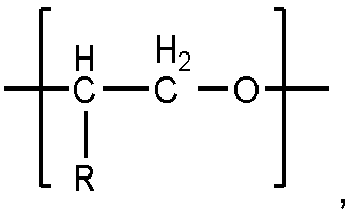

- Die allgemeine Schreibweise


- Es ist weiterhin bevorzugt, dass der Rest R4 ein Wasserstoff ist.
- Es ist dabei bevorzugt, dass die Summe aller Wiederholungseinheiten (U), (V) und (W) dividiert durch die Summe aller Wiederholungseinheiten (U), (V), (W), (X), (Y) und (Z) des mindestens einen polyester-polyethermodifizierten Polybutadiens (G) von >0 % bis 70 %, bevorzugt von 1 % bis 50 %, weiter bevorzugt von 2 % bis 40 %, noch weiter bevorzugt von 3 % bis 30 %, besonders bevorzugt von 4 % bis 20 % beträgt.
- Das bedeutet, dass >0 % bis 70 %, bevorzugt 1 % bis 50 %, weiter bevorzugt von 2 % bis 40 %, noch weiter bevorzugt von 3 % bis 30 %, besonders bevorzugt von 4 % bis 20 % der Gesamtheit der Wiederholungseinheiten (U), (V), (W), (X), (Y) und (Z) polyester-polyethermodifizierte sind.
- Die zahlenmittlere Molmasse Mn, gewichtsmittlere Molmasse Mw und Polydispersität des Polybutadienteils des polyester-polyethermodifizierten Polybutadiens sind beliebig. Unter dem Polybutadienteil wird dabei der Teil des polyester-polyethermodifizierten Polybutadiens verstanden, der vom verfahrensgemäß eingesetzten Polybutadien stammt.
- Es ist bevorzugt, dass die zahlenmittlere Molmasse Mn des Polybutadienteils des polyester-polyethermodifizierten Polybutadien von 200 g/mol bis 20000 g/mol, bevorzugt von 500 g/mol bis 10000 g/mol, besonders bevorzugt von 700 g/mol bis 5000 g/mol beträgt.
- Alternativ ist es bevorzugt, dass die zahlenmittlere Molmasse Mn des Polybutadienteils des polyester-polyethermodifizierten Polybutadiens von 2100 g/mol bis 20000 g/mol, besonders bevorzugt von 2200 g/mol bis 10000 g/mol, ganz besonders bevorzugt von 2300 g/mol bis 5000 g/mol beträgt.
- Die zahlenmittlere Molmasse Mn des Polybutadienteils ist dabei als die zahlenmittlere Molmasse Mn des zugrundeliegenden Polybutadiens definiert.
- Es ist weiterhin bevorzugt, dass das polyester-polyethermodifizierte Polybutadien im Zahlenmittel 5 bis 360, besonders bevorzugt 10 bis 180, ganz besonders bevorzugt 15 bis 90 Wiederholungseinheiten aufweist, wobei die Wiederholungseinheiten aus der Gruppe bestehend aus (U), (V), (W), (X), (Y) und (Z) ausgewählt sind.
- Alternativ ist es bevorzugt, dass das polyester-polyethermodifizierte Polybutadien im Zahlenmittel 35 bis 360, besonders bevorzugt 40 bis 180, ganz besonders bevorzugt 45 bis 90 Wiederholungseinheiten aufweist, wobei die Wiederholungseinheiten aus der Gruppe bestehend aus (U), (V), (W), (X), (Y) und (Z) ausgewählt sind.
- Es ist weiterhin bevorzugt, dass die polyester-polyethermodifizierte Polybutadiene dadurch gekennzeichnet sind, dass 0 % bis 80 %, bevorzugt 0 % bis 30 %, besonders bevorzugt 0 % bis 10% und ganz besonders bevorzugt 0 % bis 5 % der enthaltenen Doppelbindungen 1,2-Vinyl-Doppelbindungen sind und 20% bis 100%, bevorzugt 70 % bis 100 %, besonders bevorzugt 90 % bis 100 % und ganz besonders bevorzugt 95 % bis 100 % der enthaltenen Doppelbindungen 1,4-Doppelbindungen sind.
- Ganz besonders bevorzugt sind solche polyester-polyethermodifizierten Polybutadiene, die sich von den oben beschriebenen Polybutadienen Polyvest® 110 und Polyvest® 130 der Evonik Industries AG / Evonik Operations GmbH sowie Lithene ultra AL und Lithene ActiV 50 von Synthomer PLC ableiten.
- Die Molmasse und die Polydispersität der Reste B ist beliebig. Es ist aber bevorzugt, dass die mittlere Molmasse der Reste B von 100 g/mol bis 20000 g/mol, bevorzugt von 200 g/mol bis 15000 g/mol, besonders bevorzugt von 400 g/mol bis 10000 g/mol beträgt. Die mittlere Molmasse der Reste B kann aus der Einwaage der eingesetzten Monomere bezogen auf die Anzahl der OH-Gruppen des eingesetzten hydroxyfunktionellen Polybutadiens (E) berechnet werden. Werden also beispielsweise 40 g Ethylenoxid eingesetzt und weist die Menge des eingesetzten hydroxyfunktionellen Polybutadiens (E) 0,05 mol OH-Gruppen auf, so beträgt die mittlere Molmasse des Rests B 800 g/mol.
- Die polyester-polyethermodifizierten Polybutadiene sind je nach Zusammensetzung und Molmasse flüssig, pastös oder fest.
- Die zahlenmittlere Molmasse Mn der polyester-polyethermodifizierten Polybutadiene beträgt bevorzugt von 1000 g/mol bis 6000 g/mol, weiter bevorzugt von 1500 g/mol bis 5000 g/mol, besonders bevorzugt von 2000 g/mol bis 4000 g/mol.
- Ihre Polydispersität ist in weiten Bereichen variabel. Die Polydispersität des mindestens einen polyester-polyethermodifizierten Polybutadiens liegt nach GPC-Methode gegen PPG-Standard bevorzugt bei Mw/Mn von 1,5 bis 10, weiter bevorzugt zwischen 2 und 9, besonders bevorzugt zwischen 3 und 8.
- Ein weiterer Gegenstand der Erfindung ist ein Verfahren zur Herstellung von vorzugsweise linearen Polybutadienen, die kammständig (seitständig) mit Polyetherresten modifiziert sind, die mindestens eine Estergruppe aufweisen, bereitzustellen. Angelehnt an die Europäische Patentanmeldung
EP 19212066.5 PCT/EP2020/083013 - Basierend auf die Lehre der Europäischen Patentanmeldung
EP 19212066.5 PCT/EP2020/083013 - a) Umsetzung mindestens eines Polybutadiens (A) mit mindestens einem Epoxidierungsreagenz (B) zu mindestens einem epoxyfunktionellen Polybutadien (C);
- b) Umsetzung des mindestens einen epoxyfunktionellen Polybutadiens (C) mit mindestens einer hydroxyfunktionellen Verbindung (D) zu mindestens einem hydroxyfunktionellen Polybutadien (E);
- c) Umsetzung des mindestens einen hydroxyfunktionellen Polybutadiens (E) mit mindestens einer epoxyfunktionellen Verbindung (F) zu mindestens einem polyethermodifizierten Polybutadien (G)
- d) Umsetzung des mindestens einen polyethermodifizierten Polybutadiens (G) mit mindestens einer Verbindung (I) zur mindestens einem polyether-polyester-modifizierten Polybutadien (H).
- Überraschenderweise wurde gefunden, dass sich Polybutadiene mit hohem Anteil an 1,4-Einheiten und geringem Gehalt an vinylischen 1,2- Einheiten nach der Epoxidierung mit Wasserstoffperoxid leicht unter sauer katalysierter Ringöffnung mit OH-funktionellen Verbindungen in seitständig OH-funktionelle Polybutadiene (Polybutadienole) umwandeln und anschließend mit Alkylenoxiden alkoxylieren lassen.
- Gegenstände der vorliegenden Erfindung sind in den unabhängigen Ansprüchen formuliert. Vorteilhafte Ausgestaltungen der Erfindung sind in den nachgeordneten Ansprüchen, den Beispielen und der Beschreibung angegeben.
- Die erfindungsgemäßen Gegenstände werden nachfolgend beispielhaft beschrieben, ohne dass die Erfindung auf diese beispielhaften Ausführungsformern beschränkt sein soll. Sind nachfolgend Bereiche, allgemeine Formeln oder Verbindungsklassen angegeben, so sollen diese nicht nur die entsprechenden Bereiche oder Gruppen von Verbindungen umfassen, die explizit erwähnt sind, sondern auch alle Teilbereiche und Teilgruppen von Verbindungen, die durch Herausnahme von einzelnen Werten (Bereichen) oder Verbindungen erhalten werden können. Werden im Rahmen der vorliegenden Beschreibung Dokumente zitiert, so soll deren Inhalt vollständig zum Offenbarungsgehalt der vorliegenden Erfindung gehören.
- Werden nachfolgend Mittelwerte angegeben, so handelt es sich, wenn nicht anders angegeben, um Zahlenmittel. Werden nachfolgend Messwerte, Parameter oder Stoffeigenschaften angegeben, die durch Messung bestimmt werden, so handelt es sich, wenn nicht anders angegeben, um Messwerte, Parameter oder Stoffeigenschaften gemessen bei 25 °C sowie vorzugsweise bei einem Druck von 101325 Pa (Normaldruck).
- Werden nachfolgend Zahlenbereiche in der Form "X bis Y" angegeben, wobei X und Y die Grenzen des Zahlenbereichs darstellen, so ist dies gleichbedeutend mit der Angabe "von mindestens X bis einschließlich Y", sofern nicht anders angegeben. Bereichsangaben schließen die Bereichsgrenzen X und Y also mit ein, sofern nicht anders angegeben.
- Wo immer Moleküle beziehungsweise Molekülfragmente ein oder mehrere Stereozentren aufweisen oder aufgrund von Symmetrien in Isomere unterschieden werden können oder aufgrund anderer Effekte, wie zum Beispiel eingeschränkter Rotation, in Isomere unterschieden werden können, sind alle möglichen Isomere von der vorliegenden Erfindung miteingeschlossen.
- Die in dieser Erfindung aufgeführten Formeln beschreiben Verbindungen oder Reste, die aus Wiederholungseinheiten aufgebaut sind, wie beispielsweise sich wiederholende Fragmente, Blöcke oder Monomereinheiten, und eine Molgewichtsverteilung aufweisen können. Die Häufigkeit der Wiederholungseinheiten wird durch Indizes angegeben. Die in den Formeln verwendeten Indizes sind als statistische Mittelwerte (Zahlenmittel) zu betrachten. Die verwendeten Indexzahlen sowie die Wertbereiche der angegebenen Indizes werden als Mittelwerte der möglichen statistischen Verteilung der tatsächlichen vorhandenen Strukturen und/oder deren Mischungen verstanden. Die verschiedenen Fragmente beziehungsweise Wiederholungseinheiten der in den nachfolgenden Formeln (1) bis (5) beschriebenen Verbindungen können statistisch verteilt sein. Statistische Verteilungen sind blockweise aufgebaut mit einer beliebigen Anzahl an Blöcken und einer beliebigen Sequenz oder unterliegen einer randomisierten Verteilung, sie können auch alternierend aufgebaut sein, oder auch über die Kette, sofern eine solche vorliegt, einen Gradienten bilden, insbesondere können sie auch alle Mischformen bilden, bei denen gegebenenfalls Gruppen unterschiedlicher Verteilungen aufeinander folgen können. In den nachfolgenden Formeln sind alle Permutationen von Wiederholungseinheiten mitumfasst. Werden also im Rahmen der vorliegenden Erfindung Verbindungen, wie z.B. Polybutadiene (A), epoxyfunktionelle Polybutadiene (C), hydroxyfunktionelle Polybutadiene (E), polyethermodifizierte Polybutadiene (G) oder polyether-polyester-modifizierten Polybutadien (H). beschrieben, die verschiedene Einheiten mehrfach aufweisen können, so können diese sowohl ungeordnet, z.B. statistisch verteilt, oder geordnet in diesen Verbindungen vorkommen. Die Angaben zur Anzahl bzw. relativen Häufigkeit von Einheiten in solchen Verbindungen sind als Mittelwert (Zahlenmittel), gemittelt über alle entsprechenden Verbindungen, zu verstehen. Spezielle Ausführungen können dazu führen, dass die statistischen Verteilungen durch die Ausführungsform Beschränkungen erfahren. Für alle Bereiche, die nicht von der Beschränkung betroffen sind, ändert sich die statistische Verteilung nicht.
- Ein weiterer Gegenstand der Erfindung ist somit ein Verfahren zur Herstellung von einem oder mehreren polyester-polyethermodifizierten Polybutadienen, umfassend die Schritte:
- a) Umsetzung mindestens eines Polybutadiens (A) mit mindestens einem Epoxidierungsreagenz (B) zu mindestens einem epoxyfunktionellen Polybutadien (C);
- b) Umsetzung des mindestens einen epoxyfunktionellen Polybutadiens (C) mit mindestens einer hydroxyfunktionellen Verbindung (D) zu mindestens einem hydroxyfunktionellen Polybutadien (E);
- c) Umsetzung des mindestens einen hydroxyfunktionellen Polybutadiens (E) mit mindestens einer epoxyfunktionellen Verbindung (F) zu mindestens einem polyethermodifizierten Polybutadien (G),
- d) Umsetzung des mindestens einen polyethermodifizierten Polybutadiens (G) mit mindestens einer Verbindung (I) zur mindestens einem polyether-polyester-modifizierten Polybutadien (H).
- Vorzugsweise kann für Schritt d) ein Katalysator als Initiator der anionischen Ringöffnungspolymerisation dienen. Es können alle gängigen Katalysatoren eingesetzt werden.
- Als Katalysatoren können vorzugsweise Basen oder Säuren, Metallsalze, Metallakoxid oder Metallverbindungen verwendet werden.
- Bei Metallalkoxiden handelt es beispielsweise um Zirkoniumbutoxid, Tetraisopropyltitanat, Tetrabutyltitanat oder Titan(IV)-2-ethylhexyloxid.
- Bei Metallsalzen handelt es beispielsweise um Zinkacetate, Kaliumacetate, Lithiumacetate, Natriumacetate, Calciumacetate, Bariumacetate, Magnesiumacetate, Kupferacetate, Cobaltacetate oder Zink-/ Bismutcarboxylate.
- Bei Säurekatalysatoren handelt es sich z. B. um Toluolsulfonsäure oder Trifluoressigsäure.
- Auch können Zinnchlorid, Zinnoctylat, Dibutylzinndilaurat oder Monobutylzinnoxid eingesetzt werden.
- Es ist bevorzugt, dass das erfindungsgemäße Verfahren außerdem mindestens einen der folgenden optionale Schritte umfasst:
e) Farbaufhellung des mindestens einen polyethermodifizierten Polybutadiens (G). Vorzugsweise ist das Verfahren weiterhin dadurch gekennzeichnet, dass - im Schritt a) >0 % bis 70 %, bevorzugt 1 % bis 50 %, weiter bevorzugt 2 % bis 40 %, noch weiter bevorzugt 3% bis 30 % und besonders bevorzugt 4 % bis 20 % der Doppelbindungen des mindestens einen Polybutadiens (A) mit Hilfe von Perameisensäure, welche in situ aus Ameisensäure und H2O2 erzeugt wird, epoxidiert werden;
- im Schritt b) an die Epoxidgruppen des mindestens einen epoxyfunktionellen Polybutadiens (C) unter Ringöffnung ein oder mehrere kurzkettige Alkohole mit 1 bis 6 Kohlenstoffatomen, insbesondere Isobutanol, addiert werden, wobei bevorzugt ein oder mehrere saure Katalysatoren, insbesondere Trifluormethansulfonsäure, eingesetzt werden;
- im Schritt c) an die entstandenen seitständigen OH-Gruppen des mindestens einen hydroxyfunktionellen Polybutadiens (E) eine oder mehrere epoxyfunktionelle Verbindungen (F) ausgewählt aus Alkylenoxiden und ggf. weiteren epoxyfunktionellen Monomeren in einer Alkoxylierungsreaktion addiert werden, wobei bevorzugt zusätzlich ein Zn/Co-Doppelmetallcyanid-Katalysator oder basische Katalysatoren wie Amine, Guanidine, Amidine, Alkalihydroxide oder Alkalialkoholate verwendet werden;
- Im Schritt d) optional die Umsetzung des mindestens einen polyethermodifizierten Polybutadiens (G) mit mindestens einer Verbindung (I) ausgewählt ist aus der Gruppe bestehend aus cyclischen Anhydriden, Lactonen oder cyclischen Carbonaten als Monomere oder Comonomere zu mindestens einem polyester-polyethermodifizierten Polybutadien (H) erfolgt;
- im Schritt e) optional die Farbaufhellung des mindestens einen polyethermodifizierten Polybutadiens (G) mit Aktivkohle und/oder Wasserstoffperoxid vorgenommen wird.
- Durch das erfindungsgemäße Verfahren wird es erstmalig ermöglicht, lineare Polybutadiene durch eine einfache direkte Alkoxylierung an den seitständigen OH-Gruppen mit kammständigen Polyetherresten zu modifizieren. Die Kettenlänge und Monomerabfolge im Polyetherrest kann in weiten Bereichen variiert werden. Die mittlere Anzahl der ans Polybutadien gebundenen Polyetherreste ist gezielt über den Grad der Epoxidierung und die Hydroxylfunktionalisierung einstellbar und eröffnet eine große strukturelle Vielfalt bei den hydroxyfunktionellen Polybutadienen (E).
- Das im Stand der Technik bekannte Graften (Pfropfen) von Polyethern an Polybutadien erfolgt in der Praxis selten quantitativ und die Reaktionsprodukte enthalten üblicherweise freie Anteile an Polyethern und gegebenenfalls nicht funktionalisierte Polybutadiene. Die vorbeschriebene Addition von OH-funktionellen Polyethern über ihre OH-Gruppe an epoxidierte Polybutadiene geschieht ebenfalls meist unvollständig und die Produkte enthalten restliche, nicht umgesetzte Epoxidgruppen. Werden die Polyether im Überschuss eingesetzt, so lässt sich der Restgehalt and Epoxidgruppen zwar reduzieren, die Überschusspolyether verbleiben aber im Produkt, da sie destillativ nicht abgetrennt werden können.
- Für den Schritt d) werden bevorzugt für Verbindung (I)
- cyclischen Anhydride, rein oder in beliebigen Mischungen, ausgewählt sind aus der Gruppe bestehend aus gesättigten, ungesättigten oder aromatischen cyclischen Dicarbonsäureanhydriden, bevorzugt Bernsteinsäureanhydrid, Oct(en)yl-, Dec(en)yl- und Dodec(en)ylbernsteinsäueanhydrid, Maleinsäureanhydrid, Itaconsäureanhydrid, Glutaranhydrid, Adipinanhydrid, Citraconanhydrid, Trimellitanhydrid, Phthalsäureanhydrid, Hexahydro-, Tetrahydro-, Dihydro-, Methylhexahydro- und Methyltetrahydrophthalsäureanhydrid oder
- Lactone, rein oder in beliebigen Mischungen, ausgewählt sind aus der Gruppe bestehend aus Valerolactone, Caprolactone und Butyrolactone, die unsubstituiert oder mit Alkylgruppen, bevorzugt Methylgruppen, substituiert sein können, vorzugsweise ε-Caprotacton oder δ-Valerolacton.
- Vorzugsweise kann für Schritt d) ein Katalysator als Initiator der anionischen Ringöffnungspolymerisation dienen. Als Katalysatoren können Basen oder Säuren, Metallsalze, Metallakoxid oder Metallverbindungen verwendet werden.
- Bei Metallalkoxiden handelt es beispielsweise um Zirkoniumbutoxid, Tetraisopropyltitanat, Tetrabutyltitanat oder Titan(IV)-2-ethylhexyloxid.
- Bei Metallsalzen handelt es beispielsweise um Zinkacetate, Kaliumacetate, Lithiumacetate, Natriumacetate, Calciumacetate, Bariumacetate, Magnesiumacetate, Kupferacetate, Cobaltacetate oder Zink-/ Bismutcarboxylate.
- Bei Säurekatalysatoren handelt es sich z. B. um Toluolsulfonsäure oder Trifluoressigsäure.
- Auch können Zinnchlorid, Zinnoctylat, Dibutylzinndilaurat oder Monobutylzinnoxid eingesetzt werden. Die erfindungsgemäß erhältlichen Polybutadiene mit kammständigen Polyester-Polyetherresten sind vorzugsweise im Wesentlichen frei von restlichen Epoxidgruppen. Das erfindungsgemäße Verfahrensprodukt enthält vorzugsweise im Wesentlichen keine freien Polyetheranteile. Vorzugsweise sind im Wesentlichen alle Polyether chemisch über eine Etherbindung an das Polybutadien angebunden. Damit unterscheiden sich die erfindungsgemäßen Verfahrensprodukte deutlich durch ihre erhöhte Reinheit von den bisher aus dem Stand der Technik bekannten Verbindungen.
- Vorzugsweise wurde für die erfindungsgemäße Zusammensetzung die Verbindung auf Basis von linearen Polybutadienen hergestellt.
- Vorzugsweise weist die die Verbindung für die erfindungsgemäße Zusammensetzung keine seitständigen (kammständigen) Polybutadiene auf.
- Vorzugsweise weist die Verbindung ausschließlich seitständige (kammständige) Wiederholungseinheiten (U), (V) und/oder (W) auf.
- Im Schritt a) des erfindungsgemäßen Verfahrens erfolgt die Umsetzung mindestens eines Polybutadiens (A) mit mindestens einem Epoxidierungsreagenz (B) zu mindestens einem epoxyfunktionellen Polybutadien (C).
- Bei dieser Umsetzung werden Doppelbindungen des Polybutadiens (A) in Epoxidgruppen überführt. Verschiedene Methoden zur Epoxidierung von Polybutadienen mit z.B. Percarbonsäuren und Wasserstoffperoxid sind dem Fachmann bekannt und z.B. in
CN 101538338 ,JP 2004346310 DD 253627 WO 2016/142249 A1 offenbart. Besonders geeignet zur Herstellung der epoxyfunktionellen Polybutadiene (C) mit hohem Anteil an 1,4-Einheiten ist Perameisensäure, die auch in situ aus Ameisensäure in Gegenwart von Wasserstoffperoxid gebildet werden kann. Die Epoxidierung findet bevorzugt in einem Lösemittel wie Toluol oder Chloroform statt, das nach der Umsetzung und dem Auswaschen von evtl. Peroxidresten destillativ entfernt wird. - Die Polybutadiene (A) sind Polymere des Buta-1,3-diens. Die Polymerisation der Buta-1,3-dien-Monomere erfolgt dabei im Wesentlichen unter 1,4- und/oder 1,2-Verknüpfung. Eine 1,4-Verknüpfung führt zu sogenannten 1,4-trans-Einheiten und/oder 1,4-cis-Einheiten, die zusammengefasst auch als 1,4-Einheiten bezeichnet werden. Eine 1,2-Verknüpfung führt zu sogenannten 1,2-Einheiten. Die 1,2-Einheiten tragen eine Vinylgruppe und werden auch als vinylische 1,2-Einheiten bezeichnet. Die 1,2-Einheiten werden im Rahmen der vorliegenden Erfindung auch mit "(X)", die 1,4-trans-Einheiten mit "(Y)" und die 1,4-cis-Einheiten mit "(Z)" bezeichnet:

- Die in den Einheiten enthaltenen Doppelbindungen werden analog als 1,4-trans-Doppelbindungen, 1,4-cis-Doppelbindungen beziehungsweise 1,2-Doppelbindungen oder 1,2-Vinyl-Doppelbindungen bezeichnet. Die 1,4-trans-Doppelbindungen und 1,4-cis-Doppelbindungen werden zusammenfassend auch als 1,4-Doppelbindungen bezeichnet.
- Es handelt sich bei den Polybutadienen (A) also um unmodifizierte Polybutadiene. Die Polybutadiene (A) und ihre Herstellverfahren sind dem Fachmann bekannt. Die Herstellung erfolgt vorzugsweise mittels einer radikalischen, einer anionischen oder einer koordinativen Kettenpolymerisation.
- Die radikalische Kettenpolymerisation wird bevorzugt als Emulsionspolymerisation durchgeführt. Dies führt zu einem statistischen Auftreten der drei genannten Einheiten. Bei niedriger Reaktionstemperatur (ca. 5 °C) sinkt der Anteil an Vinylgruppen. Die Initiierung erfolgt vorzugsweise mit Kaliumperoxodisulfat und Eisensalzen oder auch mit Wasserstoffperoxid.
- Bei der anionischen Kettenpolymerisation erfolgt die Initiierung der Kettenpolymerisation vorzugsweise mit Butyllithium. Das so erhaltene Polybutadien (A) enthält etwa 40 % 1,4-cis-Einheiten und 50 % 1,4-trans-Einheiten.
- Bei der koordinativen Kettenpolymerisation werden vorzugsweise Ziegler-Natta-Katalysatoren eingesetzt, insbesondere stereospezifische Ziegler-Natta-Katalysatoren, die zu einem Polybutadien (A) mit einem hohen Anteil an 1,4-cis-Einheiten führen.
- Bei der Polymerisation von 1,3-Butadien können durch Neben- oder Folgereaktionen, wie z.B. einer Folgereaktion der Doppelbindungen der resultierenden 1,2- und 1,4-Einheiten des Polybutadiens, auch verzweigte Polybutadiene (A) entstehen. Bevorzugt handelt es sich bei den erfindungsgemäß eingesetzten Polybutadienen (A) aber um lineare, also unverzweigte Polybutadiene. Es ist auch möglich, dass die Polybutadiene in geringen Anteilen andere Einheiten als 1,2-Einheiten, 1,4-trans-Einheiten oder 1,4-cis-Einheiten aufweisen. Es ist aber bevorzugt, dass der Massenanteil der Summe von 1,2-Einheiten, 1,4-trans-Einheiten und 1,4-cis-Einheiten mindestens 80 %, vorzugweise mindestens 90 %, insbesondere mindestens 99% bezogen auf die Gesamtmasse des mindestens einen Polybutadiens (A), also bezogen auf die Gesamtmasse aller eingesetzten Polybutadiene (A), beträgt.
- Für das erfindungsgemäße Verfahren werden vorzugsweise solche Polybutadiene (A) verwendet, die 0 % bis 80 % 1,2-Einheiten und 20 % bis 100 % 1,4-Einheiten, bevorzugt 0 % bis 30 % 1,2-Einheiten und 70 % bis 100 % 1,4-Einheiten, besonders bevorzugt 0 % bis 10 % 1,2-Einheiten und 90 % bis 100 % 1,4-Einheiten, und ganz besonders bevorzugt 0 % bis 5 % 1,2-Einheiten und 95 % bis 100 % 1,4-Einheiten bezogen auf die Summe aus 1,2-Einheiten und 1,4-Einheiten aufweisen.
- Es ist also bevorzugt, dass von den Doppelbindungen aller eingesetzten Polybutadiene (A) 0 % bis 80 % 1,2-Vinyl-Doppelbindungen und 20 % bis 100 % 1,4-Doppelbindungen, bevorzugt 0 % bis 30 % 1,2-Vinyl-Doppelbindungen und 70 % bis 100 % 1,4-Doppelbindungen, besonders bevorzugt 0 % bis 10 % 1,2-Vinyl-Doppelbindungen und 90 % bis 100 % 1,4-Doppelbindungen, ganz besonders bevorzugt 0 % bis 5 % 1,2-Vinyl-Doppelbindungen und 95 % bis 100 % 1,4-Doppelbindungen sind.
- Für die erfindungsgemäße Herstellung der Produkte werden entsprechend vorzugsweise Polybutadiene (A) der Formel (1)

- Die Indizes x, y und z geben dabei die Anzahl der jeweiligen Butadien-Einheit im Polybutadien (A) wieder. Es handelt sich dabei um numerische Mittelwerte (Zahlenmittel) über die Gesamtheit aller Polybutadienpolymere des mindestens einen Polybutadiens (A).
- Die mittlere Molmasse und Polydispersität der verwendeten Polybutadiene (A) nach Formel (1) ist beliebig.
- Es ist bevorzugt, dass die zahlenmittlere Molmasse Mn des mindestens einen Polybutadiens (A) von 200 g/mol bis 20000 g/mol, bevorzugt von 500 g/mol bis 10000 g/mol, besonders bevorzugt von 700 g/mol bis 5000 g/mol beträgt.
- Alternativ ist es bevorzugt, dass die zahlenmittlere Molmasse Mn des mindestens einen Polybutadiens (A) von 2100 g/mol bis 20000 g/mol, besonders bevorzugt von 2200 g/mol bis 10000 g/mol, ganz besonders bevorzugt von 2300 g/mol bis 5000 g/mol beträgt.
- Die zahlenmittlere Molmasse Mn, die gewichtsmittlere Molmasse Mw und die Polydispersität (Mw/Mn) werden im Rahmen der vorliegenden Erfindung vorzugsweise mittels Gel-Permeations-Chromatographie (GPC) bestimmt, wie in den Beispielen beschrieben.
- Es ist weiterhin bevorzugt, dass das mindestens eine Polybutadien (A) im Zahlenmittel 5 bis 360, besonders bevorzugt 10 bis 180, ganz besonders bevorzugt 15 bis 90 Einheiten ausgewählt aus der Gruppe bestehend aus 1,2-Einheiten, 1,4-cis-Einheiten und 1,4-trans-Einheiten aufweist.
- Alternativ ist es bevorzugt, dass das mindestens eine Polybutadien (A) im Zahlenmittel 35 bis 360, besonders bevorzugt 40 bis 180, ganz besonders bevorzugt 45 bis 90 Einheiten ausgewählt aus der Gruppe bestehend aus 1,2-Einheiten, 1,4-cis-Einheiten und 1,4-trans-Einheiten aufweist.
- Es ist weiterhin bevorzugt, dass die Viskosität der verwendeten Polybutadiene (A) 50 bis 50000 mPas vorzugsweise 100 bis 10000 mPas, insbesondere 500 bis 5000 mPas beträgt (bestimmt gemäß DIN EN ISO 3219:1994-10).
- Besonders bevorzugt eingesetzte Polybutadiene sind die von Evonik Industries AG / Evonik Operations GmbH kommerziell erhältlichen Produkte Polyvest® 110 und Polyvest® 130 mit den folgenden typischen Kenndaten:
- Polyvest® 110: ca. 1 % 1,2-Vinyl-Doppelbindungen, ca. 24 % 1,4-trans-Doppelbindungen, ca. 75 % 1,4-cis-Doppelbindungen, zahlenmittlere Molmasse Mn ca. 2600 g/mol, Viskosität (20 °C) 700-860 mPas (gemäß DIN EN ISO 3219:1994-10),
- Polyvest® 130: ca. 1 % 1,2-Vinyl-Doppelbindungen, ca. 22 % 1,4-trans-Doppelbindungen, ca. 77 % 1,4-cis-Doppelbindungen, zahlenmittlere Molmasse Mn ca. 4600 g/mol, Viskosität (20 °C) 2700-3300 mPas (gemäß DIN EN ISO 3219:1994-10).
- Besonders bevorzugt eingesetzte Polybutadiene sind weiterhin die von Synthomer PLC erhältlichen Produkte Lithene ultra AL und Lithene ActiV 50 mit den folgenden typischen Kenndaten:
- Lithene ultra AL: ca. 40 % 1,2-Vinyl-Doppelbindungen, ca. 60 % 1,4- Doppelbindungen,
- Lithene ActiV 50: ca. 70 % 1,2-Vinyl-Doppelbindungen, ca. 30% 1,4- Doppelbindungen.
- Der Epoxidierungsgrad wird z.B. mit Hilfe der 13C-NMR-Spektroskopie oder der Epoxidzahl-Titration (Bestimmungen des Epoxid-Äquivalents gemäß DIN EN ISO 3001:1999) quantitativ bestimmt und kann über die Prozessbedingungen, insbesondere über die Einsatzmenge an Wasserstoffperoxid in Relation zur vorgelegten Menge an Doppelbindungen im Polybutadien, gezielt und reproduzierbar eingestellt werden.
- Es ist bevorzugt, dass im Schritt a) des erfindungsgemäßen Verfahrens >0 % bis 70 %, bevorzugt 1 % bis 50 %, weiter bevorzugt 2 % bis 40 %, noch weiter bevorzugt 3% bis 30 % und besonders bevorzugt 4 % bis 20 % aller Doppelbindungen des mindestens einen Polybutadiens (A) epoxidiert werden.
- Als Epoxidierungsreagenz (B) sind prinzipiell alle dem Fachmann bekannten Epoxidierungsmittel einsetzbar. Es ist bevorzugt, dass das Epoxidierungsreagenz (B) ausgewählt ist aus der Gruppe der Peroxycarbonsäuren (Percarbonsäuren, Persäuren), vorzugsweise aus der Gruppe bestehend aus meta-Chlorperbenzoesäure, Peroxyessigsäure (Peressigsäure) und Peroxyameisensäure (Perameisensäure), insbesondere Peroxyameisensäure (Perameisensäure). Die Peroxycarbonsäuren werden dabei vorzugsweise in situ aus der entsprechenden Carbonsäure und Wasserstoffperoxid gebildet.
- Es ist besonders bevorzugt, dass das mindestens eine Epoxidierungsreagenz (B) Perameisensäure enthält, welche vorzugweise in situ aus Ameisensäure und Wasserstoffperoxid gebildet wird.
- Die Epoxidierung des mindestens einen Polybutadiens (A) findet statistisch über die Polybutadienkette verteilt bevorzugt an den 1,4-Doppelbindungen statt. Eine Epoxidierung der 1,2-Doppelbindungen kann ebenfalls stattfinden und findet an diesen ebenfalls statistisch über die Polybutadienkette verteilt statt. Eine Epoxidierung der 1,2-Doppelbindungen ist aber gegenüber einer Epoxidierung der 1,4-Doppelbindungen benachteiligt. Das Reaktionsprodukt enthält somit epoxyfunktionelle Polybutadienpolymere, die sich in ihrem Epoxidierungsgrad voneinander unterscheiden. Alle angegebenen Epoxidierungsgrade sind daher als Mittelwerte zu verstehen.
- Es ist weiterhin bevorzugt, während des erfindungsgemäßen Verfahrens zur Stabilisierung der Edukte, Intermediate und Produkte, Stabilisatoren bzw. Antioxidantien zu verwenden, um ungewollte Polymerisationsreaktionen der Doppelbindungen zu vermeiden. Hierfür eignen sich z.B. die dem Fachmann bekannten sterisch gehinderten Phenole, kommerziell erhältlich zum Beispiel als Anox® 20, Iganox® 1010 (BASF), Irganox® 1076 (BASF) und Irganox® 1135 (BASF). Es ist ferner bevorzugt, den gesamten Herstellprozess unter einer Inertatmosphäre, z.B. unter Stickstoff, durchzuführen. Auch sollten vorzugsweise die unmodifizierten Edukte, also das mindestens eine Polybutadien (A), wie auch die erfindungsgemäßen polyethermodifizierten Fertigprodukte, also das mindestens eine polyethermodifizierte Polybutadien (G) bzw. (K), möglichst unter Ausschluss von Luft aufbewahrt werden.
- Im Schritt b) des erfindungsgemäßen Verfahrens erfolgt die Umsetzung des mindestens einen epoxyfunktionellen Polybutadiens (C) mit mindestens einer hydroxyfunktionellen Verbindung (D) zu mindestens einem hydroxyfunktionellen Polybutadien (E).
- Bei dieser Umsetzung findet eine Addition (Additionsreaktion) der mindestens einen hydroxyfunktionellen Verbindung (D) an das mindestens eine epoxyfunktionelle Polybutadien (C) statt. Die Umsetzung erfolgt also unter Bildung von einer oder mehreren kovalenten Bindungen zwischen der mindestens einen hydroxyfunktionellen Verbindung (D) und dem mindestens einen epoxyfunktionellen Polybutadien (C). Die Umsetzung umfasst vorzugsweise (zumindest idealisiert) einen Reaktionsschritt, bei dem ein nukleophiler Angriff mindestens einer Hydroxygruppe der mindestens einen hydroxyfunktionellen Verbindungen (D) an mindestens eine Epoxygruppe des mindestens einen epoxyfunktionellen Polybutadiens (C) unter Ringöffnung dieser mindestens einen Epoxygruppe erfolgt.
- Prinzipiell können im Sinne des erfindungsgemäßen Verfahrens alle Verbindungen mit mindestens einer Hydroxylgruppe an die Epoxidgruppen des Polybutadiens addiert werden. Hydroxyfunktionelle Verbindungen (D) können beispielsweise aus der Gruppe bestehend aus Alkoholen, Carbonsäuren und Wasser ausgewählt werden. Bevorzugt wird die mindestens eine hydroxyfunktionelle Verbindungen (D) aus der Gruppe der monofunktionellen Alkohole mit 1 bis 6 Kohlenstoffatomen, weiter bevorzugt aus der Gruppe der monofunktionellen Alkohole mit 2 bis 4 Kohlenstoffatomen, besonders bevorzugt aus der Gruppe bestehend aus Ethanol, 1-Propanol, Isopropanol (iso-Propanol), 1-Butanol, 2-Butanol und Isobutanol (iso-Butanol) ausgewählt. Dabei können auch beliebige Gemische dieser Alkohole eingesetzt werden. Es ist aber insbesondere bevorzugt, dass als hydroxyfunktionelle Verbindung (D) nicht Methanol eingesetzt wird. Als hydroxyfunktionelle Verbindung (D) ist auch Wasser geeignet. Wasser kann allein oder in Mischung mit einer oder mehreren anderen hydroxyfunktionellen Verbindungen (D) eingesetzt werden. So können beispielsweise Mischungen von Alkohol und Wasser oder Mischungen von Carbonsäure und Wasser im Schritt b) eingesetzt werden. Es ist also nicht nötig, die mindestens eine hydroxyfunktionelle Verbindung (D), wie beispielsweise Alkohol oder Carbonsäure, zu trocknen und von Wasser zu befreien.
- Das molare Verhältnis der OH-Gruppen der hydroxyfunktionellen Verbindung (D) zu den Epoxidgruppen des epoxyfunktionellen Polybutadiens (C) kann in einem weiten Bereich variiert werden. Es ist aber bevorzugt, die hydroxyfunktionellen Verbindungen (D) bezogen auf das stöchiometrische Verhältnis von Hydroxygruppen zu den Epoxidgruppen des epoxyfunktionellen Polybutadiens (C) in einem stöchiometrischen Überschuss einzusetzen, um einen quantitativen Umsatz aller Epoxidgruppen zu erreichen. Es ist daher bevorzugt, dass im Schritt b) die Gesamtzahl der Hydroxygruppen aller hydroxyfunktionellen Verbindungen (D) zur Gesamtzahl der Epoxidgruppen aller epoxyfunktionellen Polybutadiene (C) von >1:1 bis 50:1, weiter bevorzugt von 2:1 bis 35:1, noch weiter bevorzugt 3:1 bis 30:1, besonders bevorzugt von 3:1 bis 25:1 beträgt. Der Überschuss an Verbindung (D) kann nach der Umsetzung z.B. destillativ entfernt und bei Bedarf wiederverwendet werden.
- In einer bevorzugten Ausführungsform findet die Reaktion in Anwesenheit mindestens eines sauren Katalysators statt. Der Katalysator ist wahlweise im Reaktionsgemisch homogen löslich oder heterogen als Feststoff darin verteilt, wie z.B. sulfonsaure Ionenaustauscher. Bevorzugt im Sinne der Erfindung sind Katalysatoren wie Schwefelsäure, Sulfonsäuren und Trifluoressigsäure, besonders bevorzugt ist Trifluormethansulfonsäure. Es ist also bevorzugt, dass im Schritt b) eine Säure, weiter bevorzugt Schwefelsäure, Sulfonsäuren und/oder Trifluoressigsäure, besonders bevorzugt Trifluormethansulfonsäure als Katalysator eingesetzt wird.
- Die Art und Einsatzmenge der Säure werden so gewählt, dass eine möglichst rasche und quantitative Addition der mindestens einen hydroxyfunktionellen Verbindung (D) an die Epoxidgruppen des mindestens einen epoxyfunktionellen Polybutadiens (C) erfolgt. Vorzugsweise wird Trifluormethansulfonsäure in einer Konzentration von 1 wppm bis 1000 wppm (wppm = Massen-ppm), besonders bevorzugt in einer Konzentration von 50 wppm bis 300 wppm bezogen auf die Reaktionsmischung eingesetzt.
- Die Reaktion des mindestens einen epoxyfunktionellen Polybutadiens (C) mit der mindestens einen hydroxyfunktionellen Verbindung (D) in Gegenwart eines sauren Katalysators findet vorzugsweise im Temperaturbereich von 20 °C bis 120 °C statt und ist nach oben durch den Siedepunkt der hydroxyfunktionellen Verbindung (D) bzw. bei Verwendung mehrerer hydroxyfunktioneller Verbindungen (D) durch den Siedepunkt der flüchtigsten hydroxyfunktionellen Verbindung (D) begrenzt. Bevorzugt wird die Umsetzung bei 50 °C bis 90 °C durchgeführt. Die Komponenten werden einige Stunden gerührt, bis die Epoxidgruppen möglichst vollständig umgesetzt sind. Die Analyse auf Epoxidgruppen kann wahlweise durch NMR-spektroskopische Analyse oder durch bekannte Methoden der Epoxidzahl-Titration erfolgen (wie in den Beispielen beschrieben). Die Reaktionsbedingungen in Schritt b) werden vorzugsweise so gewählt, dass mehr als 97 % der in Schritt a) generierten Epoxidgruppen unter Ringöffnung umgesetzt werden. Es ist besonders bevorzugt, dass im Produkt von Schritt b), also im mindestens einen hydroxyfunktionellen Polybutadien (E), keine Epoxidgruppen mehr nachweisbar sind.
- Nach der Reaktion wird das saure Reaktionsgemisch neutralisiert. Zu diesem Zweck kann prinzipiell jedes basische Neutralisationsmittel zugesetzt werden. Bevorzugt wird die Neutralisation mit Natriumhydrogencarbonat, in fester Form oder als wässrige Lösung, durchgeführt. Die gegebenenfalls überschüssigen hydroxyfunktionellen Verbindungen (D) sowie gegebenenfalls Wasser werden vorzugsweise destillativ entfernt und ausgefallene Salze werden bei Bedarf abfiltriert. Bevorzugt ist dabei die Verwendung von wässriger Natriumhydrogencarbonat-Lösung, da so farbhellere Produkte erhalten werden.
- Aus jeweils einer Epoxidgruppe eines epoxyfunktionellen Polybutadiens (C) resultiert nach Ringöffnung durch eine hydroxyfunktionelle Verbindung (D) der Formel A-OH eine Wiederholungseinheit der Formel (2a), (2b) oder (2c):
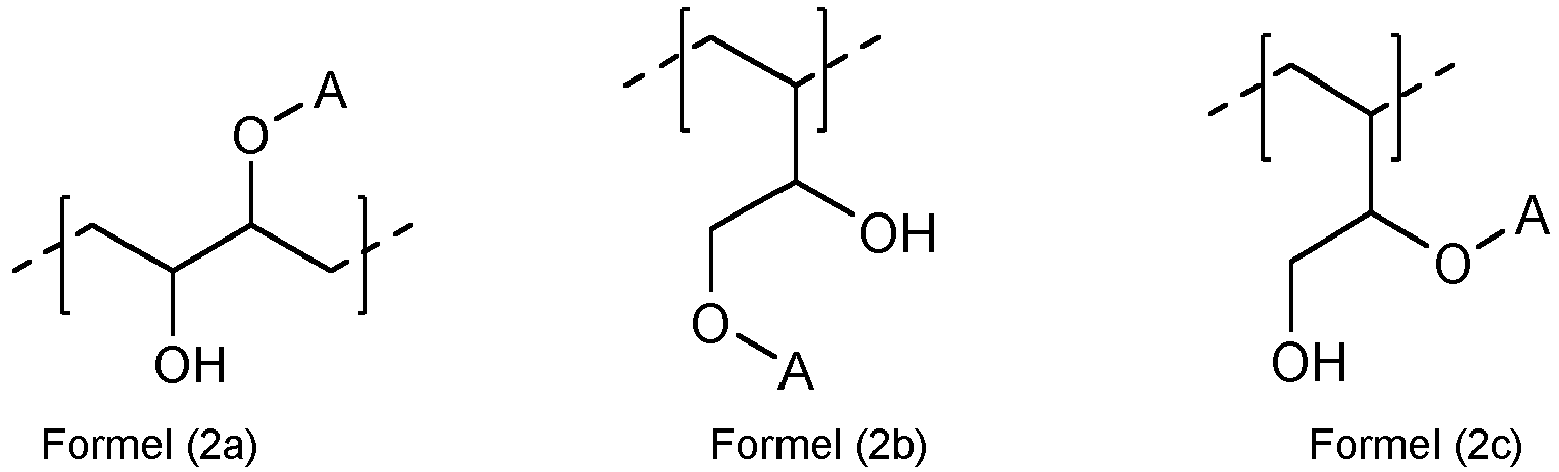
- A ist dabei vorzugsweise ein einbindiger organischer Rest, der auch weitere Hydroxylgruppen tragen kann, oder ein Wasserstoffradikal. Wird beispielsweise ein monofunktioneller, aliphatischer Alkohol mit 1 bis 6 Kohlenstoffatomen als hydroxyfunktionelle Verbindung (D) eingesetzt, so ist A ein Alkylrest mit 1 bis 6 Kohlenstoffatomen. Im Fall von Wasser als hydroxyfunktionelle Verbindung (D) ist A ein Wasserstoffradikal, also A = H. Wird beispielsweise eine Carbonsäure als hydroxyfunktionelle Verbindung (D) eingesetzt, so ist A ein Acylrest. Es resultiert also aus jeder umgesetzten Epoxidgruppe mindestens eine seitständige OH-Gruppe. Ist, wie im Fall von Wasser, A = H so resultieren aus jeder umgesetzten Epoxidgruppe genau zwei seitständige OH-Gruppen. In allen anderen Fällen, also A ≠ H, resultiert aus jeder umgesetzten Epoxidgruppe genau eine seitständige OH-Gruppe.
- Im Falle der erfindungsgemäß bevorzugten Polybutadiene (A) mit einem überwiegenden Anteil von 1,4-Einheiten, überwiegen von den Wiederholungseinheiten der Formeln (2a), (2b) und (2c) solche der Formel (2a).
- Es ist bevorzugt, dass das mindestens eine hydroxyfunktionelle Polybutadien (E) 20 % bis 100 %, bevorzugt 70 % bis 100 %, weiter bevorzugt 90 % bis 100 %, besonders bevorzugt 95 % bis 100% Wiederholungseinheiten der Formel (2a) bezogen auf die Summe der Wiederholungseinheiten der Formeln (2a), (2b) und (2c) aufweist.
- Es ist weiterhin bevorzugt, dass der Anteil der Wiederholungseinheiten der Formeln (2a), (2b) und (2c) zusammengenommen >0 % bis 70 %, bevorzugt 1 % bis 50 %, weiter bevorzugt 2 % bis 40 %, noch weiter bevorzugt 3% bis 30 % und besonders bevorzugt 4 % bis 20 % bezogen auf die Gesamtzahl aller Wiederholungseinheiten des mindestens einen hydroxyfunktionellen Polybutadiens (E) beträgt. Es ist entsprechend bevorzugt, dass der Hydroxylierungsgrad >0 % bis 70 %, bevorzugt 1 % bis 50 %, weiter bevorzugt 2 % bis 40 %, noch weiter bevorzugt 3% bis 30 % und besonders bevorzugt 4 % bis 20 % beträgt. Bei vollständiger Umsetzung in Schritt b) entspricht der Hydroxylierungsgrad des hydroxyfunktionellen Polybutadiens (E) dem Epoxidierungsgrad des entsprechenden epoxyfunktionellen Polybutadiens (C).
- Im Schritt c) des erfindungsgemäßen Verfahrens erfolgt die Umsetzung des mindestens einen hydroxyfunktionellen Polybutadiens (E) mit mindestens einer epoxyfunktionellen Verbindung (F) zu mindestens einem polyethermodifizierten Polybutadien (G).
- Das mindestens eine hydroxyfunktionelle Polybutadien (E) aus Schritt b) dient im Schritt c) als Startverbindung für die Umsetzung mit der mindestens einen epoxyfunktionellen Verbindung (F). Unter Ringöffnung und vorzugsweise in Gegenwart eines geeigneten Katalysators wird die mindestens eine epoxyfunktionelle Verbindung (F) (im Folgenden auch einfach als "Monomer" oder "Epoxidmonomer" oder "Epoxid" bezeichnet), in einer Polyadditionsreaktion an die OH-Gruppen des mindestens einen hydroxyfunktionellen Polybutadiens (E) addiert. Dies führt zur Bildung der erfindungsgemäßen Polybutadiene mit kammständigen (seitständigen) Polyetherketten, also zur Bildung des mindestens einen polyethermodifizierten Polybutadiens (G). Vorzugsweise ist das polyethermodifizierte Polybutadien (G) ein lineares Polybutadien, das kammständig (seitständig) mit Polyetherresten modifiziert ist. Es ist also bevorzugt, dass das polyethermodifizierte Polybutadien (G) ein lineares Polybutadien-Rückgrat und seitständige Polyetherreste aufweist.
- Bei der Umsetzung im Schritt c) handelt es sich vorzugsweise um eine Alkoxylierungsreaktion, also um eine Polyaddition von Alkylenoxiden an das mindestens eine hydroxyfunktionelle Polybutadien (E). Die Umsetzung im Schritt c) kann aber alternativ oder zusätzlich zu den Alkylenoxiden auch mit Glycidylverbindungen durchgeführt werden.
- Es ist daher bevorzugt, dass die mindestens eine im Schritt c) eingesetzte epoxyfunktionelle Verbindung aus der Gruppe der Alkylenoxide, bevorzugt aus der Gruppe der Alkylenoxide mit 2 bis 18 Kohlenstoffatomen, weiter bevorzugt aus der Gruppe der Alkylenoxide mit 2 bis 8 Kohlenstoffatomen, besonders bevorzugt aus der Gruppe bestehend aus Ethylenoxid, Propylenoxid, 1-Butylenoxid, cis-2-Butylenoxid, trans-2-Butylenoxid, Isobutylenoxid und Styroloxid ausgewählt ist; und/oder dass die mindestens eine im Schritt c) eingesetzte epoxyfunktionelle Verbindung aus der Gruppe der Glycidylverbindungen, bevorzugt aus der Gruppe der monofunktionellen Glycidylverbindungen, besonders bevorzugt aus der Gruppe bestehend aus Phenylglycidylether, o-Kresylglycidylether, tert-Butylphenylglycidylether, Allylglycidylether, Butylglycidylether, 2-Ethylhexylglycidylether, C12/C14-Fettalkoholglycidylether und C13/C15-Fettalkoholglycidylether ausgewählt ist.
- Die Monomere können wahlweise einzeln in reiner Form, abwechselnd hintereinander in beliebiger Dosierreihenfolge, aber auch gleichzeitig gemischt zugefügt werden. Die Sequenz der Monomereinheiten in der entstehenden Polyetherkette unterliegt damit einer blockweisen Verteilung oder einer statistischen Verteilung oder einer graduellen Verteilung im Endprodukt.
- Durch das erfindungsgemäße Verfahren werden seitständige Polyetherketten am Polybutadien aufgebaut, die sich dadurch auszeichnen, dass sie hinsichtlich Strukturaufbau und Molmasse gezielt und reproduzierbar hergestellt werden können.
- Die Abfolge der Monomereinheiten kann in weiten Grenzen durch die Reihenfolge der Zugabe variabel gestaltet werden.
- Die Molmassen der seitständigen Polyetherreste können nach dem erfindungsgemäßen Verfahren in weiten Grenzen variiert und gezielt und reproduzierbar über das Molverhältnis der zugefügten Monomere in Bezug auf die OH-Gruppen des mindestens einen vorgelegten hydroxyfunktionellen Polybutadiens (E) aus Schritt b) gesteuert werden.
- Die erfindungsgemäß hergestellten polyethermodifizierten Polybutadiene (G) sind vorzugsweise dadurch gekennzeichnet, dass sie gemäß den Formeln (3a), (3b) und (3c) über eine Ethergruppe an das Polybutadiengerüst gebundene Reste B enthalten,

- Wie oben zu Schritt b) ausgeführt wurde, stammt der Rest A in den Formeln (3a), (3b) und (3c) aus der Verbindung A-OH, also der im Schritt b) eingesetzten hydroxyfunktionellen Verbindung (D). Wie ebenfalls oben ausgeführt wurde, sind im Schritt b) zwei Fälle zu unterscheiden, nämlich A ≠ H oder A = H. Im ersten Fall, also für A ≠ H, ist der Rest A in den Formeln (3a), (3b) und (3c) identisch mit dem Rest A in den Formeln (2a), (2b) und (2c). Im zweiten Fall, also für A = H, ist der Rest A in den Formeln (3a), (3b) und (3c) jeweils unabhängig voneinander H oder ein Rest B. Wird beispielsweise ein monofunktioneller, aliphatischer Alkohol mit 1 bis 6 Kohlenstoffatomen als hydroxyfunktionelle Verbindung (D) eingesetzt, so ist A ein Alkylrest mit 1 bis 6 Kohlenstoffatomen. Wird beispielsweise eine Carbonsäure als hydroxyfunktionelle Verbindung (D) eingesetzt, so ist A ein Acylrest. Wird jedoch Wasser als hydroxyfunktionelle Verbindung (D) eingesetzt, so ist A in den Formeln (3a), (3b) und (3c) im Falle der Umsetzung mit einer oder mehreren epoxyfunktionellen Verbindung (F) ein Rest B, im Falle der Nichtumsetzung bleibt A Wasserstoff. Es resultiert also aus jeder umgesetzten seitständigen Hydroxygruppe genau ein seitständiger Rest -O-B. Der Rest B ist wiederum aus einem oder mehreren Monomeren, vorzugsweise aus mehreren Monomeren, der mindestens einen eingesetzten epoxyfunktionellen Verbindung (F) aufgebaut.
- Im Sinne der Erfindung können prinzipiell alle dem Fachmann bekannten Alkoxylierungskatalysatoren eingesetzt werden, z.B. basische Katalysatoren wie Alkalihydroxide, Alkalimetallalkoholate, Amine, Guanidine, Amidine, Phosphorverbindungen wie Triphenylphosphin, darüber hinaus saure und Lewissaure Katalysatoren wie SnCl4, SnCl2, SnF2, BF3 und BF3-Komplexe, sowie Doppelmetallcyanid (DMC)-Katalysatoren.
- Vor der Epoxidzufuhr, also vor der Zugabe der mindestens einen eingesetzten epoxyfunktionellen Verbindung (F), wird der mit dem Starter und Katalysator teilweise befüllte Reaktor z.B. mit Stickstoff inertisiert. Dies geschieht beispielsweise durch mehrfaches abwechslungsweises Evakuieren und Zuführen von Stickstoff. Es ist vorteilhaft, den Reaktor nach dem letzten Aufdrücken von Stickstoff auf unter 200 mbar zu evakuieren. Die Addition der ersten Menge an Epoxidmonomer findet somit vorzugsweise in den evakuierten Reaktor statt. Die Dosage der Monomere erfolgt unter Rühren und ggf. Kühlen, um die freiwerdende Reaktionswärme abzuführen und die vorgewählte Reaktionstemperatur einzuhalten. Als Starter dient das mindestens eine hydroxyfunktionelle Polybutadien (E) oder es kann auch ein bereits entsprechend dem erfindungsgemäßen Verfahren hergestelltes polyethermodifiziertes Polybutadien (G) als Starter eingesetzt werden, wie weiter unten beschrieben wird.
- Vorzugsweise werden Zink/Cobalt-DMC-Katalysatoren eingesetzt, insbesondere solche, die Zinkhexacyanocobaltat(III) enthalten. Vorzugsweise werden die in
US 5,158,922 ,US 20030119663 ,WO 01/80994 - Es ist bevorzugt, dass die Katalysatorkonzentration vorzugsweise bei > 0 wppm bis 1000 wppm, bevorzugt bei > 0 wppm bis 700 wppm, besonders bevorzugt bei 10 wppm bis 500 wppm bezogen auf die Gesamtmasse der entstehenden Produkte beträgt.
- Vorzugsweise wird der Katalysator nur einmal in den Reaktor dosiert. Dieser sollte vorzugsweise sauber, trocken und frei von basischen Verunreinigungen sein, die den DMC-Katalysator inhibieren könnten. Die Katalysatormenge ist vorzugsweise so einzustellen, dass eine ausreichende katalytische Aktivität für das Verfahren gegeben ist. Der Katalysator kann als Feststoff oder in Form einer Katalysatorsuspension dosiert werden. Wird eine Suspension verwendet, so eignet sich insbesondere der OH-funktionelle Starter als Suspensionsmittel.
- Um die DMC-katalysierte Umsetzung zu starten, kann es vorteilhaft sein, den Katalysator zunächst mit einer Portion der mindestens einen epoxyfunktionellen Verbindung (F), vorzugsweise ausgewählt aus der Gruppe der Alkylenoxide, insbesondere mit Propylenoxid und/oder Ethylenoxid, zu aktivieren. Nach Anspringen der Alkoxylierungsreaktion kann mit der kontinuierlichen Monomerzugabe begonnen werden.
- Die Reaktionstemperatur im Falle einer DMC-katalysierten Umsetzung in Schritt c) liegt vorzugweise bei 60 °C bis 200 °C, weiter bevorzugt bei 90 °C bis 160 °C und besonders bevorzugt bei 100 °C bis 140 °C.
- Der Innendruck des Reaktors im Falle einer DMC-katalysierten Umsetzung in Schritt c) beträgt bevorzugt 0,02 bar bis 100 bar, weiter bevorzugt 0,05 bar bis 20 bar, besonders bevorzugt 0,1 bar bis 10 bar (absolut).
- Besonders bevorzugt wird eine DMC-katalysierte Umsetzung in Schritt c) bei einer Temperatur von 100 °C bis 140 °C und einem Druck von 0,1 bar bis 10 bar durchgeführt.
- Die Umsetzung kann z.B. zwecks Viskositätserniedrigung in einem geeigneten Lösemittel durchgeführt werden. Nach Beendigung der Epoxidaddition folgt vorzugsweise eine Nachreaktion zur Vervollständigung des Umsatzes. Die Nachreaktion kann z.B. durch Weiterreaktion bei Reaktionsbedingungen (also Beibehaltung z.B. der Temperatur) ohne Zugabe von Edukten durchgeführt werden. Der DMC-Katalysator verbleibt üblicherweise im Reaktionsgemisch.
- Nicht abreagierte Epoxide und eventuell weitere flüchtige Bestandteile können nach erfolgter Umsetzung durch Vakuumdestillation, Wasserdampf- oder Gasstrippen oder andere Methoden der Desodorierung entfernt werden. Das fertige Produkt wird abschließend bei <100 °C filtriert, um evtl. vorhandene Trübstoffe zu entfernen.
- Neben den DMC-Katalysatoren können im Schritt c) erfindungsgemäß auch basische Katalysatoren verwendet werden. Geeignet sind insbesondere Alkalimetallalkoholate wie Natriummethanolat und Kaliummethanolat, die als Feststoff oder in Form ihrer methanolischen Lösungen zugefügt werden. Darüber hinaus können alle Alkalihydroxide, insbesondere Natriumhydroxid und Kaliumhydroxid eingesetzt werden, und zwar sowohl als Feststoff als auch als z.B. wässrige oder alkoholische Lösungen. Darüber hinaus können erfindungsgemäß auch basische Stickstoffverbindungen, bevorzugt Amine, Guanidine und Amidine, besonders bevorzugt tertiäre Amine wie Trimethylamin und Triethylamin verwendet werden.
- Es ist bevorzugt, die basischen Katalysatoren in einer Konzentration von >0 mol-% bis 100 mol-%, bevorzugt >0 mol-% bis 50 mol-%, besonders bevorzugt 3 mol-% bis 40 mol-% bezogen auf die Menge der OH-Gruppen des Starters einzusetzen.
- Die Reaktionstemperatur im Falle einer basisch katalysierten Umsetzung in Schritt c) liegt vorzugweise bei 80 °C bis 200 °C, weiter bevorzugt bei 90 °C bis 160 °C und besonders bevorzugt bei 100 °C bis 160 °C.
- Der Innendruck des Reaktors im Falle einer basisch katalysierten Umsetzung in Schritt c) beträgt bevorzugt 0,2 bar bis 100 bar, weiter bevorzugt 0,5 bar bis 20 bar, besonders bevorzugt 1 bar bis 10 bar (absolut).
- Besonders bevorzugt wird die basisch katalysierte Umsetzung in Schritt c) bei einer Temperatur von 100 °C bis 160 °C und einem Druck von 1 bar bis 10 bar durchgeführt.
- Die Umsetzung kann optional in einem geeigneten Lösemittel durchgeführt werden. Nach Beendigung der Epoxidaddition folgt vorzugsweise eine Nachreaktion zur Vervollständigung des Umsatzes. Die Nachreaktion kann z.B. durch Weiterreaktion bei Reaktionsbedingungen ohne Zugabe von Edukten durchgeführt werden. Nicht abreagierte Epoxide und eventuell weitere flüchtige Bestandteile können nach erfolgter Umsetzung durch Vakuumdestillation, Wasserdampf- oder Gasstrippen oder andere Methoden der Desodorierung entfernt werden. Flüchtige Katalysatoren wie Amine werden dabei entfernt.
- Zur Neutralisation der basischen Rohprodukte werden Säuren wie Phosphorsäure oder Schwefelsäure oder Carbonsäuren wie Essigsäure und Milchsäure zugefügt. Bevorzugt ist der Einsatz wässriger Phosphorsäure und Milchsäure. Die Einsatzmenge der jeweiligen Säure richtet sich nach der zuvor verwendeten Menge an basischem Katalysator. Das basische Polybutadien mit seitständigen Polyetherresten wird in Gegenwart der Säure bei vorzugsweise 40 °C bis 95 °C gerührt und anschließend in einer Vakuumdestillation bei <100 mbar und 80 °C bis 130 °C trocken destilliert. Das neutralisierte Produkt wird abschließend vorzugsweise bei <100 °C filtriert, um ausgefällte Salze zu entfernen.
- Es ist bevorzugt, dass die erfindungsgemäßen Endprodukte einen Wassergehalt von <0,2 % (angegeben als Massenanteil bezogen auf die Gesamtmasse des Endprodukts) und eine Säurezahl von <0,5 mg KOH/g haben und praktisch phosphatfrei sind.
- Nicht immer ist es möglich, die gewünschte Molmasse des Endpropdukts in nur einem einzigen Reaktionsschritt, insbesondere Alkoxylierungsschritt, zu erreichen. Besonders, wenn lange Polyetherseitenketten angestrebt werden und/oder der Starter aus Schritt b) eine hohe OH-Funktionalität aufweist, müssen große Mengen an Epoxidmonomeren addiert werden. Dies lässt die Reaktorgeometrie manchmal nicht zu. Die erfindungsgemäß hergestellten polyethermodifizierten Polybutadiene (G) aus Schritt c) tragen an den Enden ihrer seitständigen Polyetherreste jeweils eine OH Gruppe und eignen sich daher ihrerseits als Starter für den Aufbau höhermolekularer Folgeprodukte. Sie stellen im Sinne der Erfindung Vorprodukte und Startverbindungen für die Synthese von Polybutadienen mit längeren Polyetherresten dar. Die Umsetzung der mindestens einen epoxyfunktionellen Verbindung (F) kann in Schritt c) also in mehreren Teilschritten erfolgen.
- Ein mit Hilfe der DMC-Katalyse gemäß Schritt c) hergestelltes Produkt kann erfindungsgemäß wahlweise mittels DMC-Katalyse oder unter Einsatz einer der vorgenannten basischen oder sauren Katalysatoren durch erneute Addition von Epoxidmonomeren aufalkoxyliert werden. Optional kann weiterer DMC-Katalysator zugefügt werden, um z.B. die Reaktionsgeschwindigkeit bei der Kettenverlängerung zu steigern.
- Ebenso kann ein unter Basenkatalyse hergestelltes Produkt aus Schritt c) wahlweise basisch, sauer oder mittels DMC-Katalyse zu höheren Molmassen alkoxyliert werden. In Schritt c) wird vorteilhaft auf die Neutralisation verzichtet, wenn beabsichtigt ist, das basische Vorprodukt weiter basenkatalysiert mit Monomeren umzusetzen. Optional kann weiterer basischer Katalysator zugefügt werden, um z.B. die Reaktionsgeschwindigkeit bei der Kettenverlängerung zu steigern.
- In einem weiteren Schritt d) wird das mindestens eine polyethermodifizierte Polybutadien (G) mit mindestens einer Verbindung (I) zu mindestens einem polyester-polyethermodifizierten Polybutadien (H) umgesetzt.
- Dabei werden die Reste B des polyethermodifizierten Polybutadiens (G), welche terminal Hydroxylgruppen aufweisen, terminal zu Estergruppen weiter umgesetzt. Hierbei werden Di-Lactide oder cyclischen Anhydride, rein oder in beliebigen Mischungen, ausgewählt sind aus der Gruppe bestehend aus gesättigten, ungesättigten oder aromatischen cyclischen Dicarbonsäureanhydriden, bevorzugt Bernsteinsäureanhydrid, Oct(en)yl-, Dec(en)yl- und Dodec(en)ylbernsteinsäueanhydrid, Maleinsäureanhydrid, Itaconsäureanhydrid, Glutaranhydrid, Adipinanhydrid, Citraconanhydrid, Trimellitanhydrid, Phthalsäureanhydrid, Hexahydro-, Tetrahydro-, Dihydro-, Methylhexahydro- und Methyltetrahydrophthalsäureanhydrid und/oder Lactone, rein oder in beliebigen Mischungen, ausgewählt sind aus der Gruppe bestehend aus Valerolactone, Caprolactone und Butyrolactone, die unsubstituiert oder mit organischen Resten versehen, bevorzugt Methylgruppen, substituiert sein können, vorzugsweise ε-Caprotacton oder δ-Valerolacton eingesetzt.
- Als cyclische Carbonate können generell alle dem Fachmann bekannten cyclischen Carbonate, zugänglich über die Insertion von CO2 in Epoxide, rein oder in beliebigen Mischungen eingesetzt werden. Bevorzugt kommen von Glycidethern abgeleitete Carbonate zum Einsatz, Besonders bevorzugt werden Propylencarbonat und Ethylencarbonat eingesetzt.
- Die Monomere können wahlweise einzeln in reiner Form, abwechselnd hintereinander in beliebiger Dosierreihenfolge, aber auch gleichzeitig gemischt zugefügt werden. Die Sequenz der Monomereinheiten in der entstehenden Polyesterkette unterliegt damit einer blockweisen Verteilung oder einer statistischen Verteilung oder einer graduellen Verteilung im Endprodukt.
- In einem optionalen Schritt e) wird das mindestens eine polyethermodifizierte Polybutadien (G) farblich aufgehellt.
- Folgt der optionale Schritt e) auf den Schritt d) so wird dabei das mindestens eine polyester-polyethermodifizierte Polybutadien (H) farblich aufgehellt. Die Aufhellung kann aber auch nach Schritt c) des erfindungsgemäßen Verfahrens erfolgen und das mindestens eine polyethermodifizierte Polybutadien (G) wird farblich aufgehellt. Die Farbaufhellung kann beispielsweise durch den Zusatz von Aktivkohle, vorzugsweise in einem geeigneten Lösemittel, oder durch die Behandlung mit Wasserstoffperoxid erfolgen. Die Farbaufhellung kann bevorzugt über die Gardner-Farbzahl (bestimmt gemäß DIN EN ISO 4630) ermittelt werden. Es ist dabei bevorzugt, dass sich die Gardner-Farbzahl des polyethermodifizierten Polybutadiens (G) durch die Farbaufhellung um mindestens 1, vorzugsweise um mindestens 2 verringert. Besonders bevorzugt sind polyethermodifizierte Polybutadiene (G) mit eine Gardner-Farbzahl von maximal 3, insbesondere von maximal 2,5.
- Als Reaktoren für das erfindungsgemäße Verfahren können prinzipiell alle geeigneten Reaktortypen zum Einsatz kommen, die die Reaktion und ihre eventuell vorhandene Wärmetönung beherrschen lassen. Die Reaktionsführung kann in verfahrenstechnisch bekannter Art und Weise kontinuierlich, semi-kontinuierlich oder auch batchweise erfolgen und lässt sich flexibel auf die vorhandenen produktionstechnischen Einrichtungen abstimmen. Neben herkömmlichen Rührkesselreaktoren können auch Strahlschlaufenreaktoren mit Gasphase und internen Wärmetauscherrohren, wie in
WO 01/062826 - Ein weiterer Gegenstand der Erfindung ist eine Zusammensetzung enthaltend eine erfindungsgemäße Verbindung mit mindestens eine Wiederholungseinheit (U)*, (V)* und/oder (W)*.
- Vorzugsweise wird die erfindungsgemäße Zusammensetzung zur Herstellung von Beschichtungsstoffen, Farben und Lacke, als Druckfarbe oder Inkjettinte oder aber Dichtstoffen und Klebmassen verwendet.
- Auch Gegenstand der Erfindung die Verwendung der erfindungsgemäßen Verbindung mit mindestens eine Wiederholungseinheit (U)*, (V)* und/oder (W)* als Haftvermittler, Entschäumer, Dispergieradditiv, Benetzungsmittel, Hydrophobierungs-, Rheologie-, Gleit-, Plastifizierungsadditive oder sonstige Additive für den Lack- und Farbenbereich.
- Die erfindungsgemäßen Verbindungen können vorzugsweise in 1K-Beschichtungssystemen oder 2K-Beschichtungssystemen, in Melamin-Einbrenn-Systemen, Raum- oder Hochtemperatursystemen, UV-Systemen eingesetzt werden. Diese werden nach Zugabe der erfindungsgemäßen Substanzen hinsichtlich der haftungsverbessernden Eigenschaften auf diversen Substraten überprüft.
- Vorzugsweise handelt es sich bei dem Substrat um Metall, Beton, Holz, und/oder ein Kompositmaterial wie z. B. Glasfaser und/oder Kohlenstofffaserverbundwerkstoff, Stahl (verschieden legiert und/oder nachbehandelt), Aluminium, mineralische Substrate wie etwa Glas, formstabile Kunststoffe und/oder Duromere.
- Unter dem Begriff "metallische Substrate" werden folgende, jedoch nicht abschließende, Werkstoffe verstanden: Heiß und kalt gewalzter Stahl mit und ohne Nachbehandlung. Nicht Nachbehandelte Stähle werden vor dem Gebrauch durch spezielle Reiniger zum Beispiel der Firma GARDOBOND® entfettet.
- Als erste Schicht kann eine chemische Lösung zum Beispiel der Firma GARDOBOND® Type 26 aufgetragen werden. Diese kann sowohl gespritzt (S) oder aber getaucht (T) werden. Die Nachbehandlung kann üblicherweise mit einer anorganischen Konversionsschicht basierend auf einer Phosphatierung, alkalischer Passivierung oder einer Chromatierung vorgenommen werden. Dies kann durch Feuer oder aber elektrolytische Verzinkung erfolgen. Es kann zum Beispiel eine wässrige Zinkphosphatlösung eingesetzt werden. Diese bildet eine Schicht aus tertiärem Zinkphosphat oder Zinkeisenphosphat aus.
- Es kann aber auch eine Phosphatierung vorgenommen werden. Zum Beispiel wird eine wässrige Lösung mit primären Alkaliphosphaten verwendet. Diese Bleche können zum Beispiel von der Firma Q-LAB® als Type R-I bezogen werden.
- Anschließend wird zur Sicherstellung einer geschlossenen Schutzschicht auf dem Metall eine weitere chemische Spüllösung zur Passivierung verwendet. Üblicherweise wird zum einen VE-Wasser oder aber diverse Spüllösungen, zum Beispiel Gardolene® D60, D86 oder D6800, verwendet.
- Aluminium wird meistens kaltgewalzt entsprechend der Güte AlMg 1 G 18, zum Beispiel der Firma GARDOBOND® Type AA 5005A oder aber der Güte AlMg0,4Si1,2 (Automobilspezifikation) der Firma GARDOBOND® Type AA6016 verwendet. Hier wird die Oberfläche mit einer wässrigen Chromatierlösung mit enthaltener Chromsäure behandelt. Diese Bleche sind unter anderem erhältlich von der Firma Q-LAB® als Type AL. Es kann aber auch verzinkter Stahl mit dieser Methode weiterbehandelt werden.
- Unter dem Begriff "Glas" werden anorganische Silikatgläser zum Beispiel Borosilikatglas oder Kalknatronglas verstanden, die zum Beispiel als Getränkeflaschen dienen. Üblicherweise werden diese mit Etiketten versehen oder aber neuerdings auch direkt bedruckt.
- Unter dem Begriff "formstabile Kunststoffe" werden folgende, jedoch nicht abschließende, Polymere verstanden: Acrylnitril-Butadien-Styrol (ABS), Polyamide (PA), Polymethylmethacrylat (PMMA), Polycarbonat (PC), Polyethylenterephthalat (PET), Polyethylen (PE), Polypropylen (PP), Polystyrol (PS), Polyetheretherketon PEEK), Polyvinylchlorid (PVC). Polypropylen (PP), Polyethylen (PE), Synthesekautschuk-Mixturen aus Ethylen- Propylen- Dien (EPDM).
- Bei den 1K-Beschichtungssystemen enthält das filmbildende Polymer zum einen bevorzugt keine funktionellen Gruppen, da die Filmbildung durch physikalische Trocknung entsteht, oder aber Doppelbindungen, wenn die Trocknung durch eine Mischung aus oxidativer Härtung und physikalischer Trocknung erfolgt.
- Vorzugsweise ist das filmbildende Polymer, welches rein physikalisch trocknet, ausgewählt aus der Gruppe der Acrylatpolymere, zum Beispiel von der Firma EVONIK® mit dem Handelsnamen Degalan. Wird ein Polymer bevorzugt, welches zusätzlich oxidativ härtet, wird es typischerweise ausgewählt aus der Gruppe der Alkydbindemittel. Diese gehören chemisch zu den Polyestern und entstehen durch Kondensation von Alkoholen und mehrprotonigen Säuren unter Zugabe von Fettsäuren zur Modifizierung der Eigenschaften. Man unterscheidet diese nach Höhe des Ölgehaltes, welche das Trocknungsverhalten steuert. Bei einem Ölgehalt von unter 40% spricht man von einem kurzöligem Alkyd, welches lufttrocknet. Bei einem Ölgehalt zwischen 40 und 60% spricht man von einem mittelöligem Alkydharz, welches ofentrocknend ist. Bei einem Ölgehalt über 60% erhält man ein nichttrocknendes Alkyd.
- Vorzugsweise wird in der erfindungsgemäßen Formulierung ein kurzöliges, lufttrocknendes Alkydharz zum Beispiel von der Firma WORLEEKyd® verwendet. Die Polymerisation findet unter Einfluss von Sauerstoff über die Doppelbindungen der ungesättigten Fettsäureester statt. Besonders hervorzuheben ist hier die mehrfach ungesättigte α-Linolensäure. Zur Beschleunigung der Härtung werden üblicherweise Sikkative eingesetzt. Vorzugsweise handelt sich hierbei um Octoate. Zum Beispiel um Cobald oder aber Calciumoctoate. In der erfindungsgemäßen Formulierung wird ein Octa-Soligen® Cobalt 6 und ein Octa-Soligen® Calcium 10 in Kombination mit einem neuartigen Sikkativ Borchi® OXY-Coat der Firma BORCHERS® verwendet. Vorstellbar sind aber auch Cobaltoctoate mit den Handelsnamen Octa-Soligen® Cobalt 10 oder Octa-Soligen® Cobalt 12. Außerdem auch Manganoctoate unter dem Handelsnamen Octa-Soligen® Manganese 10 oder aber auch Zirkoniumoctoate unter dem Handelsnamen Octa-Soligen® Zirkonium 18 der Firma BORCHERS®. Mangan (AKDRY Mn Octoate 6%) und Zirkoniumoctoat sind auch von der Firma AMERICAN ELEMENTS® erhältlich. Calciumoctoate sind auch von der Firma PATCHEM® LTD unter dem Handelsnamen Calcium Octoate 10% erhältlich. Des Weiteren können Sikkative auf Basis von Barium, Cer, Lithium, oder Strontium eingesetzt werden. Es stehen heutzutage auch moderne Trockenstoffe auf Basis von Metallseifen verschiedener Carbonsäuren zur Verfügung. Basierend auf der 2-Ethylhexansäure zum Beispiel von der Firma BORCHERS® unter dem Handelsnamen Octa-Soligen® 203.
- Sollte die Trocknung zu schnell von statten gehen, werden sogenannte Hautverhinderungsmittel auf Basis von zum Beispiel Ketoximen, substituierten Phenolen oder aber Aldoximen zugegeben. Diese bilden mit den Sikkativen reversible Komplexe. Oxime sind zum Beispiel von der Firma BODO MÖLLER® CHEMIE unter den Handelsnamen Dura® MEKO oder Duroxim P oder aber von der Firma FISHER SCIENTIFIC® unter dem Handelsnamen Alfa Aesar® 2 Butanonoxim erhältlich.
- Jedoch ist immer eine Verdünnung mit einem geeigneten organischen Lösungsmittel notwendig, um eine gute Verarbeitbarkeit zu gewährleisten. Vorzugsweise wird in der erfindungsgemäßen Formulierung Xylol verwendet. Vorstellbar ist auch die Verwendung von aliphatischen Kohlenwasserstoffen.
- Bei den 2K-Beschichtungssystemen enthält das filmbildende Polymer bevorzugt funktionelle Gruppen, welche mit einem isocyanathaltigen Härter, einem aminhaltigen Härter oder mit einem Katalysator reaktiv sind.
- Vorzugsweise ist das filmbildende Polymer ausgewählt aus der Gruppe der hydroxyfunktionellen Acrylatpolymere, Polyesterpolymere, Polyurethanpolymere und/oder Polyetherpolymere, Polyoxypropylenamine, aminofunktionellen Acrylat-Polymere oder Polyesterpolymere sowie Polycarbamate, welche mit einem isocyanathaltigen Härter reagieren.
- Typischerweise besitzen solche Polymere reaktive Hydroxy-Gruppen. Besonders bevorzugt werden Polymere mit mehreren hydroxyfunktionellen Gruppen eingesetzt. Hydroxyfunktionelle Acrylate sind u.a. von der Firma Allnex® unter den Handelsnamen MACRYNAL® oder SETALUX® erhältlich. Beispiele für hydroxyfunktionelle Polyester sind unter anderem kommerziell erhältlich unter dem Markennamen DESMOPHEN® oder SETAL®. Verwendbare und kommerziell erhältliche hydroxyfunktionelle Polyether sind u.a. erhältlich unter dem Markennamen TERATHANE® oder POLYMEG®.
- Vorzugsweise weist die geprüfte erfindungsgemäße 2K-Beschichtung einen Härter auf, der ausgewählt ist aus der Gruppe der aliphatischen oder cycloaliphatischen Isocyanate.
- Beispiele für isocyanathaltige Härter sind monomere Isocyanate, polymere Isocyanate und Isocyanat-Prepolymere. Polyisocyanate werden gegenüber monomeren Isocyanaten aufgrund ihrer geringeren Toxizität bevorzugt. Beispiele für Polyisocyanate sind Isocyanurate, Uretdione und Biurete basierend auf Diphenylmethan Diisocyanat (MDI), Toluol Diisocyanat (TDI), Hexamethylen Diisocyanate (HDI) and Isophoron Diisocyanat (IPDI). Beispiele für kommerziell erhältliche Produkte sind unter dem Markennamen DESMODUR® von Covestro oder VESTANAT von Evonik Industries. Bekannte Produkte sind DESMODUR® N3200, DESMODUR® N3300, DESMODUR® N3600 DESMODUR® N75, DESMODUR® XP2580, DESMODUR® Z4470, DESMODUR® XP2565 and DESMODUR® VL von Covestro. Weitere Beispiele sind VESTANAT® HAT 2500 LV, VESTANAT® HB 2640 LV oder VESTANAT® T 1890E von Evonik Industries. Beispiele für Isocyanat-Prepolymere sind DESMODUR® E XP 2863, DESMODUR® XP 2599 oder DESMODUR® XP 2406 von Covestro. Weitere dem Fachmann bekannte Isocyanat-Prepolymere können eingesetzt werden.
- Es ist vorstellbar, Katalysatoren zur Aushärtung einzusetzen. Folgende Katalysatoren, ausgewählt aus organischen Sn(IV)-, Sn(II)-, Zn-, Bi-Verbindungen oder tertiären Aminen, können eingesetzt werden.
- Bevorzugt werden Katalysatoren ausgewählt aus der Gruppe der Organozinnkatalysatoren, Titanate oder Zirkonate, metallorganische Verbindungen des Aluminiums, Eisens, Calciums, Magnesiums, Zinks oder Bismuths, Lewis-Säuren oder organische Säuren/Basen, lineare oder zyklische Amidine, Guanidine oder Amine oder eine Mischung daraus eingesetzt.
- Vorzugseise werden als Härtungs-Katalysatoren organische Zinnverbindungen, wie z.B. Dibutylzinndiacetylacetonat, Dibutylzinndiacetat, Dibutylzinndioctoat, oder Dioctylzinndilaurat, Dioctylzinndiacetylacetonat, Dioctylzinndiketanoat, Dioctylstannoxan, Dioctylzinnoxid, bevorzugt Dioctylzinndiacetylacetonat, Dioctylzinndilaurat, Dioctylzinndiketanoat, Dioctylstannoxan, Dioctylzinndicarboxylat, Dioctylzinnoxid, besonders bevorzugt Dioctylzinndicarboxylat und Dioctylzinndilaurat eingesetzt. Des Weiteren können auch Zinksalze wie Zinkoctoat, Zinkacetylacetonat und Zink-2-ethylcaproat, oder Tetraalkylammoniumverbindungen wie N,N,N-Trimethyl-N-2-hydroxypropyl-ammonium-hydroxid, N,N,N-Trimethyl-N-2-hydroxypropylammonium-2-ethylhexanoat oder Cholin-2-ethylhexanoat verwendet werden. Bevorzugt ist die Verwendung von Zinkoctoat (Zink-2-ethylhexanoat) und der Tetraalkylammoniumverbindungen, besonders bevorzugt ist Zinkoctoat. Weiter bevorzugt sind Bismutkatalysatoren, z.B. TIB Kat (TIB Mannheim) oder Borchi®-Katalysatoren, Titanate, z.B. Titan(IV)isopropylat, Eisen(III)-Verbindungen, z.B. Eisen(III)-acetylacetonat, Aluminiumverbindungen, wie Aluminiumtriisopropylat, Aluminiumtri-sec-butylat und andere Alkoholate sowie Aluminiumacetylacetonat, Calciumverbindungen, wie Calciumdinatriumethylendiamintetraacetat oder Calciumdiacetylacetonat, oder auch Amine, z.B. Triethylamin, Tributylamin, 1,4-Diazabicyclo[2,2,2]octan, 1,8-Diazabicyclo[5.4.0]undec-7-en, 1,5-Diazabicyclo[4.3.0]non-5-en, N,N-Bis-(N,N-dimethyl-2-aminoethyl)-methylamin, N,N-Dimethylcyclohexylamin, N,N-Dimethylphenylamin, N-Ethylmorpholin etc.. Auch organische oder anorganische Brönstedsäuren wie Essigsäure, Trifluoressigsäure, Methansulfonsäure, p-Toluolsulfonsäure oder Benzoylchlorid, Salzsäure, Phoshorsäure deren Mono- und/oder Diester, wie z.B. Butylphosphat, (Iso-)Propylphosphat, Dibutylphosphat etc., sind als Katalysatoren bevorzugt. Weiter bevorzugt sind Guanidin-Gruppen tragende organische und Silicium-organische Verbindungen. Selbstverständlich können auch Kombinationen mehrerer Katalysatoren eingesetzt werden. Darüber hinaus können auch photolatente Basen als Katalysatoren verwendet werden, wie sie in der
WO 2005/100482 beschrieben sind. - Der Härtungskatalysator wird vorzugsweise in Mengen von 0,01 bis 5,0 Gew.-%, bevorzugt 0,05 bis 4,0 Gew.-% und besonders bevorzugt 0,1 bis 3 Gew.-% bezogen auf die Gesamtmasse der härtbaren Zusammensetzung eingesetzt.
- Auch kann die Verwendung von Lösungsmitteln sinnvoll sein. Die Lösungsmittel können dabei beispielsweise der Erniedrigung der Viskosität des unvernetzten Bindemittels dienen oder das Aufziehen auf die Oberfläche begünstigen. Als Lösungsmittel kommen prinzipiell sämtliche Lösungsmittel sowie Lösemittelmischungen in Betracht. Die Wahl eines geeigneten Lösungsmittels kann dabei erfolgen aus der Gruppe der Alkane, Alkene, Alkine, Benzol und Aromaten mit aliphatischen und aromatischen Substituenten, Carbonsäureester, lineare und cyclische Ether und bei hohen Drücken auch Kohlenstoffdioxid, halogenierte aliphatische oder aromatische Kohlenwasserstoffe, Ketone oder Aldehyde, Lactone (y-Butyrolacton), Lactame (z.B. N-Methyl-2-pyrrolidon), Nitrile, Nitroverbindungen, tertiäre Carbonsäureamide (Dimethylformamid), Harnstoffderivate wie Tetramethylharnstoff oder Dimethylpropylen-harnstoff (DMPU), Sulfoxide wie Dimethylsulfoxid (DMSO), Sulfone wie Sulfolan, Kohlensäureester wie Dimethylcarbonat oder Ethylencarbonat. Auch seien protische Lösungsmittel genannt wie Wasser, Methanol, Ethanol, n- und Isopropanol und andere Alkohole, primäre und sekundäre Amine, Carbonsäuren und deren Ester wie auch Anhydride, primäre und sekundäre Amide wie Formamid. Bevorzugt sind im Bereich der Coatinganwendungen akzeptierte Lösungsmittel wie Ether z.B. t-Butyl-methylether, Ester, wie z.B. Ethylacetat oder n-Butylacetat, tert-Butylacetat oder Diethylcarbonat sowie Alkohole, wie z.B. Ethanol und die verschiedenen Regioisomeren des Propanols und Butanols. Weiterhin sind bevorzugte Lösungsmittel aromatische und/oder aliphatische Lösemittel wie Benzol, Toluol oder Napthaschnitte.
- Bei Bedarf können außerdem eine oder mehrere Substanzen zugefügt werden, ausgewählt aus der Gruppe umfassend Co-Vernetzer, Flammschutzmittel, Entlüfter, Härter, antimikrobielle und konservierende Stoffe, Farbstoffe, Färbemittel und Pigmente, Frostschutzmittel, Fungizide, Sprühhilfsmittel, Netzmittel, Duftstoffe, Lichtschutzmittel, Radikalfänger, UV-Absorber und Stabilisatoren, insbesondere Stabilisatoren gegen thermische und/oder chemische Belastungen und/oder Belastungen durch ultraviolettes und sichtbares Licht.
- UV-Stabilisatoren sind bevorzugt bekannte Produkte auf Basis gehinderter phenolischer Systeme oder Benzotriazole. Als Licht-Stabilisatoren können z. B. sogenannte HALS-Amine eingesetzt werden. Als Stabilisatoren können z. B. die dem Fachmann bekannten Produkte oder Produktkombinationen aus z.B. Tinuvin®-Stabilisatoren (BASF), wie z. B. Tinuvin®-Stabilisatoren (BASF), beispielsweise Tinuvin® 1130, Tinuvin® 292 oder auch Tinuvin® 400, bevorzugt Tinuvin® 1130 in Kombination mit Tinuvin® 292 eingesetzt werden. Ihre Einsatzmenge richtet sich nach dem Grad der erforderlichen Stabilisierung.
- Für die Farbgebung bei Beschichtungen eignen sich Pigmente auf Basis von Titandioxid und andere Weißpigmente, Anorganischen Farbpigmenten, wie z.B. Eisenoxide, Chrompigmente, Ultramarinpigmente, Organische Farbpigmente wie Azopigmenten, Phthalocyaninpigmenten, Perylenpigmenten, Quinacridonpigmenten, darüber hinaus Ruße. Für die Verbesserung des Korrosionsschutzes kommen noch die typischen Korrosionsschutzpigmenten, wie z.B. Zinkphoshat zum Einsatz.
- Füllstoffe sind bevorzugt gefällte oder gemahlene Kreide, anorganische Carbonate im allgemeinen, gefällte oder gemahlene Silikate, gefällte oder pyrogene Kieselsäuren, Glaspulver, Glashohlkugeln (sog. Bubbles), Metalloxide, wie z.B. TiO2, Al2O3, natürliche oder gefällte Bariumsulfate, Quarzmehle, Sand, Aluminiumtrihydrate, Talkum, Glimmer, Christobalitmehle, verstärkende Fasern, wie Glasfasern oder Kohlefasern, lang oder kurzfaserige Wollastonite, Kork, Ruß oder Graphit. Vorteilhaft können hydrophobierte Füllstoffe eingesetzt werden, da diese Produkte einen geringeren Wassereintrag aufweisen und die Lagerstabilität der Formulierungen verbessern.
- Es ist auch vorstellbar, die erfindungsgemäßen Substanzen in UV-härtenden Formulierungen einzusetzen. Hier findet die Härtung durch radikalische Polymerisation statt.
- Vorzugsweise sind die filmbildenden Polymere ausgewählt aus der Gruppe der Acrylate und Methacrylate. Es wird in den meisten Fällen eine Mischung aus zum Beispiel einem Polyetheracrylat der Firma BASF mit dem Handelsnamen Laromer LR 8945® und einem Polyesteracrylat der Firma BASF® mit dem Handelsnamen Laromer LR8799 oder Laromer LR8800 verwendet.
- Als reaktive Lösungsmittel kommen Hexadioldiacrylat oder Trimethylolpropantriacrylat in Frage.
- In den nachfolgend aufgeführten Beispielen wird die vorliegende Erfindung beispielhaft beschrieben, ohne dass die Erfindung, deren Anwendungsbreite sich aus der gesamten Beschreibung und den Ansprüchen ergibt, auf die in den Beispielen genannten Ausführungsformen beschränkt sein soll.
- GPC-Messungen zur Bestimmung der Polydispersität (Mw/Mn), der gewichtsmittleren Molmasse (Mw) und der zahlenmittleren Molmasse (Mn) wurden unter den folgenden Messbedingungen durchgeführt: Säulenkombination SDV 1000/10000 Å (Länge 65 cm), Temperatur 30 °C, THF als mobile Phase, Fließrate 1 ml/min, Probenkonzentration 10 g/l, RI-Detektor, Auswertung gegen Polypropylenglykol-Standard.
- Die Bestimmung des Gehalts an Epoxidgruppen erfolgte mit Hilfe der 13C-NMR-Spektroskopie. Verwendet wurde ein NMR-Spektrometer vom Typ Bruker Avance 400. Die Proben wurden dazu in Deuterochloroform gelöst. Der Epoxidgehalt ist definiert als der Anteil an epoxidierten Butadieneinheiten in mol-% bezogen auf die Gesamtheit aller in der Probe enthaltenen Wiederholungseinheiten. Dies entspricht der Anzahl der Epoxidgruppen des epoxidierten Polybutadiens dividiert durch die Anzahl der Doppelbindungen des eingesetzten Polybutadiens.
- Die Säurezahlbestimmung wurde nach einem Titrationsverfahren in Anlehnung an die DIN EN ISO 2114 durchgeführt.
- Angelehnt an die noch unveröffentlichte europäische Patentanmeldung
EP 19212066.5 PCT/EP2020/083013 1.1 - Zur Herstellung eines epoxidierten Polybutadiens wurde ein Polybutadien der Formel (1) mit der Struktur x=1%, y=24% und z=75% eingesetzt (Polyvest® 110).
- Es wurde in einem 5L-Vielhalsglaskolben unter einer Stickstoffatmosphäre 1500 g Polyvest® 110 und 81,0 g konz. Ameisensäure in 1500 g Chloroform bei Raumtemperatur vorgelegt. Anschließend wurden 300 g 30%-ige H2O2-Lösung (30 Gew.-% H2O2 bezogen auf die Gesamtmasse der wässrigen Lösung) langsam zugetropft und die Lösung dann für 5,5 Stunden auf 50 °C erhitzt. Nach Ende der Reaktion wurde auf Raumtemperatur abgekühlt, die organische Phase abgetrennt und diese noch viermal mit dest. H2O gewaschen. Überschüssiges Chloroform und restliches Wasser wurden abdestilliert. Es wurden 1440 g des Produktes erhalten, welches mit 1000 ppm Iganox® 1135 versetzt und unter Stickstoff gelagert wurde.
- Die Auswertung mittels 13C-NMR ergab einen Epoxidierungsgrad von ca. 8,5% der Doppelbindungen. Mw=4597 g/mol ; Mn=1999 g/mol ; Mw/Mn = 2,3
- Für die anderen Beispiele A2 - A5 können die Einwaage, Reaktionsbedingungen und Auswertungen der Tabelle 1 entnehmen. Zur besseren Lesart wurde die Bezeichnung der Beispiele A1 - A5 auch für Tabellen 2 und 3 beibehalten.
Tabelle 1: Epoxidiertes Polybutadien Polybutadien [g] konz. Ameisensäure [g] CHCl3 [g] 30% H2O2 -Lsg. [g] t [h] Mn [g/mol] Mw [g/mol] Mw/Mn Epoxidierungs-grad [%] Ausbeute [g] A1 1500 81,0 1500 300 5,5 1999 4597 2,3 8,5 1440 A2 1500 81,0 1500 300 7 2001 4620 2,4 8,5 1425 A3 800 43,2 800 160 10 1982 4757 2,4 8,6 771 A4 800 43,2 800 160 9,5 1992 4582 2,3 8,3 767 10 A5 800 43,2 800 160 10 2011 4625 2,3 8,4 756 - Zur Herstellung eines hydroxylierten Polybutadiens wurde das epoxidierte Polybutadien A1 aus Schritt a) eingesetzt. Der Hydroxylierungsgrad ist dabei die Anzahl der OH-Gruppen des OH-funktionellen Polybutadiens dividiert durch die Anzahl der Doppelbindungen des in Schritt a) eingesetzten Polybutadiens. Zur Herstellung wurden in einem 5 L-Vierhalskolben unter einer Stickstoffatmosphäre 1400 g des epoxidierten Polybutadiens in 1400 g iso-Butanol vorgelegt und unter Rühren mit 80wppm Trifluormethansulfonsäure (bezogen auf Masse epoxidiertes Polybutadien). Anschließend wurde auf 70 °C erhitzt und das Gemisch für 6 Stunden bei dieser Temperatur gerührt. Während der Reaktion klart das Reaktionsgemisch auf. Nach beendeter Reaktion wurde auf Raumtempertaur abgekühlt und die Lösung durch Zugabe von 21,4 g ges. NaHCO3-Lsg. neutralisiert. Es wurde auf 115 °C erhitzt und überschüssiges Wasser sowie der überschüssige Alkohol wurden i.Vak. abdestilliert. Der durch Destillation zurück gewonnene und ggf. getrocknete Alkohol kann bei Folgesynthesen wieder eingesetzt werden. Die Trocknung des abdest. iso-Butanols kann z.B. destillativ oder durch Zusatz von Trocknungsmitteln wie z.B. Molsieben geschehen. Es wurden 1455 g eines bräunlichen Produkts erhalten, welches mit 1000 ppm Iganox® 1135 versetzt und unter Stickstoff gelagert wurde.
- Die Auswertung mittels 13C-NMR ergab einen vollständigen Umsatz aller Epoxidgruppen woraus sich ein Hydroxylierungsgrad von ca. 8,5% ergibt.
Mw=6228 g/mol ; Mn=2196 g/mol ; Mw/Mn = 2,8 - Analog wurde der Schritt auch für die anderen Beispiele durchgeführt, siehe Tabelle 2.
Tabelle 2: hydroxyfunktionelles Polybutadien Epoxidiertes Polybutadien aus Tabelle 1 [g] iso-Butanol [g] ges. NaHCO3 -Lsg. [g] t [h] Mn [g/mol] Mw [g/mol] Mw/Mn Hydroxylierungs grad [%] Ausbeute [g] A1 1400 1400 21,4 6 2196 6228 2,8 8,5 1455 A2 1400 1400 21,4 4,5 2203 6080 2,8 8,5 1467 A3 725 725 11,1 4,5 2331 8534 3,7 8,6 747 A4 720 720 11,0 5 2325 7551 3,2 8,3 752 A5 700 700 10,7 6 2313 7898 3,4 8,4 726 - In einem 3 Liter Autoklaven wurden 334,0 g des hydroxyfunktionellen Polybutadiens A2 aus Schritt b) und 19,2 g 30%-iger Natriummethanolat-Lösung (30 Gew.-% Natriummethanolat in Methanol bezogen auf Gesamtmasse der Lösung) unter Stickstoff vorgelegt und 1 h bei 50 °C gerührt. Anschließend wurde unter Rühren auf 115 °C aufgeheizt und der Reaktor bis auf einen Innendruck von 30 mbar evakuiert, um überschüssiges Methanol und andere vorhandene flüchtige Inhaltsstoffe destillativ zu entfernen. Ein Gemisch aus 332 g Ethylenoxid (EO) sowie 306 g Propylenoxid (PO) wurden kontinuierlich und unter Kühlen in 9 h bei 115 °C und max. 3,5 bar Reaktorinnendruck (absolut) zudosiert. An die 30 minütige Nachreaktion bei 115 °C schloss sich die Entgasung an. Flüchtige Anteile wie restliches Ethylenoxid und Propylenoxid wurden im Vakuum abdestilliert. Das Produkt wurde auf 95 °C abgekühlt, mit 30%-iger H3PO4 auf eine Säurezahl von 0,1 mg KOH/g neutralisiert und mit 1000 ppm Iganox® 1135 versetzt. Wasser wurde in einer Vakuumdestillation entfernt und ausgefallene Salze abfiltriert. Es wurden 1076 g des mittelviskosen und orange-farbenen, klaren alkoxylierten Polybutadiens isoliert und unter Stickstoff gelagert.
Mw=13.481 g/mol ; Mn=3209 g/mol ; Mw/Mn = 4,2 - Analog wurden weitere Beispiele und Vergleichsbeispiel gemäß Tabelle 3 mit den aufgeführten Einwaagen und Reaktionsbedingungen durchgeführt. Die Alkoxylierungsmodifikationen sind aus der Spalte "Dosageprofil" ersichtlich.
Tabelle 3: alkoxyliertes Polybutadien Hyroxyliertes Polybutadien [g] aus Tabelle 2 Dosageprofil t [h] Kat. [g] Mn [g/mol] Mw [g/mol] Mw/Mn SZ [mg KOH/g] Ausbeute [g] Aggregat-zustand A1 bzw. VGA1 532 des A1) 586 g PO 8 30,3 3233 13.650 4,5 0,1 1062 flüssig A2 bzw. VGA2 555 des A2 332 g EO / 306 g PO 6,5 31,6 3209 13.481 4,2 0,1 1013 flüssig 10 A3 455 des A3 752 g PO 9 25,9 2938 17.391 5,92 0,1 1134 flüssig A4 bzw. VGA4 627 des A4 520 g PO / 920 g EO 10 35,8 4373 18.940 4,3 0,1 7269 flüssig 15 A5 303 des A5 835 g PO 9 17,3 2999 20.638 6,88 0,1 1052 flüssig - In einem 500mL Vierhalskolben wurden 120 g des alkoxylierten Polybutadiens aus Schritt c), 40 g ε-Caprolactons (Fa. Aldrich) und 40 g δ-Valerolacton (Fa. Aldrich) unter Stickstoff vorgelegt und auf 40°C geheizt. Nach der Zugabe von 0,95 g Tyzor® NBZ (0,5 Gew.-% bezogen auf Gesamtmasse der Reaktionsmischung) wurde auf 160°C geheizt und 4 h bei Temperatur gerührt. Nach Abkühlen wurden 188g eines orangebraunen pastösen Produkts isoliert.
- Weitere Beispiele wurden mit den in Tabelle 4 aufgeführten Einwaagen (Gew.-%) und Reaktionsbedingungen durchgeführt.
Tabelle 4: Erfindungsgemäße Verbindung Erfindungsgemäße Polyester-Polyethermodifizie rte Polybutadien Alkoxyliertes Polybutadien [g] aus Tabelle 3 Alkoxyliertes Polybutadien/ ε-Caprolacton/ δ-Valerolacton (Gew.-%) Mn [g/mol] Mw [g/mol] Mw/Mn Ausbeute [g] Aggregatszustand PPA1 A1 60 / 20 / 20 2937 14.032 4,78 198 flüssig PPA2 A2 60 / 40 / 0 2855 14.072 4,93 198 fest PPA3 A3 80 / 20 / 0 2882 16.556 5,75 188 Flüssig PPA4 A4 80 / 20 / 0 3725 18.839 5,06 188 pastös PPA5.1 A5 80 / 20 / 0 3034 17.914 5,90 188 Flüssig PPA5.2 A5 60 / 40 / 0 3334 17.730 5,32 198 pastös PPA5.3 A5 60 / 20 / 20 2751 17.054 6.20 198 flüssig - Werden im Rahmen der vorliegenden Erfindung %-Angaben gemacht, so handelt es sich, wenn nicht anderes angegeben, um Angaben in Gewichts-%. Bei Zusammensetzungen beziehen sich die %-Angaben, wenn nicht anderes angegeben, auf die Gesamtzusammensetzung. Werden nachfolgend Mittelwerte angegeben, so handelt es sich, wenn nicht anderes angegeben, um Zahlenmittel. Werden nachfolgend Messwerte angegeben, so wurden diese Messwerte, wenn nicht anderes angegeben, bei einem Druck von 101325 Pa, einer Temperatur von 23 °C und der umgebenden relativen Luftfeuchtigkeit von ca. 40 % ermittelt.
-
- Speedmixer, Firma Hauschild Engineering Modell FAC 150.1 FVZ
- Trockenofen, Firma Binder, Gerätetyp FDL 115 E2
- Dispermat, Firma Getzmann Gerätetyp CV2-SIP
- Gitterschnitttester, DIN EN ISO 2409, Gitterschnittschablonen Set CCP
- Cuttermesser, Firma HEYCO Modell 01664000000
- Klebeband, Firma TESA 4651
- Laborwaage, Sartorius MSE 6202 S 100 DO
- Spiralrakel, Firma BYK Gardner, 100µm
- Für eine optimale Prüfung der Haftleistung von Haftvermittlern hat sich bewährt, zunächst eine Vorprüfung mittels des Andreas-Cut Tests durchzuführen. Wird eine Probe mit einer 1 (keinerlei Abplatzungen) bewertet, kommt sie dann zur Gitterschnittprüfung nach DIN EN ISO 2409. Somit kann Zeit und Aufwand minimiert werden. Manchmal ist es auch ausreichend, nur den Wert aus der Andreas Cut Text heranzuziehen.
- Mit einem Cuttermesser werden entlang eines Lineals zwei Ritze mit 90° zueinander und einer jeweiligen Länge von 3 bis 4 cm in die Beschichtung bis zum Untergrund durchgeschnitten. Bei Kunststoffsubstraten ist darauf zu achten, das Substrat möglichst nicht mitzuschneiden. Anschließend wird die angeritzte Stelle mit einem TESA Klebeband 4651 abgeklebt, festgedrückt und dann abgezogen. Es wird wie folgt bewertet:

- Die Kompatibilitätsprüfung wird mittels einer visuellen Beurteilung des Lackfilms anhand der Skala (Tabelle 5) ermittelt.
Tabelle 5: Skala der visuellen Beurteilung des Lackfilms: Aussehen / Merkmale 1 klar 2 Leicht trüb 3 Leicht trüb und oder Stippen 4 Trüb, Stippen und/oder Pinholes 5 Sehr trüb und/oder Krater, Stippen, Pinholes, Benetzungsstörung -
Tabelle 6: Rohstoffe für die Lackformulierungen Handelsname Chemische Beschreibung Verwendungszweck Unternehmen Degalan® 64/12 Lufttrocknendes lineares Polyacrylat Filmbildendes Polymer Fa. Evonik Macrynal® SM 510/60 LG Hydroxyfunktionelles Polyacrylat Filmbildendes Polymer Fa. Allnes Setal® 1603 Hydroxylgruppenhaltiger Polyester Filmbildendes Polymer Fa. Allnex Desmodur® N 3200 Polyisocyanat Härter Fa. Covestro Desmodur® N 3600 Polyisocyanat Härter Fa. Covestro Butylacetat Butylacetat Lösemittel Fa. Sigma-Aldrich Butyldiglocolacetat Butyldiglocolacetat Lösemittel Solvesso 100 Aromatischer Kohlenwasserstoff im Destillationsbereich 166°C-181°C Lösemittel Brenntag Hydrosol A 170 Aromatischer Kohlenwasserstoff Lösemittel DHC Solvent Chemie GmbH Xylol Isomeren Gemisch aromatischer Kohlenwasserstoffe Lösemittel Fa. Sigma-Aldrich Methoxypropylacetat Carbonsäureester Lösemittel Fa. Sigma-Aldrich TIB KAT® 318 Dioctylzinn Dicarboxylat Katalysator TIB Chemicals AG TIB KAT® 218 Dibutylzinndilaurat Katalysator TIB Chemicals AG TEGO® Flow 300 Acrylathaltiges Polymer Verlaufsadditiv Fa. Evonik TEGO® Airex 990 Entschäumer / Entlüfter Entschäumer / Entlüfter Fa. Evonik - Für die anwendungstechnischen Prüfungen wurden zunächst drei Lackformulierungen E1 bis E3 entsprechend den Bestandteilen und Mengenangaben aus Tabelle 7 hergestellt.
- Die Bestandteile (P1+P8) mit den in Tabelle 3 aufgeführten Mengen, wurden auf 2kg hochgerechnet und in einer Blechdose mit einem 2,5L Fassungsvolumen gewogen. Die Mischung wurde unter dem Dispermat der Firma Getzmann, Gerätetyp CV2-SIP, einer Dispergierscheibe mit einem Durchmesser von 8cm und einer Umdrehungsgeschwindigkeit von 500upm für 20 Minuten gerührt.
- Die Bestandteile (P2+P5 bis P8, P11+P12 und P14+P15), ohne den Härter (P5), mit den in Tabelle 6 aufgeführten Mengen wurden auf 2 kg hochgerechnet. Zunächst wurde P2 in einer Blechdose mit einem 2,5L Fassungsvolumen gewogen. Die Positionen P5 bis P8 und P11+P12, P14+P15 wurden nacheinander unter Rühren zugegeben. Die Mischung wurde unter dem Dispermat der Firma Getzmann, Gerätetyp CV2-SIP, einer Dispergierscheibe mit einem Durchmesser von 8cm und einer Umdrehungsgeschwindigkeit von 500upm hergestellt und nach Zugabe der letzten Position für weitere 20 Minuten gerührt. Es wurde darauf zu achten, dass keine Schlieren mehr zu sehen waren.
- Für die Lackformulierung E2 wurden alle Bestandteile (P3+P4, P7 und P9+P10, P13+P15) außer dem Härter (P4) mit den in Tabelle 3 aufgeführten Mengen auf 2kg hochgerechnet und in einer Blechdose mit einem 2,5L Fassungsvolumen gewogen. Die Mischung wurde mit einem Dispermat der Firma Getzmann, Gerätetyp CV2-SIP mit einer Dispergierscheibe mit einem Durchmesser von 8cm und einer Umdrehungsgeschwindigkeit von 500upm gerührt. Zunächst wird das Bindemittel (P3) vorgelegt, alle weiteren Bestandteile (P7 und P9+P10, P13+P15) wurden unter Rühren zugegeben. Nach Zugabe der letzten Position wurde für weitere 20 Minuten gerührt.
- 1) Vorbereitung der Lackformulierungen für die anwendungstechnischen Prüfungen Die erfindungsgemäßen Verbindungen PPA1 - PPA5.3, Vergleichsbeispiele VGA1, VGA2, VGA4 und PV 110 (Polyvest® 110) wurden zu je 5 Gew.-% bezogen auf den jeweiligen Festkörpergehalt (für E1 = 30%; E2 = 57,5%; E3 = 56,3%) zugegeben. Als Nullreferenz diente die Lackformulierung E1 bis E3 ohne Zusatz des Polybutadiens. VGA1, VGA2, VGA4 sind alkoxylierte Polybutadiene ohne nachträgliche Veresterung.
- Zur Einarbeitung der erfindungsgemäßen Verbindungen PPA1 - PPA5.3, Vergleichsbeispiele VGA1, VGA2, VGA4 und PV 110 (Polyvest® 110) wurden jeweils 20g der Lackformulierungen E1 bis E3 (bei den 2K Systemen inklusive Härter) in eine 50 ml PP Schraubdose (Dürrmann GmbH & Co KG, 85664 Hohenlinden) gewogen und mittels Speedmixers für zwei Minuten bei 2000 Umdrehungen pro Minute (Fa. Hauschild Engineering, Typ DAC 150 FVZ) gemischt. Die vorbereiteten Lackformulierungen wurden dann mit einem 100µm Spiralrakel auf verschiedenen Substraten appliziert, so dass im getrockneten Zustand eine Trockenschichtdicke von ca. 40 µm erzielt wurde. E1 wurde auf Glas appliziert. E2 wurde auf Glas, ABS und Aluminium appliziert. E3 wurde auf Stahl A36 Q-Panels appliziert. Die applizierten Substrate wurden bei Raumtemperatur (23°C) über Nacht und anschließend 2 Tage bei 60°C getrocknet bzw. gehärtet.
Tabelle 7: Zusammensetzung von jeweils 100 g der Lackformulierungen Position P. Rohstoffe [g] E1 E2 E3 1 Degalan® 64/12 30,0 2 Macrynal® SM 510/60 LG 60,1 3 Setal® 1603 55,7 4 Desmodur® N 3600 30,6 5 Desmodur® N 3200 21,3 6 Methoxypropylacetat 4,6 7 Butylacetat 70 5,5 11,1 8 Solvesso 100 3,4 9 Hydrosol A 170 1,1 10 Butyldiglykolacetat 1,1 11 Xylol 4,2 12 TIB KAT® 318 0,3 13 TIB KAT® 218 0,3 14 TEGO® Flow 300 0,5 15 TEGO® Airex 990 0,1 0,1 - Die Ergebnisse sind aus den nachfolgenden Tabellen zu entnehmen.
Tabelle 8: Lackformulierung E1 auf Glas Produkte Chemische Modifikation Hauftung Kompatibilität Dosageprofil Andreas Cut / Gitterschnitt PO (Masse) Alkoxyliertes Polybutadien/ ε-Caprolacton/ δ-Valerolacton (Gew.-%) E1 5/- 1 PV 110 1 / GT5 5 PPA5.1 835g 80 / 20 / 0 1 / GT5 1 PPA5.2 835g 60 / 40 / 0 1 / GT5 1 PPA5.3 835g 60 / 20 / 20 1 / GT5 1 - Die Lackformulierung E1 als Nullreferenz zeigte wie erwartet keine Haftung auf Glas. Vergleichsbeispiel PV 110 zeigte eine vergleichbare Haftung, jedoch war der Lackfilm trüb und dieser wies Stippen und/oder Pinholes auf.
- Die Lackformulierungen mit den erfindungsgemäßen Polyester-Poyethermodifizierten Polybutadienen zeigten ebenso eine gute Haftung auf Glas auf und zeitgleich sehr gute Verträglichkeit.
Tabelle 9: Lackformulierung E2 auf Glas Produkte Chemische Modifikation Haftung Kompatibilität Dosageprofil Andreas Cut / Gitterschnitt EO/PO (Masse) aus Tabelle 3 entnommen Alkoxyliertes Polybutadien/ ε-Caprolacton/ δ-Valerolacton (Gew.-%) E2 6 1 PV 110 6 4 PPA1 0 / 586g 60 / 20 / 20 1 / GT0 3 VGA2 332g / 306g 2 1 PPA2 332g / 306g 60 / 40 / 0 1 / GT0 2 PPA3 0 / 752g 80 /20 / 0 1 / GT0 4 PPA5.2 0 / 835g 60 / 40 / 0 1 / GT0 3 PPA5.3 0 / 835g 60 / 20 / 20 1 / GT0 3 - Die erfindungsgemäßen Lackformulierungen E2 auf Glas zeigten eine bessere Haftung als die bei den Vergleichsbeispielen. Die Verträglichkeit sind zumindest besser als die des PV110. Die Lackformulierung mit dem nicht veresterten polyethermodifizierten Polybutadien haftete nicht so gut auf Glas wie die der PPA2.
Tabelle 10: Lackformulierung E2 auf ABS Produkte Chemische Modifikation Haftung Kompatibilität Dosageprofil Andreas Cut / Gitterschnitt EO/PO (Masse) aus Tabelle 3 entnommen Alkoxyliertes Polybutadien/ ε-Caprolacton/ δ-Valerolacton (Gew.-%) E2 6 1 PV 110 6 4 PPA1 0 / 586g 60 / 20 / 20 2 3 VGA2 332g / 306g 4 1 PPA2 332g / 306g 60 / 40 / 0 1 / GT0 2 PPA5.1 0 / 835g 80 / 20 / 0 1 / GT0 3 PPA5.2 0 / 835g 60 / 40 / 0 1 / GT0 3 PPA5.3 0 / 835g 60 / 20 / 20 1 / GT0 3 - Die Haftung der erfindungsgemäßen Lackformulierungen zeigten auf ABS durchgehend eine sehr gute Haftung. Gegenüber dem bekannten PV110 sind sie auch verträglicher.
Tabelle 11: Lackformulierung E2 auf Aluminium A36 Q-Panel Produkte Chemische Modifikation Haftung Kompatibilität Dosageprofil Andreas Cut / Gitterschnitt EO/PO (Masse) aus Tabelle 3 entnommen Alkoxyliertes Polybutadien/ ε-Caprolacton/ δ-Valerolacton (Gew.-%) E2 6 1 PV 110 5 4 VGA1 0 / 586g 5 2 PPA1 0 / 586g 60 / 20 / 20 1 / GT0 3 VGA2 332g / 306g 3 1 PPA2 332g / 306g 60 / 40 / 0 1 / GT0 2 VGA4 520g / 920g 3 1 PPA4 520g / 920g 80 / 20 / 0 1 / GT0 1 PPA5.1 0 / 835g 80 / 20 / 0 1 / GT0 3 PPA5.2 0 / 835g 60 / 40 / 0 1 / GT0 3 PPA5.3 0 / 835g 60 / 20 / 20 1 / GT0 3 - Auch hier sind die erfindungsgemäßen Lackformulierungen in ihrer Haftung dem bekannten PV110 und den nicht veresterten polyethermodifizierten Polybutadienen überlegen.
Tabelle 12: Lackformulierung E3 auf Stahl S36 Q-Panel Produkte Chemische Modifikation Haftung Kompatibilität Dosageprofil Andreas Cut / Gitterschnitt EO/PO (Masse) aus Tabelle 3 entnommen Alkoxyliertes Polybutadien/ ε-Caprolacton/ δ-Valerolacton (Gew.-%) E3 5 1 PV 110 5 5 VGA1 0 / 586g 3 3 PPA1 0 / 586g 60 / 20 / 20 1 / GT5 1 VGA5 0 / 835g 1 / GT3 4 PPA5.2 0 / 835g 60 / 40 / 0 1 / GT5 1 - Hier zeigten die erfindungsgemäßen Lackformulierungen E3 auf Stahl sowohl in ihrer Haftungseigenschaft als in ihrer Kompatibilität ihre Überlegenheit gegenüber den unveresterten polyethermodifizierten Polybutadienen und dem bekannten PV 110.
Claims (24)
- Verbindungen auf Basis von polyethermodifiziertem Polybutadien, wobei das polyethermodifizierte Polybutadien Wiederholungseinheiten ausgewählt aus der Gruppe bestehend aus den zweibindigen Resten

 A jeweils unabhängig voneinander ein einbindiger organischer Rest oder ein Wasserstoffrest ist,
bevorzugt jeweils unabhängig voneinander ausgewählt ist aus der Gruppe bestehend aus einbindigen Kohlenwasserstoffresten mit 1 bis 6 Kohlenstoffatomen, besonders bevorzugt jeweils unabhängig voneinander ausgewählt ist aus der Gruppe bestehend aus Alkylresten mit 1 bis 4 Kohlenstoffatomen;B jeweils unabhängig voneinander ausgewählt ist aus der Gruppe bestehend aus Resten der Formel (4a),
 R1 jeweils unabhängig voneinander ausgewählt ist aus der Gruppe bestehend aus einbindigen Kohlenwasserstoffresten mit 1 bis 16 Kohlenstoffatomen, bevorzugt jeweils unabhängig voneinander ein Alkylrest mit 1 bis 16 Kohlenstoffatomen oder ein Phenylrest ist, besonders bevorzugt jeweils unabhängig voneinander ein Methylrest, ein Ethylrest oder ein Phenylrest ist;R2 ein Rest der Formel -CH2-O-R3 ist;R3 jeweils unabhängig voneinander ausgewählt ist aus der Gruppe bestehend aus einbindigen Kohlenwasserstoffresten mit 3 bis 18 Kohlenstoffatomen; bevorzugt jeweils unabhängig voneinander ein Allylrest, ein Butylrest, ein Alkylrest mit 8 bis 15 Kohlenstoffatomen oder ein Phenylrest, der mit einbindigen Resten ausgewählt aus Kohlenwasserstoffresten mit 1 bis 4 Kohlenstoffatomen substituiert sein kann, ist; besonders bevorzugt ein tert-Butylphenylrest oder ein o-Kresylrest ist;R4 Wasserstoffundm, n, o, p und q jeweils unabhängig voneinander 0 bis 300, bevorzugt 0 bis 200, besonders bevorzugt 0 bis 100 betragen, mit der Maßgabe, dass die Summe aus m, n, o, p und q größer als 1, bevorzugt größer als 5, besonders bevorzugt größer als 10 ist;und jede Permutation der Wiederholungseinheiten (U), (V), (W), (X), (Y) und (Z) sowie der Wiederholungseinheiten im Rest B mitumfasst ist, mit der Maßgabe, dass die Summe aller Wiederholungseinheiten (U), (V) und (W) dividiert durch die Summe aller Wiederholungseinheiten (U), (V), (W), (X), (Y) und (Z) von >0 % ist, dadurch gekennzeichnet, dassder Rest B mindestens eine Estergruppe aufweist.
 - Verbindung nach Anspruch 1, dadurch gekennzeichnet, dass die Estergruppe durch Umsetzung der Reste B mit Verbindungen (I) ausgewählt aus der Gruppe bestehend aus cyclischen Anhydriden, Lactonen, Di-Lactiden oder cyclischen Carbonaten als Monomere oder Comonomere gebildet wird, wobei die Verbindung Wiederholungseinheiten ausgewählt aus der Gruppe bestehend aus den Resten


- Verbindung nach der einem der vorgenannten Ansprüche, dadurch gekennzeichnet, dass cyclischen Anhydride, rein oder in beliebigen Mischungen, ausgewählt sind aus der Gruppe bestehend aus gesättigten, ungesättigten oder aromatischen cyclischen Dicarbonsäureanhydriden, bevorzugt Bernsteinsäureanhydrid, Oct(en)yl-, Dec(en)yl- und Dodec(en)ylbernsteinsäueanhydrid, Maleinsäureanhydrid, Itaconsäureanhydrid, Glutaranhydrid, Adipinanhydrid, Citraconanhydrid, Trimellitanhydrid, Phthalsäureanhydrid, Hexahydro-, Tetrahydro-, Dihydro-, Methylhexahydro- und Methyltetrahydrophthalsäureanhydrid.
- Verbindung nach einem der vorgenannten Ansprüche, dadurch gekennzeichnet, dass Lactone, rein oder in beliebigen Mischungen, ausgewählt sind aus der Gruppe bestehend aus Valerolactone, Caprolactone und Butyrolactone, die unsubstituiert oder mit organischen Resten versehen, bevorzugt Methylgruppen, substituiert sein können, vorzugsweise ε-Caprolacton oder δ-Valerolacton.
- Verbindung nach einem der vorgenannten Ansprüche, dadurch gekennzeichnet, dass die Summe aller Wiederholungseinheiten (U), (V) und (W) dividiert durch die Summe aller Wiederholungseinheiten (U), (V), (W), (X), (Y) und (Z) von >0 % bis 70 %, bevorzugt 1 % bis 50 %, weiter bevorzugt von 2 % bis 40 %, noch weiter bevorzugt von 3 % bis 30 %, besonders bevorzugt von 4 % bis 20 % beträgt.
- Verbindung nach einem der vorgenannten Ansprüche, dadurch gekennzeichnet, dass die zahlenmittlere Molmasse Mn des Polybutadienteils von 200 g/mol bis 20000 g/mol, bevorzugt von 500 g/mol bis 10000 g/mol, besonders bevorzugt von 700 g/mol bis 5000 g/mol beträgt.
- Verbindung nach einem der vorgenannten Ansprüche, dadurch gekennzeichnet, dass 0 % bis 80 %, bevorzugt 0 % bis 30 %, besonders bevorzugt 0 % bis 10 %, ganz besonders bevorzugt 0 % bis 5 % der enthaltenen Doppelbindungen 1,2-Vinyl-Doppelbindungen sind und 20 % bis 100 %, bevorzugt 70 % bis 100 %, besonders bevorzugt 90 % bis 100 %, ganz besonders bevorzugt 95 % bis 100 % der enthaltenden Doppelbindungen 1,4-Doppelbindungen sind.
- Verbindung nach einem der vorgenannten Ansprüche, dadurch gekennzeichnet, dass die mittlere Molmasse des Rests B von 100 g/mol bis 20000 g/mol, bevorzugt von 200 g/mol bis 15000 g/mol, besonders bevorzugt von 400 g/mol bis 10000 g/mol beträgt.
- Verfahren zur Herstellung von einem oder mehreren polyethermodifizierten Polybutadienen, umfassend die Schritte:a) Umsetzung mindestens eines Polybutadiens (A) mit mindestens einem Epoxidierungsreagenz (B) zu mindestens einem epoxyfunktionellen Polybutadien (C);b) Umsetzung des mindestens einen epoxyfunktionellen Polybutadiens (C) mit mindestens einer hydroxyfunktionellen Verbindung (D) zu mindestens einem hydroxyfunktionellen Polybutadien (E);c) Umsetzung des mindestens einen hydroxyfunktionellen Polybutadiens (E) mit mindestens einer epoxyfunktionellen Verbindung (F) zu mindestens einem polyethermodifizierten Polybutadien (G),d) Umsetzung des mindestens einen polyethermodifizierten Polybutadiens (G) mit mindestens einer Verbindung (I) zur mindestens einem polyether-polyester-modifizierten Polybutadien (H).
- Verfahren nach Anspruch 9, weiterhin umfassend den Schritt:
e) Farbaufhellung des mindestens einen polyethermodifizierten Polybutadiens (G). - Verfahren nach mindestens einem der Ansprüche 9 - 10, dadurch gekennzeichnet, dass von den Doppelbindungen aller eingesetzten Polybutadiene (A) 0 % bis 80 % 1,2-Vinyl-Doppelbindungen und 20 % bis 100 % 1,4-Doppelbindungen, bevorzugt 0 % bis 30 % 1,2-Vinyl-Doppelbindungen und 70 % bis 100 % 1,4-Doppelbindungen, besonders bevorzugt 0 % bis 10 % 1,2-Vinyl-Doppelbindungen und 90 % bis 100 % 1,4-Doppelbindungen, ganz besonders bevorzugt 0 % bis 5 % 1,2-Vinyl-Doppelbindungen und 95 % bis 100 % 1,4-Doppelbindungen sind.
- Verfahren nach mindestens einem der Ansprüche 9 - 11, dadurch gekennzeichnet, dass die zahlenmittlere Molmasse Mn des mindestens einen Polybutadiens (A) von 200 g/mol bis 20000 g/mol, bevorzugt von 500 g/mol bis 10000 g/mol, besonders bevorzugt von 700 g/mol bis 5000 g/mol beträgt.
- Verfahren nach mindestens einem der Ansprüche 9 - 12, dadurch gekennzeichnet, dass >0 % bis 70 %, bevorzugt 1 % bis 50 %, weiter bevorzugt 2 % bis 40 %, noch weiter bevorzugt 3% bis 30 % und besonders bevorzugt 4 % bis 20 % der Doppelbindungen des mindestens einen Polybutadiens (A) epoxidiert werden.
- Verfahren nach mindestens einem der Ansprüche 9 - 13, dadurch gekennzeichnet, dass das mindestens eine Epoxidierungsreagenz (B) Perameisensäure enthält, welche vorzugweise in situ aus Ameisensäure und Wasserstoffperoxid gebildet wird.
- Verfahren nach mindestens einem der Ansprüche 9 - 14, dadurch gekennzeichnet, dass die mindestens eine hydroxyfunktionelle Verbindungen (D) ausgewählt ist aus der Gruppe der monofunktionellen Alkohole mit 1 bis 6 Kohlenstoffatomen, bevorzugt aus der Gruppe der monofunktionellen Alkohole mit 2 bis 4 Kohlenstoffatomen, besonders bevorzugt aus der Gruppe bestehend aus Ethanol, 1-Propanol, Isopropanol, 1-Butanol, 2-Butanol und Isobutanol.
- Verfahren nach mindestens einem der Ansprüche 9 - 15, dadurch gekennzeichnet, dass im Schritt b) die Gesamtzahl der Hydroxygruppen aller hydroxyfunktionellen Verbindungen (D) zur Gesamtzahl der Epoxidgruppen aller epoxyfunktionellen Polybutadiene (C) von >1:1 bis 50:1, bevorzugt von 2:1 bis 35:1, weiter bevorzugt 3:1 bis 30:1, besonders bevorzugt von 3:1 bis 25:1 beträgt.
- Verfahren nach mindestens einem der Ansprüche 9 - 16, dadurch gekennzeichnet, dass im Schritt b) eine Säure, bevorzugt Schwefelsäure, Sulfonsäuren und/oder Trifluoressigsäure, besonders bevorzugt Trifluormethansulfonsäure als Katalysator eingesetzt wird.
- Verfahren nach mindestens einem der Ansprüche 9 - 17, dadurch gekennzeichnet, dass die mindestens eine im Schritt c) eingesetzte epoxyfunktionelle Verbindung ausgewählt ista. aus der Gruppe der Alkylenoxide mit 2 bis 18 Kohlenstoffatomen,bevorzugt aus der Gruppe der Alkylenoxide mit 2 bis 8 Kohlenstoffatomen,besonders bevorzugt ausgewählt aus der Gruppe bestehend aus Ethylenoxid, Propylenoxid, 1-Butylenoxid, cis-2-Butylenoxid, trans-2-Butylenoxid, Isobutylenoxid und Styroloxid, und/oderb. aus der Gruppe der Glycidylverbindungen,bevorzugt aus der Gruppe der monofunktionellen Glycidylverbindungen,besonders bevorzugt aus der Gruppe bestehend aus Phenylglycidylether, o-Kresylglycidylether, tert-Butylphenylglycidylether, Allylglycidylether, Butylglycidylether, 2-Ethylhexylglycidylether, C12/C14-Fettalkoholglycidylether und C13/C15-Fettalkoholglycidylether.
- Verfahren nach mindestens einem der Ansprüche 9 - 18, dadurch gekennzeichnet, dass im Schritt c) ein Alkoxylierungskatalysator eingesetzt wird; bevorzugt ausgewählt aus der Gruppe bestehend aus Alkalihydroxiden, Alkalialkoholaten, Aminen, Guanidinen, Amidinen, Phosphinen, SnCl4, SnCl2, SnF2, BF3, BF3-Komplexen und Doppelmetallcyanid (DMC)-Katalysatoren; besonders bevorzugt ausgewählt aus der Gruppe bestehend aus Zn/Co-Doppelmetallcyanid-Katalysatoren, Aminen, Guanidinen, Amidinen, Alkalihydroxiden und Alkalialkoholaten.
- Verfahren nach mindestens einem der Ansprüche 9 - 19, dadurch gekennzeichnet, dass die mindestens eine im Schritt d) eingesetzte Verbindung (I) ausgewählt ist aus der Gruppe bestehend aus cyclischen Anhydriden, Lactonen, Di-Lactiden oder cyclischen Carbonaten als Monomere oder Comonomere
- Verfahren nach mindestens einem der Ansprüche 9 - 20, dadurch gekennzeichnet, dass im Schritt d) ein Initiatorkatalysator eingesetzt wird, bevorzugt ausgewählt aus der Gruppe bestehend aus Zirkoniumbutoxid, Tetraisopropyltitanat, Tetrabutyltitanat oder Titan(IV)-2-ethylhexyloxid, Zinkacetat, Kaliumacetat, Lithiumacetat, Natriumacetat, Calciumacetat, Bariumacetat, Magnesiumacetat, Kupferacetat oder Cobaltacetat, Zink-/ Bismutcarboxylat, Toluolsulfonsäure oder Trifluoressigsäure; besonders bevorzugt Zirkoniumbutoxid und Titanbutoxid.
- Zusammensetzung enthaltend eine Verbindung nach einem der Ansprüche 1 - 8.
- Verwendung der Zusammensetzung nach Anspruch 22 zur Herstellung von Beschichtungsstoffen, Farben und Lacke, als Druckfarbe oder Inkjettinte oder aber Dichtstoffen und Klebmassen.
- Verwendung der Verbindung nach einem der Ansprüche 1 - 8 als Haftvermittler, Entschäumer, Dispergieradditiv, Benetzungsmittel oder Gleitadditive.
Applications Claiming Priority (1)
| Application Number | Priority Date | Filing Date | Title |
|---|---|---|---|
| EP21176161 | 2021-05-27 |
Publications (2)
| Publication Number | Publication Date |
|---|---|
| EP4095165A1 true EP4095165A1 (de) | 2022-11-30 |
| EP4095165B1 EP4095165B1 (de) | 2023-11-15 |
Family
ID=76159293
Family Applications (1)
| Application Number | Title | Priority Date | Filing Date |
|---|---|---|---|
| EP22174789.2A Active EP4095165B1 (de) | 2021-05-27 | 2022-05-23 | Polyester-polyethermodifizierte polybutadiene und verfahren zu deren herstellung |
Country Status (7)
| Country | Link |
|---|---|
| US (1) | US12104003B2 (de) |
| EP (1) | EP4095165B1 (de) |
| JP (1) | JP2022183009A (de) |
| CN (1) | CN115403755A (de) |
| DK (1) | DK4095165T3 (de) |
| ES (1) | ES2970683T3 (de) |
| PL (1) | PL4095165T3 (de) |
Families Citing this family (3)
| Publication number | Priority date | Publication date | Assignee | Title |
|---|---|---|---|---|
| JP2022183014A (ja) * | 2021-05-27 | 2022-12-08 | エボニック オペレーションズ ゲーエムベーハー | 有機官能性修飾ポリブタジエンに基づくユニバーサル接着促進剤 |
| JP2022183010A (ja) * | 2021-05-27 | 2022-12-08 | エボニック オペレーションズ ゲーエムベーハー | 有機官能基で変性されたポリブタジエンをベースとする消泡剤組成物 |
| CN118240190B (zh) * | 2024-03-18 | 2024-08-23 | 湖南聚仁新材料股份公司 | 耐低温聚己内酯多元醇及其与聚氨酯树脂的制备方法和油墨 |
Citations (19)
| Publication number | Priority date | Publication date | Assignee | Title |
|---|---|---|---|---|
| JPS5317030B2 (de) | 1972-03-13 | 1978-06-05 | ||
| DE2943879A1 (de) | 1978-10-30 | 1980-05-22 | Nippon Oil Co Ltd | Ueberzugszusammensetzung zur elektrolytischen abscheidung durch kathodenausfaellung |
| DD206286A1 (de) | 1982-08-19 | 1984-01-18 | Reiner Schueppler | Kurzschlussfeste, mittenspannungsstabilisierte dualstromversorgung |
| DE3305964A1 (de) | 1983-02-21 | 1984-08-23 | Henkel KGaA, 4000 Düsseldorf | Verwendung von kationischen polymeren als antistatische zusaetze zu haarbehandlungsmitteln |
| DE3442200A1 (de) | 1984-11-19 | 1986-05-28 | Henkel KGaA, 4000 Düsseldorf | Lufttrocknendes lackbindemittel auf polybutadienbasis |
| DD253627A1 (de) | 1986-11-14 | 1988-01-27 | Univ Schiller Jena | Verfahren zur herstellung von polybutadienepoxiden |
| EP0351135A2 (de) | 1988-07-08 | 1990-01-17 | Nippon Paint Co., Ltd. | Wässerige Dispersion von kationischen, vernetzten Harzteilchen und deren Verwendung |
| US4994621A (en) | 1989-04-17 | 1991-02-19 | Texaco Chemical Company | Aminated, alkoxylated hydroxyl-terminated polybutadienes |
| US5158922A (en) | 1992-02-04 | 1992-10-27 | Arco Chemical Technology, L.P. | Process for preparing metal cyanide complex catalyst |
| WO2001062826A1 (de) | 2000-02-24 | 2001-08-30 | Basf Aktiengesellschaft | Verfahren zur herstellung von polyetherpolyolen in gegenwart eines multimetallcyanidkomplex-katalysators |
| WO2001080994A1 (de) | 2000-04-20 | 2001-11-01 | Bayer Aktiengesellschaft | Verfahren zur herstellung von dmc-katalysatoren |
| JP2002105209A (ja) | 2000-10-03 | 2002-04-10 | Asahi Denka Kogyo Kk | 高分子量ポリエーテル |
| US20030119663A1 (en) | 2001-05-07 | 2003-06-26 | Pieter Ooms | Double-metal cyanide catalysts for preparing polyether polyols |
| JP2004346310A (ja) | 2003-04-30 | 2004-12-09 | Ube Ind Ltd | ポリブタジエン変性物 |
| WO2005100482A1 (de) | 2004-04-14 | 2005-10-27 | Henkel Kommanditgesellschaft Auf Aktien | Durch strahlung und feuchtigkeit härtende zusammensetzungen auf basis silan-terminierter polymere, deren herstellung und verwendung |
| EP2003156A1 (de) | 2007-04-19 | 2008-12-17 | Basf Se | Urethangruppen und Isocyanatgruppen enthaltende Prepolymere |
| CN101538338A (zh) | 2009-04-09 | 2009-09-23 | 厦门大学 | 无凝胶含双键聚合物的环氧化方法 |
| JP2011038003A (ja) | 2009-08-12 | 2011-02-24 | Yokohama Rubber Co Ltd:The | ゴム用水系接着剤 |
| WO2016142249A1 (de) | 2015-03-06 | 2016-09-15 | Basf Se | Polybutadienole zur herstellung von glasartigen polyurethanen |
Family Cites Families (21)
| Publication number | Priority date | Publication date | Assignee | Title |
|---|---|---|---|---|
| DE253627C (de) | ||||
| DE206286C (de) | 1908-02-08 | 1909-02-01 | C F Fa Richter | Kartoffelerntemaschine mit Schüttelrost |
| US3725492A (en) | 1970-10-26 | 1973-04-03 | Japanese Geon Co Ltd | Process for the preparation of liquid polybutadiene |
| DE2158878C3 (de) | 1971-11-27 | 1975-03-20 | Th. Goldschmidt Ag, 4300 Essen | Verwendung von 1,4-Polybutadien als Zusatz für Klebstoffe auf Epoxidharzbasis |
| DE2526366A1 (de) | 1975-06-12 | 1976-12-30 | Huels Chemische Werke Ag | Verfahren zur aufarbeitung von phenoladdukten an fluessiges polybutadien |
| JPS53117030A (en) | 1977-03-24 | 1978-10-13 | Nippon Oil Co Ltd | Cathode deposition type electrodeposition coating composition and its preparation |
| DE2731067C3 (de) | 1977-07-09 | 1981-11-26 | Bunawerke Hüls GmbH, 4370 Marl | Verfahren zur Herstellung von Polybutadien mit einem hohen Gehalt an Monomereneinheiten in cis-1,4- Struktur |
| DE2825707A1 (de) | 1978-06-12 | 1979-12-20 | Huels Chemische Werke Ag | Verwendung einer waessrigen polybutadiendispersion als haftvermittelnde zwischenschicht beim herstellen von polyamidueberzuegen nach dem schmelzueberzugsverfahren |
| JPS6056163B2 (ja) * | 1979-07-24 | 1985-12-09 | 日本パ−オキサイド株式会社 | ポリブタジエンのエポキシ化方法 |
| DE3014196C2 (de) | 1980-04-14 | 1982-06-09 | Chemische Werke Hüls AG, 4370 Marl | Partiell cyclisierte Addukte aus flüssigem Polybutadien und Maleinsäureanhydrid, ein Verfahren zu ihrer Herstellung sowie ihre Verwendung |
| DE19710373A1 (de) | 1997-03-13 | 1998-09-17 | Huels Chemische Werke Ag | Wäßrige Bindemittel auf Polybutadienbasis |
| DE102008043218A1 (de) | 2008-09-24 | 2010-04-01 | Evonik Goldschmidt Gmbh | Polymere Werkstoffe sowie daraus bestehende Kleber- und Beschichtungsmittel auf Basis multialkoxysilylfunktioneller Präpolymerer |
| DE102011006366A1 (de) | 2011-03-29 | 2012-10-04 | Evonik Goldschmidt Gmbh | Alkoxysilylhaltige Klebdichtstoffe mit erhöhter Bruchspannung |
| PL2679605T3 (pl) | 2012-06-29 | 2016-03-31 | Evonik Degussa Gmbh | Polibutadien z grupami epoksy |
| WO2014075901A1 (de) | 2012-11-15 | 2014-05-22 | Evonik Oil Additives Gmbh | Verfahren zur herstellung von polybutadien |
| DE102013206883A1 (de) | 2013-04-17 | 2014-10-23 | Evonik Industries Ag | Alkoxysilylhaltige Klebdichtstoffe mit intrinsisch reduzierter Viskosität |
| EP2805981A1 (de) | 2013-05-24 | 2014-11-26 | Evonik Industries AG | Polybutadien mit Epoxygruppen |
| EP3202816B1 (de) | 2016-02-04 | 2018-09-19 | Evonik Degussa GmbH | Alkoxysilylhaltige klebdichtstoffe mit verbessertem weiterreisswiderstand |
| PL3348589T3 (pl) | 2017-01-16 | 2020-02-28 | Evonik Degussa Gmbh | Polibutadien, jego wytwarzanie i zastosowanie |
| CA3159304A1 (en) | 2019-11-28 | 2021-06-03 | Frank Schubert | Polyether-modified polybutadienes and processes for preparation thereof |
| EP3981799A1 (de) | 2020-10-07 | 2022-04-13 | Evonik Operations GmbH | Verfahren zur herstellung von hydroxyfunktionalisiertem polybutadien |
-
2022
- 2022-04-07 JP JP2022063711A patent/JP2022183009A/ja active Pending
- 2022-05-23 PL PL22174789.2T patent/PL4095165T3/pl unknown
- 2022-05-23 DK DK22174789.2T patent/DK4095165T3/da active
- 2022-05-23 ES ES22174789T patent/ES2970683T3/es active Active
- 2022-05-23 EP EP22174789.2A patent/EP4095165B1/de active Active
- 2022-05-25 US US17/664,951 patent/US12104003B2/en active Active
- 2022-05-27 CN CN202210592280.4A patent/CN115403755A/zh active Pending
Patent Citations (19)
| Publication number | Priority date | Publication date | Assignee | Title |
|---|---|---|---|---|
| JPS5317030B2 (de) | 1972-03-13 | 1978-06-05 | ||
| DE2943879A1 (de) | 1978-10-30 | 1980-05-22 | Nippon Oil Co Ltd | Ueberzugszusammensetzung zur elektrolytischen abscheidung durch kathodenausfaellung |
| DD206286A1 (de) | 1982-08-19 | 1984-01-18 | Reiner Schueppler | Kurzschlussfeste, mittenspannungsstabilisierte dualstromversorgung |
| DE3305964A1 (de) | 1983-02-21 | 1984-08-23 | Henkel KGaA, 4000 Düsseldorf | Verwendung von kationischen polymeren als antistatische zusaetze zu haarbehandlungsmitteln |
| DE3442200A1 (de) | 1984-11-19 | 1986-05-28 | Henkel KGaA, 4000 Düsseldorf | Lufttrocknendes lackbindemittel auf polybutadienbasis |
| DD253627A1 (de) | 1986-11-14 | 1988-01-27 | Univ Schiller Jena | Verfahren zur herstellung von polybutadienepoxiden |
| EP0351135A2 (de) | 1988-07-08 | 1990-01-17 | Nippon Paint Co., Ltd. | Wässerige Dispersion von kationischen, vernetzten Harzteilchen und deren Verwendung |
| US4994621A (en) | 1989-04-17 | 1991-02-19 | Texaco Chemical Company | Aminated, alkoxylated hydroxyl-terminated polybutadienes |
| US5158922A (en) | 1992-02-04 | 1992-10-27 | Arco Chemical Technology, L.P. | Process for preparing metal cyanide complex catalyst |
| WO2001062826A1 (de) | 2000-02-24 | 2001-08-30 | Basf Aktiengesellschaft | Verfahren zur herstellung von polyetherpolyolen in gegenwart eines multimetallcyanidkomplex-katalysators |
| WO2001080994A1 (de) | 2000-04-20 | 2001-11-01 | Bayer Aktiengesellschaft | Verfahren zur herstellung von dmc-katalysatoren |
| JP2002105209A (ja) | 2000-10-03 | 2002-04-10 | Asahi Denka Kogyo Kk | 高分子量ポリエーテル |
| US20030119663A1 (en) | 2001-05-07 | 2003-06-26 | Pieter Ooms | Double-metal cyanide catalysts for preparing polyether polyols |
| JP2004346310A (ja) | 2003-04-30 | 2004-12-09 | Ube Ind Ltd | ポリブタジエン変性物 |
| WO2005100482A1 (de) | 2004-04-14 | 2005-10-27 | Henkel Kommanditgesellschaft Auf Aktien | Durch strahlung und feuchtigkeit härtende zusammensetzungen auf basis silan-terminierter polymere, deren herstellung und verwendung |
| EP2003156A1 (de) | 2007-04-19 | 2008-12-17 | Basf Se | Urethangruppen und Isocyanatgruppen enthaltende Prepolymere |
| CN101538338A (zh) | 2009-04-09 | 2009-09-23 | 厦门大学 | 无凝胶含双键聚合物的环氧化方法 |
| JP2011038003A (ja) | 2009-08-12 | 2011-02-24 | Yokohama Rubber Co Ltd:The | ゴム用水系接着剤 |
| WO2016142249A1 (de) | 2015-03-06 | 2016-09-15 | Basf Se | Polybutadienole zur herstellung von glasartigen polyurethanen |
Non-Patent Citations (5)
| Title |
|---|
| H. DECHER, POLYMER INTERNATIONAL, vol. 38, no. 3, 1995, pages 219 - 225 |
| J. WANG, JOURNAL OF APPLIED POLYMER SCIENCE, vol. 128, no. 4, 2013, pages 2408 - 2413 |
| Q. GAO, MACROMOLECULAR CHEMISTRY AND PHYSICS, vol. 214, no. 15, 2013, pages 1677 - 1687 |
| QING GAO ET AL: "Facile Synthesis of Amphiphilic Heterografted Copolymers with Crystalline and Amorphous Side Chains", MACROMOLECULAR CHEMISTRY AND PHYSICS,, vol. 214, no. 15, 1 January 2013 (2013-01-01), pages 1677 - 1687, XP002799119, DOI: 10.1002/MACP.201300255 * |
| QING GAO: "Part A: Pure and Applied Chemistry", J. MACROMOL. SCI., vol. 50, 2013, pages 297 - 301 |
Also Published As
| Publication number | Publication date |
|---|---|
| DK4095165T3 (da) | 2024-02-05 |
| US12104003B2 (en) | 2024-10-01 |
| CN115403755A (zh) | 2022-11-29 |
| ES2970683T3 (es) | 2024-05-30 |
| PL4095165T3 (pl) | 2024-04-02 |
| EP4095165B1 (de) | 2023-11-15 |
| US20220403063A1 (en) | 2022-12-22 |
| JP2022183009A (ja) | 2022-12-08 |
Similar Documents
| Publication | Publication Date | Title |
|---|---|---|
| EP4095165B1 (de) | Polyester-polyethermodifizierte polybutadiene und verfahren zu deren herstellung | |
| EP0272664B1 (de) | Härtbare Mischungen und deren Vewendung | |
| EP2014692B1 (de) | Allophanat- und Silangruppen enthaltende Polyisocyanate | |
| EP2892936B1 (de) | Silanfunktionelle bindemittel mit thiourethanstruktur | |
| EP3461864A1 (de) | Härtbare zusammensetzung auf basis von polysiloxanen | |
| EP3347393B1 (de) | Kratzfeste 2k-pur-beschichtungen | |
| EP3497146A1 (de) | Silanfunktionelle polymere polyurethane | |
| EP3833702A1 (de) | Isocyanatgruppen-haltiges polymer mit niedrigem gehalt an monomeren diisocyanaten | |
| DE102004009818A1 (de) | Hydrophobe, niedrigviskose Polyole | |
| EP3833700A1 (de) | Polyurethanzusammensetzung mit polymerem weichmacher und niedrigem gehalt an monomeren diisocyanaten | |
| DE102004056849A1 (de) | Neue Polyisocyanatgemische, ein Verfahren zu ihrer Herstellung und ihre Verwendung als Härterkomponente in Polyurethanlacken | |
| EP3830203A1 (de) | Polyurethanzusammensetzung mit langer verarbeitungszeit und hoher festigkeit | |
| EP2094795B1 (de) | Verfahren zur beschichtung von metallbändern | |
| EP3075789A1 (de) | Funktionalisierte keton-aldehyd-kondensationsharze | |
| JP5055106B2 (ja) | ポリイソシアネート組成物、及び二液型ポリウレタン組成物 | |
| EP4095164B1 (de) | Universeller haftvermittler auf basis von organofunktionell modifizierten polybutadienen | |
| EP3994192A1 (de) | Beständige 2k-pur-beschichtungen | |
| EP3404073B1 (de) | Hydrophile, alkoxysilanhaltige isocyanurate | |
| EP0911352A2 (de) | Einbrennüberzugsmittel und seine Verwendung | |
| EP2477737B1 (de) | Silangruppenhaltige reaktivverdünner | |
| EP3556790B1 (de) | Niedrigviskose vernetzer enthaltend alkoxysilangruppen | |
| EP4640731A1 (de) | Ein-komponenten-beschichtungsmittel für nahrungsmittelbehälter | |
| EP4640732A1 (de) | Ein-komponenten-system für beschichtungen | |
| EP4108697A1 (de) | Beschichtungsmittel und daraus erhältliche beschichtungen mit verbesserten anschmutzungsresistenzen und (selbst-)reinigungseigenschaften | |
| DD297981A5 (de) | Verfahren zur herstellung von ester- und isocyanatgruppen aufweisenden prepolymeren und ihre verwendung aks bindemittel |
Legal Events
| Date | Code | Title | Description |
|---|---|---|---|
| PUAI | Public reference made under article 153(3) epc to a published international application that has entered the european phase |
Free format text: ORIGINAL CODE: 0009012 |
|
| STAA | Information on the status of an ep patent application or granted ep patent |
Free format text: STATUS: REQUEST FOR EXAMINATION WAS MADE |
|
| 17P | Request for examination filed |
Effective date: 20220523 |
|
| AK | Designated contracting states |
Kind code of ref document: A1 Designated state(s): AL AT BE BG CH CY CZ DE DK EE ES FI FR GB GR HR HU IE IS IT LI LT LU LV MC MK MT NL NO PL PT RO RS SE SI SK SM TR |
|
| GRAP | Despatch of communication of intention to grant a patent |
Free format text: ORIGINAL CODE: EPIDOSNIGR1 |
|
| STAA | Information on the status of an ep patent application or granted ep patent |
Free format text: STATUS: GRANT OF PATENT IS INTENDED |
|
| INTG | Intention to grant announced |
Effective date: 20230727 |
|
| P01 | Opt-out of the competence of the unified patent court (upc) registered |
Effective date: 20230816 |
|
| GRAS | Grant fee paid |
Free format text: ORIGINAL CODE: EPIDOSNIGR3 |
|
| GRAA | (expected) grant |
Free format text: ORIGINAL CODE: 0009210 |
|
| STAA | Information on the status of an ep patent application or granted ep patent |
Free format text: STATUS: THE PATENT HAS BEEN GRANTED |
|
| AK | Designated contracting states |
Kind code of ref document: B1 Designated state(s): AL AT BE BG CH CY CZ DE DK EE ES FI FR GB GR HR HU IE IS IT LI LT LU LV MC MK MT NL NO PL PT RO RS SE SI SK SM TR |
|
| REG | Reference to a national code |
Ref country code: CH Ref legal event code: EP Ref country code: GB Ref legal event code: FG4D Free format text: NOT ENGLISH |
|
| REG | Reference to a national code |
Ref country code: DE Ref legal event code: R096 Ref document number: 502022000257 Country of ref document: DE |
|
| REG | Reference to a national code |
Ref country code: IE Ref legal event code: FG4D Free format text: LANGUAGE OF EP DOCUMENT: GERMAN |
|
| REG | Reference to a national code |
Ref country code: DK Ref legal event code: T3 Effective date: 20240202 |
|
| REG | Reference to a national code |
Ref country code: NO Ref legal event code: T2 Effective date: 20231115 |
|
| REG | Reference to a national code |
Ref country code: NL Ref legal event code: FP |
|
| REG | Reference to a national code |
Ref country code: SE Ref legal event code: TRGR |
|
| REG | Reference to a national code |
Ref country code: LT Ref legal event code: MG9D |
|
| PG25 | Lapsed in a contracting state [announced via postgrant information from national office to epo] |
Ref country code: GR Free format text: LAPSE BECAUSE OF FAILURE TO SUBMIT A TRANSLATION OF THE DESCRIPTION OR TO PAY THE FEE WITHIN THE PRESCRIBED TIME-LIMIT Effective date: 20240216 |
|
| PG25 | Lapsed in a contracting state [announced via postgrant information from national office to epo] |
Ref country code: IS Free format text: LAPSE BECAUSE OF FAILURE TO SUBMIT A TRANSLATION OF THE DESCRIPTION OR TO PAY THE FEE WITHIN THE PRESCRIBED TIME-LIMIT Effective date: 20240315 |
|
| PG25 | Lapsed in a contracting state [announced via postgrant information from national office to epo] |
Ref country code: LT Free format text: LAPSE BECAUSE OF FAILURE TO SUBMIT A TRANSLATION OF THE DESCRIPTION OR TO PAY THE FEE WITHIN THE PRESCRIBED TIME-LIMIT Effective date: 20231115 |
|
| PG25 | Lapsed in a contracting state [announced via postgrant information from national office to epo] |
Ref country code: LT Free format text: LAPSE BECAUSE OF FAILURE TO SUBMIT A TRANSLATION OF THE DESCRIPTION OR TO PAY THE FEE WITHIN THE PRESCRIBED TIME-LIMIT Effective date: 20231115 Ref country code: IS Free format text: LAPSE BECAUSE OF FAILURE TO SUBMIT A TRANSLATION OF THE DESCRIPTION OR TO PAY THE FEE WITHIN THE PRESCRIBED TIME-LIMIT Effective date: 20240315 Ref country code: GR Free format text: LAPSE BECAUSE OF FAILURE TO SUBMIT A TRANSLATION OF THE DESCRIPTION OR TO PAY THE FEE WITHIN THE PRESCRIBED TIME-LIMIT Effective date: 20240216 Ref country code: BG Free format text: LAPSE BECAUSE OF FAILURE TO SUBMIT A TRANSLATION OF THE DESCRIPTION OR TO PAY THE FEE WITHIN THE PRESCRIBED TIME-LIMIT Effective date: 20240215 Ref country code: PT Free format text: LAPSE BECAUSE OF FAILURE TO SUBMIT A TRANSLATION OF THE DESCRIPTION OR TO PAY THE FEE WITHIN THE PRESCRIBED TIME-LIMIT Effective date: 20240315 |
|
| REG | Reference to a national code |
Ref country code: ES Ref legal event code: FG2A Ref document number: 2970683 Country of ref document: ES Kind code of ref document: T3 Effective date: 20240530 |
|
| PG25 | Lapsed in a contracting state [announced via postgrant information from national office to epo] |
Ref country code: RS Free format text: LAPSE BECAUSE OF FAILURE TO SUBMIT A TRANSLATION OF THE DESCRIPTION OR TO PAY THE FEE WITHIN THE PRESCRIBED TIME-LIMIT Effective date: 20231115 Ref country code: LV Free format text: LAPSE BECAUSE OF FAILURE TO SUBMIT A TRANSLATION OF THE DESCRIPTION OR TO PAY THE FEE WITHIN THE PRESCRIBED TIME-LIMIT Effective date: 20231115 Ref country code: HR Free format text: LAPSE BECAUSE OF FAILURE TO SUBMIT A TRANSLATION OF THE DESCRIPTION OR TO PAY THE FEE WITHIN THE PRESCRIBED TIME-LIMIT Effective date: 20231115 |
|
| PG25 | Lapsed in a contracting state [announced via postgrant information from national office to epo] |
Ref country code: CZ Free format text: LAPSE BECAUSE OF FAILURE TO SUBMIT A TRANSLATION OF THE DESCRIPTION OR TO PAY THE FEE WITHIN THE PRESCRIBED TIME-LIMIT Effective date: 20231115 |
|
| PG25 | Lapsed in a contracting state [announced via postgrant information from national office to epo] |
Ref country code: SK Free format text: LAPSE BECAUSE OF FAILURE TO SUBMIT A TRANSLATION OF THE DESCRIPTION OR TO PAY THE FEE WITHIN THE PRESCRIBED TIME-LIMIT Effective date: 20231115 |
|
| PG25 | Lapsed in a contracting state [announced via postgrant information from national office to epo] |
Ref country code: SM Free format text: LAPSE BECAUSE OF FAILURE TO SUBMIT A TRANSLATION OF THE DESCRIPTION OR TO PAY THE FEE WITHIN THE PRESCRIBED TIME-LIMIT Effective date: 20231115 Ref country code: SK Free format text: LAPSE BECAUSE OF FAILURE TO SUBMIT A TRANSLATION OF THE DESCRIPTION OR TO PAY THE FEE WITHIN THE PRESCRIBED TIME-LIMIT Effective date: 20231115 Ref country code: RO Free format text: LAPSE BECAUSE OF FAILURE TO SUBMIT A TRANSLATION OF THE DESCRIPTION OR TO PAY THE FEE WITHIN THE PRESCRIBED TIME-LIMIT Effective date: 20231115 Ref country code: EE Free format text: LAPSE BECAUSE OF FAILURE TO SUBMIT A TRANSLATION OF THE DESCRIPTION OR TO PAY THE FEE WITHIN THE PRESCRIBED TIME-LIMIT Effective date: 20231115 Ref country code: CZ Free format text: LAPSE BECAUSE OF FAILURE TO SUBMIT A TRANSLATION OF THE DESCRIPTION OR TO PAY THE FEE WITHIN THE PRESCRIBED TIME-LIMIT Effective date: 20231115 |
|
| REG | Reference to a national code |
Ref country code: DE Ref legal event code: R097 Ref document number: 502022000257 Country of ref document: DE |
|
| PLBE | No opposition filed within time limit |
Free format text: ORIGINAL CODE: 0009261 |
|
| STAA | Information on the status of an ep patent application or granted ep patent |
Free format text: STATUS: NO OPPOSITION FILED WITHIN TIME LIMIT |
|
| 26N | No opposition filed |
Effective date: 20240819 |
|
| PG25 | Lapsed in a contracting state [announced via postgrant information from national office to epo] |
Ref country code: SI Free format text: LAPSE BECAUSE OF FAILURE TO SUBMIT A TRANSLATION OF THE DESCRIPTION OR TO PAY THE FEE WITHIN THE PRESCRIBED TIME-LIMIT Effective date: 20231115 |
|
| PG25 | Lapsed in a contracting state [announced via postgrant information from national office to epo] |
Ref country code: SI Free format text: LAPSE BECAUSE OF FAILURE TO SUBMIT A TRANSLATION OF THE DESCRIPTION OR TO PAY THE FEE WITHIN THE PRESCRIBED TIME-LIMIT Effective date: 20231115 |
|
| PG25 | Lapsed in a contracting state [announced via postgrant information from national office to epo] |
Ref country code: MC Free format text: LAPSE BECAUSE OF FAILURE TO SUBMIT A TRANSLATION OF THE DESCRIPTION OR TO PAY THE FEE WITHIN THE PRESCRIBED TIME-LIMIT Effective date: 20231115 |
|
| PG25 | Lapsed in a contracting state [announced via postgrant information from national office to epo] |
Ref country code: LU Free format text: LAPSE BECAUSE OF NON-PAYMENT OF DUE FEES Effective date: 20240523 |
|
| PG25 | Lapsed in a contracting state [announced via postgrant information from national office to epo] |
Ref country code: MC Free format text: LAPSE BECAUSE OF FAILURE TO SUBMIT A TRANSLATION OF THE DESCRIPTION OR TO PAY THE FEE WITHIN THE PRESCRIBED TIME-LIMIT Effective date: 20231115 Ref country code: LU Free format text: LAPSE BECAUSE OF NON-PAYMENT OF DUE FEES Effective date: 20240523 |
|
| PG25 | Lapsed in a contracting state [announced via postgrant information from national office to epo] |
Ref country code: IE Free format text: LAPSE BECAUSE OF NON-PAYMENT OF DUE FEES Effective date: 20240523 |
|
| PGFP | Annual fee paid to national office [announced via postgrant information from national office to epo] |
Ref country code: NL Payment date: 20250521 Year of fee payment: 4 |
|
| PGFP | Annual fee paid to national office [announced via postgrant information from national office to epo] |
Ref country code: PL Payment date: 20250516 Year of fee payment: 4 Ref country code: DE Payment date: 20250521 Year of fee payment: 4 |
|
| PGFP | Annual fee paid to national office [announced via postgrant information from national office to epo] |
Ref country code: DK Payment date: 20250526 Year of fee payment: 4 |
|
| PGFP | Annual fee paid to national office [announced via postgrant information from national office to epo] |
Ref country code: NO Payment date: 20250523 Year of fee payment: 4 |
|
| PGFP | Annual fee paid to national office [announced via postgrant information from national office to epo] |
Ref country code: BE Payment date: 20250521 Year of fee payment: 4 Ref country code: IT Payment date: 20250531 Year of fee payment: 4 |
|
| PGFP | Annual fee paid to national office [announced via postgrant information from national office to epo] |
Ref country code: FR Payment date: 20250528 Year of fee payment: 4 |
|
| PGFP | Annual fee paid to national office [announced via postgrant information from national office to epo] |
Ref country code: AT Payment date: 20250721 Year of fee payment: 4 |
|
| PGFP | Annual fee paid to national office [announced via postgrant information from national office to epo] |
Ref country code: SE Payment date: 20250521 Year of fee payment: 4 |
|
| PG25 | Lapsed in a contracting state [announced via postgrant information from national office to epo] |
Ref country code: CY Free format text: LAPSE BECAUSE OF FAILURE TO SUBMIT A TRANSLATION OF THE DESCRIPTION OR TO PAY THE FEE WITHIN THE PRESCRIBED TIME-LIMIT; INVALID AB INITIO Effective date: 20220523 |
|
| PG25 | Lapsed in a contracting state [announced via postgrant information from national office to epo] |
Ref country code: HU Free format text: LAPSE BECAUSE OF FAILURE TO SUBMIT A TRANSLATION OF THE DESCRIPTION OR TO PAY THE FEE WITHIN THE PRESCRIBED TIME-LIMIT; INVALID AB INITIO Effective date: 20220523 |
|
| PG25 | Lapsed in a contracting state [announced via postgrant information from national office to epo] |
Ref country code: FI Free format text: LAPSE BECAUSE OF FAILURE TO SUBMIT A TRANSLATION OF THE DESCRIPTION OR TO PAY THE FEE WITHIN THE PRESCRIBED TIME-LIMIT Effective date: 20231115 |
|
| PGFP | Annual fee paid to national office [announced via postgrant information from national office to epo] |
Ref country code: ES Payment date: 20250630 Year of fee payment: 4 |
|
| REG | Reference to a national code |
Ref country code: CH Ref legal event code: H13 Free format text: ST27 STATUS EVENT CODE: U-0-0-H10-H13 (AS PROVIDED BY THE NATIONAL OFFICE) Effective date: 20251223 |
|
| PG25 | Lapsed in a contracting state [announced via postgrant information from national office to epo] |
Ref country code: CH Free format text: LAPSE BECAUSE OF NON-PAYMENT OF DUE FEES Effective date: 20250531 |