EP4084232A1 - Verbinder und elektronische vorrichtung - Google Patents
Verbinder und elektronische vorrichtung Download PDFInfo
- Publication number
- EP4084232A1 EP4084232A1 EP20907641.3A EP20907641A EP4084232A1 EP 4084232 A1 EP4084232 A1 EP 4084232A1 EP 20907641 A EP20907641 A EP 20907641A EP 4084232 A1 EP4084232 A1 EP 4084232A1
- Authority
- EP
- European Patent Office
- Prior art keywords
- contact
- shield
- connector
- insulator
- contacting portion
- Prior art date
- Legal status (The legal status is an assumption and is not a legal conclusion. Google has not performed a legal analysis and makes no representation as to the accuracy of the status listed.)
- Granted
Links
Images




Classifications
-
- H—ELECTRICITY
- H01—ELECTRIC ELEMENTS
- H01R—ELECTRICALLY-CONDUCTIVE CONNECTIONS; STRUCTURAL ASSOCIATIONS OF A PLURALITY OF MUTUALLY-INSULATED ELECTRICAL CONNECTING ELEMENTS; COUPLING DEVICES; CURRENT COLLECTORS
- H01R12/00—Structural associations of a plurality of mutually-insulated electrical connecting elements, specially adapted for printed circuits, e.g. printed circuit boards [PCB], flat or ribbon cables, or like generally planar structures, e.g. terminal strips, terminal blocks; Coupling devices specially adapted for printed circuits, flat or ribbon cables, or like generally planar structures; Terminals specially adapted for contact with, or insertion into, printed circuits, flat or ribbon cables, or like generally planar structures
- H01R12/70—Coupling devices
- H01R12/71—Coupling devices for rigid printing circuits or like structures
-
- H—ELECTRICITY
- H01—ELECTRIC ELEMENTS
- H01R—ELECTRICALLY-CONDUCTIVE CONNECTIONS; STRUCTURAL ASSOCIATIONS OF A PLURALITY OF MUTUALLY-INSULATED ELECTRICAL CONNECTING ELEMENTS; COUPLING DEVICES; CURRENT COLLECTORS
- H01R12/00—Structural associations of a plurality of mutually-insulated electrical connecting elements, specially adapted for printed circuits, e.g. printed circuit boards [PCB], flat or ribbon cables, or like generally planar structures, e.g. terminal strips, terminal blocks; Coupling devices specially adapted for printed circuits, flat or ribbon cables, or like generally planar structures; Terminals specially adapted for contact with, or insertion into, printed circuits, flat or ribbon cables, or like generally planar structures
- H01R12/70—Coupling devices
- H01R12/71—Coupling devices for rigid printing circuits or like structures
- H01R12/712—Coupling devices for rigid printing circuits or like structures co-operating with the surface of the printed circuit or with a coupling device exclusively provided on the surface of the printed circuit
- H01R12/716—Coupling device provided on the PCB
-
- H—ELECTRICITY
- H01—ELECTRIC ELEMENTS
- H01R—ELECTRICALLY-CONDUCTIVE CONNECTIONS; STRUCTURAL ASSOCIATIONS OF A PLURALITY OF MUTUALLY-INSULATED ELECTRICAL CONNECTING ELEMENTS; COUPLING DEVICES; CURRENT COLLECTORS
- H01R12/00—Structural associations of a plurality of mutually-insulated electrical connecting elements, specially adapted for printed circuits, e.g. printed circuit boards [PCB], flat or ribbon cables, or like generally planar structures, e.g. terminal strips, terminal blocks; Coupling devices specially adapted for printed circuits, flat or ribbon cables, or like generally planar structures; Terminals specially adapted for contact with, or insertion into, printed circuits, flat or ribbon cables, or like generally planar structures
- H01R12/50—Fixed connections
- H01R12/51—Fixed connections for rigid printed circuits or like structures
- H01R12/55—Fixed connections for rigid printed circuits or like structures characterised by the terminals
- H01R12/57—Fixed connections for rigid printed circuits or like structures characterised by the terminals surface mounting terminals
-
- H—ELECTRICITY
- H01—ELECTRIC ELEMENTS
- H01R—ELECTRICALLY-CONDUCTIVE CONNECTIONS; STRUCTURAL ASSOCIATIONS OF A PLURALITY OF MUTUALLY-INSULATED ELECTRICAL CONNECTING ELEMENTS; COUPLING DEVICES; CURRENT COLLECTORS
- H01R12/00—Structural associations of a plurality of mutually-insulated electrical connecting elements, specially adapted for printed circuits, e.g. printed circuit boards [PCB], flat or ribbon cables, or like generally planar structures, e.g. terminal strips, terminal blocks; Coupling devices specially adapted for printed circuits, flat or ribbon cables, or like generally planar structures; Terminals specially adapted for contact with, or insertion into, printed circuits, flat or ribbon cables, or like generally planar structures
- H01R12/70—Coupling devices
- H01R12/71—Coupling devices for rigid printing circuits or like structures
- H01R12/72—Coupling devices for rigid printing circuits or like structures coupling with the edge of the rigid printed circuits or like structures
- H01R12/73—Coupling devices for rigid printing circuits or like structures coupling with the edge of the rigid printed circuits or like structures connecting to other rigid printed circuits or like structures
-
- H—ELECTRICITY
- H01—ELECTRIC ELEMENTS
- H01R—ELECTRICALLY-CONDUCTIVE CONNECTIONS; STRUCTURAL ASSOCIATIONS OF A PLURALITY OF MUTUALLY-INSULATED ELECTRICAL CONNECTING ELEMENTS; COUPLING DEVICES; CURRENT COLLECTORS
- H01R13/00—Details of coupling devices of the kinds covered by groups H01R12/70 or H01R24/00 - H01R33/00
- H01R13/648—Protective earth or shield arrangements on coupling devices, e.g. anti-static shielding
- H01R13/658—High frequency shielding arrangements, e.g. against EMI [Electro-Magnetic Interference] or EMP [Electro-Magnetic Pulse]
- H01R13/6581—Shield structure
-
- H—ELECTRICITY
- H01—ELECTRIC ELEMENTS
- H01R—ELECTRICALLY-CONDUCTIVE CONNECTIONS; STRUCTURAL ASSOCIATIONS OF A PLURALITY OF MUTUALLY-INSULATED ELECTRICAL CONNECTING ELEMENTS; COUPLING DEVICES; CURRENT COLLECTORS
- H01R13/00—Details of coupling devices of the kinds covered by groups H01R12/70 or H01R24/00 - H01R33/00
- H01R13/648—Protective earth or shield arrangements on coupling devices, e.g. anti-static shielding
- H01R13/658—High frequency shielding arrangements, e.g. against EMI [Electro-Magnetic Interference] or EMP [Electro-Magnetic Pulse]
- H01R13/6581—Shield structure
- H01R13/6582—Shield structure with resilient means for engaging mating connector
-
- H—ELECTRICITY
- H01—ELECTRIC ELEMENTS
- H01R—ELECTRICALLY-CONDUCTIVE CONNECTIONS; STRUCTURAL ASSOCIATIONS OF A PLURALITY OF MUTUALLY-INSULATED ELECTRICAL CONNECTING ELEMENTS; COUPLING DEVICES; CURRENT COLLECTORS
- H01R13/00—Details of coupling devices of the kinds covered by groups H01R12/70 or H01R24/00 - H01R33/00
- H01R13/648—Protective earth or shield arrangements on coupling devices, e.g. anti-static shielding
- H01R13/658—High frequency shielding arrangements, e.g. against EMI [Electro-Magnetic Interference] or EMP [Electro-Magnetic Pulse]
- H01R13/6581—Shield structure
- H01R13/6582—Shield structure with resilient means for engaging mating connector
- H01R13/6583—Shield structure with resilient means for engaging mating connector with separate conductive resilient members between mating shield members
-
- H—ELECTRICITY
- H01—ELECTRIC ELEMENTS
- H01R—ELECTRICALLY-CONDUCTIVE CONNECTIONS; STRUCTURAL ASSOCIATIONS OF A PLURALITY OF MUTUALLY-INSULATED ELECTRICAL CONNECTING ELEMENTS; COUPLING DEVICES; CURRENT COLLECTORS
- H01R13/00—Details of coupling devices of the kinds covered by groups H01R12/70 or H01R24/00 - H01R33/00
- H01R13/648—Protective earth or shield arrangements on coupling devices, e.g. anti-static shielding
- H01R13/658—High frequency shielding arrangements, e.g. against EMI [Electro-Magnetic Interference] or EMP [Electro-Magnetic Pulse]
- H01R13/6591—Specific features or arrangements of connection of shield to conductive members
- H01R13/6594—Specific features or arrangements of connection of shield to conductive members the shield being mounted on a PCB and connected to conductive members
Definitions
- the present disclosure relates to a connector and an electronic apparatus.
- PTL 1 discloses an electric connector device that enables reduction in size of a connector in the width direction in a structure in which a shield shell is disposed at a position outside of a contact member.
- a connector according to one embodiment of the present disclosure which is a connector to be mounted on a circuit board, includes:
- the shield member includes
- An electronic apparatus includes the connector.
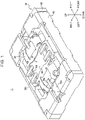
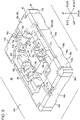
- Fig. 1 is an external top perspective view of a connector 1 according to one embodiment in a state in which a first connector 10 and a second connector 50 are connected to each other.
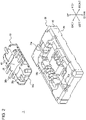
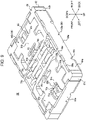
- Fig. 2 is an external top perspective view of the connector 1 according to one embodiment in a state in which the first connector 10 and the second connector 50 are separated from each other.
- the connector 1 includes the first connector 10 and the second connector 50 that can be connected to each other.
- the first connector 10 includes a first insulator 20, and a first contacts 30a that includes a first contacting portion 34a described below and that is attached to the first insulator 20.
- the first connector 10 includes a signal contact 30b and a first shield member 40 that are attached to the first insulator 20.
- the second connector 50 includes a second insulator 60 that is fittable to the first insulator 20.
- the second connector 50 includes a second contact 70a that includes a second contacting portion 74a (described below) and that is attached to the second insulator 60, the second contacting portion 74a being in contact with the first contacting portion 34a in a fitted state in which the first insulator 20 and the second insulator 60 are fitted to each other.
- the second connector 50 includes a signal contact 70b and a second shield member 80 that are attached to the second insulator 60.
- a shield member of the connector 1 is attached to the first insulator 20 and the second insulator 60.
- the shield member includes the first shield member 40 attached to the first insulator 20 and the second shield member 80 attached to the second insulator 60.
- the second connector 50 is a receptacle connector.
- the first connector 10 is a plug connector.
- the second connector 50 in which the second contact 70a and the signal contact 70b are elastically deformed in the fitted state in which the first insulator 20 and the second insulator 60 are fitted to each other, is a receptacle connector.
- the first connector 10 in which the first contact 30a and the signal contact 30b do not elastically deform, is a plug connector.
- the types of the first connector 10 and the second connector 50 are not limited to these.
- the second connector 50 may serve as a plug connector
- the first connector 10 may serve as a receptacle connector.
- the first connector 10 and the second connector 50 are to be mounted respectively on the circuit boards CB1 and CB2.
- the first connector 10 and the second connector 50 electrically connect the circuit board CB1 and the circuit board CB2.
- the circuit boards CB1 and CB2 may be rigid boards, or may be any circuit boards other than rigid boards.
- at least one of the circuit boards CB1 and CB2 may be a flexible printed circuit board.
- first connector 10 and the second connector 50 are connected to each other in a direction that is perpendicular to the circuit boards CB1 and CB2.
- the first connector 10 and the second connector 50 are connected to each other, for example, along the up-down direction.
- the connection method is not limited to this.
- the first connector 10 and the second connector 50 may be connected to each other in a direction parallel to the circuit boards CB1 and CB2.
- the first connector 10 and the second connector 50 may be connected to each other so that one of these is perpendicular to a circuit board to which the one is mounted and the other is parallel to a circuit board to which the other is mounted.
- the “fitting direction” described in the claims corresponds to, for example, the up-down direction in the present specification.
- first direction being perpendicular to a fitting direction corresponds to, for example, the left-right direction.
- longitudinal direction of the connector 1 corresponds to, for example, the left-right direction.
- second direction being perpendicular to first direction and the fitting direction corresponds to, for example, the front-back direction.
- transversal direction of the connector 1 corresponds to, for example, the front-back direction.
- the “circuit board side in the fitting direction” corresponds to, for example, the lower side.
- the connector 1 includes two pairs of the first contacts 30a and the second contacts 70a that are in contact with each other in a state in which the first connector 10 and the second connector 50 are connected.
- the connector 1 has a shield structure that shields each pair of the first contact 30a and the second contacts 70a that are in contact with each other in a fitted state in which the first insulator 20 and the second insulator 60 are fitted to each other.
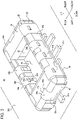
- Fig. 3 is an external top perspective view illustrating only the first connector 10 of Fig. 1 .
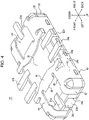
- Fig. 4 is a bottom perspective view illustrating only the first connector 10 of Fig. 1 .
- the first connector 10 is obtained, for example, by integrally insert-molding the first contact 30a, the signal contact 30b. the first shield member 40, and the first insulator 20.
- the first insulator 20 of the first connector 10 is made of an insulating and heat-resistant synthetic resin material.
- the first insulator 20 extends in a plate-like shape in the left-right direction.
- the first insulator 20 includes a bottom plate portion 21 forming a lower part thereof and a ring-shaped outer peripheral wall 22 protruding upward from the entire peripheral edge part of an upper surface of the bottom plate portion 21.
- the outer peripheral wall 22 includes a pair of transversal walls 22a that extend in the front-back direction and a pair of longitudinal walls 22b that extend in the left-right direction.
- the first insulator 20 includes a fitting recess 23 defined by a space formed by the bottom plate portion 21 and the outer peripheral wall 22.
- the first insulator 20 has a first-contact holding groove 24a formed from an outer surface in the left-right direction of the transversal wall 22a of the outer peripheral wall 22 to the inside of the transversal wall 22a.
- the first-contact holding groove 24a integrally holds the first contact 30a.
- the first insulator 20 has a signal-contact holding groove 24b formed from an outer surface to an inner surface in the front-back direction of the longitudinal wall 22b of the outer peripheral wall 22.
- the signal-contact holding groove 24b integrally holds the signal contact 30b.
- the first insulator 20 has a first-shield-member holding groove 25 formed from an outer surface and an inner surface in the left-right direction to an outer surface in the front-back direction of the transversal wall 22a of the outer peripheral wall 22.
- the first-shield-member holding groove 25 integrally holds the first shield member 40.
- Fig. 5 is a top perspective view of the first connector 10 of Fig. 3 in a state in which only the first insulator 20 is not illustrated.
- Fig. 6 is a top perspective view illustrating only a pair of the first shield members 40 of Fig. 5 .
- Fig. 7 is a top perspective view illustrating only a pair of the first contacts 30a of Fig. 5 . Referring mainly to Figs. 5 to 7 , the configuration of each of the first contact 30a, the signal contact 30b, and the first shield member 40 will be described in detail.
- the first contact 30a is made by, for example, forming a thin plate of: a copper alloy, including phosphor bronze, beryllium copper, or titanium copper; or a Corson copper alloy into the shape illustrated in Figs. 5 and 7 by using a progressive die (stamping).
- the surface of the first contact 30a is plated by gold, tin, or the like after forming a sublayer by nickel plating.
- the first contact 30a includes a mount portion 31a that extends outward in an L-shape.
- the first contact 30a includes a connection portion 32a that is formed upward in a reversely tapered shape from an upper end part of the mount portion 31a.
- the first contact 30a includes a curved portion 33a that extends in a U-shape upward from the connection portion 32a.
- the first contact 30a includes the first contacting portion 34a that is configured to include an outer surface in the left-right direction on the free-end side of the curved portion 33a.
- the first contact 30a is held with respect to the first-contact holding groove 24a, because the entirety of the first contact 30a excluding the mount portion 31a is integrated with the first-contact holding groove 24a.
- the first contact 30a is disposed along the transversal direction of the connector 1.
- the signal contact 30b is made by, for example, forming a thin plate of: a copper alloy, including phosphor bronze, beryllium copper, or titanium copper; or a Corson copper alloy into the shape illustrated in Fig. 5 by using a progressive die (stamping).
- the surface of the signal contact 30b is plated by gold, tin, or the like after forming a sublayer by nickel plating.
- the signal contact 30b includes a mount portion 31b that extends outward in an L-shape.
- the signal contact 30b includes a contacting portion 32b that extends upward from an upper end part of the mount portion 31b.
- the contacting portion 32b has a contact surface formed of an inner surface in the front-back direction.
- the contacting portion 32b is formed wider than the mount portion 31b in the left-right direction.
- the signal contact 30b includes a curved portion 33b that extends in a U-shape outward from the contacting portion 32b.
- the signal contact 30b includes a contacting portion 34b that is configured to include an outer surface in the left-right direction on the free-end side of the curved portion 33b.
- the signal contact 30b includes a projection 35b formed on an upper part of the contact surface of the contacting portion 32b.
- the free end of the curved portion 33b is formed at approximately the same height position as the contacting portion 32b.
- the signal contact 30b is integrally held with respect to the signal-contact holding groove 24b, because the entirety of the signal contact 30b excluding the mount portion 31b is in surface-contact with the signal-contact holding groove 24b.
- the tip of the mount portion 31b of the signal contact 30b is positioned outside of the longitudinal wall 22b.
- the first shield member 40 is made by forming a thin plate of any appropriate metal material into the shape illustrated in Figs. 5 and 6 by using a progressive die (stamping).
- the method of forming the first shield member 40 includes a step of bending the thin plate in the plate-thickness direction after punching the thin plate.
- the first shield member 40 is integrally held with respect to the first-shield-member holding groove 25 of the first insulator 20, and is disposed on each of the left and right sides of the first insulator 20.
- the first shield member 40 includes a first base portion 41 that forms a lower end part thereof.
- the first shield member 40 includes a first extending portion 42 that extends in an L-shape along the up-down direction from the first base portion 41 and that is disposed on each of two sides of the first base portion 41 in the front-back direction.
- the first shield member 40 includes a second extending portion 43 that extends in a U-shape along the up-down direction from each of a pair of edges, along the left-right direction, of the first base portion 41.
- the first shield member 40 includes, at an inner end part thereof in the left-right direction, a coupling portion 44 that couples the first base portions 41 on the front and back sides.
- the first shield member 40 includes a first shield portion 45 that extends in an L-shape along the up-down direction from the coupling portion 44 and that extends over the entire width of the coupling portion 44 in the front-back direction.
- the first shield member 40 includes a mount portion 46 formed of a lower surface of the first base portion 41 on each of the front and back sides.
- the mount portion 46 which is disposed on each of the front and back sides of one first shield member 40, is mounted, for example, in a separated state on a pair of ground patterns that are separated from each other on the mount surface the circuit board CB1.
- the mount portion 31a of the first contact 30a is soldered to a circuit pattern formed on the mount surface of the circuit board CB1.
- the mount portion 31b of the signal contact 30b is soldered to a circuit pattern formed on the mount surface.
- the mount portion 46 of the first shield member 40 is soldered to a circuit pattern formed on the mount surface.
- the first connector 10 is mounted on the circuit board CB1.
- electronic components other than the first connector 10, such as a communication module are mounted on the mount surface of the circuit board CB1.
- Fig. 8 is an external top perspective view illustrating only the second connector 50 of Fig. 1 .
- Fig. 9 is a bottom perspective view illustrating only the second connector 50 of Fig. 1 .
- Fig. 10 is an exploded top perspective view of the second connector 50 of Fig. 8 .
- the second connector 50 is assembled, for example, by using the following method.
- the second contact 70a is press-fitted into the second insulator 60 from above.
- the signal contact 70b is press-fitted into the second insulator 60 from below.
- the second shield member 80 is press-fitted into the second insulator 60 from above and below.
- the second insulator 60 is a plate-shaped member that is formed by injection-molding an insulating and heat-resistant synthetic resin material and that extends in the left-right direction.
- the second insulator 60 includes a bottom plate portion 61 forming a lower part thereof and a ring-shaped outer peripheral wall 62 protruding upward while surrounding the entirety of the peripheral edge part of the bottom plate portion 61.
- the outer peripheral wall 62 includes a pair of transversal walls 62a that extend in the front-back direction and a pair of longitudinal walls 62b that extend in the left-right direction.
- the second insulator 60 includes a fitting raised portion 63 protruding upward from a central part of the bottom plate portion 61.
- the second insulator 60 has a second-contact holding groove 64a formed in a central part of the transversal wall 62a of the outer peripheral wall 62 in the front-back direction.
- the second-contact holding groove 64a holds the second contact 70a pressed thereinto.
- the second insulator 60 has a signal-contact holding groove 64b formed from an inner surface in the front-back direction of the longitudinal wall 62b of the outer peripheral wall 62 to an outer surface in the front-back direction of the fitting raised portion 63.
- the signal-contact holding groove 64b holds the signal contact 70b pressed thereinto.
- the second insulator 60 has a second-shield-member holding groove 65 formed from an outer surface in the left-right direction of the transversal wall 62a of the outer peripheral wall 62 to an outer surface in the front-back direction of the transversal wall 62a and inside of the transversal wall 62a.
- the second-shield-member holding groove 65 holds the second shield member 80 pressed thereinto.
- Fig. 11 is a top perspective view of the second connector 50 of Fig. 8 in a state in which only the second insulator 60 is not illustrated.
- Fig. 12 is a top perspective view illustrating only the second shield member 80 of Fig. 11 .
- Fig. 13 is a top perspective view illustrating only a pair of the second contacts 70a of Fig. 11 . Referring mainly to Figs. 11 to 13 , the configuration of each of the second contact 70a, the signal contact 70b, and the second shield member 80 will be described in detail.
- the second contact 70a is made by, for example, forming a thin plate of: a copper alloy, including phosphor bronze, beryllium copper, or titanium copper; or a Corson copper alloy into the shape illustrated in Figs. 11 and 13 by using a progressive die (stamping).
- the surface of the second contact 70a is plated by gold, tin, or the like after forming a sublayer by nickel plating.
- the second contact 70a includes a mount portion 71a that extends outward in an L-shape.
- the second contact 70a includes a latch portion 72a formed continuously from an upper end part of the mount portion 71a.
- the latch portion 72a is formed wider in the front-back direction than the mount portion 71a and a curved portion 73a described below.
- the second contact 70a includes the curved portion 73a that extends in a U-shape upward from the latch portion 72a.
- the second contact 70a includes the second contacting portion 74a configured to include an inner surface in the left-right direction on the free-end side of the curved portion 73a.
- the second contacting portion 74a has spring elasticity so that the second contacting portion 74a can elastically deform along the left-right direction.
- the second contact 70a is held with respect to the second-contact holding groove 64a, because the latch portion 72a is latched to the second-contact holding groove 64a.
- the second contact 70a is disposed along the transversal direction of the connector 1.
- the tip of the mount portion 71a of the second contact 70a is positioned inside of the outermost end in the left-right direction of the transversal wall 62a.
- the signal contact 70b is made by, for example, forming a thin plate of: a copper alloy having spring elasticity, including phosphor bronze, beryllium copper, or titanium copper; or a Corson copper alloy into the shape illustrated in Figs. 10 and 11 by using a progressive die (stamping).
- the surface of the signal contact 70b is plated by gold, tin, or the like after forming a sublayer by nickel plating.
- the signal contact 70b includes a mount portion 71b that extends outward in an L-shape.
- the signal contact 70b includes a pair of latch portions 72b including a portion that is formed upward continuously from an upper end part of the mount portion 71b and another portion that is separated from the portion in the front-back direction and that faces the portion.
- the latch portions 72b are formed wider than the mount portion 71b and a curved portion 73b described below in the left-right direction.
- the signal contact 70b includes the curved portion 73b that connects the pair of the latch portions 72b, an elastic contacting portion 74b that is S-shaped and that is continuous with the latch portion 72b formed inside, and a contacting portion 75b formed at a tip part of the elastic contacting portion 74b so as to face outward.
- the signal contact 70b includes a contacting portion 76b including a projection that projects from an inner surface in the front-back direction of the curved portion 73b.
- the free end of the elastic contacting portion 74b is formed at approximately the same height position as the contacting portion 75b.
- the signal contact 70b is held with respect to the signal-contact holding groove 64b, because the latch portion 72b is latched to the signal-contact holding groove 64b.
- the elastic contacting portion 74b can elastically deform in the front-back direction in the signal-contact holding groove 64b formed in the fitting raised portion 63.
- the tip of the mount portion 71b of the signal contact 70b is positioned inside of the outermost end in the front-back direction of the longitudinal wall 62b.
- the second shield member 80 is made by forming a thin plate of any appropriate metal material into the shape illustrated in Figs. 10 to 12 by using a progressive die (stamping).
- the method of forming the second shield member 80 includes a step of bending the thin plate in the plate-thickness direction after punching the thin plate.
- the second shield member 80 is held by the second insulator 60 by being press-fitted into the second-shield-member holding groove 65 of the second insulator 60.
- the second shield member 80 includes, for example, three members. To be more specific, the second shield member 80 includes a first member 80a that is attached to the second insulator 60 from above so as to surround the outer peripheral wall 62 from four sides. The second shield member 80 includes a pair of second members 80b that are attached to the second insulator 60 from below so as to be disposed on the left and right sides of the second insulator 60.
- the second member 80b includes a second base portion 81b forming a lower end part thereof.
- the second base portion 81b is adjacent to the second contact 70a in the left-right direction.
- the second member 80b includes a second shield portion 82b that extends in an L-shape along the up-down direction from the second base portion 81b and that extends over the entire width of the second base portion 81b in the front-back direction.
- the second member 80b includes a third shield portion 83b that forms a central part of the second base portion 81b and that extends over the entire width of the second base portion 81b in the front-back direction.
- the second member 80b includes a latch portion 84b that extends in an L-shape along the up-down direction from each of a pair of edges, along the left-right direction, of the second base portion 81b.
- the second member 80b includes a contacting portion 85b that is disposed inside of the latch portion 84b in the left-right direction and that extends in an S-shape along the up-down direction from each of a pair of edges, along the left-right direction, of the second base portion 81b.
- the contacting portion 85b is formed at an inner end part of the second member 80b in the left-right direction.
- the second member 80b includes a first mount portion 86b that is disposed inside of the second contact 70a in the left-right direction and that is to be mounted on the circuit board CB2.
- the first mount portion 86b is formed in an L-shape on a side of the second base portion 81b opposite to the second contact 70a in the left-right direction.
- the first mount portion 86b is formed at an inner end part of the second member 80b in the left-right direction.
- a pair of the first mount portions 86b are disposed respectively on the front and back sides of the second base portion 81b in the second member 80b.
- the first mount portions 86b are symmetrically disposed on both sides with respect to the second contact 70a in the front-back direction.
- the pair of first mount portions 86b are respectively mounted, for example, in a separated state on a pair of circuit patterns that are separated from each other on the mount surface of the circuit board CB2.
- the second member 80b includes a second mount portion 87b that is formed by a lower surface on each of the front and back sides of an outer end part of the second base portion 81b in the left-right direction and a lower surface of the latch portions 84b on each of the front and back sides.
- the second mount portion 87b disposed on the front side and the second mount portion 87b disposed on the back side of one second member 80b are respectively mounted, for example, on a pair of circuit patterns that are separated from each other on the mount surface of the circuit board CB2.
- the contacting portion 85b extends upward from the first mount portion 86b.
- the contacting portion 85b extends from an end part, outside in the front-back direction, of the first mount portion 86b.
- the contacting portion 85b extends in an S-shape from the first mount portion 86b and has spring elasticity.
- the contacting portion 85b extends along the left-right direction between the first mount portion 86b and the second contact 70a.
- the width of the contacting portion 85b in the left-right direction is greater than or equal to the mount width of the first mount portion 86b in the left-right direction.
- the contacting portion 85b is symmetrically disposed on each of two sides with respect to the second contact 70a in the front-back direction.
- the second member 80b is held with respect to the second-shield-member holding groove 65, because the latch portion 84b and the second shield portion 82b are latched to the second-shield-member holding groove 65.
- the pair of latch portions 84b are latched to grooves of the second-shield-member holding groove 65 that are formed inside of the front and back sides of the transversal wall 62a.
- the second shield portion 82b is latched to a groove of the second-shield-member holding groove 65 that is formed in an outer surface in the left-right direction of the transversal wall 62a.
- the first member 80a includes a third base portion 81a that forms an upper end part thereof.
- the first member 80a includes, a fourth shield portion 82a that extends in the left-right direction with a predetermined width in an outer peripheral part thereof in the front-back direction.
- the first member 80a includes a fifth shield portion 83a that is disposed further outside than the second shield portion 82b in the left-right direction.
- the fifth shield portion 83a has a larger width in the front-back direction than the second shield portion 82b, and is disposed so as to overlap the entirety of the second shield portion 82b in the front-back direction. As illustrated also in Fig.
- the first member 80a includes an outer-peripheral-side shield portion 84a that is disposed outside of the longitudinal wall 62b of the second insulator 60 along the left-right direction.
- the outer-peripheral-side shield portion 84a extends along the left-right direction so as to couple the fourth shield portions 82a positioned on the left and right sides.
- the first member 80a includes a contacting portion 85a that extends along the up-down direction from the third base portion 81a and that is disposed on each of two sides with respect to the second contact 70a in the front-back direction.
- the contacting portion 85a has spring elasticity so that the contacting portion 85a can elastically deform along the left-right direction.
- the first member 80a includes a latch portion 86a that is formed at each of two end parts, in the left-right direction, of an outer peripheral part thereof in the front-back direction.
- the first member 80a includes a first mount portion 87a that extends linearly downward from a lower end part on each of the front and back sides of the fifth shield portion 83a.
- the first member 80a includes a second mount portion 88a that extends linearly downward from a lower end part of the latch portion 86a.
- the first member 80a includes a third mount portion 89a that extends linearly downward from each of the left and right end parts of the outer-peripheral-side shield portion 84a.
- the first mount portion 87a on the front side in the left direction and the second mount portion 88a on the left side in the front direction that are adjacent to each other are mounted on the same ground pattern on the mount surface of the circuit board CB2.
- first mount portion 87a on the back side in the left direction and the second mount portion 88a on the left side in the back direction that are adjacent to each other are mounted on the same ground pattern on the mount surface of the circuit board CB2.
- the right side of the first member 80a is configured in the same way.
- four third mount portions 89a are respectively mounted, in a separated state, on four ground patterns that are separated from each other on the mount surface of the circuit board CB2.
- the first member 80a is held with respect to the second-shield-member holding groove 65, because the latch portion 86a is latched to the second-shield-member holding groove 65.
- the mount portion 71a of the second contact 70a is soldered to a circuit pattern formed on the mount surface of the circuit board CB2.
- the mount portion 71b of the signal contact 70b is soldered to a circuit pattern formed on the mount surface.
- the first mount portion 87a, the second mount portion 88a, and the third mount portion 89a of the first member 80a of the second shield member 80; and the first mount portion 86b and the second mount portion 87b of the second member 80b are soldered to a ground pattern formed on the mount surface.
- the first mount portion 87a on the front side in the left direction and the second mount portion 88a on the left side in the front direction of the first member 80a; and the second mount portion 87b on the front side of the second member 80b that is disposed on the left side are soldered to the same ground pattern.
- the first member 80a and the second member 80b electrically as one shield member.
- the second connector 50 is mounted on the circuit board CB2.
- electronic components other than the second connector 50 such as a central processing unit (CPU), a controller, and a memory, are mounted on the mount surface of the circuit board CB2.
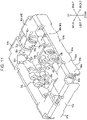
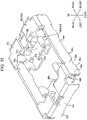
- Fig. 14 is a top perspective view of the connector 1 of Fig. 1 in a state in which only the first insulator 20 and the second insulator 60 are not illustrated.
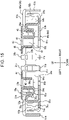
- Fig. 15 is a sectional view taken along an arrow XV-XV of Fig. 14 . Referring to Figs. 14 and 15 , the configuration of the connector 1 in a fitted state in which the first connector 10 and the second connector 50 are connected and the first insulator 20 and the second insulator 60 are fitted to each other will be described.
- the first connector 10 and the second connector 50 are caused to face each other in the up-down direction while causing the front-back positions and the left-right positions thereof to approximately coincide with each other.
- the first connector 10 is moved downward.
- the first connector 10 and the second connector 50 are connected to each other, and the fitted state of the connector 1 can be obtained.
- the fitting recess 23 of the first insulator 20 and the fitting raised portion 63 of the second insulator 60 are fitted to each other.
- the first contacting portion 34a of the first contact 30a and the second contacting portion 74a of the second contact 70a are in contact with each other, and the second contacting portion 74a, which has spring elasticity, is elastically deformed outward in the left-right direction.
- the first contact 30a and the second contact 70a are in contact with each other at only one point due to the first contacting portion 34a and the second contacting portion 74a.
- the projection 35b of the signal contact 30b has moved over the contacting portion 75b of the signal contact 70b while moving downward, and the contacting portion 32b of the signal contact 30b and the contacting portion 75b of the signal contact 70b are in contact with each other.
- the elastic contacting portion 74b which has spring elasticity, is elastically deformed inward in the front-back direction.
- the contacting portion 34b of the signal contact 30b and the contacting portion 76b of the signal contact 70b are in contact with each other.
- the signal contact 30b and the signal contact 70b are in contact with each other at two points due to the contacting portion 32b and the contacting portion 75b and due to the contacting portion 34b and the contacting portion 76b.
- the first extending portion 42 of the first shield member 40 and the contacting portion 85a of the first member 80a of the second shield member 80 are in contact with each other.
- the first extending portion 42 of the first shield member 40 extends along the up-down direction from the first base portion 41, and is disposed on each of two sides, in the front-back direction, with respect to the contact part between the first contact 30a and the second contact 70a.
- the first extending portion 42 of the first shield member 40 is disposed adjacent to the first contacting portion 34a and the second contacting portion 74a, which are in contact with each other, on each of two sides in the front-back direction.
- the contacting portion 85a of the first member 80a extends along the up-down direction from the third base portion 81a, which is disposed on the same side as the first base portion 41 in the up-down direction, and is disposed on each of two sides, in the front-back direction, with respect to the contact part between the first contact 30a and the second contact 70a.
- the contacting portion 85a of the first member 80a is disposed so as to be adjacent to the first contacting portion 34a and the second contacting portion 74a, which are in contact with each other, on each of two sides in the front-back direction.
- the first shield member 40 and the first member 80a are in contact with each other at two points due to two pairs of the first extending portions 42 and the contacting portions 85a that sandwich the first contacting portion 34a and the second contacting portion 74a in the front-back direction while being adjacent thereto.
- the two pairs of first extending portions 42 and contacting portions 85a are symmetrically disposed on both sides, in the front-back direction, with respect to the contact part between the first contact 30a and the second contact 70a.
- the second extending portion 43 of the first shield member 40 and the contacting portion 85b of the second member 80b of the second shield member 80 are in contact with each other.
- the second extending portion 43 of the first shield member 40 extends along the up-down direction from the first base portion 41, and is disposed on each of two sides, in the front-back direction, with respect to the contact part between the first contact 30a and the second contact 70a.
- the second extending portion 43 of the first shield member 40 is disposed in proximity to the first contacting portion 34a and the second contacting portion 74a, which are in contact with each other, on each of two sides in the front-back direction.
- the contacting portion 85b of the second member 80b extends along the up-down direction from the second base portion 81b, which is disposed on a side opposite to the first base portion 41 in the up-down direction, and is disposed on each of two sides, in the front-back direction, with respect to the contact part between the first contact 30a and the second contact 70a.
- the contacting portion 85b of the second member 80b is disposed so as to be in proximity to the first contacting portion 34a and the second contacting portion 74a, which are in contact with each other, on each of two sides in the front-back direction.
- the first shield member 40 and the second member 80b are in contact with each other at two points due to two pairs of the second extending portions 43 and the contacting portions 85b that sandwich the first contacting portion 34a and the second contacting portion 74a, which are in contact with each other, while being in proximity thereto.
- the two pairs of second extending portions 43 and contacting portions 85b are symmetrically disposed on both sides, in the front-back direction, with respect to the contact part between the first contact 30a and the second contact 70a.
- the first shield member 40 and the second shield member 80 are in contact with each other at four points that are adjacent to or in proximity to the first contacting portion 34a and the second contacting portion 74a, which are in contact with each other.
- the first shield portion 45 of the first shield member 40 is disposed inside in the left-right direction of the first contacting portion 34a and the second contacting portion 74a, which are in contact with each other.
- the second shield portion 82b of the second member 80b of the second shield member 80 is disposed outside in the left-right direction of the first contacting portion 34a and the second contacting portion 74a, which are in contact with each other.
- the first contacting portion 34a and the second contacting portion 74a which are in contact with each other, are shielded by the first shield portion 45 and the second shield portion 82b from both sides in the left-right direction.
- the third shield portion 83b of the second member 80b of the second shield member 80 is disposed on a side opposite to the fitting side in the up-down direction of the first contacting portion 34a and the second contacting portion 74a, which are in contact with each other. In this way, the first contacting portion 34a and the second contacting portion 74a, which are in contact with each other, are shielded by the third shield portion 83b from the side opposite to the fitting side.
- the fourth shield portion 82a of the first member 80a of the second shield member 80 is disposed on each of two sides, in the front-back direction, with respect to the first contacting portion 34a and the second contacting portion 74a, which are in contact with each other. In this way, the first contacting portion 34a and the second contacting portion 74a, which are in contact with each other, are shielded by the fourth shield portion 82a from each of two sides in the front-back direction.
- the fifth shield portion 83a of the first member 80a of the second shield member 80 is disposed further outside than the second shield portion 82b in the left-right direction.
- the first contacting portion 34a and the second contacting portion 74a which are in contact with each other, are shielded by the double structure of the second shield portion 82b and the fifth shield portion 83a outside in the left-right direction.
- the first shield portion 45 and the second shield portion 82b shield the first contacting portion 34a and the second contacting portion 74a, which are in contact with each other, from both sides in the left-right direction, and the third shield portion 83b shields the first contacting portion 34a and the second contacting portion 74a from the side opposite to the fitting side.
- the first contacting portion 34a and the second contacting portion 74a which are in contact with each other, are shielded from at least three directions.
- the third shield portion 83b shields the first contacting portion 34a and the second contacting portion 74a, which are in contact with each other, from the side opposite to the fitting side, the noise shielding effect between the first contact 30a and the second contact 70a and the circuit board CB2 is improved.
- inflow of noise from the circuit board CB2 to the first contact 30a and the second contact 70a and outflow of noise from the first contact 30a and the second contact 70a to the circuit board CB2 are effectively suppressed.
- the shield member includes the first shield member 40 attached to the first insulator 20 and the second shield member 80 attached to the second insulator 60.
- the first shield portion 45 is formed in the first shield member 40
- the second shield portion 82b and the third shield portion 83b are formed in the second shield member 80.
- these shield portions are integrally formed in one of the first shield member 40 and the second shield member 80, the shapes of the first shield member 40 and the second shield member 80 are simplified.
- the third shield portion 83b corresponding to the lower surface of the shield portion and the second shield portion 82b corresponding to the left surface of the shield portion so as to be integrated with the second member 80b of the second shield member 80, it is possible to eliminate a gap between the lower surface and the left surface and, at the same time, to establish a reliable electrical connection between the third shield portion 83b and the second shield portion 82b. Accordingly, a higher noise shielding effect can be obtained.
- the second shield member 80 includes the fourth shield portion 82a that is disposed on each of two sides, in the front-back direction, with respect to the first contacting portion 34a and the second contacting portion 74a, which are in contact with each other.
- the shield member includes five shield portions, together with the first shield portion 45, the second shield portion 82b, the third shield portion 83b.
- the first contacting portion 34a and the second contacting portion 74a which are in contact with each other, are shielded from five directions. Accordingly, inflow of noise to the first contact 30a and the second contact 70a from the outside and outflow of noise from the first contact 30a and the second contact 70a to the outside are more effectively suppressed. As a result, for example, also in high-speed transmission, it is possible to obtain better transmission characteristics for high-frequency signals.
- the second shield member 80 includes the fifth shield portion 83a that is disposed further outside than the second shield portion 82b in the left-right direction.
- the second shield member 80 has a double structure of the second shield portion 82b and the fifth shield portion 83a outside in the left-right direction of the first contacting portion 34a and the second contacting portion 74a, which are in contact with each other.
- the noise shielding effect particularly from the left-right direction is improved, and inflow of noise to the first contact 30a and the second contact 70a from the outside and outflow of noise from the first contact 30a and the second contact 70a to the outside are more effectively suppressed.
- Inflow of noise from above can be suppressed by superposing the fifth shield portion 83a of the first member 80a on the second shield portion 82b of the second member 80b.
- the fifth shield portion 83a of the first member 80a on the second shield portion 82b of the second member 80b.
- the second shield member 80 includes the outer-peripheral-side shield portion 84a, which is disposed outside of the second insulator 60 along the left-right direction.
- the second shield member 80 has a shield portion for the signal contact 30b and the signal contact 70b, which are in contact with each other, outside in the front-back direction.
- the noise shielding effect is improved also for the signal contact 30b and the signal contact 70b.
- inflow of noise to the signal contact 30b and the signal contact 70b from the outside and outflow of noise from the signal contact 30b and the signal contact 70b to the outside are effectively suppressed.
- the pair of first contacts 30a are disposed along the transversal direction of the connector 1 at both ends of the first insulator 20 in the left-right direction.
- the pair of second contacts 70a are disposed along the transversal direction of the connector 1 at both ends of the second insulator 60 in the left-right direction.
- the connector 1 includes the plurality of signal contacts 30b and the signal contacts 70b that differ from the first contacts 30a and the second contacts 70a, it is possible for the connector 1 to transmit various signals between the circuit board CB1 and the circuit board CB2. Because the plurality of signal contacts 30b and the signal contacts 70b are disposed along the longitudinal direction of the connector 1, the signal contacts 30b and the signal contacts 70b are separated far from the first contacts 30a and the second contacts 70a, which are disposed along the transversal direction of the connector 1. It is possible to separate the signal contacts 30b and the signal contacts 70b far from the first contacts 30a and the second contacts 70a in the connector 1. Accordingly, it is possible to shield the signal contacts 30b and the signal contacts 70b by using shield members that are independent from each other. At this time, it is possible to perform shielding from multiple directions, because a sufficient space for providing the shield members can be obtained.
- the shape, the disposition, the orientation, and the number of each element described above are not limited to those in the forgoing descriptions and drawings.
- the shape, the disposition, the orientation, and the number of each element may be determined in any appropriate way as long as the function thereof can be realized.
- a method of assembling the first connector 10 and the second connector 50 described above is not limited to what has been described above.
- a method of assembling the first connector 10 and the second connector 50 may be any method as long as the method allows assembly so that the functions of each of these can be fully exploited.
- at least one of the first contact 30a, the signal contact 30b, and the first shield member 40 may be attached to the first insulator 20 not by insert molding but by press-fitting.
- at least one of the second contact 70a, the signal contact 70b, and the second shield member 80 may be integrally formed with the second insulator 60 not by press-fitting but by insert molding.
- the shield member includes the first shield member 40 and the second shield member 80.
- the configuration of the shield member is not limited to this.
- the shield member may be integrally formed and may be attached to at least one of the first insulator 20 and the second insulator 60 that are in the fitted state.
- each of the shield portions including the fourth shield portion 82a, the fifth shield portion 83a, and the outer-peripheral-side shield portion 84a may be formed in either one of the first shield member 40 and the second shield member 80.
- all shield portions may be formed in only the second shield member 80.
- Each shield portion may be formed in a state in which the shield portion is divided between the first shield member 40 and the second shield member 80.
- the third shield portion 83b is disposed directly below the first contacting portion 34a and the second contacting portion 74a, which are in contact with each other, as illustrated in Fig. 15 and other figures.
- the third shield portion 83b may be disposed at a position that is displaced in the left-right direction with respect to the first contacting portion 34a and the second contacting portion 74a, which are in contact with each other.
- the second shield member 80 includes the fourth shield portion 82a that is disposed on each of two sides with respect to the first contacting portion 34a and the second contacting portion 74a, which are in contact with each other.
- the second shield member 80 may have the fourth shield portion 82a only on one side or need not have the fourth shield portion 82a, as long as a good noise shielding effect can be obtained.
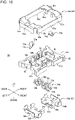
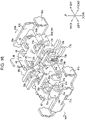
- Fig. 16 is a perspective view, corresponding to Fig. 14 , of a modification of the connector 1 of Fig. 1 in a state in which only the first insulator 20 and the second insulator 60 are not illustrated.
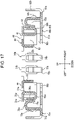
- Fig. 17 is a sectional view taken along an arrow XVII-XVII of Fig. 16 .
- the second shield member 80 has only the second member 80b without having the first member 80a.
- the second shield member 80 includes the fifth shield portion 83a.
- the second shield member 80 need not include the fifth shield portion 83a as long as a good noise shielding effect can be obtained.
- the second shield member 80 has the outer-peripheral-side shield portion 84a.
- the second shield member 80 need not have the outer-peripheral-side shield portion 84a, as long as a good noise shielding effect can be obtained.
- the shield member includes the first shield portion 45, the second shield portion 82b, the third shield portion 83b, the fourth shield portion 82a, and the fifth shield portion 83a.
- the shield member may include, in addition to the first shield portion 45 to the fifth shield portion 83a, a sixth shield portion that is disposed on a side opposite to the third shield portion 83b in the up-down direction with respect to the first contacting portion 34a and the second contacting portion 74a, which are in contact with each other.
- the sixth shield portion may be formed in either one of the first shield member 40 and the second shield member 80.
- the sixth shield portion shields the first contacting portion 34a and the second contacting portion 74a, which are in contact with each other, from above. Accordingly, the noise shielding effect is further improved, because the first shield portion 45 to the fifth shield portion 83a and the sixth shield portion shield the first contacting portion 34a and the second contacting portion 74a, which are in contact with each other, from six directions, which are the front-back, left-right, and up-down directions.
- the first extending portion 42 of the first shield member 40 and the contacting portion 85a of the second shield member 80 are in contact with each other on each of two sides, in the front-back direction, with respect to the contact part between the first contact 30a and the second contact 70a.
- this is not a limitation.
- the second shield member 80 need not have the contacting portion 85a, and only the first extending portion 42 of the first shield member 40 may be formed on each of two sides with respect to the contact part between the first contact 30a and the second contact 70a.
- first base portion 41 and the first extending portion 42 are formed in the first shield member 40.
- each of constituent portions including the first base portion 41 and the first extending portion 42 may be formed in either one of the first shield member 40 and the second shield member 80.
- Each of the constituent portions may be formed in a state of being divided between the first shield member 40 and the second shield member 80.
- the two pairs of second extending portions 43 and contacting portions 85b are symmetrically disposed on both sides, in the front-back direction, with respect to the contact part between the first contact 30a and the second contact 70a.
- this is not a limitation.
- the two pairs of second extending portions 43 and contacting portions 85b may be asymmetrically disposed.
- the two pairs of first extending portions 42 and contacting portions 85a are symmetrically disposed on both sides, in the front-back direction, with respect to the contact part between the first contact 30a and the second contact 70a.
- this is not a limitation.
- the two pairs of first extending portions 42 and contacting portions 85a may be asymmetrically disposed.
- the contacting portion 85b of the second shield member 80 extends between the first mount portion 86b and the second contact 70a along the left-right direction.
- the contacting portion 85b of the second shield member 80 may extend along any direction.
- the width of the contacting portion 85b of the second shield member 80 in the left-right direction is greater than or equal to the mount width of the first mount portion 86b in the left-right direction.
- this is not a limitation.
- the width of the contacting portion 85b in the left-right direction may be smaller than the mount width of the first mount portion 86b in the left-right direction.
- the contacting portion 85b of the second shield member 80 extends in an S-shape from the first mount portion 86b.
- the contacting portion 85b may extend in any shape from the first mount portion 86b.
- the contacting portion 85b of the second shield member 80 has spring elasticity.
- the contacting portion 85b need not have spring elasticity.
- the second extending portion 43, which is in contact with the contacting portion 85b may have spring elasticity.
- first contact 30a and the second contact 70a are disposed along the transversal direction of the connector 1.
- the first contact 30a and the second contact 70a may be disposed along the longitudinal direction of the connector 1.
- the pair of first contacts 30a are disposed at both ends of the first insulator 20 in the left-right direction and the pair of second contacts 70a are disposed at both ends of the second insulator 60 in the left-right direction.
- the pair of first contacts 30a may be disposed inside of the first insulator 20 in the left-right direction
- the pair of second contacts 70a may be disposed inside of the second insulator 60 in the left-right direction.
- the connector 1 includes a plurality of contacts that differ from the first contact 30a and the second contact 70a, that is, the signal contact 30b and the signal contact 70b.
- the connector 1 need not have the signal contact 30b and the signal contact 70b.
- the plurality of contacts are disposed along the longitudinal direction of the connector 1. However, this is not a limitation.
- the plurality of contacts may be disposed along the transversal direction of the connector 1.
- the second shield member 80 includes the first member 80a and the second member 80b.
- the second shield member 80 may be integrally formed as a single member without being divided into two members.
- each mount portion in the above embodiment is not limited to what has been described above.
- Each mount portion may have any mount pattern formed on the mount surface of a corresponding circuit board.
- the connector 1 is mounted in an electronic apparatus including the circuit board CB1 and the circuit board CB2.
- the electronic apparatus include: any communication terminal device such as a smartphone; and any information processing machine such as a personal computer, a copier, a printer, a facsimile, and a multifunctional machine.
- examples of the electronic apparatus include any industrial equipment.
- Such an electronic apparatus can obtain a good noise shielding effect due to the connector 1.
- Such an electronic apparatus has good transmission characteristics in signal transmission. Accordingly, reliability of the electronic apparatus as a product is improved.
Landscapes
- Details Of Connecting Devices For Male And Female Coupling (AREA)
- Coupling Device And Connection With Printed Circuit (AREA)
Applications Claiming Priority (2)
| Application Number | Priority Date | Filing Date | Title |
|---|---|---|---|
| JP2019235161A JP7244412B2 (ja) | 2019-12-25 | 2019-12-25 | コネクタ及び電子機器 |
| PCT/JP2020/047758 WO2021132186A1 (ja) | 2019-12-25 | 2020-12-21 | コネクタ及び電子機器 |
Publications (3)
| Publication Number | Publication Date |
|---|---|
| EP4084232A1 true EP4084232A1 (de) | 2022-11-02 |
| EP4084232A4 EP4084232A4 (de) | 2024-01-17 |
| EP4084232B1 EP4084232B1 (de) | 2025-12-10 |
Family
ID=76574107
Family Applications (1)
| Application Number | Title | Priority Date | Filing Date |
|---|---|---|---|
| EP20907641.3A Active EP4084232B1 (de) | 2019-12-25 | 2020-12-21 | Verbinder und elektronische vorrichtung |
Country Status (6)
| Country | Link |
|---|---|
| US (1) | US12142860B2 (de) |
| EP (1) | EP4084232B1 (de) |
| JP (1) | JP7244412B2 (de) |
| KR (1) | KR102611053B1 (de) |
| CN (1) | CN114830449B (de) |
| WO (1) | WO2021132186A1 (de) |
Families Citing this family (4)
| Publication number | Priority date | Publication date | Assignee | Title |
|---|---|---|---|---|
| JP7244412B2 (ja) * | 2019-12-25 | 2023-03-22 | 京セラ株式会社 | コネクタ及び電子機器 |
| JP7648472B2 (ja) * | 2021-08-10 | 2025-03-18 | 京セラ株式会社 | コネクタ及び電子機器 |
| JP7177417B1 (ja) * | 2022-08-10 | 2022-11-24 | Smk株式会社 | 基板対基板用コネクタ |
| CN115799920A (zh) * | 2022-12-30 | 2023-03-14 | 深圳市深台帏翔电子有限公司 | 连接器、电路板组件和电子设备 |
Family Cites Families (65)
| Publication number | Priority date | Publication date | Assignee | Title |
|---|---|---|---|---|
| JP3079738B2 (ja) * | 1992-02-05 | 2000-08-21 | 富士通株式会社 | 基板用シールドマルチコネクタ |
| JP2004319257A (ja) * | 2003-04-16 | 2004-11-11 | Japan Aviation Electronics Industry Ltd | 平衡伝送用コネクタ |
| TWM250431U (en) * | 2003-08-08 | 2004-11-11 | Hon Hai Prec Ind Co Ltd | Electrical connector |
| TWM251313U (en) * | 2003-08-13 | 2004-11-21 | Hon Hai Prec Ind Co Ltd | Electrical connector |
| CN2667690Y (zh) * | 2003-09-06 | 2004-12-29 | 富士康(昆山)电脑接插件有限公司 | 电连接器 |
| TWM253928U (en) * | 2003-10-31 | 2004-12-21 | Hon Hai Prec Ind Co Ltd | Electrical connector |
| US7137825B2 (en) * | 2004-03-31 | 2006-11-21 | Tyco Electronics Corporation | Shielded electrical jack connector |
| TWI249886B (en) * | 2004-06-18 | 2006-02-21 | Hon Hai Prec Ind Co Ltd | Electrical connector |
| JP2006059589A (ja) * | 2004-08-18 | 2006-03-02 | Hirose Electric Co Ltd | シールド付き電気コネクタ |
| CN2736999Y (zh) * | 2004-09-23 | 2005-10-26 | 富士康(昆山)电脑接插件有限公司 | 电连接器组合 |
| CN2757356Y (zh) * | 2004-12-01 | 2006-02-08 | 富士康(昆山)电脑接插件有限公司 | 电连接器 |
| US7108567B1 (en) * | 2005-11-07 | 2006-09-19 | Hon Hai Precision Ind. Co., Ltd | Electrical device for interconnecting two printed circuit boards at a large distance |
| US7168986B1 (en) * | 2006-03-21 | 2007-01-30 | Cheng Uei Precision Industry Co., Ltd. | Board-to-board connector assembly with EMI shielding shields |
| JP4984823B2 (ja) * | 2006-10-26 | 2012-07-25 | 富士通株式会社 | シールド板およびシールド板が取り付けられる基板実装型コネクタ |
| JP4333884B2 (ja) * | 2007-03-01 | 2009-09-16 | 日本航空電子工業株式会社 | コネクタ |
| CN201204309Y (zh) * | 2008-03-25 | 2009-03-04 | 富士康(昆山)电脑接插件有限公司 | 电连接器 |
| JP4691738B2 (ja) * | 2008-09-01 | 2011-06-01 | ヒロセ電機株式会社 | シールド機能を有するコネクタ装置 |
| US8192231B2 (en) * | 2008-10-22 | 2012-06-05 | Fci | Shielded connector |
| JP2010157368A (ja) | 2008-12-26 | 2010-07-15 | Jst Mfg Co Ltd | 電気コネクタ |
| JP4901944B2 (ja) * | 2009-12-03 | 2012-03-21 | ヒロセ電機株式会社 | 電気コネクタ |
| CN201608308U (zh) * | 2009-12-26 | 2010-10-13 | 富士康(昆山)电脑接插件有限公司 | 电连接器 |
| SG174642A1 (en) | 2010-03-22 | 2011-10-28 | 3M Innovative Properties Co | Board-to-board connector |
| US20110250800A1 (en) * | 2010-04-12 | 2011-10-13 | Hon Hai Precision Industry Co., Ltd. | Board to board connector assembly having improved plug and receptacle contacts |
| JP5890117B2 (ja) * | 2011-07-07 | 2016-03-22 | 日本航空電子工業株式会社 | コネクタ |
| JP5825477B2 (ja) * | 2011-08-18 | 2015-12-02 | Smk株式会社 | 接続コネクタ |
| JP5971845B2 (ja) * | 2012-06-04 | 2016-08-17 | 日本航空電子工業株式会社 | コネクタ |
| US8888506B2 (en) * | 2013-01-29 | 2014-11-18 | Japan Aviation Electronics Industry, Limited | Connector |
| US9124011B2 (en) * | 2013-02-27 | 2015-09-01 | Panasonic Intellectual Property Management Co., Ltd. | Connector, and header and socket to be used in the same |
| JP6045953B2 (ja) * | 2013-03-28 | 2016-12-14 | 京セラコネクタプロダクツ株式会社 | コネクタ |
| KR101496720B1 (ko) * | 2013-11-08 | 2015-02-27 | (주)우주일렉트로닉스 | 실드 및 체결형 보드 커넥터 |
| US9391398B2 (en) * | 2014-03-20 | 2016-07-12 | Japan Aviation Electronics Industry, Limited | Connector assembly |
| US9525246B2 (en) * | 2014-05-05 | 2016-12-20 | Tyco Electronics Corporation | Printed circuit board connector assembly having contact shield with integral securing members |
| JP6269558B2 (ja) * | 2014-06-05 | 2018-01-31 | 株式会社村田製作所 | コネクタセット及びコネクタ |
| JP6167997B2 (ja) * | 2014-06-05 | 2017-07-26 | 株式会社村田製作所 | コネクタセット及びコネクタ |
| JP6391517B2 (ja) * | 2015-03-30 | 2018-09-19 | モレックス エルエルシー | コネクタ |
| JP6378642B2 (ja) * | 2015-04-23 | 2018-08-22 | モレックス エルエルシー | コネクタ |
| JP6513509B2 (ja) * | 2015-07-01 | 2019-05-15 | 日本航空電子工業株式会社 | 基板対基板コネクタおよびコネクタ |
| DE102016113976A1 (de) * | 2015-07-29 | 2017-02-02 | Dai-Ichi Seiko Co., Ltd. | Elektrische Platinenverbindungs-Verbindervorrichtung |
| JP6179564B2 (ja) * | 2015-07-29 | 2017-08-16 | 第一精工株式会社 | 基板接続用電気コネクタ |
| CN107851914B (zh) * | 2015-08-05 | 2019-10-29 | 京瓷株式会社 | 插头连接器 |
| US9893480B2 (en) * | 2015-09-04 | 2018-02-13 | Tyco Electronics Japan G.K. | Connector |
| KR102420101B1 (ko) * | 2015-12-07 | 2022-07-13 | 삼성전자주식회사 | 케이블 지지구조를 포함하는 전자 기기 |
| JP6498622B2 (ja) * | 2016-03-14 | 2019-04-10 | 日本航空電子工業株式会社 | コネクタ |
| KR102165751B1 (ko) * | 2016-08-04 | 2020-10-14 | 교세라 가부시키가이샤 | 콘택트 |
| CN109565135B (zh) * | 2016-08-04 | 2020-09-29 | 京瓷株式会社 | 连接器 |
| CN108232526B (zh) * | 2016-12-21 | 2020-04-24 | 富士康(昆山)电脑接插件有限公司 | 电连接器及其组合 |
| JP6885730B2 (ja) | 2017-01-06 | 2021-06-16 | ヒロセ電機株式会社 | 遮蔽シールド板付きコネクタ |
| CN207925768U (zh) * | 2017-01-11 | 2018-09-28 | 富士康(昆山)电脑接插件有限公司 | 电连接器及其组合 |
| CN110915068B (zh) * | 2017-07-24 | 2021-11-09 | 株式会社村田制作所 | 连接器组件 |
| JP6573135B2 (ja) | 2017-11-06 | 2019-09-11 | 第一精工株式会社 | 電気コネクタ装置 |
| JP6582082B2 (ja) * | 2018-03-09 | 2019-09-25 | 京セラ株式会社 | コネクタ及び電子機器 |
| JP6582083B2 (ja) * | 2018-03-09 | 2019-09-25 | 京セラ株式会社 | コネクタ及び電子機器 |
| JP6971182B2 (ja) * | 2018-03-23 | 2021-11-24 | 京セラ株式会社 | コネクタ及び電子機器 |
| KR101975811B1 (ko) * | 2018-04-10 | 2019-05-08 | (주)연호엠에스 | 전기 커넥터 |
| US10498058B1 (en) * | 2018-05-11 | 2019-12-03 | Molex, Llc | Connector and connector assembly |
| CN209571614U (zh) * | 2019-04-18 | 2019-11-01 | 富士康(昆山)电脑接插件有限公司 | 电连接器及其对接连接器 |
| WO2020262138A1 (ja) * | 2019-06-24 | 2020-12-30 | 株式会社村田製作所 | 電気コネクタおよび該電気コネクタを備える電気コネクタセット |
| CN118198756A (zh) * | 2019-08-01 | 2024-06-14 | 株式会社村田制作所 | 阴型多极连接器以及具备该阴型多极连接器的多极连接器组 |
| JP7349635B2 (ja) * | 2019-09-30 | 2023-09-25 | パナソニックIpマネジメント株式会社 | コネクタ並びにそれに用いるソケット及びヘッダ |
| JP7244412B2 (ja) * | 2019-12-25 | 2023-03-22 | 京セラ株式会社 | コネクタ及び電子機器 |
| JP7201580B2 (ja) * | 2019-12-25 | 2023-01-10 | 京セラ株式会社 | コネクタ、コネクタモジュール、及び電子機器 |
| JP7418202B2 (ja) * | 2019-12-25 | 2024-01-19 | 京セラ株式会社 | コネクタ及び電子機器 |
| JP2021118145A (ja) * | 2020-01-29 | 2021-08-10 | 京セラ株式会社 | コネクタ、コネクタモジュール、及び電子機器 |
| KR102494901B1 (ko) * | 2020-05-13 | 2023-02-06 | 니혼 고꾸 덴시 고교 가부시끼가이샤 | 커넥터 조립체 및 커넥터 |
| JP7484062B2 (ja) * | 2020-08-17 | 2024-05-16 | ヒロセ電機株式会社 | 基板接続コネクタ |
-
2019
- 2019-12-25 JP JP2019235161A patent/JP7244412B2/ja active Active
-
2020
- 2020-12-21 CN CN202080083370.XA patent/CN114830449B/zh active Active
- 2020-12-21 US US17/782,542 patent/US12142860B2/en active Active
- 2020-12-21 EP EP20907641.3A patent/EP4084232B1/de active Active
- 2020-12-21 KR KR1020227013164A patent/KR102611053B1/ko active Active
- 2020-12-21 WO PCT/JP2020/047758 patent/WO2021132186A1/ja not_active Ceased
Also Published As
| Publication number | Publication date |
|---|---|
| US20230006376A1 (en) | 2023-01-05 |
| EP4084232A4 (de) | 2024-01-17 |
| JP7244412B2 (ja) | 2023-03-22 |
| US12142860B2 (en) | 2024-11-12 |
| KR102611053B1 (ko) | 2023-12-07 |
| CN114830449A (zh) | 2022-07-29 |
| EP4084232B1 (de) | 2025-12-10 |
| JP2021103667A (ja) | 2021-07-15 |
| CN114830449B (zh) | 2023-07-04 |
| WO2021132186A1 (ja) | 2021-07-01 |
| KR20220062411A (ko) | 2022-05-16 |
Similar Documents
| Publication | Publication Date | Title |
|---|---|---|
| EP4084232B1 (de) | Verbinder und elektronische vorrichtung | |
| JP7529868B2 (ja) | コネクタ、コネクタモジュール、及び電子機器 | |
| EP4084231B1 (de) | Steckverbinder und elektronische vorrichtung | |
| EP4084230B1 (de) | Verbinder, verbindermodul und elektronisches gerät | |
| US20250096506A1 (en) | Connector and electronic device | |
| CN119366065A (zh) | 连接器、连接器模块、以及电子设备 | |
| WO2024154678A1 (ja) | コネクタ及び電子機器 | |
| CN120035914A (zh) | 连接器模块以及电子设备 |
Legal Events
| Date | Code | Title | Description |
|---|---|---|---|
| STAA | Information on the status of an ep patent application or granted ep patent |
Free format text: STATUS: THE INTERNATIONAL PUBLICATION HAS BEEN MADE |
|
| PUAI | Public reference made under article 153(3) epc to a published international application that has entered the european phase |
Free format text: ORIGINAL CODE: 0009012 |
|
| STAA | Information on the status of an ep patent application or granted ep patent |
Free format text: STATUS: REQUEST FOR EXAMINATION WAS MADE |
|
| 17P | Request for examination filed |
Effective date: 20220613 |
|
| AK | Designated contracting states |
Kind code of ref document: A1 Designated state(s): AL AT BE BG CH CY CZ DE DK EE ES FI FR GB GR HR HU IE IS IT LI LT LU LV MC MK MT NL NO PL PT RO RS SE SI SK SM TR |
|
| DAV | Request for validation of the european patent (deleted) | ||
| DAX | Request for extension of the european patent (deleted) | ||
| P01 | Opt-out of the competence of the unified patent court (upc) registered |
Effective date: 20230505 |
|
| A4 | Supplementary search report drawn up and despatched |
Effective date: 20231220 |
|
| RIC1 | Information provided on ipc code assigned before grant |
Ipc: H01R 13/6594 20110101ALI20231214BHEP Ipc: H01R 13/6583 20110101ALI20231214BHEP Ipc: H01R 12/73 20110101ALI20231214BHEP Ipc: H01R 12/71 20110101AFI20231214BHEP |
|
| GRAP | Despatch of communication of intention to grant a patent |
Free format text: ORIGINAL CODE: EPIDOSNIGR1 |
|
| STAA | Information on the status of an ep patent application or granted ep patent |
Free format text: STATUS: GRANT OF PATENT IS INTENDED |
|
| RIC1 | Information provided on ipc code assigned before grant |
Ipc: H01R 12/71 20110101AFI20250622BHEP Ipc: H01R 12/73 20110101ALI20250622BHEP Ipc: H01R 13/6583 20110101ALI20250622BHEP Ipc: H01R 13/6594 20110101ALI20250622BHEP |
|
| INTG | Intention to grant announced |
Effective date: 20250702 |
|
| RIN1 | Information on inventor provided before grant (corrected) |
Inventor name: HORINO, SHINTARO Inventor name: KAKINO, MASAYOSHI |
|
| GRAS | Grant fee paid |
Free format text: ORIGINAL CODE: EPIDOSNIGR3 |
|
| GRAA | (expected) grant |
Free format text: ORIGINAL CODE: 0009210 |
|
| STAA | Information on the status of an ep patent application or granted ep patent |
Free format text: STATUS: THE PATENT HAS BEEN GRANTED |
|
| AK | Designated contracting states |
Kind code of ref document: B1 Designated state(s): AL AT BE BG CH CY CZ DE DK EE ES FI FR GB GR HR HU IE IS IT LI LT LU LV MC MK MT NL NO PL PT RO RS SE SI SK SM TR |
|
| REG | Reference to a national code |
Ref country code: CH Ref legal event code: F10 Free format text: ST27 STATUS EVENT CODE: U-0-0-F10-F00 (AS PROVIDED BY THE NATIONAL OFFICE) Effective date: 20251210 Ref country code: GB Ref legal event code: FG4D |
|
| REG | Reference to a national code |
Ref country code: DE Ref legal event code: R096 Ref document number: 602020063849 Country of ref document: DE |
|
| REG | Reference to a national code |
Ref country code: IE Ref legal event code: FG4D |