EP4084110A1 - Method for manufacturing electrode, method for manufacturing power storage device, and electrode manufacturing device - Google Patents
Method for manufacturing electrode, method for manufacturing power storage device, and electrode manufacturing device Download PDFInfo
- Publication number
- EP4084110A1 EP4084110A1 EP20905274.5A EP20905274A EP4084110A1 EP 4084110 A1 EP4084110 A1 EP 4084110A1 EP 20905274 A EP20905274 A EP 20905274A EP 4084110 A1 EP4084110 A1 EP 4084110A1
- Authority
- EP
- European Patent Office
- Prior art keywords
- electrode
- cleaning solution
- cleaning
- bath
- manufacturing
- Prior art date
- Legal status (The legal status is an assumption and is not a legal conclusion. Google has not performed a legal analysis and makes no representation as to the accuracy of the status listed.)
- Withdrawn
Links
- 238000004519 manufacturing process Methods 0.000 title claims description 80
- 238000000034 method Methods 0.000 title claims description 19
- 238000003860 storage Methods 0.000 title claims description 16
- 238000004140 cleaning Methods 0.000 claims abstract description 205
- 239000011149 active material Substances 0.000 claims abstract description 61
- 229910052783 alkali metal Inorganic materials 0.000 claims abstract description 60
- 239000000010 aprotic solvent Substances 0.000 claims abstract description 57
- -1 alkali metal salt Chemical class 0.000 claims abstract description 40
- 150000001340 alkali metals Chemical class 0.000 claims abstract description 36
- 238000009835 boiling Methods 0.000 claims abstract description 19
- 238000004821 distillation Methods 0.000 claims description 24
- 239000003960 organic solvent Substances 0.000 claims description 9
- 239000003792 electrolyte Substances 0.000 claims description 8
- 229910021536 Zeolite Inorganic materials 0.000 claims description 7
- 229940043430 calcium compound Drugs 0.000 claims description 7
- 150000001674 calcium compounds Chemical class 0.000 claims description 7
- HNPSIPDUKPIQMN-UHFFFAOYSA-N dioxosilane;oxo(oxoalumanyloxy)alumane Chemical compound O=[Si]=O.O=[Al]O[Al]=O HNPSIPDUKPIQMN-UHFFFAOYSA-N 0.000 claims description 7
- 239000010457 zeolite Substances 0.000 claims description 7
- 239000011737 fluorine Substances 0.000 claims description 6
- 229910052731 fluorine Inorganic materials 0.000 claims description 6
- 125000001153 fluoro group Chemical group F* 0.000 claims description 6
- 150000001875 compounds Chemical class 0.000 claims description 3
- 239000000243 solution Substances 0.000 description 133
- 238000011144 upstream manufacturing Methods 0.000 description 30
- 239000003990 capacitor Substances 0.000 description 26
- 238000005192 partition Methods 0.000 description 20
- 239000002904 solvent Substances 0.000 description 18
- 239000008151 electrolyte solution Substances 0.000 description 17
- 229910001416 lithium ion Inorganic materials 0.000 description 17
- 239000000203 mixture Substances 0.000 description 16
- HBBGRARXTFLTSG-UHFFFAOYSA-N Lithium ion Chemical compound [Li+] HBBGRARXTFLTSG-UHFFFAOYSA-N 0.000 description 15
- IEJIGPNLZYLLBP-UHFFFAOYSA-N dimethyl carbonate Chemical compound COC(=O)OC IEJIGPNLZYLLBP-UHFFFAOYSA-N 0.000 description 15
- 238000005259 measurement Methods 0.000 description 14
- 239000007773 negative electrode material Substances 0.000 description 14
- 239000007774 positive electrode material Substances 0.000 description 14
- OKTJSMMVPCPJKN-UHFFFAOYSA-N Carbon Chemical compound [C] OKTJSMMVPCPJKN-UHFFFAOYSA-N 0.000 description 13
- ODINCKMPIJJUCX-UHFFFAOYSA-N Calcium oxide Chemical compound [Ca]=O ODINCKMPIJJUCX-UHFFFAOYSA-N 0.000 description 12
- KMTRUDSVKNLOMY-UHFFFAOYSA-N Ethylene carbonate Chemical compound O=C1OCCO1 KMTRUDSVKNLOMY-UHFFFAOYSA-N 0.000 description 12
- 230000000052 comparative effect Effects 0.000 description 12
- 101100165177 Caenorhabditis elegans bath-15 gene Proteins 0.000 description 10
- 229910052744 lithium Inorganic materials 0.000 description 10
- 238000007789 sealing Methods 0.000 description 10
- 238000004804 winding Methods 0.000 description 10
- 229910001290 LiPF6 Inorganic materials 0.000 description 9
- WHXSMMKQMYFTQS-UHFFFAOYSA-N Lithium Chemical compound [Li] WHXSMMKQMYFTQS-UHFFFAOYSA-N 0.000 description 9
- 239000000463 material Substances 0.000 description 9
- 239000011230 binding agent Substances 0.000 description 8
- 238000004587 chromatography analysis Methods 0.000 description 8
- KRHYYFGTRYWZRS-UHFFFAOYSA-N Fluorane Chemical compound F KRHYYFGTRYWZRS-UHFFFAOYSA-N 0.000 description 7
- 239000004743 Polypropylene Substances 0.000 description 7
- 239000003575 carbonaceous material Substances 0.000 description 7
- 229910000040 hydrogen fluoride Inorganic materials 0.000 description 7
- 229910052751 metal Inorganic materials 0.000 description 7
- 239000002184 metal Substances 0.000 description 7
- 239000011347 resin Substances 0.000 description 7
- 229920005989 resin Polymers 0.000 description 7
- WEVYAHXRMPXWCK-UHFFFAOYSA-N Acetonitrile Chemical compound CC#N WEVYAHXRMPXWCK-UHFFFAOYSA-N 0.000 description 6
- 239000000292 calcium oxide Substances 0.000 description 6
- 235000012255 calcium oxide Nutrition 0.000 description 6
- 239000002808 molecular sieve Substances 0.000 description 6
- URGAHOPLAPQHLN-UHFFFAOYSA-N sodium aluminosilicate Chemical compound [Na+].[Al+3].[O-][Si]([O-])=O.[O-][Si]([O-])=O URGAHOPLAPQHLN-UHFFFAOYSA-N 0.000 description 6
- 238000005292 vacuum distillation Methods 0.000 description 6
- 239000003795 chemical substances by application Substances 0.000 description 5
- 238000001035 drying Methods 0.000 description 5
- 229920001155 polypropylene Polymers 0.000 description 5
- XKRFYHLGVUSROY-UHFFFAOYSA-N Argon Chemical compound [Ar] XKRFYHLGVUSROY-UHFFFAOYSA-N 0.000 description 4
- RYGMFSIKBFXOCR-UHFFFAOYSA-N Copper Chemical compound [Cu] RYGMFSIKBFXOCR-UHFFFAOYSA-N 0.000 description 4
- YCKRFDGAMUMZLT-UHFFFAOYSA-N Fluorine atom Chemical compound [F] YCKRFDGAMUMZLT-UHFFFAOYSA-N 0.000 description 4
- PXHVJJICTQNCMI-UHFFFAOYSA-N Nickel Chemical compound [Ni] PXHVJJICTQNCMI-UHFFFAOYSA-N 0.000 description 4
- FKNQFGJONOIPTF-UHFFFAOYSA-N Sodium cation Chemical compound [Na+] FKNQFGJONOIPTF-UHFFFAOYSA-N 0.000 description 4
- WYURNTSHIVDZCO-UHFFFAOYSA-N Tetrahydrofuran Chemical compound C1CCOC1 WYURNTSHIVDZCO-UHFFFAOYSA-N 0.000 description 4
- 229910001413 alkali metal ion Inorganic materials 0.000 description 4
- 229910052782 aluminium Inorganic materials 0.000 description 4
- XAGFODPZIPBFFR-UHFFFAOYSA-N aluminium Chemical compound [Al] XAGFODPZIPBFFR-UHFFFAOYSA-N 0.000 description 4
- 238000011088 calibration curve Methods 0.000 description 4
- 238000010586 diagram Methods 0.000 description 4
- JBTWLSYIZRCDFO-UHFFFAOYSA-N ethyl methyl carbonate Chemical compound CCOC(=O)OC JBTWLSYIZRCDFO-UHFFFAOYSA-N 0.000 description 4
- 239000012046 mixed solvent Substances 0.000 description 4
- 238000011084 recovery Methods 0.000 description 4
- 239000002002 slurry Substances 0.000 description 4
- 229910001415 sodium ion Inorganic materials 0.000 description 4
- 239000010935 stainless steel Substances 0.000 description 4
- 229910001220 stainless steel Inorganic materials 0.000 description 4
- 239000000126 substance Substances 0.000 description 4
- 238000003466 welding Methods 0.000 description 4
- UHOVQNZJYSORNB-UHFFFAOYSA-N Benzene Chemical compound C1=CC=CC=C1 UHOVQNZJYSORNB-UHFFFAOYSA-N 0.000 description 3
- 229920002134 Carboxymethyl cellulose Polymers 0.000 description 3
- YMWUJEATGCHHMB-UHFFFAOYSA-N Dichloromethane Chemical compound ClCCl YMWUJEATGCHHMB-UHFFFAOYSA-N 0.000 description 3
- XTHFKEDIFFGKHM-UHFFFAOYSA-N Dimethoxyethane Chemical compound COCCOC XTHFKEDIFFGKHM-UHFFFAOYSA-N 0.000 description 3
- IMNFDUFMRHMDMM-UHFFFAOYSA-N N-Heptane Chemical compound CCCCCCC IMNFDUFMRHMDMM-UHFFFAOYSA-N 0.000 description 3
- 239000004698 Polyethylene Substances 0.000 description 3
- YXFVVABEGXRONW-UHFFFAOYSA-N Toluene Chemical compound CC1=CC=CC=C1 YXFVVABEGXRONW-UHFFFAOYSA-N 0.000 description 3
- 230000032683 aging Effects 0.000 description 3
- 239000002585 base Substances 0.000 description 3
- 239000003660 carbonate based solvent Substances 0.000 description 3
- 229910052802 copper Inorganic materials 0.000 description 3
- 239000010949 copper Substances 0.000 description 3
- 238000005796 dehydrofluorination reaction Methods 0.000 description 3
- 238000003795 desorption Methods 0.000 description 3
- 238000007599 discharging Methods 0.000 description 3
- 229920001971 elastomer Polymers 0.000 description 3
- 238000007701 flash-distillation Methods 0.000 description 3
- 239000011888 foil Substances 0.000 description 3
- 239000010439 graphite Substances 0.000 description 3
- 229910002804 graphite Inorganic materials 0.000 description 3
- 239000002391 graphite-based active material Substances 0.000 description 3
- 238000003780 insertion Methods 0.000 description 3
- 230000037431 insertion Effects 0.000 description 3
- 229920000573 polyethylene Polymers 0.000 description 3
- 239000004810 polytetrafluoroethylene Substances 0.000 description 3
- 229920001343 polytetrafluoroethylene Polymers 0.000 description 3
- 239000011148 porous material Substances 0.000 description 3
- 230000008569 process Effects 0.000 description 3
- ZUHZGEOKBKGPSW-UHFFFAOYSA-N tetraglyme Chemical compound COCCOCCOCCOCCOC ZUHZGEOKBKGPSW-UHFFFAOYSA-N 0.000 description 3
- 239000013585 weight reducing agent Substances 0.000 description 3
- WNXJIVFYUVYPPR-UHFFFAOYSA-N 1,3-dioxolane Chemical compound C1COCO1 WNXJIVFYUVYPPR-UHFFFAOYSA-N 0.000 description 2
- HNSDLXPSAYFUHK-UHFFFAOYSA-N 1,4-bis(2-ethylhexyl) sulfosuccinate Chemical compound CCCCC(CC)COC(=O)CC(S(O)(=O)=O)C(=O)OCC(CC)CCCC HNSDLXPSAYFUHK-UHFFFAOYSA-N 0.000 description 2
- AFABGHUZZDYHJO-UHFFFAOYSA-N 2-Methylpentane Chemical compound CCCC(C)C AFABGHUZZDYHJO-UHFFFAOYSA-N 0.000 description 2
- QQZOPKMRPOGIEB-UHFFFAOYSA-N 2-Oxohexane Chemical compound CCCCC(C)=O QQZOPKMRPOGIEB-UHFFFAOYSA-N 0.000 description 2
- YEJRWHAVMIAJKC-UHFFFAOYSA-N 4-Butyrolactone Chemical compound O=C1CCCO1 YEJRWHAVMIAJKC-UHFFFAOYSA-N 0.000 description 2
- SBLRHMKNNHXPHG-UHFFFAOYSA-N 4-fluoro-1,3-dioxolan-2-one Chemical compound FC1COC(=O)O1 SBLRHMKNNHXPHG-UHFFFAOYSA-N 0.000 description 2
- CSCPPACGZOOCGX-UHFFFAOYSA-N Acetone Chemical compound CC(C)=O CSCPPACGZOOCGX-UHFFFAOYSA-N 0.000 description 2
- 239000004925 Acrylic resin Substances 0.000 description 2
- 229920000178 Acrylic resin Polymers 0.000 description 2
- VTYYLEPIZMXCLO-UHFFFAOYSA-L Calcium carbonate Chemical compound [Ca+2].[O-]C([O-])=O VTYYLEPIZMXCLO-UHFFFAOYSA-L 0.000 description 2
- 239000004215 Carbon black (E152) Substances 0.000 description 2
- OIFBSDVPJOWBCH-UHFFFAOYSA-N Diethyl carbonate Chemical compound CCOC(=O)OCC OIFBSDVPJOWBCH-UHFFFAOYSA-N 0.000 description 2
- RTZKZFJDLAIYFH-UHFFFAOYSA-N Diethyl ether Chemical compound CCOCC RTZKZFJDLAIYFH-UHFFFAOYSA-N 0.000 description 2
- YNQLUTRBYVCPMQ-UHFFFAOYSA-N Ethylbenzene Chemical compound CCC1=CC=CC=C1 YNQLUTRBYVCPMQ-UHFFFAOYSA-N 0.000 description 2
- DGAQECJNVWCQMB-PUAWFVPOSA-M Ilexoside XXIX Chemical compound C[C@@H]1CC[C@@]2(CC[C@@]3(C(=CC[C@H]4[C@]3(CC[C@@H]5[C@@]4(CC[C@@H](C5(C)C)OS(=O)(=O)[O-])C)C)[C@@H]2[C@]1(C)O)C)C(=O)O[C@H]6[C@@H]([C@H]([C@@H]([C@H](O6)CO)O)O)O.[Na+] DGAQECJNVWCQMB-PUAWFVPOSA-M 0.000 description 2
- NHTMVDHEPJAVLT-UHFFFAOYSA-N Isooctane Chemical compound CC(C)CC(C)(C)C NHTMVDHEPJAVLT-UHFFFAOYSA-N 0.000 description 2
- OFBQJSOFQDEBGM-UHFFFAOYSA-N Pentane Chemical compound CCCCC OFBQJSOFQDEBGM-UHFFFAOYSA-N 0.000 description 2
- 239000004642 Polyimide Substances 0.000 description 2
- NINIDFKCEFEMDL-UHFFFAOYSA-N Sulfur Chemical compound [S] NINIDFKCEFEMDL-UHFFFAOYSA-N 0.000 description 2
- 239000006230 acetylene black Substances 0.000 description 2
- 238000004458 analytical method Methods 0.000 description 2
- 229910052786 argon Inorganic materials 0.000 description 2
- NMJJFJNHVMGPGM-UHFFFAOYSA-N butyl formate Chemical compound CCCCOC=O NMJJFJNHVMGPGM-UHFFFAOYSA-N 0.000 description 2
- 239000001768 carboxy methyl cellulose Substances 0.000 description 2
- 235000010948 carboxy methyl cellulose Nutrition 0.000 description 2
- 239000008112 carboxymethyl-cellulose Substances 0.000 description 2
- SBZXBUIDTXKZTM-UHFFFAOYSA-N diglyme Chemical compound COCCOCCOC SBZXBUIDTXKZTM-UHFFFAOYSA-N 0.000 description 2
- 239000003759 ester based solvent Substances 0.000 description 2
- 239000004210 ether based solvent Substances 0.000 description 2
- 238000011156 evaluation Methods 0.000 description 2
- 150000002222 fluorine compounds Chemical class 0.000 description 2
- 229910021469 graphitizable carbon Inorganic materials 0.000 description 2
- 229930195733 hydrocarbon Natural products 0.000 description 2
- 150000002430 hydrocarbons Chemical class 0.000 description 2
- AMWRITDGCCNYAT-UHFFFAOYSA-L hydroxy(oxo)manganese;manganese Chemical compound [Mn].O[Mn]=O.O[Mn]=O AMWRITDGCCNYAT-UHFFFAOYSA-L 0.000 description 2
- 230000000977 initiatory effect Effects 0.000 description 2
- 238000002347 injection Methods 0.000 description 2
- 239000007924 injection Substances 0.000 description 2
- UAEPNZWRGJTJPN-UHFFFAOYSA-N methylcyclohexane Chemical compound CC1CCCCC1 UAEPNZWRGJTJPN-UHFFFAOYSA-N 0.000 description 2
- VLKZOEOYAKHREP-UHFFFAOYSA-N n-Hexane Chemical compound CCCCCC VLKZOEOYAKHREP-UHFFFAOYSA-N 0.000 description 2
- 229910052759 nickel Inorganic materials 0.000 description 2
- 150000002825 nitriles Chemical class 0.000 description 2
- TVMXDCGIABBOFY-UHFFFAOYSA-N octane Chemical compound CCCCCCCC TVMXDCGIABBOFY-UHFFFAOYSA-N 0.000 description 2
- 229920001721 polyimide Polymers 0.000 description 2
- 238000003825 pressing Methods 0.000 description 2
- 239000005060 rubber Substances 0.000 description 2
- 238000001577 simple distillation Methods 0.000 description 2
- 229910052708 sodium Inorganic materials 0.000 description 2
- 239000011734 sodium Substances 0.000 description 2
- 159000000000 sodium salts Chemical class 0.000 description 2
- 230000003746 surface roughness Effects 0.000 description 2
- YLQBMQCUIZJEEH-UHFFFAOYSA-N tetrahydrofuran Natural products C=1C=COC=1 YLQBMQCUIZJEEH-UHFFFAOYSA-N 0.000 description 2
- YFNKIDBQEZZDLK-UHFFFAOYSA-N triglyme Chemical compound COCCOCCOCCOC YFNKIDBQEZZDLK-UHFFFAOYSA-N 0.000 description 2
- ZZXUZKXVROWEIF-UHFFFAOYSA-N 1,2-butylene carbonate Chemical compound CCC1COC(=O)O1 ZZXUZKXVROWEIF-UHFFFAOYSA-N 0.000 description 1
- LZDKZFUFMNSQCJ-UHFFFAOYSA-N 1,2-diethoxyethane Chemical compound CCOCCOCC LZDKZFUFMNSQCJ-UHFFFAOYSA-N 0.000 description 1
- VPBZZPOGZPKYKX-UHFFFAOYSA-N 1,2-diethoxypropane Chemical compound CCOCC(C)OCC VPBZZPOGZPKYKX-UHFFFAOYSA-N 0.000 description 1
- LEEANUDEDHYDTG-UHFFFAOYSA-N 1,2-dimethoxypropane Chemical compound COCC(C)OC LEEANUDEDHYDTG-UHFFFAOYSA-N 0.000 description 1
- FSSPGSAQUIYDCN-UHFFFAOYSA-N 1,3-Propane sultone Chemical compound O=S1(=O)CCCO1 FSSPGSAQUIYDCN-UHFFFAOYSA-N 0.000 description 1
- VAYTZRYEBVHVLE-UHFFFAOYSA-N 1,3-dioxol-2-one Chemical compound O=C1OC=CO1 VAYTZRYEBVHVLE-UHFFFAOYSA-N 0.000 description 1
- RYHBNJHYFVUHQT-UHFFFAOYSA-N 1,4-Dioxane Chemical compound C1COCCO1 RYHBNJHYFVUHQT-UHFFFAOYSA-N 0.000 description 1
- SNAQINZKMQFYFV-UHFFFAOYSA-N 1-[2-[2-(2-methoxyethoxy)ethoxy]ethoxy]butane Chemical compound CCCCOCCOCCOCCOC SNAQINZKMQFYFV-UHFFFAOYSA-N 0.000 description 1
- DURPTKYDGMDSBL-UHFFFAOYSA-N 1-butoxybutane Chemical compound CCCCOCCCC DURPTKYDGMDSBL-UHFFFAOYSA-N 0.000 description 1
- CNJRPYFBORAQAU-UHFFFAOYSA-N 1-ethoxy-2-(2-methoxyethoxy)ethane Chemical compound CCOCCOCCOC CNJRPYFBORAQAU-UHFFFAOYSA-N 0.000 description 1
- MBDUIEKYVPVZJH-UHFFFAOYSA-N 1-ethylsulfonylethane Chemical compound CCS(=O)(=O)CC MBDUIEKYVPVZJH-UHFFFAOYSA-N 0.000 description 1
- BPIUIOXAFBGMNB-UHFFFAOYSA-N 1-hexoxyhexane Chemical compound CCCCCCOCCCCCC BPIUIOXAFBGMNB-UHFFFAOYSA-N 0.000 description 1
- AWBIJARKDOFDAN-UHFFFAOYSA-N 2,5-dimethyl-1,4-dioxane Chemical compound CC1COC(C)CO1 AWBIJARKDOFDAN-UHFFFAOYSA-N 0.000 description 1
- FALRKNHUBBKYCC-UHFFFAOYSA-N 2-(chloromethyl)pyridine-3-carbonitrile Chemical compound ClCC1=NC=CC=C1C#N FALRKNHUBBKYCC-UHFFFAOYSA-N 0.000 description 1
- SVONRAPFKPVNKG-UHFFFAOYSA-N 2-ethoxyethyl acetate Chemical compound CCOCCOC(C)=O SVONRAPFKPVNKG-UHFFFAOYSA-N 0.000 description 1
- JWUJQDFVADABEY-UHFFFAOYSA-N 2-methyltetrahydrofuran Chemical compound CC1CCCO1 JWUJQDFVADABEY-UHFFFAOYSA-N 0.000 description 1
- YHCCCMIWRBJYHG-UHFFFAOYSA-N 3-(2-ethylhexoxymethyl)heptane Chemical compound CCCCC(CC)COCC(CC)CCCC YHCCCMIWRBJYHG-UHFFFAOYSA-N 0.000 description 1
- GKZFQPGIDVGTLZ-UHFFFAOYSA-N 4-(trifluoromethyl)-1,3-dioxolan-2-one Chemical compound FC(F)(F)C1COC(=O)O1 GKZFQPGIDVGTLZ-UHFFFAOYSA-N 0.000 description 1
- BJWMSGRKJIOCNR-UHFFFAOYSA-N 4-ethenyl-1,3-dioxolan-2-one Chemical compound C=CC1COC(=O)O1 BJWMSGRKJIOCNR-UHFFFAOYSA-N 0.000 description 1
- LBKMJZAKWQTTHC-UHFFFAOYSA-N 4-methyldioxolane Chemical compound CC1COOC1 LBKMJZAKWQTTHC-UHFFFAOYSA-N 0.000 description 1
- LSNNMFCWUKXFEE-UHFFFAOYSA-M Bisulfite Chemical compound OS([O-])=O LSNNMFCWUKXFEE-UHFFFAOYSA-M 0.000 description 1
- DKPFZGUDAPQIHT-UHFFFAOYSA-N Butyl acetate Natural products CCCCOC(C)=O DKPFZGUDAPQIHT-UHFFFAOYSA-N 0.000 description 1
- FERIUCNNQQJTOY-UHFFFAOYSA-M Butyrate Chemical compound CCCC([O-])=O FERIUCNNQQJTOY-UHFFFAOYSA-M 0.000 description 1
- XDTMQSROBMDMFD-UHFFFAOYSA-N Cyclohexane Chemical compound C1CCCCC1 XDTMQSROBMDMFD-UHFFFAOYSA-N 0.000 description 1
- ZAFNJMIOTHYJRJ-UHFFFAOYSA-N Diisopropyl ether Chemical compound CC(C)OC(C)C ZAFNJMIOTHYJRJ-UHFFFAOYSA-N 0.000 description 1
- 239000001856 Ethyl cellulose Substances 0.000 description 1
- ZZSNKZQZMQGXPY-UHFFFAOYSA-N Ethyl cellulose Chemical compound CCOCC1OC(OC)C(OCC)C(OCC)C1OC1C(O)C(O)C(OC)C(CO)O1 ZZSNKZQZMQGXPY-UHFFFAOYSA-N 0.000 description 1
- IAYPIBMASNFSPL-UHFFFAOYSA-N Ethylene oxide Chemical compound C1CO1 IAYPIBMASNFSPL-UHFFFAOYSA-N 0.000 description 1
- 229910005143 FSO2 Inorganic materials 0.000 description 1
- KRHYYFGTRYWZRS-UHFFFAOYSA-M Fluoride anion Chemical compound [F-] KRHYYFGTRYWZRS-UHFFFAOYSA-M 0.000 description 1
- 229920002153 Hydroxypropyl cellulose Polymers 0.000 description 1
- NTIZESTWPVYFNL-UHFFFAOYSA-N Methyl isobutyl ketone Chemical compound CC(C)CC(C)=O NTIZESTWPVYFNL-UHFFFAOYSA-N 0.000 description 1
- 239000004677 Nylon Substances 0.000 description 1
- CTQNGGLPUBDAKN-UHFFFAOYSA-N O-Xylene Chemical compound CC1=CC=CC=C1C CTQNGGLPUBDAKN-UHFFFAOYSA-N 0.000 description 1
- 239000002033 PVDF binder Substances 0.000 description 1
- NQRYJNQNLNOLGT-UHFFFAOYSA-N Piperidine Chemical group C1CCNCC1 NQRYJNQNLNOLGT-UHFFFAOYSA-N 0.000 description 1
- 239000004696 Poly ether ether ketone Substances 0.000 description 1
- 239000004952 Polyamide Substances 0.000 description 1
- 239000004372 Polyvinyl alcohol Substances 0.000 description 1
- GOOHAUXETOMSMM-UHFFFAOYSA-N Propylene oxide Chemical compound CC1CO1 GOOHAUXETOMSMM-UHFFFAOYSA-N 0.000 description 1
- JUJWROOIHBZHMG-UHFFFAOYSA-N Pyridine Chemical group C1=CC=NC=C1 JUJWROOIHBZHMG-UHFFFAOYSA-N 0.000 description 1
- RWRDLPDLKQPQOW-UHFFFAOYSA-N Pyrrolidine Chemical group C1CCNC1 RWRDLPDLKQPQOW-UHFFFAOYSA-N 0.000 description 1
- 229920000297 Rayon Polymers 0.000 description 1
- 229920002472 Starch Polymers 0.000 description 1
- XHCLAFWTIXFWPH-UHFFFAOYSA-N [O-2].[O-2].[O-2].[O-2].[O-2].[V+5].[V+5] Chemical compound [O-2].[O-2].[O-2].[O-2].[O-2].[V+5].[V+5] XHCLAFWTIXFWPH-UHFFFAOYSA-N 0.000 description 1
- 229920005822 acrylic binder Polymers 0.000 description 1
- 239000000654 additive Substances 0.000 description 1
- 230000000996 additive effect Effects 0.000 description 1
- 229910000573 alkali metal alloy Inorganic materials 0.000 description 1
- IZJSTXINDUKPRP-UHFFFAOYSA-N aluminum lead Chemical compound [Al].[Pb] IZJSTXINDUKPRP-UHFFFAOYSA-N 0.000 description 1
- 150000003863 ammonium salts Chemical class 0.000 description 1
- 229940072049 amyl acetate Drugs 0.000 description 1
- PGMYKACGEOXYJE-UHFFFAOYSA-N anhydrous amyl acetate Natural products CCCCCOC(C)=O PGMYKACGEOXYJE-UHFFFAOYSA-N 0.000 description 1
- 125000000129 anionic group Chemical group 0.000 description 1
- 239000007864 aqueous solution Substances 0.000 description 1
- QVGXLLKOCUKJST-UHFFFAOYSA-N atomic oxygen Chemical compound [O] QVGXLLKOCUKJST-UHFFFAOYSA-N 0.000 description 1
- 230000008901 benefit Effects 0.000 description 1
- DBDNZCBRIPTLJF-UHFFFAOYSA-N boron(1-) monohydride Chemical compound [BH-] DBDNZCBRIPTLJF-UHFFFAOYSA-N 0.000 description 1
- 229910000019 calcium carbonate Inorganic materials 0.000 description 1
- 235000010216 calcium carbonate Nutrition 0.000 description 1
- WUKWITHWXAAZEY-UHFFFAOYSA-L calcium difluoride Chemical compound [F-].[F-].[Ca+2] WUKWITHWXAAZEY-UHFFFAOYSA-L 0.000 description 1
- AXCZMVOFGPJBDE-UHFFFAOYSA-L calcium dihydroxide Chemical compound [OH-].[OH-].[Ca+2] AXCZMVOFGPJBDE-UHFFFAOYSA-L 0.000 description 1
- 229910001634 calcium fluoride Inorganic materials 0.000 description 1
- 239000000920 calcium hydroxide Substances 0.000 description 1
- 235000011116 calcium hydroxide Nutrition 0.000 description 1
- 229910001861 calcium hydroxide Inorganic materials 0.000 description 1
- 239000006229 carbon black Substances 0.000 description 1
- 239000002134 carbon nanofiber Substances 0.000 description 1
- 239000012159 carrier gas Substances 0.000 description 1
- 239000005018 casein Substances 0.000 description 1
- BECPQYXYKAMYBN-UHFFFAOYSA-N casein, tech. Chemical compound NCCCCC(C(O)=O)N=C(O)C(CC(O)=O)N=C(O)C(CCC(O)=N)N=C(O)C(CC(C)C)N=C(O)C(CCC(O)=O)N=C(O)C(CC(O)=O)N=C(O)C(CCC(O)=O)N=C(O)C(C(C)O)N=C(O)C(CCC(O)=N)N=C(O)C(CCC(O)=N)N=C(O)C(CCC(O)=N)N=C(O)C(CCC(O)=O)N=C(O)C(CCC(O)=O)N=C(O)C(COP(O)(O)=O)N=C(O)C(CCC(O)=N)N=C(O)C(N)CC1=CC=CC=C1 BECPQYXYKAMYBN-UHFFFAOYSA-N 0.000 description 1
- 235000021240 caseins Nutrition 0.000 description 1
- 150000001768 cations Chemical class 0.000 description 1
- 239000001913 cellulose Substances 0.000 description 1
- 229920002678 cellulose Polymers 0.000 description 1
- 230000008859 change Effects 0.000 description 1
- 238000007600 charging Methods 0.000 description 1
- 239000011248 coating agent Substances 0.000 description 1
- 238000000576 coating method Methods 0.000 description 1
- 229910000428 cobalt oxide Inorganic materials 0.000 description 1
- IVMYJDGYRUAWML-UHFFFAOYSA-N cobalt(ii) oxide Chemical compound [Co]=O IVMYJDGYRUAWML-UHFFFAOYSA-N 0.000 description 1
- 239000002131 composite material Substances 0.000 description 1
- 239000006258 conductive agent Substances 0.000 description 1
- 239000004020 conductor Substances 0.000 description 1
- 238000010280 constant potential charging Methods 0.000 description 1
- 238000001944 continuous distillation Methods 0.000 description 1
- 238000011437 continuous method Methods 0.000 description 1
- 238000001816 cooling Methods 0.000 description 1
- 239000011889 copper foil Substances 0.000 description 1
- 238000005520 cutting process Methods 0.000 description 1
- 125000004093 cyano group Chemical group *C#N 0.000 description 1
- 238000001514 detection method Methods 0.000 description 1
- VUPKGFBOKBGHFZ-UHFFFAOYSA-N dipropyl carbonate Chemical compound CCCOC(=O)OCCC VUPKGFBOKBGHFZ-UHFFFAOYSA-N 0.000 description 1
- 230000000694 effects Effects 0.000 description 1
- 239000000806 elastomer Substances 0.000 description 1
- 239000007772 electrode material Substances 0.000 description 1
- 239000003480 eluent Substances 0.000 description 1
- 230000007613 environmental effect Effects 0.000 description 1
- 229920001249 ethyl cellulose Polymers 0.000 description 1
- 235000019325 ethyl cellulose Nutrition 0.000 description 1
- 239000004744 fabric Substances 0.000 description 1
- 238000010438 heat treatment Methods 0.000 description 1
- MNWFXJYAOYHMED-UHFFFAOYSA-M heptanoate Chemical compound CCCCCCC([O-])=O MNWFXJYAOYHMED-UHFFFAOYSA-M 0.000 description 1
- FUZZWVXGSFPDMH-UHFFFAOYSA-N hexanoic acid Chemical compound CCCCCC(O)=O FUZZWVXGSFPDMH-UHFFFAOYSA-N 0.000 description 1
- 229920003063 hydroxymethyl cellulose Polymers 0.000 description 1
- 229940031574 hydroxymethyl cellulose Drugs 0.000 description 1
- 239000001863 hydroxypropyl cellulose Substances 0.000 description 1
- 235000010977 hydroxypropyl cellulose Nutrition 0.000 description 1
- 150000004693 imidazolium salts Chemical group 0.000 description 1
- 230000002401 inhibitory effect Effects 0.000 description 1
- 239000011810 insulating material Substances 0.000 description 1
- 239000002608 ionic liquid Substances 0.000 description 1
- QWTDNUCVQCZILF-UHFFFAOYSA-N iso-pentane Natural products CCC(C)C QWTDNUCVQCZILF-UHFFFAOYSA-N 0.000 description 1
- 239000011244 liquid electrolyte Substances 0.000 description 1
- 229910003002 lithium salt Inorganic materials 0.000 description 1
- 159000000002 lithium salts Chemical class 0.000 description 1
- FPYJFEHAWHCUMM-UHFFFAOYSA-N maleic anhydride Chemical compound O=C1OC(=O)C=C1 FPYJFEHAWHCUMM-UHFFFAOYSA-N 0.000 description 1
- 150000001247 metal acetylides Chemical class 0.000 description 1
- 229910052976 metal sulfide Inorganic materials 0.000 description 1
- MYWUZJCMWCOHBA-VIFPVBQESA-N methamphetamine Chemical compound CN[C@@H](C)CC1=CC=CC=C1 MYWUZJCMWCOHBA-VIFPVBQESA-N 0.000 description 1
- 229920000609 methyl cellulose Polymers 0.000 description 1
- KKQAVHGECIBFRQ-UHFFFAOYSA-N methyl propyl carbonate Chemical compound CCCOC(=O)OC KKQAVHGECIBFRQ-UHFFFAOYSA-N 0.000 description 1
- GYNNXHKOJHMOHS-UHFFFAOYSA-N methyl-cycloheptane Natural products CC1CCCCCC1 GYNNXHKOJHMOHS-UHFFFAOYSA-N 0.000 description 1
- 239000001923 methylcellulose Substances 0.000 description 1
- 235000010981 methylcellulose Nutrition 0.000 description 1
- 239000011259 mixed solution Substances 0.000 description 1
- 238000002156 mixing Methods 0.000 description 1
- 238000000465 moulding Methods 0.000 description 1
- 229910000480 nickel oxide Inorganic materials 0.000 description 1
- 239000011255 nonaqueous electrolyte Substances 0.000 description 1
- 229920001778 nylon Polymers 0.000 description 1
- 239000001254 oxidized starch Substances 0.000 description 1
- 235000013808 oxidized starch Nutrition 0.000 description 1
- GNRSAWUEBMWBQH-UHFFFAOYSA-N oxonickel Chemical compound [Ni]=O GNRSAWUEBMWBQH-UHFFFAOYSA-N 0.000 description 1
- 239000001301 oxygen Substances 0.000 description 1
- 229910052760 oxygen Inorganic materials 0.000 description 1
- 239000002245 particle Substances 0.000 description 1
- 229920003055 poly(ester-imide) Polymers 0.000 description 1
- 229920002312 polyamide-imide Polymers 0.000 description 1
- 229920002530 polyetherether ketone Polymers 0.000 description 1
- 229920002451 polyvinyl alcohol Polymers 0.000 description 1
- 229920002981 polyvinylidene fluoride Polymers 0.000 description 1
- 239000000843 powder Substances 0.000 description 1
- 238000002360 preparation method Methods 0.000 description 1
- 238000003672 processing method Methods 0.000 description 1
- FVSKHRXBFJPNKK-UHFFFAOYSA-N propionitrile Chemical compound CCC#N FVSKHRXBFJPNKK-UHFFFAOYSA-N 0.000 description 1
- RUOJZAUFBMNUDX-UHFFFAOYSA-N propylene carbonate Chemical compound CC1COC(=O)O1 RUOJZAUFBMNUDX-UHFFFAOYSA-N 0.000 description 1
- LLHKCFNBLRBOGN-UHFFFAOYSA-N propylene glycol methyl ether acetate Chemical compound COCC(C)OC(C)=O LLHKCFNBLRBOGN-UHFFFAOYSA-N 0.000 description 1
- 239000002964 rayon Substances 0.000 description 1
- 238000004064 recycling Methods 0.000 description 1
- 230000008929 regeneration Effects 0.000 description 1
- 238000011069 regeneration method Methods 0.000 description 1
- 239000004065 semiconductor Substances 0.000 description 1
- 238000000926 separation method Methods 0.000 description 1
- 239000007787 solid Substances 0.000 description 1
- 238000005507 spraying Methods 0.000 description 1
- 239000008107 starch Substances 0.000 description 1
- 235000019698 starch Nutrition 0.000 description 1
- 229920003048 styrene butadiene rubber Polymers 0.000 description 1
- 229940014800 succinic anhydride Drugs 0.000 description 1
- HXJUTPCZVOIRIF-UHFFFAOYSA-N sulfolane Chemical compound O=S1(=O)CCCC1 HXJUTPCZVOIRIF-UHFFFAOYSA-N 0.000 description 1
- 229910052717 sulfur Inorganic materials 0.000 description 1
- 239000011593 sulfur Substances 0.000 description 1
- 238000012360 testing method Methods 0.000 description 1
- 239000002562 thickening agent Substances 0.000 description 1
- 229910052718 tin Inorganic materials 0.000 description 1
- 231100000331 toxic Toxicity 0.000 description 1
- 230000002588 toxic effect Effects 0.000 description 1
- 229910000314 transition metal oxide Inorganic materials 0.000 description 1
- 229910021642 ultra pure water Inorganic materials 0.000 description 1
- 239000012498 ultrapure water Substances 0.000 description 1
- 229910001935 vanadium oxide Inorganic materials 0.000 description 1
- 238000009834 vaporization Methods 0.000 description 1
- 230000008016 vaporization Effects 0.000 description 1
- 239000008096 xylene Substances 0.000 description 1
Images




Classifications
-
- H—ELECTRICITY
- H01—ELECTRIC ELEMENTS
- H01M—PROCESSES OR MEANS, e.g. BATTERIES, FOR THE DIRECT CONVERSION OF CHEMICAL ENERGY INTO ELECTRICAL ENERGY
- H01M4/00—Electrodes
- H01M4/02—Electrodes composed of, or comprising, active material
- H01M4/04—Processes of manufacture in general
-
- H—ELECTRICITY
- H01—ELECTRIC ELEMENTS
- H01G—CAPACITORS; CAPACITORS, RECTIFIERS, DETECTORS, SWITCHING DEVICES, LIGHT-SENSITIVE OR TEMPERATURE-SENSITIVE DEVICES OF THE ELECTROLYTIC TYPE
- H01G11/00—Hybrid capacitors, i.e. capacitors having different positive and negative electrodes; Electric double-layer [EDL] capacitors; Processes for the manufacture thereof or of parts thereof
- H01G11/84—Processes for the manufacture of hybrid or EDL capacitors, or components thereof
- H01G11/86—Processes for the manufacture of hybrid or EDL capacitors, or components thereof specially adapted for electrodes
-
- B—PERFORMING OPERATIONS; TRANSPORTING
- B01—PHYSICAL OR CHEMICAL PROCESSES OR APPARATUS IN GENERAL
- B01D—SEPARATION
- B01D3/00—Distillation or related exchange processes in which liquids are contacted with gaseous media, e.g. stripping
- B01D3/06—Flash distillation
-
- C—CHEMISTRY; METALLURGY
- C11—ANIMAL OR VEGETABLE OILS, FATS, FATTY SUBSTANCES OR WAXES; FATTY ACIDS THEREFROM; DETERGENTS; CANDLES
- C11D—DETERGENT COMPOSITIONS; USE OF SINGLE SUBSTANCES AS DETERGENTS; SOAP OR SOAP-MAKING; RESIN SOAPS; RECOVERY OF GLYCEROL
- C11D7/00—Compositions of detergents based essentially on non-surface-active compounds
- C11D7/50—Solvents
- C11D7/5004—Organic solvents
- C11D7/5022—Organic solvents containing oxygen
-
- H—ELECTRICITY
- H01—ELECTRIC ELEMENTS
- H01G—CAPACITORS; CAPACITORS, RECTIFIERS, DETECTORS, SWITCHING DEVICES, LIGHT-SENSITIVE OR TEMPERATURE-SENSITIVE DEVICES OF THE ELECTROLYTIC TYPE
- H01G11/00—Hybrid capacitors, i.e. capacitors having different positive and negative electrodes; Electric double-layer [EDL] capacitors; Processes for the manufacture thereof or of parts thereof
- H01G11/22—Electrodes
- H01G11/30—Electrodes characterised by their material
- H01G11/50—Electrodes characterised by their material specially adapted for lithium-ion capacitors, e.g. for lithium-doping or for intercalation
-
- H—ELECTRICITY
- H01—ELECTRIC ELEMENTS
- H01M—PROCESSES OR MEANS, e.g. BATTERIES, FOR THE DIRECT CONVERSION OF CHEMICAL ENERGY INTO ELECTRICAL ENERGY
- H01M10/00—Secondary cells; Manufacture thereof
- H01M10/05—Accumulators with non-aqueous electrolyte
- H01M10/052—Li-accumulators
-
- H—ELECTRICITY
- H01—ELECTRIC ELEMENTS
- H01M—PROCESSES OR MEANS, e.g. BATTERIES, FOR THE DIRECT CONVERSION OF CHEMICAL ENERGY INTO ELECTRICAL ENERGY
- H01M10/00—Secondary cells; Manufacture thereof
- H01M10/05—Accumulators with non-aqueous electrolyte
- H01M10/052—Li-accumulators
- H01M10/0525—Rocking-chair batteries, i.e. batteries with lithium insertion or intercalation in both electrodes; Lithium-ion batteries
-
- H—ELECTRICITY
- H01—ELECTRIC ELEMENTS
- H01M—PROCESSES OR MEANS, e.g. BATTERIES, FOR THE DIRECT CONVERSION OF CHEMICAL ENERGY INTO ELECTRICAL ENERGY
- H01M10/00—Secondary cells; Manufacture thereof
- H01M10/05—Accumulators with non-aqueous electrolyte
- H01M10/054—Accumulators with insertion or intercalation of metals other than lithium, e.g. with magnesium or aluminium
-
- H—ELECTRICITY
- H01—ELECTRIC ELEMENTS
- H01M—PROCESSES OR MEANS, e.g. BATTERIES, FOR THE DIRECT CONVERSION OF CHEMICAL ENERGY INTO ELECTRICAL ENERGY
- H01M12/00—Hybrid cells; Manufacture thereof
- H01M12/04—Hybrid cells; Manufacture thereof composed of a half-cell of the fuel-cell type and of a half-cell of the primary-cell type
- H01M12/06—Hybrid cells; Manufacture thereof composed of a half-cell of the fuel-cell type and of a half-cell of the primary-cell type with one metallic and one gaseous electrode
-
- H—ELECTRICITY
- H01—ELECTRIC ELEMENTS
- H01M—PROCESSES OR MEANS, e.g. BATTERIES, FOR THE DIRECT CONVERSION OF CHEMICAL ENERGY INTO ELECTRICAL ENERGY
- H01M4/00—Electrodes
- H01M4/02—Electrodes composed of, or comprising, active material
- H01M4/04—Processes of manufacture in general
- H01M4/0402—Methods of deposition of the material
- H01M4/0416—Methods of deposition of the material involving impregnation with a solution, dispersion, paste or dry powder
-
- H—ELECTRICITY
- H01—ELECTRIC ELEMENTS
- H01M—PROCESSES OR MEANS, e.g. BATTERIES, FOR THE DIRECT CONVERSION OF CHEMICAL ENERGY INTO ELECTRICAL ENERGY
- H01M4/00—Electrodes
- H01M4/02—Electrodes composed of, or comprising, active material
- H01M4/36—Selection of substances as active materials, active masses, active liquids
- H01M4/38—Selection of substances as active materials, active masses, active liquids of elements or alloys
- H01M4/381—Alkaline or alkaline earth metals elements
-
- H—ELECTRICITY
- H01—ELECTRIC ELEMENTS
- H01M—PROCESSES OR MEANS, e.g. BATTERIES, FOR THE DIRECT CONVERSION OF CHEMICAL ENERGY INTO ELECTRICAL ENERGY
- H01M4/00—Electrodes
- H01M4/02—Electrodes composed of, or comprising, active material
- H01M4/36—Selection of substances as active materials, active masses, active liquids
- H01M4/38—Selection of substances as active materials, active masses, active liquids of elements or alloys
- H01M4/381—Alkaline or alkaline earth metals elements
- H01M4/382—Lithium
-
- H—ELECTRICITY
- H01—ELECTRIC ELEMENTS
- H01G—CAPACITORS; CAPACITORS, RECTIFIERS, DETECTORS, SWITCHING DEVICES, LIGHT-SENSITIVE OR TEMPERATURE-SENSITIVE DEVICES OF THE ELECTROLYTIC TYPE
- H01G11/00—Hybrid capacitors, i.e. capacitors having different positive and negative electrodes; Electric double-layer [EDL] capacitors; Processes for the manufacture thereof or of parts thereof
- H01G11/04—Hybrid capacitors
- H01G11/06—Hybrid capacitors with one of the electrodes allowing ions to be reversibly doped thereinto, e.g. lithium ion capacitors [LIC]
-
- Y—GENERAL TAGGING OF NEW TECHNOLOGICAL DEVELOPMENTS; GENERAL TAGGING OF CROSS-SECTIONAL TECHNOLOGIES SPANNING OVER SEVERAL SECTIONS OF THE IPC; TECHNICAL SUBJECTS COVERED BY FORMER USPC CROSS-REFERENCE ART COLLECTIONS [XRACs] AND DIGESTS
- Y02—TECHNOLOGIES OR APPLICATIONS FOR MITIGATION OR ADAPTATION AGAINST CLIMATE CHANGE
- Y02E—REDUCTION OF GREENHOUSE GAS [GHG] EMISSIONS, RELATED TO ENERGY GENERATION, TRANSMISSION OR DISTRIBUTION
- Y02E60/00—Enabling technologies; Technologies with a potential or indirect contribution to GHG emissions mitigation
- Y02E60/10—Energy storage using batteries
Definitions
- the present disclosure relates to a method of manufacturing an electrode, a method of manufacturing a power storage device, and an electrode manufacturing apparatus.
- nonaqueous electrolyte rechargeable batteries typified by a lithium-ion rechargeable battery
- a lithium-ion rechargeable battery As a power storage device applicable to a use that requires high energy density characteristics and high output characteristics, a lithium ion capacitor is known.
- a sodium ion battery and a sodium ion capacitor using sodium that is lower in cost and is a richer resource than lithium, are also known.
- Patent Documents 1 and 2 disclose a so-called single-wafer processing method, in which pre-doping is executed in a setting where a cut electrode plate and an alkali metal plate are separated by a separator and placed in a electrolyte solution.
- Patent Documents 3 to 6 disclose a so-called continuous method, in which the pre-doping is executed while a belt-like electrode plate is transferred through an electrolyte solution.
- Patent Document 7 discloses that peeling away and adhesion of an electrode can be reduced by cleansing a pre-doped electrode with an aprotic solvent.
- One aspect of the present disclosure is a method of manufacturing an electrode including an active material doped with an alkali metal.
- the method comprises producing a doped electrode by doping an active material included in an electrode with an alkali metal in a dope solution containing a first aprotic solvent and an alkali metal salt; cleaning the doped electrode with a cleaning solution containing a second aprotic solvent that has a boiling point lower than that of first aprotic solvent; and controlling the cleaning solution such that a content ratio of the first aprotic solvent in the cleaning solution is 6 vol% or lower.
- a power storage device having high energy density and low internal resistance can be manufactured.
- the electrode manufacturing apparatus comprises a doping unit configured to produce a doped electrode by doping an active material included in an electrode with an alkali metal in a dope solution containing a first aprotic solvent and an alkali metal salt, a cleaning unit configured to clean the doped electrode with a cleaning solution containing a second aprotic solvent having a boiling point lower than that of the first aprotic solvent, and a cleaning solution supply unit configured to supply the cleaning unit with the cleaning solution, content ratio of the first aprotic solvent of which is 6 vol% or lower.
- a power storage device having high energy density and low internal resistance can be manufactured.
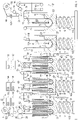
- the electrode manufacturing apparatus 11 comprises doping baths 15, 17, 19; cleaning baths 21, 23; conveyor rollers 25, 27, 29, 31, 33, 65, 67, 69, 70, 35, 37, 39, 40, 41, 43, 45, 46, 47, 49, 51, 52, 53, 55, 57, 58, 59, 61, 64, 71, 73, 75, 77, 79, 81, 83, 85, 87, 89, 91, 93 (hereinafter, these conveyor rollers may be collectively referred to as a group of conveyor rollers); a supply roll 101; a winding roll 103; supporting platforms 105; circulation filter units 107; six power sources 109, 110, 111, 112, 113, 114; a tab cleaner 117; recovery units 119; and end portion sensors 121.
- the electrode manufacturing apparatus 11 further comprises a cleaning solution supply unit 201, which will be described later,
- the doping baths 15, 17, 19 correspond to a doping unit.
- a configuration of the doping bath 17 will be explained with reference to FIG. 2 .
- the doping bath 17 includes an upstream bath 131 and a downstream bath 133.
- the upstream bath 131 is situated on a side of the doping bath 17 close to the supply roll 101 (hereinafter referred to as an upstream side);
- the downstream bath 133 is situated on a side of the doping bath 17 close to the winding roll 103 (hereinafter referred to as a downstream side).
- the upstream bath 131 is a square bath with an open top.
- a bottom surface of the upstream bath 131 has an approximately U-shaped cross section.
- the upstream bath 131 includes a partition plate 135, and four counter electrode units 137, 139, 141, 143.
- the partition plate 135 is supported by a supporting rod 145 that passes through an upper end of the partition plate 135.
- the supporting rod 145 is fixed on a wall or the like which is not shown in the drawings.
- the partition plate 135 extends in vertical directions and divides an interior of the upstream bath 131 into two spaces.
- a conveyor roller 40 is attached to a lower end of the partition plate 135.
- the partition plate 135 and the conveyor roller 40 are supported by a supporting rod 147 that passes through the partition plate 135 and the conveyor roller 40.
- a vicinity of the lower end of the partition plate 135 is cut off so that the partition plate 135 does not contact the conveyor roller 40.
- a counter electrode unit 137 is situated on the upstream side of the upstream bath 131.
- Counter electrode units 139, 141 are arranged to interpose the partition plate 135 from two sides.
- a counter electrode unit 143 is situated on the downstream side of the upstream bath 131.
- a space 149 exists between the counter electrode unit 137 and the counter electrode unit 139.
- a space 151 exists between the counter electrode unit 141 and the counter electrode unit 143.
- the counter electrode units 137, 139, 141, 143 are coupled to one electrode of a power source 109. Configurations of the counter electrode units 137, 139, 141, 143 are similar to one another. The present disclosure explains the configuration of the counter electrode units 137, 139 with reference to FIG. 3 .
- the counter electrode units 137, 139 include a conductive base material 153, an alkali metal-containing plate 155, and a porous insulating member 157 layered together.
- Materials for the conductive base material 153 may be copper, stainless steel, nickel, and the like for example.
- a form of the alkali metal-containing plate 155 is not particularly limited; it may be an alkali metal plate, an alkali metal alloy plate, and the like for example.
- a thickness of the alkali metal-containing plate 155 is 0.03 to 6 mm for example.
- the porous insulating member 157 has a plate shape.
- the porous insulating member 157 is layered on the alkali metal-containing plate 155.
- the plate-shape of the porous insulating member 157 is rendered when the porous insulating member 157 is layered on the alkali metal-containing plate 155.
- the porous insulating member 157 may be a member that retains a certain shape by itself, or, may be an easily deformable member such as a net.
- the porous insulating member 157 is a porous material; and therefore allows a dope solution, which will be explained later, to pass through the porous insulating member 157. This allows the alkali metal-containing plate 155 to contact the dope solution.
- Examples of the porous insulating member 157 may include a resin mesh, for example.
- the resin may be, for example, polyethylene, polypropylene, nylon, polyetheretherketone, and polytetrafluoroethylene.
- An opening of the mesh can be appropriately determined.
- the opening of the mesh is, for example, from 0.1 ⁇ m to 10 mm, and preferably from 0.1 mm to 5 mm.
- the thickness of the mesh can be appropriately determined.
- the thickness of the mesh is, for example, from 1 ⁇ m to 10 mm, and preferably from 30 ⁇ m to 1 mm.
- An opening ratio of the mesh can be appropriately determined.
- the opening ratio of the mesh is, for example, from 5 to 98%, and preferably from 5 to 95%, and more preferably from 50 to 95%.
- the porous insulating member 157 may be entirely made from an insulating material or may partly include an insulating layer.
- the downstream bath 133 basically has a configuration similar to the upstream bath 131. However, the conveyor roller 46 is situated in the interior of the downstream bath 133 instead of the conveyor roller 40.
- the counter electrode units 137, 139, 141, 143 in the downstream bath 133 are coupled to one electrode of the power source 110.
- the doping bath 15 has a configuration basically similar to the doping bath 17. However, the conveyor rollers 33, 70 are situated in an interior of the doping bath 15 instead of the conveyor rollers 40, 46.
- the counter electrode units 137, 139, 141, 143 in the upstream bath 131 of the doping bath 15 are coupled to one electrode of the power source 113.
- the counter electrode units 137, 139, 141, 143 in the downstream bath 133 of the doping bath 15 are coupled to one electrode of the power source 114.
- the doping bath 19 has a configuration basically similar to the doping bath 17. However, the conveyor rollers 52, 58 are situated in an interior of the doping bath 19 instead of the conveyor rollers 40, 46.
- the counter electrode units 137, 139, 141, 143 in the upstream bath 131 of the doping bath 19 are coupled to one electrode of the power source 111.
- the counter electrode units 137, 139, 141, 143 in the downstream bath 133 of the doping bath 19 are coupled to one electrode of the power source 112.
- the cleaning bath 21 is a square bath with an open top.
- a bottom surface of the cleaning bath 21 has an approximately U-shaped cross section.
- the cleaning bath 21 includes the partition plate 123.
- the partition plate 123 is supported by a supporting rod 125 that passes through an upper end of the partition plate 123.
- the supporting rod 125 is fixed on a wall or the like which is not shown in the drawings.
- the partition plate 123 extends in the vertical directions and divides an interior of the cleaning bath 21 into two spaces.
- the conveyor roller 64 is attached to a lower end of the partition plate 123.
- the partition plate 123 and the conveyor roller 64 are supported by the supporting rod 127 that passes through the partition plate 123 and the conveyor roller 64.
- a vicinity of the lower end of the partition plate 123 is cut off so that the partition plate 123 does not contact the conveyor roller 64.
- the cleaning bath 23 has a configuration basically similar to the cleaning bath 21. However, the conveyor roller 75 is situated in an interior of the cleaning bath 23 instead of the conveyor roller 33.
- the cleaning baths 21 and 23 correspond to a cleaning unit.
- the conveyor rollers 29, 31, 67, 69, 37, 39, 43, 45, 49, 51, 55, 57 are made from an electrically conductive material.
- Other conveyor rollers of the group of conveyor rollers are made of elastomer except for their bearing portions.
- the group of conveyor rollers convey an electrode 1 along a given path. The path along which the group of conveyor rollers conveys the electrode 1 starts from the supply roll 101, travels through the doping bath 15, the doping bath 17, the doping bath 19, the cleaning bath 21, the cleaning bath 23, and the tab cleaner 117 in this order, and ends at the winding roll 103.
- a part of the path that passes through the doping bath 15 is designed as follows.
- the path begins with a downward travel drawn by the conveyor rollers 29, 31 through the space 149 of the upstream bath 131.
- the direction of travel is changed upward by the conveyor roller 33 to travel through the space 151 of the upstream bath 131 upward.
- the direction of travel is then changed downward by the conveyor rollers 65, 67, 69 to travel through the space 149 of the downstream bath 133 downward.
- the direction of travel is changed upward by the conveyor roller 70 to travel through the space 151 of the downstream bath 133 upward.
- the direction of travel is ultimately changed to be horizontal by the conveyor roller 35 to travel towards the doping bath 17.
- Another part of the aforementioned path that passes through the doping bath 17 is designed as follows. Firstly, the direction of travel is changed downward by the conveyor rollers 37, 39 to travel through the space 149 of the upstream bath 131 downward. The direction of travel is then changed upward by the conveyor roller 40 to travel through the space 151 of the upstream bath 131 upward. The direction of travel is then changed downward by the conveyor rollers 41, 43, 45 to travel through the space 149 of the downstream bath 133 downward. Then the direction of travel is changed upward by the conveyor roller 46 to travel through the space 151 of the downstream bath 133 upward. The direction of travel is ultimately changed to be horizontal by the conveyor roller 47 to travel towards the doping bath 19.
- Another part of the aforementioned path that passes through the doping bath 19 is designed as follows. Firstly, the direction of travel is changed downward by the conveyor rollers 49, 51 to travel through the space 149 of the upstream bath 131 downward. The direction of travel is then changed upward by the conveyor roller 52 to travel through the space 151 of the upstream bath 131 upward. The direction of travel is then changed downward by the conveyor rollers 53, 55, 57 to travel through the space 149 of the downstream bath 133 downward. Then the direction of travel is changed upward by the conveyor roller 58 to travel through the space 151 of the downstream bath 133 upward. The direction of travel is ultimately changed to be horizontal by the conveyor roller 59 to travel towards the cleaning bath 21.
- Another part of the aforementioned path that passes through the cleaning bath 21 begins with changing its direction of travel downward by the conveyor roller 61 to make a downward travel. The direction of travel is then changed upward by the conveyor roller 64.
- Another part of the aforementioned path that passes through the cleaning bath 23 begins with changing its direction of travel downward by the conveyor roller 73 to make a downward travel. The direction of travel is then changed upward by the conveyor roller 75.
- the electrode 1 is wound around the supply roll 101.
- the supply roll 101 holds the electrode 1 in a wound state.
- An active material in the electrode 1 held by the supply roll 101 is not yet doped with alkali metal.
- the group of conveyor rollers draws and conveys the electrode 1 held by the supply roll 101.
- the winding roll 103 winds up and stores the electrode 1 conveyed by the group of conveyor rollers.
- the electrode 1 stored on the winding roll 103 has undergone a pre-doping process through the doping baths 15, 17, 19.
- the active material in the electrode 1 stored on the winding roll 103 is pre-doped with the alkali metal.
- the electrode 1 that includes the active material pre-doped with the alkali metal is called a doped electrode 1A.
- the supporting platforms 105 support the doping baths 15, 17, 19, and the cleaning baths 21, 23 from below.
- the supporting platforms 105 can change their height.
- Each of the doping baths 15, 17, 19 has the circulation filter unit 107.
- the circulation filter unit 107 includes a filter 161, a pump 163, and a pipe 165.
- the pipe165 is a circulation pipe that exits the doping bath 17, passes through the pump 163 and the filter 161 in this order, and returns to the doping bath 17.
- the dope solution in the doping bath 17 circulates through the pipe 165 and the filter 161 by a driving force of the pump 163, and returns to the doping bath 17.
- foreign matters in the dope solution are filtered by the filter 161.
- Such foreign matters include those precipitated from the dope solution and those generated from the electrode 1.
- a material for the filter 161 is a resin such as polypropylene and polytetrafluoroethylene.
- a pore size of the filter 161 can be appropriately determined. The pore size of the filter 161 is, for example, 0.2 ⁇ m or greater and 50 ⁇ m or smaller.
- the circulation filter units 107 disposed in the doping baths 15, 19 have a similar configuration and exert a similar effect.
- the dope solution is not illustrated for the purpose of convenience.
- One terminal of the power source 113 is coupled to the conveyor rollers 29, 31. Another terminal of the power source 113 is coupled to the counter electrode units 137, 139, 141, 143, disposed in the upstream bath 131 of the doping bath 15.
- the electrode 1 contacts the conveyor rollers 29, 31.
- the electrode 1 and the counter electrode units 137, 139, 141, 143 are submerged in the dope solution, which is an electrolyte solution. Accordingly, in the upstream bath 131 of the doping bath 15, the electrode 1 is electrically coupled to the counter electrode units 137, 139, 141, 143 via the electrolyte solution.
- One terminal of the power source 114 is coupled to the conveyor rollers 67, 69.
- Another terminal of the power source 110 is coupled to the counter electrode units 137, 139, 141, 143, disposed in the downstream bath 133 of the doping bath 15.
- the electrode 1 contacts the conveyor rollers 67, 69.
- the electrode 1 and the counter electrode units 137, 139, 141, 143 are submerged in the dope solution, which is an electrolyte solution. Accordingly, in the downstream bath 133 of the doping bath 15, the electrode 1 is electrically coupled to the counter electrode units 137, 139, 141, 143 via the electrolyte solution.
- One terminal of the power source 109 is coupled to the conveyor rollers 37, 39.
- Another terminal of the power source 109 is coupled to the counter electrode units 137, 139, 141, 143, disposed in the upstream bath 131 of the doping bath 17.
- the electrode 1 contacts the conveyor rollers 37, 39.
- the electrode 1 and the counter electrode units 137, 139, 141, 143 are submerged in the dope solution, which is an electrolyte solution. Accordingly, in the upstream bath 131 of the doping bath 17, the electrode 1 is electrically coupled to the counter electrode units 137, 139, 141, 143 via the electrolyte solution.
- One terminal of the power source 110 is coupled to the conveyor rollers 43, 45.
- Another terminal of the power source 110 is coupled to the counter electrode units 137, 139, 141, 143, disposed in the downstream bath 133 of the doping bath 17.
- the electrode 1 contacts the conveyor rollers 43, 45.
- the electrode 1 and the counter electrode units 137, 139, 141, 143 are submerged in the dope solution, which is an electrolyte solution. Accordingly, in the downstream bath 133 of the doping bath 17, the electrode 1 is electrically coupled to the counter electrode units 137, 139, 141, 143 via the electrolyte solution.
- One terminal of the power source 111 is coupled to the conveyor rollers 49, 51.
- Another terminal of the power source 111 is coupled to the counter electrode units 137, 139, 141, 143, disposed in the upstream bath 131 of the doping bath 19.
- the electrode 1 contacts the conveyor rollers 49, 51.
- the electrode 1 and the counter electrode units 137, 139, 141, 143 are submerged in the dope solution, which is an electrolyte solution. Accordingly, in the upstream bath 131 of the doping bath 19, the electrode 1 is electrically coupled to the counter electrode units 137, 139, 141, 143 via the electrolyte solution.
- One terminal of the power source 112 is coupled to the conveyor rollers 55, 57.
- Another terminal of the power source 112 is coupled to the counter electrode units 137, 139, 141, 143, disposed in the downstream bath 133 of the doping bath 19.
- the electrode 1 contacts the conveyor rollers 55, 57.
- the electrode 1 and the counter electrode units 137, 139, 141, 143 are submerged in the dope solution, which is an electrolyte solution. Accordingly, in the downstream bath 133 of the doping bath 19, the electrode 1 is electrically coupled to the counter electrode units 137, 139, 141, 143 via the electrolyte solution.
- the tab cleaner 117 cleans an active material layer unformed portion 94 of the electrode 1, which will be explained later.
- the recovery units 119 are individually disposed in each of the doping baths 15, 17, 19, and the cleaning baths 21, 23. The recovery units 119 collect the solution the electrode 1 takes out from the baths and return the collected solution back into the baths.
- the end portion sensors 121 detect the position of an end portion of a width W of the electrode 1.
- the electrode manufacturing apparatus 11 adjusts positions of the supply roll 101 and the winding roll 103 relative to the width W of the electrode 1 based on a result of detection by the end portion sensor 121.
- the electrode manufacturing apparatus 11 includes two cleaning baths 21, 23.
- the number of the cleaning bath may be one, or three or more.
- the number of the cleaning bath is preferably two or more since the total usage of cleaning solution can be reduced.
- the conveying paths of the electrode 1 through the cleaning baths 21, 23 take one round trip each in the vertical directions.
- the conveying paths of the electrode 1 through the cleaning baths 21, 23 may take two round trips each in the vertical directions similarly to the conveying paths through the doping baths 15, 17, 19.
- the cleaning baths 21, 23 each include an upstream bath and a downstream bath similarly to the doping baths 15, 17, 19.
- the conveying paths of the electrode 1 through the cleaning baths 21, 23 take one round trip each through the upstream bath and the downstream bath in the vertical directions.
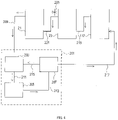
- the cleaning solution supply unit 201 comprises a buffer tank 203, a distillation unit 205, and a tank 207. An upper portion of the cleaning bath 21 and the buffer tank 203 are coupled to each other via a pipe 209.
- the buffer tank 203 and the distillation unit 205 are coupled to each other via a pipe 211.
- the distillation unit 205 and the tank 207 are coupled to each other via a pipe 213.
- the buffer tank 203 and the tank 207 are coupled to each other via a pipe 215.
- the distillation unit 205 performs simple distillation, for example.
- the tank 207 and a lower portion of the tab cleaner 117 are coupled to each other via a pipe 217.
- An upper portion of the tab cleaner 117 and a lower portion of the cleaning bath 23 are coupled to each other via a pipe 219.
- An upper portion of the cleaning bath 23 and a lower portion of the cleaning bath 21 are coupled to each other via a pipe 221.
- the pipe 221 includes an air vent 223.
- the cleaning solution supply unit 201 does not have to comprise the distillation unit 205.
- an external distillation unit may be used to distill the cleaning solution.
- the pipe 219 may be connected to a lower portion of the cleaning bath 21.
- the electrode manufacturing apparatus 11 comprises two or more cleaning baths
- the two or more cleaning baths may be coupled in series via a pipe.
- the cleaning solution can travel between the serially coupled cleaning baths in order.
- the cleaning solution that overflows from any cleaning bath is introduced to a next cleaning bath from a lower portion of the next cleaning bath.
- the electrode 1 has a strip-like shape.
- the electrode 1 comprises a current collector 193 having a strip-like shape and active material layers 195 formed on two sides of the current collector 193.
- active material layer unformed portions 94 are situated on two ends of the electrode 1 in the width direction.
- An active material layer unformed portion 94 is a part of the current collector 193 where an active material layer 195 is not formed and the current collector 193 is exposed.
- the active material layer unformed portion 94 exists continuously along a longitudinal direction of the electrode 1 and has a constant width.
- the active material layer unformed portion 94 exists on two opposing sides of the electrode 1.
- a portion where the active material layer 195 is formed is called a center portion 96.
- the center portion 96 is situated in a central area of the width of the electrode 1.
- the center portion 96 exists continuously along the longitudinal direction of the electrode 1 and has a constant width.
- the electrode 1 may include the active material layer unformed portion 94 only on one end of the width of the electrode 1.
- the current collector 193 is a positive electrode current collector, the current collector 193 is preferably made of aluminum, stainless steel, and the like. If the current collector 193 is a negative electrode current collector, the current collector 193 is preferably made of metal foil such as of copper, nickel, and stainless steel.
- the current collector 193 may be prepared by forming a conductive layer, the main component of which is a carbon material, on a metal foil. A thickness of the current collector 193 is 5 to 50 ⁇ m, for example.
- the active material layer 195 can be fabricated by, for example, preparing a slurry that contains an active material before doping with the alkali metal, a binder, and the like; applying thus prepared slurry on the current collector 193; and drying the slurry.
- Example of the binder may include, rubber-based binders such as styrenebutadiene rubber (SBR) and NBR; fluorine-based resin such as polytetrafluoroethylene and polyvinylidene fluoride; polypropylene; polyethylene; polyimide; fluorine modified (meth)acrylic binder as disclosed in Japanese Unexamined Patent Application Publication No. 2009-246137 .
- rubber-based binders such as styrenebutadiene rubber (SBR) and NBR
- fluorine-based resin such as polytetrafluoroethylene and polyvinylidene fluoride
- polypropylene polyethylene
- polyimide polyimide
- fluorine modified (meth)acrylic binder as disclosed in Japanese Unexamined Patent Application Publication No. 2009-246137 .
- the slurry may include other components in addition to the active material and the binder.
- examples of those other components may include carbon black; graphite; vapor-grown carbon fiber; conductive agent such as metal powder; carboxyl methyl cellulose; sodium salt or ammonium salt; methyl cellulose; hydroxymethyl cellulose; ethyl cellulose; hydroxypropyl cellulose; polyvinyl alcohol; oxidized starch; phosphorylated starch; and thickener such as casein.
- the thickness of the active material layer 195 is not particularly limited. However, it is, for example, 5 to 500 ⁇ m, preferably 10 to 200 ⁇ m, and particularly preferably 10 to 100 ⁇ m.
- the active material included in the active material layer 195 is not particularly limited as long as it is an electrode active material applicable to a battery or a capacitor that uses insertion/desorption of alkali metal ion.
- the active material may be a negative electrode active material or may be a positive electrode active material.
- the negative-electrode active material is not particularly limited, and examples of which may include a carbon material such as graphite, easily-graphitizable carbon, hardly-graphitizable carbon, and a composite carbon material made by coating graphite particles with carbides of pitch and resin; and metal or semimetal, such as Si and Sn, that can be alloyed with lithium or a material that includes oxides of these metal or semimetal.
- a carbon material such as graphite, easily-graphitizable carbon, hardly-graphitizable carbon, and a composite carbon material made by coating graphite particles with carbides of pitch and resin
- metal or semimetal such as Si and Sn
- Specific examples of the carbon material may include a carbon material disclosed in Japanese Unexamined Patent Application Publication No. 2013-258392 .
- Specific examples of the metal or semimetal that can be alloyed with lithium or the material that includes oxides of these metal or semimetal may include materials disclosed in Japanese Unexamined Patent Application Publication No.
- positive-electrode active material may include transition metal oxides such as cobalt oxide, nickel oxide, manganese oxide, and vanadium oxide; and sulfur-based active materials such as elemental sulfur and metal sulfides.
- Both of the positive-electrode active material and the negative-electrode active material may be made from a single substance or made by mixing two or more substances.
- the electrode manufacturing apparatus 11 of the present disclosure is suitable for a case in which the negative-electrode active material is doped with the alkali metal. It is particularly preferable that the negative-electrode active material includes a carbon material or Si, or oxides of the carbon material or Si.
- the alkali metal for doping the active material is preferably lithium or sodium; but lithium is particularly preferable.
- a density of the active material layer 195 is preferably 1.50 to 2.00 g/cc, and particularly preferably 1.60 to 1.90 g/cc. Meanwhile, in a case where the electrode 1 is used to manufacture a lithium ion capacitor, the density of the active material layer 195 is preferably 0.50 to 1.50 g/cc, and particularly preferably 0.70 to 1.20 g/cc.
- the active material is not doped with the alkali metal.
- the active material is doped with the alkali metal as a result of implementing the method of manufacturing an electrode.
- the dope solution is stored in the doping baths 15, 17, 19.
- the dope solution includes alkali metal salt, and a first aprotic solvent.
- the first aprotic solvent an organic solvent that has a boiling point exceeding 150°C at one atmospheric pressure is preferable; and an organic solvent that has a boiling point exceeding 200°C at one atmospheric pressure is particularly preferable.
- Examples of the first aprotic solvent may include, for example, ethylene carbonate, propylene carbonate, butylene carbonate, 1-fluoroethylene carbonate, dipropyl carbonate, ⁇ -butyrolactone, sulfolane, diethylene glycol dimethyl ether (diglyme), diethylene glycol methyl ethyl ether, triethylene glycol dimethyl ether (triglyme), triethylene glycol butyl methyl ether, and tetraethylene glycol dimethyl ether (tetraglyme).
- the first aprotic solvent ionic liquids such as quaternary imidazolium salt, quaternary pyridinium salt, quaternary pyrrolidinium salt, and quaternary piperidinium salt may also be used.
- the first aprotic solvent may include a single component or may be a mixed solvent including two or more kinds of components.
- the dope solution may include a solvent that has a boiling point of 150°C or lower at one atmospheric pressure.
- a solvent having a boiling point of 150°C or lower at one atmospheric pressure an aprotic organic solvent is preferable; such aprotic organic solvent specifically includes dimethyl carbonate, diethyl carbonate, ethyl methyl carbonate, acetonitrile, dimethoxyethane, tetrahydrofuran, dioxolane, and methylene chloride.
- dimethyl carbonate and ethyl methyl carbonate are preferable, and dimethyl carbonate is particularly preferable.
- Content ratio of the solvent having a boiling point of 150°C or lower at one atmospheric pressure in solvents included in the dope solution is preferably 50 to 90 vol% and particularly preferably 65 to 75 vol%.
- the alkali metal salt included in the dope solution is lithium salt or sodium salt.
- an anionic moiety included in the alkali metal salt may include phosphorous anion having a fluoro group such as PF 6 - , PF 3 (C 2 F 5 ) 3 - , and PF 3 (CF 3 ) 3 - ; boron anion having a fluoro group or a cyano group such as BF 4 - , BF 2 (CF) 2 - , BF 3 (CF 3 ) - , and B(CN) 4 - ; sulfonyl imide anion having a fluoro group such as N(FSO 2 ) 2 - , N(CF 3 SO 2 ) 2 - , and N(C 2 F 5 SO 2 ) 2 - ; and organic sulfonic acid anion having a fluoro group such as CF 3 SO 3 - .
- the alkali metal salt is a
- Concentration of the alkali metal salt in the dope solution is preferably 0.1 mol/L or higher, and more preferably within a range from 0.5 to 1.5 mol/L. In a case where the concentration of the alkali metal salt in the dope solution is within this range, doping with alkali metal proceeds efficiently.
- the dope solution may further include an additive such as vinylene carbonate, vinyl ethylene carbonate, 1-fluoroethylene carbonate, 1-(trifluoromethyl)ethylene carbonate, succinic anhydride, maleic anhydride, propane sultone, and diethyl sulfone.
- an additive such as vinylene carbonate, vinyl ethylene carbonate, 1-fluoroethylene carbonate, 1-(trifluoromethyl)ethylene carbonate, succinic anhydride, maleic anhydride, propane sultone, and diethyl sulfone.
- the cleaning solution includes a second aprotic solvent.
- the second aprotic solvent is not particularly limited to any solvent as long as its boiling point is lower than that of the first aprotic solvent.
- an organic solvent having a boiling point of 150°C or lower at one atmospheric pressure is preferable; and an organic solvent having a boiling point of 120°C or lower at one atmospheric pressure is particularly preferable.
- the boiling point of the second aprotic solvent at one atmospheric pressure is 150°C or lower, it becomes easier to remove the cleaning solution from the cleaned doped electrode 1A by drying.
- the boiling point of the second aprotic solvent at one atmospheric pressure is preferably 30°C or higher, more preferably 40°C or higher, and particularly preferably 50°C or higher. In a case where the boiling point of the second aprotic solvent at one atmospheric pressure is 30°C or higher, it is possible to inhibit excessive vaporization of the cleaning solution in the cleaning baths 21, 23.
- Examples of the second aprotic solvent may include at least one kind selected from a carbonate-based solvent, an ester-based solvent, an ether-based solvent, a hydrocarbon-based solvent, a keton-based solvent, and a nitrile-based solvent.
- Examples of the carbonate-based solvent may include dimethyl carbonate, diethyl carbonate, methyl propyl carbonate, and ethyl methyl carbonate.
- ester-based solvent examples include butyl acetate, amyl acetate, propylene glycol monomethyl ether acetate, ethylene glycol monoethyl ether acetate, butyl formate, and propyl formate.
- ether-based solvent examples include ethyl ether, i-propyl ether, n-butyl ether, n-hexyl ether, 2-ethylhexyl ether, ethylene oxide, 1, 2-propylene oxide, dioxolane, 4-methyl dioxolane, dioxane, dimethyl dioxane, tetrahydrofuran, 2-methyl tetrahydrofuran, ethylene glycol dimethyl ether, ethylene glycol diethyl ether, propylene glycol dimethyl ether, and propylene glycol diethyl ether.
- hydrocarbon-based solvent examples include n-pentane, i-pentane, n-hexane, i-hexane, n-heptane, i-heptane, 2, 2, 4-trimethyl pentane, n-octane, i-octane, cyclohexane, methyl cyclohexane, benzene, toluene, xylene, and ethylbenzene.
- keton-based solvent examples include 2-hexanone and methyl isobutyl keton.
- nitrile-based solvent examples include acetonitrile and propionitrile.
- the carbonate-based solvent is preferable.
- the second aprotic solvent may include a single component or may be a mixed solvent including two or more kinds of components.
- the cleaning solution may be substantially made from the second aprotic solvent or may include an other component in addition to the second aprotic solvent. Nevertheless, the content ratio of the first aprotic solvent in the initial cleaning solution is 6 vol% or less.
- the initial cleaning solution means a cleaning solution that is not yet used to clean the doped electrode 1A.
- the following steps are taken firstly as a preparation to manufacture the doped electrode 1A.
- the electrode 1 the active material of which is not yet doped with the alkali metal, is wound around the supply roll 101.
- the dope solution is stored in the doping baths 15, 17, 19.
- the dope solution is what has been explained in "4. Composition of Dope Solution" mentioned above.
- the electrode 1 is conveyed by the group of conveyor rollers from the supply roll 101 to the winding roll 103 along the aforementioned path.
- the path to convey the electrode 1 passes through the doping baths 15, 17, 19.
- the active material included in the active material layer 195 is doped with the alkali metal. As a consequence, the electrode 1 becomes the doped electrode 1A.
- the group of conveyor rollers further conveys the doped electrode 1A to the cleaning baths 21, 23.
- the doped electrode 1A is cleaned in the cleaning baths 21, 23 while being conveyed by the group of conveyor rollers.
- the group of conveyor rollers continuously conveys the doped electrode 1A to the tab cleaner 117.
- the tab cleaner 117 cleans the active material layer unformed portion 94 of the doped electrode 1A.
- the cleaning solution is controlled.
- the content ratio of the first aprotic solvent in the cleaning solution used to clean the doped electrode 1A becomes 6 vol% or less.
- the last cleaning bath is a cleaning bath that cleans the doped electrode 1A lastly.
- Examples of the measures to control may include a measure that includes discharging a part or all of the cleaning solution from the cleaning bath once the content ratio of the first aprotic solvent in the cleaning solution stored in the cleaning bath exceeds 6 vol% and supplying the cleaning bath with a cleaning solution, the content ratio of the first aprotic solvent of which is 6 vol% or less.
- the content ratio of the first aprotic solvent in the cleaning solution stored in the cleaning bath 21 is periodically or continuously measured.
- the content ratio of the first aprotic solvent is measured by a gas-chromatographic analysis.
- the cleaning solution is supplied from the tank 207 to the tab cleaner 117.
- the cleaning solution overflowed from the tab cleaner 117 passes through the pipe 219 and is supplied to a lower portion of the cleaning bath 23.
- the cleaning solution overflowed from the cleaning bath 23 passes through the pipe 221 and is supplied to a lower portion of the cleaning bath 21.
- the cleaning solution overflowed from the cleaning bath 21 passes through the pipe 209 and is transferred to the buffer tank 203.
- the cleaning solution is transferred from the buffer tank 203 to the distillation unit 205.
- the distillation unit 205 removes the first aprotic solvent from the cleaning solution by distillation. As a consequence, the content ratio of the first aprotic solvent in the cleaning solution becomes 6 vol% or less. After distillation, the cleaning solution is transferred to the tank 207.
- the fluorine compound may reacts with moisture present in the system and generate hydrogen fluoride. Hydrogen fluoride corrodes each unit and pipe of the electrode manufacturing apparatus 11 and is toxic.
- the distillation unit 205 for example, first adds a calcium compound and a zeolite to the cleaning solution and heats the cleaning solution for distillation. If a calcium compound is added, hydrogen fluoride reacts with the calcium compound and immobilized as calcium fluoride. If a zeolite is added, hydrogen fluoride reacts with the zeolite and immobilized and gasified as fluoride. As a consequence, hydrogen fluoride can be removed from the cleaning solution.
- a method of distillation may be, for example, flash distillation.
- the flash distillation is a continuous-type simple distillation.
- the flash distillation provides a continuous distillation while the cleaning solution continuously flows through a loop-shaped path including the buffer tank 203, the pipe 211, the distillation unit 205, the pipe 213, the tank 207, and the pipe 215.
- Another measure to control the cleaning solution may be, for example, a measure that includes continuing to supply the cleaning bath with the cleaning solution, the content ratio of the first aprotic solvent of which is 6 vol% or less, while continuing to discharge used cleaning solution from the cleaning bath.
- the cleaning solution the content ratio of the first aprotic solvent of which is 6 vol% or less
- the cleaning solution overflowed from the tab cleaner 117 passes through the pipe 219 and is continued to be supplied to the lower portion of the cleaning bath 23.
- the cleaning solution overflowed from the cleaning bath 23 passes through the pipe 221 and is continued to be supplied to the lower portion of the cleaning bath 21.
- the cleaning solution overflowed from the cleaning bath 21 passes through the pipe 209 and is continued to be transferred to the buffer tank 203.
- the cleaning solution, the content ratio of the first aprotic solvent of which is 6 vol% or less, supplied from the cleaning solution supply unit 201 may be an unused cleaning solution or may be a recycled cleaning solution recycled after being used in cleaning (hereinafter referred to as the recycled cleaning solution).
- Examples of a recycling method may include, for example, distillation.
- the content ratio of the first aprotic solvent in the cleaning solution stored in the cleaning baths 21, 23 is preferably kept 3.5 vol% or less, more preferably kept 1.5 vol% or less, and particularly preferably kept 1 vol% or less.
- the alkali metal salt is brought to the cleaning solution from the doping baths 15, 17, 19.
- the content ratio of the alkali metal salt in the cleaning solution is preferably 0.20 M or less, more preferably 0.15 M or less, and particularly preferably 0.07 M or less.
- an internal resistance of a power storage device that include the doped electrode 1A can be reduced.
- An example of the measures to control the content ratio of the alkali metal salt in the cleaning solution may include a measure that includes discharging a part or all of the cleaning solution from the cleaning bath once the content ratio of the alkali metal salt in the cleaning solution stored in the cleaning bath exceeds a specified threshold and supplying the cleaning bath with a cleaning solution, the content ratio of the alkali metal salt of which is equal to or less than the threshold.
- the content ratio of the alkali metal salt in the cleaning solution is measured by an ion-chromatographic analysis.
- Another measure to control the content ratio of the alkali metal salt in the cleaning solution may be, for example, a measure that includes continuing to supply the cleaning bath with the cleaning solution, the content ratio of the alkali metal salt of which is equal to or less than the threshold, while continuing to discharge use cleaning solution from the cleaning bath.
- the doped electrode 1A manufactured by using the electrode manufacturing apparatus 11 may be a positive electrode or may be a negative electrode.
- the electrode manufacturing apparatus 11 dopes the positive electrode active material with the alkali metal when manufacturing the positive electrode.
- the electrode manufacturing apparatus 11 dopes the negative electrode active material with the alkali metal when manufacturing the negative electrode.
- the electrode manufacturing apparatus 11 is suitable to manufacture the negative electrode that is used in alkali-ion capacitors or batteries, more suitable to manufacture the negative electrode that is used in alkali-ion capacitors or rechargeable batteries, and particularly suitable to manufacture the negative electrode that is used in lithium-ion capacitors or lithium-ion rechargeable batteries.
- a doping amount of the alkali metal is preferably 70 to 95% relative to a theoretical capacity of the negative electrode active material. In a case where lithium is occluded in the negative electrode active material of a lithium-ion rechargeable battery, the doping amount of the alkali metal is preferably 10 to 30% relative to the theoretical capacity of the negative electrode active material.
- a method of manufacturing a power storage device in the present disclosure is a method of manufacturing a power storage device comprising a positive electrode, a negative electrode, and an electrolyte.
- the negative electrode is manufactured by using the aforementioned "6. Method of Manufacturing Electrode”.
- Examples of the power storage device may include a capacitor and a battery.
- the capacitor is not particularly limited as long as it is a capacitor that uses insertion/desorption of the alkali metal ion.
- Examples of such capacitor may include a lithium ion capacitor and a sodium ion capacitor. Among these examples, the lithium ion capacitor is preferable.
- the basic configuration of the positive electrode included in the capacitor may be a typical configuration. It is preferable to use activated carbon as the positive electrode active material.
- a form of electrolyte included in the capacitor is usually a liquid electrolyte solution.
- the basic configuration of the electrolyte solution is the same as that of the aforementioned dope solution.
- a concentration of the alkali metal ion in the electrolyte is preferably 0.1 mol/L or more, and more preferably within a range of 0.5 to 1.5 mol/L.
- the electrolyte may be in a gel form or a solid form for a purpose of inhibiting leakage.
- the capacitor may include a separator between the positive electrode and the negative electrode to reduce physical contact between the positive electrode and the negative electrode.
- the separator may include a nonwoven cloth or a porous film made from a material such as cellulose rayon, polyethylene, polypropylene, polyamide, polyester, and polyimide.
- Examples of a structure of the capacitor may include a laminated cell having a laminate formed from three or more of a plate-like component unit; the plate-like component unit includes the positive electrode, the negative electrode, and the interposed separator; and the laminate is enclosed in an external film.
- Examples of the structure of the capacitor may also include a wound cell having a laminate formed by winding a belt-like component unit, which includes the positive electrode, the negative electrode, and the interposing separator, and having thus formed laminate stored in a square or cylindrical container.
- the capacitor can be manufactured by, for example, forming a basic structure including at least the negative electrode and the positive electrode, and introducing the electrolyte in the basic structure.
- a density of the active material layer 195 is preferably 0.50 to 1.50 g/cc, and particularly preferably 0.70 to 1.20 g/cc.
- the battery is not particularly limited as long as it is a battery that uses insertion/desorption of the alkali metal ion.
- the battery may be a non-rechargeable battery or a rechargeable battery.
- Examples of the battery may include a lithium-ion rechargeable battery, a sodium ion rechargeable battery, and an air battery. Among these examples, the lithium-ion rechargeable battery is preferable.
- the basic configuration of the positive electrode included in the battery may be a typical configuration.
- an organic active material such as a nitroxy radical compound, and oxygen may also be used as the positive-electrode active material.
- a configuration of the electrolyte included in the battery and a configuration of the battery itself are the same as those of the capacitor.
- the battery can be manufactured by, for example, forming a basic structure including at least the negative electrode and the positive electrode, and introducing the electrolyte in the basic structure
- a long strip-shaped current collector 193 was prepared.
- the current collector 193 was used as the negative electrode current collector.
- the size of the current collector 193 was 132 mm in width and 8 ⁇ m in thickness.
- the surface roughness Ra of the current collector 193 was 0.1 ⁇ m.
- the current collector 193 was made from copper foil.
- the active material layer 195 was formed on two sides of the current collector 193.
- the active material layer 195 was the negative electrode active material layer.
- the thickness of the active material layer 195 was 65 ⁇ m.
- the density of the active material layer 195 is preferably 1.30 to 2.00 g/cc, and particularly preferably 1.40 to 1.90 g/cc.
- the amount of application of the active material layer 195 on one side of the current collector 193 was 50 g/m 2 .
- the active material layer 195 was formed along a longitudinal direction of the current collector 193.
- the active material layer 195 was formed from an end portion of the width W of the current collector 193 for 120 mm in width.
- the width of the active material layer unformed portion 94 along the other end portion of the width W of the current collector 193 was 12 mm. Then, after drying and pressing, the electrode 1 was obtained.
- the active material layer 195 contained the negative electrode active material, carboxymethyl cellulose, acetylene black, and the binder with a mass ratio of 88:4:5:3.
- the negative electrode active material was a graphite-based active material.
- the binder was a fluorine acrylic resin. D50 of the graphite-based active material was 5 ⁇ m. A BET specific surface area of the graphite-based active material was 10 m 2 /g.
- the electrode manufacturing apparatus 11 shown in FIG. 1 was prepared, and the electrode 1 was placed.
- the counter electrode units 137, 139, 141, 143 were placed in each of the doping baths 15, 17, 19.
- the dope solution was supplied into the doping baths 15, 17, 19.
- the dope solution was a solution that include 1.2M of LiPF6.
- LiPF6 is a fluorine containing compound.
- the solvent of the dope solution was a mixed solution of EC (ethylene carbonate) and DMC (dimethyl carbonate) with a volume ratio of 3:7.
- the EC corresponds to the first aprotic solvent.
- the electrode 1 and the counter electrode units 137, 139, 141, 143 placed in the electrode manufacturing apparatus 11 were coupled to a direct current power source equipped with an electric current/voltage monitor, and 50 A of electric current was supplied while the electrode 1 was conveyed at a speed of 2 m/min.
- the center of the width W of the active material layer 195 included in the electrode 1 matched the center of the width of the lithium metal plate included in the counter electrode unit 51.
- the negative electrode active material in the active material layer 195 was doped with lithium about 80% relative to the theoretical capacity. The electrode 1 accordingly became the doped electrode 1A.
- the doped electrode 1A After having the doped electrode 1A pass through the cleaning baths 21, 23, spraying argon onto the doped electrode 1A, and drying the argon, the doped electrode 1A was wound up. 25°C of DMC was stored in the cleaning baths 21, 23. DMC corresponds to the second aprotic solvent. DMC initially stored in the cleaning baths 21, 23 did not contain EC. The doped electrode 1A was thus manufactured as mentioned above.
- a strip-shaped positive electrode current collector made of aluminum foil was prepared.
- the size of the positive electrode current collector was 128 mm in width and 12 ⁇ m in thickness.
- An aperture ratio of the positive electrode current collector was 0%.
- a conductive layer was formed on two sides of the positive electrode current collector.
- a positive electrode active material layer was formed on each conductive layer. The thickness of the positive electrode active material layer was 144 ⁇ m.
- the positive electrode active material layer was formed along a length of the positive electrode current collector.
- the positive electrode active material layer was formed from an end portion of the width of the positive electrode current collector for 111 mm in width.
- the width of a positive electrode active material layer unformed portion along the other end portion of the width of the positive electrode current collector was 17 mm.
- the positive electrode active material layer unformed portion is a portion where the positive electrode active material layer is not formed.
- the positive electrode active material layer contained activated carbon, acetylene black, the binder, and carboxymethyl cellulose with a mass ratio of 88:5:3:3. D50 of the activated carbon was 3.5 ⁇ m. The BET specific surface area of the activated carbon was 1950 m 2 /g.
- the binder was a fluoirne acrylic resin.
- a first separator and a second separator were made by cutting them out from a PP (polypropylene) sheet having a thickness of 15 ⁇ m and a surface roughness of 0.1 ⁇ m.
- the sizes of the width W and the length L of the first separator and of the second separator were greater than those of the positive electrode and the negative electrode.
- the first separator, the negative electrode, the second separator, and the positive electrode thus manufactured were layered in this order to manufacture an electrode body.
- the negative electrode used here was a portion of the doped electrode 1A, taken from between 200 m from the front end and 205 m from the front end.
- the front end is a leading end portion in the direction of conveyance.
- the positional relationship between an active material layer unformed portion 94 of a negative electrode 1C and an active material layer unformed portion 303 of a positive electrode 301 is opposite to each other along the width W.
- the active material layer unformed portion 94 protruded in a direction of the width W without overlapping the second separator 305.
- the active material layer unformed portion 303 protruded in the direction of the width W without overlapping the second separator 305.
- the electrode body was wound around an outer circumferential surface of a core rod made of stainless steel, such that the second separator 305 was situated on an inner side, to manufacture a cylindrical wound body. Then, the cylindrical wound body was pressed to manufacture the electrode body having a flattened wound structure.
- an aluminum lead member was coupled to the active material layer unformed portion 303 by ultrasonic welding.
- a copper lead member was coupled to the active material layer unformed portion 94 by ultrasonic welding.
- an aluminum sealing plate 307 was prepared.
- the sealing plate 307 included a positive electrode terminal 309 and a negative electrode terminal 311.
- the sealing plate 307 also included an unillustrated inlet.
- the positive electrode terminal 309 and the negative electrode terminal 311 were integrated with the sealing plate 307 via a PP resin holder by insert resin molding.
- the other end of the aforementioned lead member coupled to the active material layer unformed portion 94 was electrically coupled to the negative electrode terminal 311 by resistance welding.
- the other end of the lead member coupled to the active material layer unformed portion 303 was also electrically coupled to the positive electrode terminal 309 by resistance welding.
- an electrode body 313 was coupled to the sealing plate 307.
- a square-shaped aluminum case body 317 having an opening 315 on one side was prepared. Then, as shown in FIG. 8 , the electrode body 313 coupled to the sealing plate 307 was inserted into the case body 317 from the opening 315.
- an outer circumferential edge portion of the opening 315 and an outer circumferential edge portion of the sealing plate 307 were swaged to close the opening 315. Then, an electrolyte solution was injected into a case 319 from the inlet formed on the sealing plate 307.
- the case 319 was formed of the sealing plate 307 and the case body 317.
- the electrolyte solution was made by preparing a solvent containing a mixture of ethylene carbonate, ethyl methyl carbonate, and dimethyl carbonate with a volume ratio of 3:4:3 and dissolving LiPF6 in the solvent at a concentration of 1.2 M. After tentatively closing the inlet with a rubber plug, aging was performed. The aging was performed by charging and discharging at a constant temperature of 80°C. After the aging, the inlet was sealed with a safety valve and thus a lithium ion capacitor cell 321 was obtained.
- Cells for Examples 2 to 4 and Comparative Example 1 were manufactured basically by the same procedures as for the cell in Example 1. However, the negative electrode of Example 2 was a portion of the doped electrode 1A taken from between 1500 m and 1505 m from the front end.
- Example 3 the negative electrode was a portion of the doped electrode 1A taken from between 2500 m and 2505 m from the front end.
- Example 4 the negative electrode was a portion of the doped electrode 1A taken from between 3500 m and 3505 m from the front end.
- Comparative Example 1 the negative electrode was a portion of the doped electrode 1A taken from between 5000 m and 5005 m from the front end.
- weight of the manufactured cell was measured by using electronic balance. The results of the measurement are shown in a column for "cell weight” in Table 1.
- the “cell weight” shown in Table 1 is a relative value when the weight of the cell manufactured in Example 1 is 100.
- the "conveyance distance of electrode” shown in Table 1 means a distance from a portion of the doped electrode 1A used as the negative electrode to the front end of the doped electrode 1A.
- the manufactured cell was charged at a constant current of 10 A untel the cell voltage reachec 3.8 V. Then, the constant-voltage charging, which applies a constant voltage of 3.8 V to the cell, was conducted for 30 minutes. Then, the cell was discharged at a constant current of 100 A until the cell voltage reached 2.2 V. A value was calculated by divinding the voltage difference between the voltage immediately before the initiation of the discharge and the voltage 0.1 second after the initiation of the discharge current. Thus calculated value was an initial DC-IR.
- the initial DC-IR is a direct current internal resistance of an evaluation cell. The result of evaluation is shown in Table 1.
- Example 1 When the portion of the doped electrode 1A, used as the negative electrode in Example 1, passed the cleaning baths 21, 23, the cleaning solution was recovered from the cleaning baths 21, 23. Thus recovered cleaning solution was the cleaning solution of Example 1. The cleaning solution was recovered likewise in Examples 2 to 4 and Comparative Example 1.
- the method of the gas-chromatographic analysis was as described below.
- the measurement was conducted after the cleaning solution recovered from the cleaning baths 21, 23 was diluted by 100 times with acetone.
- a calibration curve was prepared in advance by measuring a mixed solvent at a known concentration. Content ratios of EC and DMC were obtained by applying the result of measurement to the calibration curve. Conditions for the measurement were as described below. The result of the measurement is shown in Table 1.
- the content ratio of LiPF 6 in the recovered cleaning solution was measured by cation analysis by the ion-chromatographic analysis.
- the method of the ion-chromatographic analysis was as described below.
- the measurement was conducted after the cleaning solution recovered from the cleaning baths 21, 23 was diluted by 1000 times with ultrapure water.
- a calibration curve was prepared in advance by measuring a mixed solvent at a known concentration. Li + concentration was obtained by applying the result of measurement to the calibration curve. Content ratio of LiPF 6 was obtained based on the Li + concentration. Conditions for the measurement were as described below. The result of the measurement is shown in Table 1.
- the cleaning solution was recovered from the cleaning bath 23 when a portion of the electrode 1, 5000 m from the front end, passed the cleaning bath 23.
- the recovered cleaning solution underwent a vacuum distillation under the following conditions.
- quicklime or molecular sieve 3A When conducting the vacuum distillation, quicklime or molecular sieve 3A was added to the cleaning solution.
- the quicklime and the molecular sieve 3A are dehydrofluorination agents.
- the content ratio of the quicklime and the molecular sieve 3A relative to the cleaning solution was 10 mass%.
- composition and pH of the cleaning solution before and after the vacuum distillation were measured.
- the composition was measured by the methods using the gas-chromatographic analysis and ion-chromatographic analysis.
- a pH test paper was used. The result of the measurement is shown in Table 2.
- the recovered cleaning solution also underwent a vacuum distillation under a condition that a dehydrofluorination agent was not added. Composition and pH of the cleaning solution before and after the vacuum distillation were also measured in this case. The result of the measurement is shown in Table 2.
- de-HF agent means the dehydrofluorination agent.
- ND means Not Detected.
- pH of the cleaning solution did not drop. The reason that the pH of the cleaning solution did not drop was because generation of hydrogen fluoride was inhibited.
Landscapes
- Engineering & Computer Science (AREA)
- Chemical & Material Sciences (AREA)
- Chemical Kinetics & Catalysis (AREA)
- General Chemical & Material Sciences (AREA)
- Electrochemistry (AREA)
- Manufacturing & Machinery (AREA)
- Power Engineering (AREA)
- Materials Engineering (AREA)
- Microelectronics & Electronic Packaging (AREA)
- Health & Medical Sciences (AREA)
- Emergency Medicine (AREA)
- Life Sciences & Earth Sciences (AREA)
- Oil, Petroleum & Natural Gas (AREA)
- Wood Science & Technology (AREA)
- Organic Chemistry (AREA)
- Dispersion Chemistry (AREA)
- Battery Electrode And Active Subsutance (AREA)
- Fixed Capacitors And Capacitor Manufacturing Machines (AREA)
- Filters And Equalizers (AREA)
Applications Claiming Priority (2)
| Application Number | Priority Date | Filing Date | Title |
|---|---|---|---|
| JP2019237214 | 2019-12-26 | ||
| PCT/JP2020/028310 WO2021131124A1 (ja) | 2019-12-26 | 2020-07-21 | 電極の製造方法、蓄電デバイスの製造方法、及び電極製造装置 |
Publications (1)
| Publication Number | Publication Date |
|---|---|
| EP4084110A1 true EP4084110A1 (en) | 2022-11-02 |
Family
ID=76572994
Family Applications (1)
| Application Number | Title | Priority Date | Filing Date |
|---|---|---|---|
| EP20905274.5A Withdrawn EP4084110A1 (en) | 2019-12-26 | 2020-07-21 | Method for manufacturing electrode, method for manufacturing power storage device, and electrode manufacturing device |
Country Status (6)
| Country | Link |
|---|---|
| US (1) | US20230045995A1 (https=) |
| EP (1) | EP4084110A1 (https=) |
| JP (1) | JPWO2021131124A1 (https=) |
| KR (1) | KR20220122660A (https=) |
| CN (1) | CN114868218A (https=) |
| WO (1) | WO2021131124A1 (https=) |
Families Citing this family (1)
| Publication number | Priority date | Publication date | Assignee | Title |
|---|---|---|---|---|
| WO2020152986A1 (ja) * | 2019-01-23 | 2020-07-30 | Jmエナジー株式会社 | ドーピングシステム及びドーピング方法 |
Family Cites Families (14)
| Publication number | Priority date | Publication date | Assignee | Title |
|---|---|---|---|---|
| JP3238627B2 (ja) | 1996-04-25 | 2001-12-17 | セイコーインスツルメンツ株式会社 | 非水電解質二次電池及びその製造方法 |
| JPH10308212A (ja) | 1997-05-06 | 1998-11-17 | Ricoh Co Ltd | 2次電池用電極板処理装置 |
| JP2003071398A (ja) * | 2001-08-30 | 2003-03-11 | Tdk Corp | 電子部品の洗浄装置 |
| JP3995050B2 (ja) | 2003-09-26 | 2007-10-24 | Jfeケミカル株式会社 | リチウムイオン二次電池負極材料用複合粒子およびその製造方法、リチウムイオン二次電池用負極材料および負極、ならびにリチウムイオン二次電池 |
| JP4051686B2 (ja) | 2004-09-30 | 2008-02-27 | ソニー株式会社 | 負極活物質およびそれを用いた電池 |
| JP5045044B2 (ja) | 2006-09-21 | 2012-10-10 | パナソニック株式会社 | 非水電解質二次電池用負極前駆体にリチウムイオンを吸蔵させる方法と装置 |
| JP5133111B2 (ja) | 2008-03-31 | 2013-01-30 | Jsr株式会社 | リチウムイオンキャパシタ |
| JP2012069894A (ja) | 2009-09-28 | 2012-04-05 | Sumitomo Chemical Co Ltd | ナトリウムイオン型蓄電デバイス |
| KR101204598B1 (ko) | 2010-08-27 | 2012-11-23 | 삼성전기주식회사 | 에너지 저장 장치의 전극 제조용 도핑 장치 및 이를 이용한 전극 제조 방법 |
| KR101204539B1 (ko) | 2010-08-27 | 2012-11-23 | 삼성전기주식회사 | 에너지 저장 장치의 전극 제조용 도핑 장치 및 이를 이용한 전극 제조 방법 |
| JP6124001B2 (ja) * | 2012-03-30 | 2017-05-10 | 三菱マテリアル株式会社 | フッ素含有電解液の処理方法 |
| JP6161328B2 (ja) | 2012-05-18 | 2017-07-12 | Jsr株式会社 | 電極活物質、電極及び蓄電デバイス |
| CN113921287B (zh) * | 2016-02-26 | 2023-06-13 | 武藏能源解决方案有限公司 | 掺杂系统、以及电极、电池和电容器的制造方法 |
| JP6853132B2 (ja) * | 2017-07-13 | 2021-03-31 | 武蔵エナジーソリューションズ株式会社 | 電極の製造方法、キャパシタの製造方法、電池の製造方法、及び電極の保護方法 |
-
2020
- 2020-07-21 JP JP2021566794A patent/JPWO2021131124A1/ja not_active Withdrawn
- 2020-07-21 WO PCT/JP2020/028310 patent/WO2021131124A1/ja not_active Ceased
- 2020-07-21 US US17/789,116 patent/US20230045995A1/en not_active Abandoned
- 2020-07-21 KR KR1020227023390A patent/KR20220122660A/ko not_active Withdrawn
- 2020-07-21 EP EP20905274.5A patent/EP4084110A1/en not_active Withdrawn
- 2020-07-21 CN CN202080090174.5A patent/CN114868218A/zh active Pending
Also Published As
| Publication number | Publication date |
|---|---|
| KR20220122660A (ko) | 2022-09-02 |
| CN114868218A (zh) | 2022-08-05 |
| JPWO2021131124A1 (https=) | 2021-07-01 |
| WO2021131124A1 (ja) | 2021-07-01 |
| US20230045995A1 (en) | 2023-02-16 |
Similar Documents
| Publication | Publication Date | Title |
|---|---|---|
| JP7307165B2 (ja) | 蓄電デバイス及びリチウムイオン二次電池の製造方法 | |
| US12068473B2 (en) | System for manufacturing an electrode, cleaning unit, and electrode manufacturing method | |
| JPWO2019203301A1 (ja) | リチウムイオン二次電池、リチウムイオンキャパシタ、及びそれらの製造方法 | |
| US12300803B2 (en) | Doping system and doping method | |
| EP4084110A1 (en) | Method for manufacturing electrode, method for manufacturing power storage device, and electrode manufacturing device | |
| US20240282908A1 (en) | Method for manufacturing doped electrode | |
| US20210384486A1 (en) | Electrode manufacturing apparatus and electrode manufacturing method | |
| US11811046B2 (en) | Method for manufacturing electrode | |
| JP7372315B2 (ja) | 電極製造方法及び蓄電デバイスの製造方法 | |
| US12095071B2 (en) | Electrode manufacturing system and electrode manufacturing method | |
| EP4102592A1 (en) | Doping system, and method for manufacturing electrode | |
| EP4246615A1 (en) | Manufacturing method for secondary battery and manufacturing method for doped electrode | |
| EP4024510A1 (en) | Method for manufacturing doped electrode, and method for manufacturing power storage device | |
| EP4365982A1 (en) | Doped electrode manufacturing method and doped electrode manufacturing system | |
| JP2024067440A (ja) | ドープ電極の製造方法及び蓄電デバイスの製造方法 |
Legal Events
| Date | Code | Title | Description |
|---|---|---|---|
| STAA | Information on the status of an ep patent application or granted ep patent |
Free format text: STATUS: THE INTERNATIONAL PUBLICATION HAS BEEN MADE |
|
| PUAI | Public reference made under article 153(3) epc to a published international application that has entered the european phase |
Free format text: ORIGINAL CODE: 0009012 |
|
| STAA | Information on the status of an ep patent application or granted ep patent |
Free format text: STATUS: REQUEST FOR EXAMINATION WAS MADE |
|
| 17P | Request for examination filed |
Effective date: 20220705 |
|
| AK | Designated contracting states |
Kind code of ref document: A1 Designated state(s): AL AT BE BG CH CY CZ DE DK EE ES FI FR GB GR HR HU IE IS IT LI LT LU LV MC MK MT NL NO PL PT RO RS SE SI SK SM TR |
|
| DAV | Request for validation of the european patent (deleted) | ||
| DAX | Request for extension of the european patent (deleted) | ||
| STAA | Information on the status of an ep patent application or granted ep patent |
Free format text: STATUS: THE APPLICATION HAS BEEN WITHDRAWN |
|
| 18W | Application withdrawn |
Effective date: 20230824 |