EP4074779B1 - Thermoplastische harzzusammensetzung, verfahren zum herstellen davon und formartikel damit - Google Patents
Thermoplastische harzzusammensetzung, verfahren zum herstellen davon und formartikel damit Download PDFInfo
- Publication number
- EP4074779B1 EP4074779B1 EP21916636.0A EP21916636A EP4074779B1 EP 4074779 B1 EP4074779 B1 EP 4074779B1 EP 21916636 A EP21916636 A EP 21916636A EP 4074779 B1 EP4074779 B1 EP 4074779B1
- Authority
- EP
- European Patent Office
- Prior art keywords
- weight
- resin composition
- thermoplastic resin
- alkyl acrylate
- measured
- Prior art date
- Legal status (The legal status is an assumption and is not a legal conclusion. Google has not performed a legal analysis and makes no representation as to the accuracy of the status listed.)
- Active
Links
Images
Classifications
-
- C—CHEMISTRY; METALLURGY
- C08—ORGANIC MACROMOLECULAR COMPOUNDS; THEIR PREPARATION OR CHEMICAL WORKING-UP; COMPOSITIONS BASED THEREON
- C08L—COMPOSITIONS OF MACROMOLECULAR COMPOUNDS
- C08L51/00—Compositions of graft polymers in which the grafted component is obtained by reactions only involving carbon-to-carbon unsaturated bonds; Compositions of derivatives of such polymers
- C08L51/003—Compositions of graft polymers in which the grafted component is obtained by reactions only involving carbon-to-carbon unsaturated bonds; Compositions of derivatives of such polymers grafted on to macromolecular compounds obtained by reactions only involving unsaturated carbon-to-carbon bonds
-
- C—CHEMISTRY; METALLURGY
- C08—ORGANIC MACROMOLECULAR COMPOUNDS; THEIR PREPARATION OR CHEMICAL WORKING-UP; COMPOSITIONS BASED THEREON
- C08F—MACROMOLECULAR COMPOUNDS OBTAINED BY REACTIONS ONLY INVOLVING CARBON-TO-CARBON UNSATURATED BONDS
- C08F212/00—Copolymers of compounds having one or more unsaturated aliphatic radicals, each having only one carbon-to-carbon double bond, and at least one being terminated by an aromatic carbocyclic ring
- C08F212/02—Monomers containing only one unsaturated aliphatic radical
- C08F212/04—Monomers containing only one unsaturated aliphatic radical containing one ring
- C08F212/06—Hydrocarbons
- C08F212/08—Styrene
-
- C—CHEMISTRY; METALLURGY
- C08—ORGANIC MACROMOLECULAR COMPOUNDS; THEIR PREPARATION OR CHEMICAL WORKING-UP; COMPOSITIONS BASED THEREON
- C08F—MACROMOLECULAR COMPOUNDS OBTAINED BY REACTIONS ONLY INVOLVING CARBON-TO-CARBON UNSATURATED BONDS
- C08F220/00—Copolymers of compounds having one or more unsaturated aliphatic radicals, each having only one carbon-to-carbon double bond, and only one being terminated by only one carboxyl radical or a salt, anhydride ester, amide, imide or nitrile thereof
- C08F220/02—Monocarboxylic acids having less than ten carbon atoms; Derivatives thereof
- C08F220/10—Esters
- C08F220/12—Esters of monohydric alcohols or phenols
- C08F220/14—Methyl esters, e.g. methyl (meth)acrylate
-
- C—CHEMISTRY; METALLURGY
- C08—ORGANIC MACROMOLECULAR COMPOUNDS; THEIR PREPARATION OR CHEMICAL WORKING-UP; COMPOSITIONS BASED THEREON
- C08F—MACROMOLECULAR COMPOUNDS OBTAINED BY REACTIONS ONLY INVOLVING CARBON-TO-CARBON UNSATURATED BONDS
- C08F220/00—Copolymers of compounds having one or more unsaturated aliphatic radicals, each having only one carbon-to-carbon double bond, and only one being terminated by only one carboxyl radical or a salt, anhydride ester, amide, imide or nitrile thereof
- C08F220/02—Monocarboxylic acids having less than ten carbon atoms; Derivatives thereof
- C08F220/42—Nitriles
- C08F220/44—Acrylonitrile
-
- C—CHEMISTRY; METALLURGY
- C08—ORGANIC MACROMOLECULAR COMPOUNDS; THEIR PREPARATION OR CHEMICAL WORKING-UP; COMPOSITIONS BASED THEREON
- C08F—MACROMOLECULAR COMPOUNDS OBTAINED BY REACTIONS ONLY INVOLVING CARBON-TO-CARBON UNSATURATED BONDS
- C08F265/00—Macromolecular compounds obtained by polymerising monomers on to polymers of unsaturated monocarboxylic acids or derivatives thereof as defined in group C08F20/00
- C08F265/04—Macromolecular compounds obtained by polymerising monomers on to polymers of unsaturated monocarboxylic acids or derivatives thereof as defined in group C08F20/00 on to polymers of esters
- C08F265/06—Polymerisation of acrylate or methacrylate esters on to polymers thereof
-
- C—CHEMISTRY; METALLURGY
- C08—ORGANIC MACROMOLECULAR COMPOUNDS; THEIR PREPARATION OR CHEMICAL WORKING-UP; COMPOSITIONS BASED THEREON
- C08L—COMPOSITIONS OF MACROMOLECULAR COMPOUNDS
- C08L33/00—Compositions of homopolymers or copolymers of compounds having one or more unsaturated aliphatic radicals, each having only one carbon-to-carbon double bond, and only one being terminated by only one carboxyl radical, or of salts, anhydrides, esters, amides, imides or nitriles thereof; Compositions of derivatives of such polymers
- C08L33/04—Homopolymers or copolymers of esters
- C08L33/06—Homopolymers or copolymers of esters of esters containing only carbon, hydrogen and oxygen, which oxygen atoms are present only as part of the carboxyl radical
- C08L33/10—Homopolymers or copolymers of methacrylic acid esters
- C08L33/12—Homopolymers or copolymers of methyl methacrylate
-
- C—CHEMISTRY; METALLURGY
- C08—ORGANIC MACROMOLECULAR COMPOUNDS; THEIR PREPARATION OR CHEMICAL WORKING-UP; COMPOSITIONS BASED THEREON
- C08L—COMPOSITIONS OF MACROMOLECULAR COMPOUNDS
- C08L51/00—Compositions of graft polymers in which the grafted component is obtained by reactions only involving carbon-to-carbon unsaturated bonds; Compositions of derivatives of such polymers
- C08L51/04—Compositions of graft polymers in which the grafted component is obtained by reactions only involving carbon-to-carbon unsaturated bonds; Compositions of derivatives of such polymers grafted on to rubbers
-
- C—CHEMISTRY; METALLURGY
- C08—ORGANIC MACROMOLECULAR COMPOUNDS; THEIR PREPARATION OR CHEMICAL WORKING-UP; COMPOSITIONS BASED THEREON
- C08L—COMPOSITIONS OF MACROMOLECULAR COMPOUNDS
- C08L2201/00—Properties
- C08L2201/10—Transparent films; Clear coatings; Transparent materials
-
- C—CHEMISTRY; METALLURGY
- C08—ORGANIC MACROMOLECULAR COMPOUNDS; THEIR PREPARATION OR CHEMICAL WORKING-UP; COMPOSITIONS BASED THEREON
- C08L—COMPOSITIONS OF MACROMOLECULAR COMPOUNDS
- C08L2203/00—Applications
- C08L2203/30—Applications used for thermoforming
-
- C—CHEMISTRY; METALLURGY
- C08—ORGANIC MACROMOLECULAR COMPOUNDS; THEIR PREPARATION OR CHEMICAL WORKING-UP; COMPOSITIONS BASED THEREON
- C08L—COMPOSITIONS OF MACROMOLECULAR COMPOUNDS
- C08L2205/00—Polymer mixtures characterised by other features
- C08L2205/02—Polymer mixtures characterised by other features containing two or more polymers of the same C08L -group
- C08L2205/025—Polymer mixtures characterised by other features containing two or more polymers of the same C08L -group containing two or more polymers of the same hierarchy C08L, and differing only in parameters such as density, comonomer content, molecular weight, structure
-
- C—CHEMISTRY; METALLURGY
- C08—ORGANIC MACROMOLECULAR COMPOUNDS; THEIR PREPARATION OR CHEMICAL WORKING-UP; COMPOSITIONS BASED THEREON
- C08L—COMPOSITIONS OF MACROMOLECULAR COMPOUNDS
- C08L25/00—Compositions of, homopolymers or copolymers of compounds having one or more unsaturated aliphatic radicals, each having only one carbon-to-carbon double bond, and at least one being terminated by an aromatic carbocyclic ring; Compositions of derivatives of such polymers
- C08L25/02—Homopolymers or copolymers of hydrocarbons
- C08L25/04—Homopolymers or copolymers of styrene
- C08L25/08—Copolymers of styrene
- C08L25/12—Copolymers of styrene with unsaturated nitriles
Definitions
- a substrate such as an acrylonitrile-butadiene-styrene resin, a polyvinyl chloride resin, a polyethylene terephthalate resin, and an iron plate, with an ASA resin to realize an aesthetically pleasing appearance and excellent colorability and weather resistance.
- EP 4 019 587 A1 is a prior art document pursuant to Art. 54(3) EPC and discloses thermoplastic resin compositions comprising: 35 to 85% by weight of an ASA graft copolymer containing alkyl acrylate rubber having an average particle diameter of 50 to 120 nm; and 15 to 65% by weight of a polymethacrylate resin, wherein the thermoplastic resin composition has an alkyl acrylate coverage value (X) of 70% or more.
- KR 2009 0073702 A discloses a thermoplastic resin composition preparation method comprising a step of mixing and extruding (A) 30-90 weight% of acrylic graft copolymer resin having a monomer mixture, comprising an aromatic vinyl compound and a vinyl cyanide compound, grafted onto alkyl acrylic rubber having an average particle diameter of 0.1-0.5 micrometer and (B) 10-70 weight% of alkyl(meth)acrylate resin such as polymethylmethacrylate.
- the present invention has been made in view of the above problems, and it is one object of the present invention to provide a thermoplastic resin composition that has excellent mechanical properties, such as impact strength, tensile strength, and flexural strength, surface hardness, transparency, and colorability and is capable of preventing occurrence of whitening during bending due to excellent non-whitening properties.
- thermoplastic resin composition It is still another object of the present invention to provide a method of preparing the thermoplastic resin composition.
- thermoplastic resin composition It is yet another object of the present invention to provide a molded article manufactured using the thermoplastic resin composition.
- the present invention may provide a thermoplastic resin composition according to the invention, wherein the thermoplastic resin composition has a total light transmittance (Tt) of 75 % or more as measured using a specimen having a thickness of 3T according to ASTM D1003.
- Tt total light transmittance
- the present invention may provide a method of preparing a thermoplastic resin composition according to the invention, wherein the thermoplastic resin composition has a total light transmittance (Tt) of 75 % or more as measured using a specimen having a thickness of 3T according to ASTM D1003.
- Tt total light transmittance
- thermoplastic resin composition in accordance with yet another aspect of the present invention, provided is a molded article including the thermoplastic resin composition.
- the present invention has an effect of providing a thermoplastic resin composition that has excellent mechanical properties, such as impact strength, tensile strength, and flexural strength, surface hardness, transparency, and colorability and is capable of preventing occurrence of whitening during bending due to excellent non-whitening properties, a method of preparing the thermoplastic resin composition, and a molded article including the thermoplastic resin composition.
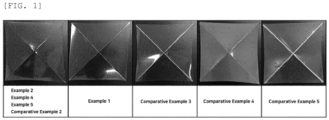
- FIG. 1 includes images showing whether whitening occurs on curved surfaces formed when extrusion sheet specimens having a thickness of 0.15 T manufactured in Examples 1, 2, 4, and 5 of the present invention and Comparative Examples 2 to 5 are folded by hand.
- thermoplastic resin composition a thermoplastic resin composition, a method of preparing the same, and a molded article including the same according to the present invention will be described in detail.
- the present inventors confirmed that, when an alkyl acrylate-aromatic vinyl compound-vinyl cyanide compound graft copolymer containing rubber having a predetermined average particle diameter and a polymethacrylate resin were mixed in a predetermined composition ratio, and an alkyl acrylate coverage value was adjusted within a predetermined range, compared to conventional ASA-based resins, mechanical properties, surface hardness, transparency, and colorability were improved, and occurrence of whitening was prevented due to excellent non-whitening properties. Based on these results, the present inventors conducted further studies to complete the present invention.
- the thermoplastic resin composition of the present invention includes 35 to 85 % by weight of an alkyl acrylate-aromatic vinyl compound-vinyl cyanide compound graft copolymer (A) containing alkyl acrylate rubber having an average particle diameter of 50 to 120 nm and 15 to 65 % by weight of a polymethacrylate resin (B), wherein the polymethacrylate resin (B) has a weight average molecular weight of 50,000 to 150,000 g/mol, wherein the thermoplastic resin composition has an alkyl acrylate coverage value (X) of 70 % or more as calculated by Equation 1 below.
- A alkyl acrylate-aromatic vinyl compound-vinyl cyanide compound graft copolymer
- B polymethacrylate resin
- X alkyl acrylate coverage value
- Equation 1 G represents a gel content (wt%) based on a total weight of the thermoplastic resin composition, and Y represents the content (wt%) of an alkyl acrylate in the gel based on a total weight of the thermoplastic resin composition.
- thermoplastic resin composition of the present invention will be described in detail.
- the graft copolymer (A) contains alkyl acrylate rubber having an average particle diameter of 50 to 120 nm, preferably 60 to 120 nm, still more preferably 80 to 110 nm. Within this range, a finally prepared thermoplastic resin composition may have excellent impact strength, light resistance, and gloss.
- the average particle diameter may be measured by dynamic light scattering, and specifically, may be measured as an intensity value using a particle size analyzer (product name: Nicomp 380, manufacturer: PSS) in a Gaussian mode.
- a sample may be prepared by diluting 0.1 g of latex (total solids content: 35 to 50 wt%) 1,000 to 5,000-fold with distilled water, and average particle diameter may be measured using flow cells in an auto-dilution manner and in a mode of dynamic light scattering/intensity 300 kHz/intensity-weight Gaussian analysis.
- temperature may be set to 23 °C
- measurement wavelength may be set to 632.8 nm
- channel width may be set to 10 ⁇ sec.
- the graft copolymer (A) is included in an amount of 35 to 85 % by weight, preferably 40 to 80 % by weight, more preferably 50 to 80 % by weight, still more preferably 60 to 80 % by weight, still more preferably 60 to 75 % by weight.
- mechanical properties such as impact strength, tensile strength, and flexural strength, gloss, and surface hardness may be excellent.
- the graft copolymer (A) may include 20 to 60 % by weight of alkyl acrylate rubber (a-1) and 40 to 80 % by weight of an aromatic vinyl compound-vinyl cyanide compound copolymer (a-2), preferably 30 to 50 % by weight of alkyl acrylate rubber (a-1) and 50 to 70 % by weight of an aromatic vinyl compound-vinyl cyanide compound copolymer (a-2), more preferably 40 to 50 % by weight of alkyl acrylate rubber (a-1) and 50 to 60 % by weight of an aromatic vinyl compound-vinyl cyanide compound copolymer (a-2).
- an aromatic vinyl compound-vinyl cyanide compound copolymer (a-2) preferably 30 to 50 % by weight of alkyl acrylate rubber (a-1) and 50 to 70 % by weight of an aromatic vinyl compound-vinyl cyanide compound copolymer (a-2), more preferably 40 to 50 % by weight of alkyl acrylate rubber (a
- the alkyl acrylate rubber may be prepared by emulsion polymerization of an alkyl acrylate.
- the alkyl acrylate rubber may be prepared by mixing an alkyl acrylate, an emulsifier, an initiator, a grafting agent, a crosslinking agent, an electrolyte, and a solvent and performing emulsion polymerization of the mixture.
- grafting efficiency may be excellent, and thus physical properties such as impact resistance may be excellent.
- a polymer including a certain compound means a polymer prepared by polymerizing the compound, and a unit in the polymer is derived from the compound.
- the alkyl acrylate rubber (a-1) may further include an aromatic vinyl compound.
- chemical resistance and impact resistance may be further improved.
- the alkyl acrylate rubber (a-1) may include an aromatic vinyl compound in an amount of 0.1 to 35 % by weight, preferably 1 to 30 % by weight, more preferably 7 to 30 % by weight, still more preferably 10 to 20 % by weight. Within this range, mechanical properties, gloss, and surface hardness may be excellent without deterioration of physical properties.
- the copolymer (a-2) may further include an alkyl acrylate.
- an alkyl acrylate In this case, physical property balance between impact resistance, weather resistance, processability, and non-whitening properties may be excellent.
- the copolymer (a-2) may include 55 to 85 % by weight of an aromatic vinyl compound, 10 to 30 % by weight of a vinyl cyanide compound, and 0.1 to 35 % by weight of an alkyl acrylate, preferably 60 to 80 % by weight of an aromatic vinyl compound, 15 to 25 % by weight of a vinyl cyanide compound, and 1 to 25 % by weight of an alkyl acrylate, more preferably 65 to 75 % by weight of an aromatic vinyl compound, 15 to 22 % by weight of a vinyl cyanide compound, and 5 to 20 % by weight of an alkyl acrylate.
- impact resistance and weather resistance may be further improved.
- the graft copolymer (A) may be prepared by emulsion polymerization. In this case, gloss and surface hardness may be excellent.
- the alkyl acrylate may be an alkyl acrylate containing an alkyl group having 1 to 15 carbon atoms, preferably includes one or more selected from the group consisting of methyl acrylate, ethyl acrylate, propyl acrylate, butyl acrylate, 2-ethylbutyl acrylate, octyl acrylate, 2-ethylhexyl acrylate, hexyl acrylate, heptyl acrylate, n-pentyl acrylate, and lauryl acrylate. More preferably, the alkyl acrylate is an alkyl acrylate having 2 to 8 carbon atoms, still more preferably butyl acrylate or ethylhexyl acrylate, still more preferably butyl acrylate.
- the aromatic vinyl compound may include one or more selected from the group consisting of styrene, ⁇ -methyl styrene, o-methyl styrene, p-methyl styrene, m-methyl styrene, ethyl styrene, isobutyl styrene, t-butyl styrene, o-bromostyrene, p-bromostyrene, m-bromostyrene, o-chlorostyrene, p-chlorostyrene, m-chlorostyrene, vinyltoluene, vinylxylene, fluorostyrene, and vinylnaphthalene, preferably one or more selected from the group consisting of styrene and ⁇ -methyl styrene, more preferably styrene.
- processability may be excellent due to proper fluidity, and mechanical properties such as impact resistance may be
- the vinyl cyanide compound may include one or more selected from the group consisting of acrylonitrile, methacrylonitrile, ethylacrylonitrile, and isopropylacrylonitrile, preferably acrylonitrile.
- Emulsion polymerization methods commonly practiced in the art to which the present invention pertains may be used in the present invention without particular limitation.
- the weight (g) of grafted monomers is obtained by subtracting the rubber weight (g) from the weight of insoluble matter (gel) obtained by dissolving a graft copolymer in acetone and performing centrifugation, and the rubber weight (g) is the weight (g) of rubber components theoretically added to graft copolymer powder.
- the weight (g) of insoluble matter (gel) When the weight (g) of insoluble matter (gel) is measured, 0.5 g of powdered graft copolymer (A) is added to 50 ml of acetone, followed by stirring at room temperature for 12 hours. Then, centrifugation is performed to separate insoluble matter that is not dissolved in acetone, followed by drying for 12 hours. Then, the weight of the insoluble matter (gel) is measured.
- the rubber weight (g) is the weight (g) of rubber components theoretically added to 0.5 g of the powdered graft copolymer (A).
- the polymethacrylate resin (B) is included in an amount of 15 to 65 % by weight, preferably 20 to 60 % by weight, more preferably 20 to 50 % by weight, still more preferably 20 to 40 % by weight, still more preferably 25 to 40 % by weight.
- mechanical properties such as impact strength, tensile strength, and flexural strength, surface hardness, transparency, and colorability may be excellent. In particular, due to excellent non-whitening properties, occurrence of whitening during bending may be prevented.
- the polymethacrylate resin (B) has a weight average molecular weight of 50,000 to 150,000 g/mol, preferably 60,000 to 140,000 g/mol, more preferably 70,000 to 130,000 g/mol, still more preferably 80,000 to 120,000 g/mol. Within this range, weather resistance may be further improved, and tensile strength and impact strength may be excellent.
- the weight average molecular weight may be measured using gel permeation chromatography (GPC, Waters Breeze).
- GPC gel permeation chromatography
- the weight average molecular weight may be measured using tetrahydrofuran (THF) as an eluate through gel permeation chromatography (GPC, Waters Breeze).
- THF tetrahydrofuran
- PS polystyrene
- the weight average molecular weight may be measured under conditions of solvent: THF, column temperature: 40 °C, flow rate: 0.3 ml/min, sample concentration: 20 mg/ml, injection amount: 5 ⁇ l, column model: 1 ⁇ PLgel 10 ⁇ m MiniMix-B (250 ⁇ 4.6 mm) + 1 ⁇ PLgel 10 ⁇ m MiniMix-B (250 ⁇ 4.6 mm) + 1 ⁇ PLgel 10 ⁇ m MiniMix-B Guard (50 ⁇ 4.6 mm), equipment name: Agilent 1200 series system, refractive index detector: Agilent G1362 RID, RI temperature: 35 °C, data processing: Agilent ChemStation S/W, and test method (Mn, Mw and PDI): OECD TG 118.
- solvent THF
- column temperature 40 °C
- flow rate 0.3 ml/min
- sample concentration 20 mg/ml
- injection amount 5 ⁇ l
- column model 1 ⁇ PLgel 10 ⁇
- the polymethacrylate resin (B) preferably includes a methacrylate monomer in an amount of 55 % by weight or more, more preferably 60 % by weight or more, still more preferably 65 % by weight or more. Within this range, weather resistance may be greatly improved, and gloss and colorability may be excellent.
- the polymethacrylate resin (B) preferably includes one or more selected from the group consisting of a polymethylmethacrylate resin and a methylmethacrylate-styrene-acrylonitrile copolymer. More preferably, the polymethacrylate resin (B) is a polymethylmethacrylate resin or a methylmethacrylate-styrene-acrylonitrile copolymer, still more preferably a polymethylmethacrylate resin. Within this range, weather resistance may be further improved, and transparency and colorability may be excellent.
- the methylmethacrylate-styrene-acrylonitrile copolymer may include 65 to 85 % by weight of methylmethacrylate, 5 to 30 % by weight of styrene, and 5 to 10 % by weight of acrylonitrile, preferably 70 to 80 % by weight of methylmethacrylate, 15 to 25 % by weight of styrene, and 5 to 10 % by weight of acrylonitrile.
- weather resistance may be further improved, and transparency and colorability may be excellent.
- the content of the alkyl acrylate in the gel of the thermoplastic resin composition is the content of an alkyl acrylate (based on 100 % by weight in total of the added thermoplastic resin composition) in insoluble matter obtained in the process of measuring the gel content.
- the gel content is the content of insoluble matter based on 100 % by weight in total of the thermoplastic resin composition.
- NMR analysis means analysis by 1 H NMR.
- thermoplastic resin composition When measuring the gel content, 1 g of a thermoplastic resin composition is added to 30 g of acetone, followed by stirring at room temperature for 12 hours. Then, centrifugation is performed to separate insoluble matter that is not dissolved in acetone, followed by drying for 12 hours. Then, the gel content is measured and calculated by Equation 2 below.
- 1 g of a thermoplastic resin composition is added to 30 g of acetone, followed by stirring at 210 rpm and room temperature using an orbital shaker (equipment name: Lab companion SKC-6075) for 12 hours.
- the alkyl acrylate coverage value is a parameter for measuring the degree of dispersion of an aromatic vinyl compound-vinyl cyanide compound polymer grafted onto alkyl acrylate rubber in the thermoplastic resin composition.
- the alkyl acrylate coverage value is high, the aromatic vinyl compound-vinyl cyanide compound polymer is evenly grafted onto the alkyl acrylate rubber to cover the alkyl acrylate rubber uniformly, thereby increasing gloss and achieving excellent tensile strength and colorability.
- the alkyl acrylate coverage value increases, the distance between rubber particles is decreased, thereby reducing voids due to cracks occurring inside the thermoplastic resin composition and suppressing whitening during bending.
- the alkyl acrylate coverage value is obtained by quantitatively calculating the content of the alkyl acrylate present in the thermoplastic resin composition through nuclear magnetic resonance (NMR) analysis or Fourier transform infrared spectroscopy (FT-IR) analysis, and the grafting degree is obtained based on the content of rubber components added during polymerization.
- NMR nuclear magnetic resonance
- FT-IR Fourier transform infrared spectroscopy
- the grafting degree is a parameter indicating a degree to which the aromatic vinyl compound-vinyl cyanide compound polymer is grafted onto the alkyl acrylate in an alkyl acrylate-aromatic vinyl compound-vinyl cyanide compound graft copolymer.
- the thermoplastic resin composition may have a haze difference ( ⁇ haze) of 10 or less, preferably 8 or less, more preferably 5 or less, still more preferably 4 or less, still more preferably 3 or less, still more preferably 0.1 to 3. Within this range, physical property balance, appearance, and non-whitening properties may be excellent.
- the thermoplastic resin composition may have a tensile strength of 200 kgf/cm 2 or more, preferably 250 kgf/cm 2 or more, more preferably 300 kgf/cm 2 or more, still more preferably 300 to 600 kgf/cm 2 , still more preferably 350 to 600 kgf/cm 2 as measured at a rate of 10 mm/min using a specimen having a thickness of 3.2 mm according to ASTM D638. Within this range, physical property balance and non-whitening properties may be excellent.
- the thermoplastic resin composition may further include 0.01 to 5 parts by weight, preferably 0.05 to 3 parts by weight, more preferably 0.1 to 2 parts by weight, still more preferably 0.2 to 1.5 parts by weight of each of one or more selected from the group consisting of a heat stabilizer, a light stabilizer, a dye, a pigment, a colorant, a lubricant, a release agent, an antistatic agent, an antibacterial agent, a processing aid, a metal deactivator, a flame retardant, a smoke suppressant, an anti-drip agent, an anti-friction agent, and an anti-wear agent.
- the required physical properties of the thermoplastic resin composition of the present invention may be implemented without deterioration in the intrinsic physical properties thereof.
- the heat stabilizer preferably includes a primary heat stabilizer and a secondary heat stabilizer.
- the primary heat stabilizer is preferably a phenolic heat stabilizer, and more preferably includes one or more selected from the group consisting of 2-t-butyl-6-(3-t-butyl-2-hydroxy-5-methylbenzyl)-4-methylphenyl acrylate, 2-[1-(2-hydroxy-3,5-di-t-pentylphenyl)ethyl]-4,6-di-t-pentylphenyl acrylate, 1,6-hexanediolbis-[3-(3,5-di-t-butyl-4-hydroxyphenyl)propionate], 2,2-thiodiehylenebis-[3-(3,5-di-t-butyl-4-hydroxyphenyl)propionate], 3,5-di-t-butyl-4-hydroxybenzylphosphonatediethyl ester, tris(2,6-dimethyl-3-hydroxy-4-t-butylbenzyl)isocyanurate, tris(3,5-d
- the secondary heat stabilizer is preferably a phosphorus heat stabilizer, and more preferably includes one or more selected from the group consisting of bis(diakylphenyl)pentaerythritol diphosphite ester, phosphite ester, trioctyl phosphite, trilauryl phosphite, tridecyl phosphite, (octyl)diphenyl phosphite, tris(2,4-dit-butylphenyl) phosphite, triphenyl phosphite, tris(butoxyethyl) phosphite, tris(nonylphenyl) phosphite, distearylpentaerythritol diphosphite, tetra(tridecyl)-1,1,3-tris(2-methyl-5-t-butyl-4-hydroxy-phenyl)butane diphosphite
- the lubricant preferably includes one or more selected from the group consisting of an aliphatic amide-based lubricant, a fatty acid ester-based lubricant, and olefin-based wax.
- the aliphatic amide-based lubricant preferably includes one or more selected from the group consisting of stearamide, oleamide, erucamide, ehylene bis stearamide, and ehylene bis oleamide.
- the fatty acid ester-based lubricant preferably includes one or more selected from the group consisting of fatty acid esters of alcohols or polyhydric alcohols, hardened oil, butyl stearate, monoglyceride stearate, pentaerythritol tetrastearate, stearylstearate, ester wax, and alkyl phosphoric acid ester.
- the olefin-based wax is preferably polyehylene wax.
- the light stabilizer may include one or more selected from the group consisting of a HALS-based UV stabilizer and a benzotriazole-based UV stabilizer, preferably a mixture of a HALS-based UV stabilizer and a benzotriazole-based UV stabilizer.
- the HALS-based UV stabilizer preferably includes one or more selected from the group consisting of bis(2,2,6,6-tetramethyl-4-piperidinyl) sebacate (UV 770), bis[N-methyl-2,2,6,6-tetramethyl-4-piperidinyl]sebacate, and succinic acid dimethyl-1-(2-hydroxyethyl)-4-hydroxy-2,2,6,6-tetramethylpiperidine (Tinuvin 622), more preferably bis(2,2,6,6-tetramethyl-4-piperidinyl)sebacate (UV 770).
- UV 770 bis(2,2,6,6-tetramethyl-4-piperidinyl) sebacate
- Tinuvin 622 succinic acid dimethyl-1-(2-hydroxyethyl)-4-hydroxy-2,2,6,6-tetramethylpiperidine
- UV 770 bis(2,2,6,6-tetramethyl-4-piperidinyl)sebacate
- the benzotriazole-based UV stabilizer preferably includes one or more selected from the group consisting of 2-(2'-hydroxy-5'-t-octylphenyl)-benzotriazole (Cyasorb UV-541), 2-(2'-hydroxy-5'-methylphenyl)benzotriazole (Tinuvin-P), 2-(2'-hydroxy-3'-tert-butyl-5'-methylphenyl)-5-chlorobenzotriazole (Tinuvin-326), 2-(2'-hydroxy-3',5'-ditert-butylphenyl)-5-chloro-benzotriazole (Tinuvin-327), 2-(2'-hydroxy-3,5-ditert-amylphenyl)benzotriazole (Tinuvin-328), 2-(2'-hydroxy-3',5'-di(1,1-dimethylbenzyl)phenyl]-2H-benzotriazole (Tinuvin-234), 2-(2'-hydroxy
- thermoplastic resin composition
- a method of preparing the thermoplastic resin composition of the present invention includes a step of kneading and extruding, at 200 to 300 °C and 100 to 500 rpm, 35 to 85 % by weight of an alkyl acrylate-aromatic vinyl compound-vinyl cyanide compound graft copolymer (A) containing alkyl acrylate rubber having an average particle diameter of 50 to 120 nm and 15 to 65 % by weight of a polymethacrylate resin (B), wherein the thermoplastic resin composition has an alkyl acrylate coverage value (X) of 70 % or more as calculated by Equation 1 below.
- Equation 1 G represents a gel content (wt%) based on a total weight of the thermoplastic resin composition, and Y represents the content (wt%) of an alkyl acrylate in the gel based on a total weight of the thermoplastic resin composition.
- thermoplastic resin composition shares all the technical characteristics of the thermoplastic resin composition described above, and thus repeated description thereof will be omitted.
- the kneading and extrusion step is preferably performed at 200 to 300 °C in a size of 10 to 199 pi, more preferably at 210 to 260 °C in a size of 20 to 80 pi, still more preferably at 220 to 250 °C in a size of 25 to 75 pi using an extrusion kneader.
- extrusion may be performed stably, and kneading may be performed efficiently.
- the temperature is cylinder temperature
- the pi means the outer diameter of a screw (unit: mm).
- Extrusion kneaders commonly used in the art to which the present invention pertains may be used without particular limitation, and a twin-screw extrusion kneader is preferably used.
- a molded article of the present invention includes the thermoplastic resin composition.
- mechanical properties such as impact strength, tensile strength, and flexural strength, surface hardness, transparency, and colorability may be excellent.
- due to excellent non-whitening properties occurrence of whitening during bending may be prevented.
- the molded article is preferably an injection-molded article, a calendering-molded article, or a T-die extrusion-molded article.
- mechanical properties such as impact strength, tensile strength, and flexural strength, surface hardness, transparency, colorability, and non-whitening properties may be excellent.
- the molded article is preferably a film or a sheet.
- the molded article may be a decorative sheet for finishing, a finishing material for outdoor construction materials, or a finishing material for roofs.
- a method of manufacturing the molded article preferably includes a step of kneading and extruding, at 200 to 300 °C and 100 to 500 rpm, 35 to 85 % by weight of an alkyl acrylate-aromatic vinyl compound-vinyl cyanide compound graft copolymer (A) containing alkyl acrylate rubber having an average particle diameter of 50 to 120 nm and 15 to 65 % by weight of a polymethacrylate resin (B) to obtain an extrudate and a step of performing injection molding, calender molding, or T-die extrusion molding of the extrudate at a molding temperature of 180 to 300 °C to manufacture a molded article.
- mechanical properties such as impact strength, tensile strength, and flexural strength, surface hardness, transparency, and colorability may be excellent.
- due to excellent non-whitening properties occurrence of whitening during bending may be prevented.
- the extrudate may be in the form of pellets or in the form a plate.
- the plate-like shape is not particularly limited when the plate-like shape is commonly defined as a plate-like shape in the technical field to which the present invention pertains, and may include, for example, a flat shape, a sheet shape, a film shape, and the like.
- the step of manufacturing a molded article includes a step of calender-molding the prepared extrudate at a calender temperature of 140 to 220 °C to obtain a sheet.
- processability may be excellent, and a sheet having a uniform surface may be easily manufactured.
- calender molding is a process of rolling an extrudate using calendering equipment including calendering rolls.
- calender molding may be performed according to a method commonly used in the art to which the present invention pertains.
- calender molding is performed according to a method including a step of mixing thermoplastic resin composition pellets as a sheet raw material at 130 to 200 °C using a mixer, a step of manufacturing a base sheet at 170 to 200 °C using the mixed raw material, and a step of manufacturing a sheet at 140 to 220 °C using the base sheet and calendering rolls.
- the step of manufacturing a base sheet may be performed using a mixing roll.
- the method of manufacturing a molded article preferably includes a step of injection-molding the prepared extrudate at an injection temperature of 200 to 260 °C, an injection pressure of 60 to 100 bar, and a holding pressure of 25 to 55 bar.
- an injection-molded article having excellent mechanical properties such as impact strength may be easily manufactured.
- the injection temperature is preferably 200 to 230 °C, more preferably 210 to 220 °C. Within this range, an injection-molded article having excellent mechanical properties such as impact strength may be easily manufactured.
- the injection pressure is preferably 70 to 90 bar, more preferably 75 to 85 bar. Within this range, an injection-molded article having excellent mechanical properties such as impact strength may be easily manufactured.
- thermoplastic resin composition of the present invention the method of preparing the same, and the molded article including the same, it should be noted that other conditions or equipment not explicitly described herein may be appropriately selected within the range commonly practiced in the art without particular limitation.
- Equation 1 G represents a gel content (wt%) based on a total weight of the thermoplastic resin composition, and Y represents the content (wt%) of an alkyl acrylate in the gel based on a total weight of the thermoplastic resin composition.
- the content of the alkyl acrylate in the gel was quantitatively measured through 1 HNMR analysis or FT-IR analysis.
- the weight (g) of grafted monomers is obtained by subtracting the rubber weight (g) from the weight of insoluble matter (gel) obtained by dissolving a graft copolymer in acetone and performing centrifugation, and the rubber weight (g) is the weight (g) of rubber components theoretically added to graft copolymer powder.
- Comparative Example 3 including the ASA resin (A) having an alkyl acrylate coverage value less than the range of the present invention and the ASA resin containing alkyl acrylate rubber having an average particle diameter greater than 120 nm, gloss, total light transmittance, and haze were poor, and transparency decreased.
- Comparative Example 5 including the styrene-acrylonitrile resin (B-2) and the ASA resin (A) having a grafting degree within the range of examples of the present invention and an alkyl acrylate coverage value less than the range of the present invention, total light transmittance and haze were poor, resulting in decrease in transparency and occurrence of whitening.
- Comparative Example 6 including the ASA resin containing alkyl acrylate rubber having an average particle diameter less than 50 nm, impact strength and total light transmittance were very low.
- Comparative Example 7 including the ASA resin containing alkyl acrylate rubber having an average particle diameter greater than 120 nm, whitening occurred, and haze and haze difference increased.
- Comparative Example 8 having an alkyl acrylate coverage value of 50 %, whitening occurred, and haze difference increased.
Landscapes
- Chemical & Material Sciences (AREA)
- Health & Medical Sciences (AREA)
- Chemical Kinetics & Catalysis (AREA)
- Medicinal Chemistry (AREA)
- Polymers & Plastics (AREA)
- Organic Chemistry (AREA)
- Compositions Of Macromolecular Compounds (AREA)
- Processes Of Treating Macromolecular Substances (AREA)
- Manufacture Of Macromolecular Shaped Articles (AREA)
Claims (13)
- Thermoplastische Harzzusammensetzung, umfassend:35 bis 85 Gew.-% eines Alkylacrylat-aromatische-Vinylverbindung-Vinylcyanidverbindung-Pfropfcopolymers (A), das Alkylacrylatkautschuk mit einem durchschnittlichen Teilchendurchmesser von 50 bis 120 nm enthält; und15 bis 65 Gew.-% eines Polymethacrylatharzes (B), wobei das Polymethacrylatharz (B) ein gewichtsgemitteltes Molekulargewicht von 50.000 bis 150.000 g/mol aufweist,wobei die thermoplastische Harzzusammensetzung einen Alkylacrylat-Bedeckungswert (X) von 70 % oder mehr aufweist, wie durch die nachstehende Gleichung 1 berechnet:
 wobei G den Gelgehalt (Gew.-%), bezogen auf das Gesamtgewicht der thermoplastischen Harzzusammensetzung, darstellt und Y den Gehalt (Gew.-%) eines Alkylacrylats in dem Gel, bezogen auf das Gesamtgewicht der thermoplastischen Harzzusammensetzung, darstellt,wobei der durchschnittliche Teilchendurchmesser durch dynamische Lichtstreuung gemessen wird, wie in der Beschreibung offenbart, der Gelgehalt gemessen wird, wie in der Beschreibung offenbart, und das gewichtsgemittelte Molekulargewicht durch Gelpermeationschromatographie gemessen wird, wie in der Beschreibung offenbart.
 - Thermoplastische Harzzusammensetzung nach Anspruch 1, wobei das Polymethacrylatharz (B) 55 Gew.-% oder mehr eines Methacrylatmonomers umfasst.
- Thermoplastische Harzzusammensetzung nach Anspruch 2, wobei das Polymethacrylatharz (B) eines oder mehrere umfasst, ausgewählt aus der Gruppe, bestehend aus einem Polymethylmethacrylatharz und einem Methylmethacrylat-Styrol-Acrylnitril-Copolymer.
- Thermoplastische Harzzusammensetzung nach Anspruch 3, wobei das Methylmethacrylat-Styrol-Acrylnitril-Copolymer 65 bis 85 Gew.-% Methylmethacrylat, 5 bis 30 Gew.-% Styrol und 5 bis 10 Gew.-% Acrylnitril umfasst.
- Thermoplastische Harzzusammensetzung nach Anspruch 1, wobei das Pfropfcopolymer (A) 20 bis 60 Gew.-% Alkylacrylatkautschuk (a-1) und 40 bis 80 Gew.-% eines aromatische-Vinylverbindung-Vinylcyanidverbindung-Copolymers (a-2) umfasst.
- Thermoplastische Harzzusammensetzung nach Anspruch 1, wobei das Pfropfcopolymer (A) einen Pfropfgrad von 60 % oder mehr aufweist, wie durch die nachstehende Gleichung 3 berechnet:
Pfropfgrad (%) = [Gewicht (g) gepfropfter Monomere/Kautschukgewicht (g)] x 100, - Thermoplastische Harzzusammensetzung nach Anspruch 1, wobei die thermoplastische Harzzusammensetzung eines oder mehrere umfasst, ausgewählt aus der Gruppe, bestehend aus einem Wärmestabilisator, einem Lichtstabilisator, einem Farbstoff, einem Pigment, einem Farbmittel, einem Schmiermittel, einem Trennmittel, einem Antistatikmittel, einem antibakteriellen Mittel, einem Verarbeitungshilfsmittel, einem Metalldesaktivator, einem Flammschutzmittel, einem Rauchunterdrücker, einem Antitropfmittel, einem Antireibungsmittel und einem Antiverschleißmittel.
- Thermoplastische Harzzusammensetzung nach Anspruch 1, wobei die thermoplastische Harzzusammensetzung eine Gesamtlichtdurchlässigkeit (Tt) von 75 % oder mehr aufweist, wie unter Verwendung einer Probe mit einer Dicke von 3T gemäß ASTM D1003 gemessen.
- Thermoplastische Harzzusammensetzung nach Anspruch 1, wobei die thermoplastische Harzzusammensetzung eine Trübung von 11 % oder weniger aufweist, wie unter Verwendung einer Probe mit einer Dicke von 3T gemäß ASTM D1003 gemessen.
- Thermoplastische Harzzusammensetzung nach Anspruch 1, wobei die thermoplastische Harzzusammensetzung einen Glanz von 120 oder mehr aufweist, wie bei einem Einfallswinkel von 45° gemäß ASTM D2457 gemessen.
- Thermoplastische Harzzusammensetzung nach Anspruch 1, wobei, wenn ein 1 kg Gewicht vertikal auf eine extrudierte Folie mit Abmessungen von 0,15 mm x 5 cm x 5 cm in Dicke, Breite und Länge von einer Höhe von 50 cm unter Verwendung eines Gardner-Schlagtesters fallen gelassen wird, Trübungswerte vor und nach dem Schlag für einen Abschnitt der Folie, auf den das Gewicht gemäß ASTM D1003 trifft, gemessen werden und eine Differenz in den Trübungswerten berechnet wird, die thermoplastische Harzzusammensetzung eine Trübungsdifferenz (△haze) von 10 oder weniger aufweist.
- Verfahren zum Herstellen einer thermoplastischen Harzzusammensetzung nach Anspruch 1, umfassend Kneten und Extrudieren, bei 200 bis 300 °C und 100 bis 500 U/min, von 35 bis 85 Gew.-% eines Alkylacrylat-aromatische-Vinylverbindung-Vinylcyanidverbindung-Pfropfcopolymers (A), das Alkylacrylatkautschuk mit einem durchschnittlichen Teilchendurchmesser von 50 bis 120 nm und 15 bis 65 Gew.-% eines Polymethacrylatharzes (B) enthält,wobei die thermoplastische Harzzusammensetzung einen Alkylacrylat-Bedeckungswert (X) von 70 % oder mehr aufweist, wie durch die nachstehende Gleichung 1 berechnet:
 wobei G den Gelgehalt (Gew.-%), bezogen auf das Gesamtgewicht der thermoplastischen Harzzusammensetzung, darstellt und Y den Gehalt (Gew.-%) eines Alkylacrylats in dem Gel, bezogen auf das Gesamtgewicht der thermoplastischen Harzzusammensetzung, darstellt,wobei der durchschnittliche Teilchendurchmesser durch dynamische Lichtstreuung gemessen wird, wie in der Beschreibung offenbart, und der Gelgehalt gemessen wird, wie in der Beschreibung offenbart.
 - Formkörper, umfassend die thermoplastische Harzzusammensetzung nach einem der Ansprüche 1 bis 11.
Applications Claiming Priority (2)
| Application Number | Priority Date | Filing Date | Title |
|---|---|---|---|
| KR1020210009292A KR102707170B1 (ko) | 2021-01-22 | 2021-01-22 | 열가소성 수지 조성물, 이의 제조방법 및 이를 포함하는 성형품 |
| PCT/KR2021/019010 WO2022158720A1 (ko) | 2021-01-22 | 2021-12-14 | 열가소성 수지 조성물, 이의 제조방법 및 이를 포함하는 성형품 |
Publications (3)
| Publication Number | Publication Date |
|---|---|
| EP4074779A1 EP4074779A1 (de) | 2022-10-19 |
| EP4074779A4 EP4074779A4 (de) | 2023-08-02 |
| EP4074779B1 true EP4074779B1 (de) | 2025-07-02 |
Family
ID=82549518
Family Applications (1)
| Application Number | Title | Priority Date | Filing Date |
|---|---|---|---|
| EP21916636.0A Active EP4074779B1 (de) | 2021-01-22 | 2021-12-14 | Thermoplastische harzzusammensetzung, verfahren zum herstellen davon und formartikel damit |
Country Status (7)
| Country | Link |
|---|---|
| US (1) | US20230235161A1 (de) |
| EP (1) | EP4074779B1 (de) |
| JP (1) | JP7342276B2 (de) |
| KR (1) | KR102707170B1 (de) |
| CN (1) | CN115119513B (de) |
| TW (1) | TWI894415B (de) |
| WO (1) | WO2022158720A1 (de) |
Families Citing this family (4)
| Publication number | Priority date | Publication date | Assignee | Title |
|---|---|---|---|---|
| JP2025535209A (ja) * | 2022-10-20 | 2025-10-24 | エルジー・ケム・リミテッド | 熱可塑性樹脂組成物、その製造方法及びそれを含む成形品 |
| WO2024085398A1 (ko) * | 2022-10-20 | 2024-04-25 | (주) 엘지화학 | 열가소성 수지 조성물, 이의 제조방법 및 이를 포함하는 성형품 |
| KR20250059797A (ko) * | 2023-10-25 | 2025-05-07 | 주식회사 엘지화학 | 열가소성 수지 조성물, 이의 제조방법 및 이를 포함하는 성형품 |
| CN118852829B (zh) * | 2024-09-23 | 2024-12-17 | 合肥科拜尔新材料股份有限公司 | 一种高韧性高透性pmma-san合金材料及其制备方法 |
Family Cites Families (18)
| Publication number | Priority date | Publication date | Assignee | Title |
|---|---|---|---|---|
| DE3813363A1 (de) * | 1988-04-21 | 1989-11-02 | Bayer Ag | Mischungen thermoplastischer polymerisate in pulverform |
| US5112910A (en) * | 1989-07-05 | 1992-05-12 | Bayer Ag | Mixtures of thermoplastic polymers in powder form |
| JPH0733470A (ja) | 1993-07-16 | 1995-02-03 | Furukawa Electric Co Ltd:The | 光ファイバ用多孔質ガラス母材の製造方法 |
| JP2006056961A (ja) * | 2004-08-19 | 2006-03-02 | Nippon A & L Kk | 熱可塑性樹脂組成物およびそれからなる樹脂成形品。 |
| US7811659B2 (en) * | 2006-01-27 | 2010-10-12 | Arkema France | High optical purity copolymer film |
| US20090043038A1 (en) * | 2007-08-10 | 2009-02-12 | Bayer Materialscience Llc | Thermoplastic composition having low gloss |
| KR100920807B1 (ko) * | 2007-12-31 | 2009-10-08 | 제일모직주식회사 | 내스크래치성과 착색성이 우수한 고내후 열가소성 수지조성물 |
| KR20130066114A (ko) * | 2011-12-12 | 2013-06-20 | 주식회사 삼양사 | 저온 응력 백화현상이 저감된 열가소성 수지 조성물 및 수지 조성물의 저온 응력 백화현상 저감 방법 |
| KR101486564B1 (ko) * | 2012-07-04 | 2015-01-26 | 제일모직 주식회사 | 열가소성 수지 조성물 및 이를 이용한 성형품 |
| KR101800086B1 (ko) * | 2014-11-21 | 2017-11-21 | 주식회사 엘지화학 | 폴리메틸메타크릴레이트 아크릴계 공중합체 얼로이 고광택 조성물 및 성형품 |
| KR102080102B1 (ko) * | 2016-11-04 | 2020-04-24 | 주식회사 엘지화학 | 열가소성 수지 조성물, 이의 제조방법 및 이를 포함하는 성형품 |
| KR102056742B1 (ko) * | 2016-11-04 | 2019-12-18 | 주식회사 엘지화학 | 내후성이 우수한 열가소성 수지 조성물, 이의 제조방법 및 이를 포함하는 성형품 |
| KR20180071835A (ko) * | 2016-12-20 | 2018-06-28 | 롯데첨단소재(주) | 열가소성 수지 조성물 및 이를 이용한 성형품 |
| KR102066598B1 (ko) * | 2017-01-02 | 2020-01-16 | 주식회사 엘지화학 | 열가소성 수지 조성물, 이의 제조방법 및 이를 포함하여 제조되는 성형품 |
| KR102183999B1 (ko) * | 2018-03-20 | 2020-11-30 | 주식회사 엘지화학 | 열가소성 수지 조성물 |
| KR20190073323A (ko) * | 2019-06-14 | 2019-06-26 | 롯데첨단소재(주) | 착색성 및 기계적 물성이 우수한 열가소성 수지 조성물 |
| US12492305B2 (en) * | 2020-07-07 | 2025-12-09 | Lg Chem, Ltd. | Thermoplastic resin and method of preparing the same |
| TWI906326B (zh) * | 2020-07-20 | 2025-12-01 | 南韓商Lg化學股份有限公司 | 熱塑性樹脂及彼之製備方法 |
-
2021
- 2021-01-22 KR KR1020210009292A patent/KR102707170B1/ko active Active
- 2021-12-14 CN CN202180009660.4A patent/CN115119513B/zh active Active
- 2021-12-14 WO PCT/KR2021/019010 patent/WO2022158720A1/ko not_active Ceased
- 2021-12-14 US US17/793,527 patent/US20230235161A1/en active Pending
- 2021-12-14 EP EP21916636.0A patent/EP4074779B1/de active Active
- 2021-12-14 JP JP2022539255A patent/JP7342276B2/ja active Active
- 2021-12-23 TW TW110148443A patent/TWI894415B/zh active
Also Published As
| Publication number | Publication date |
|---|---|
| CN115119513B (zh) | 2024-12-13 |
| EP4074779A4 (de) | 2023-08-02 |
| KR20220106409A (ko) | 2022-07-29 |
| JP7342276B2 (ja) | 2023-09-11 |
| US20230235161A1 (en) | 2023-07-27 |
| KR102707170B1 (ko) | 2024-09-20 |
| TWI894415B (zh) | 2025-08-21 |
| TW202231776A (zh) | 2022-08-16 |
| WO2022158720A1 (ko) | 2022-07-28 |
| CN115119513A (zh) | 2022-09-27 |
| EP4074779A1 (de) | 2022-10-19 |
| JP2023514020A (ja) | 2023-04-05 |
Similar Documents
| Publication | Publication Date | Title |
|---|---|---|
| EP4098698B1 (de) | Thermoplastische harzzusammensetzung, verfahren zum herstellen davon und formartikel damit | |
| EP4074779B1 (de) | Thermoplastische harzzusammensetzung, verfahren zum herstellen davon und formartikel damit | |
| EP4063455B1 (de) | Thermoplastische harzzusammensetzung, herstellungsverfahren dafür und formartikel damit | |
| EP4098697B1 (de) | Thermoplastische harzzusammensetzung, herstellungsverfahren dafür und formartikel damit | |
| EP4400543A1 (de) | Thermoplastische harzzusammensetzung, verfahren zur herstellung davon und formartikel damit | |
| EP4397709A1 (de) | Thermoplastische harzzusammensetzung, verfahren zur herstellung davon und formartikel damit | |
| EP4700086A1 (de) | Thermoplastische harzzusammensetzung, herstellungsverfahren dafür und formartikel damit | |
| KR20240055269A (ko) | 열가소성 수지 조성물, 이의 제조방법 및 이를 포함하는 성형품 | |
| KR20240055274A (ko) | 열가소성 수지 조성물, 이의 제조방법 및 이를 포함하는 성형품 | |
| KR20250055798A (ko) | 열가소성 수지 조성물, 이의 제조방법 및 이를 포함하는 성형품 | |
| KR20240055273A (ko) | 열가소성 수지 조성물, 이의 제조방법 및 이를 포함하는 성형품 | |
| KR20240055631A (ko) | 열가소성 수지 조성물, 이의 제조방법 및 이를 포함하는 성형품 |
Legal Events
| Date | Code | Title | Description |
|---|---|---|---|
| STAA | Information on the status of an ep patent application or granted ep patent |
Free format text: STATUS: UNKNOWN |
|
| STAA | Information on the status of an ep patent application or granted ep patent |
Free format text: STATUS: THE INTERNATIONAL PUBLICATION HAS BEEN MADE |
|
| PUAI | Public reference made under article 153(3) epc to a published international application that has entered the european phase |
Free format text: ORIGINAL CODE: 0009012 |
|
| STAA | Information on the status of an ep patent application or granted ep patent |
Free format text: STATUS: REQUEST FOR EXAMINATION WAS MADE |
|
| 17P | Request for examination filed |
Effective date: 20220712 |
|
| AK | Designated contracting states |
Kind code of ref document: A1 Designated state(s): AL AT BE BG CH CY CZ DE DK EE ES FI FR GB GR HR HU IE IS IT LI LT LU LV MC MK MT NL NO PL PT RO RS SE SI SK SM TR |
|
| A4 | Supplementary search report drawn up and despatched |
Effective date: 20230703 |
|
| RIC1 | Information provided on ipc code assigned before grant |
Ipc: C08L 33/12 20060101ALI20230627BHEP Ipc: C08L 51/04 20060101AFI20230627BHEP |
|
| DAV | Request for validation of the european patent (deleted) | ||
| DAX | Request for extension of the european patent (deleted) | ||
| GRAP | Despatch of communication of intention to grant a patent |
Free format text: ORIGINAL CODE: EPIDOSNIGR1 |
|
| STAA | Information on the status of an ep patent application or granted ep patent |
Free format text: STATUS: GRANT OF PATENT IS INTENDED |
|
| INTG | Intention to grant announced |
Effective date: 20250416 |
|
| GRAS | Grant fee paid |
Free format text: ORIGINAL CODE: EPIDOSNIGR3 |
|
| GRAA | (expected) grant |
Free format text: ORIGINAL CODE: 0009210 |
|
| STAA | Information on the status of an ep patent application or granted ep patent |
Free format text: STATUS: THE PATENT HAS BEEN GRANTED |
|
| AK | Designated contracting states |
Kind code of ref document: B1 Designated state(s): AL AT BE BG CH CY CZ DE DK EE ES FI FR GB GR HR HU IE IS IT LI LT LU LV MC MK MT NL NO PL PT RO RS SE SI SK SM TR |
|
| REG | Reference to a national code |
Ref country code: GB Ref legal event code: FG4D |
|
| REG | Reference to a national code |
Ref country code: CH Ref legal event code: EP |
|
| REG | Reference to a national code |
Ref country code: DE Ref legal event code: R096 Ref document number: 602021033598 Country of ref document: DE |
|
| REG | Reference to a national code |
Ref country code: IE Ref legal event code: FG4D |
|
| REG | Reference to a national code |
Ref country code: NL Ref legal event code: MP Effective date: 20250702 |
|
| PG25 | Lapsed in a contracting state [announced via postgrant information from national office to epo] |
Ref country code: PT Free format text: LAPSE BECAUSE OF FAILURE TO SUBMIT A TRANSLATION OF THE DESCRIPTION OR TO PAY THE FEE WITHIN THE PRESCRIBED TIME-LIMIT Effective date: 20251103 |
|
| PG25 | Lapsed in a contracting state [announced via postgrant information from national office to epo] |
Ref country code: NL Free format text: LAPSE BECAUSE OF FAILURE TO SUBMIT A TRANSLATION OF THE DESCRIPTION OR TO PAY THE FEE WITHIN THE PRESCRIBED TIME-LIMIT Effective date: 20250702 |
|
| REG | Reference to a national code |
Ref country code: AT Ref legal event code: MK05 Ref document number: 1809241 Country of ref document: AT Kind code of ref document: T Effective date: 20250702 |
|
| PG25 | Lapsed in a contracting state [announced via postgrant information from national office to epo] |
Ref country code: IS Free format text: LAPSE BECAUSE OF FAILURE TO SUBMIT A TRANSLATION OF THE DESCRIPTION OR TO PAY THE FEE WITHIN THE PRESCRIBED TIME-LIMIT Effective date: 20251102 |
|
| PGFP | Annual fee paid to national office [announced via postgrant information from national office to epo] |
Ref country code: DE Payment date: 20251120 Year of fee payment: 5 |
|
| PGFP | Annual fee paid to national office [announced via postgrant information from national office to epo] |
Ref country code: GB Payment date: 20251120 Year of fee payment: 5 |
|
| PG25 | Lapsed in a contracting state [announced via postgrant information from national office to epo] |
Ref country code: NO Free format text: LAPSE BECAUSE OF FAILURE TO SUBMIT A TRANSLATION OF THE DESCRIPTION OR TO PAY THE FEE WITHIN THE PRESCRIBED TIME-LIMIT Effective date: 20251002 |
|
| REG | Reference to a national code |
Ref country code: LT Ref legal event code: MG9D |
|
| PG25 | Lapsed in a contracting state [announced via postgrant information from national office to epo] |
Ref country code: AT Free format text: LAPSE BECAUSE OF FAILURE TO SUBMIT A TRANSLATION OF THE DESCRIPTION OR TO PAY THE FEE WITHIN THE PRESCRIBED TIME-LIMIT Effective date: 20250702 |
|
| PG25 | Lapsed in a contracting state [announced via postgrant information from national office to epo] |
Ref country code: FI Free format text: LAPSE BECAUSE OF FAILURE TO SUBMIT A TRANSLATION OF THE DESCRIPTION OR TO PAY THE FEE WITHIN THE PRESCRIBED TIME-LIMIT Effective date: 20250702 |
|
| PGFP | Annual fee paid to national office [announced via postgrant information from national office to epo] |
Ref country code: IT Payment date: 20251121 Year of fee payment: 5 |
|
| PG25 | Lapsed in a contracting state [announced via postgrant information from national office to epo] |
Ref country code: HR Free format text: LAPSE BECAUSE OF FAILURE TO SUBMIT A TRANSLATION OF THE DESCRIPTION OR TO PAY THE FEE WITHIN THE PRESCRIBED TIME-LIMIT Effective date: 20250702 |
|
| PGFP | Annual fee paid to national office [announced via postgrant information from national office to epo] |
Ref country code: FR Payment date: 20251125 Year of fee payment: 5 |
|
| PG25 | Lapsed in a contracting state [announced via postgrant information from national office to epo] |
Ref country code: GR Free format text: LAPSE BECAUSE OF FAILURE TO SUBMIT A TRANSLATION OF THE DESCRIPTION OR TO PAY THE FEE WITHIN THE PRESCRIBED TIME-LIMIT Effective date: 20251003 |
|
| PG25 | Lapsed in a contracting state [announced via postgrant information from national office to epo] |
Ref country code: CZ Free format text: LAPSE BECAUSE OF FAILURE TO SUBMIT A TRANSLATION OF THE DESCRIPTION OR TO PAY THE FEE WITHIN THE PRESCRIBED TIME-LIMIT Effective date: 20250702 Ref country code: SE Free format text: LAPSE BECAUSE OF FAILURE TO SUBMIT A TRANSLATION OF THE DESCRIPTION OR TO PAY THE FEE WITHIN THE PRESCRIBED TIME-LIMIT Effective date: 20250702 |
|
| PG25 | Lapsed in a contracting state [announced via postgrant information from national office to epo] |
Ref country code: LV Free format text: LAPSE BECAUSE OF FAILURE TO SUBMIT A TRANSLATION OF THE DESCRIPTION OR TO PAY THE FEE WITHIN THE PRESCRIBED TIME-LIMIT Effective date: 20250702 |
|
| PG25 | Lapsed in a contracting state [announced via postgrant information from national office to epo] |
Ref country code: PL Free format text: LAPSE BECAUSE OF FAILURE TO SUBMIT A TRANSLATION OF THE DESCRIPTION OR TO PAY THE FEE WITHIN THE PRESCRIBED TIME-LIMIT Effective date: 20250702 Ref country code: BG Free format text: LAPSE BECAUSE OF FAILURE TO SUBMIT A TRANSLATION OF THE DESCRIPTION OR TO PAY THE FEE WITHIN THE PRESCRIBED TIME-LIMIT Effective date: 20250702 |
|
| PG25 | Lapsed in a contracting state [announced via postgrant information from national office to epo] |
Ref country code: RS Free format text: LAPSE BECAUSE OF FAILURE TO SUBMIT A TRANSLATION OF THE DESCRIPTION OR TO PAY THE FEE WITHIN THE PRESCRIBED TIME-LIMIT Effective date: 20251002 |
|
| PG25 | Lapsed in a contracting state [announced via postgrant information from national office to epo] |
Ref country code: ES Free format text: LAPSE BECAUSE OF FAILURE TO SUBMIT A TRANSLATION OF THE DESCRIPTION OR TO PAY THE FEE WITHIN THE PRESCRIBED TIME-LIMIT Effective date: 20250702 |
|
| PG25 | Lapsed in a contracting state [announced via postgrant information from national office to epo] |
Ref country code: RO Free format text: LAPSE BECAUSE OF FAILURE TO SUBMIT A TRANSLATION OF THE DESCRIPTION OR TO PAY THE FEE WITHIN THE PRESCRIBED TIME-LIMIT Effective date: 20250702 |
|
| PG25 | Lapsed in a contracting state [announced via postgrant information from national office to epo] |
Ref country code: SM Free format text: LAPSE BECAUSE OF FAILURE TO SUBMIT A TRANSLATION OF THE DESCRIPTION OR TO PAY THE FEE WITHIN THE PRESCRIBED TIME-LIMIT Effective date: 20250702 |
|
| PG25 | Lapsed in a contracting state [announced via postgrant information from national office to epo] |
Ref country code: DK Free format text: LAPSE BECAUSE OF FAILURE TO SUBMIT A TRANSLATION OF THE DESCRIPTION OR TO PAY THE FEE WITHIN THE PRESCRIBED TIME-LIMIT Effective date: 20250702 |