EP4049593B1 - Bergeeinrichtung zum bergen von gewebe - Google Patents
Bergeeinrichtung zum bergen von gewebe Download PDFInfo
- Publication number
- EP4049593B1 EP4049593B1 EP21159686.1A EP21159686A EP4049593B1 EP 4049593 B1 EP4049593 B1 EP 4049593B1 EP 21159686 A EP21159686 A EP 21159686A EP 4049593 B1 EP4049593 B1 EP 4049593B1
- Authority
- EP
- European Patent Office
- Prior art keywords
- retrieval
- bag
- retrieval bag
- less
- retrieval device
- Prior art date
- Legal status (The legal status is an assumption and is not a legal conclusion. Google has not performed a legal analysis and makes no representation as to the accuracy of the status listed.)
- Active
Links
Images



Classifications
-
- A—HUMAN NECESSITIES
- A61—MEDICAL OR VETERINARY SCIENCE; HYGIENE
- A61B—DIAGNOSIS; SURGERY; IDENTIFICATION
- A61B10/00—Instruments for taking body samples for diagnostic purposes; Other methods or instruments for diagnosis, e.g. for vaccination diagnosis, sex determination or ovulation-period determination; Throat striking implements
- A61B10/02—Instruments for taking cell samples or for biopsy
-
- A—HUMAN NECESSITIES
- A61—MEDICAL OR VETERINARY SCIENCE; HYGIENE
- A61B—DIAGNOSIS; SURGERY; IDENTIFICATION
- A61B17/00—Surgical instruments, devices or methods
- A61B17/00234—Surgical instruments, devices or methods for minimally invasive surgery
-
- A—HUMAN NECESSITIES
- A61—MEDICAL OR VETERINARY SCIENCE; HYGIENE
- A61B—DIAGNOSIS; SURGERY; IDENTIFICATION
- A61B1/00—Instruments for performing medical examinations of the interior of cavities or tubes of the body by visual or photographical inspection, e.g. endoscopes; Illuminating arrangements therefor
- A61B1/012—Instruments for performing medical examinations of the interior of cavities or tubes of the body by visual or photographical inspection, e.g. endoscopes; Illuminating arrangements therefor characterised by internal passages or accessories therefor
- A61B1/018—Instruments for performing medical examinations of the interior of cavities or tubes of the body by visual or photographical inspection, e.g. endoscopes; Illuminating arrangements therefor characterised by internal passages or accessories therefor for receiving instruments
-
- A—HUMAN NECESSITIES
- A61—MEDICAL OR VETERINARY SCIENCE; HYGIENE
- A61B—DIAGNOSIS; SURGERY; IDENTIFICATION
- A61B50/00—Containers, covers, furniture or holders specially adapted for surgical or diagnostic appliances or instruments, e.g. sterile covers
- A61B50/30—Containers specially adapted for packaging, protecting, dispensing, collecting or disposing of surgical or diagnostic appliances or instruments
-
- A—HUMAN NECESSITIES
- A61—MEDICAL OR VETERINARY SCIENCE; HYGIENE
- A61B—DIAGNOSIS; SURGERY; IDENTIFICATION
- A61B1/00—Instruments for performing medical examinations of the interior of cavities or tubes of the body by visual or photographical inspection, e.g. endoscopes; Illuminating arrangements therefor
- A61B1/307—Instruments for performing medical examinations of the interior of cavities or tubes of the body by visual or photographical inspection, e.g. endoscopes; Illuminating arrangements therefor for the urinary organs, e.g. urethroscopes, cystoscopes
-
- A—HUMAN NECESSITIES
- A61—MEDICAL OR VETERINARY SCIENCE; HYGIENE
- A61B—DIAGNOSIS; SURGERY; IDENTIFICATION
- A61B17/00—Surgical instruments, devices or methods
- A61B17/00234—Surgical instruments, devices or methods for minimally invasive surgery
- A61B2017/00287—Bags for minimally invasive surgery
-
- A—HUMAN NECESSITIES
- A61—MEDICAL OR VETERINARY SCIENCE; HYGIENE
- A61B—DIAGNOSIS; SURGERY; IDENTIFICATION
- A61B17/00—Surgical instruments, devices or methods
- A61B2017/00831—Material properties
- A61B2017/00942—Material properties hydrophilic
-
- A—HUMAN NECESSITIES
- A61—MEDICAL OR VETERINARY SCIENCE; HYGIENE
- A61B—DIAGNOSIS; SURGERY; IDENTIFICATION
- A61B50/00—Containers, covers, furniture or holders specially adapted for surgical or diagnostic appliances or instruments, e.g. sterile covers
- A61B50/30—Containers specially adapted for packaging, protecting, dispensing, collecting or disposing of surgical or diagnostic appliances or instruments
- A61B2050/314—Flexible bags or pouches
Definitions
- the invention relates to a retrieval device for retrieving tissue from a human or animal patient, in particular, for example, from fluid-filled body cavities, such as the urinary bladder.
- the instrument has an insertion tube through which an axially movable plunger tube extends. This is connected at its distal end to curved retaining rails from which a bag hangs. A thread pulled through the upper edge of the bag allows it to be closed.
- a retrieval bag which can be made of transparent plastic, flexible knit, mesh, or loosely woven material.
- This retrieval bag is suitable for laparoscopic use. It is inserted in a folded form using a rod through a corresponding channel of a laparoscope into a body cavity, where it is unfolded and opened, and filled with tissue to be removed. It can then be closed and pulled out of the body cavity again through the laparoscope.
- a recovery bag which has a filter made of a sponge-like material.
- WO 2011/049918 A1 a recovery bag made of knitted fabric or a mix of knitted fabric and foil.
- tissue resection in fluid-filled body cavities such as the bladder
- tissue resection in fluid-filled body cavities, such as the bladder, it may be important to completely recapture pathologically altered tissue, such as malignant tissue, as large, undivided pieces as possible and remove them from the body cavity without leaving behind any individual tissue fragments or cells.
- Any retrieval bags must be accordingly generously sized.
- such retrieval bags must be removed from the patient through access routes, such as the working channel of an endoscope.
- the object of the invention is to create a retrieval device and a method for retrieving tissue, with which tissue can be safely picked up and by means of which the tissue can be removed via the working channel of an access instrument, such as an endoscope, can be safely removed from the patient's body.
- the retrieval device comprises a retrieval bag for retrieving cells from a patient's internal, fluid-filled cavity.
- the fluid can be an endogenous fluid, e.g., urine, bile, pancreatic secretion, cerebrospinal fluid, or an externally supplied fluid, e.g., sodium chloride solution.
- the retrieval bag has a filling opening and a rigid or flexible traction device connected to the retrieval bag.
- the retrieval bag has at least one section made of a hydrophilic, water-permeable filter membrane.
- a filter membrane is understood to be any filter membrane whose pore size is so small that it reliably retains tissue fragments and cells of the retrieved tissue.
- the retrieval device is therefore particularly suitable for use in fluid-filled body cavities. This prevents the retrieval bag from taking up unnecessary space due to the amount of water absorbed. This allows even relatively large tissue sections to be accommodated in the retrieval bag in their entirety, while still allowing the bag to be removed from the patient after expelling excess fluid through the relatively narrow working channel of an access-providing instrument, such as an endoscope or cystoscope.
- an access-providing instrument such as an endoscope or cystoscope.
- the retrieval device according to the invention is particularly advantageous when using a cystoscope, which typically has only one working channel.
- the ability to remove excess fluid from the retrieval bag and thus reduce its volume allows the bag to accommodate large pieces of tissue, allowing tumors to be removed in their entirety without having to dissect them. This also eliminates the need for the surgeon to repeatedly switch between the instrument and the retrieval device.
- the retrieval bag's filling opening can be provided with a closure device, which can be formed, for example, by a profiled strip closure.
- a closure device which can be formed, for example, by a profiled strip closure.
- the profiled strip closure has two complementary strips that can be locked together along their entire length, thereby providing a fluid-tight seal for the retrieval bag's filling opening.
- the two strips of the profiled strip closure can be tightly and permanently connected at the proximal and distal ends to prevent any fluid that might contain cells from escaping when closed.
- the closure device has an open position in which the retrieval bag is wide open and can receive tissue and fluid.
- the closure device also has a closed position in which the retrieval bag's receiving opening is closed.
- the closure device is pre-tensioned toward its open position.
- the two strips of the profile strip closure are resiliently curved away from each other.
- the retrieval bag can have two preferably flexible side walls that lie one on top of the other when the retrieval bag is closed. This helps to expel fluid, especially water, from the retrieval bag.
- the flexibility of the side walls is preferably high enough that the retrieval bag can be folded into a coil that fits through the working channel of an endoscope or cystoscope.
- the retrieval bag may be equipped with a wringing device. This can be used to force any liquid, particularly water, collected by the retrieval bag out of the bag after it has been closed.
- the hydrophilic filter membrane allows water and aqueous solutions to escape, but retains cells and tissue fragments.
- the hydrophilic water-permeable filter membrane according to the invention comprises an arrangement of one or more layers of the same or different filter material.
- the retrieval bag can be made entirely of the hydrophilic, water-permeable filter material. However, it can also have at least one non-water-permeable section, for example in the form of a plastic film from which one or both side walls of the retrieval bag are formed.
- the plastic film can have windows at one or more locations in or on which the hydrophilic, water-permeable filter membrane is attached.
- the filter material according to the invention is a fleece or a porous film.
- the filter material is preferably a woven fabric, a braid or a knitted fabric.
- the filter material can be selected from the following group of materials: Polyethersulfone (PES) with or without support material, e.g. polyester, acrylic polymer, polyamide (PA) or polyethylene terephthalate, Polysulfone (PS), polyethylene terephthalate, hydrophilic polytetrafluoroethylene (PTFE), cellulose acetate (CA), cellulose nitrate (CN), cellulose acetate with cellulose nitrate (MCE), nylon (NY), polycarbonate (PCTE), polyvinylidene difluoride (PVDF).
- PES Polyethersulfone
- PA polyamide
- PS Polysulfone
- PTFE hydrophilic polytetrafluoroethylene
- CA cellulose acetate
- CN cellulose nitrate
- MCE cellulose acetate with cellulose nitrate
- NY polycarbonate
- PCTE polyvinylidene difluoride
- the filter material can also consist of coated fibers or microperforated films, e.g., made of cellulose fibers, such as a paper-like nonwoven made of cellulose fibers, which can be coated with an impregnation, for example, of 2,2-dimethoxy-2-phenylacetophenone, 3-(1H,1H,2H,2H-perfluorooctyl)-1-vinylimidazolium iodide, 3,3'-(hexane)-1,6-diyl)bis(1-vinylimidazolium) dibromide, as well as acetonitrile and propan-1-ol.
- the following materials have proven to be particularly suitable: polyethersulfone (PES), acrylic polymer, polyamide (PA) and polyethylene terephthalate.
- the filter material according to the invention has a maximum pore size of less than 5 ⁇ m. Smaller upper limits for the pore size can be provided, such as 3 ⁇ m, 2 ⁇ m, 1.2 ⁇ m, 0.8 ⁇ m, 0.65 ⁇ m, 0.45 ⁇ m, or 0.2 ⁇ m. Although very small pore sizes are usable in principle, it is also considered to set the smallest pore size at no less than 2 ⁇ m, thus achieving high water permeability of the filter membrane while simultaneously reliably retaining typical tumor cells.
- a rescue procedure can be carried out as follows: First, the retrieval bag is inserted, for example, through the working channel of an endoscope or cystoscope into It is inserted into a body cavity in a folded or rolled-up state and then released there, ready to receive cellular material. After the material to be retrieved has been placed into the retrieval bag, the bag is closed. Subsequently, to reduce the volume of the retrieval bag, any fluid trapped within it is removed from the bag through the filter membrane. The retrieval bag, thus reduced in volume, can then be removed from the patient's body cavity through the working channel of the endoscope or cystoscope, or through another access point.
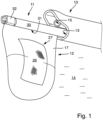
- Figure 1 1 shows a retrieval device 11 inserted into a cystoscope 10, to which a retrieval bag 12 belongs.
- the retrieval device 11 can be inserted via a working channel 13 of the cystoscope 10 into a body cavity 14 of a patient, such as a urinary bladder or other body cavities in which a surgical procedure such as a tumor resection or other tissue resection is to be performed.
- the body cavity 14 is typically filled with fluid, such as an endogenous fluid, e.g. urine, bile, pancreatic secretion, cerebrospinal fluid, or an administered fluid, e.g. sodium chloride solution.
- the cystoscope 10 has only the working channel 13, through which various instruments can be inserted into the body cavity 14. Such instruments are pushed through the working channel 13 alternately with the retrieval device 11.
- the cystoscope 10 has a viewing device 15, by means of which the surgical site can be observed.
- the viewing device 15 may be a camera with optics and lighting or another image transmitting device.
- an endoscope can also be used which has further working channels, such as, for example, a channel instead of the viewing device 15, through which the instruments can be transferred into the body cavity 14, wherein, optionally, the retrieval device 11 can also be located in the working channel 13.
- Such instruments can be, for example, electrosurgical instruments with wire electrodes, loop electrodes, or similar, which can be used to separate tissue sections from other tissue composites.
- the retrieval bag serves to collect and safely contain such tissue pieces, which are then safely packed and can be led out of the body cavity 14 through the working channel 13.
- the recovery bag 12 is in Figure 2 illustrated separately. It preferably has two flat side walls 16, 17, which may be made of a thin, flexible plastic material, such as a plastic film, e.g., polyethylene or a similar material.
- the side walls 16, 17 are cut and merge into one another at an edge 18 or are connected to one another there, so that they can be laid flat on top of one another.
- the side walls 16, 17 are connected at the top to a closure device 19, which is designed, for example, as a profile strip closure and has two complementary strips 20, 21.
- the strip 20 is, as shown in Figure 3, for example, C-shaped in cross section and thus has two resilient legs that define a channel 22 between them.
- the strip 21 is preferably formed by a round profile, which, as Figure 4 shows, fits into the channel 22 between the resilient legs 23, 24.
- the strips 20, 21 of the closure device 19 are preferably made of a flexible plastic.
- Figure 2 shows, they are slightly curved in the relaxed position so that they release a filling opening 25 on the recovery bag 12.
- Figure 2 illustrates the filling opening 25 in the open position.
- the closure device 19 Due to the curvature of the strips 20, 21 in the relaxed state, the closure device 19, as Figure 2 can be seen, prestressed towards its open position. However, if it is closed, any stiffness of the side walls 16, 17 provided will cause them to tend to press against one another, whereby the interior space enclosed by the recovery bag 12 tends to shrink.
- the retrieval bag 12 may consist entirely or, as indicated in Figures 1 and 2, only partially of a hydrophilic, water-permeable filter membrane 26, which occupies a section 27 of the retrieval bag 12 or its side wall 17.
- An identical or similar filter membrane 26 may also be provided on the other side wall 16, if required.
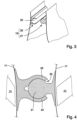
- the filter membrane 26 is in Figure 5 illustrated separately. It is arranged at a window 28 of the otherwise preferably water-impermeable side wall 16 and is firmly connected to the edge of the window 28.
- the filter membrane can be arranged on the side of the side wall 16 or 17 facing the interior and glued or welded to the edge of the window 28.
- the filter membrane 26 may be a nonwoven or a porous film and may contain or consist of one or more substances selected from the following group:
- Polyethersulfone (PES), acrylic polymer, polyamide (PA) or polyethylene terephthalate, polysulfone (PS), hydrophilized polytetrafluoroethylene (PTFE), cellulose acetate (CA), cellulose nitrate (CN), cellulose acetate with cellulose nitrate (MCE), nylon (NY), polycarbonate (PCTE) and/or polyvinylidene difluoride (PVDF).
- PES Polyethersulfone
- PA polyamide
- PS polysulfone
- PTFE hydrophilized polytetrafluoroethylene
- CA cellulose acetate
- CN cellulose nitrate
- MCE cellulose acetate with cellulose nitrate
- nylon NY
- PCTE polycarbonate
- PVDF polyvinylidene difluoride
- filter materials are possible, provided they are made of a hydrophilic material or of a material with a hydrophilic coating or finish.
- the filter material is permeated by pores that lead from one flat side of the filter membrane to its other flat side, thus forming a fluid passage through which water can escape from the interior of the retrieval bag 12 into the environment.
- the upper limit for the size of the pores is preferably below 12 ⁇ m and thus below the cell size of tumor cells.
- the largest pore diameter is at most 5 ⁇ m, more preferably at most 3 ⁇ m or less.
- the pore size is only slightly below a value of 0.2 ⁇ m. In particularly preferred embodiments, the pore diameter is greater than 0.2 ⁇ m.
- the recovery bag 12 is, as Figure 2 can be seen, connected to a traction means 29, for example a plastic wire or a rope, which is preferably connected to a corner of the retrieval bag 12, at which the closure device 19 ends.
- the traction means 29 has a length which is greater than the length of the endoscope or cystoscope 10, so that the end of the traction means 29 of the retrieval bag 12 Figure 1 is accessible from the outside (outside the patient).
- the pulling means 29 extends through a push rod 30, which can be designed like a tube and has a longitudinal slot 31 at its distal end.
- the longitudinal slot is dimensioned such that the closure device 19 is closed, ie the strips 20, 21 are pressed into one another in a locking manner, when the retrieval bag is pulled into the longitudinal slot 31 by a relative movement between the push rod 30 and the pulling means 29.
- the traction device 29 is designed to be flexible and can therefore transmit tensile forces but not shear forces.
- the retrieval bag 12 can first be rolled up and positioned in front of or in one end 32 of the push rod 30, with the traction means 29 extending through or along the push rod 30.
- the rolled-up retrieval bag 12 is then pushed through the working channel 13 of the endoscope or cystoscope 10 into the body cavity 14 of a patient.
- the retrieval bag 12 is released upon exiting the working channel 13 of the endoscope or cystoscope 10, so that its filling opening 25 exposes the interior of the retrieval bag 12.
- the ridges 20, 21 spring away from one another, so that a space is also created between the side walls 16, 17.
- the surgeon can now, for example, remove tissue in one piece from an operation site using a different instrument guided through the other working channel 15 and transfer it through the filling opening 25 into the retrieval bag 12.
- the push rod 30 is moved in the distal direction, while the traction device 29 remains axially held, so that the bag 12 cannot follow the axial movement of the push rod 30.
- the push rod 30 slides with its longitudinal slot 31 over the upper end of the retrieval bag 12 and thus permanently closes the closure device 19.
- the closed retrieval bag 12 remains closed and cannot be opened within the body cavity 14, even accidentally.
- the traction device 29 can pull the retrieval bag 12 into the longitudinal slot 31, but can no longer push it out.
- connecting means can be provided at the proximal ends of the push rod 30 and the traction device.
- the interior of the retrieval bag 12 now tends to decrease in volume. Fluid present in the retrieval bag 12 and absorbed from the body cavity 14, particularly water or aqueous substances, can escape from the retrieval bag 12 through the hydrophilic filter membrane 26. However, the absorbed tissue remains in the retrieval bag 12. This bag can now be carefully reduced in size, for example, by rotating the push rod 30 and wrapping it around its end and retracting it through the working channel 13. It can also be removed from the patient together with the endoscope or cystoscope 10.
- a number of smaller windows 28a, 28b, etc. may be provided, which are covered by the filter membrane 26.
- the filter membranes 26a, 26b can be regarded as layers of a filter membrane, with the intervening perforated side wall 17 forming a support.
- the filter membranes 26 can be Figure 5 or the filter membranes 26a and / or 26b according to Figure 6
- Each layer can be made up of matching or be constructed from different materials selected from the above list of materials. Other functionally similar materials are possible.
- membranes can be arranged directly on top of one another or at a distance from one another.
- many membranes can be made from individual films with openings that are larger than the tumor cells, e.g. (even significantly) larger than 12 ⁇ m. By connecting several such films in different layered orientations, a composite membrane with smaller openings is created, as the individual films overlap. This simplifies production and reduces the resistance of the water flowing through.
- a wringing device 33 is assigned to the retrieval bag 12.
- This can be designed, for example, as a finger-like, fixed extension 34 or as an attachment cap, which extends distally away from the cystoscope 10 or an endoscope.
- a corresponding rod can be inserted through the working channel 15, the distal end of which forms or replaces the extension 34. If the push rod 30 is rotated, the finger 34 prevents the retrieval bag 12 from rotating and thus presses water out of its interior, which can escape through the filter membrane 26.
- a retrieval device for the retrieval of tissue, in particular pathogenic tissue, from a body cavity of a patient, a retrieval device can be provided, which includes a retrieval bag 12, which consists entirely or partially of a hydrophilic, water-permeable filter membrane 26.
- the filter membrane 26 has a pore width of preferably smaller than 12 ⁇ m, more preferably smaller than 8 ⁇ m and most preferably smaller than 5 ⁇ m in order to reliably prevent the passage of pathogenic cells or other pathogenic material.
- the pores are at least large enough for water to easily escape from the retrieval bag 12. In this way, the retrieval bag 12, when filled, only requires the volume occupied by the tissue contained therein to be removed.
- Liquid present in the retrieval bag 12 can be displaced from the retrieval bag by the filter membrane 26 and thus does not contribute to its volume. This allows the inclusion of relatively large pieces of tissue during tumor removal. It is therefore possible to remove tumors in their entirety without having to dissect them within the body cavity. The risk of malignant tissue being spread and the associated risk of recurrence is thus significantly reduced.
Landscapes
- Health & Medical Sciences (AREA)
- Life Sciences & Earth Sciences (AREA)
- Surgery (AREA)
- General Health & Medical Sciences (AREA)
- Public Health (AREA)
- Veterinary Medicine (AREA)
- Animal Behavior & Ethology (AREA)
- Molecular Biology (AREA)
- Medical Informatics (AREA)
- Engineering & Computer Science (AREA)
- Biomedical Technology (AREA)
- Heart & Thoracic Surgery (AREA)
- Nuclear Medicine, Radiotherapy & Molecular Imaging (AREA)
- Pathology (AREA)
- Biophysics (AREA)
- Radiology & Medical Imaging (AREA)
- Physics & Mathematics (AREA)
- Optics & Photonics (AREA)
- Surgical Instruments (AREA)
- External Artificial Organs (AREA)
- Information Retrieval, Db Structures And Fs Structures Therefor (AREA)
Priority Applications (8)
| Application Number | Priority Date | Filing Date | Title |
|---|---|---|---|
| PL21159686.1T PL4049593T3 (pl) | 2021-02-26 | 2021-02-26 | Urządzenie pobierające do pobierania tkanki |
| EP21159686.1A EP4049593B1 (de) | 2021-02-26 | 2021-02-26 | Bergeeinrichtung zum bergen von gewebe |
| BR102022002770-6A BR102022002770A2 (pt) | 2021-02-26 | 2022-02-14 | Dispositivo e método de recuperação para recuperar tecido |
| US17/672,362 US20220273278A1 (en) | 2021-02-26 | 2022-02-15 | Retrieve device and method for retrieving of tissue |
| JP2022023556A JP2022132146A (ja) | 2021-02-26 | 2022-02-18 | 回収装置および組織を回収する方法 |
| KR1020220023693A KR20220122528A (ko) | 2021-02-26 | 2022-02-23 | 조직을 회수하기 위한 회수 장치 및 방법 |
| CN202210176657.8A CN114947982B (zh) | 2021-02-26 | 2022-02-25 | 用于取出组织的取出装置和方法 |
| US19/305,559 US20260053480A1 (en) | 2021-02-26 | 2025-08-20 | Retrieve device and method for retrieving tissue |
Applications Claiming Priority (1)
| Application Number | Priority Date | Filing Date | Title |
|---|---|---|---|
| EP21159686.1A EP4049593B1 (de) | 2021-02-26 | 2021-02-26 | Bergeeinrichtung zum bergen von gewebe |
Publications (3)
| Publication Number | Publication Date |
|---|---|
| EP4049593A1 EP4049593A1 (de) | 2022-08-31 |
| EP4049593C0 EP4049593C0 (de) | 2025-04-23 |
| EP4049593B1 true EP4049593B1 (de) | 2025-04-23 |
Family
ID=74797867
Family Applications (1)
| Application Number | Title | Priority Date | Filing Date |
|---|---|---|---|
| EP21159686.1A Active EP4049593B1 (de) | 2021-02-26 | 2021-02-26 | Bergeeinrichtung zum bergen von gewebe |
Country Status (7)
| Country | Link |
|---|---|
| US (2) | US20220273278A1 (pl) |
| EP (1) | EP4049593B1 (pl) |
| JP (1) | JP2022132146A (pl) |
| KR (1) | KR20220122528A (pl) |
| CN (1) | CN114947982B (pl) |
| BR (1) | BR102022002770A2 (pl) |
| PL (1) | PL4049593T3 (pl) |
Families Citing this family (1)
| Publication number | Priority date | Publication date | Assignee | Title |
|---|---|---|---|---|
| EP4616941A1 (en) * | 2024-03-15 | 2025-09-17 | AIRplus GmbH | Method for removing per- and polyfluoroalkyl substances |
Family Cites Families (30)
| Publication number | Priority date | Publication date | Assignee | Title |
|---|---|---|---|---|
| US5556376A (en) * | 1988-07-22 | 1996-09-17 | Yoon; Inbae | Multifunctional devices having loop configured portions and collection systems for endoscopic surgical procedures and methods thereof |
| US5354303A (en) | 1991-01-09 | 1994-10-11 | Endomedix Corporation | Devices for enclosing, manipulating, debulking and removing tissue through minimal incisions |
| US5190542A (en) * | 1991-11-05 | 1993-03-02 | Nakao Naomi L | Surgical retrieval assembly and related method |
| US5643283A (en) * | 1992-01-03 | 1997-07-01 | Younker; Marlin E. | Surgical pouch |
| US5341815A (en) | 1993-03-25 | 1994-08-30 | Ethicon, Inc. | Endoscopic surgical pouch |
| US5971995A (en) | 1998-03-30 | 1999-10-26 | Ethicon, Inc. | Surgical pouch instrument |
| US6289095B1 (en) | 1998-09-29 | 2001-09-11 | Lucent Technologies Inc. | NPA split management in intelligent network environment |
| US6387102B2 (en) * | 1998-11-20 | 2002-05-14 | Ancel Surgical R&D, Inc. | Reusable laparoscopic retrieval mechanism |
| US6350267B1 (en) | 2000-12-21 | 2002-02-26 | Ethicon Endo-Surgery, Inc. | Method of use of an improved specimen retrieval bag |
| JP4657021B2 (ja) * | 2005-06-16 | 2011-03-23 | オリンパスメディカルシステムズ株式会社 | 組織捕獲装置、内視鏡用処置具及び内視鏡 |
| US7743474B2 (en) * | 2005-10-31 | 2010-06-29 | Reynolds Consumer Products, Inc. | Polymeric package closure and method |
| US9279751B2 (en) * | 2008-12-16 | 2016-03-08 | Nico Corporation | System and method of taking and collecting tissue cores for treatment |
| WO2011049918A1 (en) * | 2009-10-19 | 2011-04-28 | Ww7 L.L.C. | Single port surgical tissue containment and extraction device |
| US20110137334A1 (en) * | 2009-12-04 | 2011-06-09 | Boston Scientific Scimed, Inc. | Electroactively Deployed Filter Device |
| US9113848B2 (en) | 2010-02-03 | 2015-08-25 | Covidien Lp | Surgical retrieval apparatus |
| NL2005359C2 (nl) | 2010-08-22 | 2012-02-27 | Anton Jansen | Inrichting voor het wegnemen van weefsel. |
| US8579914B2 (en) | 2010-12-17 | 2013-11-12 | Covidien Lp | Specimen retrieval device |
| US9364202B2 (en) | 2011-03-11 | 2016-06-14 | Covidien Lp | Specimen removal device with gas venting |
| US9101342B2 (en) * | 2011-07-22 | 2015-08-11 | Rafic Saleh | Surgical retrieval apparatus and method with semi-rigidly extendable and collapsible basket |
| JP5475191B2 (ja) * | 2011-08-01 | 2014-04-16 | オリンパスメディカルシステムズ株式会社 | 処置具 |
| US9335327B2 (en) * | 2011-08-08 | 2016-05-10 | The Henry M. Jackson Foundation For The Advancement Of Military Medicine, Inc. | Isolation and detection of cancer cells |
| WO2013083260A1 (en) * | 2011-12-06 | 2013-06-13 | Qiagen Gmbh | Recovery of a biomolecule comprising aqueous phase from a multiphasic mixture |
| US10220353B2 (en) * | 2014-08-28 | 2019-03-05 | Bha Altair, Llc | Filter water management using hydrophilic material |
| CN104905825B (zh) * | 2015-07-02 | 2017-10-20 | 上海市第一人民医院 | 一种膀胱镜、输尿管镜、肾镜下一次性标本取物器 |
| CN204816230U (zh) * | 2015-07-30 | 2015-12-02 | 北京思维力科技发展有限公司 | 一种多孔超滤过滤膜 |
| WO2017189442A1 (en) * | 2016-04-25 | 2017-11-02 | Claria Medical, Inc. | Systems and methods for tissue capture and removal |
| US11389283B2 (en) * | 2016-05-11 | 2022-07-19 | W. L. Gore & Associates, Inc. | Filter and occluder systems and associated methods and devices |
| CN205948691U (zh) * | 2016-08-17 | 2017-02-15 | 中山双安微医疗科技有限公司 | 一种重离子微孔除菌式过滤膜 |
| US11642113B2 (en) * | 2017-02-15 | 2023-05-09 | Urotech Gmbh | Interventional device for specimen retrieval |
| WO2020196649A1 (ja) * | 2019-03-27 | 2020-10-01 | 株式会社カネカ | 細胞製造装置、細胞製造方法並びにこれに用いられるサーバ、システムおよび装置 |
-
2021
- 2021-02-26 PL PL21159686.1T patent/PL4049593T3/pl unknown
- 2021-02-26 EP EP21159686.1A patent/EP4049593B1/de active Active
-
2022
- 2022-02-14 BR BR102022002770-6A patent/BR102022002770A2/pt unknown
- 2022-02-15 US US17/672,362 patent/US20220273278A1/en active Pending
- 2022-02-18 JP JP2022023556A patent/JP2022132146A/ja active Pending
- 2022-02-23 KR KR1020220023693A patent/KR20220122528A/ko active Pending
- 2022-02-25 CN CN202210176657.8A patent/CN114947982B/zh active Active
-
2025
- 2025-08-20 US US19/305,559 patent/US20260053480A1/en active Pending
Also Published As
| Publication number | Publication date |
|---|---|
| EP4049593C0 (de) | 2025-04-23 |
| EP4049593A1 (de) | 2022-08-31 |
| US20260053480A1 (en) | 2026-02-26 |
| KR20220122528A (ko) | 2022-09-02 |
| PL4049593T3 (pl) | 2025-06-30 |
| BR102022002770A2 (pt) | 2022-09-06 |
| CN114947982A (zh) | 2022-08-30 |
| JP2022132146A (ja) | 2022-09-07 |
| CN114947982B (zh) | 2025-10-21 |
| US20220273278A1 (en) | 2022-09-01 |
Similar Documents
| Publication | Publication Date | Title |
|---|---|---|
| DE69925379T2 (de) | Vorrichtung zur anwendung bei harninkontinenz und herstellungsverfahren hierfür | |
| EP1773204B1 (de) | Endochirurgischer bergebeutel für die aufnahme von körpergewebe oder -flüssigkeit | |
| DE69228326T2 (de) | Vorrichtung zum herausholen von materialien aus körperlumina | |
| DE60037831T2 (de) | Eispackung mit einer erweiterbaren öffnung | |
| DE69832193T2 (de) | Vorrichtung zur serienweisen abnahme, speicherung und verarbeitung von biopsieproben | |
| DE69217078T2 (de) | Unterlage für die behandlung von urininkontinenz | |
| DE69925507T2 (de) | Ausdehnbare bogenförmige vorrichtung zur anwendung bei harninkontinenz und herstellungsverfahren hierfür | |
| DE69328694T2 (de) | Vorrichtung zur fadensicherung | |
| DE2520899C3 (de) | Intravaginaler Menstruationsschutz | |
| DE69510461T2 (de) | Einweg-vorrichtung zum nachweis oder zur analyse einer körperflüssigkeit | |
| DE112009001316T5 (de) | Vorrichtung zur Behandlung eines Blutkreislaufkanals | |
| DE3604555A1 (de) | Hygieneartikel | |
| DE112010002841T5 (de) | Absorbierender Artikel zur medizinischen Behandlung oder für die Menstruation | |
| AT517380A1 (de) | Verfahren zur Herstellung eines Tampons | |
| DE10243129A1 (de) | Mehrfachblutentnahmegerät für Kleintiere und ähnliche Anwendungen | |
| DE20012003U1 (de) | Vorrichtung zum Einbringen von Partikeln in ein Körpergewebe, insbesondere Muskelgewebe | |
| EP3119292A1 (de) | Fangdrahtinstrument mit fangdrahtstruktur aus rohrstück | |
| EP2986228B1 (de) | Vorrichtung zur probennahme | |
| EP4049593A1 (de) | Bergeeinrichtung und verfahren zum bergen von gewebe | |
| DE29903943U1 (de) | Flächiges Rückhalteelement für Körperteile | |
| DE202011101205U1 (de) | Anastomosegerät | |
| DE102009053341B3 (de) | Testvorrichtung für Vaginalfluid | |
| DE102009001059A1 (de) | Bodenmatte | |
| WO2005065758A1 (de) | Vorrichtung zur behandlung von harnblasen-entleerungs-störungen eines menschen | |
| DE102009050457A1 (de) | Chirurgische Vorrichtung zum Hindurchführen wenigstens eines Nähfadens durch den Randbereich einer Gewebeöffnung eines Individuums und Verfahren zum Betätigen einer solchen Vorrichtung |
Legal Events
| Date | Code | Title | Description |
|---|---|---|---|
| PUAI | Public reference made under article 153(3) epc to a published international application that has entered the european phase |
Free format text: ORIGINAL CODE: 0009012 |
|
| STAA | Information on the status of an ep patent application or granted ep patent |
Free format text: STATUS: THE APPLICATION HAS BEEN PUBLISHED |
|
| AK | Designated contracting states |
Kind code of ref document: A1 Designated state(s): AL AT BE BG CH CY CZ DE DK EE ES FI FR GB GR HR HU IE IS IT LI LT LU LV MC MK MT NL NO PL PT RO RS SE SI SK SM TR |
|
| STAA | Information on the status of an ep patent application or granted ep patent |
Free format text: STATUS: REQUEST FOR EXAMINATION WAS MADE |
|
| 17P | Request for examination filed |
Effective date: 20221230 |
|
| RBV | Designated contracting states (corrected) |
Designated state(s): AL AT BE BG CH CY CZ DE DK EE ES FI FR GB GR HR HU IE IS IT LI LT LU LV MC MK MT NL NO PL PT RO RS SE SI SK SM TR |
|
| GRAP | Despatch of communication of intention to grant a patent |
Free format text: ORIGINAL CODE: EPIDOSNIGR1 |
|
| STAA | Information on the status of an ep patent application or granted ep patent |
Free format text: STATUS: GRANT OF PATENT IS INTENDED |
|
| INTG | Intention to grant announced |
Effective date: 20250103 |
|
| RIN1 | Information on inventor provided before grant (corrected) |
Inventor name: ENDERLE, MARKUS Inventor name: SCHNITZLER, UWE |
|
| GRAS | Grant fee paid |
Free format text: ORIGINAL CODE: EPIDOSNIGR3 |
|
| GRAA | (expected) grant |
Free format text: ORIGINAL CODE: 0009210 |
|
| STAA | Information on the status of an ep patent application or granted ep patent |
Free format text: STATUS: THE PATENT HAS BEEN GRANTED |
|
| AK | Designated contracting states |
Kind code of ref document: B1 Designated state(s): AL AT BE BG CH CY CZ DE DK EE ES FI FR GB GR HR HU IE IS IT LI LT LU LV MC MK MT NL NO PL PT RO RS SE SI SK SM TR |
|
| REG | Reference to a national code |
Ref country code: GB Ref legal event code: FG4D Free format text: NOT ENGLISH |
|
| REG | Reference to a national code |
Ref country code: CH Ref legal event code: EP |
|
| REG | Reference to a national code |
Ref country code: DE Ref legal event code: R096 Ref document number: 502021007258 Country of ref document: DE |
|
| REG | Reference to a national code |
Ref country code: IE Ref legal event code: FG4D Free format text: LANGUAGE OF EP DOCUMENT: GERMAN |
|
| U01 | Request for unitary effect filed |
Effective date: 20250424 |
|
| U07 | Unitary effect registered |
Designated state(s): AT BE BG DE DK EE FI FR IT LT LU LV MT NL PT RO SE SI Effective date: 20250430 |
|
| PG25 | Lapsed in a contracting state [announced via postgrant information from national office to epo] |
Ref country code: ES Free format text: LAPSE BECAUSE OF FAILURE TO SUBMIT A TRANSLATION OF THE DESCRIPTION OR TO PAY THE FEE WITHIN THE PRESCRIBED TIME-LIMIT Effective date: 20250423 |
|
| PG25 | Lapsed in a contracting state [announced via postgrant information from national office to epo] |
Ref country code: GR Free format text: LAPSE BECAUSE OF FAILURE TO SUBMIT A TRANSLATION OF THE DESCRIPTION OR TO PAY THE FEE WITHIN THE PRESCRIBED TIME-LIMIT Effective date: 20250724 Ref country code: NO Free format text: LAPSE BECAUSE OF FAILURE TO SUBMIT A TRANSLATION OF THE DESCRIPTION OR TO PAY THE FEE WITHIN THE PRESCRIBED TIME-LIMIT Effective date: 20250723 |
|
| PG25 | Lapsed in a contracting state [announced via postgrant information from national office to epo] |
Ref country code: HR Free format text: LAPSE BECAUSE OF FAILURE TO SUBMIT A TRANSLATION OF THE DESCRIPTION OR TO PAY THE FEE WITHIN THE PRESCRIBED TIME-LIMIT Effective date: 20250423 |
|
| PG25 | Lapsed in a contracting state [announced via postgrant information from national office to epo] |
Ref country code: RS Free format text: LAPSE BECAUSE OF FAILURE TO SUBMIT A TRANSLATION OF THE DESCRIPTION OR TO PAY THE FEE WITHIN THE PRESCRIBED TIME-LIMIT Effective date: 20250723 |
|
| PG25 | Lapsed in a contracting state [announced via postgrant information from national office to epo] |
Ref country code: IS Free format text: LAPSE BECAUSE OF FAILURE TO SUBMIT A TRANSLATION OF THE DESCRIPTION OR TO PAY THE FEE WITHIN THE PRESCRIBED TIME-LIMIT Effective date: 20250823 |
|
| PG25 | Lapsed in a contracting state [announced via postgrant information from national office to epo] |
Ref country code: SM Free format text: LAPSE BECAUSE OF FAILURE TO SUBMIT A TRANSLATION OF THE DESCRIPTION OR TO PAY THE FEE WITHIN THE PRESCRIBED TIME-LIMIT Effective date: 20250423 |
|
| PG25 | Lapsed in a contracting state [announced via postgrant information from national office to epo] |
Ref country code: CZ Free format text: LAPSE BECAUSE OF FAILURE TO SUBMIT A TRANSLATION OF THE DESCRIPTION OR TO PAY THE FEE WITHIN THE PRESCRIBED TIME-LIMIT Effective date: 20250423 |
|
| PG25 | Lapsed in a contracting state [announced via postgrant information from national office to epo] |
Ref country code: SK Free format text: LAPSE BECAUSE OF FAILURE TO SUBMIT A TRANSLATION OF THE DESCRIPTION OR TO PAY THE FEE WITHIN THE PRESCRIBED TIME-LIMIT Effective date: 20250423 |
|
| PLBE | No opposition filed within time limit |
Free format text: ORIGINAL CODE: 0009261 |
|
| STAA | Information on the status of an ep patent application or granted ep patent |
Free format text: STATUS: NO OPPOSITION FILED WITHIN TIME LIMIT |
|
| REG | Reference to a national code |
Ref country code: CH Ref legal event code: L10 Free format text: ST27 STATUS EVENT CODE: U-0-0-L10-L00 (AS PROVIDED BY THE NATIONAL OFFICE) Effective date: 20260304 |
|
| 26N | No opposition filed |
Effective date: 20260126 |
|
| U20 | Renewal fee for the european patent with unitary effect paid |
Year of fee payment: 6 Effective date: 20260224 |
|
| PGFP | Annual fee paid to national office [announced via postgrant information from national office to epo] |
Ref country code: GB Payment date: 20260223 Year of fee payment: 6 |
|
| PGFP | Annual fee paid to national office [announced via postgrant information from national office to epo] |
Ref country code: PL Payment date: 20260203 Year of fee payment: 6 |