EP4041615B1 - Schnellkupplungssystem für ein fahrzeuglenkrad - Google Patents
Schnellkupplungssystem für ein fahrzeuglenkrad Download PDFInfo
- Publication number
- EP4041615B1 EP4041615B1 EP20799611.7A EP20799611A EP4041615B1 EP 4041615 B1 EP4041615 B1 EP 4041615B1 EP 20799611 A EP20799611 A EP 20799611A EP 4041615 B1 EP4041615 B1 EP 4041615B1
- Authority
- EP
- European Patent Office
- Prior art keywords
- quick
- coupling part
- steering wheel
- engagement
- coupling
- Prior art date
- Legal status (The legal status is an assumption and is not a legal conclusion. Google has not performed a legal analysis and makes no representation as to the accuracy of the status listed.)
- Active
Links
Images

Classifications
-
- B—PERFORMING OPERATIONS; TRANSPORTING
- B62—LAND VEHICLES FOR TRAVELLING OTHERWISE THAN ON RAILS
- B62D—MOTOR VEHICLES; TRAILERS
- B62D1/00—Steering controls, i.e. means for initiating a change of direction of the vehicle
- B62D1/02—Steering controls, i.e. means for initiating a change of direction of the vehicle vehicle-mounted
- B62D1/04—Hand wheels
- B62D1/10—Hubs; Connecting hubs to steering columns, e.g. adjustable
-
- B—PERFORMING OPERATIONS; TRANSPORTING
- B60—VEHICLES IN GENERAL
- B60R—VEHICLES, VEHICLE FITTINGS, OR VEHICLE PARTS, NOT OTHERWISE PROVIDED FOR
- B60R16/00—Electric or fluid circuits specially adapted for vehicles and not otherwise provided for; Arrangement of elements of electric or fluid circuits specially adapted for vehicles and not otherwise provided for
- B60R16/02—Electric or fluid circuits specially adapted for vehicles and not otherwise provided for; Arrangement of elements of electric or fluid circuits specially adapted for vehicles and not otherwise provided for electric constitutive elements
- B60R16/023—Electric or fluid circuits specially adapted for vehicles and not otherwise provided for; Arrangement of elements of electric or fluid circuits specially adapted for vehicles and not otherwise provided for electric constitutive elements for transmission of signals between vehicle parts or subsystems
- B60R16/027—Electric or fluid circuits specially adapted for vehicles and not otherwise provided for; Arrangement of elements of electric or fluid circuits specially adapted for vehicles and not otherwise provided for electric constitutive elements for transmission of signals between vehicle parts or subsystems between relatively movable parts of the vehicle, e.g. between steering wheel and column
-
- B—PERFORMING OPERATIONS; TRANSPORTING
- B62—LAND VEHICLES FOR TRAVELLING OTHERWISE THAN ON RAILS
- B62D—MOTOR VEHICLES; TRAILERS
- B62D1/00—Steering controls, i.e. means for initiating a change of direction of the vehicle
- B62D1/02—Steering controls, i.e. means for initiating a change of direction of the vehicle vehicle-mounted
- B62D1/04—Hand wheels
-
- H—ELECTRICITY
- H01—ELECTRIC ELEMENTS
- H01R—ELECTRICALLY-CONDUCTIVE CONNECTIONS; STRUCTURAL ASSOCIATIONS OF A PLURALITY OF MUTUALLY-INSULATED ELECTRICAL CONNECTING ELEMENTS; COUPLING DEVICES; CURRENT COLLECTORS
- H01R13/00—Details of coupling devices of the kinds covered by groups H01R12/70 or H01R24/00 - H01R33/00
- H01R13/62—Means for facilitating engagement or disengagement of coupling parts or for holding them in engagement
- H01R13/629—Additional means for facilitating engagement or disengagement of coupling parts, e.g. aligning or guiding means, levers, gas pressure electrical locking indicators, manufacturing tolerances
- H01R13/631—Additional means for facilitating engagement or disengagement of coupling parts, e.g. aligning or guiding means, levers, gas pressure electrical locking indicators, manufacturing tolerances for engagement only
-
- H—ELECTRICITY
- H01—ELECTRIC ELEMENTS
- H01R—ELECTRICALLY-CONDUCTIVE CONNECTIONS; STRUCTURAL ASSOCIATIONS OF A PLURALITY OF MUTUALLY-INSULATED ELECTRICAL CONNECTING ELEMENTS; COUPLING DEVICES; CURRENT COLLECTORS
- H01R13/00—Details of coupling devices of the kinds covered by groups H01R12/70 or H01R24/00 - H01R33/00
- H01R13/64—Means for preventing incorrect coupling
-
- F—MECHANICAL ENGINEERING; LIGHTING; HEATING; WEAPONS; BLASTING
- F16—ENGINEERING ELEMENTS AND UNITS; GENERAL MEASURES FOR PRODUCING AND MAINTAINING EFFECTIVE FUNCTIONING OF MACHINES OR INSTALLATIONS; THERMAL INSULATION IN GENERAL
- F16D—COUPLINGS FOR TRANSMITTING ROTATION; CLUTCHES; BRAKES
- F16D1/00—Couplings for rigidly connecting two coaxial shafts or other movable machine elements
- F16D1/10—Quick-acting couplings in which the parts are connected by simply bringing them together axially
- F16D2001/102—Quick-acting couplings in which the parts are connected by simply bringing them together axially the torque is transmitted via polygon shaped connections
-
- H—ELECTRICITY
- H01—ELECTRIC ELEMENTS
- H01R—ELECTRICALLY-CONDUCTIVE CONNECTIONS; STRUCTURAL ASSOCIATIONS OF A PLURALITY OF MUTUALLY-INSULATED ELECTRICAL CONNECTING ELEMENTS; COUPLING DEVICES; CURRENT COLLECTORS
- H01R2201/00—Connectors or connections adapted for particular applications
- H01R2201/26—Connectors or connections adapted for particular applications for vehicles
Definitions
- the invention relates to a quick coupling system for a vehicle steering wheel, in particular for racing cars or simulators and game consoles.
- Such quick-coupling systems for steering wheels are used, for example, in racing to enable a driver to get in and out quickly, for which the steering wheel is removed, or to enable the steering wheel to be quickly replaced during a pit stop.
- a disadvantage of known systems is that an electrical plug connection that is also present can be damaged if handled carelessly, in particular if the coupling parts are not attached correctly.
- the present invention is therefore based on the object of creating a quick coupling system for a vehicle steering wheel which avoids the problems explained above, enables a quick and reliable assembly and disassembly of a steering wheel and prevents an undesirable loss of time, in particular during assembly.
- Engagement elements that are designed to complement each other and are arranged on both the vehicle-side coupling part and the steering wheel-side coupling part, each at least in the front area of the area to be brought into engagement, interact in such a way that even partial sliding into one another in the direction of the longitudinal axis in an incorrect orientation (rotational position about the longitudinal axis and longitudinal axis position relative to one another) is prevented.
- preventing (partial) telescoping is to be understood as an effect that goes beyond a small depth of engagement (i.e. a small depth of engagement compared to the total insertion depth of less than a fifth or even a tenth of the total insertion depth), so that, for example, an aid for correctly positioning the end faces of the coupling parts and a corresponding slight overlap in the longitudinal axial direction, in which in particular the correct rotational position relative to one another is irrelevant, is not to be regarded as partial telescoping.
- a small depth of engagement i.e. a small depth of engagement compared to the total insertion depth of less than a fifth or even a tenth of the total insertion depth
- the engagement elements are designed in the form of a non-rotationally symmetrical outer circumference and a complementary inner circumference.
- the circumferences can, for example, have irregular shapes that only allow them to be pushed into one another in a clear rotational position relative to one another.
- the interacting profiles are designed in such a way that they have a tolerance in the form of a distance between the corresponding surfaces as an attachment and insertion aid, so that they allow a slight twisting of the rotational position and/or a distance of the longitudinal axes in the form of a play.
- This initial play in the offset of the longitudinal axes and/or the rotational position of the coupling parts decreases with the penetration depth, preferably by correspondingly reducing the inner circumference or enlarging the outer circumference and/or widening or reducing the engagement elements, so that the coupling parts in the rotational position and/or longitudinal position automatically fit into the correct position (centering aid).
- the quick coupling system has electrical connecting elements preferably in the form of plug contacts, which establish an electrical connection in the assembled state.
- the quick coupling system includes, in addition to a mechanical connection for power transmission, preferably an electrical connection for transmitting signals from the steering wheel to the vehicle or to the so-called wheel base of a game or simulator system and vice versa.
- the electrical connection elements are arranged in the rear areas of the coupling parts in such a way that the electrical connection elements only come into contact when the coupling parts are assembled (plugged into one another/joined together) if both the correct orientation with regard to the longitudinal axial rotation position and a concentric positioning with regard to the alignment of the longitudinal center axes are present. This prevents incorrect contact as well as damage to the contacts.
- the insertion aid is designed in the form of a tongue and groove element, wherein the tongue element has a decreasing width towards the rear area or the tongue element has an increasing width in order to center the tongue element during insertion and to position it correctly.
- the quick coupling system according to the invention can be used for a vehicle, for a simulator or for a game console or for a corresponding steering wheel.
- the Fig. 1 The steering wheel-side coupling part 1 shown has a receptacle 7 in the form of a rectangular opening from its front side. In this opening 7, the Fig. 2 The vehicle-side coupling part 3 shown must be inserted with its head 5.
- the steering wheel-side coupling part 1 On its rear side, the steering wheel-side coupling part 1 has a fastening 19 in the form of a flange for a steering wheel not shown in the drawing.
- the head 5 of the coupling part 3 has a substantially rectangular profile, which is conical or tapered towards the front end At its rear, the coupling part is connected in a fixed and rotationally fixed manner to a steering column 27 of a vehicle or a wheel box of a simulator or game system.
- the opening or receptacle 7 is complementary in profile to the head 5 and tapers towards its depth.
- rods 9 engage in longitudinal grooves 11 formed on the outer circumference of the head 5, so that the mechanical connection of the coupling parts is locked in this position.
- a sleeve 13 arranged on the coupling part 1 can be retracted in the axial direction against a spring force (springs 25) and the head 5 can be pulled out of the holder 7.
- the head 5 has an engagement element 15, for example in the form of a recess 17, at least at one point in the profile.
- the receptacle 7 has an engagement element 15 in the profile, for example in the form of a projection.
- the engagement elements 15 and 17 engage with each other in such a way, for example in the form of a tongue and groove, that a correct orientation of the axial rotational position is ensured from the first pushing together until complete assembly.
- the head 5 centers itself automatically in the holder 7 so that the angle ⁇ becomes smaller and smaller and becomes zero in the final position of a complete assembly.
- the interaction of the engagement elements therefore ensures that the coupling parts 1 and 3 are correctly oriented to one another and that they can be pushed into one another as soon as they are attached, thus preventing them from being pushed into one another in an incorrect orientation or detecting an incorrect orientation right at the start of assembly.
- a preferably existing play (for example the complementary conical design of head 5 and holder 7), which reduces during insertion, acts as an insertion and centering aid in order to ensure a correct end position.
- a suitable reduction in the play can also enable a perfect electrical contact between the plug contacts 21 and 23.
- the play and thus the angle ⁇ is so small at this insertion depth that when pushed in further, the contacts 21 and 23 automatically engage in the correct position.
- the contacts 21 of the coupling part 1 are, as in Fig. 1 and Fig. 3 until Fig. 7 arranged so far inside, preferably in the area of the bottom of the receptacle 7, so that they only come into contact with the contacts 23 at a later point in time in an essentially correct position, for example only from half, preferably 4/5 of the complete insertion depth.
- the cross-sectional profile is designed similarly to a simple key-lock system, so that the coupling parts 1 and 3 can only be pushed into each other or the head can only be inserted into the holder 7 if the orientation is correct.
- the longitudinal profile is conical so that the further the head 5 is inserted into the receptacle 7, the smaller the radial play becomes.
- the electrical plug connection 21, 23 only makes contact when the pins 21 and sockets 23 are exactly opposite each other. This prevents mechanical damage to the plug contacts 21, 23.
- the sleeve 13 If the sleeve 13 is now released, it is pressed back into the starting position by the springs 25, whereby the clamping rods 9 penetrate into the corresponding recesses or grooves 11 of the coupling part 3 (head 5), but preferably do not touch the bottom and therefore the system remains under tension.
Landscapes
- Engineering & Computer Science (AREA)
- Mechanical Engineering (AREA)
- Chemical & Material Sciences (AREA)
- Combustion & Propulsion (AREA)
- Transportation (AREA)
- Details Of Connecting Devices For Male And Female Coupling (AREA)
- Steering Controls (AREA)
- Power Steering Mechanism (AREA)
Description
- Die Erfindung betrifft ein Schnellkupplungssystem für ein Fahrzeuglenkrad, insbesondere für Rennsportwägen oder auch Simulatoren und Spielkonsolen.
- Derartige Schnellkupplungssysteme für Lenkräder werden beispielsweise im Rennsport verwendet, um ein schnelles Ein- und Aussteigen eines Fahrers zu ermöglichen, wofür das Lenkrad abgenommen wird, oder auch um einen schnellen Tausch des Lenkrades bei einem Boxenstopp zu ermöglichen.
- Herkömmliche Schnellkupplungssysteme für Lenkräder, wie beispielsweise ein Lenkradschnellverschluss vom Typ QR-03 (herstellereigene Bezeichnung) der Firma Krontec Maschinenbau GmbH, erlauben es, ein Lenkrad schnell und ohne Zuhilfenahme von Werkzeugen in einem Fahrzeug mechanisch zu befestigen oder zu demontieren.
- Nachteiligerweise kann bei bekannten Systemen eine ebenfalls vorhandene elektrische Steckverbindung bei unachtsamer Handhabung, insbesondere einem nicht korrekten Ansetzen der Kupplungsteile, beschädigt werden.
- Zudem ist bei bekannten Systemen eine unachtsame Handhabung in Form einer nicht korrekten Positionierung, insbesondere Orientierung der Kupplungsteile zueinander, möglich, so dass eine Korrektur durch ein erneutes Ansetzen zusätzliche Zeit benötigt, was gerade im Rennsportbereich, insbesondere während eines Rennens, aus naheliegenden Gründen unerwünscht ist.
- Im Extremfall ist es sogar möglich, bei falscher Orientierung eine vermeintliche mechanische Verbindung herzustellen, die zwar nicht einrastet, aber das Lenkrad kurzzeitig zu fixieren scheint, so dass der Benutzer dies in Stresssituationen übersehen kann. Schlimmstenfalls kann sich das Lenkrad während der Fahrt lösen und einen Unfall verursachen.
- Das Dokument
DE 10 2015 219645 A1 offenbart die Merkmale des Oberbegriffs des unabhängigen Anspruchs, während die DokumenteUS 2013/0118297 A1 undEP 1 179 469 A1 weitere Kupplungssysteme für ein Lenkrad zeigen. - Der vorliegenden Erfindung liegt daher die Aufgabe zugrunde, ein Schnellkupplungssystem für ein Fahrzeuglenkrad zu schaffen, das die vorstehend erläuterten Probleme vermeidet, eine schnelle zuverlässige Montage und Demontage eines Lenkrads ermöglicht und einen unerwünschten Zeitverlust, insbesondere bei der Montage, verhindert.
- Diese Aufgabe wird erfindungsgemäß durch ein Schnellkupplungssystem für ein Fahrzeuglenkrad mit den Merkmalen des Schutzanspruchs 1 gelöst.
- Zueinander komplementär ausgebildete Eingriffselemente, die sowohl am fahrzeugseitigen Kupplungsteil als auch am lenkradseitigen Kupplungsteil jeweils wenigstens im vorderen des ineinander in Eingriff zu bringenden Bereichs angeordnet sind, wirken derart zusammen, dass auch bereits ein teilweises Ineinanderschieben in Richtung der Längsachse in nicht korrekter Orientierung (Drehposition um Längsachse und Längsachsposition zueinander) verhindert wird.
- Im Sinne der Erfindung ist unter Verhindern eines (teilweisen) Ineinanderschiebens eine über eine allenfalls geringe Eingriffstiefe (also eine im Vergleich zur gesamten Einschubtiefe geringe Eingriffstiefe von weniger als einem Fünftel oder gar ein Zehntel der gesamten Einschubtiefe) hinausgehende Wirkung zu verstehen, so dass beispielsweise eine Hilfe zum korrekten Ansetzen der Stirnseiten der Kupplungsteile und ein entsprechendes geringes Überlappen in längsaxialer Richtung, bei der insbesondere die korrekte Drehposition zueinander unbeachtlich ist, nicht als teilweises Ineinanderschieben anzusehen ist.
- Hierdurch kann vorteilhafterweise bereits beim Ansetzen verhindert werden, dass eine verdrehte Position der Kupplungsteile zueinander doch zu einem Ineinanderschieben bis zu einer im Vergleich zur endgültigen Eindringtiefe (bei korrekter Positionierung der Kupplungsteile zueinander) bis über eine vorgenannte geringe Eindringtiefe hinaus erfolgen kann.
- Hierdurch lässt es sich auch vermeiden, dass sich die Kupplungsteile bei einem Ineinanderschieben bei verdrehter Lage verklemmen oder die Kupplungsteile gar mechanisch beschädigt werden. Da durch die erfindungsgemäße Lösung eine inkorrekte Montage bereits zu einem frühen Zeitpunkt verhindert wird, entfällt auch eine unter Zeitdruck unerwünschte und unnötige Demontage nicht korrekt positionierter Kupplungsteile.
- Zudem sind Beschädigungen von elektrischen Kontakten, sofern vorhanden, inkl. der Folgen einer falschen Kontaktierung ausgeschlossen.
- In bevorzugter Ausgestaltung sind die Eingriffselemente in Form eines nicht rotationssymmetrischen Außenumfangs und eines hierzu komplementären Innenumfangs ausgebildet. Im Profil können die Umfänge beispielsweise unregelmäßige Formen besitzen, die ein Ineinanderschieben nur in einer eindeutigen Drehposition zueinander ermöglichen. Selbstverständlich ist es auch denkbar, achssymmetrische oder gar rotationssymmetrische Profile mit Ausnehmungen und/oder Vorsprüngen zu versehen, die ebenfalls ein Ineinanderschieben nur in einer eindeutigen Drehposition zueinander ermöglichen.
- Erfindungsgemäß sind die miteinanderwirkenden Profile derart ausgebildet, dass sie als Ansetz- und Einführhilfe eine Toleranz in Form eines Abstandes zwischen den entsprechenden Flächen aufweisen, so dass sie ein geringes Verdrehen der Drehposition und/oder einen Abstand der Längsachsen in Form eines Spiels zulassen. Dieses anfängliche Spiel im Versatz der Längsachsen und/oder der Drehposition der Kupplungsteile nimmt mit der Eindringtiefe, vorzugsweise durch entsprechende Verkleinerung des Innenumfangs bzw. Vergrößerung des Außenumfangs und/oder Verbreiterung oder Verkleinerung der Eingriffselemente, ab, so dass die Kupplungsteile in Drehposition und/oder Längsposition sich selbsttätig in die korrekte Lage fügen (Zentrierhilfe).
- Erfindungsgemäß weist das Schnellkupplungssystem elektrische Verbindungselemente vorzugsweise in Form von Steckkontakten auf, die im montierten Zustand eine elektrische Verbindung herstellen.
- Das erfindungsgemäße Schnellkupplungssystem beinhaltet in dieser Ausgestaltung neben einer mechanischen Verbindung zur Kraftübertragung vorzugsweise eine elektrische Verbindung zur Übertragung von Signalen vom Lenkrad zum Fahrzeug bzw. zur sogenannten wheel base eines Spiel- oder Simulatorsystems und umgekehrt.
- Die elektrischen Verbindungselemente sind soweit im jeweils hinteren Bereiche der Kupplungsteile angeordnet, dass die elektrischen Verbindungselemente bei der Montage der Kupplungsteile (Ineinanderstecken /-fügen) erst in Verbindung kommen, wenn sowohl die korrekte Orientierung bezüglich der längsaxialen Drehposition, als auch eine konzentrische Positionierung hinsichtlich der Ausrichtung der Längsmittelachsen vorliegt. Eine falsche Kontaktierung wird hierdurch ebenso ausgeschlossen wie eine Beschädigung der Kontakte.
- In bevorzugter Ausgestaltung der Erfindung ist die Einführhilfe in Form von Nut- und Federelement ausgebildet, wobei das Nutelement zum rückwärtigen Bereich hin eine geringer werdende Breite oder das Federelement eine sich vergrößernde Breite aufweist, um das Federelement beim Einführen zu zentrieren und korrekt zu positionieren.
- Das erfindungsgemäße Schnellkupplungssystem kann für ein Fahrzeug, für einen Simulator oder für eine Spielkonsole bzw. für ein entsprechendes Lenkrad verwendet werden.
- Weitere vorteilhafte Ausgestaltungen der Erfindung ergeben sich aus den abhängigen Ansprüchen.
- Die Erfindung wird nachfolgend anhand eines in der Zeichnung dargestellten Ausführungsbeispiels näher erläutert.
- In der Zeichnung zeigen:
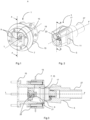
- Fig. 1
- eine perspektivische Ansicht auf ein lenkradseitiges Kupplungsteil eines Schnellkupplungssystems nach der Erfindung;
- Fig. 2
- eine perspektivische Ansicht auf ein fahrzeugseitiges Kupplungsteil eines Schnellkupplungssystems nach der Erfindung;
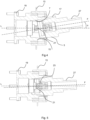
- Fig. 3
- eine Schnittansicht A-A des lenkradseitigen Kupplungsteil nach
Fig. 1 und eine Schnittansicht B-B des fahrzeugseitigen Kupplungsteils nachFig. 2 kurz bevor die Kupplungsteile nachFig. 1 und Fig. 2 bei korrekter Orientierung zueinander ineinander geschoben werden: - Fig. 4
- eine Schnittansicht nach
Fig. 3 , bei der die Kupplungsteile nachFig. 1 und Fig. 2 bereits zu einem Teil ineinander geschoben sind; - Fig. 5
- eine Schnittansicht nach
Fig. 3 undFig. 4 , bei der die Kupplungsteile nachFig. 1 und Fig. 2 bereits zu einem größeren Teil ineinander geschoben sind, aber noch keine Kontaktierung der elektrischen Verbindungselemente vorliegt: - Fig. 6
- eine Schnittansicht nach
Fig. 3 ,Fig. 4 und Fig. 5 , bei dem die Kupplungsteile nachFig. 1 und Fig. 2 vollends ineinander geschoben sind und - Fig. 7
- eine Schnittansicht analog
Fig. 3 bei einer nicht korrekten Orientierung der Kupplungsteile zueinander. - Das in
Fig. 1 dargestellte lenkradseitige Kupplungsteil 1 weist ab seiner Vorderseite eine Aufnahme 7 in Form einer rechteckigen Öffnung. In diese Öffnung 7 kann das inFig. 2 dargestellte fahrzeugseitige Kupplungsteil 3 mit seinem Kopf 5 eingeschoben werden. - An seiner Rückseite weist das lenkradseitige Kupplungsteil 1 eine Befestigung 19 in Form eines Flansches für ein in der Zeichnung nicht dargestelltes Lenkrad auf.
- Wie aus
Fig. 2 ersichtlich, besitzt der Kopf 5 des Kupplungsteils 3 ein im Wesentlichen rechteckiges Profil, das konisch bzw. sich zum vorderen Ende verjüngend ausgebildet ist. An seiner Rückseite ist das Kupplungsteil orts- und drehfest mit einer Lenksäule 27 eines Fahrzeuges oder einer wheel box eines Simulator- oder Spielsystems verbunden. - Wie aus
Fig. 3 ersichtlich, ist die Öffnung bzw. Aufnahme 7 im Profil komplementär zum Kopf 5 ausgebildet und verjüngt sich in Richtung ihrer Tiefe. - Wird der Kopf 5 in korrekter Orientierung in die Aufnahme 7 zur Gänze eingeschoben, greifen Stäbe 9 in am Außenumfang des Kopfes 5 ausgebildete Längsnuten 11 ein, so dass die mechanische Verbindung der Kupplungsteile in dieser Position verriegelt ist.
- Um die Stäbe 9 in radialer Richtung nach außen beweglich freizugeben, kann eine am Kupplungsteil 1 angeordnete Hülse 13 gegen eine Federkraft (Federn 25) in axialer Richtung zurückgezogen werden und der Kopf 5 aus der Aufnahme 7 herausgezogen werden.
- Um eine korrekte Orientierung beim Ineinanderschieben der Kupplungsteile 1 und 3 zu gewährleisten, weist der Kopf 5 wenigsten an einer Stelle im Profil ein Eingriffselement 15, beispielsweise in Form einer Ausnehmung 17, auf. Komplementär hierzu weist die Aufnahme 7 im Profil ein Eingriffselement 15, beispielsweise in Form eines Vorsprungs, auf.
- Bei einem Ineinanderschieben der Kupplungsteile 1 und 3 greifen die Eingriffselemente 15 und 17 derart, beispielsweise in Form von Nut und Feder, ineinander, so dass eine korrekte Orientierung der axialen Drehposition bereits beim ersten Ineinanderschieben bis zur kompletten Montage gewährleistet wird.
- Wie aus
Fig. 4 ersichtlich, ist eine parallele oder gar konzentrischen Lage der Längsachsen L und F der Kupplungsteile 1 und 3 nicht erforderlich, da ein zwischen Außenumfang des Kopfes 5 und Aufnahme 7 vorhandenes Spiel auch eine Schrägstellung der Kupplungsteile 1 und 3 zueinander erlaubt, so dass ein Winkel α von bis zu 25°, vorzugsweise bis zu 15° zwischen Achsen L und F möglich ist, ohne dass hierdurch ein Ineinanderschieben verhindert wird. - Durch das abhängig von der Einschubtiefe geringer werdende Spiel zentriert sich der Kopf 5 in der Aufnahme 7 selbsttätig, so dass der Winkel α immer kleiner wird und in der Endlage einer kompletten Montage zu Null wird.
- Durch das Zusammenwirken der Eingriffselemente wird daher bereits beim Ansetzen die korrekte Orientierung der Kupplungsteile 1 und 3 zueinander und für ein Ineinanderschieben gewährleistet, und damit ein Ineinanderschieben in nicht korrekter Orientierung verhindert bzw. eine fehlerhafte Orientierung gleich zu Beginn der Montage bemerkt.
- Weiterhin wirkt ein vorzugsweise vorhandenes Spiel (beispielsweise die zueinander komplementäre konische Ausbildung von Kopf 5 und Aufnahme 7), das sich beim Einschieben verringert als Einführ- und Zentrierhilfe, um eine korrekte Endlage zu gewährleisten.
- Wie aus
Fig. 5 ersichtlich, kann durch entsprechende Verringerung des Spiels auch eine einwandfreie elektrische Kontaktierung der Steckkontakte 21 und 23 ermöglicht werden. Das Spiel und damit der Winkel α ist in dieser Einschubtiefe so gering, dass bei einem weiteren Einschieben die Kontakte 21 und 23 selbsttätig lagerichtig ineinandergreifen. - Die Kontakte 21 des Kupplungsteils 1 sind hierbei, wie in
Fig. 1 und Fig. 3 bisFig. 7 soweit im Inneren, vorzugsweis im Bereich des Bodens der Aufnahme 7 angeordnet, so dass sie erst zu einem späten Zeitpunkt in im Wesentlichen lagerichtiger Position, beispielsweise erst ab der Hälfte vorzugsweise 4/5 der kompletten Einschubtiefe mit den Kontakten 23, in Verbindung kommen. - Auf diese Weise wird einer mechanischen Beschädigung durch unachtsame Handhabung vorgebeugt. Zudem wird eine - schlimmstenfalls unbemerkte - nicht korrekte Montage (aber dennoch wenigstens temporäre kraft- oder formschlüssige Verbindung) verhindert, ohne dass hierdurch ein Zeitverlust bei Montage oder Demontage des Schnellkupplungssystems auftritt.
- Die Funktionsweise des erfindungsgemäßen Schnellkupplungssystems wird im Folgenden kurz beschrieben:
Bei der Montage werden durch ein Zurückziehen der Hülse 13 die (Klemm-)Stäbe 9 zur Seite geschoben und der Kopf 5 kann in die Aufnahme 7 eingesetzt werden. - Das Querschnittsprofil ist, wie oben erläutert, ähnlich einem einfachen Schlüssel-Schloss-System gestaltet, so dass die Kupplungsteile 1 und 3 nur dann ineinandergeschoben werden können bzw. der Kopf in die Aufnahme 7 nur dann eingesetzt werden kann, wenn die Orientierung richtig ist.
- Wird dies in anderer Orientierung, z.B. unter 90° oder 180° versucht, ist die mögliche Stecktiefe so gering, dass keine Verbindung zu Stande kommen kann und dies dem Benutzer auch in Stresssituationen sofort klar wird.
- Das Längsprofil verläuft konisch, damit - je weiter der Kopf 5 in die Aufnahme 7 eingeführt wird - sich vor allem das radiale Spiel verkleinert. Der Kontakt der elektrischen Steckverbindung 21, 23 kommt erst dann zu Stande, wenn Stifte 21 und Buchsen 23 sich genau gegenüberliegen. Auf die Art werden mechanische Beschädigungen an den Steckkontakten 21, 23 verhindert.
- Wird nun die Hülse 13 losgelassen, wird sie von den Federn 25 in die Ausgangslage zurückgedrückt, wobei die Klemmstäbe 9 in die entsprechenden Vertiefungen bzw. Nuten 11 des Kupplungsteils 3 (Kopf 5) eintauchen, jedoch vorzugsweise nicht den Grund berühren und deshalb das System unter Spannung bleibt.
- Durch die bevorzugte Ausführung der Nuten 11 als Schrägen findet eine Kraftübersetzung statt, durch die die Klemmkraft zwischen den Kupplungsteilen 1 und 3 um ein Vielfaches höher ist als die Kraft der verwendeten Federn 25. Auf diese Weise bleibt die Verbindung möglichst spielarm.
-
- 1
- Kupplungsteil lenkradseitig (Buchse)
- 3
- Kupplungsteil fahrzeugseitig (Stecker)
- 5
- Kopf von 3
- 7
- Aufnahme von 1
- 9
- (Klemm-)Stäbe (Verriegelung)
- 11
- Nuten für Stäbe 9
- 13
- Hülse (axial beweglich mit Feder vorgespannt)
- 15
- Eingriffselement (Feder bzw. Nase/Vorsprung)
- 17
- Eingriffselement (Nut) für 15
- 19
- Befestigung für Lenkrad
- 21
- Steckkontakte (Stecker)
- 23
- Steckkontakte (Buchsen)
- 25
- Federn
- 27
- Lenksäule
- L
- Längsachse des Kupplungsteils 1
- F
- Längsachse des Kupplungsteils 3
- α
- Winkel zwischen Mittellängsachsen L und F
Claims (5)
- Schnellkupplungssystem für ein Lenkrad, insbesondere für Rennsportfahrzeuge, mit einem lenkradseitigen Kupplungsteil (1) und einem fahrzeugseitigen Kupplungsteil (3), welche im montierten Zustand mechanisch formschlüssig ineinandergreifen,das fahrzeugseitige Kupplungsteil (3) wenigstens ein Eingriffselement (17) und das lenkradseitige Kupplungsteil (1) ein hierzu komplementäres Element (15) aufweisen, die nur bei korrekter Orientierung bezüglich der längsaxialen Drehposition in Eingriff kommen und die Kupplungsteile (1, 3) in Richtung der Längsachse ineinandergeschoben werden können,dadurch gekennzeichnet, dassdas Schnellkupplungssystem elektrische Verbindungselemente (21, 23) aufweist, die im montierten Zustand eine elektrische Verbindung herstellen, wobei die elektrischen Verbindungselemente (21, 23) soweit im hinteren Bereich des Kupplungsteils (1) und/oder des Kupplungsteils (3) angeordnet sind, dass die elektrischen Verbindungselemente (21, 23) bei der Montage der Kupplungsteile (1, 3) erst in Verbindung kommen, wenn sowohl die korrekte Orientierung bezüglich der längsaxialen Drehposition als auch eine konzentrische Positionierung hinsichtlich der Ausrichtung der Längsmittelachsen (L, F) vorliegt, wenigstens im vordersten der ineinander in Eingriff zu bringenden Bereiche wenigstens eines Kupplungsteils (1, 3) eine Einführhilfe und/oder Zentrierungshilfe angeordnet ist unddie Einführhilfe und/oder Zentrierungshilfe in Form wenigstens eines sich einer in Richtung der Längsachse zum vorderen Bereich hin verjüngenden oder erweiternden Kupplungsteils (3) ausgebildet ist,wobei die Eingriffselemente (15, 17) jeweils wenigstens im vorderen der ineinander in Eingriff zu bringenden Bereiche der Kupplungsteile (1, 3) angeordnet sind und derart zusammenwirken, dass bereits ein teilweises Ineinanderschieben in nicht korrekter Orientierung verhindert wird.
- Schnellkupplungssystem nach Anspruch 1, dadurch gekennzeichnet, dass die Eingriffselemente (15, 17) in Form eines nicht rotationssymmetrischen Außenumfangs und eines hierzu komplementären Innenumfangs ausgebildet sind.
- Schnellkupplungssystem nach Anspruch 1 oder 2, dadurch gekennzeichnet, dass die elektrischen Verbindungselemente (21, 23) als Steckkontakte ausgebildet sind.
- Schnellkupplungssystem nach einem der vorhergehenden Ansprüche, dadurch gekennzeichnet, dass die Einführhilfe in Form eines Nutelements (17) und eines Federelements (15) ausgebildet ist, wobei das Nutelement (17) zum rückwärtigen Bereich hin eine geringer werdende Breite oder das Federelement (15) eine sich vergrößernde Breite aufweist, um das Federelement (15) beim Einführen zu zentrieren und korrekt zu positionieren.
- Verwendung eines Schnellkupplungssystems nach einem der vorhergehenden Ansprüche für ein Fahrzeug, für einen Simulator oder für eine Spielkonsole.
Applications Claiming Priority (2)
| Application Number | Priority Date | Filing Date | Title |
|---|---|---|---|
| DE202019105567.7U DE202019105567U1 (de) | 2019-10-09 | 2019-10-09 | Schnellkupplungssystem für ein Fahrzeuglenkrad |
| PCT/DE2020/100878 WO2021069031A1 (de) | 2019-10-09 | 2020-10-09 | Schnellkupplungssystem für ein fahrzeuglenkrad |
Publications (2)
| Publication Number | Publication Date |
|---|---|
| EP4041615A1 EP4041615A1 (de) | 2022-08-17 |
| EP4041615B1 true EP4041615B1 (de) | 2025-02-19 |
Family
ID=68499823
Family Applications (1)
| Application Number | Title | Priority Date | Filing Date |
|---|---|---|---|
| EP20799611.7A Active EP4041615B1 (de) | 2019-10-09 | 2020-10-09 | Schnellkupplungssystem für ein fahrzeuglenkrad |
Country Status (6)
| Country | Link |
|---|---|
| US (1) | US12116036B2 (de) |
| EP (1) | EP4041615B1 (de) |
| JP (1) | JP7682172B2 (de) |
| CN (1) | CN114514159B (de) |
| DE (1) | DE202019105567U1 (de) |
| WO (1) | WO2021069031A1 (de) |
Families Citing this family (5)
| Publication number | Priority date | Publication date | Assignee | Title |
|---|---|---|---|---|
| CN115107852A (zh) * | 2021-03-19 | 2022-09-27 | 奥托立夫开发公司 | 用于方向盘和转向管柱的快拆组件 |
| EP4213131B1 (de) * | 2021-11-07 | 2024-09-25 | Asetek Danmark A/S | Lenkradverbinder für fahrzeugsimulator |
| DE102022108814B4 (de) | 2022-04-12 | 2024-09-05 | Harmonic Drive Se | Kupplungsvorrichtung zur Verbindung von Bauteilen |
| EP4520413A1 (de) | 2023-09-07 | 2025-03-12 | Endor AG | Lenkradbasis für spielanwendungen |
| CN119905859B (zh) * | 2025-04-02 | 2025-08-05 | 济南友丰电子有限公司 | 一种无人驾驶汽车用高频传输线连接装置 |
Family Cites Families (14)
| Publication number | Priority date | Publication date | Assignee | Title |
|---|---|---|---|---|
| GB199959A (en) * | 1922-07-12 | 1923-07-05 | Harry Joyce | Improvements relating to the wheel steering mechanism of automobiles and other road vehicles |
| JPH0741657Y2 (ja) * | 1988-12-15 | 1995-09-27 | 小松フォークリフト株式会社 | ハンドル脱着装置 |
| FR2812607B1 (fr) * | 2000-08-04 | 2003-01-17 | Autoliv Isodelta | Colonne de direction pour un systeme de direction de vehicule automobile |
| JP3690669B2 (ja) * | 2002-01-25 | 2005-08-31 | 成珍 岩田 | 自動車用ステアリングホイールの取付ユニット |
| KR20040088214A (ko) * | 2003-04-09 | 2004-10-16 | 현대모비스 주식회사 | 자동차의 축 및 조향휠의 결합구조 |
| JP2005087580A (ja) * | 2003-09-19 | 2005-04-07 | Toyota Motor Corp | ゲーム兼用自動車 |
| US20130118297A1 (en) * | 2011-11-15 | 2013-05-16 | Seng Toh GOH | Anti-theft steering wheel |
| CN102616267A (zh) * | 2012-04-18 | 2012-08-01 | 北京汽车股份有限公司 | 一种车辆转向系统及车辆 |
| GB201402020D0 (en) * | 2014-02-06 | 2014-03-26 | Automotive Ltd Spa | Coupling |
| CN104386113A (zh) * | 2014-10-22 | 2015-03-04 | 王能仓 | 一种赛车方向盘快拆结构 |
| DE102015219644A1 (de) * | 2015-10-09 | 2017-04-13 | Ford Global Technologies, Llc | Steckverbindung zwischen einem Lenkrad und einer Lenkstange sowie Lenkrad und Lenkstange zur Ausbildung einer Steckverbindung |
| DE102015219645A1 (de) * | 2015-10-09 | 2017-04-13 | Ford Global Technologies, Llc | Steckverbindung zwischen einem Lenkrad und einer Lenkstange sowie Lenkrad und Lenkstange zur Ausbildung einer Steckverbindung |
| CN205059711U (zh) * | 2015-10-29 | 2016-03-02 | 安徽江淮汽车股份有限公司 | 方向盘轮毂及方向盘 |
| CN205952045U (zh) * | 2016-07-24 | 2017-02-15 | 南京珑瑞柯创汽车科技有限公司 | 一种汽车的方向盘快速拆装结构 |
-
2019
- 2019-10-09 DE DE202019105567.7U patent/DE202019105567U1/de active Active
-
2020
- 2020-10-09 US US17/767,599 patent/US12116036B2/en active Active
- 2020-10-09 CN CN202080067775.4A patent/CN114514159B/zh active Active
- 2020-10-09 JP JP2022521090A patent/JP7682172B2/ja active Active
- 2020-10-09 WO PCT/DE2020/100878 patent/WO2021069031A1/de not_active Ceased
- 2020-10-09 EP EP20799611.7A patent/EP4041615B1/de active Active
Also Published As
| Publication number | Publication date |
|---|---|
| WO2021069031A1 (de) | 2021-04-15 |
| US12116036B2 (en) | 2024-10-15 |
| DE202019105567U1 (de) | 2019-10-23 |
| CN114514159A (zh) | 2022-05-17 |
| JP2022551304A (ja) | 2022-12-08 |
| CN114514159B (zh) | 2024-09-03 |
| US20240075978A1 (en) | 2024-03-07 |
| EP4041615A1 (de) | 2022-08-17 |
| JP7682172B2 (ja) | 2025-05-23 |
Similar Documents
| Publication | Publication Date | Title |
|---|---|---|
| EP4041615B1 (de) | Schnellkupplungssystem für ein fahrzeuglenkrad | |
| DE2345365C3 (de) | Elektrische Steckverbindung | |
| EP2739520B1 (de) | Lenkspindelanordnung | |
| DE2332427C2 (de) | Elektrischer Steckverbinder | |
| DE69424694T2 (de) | Runde Durchführungsverbinderanordnung | |
| DE69222400T2 (de) | Universelles Werkzeug zum Lösen von Schnellkupplungen | |
| DE102015219644A1 (de) | Steckverbindung zwischen einem Lenkrad und einer Lenkstange sowie Lenkrad und Lenkstange zur Ausbildung einer Steckverbindung | |
| DE102011109705A1 (de) | Lenkungsanordnung | |
| DE68920712T2 (de) | Elektrischer Kontakt nicht unter Last trennbar, insbesondere für gekuppelte Apparate oder Fahrzeuge. | |
| DE102014209731A1 (de) | Lenkung und Kraftfahrzeug | |
| WO2008128501A1 (de) | Hydraulische steckverbindung | |
| DE102018128203A1 (de) | Elektrisches Steckverbinderteil und elektrisches Steckverbindungssystem mit Verriegelung | |
| DE102015216145A1 (de) | Sichtsystem für fahrzeuge | |
| EP2405147B1 (de) | Befestigungsbaugruppe | |
| DE69405846T2 (de) | Lenksäuleneinheit, insbesondere für ein Kraftfahrzeug | |
| EP3077270B1 (de) | Lenksäulenanordnung, mantelrohr für eine lenksäulenanordnung, und fahrzeug mit einer lenksäulenanordnung | |
| DE102007010836B4 (de) | Spannflansch | |
| DE102024000570B4 (de) | Lenkungsanordnung mit Schraubenführung für ein Fahrzeug, sowie Verfahren zum Herstellen einer Lenkungsanordnung | |
| DE102015219645A1 (de) | Steckverbindung zwischen einem Lenkrad und einer Lenkstange sowie Lenkrad und Lenkstange zur Ausbildung einer Steckverbindung | |
| DE102017221574A1 (de) | Batteriestecker-Betätigungssystem | |
| EP3334635B1 (de) | Sicherungsvorrichtung für eine wellenanordnung und verfahren zur zeitweiligen einschränkung der bewegungsfreiheit eines universalgelenks | |
| AT504478B1 (de) | Niederhalter | |
| AT527497B1 (de) | Steckverbinder zur fluidischen Verbindung einer Fluidleitung mit einem Stutzen | |
| DE202015106038U1 (de) | Steckverbindung zwischen einem Lenkrad und einer Lenkstange sowie Lenkrad und Lenkstange zur Ausbildung einer Steckverbindung | |
| DE102006048855B4 (de) | Verbindungsanordnung |
Legal Events
| Date | Code | Title | Description |
|---|---|---|---|
| STAA | Information on the status of an ep patent application or granted ep patent |
Free format text: STATUS: UNKNOWN |
|
| STAA | Information on the status of an ep patent application or granted ep patent |
Free format text: STATUS: THE INTERNATIONAL PUBLICATION HAS BEEN MADE |
|
| PUAI | Public reference made under article 153(3) epc to a published international application that has entered the european phase |
Free format text: ORIGINAL CODE: 0009012 |
|
| STAA | Information on the status of an ep patent application or granted ep patent |
Free format text: STATUS: REQUEST FOR EXAMINATION WAS MADE |
|
| 17P | Request for examination filed |
Effective date: 20220401 |
|
| AK | Designated contracting states |
Kind code of ref document: A1 Designated state(s): AL AT BE BG CH CY CZ DE DK EE ES FI FR GB GR HR HU IE IS IT LI LT LU LV MC MK MT NL NO PL PT RO RS SE SI SK SM TR |
|
| DAV | Request for validation of the european patent (deleted) | ||
| DAX | Request for extension of the european patent (deleted) | ||
| GRAP | Despatch of communication of intention to grant a patent |
Free format text: ORIGINAL CODE: EPIDOSNIGR1 |
|
| STAA | Information on the status of an ep patent application or granted ep patent |
Free format text: STATUS: GRANT OF PATENT IS INTENDED |
|
| INTG | Intention to grant announced |
Effective date: 20240912 |
|
| GRAS | Grant fee paid |
Free format text: ORIGINAL CODE: EPIDOSNIGR3 |
|
| GRAA | (expected) grant |
Free format text: ORIGINAL CODE: 0009210 |
|
| STAA | Information on the status of an ep patent application or granted ep patent |
Free format text: STATUS: THE PATENT HAS BEEN GRANTED |
|
| AK | Designated contracting states |
Kind code of ref document: B1 Designated state(s): AL AT BE BG CH CY CZ DE DK EE ES FI FR GB GR HR HU IE IS IT LI LT LU LV MC MK MT NL NO PL PT RO RS SE SI SK SM TR |
|
| REG | Reference to a national code |
Ref country code: GB Ref legal event code: FG4D Free format text: NOT ENGLISH |
|
| REG | Reference to a national code |
Ref country code: CH Ref legal event code: EP |
|
| REG | Reference to a national code |
Ref country code: DE Ref legal event code: R096 Ref document number: 502020010444 Country of ref document: DE |
|
| REG | Reference to a national code |
Ref country code: IE Ref legal event code: FG4D Free format text: LANGUAGE OF EP DOCUMENT: GERMAN |
|
| REG | Reference to a national code |
Ref country code: NL Ref legal event code: FP |
|
| REG | Reference to a national code |
Ref country code: DE Ref legal event code: R081 Ref document number: 502020010444 Country of ref document: DE Owner name: CORSAIR MEMORY, INC. (N.D.GES.D. STAATES DELAW, US Free format text: FORMER OWNER: ENDOR AKTIENGESELLSCHAFT, 84034 LANDSHUT, DE |
|
| PG25 | Lapsed in a contracting state [announced via postgrant information from national office to epo] |
Ref country code: RS Free format text: LAPSE BECAUSE OF FAILURE TO SUBMIT A TRANSLATION OF THE DESCRIPTION OR TO PAY THE FEE WITHIN THE PRESCRIBED TIME-LIMIT Effective date: 20250519 |
|
| PG25 | Lapsed in a contracting state [announced via postgrant information from national office to epo] |
Ref country code: FI Free format text: LAPSE BECAUSE OF FAILURE TO SUBMIT A TRANSLATION OF THE DESCRIPTION OR TO PAY THE FEE WITHIN THE PRESCRIBED TIME-LIMIT Effective date: 20250219 |
|
| PG25 | Lapsed in a contracting state [announced via postgrant information from national office to epo] |
Ref country code: PL Free format text: LAPSE BECAUSE OF FAILURE TO SUBMIT A TRANSLATION OF THE DESCRIPTION OR TO PAY THE FEE WITHIN THE PRESCRIBED TIME-LIMIT Effective date: 20250219 |
|
| REG | Reference to a national code |
Ref country code: NL Ref legal event code: PD Owner name: CORSAIR MEMORY, INC.; US Free format text: DETAILS ASSIGNMENT: CHANGE OF OWNER(S), ASSIGNMENT; FORMER OWNER NAME: ENDOR AKTIENGESELLSCHAFT Effective date: 20250703 |
|
| PG25 | Lapsed in a contracting state [announced via postgrant information from national office to epo] |
Ref country code: ES Free format text: LAPSE BECAUSE OF FAILURE TO SUBMIT A TRANSLATION OF THE DESCRIPTION OR TO PAY THE FEE WITHIN THE PRESCRIBED TIME-LIMIT Effective date: 20250219 |
|
| REG | Reference to a national code |
Ref country code: LT Ref legal event code: MG9D |
|
| PG25 | Lapsed in a contracting state [announced via postgrant information from national office to epo] |
Ref country code: IS Free format text: LAPSE BECAUSE OF FAILURE TO SUBMIT A TRANSLATION OF THE DESCRIPTION OR TO PAY THE FEE WITHIN THE PRESCRIBED TIME-LIMIT Effective date: 20250619 Ref country code: NO Free format text: LAPSE BECAUSE OF FAILURE TO SUBMIT A TRANSLATION OF THE DESCRIPTION OR TO PAY THE FEE WITHIN THE PRESCRIBED TIME-LIMIT Effective date: 20250519 |
|
| PG25 | Lapsed in a contracting state [announced via postgrant information from national office to epo] |
Ref country code: HR Free format text: LAPSE BECAUSE OF FAILURE TO SUBMIT A TRANSLATION OF THE DESCRIPTION OR TO PAY THE FEE WITHIN THE PRESCRIBED TIME-LIMIT Effective date: 20250219 |
|
| PG25 | Lapsed in a contracting state [announced via postgrant information from national office to epo] |
Ref country code: LV Free format text: LAPSE BECAUSE OF FAILURE TO SUBMIT A TRANSLATION OF THE DESCRIPTION OR TO PAY THE FEE WITHIN THE PRESCRIBED TIME-LIMIT Effective date: 20250219 Ref country code: PT Free format text: LAPSE BECAUSE OF FAILURE TO SUBMIT A TRANSLATION OF THE DESCRIPTION OR TO PAY THE FEE WITHIN THE PRESCRIBED TIME-LIMIT Effective date: 20250620 |
|
| PG25 | Lapsed in a contracting state [announced via postgrant information from national office to epo] |
Ref country code: GR Free format text: LAPSE BECAUSE OF FAILURE TO SUBMIT A TRANSLATION OF THE DESCRIPTION OR TO PAY THE FEE WITHIN THE PRESCRIBED TIME-LIMIT Effective date: 20250520 Ref country code: BG Free format text: LAPSE BECAUSE OF FAILURE TO SUBMIT A TRANSLATION OF THE DESCRIPTION OR TO PAY THE FEE WITHIN THE PRESCRIBED TIME-LIMIT Effective date: 20250219 |
|
| RAP2 | Party data changed (patent owner data changed or rights of a patent transferred) |
Owner name: CORSAIR MEMORY, INC. |
|
| REG | Reference to a national code |
Ref country code: GB Ref legal event code: 732E Free format text: REGISTERED BETWEEN 20250710 AND 20250716 |
|
| PG25 | Lapsed in a contracting state [announced via postgrant information from national office to epo] |
Ref country code: SE Free format text: LAPSE BECAUSE OF FAILURE TO SUBMIT A TRANSLATION OF THE DESCRIPTION OR TO PAY THE FEE WITHIN THE PRESCRIBED TIME-LIMIT Effective date: 20250219 |
|
| PG25 | Lapsed in a contracting state [announced via postgrant information from national office to epo] |
Ref country code: SM Free format text: LAPSE BECAUSE OF FAILURE TO SUBMIT A TRANSLATION OF THE DESCRIPTION OR TO PAY THE FEE WITHIN THE PRESCRIBED TIME-LIMIT Effective date: 20250219 |
|
| PG25 | Lapsed in a contracting state [announced via postgrant information from national office to epo] |
Ref country code: DK Free format text: LAPSE BECAUSE OF FAILURE TO SUBMIT A TRANSLATION OF THE DESCRIPTION OR TO PAY THE FEE WITHIN THE PRESCRIBED TIME-LIMIT Effective date: 20250219 |
|
| PG25 | Lapsed in a contracting state [announced via postgrant information from national office to epo] |
Ref country code: EE Free format text: LAPSE BECAUSE OF FAILURE TO SUBMIT A TRANSLATION OF THE DESCRIPTION OR TO PAY THE FEE WITHIN THE PRESCRIBED TIME-LIMIT Effective date: 20250219 Ref country code: CZ Free format text: LAPSE BECAUSE OF FAILURE TO SUBMIT A TRANSLATION OF THE DESCRIPTION OR TO PAY THE FEE WITHIN THE PRESCRIBED TIME-LIMIT Effective date: 20250219 |
|
| PG25 | Lapsed in a contracting state [announced via postgrant information from national office to epo] |
Ref country code: RO Free format text: LAPSE BECAUSE OF FAILURE TO SUBMIT A TRANSLATION OF THE DESCRIPTION OR TO PAY THE FEE WITHIN THE PRESCRIBED TIME-LIMIT Effective date: 20250219 |
|
| PG25 | Lapsed in a contracting state [announced via postgrant information from national office to epo] |
Ref country code: SK Free format text: LAPSE BECAUSE OF FAILURE TO SUBMIT A TRANSLATION OF THE DESCRIPTION OR TO PAY THE FEE WITHIN THE PRESCRIBED TIME-LIMIT Effective date: 20250219 |
|
| PGFP | Annual fee paid to national office [announced via postgrant information from national office to epo] |
Ref country code: NL Payment date: 20251023 Year of fee payment: 6 |
|
| REG | Reference to a national code |
Ref country code: DE Ref legal event code: R097 Ref document number: 502020010444 Country of ref document: DE |
|
| PLBE | No opposition filed within time limit |
Free format text: ORIGINAL CODE: 0009261 |
|
| STAA | Information on the status of an ep patent application or granted ep patent |
Free format text: STATUS: NO OPPOSITION FILED WITHIN TIME LIMIT |
|
| PGFP | Annual fee paid to national office [announced via postgrant information from national office to epo] |
Ref country code: GB Payment date: 20251024 Year of fee payment: 6 |
|
| PGFP | Annual fee paid to national office [announced via postgrant information from national office to epo] |
Ref country code: IT Payment date: 20251031 Year of fee payment: 6 |
|
| PGFP | Annual fee paid to national office [announced via postgrant information from national office to epo] |
Ref country code: FR Payment date: 20251027 Year of fee payment: 6 |
|
| 26N | No opposition filed |
Effective date: 20251120 |
|
| PGFP | Annual fee paid to national office [announced via postgrant information from national office to epo] |
Ref country code: DE Payment date: 20251218 Year of fee payment: 6 |