EP4037015B1 - Negativelektrode für lithium-ionen-sekundärbatterie sowie lithium-ionen-sekundärbatterie - Google Patents
Negativelektrode für lithium-ionen-sekundärbatterie sowie lithium-ionen-sekundärbatterie Download PDFInfo
- Publication number
- EP4037015B1 EP4037015B1 EP20869072.7A EP20869072A EP4037015B1 EP 4037015 B1 EP4037015 B1 EP 4037015B1 EP 20869072 A EP20869072 A EP 20869072A EP 4037015 B1 EP4037015 B1 EP 4037015B1
- Authority
- EP
- European Patent Office
- Prior art keywords
- layer
- negative electrode
- lithium ion
- ion secondary
- secondary battery
- Prior art date
- Legal status (The legal status is an assumption and is not a legal conclusion. Google has not performed a legal analysis and makes no representation as to the accuracy of the status listed.)
- Active
Links
Images

Classifications
-
- H—ELECTRICITY
- H01—ELECTRIC ELEMENTS
- H01M—PROCESSES OR MEANS, e.g. BATTERIES, FOR THE DIRECT CONVERSION OF CHEMICAL ENERGY INTO ELECTRICAL ENERGY
- H01M4/00—Electrodes
- H01M4/02—Electrodes composed of, or comprising, active material
- H01M4/36—Selection of substances as active materials, active masses, active liquids
- H01M4/58—Selection of substances as active materials, active masses, active liquids of inorganic compounds other than oxides or hydroxides, e.g. sulfides, selenides, tellurides, halogenides or LiCoFy; of polyanionic structures, e.g. phosphates, silicates or borates
- H01M4/583—Carbonaceous material, e.g. graphite-intercalation compounds or CFx
-
- H—ELECTRICITY
- H01—ELECTRIC ELEMENTS
- H01M—PROCESSES OR MEANS, e.g. BATTERIES, FOR THE DIRECT CONVERSION OF CHEMICAL ENERGY INTO ELECTRICAL ENERGY
- H01M4/00—Electrodes
- H01M4/02—Electrodes composed of, or comprising, active material
- H01M4/13—Electrodes for accumulators with non-aqueous electrolyte, e.g. for lithium-accumulators; Processes of manufacture thereof
- H01M4/134—Electrodes based on metals, Si or alloys
-
- H—ELECTRICITY
- H01—ELECTRIC ELEMENTS
- H01M—PROCESSES OR MEANS, e.g. BATTERIES, FOR THE DIRECT CONVERSION OF CHEMICAL ENERGY INTO ELECTRICAL ENERGY
- H01M10/00—Secondary cells; Manufacture thereof
- H01M10/05—Accumulators with non-aqueous electrolyte
- H01M10/052—Li-accumulators
- H01M10/0525—Rocking-chair batteries, i.e. batteries with lithium insertion or intercalation in both electrodes; Lithium-ion batteries
-
- H—ELECTRICITY
- H01—ELECTRIC ELEMENTS
- H01M—PROCESSES OR MEANS, e.g. BATTERIES, FOR THE DIRECT CONVERSION OF CHEMICAL ENERGY INTO ELECTRICAL ENERGY
- H01M4/00—Electrodes
- H01M4/02—Electrodes composed of, or comprising, active material
- H01M4/13—Electrodes for accumulators with non-aqueous electrolyte, e.g. for lithium-accumulators; Processes of manufacture thereof
- H01M4/133—Electrodes based on carbonaceous material, e.g. graphite-intercalation compounds or CFx
-
- H—ELECTRICITY
- H01—ELECTRIC ELEMENTS
- H01M—PROCESSES OR MEANS, e.g. BATTERIES, FOR THE DIRECT CONVERSION OF CHEMICAL ENERGY INTO ELECTRICAL ENERGY
- H01M4/00—Electrodes
- H01M4/02—Electrodes composed of, or comprising, active material
- H01M4/36—Selection of substances as active materials, active masses, active liquids
- H01M4/362—Composites
- H01M4/364—Composites as mixtures
-
- H—ELECTRICITY
- H01—ELECTRIC ELEMENTS
- H01M—PROCESSES OR MEANS, e.g. BATTERIES, FOR THE DIRECT CONVERSION OF CHEMICAL ENERGY INTO ELECTRICAL ENERGY
- H01M4/00—Electrodes
- H01M4/02—Electrodes composed of, or comprising, active material
- H01M4/36—Selection of substances as active materials, active masses, active liquids
- H01M4/362—Composites
- H01M4/366—Composites as layered products
-
- H—ELECTRICITY
- H01—ELECTRIC ELEMENTS
- H01M—PROCESSES OR MEANS, e.g. BATTERIES, FOR THE DIRECT CONVERSION OF CHEMICAL ENERGY INTO ELECTRICAL ENERGY
- H01M4/00—Electrodes
- H01M4/02—Electrodes composed of, or comprising, active material
- H01M4/36—Selection of substances as active materials, active masses, active liquids
- H01M4/38—Selection of substances as active materials, active masses, active liquids of elements or alloys
- H01M4/40—Alloys based on alkali metals
- H01M4/405—Alloys based on lithium
-
- H—ELECTRICITY
- H01—ELECTRIC ELEMENTS
- H01M—PROCESSES OR MEANS, e.g. BATTERIES, FOR THE DIRECT CONVERSION OF CHEMICAL ENERGY INTO ELECTRICAL ENERGY
- H01M4/00—Electrodes
- H01M4/02—Electrodes composed of, or comprising, active material
- H01M4/36—Selection of substances as active materials, active masses, active liquids
- H01M4/58—Selection of substances as active materials, active masses, active liquids of inorganic compounds other than oxides or hydroxides, e.g. sulfides, selenides, tellurides, halogenides or LiCoFy; of polyanionic structures, e.g. phosphates, silicates or borates
- H01M4/583—Carbonaceous material, e.g. graphite-intercalation compounds or CFx
- H01M4/587—Carbonaceous material, e.g. graphite-intercalation compounds or CFx for inserting or intercalating light metals
-
- H—ELECTRICITY
- H01—ELECTRIC ELEMENTS
- H01M—PROCESSES OR MEANS, e.g. BATTERIES, FOR THE DIRECT CONVERSION OF CHEMICAL ENERGY INTO ELECTRICAL ENERGY
- H01M4/00—Electrodes
- H01M4/02—Electrodes composed of, or comprising, active material
- H01M4/62—Selection of inactive substances as ingredients for active masses, e.g. binders, fillers
- H01M4/621—Binders
- H01M4/622—Binders being polymers
-
- H—ELECTRICITY
- H01—ELECTRIC ELEMENTS
- H01M—PROCESSES OR MEANS, e.g. BATTERIES, FOR THE DIRECT CONVERSION OF CHEMICAL ENERGY INTO ELECTRICAL ENERGY
- H01M4/00—Electrodes
- H01M4/02—Electrodes composed of, or comprising, active material
- H01M4/62—Selection of inactive substances as ingredients for active masses, e.g. binders, fillers
- H01M4/624—Electric conductive fillers
- H01M4/625—Carbon or graphite
-
- H—ELECTRICITY
- H01—ELECTRIC ELEMENTS
- H01M—PROCESSES OR MEANS, e.g. BATTERIES, FOR THE DIRECT CONVERSION OF CHEMICAL ENERGY INTO ELECTRICAL ENERGY
- H01M4/00—Electrodes
- H01M4/02—Electrodes composed of, or comprising, active material
- H01M2004/021—Physical characteristics, e.g. porosity, surface area
-
- H—ELECTRICITY
- H01—ELECTRIC ELEMENTS
- H01M—PROCESSES OR MEANS, e.g. BATTERIES, FOR THE DIRECT CONVERSION OF CHEMICAL ENERGY INTO ELECTRICAL ENERGY
- H01M4/00—Electrodes
- H01M4/02—Electrodes composed of, or comprising, active material
- H01M2004/026—Electrodes composed of, or comprising, active material characterised by the polarity
- H01M2004/027—Negative electrodes
-
- Y—GENERAL TAGGING OF NEW TECHNOLOGICAL DEVELOPMENTS; GENERAL TAGGING OF CROSS-SECTIONAL TECHNOLOGIES SPANNING OVER SEVERAL SECTIONS OF THE IPC; TECHNICAL SUBJECTS COVERED BY FORMER USPC CROSS-REFERENCE ART COLLECTIONS [XRACs] AND DIGESTS
- Y02—TECHNOLOGIES OR APPLICATIONS FOR MITIGATION OR ADAPTATION AGAINST CLIMATE CHANGE
- Y02E—REDUCTION OF GREENHOUSE GAS [GHG] EMISSIONS, RELATED TO ENERGY GENERATION, TRANSMISSION OR DISTRIBUTION
- Y02E60/00—Enabling technologies; Technologies with a potential or indirect contribution to GHG emissions mitigation
- Y02E60/10—Energy storage using batteries
Definitions
- the present disclosure relates to a negative electrode for a lithium ion secondary battery, and to a lithium ion secondary battery.
- lithium ion secondary batteries are widely in use which comprise a positive electrode, a negative electrode, and an electrolyte solution, and in which lithium ions are caused to move between the positive electrode and the negative electrode to charge or discharge the battery.
- Patent Literature 1 proposes a lithium ion secondary battery in which a fluorine-containing group is modified on a surface of the negative electrode so that affinity with the electrolyte solution is improved.
- the graphite particles B having the particle internal porosity of greater than 10% easily collapse during manufacturing of the negative electrode, an adhesiveness between the negative electrode electricity collector and the graphite particles B is high. Therefore, by placing the graphite particles B having the particle internal porosity of greater than 10% in the first layer disposed over the negative electrode electricity collector, detachment of the particles of a negative electrode active material from the negative electrode electricity collector can be suppressed, and the charge/discharge cycle characteristic of the lithium ion secondary battery can thus be improved.
- the casing body 16 is, for example, a metal container having a circular cylindrical shape with a bottom.
- a gasket 28 is provided between the casing body 16 and the sealing element 17, to secure airtightness in the battery.
- the casing body 16 has, for example, a protrusion 22 in which a part of a side surface portion of the casing body 16 protrudes to an inner side and which supports the sealing element 17.
- the protrusion 22 is desirably formed in an annular shape along a circumferential direction of the casing body 16, and supports the sealing element 17 with an upper surface thereof.
- the sealing element 17 has a structure in which a filter 23, a lower valve element 24, an insulating member 25, an upper valve element 26, and a cap 27 are layered in this order from the side of the electrode element 14.
- the members of the sealing element 17 have, for example, a circular disk shape or a ring shape, and members other than the insulating member 25 are electrically connected to each other.
- the lower valve element 24 and the upper valve element 26 are connected to each other at central parts thereof, and the insulating member 25 interposes between peripheral parts of the valve elements.
- the lower valve element 24 deforms in such a manner to press the upper valve element 26 toward the side of the cap 27, and ruptures, so that a current path between the lower valve element 24 and the upper valve element 26 is cut off.
- the upper valve element 26 ruptures, and gas is discharged from an opening of the cap 27.
- a positive electrode lead 20 attached to the positive electrode 11 extends through a throughhole of the insulating plate 18 to the side of the sealing element 17, and a negative electrode lead 21 attached to the negative electrode 12 extends through an outer side of the insulating plate 19 to the side of a bottom of the casing body 16.
- the positive electrode lead 20 is connected by welding or the like to a lower surface of the filter 23 which is a bottom plate of the sealing element 17, and the cap 27 which is a top plate of the sealing element 17 electrically connected to the filter 23 serves as a positive electrode terminal.
- the negative electrode lead 21 is connected by welding or the like to an inner surface of the bottom of the casing body 16, and the casing body 16 serves as a negative electrode terminal.
- the positive electrode 11 comprises a positive electrode electricity collector and a positive electrode mixture layer formed over the positive electrode electricity collector.
- the positive electrode electricity collector there may be employed a foil of a metal which is stable within a potential range of the positive electrode such as aluminum and an aluminum alloy, a film on a surface layer of which the metal is placed, or the like.
- the positive electrode mixture layer includes, for example, a positive electrode active material, a binder material, and an electrically conductive material. Desirably, the positive electrode mixture layer is formed over both surfaces of the positive electrode electricity collector.
- the positive electrode can be manufactured, for example, by applying a positive electrode mixture slurry including the positive electrode active material, the binder material, the electrically conductive material, or the like over the positive electrode electricity collector, drying the applied film, and rolling the dried film, to form the positive electrode mixture layer over both surfaces of the positive electrode electricity collector.
- the positive electrode active material includes a lithium-containing metal composite oxide as a primary constituent.
- metal elements contained in the lithium-containing metal composite oxide there may be exemplified Ni, Co, Mn, Al, B, Mg, Ti, V, Cr, Fe, Cu, Zn, Ga, Sr, Zr, Nb, In, Sn, Ta, W, Ca, Sb, Pb, Bi, and Ge.
- a desirable example of the lithium-containing metal composite oxide is a composite oxide containing at least one of Ni, Co, Mn, and Al.
- the electrically conductive material included in the positive electrode mixture layer there may be exemplified carbon materials such as carbon black, acetylene black, Ketjen black, graphite, or the like.
- the binder material included in the positive electrode mixture layer there may be exemplified a fluororesin such as polytetrafluoroethylene (PTFE), polyvinylidene fluoride (PVDF), or the like, polyacrylonitrile (PAN), polyimide, an acrylic resin, polyolefin, or the like.
- PTFE polytetrafluoroethylene
- PVDF polyvinylidene fluoride
- PAN polyacrylonitrile
- polyimide polyimide
- acrylic resin polyolefin
- CMC carboxymethyl cellulose
- PEO polyethylene oxide
- FIG. 2 is a cross-sectional diagram of a negative electrode according to an embodiment of the present disclosure.
- the negative electrode 12 shown in FIG. 2 comprises a negative electrode electricity collector 40, and a negative electrode mixture layer 42 formed over the negative electrode electricity collector 40.
- the negative electrode electricity collector 40 for example, there may be employed a foil of a metal which is stable within a potential range of the negative electrode such as copper and a copper alloy, a film on a surface layer of which the metal is placed.
- the first layer 44 includes, as a negative electrode active material, graphite particles B having a particle internal porosity of greater than 10%.
- the second layer 46 includes, as the negative electrode active material, graphite particles A having a particle internal porosity of 10% or lower. It is sufficient that the internal porosity of the graphite particles A be 10% or lower from the viewpoint of improving the charge/discharge cycle characteristic or the like, but is desirably 1% ⁇ 5%, and is more desirably 3% ⁇ 5%.
- the internal porosity of the graphite particles B be greater than 10% from the viewpoint of suitable collapsing in a compression process in negative electrode manufacturing, but is desirably 12% ⁇ 25%, and is more desirably 12% ⁇ 23%.
- the graphite particles A having the particle internal porosity of 10% or lower are particles with a small BET specific surface area, such as, for example, in a range of 1.0 m 2 /g ⁇ 1.6 m 2 /g.
- the graphite particles B having the particle internal porosity of greater than 10% are particles with a large BET specific surface area, such as, for example, 3.0 m 2 /g ⁇ 20 m 2 /g.
- the BET specific surface area is measured according to the BET method (nitrogen adsorption method) described in the JIS R1626 standard.
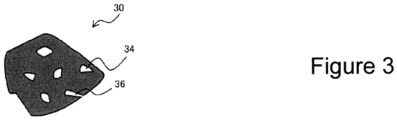
- FIG. 3 is a schematic diagram showing a cross section of the graphite particle.
- a graphite particle 30 includes a pore 34 which is closed and is not connected from an inside of the particle to a surface of the particle in a cross-sectional view of the graphite particle 30, and a pore 36 connected from the inside of the particle to the surface of the particle in the cross-sectional view.
- the pore 34 will hereinafter be referred to as an internal pore 34
- the pore 36 will hereinafter be referred to as an external pore 36.
- a number of the graphite particles A included in the second layer 46 is larger than a number of the graphite particles A included in the first layer 44, from the viewpoint of improving the charge/discharge cycle characteristic.
- an amount of the graphite particles A in the second layer 46 is desirably within a range of 40 mass% ⁇ 100 mass% with respect to the total amount of the graphite particles A in the negative electrode mixture layer 42.
- the graphite particles A and B are manufactured, for example, in the following manner.
- cokes which are a primary raw material are ground to a predetermined size, and, in a state in which the cokes are aggregated with a binder material, the aggregate is baked at a temperature of 2600°C or greater for graphitization, and the resulting graphites are then filtered to obtain the graphite particles A of a desired size.
- the internal porosity may be adjusted to a value of 10% or lower by a particle size of the precursor after the grinding, a particle size of the precursor in the aggregated state, or the like.
- an average particle size (median size D50) of the precursor after the grinding is desirably in a range of 12 ⁇ m ⁇ 20 ⁇ m.
- the cokes (precursors) which are a primary raw material are ground to a predetermined size, the cokes are aggregated with a binder agent, and, in a state in which the aggregate is pressurized and shaped in a block shape, the aggregate is baked at a temperature of 2600°C or grater for graphitization.
- the block-shape formation after the graphitization is ground and filtered, to obtain the graphite particles B of a desired size.
- the internal porosity can be adjusted to a value of greater than 10% by an amount of volatile composition added to the block-shape formation.
- the binder material When a part of the binder material added to the cokes (precursors) vaporizes during the baking, the binder material may be used as the volatile composition.
- a pitch may be exemplified as such a binder material.
- a plane spacing (d 002 ) of a (002) plane determined by an X-ray wide angle diffraction for the graphite particles A and B used in the present embodiment is desirably, for example, 0.3354 nm or greater, is more desirably 0.3357 nm or greater, is desirably lower than 0.340 nm, and is more desirably 0.338 nm or lower.
- a crystallite size (Lc(002)) determined by the X-ray diffraction for the graphite particles A and B used in the present embodiment is desirably, for example, 5 nm or greater, is more desirably 10 nm or greater, is desirably 300 nm or lower, and is more desirably 200 nm or lower.
- No particular limitation is imposed on the average particle size for the graphite particles A and B, but the average particle size is, for example, 1 ⁇ m ⁇ 30 ⁇ m.
- the average particle size means a volume-average particle size (Dv50) in which a volume accumulated value becomes 50% in a granularity distribution measured by laser diffraction scattering.
- a water contact angle of the second layer 46 be 50° or lower from the viewpoints of facilitating infiltration of the electrolyte solution into the inside of the negative electrode 12, and of improving the charge/discharge cycle characteristic, but the water contact angle of the second layer 46 is desirably 40° or lower, and is more desirably 35° or lower.
- the water contact angle is determined using a contact angle meter (DM-501 manufactured by Kyowa Interface Science Co., Ltd.), and by dropping 2.2 ⁇ L of water drops on a sample surface (surface of the second layer), imaging a shape of the water drop immediately after the dropping, and measuring the water contact angle using a ⁇ /2 method based on the acquired image.
- a contact angle meter DM-501 manufactured by Kyowa Interface Science Co., Ltd.
- the water contact angle of the second layer 46 changes, for example, by a volume ratio of the graphite particles A in the second layer 46, a packing density of the negative electrode mixture layer 42 (or a packing density of the second layer 46), or the like.
- a volume ratio of the graphite particles A in the second layer 46 with respect to a total volume of the second layer 46 is 29 volume% or greater from the viewpoint of setting the water contact angle of the second layer 46 to 50° or lower, and is more desirably 50 volume% or greater.
- the negative electrode mixture layer 42 may include an alloying material as the negative electrode active material.
- the alloying material may be contained in the same amount in the first layer 44 and in the second layer 46, or may be contained in a larger amount in either of the layers. From the viewpoint of suppressing reduction of the charge/discharge cycle characteristic of the lithium ion secondary battery, desirably, the alloying material is contained in a larger amount in the second layer 46 than in the first layer 44, and a content of the alloying material in the second layer 46 is desirably in a range of 75 mass% ⁇ 100 mass% with respect to a total amount of the alloying material in the negative electrode mixture layer 42.
- the content of the alloying material is desirably 15 mass% or lower with respect to the total amount of the negative electrode active material in the negative electrode mixture layer 42.
- a lower limit value of the content of the alloying material is desirably 5 mass% or greater with respect to the total amount of the negative electrode active material in the negative electrode mixture layer 42, from the viewpoint of increasing the capacity of the lithium ion secondary battery, and is more desirably 8 mass% or greater.
- the alloying material is formed including an element which alloys with lithium, a compound containing an element which becomes a lithium alloy, or both.
- elements which alloy with lithium and which can be applied for the negative electrode active material there may be exemplified Al, Ga, In, Si, Ge, Sn, Pb, As, Sb, Bi, or the like. Of these, Si and Sn are desirable from the viewpoint of increasing the capacity, and Si is particularly desirable.
- compounds containing Si there may be exemplified compounds containing a silicon oxide phase and Si dispersed in the silicon oxide phase, and compounds containing a lithium silicate phase and Si dispersed in the lithium silicate phase.
- the compounds containing the silicon oxide phase and Si dispersed in the silicon oxide phase are described as "SiO” in the following description.
- the compounds containing the lithium silicate phase and Si dispersed in the lithium silicate phase are described as "LSX" in the following description.
- an electrically conductive layer formed from a material of a high electrical conductivity may be formed on surfaces of the particles of SiO and LSX.
- An example of a desirable electrically conductive layer is a carbon coating formed from a carbon material.
- the carbon coating is formed from, for example, carbon black, acetylene black, Ketjen black, graphite, or a mixture of two or more of these materials.
- the carbon coating may be formed by fixing a carbon powder such as the carbon black on the surface of the particle using a binder material.
- a desirable SiO has a sea-island structure in which fine Si particles are approximately uniformly dispersed in an amorphous silicon oxide phase, and is represented by a general formula, SiO x (0.5 ⁇ x ⁇ 1.6).
- a content of the Si particles is desirably 35 mass% ⁇ 75 mass% with respect to a total mass of SiO, from the viewpoint of realizing both the battery capacity and the cycle characteristic.
- Li 4 SiO 4 is an unstable compound, reacts with water to show an alkaline characteristic, and thus, may alter Si to consequently cause degradation of the charge/discharge capacity.
- a content of the binder material in the negative electrode mixture layer 42 is, for example, desirably 0.5 mass% ⁇ 10 mass% with respect to the total amount of the negative electrode mixture layer 42, and is more desirably 1 mass% ⁇ 5 mass%.
- a porous sheet having an ion permeability and an insulating property is used.
- the porous sheet include a microporous thin film, a woven fabric, a non-woven fabric, or the like.
- an olefin-based resin such as polyethylene, polypropylene, and a copolymer including at least one of ethylene and propylene, or the like, cellulose, or the like is used.
- the separator 13 may have a single-layer structure or a layered structure. Over a surface of the separator 13, a heat resistive layer or the like may be formed.
- Cokes were ground until an average particle size thereof (median size D50) became 15 ⁇ m, a pitch was added as a binder material to the ground cokes, and the cokes were aggregated until the average particle size (median size D50) became 17 ⁇ m.
- the aggregate was baked at a temperature of 2800°C for graphitization, and was filtered using a 250-mesh filter, to obtain graphite particles A having an average particle size (median size D50) of 26 ⁇ m.
- Cokes were ground until an average particle size (median size D50) became 15 ⁇ m, a pitch serving as a binder material was added to the ground cokes, and the cokes were aggregated. Then, an isotopic pressure was applied to form a block-shape formation having a density of 1.6 g/cm 3 ⁇ 1.9 g/cm 3 .
- the block-shape formation was baked at a temperature of 2800°C for graphitization, and the block-shape formation was ground and filtered using a 250-mesh filter, to obtain graphite particles B having an average particle size (median size D50) of 19 ⁇ m.
- the graphite particles B as a negative electrode active material, the graphite particles B, CMC, and styrene-butadiene rubber were mixed in such a manner that a mass ratio of (graphite particles B):(CMC):(styrene-butadiene rubber) was 100: 1: 1, and a suitable amount of water was added, to prepare a first negative electrode mixture slurry for a first layer.
- the first negative electrode mixture slurry was applied over both surfaces of a negative electrode electricity collector formed from a copper foil, and the applied film was dried, to form a first layer over both surfaces of the negative electrode electricity collector. Then, the second negative electrode mixture slurry was applied over the first layer formed over both surfaces of the negative electrode electricity collector, and the applied film was dried, to form a second layer.
- the applied films were rolled using a roller, to manufacture a negative electrode in which a negative electrode mixture layer including the first layer and the second layer was formed over both surfaces of the negative electrode electricity collector.
- a density of the negative electrode mixture layer was 1.6 g/cm 3 , and a thickness ratio of (first layer):(second layer) was 1:1.
- ethylene carbonate (EC), fluorinated ethylene carbonate (FEC), and diethyl carbonate (DEC) were mixed with a volume ratio of 27:3:70, 1 mass% of vinylene carbonate (VC) was added, and LiPF 6 was dissolved in a ratio of 1.2 mol/L, to prepare an electrolyte solution.
- a test cell was manufactured in a manner similar to Example 1 except that, in the preparation of the second negative electrode mixture slurry, a mixture in which 29 parts by mass of the graphite particles A, 57 parts by mass of the graphite particles B, and 14 parts by mass of the Si compound were mixed was used as the negative electrode active material.
- the water contact angle of the second layer in the manufactured negative electrode was 50°.
- a volume ratio of the graphite particles A in the second layer with respect to a total volume of the second layer was 29 volume%
- a volume ratio of the graphite particles B in the second layer was 57 volume%
- a volume ratio of the Si compound in the second layer was 14 volume%.
- a test cell was manufactured in a manner similar to Example 1, except that, in the preparation of the second negative electrode mixture slurry, the negative electrode active material and the CMC were mixed with a mass ratio of 100:1 (that is, no styrene-butadiene rubber was added).
- the water contact angle of the second layer in the manufactured negative electrode was 28°.
- a test cell was manufactured in a manner similar to Example 1 except that, in the preparation of the second negative electrode mixture slurry, the negative electrode active material, the CMC, the styrene-butadiene rubber, and CNT were mixed with a mass ratio of (negative electrode active material):(CMC):(styrene-butadiene rubber):(CNT) of 100:1:1:1,
- the water contact angle of the second layer in the manufactured negative electrode was 31°.
- the negative electrode mixture slurry was applied over both surfaces of a negative electrode electricity collector formed from a copper foil, the applied film was dried, and the dried applied film was rolled using a roller, to manufacture a negative electrode in which a negative electrode mixture layer was formed over both surfaces of the negative electrode electricity collector.
- a test cell was manufactured using this negative electrode, in a manner similar to Example 1.
- the water contact angle of the negative electrode mixture layer in the manufactured negative electrode was 119°.
- a volume ratio of the Si compound in the negative electrode mixture layer with respect to a total volume of the negative electrode mixture layer was 7 volume%.
- a test cell was manufactured in a manner similar to Example 1 except that, in the preparation of the first negative electrode mixture slurry, a mixture in which 86 parts by mass of the graphite particles A and 15 parts by mass of the Si compound (SiO) were mixed was used as the negative electrode active material, and, in the preparation of the second negative electrode mixture slurry, the graphite particles B were employed as the negative electrode active material.
- the water contact angle of the second layer in the manufactured negative electrode was 119°.
- a volume ratio of the graphite particles A in the first layer with respect to a total volume of the first layer was 86 volume%, and a volume ratio of the Si compound in the first layer was 14 volume%.
- a test cell was manufactured in a manner similar to Example 1 except that, in the preparation of the second negative electrode mixture slurry, a mixture in which 86 parts by mass of the graphite particles B and 14 parts by mass of the Si compound (SiO) were mixed was used as the negative electrode active material.
- the water contact angle of the second layer in the manufactured negative electrode was 110°.
- a volume ratio of the Si compound in the second layer with respect to a total volume of the second layer was 14 volume%.
- a test cell was manufactured in a manner similar to Example 1 except that, in the preparation of the second negative electrode mixture slurry, a mixture in which 21.5 parts by mass of the graphite particles A, 64.5 parts by mass of the graphite particles B, and 14 parts by mass of the Si compound (SiO) were mixed was used as the negative electrode active material.
Landscapes
- Chemical & Material Sciences (AREA)
- Chemical Kinetics & Catalysis (AREA)
- Electrochemistry (AREA)
- General Chemical & Material Sciences (AREA)
- Composite Materials (AREA)
- Engineering & Computer Science (AREA)
- Materials Engineering (AREA)
- Inorganic Chemistry (AREA)
- Manufacturing & Machinery (AREA)
- Battery Electrode And Active Subsutance (AREA)
- Secondary Cells (AREA)
Claims (7)
- Negativelektrode (12) für eine Lithiumionensekundärbatterie (10), wobei die Negativelektrode (12) umfasst:einen Negativelektroden-Stromkollektor (40); undeine Negativelektroden-Gemischschicht (42), die über dem Negativelektroden-Stromkollektor (40) gebildet ist, wobeidie Negativelektroden-Gemischschicht (42) eine erste Schicht (44), die über dem Negativelektroden-Stromkollektor (40) angeordnet ist, und eine zweite Schicht (46) umfasst, die über der ersten Schicht (44) angeordnet ist,die zweite Schicht (46) Graphitpartikel A umfasst, die eine innere Partikelporosität von 10 % oder kleiner aufweisen, und die erste Schicht (44) Graphitpartikel B umfasst, die eine innere Partikelporosität von größer als 10 % aufweisen, wenn die innere Partikelporosität unter Verwendung von Rasterelektronenmikroskopie gemessen wird wie in der Beschreibung angegeben,ein Wasserkontaktwinkel der zweiten Schicht (46) 50° oder kleiner ist, wenn der Wasserkontaktwinkel unter Verwendung eines Kontaktwinkelmessers gemessen wird wie in der Beschreibung angegeben, undein Volumenverhältnis der Graphitpartikel A in der zweiten Schicht (46), bezogen auf ein Gesamtvolumen der zweiten Schicht (46), 29 Vol.-% oder größer ist.
- Negativelektrode (12) für die Lithiumionensekundärbatterie (10) nach Anspruch 1, wobeidie Negativelektroden-Gemischschicht (42) ein Legierungsmaterial enthält, das eine Legierung mit Lithium eingeht, unddas Legierungsmaterial in einer größeren Menge in der zweiten Schicht (46) enthalten ist als in der ersten Schicht (44).
- Negativelektrode (12) für die Lithiumionensekundärbatterie (10) nach Anspruch 2, wobeidie Negativelektroden-Gemischschicht (42) Kohlenstofffaser enthält, unddie Kohlenstofffaser in einer größeren Menge in der zweiten Schicht (46) enthalten ist als in der ersten Schicht (44).
- Negativelektrode (12) für die Lithiumionensekundärbatterie (10) nach einem der Ansprüche 1 bis 3, wobeidie Negativelektroden-Gemischschicht (42) Styrol-Butadien-Kautschuk enthält, undder Styrol-Butadien-Kautschuk in einer größeren Menge in der ersten Schicht (44) enthalten ist als in der zweiten Schicht (46).
- Negativelektrode (12) für die Lithiumionensekundärbatterie (10) nach Anspruch 4, wobei
90 Ma.-% oder größer und 100 Ma.-% oder kleiner des Styrol-Butadien-Kautschuks, der in der Negativelektroden-Gemischschicht (42) enthalten ist, in einer Halbregion auf der Seite nahe dem Negativelektroden-Stromkollektor (40) enthalten ist. - Negativelektrode (12) für die Lithiumionensekundärbatterie (10) nach einem der Ansprüche 1 bis 5, wobei
eine Dicke der zweiten Schicht (46) 1/3 oder größer als eine Dicke der Negativelektroden-Gemischschicht (42) ist. - Lithiumionensekundärbatterie (10) umfassend:
die Negativelektrode (12) für die Lithiumionensekundärbatterie (10) nach einem der Ansprüche 1 bis 6.
Priority Applications (1)
| Application Number | Priority Date | Filing Date | Title |
|---|---|---|---|
| EP25179112.5A EP4586336A3 (de) | 2019-09-27 | 2020-07-21 | Negativelektrode für eine lithiumionensekundärbatterie und lithiumionensekundärbatterie |
Applications Claiming Priority (2)
| Application Number | Priority Date | Filing Date | Title |
|---|---|---|---|
| JP2019177955 | 2019-09-27 | ||
| PCT/JP2020/028213 WO2021059705A1 (ja) | 2019-09-27 | 2020-07-21 | リチウムイオン二次電池用負極およびリチウムイオン二次電池 |
Related Child Applications (2)
| Application Number | Title | Priority Date | Filing Date |
|---|---|---|---|
| EP25179112.5A Division EP4586336A3 (de) | 2019-09-27 | 2020-07-21 | Negativelektrode für eine lithiumionensekundärbatterie und lithiumionensekundärbatterie |
| EP25179112.5A Division-Into EP4586336A3 (de) | 2019-09-27 | 2020-07-21 | Negativelektrode für eine lithiumionensekundärbatterie und lithiumionensekundärbatterie |
Publications (3)
| Publication Number | Publication Date |
|---|---|
| EP4037015A1 EP4037015A1 (de) | 2022-08-03 |
| EP4037015A4 EP4037015A4 (de) | 2023-08-09 |
| EP4037015B1 true EP4037015B1 (de) | 2025-07-02 |
Family
ID=75166940
Family Applications (2)
| Application Number | Title | Priority Date | Filing Date |
|---|---|---|---|
| EP25179112.5A Pending EP4586336A3 (de) | 2019-09-27 | 2020-07-21 | Negativelektrode für eine lithiumionensekundärbatterie und lithiumionensekundärbatterie |
| EP20869072.7A Active EP4037015B1 (de) | 2019-09-27 | 2020-07-21 | Negativelektrode für lithium-ionen-sekundärbatterie sowie lithium-ionen-sekundärbatterie |
Family Applications Before (1)
| Application Number | Title | Priority Date | Filing Date |
|---|---|---|---|
| EP25179112.5A Pending EP4586336A3 (de) | 2019-09-27 | 2020-07-21 | Negativelektrode für eine lithiumionensekundärbatterie und lithiumionensekundärbatterie |
Country Status (5)
| Country | Link |
|---|---|
| US (2) | US12322802B2 (de) |
| EP (2) | EP4586336A3 (de) |
| JP (2) | JP7716670B2 (de) |
| CN (1) | CN114424360B (de) |
| WO (1) | WO2021059705A1 (de) |
Families Citing this family (16)
| Publication number | Priority date | Publication date | Assignee | Title |
|---|---|---|---|---|
| KR102386321B1 (ko) * | 2018-04-03 | 2022-04-14 | 주식회사 엘지에너지솔루션 | 리튬 이차전지용 음극, 이의 제조방법 및 이를 포함하는 리튬 이차전지 |
| EP3961757B1 (de) * | 2019-04-24 | 2025-03-26 | Panasonic Energy Co., Ltd. | Sekundärbatterie mit wasserfreiem elektrolyt |
| JP7349349B2 (ja) * | 2019-12-26 | 2023-09-22 | パナソニックホールディングス株式会社 | 非水電解質二次電池用負極、及び非水電解質二次電池 |
| JP7372146B2 (ja) * | 2019-12-26 | 2023-10-31 | パナソニックホールディングス株式会社 | 非水電解質二次電池用負極、及び非水電解質二次電池 |
| CN112018327B (zh) * | 2020-09-21 | 2021-10-15 | 珠海冠宇电池股份有限公司 | 一种负极片及制备方法、电池 |
| JP7808762B2 (ja) * | 2020-09-30 | 2026-01-30 | パナソニックIpマネジメント株式会社 | 二次電池用負極及び二次電池 |
| JP7596526B2 (ja) * | 2020-10-16 | 2024-12-09 | エルジー エナジー ソリューション リミテッド | リチウムイオン二次電池用負極 |
| CN116888698A (zh) * | 2021-02-26 | 2023-10-13 | 松下知识产权经营株式会社 | 电化学电容器 |
| WO2022196746A1 (ja) * | 2021-03-19 | 2022-09-22 | パナソニックIpマネジメント株式会社 | 電気化学キャパシタ |
| CN113346043A (zh) * | 2021-06-04 | 2021-09-03 | 江西安驰新能源科技有限公司 | 一种低温锂离子电池正极极片及其制备方法,锂离子电池 |
| CN116964772A (zh) * | 2021-12-28 | 2023-10-27 | 宁德时代新能源科技股份有限公司 | 二次电池及含有其的用电装置 |
| WO2024024505A1 (ja) * | 2022-07-29 | 2024-02-01 | パナソニックエナジー株式会社 | 非水電解質二次電池用負極及び非水電解質二次電池 |
| CN120188295A (zh) * | 2022-11-17 | 2025-06-20 | 松下知识产权经营株式会社 | 非水电解质二次电池 |
| KR102868364B1 (ko) * | 2022-12-15 | 2025-10-14 | 에스케이온 주식회사 | 리튬 이차전지용 음극 및 이를 포함하는 리튬 이차전지 |
| KR20240153758A (ko) * | 2023-04-17 | 2024-10-24 | 에스케이온 주식회사 | 리튬 이차 전지용 음극 및 이를 포함하는 리튬 이차 전지 |
| WO2025164670A1 (ja) * | 2024-01-31 | 2025-08-07 | パナソニックIpマネジメント株式会社 | 非水電解質二次電池 |
Family Cites Families (23)
| Publication number | Priority date | Publication date | Assignee | Title |
|---|---|---|---|---|
| JPH08287952A (ja) | 1995-04-11 | 1996-11-01 | Matsushita Electric Ind Co Ltd | 非水電解液二次電池 |
| JP4040381B2 (ja) * | 2002-07-30 | 2008-01-30 | Jfeケミカル株式会社 | 複合黒鉛質粒子およびその製造方法ならびにリチウムイオン二次電池用負極およびリチウムイオン二次電池 |
| JP5213015B2 (ja) * | 2007-09-04 | 2013-06-19 | Necエナジーデバイス株式会社 | リチウムイオン二次電池 |
| JP5458689B2 (ja) * | 2008-06-25 | 2014-04-02 | 三菱化学株式会社 | 非水系二次電池用複合黒鉛粒子、それを含有する負極材料、負極及び非水系二次電池 |
| KR101057162B1 (ko) * | 2008-12-01 | 2011-08-16 | 삼성에스디아이 주식회사 | 음극활물질, 이를 구비하는 음극 및 리튬이차전지 |
| JP5810479B2 (ja) | 2009-05-26 | 2015-11-11 | 日産自動車株式会社 | リチウムイオン二次電池用の電極構造、リチウムイオン二次電池およびリチウムイオン二次電池用の電極の製造方法 |
| JP2012094261A (ja) * | 2010-10-25 | 2012-05-17 | Panasonic Corp | 非水系二次電池用負極板およびこれを用いた非水系二次電池 |
| WO2014024473A1 (ja) * | 2012-08-06 | 2014-02-13 | 昭和電工株式会社 | リチウムイオン二次電池用負極材料 |
| JP2014067638A (ja) | 2012-09-26 | 2014-04-17 | Mitsubishi Chemicals Corp | 非水系二次電池用炭素材、及び負極並びに、非水系二次電池 |
| US10270086B2 (en) | 2014-01-31 | 2019-04-23 | Sanyo Electric Co., Ltd. | Nonaqueous-electrolyte secondary-battery negative electrode |
| JP6736845B2 (ja) * | 2015-07-22 | 2020-08-05 | 三菱ケミカル株式会社 | 非水系二次電池用炭素材、及び、リチウムイオン二次電池 |
| JP6570919B2 (ja) | 2015-08-21 | 2019-09-04 | 株式会社エンビジョンAescジャパン | リチウムイオン二次電池 |
| KR20170039976A (ko) * | 2015-10-02 | 2017-04-12 | 주식회사 엘지화학 | 음극 및 이를 포함하는 이차 전지 |
| WO2017111542A1 (ko) | 2015-12-23 | 2017-06-29 | 주식회사 엘지화학 | 리튬 이차전지용 음극활물질 및 이를 포함하는 리튬 이차전지용 음극 |
| KR102088491B1 (ko) * | 2015-12-23 | 2020-03-13 | 주식회사 엘지화학 | 리튬 이차전지용 음극활물질 및 이를 포함하는 리튬 이차전지용 음극 |
| JP6759936B2 (ja) | 2016-09-28 | 2020-09-23 | 日産自動車株式会社 | 非水電解質二次電池、および負極ユニット |
| JP2018125077A (ja) | 2017-01-30 | 2018-08-09 | トヨタ自動車株式会社 | リチウムイオン二次電池用負極 |
| KR102255492B1 (ko) * | 2017-08-18 | 2021-05-27 | 주식회사 엘지에너지솔루션 | 리튬 이차전지용 음극 및 이를 포함하는 리튬 이차전지 |
| TWI666815B (zh) * | 2018-01-26 | 2019-07-21 | 財團法人工業技術研究院 | 水溶液鋰離子電池及用於其中的電極 |
| CN111201659B (zh) * | 2018-02-28 | 2023-08-11 | 松下控股株式会社 | 非水电解质二次电池 |
| CN112292773B (zh) | 2018-06-15 | 2024-07-30 | 松下新能源株式会社 | 非水电解质二次电池 |
| JP7621243B2 (ja) | 2019-02-28 | 2025-01-24 | パナソニックエナジー株式会社 | 非水電解質二次電池 |
| EP3961757B1 (de) | 2019-04-24 | 2025-03-26 | Panasonic Energy Co., Ltd. | Sekundärbatterie mit wasserfreiem elektrolyt |
-
2020
- 2020-07-21 EP EP25179112.5A patent/EP4586336A3/de active Pending
- 2020-07-21 CN CN202080066245.8A patent/CN114424360B/zh active Active
- 2020-07-21 US US17/763,021 patent/US12322802B2/en active Active
- 2020-07-21 JP JP2021548377A patent/JP7716670B2/ja active Active
- 2020-07-21 WO PCT/JP2020/028213 patent/WO2021059705A1/ja not_active Ceased
- 2020-07-21 EP EP20869072.7A patent/EP4037015B1/de active Active
-
2025
- 2025-05-09 US US19/203,593 patent/US20250266455A1/en active Pending
- 2025-07-08 JP JP2025114971A patent/JP2025129407A/ja active Pending
Also Published As
| Publication number | Publication date |
|---|---|
| EP4586336A3 (de) | 2025-10-08 |
| US12322802B2 (en) | 2025-06-03 |
| EP4037015A1 (de) | 2022-08-03 |
| JP7716670B2 (ja) | 2025-08-01 |
| JP2025129407A (ja) | 2025-09-04 |
| CN114424360A (zh) | 2022-04-29 |
| JPWO2021059705A1 (de) | 2021-04-01 |
| EP4037015A4 (de) | 2023-08-09 |
| US20250266455A1 (en) | 2025-08-21 |
| WO2021059705A1 (ja) | 2021-04-01 |
| EP4586336A2 (de) | 2025-07-16 |
| US20220344659A1 (en) | 2022-10-27 |
| CN114424360B (zh) | 2024-04-12 |
Similar Documents
| Publication | Publication Date | Title |
|---|---|---|
| EP4037015B1 (de) | Negativelektrode für lithium-ionen-sekundärbatterie sowie lithium-ionen-sekundärbatterie | |
| EP4037014B1 (de) | Negative elektrode für lithiumionensekundärbatterien und lithiumionensekundärbatterie | |
| JP7236658B2 (ja) | 非水電解質二次電池用負極及び非水電解質二次電池 | |
| EP4224561A1 (de) | Negativelektrode für sekundärbatterien und sekundärbatterie | |
| EP3961757B1 (de) | Sekundärbatterie mit wasserfreiem elektrolyt | |
| EP3993103A1 (de) | Negativelektrodenaktivmaterial für eine sekundärbatterie und sekundärbatterie | |
| EP4224560A1 (de) | Negativelektrode für sekundärbatterie und sekundärbatterie | |
| EP3683865B1 (de) | Elektrode und batterie mit wasserfreiem elektrolyt | |
| WO2021106730A1 (ja) | 非水電解質二次電池 | |
| EP4224554A1 (de) | Sekundärbatterie mit nichtwässrigem elektrolyten | |
| EP4024509B1 (de) | Negative elektrode für sekundärbatterie und sekundärbatterie mit wasserfreiem elektrolyt | |
| EP4145563A1 (de) | Positivelektrodenaktivmaterial für sekundärbatterien mit wasserfreiem elektrolyt und sekundärbatterie mit wasserfreiem elektrolyt | |
| EP4075537A1 (de) | Sekundärbatterie mit wasserfreiem elektrolyt | |
| EP4478441A1 (de) | Sekundärbatterie mit nichtwässrigem elektrolyten | |
| EP4030508B1 (de) | Positivelektroden-aktivmaterial für eine sekundärbatterie mit nichtwässrigem elektrolyten und sekundärbatterie mit nichtwässrigem elektrolyten | |
| JP7668469B2 (ja) | 非水電解質二次電池用負極、及び非水電解質二次電池 | |
| EP4160741A1 (de) | Positivelektrodenaktivmaterial für sekundärbatterien mit wasserfreiem elektrolyt und sekundärbatterie mit wasserfreiem elektrolyt | |
| EP4621901A1 (de) | Sekundärbatterie mit nichtwässrigem elektrolyten | |
| EP4471891A1 (de) | Negativelektrode für eine sekundärbatterie mit wasserfreiem elektrolyt und sekundärbatterie mit wasserfreiem elektrolyt | |
| EP4498452A1 (de) | Positivelektrode für eine sekundärbatterie mit wasserfreiem elektrolyt und sekundärbatterie mit wasserfreiem elektrolyt | |
| EP4550442A1 (de) | Sekundärbatterie mit nichtwässrigem elektrolyten | |
| EP4621900A1 (de) | Sekundärbatterie mit nichtwässrigem elektrolyten | |
| EP4024530A1 (de) | Positivelektrodenaktivmaterial für sekundärbatterien mit wasserfreiem elektrolyt und sekundärbatterie mit wasserfreiem elektrolyt | |
| WO2025062937A1 (ja) | 二次電池 | |
| WO2025205755A1 (ja) | 非水電解質二次電池用負極、非水電解質二次電池、および電池パック |
Legal Events
| Date | Code | Title | Description |
|---|---|---|---|
| STAA | Information on the status of an ep patent application or granted ep patent |
Free format text: STATUS: THE INTERNATIONAL PUBLICATION HAS BEEN MADE |
|
| PUAI | Public reference made under article 153(3) epc to a published international application that has entered the european phase |
Free format text: ORIGINAL CODE: 0009012 |
|
| STAA | Information on the status of an ep patent application or granted ep patent |
Free format text: STATUS: REQUEST FOR EXAMINATION WAS MADE |
|
| 17P | Request for examination filed |
Effective date: 20220317 |
|
| AK | Designated contracting states |
Kind code of ref document: A1 Designated state(s): AL AT BE BG CH CY CZ DE DK EE ES FI FR GB GR HR HU IE IS IT LI LT LU LV MC MK MT NL NO PL PT RO RS SE SI SK SM TR |
|
| DAV | Request for validation of the european patent (deleted) | ||
| DAX | Request for extension of the european patent (deleted) | ||
| A4 | Supplementary search report drawn up and despatched |
Effective date: 20230712 |
|
| RIC1 | Information provided on ipc code assigned before grant |
Ipc: H01M 4/02 20060101ALN20230706BHEP Ipc: H01M 4/134 20100101ALI20230706BHEP Ipc: H01M 4/62 20060101ALI20230706BHEP Ipc: H01M 4/587 20100101ALI20230706BHEP Ipc: H01M 4/36 20060101ALI20230706BHEP Ipc: H01M 4/133 20100101AFI20230706BHEP |
|
| GRAP | Despatch of communication of intention to grant a patent |
Free format text: ORIGINAL CODE: EPIDOSNIGR1 |
|
| STAA | Information on the status of an ep patent application or granted ep patent |
Free format text: STATUS: GRANT OF PATENT IS INTENDED |
|
| RIC1 | Information provided on ipc code assigned before grant |
Ipc: H01M 4/02 20060101ALN20250105BHEP Ipc: H01M 4/134 20100101ALI20250105BHEP Ipc: H01M 4/62 20060101ALI20250105BHEP Ipc: H01M 4/587 20100101ALI20250105BHEP Ipc: H01M 4/36 20060101ALI20250105BHEP Ipc: H01M 4/133 20100101AFI20250105BHEP |
|
| INTG | Intention to grant announced |
Effective date: 20250207 |
|
| P01 | Opt-out of the competence of the unified patent court (upc) registered |
Free format text: CASE NUMBER: APP_11105/2025 Effective date: 20250306 |
|
| GRAS | Grant fee paid |
Free format text: ORIGINAL CODE: EPIDOSNIGR3 |
|
| GRAA | (expected) grant |
Free format text: ORIGINAL CODE: 0009210 |
|
| STAA | Information on the status of an ep patent application or granted ep patent |
Free format text: STATUS: THE PATENT HAS BEEN GRANTED |
|
| AK | Designated contracting states |
Kind code of ref document: B1 Designated state(s): AL AT BE BG CH CY CZ DE DK EE ES FI FR GB GR HR HU IE IS IT LI LT LU LV MC MK MT NL NO PL PT RO RS SE SI SK SM TR |
|
| REG | Reference to a national code |
Ref country code: GB Ref legal event code: FG4D |
|
| REG | Reference to a national code |
Ref country code: CH Ref legal event code: EP |
|
| REG | Reference to a national code |
Ref country code: DE Ref legal event code: R096 Ref document number: 602020053985 Country of ref document: DE |
|
| REG | Reference to a national code |
Ref country code: IE Ref legal event code: FG4D |
|
| PGFP | Annual fee paid to national office [announced via postgrant information from national office to epo] |
Ref country code: DE Payment date: 20250722 Year of fee payment: 6 |
|
| PGFP | Annual fee paid to national office [announced via postgrant information from national office to epo] |
Ref country code: GB Payment date: 20250820 Year of fee payment: 6 |
|
| PGFP | Annual fee paid to national office [announced via postgrant information from national office to epo] |
Ref country code: FR Payment date: 20250829 Year of fee payment: 6 |
|
| REG | Reference to a national code |
Ref country code: NL Ref legal event code: MP Effective date: 20250702 |
|
| PG25 | Lapsed in a contracting state [announced via postgrant information from national office to epo] |
Ref country code: PT Free format text: LAPSE BECAUSE OF FAILURE TO SUBMIT A TRANSLATION OF THE DESCRIPTION OR TO PAY THE FEE WITHIN THE PRESCRIBED TIME-LIMIT Effective date: 20251103 |
|
| PG25 | Lapsed in a contracting state [announced via postgrant information from national office to epo] |
Ref country code: NL Free format text: LAPSE BECAUSE OF FAILURE TO SUBMIT A TRANSLATION OF THE DESCRIPTION OR TO PAY THE FEE WITHIN THE PRESCRIBED TIME-LIMIT Effective date: 20250702 |
|
| REG | Reference to a national code |
Ref country code: AT Ref legal event code: MK05 Ref document number: 1810298 Country of ref document: AT Kind code of ref document: T Effective date: 20250702 |
|
| PG25 | Lapsed in a contracting state [announced via postgrant information from national office to epo] |
Ref country code: IS Free format text: LAPSE BECAUSE OF FAILURE TO SUBMIT A TRANSLATION OF THE DESCRIPTION OR TO PAY THE FEE WITHIN THE PRESCRIBED TIME-LIMIT Effective date: 20251102 |
|
| PG25 | Lapsed in a contracting state [announced via postgrant information from national office to epo] |
Ref country code: NO Free format text: LAPSE BECAUSE OF FAILURE TO SUBMIT A TRANSLATION OF THE DESCRIPTION OR TO PAY THE FEE WITHIN THE PRESCRIBED TIME-LIMIT Effective date: 20251002 |
|
| REG | Reference to a national code |
Ref country code: LT Ref legal event code: MG9D |
|
| PG25 | Lapsed in a contracting state [announced via postgrant information from national office to epo] |
Ref country code: AT Free format text: LAPSE BECAUSE OF FAILURE TO SUBMIT A TRANSLATION OF THE DESCRIPTION OR TO PAY THE FEE WITHIN THE PRESCRIBED TIME-LIMIT Effective date: 20250702 |
|
| PG25 | Lapsed in a contracting state [announced via postgrant information from national office to epo] |
Ref country code: FI Free format text: LAPSE BECAUSE OF FAILURE TO SUBMIT A TRANSLATION OF THE DESCRIPTION OR TO PAY THE FEE WITHIN THE PRESCRIBED TIME-LIMIT Effective date: 20250702 |
|
| PG25 | Lapsed in a contracting state [announced via postgrant information from national office to epo] |
Ref country code: HR Free format text: LAPSE BECAUSE OF FAILURE TO SUBMIT A TRANSLATION OF THE DESCRIPTION OR TO PAY THE FEE WITHIN THE PRESCRIBED TIME-LIMIT Effective date: 20250702 |
|
| PG25 | Lapsed in a contracting state [announced via postgrant information from national office to epo] |
Ref country code: GR Free format text: LAPSE BECAUSE OF FAILURE TO SUBMIT A TRANSLATION OF THE DESCRIPTION OR TO PAY THE FEE WITHIN THE PRESCRIBED TIME-LIMIT Effective date: 20251003 |
|
| PG25 | Lapsed in a contracting state [announced via postgrant information from national office to epo] |
Ref country code: SE Free format text: LAPSE BECAUSE OF FAILURE TO SUBMIT A TRANSLATION OF THE DESCRIPTION OR TO PAY THE FEE WITHIN THE PRESCRIBED TIME-LIMIT Effective date: 20250702 Ref country code: CZ Free format text: LAPSE BECAUSE OF FAILURE TO SUBMIT A TRANSLATION OF THE DESCRIPTION OR TO PAY THE FEE WITHIN THE PRESCRIBED TIME-LIMIT Effective date: 20250702 |
|
| PG25 | Lapsed in a contracting state [announced via postgrant information from national office to epo] |
Ref country code: LV Free format text: LAPSE BECAUSE OF FAILURE TO SUBMIT A TRANSLATION OF THE DESCRIPTION OR TO PAY THE FEE WITHIN THE PRESCRIBED TIME-LIMIT Effective date: 20250702 |
|
| PG25 | Lapsed in a contracting state [announced via postgrant information from national office to epo] |
Ref country code: PL Free format text: LAPSE BECAUSE OF FAILURE TO SUBMIT A TRANSLATION OF THE DESCRIPTION OR TO PAY THE FEE WITHIN THE PRESCRIBED TIME-LIMIT Effective date: 20250702 Ref country code: BG Free format text: LAPSE BECAUSE OF FAILURE TO SUBMIT A TRANSLATION OF THE DESCRIPTION OR TO PAY THE FEE WITHIN THE PRESCRIBED TIME-LIMIT Effective date: 20250702 |
|
| PG25 | Lapsed in a contracting state [announced via postgrant information from national office to epo] |
Ref country code: RS Free format text: LAPSE BECAUSE OF FAILURE TO SUBMIT A TRANSLATION OF THE DESCRIPTION OR TO PAY THE FEE WITHIN THE PRESCRIBED TIME-LIMIT Effective date: 20251002 |
|
| PG25 | Lapsed in a contracting state [announced via postgrant information from national office to epo] |
Ref country code: ES Free format text: LAPSE BECAUSE OF FAILURE TO SUBMIT A TRANSLATION OF THE DESCRIPTION OR TO PAY THE FEE WITHIN THE PRESCRIBED TIME-LIMIT Effective date: 20250702 |