EP4012507A1 - Composant horloger phosphorescent - Google Patents
Composant horloger phosphorescent Download PDFInfo
- Publication number
- EP4012507A1 EP4012507A1 EP20213368.2A EP20213368A EP4012507A1 EP 4012507 A1 EP4012507 A1 EP 4012507A1 EP 20213368 A EP20213368 A EP 20213368A EP 4012507 A1 EP4012507 A1 EP 4012507A1
- Authority
- EP
- European Patent Office
- Prior art keywords
- layer
- phosphorescent
- watch
- component according
- front layer
- Prior art date
- Legal status (The legal status is an assumption and is not a legal conclusion. Google has not performed a legal analysis and makes no representation as to the accuracy of the status listed.)
- Granted
Links
Images
Classifications
-
- G—PHYSICS
- G04—HOROLOGY
- G04B—MECHANICALLY-DRIVEN CLOCKS OR WATCHES; MECHANICAL PARTS OF CLOCKS OR WATCHES IN GENERAL; TIME PIECES USING THE POSITION OF THE SUN, MOON OR STARS
- G04B19/00—Indicating the time by visual means
- G04B19/04—Hands; Discs with a single mark or the like
-
- A—HUMAN NECESSITIES
- A44—HABERDASHERY; JEWELLERY
- A44C—PERSONAL ADORNMENTS, e.g. JEWELLERY; COINS
- A44C27/00—Making jewellery or other personal adornments
- A44C27/001—Materials for manufacturing jewellery
-
- A—HUMAN NECESSITIES
- A44—HABERDASHERY; JEWELLERY
- A44C—PERSONAL ADORNMENTS, e.g. JEWELLERY; COINS
- A44C5/00—Bracelets; Wrist-watch straps; Fastenings for bracelets or wrist-watch straps
-
- A—HUMAN NECESSITIES
- A44—HABERDASHERY; JEWELLERY
- A44C—PERSONAL ADORNMENTS, e.g. JEWELLERY; COINS
- A44C5/00—Bracelets; Wrist-watch straps; Fastenings for bracelets or wrist-watch straps
- A44C5/0053—Flexible straps
-
- G—PHYSICS
- G04—HOROLOGY
- G04B—MECHANICALLY-DRIVEN CLOCKS OR WATCHES; MECHANICAL PARTS OF CLOCKS OR WATCHES IN GENERAL; TIME PIECES USING THE POSITION OF THE SUN, MOON OR STARS
- G04B19/00—Indicating the time by visual means
- G04B19/06—Dials
- G04B19/12—Selection of materials for dials or graduations markings
-
- G—PHYSICS
- G04—HOROLOGY
- G04B—MECHANICALLY-DRIVEN CLOCKS OR WATCHES; MECHANICAL PARTS OF CLOCKS OR WATCHES IN GENERAL; TIME PIECES USING THE POSITION OF THE SUN, MOON OR STARS
- G04B19/00—Indicating the time by visual means
- G04B19/30—Illumination of dials or hands
- G04B19/32—Illumination of dials or hands by luminescent substances
-
- G—PHYSICS
- G04—HOROLOGY
- G04B—MECHANICALLY-DRIVEN CLOCKS OR WATCHES; MECHANICAL PARTS OF CLOCKS OR WATCHES IN GENERAL; TIME PIECES USING THE POSITION OF THE SUN, MOON OR STARS
- G04B37/00—Cases
- G04B37/22—Materials or processes of manufacturing pocket watch or wrist watch cases
-
- G—PHYSICS
- G04—HOROLOGY
- G04B—MECHANICALLY-DRIVEN CLOCKS OR WATCHES; MECHANICAL PARTS OF CLOCKS OR WATCHES IN GENERAL; TIME PIECES USING THE POSITION OF THE SUN, MOON OR STARS
- G04B37/00—Cases
- G04B37/22—Materials or processes of manufacturing pocket watch or wrist watch cases
- G04B37/225—Non-metallic cases
-
- G—PHYSICS
- G04—HOROLOGY
- G04B—MECHANICALLY-DRIVEN CLOCKS OR WATCHES; MECHANICAL PARTS OF CLOCKS OR WATCHES IN GENERAL; TIME PIECES USING THE POSITION OF THE SUN, MOON OR STARS
- G04B45/00—Time pieces of which the indicating means or cases provoke special effects, e.g. aesthetic effects
- G04B45/0015—Light-, colour-, line- or spot-effects caused by or on stationary parts
Definitions
- the invention relates to a multilayer phosphorescent watch component, in particular a watch strap.
- Watchmaking companies in particular offer phosphorescent bracelets based on silicone, and more recently the offer has been developed via a company offering a watch fitted with a phosphorescent rubber strap. For its luminescent synthetic rubber strap, this company adds pigments directly into the material, which is then heat molded and pressed.
- the invention aims to provide a phosphorescent structure which does not suffer from the drawbacks described above.
- the present invention relates to a watch component comprising a phosphorescent structure comprising a transparent or translucent front layer and comprising phosphorescent pigments and an underlying reflective layer.
- the two layers of the structure of the invention comprise a polymeric matrix, advantageously elastomeric.
- elastomeric we mean a material having a modulus of elasticity of less than 100 MPa, preferably less than 50 MPa. Particularly preferably, the elastomer has an elastic modulus of less than 10 MPa at 25°C.
- the two layers comprise compatible polymers.
- compatible we mean that these two layers adhere to each other without the use of an adhesive layer.
- the polymers of the two layers comprise polymers of the same nature, differing essentially by the pigments and/or the fillers which are dispersed therein.
- the front layer has a thickness of between 0.04 and 1 mm.
- the rear layer is made reflective by the dispersion of a white pigment such as, preferably, titanium oxide.
- the phosphorescent pigment has a particle size, measured by sieving, of less than 30 ⁇ m.
- the front layer comprises at least 20% by weight of the phosphorescent pigment.
- the present invention relates to a watch component comprising a phosphorescent multilayer structure making it possible to maximize the luminous performance of the structure while minimizing the quantity of phosphorescent pigments in the complete structure.
- This structure is particularly suited to the manufacture of watch components intended to produce watch straps. It goes without saying that the timepiece component can also form other constituent elements of a wristwatch such as a watch dial, hands or even a bezel or a watch case.
- the multilayer structure comprises a front face, intended to be seen in normal use, and a rear face intended for example to be in contact with the skin in the case of a watch strap.
- the front face comprises a transparent or translucent polymeric front layer 1 comprising a phosphorescent pigment.
- the thickness of this layer is optimized so that the light emitted by the deepest pigments is not excessively absorbed by the material comprised between said deep pigment and the surface.
- this layer has a thickness of between 30 ⁇ m and 1 mm.
- a thin transparent layer can optionally be added over the phosphorescent layer, provided that it does not significantly absorb the emitted light.
- Such an additional layer can for example be added to improve the surface condition of the final product or to protect the zone comprising the pigment.
- a reflective layer 2 Under the front layer is arranged a reflective layer 2.
- This layer can either be a thin reflective layer such as a thin metallic layer deposited for example by evaporation or plasma deposition on a substrate, or, preferably, a polymer layer charged with a reflective pigment such as for example titanium oxide.
- This layer can also be deposited on a substrate or even be a self-supporting layer.
- This layer 2 can for example form the rear layer 2 of the bracelet in contact with the skin as shown in figures 1 and 2 .
- the structure could comprise a third layer (not shown) for example colored, for example arranged above the front layer 1, the important thing for solving the aforementioned problem being that the layer immediately under the phosphorescent layer be reflective.
- the small size of the TiO 2 particles (typically between 200 nm and 400 nm) makes it possible to maximize the reflection of visible light.
- the base mixture advantageously comprises an elastomer, a vulcanization system, silica, titanium oxide and an optical brightener.
- the reflective layer when it is of polymeric nature as described above, has a thickness of at least 20 ⁇ m, preferably of at least 40 ⁇ m.
- the front layer 1 and the reflective layer when it is of a polymeric nature, are preferably chosen from the set comprising a fluorinated elastomer from the FKM family or an elastomeric thermoplastic polymer from the TPU (Polyurethane) family, EVA (Ethylene vinyl acetate copolymer), silicones, EPR (ethylene propylene rubber) and their thermoplastic derivatives (TPO) or else from the family of acrylic elastomers, or a mixture of the latter.
- TPU Polyurethane
- EVA Ethylene vinyl acetate copolymer
- silicones ethylene propylene rubber
- TPO thermoplastic derivatives
- a fluoroelastomer is prepared by mixing a pure Tecnoflon® P-457 FKM grade from Slovay by working on an open mixer with 5% titanium oxide.
- a vulcanization system is added (2.5% by weight of Luperox ® 101XL-45 + 3% by weight of Drimix ® TAIC 75%, the percentages being expressed relative to the polymer).
- Nafol 1822B TM oil marketed by Sasol (up to 1.8%) is also added.
- the whole is the reflective FKM mixture ready to be shaped.
- This mixture is shaped by compression and partially crosslinked.
- the following masterbatch is made: Solvay's pure Tecnoflon ® P-457 FKM grade which is manufactured on a clean line and which is transparent is used as the matrix of the masterbatch.
- Tecnoflon ® P-457 is diluted in a 1:1 ratio in methyl ethyl ketone (Methyl Ether Ketone or MEK).
- a photoluminescent pigment previously sieved at 30 ⁇ m is incorporated into the mixture obtained in the previous step, the amount of pigment being in a 1:1 ratio with respect to Tecnoflon ® P-457 and the whole is mixed on a high-speed mixer at 3000 rpm.
- a fluorochrome is introduced at 0.5% relative to the total (ie 1.5% relative to the FKM polymer) and the whole is again mixed on a high-speed mixer at 3000 rpm.
- the solvent is evaporated in an oven at 80° C. until elimination of the solvent.
- the masterbatch prepared beforehand is incorporated up to a minimum of 60% in a pure FKM P-457 by working on an open mixer.
- a vulcanization system is added (2.5% by weight of Luperox ® 101XL-45 + 3% by weight of Drimix ® TAIC 75%, the percentages being expressed relative to the polymer).
- Nafol 1822B TM oil marketed by Sasol (up to 1.8%) is also added.
- the whole constitutes the optimized photoluminescent FKM mixture, ready to be shaped and crosslinked.
- the mixture B obtained is then overmoulded by compression and crosslinked on the substrate A previously prepared.
- the component thus obtained comprises a front layer of 100 ⁇ m having a pigment concentration of 30% adherent to a reflective elastomer layer comprising 10% titanium oxide.
Landscapes
- Physics & Mathematics (AREA)
- General Physics & Mathematics (AREA)
- Engineering & Computer Science (AREA)
- Manufacturing & Machinery (AREA)
- Chemical & Material Sciences (AREA)
- Materials Engineering (AREA)
- Laminated Bodies (AREA)
- Adornments (AREA)
Abstract
Description
- L'invention est relative à un composant horloger phosphorescent multicouche, en particulier un bracelet de montre.
- L'utilisation de matériaux photoluminescents est assez répandue sur le marché et ce pour des applications variées, telles que des pneus, des accessoires de signalisation, etc. (Par exemple :
US6431236B1 , JPH10121424A). - Les sociétés d'horlogerie proposent en particulier des bracelets phosphorescents à base de silicone, et plus récemment l'offre s'est développée via une société proposant une montre dotée d'un bracelet caoutchouc phosphorescent. Pour son bracelet en caoutchouc synthétique luminescent, cette société ajoute des pigments directement dans la matière, qui est ensuite moulée à chaud et pressée.
- Néanmoins, lorsque le pigment est ainsi dispersé dans la masse, une proportion importante de la lumière produite par les pigments est perdue, soit par absorption dans la matière dans le cas de couches épaisses, soit par émission vers la face arrière qui ne représente aucun intérêt pour le porteur. De la sorte, une proportion importante des coûteux pigments phosphorescents est en pratique inutilisée.
- L'invention vise à fournir une structure phosphorescente qui ne souffre pas des inconvénients décrits ci-dessus.
- La présente invention concerne un composant horloger comprenant une structure phosphorescente comprenant une couche avant transparente ou translucide et comprenant des pigments phosphorescents et une couche sous-jacente réfléchissante.
- De préférence, les deux couches de la structure de l'invention comprennent une matrice polymérique, avantageusement élastomérique.
- Par élastomérique, nous entendons un matériau présentant un module d'élasticité inférieur à 100 MPa, de préférence inférieur à 50 MPa. De façon particulièrement préférée, l'élastomère présente un module élastique inférieur à 10 MPa à 25°C.
- Avantageusement, les deux couches comprennent des polymères compatibles. Par compatibles, nous entendons que ces deux couches adhèrent entre elles sans l'utilisation d'une couche adhésive.
- De préférence, les polymères des deux couches comprennent des polymères de même nature, différant essentiellement par les pigments et/ou les charges qui y sont dispersées.
- Avantageusement, la couche avant présente une épaisseur comprise entre 0,04 et 1mm.
- De préférence, la couche arrière est rendue réfléchissante par la dispersion d'un pigment blanc tel que, de préférence, de l'oxyde de titane.
- Avantageusement, le pigment phosphorescent présente une taille de particule, mesurée par tamisage, inférieure à 30µm.
- De préférence, la couche avant comprend au moins 20% en poids du pigment phosphorescent.
-
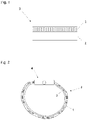
- La
figure 1 représente une vue schématique d'une coupe illustrant la structure multicouche phosphorescente d'un composant horloger selon l'invention. - La
figure 2 représente une vue schématique d'une montre comprenant un bracelet fornant un composant horloger selon l'invention. -
- 1. Couche phosphorescente
- 2. Couche réfléchissante
- 3. Bracelet de montre
- 4. Montre
- La présente invention concerne un composant horloger comprenant une structure multicouche phosphorescente permettant de maximiser les performances lumineuses de la structure tout en minimisant la quantité de pigments phosphorescents dans la structure complète. Cette structure est particulièrement adaptée à la fabrication de composant horloger destinée à réaliser des bracelets de montre. Il va de soi que le composant horloger peut également former d'autres éléments constitutifs d'une montre bracelet tels qu'un cadran de montre, des aiguilles ou encore une lunette ou une boite de montre.
- Selon l'invention, la structure multicouche comprend une face avant, destinée à être vue en utilisation normale, et une face arrière destinée par exemple à être en contact avec la peau dans le cas d'un bracelet de montre.
- Selon l'invention, la face avant comprend une couche avant 1 polymérique transparente ou translucide comprenant un pigment phosphorescent. L'épaisseur de cette couche est optimisée pour que la lumière émise par les pigments les plus profonds ne soit pas exagérément absorbée par la matière comprise entre ledit pigment profond et la surface. Selon les caractéristiques optiques de la matrice polymérique de la couche, cette couche présente une épaisseur comprise entre 30 µm et 1 mm.
- Une couche mince transparente peut éventuellement être ajoutée pardessus la couche phosphorescente, pour autant qu'elle n'absorbe pas de façon significative la lumière émise. Une telle couche supplémentaire peut par exemple être ajoutée pour améliorer l'état de surface du produit final ou protéger la zone comprenant le pigment.
- Sous la couche avant est disposée une couche réfléchissante 2. Cette couche peut soit être une couche mince réfléchissante telle qu'une couche métallique mince déposée par exemple par évaporation ou dépôt plasma sur un substrat, soit, de préférence, une couche de polymère chargé d'un pigment réfléchissant tel que par exemple de l'oxyde de titane. Cette couche peut être également déposée sur un substrat ou encore être une couche autoporteuse. Cette couche 2 peut par exemple former la couche arrière 2 du bracelet en contact avec la peau tel que cela est représenté aux
figures 1 et 2 . Néanmoins, la structure pourrait comprendre une troisième couche (non représentée) par exemple colorée, par exemple disposée au-dessus de la couche avant 1, l'important pour résoudre le problème susmentionné étant que la couche immédiatement sous la couche phosphorescente soit réfléchissante. - La petite taille des particules de TiO2 (typiquement comprise entre 200 nm et 400nm) permet de maximiser la réflexion de la lumière visible. Le mélange de base comprend avantageusement un élastomère, un système de vulcanisation, de la silice, de l'oxyde de titane et un azurant optique.
- Afin de présenter une réflexion suffisante, la couche réfléchissante, lorsqu'elle est de nature polymérique telle que décrite ci-dessus, présente une épaisseur d'au moins 20µm, de préférence d'au moins 40µm.
- La couche avant 1 et la couche réfléchissante, lorsqu'elle est de nature polymérique, sont choisies de préférence parmi l'ensemble comprenant un élastomère fluoré de la famille des FKM ou un polymère thermoplastique élastomère de la famille des TPU (Polyuréthanes), des EVA (Ethylène vinyl acétate copolymère), des silicones, des EPR (éthylène propylène rubber) et leur dérivés thermoplastiques (TPO) ou encore de la famille des élastomères acryliques, ou un mélange de ces derniers.
- Dans le cas d'un bracelet de montre, l'épaisseur totale de la couche arrière, sous la couche phosphorescente, comprenant donc la couche réfléchissante 2 et une éventuelle couche supplémentaire présente une épaisseur comprise entre 20µm et 1,5mm.
Trois techniques de mise en forme sont préférées pour la confection de bracelets : - La couche inférieure peut être surmoulée sur la couche supérieure d'élastomère phosphorescent (ou inversement)
- La couche phosphorescente peut être réalisée par moulage et la couche réflective peut être revêtue par pulvérisation.
- Les deux couches (produites séparément par injection ou compression) peuvent être assemblées via la technique de mise en forme du type « bracelet sellier » : les deux couches sont collées-cousues l'une à l'autre afin de former un bracelet.
- Un fluoroélastomère est préparé en mélangeant un grade FKM Tecnoflon® P-457 pur de chez Slovay par travail sur un mélangeur ouvert avec 5% d'oxyde de titane.
- En fin de mélange un système de vulcanisation est ajouté (2.5% en poids de Luperox® 101XL-45 + 3% en poids de Drimix® TAIC 75%, les pourcentages étant exprimés par rapport au polymère).
- Préférablement, de l'huile Nafol 1822B™ commercialisée par Sasol (jusqu'à 1.8%) est aussi ajoutée. L'ensemble constitue le mélange FKM réfléchissant prêt à être mis en forme.
- Ce mélange est mis en forme par compression et partiellement réticulé.
- Le mélange-maître suivant est réalisé :
Le grade FKM Tecnoflon® P-457 pur de Solvay qui est fabriqué sur une ligne propre et qui est transparent est utilisé comme matrice du mélange-maître. - Le Tecnoflon® P-457 est dilué dans un ratio 1 :1 dans de la méthyl éthyl cétone (Methyl Ether Ketone ou MEK).
- Un pigment photoluminescent préalablement tamisé à 30 µm est incorporé dans le mélange obtenu à l'étape précédente, la quantité de pigment étant dans un ratio 1 :1 par rapport au Tecnoflon® P-457 et l'ensemble est mélangé sur un mélangeur haute vitesse à 3000 tr.mn-1.
- Un fluorochrome est introduit à hauteur de 0.5% par rapport au total (soit 1,5% par rapport au polymère FKM) et l'ensemble est de nouveau mélangé sur mélangeur à haute vitesse à 3000 tr.mn-1.
- Le solvant est évaporé en étuve à 80°C jusqu'à élimination du solvant.
- Le mélange-maître préalablement réalisé est incorporé à hauteur de 60% minimum dans un FKM P-457 pur par travail sur un mélangeur ouvert.
- En fin de mélange un système de vulcanisation est ajouté (2.5% en poids de Luperox® 101XL-45 + 3% en poids de Drimix® TAIC 75%, les pourcentages étant exprimés par rapport au polymère).
- Préférablement, de l'huile Nafol 1822B™ commercialisée par Sasol (jusqu'à 1.8%) est aussi ajoutée. L'ensemble constitue le mélange FKM photoluminescent optimisé, prêt à être mis en forme et réticulé.
- Le mélange B obtenu est ensuite surmoulé par compression et réticulé sur le substrat A préalablement préparé.
- Le composant ainsi obtenu comprend une couche avant de 100µm présentant une concentration en pigments de 30% adhérente sur une couche d'élastomère réfléchissante comprenant 10% d'oxyde de titane.
Claims (8)
- Composant horloger comprenant une structure multicouche (3) phosphorescente comprenant une couche avant (1) à matrice polymérique transparente ou translucide et comprenant des pigments phosphorescents et une couche sous-jacente réfléchissante (2).
- Composant horloger selon la revendication 1 dans lequel la couche avant (1) comprend une matrice d'élastomère.
- Composant horloger selon la revendication 1 ou 2 dans lequel la couche sous-jacente (2) comprend une matrice polymérique chargée d'un pigment réfléchissant.
- Composant horloger selon la revendication 3 dans lequel le pigment réfléchissant comprend de l'oxyde de titane.
- Composant horloger selon la revendication 3 ou 4 dans lequel la matrice polymérique de la couche sous-jacente (2) est compatible avec la matrice polymérique de la couche avant (1).
- Composant horloger selon la revendication 5 dans lequel la couche avant (1) et la couche sous-jacente (2) comprennent un fluoroélastomère.
- Composant horloger selon l'une des revendications précédentes dans lequel la couche avant (1) présente une épaisseur comprise entre 0,03mm et 1mm.
- Composant horloger selon l'une des revendications précédentes formant un bracelet de montre (4), un cadran de montre, des aiguilles, une lunette ou une boite de montre.
Priority Applications (5)
| Application Number | Priority Date | Filing Date | Title |
|---|---|---|---|
| EP20213368.2A EP4012507B1 (fr) | 2020-12-11 | 2020-12-11 | Composant horloger phosphorescent |
| US17/468,926 US12317973B2 (en) | 2020-12-11 | 2021-09-08 | Phosphorescent timepiece component |
| JP2021146635A JP2022093255A (ja) | 2020-12-11 | 2021-09-09 | 蛍光性の計時器用コンポーネント |
| CN202111238622.4A CN114624983A (zh) | 2020-12-11 | 2021-10-25 | 磷光钟表组件 |
| JP2023148039A JP2023160968A (ja) | 2020-12-11 | 2023-09-13 | 蛍光性の計時器用コンポーネント |
Applications Claiming Priority (1)
| Application Number | Priority Date | Filing Date | Title |
|---|---|---|---|
| EP20213368.2A EP4012507B1 (fr) | 2020-12-11 | 2020-12-11 | Composant horloger phosphorescent |
Publications (2)
| Publication Number | Publication Date |
|---|---|
| EP4012507A1 true EP4012507A1 (fr) | 2022-06-15 |
| EP4012507B1 EP4012507B1 (fr) | 2026-04-01 |
Family
ID=73834240
Family Applications (1)
| Application Number | Title | Priority Date | Filing Date |
|---|---|---|---|
| EP20213368.2A Active EP4012507B1 (fr) | 2020-12-11 | 2020-12-11 | Composant horloger phosphorescent |
Country Status (4)
| Country | Link |
|---|---|
| US (1) | US12317973B2 (fr) |
| EP (1) | EP4012507B1 (fr) |
| JP (2) | JP2022093255A (fr) |
| CN (1) | CN114624983A (fr) |
Citations (8)
| Publication number | Priority date | Publication date | Assignee | Title |
|---|---|---|---|---|
| JPH07265111A (ja) * | 1994-04-01 | 1995-10-17 | Ryotaro Ogawa | 装飾を兼ねた反射・発光表示体 |
| US6431236B1 (en) | 1998-10-12 | 2002-08-13 | The Yokohama Rubber Co., Ltd. | Pneumatic tire using long afterglow phosphorescent rubber composition |
| WO2010063945A1 (fr) * | 2008-12-01 | 2010-06-10 | Porcher Industries | Fil composite photoluminescent, procede d'obtention et structure textile obtenue |
| FR2979571A1 (fr) * | 2011-09-07 | 2013-03-08 | Dp3I Dev Production Industrialisation D Idees Innovantes | Utilisation d'un procede de fabrication d'une piece couche par couche |
| EP3306419A1 (fr) * | 2016-10-05 | 2018-04-11 | The Swatch Group Research and Development Ltd | Joint horloger |
| WO2019115249A1 (fr) * | 2017-12-14 | 2019-06-20 | The Swatch Group Research And Development Ltd | Materiau pour piece d'horlogerie et de bijouterie |
| CH716226B1 (fr) * | 2006-11-03 | 2020-11-30 | Eta Sa Mft Horlogere Suisse | Piece d'horlogerie munie d'un dispositif d'eclairage comprenant une diode electroluminescente ultraviolette. |
| EP3796105A1 (fr) * | 2019-09-23 | 2021-03-24 | The Swatch Group Research and Development Ltd | Élément d'horlogerie |
Family Cites Families (24)
| Publication number | Priority date | Publication date | Assignee | Title |
|---|---|---|---|---|
| JPH0899384A (ja) * | 1994-09-30 | 1996-04-16 | Ykk Kk | 蓄光体 |
| US5879289A (en) * | 1996-07-15 | 1999-03-09 | Universal Technologies International, Inc. | Hand-held portable endoscopic camera |
| JPH1039050A (ja) | 1996-07-25 | 1998-02-13 | Seiko Epson Corp | 時計用外装部品 |
| JP2001024343A (ja) | 1999-07-13 | 2001-01-26 | Casio Comput Co Ltd | 2色成形品および腕時計バンド |
| US6366539B1 (en) * | 2000-05-05 | 2002-04-02 | Steven Liao | High illumination alarm clock |
| AU2001281044A1 (en) * | 2000-08-03 | 2002-02-18 | Paul A. Ramsden | Glow-in-the-dark sublimation-receptive medium and method of making |
| JP2003098272A (ja) * | 2001-07-17 | 2003-04-03 | Casio Comput Co Ltd | 電子機器および液晶表示装置 |
| JP2003304913A (ja) | 2002-04-18 | 2003-10-28 | Asahi Intecc Co Ltd | 蓄光発光体と、それを用いて成る装身具・発光視認用構造物要素 |
| US20040043248A1 (en) * | 2002-08-30 | 2004-03-04 | 3M Innovative Properties Company | Phosphorescent elecret films and methods of making the same |
| CH697210A5 (fr) * | 2003-04-01 | 2008-06-25 | Artecad Sa | Cadran. |
| US7070843B2 (en) * | 2003-09-10 | 2006-07-04 | Johns Manville | Highly reflective asphalt-based roofing membrane |
| JP3111451U (ja) * | 2005-03-16 | 2005-07-28 | 清 渡邉 | 光反射傘 |
| EP1870786A1 (fr) * | 2006-06-23 | 2007-12-26 | ETA SA Manufacture Horlogère Suisse | Pièce d'horlogerie munie d'un dispositif d'éclairage comprenant une diode électroluminescente |
| US8570149B2 (en) * | 2010-03-16 | 2013-10-29 | Lumidigm, Inc. | Biometric imaging using an optical adaptive interface |
| KR101798884B1 (ko) * | 2011-05-18 | 2017-11-17 | 삼성전자주식회사 | 발광소자 어셈블리 및 이를 포함하는 전조등 |
| EP2717104B1 (fr) * | 2012-10-04 | 2015-07-29 | The Swatch Group Research and Development Ltd. | Illumination d'un quantième |
| JP3185348U (ja) | 2013-04-03 | 2013-08-15 | 根本特殊化学株式会社 | 時計用表示部材 |
| US9193209B2 (en) * | 2014-02-14 | 2015-11-24 | Xerox Corporation | Infrared reflective pigments in a transfix blanket in a printer |
| US10101009B1 (en) * | 2015-07-02 | 2018-10-16 | Stacey Watkins Martin | Device to illuminate UV energy via a reflective material and light absorbing material |
| WO2017037954A1 (fr) * | 2015-09-04 | 2017-03-09 | Ykk株式会社 | Chaîne de fermeture à glissière et fermeture à glissière |
| US10492574B2 (en) * | 2015-09-28 | 2019-12-03 | Apple Inc. | Clasp mechanisms for wrist-worn devices |
| US20170162074A1 (en) * | 2015-12-02 | 2017-06-08 | Kelly D. Cheatham | Method and kit for promoting hand washing in a non-confrontational manner |
| US20200197755A1 (en) * | 2017-05-22 | 2020-06-25 | Sabic Global Technologies B.V. | Sports equipment comprising silicone polycarbonate elastomer |
| JP2019162202A (ja) | 2018-03-19 | 2019-09-26 | セイコーエプソン株式会社 | 樹脂部材及びウェアラブルバンド |
-
2020
- 2020-12-11 EP EP20213368.2A patent/EP4012507B1/fr active Active
-
2021
- 2021-09-08 US US17/468,926 patent/US12317973B2/en active Active
- 2021-09-09 JP JP2021146635A patent/JP2022093255A/ja active Pending
- 2021-10-25 CN CN202111238622.4A patent/CN114624983A/zh active Pending
-
2023
- 2023-09-13 JP JP2023148039A patent/JP2023160968A/ja active Pending
Patent Citations (8)
| Publication number | Priority date | Publication date | Assignee | Title |
|---|---|---|---|---|
| JPH07265111A (ja) * | 1994-04-01 | 1995-10-17 | Ryotaro Ogawa | 装飾を兼ねた反射・発光表示体 |
| US6431236B1 (en) | 1998-10-12 | 2002-08-13 | The Yokohama Rubber Co., Ltd. | Pneumatic tire using long afterglow phosphorescent rubber composition |
| CH716226B1 (fr) * | 2006-11-03 | 2020-11-30 | Eta Sa Mft Horlogere Suisse | Piece d'horlogerie munie d'un dispositif d'eclairage comprenant une diode electroluminescente ultraviolette. |
| WO2010063945A1 (fr) * | 2008-12-01 | 2010-06-10 | Porcher Industries | Fil composite photoluminescent, procede d'obtention et structure textile obtenue |
| FR2979571A1 (fr) * | 2011-09-07 | 2013-03-08 | Dp3I Dev Production Industrialisation D Idees Innovantes | Utilisation d'un procede de fabrication d'une piece couche par couche |
| EP3306419A1 (fr) * | 2016-10-05 | 2018-04-11 | The Swatch Group Research and Development Ltd | Joint horloger |
| WO2019115249A1 (fr) * | 2017-12-14 | 2019-06-20 | The Swatch Group Research And Development Ltd | Materiau pour piece d'horlogerie et de bijouterie |
| EP3796105A1 (fr) * | 2019-09-23 | 2021-03-24 | The Swatch Group Research and Development Ltd | Élément d'horlogerie |
Also Published As
| Publication number | Publication date |
|---|---|
| US12317973B2 (en) | 2025-06-03 |
| EP4012507B1 (fr) | 2026-04-01 |
| JP2023160968A (ja) | 2023-11-02 |
| CN114624983A (zh) | 2022-06-14 |
| JP2022093255A (ja) | 2022-06-23 |
| US20220183426A1 (en) | 2022-06-16 |
Similar Documents
| Publication | Publication Date | Title |
|---|---|---|
| EP2524405A1 (fr) | Film resistant a l'humidite a base de polymere fluore et d'oxyde inorganique pour application photovoltaïque | |
| EP2237950B2 (fr) | Film tricouche pour cellule photovoltaïque | |
| FR2868239A1 (fr) | Module de source lumineuse et phare de vehicule l'utilisant | |
| FR2549968A1 (fr) | Lentille en matiere plastique avec revetement en matieres minerales | |
| EP3306419B1 (fr) | Joint horloger | |
| FR2891370A1 (fr) | Article optique | |
| EP2468127B1 (fr) | Pièce de bijouterie et procédé de fabrication d'une telle pièce | |
| CA2141590C (fr) | Tube pour alimentation en essence | |
| EP4012507B1 (fr) | Composant horloger phosphorescent | |
| CH718148A2 (fr) | Composant horloger phosphorescent. | |
| EP2719718A1 (fr) | Film a base de polymere fluore et de pmma pour application photovoltaïque et son procédé de fabrication | |
| FR2606165A1 (fr) | Procede pour faire adherer une couche de carbone dur sur une base, notamment pour elements optiques | |
| FR3083739A1 (fr) | Composant optique avec revêtement antireflet résistant à la rayure et son procédé de fabrication | |
| EP2466339B1 (fr) | Lentille ophtalmique anti-choc et son procede de fabrication | |
| WO1993009189A1 (fr) | Materiau comportant des pigments, notamment luminescents, et son procede d'obtention | |
| CN115706193A (zh) | 光学层叠体 | |
| FR2844606A1 (fr) | Miroir electrochrome, et couche reflechissante pour ledit miroir | |
| FR3037963A1 (fr) | Film diffusant pour oled | |
| BE875737A (fr) | Polariseur transmettant et reflechissant la lumiere | |
| EP3387061A1 (fr) | Matière élastomérique confortable | |
| US20230279288A1 (en) | Phosphorescent elastomer master mixture and horological component comprising such a mixture | |
| KR101649737B1 (ko) | 측면 발광형 광섬유 | |
| CH705733B1 (fr) | Masse oscillante. | |
| EP4574920A1 (fr) | Matériau photoluminescent plus performant | |
| FR3089848A1 (fr) | Procédé de surmoulage de fibres optiques dans une pièce de carrosserie |
Legal Events
| Date | Code | Title | Description |
|---|---|---|---|
| PUAI | Public reference made under article 153(3) epc to a published international application that has entered the european phase |
Free format text: ORIGINAL CODE: 0009012 |
|
| STAA | Information on the status of an ep patent application or granted ep patent |
Free format text: STATUS: THE APPLICATION HAS BEEN PUBLISHED |
|
| AK | Designated contracting states |
Kind code of ref document: A1 Designated state(s): AL AT BE BG CH CY CZ DE DK EE ES FI FR GB GR HR HU IE IS IT LI LT LU LV MC MK MT NL NO PL PT RO RS SE SI SK SM TR |
|
| STAA | Information on the status of an ep patent application or granted ep patent |
Free format text: STATUS: REQUEST FOR EXAMINATION WAS MADE |
|
| 17P | Request for examination filed |
Effective date: 20221215 |
|
| RBV | Designated contracting states (corrected) |
Designated state(s): AL AT BE BG CH CY CZ DE DK EE ES FI FR GB GR HR HU IE IS IT LI LT LU LV MC MK MT NL NO PL PT RO RS SE SI SK SM TR |
|
| P01 | Opt-out of the competence of the unified patent court (upc) registered |
Effective date: 20230615 |
|
| STAA | Information on the status of an ep patent application or granted ep patent |
Free format text: STATUS: EXAMINATION IS IN PROGRESS |
|
| 17Q | First examination report despatched |
Effective date: 20240913 |
|
| GRAP | Despatch of communication of intention to grant a patent |
Free format text: ORIGINAL CODE: EPIDOSNIGR1 |
|
| STAA | Information on the status of an ep patent application or granted ep patent |
Free format text: STATUS: GRANT OF PATENT IS INTENDED |
|
| INTG | Intention to grant announced |
Effective date: 20251114 |
|
| GRAS | Grant fee paid |
Free format text: ORIGINAL CODE: EPIDOSNIGR3 |
|
| GRAA | (expected) grant |
Free format text: ORIGINAL CODE: 0009210 |
|
| STAA | Information on the status of an ep patent application or granted ep patent |
Free format text: STATUS: THE PATENT HAS BEEN GRANTED |
|
| AK | Designated contracting states |
Kind code of ref document: B1 Designated state(s): AL AT BE BG CH CY CZ DE DK EE ES FI FR GB GR HR HU IE IS IT LI LT LU LV MC MK MT NL NO PL PT RO RS SE SI SK SM TR |
|
| REG | Reference to a national code |
Ref country code: CH Ref legal event code: F10 Free format text: ST27 STATUS EVENT CODE: U-0-0-F10-F00 (AS PROVIDED BY THE NATIONAL OFFICE) Effective date: 20260401 Ref country code: GB Ref legal event code: FG4D Free format text: NOT ENGLISH |
|
| REG | Reference to a national code |
Ref country code: DE Ref legal event code: R096 Ref document number: 602020069521 Country of ref document: DE |
|
| REG | Reference to a national code |
Ref country code: IE Ref legal event code: FG4D Free format text: LANGUAGE OF EP DOCUMENT: FRENCH |