EP3986734B1 - Türmodul einer fahrzeugtür - Google Patents
Türmodul einer fahrzeugtür Download PDFInfo
- Publication number
- EP3986734B1 EP3986734B1 EP20750655.1A EP20750655A EP3986734B1 EP 3986734 B1 EP3986734 B1 EP 3986734B1 EP 20750655 A EP20750655 A EP 20750655A EP 3986734 B1 EP3986734 B1 EP 3986734B1
- Authority
- EP
- European Patent Office
- Prior art keywords
- contour
- door
- joining
- cable deflection
- door module
- Prior art date
- Legal status (The legal status is an assumption and is not a legal conclusion. Google has not performed a legal analysis and makes no representation as to the accuracy of the status listed.)
- Active
Links
Images



Classifications
-
- B—PERFORMING OPERATIONS; TRANSPORTING
- B60—VEHICLES IN GENERAL
- B60J—WINDOWS, WINDSCREENS, NON-FIXED ROOFS, DOORS, OR SIMILAR DEVICES FOR VEHICLES; REMOVABLE EXTERNAL PROTECTIVE COVERINGS SPECIALLY ADAPTED FOR VEHICLES
- B60J5/00—Doors
- B60J5/04—Doors arranged at the vehicle sides
- B60J5/0468—Fixation or mounting means specific for door components
-
- B—PERFORMING OPERATIONS; TRANSPORTING
- B60—VEHICLES IN GENERAL
- B60J—WINDOWS, WINDSCREENS, NON-FIXED ROOFS, DOORS, OR SIMILAR DEVICES FOR VEHICLES; REMOVABLE EXTERNAL PROTECTIVE COVERINGS SPECIALLY ADAPTED FOR VEHICLES
- B60J5/00—Doors
- B60J5/04—Doors arranged at the vehicle sides
- B60J5/0412—Lower door structure
- B60J5/0416—Assembly panels to be installed in doors as a module with components, e.g. lock or window lifter, attached thereto
-
- B—PERFORMING OPERATIONS; TRANSPORTING
- B60—VEHICLES IN GENERAL
- B60J—WINDOWS, WINDSCREENS, NON-FIXED ROOFS, DOORS, OR SIMILAR DEVICES FOR VEHICLES; REMOVABLE EXTERNAL PROTECTIVE COVERINGS SPECIALLY ADAPTED FOR VEHICLES
- B60J5/00—Doors
- B60J5/04—Doors arranged at the vehicle sides
- B60J5/0412—Lower door structure
- B60J5/0413—Inner panel, e.g. characterised by carrying components
-
- B—PERFORMING OPERATIONS; TRANSPORTING
- B60—VEHICLES IN GENERAL
- B60J—WINDOWS, WINDSCREENS, NON-FIXED ROOFS, DOORS, OR SIMILAR DEVICES FOR VEHICLES; REMOVABLE EXTERNAL PROTECTIVE COVERINGS SPECIALLY ADAPTED FOR VEHICLES
- B60J5/00—Doors
- B60J5/04—Doors arranged at the vehicle sides
- B60J5/0412—Lower door structure
- B60J5/0415—Outer panel
-
- E—FIXED CONSTRUCTIONS
- E05—LOCKS; KEYS; WINDOW OR DOOR FITTINGS; SAFES
- E05F—DEVICES FOR MOVING WINGS INTO OPEN OR CLOSED POSITION; CHECKS FOR WINGS; WING FITTINGS NOT OTHERWISE PROVIDED FOR, CONCERNED WITH THE FUNCTIONING OF THE WING
- E05F11/00—Man-operated mechanisms for operating wings, including those which also operate the fastening
- E05F11/38—Man-operated mechanisms for operating wings, including those which also operate the fastening for sliding windows, e.g. vehicle windows, to be opened or closed by vertical movement
- E05F11/382—Man-operated mechanisms for operating wings, including those which also operate the fastening for sliding windows, e.g. vehicle windows, to be opened or closed by vertical movement for vehicle windows
-
- E—FIXED CONSTRUCTIONS
- E05—LOCKS; KEYS; WINDOW OR DOOR FITTINGS; SAFES
- E05F—DEVICES FOR MOVING WINGS INTO OPEN OR CLOSED POSITION; CHECKS FOR WINGS; WING FITTINGS NOT OTHERWISE PROVIDED FOR, CONCERNED WITH THE FUNCTIONING OF THE WING
- E05F11/00—Man-operated mechanisms for operating wings, including those which also operate the fastening
- E05F11/38—Man-operated mechanisms for operating wings, including those which also operate the fastening for sliding windows, e.g. vehicle windows, to be opened or closed by vertical movement
- E05F11/48—Man-operated mechanisms for operating wings, including those which also operate the fastening for sliding windows, e.g. vehicle windows, to be opened or closed by vertical movement operated by cords or chains or other flexible elongated pulling elements, e.g. tapes
- E05F11/481—Man-operated mechanisms for operating wings, including those which also operate the fastening for sliding windows, e.g. vehicle windows, to be opened or closed by vertical movement operated by cords or chains or other flexible elongated pulling elements, e.g. tapes for vehicle windows
- E05F11/483—Man-operated mechanisms for operating wings, including those which also operate the fastening for sliding windows, e.g. vehicle windows, to be opened or closed by vertical movement operated by cords or chains or other flexible elongated pulling elements, e.g. tapes for vehicle windows by cables
-
- E—FIXED CONSTRUCTIONS
- E05—LOCKS; KEYS; WINDOW OR DOOR FITTINGS; SAFES
- E05F—DEVICES FOR MOVING WINGS INTO OPEN OR CLOSED POSITION; CHECKS FOR WINGS; WING FITTINGS NOT OTHERWISE PROVIDED FOR, CONCERNED WITH THE FUNCTIONING OF THE WING
- E05F15/00—Power-operated mechanisms for wings
- E05F15/60—Power-operated mechanisms for wings using electrical actuators
-
- E—FIXED CONSTRUCTIONS
- E05—LOCKS; KEYS; WINDOW OR DOOR FITTINGS; SAFES
- E05F—DEVICES FOR MOVING WINGS INTO OPEN OR CLOSED POSITION; CHECKS FOR WINGS; WING FITTINGS NOT OTHERWISE PROVIDED FOR, CONCERNED WITH THE FUNCTIONING OF THE WING
- E05F11/00—Man-operated mechanisms for operating wings, including those which also operate the fastening
- E05F11/38—Man-operated mechanisms for operating wings, including those which also operate the fastening for sliding windows, e.g. vehicle windows, to be opened or closed by vertical movement
- E05F11/48—Man-operated mechanisms for operating wings, including those which also operate the fastening for sliding windows, e.g. vehicle windows, to be opened or closed by vertical movement operated by cords or chains or other flexible elongated pulling elements, e.g. tapes
- E05F11/481—Man-operated mechanisms for operating wings, including those which also operate the fastening for sliding windows, e.g. vehicle windows, to be opened or closed by vertical movement operated by cords or chains or other flexible elongated pulling elements, e.g. tapes for vehicle windows
- E05F11/483—Man-operated mechanisms for operating wings, including those which also operate the fastening for sliding windows, e.g. vehicle windows, to be opened or closed by vertical movement operated by cords or chains or other flexible elongated pulling elements, e.g. tapes for vehicle windows by cables
- E05F11/486—Man-operated mechanisms for operating wings, including those which also operate the fastening for sliding windows, e.g. vehicle windows, to be opened or closed by vertical movement operated by cords or chains or other flexible elongated pulling elements, e.g. tapes for vehicle windows by cables with one cable connection to the window glass
-
- E—FIXED CONSTRUCTIONS
- E05—LOCKS; KEYS; WINDOW OR DOOR FITTINGS; SAFES
- E05F—DEVICES FOR MOVING WINGS INTO OPEN OR CLOSED POSITION; CHECKS FOR WINGS; WING FITTINGS NOT OTHERWISE PROVIDED FOR, CONCERNED WITH THE FUNCTIONING OF THE WING
- E05F15/00—Power-operated mechanisms for wings
- E05F15/60—Power-operated mechanisms for wings using electrical actuators
- E05F15/603—Power-operated mechanisms for wings using electrical actuators using rotary electromotors
- E05F15/665—Power-operated mechanisms for wings using electrical actuators using rotary electromotors for vertically-sliding wings
- E05F15/689—Power-operated mechanisms for wings using electrical actuators using rotary electromotors for vertically-sliding wings specially adapted for vehicle windows
-
- E—FIXED CONSTRUCTIONS
- E05—LOCKS; KEYS; WINDOW OR DOOR FITTINGS; SAFES
- E05Y—INDEXING SCHEME ASSOCIATED WITH SUBCLASSES E05D AND E05F, RELATING TO CONSTRUCTION ELEMENTS, ELECTRIC CONTROL, POWER SUPPLY, POWER SIGNAL OR TRANSMISSION, USER INTERFACES, MOUNTING OR COUPLING, DETAILS, ACCESSORIES, AUXILIARY OPERATIONS NOT OTHERWISE PROVIDED FOR, APPLICATION THEREOF
- E05Y2201/00—Constructional elements; Accessories therefor
- E05Y2201/60—Suspension or transmission members; Accessories therefor
- E05Y2201/622—Suspension or transmission members elements
- E05Y2201/64—Carriers
-
- E—FIXED CONSTRUCTIONS
- E05—LOCKS; KEYS; WINDOW OR DOOR FITTINGS; SAFES
- E05Y—INDEXING SCHEME ASSOCIATED WITH SUBCLASSES E05D AND E05F, RELATING TO CONSTRUCTION ELEMENTS, ELECTRIC CONTROL, POWER SUPPLY, POWER SIGNAL OR TRANSMISSION, USER INTERFACES, MOUNTING OR COUPLING, DETAILS, ACCESSORIES, AUXILIARY OPERATIONS NOT OTHERWISE PROVIDED FOR, APPLICATION THEREOF
- E05Y2201/00—Constructional elements; Accessories therefor
- E05Y2201/60—Suspension or transmission members; Accessories therefor
- E05Y2201/622—Suspension or transmission members elements
- E05Y2201/644—Flexible elongated pulling elements
- E05Y2201/654—Cables
-
- E—FIXED CONSTRUCTIONS
- E05—LOCKS; KEYS; WINDOW OR DOOR FITTINGS; SAFES
- E05Y—INDEXING SCHEME ASSOCIATED WITH SUBCLASSES E05D AND E05F, RELATING TO CONSTRUCTION ELEMENTS, ELECTRIC CONTROL, POWER SUPPLY, POWER SIGNAL OR TRANSMISSION, USER INTERFACES, MOUNTING OR COUPLING, DETAILS, ACCESSORIES, AUXILIARY OPERATIONS NOT OTHERWISE PROVIDED FOR, APPLICATION THEREOF
- E05Y2201/00—Constructional elements; Accessories therefor
- E05Y2201/60—Suspension or transmission members; Accessories therefor
- E05Y2201/622—Suspension or transmission members elements
- E05Y2201/658—Members cooperating with flexible elongated pulling elements
- E05Y2201/668—Pulleys; Wheels
-
- E—FIXED CONSTRUCTIONS
- E05—LOCKS; KEYS; WINDOW OR DOOR FITTINGS; SAFES
- E05Y—INDEXING SCHEME ASSOCIATED WITH SUBCLASSES E05D AND E05F, RELATING TO CONSTRUCTION ELEMENTS, ELECTRIC CONTROL, POWER SUPPLY, POWER SIGNAL OR TRANSMISSION, USER INTERFACES, MOUNTING OR COUPLING, DETAILS, ACCESSORIES, AUXILIARY OPERATIONS NOT OTHERWISE PROVIDED FOR, APPLICATION THEREOF
- E05Y2201/00—Constructional elements; Accessories therefor
- E05Y2201/60—Suspension or transmission members; Accessories therefor
- E05Y2201/622—Suspension or transmission members elements
- E05Y2201/684—Rails; Tracks
-
- E—FIXED CONSTRUCTIONS
- E05—LOCKS; KEYS; WINDOW OR DOOR FITTINGS; SAFES
- E05Y—INDEXING SCHEME ASSOCIATED WITH SUBCLASSES E05D AND E05F, RELATING TO CONSTRUCTION ELEMENTS, ELECTRIC CONTROL, POWER SUPPLY, POWER SIGNAL OR TRANSMISSION, USER INTERFACES, MOUNTING OR COUPLING, DETAILS, ACCESSORIES, AUXILIARY OPERATIONS NOT OTHERWISE PROVIDED FOR, APPLICATION THEREOF
- E05Y2600/00—Mounting or coupling arrangements for elements provided for in this subclass
- E05Y2600/40—Mounting location; Visibility of the elements
- E05Y2600/46—Mounting location; Visibility of the elements in or on the wing
-
- E—FIXED CONSTRUCTIONS
- E05—LOCKS; KEYS; WINDOW OR DOOR FITTINGS; SAFES
- E05Y—INDEXING SCHEME ASSOCIATED WITH SUBCLASSES E05D AND E05F, RELATING TO CONSTRUCTION ELEMENTS, ELECTRIC CONTROL, POWER SUPPLY, POWER SIGNAL OR TRANSMISSION, USER INTERFACES, MOUNTING OR COUPLING, DETAILS, ACCESSORIES, AUXILIARY OPERATIONS NOT OTHERWISE PROVIDED FOR, APPLICATION THEREOF
- E05Y2600/00—Mounting or coupling arrangements for elements provided for in this subclass
- E05Y2600/50—Mounting methods; Positioning
- E05Y2600/506—Plastic deformation
-
- E—FIXED CONSTRUCTIONS
- E05—LOCKS; KEYS; WINDOW OR DOOR FITTINGS; SAFES
- E05Y—INDEXING SCHEME ASSOCIATED WITH SUBCLASSES E05D AND E05F, RELATING TO CONSTRUCTION ELEMENTS, ELECTRIC CONTROL, POWER SUPPLY, POWER SIGNAL OR TRANSMISSION, USER INTERFACES, MOUNTING OR COUPLING, DETAILS, ACCESSORIES, AUXILIARY OPERATIONS NOT OTHERWISE PROVIDED FOR, APPLICATION THEREOF
- E05Y2600/00—Mounting or coupling arrangements for elements provided for in this subclass
- E05Y2600/50—Mounting methods; Positioning
- E05Y2600/52—Toolless
- E05Y2600/528—Hooking, e.g. using bayonets; Locking
-
- E—FIXED CONSTRUCTIONS
- E05—LOCKS; KEYS; WINDOW OR DOOR FITTINGS; SAFES
- E05Y—INDEXING SCHEME ASSOCIATED WITH SUBCLASSES E05D AND E05F, RELATING TO CONSTRUCTION ELEMENTS, ELECTRIC CONTROL, POWER SUPPLY, POWER SIGNAL OR TRANSMISSION, USER INTERFACES, MOUNTING OR COUPLING, DETAILS, ACCESSORIES, AUXILIARY OPERATIONS NOT OTHERWISE PROVIDED FOR, APPLICATION THEREOF
- E05Y2600/00—Mounting or coupling arrangements for elements provided for in this subclass
- E05Y2600/50—Mounting methods; Positioning
- E05Y2600/56—Positioning, e.g. re-positioning, or pre-mounting
-
- E—FIXED CONSTRUCTIONS
- E05—LOCKS; KEYS; WINDOW OR DOOR FITTINGS; SAFES
- E05Y—INDEXING SCHEME ASSOCIATED WITH SUBCLASSES E05D AND E05F, RELATING TO CONSTRUCTION ELEMENTS, ELECTRIC CONTROL, POWER SUPPLY, POWER SIGNAL OR TRANSMISSION, USER INTERFACES, MOUNTING OR COUPLING, DETAILS, ACCESSORIES, AUXILIARY OPERATIONS NOT OTHERWISE PROVIDED FOR, APPLICATION THEREOF
- E05Y2600/00—Mounting or coupling arrangements for elements provided for in this subclass
- E05Y2600/60—Mounting or coupling members; Accessories therefor
- E05Y2600/628—Profiles; Strips
-
- E—FIXED CONSTRUCTIONS
- E05—LOCKS; KEYS; WINDOW OR DOOR FITTINGS; SAFES
- E05Y—INDEXING SCHEME ASSOCIATED WITH SUBCLASSES E05D AND E05F, RELATING TO CONSTRUCTION ELEMENTS, ELECTRIC CONTROL, POWER SUPPLY, POWER SIGNAL OR TRANSMISSION, USER INTERFACES, MOUNTING OR COUPLING, DETAILS, ACCESSORIES, AUXILIARY OPERATIONS NOT OTHERWISE PROVIDED FOR, APPLICATION THEREOF
- E05Y2900/00—Application of doors, windows, wings or fittings thereof
- E05Y2900/50—Application of doors, windows, wings or fittings thereof for vehicles
- E05Y2900/53—Type of wing
- E05Y2900/531—Doors
-
- E—FIXED CONSTRUCTIONS
- E05—LOCKS; KEYS; WINDOW OR DOOR FITTINGS; SAFES
- E05Y—INDEXING SCHEME ASSOCIATED WITH SUBCLASSES E05D AND E05F, RELATING TO CONSTRUCTION ELEMENTS, ELECTRIC CONTROL, POWER SUPPLY, POWER SIGNAL OR TRANSMISSION, USER INTERFACES, MOUNTING OR COUPLING, DETAILS, ACCESSORIES, AUXILIARY OPERATIONS NOT OTHERWISE PROVIDED FOR, APPLICATION THEREOF
- E05Y2900/00—Application of doors, windows, wings or fittings thereof
- E05Y2900/50—Application of doors, windows, wings or fittings thereof for vehicles
- E05Y2900/53—Type of wing
- E05Y2900/55—Windows
Definitions
- the invention relates to a door module of a vehicle door, comprising a carrier plate with a cable window lifter with at least one guide rail, and a door structure joined or joinable thereto.
- the invention further relates to a vehicle door with such a door module.
- a door body of a vehicle door generally has an outer door panel forming the outer skin of the vehicle door and an inner door panel on the inside of the vehicle that is connected to the outer door panel, between which a cavity is formed as an assembly space in which functional elements or functional components of the vehicle door, such as a window lifter, a door lock, an airbag or the like, are arranged.
- a carrier plate also known as a door module carrier or unit carrier.
- the assembled carrier plate can then be placed on a mounting opening in the vehicle door or the inner door panel to cover it, in particular to create a wet/dry room separation.
- certain functional components such as guide rails for a window lifter, on a door structure or a body of the vehicle door.
- Window lifters for vehicle doors are designed with a cable pull mechanism for raising and lowering a (window) pane.
- the pane is guided along at least one guide rail by means of a driver or rail slider.
- the cable pull mechanism typically has a cable pull, which on the one hand is guided in a cable drum that winds it up and unwinds it and on the other hand is guided to the driver or rail slider with single or multiple deflections and is fixed there.
- the cable pull is usually deflected using cable deflection rollers, which are arranged in the front end areas of the guide rail, which are also referred to below as cable deflection areas.
- the cable deflection rollers are placed on bearing points and are mounted on them so that they can rotate or pivot.
- one of the cable deflection areas of a guide rail can protrude beyond the outer edge of the support plate and be inserted into a receptacle in the door structure.
- the essentially free-standing cable deflection area adversely reduces the mechanical strength and stability of the window lifter or the guide rail in this area, and also adversely increases the mechanical stress due to leverage.
- the cable deflection area To stabilize the cable deflection area, it is usually mechanically coupled to the door structure.
- bolt or screw-through bearing points are conceivable for this, in which a fastening screw or a fastening bolt at least partially penetrates the bearing point along the axis of rotation of the cable deflection roller and is held on the head side to the holder or the door structure.
- the bearing point has an internal thread, for example.
- the cable deflection area is thus force-fitted to the door structure or screw-fastened.
- the screw fastening requires an additional assembly step when assembling the vehicle door.
- rope deflection areas with bolt- or screw-free bearing points are also possible, i.e. bearing points which are not supported by a fastening element, such as a fastening screw or a fastening bolt.
- the cable deflection area is typically not directly connected to the door structure or joined to it.
- movements and bending or deformations of the cable deflection area can occur due to the forces acting on the cable deflection pulley via the guided cable, for example in the range between 5 - 6 mm (millimeters).
- Such screw- or bolt-free cable deflection areas are therefore often provided with an additional damping element.
- the EP 0 385 197 A1 discloses a vehicle door with an assembly carrier designed as a pre-assembly group, which is adjustable relative to a door body carrying the assembly carrier, and which accommodates an approximately vertical window lifter rail for a window that can be lowered into the vehicle door.
- a projection directed towards the interior of the vehicle is formed, with a recess being provided in the section of the door body opposite the projection, such that, regardless of the tolerance and/or adjustment-related position of the window lifter rail, engagement of the projection in the recess is ensured in the event of a displacement of the window lifter rail due to a side impact.
- a door module for a vehicle door that comprises a module plate and a window lifter rail attached to the module plate.
- the window lifter rail is translationally movable, pivotally attached to the module plate and fixed in a ready position by an easily releasable holding mechanism.
- the invention is based on the object of specifying a particularly suitable door module for a vehicle door.
- a connection between a carrier plate and a door structure that is as stable and easy to produce as possible should be made possible.
- the invention is also based on the object of specifying a particularly suitable vehicle door with such a door module.
- the object is achieved according to the invention with the features of claim 1 and with regard to the vehicle door with the features of claim 13.
- Advantageous embodiments and further developments are the subject of the respective subclaims.
- the advantages and embodiments mentioned with regard to the door module can also be transferred to the vehicle door and vice versa.
- the door module according to the invention is designed in particular as a door assembly of a vehicle door.
- the door module has a carrier plate as a door module carrier or unit carrier, on which a pre-assembled cable window lifter with at least one guide rail is arranged, for example.
- the door module also has a door structure, in particular in the form of an inner door panel or a window frame structure, which is joined or can be joined to the carrier plate.
- the guide rail extends with a cable deflection area beyond an outer edge of the carrier plate.
- the cable deflection area of the guide rail extends beyond the outer circumference of the carrier plate.
- the cable deflection area is designed in particular as a (joining) interface between the carrier plate and the door structure.
- the cable deflection area is provided with a joining contour which, in the joined or assembled state, sits in a form-fitting manner in a receiving contour of the door structure.
- the joining contour is formed in one piece, i.e. in one piece or monolithically, onto the cable deflection area, or is not designed in several parts, i.e. as one or more separate components.
- the receiving contour is also designed in one piece or in several parts to the door structure, for example.
- the joining contour is designed and configured such that when the joining contour is seated in the receiving contour, the joining contour at least partially engages behind the receiving contour, so that the cable deflection area is held in a stabilizing manner along a direction oriented perpendicularly thereto.
- the receiving contour is positively engaged by the joining contour at least in sections along the vertical direction, whereby the cable deflection area is mechanically stabilized along this direction.
- the door structure is hooked behind in the area of the receiving contour by the joining contour of the cable deflection area. This creates a particularly suitable door module.
- the positive connection between the joining contour and the holder creates a mechanical coupling between the cable deflection area and the door structure, which mechanically stabilizes the cable deflection area in a safe and reliable manner with regard to the forces that occur during operation. In other words, loads, stresses and forces that act on the cable deflection area are at least partially transferred to the door structure.
- the (joining) interface according to the invention between the carrier plate and the door structure improves the mechanical rigidity or strength of the cable window lifter or the guide rail.
- a “positive connection” or a “positive connection” between at least two interconnected parts is understood here and in the following to mean in particular that the cohesion of the interconnected parts is ensured at least in one direction by a direct interlocking of contours of the parts themselves or through indirect interlocking via an additional connecting part.
- the "blocking" of mutual movement in this direction is therefore due to the shape.
- a coordinate system of the motor vehicle vehicle coordinate system
- the abscissa axis is oriented along the vehicle's longitudinal direction (direction of travel) and the ordinate axis (Y-axis, Y-direction) along the vehicle's transverse direction, and the applicate axis (Z-axis, Z-direction) along the vehicle height.
- the cable deflection area protrudes from the carrier plate, particularly along the Z direction.
- the joining contour preferably engages behind the receiving contour along the Y direction. In other words, the carrier plate and the door structure are joined together in a form-fitting manner along the Y direction.
- the cable deflection area is designed with a bolt-free or boltless bearing point on which a cable deflection roller is pivotably or rotatably mounted. In other words, no additional, separate fastening element is provided between the cable deflection area and the door structure.
- this eliminates an additional assembly step in which, for example, a fastening screw is screwed into an internal thread of the bearing point in order to couple the cable deflection area to the door structure in a stabilizing manner.
- the joining contour is arranged on a side of the cable deflection area opposite the bearing point.
- the bearing point is arranged, for example, on a front side of the cable deflection area, which is on a flat side of the carrier plate that carries the cable window lifter. is arranged.
- the joining contour is arranged accordingly on an opposite rear side of the cable deflection area. This enables a simple and space-saving coupling between the cable deflection area and the door structure, which essentially has no structural impact on the bearing point or the cable deflection roller.
- the joining contour is inserted or can be inserted into the receiving contour along a longitudinal rail direction (assembly direction).
- the longitudinal rail direction is essentially oriented along the Z direction.
- the receiving contour is designed, for example, as a through-opening in the door structure through which the joining contour is at least partially guided.
- the joining contour and the receiving contour engage with each other along the longitudinal rail or assembly direction in the manner of a key-lock principle, with the receiving contour essentially being the keyhole and the joining contour being the key. This ensures particularly simple and effort-reduced assembly of the door module.
- the window lifter or guide rail - and thus the cable deflection area - are made of metal.
- at least the cable deflection area is designed as an injection-molded part, onto which the joining contour is formed in one piece, i.e. one-piece or monolithic. This enables the door module to be manufactured in a simple and cost-effective manner.
- the joining contour is produced during the injection molding process without a slide.
- no additional movable slide is required for demolding the joining contour from an injection molding tool.
- the injection molded part i.e. the cable deflection area and the joining contour, can therefore essentially be demolded using a simple open-close injection molding tool along a main demolding direction.
- the joining contour has a substantially T-shaped cross-sectional shape.
- the joining contour has the T-shaped geometry in particular in an XY plane, with the joining contour extending in particular along the Z direction. This results in a particularly simple and practical embodiment of the joining contour.
- the vertical T-leg of the joining contour engages in a form-fitting manner in a guide slot of the receiving contour.
- the vertical T-leg In the assembled state, the vertical T-leg is oriented in particular along the Y direction.
- the guide slot is preferably oriented along the longitudinal direction of the rail, i.e. the assembly direction or essentially along the Z direction.
- the guide slot thus acts in particular as a positioning or assembly aid when joining the door structure and the carrier plate.
- the guide slot ensures a form-fitting connection of the vertical T-leg, and thus of the cable deflection area, along the X direction.
- the horizontal T-leg which in the assembled state is oriented particularly along the X-direction, engages behind the receiving contour at least in sections, so that the positive connection between the cable deflection area and the door structure is realized along the Y-direction.
- This means that the horizontal T-leg is essentially arranged on a surface of the door structure or the receiving contour facing away from the cable deflection area.
- the joining contour has two contact surfaces facing each other for the door structure.
- the contact surfaces are expediently designed parallel and spaced apart from each other along the Y-direction.
- a clear width or distance is thus formed between the contact surfaces as a receptacle.
- the receptacle contour has a matching surface which is positively, in particular positively and force-fittingly, between the contact surfaces.
- a “frictional connection” or a “force-locking connection” between at least two interconnected parts is understood here and below to mean in particular that the interconnected parts are prevented from sliding off one another due to a frictional force acting between them. If there is no “connecting force” causing this frictional force (this means the force that presses the parts against one another, for example a screw force or the weight itself), the force-locking connection cannot be maintained and can therefore be released.
- This design of the joining contour and receiving contour enables particularly simple tool coordination for joining or assembling the door structure with the cable deflection area of the carrier plate. This simplifies assembly and advantageously reduces assembly or manufacturing costs.
- the contact surfaces are, for example, arranged asymmetrically, i.e. offset from one another along the X and/or Z direction.
- the joining contour or the contact surfaces are formed using different components.
- a (first) contact surface of the joining contour is formed onto the cable deflection area, and that the second contact surface is designed as a separate component which is mounted or joined to the cable deflection area to form the joining contour.
- the joining contour or the contact surfaces of the door structure itself are formed by two different components, for example by means of a frame part and a crash tube.
- the adjustment surface has a step contour, i.e. a surface offset, in particular along the Y direction, which is overlapped by the contact surfaces.
- the step contour thus acts as a tolerance compensation along the Y direction during assembly. This ensures that the cable deflection area is held particularly securely on the receiving contour.
- At least one of the contact surfaces is provided with a beak, i.e. with a bevel-like guide contour, on the free end. This makes it particularly easy to insert the adjustment surface between the contact surfaces, which simplifies assembly.
- the joining contour is at least partially spring-elastic or flexible.
- the contact surfaces is spring-elastic.
- a hooking with a certain mechanical pre-tension is thus realized by means of the contact surfaces of the joining contour, so that the matching surface is held clamped between the contact surfaces in a force-fitting manner in the assembly or joining state. This creates a particularly stable fastening.
- the joining contour is provided with a damping element.
- the damping element is arranged between at least one contact surface and the tuning surface.
- the damping element is designed, for example, as a damper placed or plugged onto the joining contour or contact surfaces, in particular a damper made of ethylene-propylene-diene rubber (short: EPDM, ethylene-propylene-diene; M group), or as an injection-molded soft component, for example a two-component sealing foam (2K sealing foam).
- the joining contour is provided with a reinforcing rib. This means that the joining contour is mechanically reinforced or stabilized. This creates a particularly stable joining contour, which subsequently results in a particularly stable and reliable form fit between the rope deflection area and the door structure.
- the door module is part of a vehicle door, in particular a side door of a motor vehicle. This creates a particularly suitable and cost-effective vehicle door.
- an electric window lifter 2 is shown as an adjusting device for a (vehicle) window pane 4 of a motor vehicle.
- the window lifter 2 has a servomotor 6, which acts on the window pane 4 by means of an adjusting mechanism 8.
- the adjusting mechanism 8 has a guide rail 10 and a driver or rail slider 12 coupled to the window pane 4.
- the window lifter 2 is designed as a simply guided cable window lifter.
- the adjusting mechanism 8 has a cable pull 14 in addition to the guide rail 10.
- the actuator 6 of the window lifter 2 drives a cable drum 18 of the actuating mechanism 8 via a worm or spur gear 16.
- a traction cable of the cable pull 14 is arranged on the cable drum 18 in such a way that the traction cable is wound up and unwound when the cable drum 18 rotates as a result of the gear 16.
- An upper cable deflection roller 20 and a lower cable deflection roller 22 are attached to the guide rail 10 and are arranged on the opposite (rail) end faces.
- the traction cable of the cable pull 14 is guided around the cable deflection rollers 20, 22.
- the window pane 4 When the servomotor 6 is actuated, the window pane 4 is moved to its (pane) position P.
- the window pane 4 can be moved reversibly between a closed position S, which represents the highest possible position P, and an open position O, which represents the lowest possible position P.
- the window pane 4 In these positions S and O, the window pane 4 is in the Fig. 1 are indicated by dashed lines.
- the window pane 4 is shown in a half-open intermediate position with solid lines.
- the abscissa axis (X-axis) is oriented along the vehicle's longitudinal direction and the ordinate axis (Y-axis) along the vehicle's transverse direction, and the applicate axis (Z-axis) along the vehicle's height direction.
- the longitudinal direction of the guide rail 12 (rail longitudinal direction) is oriented approximately parallel to the applicate axis (Z), with the transverse direction of the guide rail 10 (rail transverse direction) being aligned essentially parallel to the abscissa axis (X).
- the height direction of the guide rail 10 (rail height direction) is oriented perpendicular to the rail transverse direction and the rail longitudinal direction, and thus runs approximately parallel to the ordinate axis (Y).
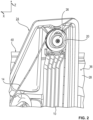
- the in Fig. 2 The rope deflection area 24 shown has a one-piece, i.e. one-piece or monolithic, molded, approximately cylindrical bearing point 26, onto which the cable deflection roller 20 is mounted so that it can rotate or pivot.
- the bearing point 26 or the cable deflection area 24 are designed without screws or bolts, which means that no additional fastening elements are arranged in the bearing point 26.
- the window lifter 2 is attached to a carrier plate 28 of a Fig. 3 shown door module 30.
- the carrier plate 28 is designed and intended to be attached to a door structure 32.
- the carrier plate 28 is designed as a (door) module carrier or unit carrier, on which, in addition to the window lifter 2, further functional components of a vehicle door (not shown in detail) can be mounted.
- the door structure 32 is designed as a window frame structure in the embodiment shown in the figures, and can also be designed as part of an inner door panel.
- the door module 30 When the door module 30 is installed as intended in a side door of a motor vehicle, it has - as do the carrier plate 28 and the door structure 32 - an inner side 34 and an outer side 36. In the installed or assembled state, the inner side 34 faces an interior (passenger compartment) of the motor vehicle, and the outer side 36 faces an area outside the motor vehicle.
- Fig. 3 shows a view of the inside 34 of the door module 30.
- fastening openings 38 On the inner side 34 of the door module 30 or the carrier plate 28, several interfaces for connecting to a door box (not shown in detail) of the door structure 32 or the inner door panel are visible in the form of fastening openings 38.
- the fastening openings 38 are arranged on an edge 40 of the carrier plate 28.
- the fastening openings 38 are provided with reference symbols in the figures merely as an example.
- the guide rail 10 with the cable deflection area 24 extends beyond the outer edge 40 of the carrier plate 28.
- the cable deflection area 24 stands approximately perpendicular to the upper edge of the carrier plate 28.
- the cable deflection area 24 is designed as a (joining) interface of the carrier plate 28 with the door structure or the window frame structure 32 of the inner door panel.
- the door structure 32 has a receiving contour 42 in the form of a through-opening passing through the door structure 32.
- the receiving contour 42 is introduced into a projection area 44 of the door structure 32, which is formed on a lower edge of the door structure 32 facing the carrier plate 28.
- the receiving contour 42 has a comparatively narrow slot area or guide slot 42a and a comparatively wide insertion area 42b opening into it.
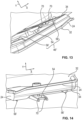
- the Fig. 5 shows the cable deflection area 24 in a perspective top view. As in the Fig. 5 comparatively clearly visible, the cable deflection area 24 is provided with an upstanding joining contour 46, which in the Fig. 3 shown joining or assembly state sits positively in the receiving contour 42 of the door structure 32.
- the guide rail 10 or at least the cable deflection area 24 is manufactured as an injection-molded part in which the joining contour 46 is integrally formed, i.e. one-piece or monolithic.
- the joining contour 46 is arranged on a side of the cable deflection area 24 opposite the bearing point 26. In the embodiment shown, the joining contour 46 is arranged on the inner side 34 of the cable deflection area 24.
- the joining contour 46 has in the XY plane essentially a T-shaped cross-sectional shape with a vertical T-leg 48 oriented approximately along the Y-axis and with a horizontal T-leg 50 oriented approximately along the X-direction.
- the T-shape is in the Fig. 6 shown in dashed lines.
- On the T-leg 50 is an extension of the T-leg 48, a reinforcing rib 52 is formed.
- the joining contour 46 and the reinforcing rib 52 extend along the Z-axis.
- the joining contour 46 can be manufactured during the injection molding process of the cable deflection area 24 without a slider.
- the joining contour 46 is designed and configured such that when the joining contour is seated in the receiving contour 42, the joining contour 46 at least partially engages behind the receiving contour 42 in a form-fitting manner, so that the cable deflection area 24 is held in a stabilizing manner along the Y axis. This means that loads, stresses and forces that occur due to the joining connection between the cable deflection area 24 and the door structure 32 and that act on the cable deflection area 24 or the bearing point 26 are at least partially transferred to the door structure 32.
- the joining contour 46 is inserted into the receiving contour 42 along an assembly direction M, which is oriented essentially along the rail longitudinal direction or Z direction.
- the joining contour 46 is guided in the insertion area 42b and the guide slot 42a.
- the vertical T-leg 48 of the joining contour 46 engages in the guide slot 42a of the receiving contour 42 in a form-fitting manner in the inserted state or joining state (assembly state).
- the guide slot 42a is at least partially oriented along the Z-axis.
- the guide slot 42a thus acts in particular as a positioning or assembly aid or insertion aid when joining the door structure 32 and the carrier plate 28.
- the guide slot 42a ensures a form-fitting connection of the vertical T-leg 48, and thus of the cable deflection area 24, along the X-axis.
- the T-leg 48 of the joining contour 46 is arranged essentially between the inner side 34 of the cable deflection area 24 and the outer side 36 of the extension area 44.
- the T-leg 50 is arranged on the inner side 34 of the extension area 44 or the door structure 32, so that the horizontal T-leg 50 at least partially engages behind the guide slot 42a of the receiving contour 42. This creates a reliable and operationally safe form fit between the cable deflection area 24 and the door structure 32 along the Y-axis.
- the joining contour 46' shown has two mutually facing contact surfaces 54 and 56 which are integrally formed, i.e. one-piece or monolithically, onto the inner side 34 of the cable deflection region 24.
- the contact surfaces 54 and 56 are arranged substantially parallel in the XZ plane and spaced apart from one another along the Y direction.
- the contact surface 54 has two lateral reinforcing or holding ribs 58, which are spaced apart from one another along the X direction and between which a transverse surface 60 is provided.
- the contact surface 56 is designed as a counter rib, which is arranged opposite one of the holding ribs 58.
- a second counter rib of the contact surface 56 is provided, which is arranged opposite the other holding rib 58.
- the receiving contour 42' is shown.
- the receiving contour 42' is, in contrast to the receiving contour 42, not closed on the circumference, but is designed to be open in the direction of the joining contour 46' or in the direction of the carrier plate 28.
- the receiving contour 42' has a matching surface 62, which - as in the Fig. 12 visible - is or can be enclosed in a form-fitting manner between the contact surfaces 54 and 56 of the joining contour 46'.
- the adjustment surface 62 has two surfaces 64, 66, which merge into one another via a step contour 68.
- the surfaces 64 and 66 are essentially oriented in the XZ plane and thus parallel to the contact surfaces 54, 56, with the step contour 68 creating a step-like or offset-like surface offset along the Y direction.
- the step contour 68 thus causes tolerance compensation along the Y direction during assembly.
- the receiving contour 42' is inserted along the Z direction into the receptacle formed between the contact surfaces 54, 56, so that the surfaces 64, 66 of the matching surface 62 are overlapped by the contact surfaces 54, 56 at least in sections.
- the free ends of the holding ribs 58 i.e. the areas of the holding ribs 58 that protrude from the transverse surface 60 along the Z direction, are provided with a beak or chamfer 70 as a guide contour.
- the beak 70 has a tapered profile towards the tip. In other words, an inclined slope is formed along the Z direction, which acts as an insertion or positioning aid when joining the door structure 32 to the cable deflection area 24.
- the retaining ribs 58 of the joining contour 46' are designed to be flexible or spring-elastic, wherein in the assembly or joining state a spring or restoring force oriented along the Y direction is realized, which as a mechanical prestress realizes a clamping force connection of the tuning surface 62 between the contact surfaces 54, 56.
- the joining contour 46" shown has two mutually facing contact surfaces 54 and 56', which are integrally formed, i.e. one-piece or monolithically, on the inner side 34 of the cable deflection region 24.
- the contact surface 56' is designed in this embodiment as two holding ribs arranged offset from the contact surface 54 on both sides along the X direction.
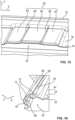
- the Figures 15 and 16 show the receiving contour 42".
- the receiving contour 42" has a tuning surface 62'.
- the tuning surface 62' has two surfaces 64' and one surface 66', which are arranged alternately or alternately along the X direction.
- the centrally arranged surface 66' is offset from the surfaces 64' by a step contour 68'.
- the surface 66' thus protrudes above or above the surfaces 64' at least in sections along the Y direction.
- the tuning surface 62' or the surfaces 64',66' are provided with a free-end beak or chamfer 72.
- the contact surfaces 54, 54', 56, 56' are formed by means of different components. It is also conceivable that the tuning surface 62, 62' is formed in several parts; in particular, it is possible that the surfaces 64, 64', 66, 66' are formed by two different components.
- the joining contour 46', 46' is provided with a damping element.
Landscapes
- Engineering & Computer Science (AREA)
- Mechanical Engineering (AREA)
- Window Of Vehicle (AREA)
Description
- Die Erfindung betrifft ein Türmodul einer Fahrzeugtür, aufweisend eine Trägerplatte mit einem Seil-Fensterheber mit mindestens einer Führungsschiene, und eine damit gefügte oder fügbare Türstruktur. Die Erfindung betrifft weiterhin eine Fahrzeugtür mit einem solchen Türmodul.
- Eine Türkarosserie einer Fahrzeugtür weist in der Regel ein die Türaußenhaut der Fahrzeugtür bildendes Türaußenblech und ein mit dem Türaußenblech verbundenes, fahrzeuginnenseitiges, Türinnenblech auf, zwischen welchen ein Hohlraum als Montageraum ausgebildet ist, in welchen Funktionselemente oder Funktionskomponenten der Fahrzeugtür, wie beispielsweise ein Fensterheber, ein Türschloss, ein Airbag oder dergleichen angeordnet sind.
- Zur Montage der Funktionskomponenten ist es möglich, diese auf einer Trägerplatte, auch Türmodulträger oder Aggregatträger genannt, vorzumontieren. Die bestückte Trägerplatte ist anschließend auf eine Montageöffnung der Fahrzeugtür oder des Türinnenblechs aufsetzbar, um diese abzudecken, insbesondere um eine Nassraum-/Trockenraumtrennung zu realisieren. Beim Einbau der Trägerplatte in die Fahrzeugtür kann es erforderlich sein, gewisse Funktionskomponenten, wie beispielsweise Führungsschienen eines Fensterhebers, zusätzlich an einer Türstruktur oder einer Karosserie der Fahrzeugtür zu montieren.
- Fensterheber für Fahrzeugtüren sind beispielsweise mit einem Seilzugmechanismus zum Anheben und zum Absenken einer (Fenster-)Scheibe ausgeführt. Bei einem derartigen Fensterheber ist die Scheibe mittels eines Mitnehmers oder Schienengleiters entlang mindestens einer Führungsschiene geführt. Der Seilzugmechanismus weist typischerweise einen Seilzug auf, der einerseits in einer diesen auf- und abwickelnden Seiltrommel sowie andererseits unter einfacher oder mehrfacher Umlenkung an den Mitnehmer oder Schienengleiter geführt und dort fixiert ist.
- Die Umlenkung des Seilzugs erfolgt in der Regel mittels Seilumlenkrollen, welche in den stirnseitigen Endbereichen der Führungsschiene, welche nachfolgend auch als Seilumlenkbereiche bezeichnet werden, angeordnet sind. Die Seilumlenkrollen sind hierbei auf Lagerstellen aufgesetzt, und an diesen drehbar oder rotierbar gelagert.
- Zur Montage der Trägerplatte an der Türstruktur kann einer der Seilumlenkbereiche einer Führungsschiene über den äußeren Rand der Trägerplatte hinausragen, und in eine Aufnahme der Türstruktur eingesetzt werden. Durch den im Wesentlichen freistehenden Seilumlenkbereich wird jedoch einerseits die mechanische Festigkeit und Stabilität des Fensterhebers beziehungsweise der Führungsschiene in diesem Bereich nachteilig reduziert, sowie andererseits die mechanische Beanspruchung aufgrund von Hebelverhältnissen nachteilig erhöht.
- Zur Stabilisierung des Seilumlenkbereichs wird dieser in der Regel mit der Türstuktur mechanisch gekoppelt. Hierzu sind beispielsweise bolzen- oder schraubendurchsetzte Lagerstellen denkbar, bei welchen eine Befestigungsschraube oder ein Befestigungsbolzen die Lagerstelle entlang der Drehachse der Seilumlenkrolle zumindest teilweise durchsetzt und kopfseitig an der Aufnahme beziehungsweise der Türstruktur gehalten ist. Die Lagerstelle weist hierbei beispielsweise ein Innengewinde auf. Der Seilumlenkbereich wird dadurch kraftschlüssig mit der Türstruktur gefügt oder schraubbefestigt. Durch die Schraubbefestigung wird jedoch ein zusätzlicher Montageschritt bei der Montage der Fahrzeugtür notwendig.
- Zur Vermeidung dieses Montageschritts sind beispielsweise auch Seilumlenkbereiche mit bolzen- oder schraubenfreien Lagerstellen möglich, also Lagerstellen, welche im Montagezustand nicht von einem Befestigungselement, wie beispielsweise einer Befestigungsschraube oder einem Befestigungsbolzen, durchsetzt werden. Bei derartigen Ausführungen ist der Seilumlenkbereich typischerweise nicht direkt mit der Türstruktur verbunden oder mit dieser gefügt. Mit anderen Worten fehlt in der Regel eine unmittelbare mechanische Kopplung zwischen dem Seilumlenkbereich und der Türstruktur, wodurch wird die mechanische Stabilität des Seilumlenkbereich nachteilig reduziert. Dadurch können im Betrieb des Fensterhebers aufgrund der über den geführten Seilzug auf die Seilumlenkrolle einwirkenden Kräfte Bewegungen und (Ver-)Biegungen beziehungsweise Verformungen des Seilumlenkbereichs auftreten, beispielsweise im Bereich zwischen 5 - 6 mm (Millimeter). Insbesondere kann es hierbei vorkommen, dass der Seilumlenkbereich in einen Berührungskontakt mit der geführten Fensterscheibe oder einem Mitnehmer beziehungsweise Schienengleiter kommt, wodurch eine ungewünschte Geräuschentwicklung bewirkt wird. Daher sind derartige schrauben- oder bolzenlose Seilumlenkbereiche häufig mit einem zusätzlichen Dämpfungselement versehen.
- Die
EP 0 385 197 A1 offenbart eine Fahrzeugtür mit einem als Vormontagegruppe ausgebildeten Aggregateträger, welcher gegenüber einem den Aggregateträger tragenden Türkörper einstellbar ist, und welcher eine etwa senkrechte Fensterheberschiene für eine in der Fahrzeugtüre versenkbare Scheibe aufnimmt. In einem unteren Endbereich der Fensterheberschiene ist ein zum Innenraum des Fahrzeuges gerichteter Ansatz angeformt, wobei in dem den Ansatz gegenüberliegenden Abschnitt des Türkörpers eine Aussparung vorgesehen ist, derart, dass unabhängig von der toleranz- und/oder einstellbedingten Lage der Fensterheberschiene ein Eingreifen des Ansatzes in die Aussparung bei einer seitenaufprallbedingten Verschiebung der Fensterheberschiene gewährleistet ist. - In der
US 2007/163177 A1 ist ein Türmodul für eine Fahrzeugtür offenbart, dass eine Modulplatte und eine an der Modulplatte befestigte Fensterheberschiene umfasst. Die Fensterheberschiene ist translatorisch beweglich, schwenkbar an der Modulplatte befestigt und durch einen leicht lösbaren Haltemechanismus in einer Bereitstellungsposition fixiert. - Der Erfindung liegt die Aufgabe zugrunde, ein besonders geeignetes Türmodul einer Fahrzeugtür anzugeben. Insbesondere soll eine möglichst stabile und einfach herstellbare Verbindung zwischen einer Trägerplatte und einer Türstruktur ermöglicht sein. Der Erfindung liegt weiterhin die Aufgabe zugrunde, eine besonders geeignete Fahrzeugtür mit einem solchen Türmodul anzugeben.
- Hinsichtlich des Türmoduls wird die Aufgabe mit den Merkmalen des Anspruchs 1 und hinsichtlich der Fahrzeugtür mit den Merkmalen des Anspruchs 13 erfindungsgemäß gelöst. Vorteilhafte Ausgestaltungen und Weiterbildungen sind Gegenstand der jeweiligen Unteransprüche. Die im Hinblick auf das Türmodul angeführten Vorteile und Ausgestaltungen sind sinngemäß auch auf die Fahrzeugtür übertragbar und umgekehrt.
- Das erfindungsgemäße Türmodul ist insbesondere als eine Türbaugruppe einer Fahrzeugtür ausgeführt. Das Türmodul weist hierbei eine Trägerplatte als Türmodulträger oder Aggregatträger auf, an welcher ein beispielsweise vormontierter Seil-Fensterheber mit mindestens einer Führungsschiene angeordnet ist. Das Türmodul weist weiterhin eine Türstruktur, insbesondere in Form eines Türinnenblechs oder einer Fensterrahmenstruktur, auf, welche mit der Trägerplatte gefügt oder fügbar ist.
- Die Führungsschiene erstreckt sich hierbei mit einem Seilumlenkbereich über einen äußeren Rand der Trägerplatte hinaus. Mit anderen Worten steht der Seilumlenkbereich der Führungsschiene den Außenumfang der Trägerplatte über.
- Der Seilumlenkbereich ist hierbei insbesondere als eine (Füge-)Schnittstelle der Trägerplatte mit der Türstruktur ausgebildet. Der Seilumlenkbereich ist hierbei mit einer Fügekontur versehen, welche im Füge- oder Montagezustand formschlüssig in einer Aufnahmekontur der Türstruktur einsitzt. Die Fügekontur ist erfindungsgemäß einteilig, also einstückig oder monolitisch, an den Seilumlenkbereich angeformt, oder ist nicht erfindungsgemäß mehrteilig, also als ein oder mehrere separate Bauteile hierzu ausgeführt. Die Aufnahmekontur ist beispielsweise ebenfalls einteilig oder mehrteilig zu der Türstruktur ausgebildet.
- Die Fügekontur ist hierbei erfindungsgemäß derart ausgelegt und ausgestaltet, dass wenn die Fügekontur in der Aufnahmekontur einsitzt, die Fügekontur die Aufnahmekontur zumindest teilweise hintergreift, so dass der Seilumlenkbereich entlang einer hierzu senkrecht orientierten Richtung stabilisierend gehalten ist. Mit anderen Worten ist die Aufnahmekontur entlang der senkrechten Richtung formschlüssig von der Fügekontur zumindest abschnittsweise hintergriffen, wodurch der Seilumlenkbereich entlang dieser Richtung mechanisch stabilisiert wird. Dies bedeutet, dass eine Hinterhakung der Türstruktur im Bereich der Aufnahmekontur durch die Fügekontur des Seilumlenkbereichs realisiert ist. Dadurch ist ein besonders geeignetes Türmodul realisiert.
- Durch den Formschluss zwischen der Fügekontur und der Aufnahme ist eine mechanische Kopplung zwischen dem Seilumlenkbereich und der Türstruktur realisiert, welche den Seilumlenkbereich hinsichtlich im Betrieb auftretender Kräfte betriebssicher und zuverlässig mechanisch stabilisiert. Mit anderen Worten werden auftretende Lasten, Spannungen und Kräfte, welche auf den Seilumlenkbereich einwirken, zumindest teilweise auf die Türstruktur übertragen. Dies bedeutet, dass die erfindungsgemäße (Füge-)Schnittstelle zwischen der Trägerplatte und der Türstruktur die mechanische Steifigkeit oder Festigkeit des Seil-Fensterhebers beziehungsweise der Führungsschiene verbessert.
- Insbesondere werden somit ungewünschte Bewegungen, mechanische (Ver-)Biegungen oder Verformungen des Seilumlenkbereichs vorteilhaft und konstruktiv einfach vermieden oder zumindest reduziert. Dadurch ist es möglich, den Seilumlenkbereich ohne ein zusätzliches Dämpfungselement auszuführen, da die Gefahr einer ungewünschten Geräuschentwicklung durch die mechanische Stabilisierung vorteilhaft und einfach vermieden ist.
- Unter einem "Formschluss" oder einer "formschlüssigen Verbindung" zwischen wenigstens zwei miteinander verbundenen Teilen wird hier und im Folgenden insbesondere verstanden, dass der Zusammenhalt der miteinander verbundenen Teile zumindest in einer Richtung durch ein unmittelbares Ineinandergreifen von Konturen der Teile selbst oder durch ein mittelbares Ineinandergreifen über ein zusätzliches Verbindungsteil erfolgt. Das "Sperren" einer gegenseitigen Bewegung in dieser Richtung erfolgt also formbedingt.
- Im Nachfolgenden sind Angaben hinsichtlich der Raumrichtungen auch insbesondere in einem Koordinatensystem des Kraftfahrzeugs (Fahrzeugkoordinatensystem) bezüglich einer beispielhaften Einbausituation des Türmoduls in einer Seitentür des Kraftfahrzeugs angegeben. Die Abszissenachse (X-Achse, X-Richtung) ist hierbei entlang der Fahrzeuglängsrichtung (Fahrrichtung) und die Ordinatenachse (Y-Achse, Y-Richtung) entlang der Fahrzeugquerrichtung sowie die Applikatenachse (Z-Achse, Z-Richtung) entlang der Fahrzeughöhe orientiert.
- Der Seilumlenkbereich steht der Trägerplatte insbesondere entlang der Z-Richtung über. Die Fügekontur hintergreift die Aufnahmekontur hierbei vorzugsweise entlang der Y-Richtung. Mit anderen Worten sind die Trägerplatte und die Türstruktur entlang der Y-Richtung formschlüssig miteinander gefügt.
- In einer bevorzugten Ausführung ist der Seilumlenkbereich mit einer - oder bolzenlosen Lagerstelle ausgeführt, an welcher eine Seilumlenkrolle drehbar oder rotierbar gelagert ist. Mit anderen Worten ist kein zusätzliches, separates Befestigungselement zwischen dem Seilumlenkbereich und der Türstruktur vorgesehen.
- Dadurch ist ein geeigneter Seilumlenkbereich realisiert, welcher eine besonders einfache und aufwandsreduzierte Montage des Türmoduls ermöglicht. Insbesondere entfällt somit ein zusätzlicher Montageschritt, bei welchem beispielsweise eine Befestigungsschraube in ein Innengewinde der Lagerstelle eingedreht wird, um den Seilumlenkbereich stabilisierend mit der Türstruktur zu koppeln.
- In einer vorteilhaften Ausgestaltung ist die Fügekontur an einer der Lagerstelle gegenüberliegenden Seite des Seilumlenkbereichs angeordnet. Mit anderen Worten ist die Lagerstelle beispielsweise an einer Vorderseite des Seilumlenkbereichs angeordnet, welche an einer den Seil-Fensterheber tragenden Planseite der Trägerplatte angeordnet ist. Die Fügekontur ist entsprechend an einer gegenüberliegenden Rückseite des Seilumlenkbereichs angeordnet. Dadurch ist eine einfache und bauraumkompakte Kopplung zwischen dem Seilumlenkbereich und der Türstruktur ermöglicht, welche im Wesentlichen keine konstruktiven Auswirkungen auf die Lagerstelle oder die Seilumlenkrolle hat.
- In einer zweckmäßigen Ausbildung ist die Fügekontur in die Aufnahmekontur entlang einer Schienenlängsrichtung (Montagerichtung) eingesteckt oder einsteckbar. Die Schienenlängsrichtung ist hierbei im Wesentlichen entlang der Z-Richtung orientiert. Die Aufnahmekontur ist beispielsweise als eine Durchführöffnung der Türstruktur ausgeführt, durch welche die Fügekontur zumindest teilweise hindurchgeführt wird. Die Fügekontur und die Aufnahmekontur greifen hierbei entlang der Schienenlängs- oder Montagerichtung nach Art eines Schlüssel-Schloss-Prinzips ineinander, wobei die Aufnahmekontur im Wesentlichen das Schlüsselloch und die Fügekontur als Schlüssel ausgebildet ist. Dadurch ist eine besonders einfache und aufwandsreduzierte Montage des Türmoduls gewährleistet.
- Beispielsweise ist es denkbar, dass die Fensterheber- oder Führungsschiene - und somit der Seilumlenkbereich - aus einem Metall hergestellt sind. In einer bevorzugten, sowie konstruktiv besonders einfachen und bauteilreduzierten Ausführung ist zumindest der Seilumlenkbereich als ein Spritzgussteil ausgeführt, an welchen die Fügekontur einstückig, also einteilig oder monolithisch, angeformt ist. Dadurch ist eine einfache sowie aufwands- und kostenreduzierte Herstellung des Türmoduls realisiert.
- In einer denkbaren Weiterbildung ist die Fügekontur im Zuge des Spritzgussprozesses hierbei ohne einen Schieber hergestellt. Mit anderen Worten ist für die Entformung der Fügekontur aus einem Spritzgusswerkzeug kein zusätzlicher beweglicher Schieber notwendig. Es werden also keine Hilfstrennebenen im Zuge des Spritzgussprozesses erzeugt, um partielle Spritzteilbereiche der Fügekontur freizustellen. Das Spritzgussteil, also der Seilumlenkbereich und die Fügekontur können also im Wesentlichen mit einem einfach funktionierenden Auf-Zu-Spritzgusswerkzeug entlang einer Hauptentformungsrichtung entformt werden.
- Dadurch ist eine besonders einfache und kostengünstige Herstellung des Türmoduls gewährleistet.
- In einer nicht erfindungsgemäßen Ausgestaltung weist die Fügekontur eine im Wesentlichen T-förmige Querschnittsform auf. Die Fügekontur weist die T-förmige Geometrie hierbei insbesondere in einer XY-Ebene auf, wobei sich die Fügekontur insbesondere entlang der Z-Richtung erstreckt. Dadurch ist eine besonders einfache und zweckmäßige Ausgestaltungsform der Fügekontur realisiert.
- In einer denkbaren nicht erfindungsgemäßen Weiterbildung greift der vertikale T-Schenkel der Fügekontur in einen Führungsschlitz der Aufnahmekontur formschlüssig ein. Der vertikale T-Schenkel ist im Montagezustand insbesondere entlang der Y-Richtung orientiert. Der Führungsschlitz ist hierbei vorzugsweise entlang der Schienenlängsrichtung, also der Montagerichtung beziehungsweise im Wesentlichen entlang der Z-Richtung, orientiert. Der Führungsschlitz wirkt somit insbesondere als eine Positionierungs- oder Montagehilfe beim Fügen der Türstruktur und der Trägerplatte. Des Weiteren wird durch den Führungsschlitz ein Formschluss des vertikalen T-Schenkels, und somit des Seilumlenkbereichs, entlang der X-Richtung realisiert.
- Der horizontale T-Schenkel, welcher im Montagezustand insbesondere entlang der X-Richtung orientiert ist, hintergreift zumindest abschnittsweise die Aufnahmekontur, so dass der Formschluss zwischen dem Seilumlenkbereich und der Türstruktur entlang der Y-Richtung realisiert ist. Dies bedeutet, dass der horizontale T-Schenkel im Wesentlichen an einer dem Seilumlenkbereich abgewandten Oberfläche der Türstruktur beziehungsweise der Aufnahmekontur angeordnet ist.
- In einer erfindungsgemäßen Ausgestaltung weist die Fügekontur zwei einander zugewandte Anlageflächen für die Türstruktur auf. Die Anlageflächen sind hierbei zweckmäßigerweise parallel und entlang der Y-Richtung beabstandet zueinander ausgeführt. Zwischen den Anlageflächen ist somit eine lichte Weite oder Abstand als Aufnahme ausgebildet. Die Aufnahmekontur weist hierbei eine Abstimmfläche auf, welche formschlüssig, insbesondere form- und kraftschlüssig, zwischen den Anlageflächen eingefasst ist. Durch die Fügekontur ist somit eine besonders einfache und aufwandreduzierte Montage ermöglicht. Im Montagezustand ist der Seilumlenkbereich somit besonders zuverlässig und stabil entlang der Y-Richtung fixiert. Dadurch werden Geräuschentwicklungen aufgrund von Relativbewegungen zwischen den Bauteilen vorteilhaft und wirkungsvoll vermieden oder zumindest reduziert.
- Unter einem "Kraftschluss" oder einer "kraftschlüssigen Verbindung" zwischen wenigstens zwei miteinander verbundenen Teilen wird hier und im Folgenden insbesondere verstanden, dass die miteinander verbundenen Teile aufgrund einer zwischen ihnen wirkenden Reibkraft gegen ein Abgleiten aneinander gehindert sind. Fehlt eine diese Reibkraft hervorrufende "Verbindungskraft" (dies bedeutet diejenige Kraft, welche die Teile gegeneinander drückt, beispielsweise eine Schraubenkraft oder die Gewichtskraft selbst), kann die kraftschlüssige Verbindung nicht aufrecht erhalten und somit gelöst werden.
- Diese Ausgestaltung der Fügekontur und Aufnahmekontur ermöglicht eine besonders einfache Werkzeugabstimmung zur Fügung oder Montage der Türstruktur mit dem Seilumlenkbereich der Trägerplatte. Dadurch wird die Montage vereinfacht und die Montage- oder Herstellungskosten vorteilhaft reduziert.
- Die Anlageflächen sind beispielsweise unsymmetrisch, also beispielsweise entlang der X- und/oder Z-Richtung versetzt zueinander, angeordnet.
- Weiterhin ist es beispielsweise denkbar, dass die Fügekontur beziehungsweise die Anlageflächen mittels unterschiedlicher Bauteile gebildet sind. Mit anderen Worten ist es beispielsweise möglich, dass eine (erste) Anlagefläche der Fügekontur an den Seilumlenkbereich angeformt ist, und dass die zweite Anlagefläche als ein separates Bauteil ausgeführt ist, welches zur Bildung der Fügekontur an den Seilumlenkbereich montiert oder gefügt wird. Beispielsweise ist es hierbei möglich, dass die Fügekontur oder die Anlageflächen der Türstruktur selbst durch zum Beispiel zwei unterschiedliche Bauteile gebildet werden, beispielsweise mittels eines Rahmenteils und eines Crashrohrs.
- In einer geeigneten Weiterbildung weist die Abstimmfläche eine Stufenkontur, also einen Flächenversatz, insbesondere entlang der Y-Richtung, auf, welche von den Anlageflächen übergriffen ist. Die Stufenkontur wirkt somit bei der Montage als ein Toleranzausgleich entlang der Y-Richtung. Dadurch ist eine besonders stabile Halterung des Seilumlenkbereichs an der Aufnahmekontur realisiert.
- In einer zweckmäßigen Ausführung ist zumindest eine der Anlageflächen freiendseitig mit einer Einschnäbelung, also mit einer fasenartigen Führungskontur, versehen. Dadurch ist ein besonders einfaches Einführen der Abstimmfläche zwischen die Anlageflächen ermöglicht, wodurch die Montage vereinfacht wird.
- In einer vorteilhaften Ausbildung ist die Fügekontur zumindest teilweise federelastisch oder flexibel ausgeführt. Dies bedeutet, dass beispielsweise mindestens eine der Anlageflächen federelastisch ausgebildet ist. Vorzugsweise ist somit mittels den Anlageflächen der Fügekontur eine Hinterhakung mit einer gewissen mechanischen Vorspannung realisiert, so dass die Abstimmfläche im Montage- oder Fügezustand kraftschlüssig zwischen den Anlageflächen geklemmt gehalten ist. Dadurch ist eine besonders stabile Befestigung realisiert.
- In einer besonders geräuschreduzierten und klapperfreien Ausführung ist die Fügekontur mit einem Dämpfungselement versehen. Das Dämpfungselement ist hierbei zwischen zumindest einer Anlagefläche und der Abstimmfläche angeordnet. Das Dämpfungselement ist beispielsweise als ein auf die Fügekontur beziehungsweise Anlageflächen aufgesetzter oder aufgesteckter Dämpfer, insbesondere ein Dämpfer aus einem Ethylen-Propylen-Dien-Kautschuk (kurz: EPDM, Ethylen-Propylen-Dien; M-Gruppe), oder als eine angespritzte Weichkomponente, beispielsweise ein Zwei-Komponenten-Dichtschaum (2K-Dichtschaum), ausgeführt.
- In einer besonders stabilen Ausbildung ist die Fügekontur mit einer Verstärkungsrippe versehen. Dies bedeutet, dass die Fügekontur mittels der mechanisch verstärkt oder stabilisiert ist. Dadurch ist eine besonders stabile Fügekontur realisiert, welche sich in der Folge auf einen besonders stabilen und betriebssicheren Formschluss zwischen dem Seilumlenkbereich und der Türstruktur überträgt.
- In einer bevorzugten Anwendung ist das Türmodul ein Teil einer Fahrzeugtür, insbesondere einer Seitentür eines Kraftfahrzeugs. Dadurch ist eine besonders geeignete und kostengünstige Fahrzeugtür realisiert.
- Nachfolgend sind Ausführungsbeispiele der Erfindung anhand einer Zeichnung näher erläutert. Darin zeigen:
- Fig. 1
- in schematischer Darstellung ein Seil-Fensterheber einer Fahrzeugtür,
- Fig. 2
- in Perspektive ausschnittsweise einen Seilumlenkbereich des Seil-Fensterhebers,
- Fig. 3
- in Frontansicht ein Türmodul einer Fahrzeugtür, mit einer Trägerplatte und mit einer Türstruktur,
- Fig. 4
- in Draufsicht eine Aufnahmekontur der Türstruktur in einer nicht erfindungsgemäßen Ausführungsform,
- Fig. 5
- in Perspektive eine Fügekontur des Seilumlenkbereichs in einer nicht erfindungsgemäßen Ausführungsform,
- Fig. 6
- in Draufsicht die Fügekontur in der nicht erfindungsgemäßen Ausführungsform,
- Fig. 7
- in Perspektive die nicht erfindungsgemäße Fügekontur und die Aufnahmekontur bei einem Fügevorgang,
- Fig. 8
- in Perspektive mit Blick auf eine Außenseite die Fügeverbindung zwischen der nicht erfindungsgemäßen Fügekontur und der Aufnahmekontur,
- Fig. 9
- in Perspektive mit Blick auf eine Innenseite die Fügeverbindung zwischen der nicht erfindungsgemäßen Fügekontur und der Aufnahmekontur,
- Fig. 10
- in Perspektive eine Fügekontur des Seilumlenkbereichs in einer erfindungsgemäßen Ausführungsform,
- Fig. 11
- in Perspektive eine Aufnahmekontur der Türstruktur in einer erfindungsgemäßen Ausführungsform,
- Fig. 12
- in Perspektive die Fügeverbindung zwischen der Fügekontur und der Aufnahmekontur gemäß der erfindungsgemäßen Ausführungsform,
- Fig. 13
- in Perspektive die Fügekontur in einer zweiten erfindungsgemäßen Ausführungsform,
- Fig. 14
- in Perspektive die Fügekontur in der zweiten erfindungsgemäßen Ausführungsform,
- Fig. 15
- in Perspektive die Aufnahmekontur in einer zweiten erfindungsgemäßen Ausführungsform, und
- Fig. 16
- in Perspektive die Aufnahmekontur in der zweiten erfindungsgemäßen Ausführungsform.
- Einander entsprechende Teile und Größen sind in allen Figuren stets mit den gleichen Bezugszeichen versehen.
- In der
Fig. 1 ist in vereinfachter und schematischer Darstellung ein elektrischer Fensterheber 2 als Stellvorrichtung für eine (Fahrzeug-)Fensterscheibe 4 eines Kraftfahrzeugs gezeigt. - Der Fensterheber 2 weist einen Stellmotor 6 auf, welcher mittels einer Stellmechanik 8 auf die Fensterscheibe 4 wirkt. Die Stellmechanik 8 weist eine Führungsschiene 10 und einen mit der Fensterscheibe 4 gekoppelten Mitnehmer oder Schienengleiter 12 auf.
- In dem gezeigten Ausführungsbeispiel ist der Fensterheber 2 als ein einfach geführter Seil-Fensterheber ausgeführt. Die Stellmechanik 8 weist hierbei zusätzlich zu der Führungsschiene 10 einen Seilzug 14 auf.
- Der Stellmotor 6 des Fensterhebers 2 treibt über ein Schnecken- oder Stirnradgetriebe 16 eine Seiltrommel 18 der Stellmechanik 8 an. Ein Zugseil des Seilzugs 14 ist derart an der Seiltrommel 18 angeordnet, dass bei durch das Getriebe 16 bewirkten Drehungen der Seiltrommel 18 ein Auf- und Abwickeln des Zugseils erfolgt.
- An der Führungsschiene 10 sind eine obere Seilumlenkrolle 20 und eine untere Seilumlenkrolle 22 befestigt, welche an den gegenüberliegenden (Schienen-)Stirnseiten angeordnet sind. Das Zugseil des Seilzugs 14 ist um die Seilumlenkrollen 20, 22 herum geführt.
- Bei einer Betätigung des Stellmotors 6 wird die Fensterscheibe 4 in ihrer (Scheiben-) Position P verfahren. Die Fensterscheibe 4 ist hierbei reversibel zwischen einer Schließstellung S, welche die höchstmögliche Position P darstellt, und einer Öffnungsstellung O, welche die tiefst mögliche Position P darstellt, verfahrbar. In diesen Stellungen S und O ist die Fensterscheibe 4 in der
Fig. 1 jeweils gestrichelt angedeutet. Mit durchgezogenen Linien ist die Fensterscheibe 4 dagegen in einer halbgeöffneten Zwischenstellung dargestellt. - Nachfolgend sind Angaben hinsichtlich der Raumrichtungen auch in einem Koordinatensystem des Kraftfahrzeugs (Fahrzeugkoordinatensystem) bezüglich der beispielhaften Einbausituation in einer Seitentür des Kraftfahrzeugs angegeben. Die Abszissenachse (X-Achse) ist hierbei entlang der Fahrzeuglängsrichtung und die Ordinatenachse (Y-Achse) entlang der Fahrzeugquerrichtung sowie die Applikatenachse (Z-Achse) entlang der Fahrzeughöhenrichtung orientiert.
- Die Längsrichtung der Führungsschiene 12 (Schienenlängsrichtung) ist hierbei etwa parallel zur Applikatenachse (Z) orientiert, wobei die Querrichtung der Führungsschiene 10 (Schienenquerrichtung) im Wesentlichen parallel zur Abszissenachse (X) ausgerichtet ist. Die Höhenrichtung der Führungsschiene 10 (Schienenhöhenrichtung) ist senkrecht zu der Schienenquerrichtung und der Schienenlängsrichtung orientiert, und verläuft somit etwa parallel zu der Ordinatenachse (Y).
- In der
Fig. 2 ist ausschnittsweise ein Seilumlenkbereich 24 des Fensterhebers 2 beziehungsweise der Führungsschiene 10, also der stirnseitige Schienenendbereich, an welchem die Seilumlenkrolle 20 angeordnet ist, näher gezeigt. - Der in
Fig. 2 gezeigte Seilumlenkbereich 24 weist einen einstückig, also einteilig oder monolithisch, angeformte, etwa zylinderförmige Lagerstelle 26 auf, auf welche die Seilumlenkrolle 20 rotierbar oder drehbar gelagert aufgesetzt ist. Die Lagerstelle 26 beziehungsweise der Seilumlenkbereich 24 sind hierbei schrauben- oder bolzenlos ausgeführt, dies bedeutet, dass keine zusätzlichen Befestigungselemente in der Lagerstelle 26 angeordnet sind. - Im Montagezustand ist der Fensterheber 2 an einer Trägerplatte 28 eines in
Fig. 3 gezeigten Türmoduls 30 vormontiert. Die Trägerplatte 28 ist dazu ausgebildet und vorgesehen an einer Türstruktur 32 festgelegt zu werden. Die Trägerplatte 28 ist hierbei als ein (Tür-)Modulträger oder Aggregatträger ausgebildet, an welchem zusätzlich zu dem Fensterheber 2 weitere Funktionskomponenten einer nicht näher gezeigten Fahrzeugtür montierbar sind. Die Türstruktur 32 ist in dem in den Figuren gezeigten Ausführungsbeispiel als eine Fensterrahmenstruktur ausgebildet, und kann hierbei auch als Teil eines Türinnenblechs ausgeführt sein. - Bei einem bestimmungsgemäßen Einbau des Türmoduls 30 in eine Seitentür eines Kraftfahrzeugs weist dieses - sowie auch die Trägerplatte 28 und die Türstruktur 32 - eine Innenseite 34 und eine Außenseite 36 auf. Die Innenseite 34 ist hierbei im Einbau- oder Montagezustand einem Innenraum (Fahrgastzelle) des Kraftfahrzeugs zugewandt, und die Außenseite 36 einem Bereich außerhalb des Kraftfahrzeugs. Die
Fig. 3 zeigt ein Blick auf die Innenseite 34 des Türmoduls 30. - An der Innenseite 34 des Türmoduls 30 beziehungsweise der Trägerplatte 28 sind mehrere Schnittstellen zur Verbindung mit einem nicht näher gezeigten Türkasten der Türstruktur 32 beziehungsweise des Türinneblechs in Form von Befestigungsöffnungen 38 ersichtlich. Die Befestigungsöffnungen 38 sind hierbei an einem Rand 40 der Trägerplatte 28 angeordnet. Die Befestigungsöffnungen 38 sind in den Figuren lediglich beispielhaft mit Bezugszeichen versehen.
- Wie beispielsweise in der
Fig. 2 ersichtlich ist, erstreckt sich die Führungsschiene 10 mit dem Seilumlenkbereich 24 über den äußeren Rand 40 der Trägerplatte 28 hinaus. Insbesondere steht der Seilumlenkbereich 24 hierbei der oberen Kante der Trägerplatte 28 etwa senkrecht empor. - Der Seilumlenkbereich 24 ist hierbei als eine (Füge-)Schnittstelle der Trägerplatte 28 mit der Türstruktur beziehungsweise der Fensterrahmenstruktur 32 des Türinnenblechs ausgebildet.
- Wie beispielsweise in der
Fig. 4 gezeigt ist, weist die Türstruktur 32 eine Aufnahmekontur 42 in Form einer die Türstruktur 32 durchsetzenden Durchführöffnung auf. Die Aufnahmekontur 42 ist in einen Auslegebereich 44 der Türstruktur 32 eingebracht, welcher an einer unteren, der Trägerplatte 28 zugewandten Kante der Türstruktur 32 angeformt ist. Die Aufnahmekontur 42 weist hierbei einen vergleichsweise schmalen Schlitzbereich oder Führungsschlitz 42a und einen darin einmündenden, vergleichsweise breiten Einführbereich 42b auf. - Die
Fig. 5 zeigt den Seilumlenkbereich 24 in einer perspektivischen Draufsicht. Wie in derFig. 5 vergleichsweise deutlich ersichtlich ist, ist der Seilumlenkbereich 24 mit einer emporstehenden Fügekontur 46 versehen, welche in dem inFig. 3 gezeigten Füge- oder Montagezustand formschlüssig in der Aufnahmekontur 42 der Türstruktur 32 einsitzt. - Nachfolgend ist die nicht erfindungsgemäße Fügekontur 46 und deren Funktion anhand der
Figuren 6 bis 9 näher erläutert. - Die Führungsschiene 10 beziehungsweise zumindest der Seilumlenkbereich 24 ist als ein Spritzgussteil hergestellt, bei welchem die Fügekontur 46 einstückig, also einteilig oder monolithisch, angeformt ist. Die Fügekontur 46 ist hierbei an einer der Lagerstelle 26 gegenüberliegenden Seite des Seilumlenkbereichs 24 angeordnet. In dem gezeigten Ausführungsbeispiel ist die Fügekontur 46 an der Innenseite 34 des Seilumlenkbereichs 24 angeordnet.
- Wie insbesondere in der
Fig. 6 ersichtlich ist, weist die Fügekontur 46 hierbei in der XY-Ebene im Wesentlichen eine T-förmige Querschnittsform mit einem vertikalen, etwa entlang der Y-Achse orientierten, T-Schenkel 48 und mit einem horizontalen, etwa entlang der X-Richtung orientierten, T-Schenkel 50 auf. Die T-Form ist in derFig. 6 strichliniert gezeigt. An dem T-Schenkel 50 ist als Verlängerung des T-Schenkels 48 eine Verstärkungsrippe 52 angeformt. Die Fügekontur 46 und die Verstärkungsrippe 52 erstrecken sich hierbei entlang der Z-Achse. - Aufgrund der T-förmigen Geometrie kann die Fügekontur 46 im Zuge des Spritzgussprozesses des Seilumlenkbereichs 24 ohne einen Schieber hergestellt werden.
- Die Fügekontur 46 ist derart ausgelegt und ausgestaltet, dass wenn die Fügekontur in der Aufnahmekontur 42 einsitzt, die Fügekontur 46 die Aufnahmekontur 42 zumindest teilweise formschlüssig hintergreift, so dass der Seilumlenkbereich 24 entlang der Y-Achse stabilisierend gehalten ist. Dies bedeutet, dass durch die Fügeverbindung zwischen dem Seilumlenkbereich 24 und der Türstruktur 32 auftretende Lasten, Spannungen und Kräfte, welche auf den Seilumlenkbereich 24 beziehungsweise die Lagerstelle 26 einwirken, zumindest teilweise auf die Türstruktur 32 übertragen werden.
- Wie in der
Fig. 7 dargestellt ist, wird die Fügekontur 46 entlang einer Montagerichtung M, welche im Wesentlichen entlang der Schienenlängsrichtung beziehungsweise Z-Richtung orientiert ist, in die Aufnahmekontur 42 eingesteckt. Hierbei wird die Fügekontur 46 in dem Einführbereich 42b und den Führungsschlitz 42a geführt. - Wie in den
Figuren 8 und 9 vergleichsweise deutlich ersichtlich ist, greift der vertikale T-Schenkel 48 der Fügekontur 46 im eingesteckten Zustand oder Fügezustand (Montagezustand) in den Führungsschlitz 42a der Aufnahmekontur 42 formschlüssig ein. Der Führungsschlitz 42a ist zumindest teilweise entlang der Z-Achse orientiert. Der Führungsschlitz 42a wirkt somit insbesondere als eine Positionierungs- oder Montagehilfe beziehungsweise Einsteckhilfe beim Fügen der Türstruktur 32 und der Trägerplatte 28. Des Weiteren wird durch den Führungsschlitz 42a ein Formschluss des vertikalen T-Schenkels 48, und somit des Seilumlenkbereichs 24, entlang der X-Achse realisiert. - Wie in den
Figuren 8 und 9 vergleichsweise deutlich ersichtlich ist, ist der T-Schenkel 48 der Fügekontur 46 im Wesentlichen zwischen der Innenseite 34 des Seilumlenkbereichs 24 und der Außenseite 36 des Auslegebereichs 44 angeordnet. Der T-Schenkel 50 ist auf der Innenseite 34 des Auslegebereichs 44 beziehungsweise der Türstruktur 32 angeordnet, so dass der horizontale T-Schenkel 50 zumindest abschnittsweise den Führungsschlitz 42a der Aufnahmekontur 42 hintergreift. Dadurch ist ein zuverlässiger und betriebssicherer Formschluss zwischen dem Seilumlenkbereich 24 und der Türstruktur 32 entlang der Y-Achse realisiert. - Nachfolgend ist ein erfindungsgemäßes Ausführungsbeispiel der Aufnahmekontur 42' und der Fügekontur 46' anhand der
Figuren 10 bis 12 näher erläutert. - Die in
Fig. 10 gezeigte Fügekontur 46' weist in dieser Ausführungsform zwei einander zugewandte Anlageflächen 54 und 56 auf, welche einstückig, also einteilig oder monolithisch an die Innenseite 34 des Seilumlenkbereichs 24 angeformt sind. Die Anlageflächen 54 und 56 sind in der XZ-Ebene im Wesentlichen parallel, und entlang der Y-Richtung beabstandet zueinander angeordnet. - Die Anlagefläche 54 weist zwei seitliche Verstärkungs- oder Halterippen 58 auf, welche entlang der X-Richtung voneinander beabstandet sind, und zwischen welchen eine Querfläche 60 vorgesehen ist. Die Anlagefläche 56 ist als eine Gegenrippe ausgebildet, welche gegenüberliegend zu einer der Halterippen 58 angeordnet ist. Beispielsweise ist hierbei eine zweite Gegenrippe der Anlagefläche 56 vorgesehen, welche gegenüberliegend zu der anderen Halterippe 58 angeordnet ist.
- In der
Fig. 11 ist die Aufnahmekontur 42' gezeigt. Die Aufnahmekontur 42' ist im Gegensatz zur Aufnahmekontur 42 nicht umfangsseitig geschlossen, sondern ist in Richtung der Fügekontur 46' beziehungsweide in Richtung der Trägerplatte 28 geöffnet ausgebildet. Die Aufnahmekontur 42' weist hierbei eine Abstimmfläche 62 auf, welche - wie in derFig. 12 ersichtlich - formschlüssig zwischen den Anlageflächen 54 und 56 der Fügekontur 46' eingefasst oder einfassbar ist. - Die Abstimmfläche 62 weist zwei Flächen 64, 66 auf, welche über eine Stufenkontur 68 in einander übergehen. Die Flächen 64 und 66 sind im Wesentlichen in der XZ-Ebene, und somit parallel zu den Anlageflächen 54, 56 orientiert, wobei durch die Stufenkontur 68 ein stufenförmiger oder absatzförmiger Flächenversatz entlang der Y-Richtung realisiert ist. Die Stufenkontur 68 bewirkt somit bei der Montage einen Toleranzausgleich entlang der Y-Richtung.
- Zur Montage oder zum Fügen der Türstruktur 32 mit dem Seilumlenkbereich 24 wird die Aufnahmekontur 42' entlang der Z-Richtung in die zwischen den Anlageflächen 54, 56 gebildete Aufnahme eingeschoben, so dass die Flächen 64, 66 der Abstimmfläche 62 von den Anlageflächen 54, 56 zumindest abschnittsweise übergriffen sind.
- Für ein vereinfachtes Einführen der Abstimmfläche 62 zwischen die Anlageflächen 54, 56 sind die Freienden der Halterippen 58, also die der Querfläche 60 entlang der Z-Richtung überstehenden Bereiche der Halterippen 58, mit einer Einschnäbelung oder Fase 70 als Führungskontur versehen. Die Einschnäbelung 70 weist hierbei einen zur Spitze hin verjüngten Verlauf auf. Mit anderen Worten ist entlang der Z-Richtung eine geneigte Schräge gebildet, welche als Einführ- oder Positionierungshilfe beim Fügen der Türstruktur 32 mit dem Seilumlenkbereich 24 wirkt.
- Vorzugsweise sind die Halterippen 58 der Fügekontur 46' biege- oder federelastisch ausgebildet, wobei im Montage- oder Fügezustand eine entlang der Y-Richtung orientierte Feder- oder Rückstellkraft realisiert wird, welche als mechanische Vorspannung einen klemmenden Kraftschluss der Abstimmfläche 62 zwischen den Anlageflächen 54, 56 realisiert.
- Nachfolgend ist ein zweites erfindungsgemäßes Ausführungsbeispiel der Aufnahmekontur 42" und der Fügekontur 46" anhand der
Figuren 13 bis 16 näher erläutert. - Die in
Fig. 13 und inFig. 14 gezeigte Fügekontur 46" weist in dieser Ausführungsform zwei einander zugewandte Anlageflächen 54 und 56' auf, welche einstückig, also einteilig oder monolithisch an die Innenseite 34 des Seilumlenkbereichs 24 angeformt sind. Die Anlagefläche 56' ist in diesem Ausführungsbeispiel als zwei entlang der X-Richtung beidseitig versetzt zur Anlagefläche 54 angeordnete Halterippen ausgebildet. - Die
Figuren 15 und 16 zeigen die Aufnahmekontur 42". Die Aufnahmekontur 42" weist hierbei eine Abstimmfläche 62' auf. Die Abstimmfläche 62' weist in dieser Ausführungsform zwei Flächen 64' und eine Fläche 66' auf, welche entlang der X-Richtung abwechselnd oder alternierend angeordnet sind. Die mittig angeordnete Fläche 66' ist hierbei über jeweils eine Stufenkontur 68' gegenüber den Flächen 64` versetzt angeordnet. Die Fläche 66' steht den Flächen 64' somit zumindest abschnittsweise entlang der Y-Richtung über oder empor. - Wie insbesondere in der
Fig. 16 ersichtlich ist, ist die Abstimmfläche 62' beziehungsweise die Flächen 64',66' mit einer freiendseitigen Einschnäbelung oder Fase 72 versehen. - Die Erfindung ist nicht auf die vorstehend beschriebenen Ausführungsbeispiele beschränkt. Vielmehr können auch andere Varianten der Erfindung von dem Fachmann hieraus abgeleitet werden, ohne den Gegenstand der Erfindung zu verlassen. Insbesondere sind ferner alle im Zusammenhang mit den Ausführungsbeispielen beschriebenen Einzelmerkmale auch auf andere Weise miteinander kombinierbar, ohne den Gegenstand der Erfindung zu verlassen.
- Insbesondere sind auch andere Querschnittsformen der Fügekontur 46, 46', 46" und/oder der Aufnahmekontur 42, 42', 42" denkbar. Die Konjunktion "und/oder" ist hier und im Folgenden derart zu verstehen, dass die mittels dieser Konjunktion verknüpften Merkmale sowohl gemeinsam als auch als Alternativen zueinander ausgebildet sein können.
- Weiterhin ist es beispielsweise denkbar, dass die Anlageflächen 54, 54', 56, 56' mittels unterschiedlicher Bauteile gebildet sind. Ebenso denkbar ist, dass die Abstimmfläche 62, 62' mehrteilig ausgebildet ist, insbesondere ist es möglich, dass die Flächen 64, 64', 66, 66' von zwei unterschiedlichen Bauteilen gebildet sind.
- Ebenso denkbar ist beispielsweise, dass die Fügekontur 46', 46' mit einem Dämpfungselement versehen ist.
-
- 2
- Fensterheber
- 4
- Fensterscheibe
- 6
- Stellmotor
- 8
- Stellmechanik
- 10
- Führungsschiene
- 12
- Schienengleiter/Mitnehmer
- 14
- Seilzug
- 16
- Schnecken-/Stirnradgetriebe
- 18
- Seiltrommel
- 20
- Seilumlenkrolle
- 22
- Seilumlenkrolle
- 24
- Seilumlenkbereich
- 26
- Lagerstelle
- 28
- Trägerplatte
- 30
- Türmodul
- 32
- Türstruktur
- 34
- Innenseite
- 36
- Außenseite
- 38
- Befestigungsöffnung
- 40
- Rand
- 42, 42', 42"
- Aufnahmekontur
- 42a
- Führungsschlitz
- 42b
- Einführbereich
- 44
- Auslegebereich
- 46, 46', 46"
- Fügekontur
- 48
- T-Schenkel
- 50
- T-Schenkel
- 52
- Verstärkungsrippe
- 54, 54', 56, 56'
- Anlagefläche
- 58
- Verstärkungsrippe/Halterippe
- 60
- Querfläche
- 62, 62'
- Abstimmfläche
- 64, 64', 66, 66'
- Fläche
- 68, 68'
- Stufenkontur
- 70, 72
- Einschnäbelung
- S
- Schließposition
- O
- Offenposition
- P
- Scheibenposition
- X
- Fahrzeuglängsrichtung
- Y
- Fahrzeugquerrichtung
- Z
- Fahrzeughöhenrichtung
- M
- Montagerichtung
Claims (13)
- Türmodul (30) einer Fahrzeugtür, aufweisend eine Trägerplatte (28) mit einem Seil-Fensterheber (2) mit mindestens einer Führungsschiene (10), und eine damit gefügte oder fügbare Türstruktur (32),- wobei sich die Führungsschiene (10) mit einem Seilumlenkbereich (24) über einen äußeren Rand (40) der Trägerplatte (28) hinaus erstreckt,- wobei der Seilumlenkbereich (28) mit einer Fügekontur (46', 46") versehen ist, welche im Fügezustand formschlüssig in einer Aufnahmekontur (42', 42") der Türstruktur (32) einsitzt,- wobei die Fügekontur (46', 46") einteilig an den Seilumlenkbereich (24) angeformt ist,- wobei die Fügekontur (46', 46") die Aufnahmekontur (42', 42") derart hintergreift, dass der Seilumlenkbereich (24) entlang einer Richtung (Y) senkrecht zum Seilumlenkbereich (24) stabilisierend gehalten ist, und- wobei die Fügekontur (46', 46") zwei einander zugewandte Anlageflächen (54, 54', 56, 56') für die Türstruktur (32) aufweist, wobei eine Abstimmfläche (62, 62') der Aufnahmekontur (42',42") formschlüssig zwischen den Anlageflächen (54, 54', 56, 56') eingefasst ist.
- Türmodul (30) nach Anspruch 1,
dadurch gekennzeichnet,
dass die Aufnahmekontur (42', 42") einteilig oder mehrteilig ausgeführt ist. - Türmodul (30) nach Anspruch 1 oder 2,
dadurch gekennzeichnet,
dass der Seilumlenkbereich (24) eine schrauben- oder bolzenlose Lagerstelle (26) aufweist, an welcher eine Seilumlenkrolle (20) drehbar gelagert ist. - Türmodul (30) nach einem der Ansprüche 1 bis 3,
dadurch gekennzeichnet,
dass die Fügekontur (46') an einer der Lagerstelle (26) gegenüberliegenden Seite (34) des Seilumlenkbereichs (24) angeordnet ist. - Türmodul (30) nach einem der Ansprüche 1 bis 4,
dadurch gekennzeichnet,
dass die Fügekontur (46', 46") in die Aufnahmekontur (42', 42") entlang einer Schienenlängsrichtung (M, Z) der Führungsschiene (10) einsteckbar oder eingesteckt ist. - Türmodul (30) nach einem der Ansprüche 1 bis 5,
dadurch gekennzeichnet,
dass zumindest der Seilumlenkbereich (24) als ein Spritzgussteil ausgeführt ist. - Türmodul (30) nach Anspruch 6,
dadurch gekennzeichnet,
dass die Fügekontur im Zuge des Spritzgussprozesses ohne einen Schieber hergestellt ist. - Türmodul (30) nach einem der Ansprüche 1 bis 7,
dadurch gekennzeichnet,
dass die Abstimmfläche (62, 62') eine Stufenkontur (68, 68') aufweist, welche von den Anlageflächen (54, 54', 56, 56') übergriffen ist. - Türmodul (30) nach einem der Ansprüche 1 bis 8,
dadurch gekennzeichnet,
dass die mindestens eine Anlagefläche (56, 56') freiendseitig mit einer Einschnäbelung (70) versehen ist. - Türmodul (30) nach einem der Ansprüche 1 bis 9,
dadurch gekennzeichnet,
dass die Fügekontur (46', 46") zumindest teilweise federelastisch ausgeführt ist. - Türmodul (30) nach einem der Ansprüche 1 bis 10,
dadurch gekennzeichnet,
dass die Fügekontur (46', 46") mit einem Dämpfungselement versehen ist. - Türmodul (30) nach einem der Ansprüche 1 bis 11,
dadurch gekennzeichnet,
dass die Fügekontur (46', 46") mit einer Verstärkungsrippe (52, 58) versehen ist - Fahrzeugtür mit einem Türmodul (30) nach einem der Ansprüche 1 bis 12.
Applications Claiming Priority (3)
| Application Number | Priority Date | Filing Date | Title |
|---|---|---|---|
| DE102019211789 | 2019-08-06 | ||
| DE102019218580.0A DE102019218580A1 (de) | 2019-08-06 | 2019-11-29 | Türmodul einer Fahrzeugtür |
| PCT/EP2020/071772 WO2021023696A1 (de) | 2019-08-06 | 2020-08-03 | Türmodul einer fahrzeugtür |
Publications (3)
| Publication Number | Publication Date |
|---|---|
| EP3986734A1 EP3986734A1 (de) | 2022-04-27 |
| EP3986734C0 EP3986734C0 (de) | 2024-10-09 |
| EP3986734B1 true EP3986734B1 (de) | 2024-10-09 |
Family
ID=74188435
Family Applications (1)
| Application Number | Title | Priority Date | Filing Date |
|---|---|---|---|
| EP20750655.1A Active EP3986734B1 (de) | 2019-08-06 | 2020-08-03 | Türmodul einer fahrzeugtür |
Country Status (5)
| Country | Link |
|---|---|
| US (1) | US20220153100A1 (de) |
| EP (1) | EP3986734B1 (de) |
| CN (1) | CN114206644B (de) |
| DE (1) | DE102019218580A1 (de) |
| WO (1) | WO2021023696A1 (de) |
Citations (1)
| Publication number | Priority date | Publication date | Assignee | Title |
|---|---|---|---|---|
| EP0385197B1 (de) * | 1989-03-03 | 1992-03-25 | Audi Ag | Fahrzeugtüre |
Family Cites Families (27)
| Publication number | Priority date | Publication date | Assignee | Title |
|---|---|---|---|---|
| JPH09169214A (ja) * | 1995-12-21 | 1997-06-30 | Yazaki Corp | 自動車のドア用部品の取付構造 |
| DE19720867C1 (de) * | 1997-05-06 | 1998-09-03 | Brose Fahrzeugteile | Verfahren zum Verbinden eines mit einer Montage- oder Verbindungsöffnung versehenen Bauteils mit einem Trägerelement eines Kraftfahrzeugs, sowie eine nach dem Verfahren hergestellte Verbindung |
| DE19838347C2 (de) * | 1998-08-14 | 2000-05-31 | Brose Fahrzeugteile | Führungsschiene und Verfahren zur Herstellung einer Führungsschiene für einen Seil- oder Bowdenrohr-Fensterheber |
| US6381906B1 (en) * | 1999-11-03 | 2002-05-07 | The Budd Company | Modular door with attachment mechanism |
| JP3673160B2 (ja) * | 2000-10-11 | 2005-07-20 | 河西工業株式会社 | 自動車用ドア構造 |
| ES2306062T3 (es) * | 2005-06-16 | 2008-11-01 | Grupo Antolin-Ingenieria, S.A. | Soporte modular para puertas de vehiculos automoviles, conjunto de puerta para un vehiculo automovil, y procedimiento para montar el soporte modular en un bastidor de puerta. |
| US20070017159A1 (en) * | 2005-07-20 | 2007-01-25 | Hi-Lex Corporation, A Michigan Corporation | Attachment of guide rail to door module plate |
| DE102006002406A1 (de) * | 2006-01-18 | 2007-07-19 | Arvinmeritor Gmbh | Türmodul für eine Fahrzeugtür, Fahrzeugtür mit einem Türmodul sowie Verfahren zur Montage eines Türmoduls an einer Fahrzeugtür |
| EP1867815A1 (de) * | 2006-06-14 | 2007-12-19 | Grupo Antolin-Ingenieria, S.A. | Türanordnung für Kraftfahrzeug-Tür und Verfahren zur Zusammenbau der Tür |
| US7882658B2 (en) * | 2007-03-13 | 2011-02-08 | Inteva Products Llc. | Cable regulator rail and carrier with snap-in pulley |
| DE202009003452U1 (de) * | 2009-03-10 | 2010-07-22 | Brose Fahrzeugteile Gmbh & Co. Kommanditgesellschaft, Hallstadt | Türmodul zum Einbau in eine Kraftfahrzeugtür |
| US8020921B2 (en) * | 2009-08-17 | 2011-09-20 | Toyota Motor Engineering & Manufacturing North America, Inc. | Door trim panel having temporary support and pivot members and method of installing the door trim panel |
| DE102010029509A1 (de) * | 2010-05-31 | 2011-12-01 | Brose Fahrzeugteile Gmbh & Co. Kommanditgesellschaft, Hallstadt | Vorrichtung zum Verbinden einer Türverkleidung mit einem Trägerteil einer Kraftfahrzeugtür |
| JP5981132B2 (ja) * | 2011-12-15 | 2016-08-31 | 株式会社ハイレックスコーポレーション | シール構造 |
| US9657759B2 (en) * | 2014-09-10 | 2017-05-23 | Newfrey Llc | U-based fastener with improved rib attachment |
| DE102015217353A1 (de) * | 2015-05-05 | 2016-11-10 | Brose Fahrzeugteile Gmbh & Co. Kommanditgesellschaft, Bamberg | Trägervorrichtung für ein Kraftfahrzeug |
| CN207063782U (zh) * | 2017-07-07 | 2018-03-02 | 昆山广振汽车部件有限公司 | 车门架结构 |
| US10350973B2 (en) * | 2017-07-17 | 2019-07-16 | Ford Global Technologies, Llc | Bracket to connect interior door trim grab handle with integrated window regulator carrier |
| GB2568121A (en) * | 2017-11-01 | 2019-05-08 | Brose Fahrzeugteile Gmbh & Co Kg | Window lifter assembly and manufacturing method |
| DE112018005395T5 (de) * | 2017-11-10 | 2020-06-25 | Inteva Products, Llc | Fahrzeugtürmodul |
| US10518613B2 (en) * | 2018-01-26 | 2019-12-31 | Ford Global Technologies, Llc | Swing clamp for connecting panels of motor vehicle |
| US11001127B2 (en) * | 2018-11-26 | 2021-05-11 | Hi-Lex Controls, Inc. | Automotive door module for window regulator |
| KR102230795B1 (ko) * | 2019-04-03 | 2021-03-22 | 주식회사 광진 | 자동차 도어용 결합장치 |
| US11525297B2 (en) * | 2020-06-30 | 2022-12-13 | Brose Fahrzeugteile Se & Co. Kommanditgesellschaft, Bamberg | Integrated window regulator and method of making the same |
| US11286705B1 (en) * | 2020-10-27 | 2022-03-29 | Hi-Lex Controls, Inc. | Cable guide assembly for a window regulator |
| KR102645133B1 (ko) * | 2022-05-20 | 2024-03-07 | (주)엘엑스하우시스 | 차량용 가니시 구조물 |
| KR102641288B1 (ko) * | 2023-11-06 | 2024-02-29 | 주식회사 서연이화 | 차량의 도어 |
-
2019
- 2019-11-29 DE DE102019218580.0A patent/DE102019218580A1/de active Pending
-
2020
- 2020-08-03 CN CN202080054229.7A patent/CN114206644B/zh active Active
- 2020-08-03 EP EP20750655.1A patent/EP3986734B1/de active Active
- 2020-08-03 WO PCT/EP2020/071772 patent/WO2021023696A1/de not_active Ceased
-
2022
- 2022-02-07 US US17/665,733 patent/US20220153100A1/en not_active Abandoned
Patent Citations (1)
| Publication number | Priority date | Publication date | Assignee | Title |
|---|---|---|---|---|
| EP0385197B1 (de) * | 1989-03-03 | 1992-03-25 | Audi Ag | Fahrzeugtüre |
Also Published As
| Publication number | Publication date |
|---|---|
| CN114206644B (zh) | 2024-03-15 |
| EP3986734C0 (de) | 2024-10-09 |
| US20220153100A1 (en) | 2022-05-19 |
| DE102019218580A1 (de) | 2021-02-11 |
| WO2021023696A1 (de) | 2021-02-11 |
| CN114206644A (zh) | 2022-03-18 |
| EP3986734A1 (de) | 2022-04-27 |
Similar Documents
| Publication | Publication Date | Title |
|---|---|---|
| WO2009015903A2 (de) | Türmodul für fahrzeugtür und montageverfahren | |
| DE102015004982A1 (de) | Befestigungsanordnung zum Positionieren und Befestigen einer Zierblende an einem Fensterrahmen einer Fahrzeugtür eines Fahrzeugs | |
| EP1904323B1 (de) | Aggregateträger für eine kraftfahrzeugtür | |
| EP3374218A1 (de) | Fensterheberbaugruppe mit aneinander clipsbaren führungselementen für ein flächenbündiges scheibenkonzept und montageverfahren | |
| DE20309170U1 (de) | Multifunktionsträger für ein Kraftfahrzeug | |
| WO2024002703A1 (de) | Vorrichtung für eine rahmenlose fahrzeugtür | |
| EP1392536A1 (de) | Seilfensterheber für kraftfahrzeugtür mit wenigstens einer schwenkbaren fürhrungsschiene | |
| WO2024115595A1 (de) | Türgriffeinheit für eine fahrzeugtür | |
| WO2024115591A1 (de) | Türgriffeinheit für eine fahrzeugtür | |
| DE102007000543B4 (de) | Schiebetürmodul für eine Kraftfahrzeugtür | |
| EP3986734B1 (de) | Türmodul einer fahrzeugtür | |
| DE102021200884A1 (de) | Fahrzeugtür eines Kraftfahrzeugs | |
| DE29916066U1 (de) | Einbaumodul zum Einbau in eine Kraftfahrzeugtür | |
| WO2020193251A1 (de) | Mitnehmer für eine fensterheberbaugruppe | |
| EP3665038A1 (de) | Längseinsteller für einen fahrzeugsitz | |
| EP1943712A1 (de) | Elektromotor mit befestigungsadapter | |
| EP1134339A2 (de) | Schliesssystem für eine Kraftfahrzeugtür | |
| DE102011085742B4 (de) | Bahngesteuerte Verstellvorrichtung mit einer mehrteiligen Trägerbaugruppe | |
| DE102021202827A1 (de) | Vormontageeinheit für eine Kraftfahrzeugtür und Kraftfahrzeugtür | |
| DE102017128865A1 (de) | Schloss für ein Kraftfahrzeug | |
| DE102023212800A1 (de) | Türgriffeinheit für eine Fahrzeugtür | |
| DE102023206257A1 (de) | Mitnehmer für einen Seilfensterheber | |
| DE102011085743A1 (de) | Lageranordnung für eine Verstellvorrichtung eines Kraftfahrzeugs | |
| WO2023118337A1 (de) | Türbaugruppe für eine fahrzeugtür | |
| DE202012102998U1 (de) | Halteelement zur Verbindung eines Türschlosses mit einem Türmodulträger einer Kraftfahrzeugtür |
Legal Events
| Date | Code | Title | Description |
|---|---|---|---|
| STAA | Information on the status of an ep patent application or granted ep patent |
Free format text: STATUS: UNKNOWN |
|
| STAA | Information on the status of an ep patent application or granted ep patent |
Free format text: STATUS: THE INTERNATIONAL PUBLICATION HAS BEEN MADE |
|
| PUAI | Public reference made under article 153(3) epc to a published international application that has entered the european phase |
Free format text: ORIGINAL CODE: 0009012 |
|
| STAA | Information on the status of an ep patent application or granted ep patent |
Free format text: STATUS: REQUEST FOR EXAMINATION WAS MADE |
|
| 17P | Request for examination filed |
Effective date: 20220119 |
|
| AK | Designated contracting states |
Kind code of ref document: A1 Designated state(s): AL AT BE BG CH CY CZ DE DK EE ES FI FR GB GR HR HU IE IS IT LI LT LU LV MC MK MT NL NO PL PT RO RS SE SI SK SM TR |
|
| DAV | Request for validation of the european patent (deleted) | ||
| DAX | Request for extension of the european patent (deleted) | ||
| STAA | Information on the status of an ep patent application or granted ep patent |
Free format text: STATUS: EXAMINATION IS IN PROGRESS |
|
| 17Q | First examination report despatched |
Effective date: 20230327 |
|
| GRAP | Despatch of communication of intention to grant a patent |
Free format text: ORIGINAL CODE: EPIDOSNIGR1 |
|
| STAA | Information on the status of an ep patent application or granted ep patent |
Free format text: STATUS: GRANT OF PATENT IS INTENDED |
|
| RIC1 | Information provided on ipc code assigned before grant |
Ipc: E05F 11/48 20060101ALI20240315BHEP Ipc: E05F 11/38 20060101ALI20240315BHEP Ipc: B60J 5/04 20060101AFI20240315BHEP |
|
| INTG | Intention to grant announced |
Effective date: 20240423 |
|
| GRAS | Grant fee paid |
Free format text: ORIGINAL CODE: EPIDOSNIGR3 |
|
| GRAA | (expected) grant |
Free format text: ORIGINAL CODE: 0009210 |
|
| STAA | Information on the status of an ep patent application or granted ep patent |
Free format text: STATUS: THE PATENT HAS BEEN GRANTED |
|
| AK | Designated contracting states |
Kind code of ref document: B1 Designated state(s): AL AT BE BG CH CY CZ DE DK EE ES FI FR GB GR HR HU IE IS IT LI LT LU LV MC MK MT NL NO PL PT RO RS SE SI SK SM TR |
|
| REG | Reference to a national code |
Ref country code: CH Ref legal event code: EP |
|
| REG | Reference to a national code |
Ref country code: DE Ref legal event code: R096 Ref document number: 502020009440 Country of ref document: DE |
|
| REG | Reference to a national code |
Ref country code: IE Ref legal event code: FG4D Free format text: LANGUAGE OF EP DOCUMENT: GERMAN |
|
| U01 | Request for unitary effect filed |
Effective date: 20241009 |
|
| U07 | Unitary effect registered |
Designated state(s): AT BE BG DE DK EE FI FR IT LT LU LV MT NL PT RO SE SI Effective date: 20241030 |
|
| PG25 | Lapsed in a contracting state [announced via postgrant information from national office to epo] |
Ref country code: IS Free format text: LAPSE BECAUSE OF FAILURE TO SUBMIT A TRANSLATION OF THE DESCRIPTION OR TO PAY THE FEE WITHIN THE PRESCRIBED TIME-LIMIT Effective date: 20250209 Ref country code: HR Free format text: LAPSE BECAUSE OF FAILURE TO SUBMIT A TRANSLATION OF THE DESCRIPTION OR TO PAY THE FEE WITHIN THE PRESCRIBED TIME-LIMIT Effective date: 20241009 |
|
| PG25 | Lapsed in a contracting state [announced via postgrant information from national office to epo] |
Ref country code: ES Free format text: LAPSE BECAUSE OF FAILURE TO SUBMIT A TRANSLATION OF THE DESCRIPTION OR TO PAY THE FEE WITHIN THE PRESCRIBED TIME-LIMIT Effective date: 20241009 |
|
| PG25 | Lapsed in a contracting state [announced via postgrant information from national office to epo] |
Ref country code: NO Free format text: LAPSE BECAUSE OF FAILURE TO SUBMIT A TRANSLATION OF THE DESCRIPTION OR TO PAY THE FEE WITHIN THE PRESCRIBED TIME-LIMIT Effective date: 20250109 |
|
| PG25 | Lapsed in a contracting state [announced via postgrant information from national office to epo] |
Ref country code: GR Free format text: LAPSE BECAUSE OF FAILURE TO SUBMIT A TRANSLATION OF THE DESCRIPTION OR TO PAY THE FEE WITHIN THE PRESCRIBED TIME-LIMIT Effective date: 20250110 |
|
| PG25 | Lapsed in a contracting state [announced via postgrant information from national office to epo] |
Ref country code: PL Free format text: LAPSE BECAUSE OF FAILURE TO SUBMIT A TRANSLATION OF THE DESCRIPTION OR TO PAY THE FEE WITHIN THE PRESCRIBED TIME-LIMIT Effective date: 20241009 |
|
| PG25 | Lapsed in a contracting state [announced via postgrant information from national office to epo] |
Ref country code: RS Free format text: LAPSE BECAUSE OF FAILURE TO SUBMIT A TRANSLATION OF THE DESCRIPTION OR TO PAY THE FEE WITHIN THE PRESCRIBED TIME-LIMIT Effective date: 20250109 |
|
| PG25 | Lapsed in a contracting state [announced via postgrant information from national office to epo] |
Ref country code: SM Free format text: LAPSE BECAUSE OF FAILURE TO SUBMIT A TRANSLATION OF THE DESCRIPTION OR TO PAY THE FEE WITHIN THE PRESCRIBED TIME-LIMIT Effective date: 20241009 |
|
| PG25 | Lapsed in a contracting state [announced via postgrant information from national office to epo] |
Ref country code: SK Free format text: LAPSE BECAUSE OF FAILURE TO SUBMIT A TRANSLATION OF THE DESCRIPTION OR TO PAY THE FEE WITHIN THE PRESCRIBED TIME-LIMIT Effective date: 20241009 |
|
| PG25 | Lapsed in a contracting state [announced via postgrant information from national office to epo] |
Ref country code: CZ Free format text: LAPSE BECAUSE OF FAILURE TO SUBMIT A TRANSLATION OF THE DESCRIPTION OR TO PAY THE FEE WITHIN THE PRESCRIBED TIME-LIMIT Effective date: 20241009 |
|
| PLBE | No opposition filed within time limit |
Free format text: ORIGINAL CODE: 0009261 |
|
| STAA | Information on the status of an ep patent application or granted ep patent |
Free format text: STATUS: NO OPPOSITION FILED WITHIN TIME LIMIT |
|
| 26N | No opposition filed |
Effective date: 20250710 |
|
| U20 | Renewal fee for the european patent with unitary effect paid |
Year of fee payment: 6 Effective date: 20250901 |
|
| REG | Reference to a national code |
Ref country code: CH Ref legal event code: H13 Free format text: ST27 STATUS EVENT CODE: U-0-0-H10-H13 (AS PROVIDED BY THE NATIONAL OFFICE) Effective date: 20260324 |
|
| PG25 | Lapsed in a contracting state [announced via postgrant information from national office to epo] |
Ref country code: MC Free format text: LAPSE BECAUSE OF FAILURE TO SUBMIT A TRANSLATION OF THE DESCRIPTION OR TO PAY THE FEE WITHIN THE PRESCRIBED TIME-LIMIT Effective date: 20241009 |
|
| PG25 | Lapsed in a contracting state [announced via postgrant information from national office to epo] |
Ref country code: CH Free format text: LAPSE BECAUSE OF NON-PAYMENT OF DUE FEES Effective date: 20250831 |