EP3971269A1 - Waschzusammensetzung - Google Patents
Waschzusammensetzung Download PDFInfo
- Publication number
- EP3971269A1 EP3971269A1 EP20732997.0A EP20732997A EP3971269A1 EP 3971269 A1 EP3971269 A1 EP 3971269A1 EP 20732997 A EP20732997 A EP 20732997A EP 3971269 A1 EP3971269 A1 EP 3971269A1
- Authority
- EP
- European Patent Office
- Prior art keywords
- phase
- capsule
- catalyzing
- compartments
- preparing
- Prior art date
- Legal status (The legal status is an assumption and is not a legal conclusion. Google has not performed a legal analysis and makes no representation as to the accuracy of the status listed.)
- Withdrawn
Links
- 239000000203 mixture Substances 0.000 title claims abstract description 72
- 238000005406 washing Methods 0.000 title claims description 20
- 239000002775 capsule Substances 0.000 claims abstract description 75
- 239000000344 soap Substances 0.000 claims abstract description 48
- 239000003599 detergent Substances 0.000 claims abstract description 40
- 150000002978 peroxides Chemical class 0.000 claims abstract description 34
- -1 transition metal salt Chemical class 0.000 claims abstract description 30
- 229920001222 biopolymer Polymers 0.000 claims abstract description 29
- 238000000034 method Methods 0.000 claims abstract description 28
- 239000011159 matrix material Substances 0.000 claims abstract description 27
- 229910052723 transition metal Inorganic materials 0.000 claims abstract description 27
- 239000007864 aqueous solution Substances 0.000 claims abstract description 18
- 238000004140 cleaning Methods 0.000 claims abstract description 8
- 239000012071 phase Substances 0.000 claims description 192
- 229920001661 Chitosan Polymers 0.000 claims description 39
- SQQMAOCOWKFBNP-UHFFFAOYSA-L manganese(II) sulfate Chemical compound [Mn+2].[O-]S([O-])(=O)=O SQQMAOCOWKFBNP-UHFFFAOYSA-L 0.000 claims description 28
- 229940099596 manganese sulfate Drugs 0.000 claims description 27
- 239000011702 manganese sulphate Substances 0.000 claims description 27
- 235000007079 manganese sulphate Nutrition 0.000 claims description 27
- 239000000243 solution Substances 0.000 claims description 27
- XLYOFNOQVPJJNP-UHFFFAOYSA-N water Substances O XLYOFNOQVPJJNP-UHFFFAOYSA-N 0.000 claims description 23
- 238000003756 stirring Methods 0.000 claims description 21
- 239000007787 solid Substances 0.000 claims description 20
- VTIIJXUACCWYHX-UHFFFAOYSA-L disodium;carboxylatooxy carbonate Chemical group [Na+].[Na+].[O-]C(=O)OOC([O-])=O VTIIJXUACCWYHX-UHFFFAOYSA-L 0.000 claims description 11
- 229940045872 sodium percarbonate Drugs 0.000 claims description 11
- 230000007935 neutral effect Effects 0.000 claims description 8
- PWHULOQIROXLJO-UHFFFAOYSA-N Manganese Chemical group [Mn] PWHULOQIROXLJO-UHFFFAOYSA-N 0.000 claims description 7
- 239000007900 aqueous suspension Substances 0.000 claims description 7
- 108010010803 Gelatin Proteins 0.000 claims description 4
- 235000010418 carrageenan Nutrition 0.000 claims description 4
- 229920001525 carrageenan Polymers 0.000 claims description 4
- 229920000159 gelatin Polymers 0.000 claims description 4
- 235000019322 gelatine Nutrition 0.000 claims description 4
- 235000011852 gelatine desserts Nutrition 0.000 claims description 4
- 239000000843 powder Substances 0.000 claims description 4
- 229920002148 Gellan gum Polymers 0.000 claims description 3
- 239000000679 carrageenan Substances 0.000 claims description 3
- 229940113118 carrageenan Drugs 0.000 claims description 3
- 125000000524 functional group Chemical group 0.000 claims description 3
- 239000000216 gellan gum Substances 0.000 claims description 3
- 235000010492 gellan gum Nutrition 0.000 claims description 3
- 229920000642 polymer Polymers 0.000 claims description 3
- UHVMMEOXYDMDKI-JKYCWFKZSA-L zinc;1-(5-cyanopyridin-2-yl)-3-[(1s,2s)-2-(6-fluoro-2-hydroxy-3-propanoylphenyl)cyclopropyl]urea;diacetate Chemical compound [Zn+2].CC([O-])=O.CC([O-])=O.CCC(=O)C1=CC=C(F)C([C@H]2[C@H](C2)NC(=O)NC=2N=CC(=CC=2)C#N)=C1O UHVMMEOXYDMDKI-JKYCWFKZSA-L 0.000 claims description 3
- 239000007790 solid phase Substances 0.000 claims description 2
- 235000019645 odor Nutrition 0.000 description 29
- QVGXLLKOCUKJST-UHFFFAOYSA-N atomic oxygen Chemical compound [O] QVGXLLKOCUKJST-UHFFFAOYSA-N 0.000 description 14
- 239000001301 oxygen Substances 0.000 description 14
- 229910052760 oxygen Inorganic materials 0.000 description 14
- 238000007789 sealing Methods 0.000 description 10
- 230000003197 catalytic effect Effects 0.000 description 8
- 239000004753 textile Substances 0.000 description 8
- 239000003054 catalyst Substances 0.000 description 7
- 238000006243 chemical reaction Methods 0.000 description 6
- 150000001875 compounds Chemical class 0.000 description 5
- 238000004519 manufacturing process Methods 0.000 description 5
- 239000000463 material Substances 0.000 description 5
- 210000004243 sweat Anatomy 0.000 description 5
- WMXCDAVJEZZYLT-UHFFFAOYSA-N tert-butylthiol Chemical compound CC(C)(C)S WMXCDAVJEZZYLT-UHFFFAOYSA-N 0.000 description 5
- CDBYLPFSWZWCQE-UHFFFAOYSA-L Sodium Carbonate Chemical compound [Na+].[Na+].[O-]C([O-])=O CDBYLPFSWZWCQE-UHFFFAOYSA-L 0.000 description 4
- 238000002290 gas chromatography-mass spectrometry Methods 0.000 description 4
- 229910052748 manganese Inorganic materials 0.000 description 4
- 239000011572 manganese Substances 0.000 description 4
- 238000002360 preparation method Methods 0.000 description 4
- 150000003839 salts Chemical class 0.000 description 4
- 239000000126 substance Substances 0.000 description 4
- 229920002101 Chitin Polymers 0.000 description 3
- 241000282414 Homo sapiens Species 0.000 description 3
- KWYUFKZDYYNOTN-UHFFFAOYSA-M Potassium hydroxide Chemical compound [OH-].[K+] KWYUFKZDYYNOTN-UHFFFAOYSA-M 0.000 description 3
- 238000004458 analytical method Methods 0.000 description 3
- 150000001768 cations Chemical class 0.000 description 3
- 239000003795 chemical substances by application Substances 0.000 description 3
- 239000012153 distilled water Substances 0.000 description 3
- 238000005470 impregnation Methods 0.000 description 3
- 239000002609 medium Substances 0.000 description 3
- 229910021645 metal ion Inorganic materials 0.000 description 3
- 230000003647 oxidation Effects 0.000 description 3
- 238000007254 oxidation reaction Methods 0.000 description 3
- 239000002245 particle Substances 0.000 description 3
- 229920001282 polysaccharide Polymers 0.000 description 3
- 239000005017 polysaccharide Substances 0.000 description 3
- 229920002451 polyvinyl alcohol Polymers 0.000 description 3
- 230000008569 process Effects 0.000 description 3
- 244000005714 skin microbiome Species 0.000 description 3
- MSLRPWGRFCKNIZ-UHFFFAOYSA-J tetrasodium;hydrogen peroxide;dicarbonate Chemical compound [Na+].[Na+].[Na+].[Na+].OO.OO.OO.[O-]C([O-])=O.[O-]C([O-])=O MSLRPWGRFCKNIZ-UHFFFAOYSA-J 0.000 description 3
- MSWZFWKMSRAUBD-IVMDWMLBSA-N 2-amino-2-deoxy-D-glucopyranose Chemical compound N[C@H]1C(O)O[C@H](CO)[C@@H](O)[C@@H]1O MSWZFWKMSRAUBD-IVMDWMLBSA-N 0.000 description 2
- 229920002972 Acrylic fiber Polymers 0.000 description 2
- 229920000742 Cotton Polymers 0.000 description 2
- 241000238424 Crustacea Species 0.000 description 2
- PEDCQBHIVMGVHV-UHFFFAOYSA-N Glycerine Chemical compound OCC(O)CO PEDCQBHIVMGVHV-UHFFFAOYSA-N 0.000 description 2
- 241000238631 Hexapoda Species 0.000 description 2
- DGAQECJNVWCQMB-PUAWFVPOSA-M Ilexoside XXIX Chemical compound C[C@@H]1CC[C@@]2(CC[C@@]3(C(=CC[C@H]4[C@]3(CC[C@@H]5[C@@]4(CC[C@@H](C5(C)C)OS(=O)(=O)[O-])C)C)[C@@H]2[C@]1(C)O)C)C(=O)O[C@H]6[C@@H]([C@H]([C@@H]([C@H](O6)CO)O)O)O.[Na+] DGAQECJNVWCQMB-PUAWFVPOSA-M 0.000 description 2
- 239000004372 Polyvinyl alcohol Substances 0.000 description 2
- FIKNGFBNGIHRJV-QHGLUPRGSA-N S-(1-hydroxy-3-methylhexan-3-yl)-L-cysteinylglycine zwitterion Chemical compound CCCC(C)(CCO)SC[C@H](N)C(=O)NCC(O)=O FIKNGFBNGIHRJV-QHGLUPRGSA-N 0.000 description 2
- 229920002472 Starch Polymers 0.000 description 2
- 230000002378 acidificating effect Effects 0.000 description 2
- 125000003277 amino group Chemical group 0.000 description 2
- 230000036983 biotransformation Effects 0.000 description 2
- 238000004061 bleaching Methods 0.000 description 2
- 239000013626 chemical specie Substances 0.000 description 2
- 230000006196 deacetylation Effects 0.000 description 2
- 238000003381 deacetylation reaction Methods 0.000 description 2
- HRKQOINLCJTGBK-UHFFFAOYSA-N dihydroxidosulfur Chemical compound OSO HRKQOINLCJTGBK-UHFFFAOYSA-N 0.000 description 2
- 238000001704 evaporation Methods 0.000 description 2
- 230000008020 evaporation Effects 0.000 description 2
- 238000002474 experimental method Methods 0.000 description 2
- 238000001125 extrusion Methods 0.000 description 2
- 239000004744 fabric Substances 0.000 description 2
- 239000000835 fiber Substances 0.000 description 2
- 150000004676 glycans Chemical class 0.000 description 2
- 230000003993 interaction Effects 0.000 description 2
- 239000003446 ligand Substances 0.000 description 2
- 239000007788 liquid Substances 0.000 description 2
- 230000014759 maintenance of location Effects 0.000 description 2
- 230000001590 oxidative effect Effects 0.000 description 2
- 230000002085 persistent effect Effects 0.000 description 2
- 229920006395 saturated elastomer Polymers 0.000 description 2
- 229910000029 sodium carbonate Inorganic materials 0.000 description 2
- HEMHJVSKTPXQMS-UHFFFAOYSA-M sodium hydroxide Inorganic materials [OH-].[Na+] HEMHJVSKTPXQMS-UHFFFAOYSA-M 0.000 description 2
- MWNQXXOSWHCCOZ-UHFFFAOYSA-L sodium;oxido carbonate Chemical compound [Na+].[O-]OC([O-])=O MWNQXXOSWHCCOZ-UHFFFAOYSA-L 0.000 description 2
- 239000002195 soluble material Substances 0.000 description 2
- 239000002904 solvent Substances 0.000 description 2
- 235000019698 starch Nutrition 0.000 description 2
- 239000008107 starch Substances 0.000 description 2
- 150000003871 sulfonates Chemical class 0.000 description 2
- 230000035900 sweating Effects 0.000 description 2
- 150000003573 thiols Chemical class 0.000 description 2
- 230000001131 transforming effect Effects 0.000 description 2
- 150000003624 transition metals Chemical class 0.000 description 2
- 235000015112 vegetable and seed oil Nutrition 0.000 description 2
- 239000008158 vegetable oil Substances 0.000 description 2
- PSALIMFZUGITJC-UHFFFAOYSA-N 3-methyl-3-sulfanylhexan-1-ol Chemical compound CCCC(C)(S)CCO PSALIMFZUGITJC-UHFFFAOYSA-N 0.000 description 1
- 241000894006 Bacteria Species 0.000 description 1
- KRKNYBCHXYNGOX-UHFFFAOYSA-K Citrate Chemical compound [O-]C(=O)CC(O)(CC([O-])=O)C([O-])=O KRKNYBCHXYNGOX-UHFFFAOYSA-K 0.000 description 1
- 241000186216 Corynebacterium Species 0.000 description 1
- 241000196324 Embryophyta Species 0.000 description 1
- MHAJPDPJQMAIIY-UHFFFAOYSA-N Hydrogen peroxide Chemical compound OO MHAJPDPJQMAIIY-UHFFFAOYSA-N 0.000 description 1
- WAEMQWOKJMHJLA-UHFFFAOYSA-N Manganese(2+) Chemical compound [Mn+2] WAEMQWOKJMHJLA-UHFFFAOYSA-N 0.000 description 1
- 241000191940 Staphylococcus Species 0.000 description 1
- 230000021736 acetylation Effects 0.000 description 1
- 238000006640 acetylation reaction Methods 0.000 description 1
- 239000002253 acid Substances 0.000 description 1
- 230000009471 action Effects 0.000 description 1
- 239000003513 alkali Substances 0.000 description 1
- 150000001450 anions Chemical class 0.000 description 1
- 239000012736 aqueous medium Substances 0.000 description 1
- 239000012298 atmosphere Substances 0.000 description 1
- IRERQBUNZFJFGC-UHFFFAOYSA-L azure blue Chemical compound [Na+].[Na+].[Na+].[Na+].[Na+].[Na+].[Na+].[Na+].[Al+3].[Al+3].[Al+3].[Al+3].[Al+3].[Al+3].[S-]S[S-].[O-][Si]([O-])([O-])[O-].[O-][Si]([O-])([O-])[O-].[O-][Si]([O-])([O-])[O-].[O-][Si]([O-])([O-])[O-].[O-][Si]([O-])([O-])[O-].[O-][Si]([O-])([O-])[O-] IRERQBUNZFJFGC-UHFFFAOYSA-L 0.000 description 1
- MSWZFWKMSRAUBD-UHFFFAOYSA-N beta-D-galactosamine Natural products NC1C(O)OC(CO)C(O)C1O MSWZFWKMSRAUBD-UHFFFAOYSA-N 0.000 description 1
- 230000015572 biosynthetic process Effects 0.000 description 1
- 238000000071 blow moulding Methods 0.000 description 1
- 230000015556 catabolic process Effects 0.000 description 1
- 238000006555 catalytic reaction Methods 0.000 description 1
- 239000001913 cellulose Substances 0.000 description 1
- 229920002678 cellulose Polymers 0.000 description 1
- 230000008859 change Effects 0.000 description 1
- 239000007809 chemical reaction catalyst Substances 0.000 description 1
- 239000011248 coating agent Substances 0.000 description 1
- 238000000576 coating method Methods 0.000 description 1
- 238000002485 combustion reaction Methods 0.000 description 1
- 239000000470 constituent Substances 0.000 description 1
- 150000004696 coordination complex Chemical class 0.000 description 1
- 238000006731 degradation reaction Methods 0.000 description 1
- 239000000645 desinfectant Substances 0.000 description 1
- 230000000249 desinfective effect Effects 0.000 description 1
- XPPKVPWEQAFLFU-UHFFFAOYSA-J diphosphate(4-) Chemical compound [O-]P([O-])(=O)OP([O-])([O-])=O XPPKVPWEQAFLFU-UHFFFAOYSA-J 0.000 description 1
- 235000011180 diphosphates Nutrition 0.000 description 1
- 230000008034 disappearance Effects 0.000 description 1
- 238000004090 dissolution Methods 0.000 description 1
- 229920001971 elastomer Polymers 0.000 description 1
- 210000000245 forearm Anatomy 0.000 description 1
- 239000007789 gas Substances 0.000 description 1
- 238000004817 gas chromatography Methods 0.000 description 1
- 229960002442 glucosamine Drugs 0.000 description 1
- 235000011187 glycerol Nutrition 0.000 description 1
- 150000002500 ions Chemical class 0.000 description 1
- 150000002632 lipids Chemical class 0.000 description 1
- 239000006193 liquid solution Substances 0.000 description 1
- WPBNNNQJVZRUHP-UHFFFAOYSA-L manganese(2+);methyl n-[[2-(methoxycarbonylcarbamothioylamino)phenyl]carbamothioyl]carbamate;n-[2-(sulfidocarbothioylamino)ethyl]carbamodithioate Chemical compound [Mn+2].[S-]C(=S)NCCNC([S-])=S.COC(=O)NC(=S)NC1=CC=CC=C1NC(=S)NC(=O)OC WPBNNNQJVZRUHP-UHFFFAOYSA-L 0.000 description 1
- 238000004949 mass spectrometry Methods 0.000 description 1
- 230000008018 melting Effects 0.000 description 1
- 238000002844 melting Methods 0.000 description 1
- 229910052751 metal Inorganic materials 0.000 description 1
- 239000002184 metal Substances 0.000 description 1
- 230000004048 modification Effects 0.000 description 1
- 238000012986 modification Methods 0.000 description 1
- 239000000178 monomer Substances 0.000 description 1
- SXLLDUPXUVRMEE-UHFFFAOYSA-N nonanediperoxoic acid Chemical compound OOC(=O)CCCCCCCC(=O)OO SXLLDUPXUVRMEE-UHFFFAOYSA-N 0.000 description 1
- 102000039446 nucleic acids Human genes 0.000 description 1
- 108020004707 nucleic acids Proteins 0.000 description 1
- 150000007523 nucleic acids Chemical class 0.000 description 1
- 239000003921 oil Substances 0.000 description 1
- 235000019198 oils Nutrition 0.000 description 1
- 235000008390 olive oil Nutrition 0.000 description 1
- 239000004006 olive oil Substances 0.000 description 1
- 239000007800 oxidant agent Substances 0.000 description 1
- 238000005192 partition Methods 0.000 description 1
- 230000000737 periodic effect Effects 0.000 description 1
- 125000002081 peroxide group Chemical group 0.000 description 1
- 150000004965 peroxy acids Chemical class 0.000 description 1
- 125000001997 phenyl group Chemical group [H]C1=C([H])C([H])=C(*)C([H])=C1[H] 0.000 description 1
- 230000037081 physical activity Effects 0.000 description 1
- 229920000747 poly(lactic acid) Polymers 0.000 description 1
- 239000004626 polylactic acid Substances 0.000 description 1
- XAEFZNCEHLXOMS-UHFFFAOYSA-M potassium benzoate Chemical compound [K+].[O-]C(=O)C1=CC=CC=C1 XAEFZNCEHLXOMS-UHFFFAOYSA-M 0.000 description 1
- 230000001681 protective effect Effects 0.000 description 1
- 108090000623 proteins and genes Proteins 0.000 description 1
- 102000004169 proteins and genes Human genes 0.000 description 1
- 230000035484 reaction time Effects 0.000 description 1
- 238000007127 saponification reaction Methods 0.000 description 1
- 238000000926 separation method Methods 0.000 description 1
- 238000004088 simulation Methods 0.000 description 1
- 239000000779 smoke Substances 0.000 description 1
- 239000011734 sodium Substances 0.000 description 1
- 229910052708 sodium Inorganic materials 0.000 description 1
- 239000002910 solid waste Substances 0.000 description 1
- 241000894007 species Species 0.000 description 1
- 239000004094 surface-active agent Substances 0.000 description 1
- 239000000725 suspension Substances 0.000 description 1
- 230000002459 sustained effect Effects 0.000 description 1
- 230000009466 transformation Effects 0.000 description 1
- 229910001428 transition metal ion Inorganic materials 0.000 description 1
- 235000013799 ultramarine blue Nutrition 0.000 description 1
Images
Classifications
-
- C—CHEMISTRY; METALLURGY
- C11—ANIMAL OR VEGETABLE OILS, FATS, FATTY SUBSTANCES OR WAXES; FATTY ACIDS THEREFROM; DETERGENTS; CANDLES
- C11D—DETERGENT COMPOSITIONS; USE OF SINGLE SUBSTANCES AS DETERGENTS; SOAP OR SOAP-MAKING; RESIN SOAPS; RECOVERY OF GLYCEROL
- C11D9/00—Compositions of detergents based essentially on soap
- C11D9/04—Compositions of detergents based essentially on soap containing compounding ingredients other than soaps
-
- C—CHEMISTRY; METALLURGY
- C11—ANIMAL OR VEGETABLE OILS, FATS, FATTY SUBSTANCES OR WAXES; FATTY ACIDS THEREFROM; DETERGENTS; CANDLES
- C11D—DETERGENT COMPOSITIONS; USE OF SINGLE SUBSTANCES AS DETERGENTS; SOAP OR SOAP-MAKING; RESIN SOAPS; RECOVERY OF GLYCEROL
- C11D1/00—Detergent compositions based essentially on surface-active compounds; Use of these compounds as a detergent
- C11D1/02—Anionic compounds
- C11D1/04—Carboxylic acids or salts thereof
-
- C—CHEMISTRY; METALLURGY
- C11—ANIMAL OR VEGETABLE OILS, FATS, FATTY SUBSTANCES OR WAXES; FATTY ACIDS THEREFROM; DETERGENTS; CANDLES
- C11D—DETERGENT COMPOSITIONS; USE OF SINGLE SUBSTANCES AS DETERGENTS; SOAP OR SOAP-MAKING; RESIN SOAPS; RECOVERY OF GLYCEROL
- C11D17/00—Detergent materials or soaps characterised by their shape or physical properties
- C11D17/04—Detergent materials or soaps characterised by their shape or physical properties combined with or containing other objects
- C11D17/041—Compositions releasably affixed on a substrate or incorporated into a dispensing means
- C11D17/042—Water soluble or water disintegrable containers or substrates containing cleaning compositions or additives for cleaning compositions
- C11D17/045—Multi-compartment
-
- B—PERFORMING OPERATIONS; TRANSPORTING
- B01—PHYSICAL OR CHEMICAL PROCESSES OR APPARATUS IN GENERAL
- B01J—CHEMICAL OR PHYSICAL PROCESSES, e.g. CATALYSIS OR COLLOID CHEMISTRY; THEIR RELEVANT APPARATUS
- B01J23/00—Catalysts comprising metals or metal oxides or hydroxides, not provided for in group B01J21/00
- B01J23/16—Catalysts comprising metals or metal oxides or hydroxides, not provided for in group B01J21/00 of arsenic, antimony, bismuth, vanadium, niobium, tantalum, polonium, chromium, molybdenum, tungsten, manganese, technetium or rhenium
- B01J23/32—Manganese, technetium or rhenium
- B01J23/34—Manganese
-
- C—CHEMISTRY; METALLURGY
- C11—ANIMAL OR VEGETABLE OILS, FATS, FATTY SUBSTANCES OR WAXES; FATTY ACIDS THEREFROM; DETERGENTS; CANDLES
- C11D—DETERGENT COMPOSITIONS; USE OF SINGLE SUBSTANCES AS DETERGENTS; SOAP OR SOAP-MAKING; RESIN SOAPS; RECOVERY OF GLYCEROL
- C11D9/00—Compositions of detergents based essentially on soap
- C11D9/02—Compositions of detergents based essentially on soap on alkali or ammonium soaps
-
- C—CHEMISTRY; METALLURGY
- C11—ANIMAL OR VEGETABLE OILS, FATS, FATTY SUBSTANCES OR WAXES; FATTY ACIDS THEREFROM; DETERGENTS; CANDLES
- C11D—DETERGENT COMPOSITIONS; USE OF SINGLE SUBSTANCES AS DETERGENTS; SOAP OR SOAP-MAKING; RESIN SOAPS; RECOVERY OF GLYCEROL
- C11D9/00—Compositions of detergents based essentially on soap
- C11D9/04—Compositions of detergents based essentially on soap containing compounding ingredients other than soaps
- C11D9/06—Inorganic compounds
- C11D9/08—Water-soluble compounds
- C11D9/10—Salts
-
- C—CHEMISTRY; METALLURGY
- C11—ANIMAL OR VEGETABLE OILS, FATS, FATTY SUBSTANCES OR WAXES; FATTY ACIDS THEREFROM; DETERGENTS; CANDLES
- C11D—DETERGENT COMPOSITIONS; USE OF SINGLE SUBSTANCES AS DETERGENTS; SOAP OR SOAP-MAKING; RESIN SOAPS; RECOVERY OF GLYCEROL
- C11D9/00—Compositions of detergents based essentially on soap
- C11D9/04—Compositions of detergents based essentially on soap containing compounding ingredients other than soaps
- C11D9/22—Organic compounds, e.g. vitamins
- C11D9/225—Polymers
-
- C—CHEMISTRY; METALLURGY
- C11—ANIMAL OR VEGETABLE OILS, FATS, FATTY SUBSTANCES OR WAXES; FATTY ACIDS THEREFROM; DETERGENTS; CANDLES
- C11D—DETERGENT COMPOSITIONS; USE OF SINGLE SUBSTANCES AS DETERGENTS; SOAP OR SOAP-MAKING; RESIN SOAPS; RECOVERY OF GLYCEROL
- C11D9/00—Compositions of detergents based essentially on soap
- C11D9/04—Compositions of detergents based essentially on soap containing compounding ingredients other than soaps
- C11D9/42—Per-compounds
-
- B—PERFORMING OPERATIONS; TRANSPORTING
- B65—CONVEYING; PACKING; STORING; HANDLING THIN OR FILAMENTARY MATERIAL
- B65D—CONTAINERS FOR STORAGE OR TRANSPORT OF ARTICLES OR MATERIALS, e.g. BAGS, BARRELS, BOTTLES, BOXES, CANS, CARTONS, CRATES, DRUMS, JARS, TANKS, HOPPERS, FORWARDING CONTAINERS; ACCESSORIES, CLOSURES, OR FITTINGS THEREFOR; PACKAGING ELEMENTS; PACKAGES
- B65D65/00—Wrappers or flexible covers; Packaging materials of special type or form
- B65D65/38—Packaging materials of special type or form
- B65D65/46—Applications of disintegrable, dissolvable or edible materials
-
- C—CHEMISTRY; METALLURGY
- C11—ANIMAL OR VEGETABLE OILS, FATS, FATTY SUBSTANCES OR WAXES; FATTY ACIDS THEREFROM; DETERGENTS; CANDLES
- C11D—DETERGENT COMPOSITIONS; USE OF SINGLE SUBSTANCES AS DETERGENTS; SOAP OR SOAP-MAKING; RESIN SOAPS; RECOVERY OF GLYCEROL
- C11D2111/00—Cleaning compositions characterised by the objects to be cleaned; Cleaning compositions characterised by non-standard cleaning or washing processes
- C11D2111/10—Objects to be cleaned
- C11D2111/12—Soft surfaces, e.g. textile
Definitions
- the present invention relates to a composition for washing textiles, particularly a composition for removing molecules associated with bad odors in textiles, more particularly for removing said molecules from sports apparel.
- Document US4626373 relates to a detergent comprising a manganese catalyst with bleaching action, comprising a Mn(II) cation bound to a ligand in a protective matrix, a peroxide, and a surfactant, wherein the manganese complex is preferably formed with pyrophosphate or starch.
- composition of the present invention aims to overcome said drawbacks, favoring the cleaning and removal of persistent bad odors that cannot be easily removed using conventional detergents.
- the inventors have surprisingly discovered that the combination in a composition of a catalyzing phase A comprising a polymer matrix impregnated with an aqueous solution of a transition metal salt, a phase B comprising a peroxide, and a phase C comprising soap, wherein the catalyzing phase A is physically separated from phase B, allows effectively removing bad odors impregnated in textile fibers, particularly bad odors impregnated in sports apparel.
- the composition of the present invention successfully removes unwanted odors even at a low washing temperature, a feature which is desirable given that some textiles readily deteriorate if they are subjected to washing cycles at temperatures above 40°C. Specifically, the effectiveness thereof at room temperature has been demonstrated.
- the invention in a first aspect, relates to a composition
- a composition comprising a combination of at least one catalyzing phase A comprising a biopolymer matrix impregnated with an aqueous solution of a transition metal salt, one phase B comprising a peroxide, and one phase C comprising soap; wherein the catalyzing phase A is physically separated from phase B.
- the invention in a second aspect, relates to a capsule comprising two or three compartments, wherein said compartments are made of a water-soluble film and wherein the compartments together form said capsule; characterized in that said capsule contains the composition according to the first aspect, wherein the catalyzing phase A is physically separated from phase B.
- the invention also relates to a method for preparing a composition according to the first aspect, comprising the steps of (a) preparing a catalyzing phase A which comprises preparing an aqueous solution of a transition metal salt, preferably manganese sulfate, preparing an aqueous suspension of a biopolymer matrix, preferably a chitosan matrix, stirring the aqueous suspension of the biopolymer matrix at a temperature of at least 50°C and adding the aqueous solution of the transition metal salt, and maintaining stirring and a temperature of at least 50% until the water evaporates; (b) providing a phase B comprising a peroxide, preferably sodium percarbonate; (c) providing a phase C comprising soap, and (d) combining the three phases, providing that the catalyzing phase A does not interact with phase B.
- a catalyzing phase A which comprises preparing an aqueous solution of a transition metal salt, preferably manganese sulfate, preparing an a
- Another aspect of the invention relates to a method for preparing the capsule according to the second aspect of the invention, comprising the steps of (a) providing two or three compartments made of a water-soluble film, (b) introducing two phases A, B, and C in the compartments, wherein the catalyzing phase A does not interact physically with phase B, and (c) attaching the compartments to form the capsule.
- Another aspect of the invention relates to the method for cleaning clothing which comprises treating the clothing to be cleaned with the composition as defined in the first inventive aspect or with the capsule as defined in the second inventive aspect.
- a final aspect of the invention relates to the use of the composition according to the first aspect of the capsule of the second inventive aspect as a detergent for clothing.
- the composition of the present invention comprises a combination of at least three phases: a catalyzing phase A comprising a biopolymer matrix impregnated with an aqueous solution of a transition metal salt, a phase B comprising a peroxide, and a phase C comprising soap; wherein the catalyzing phase A is physically separated from phase B.
- a catalyzing phase A comprising a biopolymer matrix impregnated with an aqueous solution of a transition metal salt
- phase B comprising a peroxide
- a phase C comprising soap
- the composition of the present invention is capable of removing bad odors caused by excessive sweating, due to the presence of the thioalcohol "3-methyl-3-sulfanylhexan-1-ol" accountable for the bad odor and produced by skin bacteria from the genus Staphylococcus and Corynebacterium by means of biotransformation, particularly S-[1-(2-hydroxyethyl)-1-methylbutyl]-(L)-cysteinylglycine, also referred to as S-Cys-Gly-3M3SH.
- the invention relates to a composition
- a composition comprising a combination of at least: a) one catalyzing phase A comprising a biopolymer matrix impregnated with an aqueous solution of a transition metal salt, b) one phase B comprising a peroxide, and c) one phase C comprising soap; wherein the catalyzing phase A is physically separated from phase B.
- the composition as defined above is a detergent composition.
- catalyzing phase in the present invention refers to a phase which is capable of triggering or accelerating a chemical reaction by means of a catalyst.
- the catalyzing phase A comprises a biopolymer matrix which is impregnated with an aqueous solution of a transition metal salt, wherein said transition metal salt is the catalyst.
- biopolymer matrix refers to a continuous, three-dimensional structure formed by a biopolymer the functional groups of which form a complex with and stabilize metal ions, particularly a transition metal ion, and more specifically Mn 2+ ion, keeping its catalytic activity sustained over time.
- biopolymer refers to a type of polymer which is produced by a living organism in nature. Alternatively, it can also be referred to as a polymeric biomolecule.
- biopolymers are proteins, polysaccharides, or nucleic acids; particularly silk, rubber, cellulose, or chitin; more specifically chitosan, gelatins, carrageenan, and gellan gum, or mixtures thereof.
- the biopolymer matrix is formed by a biopolymer selected from chitosan, gelatins, carrageenan, gellan gum, and mixtures thereof, preferably chitosan.
- Chitosan [poly- ⁇ -(1,4)-2-amino-2-deoxy-D-glucose] is a biopolymer, particularly an amino polysaccharide found abundantly in nature, which is produced from chitin deacetylation. Generally, it is obtained from small crustaceans and insects. The main characteristic is its degree of acetylation, so it is capable of forming a continuous structure or matrix, and its molecular weight. Due to the presence of amino groups, it is capable of creating bonds with positively charged molecules.
- chitosan is used in solid state, preferably as a powder.
- the term "impregnate” is defined as contacting specific particles or molecules in a structure, being fixed by chemical interactions.
- transition metal salt is a term referring to a chemical compound consisting of a cluster of cations and anions which interact by means of ionic or electrostatic forces, wherein cations are positively charged ions of the transition metal.
- transition metal refers to an element from block “d” of the periodic table, whose electron configuration of the "d" orbital is incomplete or may give rise to cations.
- peroxide referred to herein refers to a peroxide or a peroxide adduct.
- a peroxide is an [O-O] 2- group, also referred to as "peroxo" group.
- adduct refers to an AB chemical species, wherein each molecular entity is formed by direct combination of two molecular entities A and B, such that there is a change in connectivity but not a loss of atoms in entities A and B. Therefore, a peroxide adduct in the present invention refers to a chemical species formed by two or more molecular entities, wherein one of the molecular entities contains a peroxide group.
- the transition metal salt of the catalyzing phase A comprising a biopolymer matrix impregnated with an aqueous solution of a transition metal salt is a manganese salt, preferably the salt is manganese sulfate.
- composition defined above comprising one which comprises a peroxide in phase B selected from percarbonate, perborate, peroxypyrophosphates, citrate perhydrates, peroxophthalates, diperazelaic acid, phthaloimino peracid, and diperdodecanedioic acid, preferably percarbonate.
- a peroxide in phase B selected from percarbonate, perborate, peroxypyrophosphates, citrate perhydrates, peroxophthalates, diperazelaic acid, phthaloimino peracid, and diperdodecanedioic acid, preferably percarbonate.
- Sodium percarbonate is a sodium carbonate (Na 2 CO 3 ) and hydrogen peroxide (H 2 O 2 ) adduct, the chemical formula of which is 2Na 2 CO 3 ⁇ 3H 2 O 2 , and it is a solid at room temperature.
- room temperature in the present invention is defined as a comfortable temperature, typical of the inside of a room, in a range between 18 and 30°C depending on the region and time of the year. However, in a scientific context, it is generally between 21 and 25°C (294.15 and 298.15 K). Specifically, the room temperature value accepted in scientific literature corresponds to 25°C (298.15K).
- the peroxide of phase B is in solid state.
- the composition defined above comprises a biopolymer chitosan matrix impregnated with an aqueous solution of a transition metal salt, wherein the transition metal salt is manganese sulfate, and wherein the peroxide is sodium percarbonate.
- all the phases of the composition as defined above, comprising a combination of at least one catalyzing phase A comprising a biopolymer matrix impregnated with an aqueous solution of a transition metal salt, one phase B comprising a peroxide, and one phase C comprising soap, wherein the catalyzing phase A is physically separated from phase B, are solid.
- composition defined above comprises a phase C comprising soap.
- the soap of phase C is a soap in solid state.
- soap refers to a salt, generally a sodium or potassium salt, resulting from the chemical reaction of saponification between an alkali (sodium or potassium hydroxide) and a lipid.
- alkali sodium or potassium hydroxide
- Non-limiting examples of soaps include neutral soap, for example Marseille-type soap, tar soap, oil soap, and glycerin soap.
- the soap is a neutral soap, preferably Marseille soap.
- neutral soap refers to a soap the pH of which is similar to the pH of the surface of healthy human skin.
- the pH value of human skin normally measured on the surface of the inner face of the forearm, is moderately acidic and is generally comprised between 4.5 and 5.5. Therefore, the expression “neutral soap” in the present invention refers to a soap the pH of which is in a range comprised between 4.5 and 5.5.
- the expression "Marseille soap” refers to a soap which is manufactured by means of a conventional process, produced originally in the area of Marseille, France, from a mixture of vegetable oils, salt water from the Mediterranean sea, and alkaline ash.
- the vegetable oil is olive oil.
- the alkaline ash originates from solid waste resulting from plant combustion.
- the composition defined above comprises a phase A wherein the transition metal salt is manganese sulfate, a phase B wherein the peroxide is a peroxide in solid state, and a phase C wherein the soap is Marseille soap, and wherein each of phases A, B, and C are physically separated from one another.
- the composition defined above comprises between 2% and 6% of catalyzing phase A, between 2% and 9% of phase B, and between 85% and 96% of a phase C. More preferably, the composition comprises between 3% and 5% of catalyzing phase A, between 4% and 6% of phase B, and between 89% and 93% of phase C.
- the catalyzing phase A is physically separated from phase B.
- the catalyzing phase A is physically separated from phase B and phase C.
- each of phases A, B, and C are physically separated from one another.
- the invention in a second aspect, relates to a capsule comprising two or three compartments, wherein said compartments are made of a water-soluble film (4) and wherein the compartments together form the capsule, characterized in that said capsule contains the composition defined above, wherein the catalyzing phase A is physically separated from phase B.
- capsule in the present invention refers to a casing which covers, protects, and physically separates an element, part, or compound that is “encapsulated”.
- partition refers to each of the partitions or sections into which a space is physically divided.
- film in the present invention refers to a thin layer forming a coating.
- water-soluble in the present invention refers to the capacity of dissolving in the presence of water, forming a solution.
- the capsule of the present invention comprises two or three compartments made of a water-soluble film.
- water-soluble materials which can form thin water-soluble films or sheets suitable for separating the components of the detergent composition of the present invention are polyvinyl alcohol (PVA/PVAL/POVH) or mixtures of polylactic acid with starch.
- the water-soluble film described herein has a water solubility of at least 50%, preferably at least 75%, even more preferably 95%.
- the water-soluble material of the water-soluble film can be obtained and processed by means of any suitable technique of the state of the art, known by one skilled in the art, such as melting, blow molding, extrusion, or blow extrusion, for example.
- the capsule defined above comprises two compartments, wherein said compartments are made of a water-soluble film (4) and wherein the compartments together form said capsule; characterized in that said capsule contains the detergent composition defined above, and wherein the catalyzing phase A is physically separated from phase B.
- the capsule defined above comprises two compartments, wherein said compartments are made of a water-soluble film (4) and wherein the compartments together form said capsule; characterized in that said capsule contains the detergent composition defined above, and wherein the catalyzing phase A is physically separated from phase B and phase C.
- the capsule defined above comprises three compartments, wherein said compartments are made of a water-soluble film (4) and wherein the compartments together form said capsule; characterized in that said capsule contains the detergent composition defined above, wherein the catalyzing phase A is physically separated from phase B.
- the capsule defined above comprises three compartments, wherein said compartments are made of a water-soluble film (4) and wherein the compartments together form said capsule; characterized in that said capsule contains the detergent composition defined above, and wherein the catalyzing phase A is physically separated from phase B and phase C.
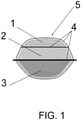
- the capsule defined above comprises three compartments, wherein said compartments are made of a water-soluble film (4) and wherein the compartments together form said capsule; characterized in that said capsule contains the detergent composition defined above, wherein each of the three phases A (1), B (2), and C (3) is located in a different compartment of the capsule (5).
- This separation allows the peroxide to contact the catalyst in the presence of the fabric to be cleaned during the washing process, optimizing the amount of oxygen generated.
- the capsule of the present invention as defined above comprises: from 0.5 g to 1.25 g of catalyzing phase A, from 0.5 g to 2 g of phase B, and from 15 g to 20 g of phase C.
- the capsule of the present invention as defined above comprises: from 2% to 6% of catalyzing phase A, from 2% to 9% of phase B, and from 85% to 96% of phase C.
- the capsule of the present invention as defined above comprises: from 3% to 5% of catalyzing phase A, from 4% to 6% of phase B, and from 89% to 93% of phase C.
- Another aspect of the invention relates to a method for preparing a composition according to the first aspect, comprising the steps of (a) preparing a catalyzing phase A which comprises preparing an aqueous solution of a transition metal salt, preferably manganese sulfate, preparing an aqueous suspension of a biopolymer matrix, preferably a chitosan matrix, stirring the aqueous suspension of the biopolymer matrix at a temperature of at least 50°C and adding the aqueous solution of the transition metal salt, and maintaining stirring and a temperature of at least 50% until the water evaporates; (b) providing a phase B comprising a peroxide, preferably sodium percarbonate; (c) providing a phase C comprising soap; and (d) combining the three phases, providing that the catalyzing phase A does not interact with phase B.
- a catalyzing phase A which comprises preparing an aqueous solution of a transition metal salt, preferably manganese sulfate, preparing an
- the aqueous solution of a transition metal salt of step (a) has a transition metal salt concentration from 2% to 10%, even more preferably from 4% to 6%.
- the aqueous suspension of the biopolymer of step (a) has a biopolymer concentration from 8% to 10%.
- the stirring of the aqueous biopolymer suspension of step (a) takes place at least at 10 rpm.
- Another aspect of the invention relates to a method for preparing the capsule according to the second aspect of the invention, comprising the steps of (a) providing two or three compartments made of a water-soluble film, (b) introducing the phases A, B, and C in the compartments, wherein the catalyzing phase A does not interact physically with phase B, and (c) attaching the compartments to form the capsule.
- the attachment of the compartments to form the capsule can be carried out by means of a chemical sealing method with a solvent, preferably sealing with water. Sealing with water is carried out by applying moisture to the films before sealing them to form the sealing areas.
- each phase A, B, and C is introduced in a different compartment of said capsule.
- Another aspect of the invention relates to a method for cleaning clothing which comprises treating the clothing to be cleaned with the composition as defined in the first inventive aspect or with the capsule as defined in the second inventive aspect.
- the cleaning method defined above can be carried out in a home appliance for washing textiles or manually, known by one skilled in the art as machine washing or hand washing, respectively.
- This cleaning method which comprises treating the clothing to be cleaned with the composition of the invention, directly or in the form of a capsule, allows effectively removing bad odors impregnated in the textile fibers, particularly bad odors impregnated in sports apparel. Furthermore, this method successfully removes unwanted odors even at a low washing temperature, a feature which is desirable given that certain textiles readily deteriorate if they are subjected to washing cycles at temperatures above 40°C. Specifically, the effectiveness thereof at room temperature has been demonstrated.
- a final aspect of the invention relates to the use of the composition according to the first aspect as a detergent for clothing, preferably as a detergent for sportswear.
- the catalyzing phase of the example is prepared by means of wet impregnation, i.e., contacting the chitosan support with the impregnating solution, i.e., a manganese sulfate solution, for a specific time until the chitosan support is saturated with the solution. After that saturation time, the excess liquid is removed by evaporation to obtain the catalyzing phase A in solid form of the detergent composition of the present invention.
- the impregnating solution i.e., a manganese sulfate solution
- the manganese sulfate solution is added dropwise with a Pasteur pipette to the chitosan solution, keeping stirring constant and the temperature at 80°C.
- the temperature is reduced to 60°C and it is kept under gentle stirring until the prepared material is dry.
- the prepared samples of the catalyzing phase (chitosan matrix impregnated with a manganese sulfate solution) are reproduced below: Table 1.
- the capsule as described above can be obtained according to a method which comprises providing 2 or 3 compartments made of a water-soluble film (4), introducing phases A (1), B (2), and C (3) in said compartments, wherein phases A, B, and C are physically separated from and do not interact with one another, and finally attaching the compartments such that together they form said capsule (5).
- the attachment of the compartments can be carried out by means of a chemical sealing method with a solvent, preferably sealing with water. Sealing with water is carried out by applying moisture to the films before sealing them to form the sealing areas.
- phase A the determination of the active oxygen generated in the reaction upon contact with the soap (phase C) and the peroxide (phase B) in an aqueous medium has been performed.
- the oxygen determination was carried out in a leak-tight atmosphere to prevent the interference of the oxygen present in the air, and for the purpose of obtaining comparable results, so as to verify the catalytic activity of the prepared catalyzing phase A samples.
- washing simulation was performed specifically by adding an unwanted odor agent similar to the molecule accountable for the bad odor which impregnates fabrics after sweating.
- an unwanted odor agent similar to the molecule accountable for the bad odor which impregnates fabrics after sweating.
- 2-methyl-2-propanethiol the main characteristics of which are its low molecular weight, strong odor, and high water miscibility, was used.
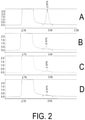
- the reaction was analyzed by means of gas chromatography
- Figure 2 depicts the curves obtained by means of GC-MS.
- Curve A represents the analysis performed at the initial moment of contacting the three phases with compound 2-methyl-2-propanethiol.
- Curve B represents the analysis after 15 minutes
- curve C represents the analysis after 30 minutes
- curve D represents the result obtained 1 hour after contacting the three phases, with the 2-methyl-2-propanethiol molecule being present.
- the X-axis represents the retention time expressed in seconds and the Y-axis represents the signal obtained by means of GC-MS expressed in mV, the signal being related with the abundance of the compound to be measured in the analyzed sample.
- the present invention refers to a detergent for washing sports apparel having three different phases compartmentalized by means of a water-soluble film such that when the detergent contacts water, the film dissolves, allowing the reaction between the phases of the detergent, leading to a catalytic reaction which generates a percentage of active oxygen capable of oxidizing the molecules associated with bad odors emanating from used sports apparel.
- the detergent of the invention incorporates oxidizing agents capable of transforming the thiols accountable for the bad odor into water-soluble sulfonates.
- the detergent incorporates disinfecting agents efficient for removing the population of skin bacteria present in clothing made of cotton and other acrylic fibers, which are accountable for the biotransformation of the fundamental sweat molecule that is secreted in the armpit, S-[1-(2-hydroxyethyl)-1-methylbutyl]-(L)-cysteinylglycine, also referred to as S-Cys-Gly-3M3SH, and plays a significant role in the bad odor when it is metabolized into free thioalcohol.
- disinfecting agents efficient for removing the population of skin bacteria present in clothing made of cotton and other acrylic fibers, which are accountable for the biotransformation of the fundamental sweat molecule that is secreted in the armpit, S-[1-(2-hydroxyethyl)-1-methylbutyl]-(L)-cysteinylglycine, also referred to as S-Cys-Gly-3M3SH, and plays a significant role in the bad odor when it is metabolized into free thio
- the object of the invention is to provide a sustainable detergent with a high disinfecting and odor-removal capacity.
- the object of the detergent of the present invention is to overcome these drawbacks.
- the proposed detergent satisfactorily solves the problems set forth above based on a product, preferably by way of a capsule, in which there are differentiated at least:
- the phase of Marseille-type neutral soap contains an amount comprised between 15 and 20 grams
- the phase of sodium percarbonate in solid state contains between 0.5 and 2 grams
- the catalyzing phase contains an amount between 0.5 and 1.25 grams.
- the detergent of the invention is formed by at least three compartments, wherein each compartment is formed by a water-soluble film and separately contains each of the aforementioned phases.
- the compartments formed by the soluble film are attached to generate a detergent capsule in which the phases forming same are differentiated. Therefore, when the capsule is contacted with water, the film of the compartments dissolves and the catalyzing phase generates the catalytic activity upon contact with the peroxide, releasing a high percentage of active oxygen which allows the transformation of the malodorous molecules by oxidation. The contact of this medium with the soap already in a liquid solution from the third compartment completes the washing of the clothing.
- the object of the present invention is to provide a detergent for cleaning sports apparel which is characterized by the emanation of a strong and persistent bad odor caused by sweat impregnating the clothing, generated by the user while practicing sports.
- the catalyzing phase has been synthesized by impregnation from natural biopolymers originating from chitosan, in addition to other biopolymers such as carrageenans and gelatins.
- Chitosan formed in chitin deacetylation and a constituent of the exoskeleton of crustaceans and insects, is a polysaccharide the monomer of which is glucosamine, which is a key factor as it has the capacity to absorb and form complexes with certain metal ions present in aqueous solutions due to the strong interaction with the protonated amino groups of the glucosamine units and metal ions.
- the catalyzing phase is prepared by wet impregnation, wherein the chitosan support is contacted with the impregnating solution, a manganese sulfate solution, for a specific time until the chitosan support is saturated with the solution. After that time, the excess liquid is removed by evaporation, obtaining the solid catalyzing phase of the detergent object of the invention.
- the manganese sulfate solution of the catalyzing phase used for impregnating the chitosan support has a concentration percentage in an interval between 2% and 10%.
- phase corresponding to the peroxide may consist of sodium carbonate peroxyhydrate, also referred to as sodium percarbonate.
- Each of the three prepared phases is introduced in three different compartments each demarcated by a water-soluble film. Finally, the compartments are attached to generate a detergent capsule.
- the prepared samples have a high catalytic capacity generating a significant percentage of active oxygen for the removal of thiol molecules oxidized into water-soluble sulfonates.
- the detergent capsule (5) is preferably formed by three compartments, wherein each compartment independently stores each of the three phases: a phase containing the catalyst (1), a phase containing sodium percarbonate powder (2), and a third phase of Marseille-type natural soap (3).
- the phase of Marseille-type natural soap (3) contains an amount of 18 grams
- the phase of sodium percarbonate in solid state (2) contains 1 gram
- the catalyzing phase (1) contains 0.75 grams.
- manganese sulfate solutions were prepared during the tests, wherein concentrations of this salt in percentages of 2.5%, 5%, 7.5%, and 10% were used.
Landscapes
- Chemical & Material Sciences (AREA)
- Engineering & Computer Science (AREA)
- Chemical Kinetics & Catalysis (AREA)
- Organic Chemistry (AREA)
- Life Sciences & Earth Sciences (AREA)
- Oil, Petroleum & Natural Gas (AREA)
- Wood Science & Technology (AREA)
- Inorganic Chemistry (AREA)
- Materials Engineering (AREA)
- Detergent Compositions (AREA)
Applications Claiming Priority (2)
| Application Number | Priority Date | Filing Date | Title |
|---|---|---|---|
| ES201930433A ES2724992B2 (es) | 2019-05-16 | 2019-05-16 | Detergente para lavado de prendas deportivas y procedimiento de fabricación del mismo |
| PCT/ES2020/070317 WO2020229719A1 (es) | 2019-05-16 | 2020-05-18 | Composición de lavado |
Publications (1)
| Publication Number | Publication Date |
|---|---|
| EP3971269A1 true EP3971269A1 (de) | 2022-03-23 |
Family
ID=67909670
Family Applications (1)
| Application Number | Title | Priority Date | Filing Date |
|---|---|---|---|
| EP20732997.0A Withdrawn EP3971269A1 (de) | 2019-05-16 | 2020-05-18 | Waschzusammensetzung |
Country Status (4)
| Country | Link |
|---|---|
| US (1) | US20220220425A1 (de) |
| EP (1) | EP3971269A1 (de) |
| ES (1) | ES2724992B2 (de) |
| WO (1) | WO2020229719A1 (de) |
Families Citing this family (1)
| Publication number | Priority date | Publication date | Assignee | Title |
|---|---|---|---|---|
| CN115888574A (zh) * | 2022-12-05 | 2023-04-04 | 成都理工大学 | 乳化-化学交联法制备过碳酸钠-壳聚糖缓释微球的方法 |
Family Cites Families (7)
| Publication number | Priority date | Publication date | Assignee | Title |
|---|---|---|---|---|
| GB8329762D0 (en) * | 1983-11-08 | 1983-12-14 | Unilever Plc | Manganese adjuncts |
| ES2206853T3 (es) * | 1998-11-10 | 2004-05-16 | Unilever N.V. | Catalizadores de blanqueo y oxidacion. |
| JP2006131659A (ja) * | 2004-11-02 | 2006-05-25 | Lion Corp | 漂白性組成物 |
| DE102007059968A1 (de) * | 2007-12-11 | 2009-06-18 | Henkel Ag & Co. Kgaa | Reinigungsmittel |
| DE102009033248A1 (de) * | 2009-07-14 | 2010-05-06 | Henkel Ag & Co. Kgaa | Waschmittel für die Niedrigtemperaturwäsche von hochfunktionellen Materialien |
| US20110240510A1 (en) * | 2010-04-06 | 2011-10-06 | Johan Maurice Theo De Poortere | Optimized release of bleaching systems in laundry detergents |
| EP3415591B1 (de) | 2017-06-15 | 2021-04-28 | The Procter & Gamble Company | Wasserlöslicher einheitsdosierartikel mit einem festen waschmittel |
-
2019
- 2019-05-16 ES ES201930433A patent/ES2724992B2/es not_active Expired - Fee Related
-
2020
- 2020-05-18 EP EP20732997.0A patent/EP3971269A1/de not_active Withdrawn
- 2020-05-18 WO PCT/ES2020/070317 patent/WO2020229719A1/es not_active Ceased
- 2020-05-18 US US17/610,847 patent/US20220220425A1/en not_active Abandoned
Also Published As
| Publication number | Publication date |
|---|---|
| ES2724992A1 (es) | 2019-09-18 |
| ES2724992B2 (es) | 2020-03-17 |
| US20220220425A1 (en) | 2022-07-14 |
| WO2020229719A1 (es) | 2020-11-19 |
Similar Documents
| Publication | Publication Date | Title |
|---|---|---|
| DE69406272T2 (de) | Feuchttigkeitsbeständige zusammensetzung | |
| EP0147191B1 (de) | Parfüm und Parfüm enthaltende Zusammensetzungen | |
| ES2127745T5 (es) | Composiciones para tratamiento de tejidos que comprenden particulas de perfume. | |
| CA2630581C (en) | Improvements relating to fabric treatment compositions | |
| JP7730317B2 (ja) | 石鹸組成物 | |
| Wei et al. | Polymer carriers for controlled fragrance release | |
| EP3971269A1 (de) | Waschzusammensetzung | |
| JPS60197746A (ja) | 多孔質球状粒子及びその製法 | |
| KR102537959B1 (ko) | 원치 않는 분자 제거용 조성물 | |
| van Soest | Encapsulation of fragrances and flavours: a way to control odour and aroma in consumer products | |
| BR112015010475B1 (pt) | partícula, composição líquida e composição de cuidado doméstico ou de cuidado pessoal | |
| JP3181534U (ja) | 粘着消臭・抗菌シート | |
| WO2000005446A1 (fr) | Article textile ou vestimentaire ou de toilette et soin du corps, porteur de microcapsules, et procedes pour sa realisation | |
| EP0255525B1 (de) | Verfahren zum neutralisieren des unangenehmen achselgeruches | |
| KR100509853B1 (ko) | 소취물질이 첨착된 카본나노볼을 함유하는 소취제 | |
| CN1188143A (zh) | 洗涤用的香料颗粒 | |
| CN112500937B (zh) | 一种祛除异味留香剂及其制备方法和应用 | |
| JP3338316B2 (ja) | 糊剤、該糊剤を用いた繊維製品の抗菌性加工品およびその加工法 | |
| ES1248216U (es) | Composicion de lavado | |
| JP2001190650A (ja) | 泡ゲル空気処理組成物及び該組成物の本体を形成する方法 | |
| CN1180155C (zh) | 功能化纤维材料及其处理方法 | |
| JPS602063B2 (ja) | 生魚臭の消臭剤 | |
| JP7832428B2 (ja) | 表面修飾多糖類ナノ材料、その分散液、機能性物品及び機能性物品の加工法 | |
| JPH01190796A (ja) | 粉末洗浄剤組成物 | |
| JPH0672827A (ja) | 洗顔料 |
Legal Events
| Date | Code | Title | Description |
|---|---|---|---|
| STAA | Information on the status of an ep patent application or granted ep patent |
Free format text: STATUS: UNKNOWN |
|
| STAA | Information on the status of an ep patent application or granted ep patent |
Free format text: STATUS: THE INTERNATIONAL PUBLICATION HAS BEEN MADE |
|
| PUAI | Public reference made under article 153(3) epc to a published international application that has entered the european phase |
Free format text: ORIGINAL CODE: 0009012 |
|
| STAA | Information on the status of an ep patent application or granted ep patent |
Free format text: STATUS: REQUEST FOR EXAMINATION WAS MADE |
|
| 17P | Request for examination filed |
Effective date: 20211216 |
|
| AK | Designated contracting states |
Kind code of ref document: A1 Designated state(s): AL AT BE BG CH CY CZ DE DK EE ES FI FR GB GR HR HU IE IS IT LI LT LU LV MC MK MT NL NO PL PT RO RS SE SI SK SM TR |
|
| DAV | Request for validation of the european patent (deleted) | ||
| DAX | Request for extension of the european patent (deleted) | ||
| STAA | Information on the status of an ep patent application or granted ep patent |
Free format text: STATUS: THE APPLICATION IS DEEMED TO BE WITHDRAWN |
|
| 18D | Application deemed to be withdrawn |
Effective date: 20231201 |