EP3960658B1 - Beschickungsfahrzeug für eine stapellageranordnung - Google Patents
Beschickungsfahrzeug für eine stapellageranordnung Download PDFInfo
- Publication number
- EP3960658B1 EP3960658B1 EP20192811.6A EP20192811A EP3960658B1 EP 3960658 B1 EP3960658 B1 EP 3960658B1 EP 20192811 A EP20192811 A EP 20192811A EP 3960658 B1 EP3960658 B1 EP 3960658B1
- Authority
- EP
- European Patent Office
- Prior art keywords
- lifting
- arrangement
- charging vehicle
- loading vehicle
- acts
- Prior art date
- Legal status (The legal status is an assumption and is not a legal conclusion. Google has not performed a legal analysis and makes no representation as to the accuracy of the status listed.)
- Active
Links
Images
Classifications
-
- B—PERFORMING OPERATIONS; TRANSPORTING
- B60—VEHICLES IN GENERAL
- B60K—ARRANGEMENT OR MOUNTING OF PROPULSION UNITS OR OF TRANSMISSIONS IN VEHICLES; ARRANGEMENT OR MOUNTING OF PLURAL DIVERSE PRIME-MOVERS IN VEHICLES; AUXILIARY DRIVES FOR VEHICLES; INSTRUMENTATION OR DASHBOARDS FOR VEHICLES; ARRANGEMENTS IN CONNECTION WITH COOLING, AIR INTAKE, GAS EXHAUST OR FUEL SUPPLY OF PROPULSION UNITS IN VEHICLES
- B60K1/00—Arrangement or mounting of electrical propulsion units
- B60K1/02—Arrangement or mounting of electrical propulsion units comprising more than one electric motor
-
- B—PERFORMING OPERATIONS; TRANSPORTING
- B65—CONVEYING; PACKING; STORING; HANDLING THIN OR FILAMENTARY MATERIAL
- B65G—TRANSPORT OR STORAGE DEVICES, e.g. CONVEYORS FOR LOADING OR TIPPING, SHOP CONVEYOR SYSTEMS OR PNEUMATIC TUBE CONVEYORS
- B65G1/00—Storing articles, individually or in orderly arrangement, in warehouses or magazines
- B65G1/02—Storage devices
- B65G1/04—Storage devices mechanical
- B65G1/0471—Storage devices mechanical with access from beneath
-
- B—PERFORMING OPERATIONS; TRANSPORTING
- B65—CONVEYING; PACKING; STORING; HANDLING THIN OR FILAMENTARY MATERIAL
- B65G—TRANSPORT OR STORAGE DEVICES, e.g. CONVEYORS FOR LOADING OR TIPPING, SHOP CONVEYOR SYSTEMS OR PNEUMATIC TUBE CONVEYORS
- B65G35/00—Mechanical conveyors not otherwise provided for
-
- B—PERFORMING OPERATIONS; TRANSPORTING
- B60—VEHICLES IN GENERAL
- B60L—PROPULSION OF ELECTRICALLY-PROPELLED VEHICLES; SUPPLYING ELECTRIC POWER FOR AUXILIARY EQUIPMENT OF ELECTRICALLY-PROPELLED VEHICLES; ELECTRODYNAMIC BRAKE SYSTEMS FOR VEHICLES IN GENERAL; MAGNETIC SUSPENSION OR LEVITATION FOR VEHICLES; MONITORING OPERATING VARIABLES OF ELECTRICALLY-PROPELLED VEHICLES; ELECTRIC SAFETY DEVICES FOR ELECTRICALLY-PROPELLED VEHICLES
- B60L53/00—Methods of charging batteries, specially adapted for electric vehicles; Charging stations or on-board charging equipment therefor; Exchange of energy storage elements in electric vehicles
-
- B—PERFORMING OPERATIONS; TRANSPORTING
- B65—CONVEYING; PACKING; STORING; HANDLING THIN OR FILAMENTARY MATERIAL
- B65G—TRANSPORT OR STORAGE DEVICES, e.g. CONVEYORS FOR LOADING OR TIPPING, SHOP CONVEYOR SYSTEMS OR PNEUMATIC TUBE CONVEYORS
- B65G1/00—Storing articles, individually or in orderly arrangement, in warehouses or magazines
- B65G1/02—Storage devices
- B65G1/04—Storage devices mechanical
- B65G1/06—Storage devices mechanical with means for presenting articles for removal at predetermined position or level
- B65G1/065—Storage devices mechanical with means for presenting articles for removal at predetermined position or level with self propelled cars
-
- B—PERFORMING OPERATIONS; TRANSPORTING
- B65—CONVEYING; PACKING; STORING; HANDLING THIN OR FILAMENTARY MATERIAL
- B65G—TRANSPORT OR STORAGE DEVICES, e.g. CONVEYORS FOR LOADING OR TIPPING, SHOP CONVEYOR SYSTEMS OR PNEUMATIC TUBE CONVEYORS
- B65G57/00—Stacking of articles
- B65G57/30—Stacking of articles by adding to the bottom of the stack
- B65G57/301—Stacking of articles by adding to the bottom of the stack by means of reciprocatory or oscillatory lifting and holding or gripping devices
- B65G57/302—Stacking of articles by adding to the bottom of the stack by means of reciprocatory or oscillatory lifting and holding or gripping devices added articles being lifted to substantially stationary grippers or holders
-
- B—PERFORMING OPERATIONS; TRANSPORTING
- B65—CONVEYING; PACKING; STORING; HANDLING THIN OR FILAMENTARY MATERIAL
- B65G—TRANSPORT OR STORAGE DEVICES, e.g. CONVEYORS FOR LOADING OR TIPPING, SHOP CONVEYOR SYSTEMS OR PNEUMATIC TUBE CONVEYORS
- B65G59/00—De-stacking of articles
- B65G59/06—De-stacking from the bottom of the stack
- B65G59/061—De-stacking from the bottom of the stack articles being separated substantially along the axis of the stack
- B65G59/062—De-stacking from the bottom of the stack articles being separated substantially along the axis of the stack by means of reciprocating or oscillating escapement-like mechanisms
- B65G59/063—De-stacking from the bottom of the stack articles being separated substantially along the axis of the stack by means of reciprocating or oscillating escapement-like mechanisms comprising lifting means
-
- B—PERFORMING OPERATIONS; TRANSPORTING
- B66—HOISTING; LIFTING; HAULING
- B66F—HOISTING, LIFTING, HAULING OR PUSHING, NOT OTHERWISE PROVIDED FOR, e.g. DEVICES WHICH APPLY A LIFTING OR PUSHING FORCE DIRECTLY TO THE SURFACE OF A LOAD
- B66F9/00—Devices for lifting or lowering bulky or heavy goods for loading or unloading purposes
-
- B—PERFORMING OPERATIONS; TRANSPORTING
- B66—HOISTING; LIFTING; HAULING
- B66F—HOISTING, LIFTING, HAULING OR PUSHING, NOT OTHERWISE PROVIDED FOR, e.g. DEVICES WHICH APPLY A LIFTING OR PUSHING FORCE DIRECTLY TO THE SURFACE OF A LOAD
- B66F9/00—Devices for lifting or lowering bulky or heavy goods for loading or unloading purposes
- B66F9/06—Devices for lifting or lowering bulky or heavy goods for loading or unloading purposes movable, with their loads, on wheels or the like, e.g. fork-lift trucks
- B66F9/075—Constructional features or details
- B66F9/07572—Propulsion arrangements
-
- B—PERFORMING OPERATIONS; TRANSPORTING
- B66—HOISTING; LIFTING; HAULING
- B66F—HOISTING, LIFTING, HAULING OR PUSHING, NOT OTHERWISE PROVIDED FOR, e.g. DEVICES WHICH APPLY A LIFTING OR PUSHING FORCE DIRECTLY TO THE SURFACE OF A LOAD
- B66F9/00—Devices for lifting or lowering bulky or heavy goods for loading or unloading purposes
- B66F9/06—Devices for lifting or lowering bulky or heavy goods for loading or unloading purposes movable, with their loads, on wheels or the like, e.g. fork-lift trucks
- B66F9/075—Constructional features or details
- B66F9/20—Means for actuating or controlling masts, platforms, or forks
-
- B—PERFORMING OPERATIONS; TRANSPORTING
- B65—CONVEYING; PACKING; STORING; HANDLING THIN OR FILAMENTARY MATERIAL
- B65G—TRANSPORT OR STORAGE DEVICES, e.g. CONVEYORS FOR LOADING OR TIPPING, SHOP CONVEYOR SYSTEMS OR PNEUMATIC TUBE CONVEYORS
- B65G2201/00—Indexing codes relating to handling devices, e.g. conveyors, characterised by the type of product or load being conveyed or handled
- B65G2201/02—Articles
- B65G2201/0235—Containers
-
- Y—GENERAL TAGGING OF NEW TECHNOLOGICAL DEVELOPMENTS; GENERAL TAGGING OF CROSS-SECTIONAL TECHNOLOGIES SPANNING OVER SEVERAL SECTIONS OF THE IPC; TECHNICAL SUBJECTS COVERED BY FORMER USPC CROSS-REFERENCE ART COLLECTIONS [XRACs] AND DIGESTS
- Y02—TECHNOLOGIES OR APPLICATIONS FOR MITIGATION OR ADAPTATION AGAINST CLIMATE CHANGE
- Y02T—CLIMATE CHANGE MITIGATION TECHNOLOGIES RELATED TO TRANSPORTATION
- Y02T10/00—Road transport of goods or passengers
- Y02T10/60—Other road transportation technologies with climate change mitigation effect
- Y02T10/70—Energy storage systems for electromobility, e.g. batteries
-
- Y—GENERAL TAGGING OF NEW TECHNOLOGICAL DEVELOPMENTS; GENERAL TAGGING OF CROSS-SECTIONAL TECHNOLOGIES SPANNING OVER SEVERAL SECTIONS OF THE IPC; TECHNICAL SUBJECTS COVERED BY FORMER USPC CROSS-REFERENCE ART COLLECTIONS [XRACs] AND DIGESTS
- Y02—TECHNOLOGIES OR APPLICATIONS FOR MITIGATION OR ADAPTATION AGAINST CLIMATE CHANGE
- Y02T—CLIMATE CHANGE MITIGATION TECHNOLOGIES RELATED TO TRANSPORTATION
- Y02T10/00—Road transport of goods or passengers
- Y02T10/60—Other road transportation technologies with climate change mitigation effect
- Y02T10/7072—Electromobility specific charging systems or methods for batteries, ultracapacitors, supercapacitors or double-layer capacitors
-
- Y—GENERAL TAGGING OF NEW TECHNOLOGICAL DEVELOPMENTS; GENERAL TAGGING OF CROSS-SECTIONAL TECHNOLOGIES SPANNING OVER SEVERAL SECTIONS OF THE IPC; TECHNICAL SUBJECTS COVERED BY FORMER USPC CROSS-REFERENCE ART COLLECTIONS [XRACs] AND DIGESTS
- Y02—TECHNOLOGIES OR APPLICATIONS FOR MITIGATION OR ADAPTATION AGAINST CLIMATE CHANGE
- Y02T—CLIMATE CHANGE MITIGATION TECHNOLOGIES RELATED TO TRANSPORTATION
- Y02T90/00—Enabling technologies or technologies with a potential or indirect contribution to GHG emissions mitigation
- Y02T90/10—Technologies relating to charging of electric vehicles
- Y02T90/14—Plug-in electric vehicles
Definitions
- the present invention relates to a loading vehicle for a stack storage arrangement with a chassis, a first running wheel arrangement with which the loading vehicle can be moved in a first direction, a second running wheel arrangement with which the loading vehicle can be moved in a second direction transverse to the first direction, and a lifting device which has a lifting drive acting perpendicular to the first direction and to the second direction, wherein the lifting device has a lifting platform for lifting a container, wherein the lifting platform can be displaced with the lifting drive from a basic position in the direction of gravity upwards into a raised position.
- Such a loading vehicle is made of EP 3 053 855 A2
- the loading vehicle has a motor that can be used both on a lifting device and on displacement devices for two trolleys that are arranged orthogonally to each other.
- Another loading vehicle is, for example, WO 2019/238703 A1 known.
- the known loading vehicle is moved above a stacking storage arrangement.
- container stacking spaces are arranged in the form of a matrix in rows and columns.
- a rail system is laid above the stacking storage arrangement.
- This rail system has a first group of rails running in the direction of the rows and a second group of rails running in the direction of the columns.
- the first wheel arrangement then interacts with the first group of rails.
- the second wheel arrangement interacts with the second group of rails. Switching between the first rail arrangement and the second rail arrangement is achieved by the second wheel assembly is pushed downwards out of the chassis and engages the second group of rails.
- CA 3 086 277 A1 shows a loading vehicle for a stacked storage arrangement, which is intended to be moved on top of the stacked storage arrangement.
- This loading vehicle also has two sets of wheels oriented orthogonally to each other, so that one set of wheels can be used to move the loading vehicle in a first direction, and a second set of wheels can be used to move the loading vehicle in a second direction oriented orthogonally to the first direction.
- the invention is based on the object of designing a loading vehicle in a simple and cost-effective manner.
- This loading vehicle is used in a stacking storage arrangement in which a loading area is located below the container stacking areas.
- the containers are therefore loaded into the container stacking areas from below. and removed downwards from the container stacking spaces.
- the container stacking spaces are arranged in the form of a matrix with rows and columns.
- the loading vehicle can then be moved, for example, with the first wheel arrangement in the direction of the rows and with the second wheel arrangement in the direction of the columns.
- the loading vehicle is driven under a container stacking space.
- the container on the loading vehicle, or more precisely on the lifting platform is lifted until it passes a holding device located at the lower end of a container stacking space. Once the container has passed the holding device and the lifting platform is lowered, the holding device holds the container in place.
- the container to be stored lifts these containers along with them and then forms the bottommost container in a stack.
- the loading vehicle comes into action again and uses its lifting platform to lift the bottommost container in a stack until it is free of the holding device.
- the holding device is then held open, and the lifting platform with the container or container stack on it is lowered until the container to be removed has passed the holding device.
- the holding device is then reactivated and holds the remaining containers in the container stacking area.
- the lifting drive has a second function. It not only serves to raise and lower the lifting platform, but also to push the second idler assembly downwards so that the loading vehicle can be moved on the second idler assembly when the second idler assembly has been moved downwards beyond the first idler assembly. This allows the loading vehicle to be moved in two directions. An additional drive to move the second idler assembly is not required.
- the lifting drive that operates the lifting platform must be capable of lifting and lowering a container anyway. It can therefore be dimensioned without great effort to handle the additional weight of the loading vehicle.
- the lifting platform can be moved downwards from its home position in the direction of gravity by the lifting drive. If the second impeller assembly is to be moved downwards beyond the first impeller assembly, the lifting platform is also lowered a certain distance. This is also possible when a container is located on the lifting platform. The container is then moved further into the loading vehicle and does not interfere with the movement of the loading vehicle in the second direction.
- a spring arrangement is provided between the chassis and the second wheel assembly, which counteracts the downward force of the lifting drive in the direction of gravity.
- the lifting drive therefore only needs to be capable of pushing the second wheel assembly downward out of the first wheel assembly.
- the return movement of the second wheel assembly, such that the loading vehicle can then be moved on the first wheel assembly, is achieved by the action of the spring arrangement.
- the spring arrangement comprises a spring element, in particular a compression spring.
- the compression spring is compressed when the second impeller arrangement is lowered beyond the first impeller arrangement. It relaxes when the second impeller arrangement is raised again.
- the spring element stores energy in a different way.
- the second wheel assembly comprises at least one wheel mounted on a rocker arm.
- the rocker arm facilitates the movement of the second wheel assembly.
- the rocker arm is pivotally mounted on the chassis.
- the wheel is located at a certain distance from the axis of rotation connecting the rocker arm to the chassis. When the rocker arm is then pivoted, the second wheel can be moved easily.
- the swing arm is suspended from the chassis in a central region in the second direction.
- the second The wheel is located on the outer edge of the loading vehicle, which has a positive effect on the stability of the loading vehicle while driving. The risk of the loading vehicle tipping over is minimized.
- the lifting frame acts on the swing arm. This is a relatively simple way to pivot the swing arm.
- the lifting frame act on the rocker arm via a ball assembly and a ball support. This minimizes friction between the lifting platform and the rocker arm. This has a positive effect on potential wear.
- the lifting drive comprises a push chain that exerts pressure on the lifting frame when the lifting frame moves upwards from its home position in the direction of gravity, and exerts tension on the lifting frame when the lifting frame moves downwards from its home position in the direction of gravity.
- This type of application is possible because the push chain can be subjected to both tensile and compressive loads.
- Fig. 1 shows schematically a loading vehicle 1 which can be used in a stacking storage arrangement to store containers from below into container stacking spaces and to remove containers from below from the container stacking spaces.
- the loading vehicle has a first wheel assembly 2 with first wheels 2a, 2b, 2c and a second wheel assembly 3 with second wheels 3a, 3b.
- the first wheels 2a-2c are attached to a chassis 4.
- the loading vehicle 1 With the first wheel assembly 2, the loading vehicle 1 can be moved in a first direction.
- the second wheels 3a, 3b of the second wheel assembly 3 are oriented perpendicular to the first wheels 2a-2c.
- the loading vehicle 1 can be moved in a direction perpendicular or transverse to the first direction.
- the loading vehicle 1 further comprises a lifting device with which it is capable of storing a container (not shown in detail) from below into a container stacking space of a stacking storage arrangement or of removing the container downwards from the container stacking space.
- the loading vehicle 1 comprises a lifting platform 5 that can be raised by a lifting device.
- the lifting device comprises a push chain 6.
- the push chain 6 is driven by a drive motor 7.
- the lifting platform 5 can be guided by a guide 8.
- the first wheels 2a-2c are arranged directly on the chassis 4. They can be driven by a drive 9.
- the second wheels 3a, 3b are each arranged on a rocker arm 10, 11, wherein the rocker arms 10, 11 are pivotably attached to the chassis 4. Only for the rocker arm 11 is a pivot point 12 visible.
- the rockers 10, 11 are supported on the chassis 4 via compression springs 13, 14. Without the influence of other forces, the compression springs 13, 14 cause the second wheels 3a, 3b to move into the Fig. 2 shown inactive position, in which the loading vehicle 1 can only be moved on the first wheel arrangement 2.
- the push chain 6 is firmly connected to the lifting platform 5.
- the lifting platform 5 is provided with a ball roller assembly 15 on its underside (the directions “top” and “bottom” refer to the direction of gravity).
- the rockers 10, 11 have a ball support 16 on their upper side.
- Fig. 2 shows a basic position of the lifting platform 5.
- the basic position of the lifting platform 5 is a position in which a container picked up on the lifting platform is moved in the loading area during transport in the first direction when the loading vehicle 1 rolls on the first wheel arrangement 2.
- the lifting platform 5 can be moved upwards from this basic position in order to store the container in a container stacking area or to remove the container from there.
- the lifting platform 5 can also be moved downwards from the basic position using the push chain 6.
- the ball guide arrangement 15 comes into contact with the ball support 16, as shown in Fig. 3
- the rockers 10, 11 are pivoted relative to the chassis, thereby moving the second wheels 3a, 3b downwards beyond the first wheels 2a, 2b.
- the compression springs 13, 14 are compressed, and the chassis 4 is raised.
- the loading vehicle 1 can then be moved on the second wheel arrangement 3.
- the lifting platform 5 When the first wheel assembly is to be reactivated, the lifting platform 5 is raised again. This lifting can be achieved solely through the force of the compression springs 13, 14, if appropriately dimensioned. However, it is also possible to use the lifting drive with the push chain 6 for this movement.
- the lifting platform 5 When the lifting platform 5 is raised, the rockers 10, 11 are pivoted back, and the second wheels 3a, 3b are raised relative to the chassis (or the chassis 4 is lowered relative to the second wheels 3a, 3b), so that the first wheel assembly 2 becomes active again.
- the push chain 6 acts with pressure on the lifting platform 5, at least when the lifting platform 5 is lifted upwards from the basic position. However, if the lifting platform 5 is moved downwards from the basic position, the push chain 6 acts with tension on the lifting platform 5.
- the pivot axis 12 of the rockers 10, 11 is arranged in a central region of the chassis 4.
- the rockers 10, 11 are suspended in a central region on the chassis 4.
- This means that the second running wheels 3a, 3b can be arranged relatively far outward on the loading vehicle, so that the loading wheels 3a, 3b (and their corresponding pair on the other side of the loading vehicle 1) form a relatively large contact area. This has a positive effect on the stability of the loading vehicle 1.
Landscapes
- Engineering & Computer Science (AREA)
- Mechanical Engineering (AREA)
- Transportation (AREA)
- Structural Engineering (AREA)
- Chemical & Material Sciences (AREA)
- Combustion & Propulsion (AREA)
- Life Sciences & Earth Sciences (AREA)
- Civil Engineering (AREA)
- Geology (AREA)
- Power Engineering (AREA)
- Loading Or Unloading Of Vehicles (AREA)
- Charge And Discharge Circuits For Batteries Or The Like (AREA)
- Automobile Manufacture Line, Endless Track Vehicle, Trailer (AREA)
- Warehouses Or Storage Devices (AREA)
- Handcart (AREA)
- Arrangement Or Mounting Of Propulsion Units For Vehicles (AREA)
Description
- Die vorliegende Erfindung betrifft ein Beschickungsfahrzeug für eine Stapellageranordnung mit einem Fahrgestell, einer ersten Laufradanordnung, mit der das Beschickungsfahrzeug in eine erste Richtung verfahrbar ist, einer zweiten Laufradanordnung, mit der das Beschickungsfahrzeug in eine zweite Richtung quer zur ersten Richtung verfahrbar ist, und einer Hubeinrichtung, die einen senkrecht zur ersten Richtung und zur zweiten Richtung wirkenden Hubantrieb aufweist, wobei die Hubeinrichtung eine Hubplattform zum Anheben eines Behälters aufweist, wobei die Hubplattform mit dem Hubantrieb aus einer Grundstellung in Schwerkraftrichtung nach oben in eine angehobene Stellung verlagerbar ist.
- Ein derartiges Beschickungsfahrzeug ist aus
EP 3 053 855 A2 bekannt. Das Beschickungsfahrzeug weist einen Motor auf, der sowohl auf eine Hubeinrichtung als auch auf Verlagerungseinrichtungen für zwei Fahrwerke verwendet werden kann, die orthogonal zueinander gerichtet sind. - Ein weiteres Beschickungsfahrzeug ist beispielsweise aus
WO 2019/238703 A1 bekannt. - Das bekannte Beschickungsfahrzeug wird oberhalb einer Stapellageranordnung verfahren. In der Stapellageranordnung sind Behälterstapelräume in Form einer Matrix in Reihen und in Spalten angeordnet. Damit das Beschickungsfahrzeug alle Behälterstapelräume erreichen kann, ist oberhalb der Stapellageranordnung ein Schienensystem verlegt, das eine erste Gruppe von Schienen aufweist, die in Richtung der Reihen verlaufen, und eine zweite Gruppe von Schienen, die in Richtung der Spalten verlaufen. Die erste Laufradanordnung wirkt dann mit der ersten Gruppe von Schienen zusammen. Die zweite Laufradanordnung wirkt mit der zweiten Gruppe von Schienen zusammen. Ein Wechsel zwischen der ersten Schienenanordnung und der zweiten Schienenanordnung erfolgt dadurch, dass die zweite Laufradanordnung nach unten aus dem Fahrgestell herausgeschoben wird und mit der zweiten Gruppe von Schienen in Eingriff kommt.
- Für die Betätigung der zweiten Laufradanordnung ist allerdings ein Antrieb erforderlich, der in der Lage ist, die zweite Laufradanordnung gegen das Gewicht des Beschickungsfahrzeugs, ggfs. mit aufgenommenem Behälter, nach unten aus dem Beschickungsfahrzeug heraus zu bewegen. Dies erfordert einen relativ großen Aufwand.
-
CA 3 086 277 A1 zeigt ein Beschickungsfahrzeug für eine Stapellageranordnung, das dafür vorgesehen ist, auf der Oberseite der Stapellageranordnung verfahren zu werden. Auch dieses Beschickungsfahrzeug weist zwei Sätze von Laufrädern auf, die orthogonal zueinander gerichtet sind, so dass man einen Satz von Laufrädern verwenden kann, um das Beschickungsfahrzeug in eine erste Richtung zu bewegen, und einen zweiten _Satz von Laufrädern, um das Beschickungsfahrzeug in eine orthogonal zur ersten Richtung gerichtete zweite Richtung bewegen zu können. - Der Erfindung liegt die Aufgabe zugrunde, ein Beschickungsfahrzeug einfach und kostengünstig auszubilden.
- Diese Aufgabe wird bei einem Beschickungsfahrzeug der eingangs genannten Art dadurch gelöst, dass, der Hubantrieb auf die zweite Laufradanordnung in Schwerkraftrichtung nach unten wirkt und die zweite Laufradanordnung nach unten über die erste Laufradanordnung hinaus verlagert, wobei der Hubantrieb über die Hubplattform auf die zweite Laufradanordnung wirkt.
- Dieses Beschickungsfahrzeug wird in einer Stapellageranordnung verwendet, bei dem ein Beschickungsraum unterhalb der Behälterstapelräume angeordnet ist. Die Behälter werden also von unten in die Behälterstapelräume eingelagert und nach unten aus den Behälterstapelräumen entnommen. Die Behälterstapelräume sind auch hier in Form einer Matrix mit Reihen und Spalten angeordnet. Das Beschickungsfahrzeug kann dann mit der ersten Laufradanordnung beispielsweise in Richtung der Reihen und mit der zweiten Laufradanordnung in Richtung der Spalten verfahren werden. Zum Einlagern eines Behälters wird das Beschickungsfahrzeug unter einen Behälterstapelraum gefahren. Der auf dem Beschickungsfahrzeug, genauer gesagt auf der Hubplattform befindliche Behälter wird angehoben, bis er eine Halteeinrichtung passiert, die am unteren Ende eines Behälterstapelraums angeordnet ist. Wenn der Behälter die Halteeinrichtung passiert hat und die Hubplattform abgesenkt wird, hält die Halteeinrichtung den Behälter fest. Wenn sich bereits ein oder mehrere Behälter in dem Behälterstapelraum befinden, dann hebt der einzulagernde Behälter diese Behälter mit an und bildet dann den untersten Behälter eines Stapels. Wenn der Behälter ausgelagert werden soll, tritt wieder das Beschickungsfahrzeug in Aktion und hebt mit seiner Hubplattform den untersten Behälter eines Stapels an, bis er von der Halteeinrichtung freikommt. Die Halteeinrichtung wird dann offengehalten und die Hubplattform mit dem darauf befindlichen Behälter oder Behälterstapel wird abgesenkt, bis der zu entnehmende Behälter an der Halteeinrichtung vorbeigetreten ist. Danach wird die Halteeinrichtung wieder aktiviert und hält verbleibende Behälter in dem Behälterstapelraum fest.
- Der Hubantrieb hat im vorliegenden Fall eine zweite Funktion. Er dient nicht nur dazu, die Hubplattform anzuheben und abzusenken, sondern er dient auch dazu, die zweite Laufradanordnung nach unten zu drücken, so dass das Beschickungsfahrzeug, wenn die zweite Laufradanordnung nach unten über die erste Laufradanordnung hinaus verlagert worden ist, auf der zweiten Laufradanordnung bewegt werden kann. Damit kann das Beschickungsfahrzeug in zwei Richtungen bewegt werden. Ein zusätzlicher Antrieb zum Verlagern der zweiten Laufradanordnung ist nicht erforderlich. Der Hubantrieb, der die Hubplattform betätigt, muss ohnehin in der Lage sein, einen Behälter anzuheben und abzusenken. Er kann daher ohne größeren Aufwand auch so dimensioniert werden, dass er das zusätzliche Gewicht des Beschickungsfahrzeugs mit handhaben kann.
- . Man muss den Hubantrieb also nicht mechanisch umschalten, damit er einerseits auf die Hubplattform und andererseits auf die zweite Laufradanordnung wirkt. Dies ergibt einen einfachen Aufbau.
- Vorzugsweise ist die Hubplattform durch den Hubantrieb aus der Grundstellung in Schwerkraftrichtung nach unten verlagerbar. Wenn die zweite Laufradanordnung nach unten über die erste Laufradanordnung hinaus verlagert werden soll, wird die Hubplattform ebenfalls eine gewisse Strecke abgesenkt. Dies ist auch dann möglich, wenn sich ein Behälter auf der Hubplattform befindet. Der Behälter wird dann allenfalls weiter in das Beschickungsfahrzeug hinein bewegt, stört also beim Verfahren des Beschickungsfahrzeugs in der zweiten Richtung nicht.
- Vorzugsweise ist eine Federanordnung zwischen dem Fahrgestell und der zweiten Laufradanordnung vorgesehen, die entgegen der in Schwerkraftrichtung nach unten gerichteten Wirkung des Hubantriebs wirkt. Der Hubantrieb muss also nur in der Lage sein, die zweite Laufradanordnung nach unten aus der ersten Laufradanordnung hinaus zu drücken. Die Rückbewegung der zweiten Laufradanordnung dergestalt, dass das Beschickungsfahrzeug danach auf der ersten Laufradanordnung verfahrbar ist, erfolgt durch die Wirkung der Federanordnung.
- Hierbei ist bevorzugt, dass die Federanordnung ein Federelement, insbesondere eine Druckfeder aufweist. Die Druckfeder wird komprimiert, wenn die zweite Laufradanordnung über die erste Laufradanordnung hinaus abgesenkt wird. Sie entspannt sich, wenn die zweite Laufradanordnung wieder angehoben wird. Bei einer anderen Ausbildung des Federelements speichert das Federelement Energie auf andere Weise.
- Vorzugsweise weist die zweite Laufradanordnung mindestens ein Laufrad auf, das an einer Schwinge angeordnet ist. Die Anordnung an einer Schwinge erleichtert das Verlagern der zweiten Laufradanordnung. Die Schwinge ist schwenkbar am Fahrgestell angeordnet. Das Laufrad befindet sich in einer gewissen Entfernung von der Drehachse, die die Schwinge mit dem Fahrgestell verbindet. Wenn die Schwinge dann verschwenkt wird, kann das zweite Laufrad problemlos bewegt werden.
- Vorzugsweise ist die Schwinge in einem in der zweiten Richtung mittleren Bereich am Fahrgestell aufgehängt. Dementsprechend befindet sich das zweite Laufrad in einem äußeren Bereich des Beschickungsfahrzeugs, was sich positiv auf die Stabilität des Beschickungsfahrzeugs beim Fahren auswirkt. Die Gefahr, dass das Beschickungsfahrzeug kippt, wird kleingehalten.
- Vorzugsweise wirkt der Hubrahmen auf die Schwinge. Dies ist eine relativ einfache Möglichkeit, um die Schwinge zu verschwenken.
- Hierbei ist bevorzugt, dass der Hubrahmen über eine Kugelanordnung und eine Kugelauflage auf die Schwinge wirkt. Damit wird die Reibung zwischen der Hubplattform und der Schwinge kleingehalten. Dies wirkt sich günstig auf einen möglichen Verschleiß aus.
- Vorzugsweise weist der Hubantrieb eine Schubkette auf, die bei einer Bewegung des Hubrahmens aus der Grundstellung in Schwerkraftrichtung nach oben mit Druck auf den Hubrahmen wirkt und bei einer Bewegung des Hubrahmens aus der Grundstellung in Schwerkraftrichtung nach unten mit Zug auf den Hubrahmen wirkt. Eine derartige Anwendung ist möglich, weil die Schubkette sowohl auf Zug als auch auf Druck belastet werden kann.
- Die Erfindung wird im Folgenden anhand eines bevorzugten Ausführungsbeispiels in Verbindung mit der Zeichnung beschrieben. Hierin zeigen:
- Fig. 1
- eine schematische perspektivische Darstellung eines Beschickungsfahrzeugs mit einer ersten Laufradanordnung und einer zweiten Laufradanordnung,
- Fig. 2
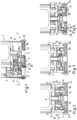
- eine schematische Seitenansicht des Beschickungsfahrzeugs in einem Zustand, in dem die erste Laufradanordnung aktiv ist,
- Fig. 3
- eine schematische Seitenansicht des Beschickungsfahrzeugs in einem Zustand, bei dem man zwischen der ersten Laufradanordnung und der zweiten Laufradanordnung wechselt und
- Fig. 4
- eine schematische Seitenansicht des Beschickungsfahrzeugs in einem Zustand, bei dem die zweite Laufradanordnung aktiv ist.
-
Fig. 1 zeigt schematisch ein Beschickungsfahrzeug 1, das in einer Stapellageranordnung verwendet werden kann, um Behälter von unten in Behälterstapelräume einzulagern und Behälter von unten aus den Behälterstapelräumen zu entnehmen. - Das Beschickungsfahrzeug weist eine erste Laufradanordnung 2 mit ersten Laufrädern 2a, 2b, 2c und eine zweite Laufradanordnung 3 mit zweiten Laufrädern 3a, 3b auf. Die ersten Laufräder 2a-2c sind an einem Fahrgestell 4 befestigt. Mit der ersten Laufradanordnung 2 kann das Beschickungsfahrzeug 1 in eine erste Richtung verfahren werden. Die zweiten Laufräder 3a, 3b der zweiten Laufradanordnung 3 sind senkrecht zu den ersten Laufrädern 2a-2c gerichtet. Mit der zweiten Laufradanordnung 3 kann das Beschickungsfahrzeug 1 in eine Richtung senkrecht oder quer zur ersten Richtung verfahren werden.
- Das Beschickungsfahrzeug 1 weist weiterhin eine Hubeinrichtung auf, mit der es in der Lage ist, einen nicht näher dargestellten Behälter von unten in einen Behälterstapelraum einer Stapellageranordnung einzulagern oder den Behälter nach unten aus dem Behälterstapelraum zu entnehmen. Hierzu weist das Beschickungsfahrzeug 1 eine Hubplattform 5 auf, die von einer Hubeinrichtung angehoben werden kann. Die Hubeinrichtung weist im vorliegenden Fall eine Schubkette 6 auf. Die Schubkette 6 wird durch einen Antriebsmotor 7 angetrieben. Die Hubplattform 5 kann durch eine Führung 8 geführt werden.
- Die ersten Laufräder 2a-2c sind unmittelbar am Fahrgestell 4 angeordnet. Sie können durch einen Fahrantrieb 9 angetrieben werden.
- Die zweiten Laufräder 3a, 3b sind jeweils an einer Schwinge 10, 11 angeordnet, wobei die Schwingen 10, 11 verschwenkbar am Fahrgestell 4 befestigt sind. Lediglich für die Schwinge 11 ist ein Drehpunkt 12 erkennbar.
- Die Schwingen 10, 11 sind über Druckfedern 13, 14 am Fahrgestell 4 abgestützt. Ohne Einwirkung anderer Kräfte bewirken die Druckfedern 13, 14, dass die zweiten Laufräder 3a, 3b in die in
Fig. 2 dargestellte inaktive Position verschwenkt werden, in der das Beschickungsfahrzeug 1 lediglich auf der ersten Laufradanordnung 2 verfahren werden kann. - Die Schubkette 6 ist fest mit der Hubplattform 5 verbunden. Die Hubplattform 5 ist an ihrer Unterseite (die Richtungsangaben "oben" und "unten" beziehen sich auf die Schwerkraftrichtung) mit einer Kugelrollenanordnung 15 versehen. Die Schwingen 10, 11 weisen auf ihrer Oberseite eine Kugelauflage 16 auf.
-
Fig. 2 zeigt eine Grundstellung der Hubplattform 5. Die Grundstellung der Hubplattform 5 ist eine Stellung, in der ein auf der Hubplattform aufgenommener Behälter beim Transport in die erste Richtung, wenn das Beschickungsfahrzeug 1 auf der ersten Laufradanordnung 2 rollt, im Beschickungsraum verfahren wird. Die Hubplattform 5 kann aus dieser Grundstellung nach oben bewegt werden, um den Behälter in einen Behälterstapelraum einzulagern oder den Behälter von dort zu entnehmen. - Die Hubplattform 5 kann jedoch auch mit Hilfe der Schubkette 6 aus der Grundstellung heraus nach unten verlagert werden. Dabei kommt die Kugelführungsanordnung 15 in Kontakt mit der Kugelauflage 16, wie dies in
Fig. 3 dargestellt ist. Wenn die Hubplattform 5 weiter abgesenkt wird, wie dies inFig. 4 dargestellt ist, dann werden die Schwingen 10, 11 gegenüber dem Fahrgestell verschwenkt und bewegen dadurch die zweiten Laufräder 3a, 3b über die ersten Laufräder 2a, 2b nach unten hinaus. Bei dieser Bewegung werden die Druckfedern 13, 14 komprimiert und das Fahrgestell 4 wird angehoben. Das Beschickungsfahrzeug 1 ist dann auf der zweiten Laufradanordnung 3 bewegbar. - Wenn die erste Laufradanordnung wieder aktiviert werden soll, wird die Hubplattform 5 wieder angehoben. Dieses Anheben kann bei entsprechender Dimensionierung alleine über die Kraft der Druckfedern 13, 14 erfolgen. Es ist aber auch möglich, für diese Bewegung den Hubantrieb mit der Schubkette 6 zu verwenden. Wenn die Hubplattform 5 angehoben wird, werden die Schwingen 10, 11 zurück verschwenkt und die zweiten Laufräder 3a, 3b werden gegenüber dem Fahrgestell angehoben (bzw. das Fahrgestell 4 wird gegenüber den zweiten Laufrädern 3a, 3b abgesenkt), so dass wieder die erste Laufradanordnung 2 aktiv wird.
- Die Schubkette 6 wirkt zumindest beim Anheben der Hubplattform 5 aus der Grundstellung nach oben mit Druck auf die Hubplattform 5. Wenn die Hubplattform 5 hingegen aus der Grundstellung heraus nach unten verlagert wird, dann wirkt die Schubkette 6 mit Zug auf die Hubplattform 5.
- Die Schwenkachse 12 der Schwingen 10, 11 ist in einem mittleren Bereich des Fahrgestells 4 angeordnet. Mit anderen Worten sind die Schwingen 10, 11 in einem mittleren Bereich am Fahrgestell 4 aufgehängt. Dies wiederum führt dazu, dass die zweiten Laufräder 3a, 3b relativ weit außen am Beschickungsfahrzeug angeordnet sein können, so dass die Beschickungsräder 3a, 3b (und ihr entsprechendes Paar auf der anderen Seite des Beschickungsfahrzeugs 1) eine relativ große Aufstandsfläche bilden. Dies wirkt sich positiv auf die Stabilität des Beschickungsfahrzeugs 1 aus.
Claims (9)
- Beschickungsfahrzeug (1) für eine Stapellageranordnung mit einem Fahrgestell (4), einer ersten Laufradanordnung (2), mit der das Beschickungsfahrzeug (1) in eine erste Richtung verfahrbar ist, einer zweiten Laufradanordnung (3), mit der das Beschickungsfahrzeug (1) in eine zweite Richtung quer zur ersten Richtung verfahrbar ist, und einer Hubeinrichtung, die einen senkrecht zur ersten Richtung und zur zweiten Richtung wirkenden Hubantrieb (6, 7) aufweist, wobei die Hubeinrichtung eine Hubplattform (5) zum Anheben eines Behälters aufweist, wobei die Hubplattform (5) mit dem Hubantrieb (6, 7) aus einer Grundstellung in Schwerkraftrichtung nach oben in eine angehobene Stellung verlagerbar ist, dadurch gekennzeichnet, dass der Hubantrieb (6, 7) auf die zweite Laufradanordnung (3) in Schwerkraftrichtung nach unten wirkt und die zweite Laufradanordnung (3) nach unten über die erste Laufradanordnung (2) hinaus verlagert, wobei der Hubantrieb (6, 7) über die Hubplattform (5) auf die zweite Laufradanordnung (3) wirkt.
- Beschickungsfahrzeug nach Anspruch 1, dadurch gekennzeichnet, dass die Hubplattform (5) durch den Hubantrieb (6, 7) aus der Grundstellung in Schwerkraftrichtung nach unten verlagerbar ist.
- Beschickungsfahrzeug nach Anspruch 1 oder 2, dadurch gekennzeichnet, dass eine Federanordnung (13, 14) zwischen dem Fahrgestell (4) und der zweiten Laufradanordnung (3) vorgesehen ist, die entgegen der in Schwerkraftrichtung nach unten gerichteten Wirkung des Hubantriebs (6, 7) wirkt.
- Beschickungsfahrzeug nach Anspruch 3, dadurch gekennzeichnet, dass die Federanordnung (13, 14) ein Federelement, insbesondere eine Druckfeder aufweist.
- Beschickungsfahrzeug nach einem der Ansprüche 1 bis 4, dadurch gekennzeichnet, dass die zweite Laufradanordnung (3) mindestens ein Laufrad (3a, 3b) aufweist, das an einer Schwinge (10, 11) angeordnet ist.
- Beschickungsfahrzeug nach Anspruch 5, dadurch gekennzeichnet, dass die Schwinge (10, 11) in einem in der zweiten Richtung mittleren Bereich am Fahrgestell (4) aufgehängt ist.
- Beschickungsfahrzeug nach Anspruch 5 oder 6, dadurch gekennzeichnet, dass der Hubrahmen (5) auf die Schwinge (10, 11) wirkt.
- Beschickungsfahrzeug nach Anspruch 7, dadurch gekennzeichnet, dass der Hubrahmen (5) über eine Kugelanordnung (15) und eine Kugelauflage (16) auf die Schwinge (10, 11) wirkt.
- Beschickungsfahrzeug nach einem der Ansprüche 1 bis 8, dadurch gekennzeichnet, dass der Hubantrieb (6, 7) eine Schubkette (6) aufweist, die bei einer Bewegung des Hubrahmens (5) aus der Grundstellung in Schwerkraftrichtung nach oben mit Druck auf den Hubrahmen (5) wirkt und bei einer Bewegung des Hubrahmens (5) aus der Grundstellung in Schwerkraftrichtung nach unten mit Zug auf den Hubrahmen (5) wirkt.
Priority Applications (7)
| Application Number | Priority Date | Filing Date | Title |
|---|---|---|---|
| ES20192811T ES3040104T3 (en) | 2020-08-26 | 2020-08-26 | Feeder vehicle for a stack storage assembly |
| PL20192811.6T PL3960658T3 (pl) | 2020-08-26 | 2020-08-26 | Pojazd załadunkowy dla układu składowania w stosach |
| EP20192811.6A EP3960658B1 (de) | 2020-08-26 | 2020-08-26 | Beschickungsfahrzeug für eine stapellageranordnung |
| CA3128622A CA3128622A1 (en) | 2020-08-26 | 2021-08-18 | Charging vehicle for a stack storage assembly |
| JP2021134647A JP2022040029A (ja) | 2020-08-26 | 2021-08-20 | 積層体保管アセンブリ用の充電式車両 |
| US17/411,548 US12269332B2 (en) | 2020-08-26 | 2021-08-25 | Charging vehicle for a stack storage assembly |
| CN202110988226.7A CN114104627A (zh) | 2020-08-26 | 2021-08-26 | 用于堆叠存储组件的运送车辆 |
Applications Claiming Priority (1)
| Application Number | Priority Date | Filing Date | Title |
|---|---|---|---|
| EP20192811.6A EP3960658B1 (de) | 2020-08-26 | 2020-08-26 | Beschickungsfahrzeug für eine stapellageranordnung |
Publications (2)
| Publication Number | Publication Date |
|---|---|
| EP3960658A1 EP3960658A1 (de) | 2022-03-02 |
| EP3960658B1 true EP3960658B1 (de) | 2025-06-11 |
Family
ID=72290760
Family Applications (1)
| Application Number | Title | Priority Date | Filing Date |
|---|---|---|---|
| EP20192811.6A Active EP3960658B1 (de) | 2020-08-26 | 2020-08-26 | Beschickungsfahrzeug für eine stapellageranordnung |
Country Status (7)
| Country | Link |
|---|---|
| US (1) | US12269332B2 (de) |
| EP (1) | EP3960658B1 (de) |
| JP (1) | JP2022040029A (de) |
| CN (1) | CN114104627A (de) |
| CA (1) | CA3128622A1 (de) |
| ES (1) | ES3040104T3 (de) |
| PL (1) | PL3960658T3 (de) |
Families Citing this family (3)
| Publication number | Priority date | Publication date | Assignee | Title |
|---|---|---|---|---|
| AT525735B1 (de) * | 2022-10-06 | 2023-07-15 | Knapp Ag | Automatisiertes Lagersystem mit einem Shuttle zum Transport von Lagerhilfsmitteln |
| DE102024122931A1 (de) * | 2024-08-12 | 2026-02-12 | Jungheinrich Aktiengesellschaft | Stapellageranordnung |
| DE102024122970A1 (de) * | 2024-08-12 | 2026-02-12 | Jungheinrich Aktiengesellschaft | Beschickungsfahrzeug für eine Blocklageranordnung |
Citations (1)
| Publication number | Priority date | Publication date | Assignee | Title |
|---|---|---|---|---|
| US20140086714A1 (en) * | 2012-09-27 | 2014-03-27 | Ohad MALIK | Automated warehousing systems and method |
Family Cites Families (12)
| Publication number | Priority date | Publication date | Assignee | Title |
|---|---|---|---|---|
| JPH05229609A (ja) * | 1992-02-18 | 1993-09-07 | Sumitomo Heavy Ind Ltd | 立体自動倉庫 |
| DE102015001410A1 (de) * | 2015-02-06 | 2016-08-11 | Gebhardt Fördertechnik GmbH | Palettentransportvorrichtung |
| EP3591727A4 (de) | 2017-03-02 | 2020-12-23 | Hitachi Chemical Co., Ltd. | Organisches elektronisches material und verwendung davon |
| DE102017203514A1 (de) | 2017-03-03 | 2018-09-20 | Robert Bosch Gmbh | Flurförderfahrzeug mit verbessertem Sensorkonzept sowie Flurfördersystem |
| MX2018004985A (es) | 2017-04-21 | 2018-11-09 | Rehrig Pacific Co | Apilador de bandejas de panificación. |
| CN111727159B (zh) | 2018-01-09 | 2022-04-22 | 自动存储科技股份有限公司 | 用于遥控式运载工具的移位机构 |
| WO2019137866A1 (en) * | 2018-01-09 | 2019-07-18 | Autostore Technology AS | A displacement mechanism for a remotely operated vehicle |
| WO2019238703A1 (en) | 2018-06-12 | 2019-12-19 | Autostore Technology AS | Storage system with modular container handling vehicles |
| CA3021982A1 (en) * | 2018-10-24 | 2020-04-24 | Paul Redman | Pallet exchanger and load splitter |
| JP7202606B2 (ja) * | 2018-11-08 | 2023-01-12 | 建ロボテック株式会社 | 自走ロボット |
| CN209583531U (zh) | 2018-12-29 | 2019-11-05 | 广州蓝海机器人系统有限公司 | 一种具有举升平台的agv |
| CN110092324B (zh) | 2019-04-12 | 2024-07-02 | 华中科技大学 | 一种具备换向兼升降功能的新型重载rgv机器人 |
-
2020
- 2020-08-26 EP EP20192811.6A patent/EP3960658B1/de active Active
- 2020-08-26 PL PL20192811.6T patent/PL3960658T3/pl unknown
- 2020-08-26 ES ES20192811T patent/ES3040104T3/es active Active
-
2021
- 2021-08-18 CA CA3128622A patent/CA3128622A1/en active Pending
- 2021-08-20 JP JP2021134647A patent/JP2022040029A/ja active Pending
- 2021-08-25 US US17/411,548 patent/US12269332B2/en active Active
- 2021-08-26 CN CN202110988226.7A patent/CN114104627A/zh active Pending
Patent Citations (1)
| Publication number | Priority date | Publication date | Assignee | Title |
|---|---|---|---|---|
| US20140086714A1 (en) * | 2012-09-27 | 2014-03-27 | Ohad MALIK | Automated warehousing systems and method |
Also Published As
| Publication number | Publication date |
|---|---|
| ES3040104T3 (en) | 2025-10-29 |
| CA3128622A1 (en) | 2022-02-26 |
| US20220063387A1 (en) | 2022-03-03 |
| PL3960658T3 (pl) | 2025-10-13 |
| CN114104627A (zh) | 2022-03-01 |
| JP2022040029A (ja) | 2022-03-10 |
| EP3960658A1 (de) | 2022-03-02 |
| US12269332B2 (en) | 2025-04-08 |
Similar Documents
| Publication | Publication Date | Title |
|---|---|---|
| EP2982624B1 (de) | Haltevorrichtung und Lagersystem für Behälterstapel | |
| EP3960658B1 (de) | Beschickungsfahrzeug für eine stapellageranordnung | |
| EP2675416B1 (de) | Zusatzrolle | |
| EP3838802B1 (de) | Stapellageranordnung und verfahren zum betreiben einer stapellageranordnung | |
| EP2404847B1 (de) | Wagen zum Transport von Paletten innerhalb eines Tiefen-Regalsystems | |
| EP3960657B1 (de) | Stapellageranordnung | |
| EP3782929A1 (de) | Behälterstapellager-beschickungswagen | |
| DE69920783T2 (de) | Krafthebevorrichtung für Fahrzeuge | |
| DE2121114A1 (de) | Zusatzgerät für Gabelstapler zum Einsatz in engen Hallengängen | |
| EP3782932A1 (de) | Stapellageranordnung | |
| EP3782933A1 (de) | Behälterstapellager-beschickungswagen | |
| EP3581539A1 (de) | Palettengut-abhebevorrichtung | |
| EP0903277A2 (de) | Hubwagen | |
| DE102018129409A1 (de) | Greifvorrichtung sowie Verfahren zum Greifen einer Transportpalette | |
| DE2536756A1 (de) | Ballenwagen mit auswahl der anordnung von ballen in ballengruppen eines ballenstapels | |
| DE2759085A1 (de) | Fangvorrichtung fuer eine mindestens ein seil aufweisende hubvorrichtung | |
| DE102006024345B3 (de) | Scherenhubtisch | |
| WO2023025350A1 (de) | Vorrichtung zum transport von stückgütern | |
| DE102010028214B4 (de) | Stellmechanismus für den Einsatz in berührungslosen Stapelsystemen | |
| DE102019135616A1 (de) | Transportvorrichtung | |
| DE3302960A1 (de) | Kraftfahrzeug mit hebebuehne | |
| DE102019130333A1 (de) | Flurförderzeug, insbesondere Schubmaststapler | |
| DE102024106144A1 (de) | Antriebseinheit | |
| DE3024595C2 (de) | Parallelführung für eine höhenverschwenkbare Arbeitsplattform | |
| DE202005014323U1 (de) | Vorrichtung zum Stapeln von Dachpfannen |
Legal Events
| Date | Code | Title | Description |
|---|---|---|---|
| PUAI | Public reference made under article 153(3) epc to a published international application that has entered the european phase |
Free format text: ORIGINAL CODE: 0009012 |
|
| STAA | Information on the status of an ep patent application or granted ep patent |
Free format text: STATUS: THE APPLICATION HAS BEEN PUBLISHED |
|
| AK | Designated contracting states |
Kind code of ref document: A1 Designated state(s): AL AT BE BG CH CY CZ DE DK EE ES FI FR GB GR HR HU IE IS IT LI LT LU LV MC MK MT NL NO PL PT RO RS SE SI SK SM TR |
|
| STAA | Information on the status of an ep patent application or granted ep patent |
Free format text: STATUS: REQUEST FOR EXAMINATION WAS MADE |
|
| 17P | Request for examination filed |
Effective date: 20220523 |
|
| RBV | Designated contracting states (corrected) |
Designated state(s): AL AT BE BG CH CY CZ DE DK EE ES FI FR GB GR HR HU IE IS IT LI LT LU LV MC MK MT NL NO PL PT RO RS SE SI SK SM TR |
|
| P01 | Opt-out of the competence of the unified patent court (upc) registered |
Effective date: 20230628 |
|
| STAA | Information on the status of an ep patent application or granted ep patent |
Free format text: STATUS: EXAMINATION IS IN PROGRESS |
|
| 17Q | First examination report despatched |
Effective date: 20231114 |
|
| GRAP | Despatch of communication of intention to grant a patent |
Free format text: ORIGINAL CODE: EPIDOSNIGR1 |
|
| STAA | Information on the status of an ep patent application or granted ep patent |
Free format text: STATUS: GRANT OF PATENT IS INTENDED |
|
| INTG | Intention to grant announced |
Effective date: 20250122 |
|
| GRAS | Grant fee paid |
Free format text: ORIGINAL CODE: EPIDOSNIGR3 |
|
| GRAA | (expected) grant |
Free format text: ORIGINAL CODE: 0009210 |
|
| STAA | Information on the status of an ep patent application or granted ep patent |
Free format text: STATUS: THE PATENT HAS BEEN GRANTED |
|
| AK | Designated contracting states |
Kind code of ref document: B1 Designated state(s): AL AT BE BG CH CY CZ DE DK EE ES FI FR GB GR HR HU IE IS IT LI LT LU LV MC MK MT NL NO PL PT RO RS SE SI SK SM TR |
|
| REG | Reference to a national code |
Ref country code: GB Ref legal event code: FG4D Free format text: NOT ENGLISH |
|
| REG | Reference to a national code |
Ref country code: CH Ref legal event code: EP |
|
| REG | Reference to a national code |
Ref country code: DE Ref legal event code: R096 Ref document number: 502020011192 Country of ref document: DE |
|
| REG | Reference to a national code |
Ref country code: IE Ref legal event code: FG4D Free format text: LANGUAGE OF EP DOCUMENT: GERMAN |
|
| REG | Reference to a national code |
Ref country code: NL Ref legal event code: FP |
|
| PG25 | Lapsed in a contracting state [announced via postgrant information from national office to epo] |
Ref country code: FI Free format text: LAPSE BECAUSE OF FAILURE TO SUBMIT A TRANSLATION OF THE DESCRIPTION OR TO PAY THE FEE WITHIN THE PRESCRIBED TIME-LIMIT Effective date: 20250611 |
|
| PGFP | Annual fee paid to national office [announced via postgrant information from national office to epo] |
Ref country code: ES Payment date: 20250917 Year of fee payment: 6 |
|
| PGFP | Annual fee paid to national office [announced via postgrant information from national office to epo] |
Ref country code: DE Payment date: 20250919 Year of fee payment: 6 |
|
| REG | Reference to a national code |
Ref country code: LT Ref legal event code: MG9D |
|
| PG25 | Lapsed in a contracting state [announced via postgrant information from national office to epo] |
Ref country code: GR Free format text: LAPSE BECAUSE OF FAILURE TO SUBMIT A TRANSLATION OF THE DESCRIPTION OR TO PAY THE FEE WITHIN THE PRESCRIBED TIME-LIMIT Effective date: 20250912 |
|
| PGFP | Annual fee paid to national office [announced via postgrant information from national office to epo] |
Ref country code: NO Payment date: 20250919 Year of fee payment: 6 |
|
| PGFP | Annual fee paid to national office [announced via postgrant information from national office to epo] |
Ref country code: NL Payment date: 20250922 Year of fee payment: 6 |
|
| PG25 | Lapsed in a contracting state [announced via postgrant information from national office to epo] |
Ref country code: BG Free format text: LAPSE BECAUSE OF FAILURE TO SUBMIT A TRANSLATION OF THE DESCRIPTION OR TO PAY THE FEE WITHIN THE PRESCRIBED TIME-LIMIT Effective date: 20250611 |
|
| PGFP | Annual fee paid to national office [announced via postgrant information from national office to epo] |
Ref country code: GB Payment date: 20250923 Year of fee payment: 6 |
|
| PG25 | Lapsed in a contracting state [announced via postgrant information from national office to epo] |
Ref country code: HR Free format text: LAPSE BECAUSE OF FAILURE TO SUBMIT A TRANSLATION OF THE DESCRIPTION OR TO PAY THE FEE WITHIN THE PRESCRIBED TIME-LIMIT Effective date: 20250611 |
|
| PGFP | Annual fee paid to national office [announced via postgrant information from national office to epo] |
Ref country code: FR Payment date: 20250924 Year of fee payment: 6 Ref country code: AT Payment date: 20250918 Year of fee payment: 6 |
|
| PGFP | Annual fee paid to national office [announced via postgrant information from national office to epo] |
Ref country code: CH Payment date: 20250925 Year of fee payment: 6 |
|
| PG25 | Lapsed in a contracting state [announced via postgrant information from national office to epo] |
Ref country code: RS Free format text: LAPSE BECAUSE OF FAILURE TO SUBMIT A TRANSLATION OF THE DESCRIPTION OR TO PAY THE FEE WITHIN THE PRESCRIBED TIME-LIMIT Effective date: 20250911 |
|
| PG25 | Lapsed in a contracting state [announced via postgrant information from national office to epo] |
Ref country code: LV Free format text: LAPSE BECAUSE OF FAILURE TO SUBMIT A TRANSLATION OF THE DESCRIPTION OR TO PAY THE FEE WITHIN THE PRESCRIBED TIME-LIMIT Effective date: 20250611 |
|
| REG | Reference to a national code |
Ref country code: ES Ref legal event code: FG2A Ref document number: 3040104 Country of ref document: ES Kind code of ref document: T3 Effective date: 20251029 |
|
| PG25 | Lapsed in a contracting state [announced via postgrant information from national office to epo] |
Ref country code: PT Free format text: LAPSE BECAUSE OF FAILURE TO SUBMIT A TRANSLATION OF THE DESCRIPTION OR TO PAY THE FEE WITHIN THE PRESCRIBED TIME-LIMIT Effective date: 20251013 |
|
| PG25 | Lapsed in a contracting state [announced via postgrant information from national office to epo] |
Ref country code: IS Free format text: LAPSE BECAUSE OF FAILURE TO SUBMIT A TRANSLATION OF THE DESCRIPTION OR TO PAY THE FEE WITHIN THE PRESCRIBED TIME-LIMIT Effective date: 20251011 |
|
| PG25 | Lapsed in a contracting state [announced via postgrant information from national office to epo] |
Ref country code: SM Free format text: LAPSE BECAUSE OF FAILURE TO SUBMIT A TRANSLATION OF THE DESCRIPTION OR TO PAY THE FEE WITHIN THE PRESCRIBED TIME-LIMIT Effective date: 20250611 |
|
| PGFP | Annual fee paid to national office [announced via postgrant information from national office to epo] |
Ref country code: IT Payment date: 20251128 Year of fee payment: 6 |
|
| PGFP | Annual fee paid to national office [announced via postgrant information from national office to epo] |
Ref country code: CZ Payment date: 20250912 Year of fee payment: 6 |
|
| PGFP | Annual fee paid to national office [announced via postgrant information from national office to epo] |
Ref country code: PL Payment date: 20250916 Year of fee payment: 6 |
|
| PG25 | Lapsed in a contracting state [announced via postgrant information from national office to epo] |
Ref country code: EE Free format text: LAPSE BECAUSE OF FAILURE TO SUBMIT A TRANSLATION OF THE DESCRIPTION OR TO PAY THE FEE WITHIN THE PRESCRIBED TIME-LIMIT Effective date: 20250611 |
|
| PG25 | Lapsed in a contracting state [announced via postgrant information from national office to epo] |
Ref country code: SK Free format text: LAPSE BECAUSE OF FAILURE TO SUBMIT A TRANSLATION OF THE DESCRIPTION OR TO PAY THE FEE WITHIN THE PRESCRIBED TIME-LIMIT Effective date: 20250611 Ref country code: RO Free format text: LAPSE BECAUSE OF FAILURE TO SUBMIT A TRANSLATION OF THE DESCRIPTION OR TO PAY THE FEE WITHIN THE PRESCRIBED TIME-LIMIT Effective date: 20250611 |
|
| REG | Reference to a national code |
Ref country code: DE Ref legal event code: R097 Ref document number: 502020011192 Country of ref document: DE |
|
| PG25 | Lapsed in a contracting state [announced via postgrant information from national office to epo] |
Ref country code: MC Free format text: LAPSE BECAUSE OF FAILURE TO SUBMIT A TRANSLATION OF THE DESCRIPTION OR TO PAY THE FEE WITHIN THE PRESCRIBED TIME-LIMIT Effective date: 20250611 |
|
| PG25 | Lapsed in a contracting state [announced via postgrant information from national office to epo] |
Ref country code: DK Free format text: LAPSE BECAUSE OF FAILURE TO SUBMIT A TRANSLATION OF THE DESCRIPTION OR TO PAY THE FEE WITHIN THE PRESCRIBED TIME-LIMIT Effective date: 20250611 |
|
| PG25 | Lapsed in a contracting state [announced via postgrant information from national office to epo] |
Ref country code: LU Free format text: LAPSE BECAUSE OF NON-PAYMENT OF DUE FEES Effective date: 20250826 |
|
| PLBE | No opposition filed within time limit |
Free format text: ORIGINAL CODE: 0009261 |
|
| STAA | Information on the status of an ep patent application or granted ep patent |
Free format text: STATUS: NO OPPOSITION FILED WITHIN TIME LIMIT |
|
| REG | Reference to a national code |
Ref country code: CH Ref legal event code: L10 Free format text: ST27 STATUS EVENT CODE: U-0-0-L10-L00 (AS PROVIDED BY THE NATIONAL OFFICE) Effective date: 20260423 |