EP3939709B1 - Vibrationserzeugungsvorrichtung - Google Patents
Vibrationserzeugungsvorrichtung Download PDFInfo
- Publication number
- EP3939709B1 EP3939709B1 EP20770919.7A EP20770919A EP3939709B1 EP 3939709 B1 EP3939709 B1 EP 3939709B1 EP 20770919 A EP20770919 A EP 20770919A EP 3939709 B1 EP3939709 B1 EP 3939709B1
- Authority
- EP
- European Patent Office
- Prior art keywords
- region
- frequency
- vibration
- housing
- excitation coil
- Prior art date
- Legal status (The legal status is an assumption and is not a legal conclusion. Google has not performed a legal analysis and makes no representation as to the accuracy of the status listed.)
- Active
Links
Images











Classifications
-
- B—PERFORMING OPERATIONS; TRANSPORTING
- B06—GENERATING OR TRANSMITTING MECHANICAL VIBRATIONS IN GENERAL
- B06B—METHODS OR APPARATUS FOR GENERATING OR TRANSMITTING MECHANICAL VIBRATIONS OF INFRASONIC, SONIC, OR ULTRASONIC FREQUENCY, e.g. FOR PERFORMING MECHANICAL WORK IN GENERAL
- B06B1/00—Methods or apparatus for generating mechanical vibrations of infrasonic, sonic, or ultrasonic frequency
- B06B1/02—Methods or apparatus for generating mechanical vibrations of infrasonic, sonic, or ultrasonic frequency making use of electrical energy
- B06B1/04—Methods or apparatus for generating mechanical vibrations of infrasonic, sonic, or ultrasonic frequency making use of electrical energy operating with electromagnetism
- B06B1/045—Methods or apparatus for generating mechanical vibrations of infrasonic, sonic, or ultrasonic frequency making use of electrical energy operating with electromagnetism using vibrating magnet, armature or coil system
-
- H—ELECTRICITY
- H04—ELECTRIC COMMUNICATION TECHNIQUE
- H04R—LOUDSPEAKERS, MICROPHONES, GRAMOPHONE PICK-UPS OR LIKE ACOUSTIC ELECTROMECHANICAL TRANSDUCERS; ELECTRIC HEARING AIDS; PUBLIC ADDRESS SYSTEMS
- H04R13/00—Transducers having an acoustic diaphragm of magnetisable material directly co-acting with electromagnet
-
- H—ELECTRICITY
- H04—ELECTRIC COMMUNICATION TECHNIQUE
- H04R—LOUDSPEAKERS, MICROPHONES, GRAMOPHONE PICK-UPS OR LIKE ACOUSTIC ELECTROMECHANICAL TRANSDUCERS; ELECTRIC HEARING AIDS; PUBLIC ADDRESS SYSTEMS
- H04R7/00—Diaphragms for electromechanical transducers; Cones
- H04R7/16—Mounting or tensioning of diaphragms or cones
-
- H—ELECTRICITY
- H04—ELECTRIC COMMUNICATION TECHNIQUE
- H04R—LOUDSPEAKERS, MICROPHONES, GRAMOPHONE PICK-UPS OR LIKE ACOUSTIC ELECTROMECHANICAL TRANSDUCERS; ELECTRIC HEARING AIDS; PUBLIC ADDRESS SYSTEMS
- H04R9/00—Transducers of moving-coil, moving-strip, or moving-wire type
- H04R9/02—Details
- H04R9/025—Magnetic circuit
Definitions
- the present disclosure relates to a vibration generating device.
- Patent Document 1 discloses a vibration source drive device that has an object to generate sound and vibration exclusively.
- Patent Document 1 Japanese Laid-Open Patent Application No. 2001-121079
- the present disclosure has an object to provide a vibration generating device capable of presenting sound and vibration that are sufficiently separated.
- US 2002/064295 A1 discloses a multifunction acoustic device comprising a frame, a speaker diaphragm supported in the frame, a voice coil secured to the speaker diaphragm, a rotor having a central permanent magnet and a cylindrical hub provided around the central permanent magnet, and rotatably supported in the frame, a motor annular permanent magnet disposed around the rotor, the voice coil being disposed in the gap formed between the central permanent magnet and the hub.
- JP 2016 096677 A discloses an oscillation generating device capable of allowing oscillation operation of an oscillator to be stabled.
- the present invention provides a vibration generating device as defined in independent claim 1. Further advantageous aspects of the present invention are defined in the dependent claims.
- a vibration generating device includes a housing; a diaphragm supported by the housing, and configured to generate sound by vibrating in a first direction; and a vibration providing part attached to the housing, and configured to vibrate the housing, wherein the vibration providing part vibrates the housing in the first direction at a first frequency, and vibrates the housing in a second direction at a second frequency lower than the first frequency.
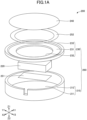
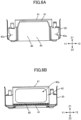
- FIG. 1A , 1B , and 1C are diagram illustrating a configuration of a vibration generating device 200 according to a first embodiment.
- FIG. 1A is an exploded perspective view
- FIG. 1B is a plan view
- FIG. 1C is a cross-sectional view along a I-I line in FIG. 1B . Note that the directions in each figure are defined as X1 being left, X2 being right, Y1 being front, Y2 being rear, Z1 being upward, and Z2 being downward.
- the upper case 230 has a ring-shaped bottom plate 231 having an opening 232 formed at the center, and a guide part 233 provided at an edge of the bottom plate 231 to guide the diaphragm 240.
- the diaphragm 240 has a disk shape, and is fixed to the top surface of the bottom plate 231 by a ring-shaped double-sided tape 252 inside the guide part 233, to be held by the upper case 230.
- the upper case 230 is fixed to the lower case 210 so that the diaphragm 240 is positioned on the upside with respect to the upper case 230.
- the upper case 230 may be fixed to the lower case 210 so that the diaphragm 240 is positioned on the lower side with respect to the upper case 230.
- the upper case 230 is an example of a holder.
- the diaphragm 240 is supported by the housing 260, and generates sound by vibrating in a first direction (the Z1-Z2 direction).
- the vibration providing part 220 is attached to the housing 260, to vibrate the housing 260.
- the vibration providing part 220 vibrates the housing 260 in the first direction at the first frequency f1, and vibrates the housing 260 in a second direction at a second frequency f2 that is lower than the first frequency f1.
- the second direction is a direction different from the first direction, and favorably is a direction (the X1-X2 direction or the Y1-Y2 direction) orthogonal to the first direction (the Z1-Z2 direction).
- the diaphragm 240 can be integrally formed with the housing 260.
- the diaphragm 240 can be integrally formed with the upper case 230.
- the housing 260 and the diaphragm 240 are made of synthetic resin or made of metal.
- the housing 260 vibrating in the first direction causes the diaphragm 240 to vibrate in the first direction, and the diaphragm 240 vibrating the surrounding air generates sound.
- the first frequency f1 is not limited in particular, and may be set to be, for example, greater than or equal to 200 Hz and less than or equal to 6 kHz; in particular, it is favorable that the range is set to be, for example, greater than or equal to 1 kHz and less than or equal to 4 kHz that can be easily detected by the auditory perception of a person. Even if the housing 260 vibrates at a frequency in a range that can be easily detected by the auditory perception of a person, the vibration is hardly detected by the person through the tactile perception. Therefore, vibration at the first frequency f1 in the first direction can present sound to a person without causing the person to feel the vibration substantially.
- the second frequency f2 is not limited in particular, and may be set to be, for example, less than or equal to 600 Hz; in particular, it is favorable that the range is set to be, for example, greater than or equal to 100 Hz and less than or equal to 500 Hz that can be easily detected by the tactile perception of a person. Even in the case where the first frequency f1 is greater than or equal to 200 Hz and less than or equal to 600 Hz, the second frequency f2 simply needs to be lower than the first frequency f1.
- the auditory perception of a person can detect frequencies of sound that are easily detected by the tactile perception; however, when vibrating in the second direction, the diaphragm 240 hardly vibrates in the first direction, and thereby, the diaphragm 240 does not generate sound. Therefore, vibration at the second frequency f2 in the second direction can present vibration to a person without causing the person to feel sound substantially.
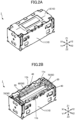
- FIGs. 2A and 2B are first explanatory diagrams illustrating a configuration of the vibration providing part 1.
- FIG. 2A is a perspective view illustrating an external appearance of the vibration providing part 1; and
- FIG. 2B is a perspective view illustrating the vibration providing part 1 in a state of a cover 12 being removed.
- FIG. 3 is a second explanatory diagram illustrating the configuration of the vibration providing part 1, and is an exploded perspective view of the vibration providing part 1.
- FIG. 4 is an explanatory diagram illustrating a configuration of the vibrator 20 in the vibration providing part 1, and is a perspective view of the vibrator 20.
- FIGs. 5A and 5B are first explanatory diagrams illustrating a configuration of the holder 30 and the elastic supporter 40 in the vibration providing part 1.
- FIG. 5A is a perspective view of the holder 30 and the elastic supporter 40; and
- FIG. 5B is a front view of the holder 30 and the elastic supporter 40 in the vibration providing part 1.
- FIGs. 6A and 6B are second explanatory diagrams illustrating a configuration of the holder 30 and the elastic supporter 40 in the vibration providing part 1.
- FIG. 6A is a side view in the case of viewing the holder 30 and the elastic supporter 40 from the right; and
- FIG. 6B is a cross-sectional view corresponding to a cross section of FIG. 5B along a cross section A1-A1.
- FIG. 7A and 7B are explanatory diagrams illustrating a configuration of the permanent magnet in the vibration providing part 1.
- FIG. 7A is an exploded perspective view of the permanent magnet 70 on the rear side;
- FIG. 7B is a front view of the permanent magnet 70 on the rear side.
- FIGs. 8A and 8B are explanatory diagrams illustrating driving directions of the magnetic drive part 50 in the vibration providing part 1, in which the magnetic core 61 is viewed from the front.
- FIG. 8A illustrates a direction of a magnetic force exerted by the permanent magnet 70 on the front edge 61F of the core 61 when the front edge 61F of the core 61 is magnetized to be an N pole; and
- FIG. 8B illustrates a direction of a magnetic force exerted by the permanent magnet 70 on the front edge 61F of the core 61 when the front edge 61F of the core 61 is magnetized to be an S pole.
- a solid-line arrow indicates a direction of a magnetic force acting on the magnetic core 61.
- FIGs. 9A and 9B are explanatory diagram illustrating vibration directions of the vibrator 20 in the vibration providing part 1, in which the vibrator 20, the holder 30, and the elastic supporter 40 are viewed from the front.
- FIG. 9A illustrates a vibration direction of the vibrator 20 when the electromagnet 60 generates an alternating magnetic field at the same frequency as the first natural frequency
- FIG. 9B illustrates a vibration direction of the vibrator 20 when the electromagnet 60 generates an alternating magnetic field at the same frequency as the second natural frequency.
- FIGs. 9A illustrates a vibration direction of the vibrator 20 when the electromagnet 60 generates an alternating magnetic field at the same frequency as the first natural frequency
- FIG. 9B illustrates a vibration direction of the vibrator 20 when the electromagnet 60 generates an alternating magnetic field at the same frequency as the second natural frequency.
- a solid-line arrow indicates a direction in which it is easier for the vibrator 20 to generate vibration, namely, the vibration direction of the vibrator 20, and a dashed-line arrow indicates a direction in which it is difficult for the vibrator 20 to generate vibration.
- the Z1-Z2 direction is an example of a first direction; the X1-X2 direction is an example of a second direction; and the Y1-Y2 direction is an example of a third direction.
- the vibration providing part 1 includes a housing 10, the vibrator 20, the holder 30, the two elastic supporters 40, and the magnetic drive part 50.
- the housing 10 is constituted by combining a main body 11 and the cover 12.
- the main body 11 is a box-like member having generally a rectangular shape formed by processing a metal plate, and has a container 11a as a recessed part that is generally a rectangular parallelepiped, and recessed downward from an upper end 11b of the main body 11.
- the cover 12 is a plate-like member having generally rectangular shape formed by processing a metal plate, and is attached to the upper end 11b of the main body 11 to cover the container 11a from the top.
- the housing 10 is an example of an inside housing.
- the vibrator 20 is a member having generally a rectangular shape contained in the container 11a of the housing 10.
- the electromagnet 60 as part of the magnetic drive part 50 is arranged.
- the holder 30 and the elastic supporter 40 are integrally formed by processing a metal plate having a spring property, to have a predetermined shape. As illustrated in FIG. 5A, 5B , 6A, and 6B , the holder 30 is a box-like part being generally a rectangular parallelepiped. As illustrated in FIG. 2B and 3 , in the holder 30, the lower part of the vibrator 20 is contained to be held.
- the elastic supporter 40 is a plate spring formed by folding a metal plate extending in the left-right direction multiple times so as to have the folds extend along the front-back direction.
- the two elastic supporters 40 one extends from the left end 30L of the holder 30 to the left side, and the other extends from the right end 30R of the holder 30 to the right side.
- the elastic supporter 40 extending from the left end 30L of the holder 30 to the left side will be referred to as the elastic supporter 40 on the left side; and the elastic supporter 40 extending from the right end 30R of the holder 30 to the right side will be referred to as the elastic supporter 40 on the right side.
- the elastic supporter 40 has three folded parts 41, two flat parts 42, and an attachment 43.
- the folded part 41 is a part at which the metal plate is folded along a folds.
- the flat part 42 is a part having generally a rectangular shape extending from one of the three folded parts 41 to another, and has sides along the direction of the folds and sides along the extending direction.
- the elastic supporter 40 is formed so as to make a dimension along the direction of the folds of the flat part 42 (referred to as the width dimension of the flat part 42, hereafter) greater than a dimension along the extending direction of the flat part 42 (referred to as the length dimension of the flat part 42, hereafter).
- an opening 42a having generally a rectangular shape is formed at a position away from the outer periphery of the flat part 42.
- a plate spring having such a folded structure as in the elastic supporter 40 has a feature in that elastic deformation occurs more easily in directions orthogonal to the folds (the left-right direction and the up-down direction). In other words, such a plate spring can be elastically deformed along the left-right direction due to expansion and contraction, and elastically deformed along the up-down direction by deflection. On the other hand, such a plate spring also has a feature in that deformation hardly occurs in the direction along the folds (in the front-back direction), and hence, is suitable as a member for suppressing movement along the front-back direction.
- the attachment 43 is formed at the tip of the elastic supporter 40.
- An engaging claw part 43a is formed at a predetermined position of the attachment 43. Further, by having of the engaging claw part 43a engaged with the main body 11 of the housing 10, the elastic supporter 40 is attached to the housing 10. Further, by elastic deformation along the left-right direction and along the up-down direction, the elastic supporter 40 supports the vibrator 20 to be capable of vibrating along the left-right direction and along the up-down direction.
- the vibrator 20 vibrates along the left-right direction at the first natural frequency that is determined according to the first modulus of elasticity and the mass of the vibrator 20, and vibrates along the up-down direction at the second natural frequency that is determined according to the second modulus of elasticity and the mass of the vibrator 20. Further, as the first modulus of elasticity and the second modulus of elasticity take different values from each other, the first natural frequency and the second natural frequency take different values from each other.
- the magnetic drive part 50 is configured to include the electromagnet 60 arranged facing the vibrator 20 (a first magnetic field generating part), and the two permanent magnets 70 arranged facing the housing 10 (a second magnetic field generating part).
- the electromagnet 60 has a magnetic core 61, a bobbin 62, a coil 63, and a terminal 64.
- the magnetic core 61 is a member having a prismatic shape made of a ferromagnetic material, and extends along the front-back direction.
- the bobbin 62 is a member having a cylindrical shape made of an insulator, and covers the outer periphery of the core 61.
- the coil 63 is formed by winding a wire around the outer periphery of the bobbin 62.
- the terminal 64 connects both ends of the coil 63 to an external circuit (not illustrated) via a member for wiring (not illustrated).
- the electromagnet 60 generates a magnetic field along the front-back direction by causing an alternating current to flow through the coil 63, to magnetize the front edge 61F and the rear edge 61R of the core 61 to have different poles. Further, by adopting an alternating current as the current flowing through the coil 63, the magnetic field generated by the electromagnet 60 is an alternating magnetic field in which the direction of the magnetic field changes in response to change in the direction of the current. Further, when the front edge 61F of the core 61 is serving as an S pole, the rear edge 61R is serving as an N pole, and when the front edge 61F of the core 61 is serving as an N pole, the rear edge 61R is serving as an S pole. The timing and the frequency of the alternating magnetic field generated by the electromagnet 60 are controlled by the external circuit described above.
- the permanent magnet 70 is a plate-like magnet being generally a rectangular parallelepiped.
- the two permanent magnets 70 are arranged on the front edge side and on the rear edge side of the housing 10, respectively, so as to be positioned on an extended line in the front-back direction of the magnetic core 61 included in the electromagnet 60 of the vibrator 20 (refer to as the extended line in the front-back direction of the vibrator 20, hereafter).
- the permanent magnet 70 has a magnetized face 71 that is formed to have generally a rectangular shape, and edges along the left-right direction and along the up-down direction. Further, the magnetized face 71 of the permanent magnet 70 is opposite to the magnetic core 61 of the electromagnet 60 in in the frond-back direction.
- the permanent magnet 70 has a slit 72 that is formed to extend diagonally from the upper left to the lower right of the magnetized face 71. Further, the magnetized face 71 is partitioned into two magnetized regions 73 by the slit 72, and the two magnetized regions 73 are magnetized to be magnetic poles different from each other. In this way, the permanent magnet 70 is magnetized to have different magnetic poles aligned along the left-right direction and along the up-down direction, respectively.
- the permanent magnet 70 arranged on the front edge side of the housing 10 will be referred to as the permanent magnet 70 on the front side; and the permanent magnet 70 arranged on the rear edge side of the housing 10 will be referred to as the permanent magnet 70 on the rear side.
- a region on the lower left side will be referred to as the first magnetized region 73a; and a region on the upper right side will be referred to as the second magnetized region 73b.
- the first magnetized region 73a becomes an S pole and the second magnetized region 73b becomes an N pole; and in the permanent magnet 70 on the rear side, the first magnetized region 73a becomes an N pole and the second magnetized region 73b becomes an S pole.
- a yoke 74 as a member made of a ferromagnetic material is attached to the permanent magnet 70, for directing the magnetic field generated by the permanent magnet 70 toward the electromagnet 60.
- the vibration providing part 1 has a configuration like this.
- the magnetic drive part 50 includes the electromagnet 60 arranged facing the vibrator 20, and the two permanent magnets 70 arranged facing the housing 10. Further, the electromagnet 60 generates an alternating magnetic field by causing an alternating current to flow through the coil 63, to magnetize the front edge 61F and the rear edge 61R of the core 61. Also, the permanent magnet 70 is arranged on the housing 10 side so to be opposite the electromagnet 60 in front and in the rear. Further, on the magnetized surface 71 of the permanent magnet 70, the first magnetized region 73a and the second magnetized region 73b that are magnetized to be different magnetic poles.
- the front edge 61F of the core 61 when the front edge 61F of the core 61 is magnetized to be an N pole, the front edge 61F of the core 61 attracts the first magnetized region 73a of the permanent magnet 70 on the front side to each other, and repels the second magnetized region 73b from each other.
- the rear edge 61R of the core 61 when the front edge 61F of the core 61 is magnetized to be an N pole, the rear edge 61R of the core 61 is magnetized to be an S pole; and the rear edge 61R of the core 61 attracts the first magnetized region 73a of the permanent magnet 70 on the rear side to each other, and repels the second magnetized region 73b from each other.
- the magnetic forces act on the vibrator 20 in the left direction and in the downward direction.
- the front edge 61F of the core 61 when the front edge 61F of the core 61 is magnetized to be an S pole, the front edge 61F of the core 61 repels the first magnetized region 73a of the permanent magnet 70 on the front side from each other, and attracts the second magnetized region 73b to each other.
- the rear edge 61R of the core 61 when the front edge 61F of the core 61 is magnetized to be an S pole, the rear edge 61R of the core 61 is magnetized to be an N pole; and the rear edge 61R of the magnetic core 61 repels the first magnetized region 73a of the permanent magnet 70 on the rear side from each other, and attracts the second magnetized region 73b to each other.
- the magnetic forces act on the vibrator 20 in the right direction and in the UP direction.
- the magnetic drive part 50 every time the direction of the magnetic field generated by the electromagnet 60 is inverted, the front edge 61F and the rear edge 61R of the magnetic core 61 of the electromagnet 60 attract or repel the first magnetized region 73a of the permanent magnet 70 to or from each other, and repel or attract the second magnetized region 73b from or to each other. Further, the magnetic drive part 50 uses the magnetic forces between the electromagnet 60 and the permanent magnet 70, to drive the vibrator 20 in the left-right direction and in the up-down direction.
- the vibrator 20 is supported by the elastic supporter 40, to be capable of vibrating along the left-right direction and along the up-down direction. Further, the vibrator 20 vibrates along the left-right direction at the first natural frequency that is determined according to the first modulus of elasticity and the mass of the vibrator 20, and vibrates along the up-down direction at the second natural frequency that is determined according to the second modulus of elasticity and the mass of the vibrator 20.
- the magnetic drive part 50 vibrates the vibrator 20 along the left-right direction by the alternating magnetic field at the same frequency as the first natural frequency, and vibrates the vibrator 20 along the up-down direction by the alternating magnetic field at the same frequency as the second natural frequency.
- vibrating the vibrator 20 along the left-right direction by the alternating magnetic field at the same frequency as the first natural frequency will be referred as to driving the vibrator 20 in the left-right direction at the first natural frequency; and vibrating the vibrator 20 along the up-down direction by the alternating magnetic field at the same frequency as the second natural frequency, will be referred as to driving the vibrator 20 in the up-down direction at the second natural frequency.
- a plate spring having such a folded structure like the elastic supporter 40 has a feature in that elastic deformation occurs easier in a direction orthogonal to the folds, whereas deformation hardly occurs in the direction along the folds. Therefore, in the vibration providing part 1, by using the feature of the plate spring, deformation of the elastic supporter 40 along the front-back direction is suppressed; and thereby, movement of the vibrator 20 along the front-back direction is suppressed, and vibrating operations of the vibrator 20 along the left-right direction and along the up-down direction are stabilized.
- a width dimension of the flat part 42 greater than the length dimension of the flat part 42 makes deformation along the folds more difficult.
- the elastic supporter 40 is formed so as to have the width dimension of the flat part 42 greater than the length dimension of the flat part 42, and thereby, deformation of the elastic supporter 40 along the front-back direction can be suppressed more easily.
- the outer periphery of the flat part 42 greatly influences the difficulty of deformation of the elastic supporter 40 along the folds
- the influence of part of the flat part 42 away from the outer periphery is smaller than the influence of the outer periphery of the flat part 42.
- the opening 42a at a part away from the outer periphery of the flat part 42, the mechanical strength in directions orthogonal to the folds of the flat part 42 (in the left-right direction and in the up-down direction) can be reduced, and thereby, the elastic supporter 40 can be made elastically deformable more easily in the directions orthogonal to the folds.
- the vibration providing part 1 is configured to have the opening 42a formed at a position away from the outer periphery of the flat part 42, so as to have elastic deformation occur easier along the left-right direction and along the up-down direction, while the deformability of the elastic supporter 40 along the front-back direction is suppressed. Further, by adjusting the dimensions of the opening 42a, the elastic deformability of the elastic supporter 40 along the left-right direction and along the up-down direction can be adjusted.
- the elastic supporter 40 is a plate spring formed to have the multiple folded parts 41 in which the folds are folded along the front-back direction (third direction) orthogonal to the left-right direction (first direction) and to the up-down direction (second direction), and the two flat parts 42 that have generally a rectangular shape and extend from one of the multiple folded parts 41 to another.
- a plate spring having such a folded structure has a feature in that elastic deformation occurs easier in a direction orthogonal to the folds, whereas deformation hardly occurs in the direction along the folds.
- the vibration providing part 1 by forming the opening 42a at a position away from the outer periphery of the flat part 42, while suppressing the deformability of the elastic supporter 40 along the front-back direction, elastic deformation can occur easier along the left-right direction and along the up-down direction. Further, by adjusting the dimensions of the opening 42a, the elastic deformability of the elastic supporter 40 along the left-right direction and along the up-down direction can be adjusted. As a result, while stabilizing the vibrating operations of the vibrator 20, the vibrator 20 can be easily vibrated along the left-right direction and along the up-down direction, and the easiness of vibration of the vibrator 20 can be adjusted.
- the vibration providing part 1 by forming the elastic supporter 40 so as to have the width dimension of the flat part 42 (the dimension in the direction along the folds)greater than the length dimension of the flat part 42 (the dimension along the extending direction), the deformation of the elastic supporter 40 along the front-back direction can be further suppressed, and the vibrating operations of the vibrator 20 can be further stabilized.
- the magnetic drive part 50 driving the vibrator 20 at the first natural frequency corresponding to the first modulus of elasticity and the mass of the vibrator 20 makes the vibrator 20 easily vibrated along the left-right direction, and hardly vibrated along the up-down direction.
- the magnetic drive part 50 driving the vibrator 20 at the second natural frequency corresponding to the second modulus of elasticity and the mass of the vibrator 20 makes the vibrator 20 easily vibrated along the up-down direction, and hardly vibrated along the left-right direction.
- such a vibration providing part 1 is suitable in the case of driving the vibrator 20 by using the magnetic forces between the electromagnet 60 and the permanent magnets 70.
- Such a vibration providing part 1 can be used, for example, by attaching the lower end of the main body 11 or the cover 12 to the bottom plate 211 of the housing 260.
- the configuration of the vibration providing part 1 may be changed appropriately.
- two elastic supporters 40 may be attached directly to the vibrator 20. In this case, the holder 30 becomes unnecessary.
- the vibration providing part 1 may further include members other than those described above.
- the materials and/or the shapes of the housing 10, the holder 30, and the elastic supporter 40 may be changed appropriately.
- the number of folds of the plate spring as the elastic supporter 40 may be a number other than that described above.
- the shape of the flat part 42 and/or the shape of the opening 42a may be shapes other than those described above.
- the elastic supporter 40 may be formed using a separate member from the holder 30, and then, combined with the holder 30.
- the configuration of the magnetic drive part 50 may be changed appropriately.
- the permanent magnet 70 may be arranged on either one of the front edge side or the rear edge side of the housing 10.
- the shape of the slit 72 may be other than that described above.
- multiple permanent magnets magnetized to be different magnetic poles along the left-right direction and along the up-down direction may be arranged in the housing 10.
- the magnetic drive part 50 may drive the vibrator 20 at a vibration frequency other than the first natural frequency and the second natural frequency.
- the magnetic drive part 50 not only drives the vibrator 20 along the left-right direction at the first natural frequency and drives the vibrator 20 along the up-down direction at the second natural frequency, but also may drive the vibrator 20 in an oblique direction at an intermediate vibration frequency between the first natural frequency and the second natural frequency.
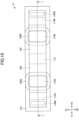
- FIG. 10 is a plan view illustrating a configuration of the vibration providing part 2
- FIG. 11 is a plan view in which the movable yoke and the permanent magnet are removed from FIG. 10
- FIG. 12 is a cross-sectional view illustrating the configuration of the vibration providing part 2.
- FIG. 6 corresponds to a cross sectional view along a line I-I in FIGs. 4 and 5 .
- the Z1-Z2 direction is an example of a first direction; and the Y1-Y2 direction is an example of a second direction.
- the vibration providing part 2 includes a fixed yoke 110, a movable yoke 120, a first excitation coil 130A, a second excitation coil 130B, a first rubber 140A, a second rubber 140B, and a permanent magnet 160.
- the fixed yoke 110 has a plate-shaped base 111 having a generally rectangular planar shape.
- the axial core direction of the first excitation coil 130A and the second excitation coil 130B is parallel to the Z1-Z2 direction.
- the movable yoke 120 is an example of a first yoke
- the fixed yoke 110 is an example of a second yoke
- the first rubber 140A and the second rubber 140B are examples of elastic support members.
- the fixed yoke 110 further includes a central protruding part 112 protruding upward (on the Z1 side) from the center of the base 111; a first side protruding part 114A protruding upward from an edge (front edge) of the base 111 on the Y1 side in the longitudinal direction; and a second side protruding part 114B protruding upward from an edge (rear edge) of the base 111 on the Y2 side in the longitudinal direction.
- the first side protruding part 114A and the second side protruding part 114B are arranged at positions between which the central protruding parts 112 is interposed in the X1-X2 direction.
- the fixed yoke 110 further includes a first iron core 113A protruding upward from the base 111, between the central protruding part 112 and the first side protruding part 114A; and a second iron core 113B protruding upward from the base 111, between the central protruding part 112 and the second side protruding part 114B.
- the first excitation coil 130A is wound around the first iron core 113A
- the second excitation coil 130B is wound around the second iron core 113B.
- the first rubber 140A is arranged on the first side protruding part 114A
- the second rubber 140B is arranged on the second side protruding part 114B.
- the central protruding part 112 is an example of a first protruding part
- the first side protruding part 114A and the second side protruding part 114B are examples of second protruding parts.
- the movable yoke 120 is plate-shaped, and has a generally rectangular planar shape.
- the movable yoke 120 contacts the first rubber 140A and the second rubber 140B at its edges in the longitudinal direction.
- the permanent magnet 160 is attached to a surface of the movable yoke 120 on the fixed yoke 110 side.
- the permanent magnet 160 includes a first region 161, a second region 162 positioned on the Y1 side of the first region 161, and a third region 163 positioned on the Y2 side of the first region 161.
- the first region 161 is magnetized to be an S pole
- the second and third regions 162 and 163 are magnetized to be N poles.
- the permanent magnet 160 is attached to the movable yoke 120 at substantially the center in plan view, so that the first region 161 is opposite to the central protruding part 112; a boundary 612 between the first region 161 and the second region 162 is opposite to the first excitation coil 130A; and a boundary 613 between the first region 161 and the third region 163 is opposite to the second excitation coil 130B. Also, the boundary 612 is positioned on the Y2 side relative to the axial core of the first excitation coil 130A, and the boundary 613 is positioned on the Y1 side relative to the axial core of the second excitation coil 130B.
- the boundary 612 is positioned on the Y2 side relative to the center of first iron core 113A
- the boundary 613 is positioned on the Y1 side relative to the center of second iron core 113B.
- the permanent magnet 160 magnetizes the fixed yoke 110 and the movable yoke 120, and the magnetic attractive force biases the movable yoke 120 in the Z1-Z2 direction toward the fixed yoke 110. Also, the magnetic attractive force biases both ends of the movable yoke 120 in the Y1-Y2 direction to approach the first side protruding part 114A and the second side protruding part 114B, respectively.
- the vibration providing part 2 is driven so that the directions of respective currents flowing in the first excitation coil 130A and the second excitation coil 130B are inverted alternately.
- the pole on a surface of the first iron core 113A facing the movable yoke 120 and the pole on a surface of the second iron core 113B facing the movable yoke 120 are to alternately inverted independently from each other.
- the permanent magnet 160 and the movable yoke 120 reciprocate in the Y1-Y2 direction or the Z1-Z2 direction. A relationship between directions of currents and directions of motions will be described later.
- the first rubber 140A and the second rubber 140B have a rectangular planar shape whose longitudinal direction corresponds to the X1-X2 direction.
- the first rubber 140A is interposed between the first side protruding part 114A and the movable yoke 120
- the second rubber 140B is interposed between the second side protruding part 114B and the movable yoke 120.
- the first rubber 140A and the second rubber 140B are interposed between the fixed yoke 110 and the movable yoke 120. Therefore, unless intentionally disassembled, the first rubber 140A and the second rubber 140B are held between the fixed yoke 110 and the movable yoke 120.
- first rubber 140A may be fixed to the top surface of the first side protruding part 114A, fixed to the bottom surface of the movable yoke 120, or fixed to the both; and the second rubber 140B may be fixed to the upper surface of the second side protruding part 114B, fixed to the bottom surface of the movable yoke 120, or fixed to the both.
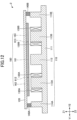
- FIG. 13A is a diagram illustrating a relationship between the directions of the currents and the directions of motions in the first combination.
- the magnetic pole of the first iron core 113A facing the movable yoke 120 becomes an N pole
- the magnetic pole of the second iron core 113B facing the movable yoke 120 also becomes an N pole.
- the poles of the central protruding part 112, the first side protruding part 114A, and the second side protruding part 114B on the surfaces facing the movable yoke 120 become S poles.
- a repulsive force acts between the central protruding part 112 and the first region 161
- a repulsive force acts between the first iron core 113A and the second region 162
- a repulsive force acts between the second iron core 113B and the third region 163. Therefore, a force 190U directed toward the Z1 side acts on the movable yoke 120.
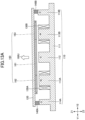
- FIG. 13B is a diagram illustrating a relationship between the directions of the currents and the directions of motions in the second combination.
- the magnetic pole of the first iron core 113A facing the movable yoke 120 becomes an S pole
- the magnetic pole of the second iron core 113B facing the movable yoke 120 also becomes an S pole.
- the poles of the central protruding part 112, the first side protruding part 114A, and the second side protruding part 114B on the surfaces facing the movable yoke 120 become N poles.
- an attractive force acts between the central protruding part 112 and the first region 161; an attractive force acts between the first iron core 113A and the second region 162; and an attractive force acts between the second iron core 113B and the third region 163. Therefore, a force 190D directed toward the Z2 side acts on the movable yoke 120.
- the movable yoke 120 reciprocates in the Z1-Z2 direction.
- the movable yoke 120 vibrates in the Z1-Z2 direction with the neutral position being the position in the initial state.
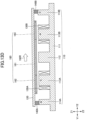
- FIG. 13C is a diagram illustrating a relationship between the directions of the currents and the directions of motions in the third combination.
- the magnetic pole of the first iron core 113A facing the movable yoke 120 becomes an N pole
- the magnetic pole of the second iron core 113B facing the movable yoke 120 becomes an S pole.
- the magnetic pole of the first side protruding part 114A facing the movable yoke 120 becomes an S pole
- the magnetic pole of the second side protruding part 114B facing the movable yoke 120 becomes an N pole.
- FIG. 13D is a diagram illustrating a relationship between the directions of the currents and the directions of motions in the fourth combination.
- the magnetic pole of the first iron core 113A facing the movable yoke 120 becomes an N pole
- the magnetic pole of the second iron core 113B facing the movable yoke 120 becomes an S pole.
- the magnetic pole of the first side protruding part 114A facing the movable yoke 120 becomes an S pole
- the magnetic pole of the second side protruding part 114B facing the movable yoke 120 becomes an N pole.
- the movable yoke 120 reciprocates in the Y1-Y2 direction.
- the movable yoke 120 vibrates in the Y1-Y2 direction with the neutral position being the position in the initial state.
- Such a vibration providing part 2 can be used, for example, by attaching a surface of the movable yoke 120 on the Z1 side to the bottom plate 211 of the housing 260.
- FIG. 14 is a cross-sectional view illustrating a configuration of a vibration generating device according to the second embodiment.
- a vibration generating device 300 includes a housing 310; a diaphragm 312 that is supported by the housing 310 and generates sound by vibrating in the first direction (the Z1-Z2 direction); and a vibration providing part 220 that is attached to the housing 310 to vibrate the housing 310.
- the vibration providing part 220 vibrates the housing 310 in the first direction at a first frequency f1, and vibrates the housing 310 in a second direction orthogonal to the first direction (the X1-X2 direction or the Y1-Y2 direction), at a second frequency f2 that is lower than the first frequency f1.
- the vibration generating device 300 further includes a coupling part 311 that couples the housing 310 with the diaphragm 312.
- the coupling part 311 is thinner than part of the housing 310 connected with the coupling part 311.
- the other elements are substantially the same as those in the first embodiment.
- the housing 310 vibrating in the first direction causes the diaphragm 312 to vibrate in the first direction through the deflection of the coupling part 311, and the diaphragm 312 vibrating the surrounding air generates sound. Also, when vibrating in the second direction, the diaphragm 312 hardly vibrates in the first direction, and hence, the diaphragm 312 does not generate sound.
- vibration at the first frequency f1 in the first direction sound can be presented to a person with virtually no vibration felt by the person, and by vibration at the second frequency f2 in the second direction, vibration can be presented to the person with virtually no sound felt by the person.
- the diaphragm 312 can be integrally formed with the coupling part 311 and the housing 310.
- the housing 310, the coupling part 311, and the diaphragm 312 are made of synthetic resin.
- the diaphragm 312 may be have a thickness equivalent to the thickness of the coupling part 311, or may be thinner or thicker than the coupling part 311.
- the application of the vibration generating device in the present disclosure is not limited in particular, and can be used, for example, for presenting vibration and sound to persons who are riding in an automobile.
- presentation for alerting only the driver to a low-urgency matter can be provided by vibration in the driver's seat
- presentation for alerting all occupants in the automobile to a high-urgency matter can be provided by sound spreading throughout the entire interior of the automobile.
- the location at which the vibration generating device in the present disclosure is installed is not limited in particular, and can be embedded, for example, in the bearing surface or the backrest of the driver's seat.
- vibration and sound may be presented from multiple vibration generating devices to a single user. For example, by using multiple vibration generating devices to present the vibration or sound in multiple directions, lively presentation can be provided.
- sound and vibration can be adequately separated when being presented to the user, in some applications, sound and vibration may be intentionally mixed when being presented to the user.
- a signal at the first frequency f1 (high-frequency signal) and a signal at the second frequency f2 (low-frequency signal) may be input separately, or a signal in which the signal at the first frequency f1 and the signal at the second frequency f2 are superimposed (superimposed signal) may be input.
- FIG. 15A is a diagram illustrating an example of a waveform of a signal at the first frequency f1.
- FIG. 15B is a diagram illustrating an example of a waveform of a signal at the second frequency f2.
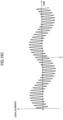
- 15C is a diagram illustrating an example of a waveform of a superimposed signal in which the signal of the first frequency f1 and the signal of the second frequency f2 are superimposed.
- the first frequency f1 is set to 20 ⁇ f0 and the second frequency f2 is set to f0.
- the housing can be vibrated in the first direction at the first frequency f1 and in the second direction at the second frequency f2.
Landscapes
- Physics & Mathematics (AREA)
- Engineering & Computer Science (AREA)
- Acoustics & Sound (AREA)
- Signal Processing (AREA)
- Electromagnetism (AREA)
- Mechanical Engineering (AREA)
- Multimedia (AREA)
- Apparatuses For Generation Of Mechanical Vibrations (AREA)
- Details Of Audible-Bandwidth Transducers (AREA)
- Electrostatic, Electromagnetic, Magneto- Strictive, And Variable-Resistance Transducers (AREA)
Claims (6)
- Vibrationserzeugungsvorrichtung, aufweisend:ein Gehäuse (260, 310);eine Membran (204, 312), die von dem Gehäuse (260, 310) getragen wird und dazu ausgebildet ist, Schall durch Vibration in einer ersten Richtung zu erzeugen; undein Vibrationsbereitstellungsteil (1, 2, 220), das an dem Gehäuse (260, 310) angebracht ist und dazu ausgebildet ist, das Gehäuse (260, 310) in Schwingung zu versetzen,wobei das Vibrationsbereitstellungsteil (1, 2, 220) dazu ausgebildet ist, das Gehäuse (260, 310) in der ersten Richtung mit einer ersten Frequenz in Schwingung zu versetzen und das Gehäuse (260, 310) in einer zweiten Richtung mit einer zweiten Frequenz in Schwingung zu versetzen, die niedriger ist als die erste Frequenz,dadurch gekennzeichnet,das das Vibrationsbereitstellungsteil (1, 2, 220) aufweist:ein erstes Joch (120),ein zweites Joch (110), das dem ersten Joch (120) in der ersten Richtung gegenüberliegend angeordnet ist,einen Permanentmagneten (160), der an einer einem zweiten Joch (110) zugewandten Oberfläche des ersten Jochs (120) angebracht ist, undeine erste Erregerspule (130A) und eine zweite Erregerspule (1320B), die an dem zweiten Joch (110) angebracht sind, um bei Erregung einen magnetischen Fluss zu erzeugen,wobei das zweite Joch (110) aufweist:eine Basis (111) undeinen ersten hervorstehenden Teil (112), der von der Basis (111) zwischen der ersten Erregerspule und der zweiten Erregerspule in Richtung des ersten Jochs (120) hervorsteht,wobei die erste Erregerspule (130A) und die zweite Erregerspule (130B) derart angeordnet sind, dass der erste hervorstehende Teil (112) in der zweiten Richtung zwischen diesen angeordnet ist,wobei eine axiale Kernrichtung der ersten Erregerspule (130A) und der zweiten Erregerspule (130B) parallel zu der ersten Richtung ist,wobei der Permanentmagnet (160) aufweist:einen ersten Bereich (161),einen zweiten Bereich (162), der in der zweiten Richtung auf der einen Seite des ersten Bereichs (161) angeordnet ist, undeinen dritten Bereich (163), der in der zweiten Richtung (162) auf der anderen Seite des ersten Bereichs (161) angeordnet ist,wobei der erste Bereich (161) derart magnetisiert ist, dass er ein erster Magnetpol ist,wobei der zweite Bereich (162) und der dritte Bereich (162) derart magnetisiert sind, dass sie zweite Magnetpole sind,wobei der erste Bereich (161) dem ersten hervorstehenden Teil (112) gegenüberliegt,wobei eine Grenze zwischen dem ersten Bereich (161) und dem zweiten Bereich (162) der ersten Erregerspule (130A) gegenüberliegt, undwobei eine Grenze zwischen dem ersten Bereich (161) und dem dritten Bereich (163) der zweiten Erregerspule (130B) gegenüberliegt.
- Vibrationserzeugungsvorrichtung nach Anspruch 1,wobei ein überlagertes Signal eingegeben wird, bei dem ein Signal mit der ersten Frequenz und ein Signal mit der zweiten Frequenz einander überlagert sind, undwobei das Vibrationsbereitstellungsteil (1, 2, 220) dazu ausgebildet ist, das überlagerte Signal in das Signal mit der ersten Frequenz und das Signal mit der zweiten Frequenz zu trennen, um das Gehäuse in der ersten Richtung mit der ersten Frequenz in Schwingung zu versetzen und das Gehäuse in einer zweiten Richtung mit der zweiten Frequenz in Schwingung zu versetzen.
- Vibrationserzeugungsvorrichtung nach Anspruch 1 oder 2,wobei die erste Frequenz größer als oder gleich 200 Hz und kleiner als oder gleich 6 kHz ist, undwobei die zweite Frequenz kleiner als oder gleich 600 Hz ist.
- Vibrationserzeugungsvorrichtung nach einem der Ansprüche 1 bis 3,wobei das Gehäuse einen Halter aufweist, der zum Halten der Membran ausgebildet ist, undwobei bei Betrachtung in der ersten Richtung ein den Halter überlappender Teil der Membran an dem Halter befestigt ist.
- Vibrationserzeugungsvorrichtung nach einem der Ansprüche 1 bis 3,
wobei die Membran mit dem Gehäuse einstückig ausgebildet ist. - Vibrationserzeugungsvorrichtung nach einem der Ansprüche 1 bis 5,
wobei das Gehäuse (260, 310) und die Membran (240, 312) aus Kunstharz oder aus Metall bestehen.
Applications Claiming Priority (2)
| Application Number | Priority Date | Filing Date | Title |
|---|---|---|---|
| JP2019047616 | 2019-03-14 | ||
| PCT/JP2020/007014 WO2020184147A1 (ja) | 2019-03-14 | 2020-02-21 | 振動生成装置 |
Publications (3)
| Publication Number | Publication Date |
|---|---|
| EP3939709A1 EP3939709A1 (de) | 2022-01-19 |
| EP3939709A4 EP3939709A4 (de) | 2022-11-23 |
| EP3939709B1 true EP3939709B1 (de) | 2024-10-23 |
Family
ID=72427982
Family Applications (1)
| Application Number | Title | Priority Date | Filing Date |
|---|---|---|---|
| EP20770919.7A Active EP3939709B1 (de) | 2019-03-14 | 2020-02-21 | Vibrationserzeugungsvorrichtung |
Country Status (5)
| Country | Link |
|---|---|
| US (1) | US12103040B2 (de) |
| EP (1) | EP3939709B1 (de) |
| JP (1) | JP7253613B2 (de) |
| CN (1) | CN113382808B (de) |
| WO (1) | WO2020184147A1 (de) |
Families Citing this family (1)
| Publication number | Priority date | Publication date | Assignee | Title |
|---|---|---|---|---|
| WO2022014135A1 (ja) * | 2020-07-14 | 2022-01-20 | アルプスアルパイン株式会社 | 車両システム及び振動発生装置 |
Family Cites Families (12)
| Publication number | Priority date | Publication date | Assignee | Title |
|---|---|---|---|---|
| CN1116123C (zh) * | 1996-06-21 | 2003-07-30 | 三洋电机株式会社 | 携带用通信装置 |
| JP3344385B2 (ja) | 1999-10-22 | 2002-11-11 | ヤマハ株式会社 | 振動源駆動装置 |
| JP2002159916A (ja) * | 2000-11-24 | 2002-06-04 | Citizen Electronics Co Ltd | 多機能型音響装置 |
| DE10238325A1 (de) * | 2002-08-16 | 2004-03-11 | Fraunhofer-Gesellschaft zur Förderung der angewandten Forschung e.V. | Lautsprecher |
| JP3974068B2 (ja) * | 2003-03-27 | 2007-09-12 | 日本信号株式会社 | プレーナー型電磁アクチュエータ |
| JP5840427B2 (ja) * | 2011-09-09 | 2016-01-06 | アルプス電気株式会社 | 振動発生装置 |
| JP6151235B2 (ja) * | 2014-10-22 | 2017-06-21 | 日本電信電話株式会社 | 加速度発生装置および情報呈示方法 |
| JP6253157B2 (ja) * | 2014-11-14 | 2017-12-27 | アルプス電気株式会社 | 振動発生装置 |
| KR101648955B1 (ko) * | 2015-03-24 | 2016-08-19 | 주식회사 예일전자 | 감각신호출력장치 및 그 진동과 관련된 탄발지지체 |
| US10623840B2 (en) * | 2017-03-24 | 2020-04-14 | Harman International Industries, Incorporated | Loudspeaker acoustic diversity aperture frame |
| JP2019025390A (ja) * | 2017-07-26 | 2019-02-21 | アルプス電気株式会社 | 振動発生装置 |
| JP2019047616A (ja) | 2017-09-01 | 2019-03-22 | 小堀 しづ | 現代、宇宙はどのように成っているか。 |
-
2020
- 2020-02-21 CN CN202080012365.XA patent/CN113382808B/zh active Active
- 2020-02-21 JP JP2021504889A patent/JP7253613B2/ja active Active
- 2020-02-21 EP EP20770919.7A patent/EP3939709B1/de active Active
- 2020-02-21 WO PCT/JP2020/007014 patent/WO2020184147A1/ja not_active Ceased
-
2021
- 2021-08-30 US US17/446,351 patent/US12103040B2/en active Active
Also Published As
| Publication number | Publication date |
|---|---|
| CN113382808A (zh) | 2021-09-10 |
| JP7253613B2 (ja) | 2023-04-06 |
| JPWO2020184147A1 (de) | 2020-09-17 |
| US12103040B2 (en) | 2024-10-01 |
| US20210387231A1 (en) | 2021-12-16 |
| EP3939709A4 (de) | 2022-11-23 |
| WO2020184147A1 (ja) | 2020-09-17 |
| CN113382808B (zh) | 2022-08-16 |
| EP3939709A1 (de) | 2022-01-19 |
Similar Documents
| Publication | Publication Date | Title |
|---|---|---|
| CN108855846B (zh) | 振动产生装置 | |
| US11245319B2 (en) | Vibration actuator, wearable terminal, and incoming call notification function device | |
| JP7407290B2 (ja) | 車両システム及び振動発生装置 | |
| EP2432251A1 (de) | Multifunktions-mikrolautsprecher | |
| TW202019063A (zh) | 振動產生裝置 | |
| CN110896517B (zh) | 屏幕发声激励器及电子设备 | |
| US12293654B2 (en) | Bodily vibration generation device and bodily vibration presentation apparatus | |
| JP2004343362A (ja) | 平面スピーカ | |
| EP3939709B1 (de) | Vibrationserzeugungsvorrichtung | |
| WO2019021969A1 (ja) | 振動発生装置 | |
| JP2019025390A (ja) | 振動発生装置 | |
| JP2015070730A (ja) | 振動アクチュエータ | |
| JP6526162B2 (ja) | 振動発生装置 | |
| JP6539714B2 (ja) | 振動発生装置 | |
| JP6499261B2 (ja) | 振動発生装置 | |
| JP2002112387A (ja) | スピーカ及びスピーカシステム | |
| WO2019013083A1 (ja) | 振動発生装置 | |
| JP2019211982A (ja) | 電子装置 | |
| JP2004221887A (ja) | スピーカ | |
| JP2018029483A (ja) | 振動発生装置 | |
| JP6539715B2 (ja) | 振動発生装置 | |
| JP6416364B2 (ja) | 振動発生装置 | |
| JP2018170844A (ja) | 発電装置及びそれを備えた入力装置 | |
| KR100915914B1 (ko) | 진동 스피커 |
Legal Events
| Date | Code | Title | Description |
|---|---|---|---|
| STAA | Information on the status of an ep patent application or granted ep patent |
Free format text: STATUS: THE INTERNATIONAL PUBLICATION HAS BEEN MADE |
|
| PUAI | Public reference made under article 153(3) epc to a published international application that has entered the european phase |
Free format text: ORIGINAL CODE: 0009012 |
|
| STAA | Information on the status of an ep patent application or granted ep patent |
Free format text: STATUS: REQUEST FOR EXAMINATION WAS MADE |
|
| 17P | Request for examination filed |
Effective date: 20210831 |
|
| AK | Designated contracting states |
Kind code of ref document: A1 Designated state(s): AL AT BE BG CH CY CZ DE DK EE ES FI FR GB GR HR HU IE IS IT LI LT LU LV MC MK MT NL NO PL PT RO RS SE SI SK SM TR |
|
| DAV | Request for validation of the european patent (deleted) | ||
| DAX | Request for extension of the european patent (deleted) | ||
| A4 | Supplementary search report drawn up and despatched |
Effective date: 20221020 |
|
| RIC1 | Information provided on ipc code assigned before grant |
Ipc: H04R 7/16 20060101ALI20221014BHEP Ipc: H04R 9/02 20060101ALI20221014BHEP Ipc: H04R 13/00 20060101ALI20221014BHEP Ipc: H04R 1/00 20060101ALI20221014BHEP Ipc: B06B 1/04 20060101AFI20221014BHEP |
|
| STAA | Information on the status of an ep patent application or granted ep patent |
Free format text: STATUS: EXAMINATION IS IN PROGRESS |
|
| 17Q | First examination report despatched |
Effective date: 20230602 |
|
| GRAP | Despatch of communication of intention to grant a patent |
Free format text: ORIGINAL CODE: EPIDOSNIGR1 |
|
| STAA | Information on the status of an ep patent application or granted ep patent |
Free format text: STATUS: GRANT OF PATENT IS INTENDED |
|
| INTG | Intention to grant announced |
Effective date: 20240618 |
|
| GRAS | Grant fee paid |
Free format text: ORIGINAL CODE: EPIDOSNIGR3 |
|
| GRAA | (expected) grant |
Free format text: ORIGINAL CODE: 0009210 |
|
| STAA | Information on the status of an ep patent application or granted ep patent |
Free format text: STATUS: THE PATENT HAS BEEN GRANTED |
|
| AK | Designated contracting states |
Kind code of ref document: B1 Designated state(s): AL AT BE BG CH CY CZ DE DK EE ES FI FR GB GR HR HU IE IS IT LI LT LU LV MC MK MT NL NO PL PT RO RS SE SI SK SM TR |
|
| REG | Reference to a national code |
Ref country code: GB Ref legal event code: FG4D |
|
| REG | Reference to a national code |
Ref country code: CH Ref legal event code: EP |
|
| REG | Reference to a national code |
Ref country code: DE Ref legal event code: R096 Ref document number: 602020039953 Country of ref document: DE |
|
| REG | Reference to a national code |
Ref country code: IE Ref legal event code: FG4D |
|
| REG | Reference to a national code |
Ref country code: LT Ref legal event code: MG9D |
|
| REG | Reference to a national code |
Ref country code: NL Ref legal event code: MP Effective date: 20241023 |
|
| REG | Reference to a national code |
Ref country code: AT Ref legal event code: MK05 Ref document number: 1734421 Country of ref document: AT Kind code of ref document: T Effective date: 20241023 |
|
| PG25 | Lapsed in a contracting state [announced via postgrant information from national office to epo] |
Ref country code: NL Free format text: LAPSE BECAUSE OF FAILURE TO SUBMIT A TRANSLATION OF THE DESCRIPTION OR TO PAY THE FEE WITHIN THE PRESCRIBED TIME-LIMIT Effective date: 20241023 |
|
| PG25 | Lapsed in a contracting state [announced via postgrant information from national office to epo] |
Ref country code: NL Free format text: LAPSE BECAUSE OF FAILURE TO SUBMIT A TRANSLATION OF THE DESCRIPTION OR TO PAY THE FEE WITHIN THE PRESCRIBED TIME-LIMIT Effective date: 20241023 |
|
| PG25 | Lapsed in a contracting state [announced via postgrant information from national office to epo] |
Ref country code: HR Free format text: LAPSE BECAUSE OF FAILURE TO SUBMIT A TRANSLATION OF THE DESCRIPTION OR TO PAY THE FEE WITHIN THE PRESCRIBED TIME-LIMIT Effective date: 20241023 Ref country code: PT Free format text: LAPSE BECAUSE OF FAILURE TO SUBMIT A TRANSLATION OF THE DESCRIPTION OR TO PAY THE FEE WITHIN THE PRESCRIBED TIME-LIMIT Effective date: 20250224 Ref country code: IS Free format text: LAPSE BECAUSE OF FAILURE TO SUBMIT A TRANSLATION OF THE DESCRIPTION OR TO PAY THE FEE WITHIN THE PRESCRIBED TIME-LIMIT Effective date: 20250223 |
|
| PG25 | Lapsed in a contracting state [announced via postgrant information from national office to epo] |
Ref country code: FI Free format text: LAPSE BECAUSE OF FAILURE TO SUBMIT A TRANSLATION OF THE DESCRIPTION OR TO PAY THE FEE WITHIN THE PRESCRIBED TIME-LIMIT Effective date: 20241023 |
|
| PG25 | Lapsed in a contracting state [announced via postgrant information from national office to epo] |
Ref country code: BG Free format text: LAPSE BECAUSE OF FAILURE TO SUBMIT A TRANSLATION OF THE DESCRIPTION OR TO PAY THE FEE WITHIN THE PRESCRIBED TIME-LIMIT Effective date: 20241023 |
|
| PG25 | Lapsed in a contracting state [announced via postgrant information from national office to epo] |
Ref country code: ES Free format text: LAPSE BECAUSE OF FAILURE TO SUBMIT A TRANSLATION OF THE DESCRIPTION OR TO PAY THE FEE WITHIN THE PRESCRIBED TIME-LIMIT Effective date: 20241023 |
|
| PG25 | Lapsed in a contracting state [announced via postgrant information from national office to epo] |
Ref country code: NO Free format text: LAPSE BECAUSE OF FAILURE TO SUBMIT A TRANSLATION OF THE DESCRIPTION OR TO PAY THE FEE WITHIN THE PRESCRIBED TIME-LIMIT Effective date: 20250123 |
|
| PG25 | Lapsed in a contracting state [announced via postgrant information from national office to epo] |
Ref country code: LV Free format text: LAPSE BECAUSE OF FAILURE TO SUBMIT A TRANSLATION OF THE DESCRIPTION OR TO PAY THE FEE WITHIN THE PRESCRIBED TIME-LIMIT Effective date: 20241023 Ref country code: GR Free format text: LAPSE BECAUSE OF FAILURE TO SUBMIT A TRANSLATION OF THE DESCRIPTION OR TO PAY THE FEE WITHIN THE PRESCRIBED TIME-LIMIT Effective date: 20250124 Ref country code: AT Free format text: LAPSE BECAUSE OF FAILURE TO SUBMIT A TRANSLATION OF THE DESCRIPTION OR TO PAY THE FEE WITHIN THE PRESCRIBED TIME-LIMIT Effective date: 20241023 |
|
| PG25 | Lapsed in a contracting state [announced via postgrant information from national office to epo] |
Ref country code: PL Free format text: LAPSE BECAUSE OF FAILURE TO SUBMIT A TRANSLATION OF THE DESCRIPTION OR TO PAY THE FEE WITHIN THE PRESCRIBED TIME-LIMIT Effective date: 20241023 |
|
| PG25 | Lapsed in a contracting state [announced via postgrant information from national office to epo] |
Ref country code: RS Free format text: LAPSE BECAUSE OF FAILURE TO SUBMIT A TRANSLATION OF THE DESCRIPTION OR TO PAY THE FEE WITHIN THE PRESCRIBED TIME-LIMIT Effective date: 20250123 |
|
| PG25 | Lapsed in a contracting state [announced via postgrant information from national office to epo] |
Ref country code: SM Free format text: LAPSE BECAUSE OF FAILURE TO SUBMIT A TRANSLATION OF THE DESCRIPTION OR TO PAY THE FEE WITHIN THE PRESCRIBED TIME-LIMIT Effective date: 20241023 |
|
| PG25 | Lapsed in a contracting state [announced via postgrant information from national office to epo] |
Ref country code: DK Free format text: LAPSE BECAUSE OF FAILURE TO SUBMIT A TRANSLATION OF THE DESCRIPTION OR TO PAY THE FEE WITHIN THE PRESCRIBED TIME-LIMIT Effective date: 20241023 |
|
| PG25 | Lapsed in a contracting state [announced via postgrant information from national office to epo] |
Ref country code: EE Free format text: LAPSE BECAUSE OF FAILURE TO SUBMIT A TRANSLATION OF THE DESCRIPTION OR TO PAY THE FEE WITHIN THE PRESCRIBED TIME-LIMIT Effective date: 20241023 |
|
| PG25 | Lapsed in a contracting state [announced via postgrant information from national office to epo] |
Ref country code: RO Free format text: LAPSE BECAUSE OF FAILURE TO SUBMIT A TRANSLATION OF THE DESCRIPTION OR TO PAY THE FEE WITHIN THE PRESCRIBED TIME-LIMIT Effective date: 20241023 |
|
| REG | Reference to a national code |
Ref country code: DE Ref legal event code: R097 Ref document number: 602020039953 Country of ref document: DE |
|
| PG25 | Lapsed in a contracting state [announced via postgrant information from national office to epo] |
Ref country code: SK Free format text: LAPSE BECAUSE OF FAILURE TO SUBMIT A TRANSLATION OF THE DESCRIPTION OR TO PAY THE FEE WITHIN THE PRESCRIBED TIME-LIMIT Effective date: 20241023 |
|
| PG25 | Lapsed in a contracting state [announced via postgrant information from national office to epo] |
Ref country code: CZ Free format text: LAPSE BECAUSE OF FAILURE TO SUBMIT A TRANSLATION OF THE DESCRIPTION OR TO PAY THE FEE WITHIN THE PRESCRIBED TIME-LIMIT Effective date: 20241023 |
|
| PG25 | Lapsed in a contracting state [announced via postgrant information from national office to epo] |
Ref country code: IT Free format text: LAPSE BECAUSE OF FAILURE TO SUBMIT A TRANSLATION OF THE DESCRIPTION OR TO PAY THE FEE WITHIN THE PRESCRIBED TIME-LIMIT Effective date: 20241023 |
|
| PLBE | No opposition filed within time limit |
Free format text: ORIGINAL CODE: 0009261 |
|
| STAA | Information on the status of an ep patent application or granted ep patent |
Free format text: STATUS: NO OPPOSITION FILED WITHIN TIME LIMIT |
|
| PG25 | Lapsed in a contracting state [announced via postgrant information from national office to epo] |
Ref country code: SE Free format text: LAPSE BECAUSE OF FAILURE TO SUBMIT A TRANSLATION OF THE DESCRIPTION OR TO PAY THE FEE WITHIN THE PRESCRIBED TIME-LIMIT Effective date: 20241023 |
|
| PG25 | Lapsed in a contracting state [announced via postgrant information from national office to epo] |
Ref country code: MC Free format text: LAPSE BECAUSE OF FAILURE TO SUBMIT A TRANSLATION OF THE DESCRIPTION OR TO PAY THE FEE WITHIN THE PRESCRIBED TIME-LIMIT Effective date: 20241023 |
|
| REG | Reference to a national code |
Ref country code: CH Ref legal event code: PL |
|
| 26N | No opposition filed |
Effective date: 20250724 |
|
| PG25 | Lapsed in a contracting state [announced via postgrant information from national office to epo] |
Ref country code: LU Free format text: LAPSE BECAUSE OF NON-PAYMENT OF DUE FEES Effective date: 20250221 |
|
| PG25 | Lapsed in a contracting state [announced via postgrant information from national office to epo] |
Ref country code: CH Free format text: LAPSE BECAUSE OF NON-PAYMENT OF DUE FEES Effective date: 20250228 |
|
| GBPC | Gb: european patent ceased through non-payment of renewal fee |
Effective date: 20250221 |
|
| REG | Reference to a national code |
Ref country code: BE Ref legal event code: MM Effective date: 20250228 |
|
| PG25 | Lapsed in a contracting state [announced via postgrant information from national office to epo] |
Ref country code: GB Free format text: LAPSE BECAUSE OF NON-PAYMENT OF DUE FEES Effective date: 20250221 |
|
| PG25 | Lapsed in a contracting state [announced via postgrant information from national office to epo] |
Ref country code: FR Free format text: LAPSE BECAUSE OF NON-PAYMENT OF DUE FEES Effective date: 20250228 |
|
| PG25 | Lapsed in a contracting state [announced via postgrant information from national office to epo] |
Ref country code: BE Free format text: LAPSE BECAUSE OF NON-PAYMENT OF DUE FEES Effective date: 20250228 |
|
| PG25 | Lapsed in a contracting state [announced via postgrant information from national office to epo] |
Ref country code: IE Free format text: LAPSE BECAUSE OF NON-PAYMENT OF DUE FEES Effective date: 20250221 |
|
| PGFP | Annual fee paid to national office [announced via postgrant information from national office to epo] |
Ref country code: DE Payment date: 20260218 Year of fee payment: 7 |