EP3936634B1 - Herstellungsverfahren einer medizinischen prothese durch anwendung einer oxidierten keramischen schicht auf der oberfläche von zirkonium - Google Patents
Herstellungsverfahren einer medizinischen prothese durch anwendung einer oxidierten keramischen schicht auf der oberfläche von zirkonium Download PDFInfo
- Publication number
- EP3936634B1 EP3936634B1 EP19918349.2A EP19918349A EP3936634B1 EP 3936634 B1 EP3936634 B1 EP 3936634B1 EP 19918349 A EP19918349 A EP 19918349A EP 3936634 B1 EP3936634 B1 EP 3936634B1
- Authority
- EP
- European Patent Office
- Prior art keywords
- zirconium
- oxidation
- roughness
- surface layer
- layer
- Prior art date
- Legal status (The legal status is an assumption and is not a legal conclusion. Google has not performed a legal analysis and makes no representation as to the accuracy of the status listed.)
- Active
Links
Images

Classifications
-
- C—CHEMISTRY; METALLURGY
- C23—COATING METALLIC MATERIAL; COATING MATERIAL WITH METALLIC MATERIAL; CHEMICAL SURFACE TREATMENT; DIFFUSION TREATMENT OF METALLIC MATERIAL; COATING BY VACUUM EVAPORATION, BY SPUTTERING, BY ION IMPLANTATION OR BY CHEMICAL VAPOUR DEPOSITION, IN GENERAL; INHIBITING CORROSION OF METALLIC MATERIAL OR INCRUSTATION IN GENERAL
- C23C—COATING METALLIC MATERIAL; COATING MATERIAL WITH METALLIC MATERIAL; SURFACE TREATMENT OF METALLIC MATERIAL BY DIFFUSION INTO THE SURFACE, BY CHEMICAL CONVERSION OR SUBSTITUTION; COATING BY VACUUM EVAPORATION, BY SPUTTERING, BY ION IMPLANTATION OR BY CHEMICAL VAPOUR DEPOSITION, IN GENERAL
- C23C8/00—Solid state diffusion of only non-metal elements into metallic material surfaces; Chemical surface treatment of metallic material by reaction of the surface with a reactive gas, leaving reaction products of surface material in the coating, e.g. conversion coatings, passivation of metals
- C23C8/06—Solid state diffusion of only non-metal elements into metallic material surfaces; Chemical surface treatment of metallic material by reaction of the surface with a reactive gas, leaving reaction products of surface material in the coating, e.g. conversion coatings, passivation of metals using gases
- C23C8/08—Solid state diffusion of only non-metal elements into metallic material surfaces; Chemical surface treatment of metallic material by reaction of the surface with a reactive gas, leaving reaction products of surface material in the coating, e.g. conversion coatings, passivation of metals using gases only one element being applied
- C23C8/10—Oxidising
- C23C8/12—Oxidising using elemental oxygen or ozone
-
- C—CHEMISTRY; METALLURGY
- C23—COATING METALLIC MATERIAL; COATING MATERIAL WITH METALLIC MATERIAL; CHEMICAL SURFACE TREATMENT; DIFFUSION TREATMENT OF METALLIC MATERIAL; COATING BY VACUUM EVAPORATION, BY SPUTTERING, BY ION IMPLANTATION OR BY CHEMICAL VAPOUR DEPOSITION, IN GENERAL; INHIBITING CORROSION OF METALLIC MATERIAL OR INCRUSTATION IN GENERAL
- C23C—COATING METALLIC MATERIAL; COATING MATERIAL WITH METALLIC MATERIAL; SURFACE TREATMENT OF METALLIC MATERIAL BY DIFFUSION INTO THE SURFACE, BY CHEMICAL CONVERSION OR SUBSTITUTION; COATING BY VACUUM EVAPORATION, BY SPUTTERING, BY ION IMPLANTATION OR BY CHEMICAL VAPOUR DEPOSITION, IN GENERAL
- C23C8/00—Solid state diffusion of only non-metal elements into metallic material surfaces; Chemical surface treatment of metallic material by reaction of the surface with a reactive gas, leaving reaction products of surface material in the coating, e.g. conversion coatings, passivation of metals
- C23C8/02—Pretreatment of the material to be coated
-
- A—HUMAN NECESSITIES
- A61—MEDICAL OR VETERINARY SCIENCE; HYGIENE
- A61L—METHODS OR APPARATUS FOR STERILISING MATERIALS OR OBJECTS IN GENERAL; DISINFECTION, STERILISATION OR DEODORISATION OF AIR; CHEMICAL ASPECTS OF BANDAGES, DRESSINGS, ABSORBENT PADS OR SURGICAL ARTICLES; MATERIALS FOR BANDAGES, DRESSINGS, ABSORBENT PADS OR SURGICAL ARTICLES
- A61L27/00—Materials for grafts or prostheses or for coating grafts or prostheses
- A61L27/02—Inorganic materials
- A61L27/04—Metals or alloys
-
- A—HUMAN NECESSITIES
- A61—MEDICAL OR VETERINARY SCIENCE; HYGIENE
- A61L—METHODS OR APPARATUS FOR STERILISING MATERIALS OR OBJECTS IN GENERAL; DISINFECTION, STERILISATION OR DEODORISATION OF AIR; CHEMICAL ASPECTS OF BANDAGES, DRESSINGS, ABSORBENT PADS OR SURGICAL ARTICLES; MATERIALS FOR BANDAGES, DRESSINGS, ABSORBENT PADS OR SURGICAL ARTICLES
- A61L27/00—Materials for grafts or prostheses or for coating grafts or prostheses
- A61L27/02—Inorganic materials
- A61L27/04—Metals or alloys
- A61L27/047—Other specific metals or alloys not covered by A61L27/042 - A61L27/045 or A61L27/06
-
- A—HUMAN NECESSITIES
- A61—MEDICAL OR VETERINARY SCIENCE; HYGIENE
- A61L—METHODS OR APPARATUS FOR STERILISING MATERIALS OR OBJECTS IN GENERAL; DISINFECTION, STERILISATION OR DEODORISATION OF AIR; CHEMICAL ASPECTS OF BANDAGES, DRESSINGS, ABSORBENT PADS OR SURGICAL ARTICLES; MATERIALS FOR BANDAGES, DRESSINGS, ABSORBENT PADS OR SURGICAL ARTICLES
- A61L27/00—Materials for grafts or prostheses or for coating grafts or prostheses
- A61L27/28—Materials for coating prostheses
- A61L27/30—Inorganic materials
-
- A—HUMAN NECESSITIES
- A61—MEDICAL OR VETERINARY SCIENCE; HYGIENE
- A61L—METHODS OR APPARATUS FOR STERILISING MATERIALS OR OBJECTS IN GENERAL; DISINFECTION, STERILISATION OR DEODORISATION OF AIR; CHEMICAL ASPECTS OF BANDAGES, DRESSINGS, ABSORBENT PADS OR SURGICAL ARTICLES; MATERIALS FOR BANDAGES, DRESSINGS, ABSORBENT PADS OR SURGICAL ARTICLES
- A61L27/00—Materials for grafts or prostheses or for coating grafts or prostheses
- A61L27/28—Materials for coating prostheses
- A61L27/30—Inorganic materials
- A61L27/306—Other specific inorganic materials not covered by A61L27/303 - A61L27/32
-
- A—HUMAN NECESSITIES
- A61—MEDICAL OR VETERINARY SCIENCE; HYGIENE
- A61L—METHODS OR APPARATUS FOR STERILISING MATERIALS OR OBJECTS IN GENERAL; DISINFECTION, STERILISATION OR DEODORISATION OF AIR; CHEMICAL ASPECTS OF BANDAGES, DRESSINGS, ABSORBENT PADS OR SURGICAL ARTICLES; MATERIALS FOR BANDAGES, DRESSINGS, ABSORBENT PADS OR SURGICAL ARTICLES
- A61L27/00—Materials for grafts or prostheses or for coating grafts or prostheses
- A61L27/50—Materials characterised by their function or physical properties, e.g. injectable or lubricating compositions, shape-memory materials, surface modified materials
-
- C—CHEMISTRY; METALLURGY
- C22—METALLURGY; FERROUS OR NON-FERROUS ALLOYS; TREATMENT OF ALLOYS OR NON-FERROUS METALS
- C22C—ALLOYS
- C22C16/00—Alloys based on zirconium
-
- C—CHEMISTRY; METALLURGY
- C23—COATING METALLIC MATERIAL; COATING MATERIAL WITH METALLIC MATERIAL; CHEMICAL SURFACE TREATMENT; DIFFUSION TREATMENT OF METALLIC MATERIAL; COATING BY VACUUM EVAPORATION, BY SPUTTERING, BY ION IMPLANTATION OR BY CHEMICAL VAPOUR DEPOSITION, IN GENERAL; INHIBITING CORROSION OF METALLIC MATERIAL OR INCRUSTATION IN GENERAL
- C23C—COATING METALLIC MATERIAL; COATING MATERIAL WITH METALLIC MATERIAL; SURFACE TREATMENT OF METALLIC MATERIAL BY DIFFUSION INTO THE SURFACE, BY CHEMICAL CONVERSION OR SUBSTITUTION; COATING BY VACUUM EVAPORATION, BY SPUTTERING, BY ION IMPLANTATION OR BY CHEMICAL VAPOUR DEPOSITION, IN GENERAL
- C23C8/00—Solid state diffusion of only non-metal elements into metallic material surfaces; Chemical surface treatment of metallic material by reaction of the surface with a reactive gas, leaving reaction products of surface material in the coating, e.g. conversion coatings, passivation of metals
- C23C8/06—Solid state diffusion of only non-metal elements into metallic material surfaces; Chemical surface treatment of metallic material by reaction of the surface with a reactive gas, leaving reaction products of surface material in the coating, e.g. conversion coatings, passivation of metals using gases
- C23C8/08—Solid state diffusion of only non-metal elements into metallic material surfaces; Chemical surface treatment of metallic material by reaction of the surface with a reactive gas, leaving reaction products of surface material in the coating, e.g. conversion coatings, passivation of metals using gases only one element being applied
- C23C8/10—Oxidising
-
- C—CHEMISTRY; METALLURGY
- C23—COATING METALLIC MATERIAL; COATING MATERIAL WITH METALLIC MATERIAL; CHEMICAL SURFACE TREATMENT; DIFFUSION TREATMENT OF METALLIC MATERIAL; COATING BY VACUUM EVAPORATION, BY SPUTTERING, BY ION IMPLANTATION OR BY CHEMICAL VAPOUR DEPOSITION, IN GENERAL; INHIBITING CORROSION OF METALLIC MATERIAL OR INCRUSTATION IN GENERAL
- C23C—COATING METALLIC MATERIAL; COATING MATERIAL WITH METALLIC MATERIAL; SURFACE TREATMENT OF METALLIC MATERIAL BY DIFFUSION INTO THE SURFACE, BY CHEMICAL CONVERSION OR SUBSTITUTION; COATING BY VACUUM EVAPORATION, BY SPUTTERING, BY ION IMPLANTATION OR BY CHEMICAL VAPOUR DEPOSITION, IN GENERAL
- C23C8/00—Solid state diffusion of only non-metal elements into metallic material surfaces; Chemical surface treatment of metallic material by reaction of the surface with a reactive gas, leaving reaction products of surface material in the coating, e.g. conversion coatings, passivation of metals
- C23C8/80—After-treatment
-
- A—HUMAN NECESSITIES
- A61—MEDICAL OR VETERINARY SCIENCE; HYGIENE
- A61L—METHODS OR APPARATUS FOR STERILISING MATERIALS OR OBJECTS IN GENERAL; DISINFECTION, STERILISATION OR DEODORISATION OF AIR; CHEMICAL ASPECTS OF BANDAGES, DRESSINGS, ABSORBENT PADS OR SURGICAL ARTICLES; MATERIALS FOR BANDAGES, DRESSINGS, ABSORBENT PADS OR SURGICAL ARTICLES
- A61L2400/00—Materials characterised by their function or physical properties
- A61L2400/18—Modification of implant surfaces in order to improve biocompatibility, cell growth, fixation of biomolecules, e.g. plasma treatment
-
- A—HUMAN NECESSITIES
- A61—MEDICAL OR VETERINARY SCIENCE; HYGIENE
- A61L—METHODS OR APPARATUS FOR STERILISING MATERIALS OR OBJECTS IN GENERAL; DISINFECTION, STERILISATION OR DEODORISATION OF AIR; CHEMICAL ASPECTS OF BANDAGES, DRESSINGS, ABSORBENT PADS OR SURGICAL ARTICLES; MATERIALS FOR BANDAGES, DRESSINGS, ABSORBENT PADS OR SURGICAL ARTICLES
- A61L2420/00—Materials or methods for coatings medical devices
- A61L2420/02—Methods for coating medical devices
-
- A—HUMAN NECESSITIES
- A61—MEDICAL OR VETERINARY SCIENCE; HYGIENE
- A61L—METHODS OR APPARATUS FOR STERILISING MATERIALS OR OBJECTS IN GENERAL; DISINFECTION, STERILISATION OR DEODORISATION OF AIR; CHEMICAL ASPECTS OF BANDAGES, DRESSINGS, ABSORBENT PADS OR SURGICAL ARTICLES; MATERIALS FOR BANDAGES, DRESSINGS, ABSORBENT PADS OR SURGICAL ARTICLES
- A61L2420/00—Materials or methods for coatings medical devices
- A61L2420/08—Coatings comprising two or more layers
-
- A—HUMAN NECESSITIES
- A61—MEDICAL OR VETERINARY SCIENCE; HYGIENE
- A61L—METHODS OR APPARATUS FOR STERILISING MATERIALS OR OBJECTS IN GENERAL; DISINFECTION, STERILISATION OR DEODORISATION OF AIR; CHEMICAL ASPECTS OF BANDAGES, DRESSINGS, ABSORBENT PADS OR SURGICAL ARTICLES; MATERIALS FOR BANDAGES, DRESSINGS, ABSORBENT PADS OR SURGICAL ARTICLES
- A61L2430/00—Materials or treatment for tissue regeneration
- A61L2430/24—Materials or treatment for tissue regeneration for joint reconstruction
Definitions
- the present application pertains to the field of materials for use in medical implants, and relates in particular to a preparation method and application of an oxidized ceramic layer on the surface of zirconium and zirconium alloy.
- zirconium and zirconium alloys have excellent mechanical properties, corrosion resistance and biocompatibility. Therefore, they have been recognized as very good materials for use in medical implants.
- service life of the medical implant is most important. Especially, when the medical implant is used in the young patient, the desirable implant is able to be used throughout the lifetime of the patient.
- zirconium and zirconium alloys are not sufficiently resistant to wear, which limits their application to bearing implants such as hip and knee joint replacements.
- the service lifespan of such bearing implants are affected by the factors including not only mechanical properties, corrosion resistance and biocompatibility of the used zirconium or zirconium alloy but also the generated wear of zirconium or zirconium alloy surface as it moves relative to another contacting surface made of, such as ultra-high molecular weight polyethylene.
- Such wear not only create numerous wear particles to enhance friction coefficients of articular surfaces and thus further intensify wear, but also release metal ions that may cause long-lasting harm to human health. Therefore, it is necessary to strengthen wear resistance property when zirconium or a zirconium alloy is used manufacture such bearing types of implant devices.
- U.S. Patent US2987352A discloses to oxidize a zirconium/zirconium alloy in air to form a blue-black oxide layer on their surfaces.
- the formed blue-black oxidation ceramic surface layer is very hard and compact, imparting significantly improved wear resistance to the zirconium/zirconium alloy.
- U.S. Patent US5037438A discloses a zirconium alloy prosthesis with a zirconium oxide surface.
- the oxidation ceramic surface layer generally has a non-uniform thickness. In order to decrease friction coefficients of relative movement surfaces to alleviate wear, it is necessary to reduce the roughness of the surface oxidation ceramic layer as much as possible. Therefore, the oxide surface layer must be finely polished.
- the polishing process results in various thickness losses of the oxide surface layer at different locations.
- the blue-black oxidation ceramic surface layer tends to have a very thin and uneven thickness. This causes the complete removal of the oxidation ceramic surface layer at locations with thinner thicknesses, and thus results in the loss of integrity of the oxidation ceramic surface layer, which seriously impairs wear resistance of the prosthesis.
- the uneven oxidation ceramic surface layer results in an uneven contact with the metal substrate at the interface, which weakens bonding strength between the oxidation ceramic surface layer and the metal substrate. This causes an easy peel-off of the oxidation ceramic surface layer from the metal substrate during use, and thus brings great risks.
- Chinese Patent Application, CN 107675122 A discloses the preparation method of the non-stoichiometric ratio oxidation film on the surface of a zirconium-niobium alloy comprising sequentially grinding and polishing the surface of the zirconium-niobium alloy material, and forming the non-stoichiometric ratio oxidation film on the surface of the zirconium-niobium alloy by carrying out the specific oxidation treatment.
- the oxidation film obtained by this method has a surface roughness that does not meet the medical implant criterion, which has to be subjected to a secondary polishing after the oxidation treatment. Therefore, it cannot solve the problem that the oxide film is locally too thin or even damaged caused by the secondary polishing.
- U.S. Patent Application, US 2007/0251604 A1 discloses a method of reworking a zirconium or zirconium alloy comprising an oxidation and/or nitridation layer on its surface, comprising treating the zirconium or zirconium alloy under reduced pressure or in an inert gas environment at an elevated temperature until the oxidation and/or nitridation layer is substantially removed from the surface.
- Such a method is directed to reclaim the rejected components due to the failure of the oxidation treatment to carry out the secondary oxidation treatment, and does not teach how to achieve a uniform and unbroken oxide layer.
- U.S. Patent Application, US 2007/0137734 A1 discloses a medical implant of zirconium or zirconium alloy comprising a thick diffusion hardened zone and a ceramic layer, as well as a method of treating the medical implant in vacuum or in an inert gas environment at an elevated temperature. Such a method is able to generate a specific diffusion hardened zone, but is unable to solve problems created by the secondary polishing after the oxidation treatment.
- U.S. Patent Application, US 2002/0042656 A1 discloses a method of making a coating of a blue-black or black oxidized zirconium of uniform thickness on a zirconium or zirconium alloy material, comprising the step of changing the surface roughness of the zirconium or zirconium alloy and the subsequent step of the oxidation treatment.
- a method of making a coating of a blue-black or black oxidized zirconium of uniform thickness on a zirconium or zirconium alloy material comprising the step of changing the surface roughness of the zirconium or zirconium alloy and the subsequent step of the oxidation treatment.
- such a method cannot solve problems created by the secondary polishing after the oxidation treatment.
- the international PCT Patent Application, WO 98/42390 discloses a method of forming a oxide coating on zirconium or zirconium alloys, comprising changing the surface roughness of the zirconium or zirconium alloy, and generating the oxide coating of a uniform thickness via the oxidation treatment.
- a method of forming a oxide coating on zirconium or zirconium alloys comprising changing the surface roughness of the zirconium or zirconium alloy, and generating the oxide coating of a uniform thickness via the oxidation treatment.
- Such a method cannot solve problems created by the secondary polishing after the oxidation treatment.
- Further studies have shown that the growth of a zirconium oxide coating proceeds at a rate that is not constant and will experience a turning point. Before this point, increase of thickness for the coating follows the parabolic profile and the formed oxidation ceramic surface layer has an excellent compactness, a high bonding strength and a good wear resistance.
- an optimal thickness is in the range of 3-7 ⁇ m. With the thickness in this range, the coating possesses an optimal internal compactness, a high bonding strength and an excellent wear resistance.
- the oxidation ceramic surface layer lose a thickness of 2-5 ⁇ m.
- the remaining oxidation ceramic surface layer would have an ultimate thickness that cannot meet application requirements.
- it is required to form an initial oxidation ceramic surface layer with an increased thickness.
- the increased thickness impairs properties of the oxidation ceramic surface layer.
- polishing is indispensible in traditional surface oxidation process. If the cooling process after the completion of high-temperature oxidation is a slow cooling process, the oxidation ceramic surface layer has its thickness further increased in this cooling process as the zirconium or a zirconium alloy is still exposed in the oxidizing atmosphere. However, the oxide layer formed at improper temperatures has a poor quality and has to be polished and removed. If the cooling process is a quick cooling process, due to the significant temperature difference between the inside and outside of the workpiece, thermal stress causes micro-cracks to develop in an outermost surface area of the oxide layer easily. This also results in the necessity of polishing and removal of such area.
- present application proposes a method for preparing a medical implant, comprising forming an oxidation ceramic layer on a surface of zirconium or a zirconium alloy, which is able to directly obtain the oxidation ceramic surface layer having a satisfied roughness and a controlled uniform thickness without the need of a polishing process after the surface oxidization treatment on the zirconium or zirconium alloy, and thus enables to solve the problems of the surfaces of the zirconium or zirconium alloys caused by polishing of the oxidation ceramic surface layer.
- zirconium/zirconium alloy refers to that the method for preparing an oxidation ceramic surface layer is applicable to pure zirconium metal and zirconium alloys.
- present application provides a method for preparing a medical implant, comprising forming an oxidation ceramic layer on a surface of zirconium or a zirconium alloy, the formation of the oxidation ceramic layer on a surface of zirconium or a zirconium alloy comprising steps of:
- the roughness is lowered to a value in the range of 0.002 ⁇ m to 0.010 ⁇ m in step 1).
- a thickness of the oxidation ceramic surface layer on the targeted area is controlled within a range of 1 ⁇ m to 20 ⁇ m.
- the roughness of the targeted area is lowered in step 1) by means of grinding, mechanical polishing, fine machining, vibratory polishing or any combination thereof.
- the inactive gas in step 3) is one or more selected from the group consisting of nitrogen and rare gases.
- the targeted area for the surface oxidization treatment is an area to be brought into direct contact with another bearing surface.
- the atmosphere containing the oxidizing gas in step 2) is an atmosphere containing oxygen and/or ozone.
- oxidation ceramic surface layer 20, oxygen-rich diffusion layer; 30, metal substrate.
- the method for preparing an oxidation ceramic layer on a surface of zirconium or a zirconium alloy comprises the following specific steps:
- the common zirconium or zirconium alloy medical implants that have been performed surface oxidization treatments, in particular hip or knee joint prostheses fabricated from zirconium-niobium alloys, are generally required to have a surface roughness of 0.02 ⁇ m or less.
- Such surface roughness has to be realized by polishing the oxidation ceramic surface layer after oxidation treatment in prior art.
- the metal surface is pre-treated to control the roughness within a predetermined range in advance. Inventors have confirmed through repeat experiments that the metal having the roughness within the predetermined range is able to be oxidized and thus form an oxidation ceramic surface layer having a surface roughness that meets application requirements directly, enabling to omit the polishing step after the oxidization treatment.
- the oxidation ceramic layer resulting from the surface oxidation treatment may have a surface roughness Ra greater than 0.02 ⁇ m that fails to satisfy requirements; and if the roughness Ra is lowered to 0.002 ⁇ m or less, the cost is too high and the roughness exceed actual needs, which is thus not recommended in consideration of cost effectiveness
- the surface roughness modification can be accomplished by grinding, mechanical polishing, fine machining, vibratory polishing or any combination thereof.
- the oxidation ceramic surface layer grows to have an excessively large thickness, the occurrence of numerous micro-cracks in the layerc as well as the poor bonding strength and bad wear resistance are resulted. If the layer is too thin, it may suffer from insufficient wear resistance. If the oxidation ceramic surface layer has a thickness in the above range, the layer is able to have an optimal internal compactness, a high bonding strength and an excellent wear resistance. The surface oxidation ceramic layer does not need to be too thick as there is no need to polish the layer in subsequent. Therefore, the thickness of surface oxidation ceramic layer can be controlled within the above range directly and the elimination of subsequent polishing enables to prove integrity and uniformity of the oxidation ceramic surface layer, resulting in additional improvements in its overall performance.
- the oxidizing gas may be replaced by introducing nitrogen or an inert gas such as helium, neon or argon, or any combination thereof.
- nitrogen or an inert gas such as helium, neon or argon, or any combination thereof.
- the subsequent replacement with the inactive gas avoids the formation during the cooling process of a membrane layercoating with inferior quality that has to be removed in subsequent, thus resulting in a further increase in the quality of the oxidation ceramic surface layer.
- the polishing after oxidization treatment is successfully omitted and thus the problems arising from the polishing are solved.
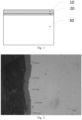
- the above method can be used to fabricate a material for use in medical implants, which includes a metal substrate 30, a oxygen-rich diffusion layer 20 and a oxidation ceramic surface layer 10 that are arranged from inside to outside, as shown in Fig. 1 .
- the metal substrate 30 is a metallic material that has not experienced a surface oxidation treatment.
- the oxidation ceramic layer 10 is a layer in which oxygen element is present essentially in the form of the oxide.
- the oxygen-rich diffusion layer 20 is a layer in which the content of oxygen is higher than the content of oxygen in metal substrate and the oxygen element is present essentially in the form of solute atoms.
- the metal substrate 30 is zirconium metal or a zirconium alloy, and the oxygen-rich diffusion layer 20 and the oxidation ceramic surface layer 10 are formed by the above method.
- Such material is suitable for use in the fabrication of medical implants, in particular bearing implants in hip or knee joints, which are required to have bearing performances.
- the middle dark region is an oxidation ceramic surface layer 10
- the rightmost brightest region is a metal substrate 30.
- the oxygen-rich diffusion layer 20 is a light-colored layer having a thickness of 1 to 2- ⁇ m and close to the dark-colored oxidation ceramic surface layer 10.
- each material or reagent used in the following embodiments is commercially available, and each process or parameter adopted in the method can be realized by conventional techniques.
- Zr-2.5Nb alloy a zirconium alloy containing 2.5 wt% of Nb samples were ground and polished so that Sample 1 had a lowered surface roughness Ra of 0.3792 ⁇ m and Sample 2 had a lowered surface roughness Ra of 0.0038 ⁇ m.
- the samples 1 and 2 were together placed into a tube furnace, heated to 550 °C in air and maintained at the temperature for 6 h. Subsequently, air was evacuated and argon was introduced to the furnace. After the slow cooling at a rate of 5 °C/min to 100 °C or below, the samples 1 and 2 were taken out and measured with a roughness gauge.
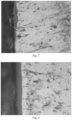
- Fig. 2 is a metallurgical microscopic image of a cross section of Sample 1 that has been oxidized, which shows a metal substrate (right), an oxidation ceramic surface layer (left) and an oxygen-rich diffusion layer between the metal substrate and the oxidation ceramic surface layer.
- a cross section image of Sample 1 after the oxidation treatment was taken and shown in Fig. 3 . Since the surface roughness Ra of Sample 2 after the oxidation treatment has already met the requirement of Ra ⁇ 0.02 ⁇ m, there is no need to perform a polishing treatment.
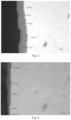
- the cross section image of Sample 2 after the oxidation treatment was taken by a metallurgical microscope and shown in Fig. 4 .
- Fig. 2 is a metallurgical microscope image showing the cross section of Sample 1 that has been further ground and polished to a Ra of 0.0184 ⁇ m.
- the remaining oxidation ceramic surface layer exhibits an extremely uneven distribution of thickness, even the exposure of zirconium-niobium alloy substrate at partial area.
- the reason for this was that during the grinding and polishing process for a low roughness, the convex portions of the oxidation ceramic surface layer experiences a large thickness loss while the concave portions thereof experiences few thickness loss.
- the oxidation ceramic surface layer has a thickness of 4.728 ⁇ m at the thickest location but almost no reservation of the oxidation ceramic layer at the thinnest location. Apparently, this oxidation ceramic surface layer is unusable.
- Sample 2 of Fig. 4 had an oxidation ceramic surface layer with a thickness of about 6.21 ⁇ m within the optimal thickness range of 3-7 ⁇ m. Since the initial surface roughness of Sample 2 is very low, the formed oxidation ceramic surface layer has a uniform thickness varying from 5.859 ⁇ m to 6.373 ⁇ m, i.e., having a tolerance of only 0.26 ⁇ m. Since this oxidation ceramic surface layer was totally satisfactory in terms of surface roughness, it is unnecessary to perform a further polishing treatment and integrity of the layer would not be impaired, so that the oxidation ceramic surface layer is able to possess a great improvement in property.
- the oxidation ceramic surface layer obtained by the present method has a uniform thickness, in which the interface between the surface oxidation ceramic layer and the substrate is substantially a horizontal plane, making it an ideal oxidation ceramic surface layer of a zirconium/zirconium alloy.
- Samples 3 and 4 were together placed into a tube furnace, heated to 600 °C in air and maintained at the temperature for 4 h. Subsequently, air was evacuated and argon was introduced to the furnace. After the slow cooling at a rate of 5 °C/min to 100 °C or below, the samples 3 and 4 were taken out and measured with a roughness gauge. The results showed, after the oxidation treatment, the roughness Ra of Sample 3 increased to 0.7705 ⁇ m and that of Sample 4 increased to 0.0158 ⁇ m. Fig.
- Fig. 5 is a metallurgical microscopic image showing a cross section of Sample 3 that has been oxidized
- Fig. 6 is a metallurgical microscopic image showing a cross section of Sample 3 that has been further ground and polished to a surface roughness Ra of 0.0177 ⁇ m. Since the surface roughness Ra of Sample 4 after the oxidation treatment has already met the requirement of Ra ⁇ 0.02 ⁇ m, there is no need to perform a polishing treatment.
- the cross section image of Sample 4 after the oxidation treatment was taken by a metallurgical microscope and shown in Fig. 4 .
- FIG. 5 Sample 3 that has experienced surface oxidation treatment possesses an oxidation ceramic surface layer having an average thickness of about 8.66 ⁇ m.
- the surface of Sample 3 fluctuates seriously and the interface between the oxidation ceramic surface layer and substrate in Sample 3 is a curved interface.
- Fig. 6 is a metallurgical microscope image showing the cross section of Sample 3 that has been further ground and polished to a Ra of 0.0177 ⁇ m. After the grinding and polishing treatment, the oxidation ceramic surface layer remains a thickness of 5.037 ⁇ m at the thickest location and a thickness of merely 1.439 ⁇ m at the thinnest location. Although the ground and polished oxidation ceramic surface layer still covers the entire surface of Sample No.
- the remaining oxidation ceramic surface layer has an uneven thickness and a poor protective performance at relatively thin locations.
- the surface oxidation treatment is required to prepare a more thick oxidation ceramic surface layer.
- the oxidation ceramic surface layer formed under the above roughness has already exceeded the optimal thickness range of 3-7 ⁇ m, which affects the performance of the surface oxidation ceramic layer.
- Sample 4 had an oxidation ceramic surface layer with an average thickness of about 10.22 ⁇ m. While the thickness is out of the optimal range (3-7 ⁇ m), the sample surface remains to be flat. The oxidation ceramic surface layer is uniform in thickness and had a flat, clear interface with the substrate as well as good protective properties.
- Samples 5 and 6 were placed into separate tube furnaces, and were both heated to 600 °C in air and maintained at the temperature for 4 h. Subsequently, for the furnace with Sample 5 placed therein, air was evacuated from and argon was introduced to the furnace following by the slow cooling at a rate of 5 °C/min to 100 °C or below. Then, Sample 5 was taken out from the furnace.
- Sample 6 was slowly cooled still in the oxidizing atmosphere at a rate of 5 °C/min to 100 °C or below and then taken out. As measured with a roughness gauge, after the oxidation treatment, the roughness Ra of Sample 5 increased to 0.0162 ⁇ m and that of Sample 6 increased to 0.0426 ⁇ m.
- Fig. 8 is a metallurgical microscope image showing the cross section of Sample 5.
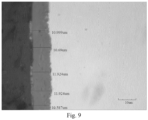
- Fig. 8 shows that the formed oxidation ceramic layer has a uniform average thickness of about 9.54 ⁇ m and a flat surface as well as a flat and straight interface with the substrate. Since the roughness Ra is within the range of Ra ⁇ 0.02 ⁇ m, Sample 5 can be directly used in the fabrication of a bearing implant such as a hip or knee joints without further polishing. As Sample 6 is cooled in the initial oxidizing atmosphere, the surface of Sample 6 continues to be oxidized in the cooling process, so as to form a thicker oxidation ceramic surface layer. As shown in Fig.
- the formed oxidation ceramic surface layer has a thickness of about 11.28 ⁇ m, and poor-quality oxides are present on the outer surface of the layer, which remarkably raises the surface roughness of Sample 6 that has been oxidized beyond the range of Ra ⁇ 0.02 ⁇ m. Therefore, it has to be further polished before it can meet the application requirements of bearing implants such as hip and knee joints. Nonetheless, thanks to the polishing treatment prior to the oxidation treatment, the oxidation ceramic surface layer has a flat interface with the substrate, which allows the layer to maintain a uniform thickness after polishing and eliminate the problems of non-uniform thickness and excessive low thickness at some locations.
- the oxidation ceramic surface layer is allowed to grow exactly to the optical thickness. This enables the oxide layer to have an optimal internal compactness, a high bonding strength and an excellent wear resistance.
- the medical implants as mentioned herein refer to implantable medical instruments that can be placed into surgically created or naturally occurring cavities in human bodies.
- the medical implants may include, but are not limited to, surgical implants such as artificial joints, (orthopedic, spinal, cardiovascular and neurosurgical) implants, structural prostheses, dentures and other artificial organs; implants made of metal materials (including stainless steel, cobalt-based alloys, titanium and alloys thereof and shape memory alloys), polymers, high molecular materials, inorganic non-metallic materials, ceramic materials, etc.; implantable instruments such as implantable orthopedic instruments, implantable aesthetic and plastic surgical instrument and materials; implantable appliances such as bones (plates, screws, pins, rods), intra-spinal fixation devices, staplers, patellar concentrators, bone wax, bone repair materials, plastic surgical materials, heart or tissue repair materials, intraocular filling materials, nerve patch, etc.; interventional instruments such as interventional catheters, stents, embolization and other devices; and orthopedic (orthoped
Landscapes
- Chemical & Material Sciences (AREA)
- Health & Medical Sciences (AREA)
- Engineering & Computer Science (AREA)
- Materials Engineering (AREA)
- Mechanical Engineering (AREA)
- Metallurgy (AREA)
- Organic Chemistry (AREA)
- Chemical Kinetics & Catalysis (AREA)
- Medicinal Chemistry (AREA)
- Dermatology (AREA)
- Oral & Maxillofacial Surgery (AREA)
- Transplantation (AREA)
- Epidemiology (AREA)
- Life Sciences & Earth Sciences (AREA)
- Animal Behavior & Ethology (AREA)
- General Health & Medical Sciences (AREA)
- Public Health (AREA)
- Veterinary Medicine (AREA)
- Inorganic Chemistry (AREA)
- Materials For Medical Uses (AREA)
- Prostheses (AREA)
Claims (7)
- Verfahren zur Herstellung eines medizinischen Implantats, umfassend ein Bilden einer Oxidationskeramikschicht auf einer Oberfläche von Zirkonium oder einer Zirkoniumlegierung, wobei das Bilden der Oxidationskeramikschicht auf einer Oberfläche von Zirkonium oder einer Zirkoniumlegierung folgende Schritte umfasst:1) Verringern einer Rauheit eines Zielbereichs des Zirkoniums oder der Zirkoniumlegierung, auf dem eine Oberflächenoxidationsbehandlung durchzuführen ist, wobei die Rauheit auf 0,01 µm oder weniger gesteuert wird;2) Durchführen der Oberflächenoxidationsbehandlung durch Erhitzen auf eine Temperatur im Bereich von 500°C bis 700°C und Halten der Temperatur für 0,5-10 h in einer Atmosphäre, die ein oxidierendes Gas enthält, um eine Oxidationskeramikoberflächenschicht zu bilden; und3) Einleiten eines inaktiven Gases, um das in Schritt 2) verwendete Oxidationsgas zu ersetzen, und Initiieren eines Abkühlungsprozesses, um eine Erstellung der Oxidationskeramikoberflächenschicht abzuschließen, ohne eine anschließende Behandlung zur Verringerung einer Rauheit der Oxidationskeramikoberflächenschicht durchzuführen.
- Verfahren nach Anspruch 1, wobei in Schritt 1) die Rauheit auf einen Wert im Bereich von 0,002 µm bis 0,010 µm verringert wird.
- Verfahren nach Anspruch 1, wobei nach der Oxidationsbehandlung in Schritt 2) eine Dicke der Oxidationskeramikoberflächenschicht auf dem Zielbereich in einem Bereich von 1 µm bis 20 µm gesteuert wird.
- Verfahren nach Anspruch 1, wobei die Rauheit des Zielbereichs in Schritt 1) durch Schleifen, mechanisches Polieren, Feinbearbeitung, Vibrationspolieren oder eine beliebige Kombination davon verringert wird.
- Verfahren nach Anspruch 1, wobei das inaktive Gas in Schritt 3) eines oder mehrere aus der Gruppe bestehend aus Stickstoff und Edelgasen ist.
- Verfahren nach Anspruch 1, wobei der Zielbereich für die Oberflächenoxidationsbehandlung ein Bereich ist, der in direkten Kontakt mit einer anderen Lageroberfläche gebracht werden soll.
- Verfahren nach Anspruch 1, wobei die Atmosphäre, die das oxidierende Gas in Schritt 2) enthält, eine Atmosphäre ist, die Sauerstoff und/oder Ozon enthält.
Applications Claiming Priority (2)
| Application Number | Priority Date | Filing Date | Title |
|---|---|---|---|
| CN201910173412.8A CN109706421B (zh) | 2019-03-07 | 2019-03-07 | 制备锆及锆合金表面氧化陶瓷层的方法及应用 |
| PCT/CN2019/118460 WO2020177386A1 (zh) | 2019-03-07 | 2019-11-14 | 锆及锆合金表面氧化陶瓷层的制备方法及其应用 |
Publications (4)
| Publication Number | Publication Date |
|---|---|
| EP3936634A1 EP3936634A1 (de) | 2022-01-12 |
| EP3936634A4 EP3936634A4 (de) | 2022-01-12 |
| EP3936634C0 EP3936634C0 (de) | 2023-09-13 |
| EP3936634B1 true EP3936634B1 (de) | 2023-09-13 |
Family
ID=66265637
Family Applications (1)
| Application Number | Title | Priority Date | Filing Date |
|---|---|---|---|
| EP19918349.2A Active EP3936634B1 (de) | 2019-03-07 | 2019-11-14 | Herstellungsverfahren einer medizinischen prothese durch anwendung einer oxidierten keramischen schicht auf der oberfläche von zirkonium |
Country Status (7)
| Country | Link |
|---|---|
| US (1) | US20220154322A1 (de) |
| EP (1) | EP3936634B1 (de) |
| JP (1) | JP7237184B2 (de) |
| CN (2) | CN109706421B (de) |
| AU (1) | AU2019432095B2 (de) |
| CA (1) | CA3132222A1 (de) |
| WO (1) | WO2020177386A1 (de) |
Families Citing this family (11)
| Publication number | Priority date | Publication date | Assignee | Title |
|---|---|---|---|---|
| CN109825797B (zh) * | 2019-03-07 | 2020-06-16 | 苏州微创关节医疗科技有限公司 | 锆合金的处理方法及应用 |
| CN109706421B (zh) * | 2019-03-07 | 2020-08-18 | 苏州微创关节医疗科技有限公司 | 制备锆及锆合金表面氧化陶瓷层的方法及应用 |
| CN110965013B (zh) * | 2019-12-17 | 2023-04-07 | 西安优耐特容器制造有限公司 | 一种柔性可控电阻加热锆金属表面陶瓷化装置及方法 |
| JP7595243B2 (ja) * | 2020-05-18 | 2024-12-06 | 国立大学法人 熊本大学 | 透明成形体及びその製造方法 |
| CN111826603B (zh) * | 2020-07-21 | 2022-09-30 | 苏州微创关节医疗科技有限公司 | 制备金属基底表面氧化陶瓷层的方法及应用 |
| CN112404433B (zh) * | 2020-10-30 | 2023-03-10 | 嘉思特华剑医疗器材(天津)有限公司 | 含氧化层锆铌合金分区骨小梁单间室胫骨平台及制备方法 |
| CN112315627B (zh) * | 2020-10-30 | 2024-04-09 | 嘉思特医疗器材(天津)股份有限公司 | 带有骨小梁的含氧化层锆铌合金胫骨平台假体及制备方法 |
| CN115323309A (zh) * | 2022-06-27 | 2022-11-11 | 西安泵阀总厂有限公司 | 一种锆及锆合金泵口环零件的表面硬化处理方法 |
| CN115261772B (zh) * | 2022-07-09 | 2024-05-31 | 北京市春立正达医疗器械股份有限公司 | 一种在锆合金表面快速制备陶瓷改性层的方法 |
| CN115970058B (zh) * | 2022-12-21 | 2024-06-25 | 北京市春立正达医疗器械股份有限公司 | 一种股骨髁表面制备陶瓷改性层的方法 |
| CN117758194A (zh) * | 2023-12-26 | 2024-03-26 | 大博医疗科技股份有限公司 | 一种锆合金材料表面处理方法及锆合金材料 |
Family Cites Families (20)
| Publication number | Priority date | Publication date | Assignee | Title |
|---|---|---|---|---|
| US2987352A (en) | 1958-02-10 | 1961-06-06 | Ca Atomic Energy Ltd | Zirconium bearings and process of producing same |
| US5037438A (en) | 1989-07-25 | 1991-08-06 | Richards Medical Company | Zirconium oxide coated prosthesis for wear and corrosion resistance |
| DK0968011T3 (da) * | 1997-03-27 | 2004-12-20 | Smith & Nephew Inc | Fremgangsmåde til overfladeoxidation af zirkoniumlegeringer og fremstillet produkt |
| US6585772B2 (en) * | 1997-03-27 | 2003-07-01 | Smith & Nephew, Inc. | Method of surface oxidizing zirconium and zirconium alloys and resulting product |
| EP1245409A4 (de) * | 2000-04-19 | 2009-08-19 | Citizen Holdings Co Ltd | Geschirrteil sowie verfahren zur behandlung seiner oberfläche, substrat mit harter deckfolie und verfahren zu seiner herstellung, und bestecke |
| FR2827078B1 (fr) * | 2001-07-04 | 2005-02-04 | Soitec Silicon On Insulator | Procede de diminution de rugosite de surface |
| JP2005538745A (ja) * | 2001-12-06 | 2005-12-22 | スミス アンド ネフュー インコーポレーテッド | 人工補装器具用の現場酸化テクスチャ加工表面およびその製造方法 |
| GB0216527D0 (en) * | 2002-07-16 | 2002-08-28 | Boc Group Plc | Thermal treatment method |
| AU2006333519B2 (en) * | 2005-12-15 | 2013-08-15 | Smith & Nephew, Inc. | Diffusion-hardened medical implant |
| US8795441B2 (en) * | 2006-04-26 | 2014-08-05 | Smith & Nephew, Inc. | Reworking of surface oxidized and nitrided components |
| CN101808595B (zh) * | 2007-06-11 | 2017-05-10 | 史密夫和内修有限公司 | 层状陶瓷医疗植入物 |
| US20100041663A1 (en) * | 2008-07-18 | 2010-02-18 | Novartis Ag | Organic Compounds as Smo Inhibitors |
| GB0813667D0 (en) * | 2008-07-25 | 2008-09-03 | Boc Group Plc | Case hardening titanium and its alloys |
| US8361381B2 (en) * | 2008-09-25 | 2013-01-29 | Smith & Nephew, Inc. | Medical implants having a porous coated surface |
| CN104818409B (zh) * | 2015-04-21 | 2017-03-08 | 华南理工大学 | 一种高耐磨、高强韧的医用锆合金及其制备方法与应用 |
| CN107142444B (zh) * | 2017-03-28 | 2019-09-06 | 广西大学 | 一种表面氧化的β型医用锆合金的制备方法 |
| CN107675122B (zh) * | 2017-11-20 | 2019-11-12 | 北京金轮坤天特种机械有限公司 | 一种锆铌合金表面非化学计量比氧化膜及其制备方法 |
| CN108434517A (zh) * | 2018-02-24 | 2018-08-24 | 北京爱康宜诚医疗器材有限公司 | 抗菌牙种植体及其制备方法 |
| CN108559942B (zh) * | 2018-05-14 | 2020-10-20 | 中鼎特金秦皇岛科技股份有限公司 | 一种在锆基合金表面制备黑色陶瓷层的方法 |
| CN109706421B (zh) * | 2019-03-07 | 2020-08-18 | 苏州微创关节医疗科技有限公司 | 制备锆及锆合金表面氧化陶瓷层的方法及应用 |
-
2019
- 2019-03-07 CN CN201910173412.8A patent/CN109706421B/zh active Active
- 2019-03-07 CN CN202010084697.0A patent/CN111270196B/zh active Active
- 2019-11-14 JP JP2021552569A patent/JP7237184B2/ja active Active
- 2019-11-14 WO PCT/CN2019/118460 patent/WO2020177386A1/zh not_active Ceased
- 2019-11-14 US US17/437,026 patent/US20220154322A1/en not_active Abandoned
- 2019-11-14 EP EP19918349.2A patent/EP3936634B1/de active Active
- 2019-11-14 AU AU2019432095A patent/AU2019432095B2/en active Active
- 2019-11-14 CA CA3132222A patent/CA3132222A1/en active Pending
Also Published As
| Publication number | Publication date |
|---|---|
| JP7237184B2 (ja) | 2023-03-10 |
| EP3936634C0 (de) | 2023-09-13 |
| CA3132222A1 (en) | 2020-09-10 |
| AU2019432095A1 (en) | 2021-09-30 |
| JP2022522887A (ja) | 2022-04-20 |
| CN109706421B (zh) | 2020-08-18 |
| CN109706421A (zh) | 2019-05-03 |
| CN111270196B (zh) | 2022-03-04 |
| EP3936634A1 (de) | 2022-01-12 |
| US20220154322A1 (en) | 2022-05-19 |
| EP3936634A4 (de) | 2022-01-12 |
| CN111270196A (zh) | 2020-06-12 |
| WO2020177386A1 (zh) | 2020-09-10 |
| AU2019432095B2 (en) | 2022-09-08 |
Similar Documents
| Publication | Publication Date | Title |
|---|---|---|
| EP3936634B1 (de) | Herstellungsverfahren einer medizinischen prothese durch anwendung einer oxidierten keramischen schicht auf der oberfläche von zirkonium | |
| JP4719416B2 (ja) | ジルコニウムおよびジルコニウム合金の表面酸化方法と結果として生じる生産品 | |
| JP5048501B2 (ja) | ジルコニウム及びジルコニウム合金を表面酸化する方法及びそれによって得られる生成物 | |
| AU736216B2 (en) | Method of surface oxidizing zirconium alloys and resulting product | |
| JP5693965B2 (ja) | 表面合金化医療用インプラント | |
| JP3330380B2 (ja) | ほてつ移植体、その製造方法およびほてつ移植用に有用な合金 | |
| AU2002330894A1 (en) | Method of surface oxidizing zirconium and zirconium alloys and resulting product | |
| CN112274301A (zh) | 含氧化层锆铌合金踝关节假体系统及制备方法 | |
| Lee et al. | Ceramic femoral prosthesis in TKA—present and future |
Legal Events
| Date | Code | Title | Description |
|---|---|---|---|
| STAA | Information on the status of an ep patent application or granted ep patent |
Free format text: STATUS: THE INTERNATIONAL PUBLICATION HAS BEEN MADE |
|
| PUAI | Public reference made under article 153(3) epc to a published international application that has entered the european phase |
Free format text: ORIGINAL CODE: 0009012 |
|
| STAA | Information on the status of an ep patent application or granted ep patent |
Free format text: STATUS: REQUEST FOR EXAMINATION WAS MADE |
|
| 17P | Request for examination filed |
Effective date: 20210910 |
|
| A4 | Supplementary search report drawn up and despatched |
Effective date: 20211104 |
|
| AK | Designated contracting states |
Kind code of ref document: A1 Designated state(s): AL AT BE BG CH CY CZ DE DK EE ES FI FR GB GR HR HU IE IS IT LI LT LU LV MC MK MT NL NO PL PT RO RS SE SI SK SM TR |
|
| DAV | Request for validation of the european patent (deleted) | ||
| DAX | Request for extension of the european patent (deleted) | ||
| GRAP | Despatch of communication of intention to grant a patent |
Free format text: ORIGINAL CODE: EPIDOSNIGR1 |
|
| STAA | Information on the status of an ep patent application or granted ep patent |
Free format text: STATUS: GRANT OF PATENT IS INTENDED |
|
| INTG | Intention to grant announced |
Effective date: 20230403 |
|
| GRAS | Grant fee paid |
Free format text: ORIGINAL CODE: EPIDOSNIGR3 |
|
| GRAA | (expected) grant |
Free format text: ORIGINAL CODE: 0009210 |
|
| STAA | Information on the status of an ep patent application or granted ep patent |
Free format text: STATUS: THE PATENT HAS BEEN GRANTED |
|
| AK | Designated contracting states |
Kind code of ref document: B1 Designated state(s): AL AT BE BG CH CY CZ DE DK EE ES FI FR GB GR HR HU IE IS IT LI LT LU LV MC MK MT NL NO PL PT RO RS SE SI SK SM TR |
|
| REG | Reference to a national code |
Ref country code: CH Ref legal event code: EP |
|
| REG | Reference to a national code |
Ref country code: DE Ref legal event code: R096 Ref document number: 602019037654 Country of ref document: DE |
|
| REG | Reference to a national code |
Ref country code: IE Ref legal event code: FG4D |
|
| U01 | Request for unitary effect filed |
Effective date: 20231012 |
|
| U07 | Unitary effect registered |
Designated state(s): AT BE BG DE DK EE FI FR IT LT LU LV MT NL PT SE SI Effective date: 20231023 |
|
| PG25 | Lapsed in a contracting state [announced via postgrant information from national office to epo] |
Ref country code: GR Free format text: LAPSE BECAUSE OF FAILURE TO SUBMIT A TRANSLATION OF THE DESCRIPTION OR TO PAY THE FEE WITHIN THE PRESCRIBED TIME-LIMIT Effective date: 20231214 |
|
| PG25 | Lapsed in a contracting state [announced via postgrant information from national office to epo] |
Ref country code: RS Free format text: LAPSE BECAUSE OF FAILURE TO SUBMIT A TRANSLATION OF THE DESCRIPTION OR TO PAY THE FEE WITHIN THE PRESCRIBED TIME-LIMIT Effective date: 20230913 Ref country code: NO Free format text: LAPSE BECAUSE OF FAILURE TO SUBMIT A TRANSLATION OF THE DESCRIPTION OR TO PAY THE FEE WITHIN THE PRESCRIBED TIME-LIMIT Effective date: 20231213 Ref country code: HR Free format text: LAPSE BECAUSE OF FAILURE TO SUBMIT A TRANSLATION OF THE DESCRIPTION OR TO PAY THE FEE WITHIN THE PRESCRIBED TIME-LIMIT Effective date: 20230913 Ref country code: GR Free format text: LAPSE BECAUSE OF FAILURE TO SUBMIT A TRANSLATION OF THE DESCRIPTION OR TO PAY THE FEE WITHIN THE PRESCRIBED TIME-LIMIT Effective date: 20231214 |
|
| U20 | Renewal fee for the european patent with unitary effect paid |
Year of fee payment: 5 Effective date: 20231227 |
|
| PG25 | Lapsed in a contracting state [announced via postgrant information from national office to epo] |
Ref country code: IS Free format text: LAPSE BECAUSE OF FAILURE TO SUBMIT A TRANSLATION OF THE DESCRIPTION OR TO PAY THE FEE WITHIN THE PRESCRIBED TIME-LIMIT Effective date: 20240113 |
|
| PG25 | Lapsed in a contracting state [announced via postgrant information from national office to epo] |
Ref country code: ES Free format text: LAPSE BECAUSE OF FAILURE TO SUBMIT A TRANSLATION OF THE DESCRIPTION OR TO PAY THE FEE WITHIN THE PRESCRIBED TIME-LIMIT Effective date: 20230913 |
|
| PG25 | Lapsed in a contracting state [announced via postgrant information from national office to epo] |
Ref country code: SM Free format text: LAPSE BECAUSE OF FAILURE TO SUBMIT A TRANSLATION OF THE DESCRIPTION OR TO PAY THE FEE WITHIN THE PRESCRIBED TIME-LIMIT Effective date: 20230913 Ref country code: RO Free format text: LAPSE BECAUSE OF FAILURE TO SUBMIT A TRANSLATION OF THE DESCRIPTION OR TO PAY THE FEE WITHIN THE PRESCRIBED TIME-LIMIT Effective date: 20230913 Ref country code: IS Free format text: LAPSE BECAUSE OF FAILURE TO SUBMIT A TRANSLATION OF THE DESCRIPTION OR TO PAY THE FEE WITHIN THE PRESCRIBED TIME-LIMIT Effective date: 20240113 Ref country code: ES Free format text: LAPSE BECAUSE OF FAILURE TO SUBMIT A TRANSLATION OF THE DESCRIPTION OR TO PAY THE FEE WITHIN THE PRESCRIBED TIME-LIMIT Effective date: 20230913 Ref country code: CZ Free format text: LAPSE BECAUSE OF FAILURE TO SUBMIT A TRANSLATION OF THE DESCRIPTION OR TO PAY THE FEE WITHIN THE PRESCRIBED TIME-LIMIT Effective date: 20230913 Ref country code: SK Free format text: LAPSE BECAUSE OF FAILURE TO SUBMIT A TRANSLATION OF THE DESCRIPTION OR TO PAY THE FEE WITHIN THE PRESCRIBED TIME-LIMIT Effective date: 20230913 |
|
| PG25 | Lapsed in a contracting state [announced via postgrant information from national office to epo] |
Ref country code: PL Free format text: LAPSE BECAUSE OF FAILURE TO SUBMIT A TRANSLATION OF THE DESCRIPTION OR TO PAY THE FEE WITHIN THE PRESCRIBED TIME-LIMIT Effective date: 20230913 |
|
| REG | Reference to a national code |
Ref country code: DE Ref legal event code: R097 Ref document number: 602019037654 Country of ref document: DE |
|
| REG | Reference to a national code |
Ref country code: CH Ref legal event code: PL |
|
| PG25 | Lapsed in a contracting state [announced via postgrant information from national office to epo] |
Ref country code: MC Free format text: LAPSE BECAUSE OF FAILURE TO SUBMIT A TRANSLATION OF THE DESCRIPTION OR TO PAY THE FEE WITHIN THE PRESCRIBED TIME-LIMIT Effective date: 20230913 |
|
| PG25 | Lapsed in a contracting state [announced via postgrant information from national office to epo] |
Ref country code: CH Free format text: LAPSE BECAUSE OF NON-PAYMENT OF DUE FEES Effective date: 20231130 |
|
| PLBE | No opposition filed within time limit |
Free format text: ORIGINAL CODE: 0009261 |
|
| STAA | Information on the status of an ep patent application or granted ep patent |
Free format text: STATUS: NO OPPOSITION FILED WITHIN TIME LIMIT |
|
| PG25 | Lapsed in a contracting state [announced via postgrant information from national office to epo] |
Ref country code: MC Free format text: LAPSE BECAUSE OF FAILURE TO SUBMIT A TRANSLATION OF THE DESCRIPTION OR TO PAY THE FEE WITHIN THE PRESCRIBED TIME-LIMIT Effective date: 20230913 Ref country code: CH Free format text: LAPSE BECAUSE OF NON-PAYMENT OF DUE FEES Effective date: 20231130 |
|
| 26N | No opposition filed |
Effective date: 20240614 |
|
| REG | Reference to a national code |
Ref country code: IE Ref legal event code: MM4A |
|
| PG25 | Lapsed in a contracting state [announced via postgrant information from national office to epo] |
Ref country code: IE Free format text: LAPSE BECAUSE OF NON-PAYMENT OF DUE FEES Effective date: 20231114 |
|
| PG25 | Lapsed in a contracting state [announced via postgrant information from national office to epo] |
Ref country code: IE Free format text: LAPSE BECAUSE OF NON-PAYMENT OF DUE FEES Effective date: 20231114 |
|
| U20 | Renewal fee for the european patent with unitary effect paid |
Year of fee payment: 6 Effective date: 20241126 |
|
| PG25 | Lapsed in a contracting state [announced via postgrant information from national office to epo] |
Ref country code: CY Free format text: LAPSE BECAUSE OF FAILURE TO SUBMIT A TRANSLATION OF THE DESCRIPTION OR TO PAY THE FEE WITHIN THE PRESCRIBED TIME-LIMIT; INVALID AB INITIO Effective date: 20191114 |
|
| PG25 | Lapsed in a contracting state [announced via postgrant information from national office to epo] |
Ref country code: HU Free format text: LAPSE BECAUSE OF FAILURE TO SUBMIT A TRANSLATION OF THE DESCRIPTION OR TO PAY THE FEE WITHIN THE PRESCRIBED TIME-LIMIT; INVALID AB INITIO Effective date: 20191114 |
|
| PG25 | Lapsed in a contracting state [announced via postgrant information from national office to epo] |
Ref country code: TR Free format text: LAPSE BECAUSE OF FAILURE TO SUBMIT A TRANSLATION OF THE DESCRIPTION OR TO PAY THE FEE WITHIN THE PRESCRIBED TIME-LIMIT Effective date: 20230913 |
|
| U20 | Renewal fee for the european patent with unitary effect paid |
Year of fee payment: 7 Effective date: 20251127 |
|
| PGFP | Annual fee paid to national office [announced via postgrant information from national office to epo] |
Ref country code: GB Payment date: 20251121 Year of fee payment: 7 |