EP3919984B1 - Image forming apparatus - Google Patents
Image forming apparatus Download PDFInfo
- Publication number
- EP3919984B1 EP3919984B1 EP21175211.8A EP21175211A EP3919984B1 EP 3919984 B1 EP3919984 B1 EP 3919984B1 EP 21175211 A EP21175211 A EP 21175211A EP 3919984 B1 EP3919984 B1 EP 3919984B1
- Authority
- EP
- European Patent Office
- Prior art keywords
- motor
- developing roller
- timing
- rotation amount
- image forming
- Prior art date
- Legal status (The legal status is an assumption and is not a legal conclusion. Google has not performed a legal analysis and makes no representation as to the accuracy of the status listed.)
- Active
Links
Images



Classifications
-
- G—PHYSICS
- G03—PHOTOGRAPHY; CINEMATOGRAPHY; ANALOGOUS TECHNIQUES USING WAVES OTHER THAN OPTICAL WAVES; ELECTROGRAPHY; HOLOGRAPHY
- G03G—ELECTROGRAPHY; ELECTROPHOTOGRAPHY; MAGNETOGRAPHY
- G03G15/00—Apparatus for electrographic processes using a charge pattern
- G03G15/06—Apparatus for electrographic processes using a charge pattern for developing
- G03G15/08—Apparatus for electrographic processes using a charge pattern for developing using a solid developer, e.g. powder developer
- G03G15/0806—Apparatus for electrographic processes using a charge pattern for developing using a solid developer, e.g. powder developer on a donor element, e.g. belt, roller
- G03G15/0813—Apparatus for electrographic processes using a charge pattern for developing using a solid developer, e.g. powder developer on a donor element, e.g. belt, roller characterised by means in the developing zone having an interaction with the image carrying member, e.g. distance holders
-
- G—PHYSICS
- G03—PHOTOGRAPHY; CINEMATOGRAPHY; ANALOGOUS TECHNIQUES USING WAVES OTHER THAN OPTICAL WAVES; ELECTROGRAPHY; HOLOGRAPHY
- G03G—ELECTROGRAPHY; ELECTROPHOTOGRAPHY; MAGNETOGRAPHY
- G03G15/00—Apparatus for electrographic processes using a charge pattern
- G03G15/75—Details relating to xerographic drum, band or plate, e.g. replacing, testing
- G03G15/757—Drive mechanisms for photosensitive medium, e.g. gears
-
- G—PHYSICS
- G03—PHOTOGRAPHY; CINEMATOGRAPHY; ANALOGOUS TECHNIQUES USING WAVES OTHER THAN OPTICAL WAVES; ELECTROGRAPHY; HOLOGRAPHY
- G03G—ELECTROGRAPHY; ELECTROPHOTOGRAPHY; MAGNETOGRAPHY
- G03G15/00—Apparatus for electrographic processes using a charge pattern
- G03G15/01—Apparatus for electrographic processes using a charge pattern for producing multicoloured copies
-
- G—PHYSICS
- G03—PHOTOGRAPHY; CINEMATOGRAPHY; ANALOGOUS TECHNIQUES USING WAVES OTHER THAN OPTICAL WAVES; ELECTROGRAPHY; HOLOGRAPHY
- G03G—ELECTROGRAPHY; ELECTROPHOTOGRAPHY; MAGNETOGRAPHY
- G03G15/00—Apparatus for electrographic processes using a charge pattern
- G03G15/06—Apparatus for electrographic processes using a charge pattern for developing
- G03G15/08—Apparatus for electrographic processes using a charge pattern for developing using a solid developer, e.g. powder developer
- G03G15/0806—Apparatus for electrographic processes using a charge pattern for developing using a solid developer, e.g. powder developer on a donor element, e.g. belt, roller
-
- G—PHYSICS
- G03—PHOTOGRAPHY; CINEMATOGRAPHY; ANALOGOUS TECHNIQUES USING WAVES OTHER THAN OPTICAL WAVES; ELECTROGRAPHY; HOLOGRAPHY
- G03G—ELECTROGRAPHY; ELECTROPHOTOGRAPHY; MAGNETOGRAPHY
- G03G15/00—Apparatus for electrographic processes using a charge pattern
- G03G15/06—Apparatus for electrographic processes using a charge pattern for developing
- G03G15/08—Apparatus for electrographic processes using a charge pattern for developing using a solid developer, e.g. powder developer
- G03G15/0806—Apparatus for electrographic processes using a charge pattern for developing using a solid developer, e.g. powder developer on a donor element, e.g. belt, roller
- G03G15/0808—Apparatus for electrographic processes using a charge pattern for developing using a solid developer, e.g. powder developer on a donor element, e.g. belt, roller characterised by the developer supplying means, e.g. structure of developer supply roller
-
- G—PHYSICS
- G03—PHOTOGRAPHY; CINEMATOGRAPHY; ANALOGOUS TECHNIQUES USING WAVES OTHER THAN OPTICAL WAVES; ELECTROGRAPHY; HOLOGRAPHY
- G03G—ELECTROGRAPHY; ELECTROPHOTOGRAPHY; MAGNETOGRAPHY
- G03G15/00—Apparatus for electrographic processes using a charge pattern
- G03G15/50—Machine control of apparatus for electrographic processes using a charge pattern, e.g. regulating differents parts of the machine, multimode copiers, microprocessor control
-
- G—PHYSICS
- G03—PHOTOGRAPHY; CINEMATOGRAPHY; ANALOGOUS TECHNIQUES USING WAVES OTHER THAN OPTICAL WAVES; ELECTROGRAPHY; HOLOGRAPHY
- G03G—ELECTROGRAPHY; ELECTROPHOTOGRAPHY; MAGNETOGRAPHY
- G03G15/00—Apparatus for electrographic processes using a charge pattern
- G03G15/50—Machine control of apparatus for electrographic processes using a charge pattern, e.g. regulating differents parts of the machine, multimode copiers, microprocessor control
- G03G15/5008—Driving control for rotary photosensitive medium, e.g. speed control, stop position control
-
- G—PHYSICS
- G03—PHOTOGRAPHY; CINEMATOGRAPHY; ANALOGOUS TECHNIQUES USING WAVES OTHER THAN OPTICAL WAVES; ELECTROGRAPHY; HOLOGRAPHY
- G03G—ELECTROGRAPHY; ELECTROPHOTOGRAPHY; MAGNETOGRAPHY
- G03G15/00—Apparatus for electrographic processes using a charge pattern
- G03G15/55—Self-diagnostics; Malfunction or lifetime display
- G03G15/553—Monitoring or warning means for exhaustion or lifetime end of consumables, e.g. indication of insufficient copy sheet quantity for a job
-
- G—PHYSICS
- G03—PHOTOGRAPHY; CINEMATOGRAPHY; ANALOGOUS TECHNIQUES USING WAVES OTHER THAN OPTICAL WAVES; ELECTROGRAPHY; HOLOGRAPHY
- G03G—ELECTROGRAPHY; ELECTROPHOTOGRAPHY; MAGNETOGRAPHY
- G03G15/00—Apparatus for electrographic processes using a charge pattern
- G03G15/80—Details relating to power supplies, circuits boards, electrical connections
-
- G—PHYSICS
- G03—PHOTOGRAPHY; CINEMATOGRAPHY; ANALOGOUS TECHNIQUES USING WAVES OTHER THAN OPTICAL WAVES; ELECTROGRAPHY; HOLOGRAPHY
- G03G—ELECTROGRAPHY; ELECTROPHOTOGRAPHY; MAGNETOGRAPHY
- G03G21/00—Arrangements not provided for by groups G03G13/00 - G03G19/00, e.g. cleaning, elimination of residual charge
- G03G21/16—Mechanical means for facilitating the maintenance of the apparatus, e.g. modular arrangements
- G03G21/1642—Mechanical means for facilitating the maintenance of the apparatus, e.g. modular arrangements for connecting the different parts of the apparatus
- G03G21/1647—Mechanical connection means
-
- G—PHYSICS
- G03—PHOTOGRAPHY; CINEMATOGRAPHY; ANALOGOUS TECHNIQUES USING WAVES OTHER THAN OPTICAL WAVES; ELECTROGRAPHY; HOLOGRAPHY
- G03G—ELECTROGRAPHY; ELECTROPHOTOGRAPHY; MAGNETOGRAPHY
- G03G21/00—Arrangements not provided for by groups G03G13/00 - G03G19/00, e.g. cleaning, elimination of residual charge
- G03G21/16—Mechanical means for facilitating the maintenance of the apparatus, e.g. modular arrangements
- G03G21/1661—Mechanical means for facilitating the maintenance of the apparatus, e.g. modular arrangements means for handling parts of the apparatus in the apparatus
- G03G21/1676—Mechanical means for facilitating the maintenance of the apparatus, e.g. modular arrangements means for handling parts of the apparatus in the apparatus for the developer unit
-
- G—PHYSICS
- G03—PHOTOGRAPHY; CINEMATOGRAPHY; ANALOGOUS TECHNIQUES USING WAVES OTHER THAN OPTICAL WAVES; ELECTROGRAPHY; HOLOGRAPHY
- G03G—ELECTROGRAPHY; ELECTROPHOTOGRAPHY; MAGNETOGRAPHY
- G03G21/00—Arrangements not provided for by groups G03G13/00 - G03G19/00, e.g. cleaning, elimination of residual charge
- G03G21/16—Mechanical means for facilitating the maintenance of the apparatus, e.g. modular arrangements
- G03G21/18—Mechanical means for facilitating the maintenance of the apparatus, e.g. modular arrangements using a processing cartridge, whereby the process cartridge comprises at least two image processing means in a single unit
-
- G—PHYSICS
- G03—PHOTOGRAPHY; CINEMATOGRAPHY; ANALOGOUS TECHNIQUES USING WAVES OTHER THAN OPTICAL WAVES; ELECTROGRAPHY; HOLOGRAPHY
- G03G—ELECTROGRAPHY; ELECTROPHOTOGRAPHY; MAGNETOGRAPHY
- G03G2215/00—Apparatus for electrophotographic processes
- G03G2215/06—Developing structures, details
- G03G2215/0634—Developing device
- G03G2215/0636—Specific type of dry developer device
Definitions
- the present invention relates to an image forming apparatus, e.g., a copier, a printer, or a facsimile, including a motor.
- an image forming apparatus e.g., a copier, a printer, or a facsimile, including a motor.
- a brushless motor, a stepping motor or the like is used as a drive source of a rotating member of an image forming apparatus.
- a developing roller as described in Japanese Patent Application Publication No. 2006-292868 , the unit for switching between drive and non-drive of the developing roller is disposed in a drive transmission path between the drive source and the developing roller, and the total rotation amount of the developing roller is reduced by starting the rotation of the developing roller immediately before image formation.
- Japanese Patent Application Publication No. 2001-109340 in which the service life of the developing roller is detected by disposing a sensor which detects the rotation of the developing roller in order to accurately measure the total rotation amount of the developing roller in the image forming apparatus.
- Further background documents of interest are JP-H11 -143218 and JP-2018-203424 .
- the rotation amount of the drive source does not match the rotation amount of the developing roller. Consequently, in a configuration in which a sensor which directly detects the rotation amount of the developing roller is not disposed, a problem arises in that it is difficult to accurately estimate the rotation amount of the developing roller. On the other hand, in a case where the sensor which detects the rotation of the developing roller is disposed as in Japanese Patent Application Publication No. 2001-109340 , there is a concern that cost is increased due to addition of the sensor or the size of a product is increased due to necessity for space in which the sensor is disposed.
- the present invention has been made in view of the above problem.
- the present invention provides a configuration which can estimate, with higher accuracy, the rotation amount of a developing roller or information corresponding to the rotation amount in a space-saving manner at low cost.
- the present invention in its one aspect provides an image forming apparatus as specified in claims 1 to 10.
- the present invention in its one aspect provides an image forming apparatus as specified in claims 11 to 15.
- Embodiment 1 of the present invention will be described based on FIGS. 1 to 7 . Note that the present embodiment is only illustrative, and the present invention is not limited to these components.
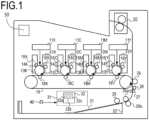
- FIG. 1 is a configuration diagram of a tandem-type color image forming apparatus which uses an electrophotographic process. By using the drawing, an image forming operation in the configuration of the image forming apparatus will be described.
- the tandem-type color image forming apparatus is configured to be able to output a full-color image by stacking toners having four colors of yellow (Y), magenta (M), cyan (C), and black (K) on each other.
- laser scanners 11Y, 11M, 11C, 11K
- cartridges (12Y, 12M, 12C, 12K) are provided.
- the cartridges (12Y, 12M, 12C, 12K) are constituted by developing devices having photosensitive members (13Y, 13M, 13C, 13K) which rotate in directions indicated by arrows in the drawing, photosensitive member cleaners (14Y, 14M, 14C, 14K) which are provided so as to be in contact with the photosensitive members, charging rollers (15Y, 15M, 15C, 15K), and developing rollers (16Y, 16M, 16C, 16K).
- an intermediate transfer belt 19 is provided to be in contact with the photosensitive members (13Y, 13M, 13C, 13K) for the individual colors, and primary transfer rollers (18Y, 18M, 18C, 18K) are installed so as to face the photosensitive members with the intermediate transfer belt 19 sandwiched therebetween.
- the image forming apparatus in the present embodiment has an A motor 101, a B motor, and a C motor.
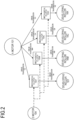
- the A motor 101 is a motor for rotating the developing rollers (16Y, 16M, 16C, 16K), and will be described later by using FIG. 2 .
- the B motor which is not shown in the drawing is a motor for rotating the photosensitive members (13Y, 13M, 13C).
- the C motor which is not shown in the drawing is a motor for rotating the intermediate transfer belt 19 and the photosensitive member 13K.
- Each of the A motor 101, the B motor, and the C motor is a DC brushless motor, and a combination of the motor and the roller rotated by the motor is not limited to the present embodiment.
- a paper feed roller 25, separation rollers 26a and 26b, and a registration roller 27 are provided downstream of a cassette 22 which stores sheets 21 in a conveying direction, and a conveyance sensor 28 is provided in the vicinity of the registration roller 27 on the downstream side in a sheet conveying direction. Further, a secondary transfer roller 29 is disposed so as to be in contact with the intermediate transfer belt 19 on the downstream side in a conveyance path, and a fixing unit 30 is disposed downstream of the secondary transfer roller 29.
- a controller 31 serving as a control portion of a laser printer is provided, and is constituted by a central processing unit (CPU) 32 including a ROM 32a, a RAM 32b, and a timer 32c, and various input-output control circuits (not shown).
- CPU central processing unit
- ROM 32a read-only memory
- RAM 32b random access memory
- timer 32c timer
- various input-output control circuits not shown.
- the electrophotographic process will be briefly described.
- the surfaces of the photosensitive members (13Y, 13M, 13C, 13K) are uniformly charged by the charging rollers (15Y, 15M, 15C, 15K).
- the driving force of the B motor is transmitted to each of the photosensitive members (13Y, 13M, 13C) by a gear, and the photosensitive members are thereby rotated.
- the driving force of the C motor is transmitted to each of the photosensitive member 13K and the intermediate transfer belt 19 by a gear, and the photosensitive member 13K and the intermediate transfer belt 19 are thereby rotated.
- the surfaces of the photosensitive members are irradiated with laser light which is modulated according to image data by the laser scanners (11Y, 11M, 11C, 11K).
- electrification charge in a portion irradiated with the laser light is removed, and electrostatic latent images are thereby formed on the surfaces of the photosensitive members (13Y, 13M, 13C, 13K).
- toner is adhered to the electrostatic latent image on each of the photosensitive members (13Y, 13M, 13C, 13K) from each of the developing rollers (16Y, 16M, 16C, 16K) which hold toner layers each having a predetermined amount of toner by a developing bias. With this, toner images having the individual colors are formed on the surfaces of the photosensitive members (13Y, 13M, 13C, 13K).
- the toner images formed on the surfaces of the photosensitive members (13Y, 13M, 13C, 13K) are attracted to the intermediate transfer belt 19 at nip portions between the photosensitive members (13Y, 13M, 13C, 13K) and the intermediate transfer belt 19 by a primary transfer bias applied to each of the primary transfer rollers (18Y, 18M, 18C, 18K).
- the CPU 32 controls an image formation timing in each of the cartridges (12Y, 12M, 12C, 12K) based on a timing corresponding to a belt conveyance speed to transfer the toner images of the cartridges onto the intermediate transfer belt 19 sequentially. With this, a full-color image is finally formed on the intermediate transfer belt 19.
- the sheets 21 in the cassette 22 are conveyed by the paper feed roller 25, only one sheet 21 is caused to pass through the registration roller 27 by the separation rollers 26a and 26b, and is conveyed to the secondary transfer roller 29. Thereafter, the toner image on the intermediate transfer belt 19 is transferred to the sheet 21 at a nip portion between the secondary transfer roller 29 positioned downstream of the registration roller and the intermediate transfer belt 19, and the toner image on the sheet 21 is finally subjected to heating and fixing processing by the fixing unit 30 and is discharged to the outside of the image forming apparatus.
- the image forming apparatus in the present embodiment includes an environmental temperature sensor 40 which measures the environmental temperature of outside air, and is capable of performing setting of image formation corresponding to the measured environmental temperature.
- the drive configuration for rotating the developing rollers is constituted by the A motor 101 serving as a single drive source, drive transmission unit (YA, YB, MA, MB, CA, CB, KA, KB) which serve as a drive train and use gear trains, and a D motor 104 and mechanical clutches (105Y, 105M, 105C, 105K) controlled by the D motor 104 which serve as drive switching unit.
- the drive of the D motor 104 is controlled by the controller 31 (CPU 32).
- the A motor 101 is a brushless motor, and a rotational force generated in the A motor 101 is transmitted to each of the mechanical clutches (105Y, 105M, 105C, 105K) at some midpoint in the drive train by the drive transmission unit (YA, MA, CA, KA) which use the gear train.
- the D motor 104 is a motor capable of rotation position control (e.g., a stepping motor) and, when the D motor is caused to rotate by a predetermined rotation amount, the mechanical clutches are brought into a connection state.
- FIG. 3 shows the configuration of the motor control portion 120.
- the motor control portion 120 is a circuit for causing the A motor 101 to rotate.
- the motor control portion 120 includes arithmetic processing unit which uses, e.g., a microcomputer 121.
- the microcomputer 121 includes, in addition to a CPU, a communication port 122, an AD converter 129, a counter 123, a nonvolatile memory 124, a reference clock generation portion 125, a PWM port 127, and a current value calculation portion 128.
- the counter 123 performs a count operation based on a reference clock generated by the reference clock generation portion 125, and performs measurement of a period of an input pulse and generation of a PWM signal which is performed in synchronization with the rotation of the A motor 101 by using the count value.
- the PWM port 127 includes six terminals, and outputs PWM signals of three high-side signal terminals (U-H, V-H, W-H) and three low-side signal terminals (U-L, V-L, W-L).
- the motor control portion 120 includes a three-phase inverter 131 constituted by three high-side switching elements and three low-side switching elements.
- the switching element it is possible to use, e.g., a transistor or an FET.
- Each switching element is connected to the PWM port 127 via a gate driver 132, and it is possible to perform ON/OFF control with the PWM signal output from the PWM port 127. It is assumed that each switching element is turn ON when the PWM signal is H, and is turned OFF when the PWM signal is L.
- Outputs 133 of U, V, and W phases of the inverter 131 are connected to coils 135, 136, and 137 of the motor, and it is possible to control energization of coil currents flowing through the coils 135, 136, and 137 with the ON/OFF control of each switching element.
- the coil currents flowing through the coils 135, 136, and 137 are detected by a current detection portion.
- the current detection portion is constituted by a current sensor 130, an amplification portion 134, an AD converter 129, and a current value calculation portion 128.
- the current value calculation portion 128 is implemented by arithmetic function by the CPU incorporated in the microcomputer, but dedicated hardware capable of current value calculation may also be provided in the microcomputer.
- the current flowing through the coil is converted to a voltage by the current sensor 130.
- the voltage is subjected to amplification and application of an offset voltage in the amplification portion 134, and is input to the AD converter 129 of the microcomputer.
- an amplification factor in the amplification portion 134 is 10
- an offset voltage to be applied is 1.6 V
- an output voltage of the amplification portion 134 when a current of -10 A to +10 A is caused to flow is 0.6 to 2.6 V.
- the AD converter 129 outputs a voltage of, e.g., 0 to 3 V as an AD value of 0 to 4095. Consequently, the AD value when a current of -10 A to +10 A is caused to flow is about 819 to 3549. Note that it is assumed that, with regard to the polarity of a current, the current is positive in the case where the current is caused to flow from the three-phase inverter 131 to the A motor 101.
- the current value calculation portion 128 performs predetermined arithmetic on data subjected to AD conversion (hereinafter described as an AD value) to calculate the current value. That is, the current value is determined by subtracting an offset value from the AD value and further multiplying the value obtained by the subtraction by a predetermined coefficient. Note that, instead of an actual current value, a value correlated with the actual current value may correspond to the current value calculated herein, and it is described that the current value is determined in the case where such a correlated value is determined.
- the offset value is the AD value of the offset voltage of 1.6 V, and hence the offset value is about 2184, and the coefficient is about 0.00733. With regard to the offset value, the AD value when the coil current is not caused to flow is read and stored, and is used as the offset value. The coefficient is retained in the nonvolatile memory 124 as a standard coefficient in advance.
- the microcomputer 121 By controlling the three-phase inverter 131 via the gate driver 132 with the microcomputer 121, currents flow through the coils 135, 136, and 137 of the A motor 101.
- the microcomputer 121 detects the currents flowing through the coils with the current sensor 130, the amplification portion 134, and the AD converter 129, and calculates the rotor position and the speed of the A motor 101 from the detected currents flowing through the coils. With the foregoing arrangement, the microcomputer 121 can control the rotation of the A motor 101.
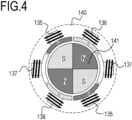
- the A motor 101 is constituted by a six-slot stator 140 and a four-pole rotor 141, and the stator 140 includes the coils 135, 136, and 137 of the U, V, and W phases which are wound around stator cores.
- the rotor 141 is constituted by a permanent magnet, and includes two sets of the north pole/the south pole.
- the coils 135, 136, and 137 of U, V, and W layers are connected to inverter outputs.
- the motor control portion 120 activates the A motor 101 in a disconnection state in which the A motor and the developing rollers (16Y, 16M, 16C, 16K) are not connected.
- the controller 31 activates the D motor. With the rotation of the D motor, the mechanical clutch 105Y is connected and the developing roller 16Y starts to rotate at a B timing.
- the mechanical clutch 105 is constituted by an input portion which receives a driving force from the drive source and an output portion which is connected to a destination to which the driving force is transmitted.
- the mechanical clutch 105 is brought into a connection state, the input portion and the output portion are connected mechanically/magnetically, and the driving force input to the input portion is transmitted to the output portion. This state is assumed to be the connection state.
- the mechanical clutches 105M, 105C, and 105K are connected, whereby the developing rollers 16M, 16C, and 16K start to rotate.
- a load torque of the A motor 101 is increased successively at the B, C, D, and E timings serving as transmission timings.
- the controller 31 causes the D motor to rotate and, at F, G, H, and I timings serving as non-transmission timings, the mechanical clutches 105Y, 105M, 105C, and 105K bring the developing rollers into the disconnection state. With this, the rotations of the developing rollers 16Y, 16M, 16C, and 16K successively stop. Finally, the rotation of the A motor 101 is stopped at a J timing.
- the rotation start timing of the A motor 101 is different from the rotation start timings of the developing rollers (16Y, 16M, 16C, 16K). Consequently, it is not possible to accurately calculate the rotation amounts of the developing rollers (16Y, 16M, 16C, 16K) from information relating to the rotation of the A motor 101.
- the information relating to the rotation amount of the A motor 101 may be the motor rotation amount of the A motor 101 itself or may also be a rotation time period.
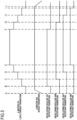
- FIG. 6 represents the current value of the A motor 101 and a rotation amount counter of the A motor 101 with the horizontal axis indicating time.
- the current value of the current flowing through the A motor 101 can be detected by the current sensor 130, and it is possible to detect torque applied to the A motor 101 and torque change with the current value of the A motor 101. That is, the change of the current value of the A motor 101 shown in FIG. 6 corresponds to load torque transition of the A motor 101 in FIG. 5 .
- the current value of the A motor 101 changes in a direction in which the current value increases at B, C, D, and E timings (first timings), and changes in a direction in which the current value decreases at F, G, H, and I timings (second timings).
- the change of the current value of the A motor 101 represents the change of the torque applied to the A motor 101.
- the B timing is a timing at which the developing roller 16Y is connected by the mechanical clutch 105Y
- the F timing is a timing at which the developing roller 16Y is disconnected by the mechanical clutch 105Y
- the C timing is a timing at which the developing roller 16M is connected by the mechanical clutch 105M
- the G timing is a timing at which the developing roller 16M is disconnected by the mechanical clutch 105M.
- the D timing is a timing at which the developing roller 16C is connected by the mechanical clutch 105C
- the H timing is a timing at which the developing roller 16C is disconnected by the mechanical clutch 105C
- the E timing is a timing at which the developing roller 16K is connected by the mechanical clutch 105K
- the I timing is a timing at which the developing roller 16K is disconnected by the mechanical clutch 105K.
- a rotation amount Cy of the developing roller 16Y is determined by subtracting a rotation amount counter value Cy_ON of the A motor 101 at the B timing from a rotation amount counter value Cy_OFF of the A motor 101 at the F timing and multiplying the value obtained by the subtraction by a ratio of the number of rotations (reduction ratio k) of the developing roller 16Y with respect to the number of rotations of the A motor 101.
- the reduction ratio k of the developing roller with respect to the motor denotes the ratio of the number of rotations.
- a rotation amount Cm of the developing roller 16M can be determined by subtracting a rotation amount counter value Cm_ON of the A motor 101 at the C timing from a rotation amount counter value Cm_OFF of the A motor 101 at the G timing and multiplying the value obtained by the subtraction by the reduction ratio k.
- the reduction ratio k at this point is the reduction ratio of the developing roller 16M with respect to the A motor 101.
- a rotation amount Cc of the developing roller 16C can be determined by subtracting a rotation amount counter value Cc_ON of the A motor 101 at the D timing from a rotation amount counter value Cc_OFF of the A motor 101 at the H timing and multiplying the value obtained by the subtraction by the reduction ratio k.
- the reduction ratio k at this point is the reduction ratio of the developing roller 16C with respect to the A motor 101.
- a rotation amount Ck of the developing roller 16K can be determined by subtracting a rotation amount counter value Ck_ON of the A motor 101 at the E timing from a rotation amount counter value Ck_OFF of the A motor 101 at the I timing and multiplying the value obtained by the subtraction by the reduction ratio k.
- the reduction ratio k at this point is the reduction ratio of the developing roller 16K with respect to the A motor 101.
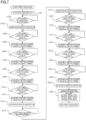
- the CPU 32 starts the rotation of the D motor 104 in S103 at a timing at which the completion of activation of the A motor 101 is determined in S102.
- the CPU 32 detects the B timing at which the developing roller 16Y starts to rotate from the change of the current value of the A motor 101 in the direction in which the current value increases.
- the B timing at which the current value of the A motor 101 increases is determined by reading detection data from the current detection portion by the CPU 32.
- the CPU 32 acquires the rotation amount counter value Cy_ON of the A motor at the B timing in S105.
- the rotor position of the A motor 101 is calculated from the current flowing through the motor, and the rotation amount counter value is counted from the calculated rotor position.
- the same effect can be achieved by disposing a sensor (FG output, Hall element) on the A motor 101, and the operation is not limited to the mode described in the present embodiment.
- the CPU 32 detects the C timing at which the developing roller 16M starts to rotate from the change of the current value of the A motor 101 in the direction in which the current value increases.
- the D timing at which the developing roller 16C starts to rotate is detected from the change of the current value of the A motor 101 in the direction in which the current value increases.
- the E timing at which the developing roller 16K starts to rotate is detected from the change of the current value of the A motor 101 in the direction in which the current value increases.
- the CPU 32 acquires the rotation amount counter value Cm_ON of the A motor at the C timing, the rotation amount counter value Cc_ON of the A motor at the D timing, and the rotation amount counter value Ck_ON of the A motor at the E timing.
- the CPU 32 stops the rotation of the D motor 104. With this, the connection state of the mechanical clutch is maintained.
- the CPU 32 starts the rotation of the D motor 104 in S114 at the timing of start of print sequence end processing in S113.
- the CPU 32 detects the F timing at which the developing roller 16Y stops rotating from the change of the current value of the A motor 101 in the direction in which the current value decreases.
- the rotation amount counter value Cy_OFF of the A motor at the F timing is acquired.
- the CPU 32 detects the G timing at which the developing roller 16M stops rotating, the timing H at which the developing roller 16C stops rotating, and the I timing at which the developing roller 16K stops rotating from the timing at which the current value of the A motor 101 changes in the direction in which the current value decreases.
- the CPU 32 acquires the rotation amount counter value Cm_OFF of the A motor at the G timing, the rotation amount counter value Cc_OFF of the A motor at the H timing, and the rotation amount counter value Ck_OFF of the A motor at the I timing.
- the CPU 32 stops the rotation of the D motor 104.
- the print sequence is ended by calculating the rotation amounts of the developing rollers (16Y, 16M, 16C, 16K) by using the following mathematical expressions.
- the CPU 32 serving as acquisition unit acquires the rotation amount of each developing roller, but the acquisition of the rotation amount is not limited thereto.
- an elapsed time period from the B timing to the F timing i.e., a time period from the timing at which the developing roller 16Y is connected by the mechanical clutch 105Y until the developing roller 16Y is disconnected may correspond to the rotation amount.
- the rotation time period of the A motor 101 between connection and disconnection of the mechanical clutch is correlated with the rotation amount of the developing roller. The same applies to the developing rollers for other colors.
- the CPU 32 can acquire information relating to the rotation amount of the developing roller based on the transmission timing at which the rotational driving force from the A motor 101 is allowed to be transmitted to the developing roller and the non-transmission timing at which the rotational driving force therefrom is prevented from being transmitted.
- the CPU 32 functions as the acquisition unit for calculating and acquiring the rotation amount of the developing roller or the information relating to the rotation amount, but the calculation and acquisition are not limited thereto. That is, as described above, the CPU 32 of the controller 31 may calculate the information relating to the rotation amount of the developing roller based on the value detected by the microcomputer 121. Alternatively, the microcomputer 121 serving as the acquisition unit may calculate and acquire the information relating to the rotation amount of the developing roller, and deliver the calculation result to the controller 31 via a serial communication line. Alternatively, arithmetic performed when the information relating to the rotation amount of the developing roller is calculated may be divided between the microcomputer 121 and the CPU 32.
- Embodiment 1 the description has been given of the example in which the rotation start timing and the rotation end timing of the developing roller are detected from the change of the current flowing through the coil of the A motor 101, and the rotation amount of the developing roller is calculated by the means for counting the rotation amount of the A motor 101.
- the rotation start timing and the rotation end timing of the developing roller are detected from the change of the current flowing through the motor.
- a description will be given of an example in which the rotation amount of the motor is calculated from the rotation time period of the developing roller and the speed of the A motor 101.
- Embodiment 1 points different from Embodiment 1 will be mainly described, and components common to Embodiment 1 are designated by the same reference numerals and the description thereof will be omitted.
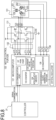
- FIG. 8 shows the configuration of the motor control portion 120.
- the motor control portion 120 is a circuit for causing the A motor 101 to rotate.
- the current detection portion is constituted by a current sensor 200, the AD converter 129, and the current value calculation portion 128.
- a current to the motor is converted to a voltage by the current sensor 200, and the voltage is input to the AD converter 129 of the microcomputer.
- the current value calculation portion 128 performs predetermined arithmetic on the AD value to calculate the current value.
- Hall elements 201, 202, and 203 for detecting the rotation of the rotor are provided on the A motor 101, and a voltage output by the Hall element is input to the microcomputer 121 after being amplified by the amplification portion 134.
- the microcomputer 121 calculates the rotor position and the speed of the A motor 101 with the Hall elements 201, 202, and 203, the amplification portion 134, and the AD converter 129 which serve as rotation speed acquisition unit.
- the microcomputer 121 controls the three-phase inverter 131 via the gate driver 132 based on rotor position information detected by the Hall elements 201, 202, and 203. Then, currents flow through the coils 135, 136, and 137 of the A motor 101, and the A motor 101 is thereby caused to rotate. With the foregoing arrangement, the microcomputer 121 can control the rotation of the A motor 101.
- the horizontal axis indicates time and the vertical axis indicates the current value of the A motor 101.
- a B timing, a C timing, a D timing, and an E timing are timings at which the developing rollers (16Y, 16M, 16C, 16K) start to rotate, and times at these timings are Tb, Tc, Td, and Te.
- an F timing, a G timing, an H timing, and an I timing are timings at which the developing rollers (16Y, 16M, 16C, 16K) stop rotating, and times at these timings are Tf, Tg, Th, and Ti.
- the rotation time periods of the developing rollers (16Y, 16M, 16C, 16K) can be determined by the following mathematical expressions.
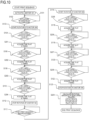
- the CPU 32 starts end processing of the print sequence in S113, and starts the rotation of the D motor 104 in S114.
- the CPU 32 acquires the times Tf, Tg, Th, and Ti at the F timing, the G timing, the H timing, and the I timing which are timings at which the developing rollers (16Y, 16M, 16C, 16K) stop rotating.
- the CPU 32 stops the rotation of the D motor 104.
- the print sequence is ended by calculating the rotation amounts of the developing rollers (16Y, 16M, 16C, 16K) by using the following mathematical expressions.
- the CPU 32 functions as the acquisition unit for calculating and acquiring the rotation amount of the developing roller, but the acquisition and calculation are not limited thereto. That is, as described above, the CPU 32 of the controller 31 may calculate the rotation amount of the developing roller based on the value detected by the microcomputer 121. Alternatively, the microcomputer 121 serving as the acquisition unit may calculate and acquire the rotation amount of the developing roller, and deliver the calculation result to the controller 31 via the serial communication line. Alternatively, arithmetic performed when the rotation amount of the developing roller is calculated may be divided between the microcomputer 121 and the CPU 32.
- the tandem-type image forming apparatus having a plurality of developing rollers is described as an example, but it will be appreciated that the present invention can be applied to a monochrome image forming apparatus having one developing roller.
- the change of the torque is detected from the change of the current of the brushless motor, and the timing at which the driving force of the brushless motor is allowed to be transmitted by the drive transmission switching unit and the timing at which the driving force thereof is prevented from being transmitted by the drive transmission switching unit are detected.
- a stepping motor or a brush motor when a configuration is adopted in which the number of rotations is detected and is fed back to the current flowing through the motor, it is possible detect the change of the torque by detecting the current. Accordingly, the present invention can also be used in the stepping motor or the brush motor.
Landscapes
- Physics & Mathematics (AREA)
- General Physics & Mathematics (AREA)
- Engineering & Computer Science (AREA)
- Microelectronics & Electronic Packaging (AREA)
- Computer Vision & Pattern Recognition (AREA)
- Dry Development In Electrophotography (AREA)
- Control Or Security For Electrophotography (AREA)
Applications Claiming Priority (1)
| Application Number | Priority Date | Filing Date | Title |
|---|---|---|---|
| JP2020095729A JP7451309B2 (ja) | 2020-06-01 | 2020-06-01 | 画像形成装置 |
Publications (2)
| Publication Number | Publication Date |
|---|---|
| EP3919984A1 EP3919984A1 (en) | 2021-12-08 |
| EP3919984B1 true EP3919984B1 (en) | 2023-05-03 |
Family
ID=76059700
Family Applications (1)
| Application Number | Title | Priority Date | Filing Date |
|---|---|---|---|
| EP21175211.8A Active EP3919984B1 (en) | 2020-06-01 | 2021-05-21 | Image forming apparatus |
Country Status (6)
| Country | Link |
|---|---|
| US (1) | US11467527B2 (enExample) |
| EP (1) | EP3919984B1 (enExample) |
| JP (1) | JP7451309B2 (enExample) |
| KR (1) | KR102744119B1 (enExample) |
| CN (1) | CN113759680B (enExample) |
| BR (1) | BR102021009531A2 (enExample) |
Families Citing this family (1)
| Publication number | Priority date | Publication date | Assignee | Title |
|---|---|---|---|---|
| US11567441B2 (en) * | 2020-11-30 | 2023-01-31 | Canon Kabushiki Kaisha | Image forming apparatus displaying abnormal state of rotary members driven by a motor based on a detected current value |
Family Cites Families (20)
| Publication number | Priority date | Publication date | Assignee | Title |
|---|---|---|---|---|
| JPH11143218A (ja) * | 1997-11-07 | 1999-05-28 | Fuji Xerox Co Ltd | 現像装置 |
| JP3476399B2 (ja) | 1999-10-12 | 2003-12-10 | 富士写真フイルム株式会社 | カートリッジの寿命検出方法及び装置及びシステム並びにカートリッジ及び記憶媒体 |
| JP4381074B2 (ja) | 2003-09-16 | 2009-12-09 | 株式会社リコー | 画像形成装置、および現像器のセットアップ方法 |
| JP4322742B2 (ja) | 2004-06-22 | 2009-09-02 | シャープ株式会社 | 現像装置 |
| JP4667106B2 (ja) | 2005-04-07 | 2011-04-06 | キヤノン株式会社 | 画像形成装置 |
| CN101192029B (zh) * | 2006-11-30 | 2010-09-08 | 株式会社理光 | 粉体量检测装置,显影装置,处理卡盒及图像形成装置 |
| US7911168B2 (en) * | 2007-02-27 | 2011-03-22 | Ricoh Company, Limited | Method and device for controlling motor, and image forming apparatus |
| JP5167656B2 (ja) | 2007-03-05 | 2013-03-21 | 富士ゼロックス株式会社 | 画像形成装置 |
| JP2009220435A (ja) | 2008-03-17 | 2009-10-01 | Riso Kagaku Corp | 印刷装置 |
| JP5298866B2 (ja) * | 2009-01-13 | 2013-09-25 | 富士ゼロックス株式会社 | 画像形成装置 |
| JP4981842B2 (ja) * | 2009-04-20 | 2012-07-25 | 株式会社沖データ | 画像形成装置 |
| JP2012128017A (ja) | 2010-12-13 | 2012-07-05 | Canon Inc | 画像形成装置 |
| US20120321354A1 (en) | 2011-06-16 | 2012-12-20 | Rapkin Alan E | Method for filling a developer station |
| KR101912687B1 (ko) * | 2012-05-21 | 2018-10-29 | 에이치피프린팅코리아 유한회사 | 화상형성장치 및 그 현상기 제어 방법 |
| JP5943772B2 (ja) | 2012-08-13 | 2016-07-05 | キヤノン株式会社 | 画像形成装置 |
| JP6079688B2 (ja) * | 2014-03-31 | 2017-02-15 | ブラザー工業株式会社 | カートリッジ |
| JP6922433B2 (ja) * | 2017-05-31 | 2021-08-18 | コニカミノルタ株式会社 | 画像形成装置およびその保守作業を支援する方法 |
| US10838333B2 (en) * | 2017-09-28 | 2020-11-17 | Brother Kogyo Kabushiki Kaisha | Image forming apparatus capable of suppressing generation of noise upon turning on image forming apparatus |
| JP2019099282A (ja) * | 2017-11-28 | 2019-06-24 | キヤノン株式会社 | シート搬送装置及び画像形成装置 |
| JP2020038313A (ja) | 2018-09-05 | 2020-03-12 | コニカミノルタ株式会社 | 画像形成装置 |
-
2020
- 2020-06-01 JP JP2020095729A patent/JP7451309B2/ja active Active
-
2021
- 2021-05-17 BR BR102021009531-8A patent/BR102021009531A2/pt unknown
- 2021-05-21 EP EP21175211.8A patent/EP3919984B1/en active Active
- 2021-05-27 CN CN202110581623.2A patent/CN113759680B/zh active Active
- 2021-06-01 US US17/335,392 patent/US11467527B2/en active Active
- 2021-06-01 KR KR1020210070574A patent/KR102744119B1/ko active Active
Also Published As
| Publication number | Publication date |
|---|---|
| BR102021009531A2 (pt) | 2021-12-07 |
| EP3919984A1 (en) | 2021-12-08 |
| US20210373478A1 (en) | 2021-12-02 |
| KR102744119B1 (ko) | 2024-12-19 |
| JP2021189342A (ja) | 2021-12-13 |
| CN113759680A (zh) | 2021-12-07 |
| KR20210148948A (ko) | 2021-12-08 |
| CN113759680B (zh) | 2024-05-24 |
| US11467527B2 (en) | 2022-10-11 |
| JP7451309B2 (ja) | 2024-03-18 |
Similar Documents
| Publication | Publication Date | Title |
|---|---|---|
| JP6429453B2 (ja) | モータ制御装置及び画像形成装置 | |
| JP2011081347A (ja) | 搬送装置、画像形成装置、被搬送媒体搬送方法、プログラム | |
| JP6977362B2 (ja) | 画像形成装置 | |
| JP2009173380A (ja) | シート搬送装置、画像形成装置、原稿読取装置、シート厚検知方法、プログラムおよびコンピュータ読取可能な記録媒体 | |
| EP3919984B1 (en) | Image forming apparatus | |
| US8639141B2 (en) | Image forming apparatus | |
| JP6922433B2 (ja) | 画像形成装置およびその保守作業を支援する方法 | |
| EP2690503B1 (en) | Image forming apparatus and communication method | |
| JP7113692B2 (ja) | 制御装置及び画像形成装置 | |
| US20200313587A1 (en) | Motor control apparatus and image forming apparatus | |
| US8615675B2 (en) | Image forming apparatus | |
| CN110196538B (zh) | 图像形成装置 | |
| US20240337980A1 (en) | Image forming apparatus | |
| JP2020181058A (ja) | モータ制御装置及び画像形成装置 | |
| JP2006058364A (ja) | 画像形成装置 | |
| CN102411282B (zh) | 图像形成装置 | |
| JP7693432B2 (ja) | 画像形成装置 | |
| US11567441B2 (en) | Image forming apparatus displaying abnormal state of rotary members driven by a motor based on a detected current value | |
| JP2010220434A (ja) | モータ制御装置 | |
| JP7475157B2 (ja) | 画像形成装置、モータを制御するモータ制御装置及びモータの制御方法 | |
| JP7764202B2 (ja) | 画像形成装置 | |
| JP7381316B2 (ja) | モータ制御装置及び画像形成装置 | |
| JP2009042543A (ja) | 画像形成装置 | |
| JP2010142015A (ja) | モータ制御装置およびそれを用いた画像形成装置 | |
| JP2017184489A (ja) | モータ駆動装置及び画像形成装置 |
Legal Events
| Date | Code | Title | Description |
|---|---|---|---|
| PUAI | Public reference made under article 153(3) epc to a published international application that has entered the european phase |
Free format text: ORIGINAL CODE: 0009012 |
|
| STAA | Information on the status of an ep patent application or granted ep patent |
Free format text: STATUS: THE APPLICATION HAS BEEN PUBLISHED |
|
| AK | Designated contracting states |
Kind code of ref document: A1 Designated state(s): AL AT BE BG CH CY CZ DE DK EE ES FI FR GB GR HR HU IE IS IT LI LT LU LV MC MK MT NL NO PL PT RO RS SE SI SK SM TR |
|
| B565 | Issuance of search results under rule 164(2) epc |
Effective date: 20211007 |
|
| STAA | Information on the status of an ep patent application or granted ep patent |
Free format text: STATUS: REQUEST FOR EXAMINATION WAS MADE |
|
| 17P | Request for examination filed |
Effective date: 20220608 |
|
| RBV | Designated contracting states (corrected) |
Designated state(s): AL AT BE BG CH CY CZ DE DK EE ES FI FR GB GR HR HU IE IS IT LI LT LU LV MC MK MT NL NO PL PT RO RS SE SI SK SM TR |
|
| INTG | Intention to grant announced |
Effective date: 20221117 |
|
| STAA | Information on the status of an ep patent application or granted ep patent |
Free format text: STATUS: GRANT OF PATENT IS INTENDED |
|
| GRAS | Grant fee paid |
Free format text: ORIGINAL CODE: EPIDOSNIGR3 |
|
| GRAA | (expected) grant |
Free format text: ORIGINAL CODE: 0009210 |
|
| STAA | Information on the status of an ep patent application or granted ep patent |
Free format text: STATUS: THE PATENT HAS BEEN GRANTED |
|
| AK | Designated contracting states |
Kind code of ref document: B1 Designated state(s): AL AT BE BG CH CY CZ DE DK EE ES FI FR GB GR HR HU IE IS IT LI LT LU LV MC MK MT NL NO PL PT RO RS SE SI SK SM TR |
|
| REG | Reference to a national code |
Ref country code: GB Ref legal event code: FG4D |
|
| REG | Reference to a national code |
Ref country code: AT Ref legal event code: REF Ref document number: 1565150 Country of ref document: AT Kind code of ref document: T Effective date: 20230515 Ref country code: CH Ref legal event code: EP |
|
| REG | Reference to a national code |
Ref country code: DE Ref legal event code: R096 Ref document number: 602021002139 Country of ref document: DE |
|
| REG | Reference to a national code |
Ref country code: IE Ref legal event code: FG4D |
|
| REG | Reference to a national code |
Ref country code: LT Ref legal event code: MG9D |
|
| REG | Reference to a national code |
Ref country code: NL Ref legal event code: MP Effective date: 20230503 |
|
| REG | Reference to a national code |
Ref country code: AT Ref legal event code: MK05 Ref document number: 1565150 Country of ref document: AT Kind code of ref document: T Effective date: 20230503 |
|
| PG25 | Lapsed in a contracting state [announced via postgrant information from national office to epo] |
Ref country code: SE Free format text: LAPSE BECAUSE OF FAILURE TO SUBMIT A TRANSLATION OF THE DESCRIPTION OR TO PAY THE FEE WITHIN THE PRESCRIBED TIME-LIMIT Effective date: 20230503 Ref country code: PT Free format text: LAPSE BECAUSE OF FAILURE TO SUBMIT A TRANSLATION OF THE DESCRIPTION OR TO PAY THE FEE WITHIN THE PRESCRIBED TIME-LIMIT Effective date: 20230904 Ref country code: NO Free format text: LAPSE BECAUSE OF FAILURE TO SUBMIT A TRANSLATION OF THE DESCRIPTION OR TO PAY THE FEE WITHIN THE PRESCRIBED TIME-LIMIT Effective date: 20230803 Ref country code: NL Free format text: LAPSE BECAUSE OF FAILURE TO SUBMIT A TRANSLATION OF THE DESCRIPTION OR TO PAY THE FEE WITHIN THE PRESCRIBED TIME-LIMIT Effective date: 20230503 Ref country code: ES Free format text: LAPSE BECAUSE OF FAILURE TO SUBMIT A TRANSLATION OF THE DESCRIPTION OR TO PAY THE FEE WITHIN THE PRESCRIBED TIME-LIMIT Effective date: 20230503 Ref country code: AT Free format text: LAPSE BECAUSE OF FAILURE TO SUBMIT A TRANSLATION OF THE DESCRIPTION OR TO PAY THE FEE WITHIN THE PRESCRIBED TIME-LIMIT Effective date: 20230503 |
|
| PG25 | Lapsed in a contracting state [announced via postgrant information from national office to epo] |
Ref country code: RS Free format text: LAPSE BECAUSE OF FAILURE TO SUBMIT A TRANSLATION OF THE DESCRIPTION OR TO PAY THE FEE WITHIN THE PRESCRIBED TIME-LIMIT Effective date: 20230503 Ref country code: PL Free format text: LAPSE BECAUSE OF FAILURE TO SUBMIT A TRANSLATION OF THE DESCRIPTION OR TO PAY THE FEE WITHIN THE PRESCRIBED TIME-LIMIT Effective date: 20230503 Ref country code: LV Free format text: LAPSE BECAUSE OF FAILURE TO SUBMIT A TRANSLATION OF THE DESCRIPTION OR TO PAY THE FEE WITHIN THE PRESCRIBED TIME-LIMIT Effective date: 20230503 Ref country code: LT Free format text: LAPSE BECAUSE OF FAILURE TO SUBMIT A TRANSLATION OF THE DESCRIPTION OR TO PAY THE FEE WITHIN THE PRESCRIBED TIME-LIMIT Effective date: 20230503 Ref country code: IS Free format text: LAPSE BECAUSE OF FAILURE TO SUBMIT A TRANSLATION OF THE DESCRIPTION OR TO PAY THE FEE WITHIN THE PRESCRIBED TIME-LIMIT Effective date: 20230903 Ref country code: HR Free format text: LAPSE BECAUSE OF FAILURE TO SUBMIT A TRANSLATION OF THE DESCRIPTION OR TO PAY THE FEE WITHIN THE PRESCRIBED TIME-LIMIT Effective date: 20230503 Ref country code: GR Free format text: LAPSE BECAUSE OF FAILURE TO SUBMIT A TRANSLATION OF THE DESCRIPTION OR TO PAY THE FEE WITHIN THE PRESCRIBED TIME-LIMIT Effective date: 20230804 |
|
| PG25 | Lapsed in a contracting state [announced via postgrant information from national office to epo] |
Ref country code: FI Free format text: LAPSE BECAUSE OF FAILURE TO SUBMIT A TRANSLATION OF THE DESCRIPTION OR TO PAY THE FEE WITHIN THE PRESCRIBED TIME-LIMIT Effective date: 20230503 |
|
| PG25 | Lapsed in a contracting state [announced via postgrant information from national office to epo] |
Ref country code: SK Free format text: LAPSE BECAUSE OF FAILURE TO SUBMIT A TRANSLATION OF THE DESCRIPTION OR TO PAY THE FEE WITHIN THE PRESCRIBED TIME-LIMIT Effective date: 20230503 |
|
| REG | Reference to a national code |
Ref country code: BE Ref legal event code: MM Effective date: 20230531 |
|
| PG25 | Lapsed in a contracting state [announced via postgrant information from national office to epo] |
Ref country code: SM Free format text: LAPSE BECAUSE OF FAILURE TO SUBMIT A TRANSLATION OF THE DESCRIPTION OR TO PAY THE FEE WITHIN THE PRESCRIBED TIME-LIMIT Effective date: 20230503 Ref country code: SK Free format text: LAPSE BECAUSE OF FAILURE TO SUBMIT A TRANSLATION OF THE DESCRIPTION OR TO PAY THE FEE WITHIN THE PRESCRIBED TIME-LIMIT Effective date: 20230503 Ref country code: RO Free format text: LAPSE BECAUSE OF FAILURE TO SUBMIT A TRANSLATION OF THE DESCRIPTION OR TO PAY THE FEE WITHIN THE PRESCRIBED TIME-LIMIT Effective date: 20230503 Ref country code: LU Free format text: LAPSE BECAUSE OF NON-PAYMENT OF DUE FEES Effective date: 20230521 Ref country code: EE Free format text: LAPSE BECAUSE OF FAILURE TO SUBMIT A TRANSLATION OF THE DESCRIPTION OR TO PAY THE FEE WITHIN THE PRESCRIBED TIME-LIMIT Effective date: 20230503 Ref country code: DK Free format text: LAPSE BECAUSE OF FAILURE TO SUBMIT A TRANSLATION OF THE DESCRIPTION OR TO PAY THE FEE WITHIN THE PRESCRIBED TIME-LIMIT Effective date: 20230503 Ref country code: CZ Free format text: LAPSE BECAUSE OF FAILURE TO SUBMIT A TRANSLATION OF THE DESCRIPTION OR TO PAY THE FEE WITHIN THE PRESCRIBED TIME-LIMIT Effective date: 20230503 |
|
| REG | Reference to a national code |
Ref country code: DE Ref legal event code: R097 Ref document number: 602021002139 Country of ref document: DE |
|
| PG25 | Lapsed in a contracting state [announced via postgrant information from national office to epo] |
Ref country code: MC Free format text: LAPSE BECAUSE OF FAILURE TO SUBMIT A TRANSLATION OF THE DESCRIPTION OR TO PAY THE FEE WITHIN THE PRESCRIBED TIME-LIMIT Effective date: 20230503 |
|
| REG | Reference to a national code |
Ref country code: IE Ref legal event code: MM4A |
|
| PG25 | Lapsed in a contracting state [announced via postgrant information from national office to epo] |
Ref country code: MC Free format text: LAPSE BECAUSE OF FAILURE TO SUBMIT A TRANSLATION OF THE DESCRIPTION OR TO PAY THE FEE WITHIN THE PRESCRIBED TIME-LIMIT Effective date: 20230503 |
|
| PLBE | No opposition filed within time limit |
Free format text: ORIGINAL CODE: 0009261 |
|
| STAA | Information on the status of an ep patent application or granted ep patent |
Free format text: STATUS: NO OPPOSITION FILED WITHIN TIME LIMIT |
|
| 26N | No opposition filed |
Effective date: 20240206 |
|
| PG25 | Lapsed in a contracting state [announced via postgrant information from national office to epo] |
Ref country code: IE Free format text: LAPSE BECAUSE OF NON-PAYMENT OF DUE FEES Effective date: 20230521 |
|
| PG25 | Lapsed in a contracting state [announced via postgrant information from national office to epo] |
Ref country code: IE Free format text: LAPSE BECAUSE OF NON-PAYMENT OF DUE FEES Effective date: 20230521 |
|
| PG25 | Lapsed in a contracting state [announced via postgrant information from national office to epo] |
Ref country code: SI Free format text: LAPSE BECAUSE OF FAILURE TO SUBMIT A TRANSLATION OF THE DESCRIPTION OR TO PAY THE FEE WITHIN THE PRESCRIBED TIME-LIMIT Effective date: 20230503 |
|
| PG25 | Lapsed in a contracting state [announced via postgrant information from national office to epo] |
Ref country code: SI Free format text: LAPSE BECAUSE OF FAILURE TO SUBMIT A TRANSLATION OF THE DESCRIPTION OR TO PAY THE FEE WITHIN THE PRESCRIBED TIME-LIMIT Effective date: 20230503 Ref country code: IT Free format text: LAPSE BECAUSE OF FAILURE TO SUBMIT A TRANSLATION OF THE DESCRIPTION OR TO PAY THE FEE WITHIN THE PRESCRIBED TIME-LIMIT Effective date: 20230503 Ref country code: FR Free format text: LAPSE BECAUSE OF NON-PAYMENT OF DUE FEES Effective date: 20230703 Ref country code: BE Free format text: LAPSE BECAUSE OF NON-PAYMENT OF DUE FEES Effective date: 20230531 |
|
| PG25 | Lapsed in a contracting state [announced via postgrant information from national office to epo] |
Ref country code: BG Free format text: LAPSE BECAUSE OF FAILURE TO SUBMIT A TRANSLATION OF THE DESCRIPTION OR TO PAY THE FEE WITHIN THE PRESCRIBED TIME-LIMIT Effective date: 20230503 |
|
| PG25 | Lapsed in a contracting state [announced via postgrant information from national office to epo] |
Ref country code: BG Free format text: LAPSE BECAUSE OF FAILURE TO SUBMIT A TRANSLATION OF THE DESCRIPTION OR TO PAY THE FEE WITHIN THE PRESCRIBED TIME-LIMIT Effective date: 20230503 |
|
| REG | Reference to a national code |
Ref country code: CH Ref legal event code: PL |
|
| PG25 | Lapsed in a contracting state [announced via postgrant information from national office to epo] |
Ref country code: CH Free format text: LAPSE BECAUSE OF NON-PAYMENT OF DUE FEES Effective date: 20240531 |
|
| PGFP | Annual fee paid to national office [announced via postgrant information from national office to epo] |
Ref country code: DE Payment date: 20250423 Year of fee payment: 5 |
|
| PGFP | Annual fee paid to national office [announced via postgrant information from national office to epo] |
Ref country code: GB Payment date: 20250423 Year of fee payment: 5 |
|
| PG25 | Lapsed in a contracting state [announced via postgrant information from national office to epo] |
Ref country code: CY Free format text: LAPSE BECAUSE OF FAILURE TO SUBMIT A TRANSLATION OF THE DESCRIPTION OR TO PAY THE FEE WITHIN THE PRESCRIBED TIME-LIMIT; INVALID AB INITIO Effective date: 20210521 |
|
| PG25 | Lapsed in a contracting state [announced via postgrant information from national office to epo] |
Ref country code: HU Free format text: LAPSE BECAUSE OF FAILURE TO SUBMIT A TRANSLATION OF THE DESCRIPTION OR TO PAY THE FEE WITHIN THE PRESCRIBED TIME-LIMIT; INVALID AB INITIO Effective date: 20210521 |
|
| PG25 | Lapsed in a contracting state [announced via postgrant information from national office to epo] |
Ref country code: TR Free format text: LAPSE BECAUSE OF FAILURE TO SUBMIT A TRANSLATION OF THE DESCRIPTION OR TO PAY THE FEE WITHIN THE PRESCRIBED TIME-LIMIT Effective date: 20230503 |