EP3888718B1 - Medizinische gummizusammensetzung, medizinische gummikomponente und vorgefüllte spritze - Google Patents
Medizinische gummizusammensetzung, medizinische gummikomponente und vorgefüllte spritze Download PDFInfo
- Publication number
- EP3888718B1 EP3888718B1 EP21162083.6A EP21162083A EP3888718B1 EP 3888718 B1 EP3888718 B1 EP 3888718B1 EP 21162083 A EP21162083 A EP 21162083A EP 3888718 B1 EP3888718 B1 EP 3888718B1
- Authority
- EP
- European Patent Office
- Prior art keywords
- rubber
- mass
- crosslinking agent
- medical
- parts
- Prior art date
- Legal status (The legal status is an assumption and is not a legal conclusion. Google has not performed a legal analysis and makes no representation as to the accuracy of the status listed.)
- Active
Links
Images

Classifications
-
- C—CHEMISTRY; METALLURGY
- C08—ORGANIC MACROMOLECULAR COMPOUNDS; THEIR PREPARATION OR CHEMICAL WORKING-UP; COMPOSITIONS BASED THEREON
- C08L—COMPOSITIONS OF MACROMOLECULAR COMPOUNDS
- C08L23/00—Compositions of homopolymers or copolymers of unsaturated aliphatic hydrocarbons having only one carbon-to-carbon double bond; Compositions of derivatives of such polymers
- C08L23/02—Compositions of homopolymers or copolymers of unsaturated aliphatic hydrocarbons having only one carbon-to-carbon double bond; Compositions of derivatives of such polymers not modified by chemical after-treatment
- C08L23/18—Homopolymers or copolymers of hydrocarbons having four or more carbon atoms
- C08L23/20—Homopolymers or copolymers of hydrocarbons having four or more carbon atoms having four to nine carbon atoms
- C08L23/22—Copolymers of isobutene; Butyl rubber; Homopolymers or copolymers of other iso-olefins
-
- C—CHEMISTRY; METALLURGY
- C08—ORGANIC MACROMOLECULAR COMPOUNDS; THEIR PREPARATION OR CHEMICAL WORKING-UP; COMPOSITIONS BASED THEREON
- C08L—COMPOSITIONS OF MACROMOLECULAR COMPOUNDS
- C08L23/00—Compositions of homopolymers or copolymers of unsaturated aliphatic hydrocarbons having only one carbon-to-carbon double bond; Compositions of derivatives of such polymers
- C08L23/26—Compositions of homopolymers or copolymers of unsaturated aliphatic hydrocarbons having only one carbon-to-carbon double bond; Compositions of derivatives of such polymers modified by chemical after-treatment
- C08L23/28—Compositions of homopolymers or copolymers of unsaturated aliphatic hydrocarbons having only one carbon-to-carbon double bond; Compositions of derivatives of such polymers modified by chemical after-treatment by reaction with halogens or halogen-containing compounds
- C08L23/283—Iso-olefin halogenated homopolymers or copolymers
-
- A—HUMAN NECESSITIES
- A61—MEDICAL OR VETERINARY SCIENCE; HYGIENE
- A61L—METHODS OR APPARATUS FOR STERILISING MATERIALS OR OBJECTS IN GENERAL; DISINFECTION, STERILISATION OR DEODORISATION OF AIR; CHEMICAL ASPECTS OF BANDAGES, DRESSINGS, ABSORBENT PADS OR SURGICAL ARTICLES; MATERIALS FOR BANDAGES, DRESSINGS, ABSORBENT PADS OR SURGICAL ARTICLES
- A61L31/00—Materials for other surgical articles, e.g. stents, stent-grafts, shunts, surgical drapes, guide wires, materials for adhesion prevention, occluding devices, surgical gloves, tissue fixation devices
- A61L31/04—Macromolecular materials
- A61L31/048—Macromolecular materials obtained by reactions only involving carbon-to-carbon unsaturated bonds
- A61L31/049—Rubbers
-
- A—HUMAN NECESSITIES
- A61—MEDICAL OR VETERINARY SCIENCE; HYGIENE
- A61L—METHODS OR APPARATUS FOR STERILISING MATERIALS OR OBJECTS IN GENERAL; DISINFECTION, STERILISATION OR DEODORISATION OF AIR; CHEMICAL ASPECTS OF BANDAGES, DRESSINGS, ABSORBENT PADS OR SURGICAL ARTICLES; MATERIALS FOR BANDAGES, DRESSINGS, ABSORBENT PADS OR SURGICAL ARTICLES
- A61L31/00—Materials for other surgical articles, e.g. stents, stent-grafts, shunts, surgical drapes, guide wires, materials for adhesion prevention, occluding devices, surgical gloves, tissue fixation devices
- A61L31/04—Macromolecular materials
- A61L31/041—Mixtures of macromolecular compounds
-
- A—HUMAN NECESSITIES
- A61—MEDICAL OR VETERINARY SCIENCE; HYGIENE
- A61M—DEVICES FOR INTRODUCING MEDIA INTO, OR ONTO, THE BODY; DEVICES FOR TRANSDUCING BODY MEDIA OR FOR TAKING MEDIA FROM THE BODY; DEVICES FOR PRODUCING OR ENDING SLEEP OR STUPOR
- A61M5/00—Devices for bringing media into the body in a subcutaneous, intra-vascular or intramuscular way; Accessories therefor, e.g. filling or cleaning devices, arm-rests
- A61M5/178—Syringes
- A61M5/31—Details
-
- C—CHEMISTRY; METALLURGY
- C08—ORGANIC MACROMOLECULAR COMPOUNDS; THEIR PREPARATION OR CHEMICAL WORKING-UP; COMPOSITIONS BASED THEREON
- C08K—Use of inorganic or non-macromolecular organic substances as compounding ingredients
- C08K5/00—Use of organic ingredients
- C08K5/04—Oxygen-containing compounds
- C08K5/10—Esters; Ether-esters
- C08K5/11—Esters; Ether-esters of acyclic polycarboxylic acids
-
- C—CHEMISTRY; METALLURGY
- C08—ORGANIC MACROMOLECULAR COMPOUNDS; THEIR PREPARATION OR CHEMICAL WORKING-UP; COMPOSITIONS BASED THEREON
- C08K—Use of inorganic or non-macromolecular organic substances as compounding ingredients
- C08K5/00—Use of organic ingredients
- C08K5/04—Oxygen-containing compounds
- C08K5/14—Peroxides
-
- C—CHEMISTRY; METALLURGY
- C08—ORGANIC MACROMOLECULAR COMPOUNDS; THEIR PREPARATION OR CHEMICAL WORKING-UP; COMPOSITIONS BASED THEREON
- C08L—COMPOSITIONS OF MACROMOLECULAR COMPOUNDS
- C08L15/00—Compositions of rubber derivatives
- C08L15/02—Rubber derivatives containing halogen
-
- C—CHEMISTRY; METALLURGY
- C08—ORGANIC MACROMOLECULAR COMPOUNDS; THEIR PREPARATION OR CHEMICAL WORKING-UP; COMPOSITIONS BASED THEREON
- C08L—COMPOSITIONS OF MACROMOLECULAR COMPOUNDS
- C08L9/00—Compositions of homopolymers or copolymers of conjugated diene hydrocarbons
-
- A—HUMAN NECESSITIES
- A61—MEDICAL OR VETERINARY SCIENCE; HYGIENE
- A61M—DEVICES FOR INTRODUCING MEDIA INTO, OR ONTO, THE BODY; DEVICES FOR TRANSDUCING BODY MEDIA OR FOR TAKING MEDIA FROM THE BODY; DEVICES FOR PRODUCING OR ENDING SLEEP OR STUPOR
- A61M5/00—Devices for bringing media into the body in a subcutaneous, intra-vascular or intramuscular way; Accessories therefor, e.g. filling or cleaning devices, arm-rests
- A61M5/178—Syringes
- A61M5/31—Details
- A61M2005/3103—Leak prevention means for distal end of syringes, i.e. syringe end for mounting a needle
-
- A—HUMAN NECESSITIES
- A61—MEDICAL OR VETERINARY SCIENCE; HYGIENE
- A61M—DEVICES FOR INTRODUCING MEDIA INTO, OR ONTO, THE BODY; DEVICES FOR TRANSDUCING BODY MEDIA OR FOR TAKING MEDIA FROM THE BODY; DEVICES FOR PRODUCING OR ENDING SLEEP OR STUPOR
- A61M5/00—Devices for bringing media into the body in a subcutaneous, intra-vascular or intramuscular way; Accessories therefor, e.g. filling or cleaning devices, arm-rests
- A61M5/178—Syringes
- A61M5/31—Details
- A61M2005/3103—Leak prevention means for distal end of syringes, i.e. syringe end for mounting a needle
- A61M2005/3104—Caps for syringes without needle
-
- A—HUMAN NECESSITIES
- A61—MEDICAL OR VETERINARY SCIENCE; HYGIENE
- A61M—DEVICES FOR INTRODUCING MEDIA INTO, OR ONTO, THE BODY; DEVICES FOR TRANSDUCING BODY MEDIA OR FOR TAKING MEDIA FROM THE BODY; DEVICES FOR PRODUCING OR ENDING SLEEP OR STUPOR
- A61M5/00—Devices for bringing media into the body in a subcutaneous, intra-vascular or intramuscular way; Accessories therefor, e.g. filling or cleaning devices, arm-rests
- A61M5/178—Syringes
- A61M5/31—Details
- A61M5/32—Needles; Details of needles pertaining to their connection with syringe or hub; Accessories for bringing the needle into, or holding the needle on, the body; Devices for protection of needles
- A61M5/3202—Devices for protection of the needle before use, e.g. caps
-
- C—CHEMISTRY; METALLURGY
- C08—ORGANIC MACROMOLECULAR COMPOUNDS; THEIR PREPARATION OR CHEMICAL WORKING-UP; COMPOSITIONS BASED THEREON
- C08L—COMPOSITIONS OF MACROMOLECULAR COMPOUNDS
- C08L2203/00—Applications
- C08L2203/02—Applications for biomedical use
-
- C—CHEMISTRY; METALLURGY
- C08—ORGANIC MACROMOLECULAR COMPOUNDS; THEIR PREPARATION OR CHEMICAL WORKING-UP; COMPOSITIONS BASED THEREON
- C08L—COMPOSITIONS OF MACROMOLECULAR COMPOUNDS
- C08L2205/00—Polymer mixtures characterised by other features
- C08L2205/03—Polymer mixtures characterised by other features containing three or more polymers in a blend
-
- C—CHEMISTRY; METALLURGY
- C08—ORGANIC MACROMOLECULAR COMPOUNDS; THEIR PREPARATION OR CHEMICAL WORKING-UP; COMPOSITIONS BASED THEREON
- C08L—COMPOSITIONS OF MACROMOLECULAR COMPOUNDS
- C08L2312/00—Crosslinking
Definitions
- the present invention relates to a medical rubber composition, a medical rubber component using the same, and a prefilled syringe, more specifically relates to a technology for improving gas permeation of a medical rubber component.
- a nozzle cap is attached to the tip on the nozzle side of the syringe barrel of the prefilled syringe.
- Examples of the prefilled syringe include a syringe with a needle where a needle is buried into the nozzle of the syringe barrel in advance; and a syringe without a needle where the nozzle cap thereof is removed and an injection needle is attached.
- Examples of the nozzle cap include a needle-shielding type having a needle penetration portion for the syringe with a needle and covering the nozzle in a state that the needle is stuck into the needle penetration portion by several millimeters; and a type of covering the nozzle of the syringe without a needle (refer to JP 2013-112703 A , JP 2001-340425 A , JP 2015-62564 A , etc.).
- the prefilled syringe is sterilized by ethylene oxide gas (EOG), steam, or gamma ray radiation in a state that the nozzle cap is attached to the nozzle of the syringe barrel before filling a pharmaceutical liquid. Then, the syringe barrel is filled with a pharmaceutical liquid in a sterile condition, and plugged with a sterilized gasket. After that, the prefilled syringe is packaged and shipped as a product.
- EOG ethylene oxide gas
- steam steam
- gamma ray radiation gamma ray radiation
- the gas such as EOG and steam is required to permeate through the rubber forming the nozzle cap, for example, in a case of the syringe with a needle, to sterilize the whole needle including the tip stuck into the needle penetration portion, the nozzle, or the like.
- the residue such as ethylene oxide used in the sterilization and ethylene glycol, ethylene chlorohydrin and the like which are secondary products of ethylene oxide, can be quickly removed by deaeration and/or aeration.
- the adsorbed moisture can be quickly removed by drying.
- JP 3193895 B discloses a rubber stopper for a pharmaceutical container, obtained by vulcanizing a halogenated butyl rubber blended with a super high molecular weight polyethylene fine powder in an amount of from 5 to 25 parts by weight relative to 100 parts by weight of the halogenated butyl rubber, without the presence of a zinc compound and using at least one kind of 2-substitute-4,6-dithiol-s-triazine derivatives or an organic peroxide.
- WO 2016/052037 discloses a nozzle cap for a prefilled syringe, wherein the nozzle cap is formed from a rubber composition containing a rubber component, the rubber component includes a diene-based rubber and a non-diene-based rubber, and a proportion of the diene-based rubber in 100 parts by mass of a total of the two rubbers is 20 parts by mass or more and 70 parts by mass or less.
- An object of the present invention is to provide a medical rubber composition having gas permeability suitable for gas sterilization while maintaining non-elution.
- the present invention provides a medical rubber composition containing (a) a butyl rubber, (b) a diene-based rubber containing polybutadiene, (c) a peroxide-based crosslinking agent, and (d) a co-crosslinking agent, wherein an amount of (b) the diene-based rubber is 15 parts by mass or more and 90 parts by mass or less in 100 parts by mass of the rubber component composed of (a) the butyl rubber and (b) the diene-based rubber, and a mass ratio ((d)/(c)) of (d) the co-crosslinking agent to (c) the peroxide-based crosslinking agent is 1.2 or more and 25 or less.
- the medical rubber composition according to the present invention is used, the medical rubber composition having excellent gas permeability for gas sterilization while maintaining non-elution characteristic, and the medical rubber component using the medical rubber composition are obtained. If the medical rubber composition according to the present invention is used, the nozzle cap having excellent gas permeability for gas sterilization while maintaining non-elution characteristic, and the prefilled syringe using the nozzle cap are obtained.
- the medical rubber composition according to the present invention contains (a) a butyl rubber, (b) a diene-based rubber containing polybutadiene, (c) a peroxide-based crosslinking agent, and (d) a co-crosslinking agent, wherein an amount of (b) the diene-based rubber is 15 parts by mass or more and 90 parts by mass or less in 100 parts by mass of the rubber component composed of (a) the butyl rubber and (b) the diene-based rubber, and a mass ratio ((d)/(c)) of (d) the co-crosslinking agent to (c) the peroxide-based crosslinking agent is 1.2 or more and 25 or less.
- the medical rubber composition according to the present invention contains, (a) the butyl rubber and (b) the diene-based rubber containing polybutadiene, as the rubber component.
- the butyl rubber for example, a copolymer obtained by polymerizing isobutylene and a small amount of isoprene is preferable.
- the butyl rubber preferably includes a halogenated butyl rubber.
- the halogenated butyl rubber include a chlorinated butyl rubber, a brominated butyl rubber, and a bromide of a copolymer of isobutylene and p-methylstyrene.
- the chlorinated butyl rubber or the brominated butyl rubber is preferable.
- the chlorinated butyl rubber or brominated butyl rubber is, for example, obtained by an addition reaction or substitution reaction between chlorine or bromine and an isoprene moiety in a butyl rubber, specifically a double bond and/or a carbon atom adjacent to a double bond of the isoprene moiety.
- the amount of halogen in the halogenated butyl rubber is preferably 0.5 mass % or more, more preferably 1 mass % or more, and even more preferably 1.5 mass % or more, and is preferably 5 mass % or less, more preferably 4 mass % or less, and even more preferably 3 mass % or less.
- chlorinated butyl rubber examples include at least one member selected from CHLOROBUTYL 1066 (stabilizer: NS, halogen content: 1.26%, Mooney viscosity: 38 ML 1+8 (125 °C), specific gravity: 0.92) available from Japan Butyl Co. Ltd. and LANXESS X_BUTYL CB1240 available from LANXESS Co. Ltd.
- brominated butyl rubber examples include at least one member selected from BROMOBUTYL 2255 (stabilizer: NS, halogen content: 2.0%, Mooney viscosity: 46 ML 1+8 (125 °C), specific gravity: 0.93) available from Japan Butyl Co. Ltd. and LANXESS X_BUTYL BBX2 available from LANXESS Co. Ltd.
- the medical rubber composition according to the present invention contains (b) the diene-based rubber containing polybutadiene, as the rubber component.
- the diene-based rubber is obtained by polymerizing a diene monomer and is a rubber having a double bond in the main chain thereof. It is noted that in the present invention, (a) the butyl rubber that is the copolymer obtained by polymerizing isobutylene and a small amount of isoprene is not treated as a diene-based rubber, although a small amount of isoprene is copolymerized.
- diene-based rubber examples include a natural rubber (NR), an isoprene rubber (IR), a polybutadiene (BR), a styrene-butadiene rubber (SBR), a chloroprene rubber (CR), and an acrylonitrile-butadiene rubber (NBR). These rubbers may be used solely, two or more of these rubbers may be used in combination.
- NR natural rubber
- IR isoprene rubber
- BR polybutadiene
- SBR styrene-butadiene rubber
- CR chloroprene rubber
- NBR acrylonitrile-butadiene rubber
- the diene-based rubber containing polybutadiene is preferably used as the diene-based rubber.
- the amount of the polybutadiene in the diene-based rubber is preferably 50 mass % or more, more preferably 70 mass % or more, and even more preferably 90 mass % or more.
- the diene-based rubber consists of the polybutadiene.
- the amount of (b) the diene-based rubber is 15 parts by mass or more, preferably 20 parts by mass or more, more preferably 40 parts by mass or more, and even more preferably 60 parts by mass or more, and is preferably 90 parts by mass or less, more preferably 85 parts by mass or less, even more preferably 80 parts by mass or less, and most preferably 75 parts by mass or less in 100 parts by mass of the rubber component composed of (a) the butyl rubber and (b) the diene-based rubber. If the amount of (b) the diene-based rubber falls within the above range, the gas permeability increases while maintaining the excellent non-elution characteristic. As a result, for example, it is possible to shorten the time of the gas sterilization process for the prefilled syringe before filling a pharmaceutical liquid.
- the medical rubber composition according to the present invention contains (c) the peroxide-based crosslinking agent.
- (c) The peroxide-based crosslinking agent is blended mainly for crosslinking (b) the diene-based rubber.
- the peroxide-based crosslinking agent used in the present invention is an organic peroxide.
- the organic peroxide decomposes by heat or light to produce radicals.
- the radical generated from the organic peroxide abstracts a hydrogen atom from (b) the diene-based rubber to generate a radical in (b) the diene-based rubber.
- the radical of (b) the diene-based rubber is considered to become a starting point of crosslinking.
- the peroxide-based crosslinking agent has an action of improving the crosslinking efficiency of (b) the diene-based rubber.
- the peroxide-based crosslinking agent has an action of softening (a) the butyl rubber during kneading.
- the rubber molecule of the butyl rubber is cut by the mechanical shearing during the kneading.
- the co-crosslinking agent which will be described later is considered to have an action of bonding to the cut butyl rubber molecule and crosslinking the cut rubber molecules.
- the peroxide-based crosslinking agent examples include a dialkyl peroxide, a peroxy ester, a peroxy ketal, and a hydroperoxide.
- dialkyl peroxide examples include di(2-t-butylperoxyisopropyl) benzene, dicumyl peroxide, 2,5-dimethyl-2,5-di(t-butylperoxy) hexane, t-butylcumyl peroxy, di-t-hexylperoxy, di-t-butylperoxy, and 2,5-dimethyl-2,5-di(t-butylperoxy) hexyne-3.
- peroxy ester examples include t-butylperoxy maleate, t-butylperoxy-3,3,5-trimethyl cyclohexanoate, t-butylperoxy laurate, t-butylperoxyisopropyl monocarbonate, t-hexylperoxy benzoate, 2,5-dimethyl-2,5-di(benzoylperoxy) hexane, t-butylperoxy acetate, and t-butylperoxy benzoate.
- Examples of the peroxy ketal include 1,1-di(t-hexylperoxy)-3,3,5-trimethylcyclohexane, 1,1-di(t-hexylperoxy) cyclohexane, 1,1-di(t-butylperoxy)-2-methylcyclohexane, 1,1-di(t-butylperoxy) cyclohexane, 2,2-di(t-butylperoxy) butane, n-butyl-4,4-di(t-butylperoxy) valerate, and 2,2-di(4,4-di(t-butylperoxy) cyclohexyl) propane.
- Examples of the hydroperoxide include p-menthane hydroperoxide, and diisopropylbenzene hydroperoxide. These organic peroxides may be used solely, or two or more of them may be used in combination.
- the amount of (c) the peroxide-based crosslinking agent in the medical rubber composition according to the present invention is preferably 0.05 part by mass or more, more preferably 0.1 part by mass or more, and even more preferably 0.15 part by mass or more, and is preferably 7 parts by mass or less, more preferably 5 parts by mass or less, and even more preferably 2 parts by mass or less, with respect to 100 parts by mass of the rubber component composed of (a) the butyl rubber and (b) the diene-based rubber. If the amount of (c) the peroxide-based crosslinking agent falls within the above range, softening of the butyl rubber component is suppressed, and non-elution is maintained.
- the medical rubber composition according to the present invention may contain a crosslinking agent other than (c) the peroxide-based crosslinking agent, as long as the crosslinking agent does not impair the inventive effect.
- a crosslinking agent other than (c) the peroxide-based crosslinking agent include sulfur, a metal oxide, a resin crosslinking agent, an organic peroxide, and a triazine derivative. They may be used solely, or two or more of them may be used in combination.
- sulfur used as the crosslinking agent examples include powder sulfur, fine powder sulfur, precipitated sulfur, colloidal sulfur, and chlorinated sulfur.
- metal oxide used as the crosslinking agent examples include magnesium oxide, calcium oxide, zinc oxide, and copper oxide.
- the resin crosslinking agent examples include alkylphenol formaldehyde resins such as an alkylphenol formaldehyde resin, a thermo-reactive phenol resin, a phenol dialcohol-based resin, a bisphenol resin, and a thermo-reactive bromomethylalkylated phenol resin.
- alkylphenol formaldehyde resins such as an alkylphenol formaldehyde resin, a thermo-reactive phenol resin, a phenol dialcohol-based resin, a bisphenol resin, and a thermo-reactive bromomethylalkylated phenol resin.
- the medical rubber composition according to the present invention contains (d) the co-crosslinking agent.
- the co-crosslinking agent is considered to act on the radical of (b) the diene-based rubber formed by the peroxide-based crosslinking agent to form a crosslink. Further, the co-crosslinking agent suppresses cleavage of (a) the butyl rubber caused by (c) the peroxide-based crosslinking agent, to form a crosslink.
- the co-crosslinking agent preferably includes a polyfunctional (meth)acrylate compound.
- the polyfunctional (meth)acrylate compound more preferably includes a difunctional or higher functional (meth)acrylate-based compound, and even more preferably includes a trifunctional or higher functional (meth)acrylate-based compound, and preferably includes an octafunctional or lower functional (meth)acrylate-based compound, more preferably includes a hexafunctional or lower functional (meth)acrylate-based compound.
- the difunctional or higher functional (meth)acrylate compound include a compound having at least two acryloyl groups and/or methacryloyl groups. It is noted that "(meth)acrylate” means "acrylate" and/or "methacrylate”.
- difunctional or higher functional (meth)acrylate-based compound examples include polyethylene glycol di(meth)acrylate, 1,4-butanediol di(meth)acrylate, 1,6-hexanediol di(meth)acrylate, 1,9-nonanediol di(meth)acrylate, trimethylolpropane tri(meth)acrylate, trimethylolethane tri(meth)acrylate, pentaerythritol tri(meth)acrylate, pentaerythritol tetra(meth)acrylate, glycerin tri(meth)acrylate, dipentaerythritol tri(meth)acrylate, dipentaerythritol tetra(meth)acrylate, dipentaerythritol penta(meth)acrylate, dipentaerythritol hexa(meth)acrylate, tripentaerythritol tetra(
- the amount of (d) the co-crosslinking agent in the medical rubber composition according to the present invention is preferably 0.1 part by mass or more, more preferably 0.4 part by mass or more, and even more preferably 0.6 part by mass or more, and is preferably 10 parts by mass or less, more preferably 5 parts by mass or less, and even more preferably 3 parts by mass or less, with respect to 100 parts by mass of the rubber component composed of (a) the butyl rubber and (b) the diene-based rubber. If the amount of (d) the co-crosslinking agent falls within the above range, softening of the butyl rubber component is suppressed, and non-elution is maintained.
- a mass ratio ((d)/(c)) of (d) the co-crosslinking agent to (c) the peroxide-based crosslinking agent is preferably 1.2 or more, more preferably 1.5 or more, and even more preferably 2 or more, and is preferably 25 or less, more preferably 20 or less, and even more preferably 10 or less. If the mass ratio ((d)/(c)) of (d) the co-crosslinking agent to (c) the peroxide-based crosslinking agent falls within the above range, softening of the butyl rubber component is suppressed, and non-elution is maintained.
- the medical rubber composition according to the present invention may contain a triazine derivative. It is considered that the triazine derivative actions as a crosslinking agent on (a) the butyl rubber and actions as a crosslinking retarder on the crosslinking system using (c) the peroxide-based crosslinking agent/(d) the co-crosslinking agent.
- the triazine derivative include a compound represented by the general formula (1).
- R is -SH, -OR 1 , -SR 2 , -NHR 3 or -NR 4 R 5
- R 1 , R 2 , R 3 , R 4 and R 5 represent an alkyl group, an alkenyl group, an aryl group, an aralkyl group, an alkylaryl group or a cycloalkyl group, and R 4 and R 5 may be identical to or different from each other.
- M 1 and M 2 are H, Na, Li, K, 1/2Mg, 1/2Ba, 1/2Ca, an aliphatic primary amine, secondary amine or tertiary amine, a quaternary ammonium salt or a phosphonium salt; and M 1 and M 2 may be identical to or different from each other.
- examples of the alkyl group include an alkyl group having 1 to 12 carbon atoms such as methyl group, ethyl group, n-propyl group, isopropyl group, n-butyl group, isobutyl group, tert-butyl group, n-pentyl group, isopentyl group, tert-pentyl group, n-hexyl group, 1,1-dimethylpropyl group, octyl group, isooctyl group, 2-ethylhexyl group, decyl group, and dodecyl group.
- alkyl group having 1 to 12 carbon atoms such as methyl group, ethyl group, n-propyl group, isopropyl group, n-butyl group, isobutyl group, tert-butyl group, n-pentyl group, isopentyl group, tert-pentyl group,
- alkenyl group examples include an alkenyl group having 1 to 12 carbon atoms such as vinyl group, allyl group, 1-propenyl group, isopropenyl group, 2-butenyl group, 1,3-butadienyl group, and 2-pentenyl group.
- aryl group examples include a monocyclic or condensed polycyclic aromatic hydrocarbon group, and specific examples thereof include an aryl group having 6 to 14 carbon atoms such as phenyl group, naphthyl group, anthryl group, phenanthryl group, and acenaphthylenyl group.
- Examples of the aralkyl group include an aralkyl group having 7 to 19 carbon atoms such as benzyl group, phenethyl group, diphenylmethyl group, 1-naphthylmethyl group, 2-naphthylmethyl group, 2,2-diphenylethyl group, 3-phenylpropyl group, 4-phenylbutyl group, 5-phenylpentyl group, 2-biphenylylmethyl group, 3-biphenylylmethyl group, and 4-biphenylylmethyl group.
- Examples of the alkylaryl group include an alkylaryl group having 7 to 19 carbon atoms such as tolyl group, xylyl group, and octylphenyl group.
- cycloalkyl group examples include a cycloalkyl group having 3 to 9 carbon atoms such as cyclopropyl group, cyclobutyl group, cyclopentyl group, cyclohexyl group, cycloheptyl group, cyclooctyl group and cyclononyl group.
- triazine derivative represented by the general formula (1) examples include 2,4,6-trimercapto-s-triazine, 2-methylamino-4,6-dimercapto-s-triazine, 2-(n-butylamino)-4,6-dimercapto-s-triazine, 2-octylamino-4,6-dimercapto-s-triazine, 2-propylamino-4,6-dimercapto-s-triazine, 2-diallylamino-4,6-dimercapto-s-triazine, 2-dimethylamino-4,6-dimercapto-s-triazine, 2-dibutylamino-4,6-dimercapto-s-triazine, 2-di(iso-butylamino)-4,6-dimercapto-s-triazine, 2-dipropylamino-4,6-dimercapto-s-triazine, 2-
- 2,4,6-trimercapto-s-triazine, 2-dialkylamino-4,6-dimercapto-s-triazine, and 2-anilino-4,6-dimercapto-s-triazine are preferable, and 2-dibutylamino-4,6-dimercapto-s-triazine is most preferable in view of easy availability.
- the triazine derivative may be used solely, or two or more of the triazine derivatives may be used in combination.
- the medical rubber composition according to the present invention preferably does not contain a vulcanization accelerator.
- the vulcanization accelerator may remain in the final rubber product, and dissolve into the pharmaceutical liquid in a syringe or vial.
- the vulcanization accelerator include a guanidine accelerator (e.g. diphenylguanidine), a thiuram accelerator (e.g. tetramethylthiuram disulfide, tetramethylthiuram monosulfide), a dithiocarbamate accelerator (e.g. zinc dimethyldithiocarbamate), a thiazole accelerator (e.g.
- 2-mercaptobenzothiazole, dibenzothiazyl disulfide), and a sulfenamide accelerator e.g. N-cyclohexyl-2-benzothiazole sulfenamide, N-t-butyl-2-benzothiazole sulfenamide.
- the medical rubber composition according to the present invention may contain a hydrotalcite.
- the hydrotalcite functions as an anti-scorching agent when crosslinking the halogenated butyl rubber, and also functions as an agent to prevent increase in compression permanent strain of the medical rubber member. Further, the hydrotalcite also functions as an acid acceptor to absorb chlorine-based gas or bromine-based gas happening when crosslinking the halogenated butyl rubber and prevent occurrence of crosslinking inhibition caused by these gases. It is noted that the above-mentioned magnesium oxide is also capable of functioning as an acid acceptor.
- hydrotalcite examples include one or at least two members selected from a Mg-AI hydrotalcite such as Mg 4.5 Al 2 (OH) 13 CO 3 ⁇ 3.5H 2 O, Mg 4.5 Al 2 (OH) 13 CO 3 , Mg 4 Al 2 (OH) 12 CO3 ⁇ 3.5H 2 O, Mg 6 Al 2 (OH) 16 CO 3 ⁇ 4H 2 O, Mg 5 Al 2 (OH) 14 CO 3 ⁇ 4H 2 O and Mg 3 Al 2 (OH) 10 CO 3 ⁇ 1.7H 2 O.
- a Mg-AI hydrotalcite such as Mg 4.5 Al 2 (OH) 13 CO 3 ⁇ 3.5H 2 O, Mg 4.5 Al 2 (OH) 13 CO 3 , Mg 4 Al 2 (OH) 12 CO3 ⁇ 3.5H 2 O, Mg 6 Al 2 (OH) 16 CO 3 ⁇ 4H 2 O, Mg 5 Al 2 (OH) 14 CO 3 ⁇ 4H 2 O and Mg 3 Al 2 (OH) 10 CO 3 ⁇ 1.7H 2 O.
- hydrotalcite examples include DHT-4A (registered trademark)-2 available from Kyowa Chemical Industry Co. Ltd.
- the hydrotalcite when used as the acid acceptor, the hydrotalcite is preferably used together with MgO.
- the amount of the hydrotalcite is preferably considered as the total amount of the acid acceptor (hydrotalcite and MgO).
- the total amount of the acid acceptor (hydrotalcite and MgO) is preferably 0.5 part by mass or more, more preferably 1 part by mass or more, and is preferably 15 parts by mass or less, more preferably 10 parts by mass or less, with respect to 100 parts by mass of the rubber component composed of (a) the butyl rubber and (b) the diene-based rubber. If the total amount of the acid acceptor (hydrotalcite and MgO) falls within the above range, rusting of a mold or the like is suppressed, and defects that the materials themselves become white spot of foreign material are reduced.
- the medical rubber composition according to the present invention may further contain (e) a filler.
- a filler examples include an inorganic filler such as clay and talc, and a resin powder of an olefin resin, styrene elastomer or ultrahigh molecular weight polyethylene (UHMWPE).
- the filler is preferable, clay or talc is more preferable.
- the filler functions as adjusting the rubber hardness of the medical rubber component, and also functions as a weight increasing material to reduce the production cost of the medical rubber component.
- Examples of the clay include calcined clay and kaolin clay.
- Specific examples of the clay include SILLITIN (registered trademark) Z available from Hoffmann Mineral Corporation, SATINTONE (registered trademark) W available from Engelhard Corporation, NN Kaolin Clay available from Tsuchiya Kaolin Industry Co. Ltd., and PoleStar 200R available from IMERYS Specialities Japan K.K.
- talc examples include Hytron A available from Takehara Kagaku Kogyo Co., Ltd., MICRO ACE (registered trademark) K-1 available from Nippon Talc Co. Ltd., and Mistron (registered trademark) Vapor available from IMERYS Specialities Japan K.K.
- the amount of (e) the filler in the medical rubber composition according to the present invention is preferably appropriately set according to the desired rubber hardness or the like of the medical rubber component.
- the amount of (e) the filler in the medical rubber composition according to the present invention is, for example, preferably 5 parts by mass or more, more preferably 10 parts by mass or more, and even more preferably 20 parts by mass or more, and is preferably 200 parts by mass or less, more preferably 150 parts by mass or less, and even more preferably 100 parts by mass or less, with respect to 100 parts by mass of the rubber component composed of (a) the butyl rubber and (b) the diene-based rubber.
- the medical rubber composition according to the present invention may further contain a coloring agent such as titanium oxide and carbon black, a lubricant such as stearic acid and low density polyethylene (LDPE), a processing aid, polyethylene glycol acting as a crosslinking activator, or the like, in an appropriate proportion.
- a coloring agent such as titanium oxide and carbon black
- a lubricant such as stearic acid and low density polyethylene (LDPE)
- LDPE low density polyethylene
- processing aid polyethylene glycol acting as a crosslinking activator, or the like
- the present invention includes a medical rubber component formed from the medical rubber composition according to the present invention.
- the medical rubber component according to the present invention include a rubber stopper or sealing component of a container for various medical preparations such as a liquid preparation, a powder preparation and a freeze-dried preparation; and a sliding or sealing component such as a rubber stopper for a vacuum blood collecting tube, and a plunger stopper or nozzle cap for a prefilled syringe.
- the medical rubber composition according to the present invention is obtained by kneading (a) the butyl rubber, (b) the diene-based rubber containing polybutadiene, (c) the peroxide-based crosslinking agent, (d) the co-crosslinking agent, and other optional materials added where necessary.
- the kneading can be performed, for example, with an open roll, a closed kneader, or the like.
- the kneaded mixture is preferably molded into a ribbon shape, a sheet shape, a pellet shape, or the like, and is more preferably molded into the sheet shape.
- the kneaded mixture in the ribbon shape, sheet shape or pellet shape is press-molded to form a medical rubber component having a desired shape.
- the crosslinking reaction of the medical rubber composition proceeds during the pressing.
- the molding temperature is, for example, preferably 130 °C or more, more preferably 140 °C or more, and is preferably 200 °C or less, more preferably 190 °C or less.
- the molding time is preferably 2 minutes or more, more preferably 3 minutes or more, and is preferably 60 minutes or less, more preferably 30 minutes or less.
- the molding pressure is preferably 0.1 MPa or more, more preferably 0.2 MPa or more, and is preferably 10 MPa or less, more preferably 8 MPa or less.
- the extra part of the molded product obtained by the press molding is cut off and removed to form a predetermined shape.
- the obtained molded product is washed, sterilized, dried and packed to produce the medical rubber component.
- a resin film may be laminated on and integrated with the medical rubber component.
- the resin film include a film of an inactive resin such as polytetrafluoroethylene (PTFE), tetrafluoroethylene-ethylene copolymer (ETFE), their modified products, and ultra-high density polyethylene (UHMWPE).
- PTFE polytetrafluoroethylene
- ETFE tetrafluoroethylene-ethylene copolymer
- UHMWPE ultra-high density polyethylene
- the resin film may be integrated with the medical rubber component formed by press molding, for example, by press molding the resin film in a state of being laminated on the sheet-shaped rubber composition.
- the rubber hardness of the medical rubber component according to the present invention is preferably 35 or more and is preferably 70 or less in Durometer type A hardness (Shore A hardness) measured in accordance with the measuring method described in "Durometer hardness, Part III, Measuring method of hardness, Vulcanized rubber and thermoplastic rubber" of Japan Industry Specification JIS K 6253-3: 2012.
- the Shore A hardness of a sliding or sealing component such as a plunger stopper or a nozzle cap for a prefilled syringe is preferably 40 or more and is preferably 70 or less. It is noted that a needle-shielding type nozzle cap for a syringe with a needle most preferably has a Durometer type A hardness of 55 or less, for more easily sticking the needle into the needle penetration portion and further surely preventing bending of the needle.
- a nozzle cap for a syringe without a needle most preferably has a Durometer type A hardness of 40 or more, for further enhancing the sealability of the nozzle cap covering the nozzle during storage of the nozzle cap, or further surely preventing loosening of the nozzle cap and falling of the nozzle cap from the nozzle.
- the rubber hardness of the medical rubber component is adjusted, for example, by varying the mixing ratio of the raw materials.
- the gas permeability (cc ⁇ cm/cm 2 ⁇ sec ⁇ cmHg) of the medical rubber component formed from the medical rubber composition according to the present invention, per a thickness of 1 mm of the sample, measured by Method B (isopiestic method) prescribed in "Gas permeability test method for plastic films and sheets" of Japan Industry Specification JIS K7126-1987, is preferably 1.5 ⁇ 10 -10 or more, more preferably 3.0 ⁇ 10 -10 or more, and even more preferably 5.0 ⁇ 10 -10 or more, and is preferably 100 ⁇ 10 -10 or less, more preferably 50 ⁇ 10 -10 or less, and even more preferably 30 ⁇ 10 -10 or less.
- the gas permeability is adjusted to the above range by varying the proportions of various materials.
- the gas permeability is preferably measured by using, for example, N 2 .
- the gas permeability falls within the above range, good gas permeability is ensured.
- EOG can quickly permeate through the nozzle cap to sterilize the nozzle or needle in a short time.
- the residue such as ethylene oxide, ethylene glycol and ethylene chlorohydrin can be quickly decreased, and the sterilization time is shortened, which improve the productivity of the prefilled syringe.
- the gas permeability is excessively great, a general gas permeates so much during normal storage excluding the sterilization that the sealing property deteriorates.
- the internal pressure generated inside the nozzle cap during the deaeration and/or aeration can be quickly released to prevent the nozzle cap from loosening and falling from the nozzle.
- the rubber component formed from the medical rubber composition according to the present invention is suitably used as a nozzle cap for a prefilled syringe.
- the present invention includes the prefilled syringe comprising the nozzle cap according to the present invention.
- the prefilled syringe according to the present invention is preferably sterilized by gas in a state that the nozzle cap is attached to the syringe.
- nozzle cap is sometimes called by a name of, for example, needle cap, needle shield, rubber cap, tip cap, plunger tip or syringe sealing stopper, depending on the attached form.
- gas sterilization examples include steam sterilization, and ethylene oxide gas (EOG) sterilization treatment.
- EOG ethylene oxide gas
- the EOG sterilization treatment is a method of sterilizing a device at an atmosphere of ethylene oxide gas.
- the concentration of the ethylene oxide gas preferably ranges from 400 mg/l to 1100 mg/l, more preferably ranges from 450 mg/l to 900 mg/l, and even more preferably ranges from 500 mg/l to 700 mg/l. If the concentration of the ethylene oxide gas is excessively high, the residual concentration of the EOG gas tends to be high after the sterilization.
- the EOG sterilization temperature preferably ranges from 35 °C to 70 °C, and the sterilization humidity (relative humidity) is preferably 40% RH or more.
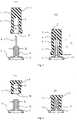
- Fig. 1(a) is a cross-sectional view showing one example of an embodiment of the nozzle cap according to the present invention and a nozzle of a syringe barrel, wherein the nozzle is covered with the nozzle cap.
- Fig. 1(b) is a cross-sectional view showing a state of covering the nozzle with the nozzle cap of Fig. 1(a) .
- the nozzle cap 1 is used for a syringe 5 with a needle in which a needle 4 is buried into the nozzle 3 of a syringe barrel 2 in advance.
- the nozzle cap 1 as a whole is integrally formed from the medical rubber composition.
- the nozzle cap 1 comprises a cylindrical portion 6 having an inner diameter D1 slightly less than an outer diameter D2 of the nozzle 3, and a needle penetration portion 7 connecting to one end side (upper end side in the figure) of the cylindrical portion 6.
- the needle penetration portion 7 is formed into a columnar shape having an outer surface continuous to the cylindrical portion 6.
- An opening 8 for inserting the nozzle 3 in the cylindrical portion 6 and covering the nozzle 3 with the nozzle cap 1, is formed on another end side (lower end side in the figure) of the cylindrical portion 6.
- a size L1 from the closed end coupled to the needle penetration portion 7 to another end on the side of the opening 8, in the axis direction of the cylindrical portion 6, and a size L2 from the another end on the side of the opening 8 to the tip of the needle 4, of the cylindrical portion 6 in a state of the nozzle cap 1 covering the nozzle 3, are set to L1 ⁇ L2, by which the tip of the needle 4 sticks in the needle penetration portion 7 by about 5 mm to secure liquid-seal, air-seal, sterility, or the like.
- Fig. 2(a) is a cross-sectional view showing another example of an embodiment of the nozzle cap according to the present invention and a nozzle of a syringe barrel, wherein the nozzle is covered with the nozzle cap.
- Fig. 2(b) is a cross-sectional view showing a state of covering the nozzle with the nozzle cap of Fig. 2(a) .
- the nozzle cap 9 is used to cover the nozzle 12 of a syringe barrel 11 of a syringe 10 without a needle.
- the nozzle cap 9 is integrally formed from the above medical rubber composition.
- the nozzle cap 9 comprises a cylindrical portion 13 having an inner diameter D3 slightly less than an outer diameter D4 of the nozzle 12.
- An end side (upper end side in the figure) of the cylindrical portion 13 is closed, and an opening 14 for inserting the nozzle 12 in the cylindrical portion 13 and covering the nozzle 12 with the nozzle cap 9, is formed on another end side (lower end side in the figure) of the cylindrical portion 13.
- the thinnest regions of the nozzle caps 1, 9, i.e. the thickness T1 of the cylindrical portion 6 in the example of Fig. 1(a), (b) and the thickness T2 of the cylindrical portion 13 in the example of Fig. 2(a) (b) are preferably set to 1.0 ⁇ 0.5 mm, respectively.
- the thicknesses T1, T2 are higher than the above range, permeation of gas or steam is suppressed, thus the EOG sterilization, the deaeration and/or aeration, the steam sterilization, or the drying process after the steam sterilization needs longer time, which may lower the productivity of the prefilled syringe.
- the internal pressure generated inside the nozzle caps 1, 9 during the deaeration and/or aeration or during the steam sterilization or the drying process thereof fails to be quickly released, thus the nozzle caps 1, 9 may become loose and easily fall from the nozzles 3, 12 by the elevated internal pressure.
- the thicknesses T1, T2 are lower than the above range, rigidity is insufficient, and poor closing may occur when covering the nozzle 3, 12 with the nozzle caps 1, 9, which may lower the productivity of the prefilled syringe.
- the nozzle caps 1, 9 are provided with good gas permeability, and in particular, EOG can quickly permeate through the nozzle caps 1, 9 to sterilize the nozzles 3, 12 or the needle 4 in a short time during the EOG sterilization, and the residue such as ethylene oxide, ethylene glycol and ethylene chlorohydrin can be quickly removed during the deaeration and/or aeration, which improve the productivity of the prefilled syringe.
- the internal pressure generated inside the nozzle caps 1, 9 during the deaeration and aeration can be quickly released to prevent the nozzle caps 1, 9 from loosening and falling from the nozzles 3, 12.
- the nozzle caps 1, 9 are provided with appropriate rigidity, and poor closing hardly occurs when covering the nozzle 3, 12 with the nozzle caps 1, 9, which improve the productivity of the prefilled syringe.
- a testing piece for measuring gas permeation coefficient was prepared from the obtained medical rubber composition, and the gas permeation coefficient was measured.
- the measurement was performed according to JIS-K 6275-1 by a differential pressure method, using GTR-30XASR available from GTR Corporation.
- the rubber composition No. 1 was adopted as a standard formulation and the N 2 permeation coefficient thereof was defined as 1, and the N 2 permeation coefficient of each rubber composition was represented by converting the N 2 permeation coefficient of each rubber composition into this index.
- Testing sample A slab with a thickness of 2 mm was prepared by press molding the above-blended rubber composition at a temperature of 180 °C for 6 minutes. The slab was punched with a punch having ⁇ 17 mm to obtain a testing sample.
- a testing syringe of Fig. 3 was produced.
- a cycloolefin polymer (COP) resin available from Daisei Chemical Industry Co. Ltd. was used, and the syringe stopper 17 was formed from a general medical rubber composition using a butyl rubber.
- the nozzle cap 19 was formed from the medical rubber composition in Table 1.
- BI (Bacillus atrophaeus ATCC cell 9372) 21 was used as the bacterium and set as shown in Fig. 3 , and the nozzle cap 19 was attached, to produce the syringe sample for the EOG sterilization test.
- STN-062 available from CROSSTEX Corporation was used, the testing syringe sample was sterilized for a predetermined time at 50 °C under an EOG atmosphere, and the number of BI bacteria was measured.
- the medical rubber component formed from the medical rubber composition according to the present invention has excellent non-elution and gas permeability.
- the medical rubber composition No. 1 failed to be sterilized in 24 hours.
- the medical rubber composition No. 2 failed to be sterilized in 10 hours.
- the medical rubber composition No. 4 had a small mass ratio ((d)/(c)) of (d) the co-crosslinking agent to (c) the peroxide-based crosslinking agent, and the rubber composition failed to be crosslinked.
- the medical rubber composition No. 5 had a great mass ratio ((d)/(c)) of (d) the co-crosslinking agent to (c) the peroxide-based crosslinking agent, and thus the sample for the EOG sterilization test failed to be formed.
Landscapes
- Health & Medical Sciences (AREA)
- Chemical & Material Sciences (AREA)
- Chemical Kinetics & Catalysis (AREA)
- Medicinal Chemistry (AREA)
- Polymers & Plastics (AREA)
- Organic Chemistry (AREA)
- Heart & Thoracic Surgery (AREA)
- Animal Behavior & Ethology (AREA)
- Veterinary Medicine (AREA)
- Public Health (AREA)
- Vascular Medicine (AREA)
- General Health & Medical Sciences (AREA)
- Life Sciences & Earth Sciences (AREA)
- Hematology (AREA)
- Engineering & Computer Science (AREA)
- Biomedical Technology (AREA)
- Anesthesiology (AREA)
- Surgery (AREA)
- Epidemiology (AREA)
- General Chemical & Material Sciences (AREA)
- Compositions Of Macromolecular Compounds (AREA)
- Medical Preparation Storing Or Oral Administration Devices (AREA)
- Infusion, Injection, And Reservoir Apparatuses (AREA)
Claims (12)
- Medizinische Kautschukzusammensetzung, welche enthält:(a) einen Butylkautschuk,(b) einen Dien-basierten Kautschuk, der Polybutadien enthält,(c) ein Peroxid-basiertes Vernetzungsmittel und(d) ein Co-Vernetzungsmittel,wobei eine Menge (b) des Dien-basierten Kautschuks 15 Massenteile oder mehr und 90 Massenteile oder weniger in 100 Massenteilen einer mit (a) dem Butylkautschuk und (b) dem Dien-basierten Kautschuk zusammengesetzten Kautschukkomponente beträgt, undein Massenverhältnis ((d)/(c)) (d) des Co-Vernetzungsmittels zu (c) dem Peroxid-basierten Vernetzungsmittel 1,2 oder mehr und 25 oder weniger beträgt.
- Medizinische Kautschukzusammensetzung nach Anspruch 1, wobei (a) der Butylkautschuk einen halogenierten Butylkautschuk umfasst.
- Medizinische Kautschukzusammensetzung nach Anspruch 2, wobei der halogenierte Butylkautschuk einen chlorierten Butylkautschuk umfasst.
- Medizinische Kautschukzusammensetzung nach einem der Ansprüche 1 bis 3, wobei die Menge an (b) dem Dien-basierten Kautschuk 20 Massenteile oder mehr und 90 Massenteile oder weniger in 100 Massenteilen der mit (a) dem Butylkautschuk und (b) dem Dien-basierten Kautschuk zusammengesetzten Kautschukkomponente beträgt.
- Medizinische Kautschukzusammensetzung nach einem der Ansprüche 1 bis 4, wobei eine Menge (c) des Peroxid-basierten Vernetzungsmittels 0,05 Massenteile oder mehr und 7 Massenteile oder weniger beträgt, bezogen auf 100 Massenteile der mit (a) dem Butylkautschuk und (b) dem Dien-basierten Kautschuk zusammengesetzten Kautschukkomponente.
- Medizinische Kautschukzusammensetzung nach einem der Ansprüche 1 bis 5, wobei eine Menge (d) des Co-Vernetzungsmittels 0,1 Massenteile oder mehr und 10 Massenteile oder weniger beträgt, bezogen auf 100 Massenteile der mit (a) dem Butylkautschuk und (b) dem Dien-basierten Kautschuk zusammengesetzten Kautschukkomponente.
- Medizinische Kautschukzusammensetzung nach einem der Ansprüche 1 bis 6, wobei (d) das Co-Vernetzungsmittel eine polyfunktionelle (Meth)acrylat-Verbindung enthält.
- Medizinisches Kautschukteil, gebildet aus einer medizinischen Kautschukzusammensetzung nach einem der Ansprüche 1 bis 7.
- Düsenkappe für vorgefüllte Spritze, gebildet aus einer medizinischen Kautschukzusammensetzung nach einem der Ansprüche 1 bis 7.
- Vorgefüllte Spritze, umfassendeine Düsenkappe nach Anspruch 9, undeine Spritze, an der die Düsenkappe befestigt ist.
- Vorgefüllte Spritze nach Anspruch 10, wobei die vorgefüllte Spritze in einem Zustand, in dem die Düsenkappe an der Spritze befestigt ist, durch Gas sterilisiert ist.
- Vorgefüllte Spritze nach Anspruch 11, wobei die vorgefüllte Spritze durch Dampf oder Ethylenoxid-Gas sterilisiert ist.
Applications Claiming Priority (1)
| Application Number | Priority Date | Filing Date | Title |
|---|---|---|---|
| JP2020063679A JP7459620B2 (ja) | 2020-03-31 | 2020-03-31 | 医療用ゴム組成物、医療用ゴム部品、および、プレフィルドシリンジ |
Publications (2)
| Publication Number | Publication Date |
|---|---|
| EP3888718A1 EP3888718A1 (de) | 2021-10-06 |
| EP3888718B1 true EP3888718B1 (de) | 2022-06-29 |
Family
ID=74871285
Family Applications (1)
| Application Number | Title | Priority Date | Filing Date |
|---|---|---|---|
| EP21162083.6A Active EP3888718B1 (de) | 2020-03-31 | 2021-03-11 | Medizinische gummizusammensetzung, medizinische gummikomponente und vorgefüllte spritze |
Country Status (4)
| Country | Link |
|---|---|
| US (1) | US11572464B2 (de) |
| EP (1) | EP3888718B1 (de) |
| JP (1) | JP7459620B2 (de) |
| CN (1) | CN113462093A (de) |
Families Citing this family (4)
| Publication number | Priority date | Publication date | Assignee | Title |
|---|---|---|---|---|
| KR20240018618A (ko) * | 2021-06-11 | 2024-02-13 | 브리스톨-마이어스 스큅 컴퍼니 | 약물 카트리지, 약물 전달 디바이스, 및 그 준비 방법 |
| JP2023093154A (ja) * | 2021-12-22 | 2023-07-04 | 住友ゴム工業株式会社 | 医療用ゴム部品の滅菌方法 |
| US20250340719A1 (en) * | 2022-07-08 | 2025-11-06 | Kawaguchi Chemical Industry Co., Ltd. | Crosslinking agent for chlorinated butyl rubber |
| JP7782412B2 (ja) * | 2022-10-21 | 2025-12-09 | 住友ゴム工業株式会社 | 医療用ゴム部品の滅菌方法 |
Family Cites Families (14)
| Publication number | Priority date | Publication date | Assignee | Title |
|---|---|---|---|---|
| JPS52133347A (en) * | 1976-04-30 | 1977-11-08 | Daikyo Gomu Seiko Kk | High molecular products |
| JPS5316203A (en) * | 1976-07-29 | 1978-02-15 | Toyo Tire & Rubber Co Ltd | Composition for sealing puncture |
| JPH0193895A (ja) | 1987-10-05 | 1989-04-12 | Matsushita Electric Works Ltd | イオン化式煙感知器 |
| JP3105407B2 (ja) * | 1994-10-17 | 2000-10-30 | 株式会社大協精工 | 医療用、医薬品用ゴム配合物及びゴム製品並びに医療用、医薬品用器具 |
| JP3193895B2 (ja) | 1996-11-07 | 2001-07-30 | 株式会社大協精工 | 医薬品容器用及び医薬品注入器用ゴム栓 |
| JP4601127B2 (ja) | 2000-06-06 | 2010-12-22 | 住友ゴム工業株式会社 | 医療用ゴム栓 |
| ATE333491T1 (de) * | 2001-01-30 | 2006-08-15 | Daikyo Seiko Ltd | Kautschukzusammensetzung oder das vernetzte produkt zur herstellung von gummipfropfen für medikamente oder medizinische behandlung |
| KR101237193B1 (ko) * | 2004-12-08 | 2013-02-25 | 란세스 인크. | 고무 물품에 유용한 과산화물 경화성 부틸 조성물 |
| CN101247838B (zh) * | 2005-08-26 | 2012-09-26 | 贝克顿迪肯森公司 | 对弹性密封制品进行消毒的方法 |
| JP5474287B2 (ja) * | 2007-09-28 | 2014-04-16 | テルモ株式会社 | 薬剤充填済医療用容器および薬剤充填済医療用容器包装体 |
| JP5676420B2 (ja) | 2011-11-25 | 2015-02-25 | 住友ゴム工業株式会社 | 熱可塑性エラストマー組成物および医療用ゴム用品 |
| JP6243682B2 (ja) | 2013-09-25 | 2017-12-06 | 住友ゴム工業株式会社 | 医療用ゴム部品 |
| EP3199189A4 (de) * | 2014-10-02 | 2018-07-11 | Sumitomo Rubber Industries, Ltd. | Düsenkappe |
| JP7080791B2 (ja) | 2018-10-15 | 2022-06-06 | ミネベアミツミ株式会社 | 遠心送風機 |
-
2020
- 2020-03-31 JP JP2020063679A patent/JP7459620B2/ja active Active
-
2021
- 2021-02-26 CN CN202110222877.5A patent/CN113462093A/zh active Pending
- 2021-03-11 EP EP21162083.6A patent/EP3888718B1/de active Active
- 2021-03-30 US US17/217,459 patent/US11572464B2/en active Active
Also Published As
| Publication number | Publication date |
|---|---|
| US20210301116A1 (en) | 2021-09-30 |
| EP3888718A1 (de) | 2021-10-06 |
| CN113462093A (zh) | 2021-10-01 |
| US11572464B2 (en) | 2023-02-07 |
| JP7459620B2 (ja) | 2024-04-02 |
| JP2021161222A (ja) | 2021-10-11 |
Similar Documents
| Publication | Publication Date | Title |
|---|---|---|
| EP3888718B1 (de) | Medizinische gummizusammensetzung, medizinische gummikomponente und vorgefüllte spritze | |
| EP3824914B1 (de) | Medizinische gummizusammensetzung und medizinische kautschukkomponente | |
| EP3199189A1 (de) | Düsenkappe | |
| EP4201434B1 (de) | Medizinische kautschukzusammensetzung, medizinisches kautschukteil und verpackungsartikel für medizinisches kautschukteil | |
| EP4115916B1 (de) | Medizinische gummizusammensetzung, medizinisches kautschukteil und vorfüllbare spritze | |
| EP4212182A2 (de) | Sterilisationsverfahren für ein medizinisches gummiteil | |
| EP4360662B1 (de) | Sterilisationsverfahren für ein medizinisches gummiteil | |
| EP4450556B1 (de) | Medizinische kautschukzusammensetzung und medizinisches kautschukprodukt | |
| EP4385527A1 (de) | Medizinisches gummiprodukt | |
| WO2025142217A1 (ja) | 医療用ゴム物品の製造方法 |
Legal Events
| Date | Code | Title | Description |
|---|---|---|---|
| PUAI | Public reference made under article 153(3) epc to a published international application that has entered the european phase |
Free format text: ORIGINAL CODE: 0009012 |
|
| STAA | Information on the status of an ep patent application or granted ep patent |
Free format text: STATUS: THE APPLICATION HAS BEEN PUBLISHED |
|
| AK | Designated contracting states |
Kind code of ref document: A1 Designated state(s): AL AT BE BG CH CY CZ DE DK EE ES FI FR GB GR HR HU IE IS IT LI LT LU LV MC MK MT NL NO PL PT RO RS SE SI SK SM TR |
|
| STAA | Information on the status of an ep patent application or granted ep patent |
Free format text: STATUS: REQUEST FOR EXAMINATION WAS MADE |
|
| 17P | Request for examination filed |
Effective date: 20211020 |
|
| RBV | Designated contracting states (corrected) |
Designated state(s): AL AT BE BG CH CY CZ DE DK EE ES FI FR GB GR HR HU IE IS IT LI LT LU LV MC MK MT NL NO PL PT RO RS SE SI SK SM TR |
|
| GRAP | Despatch of communication of intention to grant a patent |
Free format text: ORIGINAL CODE: EPIDOSNIGR1 |
|
| STAA | Information on the status of an ep patent application or granted ep patent |
Free format text: STATUS: GRANT OF PATENT IS INTENDED |
|
| INTG | Intention to grant announced |
Effective date: 20220322 |
|
| GRAS | Grant fee paid |
Free format text: ORIGINAL CODE: EPIDOSNIGR3 |
|
| GRAA | (expected) grant |
Free format text: ORIGINAL CODE: 0009210 |
|
| STAA | Information on the status of an ep patent application or granted ep patent |
Free format text: STATUS: THE PATENT HAS BEEN GRANTED |
|
| AK | Designated contracting states |
Kind code of ref document: B1 Designated state(s): AL AT BE BG CH CY CZ DE DK EE ES FI FR GB GR HR HU IE IS IT LI LT LU LV MC MK MT NL NO PL PT RO RS SE SI SK SM TR |
|
| REG | Reference to a national code |
Ref country code: CH Ref legal event code: EP |
|
| REG | Reference to a national code |
Ref country code: AT Ref legal event code: REF Ref document number: 1500855 Country of ref document: AT Kind code of ref document: T Effective date: 20220715 |
|
| REG | Reference to a national code |
Ref country code: IE Ref legal event code: FG4D |
|
| REG | Reference to a national code |
Ref country code: DE Ref legal event code: R096 Ref document number: 602021000167 Country of ref document: DE |
|
| REG | Reference to a national code |
Ref country code: LT Ref legal event code: MG9D |
|
| PG25 | Lapsed in a contracting state [announced via postgrant information from national office to epo] |
Ref country code: SE Free format text: LAPSE BECAUSE OF FAILURE TO SUBMIT A TRANSLATION OF THE DESCRIPTION OR TO PAY THE FEE WITHIN THE PRESCRIBED TIME-LIMIT Effective date: 20220629 Ref country code: NO Free format text: LAPSE BECAUSE OF FAILURE TO SUBMIT A TRANSLATION OF THE DESCRIPTION OR TO PAY THE FEE WITHIN THE PRESCRIBED TIME-LIMIT Effective date: 20220929 Ref country code: LT Free format text: LAPSE BECAUSE OF FAILURE TO SUBMIT A TRANSLATION OF THE DESCRIPTION OR TO PAY THE FEE WITHIN THE PRESCRIBED TIME-LIMIT Effective date: 20220629 Ref country code: HR Free format text: LAPSE BECAUSE OF FAILURE TO SUBMIT A TRANSLATION OF THE DESCRIPTION OR TO PAY THE FEE WITHIN THE PRESCRIBED TIME-LIMIT Effective date: 20220629 Ref country code: GR Free format text: LAPSE BECAUSE OF FAILURE TO SUBMIT A TRANSLATION OF THE DESCRIPTION OR TO PAY THE FEE WITHIN THE PRESCRIBED TIME-LIMIT Effective date: 20220930 Ref country code: FI Free format text: LAPSE BECAUSE OF FAILURE TO SUBMIT A TRANSLATION OF THE DESCRIPTION OR TO PAY THE FEE WITHIN THE PRESCRIBED TIME-LIMIT Effective date: 20220629 Ref country code: BG Free format text: LAPSE BECAUSE OF FAILURE TO SUBMIT A TRANSLATION OF THE DESCRIPTION OR TO PAY THE FEE WITHIN THE PRESCRIBED TIME-LIMIT Effective date: 20220929 |
|
| REG | Reference to a national code |
Ref country code: NL Ref legal event code: MP Effective date: 20220629 |
|
| REG | Reference to a national code |
Ref country code: AT Ref legal event code: MK05 Ref document number: 1500855 Country of ref document: AT Kind code of ref document: T Effective date: 20220629 |
|
| PG25 | Lapsed in a contracting state [announced via postgrant information from national office to epo] |
Ref country code: RS Free format text: LAPSE BECAUSE OF FAILURE TO SUBMIT A TRANSLATION OF THE DESCRIPTION OR TO PAY THE FEE WITHIN THE PRESCRIBED TIME-LIMIT Effective date: 20220629 Ref country code: LV Free format text: LAPSE BECAUSE OF FAILURE TO SUBMIT A TRANSLATION OF THE DESCRIPTION OR TO PAY THE FEE WITHIN THE PRESCRIBED TIME-LIMIT Effective date: 20220629 |
|
| PG25 | Lapsed in a contracting state [announced via postgrant information from national office to epo] |
Ref country code: NL Free format text: LAPSE BECAUSE OF FAILURE TO SUBMIT A TRANSLATION OF THE DESCRIPTION OR TO PAY THE FEE WITHIN THE PRESCRIBED TIME-LIMIT Effective date: 20220629 |
|
| PG25 | Lapsed in a contracting state [announced via postgrant information from national office to epo] |
Ref country code: SM Free format text: LAPSE BECAUSE OF FAILURE TO SUBMIT A TRANSLATION OF THE DESCRIPTION OR TO PAY THE FEE WITHIN THE PRESCRIBED TIME-LIMIT Effective date: 20220629 Ref country code: SK Free format text: LAPSE BECAUSE OF FAILURE TO SUBMIT A TRANSLATION OF THE DESCRIPTION OR TO PAY THE FEE WITHIN THE PRESCRIBED TIME-LIMIT Effective date: 20220629 Ref country code: RO Free format text: LAPSE BECAUSE OF FAILURE TO SUBMIT A TRANSLATION OF THE DESCRIPTION OR TO PAY THE FEE WITHIN THE PRESCRIBED TIME-LIMIT Effective date: 20220629 Ref country code: PT Free format text: LAPSE BECAUSE OF FAILURE TO SUBMIT A TRANSLATION OF THE DESCRIPTION OR TO PAY THE FEE WITHIN THE PRESCRIBED TIME-LIMIT Effective date: 20221031 Ref country code: ES Free format text: LAPSE BECAUSE OF FAILURE TO SUBMIT A TRANSLATION OF THE DESCRIPTION OR TO PAY THE FEE WITHIN THE PRESCRIBED TIME-LIMIT Effective date: 20220629 Ref country code: EE Free format text: LAPSE BECAUSE OF FAILURE TO SUBMIT A TRANSLATION OF THE DESCRIPTION OR TO PAY THE FEE WITHIN THE PRESCRIBED TIME-LIMIT Effective date: 20220629 Ref country code: AT Free format text: LAPSE BECAUSE OF FAILURE TO SUBMIT A TRANSLATION OF THE DESCRIPTION OR TO PAY THE FEE WITHIN THE PRESCRIBED TIME-LIMIT Effective date: 20220629 |
|
| PG25 | Lapsed in a contracting state [announced via postgrant information from national office to epo] |
Ref country code: PL Free format text: LAPSE BECAUSE OF FAILURE TO SUBMIT A TRANSLATION OF THE DESCRIPTION OR TO PAY THE FEE WITHIN THE PRESCRIBED TIME-LIMIT Effective date: 20220629 Ref country code: IS Free format text: LAPSE BECAUSE OF FAILURE TO SUBMIT A TRANSLATION OF THE DESCRIPTION OR TO PAY THE FEE WITHIN THE PRESCRIBED TIME-LIMIT Effective date: 20221029 |
|
| REG | Reference to a national code |
Ref country code: DE Ref legal event code: R097 Ref document number: 602021000167 Country of ref document: DE |
|
| PG25 | Lapsed in a contracting state [announced via postgrant information from national office to epo] |
Ref country code: AL Free format text: LAPSE BECAUSE OF FAILURE TO SUBMIT A TRANSLATION OF THE DESCRIPTION OR TO PAY THE FEE WITHIN THE PRESCRIBED TIME-LIMIT Effective date: 20220629 |
|
| PG25 | Lapsed in a contracting state [announced via postgrant information from national office to epo] |
Ref country code: DK Free format text: LAPSE BECAUSE OF FAILURE TO SUBMIT A TRANSLATION OF THE DESCRIPTION OR TO PAY THE FEE WITHIN THE PRESCRIBED TIME-LIMIT Effective date: 20220629 Ref country code: CZ Free format text: LAPSE BECAUSE OF FAILURE TO SUBMIT A TRANSLATION OF THE DESCRIPTION OR TO PAY THE FEE WITHIN THE PRESCRIBED TIME-LIMIT Effective date: 20220629 |
|
| PLBE | No opposition filed within time limit |
Free format text: ORIGINAL CODE: 0009261 |
|
| STAA | Information on the status of an ep patent application or granted ep patent |
Free format text: STATUS: NO OPPOSITION FILED WITHIN TIME LIMIT |
|
| 26N | No opposition filed |
Effective date: 20230330 |
|
| P01 | Opt-out of the competence of the unified patent court (upc) registered |
Effective date: 20230510 |
|
| PG25 | Lapsed in a contracting state [announced via postgrant information from national office to epo] |
Ref country code: SI Free format text: LAPSE BECAUSE OF FAILURE TO SUBMIT A TRANSLATION OF THE DESCRIPTION OR TO PAY THE FEE WITHIN THE PRESCRIBED TIME-LIMIT Effective date: 20220629 |
|
| PG25 | Lapsed in a contracting state [announced via postgrant information from national office to epo] |
Ref country code: MC Free format text: LAPSE BECAUSE OF FAILURE TO SUBMIT A TRANSLATION OF THE DESCRIPTION OR TO PAY THE FEE WITHIN THE PRESCRIBED TIME-LIMIT Effective date: 20220629 |
|
| REG | Reference to a national code |
Ref country code: BE Ref legal event code: MM Effective date: 20230331 |
|
| PG25 | Lapsed in a contracting state [announced via postgrant information from national office to epo] |
Ref country code: LU Free format text: LAPSE BECAUSE OF NON-PAYMENT OF DUE FEES Effective date: 20230311 |
|
| REG | Reference to a national code |
Ref country code: IE Ref legal event code: MM4A |
|
| PG25 | Lapsed in a contracting state [announced via postgrant information from national office to epo] |
Ref country code: IT Free format text: LAPSE BECAUSE OF FAILURE TO SUBMIT A TRANSLATION OF THE DESCRIPTION OR TO PAY THE FEE WITHIN THE PRESCRIBED TIME-LIMIT Effective date: 20220629 Ref country code: IE Free format text: LAPSE BECAUSE OF NON-PAYMENT OF DUE FEES Effective date: 20230311 |
|
| PG25 | Lapsed in a contracting state [announced via postgrant information from national office to epo] |
Ref country code: BE Free format text: LAPSE BECAUSE OF NON-PAYMENT OF DUE FEES Effective date: 20230331 |
|
| REG | Reference to a national code |
Ref country code: CH Ref legal event code: PL |
|
| PG25 | Lapsed in a contracting state [announced via postgrant information from national office to epo] |
Ref country code: BG Free format text: LAPSE BECAUSE OF FAILURE TO SUBMIT A TRANSLATION OF THE DESCRIPTION OR TO PAY THE FEE WITHIN THE PRESCRIBED TIME-LIMIT Effective date: 20220629 |
|
| PG25 | Lapsed in a contracting state [announced via postgrant information from national office to epo] |
Ref country code: BG Free format text: LAPSE BECAUSE OF FAILURE TO SUBMIT A TRANSLATION OF THE DESCRIPTION OR TO PAY THE FEE WITHIN THE PRESCRIBED TIME-LIMIT Effective date: 20220629 |
|
| PG25 | Lapsed in a contracting state [announced via postgrant information from national office to epo] |
Ref country code: CH Free format text: LAPSE BECAUSE OF NON-PAYMENT OF DUE FEES Effective date: 20240331 |
|
| PG25 | Lapsed in a contracting state [announced via postgrant information from national office to epo] |
Ref country code: CY Free format text: LAPSE BECAUSE OF FAILURE TO SUBMIT A TRANSLATION OF THE DESCRIPTION OR TO PAY THE FEE WITHIN THE PRESCRIBED TIME-LIMIT; INVALID AB INITIO Effective date: 20210311 |
|
| PG25 | Lapsed in a contracting state [announced via postgrant information from national office to epo] |
Ref country code: HU Free format text: LAPSE BECAUSE OF FAILURE TO SUBMIT A TRANSLATION OF THE DESCRIPTION OR TO PAY THE FEE WITHIN THE PRESCRIBED TIME-LIMIT; INVALID AB INITIO Effective date: 20210311 |
|
| GBPC | Gb: european patent ceased through non-payment of renewal fee |
Effective date: 20250311 |
|
| PG25 | Lapsed in a contracting state [announced via postgrant information from national office to epo] |
Ref country code: TR Free format text: LAPSE BECAUSE OF FAILURE TO SUBMIT A TRANSLATION OF THE DESCRIPTION OR TO PAY THE FEE WITHIN THE PRESCRIBED TIME-LIMIT Effective date: 20220629 |
|
| PG25 | Lapsed in a contracting state [announced via postgrant information from national office to epo] |
Ref country code: GB Free format text: LAPSE BECAUSE OF NON-PAYMENT OF DUE FEES Effective date: 20250311 |
|
| PGFP | Annual fee paid to national office [announced via postgrant information from national office to epo] |
Ref country code: DE Payment date: 20260128 Year of fee payment: 6 |
|
| PGFP | Annual fee paid to national office [announced via postgrant information from national office to epo] |
Ref country code: FR Payment date: 20260209 Year of fee payment: 6 |