EP3856856B1 - Uv-härtbare zusammensetzung zur verwendung beim 3d-drucken - Google Patents
Uv-härtbare zusammensetzung zur verwendung beim 3d-drucken Download PDFInfo
- Publication number
- EP3856856B1 EP3856856B1 EP19773412.2A EP19773412A EP3856856B1 EP 3856856 B1 EP3856856 B1 EP 3856856B1 EP 19773412 A EP19773412 A EP 19773412A EP 3856856 B1 EP3856856 B1 EP 3856856B1
- Authority
- EP
- European Patent Office
- Prior art keywords
- alkyl
- phenyl
- photocurable composition
- meth
- tert
- Prior art date
- Legal status (The legal status is an assumption and is not a legal conclusion. Google has not performed a legal analysis and makes no representation as to the accuracy of the status listed.)
- Active
Links
Classifications
-
- C—CHEMISTRY; METALLURGY
- C09—DYES; PAINTS; POLISHES; NATURAL RESINS; ADHESIVES; COMPOSITIONS NOT OTHERWISE PROVIDED FOR; APPLICATIONS OF MATERIALS NOT OTHERWISE PROVIDED FOR
- C09D—COATING COMPOSITIONS, e.g. PAINTS, VARNISHES OR LACQUERS; FILLING PASTES; CHEMICAL PAINT OR INK REMOVERS; INKS; CORRECTING FLUIDS; WOODSTAINS; PASTES OR SOLIDS FOR COLOURING OR PRINTING; USE OF MATERIALS THEREFOR
- C09D139/00—Coating compositions based on homopolymers or copolymers of compounds having one or more unsaturated aliphatic radicals, each having only one carbon-to-carbon double bond, and at least one being terminated by a single or double bond to nitrogen or by a heterocyclic ring containing nitrogen; Coating compositions based on derivatives of such polymers
- C09D139/04—Homopolymers or copolymers of monomers containing heterocyclic rings having nitrogen as ring member
-
- C—CHEMISTRY; METALLURGY
- C09—DYES; PAINTS; POLISHES; NATURAL RESINS; ADHESIVES; COMPOSITIONS NOT OTHERWISE PROVIDED FOR; APPLICATIONS OF MATERIALS NOT OTHERWISE PROVIDED FOR
- C09D—COATING COMPOSITIONS, e.g. PAINTS, VARNISHES OR LACQUERS; FILLING PASTES; CHEMICAL PAINT OR INK REMOVERS; INKS; CORRECTING FLUIDS; WOODSTAINS; PASTES OR SOLIDS FOR COLOURING OR PRINTING; USE OF MATERIALS THEREFOR
- C09D11/00—Inks
- C09D11/02—Printing inks
- C09D11/10—Printing inks based on artificial resins
- C09D11/101—Inks specially adapted for printing processes involving curing by wave energy or particle radiation, e.g. with UV-curing following the printing
-
- B—PERFORMING OPERATIONS; TRANSPORTING
- B29—WORKING OF PLASTICS; WORKING OF SUBSTANCES IN A PLASTIC STATE IN GENERAL
- B29C—SHAPING OR JOINING OF PLASTICS; SHAPING OF MATERIAL IN A PLASTIC STATE, NOT OTHERWISE PROVIDED FOR; AFTER-TREATMENT OF THE SHAPED PRODUCTS, e.g. REPAIRING
- B29C64/00—Additive manufacturing, i.e. manufacturing of three-dimensional [3D] objects by additive deposition, additive agglomeration or additive layering, e.g. by 3D printing, stereolithography or selective laser sintering
- B29C64/10—Processes of additive manufacturing
- B29C64/106—Processes of additive manufacturing using only liquids or viscous materials, e.g. depositing a continuous bead of viscous material
- B29C64/124—Processes of additive manufacturing using only liquids or viscous materials, e.g. depositing a continuous bead of viscous material using layers of liquid which are selectively solidified
-
- B—PERFORMING OPERATIONS; TRANSPORTING
- B33—ADDITIVE MANUFACTURING TECHNOLOGY
- B33Y—ADDITIVE MANUFACTURING, i.e. MANUFACTURING OF THREE-DIMENSIONAL [3-D] OBJECTS BY ADDITIVE DEPOSITION, ADDITIVE AGGLOMERATION OR ADDITIVE LAYERING, e.g. BY 3-D PRINTING, STEREOLITHOGRAPHY OR SELECTIVE LASER SINTERING
- B33Y10/00—Processes of additive manufacturing
-
- B—PERFORMING OPERATIONS; TRANSPORTING
- B33—ADDITIVE MANUFACTURING TECHNOLOGY
- B33Y—ADDITIVE MANUFACTURING, i.e. MANUFACTURING OF THREE-DIMENSIONAL [3-D] OBJECTS BY ADDITIVE DEPOSITION, ADDITIVE AGGLOMERATION OR ADDITIVE LAYERING, e.g. BY 3-D PRINTING, STEREOLITHOGRAPHY OR SELECTIVE LASER SINTERING
- B33Y70/00—Materials specially adapted for additive manufacturing
-
- B—PERFORMING OPERATIONS; TRANSPORTING
- B33—ADDITIVE MANUFACTURING TECHNOLOGY
- B33Y—ADDITIVE MANUFACTURING, i.e. MANUFACTURING OF THREE-DIMENSIONAL [3-D] OBJECTS BY ADDITIVE DEPOSITION, ADDITIVE AGGLOMERATION OR ADDITIVE LAYERING, e.g. BY 3-D PRINTING, STEREOLITHOGRAPHY OR SELECTIVE LASER SINTERING
- B33Y80/00—Products made by additive manufacturing
-
- C—CHEMISTRY; METALLURGY
- C09—DYES; PAINTS; POLISHES; NATURAL RESINS; ADHESIVES; COMPOSITIONS NOT OTHERWISE PROVIDED FOR; APPLICATIONS OF MATERIALS NOT OTHERWISE PROVIDED FOR
- C09D—COATING COMPOSITIONS, e.g. PAINTS, VARNISHES OR LACQUERS; FILLING PASTES; CHEMICAL PAINT OR INK REMOVERS; INKS; CORRECTING FLUIDS; WOODSTAINS; PASTES OR SOLIDS FOR COLOURING OR PRINTING; USE OF MATERIALS THEREFOR
- C09D11/00—Inks
- C09D11/02—Printing inks
- C09D11/10—Printing inks based on artificial resins
- C09D11/102—Printing inks based on artificial resins containing macromolecular compounds obtained by reactions other than those only involving unsaturated carbon-to-carbon bonds
-
- B—PERFORMING OPERATIONS; TRANSPORTING
- B29—WORKING OF PLASTICS; WORKING OF SUBSTANCES IN A PLASTIC STATE IN GENERAL
- B29K—INDEXING SCHEME ASSOCIATED WITH SUBCLASSES B29B, B29C OR B29D, RELATING TO MOULDING MATERIALS OR TO MATERIALS FOR MOULDS, REINFORCEMENTS, FILLERS OR PREFORMED PARTS, e.g. INSERTS
- B29K2039/00—Use of polymers with unsaturated aliphatic radicals and with a nitrogen or a heterocyclic ring containing nitrogen in a side chain or derivatives thereof as moulding material
-
- B—PERFORMING OPERATIONS; TRANSPORTING
- B29—WORKING OF PLASTICS; WORKING OF SUBSTANCES IN A PLASTIC STATE IN GENERAL
- B29K—INDEXING SCHEME ASSOCIATED WITH SUBCLASSES B29B, B29C OR B29D, RELATING TO MOULDING MATERIALS OR TO MATERIALS FOR MOULDS, REINFORCEMENTS, FILLERS OR PREFORMED PARTS, e.g. INSERTS
- B29K2995/00—Properties of moulding materials, reinforcements, fillers, preformed parts or moulds
- B29K2995/0037—Other properties
- B29K2995/0077—Yield strength; Tensile strength
-
- B—PERFORMING OPERATIONS; TRANSPORTING
- B29—WORKING OF PLASTICS; WORKING OF SUBSTANCES IN A PLASTIC STATE IN GENERAL
- B29K—INDEXING SCHEME ASSOCIATED WITH SUBCLASSES B29B, B29C OR B29D, RELATING TO MOULDING MATERIALS OR TO MATERIALS FOR MOULDS, REINFORCEMENTS, FILLERS OR PREFORMED PARTS, e.g. INSERTS
- B29K2995/00—Properties of moulding materials, reinforcements, fillers, preformed parts or moulds
- B29K2995/0037—Other properties
- B29K2995/0089—Impact strength or toughness
Definitions
- the present invention relates to the use of a photocurable composition in a photopolymerization 3D printing process, wherein the photocurable composition comprises (A1) a N-vinyloxazolidinone of formula wherein
- JP57109813 discloses a curing composition that is composed of N-vinyl-2-oxazolidone and a crosslinkable monomer containing acryloyl or methacryloyl groups, thus suitably being used as a coating material for metal, because of its high curing rate and high adhesion.
- EP-A-555 069 discloses that the performance characteristics of radiation curable compositions can be improved by adding solid monomers, in particular N-vinylcaprolactam.
- solid monomers in particular N-vinylcaprolactam.
- the handling of such solid monomers is disadvantageous.
- N-vinylcaprolactam may be replaced by a mixture of N-vinylcaprolactam with an N-vinylamide.
- US4639472 discloses radiation curable compositions comprising N-vinyloxazolidinone. Printing inks are mentioned as one possible application of such radiation curable compositions.
- US4738870 relates to a photopolymerizable composition
- US4929403 relates to a process for rapidly forming a multilayer flexible mold for finely detailed objects from a radiatively curable molding composition, the process comprising: (a) coating at least a portion of the surface of a three-dimensional object with a fluid molding composition, the molding composition being radiatively curable; (b) curing the coating to form an elastic, flexible layer of cured molding composition on the three-dimensional object by exposing the fluid coating composition to radiative energy; (c) repeating steps (a) and (b) successively until a self-supporting multilayer elastic coating of cured molding composition has been formed on the three-dimensional object, the multilayer coating being sufficiently strong so as to not distort perceptibly when filled with a molding material having a low to moderate density; and (d) removing the three-dimensional object.
- US4929403 relates to a process for rapidly forming a multilayer flexible mold for finely detailed objects from a radiatively curable molding composition, the process comprising: (a) coating at least a portion of the surface of a three-dimensional object with a fluid molding composition, the molding composition being radiatively curable; (b) curing the coating to form an elastic, flexible layer of cured molding composition on the three-dimensional object by exposing the fluid coating composition to radiative energy; (c) repeating steps (a) and (b) successively until a self-supporting multilayer elastic coating of cured molding composition has been formed on the three-dimensional object, the multilayer coating being sufficiently strong so as to not distort perceptibly when filled with a molding material having a low to moderate density; and (d) removing the three-dimensional object.
- the fluid molding composition may comprise (a) at least one crosslinkable oligomer; (b) at least one reactive diluent; and (c) at least one photoinitiator.
- WO2015022228 relates to the use of a radiation curable composition as printing ink for ink-jet printing, wherein the radiation curable composition comprises N-vinyloxazolidinone of formula in which R 1 to R 4 independently from each other are a hydrogen atom or an organic radical having not more than 10 carbon atoms.
- WO18146259 relates to compositions, comprising a compound of formula (I) wherein
- photocurable compositions for 3D printing, in particular in photopolymer jetting and stereolithography.
- the photocurable compositions should have a high reactivity in radiation curing and should allow a 3D printing process resulting in three-dimensional articles with improved characteristics, in particular balanced mechanical properties combining stiffness with high toughness.
- N-vinyloxazolidinone of formula ( I ) provide a strong diluting effect for high viscous oligomers resulting in a higher amount of oligomers which in fact may have a positive impact on stiffness/toughness.
- Cured three-dimensional shaped articles having balanced mechanical properties combining stiffness with high toughness can be made from the photocurable compositions used according to the present invention, in particular by stereolithography and photopolymer jetting.
- the present invention is directed to the use of a photocurable composition in a photopolymerization 3D printing process, in particular vat photopolymerisation, or photopolymer jetting, wherein the photocurable composition comprises (A1) a N-vinyloxazolidinone of formula wherein
- the photocurable composition comprises preferably (A1) a N-vinyloxazolidinone of formula wherein
- the amount of components (A1) and (A2) is especially 30 to 50 % by weight, very especially 40 to 60 % by weight based on the amount of components (A1) and (A2) and (B).
- the amount of component (B) is especially 70 to 50 % by weight, very especially 60 to 40 % by weight based on the amount of components (A1) and (A2) and (B).
- the viscosity of the photocurable compositions is generally in the range 10 to 3000 mPa ⁇ s, preferably 10 to 1500 mPa ⁇ s at 30 ° C. In case of photopolymer jetting the viscosity of the photocurable composition is adjusted to be in the range of 10 to 150 mPas at 30 ° C. In case of vat-based photopolymerization the viscosity of the photocurable composition is adjusted to be in the range of 50 to 1500 mPas at 30 ° C. Most commercial print heads require heating to reduce ink viscosity which is typically in the range of 10 to 20 mPas.
- Photocurable compositions comprising N-vinyloxazolidinone of formula ( I ) have a significantly lower viscosity than photocurable compositions, comprising instead of N-vinyloxazolidinone of formula ( I ) acryloylmorpholine (ACMO).
- N-vinyloxazolidinone of formula ( I ) provide a strong diluting effect for high viscous oligomers, offering more flexibility with respect to the development of formulations and better mechanical properties of the cured three-dimensional shaped articles, in particular balanced mechanical properties combining stiffness with high toughness.
- the present invention relates to a method for producing a three-dimensional article, comprising
- the amount of component (A1) is 5 to 70 % by weight based on the amount of components (A1), (A2) and (B).
- the amount of components (A1) and (A2) is 30 to 70 % by weight, especially 30 to 50 % by weight, very especially 40 to 60 % by weight based on the amount of components (A1) and (A2) and (B).
- the amount of component (B) is 70 to 30 % by weight, especially 70 to 50 % by weight, very especially 60 to 40 % by weight based on the amount of components (A1) (and (A2) and (B).
- the composition used according to the present invention does not include component (A2) and the amount of component (A1) is 30 to 70 % by weight, especially 30 to 50 % by weight, very especially 40 to 60 % by weight and the amount of component (B) is 70 to 30 % by weight, especially 70 to 50 % by weight, very especially 60 to 40 % by weight based on the amount of components (A1) and (B).
- the photocurable composition comprises (A1) a N-vinyloxazolidinone of formula wherein
- the viscosity of the photocurable compositions is generally in the range 10 to 3000 mPa ⁇ s, preferably 10 to 1500 mPa ⁇ s at 30 ° C. In case of photopolymer jetting the viscosity of the photocurable composition is adjusted to be in the range of 10 to 150 mPas at 30 ° C. In case of vat-based photopolymerization the viscosity of the photocurable composition is adjusted to be in the range of 50 to 1500 mPas at 30 ° C.
- the amount of component (A1) is especially 30 to 50 % by weight, very especially 40 to 60 % by weight and the amount of component (B) is especially 70 to 50 % by weight, very especially 60 to 40 % by weight based on the amount of components (A1) and (B).
- the viscosity of the photocurable compositions is generally in the range 10 to 3000 mPa ⁇ s, preferably 10 to 1500 mPa ⁇ s at 30 °C. In case of photopolymer jetting the viscosity of the photocurable composition is adjusted to be in the range of 10 to 150 mPas at 30 °C. In case of vat-based photopolymerization the viscosity of the photocurable composition is adjusted to be in the range of 50 to 1500 mPas at 30° C.
- At least two of R 1 to R 4 in formula ( I ) are a hydrogen atom.
- At least two of R 1 to R 4 in formula (I) are a hydrogen atom and any remaining R 1 to R 4 are an organic group having not more than 10 carbon atoms.
- the organic group has not more than 4 carbon atoms.
- the organic group is an alkyl, or alkoxy group.
- the organic group is a C 1 -C 4 alkyl group, or a C 1 -C 4 alkoxy group.
- the organic group is a methyl group.
- N-vinyloxazolidinone of formula ( I ) compounds may be mentioned, wherein
- NVO and NVMO are particularly preferred.
- the second diluent (B) may be a single diluent, or a mixture of two, or more diluents.
- the second diluent (B) represents a "reactive diluent", which is a component that contains at least one free radically reactive group (e.g., an ethylenically-unsaturated group) that can co-react with components (A1) and (B) (e.g., is capable of undergoing addition polymerization).
- a free radically reactive group e.g., an ethylenically-unsaturated group
- composition used according to the present invention comprises the second diluent (A2), it is contained in an amount of 5 to 65 % by weight based on the amount of components (A1), (A2) and (B).
- Examples of monofunctional vinylamide components include such as N-vinyl-pyrrolidone, vinyl-imidazole, N-vinylcaprolactame, N-(hydroxymethyl)vinylamide, N-hydroxyethyl vinylamide, N-isopropylvinylamide, N-isopropylmethvinylamide, N-tert-butylvinylamide, N,N'-methylenebisvinylamide, N-(isobutoxymethyl)vinylamide, N-(butoxymethyl)vinylamide, N-[3-(dimethylamino)propyl]methvinylamide, N,N-dimethylvinylamide, N,N-diethylvinylamide and N-methyl-N-vinylacetamide.
- Examples of monofunctional methacrylate include isobornyl methacrylate, tetrahydrofurfuryl methacrylate, ethoxylated phenyl methacrylate, cyclohexylmethacrylate, lauryl methacrylate, stearyl methacrylate, octyl methacrylate, isodecyl methacrylate, tridecyl methacrylate, caprolactone methacrylate, nonyl phenol methacrylate, cyclic trimethylolpropane formal methacrylate, methoxy polyethyleneglycol methacrylates, methoxy polypropyleneglycol methacrylates, hydroxyethyl methacrylate, hydroxypropyl methacrylate and glycidyl methacrylate.
- the photocurable composition used according to the present invention may contain a difunctional, or tetrafunctional diluent having two unsaturated carbon-carbon bonds, such as, for example, difunctional, or tetrafunctional (meth)acrylates.
- bifunctional monomer examples include 1,3-butylene glycol di(meth)acrylate, 1,4-butanediol di(meth)acrylate, diethylene glycol di(meth)acrylate, 1,6-hexanediol di(meth)acrylate, polyethylene glycol (200) di(meth)acrylate, tetraethylene glycol di(meth)acrylate, triethylene glycol di(meth)acrylate, tripropylene glycol di(meth)acrylate, polyethylene glycol (400) di(meth)acrylate, ethoxylated (3) bisphenol A di(meth)acrylate, dipropylene glycol di(meth)acrylate, alkoxylated hexanediol di(meth)acrylate, ethoxylated (4) bisphenol A di(meth)acrylate, ethoxylated (10) bisphenol A di(meth)acrylate, polyethylene glycol (600) di(meth)acrylate, tricyclode
- Polyethylene glycol (200) diacrylate, polyethylene glycol (400) diacrylate, and polyethylene glycol (600) diacrylate mentioned above are represented by the chemical formulae below.
- tetrafunctional (meth)acrylates are bistrimethylolpropane tetraacrylate, pentaerythritol tetracrylate, tetramethylolmethane tetramethacrylate, pentaerythritol tetramethacrylate, bistrimethylolpropane tetramethacrylate, ethoxylated pentaerythritol tetraacrylate, propoxylated pentaerythritol tetraacrylate, dipentaerythritol tetraacrylate, ethoxylated dipentaerythritol tetraacrylate, propoxylated dipentaerythritol tetraacrylate, aryl urethane tetraacrylates, aliphatic urethane tetraacrylates, melamine tetraacrylates, epoxy novolac tetraacrylates and polyester tetraacryl
- the photocurable composition used according to the present invention may contain monofunctional acrylamides or methacrylamides.
- Examples include acryloylmorpholine, methacryloylmorpholine, N-(hydroxymethyl)acrylamide, N-hydroxyethyl acrylamide, N-isopropylacrylamide, N-isopropylmethacrylamide, N-tert-butylacrylamide, N,N'-methylenebisacrylamide, N-(isobutoxymethyl)acrylamide, N-(butoxymethyl)acrylamide, N-[3-(dimethylamino)propyl]methacrylamide, N,N-dimethylacrylamide, N,N-diethylacrylamide, N-(hydroxymethyl)methacrylamide, N-hydroxyethyl methacrylamide, N-isopropyl meth acrylamide, N-isopropylmethmethacrylamide, N-tert-butylmethacrylamide, N,N'-methylenebismethacrylamide,
- the oligomer (B) is selected from polyester (meth)acrylates, polyether (meth)acrylates, carbonate (meth)acrylates, epoxy (meth)acrylates and urethane (meth)acrylates, including amine-modified oligomers.
- the oligomer (B) may be single oligomer, or a mixture of two, or more oligomers.
- Urethane (meth)acrylates are obtainable for example by reacting polyisocyanates with hydroxyalkyl (meth)acrylates and optionally chain extenders such as diols, polyols, diamines, polyamines, dithiols or polythiols.
- Urethane (meth)acrylates of this kind comprise as synthesis components substantially:
- Suitable components (1) are, for example, aliphatic, aromatic, and cycloaliphatic diisocyanates and polyisocyanates having an NCO functionality of at least 2, preferably 2 to 5, and more preferably more than 2 to 4.
- Polyisocyanates contemplated include polyisocyanates containing isocyanurate groups, uretdione diisocyanates, polyisocyanates containing biuret groups, polyisocyanates containing urethane groups or allophanate groups, polyisocyanates comprising oxadiazinetrione groups, uretonimine-modified polyisocyantes of linear or branched C 4 -C 20 alkylene diisocyanates, cycloaliphatic diisocyanates having a total of 6 to 20 C atoms, or aromatic diisocyanates having a total of 8 to 20 C atoms, or mixtures thereof.
- customary diisocyanates are aliphatic diisocyanates such as tetramethylene diisocyanate, hexamethylene diisocyanate (1,6-diisocyanatohexane), trimethylhexamethylene diisocyanate, octamethylene diisocyanate, decamethylene diisocyanate, dodecamethylene diisocyanate, tetradecamethylene diisocyanate, derivatives of lysine diisocyanate, tetramethylxylylene diisocyanate, trimethylhexane diisocyanate or tetramethylhexane diisocyanate, cycloaliphatic diisocyanates such as 1,4-, 1,3- or 1,2-diisocyanatocyclohexane, 4,4'- or 2,4'-di(isocyanatocyclohexyl)methane, 1-isocyanato-3,3,5-trimethyl-5-(isocyanato
- Mixtures of the stated diisocyanates may also be present.
- Contemplated as component (2) in accordance with the invention is at least one compound (2) which carries at least one isocyanate-reactive group and at least one radically polymerizable group.
- the compounds (2) preferably have precisely one isocyanate-reactive group and 1 to 5, more preferably 1 to 4, and very preferably 1 to 3 radically polymerizable groups.
- the components (2) preferably have a molar weight of below 10 000 g/mol, more preferably below 5000 g/mol, very preferably below 4000 g/mol, and more particularly below 3000 g/mol.
- Special components (b) have a molar weight of below 1000 or even below 600 g/mol.
- Isocyanate-reactive groups may be, for example, -OH, -SH, -NH 2 , and -NHR 100 , where R 100 is hydrogen or an alkyl group containing 1 to 4 carbon atoms, such as methyl, ethyl, n-propyl, iso propyl, n-butyl, iso butyl, sec -butyl or tert -butyl, for example.
- Components (2) may be, for example, monoesters of ⁇ , ⁇ -unsaturated carboxylic acids, such as acrylic acid, methacrylic acid, crotonic acid, itaconic acid, fumaric acid, maleic acid, acrylamidoglycolic acid and methacrylamidoglycolic acid, and polyols, which have preferably 2 to 20 C atoms and at least two hydroxyl groups, such as ethylene glycol, diethylene glycol, triethylene glycol, propylene 1,2-glycol, propylene 1,3-glycol, 1,1-dimethyl-1,2-ethanediol, dipropylene glycol, triethylene glycol, tetraethylene glycol, pentaethylene glycol, tripropylene glycol, 1,2-, 1,3- or 1,4-butanediol, 1,5-pentanediol, neopentyl glycol, 1,6-hexanediol, 2-methyl-1,5-pentan
- esters or amides of (meth)acrylic acid with amino alcohols such as 2-aminoethanol, 2-(methylamino)ethanol, 3-amino-1-propanol, 1-amino-2-propanol or 2-(2-aminoethoxy)ethanol, for example, 2-mercaptoethanol or polyaminoalkanes, such as ethylenediamine or diethylenetriamine, or vinylacetic acid.
- amides of ethylenically unsaturated carboxylic acids with amino alcohols are hydroxyalkyl(meth)acrylamides such as N-hydroxymethylacrylamide, N-hydroxymethylmethacrylamide, N-hydroxyethyl acrylamide, N-hydroxyethylmethacrylamide, 5-hydroxy-3-oxapentyl(meth)acrylamide, N-hydroxyalkylcrotonamides such as N-hydroxymethylcrotonamide, or N-hydroxyalkylmaleimides such as N-hydroxyethylmaleimide.
- 2-hydroxyethyl acrylate 2-hydroxyethyl methacrylate, 2- or 3-hydroxypropyl acrylate, 1,4-butanediol monoacrylate, 3-(acryloyloxy)-2-hydroxypropyl (meth)acrylate, and also the monoacrylates of polyethylene glycol with a molar mass of 106 to 238.
- Contemplated as component (3) are compounds which have at least two isocyanate-reactive groups, examples being -OH, -SH, -NH 2 or -NH R 101 , in which R 101 therein, independently of one another, may be hydrogen, methyl, ethyl, iso propyl, n -propyl, n -butyl, iso butyl, sec -butyl or ter t-butyl .
- Compounds (3) having precisely 2 isocyanate-reactive groups are preferably diols having 2 to 20 carbon atoms, examples being ethylene glycol, 1,2-propanediol, 1,3-propanediol, 1,1-dimethylethane-1,2-diol, 2-butyl-2-ethyl-1,3-propanediol, 2-ethyl-1,3-propanediol, 2-methyl-1,3-propanediol, neopentyl glycol, neopentyl glycol hydroxypivalate, 1,2-, 1,3- or 1,4-butanediol, 1,6-hexanediol, 1,10-decanediol, bis(4-hydroxycyclohexane)isopropylidene, tetramethylcyclobutanediol, 1,2-, 1,3- or 1,4-cyclohexanediol, cyclo
- cycloaliphatic diols such as, for example, bis(4-hydroxycyclohexane)isopropylidene, tetramethylcyclobutanediol, 1,2-, 1,3-, or 1,4-cyclohexanediol, 1,1-, 1,2-, 1,3-, and 1,4-cyclohexanedimethanol, cyclooctanediol or norbornanediol.
- Further compounds (3) may be compounds having at least three isocyanate-reactive groups.
- these components may have 3 to 6, preferably 3 to 5, more preferably 3 to 4, and very preferably 3 isocyanate-reactive groups.
- the molecular weight of these components is generally not more than 2000 g/mol, preferably not more than 1500 g/mol, more preferably not more than 1000 g/mol, and very preferably not more than 500 g/mol.
- the urethane (meth)acrylates preferably have a number-average molar weight M n of 500 to 20 000, in particular of 500 to 10 000 and more preferably 600 to 3000 g/mol (determined by gel permeation chromatography using tetrahydrofuran and polystyrene as standard).
- Epoxy (meth)acrylates are obtainable by reacting epoxides with (meth)acrylic acid.
- suitable epoxides include epoxidized olefins, aromatic glycidyl ethers or aliphatic glycidyl ethers, preferably those of aromatic or aliphatic glycidyl ethers.
- Aromatic glycidyl ethers are, for example, bisphenol A diglycidyl ether, bisphenol F diglycidyl ether, bisphenol B diglycidyl ether, bisphenol S diglycidyl ether, hydroquinone diglycidyl ether, alkylation products of phenol/dicyclopentadiene, e.g., 2,5-bis[(2,3-epoxypropoxy)phenyl]octahydro-4,7-methano-5H-indene ( CAS No. [13446-85-0 ]), tris[4-(2,3-epoxypropoxy)phenyl]methane isomers ( CAS No. [66072-39-7 ]), phenol-based epoxy novolaks ( CAS No. [9003-35-4 ]), and cresol-based epoxy novolaks ( CAS No. [37382-79-9 ]).
- bisphenol A diglycidyl ether bisphenol F diglycidyl ether
- aliphatic glycidyl ethers examples include 1,4-butanediol diglycidyl ether, 1,6-hexanediol diglycidyl ether, trimethylolpropane triglycidyl ether, pentaerythritol tetraglycidyl ether, 1,1,2,2-tetrakis[4-(2,3-epoxypropoxy)phenyl]ethane ( CAS No. [27043-37-4 ]), diglycidyl ether of polypropylene glycol ( ⁇ , ⁇ -bis(2,3-epoxypropoxy)poly(oxypropylene), CAS No. [16096-30-3 ]) and of hydrogenated bisphenol A (2,2-bis[4-(2,3-epoxypropoxy)cyclohexyl]propane, CAS No. [13410-58-7 ]).
- the epoxy (meth)acrylates preferably have a number-average molar weight M n of 200 to 20 000, more preferably of 200 to 10 000 g/mol, and very preferably of 250 to 3000 g/mol; the amount of (meth)acrylic groups is preferably 1 to 5, more preferably 2 to 4, per 1000 g of epoxy (meth)acrylate (determined by gel permeation chromatography using polystyrene as standard and tetrahydrofuran as eluent).
- Carbonate (meth)acrylates comprise on average preferably 1 to 5, especially 2 to 4, more preferably 2 to 3 (meth)acrylic groups, and very preferably 2 (meth)acrylic groups.
- the number-average molecular weight M n of the carbonate (meth)acrylates is preferably less than 3000 g/mol, more preferably less than 1500 g/mol, very preferably less than 800 g/mol (determined by gel permeation chromatography using polystyrene as standard, tetrahydrofuran as solvent).
- the carbonate (meth)acrylates are obtainable in a simple manner by transesterifying carbonic esters with polyhydric, preferably dihydric, alcohols (diols, hexanediol for example) and subsequently esterifying the free OH groups with (meth)acrylic acid, or else by transesterification with (meth)acrylic esters, as described for example in EP-A 92 269 . They are also obtainable by reacting phosgene, urea derivatives with polyhydric, e.g., dihydric, alcohols.
- (meth)acrylates of polycarbonate polyols such as the reaction product of one of the aforementioned diols or polyols and a carbonic ester and also a hydroxyl-containing (meth)acrylate.
- suitable carbonic esters include ethylene carbonate, 1,2- or 1,3-propylene carbonate, dimethyl carbonate, diethyl carbonate or dibutyl carbonate.
- Suitable hydroxyl-containing (meth)acrylates are 2-hydroxyethyl (meth)acrylate, 2- or 3-hydroxypropyl (meth)acrylate, 1,4-butanediol mono(meth)acrylate, neopentyl glycol mono(meth)acrylate, glyceryl mono- and di(meth)acrylate, trimethylolpropane mono- and di(meth)acrylate, and pentaerythritol mono-, di-, and tri(meth)acrylate.
- Particularly preferred carbonate (meth)acrylates are those of the formula: in which R 102 is H or CH 3 , X 2 is a C 2 -C 18 alkylene group, and n1 is an integer from 1 to 5, preferably 1 to 3.
- R 102 is preferably H and X 2 is preferably C 2 to C 10 alkylene, examples being 1,2-ethylene, 1,2-propylene, 1,3-propylene, 1,4-butylene, and 1,6-hexylene, more preferably C 4 to C 8 alkylene. With very particular preference X 2 is C 6 alkylene.
- the carbonate (meth)acrylates are preferably aliphatic carbonate (meth)acrylates.
- oligomers (B) urethane (meth)acrylates are particularly preferred.
- a urethane (meth)acrylate may refer to a single urethane (meth)acrylate or to a mixture of different urethane (meth)acrylates.
- Suitable urethane (meth)acrylates can be monofunctional, but preferably are difunctional, or of higher functionality.
- the functionality refers to the number of (meth)acrylate functional groups exhibited by the compound.
- urethane (meth)acrylates made from polyetherdiols, or polyester diols, aliphatic, aromatic, or cyclic diisocyanates and hydroxyalkyl (meth)acrylates. More preferred are urethane (meth)acrylates made from polyester diols, aromatic, or cyclic diisocyanates and hydroxyalkyl (metha)crylates.
- the diisocyanates are preferably selected from 4,4'-, 2,4'- and/or 2,2'-methylenedicyclohexyl diisocyanate (H12MDI), isophorone diisocyanates (IPDI) and tolylene 2,4- and/or 2,6-diisocyanate (TDI).
- H12MDI 4,4'-, 2,4'- and/or 2,2'-methylenedicyclohexyl diisocyanate
- IPDI isophorone diisocyanates
- TDI tolylene 2,4- and/or 2,6-diisocyanate
- the hydroxyalkyl (meth)acrylates are preferably selected from 2-hydroxyethyl acrylate, 2-hydroxyethyl methacrylate, 2- or 3-hydroxypropyl acrylate, 2- or 3-hydroxypropyl methacrylate, 4-hydroxybutyl methacrylate, and 4-hydroxybutyl acrylate.
- urethane (meth)acrylates made from lactones of formula aliphatic, aromatic, or cyclic diisocyanates and hydroxyalkyl (meth)acrylates. More preferred are urethane (meth)acrylates made from caprolactone, aliphatic, or cyclic diisocyanates and hydroxyalkyl (meth)acrylates.
- the diisocyanates are preferably selected from di(isocyanatocyclohexyl)methane, 2,2,4- and 2,4,4-trimethylhexane diisocyanate, and especially 4,4'-, 2,4'- and/or 2,2'-methylenedicyclohexyl diisocyanate (H12MDI).
- the hydroxyalkyl (meth)acrylates are preferably selected from 2-hydroxyethyl acrylate, 2-hydroxyethyl methacrylate, 2- or 3-hydroxypropyl acrylate, 2- or 3-hydroxypropyl methacrylate, 4-hydroxybutyl methacrylate, and 4-hydroxybutyl acrylate.
- polyester urethane (meth)acrylate (B) is obtained by reacting
- the hydroxyalkylacrylate, or hydroxyalkylmethacrylate (B1) is preferably a compound of formula wherein R 103 is a hydrogen atom, or a methyl group, and n is 2 to 6, especially 2 to 4.
- Examples of (B1) include 2-hydroxyethyl acrylate, 2-hydroxyethyl methacrylate, 2- or 3-hydroxypropyl acrylate, 2- or 3-hydroxypropyl methacrylate, 4-hydroxybutyl methacrylate and 4-hydroxybutyl acrylate.
- 2-Hydroxyethyl acrylate is most preferred.
- the organic diisocyanate (B2) used for making the polyester urethane acrylate is either an aliphatic, a cycloaliphatic, or an aromatic diisocyanate.
- customary aliphatic and cycloaliphatic diisocyanates are tri-, tetra-, penta-, hexa-, hepta- and/or octamethylene diisocyanate, 2-methylpentamethylene 1,5-diisocyanate, 2-ethyltetramethylene 1,4-diisocyanate, hexamethylene 1,6-diisocyanate (HDI), pentamethylene 1,5-diisocyanate, butylene 1,4-diisocyanate, trimethylhexamethylene 1,6-diisocyanate, 1-isocyanato-3,3,5-trimethyl-5-isocyanatomethylcyclohexane (isophorone diisocyanate, IPDI), 1,4- and/or 1,3-bis(isocyanatomethyl)cyclohexane (HXDI), 1,4-cyclohexane diisocyanate, 1-methyl-2,4- and/or 1-methyl-2
- Preferred aliphatic and cycloaliphatic polyisocyanates are hexamethylene 1,6-diisocyanate (HDI), 1-isocyanato-3,3,5-trimethyl-5-isocyanatomethylcyclohexane (isophorone diisocyanate, IPDI) and 4,4'-, 2,4'- and/or 2,2'-methylenedicyclohexyl diisocyanate (H12MDI); particular preference is given to H12MDI and IPDI or mixtures thereof.
- HDI hexamethylene 1,6-diisocyanate
- IPDI isophorone diisocyanate
- H12MDI 4,4'-, 2,4'- and/or 2,2'-methylenedicyclohexyl diisocyanate
- Suitable aromatic diisocyanates include naphthylene 1.5- diisocyanate (NDI), tolylene 2,4- and/or 2,6-diisocyanate (TDI), diphenylmethane 2,2'-, 2,4'- and/or 4,4'-diisocyanate (MDI), 3,3'-dimethyl-4,4'-diisocyanato-diphenyl (TODI), p-phenylene diisocyanate (PDI), diphenylethan-4,4'-diisoyanate (EDI), diphenylmethandiisocyanate, 3,3'-dimethyldiphenyl-diisocyanate, 1,2-diphenylethandiisocyanate and/or phenylene diisocyanat.
- NDI naphthylene 1.5- diisocyanate
- TDI tolylene 2,4- and/or 2,6-diisocyanate
- MDI diphenylmethane 2,2
- the at present most preferred diisocyanates are 4,4'-, 2,4'- and/or 2,2'-methylenedicyclohexyl diisocyanate (H12MDI), isophorone diisocyanates (IPDI), or tolylene 2,4- and/or 2,6-diisocyanate (TDI).
- H12MDI 4,4'-, 2,4'- and/or 2,2'-methylenedicyclohexyl diisocyanate
- IPDI isophorone diisocyanates
- TDI tolylene 2,4- and/or 2,6-diisocyanate
- Polyester polyols (B3) derived from dicarboxylic acid and diols are preferred and, for example, described in US20160122465 .
- the dicarboxylic acids used for making the polyester polyol include aliphatic, or cycloaliphatic dicarboxylic acids, or combinations thereof. Among them, aliphatic dicarboxylic acids are preferred. Suitable aliphatic dicarboxylic acids which can be used alone or in mixture typically contain from 4 to 12 carbon atoms and include: succinic acid, glutaric acid, adipic acid, pimelic acid, suberic acid, and the like. Adipic acid is preferred.
- the diols used for making the polyester polyol include aliphatic, or cycloaliphatic diols, or combinations thereof, preferably aliphatic diols containing 2 to 8 carbon atoms and more preferably 2 to 6 carbon atoms.
- aliphatic diols that can be used include ethylene glycol, 1,3-propanediol, 1,4-butanediol, 1,5-pentanediol, 1,6-hexanediol and the like.
- the polyester polyol is derived from adipic acid and ethylene glycol and 1,4-butanediol (poly(ethylene 1,4-butylene adipate) diol, PEBA).
- PEBA poly(ethylene 1,4-butylene adipate) diol
- the molar ratio of ethylene glycol to 1,4-butanediol is from 0.05:1 to 10:1, preferably from 0.2:1 to 5:1, more preferably 0.5:1 to 1.5:1, most preferred from 0.75: 1 to 1.25: 1.
- the linear polyester polyol will typically have a number average molecular weight within the range of 4 ⁇ 10 2 to 7.0 ⁇ 10 3 , preferably 8 ⁇ 10 2 to 6.0 ⁇ 10 3 , more preferably 1 ⁇ 10 3 to 5.0 ⁇ 10 3 .
- the linear polyol is polyester polyol derived from one kind of aliphatic dicarboxylic acid and two kinds of aliphatic diols and has a number average molecular weight of from 2.0 ⁇ 10 3 to 4.0 ⁇ 10 3 .
- the linear polyol is polyester polyol derived from one kind of aliphatic dicarboxylic acid and one kind of aliphatic diol and has a number average molecular weight of from 1.5 ⁇ 10 3 to 4.0 ⁇ 10 3 , and more preferably from 1.8 ⁇ 10 3 to 3.5 ⁇ 10 3 . All molecular weights specified in this text have the unit of [g/mol] and refer, unless indicated otherwise, to the number average molecular weight (Mn).
- polyester urethane acrylates, or methacrylates (A) have viscosities in the range of 2000 to 20000 mPas at 60° C.
- a secondary polyol such as, for example, glycerol, may be used, to finetune the mechanical properties of the inventive urethane (meth)acrylates by introducing linear or branched structural elements.
- the polyester urethane (meth)acrylate (B) is obtained by reacting a hydroxyalkyl(meth)acrylate of formula with a lactone of formula and at least one cycloaliphatic or asymmetric aliphatic diisocyanate, wherein R 111 is a divalent alkylene radical having 2 to 12 carbon atoms and which may optionally be substituted by C 1 -C 4 alkyl groups and/or interrupted by one or more oxygen atoms, R 112 in each case independently of any other is methyl or hydrogen, R 113 is a divalent alkylene radical having 1 to 12 carbon atoms and which may optionally be substituted by C 1 to C 4 alkyl groups and/or interrupted by one or more oxygen atoms.
- R 111 is a divalent alkylene radical having 2 to 12 carbon atoms and which may optionally be substituted by C 1 -C 4 alkyl groups and/or interrupted by one or more oxygen atoms
- R 112 in each case independently of any other is
- R 111 is preferably selected from the group consisting of 1,2-ethylene, 1,2- or 1,3-propylene, 1,2-, 1,3-, or 1,4-butylene, 1,1-dimethyl-1,2-ethylene, 1,2-dimethyl-1,2-ethylene, 1,5-pentylene, 1,6-hexylene, 1,8-octylene, 1,10-decylene, and 1,12-dodecylene.
- R 113 is preferably selected from the group consisting of methylene, 1,2-ethylene, 1,2-propylene, 1,3-propylene, 1,2-butylene, 1,3-butylene, 1,4-butylene, 1,5-pentylene, 1,5-hexylene, 1,6-hexylene, 1,8-octylene, 1,10-decylene, 1,12-dodecylene, 2-oxa-1,4-butylene, 3-oxa-1,5-pentylene, and 3-oxa-1,5-hexylene.
- the hydroxyalkyl(meth)acrylate of formula (A) is preferably selected from the group consisting of 2-hydroxyethyl(meth)acrylate, 2- or 3-hydroxypropyl(meth)acrylate, 1,4-butanediol mono(meth)acrylate, neopentyl glycol mono(meth)acrylate, 1,5-pentanediol mono(meth)acrylate, and 1,6-hexanediol mono(meth)acrylate.
- the lactone of formula is preferably selected from the group consisting of ⁇ -propiolactone, ⁇ -butyrolactone, ⁇ -ethyl-gamma-butyrolactone, ⁇ -valerolactone, delta-valerolactone, ⁇ -caprolactone, 7-methyloxepan-2-one, 1,4-dioxepan-5-one, oxacyclotridecan-2-one, and 13-butyl-oxacyclotridecan-2-one.
- Cycloaliphatic diisocyanates are 1,4-, 1,3-, or 1,2-diisocyanatocyclohexane, 4,4'-, 2,4'- and/or 2,2'-methylenedicyclohexyl diisocyanate (H12MDI), bis(isocyanatomethyl)bicyclo[2.2.1]heptane (NBDI), 1-isocyanato-3,3,5-trimethyl-5-(isocyanatomethyl)cyclohexane(isophorone diisocyanate), 1,3- or 1,4-bis(isocyanatomethyl)cyclohexane or 2,4- or 2,6-diisocyanato-1-methylcyclohexane, and also 3(or 4),8(or 9)-bis(isocyanatomethyl)tricyclo[5.2.1.02.6]decane isomer mixtures.
- Asymmetric aliphatic diisocyanates are derivatives of lysine diisocyanate, or tetramethylxylylene diisocyanate, trimethylhexane diisocyanate, or tetramethylhexane diisocyanate.
- di(isocyanatocyclohexyl)methane 2,2,4- and 2,4,4-trimethylhexane diisocyanate, and especially 4,4'-, 2,4'- and/or 2,2'-methylenedicyclohexyl diisocyanate (H12MDI).
- H12MDI 4,4'-, 2,4'- and/or 2,2'-methylenedicyclohexyl diisocyanate
- the urethane (meth)acrylates can be in particular produced by reacting ⁇ -caprolactone, 4,4'-, 2,4'- and/or 2,2'-methylenedicyclohexyl diisocyanate (H12MDI) and hydroxyethylacrylate.
- H12MDI 2,4'-methylenedicyclohexyl diisocyanate
- the polyester urethane (meth)acrylate (B) is obtained by reacting a polyalkylene glycol with a lactone of formula at least one cycloaliphatic or asymmetric aliphatic diisocyanate, and an hydroxyalkyl(meth)acrylate of formula (A).
- the hydroxyalkyl(meth)acrylate of formula (A) is preferably selected from the group consisting of 2-hydroxyethyl(meth)acrylate, 2- or 3-hydroxypropyl(meth)acrylate, 1,4-butanediol mono(meth)acrylate, neopentyl glycol mono(meth)acrylate, 1,5-pentanediol mono(meth)acrylate, and 1,6-hexanediol mono(meth)acrylate.
- the urethane (meth)acrylates can be in particular produced by reacting a polyalkylene glycol, preferably a polyethylene glycol, with ⁇ -caprolactone, 4,4'-, 2,4'- and/or 2,2'-methylenedicyclohexyl diisocyanate (H12MDI) and hydroxyethylacrylate.
- a polyalkylene glycol preferably a polyethylene glycol
- ⁇ -caprolactone 4,4'-, 2,4'- and/or 2,2'-methylenedicyclohexyl diisocyanate (H12MDI) and hydroxyethylacrylate.
- the photoinitiator (C) may be a single compound, or a mixture of compounds.
- photoinitiators (C) are known to the person skilled in the art and for example published by Kurt Dietliker in "A compilation of photoinitiators commercially available for UV today", Sita Technology Textbook, Edinburgh, London, 2002 .
- the photoinitiator (C) is selected from acylphosphine oxide compounds, benzophenone compounds, alpha-aminoketone compounds, phenylglyoxylate compounds, oxime ester compounds, mixtures thereof and mixtures with alpha-hydroxy ketone compounds, or alpha-alkoxyketone compounds.
- Suitable acylphosphine oxide compounds are of the formula XII wherein
- the photoinitiator (C) is a compound of the formula (XII), such as, for example, bis(2,4,6-trimethylbenzoyl)-phenylphosphine oxide; 2,4,6-trimethylbenzoyl-diphenyl-phosphine oxide; ethyl (2,4,6 trimethylbenzoyl phenyl) phosphinic acid ester; (2,4,6-trimethylbenzoyl)-2,4-dipentoxyphenylphosphine oxide and bis(2,6-dimethoxybenzoyl)-2,4,4-trimethylpentylphosphine oxide.
- formula (XII) such as, for example, bis(2,4,6-trimethylbenzoyl)-phenylphosphine oxide; 2,4,6-trimethylbenzoyl-diphenyl-phosphine oxide; ethyl (2,4,6 trimethylbenzoyl phenyl) phosphinic acid ester; (2,4,6-tri
- Examples are mixtures of bis(2,6-dimethoxybenzoyl)-2,4,4-trimethylpentylphosphine oxide with 1-hydroxy-cyclohexyl-phenyl-ketone, of bis(2,4,6-trimethylbenzoyl)-phenylphosphine oxide with 2-hydroxy-2-methyl-1-phenyl-propan-1-one, of bis(2,4,6-trimethylbenzoyl)-phenylphosphine oxide with ethyl (2,4,6 trimethylbenzoyl phenyl) phosphinic acid ester, etc.
- Suitable benzophenone compounds are compounds of the formula wherein
- benzophenone Esacure TZT ® available from IGM, (a mixture of 2,4,6-trimethylbenzophenone and 4-methylbenzophenone), 4-phenylbenzophenone, 4-methoxybenzophenone, 4,4'-dimethoxybenzophenone, 4,4'-dimethylbenzophenone, 4,4'-dichlorobenzophenone, 4,4'-dimethylaminobenzophenone, 4,4'-diethylaminobenzophenone, 4-methylbenzophenone, 2,4,6-trimethylbenzophenone, 4-(4-methylthiophenyl)benzophenone, 3,3'-dimethyl-4-methoxybenzophenone, methyl-2-benzoylbenzoate, 4-(2-hydroxyethylthio)benzophenone, 4-(4-tolylthio)benzophenone, 4-benzoyl-N,N,N-trimethylbenzenemethanaminium chloride, 2-hydroxy-3-(4
- 1-hydroxy-cyclohexyl-phenyl-ketone or a mixture of 1-hydroxy-cyclohexyl-phenyl-ketone with benzophenone 2-methyl-1[4-(methylthio)phenyl]-2-morpholinopropan-1-one, 2-benzyl-2-dimethylamino-1-(4-morpholinophenyl)-butan-1-one, 2-dimethylamino-2-(4-methyl-benzyl)-1-(4-morpholin-4-yl-phenyl)-butan-1-one, (3,4-dimethoxy-benzoyl)-1-benzyl-1-dimethylamino propane, 1-[4-(2-hydroxyethoxy)-phenyl]-2-hydroxy-2-methyl-1-propan-1-one, 2,2-dimethoxy-1,2-diphenylethan-1-one, 2-hydroxy-2-methyl-1-phenyl-propan-1-one, 2-hydroxy-1- ⁇ 4-[4-(2-hydroxy-2-methylpro
- Suitable phenylglyoxylate compounds are of the formula wherein
- the compounds of the formula XIII are oxo-phenyl-acetic acid 2-[2-(2-oxo-2-phenyl-acetoxy)-ethoxy]-ethyl ester (Irgacure ® 754), methyl ⁇ -oxo benzeneacetate.
- Suitable oxime ester compounds are of the formula wherein z is 0 or 1;
- cationic photoinitiators such as benzoyl peroxide (other suitable peroxides are described in US 4 950 581 , column 19, lines 17-25), or aromatic sulfonium, phosphonium or iodonium salts, such as are described, for example, in US 4 950 581 , column 18, line 60 to column 19, line 10.
- Suitable sulfonium salt compounds are of formula wherein
- Suitable iodonium salt compounds are of formula wherein
- iodonium salt compounds are e.g. tolylcumyliodonium tetrakis(pentafluorophenyl) borate, 4-[(2-hydroxy-tetradecyloxy)phenyl]phenyliodonium hexafluoroantimonate or hexafluorophosphate, tolylcumyliodonium hexafluorophosphate, 4-isopropylphenyl-4'-methylphenyliodonium hexafluorophosphate, 4-isobutylphenyl-4'-methylphenyliodonium hexafluorophosphate (Irgacure ® 250, BASF SE), 4-octyloxyphenyl-phenyliodonium hexafluorophosphate or hexafluoroantimonate, bis(dodecylphenyl)iodonium hexafluoroantimonate or hexx
- iodonium salts Of all the iodonium salts mentioned, compounds with other anions are, of course, also suitable.
- the preparation of iodonium salts is known to the person skilled in the art and described in the literature, for example US 4151175 , US 3862333 , US 4694029 , EP 562897 , US 4399071 , US 6306555 , WO 98/46647 J. V. Crivello, "Photoinitiated Cationic Polymerization” in: UV Curing: Science and Technology, Editor S. P. Pappas, pages 24-77, Technology Marketing Corporation, Norwalk, Conn. 1980, ISBN No. 0-686-23773-0 ; J. V. Crivello, J. H. W.
- Acylphosphinoxides such as, for example, bis(2,4,6-trimethylbenzoyl)-phenylphosphine oxide, 2,4,6-trimethylbenzoyl-diphenyl-phosphine oxide and ethyl phenyl(2,4,6-trimethylbenzoyl)phosphinate, are preferred for curing with light sources having emission peak(s) in the UV-A range and (near) VIS range (Laser, LEDs, LCD).
- alpha-Hydroxy ketone type compounds such as, for example, 1-hydroxy-cyclohexyl-phenyl-ketone, 2-hydroxy-2-methyl-1-phenyl-propan-1-one, 2-hydroxy-1- ⁇ 4-[4-(2-hydroxy-2-methyl-propionyl)-benzyl]-phenyl ⁇ -2-methyl-propan-1-one, 1-[4-(2-hydroxyethoxy)-phenyl]-2-hydroxy-2-methyl-1-propan-1-one, Esacure KIP provided by Lamberti, 2-hydroxy-1- ⁇ 1-[4-(2-hydroxy-2-methyl-propionyl)-phenyl]-1,3,3-trimethyl-indan-5-yl ⁇ -2-methyl-propan-1-one and mixtures thereof, are preferred for curing with UV laser having emission peak at 355 nm (SLA).
- SLA emission peak at 355 nm
- the absorption range of one photoinitiator might not cover the entire range. This can be achieved by combining two different photoinitiator types, e.g.
- alpha-hydroxy ketones (1-hydroxy-cyclohexyl-phenyl-ketone, 2-hydroxy-2-methyl-1-phenyl-propan-1-one, or 2-hydroxy-1- ⁇ 4-[4-(2-hydroxy-2-methyl-propionyl)-benzyl]-phenyl ⁇ -2-methyl-propan-1-one) with acyl phosphinoxides (bis(2,4,6-trimethylbenzoyl)-phenylphosphine oxide, 2,4,6-trimethylbenzoyl-diphenyl-phosphine oxide and ethyl phenyl(2,4,6-trimethylbenzoyl)phosphinate.
- acyl phosphinoxides bis(2,4,6-trimethylbenzoyl)-phenylphosphine oxide, 2,4,6-trimethylbenzoyl-diphenyl-phosphine oxide and ethyl phenyl(2,4,6-trimethylbenzoyl)phosphinate.
- titanocenes such as, for example, bis (cyclopentadienyl) bis [2,6-difluoro- 3-(1-pyrryl)phenyl titanium (Omnirad 784) are required.
- the photoinitiators are used typically in a proportion of from about 0.5 to 10 % by weight, especially 0.1 to 5.0% by weight based on the total weight of composition.
- Halogen is fluorine, chlorine, bromine and iodine.
- C 1 -C 24 alkyl (C 1 -C 20 alkyl, especially C 1 -C 12 alkyl) is typically linear or branched, where possible. Examples are methyl, ethyl, n-propyl, isopropyl, n-butyl, sec.-butyl, isobutyl, tert.-butyl, n-pentyl, 2-pentyl, 3-pentyl, 2,2-dimethylpropyl, 1,1,3,3-tetramethylpentyl, n-hexyl, 1-methylhexyl, 1,1,3,3,5,5-hexamethylhexyl, n-heptyl, isoheptyl, 1,1,3,3-tetramethylbutyl, 1-methylheptyl, 3-methylheptyl, n-octyl, 1,1,3,3-tetramethylbutyl and 2-ethylhexyl, n-nonyl, decy
- C 1 -C 8 alkyl is typically methyl, ethyl, n-propyl, isopropyl, n-butyl, sec.-butyl, isobutyl, tert.-butyl, n-pentyl, 2-pentyl, 3-pentyl, 2,2-dimethyl-propyl, n-hexyl, n-heptyl, n-octyl, 1,1,3,3-tetramethylbutyl and 2-ethylhexyl.
- C 1 -C 4 alkyl is typically methyl, ethyl, n-propyl, isopropyl, n-butyl, sec.-butyl, isobutyl, tert.-butyl.
- C 2 -C 12 alkenyl (C 2 -C 5 alkenyl) groups are straight-chain or branched alkenyl groups, such as e.g. vinyl, allyl, methallyl, isopropenyl, 2-butenyl, 3-butenyl, isobutenyl, n-penta-2,4-dienyl, 3-methyl-but-2-enyl, n-oct-2-enyl, or n-dodec-2-enyl.
- C 1 -C 12 alkoxy groups are straight-chain or branched alkoxy groups, e.g. methoxy, ethoxy, n-propoxy, isopropoxy, n-butoxy, sec-butoxy, tert-butoxy, amyloxy, isoamyloxy or tert-amyloxy, heptyloxy, octyloxy, isooctyloxy, nonyloxy, decyloxy, undecyloxy and dodecyloxy.
- alkoxy groups e.g. methoxy, ethoxy, n-propoxy, isopropoxy, n-butoxy, sec-butoxy, tert-butoxy, amyloxy, isoamyloxy or tert-amyloxy, heptyloxy, octyloxy, isooctyloxy, nonyloxy, decyloxy, undecyloxy and dodecyloxy.
- C 1 -C 12 alkylthio groups (C 1 -C 8 alkylthio groups) are straight-chain or branched alkylthio groups and have the same preferences as the akoxy groups, except that oxygen is exchanged against sulfur.
- C 1 -C 12 alkylene is bivalent C 1 -C 12 alkyl, i.e. alkyl having two (instead of one) free valencies, e.g. trimethylene or tetramethylene.
- a cycloalkyl group is typically C 3 -C 8 cycloalkyl, such as, for example, cyclopentyl, cyclohexyl, cycloheptyl, or cyclooctyl, which may be unsubstituted or substituted.
- sensitizer compounds are disclosed in WO 06/008251 , page 36, line 30 to page 38, line 8.
- sensitizer inter alia benzophenone compounds as described above can be employed.
- the photocurable compositions may comprise further mixture constituents which are preferably selected from
- defoamers and deaerating agents D.4
- lubricants and leveling agents D.5
- thermally curing or radiation-curing auxiliaries D.6
- substrate wetting auxiliaries D.7
- wetting and dispersing auxiliaries D.8
- hydrophobizing agents D.9
- in-can stabilizers D.10
- auxiliaries for improving scratch resistance D.11 listed under component D usually cannot be strictly distinguished from one another.
- lubricants and leveling agents often additionally act as defoamers and/or deaerating agents and/or as auxiliaries for improving scratch resistance.
- Radiation-curing auxiliaries can in turn act as lubricants and leveling agents and/or deaerating agents and/or also as substrate wetting auxiliaries.
- a certain additive may therefore be attributed to more than one of the groups (D.4) to (D.11) described below.
- the defoamers of group (D.4) include silicon-free and silicon-containing polymers.
- the silicon-containing polymers are, for example, unmodified or modified polydialkylsiloxanes or branched copolymers, comb copolymers or block copolymers composed of polydialkylsiloxane and polyether units, the latter being obtainable from ethylene oxide or propylene oxide.
- the deaerating agents of group (D.4) include, for example, organic polymers, for instance polyethers and polyacrylates, dialkylpolysiloxanes, especially dimethylpolysiloxanes, organically modified polysiloxanes, for instance arylalkyl-modified polysiloxanes, or else fluorosilicones.
- organic polymers for instance polyethers and polyacrylates
- dialkylpolysiloxanes especially dimethylpolysiloxanes
- organically modified polysiloxanes for instance arylalkyl-modified polysiloxanes
- fluorosilicones fluorosilicones.
- the action of defoamers is based essentially on preventing foam formation or destroying foam which has already formed.
- Deaerating agents act essentially in such a way that they promote the coalescence of finely distributed gas or air bubbles to larger bubbles in the medium to be deaerated, for example the inventive compositions, and hence
- auxiliaries are, for example, obtainable commercially from Tego as TEGO ® Foamex 800, TEGO ® Foamex 805, TEGO ® Foamex 810, TEGO ® Foamex 815, TEGO ® Foamex 825, TEGO ® Foamex 835, TEGO ® Foamex 840, TEGO ® Foamex 842, TEGO ® Foamex 1435, TEGO ® Foamex 1488, TEGO ® Foamex 1495, TEGO ® Foamex 3062, TEGO ® Foamex 7447, TEGO ® Foamex 8020, Tego ® Foamex N, TEGO ® Foamex K 3, TEGO ® Antifoam 2-18, TEGO ® Antifoam 2-57, TEGO ® Anti
- the auxiliaries of group (D.4) are typically used in a proportion of from about 0.05 to 3.0% by weight, preferably from about 0.5 to 2.0% by weight, based on the total weight of the composition.
- the group (D.5) of the lubricants and leveling agents includes, for example, silicon-free but also silicon-containing polymers, for example polyacrylates or modified low molecular weight polydialkylsiloxanes.
- the modification consists in replacing some of the alkyl groups with a wide variety of organic radicals. These organic radicals are, for example, polyethers, polyesters or else long-chain alkyl radicals, the former finding most frequent use.
- the polyether radicals of the correspondingly modified polysiloxanes are typically formed by means of ethylene oxide and/or propylene oxide units. The higher the proportion of these alkylene oxide units is in the modified polysiloxane, the more hydrophilic is generally the resulting product.
- auxiliaries are obtainable commercially, for example, from Tego as TEGO ® Glide 100, TEGO ® Glide ZG 400, TEGO ® Glide 406, TEGO ® Glide 410, TEGO ® Glide 411, TEGO ® Glide 415, TEGO ® Glide 420, TEGO ® Glide 435, TEGO ® Glide 440, TEGO ® Glide 450, TEGO ® Glide A 115, TEGO ® Glide B 1484 (also usable as a defoamer and deaerating agent), TEGO ® Flow ATF, TEGO ® Flow ATF2, TEGO ® Flow 300, TEGO ® Flow 460, TEGO ® Flow 425 and TEGO ® Flow ZFS 460.
- Tego TEGO ® Glide 100, TEGO ® Glide ZG 400,
- the radiation-curable lubricants and leveling agents used which additionally also serve to improve scratch resistance, can be the products TEGO ® Rad 2100, TEGO ® Rad 2200, TEGO ® Rad 2300, TEGO ® Rad 2500, TEGO ® Rad 2600, TEGO ® Rad 2700 and TEGO ® Twin 4000, likewise obtainable from Tego.
- auxiliaries are obtainable from BYK, for example as BYK ® -300, BYK ® -306, BYK ® -307, BYK ® -310, BYK ® -320, BYK ® -322, BYK ® -331, BYK ® -333, BYK ® -337, BYK ® -341, Byk ® 354, Byk ® 361 N, BYK ® -378 and BYK ® -388.
- the auxiliaries of group (D.5) are typically used in a proportion of from about 0.005 to 1.0% by weight, preferably from about 0.01 to 0.2% by weight, based on the total weight of the composition.
- Group (D.6) includes, as radiation-curing auxiliaries, in particular polysiloxanes with terminal double bonds which are, for example, part of an acrylate group.
- auxiliaries can be made to crosslink by actinic or, for example, electron beam radiation.
- These auxiliaries generally combine several properties in one. In the uncrosslinked state, they can act as defoamers, deaerating agents, lubricants and leveling agents and/or substrate wetting aids; in the crosslinked state, they increase in particular the scratch resistance, for example of articles which can be produced with the inventive compositions.
- the improvement in the shine performance for example, articles can essentially be regarded as the effect of the action of these auxiliaries as defoamers, devolatilizers and/or lubricants and leveling agents (in the uncrosslinked state).
- the radiation-curing auxiliaries which can be used are, for example, the products TEGO ® Rad 2100, TEGO ® Rad 2200, TEGO ® Rad 2500, TEGO ® Rad 2600 and TEGO ® Rad 2700 obtainable from Tego, and the product BYK ® -371 obtainable from BYK.
- Thermally curing auxiliaries of group (D.6) comprise, for example, primary OH groups which can react with isocyanate groups.
- the thermally curing auxiliaries used can, for example, be the products BYK ® -370, BYK ® -373 and BYK ® -375 obtainable from BYK.
- the auxiliaries of group (D.6) are typically used in a proportion of from about 0.1 to 5.0% by weight, preferably from about 0.1 to 3.0% by weight, based on the total weight of the composition.
- the auxiliaries of group (D.7) of the substrate wetting aids serve in particular to increase the wettability of the substrate, which is to be imprinted or coated, for instance, by printing inks or coating compositions, for example compositions (a.1) to (a.5).
- the generally associated improvement in the lubricating and leveling performance of such printing inks or coating compositions has an effect on the appearance of the finished (for example crosslinked) print or of the finished (for example crosslinked) layer.
- auxiliaries are commercially available, for example, from Tego as TEGO ® Wet KL 245, TEGO ® Wet 250, TEGO ® Wet 260 and TEGO ® Wet ZFS 453, and from BYK as BYK ® -306, BYK ® -307, BYK ® -310, BYK ® -333, BYK ® -344, BYK ® -345, BYK ® -346 and Byk ® -348.
- Tego TEGO ® Wet KL 245, TEGO ® Wet 250, TEGO ® Wet 260 and TEGO ® Wet ZFS 453, and from BYK as BYK ® -306, BYK ® -307, BYK ® -310, BYK ® -333, BYK ® -344, BYK ® -345, BYK ® -346 and Byk ® -348.
- Zonyl ® brand from Dupont, such as Zonyl ® FSA and Zonyl ® FSG. These are fluorinated surfactants/wetting agents.
- the auxiliaries of group (D.7) are typically used in a proportion of from about 0.01 to 3.0% by weight, preferably from about 0.01 to 1.5% by weight and especially from 0.03 to 1.5% by weight, based on the total weight of the composition.
- auxiliaries of group (D.8) of the wetting and dispersing aids serve in particular to prevent the leaching and floating and also the settling of pigments, and are therefore useful, if necessary, in pigmented compositions in particular.
- auxiliaries stabilize pigment dispersions essentially by electrostatic repulsion and/or steric hindrance of the additized pigment particles, the interaction of the auxiliary with the surrounding medium (for example binder) playing a major role in the latter case.
- Such wetting and dispersing aids are supplied commercially, for example, by Tego as TEGO ® Dispers 610, TEGO ® Dispers 610 S, TEGO ® Dispers 630, TEGO ® Dispers 700, TEGO ® Dispers 705, TEGO ® Dispers 710, TEGO ® Dispers 720 W, TEGO ® Dispers 725 W, TEGO ® Dispers 730 W, TEGO ® Dispers 735 W and TEGO ® Dispers 740 W, and by BYK as Disperbyk ® , Disperbyk ® -107, Disperbyk ® -108, Disperbyk ® -110, Disperbyk ® -111, Disperbyk ® -115, Disperbyk ® -130, Disperbyk ® -160, Disperbyk ® -161, Disperbyk ® -162, Disperbyk ® -163, Disperbyk ® -
- the dosage of the auxiliaries of group (D.8) depends mainly upon the surface area of the pigments to be covered and upon the mean molar mass of the auxiliary.
- a content of the latter of from about 0.5 to 2.0% by weight based on the total weight of pigment and auxiliary is typically assumed.
- the content is increased to from about 1.0 to 30% by weight.
- the content of the latter is from about 1.0 to 5.0% by weight based on the total weight of pigment and auxiliary.
- this content may be in the range from about 10.0 to 90% by weight.
- the hydrophobizing agents of group (D.9) can be used with a view, for example, to providing articles obtained with inventive compositions with water-repellent properties. This means that swelling resulting from water absorption and hence a change, for example, in the optical properties of such articles is no longer possible or at least greatly suppressed.
- the compositions when used, for example, as a printing ink in 3D printing, their absorption of water can be prevented or at least greatly inhibited.
- Such hydrophobizing agents are commercially available, for example, from Tego as Tego ® Phobe WF, Tego ® Phobe 1000, Tego ® Phobe 1000 S, Tego ® Phobe 1010, Tego ® Phobe 1030, Tego ® Phobe 1040, Tego ® Phobe 1050, Tego ® Phobe 1200, Tego ® Phobe 1300, Tego ® Phobe 1310 and Tego ® Phobe 1400.
- the auxiliaries of group (D.9) are used typically in a proportion of from about 0.05 to 5.0% by weight, preferably from about 0.1 to 3.0% by weight, based on the total weight of the composition.
- In-can stabilizers of group (D.10) provide increased storage stability from manufacturing to curing.
- Examples of in-can stabilizers of group (D.10) are: Phosphites and phosphonites (processing stabilizer), for example triphenyl phosphite, diphenylalkyl phosphites, phenyldialkyl phosphites, tris(nonylphenyl) phosphite, trilauryl phosphite, trioctadecyl phosphite, distearylpentaerythritol diphosphite, tris(2,4-di-tert-butylphenyl) phosphite, diisodecyl pentaerythritol diphosphite, bis(2,4-di-tert-butylphenyl)pentaerythritol diphosphite, bis(2,4-di-cumylphenyl) pen
- Phosphorous acid triphenyl ester, polymer with alpha-hydro-omega-hydroxypoly[oxy(methyl-1,2-ethanediyl)], C10-16 alkyl esters ( CAS No. 1227937-46-3 ).
- the following phosphites are especially preferred: Tris(2,4-di-tert-butylphenyl) phosphite, tris(nonylphenyl) phosphite,
- the quinone methides may be used in combination with highly sterically hindered nitroxyl radicals as described, for example, in US20110319535 .
- In-can stabilizers of group (D.10) are used typically in a proportion of from about 0.01 to 0.3% by weight, preferably from about 0.04 to 0.15% by weight, based on the total weight of the composition.
- the group (D.11) of the auxiliaries for improving scratch resistance includes, for example, the products TEGO ® Rad 2100, TEGO ® Rad 2200, TEGO ® Rad 2500, TEGO ® Rad 2600 and TEGO ® Rad 2700 which are obtainable from Tego and have already been mentioned above.
- auxiliaries useful amounts are likewise those mentioned in group (D.6), i.e. these additives are typically used in a proportion of from about 0.1 to 5.0% by weight, preferably from about 0.1 to 3.0% by weight, based on the total weight of the composition.
- the group (E.1) of the dyes includes, for example, dyes from the class of the azo dyes, metal complex dyes, basic dyes such as di- and triarylmethane dyes and salts thereof, azomethine derivatives, polymethines, antraquinone dyes and the like.
- suitable dyes which can be used in the inventive composition is given by the book by H. Zollinger, "Color Chemistry", Wiley-VCH, Weinheim, 3rd edition 2003 .
- photochromic, thermochromic or luminescent dyes and dyes which have a combination of these properties.
- fluorescent dyes should also be understood to mean optical brighteners. Optical brighteners may be used for the optimization of the absorption characteristics (critical energy and depth of penetration) of the photocurable composition.
- Examples of the latter include the class of the bisstyrylbenzenes, especially of the cyanostyryl compounds, and correspond to the formula
- optical brighteners from the class of the stilbenes are, for example, those of the formulae and in which Q 1 is in each case C 1 -C 4 -alkoxycarbonyl or cyano, Q 2 is benzoxazol-2-yl, which may be mono- or disubstituted by C 1 -C 4 -alkyl, especially methyl, Q 3 is C 1 -C 4 -alkoxycarbonyl or 3-(C 1 -C 4 -alkyl)-1,2,4-oxadiazol-3-yl.
- optical brighteners from the class of the benzoxazoles obey, for example, the formulae or in which Q 4 is in each case C 1 -C 4 -alkyl, especially methyl, L is a radical of the formula and n is an integer from 0 to 2.
- Suitable optical brighteners from the class of the coumarins have, for example, the formula in which
- optical brighteners from the class of the pyrenes correspond, for example, to the formula in which
- the abovementioned brighteners can be used either alone or in a mixture with one another.
- optical brighteners are generally commercially available products known per se. They are described, for example, in Ullmann's Encyclopedia of Industrial Chemistry, 5th edition, volume A18, pages 156 to 161 , or can be obtained by the methods described there.
- one or more optical brighteners from the class of the bisstyrylbenzenes is used, especially of the cyanostyrylbenzenes.
- the latter may be used as individual compounds, but also as a mixture of the isomeric compounds.
- Optical brighteners are sold, for example, commercially as Ultraphor ® SF 004, Ultraphor ® SF MO, Ultraphor ® SF MP and Ultraphor ® SF PO from BASF SE.
- the group (E.2) of the pigments includes both inorganic and organic pigments.
- An overview of inorganic colored pigments which can be used in the inventive compositions is given by the book by H. Endriß "Aberichte anorganische Bunt-Pigmente” ["Current inorganic colored pigments”] (publisher U. Zorll, Curt-R.-Vincentz-Verlag Hanover 1997 ), and the book by G. Buxbaum, "Industrial Inorganic Pigments", Wiley-VCH, Weinheim, 3rd edition 2005 .
- Pigment Black 6 and Pigment Black 7 carbon black
- Pigment Black 11 iron oxide black, Fe 3 O 4
- Pigment White 4 zinc oxide, ZnO
- Pigment White 5 lithopone, ZnS/BaSO 4
- Pigment White 6 titanium oxide, TiO 2
- Pigment White 7 zinc sulfide, ZnS
- compositions magnetic, electrically conductive, photochromic, thermochromic or luminescent pigments, and also pigments which have a combination of these properties.
- useful pigments having luminescent properties are also inorganic, doped or undoped compounds essentially based on alkaline earth metal oxides, alkaline earth metal/transition metal oxides, alkaline earth metal/aluminum oxides, alkaline earth metal/silicon oxides or alkaline earth metal/phosphorus oxides, alkaline earth metal halides, Zn/silicon oxides, Zn/alkaline earth metal halides, rare earth metal oxides, rare earth metal/transition metal oxides, rare earth metal/aluminum oxides, rare earth metal/silicon oxides or rare earth metal/phosphorus oxides, rare earth metal oxide sulfides or oxide halides, zinc oxide, sulfide or selenide, cadmium oxide, sulfide or selenide or zinc/cadmium oxide, sulfide or selenide, the cadmium compounds being of lower importance owing to their toxicological and
- the dopants used in these compounds are usually aluminum, tin, antimony, rare earth metals, such as cerium, europium or terbium, transition metals, such as manganese, copper, silver or zinc, or combinations of these elements.
- Luminescent pigments are specified below by way of example, the notation “compound:element(s)” being taken to mean to the relevant person skilled in the art that said compound has been doped with the corresponding element(s).
- the notation “(P,V)” denotes that the corresponding lattice positions in the solid structure of the pigment are randomly occupied by phosphorus and vanadium.
- Examples of such compounds which are capable of luminescence are MgWO 4 , CaWO 4 , Sr 4 Al 14 O 25 :Eu, BaMg 2 Al 10 O 27 :Eu, MgAl 11 O 19 :Ce,Tb, MgSiO 3 :Mn, Ca 10 (PO 4 ) 6 (F,Cl):Sb,Mn, (SrMg) 2 P 2 O 7 :Eu, SrMg 2 P 2 O 7 :Sn, BaFCI:Eu, Zn 2 SiO 4 :Mn, (Zn,Mg)F 2 :Mn, Y 2 O 3 :Eu, YVO 4 :Eu, Y(P,V)O 4 :Eu, Y 2 SiO 5 :Ce,Tb, Y 2 O 2 S:Eu, Y 22 S:Tb, La 2 O 2 S:Tb, Gd 2 O 2 S:Tb, LaOBr:Tb, ZnO:Zn
- component F examples include:
- the components G of the IR absorber used are compounds which exhibit one or more absorption bands in the infrared spectral region, i.e. from > 750 nm, e.g. from 751 nm, to 1 mm. Preference is given to compounds which exhibit one absorption band in the near infrared (NIR) spectral region, i.e. from > 750 (e.g. 751) to 2000 nm, and optionally additionally also in the visible spectral region, especially from 550 to 750 nm.
- NIR near infrared
- the compounds of component G When the compounds absorb both in the IR and in the visible spectral region, they preferably exhibit the greatest absorption maximum in the IR region and a smaller maximum (frequently in the form of a so-called absorption shoulder) in the visible region.
- the compounds of component G additionally also exhibit fluorescence. Fluorescence is the transition of a system excited by absorption of electromagnetic radiation (usually visible light, UV radiation, X-rays or electron beams) to a state of lower energy by spontaneous emission of radiation of the same wavelength (resonance fluorescence) or longer wavelength.
- Preferred compounds of component G exhibit, when they fluoresce, a fluorescence in the IR spectral region, preferably in the NIR.
- Such compounds are, for example, selected from naphthalenes, anthracenes, phenanthrenes, tetracenes, perylenes, terrylenes, quaterrylenes, pentarylenes, hexarylenes, anthraquinones, indanthrones, acridines, carbazoles, dibenzofuranes, dinaphthofuranes, benzimidazoles, benzthiazoles, phenazines, di ⁇ oxazines, quinacridones, metal phthalocyanines, metal naphthalocyanines, metal porphyrines, coumarines, dibenzofuranones, dinaphthofuranones, benzimidazolones, indigo compounds, thioindigo compounds, quinophthalones, naphthoquinophthalones and diketopyrrolopyrroles.
- Particularly preferred compounds of component G which absorb IR radiation and optionally fluoresce are selected from naphthalenes, anthracenes, phenanthrenes, tetracenes, perylenes, terrylenes, quaterrylenes, pentarylenes and hexarylenes, more preferably from perylenes, terrylenes and quaterrylenes and especially from terrylenes and quaterrylenes.
- the compound is especially a quaterrylene. Suitable compounds are described in WO 2008/012292 .
- the present disclosure(s) also provides methods suitable for making 3-dimensional structures comprising a plurality of polymer layers and 3-dimensional patterns.
- Some embodiments provide methods of patterning a polymeric image on a substrate, each method comprising;
- the method may comprise depositing a plurality of layers of a photocurable composition on a substrate before irradiation, at least one of which is the photocurable composition used according to the present invention.
- the irradiated portion is patterned through use of a photomask, by a direct writing application of light, by interference, nanoimprint, or diffraction gradient lithography, by inkjet 3D printing, stereolithography, holography, LCD or digital light projection (DLP).
- the photocurable compositions may be irradiated by any variety of methods known in the art.
- Patterning may be achieved by photolithography, using a positive or negative image photomask, by interference lithography (i.e., using a diffraction grating), by proximity field nanopatterning by diffraction gradient lithography, or by a direct laser writing application of light, such as by multi-photon lithography, by nanoimprint lithography, by inkjet 3D printing, stereolithography and the digital micromirror array variation of stereolithography (commonly referred to as digital light projection (DLP).
- the photocurable compositions are especially amenable to preparing structures using stereolithographic methods, for example including digital light projection (DLP).
- the photocurable compositions may be processed as bulk structures, for example using vat polymerization, wherein the photopolymer is cured directly onto a translated or rotated substrate, and the irradiation is patterned via stereolithography, holography, or digital light projection (DLP).
- vat polymerization wherein the photopolymer is cured directly onto a translated or rotated substrate, and the irradiation is patterned via stereolithography, holography, or digital light projection (DLP).
- DLP digital light projection
- Stereolithography is a form of three-dimensional (3D) printing technology used for creating models, prototypes, patterns and production parts in a layer by layer fashion (so-called "additive manufacturing") using photo-polymerization, a process by which light causes chains of molecules to link, forming polymers. Those polymers then make up the body of a three-dimensional solid.
- an SLA additive manufacturing process uses a build platform having a build tray submerged in a liquid photosensitive material.
- a 3D model of the item to be manufactured is imported into an associated 3D printer software, which software slices the 3D model into 2D images that are then projected onto the build platform to expose the photopolymer.
- FIG. 3 of US4575330 depicts a known prior art "top-down" approach to printing.
- a container 21 is filled with a UV curable liquid 22 or the like, to provide a designated working surface 23.
- a programmable source of ultraviolet (UV) light 26 produces a spot of ultraviolet light 27 in the plane of surface 23.
- the spot 27 is movable across the surface 23 by the motion of mirrors or other optical or mechanical elements that are a part of light source 26.
- the position of the spot 27 on surface 23 is controlled by a computer 28.
- a movable elevator platform 29 inside container 21 is moved up and down selectively, the position of the platform being controlled by the computer 28.
- the elevator platform may be driven mechanically, pneumatically, hydraulically or electrically, and it typically uses optical or electronic feedback to precisely control its position.
- the device As the device operates, it produces a three-dimensional object 30 by step-wise buildup of integrated laminate such as 30a, 30b, 30c.
- the surface of the UV curable liquid 22 is maintained at a constant level in the container 21, and the spot of UV light 27 is moved across the working surface 23 in a programmed manner.
- the elevator platform 29 that was initially just below surface 23 is moved down from the surface in a programmed manner by any suitable actuator. In this way, the solid material that was initially formed is taken below surface 23 and new liquid 22 flows across the surface 23. A portion of this new liquid is, in turn, converted to solid material by the programmed UV light spot 27, and the new material adhesively connects to the material below it. This process is continued until the entire three-dimensional object 30 is formed.
- a computer controlled pump may be used to maintain a constant level of the liquid 22 at the working surface 23.
- Appropriate level detection system and feedback networks can be used to drive a fluid pump or a liquid displacement device to offset changes in fluid volume and maintain constant fluid level at the surface 23.
- the source 26 can be moved relative to the sensed level 23 and automatically maintain sharp focus at the working surface 23. All of these alternatives can be readily achieved by conventional software operating in conjunction with the computer control system 28.
- UV curable liquid 22 floats on a heavier UV transparent liquid 32 that is non-miscible and non-wetting with the curable liquid 22.
- ethylene glycol or heavy water are suitable for the intermediate liquid layer 32.
- the three-dimensional object 30 is pulled up from the liquid 22, rather than down and further into the liquid medium, as shown in the system of FIG. 3.
- the UV light source 26 in FIG. 4 focuses the spot 27 at the interface between the liquid 22 and the non-miscible intermediate liquid layer 32, the UV radiation passing through a suitable UV transparent window 33, of quartz or the like, supported at the bottom of the container 21.
- one or more layers of the item are printed from resin that is foamed (at the build surface 23).
- FIG. 3 of WO2018106977 depicts a representative implementation of an additive manufacturing method and apparatus wherein resin foam is the source material for the printer.
- the SLA apparatus comprises a radiation source 300 (e.g., DLP, laser, electron beam (EB), x-ray, etc. and scanner), a movement control mechanism 302 (e.g., a stepper motor) that moves a build platform 304 vertically up and down within a tank 305 that holds the photopolymer resin 306, and a sweeper 308 (also known as a "recoater" blade) that sweeps horizontally.
- a radiation source 300 e.g., DLP, laser, electron beam (EB), x-ray, etc. and scanner
- a movement control mechanism 302 e.g., a stepper motor
- a sweeper 308 also known as a "recoater" blade
- the SLA apparatus is augmented with a foam producing and dispensing mechanism to facilitate production of resin foam at the printer interface, namely, the layer being printed.
- the mechanism comprises a foaming or pressure vessel 312, an electromechanical valve 314, and a hose or tube 316.
- a manifold 318 is attached to the sweeper 308 to evenly distribute the foamed resin across the top layer of the build surface.
- the foaming vessel receives liquid resin and a suitable gas (e.g., CO 2 , N 2 O, etc.).
- Gas is dissolved in the liquid resin within the foaming vessel (e.g., by shaking, missing, agitation, etc.) and selectively delivered to the build plate/platform via the hose 316 when the valve 314 is actuated, e.g., by a solenoid or other electromechanical, pneumatic, optical or electronic control device.
- the mechanism is under program control using a computer, which may be the same computer used to control the printer.
- the mechanism includes a frother 320 (e.g., a mechanical agitator, an ultrasonic device, etc.) to shake or otherwise dissolve the gas within the liquid vessel if needed to produce foam.
- the gas spontaneously evolves out of the liquid mixture (due to the lower pressure) to produce a foam that is radiation-curable.
- the sweeper 308 spreads the foam evenly onto the plate, and the light engine is then activated to display the appropriate image to cure (solidify) the foam into a layer.
- the movement control mechanism moves the platform down so that the next layer of the item can be built; the process is then repeated, once again preferably using the foam layer at the print interface. While the preferred technique uses layer-wise additive manufacturing, other manufacturing processes may be used to process the foam to produce the build item, such as, for example, laser holography, wherein two lasers intersect in a tank of foamed resin and cure the resin at that spot.
- the photocurable composition used according to the present invention is preferably used in vat photopolymerization (stereolithography) and photopolymer jetting/printing.
- the present invention is directed to a method for producing a three-dimensional article, comprising
- the method comprises a vat photopolymerization, wherein the photocurable used according to the present invention in step b) is cured directly onto a translated or rotated substrate, and the irradiation is patterned via stereolithography, holography, or digital light projection (DLP).
- the photocurable used according to the present invention in step b) is cured directly onto a translated or rotated substrate, and the irradiation is patterned via stereolithography, holography, or digital light projection (DLP).
- DLP digital light projection
- the present invention is also directed to a three-dimensional article produced by the method of the present invention, or a three-dimensional article, which is a cured product of the photocurable composition used according to the present invention.
- the three-dimensional article may have an Izod impact strength (unnotched) of greater than 45 kJ/m 2 , especially of greater than 50 kJ/m 2 , very especially of greater than 55 kJ/m 2 .
- the three-dimensional article may have an E modulus of greater than 1750 MPa, especially of greater than 1950 MPa, very especially of greater than 1950 MPa.
- the mechanical properties of the cured compositions (three-dimensional article) can be modified by changing the ratio of 5-methyl-3-vinyl-oxazolidin-2-one and the used oligomers to obtain materials with good mechanical performance, either focusing on high impact strength (Examples 1 to 3) or high E modulus (Example 4).
- the photocurable compositions used according to the present invention may be used in dual cure stereolithography resins suitable for stereolithography techniques (particularly for CLIP). Reference is made to US9,453,142 , US2016/0136889 , US2016/0137838 and US2016/016077 . These resins usually include a first polymerizable system typically polymerized by light (sometimes referred to as "Part A") from which an intermediate object is produced, and also include at least a second polymerizable system (“Part B”) which is usually cured after the intermediate object is first formed, and which impart desirable structural and/or tensile properties to the final object.
- Part A first polymerizable system typically polymerized by light
- Part B second polymerizable system
- the photocurable compositions used according to the present invention may be comprised by Part A.
- the viscosity of the photocurable compositions was determined at 30 ° C in accordance with DIN EN ISO 3219 using a cone/plate HR-1 Discovery Hybrid Rheometer (TA Instruments) and a cone of 60 mm diameter and an angle of 2° at a shear rate of 100 s -1 .present
- UVA fluorescent tubes Sylvania blacklight 368, F40W, T12
- UV-Control 3CT UV-technik meyer GmbH
- UV curing was performed on both sides of the specimen under a 365 nm UV-LED (Hoenle) in 5 passes (tensile specimen, 2 mm thickness) and 10 passes at 500 mJ/cm 2 .
- Example1 Example 2 Example 3 Example 4 Component Wt-% Wt-% Wt-% Wt-% Wt-% 5-methyl-3-vinyl-oxazolidin-2-one 69.50 49.50 39.50 39.50 Laromer ® UA 9089 1 ) 29.50 49.50 59.50 - Visiomer ® H EMA TM D1 2) - - - 59.50 Omnirad ® TPO-L 3) 1.00 1.00 1.00 1.00 1.00 Total 100.00 100.00 100.00 100.00 Viscosity [mPas] at 30° C/100 s -1 27 113 259 74 E modulus [MPa] 2000 ⁇ 32 1450 ⁇ 31 1140 ⁇ 32 2730 ⁇ 59 Tensile strength at break [MPa] 47.0 ⁇ 1.2 42.3 ⁇ 2.6 50.8 ⁇ 6.9 84.8 ⁇ 3.3 Elongation at break [%] 29.8 ⁇ 9.2 49.9 ⁇ 12.6 79.8 ⁇ 13.2
- the mechanical properties of the cured compositions can be modified by changing the ratio of 5-methyl-3-vinyl-oxazolidin-2-one and the used oligomers to obtain materials with good mechanical performance, either focusing on high impact strength (Examples 1 to 3) or high E modulus (Example 4).
- the viscosity of the composition in Example 1 is very low which makes it suitable for photopolymer jetting. Low viscous resins are also desired for vat-based printing processes to ensure an efficient recoating step.
Landscapes
- Chemical & Material Sciences (AREA)
- Engineering & Computer Science (AREA)
- Materials Engineering (AREA)
- Manufacturing & Machinery (AREA)
- Wood Science & Technology (AREA)
- Organic Chemistry (AREA)
- Life Sciences & Earth Sciences (AREA)
- Physics & Mathematics (AREA)
- Mechanical Engineering (AREA)
- Optics & Photonics (AREA)
- Chemical Kinetics & Catalysis (AREA)
- Polymerisation Methods In General (AREA)
- Macromonomer-Based Addition Polymer (AREA)
Claims (18)
- Verwendung einer photohärtbaren Zusammensetzung bei einem Photopolymerisations-3D-Druckprozess, insbesondere Vat-Photopolymerisation oder Photopolymer-Jetting, wobei die photohärtbare Zusammensetzung Folgendes umfasst:(A1) ein N-Vinyloxazolidinon der Formel

R1, R2, R3 und R4 unabhängig voneinander für ein Wasserstoffatom oder eine organische Gruppe mit nicht mehr als 10 Kohlenstoffatomen stehen,(A2) gegebenenfalls ein oder mehrere zweite reaktive Verdünnungsmittel,(B) ein oder mehrere Oligomere und(c) einen Photoinitiator (C), wobei die Menge von Komponente (A1) 5 bis 70 Gew.-%, bezogen auf die Menge der Komponenten (A1), (A2) und (B), beträgt, wobei es sich bei dem reaktiven Verdünnungsmittel um eine Komponente handelt, die mindestens eine radikalisch reaktive Gruppe, die mit den Komponenten (A1) und (B) coreagieren kann, enthält. - Verfahren zur Herstellung eines dreidimensionalen Gegenstands, das Folgendes umfasst:a) Bereitstellen einer photohärtbaren Zusammensetzung,b) Belichten der photohärtbaren Zusammensetzung mit aktinischer Strahlung zur Bildung eines gehärteten Querschnitts,c) Wiederholen der Schritte (a) und (b) zum Aufbauen eines dreidimensionalen Gegenstands, wobei die photohärtbare Zusammensetzung Folgendes umfasst:(A1) ein N-Vinyloxazolidinon der Formel
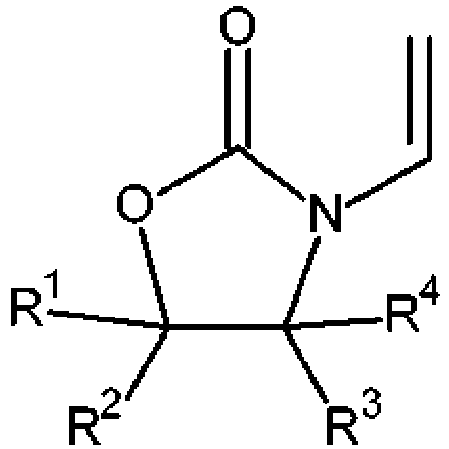
R1, R2, R3 und R4 unabhängig voneinander für ein Wasserstoffatom oder eine organische Gruppe mit nicht mehr als 10 Kohlenstoffatomen stehen,(A2) gegebenenfalls ein oder mehrere zweite reaktive Verdünnungsmittel,(B) ein oder mehrere Oligomere und(c) einen Photoinitiator (C), wobei die Menge von Komponente (A1) 5 bis 70 Gew.-%, bezogen auf die Menge der Komponenten (A1), (A2) und (B), beträgt, wobei es sich bei dem reaktiven Verdünnungsmittel um eine Komponente handelt, die mindestens eine radikalisch reaktive Gruppe, die mit den Komponenten (A1) und (B) coreagieren kann, enthält. - Verwendung der photohärtbaren Zusammensetzung nach Anspruch 1 oder Verfahren nach Anspruch 2, wobei die Viskosität der photohärtbaren Zusammensetzung im Bereich von 10 bis 3000 mPa s, vorzugsweise von 10 bis 1500 mPa s, bei 30 °C liegt, wobei die Viskosität der photohärtbaren Zusammensetzung wie in der Beschreibung angegeben bestimmt wird.
- Verwendung der photohärtbaren Zusammensetzung nach Anspruch 1 oder 3 oder Verfahren nach Anspruch 2 oder 3, wobei die Menge der Komponenten (A1) und (A2) 30 bis 70 Gew.-%, insbesondere 50 bis 70 Gew.-%, ganz besonders 60 bis 70 Gew.-%, beträgt und die Menge von Komponente (B) 70 bis 30 Gew.-%, insbesondere 50 bis 30 Gew.-%, ganz besonders 40 bis 30 Gew.-% beträgt, bezogen auf die Menge der Komponenten (A1), (A2) und (B).
- Verwendung der photohärtbaren Zusammensetzung nach Anspruch 1, 3 oder 4 oder Verfahren nach Anspruch 2, 3 oder 4, wobei mindestens zwei von R1 bis R4 in Formel I für ein Wasserstoffatom stehen.
- Verwendung der photohärtbaren Zusammensetzung nach Anspruch 1 oder 3 bis 5 oder Verfahren nach Anspruch 2 oder 3 bis 5, wobei das N-Vinyloxazolidinon der Formel I aus einer Verbindung, in der R1, R2, R3 und R4 für ein Wasserstoffatom stehen, einer Verbindung, in der R1 für eine C1-C4-Alkylgruppe, insbesondere eine Methylgruppe, steht und R2, R3 und R4 für ein Wasserstoffatom stehen, und einer Verbindung, in der R1 und R2 für ein Wasserstoffatom stehen und R3 und R4 für eine C1-C4-Alkylgruppe, insbesondere eine Methylgruppe, stehen, und Mischungen davon ausgewählt ist.
- Verwendung der photohärtbaren Zusammensetzung nach Anspruch 1 oder 3 bis 6 oder Verfahren nach Anspruch 2 oder 3 bis 6, wobei das Oligomer (B) aus Polyesteracrylaten, Polyetheracrylaten, Epoxyacrylaten und Urethanacrylaten ausgewählt ist.
- Verwendung der photohärtbaren Zusammensetzung nach Anspruch 1 oder 3 bis 7 oder Verfahren nach Anspruch 2 oder 3 bis 7, wobei das Oligomer (B) erhalten wird durch Umsetzen von(B1) einem Hydroxyalkylacrylat oder Hydroxyalkylmethacrylat,(B2) einem aliphatischen Diisocyanat, einem aliphatischen Polyisocyanat, einem cycloaliphatischen Diisocyanat, einem cycloaliphatischen Polyisocyanat, einem aromatischen Diisocyanat oder einem aromatischen Polyisocyanat oder Mischungen davon,(B3) einem Polyesterpolyol, das von aliphatischen Dicarbonsäuren und aliphatischen Diolen abgeleitet ist, und(B4) gegebenenfalls einem sekundären Polyol, insbesondere Glycerin.
- Verwendung der photohärtbaren Zusammensetzung nach Anspruch 8 oder Verfahren nach Anspruch 8, wobei Komponente (B1) aus 2-Hydroxyethylacrylat, 2-Hydroxyethylmethacrylat, 2- oder 3-Hydroxypropylacrylat, 2- oder 3-Hydroxypropylmethacrylat, 4-Hydroxybutylmethacrylat und 4-Hydroxybutylacrylat ausgewählt ist, Komponente (B2) aus 4,4'-, 2,4'- und/oder 2,2'-Methylendicyclohexyldiisocyanat (H12MDI), Isophorondiisocyanaten (IPDI) und Tolylen-2,4- und/oder -2,6-diisocyanat (TDI) ausgewählt ist und das Polyesterpolyol (B3) von Adipinsäure und Ethylenglykol und 1,4-Butandiol abgeleitet ist ((Poly(ethylen-1,4-butylenadipat)diol, PEBA).
- Verwendung der photohärtbaren Zusammensetzung nach Anspruch 7 oder Verfahren nach Anspruch 7, wobei das Oligomer (B) erhalten wird durch Umsetzen von einem Polyalkylenglykol mit einem Lacton der Formel

- Verwendung der photohärtbaren Zusammensetzung nach Anspruch 10 oder Verfahren nach Anspruch 10, wobei das Oligomer (B) durch Umsetzen von ε-Caprolacton, 4,4'-, 2,4'- und/oder 2,2'-Methylendicyclohexyldiisocyanat und Hydroxyethylacrylat erhalten wird.
- Verwendung der photohärtbaren Zusammensetzung nach Anspruch 7 oder Verfahren nach Anspruch 7, wobei das Oligomer (B) durch Umsetzen von aliphatischen, aromatischen oder cyclischen Diisocyanaten mit Hydroxyalkyl(meth)acrylat, insbesondere durch Umsetzen von Trimethylhexamethylendiisocyanat mit Hydroxyethylmethacrylat, erhalten wird.
- Verwendung der photohärtbaren Zusammensetzung nach Anspruch 1 oder 3 bis 12 oder Verfahren nach Anspruch 2 oder 3 bis 12, wobei der Photoinitiator (C) aus Acylphosphinoxidverbindungen, Benzophenonverbindungen, alpha-Aminoketonverbindungen, Phenylglyoxylatverbindungen, Oximeesterverbindungen, Mischungen davon und Mischungen mit alpha-Hydroxyketonverbindungen oder alpha-Alkoxyketonverbindungen ausgewählt ist.
- Verwendung der photohärtbaren Zusammensetzung nach Anspruch 1 oder 3 bis 12 oder Verfahren nach Anspruch 2 oder 3 bis 12, wobei es sich bei dem Photoinitiator (C) um eine Verbindung der Formel
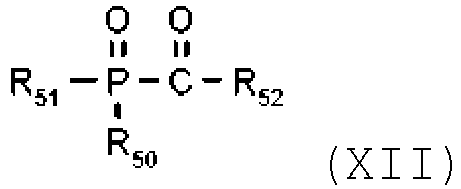 R50 für unsubstituiertes Cyclohexyl, Cyclopentyl, Phenyl, Naphthyl oder Biphenylyl steht oder für Cyclohexyl, Cyclopentyl, Phenyl, Naphthyl oder Biphenylyl, das durch ein oder mehrere Halogen, C1-C12-Alkyl, C1-C12-Alkoxy, C1-C12-Alkylthio oder durch NR53R54 substituiert ist, steht; oder R50 für unsubstituiertes C1-C20-Alkyl oder für C1-C20-Alkyl, das durch ein oder mehrere Halogen, C1-C12-Alkoxy, C1-C12-Alkylthio, NR53R54 oder durch - (CO) -O-C1-C24-Alkyl substituiert ist, steht;R51 für unsubstituiertes Cyclohexyl, Cyclopentyl, Phenyl, Naphthyl oder Biphenylyl steht oder für Cyclohexyl, Cyclopentyl, Phenyl, Naphthyl oder Biphenylyl, das durch ein oder mehrere Halogen, C1-C12-Alkyl, C1-C12-Alkoxy, C1-C12-Alkylthio oder durch NR53R54 substituiert ist, steht; oder R51 für -(CO)R'52 steht; oder R51 für C1-C12-Alkyl, das unsubstituiert oder durch ein oder mehrere Halogen, C1-C12-Alkoxy, C1-C12-Alkylthio oder durch NR53R54 substituiert ist, steht;R52 und R'52 unabhängig voneinander für unsubstituiertes Cyclohexyl, Cyclopentyl, Phenyl, Naphthyl oder Biphenylyl stehen oder für Cyclohexyl, Cyclopentyl, Phenyl, Naphthyl oder Biphenylyl, das durch ein oder mehrere Halogen, C1-C4-Alkyl oder C1-C4-Alkoxy substituiert ist, stehen; oder R52 für einen 5- oder 6-gliedrigen heterocyclischen Ring mit einem S-Atomen oder einem N-Atom steht;R53 und R54 unabhängig voneinander für Wasserstoff, unsubstituiertes C1-C12-Alkyl oder C1-C12-Alkyl, das durch ein oder mehrere OH oder SH substituiert ist, stehen, wobei die Alkylkette gegebenenfalls durch ein bis vier Sauerstoffatome unterbrochen ist; oder R53 und R54 unabhängig voneinander für C2-C12-Alkenyl, Cyclopentyl, Cyclohexyl, Benzyl oder Phenyl stehen, oder es sich bei dem Photoinitiator (C) um eine Mischung einer Verbindung der Formel (XII) und einer Verbindung der Formel
 R29 für Wasserstoff oder C1-C18-Alkoxy steht;R30 für Wasserstoff, C1-C18-Alkyl, C1-C12-Hydroxyalkyl, C1-C18-Alkoxy, OCH2CH2-OR34,Morpholino, S-C1-C18-Alkyl, eine Gruppe -HC=CH2, - C (CH3) =CH2,


 D, E und f für 1-3 stehen;c für 2-10 steht;G1 und G2 unabhängig voneinander für Endgruppen der polymeren Struktur, vorzugsweise Wasserstoff oder Methyl, stehen;R34 für Wasserstoff
 R31 für Hydroxy, C1-C16-Alkoxy, Morpholino, Dimethylamino oder -O(CH2CH2O)g-C1-C16-Alkyl steht;g für 1 bis 20 steht;R32 und R33 unabhängig voneinander für Wasserstoff, C1-C6-Alkyl, C1-C16-Alkoxy oder -O (CH2CH2O)g-C1-C16-Alkyl stehen; oder für unsubstituiertes Phenyl oder Benzyl oder Phenyl oder Benzyl, das durch C1-C12-Alkyl substituiert ist, stehen; oder R32 und R33 zusammen mit dem Kohlenstoffatom, an das sie gebunden sind, einen Cyclohexylring bilden;R35 für Wasserstoff, OR36 oder NR37R38 steht;R36 für Wasserstoff, C1-C12-Alkyl, das gegebenenfalls durch ein oder mehrere nicht aufeinanderfolgende O-Atome unterbrochen ist, wobei das nicht unterbrochene oder unterbrochene C1-C12-Alkyl gegebenenfalls durch ein oder mehrere OH substituiert ist, steht oder R36 für
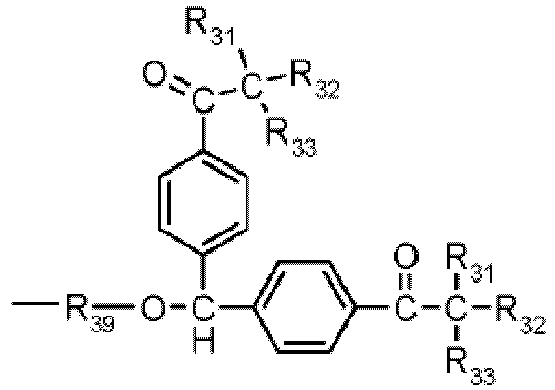 R37 und R38 unabhängig voneinander für Wasserstoff oder C1-C12-Alkyl, das unsubstituiert oder durch ein oder mehrere OH substituiert ist, stehen;R39 für C1-C12-Alkylen, das gegebenenfalls durch ein oder mehrere nicht aufeinanderfolgende O unterbrochen ist, - (CO) -NH-C1-C12-Alkylen-NH- (CO) - oder
 mit der Maßgabe, dass R31, R32 und R33 nicht alle zusammen für C1-C16-Alkoxy oder -O (CH2CH2O)g-C1-C16-Alkyl stehen, oder es sich bei dem Photoinitiator um eine Mischung von verschiedenen Verbindungen der Formel (XII) handelt oder es sich bei dem Photoinitiator um eine Mischung von Verbindungen der Formel (XII) und (XI) handelt.
 - Verfahren zur Herstellung eines dreidimensionalen Gegenstands nach Anspruch 2 oder 3 bis 14, umfassend eine Vat-Photopolymerisation, wobei die photohärtbare Zusammensetzung in Schritt b) direkt auf einem translatierten oder gedrehten Substrat gehärtet wird und die Bestrahlung mittels Stereolithographie, Holographie oder digitale Lichtprojektion (DLP) strukturiert wird.
- Verfahren nach Anspruch 2 oder 3 bis 14, das Folgendes umfasst:a) Aufbringen einer Schicht der photohärtbaren Zusammensetzung auf eine Oberfläche;b) bildmäßiges Belichten der Schicht mit aktinischer Strahlung zur Bildung eines bebilderten gehärteten Querschnitts;c) Aufbringen einer zweiten Schicht der photohärtbaren Zusammensetzung auf den vorher belichteten bebilderten Querschnitt;d) bildmäßiges Belichten der Schicht aus Schritt (c) mit aktinischer Strahlung zur Bildung eines zusätzlichen bebilderten Querschnitts, wobei die Strahlung das Härten der zweiten Schicht in den belichteten Bereichen und Haftung auf dem vorher belichteten Querschnitt bewirkt; unde) Wiederholen der Schritte (c) und (d) zum Aufbauen eines dreidimensionalen Gegenstands.
- Dreidimensionaler Gegenstand, hergestellt durch das Verfahren nach Anspruch 2 oder 3 bis 14.
- Dreidimensionaler Gegenstand nach Anspruch 17 mit einer IZOD-Schlagzähigkeit (ungekerbt) von mehr als 45 kJ/m2, speziell von mehr als 50 kJ/m2, ganz speziell von mehr als 55 kJ/m2, und/oder einem E-Modul von mehr als 1750 MPa, speziell von mehr als 1950 MPa.
Applications Claiming Priority (2)
| Application Number | Priority Date | Filing Date | Title |
|---|---|---|---|
| EP18196332 | 2018-09-24 | ||
| PCT/EP2019/075277 WO2020064523A1 (en) | 2018-09-24 | 2019-09-20 | Uv curable composition for use in 3d printing |
Publications (3)
| Publication Number | Publication Date |
|---|---|
| EP3856856A1 EP3856856A1 (de) | 2021-08-04 |
| EP3856856C0 EP3856856C0 (de) | 2024-05-29 |
| EP3856856B1 true EP3856856B1 (de) | 2024-05-29 |
Family
ID=63798787
Family Applications (1)
| Application Number | Title | Priority Date | Filing Date |
|---|---|---|---|
| EP19773412.2A Active EP3856856B1 (de) | 2018-09-24 | 2019-09-20 | Uv-härtbare zusammensetzung zur verwendung beim 3d-drucken |
Country Status (7)
| Country | Link |
|---|---|
| US (1) | US11999865B2 (de) |
| EP (1) | EP3856856B1 (de) |
| JP (1) | JP7532381B2 (de) |
| KR (1) | KR102885452B1 (de) |
| CN (1) | CN112639034A (de) |
| ES (1) | ES2986926T3 (de) |
| WO (1) | WO2020064523A1 (de) |
Families Citing this family (9)
| Publication number | Priority date | Publication date | Assignee | Title |
|---|---|---|---|---|
| US12134702B2 (en) * | 2019-09-11 | 2024-11-05 | Board Of Regents, The University Of Texas System | Compositions and methods for extrusion-based 3D printing of soft materials |
| CN116323510A (zh) * | 2020-10-05 | 2023-06-23 | 住友电气工业株式会社 | 树脂组合物、光纤以及光纤的制造方法 |
| WO2022075050A1 (ja) * | 2020-10-05 | 2022-04-14 | 住友電気工業株式会社 | 樹脂組成物、光ファイバ及び光ファイバの製造方法 |
| US20240141086A1 (en) * | 2021-02-25 | 2024-05-02 | Basf Se | Curable composition comprising light polymerizable liquid and epoxy precursor for coating, 2d object formation and 3d printing |
| KR20220157263A (ko) | 2021-05-20 | 2022-11-29 | 주식회사 엘지에너지솔루션 | 배터리 모듈 및 이를 포함하는 배터리 팩 |
| KR102569223B1 (ko) * | 2021-06-02 | 2023-08-22 | 애경케미칼주식회사 | 1,6-헥사메틸렌디이소시아네이트와 2,4-톨루엔디이소시아네이트의 이소시아누레이트형 삼량체 구조를 가지는 우레탄아크릴레이트 화합물 및 이를 이용한 고강도 및 고내열성 3d 광경화 조성물 |
| CN115109546A (zh) * | 2022-07-27 | 2022-09-27 | 上海本诺电子材料有限公司 | 一种uv湿气双固化胶粘剂及其制备方法 |
| CN115322622B (zh) * | 2022-08-24 | 2023-03-31 | 山东布瑞特油墨有限公司 | 一种uv固化喷墨材料及其制备方法和应用 |
| WO2025116486A1 (ko) * | 2023-11-29 | 2025-06-05 | 코오롱인더스트리 주식회사 | 감광성 수지 조성물, 이를 이용한 드라이 필름 포토레지스트 및 그 제조방법, 레지스트 패턴 및 디스플레이 장치 |
Family Cites Families (28)
| Publication number | Priority date | Publication date | Assignee | Title |
|---|---|---|---|---|
| ZA741203B (en) | 1973-03-23 | 1975-01-29 | Smithkline Corp | Veterinary feed compositions for inhibiting rumen microbial deamination |
| US4151175A (en) | 1976-12-09 | 1979-04-24 | General Electric Company | Method for making diarylhalonium salts |
| JPS57109813A (en) | 1980-12-27 | 1982-07-08 | Toagosei Chem Ind Co Ltd | Curing composition |
| US4399071A (en) | 1982-03-12 | 1983-08-16 | General Electric Company | Method for making diaryliodonium salts |
| IT1151545B (it) | 1982-04-15 | 1986-12-24 | Anic Spa | Composizione a base di policarbonati alifatici con terminazioni acriliche o metacriliche reticolabile in presenza di iniziatori radicalici |
| US4575330A (en) | 1984-08-08 | 1986-03-11 | Uvp, Inc. | Apparatus for production of three-dimensional objects by stereolithography |
| US4639472A (en) | 1984-12-17 | 1987-01-27 | The Dow Chemical Company | N-vinyl-2-oxazolidinones as reactive diluents in actinic radiation curable coatings |
| US4694029A (en) | 1985-04-09 | 1987-09-15 | Cook Paint And Varnish Company | Hybrid photocure system |
| US4738870A (en) * | 1986-03-27 | 1988-04-19 | The Dow Chemical Company | Adherent photopolymerizable compositions |
| US4950581A (en) | 1987-07-06 | 1990-08-21 | Fuji Photo Film Co., Ltd. | Photopolymerizable composition |
| US4929403A (en) | 1989-07-25 | 1990-05-29 | Audsley Edwin F | Process for forming multi-layer flexible molds |
| GB2264118B (en) | 1992-02-07 | 1996-01-10 | Sericol Ltd | Radiation-curable compositions |
| FR2688783A1 (fr) | 1992-03-23 | 1993-09-24 | Rhone Poulenc Chimie | Nouveaux borates d'onium ou de complexe organometallique amorceurs cationiques de polymerisation. |
| FR2762001B1 (fr) | 1997-04-11 | 1999-07-02 | Rhodia Chimie Sa | Amorceurs non toxiques, resines a groupements organofonctionnels reticulables comprenant les amorceurs, et leur utilisation pour la preparation de polymeres stables et non toxiques |
| SG98433A1 (en) | 1999-12-21 | 2003-09-19 | Ciba Sc Holding Ag | Iodonium salts as latent acid donors |
| JP2003089711A (ja) | 2001-09-18 | 2003-03-28 | Nippon Shokubai Co Ltd | 硬化性樹脂組成物及び樹脂硬化製品 |
| US20070249484A1 (en) | 2004-07-21 | 2007-10-25 | Johannes Benkhoff | Process for the Photoactivation and use of a Catalyst by an Inverted Two-Stage Procedure |
| EP1873199A1 (de) | 2004-09-03 | 2008-01-02 | Ciba Specialty Chemicals Holding Inc. | In-Can Stabilisatoren |
| WO2008012292A1 (de) | 2006-07-24 | 2008-01-31 | Basf Se | Flüssigkristallines gemisch |
| EP2358832A1 (de) | 2008-11-21 | 2011-08-24 | Basf Se | Druckfarbe, enthaltend n-vinylcaprolactam und weitere n-vinylamidmonomere |
| RU2654485C2 (ru) | 2013-05-27 | 2018-05-21 | Басф Се | Способ получения уретан(мет)акрилатов |
| ES2959200T3 (es) | 2013-06-04 | 2024-02-21 | Basf Se | Elastómeros termoplásticos de poliuretano blando y proceso para su preparación |
| EP3033399B1 (de) * | 2013-08-12 | 2017-10-11 | Basf Se | Tintenstrahldrucktinte mit n-vinyloxazolidinon |
| CN107077064B (zh) | 2014-06-23 | 2021-06-04 | 卡本有限公司 | 用于制备三维物体的具有多重硬化机制的聚氨酯树脂 |
| JP6509507B2 (ja) | 2014-07-17 | 2019-05-08 | 任天堂株式会社 | ゲームシステム、端末装置、コンピュータプログラム及び情報表示方法 |
| US11738511B2 (en) | 2016-12-08 | 2023-08-29 | Igneous IP Holdings, LLC | Additive manufacturing using foaming radiation-curable resin |
| JP7206204B2 (ja) | 2017-02-10 | 2023-01-17 | ビーエーエスエフ ソシエタス・ヨーロピア | 印刷用調合物において反応性希釈剤として用いられるアクリレート含有モノマー |
| JP7469051B2 (ja) * | 2020-01-15 | 2024-04-16 | 住友化学株式会社 | 窒化物結晶基板の製造方法、窒化物結晶基板および積層構造体 |
-
2019
- 2019-09-20 KR KR1020217011109A patent/KR102885452B1/ko active Active
- 2019-09-20 WO PCT/EP2019/075277 patent/WO2020064523A1/en not_active Ceased
- 2019-09-20 US US17/279,369 patent/US11999865B2/en active Active
- 2019-09-20 ES ES19773412T patent/ES2986926T3/es active Active
- 2019-09-20 EP EP19773412.2A patent/EP3856856B1/de active Active
- 2019-09-20 JP JP2021540914A patent/JP7532381B2/ja active Active
- 2019-09-20 CN CN201980055321.2A patent/CN112639034A/zh active Pending
Also Published As
| Publication number | Publication date |
|---|---|
| KR102885452B1 (ko) | 2025-11-14 |
| JP2022502557A (ja) | 2022-01-11 |
| KR20210065126A (ko) | 2021-06-03 |
| ES2986926T3 (es) | 2024-11-13 |
| EP3856856C0 (de) | 2024-05-29 |
| WO2020064523A1 (en) | 2020-04-02 |
| EP3856856A1 (de) | 2021-08-04 |
| US11999865B2 (en) | 2024-06-04 |
| US20210395558A1 (en) | 2021-12-23 |
| JP7532381B2 (ja) | 2024-08-13 |
| CN112639034A (zh) | 2021-04-09 |
Similar Documents
| Publication | Publication Date | Title |
|---|---|---|
| EP3856856B1 (de) | Uv-härtbare zusammensetzung zur verwendung beim 3d-drucken | |
| US12325806B2 (en) | Photocurable composition for use in 3D printing | |
| EP3911687B1 (de) | Limonenbasierte (meth)acrylate zur verwendung im 3d-druck | |
| EP4055071A1 (de) | Wasserspülbare zusammensetzungen zur verwendung beim 3d-drucken | |
| JP4595535B2 (ja) | エネルギー線硬化型インクジェット記録用インク組成物を用いた画像形成方法 | |
| JP2016117807A (ja) | 活性エネルギー線硬化型組成物、収容体、インクジェット記録装置、記録物及び立体硬化物 | |
| US20210292588A1 (en) | Process for the production of strongly adherent liquid crystal films on flexible substrates | |
| JP5145629B2 (ja) | エネルギー線硬化型インクジェット記録用クリアインク組成物 | |
| US20170137641A1 (en) | Active-energy-ray-curable composition, active-energy-ray-curable ink, composition stored container, two-dimensional or three-dimensional image forming apparatus, two-dimensional or three-dimensional image forming method, cured material, and structure | |
| EP3680274A1 (de) | Hydroxyurethan-(meth)acrylatpräpolymere zur verwendung im 3d-druck | |
| KR102887471B1 (ko) | 3d 인쇄에 사용하기 위한 광경화성 조성물 |
Legal Events
| Date | Code | Title | Description |
|---|---|---|---|
| STAA | Information on the status of an ep patent application or granted ep patent |
Free format text: STATUS: UNKNOWN |
|
| STAA | Information on the status of an ep patent application or granted ep patent |
Free format text: STATUS: THE INTERNATIONAL PUBLICATION HAS BEEN MADE |
|
| PUAI | Public reference made under article 153(3) epc to a published international application that has entered the european phase |
Free format text: ORIGINAL CODE: 0009012 |
|
| STAA | Information on the status of an ep patent application or granted ep patent |
Free format text: STATUS: REQUEST FOR EXAMINATION WAS MADE |
|
| 17P | Request for examination filed |
Effective date: 20210426 |
|
| AK | Designated contracting states |
Kind code of ref document: A1 Designated state(s): AL AT BE BG CH CY CZ DE DK EE ES FI FR GB GR HR HU IE IS IT LI LT LU LV MC MK MT NL NO PL PT RO RS SE SI SK SM TR |
|
| DAV | Request for validation of the european patent (deleted) | ||
| DAX | Request for extension of the european patent (deleted) | ||
| STAA | Information on the status of an ep patent application or granted ep patent |
Free format text: STATUS: EXAMINATION IS IN PROGRESS |
|
| 17Q | First examination report despatched |
Effective date: 20230503 |
|
| GRAP | Despatch of communication of intention to grant a patent |
Free format text: ORIGINAL CODE: EPIDOSNIGR1 |
|
| STAA | Information on the status of an ep patent application or granted ep patent |
Free format text: STATUS: GRANT OF PATENT IS INTENDED |
|
| INTG | Intention to grant announced |
Effective date: 20240104 |
|
| GRAS | Grant fee paid |
Free format text: ORIGINAL CODE: EPIDOSNIGR3 |
|
| GRAA | (expected) grant |
Free format text: ORIGINAL CODE: 0009210 |
|
| STAA | Information on the status of an ep patent application or granted ep patent |
Free format text: STATUS: THE PATENT HAS BEEN GRANTED |
|
| AK | Designated contracting states |
Kind code of ref document: B1 Designated state(s): AL AT BE BG CH CY CZ DE DK EE ES FI FR GB GR HR HU IE IS IT LI LT LU LV MC MK MT NL NO PL PT RO RS SE SI SK SM TR |
|
| REG | Reference to a national code |
Ref country code: CH Ref legal event code: EP |
|
| REG | Reference to a national code |
Ref country code: IE Ref legal event code: FG4D |
|
| REG | Reference to a national code |
Ref country code: DE Ref legal event code: R096 Ref document number: 602019052957 Country of ref document: DE |
|
| U01 | Request for unitary effect filed |
Effective date: 20240625 |
|
| U07 | Unitary effect registered |
Designated state(s): AT BE BG DE DK EE FI FR IT LT LU LV MT NL PT SE SI Effective date: 20240704 |
|
| PG25 | Lapsed in a contracting state [announced via postgrant information from national office to epo] |
Ref country code: IS Free format text: LAPSE BECAUSE OF FAILURE TO SUBMIT A TRANSLATION OF THE DESCRIPTION OR TO PAY THE FEE WITHIN THE PRESCRIBED TIME-LIMIT Effective date: 20240929 |
|
| PG25 | Lapsed in a contracting state [announced via postgrant information from national office to epo] |
Ref country code: HR Free format text: LAPSE BECAUSE OF FAILURE TO SUBMIT A TRANSLATION OF THE DESCRIPTION OR TO PAY THE FEE WITHIN THE PRESCRIBED TIME-LIMIT Effective date: 20240529 |
|
| PG25 | Lapsed in a contracting state [announced via postgrant information from national office to epo] |
Ref country code: GR Free format text: LAPSE BECAUSE OF FAILURE TO SUBMIT A TRANSLATION OF THE DESCRIPTION OR TO PAY THE FEE WITHIN THE PRESCRIBED TIME-LIMIT Effective date: 20240830 |
|
| PG25 | Lapsed in a contracting state [announced via postgrant information from national office to epo] |
Ref country code: PL Free format text: LAPSE BECAUSE OF FAILURE TO SUBMIT A TRANSLATION OF THE DESCRIPTION OR TO PAY THE FEE WITHIN THE PRESCRIBED TIME-LIMIT Effective date: 20240529 |
|
| PG25 | Lapsed in a contracting state [announced via postgrant information from national office to epo] |
Ref country code: PL Free format text: LAPSE BECAUSE OF FAILURE TO SUBMIT A TRANSLATION OF THE DESCRIPTION OR TO PAY THE FEE WITHIN THE PRESCRIBED TIME-LIMIT Effective date: 20240529 Ref country code: NO Free format text: LAPSE BECAUSE OF FAILURE TO SUBMIT A TRANSLATION OF THE DESCRIPTION OR TO PAY THE FEE WITHIN THE PRESCRIBED TIME-LIMIT Effective date: 20240829 Ref country code: IS Free format text: LAPSE BECAUSE OF FAILURE TO SUBMIT A TRANSLATION OF THE DESCRIPTION OR TO PAY THE FEE WITHIN THE PRESCRIBED TIME-LIMIT Effective date: 20240929 Ref country code: HR Free format text: LAPSE BECAUSE OF FAILURE TO SUBMIT A TRANSLATION OF THE DESCRIPTION OR TO PAY THE FEE WITHIN THE PRESCRIBED TIME-LIMIT Effective date: 20240529 Ref country code: GR Free format text: LAPSE BECAUSE OF FAILURE TO SUBMIT A TRANSLATION OF THE DESCRIPTION OR TO PAY THE FEE WITHIN THE PRESCRIBED TIME-LIMIT Effective date: 20240830 Ref country code: RS Free format text: LAPSE BECAUSE OF FAILURE TO SUBMIT A TRANSLATION OF THE DESCRIPTION OR TO PAY THE FEE WITHIN THE PRESCRIBED TIME-LIMIT Effective date: 20240829 |
|
| REG | Reference to a national code |
Ref country code: ES Ref legal event code: FG2A Ref document number: 2986926 Country of ref document: ES Kind code of ref document: T3 Effective date: 20241113 |
|
| U20 | Renewal fee for the european patent with unitary effect paid |
Year of fee payment: 6 Effective date: 20241004 |
|
| U1N | Appointed representative for the unitary patent procedure changed after the registration of the unitary effect |
Representative=s name: BASF IP ASSOCIATION; DE |
|
| PG25 | Lapsed in a contracting state [announced via postgrant information from national office to epo] |
Ref country code: CZ Free format text: LAPSE BECAUSE OF FAILURE TO SUBMIT A TRANSLATION OF THE DESCRIPTION OR TO PAY THE FEE WITHIN THE PRESCRIBED TIME-LIMIT Effective date: 20240529 |
|
| PG25 | Lapsed in a contracting state [announced via postgrant information from national office to epo] |
Ref country code: RO Free format text: LAPSE BECAUSE OF FAILURE TO SUBMIT A TRANSLATION OF THE DESCRIPTION OR TO PAY THE FEE WITHIN THE PRESCRIBED TIME-LIMIT Effective date: 20240529 Ref country code: SK Free format text: LAPSE BECAUSE OF FAILURE TO SUBMIT A TRANSLATION OF THE DESCRIPTION OR TO PAY THE FEE WITHIN THE PRESCRIBED TIME-LIMIT Effective date: 20240529 |
|
| PG25 | Lapsed in a contracting state [announced via postgrant information from national office to epo] |
Ref country code: SM Free format text: LAPSE BECAUSE OF FAILURE TO SUBMIT A TRANSLATION OF THE DESCRIPTION OR TO PAY THE FEE WITHIN THE PRESCRIBED TIME-LIMIT Effective date: 20240529 |
|
| PGFP | Annual fee paid to national office [announced via postgrant information from national office to epo] |
Ref country code: ES Payment date: 20241018 Year of fee payment: 6 |
|
| PG25 | Lapsed in a contracting state [announced via postgrant information from national office to epo] |
Ref country code: SM Free format text: LAPSE BECAUSE OF FAILURE TO SUBMIT A TRANSLATION OF THE DESCRIPTION OR TO PAY THE FEE WITHIN THE PRESCRIBED TIME-LIMIT Effective date: 20240529 Ref country code: SK Free format text: LAPSE BECAUSE OF FAILURE TO SUBMIT A TRANSLATION OF THE DESCRIPTION OR TO PAY THE FEE WITHIN THE PRESCRIBED TIME-LIMIT Effective date: 20240529 Ref country code: RO Free format text: LAPSE BECAUSE OF FAILURE TO SUBMIT A TRANSLATION OF THE DESCRIPTION OR TO PAY THE FEE WITHIN THE PRESCRIBED TIME-LIMIT Effective date: 20240529 Ref country code: CZ Free format text: LAPSE BECAUSE OF FAILURE TO SUBMIT A TRANSLATION OF THE DESCRIPTION OR TO PAY THE FEE WITHIN THE PRESCRIBED TIME-LIMIT Effective date: 20240529 |
|
| PGFP | Annual fee paid to national office [announced via postgrant information from national office to epo] |
Ref country code: CH Payment date: 20241001 Year of fee payment: 6 |
|
| PLBE | No opposition filed within time limit |
Free format text: ORIGINAL CODE: 0009261 |
|
| STAA | Information on the status of an ep patent application or granted ep patent |
Free format text: STATUS: NO OPPOSITION FILED WITHIN TIME LIMIT |
|
| PG25 | Lapsed in a contracting state [announced via postgrant information from national office to epo] |
Ref country code: MC Free format text: LAPSE BECAUSE OF FAILURE TO SUBMIT A TRANSLATION OF THE DESCRIPTION OR TO PAY THE FEE WITHIN THE PRESCRIBED TIME-LIMIT Effective date: 20240529 |
|
| 26N | No opposition filed |
Effective date: 20250303 |
|
| PG25 | Lapsed in a contracting state [announced via postgrant information from national office to epo] |
Ref country code: IE Free format text: LAPSE BECAUSE OF NON-PAYMENT OF DUE FEES Effective date: 20240920 |
|
| REG | Reference to a national code |
Ref country code: CH Ref legal event code: U11 Free format text: ST27 STATUS EVENT CODE: U-0-0-U10-U11 (AS PROVIDED BY THE NATIONAL OFFICE) Effective date: 20251001 |
|
| PGFP | Annual fee paid to national office [announced via postgrant information from national office to epo] |
Ref country code: GB Payment date: 20250923 Year of fee payment: 7 |
|
| U20 | Renewal fee for the european patent with unitary effect paid |
Year of fee payment: 7 Effective date: 20250930 |