EP3842037A1 - Pharmaceutical composition and administrations thereof - Google Patents
Pharmaceutical composition and administrations thereof Download PDFInfo
- Publication number
- EP3842037A1 EP3842037A1 EP20211291.8A EP20211291A EP3842037A1 EP 3842037 A1 EP3842037 A1 EP 3842037A1 EP 20211291 A EP20211291 A EP 20211291A EP 3842037 A1 EP3842037 A1 EP 3842037A1
- Authority
- EP
- European Patent Office
- Prior art keywords
- pharmaceutical composition
- weight
- solid dispersion
- composition
- amorphous compound
- Prior art date
- Legal status (The legal status is an assumption and is not a legal conclusion. Google has not performed a legal analysis and makes no representation as to the accuracy of the status listed.)
- Pending
Links
Images
Classifications
-
- A—HUMAN NECESSITIES
- A61—MEDICAL OR VETERINARY SCIENCE; HYGIENE
- A61K—PREPARATIONS FOR MEDICAL, DENTAL OR TOILETRY PURPOSES
- A61K9/00—Medicinal preparations characterised by special physical form
- A61K9/20—Pills, tablets, discs, rods
- A61K9/2004—Excipients; Inactive ingredients
- A61K9/2022—Organic macromolecular compounds
- A61K9/205—Polysaccharides, e.g. alginate, gums; Cyclodextrin
- A61K9/2054—Cellulose; Cellulose derivatives, e.g. hydroxypropyl methylcellulose
-
- A—HUMAN NECESSITIES
- A61—MEDICAL OR VETERINARY SCIENCE; HYGIENE
- A61K—PREPARATIONS FOR MEDICAL, DENTAL OR TOILETRY PURPOSES
- A61K31/00—Medicinal preparations containing organic active ingredients
-
- A—HUMAN NECESSITIES
- A61—MEDICAL OR VETERINARY SCIENCE; HYGIENE
- A61K—PREPARATIONS FOR MEDICAL, DENTAL OR TOILETRY PURPOSES
- A61K31/00—Medicinal preparations containing organic active ingredients
- A61K31/33—Heterocyclic compounds
- A61K31/395—Heterocyclic compounds having nitrogen as a ring hetero atom, e.g. guanethidine or rifamycins
- A61K31/435—Heterocyclic compounds having nitrogen as a ring hetero atom, e.g. guanethidine or rifamycins having six-membered rings with one nitrogen as the only ring hetero atom
- A61K31/47—Quinolines; Isoquinolines
-
- A—HUMAN NECESSITIES
- A61—MEDICAL OR VETERINARY SCIENCE; HYGIENE
- A61K—PREPARATIONS FOR MEDICAL, DENTAL OR TOILETRY PURPOSES
- A61K9/00—Medicinal preparations characterised by special physical form
- A61K9/14—Particulate form, e.g. powders, Processes for size reducing of pure drugs or the resulting products, Pure drug nanoparticles
- A61K9/16—Agglomerates; Granulates; Microbeadlets ; Microspheres; Pellets; Solid products obtained by spray drying, spray freeze drying, spray congealing,(multiple) emulsion solvent evaporation or extraction
- A61K9/1605—Excipients; Inactive ingredients
- A61K9/1629—Organic macromolecular compounds
- A61K9/1635—Organic macromolecular compounds obtained by reactions only involving carbon-to-carbon unsaturated bonds, e.g. polyvinyl pyrrolidone, poly(meth)acrylates
-
- A—HUMAN NECESSITIES
- A61—MEDICAL OR VETERINARY SCIENCE; HYGIENE
- A61K—PREPARATIONS FOR MEDICAL, DENTAL OR TOILETRY PURPOSES
- A61K9/00—Medicinal preparations characterised by special physical form
- A61K9/14—Particulate form, e.g. powders, Processes for size reducing of pure drugs or the resulting products, Pure drug nanoparticles
- A61K9/16—Agglomerates; Granulates; Microbeadlets ; Microspheres; Pellets; Solid products obtained by spray drying, spray freeze drying, spray congealing,(multiple) emulsion solvent evaporation or extraction
- A61K9/1605—Excipients; Inactive ingredients
- A61K9/1629—Organic macromolecular compounds
- A61K9/1652—Polysaccharides, e.g. alginate, cellulose derivatives; Cyclodextrin
-
- A—HUMAN NECESSITIES
- A61—MEDICAL OR VETERINARY SCIENCE; HYGIENE
- A61K—PREPARATIONS FOR MEDICAL, DENTAL OR TOILETRY PURPOSES
- A61K9/00—Medicinal preparations characterised by special physical form
- A61K9/20—Pills, tablets, discs, rods
- A61K9/2004—Excipients; Inactive ingredients
- A61K9/2022—Organic macromolecular compounds
- A61K9/2027—Organic macromolecular compounds obtained by reactions only involving carbon-to-carbon unsaturated bonds, e.g. polyvinyl pyrrolidone, poly(meth)acrylates
-
- A—HUMAN NECESSITIES
- A61—MEDICAL OR VETERINARY SCIENCE; HYGIENE
- A61K—PREPARATIONS FOR MEDICAL, DENTAL OR TOILETRY PURPOSES
- A61K9/00—Medicinal preparations characterised by special physical form
- A61K9/20—Pills, tablets, discs, rods
- A61K9/28—Dragees; Coated pills or tablets, e.g. with film or compression coating
- A61K9/2806—Coating materials
- A61K9/282—Organic compounds, e.g. fats
-
- A—HUMAN NECESSITIES
- A61—MEDICAL OR VETERINARY SCIENCE; HYGIENE
- A61P—SPECIFIC THERAPEUTIC ACTIVITY OF CHEMICAL COMPOUNDS OR MEDICINAL PREPARATIONS
- A61P1/00—Drugs for disorders of the alimentary tract or the digestive system
- A61P1/10—Laxatives
-
- A—HUMAN NECESSITIES
- A61—MEDICAL OR VETERINARY SCIENCE; HYGIENE
- A61P—SPECIFIC THERAPEUTIC ACTIVITY OF CHEMICAL COMPOUNDS OR MEDICINAL PREPARATIONS
- A61P1/00—Drugs for disorders of the alimentary tract or the digestive system
- A61P1/16—Drugs for disorders of the alimentary tract or the digestive system for liver or gallbladder disorders, e.g. hepatoprotective agents, cholagogues, litholytics
-
- A—HUMAN NECESSITIES
- A61—MEDICAL OR VETERINARY SCIENCE; HYGIENE
- A61P—SPECIFIC THERAPEUTIC ACTIVITY OF CHEMICAL COMPOUNDS OR MEDICINAL PREPARATIONS
- A61P1/00—Drugs for disorders of the alimentary tract or the digestive system
- A61P1/18—Drugs for disorders of the alimentary tract or the digestive system for pancreatic disorders, e.g. pancreatic enzymes
-
- A—HUMAN NECESSITIES
- A61—MEDICAL OR VETERINARY SCIENCE; HYGIENE
- A61P—SPECIFIC THERAPEUTIC ACTIVITY OF CHEMICAL COMPOUNDS OR MEDICINAL PREPARATIONS
- A61P11/00—Drugs for disorders of the respiratory system
-
- A—HUMAN NECESSITIES
- A61—MEDICAL OR VETERINARY SCIENCE; HYGIENE
- A61P—SPECIFIC THERAPEUTIC ACTIVITY OF CHEMICAL COMPOUNDS OR MEDICINAL PREPARATIONS
- A61P11/00—Drugs for disorders of the respiratory system
- A61P11/02—Nasal agents, e.g. decongestants
-
- A—HUMAN NECESSITIES
- A61—MEDICAL OR VETERINARY SCIENCE; HYGIENE
- A61P—SPECIFIC THERAPEUTIC ACTIVITY OF CHEMICAL COMPOUNDS OR MEDICINAL PREPARATIONS
- A61P11/00—Drugs for disorders of the respiratory system
- A61P11/04—Drugs for disorders of the respiratory system for throat disorders
-
- A—HUMAN NECESSITIES
- A61—MEDICAL OR VETERINARY SCIENCE; HYGIENE
- A61P—SPECIFIC THERAPEUTIC ACTIVITY OF CHEMICAL COMPOUNDS OR MEDICINAL PREPARATIONS
- A61P11/00—Drugs for disorders of the respiratory system
- A61P11/06—Antiasthmatics
-
- A—HUMAN NECESSITIES
- A61—MEDICAL OR VETERINARY SCIENCE; HYGIENE
- A61P—SPECIFIC THERAPEUTIC ACTIVITY OF CHEMICAL COMPOUNDS OR MEDICINAL PREPARATIONS
- A61P11/00—Drugs for disorders of the respiratory system
- A61P11/16—Central respiratory analeptics
-
- A—HUMAN NECESSITIES
- A61—MEDICAL OR VETERINARY SCIENCE; HYGIENE
- A61P—SPECIFIC THERAPEUTIC ACTIVITY OF CHEMICAL COMPOUNDS OR MEDICINAL PREPARATIONS
- A61P13/00—Drugs for disorders of the urinary system
- A61P13/02—Drugs for disorders of the urinary system of urine or of the urinary tract, e.g. urine acidifiers
-
- A—HUMAN NECESSITIES
- A61—MEDICAL OR VETERINARY SCIENCE; HYGIENE
- A61P—SPECIFIC THERAPEUTIC ACTIVITY OF CHEMICAL COMPOUNDS OR MEDICINAL PREPARATIONS
- A61P13/00—Drugs for disorders of the urinary system
- A61P13/12—Drugs for disorders of the urinary system of the kidneys
-
- A—HUMAN NECESSITIES
- A61—MEDICAL OR VETERINARY SCIENCE; HYGIENE
- A61P—SPECIFIC THERAPEUTIC ACTIVITY OF CHEMICAL COMPOUNDS OR MEDICINAL PREPARATIONS
- A61P15/00—Drugs for genital or sexual disorders; Contraceptives
- A61P15/08—Drugs for genital or sexual disorders; Contraceptives for gonadal disorders or for enhancing fertility, e.g. inducers of ovulation or of spermatogenesis
-
- A—HUMAN NECESSITIES
- A61—MEDICAL OR VETERINARY SCIENCE; HYGIENE
- A61P—SPECIFIC THERAPEUTIC ACTIVITY OF CHEMICAL COMPOUNDS OR MEDICINAL PREPARATIONS
- A61P19/00—Drugs for skeletal disorders
- A61P19/04—Drugs for skeletal disorders for non-specific disorders of the connective tissue
-
- A—HUMAN NECESSITIES
- A61—MEDICAL OR VETERINARY SCIENCE; HYGIENE
- A61P—SPECIFIC THERAPEUTIC ACTIVITY OF CHEMICAL COMPOUNDS OR MEDICINAL PREPARATIONS
- A61P19/00—Drugs for skeletal disorders
- A61P19/08—Drugs for skeletal disorders for bone diseases, e.g. rachitism, Paget's disease
-
- A—HUMAN NECESSITIES
- A61—MEDICAL OR VETERINARY SCIENCE; HYGIENE
- A61P—SPECIFIC THERAPEUTIC ACTIVITY OF CHEMICAL COMPOUNDS OR MEDICINAL PREPARATIONS
- A61P19/00—Drugs for skeletal disorders
- A61P19/08—Drugs for skeletal disorders for bone diseases, e.g. rachitism, Paget's disease
- A61P19/10—Drugs for skeletal disorders for bone diseases, e.g. rachitism, Paget's disease for osteoporosis
-
- A—HUMAN NECESSITIES
- A61—MEDICAL OR VETERINARY SCIENCE; HYGIENE
- A61P—SPECIFIC THERAPEUTIC ACTIVITY OF CHEMICAL COMPOUNDS OR MEDICINAL PREPARATIONS
- A61P21/00—Drugs for disorders of the muscular or neuromuscular system
- A61P21/02—Muscle relaxants, e.g. for tetanus or cramps
-
- A—HUMAN NECESSITIES
- A61—MEDICAL OR VETERINARY SCIENCE; HYGIENE
- A61P—SPECIFIC THERAPEUTIC ACTIVITY OF CHEMICAL COMPOUNDS OR MEDICINAL PREPARATIONS
- A61P25/00—Drugs for disorders of the nervous system
-
- A—HUMAN NECESSITIES
- A61—MEDICAL OR VETERINARY SCIENCE; HYGIENE
- A61P—SPECIFIC THERAPEUTIC ACTIVITY OF CHEMICAL COMPOUNDS OR MEDICINAL PREPARATIONS
- A61P25/00—Drugs for disorders of the nervous system
- A61P25/14—Drugs for disorders of the nervous system for treating abnormal movements, e.g. chorea, dyskinesia
- A61P25/16—Anti-Parkinson drugs
-
- A—HUMAN NECESSITIES
- A61—MEDICAL OR VETERINARY SCIENCE; HYGIENE
- A61P—SPECIFIC THERAPEUTIC ACTIVITY OF CHEMICAL COMPOUNDS OR MEDICINAL PREPARATIONS
- A61P25/00—Drugs for disorders of the nervous system
- A61P25/22—Anxiolytics
-
- A—HUMAN NECESSITIES
- A61—MEDICAL OR VETERINARY SCIENCE; HYGIENE
- A61P—SPECIFIC THERAPEUTIC ACTIVITY OF CHEMICAL COMPOUNDS OR MEDICINAL PREPARATIONS
- A61P25/00—Drugs for disorders of the nervous system
- A61P25/28—Drugs for disorders of the nervous system for treating neurodegenerative disorders of the central nervous system, e.g. nootropic agents, cognition enhancers, drugs for treating Alzheimer's disease or other forms of dementia
-
- A—HUMAN NECESSITIES
- A61—MEDICAL OR VETERINARY SCIENCE; HYGIENE
- A61P—SPECIFIC THERAPEUTIC ACTIVITY OF CHEMICAL COMPOUNDS OR MEDICINAL PREPARATIONS
- A61P27/00—Drugs for disorders of the senses
- A61P27/02—Ophthalmic agents
-
- A—HUMAN NECESSITIES
- A61—MEDICAL OR VETERINARY SCIENCE; HYGIENE
- A61P—SPECIFIC THERAPEUTIC ACTIVITY OF CHEMICAL COMPOUNDS OR MEDICINAL PREPARATIONS
- A61P3/00—Drugs for disorders of the metabolism
-
- A—HUMAN NECESSITIES
- A61—MEDICAL OR VETERINARY SCIENCE; HYGIENE
- A61P—SPECIFIC THERAPEUTIC ACTIVITY OF CHEMICAL COMPOUNDS OR MEDICINAL PREPARATIONS
- A61P3/00—Drugs for disorders of the metabolism
- A61P3/06—Antihyperlipidemics
-
- A—HUMAN NECESSITIES
- A61—MEDICAL OR VETERINARY SCIENCE; HYGIENE
- A61P—SPECIFIC THERAPEUTIC ACTIVITY OF CHEMICAL COMPOUNDS OR MEDICINAL PREPARATIONS
- A61P3/00—Drugs for disorders of the metabolism
- A61P3/08—Drugs for disorders of the metabolism for glucose homeostasis
- A61P3/10—Drugs for disorders of the metabolism for glucose homeostasis for hyperglycaemia, e.g. antidiabetics
-
- A—HUMAN NECESSITIES
- A61—MEDICAL OR VETERINARY SCIENCE; HYGIENE
- A61P—SPECIFIC THERAPEUTIC ACTIVITY OF CHEMICAL COMPOUNDS OR MEDICINAL PREPARATIONS
- A61P35/00—Antineoplastic agents
-
- A—HUMAN NECESSITIES
- A61—MEDICAL OR VETERINARY SCIENCE; HYGIENE
- A61P—SPECIFIC THERAPEUTIC ACTIVITY OF CHEMICAL COMPOUNDS OR MEDICINAL PREPARATIONS
- A61P37/00—Drugs for immunological or allergic disorders
- A61P37/08—Antiallergic agents
-
- A—HUMAN NECESSITIES
- A61—MEDICAL OR VETERINARY SCIENCE; HYGIENE
- A61P—SPECIFIC THERAPEUTIC ACTIVITY OF CHEMICAL COMPOUNDS OR MEDICINAL PREPARATIONS
- A61P43/00—Drugs for specific purposes, not provided for in groups A61P1/00-A61P41/00
-
- A—HUMAN NECESSITIES
- A61—MEDICAL OR VETERINARY SCIENCE; HYGIENE
- A61P—SPECIFIC THERAPEUTIC ACTIVITY OF CHEMICAL COMPOUNDS OR MEDICINAL PREPARATIONS
- A61P5/00—Drugs for disorders of the endocrine system
- A61P5/06—Drugs for disorders of the endocrine system of the anterior pituitary hormones, e.g. TSH, ACTH, FSH, LH, PRL, GH
-
- A—HUMAN NECESSITIES
- A61—MEDICAL OR VETERINARY SCIENCE; HYGIENE
- A61P—SPECIFIC THERAPEUTIC ACTIVITY OF CHEMICAL COMPOUNDS OR MEDICINAL PREPARATIONS
- A61P5/00—Drugs for disorders of the endocrine system
- A61P5/14—Drugs for disorders of the endocrine system of the thyroid hormones, e.g. T3, T4
-
- A—HUMAN NECESSITIES
- A61—MEDICAL OR VETERINARY SCIENCE; HYGIENE
- A61P—SPECIFIC THERAPEUTIC ACTIVITY OF CHEMICAL COMPOUNDS OR MEDICINAL PREPARATIONS
- A61P5/00—Drugs for disorders of the endocrine system
- A61P5/18—Drugs for disorders of the endocrine system of the parathyroid hormones
-
- A—HUMAN NECESSITIES
- A61—MEDICAL OR VETERINARY SCIENCE; HYGIENE
- A61P—SPECIFIC THERAPEUTIC ACTIVITY OF CHEMICAL COMPOUNDS OR MEDICINAL PREPARATIONS
- A61P5/00—Drugs for disorders of the endocrine system
- A61P5/48—Drugs for disorders of the endocrine system of the pancreatic hormones
- A61P5/50—Drugs for disorders of the endocrine system of the pancreatic hormones for increasing or potentiating the activity of insulin
-
- A—HUMAN NECESSITIES
- A61—MEDICAL OR VETERINARY SCIENCE; HYGIENE
- A61P—SPECIFIC THERAPEUTIC ACTIVITY OF CHEMICAL COMPOUNDS OR MEDICINAL PREPARATIONS
- A61P7/00—Drugs for disorders of the blood or the extracellular fluid
-
- A—HUMAN NECESSITIES
- A61—MEDICAL OR VETERINARY SCIENCE; HYGIENE
- A61P—SPECIFIC THERAPEUTIC ACTIVITY OF CHEMICAL COMPOUNDS OR MEDICINAL PREPARATIONS
- A61P7/00—Drugs for disorders of the blood or the extracellular fluid
- A61P7/10—Antioedematous agents; Diuretics
Definitions
- the present invention relates to pharmaceutical compositions comprising a solid dispersion of N-[2,4-Bis(1,1-dimethylethyl)-5-hydroxyphenyl]-1,4-dihydro-4-oxoquinoline-3-carboxamide, and methods of manufacturing and administering pharmaceutical compositions comprising N-[2,4-Bis(1,1-dimethylethyl)-5-hydroxyphenyl]-1,4-dihydro-4-oxoquinoline-3-carboxamide.
- Cystic fibrosis is a recessive genetic disease that affects approximately 30,000 children and adults in the United States and approximately 30,000 children and adults in Europe. Despite progress in the treatment of CF, there is no cure.
- CF is caused by mutations in the cystic fibrosis transmembrane conductance regulator (CFTR) gene that encodes an epithelial chloride ion channel responsible for aiding in the regulation of salt and water absorption and secretion in various tissues.
- CFTR cystic fibrosis transmembrane conductance regulator
- Small molecule drugs known as potentiators that increase the probability of CFTR channel opening represent one potential therapeutic strategy to treat CF.
- CFTR is a cAMP/ATP-mediated anion channel that is expressed in a variety of cells types, including absorptive and secretory epithelia cells, where it regulates anion flux across the membrane, as well as the activity of other ion channels and proteins.
- epithelia cells normal functioning of CFTR is critical for the maintenance of electrolyte transport throughout the body, including respiratory and digestive tissue.
- CFTR is composed of approximately 1480 amino acids that encode a protein made up of a tandem repeat of transmembrane domains, each containing six transmembrane helices and a nucleotide binding domain. The two transmembrane domains are linked by a large, polar, regulatory (R)-domain with multiple phosphorylation sites that regulate channel activity and cellular trafficking.
- CFTR cystic fibrosis
- a defect in this gene causes mutations in CFTR resulting in cystic fibrosis ("CF"), the most common fatal genetic disease in humans. Cystic fibrosis affects approximately one in every 2,500 infants in the United States. Within the general United States population, up to 10 million people carry a single copy of the defective gene without apparent ill effects. In contrast, individuals with two copies of the CF associated gene suffer from the debilitating and fatal effects of CF, including chronic lung disease.
- CFTR endogenously expressed in respiratory epithelia leads to reduced apical anion secretion causing an imbalance in ion and fluid transport.
- anion transport contributes to enhanced mucus accumulation in the lung and the accompanying microbial infections that ultimately cause death in CF patients.
- CF patients In addition to respiratory disease, CF patients typically suffer from gastrointestinal problems and pancreatic insufficiency that, if left untreated, results in death.
- the majority of males with cystic fibrosis are infertile and fertility is decreased among females with cystic fibrosis.
- individuals with a single copy of the CF associated gene exhibit increased resistance to cholera and to dehydration resulting from diarrhea - perhaps explaining the relatively high frequency of the CF gene within the population.
- the most prevalent mutation is a deletion of phenylalanine at position 508 of the CFTR amino acid sequence, and is commonly referred to as ⁇ F508-CFTR. This mutation occurs in approximately 70% of the cases of cystic fibrosis and is associated with a severe disease.
- CFTR transports a variety of molecules in addition to anions
- this role represents one element in an important mechanism of transporting ions and water across the epithelium.
- the other elements include the epithelial Na+ channel, ENaC, Na+/2Cl-/K+ co-transporter, Na+-K+-ATPase pump and the basolateral membrane K+ channels, that are responsible for the uptake of chloride into the cell.
- Chloride absorption takes place by the coordinated activity of ENaC and CFTR present on the apical membrane and the Na+-K+-ATPase pump and Cl ion channels expressed on the basolateral surface of the cell.
- Secondary active transport of chloride from the luminal side leads to the accumulation of intracellular chloride, which can then passively leave the cell via Cl- channels, resulting in a vectorial transport.
- N-[2,4-bis(1,1-dimethylethyl)-5-hydroxyphenyl]-1,4-dihydro-4-oxoquinoline-3-carboxamide is a potent and selective CFTR potentiator of wild-type and mutant (including e.g., ⁇ F508, R117H, and G551D) forms of human CFTR.
- N-[2,4-bis(1,1-dimethylethyl)-5-hydroxyphenyl]-1,4-dihydro-4-oxoquinoline-3-carboxamide is useful for treatment of adult patients with cystic fibrosis and at least one G551D-CFTR allele.
- the invention relates to pharmaceutical compositions comprising a solid dispersion of N-[2,4-bis(1,1-dimethylethyl)-5-hydroxyphenyl]-1,4-dihydro-4-oxoquinoline-3-carboxamide ("Compound 1").
- the pharmaceutical compositions may also include one or more of the following excipients: a filler, a disintegrant, a glidant, a lubricant, a binder, and a surfactant.
- the present invention provides a pharmaceutical composition comprising a solid dispersion of amorphous Compound 1, wherein the solid dispersion comprises about 25 mg of amorphous Compound 1. In certain embodiments, the solid dispersion comprises about 25 mg of substantially amorphous Compound 1.
- the present invention provides a pharmaceutical composition comprising a solid dispersion of amorphous Compound 1, wherein the solid dispersion comprises about 50 mg of amorphous Compound 1. In certain embodiments, the solid dispersion comprises about 50 mg of substantially amorphous Compound 1.
- the present invention provides a pharmaceutical composition comprising a solid dispersion of amorphous Compound 1, wherein the solid dispersion comprises about 75 mg of amorphous Compound 1. In certain embodiments, the solid dispersion comprises about 75 mg of substantially amorphous Compound 1.
- the present invention provides a pharmaceutical composition comprising a solid dispersion of amorphous Compound 1, wherein the solid dispersion comprises about 100 mg of amorphous Compound 1. In certain embodiments, the solid dispersion comprises about 100 mg of substantially amorphous Compound 1.
- the present invention provides a pharmaceutical composition comprising a solid dispersion of amorphous Compound 1, wherein the solid dispersion comprises about 150 mg of amorphous Compound 1. In certain embodiments, the solid dispersion comprises about 150 mg of substantially amorphous Compound 1.
- the present invention provides a pharmaceutical composition comprising a solid dispersion of amorphous Compound 1, wherein the solid dispersion comprises about 250 mg of amorphous Compound 1. In certain embodiments, the solid dispersion comprises about 250 mg of substantially amorphous Compound 1.
- the solid form of Compound 1 in the pharmaceutical composition is a solid dispersion comprising substantially amorphous or amorphous Compound 1 and a polymer, such as hydroxypropylmethylcellulose (HPMC), hydroxypropylmethylcellulose acetate succinate (HPMCAS), vinylpyrrolidone/vinyl acetate copolymer (PVP/VA), polyvinylpyrrolidone (PVP), methacrylic acid/methacrylate copolymers, hydroxypropyl cellulose (HPC), or any combination thereof.
- a polymer such as hydroxypropylmethylcellulose (HPMC), hydroxypropylmethylcellulose acetate succinate (HPMCAS), vinylpyrrolidone/vinyl acetate copolymer (PVP/VA), polyvinylpyrrolidone (PVP), methacrylic acid/methacrylate copolymers, hydroxypropyl cellulose (HPC), or any combination thereof.
- HPMC hydroxypropylmethylcellulose
- the solid dispersion has a concentration of at least 20 wt% of Compound 1, by weight of the solid dispersion. In other instances, the solid dispersion comprises 80 wt% or less of HPMCAS or PVP/VA. Some solid dispersions comprise from about 40 wt% to about 60 wt% of substantially amorphous or amorphous Compound 1 by weight of the solid dispersion and from about 60 wt% to about 40 wt% of polymer by weight of the solid dispersion.
- solid dispersions comprise from about 65 wt% to about 95 wt% of substantially amorphous or amorphous Compound 1 by weight of the solid dispersion and from about 45 wt% to about 5 wt% of polymer by weight of the solid dispersion.
- Solid dispersions can also optionally comprise additives such as a surfactant (e.g., sodium lauryl sulfate (SLS)), which can be present in a concentration of less than 10 wt% of surfactant by weight of solid dispersion.
- a surfactant e.g., sodium lauryl sulfate (SLS)
- SLS sodium lauryl sulfate
- Still other solid dispersions comprise from about 45 wt% to about 85 wt% of substantially amorphous or amorphous Compound 1, from about 0.45 wt% to about 0.55 wt% of SLS, and from about 14.45 wt% to about 55.55 wt% of HPMCAS or PVP/VA by weight of the solid dispersion.
- the pharmaceutical compositions also comprise a filler (e.g., lactose, sorbitol, celluloses, calcium phosphates, starches, sugars (e.g., mannitol, sucrose, or the like) or any combination thereof) in concentrations of at least about 10 wt% by weight of the composition; a disintegrant (e.g., sodium croscarmellose, sodium starch glycolate, or a combination thereof) in concentrations of about 10 wt% or less by weight of the composition; a surfactant (e.g., sodium lauryl sulfate, sodium stearyl fumarate (SSF), polyoxyethylene 20 sorbitan mono-oleate, or any combination thereof) in concentrations of about 10 wt% or less by weight of the composition; a binder (e.g., microcrystalline cellulose, dibasic calcium phosphate, sucrose, corn (maize) starch, modified cellulose (e.g., hydroxycellulose (e.g
- Such pharmaceutical compositions can optionally comprise one or more colorants, fragrances, and/or flavors to enhance its visual appeal, taste, and scent.
- a pharmaceutical composition consisting of a tablet that comprises a solid dispersion, a filler, a disintegrant, a surfactant, a binder, a glidant, and a lubricant, wherein the tablet has a dissolution of at least about 50% in about 30 minutes, and the solid dispersion comprises substantially amorphous Compound 1.
- dissolution is measured with a standard USP Type II apparatus that employs a dissolution media of 0.6% sodium lauryl sulfate dissolved in 900 mL of DI water (or a volume of media having the same ratio of SLS to DI water) at a temperature of about 37 °C. A single experimental tablet is tested in each test vessel of the apparatus.
- Dissolution can also be measured with a standard USP Type II apparatus that employs a dissolution media of 0.7% sodium lauryl sulfate dissolved in 900 mL of 50 mM sodium phosphate buffer (pH 6.8) at a temperature of about 37 °C. Dissolution can also be measured with a standard USP Type II apparatus that employs a dissolution media of 0.5% sodium lauryl sulfate dissolved in 900 mL of 50 mM sodium phosphate buffer (pH 6.8) at a temperature of about 37 °C. A single experimental tablet is tested in each test vessel of the apparatus.
- Another aspect of the present invention provides a pharmaceutical composition consisting of a tablet that comprises a solid dispersion comprising amorphous or substantially amorphous Compound 1 and HPMCAS or PVP/VA; and, a filler, a disintegrant, a surfactant, a binder, a glidant, and a lubricant, wherein the tablet has a hardness of at least about 5 Kp.
- the tablets described herein are coated.
- coated tablets described herein are colored.
- the colored, coated tablets include text or images.
- the text or images can be printed on the colored, coated tablet.
- the colored, coated tablets include about 3 wt% of a film coating comprising a blue colorant, such as OPADRY® II.
- the colored tablets can be labeled with a logo and text indicating the strength of the active ingredient in the tablet using a black ink, such as Opacode® WB or Opacode® S-1-17823.
- the colored, coated tablets are coated with a colorant, waxed, and then labeled with a logo, other image, and/or text using a suitable ink.
- the tablets are coated with about 3 wt% of colorant, and waxed with Carnauba wax powder weighed out in the amount of about 0.01% w/w of the starting tablet core weight.
- the waxed tablets can be labeled with a logo and text indicating the strength of the active ingredient in the tablet using a suitable ink.
- Another aspect of the present invention provides a method of producing a pharmaceutical composition
- a method of producing a pharmaceutical composition comprising the steps of providing an admixture of a solid dispersion of amorphous Compound 1, a binder, a glidant, a surfactant, a lubricant, a disintegrant, and a filler, and compressing the admixture into a tablet having a dissolution of at least about 50% in about 30 minutes.
- the admixture is compressed to a hardness of at least about 5 Kp.
- Another aspect of the present invention provides a method of producing a pharmaceutical composition
- a method of producing a pharmaceutical composition comprising the steps of providing an admixture of a solid dispersion of amorphous Compound 1, a binder, a glidant, a surfactant, a lubricant, a disintegrant, and a filler, and compressing the admixture into a tablet having a dissolution of at least about 70% in about 30 minutes.
- Another aspect of the present invention provides a method of administering a pharmaceutical composition by orally administering to a patient at least once per day at least one tablet comprising a solid dispersion of substantially amorphous or amorphous Compound 1, a filler, a binder, a glidant, a disintegrant, a surfactant, and a lubricant, in which the solid dispersion comprises at least about 25 mg of substantially amorphous or amorphous Compound 1.
- the tablet is orally administered to the patient once per day.
- Other tablets useful in this method comprise a solid dispersion containing at least about 50 mg of substantially amorphous or amorphous Compound 1.
- Some tablets useful in this method comprise a solid dispersion containing at least about 75 mg of substantially amorphous or amorphous Compound 1.
- Other tablets useful in this method comprise a solid dispersion containing at least about 100 mg of substantially amorphous or amorphous Compound 1.
- Yet other tablets useful in this method comprise a solid dispersion containing at least about 150 mg of substantially amorphous or amorphous Compound 1.
- the administration comprises orally administering to a patient at least once per day at least one tablet comprising a solid dispersion of substantially amorphous or amorphous Compound 1, a filler, a binder, a glidant, a disintegrant, a surfactant, and a lubricant, in which the solid dispersion contains at least about 250 mg of substantially amorphous or amorphous Compound 1.
- the present invention provides for a method of orally administering the pharmaceutical compositions described herein at least once a day.
- the present invention provides for a method of orally administering the pharmaceutical composition described herein once a day.
- the present invention provides for a method of orally administering the pharmaceutical composition described herein twice a day.
- the invention also provides a method of treating or lessening the severity of a disease in a patient comprising administering to said patient one of the compositions as defined herein, and said disease is selected from cystic fibrosis, asthma, smoke induced COPD, chronic bronchitis, rhinosinusitis, constipation, pancreatitis, pancreatic insufficiency, male infertility caused by congenital bilateral absence of the vas deferens (CBAVD), mild pulmonary disease, idiopathic pancreatitis, allergic bronchopulmonary aspergillosis (ABPA), liver disease, hereditary emphysema, hereditary hemochromatosis, coagulation-fibrinolysis deficiencies, such as protein C deficiency, Type 1 hereditary angioedema, lipid processing deficiencies, such as familial hypercholesterolemia, Type 1 chylomicronemia, abetalipoproteinemia, lysosomal storage diseases, such as I
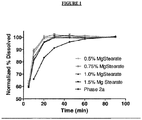
- Figure 1 presents a graphical illustration of the dissolution profiles of exemplary tablets according to the present invention.
- the present invention provides a pharmaceutical composition comprising a solid dispersion of N-[2,4-bis(1,1-dimethylethyl)-5-hydroxyphenyl]-1,4-dihydro-4-oxoquinoline-3-carboxamide, a method of manufacturing a pharmaceutical composition comprising N-[2,4-bis(1,1-dimethylethyl)-5-hydroxyphenyl]-1,4-dihydro-4-oxoquinoline-3-carboxamide, and a method of administering a pharmaceutical composition comprising a solid form of N-[2,4-bis(1,1-dimethylethyl)-5-hydroxyphenyl]-1,4-dihydro-4-oxoquinoline-3 -carboxamide.
- API active pharmaceutical ingredient
- CF potentiator e.g., N-[2,4-bis(1,1-dimethylethyl)-5-hydroxyphenyl]-1,4-dihydro-4-oxoquinoline-3-carboxamide.
- Compound 1 is used interchangeably with "N-[2,4-bis(1,1-dimethylethyl)-5-hydroxyphenyl]-1,4-dihydro-4-oxoquinoline-3-carboxamide", which has the following structure:
- amorphous refers to a solid material having no long range order in the position of its molecules.
- Amorphous solids are generally supercooled liquids in which the molecules are arranged in a random manner so that there is no well-defined arrangement, e.g., molecular packing, and no long range order.
- Amorphous solids are generally isotropic, i.e. exhibit similar properties in all directions and do not have definite melting points.
- an amorphous material is a solid material having no sharp characteristic crystalline peak(s) in its X-ray power diffraction (XRPD) pattern (i.e., is not crystalline as determined by XRPD).
- XRPD X-ray power diffraction
- one or several broad peaks appear in its XRPD pattern. Broad peaks are characteristic of an amorphous solid. See, US 2004/0006237 for a comparison of XRPDs of an amorphous material and crystalline material.
- substantially amorphous refers to a solid material having little or no long range order in the position of its molecules.
- substantially amorphous materials have less than about 15% crystallinity (e.g., less than about 10% crystallinity or less than about 5% crystallinity).
- 'substantially amorphous' includes the descriptor, 'amorphous', which refers to materials having no (0%) crystallinity.
- the term "dispersion” refers to a disperse system in which one substance, the dispersed phase, is distributed, in discrete units, throughout a second substance (the continuous phase or vehicle).
- the size of the dispersed phase can vary considerably (e.g. single molecules, colloidal particles of nanometer dimension, to multiple microns in size).
- the dispersed phases can be solids, liquids, or gases. In the case of a solid dispersion, the dispersed and continuous phases are both solids.
- a solid dispersion can include: an amorphous drug in an amorphous polymer; an amorphous drug in crystalline polymer; a crystalline drug in an amorphous polymer; or a crystalline drug in crystalline polymer.
- a solid dispersion can include an amorphous drug in an amorphous polymer or an amorphous drug in crystalline polymer.
- a solid dispersion includes the polymer constituting the dispersed phase, and the drug constitutes the continuous phase.
- a solid dispersion includes the drug constituting the dispersed phase, and the polymer constitutes the continuous phase.
- solid dispersion generally refers to a solid dispersion of two or more components, usually one or more drugs (e.g., one drug (e.g., Compound 1)) and polymer, but possibly containing other components such as surfactants or other pharmaceutical excipients, where the drug(s) (e.g., Compound 1) is substantially amorphous (e.g., having about 15% or less (e.g., about 10% or less, or about 5% or less)) of crystalline drug (e.g., N-[2,4-bis(1,1-dimethylethyl)-5-hydroxyphenyl]-1,4-dihydro-4-oxoquinoline-3-carboxamide) or amorphous (i.e., having no crystalline drug), and the physical stability and/or dissolution and/or solubility of the substantially amorphous or amorphous drug is enhanced by the other components.
- drugs e.g., one drug (e.g., Compound 1)
- polymer but possibly containing
- Solid dispersions typically include a compound dispersed in an appropriate carrier medium, such as a solid state carrier.
- a carrier comprises a polymer (e.g., a water-soluble polymer or a partially water-soluble polymer) and can include optional excipients such as functional excipients (e.g., one or more surfactants) or nonfunctional excipients (e.g., one or more fillers).
- Another exemplary solid dispersion is a co-precipitate or a co-melt of N-[2,4-bis(1,1-dimethylethyl)-5-hydroxyphenyl]-1,4-dihydro-4-oxoquinoline-3-carboxamide with at least one polymer.
- a "Co-precipitate” is a product after dissolving a drug and a polymer in a solvent or solvent mixture followed by the removal of the solvent or solvent mixture. Sometimes the polymer can be suspended in the solvent or solvent mixture.
- the solvent or solvent mixture includes organic solvents and supercritical fluids.
- a "co-melt” is a product after heating a drug and a polymer to melt, optionally in the presence of a solvent or solvent mixture, followed by mixing, removal of at least a portion of the solvent if applicable, and cooling to room temperature at a selected rate.
- crystallinity refers to the degree of structural order in a solid.
- Compound 1, which is substantially amorphous has less than about 15% crystallinity, or its solid state structure is less than about 15% crystalline.
- Compound 1, which is amorphous has zero (0%) crystallinity.
- CF potentiator refers to a compound that exhibits biological activity characterized by increasing gating functionality of the mutant CFTR protein present in the cell surface to approximately wild type levels.
- excipient is an inactive ingredient in a pharmaceutical composition.
- excipients include fillers or diluents, surfactants, binders, glidants, lubricants, disintegrants, and the like.
- a "disintegrant” is an excipient that hydrates a pharmaceutical composition and aids in tablet dispersion.
- disintegrants include sodium croscarmellose and/or sodium starch glycolate.
- a "diluent” or “filler” is an excipient that adds bulkiness to a pharmaceutical composition.
- fillers include lactose, sorbitol, celluloses, calcium phosphates, starches, sugars (e.g., mannitol, sucrose, or the like) or any combination thereof.
- a "surfactant” is an excipient that imparts pharmaceutical compositions with enhanced solubility and/or wetability.
- surfactants include sodium lauryl sulfate (SLS), sodium stearyl fumarate (SSF), polyoxyethylene 20 sorbitan mono-oleate (e.g., TweenTM), or any combination thereof.
- a "binder” is an excipient that imparts a pharmaceutical composition with enhanced cohesion or tensile strength (e.g., hardness).
- binders include dibasic calcium phosphate, sucrose, corn (maize) starch, microcrystalline cellulose, and modified cellulose (e.g., hydroxymethyl cellulose).
- glidant is an excipient that imparts a pharmaceutical compositions with enhanced flow properties.
- examples of glidants include colloidal silica and/or talc.
- a "colorant” is an excipient that imparts a pharmaceutical composition with a desired color.
- examples of colorants include commercially available pigments such as FD&C Blue # 1 Aluminum Lake, FD&C Blue #2, other FD&C Blue colors, titanium dioxide, iron oxide, and/or combinations thereof.
- a "lubricant” is an excipient that is added to pharmaceutical compositions that are pressed into tablets.
- the lubricant aids in compaction of granules into tablets and ejection of a tablet of a pharmaceutical composition from a die press.
- examples of lubricants include magnesium stearate, stearic acid (stearin), hydrogenated oil, sodium stearyl fumarate, or any combination thereof.
- Friability is measured using a standard USP testing apparatus that tumbles experimental tablets for 100 revolutions. Some tablets of the present invention have a friability of less than about 1% (e.g., less than about 0.75%, less than about 0.50%, or less than about 0.30%)
- mean particle diameter is the average particle diameter as measured using techniques such as laser light scattering, image analysis, or sieve analysis.
- bulk density is the mass of particles of material divided by the total volume the particles occupy. The total volume includes particle volume, inter-particle void volume and internal pore volume. Bulk density is not an intrinsic property of a material; it can change depending on how the material is processed.
- the present invention provides a pharmaceutical composition
- a pharmaceutical composition comprising a CF potentiator API (e.g., a solid dispersion of Compound 1).
- the present invention provides a pharmaceutical composition comprising a solid dispersion of substantially amorphous Compound 1, wherein the solid dispersion comprises about 25 mg of substantially amorphous Compound 1.
- the present invention provides a pharmaceutical composition comprising a solid dispersion of substantially amorphous Compound 1, wherein the solid dispersion comprises about 50 mg of substantially amorphous Compound 1.
- the present invention provides a pharmaceutical composition comprising a solid dispersion of substantially amorphous Compound 1, wherein the solid dispersion comprises about 75 mg of substantially amorphous Compound 1.
- the present invention provides a pharmaceutical composition comprising a solid dispersion of substantially amorphous Compound 1, wherein the solid dispersion comprises about 100 mg of substantially amorphous Compound 1.
- the present invention provides a pharmaceutical composition comprising a solid dispersion of substantially amorphous Compound 1, wherein the solid dispersion comprises about 150 mg of substantially amorphous Compound 1.
- the present invention provides a pharmaceutical composition comprising a solid dispersion of substantially amorphous Compound 1, wherein the solid dispersion comprises about 250 mg of substantially amorphous Compound 1.
- the present invention provides a pharmaceutical composition comprising a solid dispersion of amorphous Compound 1, wherein the solid dispersion comprises about 25 mg of amorphous Compound 1.
- the present invention provides a pharmaceutical composition comprising a solid dispersion of amorphous Compound 1, wherein the solid dispersion comprises about 50 mg of amorphous Compound 1.
- the present invention provides a pharmaceutical composition comprising a solid dispersion of amorphous Compound 1, wherein the solid dispersion comprises about 75 mg of amorphous Compound 1.
- the present invention provides a pharmaceutical composition comprising a solid dispersion of amorphous Compound 1, wherein the solid dispersion comprises about 100 mg of amorphous Compound 1.
- the present invention provides a pharmaceutical composition comprising a solid dispersion of amorphous Compound 1, wherein the solid dispersion comprises about 150 mg of amorphous Compound 1.
- the present invention provides a pharmaceutical composition comprising a solid dispersion of amorphous Compound 1, wherein the solid dispersion comprises about 250 mg of amorphous Compound 1.
- Another aspect of the present invention provides a pharmaceutical composition
- a pharmaceutical composition comprising a solid dispersion of Compound 1 in which the solid dispersion comprises a polymer.
- the present invention provides a pharmaceutical composition
- a pharmaceutical composition comprising a solid dispersion of substantially amorphous Compound 1 and HPMCAS, wherein the solid dispersion comprises about 25 mg of substantially amorphous Compound 1.
- the present invention provides a pharmaceutical composition
- a pharmaceutical composition comprising a solid dispersion of substantially amorphous Compound 1 and HPMCAS, wherein the solid dispersion comprises about 50 mg of substantially amorphous Compound 1.
- the present invention provides a pharmaceutical composition
- a pharmaceutical composition comprising a solid dispersion of substantially amorphous Compound 1 and HPMCAS, wherein the solid dispersion comprises about 75 mg of substantially amorphous Compound 1.
- the present invention provides a pharmaceutical composition
- a pharmaceutical composition comprising a solid dispersion of substantially amorphous Compound 1 and HPMCAS, wherein the solid dispersion comprises about 100 mg of substantially amorphous Compound 1.
- the present invention provides a pharmaceutical composition
- a pharmaceutical composition comprising a solid dispersion of substantially amorphous Compound 1 and HPMCAS, wherein the solid dispersion comprises about 150 mg of substantially amorphous Compound 1.
- the present invention provides a pharmaceutical composition
- a pharmaceutical composition comprising a solid dispersion of substantially amorphous Compound 1 and HPMCAS, wherein the solid dispersion comprises about 250 mg of substantially amorphous Compound 1.
- the present invention provides a pharmaceutical composition
- a pharmaceutical composition comprising a solid dispersion of amorphous Compound 1 and HPMCAS, wherein the solid dispersion comprises about 25 mg of amorphous Compound 1.
- the present invention provides a pharmaceutical composition
- a pharmaceutical composition comprising a solid dispersion of amorphous Compound 1 and HPMCAS, wherein the solid dispersion comprises about 50 mg of amorphous Compound 1.
- the present invention provides a pharmaceutical composition
- a pharmaceutical composition comprising a solid dispersion of amorphous Compound 1 and HPMCAS, wherein the solid dispersion comprises about 75 mg of amorphous Compound 1.
- the present invention provides a pharmaceutical composition
- a pharmaceutical composition comprising a solid dispersion of amorphous Compound 1 and HPMCAS, wherein the solid dispersion comprises about 100 mg of amorphous Compound 1.
- the present invention provides a pharmaceutical composition comprising a solid dispersion of amorphous Compound 1 and HPMCAS, wherein the solid dispersion comprises about 150 mg of amorphous Compound 1.
- the present invention provides a pharmaceutical composition
- a pharmaceutical composition comprising a solid dispersion of amorphous Compound 1 and HPMCAS, wherein the solid dispersion comprises about 250 mg of amorphous Compound 1.
- the present invention provides a pharmaceutical composition
- a pharmaceutical composition comprising a solid dispersion of substantially amorphous Compound 1 and PVP/VA, wherein the solid dispersion comprises about 25 mg of substantially amorphous Compound 1.
- the present invention provides a pharmaceutical composition
- a pharmaceutical composition comprising a solid dispersion of substantially amorphous Compound 1 and PVP/VA, wherein the solid dispersion comprises about 50 mg of substantially amorphous Compound 1.
- the present invention provides a pharmaceutical composition
- a pharmaceutical composition comprising a solid dispersion of substantially amorphous Compound 1 and PVP/VA, wherein the solid dispersion comprises about 75 mg of substantially amorphous Compound 1.
- the present invention provides a pharmaceutical composition
- a pharmaceutical composition comprising a solid dispersion of substantially amorphous Compound 1 and PVP/VA, wherein the solid dispersion comprises about 100 mg of substantially amorphous Compound 1.
- the present invention provides a pharmaceutical composition
- a pharmaceutical composition comprising a solid dispersion of substantially amorphous Compound 1 and PVP/VA, wherein the solid dispersion comprises about 150 mg of substantially amorphous Compound 1.
- the present invention provides a pharmaceutical composition
- a pharmaceutical composition comprising a solid dispersion of substantially amorphous Compound 1 and PVP/VA, wherein the solid dispersion comprises about 250 mg of substantially amorphous Compound 1.
- the present invention provides a pharmaceutical composition comprising a solid dispersion of amorphous Compound 1 and PVP/VA, wherein the solid dispersion comprises about 25 mg of amorphous Compound 1.
- the present invention provides a pharmaceutical composition comprising a solid dispersion of amorphous Compound 1 and PVP/VA, wherein the solid dispersion comprises about 50 mg of amorphous Compound 1.
- the present invention provides a pharmaceutical composition comprising a solid dispersion of amorphous Compound 1 and PVP/VA, wherein the solid dispersion comprises about 75 mg of amorphous Compound 1.
- the present invention provides a pharmaceutical composition comprising a solid dispersion of amorphous Compound 1 and PVP/VA, wherein the solid dispersion comprises about 100 mg of amorphous Compound 1.
- the present invention provides a pharmaceutical composition comprising a solid dispersion of amorphous Compound 1 and PVP/VA, wherein the solid dispersion comprises about 150 mg of amorphous Compound 1.
- the present invention provides a pharmaceutical composition comprising a solid dispersion of amorphous Compound 1 and PVP/VA, wherein the solid dispersion comprises about 250 mg of amorphous Compound 1.
- One aspect of the present invention provides a pharmaceutical composition
- a CF potentiator API e.g., a solid dispersion of Compound 1
- other excipients e.g., a filler, a disintegrant, a surfactant, a binder, a glidant, a colorant, a lubricant, or any combination thereof.
- the present invention provides a pharmaceutical composition comprising:
- the present invention provides a pharmaceutical composition comprising:
- the present invention provides a pharmaceutical composition comprising:
- the present invention provides a pharmaceutical composition comprising:
- the present invention provides a pharmaceutical composition comprising:
- the present invention provides a pharmaceutical composition comprising:
- the present invention provides a pharmaceutical composition comprising:
- the present invention provides a pharmaceutical composition comprising:
- the present invention provides a pharmaceutical composition comprising:
- the present invention provides a pharmaceutical composition comprising:
- the present invention provides a pharmaceutical composition comprising:
- the present invention provides a pharmaceutical composition comprising:
- the present invention provides a pharmaceutical composition comprising:
- the present invention provides a pharmaceutical composition comprising:
- the present invention provides a pharmaceutical composition comprising:
- the present invention provides a pharmaceutical composition comprising:
- the present invention provides a pharmaceutical composition comprising:
- the present invention provides a pharmaceutical composition comprising:
- the present invention provides a pharmaceutical composition comprising:
- the present invention provides a pharmaceutical composition comprising:
- the present invention provides a pharmaceutical composition comprising:
- the present invention provides a pharmaceutical composition comprising:
- the present invention provides a pharmaceutical composition comprising:
- the present invention provides a pharmaceutical composition comprising:
- the present invention provides a pharmaceutical composition comprising:
- the present invention provides a pharmaceutical composition comprising:
- the present invention provides a pharmaceutical composition comprising:
- the present invention provides a pharmaceutical composition comprising:
- the present invention provides a pharmaceutical composition comprising:
- the present invention provides a pharmaceutical composition comprising:
- the present invention provides a pharmaceutical composition comprising:
- the present invention provides a pharmaceutical composition comprising:
- the present invention provides a pharmaceutical composition comprising:
- the present invention provides a pharmaceutical composition comprising:
- the present invention provides a pharmaceutical composition comprising:
- the present invention provides a pharmaceutical composition comprising:
- the pharmaceutical composition comprises a solid dispersion, a filler, a disintegrant, a surfactant, a binder, a glidant, and a lubricant, wherein the solid dispersion comprises Compound 1 and a polymer.
- the pharmaceutical composition comprises a solid dispersion a filler, a disintegrant, a surfactant, a binder, a glidant, and a lubricant, wherein the solid dispersion comprises from about 45 wt% to about 65 wt% (e.g., about 50 wt%) of Compound 1 by weight of the dispersion and a polymer.
- the pharmaceutical composition comprises a solid dispersion a filler, a disintegrant, a surfactant, a binder, a glidant, and a lubricant, wherein the solid dispersion comprises from about 75 wt% to about 95 wt% (e.g., about 80 wt%) of Compound 1 by weight of the dispersion and a polymer.
- Suitable solid dispersions of Compound 1, i.e., N-[2,4-bis(1,1-dimethylethyl)-5-hydroxyphenyl]-1,4-dihydro-4-oxoquinoline-3-carboxamide include, without limitation, those dispersions described in PCT publication no. WO 2007/079139 , which is hereby incorporated by reference in its entirety.
- the pharmaceutical composition of the present invention comprises a solid dispersion of Compound 1.
- the solid dispersion comprises substantially amorphous Compound 1, where Compound 1 is less than about 15% (e.g., less than about 10% or less than about 5%) crystalline, and at least one polymer.
- the solid dispersion comprises amorphous Compound 1, i.e., Compound 1 has about 0% crystallinity.
- the concentration of Compound 1 in the solid dispersion depends on several factors such as the amount of pharmaceutical composition needed to provide a desired amount of Compound 1 and the desired dissolution profile of the pharmaceutical composition.
- Polymers useful in these solid dispersions are inert, pharmaceutically acceptable polymers that are at least partially soluble in water or biological fluids.
- Polymers can include homopolymers (e.g., polysaccharides) or copolymers (e.g., block copolymers).
- the solid dispersion comprises substantially amorphous or amorphous N-[2,4-bis(1,1-dimethylethyl)-5-hydroxyphenyl]-1,4-dihydro-4-oxoquinoline-3-carboxamide and at least one polymer independently selected from hydroxypropylmethylcellulose (HPMC), hydroxypropylmethylcellulose acetate succinate (HPMCAS), vinylpyrrolidone/vinyl acetate copolymer (PVP/VA), polyvinylpyrrolidone (PVP), methacrylic acid/methacrylate copolymers, hydroxypropyl cellulose (HPC), or any combination thereof.
- HPMC hydroxypropylmethylcellulose
- HPMCAS hydroxypropylmethylcellulose acetate succinate
- PV/VA vinylpyrrolidone/vinyl acetate copolymer
- PVP polyvinylpyrrolidone
- methacrylic acid/methacrylate copolymers hydroxypropyl cellulose (H
- the solid dispersion comprises substantially amorphous or amorphous N-[2,4-bis(1,1-dimethylethyl)-5-hydroxyphenyl]-1,4-dihydro-4-oxoquinoline-3-carboxamide and HPMCAS or PVP/VA.
- the pharmaceutical composition comprises a solid dispersion that contains substantially amorphous Compound 1 and HPMCAS or PVP/VA, in which the solid dispersion has a mean particle diameter, measured by light scattering (e.g., using a Malvern Mastersizer available from Malvern Instruments in England) of greater than about 5 ⁇ m (e.g., greater than about 6 ⁇ m, greater than about 7 ⁇ m, greater than about 8 ⁇ m, or greater than about 10 ⁇ m).
- a mean particle diameter measured by light scattering (e.g., using a Malvern Mastersizer available from Malvern Instruments in England) of greater than about 5 ⁇ m (e.g., greater than about 6 ⁇ m, greater than about 7 ⁇ m, greater than about 8 ⁇ m, or greater than about 10 ⁇ m).
- the pharmaceutical composition comprises a solid dispersion that contains amorphous Compound 1 and HPMCAS or PVP/VA, in which the solid dispersion has a mean particle diameter, measured by light scattering, of greater than about 5 ⁇ m (e.g., greater than about 6 ⁇ m, greater than about 7 ⁇ m, greater than about 8 ⁇ m, or greater than about 10 ⁇ m).
- the pharmaceutical composition comprises a solid dispersion comprising substantially amorphous Compound 1 and HPMCAS, in which the solid dispersion has a mean particle diameter, measured by light scattering, of from about 7 ⁇ m to about 25 ⁇ m.
- the pharmaceutical composition comprises a solid dispersion comprising amorphous Compound 1 and HPMCAS, in which the solid dispersion has a mean particle diameter, measured by light scattering, of from about 7 ⁇ m to about 25 ⁇ m.
- the pharmaceutical composition comprises a solid dispersion comprising substantially amorphous Compound 1 and HPMCAS, in which the solid dispersion has a mean particle diameter, measured by light scattering, of from about 10 ⁇ m to about 35 ⁇ m.
- the pharmaceutical composition comprises a solid dispersion comprising amorphous Compound 1 and HPMCAS, in which the solid dispersion has a mean particle diameter, measured by light scattering, of from about 10 ⁇ m to about 35 ⁇ m.
- the pharmaceutical composition comprises a solid dispersion comprising substantially amorphous Compound 1 and HPMCAS or PVP/VA, in which the solid dispersion has a bulk density of about 0.10 g/cc or greater (e.g., 0.15 g/cc or greater, 0.17 g/cc or greater).
- the pharmaceutical composition comprising a solid dispersion comprising amorphous Compound 1 and HPMCAS or PVP/VA, in which the solid dispersion has a bulk density of about 0.10 g/cc or greater (e.g., 0.15 g/cc or greater, 0.17 g/cc or greater).
- the pharmaceutical composition comprises a solid dispersion that comprises substantially amorphous Compound 1 and HPMCAS or PVP/VA, in which the solid dispersion has a bulk density of from about 0.10 g/cc to about 0.45 g/cc (e.g., from about 0.15 g/cc to about 0.42 g/cc, or from about 0.17 g/cc to about 0.40 g/cc).
- the pharmaceutical composition comprises a solid dispersion that includes amorphous Compound 1 and HPMCAS or PVP/VA, in which the solid dispersion has a bulk density of from about 0.10 g/cc to about 0.45 g/cc (e.g., from about 0.15 g/cc to about 0.42 g/cc, or from about 0.17 g/cc to about 0.40 g/cc).
- the pharmaceutical composition comprises a solid dispersion that comprises substantially amorphous Compound 1 and HPMCAS, in which the solid dispersion has a bulk density of from about 0.10 g/cc to about 0.45 g/cc (e.g., from about 0.15 g/cc to about 0.42 g/cc, or from about 0.17 g/cc to about 0.40 g/cc).
- the pharmaceutical composition includes a solid dispersion that comprises amorphous Compound 1 and HPMCAS, in which the solid dispersion has a bulk density of from about 0.10 g/cc to about 0.45 g/cc (e.g., from about 0.15 g/cc to about 0.42 g/cc, or from about 0.17 g/cc to about 0.40 g/cc).
- Alternative solid dispersions comprise substantially amorphous or amorphous Compound 1 and HPMCAS or PVP/VA, wherein substantially amorphous Compound 1 or amorphous Compound 1 is present in an amount of at least 20 wt% (e.g., at least 40 wt%, at least 45 wt%, at least 49 wt%, or at least 50 wt%) by weight of the solid dispersion.
- the solid dispersion comprises HPMCAS or PVP/VA and from about 20 wt% to about 99 wt% (e.g., from about 40 wt% to about 90 wt%, from about 42 wt% to about 88 wt%, from about 45 wt% to about 85 wt%, or from about 50 wt% to about 80 wt%) of substantially amorphous or amorphous Compound 1 by weight of the solid dispersion.
- HPMCAS or PVP/VA from about 20 wt% to about 99 wt% (e.g., from about 40 wt% to about 90 wt%, from about 42 wt% to about 88 wt%, from about 45 wt% to about 85 wt%, or from about 50 wt% to about 80 wt%) of substantially amorphous or amorphous Compound 1 by weight of the solid dispersion.
- the solid dispersion comprises HPMCAS or PVP/VA and from about 40 wt% to about 60 wt% (e.g., from about 42 wt% to about 57 wt%, from about 45 wt% to about 55 wt%, or from about 47 wt% to about 53 wt%) of substantially amorphous or amorphous Compound 1 by weight of the solid dispersion.
- the solid dispersion comprises HPMCAS or PVP/VA and from about 65 wt% to about 95 wt% (e.g., from about 67 wt% to about 92 wt%, from about 70 wt% to about 90 wt%, or from about 72 wt% to about 88 wt%) of substantially amorphous Compound 1 or amorphous Compound 1 by weight of the solid dispersion.
- the solid dispersion comprises 80 wt% or less (e.g., 60 wt% or less, 55 wt% or less, or 50 wt% or less) of polymer (e.g., HPMCAS, PVP/VA, PVP, methacrylic acid/methacrylate copolymer, HPC, or any combination thereof) by weight of solid dispersion.
- polymer e.g., HPMCAS, PVP/VA, PVP, methacrylic acid/methacrylate copolymer, HPC, or any combination thereof
- the solid dispersion comprises from about 1 wt% to about 80 wt% (e.g., from about 10 wt% to about 60 wt%) of polymer (e.g., HPMCAS, PVP/VA, PVP, methacrylic acid/methacrylate copolymer, HPC, or any combination thereof).
- Some solid dispersions comprise from about 40 wt% to about 60 wt% (e.g., from about 42 wt% to about 57 wt%, from about 45 wt% to about 55 wt%, or from about 47 wt% to about 53 wt%) of substantially amorphous Compound 1 by weight of the solid dispersion and from about 60 wt% to about 40 wt% of polymer (e.g., HPMCAS, PVP/VA, PVP, methacrylic acid/methacrylate copolymer, HPC, or any combination thereof).
- polymer e.g., HPMCAS, PVP/VA, PVP, methacrylic acid/methacrylate copolymer, HPC, or any combination thereof.
- Alternative solid dispersions comprise from about 40 wt% to about 60 wt% (e.g., from about 42 wt% to about 57 wt%, from about 45 wt% to about 55 wt%, or from about 47 wt% to about 53 wt%) of amorphous Compound 1 by weight of the solid dispersion and from about 60 wt% to about 40 wt% of polymer (e.g., HPMCAS, PVP/VA, PVP, methacrylic acid/methacrylate copolymer, HPC, or any combination thereof).
- polymer e.g., HPMCAS, PVP/VA, PVP, methacrylic acid/methacrylate copolymer, HPC, or any combination thereof.
- solid dispersions comprise from about 65 wt% to about 95 wt% (e.g., from about 67 wt% to about 92 wt%, from about 70 wt% to about 90 wt%, or from about 72 wt% to about 88 wt%) of substantially amorphous Compound 1 by weight of the solid dispersion and from about 45 wt% to about 5 wt% of polymer (e.g., HPMCAS, PVP/VA, PVP, methacrylic acid/methacrylate copolymer, HPC, or any combination thereof).
- polymer e.g., HPMCAS, PVP/VA, PVP, methacrylic acid/methacrylate copolymer, HPC, or any combination thereof.
- the solid dispersion comprises from about 65 wt% to about 95 wt% (e.g., from about 67 wt% to about 92 wt%, from about 70 wt% to about 90 wt%, or from about 72 wt% to about 88 wt%) of amorphous Compound 1 by weight of the solid dispersion and from about 45 wt% to about 5 wt% of polymer (e.g., HPMCAS, PVP/VA, PVP, methacrylic acid/methacrylate copolymer, HPC, or any combination thereof).
- polymer e.g., HPMCAS, PVP/VA, PVP, methacrylic acid/methacrylate copolymer, HPC, or any combination thereof.
- Solid dispersions useful in embodiments of the present invention can optionally comprise a surfactant.
- Suitable surfactants include sodium lauryl sulfate (SLS), sodium stearyl fumarate (SSF), polyoxyethylene 20 sorbitan mono-oleate (e.g., TweenTM), any combination thereof, or the like.
- the solid dispersion comprises less than 5 wt% (less than 3.0 wt%, less than 1.5 wt%, or less than 1.0 wt%) of surfactant by weight of solid dispersion.
- the solid dispersion comprises from about 0.30 wt% to about 0.80 wt% (e.g., from about 0.35 wt% to about 0.70 wt%, from about 0.40 wt% to about 0.60 wt%, or from about 0.45 wt% to about 0.55 wt%) of surfactant by weight of solid dispersion.
- the solid dispersion comprises from about 45 wt% to about 85 wt% of substantially amorphous or amorphous Compound 1, from about 0.45 wt% to about 0.55 wt% of SLS, and from about 14.45 wt% to about 55.55 wt% of HPMCAS or PVP/VA by weight of the solid dispersion.
- One exemplary solid dispersion contains about 50 wt% of substantially amorphous or amorphous Compound 1, about 49.5 wt% of HPMCAS or PVP/VA, and about 0.5 wt% of SLS, by weight of the solid dispersion.
- Another exemplary solid dispersion contains about 80 wt% of substantially amorphous or amorphous Compound 1, about 19.5 wt% of HPMCAS or PVP/VA, and about 0.5 wt% of SLS.
- the solid dispersion comprises from about 45 wt% to about 85 wt% of substantially amorphous or amorphous Compound 1, from about 0.45 wt% to about 0.55 wt% of SLS, and from about 14.45 wt% to about 55.55 wt% of HPMCAS by weight of the solid dispersion.
- One exemplary solid dispersion contains about 50 wt% of substantially amorphous or amorphous Compound 1, about 49.5 wt% of HPMCAS, and about 0.5 wt% of SLS, by weight of the solid dispersion.
- Another exemplary solid dispersion contains about 80 wt% of substantially amorphous or amorphous Compound 1, about 19.5 wt% of HPMCAS or PVP/VA, and about 0.5 wt% of SLS.
- compositions of the present invention also comprise one or more excipients such as fillers, disintegrants, surfactants, binders, glidants, lubricants, colorants, or fragrances.
- excipients such as fillers, disintegrants, surfactants, binders, glidants, lubricants, colorants, or fragrances.
- Fillers suitable for the present invention are compatible with the ingredients of the pharmaceutical composition, i.e., they do not substantially reduce the solubility, the hardness, the chemical stability, the physical stability, or the biological activity of the pharmaceutical composition.
- Exemplary fillers include lactose, sorbitol, celluloses, calcium phosphates, starches, sugars (e.g., mannitol, sucrose, or the like), or any combination thereof.
- the pharmaceutical composition comprises at least one filler in an amount of at least about 10 wt% (e.g., at least about 20 wt%, at least about 25 wt%, or at least about 27 wt%) by weight of the composition.
- the pharmaceutical composition comprises from about 10 wt% to about 60 wt% (e.g., from about 20 wt% to about 55 wt%, from about 25 wt% to about 50 wt%, or from about 27 wt% to about 45 wt%) of filler, by weight of the composition.
- the pharmaceutical composition comprises at least about 20 wt% (e.g., at least 25 wt% or at least 27 wt%) of lactose, by weight of the composition.
- the pharmaceutical composition comprises from about 20 wt% to about 60 wt% (e.g., from about 25 wt% to about 55 wt% or from about 27 wt% to about 45 wt%) of lactose, by weight of the composition.
- Disintegrants suitable for the present invention enhance the dispersal of the pharmaceutical composition and are compatible with the ingredients of the pharmaceutical composition, i.e., they do not substantially reduce the chemical stability, the physical stability, the hardness, or the biological activity of the pharmaceutical composition.
- Exemplary disintegrants include sodium croscarmellose, sodium starch glycolate, or a combination thereof.
- the pharmaceutical composition comprises disintegrant in an amount of about 10 wt% or less (e.g., about 7 wt% or less, about 6 wt% or less, or about 5 wt% or less) by weight of the composition.
- the pharmaceutical composition comprises from about 1 wt% to about 10 wt% (e.g., from about 1.5 wt% to about 7.5 wt% or from about 2.5 wt% to about 6 wt%) of disintegrant, by weight of the composition.
- the pharmaceutical composition comprises about 10 wt% or less (e.g., 7 wt% or less, 6 wt% or less, or 5 wt% or less) of sodium croscarmellose, by weight of the composition.
- the pharmaceutical composition comprises from about 1 wt% to about 10 wt% (e.g., from about 1.5 wt% to about 7.5 wt% or from about 2.5 wt% to about 6 wt%) of sodium croscarmellose, by weight of the composition.
- the pharmaceutical composition comprises from about 0.1% to about 10 wt% (e.g., from about 0.5 wt% to about 7.5 wt% or from about 1.5 wt% to about 6 wt%) of disintegrant, by weight of the composition.
- the pharmaceutical composition comprises from about 0.5% to about 10 wt% (e.g., from about 1.5 wt% to about 7.5 wt% or from about 2.5 wt% to about 6 wt%) of disintegrant, by weight of the composition.
- Surfactants suitable for the present invention enhance the solubility of the pharmaceutical composition and are compatible with the ingredients of the pharmaceutical composition, i.e., they do not substantially reduce the chemical stability, the physical stability, the hardness, or the biological activity of the pharmaceutical composition.
- exemplary surfactants include sodium lauryl sulfate (SLS), sodium stearyl fumarate (SSF), polyoxyethylene 20 sorbitan mono-oleate (e.g., TweenTM), any combination thereof, or the like.
- the pharmaceutical composition comprises a surfactant in an amount of about 10 wt% or less (e.g., about 5 wt% or less, about 2 wt% or less, about 1 wt% or less, about 0.8 wt% or less, or about 0.6 wt% or less) by weight of the composition.
- the pharmaceutical composition includes from about 10 wt% to about 0.1 wt% (e.g., from about 5 wt% to about 0.2 wt% or from about 2 wt% to about 0.3 wt%) of surfactant, by weight of the composition.
- the pharmaceutical composition comprises 10 wt% or less (e.g., about 5 wt% or less, about 2 wt% or less, about 1 wt% or less, about 0.8 wt% or less, or about 0.6 wt% or less) of sodium lauryl sulfate, by weight of the composition.
- the pharmaceutical composition comprises from about 10 wt% to about 0.1 wt% (e.g., from about 5 wt% to about 0.2 wt% or from about 2 wt% to about 0.3 wt%) of sodium lauryl sulfate, by weight of the composition.
- Binders suitable for the present invention enhance the tablet strength of the pharmaceutical composition and are compatible with the ingredients of the pharmaceutical composition, i.e., they do not substantially reduce the chemical stability, the physical stability, or the biological activity of the pharmaceutical composition.
- Exemplary binders include microcrystalline cellulose, dibasic calcium phosphate, sucrose, corn (maize) starch, modified cellulose (e.g., hydroxymethyl cellulose), or any combination thereof.
- the pharmaceutical composition comprises a binder in an amount of at least about 1 wt% (e.g., at least about 10 wt%, at least about 15 wt%, at least about 20 wt%, or at least about 22 wt%) by weight of the composition.
- the pharmaceutical composition comprises from about 5 wt% to about 50 wt% (e.g., from about 10 wt% to about 45 wt% or from about 20 wt% to about 45 wt%) of binder, by weight of the composition.
- the pharmaceutical composition comprises at least about 1 wt% (e.g., at least about 10 wt%, at least about 15 wt%, at least about 20 wt%, or at least about 22 wt%) of microcrystalline cellulose, by weight of the composition.
- the pharmaceutical composition comprises from about 5 wt% to about 50 wt% (e.g., from about 10 wt% to about 45 wt% or from about 20 wt% to about 45 wt%) of microcrystalline cellulose, by weight of the composition.
- Glidants suitable for the present invention enhance the flow properties of the pharmaceutical composition and are compatible with the ingredients of the pharmaceutical composition, i.e., they do not substantially reduce the solubility, the hardness, the chemical stability, the physical stability, or the biological activity of the pharmaceutical composition.
- Exemplary glidants include colloidal silicon dioxide, talc, or a combination thereof.
- the pharmaceutical composition comprises a glidant in an amount of 2 wt% or less (e.g., 1.75 wt%, 1.25 wt% or less, or 1.00 wt% or less) by weight of the composition.
- the pharmaceutical composition comprises from about 2 wt% to about 0.05 wt% (e.g., from about 1.5 wt% to about 0.07 wt% or from about 1.0 wt% to about 0.09 wt%) of glidant, by weight of the composition.
- the pharmaceutical composition comprises 2 wt% or less (e.g., 1.75 wt%, 1.25 wt% or less, or 1.00 wt% or less) of colloidal silicon dioxide, by weight of the composition.
- the pharmaceutical composition comprises from about 2 wt% to about 0.05 wt% (e.g., from about 1.5 wt% to about 0.07 wt% or from about 1.0 wt% to about 0.09 wt%) of colloidal silicon dioxide, by weight of the composition.
- Lubricants suitable for the present invention improve the compression and ejection of compressed pharmaceutical compositions from a die press and are compatible with the ingredients of the pharmaceutical composition, i.e., they do not substantially reduce the solubility, the hardness, or the biological activity of the pharmaceutical composition.
- Exemplary lubricants include magnesium stearate, stearic acid (stearin), hydrogenated oil, sodium stearyl fumarate, or any combination thereof.
- the pharmaceutical composition comprises a lubricant in an amount of 2 wt% or less (e.g., 1.75 wt%, 1.25 wt% or less, or 1.00 wt% or less) by weight of the composition.
- the pharmaceutical composition comprises from about 2 wt% to about 0.10 wt% (e.g., from about 1.5 wt% to about 0.15 wt% or from about 1.3 wt% to about 0.30 wt%) of lubricant, by weight of the composition.
- the pharmaceutical composition comprises 2 wt% or less (e.g., 1.75 wt%, 1.25 wt% or less, or 1.00 wt% or less) of magnesium stearate, by weight of the composition.
- the pharmaceutical composition comprises from about 2 wt% to about 0.10 wt% (e.g., from about 1.5 wt% to about 0.15 wt% or from about 1.3 wt% to about 0.30 wt%) of magnesium stearate, by weight of the composition.
- compositions of the present invention can optionally comprise one or more colorants, flavors, and/or fragrances to enhance the visual appeal, taste, and/or scent of the composition.
- Suitable colorants, flavors, or fragrances are compatible with the ingredients of the pharmaceutical composition, i.e., they do not substantially reduce the solubility, the chemical stability, the physical stability, the hardness, or the biological activity of the pharmaceutical composition.
- the pharmaceutical composition comprises a colorant, a flavor, and/or a fragrance.
- the pharmaceutical composition comprises less than about 1 wt% (e.g., less than about 0.75 wt% or less than about 0.5 wt%) of each optionally ingredient, i.e., colorant, flavor and/or fragrance, by weight of the composition.
- the pharmaceutical composition comprises less than about 1 wt% (e.g., less than about 0.75 wt% or less than about 0.5 wt%) of a colorant. In still another example, the pharmaceutical composition comprises less than about 1 wt% (e.g., less than about 0.75 wt% or less than about 0.5 wt%) of a blue colorant (e.g., FD&C Blue #1 and/or FD&C Blue #2 Aluminum Lake, commercially available from Colorcon, Inc. of West Point, PA.)
- a blue colorant e.g., FD&C Blue #1 and/or FD&C Blue #2 Aluminum Lake, commercially available from Colorcon, Inc. of West Point, PA.
- the pharmaceutical composition can be made into tablets and the tablets can be coated with a colorant and optionally labeled with a logo, other image and/or text using a suitable ink.
- the pharmaceutical composition can be made into tablets and the tablets can be coated with a colorant, waxed, and optionally labeled with a logo, other image and/or text using a suitable ink.
- Suitable colorants and inks are compatible with the ingredients of the pharmaceutical composition, i.e., they do not substantially reduce the solubility, the chemical stability, the physical stability, the hardness, or the biological activity of the pharmaceutical composition.
- the suitable colorants and inks can be any color and are water based or solvent based.
- tablets made from the pharmaceutical composition are coated with a colorant and then labeled with a logo, other image, and/or text using a suitable ink.
- tablets comprising pharmaceutical composition as described herein can be coated with about 3 wt% (e.g., less than about 6 wt% or less than about 4 wt%) of film coating comprising a colorant.
- the colored tablets can be labeled with a logo and text indicating the strength of the active ingredient in the tablet using a suitable ink.
- tablets comprising pharmaceutical composition as described herein can be coated with about 3 wt% (e.g., less than about 6 wt% or less than about 4 wt%) of a film coating comprising a blue colorant (e.g., OPADRY® II, commercially available from Colorcon, Inc. of West Point, PA.).
- a blue colorant e.g., OPADRY® II, commercially available from Colorcon, Inc. of West Point, PA.
- the colored tablets can be labeled with a logo and text indicating the strength of the active ingredient in the tablet using a black ink (e.g., Opacode® WB, commercially available from Colorcon, Inc. of West Point, PA.).
- tablets made from the pharmaceutical composition are coated with a colorant, waxed, and then labeled with a logo, other image, and/or text using a suitable ink.
- tablets comprising pharmaceutical composition as described herein can be coated with about 3 wt% (e.g., less than about 6 wt% or less than about 4 wt%) of film coating comprising a colorant.
- the colored tablets can be waxed with Carnauba wax powder weighed out in the amount of about 0.01% w/w of the starting tablet core weight.
- the waxed tablets can be labeled with a logo and text indicating the strength of the active ingredient in the tablet using a suitable ink.
- tablets comprising pharmaceutical composition as described herein can be coated with about 3 wt% (e.g., less than about 6 wt% or less than about 4 wt%) of a film coating comprising a blue colorant (e.g., OPADRY® II, commercially available from Colorcon, Inc. of West Point, PA.).
- a blue colorant e.g., OPADRY® II, commercially available from Colorcon, Inc. of West Point, PA.
- the colored tablets can be waxed with Carnauba wax powder weighed out in the amount of about 0.01% w/w of the starting tablet core weight.
- the waxed tablets can be labeled with a logo and text indicating the strength of the active ingredient in the tablet using a black ink (e.g., Opacode® S-1-17823 - a solvent based ink, commercially available from Colorcon, Inc. of West Point, PA.).
- a black ink e.g., Opacode® S-1-178
- One exemplary pharmaceutical composition comprises from about 5 wt% to about 50 wt% (e.g., from about 5 wt% to about 25 wt%, from about 15 wt% to about 40 wt%, or from about 30 wt% to about 50 wt%) of a solid dispersion, by weight of the composition, comprising from about 40 wt% to about 60 wt% of substantially amorphous Compound 1, by weight of the dispersion, and from about 60 wt% to about 40 wt% of a polymer, by weight of the dispersion; from about 25 wt% to about 50 wt% of a filler; from about 1 wt% to about 10 wt% of a disintegrant; from about 2 wt% to about 0.3 wt% of a surfactant; from about 5 wt% to about 50 wt% of a binder; from about 2 wt% to about 0.05 wt% of a glidant; and
- the pharmaceutical composition comprises from about 5 wt% to about 50 wt% (e.g., from about 5 wt% to about 25 wt%, from about 15 wt% to about 40 wt%, or from about 30 wt% to about 50 wt%) of a solid dispersion, by weight of the composition, comprising from about 40 wt% to about 60 wt% of amorphous Compound 1, by weight of the dispersion, and from about 60 wt% to about 40 wt% of a polymer, by weight of the dispersion; from about 25 wt% to about 50 wt% of a filler; from about 1 wt% to about 10 wt% of a disintegrant; from about 2 wt% to about 0.3 wt% of a surfactant; from about 5 wt% to about 50 wt% of a binder; from about 2 wt% to about 0.05 wt% of a glidant; and from about 5
- Another exemplary pharmaceutical composition comprises from about 5 wt% to about 50 wt% (e.g., from about 5 wt% to about 25 wt%, from about 15 wt% to about 40 wt%, or from about 30 wt% to about 50 wt%) of a solid dispersion, by weight of the composition, comprising from about 70 wt% to about 90 wt% of substantially amorphous Compound 1, by weight of the dispersion, and from about 30 wt% to about 10 wt% of a polymer, by weight of the dispersion; from about 25 wt% to about 50 wt% of a filler; from about 1 wt% to about 10 wt% of a disintegrant; from about 2 wt% to about 0.3 wt% of a surfactant; from about 5 wt% to about 50 wt% of a binder; from about 2 wt% to about 0.05 wt% of a glidant; and
- the pharmaceutical composition comprises from about 5 wt% to about 50 wt% (e.g., from about 5 wt% to about 25 wt%, from about 15 wt% to about 40 wt%, or from about 30 wt% to about 50 wt%) of a solid dispersion, by weight of the composition, comprising from about 70 wt% to about 90 wt% of amorphous Compound 1, by weight of the dispersion, and from about 30 wt% to about 10 wt% of a polymer, by weight of the dispersion; from about 25 wt% to about 50 wt% of a filler; from about 1 wt% to about 10 wt% of a disintegrant; from about 2 wt% to about 0.3 wt% of a surfactant; from about 5 wt% to about 50 wt% of a binder; from about 2 wt% to about 0.05 wt% of a glidant; and from about 5
- One pharmaceutical composition of the present invention comprises about 15 wt% of a solid dispersion by weight of the composition, wherein the dispersion comprises about 50 wt% of substantially amorphous Compound 1 by weight of the dispersion, about 49.5 wt% of HPMCAS by weight of the dispersion, and about 0.5 wt% SLS by weight of the dispersion; about 35 wt% of microcrystalline cellulose by weight of the composition; about 43 wt% of lactose by weight of the composition; about 5 wt% of sodium croscarmellose by weight of the composition; about 0.5 wt% of SLS by weight of the composition; about 0.125 wt% of colloidal silicon dioxide by weight of the composition; and about 0.5 wt% of magnesium stearate by weight of the composition.
- the pharmaceutical composition of the present invention comprises about 15 wt% of a solid dispersion by weight of the composition, wherein the dispersion comprises about 50 wt% of amorphous Compound 1 by weight of the dispersion, about 49.5 wt% of HPMCAS by weight of the dispersion, and about 0.5 wt% SLS by weight of the dispersion; about 35 wt% of microcrystalline cellulose by weight of the composition; about 43 wt% of lactose by weight of the composition; about 5 wt% of sodium croscarmellose by weight of the composition; about 0.5 wt% of SLS by weight of the composition; about 0.125 wt% of colloidal silicon dioxide by weight of the composition; and about 0.5 wt% of magnesium stearate by weight of the composition.
- Another pharmaceutical composition of the present invention comprises about 31 wt% of a solid dispersion by weight of the composition, wherein the dispersion comprises about 50 wt% of substantially amorphous Compound 1 by weight of the dispersion, about 49.5 wt% of HPMCAS by weight of the dispersion, and about 0.5 wt% SLS by weight of the dispersion; about 25 wt% of microcrystalline cellulose by weight of the composition; about 38 wt% of lactose by weight of the composition; about 5 wt% of sodium croscarmellose by weight of the composition; about 0.5 wt% of SLS by weight of the composition; about 0.125 wt% of colloidal silicon dioxide by weight of the composition; and about 0.5 wt% of magnesium stearate by weight of the composition.
- the pharmaceutical composition of the present invention comprises about 31 wt% of a solid dispersion by weight of the composition, wherein the dispersion comprises about 50 wt% of amorphous Compound 1 by weight of the dispersion, about 49.5 wt% of HPMCAS by weight of the dispersion, and about 0.5 wt% SLS by weight of the dispersion; about 25 wt% of microcrystalline cellulose by weight of the composition; about 38 wt% of lactose by weight of the composition; about 5 wt% of sodium croscarmellose by weight of the composition; about 0.5 wt% of SLS by weight of the composition; about 0.125 wt% of colloidal silicon dioxide by weight of the composition; and about 0.5 wt% of magnesium stearate by weight of the composition.
- Another pharmaceutical composition of the present invention comprises about 40 wt% of a solid dispersion by weight of the composition, wherein the dispersion comprises about 80 wt% of substantially amorphous Compound 1 by weight of the dispersion, about 19.5 wt% of PVP/VA by weight of the dispersion, and about 0.5 wt% SLS by weight of the dispersion; about 27 wt% of microcrystalline cellulose by weight of the composition; about 27 wt% of lactose by weight of the composition; about 3 wt% of sodium croscarmellose by weight of the composition; about 0.5 wt% of SLS by weight of the composition; about 1 wt% of colloidal silicon dioxide by weight of the composition; about 1 wt% of magnesium stearate by weight of the composition, and about 0.4 wt% of colorant by weight of the composition.
- the pharmaceutical composition of the present invention comprises about 40 wt% of a solid dispersion by weight of the composition, wherein the dispersion comprises about 80 wt% of amorphous Compound 1 by weight of the dispersion, about 19.5 wt% of PVP/VA by weight of the dispersion, and about 0.5 wt% SLS by weight of the dispersion; about 27 wt% of microcrystalline cellulose by weight of the composition; about 27 wt% of lactose by weight of the composition; about 3 wt% of sodium croscarmellose by weight of the composition; about 0.5 wt% of SLS by weight of the composition; about 1 wt% of colloidal silicon dioxide by weight of the composition; about 1 wt% of magnesium stearate by weight of the composition, and about 0.4 wt% of colorant by weight of the composition.
- Another pharmaceutical composition of the present invention comprises about 40 wt% of a solid dispersion by weight of the composition, wherein the dispersion comprises about 80 wt% of substantially amorphous Compound 1 by weight of the dispersion, about 19.5 wt% of HPMCAS by weight of the dispersion, and about 0.5 wt% SLS by weight of the dispersion; about 27 wt% of microcrystalline cellulose by weight of the composition; about 27 wt% of lactose by weight of the composition; about 3 wt% of sodium croscarmellose by weight of the composition; about 0.5 wt% of SLS by weight of the composition; about 1 wt% of colloidal silicon dioxide by weight of the composition; about 1 wt% of magnesium stearate by weight of the composition, and about 0.4 wt% of colorant by weight of the composition.
- the pharmaceutical composition of the present invention comprises about 40 wt% of a solid dispersion by weight of the composition, wherein the dispersion comprises about 80 wt% of amorphous Compound 1 by weight of the dispersion, about 19.5 wt% of HPMCAS by weight of the dispersion, and about 0.5 wt% SLS by weight of the dispersion; about 27 wt% of microcrystalline cellulose by weight of the composition; about 27 wt% of lactose by weight of the composition; about 3 wt% of sodium croscarmellose by weight of the composition; about 0.5 wt% of SLS by weight of the composition; about 1 wt% of colloidal silicon dioxide by weight of the composition; about 1 wt% of magnesium stearate by weight of the composition, and about 0.4 wt% of colorant by weight of the composition.
- composition of the present invention comprises about 34.5 wt% of a solid dispersion by weight of the composition, wherein the dispersion comprises about 80 wt% of substantially amorphous Compound 1 by weight of the dispersion, about 19.5 wt% of HPMCAS by weight of the dispersion, and about 0.5 wt% SLS by weight of the dispersion; about 30 wt% of microcrystalline cellulose by weight of the composition; about 30 wt% of lactose by weight of the composition; about 3 wt% of sodium croscarmellose by weight of the composition; about 0.5 wt% of SLS by weight of the composition; about 1 wt% of colloidal silicon dioxide by weight of the composition; about 1 wt% of magnesium stearate by weight of the composition.
- a caplet shaped pharmaceutical tablet composition having a hardness of 9.5 Kp ⁇ 15 percent comprises about 34 wt% of a solid dispersion by weight of the composition, wherein the dispersion comprises about 80 wt% of substantially amorphous Compound 1 by weight of the dispersion, about 19.5 wt% of HPMCAS by weight of the dispersion, and about 0.5 wt% SLS by weight of the dispersion; about 30 wt% of microcrystalline cellulose by weight of the composition; about 30 wt% of lactose by weight of the composition; about 3 wt% of sodium croscarmellose by weight of the composition; about 0.5 wt% of SLS by weight of the composition; about 1 wt% of colloidal silicon dioxide by weight of the composition; and about 1 wt% of magnesium stearate by weight of the composition.
- the caplet shaped pharmaceutical tablet contains 150 mg of Compound 1.
- the caplet shaped pharmaceutical tablet contains 150 mg of Compound 1.
- the caplet comprises
- a caplet shaped pharmaceutical tablet composition having an initial hardness of 11 Kp ⁇ 20 percent comprises about 40 wt% of a solid dispersion by weight of the composition, wherein the dispersion comprises about 80 wt% of substantially amorphous Compound 1 by weight of the dispersion, about 19.5 wt% of HPMCAS by weight of the dispersion, and about 0.5 wt% SLS by weight of the dispersion; about 30 wt% of microcrystalline cellulose by weight of the composition; about 30 wt% of lactose by weight of the composition; about 3 wt% of sodium croscarmellose by weight of the composition; about 0.5 wt% of SLS by weight of the composition; about 1 wt% of colloidal silicon dioxide by weight of the composition; and about 1 wt% of magnesium stearate by weight of the composition.
- the caplet shaped pharmaceutical tablet contains 150 mg of Compound 1.
- a caplet shaped pharmaceutical tablet composition having an initial hardness of 11 Kp ⁇ 20 percent comprises about 34.1 wt% of a solid dispersion by weight of the composition, wherein the dispersion comprises about 80 wt% of substantially amorphous Compound 1 by weight of the dispersion, about 19.5 wt% of HPMCAS by weight of the dispersion, and about 0.5 wt% SLS by weight of the dispersion; about 30 wt% of microcrystalline cellulose by weight of the composition; about 30.4 wt% of lactose by weight of the composition; about 3 wt% of sodium croscarmellose by weight of the composition; about 0.5 wt% of SLS by weight of the composition; about 1 wt% of colloidal silicon dioxide by weight of the composition; and about 1 wt% of magnesium stearate by weight of the composition.
- the caplet shaped pharmaceutical tablet composition contains 100 mg of Compound 1. In other aspects, the caplet shaped pharmaceutical tablet composition includes a colorant coating and a printed logo or text. In some embodiments of this aspect, the caplet shaped pharmaceutical tablet composition includes a blue OPADRY® II coating and a water or solvent based ink logo or text. In certain embodiments, the caplet shaped pharmaceutical tablet contains 150 mg of Compound 1.
- a caplet shaped pharmaceutical tablet composition having an initial hardness of between about 6 and 16 Kp comprises about 34.1 wt% of a solid dispersion by weight of the composition, wherein the dispersion comprises about 80 wt% of substantially amorphous Compound 1 by weight of the dispersion, about 19.5 wt% of HPMCAS by weight of the dispersion, and about 0.5 wt% SLS by weight of the dispersion; about 30.5 wt% of microcrystalline cellulose by weight of the composition; about 30.4 wt% of lactose by weight of the composition; about 3 wt% of sodium croscarmellose by weight of the composition; about 0.5 wt% of SLS by weight of the composition; about 0.5 wt% of colloidal silicon dioxide by weight of the composition; and about 1 wt% of magnesium stearate by weight of the composition.
- the caplet shaped pharmaceutical tablet composition contains 100 mg of Compound 1.
- the caplet shaped pharmaceutical tablet composition comprises a colorant coated, a wax coating, and a printed logo or text.
- the caplet shaped pharmaceutical tablet includes a blue OPADRY® II coating and a water or solvent based ink logo or text.
- the colorant coating is blue OPADRY® II.
- the wax coating comprises Carnauba wax.
- the ink for the printed logo or text is a solvent based ink.
- the caplet shaped pharmaceutical tablet composition contains 150 mg of Compound 1.
- a pharmaceutical tablet composition having an initial hardness of between about 9 and 21 Kp comprises about 34.1 wt% of a solid dispersion by weight of the composition, wherein the dispersion comprises about 80 wt% of substantially amorphous Compound 1 by weight of the dispersion, about 19.5 wt% of HPMCAS by weight of the dispersion, and about 0.5 wt% SLS by weight of the dispersion; about 30.5 wt% of microcrystalline cellulose by weight of the composition; about 30.4 wt% of lactose by weight of the composition; about 3 wt% of sodium croscarmellose by weight of the composition; about 0.5 wt% of SLS by weight of the composition; about 0.5 wt% of colloidal silicon dioxide by weight of the composition; and about 1 wt% of magnesium stearate by weight of the composition.
- the caplet shaped pharmaceutical tablet composition contains 150 mg of Compound 1.
- the caplet shaped pharmaceutical tablet composition further comprises a colorant coated, a wax coating, and a printed logo or text.
- the tablet includes a blue OPADRY® II coating and a water or solvent based ink logo or text.
- the wax coating comprises Carnauba wax.
- the ink for the printed logo or text is a solvent based ink.
- the caplet shaped pharmaceutical tablet composition contains 100 mg of Compound 1.
- a pharmaceutical composition comprises about 34 wt% of a solid dispersion by weight of the composition, wherein the dispersion comprises about 80 wt% of substantially amorphous Compound 1 by weight of the dispersion, about 19.5 wt% of HPMCAS by weight of the dispersion, and about 0.5 wt% SLS by weight of the dispersion; about 30 wt% of microcrystalline cellulose by weight of the composition; about 30 wt% of lactose by weight of the composition; about 3 wt% of sodium croscarmellose by weight of the composition; about 0.5 wt% of SLS by weight of the composition; about 1 wt% of colloidal silicon dioxide by weight of the composition; and about 1 wt% of magnesium stearate by weight of the composition.
- the pharmaceutical composition contains 150 mg of Compound 1.
- the pharmaceutical composition contains 100 mg of Compound 1.
- a pharmaceutical composition comprises about 40 wt% of a solid dispersion by weight of the composition, wherein the dispersion comprises about 80 wt% of substantially amorphous Compound 1 by weight of the dispersion, about 19.5 wt% of HPMCAS by weight of the dispersion, and about 0.5 wt% SLS by weight of the dispersion; about 30 wt% of microcrystalline cellulose by weight of the composition; about 30 wt% of lactose by weight of the composition; about 3 wt% of sodium croscarmellose by weight of the composition; about 0.5 wt% of SLS by weight of the composition; about 1 wt% of colloidal silicon dioxide by weight of the composition; and about 1 wt% of magnesium stearate by weight of the composition.
- the pharmaceutical composition contains 150 mg of Compound 1.
- the pharmaceutical composition contains 100 mg of Compound 1.
- a pharmaceutical composition comprises about 34.1 wt% of a solid dispersion by weight of the composition, wherein the dispersion comprises about 80 wt% of substantially amorphous Compound 1 by weight of the dispersion, about 19.5 wt% of HPMCAS by weight of the dispersion, and about 0.5 wt% SLS by weight of the dispersion; about 30 wt% of microcrystalline cellulose by weight of the composition; about 30.4 wt% of lactose by weight of the composition; about 3 wt% of sodium croscarmellose by weight of the composition; about 0.5 wt% of SLS by weight of the composition; about 1 wt% of colloidal silicon dioxide by weight of the composition; and about 1 wt% of magnesium stearate by weight of the composition.
- the pharmaceutical composition contains 100 mg of Compound 1. In other embodiments, the pharmaceutical composition contains 150 mg of Compound 1. In other aspects, the pharmaceutical composition is formed as a tablet composition that includes a colorant coating and a printed logo or text. In some embodiments of this aspect, the pharmaceutical tablet composition includes a blue OPADRY® II coating and a water or solvent based ink logo or text.
- a pharmaceutical composition comprises about 34.1 wt% of a solid dispersion by weight of the composition, wherein the dispersion comprises about 80 wt% of substantially amorphous Compound 1 by weight of the dispersion, about 19.5 wt% of HPMCAS by weight of the dispersion, and about 0.5 wt% SLS by weight of the dispersion; about 30.5 wt% of microcrystalline cellulose by weight of the composition; about 30.4 wt% of lactose by weight of the composition; about 3 wt% of sodium croscarmellose by weight of the composition; about 0.5 wt% of SLS by weight of the composition; about 0.5 wt% of colloidal silicon dioxide by weight of the composition; and about 1 wt% of magnesium stearate by weight of the composition.
- the pharmaceutical tablet contains 100 mg of Compound 1. In other embodiments, the pharmaceutical composition contains 150 mg of Compound 1. In some further aspects, the pharmaceutical composition is formed as a tablet and comprises a colorant coated, a wax coating, and a printed logo or text. In some embodiments of this aspect, the pharmaceutical tablet includes a blue OPADRY® II coating and a water or solvent based ink logo or text. In some instances, the colorant coating is blue OPADRY® II. In some instances, the wax coating comprises Carnauba wax. In certain aspects, the ink for the printed logo or text is a solvent based ink.
- compositions of the present invention can be processed into a tablet form, capsule form, or suspension that is suited for oral administration or can be reconstituted in an aqueous solvent (e.g., DI water or saline) for oral, IV, or inhalation (e.g., nebulizer) administration.
- aqueous solvent e.g., DI water or saline
- inhalation e.g., nebulizer
- a pharmaceutical composition consisting of a tablet that includes a CF potentiator API (e.g., a solid dispersion of N-[2,4-bis(1,1-dimethylethyl)-5-hydroxyphenyl]-1,4-dihydro-4-oxoquinoline-3-carboxamide) and other excipients (e.g., a filler, a disintegrant, a surfactant, a binder, a glidant, a colorant, a lubricant, or any combination thereof), each of which is described above and in the Examples below, wherein the tablet has a dissolution of at least about 50% (e.g., at least about 60%, at least about 70%, at least about 80%, at least about 90%, or at least about 99%) in about 30 minutes.
- CF potentiator API e.g., a solid dispersion of N-[2,4-bis(1,1-dimethylethyl)-5-hydroxyphenyl]-1,
- the pharmaceutical composition consists of a tablet that includes a CF potentiator API (e.g., a solid dispersion of Compound 1) and other excipients (e.g., a filler, a disintegrant, a surfactant, a binder, a glidant, a colorant, a lubricant, or any combination thereof), each of which is described above and in the Examples below, wherein the tablet has a dissolution of from about 50% to about 100% (e.g., from about 55% to about 95% or from about 60% to about 90%) in about 30 minutes.
- a CF potentiator API e.g., a solid dispersion of Compound 1
- other excipients e.g., a filler, a disintegrant, a surfactant, a binder, a glidant, a colorant, a lubricant, or any combination thereof
- the pharmaceutical composition consists of a tablet that comprises a solid dispersion comprising substantially amorphous or amorphous Compound 1 and HPMCAS or PVP/VA; and, a filler, a disintegrant, a surfactant, a binder, a glidant, and a lubricant, wherein the tablet has a dissolution of at least about 50% (e.g., at least about 60%, at least about 70%, at least about 80%, at least about 90%, or at least about 99%) in about 30 minutes.
- a dissolution e.g., at least about 60%, at least about 70%, at least about 80%, at least about 90%, or at least about 99%
- the pharmaceutical composition consists of a tablet that comprises a solid dispersion comprising substantially amorphous or amorphous Compound 1 and HPMCAS or PVP/VA; and, a filler, a disintegrant, a surfactant, a binder, a glidant, and a lubricant, wherein the tablet has a dissolution of from about 50% to about 100% (e.g., from about 55% to about 95% or from about 60% to about 90%) in about 30 minutes.
- the tablet comprises a solid dispersion comprising at least about 25 mg (e.g., at least about 30 mg, at least about 40 mg, or at least about 50 mg) of substantially amorphous or amorphous Compound 1; and PVP/VA and SLS.
- the tablet comprises a solid dispersion comprising at least about 25 mg (e.g., at least about 30 mg, at least about 40 mg, at least about 50 mg, at least about 100 mg, or at least 150 mg) of substantially amorphous or amorphous Compound 1; and HPMCAS and SLS.
- Dissolution can be measured with a standard USP Type II apparatus that employs a dissolution media of 0.6% sodium lauryl sulfate dissolved in 900 mL of DI water, stirring at about 50-75 rpm at a temperature of about 37 °C. A single experimental tablet is tested in each test vessel of the apparatus. Dissolution can also be measured with a standard USP Type II apparatus that employs a dissolution media of 0.7% sodium lauryl sulfate dissolved in 900 mL of 50 mM sodium phosphate buffer (pH 6.8), stirring at about 65 rpm at a temperature of about 37 °C. A single experimental tablet is tested in each test vessel of the apparatus.
- Dissolution can also be measured with a standard USP Type II apparatus that employs a dissolution media of 0.5% sodium lauryl sulfate dissolved in 900 mL of 50 mM sodium phosphate buffer (pH 6.8), stirring at about 65 rpm at a temperature of about 37 °C. A single experimental tablet is tested in each test vessel of the apparatus.
- a pharmaceutical composition consisting of a tablet that comprises a CF potentiator API (e.g., a solid dispersion of Compound 1) and other excipients (e.g., a filler, a disintegrant, a surfactant, a binder, a glidant, a colorant, a lubricant, or any combination thereof), each of which is described above and in the Examples below, wherein the tablet has a hardness of at least about 5 Kp.
- CF potentiator API e.g., a solid dispersion of Compound 1
- other excipients e.g., a filler, a disintegrant, a surfactant, a binder, a glidant, a colorant, a lubricant, or any combination thereof
- the pharmaceutical composition consists of a tablet that comprises a CF potentiator API (e.g., a solid dispersion of Compound 1) and other excipients (e.g., a filler, a disintegrant, a surfactant, a binder, a glidant, a colorant, a lubricant, or any combination thereof), each of which is described above and in the Examples below, wherein the tablet has a hardness of at least about 5 Kp (e.g., at least about 5.5, at least about 6 Kp, or at least about 7 Kp).
- a CF potentiator API e.g., a solid dispersion of Compound 1
- other excipients e.g., a filler, a disintegrant, a surfactant, a binder, a glidant, a colorant, a lubricant, or any combination thereof
- Another aspect of the present invention provides a method of producing a pharmaceutical composition
- a method of producing a pharmaceutical composition comprising providing an admixture of a solid dispersion of substantially amorphous or amorphous N-[2,4-Bis(1,1-dimethylethyl)-5-hydroxyphenyl]-1,4-dihydro-4-oxoquinoline-3-carboxamide, a binder, a glidant, a surfactant, a lubricant, a disintegrant, and a filler, and compressing the admixture into a tablet having a dissolution of at least about 50% in about 30 minutes.
- the admixture can comprise optional additives such as one or more colorants, one or more flavors, and/or one or more fragrances as described above and in the Examples below.
- the relative concentrations (e.g., wt%) of each of these ingredients (and any optional additives) in the admixture is also presented above and in the Examples below.
- the ingredients constituting the admixture can be provided sequentially or in any combination of additions; and, the ingredients or combination of ingredients can be provided in any order.
- the lubricant is the last component added to the admixture.
- the admixture comprises a solid dispersion of substantially amorphous Compound 1, a binder, a glidant, a surfactant, a lubricant, a disintegrant, and a filler, wherein each of these ingredients is provided in a powder form (e.g., provided as particles having a mean diameter, measured by light scattering, of 250 ⁇ m or less (e.g., 150 ⁇ m or less, 100 ⁇ m or less, 50 ⁇ m or less, 45 ⁇ m or less, 40 ⁇ m or less, or 35 ⁇ m or less)).
- a powder form e.g., provided as particles having a mean diameter, measured by light scattering, of 250 ⁇ m or less (e.g., 150 ⁇ m or less, 100 ⁇ m or less, 50 ⁇ m or less, 45 ⁇ m or less, 40 ⁇ m or less, or 35 ⁇ m or less)).
- the admixture comprises a solid dispersion of amorphous Compound 1, a binder, a glidant, a surfactant, a lubricant, a disintegrant, and a filler, wherein each of these ingredients is provided in a powder form (e.g., provided as particles having a mean diameter, measured by light scattering, of 250 ⁇ m or less (e.g., 150 ⁇ m or less, 100 ⁇ m or less, 50 ⁇ m or less, 45 ⁇ m or less, 40 ⁇ m or less, or 35 ⁇ m or less)).
- a powder form e.g., provided as particles having a mean diameter, measured by light scattering, of 250 ⁇ m or less (e.g., 150 ⁇ m or less, 100 ⁇ m or less, 50 ⁇ m or less, 45 ⁇ m or less, 40 ⁇ m or less, or 35 ⁇ m or less)).
- the admixture comprises a solid dispersion of substantially amorphous Compound 1, a binder, a glidant, a surfactant, a lubricant, a disintegrant, and a filler, wherein each of these ingredients is substantially free of water.
- Each of the ingredients comprises less than 5 wt% (e.g., less than 2 wt%, less than 1 wt%, less than 0.75 wt%, less than 0.5 wt%, or less than 0.25 wt%) of water by weight of the ingredient.
- the admixture comprises a solid dispersion of amorphous Compound 1, a binder, a glidant, a surfactant, a lubricant, a disintegrant, and a filler, wherein each of these ingredients is substantially free of water.
- each of the ingredients comprises less than 5 wt% (e.g., less than 2 wt%, less than 1 wt%, less than 0.75 wt%, less than 0.5 wt%, or less than 0.25 wt%) of water by weight of the ingredient.
- compressing the admixture into a tablet is accomplished by filling a form (e.g., a mold) with the admixture and applying pressure to admixture. This can be accomplished using a die press or other similar apparatus. It is also noted that the application of pressure to the admixture in the form can be repeated using the same pressure during each compression or using different pressures during the compressions. In another example, the admixture is compressed using a die press that applies sufficient pressure to form a tablet having a dissolution of about 50% or more at about 30 minutes (e.g., about 55% or more at about 30 minutes or about 60% or more at about 30 minutes).
- the admixture is compressed using a die press to produce a tablet hardness of at least about 5 Kp (at least about 5.5 Kp, at least about 6 Kp, at least about 7 Kp, at least about 11 Kp, or at least 21Kp). In some instances, the admixture is compressed to produce a tablet hardness of between about 6 and 21 Kp.
- tablets comprising a pharmaceutical composition as described herein can be coated with about 3.0 wt% of a film coating comprising a colorant by weight of the tablet.
- the colorant suspension or solution used to coat the tablets comprises about 20%w/w of solids by weight of the colorant suspension or solution.
- the coated tablets can be labeled with a logo, other image or text.
- the method of producing a pharmaceutical composition comprises providing an admixture of a solid dispersion of substantially amorphous Compound 1, a binder, a glidant, a surfactant, a lubricant, a disintegrant, and a filler; mixing the admixture until the admixture is substantially homogenous, and compressing the admixture into a tablet as described above or in the Examples below.
- the method of producing a pharmaceutical composition comprises providing an admixture of a solid dispersion of amorphous Compound 1, a binder, a glidant, a surfactant, a lubricant, a disintegrant, and a filler; mixing the admixture until the admixture is substantially homogenous, and compressing the admixture into a tablet as described above or in the Examples below.
- the admixture is mixed by stirring, blending, shaking, or the like using hand mixing, a mixer, a blender, any combination thereof, or the like.
- mixing can occur between successive additions, continuously throughout the ingredient addition, after the addition of all of the ingredients or combinations of ingredients, or any combination thereof.
- the admixture is mixed until it has a substantially homogenous composition.
- the invention also provides a method of treating or lessening the severity of a disease in a patient comprising administering to said patient one of the compositions as defined herein, and said disease is selected from cystic fibrosis, asthma, smoke induced COPD, chronic bronchitis, rhinosinusitis, constipation, pancreatitis, pancreatic insufficiency, male infertility caused by congenital bilateral absence of the vas deferens (CBAVD), mild pulmonary disease, idiopathic pancreatitis, allergic bronchopulmonary aspergillosis (ABPA), liver disease, hereditary emphysema, hereditary hemochromatosis, coagulation-fibrinolysis deficiencies, such as protein C deficiency, Type 1 hereditary angioedema, lipid processing deficiencies, such as familial hypercholesterolemia, Type 1 chylomicronemia, abetalipoproteinemia, lysosomal storage diseases, such as I
- Another aspect of the present invention provides a method of administering a pharmaceutical composition by orally administering to a patient at least once per day the composition comprising a solid dispersion of substantially amorphous or amorphous Compound 1, in which the solid dispersion comprises at least about 25 mg of substantially amorphous or amorphous Compound 1.
- Another aspect of the present invention provides a method of administering a pharmaceutical composition by orally administering to a patient at least once per day the composition comprising a solid dispersion of substantially amorphous or amorphous Compound 1, in which the solid dispersion comprises at least about 50 mg of substantially amorphous or amorphous Compound 1.
- Another aspect of the present invention provides a method of administering a pharmaceutical composition by orally administering to a patient at least once per day the composition comprising a solid dispersion of substantially amorphous or amorphous Compound 1, in which the solid dispersion comprises at least about 75 mg of substantially amorphous or amorphous Compound 1.
- Another aspect of the present invention provides a method of administering a pharmaceutical composition by orally administering to a patient at least once per day the composition comprising a solid dispersion of substantially amorphous or amorphous Compound 1, in which the solid dispersion comprises at least about 100mg of substantially amorphous or amorphous Compound 1.
- Another aspect of the present invention provides a method of administering a pharmaceutical composition by orally administering to a patient at least once per day the composition comprising a solid dispersion of substantially amorphous or amorphous Compound 1, in which the solid dispersion comprises at least about 150 mg of substantially amorphous or amorphous Compound 1.
- Another aspect of the present invention provides a method of administering a pharmaceutical composition by orally administering to a patient at least once per day the composition comprising a solid dispersion of substantially amorphous or amorphous Compound 1, in which the solid dispersion comprises at least about 250 mg of substantially amorphous or amorphous Compound 1.
- Another aspect of the present invention provides a method of administering a pharmaceutical composition by orally administering to a patient twice per day the composition comprising a solid dispersion of substantially amorphous or amorphous Compound 1, in which the solid dispersion comprises at least about 25 mg of substantially amorphous or amorphous Compound 1.
- Another aspect of the present invention provides a method of administering a pharmaceutical composition by orally administering to a patient twice per day the composition comprising a solid dispersion of substantially amorphous or amorphous Compound 1, in which the solid dispersion comprises at least about 50 mg of substantially amorphous or amorphous Compound 1.
- Another aspect of the present invention provides a method of administering a pharmaceutical composition by orally administering to a patient twice per day the composition comprising a solid dispersion of substantially amorphous or amorphous Compound 1, in which the solid dispersion comprises at least about 75 mg of substantially amorphous or amorphous Compound 1.
- Another aspect of the present invention provides a method of administering a pharmaceutical composition by orally administering to a patient twice per day the composition comprising a solid dispersion of substantially amorphous or amorphous Compound 1, in which the solid dispersion comprises at least about 100 mg of substantially amorphous or amorphous Compound 1.
- Another aspect of the present invention provides a method of administering a pharmaceutical composition by orally administering to a patient twice per day the composition comprising a solid dispersion of substantially amorphous or amorphous Compound 1, in which the solid dispersion comprises at least about 150 mg of substantially amorphous or amorphous Compound 1.
- Another aspect of the present invention provides a method of administering a pharmaceutical composition by orally administering to a patient twice per day the composition comprising a solid dispersion of substantially amorphous or amorphous Compound 1, in which the solid dispersion comprises at least about 250 mg of substantially amorphous or amorphous Compound 1.
- compositions comprising a solid dispersion of substantially amorphous or amorphous Compound 1, in which the solid dispersion comprises at least about 25 mg of substantially amorphous or amorphous Compound 1.
- compositions comprising a solid dispersion of substantially amorphous or amorphous Compound 1, in which the solid dispersion comprises at least about 50 mg of substantially amorphous or amorphous Compound 1.
- compositions comprising a solid dispersion of substantially amorphous or amorphous Compound 1, in which the solid dispersion comprises at least about 75 mg of substantially amorphous or amorphous Compound 1.
- compositions comprising a solid dispersion of substantially amorphous or amorphous Compound 1, in which the solid dispersion comprises at least about 100 mg of substantially amorphous or amorphous Compound 1.
- compositions comprising a solid dispersion of substantially amorphous or amorphous Compound 1, in which the solid dispersion comprises at least about 150 mg of substantially amorphous or amorphous Compound 1.
- compositions comprising a solid dispersion of substantially amorphous or amorphous Compound 1, in which the solid dispersion comprises at least about 250 mg of substantially amorphous or amorphous Compound 1.
- a pharmaceutical composition as described herein is orally administered to a patient once every 24 hours.
- Another aspect of the present invention provides a method of administering a pharmaceutical composition by orally administering to a patient once per day the composition comprising a solid dispersion of substantially amorphous or amorphous Compound 1, in which the solid dispersion comprises at least about 25 mg of substantially amorphous or amorphous Compound 1.
- Another aspect of the present invention provides a method of administering a pharmaceutical composition by orally administering to a patient once per day the composition comprising a solid dispersion of substantially amorphous or amorphous Compound 1, in which the solid dispersion comprises at least about 50 mg of substantially amorphous or amorphous Compound 1.
- Another aspect of the present invention provides a method of administering a pharmaceutical composition by orally administering to a patient once per day the composition comprising a solid dispersion of substantially amorphous or amorphous Compound 1, in which the solid dispersion comprises at least about 75 mg of substantially amorphous or amorphous Compound 1.
- Another aspect of the present invention provides a method of administering a pharmaceutical composition by orally administering to a patient once per day the composition comprising a solid dispersion of substantially amorphous or amorphous Compound 1, in which the solid dispersion comprises at least about 100 mg of substantially amorphous or amorphous Compound 1.
- Another aspect of the present invention provides a method of administering a pharmaceutical composition by orally administering to a patient once per day the composition comprising a solid dispersion of substantially amorphous or amorphous Compound 1, in which the solid dispersion comprises at least about 150 mg of substantially amorphous or amorphous Compound 1.
- Another aspect of the present invention provides a method of administering a pharmaceutical composition by orally administering to a patient once per day the composition comprising a solid dispersion of substantially amorphous or amorphous Compound 1, in which the solid dispersion comprises at least about 250 mg of substantially amorphous or amorphous Compound 1.
- Another aspect of the present invention provides a method of administering a pharmaceutical composition
- a method of administering a pharmaceutical composition comprising orally administering to a patient at least once per day at least one tablet comprising a pharmaceutical composition containing a solid dispersion of substantially amorphous Compound 1, a filler, a binder, a glidant, a disintegrant, a surfactant, and a lubricant, each of which is described above and in the Examples below, wherein the solid dispersion comprises at least 25 mg (e.g., at least 35 mg, at least 40 mg, or at least 45 mg) of substantially amorphous Compound 1.
- the present invention provides a method of administering a pharmaceutical composition comprising orally administering to a patient at least one tablet comprising:
- the present invention provides a method of administering a pharmaceutical composition comprising orally administering to a patient at least one tablet comprising:
- the present invention provides a method of administering a pharmaceutical composition comprising orally administering to a patient at least one tablet comprising:
- the present invention provides a method of administering a pharmaceutical composition comprising orally administering to a patient at least one tablet comprising:
- the present invention provides a method of administering a pharmaceutical composition comprising orally administering to a patient at least one tablet comprising:
- the present invention provides a method of administering a pharmaceutical composition comprising orally administering to a patient at least one tablet comprising:
- the present invention provides a method of administering a pharmaceutical composition comprising orally administering to a patient at least one tablet comprising:
- the present invention provides a method of administering a pharmaceutical composition comprising orally administering to a patient at least one tablet comprising:
- the present invention provides a method of administering a pharmaceutical composition comprising orally administering to a patient at least one tablet comprising:
- the present invention provides a method of administering a pharmaceutical composition comprising orally administering to a patient at least one tablet comprising:
- the present invention provides a method of administering a pharmaceutical composition comprising orally administering to a patient at least one tablet comprising:
- the present invention provides a method of administering a pharmaceutical composition comprising orally administering to a patient at least one tablet comprising:
- the present invention provides a method of administering a pharmaceutical composition comprising orally administering to a patient at least one tablet comprising:
- the present invention provides a method of administering a pharmaceutical composition comprising orally administering to a patient at least one tablet comprising:
- the present invention provides a method of administering a pharmaceutical composition comprising orally administering to a patient at least one tablet comprising:
- the present invention provides a method of administering a pharmaceutical composition comprising orally administering to a patient at least one tablet comprising:
- the present invention provides a method of administering a pharmaceutical composition comprising orally administering to a patient at least one tablet comprising:
- the present invention provides a method of administering a pharmaceutical composition comprising orally administering to a patient at least one tablet comprising:
- the present invention provides for a method of orally administering the pharmaceutical composition described herein once a day. In other embodiments, the present invention provides for a method of orally administering the pharmaceutical composition described herein twice a day.
- Another aspect of the present invention provides a method of administering a pharmaceutical composition by orally administering to a patient at least once per day at least one tablet comprising a solid dispersion of substantially amorphous or amorphous Compound 1, a filler, a binder, a glidant, a disintegrant, a surfactant, and a lubricant, in which the solid dispersion comprises at least about 25 mg of substantially amorphous or amorphous Compound 1.
- the tablet is orally administered to the patient once per day.
- the administration comprises orally administering to a patient twice per day at least one tablet comprising a solid dispersion of substantially amorphous or amorphous Compound 1, a filler, a binder, a glidant, a disintegrant, a surfactant, and a lubricant, in which the solid dispersion contains at least about 25 mg of substantially amorphous or amorphous Compound 1.
- Some tablets useful in this method comprise a solid dispersion containing at least about 50 mg of substantially amorphous or amorphous Compound 1.
- the administration includes orally administering to a patient twice per day at least one tablet comprising a solid dispersion of substantially amorphous or amorphous Compound 1, a filler, a binder, a glidant, a disintegrant, a surfactant, and a lubricant, in which the solid dispersion contains at least about 50 mg of substantially amorphous or amorphous Compound 1.
- Some tablets useful in this method comprise a solid dispersion containing at least about 75 mg of substantially amorphous or amorphous Compound 1.
- the administration includes orally administering to a patient twice per day at least one tablet comprising a solid dispersion of substantially amorphous or amorphous Compound 1, a filler, a binder, a glidant, a disintegrant, a surfactant, and a lubricant, in which the solid dispersion contains at least about 75 mg of substantially amorphous or amorphous Compound 1.
- Another aspect of the present invention provides a method of administering a pharmaceutical composition by orally administering to a patient at least once per day at least one tablet comprising a solid dispersion of substantially amorphous or amorphous Compound 1, a filler, a binder, a glidant, a disintegrant, a surfactant, and a lubricant, in which the solid dispersion comprises at least about 100 mg of substantially amorphous or amorphous Compound 1.
- the tablet is orally administered to the patient once per day.
- the administration comprises orally administering to a patient twice per day at least one tablet comprising a solid dispersion of substantially amorphous or amorphous Compound 1, a filler, a binder, a glidant, a disintegrant, a surfactant, and a lubricant, in which the solid dispersion contains at least about 100 mg of substantially amorphous or amorphous Compound 1.
- Other tablets useful in this method comprise a solid dispersion containing at least about 150 mg of substantially amorphous or amorphous Compound 1.
- the administration includes orally administering to a patient twice per day at least one tablet comprising a solid dispersion of substantially amorphous or amorphous Compound 1, a filler, a binder, a glidant, a disintegrant, a surfactant, and a lubricant, in which the solid dispersion contains at least about 150 mg of substantially amorphous or amorphous Compound 1.
- the administration includes orally administering to a patient at least once per day at least one tablet comprising a solid dispersion of substantially amorphous or amorphous Compound 1, a filler, a binder, a glidant, a disintegrant, a surfactant, and a lubricant, in which the solid dispersion contains at least about 250 mg of substantially amorphous or amorphous Compound 1.
- the administration includes orally administering to a patient once per day at least one tablet comprising a solid dispersion of substantially amorphous or amorphous Compound 1, a filler, a binder, a glidant, a disintegrant, a surfactant, and a lubricant, in which the solid dispersion contains at least about 250 mg of substantially amorphous or amorphous Compound 1.
- the administration includes orally administering to a patient twice per day at least one tablet comprising a solid dispersion of substantially amorphous or amorphous Compound 1, a filler, a binder, a glidant, a disintegrant, a surfactant, and a lubricant, in which the solid dispersion contains at least about 250 mg of substantially amorphous or amorphous Compound 1.
- the method of administering a pharmaceutical composition including orally administering to a patient at least once per day at least one tablet including a pharmaceutical composition containing a solid dispersion of amorphous Compound 1, a filler, a binder, a glidant, a disintegrant, a surfactant, and a lubricant, each of which is described above and in the Examples below, wherein the solid dispersion comprises at least 25 mg (e.g., at least 35 mg, at least 40 mg, or at least 45 mg) of substantially amorphous Compound 1.
- the method of administering a pharmaceutical composition includes orally administering to a patient at least once per day at least one tablet comprising a pharmaceutical composition containing a solid dispersion of substantially amorphous Compound 1, a filler, a binder, a glidant, a disintegrant, a surfactant, and a lubricant, wherein the solid dispersion comprises from about 30 mg to about 300 mg (e.g., from about 40 mg to about 280 mg or from about 45 mg to about 260 mg, or from about 50 mg to about 200 mg) of substantially amorphous Compound 1.
- the method of administering a pharmaceutical composition includes orally administering to a patient at least once per day at least one tablet comprising a pharmaceutical composition containing a solid dispersion of amorphous Compound 1, a filler, a binder, a glidant, a disintegrant, a surfactant, and a lubricant, wherein the solid dispersion comprises from about 30 mg to about 300 mg (e.g., from about 40 mg to about 280 mg or from about 45 mg to about 260 mg, or from about 50 mg to about 200 mg) of amorphous Compound 1.
- the method of administering a pharmaceutical composition includes orally administering to a patient once per day at least one tablet comprising a pharmaceutical composition containing a solid dispersion of Compound 1, a filler, a binder, a glidant, a disintegrant, a surfactant, and a lubricant, each of which is described above and in the Examples below, wherein the solid dispersion comprises at least 25 mg (e.g., at least 35 mg, at least 40 mg, at least 45 mg, at least 75 mg, at least about 100 mg, at least about 150 mg, or at least 250 mg,) of substantially amorphous Compound 1 or amorphous Compound 1.
- a pharmaceutical composition containing a solid dispersion of Compound 1, a filler, a binder, a glidant, a disintegrant, a surfactant, and a lubricant, each of which is described above and in the Examples below, wherein the solid dispersion comprises at least 25 mg (e.g., at least 35
- the method of administering a pharmaceutical composition includes orally administering to a patient once per day one tablet comprising a pharmaceutical composition containing a solid dispersion of Compound 1, a filler, a binder, a glidant, a disintegrant, a surfactant, and a lubricant, wherein the solid dispersion comprises at least 75 mg (e.g., at least 100 mg, at least 125 mg, at least 140 mg, at least 150 mg, or at least 250 mg) of substantially amorphous Compound 1 or amorphous Compound 1.
- the method of administering a pharmaceutical composition includes orally administering to a patient once per day a plurality of tablets (e.g., two tablets, three tablets, four or five tablets), wherein each tablet comprises a pharmaceutical composition comprising a solid dispersion of substantially amorphous Compound 1 or amorphous Compound 1, a filler, a binder, a glidant, a disintegrant, a surfactant, and a lubricant, wherein the solid dispersion comprises at least 25 mg (e.g., at least 35 mg, at least 40 mg, at least 45 mg, at least 75 mg, at least about 150 mg, or at least 250 mg,) of substantially amorphous Compound 1 or amorphous Compound 1.
- a plurality of tablets e.g., two tablets, three tablets, four or five tablets
- each tablet comprises a pharmaceutical composition comprising a solid dispersion of substantially amorphous Compound 1 or amorphous Compound 1, a filler, a binder, a
- the method of administering a pharmaceutical composition includes orally administering to a patient twice per day at least one tablet comprising a pharmaceutical composition containing a solid dispersion of Compound 1, a filler, a binder, a glidant, a disintegrant, a surfactant, and a lubricant, each of which is described above and in the Examples below, wherein the solid dispersion comprises at least 25 mg (e.g., at least 35 mg, at least 40 mg, at least 45 mg, at least 50 mg, at least 75 mg, at least about 150 mg, or at least 250 mg,) of substantially amorphous Compound 1 or amorphous Compound 1.
- a solid dispersion comprises at least 25 mg (e.g., at least 35 mg, at least 40 mg, at least 45 mg, at least 50 mg, at least 75 mg, at least about 150 mg, or at least 250 mg,) of substantially amorphous Compound 1 or amorphous Compound 1.
- the method of administering a pharmaceutical composition includes orally administering to a patient twice per day one tablet comprising a pharmaceutical composition containing a solid dispersion of Compound 1, a filler, a binder, a glidant, a disintegrant, a surfactant, and a lubricant, wherein the solid dispersion comprises at least 75 mg (e.g., at least 100 mg, at least 125 mg, at least 140 mg, at least 150 mg, or at least 250 mg) of substantially amorphous Compound 1 or amorphous Compound 1.
- the method of administering a pharmaceutical composition includes orally administering to a patient twice per day a plurality of tablets (e.g., two tablets, three tablets, four or five tablets), wherein each tablet comprises a pharmaceutical composition comprising a solid dispersion of substantially amorphous Compound 1 or amorphous Compound 1, a filler, a binder, a glidant, a disintegrant, a surfactant, and a lubricant, wherein the solid dispersion comprises at least 25 mg (e.g., at least 35 mg, at least 40 mg, at least 45 mg, at least 50 mg, at least 75 mg, at least about 150 mg, or at least 250 mg,) of substantially amorphous Compound 1 or amorphous Compound 1.
- a plurality of tablets e.g., two tablets, three tablets, four or five tablets
- each tablet comprises a pharmaceutical composition comprising a solid dispersion of substantially amorphous Compound 1 or amorphous Compound 1, a filler, a bin
- the methods of administration of the present invention can optionally include orally administering a beverage (water, milk, or the like), food, and/or additional pharmaceutical compositions including additional APIs.
- a beverage water, milk, or the like
- food including a standard high fat high calorie CF meal or snack
- additional pharmaceutical compositions including additional APIs the oral administration of the beverage, food, and/or additional API can occur concurrently with the oral administration of the tablet, prior to the oral administration of the tablet, and/or after the administration of the tablet.
- the method of administering a pharmaceutical composition includes orally administering to a patient at least once per day at least one tablet comprising a pharmaceutical composition containing a solid dispersion of substantially amorphous Compound 1 or amorphous Compound 1, a filler, a binder, a glidant, a disintegrant, a surfactant, a lubricant, and a second API.
- the method of administering a pharmaceutical composition includes orally administering to a patient at least once per day at least one tablet comprising a pharmaceutical composition comprising a solid dispersion of substantially amorphous Compound 1 or amorphous Compound 1, a filler, a binder, a glidant, a disintegrant, a surfactant, and a lubricant, wherein the solid dispersion comprises at least 25 mg (e.g., at least 35 mg, at least 45 mg, or at least 50 mg) of substantially amorphous Compound 1 or amorphous Compound 1, and orally administering to a patient at least once per day a second pharmaceutical composition comprising a second API.
- the method of administering a pharmaceutical composition includes orally administering to a patient every 12 hours at least one tablet comprising a pharmaceutical composition as described herein, in which the tablet is administered about 30 minutes after consuming a high fat, high calorie CF meal or snack.
- the compound and pharmaceutically acceptable compositions of the present invention can be employed in combination therapies, that is, the compound and pharmaceutically acceptable compositions can be administered concurrently with, prior to, or subsequent to, one or more other desired therapeutics or medical procedures.
- the particular combination of therapies (therapeutics or procedures) to employ in a combination regimen will take into account compatibility of the desired therapeutics and/or procedures and the desired therapeutic effect to be achieved.
- the therapies employed may achieve a desired effect for the same disorder (for example, an inventive compound may be administered concurrently with another agent used to treat the same disorder), or they may achieve different effects (e.g., control of any adverse effects).
- additional therapeutic agents that are normally administered to treat or prevent a particular disease, or condition are known as "appropriate for the disease, or condition, being treated.”
- the additional agent is selected from a mucolytic agent, bronchodialator, an anti-biotic, an anti-infective agent, an anti-inflammatory agent, a CFTR modulator other than Compound 1 of the present invention, or a nutritional agent.
- the additional agent is an antibiotic.
- antibiotics useful herein include tobramycin, including tobramycin inhaled powder (TIP), azithromycin, aztreonam, including the aerosolized form of aztreonam, amikacin, including liposomal formulations thereof, ciprofloxacin, including formulations thereof suitable for administration by inhalation, levoflaxacin, including aerosolized formulations thereof, and combinations of two antibiotics, e.g., fosfomycin and tobramycin.
- the additional agent is a mucolyte.
- exemplary mucolytes useful herein includes Pulmozyme®.
- the additional agent is a bronchodialator.
- exemplary bronchodialtors include albuterol, metaprotenerol sulfate, pirbuterol acetate, salmeterol, or tetrabuline sulfate.
- the additional agent is effective in restoring lung airway surface liquid.
- Such agents improve the movement of salt in and out of cells, allowing mucus in the lung airway to be more hydrated and, therefore, cleared more easily.
- Exemplary such agents include hypertonic saline, denufosol tetrasodium ([[(3S, 5R)-5-(4-amino-2-oxopyrimidin-1-yl)-3-hydroxyoxolan-2-yl]methoxy-hydroxyphosphoryl] [[[(2R,3S,4R,5R)-5-(2,4-dioxopyrimidin-1-yl)-3, 4-dihydroxyoxolan-2-yl]methoxy-hydroxyphosphoryl]oxy-hydroxyphosphoryl] hydrogen phosphate), or bronchitol (inhaled formulation of mannitol).
- the additional agent is an anti-inflammatory agent, i.e., an agent that can reduce the inflammation in the lungs.
- agents useful herein include ibuprofen, docosahexanoic acid (DHA), sildenafil, inhaled glutathione, pioglitazone, hydroxychloroquine, or simavastatin.
- the additional agent is a CFTR modulator other than compound 1, i.e., an agent that has the effect of modulating CFTR activity.
- CFTR modulator other than compound 1, i.e., an agent that has the effect of modulating CFTR activity.
- agents include ataluren ("PTC124®”; 3-[5-(2-fluorophenyl)-1,2,4-oxadiazol-3-yl]benzoic acid), sinapultide, lancovutide, depelestat (a human recombinant neutrophil elastase inhibitor), cobiprostone (7- ⁇ (2R, 4aR, 5R, 7aR)-2-[(3S)-1,1-difluoro-3-methylpentyl]-2-hydroxy-6-oxooctahydrocyclopenta[b]pyran-5-yl ⁇ heptanoic acid), or (3-(6-(1-(2,2-difluorobenzo[d][1,3
- the additional agent is (3-(6-(1-(2,2-difluorobenzo[d][1,3]dioxol-5-yl) cyclopropanecarboxamido)-3-methylpyridin-2-yl)benzoic acid.
- the additional agent is a nutritional agent.
- exemplary such agents include pancrelipase (pancreating enzyme replacement), including Pancrease®, Pancreacarb®, Ultrase®, or Creon®, Liprotomase® (formerly Trizytek®), Aquadeks®, or glutathione inhalation.
- the additional nutritional agent is pancrelipase.
- hypromellose acetate succinate polymer HG grade, commercially available from Biddle Sawyer Corporation in New York, New York or Shin-Etsu Chemical Co.
- SLS sodium lauryl sulfate
- N-[2,4-bis(1,1-dimethylethyl)-5-hydroxyphenyl]-1,4-dihydro-4-oxoquinoline-3-carboxamide were added according to the ratio 49.5 wt% hypromellose acetate succinate / 0.5 wt% sodium lauryl sulfate (SLS) / 50 wt% N-[2,4-bis(1,1-dimethylethyl)-5-hydroxyphenyl]-1,4-dihydro-4-oxoquinoline-3-carboxamide.
- the resulting mixture contained 20 wt% dissolved solids.
- Table A1 Solid Spray Dispersion Ingredients for Intermediate A Units Batch N-[2,4-Bis( 1,1-dimethylethyl)-5-hydroxyphenyl]-1,4-dihydro-4-oxoquinoline-3-carboxamide Kg 9.00 hypromellose acetate succinate Kg 8.91 SLS Kg 0.09 Total Solids Kg 18.00 MEK Kg 64.80 Water Kg 7.20 Total Solvents Kg 72.00 Total Spray Solution Weight Kg 90.00
- the mixture was mixed at room temperature until it was substantially homogenous and all components were substantially dissolved.
- a spray drier, Niro Mobile Minor Spray Dryer with extended chamber, fitted with a 1.3 mm two-fluid atomizer situated approximately 5 cm from the top of the spray drying vessel was used in accordance with the spray dry parameters in Table A2.
- An inertial cyclone separated the product from the process gas and solvent vapors, and a filter bag collected the fine particles not separated by the cyclone.
- the resultant product was transferred to a vacuum tray dryer for drying to reduce residual solvents to a level of less than about 5000 ppm and to generate dry Intermediate A.
- a solvent system of MEK, DI water, and acetone formulated according to the ratio 65 wt% MEK / 9 wt% DI water / 26 wt% acetone, was heated to a temperature of 20 - 30 °C in a reactor equipped with a magnetic stirrer and thermal circuit.
- a copolymer of vinylpyrrolidone and vinylacetatepolyvinylpyrrolidone (PVP VA-64 commercially available from Shanghai Lite Chemical Technology Co., Ltd.
- Table B1 Solid Spray Dispersion Ingredients for Intermediate B Units Batch 1 N-[2,4-Bis(1,1-dimethylethyl)-5-hydroxyphenyl]-1,4-dihydro-4-oxoquinoline-3-carboxamide Kg 24.00 PVPVA-64 Kg 5.850 SLS Kg 0.1500 Total Solids Kg 30.00 MEK Kg 150.1 Water Kg 20.78 Acetone Kg 60.03 Total Solvents Kg 230.9 Total Spray Solution Weight Kg 260.9
- the mixture was maintained at a temperature of 20 - 30 °C and mixed until it was substantially homogenous and all components were substantially dissolved.
- the spray nozzle was situated approximately 5 cm from the top of the spray drying vessel.
- a high efficiency cyclone separated the wet product from the spray gas and solvent vapors.
- the wet product was transferred to a tray vacuum dryer for drying to reduce residual solvents to a level of less than about 5000 ppm and to generate dry Intermediate B.
- a solvent system of MEK and DI water formulated according to the ratio 90 wt% MEK / 10 wt% DI water, was heated to a temperature of 20 - 30 °C in a reactor, equipped with a magnetic stirrer and thermal circuit.
- hypromellose acetate succinate polymer HPMCAS (HG grade), SLS, and N-[2,4-Bis(1,1-dimethylethyl)-5-hydroxyphenyl]-1,4-dihydro-4-oxoquinoline-3-carboxamide were added according to the ratio 19.5 wt% hypromellose acetate succinate / 0.5 wt% SLS / 80 wt% N-[2,4-Bis(1,1-dimethylethyl)-5-hydroxyphenyl]-1,4-dihydro-4-oxoquinoline-3-carboxamide.
- the resulting mixture contained 12.5 wt% solids.
- Table C1 Solid Spray Dispersion Ingredients for Intermediate C. Units Batch N-[2,4-Bis(1,1-dimethylethyl)-5-hydroxyphenyl]-1,4-dihydro-4-oxoquinoline-3-carboxamide Kg 24.00 HPMCAS Kg 5.850 SLS Kg 0.1500 Total Solids Kg 30.00 MEK Kg 189.0 Water Kg 21.00 Total Solvents Kg 210.0 Total Spray Solution Weight Kg 260.9
- the mixture was maintained at a temperature of 20 - 30 °C and mixed until it was substantially homogenous and all components were substantially dissolved.
- the spray nozzle was situated approximately 5 cm from the top of the spray drying vessel.
- a high efficiency cyclone separated the wet product from the spray gas and solvent vapors.
- the wet product was transferred to a tray vacuum dryer for drying to reduce residual solvents to a level of less than about 5000 ppm and to generate dry Intermediate C.
- a solvent system of MEK and DI water formulated according to the ratio 90 wt% MEK / 10 wt% DI water, was heated to a temperature of 20 - 30 °C in a reactor, equipped with a magnetic stirrer and thermal circuit.
- hypromellose acetate succinate polymer HPMCAS (HG grade), SLS, and N-[2,4-Bis(1,1-dimethylethyl)-5-hydroxyphenyl]-1,4-dihydro-4-oxoquinoline-3-carboxamide were added according to the ratio 19.5 wt% hypromellose acetate succinate /0.5 wt% SLS / 80 wt% N-[2,4-Bis(1,1-dimethylethyl)-5-hydroxyphenyl]-1,4-dihydro-4-oxoquinoline-3-carboxamide.
- the resulting mixture contained 12.5 wt% solids.
- Table D1 Solid Spray Dispersion Ingredients for Intermediate D. Units Batch N-[2,4-Bis(1,1-dimethylethyl)-5-hydroxyphenyl]-1,4-dihydro-4-oxoquinoline-3-carboxamide Kg 1.60 HPMCAS Kg 0.390 SLS Kg 0.010 Total Solids Kg 2.00 MEK Kg 12.6 Water Kg 1.40 Total Solvents Kg 14.0 Total Spray Solution Weight Kg 16.0
- the mixture was maintained at a temperature of 20 - 30 °C and mixed until it was substantially homogenous and all components were substantially dissolved.
- a high efficiency cyclone separated the wet product from the spray gas and solvent vapors.
- the wet product contained 6.3% MEK and 0.7% Water and had a mean particle size of 7um and a bulk density of 0.23g/cc.
- the wet product was transferred to a tray vacuum dryer for drying to reduce residual solvents to a level of less than about 5000 ppm and to generate dry Intermediate D.
- the dry Intermediate D contained ⁇ 0.5% MEK and 0.3% Water.
- a solvent system of MEK and DI water formulated according to the ratio 90 wt% MEK / 10 wt% DI water, was heated to a temperature of 20 - 30 °C in a reactor, equipped with a magnetic stirrer and thermal circuit.
- hypromellose acetate succinate polymer HPMCAS (HG grade), SLS, and N-[2,4-Bis(1,1-dimethylethyl)-5-hydroxyphenyl]-1,4-dihydro-4-oxoquinoline-3-carboxamide were added according to the ratio 19.5 wt% hypromellose acetate succinate / 0.5 wt% SLS / 80 wt% N-[2,4-Bis(1,1-dimethylethyl)-5-hydroxyphenyl]-1,4-dihydro-4-oxoquinoline-3-carboxamide.
- the resulting mixture contained 10.5 wt% solids.
- Table E1 Solid Spray Dispersion Ingredients for Intermediate E. Units Batch N-[2,4-Bis( 1,1-dimethylethyl)-5-hydroxyphenyl]-1,4-dihdro-4-oxouinoline-3-carboxamide Kg 43.93 HPMCAS Kg 10.72 SLS Kg 0.2750 Total Solids Kg 54.93 MEK Kg 421.8 Water Kg 46.90 Total Solvents Kg 468.7 Total Spray Solution Weight Kg 523.6
- the mixture temperature was adjusted to a range of 30 - 45 °C and mixed until it was substantially homogenous and all components were substantially dissolved.
- a high efficiency cyclone separated the wet product from the spray gas and solvent vapors.
- the wet product contained 8.8 - 12.5%wt. MEK/Water a mean particle size of 16 - 24um and a bulk density of 0.28 - 0.36g/cc.
- the wet product was transferred to a 350L stainless steel double cone vacuum dryer for drying to reduce residual solvents to a level of less than about 5000 ppm and to generate dry Intermediate E.
- the dry Intermediate E contained ⁇ 0.3% MEK and 0.8% Water.
- a solvent system of MEK and DI water formulated according to the ratio 90 wt% MEK / 10 wt% DI water, was heated to a temperature of 20 - 30 °C in a reactor, equipped with a magnetic stirrer and thermal circuit.
- hypromellose acetate succinate polymer HPMCAS (HG grade), SLS, and N-[2,4-Bis(1,1-dimethylethyl)-5-hydroxyphenyl]-1,4-dihydro-4-oxoquinoline-3-carboxamide were added according to the ratio 19.5 wt% hypromellose acetate succinate / 0.5 wt% SLS / 80 wt% N-[2,4-Bis(1,1-dimethylethyl)-5-hydroxyphenyl]-1,4-dihydro-4-oxoquinoline-3-carboxamide.
- the resulting mixture contained 10.5 wt% solids.
- Table F1 Solid Spray Dispersion Ingredients for Intermediate F. Units Batch N-[2,4-Bis(1,1-dimethylethyl)-5-hydroxyphenyl]-1,4-dihvdro-4-oxoquinoline-3-carboxamide Kg 70.0 HPMCAS Kg 17.1 SLS Kg 0.438 Total Solids Kg 87.5 MEK Kg 671 Water Kg 74.6 Total Solvents Kg 746 Total Spray Solution Weight Kg 833
- the mixture temperature was adjusted to a range of 20 - 45 °C and mixed until it was substantially homogenous and all components were substantially dissolved.
- a high efficiency cyclone separated the wet product from the spray gas and solvent vapors.
- the wet product contained 8.5 - 9.7% MEK and 0.56 - 0.83% Water and had a mean particle size of 17 - 19um and a bulk density of 0.27 - 0.33g/cc.
- the wet product was transferred to a 4000L stainless steel double cone vacuum dryer for drying to reduce residual solvents to a level of less than about 5000 ppm and to generate dry Intermediate F.
- the dry Intermediate F contained ⁇ 0.03% MEK and 0.3% Water.
- a solvent system of MEK and DI water formulated according to the ratio 90 wt% MEK / 10 wt% DI water, was heated to a temperature of 20 - 30 °C in a reactor, equipped with a magnetic stirrer and thermal circuit.
- hypromellose acetate succinate polymer HPMCAS (HG grade), SLS, and N-[2,4-Bis(1,1-dimethylethyl)-5-hydroxyphenyl]-1,4-dihydro-4-oxoquinoline-3-carboxamide were added according to the ratio 19.5 wt % hypromellose acetate succinate / 0.5 wt % SLS / 80 wt% N-[2,4-Bis(1,1-dimethylethyl)-5-hydroxyphenyl]-1,4-dihydro-4-oxoquinoline-3-carboxamide.
- the resulting mixture contained 10.5 wt% solids.
- Table G1 Solid Spray Dispersion Ingredients for Intermediate G. Units Batch N-[2,4-Bis(1,1-dimethylethyl)-5-hydroxyphenyl]-1,4-dihydro-4-oxoquinoline-3-carboxamide Kg 24.0 HPMCAS Kg 5.85 SLS Kg 0.15 Total Solids Kg 30.0 MEK Kg 230.1 Water Kg 25.6 Total Solvents Kg 255.7 Total Spray Solution Weight Kg 285.7
- the mixture temperature was adjusted to a range of 20 - 45 °C and mixed until it was substantially homogenous and all components were substantially dissolved.
- a high efficiency cyclone separated the wet product from the spray gas and solvent vapors.
- the wet product contained 10.8% MEK and 0.7% Water and had a mean particle size of 19um and a bulk density of 0.32g/cc.
- the wet product was transferred to a 4000L stainless steel double cone vacuum dryer for drying to reduce residual solvents to a level of less than about 5000 ppm and to generate dry Intermediate.
- the dry Intermediate G contained ⁇ 0.05% MEK and 0.7% Water.
- Example 1 Exemplary Tablet 1 (Formulated to have 25 mg of Compound 1)
- a batch of round core 3/8" tablets was formulated to have approximately 25 mg of Compound 1 per tablet using the amounts of ingredients recited in Table 1, below.
- Table 1 Ingredients for Exemplary Tablet 1. Tablet Formulation Percent Dose %Wt./Wt. Dose (mg) Batch (g) Intermediate A 15.29% 51.23 512.5 Microcrystalline cellulose 35.00% 117.25 1172 Lactose 43.85% 146.00 1460 Sodium croscarmellose 5.000% 16.75 167.5 SLS 0.500% 1.675 16.75 Colloidal silicon dioxide 0.125% 0.4188 4.188 Magnesium stearate 0.50% 1.675 16.75 Total 100% 335 3350
- microcrystalline cellulose FMC MCC Avicel® PH102, commercially available from FMC BioPolymer Corporation of Philadelphia, PA
- lactose Formemost FastFlo® Lactose #316 commercially available from Foremost Farms USA of Baraboo, WI
- sodium croscarmellose FMC Ac-Di-Sol®, commercially available from FMC BioPolymer Corporation of Philadelphia, PA
- SLS and colloidal silicon dioxide (Cabot Cab-O-Sil® M-5P Fumed Silicon Dioxide, commercially available from Cabot Corporation of Alpharetta, GA) were sieved through a 20 mesh screen to remove lumps.
- the mixture was blended for 25 minutes in a V-blender at 20-24 rpm.
- Magnesium stearate was sieved through a 30 mesh screen to remove lumps, and added to the mixture, which was blended for another 3 minutes.
- the mixture was transferred to a Piccola B-Tooling, 10 Station rotary tablet press (half tooled) for compression. Pressing the mixture into tablets generated 3/8" round tablets having approximately 25 mg of N-[2,4-Bis(1,1-dimethylethyl)-5-hydroxyphenyl]-1,4-dihydro-4-oxoquinoline-3-carboxamide.
- Example 2 Exemplary Tablet 2 (Formulated to have 50 mg of Compound 1)
- a batch of round core 3/8" tablets was formulated to have about 50 mg of Compound 1 per tablet using the amounts of ingredients recited in Table 2, below.
- Table 2 Ingredients for Exemplary Tablet 2. Tablet Formulation Percent Dose % Wt./Wt. Dose (mg) Batch (g) Intermediate A 30.60% 102.50 1025.0 Microcrystalline cellulose 25.00% 83.75 837.5 Lactose 38.28% 128.23 1282.3 Sodium croscarmellose 5.000% 16.75 167.5 SLS 0.500% 1.675 16.75 Colloidal silicon dioxide 0.125% 0.4188 4.188 Magnesium stearate 0.50% 1.675 16.75 Total 100% 335 3350
- the mixture was blended for 25 minutes in a V-blender at 20-24 rpm.
- Magnesium stearate was sieved through a 30 mesh screen to remove lumps, and added to the mixture, which was blended for another 3 minutes.
- the mixture was transferred to a Piccola B-Tooling, 10 Station rotary tablet press (half tooled) for compression. Pressing the mixture into tablets generated 3/8" round tablets having approximately 50 mg of N-[2,4-Bis(1,1-dimethylethyl)-5-hydroxyphenyl]-1,4-dihydro-4-oxoquinoline-3-carboxamide.
- Example 3 Exemplary Tablet 3 (Formulated with PVP/VA Polymer to have 150 mg of Compound 1)
- a batch of caplet-shaped tablets was formulated to have about 150 mg of Compound 1 per tablet using the amounts of ingredients recited in Table 3, below.
- Table 3 Ingredients for Exemplary Tablet 3. Tablet Formulation Percent Dose %Wt./Wt. Dose (mg) Batch (g) Intermediate B 40.000% 187.50 240.00 Microcrystalline cellulose 27.063% 126.86 162.38 Lactose 27.063% 126.86 162.38 Sodium croscarmellose 3.000% 14.06 18.00 SLS 0.500% 2.34 3.00 Colloidal silicon dioxide 1.000% 4.69 6.00 Coloring 0.375% 1.76 2.25 Magnesium stearate 1.000% 4.69 6.00 Total 100% 469 600
- a glidant blend of colloidal silicon dioxide (Cabot Cab-O-Sil® M-5P Fumed Silicon Dioxide) and SLS was produced by hand mixing these two ingredients, in the amounts given in Table 3, and filtering the resulting mix through a 70 mesh screen sieve.
- a color blend of coloring (Colorcon Blue #1 Aluminum Lake #5516) and sodium croscarmellose (FMC Ac-Di-Sol®) was produced by hand mixing these two ingredients, in the amounts given in Table 3, and filtering the resulting mix through a 70 mesh screen sieve.
- the glidant blend and the color blend were hand mixed and added to a 2 L blending container.
- microcrystalline cellulose FMC MCC Avicel® PH102
- lactose Formmost FastFlo® Lactose #316
- Magnesium Stearate was filtered through a 70 mesh screen sieve and added to the mixture in the blending container, and the resulting mixture was mixed for 5 minutes at a rate of 22 rpm.
- the resulting mixture was compressed into tablets using a gravity fed boot tooled with 0.64" ⁇ 0.32" caplet type B tooling set to produce a tablet having an initial hardness of about 8 Kp ⁇ 15%.
- Example 4 Exemplary Tablet 4 (Formulated with HPMCAS Polymer to have 150 mg of Compound 1)
- a batch of caplet-shaped tablets was formulated to have about 150 mg of Compound 1 per tablet using the amounts of ingredients recited in Table 4, below.
- Table 4 Ingredients for Exemplary Tablet 4. Tablet Formulation Percent Dose %Wt./Wt. Dose (mg) Batch (g) Intermediate C 34.091 % 187.50 204.55 Microcrystalline cellulose 30.017% 165.09 180.10 Lactose 30.017% 165.09 180.10 Sodium croscarmellose 3.000% 16.50 18.00 SLS 0.500% 2.75 3.00 Colloidal silicon dioxide 1.000% 5.50 6.00 Coloring 0.375% 2.06 2.25 Magnesium stearate 1.000% 5.50 6.00 Total 100% 550 600
- a glidant blend of colloidal silicon dioxide (Cabot Cab-O-Sil® M-5P Fumed Silicon Dioxide) and SLS was produced by hand mixing these two ingredients, in the amounts given in Table 4, and filtering the resulting mix through a 70 mesh screen sieve.
- a color blend including coloring (Colorcon Blue #1 Aluminum Lake #5516) and sodium croscarmellose (FMC Ac-Di-Sol®) was produced by hand mixing these two ingredients, in the amounts given in Table 4, and filtering the resulting mix through a 70 mesh screen sieve.
- the glidant blend and the color blend were hand mixed and added to a 2 L blending container.
- microcrystalline cellulose FMC MCC Avicel® PH102
- lactose Formmost FastFlo® Lactose #316
- Magnesium stearate was filtered through a 70 mesh screen sieve and added to the mixture in the blending container, and the resulting mixture was mixed for 5 minutes at a rate of 22 rpm.
- the resulting mixture was compressed into tablets using a tablet press tooled with 0.64" ⁇ 0.32" caplet type B tooling set to produce a tablet having an initial hardness of about 9.5 Kp ⁇ 15%.
- Example 5 Exemplary Tablet 5 (Formulated with HPMCAS Polymer to have 150 mg of Compound 1)
- a batch of caplet-shaped tablets was formulated to have about 150 mg of Compound 1 per tablet using the amounts of ingredients recited in Table 5, below.
- Table 5 Ingredients for Exemplary Tablet 5. Tablet Formulation Percent Dose %Wt./Wt. Dose (mg) Batch (g) Intermediate G 34.564% 190.10 21000.00 Microcrystalline cellulose 29.968% 164.82 18207.62 Lactose 29.968% 164.82 18207.62 Sodium croscarmellose 3.000% 16.50 1822.71 SLS 0.500% 2.75 303.78 Colloidal silicon dioxide 1.000% 5.50 607.57 Magnesium stearate 1.000% 5.50 607.57 Total 100% 550 607560
- a blend of colloidal silicon dioxide (Cabot Cab-O-Sil® M-5P Fumed Silicon Dioxide), SLS, sodium croscarmellose (FMC Ac-Di-Sol®), and approximately 10% of the lactose (Foremost FastFlo® Lactose #316) given in Table 5 was produced by mixing these ingredients in a V-blender to provide about 125 inversions. This mixture, Preblend 1, was cone-milled through a 40 mesh screen sieve, collected and stored for subsequent use.
- a V-blender was charged with Preblend 2, the remaining 70% of the lactose (Foremost FastFlo® Lactose #316) given in Table 3, Preblend 3, Preblend 1, and Preblend 4, in that order, and blended for about 500 inversions. The blended mixture was tested for uniformity.
- Magnesium Stearate was filtered through a 70 mesh screen sieve and added to the mixture in the blending container, and the resulting mixture was mixed to provide about 125 inversions.
- the resulting mixture was compressed into tablets using a Killian T100 press tooled with 0.64" ⁇ 0.32" caplet type B tooling set to produce a tablet having an initial hardness of about 11 Kp ⁇ 20%.
- Example 6 Exemplary Tablet 6 (Formulated with HPMCAS Polymer to have 100 mg of Compound 1)
- a batch of caplet-shaped tablets was formulated to have about 150 mg of Compound 1 per tablet using the amounts of ingredients recited in Table 6, below.
- Table 6 Ingredients for Exemplary Tablet 6. Tablet Formulation Percent Dose %Wt./Wt. Dose (mg) Batch (g) Intermediate G 34.564% 126.73 9000.06 Microcrystalline cellulose 29.968% 109.88 7803.32 Lactose 29.968% 109.88 7803.32 Sodium croscarmellose 3.000% 11.00 781.17 SLS 0.500% 1.83 130.19 Colloidal silicon dioxide 1.000% 3.67 260.39 Magnesium stearate 1.000% 3.67 260.39 Total 100% 367 26040
- a blend of colloidal silicon dioxide (Cabot Cab-O-Sil® M-5P Fumed Silicon Dioxide), SLS, sodium croscarmellose (FMC Ac-Di-Sol®), and approximately 10% of the lactose (Foremost FastFlo® Lactose #316) given in Table 6 was produced by mixing these ingredients in a V-blender to provide about 125 inversions. This mixture, Preblend 1, was cone-milled through a 40 mesh screen sieve, collected and stored for subsequent use.
- a V-blender was charged with Preblend 2, the remaining 70% of the lactose (Foremost FastFlo® Lactose #316) given in Table 3, Preblend 3, Preblend 1, and Preblend 4, in that order, and blended for about 500 inversions. The blended mixture was tested for uniformity.
- Magnesium Stearate was filtered through a 70 mesh screen sieve and added to the mixture in the blending container, and the resulting mixture was mixed to provide about 125 inversions.
- the resulting mixture was compressed into tablets using a Killian T100 press tooled with 0.64" ⁇ 0.32" caplet type B tooling set to produce a tablet having an initial hardness of about 11 Kp ⁇ 20%.
- Example 7 Exemplary Tablets 7 and 8 (Tablet 5 and 6 with Spray-Coating
- a batch of caplet-shaped tablets from Example 5 and 6 was spray-coated with OPADRY® II (Blue, Colorcon) to a weight gain of about 3.0% using a 24" coating pan configured with the parameters in Table 7 followed by logo printing using Opacode® WB (Black, Colorcon).
- Table 7 Spray-Coating Process Parameters Coating Parameters 24" Pan Target Pan Load (kg) 15 Inlet Temperature (°C)* * Pan Speed (rpm) 14 Jog Time TBD # of Spray Guns 2 Solids Content (%w/w) 20 Gun to Bed Distance (inches) 6 Inlet Air Flow (cfm) 250, 300** Spray Rate (g/min) 70 Exhaust Temperature (°C) 50 Atomization Pressure (psi) 25 Pattern Pressure (psi) 25 * Inlet temperature is monitored to achieve target exhaust temperature. Initial inlet temperature should be set at about 75°C to achieve target exhaust temp. ** The target Inlet Air Flow was 250, 300 for Tablet 7 and Tablet 8, respectively.
- the OPADRY® II suspension was prepared by measuring an amount of de-ionized water which when combined with OPADRY® II would produce a total solids content of 20 %w/w. The water is mixed to a vortex followed by addition of OPADRY® II over a period of approximately 5 minutes. Once the OPADRY® II powder was wetted, mixing was continued to ensure that all solid material is well-dispersed. The suspension is then charged into a Thomas 24" pan coating instrument using coating conditions outlined in Table 7.
- Core tablets are placed into the coating pan and pre-warmed.
- the inlet temperature was increased from room temperature to about 55°C and then increased as necessary to provide the exhaust temperature in Table 7.
- the coating process was performed with 20% w/w OPADRY® II (85 Series Blue) coating dispersion to obtain a target weight gain of about 3%.
- the coated tablets were then allowed to tumble for about 2 minutes without spraying.
- the bed temperature was then allowed to cool to about 35°C.
- Example 8 Exemplary Tablet 9 (Formulated with HPMCAS Polymer to have 100 mg of Compound 1)
- a batch of caplet-shaped tablets was formulated to have about 100 mg of Compound 1 per tablet using the amounts of ingredients recited in Table 8, below.
- colloidal silicon dioxide (Cabot Cab-O-Sil® M-5P Fumed Silicon Dioxide) and the microcrystalline cellulose (FMC MCC Avicel® PH102) were passed through a 30 mesh screen.
- the sodium croscarmellose (FMC Ac-Di-Sol®), SLS, Intermediate F, and lactose (Foremost FastFlo® Lactose #316) were also passed, individually in the preceding order, through the same 30 mesh screen. A nitrogen purge was used when screening Intermediate F. The screened components were loaded into a 10 cubic feet V-blender, which was purged with nitrogen, and blended for about 180 (+/- 10) inversions.
- the Magnesium Stearate was filtered through a 40 mesh screen sieve into the blending container and mixed to provide about 54 inversions.
- the resulting mixture was compressed into tablets using a fully tooled 36 Fette 2090 press with 0.568" x 0.2885" caplet type B tooling set to produce a tablet having an initial target hardness of about 10 Kp ⁇ 20%.
- Example 9 Exemplary Tablet 10 (Tablet 9 with Spray-Coating)
- a batch of caplet-shaped tablets from Example 8 was spray-coated with OPADRY® II (Blue, Colorcon) to a weight gain of about 3.0% using a 24" coating pan configured with the parameters in Table 9 followed by wax coating and then printing using Opacode® S-1-17823 (Solvent based Black, Colorcon).
- OPADRY® II Blue, Colorcon
- Table 9 Spray-Coating Process Parameters Coating Parameters 24" Pan Target Pan Load (kg) 14 Inlet Temperature (°C)* * Pan Speed (rpm) 10 Jog Time (sec) # of Spray Guns 2 Solids Content (%w/w) 20 Gun to Bed Distance (inches) 6 Inlet Air Flow (cfm) 300 Spray Rate (g/min) 35 Exhaust Temperature (°C) 50 Atomization Pressure (psi) 42 * Inlet temperature is monitored to achieve target exhaust temperature. Initial inlet temperature should be set at about 75°C to achieve target exhaust temp.
- the OPADRY® II suspension was prepared by measuring an amount of de-ionized water which when combined with OPADRY® II would produce a total solids content of 20 %w/w. The water is mixed to a vortex followed by addition of OPADRY® II over a period of approximately 5 minutes. Once the OPADRY® II powder was wetted, mixing was continued to ensure that all solid material is well-dispersed. The suspension is then charged into a Thomas 24" pan coating instrument using coating conditions outlined in Table 9.
- Uncoated tablets are placed into the coating pan and pre-warmed.
- the inlet was increased from room temperature to about 55°C and then increased as necessary to provide the exhaust temperature in Table 9.
- the coating process was performed with 20% w/w OPADRY® II (85 Series Blue) coating dispersion to obtain a target weight gain of about 3%.
- the coated tablets were then allowed to tumble for about 2 minutes without spraying.
- the bed temperature was then allowed to cool to about 35°C.
- the Carnauba wax powder was weighed out in the amount of about 0.01% w/w of the starting tablet core weight. With the air flow off, the carnauba wax powder was sprinkled evenly on the tablet bed. The pan bed was turned on to the speed indicated in Table 9. After 5 minutes, the air flow was turned on (without heating) to the setting indicated in Table 9. After about one minute the air flow and pan were turned off.
- Example 10 Exemplary Tablet 11 (Formulated with HPMCAS Polymer to have 150 mg of Compound 1)
- a batch of caplet-shaped tablets was formulated to have about 100 mg of Compound 1 per tablet using the amounts of ingredients recited in Table 11, below.
- Table 10 Ingredients for Exemplary Tablet 11. Tablet Formulation Percent Dose %Wt./Wt. Dose (mg) Batch (g) Intermediate F 34.09% 187.5 23.86 Microcrystalline cellulose 30.51% 167.8 21.36 Lactose 30.40% 167.2 21.28 Sodium croscarmellose 3.000% 16.50 2.100 SLS 0.500% 2.750 0.3500 Colloidal silicon dioxide 0.500% 2.750 0.3500 Magnesium stearate 1.000% 5.500 0.7000 Total 100% 550 70
- colloidal silicon dioxide (Cabot Cab-O-Sil® M-5P Fumed Silicon Dioxide) and the microcrystalline cellulose (FMC MCC Avicel® PH102) were passed through a 30 mesh screen.
- the sodium croscarmellose (FMC Ac-Di-Sol®), SLS, Intermediate F, and lactose (Foremost FastFlo® Lactose #316) were also passed, individually in the preceding order, through the same 30 mesh screen. A nitrogen purge was used when screening Intermediate F. The screened components were loaded into a 10 cubic feet V-blender, which was purged with nitrogen, and blended for about 180 (+/- 10) inversions.
- the Magnesium Stearate was filtered through a 40 mesh screen sieve into the blending container and mixed to provide about 54 inversions.
- the resulting mixture was compressed into tablets using a fully tooled 36 Fette 2090 press with 0.568" x 0.2885" caplet type B tooling set to produce a tablet having an initial target hardness of about 10 Kp ⁇ 20%.
- Example 11 Exemplary Tablet 12 (Tablet 11 with Spray-Coating)
- a batch of caplet-shaped tablets from Example 10 was spray-coated with OPADRY® II (Blue, Colorcon) to a weight gain of about 3.0% using a 24" coating pan configured with the parameters in Table 11 followed by wax coating and then printing using Opacode® S-1-17823 (Solvent based Black, Colorcon).
- OPADRY® II Blue, Colorcon
- Table 11 Spray-Coating Process Parameters Coating Parameters 24" Pan Target Pan Load (kg) 14 Inlet Temperature (°C)* * Pan Speed (rpm) 10 Jog Time (sec) 2-5 sec every 60 sec # of Spray Guns 2 Solids Content (%w/w) 20 Gun to Bed Distance (inches) 6 Inlet Air Flow (cfm) 300 Spray Rate (g/min) 35 Exhaust Temperature (°C) 50 Atomization Pressure (psi) 42 * Inlet temperature is monitored to achieve target exhaust temperature. Initial inlet temperature should be set at about 75°C to achieve target exhaust temp.
- the OPADRY® II suspension was prepared by measuring an amount of de-ionized water which when combined with OPADRY® II would produce a total solids content of 20 %w/w. The water is mixed to a vortex followed by addition of OPADRY® II over a period of approximately 5 minutes. Once the OPADRY@ II powder was wetted, mixing was continued to ensure that all solid material is well-dispersed. The suspension is then charged into a Thomas 24" pan coating instrument using coating conditions outlined in Table 11.
- Uncoated tablets are placed into the coating pan and pre-warmed.
- the inlet was increased from room temperature to about 55°C and then increased as necessary to provide the exhaust temperature in Table 9.
- the coating process was performed with 20% w/w OPADRY® II (85 Series Blue) coating dispersion to obtain a target weight gain of about 3%.
- the coated tablets were then allowed to tumble for about 2 minutes without spraying.
- the bed temperature was then allowed to cool to about 35°C.
- the Carnauba wax powder was weighed out in the amount of about 0.01% w/w of the starting tablet core weight. With the air flow off, the carnauba wax powder was sprinkled evenly on the tablet bed. The pan bed was turned on to the speed indicated in Table 11. After 5 minutes, the air flow was turned on (without heating) to the setting indicated in Table 11. After about one minute the air flow and pan were turned off.
- Table 12 Exemplary administration A of pharmaceutical formulations of the present invention.
- Frequency of dosing (per day) Tablet Description Conditions One administration 3x50 mg Tablets of Example 2 Administered with 240 mL of water under fasting conditions One administration 150 mg Tablet of Example 3 Administered with 240 mL of water under fasting conditions One administration 150 mg Tablet of Example 3 Administered with 240 mL of water, 30 minutes after start of a high fat breakfast
- One administration 150 mg Tablet of Example 4 Administered with 240 mL of water under fasting conditions
- the pharmaceutical formulations are administered to subjects between 7:00 AM and 9:00 AM, and the pharmaceutical formulation is given at approximately the same time (within a 1-hour window) on each dosing occasion.
- food is allowed 4 hours after the pharmaceutical formulation is administered.
- breakfast is given about 30 minutes prior to the dosing time and is consumed in about 25 minutes. In each of these administrations, the patient is instructed not to lie down for 4 hours after taking the study drug.
- Table 13 Exemplary administration B of pharmaceutical formulations of the present invention.
- the pharmaceutical formulations are administered to patients approximately every 12 hours.
- Example 14 Dissolution Profile of Several Exemplary Tablets
- each of the exemplary tablets illustrated in Figure 1 are at least 50% dissolved at about 30 minutes.
Landscapes
- Health & Medical Sciences (AREA)
- Engineering & Computer Science (AREA)
- Chemical & Material Sciences (AREA)
- Animal Behavior & Ethology (AREA)
- Medicinal Chemistry (AREA)
- Pharmacology & Pharmacy (AREA)
- Life Sciences & Earth Sciences (AREA)
- General Health & Medical Sciences (AREA)
- Public Health (AREA)
- Veterinary Medicine (AREA)
- Bioinformatics & Cheminformatics (AREA)
- Chemical Kinetics & Catalysis (AREA)
- General Chemical & Material Sciences (AREA)
- Nuclear Medicine, Radiotherapy & Molecular Imaging (AREA)
- Organic Chemistry (AREA)
- Diabetes (AREA)
- Epidemiology (AREA)
- Pulmonology (AREA)
- Neurology (AREA)
- Biomedical Technology (AREA)
- Physical Education & Sports Medicine (AREA)
- Neurosurgery (AREA)
- Endocrinology (AREA)
- Hematology (AREA)
- Orthopedic Medicine & Surgery (AREA)
- Rheumatology (AREA)
- Obesity (AREA)
- Urology & Nephrology (AREA)
- Reproductive Health (AREA)
- Otolaryngology (AREA)
- Pain & Pain Management (AREA)
- Gynecology & Obstetrics (AREA)
- Hospice & Palliative Care (AREA)
- Psychology (AREA)
- Immunology (AREA)
- Ophthalmology & Optometry (AREA)
- Emergency Medicine (AREA)
- Gastroenterology & Hepatology (AREA)
- Pregnancy & Childbirth (AREA)
- Psychiatry (AREA)
Applications Claiming Priority (9)
| Application Number | Priority Date | Filing Date | Title |
|---|---|---|---|
| US8870408P | 2008-08-13 | 2008-08-13 | |
| US8880108P | 2008-08-14 | 2008-08-14 | |
| US9009608P | 2008-08-19 | 2008-08-19 | |
| US14616309P | 2009-01-21 | 2009-01-21 | |
| US18152709P | 2009-05-27 | 2009-05-27 | |
| US18334509P | 2009-06-02 | 2009-06-02 | |
| PCT/US2009/004629 WO2010019239A2 (en) | 2008-08-13 | 2009-08-13 | Pharmaceutical composition and administrations thereof |
| EP17204189.9A EP3345625B1 (en) | 2008-08-13 | 2009-08-13 | Pharmaceutical composition and administrations thereof |
| EP09789125.3A EP2328618B1 (en) | 2008-08-13 | 2009-08-13 | Pharmaceutical composition of n-[2,4-bis(1,1-dimethylethyl)-5-hydroxyphenyl]-1,4-dihydro-4- oxoquinoline-3-carboxamide and administration thereof |
Related Parent Applications (2)
| Application Number | Title | Priority Date | Filing Date |
|---|---|---|---|
| EP09789125.3A Division EP2328618B1 (en) | 2008-08-13 | 2009-08-13 | Pharmaceutical composition of n-[2,4-bis(1,1-dimethylethyl)-5-hydroxyphenyl]-1,4-dihydro-4- oxoquinoline-3-carboxamide and administration thereof |
| EP17204189.9A Division EP3345625B1 (en) | 2008-08-13 | 2009-08-13 | Pharmaceutical composition and administrations thereof |
Publications (1)
| Publication Number | Publication Date |
|---|---|
| EP3842037A1 true EP3842037A1 (en) | 2021-06-30 |
Family
ID=41206223
Family Applications (3)
| Application Number | Title | Priority Date | Filing Date |
|---|---|---|---|
| EP17204189.9A Revoked EP3345625B1 (en) | 2008-08-13 | 2009-08-13 | Pharmaceutical composition and administrations thereof |
| EP09789125.3A Active EP2328618B1 (en) | 2008-08-13 | 2009-08-13 | Pharmaceutical composition of n-[2,4-bis(1,1-dimethylethyl)-5-hydroxyphenyl]-1,4-dihydro-4- oxoquinoline-3-carboxamide and administration thereof |
| EP20211291.8A Pending EP3842037A1 (en) | 2008-08-13 | 2009-08-13 | Pharmaceutical composition and administrations thereof |
Family Applications Before (2)
| Application Number | Title | Priority Date | Filing Date |
|---|---|---|---|
| EP17204189.9A Revoked EP3345625B1 (en) | 2008-08-13 | 2009-08-13 | Pharmaceutical composition and administrations thereof |
| EP09789125.3A Active EP2328618B1 (en) | 2008-08-13 | 2009-08-13 | Pharmaceutical composition of n-[2,4-bis(1,1-dimethylethyl)-5-hydroxyphenyl]-1,4-dihydro-4- oxoquinoline-3-carboxamide and administration thereof |
Country Status (27)
| Country | Link |
|---|---|
| US (1) | US20120220625A1 (enExample) |
| EP (3) | EP3345625B1 (enExample) |
| JP (2) | JP5575768B2 (enExample) |
| KR (5) | KR20220057663A (enExample) |
| CN (1) | CN102231990B (enExample) |
| AU (2) | AU2009282419B2 (enExample) |
| BR (1) | BRPI0916877A2 (enExample) |
| CA (1) | CA2733908C (enExample) |
| CY (2) | CY1119945T1 (enExample) |
| DK (2) | DK3345625T3 (enExample) |
| EA (1) | EA021706B1 (enExample) |
| ES (2) | ES2857152T3 (enExample) |
| HR (2) | HRP20180328T1 (enExample) |
| HU (2) | HUE035931T2 (enExample) |
| IL (3) | IL211203A (enExample) |
| LT (2) | LT3345625T (enExample) |
| ME (1) | ME03019B (enExample) |
| MX (3) | MX373230B (enExample) |
| NO (1) | NO2328618T3 (enExample) |
| NZ (1) | NZ591535A (enExample) |
| PL (2) | PL2328618T3 (enExample) |
| PT (2) | PT3345625T (enExample) |
| RS (2) | RS56894B1 (enExample) |
| SI (2) | SI2328618T1 (enExample) |
| SM (2) | SMT201800074T1 (enExample) |
| WO (1) | WO2010019239A2 (enExample) |
| ZA (1) | ZA201101097B (enExample) |
Families Citing this family (118)
| Publication number | Priority date | Publication date | Assignee | Title |
|---|---|---|---|---|
| CN1898221A (zh) | 2003-09-06 | 2007-01-17 | 沃泰克斯药物股份有限公司 | Atp-结合弹夹转运蛋白的调控剂 |
| US7977322B2 (en) | 2004-08-20 | 2011-07-12 | Vertex Pharmaceuticals Incorporated | Modulators of ATP-binding cassette transporters |
| PT1773816E (pt) | 2004-06-24 | 2015-04-29 | Vertex Pharma | Moduladores de transportadores de cassete de ligação de atp |
| CA2618057A1 (en) | 2005-08-11 | 2007-02-22 | Vertex Pharmaceuticals Incorporated | Modulators of cystic fibrosis transmembrane conductance regulator |
| CN102775396B (zh) | 2005-11-08 | 2014-10-08 | 沃泰克斯药物股份有限公司 | Atp-结合弹夹转运蛋白的杂环调控剂 |
| US7691902B2 (en) | 2005-12-28 | 2010-04-06 | Vertex Pharmaceuticals Incorporated | Modulators of ATP-binding cassette transporters |
| RS55940B1 (sr) | 2005-12-28 | 2017-09-29 | Vertex Pharma | Čvrsti oblici n-[2,4-bis(1,1-dimetiletil)-5-hidroksifenil]-1,4-dihidro-4-oksohinolin-3-karboksamida |
| USRE50453E1 (en) | 2006-04-07 | 2025-06-10 | Vertex Pharmaceuticals Incorporated | Indole derivatives as CFTR modulators |
| US7645789B2 (en) * | 2006-04-07 | 2010-01-12 | Vertex Pharmaceuticals Incorporated | Indole derivatives as CFTR modulators |
| PL2007756T3 (pl) | 2006-04-07 | 2016-01-29 | Vertex Pharma | Modulatory transporterów posiadających kasetę wiążącą ATP |
| US10022352B2 (en) | 2006-04-07 | 2018-07-17 | Vertex Pharmaceuticals Incorporated | Modulators of ATP-binding cassette transporters |
| US8563573B2 (en) | 2007-11-02 | 2013-10-22 | Vertex Pharmaceuticals Incorporated | Azaindole derivatives as CFTR modulators |
| JP5497633B2 (ja) | 2007-05-09 | 2014-05-21 | バーテックス ファーマシューティカルズ インコーポレイテッド | Cftrのモジュレーター |
| AU2008302598B2 (en) | 2007-08-24 | 2014-07-17 | Vertex Pharmaceuticals Incorporated | Isothiazolopyridinones useful for the treatment of (inter alia) Cystic Fibrosis |
| CN101952254B (zh) | 2007-11-16 | 2012-09-05 | 沃泰克斯药物股份有限公司 | Atp结合盒转运蛋白的异喹啉调节剂 |
| EP2231606B1 (en) | 2007-12-07 | 2013-02-13 | Vertex Pharmaceuticals Incorporated | Processes for producing cycloalkylcarboxiamido-pyridine benzoic acids |
| EA201070699A1 (ru) * | 2007-12-07 | 2011-02-28 | Вертекс Фармасьютикалз Инкорпорейтед | Композиции 3-(6-(1-2,2-дифторбензо[d][1,3]диоксол-5-ил)циклопропанкарбоксамидо)-3-метилпиридин-2-ил)бензойной кислоты |
| NZ614151A (en) | 2007-12-07 | 2015-04-24 | Vertex Pharma | Solid forms of 3-(6-(1-(2,2-difluorobenzo[d][1,3]dioxol-5-yl) cyclopropanecarboxamido)-3-methylpyridin-2-yl)benzoic acid |
| US20100036130A1 (en) | 2007-12-07 | 2010-02-11 | Vertex Pharmaceuticals Incorporated | Processes for producing cycloalkylcarboxamido-pyridine benzoic acids |
| ES2647531T3 (es) | 2008-02-28 | 2017-12-22 | Vertex Pharmaceuticals Incorporated | Derivados de heteroarilo como moduladores de CFTR |
| NZ616097A (en) | 2008-03-31 | 2015-04-24 | Vertex Pharma | Pyridyl derivatives as cftr modulators |
| US20100074949A1 (en) * | 2008-08-13 | 2010-03-25 | William Rowe | Pharmaceutical composition and administration thereof |
| US12458635B2 (en) | 2008-08-13 | 2025-11-04 | Vertex Pharmaceuticals Incorporated | Pharmaceutical composition and administrations thereof |
| HUE035931T2 (hu) | 2008-08-13 | 2018-06-28 | Vertex Pharma | N-[2,4-bis(1,1-dimetiletil)-5-hidroxipenil]-1,4-dihidro-4-oxokinolin-3-karboxamid gyógyszerészeti készítménye és annak alkalmazása |
| CA2736545A1 (en) * | 2008-09-29 | 2010-04-01 | Vertex Pharmaceuticals Incorporated | Dosage units of 3-(6-(1-(2,2-difluorobenzo[d][1,3]dioxol-5-yl)cyclopropanecarboxamido)-3-methylpyridin-2-yl)benzoic acid |
| PL2349263T3 (pl) | 2008-10-23 | 2014-11-28 | Vertex Pharma | Modulatory mukowiscydozowego regulatora przewodnictwa przezbłonowego |
| EP2821400B1 (en) | 2009-03-20 | 2017-09-27 | Vertex Pharmaceuticals Incorporated | Process for making modulators of cystic fibrosis transmembrane conductance regulator |
| US8802868B2 (en) | 2010-03-25 | 2014-08-12 | Vertex Pharmaceuticals Incorporated | Solid forms of (R)-1(2,2-difluorobenzo[D][1,3]dioxo1-5-yl)-N-(1-(2,3-dihydroxypropyl-6-fluoro-2-(1-hydroxy-2-methylpropan2-yl)-1H-Indol-5-yl)-Cyclopropanecarboxamide |
| ME02446B (me) | 2010-04-07 | 2016-09-20 | Vertex Pharma | Čvrste forme 3-(6-(1-(2,2-difluorobenzo[d][1,3]dioksol-5-il)ciklopropankarboksiamido)-3-metilpiridin-2-il)benzoeve kiseline |
| ES3017582T3 (en) | 2010-04-07 | 2025-05-13 | Vertex Pharma | Pharmaceutical compositions of 3-(6-(1-(2,2-difluorobenzo[d][1,3]dioxol-5-yl) cyclopropanecarboxamido)-3-methylpyriodin-2-yl)benzoic acid and administration thereof |
| KR20190061096A (ko) | 2010-04-22 | 2019-06-04 | 버텍스 파마슈티칼스 인코포레이티드 | 시클로알킬카르복스아미도-인돌 화합물의 제조 방법 |
| US8563593B2 (en) | 2010-06-08 | 2013-10-22 | Vertex Pharmaceuticals Incorporated | Formulations of (R)-1-(2,2-difluorobenzo[D] [1,3] dioxol-5-yl)-N-(1-(2,3-dihydroxypropyl)-6-fluoro-2-(1-hydroxy-2-methylpropan-2-yl)-1H-indol-5-yl)cyclopropanecarboxamide |
| MX2013002353A (es) | 2010-08-27 | 2013-09-26 | Vertex Pharma | Composicion farmaceutica y administraciones de la misma. |
| MX349159B (es) | 2011-05-18 | 2017-07-14 | Concert Pharmaceuticals Inc | Derivados deuterados de ivacaftor. |
| HUE047354T2 (hu) | 2011-05-18 | 2020-04-28 | Vertex Pharmaceuticals Europe Ltd | Ivacaftor deuterizált származékai |
| EP2567959B1 (en) | 2011-09-12 | 2014-04-16 | Sanofi | 6-(4-hydroxy-phenyl)-3-styryl-1h-pyrazolo[3,4-b]pyridine-4-carboxylic acid amide derivatives as kinase inhibitors |
| HRP20170458T1 (hr) | 2011-11-08 | 2017-05-19 | Vertex Pharmaceuticals Inc. | Modulatori atp - vezujućih kasetnih transportera |
| MX2014010253A (es) | 2012-02-27 | 2014-11-12 | Vertex Pharma | Composicion farmaceutica y administraciones de la misma. |
| CN104619321A (zh) * | 2012-04-06 | 2015-05-13 | Uab研究基金会 | 用于增加cftr活性的方法 |
| CA2878057A1 (en) | 2012-07-16 | 2014-01-23 | Rossitza Gueorguieva Alargova | Pharmaceutical compositions of (r)-1-(2,2-difluorobenzo[d][1,3]dioxol-5-yl)-n-(1-(2,3-dihydroxypropyl)-6-fluoro-2-(1-hydroxy-2-methylpropan-2-yl)-1h-indol-5-yl) cyclopropanecarboxamide and administration thereof |
| EP2875830A4 (en) | 2012-07-20 | 2016-02-24 | Otsuka Pharma Co Ltd | TABLET HAVING DRY INK FILM ON THE SURFACE THEREOF, AND INK FOR INKJET PRINTER |
| FI2914248T4 (fi) * | 2012-11-02 | 2023-12-19 | Vertex Pharma | Farmaseuttisia koostumuksia cftr-välitteisten tautien hoitamiseksi |
| WO2014078842A1 (en) | 2012-11-19 | 2014-05-22 | Concert Pharmaceuticals, Inc. | Deuterated cftr potentiators |
| HK1220610A1 (zh) | 2013-03-13 | 2017-05-12 | 弗拉特利发现实验室有限责任公司 | 哒嗪酮化合物和用於治疗囊肿状纤维化的方法 |
| PL3038601T3 (pl) * | 2013-08-27 | 2020-08-24 | Gilead Pharmasset Llc | Formulacja złożona dwóch związków przeciwwirusowych |
| CN105848657B (zh) | 2013-11-12 | 2020-05-22 | 沃泰克斯药物股份有限公司 | 制备用于治疗cftr介导的疾病的药物组合物的方法 |
| DK3091981T3 (da) * | 2014-01-09 | 2021-05-31 | Verastem Inc | Sammensætninger og fremgangsmåder til behandling af abnorm cellevækst |
| KR20220070066A (ko) * | 2014-03-14 | 2022-05-27 | 아지오스 파마슈티컬스 아이엔씨. | 치료적으로 활성인 화합물의 약제학적 조성물 |
| PL3925607T3 (pl) | 2014-04-15 | 2023-10-30 | Vertex Pharmaceuticals Incorporated | Kompozycje farmaceutyczne do leczenia chorób, w których pośredniczy mukowiscydozowy przezbłonowy regulator przewodnictwa |
| GB201415381D0 (en) | 2014-08-29 | 2014-10-15 | Algipharma As | Inhalable powder formulations of alginate oligomers |
| RS60906B1 (sr) | 2014-10-06 | 2020-11-30 | Vertex Pharma | Modulatori regulatora transmembranske provodljivosti za cističnu fibrozu |
| RU2749213C2 (ru) * | 2014-10-07 | 2021-06-07 | Вертекс Фармасьютикалз Инкорпорейтед | Сокристаллы модуляторов регулятора трансмембранной проводимости при кистозном фиброзе |
| SI3221692T1 (sl) | 2014-11-18 | 2021-11-30 | Vertex Pharmaceuticals Inc. | Postopek za izvajanje testov visoke prepustnosti z visoko zmogljivostno tekočinsko kromatografijo |
| GB201504878D0 (en) | 2015-03-23 | 2015-05-06 | Algipharma As | Use of alginate oligomers and CFTR modulators in the treatment of conditions associated with CFTR dysfuntion |
| EP3352757B1 (en) | 2015-09-21 | 2023-08-16 | Vertex Pharmaceuticals (Europe) Limited | Administration of deuterated cftr potentiators |
| AU2016327603B2 (en) | 2015-09-25 | 2021-04-22 | Vertex Pharmaceuticals (Europe) Limited | Deuterated CFTR potentiators |
| GB201517639D0 (en) | 2015-10-06 | 2015-11-18 | Algipharma As | Use of alginate oligomers to treat or prevent microbial overgrowth in the intestinal tract |
| EP3440112A4 (en) * | 2016-04-08 | 2019-10-09 | X4 Pharmaceuticals, Inc. | METHOD FOR THE TREATMENT OF CANCER |
| FR3055800B1 (fr) | 2016-09-15 | 2020-06-26 | Unither Pharmaceuticals | Composition solide a ingestion rapide et deglutition facilitee, sous forme de particules solides non agglomerees, comprenant deux differents types de particules |
| HUE056716T2 (hu) | 2016-09-30 | 2022-03-28 | Vertex Pharma | Cisztás firbrózis transzmembrán konduktancia regulátor modulátora, gyógyszerészeti készítmények, kezelési eljárások, és eljárások a modulátor elõállítására |
| EP3812379A1 (en) | 2016-12-09 | 2021-04-28 | Vertex Pharmaceuticals Incorporated | Crystalline form of a n-(pyrazol-4-yl)sulfonyl-6-(pyrazol-1-yl)-2-(pyrrolidin-1-yl)pyridine-3-carboxamide for treating cystic fibrosis |
| AU2018279646B2 (en) | 2017-06-08 | 2023-04-06 | Vertex Pharmaceuticals Incorporated | Methods of treatment for cystic fibrosis |
| US20210069174A1 (en) | 2017-07-01 | 2021-03-11 | Vertex Pharmaceuticals Incorporated | Compositions and methods for treatment of cystic fibrosis |
| WO2019018353A1 (en) | 2017-07-17 | 2019-01-24 | Vertex Pharmaceuticals Incorporated | METHODS OF TREATING CYSTIC FIBROSIS |
| CA3069226A1 (en) | 2017-07-17 | 2019-01-24 | Vertex Pharmaceuticals Incorporated | Methods of treatment for cystic fibrosis |
| ES2912657T3 (es) | 2017-08-02 | 2022-05-26 | Vertex Pharma | Procesos para preparar compuestos de pirrolidina |
| AU2018351533B2 (en) | 2017-10-19 | 2023-02-02 | Vertex Pharmaceuticals Incorporated | Crystalline forms and compositions of CFTR modulators |
| KR102720000B1 (ko) | 2017-12-01 | 2024-10-21 | 버텍스 파마슈티칼스 인코포레이티드 | 낭포성 섬유증 막관통 조절 인자의 제조 방법 |
| WO2019113089A1 (en) | 2017-12-04 | 2019-06-13 | Vertex Pharmaceuticals Incorporated | Compositions for treating cystic fibrosis |
| JP7245834B2 (ja) | 2017-12-08 | 2023-03-24 | バーテックス ファーマシューティカルズ インコーポレイテッド | 嚢胞性線維症膜コンダクタンス制御因子のモジュレーターを作成するためのプロセス |
| TWI810243B (zh) | 2018-02-05 | 2023-08-01 | 美商維泰克斯製藥公司 | 用於治療囊腫纖化症之醫藥組合物 |
| LT3752510T (lt) | 2018-02-15 | 2023-04-11 | Vertex Pharmaceuticals Incorporated | Makrocikliniai junginiai kaip cistinės fibrozės transmembraninio laidumo reguliatoriaus moduliatoriai, jų farmacinės kompozicijos, jų panaudojimas cistinės fibrozės gydymui ir jų gamybos būdas |
| WO2019195739A1 (en) | 2018-04-05 | 2019-10-10 | Alexander Russell Abela | Modulators of cystic fibrosis transmembrane conductance regulator |
| US11414439B2 (en) | 2018-04-13 | 2022-08-16 | Vertex Pharmaceuticals Incorporated | Modulators of cystic fibrosis transmembrane conductance regulator, pharmaceutical compositions, methods of treatment, and process for making the modulator |
| EP3880197B9 (en) | 2018-11-14 | 2025-07-02 | Vertex Pharmaceuticals Incorporated | Methods of treatment for cystic fibrosis |
| UY38630A (es) | 2019-04-03 | 2020-10-30 | Vertex Pharma | Agentes moduladores del regulador de la conductancia transmembrana de la fibrosis quística |
| WO2020214921A1 (en) | 2019-04-17 | 2020-10-22 | Vertex Pharmaceuticals Incorporated | Solid forms of modulators of cftr |
| WO2020242935A1 (en) | 2019-05-29 | 2020-12-03 | Vertex Pharmaceuticals Incorporated | Methods of treatment for cystic fibrosis |
| EP4013741B1 (en) | 2019-08-14 | 2024-04-17 | Vertex Pharmaceuticals Incorporated | Process of making cftr modulators |
| TWI867024B (zh) | 2019-08-14 | 2024-12-21 | 美商維泰克斯製藥公司 | 囊腫纖維化跨膜傳導調節蛋白之調節劑 |
| MX2022001827A (es) | 2019-08-14 | 2022-06-09 | Vertex Pharma | Moduladores del regulador de conductancia transmembrana de la fibrosis quistica. |
| WO2021030552A1 (en) | 2019-08-14 | 2021-02-18 | Vertex Pharmaceuticals Incorporated | Crystalline forms of cftr modulators |
| BR112022011555A2 (pt) * | 2019-12-20 | 2022-08-30 | Intervet Int Bv | Composição farmacêutica de um composto pirazólico disperso em uma matriz polimérica |
| US20230218533A1 (en) * | 2020-06-10 | 2023-07-13 | Board Of Regents, The University Of Texas System | 3d laser sintering processes for improved drug delivery |
| WO2022194399A1 (en) | 2020-07-13 | 2022-09-22 | Idorsia Pharmaceuticals Ltd | Macrocycles as cftr modulators |
| WO2022013360A1 (en) | 2020-07-17 | 2022-01-20 | Synthon B.V. | Pharmaceutical composition comprising ivacaftor |
| CR20230120A (es) | 2020-08-07 | 2023-09-01 | Vertex Pharma | Moduladores del regulador de la conductancia transmembrana de la fibrosis quística |
| IL300413A (en) | 2020-08-13 | 2023-04-01 | Vertex Pharma | Crystal forms of CFTR modulators |
| SMT202500315T1 (it) * | 2020-09-09 | 2025-11-10 | Crinetics Pharmaceuticals Inc | Formulazioni di un modulatore della somatostatina |
| US20230373974A1 (en) | 2020-10-07 | 2023-11-23 | Vertex Pharmaceuticals Incorporated | Modulators of cystic fibrosis transmembrane conductance regulator |
| GEP20257824B (en) | 2020-10-07 | 2025-11-10 | Vertex Pharma | Modulators of cystic fibrosis transmembrane conductance regulator |
| EP4225737A1 (en) | 2020-10-07 | 2023-08-16 | Vertex Pharmaceuticals Incorporated | Modulators of cystic fibrosis transmembrane conductance regulator |
| EP4225748A1 (en) | 2020-10-07 | 2023-08-16 | Vertex Pharmaceuticals Incorporated | Modulators of cystic fibrosis transmembrane conductance regulator |
| AU2021358063A1 (en) | 2020-10-07 | 2023-05-18 | Vertex Pharmaceuticals Incorporated | Modulators of cystic fibrosis transmembrane conductance regulator |
| WO2022076621A1 (en) | 2020-10-07 | 2022-04-14 | Vertex Pharmaceuticals Incorporated | Modulators of cystic fibrosis transmembrane conductance regulator |
| EP4225762A1 (en) | 2020-10-07 | 2023-08-16 | Vertex Pharmaceuticals Incorporated | Modulators of cystic fibrosis transmembrane conductance regulator |
| JP2023545762A (ja) | 2020-10-07 | 2023-10-31 | バーテックス ファーマシューティカルズ インコーポレイテッド | 嚢胞性線維症膜貫通コンダクタンス制御因子の調節因子 |
| US20230374038A1 (en) | 2020-10-07 | 2023-11-23 | Vertex Pharmaceuticals Incorporated | Modulators of cystic fibrosis transmembrane conductance regulator |
| WO2022076626A1 (en) | 2020-10-07 | 2022-04-14 | Vertex Pharmaceuticals Incorporated | Modulators of cystic fibrosis transmembrane conductance regulator |
| US12324802B2 (en) | 2020-11-18 | 2025-06-10 | Vertex Pharmaceuticals Incorporated | Modulators of cystic fibrosis transmembrane conductance regulator |
| KR20230118123A (ko) | 2020-12-10 | 2023-08-10 | 버텍스 파마슈티칼스 인코포레이티드 | 낭성 섬유증 치료 방법 |
| IL314449A (en) | 2022-02-03 | 2024-09-01 | Vertex Pharma | Methods of treatment for cystic fibrosis |
| IL314691A (en) | 2022-02-03 | 2024-10-01 | Vertex Pharma | PREPARATION METHODS AND CRYSTALLINE FORMS OF (6A,12A)-17-AMINO-12-METHYL-6,15-BIS(TRIFLUOROMETHYL)-13,19-DIOXA-3,4,18-TRIAZATRICYCLO[ 12.3.112.3.1. NONADECA-1(18),2,4,14,16-PENTAEN-6-OL |
| CA3251045A1 (en) | 2022-02-08 | 2023-08-17 | Vertex Pharmaceuticals Incorporated | MODULATORS OF THE TRANSMEMBRANE CONDUCTANCE REGULATOR IN CYSTIC FIBROSIS |
| CA3258118A1 (en) | 2022-04-06 | 2023-10-12 | Vertex Pharmaceuticals Incorporated | MODULATORS OF THE TRANSMEMBRANE CONDUCTANCE REGULATOR IN CYSTIC FIBROSIS |
| US20250332151A1 (en) | 2022-05-16 | 2025-10-30 | Vertex Pharmaceuticals Incorporated | Methods of treatment for cystic fibrosis |
| CA3253977A1 (en) | 2022-05-16 | 2023-11-23 | Vertex Pharmaceuticals Incorporated | SOLID FORMS OF MACROCYCLIC COMPOUNDS AS CFTR MODULATORS AND THEIR PREPARATION |
| EP4565212A1 (en) | 2022-08-04 | 2025-06-11 | Vertex Pharmaceuticals Incorporated | Compositions for the treatment of cftr-mediated diseases |
| EP4335434A1 (en) | 2022-08-17 | 2024-03-13 | Sanovel Ilac Sanayi Ve Ticaret A.S. | Pharmaceutical compositions comprising ivacaftor |
| WO2024056779A1 (en) | 2022-09-15 | 2024-03-21 | Idorsia Pharmaceuticals Ltd | Crystalline form of (3s,7s,10r,13r)-13-benzyl-20-fluoro-7-isobutyl-n-(2-(3-methoxy-1,2,4-oxadiazol-5-yl)ethyl)-6,9-dimethyl-1,5,8,11-tetraoxo-10-(2,2,2-trifluoroethyl)-1,2,3,4,5,6,7,8,9,10,11,12,13,14-tetradecahydro-[1]oxa[4,7,10,14]tetraazacycloheptadecino[16,17-f]quinoline-3-carboxamide |
| WO2024056791A1 (en) | 2022-09-15 | 2024-03-21 | Idorsia Pharmaceuticals Ltd | Combination of macrocyclic cftr modulators with cftr correctors and / or cftr potentiators |
| JP2025531206A (ja) | 2022-09-15 | 2025-09-19 | イドルシア・ファーマシューティカルズ・リミテッド | 大環状cftr調節剤 |
| WO2025076235A1 (en) | 2023-10-04 | 2025-04-10 | Vertex Pharmaceuticals Incorporated | Modulators of cystic fibrosis transmembrane conductance regulator |
| WO2025076240A1 (en) | 2023-10-04 | 2025-04-10 | Vertex Pharmaceuticals Incorporated | Solid forms of modulators of cystic fibrosis transmembrane conductance regulator |
| EP4570241A1 (en) | 2023-12-12 | 2025-06-18 | Genepharm S.A. | Compositions of ivacaftor |
| EP4574138A1 (en) | 2023-12-20 | 2025-06-25 | Sanovel Ilac Sanayi Ve Ticaret Anonim Sirketi | A tablet composition comprising ivacaftor |
| WO2025166342A1 (en) | 2024-02-04 | 2025-08-07 | Vertex Pharmaceuticals Incorporated | Combination of vanzacaftor, tezacaftor, deutivacaftor for use in treating cystic fibrosis |
| WO2025186214A1 (en) | 2024-03-05 | 2025-09-12 | Idorsia Pharmaceuticals Ltd | Macrocyclic cftr modulators |
Citations (3)
| Publication number | Priority date | Publication date | Assignee | Title |
|---|---|---|---|---|
| US20040006237A1 (en) | 2001-11-14 | 2004-01-08 | Teva Pharmaceutical Industries Ltd. | Amorphous and crystalline forms of losartan potassium and process for their preparation |
| WO2007079139A2 (en) | 2005-12-28 | 2007-07-12 | Vertex Pharmaceuticals, Inc. | Solid forms of n-[2,4-bis(1,1-dimethylethyl)-5-hydroxyphenyl]-1,4-dihydro-4-oxoquinoline-3-carboxamide |
| WO2010019239A2 (en) | 2008-08-13 | 2010-02-18 | Vertex Pharmaceuticals Incorporated | Pharmaceutical composition and administrations thereof |
Family Cites Families (4)
| Publication number | Priority date | Publication date | Assignee | Title |
|---|---|---|---|---|
| KR101118930B1 (ko) * | 2003-11-14 | 2012-03-14 | 아지노모토 가부시키가이샤 | 페닐알라닌 유도체의 고체 분산체 또는 고체 분산체 의약제제 |
| JP2006206612A (ja) * | 2004-05-27 | 2006-08-10 | Ono Pharmaceut Co Ltd | 固形製剤用組成物 |
| MX2009006806A (es) | 2006-12-22 | 2009-08-27 | Vertex Pharma | Secado por rocio fluidizado. |
| CA2742042A1 (en) * | 2008-10-23 | 2010-04-29 | Vertex Pharmaceuticals Incorporated | Modulators of cystic fibrosis transmembrane conductance regulator |
-
2009
- 2009-08-13 HU HUE09789125A patent/HUE035931T2/hu unknown
- 2009-08-13 PT PT172041899T patent/PT3345625T/pt unknown
- 2009-08-13 MX MX2018015847A patent/MX373230B/es unknown
- 2009-08-13 SI SI200931803T patent/SI2328618T1/en unknown
- 2009-08-13 SM SM20180074T patent/SMT201800074T1/it unknown
- 2009-08-13 EP EP17204189.9A patent/EP3345625B1/en not_active Revoked
- 2009-08-13 BR BRPI0916877A patent/BRPI0916877A2/pt not_active Application Discontinuation
- 2009-08-13 EP EP09789125.3A patent/EP2328618B1/en active Active
- 2009-08-13 ES ES17204189T patent/ES2857152T3/es active Active
- 2009-08-13 KR KR1020227014317A patent/KR20220057663A/ko not_active Ceased
- 2009-08-13 CA CA2733908A patent/CA2733908C/en active Active
- 2009-08-13 AU AU2009282419A patent/AU2009282419B2/en active Active
- 2009-08-13 PL PL09789125T patent/PL2328618T3/pl unknown
- 2009-08-13 ES ES09789125.3T patent/ES2660143T3/es active Active
- 2009-08-13 SI SI200932107T patent/SI3345625T1/sl unknown
- 2009-08-13 KR KR1020177016117A patent/KR20170072950A/ko not_active Ceased
- 2009-08-13 LT LTEP17204189.9T patent/LT3345625T/lt unknown
- 2009-08-13 NO NO09789125A patent/NO2328618T3/no unknown
- 2009-08-13 CN CN2009801354496A patent/CN102231990B/zh active Active
- 2009-08-13 KR KR1020117005734A patent/KR20110042356A/ko not_active Ceased
- 2009-08-13 SM SM20210077T patent/SMT202100077T1/it unknown
- 2009-08-13 PT PT97891253T patent/PT2328618T/pt unknown
- 2009-08-13 WO PCT/US2009/004629 patent/WO2010019239A2/en not_active Ceased
- 2009-08-13 MX MX2011001782A patent/MX2011001782A/es unknown
- 2009-08-13 KR KR1020247015082A patent/KR20240066199A/ko active Pending
- 2009-08-13 KR KR1020197037948A patent/KR20190143497A/ko not_active Ceased
- 2009-08-13 JP JP2011522994A patent/JP5575768B2/ja active Active
- 2009-08-13 DK DK17204189.9T patent/DK3345625T3/da active
- 2009-08-13 EP EP20211291.8A patent/EP3842037A1/en active Pending
- 2009-08-13 RS RS20180161A patent/RS56894B1/sr unknown
- 2009-08-13 EA EA201170330A patent/EA021706B1/ru unknown
- 2009-08-13 MX MX2014008855A patent/MX366161B/es unknown
- 2009-08-13 ME MEP-2018-54A patent/ME03019B/me unknown
- 2009-08-13 RS RS20210129A patent/RS61408B1/sr unknown
- 2009-08-13 DK DK09789125.3T patent/DK2328618T3/en active
- 2009-08-13 PL PL17204189T patent/PL3345625T3/pl unknown
- 2009-08-13 HU HUE17204189A patent/HUE053357T2/hu unknown
- 2009-08-13 HR HRP20180328TT patent/HRP20180328T1/hr unknown
- 2009-08-13 NZ NZ591535A patent/NZ591535A/xx unknown
- 2009-08-13 LT LTEP09789125.3T patent/LT2328618T/lt unknown
-
2011
- 2011-02-10 ZA ZA2011/01097A patent/ZA201101097B/en unknown
- 2011-02-13 IL IL211203A patent/IL211203A/en active IP Right Grant
-
2012
- 2012-02-10 US US13/370,540 patent/US20120220625A1/en not_active Abandoned
-
2014
- 2014-03-12 JP JP2014048523A patent/JP2014111656A/ja not_active Withdrawn
-
2016
- 2016-08-16 AU AU2016216569A patent/AU2016216569B2/en active Active
-
2017
- 2017-05-21 IL IL252421A patent/IL252421B/en active IP Right Grant
-
2018
- 2018-02-26 CY CY20181100229T patent/CY1119945T1/el unknown
-
2020
- 2020-07-05 IL IL275854A patent/IL275854A/en unknown
-
2021
- 2021-02-05 HR HRP20210208TT patent/HRP20210208T1/hr unknown
- 2021-02-22 CY CY20211100146T patent/CY1123901T1/el unknown
Patent Citations (4)
| Publication number | Priority date | Publication date | Assignee | Title |
|---|---|---|---|---|
| US20040006237A1 (en) | 2001-11-14 | 2004-01-08 | Teva Pharmaceutical Industries Ltd. | Amorphous and crystalline forms of losartan potassium and process for their preparation |
| WO2007079139A2 (en) | 2005-12-28 | 2007-07-12 | Vertex Pharmaceuticals, Inc. | Solid forms of n-[2,4-bis(1,1-dimethylethyl)-5-hydroxyphenyl]-1,4-dihydro-4-oxoquinoline-3-carboxamide |
| WO2010019239A2 (en) | 2008-08-13 | 2010-02-18 | Vertex Pharmaceuticals Incorporated | Pharmaceutical composition and administrations thereof |
| EP2328618A2 (en) | 2008-08-13 | 2011-06-08 | Vertex Pharmceuticals Incorporated | Pharmaceutical composition of n-[2,4-bis(1,1-dimethylethyl)-5-hydroxyphenyl]-1,4-dihydro-4- oxoquinoline-3-carboxamide and administration thereof |
Non-Patent Citations (10)
| Title |
|---|
| "Handbook of Modern Pharmaceutical Analys~ ", 1 January 2001, article LAU EDWARD: "PREFORMULATION STUDIES", pages: 173,192 - 193, XP093285915 |
| ANONYMOUS: "USP 42 NF 37 Second Supplemet", U.S. PHARMACOPEIA NATIONAL FORMULARY, 1 January 2019 (2019-01-01), pages 1 - 3, XP093285913 |
| CUTTING, G. R. ET AL., NATURE, vol. 346, 1990, pages 366 - 369 |
| DALEMANS ET AL., NATURE LOND, vol. 354, 1991, pages 526 - 528 |
| DEAN, M. ET AL., CELL, vol. 61, 1990, pages 863 - 870 |
| KEREM, B-S ET AL., PROC. NATL. ACAD. SCI. USA, vol. 87, 1990, pages 8447 - 8451 |
| PASYKFOSKETT, J. CELL. BIOCHEM., vol. 270, 1995, pages 12347 - 50 |
| QUINTON, P. M., FASEB J, vol. 4, 1990, pages 2709 - 2727 |
| RIORDAN, J. R. ET AL., SCIENCE, vol. 245, 1989, pages 1073 - 1080 |
| VASCONCELOS T; SARMENTO B; COSTA P: "Solid dispersions as strategy to improve oral bioavailability of poor water soluble drugs", DRUG DISCOVERY TODAY, vol. 12, 1 January 2007 (2007-01-01), pages 1068 - 1075, XP002779343 |
Also Published As
Similar Documents
| Publication | Publication Date | Title |
|---|---|---|
| US11564916B2 (en) | Pharmaceutical composition and administrations thereof | |
| EP3345625B1 (en) | Pharmaceutical composition and administrations thereof | |
| US20140315948A1 (en) | Pharmaceutical Composition and Administrations Thereof | |
| US12458635B2 (en) | Pharmaceutical composition and administrations thereof | |
| HK40051819A (en) | Pharmaceutical composition and administrations thereof | |
| HK1256805B (en) | Pharmaceutical composition and administrations thereof | |
| HK1151738B (en) | Pharmaceutical composition of n-[2,4-bis(1,1-dimethylethyl)-5-hydroxyphenyl]-1,4-dihydro-4-oxoquinoline-3-carboxamide and administration thereof | |
| HK1151738A (en) | Pharmaceutical composition of n-[2,4-bis(1,1-dimethylethyl)-5-hydroxyphenyl]-1,4-dihydro-4-oxoquinoline-3-carboxamide and administration thereof | |
| HK1161140B (en) | Pharmaceutical composition of n-[2,4-bis(1,1-dimethylethyl)-5-hydroxyphenyl]-1,4-dihydro-4-oxoquinoline-3-carboxamide and administration thereof |
Legal Events
| Date | Code | Title | Description |
|---|---|---|---|
| PUAI | Public reference made under article 153(3) epc to a published international application that has entered the european phase |
Free format text: ORIGINAL CODE: 0009012 |
|
| STAA | Information on the status of an ep patent application or granted ep patent |
Free format text: STATUS: THE APPLICATION HAS BEEN PUBLISHED |
|
| AC | Divisional application: reference to earlier application |
Ref document number: 3345625 Country of ref document: EP Kind code of ref document: P Ref document number: 2328618 Country of ref document: EP Kind code of ref document: P |
|
| AK | Designated contracting states |
Kind code of ref document: A1 Designated state(s): AT BE BG CH CY CZ DE DK EE ES FI FR GB GR HR HU IE IS IT LI LT LU LV MC MK MT NL NO PL PT RO SE SI SK SM TR |
|
| STAA | Information on the status of an ep patent application or granted ep patent |
Free format text: STATUS: REQUEST FOR EXAMINATION WAS MADE |
|
| REG | Reference to a national code |
Ref country code: HK Ref legal event code: DE Ref document number: 40051819 Country of ref document: HK |
|
| 17P | Request for examination filed |
Effective date: 20211221 |
|
| RAX | Requested extension states of the european patent have changed |
Extension state: RS Payment date: 20211221 Extension state: BA Payment date: 20211221 Extension state: AL Payment date: 20211221 |
|
| RBV | Designated contracting states (corrected) |
Designated state(s): AT BE BG CH CY CZ DE DK EE ES FI FR GB GR HR HU IE IS IT LI LT LU LV MC MK MT NL NO PL PT RO SE SI SK SM TR |
|
| STAA | Information on the status of an ep patent application or granted ep patent |
Free format text: STATUS: EXAMINATION IS IN PROGRESS |
|
| 17Q | First examination report despatched |
Effective date: 20230509 |
|
| P01 | Opt-out of the competence of the unified patent court (upc) registered |
Effective date: 20230528 |
|
| GRAP | Despatch of communication of intention to grant a patent |
Free format text: ORIGINAL CODE: EPIDOSNIGR1 |
|
| STAA | Information on the status of an ep patent application or granted ep patent |
Free format text: STATUS: GRANT OF PATENT IS INTENDED |
|
| TPAC | Observations filed by third parties |
Free format text: ORIGINAL CODE: EPIDOSNTIPA |
|
| GRAS | Grant fee paid |
Free format text: ORIGINAL CODE: EPIDOSNIGR3 |
|
| GRAJ | Information related to disapproval of communication of intention to grant by the applicant or resumption of examination proceedings by the epo deleted |
Free format text: ORIGINAL CODE: EPIDOSDIGR1 |
|
| GRAL | Information related to payment of fee for publishing/printing deleted |
Free format text: ORIGINAL CODE: EPIDOSDIGR3 |
|
| INTG | Intention to grant announced |
Effective date: 20250218 |
|
| RIN1 | Information on inventor provided before grant (corrected) |
Inventor name: GROSSI, ALFREDO Inventor name: BOTFIELD, MARTYN Inventor name: GROOTENHUIS, PETER D. J. Inventor name: OVERHOFF, KIRK Inventor name: VERWIJS, MARINUS JACOBUS Inventor name: DINEHART, KIRK Inventor name: YOUNG, CHRISTOPHER Inventor name: HURTER, PATRICIA Inventor name: ROWE, WILLIAM |
|
| STAA | Information on the status of an ep patent application or granted ep patent |
Free format text: STATUS: EXAMINATION IS IN PROGRESS |
|
| TPAC | Observations filed by third parties |
Free format text: ORIGINAL CODE: EPIDOSNTIPA |
|
| INTC | Intention to grant announced (deleted) |