EP3793995B1 - Matrixmetalloproteinase (mmp)-inhibitoren und verfahren zu deren verwendung - Google Patents
Matrixmetalloproteinase (mmp)-inhibitoren und verfahren zu deren verwendung Download PDFInfo
- Publication number
- EP3793995B1 EP3793995B1 EP19728197.5A EP19728197A EP3793995B1 EP 3793995 B1 EP3793995 B1 EP 3793995B1 EP 19728197 A EP19728197 A EP 19728197A EP 3793995 B1 EP3793995 B1 EP 3793995B1
- Authority
- EP
- European Patent Office
- Prior art keywords
- compound
- mmol
- hydrogen
- alkyl
- group
- Prior art date
- Legal status (The legal status is an assumption and is not a legal conclusion. Google has not performed a legal analysis and makes no representation as to the accuracy of the status listed.)
- Active
Links
Images



Classifications
-
- C—CHEMISTRY; METALLURGY
- C07—ORGANIC CHEMISTRY
- C07D—HETEROCYCLIC COMPOUNDS
- C07D407/00—Heterocyclic compounds containing two or more hetero rings, at least one ring having oxygen atoms as the only ring hetero atoms, not provided for by group C07D405/00
- C07D407/14—Heterocyclic compounds containing two or more hetero rings, at least one ring having oxygen atoms as the only ring hetero atoms, not provided for by group C07D405/00 containing three or more hetero rings
-
- C—CHEMISTRY; METALLURGY
- C07—ORGANIC CHEMISTRY
- C07D—HETEROCYCLIC COMPOUNDS
- C07D405/00—Heterocyclic compounds containing both one or more hetero rings having oxygen atoms as the only ring hetero atoms, and one or more rings having nitrogen as the only ring hetero atom
- C07D405/14—Heterocyclic compounds containing both one or more hetero rings having oxygen atoms as the only ring hetero atoms, and one or more rings having nitrogen as the only ring hetero atom containing three or more hetero rings
-
- A—HUMAN NECESSITIES
- A61—MEDICAL OR VETERINARY SCIENCE; HYGIENE
- A61K—PREPARATIONS FOR MEDICAL, DENTAL OR TOILETRY PURPOSES
- A61K31/00—Medicinal preparations containing organic active ingredients
- A61K31/33—Heterocyclic compounds
- A61K31/395—Heterocyclic compounds having nitrogen as a ring hetero atom, e.g. guanethidine or rifamycins
- A61K31/41—Heterocyclic compounds having nitrogen as a ring hetero atom, e.g. guanethidine or rifamycins having five-membered rings with two or more ring hetero atoms, at least one of which being nitrogen, e.g. tetrazole
- A61K31/4164—1,3-Diazoles
- A61K31/4178—1,3-Diazoles not condensed 1,3-diazoles and containing further heterocyclic rings, e.g. pilocarpine, nitrofurantoin
-
- A—HUMAN NECESSITIES
- A61—MEDICAL OR VETERINARY SCIENCE; HYGIENE
- A61K—PREPARATIONS FOR MEDICAL, DENTAL OR TOILETRY PURPOSES
- A61K31/00—Medicinal preparations containing organic active ingredients
- A61K31/33—Heterocyclic compounds
- A61K31/395—Heterocyclic compounds having nitrogen as a ring hetero atom, e.g. guanethidine or rifamycins
- A61K31/435—Heterocyclic compounds having nitrogen as a ring hetero atom, e.g. guanethidine or rifamycins having six-membered rings with one nitrogen as the only ring hetero atom
- A61K31/44—Non condensed pyridines; Hydrogenated derivatives thereof
- A61K31/4427—Non condensed pyridines; Hydrogenated derivatives thereof containing further heterocyclic ring systems
- A61K31/4439—Non condensed pyridines; Hydrogenated derivatives thereof containing further heterocyclic ring systems containing a five-membered ring with nitrogen as a ring hetero atom, e.g. omeprazole
-
- A—HUMAN NECESSITIES
- A61—MEDICAL OR VETERINARY SCIENCE; HYGIENE
- A61P—SPECIFIC THERAPEUTIC ACTIVITY OF CHEMICAL COMPOUNDS OR MEDICINAL PREPARATIONS
- A61P1/00—Drugs for disorders of the alimentary tract or the digestive system
- A61P1/16—Drugs for disorders of the alimentary tract or the digestive system for liver or gallbladder disorders, e.g. hepatoprotective agents, cholagogues, litholytics
-
- A—HUMAN NECESSITIES
- A61—MEDICAL OR VETERINARY SCIENCE; HYGIENE
- A61P—SPECIFIC THERAPEUTIC ACTIVITY OF CHEMICAL COMPOUNDS OR MEDICINAL PREPARATIONS
- A61P11/00—Drugs for disorders of the respiratory system
-
- A—HUMAN NECESSITIES
- A61—MEDICAL OR VETERINARY SCIENCE; HYGIENE
- A61P—SPECIFIC THERAPEUTIC ACTIVITY OF CHEMICAL COMPOUNDS OR MEDICINAL PREPARATIONS
- A61P11/00—Drugs for disorders of the respiratory system
- A61P11/06—Antiasthmatics
-
- A—HUMAN NECESSITIES
- A61—MEDICAL OR VETERINARY SCIENCE; HYGIENE
- A61P—SPECIFIC THERAPEUTIC ACTIVITY OF CHEMICAL COMPOUNDS OR MEDICINAL PREPARATIONS
- A61P13/00—Drugs for disorders of the urinary system
- A61P13/12—Drugs for disorders of the urinary system of the kidneys
-
- A—HUMAN NECESSITIES
- A61—MEDICAL OR VETERINARY SCIENCE; HYGIENE
- A61P—SPECIFIC THERAPEUTIC ACTIVITY OF CHEMICAL COMPOUNDS OR MEDICINAL PREPARATIONS
- A61P19/00—Drugs for skeletal disorders
- A61P19/02—Drugs for skeletal disorders for joint disorders, e.g. arthritis, arthrosis
-
- A—HUMAN NECESSITIES
- A61—MEDICAL OR VETERINARY SCIENCE; HYGIENE
- A61P—SPECIFIC THERAPEUTIC ACTIVITY OF CHEMICAL COMPOUNDS OR MEDICINAL PREPARATIONS
- A61P29/00—Non-central analgesic, antipyretic or antiinflammatory agents, e.g. antirheumatic agents; Non-steroidal antiinflammatory drugs [NSAID]
-
- A—HUMAN NECESSITIES
- A61—MEDICAL OR VETERINARY SCIENCE; HYGIENE
- A61P—SPECIFIC THERAPEUTIC ACTIVITY OF CHEMICAL COMPOUNDS OR MEDICINAL PREPARATIONS
- A61P35/00—Antineoplastic agents
-
- A—HUMAN NECESSITIES
- A61—MEDICAL OR VETERINARY SCIENCE; HYGIENE
- A61P—SPECIFIC THERAPEUTIC ACTIVITY OF CHEMICAL COMPOUNDS OR MEDICINAL PREPARATIONS
- A61P9/00—Drugs for disorders of the cardiovascular system
-
- C—CHEMISTRY; METALLURGY
- C07—ORGANIC CHEMISTRY
- C07D—HETEROCYCLIC COMPOUNDS
- C07D233/00—Heterocyclic compounds containing 1,3-diazole or hydrogenated 1,3-diazole rings, not condensed with other rings
- C07D233/54—Heterocyclic compounds containing 1,3-diazole or hydrogenated 1,3-diazole rings, not condensed with other rings having two double bonds between ring members or between ring members and non-ring members
- C07D233/66—Heterocyclic compounds containing 1,3-diazole or hydrogenated 1,3-diazole rings, not condensed with other rings having two double bonds between ring members or between ring members and non-ring members with hetero atoms or with carbon atoms having three bonds to hetero atoms with at the most one bond to halogen, e.g. ester or nitrile radicals, directly attached to ring carbon atoms
- C07D233/72—Two oxygen atoms, e.g. hydantoin
- C07D233/74—Two oxygen atoms, e.g. hydantoin with only hydrogen atoms or radicals containing only hydrogen and carbon atoms, attached to other ring members
-
- C—CHEMISTRY; METALLURGY
- C07—ORGANIC CHEMISTRY
- C07D—HETEROCYCLIC COMPOUNDS
- C07D401/00—Heterocyclic compounds containing two or more hetero rings, having nitrogen atoms as the only ring hetero atoms, at least one ring being a six-membered ring with only one nitrogen atom
- C07D401/02—Heterocyclic compounds containing two or more hetero rings, having nitrogen atoms as the only ring hetero atoms, at least one ring being a six-membered ring with only one nitrogen atom containing two hetero rings
- C07D401/04—Heterocyclic compounds containing two or more hetero rings, having nitrogen atoms as the only ring hetero atoms, at least one ring being a six-membered ring with only one nitrogen atom containing two hetero rings directly linked by a ring-member-to-ring-member bond
-
- C—CHEMISTRY; METALLURGY
- C07—ORGANIC CHEMISTRY
- C07D—HETEROCYCLIC COMPOUNDS
- C07D401/00—Heterocyclic compounds containing two or more hetero rings, having nitrogen atoms as the only ring hetero atoms, at least one ring being a six-membered ring with only one nitrogen atom
- C07D401/14—Heterocyclic compounds containing two or more hetero rings, having nitrogen atoms as the only ring hetero atoms, at least one ring being a six-membered ring with only one nitrogen atom containing three or more hetero rings
-
- C—CHEMISTRY; METALLURGY
- C07—ORGANIC CHEMISTRY
- C07D—HETEROCYCLIC COMPOUNDS
- C07D403/00—Heterocyclic compounds containing two or more hetero rings, having nitrogen atoms as the only ring hetero atoms, not provided for by group C07D401/00
- C07D403/02—Heterocyclic compounds containing two or more hetero rings, having nitrogen atoms as the only ring hetero atoms, not provided for by group C07D401/00 containing two hetero rings
- C07D403/04—Heterocyclic compounds containing two or more hetero rings, having nitrogen atoms as the only ring hetero atoms, not provided for by group C07D401/00 containing two hetero rings directly linked by a ring-member-to-ring-member bond
-
- C—CHEMISTRY; METALLURGY
- C07—ORGANIC CHEMISTRY
- C07D—HETEROCYCLIC COMPOUNDS
- C07D405/00—Heterocyclic compounds containing both one or more hetero rings having oxygen atoms as the only ring hetero atoms, and one or more rings having nitrogen as the only ring hetero atom
- C07D405/02—Heterocyclic compounds containing both one or more hetero rings having oxygen atoms as the only ring hetero atoms, and one or more rings having nitrogen as the only ring hetero atom containing two hetero rings
- C07D405/04—Heterocyclic compounds containing both one or more hetero rings having oxygen atoms as the only ring hetero atoms, and one or more rings having nitrogen as the only ring hetero atom containing two hetero rings directly linked by a ring-member-to-ring-member bond
-
- C—CHEMISTRY; METALLURGY
- C07—ORGANIC CHEMISTRY
- C07D—HETEROCYCLIC COMPOUNDS
- C07D407/00—Heterocyclic compounds containing two or more hetero rings, at least one ring having oxygen atoms as the only ring hetero atoms, not provided for by group C07D405/00
- C07D407/02—Heterocyclic compounds containing two or more hetero rings, at least one ring having oxygen atoms as the only ring hetero atoms, not provided for by group C07D405/00 containing two hetero rings
- C07D407/04—Heterocyclic compounds containing two or more hetero rings, at least one ring having oxygen atoms as the only ring hetero atoms, not provided for by group C07D405/00 containing two hetero rings directly linked by a ring-member-to-ring-member bond
-
- C—CHEMISTRY; METALLURGY
- C07—ORGANIC CHEMISTRY
- C07D—HETEROCYCLIC COMPOUNDS
- C07D409/00—Heterocyclic compounds containing two or more hetero rings, at least one ring having sulfur atoms as the only ring hetero atoms
- C07D409/02—Heterocyclic compounds containing two or more hetero rings, at least one ring having sulfur atoms as the only ring hetero atoms containing two hetero rings
- C07D409/04—Heterocyclic compounds containing two or more hetero rings, at least one ring having sulfur atoms as the only ring hetero atoms containing two hetero rings directly linked by a ring-member-to-ring-member bond
-
- C—CHEMISTRY; METALLURGY
- C07—ORGANIC CHEMISTRY
- C07D—HETEROCYCLIC COMPOUNDS
- C07D409/00—Heterocyclic compounds containing two or more hetero rings, at least one ring having sulfur atoms as the only ring hetero atoms
- C07D409/14—Heterocyclic compounds containing two or more hetero rings, at least one ring having sulfur atoms as the only ring hetero atoms containing three or more hetero rings
-
- C—CHEMISTRY; METALLURGY
- C07—ORGANIC CHEMISTRY
- C07D—HETEROCYCLIC COMPOUNDS
- C07D413/00—Heterocyclic compounds containing two or more hetero rings, at least one ring having nitrogen and oxygen atoms as the only ring hetero atoms
- C07D413/02—Heterocyclic compounds containing two or more hetero rings, at least one ring having nitrogen and oxygen atoms as the only ring hetero atoms containing two hetero rings
- C07D413/04—Heterocyclic compounds containing two or more hetero rings, at least one ring having nitrogen and oxygen atoms as the only ring hetero atoms containing two hetero rings directly linked by a ring-member-to-ring-member bond
-
- C—CHEMISTRY; METALLURGY
- C07—ORGANIC CHEMISTRY
- C07D—HETEROCYCLIC COMPOUNDS
- C07D413/00—Heterocyclic compounds containing two or more hetero rings, at least one ring having nitrogen and oxygen atoms as the only ring hetero atoms
- C07D413/14—Heterocyclic compounds containing two or more hetero rings, at least one ring having nitrogen and oxygen atoms as the only ring hetero atoms containing three or more hetero rings
Definitions
- MMPs Matrix metalloproteinases
- connective tissue which relates to a few disease processes such as rheumatoid arthritis, osteoarthritis, gastric ulceration, asthma, emphysema, and tumor metastasis. Therefore, inhibition of one or more MMPs may be of benefit in these diseases.
- MMP-12 Human macrophage elastase
- MMP-12 Human macrophage elastase
- MMP-12 exhibits all the characteristics of other MMPs, but is preferentially produced from macrophages infiltrating into tissues where injury or remodeling is occurring, and degrades extracellular matrix. For example, increased levels of MMP-12 have been observed during the onset of emphysema. Additionally, an MMP-12 knock-out mouse model showed no development of emphysema after being exposed for a lengthy period of time to cigarette smoke ( Hautamkai et al. Science, 1997, 277: 2002-2004 ). These data suggest that MMP-12 plays a role in disease progression of emphysema.
- MMP-12 has pro fibrotic activities in the lung and liver ( Madala et al. J Immunol 2010;184:3955-3963 ).
- MMP-12 may also contribute to Idiopathic pulmonary fibrosis (IPF) pathogenesis by cleaving extracellular matrix (ECM) proteins, as BALF levels of a type IV collagen fragment generated by MMP-12 are increased in patients with IPF ( Sand et al. PLoS One 2013; 8:e84934 ), and human MMP-12 can cleave a number of human ECM proteins in vitro ( Owen etal. J Leukoc Biol 1999;65:137-150 ).
- IPF Idiopathic pulmonary fibrosis
- ECM extracellular matrix
- inhibitors of MMP-12 may be useful in the treatment of pulmonary diseases, such as chronic obstructive pulmonary disease (COPD), emphysema, asthma, acute lung injury, idiopathic pulmonary fibrosis (IPF), sarcoidosis, systemic sclerosis, liver fibrosis and nonalcoholic steatohepatitis (NASH).
- COPD chronic obstructive pulmonary disease
- emphysema asthma
- acute lung injury idiopathic pulmonary fibrosis
- IPF idiopathic pulmonary fibrosis
- Sarcoidosis systemic sclerosis
- liver fibrosis and nonalcoholic steatohepatitis (NASH).
- NASH nonalcoholic steatohepatitis
- MMP-12 has been shown to be secreted from alveolar macrophages of smokers ( Shapiro et al., Journal of Biological Chemistry, 1993, 268: 23824 ), in foam cells in atherosclerotic lesions ( Matsumoto et al., Am. J. Pathol., 1998, 153: 109 ), and in a nephritis rat model ( Kaneko et al., J. Immunol., 2003, 170:3377 ). MMP-12 also plays a role in coronary artery disease ( Jormsjo et al., Circulation Research, 2000, 86: 998 ).
- MMP-12 was also shown to be upregulated in inflammatory bowel disease (IBD) patients as well as in a T-cell mediated model of colitis and contribute to epithelial degradation and MMP-12-/- mice were protected against TNBS induced colitis ( Pender et al., Ann N Y Acad Sci. 2006, 1072:386-8 .).
- Epithelial and stromal MMP-12 along with MMP-3 and -7 have been also upregulated in pouch mucosa of pediatric onset UC, suggesting that the expression of MMPs pediatric UC pouch in the long-term shares characteristics with IBD ( Switzerlandalo et al., World J Gastroenterol. 2012, 18(30):4028-36 ).
- IBD inflammatory bowel disease
- MMP-12 inhibitors are known (see e.g., International Patent Application Publication WO 00/40577 ; European Patent Application Publication EP 1 288 199 A1 ; U.S. Patent No. 6,352,9761 , and U.S. Patent Application Publication No. 2004/0072871 ; and European Patent Application Publication EP1394159 ).
- MMP inhibitors A particular class of MMP inhibitors that have been described are the hydantoin derivatives.
- International Patent Application Publication WO 02/096426 describes hydantoin derivatives of the general formula: which are disclosed as being active as MMP inhibitors, particularly against tumor necrosis factor-alpha converting enzyme (TACE) and aggrecanase.
- TACE tumor necrosis factor-alpha converting enzyme
- a feature of the disclosed structures of these derivatives is a spiro-linkage between the hydantoin ring and its side chain.
- U.S. Patent Application Publication No. 2004/0067996 and International Patent Application Publication WO 2004/108086 describe similar hydantoin derivatives of the general formula: which are also described as MMP inhibitors, particularly for TACE and aggrecanase.
- MMP-12 inhibitors which are hydantoin derivatives of the general formula: respectively. Some of the disclosed compounds showed MMP inhibitory activities, including MMP-12 inhibitory activity.
- Hydantoin derivatives are a useful class of MMP inhibitors. However, there is a need in the art to identify hydantoin derivatives having improved specificity, potency, and pharmacological properties.
- the application relates to a compound of formula (II): or a tautomer, stereoisomer, pharmaceutically acceptable salt, or solvate thereof, wherein:
- the application relates to a compound of formula (II), or a tautomer, stereoisomer, pharmaceutically acceptable salt, or solvate thereof, wherein ring C is phenyl
- the application relates to a compound of formula (II), or a tautomer, stereoisomer, pharmaceutically acceptable salt, or solvate thereof, wherein ring D is pyridinyl.
- the application relates to a compound of formula (II), or a tautomer, stereoisomer, pharmaceutically acceptable salt, or solvate thereof, wherein R 4 is hydrogen.
- the application relates to a compound of formula (II), or a tautomer, stereoisomer, pharmaceutically acceptable salt, or solvate thereof, wherein R 1 is alkyl.
- the application relates to a compound of formula (II), or a tautomer, stereoisomer, pharmaceutically acceptable salt, or solvate thereof, wherein X is S and Z is CH 2 .
- the application relates to a compound of formula (II), or a tautomer, stereoisomer, pharmaceutically acceptable salt, or solvate thereof, wherein X is S, Y is O, and Z is CH 2 .
- the application relates to a compound of formula (II), or a tautomer, stereoisomer, pharmaceutically acceptable salt, or solvate thereof, wherein n is 1; and and R 2 is alkyl, alkoxy, hydroxy, hydroxyalkyl or amide.
- the application relates to a compound of formula (II), or a tautomer, stereoisomer, pharmaceutically acceptable salt, or solvate thereof, wherein n is 1; and R 2 is -CH 3 , C 1-4 alkoxy, -OH, -CH 2 OH, or -C(O)NH 2 .
- the application relates to a compound of formula (III): or a tautomer, stereoisomer, pharmaceutically acceptable salt, or solvate thereof, wherein:
- the application relates to a compound of formula (IV): or a tautomer, stereoisomer, pharmaceutically acceptable salt, or solvate thereof, wherein:
- the application relates to a compound of formula (IV), or a tautomer, stereoisomer, pharmaceutically acceptable salt, or solvate thereof, wherein R 2 is -CH 3 , C 1-4 alkoxy, -OH, -CH 2 OH, or -C(O)NH 2 .
- the application relates to a compound of formula (IV), or a tautomer, stereoisomer, pharmaceutically acceptable salt, or solvate thereof, wherein R 1 is C 1-4 alkyl.
- the application relates to a compound selected from the group consisting of the compounds listed in Table 1, or a tautomer, stereoisomer, pharmaceutically acceptable salt, or solvate thereof.
- the application relates to a compound selected from the group consisting of the compounds listed in Table 1, or a pharmaceutically acceptable salt thereof.
- the application relates to a pharmaceutical composition
- a pharmaceutical composition comprising a compound of the application as described herein, or a tautomer, stereoisomer, pharmaceutically acceptable salt, or solvate thereof, and at least one pharmaceutically acceptable carrier.
- MMP-12 macrophage elastase
- MMP-12 macrophage elastase
- the application relates to a method of inhibiting macrophage elastase (MMP-12) in a subject in need thereof, comprising administering to the subject a compound or pharmaceutical composition of the application.
- MMP-12 macrophage elastase
- the application relates to a method of treating a disease mediated by macrophage elastase (MMP-12) in a subject in need thereof, comprising administering to the subject a compound or pharmaceutical composition of the application.
- MMP-12 macrophage elastase
- the disease is selected from the group consisting of asthma, chronic obstructive pulmonary disease (COPD), emphysema, acute lung injury, and idiopathic pulmonary fibrosis (IPF), sarcoidosis, systemic sclerosis, liver fibrosis, nonalcoholic steatohepatitis (NASH), arthritis, cancer, heart disease, Inflammatory bowel disease (IBD), acute kidney injury (AKI), chronic kidney disease (CKD), Alport syndrome, and nephritis.
- COPD chronic obstructive pulmonary disease
- emphysema acute lung injury
- IPF idiopathic pulmonary fibrosis
- Sarcoidosis systemic sclerosis
- liver fibrosis liver fibrosis
- NASH nonalcoholic steatohepatitis
- arthritis cancer
- cancer heart disease
- IBD Inflammatory bowel disease
- AKI acute kidney injury
- CKD chronic kidney disease
- Alport syndrome and ne
- Also provided herein is a compound of the application or a tautomer, stereoisomer, pharmaceutically acceptable salt, or solvate thereof, or a composition of the application for use in a method of inhibiting macrophage elastase (MMP-12), or treating a disease mediated by macrophage elastase (MMP-12).
- MMP-12 macrophage elastase
- MMP-12 macrophage elastase
- the disease is selected from the group consisting of asthma, chronic obstructive pulmonary disease (COPD), emphysema, acute lung injury, and idiopathic pulmonary fibrosis (IPF), sarcoidosis, systemic sclerosis, liver fibrosis, nonalcoholic steatohepatitis (NASH), arthritis, cancer, heart disease, Inflammatory bowel disease (IBD), acute kidney injury (AKI), chronic kidney disease (CKD), Alport syndrome, and nephritis.
- COPD chronic obstructive pulmonary disease
- emphysema acute lung injury
- IPF idiopathic pulmonary fibrosis
- Sarcoidosis systemic sclerosis
- liver fibrosis liver fibrosis
- NASH nonalcoholic steatohepatitis
- arthritis cancer
- cancer heart disease
- IBD Inflammatory bowel disease
- AKI acute kidney injury
- CKD chronic kidney disease
- Alport syndrome and ne
- Also provided herein is use of a compound of the application or a tautomer, stereoisomer, pharmaceutically acceptable salt, or solvate thereof, or a composition of the application in the manufacture of a medicament for inhibiting macrophage elastase (MMP-12) or treating a disease mediated by macrophage elastase (MMP-12).
- MMP-12 macrophage elastase
- MMP-12 macrophage elastase
- the disease is selected from the group consisting of asthma, chronic obstructive pulmonary disease (COPD), emphysema, acute lung injury, and idiopathic pulmonary fibrosis (IPF), sarcoidosis, systemic sclerosis, liver fibrosis, nonalcoholic steatohepatitis (NASH), arthritis, cancer, heart disease, Inflammatory bowel disease (IBD), acute kidney injury (AKI), chronic kidney disease (CKD), Alport syndrome, and nephritis.
- COPD chronic obstructive pulmonary disease
- emphysema acute lung injury
- IPF idiopathic pulmonary fibrosis
- Sarcoidosis systemic sclerosis
- liver fibrosis liver fibrosis
- NASH nonalcoholic steatohepatitis
- arthritis cancer
- cancer heart disease
- IBD Inflammatory bowel disease
- AKI acute kidney injury
- CKD chronic kidney disease
- Alport syndrome and ne
- the application relates to a method of preparing a pharmaceutical composition fo the application, comprising combining a compound of the application, or a tautomer, stereoisomer, pharmaceutically acceptable salt, or solvate thereof, and at least one pharmaceutically acceptable carrier.
- the conjunctive term "and/or" between multiple recited elements is understood as encompassing both individual and combined options. For instance, where two elements are conjoined by "and/or," a first option refers to the applicability of the first element without the second. A second option refers to the applicability of the second element without the first. A third option refers to the applicability of the first and second elements together. Any one of these options is understood to fall within the meaning, and therefore satisfy the requirement of the term "and/or” as used herein. Concurrent applicability of more than one of the options is also understood to fall within the meaning, and therefore satisfy the requirement of the term "and/or.”
- any numerical value such as a concentration or a concentration range described herein, are to be understood as being modified in all instances by the term "about.”
- a numerical value typically includes ⁇ 10% of the recited value.
- the recitation of "10-fold” includes 9-fold and 11-fold.
- the use of a numerical range expressly includes all possible subranges, all individual numerical values within that range, including integers within such ranges and fractions of the values unless the context clearly indicates otherwise.
- subject means any animal, preferably a mammal, most preferably a human, to whom will be or has been treated by a method according to an embodiment of the application.
- mammal encompasses any mammal. Examples of mammals include, but are not limited to, cows, horses, sheep, pigs, cats, dogs, mice, rats, rabbits, guinea pigs, non-human primates (NHPs) such as monkeys or apes, humans, etc., more preferably a human.
- pharmaceutically acceptable salt(s) means those salts of a compound of interest that are safe and effective for topical use in mammals and that possess the desired biological activity.
- Pharmaceutically acceptable salts include salts of acidic or basic groups present in the specified compounds.
- Pharmaceutically acceptable acid addition salts include, but are not limited to, hydrochloride, hydrobromide, hydroiodide, nitrate, sulfate, bisulfate, phosphate, acid phosphate, isonicotinate, carbonate, bicarbonate, acetate, lactate, salicylate, citrate, tartrate, propionate, butyrate, pyruvate, oxalate, malonate, pantothenate, bitartrate, ascorbate, succinate, maleate, gentisinate, fumarate, gluconate, glucaronate, saccharate, formate, benzoate, glutamate, methanesulfonate, ethanesulfonate, benzensulfonate, p-toluenesulfonate and pamoate (i.e., 1,1'-methylene-bis-(2-hydroxy-3-naphthoate)) salts.
- pamoate i.e
- Suitable base salts include, but are not limited to, aluminum, calcium, lithium, magnesium, potassium, sodium, zinc, bismuth, and diethanolamine salts.
- Suitable base salts include, but are not limited to, aluminum, calcium, lithium, magnesium, potassium, sodium, zinc, bismuth, and diethanolamine salts.
- alkyl means a saturated, monovalent, unbranched or branched hydrocarbon chain.
- An alkyl group can be unsubstituted or substituted with one or more suitable substituents.
- alkyl groups include, but are not limited to, methyl (Me), ethyl (Et), propyl (e.g., n-propyl, isopropyl), butyl (e.g., n-butyl, isobutyl, tert-butyl), and pentyl (e.g., n-pentyl, isopentyl, neopentyl), etc.
- An alkyl group can have a specified number of carbon atoms.
- C 1 to C 10 alkyl or “C 1-10 alkyl” is intended to include C 1 , C 2 , C 3 , C 4 , C 5 , C 6 , C 7 , C 8 , C 9 , and C 10 alkyl groups.
- C 1 to C 6 alkyl or “C 1-6 alkyl” denotes alkyl having one to six carbon atoms.
- alkoxy refers to an -O-alkyl group, wherein alkyl is as defined above.
- An alkoxy group is attached to the parent molecule through an oxygen atom.
- An alkoxy group can have a specified number of carbon atoms.
- C 1 to C 10 alkoxy or "C 1-10 alkoxy” is intended to include C 1 , C 2 , C 3 , C 4 , C 5 , C 6 , C 7 , C 8 , C 9 , and C 10 alkoxy groups.
- C 1 to C 6 alkoxy or "C 1-6 alkoxy” denotes alkoxy having 1 to 6 carbon atoms.
- alkoxy examples include, but are not limited to, methoxy, ethoxy, propoxy (e.g., n-propoxy, isopropoxy), butoxy (e.g., n-butoxy, isobutoxy, tert-butoxy), pentyloxy (e.g., n-pentyloxy, isopentyloxy, neopentyloxy), etc.
- An alkoxy group can be unsubstituted or substituted with one or more suitable substituents.
- alkylthio or “thioalkoxy” represents an alkyl group as defined above attached through a sulfur bridge, for example, -S-methyl, -S-ethyl, etc.
- Representative examples of alkylthio include, but are not limited to, - SCH 3 , -SCH 2 CH 3 , etc.
- halogen means fluorine, chlorine, bromine, or iodine.
- halo means fluoro, chloro, bromo, and iodo.
- Haloalkyl is intended to include both branched and straight-chain saturated aliphatic hydrocarbon groups substituted with one or more halogen atoms.
- haloalkyl include, but are not limited to, fluoromethyl, difluoromethyl, trifluoromethyl, chloromethyl, dichloromethyl, trichloromethyl, pentafluoroethyl, pentachloroethyl, 2,2,2-trifluoroethyl, heptafluoropropyl, and heptachloropropyl.
- hydroxy and “hydroxyl” can be used interchangeably, and refer to -OH.
- cyano refers to -CN.
- alkylamino refers to an amino group in which one or both of the hydrogen atoms attached to nitrogen is substituted with an alkyl group.
- alkylamino includes methylamino (-NHCH 3 ), dimethylamino (-N(CH 3 ) 2 ), - NHCH 2 CH 3 , etc.
- aminoalkyl as used herein is intended to include both branched and straight-chain saturated aliphatic hydrocarbon groups substituted with one or more amino groups.
- C 1-4 aminoalkyl is intended to include C 1 , C 2 , C 3 , and C 4 alkyl groups substituted with one or more amino groups.
- Representative examples of aminoalkyl groups include, but are not limited to, -CH 2 NH 2 , -CH 2 CH 2 NH 2 , and -CH 2 CH(NH 2 )CH 3 .
- amide refers to -C(O)N(R) 2 , wherein each R is independently an alkyl group or a hydrogen.
- examples of amides include, but are not limited to, -C(O)NH 2 , - C(O)NHCH 3 , and -C(O)N(CH 3 ) 2 .
- hydroxylalkyl and “hydroxyalkyl” are used interchangeably, and refer to an alkyl group substituted with one or more hydroxyl groups.
- the alkyl can be a branched or straight-chain aliphatic hydrocarbon. Examples of hydroxylalkyl include, but are not limited to, hydroxylmethyl (-CH 2 OH), hydroxylethyl (-CH 2 CH 2 OH), etc.
- aryl as used herein is a group that contains any carbon-based aromatic group including, but not limited to, phenyl, naphthyl, anthracenyl, phenanthranyl, and the like.
- Aryl moieties are well known and described, for example, in Lewis, R. J., ed., Hawley's Condensed Chemical Dictionary, 13th Edition, John Wiley & Sons, Inc., New York (1997 ).
- An aryl group can be substituted or unsubstituted with one or more suitable substituents.
- An aryl group can be a single ring structure (i.e., monocyclic) or comprise multiple ring structures (i.e., polycyclic) that are fused ring structures.
- an aryl group is a monocyclic aryl group for instance phenyl.
- heteroaryl includes stable monocyclic and polycyclic aromatic hydrocarbons that contain at least one heteroatom ring member such as sulfur, oxygen, or nitrogen.
- Heteroaryl can be monocyclic or polycyclic, e.g., bicyclic or tricyclic.
- Each ring of a heteroaryl group containing a heteroatom can contain one or two oxygen or sulfur atoms and/or from one to four nitrogen atoms provided that the total number of heteroatoms in each ring is four or less and each ring has at least one carbon atom.
- the fused rings completing the bicyclic group can contain only carbon atoms and can be saturated, partially saturated, or unsaturated.
- Heteroaryl groups which are polycyclic, e.g., bicyclic or tricyclic must include at least one fully aromatic ring but the other fused ring or rings can be aromatic or nonaromatic.
- the heteroaryl group can be attached at any available nitrogen or carbon atom of any ring of the heteroaryl group.
- the term "heteroaryl” refers to 5- or 6-membered monocyclic groups and 9- or 10-membered bicyclic groups which have at least one heteroatom (O, S, or N) in at least one of the rings, wherein the heteroatom-containing ring preferably has 1, 2, or 3 heteroatoms, more preferably 1 or 2 heteroatoms, selected from O, S, and/or N.
- a heteroaryl group can be unsubstituted, or substituted with one or more suitable substituents.
- the nitrogen heteroatom(s) of a heteroaryl can be substituted or unsubstituted.
- the nitrogen and sulfur heteroatom(s) of a heteroaryl can optionally be oxidized (i.e., N ⁇ O and S(O) r , wherein r is 0, 1 or 2).
- Exemplary monocyclic heteroaryl groups include, but are not limited to, pyrrolyl, pyrazolyl, pyrazolinyl, imidazolyl, oxazolyl, isoxazolyl, thiazolyl, thiadiazolyl, isothiazolyl, furanyl, thiophenyl, oxadiazolyl, pyridinyl, pyrazinyl, pyrimidinyl, pyridazinyl, and triazinyl.
- Exemplary bicyclic heteroaryl groups include, but are not limited to, indolyl, benzothiazolyl, benzodioxolyl, benzoxazolyl, benzothienyl, quinolinyl, tetrahydroisoquinolinyl, isoquinolinyl, benzimidazolyl, benzopyranyl, indolizinyl, benzofuranyl, chromonyl, coumarinyl, benzopyranyl, cinnolinyl, quinoxalinyl, indazolyl, pyrrolopyridinyl, furopyridinyl, dihydroisoindolyl, and tetrahydroquinolinyl.
- substituted means that at least one hydrogen atom is replaced with a non-hydrogen group, provided that all normal valencies are maintained and that the substitution results in a stable compound.
- that group can have one or more substituents, preferably from one to five substituents, more preferably from one to three substituents, most preferably from one to two substituents, independently selected from the list of substituents.
- substituents independently selected from the list of substituents.
- independently when used in reference to substituents, means that when more than one of such substituents is possible, such substituents can be the same or different from each other.
- substituents include, but are not limited to, alkyl, halogen, alkoxy, amide, alkythio, amine, alkylamine, aminoalkyl, hydroxyalkyl, hydroxyl, carboxyl, etc., such as C 1-4 alkyl, C 1-3 alkoxy, -OH, - COOH, -F, -Cl, -C(O)NHCH 3 , -C(O)N(CH 3 ) 2 .
- any variable occurs more than one time in any constituent or formula for a compound, its definition at each occurrence is independent of its definition at every other occurrence.
- a group is shown to be substituted with 0-3 R groups, then said group can be optionally substituted with up to three R groups, and at each occurrence, R is selected independently from the definition of R.
- any chemical formulas with bonds shown only as solid lines and not as solid wedged or hashed wedged bonds, or otherwise indicated as having a particular configuration (e.g., R or S) around one or more atoms contemplates each possible stereoisomer, or mixture of two or more stereoisomers.
- the stereochemistry of a structure is not specified, the structure is intended to encompass all individual stereoisomers and mixtures thereof
- Stereoisomers includes enantiomers and diastereomers. Enantiomers are stereoisomers that are non-super-imposable mirror images of each other.
- a 1: 1 mixture of a pair of enantiomers is a racemate or racemic mixture.
- Diastereomers or diastereoisomers are stereoisomers that are not enantiomers, i.e., they are not related as mirror images, and occur when two or more stereoisomers of a compound have different configurations at one or more of the equivalent stereocenters and are not mirror images of each other.
- Substituent groups e.g., alkyl, heterocyclyl, etc. can contain stereocenters in either the R or S configuration.
- stereochemically pure isomeric forms of the compounds of the invention i.e., a single enantiomer or a single diastereomer
- mixtures thereof including their racemates include a specific stereoisomer.
- R when a compound is for instance specified as (R), this means that the compound is substantially free of the (S) isomer.
- Compounds of the application described herein can be used as racemic mixtures, enantiomerically or diastereomerically enriched mixtures, or as enantiomerically or diastereomerically pure individual stereoisomers.
- Stereochemically pure isomeric forms can be obtained by techniques known in the art in view of the present disclosure.
- diastereoisomers can be separated by physical separation methods such as fractional crystallization and chromatographic techniques, and enantiomers can be separated from each other by the selective crystallization of the diastereomeric salts with optically active acids or bases or by chiral chromatography.
- Pure stereoisomers can also be prepared synthetically from appropriate stereochemically pure starting materials, or by using stereoselective reactions.
- tautomer refers to compounds that are interchangeable forms of a particular compound structure and that vary in the displacement of hydrogen atoms and electrons. Tautomers are constitutional isomers of chemical compounds that readily interconvert, usually resulting in relocation of a proton (hydrogen). Thus, two structures can be in equilibrium through the movement of pi electrons and an atom (usually hydrogen). All tautomeric forms and mixtures of tautomers of the compounds of the application are including with the scope of the application.
- solvate means a physical association, e.g., by hydrogen bonding, of a compound of the application with one or more solvent molecules.
- the solvent molecules in the solvate can be present in a regular arrangement and/or a non-ordered arrangement.
- the solvate can comprise either a stoichiometric or nonstoichiometric amount of the solvent molecules.
- Solvate encompasses both solution-phase and isolable solvates.
- Compounds of the application can form solvates with water (i.e., hydrates) or common organic solvents. Exemplary solvates include, but are not limited to, hydrates, ethanolates, methanolates, and isopropanolates. Methods of solvation are generally known in the art.
- isotopes of atoms occurring in the compounds of the application.
- Isotopes include those atoms having the same atomic number but different mass numbers.
- isotopes of hydrogen include deuterium and tritium.
- isotopes of carbon include 13 C and 14 C.
- Isotopically-labeled compounds of the invention can generally be prepared by conventional techniques known to those skilled in the art or by processes analogous to those described herein, using an appropriate isotopically-labeled reagent in place of the non-labeled reagent otherwise employed.
- the name of a compound is intended to encompass all possible existing isomeric forms (e.g., optical isomer, enantiomer, diastereomer, racemate or racemic mixture), tautomers, and pharmaceutically acceptable salts, of the compound.
- a compound of formula (II), or a tautomer, stereoisomer, pharmaceutically acceptable salt, or solvate thereof wherein m is 1, and R 3 is independently hydrogen, alkyl, or halo, preferably hydrogen, -CH 3 , -F, or -Cl, more preferably hydrogen.
- a compound of formula (II), or a tautomer, stereoisomer, pharmaceutically acceptable salt, or solvate thereof wherein ring D is optionally substituted with 1, 2, 3, 4, or 5 substitutent groups, preferably 1 or 2 substituent groups, independently selected from the group consisting of alkyl, halo, haloalkyl, alkoxy, alkylthio, amino, amide, alkylamino, aminoalkyl, cyano, hydroxyalkyl, -(CH 2 ) p C(O)OR 6 , and - (CH 2 ) p OC(O)R 6 , wherein p is 0, 1, 2, 3, 4, or 5.
- the substituent group if present, can be attached at any position of ring D.
- ring D is substituted with one substituent group.
- a compound of formula (II), or a tautomer, stereoisomer, pharmaceutically acceptable salt, or solvate thereof wherein ring D is pyridinyl substituted with one substituent at the meta position, preferably pyridinyl substituted at the meta position, relative to the bond to variable Z.
- Particularly preferred substituent groups for ring D include methyl (-CH 3 ), amide (-C(O)NH 2 ), methoxy (-OCH 3 ), hydroxyl (-OH), and hydroxylmethyl (-CH 2 OH).
- ring D is pyridinyl
- a compound of formula (II), or a tautomer, stereoisomer, pharmaceutically acceptable salt, or solvate thereof wherein n is 1 and R 2 is C 1-4 alkoxy (e.g., -OCH 3 , -OCH 2 CH 2 CH 3 , -OCH 2 CH 3 , -OCH(CH 3 ) 2 , -OCH 2 CH(CH 3 ) 2 ), C 1-4 alkyl (e.g., -CH 3 , -CH 2 CH 3 , -CH 2 CH(CH 3 ) 2 ), -CH 2 OH, -OH, -COOH, -C(O)NH 2 , -C(O)NHCH 3 , or - CH 2 OC(O)CH(NH 2 )CH(CH 3 ) 2 , -C(O)NH 2 , -C(O)NHCH 3 .
- R 2 is -CH 3 , -C(O)NH
- the chiral carbon atom of the hydantoin moiety can be unsubstituted (i.e., R 1 is hydrogen) or substituted.
- R 1 substituent is preferably alkyl.
- Preferred alkyl groups for substitution of the chiral carbon atom of the hydantoin moiety include C 1-4 alkyl groups, such as methyl, ethyl, propyl, isopropyl, butyl, isobutyl, etc.
- a compound of formula (II), or a tautomer, stereoisomer, pharmaceutically acceptable salt, or solvate thereof wherein R 1 is hydrogen, - CH 3 , -CH 2 CH 3 , -CH 2 CH 2 CH 3 , -CH(CH 3 ) 2 , or -CH 2 CH(CH 3 ) 2 .
- R 4 and R 5 are each independently hydrogen or alkyl.
- Preferred alkyl groups include methyl.
- each of X, Y, and Z is independently selected from the group consisting of O, NR x , CH 2 , and S(O) q , wherein q is 0, 1, or 2 and R x is hydrogen or alkyl.
- each of the linker units X, Y and Z is independently selected from O, S, S(O), SO 2 , NH, N-alkyl, and CH 2 .
- each of X, Y, and Z is independently selected from S, S(O), S(O) 2 , CH 2 , and O, more preferably S, CH 2 , and O.
- a compound of formula (II), or a tautomer, stereoisomer, pharmaceutically acceptable salt, or solvate thereof wherein X is S; Y is O, CH 2 , NH, or NH(CH 3 ); and Z is CH 2 .
- ring B is an optionally substituted furanyl.
- Any positional or regioisomer of the furanyl ring can be used, meaning that the hydantoin moiety and X linker can be connected to the furanyl at any substitutable carbon atom on the furanyl ring.
- the hydantoin moiety and X linker can be connected to the furanyl ring in a 2, 3- substitution pattern, a 2, 4- substitution pattern, a 2, 5- substitution pattern, a 3, 4- substitution pattern, etc., relative to the oxygen heteroatom of the furanyl ring.
- a compound of formula (II), or a tautomer, stereoisomer, pharmaceutically acceptable salt, or solvate thereof wherein ring B (i.e., the furanyl ring) is substituted.
- Ring B i.e., the furanyl ring
- ring B can be substituted with an alkyl group, e.g., methyl.
- a compound of formula (III), or a tautomer, stereoisomer, pharmaceutically acceptable salt, or solvate thereof wherein ring D is optionally substituted with 1, 2, 3, 4, or 5 substitutent groups, preferably 1 or 2 substituent groups, independently selected from the group consisting of alkyl, halo, haloalkyl, alkoxy, alkylthio, amino, amide, alkylamino, aminoalkyl, cyano, hydroxyalkyl, -(CH 2 ) p C(O)OR 6 , and - (CH 2 ) p OC(O)R 6 , wherein p is 0, 1, 2, 3, 4, or 5.
- the substituent group, if present, can be attached at any position of ring D.
- ring D is substituted with one substituent group (i.e., n is 1).
- substituent groups for ring D include methyl (-CH 3 ), amide (-C(O)NH 2 ), methoxy (-OCH 3 ), hydroxyl (-OH), and hydroxylmethyl (-CH 2 OH).
- ring D is pyridinyl
- R 2 is -CH 3 , -C(O)NH 2
- a compound of formula (III), or a tautomer, stereoisomer, pharmaceutically acceptable salt, or solvate thereof wherein each of X and Y is independently selected from the group consisting of O, NR x , CH2, and S(O) q , wherein q is 0, 1, or 2 and R x is hydrogen or alkyl, e.g., methyl.
- R 3 is hydrogen, alkyl, or halo;
- R 7 is hydrogen or alkyl;
- ring D is optionally substituted pyrdinyl;
- X is halo
- Int-A To a solution of LDA is added Int-A and the mixture is stirred at -78°C for about 1 hour. Then Int-B is added and the mixture is stirred for an additional three hours. The reaction is quenched and extracted. The organic layer is washed, dried, concentrated under vacuum and the residue purified by column chromatograph to obtain Int-C. NaH is added to a mixture of Int-C and Int-D at 0°C and the mixture is stirred at room temperature overnight. Then the mixture is concentrated, HCl is added to adjust the pH to 6 and the mixture is filtered to give Int-E. Int-E is reacted with Int-F1 in the presence of DEAD and triphenylphosphine to give Int-G.
- Int-E is reacted with Int-F2 in the presence of potassium carbonate to give Int-G.
- Int-G is then reacted with (NH 4 ) 2 CO 3 and potassium cyanide (KCN) in aqueous alcohol overnight.
- the reaction mixture is evaporated to remove the solvent and then extracted.
- the organic layer is dried and evaporated, and the residue purified by column chromatography to obtain compounds according to embodiments of the application.
- R 1 is alkyl
- R 3 is hydrogen, halo, or alkyl
- X is halo
- ring D is optionally substituted pyrdinyl.
- Int-D in DMSO is stirred at 80°C overnight under nitrogen atmosphere.
- the mixture is purified to yield Int-H.
- a mixture of Int-H, Int-F2, and potassium carbonate is stirred under heating.
- the mixture is purified to yield Int-I which is reacted with triphenylphosphine, TBAB and dilute hydrochloric acid to yield Int-K after column purification.
- Int-C and Int-K are reacted in the presence of sodium hydride to obtain Int-G.
- Int-G is then reacted with (NH 4 ) 2 CO 3 and potassium cyanide (KCN) in aqueous alcohol overnight.
- the reaction mixture is evaporated to remove the solvent and then extracted.
- the organic layer is dried and evaporated, and the residue purified by column chromatography to obtain compounds according to embodiments of the application.
- Int-E is reacted with (CF 3 SO 2 ) 2 O and TEA to obtain Int-L after purification.
- To a solution of Int-L and Int-M is added xantphose, Pd 2 (dba) 3 and Cs 2 CO 3 .
- Int-N is obtained.
- Int-GN is then reacted with (NH 4 ) 2 CO 3 and potassium cyanide (KCN) in aqueous alcohol overnight.
- the reaction mixture is evaporated to remove the solvent and then extracted.
- the organic layer is dried and evaporated, and the residue purified by column chromatography to obtain compounds according to embodiments of the application.
- salts of compounds of the application can be synthesized from the parent compound containing an acidic or basic moiety by conventional chemical methods. Generally, such salts can be prepared by reacting the free acid or base forms of these compounds with a stoichiometric amount of the appropriate acid or base in water or in an organic solvent, or in a mixture of the two.
- suitable organic solvents include, but are not limited to, ether, ethyl acetate, ethanol, isopropanol, or acetonitrile.
- Another aspect of the application relates to a pharmaceutical composition
- a pharmaceutical composition comprising a compound of the application as described herein, or a or a tautomer, stereoisomer, pharmaceutically acceptable salt, or solvate thereof.
- suitable carriers and additives include water, glycols, oils, alcohols, preservatives, coloring agents and the like.
- suitable carriers and additives include starches, sugars, diluents, granulating agents, lubricants, binders, disintegrating agents and the like.
- the aqueous solution/suspension can comprise water, glycols, oils, emollients, stabilizers, wetting agents, preservatives, aromatics, flavors, and the like as suitable carriers and additives.
- compositions of the application can be formulated in any matter suitable for administration to a subject to facilitate administration and improve efficacy, including, but not limited to, oral (enteral) administration and parenteral injections.
- the parenteral injections include intravenous injection or infusion, subcutaneous injection, intradermal injection, and intramuscular injection.
- Compositions of the application can also be formulated for other routes of administration including transmucosal, ocular, rectal, long acting implantation, sublingual administration, under the tongue, from oral mucosa bypassing the portal circulation, inhalation, or intranasal.
- compositions are formulated for oral administration.
- compositions can be prepared by any method known in the art in view of the present disclosure, and one of ordinary skill in the art will be familiar with such techniques used to prepare pharmaceutical compositions.
- a pharmaceutical composition according to the application can be prepared by mixing a compound of the application with one or more pharmaceutically acceptable carriers according to conventional pharmaceutical compounding techniques, including but not limited to, conventional admixing, dissolving, granulating, emulsifying, encapsulating, entrapping or lyophilizing processes.
- Matrix metalloproteinases also known as matrixins, are a group of enzymes that in concert are responsible for the degradation of most extracellular matrix proteins during organogenesis, growth and normal tissue turnover.
- MMPs are calcium-dependent zinc-containing endopeptidases, and belong to a larger family of proteases known as the metzincin superfamily.
- MMPs are capable of degrading extracellular matrix proteins, but can also process a number of bioactive molecules, and known to be involved in, e.g., cleavage of cell surface receptors, release of apoptotic ligands, and chemokine/cytokine inactivation.
- MMPs are also thought to play a major role in cell behaviors such as cell proliferation, migration (adhesion/dispersion), differentiation, angiogenesis, apoptosis, and host defense.
- the MMPs are inhibited by specific endogenous tissue inhibitor of metalloproteinases (TIMPs), which comprise a family of four protease inhibitors: TIMP-1, TIMP-2, TIMP-3, and TIMP-4.
- TIMP-1 tissue inhibitor of metalloproteinases
- MMPs include, but are not limited to, MMP-1(Interstitial collagenase), MMP-2 (gelatinase-A), MMP-3 (stromelysin 1), MMP-7 (matrilysin), MMP-8 (neutrophil collagenase), MMP-9 (gelatinase-B), MMP-10 (stromelysin 2), MMP-11 (stromelysin 3), MMP-12 (macrophage elastase), MMP-13 (collagenase 3), MMP-14 (MT1-MMP), etc.
- MMP-1 Interstitial collagenase
- MMP-2 gelatinase-A
- MMP-3 stromelysin 1
- MMP-7 mitrilysin
- MMP-8 neutraltrophil collagenase
- MMP-9 gelatinase-B
- MMP-10 stromelysin 2
- MMP-11 stromelysin 3
- MMP-12 microphage elastase
- the application also provides methods of treating a disease mediated by MMP-12.
- a method of treating a disease mediated by MMP-12 comprises administering to the subject a therapeutically effective amount of a compound of the application or and any tautomer, stereoisomer, pharmaceutically acceptable salt or solvate thereof, or a pharmaceutical composition of the application.
- “treat,” “treating,” and “treatment” refer to prevention of the recurrence of a disease mediated by MMP-12. In a particular embodiment, “treat,” “treating,” and “treatment” refer to an increase in the survival of a subject having a disease mediated by MMP-12. In a particular embodiment, “treat,” “treating,” and “treatment” refer to elimination of a disease mediated by MMP-12 in the subject.
- a therapeutically effective amount refers to the amount of a composition or compound of the application which is sufficient to inhibit MMP-12 or treat a disease mediated by MMP-12.
- Diseases mediated by MMP-12 that can be treated according to the methods of the application include, but are not limited to, asthma, chronic obstructive pulmonary disease (COPD), emphysema, acute lung injury, idiopathic pulmonary fibrosis (IPF), sarcoidosis, systemic sclerosis, liver fibrosis, nonalcoholic steatohepatitis (NASH), arthritis, cancer, heart disease, inflammatory bowel disease (IBD), acute kidney injury (AKI), chronic kidney disease (CKD), Alport syndrome, and nephritis.
- COPD chronic obstructive pulmonary disease
- IPF idiopathic pulmonary fibrosis
- NASH nonalcoholic steatohepatitis
- arthritis cancer
- heart disease inflammatory bowel disease
- AKI acute kidney injury
- FC-2 , FC-3 , and FC-4 were synthesized using the same procedure as FC-1 except starting material 3-a was replaced by compounds 3-2, 3-3, and 3-4, accordingly:
- FC-5, FC-6, and FC-7 were synthesized using the same procedure as FC-1, except starting material 3-a was replaced by intermediates 3-5, 3-6, and 3-7, accordingly:
- FI-2a-3, FI-2a-4 and FI-2a-5 are similar to the synthesis of FI-2a-2 except to replace EtMgBr with i-BuMgBr, PrMgBr, and i-PrMgBr accordingly.
- FC-10 , FC-11 and FC-12 are similar to the synthesis of FC-9 except that FI-2a-2 was replaced with FI-2a-3 , FI-2a-4 , and FI-2a-5 accordingly.
- Intermediates 3-8 , 3-9 and 3-11 were synthesized by the same procedure as intermediate 3-10 , except that 2-Methyl-1-propanol was replaced with methanol in the synthesis of intermediate 3-8 , ethanol in the synthesis of intermediate 3-9 and i-propanol in the synthesis of intermediate 3-11.
- Intermediates 3-13 and 3-14 were synthesized by the same procedure as the preparation of intermediate 3-12 except that bromoethane was replaced with 2-bromopropane or 1-bromopropane as starting material.
- FC-21 , FC-22 , FC-23 , FC-24 and FC-25 were synthesized by the same procedure except that intermediate FI-20 was replaced with intermediates FI-21 , FI-22 , FI-23 , FI-24 or FI-25 , accordingly.
- FI-1b.4 0.1 g, 1 mmol
- HBr 1mL, 2 M HBr (aq)
- the mixture was diluted with toluene and water.
- the aqueous phase was extracted with toluene.
- the combined organic fractions were washed with brine.
- the crude NMR of the toluene solution was checked, which indicated that the desired product FI-1b (0.15g) was present.
- the toluene solution of FI-1b was used in the next step without further purification.
- FI-29e (0.53 g, 3.48 mmol, 1.0 eq) in DCM (50 mL) was added SOCl 2 (0.83 g, 6.96 mmol, 2.0 eq) drop wise at 0 °C under nitrogen atmosphere. The mixture was stirred at room temperature for 2 h. The reaction mixture was diluted with DCM (50 mL) and washed with a saturated aqueous solution of NaHCO 3 , brine, dried over anhydrous Na 2 SO 4 and concentrated under reduced pressure to afford FI-29f (0.47 g, 79%).
- FI-29f 470 mg, 2.75 mmol, 1.0 eq
- DMF 20 mL
- FI-3 607 mg, 2.75 mmol, 1.0 eq
- K 2 CO 3 759 mg, 5.5 mmol, 2 eq
- the mixture was stirred at room temperature for 4 h.
- the mixture was diluted with water (50 mL) and extracted with ethyl acetate (30 mLX3).
- the organic layer was washed with brine, dried over anhydrous Na 2 SO 4 and concentrated under reduced pressure.
- the residue was purified by silica gel chromatography to afford FI-29g (210 mg, 22%).
- FI-30b 1.3 g, 5.65 mmol, 1.0 eq
- DCM 50 mL
- 2-methyl-4-vinylpyridine 0.74 g, 6.21 mmol, 1.1 eq
- Hoveyda-Grubbs II reagent 354 g, 0.57 mmol, 0.1 eq
- the mixture was stirred at 50 °C for 14 h under nitrogen atmosphere.
- the mixture was diluted with DCM (100 mL) and washed with brine, dried over anhydrous Na 2 SO 4 and concentrated under reduced pressure.
- the residue was purified by silica gel chromatography to afford FI-30c (0.3 g, 16%).
- FI-34b (2.4 g, 7.83 mmol, 1.0 eq) in THF (80 mL) was added LiAlH 4 (0.89 g, 23.5 mmol, 3 eq) at 0 °C under nitrogen atmosphere. The mixture was stirred at room temperature for 2 h. Then the mixture was cooled to 0 °C and quenched with 1N HCl (30 mL). The mixture was extracted with DCM (3 x 50 mL). The combined organic phases were washed with saturated aqueous of NaHCOs, brine, dried over anhydrous Na 2 SO 4 and concentrated under reduced pressure. The residue was purified by silica gel chromatography to afford FI-34c (2.0 g, 22%).
- the enzyme and compounds were pre-incubated on a shaker to mix in wells. After an hour of mixing, fluorogenic substrate was added to each well. Reaction without enzyme was used as a blank control in the plate. The plate was then fed into a plate reader to measure fluorescence intensity at Excitation/Emission wavelengths of 340 nm/440 nm every 10 mins for at least 1 hour at 37 °C. The IC 50 of each compound in MMP-12 inhibition was determined by using a readout obtained at time point 30 minutes. The results for each compound tested are show in Table 1.
- the MMP selectivity assay was performed by using other recombinant human MMPs, including MMP-1, MMP-2, MMP-3, MMP-7, MMP-8, MMP-9, MMP-10, MMP-13, and MMP-14.
- the IC 50 of the compounds for the other recombinant human MMPs was determined as described above in Example 1, and are shown in Table 2.
- Example 3 Therapeutic efficacy study of MMP-12 inhibitor in bleomycin - induced SD rat unilateral lung fibrosis model for Idiopathic Pulmonary Fibrosis (IPF)
- FC-4 bleomycin induced unilateral lung fibrosis model in Sprague Dawley (SD) rats.
- Saline was administrated via direct intra-trachea injection in the sham group, and the other groups' animals received a BLM injection at a dose of 3 mg/kg in volume of 1.0 ml/kg. All animals were processed using a non invasive lung function test with EMMS Whole Body Plethysmography system at pre-modeling, and at days 3, 7, 11, 14, 18 and 21 of modeling. One day after the last drug delivery, the left lung of all animals was perfused with 10% formalin, and processed for pathology analysis.
- FC-4 alveoli in the fibrosis core were damaged as alveolar epithelial cell shedding and regeneration, alveolar wall inflammatory cell infiltration and fibrosis, and alveolar cavity inflammatory cell infiltration with fibrosis mass were observed.
- Animals treated with FC-4 at dosage of 10 mg/kg/day showed a significant therapeutic effect on lung fibrosis as compared to the model group.
- Increasing the dose of FC-4 to 30 mg/kg/day and 100 mg/kg/day also showed a significant therapeutic effect, however a clear dose dependent effect was not observed.
- Fibrosis Ashcraft scoring data showed FC-4 had a similar significant reduction in fibrosis score.
- FC-4 treatment had a similar reduction in Collagen-I and collagen-IV deposition in fibrosis core; MMP-12, TGF- ⁇ 1 and elastin expression in the fibrosis core also had a clear reduction in expression.
- FC-4 induced unilateral lung fibrosis model was achieved.
- Oral administration of FC-4 starting on day-8 of the lung fibrosis model for 2 weeks provided a significant therapeutic effect either at a dose of 10 mg/kg/day, 30 mg/kg/day or 100 mg/kg/day.
- Treatment with FC-4 also showed a significant therapeutic effect on lung fibrosis as compared to model group with all dosing group.
- Fibrosis related biomarker analysis indicated that FC-4 treatment reduced the related biomarker expression and collagen deposition in the fibrosis core, suggesting the therapeutic mechanism of FC-4 for IPF.
- Animals Species and quality level: SD rats, SPF grade. Gender and number: male, 93. Purchasing body weight range: 260-280 g. Company Certificate No.: SCXX (Jing) 2012-001, Beijing Vital River Laboratory Animal Technology Co., Ltd.
- Animal Housing Rats were housed in the Animal House Facility of the Nanjing BioSciKin Co.Ltd. under international standards for temperature, humidity and light control system. The animal use protocol was reviewed and approved by the Institutional Animal Care and Use Committee (IACUC) of KCI Biotech Inc. All experimental procedures were conducted in conformity with institutional guidelines of KCI Biotech Inc.
- Drug administration Test article FC-4 were designed as an oral administration via a gastric perfusion. FC-4 was delivered twice a day starting from day-8 of modeling for 14 days. (Table 3.1).
- Non invasive lung function test All animals were given a noninvasive lung function examination with EMMS Whole Body Plethysmography (WBP) system at multiple time points during the study periods, including at pre-IPF modeling, day-3 of IPF, day-7 of IPF before dosing, day-11 of IPF, day-14 of IPF, day-18 of IPF and day-21 of IPF before sacrificing the animals, focusing on the parameters of tidal volume (TV), breath rate, inspiratory volume per minute (MV) and Penh. index.
- each animal received a systemic perfusion with 10% formaldehyde solution, then the left lung was harvested and perfused again with an equal volume of 10% formaldehyde solution (3 ml for each lung). Lung pathology was processed after lung fixation.
- H&E Hematoxylin and eosin
- Masson Trichrome staining were processed following KCI pathology standard staining SOPs, and whole slides were then scanned by Hamamatsu NanoZoomer Digital Pathology S210 slide scanner after staining.
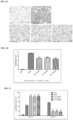
- Bronchiole and pulmonary arteriole damage and inflammatory cell infiltration in fibrosis core and fibrosis board area were scored with H&E stained slides according to the criteria set forth in Table 3.2 and Table 3.3 (see also FIG. 1A ).
- BLM induced left lung injury area and pathological fibrosis score were evaluated with Masson Trichrome stained slides according to the criteria set forth in Table 3.4 and FIG. 1B .
- IHC methods such as Collagen-I (Abcam, Cat# ab34710), Collagen-IV (Abcam, Cat# ab6586), MMP-12 (LSBio, Cat# LS-C497709), TGF- ⁇ 1 (Invitrigen, Cat# MA5-16949) and elastin (Abcam, Cat# GR134273-29).
- IHC staining was processed according to the standard protocol of IHC at KCI. The stained slides were then scanned by Hamamatsu NanoZoomer Digital Pathology S210 slide scanner and analyzed using the software to get the positive staining area/analysis area (%).
- Alveolar septum Clear fibrosis change (alveolar walls thicken and more than three times thicker than that in normal lung), small nodule formation but no connection. Structure: Large alveolar areas, little exudate, no fibrosis material. 3 Alveolar septum: Early stage fibrosis forms in all alveolar (alveolar walls thicken and more than three times thicker than that in normal lung). Structure: Large alveolar areas, little exudate, no fibrosis material. 4 Alveolar septum: Alveolar septum is still visible. Structure: Isolated fibrosis nodule formation in alveolar ( ⁇ 10% at high magnification) 5 Alveolar septum: Alveolar septum is still visible.
- Structure Integrate fibrosis nodule formation in alveolar (>10% and ⁇ 50% at high magnification). Lung structure is substantially impaired but exists. 6 Alveolar septum: seen but barely exists. Structure: Integrate fibrosis nodule formation in alveolar (>50% at high magnification). Lung structure barely exists. 7 Alveolar septum: does not exist. Structure: Pulmonary alveoli and interstitial fibrosis proliferation were seen but there are still 5 vacuole structures. 8 Alveolar septum: does not exist. Structure: Pulmonary alveoli and interstitial fibrosis proliferation were seen at high magnification.
- Left lung histology represented a significant lung injury with a clear damage board, which showed as a different degree of bronchial hyperplasia, terminal fine bronchus and alveolar duct epithelial cell hyperplasia, and a different quantity of mucus in bronchial lumen.
- a different degree of inflammatory cell infiltration on bronchial walls, especially in the adventitia area; and partial bronchial wall thickness with granulation tissue were observed.
- Alveolar damages in the fibrosis core were represented as alveolar epithelial denudation, regeneration, alveolar wall inflammatory cell infiltration and fibrosis.
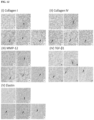
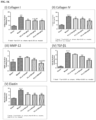
- model f Pathological analysis of multiple biomarkers in left lung fibrosis core: 1) Collagen-I: The analysis of IHC staining in the fibrosis core for the animals treated with FC-4 showed a significant dosing dependent reduction of Collagen-I deposition and showed a significant difference at each dose treatment (p ⁇ 0.05) ( FIG. 1J (I) and FIG. 1K (I) ); Collagen-IV: Collagen-IV IHC analysis indicated a significant dose dependent reduction in the collagen-IV deposition in the fibrosis core both in FC-4 treated animals (p ⁇ 0.05) ( FIG. 1J (II) and FIG. 1K (II) ).
- MMP-12 MMP-12 IHC analysis showed a significant reduction in MMP-12 expression in the fibrosis core in FC-4 treated animals with a clear dose dependent reduction (p>0.05) ( FIG. 1J (III) and FIG. 1K (III) ).
- TGF- ⁇ 1 TGF- ⁇ 1 IHC analysis showed a significant reduction in the TGF- ⁇ 1 expression in the fibrosis core in FC-4 treated animals (p ⁇ 0.05) ( FIG. 1J (IV) and FIG. 1K (IV) ).
- Elastin Elastin IHC analysis showed a significant reduction in the elastin expression in the fibrosis core in FC-4 treated animals (p ⁇ 0.05) ( FIG. 1J (V) and FIG. 1K (panel (V)).
- the left ureter was ligated to create a unilateral ureteral occlusion (UUO) model to induce renal fibrosis.
- the test article FC-4 was administrated twice a day via oral delivery after modeling for 14 days.
- Peripheral blood serum was prepared at pre-modeling and day-15 (one day after last dosing). All animals were euthanized and processed for left kidney pathology studies.
- FC-4 treatment at a dose of 20 mg/kg/day did slightly limit the blood urea nitrogen (BUN) elevation as compared to vehicle group, however all data did not show a statistically significant difference as compared to model group. Serum creatinine levels did show a similar change as in the BUN.
- BUN blood urea nitrogen
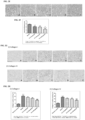
- FC-4 treatment represented a clear dose dependent effect, and a dose at 20 mg/kg/day was more effective than a dose of 2 mg/kg/day (p ⁇ 0.01).
- the semi-quantitative evaluation of interstitial inflammation in the cortex indicated a significant reduction with the treatment of FC-4, and showed a dose dependent efficacy of FC-4.
- the semi quantitative evaluation of interstitial fibrosis in the cortex indicated a significant reduction in the fibrosis score with the treatment of FC-4 at all dose groups. There was a clear dose dependent effect both in FC-4 treatment groups.
- FC-4 a significant kidney cortex damage, inflammation and interstitial fibrosis within 15 days of modeling.
- the treatment of FC-4 represented a clear dose dependent efficacy either in the limitation in the kidney damage, interstitial inflammation or interstitial fibrosis.
- Fibrosis related biomarker analysis indicated the treatment with FC-4 reduced the related collagen deposition (Collagen-I and IV) in the cortex area of damaged kidney.
- Animals Gender: Male, SD rats, 180-220 g, total 71. Certificate: 11400700272659, Beijing Vital River Laboratory Animal Technology Co., Ltd., China.
- Animal holding Animals were maintained in a temperature-controlled environment with a 12 hours light/ 12 hours dark cycle and free access to food and water. Experimental procedures were performed according to IACUC guidelines in the KCI (SuZhou) Biotech Inc. (KCI) animal research facility. Model creation: Total 36 male SD rats were used in this study. After anesthesia with 2.5% isoflurane inhalation the animal abdomen was opened surgically. The left ureter was exposed and ligated close to the bladder to create the UUO model. After confirming no bleeding, the abdomen wall was closed in layers. The animals were maintained under temperature controlled pad (37°C) for the recovery from anesthesia, and then were transferred to holding cages with regular food and water.
- KCI KCI
- Kidney pathology examination 3a) Kidney H&E staining and analysis: Following KCI's pathologic SOP all left kidneys were fixed in 10% formalin for at least 24 h at room temperature. After fixation, the kidney was cut longitudinally to get the largest surface and dehydrated in graded ethanol, cleared in xylene, and embedded in paraffin.
- Kidney IHC staining and analysis All of left kidneys from each group (eight right kidneys from model group) were processed for biomarker analysis using IHC methods, such as Collagen-I (Abcam, Cat# ab34710), Collagen-IV (Abcam, Cat# ab6586). The IHC staining was processed according to the standard protocol of IHC at KCI. The stained slides were then scanned by Hamamatsu NanoZoomer Digital Pathology S210 slide scanner and analyzed using the software to get the positive staining area/analysis area (%). 4) Statistical analysis: Graphpad, prism 5.0 was used for all statistical analyses with p value ⁇ 0.05 considered significant. All data were reported as mean ⁇ SEM.
Landscapes
- Chemical & Material Sciences (AREA)
- Organic Chemistry (AREA)
- Health & Medical Sciences (AREA)
- Public Health (AREA)
- Pharmacology & Pharmacy (AREA)
- Veterinary Medicine (AREA)
- General Health & Medical Sciences (AREA)
- Medicinal Chemistry (AREA)
- Animal Behavior & Ethology (AREA)
- Life Sciences & Earth Sciences (AREA)
- Nuclear Medicine, Radiotherapy & Molecular Imaging (AREA)
- General Chemical & Material Sciences (AREA)
- Chemical Kinetics & Catalysis (AREA)
- Bioinformatics & Cheminformatics (AREA)
- Engineering & Computer Science (AREA)
- Pulmonology (AREA)
- Rheumatology (AREA)
- Urology & Nephrology (AREA)
- Epidemiology (AREA)
- Physical Education & Sports Medicine (AREA)
- Immunology (AREA)
- Orthopedic Medicine & Surgery (AREA)
- Gastroenterology & Hepatology (AREA)
- Heart & Thoracic Surgery (AREA)
- Cardiology (AREA)
- Pain & Pain Management (AREA)
- Pharmaceuticals Containing Other Organic And Inorganic Compounds (AREA)
- Plural Heterocyclic Compounds (AREA)
- Medicines That Contain Protein Lipid Enzymes And Other Medicines (AREA)
- Acyclic And Carbocyclic Compounds In Medicinal Compositions (AREA)
- Medicines Containing Material From Animals Or Micro-Organisms (AREA)
Claims (13)
- Verbindung der Formel (II):
 Ring B optional substituiertes Furanyl ist;Ring C Aryl oder Heteroaryl ist;Ring D Pyridinyl ist;X, Y und Z jeweils unabhängig aus der Gruppe bestehend aus O, CH2, NRx und S(O)q ausgewählt sind, wobei Rx Wasserstoff oder Alkyl ist;R1 Wasserstoff oder Alkyl ist;R2 jeweils unabhängig aus der Gruppe bestehend aus Wasserstoff, Alkyl, Halogen, Hydroxyl, Halogenalkyl, Alkoxy, Alkylthio, Amino, Amid, Alkylamin, Aminoalkyl, Cyano, Hydroxyalkyl, -(CH2)pC(O)OR6, und -(CH2)pOC(O)R6 ausgewählt ist;R3 jeweils unabhängig aus der Gruppe bestehend aus Wasserstoff, Alkyl und Halogen ausgewählt ist;R4 Wasserstoff oder Alkyl ist;R5 Wasserstoff ist;R6 jeweils unabhängig aus der Gruppe bestehend aus Wasserstoff und Alkyl ausgewählt ist, wobei das Alkyl unsubstituiert oder mit einer oder mehreren Gruppen substituiert ist, die unabhängig aus der Gruppe bestehend aus Amino, Hydroxyl, Halogen und Alkoxy ausgewählt sind;m 1, 2, 3 oder 4 ist;n 1, 2, 3, 4 oder 5 ist;p 0, 1, 2, 3, 4 oder 5 ist; undq 0, 1 oder 2 ist.
 - Verbindung nach Anspruch 1, wobei Ring C Phenyl ist.
- Verbindung nach Anspruch 1, wobei X S ist und Z CH2 ist, oder wobei X S ist, Y O ist und Z CH2 ist.
- Verbindung nach Anspruch 1, wobei n 1 ist; und R2 Alkyl, Alkoxy, Hydroxy, Hydroxyalkyl oder Amid ist.
- Verbindung nach Anspruch 1, wobei n 1 ist; und R2 -CH3, C1-4 Alkoxy, -OH, -CH2OH oder -C(O)NH2 ist.
- Verbindung nach Anspruch 1, die eine Verbindung der Formel (III) ist:
 R1 Wasserstoff oder C1-4-Alkyl ist;X S ist;Y O, CH2, NH oder N(CH3) ist;R2 jeweils unabhängig aus der Gruppe bestehend aus Wasserstoff, Alkyl, Hydroxyl, Alkoxy, Amid und Hydroxyalkyl ausgewählt ist;R3 jeweils Wasserstoff, Alkyl oder Halogen ist;Ring D Pyridinyl ist;R4 und R5 jeweils Wasserstoff sind;R7 Wasserstoff oder Methyl ist; undn 1 oder 2 ist.
 - Verbindung nach Anspruch 1, die eine Verbindung der Formel (IV) ist:
 R1 Wasserstoff oder Alkyl ist;R2 aus der Gruppe bestehend aus Alkyl, Amid, Hydroxyl, Alkoxy und Hydroxylalkyl ausgewählt ist;R4 und R5 jeweils Wasserstoff sind; undR7 Methyl oder Wasserstoff ist.
 - Verbindung nach Anspruch 7, wobei R2 -CH3, C1-4-Alkoxy, -OH, - CH2OH oder -C(O)NH2 ist.
- Verbindung nach Anspruch 7, wobei R1 C1-4-Alkyl ist.
- Verbindung nach Anspruch 1, die eine Verbindung ausgewählt aus der Gruppe bestehend aus Folgendem ist:


- Pharmazeutische Zusammensetzung, umfassend die Verbindung nach einem der Ansprüche 1 bis 10 und mindestens einen pharmazeutisch verträglichen Träger.
- Pharmazeutische Zusammensetzung nach Anspruch 11 zur Verwendung in einem Verfahren zum Inhibieren der MakrophagenElastase (MMP-12) bei einem Subjekt, das dessen bedarf.
- Pharmazeutische Zusammensetzung nach Anspruch 12 zur Verwendung in einem Verfahren zum Behandeln einer durch Makrophagenelastase MMP-12 vermittelten Krankheit bei einem Subjekt, das dessen bedarf, wobei die Krankheit aus der Gruppe bestehend aus Asthma, chronisch obstruktiver Lungenerkrankung (COPD) und Emphysem, akuter Lungenschädigung, idiopathischer Lungenfibrose (IPF), Sarkoidose, systemischer Sklerose, Leberfibrose, nichtalkoholischer Steatohepatitis (NASH), Arthritis, Krebs, Herzerkrankung, entzündlicher Darmerkrankung (IBD), akuter Nierenschädigung (AKI), chronischer Nierenerkrankung (CKD), Alport-Syndrom und Nephritis ausgewählt ist.
Priority Applications (2)
| Application Number | Priority Date | Filing Date | Title |
|---|---|---|---|
| SI201930733T SI3793995T1 (sl) | 2018-05-15 | 2019-05-14 | Zaviralci matrične metaloproteinaze (mmp)in načini njihove uporabe |
| EP24150920.7A EP4349332A3 (de) | 2018-05-15 | 2019-05-14 | Matrixmetalloproteinase (mmp)-inhibitoren und verfahren zur verwendung davon |
Applications Claiming Priority (2)
| Application Number | Priority Date | Filing Date | Title |
|---|---|---|---|
| US201862671753P | 2018-05-15 | 2018-05-15 | |
| PCT/US2019/032131 WO2019222157A1 (en) | 2018-05-15 | 2019-05-14 | Matrix metalloproteinase (mmp) inhibitors and methods of use thereof |
Related Child Applications (1)
| Application Number | Title | Priority Date | Filing Date |
|---|---|---|---|
| EP24150920.7A Division EP4349332A3 (de) | 2018-05-15 | 2019-05-14 | Matrixmetalloproteinase (mmp)-inhibitoren und verfahren zur verwendung davon |
Publications (2)
| Publication Number | Publication Date |
|---|---|
| EP3793995A1 EP3793995A1 (de) | 2021-03-24 |
| EP3793995B1 true EP3793995B1 (de) | 2024-01-10 |
Family
ID=66690981
Family Applications (4)
| Application Number | Title | Priority Date | Filing Date |
|---|---|---|---|
| EP24150920.7A Pending EP4349332A3 (de) | 2018-05-15 | 2019-05-14 | Matrixmetalloproteinase (mmp)-inhibitoren und verfahren zur verwendung davon |
| EP24150915.7A Pending EP4335499A3 (de) | 2018-05-15 | 2019-05-14 | Matrixmetalloproteinase (mmp)-inhibitoren und verfahren zur verwendung davon |
| EP19731374.5A Active EP3793992B1 (de) | 2018-05-15 | 2019-05-14 | Matrixmetalloproteinase (mmp)-inhibitoren und verfahren zu deren verwendung |
| EP19728197.5A Active EP3793995B1 (de) | 2018-05-15 | 2019-05-14 | Matrixmetalloproteinase (mmp)-inhibitoren und verfahren zu deren verwendung |
Family Applications Before (3)
| Application Number | Title | Priority Date | Filing Date |
|---|---|---|---|
| EP24150920.7A Pending EP4349332A3 (de) | 2018-05-15 | 2019-05-14 | Matrixmetalloproteinase (mmp)-inhibitoren und verfahren zur verwendung davon |
| EP24150915.7A Pending EP4335499A3 (de) | 2018-05-15 | 2019-05-14 | Matrixmetalloproteinase (mmp)-inhibitoren und verfahren zur verwendung davon |
| EP19731374.5A Active EP3793992B1 (de) | 2018-05-15 | 2019-05-14 | Matrixmetalloproteinase (mmp)-inhibitoren und verfahren zu deren verwendung |
Country Status (20)
| Country | Link |
|---|---|
| US (6) | US12258335B1 (de) |
| EP (4) | EP4349332A3 (de) |
| JP (4) | JP7344959B2 (de) |
| KR (3) | KR102861502B1 (de) |
| CN (3) | CN119462623A (de) |
| AU (3) | AU2019269409B2 (de) |
| BR (1) | BR112020023269A2 (de) |
| CA (2) | CA3100319A1 (de) |
| DK (2) | DK3793992T3 (de) |
| ES (2) | ES2978192T3 (de) |
| FI (2) | FI3793995T3 (de) |
| HU (2) | HUE066627T2 (de) |
| LT (1) | LT3793995T (de) |
| MY (1) | MY199200A (de) |
| PL (1) | PL3793995T3 (de) |
| PT (2) | PT3793992T (de) |
| SG (2) | SG11202011316RA (de) |
| SI (1) | SI3793995T1 (de) |
| TW (3) | TWI798435B (de) |
| WO (2) | WO2019222154A1 (de) |
Families Citing this family (7)
| Publication number | Priority date | Publication date | Assignee | Title |
|---|---|---|---|---|
| US10532102B2 (en) | 2016-08-19 | 2020-01-14 | Foresee Pharmaceuticals Co., Ltd. | Pharmaceutical composition and methods of uses |
| KR102861502B1 (ko) * | 2018-05-15 | 2025-09-18 | 포시 파마슈티컬스 유에스에이 인코포레이티드 | 기질 금속단백분해효소 (mmp) 억제제 및 이의 사용 방법 |
| CN115667227B (zh) | 2019-11-14 | 2024-11-01 | 逸达生物科技股份有限公司 | 基质金属蛋白酶(mmp)抑制剂及其使用方法 |
| JP2024520818A (ja) * | 2021-06-08 | 2024-05-24 | フォアシー ファーマシューティカルズ カンパニー リミテッド | 急性呼吸促迫症候群を処置するためのmmp阻害薬の使用 |
| EP4351566A4 (de) * | 2021-06-08 | 2025-04-23 | Foresee Pharmaceuticals USA, Inc. | Sichere verabreichung von mmp-12 inhibitoren |
| WO2023110473A1 (en) | 2021-12-14 | 2023-06-22 | Basf Se | Heterocyclic compounds for the control of invertebrate pests |
| EP4198033A1 (de) | 2021-12-14 | 2023-06-21 | Basf Se | Heterocyclische verbindungen zur bekämpfung von wirbellosen schädlingen |
Family Cites Families (14)
| Publication number | Priority date | Publication date | Assignee | Title |
|---|---|---|---|---|
| FR2482618A1 (fr) | 1980-05-16 | 1981-11-20 | Inst Corps Gras Iterg | Procede de conjugaison catalytique de corps gras polyinsatures, produits obtenus et application |
| US6352976B1 (en) | 1998-12-31 | 2002-03-05 | Aventis Pharmaceuticals Inc. | Selective inhibitors of MMP-12 |
| AU1817700A (en) | 1998-12-31 | 2000-07-24 | Aventis Pharmaceuticals Inc. | 1-carboxymethyl-2-oxo-azepan derivatives useful as selective inhibitors of mmp-12 |
| AU4882101A (en) | 2000-04-28 | 2001-11-12 | Shionogi & Co., Ltd. | Mmp-12 inhibitors |
| SE0100903D0 (sv) | 2001-03-15 | 2001-03-15 | Astrazeneca Ab | Compounds |
| KR20030082990A (ko) * | 2001-03-15 | 2003-10-23 | 아스트라제네카 아베 | 메탈로프로테이나제 억제제 |
| CA2447475A1 (en) | 2001-05-25 | 2002-12-05 | Chu-Biao Xue | Hydantion derivatives as inhibitors of matrix metalloproteinases |
| EP1394159A1 (de) | 2002-08-13 | 2004-03-03 | Warner-Lambert Company LLC | Neue Thiophen-Derivate, Verfahren zu ihrer Herstellung und diese enthaltende pharmazeutische Zusammensetzungen |
| SE0202539D0 (sv) | 2002-08-27 | 2002-08-27 | Astrazeneca Ab | Compounds |
| US7041693B2 (en) | 2002-10-04 | 2006-05-09 | Bristol-Myers Squibb Company | Hydantoin derivatives as inhibitors of matrix metalloproteinases and/or TNF-α converting enzyme (TACE) |
| US7132432B2 (en) | 2003-06-05 | 2006-11-07 | Bristol-Myers Squibb Company | Hydantoin derivatives as inhibitors of tumor necrosis factor-alpha converting enzyme (TACE) |
| DK1789036T3 (da) * | 2004-08-19 | 2011-06-27 | Quest Pharmaceutical Services | 5-[3-(4-benzyloxyphenylthio)-fur-2-yl]-imidazolidin-2,4-dion og analoger som inhibitorer af makrofagelastase |
| JP5357365B1 (ja) | 2011-12-21 | 2013-12-04 | パナソニック株式会社 | データ処理装置、データ送信装置、データ処理システム、データ処理方法、及び、データ送信方法 |
| KR102861502B1 (ko) | 2018-05-15 | 2025-09-18 | 포시 파마슈티컬스 유에스에이 인코포레이티드 | 기질 금속단백분해효소 (mmp) 억제제 및 이의 사용 방법 |
-
2019
- 2019-05-14 KR KR1020207035504A patent/KR102861502B1/ko active Active
- 2019-05-14 CN CN202411619226.XA patent/CN119462623A/zh active Pending
- 2019-05-14 ES ES19728197T patent/ES2978192T3/es active Active
- 2019-05-14 JP JP2021514291A patent/JP7344959B2/ja active Active
- 2019-05-14 CA CA3100319A patent/CA3100319A1/en active Pending
- 2019-05-14 WO PCT/US2019/032127 patent/WO2019222154A1/en not_active Ceased
- 2019-05-14 CN CN201980047375.4A patent/CN112424192B/zh active Active
- 2019-05-14 PT PT197313745T patent/PT3793992T/pt unknown
- 2019-05-14 KR KR1020207035503A patent/KR102761591B1/ko active Active
- 2019-05-14 AU AU2019269409A patent/AU2019269409B2/en active Active
- 2019-05-14 JP JP2021514292A patent/JP7343571B2/ja active Active
- 2019-05-14 ES ES19731374T patent/ES2984594T3/es active Active
- 2019-05-14 TW TW108116632A patent/TWI798435B/zh active
- 2019-05-14 FI FIEP19728197.5T patent/FI3793995T3/fi active
- 2019-05-14 US US17/055,483 patent/US12258335B1/en active Active
- 2019-05-14 MY MYPI2020005983A patent/MY199200A/en unknown
- 2019-05-14 DK DK19731374.5T patent/DK3793992T3/da active
- 2019-05-14 SI SI201930733T patent/SI3793995T1/sl unknown
- 2019-05-14 SG SG11202011316RA patent/SG11202011316RA/en unknown
- 2019-05-14 CN CN201980047333.0A patent/CN112424186A/zh active Pending
- 2019-05-14 HU HUE19731374A patent/HUE066627T2/hu unknown
- 2019-05-14 US US17/055,459 patent/US11739080B2/en active Active
- 2019-05-14 TW TW108116631A patent/TWI827601B/zh active
- 2019-05-14 HU HUE19728197A patent/HUE066619T2/hu unknown
- 2019-05-14 KR KR1020257002624A patent/KR20250021604A/ko active Pending
- 2019-05-14 LT LTEPPCT/US2019/032131T patent/LT3793995T/lt unknown
- 2019-05-14 FI FIEP19731374.5T patent/FI3793992T3/fi active
- 2019-05-14 PT PT197281975T patent/PT3793995T/pt unknown
- 2019-05-14 SG SG11202011318QA patent/SG11202011318QA/en unknown
- 2019-05-14 WO PCT/US2019/032131 patent/WO2019222157A1/en not_active Ceased
- 2019-05-14 EP EP24150920.7A patent/EP4349332A3/de active Pending
- 2019-05-14 PL PL19728197.5T patent/PL3793995T3/pl unknown
- 2019-05-14 BR BR112020023269-6A patent/BR112020023269A2/pt unknown
- 2019-05-14 AU AU2019270975A patent/AU2019270975B2/en active Active
- 2019-05-14 EP EP24150915.7A patent/EP4335499A3/de active Pending
- 2019-05-14 US US16/411,402 patent/US10851089B2/en active Active
- 2019-05-14 EP EP19731374.5A patent/EP3793992B1/de active Active
- 2019-05-14 DK DK19728197.5T patent/DK3793995T3/da active
- 2019-05-14 TW TW112115526A patent/TWI895726B/zh active
- 2019-05-14 CA CA3100320A patent/CA3100320A1/en active Pending
- 2019-05-14 EP EP19728197.5A patent/EP3793995B1/de active Active
- 2019-05-14 US US16/411,336 patent/US20190352288A1/en not_active Abandoned
-
2023
- 2023-07-06 US US18/347,674 patent/US12215096B2/en active Active
- 2023-08-31 JP JP2023140718A patent/JP2023164905A/ja active Pending
- 2023-09-04 JP JP2023142664A patent/JP7656669B2/ja active Active
-
2024
- 2024-01-18 AU AU2024200323A patent/AU2024200323B2/en active Active
- 2024-12-17 US US18/983,692 patent/US20250115590A1/en active Pending
Also Published As
Similar Documents
| Publication | Publication Date | Title |
|---|---|---|
| EP3793995B1 (de) | Matrixmetalloproteinase (mmp)-inhibitoren und verfahren zu deren verwendung | |
| HK40050772A (en) | Matrix metalloproteinase (mmp) inhibitors and methods of use thereof | |
| HK40050772B (en) | Matrix metalloproteinase (mmp) inhibitors and methods of use thereof | |
| RU2820540C2 (ru) | Ингибиторы матриксной металлопротеиназы (mmp) и способы их применения | |
| US12583844B2 (en) | Matrix metalloproteinase (MMP) inhibitors and methods of use thereof | |
| HK40107395A (en) | Matrix metalloproteinase (mmp) inhibitors and methods of use thereof | |
| HK40050775A (en) | Matrix metalloproteinase (mmp) inhibitors and methods of use thereof | |
| HK40050775B (en) | Matrix metalloproteinase (mmp) inhibitors and methods of use thereof |
Legal Events
| Date | Code | Title | Description |
|---|---|---|---|
| STAA | Information on the status of an ep patent application or granted ep patent |
Free format text: STATUS: UNKNOWN |
|
| STAA | Information on the status of an ep patent application or granted ep patent |
Free format text: STATUS: THE INTERNATIONAL PUBLICATION HAS BEEN MADE |
|
| PUAI | Public reference made under article 153(3) epc to a published international application that has entered the european phase |
Free format text: ORIGINAL CODE: 0009012 |
|
| STAA | Information on the status of an ep patent application or granted ep patent |
Free format text: STATUS: REQUEST FOR EXAMINATION WAS MADE |
|
| 17P | Request for examination filed |
Effective date: 20201211 |
|
| AK | Designated contracting states |
Kind code of ref document: A1 Designated state(s): AL AT BE BG CH CY CZ DE DK EE ES FI FR GB GR HR HU IE IS IT LI LT LU LV MC MK MT NL NO PL PT RO RS SE SI SK SM TR |
|
| AX | Request for extension of the european patent |
Extension state: BA ME |
|
| DAV | Request for validation of the european patent (deleted) | ||
| DAX | Request for extension of the european patent (deleted) | ||
| REG | Reference to a national code |
Ref country code: HK Ref legal event code: DE Ref document number: 40050772 Country of ref document: HK |
|
| STAA | Information on the status of an ep patent application or granted ep patent |
Free format text: STATUS: EXAMINATION IS IN PROGRESS |
|
| 17Q | First examination report despatched |
Effective date: 20220204 |
|
| P01 | Opt-out of the competence of the unified patent court (upc) registered |
Effective date: 20230512 |
|
| GRAP | Despatch of communication of intention to grant a patent |
Free format text: ORIGINAL CODE: EPIDOSNIGR1 |
|
| STAA | Information on the status of an ep patent application or granted ep patent |
Free format text: STATUS: GRANT OF PATENT IS INTENDED |
|
| INTG | Intention to grant announced |
Effective date: 20230720 |
|
| GRAS | Grant fee paid |
Free format text: ORIGINAL CODE: EPIDOSNIGR3 |
|
| GRAA | (expected) grant |
Free format text: ORIGINAL CODE: 0009210 |
|
| STAA | Information on the status of an ep patent application or granted ep patent |
Free format text: STATUS: THE PATENT HAS BEEN GRANTED |
|
| AK | Designated contracting states |
Kind code of ref document: B1 Designated state(s): AL AT BE BG CH CY CZ DE DK EE ES FI FR GB GR HR HU IE IS IT LI LT LU LV MC MK MT NL NO PL PT RO RS SE SI SK SM TR |
|
| REG | Reference to a national code |
Ref country code: GB Ref legal event code: FG4D |
|
| REG | Reference to a national code |
Ref country code: CH Ref legal event code: EP |
|
| REG | Reference to a national code |
Ref country code: DE Ref legal event code: R096 Ref document number: 602019044856 Country of ref document: DE |
|
| REG | Reference to a national code |
Ref country code: IE Ref legal event code: FG4D |
|
| REG | Reference to a national code |
Ref country code: DK Ref legal event code: T3 Effective date: 20240405 |
|
| REG | Reference to a national code |
Ref country code: FI Ref legal event code: FGE |
|
| REG | Reference to a national code |
Ref country code: SE Ref legal event code: TRGR |
|
| REG | Reference to a national code |
Ref country code: NL Ref legal event code: FP |
|
| REG | Reference to a national code |
Ref country code: PT Ref legal event code: SC4A Ref document number: 3793995 Country of ref document: PT Date of ref document: 20240502 Kind code of ref document: T Free format text: AVAILABILITY OF NATIONAL TRANSLATION Effective date: 20240426 |
|
| REG | Reference to a national code |
Ref country code: GR Ref legal event code: EP Ref document number: 20240400865 Country of ref document: GR Effective date: 20240516 |
|
| PG25 | Lapsed in a contracting state [announced via postgrant information from national office to epo] |
Ref country code: IS Free format text: LAPSE BECAUSE OF FAILURE TO SUBMIT A TRANSLATION OF THE DESCRIPTION OR TO PAY THE FEE WITHIN THE PRESCRIBED TIME-LIMIT Effective date: 20240510 |
|
| REG | Reference to a national code |
Ref country code: EE Ref legal event code: FG4A Ref document number: E024266 Country of ref document: EE Effective date: 20240430 |
|
| PG25 | Lapsed in a contracting state [announced via postgrant information from national office to epo] |
Ref country code: RS Free format text: LAPSE BECAUSE OF FAILURE TO SUBMIT A TRANSLATION OF THE DESCRIPTION OR TO PAY THE FEE WITHIN THE PRESCRIBED TIME-LIMIT Effective date: 20240410 Ref country code: HR Free format text: LAPSE BECAUSE OF FAILURE TO SUBMIT A TRANSLATION OF THE DESCRIPTION OR TO PAY THE FEE WITHIN THE PRESCRIBED TIME-LIMIT Effective date: 20240110 |
|
| PG25 | Lapsed in a contracting state [announced via postgrant information from national office to epo] |
Ref country code: RS Free format text: LAPSE BECAUSE OF FAILURE TO SUBMIT A TRANSLATION OF THE DESCRIPTION OR TO PAY THE FEE WITHIN THE PRESCRIBED TIME-LIMIT Effective date: 20240410 Ref country code: IS Free format text: LAPSE BECAUSE OF FAILURE TO SUBMIT A TRANSLATION OF THE DESCRIPTION OR TO PAY THE FEE WITHIN THE PRESCRIBED TIME-LIMIT Effective date: 20240510 Ref country code: HR Free format text: LAPSE BECAUSE OF FAILURE TO SUBMIT A TRANSLATION OF THE DESCRIPTION OR TO PAY THE FEE WITHIN THE PRESCRIBED TIME-LIMIT Effective date: 20240110 |
|
| REG | Reference to a national code |
Ref country code: AT Ref legal event code: UEP Ref document number: 1648822 Country of ref document: AT Kind code of ref document: T Effective date: 20240110 |
|
| REG | Reference to a national code |
Ref country code: HU Ref legal event code: AG4A Ref document number: E066619 Country of ref document: HU |
|
| REG | Reference to a national code |
Ref country code: ES Ref legal event code: FG2A Ref document number: 2978192 Country of ref document: ES Kind code of ref document: T3 Effective date: 20240906 |
|
| REG | Reference to a national code |
Ref country code: DE Ref legal event code: R097 Ref document number: 602019044856 Country of ref document: DE |
|
| PG25 | Lapsed in a contracting state [announced via postgrant information from national office to epo] |
Ref country code: SM Free format text: LAPSE BECAUSE OF FAILURE TO SUBMIT A TRANSLATION OF THE DESCRIPTION OR TO PAY THE FEE WITHIN THE PRESCRIBED TIME-LIMIT Effective date: 20240110 |
|
| PG25 | Lapsed in a contracting state [announced via postgrant information from national office to epo] |
Ref country code: CZ Free format text: LAPSE BECAUSE OF FAILURE TO SUBMIT A TRANSLATION OF THE DESCRIPTION OR TO PAY THE FEE WITHIN THE PRESCRIBED TIME-LIMIT Effective date: 20240110 |
|
| PG25 | Lapsed in a contracting state [announced via postgrant information from national office to epo] |
Ref country code: SK Free format text: LAPSE BECAUSE OF FAILURE TO SUBMIT A TRANSLATION OF THE DESCRIPTION OR TO PAY THE FEE WITHIN THE PRESCRIBED TIME-LIMIT Effective date: 20240110 |
|
| PG25 | Lapsed in a contracting state [announced via postgrant information from national office to epo] |
Ref country code: SM Free format text: LAPSE BECAUSE OF FAILURE TO SUBMIT A TRANSLATION OF THE DESCRIPTION OR TO PAY THE FEE WITHIN THE PRESCRIBED TIME-LIMIT Effective date: 20240110 Ref country code: SK Free format text: LAPSE BECAUSE OF FAILURE TO SUBMIT A TRANSLATION OF THE DESCRIPTION OR TO PAY THE FEE WITHIN THE PRESCRIBED TIME-LIMIT Effective date: 20240110 Ref country code: RO Free format text: LAPSE BECAUSE OF FAILURE TO SUBMIT A TRANSLATION OF THE DESCRIPTION OR TO PAY THE FEE WITHIN THE PRESCRIBED TIME-LIMIT Effective date: 20240110 Ref country code: CZ Free format text: LAPSE BECAUSE OF FAILURE TO SUBMIT A TRANSLATION OF THE DESCRIPTION OR TO PAY THE FEE WITHIN THE PRESCRIBED TIME-LIMIT Effective date: 20240110 |
|
| PLBE | No opposition filed within time limit |
Free format text: ORIGINAL CODE: 0009261 |
|
| STAA | Information on the status of an ep patent application or granted ep patent |
Free format text: STATUS: NO OPPOSITION FILED WITHIN TIME LIMIT |
|
| 26N | No opposition filed |
Effective date: 20241011 |
|
| PG25 | Lapsed in a contracting state [announced via postgrant information from national office to epo] |
Ref country code: MC Free format text: LAPSE BECAUSE OF FAILURE TO SUBMIT A TRANSLATION OF THE DESCRIPTION OR TO PAY THE FEE WITHIN THE PRESCRIBED TIME-LIMIT Effective date: 20240110 |
|
| PG25 | Lapsed in a contracting state [announced via postgrant information from national office to epo] |
Ref country code: MC Free format text: LAPSE BECAUSE OF FAILURE TO SUBMIT A TRANSLATION OF THE DESCRIPTION OR TO PAY THE FEE WITHIN THE PRESCRIBED TIME-LIMIT Effective date: 20240110 |
|
| PGFP | Annual fee paid to national office [announced via postgrant information from national office to epo] |
Ref country code: NL Payment date: 20250526 Year of fee payment: 7 |
|
| PGFP | Annual fee paid to national office [announced via postgrant information from national office to epo] |
Ref country code: FI Payment date: 20250526 Year of fee payment: 7 |
|
| PGFP | Annual fee paid to national office [announced via postgrant information from national office to epo] |
Ref country code: DE Payment date: 20250529 Year of fee payment: 7 |
|
| PGFP | Annual fee paid to national office [announced via postgrant information from national office to epo] |
Ref country code: GB Payment date: 20250527 Year of fee payment: 7 Ref country code: ES Payment date: 20250602 Year of fee payment: 7 Ref country code: DK Payment date: 20250526 Year of fee payment: 7 |
|
| PGFP | Annual fee paid to national office [announced via postgrant information from national office to epo] |
Ref country code: LT Payment date: 20250422 Year of fee payment: 7 |
|
| PGFP | Annual fee paid to national office [announced via postgrant information from national office to epo] |
Ref country code: HU Payment date: 20250425 Year of fee payment: 7 Ref country code: NO Payment date: 20250530 Year of fee payment: 7 |
|
| PGFP | Annual fee paid to national office [announced via postgrant information from national office to epo] |
Ref country code: LU Payment date: 20250527 Year of fee payment: 7 Ref country code: IT Payment date: 20250521 Year of fee payment: 7 Ref country code: BE Payment date: 20250527 Year of fee payment: 7 |
|
| PGFP | Annual fee paid to national office [announced via postgrant information from national office to epo] |
Ref country code: LV Payment date: 20250422 Year of fee payment: 7 Ref country code: PT Payment date: 20250421 Year of fee payment: 7 |
|
| PGFP | Annual fee paid to national office [announced via postgrant information from national office to epo] |
Ref country code: EE Payment date: 20250426 Year of fee payment: 7 Ref country code: FR Payment date: 20250526 Year of fee payment: 7 |
|
| PGFP | Annual fee paid to national office [announced via postgrant information from national office to epo] |
Ref country code: GR Payment date: 20250528 Year of fee payment: 7 Ref country code: MT Payment date: 20250429 Year of fee payment: 7 Ref country code: BG Payment date: 20250514 Year of fee payment: 7 |
|
| PGFP | Annual fee paid to national office [announced via postgrant information from national office to epo] |
Ref country code: CH Payment date: 20250601 Year of fee payment: 7 |
|
| PGFP | Annual fee paid to national office [announced via postgrant information from national office to epo] |
Ref country code: AT Payment date: 20250423 Year of fee payment: 7 |
|
| PGFP | Annual fee paid to national office [announced via postgrant information from national office to epo] |
Ref country code: TR Payment date: 20250428 Year of fee payment: 7 |
|
| PGFP | Annual fee paid to national office [announced via postgrant information from national office to epo] |
Ref country code: IE Payment date: 20250527 Year of fee payment: 7 |
|
| PGFP | Annual fee paid to national office [announced via postgrant information from national office to epo] |
Ref country code: SI Payment date: 20250421 Year of fee payment: 7 Ref country code: SE Payment date: 20250527 Year of fee payment: 7 |
|
| PG25 | Lapsed in a contracting state [announced via postgrant information from national office to epo] |
Ref country code: CY Free format text: LAPSE BECAUSE OF FAILURE TO SUBMIT A TRANSLATION OF THE DESCRIPTION OR TO PAY THE FEE WITHIN THE PRESCRIBED TIME-LIMIT; INVALID AB INITIO Effective date: 20190514 |
|
| PGFP | Annual fee paid to national office [announced via postgrant information from national office to epo] |
Ref country code: PL Payment date: 20250424 Year of fee payment: 7 |