EP3783679B1 - Festelektrolyt, verfahren zu seiner herstellung und selbstgenerierende sekundärbatterie - Google Patents
Festelektrolyt, verfahren zu seiner herstellung und selbstgenerierende sekundärbatterie Download PDFInfo
- Publication number
- EP3783679B1 EP3783679B1 EP19788645.0A EP19788645A EP3783679B1 EP 3783679 B1 EP3783679 B1 EP 3783679B1 EP 19788645 A EP19788645 A EP 19788645A EP 3783679 B1 EP3783679 B1 EP 3783679B1
- Authority
- EP
- European Patent Office
- Prior art keywords
- compound
- solid electrolyte
- fluorohydrogenate
- thiophenium
- salt
- Prior art date
- Legal status (The legal status is an assumption and is not a legal conclusion. Google has not performed a legal analysis and makes no representation as to the accuracy of the status listed.)
- Active
Links
Images








Classifications
-
- H—ELECTRICITY
- H01—ELECTRIC ELEMENTS
- H01B—CABLES; CONDUCTORS; INSULATORS; SELECTION OF MATERIALS FOR THEIR CONDUCTIVE, INSULATING OR DIELECTRIC PROPERTIES
- H01B1/00—Conductors or conductive bodies characterised by the conductive materials; Selection of materials as conductors
- H01B1/06—Conductors or conductive bodies characterised by the conductive materials; Selection of materials as conductors mainly consisting of other non-metallic substances
- H01B1/12—Conductors or conductive bodies characterised by the conductive materials; Selection of materials as conductors mainly consisting of other non-metallic substances organic substances
- H01B1/122—Ionic conductors
-
- H—ELECTRICITY
- H01—ELECTRIC ELEMENTS
- H01M—PROCESSES OR MEANS, e.g. BATTERIES, FOR THE DIRECT CONVERSION OF CHEMICAL ENERGY INTO ELECTRICAL ENERGY
- H01M10/00—Secondary cells; Manufacture thereof
- H01M10/05—Accumulators with non-aqueous electrolyte
- H01M10/052—Li-accumulators
-
- H—ELECTRICITY
- H02—GENERATION; CONVERSION OR DISTRIBUTION OF ELECTRIC POWER
- H02N—ELECTRIC MACHINES NOT OTHERWISE PROVIDED FOR
- H02N2/00—Electric machines in general using piezoelectric effect, electrostriction or magnetostriction
- H02N2/18—Electric machines in general using piezoelectric effect, electrostriction or magnetostriction producing electrical output from mechanical input, e.g. generators
-
- H—ELECTRICITY
- H10—SEMICONDUCTOR DEVICES; ELECTRIC SOLID-STATE DEVICES NOT OTHERWISE PROVIDED FOR
- H10N—ELECTRIC SOLID-STATE DEVICES NOT OTHERWISE PROVIDED FOR
- H10N30/00—Piezoelectric or electrostrictive devices
- H10N30/30—Piezoelectric or electrostrictive devices with mechanical input and electrical output, e.g. functioning as generators or sensors
-
- H—ELECTRICITY
- H10—SEMICONDUCTOR DEVICES; ELECTRIC SOLID-STATE DEVICES NOT OTHERWISE PROVIDED FOR
- H10N—ELECTRIC SOLID-STATE DEVICES NOT OTHERWISE PROVIDED FOR
- H10N30/00—Piezoelectric or electrostrictive devices
- H10N30/80—Constructional details
- H10N30/85—Piezoelectric or electrostrictive active materials
- H10N30/857—Macromolecular compositions
-
- H—ELECTRICITY
- H01—ELECTRIC ELEMENTS
- H01M—PROCESSES OR MEANS, e.g. BATTERIES, FOR THE DIRECT CONVERSION OF CHEMICAL ENERGY INTO ELECTRICAL ENERGY
- H01M2300/00—Electrolytes
- H01M2300/0017—Non-aqueous electrolytes
- H01M2300/0025—Organic electrolyte
-
- H—ELECTRICITY
- H01—ELECTRIC ELEMENTS
- H01M—PROCESSES OR MEANS, e.g. BATTERIES, FOR THE DIRECT CONVERSION OF CHEMICAL ENERGY INTO ELECTRICAL ENERGY
- H01M2300/00—Electrolytes
- H01M2300/0017—Non-aqueous electrolytes
- H01M2300/0065—Solid electrolytes
-
- Y—GENERAL TAGGING OF NEW TECHNOLOGICAL DEVELOPMENTS; GENERAL TAGGING OF CROSS-SECTIONAL TECHNOLOGIES SPANNING OVER SEVERAL SECTIONS OF THE IPC; TECHNICAL SUBJECTS COVERED BY FORMER USPC CROSS-REFERENCE ART COLLECTIONS [XRACs] AND DIGESTS
- Y02—TECHNOLOGIES OR APPLICATIONS FOR MITIGATION OR ADAPTATION AGAINST CLIMATE CHANGE
- Y02E—REDUCTION OF GREENHOUSE GAS [GHG] EMISSIONS, RELATED TO ENERGY GENERATION, TRANSMISSION OR DISTRIBUTION
- Y02E60/00—Enabling technologies; Technologies with a potential or indirect contribution to GHG emissions mitigation
- Y02E60/10—Energy storage using batteries
Definitions
- the present application relates to a solid electrolyte and a method for preparing the same and, more particularly, to a solid electrolyte including a compound in which cations and anions are bonded, and a method for preparing the same.
- a self-generating secondary battery including the same is also disclosed herein.
- a secondary battery includes a positive electrode, a negative electrode, and an electrolyte provided between the positive electrode and the negative electrode.
- the secondary battery is used in portable electronic devices such as smart phones. In the market for portable electronic devices, the electronic devices are being manufactured to have thin and flexible properties. Accordingly, there is a demand for smaller and lighter secondary batteries.
- a liquid-based material in which salt including ions such as lithium, sodium or the like is mixed in an organic solvent, is mainly used as an electrolyte for the secondary battery.
- the organic solvent of the electrolyte is likely to volatilize or leak, and there is also a risk of explosion due to swelling as a temperature rises.
- the general solid electrolyte has a lower ion conductivity compared to the liquid electrolyte.
- the solid electrolyte containing an ionic material there has been an ongoing study on the solid electrolyte containing an ionic material.
- Korean Unexamined Patent Publication No. 10-2014-0046611 provides a composition for an ionic liquid polymer electrolyte, which contains an ionic liquid monomer having a vinyl group and an ionic group, an organic electrolyte, and a cross-linking agent having at least two double bonds at a terminal, in which the ionic group contains cations and anions. Accordingly, disclosed is a method for preparing a composition for an ionic liquid polymer electrolyte capable of solving the problem of electrolyte leakage and providing a lithium secondary battery having excellent flame-retardant properties.
- EP 3 284 786 A1 discloses a polyester resin composition and a method of manufacturing the same.
- WO 2016/090087 A1 discloses electrically conductive polymer films and complexes containing a conductivity enhancing agent, and electronic devices containing such films and complexes.
- US 2016/312006 A1 discloses polymer compositions, films, gels, and foams containing sulfonylimide salts, and electronic devices containing such films, gels, and foams.
- One technical object of the present invention is to provide a solid electrolyte and a method for preparing the same.
- Another technical object of the present invention is to provide a solid electrolyte including a compound in which cations and anions are bonded and which has a crystal phase, and a method for preparing the same.
- Still another technical object of the present invention is to provide a solid electrolyte having a high ion conductivity, and a method for preparing the same.
- Still another technical object of the present invention is to provide an organic piezoelectric material and a method for preparing the same.
- Still another technical object of the present invention is to provide an organic piezoelectric material in which cations and anions are bonded and which has a crystal phase, and a method for preparing the same.
- Still another technical object of the present invention is to provide an organic piezoelectric material having a high piezoelectric performance, and a method for preparing the same.
- the present application provides a solid electrolyte.
- the solid electrolyte includes a compound in which cations having thiophenium and anions having fluorohydrogenate are bonded.
- the compound may include an alkyl group bonded with a sulfur element of the thiophenium and the alkyl group may include one of a methyl group, an ethyl group, a propyl group or a butyl group.
- the compound may have an ion conductivity that decreases as a chain of the alkyl group becomes longer.
- the compound may include a methyl group bonded with a sulfur element of the thiophenium, and may have a first crystal phase in a temperature range of 28 to 90°C and a second crystal phase in a temperature range of 22 to 28°C in a heat flow spectrum according to temperature by differential scanning calorimetry (DSC).
- DSC differential scanning calorimetry
- the solid electrolyte may further include lithium salt, in which a unit cell of the compound may have an orthorhombic crystal structure, the cation may be provided at a vertex and at a center of a face of the crystal structure, the anion may be provided in a middle of an edge of the crystal structure, and the lithium salt may be arbitrarily provided at interstitial sites of the crystal structure.
- an ion conductivity of the solid electrolyte may increase as a concentration of the lithium salt increases.
- a methyl group bonded with a sulfur element of the thiophenium may be provided, and the solid electrolyte may have a crystal phase in a temperature range of 28 to 70°C in a heat flow spectrum according to temperature by differential scanning calorimetry (DSC).
- DSC differential scanning calorimetry
- a self-generating secondary battery may include a positive electrode, a negative electrode, and an electrolyte positioned between the positive electrode and the negative electrode, in which the electrolyte may include the compound according to the above-described embodiment and lithium salt.
- the present application provides a solid electrolyte.
- the solid electrolyte may include a compound in which cations including thiophenium and anions including fluorohydrogenate are bonded.
- the compound may include an alkyl group bonded with a nitrogen element of the thiazolium and the alkyl group may include one of a methyl group, an ethyl group, a propyl group or a butyl group.
- the compound may include an ethyl group bonded with a nitrogen element of the thiazolium.
- the solid electrolyte may further include lithium salt.
- the present application provides a solid electrolyte.
- the solid electrolyte includes a compound in which cations and anions are bonded, in which the compound has a crystal phase wherein a molecular weight of the cation is 95 g/mol or more, a molecular weight of the anion is more than 60 g/mol, and a hydrogen ion concentration (pH) of the anion is less than 3, in which an entropy of fusion of the compound is 15-25 J/K mol
- the cation may include a pentagonal heterocyclic compound, in which the heterocyclic compound may include one element of sulfur, nitrogen, oxygen or phosphorus.
- the anion may include one of fluorohydrogenate, cyano(nitroso)methanide or tetrazoline.
- the present application provides a method for preparing a solid electrolyte.
- the method for preparing a solid electrolyte includes providing a mixed solution containing one of thiophenium salt or thiazolium salt, and a fluorohydrogenate precursor, and reacting the mixed solution at a temperature lower than room temperature to prepare a compound in which thiophenium and fluorohydrogenate are bonded, or a compound in which thiazolium and fluorohydrogenate are bonded.
- the providing of the mixed solution may include preparing the thiophenium salt or the thiazolium salt, in which the preparing of the thiophenium salt or the thiazolium salt may include providing an alkyl group precursor solution, dripping thiophene or thiazoline into the alkyl group precursor solution to prepare a cation source solution, and reacting the cation source solution to prepare the thiophenium salt or the thiazolium salt containing the alkyl group, in which the alkyl group may include one of a methyl group, an ethyl group, a propyl group or a butyl group.
- the providing of the mixed solution may include the preparing of the fluorohydrogenate precursor, in which the preparing of the fluorohydrogenate precursor may include stirring a solution containing hydrofluoric acid and water to prepare the fluorohydrogenate precursor.
- the method for preparing a solid electrolyte includes providing lithium fluorohydrogenate, and mixing and heat-treating the compound according to the above-described embodiment and the lithium fluorohydrogenate to prepare a lithium-doped solid electrolyte, in which the providing of the lithium fluorohydrogenate may include adding lithium salt into hydrofluoric acid aqueous solution to prepare a source solution, and reacting the source solution at a temperature lower than room temperature to prepare the lithium fluorohydrogenate.
- the solid electrolyte may include a compound in which cations having thiophenium and anions having fluorohydrogenate are bonded.
- the solid electrolyte may include the compound and lithium salt.
- a unit cell of the compound may have an orthorhombic crystal structure, in which the thiophenium may be provided at a vertex and at a center of a face of the crystal structure, and the fluorohydrogenate may be provided in a middle of an edge of the crystal structure.
- the solid electrolyte may have the lithium salt arbitrarily provided at interstitial sites of the crystal structure.
- the lithium salt may easily move within the crystal structure. Accordingly, the solid electrolyte may have an ion conductivity that becomes higher as a concentration of the lithium salt increases.
- the solid electrolyte may have a lithium-enriched phase formed.
- the lithium-enriched phase may have a relatively low melting point.
- the solid electrolyte may have a melting point lower than that of the compound, and thus an entropy of fusion of the solid electrolyte may decrease.
- the solid electrolyte may include the compound in which the cations and the anions are bonded, but may have a crystal phase and a high ion conductivity. Accordingly, the solid electrolyte may be easily provided as an electrolyte for a secondary battery.
- the compound, in which the cations including the thiophenium and the anions including the fluorohydrogenate are bonded, may include an organic piezoelectric material.
- the organic piezoelectric material may have a crystal structure. If an external force is applied to the organic piezoelectric material, the cations and the anions in a unit cell of the crystal structure may have a displacement, and thus the organic piezoelectric material may have piezoelectric properties.
- the organic piezoelectric material may have an entropy of fusion of 15-35 J/K mol. Accordingly, the crystal structure of the organic piezoelectric material may have softness.
- the organic piezoelectric material may include a polycrystal having a plurality of microcrystals. Accordingly, the organic piezoelectric material may have piezoelectric properties caused by a spontaneous ionic polarization phenomenon. In this case, the organic piezoelectric material may have a high piezoelectric coefficient of 109 pC/N at room temperature. In addition, the organic piezoelectric material may be prepared at a temperature equal to or lower than room temperature.
- the organic piezoelectric material may be prepared at a lower process temperature compared to a conventional inorganic piezoelectric material and through poling at a relatively low voltage. Accordingly, it may be possible to save time and costs required in a process of preparing the organic piezoelectric material.
- the organic piezoelectric material may have a higher piezoelectric coefficient compared to a conventional piezoelectric material, and thus can be easily used in various electronic elements such as a self-generating secondary battery, a piezoelectric sensor, a piezoelectric actuator, etc.
- the solid electrolyte may include a compound in which cations having thiazolium and anions having fluorohydrogenate are bonded. Furthermore, the solid electrolyte may include the compound and lithium salt. The solid electrolyte may have a crystal phase and a high ion conductivity.
- first element When it is mentioned in the specification that one element is on another element, it means that the first element may be directly formed on the second element or a third element may be interposed between the first element and the second element. Further, in the drawings, the thicknesses of the membrane and areas are exaggerated for efficient description of the technical contents.
- first, second, and third are used to describe various elements, but the elements are not limited to the terms. The terms are used only to distinguish one element from another element. Accordingly, an element mentioned as a first element in one embodiment may be mentioned as a second element in another embodiment.
- the embodiments illustrated here include their complementary embodiments. Further, the term "and/or" in the specification is used to include at least one of the elements enumerated in the specification.
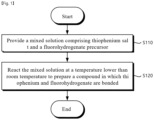
- FIG. 1 is a flowchart for explaining a method for preparing a solid electrolyte according to a first embodiment of the present invention.
- a mixed solution including thiophenium salt and a fluorohydrogenate precursor may be provided (S110).
- the thiophenium salt may be prepared by reacting an alkyl group precursor solution and thiophene.
- the alkyl group precursor solution may be prepared by adding an alkyl group precursor material into a solvent and stirring at room temperature.
- the solvent may include acetonitrile.
- the alkyl group precursor material may include one of dichloromethane represented by a following ⁇ Chemical Formula 1>, ethyl chloride represented by a following ⁇ Chemical Formula 2>, propyl chloride represented by a following ⁇ Chemical Formula 3>, or butyl chloride represented by a following ⁇ Chemical Formula 4>.
- the thiophenium salt may be prepared by dripping the thiophene into the alkyl group precursor solution prepared as described above, and reacting the resulting solution. Unlike the above, if a large amount of the thiophene is added into the alkyl group precursor solution at one time, the reactivity between the thiophene and the alkyl group precursor material may decrease, and thus it may not be easy to prepare the thiophenium salt.
- the reactivity between the thiophene and the alkyl group precursor material may be enhanced.
- a yield of the thiophenium salt may be enhanced.
- a time of the reaction may increase. Accordingly, as the length of the chain increases, a temperature of the reaction may increase, and thus the reactivity between the alkyl group precursor material and the thiophene may be enhanced.
- the thiophenium salt may include an alkyl group bonded with a sulfur atom of the thiophenium.
- the thiophenium salt may include thiophenium chloride containing at least one of a methyl group, an ethyl group, a propyl group or a butyl group.
- the thiophene may be dripped into the solution containing the dichloromethane, and reacted at room temperature to prepare the thiophenium salt in which a carbon element of the dichloromethane is bonded with a sulfur element of the thiophene.
- the thiophenium salt containing a methyl group represented by a following ⁇ Chemical Formula 5> may be prepared.
- the thiophene may be dripped into the solution containing the ethyl chloride, and reacted at a temperature higher than room temperature to prepare the thiophenium salt in which the ethyl chloride is bonded with a sulfur element at 1-position of the thiophene.
- the thiophenium salt containing an ethyl group represented by a following ⁇ Chemical Formula 6> may be prepared.
- the thiophene may be dripped into the solution containing the propyl chloride, and reacted at a temperature higher than room temperature to prepare the thiophenium salt in which the propyl chloride is bonded with a sulfur element at 1-position of the thiophene.
- the thiophenium salt containing a propyl group represented by a following ⁇ Chemical Formula 7> may be prepared.
- the thiophene may be dripped into the solution containing the butyl chloride, and reacted at a temperature higher than room temperature to prepare the thiophenium salt in which the butyl chloride is bonded with a sulfur element at 1-position of the thiophene.
- the thiophenium salt containing a butyl group represented by a following ⁇ Chemical Formula 8> may be prepared.
- the fluorohydrogenate precursor may be prepared by stirring a solution containing hydrofluoric acid and water. Specifically, for example, the fluorohydrogenate precursor may be prepared by adding and stirring extra water into hydrofluoric acid at a concentration of 1M.
- the mixed solution may be reacted to prepare a compound in which thiophenium and fluorohydrogenate are bonded (S120).
- the mixed solution may be reacted at a temperature of -70°C or less for 24 hours so as to prepare the compound in which the thiophenium and the fluorohydrogenate represented by a following ⁇ Chemical Formula 9> are bonded.
- the fluorohydrogenate precursor may be evaporated.
- the fluorohydrogenate precursor may have a boiling point at a temperature equal to or less than room temperature, and thus may be volatilized at room temperature.
- the compound may be easily prepared.
- a temperature of the reaction decreases, a loss of the fluorohydrogenate may decrease, and thus a time of the reaction may decrease.
- the compound may include the alkyl group bonded to a sulfur element of the thiophenium.
- a chain of the alkyl group becomes longer, a molecular weight of the thiophenium may increase. Accordingly, an ion conductivity of the compound may decrease.
- the alkyl group is a methyl group
- the compound may have a relatively high ion conductivity
- the alkyl group is a butyl group
- the compound may have a relatively low ion conductivity.
- the compound may be composed of cations having the thiophenium and anions having the fluorohydrogenate and bonded to the cations.
- the compound may have a crystal phase.
- the compound may have a first crystal phase and a second crystal phase depending on a temperature.
- the first crystal phase may be formed in a temperature range of 28 to 90°C
- the second crystal phase may be formed in a temperature range of 22 to 28°C.
- the compound may be subject to a solid-liquid state change at a temperature of 90°C or higher.
- FIG. 2 is a view showing a crystal structure of a solid electrolyte according to an embodiment of the present invention.
- a solid electrolyte including the compound and lithium salt may be prepared.
- a unit cell of the compound may have an orthorhombic crystal structure, in which the thiophenium may be provided at a vertex and at a center of a face of the crystal structure, and the fluorohydrogenate may be provided in a middle of an edge of the crystal structure.
- the solid electrolyte may have the lithium salt arbitrarily provided at interstitial sites of the crystal structure.
- the lithium salt may include lithium fluorohydrogenate.
- the solid electrolyte may be prepared by a reaction between the compound and the lithium fluorohydrogenate.
- the lithium fluorohydrogenate may be prepared by adding lithium salt into the fluorohydrogenate precursor and reacting at a temperature lower than room temperature.
- the lithium fluorohydrogenate may be prepared by using the fluorohydrogenate precursor. Accordingly, the fluorohydrogenate precursor may be prevented from being evaporated through a reaction at a temperature lower than room temperature.
- the lithium fluorohydrogenate may be prepared by adding lithium chloride into the hydrofluoric acid aqueous solution at a concentration of 1M, and reacting at a temperature of -70°C or lower for 24 hours.
- the lithium fluorohydrogenate may be prepared through an anion exchange reaction.
- the solid electrolyte may be prepared by heating the compound at a temperature higher than room temperature and simultaneously adding the lithium fluorohydrogenate prepared as described above into the compound.
- the solid electrolyte may be prepared by adding the lithium fluorohydrogenate in an amount of 1 to 10 mol% compared to the compound.
- the lithium salt may be provided at the interstitial sites of the crystal structure of the compound, and thus may easily move within the crystal structure. Accordingly, the solid electrolyte may have an ion conductivity that becomes higher as an amount of the lithium fluorohydrogenate added increases.
- the solid electrolyte may be subject to a solid-liquid state change at a temperature of 70°C or higher, and may have one crystal phase in a temperature range of 28 to 70°C.
- the solid electrolyte may have a melting point (a temperature of solid-liquid state change) that becomes lower than that of the compound due to lithium doping, and a temperature of solid-solid state change may vary.
- the compound and the solid electrolyte may show a relatively similar pattern in an X-ray diffraction pattern (XRD). Unlike the compound, however, the solid electrolyte may show a lithium-enriched phase. Accordingly, the compound and the solid electrolyte may have a different crystal orientation.
- XRD X-ray diffraction pattern
- the solid electrolyte including the compound according to an embodiment of the present invention or the solid electrolyte doped with lithium may be used as an electrolyte for a secondary battery.
- the secondary battery may include a positive electrode, a negative electrode, and the electrolyte.
- the electrolyte may be provided between the positive electrode and the negative electrode.
- the solid electrolyte may include a compound in which cations and anions are bonded.
- the cations and the anions may be selected to have a maximum ion conductivity in a range satisfying a condition for allowing the compound to have a crystal phase wherein the condition for allowing the compound to have a crystal phase may include a condition in which a molecular weight of the cation is 95 g/mol or more.
- the cation may include a pentagonal heterocyclic compound, in which the heterocyclic compound may have one element of sulfur, nitrogen, oxygen or phosphorus.
- the cation may include one of thiophenium represented by a following ⁇ Chemical Formula 10>, thiazolium represented by a following ⁇ Chemical Formula 11>, phospholanium represented by a following ⁇ Chemical Formula 12>, or oxathiolanium represented by a following ⁇ Chemical Formula 13> or ⁇ Chemical Formula 14>, or thiazolidinium represented by a following ⁇ Chemical Formula 15>.
- Conditions for allowing the compound to have a crystal phase may include a condition in which a molecular weight of the anion is more than 60 g/mol, and a hydrogen ion concentration (pH) of the anion is less than 3.
- the anion may include one of fluorohydrogenate represented by a following ⁇ Chemical Formula 16>, cyano(nitroso)methanide represented by a following ⁇ Chemical Formula 17>, or tetrazolidine represented by a following ⁇ Chemical Formula 18>.
- the compound may exist in a liquid state.
- the anion may not be easy to form a solid having a crystal phase.
- the cation includes one of thiophenium represented by the above ⁇ Chemical Formula 10> or thiazolium represented by the above ⁇ Chemical Formula 11>
- the anion includes one of oxohydrogenate represented by a following ⁇ Chemical Formula 19> or cyanate represented by a following ⁇ Chemical Formula 20>
- the compound may exist in an ionic liquid state.
- the compound may easily have a crystal phase.
- the cation includes one of thiophenium represented by the above ⁇ Chemical Formula 10> or thiazolium represented by the above ⁇ Chemical Formula 11>
- the anion includes one of fluorohydrogenate represented by the above ⁇ Chemical Formula 16>, cyano(nitroso)methanide represented by the above ⁇ Chemical Formula 17> or tetrazolidine represented by the above ⁇ Chemical Formula 18>
- the compound may exist in a solid state of having the crystal phase.
- the compound may have a crystal phase, if a molecular weight of the cation is 95 g/mol or more, a molecular weight of the anion is more than 60 g/mol, and a hydrogen ion concentration (pH) of the anion is less than 3.
- a condition for allowing the compound to have the crystal phase may be met, and an entropy of fusion of the compound may be 15-25 J/K. Accordingly, the crystal phase may have softness.
- the compound may have a liquid state. Accordingly, the compound may not easily have a crystal phase. In addition, if the entropy of fusion is more than 35 J/K mol, the compound may have a crystalline solid state and may not have softness.
- the entropy of fusion may be 15-25 J/K mol, and thus the compound may easily have a crystal phase and a high ion conductivity at the same time.
- the solid electrolyte including the compound may be used as an electrolyte for a secondary battery.
- the secondary battery may include a positive electrode, a negative electrode, and the electrolyte.
- the electrolyte may be provided between the positive electrode and the negative electrode.
- the compound may include an organic piezoelectric material having piezoelectric properties.
- the compound may include a polycrystal having a plurality of microcrystals.
- a crystal structure of the compound may have softness.
- the cation and/or the anion may have a displacement within the crystal structure. Accordingly, there may occur an ionic polarization due to a relative displacement of the cation and the anion.
- an inorganic compound including an inorganic matter may be subject to poling under a high voltage condition. Accordingly, the inorganic compound may have piezoelectric properties.
- the inorganic compound may be prepared by being heat-treated at a temperature higher than a temperature at which the compound is prepared as described above with reference to FIG. 1 .
- the compound according to an embodiment of the present invention may be subject to poling at a relatively low voltage to have piezoelectric properties.
- the compound may be prepared at a temperature equal to or lower than room temperature. Accordingly, the compound may have less time and costs required for a preparation process than those of the inorganic compound.
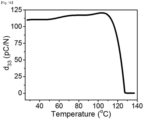
- the compound may have a piezoelectric coefficient of 105 to 125 pC/N in a temperature range of room temperature to 110°C.
- the compound may have a piezoelectric coefficient of 109 pC/N at room temperature.
- the compound may be subject to a phase transition into another crystal structure at 127°C, and thus the compound may not show piezoelectric properties.
- the compound may have piezoelectric properties in a temperature range of 127°C or less.
- the compound may have a piezoelectric coefficient of 105 to 125 pC/N in a frequency range of 25 to 250 Hz.
- the compound may have a piezoelectric coefficient corresponding to each frequency value.
- a vibration mechanical energy represented by the frequency is applied to the compound, the compound may be converted into different electric signals according to a value of the applied energy. Accordingly, a piezoelectric element including the compound may be easily prepared.
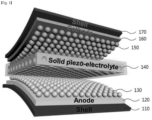
- FIG. 3 is a schematic view showing a self-generating secondary battery including an organic piezoelectric material according to an embodiment of the present invention.
- the self-generating secondary battery may include a positive electrode 160, a negative electrode 120, and an electrolyte 140 disposed between the positive electrode 160 and the negative electrode 120.
- the positive electrode 160 and the negative electrode 120 may include a positive electrode active material 150 and a negative electrode active material 130, respectively.
- the positive electrode active material 150 and the negative electrode active material 130 may be provided in the form of particle onto the surfaces of the positive electrode 160 and the negative electrode 120 respectively, or may be mixed and provided in the positive electrode 160 and the negative electrode 120.
- the electrolyte 140 may include a piezoelectric body. Accordingly, it may be possible to easily prepare a self-generating secondary battery that converts and stores vibration mechanical energy generated from movement of a human body, wind, wave or the like into electrical energy.
- the electrolyte 140 may include a solid electrolyte containing the compound prepared according to an embodiment of the present invention and lithium salt.
- the compound may have a high piezoelectric constant.
- the compound may have a high ion conductivity.
- the ion conductivity of the compound may be 126 S/cm. Accordingly, the solid electrolyte may be easily prepared by mixing lithium salt in the compound.
- the self-generating secondary battery may have a first protective layer 170 on the outside of the positive electrode 160 and a second protective layer 110 on the outside of the negative electrode 120. Accordingly, the positive electrode 160, the negative electrode 120, and the electrolyte 140 may be protected from an external environment.
- the first protective layer 170 and the second protective layer 110 may include a polymer resin.
- the first protective layer 170 and the second protective layer 110 may include kapton, polyimide (PI), polyethylene terephthalate (PET), etc.
- the solid electrolyte may include the compound and lithium salt.
- a unit cell of the compound may have an orthorhombic crystal structure, in which the thiophenium may be provided at a vertex and at a center of a face of the crystal structure, and the fluorohydrogenate may be provided in a middle of an edge of the crystal structure.
- the solid electrolyte may have the lithium salt arbitrarily provided at interstitial sites of the crystal structure.
- the lithium salt may include lithium fluorohydrogenate.
- the solid electrolyte may be prepared by a reaction between the compound and the lithium fluorohydrogenate.
- a piezoelectric field may be generated in the electrolyte 140 including the compound. Specifically, the piezoelectric field may be generated from an upper portion of the electrolyte 140 adjacent to the positive electrode 160 toward a lower portion of the electrolyte 140 adjacent to the negative electrode 120. Lithium ions may move from the positive electrode active material 150 to the negative electrode active material 130 by a piezoelectric field from the positive electrode 160 toward the negative electrode 120. Accordingly, a charge operation of the self-generating secondary battery may be performed by external force.
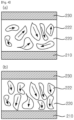
- FIG. 4 shows sectional views of a piezoelectric sensor including an organic piezoelectric material according to an embodiment of the present invention, which represents a driving principle. Specifically, (a) of FIG. 4 is a sectional view showing the piezoelectric sensor before an external force is applied, and (b) of FIG. 4 is a sectional view showing the piezoelectric sensor to which an external force is applied.
- the piezoelectric sensor may include a first electrode 210, a second electrode 230, and a piezoelectric material layer 220 disposed between the first electrode 210 and the second electrode 230.
- the piezoelectric material layer 220 may include a polycrystal. Accordingly, the piezoelectric material layer 220 may include a plurality of microcrystals 222. As shown in (a) of FIG. 4 , the plurality of microcrystals 222 may have different polarization directions before an external force is applied to the piezoelectric sensor.
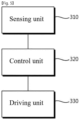
- FIG. 5 is a block view showing a device including an organic piezoelectric material according to an embodiment of the present invention.
- the device may include a sensing unit 310, a driving unit 330, and a control unit 320 that converts an electrical signal obtained from the sensing unit 310 into physical energy to control the driving device 330.
- the sensing unit 310 may sense a change in an external environment, convert the change into an electric signal, and provide the electric signal to the control unit 320.
- the change in the external environment may be variously selected according to a use of the device.
- the control unit 320 may include an actuator containing a piezoelectric material. Accordingly, the piezoelectric material may be subject to a polarization phenomenon due to an electric signal provided from the sensing unit 310, while the electric signal may be converted into physical energy at the same time.
- the compound described above with reference to FIGS. 1 to 2 may have piezoelectric properties due to spontaneous ionic polarization.
- the compound may have a high piezoelectric coefficient, and thus may be provided as the piezoelectric material of the actuator.
- the actuator may include a motor, a switch, etc.
- the driving unit 330 may include a device that may be driven by the physical energy converted by the control unit 320.
- the driving unit 330 may include a lighting, a mechanical device, etc.
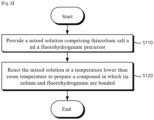
- FIG. 6 is a flowchart for explaining a method for preparing a solid electrolyte according to a second embodiment of the present invention.
- a mixed solution including thiazolium salt and a fluorohydrogenate precursor may be provided (S110).
- the thiazolium salt may be prepared by reacting an alkyl group precursor solution and thiazoline.
- the alkyl group precursor solution may be prepared by adding an alkyl group precursor material into a solvent and stirring at room temperature.
- the solvent may include acetonitrile.
- the alkyl group precursor material may include one of dichloromethane represented by a following ⁇ Chemical Formula 21>, ethyl chloride represented by a following ⁇ Chemical Formula 22>, propyl chloride represented by a following ⁇ Chemical Formula 23>, or butyl chloride represented by a following ⁇ Chemical Formula 24>.
- the thiazolium salt may be prepared by dripping the thiazoline into the alkyl group precursor solution prepared as described above, and reacting the resulting solution. Unlike the above, if a large amount of the thiazoline is added into the alkyl group precursor solution at one time, the reactivity between the thiazoline and the alkyl group precursor material may decrease, and thus it may not be easy to prepare the thiazolium salt.
- the reactivity between the thiazoline and the alkyl group precursor material may be enhanced.
- a yield of the thiazolium salt may be enhanced.
- a time of the reaction may increase. Accordingly, as the length of the chain increases, a temperature of the reaction may increase, and thus the reactivity between the alkyl group precursor material and the thiazoline may be enhanced.
- the thiazolium salt may include an alkyl group bonded with a nitrogen atom of the thiazolium.
- the thiazolium salt may include thiazolium chloride containing one of a methyl group, an ethyl group, a propyl group or a butyl group.
- the thiazoline may be dripped into the solution containing the dichloromethane, and reacted at room temperature to prepare the thiazolium salt in which a carbon element of the dichloromethane is bonded with a nitrogen element of the thiazoline.
- the thiazolium salt containing a methyl group represented by a following ⁇ Chemical Formula 25> may be prepared.
- the thiazoline may be dripped into the solution containing the ethyl chloride, and reacted at a temperature higher than room temperature to prepare the thiazolium salt in which the ethyl chloride is bonded with a nitrogen element at 1-position of the thiazoline.
- the thiazolium salt containing an ethyl group represented by a following ⁇ Chemical Formula 26> may be prepared.
- the thiazoline may be dripped into the solution containing the propyl chloride, and reacted at a temperature higher than room temperature to prepare the thiazolium salt in which the propyl chloride is bonded with a nitrogen element at 1-position of the thiazoline.
- the thiazolium salt containing a propyl group represented by a following ⁇ Chemical Formula 27> may be prepared.
- the thiazoline may be dripped into the solution containing the butyl chloride, and reacted at a temperature higher than room temperature to prepare the thiazolium salt in which the butyl chloride is bonded with a nitrogen element at 1-position of the thiazoline.
- the thiazolium salt containing a butyl group represented by a following ⁇ Chemical Formula 8> may be prepared.
- the fluorohydrogenate precursor may be prepared by stirring a solution containing hydrofluoric acid and water. Specifically, for example, the fluorohydrogenate precursor may be prepared by adding and stirring extra water into hydrofluoric acid at a concentration of 1M.
- the mixed solution may be reacted to prepare a compound in which thiazolium and fluorohydrogenate are bonded (S120).
- the mixed solution may be reacted at a temperature of -70°C or less for 24 hours so as to prepare the compound in which the thiazolium and the fluorohydrogenate represented by a following ⁇ Chemical Formula 29> are bonded.
- the fluorohydrogenate precursor may be evaporated.
- the fluorohydrogenate precursor may have a boiling point at a temperature equal to or less than room temperature, and thus may be volatilized at room temperature.
- the compound may be easily prepared.
- a temperature of the reaction decreases, a loss of the fluorohydrogenate may decrease, and thus a time of the reaction may decrease.
- the compound may be composed of cations having the thiazolium and anions having the fluorohydrogenate and bonded to the cations.
- the compound may have a crystal phase.
- a solid electrolyte including the compound and lithium salt may be prepared.
- the lithium salt may be arbitrarily provided at interstitial sites of the crystal structure of the compound.
- the lithium salt may include lithium fluorohydrogenate.
- the solid electrolyte may be prepared by a reaction between the compound and the lithium fluorohydrogenate.
- the lithium fluorohydrogenate may be prepared by adding lithium salt into the fluorohydrogenate precursor and reacting at a temperature lower than room temperature.
- the lithium fluorohydrogenate may be prepared by using the fluorohydrogenate precursor. Accordingly, the fluorohydrogenate precursor may be prevented from being evaporated through a reaction at a temperature lower than room temperature.
- the lithium fluorohydrogenate may be prepared by adding lithium chloride into the hydrofluoric acid aqueous solution at a concentration of 1M, and reacting at a temperature of -70°C or lower for 24 hours.
- the lithium fluorohydrogenate may be prepared through an anion exchange reaction.
- the solid electrolyte may be prepared by heating the compound at a temperature higher than room temperature and simultaneously adding the lithium fluorohydrogenate prepared as described above into the compound.
- the solid electrolyte may be prepared by adding the lithium fluorohydrogenate in an amount of 1 to 10 mol% compared to the compound.
- the lithium salt may be provided at the interstitial sites of the crystal structure of the compound, and thus may easily move within the crystal structure. Accordingly, the solid electrolyte may have an ion conductivity that becomes higher with the addition of the lithium fluorohydrogenate.
- the solid electrolyte including the compound according to an embodiment of the present invention or the solid electrolyte doped with lithium may be used as an electrolyte for a secondary battery.
- the secondary battery may include a positive electrode, a negative electrode, and the electrolyte.
- the electrolyte may be provided between the positive electrode and the negative electrode.
- Dichloromethane represented by the above ⁇ Chemical Formula 1> was provided as an alkyl group precursor material.
- Acetonitrile was provided into a conical flask, after which the dichloromethane was added and stirred at room temperature for 10 minutes to prepare an alkyl group precursor solution.
- the preparation of the alkyl group precursor solution was performed in a glove box without moisture.
- Thiophene was dripped into the alkyl group precursor solution while being stirred, after which a uniformly mixed solution was slowly stirred at room temperature for four days so as to prepare thiophenium salt having a methyl group.
- a washing process was performed by providing the thiophenium salt and a solvent of ethyl acetate and diethyl ether into a rotary concentrator.
- the thiophenium salt was added into the fluorohydrogenate precursor to prepare a mixed solution.
- the mixed solution was left alone at a temperature of -70°C for 24 hours, so as to prepare a compound in which the thiophenium salt and the fluorohydrogenate were bonded.
- the compound was provided into a glove box under a nitrogen atmosphere and left alone at room temperature for two to three hours, so that volatile gas was removed. After that, a drying process was performed by providing the compound into the rotary concentrator, so as to prepare a compound according to Experimental Example 1-1.
- a compound was prepared by the same method as described above in Experimental Example 1-1. However, instead of the dichloromethane, ethyl chloride represented by the above ⁇ Chemical Formula 2> was provided as the alkyl group precursor material. In addition, in the preparing of thiophenium, a reaction was performed at a temperature of 60 to 80°C for two to three days instead of the reaction at room temperature for four days, so as to prepare a compound according to Experimental Example 1-2.
- a compound was prepared by the same method as described above in Experimental Example 1-1. However, instead of the dichloromethane, propyl chloride represented by the above ⁇ Chemical Formula 3> was provided as the alkyl group precursor material. In addition, in the preparing of thiophenium, a reaction was performed at a temperature of 60 to 80°C for two to three days instead of the reaction at room temperature for four days, so as to prepare a compound according to Experimental Example 1-3.
- a compound was prepared by the same method as described above in Experimental Example 1-1. However, instead of the dichloromethane, butyl chloride represented by the above ⁇ Chemical Formula 4> was provided as the alkyl group precursor material. In addition, in the preparing of thiophenium, a reaction was performed at a temperature of 60 to 80°C for two to three days instead of the reaction at room temperature for four days, so as to prepare a compound according to Experimental Example 1-4.
- a 1M hydrofluoric acid aqueous solution and lithium chloride (LiCl) were added into a container and left alone at a temperature of -70°C for 24 hours, so as to prepare lithium fluorohydrogenate.
- a compound having a methyl group according to Experimental Example 1-1 described above was heated to 60°C and the lithium fluorohydrogenate was added in an amount of 1 mol% at the same time and reacted for two hours, so as to prepare a solid electrolyte according to Experimental Example 2-1.
- a solid electrolyte was prepared by the same method as described above in Experimental Example 2-1. However, the lithium fluorohydrogenate was added in an amount of 5 mol% instead of 1 mol%, so as to prepare a solid electrolyte according to Experimental Example 2-2.
- a solid electrolyte was prepared by the same method as described above in Experimental Example 2-1. However, the lithium fluorohydrogenate was added in an amount of 10 mol% instead of 1 mol%, so as to prepare a solid electrolyte according to Experimental Example 2-3.
- thiazolium represented above was provided.
- the R 1 represents an ethyl group.
- fluorohydrogenate prepared according to Experimental Example 1-1 described above was used to prepare a compound according to Comparative Example 1-1.
- the R 1 and R 2 represent an ethyl group and a butyl group, respectively.
- fluorohydrogenate prepared according to Experimental Example 1-1 described above was used to prepare a compound according to Comparative Example 1-2.
- the R 1 and R 2 represent an ethyl group and a butyl group, respectively.
- fluorohydrogenate prepared according to Experimental Example 1-1 described above was used to prepare a compound according to Comparative Example 1-3.
- imidazolium represented by the above ⁇ Chemical Formula 31> was provided.
- the R 1 and R 2 represent a methyl group and an ethyl group, respectively.
- fluorohydrogenate prepared according to Experimental Example 1-1 described above was used to prepare a compound according to Comparative Example 1-4.
- a methyl group and an ethyl group were bonded to nitrogen of thiazolidinium represented by the above ⁇ Chemical Formula 15>, and two methyl groups were bonded to sulfur of thiazolidinium.
- fluorohydrogenate prepared according to Experimental Example 1-1 described above was used to prepare a compound according to Comparative Example 1-5.
- FIG. 7 is a differential scanning calorimetry (DSC) graph showing a compound according to Experimental Example 1-1 and a solid electrolyte according to Experimental Example 2-3 of the present invention.
- the solid-liquid state change was observed in the compound at 90°C. In this case, an entropy of fusion of the compound was calculated to be 32 J/K mol. In contrast, the solid-liquid state change was observed in the solid electrolyte at 70°C. In this case, an entropy of fusion of the solid electrolyte was calculated to be 24 J/K mol.
- the solid-solid state change was observed twice in the compound. Accordingly, it was confirmed that the compound has a first crystal phase in a temperature range of 28 to 90°C and a second crystal phase in a temperature range of 22 to 28°C. In contrast, it was confirmed that the solid-solid state change is observed once in the solid electrolyte, so as to have one crystal phase in a temperature range of 22 to 70°C.
- the compound further includes the lithium salt, and a melting point (a temperature of solid-liquid state change) may decrease. Accordingly, it can be confirmed that the entropy of fusion required for the state change decreases. In addition, it can be confirmed that the compound further includes the lithium salt and a temperature of the solid-solid state change varies.
- FIG. 8 is a graph showing an X-ray diffraction pattern (XRD) of a compound according to Experimental Example 1-1 and a solid electrolyte according to Experimental Example 2-2 of the present invention.
- XRD X-ray diffraction pattern
- a change in crystal structure may be observed in a solid electrolyte according to Experimental Example 2-2 compared to a compound according to Experimental Example 1-1.
- the solid electrolyte further includes a lithium-enriched phase and a crystal orientation is changed in the solid electrolyte compared to the compound.
- the solid electrolyte may further include a phase having a different composition compared to the compound.
- the phase having a different composition is liquefied at a relatively low temperature, and thus the solid electrolyte may have a lower melting point compared to the compound, as described above in FIG. 2 .
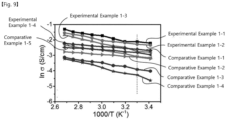
- FIG. 9 is a graph showing an ion conductivity according to a temperature of compounds according to Experimental Examples 1-1 to 1-4 and compounds according to Comparative Examples 1-1 to 1-5 of the present invention.
- compounds according to Experimental Examples 1-1 to 1-4 and compounds according to Comparative Examples 1-1 and 1-4 include the same anion, in which the anion may be fluorohydrogenate. Accordingly, an ion conductivity according to a change of the cation may be compared.
- the compounds according to the experimental examples of the present invention showed an ion conductivity high than that of the compounds according to the comparative examples.
- the compounds according to the experimental examples of the present invention showed a higher ion conductivity as a length of the alkyl group chain decreases.
- the compound showed an ion conductivity of 46 to 126 mS/cm at room temperature, and the compound having a methyl group showed the highest ion conductivity of 126 mS/cm.
- the compound of ⁇ Table 2> may include one of thiazolium represented by the above ⁇ Chemical Formula 11>, phospholanium represented by the above ⁇ Chemical Formula 12>, and thiazolidinium represented by the above ⁇ Chemical Formula 15> (a change in an alkyl group bonded to nitrogen while two methyl groups are fixedly bonded to sulfur), imidazolium represented by the above ⁇ Chemical Formula 31>, or pyrrolidinium represented by the above ⁇ Chemical Formula 30> as a cation.
- the compound according to an experimental example of the present invention has an ion conductivity higher than that of the compound of ⁇ Table 2>.
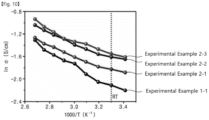
- FIG. 10 is a graph showing an ion conductivity according to a temperature of a compound according to Experimental Example 1-1 and solid electrolytes according to Experimental Examples 2-1 to 2-3 of the present invention.
- the solid electrolyte further contained the lithium fluorohydrogenate in an amount of 1 to 10 mol% compared to the compound.
- the solid electrolyte may have the lithium salt arbitrarily provided at interstitial sites of the crystal structure of the compound. Thus, the lithium salt may easily move within the crystal structure, and thus it was observed that the solid electrolyte has a higher ion conductivity as an amount of lithium fluorohydrogenate added increases.
- the lithium salt may move to interstitial sites where the lithium salt is not provided, and may show an ion conductivity.
- the lithium salt may not relatively easily move. Accordingly, it was observed that the ion conductivity substantially reaches saturation, if an amount of the lithium fluorohydrogenate added is 5 mol% or more.
- FIG. 11 is a view showing pictures of an electrolyte membrane coated with a solid electrolyte according to an embodiment of the present invention.
- PTFE polytetrafluoroethylene
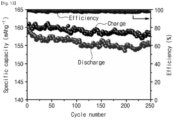
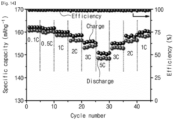
- FIGS. 12 and 13 are graphs showing results of a cycle test of a secondary battery including a solid electrolyte according to Experimental Example 2-2 of the present invention.
- the secondary battery included the solid electrolyte according to Experimental Example 2-2 of the present invention.
- the secondary battery included LiFePO 4 as a positive electrode, lithium metal as a negative electrode, and polyethylene (PE) as a separator between the positive electrode and the negative electrode.
- the secondary battery was subject to a cycle test at a rate of 1C.
- the secondary battery showed a coulombic efficiency of 99.5% and a capacity of 158.6 mAh/g.
- the secondary battery showed a coulomb efficiency of 98% and a capacity of 155.5 mAh/g.
- FIG. 14 is a graph showing a capacity retention rate according to charge/discharge rate of a secondary battery including a solid electrolyte according to Experimental Example 2-2 of the present invention.
- a rate of the secondary battery manufactured with reference to FIGS. 12 and 13 was changed at every certain cycle, and thus a degree to which a capacity of the secondary battery is maintained was confirmed.
- a charge/discharge rate of the secondary battery increased to 0.1 to 5C, and again decreased to 1C. Accordingly, if the charge/discharge rate was 0.1, 0.5, 1, 2, 3 and 5C, a discharge capacity was measured to be 161.0, 160.5, 158.6, 156.4, 153.8 and 148.9 mAh/g, respectively.
- the secondary battery maintains a constant capacity regardless of a change in rate.
- FIG. 15 is a graph showing an impedance according to a cycle test of a secondary battery including a solid electrolyte according to Experimental Example 2-2 of the present invention.
- an interphase impedance (R SEI ) and an electron transfer impedance (R CT ) in the first cycle and the 250th cycle was measured.
- the interphase impedance and the electron transfer impedance in the first cycle were calculated to be 1.65 and 11.22 ⁇ , respectively.
- the interphase impedance and the electron transfer impedance in the 250th cycle were calculated to be 1.75 and 11.65 ⁇ , respectively.
- elements included in the components of the secondary battery may be subject to movement and diffusion. Accordingly, resistance in the secondary battery may increase, and charge/discharge properties of the secondary battery may decrease.
- the secondary battery including the solid electrolyte according to an exemplary embodiment of the present invention shows a relatively low increase in the impedance in the 250th cycle.
- the secondary battery including the solid electrolyte according to an embodiment of the present invention has excellent chemical stability.
- FIG. 16 is a graph showing a piezoelectric coefficient according to a temperature of an organic piezoelectric material according to an embodiment of the present invention.
- an organic piezoelectric material according to an experimental example of the present invention shows piezoelectric properties in a range before a temperature of phase transition.
- barium titanium oxide (BaTiO 3 ), quartz, etc. are used as an inorganic matter
- PVDF, etc. is used as an organic matter
- the piezoelectric coefficients of the conventional piezoelectric materials are shown in a following ⁇ Table 3>.
- the organic piezoelectric material may have a piezoelectric coefficient of 109 pC/N at room temperature. Accordingly, it can be understood that the organic piezoelectric material has a higher piezoelectric coefficient than that of a conventional piezoelectric material.
- the organic piezoelectric material has a piezoelectric coefficient of 105 to 125 pC/N in a temperature range of room temperature to 110°C.
- the organic piezoelectric material is subject to a phase transition into a different crystal structure at 127°C, and thus the organic piezoelectric material does not have piezoelectric properties.
- FIG. 17 is a graph showing a piezoelectric coefficient according to a frequency of an organic piezoelectric material according to an embodiment of the present invention.
- the organic piezoelectric material has a piezoelectric coefficient of 105 to 125 pC/N in a frequency range of 25 to 250 Hz.
- a piezoelectric coefficient of the organic piezoelectric material was confirmed by increasing or decreasing a value of the frequency. In this case, it was confirmed that the compound has a piezoelectric coefficient corresponding to each frequency value.
- FIG. 18 is a scanning electron microscopy (SEM) image of an organic piezoelectric material according to an embodiment of the present invention.
- the organic piezoelectric material may have a solid state at room temperature.
- FIG. 19 is a piezoresponse force microscopy (PFM) image of an organic piezoelectric material according to an embodiment of the present invention.
- PFM piezoresponse force microscopy
- the piezoresponse force microscope applies an electric field to a sample from a tip of the piezoresponse force microscope, and thus a physical change such as expansion or compression may occur in the sample.
- a position of the tip of the piezoresponse force microscope may be changed according to the physical change, so as to generate a piezoresponse force microscopy image.
- Dichloromethane represented by the above ⁇ Chemical Formula 21> was provided as an alkyl group precursor material.
- Acetonitrile was provided into a conical flask, after which the dichloromethane was added and stirred at room temperature for 10 minutes to prepare an alkyl group precursor solution.
- the preparation of the alkyl group precursor solution was performed in a glove box without moisture.
- Thiazoline was dripped into the alkyl group precursor solution while being stirred, after which a uniformly mixed solution was slowly stirred at room temperature for four days so as to prepare thiazolium salt having a methyl group.
- a washing process was performed by providing the thiazolium salt and a solvent of ethyl acetate and diethyl ether into a rotary concentrator.
- the thiazolium salt was added into the fluorohydrogenate precursor to prepare a mixed solution.
- the mixed solution was left alone at a temperature of -70°C for 24 hours, so as to prepare a compound in which the thiazolium salt and the fluorohydrogenate were bonded.
- the compound was provided into a glove box under a nitrogen atmosphere and left alone at room temperature for two to three hours, so that volatile gas was removed. After that, a drying process was performed by providing the compound into the rotary concentrator, so as to prepare a compound according to Experimental Example 3-1.
- a compound was prepared by the same method as described above in Experimental Example 3-1. However, instead of the dichloromethane, ethyl chloride represented by the above ⁇ Chemical Formula 22> was provided as the alkyl group precursor material. In addition, in the preparing of thiazolium salt, a reaction was performed at a temperature of 60 to 80°C for two to three days instead of the reaction at room temperature for four days, so as to prepare a compound according to Experimental Example 3-2.
- a compound was prepared by the same method as described above in Experimental Example 3-1. However, instead of the dichloromethane, propyl chloride represented by the above ⁇ Chemical Formula 23> was provided as the alkyl group precursor material. In addition, in the preparing of thiazolium salt, a reaction was performed at a temperature of 60 to 80°C for two to three days instead of the reaction at room temperature for four days, so as to prepare a compound according to Experimental Example 3-3.
- a compound was prepared by the same method as described above in Experimental Example 3-1. However, instead of the dichloromethane, butyl chloride represented by the above ⁇ Chemical Formula 24> was provided as the alkyl group precursor material. In addition, in the preparing of thiazolium salt, a reaction was performed at a temperature of 60 to 80°C for two to three days instead of the reaction at room temperature for four days, so as to prepare a compound according to Experimental Example 3-4.
- phospholanium represented by the above ⁇ Chemical Formula 12> was provided.
- the R 1 and R 2 represent an alkyl group in a following [Table 4], respectively.
- fluorohydrogenate prepared according to Experimental Example 3-1 described above was used to prepare a compound according to Comparative Example 2-1.
- R 1 and R 2 represent an alkyl group in a following [Table 4], respectively.
- fluorohydrogenate prepared according to Experimental Example 3-1 described above was used to prepare a compound according to Comparative Example 2-2.
- R 1 and R 2 represent an alkyl group in a following [Table 4], respectively.
- fluorohydrogenate prepared according to Experimental Example 3-1 described above was used to prepare a compound according to Comparative Example 2-3.
- thiazolidinium represented by the above ⁇ Chemical Formula 15> was provided.
- the R 1 and R 2 are an alkyl group bonded to nitrogen respectively and two methyl groups were fixedly bonded to sulfur.
- fluorohydrogenate prepared according to Experimental Example 3-1 described above was used to prepare a compound according to Comparative Example 2-4.
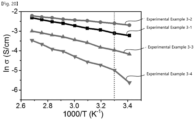
- FIG. 20 is a graph showing a measured ion conductivity of a compound according to Experimental Examples 3-1 to 3-4 of the present invention.
- an ion conductivity of compounds according to Experimental Examples 3-1 to 3-4 was measured.
- an ion conductivity was measured to be 4 mS/cm 2 at room temperature.
- an ion conductivity was measured to be 74 mS/cm 2 .
- an ion conductivity was measured to be 18.9 mS/cm 2 .
- an ion conductivity was measured to be 6.8 mS/cm 2 .
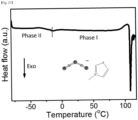
- FIG. 21 is a differential scanning calorimetry (DSC) graph of a compound according to Experimental Example 3-1 of the present invention.
- FIG. 21 a state change according to temperature is observed in the compound according to Experimental Example 3-1. Specifically, as shown in FIG. 3 , it can be confirmed that the compound has a first crystal phase between -14°C and 110°C and a second crystal phase between -80°C and -14°C.
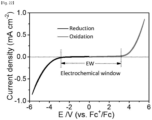
- FIG. 22 is a graph showing a measured electrochemical window of a compound according to Experimental Example 3-1 of the present invention.
- the compound according to Experimental Example 3-1 has an electrochemical window up to -3V to +3V in a range of about 6V.
- a compound, in which cations including thiazolium and anions including fluorohydrogenate are prepared maintains a solid state in a wide temperature range, while maintaining electrochemical stability and high ion conductivity.
- a solid electrolyte and a secondary battery including the same can be used in various fields of industry such as portable electronic devices, electric vehicles, ESS, etc.
Landscapes
- Physics & Mathematics (AREA)
- Spectroscopy & Molecular Physics (AREA)
- Engineering & Computer Science (AREA)
- Manufacturing & Machinery (AREA)
- Chemical & Material Sciences (AREA)
- Chemical Kinetics & Catalysis (AREA)
- Electrochemistry (AREA)
- General Chemical & Material Sciences (AREA)
- Conductive Materials (AREA)
- Secondary Cells (AREA)
Claims (14)
- Festelektrolyt, umfassend eine Verbindung, in der Kationen, einschließlich einem aus Thiophenium und Thiazolium, und Anionen, einschließlich Fluorohydrogenat, gebunden sind.
- Festelektrolyt nach Anspruch 1, wobei das Kation Thiophenium ist, die Verbindung eine Alkylgruppe beinhaltet, die mit einem Schwefelelement des Thiopheniums gebunden ist, und die Alkylgruppe eines aus einer Methylgruppe, einer Ethylgruppe, einer Propylgruppe oder einer Butylgruppe beinhaltet.
- Festelektrolyt nach Anspruch 2, wobei das Kation Thiophenium ist und die Verbindung eine Ionenleitfähigkeit aufweist, die abnimmt, wenn eine Kette der Alkylgruppe länger wird.
- Festelektrolyt nach Anspruch 1, wobei das Kation Thiophenium ist und die Verbindung eine Methylgruppe beinhaltet, die mit einem Schwefelelement des Thiopheniums gebunden ist, und eine erste Kristallphase in einem Temperaturbereich von 28 bis 90 °C und eine zweite Kristallphase in einem Temperaturbereich von 22 bis 28 °C in einem Wärmestromspektrum gemäß Temperatur durch dynamische Differenzkalorimetrie (DSC) aufweist.
- Festelektrolyt nach Anspruch 1, wobei das Kation Thiophenium ist und der Festelektrolyt ferner Lithiumsalz umfasst, in dem eine Elementarzelle der Verbindung eine orthorhombische Kristallstruktur aufweist, das Kation an einem Scheitelpunkt und an einem Zentrum einer Fläche der Kristallstruktur bereitgestellt ist, und das Anion in einer Mitte einer Kante der Kristallstruktur bereitgestellt ist, und das Lithiumsalz an Zwischengitterplätzen der Kristallstruktur willkürlich bereitgestellt ist, und
wobei eine Ionenleitfähigkeit zunimmt, wenn eine Konzentration des Lithiumsalzes zunimmt. - Festelektrolyt nach Anspruch 1, wobei das Kation Thiophenium ist, eine Methylgruppe, die mit einem Schwefelelement des Thiopheniums gebunden ist, bereitgestellt ist, und der Festelektrolyt eine Kristallphase in einem Temperaturbereich von 28 bis 70 °C in einem Wärmestromspektrum gemäß Temperatur durch dynamische Differenzkalorimetrie (DSC) aufweist.
- Festelektrolyt nach Anspruch 1, wobei das Kation Thiazolium ist, die Verbindung eine Alkylgruppe beinhaltet, die mit einem Stickstoffelement des Thiazoliums gebunden ist, und die Alkylgruppe eines aus einer Methylgruppe, einer Ethylgruppe, einer Propylgruppe oder einer Butylgruppe beinhaltet, und bevorzugt die Verbindung eine Ethylgruppe beinhaltet, die mit einem Stickstoffelement des Thiazoliums gebunden ist.
- Festelektrolyt nach Anspruch 1, wobei das Kation Thiazolium ist und der Festelektrolyt ferner Lithiumsalz umfasst.
- Festelektrolyt, umfassend eine Verbindung, in der Kationen und Anionen gebunden sind, wobei die Verbindung eine Kristallphase aufweist,
wobei ein Molekulargewicht des Kations 95 g/mol oder mehr beträgt, ein Molekulargewicht des Anions mehr als 60 g/mol beträgt und eine Wasserstoffionenkonzentration (pH) des Anions weniger als 3 beträgt, in der eine Schmelzentropie der Verbindung 15-25 J/(K · mol) beträgt. - Festelektrolyt nach Anspruch 9, wobei das Kation eine fünfeckige heterocyclische Verbindung umfasst, in der die heterocyclische Verbindung ein Element aus Schwefel, Stickstoff, Sauerstoff oder Phosphor beinhaltet.
- Festelektrolyt nach Anspruch 9, wobei, wenn das Kation Thiophenium beinhaltet, das Antion eines aus Fluorohydrogenat, Cyano(nitroso)methanid oder Tetrazolin beinhaltet.
- Verfahren zum Herstellen eines Festelektrolyten, wobei das Verfahren Folgendes umfasst:Bereitstellen einer Mischlösung, die eines aus Thiopheniumsalz oder Thiazoliumsalz und einen Fluorohydrogenat-Vorläufer enthält, undReagieren der Mischlösung bei einer Temperatur, die niedriger als Raumtemperatur ist, um eine Verbindung, in der Thiophenium und Fluorohydrogenat gebunden sind, oder eine Verbindung, in der Thiazolium und Fluorohydrogenat gebunden sind, herzustellen.
- Verfahren nach Anspruch 12, wobei das Bereitstellen der Mischlösung das Herstellen des Thiopheniumsalzes oder des Thiazoliumsalzes umfasst, wobei das Herstellen des Thiopheniumsalzes oder des Thiazoliumsalzes Folgendes beinhaltet:Bereitstellen einer Alkalygruppenvorläuferlösung;Tröpfeln des Thiophens oder Thiazolins in die Alkalkygruppenvorläuferlösung, um eine Kationenquelllösung herzustellen, undReagieren der Kationenquelllösung, um das Thiopheniumsalz oder das Thiazoliumsalz herzustellen, das die Alkylgruppe enthält, wobei die Alkylgruppe eines aus einer Methylgruppe, einer Ethylgruppe, einer Propylgruppe oder einer Butylgruppe beinhaltet, undwobei das Bereitstellen der Mischlösung das Herstellen des Fluorohydrogenat-Vorläufers umfasst, wobei das Herstellen des Fluorohydrogenat-Vorläufers das Rühren einer Lösung beinhaltet, die Flusssäure und Wasser enthält, um den Fluorohydrogenat-Vorläufer herzustellen.
- Verfahren zum Herstellen eines Festelektrolyten, wobei das Verfahren Folgendes umfasst:Bereitstellen von Lithium-Fluorohydrogenat; undMischen und Wärmebehandeln der Verbindung nach Anspruch 13 und des Lithium-Fluorohydrogenats, um einen Lithium-dotierten Festelektrolyten herzustellen,wobei das Bereitstellen des Lithium-Fluorohydrogenats Folgendes beinhaltet:Hinzugeben von Lithiumsalz in wässrige Flusssäurelösung, um eine Quelllösung herzustellen, undReagieren der Quelllösung bei einer Temperatur, die niedriger als Raumtemperatur ist, um das Lithium-Fluorohydrogenat herzustellen.
Applications Claiming Priority (3)
| Application Number | Priority Date | Filing Date | Title |
|---|---|---|---|
| KR20180043847 | 2018-04-16 | ||
| KR20180043850 | 2018-04-16 | ||
| PCT/KR2019/004596 WO2019203549A1 (ko) | 2018-04-16 | 2019-04-16 | 고체 전해질, 그 제조 방법, 및 이를 포함하는 자가 발전 이차 전지 |
Publications (3)
| Publication Number | Publication Date |
|---|---|
| EP3783679A1 EP3783679A1 (de) | 2021-02-24 |
| EP3783679A4 EP3783679A4 (de) | 2022-01-12 |
| EP3783679B1 true EP3783679B1 (de) | 2024-04-17 |
Family
ID=68239121
Family Applications (1)
| Application Number | Title | Priority Date | Filing Date |
|---|---|---|---|
| EP19788645.0A Active EP3783679B1 (de) | 2018-04-16 | 2019-04-16 | Festelektrolyt, verfahren zu seiner herstellung und selbstgenerierende sekundärbatterie |
Country Status (4)
| Country | Link |
|---|---|
| EP (1) | EP3783679B1 (de) |
| JP (1) | JP7141142B2 (de) |
| CN (1) | CN112106214B (de) |
| WO (1) | WO2019203549A1 (de) |
Cited By (1)
| Publication number | Priority date | Publication date | Assignee | Title |
|---|---|---|---|---|
| US12107216B2 (en) | 2018-04-16 | 2024-10-01 | Industry—University Cooperation Foundation Hanyang University Erica Campus | Solid electrolyte, intermediate of solid electrolyte, secondary battery comprising the same, and method of fabricating the same |
Families Citing this family (2)
| Publication number | Priority date | Publication date | Assignee | Title |
|---|---|---|---|---|
| EP4047683A4 (de) | 2019-10-15 | 2024-03-13 | Industry-University Cooperation Foundation Hanyang University ERICA Campus | Elektrodenzwischenprodukt, elektrodenpulver, elektrode damit, elektrodenpellet damit und verfahren zur jeweiligen herstellung |
| US12489138B2 (en) | 2019-10-15 | 2025-12-02 | Industry-University Cooperation Foundation Hanyang University Erica Campus | Intermediate product of solid electrolyte, solid electrolyte using same, secondary battery including same, and method for manufacturing same |
Family Cites Families (13)
| Publication number | Priority date | Publication date | Assignee | Title |
|---|---|---|---|---|
| KR101502926B1 (ko) * | 2007-07-06 | 2015-03-17 | 삼성에스디아이 주식회사 | 리튬 이차 전지용 고분자 전해질, 및 이를 포함하는 리튬이차 전지 |
| US20110262816A1 (en) | 2009-01-12 | 2011-10-27 | Glenn Amatucci | Polyhydrogen fluoride based battery |
| CN102791747B (zh) * | 2010-01-15 | 2014-08-06 | 可乐丽股份有限公司 | 高分子电解质凝胶组合物 |
| KR101210652B1 (ko) | 2011-04-01 | 2012-12-11 | 주식회사 다오테크 | 하드디스크용 수납장치 |
| KR102039602B1 (ko) | 2012-10-08 | 2019-11-04 | 한양대학교 산학협력단 | 이온성 액체 고분자 전해질용 조성물, 이에 의해 제조된 이온성 액체 고분자 전해질 및 이를 포함하는 리튬이차전지 |
| WO2015088999A1 (en) * | 2013-12-11 | 2015-06-18 | Rhodia Operations | Polymer compositions, films, gels, and foams containing sulfonylimide salts, and electronic devices containing such films, gels, and foams |
| WO2016031961A1 (ja) | 2014-08-29 | 2016-03-03 | 国立研究開発法人産業技術総合研究所 | イオン液体および柔粘性結晶 |
| WO2016090087A1 (en) * | 2014-12-05 | 2016-06-09 | Rhodia Operations | Electrically conductive polymer films and complexes containing a conductivity enhancing agent, and electronic devices containing such films and complexes |
| PH12017501874B1 (en) * | 2015-04-15 | 2023-04-19 | Toray Industries | Polyester resin composition and method of manufacturing same |
| WO2017123026A1 (ko) * | 2016-01-12 | 2017-07-20 | 주식회사 엘지화학 | 황화물계 고체 전해질 및 이를 적용한 전고체 전지 |
| CN108352567B (zh) * | 2016-01-12 | 2021-11-30 | 株式会社Lg化学 | 硫化物型固体电解质和应用其的全固态电池 |
| JP6165911B2 (ja) * | 2016-03-17 | 2017-07-19 | シャープ株式会社 | 画像読取装置及び画像形成装置 |
| WO2019188358A1 (ja) | 2018-03-29 | 2019-10-03 | 本田技研工業株式会社 | フッ化物イオン二次電池用電解質、および当該電解質を用いたフッ化物イオン二次電池 |
-
2019
- 2019-04-16 EP EP19788645.0A patent/EP3783679B1/de active Active
- 2019-04-16 WO PCT/KR2019/004596 patent/WO2019203549A1/ko not_active Ceased
- 2019-04-16 JP JP2020556938A patent/JP7141142B2/ja active Active
- 2019-04-16 CN CN201980026046.1A patent/CN112106214B/zh active Active
Cited By (1)
| Publication number | Priority date | Publication date | Assignee | Title |
|---|---|---|---|---|
| US12107216B2 (en) | 2018-04-16 | 2024-10-01 | Industry—University Cooperation Foundation Hanyang University Erica Campus | Solid electrolyte, intermediate of solid electrolyte, secondary battery comprising the same, and method of fabricating the same |
Also Published As
| Publication number | Publication date |
|---|---|
| CN112106214B (zh) | 2025-01-28 |
| JP2021521597A (ja) | 2021-08-26 |
| EP3783679A1 (de) | 2021-02-24 |
| JP7141142B2 (ja) | 2022-09-22 |
| WO2019203549A1 (ko) | 2019-10-24 |
| CN112106214A (zh) | 2020-12-18 |
Similar Documents
| Publication | Publication Date | Title |
|---|---|---|
| EP3502051B1 (de) | Verfahren zur herstellung von einem festelektrolyt für festkörperbatterie mit argyroditartiger kristallstruktur | |
| CN100530808C (zh) | 能量储存装置 | |
| US9331333B2 (en) | Active substance for electrode for a sodium ion battery | |
| EP3783679B1 (de) | Festelektrolyt, verfahren zu seiner herstellung und selbstgenerierende sekundärbatterie | |
| US11784350B2 (en) | Ionic liquid electrolyte for lithium-ion batteries | |
| KR102413868B1 (ko) | 가요성 배터리 | |
| JP6564416B2 (ja) | 広範囲な結晶化温度範囲で高イオン伝導度を有する硫化物系固体電解質及びその製造方法 | |
| EP3190648A1 (de) | Lithiumelektrode, lithiumsekundärbatterie damit, batteriemodul mit lithiumsekundärbatterie und herstellungsverfahren einer lithiumelektrode | |
| Chaurasia et al. | Electrical, mechanical, structural, and thermal behaviors of polymeric gel electrolyte membranes of poly (vinylidene fluoride-co-hexafluoropropylene) with the ionic liquid 1-butyl-3-methylimidazolium tetrafluoroborate plus lithium tetrafluoroborate. | |
| KR102381518B1 (ko) | 고체 전해질 및 그 제조 방법 | |
| JP2020053229A (ja) | ポリマ電解質シート及びその製造方法、並びに電気化学デバイス及びその製造方法 | |
| KR20170137279A (ko) | 이차전지용 전해질 및 이를 포함하는 이차전지 | |
| KR102429821B1 (ko) | 고성능 및 고신뢰성을 가지는 전기변색장치 및 그 제조 방법 | |
| KR102822086B1 (ko) | 전극의 중간 생성물, 이를 이용한 전극, 이를 이용한 전극 펠렛, 및 그들의 제조 방법 | |
| CN115885392A (zh) | 表面处理的电极、固体电解质的保护以及包括所述电极的元件、模块和电池 | |
| US12107216B2 (en) | Solid electrolyte, intermediate of solid electrolyte, secondary battery comprising the same, and method of fabricating the same | |
| KR102006821B1 (ko) | 고체 전해질 재료, 이의 제조방법, 및 이를 포함하는 전고체 전지 | |
| Sharma et al. | Unraveling the Prospects of Nano Hybrid Electrolytes for Lithium-Ion Batteries: Review and Outlook | |
| Ruan et al. | A flexible and free-standing composite solid electrolyte with a pomegranate-like structure for solid-state sodium-ion batteries | |
| Bajaj et al. | Low Viscosity Ionic Liquids as Novel Dopants in Poly (Methyl Methacrylate) Polymer Electrolyte: Detailed Photoelectrochemical Studies | |
| Kumari et al. | Mg‐Ion Conducting Gel Polymer Electrolyte Based on High Flash Point Solvent Adiponitrile for Magnesium Ion Batteries | |
| US20230100845A1 (en) | Electrode including cellulose derivative composition for all-solid-state secondary battery binder | |
| KR20190136799A (ko) | 고체 전해질, 이의 제조방법, 및 이를 포함하는 전고체 전지 | |
| JP3900632B2 (ja) | 高分子固体電解質 | |
| KR102298345B1 (ko) | 유기 압전 물질 및 그 제조 방법 |
Legal Events
| Date | Code | Title | Description |
|---|---|---|---|
| STAA | Information on the status of an ep patent application or granted ep patent |
Free format text: STATUS: THE INTERNATIONAL PUBLICATION HAS BEEN MADE |
|
| PUAI | Public reference made under article 153(3) epc to a published international application that has entered the european phase |
Free format text: ORIGINAL CODE: 0009012 |
|
| STAA | Information on the status of an ep patent application or granted ep patent |
Free format text: STATUS: REQUEST FOR EXAMINATION WAS MADE |
|
| 17P | Request for examination filed |
Effective date: 20201027 |
|
| AK | Designated contracting states |
Kind code of ref document: A1 Designated state(s): AL AT BE BG CH CY CZ DE DK EE ES FI FR GB GR HR HU IE IS IT LI LT LU LV MC MK MT NL NO PL PT RO RS SE SI SK SM TR |
|
| AX | Request for extension of the european patent |
Extension state: BA ME |
|
| DAV | Request for validation of the european patent (deleted) | ||
| DAX | Request for extension of the european patent (deleted) | ||
| REG | Reference to a national code |
Ref legal event code: R079 Ipc: H01B0001120000 Ref country code: DE Ref legal event code: R079 Ref document number: 602019050513 Country of ref document: DE Free format text: PREVIOUS MAIN CLASS: H01L0041193000 Ipc: H01B0001120000 |
|
| A4 | Supplementary search report drawn up and despatched |
Effective date: 20211210 |
|
| RIC1 | Information provided on ipc code assigned before grant |
Ipc: H02N 2/00 20060101ALI20211206BHEP Ipc: H01M 10/052 20100101ALI20211206BHEP Ipc: H01L 41/193 20060101ALI20211206BHEP Ipc: H01L 41/08 20060101ALI20211206BHEP Ipc: H01B 1/12 20060101AFI20211206BHEP |
|
| STAA | Information on the status of an ep patent application or granted ep patent |
Free format text: STATUS: EXAMINATION IS IN PROGRESS |
|
| 17Q | First examination report despatched |
Effective date: 20230313 |
|
| RIC1 | Information provided on ipc code assigned before grant |
Ipc: H10N 30/857 20230101ALI20231124BHEP Ipc: H10N 30/85 20230101ALI20231124BHEP Ipc: H02N 2/00 20060101ALI20231124BHEP Ipc: H01M 10/052 20100101ALI20231124BHEP Ipc: H01B 1/12 20060101AFI20231124BHEP |
|
| GRAP | Despatch of communication of intention to grant a patent |
Free format text: ORIGINAL CODE: EPIDOSNIGR1 |
|
| STAA | Information on the status of an ep patent application or granted ep patent |
Free format text: STATUS: GRANT OF PATENT IS INTENDED |
|
| INTG | Intention to grant announced |
Effective date: 20240105 |
|
| GRAS | Grant fee paid |
Free format text: ORIGINAL CODE: EPIDOSNIGR3 |
|
| GRAA | (expected) grant |
Free format text: ORIGINAL CODE: 0009210 |
|
| STAA | Information on the status of an ep patent application or granted ep patent |
Free format text: STATUS: THE PATENT HAS BEEN GRANTED |
|
| AK | Designated contracting states |
Kind code of ref document: B1 Designated state(s): AL AT BE BG CH CY CZ DE DK EE ES FI FR GB GR HR HU IE IS IT LI LT LU LV MC MK MT NL NO PL PT RO RS SE SI SK SM TR |
|
| REG | Reference to a national code |
Ref country code: GB Ref legal event code: FG4D |
|
| REG | Reference to a national code |
Ref country code: CH Ref legal event code: EP |
|
| REG | Reference to a national code |
Ref country code: DE Ref legal event code: R096 Ref document number: 602019050513 Country of ref document: DE |
|
| REG | Reference to a national code |
Ref country code: IE Ref legal event code: FG4D |
|
| REG | Reference to a national code |
Ref country code: LT Ref legal event code: MG9D |
|
| REG | Reference to a national code |
Ref country code: NL Ref legal event code: MP Effective date: 20240417 |
|
| REG | Reference to a national code |
Ref country code: AT Ref legal event code: MK05 Ref document number: 1678071 Country of ref document: AT Kind code of ref document: T Effective date: 20240417 |
|
| PG25 | Lapsed in a contracting state [announced via postgrant information from national office to epo] |
Ref country code: NL Free format text: LAPSE BECAUSE OF FAILURE TO SUBMIT A TRANSLATION OF THE DESCRIPTION OR TO PAY THE FEE WITHIN THE PRESCRIBED TIME-LIMIT Effective date: 20240417 |
|
| PG25 | Lapsed in a contracting state [announced via postgrant information from national office to epo] |
Ref country code: NL Free format text: LAPSE BECAUSE OF FAILURE TO SUBMIT A TRANSLATION OF THE DESCRIPTION OR TO PAY THE FEE WITHIN THE PRESCRIBED TIME-LIMIT Effective date: 20240417 |
|
| PG25 | Lapsed in a contracting state [announced via postgrant information from national office to epo] |
Ref country code: IS Free format text: LAPSE BECAUSE OF FAILURE TO SUBMIT A TRANSLATION OF THE DESCRIPTION OR TO PAY THE FEE WITHIN THE PRESCRIBED TIME-LIMIT Effective date: 20240817 |
|
| PG25 | Lapsed in a contracting state [announced via postgrant information from national office to epo] |
Ref country code: BG Free format text: LAPSE BECAUSE OF FAILURE TO SUBMIT A TRANSLATION OF THE DESCRIPTION OR TO PAY THE FEE WITHIN THE PRESCRIBED TIME-LIMIT Effective date: 20240417 |
|
| PG25 | Lapsed in a contracting state [announced via postgrant information from national office to epo] |
Ref country code: HR Free format text: LAPSE BECAUSE OF FAILURE TO SUBMIT A TRANSLATION OF THE DESCRIPTION OR TO PAY THE FEE WITHIN THE PRESCRIBED TIME-LIMIT Effective date: 20240417 Ref country code: FI Free format text: LAPSE BECAUSE OF FAILURE TO SUBMIT A TRANSLATION OF THE DESCRIPTION OR TO PAY THE FEE WITHIN THE PRESCRIBED TIME-LIMIT Effective date: 20240417 |
|
| PG25 | Lapsed in a contracting state [announced via postgrant information from national office to epo] |
Ref country code: GR Free format text: LAPSE BECAUSE OF FAILURE TO SUBMIT A TRANSLATION OF THE DESCRIPTION OR TO PAY THE FEE WITHIN THE PRESCRIBED TIME-LIMIT Effective date: 20240718 |
|
| PG25 | Lapsed in a contracting state [announced via postgrant information from national office to epo] |
Ref country code: PT Free format text: LAPSE BECAUSE OF FAILURE TO SUBMIT A TRANSLATION OF THE DESCRIPTION OR TO PAY THE FEE WITHIN THE PRESCRIBED TIME-LIMIT Effective date: 20240819 |
|
| PG25 | Lapsed in a contracting state [announced via postgrant information from national office to epo] |
Ref country code: ES Free format text: LAPSE BECAUSE OF FAILURE TO SUBMIT A TRANSLATION OF THE DESCRIPTION OR TO PAY THE FEE WITHIN THE PRESCRIBED TIME-LIMIT Effective date: 20240417 |
|
| PG25 | Lapsed in a contracting state [announced via postgrant information from national office to epo] |
Ref country code: AT Free format text: LAPSE BECAUSE OF FAILURE TO SUBMIT A TRANSLATION OF THE DESCRIPTION OR TO PAY THE FEE WITHIN THE PRESCRIBED TIME-LIMIT Effective date: 20240417 |
|
| PG25 | Lapsed in a contracting state [announced via postgrant information from national office to epo] |
Ref country code: PL Free format text: LAPSE BECAUSE OF FAILURE TO SUBMIT A TRANSLATION OF THE DESCRIPTION OR TO PAY THE FEE WITHIN THE PRESCRIBED TIME-LIMIT Effective date: 20240417 |
|
| PG25 | Lapsed in a contracting state [announced via postgrant information from national office to epo] |
Ref country code: LV Free format text: LAPSE BECAUSE OF FAILURE TO SUBMIT A TRANSLATION OF THE DESCRIPTION OR TO PAY THE FEE WITHIN THE PRESCRIBED TIME-LIMIT Effective date: 20240417 |
|
| PG25 | Lapsed in a contracting state [announced via postgrant information from national office to epo] |
Ref country code: PT Free format text: LAPSE BECAUSE OF FAILURE TO SUBMIT A TRANSLATION OF THE DESCRIPTION OR TO PAY THE FEE WITHIN THE PRESCRIBED TIME-LIMIT Effective date: 20240819 Ref country code: PL Free format text: LAPSE BECAUSE OF FAILURE TO SUBMIT A TRANSLATION OF THE DESCRIPTION OR TO PAY THE FEE WITHIN THE PRESCRIBED TIME-LIMIT Effective date: 20240417 Ref country code: NO Free format text: LAPSE BECAUSE OF FAILURE TO SUBMIT A TRANSLATION OF THE DESCRIPTION OR TO PAY THE FEE WITHIN THE PRESCRIBED TIME-LIMIT Effective date: 20240717 Ref country code: LV Free format text: LAPSE BECAUSE OF FAILURE TO SUBMIT A TRANSLATION OF THE DESCRIPTION OR TO PAY THE FEE WITHIN THE PRESCRIBED TIME-LIMIT Effective date: 20240417 Ref country code: IS Free format text: LAPSE BECAUSE OF FAILURE TO SUBMIT A TRANSLATION OF THE DESCRIPTION OR TO PAY THE FEE WITHIN THE PRESCRIBED TIME-LIMIT Effective date: 20240817 Ref country code: HR Free format text: LAPSE BECAUSE OF FAILURE TO SUBMIT A TRANSLATION OF THE DESCRIPTION OR TO PAY THE FEE WITHIN THE PRESCRIBED TIME-LIMIT Effective date: 20240417 Ref country code: GR Free format text: LAPSE BECAUSE OF FAILURE TO SUBMIT A TRANSLATION OF THE DESCRIPTION OR TO PAY THE FEE WITHIN THE PRESCRIBED TIME-LIMIT Effective date: 20240718 Ref country code: FI Free format text: LAPSE BECAUSE OF FAILURE TO SUBMIT A TRANSLATION OF THE DESCRIPTION OR TO PAY THE FEE WITHIN THE PRESCRIBED TIME-LIMIT Effective date: 20240417 Ref country code: ES Free format text: LAPSE BECAUSE OF FAILURE TO SUBMIT A TRANSLATION OF THE DESCRIPTION OR TO PAY THE FEE WITHIN THE PRESCRIBED TIME-LIMIT Effective date: 20240417 Ref country code: BG Free format text: LAPSE BECAUSE OF FAILURE TO SUBMIT A TRANSLATION OF THE DESCRIPTION OR TO PAY THE FEE WITHIN THE PRESCRIBED TIME-LIMIT Effective date: 20240417 Ref country code: AT Free format text: LAPSE BECAUSE OF FAILURE TO SUBMIT A TRANSLATION OF THE DESCRIPTION OR TO PAY THE FEE WITHIN THE PRESCRIBED TIME-LIMIT Effective date: 20240417 Ref country code: RS Free format text: LAPSE BECAUSE OF FAILURE TO SUBMIT A TRANSLATION OF THE DESCRIPTION OR TO PAY THE FEE WITHIN THE PRESCRIBED TIME-LIMIT Effective date: 20240717 |
|
| PG25 | Lapsed in a contracting state [announced via postgrant information from national office to epo] |
Ref country code: DK Free format text: LAPSE BECAUSE OF FAILURE TO SUBMIT A TRANSLATION OF THE DESCRIPTION OR TO PAY THE FEE WITHIN THE PRESCRIBED TIME-LIMIT Effective date: 20240417 |
|
| REG | Reference to a national code |
Ref country code: DE Ref legal event code: R097 Ref document number: 602019050513 Country of ref document: DE |
|
| PG25 | Lapsed in a contracting state [announced via postgrant information from national office to epo] |
Ref country code: EE Free format text: LAPSE BECAUSE OF FAILURE TO SUBMIT A TRANSLATION OF THE DESCRIPTION OR TO PAY THE FEE WITHIN THE PRESCRIBED TIME-LIMIT Effective date: 20240417 |
|
| PG25 | Lapsed in a contracting state [announced via postgrant information from national office to epo] |
Ref country code: CZ Free format text: LAPSE BECAUSE OF FAILURE TO SUBMIT A TRANSLATION OF THE DESCRIPTION OR TO PAY THE FEE WITHIN THE PRESCRIBED TIME-LIMIT Effective date: 20240417 |
|
| PG25 | Lapsed in a contracting state [announced via postgrant information from national office to epo] |
Ref country code: SK Free format text: LAPSE BECAUSE OF FAILURE TO SUBMIT A TRANSLATION OF THE DESCRIPTION OR TO PAY THE FEE WITHIN THE PRESCRIBED TIME-LIMIT Effective date: 20240417 Ref country code: RO Free format text: LAPSE BECAUSE OF FAILURE TO SUBMIT A TRANSLATION OF THE DESCRIPTION OR TO PAY THE FEE WITHIN THE PRESCRIBED TIME-LIMIT Effective date: 20240417 |
|
| PG25 | Lapsed in a contracting state [announced via postgrant information from national office to epo] |
Ref country code: SM Free format text: LAPSE BECAUSE OF FAILURE TO SUBMIT A TRANSLATION OF THE DESCRIPTION OR TO PAY THE FEE WITHIN THE PRESCRIBED TIME-LIMIT Effective date: 20240417 |
|
| PG25 | Lapsed in a contracting state [announced via postgrant information from national office to epo] |
Ref country code: SM Free format text: LAPSE BECAUSE OF FAILURE TO SUBMIT A TRANSLATION OF THE DESCRIPTION OR TO PAY THE FEE WITHIN THE PRESCRIBED TIME-LIMIT Effective date: 20240417 Ref country code: SK Free format text: LAPSE BECAUSE OF FAILURE TO SUBMIT A TRANSLATION OF THE DESCRIPTION OR TO PAY THE FEE WITHIN THE PRESCRIBED TIME-LIMIT Effective date: 20240417 Ref country code: RO Free format text: LAPSE BECAUSE OF FAILURE TO SUBMIT A TRANSLATION OF THE DESCRIPTION OR TO PAY THE FEE WITHIN THE PRESCRIBED TIME-LIMIT Effective date: 20240417 Ref country code: EE Free format text: LAPSE BECAUSE OF FAILURE TO SUBMIT A TRANSLATION OF THE DESCRIPTION OR TO PAY THE FEE WITHIN THE PRESCRIBED TIME-LIMIT Effective date: 20240417 Ref country code: DK Free format text: LAPSE BECAUSE OF FAILURE TO SUBMIT A TRANSLATION OF THE DESCRIPTION OR TO PAY THE FEE WITHIN THE PRESCRIBED TIME-LIMIT Effective date: 20240417 Ref country code: CZ Free format text: LAPSE BECAUSE OF FAILURE TO SUBMIT A TRANSLATION OF THE DESCRIPTION OR TO PAY THE FEE WITHIN THE PRESCRIBED TIME-LIMIT Effective date: 20240417 |
|
| PG25 | Lapsed in a contracting state [announced via postgrant information from national office to epo] |
Ref country code: IT Free format text: LAPSE BECAUSE OF FAILURE TO SUBMIT A TRANSLATION OF THE DESCRIPTION OR TO PAY THE FEE WITHIN THE PRESCRIBED TIME-LIMIT Effective date: 20240417 |
|
| PLBE | No opposition filed within time limit |
Free format text: ORIGINAL CODE: 0009261 |
|
| STAA | Information on the status of an ep patent application or granted ep patent |
Free format text: STATUS: NO OPPOSITION FILED WITHIN TIME LIMIT |
|
| 26N | No opposition filed |
Effective date: 20250120 |
|
| PG25 | Lapsed in a contracting state [announced via postgrant information from national office to epo] |
Ref country code: SI Free format text: LAPSE BECAUSE OF FAILURE TO SUBMIT A TRANSLATION OF THE DESCRIPTION OR TO PAY THE FEE WITHIN THE PRESCRIBED TIME-LIMIT Effective date: 20240417 |
|
| PGFP | Annual fee paid to national office [announced via postgrant information from national office to epo] |
Ref country code: DE Payment date: 20250430 Year of fee payment: 7 |
|
| PG25 | Lapsed in a contracting state [announced via postgrant information from national office to epo] |
Ref country code: SE Free format text: LAPSE BECAUSE OF FAILURE TO SUBMIT A TRANSLATION OF THE DESCRIPTION OR TO PAY THE FEE WITHIN THE PRESCRIBED TIME-LIMIT Effective date: 20240417 |
|
| REG | Reference to a national code |
Ref country code: CH Ref legal event code: H13 Free format text: ST27 STATUS EVENT CODE: U-0-0-H10-H13 (AS PROVIDED BY THE NATIONAL OFFICE) Effective date: 20251125 |
|
| PG25 | Lapsed in a contracting state [announced via postgrant information from national office to epo] |
Ref country code: LU Free format text: LAPSE BECAUSE OF NON-PAYMENT OF DUE FEES Effective date: 20250416 |
|
| PG25 | Lapsed in a contracting state [announced via postgrant information from national office to epo] |
Ref country code: MC Free format text: LAPSE BECAUSE OF FAILURE TO SUBMIT A TRANSLATION OF THE DESCRIPTION OR TO PAY THE FEE WITHIN THE PRESCRIBED TIME-LIMIT Effective date: 20240417 |
|
| REG | Reference to a national code |
Ref country code: BE Ref legal event code: MM Effective date: 20250430 |
|
| PG25 | Lapsed in a contracting state [announced via postgrant information from national office to epo] |
Ref country code: BE Free format text: LAPSE BECAUSE OF NON-PAYMENT OF DUE FEES Effective date: 20250430 |
|
| PG25 | Lapsed in a contracting state [announced via postgrant information from national office to epo] |
Ref country code: CH Free format text: LAPSE BECAUSE OF NON-PAYMENT OF DUE FEES Effective date: 20250430 |
|
| PGFP | Annual fee paid to national office [announced via postgrant information from national office to epo] |
Ref country code: GB Payment date: 20260325 Year of fee payment: 8 |
|
| PG25 | Lapsed in a contracting state [announced via postgrant information from national office to epo] |
Ref country code: IE Free format text: LAPSE BECAUSE OF NON-PAYMENT OF DUE FEES Effective date: 20250416 |
|
| PGFP | Annual fee paid to national office [announced via postgrant information from national office to epo] |
Ref country code: FR Payment date: 20260325 Year of fee payment: 8 |