EP3774558B1 - Dünnwandige flasche zur aufnahme eines flüssigen lebensmittels - Google Patents
Dünnwandige flasche zur aufnahme eines flüssigen lebensmittels Download PDFInfo
- Publication number
- EP3774558B1 EP3774558B1 EP19713503.1A EP19713503A EP3774558B1 EP 3774558 B1 EP3774558 B1 EP 3774558B1 EP 19713503 A EP19713503 A EP 19713503A EP 3774558 B1 EP3774558 B1 EP 3774558B1
- Authority
- EP
- European Patent Office
- Prior art keywords
- bottle
- sleeve
- consumer
- activatable portion
- opening
- Prior art date
- Legal status (The legal status is an assumption and is not a legal conclusion. Google has not performed a legal analysis and makes no representation as to the accuracy of the status listed.)
- Active
Links
Images


Classifications
-
- B—PERFORMING OPERATIONS; TRANSPORTING
- B65—CONVEYING; PACKING; STORING; HANDLING THIN OR FILAMENTARY MATERIAL
- B65D—CONTAINERS FOR STORAGE OR TRANSPORT OF ARTICLES OR MATERIALS, e.g. BAGS, BARRELS, BOTTLES, BOXES, CANS, CARTONS, CRATES, DRUMS, JARS, TANKS, HOPPERS, FORWARDING CONTAINERS; ACCESSORIES, CLOSURES, OR FITTINGS THEREFOR; PACKAGING ELEMENTS; PACKAGES
- B65D1/00—Rigid or semi-rigid containers having bodies formed in one piece, e.g. by casting metallic material, by moulding plastics, by blowing vitreous material, by throwing ceramic material, by moulding pulped fibrous material or by deep-drawing operations performed on sheet material
- B65D1/02—Bottles or similar containers with necks or like restricted apertures, designed for pouring contents
- B65D1/0223—Bottles or similar containers with necks or like restricted apertures, designed for pouring contents characterised by shape
-
- B—PERFORMING OPERATIONS; TRANSPORTING
- B65—CONVEYING; PACKING; STORING; HANDLING THIN OR FILAMENTARY MATERIAL
- B65D—CONTAINERS FOR STORAGE OR TRANSPORT OF ARTICLES OR MATERIALS, e.g. BAGS, BARRELS, BOTTLES, BOXES, CANS, CARTONS, CRATES, DRUMS, JARS, TANKS, HOPPERS, FORWARDING CONTAINERS; ACCESSORIES, CLOSURES, OR FITTINGS THEREFOR; PACKAGING ELEMENTS; PACKAGES
- B65D1/00—Rigid or semi-rigid containers having bodies formed in one piece, e.g. by casting metallic material, by moulding plastics, by blowing vitreous material, by throwing ceramic material, by moulding pulped fibrous material or by deep-drawing operations performed on sheet material
- B65D1/02—Bottles or similar containers with necks or like restricted apertures, designed for pouring contents
- B65D1/0223—Bottles or similar containers with necks or like restricted apertures, designed for pouring contents characterised by shape
- B65D1/0261—Bottom construction
-
- B—PERFORMING OPERATIONS; TRANSPORTING
- B65—CONVEYING; PACKING; STORING; HANDLING THIN OR FILAMENTARY MATERIAL
- B65D—CONTAINERS FOR STORAGE OR TRANSPORT OF ARTICLES OR MATERIALS, e.g. BAGS, BARRELS, BOTTLES, BOXES, CANS, CARTONS, CRATES, DRUMS, JARS, TANKS, HOPPERS, FORWARDING CONTAINERS; ACCESSORIES, CLOSURES, OR FITTINGS THEREFOR; PACKAGING ELEMENTS; PACKAGES
- B65D1/00—Rigid or semi-rigid containers having bodies formed in one piece, e.g. by casting metallic material, by moulding plastics, by blowing vitreous material, by throwing ceramic material, by moulding pulped fibrous material or by deep-drawing operations performed on sheet material
- B65D1/02—Bottles or similar containers with necks or like restricted apertures, designed for pouring contents
- B65D1/0223—Bottles or similar containers with necks or like restricted apertures, designed for pouring contents characterised by shape
- B65D1/0292—Foldable bottles
-
- B—PERFORMING OPERATIONS; TRANSPORTING
- B65—CONVEYING; PACKING; STORING; HANDLING THIN OR FILAMENTARY MATERIAL
- B65D—CONTAINERS FOR STORAGE OR TRANSPORT OF ARTICLES OR MATERIALS, e.g. BAGS, BARRELS, BOTTLES, BOXES, CANS, CARTONS, CRATES, DRUMS, JARS, TANKS, HOPPERS, FORWARDING CONTAINERS; ACCESSORIES, CLOSURES, OR FITTINGS THEREFOR; PACKAGING ELEMENTS; PACKAGES
- B65D23/00—Details of bottles or jars not otherwise provided for
- B65D23/08—Coverings or external coatings
- B65D23/0885—Rigid shells for receiving the bottle or part of it
Definitions
- the present invention relates generally to the field of containers for food liquids, and in particular relates to a product which comprises a bottle and a food liquid such as non-carbonated mineral water.
- the invention also relates to an object which comprises the aforementioned product, and which can be easily handled by a consumer.
- the invention finally relates to a method for delivering an aforementioned product to a consumer.
- Containers for food liquids are known in the prior art, and in particular thin-walled plastic bottles for transporting and delivering mineral water to a consumer who wishes to consume quality water, with preserved flavor and quality.
- Such containers or plastic bottles are disclosed in the documents WO201012956A1 , WO201093602A2 , EP1873067A1 , Or WO2014101957A1 .
- the document FR2830844A1 discloses a container for a flowable product, with a flexible plastic body.
- the document WO2014101956A1 discloses a bottle with a deformable bottom as well as a product according to the preamble of claim 1.
- An aim of the present invention is to address the drawbacks of the prior art documents mentioned above and in particular, first of all, to propose a bottle which forms a product by containing a food liquid which minimizes the ecological impact, which is cheap to produce, without however degrading the ergonomics or the use by the consumer, who must be able to handle the bottle without taking any particular precaution, and without risking the liquid contained overflowing.
- the bottle in the product according to the above implementation has a low thickness (and consequently a low rigidity), as well as an activatable portion to be activated by the consumer himself.
- the latter pushes the activatable portion to make it present a convex shape, which makes it possible, for example, to define a circular base on which the bottle can be placed in a stable manner.
- Putting the activatable portion in the activated state also makes it possible to increase the pressure internal of the bottle, which stretches its surfaces and improves its hold.
- the consumer creates a fold in the bottle, which increases its rigidity. It can also be noted that moving from a concave shape to a convex shape causes a noise or "activation noise" which informs the consumer about the change in state.
- the activatable portion of the bottle is arranged to be activated directly by the user (for example by a push exerted by the user's hand or fingers directly on the activatable portion).
- the activatable portion is arranged to remain in this state, even if the activatable portion is not in contact with a support or a work surface.
- the activatable portion is arranged to remain in the activated or relaxed (non-activated) state as long as pressure is not exerted by the user to make it change state.
- the activation of the activatable portion is carried out by the consumer, i.e. the person who will consume the food liquid.
- the invention can be implemented by a user who is not the consumer.
- the cylindrical part of the bottle has a lateral surface whose generatrices are parallel lines, and which follow a base curve (defined by the intersection of the lateral surface with a plane perpendicular to an axial direction of the bottle) which is a closed curve.
- This closed base curve can be circular in shape (a circle), oval in shape (an ellipse or any oval shape), square or rectangular in shape, where appropriate with rounded corners.
- Such a section of the cylindrical part can improve grip, limit flexibility and/or limit the risk of leakage when opening the bottle.
- the activatable portion is advantageously adjacent to the cylindrical portion, which allows on the one hand to properly tension said cylindrical portion when the activatable portion is activated, and on the other hand to guarantee that the activatable portion will remain activated, because a fold along the perimeter of the cylindrical portion will be more resistant.
- the weight of the liquid in the bottle is not sufficient to cause the activatable portion to change from the activated state to the non-activated state.
- the activatable portion forms a base of the bottle, and the activatable portion is rounded outward in the relaxed state.
- the bottle in the relaxed state, the bottle does not stand upright on its own. The consumer must activate it, so as to form a circular or practically circular fold which then forms a stable base of the bottle.
- This implementation is advantageous in the case where the bottle is so thin that it has no proper support: it is possible to fill it, to transport it in the relaxed state, and the consumer only has to pass it in the activated state to place it on a table.
- the bottom has at least one radial groove which extends over a length of at least 10% of the diameter of the cylindrical part of the body.
- the bottom has four radial grooves which extend over a length of at least 10% of the diameter of the cylindrical part of the body.
- Such radial grooves formed on the bottom form an advantageous implementation to help the bottom to form a marked convexity in the activated state, and to remain in this activated state.
- the bottle comprises a body, preferably partly cylindrical, arranged between a neck (and/or a spout) and a base.
- the bottle comprises a plurality of ribs oriented in an axial direction of the bottle and distributed along the body.
- Such axial ribs are an advantageous implementation, because when passing from the relaxed state to the activated state, they will stretch so that the external parts of the body between the ribs move radially: the external diameter increases rapidly, without increasing the internal pressure too much.
- these grooves oriented in the axial direction of the bottle are not stiffening grooves, and they allow the bottle to expand.
- the bottle is formed from polyethylene terephthalate (PET).
- PET polyethylene terephthalate
- the liquid is a food liquid, preferably water, preferably non-carbonated, and preferably filled at a temperature below 50°C.
- the food liquid is still mineral water, and such a thin bottle remains well suited for transporting it from the bottling site to the consumer's home.
- the product comprises means for closing the bottle, such as a screw-on or push-on cap, a seal or a valve.
- the closing means may further comprise means for proving tamper-evidence such as a tamper-evident ring attached to the cap by bridges to be broken upon first use. It may also be a seal sealed on the neck, to be permanently removed upon first use.
- the closing means may, where appropriate, comprise reversible means for closing the bottle after first use. This is the case, for example, with screw-on and unscrewable caps. It is mentioned that the filled bottle is preferably closed using a screw-on or push-on cap provided with a tamper-evident ring whose bridges are not broken.
- the activatable portion in the relaxed state, defines at least 2%, preferably at least 5%, preferably at least 15%, preferably from 5% to 10% of the internal volume.
- moving from the relaxed state to the activated state significantly changes the internal pressure in the bottle.
- the outer sleeve forms a rigid handle that can accommodate the bottle, and once the bottle is locked in the sleeve, the consumer finds it easy to handle, and can firmly hold the sleeve without causing untimely deformation that would cause it to overflow, which he could not do with the bottle being too thin and not rigid enough.
- the transition of the activatable portion into the activated state is simple, which does not require a complex operation from the consumer.
- the object is simple to use, provides satisfactory support, and yet the bottle is much thinner and more flexible than a bottle of the prior art, which makes it possible to offer an economical and ecological solution for the consumer, because the sleeve is reusable.
- the sleeve has a constriction opposite the opening, and arranged to form an axial stop for the bottle received in the opening.
- a stop allows intuitive use: it is sufficient to push the bottle into the sleeve up to the constriction, to then activate the activatable portion.
- the sleeve has an opening at the neck, arranged to allow a neck of the bottle received in the opening to pass through.
- the sleeve has an opening, preferably lateral, to allow the consumer to exert a deactivation force directly on the closed bottle having the activatable portion. in an activated state, so as to move the activatable portion into the deactivated state to unlock the bottle from the sleeve.
- an opening provides direct access to the bottle, which allows it to be pressed so that the internal pressure pushes back the activatable portion which then moves from the activated state to the relaxed state: the bottle can be easily removed from the sleeve.
- the opening is arranged on an upper part of the sleeve, or on a part intended to be opposite a neck of the bottle. This makes it possible to press on the bottle at a location far from the bottom / the activatable portion, so as not to create unwanted deformations.
- the sleeve is provided to be sufficiently flexible (with a thickness of less than 500 ⁇ m, and preferably less than 300 ⁇ m), to allow the consumer, with a pronounced pinching force (at least 20 newtons, and preferably at least 30 newtons) to deform the sleeve and the bottle sufficiently to sufficiently increase the internal pressure and push the activatable portion from the activated state to the relaxed state.
- the activatable portion has no tab or protrusion to pull on.
- the sleeve is a part open at both ends and has a wall that is at least partly cylindrical to be grasped by the consumer.
- the object comprises a base embedded on the strap between its first end and the loop, the base comprising a protrusion arranged to push the activatable portion when the bottle is received, upon a pulling movement on the strap, exerted by the consumer.
- the base (or a removable base) comprises a bump or protrusion which automatically presses and conforms the activatable portion in the activated state.
- the base forms a support for information intended for the consumer.
- the object comprises another loop for the strap, arranged on the sleeve on the side of the second end of the strap.
- the sleeve has an internal wall arranged to contact the body of the bottle, at least 30% of the surface of the internal wall is airtight and/or has an arithmetic roughness (Ra) less than or equal to 1.6 ⁇ m, preferably less than or equal to 0.8 ⁇ m.
- Ra arithmetic roughness
- the internal wall is varnished or has a smooth and/or airtight surface coating.
- the sleeve is arranged to maintain an air vacuum between its inner wall and the bottle with the activatable portion in the activated state, which provides an effective lock.
- the sleeve has an internal wall with thermal insulation, such as at least one air pocket or an insulating material (polystyrene, preferably expanded, polyurethane foam, etc.).
- thermal insulation such as at least one air pocket or an insulating material (polystyrene, preferably expanded, polyurethane foam, etc.).
- the sleeve includes an overmolded insert made of non-slip material, such as EPDM, rubber, etc.
- This implementation allows to improve the anti-rotation of the bottle activated in the sleeve.
- the object comprises the bottle with axial ribs, in which the activatable portion, by passing into the activated state under a force exerted by the consumer, causes, by reducing a depth of the ribs, an increase in the diameter of the part of the body comprising the ribs, so as to cause direct contact between the body of the bottle and an internal wall of the sleeve.
- the object comprises the bottle with at least one peripheral rib, in which the sleeve has at least one internal groove or opening arranged to face the rib of the bottle received in the opening, so as to allow radial outward movement of the rib of the bottle when activatable portion is activated.
- the sleeve has at least one protrusion arranged to cooperate with the bottle, preferably with a portion of a neck or neck of the bottle, so as to provide a torque resisting rotation of the bottle in the sleeve.
- a protrusion may be an index or grooves, which are preferably arranged opposite the neck of the bottle, which is thicker and stronger than the rest of the bottle.
- the activatable portion by passing into the activated state under a force exerted by the consumer, causes direct contact between the body of the bottle and an internal wall of the sleeve, by expulsion of an interstitial air layer.
- the sleeve comprises means for recognizing the bottle, and/or means of communication for sending information to the consumer, and/or a human-machine interface arranged to receive an order from the consumer.
- the bottle is manufactured, filled, and transported with the activatable portion in the relaxed state. It is only the consumer who activates the activatable portion, for example, to place the bottle upright on a table or to lock it in the sleeve.
- the filling is preferably carried out cold (at less than 50°C), so that the activatable portion is not intended to compensate for a variation in pressure/volume caused by a variation in temperature during cooling.
- the delivery method comprises a step of delivering a plurality of bottles of the product according to the first aspect of the invention forming a batch, and a single sleeve, or a number of sleeves less than the plurality of bottles forming a batch, of the object according to the second aspect of the invention.
- the method of use comprises a step of exerting a force on the closed bottle to unlock the bottle from the sleeve, causing the activatable portion to move from the activated state to the relaxed state, after consumption of the food liquid for example.
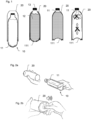
- FIG. 1 schematically represents four views of an object comprising a sleeve 20 which receives a product 10 composed essentially of a bottle 11.
- the bottle 11 includes an activatable portion that forms a bottom 111 of the bottle in the implementation shown.
- the activatable portion is in a relaxed state, that is to say that the bottom 111 has a concavity or a rounded shape towards the bottom.
- the second sectional view (starting from the left of the Figure 1 ), the bottle 11 is completely inserted into the sleeve 20, because it comes to a stop on a constriction of the sleeve 20, with the neck of the bottle 11 passing through an upper opening of the sleeve 20.
- This view also shows a cap 13 which keeps the bottle closed, itself containing a drinking liquid 12.
- the bottom 111 is still in the relaxed state, that is to say concave downwards. A clearance still exists between the cylindrical parts of the sleeve 20 and the bottle 11.
- the bottle 11 is locked in the sleeve 20, it can no longer move axially or in rotation relative to the sleeve 20.
- such a bottle 11 has such a small thickness that once opened, it would deform so much under a gripping force of approximately 20 newtons that the liquid to be drunk would overflow.
- the user can handle the bottle 11 by firmly holding the sleeve 20 (with a gripping force greater than or equal to 20 newtons).
- FIG. 2a represents a first usage diagram of the object of the Figure 1 , with a consumer (i.e. a user, preferably end user) who introduces the product 10 (the bottle 11 + the liquid 12 + the cap 13) in a substantially horizontal direction into the sleeve 20.
- a consumer i.e. a user, preferably end user
- the product 10 the bottle 11 + the liquid 12 + the cap 13
- FIG. 2b represents the consumer activating the bottom 111 by pushing it, which produces an activation noise as shown in the pictogram, to lock the bottle 11 in the sleeve 20.
- FIG. 3 represents two views of a second usage scenario of the object of the Figure 1 .
- the sleeve 20 is threaded vertically onto the product 10 which rests on a work surface S.
- the base 111 is in the relaxed state, and as shown in the detail of the left view, an air gap 40 is present between the body 112 of the bottle 11 and the sleeve 20.
- This air gap 40 facilitates the sliding and introduction of the bottle 11 into the sleeve 20.
- a clearance (in the relaxed state of the base 111), less than 1.5 mm, is approximately 0.8 mm or 0.5 mm between the two components.
- the right-hand view represents the end of the second usage scenario: once the bottle 11 has reached the stop in the sleeve 20, the consumer simply needs to continue to push the sleeve 20 downwards until it stops on the support S to activate the base 111 which then takes on a convex shape, emits a locking noise and locks the bottle 11 in the sleeve 20.
- the wall 112 of the body of the bottle 11 directly touches the sleeve 20, there is no more air, which provides effective locking of the bottle 11 in the sleeve 20.
- FIG. 4 represents a side view and a bottom view of the bottle 11 according to the invention.
- the base 111 comprises four radial grooves or ribs 113 and a central cup 114.
- the radial ribs or grooves 113 improve the hold of the base 111 in its activated state, and the cup 114 improves the ergonomics of use by intuitively indicating to the consumer where to press to activate the activatable portion. It is possible to provide more or less four radial ribs 113, and their presence is independent of the presence of the cup 114.
- the bottle 11 is formed from a thin-walled thermoplastic material.
- the material is preferably a polyester such as polyethylene terephthalate (PET), polytrimethylene terephthalate (PTT), polyethylene furanoate (PEF) or polytrimethylene furanoate (PTF). It is preferably shaped by an injection blow molding process, for example an injection stretch blow molding process. In these processes, a solid preform is manufactured by injecting the material into a mold and then cooling it, the preform is then heated to soften it, optionally stretched longitudinally using a rod, and then stretched axially and longitudinally by blowing into a mold to the shape of the bottle.
- polyester materials and processes are known to those skilled in the art. Their combination makes it possible to obtain thin, lightweight walls with good mechanical strength and good sealing or other barrier properties. These properties are due to the orientation of the macromolecular chains inducing at least partial crystallization.
- these polyesters have the advantage of being easily recyclable. Recovery, sorting, and regeneration channels are organized. Regeneration can be mechanical recycling involving melting and shaping, for example into granules before new plastics processing operations such as injection blow molding or chemical recycling involving depolymerization, recovery of monomers or precursors, then new polymerization.
- the implementation and use of the thin-walled bottles of the invention therefore presents a very advantageous environmental balance, in addition to good practicality, in particular with regard to the implementation using conventional, thicker, non-activatable PET bottles.
- the thin wall is preferably such that the body of the bottle has a thickness in a range from 30 ⁇ m to 150 ⁇ m, for example in a range from 30 ⁇ m to 50 ⁇ m or from 50 ⁇ m to 70 ⁇ m or from 70 ⁇ m to 100 ⁇ m, or from 100 ⁇ m to 125 ⁇ m or from 125 ⁇ m to 150 ⁇ m, preferably in a range from 100 ⁇ m to 125 ⁇ m.
- the thickness mentioned is the thickness at at least one point of the body, preferably the average thickness over a portion representing at least 50% in length or area of the body, preferably at least 80%, preferably the average thickness over the entire body.
- the bottom of the bottle may have a slightly greater thickness than the body, for example up to 50% more than the body, for example up to 20% more.
- the bottom may also have a cup, typically corresponding to the bottom of the preform and its injection point.
- the thickness can be adjusted by adapting, for a target bottle volume, the characteristics of the preform, in particular its shape and the thickness of its walls, as well as the stretching characteristics. It is mentioned that the thickness of the preform walls, the geometry of the preform such as its length, diameter and base shape, determine, with the neck that can form a bottle neck, the weight.
- the bottle, unfilled, unclosed, and/or the preform generally have an identical weight. Subsequently, the weights given refer indifferently to the bottle weight or the preform weight. For a 75 cl bottle, it is advantageous to use preforms of 8 to 13 g.
- the overall stretching ratio can for example be between 12.0 and 27.0, preferably between 15.0 and 20.0.
- the axial stretch ratio (typically the ratio between the height of the bottle and the length of the stretchable part of the preform, typically the under-neck distance) can for example be understood between 3.0 and 4.5.
- the radial stretch ratio (typically the ratio between the diameter of the bottle and the diameter of the stretchable part of the preform) can for example be between 4.0 and 6.0. It is mentioned that the overall stretch ratio is generally equal to the product of the axial stretch ratio and the radial stretch ratio.
- Preform type Preform having an unstretched neck with screw thread and flange
- Preform weight 12.8g Neck weight 3.68g
- Bottle type Cylindrical bottle with circular section and concave bottom that can be activated Bottle diameter 71.5 mm Bottle height 238.5 mm Bottle Volume 75 cl
- Overall stretch rate 17.96
- Radial stretch ratio 4.35
- Axial stretch rate 4.13 Thickness at body level 110 ⁇ m
- FIG. 5 represents a first variant of the object of the Figure 1 , in which a bottle 11A comprises a plurality of axial (or vertical here) ribs 115 distributed around the body of the bottle 11. Consequently, it is these ribs 115 which will mainly deform during activation of the bottom 111, so that the diameter of the body of the bottle 11A goes from a value (a) to a diameter greater than (a), at the level of the ribs 115 which therefore concentrate the deformation of the body of the bottle 11 (in detail, the portions of the body between the ribs 115 will move radially, simultaneously with a reduction in the depth of the ribs 115, which "extend" in a tangential direction).
- FIG. 6a represents a second variant of the object of the Figure 1 , in which a bottle 11B comprises at least one (here three) ribs 116 perpendicular to the axis of the bottle 11B.
- the ribs 116 are directed towards the inside of the bottle 11B, as shown in the left view of the Figure 6a .
- the activated state of the background 111 (right view of the Figure 6a )
- the ribs 116 protrude from the body of the bottle 11B and contact the inner wall of the sleeve 20, so that the bottle 11B is locked in the sleeve 20.
- FIG. 6b represents a third variant of the object of the Figure 1 .
- a sleeve 20A comprises, according to this third variant, lateral openings 201 which are opposite the ribs 116 of the bottle 11B.
- the bottom 111 When passing from the relaxed state to the activated state, the bottom 111 always causes an outward movement of the ribs 116, but these can then engage in the openings 201 of the sleeve 20, so that the locking is further improved.
- ribs 116 instead of the ribs 116, a succession of hemispherical portions distributed around the periphery of the body can be provided, which will have the same behavior as the ribs 116.
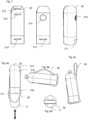
- FIG. 7 represents three views of an example of the sleeve 20 of the Figure 1 , which has a hollow tube shape to accommodate the bottle 11, with a lower opening and an upper constriction.
- the sleeve 20 has an opening 214 on its cylindrical part. This opening allows the consumer to press on the side of the closed bottle 11, to move the bottom 111 from the activated state to the relaxed state. Thus the bottle 11 is easily unlocked from the sleeve 20 and the consumer can remove it and install another bottle 11.
- a very rigid sleeve 20 can be provided, and which has a thickness of up to several millimeters, or made of metal.
- the lateral opening 214 it is possible not to provide the lateral opening 214, but to limit the thickness of the sleeve 20 (then made of plastic) to a thickness less than, for example, 500 ⁇ m, or even 350 ⁇ m, so that it is flexible under a particular force (for example at least 20 newtons) and to deform the closed bottle 11 so as to cause the bottom 111 to pass from the activated state to the relaxed state.
- a particular force for example at least 20 newtons
- the sleeve 20 here comprises, according to a particular implementation, four lugs or loops 210, 211, 212 and 213, arranged to attach a strap 30, visible from the Figures 8a to 8d .
- the consumer can pull on the strap 30 to tighten it between the loop 211 and 210, so as to block the lower opening, as shown in the bottom view of the figure 8d . It is then possible for the consumer to easily transport the object, as shown by the Figures 8b and 8c , with additional securing of the bottle 11 in the sleeve 20.
Landscapes
- Engineering & Computer Science (AREA)
- Mechanical Engineering (AREA)
- Ceramic Engineering (AREA)
- Containers Having Bodies Formed In One Piece (AREA)
- Details Of Rigid Or Semi-Rigid Containers (AREA)
Claims (16)
- Produkt, umfassen:- eine geschlossene Flasche (11; 11A; 11B) aus dünnwandigem Kunststoff, die einen zumindest teilweise zylindrischen Körper umfasst und ein Innenvolumen definiert, wobei der zylindrische Teil der Flasche eine Seitenfläche aufweist, deren Mantellinien parallele Geraden sind, die einer geschlossenen Basiskurve folgen, die durch den Schnittpunkt der Seitenfläche mit einer Ebene, die senkrecht zu einer axialen Richtung der Flasche verläuft, definiert ist,- eine Trinkflüssigkeit (12), die mindestens 80 % des Innenvolumens der Flasche (11; 11A; 11B) ausfüllt,wobei die Flasche (11; 11A; 11B) mindestens einen aktivierbaren Abschnitt mit einer Konkavität umfasst, die in einem entspannten Zustand in einer ersten Richtung ausgerichtet ist, wobei der aktivierbare Abschnitt eingerichtet ist, um sich unter einer von einem Verbraucher ausgeübten Kraft zu verformen, um in einen aktivierten Zustand überzugehen und eine Konvexität aufweist, die in einer der ersten Richtung entgegengesetzten Richtung ausgerichtet ist,wobei ein von der Flüssigkeit (12) auf die geschlossene Flasche (11; 11A; 11B) mit dem aktivierbaren Abschnitt im entspannten Zustand ausgeübter Druck niedriger ist als ein von der Flüssigkeit (12) auf die geschlossene Flasche (11; 11A; 11B) mit dem aktivierbaren Abschnitt im aktivierten Zustand ausgeübter Druck,wobei der Körper der Flasche (11; 11A; 11B) eine Dicke aufweist, die in einem Bereich von 30 µm bis 150 µm liegt,wobei der aktivierbare Abschnitt einen Boden (111) der Flasche (11; 11A; 11B) bildet, wobei der aktivierbare Abschnitt im entspannten Zustand nach außen abgerundet ist, und wobei der aktivierbare Abschnitt eingerichtet ist, um im aktivierten Zustand oder im entspannten Zustand zu bleiben, solange kein Druck von dem Benutzer ausgeübt wird, um den Zustand zu ändern, dadurch gekennzeichnet, dass der Boden (111) mindestens eine radiale Nut (113) aufweist, die sich über eine Länge von mindestens 10 % des Durchmessers des zylindrischen Teils des Körpers erstreckt.
- Produkt nach vorhergehendem Anspruch, wobei der Boden (111) eine Dicke aufweist, die ±20 % der Dicke des Körpers der Flasche (11; 11A; 11B) entspricht, mit Ausnahme eines zentralen Abschnitts des Bodens (111), der innerhalb eines Durchmessers liegt von:- kleiner oder gleich 50 % des Durchmessers des zylindrischen Teils des Körpers,- vorzugsweise kleiner oder gleich 35 % des Durchmessers des zylindrischen Teils des Körpers,- noch bevorzugter kleiner oder gleich 20 % des Durchmessers des zylindrischen Teils des Körpers.
- Produkt nach einem der vorhergehenden Ansprüche, wobei der Körper der Flasche (11; 11A; 11B) eine Dicke aufweist, die liegt:- in einem Bereich von 30 µm bis 50 µm oder von 50 µm bis 70 µm oder von 70 µm bis 100 µm oder von 100 µm bis 125 µm oder von 125 µm bis 150 µm,- und vorzugsweise in einem Bereich von 100 µm bis 125 µm.
- Produkt nach einem der vorhergehenden Ansprüche, wobei die Flasche (11; 11A; 11B) eine Vielzahl von Rippen (115) umfasst, die in einer axialen Richtung der Flasche (11; 11A; 11B) ausgerichtet und entlang des Körpers verteilt sind.
- Produkt nach einem der vorhergehenden Ansprüche, wobei die Flasche (11; 11A; 11B) einen Hals und mindestens eine kreisförmige Rippe (116) umfasst, die in einer Richtung senkrecht zu einer axialen Richtung der Flasche (11; 11A; 11B) ausgerichtet ist und auf dem Körper der Flasche (11; 11A; 11B) in der Nähe des Halses eingerichtet ist.
- Produkt nach einem der vorhergehenden Ansprüche, wobei der aktivierbare Abschnitt im entspannten Zustand mindestens 2 %, vorzugsweise mindestens 5 %, vorzugsweise mindestens 15 %, vorzugsweise 5 % bis 10 % des Innenvolumens definiert.
- Objekt, das von einem Verbraucher zu halten ist, umfassend:- eine äußere Hülle (20; 20A), die eingerichtet ist, um von dem Verbraucher gehalten zu werden,- ein Produkt nach einem der vorhergehenden Ansprüche,wobei die Hülle (20; 20A) eine Öffnung umfasst, die eingerichtet ist, um die Flasche (11; 11A; 11B) mit dem aktivierbaren Abschnitt im entspannten Zustand aufzunehmen,und wobei der aktivierbare Abschnitt, wenn er unter einer vom Verbraucher ausgeübten Kraft in den aktivierten Zustand übergeht, Mittel zum Verriegeln der Flasche (11; 11A; 11B) in der äußeren Hülle (20; 20A) bildet.
- Objekt nach vorhergehendem Anspruch, wobei die Hülle (20; 20A) eine der Öffnung gegenüberliegende Einschnürung aufweist und eingerichtet ist, um einen axialen Anschlag für die in der Öffnung aufgenommene Flasche (11; 11A; 11B) zu bilden.
- Objekt nach einem der Ansprüche 7 oder 8, wobei die Hülle (20; 20A) eine Öffnung, vorzugsweise seitlich, aufweist, um es dem Verbraucher zu ermöglichen, eine Deaktivierungskraft direkt auf die geschlossene Flasche (11; 11A; 11B) auszuüben, die den aktivierbaren Abschnitt in einem aktivierten Zustand aufweist, um den aktivierbaren Abschnitt in den deaktivierten Zustand zu überführen, um die Flasche (11; 11A; 11B) von der Hülle (20; 20A) zu entriegeln.
- Objekt nach einem der Ansprüche 7 bis 9, wobei die Hülle (20; 20A) eine Länge aufweist, die ausreicht, um zu bedecken:- mindestens 50 % der Flasche (11; 11A; 11B),- vorzugsweise mindestens 75 % der Flasche (11; 11A; 11B),- noch bevorzugter den gesamten Körper der Flasche (11; 11A; 11B),- und noch bevorzugter den gesamten Körper der Flasche (11; 11A; 11B), deren aktivierbarer Abschnitt den Boden (111) bildet, sowie höchstens 80 % und vorzugsweise 20 % bis höchstens 50 % der Höhe des aktivierbaren Abschnitts im entspannten Zustand.
- Objekt nach einem der Ansprüche 7 bis 10, umfassend einen Riemen (30), der mit der Hülle (20; 20A) verbunden ist, und wobei:der Riemen (30) aufweist:- ein erstes Ende, das an einem ersten Ende der Hülle (20; 20A) auf der Seite der Einführungsöffnung der Flasche (11; 11A; 11B) befestigt ist,- einen Abschnitt, der gleitend durch eine Schlaufe angebracht ist, die am ersten Ende der Hülle (20; 20A) und an einer gegenüberliegenden Seite des ersten Endes des an der Hülle (20; 20A) befestigten Riemens (30) eingerichtet ist,- ein zweites Ende, das an einem zweiten Ende der Hülle (20; 20A) befestigt ist,so dass der Riemen (30):• zwischen seinem ersten Ende und der Schlaufe locker ist, die Öffnung freigibt und das Einführen der Flasche (11; 11A; 11B) in die Öffnung ermöglicht,• zwischen seinem ersten Ende und der Schlaufe gespannt ist, die Öffnung blockiert und verhindert, dass die Flasche (11; 11A; 11B) aus der Hülle (20; 20A) herausgezogen wird.
- Objekt nach einem der Ansprüche 7 bis 11, wobei die Hülle (20; 20A) eine Dicke aufweist:- die mindestens größer als das Doppelte einer Dicke des Körpers der Flasche (11; 11A; 11B) ist, oder- mindestens größer als 200 µm ist.
- Objekt nach einem der Ansprüche 7 bis 12, wobei die Hülle (20; 20A) eine Innenwand aufweist, die eingerichtet ist, um den Körper der Flasche (11; 11A; 11B) zu berühren, wobei mindestens 30 % der Fläche der Innenwand luftdicht ist und/oder eine arithmetische Rauheit (Ra) von weniger als oder gleich 1,6 µm aufweist.
- Objekt nach einem der Ansprüche 7 bis 13, umfassend das Produkt nach Anspruch 4, wobei der aktivierbare Abschnitt, wenn er unter einer von dem Verbraucher ausgeübten Kraft in den aktivierten Zustand übergeht, durch Verringerung einer Tiefe der Rippen eine Vergrößerung des Durchmessers des Teils des Körpers, der die Rippen umfasst, bewirkt, so dass ein direkter Kontakt zwischen dem Körper der Flasche (11; 11A; 11B) und einer Innenwand der Hülle (20; 20A) entsteht.
- Objekt nach einem der Ansprüche 7 bis 13, umfassend das Produkt nach Anspruch 5, wobei die Hülle (20; 20A) mindestens eine innere Nut oder Öffnung aufweist, die eingerichtet ist, um der Rippe der Flasche (11; 11A; 11B), die in der Öffnung aufgenommen ist, zugewandt zu sein, so dass eine radiale Verlagerung der Rippe der Flasche (11; 11A; 11B) nach außen bei Aktivierung des aktivierbaren Abschnitts ermöglicht wird.
- Verfahren zum Bereitstellen eines Produkts nach einem der Ansprüche 1 bis 6 für einen Verbraucher, das die folgenden Schritte umfasst:- Herstellen der Flasche (11; 11A; 11B) des Produkts nach einem der Ansprüche 1 bis 6, beispielsweise durch Spritzblasverfahren,- Füllen von mindestens 80 % des Innenvolumens der Flasche (11; 11A; 11B) mit einer Lebensmittelflüssigkeit (12), vorzugsweise bei einer Temperatur von weniger als 50°C,- Verschließen der Flasche (11; 11A; 11B),- Transportieren der verschlossenen Flasche (11; 11A; 11B) mit dem aktivierbaren Abschnitt im entspannten Zustand zu einer Stelle, an der sie einem Verbraucher zur Verfügung gestellt wird, beispielsweise zu Hause, am Arbeitsplatz, in einem Restaurant, in einem Geschäft oder in einem mechanisierten Automaten.
Applications Claiming Priority (2)
| Application Number | Priority Date | Filing Date | Title |
|---|---|---|---|
| FR1852891A FR3079503B1 (fr) | 2018-04-03 | 2018-04-03 | Bouteille a parois minces pour contenir un liquide alimentaire |
| PCT/EP2019/058218 WO2019192975A1 (fr) | 2018-04-03 | 2019-04-02 | Bouteille a parois minces pour contenir un liquide alimentaire |
Publications (2)
| Publication Number | Publication Date |
|---|---|
| EP3774558A1 EP3774558A1 (de) | 2021-02-17 |
| EP3774558B1 true EP3774558B1 (de) | 2025-03-26 |
Family
ID=62751090
Family Applications (1)
| Application Number | Title | Priority Date | Filing Date |
|---|---|---|---|
| EP19713503.1A Active EP3774558B1 (de) | 2018-04-03 | 2019-04-02 | Dünnwandige flasche zur aufnahme eines flüssigen lebensmittels |
Country Status (3)
| Country | Link |
|---|---|
| EP (1) | EP3774558B1 (de) |
| FR (1) | FR3079503B1 (de) |
| WO (1) | WO2019192975A1 (de) |
Families Citing this family (1)
| Publication number | Priority date | Publication date | Assignee | Title |
|---|---|---|---|---|
| FR3101617B1 (fr) * | 2019-10-03 | 2022-03-25 | Sa Des Eaux Minerales D’Evian Et En Abrege S A E M E | Objet a tenir par un utilisateur, comprenant une coque et une bouteille |
Citations (1)
| Publication number | Priority date | Publication date | Assignee | Title |
|---|---|---|---|---|
| WO2014101956A1 (en) * | 2012-12-28 | 2014-07-03 | Sa Des Eaux Minerales D'evian Saeme | Self collapsible blow moulded plastic thin-walled container |
Family Cites Families (7)
| Publication number | Priority date | Publication date | Assignee | Title |
|---|---|---|---|---|
| DE19500006A1 (de) * | 1995-01-01 | 1996-07-04 | Gerd Hoermansdoerfer | Pastenspender |
| FR2830844A1 (fr) * | 2001-10-12 | 2003-04-18 | Perrier Vittel Man Et Technolo | Contenant pour un produit coulant, procede de fabrication et utilisations dudit contenant |
| FR2934568B1 (fr) | 2008-07-29 | 2010-09-17 | Tecsor | Procede de traitement d'un contenant a paroi mince en matiere plastique, rempli a chaud et dispositif associe |
| CN102307786B (zh) | 2009-02-10 | 2016-08-17 | 普拉斯蒂派克包装公司 | 加压塑料容器的系统和方法 |
| JP5545426B2 (ja) * | 2009-11-11 | 2014-07-09 | 東洋製罐株式会社 | 中空容器 |
| MX361594B (es) | 2012-12-28 | 2018-12-10 | Sa Des Eaux Minerales Devian Et En Abrege S A E M E | Envase de fino espesor de plastico moldeado por soplado retractil. |
| CA2943255C (en) * | 2014-03-31 | 2023-01-24 | Amcor Limited | Controlled release container |
-
2018
- 2018-04-03 FR FR1852891A patent/FR3079503B1/fr active Active
-
2019
- 2019-04-02 WO PCT/EP2019/058218 patent/WO2019192975A1/fr not_active Ceased
- 2019-04-02 EP EP19713503.1A patent/EP3774558B1/de active Active
Patent Citations (1)
| Publication number | Priority date | Publication date | Assignee | Title |
|---|---|---|---|---|
| WO2014101956A1 (en) * | 2012-12-28 | 2014-07-03 | Sa Des Eaux Minerales D'evian Saeme | Self collapsible blow moulded plastic thin-walled container |
Also Published As
| Publication number | Publication date |
|---|---|
| WO2019192975A1 (fr) | 2019-10-10 |
| EP3774558A1 (de) | 2021-02-17 |
| FR3079503A1 (fr) | 2019-10-04 |
| FR3079503B1 (fr) | 2020-03-06 |
Similar Documents
| Publication | Publication Date | Title |
|---|---|---|
| EP2084071B1 (de) | Behältnis, in erster linie flaschen, aus einem thermoplastischen material | |
| EP2051910B1 (de) | Durch blasung oder streckblasung einer vorform eines thermoplastischen materials gewonnener hohlkörperboden und hohlkörper mit einem solchen boden | |
| EP2129614B1 (de) | Verfahren zur füllung einer ausziehbaren packung | |
| FR2941924A1 (fr) | Recipient dont le fond est muni d'une voute flexible a double assise | |
| CN105008229B (zh) | 可收回吹塑成型塑料薄壁容器 | |
| WO2010046561A1 (fr) | Corps creux muni de reliefs permettant son indexation et procédé de manutention d'un tel corps | |
| FR2825315A1 (fr) | Systeme de moulage et procede en relation utilisant un moule pour l'injection a entree laterale avec assistance du vide et article moule par soufflage resultant | |
| EP1975116A1 (de) | Verfahren zum Füllen einer Schrumpfverpackung | |
| EP2212096A2 (de) | Herstellungsverfahren einer verpackung für heissabfüllung sowie eine solche verpackung | |
| EP2331315B1 (de) | Verfahren zur behandlung eines heiss befüllbaren, dünnwandigen kunststoffbehälters und zugehörige vorrichtung | |
| FR2939106A1 (fr) | Dispositif d'habillage pour recipient, notamment pour bouteille contenant un liquide a boire, et procede de fabrication associe | |
| WO2019192975A1 (fr) | Bouteille a parois minces pour contenir un liquide alimentaire | |
| FR2543484A1 (fr) | Procede pour fabriquer un recipient tel que fut en matiere thermoplastique et recipient ainsi fabrique | |
| FR2539107A1 (fr) | Conteneur en trois parties et son procede de fabrication | |
| FR2767123A1 (fr) | Nouvelle structure de recipient et procede de conditionnement d'un produit au moyen de ce recipient | |
| WO2016097543A1 (fr) | Récipient à large col à manchon fileté rapporté | |
| EP4037985B1 (de) | Von einem benutzer zu haltendes objekt mit einer hülle und einer flasche | |
| EP3774564A1 (de) | Flasche mit dünnen wänden zur aufnahme einer lebensmittelflüssigkeit | |
| BE898602A (fr) | Methode de fabrication de conteneurs | |
| FR2581926A1 (fr) | Procede de production d'un recipient en matiere plastique fabrique par soufflage avec etirage bi-oriente et comportant une poignee, et recipient obtenu | |
| WO2004030895A1 (fr) | Preforme plastique a large col avec zone d'etancheite interne protegee contre les deteriorations mecaniques | |
| EP3972913B1 (de) | Behälter mit griff am körper, der durch einen einzigen arbeitsgang geformt wird | |
| FR2925030A1 (fr) | Recipient en matiere plastiques recyclable et dispositif de fermeture correspondant | |
| BE1019366A5 (fr) | Conteneur pour liquides. | |
| WO2005115725A1 (fr) | Procede de fabrication d'un jeton pour l'obtention d'un flacon par thermoformage et soufflage et jeton ainsi obtenu |
Legal Events
| Date | Code | Title | Description |
|---|---|---|---|
| STAA | Information on the status of an ep patent application or granted ep patent |
Free format text: STATUS: UNKNOWN |
|
| STAA | Information on the status of an ep patent application or granted ep patent |
Free format text: STATUS: THE INTERNATIONAL PUBLICATION HAS BEEN MADE |
|
| PUAI | Public reference made under article 153(3) epc to a published international application that has entered the european phase |
Free format text: ORIGINAL CODE: 0009012 |
|
| STAA | Information on the status of an ep patent application or granted ep patent |
Free format text: STATUS: REQUEST FOR EXAMINATION WAS MADE |
|
| 17P | Request for examination filed |
Effective date: 20201103 |
|
| AK | Designated contracting states |
Kind code of ref document: A1 Designated state(s): AL AT BE BG CH CY CZ DE DK EE ES FI FR GB GR HR HU IE IS IT LI LT LU LV MC MK MT NL NO PL PT RO RS SE SI SK SM TR |
|
| AX | Request for extension of the european patent |
Extension state: BA ME |
|
| DAV | Request for validation of the european patent (deleted) | ||
| DAX | Request for extension of the european patent (deleted) | ||
| STAA | Information on the status of an ep patent application or granted ep patent |
Free format text: STATUS: EXAMINATION IS IN PROGRESS |
|
| 17Q | First examination report despatched |
Effective date: 20221122 |
|
| GRAP | Despatch of communication of intention to grant a patent |
Free format text: ORIGINAL CODE: EPIDOSNIGR1 |
|
| STAA | Information on the status of an ep patent application or granted ep patent |
Free format text: STATUS: GRANT OF PATENT IS INTENDED |
|
| INTG | Intention to grant announced |
Effective date: 20241017 |
|
| GRAS | Grant fee paid |
Free format text: ORIGINAL CODE: EPIDOSNIGR3 |
|
| GRAA | (expected) grant |
Free format text: ORIGINAL CODE: 0009210 |
|
| STAA | Information on the status of an ep patent application or granted ep patent |
Free format text: STATUS: THE PATENT HAS BEEN GRANTED |
|
| AK | Designated contracting states |
Kind code of ref document: B1 Designated state(s): AL AT BE BG CH CY CZ DE DK EE ES FI FR GB GR HR HU IE IS IT LI LT LU LV MC MK MT NL NO PL PT RO RS SE SI SK SM TR |
|
| REG | Reference to a national code |
Ref country code: GB Ref legal event code: FG4D Free format text: NOT ENGLISH |
|
| REG | Reference to a national code |
Ref country code: CH Ref legal event code: EP |
|
| REG | Reference to a national code |
Ref country code: DE Ref legal event code: R096 Ref document number: 602019067744 Country of ref document: DE |
|
| REG | Reference to a national code |
Ref country code: IE Ref legal event code: FG4D Free format text: LANGUAGE OF EP DOCUMENT: FRENCH |
|
| PG25 | Lapsed in a contracting state [announced via postgrant information from national office to epo] |
Ref country code: RS Free format text: LAPSE BECAUSE OF FAILURE TO SUBMIT A TRANSLATION OF THE DESCRIPTION OR TO PAY THE FEE WITHIN THE PRESCRIBED TIME-LIMIT Effective date: 20250626 |
|
| PG25 | Lapsed in a contracting state [announced via postgrant information from national office to epo] |
Ref country code: FI Free format text: LAPSE BECAUSE OF FAILURE TO SUBMIT A TRANSLATION OF THE DESCRIPTION OR TO PAY THE FEE WITHIN THE PRESCRIBED TIME-LIMIT Effective date: 20250326 |
|
| PGFP | Annual fee paid to national office [announced via postgrant information from national office to epo] |
Ref country code: DE Payment date: 20250423 Year of fee payment: 7 |
|
| REG | Reference to a national code |
Ref country code: LT Ref legal event code: MG9D |
|
| PG25 | Lapsed in a contracting state [announced via postgrant information from national office to epo] |
Ref country code: NO Free format text: LAPSE BECAUSE OF FAILURE TO SUBMIT A TRANSLATION OF THE DESCRIPTION OR TO PAY THE FEE WITHIN THE PRESCRIBED TIME-LIMIT Effective date: 20250626 |
|
| PG25 | Lapsed in a contracting state [announced via postgrant information from national office to epo] |
Ref country code: HR Free format text: LAPSE BECAUSE OF FAILURE TO SUBMIT A TRANSLATION OF THE DESCRIPTION OR TO PAY THE FEE WITHIN THE PRESCRIBED TIME-LIMIT Effective date: 20250326 |
|
| PG25 | Lapsed in a contracting state [announced via postgrant information from national office to epo] |
Ref country code: LV Free format text: LAPSE BECAUSE OF FAILURE TO SUBMIT A TRANSLATION OF THE DESCRIPTION OR TO PAY THE FEE WITHIN THE PRESCRIBED TIME-LIMIT Effective date: 20250326 |
|
| PG25 | Lapsed in a contracting state [announced via postgrant information from national office to epo] |
Ref country code: GR Free format text: LAPSE BECAUSE OF FAILURE TO SUBMIT A TRANSLATION OF THE DESCRIPTION OR TO PAY THE FEE WITHIN THE PRESCRIBED TIME-LIMIT Effective date: 20250627 Ref country code: BG Free format text: LAPSE BECAUSE OF FAILURE TO SUBMIT A TRANSLATION OF THE DESCRIPTION OR TO PAY THE FEE WITHIN THE PRESCRIBED TIME-LIMIT Effective date: 20250326 |
|
| PGFP | Annual fee paid to national office [announced via postgrant information from national office to epo] |
Ref country code: CH Payment date: 20250501 Year of fee payment: 7 |
|
| REG | Reference to a national code |
Ref country code: NL Ref legal event code: MP Effective date: 20250326 |
|
| PG25 | Lapsed in a contracting state [announced via postgrant information from national office to epo] |
Ref country code: NL Free format text: LAPSE BECAUSE OF FAILURE TO SUBMIT A TRANSLATION OF THE DESCRIPTION OR TO PAY THE FEE WITHIN THE PRESCRIBED TIME-LIMIT Effective date: 20250326 |
|
| PG25 | Lapsed in a contracting state [announced via postgrant information from national office to epo] |
Ref country code: SE Free format text: LAPSE BECAUSE OF FAILURE TO SUBMIT A TRANSLATION OF THE DESCRIPTION OR TO PAY THE FEE WITHIN THE PRESCRIBED TIME-LIMIT Effective date: 20250326 |
|
| REG | Reference to a national code |
Ref country code: AT Ref legal event code: MK05 Ref document number: 1778863 Country of ref document: AT Kind code of ref document: T Effective date: 20250326 |
|
| PG25 | Lapsed in a contracting state [announced via postgrant information from national office to epo] |
Ref country code: SM Free format text: LAPSE BECAUSE OF FAILURE TO SUBMIT A TRANSLATION OF THE DESCRIPTION OR TO PAY THE FEE WITHIN THE PRESCRIBED TIME-LIMIT Effective date: 20250326 |
|
| PG25 | Lapsed in a contracting state [announced via postgrant information from national office to epo] |
Ref country code: ES Free format text: LAPSE BECAUSE OF FAILURE TO SUBMIT A TRANSLATION OF THE DESCRIPTION OR TO PAY THE FEE WITHIN THE PRESCRIBED TIME-LIMIT Effective date: 20250326 Ref country code: PT Free format text: LAPSE BECAUSE OF FAILURE TO SUBMIT A TRANSLATION OF THE DESCRIPTION OR TO PAY THE FEE WITHIN THE PRESCRIBED TIME-LIMIT Effective date: 20250728 |
|
| PG25 | Lapsed in a contracting state [announced via postgrant information from national office to epo] |
Ref country code: PL Free format text: LAPSE BECAUSE OF FAILURE TO SUBMIT A TRANSLATION OF THE DESCRIPTION OR TO PAY THE FEE WITHIN THE PRESCRIBED TIME-LIMIT Effective date: 20250326 Ref country code: IT Free format text: LAPSE BECAUSE OF FAILURE TO SUBMIT A TRANSLATION OF THE DESCRIPTION OR TO PAY THE FEE WITHIN THE PRESCRIBED TIME-LIMIT Effective date: 20250326 |
|
| PG25 | Lapsed in a contracting state [announced via postgrant information from national office to epo] |
Ref country code: AT Free format text: LAPSE BECAUSE OF FAILURE TO SUBMIT A TRANSLATION OF THE DESCRIPTION OR TO PAY THE FEE WITHIN THE PRESCRIBED TIME-LIMIT Effective date: 20250326 |
|
| PG25 | Lapsed in a contracting state [announced via postgrant information from national office to epo] |
Ref country code: EE Free format text: LAPSE BECAUSE OF FAILURE TO SUBMIT A TRANSLATION OF THE DESCRIPTION OR TO PAY THE FEE WITHIN THE PRESCRIBED TIME-LIMIT Effective date: 20250326 |
|
| PG25 | Lapsed in a contracting state [announced via postgrant information from national office to epo] |
Ref country code: RO Free format text: LAPSE BECAUSE OF FAILURE TO SUBMIT A TRANSLATION OF THE DESCRIPTION OR TO PAY THE FEE WITHIN THE PRESCRIBED TIME-LIMIT Effective date: 20250326 |
|
| PG25 | Lapsed in a contracting state [announced via postgrant information from national office to epo] |
Ref country code: SK Free format text: LAPSE BECAUSE OF FAILURE TO SUBMIT A TRANSLATION OF THE DESCRIPTION OR TO PAY THE FEE WITHIN THE PRESCRIBED TIME-LIMIT Effective date: 20250326 |
|
| PG25 | Lapsed in a contracting state [announced via postgrant information from national office to epo] |
Ref country code: IS Free format text: LAPSE BECAUSE OF FAILURE TO SUBMIT A TRANSLATION OF THE DESCRIPTION OR TO PAY THE FEE WITHIN THE PRESCRIBED TIME-LIMIT Effective date: 20250726 |
|
| PG25 | Lapsed in a contracting state [announced via postgrant information from national office to epo] |
Ref country code: LU Free format text: LAPSE BECAUSE OF NON-PAYMENT OF DUE FEES Effective date: 20250402 |
|
| PG25 | Lapsed in a contracting state [announced via postgrant information from national office to epo] |
Ref country code: MC Free format text: LAPSE BECAUSE OF FAILURE TO SUBMIT A TRANSLATION OF THE DESCRIPTION OR TO PAY THE FEE WITHIN THE PRESCRIBED TIME-LIMIT Effective date: 20250326 |
|
| REG | Reference to a national code |
Ref country code: BE Ref legal event code: MM Effective date: 20250430 |
|
| REG | Reference to a national code |
Ref country code: DE Ref legal event code: R097 Ref document number: 602019067744 Country of ref document: DE |
|
| PG25 | Lapsed in a contracting state [announced via postgrant information from national office to epo] |
Ref country code: DK Free format text: LAPSE BECAUSE OF FAILURE TO SUBMIT A TRANSLATION OF THE DESCRIPTION OR TO PAY THE FEE WITHIN THE PRESCRIBED TIME-LIMIT Effective date: 20250326 |
|
| PG25 | Lapsed in a contracting state [announced via postgrant information from national office to epo] |
Ref country code: BE Free format text: LAPSE BECAUSE OF NON-PAYMENT OF DUE FEES Effective date: 20250430 |
|
| PG25 | Lapsed in a contracting state [announced via postgrant information from national office to epo] |
Ref country code: CZ Free format text: LAPSE BECAUSE OF FAILURE TO SUBMIT A TRANSLATION OF THE DESCRIPTION OR TO PAY THE FEE WITHIN THE PRESCRIBED TIME-LIMIT Effective date: 20250326 |
|
| PLBE | No opposition filed within time limit |
Free format text: ORIGINAL CODE: 0009261 |
|
| STAA | Information on the status of an ep patent application or granted ep patent |
Free format text: STATUS: NO OPPOSITION FILED WITHIN TIME LIMIT |
|
| REG | Reference to a national code |
Ref country code: CH Ref legal event code: L10 Free format text: ST27 STATUS EVENT CODE: U-0-0-L10-L00 (AS PROVIDED BY THE NATIONAL OFFICE) Effective date: 20260211 |
|
| 26N | No opposition filed |
Effective date: 20260105 |
|
| PGFP | Annual fee paid to national office [announced via postgrant information from national office to epo] |
Ref country code: GB Payment date: 20260312 Year of fee payment: 8 |
|
| PG25 | Lapsed in a contracting state [announced via postgrant information from national office to epo] |
Ref country code: IE Free format text: LAPSE BECAUSE OF NON-PAYMENT OF DUE FEES Effective date: 20250402 |
|
| PGFP | Annual fee paid to national office [announced via postgrant information from national office to epo] |
Ref country code: FR Payment date: 20260309 Year of fee payment: 8 |
|
| REG | Reference to a national code |
Ref country code: CH Ref legal event code: U11 Free format text: ST27 STATUS EVENT CODE: U-0-0-U10-U11 (AS PROVIDED BY THE NATIONAL OFFICE) Effective date: 20260501 |