EP3774558B1 - Thin-walled bottle for containing a liquid foodstuff - Google Patents
Thin-walled bottle for containing a liquid foodstuff Download PDFInfo
- Publication number
- EP3774558B1 EP3774558B1 EP19713503.1A EP19713503A EP3774558B1 EP 3774558 B1 EP3774558 B1 EP 3774558B1 EP 19713503 A EP19713503 A EP 19713503A EP 3774558 B1 EP3774558 B1 EP 3774558B1
- Authority
- EP
- European Patent Office
- Prior art keywords
- bottle
- sleeve
- consumer
- activatable portion
- opening
- Prior art date
- Legal status (The legal status is an assumption and is not a legal conclusion. Google has not performed a legal analysis and makes no representation as to the accuracy of the status listed.)
- Active
Links
Images


Classifications
-
- B—PERFORMING OPERATIONS; TRANSPORTING
- B65—CONVEYING; PACKING; STORING; HANDLING THIN OR FILAMENTARY MATERIAL
- B65D—CONTAINERS FOR STORAGE OR TRANSPORT OF ARTICLES OR MATERIALS, e.g. BAGS, BARRELS, BOTTLES, BOXES, CANS, CARTONS, CRATES, DRUMS, JARS, TANKS, HOPPERS, FORWARDING CONTAINERS; ACCESSORIES, CLOSURES, OR FITTINGS THEREFOR; PACKAGING ELEMENTS; PACKAGES
- B65D1/00—Rigid or semi-rigid containers having bodies formed in one piece, e.g. by casting metallic material, by moulding plastics, by blowing vitreous material, by throwing ceramic material, by moulding pulped fibrous material or by deep-drawing operations performed on sheet material
- B65D1/02—Bottles or similar containers with necks or like restricted apertures, designed for pouring contents
- B65D1/0223—Bottles or similar containers with necks or like restricted apertures, designed for pouring contents characterised by shape
-
- B—PERFORMING OPERATIONS; TRANSPORTING
- B65—CONVEYING; PACKING; STORING; HANDLING THIN OR FILAMENTARY MATERIAL
- B65D—CONTAINERS FOR STORAGE OR TRANSPORT OF ARTICLES OR MATERIALS, e.g. BAGS, BARRELS, BOTTLES, BOXES, CANS, CARTONS, CRATES, DRUMS, JARS, TANKS, HOPPERS, FORWARDING CONTAINERS; ACCESSORIES, CLOSURES, OR FITTINGS THEREFOR; PACKAGING ELEMENTS; PACKAGES
- B65D1/00—Rigid or semi-rigid containers having bodies formed in one piece, e.g. by casting metallic material, by moulding plastics, by blowing vitreous material, by throwing ceramic material, by moulding pulped fibrous material or by deep-drawing operations performed on sheet material
- B65D1/02—Bottles or similar containers with necks or like restricted apertures, designed for pouring contents
- B65D1/0223—Bottles or similar containers with necks or like restricted apertures, designed for pouring contents characterised by shape
- B65D1/0261—Bottom construction
-
- B—PERFORMING OPERATIONS; TRANSPORTING
- B65—CONVEYING; PACKING; STORING; HANDLING THIN OR FILAMENTARY MATERIAL
- B65D—CONTAINERS FOR STORAGE OR TRANSPORT OF ARTICLES OR MATERIALS, e.g. BAGS, BARRELS, BOTTLES, BOXES, CANS, CARTONS, CRATES, DRUMS, JARS, TANKS, HOPPERS, FORWARDING CONTAINERS; ACCESSORIES, CLOSURES, OR FITTINGS THEREFOR; PACKAGING ELEMENTS; PACKAGES
- B65D1/00—Rigid or semi-rigid containers having bodies formed in one piece, e.g. by casting metallic material, by moulding plastics, by blowing vitreous material, by throwing ceramic material, by moulding pulped fibrous material or by deep-drawing operations performed on sheet material
- B65D1/02—Bottles or similar containers with necks or like restricted apertures, designed for pouring contents
- B65D1/0223—Bottles or similar containers with necks or like restricted apertures, designed for pouring contents characterised by shape
- B65D1/0292—Foldable bottles
-
- B—PERFORMING OPERATIONS; TRANSPORTING
- B65—CONVEYING; PACKING; STORING; HANDLING THIN OR FILAMENTARY MATERIAL
- B65D—CONTAINERS FOR STORAGE OR TRANSPORT OF ARTICLES OR MATERIALS, e.g. BAGS, BARRELS, BOTTLES, BOXES, CANS, CARTONS, CRATES, DRUMS, JARS, TANKS, HOPPERS, FORWARDING CONTAINERS; ACCESSORIES, CLOSURES, OR FITTINGS THEREFOR; PACKAGING ELEMENTS; PACKAGES
- B65D23/00—Details of bottles or jars not otherwise provided for
- B65D23/08—Coverings or external coatings
- B65D23/0885—Rigid shells for receiving the bottle or part of it
Definitions
- the present invention relates generally to the field of containers for food liquids, and in particular relates to a product which comprises a bottle and a food liquid such as non-carbonated mineral water.
- the invention also relates to an object which comprises the aforementioned product, and which can be easily handled by a consumer.
- the invention finally relates to a method for delivering an aforementioned product to a consumer.
- Containers for food liquids are known in the prior art, and in particular thin-walled plastic bottles for transporting and delivering mineral water to a consumer who wishes to consume quality water, with preserved flavor and quality.
- Such containers or plastic bottles are disclosed in the documents WO201012956A1 , WO201093602A2 , EP1873067A1 , Or WO2014101957A1 .
- the document FR2830844A1 discloses a container for a flowable product, with a flexible plastic body.
- the document WO2014101956A1 discloses a bottle with a deformable bottom as well as a product according to the preamble of claim 1.
- An aim of the present invention is to address the drawbacks of the prior art documents mentioned above and in particular, first of all, to propose a bottle which forms a product by containing a food liquid which minimizes the ecological impact, which is cheap to produce, without however degrading the ergonomics or the use by the consumer, who must be able to handle the bottle without taking any particular precaution, and without risking the liquid contained overflowing.
- the bottle in the product according to the above implementation has a low thickness (and consequently a low rigidity), as well as an activatable portion to be activated by the consumer himself.
- the latter pushes the activatable portion to make it present a convex shape, which makes it possible, for example, to define a circular base on which the bottle can be placed in a stable manner.
- Putting the activatable portion in the activated state also makes it possible to increase the pressure internal of the bottle, which stretches its surfaces and improves its hold.
- the consumer creates a fold in the bottle, which increases its rigidity. It can also be noted that moving from a concave shape to a convex shape causes a noise or "activation noise" which informs the consumer about the change in state.
- the activatable portion of the bottle is arranged to be activated directly by the user (for example by a push exerted by the user's hand or fingers directly on the activatable portion).
- the activatable portion is arranged to remain in this state, even if the activatable portion is not in contact with a support or a work surface.
- the activatable portion is arranged to remain in the activated or relaxed (non-activated) state as long as pressure is not exerted by the user to make it change state.
- the activation of the activatable portion is carried out by the consumer, i.e. the person who will consume the food liquid.
- the invention can be implemented by a user who is not the consumer.
- the cylindrical part of the bottle has a lateral surface whose generatrices are parallel lines, and which follow a base curve (defined by the intersection of the lateral surface with a plane perpendicular to an axial direction of the bottle) which is a closed curve.
- This closed base curve can be circular in shape (a circle), oval in shape (an ellipse or any oval shape), square or rectangular in shape, where appropriate with rounded corners.
- Such a section of the cylindrical part can improve grip, limit flexibility and/or limit the risk of leakage when opening the bottle.
- the activatable portion is advantageously adjacent to the cylindrical portion, which allows on the one hand to properly tension said cylindrical portion when the activatable portion is activated, and on the other hand to guarantee that the activatable portion will remain activated, because a fold along the perimeter of the cylindrical portion will be more resistant.
- the weight of the liquid in the bottle is not sufficient to cause the activatable portion to change from the activated state to the non-activated state.
- the activatable portion forms a base of the bottle, and the activatable portion is rounded outward in the relaxed state.
- the bottle in the relaxed state, the bottle does not stand upright on its own. The consumer must activate it, so as to form a circular or practically circular fold which then forms a stable base of the bottle.
- This implementation is advantageous in the case where the bottle is so thin that it has no proper support: it is possible to fill it, to transport it in the relaxed state, and the consumer only has to pass it in the activated state to place it on a table.
- the bottom has at least one radial groove which extends over a length of at least 10% of the diameter of the cylindrical part of the body.
- the bottom has four radial grooves which extend over a length of at least 10% of the diameter of the cylindrical part of the body.
- Such radial grooves formed on the bottom form an advantageous implementation to help the bottom to form a marked convexity in the activated state, and to remain in this activated state.
- the bottle comprises a body, preferably partly cylindrical, arranged between a neck (and/or a spout) and a base.
- the bottle comprises a plurality of ribs oriented in an axial direction of the bottle and distributed along the body.
- Such axial ribs are an advantageous implementation, because when passing from the relaxed state to the activated state, they will stretch so that the external parts of the body between the ribs move radially: the external diameter increases rapidly, without increasing the internal pressure too much.
- these grooves oriented in the axial direction of the bottle are not stiffening grooves, and they allow the bottle to expand.
- the bottle is formed from polyethylene terephthalate (PET).
- PET polyethylene terephthalate
- the liquid is a food liquid, preferably water, preferably non-carbonated, and preferably filled at a temperature below 50°C.
- the food liquid is still mineral water, and such a thin bottle remains well suited for transporting it from the bottling site to the consumer's home.
- the product comprises means for closing the bottle, such as a screw-on or push-on cap, a seal or a valve.
- the closing means may further comprise means for proving tamper-evidence such as a tamper-evident ring attached to the cap by bridges to be broken upon first use. It may also be a seal sealed on the neck, to be permanently removed upon first use.
- the closing means may, where appropriate, comprise reversible means for closing the bottle after first use. This is the case, for example, with screw-on and unscrewable caps. It is mentioned that the filled bottle is preferably closed using a screw-on or push-on cap provided with a tamper-evident ring whose bridges are not broken.
- the activatable portion in the relaxed state, defines at least 2%, preferably at least 5%, preferably at least 15%, preferably from 5% to 10% of the internal volume.
- moving from the relaxed state to the activated state significantly changes the internal pressure in the bottle.
- the outer sleeve forms a rigid handle that can accommodate the bottle, and once the bottle is locked in the sleeve, the consumer finds it easy to handle, and can firmly hold the sleeve without causing untimely deformation that would cause it to overflow, which he could not do with the bottle being too thin and not rigid enough.
- the transition of the activatable portion into the activated state is simple, which does not require a complex operation from the consumer.
- the object is simple to use, provides satisfactory support, and yet the bottle is much thinner and more flexible than a bottle of the prior art, which makes it possible to offer an economical and ecological solution for the consumer, because the sleeve is reusable.
- the sleeve has a constriction opposite the opening, and arranged to form an axial stop for the bottle received in the opening.
- a stop allows intuitive use: it is sufficient to push the bottle into the sleeve up to the constriction, to then activate the activatable portion.
- the sleeve has an opening at the neck, arranged to allow a neck of the bottle received in the opening to pass through.
- the sleeve has an opening, preferably lateral, to allow the consumer to exert a deactivation force directly on the closed bottle having the activatable portion. in an activated state, so as to move the activatable portion into the deactivated state to unlock the bottle from the sleeve.
- an opening provides direct access to the bottle, which allows it to be pressed so that the internal pressure pushes back the activatable portion which then moves from the activated state to the relaxed state: the bottle can be easily removed from the sleeve.
- the opening is arranged on an upper part of the sleeve, or on a part intended to be opposite a neck of the bottle. This makes it possible to press on the bottle at a location far from the bottom / the activatable portion, so as not to create unwanted deformations.
- the sleeve is provided to be sufficiently flexible (with a thickness of less than 500 ⁇ m, and preferably less than 300 ⁇ m), to allow the consumer, with a pronounced pinching force (at least 20 newtons, and preferably at least 30 newtons) to deform the sleeve and the bottle sufficiently to sufficiently increase the internal pressure and push the activatable portion from the activated state to the relaxed state.
- the activatable portion has no tab or protrusion to pull on.
- the sleeve is a part open at both ends and has a wall that is at least partly cylindrical to be grasped by the consumer.
- the object comprises a base embedded on the strap between its first end and the loop, the base comprising a protrusion arranged to push the activatable portion when the bottle is received, upon a pulling movement on the strap, exerted by the consumer.
- the base (or a removable base) comprises a bump or protrusion which automatically presses and conforms the activatable portion in the activated state.
- the base forms a support for information intended for the consumer.
- the object comprises another loop for the strap, arranged on the sleeve on the side of the second end of the strap.
- the sleeve has an internal wall arranged to contact the body of the bottle, at least 30% of the surface of the internal wall is airtight and/or has an arithmetic roughness (Ra) less than or equal to 1.6 ⁇ m, preferably less than or equal to 0.8 ⁇ m.
- Ra arithmetic roughness
- the internal wall is varnished or has a smooth and/or airtight surface coating.
- the sleeve is arranged to maintain an air vacuum between its inner wall and the bottle with the activatable portion in the activated state, which provides an effective lock.
- the sleeve has an internal wall with thermal insulation, such as at least one air pocket or an insulating material (polystyrene, preferably expanded, polyurethane foam, etc.).
- thermal insulation such as at least one air pocket or an insulating material (polystyrene, preferably expanded, polyurethane foam, etc.).
- the sleeve includes an overmolded insert made of non-slip material, such as EPDM, rubber, etc.
- This implementation allows to improve the anti-rotation of the bottle activated in the sleeve.
- the object comprises the bottle with axial ribs, in which the activatable portion, by passing into the activated state under a force exerted by the consumer, causes, by reducing a depth of the ribs, an increase in the diameter of the part of the body comprising the ribs, so as to cause direct contact between the body of the bottle and an internal wall of the sleeve.
- the object comprises the bottle with at least one peripheral rib, in which the sleeve has at least one internal groove or opening arranged to face the rib of the bottle received in the opening, so as to allow radial outward movement of the rib of the bottle when activatable portion is activated.
- the sleeve has at least one protrusion arranged to cooperate with the bottle, preferably with a portion of a neck or neck of the bottle, so as to provide a torque resisting rotation of the bottle in the sleeve.
- a protrusion may be an index or grooves, which are preferably arranged opposite the neck of the bottle, which is thicker and stronger than the rest of the bottle.
- the activatable portion by passing into the activated state under a force exerted by the consumer, causes direct contact between the body of the bottle and an internal wall of the sleeve, by expulsion of an interstitial air layer.
- the sleeve comprises means for recognizing the bottle, and/or means of communication for sending information to the consumer, and/or a human-machine interface arranged to receive an order from the consumer.
- the bottle is manufactured, filled, and transported with the activatable portion in the relaxed state. It is only the consumer who activates the activatable portion, for example, to place the bottle upright on a table or to lock it in the sleeve.
- the filling is preferably carried out cold (at less than 50°C), so that the activatable portion is not intended to compensate for a variation in pressure/volume caused by a variation in temperature during cooling.
- the delivery method comprises a step of delivering a plurality of bottles of the product according to the first aspect of the invention forming a batch, and a single sleeve, or a number of sleeves less than the plurality of bottles forming a batch, of the object according to the second aspect of the invention.
- the method of use comprises a step of exerting a force on the closed bottle to unlock the bottle from the sleeve, causing the activatable portion to move from the activated state to the relaxed state, after consumption of the food liquid for example.
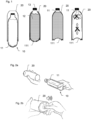
- FIG. 1 schematically represents four views of an object comprising a sleeve 20 which receives a product 10 composed essentially of a bottle 11.
- the bottle 11 includes an activatable portion that forms a bottom 111 of the bottle in the implementation shown.
- the activatable portion is in a relaxed state, that is to say that the bottom 111 has a concavity or a rounded shape towards the bottom.
- the second sectional view (starting from the left of the Figure 1 ), the bottle 11 is completely inserted into the sleeve 20, because it comes to a stop on a constriction of the sleeve 20, with the neck of the bottle 11 passing through an upper opening of the sleeve 20.
- This view also shows a cap 13 which keeps the bottle closed, itself containing a drinking liquid 12.
- the bottom 111 is still in the relaxed state, that is to say concave downwards. A clearance still exists between the cylindrical parts of the sleeve 20 and the bottle 11.
- the bottle 11 is locked in the sleeve 20, it can no longer move axially or in rotation relative to the sleeve 20.
- such a bottle 11 has such a small thickness that once opened, it would deform so much under a gripping force of approximately 20 newtons that the liquid to be drunk would overflow.
- the user can handle the bottle 11 by firmly holding the sleeve 20 (with a gripping force greater than or equal to 20 newtons).
- FIG. 2a represents a first usage diagram of the object of the Figure 1 , with a consumer (i.e. a user, preferably end user) who introduces the product 10 (the bottle 11 + the liquid 12 + the cap 13) in a substantially horizontal direction into the sleeve 20.
- a consumer i.e. a user, preferably end user
- the product 10 the bottle 11 + the liquid 12 + the cap 13
- FIG. 2b represents the consumer activating the bottom 111 by pushing it, which produces an activation noise as shown in the pictogram, to lock the bottle 11 in the sleeve 20.
- FIG. 3 represents two views of a second usage scenario of the object of the Figure 1 .
- the sleeve 20 is threaded vertically onto the product 10 which rests on a work surface S.
- the base 111 is in the relaxed state, and as shown in the detail of the left view, an air gap 40 is present between the body 112 of the bottle 11 and the sleeve 20.
- This air gap 40 facilitates the sliding and introduction of the bottle 11 into the sleeve 20.
- a clearance (in the relaxed state of the base 111), less than 1.5 mm, is approximately 0.8 mm or 0.5 mm between the two components.
- the right-hand view represents the end of the second usage scenario: once the bottle 11 has reached the stop in the sleeve 20, the consumer simply needs to continue to push the sleeve 20 downwards until it stops on the support S to activate the base 111 which then takes on a convex shape, emits a locking noise and locks the bottle 11 in the sleeve 20.
- the wall 112 of the body of the bottle 11 directly touches the sleeve 20, there is no more air, which provides effective locking of the bottle 11 in the sleeve 20.
- FIG. 4 represents a side view and a bottom view of the bottle 11 according to the invention.
- the base 111 comprises four radial grooves or ribs 113 and a central cup 114.
- the radial ribs or grooves 113 improve the hold of the base 111 in its activated state, and the cup 114 improves the ergonomics of use by intuitively indicating to the consumer where to press to activate the activatable portion. It is possible to provide more or less four radial ribs 113, and their presence is independent of the presence of the cup 114.
- the bottle 11 is formed from a thin-walled thermoplastic material.
- the material is preferably a polyester such as polyethylene terephthalate (PET), polytrimethylene terephthalate (PTT), polyethylene furanoate (PEF) or polytrimethylene furanoate (PTF). It is preferably shaped by an injection blow molding process, for example an injection stretch blow molding process. In these processes, a solid preform is manufactured by injecting the material into a mold and then cooling it, the preform is then heated to soften it, optionally stretched longitudinally using a rod, and then stretched axially and longitudinally by blowing into a mold to the shape of the bottle.
- polyester materials and processes are known to those skilled in the art. Their combination makes it possible to obtain thin, lightweight walls with good mechanical strength and good sealing or other barrier properties. These properties are due to the orientation of the macromolecular chains inducing at least partial crystallization.
- these polyesters have the advantage of being easily recyclable. Recovery, sorting, and regeneration channels are organized. Regeneration can be mechanical recycling involving melting and shaping, for example into granules before new plastics processing operations such as injection blow molding or chemical recycling involving depolymerization, recovery of monomers or precursors, then new polymerization.
- the implementation and use of the thin-walled bottles of the invention therefore presents a very advantageous environmental balance, in addition to good practicality, in particular with regard to the implementation using conventional, thicker, non-activatable PET bottles.
- the thin wall is preferably such that the body of the bottle has a thickness in a range from 30 ⁇ m to 150 ⁇ m, for example in a range from 30 ⁇ m to 50 ⁇ m or from 50 ⁇ m to 70 ⁇ m or from 70 ⁇ m to 100 ⁇ m, or from 100 ⁇ m to 125 ⁇ m or from 125 ⁇ m to 150 ⁇ m, preferably in a range from 100 ⁇ m to 125 ⁇ m.
- the thickness mentioned is the thickness at at least one point of the body, preferably the average thickness over a portion representing at least 50% in length or area of the body, preferably at least 80%, preferably the average thickness over the entire body.
- the bottom of the bottle may have a slightly greater thickness than the body, for example up to 50% more than the body, for example up to 20% more.
- the bottom may also have a cup, typically corresponding to the bottom of the preform and its injection point.
- the thickness can be adjusted by adapting, for a target bottle volume, the characteristics of the preform, in particular its shape and the thickness of its walls, as well as the stretching characteristics. It is mentioned that the thickness of the preform walls, the geometry of the preform such as its length, diameter and base shape, determine, with the neck that can form a bottle neck, the weight.
- the bottle, unfilled, unclosed, and/or the preform generally have an identical weight. Subsequently, the weights given refer indifferently to the bottle weight or the preform weight. For a 75 cl bottle, it is advantageous to use preforms of 8 to 13 g.
- the overall stretching ratio can for example be between 12.0 and 27.0, preferably between 15.0 and 20.0.
- the axial stretch ratio (typically the ratio between the height of the bottle and the length of the stretchable part of the preform, typically the under-neck distance) can for example be understood between 3.0 and 4.5.
- the radial stretch ratio (typically the ratio between the diameter of the bottle and the diameter of the stretchable part of the preform) can for example be between 4.0 and 6.0. It is mentioned that the overall stretch ratio is generally equal to the product of the axial stretch ratio and the radial stretch ratio.
- Preform type Preform having an unstretched neck with screw thread and flange
- Preform weight 12.8g Neck weight 3.68g
- Bottle type Cylindrical bottle with circular section and concave bottom that can be activated Bottle diameter 71.5 mm Bottle height 238.5 mm Bottle Volume 75 cl
- Overall stretch rate 17.96
- Radial stretch ratio 4.35
- Axial stretch rate 4.13 Thickness at body level 110 ⁇ m
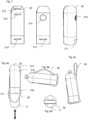
- FIG. 5 represents a first variant of the object of the Figure 1 , in which a bottle 11A comprises a plurality of axial (or vertical here) ribs 115 distributed around the body of the bottle 11. Consequently, it is these ribs 115 which will mainly deform during activation of the bottom 111, so that the diameter of the body of the bottle 11A goes from a value (a) to a diameter greater than (a), at the level of the ribs 115 which therefore concentrate the deformation of the body of the bottle 11 (in detail, the portions of the body between the ribs 115 will move radially, simultaneously with a reduction in the depth of the ribs 115, which "extend" in a tangential direction).
- FIG. 6a represents a second variant of the object of the Figure 1 , in which a bottle 11B comprises at least one (here three) ribs 116 perpendicular to the axis of the bottle 11B.
- the ribs 116 are directed towards the inside of the bottle 11B, as shown in the left view of the Figure 6a .
- the activated state of the background 111 (right view of the Figure 6a )
- the ribs 116 protrude from the body of the bottle 11B and contact the inner wall of the sleeve 20, so that the bottle 11B is locked in the sleeve 20.
- FIG. 6b represents a third variant of the object of the Figure 1 .
- a sleeve 20A comprises, according to this third variant, lateral openings 201 which are opposite the ribs 116 of the bottle 11B.
- the bottom 111 When passing from the relaxed state to the activated state, the bottom 111 always causes an outward movement of the ribs 116, but these can then engage in the openings 201 of the sleeve 20, so that the locking is further improved.
- ribs 116 instead of the ribs 116, a succession of hemispherical portions distributed around the periphery of the body can be provided, which will have the same behavior as the ribs 116.
- FIG. 7 represents three views of an example of the sleeve 20 of the Figure 1 , which has a hollow tube shape to accommodate the bottle 11, with a lower opening and an upper constriction.
- the sleeve 20 has an opening 214 on its cylindrical part. This opening allows the consumer to press on the side of the closed bottle 11, to move the bottom 111 from the activated state to the relaxed state. Thus the bottle 11 is easily unlocked from the sleeve 20 and the consumer can remove it and install another bottle 11.
- a very rigid sleeve 20 can be provided, and which has a thickness of up to several millimeters, or made of metal.
- the lateral opening 214 it is possible not to provide the lateral opening 214, but to limit the thickness of the sleeve 20 (then made of plastic) to a thickness less than, for example, 500 ⁇ m, or even 350 ⁇ m, so that it is flexible under a particular force (for example at least 20 newtons) and to deform the closed bottle 11 so as to cause the bottom 111 to pass from the activated state to the relaxed state.
- a particular force for example at least 20 newtons
- the sleeve 20 here comprises, according to a particular implementation, four lugs or loops 210, 211, 212 and 213, arranged to attach a strap 30, visible from the Figures 8a to 8d .
- the consumer can pull on the strap 30 to tighten it between the loop 211 and 210, so as to block the lower opening, as shown in the bottom view of the figure 8d . It is then possible for the consumer to easily transport the object, as shown by the Figures 8b and 8c , with additional securing of the bottle 11 in the sleeve 20.
Landscapes
- Engineering & Computer Science (AREA)
- Mechanical Engineering (AREA)
- Ceramic Engineering (AREA)
- Details Of Rigid Or Semi-Rigid Containers (AREA)
- Containers Having Bodies Formed In One Piece (AREA)
Description
La présente invention concerne de manière générale le domaine des récipients pour liquide alimentaire, et concerne en particulier un produit qui comprend une bouteille et un liquide alimentaire tel que de l'eau minérale non gazeuse. L'invention concerne aussi un objet qui comprend le produit susmentionné, et qui peut être aisément manipulé par un consommateur. L'invention concerne enfin un procédé de livraison à un consommateur d'un produit susmentionné.The present invention relates generally to the field of containers for food liquids, and in particular relates to a product which comprises a bottle and a food liquid such as non-carbonated mineral water. The invention also relates to an object which comprises the aforementioned product, and which can be easily handled by a consumer. The invention finally relates to a method for delivering an aforementioned product to a consumer.
Il est connu dans l'art antérieur des récipients pour liquide alimentaire, et en particulier des bouteilles en plastique à parois minces pour transporter et livrer de l'eau minérale à un consommateur qui désire consommer une eau de qualité, avec une saveur et une qualité préservées. De tels récipients ou bouteilles en plastique sont divulgués dans les documents
En contrepartie, la production de ces bouteilles en plastique peut avoir un impact environnemental, et il faut également prévoir des filières de recyclage pour minimiser cet impact.On the other hand, the production of these plastic bottles can have an environmental impact, and recycling channels must also be provided to minimize this impact.
De plus, il peut être intéressant (économiquement ou écologiquement) de minimiser les épaisseurs de ces bouteilles, mais il faut prévoir que la bouteille reste aisée à manipuler, et ne se déforme pas ou pas trop lorsqu'un utilisateur la tient (avec typiquement un effort de 20 newtons). Cet aspect est particulièrement important pour les bouteilles de petite contenance (inférieures à 2 L, préférentiellement inférieures à 1.5 L ou même 1 L), car ces dernières sont destinées à accompagner le consommateur dans ses déplacements, et un risque de déformation (qui conduit à un débordement si le consommateur serre fortement la bouteille) doit être minimal.In addition, it may be interesting (economically or ecologically) to minimize the thickness of these bottles, but it is necessary to ensure that the bottle remains easy to handle, and does not deform or does not deform too much when a user holds it (typically with an effort of 20 newtons). This aspect is particularly important for small capacity bottles (less than 2 L, preferably less than 1.5 L or even 1 L), because the latter are intended to accompany the consumer in his travels, and a risk of deformation (which leads to a overflow if the consumer squeezes the bottle strongly) must be minimal.
Un but de la présente invention est de répondre aux inconvénients des documents de l'art antérieur mentionnés ci-dessus et en particulier, tout d'abord, de proposer une bouteille qui forme un produit en contenant un liquide alimentaire qui minimise l'impact écologique, qui soit bon marché à produire, sans pour autant dégrader l'ergonomie ou l'usage par le consommateur, qui doit pouvoir manipuler la bouteille sans prendre de précaution particulière, et sans risquer de faire déborder le liquide contenu.An aim of the present invention is to address the drawbacks of the prior art documents mentioned above and in particular, first of all, to propose a bottle which forms a product by containing a food liquid which minimizes the ecological impact, which is cheap to produce, without however degrading the ergonomics or the use by the consumer, who must be able to handle the bottle without taking any particular precaution, and without risking the liquid contained overflowing.
Pour cela, l'invention est définie par la revendication 1 et un premier aspect de l'invention concerne un produit comprenant :
- une bouteille fermée en plastique à paroi mince comprenant un corps au moins en partie cylindrique et définissant un volume interne, la partie cylindrique de la bouteille présentant une surface latérale dont les génératrices sont des droites parallèles qui suivent une courbe de base fermée définie par l'intersection de la surface latérale avec un plan perpendiculaire à une direction axiale de la bouteille,
- un liquide à boire remplissant au moins 80% du volume interne de la bouteille, la bouteille comprenant au moins une portion activable avec une concavité orientée selon une première direction dans un état relaxé, la portion activable étant agencée pour se déformer sous un effort exercé par un consommateur pour passer dans un état activé et présenter une convexité orientée dans une direction opposée à la première direction,
- a closed thin-walled plastic bottle comprising an at least partly cylindrical body and defining an internal volume, the cylindrical part of the bottle having a lateral surface whose generatrices are parallel straight lines which follow a closed base curve defined by the intersection of the lateral surface with a plane perpendicular to an axial direction of the bottle,
- a drinking liquid filling at least 80% of the internal volume of the bottle, the bottle comprising at least one activatable portion with a concavity oriented in a first direction in a relaxed state, the activatable portion being arranged to deform under a force exerted by a consumer to pass into an activated state and present a convexity oriented in a direction opposite to the first direction,
La bouteille dans le produit selon la mise en œuvre ci-dessus présente une faible épaisseur (et en conséquence une faible rigidité), ainsi qu'une portion activable à activer par le consommateur lui-même. Ce dernier pousse la portion activable pour lui faire présenter une forme convexe, ce qui permet par exemple de définir une embase circulaire sur laquelle la bouteille peut être posée de manière stable. Le fait de passer la portion activable dans l'état activé permet aussi d'augmenter la pression interne de la bouteille, ce qui tend ses surfaces et améliore sa tenue. Enfin, en passant d'une forme concave à une forme convexe, le consommateur crée un pli dans la bouteille, ce qui augmente sa rigidité. On peut aussi noter que de passer d'une forme concave à une forme convexe provoque un bruit ou « bruit d'activation » qui renseigne le consommateur sur le changement d'état.The bottle in the product according to the above implementation has a low thickness (and consequently a low rigidity), as well as an activatable portion to be activated by the consumer himself. The latter pushes the activatable portion to make it present a convex shape, which makes it possible, for example, to define a circular base on which the bottle can be placed in a stable manner. Putting the activatable portion in the activated state also makes it possible to increase the pressure internal of the bottle, which stretches its surfaces and improves its hold. Finally, by moving from a concave shape to a convex shape, the consumer creates a fold in the bottle, which increases its rigidity. It can also be noted that moving from a concave shape to a convex shape causes a noise or "activation noise" which informs the consumer about the change in state.
En particulier, la portion activable de la bouteille est agencée pour être activée directement par l'utilisateur (par exemple par une poussée exercée par la main ou des doigts de l'utilisateur directement sur la portion activable).In particular, the activatable portion of the bottle is arranged to be activated directly by the user (for example by a push exerted by the user's hand or fingers directly on the activatable portion).
Bien entendu, ce changement d'état est réversible. Cependant, une fois activée, la portion activable est agencée pour rester dans cet état, même si la portion activable n'est pas en contact avec un support ou un plan de travail. En d'autres termes, la portion activable est agencée pour rester dans l'état activé ou relaxé (non activé) tant qu'une pression n'est pas exercée par l'utilisateur pour la faire changer d'état.Of course, this change of state is reversible. However, once activated, the activatable portion is arranged to remain in this state, even if the activatable portion is not in contact with a support or a work surface. In other words, the activatable portion is arranged to remain in the activated or relaxed (non-activated) state as long as pressure is not exerted by the user to make it change state.
Avantageusement, l'activation de la portion activable est effectuée par le consommateur, c'est-à-dire la personne qui va consommer le liquide alimentaire. Cependant, l'invention peut être mise en œuvre par un utilisateur qui n'est pas le consommateur.Advantageously, the activation of the activatable portion is carried out by the consumer, i.e. the person who will consume the food liquid. However, the invention can be implemented by a user who is not the consumer.
Par ailleurs, la partie cylindrique de la bouteille présente une surface latérale dont les génératrices sont des droites parallèles, et qui suivent une courbe de base (définie par l'intersection de la surface latérale avec un plan perpendiculaire à une direction axiale de la bouteille) qui est une courbe fermée. Cette courbe de base fermée pouvant être de forme circulaire (un cercle), de forme ovale (une ellipse ou une forme ovale quelconque), de forme carrée ou rectangulaire, le cas échéant avec les coins arrondis.Furthermore, the cylindrical part of the bottle has a lateral surface whose generatrices are parallel lines, and which follow a base curve (defined by the intersection of the lateral surface with a plane perpendicular to an axial direction of the bottle) which is a closed curve. This closed base curve can be circular in shape (a circle), oval in shape (an ellipse or any oval shape), square or rectangular in shape, where appropriate with rounded corners.
Une telle section de la partie cylindrique peut améliorer la préhension, limiter la flexibilité et/ou limiter le risque de fuite à l'ouverture de la bouteille.Such a section of the cylindrical part can improve grip, limit flexibility and/or limit the risk of leakage when opening the bottle.
De plus, la portion activable est avantageusement adjacente à la portion cylindrique, ce qui permet d'une part de bien mettre en tension ladite portion cylindrique lorsque la portion activable est activée, et de garantir d'autre part que la portion activable restera activée, car un pli le long du périmètre de la portion cylindrique sera plus résistant. En particulier, le poids du liquide dans la bouteille ne suffit pas à provoquer le passage de la portion activable de l'état activé à l'état non activé.In addition, the activatable portion is advantageously adjacent to the cylindrical portion, which allows on the one hand to properly tension said cylindrical portion when the activatable portion is activated, and on the other hand to guarantee that the activatable portion will remain activated, because a fold along the perimeter of the cylindrical portion will be more resistant. In particular, the weight of the liquid in the bottle is not sufficient to cause the activatable portion to change from the activated state to the non-activated state.
Avantageusement, la portion activable forme un fond de la bouteille, et la portion activable est arrondie vers l'extérieur dans l'état relaxé. Autrement dit, dans l'état relaxé, la bouteille ne tient pas toute seule debout. Il faut que le consommateur l'active, de sorte à former un pli circulaire ou pratiquement circulaire qui forme alors une base stable de la bouteille. Cette mise en œuvre est avantageuse dans le cas où la bouteille est si fine qu'elle n'a pas de tenue propre : il est possible de la remplir, de la transporter dans l'état relaxé, et le consommateur n'a qu'à la passer dans l'état activé pour la poser sur une table.Advantageously, the activatable portion forms a base of the bottle, and the activatable portion is rounded outward in the relaxed state. In other words, in the relaxed state, the bottle does not stand upright on its own. The consumer must activate it, so as to form a circular or practically circular fold which then forms a stable base of the bottle. This implementation is advantageous in the case where the bottle is so thin that it has no proper support: it is possible to fill it, to transport it in the relaxed state, and the consumer only has to pass it in the activated state to place it on a table.
Avantageusement, le fond présente une épaisseur égale à ±20% à l'épaisseur du corps de la bouteille, à l'exception d'une portion centrale du fond comprise dans un diamètre :
- inférieur ou égal à 50% du diamètre de la partie cylindrique du corps,
- préférentiellement inférieur ou égal à 35% du diamètre de la partie cylindrique du corps,
- plus préférentiellement inférieur ou égal à 20% du diamètre de la partie cylindrique du corps. En d'autres termes, la bouteille présente une épaisseur uniforme, au moins entre sa paroi cylindrique et la majeure partie externe du fond. Pour prendre l'épaisseur, on peut par exemple faire au moins trois mesurer le long de la partie cylindrique du corps (à au moins 10 mm d'un col ou du fond) et en faire la moyenne.
- less than or equal to 50% of the diameter of the cylindrical part of the body,
- preferably less than or equal to 35% of the diameter of the cylindrical part of the body,
- more preferably less than or equal to 20% of the diameter of the cylindrical part of the body. In other words, the bottle has a uniform thickness, at least between its cylindrical wall and the major external part of the bottom. To take the thickness, we can for example make at least three measure along the cylindrical part of the body (at least 10 mm from a neck or bottom) and take the average.
Selon l'invention, le fond présente au moins une rainure radiale qui s'étend sur une longueur d'au moins 10% du diamètre de la partie cylindrique du corps. Très avantageusement, le fond présente quatre rainures radiales qui s'étendent sur une longueur d'au moins 10% du diamètre de la partie cylindrique du corps. De telles rainures radiales formées sur le fond forment une mise en œuvre avantageuse pour aider le fond à bien former une convexité marquée dans l'état activé, et à rester dans cet état activé.According to the invention, the bottom has at least one radial groove which extends over a length of at least 10% of the diameter of the cylindrical part of the body. Very advantageously, the bottom has four radial grooves which extend over a length of at least 10% of the diameter of the cylindrical part of the body. Such radial grooves formed on the bottom form an advantageous implementation to help the bottom to form a marked convexity in the activated state, and to remain in this activated state.
Avantageusement, le fond présente une coupelle centrale formant une zone à pousser par le consommateur et comprise dans un diamètre :
- inférieur ou égal à 50% du diamètre de la partie cylindrique du corps,
- préférentiellement inférieur ou égal à 35% du diamètre de la partie cylindrique du corps,
- plus préférentiellement inférieur ou égal à 20% du diamètre de la partie cylindrique du corps.
- less than or equal to 50% of the diameter of the cylindrical part of the body,
- preferably less than or equal to 35% of the diameter of the cylindrical part of the body,
- more preferably less than or equal to 20% of the diameter of the cylindrical part of the body.
Avantageusement, le corps de la bouteille présente une épaisseur comprise :
- -par exemple dans une plage allant de 30 µm à 50 µm ou de 50 µm à 70 µm ou de 70 µm à 100 µm, ou de 100 µm à 125 µm ou de 125 µm à 150 µm,
- et de préférence dans une plage allant de 100 µm à 125 µm.
- -for example in a range from 30 µm to 50 µm or from 50 µm to 70 µm or from 70 µm to 100 µm, or from 100 µm to 125 µm or from 125 µm to 150 µm,
- and preferably in a range from 100 µm to 125 µm.
Avantageusement, la bouteille comprend un corps, de préférence en partie cylindrique, agencé entre un col (et/ou un goulot) et un fond.Advantageously, the bottle comprises a body, preferably partly cylindrical, arranged between a neck (and/or a spout) and a base.
Avantageusement, la bouteille comprend une pluralité de nervures orientées selon une direction axiale de la bouteille et réparties le long du corps. De telles nervures axiales sont une mise en œuvre avantageuse, car lors du passage de l'état relaxé à l'état activé, elles vont s'étirer pour que les parties externes du corps entre les nervures se déplacent radialement : le diamètre externe augmente rapidement, sans pour autant augmenter trop la pression interne. Autrement dit, ces rainures orientées selon la direction axiale de la bouteille ne sont pas des rainures de rigidification, et elles permettent à la bouteille de se dilater.Advantageously, the bottle comprises a plurality of ribs oriented in an axial direction of the bottle and distributed along the body. Such axial ribs are an advantageous implementation, because when passing from the relaxed state to the activated state, they will stretch so that the external parts of the body between the ribs move radially: the external diameter increases rapidly, without increasing the internal pressure too much. In other words, these grooves oriented in the axial direction of the bottle are not stiffening grooves, and they allow the bottle to expand.
Avantageusement, la bouteille comprend un goulot et au moins une nervure circulaire orientée selon une direction perpendiculaire à une direction axiale de la bouteille et agencée sur le corps de la bouteille à proximité du goulot. Une ou plusieurs de ces nervures transversales ou périphériques sont une mise en œuvre avantageuse, car lors du passage de l'état relaxé à l'état activé, elles vont concentrer la déformation du reste de la bouteille, jusqu'à changer d'orientation : les nervures périphériques initialement dirigées vers l'intérieur peuvent être dirigées vers l'extérieur pour former des protubérances. Autrement dit, cette ou ces rainures orientée(s) selon une direction perpendiculaire à une direction axiale de la bouteille n'est (ne sont) pas une (des) rainure(s) de rigidification.Advantageously, the bottle comprises a neck and at least one circular rib oriented in a direction perpendicular to an axial direction of the bottle and arranged on the body of the bottle near the neck. One or more of these transverse or peripheral ribs are an advantageous implementation, because during the transition from the relaxed state to the activated state, they will concentrate the deformation of the rest of the bottle, until changing orientation: the peripheral ribs initially directed inwards can be directed outwards to form protuberances. In other words, this or these grooves oriented in a direction perpendicular to an axial direction of the bottle is (are) not a (some) stiffening groove(s).
Avantageusement, la bouteille est formée en polyéthylène téréphtalate (PET).Advantageously, the bottle is formed from polyethylene terephthalate (PET).
Avantageusement, le liquide est un liquide alimentaire, de préférence de l'eau, de préférence non gazeuse, et de préférence rempli à une température inférieure à 50°C. en d'autres termes, le liquide alimentaire est une eau minérale plate, et une bouteille si fine reste bien adaptée pour la transporter du lieu d'embouteillage au domicile du consommateur.Advantageously, the liquid is a food liquid, preferably water, preferably non-carbonated, and preferably filled at a temperature below 50°C. In other words, the food liquid is still mineral water, and such a thin bottle remains well suited for transporting it from the bottling site to the consumer's home.
Avantageusement, le produit comprend des moyens de fermeture de la bouteille, tels qu'un capuchon à visser ou à emboiter, un opercule ou une valve. Les moyens de fermeture peuvent en outre comprendre des moyens de preuve d'inviolabilité tels qu'une bague d'inviolabilité liée au capuchon par des pontets à briser lors d'une première utilisation. Il peut s'agir également d'un opercule scellé sur le col, à retirer de manière définitive lors de la première utilisation. Les moyens de fermeture peuvent le cas échéant comprendre des moyens réversibles permettant de refermer la bouteille après une première utilisation. C'est le cas par exemple des capuchons à visser et dévisser. On mentionne que la bouteille remplie est de préférence fermée à l'aide d'un capuchon à visser ou emboîter muni d'une bague d'inviolabilité dont les pontets ne sont pas brisés.Advantageously, the product comprises means for closing the bottle, such as a screw-on or push-on cap, a seal or a valve. The closing means may further comprise means for proving tamper-evidence such as a tamper-evident ring attached to the cap by bridges to be broken upon first use. It may also be a seal sealed on the neck, to be permanently removed upon first use. The closing means may, where appropriate, comprise reversible means for closing the bottle after first use. This is the case, for example, with screw-on and unscrewable caps. It is mentioned that the filled bottle is preferably closed using a screw-on or push-on cap provided with a tamper-evident ring whose bridges are not broken.
Avantageusement, la bouteille présente un volume interne :
- inférieur ou égal à 2 L,
- préférentiellement inférieur ou égal à 1.5 L,
- plus préférentiellement inférieur ou égal à 1 L,
- encore plus préférentiellement inférieur ou égal à 0.8 L.
- less than or equal to 2 L,
- preferably less than or equal to 1.5 L,
- more preferably less than or equal to 1 L,
- even more preferably less than or equal to 0.8 L.
Avantageusement, la portion activable, dans l'état relaxé définit au moins 2%, de préférence au moins 5%, de préférence au moins 15%, de préférence de 5% à 10% du volume interne. Ainsi, avec un tel volume relatif pour la portion activable, passer de l'état relaxé à l'état activé change notablement la pression interne dans la bouteille.Advantageously, the activatable portion, in the relaxed state, defines at least 2%, preferably at least 5%, preferably at least 15%, preferably from 5% to 10% of the internal volume. Thus, with such a relative volume for the activatable portion, moving from the relaxed state to the activated state significantly changes the internal pressure in the bottle.
Un deuxième aspect de l'invention concerne un objet à tenir par un consommateur, comprenant :
- un manchon externe agencé pour être tenu par le consommateur,
- un produit selon le premier aspect de l'invention,
- dans lequel le manchon comprend une ouverture agencée pour recevoir la bouteille avec la portion activable dans l'état relaxé,
- et dans lequel, la portion activable, en passant dans l'état activé sous un effort exercé par le consommateur, forme des moyens de verrouillage de la bouteille dans le manchon externe.
- an external sleeve arranged to be held by the consumer,
- a product according to the first aspect of the invention,
- wherein the sleeve comprises an opening arranged to receive the bottle with the activatable portion in the relaxed state,
- and in which, the activatable portion, by passing into the activated state under a force exerted by the consumer, forms means for locking the bottle in the external sleeve.
Selon la mise en œuvre ci-dessus, le manchon externe forme une poignée rigide qui peut accueillir la bouteille, et une fois celle-ci verrouillée dans le manchon, le consommateur trouve une manipulation aisée, et peut maintenir fermement le manchon sans provoquer de déformation intempestive qui provoquerait un débordement, ce qu'il ne pourrait pas faire avec la bouteille trop fine et trop peu rigide. De plus, le passage de la portion activable dans l'état activé est simple, ce qui ne demande pas d'opération complexe au consommateur. En conséquence, l'objet est simple à utiliser, procure un maintien satisfaisant, et pourtant la bouteille est bien plus fine et flexible qu'une bouteille de l'art antérieur, ce qui permet de proposer une solution économique et écologique pour le consommateur, car le manchon est réutilisable.According to the above implementation, the outer sleeve forms a rigid handle that can accommodate the bottle, and once the bottle is locked in the sleeve, the consumer finds it easy to handle, and can firmly hold the sleeve without causing untimely deformation that would cause it to overflow, which he could not do with the bottle being too thin and not rigid enough. In addition, the transition of the activatable portion into the activated state is simple, which does not require a complex operation from the consumer. As a result, the object is simple to use, provides satisfactory support, and yet the bottle is much thinner and more flexible than a bottle of the prior art, which makes it possible to offer an economical and ecological solution for the consumer, because the sleeve is reusable.
Avantageusement, le manchon présente un rétreint opposé à l'ouverture, et agencé pour former une butée axiale à la bouteille reçue dans l'ouverture. Une telle butée permet une utilisation intuitive : il suffit de pousser la bouteille dans le manchon jusqu'au rétreint, pour ensuite activer la portion activable.Advantageously, the sleeve has a constriction opposite the opening, and arranged to form an axial stop for the bottle received in the opening. Such a stop allows intuitive use: it is sufficient to push the bottle into the sleeve up to the constriction, to then activate the activatable portion.
Avantageusement, le manchon présente une ouverture au niveau du rétreint, agencée pour laisser passer un goulot de la bouteille reçue dans l'ouverture.Advantageously, the sleeve has an opening at the neck, arranged to allow a neck of the bottle received in the opening to pass through.
Avantageusement, le manchon présente une ouverture, de préférence latérale, pour permettre au consommateur d'exercer un effort de désactivation directement sur la bouteille fermée ayant la portion activable dans un état activé, de sorte à faire passer la portion activable dans l'état désactivé pour déverrouiller la bouteille du manchon. Une telle ouverture procure un accès direct à la bouteille, ce qui permet d'appuyer dessus pour que la pression interne repousse la portion activable qui passe alors de l'état activé à l'état relaxé : la bouteille peut être retirée aisément du manchon.Advantageously, the sleeve has an opening, preferably lateral, to allow the consumer to exert a deactivation force directly on the closed bottle having the activatable portion. in an activated state, so as to move the activatable portion into the deactivated state to unlock the bottle from the sleeve. Such an opening provides direct access to the bottle, which allows it to be pressed so that the internal pressure pushes back the activatable portion which then moves from the activated state to the relaxed state: the bottle can be easily removed from the sleeve.
Préférentiellement, l'ouverture est agencée sur une partie supérieure du manchon, ou sur une partie destinée à être en regard d'un col de la bouteille. Cela permet d'appuyer sur la bouteille à un endroit éloigné du fond / de la portion activable, pour ne pas créer de déformations parasites.Preferably, the opening is arranged on an upper part of the sleeve, or on a part intended to be opposite a neck of the bottle. This makes it possible to press on the bottle at a location far from the bottom / the activatable portion, so as not to create unwanted deformations.
Alternativement, s'il n'est pas prévu d'ouverture, le manchon est prévu suffisamment flexible (avec une épaisseur inférieure à 500 µm, et de préférence inférieure à 300 µm), pour permettre au consommateur, avec un effort de pincement prononcé (au moins 20 newtons, et de préférence au moins 30 newtons) de déformer suffisamment le manchon et la bouteille pour y faire augmenter suffisamment la pression interne et repousser la portion activable de l'état activé à l'état relaxé.Alternatively, if no opening is provided, the sleeve is provided to be sufficiently flexible (with a thickness of less than 500 µm, and preferably less than 300 µm), to allow the consumer, with a pronounced pinching force (at least 20 newtons, and preferably at least 30 newtons) to deform the sleeve and the bottle sufficiently to sufficiently increase the internal pressure and push the activatable portion from the activated state to the relaxed state.
En conséquence, la portion activable est dépourvue de languette ou de protubérance pour tirer dessus.As a result, the activatable portion has no tab or protrusion to pull on.
Avantageusement, le manchon présente une longueur suffisante pour recouvrir
- au moins 50% de la bouteille,
- préférentiellement au moins 75% de la bouteille,
- encore plus préférentiellement la totalité du corps de la bouteille,
- et encore plus préférentiellement la totalité du corps de la bouteille dont la portion activable forme le fond, ainsi que 80% au plus, et préférentiellement de 20% 50% au plus, de la hauteur de la portion activable dans l'état relaxé.
- at least 50% of the bottle,
- preferably at least 75% of the bottle,
- even more preferably the entire body of the bottle,
- and even more preferably the entire body of the bottle of which the activatable portion forms the bottom, as well as 80% at most, and preferably 20% 50% at most, of the height of the activatable portion in the relaxed state.
Avantageusement, le manchon présente, avec la bouteille dont la portion activable est dans l'état relaxé, un jeu :
- inférieur ou égal à 1.5 mm, de préférence à 1.0 mm,
- plus préférentiellement inférieur ou égal 0.8 mm,
- encore plus préférentiellement inférieur ou égal à 0.5 mm.
- less than or equal to 1.5 mm, preferably 1.0 mm,
- more preferably less than or equal to 0.8 mm,
- even more preferably less than or equal to 0.5 mm.
Avantageusement, le manchon est une pièce ouverte à ses deux extrémités et présente une paroi au moins en partie cylindrique à saisir par le consommateur.Advantageously, the sleeve is a part open at both ends and has a wall that is at least partly cylindrical to be grasped by the consumer.
Avantageusement, l'objet comprend une sangle liée au manchon, et :
- la sangle présente :
- une première extrémité attachée à une première extrémité du manchon du côté de l'ouverture d'introduction de la bouteille,
- une portion montée en coulissement au travers d'un passant agencé sur la première extrémité du manchon et un côté latéral opposé de la première extrémité de la sangle attachée au manchon,
- une deuxième extrémité attachée à une deuxième extrémité du manchon, de sorte à ce que la sangle :
- détendue entre sa première extrémité et le passant, dégage l'ouverture et permet une insertion de la bouteille dans l'ouverture,
- tendue entre sa première extrémité et le passant, bloque l'ouverture et empêche un retrait de la bouteille du manchon.
- La sangle selon la mise en œuvre ci-dessus permet de former une barrière à la bouteille (sangle tendue), et peut laisser passer la bouteille, juste en faisant coulisser la sangle dans le passant pour la détendre.
- the strap presents:
- a first end attached to a first end of the sleeve on the side of the bottle insertion opening,
- a portion slidably mounted through a loop arranged on the first end of the sleeve and an opposite lateral side of the first end of the strap attached to the sleeve,
- a second end attached to a second end of the sleeve, so that the strap:
- relaxed between its first end and the loop, clears the opening and allows the bottle to be inserted into the opening,
- stretched between its first end and the loop, blocks the opening and prevents the bottle from being removed from the sleeve.
- The strap according to the implementation above makes it possible to form a barrier to the bottle (stretched strap), and can let the bottle pass, simply by sliding the strap in the loop to relax it.
Avantageusement, l'objet comprend une base embarquée sur la sangle entre sa première extrémité et le passant, la base comprenant une protubérance agencée pour pousser la portion activable lorsque la bouteille est reçue, lors d'un mouvement de traction sur la sangle, exercé par le consommateur. La base (ou un socle amovible) comprend une bosse ou une protubérance qui appuie et conforme automatiquement la portion activable dans l'état activé.Advantageously, the object comprises a base embedded on the strap between its first end and the loop, the base comprising a protrusion arranged to push the activatable portion when the bottle is received, upon a pulling movement on the strap, exerted by the consumer. The base (or a removable base) comprises a bump or protrusion which automatically presses and conforms the activatable portion in the activated state.
Avantageusement, la base forme un support pour des informations destinées au consommateur.Advantageously, the base forms a support for information intended for the consumer.
Avantageusement, l'objet comprend un autre passant pour la sangle, agencé sur le manchon du côté de la deuxième extrémité de la sangle.Advantageously, the object comprises another loop for the strap, arranged on the sleeve on the side of the second end of the strap.
Avantageusement, le manchon présente une épaisseur :
- au moins supérieure à deux fois une épaisseur du corps de la bouteille, ou
- au moins supérieure à 200 µm.
- at least greater than twice the thickness of the body of the bottle, or
- at least greater than 200 µm.
Avantageusement, le manchon présente une paroi interne agencée pour contacter le corps de la bouteille, au moins 30% en surface de la paroi interne est étanche à l'air et/ou présente une rugosité arithmétique (Ra) inférieure ou égale à 1.6 µm, de préférence inférieure ou égale à 0.8 µm.Advantageously, the sleeve has an internal wall arranged to contact the body of the bottle, at least 30% of the surface of the internal wall is airtight and/or has an arithmetic roughness (Ra) less than or equal to 1.6 µm, preferably less than or equal to 0.8 µm.
Avantageusement, la paroi interne est vernie ou présente un revêtement de surface lisse et/ou étanche à l'air.Advantageously, the internal wall is varnished or has a smooth and/or airtight surface coating.
En d'autres termes, le manchon est agencé pour maintenir un vide d'air entre sa paroi interne et la bouteille avec la portion activable dans l'état activé, ce qui procure un verrouillage efficace.In other words, the sleeve is arranged to maintain an air vacuum between its inner wall and the bottle with the activatable portion in the activated state, which provides an effective lock.
Avantageusement, le manchon présente une paroi interne avec une isolation thermique, telle qu'au moins une poche d'air ou un matériau isolant (polystyrène, de préférence expansé, mousse de polyuréthane...).Advantageously, the sleeve has an internal wall with thermal insulation, such as at least one air pocket or an insulating material (polystyrene, preferably expanded, polyurethane foam, etc.).
Avantageusement, le manchon comprend un insert surmoulé en matière antidérapante, telle que de l'EPDM, du caoutchouc... cette mise en œuvre permet d'améliorer l'anti-rotation de la bouteille activée dans le manchon.Advantageously, the sleeve includes an overmolded insert made of non-slip material, such as EPDM, rubber, etc. This implementation allows to improve the anti-rotation of the bottle activated in the sleeve.
Avantageusement, l'objet comprend la bouteille avec des nervures axiales, dans lequel la portion activable, en passant dans l'état activé sous un effort exercé par le consommateur, provoque, par diminution d'une profondeur des nervures, une augmentation du diamètre de la partie du corps comprenant les nervures, de sorte à provoquer un contact direct entre le corps de la bouteille et une paroi interne du manchon.Advantageously, the object comprises the bottle with axial ribs, in which the activatable portion, by passing into the activated state under a force exerted by the consumer, causes, by reducing a depth of the ribs, an increase in the diameter of the part of the body comprising the ribs, so as to cause direct contact between the body of the bottle and an internal wall of the sleeve.
Avantageusement, l'objet comprend la bouteille avec au moins une nervure périphérique, dans lequel le manchon présente au moins une rainure interne ou une ouverture agencée pour être en regard de la nervure de la bouteille reçue dans l'ouverture, de sorte à permettre un déplacement radial vers l'extérieur de la nervure de la bouteille lors de l'activation de la portion activable.Advantageously, the object comprises the bottle with at least one peripheral rib, in which the sleeve has at least one internal groove or opening arranged to face the rib of the bottle received in the opening, so as to allow radial outward movement of the rib of the bottle when activatable portion is activated.
Avantageusement, le manchon présente au moins une protubérance agencée pour coopérer avec la bouteille, de préférence avec une partie d'un goulot ou d'un col de la bouteille, de sorte à procurer un couple résistant à une rotation de la bouteille dans le manchon. Une telle protubérance peut être un index ou des cannelures, qui sont de préférence agencées en regard du goulot de la bouteille, qui est plus épais et plus résistant que le reste de la bouteille.Advantageously, the sleeve has at least one protrusion arranged to cooperate with the bottle, preferably with a portion of a neck or neck of the bottle, so as to provide a torque resisting rotation of the bottle in the sleeve. Such a protrusion may be an index or grooves, which are preferably arranged opposite the neck of the bottle, which is thicker and stronger than the rest of the bottle.
Avantageusement, la portion activable, en passant dans l'état activé sous un effort exercé par le consommateur, provoque une mise en contact direct entre le corps de la bouteille et une paroi interne du manchon, par expulsion d'une lame d'air interstitielle.Advantageously, the activatable portion, by passing into the activated state under a force exerted by the consumer, causes direct contact between the body of the bottle and an internal wall of the sleeve, by expulsion of an interstitial air layer.
Avantageusement, le manchon est formé :
- en matériau polymère tel que du polyéthylène téréphtalate (PET), ou du polyamide (PA), ou du polycarbonate (PC), et comprend optionnellement un matériau de charge tel que des fibres, ou
- en un métal tel que de l'aluminium.
- of polymeric material such as polyethylene terephthalate (PET), or polyamide (PA), or polycarbonate (PC), and optionally comprises a filler material such as fibers, or
- made of a metal such as aluminum.
Avantageusement, le manchon comprend des moyens de reconnaissance de la bouteille, et/ou des moyens de communication pour envoyer une information au consommateur, et/ou une interface homme machine agencée pour recevoir une commande du consommateur.Advantageously, the sleeve comprises means for recognizing the bottle, and/or means of communication for sending information to the consumer, and/or a human-machine interface arranged to receive an order from the consumer.
Avantageusement :
- les moyens de reconnaissance comprennent des moyens de communication sans fil, et/ou une étiquette électronique, et/ou des moyens de reconnaissance optiques, et/ou des moyens de détection magnétiques,
- la bouteille comprend un marqueur agencé pour être reconnu par les moyens de reconnaissance du manchon. Cette mise en œuvre permet au manchon de reconnaître la bouteille et/ou le liquide, et d'afficher en retour des informations au consommateur (nature du liquide, date de consommation optimale...).
- the recognition means comprise wireless communication means, and/or an electronic tag, and/or optical recognition means, and/or magnetic detection means,
- the bottle includes a marker arranged to be recognized by the recognition means of the sleeve. This implementation allows the sleeve to recognize the bottle and/or the liquid, and to display information in return to the consumer (nature of the liquid, best before date, etc.).
Avantageusement :
- les moyens de communication comprennent un écran, de préférence tactile, et/ou des moyens de communication sans fil agencés pour établir une connexion avec un appareil électronique portable, tel qu'un téléphone ou une tablette numérique, et/ou
- les moyens de communication sont agencés pour envoyer au consommateur au moins une information relative au liquide alimentaire contenu dans la bouteille, et/ou au moins une information relative à une consommation de liquide, et/ou un historique des bouteilles utilisées, et/ou
- les moyens de communication sont agencés pour établir une connexion, de préférence sans fil, avec un serveur distant, pour :
- envoyer/recevoir une information relative au consommateur, à une consommation du consommateur, à un avis du consommateur, recueilli par une interface homme machine liée aux moyens de communication,
- envoyer une commande de bouteilles.
- the communication means comprise a screen, preferably a touch screen, and/or wireless communication means arranged to establish a connection with a portable electronic device, such as a telephone or a digital tablet, and/or
- the means of communication are arranged to send to the consumer at least one piece of information relating to the food liquid contained in the bottle, and/or at least one piece of information relating to liquid consumption, and/or a history of the bottles used, and/or
- the means of communication are arranged to establish a connection, preferably wireless, with a remote server, for:
- send/receive information relating to the consumer, to the consumer's consumption, to a consumer's opinion, collected by a human-machine interface linked to the means of communication,
- send an order for bottles.
Un troisième aspect de l'invention concerne un procédé de livraison à un consommateur d'un produit selon le premier aspect de l'invention, comprenant les étapes consistant à :
- fabriquer la bouteille du produit selon le premier aspect de l'invention, par exemple par injection soufflage,
- remplir au moins 80% du volume interne de la bouteille avec un liquide alimentaire, de préférence à une température inférieure à 50°C,
- fermer la bouteille,
- transporter la bouteille fermée avec la portion activable dans l'état relaxé jusqu'à un point de mise à disposition pour un consommateur, par exemple le domicile, un lieu de travail, un restaurant, un magasin ou un distributeur mécanisé.
- manufacturing the bottle of the product according to the first aspect of the invention, for example by injection blow molding,
- fill at least 80% of the internal volume of the bottle with a food liquid, preferably at a temperature below 50°C,
- close the bottle,
- transporting the closed bottle with the activatable portion in the relaxed state to a point of provision for a consumer, for example, a home, a workplace, a restaurant, a store or a mechanized dispenser.
En conséquence, la bouteille est fabriquée, remplie et transportée avec la portion activable dans l'état relaxé. C'est seulement le consommateur qui active la portion activable, par exemple pour poser la bouteille verticale sur une table, ou pour la verrouiller dans le manchon.As a result, the bottle is manufactured, filled, and transported with the activatable portion in the relaxed state. It is only the consumer who activates the activatable portion, for example, to place the bottle upright on a table or to lock it in the sleeve.
Il est également à noter que le remplissage est préférentiellement effectué à froid (à moins de 50°C), si bien que la portion activable n'a pas à vocation à compenser une variation de pression / volume provoquée par une variation de température lors d'un refroidissement.It should also be noted that the filling is preferably carried out cold (at less than 50°C), so that the activatable portion is not intended to compensate for a variation in pressure/volume caused by a variation in temperature during cooling.
Avantageusement, le procédé de livraison comprend une étape consistant à livrer une pluralité de bouteilles du produit selon le premier aspect de l'invention formant un lot, et un seul manchon, ou un nombre de manchon inférieur à la pluralité de bouteilles formant un lot, de l'objet selon le deuxième aspect de l'invention. Cela permet d'économiser de la matière sur chaque bouteille, tout en procurant la possibilité d'accouplement avec un manchon réutilisable et suffisamment rigide pour assurer une bonne ergonomie.Advantageously, the delivery method comprises a step of delivering a plurality of bottles of the product according to the first aspect of the invention forming a batch, and a single sleeve, or a number of sleeves less than the plurality of bottles forming a batch, of the object according to the second aspect of the invention. This makes it possible to save material on each bottle, while providing the possibility of coupling with a reusable sleeve that is sufficiently rigid to ensure good ergonomics.
Un quatrième aspect qui ne fait pas partie de l'invention concerne un procédé d'utilisation par un consommateur d'un objet selon le deuxième aspect de l'invention, comprenant les étapes consistant à :
- recevoir le produit selon le premier aspect de l'invention avec la portion activable de la bouteille dans l'état relaxé,
- insérer la bouteille fermée dans le manchon de l'objet selon le deuxième aspect de l'invention,
- exercer un effort sur la portion activable de la bouteille fermée pour verrouiller la bouteille dans le manchon.
- receiving the product according to the first aspect of the invention with the activatable portion of the bottle in the relaxed state,
- inserting the closed bottle into the sleeve of the object according to the second aspect of the invention,
- exert force on the activatable portion of the closed bottle to lock the bottle in the sleeve.
Avantageusement, le procédé d'utilisation comprend une étape consistant à exercer un effort sur la bouteille fermée pour déverrouiller la bouteille du manchon, en faisant passer la portion activable de l'état activé à l'état relaxé, après consommation du liquide alimentaire par exemple.Advantageously, the method of use comprises a step of exerting a force on the closed bottle to unlock the bottle from the sleeve, causing the activatable portion to move from the activated state to the relaxed state, after consumption of the food liquid for example.
D'autres caractéristiques et avantages de la présente invention apparaîtront plus clairement à la lecture de la description détaillée qui suit de plusieurs modes de réalisation de l'invention donnés à titre d'exemples nullement limitatifs et illustrés par les dessins annexés, dans lesquels :
- la
figure 1 représente schématiquement quatre vues de l'utilisation d'un objet selon l'invention, comprenant un produit avec une bouteille fermée et un manchon ; - les
figures 2a et 2b représentent un premier schéma d'usage de l'objet de lafigure 1 ; - la
figure 3 représente un deuxième schéma d'usage de l'objet de lafigure 1 , avec un détail des parois de la bouteille fermée et du manchon ; - la
figure 4 représente une vue de profil et une vue de dessous de la bouteille fermée de l'objet de lafigure 1 - la
figure 5 représente deux vues d'une première variante de l'objet de lafigure 1 ; - la
figure 6a représente deux vues d'une deuxième variante de l'objet de lafigure 1 ; - la
figure 6b représente deux vues d'une troisième variante de l'objet de lafigure 1 ; - la
figure 7 représente trois vues du manchon de lafigure 1 ; - les
figures 8a à 8d représentent une quatrième variante de l'objet de lafigure 1 .
- there
Figure 1 schematically represents four views of the use of an object according to the invention, comprising a product with a closed bottle and a sleeve; - THE
Figures 2a and 2b represent a first usage diagram of the object of theFigure 1 ; - there
Figure 3 represents a second usage pattern of the object of theFigure 1 , with a detail of the walls of the closed bottle and the sleeve; - there
Figure 4 represents a side view and a bottom view of the closed bottle of the object of theFigure 1 - there
Figure 5 represents two views of a first variant of the object of theFigure 1 ; - there
Figure 6a represents two views of a second variant of the object of theFigure 1 ; - there
Figure 6b represents two views of a third variant of the object of theFigure 1 ; - there
Figure 7 represents three views of the sleeve of theFigure 1 ; - THE
Figures 8a to 8d represent a fourth variant of the object of theFigure 1 .
La
La bouteille 11 comprend une portion activable qui forme un fond 111 de la bouteille dans la mise en œuvre représentée. Dans la première vue (à gauche) de la
La deuxième vue en coupe (en partant de la gauche de la
La troisième vue en partant de la gauche de la
Comme le montre la quatrième vue en partant de la gauche de la
En d'autres termes, le passage du fond 111 de l'état relaxé à l'état activé a provoqué une augmentation de la pression interne dans la bouteille 11, qui a ensuite "poussé" ou "tendu" le diamètre extérieur du corps cylindrique de la bouteille 11, de sorte à chasser la lame d'air entre la bouteille 11 et le manchon 20, si bien que la bouteille 11 ne peut plus bouger par rapport au manchon 20.In other words, the passage of the bottom 111 from the relaxed state to the activated state caused an increase in the internal pressure in the
Cela permet de proposer une bouteille 11 flexible, donc légère et nécessitant peu de matière pour la fabriquer et dans la pratique peu facilement utilisable seule en raison de sa grande flexibilité, mais avec une manipulation aisée et satisfaisante lorsqu'elle est verrouillée dans le manchon 20. Le manchon 20 forme donc une pièce réutilisable qui peut recevoir simplement des bouteilles 11 qui nécessitent peu de matière et qui ne seraient pas facilement utilisables seules.This makes it possible to provide a
En particulier, une telle bouteille 11 présente une épaisseur si faible qu'une fois ouverte, elle se déformerait tellement sous un effort de préhension d'environ 20 newtons que le liquide à boire déborderait. Cependant, accouplée et verrouillée dans le manchon 20, l'utilisateur peut manipuler la bouteille 11 en tenant fermement le manchon 20 (avec un effort de préhension supérieur ou égal à 20 newtons).In particular, such a
La
La
La
La vue de droite représente la fin du deuxième scénario d'usage : une fois la bouteille 11 arrivée en butée dans le manchon 20, il suffit au consommateur de continuer à pousser vers le bas le manchon 20 jusqu'en butée sur le support S pour activer le fond 111 qui prend alors une forme convexe, émet un bruit de verrouillage et verrouille la bouteille 11 dans le manchon 20.The right-hand view represents the end of the second usage scenario: once the
Comme le montre le détail de la vue de droite de la
La
La bouteille 11 est formée d'un matériau thermoplastique à parois minces. Le matériau est de préférence un polyester tel que le polyéthylène téréphtalate (PET), le poly-triméthylène téréphtalate (PTT), le polyéthylène furanoate (PEF) ou le poly-triméthylène furanoate (PTF). Elle est de préférence mise en forme par un procédé d'injection soufflage («Injection Blow Molding» en anglais) par exemple un procédé d'injection étirage soufflage («Injection Stretch Blow Molding» en anglais). Dans ces procédés une préforme solide est fabriquée par injection du matériau dans un moule puis refroidissement, la préforme est ensuite chauffée afin de l'amollir, éventuellement étirée longitudinalement à l'aide d'une tige, puis étirée axialement et longitudinalement par soufflage dans un moule à la forme de la bouteille.The
Ces matériaux polyester et procédés sont connus de l'homme du métier. Leur combinaison permet d'obtenir des parois minces, légères, de bonne résistance mécanique et de bonne étanchéité ou autres propriétés barrières. Ces propriétés sont dues à l'orientation des chaines macromoléculaires induisant au moins partiellement une cristallisation. Outre l'économie de matériau, ces polyesters présentent l'avantage d'être aisément recyclables. Les filières de récupération, tri, et régénération sont organisées. La régénération peut être un recyclage mécanique impliquant une fonte et une mise en forme, par exemple en granulés avant de nouvelles opération de plasturgie comme l'injection soufflage ou un recyclage chimique impliquant une dépolymérisation, une récupération de de monomères ou de précurseurs, puis une nouvelle polymérisation.These polyester materials and processes are known to those skilled in the art. Their combination makes it possible to obtain thin, lightweight walls with good mechanical strength and good sealing or other barrier properties. These properties are due to the orientation of the macromolecular chains inducing at least partial crystallization. In addition to saving material, these polyesters have the advantage of being easily recyclable. Recovery, sorting, and regeneration channels are organized. Regeneration can be mechanical recycling involving melting and shaping, for example into granules before new plastics processing operations such as injection blow molding or chemical recycling involving depolymerization, recovery of monomers or precursors, then new polymerization.
La mise en œuvre et l'utilisation des bouteilles à parois minces de l'invention présente par conséquent un bilan environnemental très avantageux, en plus d'une bonne praticité, notamment par apport à la mise en œuvre de bouteilles en PET conventionnelles non activables, plus épaisses.The implementation and use of the thin-walled bottles of the invention therefore presents a very advantageous environmental balance, in addition to good practicality, in particular with regard to the implementation using conventional, thicker, non-activatable PET bottles.
La paroi mince est de préférence telle que le corps de la bouteille présente une épaisseur comprise dans une plage allant de 30 µm à 150 µm, par exemple dans une plage allant de 30 µm à 50 µm ou de 50 µm à 70 µm ou de 70 µm à 100 µm, ou de 100 µm à 125 µm ou de 125 µm à 150 µm, de préférence dans une plage allant de 100 µm à 125 µm. L'épaisseur mentionnée est l'épaisseur en au moins un point du corps, de préférence l'épaisseur moyenne sur une portion représentant au moins 50% en longueur ou en surface du corps, de préférence au moins 80%, de préférence l'épaisseur moyenne sur l'ensemble du corps. Le fond de la bouteille peut présenter une épaisseur légèrement supérieure à celle du corps, par exemple une épaisseur allant jusqu'à 50% de plus de celle du corps, par exemple jusqu'à 20% de plus. Le fond peut également présenter une coupelle, correspondant typiquement au fond de la préforme et à son point d'injection.The thin wall is preferably such that the body of the bottle has a thickness in a range from 30 µm to 150 µm, for example in a range from 30 µm to 50 µm or from 50 µm to 70 µm or from 70 µm to 100 µm, or from 100 µm to 125 µm or from 125 µm to 150 µm, preferably in a range from 100 µm to 125 µm. The thickness mentioned is the thickness at at least one point of the body, preferably the average thickness over a portion representing at least 50% in length or area of the body, preferably at least 80%, preferably the average thickness over the entire body. The bottom of the bottle may have a slightly greater thickness than the body, for example up to 50% more than the body, for example up to 20% more. The bottom may also have a cup, typically corresponding to the bottom of the preform and its injection point.
L'épaisseur peut être ajustée en adaptant, pour un volume de bouteille cible, les caractéristiques de la préforme, notamment sa forme et l'épaisseur de ses parois, ainsi que les caractéristiques d'étirage. On mentionne que l'épaisseur de parois de préforme, la géométrie de la préforme comme sa longueur son diamètre et sa forme de fond, déterminent avec le col qui pourra former un goulot de bouteille, le poids. La bouteille, non remplie, non fermée, et/ou la préforme présentent généralement un poids identique. Par la suite les poids donnés se réfèrent indifféremment aux poids de bouteille ou au poids de préforme. Pour une bouteille de 75 cl, on peut avantageusement mettre en œuvre, des préformes de 8 à 13g. Le taux d'étirage global peut par exemple être compris entre 12,0 et 27,0, de préférence entre 15.0 et 20.0. Le taux détirage axial (typiquement le rapport entre la hauteur de la bouteille et la longueur de la partie étirable de la préforme, typiquement la distance sous col) peut par exemple être compris entre 3,0 et 4,5. Le taux détirage radial (typiquement rapport entre le diamètre de la bouteille et le diamètre de la partie étirable de la préforme) peut par exemple être compris entre 4.0 et 6.0. On mentionne que le taux d'étirage global est généralement égal au produit du taux d'étirage axial et du taux d'étirage radial.The thickness can be adjusted by adapting, for a target bottle volume, the characteristics of the preform, in particular its shape and the thickness of its walls, as well as the stretching characteristics. It is mentioned that the thickness of the preform walls, the geometry of the preform such as its length, diameter and base shape, determine, with the neck that can form a bottle neck, the weight. The bottle, unfilled, unclosed, and/or the preform generally have an identical weight. Subsequently, the weights given refer indifferently to the bottle weight or the preform weight. For a 75 cl bottle, it is advantageous to use preforms of 8 to 13 g. The overall stretching ratio can for example be between 12.0 and 27.0, preferably between 15.0 and 20.0. The axial stretch ratio (typically the ratio between the height of the bottle and the length of the stretchable part of the preform, typically the under-neck distance) can for example be understood between 3.0 and 4.5. The radial stretch ratio (typically the ratio between the diameter of the bottle and the diameter of the stretchable part of the preform) can for example be between 4.0 and 6.0. It is mentioned that the overall stretch ratio is generally equal to the product of the axial stretch ratio and the radial stretch ratio.
De bons résultats sont par exemple obtenus avec les caractéristiques ci-dessous:
La
La
La
A la place des nervures 116, on peut prévoir une succession de portions hémisphériques répartie sur la périphérie du corps, et qui auront le même comportement que les nervures 116.Instead of the
La
Selon une mise en œuvre avantageuse, le manchon 20 présente une ouverture 214 sur sa partie cylindrique. Cette ouverture permet au consommateur d'appuyer sur le flanc de la bouteille 11 fermée, pour faire passer le fond 111 de l'état activé à l'état relaxé. Ainsi la bouteille 11 est aisément déverrouillée du manchon 20 et le consommateur peut la retirer et installer une autre bouteille 11. Dans ce cas, on peut prévoir un manchon 20 très rigide, et qui présente une épaisseur pouvant aller jusqu'à plusieurs millimètres, ou en métal.According to an advantageous implementation, the
En alternative, on peut ne pas prévoir l'ouverture latérale 214, mais limiter l'épaisseur du manchon 20 (alors en plastique) à une épaisseur inférieure à par exemple 500 µm, voire 350µm, pour qu'il soit flexible sous un effort particulier (par exemple au moins 20 newtons) et déformer la bouteille 11 fermée de sorte à faire passer le fond 111 de l'état activé à l'état relaxé.Alternatively, it is possible not to provide the
Selon la
En particulier, la sangle 30 :
- présente une première extrémité attachée au passant 211 (qui est du côté inférieur du manchon 20 et du même côté latéral que l'ouverture 214),
- coulisse dans le passant 210 (qui est du côté inférieur du manchon 20 mais opposé au côté latéral de l'ouverture 214),
- coulisse dans le passant 212,
- présente une deuxième extrémité attachée au passant 213.
- has a first end attached to the loop 211 (which is on the lower side of the
sleeve 20 and on the same lateral side as the opening 214), - slides into the loop 210 (which is on the lower side of the
sleeve 20 but opposite the lateral side of the opening 214), - slides into the
loop 212, - has a second end attached to the
loop 213.
Ainsi, tel que le montre la
Une fois la bouteille 11 introduite dans le manchon 20, le consommateur peut tirer sur la sangle 30 pour la tendre entre le passant 211 et 210, de sorte à bloquer l'ouverture inférieure, comme le montre la vue de dessous de la
On comprendra que diverses modifications et/ou améliorations évidentes pour l'homme du métier peuvent être apportées aux différents modes de réalisation de l'invention décrits dans la présente description sans sortir du cadre de l'invention défini par les revendications annexées.It will be understood that various modifications and/or improvements obvious to those skilled in the art may be made to the various embodiments of the invention described in the present description without departing from the scope of the invention defined by the appended claims.
Claims (16)
- A product comprising:- a closed thin-walled plastic bottle (11; 11A; 11B) comprising an at least partly cylindrical body and defining an internal volume, the cylindrical part of the bottle having a lateral surface whose generatrices are parallel straight lines that follow a closed base curve defined by the intersection of the lateral surface with a plane perpendicular to an axial direction of the bottle,- a liquid (12) to be drunk filling at least 80% of the internal volume of the bottle (11; 11A; 11B),the bottle (11; 11A; 11B) comprising at least one activatable portion with a concavity oriented along a first direction in a relaxed state, the activatable portion being arranged to deform under a force exerted by a consumer to pass into an activated state and to have a convexity oriented in a direction opposite to the first direction,a pressure exerted by the liquid (12) on the bottle (11; 11A; 11B) closed with the activatable portion in the relaxed state being lower than a pressure exerted by the liquid (12) on the bottle (11; 11A; 11B) closed with the activatable portion in the activated state,the body of the bottle (11; 11A; 11B) having a thickness within a range from 30 µm to 150 µm,wherein the activatable portion forms a bottom (111) of the bottle (11; 11A; 11B), wherein the activatable portion is rounded outwards in the relaxed state, and wherein the activatable portion is arranged to remain in the activated state or in the relaxed state as long as a pressure is not exerted by the user to change state, characterized in that the bottom (111) has at least one radial groove (113) which extends over a length of at least 10% of the diameter of the cylindrical part of the body.
- The product according to the preceding claim, wherein the bottom (111) has a thickness equal to ±20% of the thickness of the body of the bottle (11; 11A; 11B), with the exception of a central portion of the bottom (111) comprised in a diameter:- less than or equal to 50% of the diameter of the cylindrical part of the body,- preferably less than or equal to 35% of the diameter of the cylindrical part of the body,- more preferably less than or equal to 20% of the diameter of the cylindrical part of the body.
- The product according to any of the preceding claims, wherein the body of the bottle (11; 11A; 11B) has a thickness comprised:- in a range from 30 µm to 50 µm or from 50 µm to 70 µm or from 70 µm to 100 µm, or from 100 µm to 125 µm or from 125 µm to 150 µm,- and preferably in a range from 100 µm to 125 µm.
- The product according to any of the preceding claims, wherein the bottle (11; 11A; 11B) comprises a plurality of ribs (115) oriented along an axial direction of the bottle (11; 11A; 11B) and distributed along the body.
- The product according to any of the preceding claims, wherein the bottle (11; 11A; 11B) comprises a neck and at least one circular rib (116) oriented along a direction perpendicular to an axial direction of the bottle (11; 11A; 11B) and arranged on the body of the bottle (11; 11A; 11B) in the vicinity of the neck.
- The product according to any of the preceding claims, wherein the activatable portion, in the relaxed state, defines at least 2%, preferably at least 5%, preferably at least 15%, preferably from 5% to 10% of the internal volume.
- An object to be held by a consumer, comprising:- an outer sleeve (20; 20A) arranged to be held by the consumer,- a product according to any of the preceding claims,wherein the sleeve (20; 20A) comprises an opening arranged to receive the bottle (11; 11A; 11B) with the activatable portion in the relaxed state,and wherein the activatable portion, by passing into the activated state under a force exerted by the consumer, forms means for locking the bottle (11; 11A; 11B) in the outer sleeve (20; 20A).
- The object according to the preceding claim, wherein the sleeve (20; 20A) has a constriction opposite to the opening, and arranged to form an axial abutment for the bottle (11; 11A; 11B) received in the opening.
- The object according to any of claims 7 or 8, wherein the sleeve (20; 20A) has an opening, preferably lateral opening, to allow the consumer to exert a deactivation force directly on the closed bottle (11; 11A; 11B) having the activatable portion in an activated state, so as to pass the activatable portion into the deactivated state to unlock the bottle (11; 11A; 11B) from the sleeve (20; 20A).
- The object according to any of claims 7 to 9, wherein the sleeve (20; 20A) has a sufficient length to cover:- at least 50% of the bottle (11; 11A; 11B),- preferably at least 75% of the bottle (11; 11A; 11B),- even more preferably the entire body of the bottle (11; 11A; 11B),- and even more preferably the entire body of the bottle (11; 11A; 11B) whose activatable portion forms the bottom (111), as well as 80% at most, and preferably from 20% to 50% at most, of the height of the activatable portion in the relaxed state.
- The object according to any of claims 7 to 10, comprising a strap (30) connected to the sleeve (20; 20A), and wherein:the strap (30) has:- a first end attached to a first end of the sleeve (20; 20A) on the side of the opening for introducing the bottle (11; 11A; 11B),- a portion slidably mounted through a loop arranged on the first end of the sleeve (20; 20A) and on an opposite lateral side of the first end of the strap (30) attached to the sleeve (20; 20A),- a second end attached to a second end of the sleeve (20; 20A),so that the strap (30):• relaxed between its first end and the loop, releases the opening and allows insertion of the bottle (11; 11A; 11B) into the opening,• taut between its first end and the loop, blocks the opening and prevents removal of the bottle (11; 11A; 11B) from the sleeve (20; 20A).
- The object according to any of claims 7 to 11, wherein the sleeve (20; 20A) has a thickness:- at least greater than twice a thickness of the body of the bottle (11; 11A; 11B), or- at least greater than 200 µm.
- The object according to any of claims 7 to 12, wherein the sleeve (20; 20A) has an inner wall arranged to contact the body of the bottle (11; 11A; 11B), wherein at least 30% on the surface of the inner wall is airtight and/or has an arithmetic roughness (Ra) less than or equal to 1.6 µm.
- The object according to any of claims 7 to 13, comprising the product according to claim 4, wherein the activatable portion, by passing into the activated state under a force exerted by the consumer, causes, by reduction of a depth of the ribs, an increase in the diameter of the part of the body comprising the ribs, so as to cause direct contact between the body of the bottle (11; 11A; 11B) and an inner wall of the sleeve (20; 20A).
- The object according to any of claims 7 to 13, comprising the product according to claim 5, wherein the sleeve (20; 20A) has at least one inner groove or an opening arranged to be facing the rib of the bottle (11; 11A; 11B) received in the opening, so as to allow a radial displacement towards the outside of the rib of the bottle (11; 11A; 11B) during the activation of the activatable portion.
- A method for delivering to a consumer a product according to any of claims 1 to 6, comprising the steps consisting in:- manufacturing the bottle (11; 11A; 11B) of the product of any of claims 1 to 6, for example by injection blow molding,- filling at least 80% of the internal volume of the bottle (11; 11A; 11B) with a food liquid (12), preferably at a temperature below 50°C,- closing the bottle (11; 11A; 11B),- transporting the closed bottle (11; 11A; 11B) with the activatable portion in the relaxed state to a provisioning point for a consumer, for example the home, a workplace, a restaurant, a store or a mechanized distributor.
Applications Claiming Priority (2)
| Application Number | Priority Date | Filing Date | Title |
|---|---|---|---|
| FR1852891A FR3079503B1 (en) | 2018-04-03 | 2018-04-03 | THIN WALL BOTTLE TO CONTAIN A FOOD LIQUID |
| PCT/EP2019/058218 WO2019192975A1 (en) | 2018-04-03 | 2019-04-02 | Thin-walled bottle for containing a liquid foodstuff |
Publications (2)
| Publication Number | Publication Date |
|---|---|
| EP3774558A1 EP3774558A1 (en) | 2021-02-17 |
| EP3774558B1 true EP3774558B1 (en) | 2025-03-26 |
Family
ID=62751090
Family Applications (1)
| Application Number | Title | Priority Date | Filing Date |
|---|---|---|---|
| EP19713503.1A Active EP3774558B1 (en) | 2018-04-03 | 2019-04-02 | Thin-walled bottle for containing a liquid foodstuff |
Country Status (3)
| Country | Link |
|---|---|
| EP (1) | EP3774558B1 (en) |
| FR (1) | FR3079503B1 (en) |
| WO (1) | WO2019192975A1 (en) |
Families Citing this family (1)
| Publication number | Priority date | Publication date | Assignee | Title |
|---|---|---|---|---|
| FR3101617B1 (en) * | 2019-10-03 | 2022-03-25 | Sa Des Eaux Minerales D’Evian Et En Abrege S A E M E | OBJECT TO BE HELD BY A USER, COMPRISING A SHELL AND A BOTTLE |
Citations (1)
| Publication number | Priority date | Publication date | Assignee | Title |
|---|---|---|---|---|
| WO2014101956A1 (en) * | 2012-12-28 | 2014-07-03 | Sa Des Eaux Minerales D'evian Saeme | Self collapsible blow moulded plastic thin-walled container |
Family Cites Families (7)
| Publication number | Priority date | Publication date | Assignee | Title |
|---|---|---|---|---|
| DE19500006A1 (en) * | 1995-01-01 | 1996-07-04 | Gerd Hoermansdoerfer | Disposable paste dispenser for e.g. tooth paste |
| FR2830844A1 (en) * | 2001-10-12 | 2003-04-18 | Perrier Vittel Man Et Technolo | CONTAINER FOR A SINKING PRODUCT, METHOD OF MANUFACTURING AND USES OF SUCH CONTAINER |
| FR2934568B1 (en) | 2008-07-29 | 2010-09-17 | Tecsor | PROCESS FOR PROCESSING A HOT-FILLED PLASTIC THIN-FILM CONTAINER AND DEVICE THEREOF |
| JP5694961B2 (en) | 2009-02-10 | 2015-04-01 | プラスチパック パッケージング,インコーポレイテッド | System and method for pressurizing plastic containers |
| JP5545426B2 (en) * | 2009-11-11 | 2014-07-09 | 東洋製罐株式会社 | Hollow container |
| MX361594B (en) | 2012-12-28 | 2018-12-10 | Sa Des Eaux Minerales Devian Et En Abrege S A E M E | Retractable blow moulded plastic thin-walled container. |
| ES2949040T3 (en) * | 2014-03-31 | 2023-09-25 | Amcor Rigid Plastics Usa Llc | Controlled release container |
-
2018
- 2018-04-03 FR FR1852891A patent/FR3079503B1/en active Active
-
2019
- 2019-04-02 WO PCT/EP2019/058218 patent/WO2019192975A1/en not_active Ceased
- 2019-04-02 EP EP19713503.1A patent/EP3774558B1/en active Active
Patent Citations (1)
| Publication number | Priority date | Publication date | Assignee | Title |
|---|---|---|---|---|
| WO2014101956A1 (en) * | 2012-12-28 | 2014-07-03 | Sa Des Eaux Minerales D'evian Saeme | Self collapsible blow moulded plastic thin-walled container |
Also Published As
| Publication number | Publication date |
|---|---|
| FR3079503B1 (en) | 2020-03-06 |
| FR3079503A1 (en) | 2019-10-04 |
| EP3774558A1 (en) | 2021-02-17 |
| WO2019192975A1 (en) | 2019-10-10 |
Similar Documents
| Publication | Publication Date | Title |
|---|---|---|
| EP2396246B1 (en) | Container in which the base is provided with a double-seated flexible arch | |
| EP2084071A2 (en) | Vessel, mainly a bottle, of a thermoplastic material | |
| EP2129614B1 (en) | Method of filling a retractable package | |
| EP2051910A2 (en) | Bottom of a hollow body obtained by blowing or stretch-blowing a preform of a thermoplastic material, and hollow body comprising such a bottom | |
| CN105073586A (en) | Self collapsible blow moulded plastic thin-walled container | |
| CN105008229B (en) | Recoverable blow molded plastic thin-walled pressure vessel | |
| EP2349666A1 (en) | Hollow body equipped with reliefs that enable the indexing thereof and process for handling such a body | |
| WO2007101879A1 (en) | Injecting/blowing device for making a thin wall component and corresponding method | |
| FR2825315A1 (en) | MOLDING SYSTEM AND RELATED METHOD USING A VACUUM ASSISTED SIDE ENTRY INJECTION MOLD AND RESULTING BLOW MOLDED ARTICLE | |
| EP1975116A1 (en) | Method of filling a retractable package | |
| EP3774558B1 (en) | Thin-walled bottle for containing a liquid foodstuff | |
| EP2331315B1 (en) | Method of treating a hot filled plastic thin walled container and associated device | |
| FR2939106A1 (en) | CLOTHING DEVICE FOR A CONTAINER, IN PARTICULAR A BOTTLE CONTAINING A LIQUID, AND METHOD OF MANUFACTURING THE SAME | |
| FR2543484A1 (en) | METHOD FOR MANUFACTURING A CONTAINER AS WAS THERMOPLASTIC MATERIAL AND RECIPIENT SO MANUFACTURED | |
| FR2767123A1 (en) | NOVEL CONTAINER STRUCTURE AND METHOD FOR PACKAGING A PRODUCT USING THE CONTAINER | |
| WO2016097543A1 (en) | Wide-necked container having an attached threaded sleeve | |
| EP4037985B1 (en) | Object to be held by a user, comprising a shell and a bottle | |
| WO2019192974A1 (en) | Bottle with thin walls for containing a food liquid | |
| BE898602A (en) | METHOD OF MANUFACTURING CONTAINERS | |
| FR2581926A1 (en) | PROCESS FOR THE PRODUCTION OF A PLASTIC CONTAINER MANUFACTURED BY BLOWING WITH BI-ORIENT STRETCH AND COMPRISING A HANDLE, AND CONTAINER OBTAINED | |
| WO2004030895A1 (en) | Wide mouth plastic preform with internal sealing zone protected against mechanical damage | |
| EP3972913B1 (en) | Container, the body of which has a gripping handle formed by a single boxing operation | |
| FR2925030A1 (en) | RECYCLABLE PLASTIC CONTAINER AND CORRESPONDING CLOSURE DEVICE | |
| WO2025021969A1 (en) | Container, in particular a bottle, made of thermoplastic material having improved vertical load strength | |
| FR2950610A1 (en) | COOPERANT THREAD COLLAR CONTAINER WITH THREADING A CAP AND METHOD OF MANUFACTURING THE SAME |
Legal Events
| Date | Code | Title | Description |
|---|---|---|---|
| STAA | Information on the status of an ep patent application or granted ep patent |
Free format text: STATUS: UNKNOWN |
|
| STAA | Information on the status of an ep patent application or granted ep patent |
Free format text: STATUS: THE INTERNATIONAL PUBLICATION HAS BEEN MADE |
|
| PUAI | Public reference made under article 153(3) epc to a published international application that has entered the european phase |
Free format text: ORIGINAL CODE: 0009012 |
|
| STAA | Information on the status of an ep patent application or granted ep patent |
Free format text: STATUS: REQUEST FOR EXAMINATION WAS MADE |
|
| 17P | Request for examination filed |
Effective date: 20201103 |
|
| AK | Designated contracting states |
Kind code of ref document: A1 Designated state(s): AL AT BE BG CH CY CZ DE DK EE ES FI FR GB GR HR HU IE IS IT LI LT LU LV MC MK MT NL NO PL PT RO RS SE SI SK SM TR |
|
| AX | Request for extension of the european patent |
Extension state: BA ME |
|
| DAV | Request for validation of the european patent (deleted) | ||
| DAX | Request for extension of the european patent (deleted) | ||
| STAA | Information on the status of an ep patent application or granted ep patent |
Free format text: STATUS: EXAMINATION IS IN PROGRESS |
|
| 17Q | First examination report despatched |
Effective date: 20221122 |
|
| GRAP | Despatch of communication of intention to grant a patent |
Free format text: ORIGINAL CODE: EPIDOSNIGR1 |
|
| STAA | Information on the status of an ep patent application or granted ep patent |
Free format text: STATUS: GRANT OF PATENT IS INTENDED |
|
| INTG | Intention to grant announced |
Effective date: 20241017 |
|
| GRAS | Grant fee paid |
Free format text: ORIGINAL CODE: EPIDOSNIGR3 |
|
| GRAA | (expected) grant |
Free format text: ORIGINAL CODE: 0009210 |
|
| STAA | Information on the status of an ep patent application or granted ep patent |
Free format text: STATUS: THE PATENT HAS BEEN GRANTED |
|
| AK | Designated contracting states |
Kind code of ref document: B1 Designated state(s): AL AT BE BG CH CY CZ DE DK EE ES FI FR GB GR HR HU IE IS IT LI LT LU LV MC MK MT NL NO PL PT RO RS SE SI SK SM TR |
|
| REG | Reference to a national code |
Ref country code: GB Ref legal event code: FG4D Free format text: NOT ENGLISH |
|
| REG | Reference to a national code |
Ref country code: CH Ref legal event code: EP |
|
| REG | Reference to a national code |
Ref country code: DE Ref legal event code: R096 Ref document number: 602019067744 Country of ref document: DE |
|
| REG | Reference to a national code |
Ref country code: IE Ref legal event code: FG4D Free format text: LANGUAGE OF EP DOCUMENT: FRENCH |
|
| PG25 | Lapsed in a contracting state [announced via postgrant information from national office to epo] |
Ref country code: RS Free format text: LAPSE BECAUSE OF FAILURE TO SUBMIT A TRANSLATION OF THE DESCRIPTION OR TO PAY THE FEE WITHIN THE PRESCRIBED TIME-LIMIT Effective date: 20250626 |
|
| PG25 | Lapsed in a contracting state [announced via postgrant information from national office to epo] |
Ref country code: FI Free format text: LAPSE BECAUSE OF FAILURE TO SUBMIT A TRANSLATION OF THE DESCRIPTION OR TO PAY THE FEE WITHIN THE PRESCRIBED TIME-LIMIT Effective date: 20250326 |
|
| PGFP | Annual fee paid to national office [announced via postgrant information from national office to epo] |
Ref country code: DE Payment date: 20250423 Year of fee payment: 7 |
|
| PGFP | Annual fee paid to national office [announced via postgrant information from national office to epo] |
Ref country code: GB Payment date: 20250425 Year of fee payment: 7 |
|
| REG | Reference to a national code |
Ref country code: LT Ref legal event code: MG9D |
|
| PG25 | Lapsed in a contracting state [announced via postgrant information from national office to epo] |
Ref country code: NO Free format text: LAPSE BECAUSE OF FAILURE TO SUBMIT A TRANSLATION OF THE DESCRIPTION OR TO PAY THE FEE WITHIN THE PRESCRIBED TIME-LIMIT Effective date: 20250626 |
|
| PG25 | Lapsed in a contracting state [announced via postgrant information from national office to epo] |
Ref country code: HR Free format text: LAPSE BECAUSE OF FAILURE TO SUBMIT A TRANSLATION OF THE DESCRIPTION OR TO PAY THE FEE WITHIN THE PRESCRIBED TIME-LIMIT Effective date: 20250326 |
|
| PG25 | Lapsed in a contracting state [announced via postgrant information from national office to epo] |
Ref country code: LV Free format text: LAPSE BECAUSE OF FAILURE TO SUBMIT A TRANSLATION OF THE DESCRIPTION OR TO PAY THE FEE WITHIN THE PRESCRIBED TIME-LIMIT Effective date: 20250326 |
|
| PGFP | Annual fee paid to national office [announced via postgrant information from national office to epo] |
Ref country code: FR Payment date: 20250422 Year of fee payment: 7 |
|
| PG25 | Lapsed in a contracting state [announced via postgrant information from national office to epo] |
Ref country code: GR Free format text: LAPSE BECAUSE OF FAILURE TO SUBMIT A TRANSLATION OF THE DESCRIPTION OR TO PAY THE FEE WITHIN THE PRESCRIBED TIME-LIMIT Effective date: 20250627 Ref country code: BG Free format text: LAPSE BECAUSE OF FAILURE TO SUBMIT A TRANSLATION OF THE DESCRIPTION OR TO PAY THE FEE WITHIN THE PRESCRIBED TIME-LIMIT Effective date: 20250326 |
|
| PGFP | Annual fee paid to national office [announced via postgrant information from national office to epo] |
Ref country code: CH Payment date: 20250501 Year of fee payment: 7 |
|
| REG | Reference to a national code |
Ref country code: NL Ref legal event code: MP Effective date: 20250326 |
|
| PG25 | Lapsed in a contracting state [announced via postgrant information from national office to epo] |
Ref country code: NL Free format text: LAPSE BECAUSE OF FAILURE TO SUBMIT A TRANSLATION OF THE DESCRIPTION OR TO PAY THE FEE WITHIN THE PRESCRIBED TIME-LIMIT Effective date: 20250326 |
|
| PG25 | Lapsed in a contracting state [announced via postgrant information from national office to epo] |
Ref country code: SE Free format text: LAPSE BECAUSE OF FAILURE TO SUBMIT A TRANSLATION OF THE DESCRIPTION OR TO PAY THE FEE WITHIN THE PRESCRIBED TIME-LIMIT Effective date: 20250326 |
|
| REG | Reference to a national code |
Ref country code: AT Ref legal event code: MK05 Ref document number: 1778863 Country of ref document: AT Kind code of ref document: T Effective date: 20250326 |
|
| PG25 | Lapsed in a contracting state [announced via postgrant information from national office to epo] |
Ref country code: SM Free format text: LAPSE BECAUSE OF FAILURE TO SUBMIT A TRANSLATION OF THE DESCRIPTION OR TO PAY THE FEE WITHIN THE PRESCRIBED TIME-LIMIT Effective date: 20250326 |
|
| PG25 | Lapsed in a contracting state [announced via postgrant information from national office to epo] |
Ref country code: ES Free format text: LAPSE BECAUSE OF FAILURE TO SUBMIT A TRANSLATION OF THE DESCRIPTION OR TO PAY THE FEE WITHIN THE PRESCRIBED TIME-LIMIT Effective date: 20250326 Ref country code: PT Free format text: LAPSE BECAUSE OF FAILURE TO SUBMIT A TRANSLATION OF THE DESCRIPTION OR TO PAY THE FEE WITHIN THE PRESCRIBED TIME-LIMIT Effective date: 20250728 |
|
| PG25 | Lapsed in a contracting state [announced via postgrant information from national office to epo] |
Ref country code: PL Free format text: LAPSE BECAUSE OF FAILURE TO SUBMIT A TRANSLATION OF THE DESCRIPTION OR TO PAY THE FEE WITHIN THE PRESCRIBED TIME-LIMIT Effective date: 20250326 Ref country code: IT Free format text: LAPSE BECAUSE OF FAILURE TO SUBMIT A TRANSLATION OF THE DESCRIPTION OR TO PAY THE FEE WITHIN THE PRESCRIBED TIME-LIMIT Effective date: 20250326 |
|
| PG25 | Lapsed in a contracting state [announced via postgrant information from national office to epo] |
Ref country code: AT Free format text: LAPSE BECAUSE OF FAILURE TO SUBMIT A TRANSLATION OF THE DESCRIPTION OR TO PAY THE FEE WITHIN THE PRESCRIBED TIME-LIMIT Effective date: 20250326 |
|
| PG25 | Lapsed in a contracting state [announced via postgrant information from national office to epo] |
Ref country code: EE Free format text: LAPSE BECAUSE OF FAILURE TO SUBMIT A TRANSLATION OF THE DESCRIPTION OR TO PAY THE FEE WITHIN THE PRESCRIBED TIME-LIMIT Effective date: 20250326 |
|
| PG25 | Lapsed in a contracting state [announced via postgrant information from national office to epo] |
Ref country code: RO Free format text: LAPSE BECAUSE OF FAILURE TO SUBMIT A TRANSLATION OF THE DESCRIPTION OR TO PAY THE FEE WITHIN THE PRESCRIBED TIME-LIMIT Effective date: 20250326 |
|
| PG25 | Lapsed in a contracting state [announced via postgrant information from national office to epo] |
Ref country code: SK Free format text: LAPSE BECAUSE OF FAILURE TO SUBMIT A TRANSLATION OF THE DESCRIPTION OR TO PAY THE FEE WITHIN THE PRESCRIBED TIME-LIMIT Effective date: 20250326 |
|
| PG25 | Lapsed in a contracting state [announced via postgrant information from national office to epo] |
Ref country code: IS Free format text: LAPSE BECAUSE OF FAILURE TO SUBMIT A TRANSLATION OF THE DESCRIPTION OR TO PAY THE FEE WITHIN THE PRESCRIBED TIME-LIMIT Effective date: 20250726 |
|
| PG25 | Lapsed in a contracting state [announced via postgrant information from national office to epo] |
Ref country code: LU Free format text: LAPSE BECAUSE OF NON-PAYMENT OF DUE FEES Effective date: 20250402 |
|
| PG25 | Lapsed in a contracting state [announced via postgrant information from national office to epo] |
Ref country code: MC Free format text: LAPSE BECAUSE OF FAILURE TO SUBMIT A TRANSLATION OF THE DESCRIPTION OR TO PAY THE FEE WITHIN THE PRESCRIBED TIME-LIMIT Effective date: 20250326 |
|
| REG | Reference to a national code |
Ref country code: BE Ref legal event code: MM Effective date: 20250430 |
|
| PG25 | Lapsed in a contracting state [announced via postgrant information from national office to epo] |
Ref country code: DK Free format text: LAPSE BECAUSE OF FAILURE TO SUBMIT A TRANSLATION OF THE DESCRIPTION OR TO PAY THE FEE WITHIN THE PRESCRIBED TIME-LIMIT Effective date: 20250326 |
|
| PG25 | Lapsed in a contracting state [announced via postgrant information from national office to epo] |
Ref country code: BE Free format text: LAPSE BECAUSE OF NON-PAYMENT OF DUE FEES Effective date: 20250430 |
|
| PG25 | Lapsed in a contracting state [announced via postgrant information from national office to epo] |
Ref country code: CZ Free format text: LAPSE BECAUSE OF FAILURE TO SUBMIT A TRANSLATION OF THE DESCRIPTION OR TO PAY THE FEE WITHIN THE PRESCRIBED TIME-LIMIT Effective date: 20250326 |
|
| PLBE | No opposition filed within time limit |
Free format text: ORIGINAL CODE: 0009261 |
|
| STAA | Information on the status of an ep patent application or granted ep patent |
Free format text: STATUS: NO OPPOSITION FILED WITHIN TIME LIMIT |
|
| REG | Reference to a national code |
Ref country code: CH Ref legal event code: L10 Free format text: ST27 STATUS EVENT CODE: U-0-0-L10-L00 (AS PROVIDED BY THE NATIONAL OFFICE) Effective date: 20260211 |