EP3754176B1 - Steuerungsvorrichtung für brennkraftmaschine und steuerungsverfahren für brennkraftmaschine - Google Patents
Steuerungsvorrichtung für brennkraftmaschine und steuerungsverfahren für brennkraftmaschine Download PDFInfo
- Publication number
- EP3754176B1 EP3754176B1 EP18906138.5A EP18906138A EP3754176B1 EP 3754176 B1 EP3754176 B1 EP 3754176B1 EP 18906138 A EP18906138 A EP 18906138A EP 3754176 B1 EP3754176 B1 EP 3754176B1
- Authority
- EP
- European Patent Office
- Prior art keywords
- internal combustion
- combustion engine
- threshold value
- crank angle
- predetermined threshold
- Prior art date
- Legal status (The legal status is an assumption and is not a legal conclusion. Google has not performed a legal analysis and makes no representation as to the accuracy of the status listed.)
- Active
Links
Images
Classifications
-
- F—MECHANICAL ENGINEERING; LIGHTING; HEATING; WEAPONS; BLASTING
- F02—COMBUSTION ENGINES; HOT-GAS OR COMBUSTION-PRODUCT ENGINE PLANTS
- F02N—STARTING OF COMBUSTION ENGINES; STARTING AIDS FOR SUCH ENGINES, NOT OTHERWISE PROVIDED FOR
- F02N11/00—Starting of engines by means of electric motors
- F02N11/04—Starting of engines by means of electric motors the motors being associated with current generators
-
- F—MECHANICAL ENGINEERING; LIGHTING; HEATING; WEAPONS; BLASTING
- F02—COMBUSTION ENGINES; HOT-GAS OR COMBUSTION-PRODUCT ENGINE PLANTS
- F02N—STARTING OF COMBUSTION ENGINES; STARTING AIDS FOR SUCH ENGINES, NOT OTHERWISE PROVIDED FOR
- F02N11/00—Starting of engines by means of electric motors
- F02N11/08—Circuits specially adapted for starting of engines
- F02N11/0814—Circuits specially adapted for starting of engines comprising means for controlling automatic idle-start-stop
- F02N11/0818—Conditions for starting or stopping the engine or for deactivating the idle-start-stop mode
-
- F—MECHANICAL ENGINEERING; LIGHTING; HEATING; WEAPONS; BLASTING
- F02—COMBUSTION ENGINES; HOT-GAS OR COMBUSTION-PRODUCT ENGINE PLANTS
- F02D—CONTROLLING COMBUSTION ENGINES
- F02D41/00—Electrical control of supply of combustible mixture or its constituents
- F02D41/009—Electrical control of supply of combustible mixture or its constituents using means for generating position or synchronisation signals
-
- F—MECHANICAL ENGINEERING; LIGHTING; HEATING; WEAPONS; BLASTING
- F02—COMBUSTION ENGINES; HOT-GAS OR COMBUSTION-PRODUCT ENGINE PLANTS
- F02D—CONTROLLING COMBUSTION ENGINES
- F02D41/00—Electrical control of supply of combustible mixture or its constituents
- F02D41/02—Circuit arrangements for generating control signals
- F02D41/04—Introducing corrections for particular operating conditions
- F02D41/06—Introducing corrections for particular operating conditions for engine starting or warming up
- F02D41/062—Introducing corrections for particular operating conditions for engine starting or warming up for starting
- F02D41/065—Introducing corrections for particular operating conditions for engine starting or warming up for starting at hot start or restart
-
- F—MECHANICAL ENGINEERING; LIGHTING; HEATING; WEAPONS; BLASTING
- F02—COMBUSTION ENGINES; HOT-GAS OR COMBUSTION-PRODUCT ENGINE PLANTS
- F02N—STARTING OF COMBUSTION ENGINES; STARTING AIDS FOR SUCH ENGINES, NOT OTHERWISE PROVIDED FOR
- F02N11/00—Starting of engines by means of electric motors
- F02N11/08—Circuits specially adapted for starting of engines
- F02N11/0814—Circuits specially adapted for starting of engines comprising means for controlling automatic idle-start-stop
- F02N11/0844—Circuits specially adapted for starting of engines comprising means for controlling automatic idle-start-stop with means for restarting the engine directly after an engine stop request, e.g. caused by change of driver mind
-
- F—MECHANICAL ENGINEERING; LIGHTING; HEATING; WEAPONS; BLASTING
- F02—COMBUSTION ENGINES; HOT-GAS OR COMBUSTION-PRODUCT ENGINE PLANTS
- F02D—CONTROLLING COMBUSTION ENGINES
- F02D2200/00—Input parameters for engine control
- F02D2200/02—Input parameters for engine control the parameters being related to the engine
- F02D2200/10—Parameters related to the engine output, e.g. engine torque or engine speed
- F02D2200/101—Engine speed
-
- F—MECHANICAL ENGINEERING; LIGHTING; HEATING; WEAPONS; BLASTING
- F02—COMBUSTION ENGINES; HOT-GAS OR COMBUSTION-PRODUCT ENGINE PLANTS
- F02N—STARTING OF COMBUSTION ENGINES; STARTING AIDS FOR SUCH ENGINES, NOT OTHERWISE PROVIDED FOR
- F02N2200/00—Parameters used for control of starting apparatus
- F02N2200/02—Parameters used for control of starting apparatus said parameters being related to the engine
- F02N2200/021—Engine crank angle
-
- F—MECHANICAL ENGINEERING; LIGHTING; HEATING; WEAPONS; BLASTING
- F02—COMBUSTION ENGINES; HOT-GAS OR COMBUSTION-PRODUCT ENGINE PLANTS
- F02N—STARTING OF COMBUSTION ENGINES; STARTING AIDS FOR SUCH ENGINES, NOT OTHERWISE PROVIDED FOR
- F02N2200/00—Parameters used for control of starting apparatus
- F02N2200/02—Parameters used for control of starting apparatus said parameters being related to the engine
- F02N2200/022—Engine speed
-
- F—MECHANICAL ENGINEERING; LIGHTING; HEATING; WEAPONS; BLASTING
- F02—COMBUSTION ENGINES; HOT-GAS OR COMBUSTION-PRODUCT ENGINE PLANTS
- F02N—STARTING OF COMBUSTION ENGINES; STARTING AIDS FOR SUCH ENGINES, NOT OTHERWISE PROVIDED FOR
- F02N2250/00—Problems related to engine starting or engine's starting apparatus
- F02N2250/04—Reverse rotation of the engine
-
- F—MECHANICAL ENGINEERING; LIGHTING; HEATING; WEAPONS; BLASTING
- F02—COMBUSTION ENGINES; HOT-GAS OR COMBUSTION-PRODUCT ENGINE PLANTS
- F02N—STARTING OF COMBUSTION ENGINES; STARTING AIDS FOR SUCH ENGINES, NOT OTHERWISE PROVIDED FOR
- F02N2300/00—Control related aspects of engine starting
- F02N2300/20—Control related aspects of engine starting characterised by the control method
- F02N2300/2011—Control involving a delay; Control involving a waiting period before engine stop or engine start
-
- Y—GENERAL TAGGING OF NEW TECHNOLOGICAL DEVELOPMENTS; GENERAL TAGGING OF CROSS-SECTIONAL TECHNOLOGIES SPANNING OVER SEVERAL SECTIONS OF THE IPC; TECHNICAL SUBJECTS COVERED BY FORMER USPC CROSS-REFERENCE ART COLLECTIONS [XRACs] AND DIGESTS
- Y02—TECHNOLOGIES OR APPLICATIONS FOR MITIGATION OR ADAPTATION AGAINST CLIMATE CHANGE
- Y02T—CLIMATE CHANGE MITIGATION TECHNOLOGIES RELATED TO TRANSPORTATION
- Y02T10/00—Road transport of goods or passengers
- Y02T10/10—Internal combustion engine [ICE] based vehicles
- Y02T10/40—Engine management systems
Definitions
- the present invention relates to a control method for internal combustion engine and a control device for internal combustion engine.
- Patent Document 1 discloses art for restarting an engine in response to a brake-off performed during an automatic stop of the engine.
- the restart may fail due to an insufficient torque of an electric motor upon cranking for automatic restart of the engine.
- the electric motor in case of a low voltage of a battery serving as a drive source of the electric motor, the electric motor generates a relatively low torque.
- DE 10 2015 213 218 A1 describes an engine control system, comprising an electric motor coupled to a crankshaft of an engine, a speed sensor, which is configured to detect an engine speed of the engine, and a start-stop system that operates during deceleration, wherein the electric motor is operated to drive the engine when the decelerating start-stop system issues an engine restart request during a drop in the engine speed when it is determined that the engine speed is equal to or less than a first predetermined engine speed after having determined it has been suggested that the engine may not move past compression top dead center.
- Patent Document 1 JP 2014-122635 A
- the present invention serves to boost the cranking by starting the cranking from the crank angle sufficiently near to the bottom dead center, and perform the cranking of the internal combustion engine over a reaction force against compression in the cylinder in compression stroke, even in case that an electric motor for the cranking generates a relatively small torque.
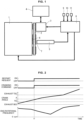
- FIG. 1 is a schematic view illustrating a control device for an internal combustion engine 1 according to the present invention.
- Internal combustion engine 1 serves as a drive source of a vehicle, and is structured to drive a motor generator 3 being an electric motor, via a belt 2.
- Internal combustion engine 1 includes a plurality of cylinders.
- Motor generator 3 is structured to act as a motor (so-called power running) and also act as a generator (so-called regeneration).
- Motor generator 3 serves as a so-called starter motor upon starting the internal combustion engine 1, employing an in-vehicle battery 4 as a drive source.
- Battery 4 is structured to be charged with electric power generated by motor generator 3.
- Internal combustion engine 1 has an engine speed (i.e. an engine rotational frequency) and a crank angle which are monitored by a crank angle sensor 5.
- crank angle sensor 5 monitors a rotational speed (i.e. a rotational frequency) and a crank angle of a crankshaft 6 of internal combustion engine 1.
- a reference numeral 7 in FIG. 1 represents a drive plate mounted to an end of crankshaft 6.
- Control unit 8 is a known digital computer including a CPU, a ROM, a RAM, and an input/output interface.
- Control unit 8 receives, in addition to a monitor signal from crank angle sensor 5 described above, monitor signals from various sensors such as an accelerator-opening sensor 9 monitoring a depression amount of an accelerator pedal not shown, a brake switch 10 monitoring an operation on a brake pedal not shown, and a vehicle speed sensor 11 monitoring a vehicle speed.
- monitor signals from various sensors such as an accelerator-opening sensor 9 monitoring a depression amount of an accelerator pedal not shown, a brake switch 10 monitoring an operation on a brake pedal not shown, and a vehicle speed sensor 11 monitoring a vehicle speed.
- control unit 8 suitably controls an amount and timing of fuel injection from a fuel injection valve (not shown) of internal combustion engine 1, ignition timing and an intake air amount of internal combustion engine 1, etc. Furthermore, control unit 8 suitably controls motor generator 3.
- Control unit 8 is configured to detect a cylinder being in a compression stroke, based on the monitor signals from crank angle sensor 5. Furthermore, control unit 8 is configured to measure a SOC (State Of Charge) that is a ratio of a residual capacity to a charging capacity of battery 4. Internal combustion engine 1 suspends fuel supply and automatically stops, in response to satisfaction of a predetermined automatic stop condition. Then, internal combustion engine 1 that has been in the automatic stop restarts in response to satisfaction of a predetermined automatic restart condition. In other words, control unit 8 determines that the restart is requested, in response to satisfaction of the automatic restart condition.
- SOC State Of Charge
- the automatic stop of internal combustion engine 1 may be divided into idle stop, coast stop, and sailing stop.
- the idle stop is implemented in response to satisfaction of an idle-stop implementation condition during vehicle stop, wherein the idle-stop implementation condition serves as the automatic stop condition.
- Internal combustion engine 1 under the idle stop restarts in response to satisfaction of an idle-stop termination condition serving as the automatic restart condition.
- the idle-stop implementation condition exemplarily includes: a requirement that the accelerator pedal is released; a requirement that the brake pedal is depressed; a requirement that the vehicle speed is less than or equal to a predetermined value; and a requirement that the battery SOC of the battery is greater than or equal to a predetermined threshold value for idle-stop prohibition.
- the requirement that the accelerator pedal is released means a requirement that the accelerator pedal is apart from a foot: i.e., the accelerator is OFF.
- the requirement that the brake pedal is depressed means a requirement that the brake switch 10 is ON.
- the idle-stop termination condition during the vehicle stop exemplarily includes: a requirement that the accelerator pedal is depressed; a requirement that the brake pedal is released; and a requirement that the battery SOC is lower than the predetermined threshold value for idle-stop prohibition.
- the idle-stop termination condition is satisfied, and internal combustion engine 1 automatically restarts.
- the requirement that the accelerator pedal is depressed means a requirement that the accelerator is ON. Furthermore, the requirement that the brake pedal is released means a requirement that the brake pedal is apart from a foot: i.e., the brake switch 10 is OFF.
- the coast stop is implemented in response to satisfaction of a coast-stop implementation condition during vehicle running, wherein the coast-stop implementation condition serves as the automatic stop condition.
- Internal combustion engine 1 under the coast stop restarts in response to satisfaction of a coast-stop termination condition serving as the automatic restart condition.
- the coast-stop implementation condition is satisfied, for example, in a case that the battery SOC is greater than or equal to a predetermined value during deceleration with the brake pedal depressed.
- the coast-stop termination condition is satisfied in response to, for example, the depression of accelerator pedal, or the release of brake pedal, or a need for securing electric power of the vehicle due to the battery SOC lower than or equal to a predetermined value.
- the present embodiment refers to a coast stop state as a state that internal combustion engine 1 has automatically stopped during deceleration with the brake pedal depressed under a low vehicle speed.
- the sailing stop is implemented in response to satisfaction of a sailing-stop implementation condition during vehicle running, wherein the sailing-stop implementation condition serves as the automatic stop condition.
- Internal combustion engine 1 under the sailing stop restarts in response to satisfaction of a sailing-stop termination condition serving as the automatic restart condition.
- the sailing-stop implementation condition is satisfied, for example, in a case that during the vehicle running, the accelerator pedal turns to a released state from a depressed state, and the battery SOC is greater than or equal to a predetermined value.
- the sailing-stop termination condition is satisfied, for example, in response to the depression of accelerator pedal, or in response to a need for securing the electric power of the vehicle due to the battery SOC lower than or equal to the predetermined value.
- the present embodiment refers to a sailing stop state as a state that internal combustion engine 1 has automatically stopped during inertial traveling with the brake pedal released under a middle to high vehicle speed.
- control unit 8 serves as a controller configured to restart the internal combustion engine 1 being in the automatic stop, in response to satisfaction of the automatic restart condition.
- control unit 8 serves also to automatically stop the internal combustion engine 1 in response to satisfaction of the automatic stop condition.
- internal combustion engine 1 may be stationary due to equilibrium of torques at an engine speed of 0 rpm, when the crank angle reaches an angle of equilibrium with a reaction force against compression.
- the sufficient engine speed serves to overcome the compression reaction force due to inertia (or momentum) thereof, even if the compression reaction force in the cylinder in compression stroke defeats a motor torque of motor generator 3 performing the cranking.
- Motor generator 3 cranking the internal combustion engine 1 generates a torque (i.e. a drive torque) that gradually increases or rises with time after a timing of cranking start.
- control unit 8 as the controller starts the cranking at a timing at which the crank angle of the cylinder in compression stroke of internal combustion engine 1 is nearer to the bottom dead center than a predetermined threshold value.
- control unit 8 turns a cranking command ON and starts the cranking in response to satisfaction of a condition that the crank angle of the cylinder in compression stroke of internal combustion engine 1 is nearer to the bottom dead center than the predetermined threshold value.
- internal combustion engine 1 starts the cranking at a timing at which the crank angle of the cylinder in compression stroke of internal combustion engine 1 is nearer to the bottom dead center than a predetermined threshold value A.
- internal combustion engine 1 starts the cranking at a timing at which the crank angle of the cylinder in compression stroke of internal combustion engine 1 is nearer to the bottom dead center than a predetermined threshold value B.
- the threshold value to be compared with the crank angle of the cylinder in compression stroke of internal combustion engine 1 is set depending on a rotation direction of internal combustion engine.
- the threshold value to be compared with the crank angle of the cylinder in compression stroke of internal combustion engine 1 is set to a different value depending on whether the rotation of internal combustion engine 1 rotates positively or reversely.
- the positive rotation refers to a rotation direction of crankshaft 6 in a state in which drive force of internal combustion engine 1 is transferred to drive wheels of the vehicle.
- the reverse rotation refers to a rotation direction of swing back of crankshaft 6 which may occurs immediately before rotation of crankshaft 6 stops.
- the above configurations serve to boost the cranking by starting the cranking from the crank angle sufficiently near to the bottom dead center, even in case that motor generator 3 generates a small torque due to a low voltage of battery 4. This allows motor generator 3 to perform the cranking over the compression reaction force of the cylinder in compression stroke, and restart the internal combustion engine 1.
- FIG. 2 is a timing chart showing an example of control for a case that internal combustion engine 1 that has automatically stopped restarts under the engine speed in positive rotation.
- the crank angle shown in FIG. 2 is a crank angle of the cylinder in compression stroke upon the request for restart.
- the crank angle of the cylinder in compression stroke is lower than the predetermined threshold value A at a time instant t1 being a timing of satisfaction of the automatic restart condition and turning-ON of the restart request.
- the cranking command is turned ON in order to start to drive the motor generator 3, at the time instant t1 at which the restart request is turned ON.
- the time instant t1 is a timing of starting the cranking of internal combustion engine 1 that has been in the automatic stop.
- the engine speed (shown as ENG rotational speed) starts to increase at a timing after the time instant t1, due to a time lag from the turning-ON of cranking command to start of the driving of motor generator 3.
- the compression reaction force increases with advancement in crank angle so as to make negative the torque balance (i.e. the balance of the drive torque and the compression reaction force)
- the engine speed is suppressed from continuing falling because the engine speed can be increased during a period in which the torque balance is positive.
- the threshold value A in the positive rotation may be set to have a value that approaches the top dead center with decrease in engine speed.
- the threshold value A may be variably set depending on the engine speed.
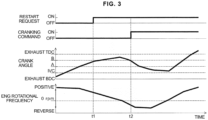
- FIG. 3 is a timing chart showing an example of control for a case that internal combustion engine 1 that has automatically stopped restarts under the engine speed in reverse rotation.
- the crank angle shown in FIG. 3 is a crank angle of the cylinder in compression stroke upon the request for restart.
- the automatic restart condition is satisfied at the time instant t1, and thereafter the crank angle of the cylinder in compression stroke is maintained greater than the threshold value A during a period in which the engine speed is in the positive rotation. Then, the crank angle of the cylinder in compression stroke falls below the threshold value B at a time instant t2 being a timing after the engine speed has turned into the reverse rotation.
- the cranking command is not turned ON at the time instant t1 at which the restart request is turned ON.
- the cranking command is turned ON at the time instant t2.
- the time instant t2 is a timing of starting the cranking of internal combustion engine 1 that has been in the automatic stop.
- the engine speed (shown as ENG rotational speed) starts to increase to a positive rotation side after the time instant t2, due to a time lag from the turning-ON of the cranking command to start of the driving of motor generator 3.
- the threshold value B in the reverse rotation may be set to have a value that approaches the top dead center with increase in engine speed.
- the threshold value B may be variably set depending on the engine speed.
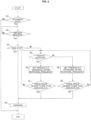
- FIG. 4 is a flow chart showing a flow of control on the internal combustion engine according to the present invention.
- Step S1 is determination of whether internal combustion engine 1 is in the automatic stop. If internal combustion engine 1 is in the automatic stop, step S2 is executed subsequently to step S1. If internal combustion engine 1 is not in the automatic stop, a routine at this time is ended.
- Step S2 is determination of whether there is the restart request. If there is the restart request, step S3 is executed subsequently to step S2.
- Step S3 is determination of whether internal combustion engine 1 is stationary: in detail, determination of whether the rotation of crankshaft 6 of internal combustion engine 1 is stationary. If internal combustion engine 1 is stationary, step S4 is executed subsequently to step S3. If internal combustion engine 1 is not stationary, step S5 is executed subsequently to step S3.
- Step S4 is implementation, which means starting, of the cranking of internal combustion engine 1.
- Step S5 is determination of whether internal combustion engine 1 is in the positive rotation. If crankshaft 6 of internal combustion engine 1 is in the positive rotation, step S6 is executed subsequently to step S5. If crankshaft 6 of internal combustion engine 1 is in the reverse rotation, step S8 is executed subsequently to step S5.
- Step S6 is setting of the threshold value A depending on the engine speed (i.e. the ENG rotational speed).
- Step S7 is determination of whether the crank angle of the cylinder in compression stroke is nearer to the bottom dead center than the threshold value A. If the crank angle of the cylinder in compression stroke is nearer to the bottom dead center than the threshold value A, step S4 is executed subsequently to step S7. If the crank angle of the cylinder in compression stroke is not nearer to the bottom dead center than the threshold value A, step S5 is executed subsequently to step S7.
- Step S8 is setting of the threshold value B depending on the engine speed (i.e. the ENG rotational speed).
- Step S9 is determination of whether the crank angle of the cylinder in compression stroke is nearer to the bottom dead center than the threshold value B. If the crank angle of the cylinder in compression stroke is nearer to the bottom dead center than the threshold value B, step S4 is executed subsequently to step S9. If the crank angle of the cylinder in compression stroke is not nearer to the bottom dead center than the threshold value B, step S5 is executed subsequently to step S9.
- the above embodiment relates to a control method for internal combustion engine and a control device for internal combustion engine.
Landscapes
- Engineering & Computer Science (AREA)
- Chemical & Material Sciences (AREA)
- Combustion & Propulsion (AREA)
- Mechanical Engineering (AREA)
- General Engineering & Computer Science (AREA)
- Control Of Vehicle Engines Or Engines For Specific Uses (AREA)
- Output Control And Ontrol Of Special Type Engine (AREA)
Claims (6)
- Steuerverfahren für einen Verbrennungsmotor (1), der aufgebaut ist, um eine Antriebsquelle eines Fahrzeugs zu sein, und mit mindestens einem Zylinder, einer Steuereinheit (8), einem Kurbelwinkelsensor (5) und einem Startermotor (3), der mit dem Verbrennungsmotor (1) gekoppelt ist, versehen ist, wobei das Steuerverfahren den folgenden Schritt umfasst, nachdem der Verbrennungsmotor (1) automatisch gestoppt wurde:Bestimmen, ob eine Anforderung für den Neustart des Verbrennungsmotors (1) vorliegt;Bestimmen, ob die Drehung des Verbrennungsmotors (1) gestoppt ist; undals Reaktion auf das Vorliegen der Anforderung für den Neustart des Verbrennungsmotors (1) vor dem Stoppen der Drehung des Verbrennungsmotors (1), Bestimmen, ob ein Kurbelwinkel eines Zylinders im Verdichtungstakt des Verbrennungsmotors (1) näher am unteren Totpunkt liegt als mindestens ein vorbestimmter Schwellenwert (A, B),Starten des Ankurbelns des Verbrennungsmotors (1), wenn der Kurbelwinkel des Zylinders näher am unteren Totpunkt liegt als der vorbestimmte Schwellenwert (A, B);wobei das Steuerverfahren dadurch gekennzeichnet ist, dass das Steuerverfahren ferner den Start des Ankurbelns verzögert, bis der Kurbelwinkel des Zylinders näher am unteren Totpunkt liegt als der vorbestimmte Schwellenwert (A, B), wenn der Kurbelwinkel des Zylinders nicht näher am unteren Totpunkt liegt als der vorbestimmte Schwellenwert (A, B).
- Steuerverfahren nach Anspruch 1, wobei das Steuerverfahren ferner Folgendes umfasst:
Einstellen des vorbestimmten Schwellenwerts (A, B) auf einen anderen Wert in Abhängigkeit davon, ob sich der Verbrennungsmotor (1) positiv oder umgekehrt dreht. - Steuerverfahren nach einem der Ansprüche 1 oder 2, wobei das Steuerverfahren ferner Folgendes umfasst:
Einstellen des vorbestimmten Schwellenwerts (A, B), so dass er in Abhängigkeit von einer Motordrehzahl des Verbrennungsmotors (1) variabel ist. - Steuerverfahren nach einem der Ansprüche 1, 2 und 4, wobei in dem Fall, dass sich der Verbrennungsmotor (1) positiv dreht, der vorbestimmte Schwellenwert (A, B) so eingestellt wird, dass er einen Wert aufweist, der sich dem oberen Totpunkt mit abnehmender Motordrehzahl nähert.
- Steuerverfahren nach einem der Ansprüche 1, 2, 4 und 5, wobei in dem Fall, dass sich der Verbrennungsmotor (1) umgekehrt dreht, der vorbestimmte Schwellenwert (A, B) so eingestellt wird, dass er einen Wert aufweist, der sich dem oberen Totpunkt mit zunehmender Motordrehzahl nähert.
- Steuervorrichtung für einen Verbrennungsmotor, wobei die Steuervorrichtung Folgendes umfasst:einen Verbrennungsmotor (1), der aufgebaut ist, um eine Antriebsquelle eines Fahrzeugs zu sein, und mit mindestens einem Zylinder versehen ist und mit einem Startermotor (3) gekoppelt ist; undeine Steuereinheit (8), die mit einem Kurbelwinkelsensor (5) verbunden ist und konfiguriert ist, um, nachdem der Verbrennungsmotor (1) automatisch gestoppt wurde:zu bestimmen, ob eine vorbestimmte automatische Neustartbedingung erfüllt ist;zu bestimmen, ob die Drehung des Verbrennungsmotors (1) gestoppt ist; undals Reaktion auf das Vorliegen der Anforderung für den Neustart des Verbrennungsmotors (1) vor dem Stoppen der Drehung des Verbrennungsmotors (1) zu bestimmen, ob ein Kurbelwinkel eines Zylinders im Verdichtungstakt des Verbrennungsmotors (1) näher am unteren Totpunkt liegt als mindestens ein vorbestimmter Schwellenwert (A, B),das Ankurbeln des Verbrennungsmotors (1) zu starten, wenn der Kurbelwinkel des Zylinders näher am unteren Totpunkt liegt als der vorbestimmte Schwellenwert (A, B); undwobei das Steuerverfahren dadurch gekennzeichnet ist, dass das Steuerverfahren ferner konfiguriert ist, umden Start des Ankurbelns zu verzögern, bis der Kurbelwinkel des Zylinders näher am unteren Totpunkt liegt als der vorbestimmte Schwellenwert (A, B), wenn der Kurbelwinkel des Zylinders nicht näher am unteren Totpunkt liegt als der vorbestimmte Schwellenwert (A, B).
Applications Claiming Priority (1)
| Application Number | Priority Date | Filing Date | Title |
|---|---|---|---|
| PCT/JP2018/005185 WO2019159270A1 (ja) | 2018-02-15 | 2018-02-15 | 内燃機関の制御方法及び内燃機関の制御装置 |
Publications (3)
| Publication Number | Publication Date |
|---|---|
| EP3754176A1 EP3754176A1 (de) | 2020-12-23 |
| EP3754176A4 EP3754176A4 (de) | 2021-03-03 |
| EP3754176B1 true EP3754176B1 (de) | 2025-03-12 |
Family
ID=67618947
Family Applications (1)
| Application Number | Title | Priority Date | Filing Date |
|---|---|---|---|
| EP18906138.5A Active EP3754176B1 (de) | 2018-02-15 | 2018-02-15 | Steuerungsvorrichtung für brennkraftmaschine und steuerungsverfahren für brennkraftmaschine |
Country Status (6)
| Country | Link |
|---|---|
| US (1) | US11204009B2 (de) |
| EP (1) | EP3754176B1 (de) |
| JP (1) | JP6844721B2 (de) |
| CN (1) | CN111712626B (de) |
| MX (1) | MX2020008369A (de) |
| WO (1) | WO2019159270A1 (de) |
Families Citing this family (1)
| Publication number | Priority date | Publication date | Assignee | Title |
|---|---|---|---|---|
| EP4219924A4 (de) * | 2020-09-24 | 2023-11-15 | Nissan Motor Co., Ltd. | Verfahren zur steuerung eines verbrennungsmotors und vorrichtung zur steuerung eines verbrennungsmotors |
Citations (1)
| Publication number | Priority date | Publication date | Assignee | Title |
|---|---|---|---|---|
| EP2339168B1 (de) * | 2009-12-25 | 2017-05-31 | Nissan Motor Co., Ltd. | Verfahren und Vorrichtung zur Brennkraftmaschinensteuerung |
Family Cites Families (13)
| Publication number | Priority date | Publication date | Assignee | Title |
|---|---|---|---|---|
| JP3772891B2 (ja) * | 2004-04-30 | 2006-05-10 | マツダ株式会社 | エンジンの始動装置 |
| DE102012203325B4 (de) * | 2012-03-02 | 2025-08-14 | Robert Bosch Gmbh | Verfahren und Vorrichtung zur Steuerung einer Brennkraftmaschine |
| JP5958416B2 (ja) * | 2013-05-08 | 2016-08-02 | マツダ株式会社 | 予混合圧縮着火式エンジンの始動制御装置 |
| JP2015108322A (ja) * | 2013-12-04 | 2015-06-11 | ヤマハ発動機株式会社 | エンジンシステムおよび鞍乗り型車両 |
| GB2521428B (en) * | 2013-12-19 | 2018-08-15 | Jaguar Land Rover Ltd | Improvements to engine shutdown |
| JP5941934B2 (ja) | 2014-02-07 | 2016-06-29 | 日立オートモティブシステムズ株式会社 | 車両の制御装置 |
| JP6350058B2 (ja) * | 2014-07-17 | 2018-07-04 | スズキ株式会社 | モータの制御装置 |
| JP6198971B2 (ja) * | 2014-11-05 | 2017-09-20 | 三菱電機株式会社 | エンジン始動装置 |
| JP5875664B1 (ja) | 2014-11-25 | 2016-03-02 | 三菱電機株式会社 | エンジン始動制御装置およびエンジン始動制御方法 |
| JP2016194267A (ja) * | 2015-03-31 | 2016-11-17 | 新電元工業株式会社 | エンジン始動制御装置 |
| JP6589696B2 (ja) * | 2016-03-03 | 2019-10-16 | 株式会社デンソー | エンジン始動システム |
| JP6622663B2 (ja) * | 2016-07-08 | 2019-12-18 | 本田技研工業株式会社 | 内燃機関の停止始動制御装置 |
| JP6687503B2 (ja) * | 2016-12-15 | 2020-04-22 | トヨタ自動車株式会社 | エンジンの始動制御装置 |
-
2018
- 2018-02-15 EP EP18906138.5A patent/EP3754176B1/de active Active
- 2018-02-15 CN CN201880089304.6A patent/CN111712626B/zh active Active
- 2018-02-15 MX MX2020008369A patent/MX2020008369A/es unknown
- 2018-02-15 WO PCT/JP2018/005185 patent/WO2019159270A1/ja not_active Ceased
- 2018-02-15 JP JP2019571867A patent/JP6844721B2/ja active Active
- 2018-02-15 US US16/968,908 patent/US11204009B2/en active Active
Patent Citations (1)
| Publication number | Priority date | Publication date | Assignee | Title |
|---|---|---|---|---|
| EP2339168B1 (de) * | 2009-12-25 | 2017-05-31 | Nissan Motor Co., Ltd. | Verfahren und Vorrichtung zur Brennkraftmaschinensteuerung |
Also Published As
| Publication number | Publication date |
|---|---|
| JP6844721B2 (ja) | 2021-03-17 |
| US20210047992A1 (en) | 2021-02-18 |
| EP3754176A1 (de) | 2020-12-23 |
| WO2019159270A1 (ja) | 2019-08-22 |
| JPWO2019159270A1 (ja) | 2020-12-03 |
| EP3754176A4 (de) | 2021-03-03 |
| CN111712626A (zh) | 2020-09-25 |
| MX2020008369A (es) | 2020-09-25 |
| CN111712626B (zh) | 2022-04-12 |
| US11204009B2 (en) | 2021-12-21 |
Similar Documents
| Publication | Publication Date | Title |
|---|---|---|
| JP3546735B2 (ja) | エンジンの始動制御装置 | |
| US9670868B2 (en) | Automatic stopping device and automatic stopping method for internal combustion engine | |
| US20130002210A1 (en) | Method for Controlling Vehicle Launch | |
| JP5737203B2 (ja) | エンジン制御装置 | |
| US11136930B2 (en) | Engine start control device | |
| CN102859181B (zh) | 驱动控制装置、驱动控制系统及驱动控制方法 | |
| JP2000320366A (ja) | エンジン自動停止再始動車両 | |
| JP2016022867A (ja) | モータ制御装置 | |
| US20160272210A1 (en) | Vehicle control device | |
| EP3754176B1 (de) | Steuerungsvorrichtung für brennkraftmaschine und steuerungsverfahren für brennkraftmaschine | |
| US11859588B2 (en) | Method for controlling internal combustion engine, and device for controlling internal combustion engine | |
| JP6595091B2 (ja) | 車両用制御装置 | |
| JP3555516B2 (ja) | エンジンの自動停止再始動装置 | |
| JP6891486B2 (ja) | ハイブリッド車両の駆動制御装置 | |
| JP6234116B2 (ja) | 内燃機関の制御装置 | |
| CN108071501B (zh) | 发动机再启动装置 | |
| JP3783647B2 (ja) | アイドルストップ車の制御装置及び制御方法 | |
| JP3777946B2 (ja) | 車両のエンジン制御装置 | |
| JP7690899B2 (ja) | ハイブリッド車両の制御装置 | |
| JP7302751B2 (ja) | 内燃機関の制御方法及び内燃機関の制御装置 | |
| JP2025029952A (ja) | ハイブリッド車両の制御装置 | |
| JP2016125344A (ja) | エンジンの制御装置 | |
| JP2024098876A (ja) | ハイブリッド車両の制御装置 | |
| JP2022052806A (ja) | 内燃機関の制御方法及び内燃機関の制御装置 |
Legal Events
| Date | Code | Title | Description |
|---|---|---|---|
| STAA | Information on the status of an ep patent application or granted ep patent |
Free format text: STATUS: THE INTERNATIONAL PUBLICATION HAS BEEN MADE |
|
| PUAI | Public reference made under article 153(3) epc to a published international application that has entered the european phase |
Free format text: ORIGINAL CODE: 0009012 |
|
| STAA | Information on the status of an ep patent application or granted ep patent |
Free format text: STATUS: REQUEST FOR EXAMINATION WAS MADE |
|
| 17P | Request for examination filed |
Effective date: 20200915 |
|
| AK | Designated contracting states |
Kind code of ref document: A1 Designated state(s): AL AT BE BG CH CY CZ DE DK EE ES FI FR GB GR HR HU IE IS IT LI LT LU LV MC MK MT NL NO PL PT RO RS SE SI SK SM TR |
|
| AX | Request for extension of the european patent |
Extension state: BA ME |
|
| A4 | Supplementary search report drawn up and despatched |
Effective date: 20210202 |
|
| RIC1 | Information provided on ipc code assigned before grant |
Ipc: F02N 11/04 20060101ALI20210127BHEP Ipc: F02D 41/00 20060101ALI20210127BHEP Ipc: F02N 11/08 20060101AFI20210127BHEP |
|
| DAV | Request for validation of the european patent (deleted) | ||
| DAX | Request for extension of the european patent (deleted) | ||
| STAA | Information on the status of an ep patent application or granted ep patent |
Free format text: STATUS: EXAMINATION IS IN PROGRESS |
|
| 17Q | First examination report despatched |
Effective date: 20221201 |
|
| GRAP | Despatch of communication of intention to grant a patent |
Free format text: ORIGINAL CODE: EPIDOSNIGR1 |
|
| STAA | Information on the status of an ep patent application or granted ep patent |
Free format text: STATUS: GRANT OF PATENT IS INTENDED |
|
| INTG | Intention to grant announced |
Effective date: 20250107 |
|
| GRAS | Grant fee paid |
Free format text: ORIGINAL CODE: EPIDOSNIGR3 |
|
| GRAA | (expected) grant |
Free format text: ORIGINAL CODE: 0009210 |
|
| STAA | Information on the status of an ep patent application or granted ep patent |
Free format text: STATUS: THE PATENT HAS BEEN GRANTED |
|
| AK | Designated contracting states |
Kind code of ref document: B1 Designated state(s): AL AT BE BG CH CY CZ DE DK EE ES FI FR GB GR HR HU IE IS IT LI LT LU LV MC MK MT NL NO PL PT RO RS SE SI SK SM TR |
|
| REG | Reference to a national code |
Ref country code: GB Ref legal event code: FG4D |
|
| REG | Reference to a national code |
Ref country code: CH Ref legal event code: EP |
|
| REG | Reference to a national code |
Ref country code: DE Ref legal event code: R096 Ref document number: 602018080159 Country of ref document: DE |
|
| REG | Reference to a national code |
Ref country code: IE Ref legal event code: FG4D |
|
| PG25 | Lapsed in a contracting state [announced via postgrant information from national office to epo] |
Ref country code: RS Free format text: LAPSE BECAUSE OF FAILURE TO SUBMIT A TRANSLATION OF THE DESCRIPTION OR TO PAY THE FEE WITHIN THE PRESCRIBED TIME-LIMIT Effective date: 20250612 |
|
| PG25 | Lapsed in a contracting state [announced via postgrant information from national office to epo] |
Ref country code: FI Free format text: LAPSE BECAUSE OF FAILURE TO SUBMIT A TRANSLATION OF THE DESCRIPTION OR TO PAY THE FEE WITHIN THE PRESCRIBED TIME-LIMIT Effective date: 20250312 |
|
| PG25 | Lapsed in a contracting state [announced via postgrant information from national office to epo] |
Ref country code: ES Free format text: LAPSE BECAUSE OF FAILURE TO SUBMIT A TRANSLATION OF THE DESCRIPTION OR TO PAY THE FEE WITHIN THE PRESCRIBED TIME-LIMIT Effective date: 20250312 |
|
| REG | Reference to a national code |
Ref country code: LT Ref legal event code: MG9D |
|
| PG25 | Lapsed in a contracting state [announced via postgrant information from national office to epo] |
Ref country code: NO Free format text: LAPSE BECAUSE OF FAILURE TO SUBMIT A TRANSLATION OF THE DESCRIPTION OR TO PAY THE FEE WITHIN THE PRESCRIBED TIME-LIMIT Effective date: 20250612 |
|
| PG25 | Lapsed in a contracting state [announced via postgrant information from national office to epo] |
Ref country code: HR Free format text: LAPSE BECAUSE OF FAILURE TO SUBMIT A TRANSLATION OF THE DESCRIPTION OR TO PAY THE FEE WITHIN THE PRESCRIBED TIME-LIMIT Effective date: 20250312 |
|
| REG | Reference to a national code |
Ref country code: NL Ref legal event code: MP Effective date: 20250312 |
|
| PG25 | Lapsed in a contracting state [announced via postgrant information from national office to epo] |
Ref country code: LV Free format text: LAPSE BECAUSE OF FAILURE TO SUBMIT A TRANSLATION OF THE DESCRIPTION OR TO PAY THE FEE WITHIN THE PRESCRIBED TIME-LIMIT Effective date: 20250312 |
|
| PG25 | Lapsed in a contracting state [announced via postgrant information from national office to epo] |
Ref country code: GR Free format text: LAPSE BECAUSE OF FAILURE TO SUBMIT A TRANSLATION OF THE DESCRIPTION OR TO PAY THE FEE WITHIN THE PRESCRIBED TIME-LIMIT Effective date: 20250613 Ref country code: BG Free format text: LAPSE BECAUSE OF FAILURE TO SUBMIT A TRANSLATION OF THE DESCRIPTION OR TO PAY THE FEE WITHIN THE PRESCRIBED TIME-LIMIT Effective date: 20250312 |
|
| REG | Reference to a national code |
Ref country code: AT Ref legal event code: MK05 Ref document number: 1775174 Country of ref document: AT Kind code of ref document: T Effective date: 20250312 |
|
| PG25 | Lapsed in a contracting state [announced via postgrant information from national office to epo] |
Ref country code: NL Free format text: LAPSE BECAUSE OF FAILURE TO SUBMIT A TRANSLATION OF THE DESCRIPTION OR TO PAY THE FEE WITHIN THE PRESCRIBED TIME-LIMIT Effective date: 20250312 |
|
| PG25 | Lapsed in a contracting state [announced via postgrant information from national office to epo] |
Ref country code: SE Free format text: LAPSE BECAUSE OF FAILURE TO SUBMIT A TRANSLATION OF THE DESCRIPTION OR TO PAY THE FEE WITHIN THE PRESCRIBED TIME-LIMIT Effective date: 20250312 |
|
| PG25 | Lapsed in a contracting state [announced via postgrant information from national office to epo] |
Ref country code: SM Free format text: LAPSE BECAUSE OF FAILURE TO SUBMIT A TRANSLATION OF THE DESCRIPTION OR TO PAY THE FEE WITHIN THE PRESCRIBED TIME-LIMIT Effective date: 20250312 |
|
| PG25 | Lapsed in a contracting state [announced via postgrant information from national office to epo] |
Ref country code: PT Free format text: LAPSE BECAUSE OF FAILURE TO SUBMIT A TRANSLATION OF THE DESCRIPTION OR TO PAY THE FEE WITHIN THE PRESCRIBED TIME-LIMIT Effective date: 20250714 |
|
| PG25 | Lapsed in a contracting state [announced via postgrant information from national office to epo] |
Ref country code: PL Free format text: LAPSE BECAUSE OF FAILURE TO SUBMIT A TRANSLATION OF THE DESCRIPTION OR TO PAY THE FEE WITHIN THE PRESCRIBED TIME-LIMIT Effective date: 20250312 Ref country code: IT Free format text: LAPSE BECAUSE OF FAILURE TO SUBMIT A TRANSLATION OF THE DESCRIPTION OR TO PAY THE FEE WITHIN THE PRESCRIBED TIME-LIMIT Effective date: 20250312 |
|
| PG25 | Lapsed in a contracting state [announced via postgrant information from national office to epo] |
Ref country code: AT Free format text: LAPSE BECAUSE OF FAILURE TO SUBMIT A TRANSLATION OF THE DESCRIPTION OR TO PAY THE FEE WITHIN THE PRESCRIBED TIME-LIMIT Effective date: 20250312 |
|
| PG25 | Lapsed in a contracting state [announced via postgrant information from national office to epo] |
Ref country code: CZ Free format text: LAPSE BECAUSE OF FAILURE TO SUBMIT A TRANSLATION OF THE DESCRIPTION OR TO PAY THE FEE WITHIN THE PRESCRIBED TIME-LIMIT Effective date: 20250312 Ref country code: EE Free format text: LAPSE BECAUSE OF FAILURE TO SUBMIT A TRANSLATION OF THE DESCRIPTION OR TO PAY THE FEE WITHIN THE PRESCRIBED TIME-LIMIT Effective date: 20250312 |
|
| PG25 | Lapsed in a contracting state [announced via postgrant information from national office to epo] |
Ref country code: RO Free format text: LAPSE BECAUSE OF FAILURE TO SUBMIT A TRANSLATION OF THE DESCRIPTION OR TO PAY THE FEE WITHIN THE PRESCRIBED TIME-LIMIT Effective date: 20250312 |
|
| PG25 | Lapsed in a contracting state [announced via postgrant information from national office to epo] |
Ref country code: SK Free format text: LAPSE BECAUSE OF FAILURE TO SUBMIT A TRANSLATION OF THE DESCRIPTION OR TO PAY THE FEE WITHIN THE PRESCRIBED TIME-LIMIT Effective date: 20250312 |
|
| PG25 | Lapsed in a contracting state [announced via postgrant information from national office to epo] |
Ref country code: IS Free format text: LAPSE BECAUSE OF FAILURE TO SUBMIT A TRANSLATION OF THE DESCRIPTION OR TO PAY THE FEE WITHIN THE PRESCRIBED TIME-LIMIT Effective date: 20250712 |
|
| REG | Reference to a national code |
Ref country code: DE Ref legal event code: R097 Ref document number: 602018080159 Country of ref document: DE |
|
| PG25 | Lapsed in a contracting state [announced via postgrant information from national office to epo] |
Ref country code: DK Free format text: LAPSE BECAUSE OF FAILURE TO SUBMIT A TRANSLATION OF THE DESCRIPTION OR TO PAY THE FEE WITHIN THE PRESCRIBED TIME-LIMIT Effective date: 20250312 |
|
| PGFP | Annual fee paid to national office [announced via postgrant information from national office to epo] |
Ref country code: FR Payment date: 20251208 Year of fee payment: 9 |
|
| PLBE | No opposition filed within time limit |
Free format text: ORIGINAL CODE: 0009261 |
|
| STAA | Information on the status of an ep patent application or granted ep patent |
Free format text: STATUS: NO OPPOSITION FILED WITHIN TIME LIMIT |
|
| REG | Reference to a national code |
Ref country code: CH Ref legal event code: L10 Free format text: ST27 STATUS EVENT CODE: U-0-0-L10-L00 (AS PROVIDED BY THE NATIONAL OFFICE) Effective date: 20260121 |
|
| 26N | No opposition filed |
Effective date: 20251215 |
|
| PGFP | Annual fee paid to national office [announced via postgrant information from national office to epo] |
Ref country code: GB Payment date: 20260106 Year of fee payment: 9 |
|
| PGFP | Annual fee paid to national office [announced via postgrant information from national office to epo] |
Ref country code: DE Payment date: 20251224 Year of fee payment: 9 |