EP3749731B1 - Thermisches kontakt- und füllmaterial und akkumulator-anordnung mit einem thermischen kontakt- und füllmaterial - Google Patents
Thermisches kontakt- und füllmaterial und akkumulator-anordnung mit einem thermischen kontakt- und füllmaterial Download PDFInfo
- Publication number
- EP3749731B1 EP3749731B1 EP19703039.8A EP19703039A EP3749731B1 EP 3749731 B1 EP3749731 B1 EP 3749731B1 EP 19703039 A EP19703039 A EP 19703039A EP 3749731 B1 EP3749731 B1 EP 3749731B1
- Authority
- EP
- European Patent Office
- Prior art keywords
- filling material
- thermal contact
- material according
- thermally conductive
- thermal
- Prior art date
- Legal status (The legal status is an assumption and is not a legal conclusion. Google has not performed a legal analysis and makes no representation as to the accuracy of the status listed.)
- Active
Links
Images


Classifications
-
- H—ELECTRICITY
- H01—ELECTRIC ELEMENTS
- H01M—PROCESSES OR MEANS, e.g. BATTERIES, FOR THE DIRECT CONVERSION OF CHEMICAL ENERGY INTO ELECTRICAL ENERGY
- H01M10/00—Secondary cells; Manufacture thereof
- H01M10/60—Heating or cooling; Temperature control
- H01M10/65—Means for temperature control structurally associated with the cells
- H01M10/653—Means for temperature control structurally associated with the cells characterised by electrically insulating or thermally conductive materials
-
- C—CHEMISTRY; METALLURGY
- C08—ORGANIC MACROMOLECULAR COMPOUNDS; THEIR PREPARATION OR CHEMICAL WORKING-UP; COMPOSITIONS BASED THEREON
- C08K—Use of inorganic or non-macromolecular organic substances as compounding ingredients
- C08K3/00—Use of inorganic substances as compounding ingredients
- C08K3/18—Oxygen-containing compounds, e.g. metal carbonyls
- C08K3/20—Oxides; Hydroxides
- C08K3/22—Oxides; Hydroxides of metals
-
- C—CHEMISTRY; METALLURGY
- C08—ORGANIC MACROMOLECULAR COMPOUNDS; THEIR PREPARATION OR CHEMICAL WORKING-UP; COMPOSITIONS BASED THEREON
- C08K—Use of inorganic or non-macromolecular organic substances as compounding ingredients
- C08K5/00—Use of organic ingredients
- C08K5/04—Oxygen-containing compounds
- C08K5/10—Esters; Ether-esters
-
- C—CHEMISTRY; METALLURGY
- C08—ORGANIC MACROMOLECULAR COMPOUNDS; THEIR PREPARATION OR CHEMICAL WORKING-UP; COMPOSITIONS BASED THEREON
- C08K—Use of inorganic or non-macromolecular organic substances as compounding ingredients
- C08K5/00—Use of organic ingredients
- C08K5/54—Silicon-containing compounds
- C08K5/541—Silicon-containing compounds containing oxygen
- C08K5/5425—Silicon-containing compounds containing oxygen containing at least one C=C bond
-
- C—CHEMISTRY; METALLURGY
- C08—ORGANIC MACROMOLECULAR COMPOUNDS; THEIR PREPARATION OR CHEMICAL WORKING-UP; COMPOSITIONS BASED THEREON
- C08K—Use of inorganic or non-macromolecular organic substances as compounding ingredients
- C08K5/00—Use of organic ingredients
- C08K5/54—Silicon-containing compounds
- C08K5/541—Silicon-containing compounds containing oxygen
- C08K5/5435—Silicon-containing compounds containing oxygen containing oxygen in a ring
-
- C—CHEMISTRY; METALLURGY
- C08—ORGANIC MACROMOLECULAR COMPOUNDS; THEIR PREPARATION OR CHEMICAL WORKING-UP; COMPOSITIONS BASED THEREON
- C08K—Use of inorganic or non-macromolecular organic substances as compounding ingredients
- C08K5/00—Use of organic ingredients
- C08K5/54—Silicon-containing compounds
- C08K5/544—Silicon-containing compounds containing nitrogen
-
- C—CHEMISTRY; METALLURGY
- C09—DYES; PAINTS; POLISHES; NATURAL RESINS; ADHESIVES; COMPOSITIONS NOT OTHERWISE PROVIDED FOR; APPLICATIONS OF MATERIALS NOT OTHERWISE PROVIDED FOR
- C09K—MATERIALS FOR MISCELLANEOUS APPLICATIONS, NOT PROVIDED FOR ELSEWHERE
- C09K5/00—Heat-transfer, heat-exchange or heat-storage materials, e.g. refrigerants; Materials for the production of heat or cold by chemical reactions other than by combustion
- C09K5/08—Materials not undergoing a change of physical state when used
- C09K5/14—Solid materials, e.g. powdery or granular
-
- H—ELECTRICITY
- H01—ELECTRIC ELEMENTS
- H01M—PROCESSES OR MEANS, e.g. BATTERIES, FOR THE DIRECT CONVERSION OF CHEMICAL ENERGY INTO ELECTRICAL ENERGY
- H01M10/00—Secondary cells; Manufacture thereof
- H01M10/60—Heating or cooling; Temperature control
- H01M10/66—Heat-exchange relationships between the cells and other systems, e.g. central heating systems or fuel cells
-
- H—ELECTRICITY
- H01—ELECTRIC ELEMENTS
- H01M—PROCESSES OR MEANS, e.g. BATTERIES, FOR THE DIRECT CONVERSION OF CHEMICAL ENERGY INTO ELECTRICAL ENERGY
- H01M50/00—Constructional details or processes of manufacture of the non-active parts of electrochemical cells other than fuel cells, e.g. hybrid cells
- H01M50/20—Mountings; Secondary casings or frames; Racks, modules or packs; Suspension devices; Shock absorbers; Transport or carrying devices; Holders
-
- H—ELECTRICITY
- H01—ELECTRIC ELEMENTS
- H01M—PROCESSES OR MEANS, e.g. BATTERIES, FOR THE DIRECT CONVERSION OF CHEMICAL ENERGY INTO ELECTRICAL ENERGY
- H01M50/00—Constructional details or processes of manufacture of the non-active parts of electrochemical cells other than fuel cells, e.g. hybrid cells
- H01M50/20—Mountings; Secondary casings or frames; Racks, modules or packs; Suspension devices; Shock absorbers; Transport or carrying devices; Holders
- H01M50/233—Mountings; Secondary casings or frames; Racks, modules or packs; Suspension devices; Shock absorbers; Transport or carrying devices; Holders characterised by physical properties of casings or racks, e.g. dimensions
- H01M50/24—Mountings; Secondary casings or frames; Racks, modules or packs; Suspension devices; Shock absorbers; Transport or carrying devices; Holders characterised by physical properties of casings or racks, e.g. dimensions adapted for protecting batteries from their environment, e.g. from corrosion
-
- C—CHEMISTRY; METALLURGY
- C08—ORGANIC MACROMOLECULAR COMPOUNDS; THEIR PREPARATION OR CHEMICAL WORKING-UP; COMPOSITIONS BASED THEREON
- C08K—Use of inorganic or non-macromolecular organic substances as compounding ingredients
- C08K3/00—Use of inorganic substances as compounding ingredients
- C08K3/18—Oxygen-containing compounds, e.g. metal carbonyls
- C08K3/20—Oxides; Hydroxides
- C08K3/22—Oxides; Hydroxides of metals
- C08K2003/2227—Oxides; Hydroxides of metals of aluminium
-
- C—CHEMISTRY; METALLURGY
- C08—ORGANIC MACROMOLECULAR COMPOUNDS; THEIR PREPARATION OR CHEMICAL WORKING-UP; COMPOSITIONS BASED THEREON
- C08K—Use of inorganic or non-macromolecular organic substances as compounding ingredients
- C08K2201/00—Specific properties of additives
- C08K2201/001—Conductive additives
-
- C—CHEMISTRY; METALLURGY
- C08—ORGANIC MACROMOLECULAR COMPOUNDS; THEIR PREPARATION OR CHEMICAL WORKING-UP; COMPOSITIONS BASED THEREON
- C08L—COMPOSITIONS OF MACROMOLECULAR COMPOUNDS
- C08L2205/00—Polymer mixtures characterised by other features
- C08L2205/02—Polymer mixtures characterised by other features containing two or more polymers of the same C08L -group
- C08L2205/025—Polymer mixtures characterised by other features containing two or more polymers of the same C08L -group containing two or more polymers of the same hierarchy C08L, and differing only in parameters such as density, comonomer content, molecular weight, structure
-
- H—ELECTRICITY
- H01—ELECTRIC ELEMENTS
- H01M—PROCESSES OR MEANS, e.g. BATTERIES, FOR THE DIRECT CONVERSION OF CHEMICAL ENERGY INTO ELECTRICAL ENERGY
- H01M2220/00—Batteries for particular applications
- H01M2220/20—Batteries in motive systems, e.g. vehicle, ship, plane
-
- Y—GENERAL TAGGING OF NEW TECHNOLOGICAL DEVELOPMENTS; GENERAL TAGGING OF CROSS-SECTIONAL TECHNOLOGIES SPANNING OVER SEVERAL SECTIONS OF THE IPC; TECHNICAL SUBJECTS COVERED BY FORMER USPC CROSS-REFERENCE ART COLLECTIONS [XRACs] AND DIGESTS
- Y02—TECHNOLOGIES OR APPLICATIONS FOR MITIGATION OR ADAPTATION AGAINST CLIMATE CHANGE
- Y02E—REDUCTION OF GREENHOUSE GAS [GHG] EMISSIONS, RELATED TO ENERGY GENERATION, TRANSMISSION OR DISTRIBUTION
- Y02E60/00—Enabling technologies; Technologies with a potential or indirect contribution to GHG emissions mitigation
- Y02E60/10—Energy storage using batteries
Definitions
- thermally conductive materials are known, for example, in the form of thermal pastes from microelectronics, where they enable heat to be dissipated from semiconductor chips.
- thermal pastes usually consist of a heat-conducting filler made of metallic or ceramic particles, such as aluminum oxide, and a silicone-containing base oil as a binder.
- thermal paste for electronic components which contains aluminum oxide as a filler and a silicone-containing base oil.
- US 5,591,789 A relates to thermal contact and heat conduction between a heat-generating and a heat-dissipating component.
- the Heat paste includes a thermally conductive filler and a silicone-free base oil.
- thermally conductive grease containing a metal hydroxide as a thermally conductive filler.
- thermal pastes generally meet the requirements of microelectronics in that they can be easily introduced into the joint between the active components and due to their pasty nature Property can also be removed again. Furthermore, they can also be used in large-volume technical applications, such as for thermal contacting in heat exchangers. However, due to their pasty properties, such thermally conductive pastes are not very suitable for applications that are exposed to mechanical stress. Mechanical stress such as vibrations or movements can cause the thermal paste to escape from the joint between the active components, causing air to enter the joint.
- the present invention is therefore based on the object of specifying a thermal contact and filling material which, compared to the heat-conducting pastes known from the prior art, is suitable for large-volume applications and, in particular, can better withstand potential mechanical loads.
- a thermal contact and filling material according to the invention has at least one heat-conducting filler and at least one silicone-free base oil.
- the heat-conducting filler is a metal hydroxide, in particular an aluminum hydroxide, and that the thermal contact and filling material also has at least one chemically crosslinkable prepolymer mixture.
- the thermal contact and filling material according to the invention has the advantage over the thermally conductive pastes known from the prior art in that a metal hydroxide is used as the thermally conductive filler, which is typically specifically light and inexpensive. It is within the scope of the invention that the metal hydroxide is aluminum hydroxide, which has a significantly lower density of only 2.4 g/cm 3 compared to the density of 3.9 g/cm 3 of the commonly used aluminum oxide having. A lower density of the components used in the thermal contact and filling material has a preferential effect on its range of applications. Preferably in the case of large volume applications, a lower density and the associated reduction in weight of the thermal contact and fill material is desirable. However, the invention is not limited to this.
- the metal hydroxides used are typically significantly less abrasive compared to the metal oxides, so that not only the active components but also any components of dosing systems with which the thermal contact and filling material according to the invention is processed are protected. In this way, premature material wear of the active components and the dosing systems can be avoided in an advantageous manner.
- the thermal contact and filling material according to the invention contains a silicone-free base oil as a binder.
- base oils containing silicone contain small amounts of volatile silicone compounds, which can be released from the base oil into the ambient air. These volatile silicone compounds can be deposited on surfaces surrounding the active components. If subsequent painting or adhesive processes are to be carried out on these contaminated surfaces, there is a risk that the adhesion of the paint or adhesive layers will be lost. If the volatile silicone compounds reach electrical contacts, they are decomposed by sparking and form insulating oxide layers, which impairs or destroys the function of the contacts.
- contamination of surrounding surfaces with volatile silicone compounds can advantageously be avoided.
- a binder in the form of a silicone-free base oil enables the viscosity and thus the flowability of the thermal oil to be adjusted Contact and filling material to a desired value. This allows the viscosity and flowability of the thermal contact and filling material to be adjusted with regard to the planned application.
- a chemically crosslinkable prepolymer mixture advantageously enables the thermal contact and filling material to harden by chemical crosslinking to form a polymer after it has been filled into a joint between two active components. Compared to the pasty heat-conducting materials known from the prior art, this prevents the thermal contact and filling material from emerging from the joint as a result of mechanical loads caused by vibrations and movements and changing its position, whereby air again enters the joint between the active components of the heat-generating components. This prevents local overheating of the heat-generating components, which ultimately significantly extends the service life of these components.
- the chemical crosslinking of the polymer is preferably carried out by water, in particular in the form of atmospheric moisture.
- the invention is not limited to this.
- the thermal contact and filling material described can preferably be provided for applications in energy and electrical engineering in which larger volumes or gaps have to be filled in a thermally conductive and potentially reversible manner. This is primarily the case with drive batteries for electric vehicles, where the issue is the controllable and repairable thermal contacting of Li-ion cells or modules.
- the thermal contact and filling material can preferably also be used for other applications in industrial heating and cooling technology, in electrical engineering, electronics and mechanical engineering.
- These applications include, for example, the thermal connection of heat pipes in solar collectors and heat collectors, the reversible thermal contact in heat exchangers, heating and cooling tables, Peltier elements, heated press molds and extruders, embossing devices, heating baths as well as the reversible heat-conducting embedding or connection of motors, line electronic components, LED lamps, sensors and thermocouples.
- the chemically crosslinkable prepolymer mixture has at least one prepolymer and at least one crosslinker. It has proven to be advantageous if the prepolymer is preferably an alkoxysilane-functionalized polyether. By polymerizing an alkoxysilane-functionalized polyether, a solid and at the same time elastic thermal contact and filling material can typically be formed.
- a prepolymer and a crosslinker enables the formation of a three-dimensional polymer network and thus the formation of an elastic, dimensionally stable mass. This leads to an even greater optimization of the operational stability under shock, vibration, tilting and changing temperatures of the heat-generating components. It is within the scope of the invention that the proportion of crosslinker in relation to the prepolymer can be adjusted in such a way that a desired elasticity of the thermal contact and filling material is retained after crosslinking, so that the material can be easily detached and removed from the heat-generating components can.
- the crosslinker is an organofunctional silane.
- Organofunctional silanes in the sense of the present compound are hybrid chemical compounds which represent silanes provided with reactive organic groups, whereby they can serve as crosslinkers, i.e. as a “molecular bridge” between prepolymers.
- Commercially available silanes contain, for example, amino, epoxy, glycidoxy, mercapto and sulfido, isocyanato, methacryloxy and vinyl groups.
- organofunctional silane can be selected from the group vinyltrimethoxysilane, 3-aminopropyltrimethoxysilane, 3-glycidyloxypropyltrimethoxysilane.
- the invention is not limited to this.
- the thermal contact and filling material has a polymerization catalyst.
- a polymerization catalyst optimizes the curing speed of the thermal contact and filling material. It is within the scope of the invention that the type of polymerization catalyst can be selected depending on the composition of the prepolymer mixture and the desired properties of the crosslinked end product.
- thermal contact and filling material Since the thermal contact and filling material must have sufficient flowability for automatic processability, a further advantageous embodiment of the thermal contact and filling material provides that the proportion of the heat-conducting filler in the thermal contact and filling material is in the range of 50 to 90 percent by weight lies. Investigations by the applicant have shown that optimal viscosity and thus flowability can be achieved by using a proportion of the heat-conducting filler in the range of 50 to 90 percent by weight in the thermal contact and filling material.
- the flowability and viscosity of the thermal contact and filling material can be influenced by the proportion of base oil. Therefore, in a further advantageous embodiment, the proportion of silicone-free base oil in the thermal contact and filling material is in the range of 5 to 50 percent by weight.
- a further advantageous embodiment of the thermal contact and filling material provides that the proportion of the chemically crosslinkable prepolymer mixture in the thermal contact and filling material is in the range of 1 to 15 percent by weight.
- a smaller proportion of the chemically crosslinkable prepolymer mixture leads to a lower hardness and stability of the thermal contact and filling material in the fully polymerized state.
- a higher proportion of the chemically crosslinkable prepolymer mixture leads to higher hardness and stability. This means that the user can easily select the desired properties of the thermal contact and filling material according to the planned application.
- the silicone-free base oil of the thermal contact and filling material is preferably high-boiling, in particular the silicone-free base oil preferably has a vapor pressure of ⁇ 10 -4 hPa at a temperature of 20 ° C.
- the silicone-free base oil of the thermal contact and filling material is preferably an ester.
- esters as base oil is well known, for example in the production of lubricants. These can be divided into synthetic products and those of natural origin such as vegetable oils or animal fats.
- the ester used for the thermal contact and filling material is preferably a high-boiling, synthetic ester, which is characterized by high oxidation stability and low tendency to evaporate and can therefore also be used at elevated temperatures in the range from 50 ° C to 150 ° C can.
- the term "high boiling ester” refers to esters with a vapor pressure of ⁇ 10 -4 hPa at a temperature of 20 °C.
- the thermal contact and filling material has a curing speed of 0.1 mm/day to 10 mm/day, preferably of 0. 5 mm/day to 7 mm/day, particularly preferably from 1 mm/day to 5 mm/day. This allows the thermal contact and filling material to be introduced into the joint between the active components without any time pressure and at the same time avoid a long curing period. This ultimately has a positive effect on the processability of the thermal contact and filling material.
- thermal contact and filling material has a dynamic viscosity in the range of 50 to 500 Pa s (measured with a rotational viscometer at 40 °C).
- the flowability of the thermal contact and filling material can be adjusted to a desired value by adding rheology additives.
- Rheology additives are present in the thermal contact and filling material in the range of 0.1 - 5% by weight and serve to increase the viscosity of the thermal contact and filling material.
- the invention is not limited to this.
- the thermal contact and filling material has a thermal conductivity in the range of 1 to 5 W/m K.
- the thermal conductivity of the thermal contact and filling material depends on its composition and can be adjusted accordingly through a suitable choice of components. This allows the thermal conductivity to be selected depending on the application and at the same time a cost-optimized material to be produced.
- thermal contact and filling material provides that it has a specific density in the range of 1.5 to 2.5 g/cm 3 .
- the thermal contact and filling material according to the invention is characterized in that it has a silicone-free base oil.
- the thermal contact and filling material is silicone-free. This ensures that contamination of the surrounding surfaces by volatile silicone compounds from the base oil as well as other components of the thermal contact and filling material is avoided. This means that impairment of the functionality of other components in the vicinity of the heat-generating element can be prevented.
- Another aspect of the present invention provides an accumulator arrangement, in particular for a vehicle, which has at least one carrier, at least one accumulator element and at least one base plate.
- the accumulator element is arranged on the carrier, the carrier being arranged on the base plate.
- Accumulator arrangements such as the lithium-ion accumulator are well known in vehicle construction as drive batteries for electric vehicles.
- individual lithium-ion cells are attached to a carrier
- several carriers with lithium-ion cells are attached to a base plate.
- both the carrier and the base plate serve as heat-dissipating elements.
- Conventional cooling systems are based on liquid cooling or on the thermal pastes described in the prior art. In the case of liquid cooling, the problem arises that the liquid does not flow evenly in the joint between the active components, which means that uniform heat dissipation cannot be guaranteed. As a result, the accumulator assembly may malfunction.
- a thermal paste which contains a silicone-containing base oil.
- such silicone-containing base oils contain small amounts of volatile silicone compounds, which can be released from the base oil into the ambient air. If the volatile silicone compounds reach electrical contacts, they are decomposed by sparking and form insulating oxide layers, which impairs or destroys the function of the contacts. This has a negative effect on the service life of the accumulator arrangement.
- the accumulator arrangement according to the invention therefore provides, as an essential aspect, a thermally conductive layer, which is at least between the base plate and the carrier and/or between the accumulator element and is arranged on the carrier.
- the thermally conductive layer is formed from a thermal filling and contact material according to one of claims 1 to 13.
- the individual accumulator elements are mechanically fixed on the carrier and/or the carrier on the base plate. This ensures the required shock resistance of the accumulator arrangement guaranteed in operating condition.
- the invention is not limited to this.
- a first advantageous embodiment of the accumulator arrangement provides that the thermally conductive layer is detachably arranged between the base plate and the carrier. This allows, in the event of correction, repair or recycling of the battery assembly, the thermal contact and fill material to be removed using moderate forces, thereby rendering the carrier and/or base plate reusable.
- the thermally conductive layer preferably also has thixotropic properties. These thixotropic properties can preferably be achieved by a suitable choice of the composition of the thermal contact and filling material.
- a thixotropic thermally conductive layer can preferably be formed by the proportion of the prepolymer mixture and/or the crosslinker and/or the base oil in the thermal contact and filling material.
- the thixotropic properties of the thermally conductive layer can also have a preferably positive effect on the stability of the layer, thereby increasing the service life of the thermally conductive layer and preventing the formation of a poorly heat-conducting air layer.
- the thermal contact and filling material from which the thermally conductive layer is formed contains further additives such as stabilizers in the form of rheology additives.
- additives such as stabilizers in the form of rheology additives.
- the addition of such additives enables the viscosity of the thermally conductive layer or the thermal contact and filling material to be adjusted and preferably also influences the stability of the thermally conductive layer.
- the thermally conductive layer has a layer thickness in the range from 0.1 mm to 10 mm, preferably from 0.5 mm to 5 mm, particularly preferably from 1 mm to 3 mm. This means that the layer thickness can be optimally adapted to the size of the joint between active components.
- Figure 1 shows a first exemplary embodiment of an accumulator arrangement 1 according to the invention.
- the accumulator arrangement 1 has several accumulator elements 21, 22, 23, 24, several carriers 31, 32, 33, 34, 35, 36 and a base plate 4.
- accumulator elements 21, 22, 23, 24 are mounted on a carrier 31 and screwed to it.
- the carrier 31 is designed as a heat-conducting plate and is in turn applied to the base plate and screwed to it. This ensures the stability of the accumulator arrangement 1 against shocks or tilting of the arrangement during operation.
- the carrier 31 and the base plate 4 are made of metal. However, the invention is not limited to this.
- the carrier 31 and/or the base plate 4 can also be made of other heat-conducting materials such as graphite.
- the accumulator elements 21, 22, 23, 24 are arranged parallel to one another in series and are designed as lithium-ion cells. However, the invention is not limited to this. It is therefore also within the scope of the invention that other types of accumulators can be used. Furthermore, the accumulator elements 21, 22, 23, 24 can also be arranged on the carrier 31, 32, 33, 34, 35, 36 in a different orientation to one another.
- the number of carriers 31, 32, 33, 34, 35, 36 and/or the number of accumulator elements 21, 22, 23, 24 can vary.
- FIG. 1 there is a thermally conductive layer 5 between the supports 31, 32, 33, 34, 35, 36 and the base plate 4.
- the heat generated by the accumulator elements 21, 22, 23, 24 and dissipated to the supports is transferred here the base plate 4 derived.
- a thermally conductive layer 5 is also introduced between the accumulator elements 21, 22, 23, 24 and the carriers 31, 32, 33, 34, 35, 36 (in Figure 1 not visible).
- the thermally conductive layer 5 consists of a thermal contact and filling material according to the invention, which contains, among other things, aluminum hydroxide as a filler and a high-boiling synthetic ester as a silicone-free base oil.
- the thermally conductive layer 5 is applied over the entire surface between the six supports 31, 32, 33, 34, 35, 36 and the base plate 4. Furthermore, the layer has a layer thickness of 1 mm (not from Figure 1 visible). This enables optimal heat dissipation in the present exemplary embodiment. However, it is also within the scope of the invention for the thermally conductive layer 5 to be punctiform and/or strip-like between the six supports 31, 32, 33, 34, 35, 36 and the base plate 4 with a layer thickness in the range of 0.1 to 5 mm.
- FIG. 2 shows a detailed view of the already described exemplary embodiment of an accumulator arrangement 1 according to the invention in a sectional view.
- the accumulator arrangement 1 has one of those in Figure 1
- the design described has an identical structure.
- four accumulator elements 21, 22, 23, 24 are mounted on a carrier 31 and screwed to it (screw connection not shown).
- the carrier 31 is designed as a heat-conducting plate and in turn is applied to the base plate 4 and screwed to it (screw connection also not shown). This ensures the stability of the accumulator arrangement 1 against shocks or tilting of the arrangement during operation.
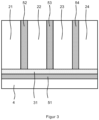
- FIG 3 shows a detailed view of a second exemplary embodiment of an accumulator arrangement 1 according to the invention in a sectional view.
- the accumulator arrangement 1 in a detailed view shows one of those in Figure 2
- the design described has an identical structure, which is why further details need not be discussed at first.
- a difference from the exemplary embodiment described above is that a thermally conductive layer 51 is not only formed between the carrier 31 and the base plate 4. Rather, a thermally conductive layer 52, 53, 54 is also introduced between the individual battery elements 21, 22, 23, 24 perpendicular to the carrier 31.
- the thermally conductive layer 52, 53, 54 which is formed perpendicular to the carrier 31 between the individual battery elements 21, 22, 23, 24, is introduced as a continuous layer or only at points.
- This thermally conductive layer 52, 53, 54 is made of a thermal contact layer according to the invention and filling material, in the present case the layer is designed in the same way as the thermally conductive layer 5.
Landscapes
- Chemical & Material Sciences (AREA)
- Chemical Kinetics & Catalysis (AREA)
- Engineering & Computer Science (AREA)
- General Chemical & Material Sciences (AREA)
- Electrochemistry (AREA)
- Organic Chemistry (AREA)
- Manufacturing & Machinery (AREA)
- Polymers & Plastics (AREA)
- Health & Medical Sciences (AREA)
- Medicinal Chemistry (AREA)
- Combustion & Propulsion (AREA)
- Thermal Sciences (AREA)
- Materials Engineering (AREA)
- Physics & Mathematics (AREA)
- Secondary Cells (AREA)
- Compositions Of Macromolecular Compounds (AREA)
- Cooling Or The Like Of Semiconductors Or Solid State Devices (AREA)
- Cooling Or The Like Of Electrical Apparatus (AREA)
- Battery Mounting, Suspending (AREA)
Priority Applications (2)
| Application Number | Priority Date | Filing Date | Title |
|---|---|---|---|
| HRP20240416TT HRP20240416T1 (hr) | 2018-02-09 | 2019-01-30 | Toplinski kontakt i materijal za punjenje i sklop baterije koji imaju toplinski kontakt i materijal za punjenje |
| EP24152777.9A EP4336636A3 (de) | 2018-02-09 | 2019-01-30 | Thermisches kontakt- und füllmaterial und akkumulator-anordnung mit einem thermischen kontakt- und füllmaterial |
Applications Claiming Priority (2)
| Application Number | Priority Date | Filing Date | Title |
|---|---|---|---|
| DE102018102989.6A DE102018102989C5 (de) | 2018-02-09 | 2018-02-09 | Akkumulator-Anordnung mit einem thermischen Kontakt- und Füllmaterial |
| PCT/EP2019/052263 WO2019154694A1 (de) | 2018-02-09 | 2019-01-30 | Thermisches kontakt- und füllmaterial und akkumulator-anordnung mit einem thermischen kontakt- und füllmaterial |
Related Child Applications (1)
| Application Number | Title | Priority Date | Filing Date |
|---|---|---|---|
| EP24152777.9A Division EP4336636A3 (de) | 2018-02-09 | 2019-01-30 | Thermisches kontakt- und füllmaterial und akkumulator-anordnung mit einem thermischen kontakt- und füllmaterial |
Publications (3)
| Publication Number | Publication Date |
|---|---|
| EP3749731A1 EP3749731A1 (de) | 2020-12-16 |
| EP3749731C0 EP3749731C0 (de) | 2024-02-21 |
| EP3749731B1 true EP3749731B1 (de) | 2024-02-21 |
Family
ID=65278341
Family Applications (2)
| Application Number | Title | Priority Date | Filing Date |
|---|---|---|---|
| EP19703039.8A Active EP3749731B1 (de) | 2018-02-09 | 2019-01-30 | Thermisches kontakt- und füllmaterial und akkumulator-anordnung mit einem thermischen kontakt- und füllmaterial |
| EP24152777.9A Withdrawn EP4336636A3 (de) | 2018-02-09 | 2019-01-30 | Thermisches kontakt- und füllmaterial und akkumulator-anordnung mit einem thermischen kontakt- und füllmaterial |
Family Applications After (1)
| Application Number | Title | Priority Date | Filing Date |
|---|---|---|---|
| EP24152777.9A Withdrawn EP4336636A3 (de) | 2018-02-09 | 2019-01-30 | Thermisches kontakt- und füllmaterial und akkumulator-anordnung mit einem thermischen kontakt- und füllmaterial |
Country Status (8)
| Country | Link |
|---|---|
| US (1) | US11542421B2 (https=) |
| EP (2) | EP3749731B1 (https=) |
| JP (2) | JP7307099B2 (https=) |
| KR (2) | KR20250044789A (https=) |
| CN (2) | CN111684016B (https=) |
| DE (1) | DE102018102989C5 (https=) |
| HR (1) | HRP20240416T1 (https=) |
| WO (1) | WO2019154694A1 (https=) |
Families Citing this family (6)
| Publication number | Priority date | Publication date | Assignee | Title |
|---|---|---|---|---|
| DE102018222459A1 (de) * | 2018-12-20 | 2020-06-25 | Audi Ag | Verfahren zum Bereitstellen einer Batterieanordnung für ein Kraftfahrzeug und Kraftfahrzeug |
| DE102019210439A1 (de) * | 2019-07-15 | 2021-01-21 | Audi Ag | Verfahren zum Montieren einer Batterie, Batterie sowie Kraftfahrzeug mit einer solchen Batterie |
| CN115548506A (zh) * | 2022-08-12 | 2022-12-30 | 广汽埃安新能源汽车有限公司 | 电池包及用电设备 |
| DE102022210846B4 (de) * | 2022-10-14 | 2025-08-28 | Volkswagen Aktiengesellschaft | Batterie für ein elektrisch angetriebenes Kraftfahrzeug |
| EP4424761A1 (de) | 2023-02-28 | 2024-09-04 | POLYTEC PT GMBH Polymere Technologien | Hochtemperaturbeständiges kontakt- und füllmaterial und dessen verwendung |
| EP4424735A1 (de) | 2023-02-28 | 2024-09-04 | POLYTEC PT GMBH Polymere Technologien | Injizierfähiges thermisches kontakt- und füllmaterial und dessen verwendung für grossflächige bauteile |
Family Cites Families (30)
| Publication number | Priority date | Publication date | Assignee | Title |
|---|---|---|---|---|
| US5591789A (en) * | 1995-06-07 | 1997-01-07 | International Business Machines Corporation | Polyester dispersants for high thermal conductivity paste |
| JPH11193343A (ja) * | 1997-08-25 | 1999-07-21 | Sekisui Chem Co Ltd | 室温硬化性組成物 |
| FR2879612B1 (fr) * | 2004-12-21 | 2007-05-04 | Rhodia Chimie Sa | Composition elastomere silicone, adhesive, monocomposante et reticulable par polyaddition |
| EP1878767A1 (en) * | 2006-07-12 | 2008-01-16 | Shin-Etsu Chemical Co., Ltd. | Heat conductive silicone grease composition and cured product thereof |
| US20080291634A1 (en) * | 2007-05-22 | 2008-11-27 | Weiser Martin W | Thermal interconnect and interface materials, methods of production and uses thereof |
| JP2009013237A (ja) | 2007-07-02 | 2009-01-22 | Dai Ichi Kogyo Seiyaku Co Ltd | 放熱性ポリウレタン樹脂組成物及び放熱性ポリウレタンシート |
| DE102007039900A1 (de) * | 2007-08-23 | 2008-10-16 | Siemens Ag | Thermisches und elektrisches Kontaktmaterial mit mindestens zwei Materialbestandteilen und Verwendung des Kontaktmaterials |
| JP2010215826A (ja) * | 2009-03-18 | 2010-09-30 | Konishi Co Ltd | 1液室温湿気硬化型硬化性樹脂組成物 |
| JP5283553B2 (ja) | 2009-04-09 | 2013-09-04 | 株式会社デンソー | 熱伝導性シリコーングリース組成物 |
| JP5740103B2 (ja) | 2009-10-19 | 2015-06-24 | 日東電工株式会社 | 熱伝導部材、及びそれを用いた組電池装置 |
| KR101346416B1 (ko) * | 2010-05-19 | 2014-01-02 | 도카이 고무 고교 가부시키가이샤 | 도전막, 및 그것을 사용한 트랜스듀서, 플렉시블 배선판 |
| JP5823099B2 (ja) * | 2010-06-16 | 2015-11-25 | セメダイン株式会社 | 難燃伝熱性硬化性組成物 |
| JP5343048B2 (ja) * | 2010-07-29 | 2013-11-13 | 日立ビークルエナジー株式会社 | 蓄電モジュールおよび蓄電装置 |
| ES2621135T3 (es) | 2010-07-29 | 2017-07-03 | E4V | Sistema de refrigeración de batería eléctrica y batería que comprende dicho sistema |
| CN107946689B (zh) * | 2011-04-15 | 2021-01-22 | Cps科技控股有限公司 | 具有外部热管理系统的电池系统 |
| CN104350814B (zh) | 2012-06-15 | 2017-10-13 | 株式会社钟化 | 散热结构体、便携式信息终端、电子设备及电子设备的修理方法 |
| US9752007B2 (en) * | 2012-07-30 | 2017-09-05 | Dow Corning Corporation | Thermally conductive condensation reaction curable polyorganosiloxane composition and methods for the preparation and use of the composition |
| DE102012109500A1 (de) | 2012-10-05 | 2014-04-10 | Dr. Neidlinger Holding Gmbh | Wärmeableitendes Polymer und Harzzusammensetzungen zur Herstellung desselben |
| US20150351217A1 (en) * | 2012-11-21 | 2015-12-03 | Kaneka Corporation | Heat dissipation structure |
| WO2015092889A1 (ja) * | 2013-12-18 | 2015-06-25 | ポリマテック・ジャパン株式会社 | 硬化型熱伝導性グリス、放熱構造および放熱構造の製造方法 |
| DE102014207508A1 (de) * | 2014-04-17 | 2015-10-22 | Wacker Chemie Ag | Vernetzbare Massen auf Basis von organyloxysilanterminierten Polymeren |
| JP6626647B2 (ja) * | 2014-09-05 | 2019-12-25 | Toyo Tire株式会社 | 熱伝導率可変材料、当該熱伝導率可変材料を用いた熱制御装置、及び当該熱伝導率可変材料を用いた熱制御方法 |
| US9413047B2 (en) | 2014-10-01 | 2016-08-09 | Ford Global Technologies, Llc | Assembly to manage contact between battery cell array and thermal interface component of thermal plate |
| JP6172832B2 (ja) | 2015-03-31 | 2017-08-02 | 積水メディカル株式会社 | 血清または血漿分離用組成物、並びに血液採取容器 |
| DE102015116110A1 (de) | 2015-09-23 | 2017-03-23 | Carl Zeiss Vision International Gmbh | Verfahren und System zur Bestimmung der subjektiven Refraktionseigenschaften eines Auges |
| DE102015118245B4 (de) | 2015-10-26 | 2024-10-10 | Infineon Technologies Austria Ag | Elektronische Komponente mit einem thermischen Schnittstellenmaterial, Herstellungsverfahren für eine elektronische Komponente, Wärmeabfuhrkörper mit einem thermischen Schnittstellenmaterial und thermisches Schnittstellenmaterial |
| JP6465037B2 (ja) * | 2016-01-07 | 2019-02-06 | 信越化学工業株式会社 | 縮合硬化反応と有機過酸化物硬化反応を併用したシリコーン組成物 |
| CN105754229A (zh) * | 2016-03-04 | 2016-07-13 | 王金武 | 一种耐磨易散热的复合橡胶电缆料 |
| JP6537578B2 (ja) | 2017-11-14 | 2019-07-03 | ニホンハンダ株式会社 | 熱伝導性オイル組成物、放熱剤及び電子機器 |
| US11312630B2 (en) | 2018-02-08 | 2022-04-26 | Tunghsu Technology Group Co., Ltd. | Modification method for graphene, modified graphene, and composition containing graphene |
-
2018
- 2018-02-09 DE DE102018102989.6A patent/DE102018102989C5/de active Active
-
2019
- 2019-01-30 KR KR1020257008577A patent/KR20250044789A/ko active Pending
- 2019-01-30 EP EP19703039.8A patent/EP3749731B1/de active Active
- 2019-01-30 EP EP24152777.9A patent/EP4336636A3/de not_active Withdrawn
- 2019-01-30 CN CN201980012132.7A patent/CN111684016B/zh active Active
- 2019-01-30 CN CN202410204319.XA patent/CN118290923A/zh active Pending
- 2019-01-30 HR HRP20240416TT patent/HRP20240416T1/hr unknown
- 2019-01-30 US US16/966,916 patent/US11542421B2/en active Active
- 2019-01-30 WO PCT/EP2019/052263 patent/WO2019154694A1/de not_active Ceased
- 2019-01-30 JP JP2020565524A patent/JP7307099B2/ja active Active
- 2019-01-30 KR KR1020207025947A patent/KR102784416B1/ko active Active
-
2023
- 2023-06-29 JP JP2023106660A patent/JP2023130410A/ja active Pending
Also Published As
| Publication number | Publication date |
|---|---|
| WO2019154694A1 (de) | 2019-08-15 |
| JP2023130410A (ja) | 2023-09-20 |
| KR102784416B1 (ko) | 2025-03-21 |
| CN111684016A (zh) | 2020-09-18 |
| HRP20240416T1 (hr) | 2024-06-21 |
| CN118290923A (zh) | 2024-07-05 |
| JP7307099B2 (ja) | 2023-07-11 |
| DE102018102989C5 (de) | 2024-10-10 |
| EP4336636A3 (de) | 2024-05-29 |
| DE102018102989B4 (de) | 2020-08-13 |
| EP3749731A1 (de) | 2020-12-16 |
| DE102018102989A1 (de) | 2019-03-21 |
| JP2021514421A (ja) | 2021-06-10 |
| KR20200136898A (ko) | 2020-12-08 |
| KR20250044789A (ko) | 2025-04-01 |
| EP3749731C0 (de) | 2024-02-21 |
| US20210047550A1 (en) | 2021-02-18 |
| EP4336636A2 (de) | 2024-03-13 |
| CN111684016B (zh) | 2024-03-15 |
| US11542421B2 (en) | 2023-01-03 |
Similar Documents
| Publication | Publication Date | Title |
|---|---|---|
| EP3749731B1 (de) | Thermisches kontakt- und füllmaterial und akkumulator-anordnung mit einem thermischen kontakt- und füllmaterial | |
| EP2114113B1 (de) | Leiterplatteneinheit und Verfahren zu deren Herstellung | |
| DE212018000344U1 (de) | Wärmeableitungsstruktur und damit versehene Batterie | |
| DE102017203096B4 (de) | Wärmeleit- sowie Batterieanordnung | |
| EP2114116B1 (de) | Hybridkühlung | |
| WO2008116539A2 (de) | Elektrisches gerät und verwendung | |
| DE102014212143A1 (de) | Kontaktierungsvorrichtung zur Kontaktierung einer Energiespeicherzelle | |
| DE102017212233A1 (de) | Elektrische Baugruppe und Verfahren zur Herstellung einer elektrischen Baugruppe | |
| DE102012221689B4 (de) | Batterie mit Verbundstruktur | |
| WO2009053357A1 (de) | Elektrische leistungskomponente, insbesondere leistungshalbleiter-modul, mit einer kühlvorrichtung und verfahren zum flächigen und wärmeleitenden anbinden einer kühlvorrichtung an eine elektrische leistungskomponente | |
| EP3475978A1 (de) | Wärmeleitender isolator | |
| DE102013219090B4 (de) | Gehäuse für ein Sensorsystem in einem Fahrzeug | |
| DE102020104573B4 (de) | Batteriezellenanordnung, Batterie und Kraftfahrzeug | |
| DE102010005020B4 (de) | Verwendung eines Formkörpers aus einem wärmeleitenden Kompositmaterial zur Wärmeableitung | |
| DE102013219433B4 (de) | Elektronisches Leistungsmodul mit elastischen Kontakten und Stapelaufbau mit einem solchen Leistungsmodul | |
| EP3661341A1 (de) | Vorrichtung zur kühlung einer stromschiene | |
| DE102009034138B4 (de) | Leistungshalbleitermodul mit einem Sandwich mit einem Leistungshalbleiterbauelement | |
| EP4385293B1 (de) | Thermisch leitfähige halterung | |
| WO2016091427A1 (de) | Wärmeübertragendes ausgleichselement sowie elektrisch betreibbares fahrzeug mit derartigem ausgleichselement | |
| DE102007039903A1 (de) | Wärmeleitmaterial mit zwei Materialbestandteilen und Verwendung des Wärmeleitmaterials | |
| DE102007039902A1 (de) | Wärmeleitmaterial mit zwei Materialbestandteilen und Verwendung des Wärmeleitmaterials | |
| DE102021214613A1 (de) | Wärmetauschvorrichtung und daraus bestehender eigensicherer kühlbarer Bremswiderstand | |
| DE102009000885A1 (de) | Halbleitermodul | |
| DE102007039901A1 (de) | Thermisches und elektrisches Kontaktmaterial mit mindestens zwei Materialbestandteilen und Verwendung des Kontaktmaterials | |
| DE102023208756A1 (de) | Elektrische Isolieranordnung |
Legal Events
| Date | Code | Title | Description |
|---|---|---|---|
| REG | Reference to a national code |
Ref country code: HR Ref legal event code: TUEP Ref document number: P20240416T Country of ref document: HR |
|
| STAA | Information on the status of an ep patent application or granted ep patent |
Free format text: STATUS: UNKNOWN |
|
| STAA | Information on the status of an ep patent application or granted ep patent |
Free format text: STATUS: THE INTERNATIONAL PUBLICATION HAS BEEN MADE |
|
| PUAI | Public reference made under article 153(3) epc to a published international application that has entered the european phase |
Free format text: ORIGINAL CODE: 0009012 |
|
| STAA | Information on the status of an ep patent application or granted ep patent |
Free format text: STATUS: REQUEST FOR EXAMINATION WAS MADE |
|
| 17P | Request for examination filed |
Effective date: 20200818 |
|
| AK | Designated contracting states |
Kind code of ref document: A1 Designated state(s): AL AT BE BG CH CY CZ DE DK EE ES FI FR GB GR HR HU IE IS IT LI LT LU LV MC MK MT NL NO PL PT RO RS SE SI SK SM TR |
|
| AX | Request for extension of the european patent |
Extension state: BA ME |
|
| RIN1 | Information on inventor provided before grant (corrected) |
Inventor name: MAURER, ARNO Inventor name: STOESSER, BENJAMIN |
|
| DAV | Request for validation of the european patent (deleted) | ||
| DAX | Request for extension of the european patent (deleted) | ||
| STAA | Information on the status of an ep patent application or granted ep patent |
Free format text: STATUS: EXAMINATION IS IN PROGRESS |
|
| 17Q | First examination report despatched |
Effective date: 20220912 |
|
| RIC1 | Information provided on ipc code assigned before grant |
Ipc: H01M 50/24 20210101ALI20230802BHEP Ipc: H01M 10/66 20140101ALI20230802BHEP Ipc: H01M 10/653 20140101ALI20230802BHEP Ipc: C08K 3/10 20180101ALI20230802BHEP Ipc: C09K 5/14 20060101AFI20230802BHEP |
|
| GRAP | Despatch of communication of intention to grant a patent |
Free format text: ORIGINAL CODE: EPIDOSNIGR1 |
|
| STAA | Information on the status of an ep patent application or granted ep patent |
Free format text: STATUS: GRANT OF PATENT IS INTENDED |
|
| INTG | Intention to grant announced |
Effective date: 20230914 |
|
| GRAS | Grant fee paid |
Free format text: ORIGINAL CODE: EPIDOSNIGR3 |
|
| GRAA | (expected) grant |
Free format text: ORIGINAL CODE: 0009210 |
|
| STAA | Information on the status of an ep patent application or granted ep patent |
Free format text: STATUS: THE PATENT HAS BEEN GRANTED |
|
| AK | Designated contracting states |
Kind code of ref document: B1 Designated state(s): AL AT BE BG CH CY CZ DE DK EE ES FI FR GB GR HR HU IE IS IT LI LT LU LV MC MK MT NL NO PL PT RO RS SE SI SK SM TR |
|
| REG | Reference to a national code |
Ref country code: GB Ref legal event code: FG4D Free format text: NOT ENGLISH |
|
| REG | Reference to a national code |
Ref country code: CH Ref legal event code: EP |
|
| REG | Reference to a national code |
Ref country code: DE Ref legal event code: R096 Ref document number: 502019010619 Country of ref document: DE |
|
| REG | Reference to a national code |
Ref country code: IE Ref legal event code: FG4D Free format text: LANGUAGE OF EP DOCUMENT: GERMAN |
|
| U01 | Request for unitary effect filed |
Effective date: 20240314 |
|
| U07 | Unitary effect registered |
Designated state(s): AT BE BG DE DK EE FI FR IT LT LU LV MT NL PT SE SI Effective date: 20240322 |
|
| REG | Reference to a national code |
Ref country code: HR Ref legal event code: T1PR Ref document number: P20240416 Country of ref document: HR |
|
| PG25 | Lapsed in a contracting state [announced via postgrant information from national office to epo] |
Ref country code: IS Free format text: LAPSE BECAUSE OF FAILURE TO SUBMIT A TRANSLATION OF THE DESCRIPTION OR TO PAY THE FEE WITHIN THE PRESCRIBED TIME-LIMIT Effective date: 20240621 |
|
| PG25 | Lapsed in a contracting state [announced via postgrant information from national office to epo] |
Ref country code: GR Free format text: LAPSE BECAUSE OF FAILURE TO SUBMIT A TRANSLATION OF THE DESCRIPTION OR TO PAY THE FEE WITHIN THE PRESCRIBED TIME-LIMIT Effective date: 20240522 |
|
| PG25 | Lapsed in a contracting state [announced via postgrant information from national office to epo] |
Ref country code: RS Free format text: LAPSE BECAUSE OF FAILURE TO SUBMIT A TRANSLATION OF THE DESCRIPTION OR TO PAY THE FEE WITHIN THE PRESCRIBED TIME-LIMIT Effective date: 20240521 |
|
| PG25 | Lapsed in a contracting state [announced via postgrant information from national office to epo] |
Ref country code: ES Free format text: LAPSE BECAUSE OF FAILURE TO SUBMIT A TRANSLATION OF THE DESCRIPTION OR TO PAY THE FEE WITHIN THE PRESCRIBED TIME-LIMIT Effective date: 20240221 |
|
| PG25 | Lapsed in a contracting state [announced via postgrant information from national office to epo] |
Ref country code: RS Free format text: LAPSE BECAUSE OF FAILURE TO SUBMIT A TRANSLATION OF THE DESCRIPTION OR TO PAY THE FEE WITHIN THE PRESCRIBED TIME-LIMIT Effective date: 20240521 Ref country code: IS Free format text: LAPSE BECAUSE OF FAILURE TO SUBMIT A TRANSLATION OF THE DESCRIPTION OR TO PAY THE FEE WITHIN THE PRESCRIBED TIME-LIMIT Effective date: 20240621 Ref country code: GR Free format text: LAPSE BECAUSE OF FAILURE TO SUBMIT A TRANSLATION OF THE DESCRIPTION OR TO PAY THE FEE WITHIN THE PRESCRIBED TIME-LIMIT Effective date: 20240522 Ref country code: ES Free format text: LAPSE BECAUSE OF FAILURE TO SUBMIT A TRANSLATION OF THE DESCRIPTION OR TO PAY THE FEE WITHIN THE PRESCRIBED TIME-LIMIT Effective date: 20240221 |
|
| PG25 | Lapsed in a contracting state [announced via postgrant information from national office to epo] |
Ref country code: PL Free format text: LAPSE BECAUSE OF FAILURE TO SUBMIT A TRANSLATION OF THE DESCRIPTION OR TO PAY THE FEE WITHIN THE PRESCRIBED TIME-LIMIT Effective date: 20240221 |
|
| PG25 | Lapsed in a contracting state [announced via postgrant information from national office to epo] |
Ref country code: PL Free format text: LAPSE BECAUSE OF FAILURE TO SUBMIT A TRANSLATION OF THE DESCRIPTION OR TO PAY THE FEE WITHIN THE PRESCRIBED TIME-LIMIT Effective date: 20240221 |
|
| PG25 | Lapsed in a contracting state [announced via postgrant information from national office to epo] |
Ref country code: SM Free format text: LAPSE BECAUSE OF FAILURE TO SUBMIT A TRANSLATION OF THE DESCRIPTION OR TO PAY THE FEE WITHIN THE PRESCRIBED TIME-LIMIT Effective date: 20240221 |
|
| PG25 | Lapsed in a contracting state [announced via postgrant information from national office to epo] |
Ref country code: CZ Free format text: LAPSE BECAUSE OF FAILURE TO SUBMIT A TRANSLATION OF THE DESCRIPTION OR TO PAY THE FEE WITHIN THE PRESCRIBED TIME-LIMIT Effective date: 20240221 |
|
| PG25 | Lapsed in a contracting state [announced via postgrant information from national office to epo] |
Ref country code: SK Free format text: LAPSE BECAUSE OF FAILURE TO SUBMIT A TRANSLATION OF THE DESCRIPTION OR TO PAY THE FEE WITHIN THE PRESCRIBED TIME-LIMIT Effective date: 20240221 |
|
| PG25 | Lapsed in a contracting state [announced via postgrant information from national office to epo] |
Ref country code: SM Free format text: LAPSE BECAUSE OF FAILURE TO SUBMIT A TRANSLATION OF THE DESCRIPTION OR TO PAY THE FEE WITHIN THE PRESCRIBED TIME-LIMIT Effective date: 20240221 Ref country code: SK Free format text: LAPSE BECAUSE OF FAILURE TO SUBMIT A TRANSLATION OF THE DESCRIPTION OR TO PAY THE FEE WITHIN THE PRESCRIBED TIME-LIMIT Effective date: 20240221 Ref country code: RO Free format text: LAPSE BECAUSE OF FAILURE TO SUBMIT A TRANSLATION OF THE DESCRIPTION OR TO PAY THE FEE WITHIN THE PRESCRIBED TIME-LIMIT Effective date: 20240221 Ref country code: CZ Free format text: LAPSE BECAUSE OF FAILURE TO SUBMIT A TRANSLATION OF THE DESCRIPTION OR TO PAY THE FEE WITHIN THE PRESCRIBED TIME-LIMIT Effective date: 20240221 |
|
| REG | Reference to a national code |
Ref country code: DE Ref legal event code: R097 Ref document number: 502019010619 Country of ref document: DE |
|
| PLBE | No opposition filed within time limit |
Free format text: ORIGINAL CODE: 0009261 |
|
| STAA | Information on the status of an ep patent application or granted ep patent |
Free format text: STATUS: NO OPPOSITION FILED WITHIN TIME LIMIT |
|
| U20 | Renewal fee for the european patent with unitary effect paid |
Year of fee payment: 7 Effective date: 20241205 |
|
| 26N | No opposition filed |
Effective date: 20241122 |
|
| REG | Reference to a national code |
Ref country code: HR Ref legal event code: ODRP Ref document number: P20240416 Country of ref document: HR Payment date: 20241210 Year of fee payment: 7 |
|
| PG25 | Lapsed in a contracting state [announced via postgrant information from national office to epo] |
Ref country code: MC Free format text: LAPSE BECAUSE OF FAILURE TO SUBMIT A TRANSLATION OF THE DESCRIPTION OR TO PAY THE FEE WITHIN THE PRESCRIBED TIME-LIMIT Effective date: 20240221 |
|
| PGFP | Annual fee paid to national office [announced via postgrant information from national office to epo] |
Ref country code: GB Payment date: 20251211 Year of fee payment: 8 |
|
| U20 | Renewal fee for the european patent with unitary effect paid |
Year of fee payment: 8 Effective date: 20251205 |
|
| PGFP | Annual fee paid to national office [announced via postgrant information from national office to epo] |
Ref country code: HR Payment date: 20251208 Year of fee payment: 8 |
|
| PG25 | Lapsed in a contracting state [announced via postgrant information from national office to epo] |
Ref country code: IE Free format text: LAPSE BECAUSE OF NON-PAYMENT OF DUE FEES Effective date: 20250130 |
|
| REG | Reference to a national code |
Ref country code: CH Ref legal event code: U11 Free format text: ST27 STATUS EVENT CODE: U-0-0-U10-U11 (AS PROVIDED BY THE NATIONAL OFFICE) Effective date: 20260201 |
|
| REG | Reference to a national code |
Ref country code: HR Ref legal event code: ODRP Ref document number: P20240416 Country of ref document: HR Payment date: 20251208 Year of fee payment: 8 |
|
| PGFP | Annual fee paid to national office [announced via postgrant information from national office to epo] |
Ref country code: NO Payment date: 20260109 Year of fee payment: 8 |
|
| PGFP | Annual fee paid to national office [announced via postgrant information from national office to epo] |
Ref country code: TR Payment date: 20260129 Year of fee payment: 8 |
|
| PGFP | Annual fee paid to national office [announced via postgrant information from national office to epo] |
Ref country code: CH Payment date: 20260201 Year of fee payment: 8 |