EP3736786B1 - Fahrzeug und verfahren zum schutz einer in einem fahrzeug zurückgelassenen person - Google Patents
Fahrzeug und verfahren zum schutz einer in einem fahrzeug zurückgelassenen person Download PDFInfo
- Publication number
- EP3736786B1 EP3736786B1 EP19205773.5A EP19205773A EP3736786B1 EP 3736786 B1 EP3736786 B1 EP 3736786B1 EP 19205773 A EP19205773 A EP 19205773A EP 3736786 B1 EP3736786 B1 EP 3736786B1
- Authority
- EP
- European Patent Office
- Prior art keywords
- vehicle
- infant
- person
- rear seat
- controller
- Prior art date
- Legal status (The legal status is an assumption and is not a legal conclusion. Google has not performed a legal analysis and makes no representation as to the accuracy of the status listed.)
- Active
Links
Images


Classifications
-
- B—PERFORMING OPERATIONS; TRANSPORTING
- B60—VEHICLES IN GENERAL
- B60W—CONJOINT CONTROL OF VEHICLE SUB-UNITS OF DIFFERENT TYPE OR DIFFERENT FUNCTION; CONTROL SYSTEMS SPECIALLY ADAPTED FOR HYBRID VEHICLES; ROAD VEHICLE DRIVE CONTROL SYSTEMS FOR PURPOSES NOT RELATED TO THE CONTROL OF A PARTICULAR SUB-UNIT
- B60W50/00—Details of control systems for road vehicle drive control not related to the control of a particular sub-unit, e.g. process diagnostic or vehicle driver interfaces
- B60W50/0098—Details of control systems ensuring comfort, safety or stability not otherwise provided for
-
- B—PERFORMING OPERATIONS; TRANSPORTING
- B60—VEHICLES IN GENERAL
- B60R—VEHICLES, VEHICLE FITTINGS, OR VEHICLE PARTS, NOT OTHERWISE PROVIDED FOR
- B60R21/00—Arrangements or fittings on vehicles for protecting or preventing injuries to occupants or pedestrians in case of accidents or other traffic risks
- B60R21/01—Electrical circuits for triggering passive safety arrangements, e.g. airbags, safety belt tighteners, in case of vehicle accidents or impending vehicle accidents
-
- B—PERFORMING OPERATIONS; TRANSPORTING
- B60—VEHICLES IN GENERAL
- B60R—VEHICLES, VEHICLE FITTINGS, OR VEHICLE PARTS, NOT OTHERWISE PROVIDED FOR
- B60R21/00—Arrangements or fittings on vehicles for protecting or preventing injuries to occupants or pedestrians in case of accidents or other traffic risks
- B60R21/01—Electrical circuits for triggering passive safety arrangements, e.g. airbags, safety belt tighteners, in case of vehicle accidents or impending vehicle accidents
- B60R21/015—Electrical circuits for triggering passive safety arrangements, e.g. airbags, safety belt tighteners, in case of vehicle accidents or impending vehicle accidents including means for detecting the presence or position of passengers, passenger seats or child seats, and the related safety parameters therefor, e.g. speed or timing of airbag inflation in relation to occupant position or seat belt use
- B60R21/01554—Seat position sensors
-
- B—PERFORMING OPERATIONS; TRANSPORTING
- B60—VEHICLES IN GENERAL
- B60H—ARRANGEMENTS OF HEATING, COOLING, VENTILATING OR OTHER AIR-TREATING DEVICES SPECIALLY ADAPTED FOR PASSENGER OR GOODS SPACES OF VEHICLES
- B60H1/00—Heating, cooling or ventilating devices
- B60H1/00642—Control systems or circuits; Control members or indication devices for heating, cooling or ventilating devices
- B60H1/00735—Control systems or circuits characterised by their input, i.e. by the detection, measurement or calculation of particular conditions, e.g. signal treatment, dynamic models
-
- B—PERFORMING OPERATIONS; TRANSPORTING
- B60—VEHICLES IN GENERAL
- B60H—ARRANGEMENTS OF HEATING, COOLING, VENTILATING OR OTHER AIR-TREATING DEVICES SPECIALLY ADAPTED FOR PASSENGER OR GOODS SPACES OF VEHICLES
- B60H1/00—Heating, cooling or ventilating devices
- B60H1/00642—Control systems or circuits; Control members or indication devices for heating, cooling or ventilating devices
- B60H1/00735—Control systems or circuits characterised by their input, i.e. by the detection, measurement or calculation of particular conditions, e.g. signal treatment, dynamic models
- B60H1/00742—Control systems or circuits characterised by their input, i.e. by the detection, measurement or calculation of particular conditions, e.g. signal treatment, dynamic models by detection of the vehicle occupants' presence; by detection of conditions relating to the body of occupants, e.g. using radiant heat detectors
-
- B—PERFORMING OPERATIONS; TRANSPORTING
- B60—VEHICLES IN GENERAL
- B60H—ARRANGEMENTS OF HEATING, COOLING, VENTILATING OR OTHER AIR-TREATING DEVICES SPECIALLY ADAPTED FOR PASSENGER OR GOODS SPACES OF VEHICLES
- B60H1/00—Heating, cooling or ventilating devices
- B60H1/00642—Control systems or circuits; Control members or indication devices for heating, cooling or ventilating devices
- B60H1/00735—Control systems or circuits characterised by their input, i.e. by the detection, measurement or calculation of particular conditions, e.g. signal treatment, dynamic models
- B60H1/00785—Control systems or circuits characterised by their input, i.e. by the detection, measurement or calculation of particular conditions, e.g. signal treatment, dynamic models by the detection of humidity or frost
-
- B—PERFORMING OPERATIONS; TRANSPORTING
- B60—VEHICLES IN GENERAL
- B60H—ARRANGEMENTS OF HEATING, COOLING, VENTILATING OR OTHER AIR-TREATING DEVICES SPECIALLY ADAPTED FOR PASSENGER OR GOODS SPACES OF VEHICLES
- B60H1/00—Heating, cooling or ventilating devices
- B60H1/00642—Control systems or circuits; Control members or indication devices for heating, cooling or ventilating devices
- B60H1/00735—Control systems or circuits characterised by their input, i.e. by the detection, measurement or calculation of particular conditions, e.g. signal treatment, dynamic models
- B60H1/008—Control systems or circuits characterised by their input, i.e. by the detection, measurement or calculation of particular conditions, e.g. signal treatment, dynamic models the input being air quality
-
- B—PERFORMING OPERATIONS; TRANSPORTING
- B60—VEHICLES IN GENERAL
- B60H—ARRANGEMENTS OF HEATING, COOLING, VENTILATING OR OTHER AIR-TREATING DEVICES SPECIALLY ADAPTED FOR PASSENGER OR GOODS SPACES OF VEHICLES
- B60H1/00—Heating, cooling or ventilating devices
- B60H1/00642—Control systems or circuits; Control members or indication devices for heating, cooling or ventilating devices
- B60H1/00814—Control systems or circuits characterised by their output, for controlling particular components of the heating, cooling or ventilating installation
- B60H1/00821—Control systems or circuits characterised by their output, for controlling particular components of the heating, cooling or ventilating installation the components being ventilating, air admitting or air distributing devices
-
- B—PERFORMING OPERATIONS; TRANSPORTING
- B60—VEHICLES IN GENERAL
- B60H—ARRANGEMENTS OF HEATING, COOLING, VENTILATING OR OTHER AIR-TREATING DEVICES SPECIALLY ADAPTED FOR PASSENGER OR GOODS SPACES OF VEHICLES
- B60H1/00—Heating, cooling or ventilating devices
- B60H1/00642—Control systems or circuits; Control members or indication devices for heating, cooling or ventilating devices
- B60H1/00978—Control systems or circuits characterised by failure of detection or safety means; Diagnostic methods
-
- B—PERFORMING OPERATIONS; TRANSPORTING
- B60—VEHICLES IN GENERAL
- B60J—WINDOWS, WINDSCREENS, NON-FIXED ROOFS, DOORS, OR SIMILAR DEVICES FOR VEHICLES; REMOVABLE EXTERNAL PROTECTIVE COVERINGS SPECIALLY ADAPTED FOR VEHICLES
- B60J1/00—Windows; Windscreens; Accessories therefor
- B60J1/08—Windows; Windscreens; Accessories therefor arranged at vehicle sides
- B60J1/12—Windows; Windscreens; Accessories therefor arranged at vehicle sides adjustable
-
- B—PERFORMING OPERATIONS; TRANSPORTING
- B60—VEHICLES IN GENERAL
- B60K—ARRANGEMENT OR MOUNTING OF PROPULSION UNITS OR OF TRANSMISSIONS IN VEHICLES; ARRANGEMENT OR MOUNTING OF PLURAL DIVERSE PRIME-MOVERS IN VEHICLES; AUXILIARY DRIVES FOR VEHICLES; INSTRUMENTATION OR DASHBOARDS FOR VEHICLES; ARRANGEMENTS IN CONNECTION WITH COOLING, AIR INTAKE, GAS EXHAUST OR FUEL SUPPLY OF PROPULSION UNITS IN VEHICLES
- B60K28/00—Safety devices for propulsion-unit control, specially adapted for, or arranged in, vehicles, e.g. preventing fuel supply or ignition in the event of potentially dangerous conditions
- B60K28/10—Safety devices for propulsion-unit control, specially adapted for, or arranged in, vehicles, e.g. preventing fuel supply or ignition in the event of potentially dangerous conditions responsive to conditions relating to the vehicle
- B60K28/12—Safety devices for propulsion-unit control, specially adapted for, or arranged in, vehicles, e.g. preventing fuel supply or ignition in the event of potentially dangerous conditions responsive to conditions relating to the vehicle responsive to conditions relating to doors or doors locks, e.g. open door
-
- B—PERFORMING OPERATIONS; TRANSPORTING
- B60—VEHICLES IN GENERAL
- B60K—ARRANGEMENT OR MOUNTING OF PROPULSION UNITS OR OF TRANSMISSIONS IN VEHICLES; ARRANGEMENT OR MOUNTING OF PLURAL DIVERSE PRIME-MOVERS IN VEHICLES; AUXILIARY DRIVES FOR VEHICLES; INSTRUMENTATION OR DASHBOARDS FOR VEHICLES; ARRANGEMENTS IN CONNECTION WITH COOLING, AIR INTAKE, GAS EXHAUST OR FUEL SUPPLY OF PROPULSION UNITS IN VEHICLES
- B60K35/00—Instruments specially adapted for vehicles; Arrangement of instruments in or on vehicles
- B60K35/20—Output arrangements, i.e. from vehicle to user, associated with vehicle functions or specially adapted therefor
- B60K35/28—Output arrangements, i.e. from vehicle to user, associated with vehicle functions or specially adapted therefor characterised by the type of the output information, e.g. video entertainment or vehicle dynamics information; characterised by the purpose of the output information, e.g. for attracting the attention of the driver
-
- B—PERFORMING OPERATIONS; TRANSPORTING
- B60—VEHICLES IN GENERAL
- B60N—SEATS SPECIALLY ADAPTED FOR VEHICLES; VEHICLE PASSENGER ACCOMMODATION NOT OTHERWISE PROVIDED FOR
- B60N2/00—Seats specially adapted for vehicles; Arrangement or mounting of seats in vehicles
- B60N2/002—Seats provided with an occupancy detection means mounted therein or thereon
- B60N2/0021—Seats provided with an occupancy detection means mounted therein or thereon characterised by the type of sensor or measurement
- B60N2/0022—Seats provided with an occupancy detection means mounted therein or thereon characterised by the type of sensor or measurement for sensing anthropometric parameters, e.g. heart rate or body temperature
-
- B—PERFORMING OPERATIONS; TRANSPORTING
- B60—VEHICLES IN GENERAL
- B60N—SEATS SPECIALLY ADAPTED FOR VEHICLES; VEHICLE PASSENGER ACCOMMODATION NOT OTHERWISE PROVIDED FOR
- B60N2/00—Seats specially adapted for vehicles; Arrangement or mounting of seats in vehicles
- B60N2/002—Seats provided with an occupancy detection means mounted therein or thereon
- B60N2/0021—Seats provided with an occupancy detection means mounted therein or thereon characterised by the type of sensor or measurement
- B60N2/0024—Seats provided with an occupancy detection means mounted therein or thereon characterised by the type of sensor or measurement for identifying, categorising or investigation of the occupant or object on the seat
-
- B—PERFORMING OPERATIONS; TRANSPORTING
- B60—VEHICLES IN GENERAL
- B60N—SEATS SPECIALLY ADAPTED FOR VEHICLES; VEHICLE PASSENGER ACCOMMODATION NOT OTHERWISE PROVIDED FOR
- B60N2/00—Seats specially adapted for vehicles; Arrangement or mounting of seats in vehicles
- B60N2/002—Seats provided with an occupancy detection means mounted therein or thereon
- B60N2/0021—Seats provided with an occupancy detection means mounted therein or thereon characterised by the type of sensor or measurement
- B60N2/0024—Seats provided with an occupancy detection means mounted therein or thereon characterised by the type of sensor or measurement for identifying, categorising or investigation of the occupant or object on the seat
- B60N2/0026—Seats provided with an occupancy detection means mounted therein or thereon characterised by the type of sensor or measurement for identifying, categorising or investigation of the occupant or object on the seat for distinguishing between humans, animals or objects
-
- B—PERFORMING OPERATIONS; TRANSPORTING
- B60—VEHICLES IN GENERAL
- B60N—SEATS SPECIALLY ADAPTED FOR VEHICLES; VEHICLE PASSENGER ACCOMMODATION NOT OTHERWISE PROVIDED FOR
- B60N2/00—Seats specially adapted for vehicles; Arrangement or mounting of seats in vehicles
- B60N2/002—Seats provided with an occupancy detection means mounted therein or thereon
- B60N2/0021—Seats provided with an occupancy detection means mounted therein or thereon characterised by the type of sensor or measurement
- B60N2/0035—Seats provided with an occupancy detection means mounted therein or thereon characterised by the type of sensor or measurement characterised by the sensor data transmission, e.g. wired connections or wireless transmitters therefor; characterised by the sensor data processing, e.g. seat sensor signal amplification or electric circuits for providing seat sensor information
-
- B—PERFORMING OPERATIONS; TRANSPORTING
- B60—VEHICLES IN GENERAL
- B60N—SEATS SPECIALLY ADAPTED FOR VEHICLES; VEHICLE PASSENGER ACCOMMODATION NOT OTHERWISE PROVIDED FOR
- B60N2/00—Seats specially adapted for vehicles; Arrangement or mounting of seats in vehicles
- B60N2/24—Seats specially adapted for vehicles; Arrangement or mounting of seats in vehicles for particular purposes or particular vehicles
- B60N2/26—Seats specially adapted for vehicles; Arrangement or mounting of seats in vehicles for particular purposes or particular vehicles for children
- B60N2/28—Seats readily mountable on, and dismountable from, existing seats or other parts of the vehicle
-
- B—PERFORMING OPERATIONS; TRANSPORTING
- B60—VEHICLES IN GENERAL
- B60R—VEHICLES, VEHICLE FITTINGS, OR VEHICLE PARTS, NOT OTHERWISE PROVIDED FOR
- B60R16/00—Electric or fluid circuits specially adapted for vehicles and not otherwise provided for; Arrangement of elements of electric or fluid circuits specially adapted for vehicles and not otherwise provided for
- B60R16/02—Electric or fluid circuits specially adapted for vehicles and not otherwise provided for; Arrangement of elements of electric or fluid circuits specially adapted for vehicles and not otherwise provided for electric constitutive elements
- B60R16/023—Electric or fluid circuits specially adapted for vehicles and not otherwise provided for; Arrangement of elements of electric or fluid circuits specially adapted for vehicles and not otherwise provided for electric constitutive elements for transmission of signals between vehicle parts or subsystems
-
- B—PERFORMING OPERATIONS; TRANSPORTING
- B60—VEHICLES IN GENERAL
- B60R—VEHICLES, VEHICLE FITTINGS, OR VEHICLE PARTS, NOT OTHERWISE PROVIDED FOR
- B60R21/00—Arrangements or fittings on vehicles for protecting or preventing injuries to occupants or pedestrians in case of accidents or other traffic risks
- B60R21/01—Electrical circuits for triggering passive safety arrangements, e.g. airbags, safety belt tighteners, in case of vehicle accidents or impending vehicle accidents
- B60R21/015—Electrical circuits for triggering passive safety arrangements, e.g. airbags, safety belt tighteners, in case of vehicle accidents or impending vehicle accidents including means for detecting the presence or position of passengers, passenger seats or child seats, and the related safety parameters therefor, e.g. speed or timing of airbag inflation in relation to occupant position or seat belt use
- B60R21/01556—Child-seat detection systems
-
- B—PERFORMING OPERATIONS; TRANSPORTING
- B60—VEHICLES IN GENERAL
- B60R—VEHICLES, VEHICLE FITTINGS, OR VEHICLE PARTS, NOT OTHERWISE PROVIDED FOR
- B60R21/00—Arrangements or fittings on vehicles for protecting or preventing injuries to occupants or pedestrians in case of accidents or other traffic risks
- B60R21/01—Electrical circuits for triggering passive safety arrangements, e.g. airbags, safety belt tighteners, in case of vehicle accidents or impending vehicle accidents
- B60R21/015—Electrical circuits for triggering passive safety arrangements, e.g. airbags, safety belt tighteners, in case of vehicle accidents or impending vehicle accidents including means for detecting the presence or position of passengers, passenger seats or child seats, and the related safety parameters therefor, e.g. speed or timing of airbag inflation in relation to occupant position or seat belt use
- B60R21/01566—Devices for warning or indicating mode of inhibition
-
- G—PHYSICS
- G01—MEASURING; TESTING
- G01S—RADIO DIRECTION-FINDING; RADIO NAVIGATION; DETERMINING DISTANCE OR VELOCITY BY USE OF RADIO WAVES; LOCATING OR PRESENCE-DETECTING BY USE OF THE REFLECTION OR RERADIATION OF RADIO WAVES; ANALOGOUS ARRANGEMENTS USING OTHER WAVES
- G01S13/00—Systems using the reflection or reradiation of radio waves, e.g. radar systems; Analogous systems using reflection or reradiation of waves whose nature or wavelength is irrelevant or unspecified
- G01S13/88—Radar or analogous systems specially adapted for specific applications
-
- G—PHYSICS
- G01—MEASURING; TESTING
- G01S—RADIO DIRECTION-FINDING; RADIO NAVIGATION; DETERMINING DISTANCE OR VELOCITY BY USE OF RADIO WAVES; LOCATING OR PRESENCE-DETECTING BY USE OF THE REFLECTION OR RERADIATION OF RADIO WAVES; ANALOGOUS ARRANGEMENTS USING OTHER WAVES
- G01S13/00—Systems using the reflection or reradiation of radio waves, e.g. radar systems; Analogous systems using reflection or reradiation of waves whose nature or wavelength is irrelevant or unspecified
- G01S13/88—Radar or analogous systems specially adapted for specific applications
- G01S13/886—Radar or analogous systems specially adapted for specific applications for alarm systems
-
- G—PHYSICS
- G08—SIGNALLING
- G08B—SIGNALLING SYSTEMS, e.g. PERSONAL CALLING SYSTEMS; ORDER TELEGRAPHS; ALARM SYSTEMS
- G08B21/00—Alarms responsive to a single specified undesired or abnormal condition and not otherwise provided for
- G08B21/18—Status alarms
- G08B21/22—Status alarms responsive to presence or absence of persons
-
- G—PHYSICS
- G08—SIGNALLING
- G08B—SIGNALLING SYSTEMS, e.g. PERSONAL CALLING SYSTEMS; ORDER TELEGRAPHS; ALARM SYSTEMS
- G08B21/00—Alarms responsive to a single specified undesired or abnormal condition and not otherwise provided for
- G08B21/18—Status alarms
- G08B21/24—Reminder alarms, e.g. anti-loss alarms
-
- B—PERFORMING OPERATIONS; TRANSPORTING
- B60—VEHICLES IN GENERAL
- B60N—SEATS SPECIALLY ADAPTED FOR VEHICLES; VEHICLE PASSENGER ACCOMMODATION NOT OTHERWISE PROVIDED FOR
- B60N2210/00—Sensor types, e.g. for passenger detection systems or for controlling seats
- B60N2210/10—Field detection presence sensors
- B60N2210/16—Electromagnetic waves
- B60N2210/20—Radar
-
- B—PERFORMING OPERATIONS; TRANSPORTING
- B60—VEHICLES IN GENERAL
- B60N—SEATS SPECIALLY ADAPTED FOR VEHICLES; VEHICLE PASSENGER ACCOMMODATION NOT OTHERWISE PROVIDED FOR
- B60N2210/00—Sensor types, e.g. for passenger detection systems or for controlling seats
- B60N2210/30—Temperature sensors
-
- B—PERFORMING OPERATIONS; TRANSPORTING
- B60—VEHICLES IN GENERAL
- B60N—SEATS SPECIALLY ADAPTED FOR VEHICLES; VEHICLE PASSENGER ACCOMMODATION NOT OTHERWISE PROVIDED FOR
- B60N2230/00—Communication or electronic aspects
- B60N2230/10—Wired data transmission
-
- B—PERFORMING OPERATIONS; TRANSPORTING
- B60—VEHICLES IN GENERAL
- B60N—SEATS SPECIALLY ADAPTED FOR VEHICLES; VEHICLE PASSENGER ACCOMMODATION NOT OTHERWISE PROVIDED FOR
- B60N2230/00—Communication or electronic aspects
- B60N2230/20—Wireless data transmission
-
- B—PERFORMING OPERATIONS; TRANSPORTING
- B60—VEHICLES IN GENERAL
- B60W—CONJOINT CONTROL OF VEHICLE SUB-UNITS OF DIFFERENT TYPE OR DIFFERENT FUNCTION; CONTROL SYSTEMS SPECIALLY ADAPTED FOR HYBRID VEHICLES; ROAD VEHICLE DRIVE CONTROL SYSTEMS FOR PURPOSES NOT RELATED TO THE CONTROL OF A PARTICULAR SUB-UNIT
- B60W2540/00—Input parameters relating to occupants
- B60W2540/01—Occupants other than the driver
-
- B—PERFORMING OPERATIONS; TRANSPORTING
- B60—VEHICLES IN GENERAL
- B60Y—INDEXING SCHEME RELATING TO ASPECTS CROSS-CUTTING VEHICLE TECHNOLOGY
- B60Y2302/00—Responses or measures related to driver conditions
- B60Y2302/03—Actuating a signal or alarm device
-
- B—PERFORMING OPERATIONS; TRANSPORTING
- B60—VEHICLES IN GENERAL
- B60Y—INDEXING SCHEME RELATING TO ASPECTS CROSS-CUTTING VEHICLE TECHNOLOGY
- B60Y2400/00—Special features of vehicle units
- B60Y2400/30—Sensors
- B60Y2400/301—Sensors for position or displacement
- B60Y2400/3017—Radars
-
- B—PERFORMING OPERATIONS; TRANSPORTING
- B60—VEHICLES IN GENERAL
- B60Y—INDEXING SCHEME RELATING TO ASPECTS CROSS-CUTTING VEHICLE TECHNOLOGY
- B60Y2400/00—Special features of vehicle units
- B60Y2400/30—Sensors
- B60Y2400/302—Temperature sensors
Definitions
- the present disclosure relates to a vehicle and a method for protecting an infant left in the vehicle.
- the driver of the vehicle when a person, in particular, an infant is secured on a rear seat of a vehicle (e.g., in a car seat), the driver of the vehicle, after stopping the vehicle, helps the infant to get out of the vehicle and leaves the vicinity of the vehicle together with the infant.
- the driver may leave the vicinity of the vehicle, with the infant left on the rear seat of the vehicle.
- KR 10-1870916 B1 provides a detection and alarm apparatus for a residual passenger in a vehicle capable of detecting a residual passenger by using a radar sensor and thereby alerting the passenger.
- An aspect of the present disclosure provides a vehicle for raising a possibility of survival of a person (e.g., an infant) left in the vehicle and a method for protecting the person left in the vehicle.
- a person e.g., an infant
- a method for protecting a person left in a vehicle includes determining whether the person is present on a rear seat, by using a waveform of a reflected wave generated by a radar sensor after an ignition of the vehicle is turned off, determining a risk level, when it is determined that the person is on the rear seat, and taking a first step measure corresponding to a risk factor, when the risk level indicates a possibility of danger to the person, determining that a step shift condition is satisfied, when at least one of an air-conditioning controller is not continued to operate due to lack of vehicle fuel or battery or a door is not opened for more than a specific period of time, and performing a second step measure when the step shift condition is satisfied, wherein the second step measure is an operation of moving the vehicle to a road on which another vehicle travels, by using an electronic control unit (ECU) and an automated driving system (ADS) when the vehicle is determined to be located in the parking lot, as defined in independent claim 1.
- ECU electronice control unit
- ADS automated driving system
- vehicle or “vehicular” or other similar term as used herein is inclusive of motor vehicles in general such as passenger automobiles including sports utility vehicles (SUV), buses, trucks, various commercial vehicles, watercraft including a variety of boats and ships, aircraft, and the like, and includes hybrid vehicles, electric vehicles, plug-in hybrid electric vehicles, hydrogen-powered vehicles and other alternative fuel vehicles (e.g. fuels derived from resources other than petroleum).
- a hybrid vehicle is a vehicle that has two or more sources of power, for example both gasoline-powered and electric-powered vehicles.
- control logic of the present disclosure may be embodied as non-transitory computer readable media on a computer readable medium containing executable program instructions executed by a processor, controller or the like.
- Examples of computer readable media include, but are not limited to, ROM, RAM, compact disc (CD)-ROMs, magnetic tapes, floppy disks, flash drives, smart cards and optical data storage devices.
- the computer readable medium can also be distributed in network coupled computer systems so that the computer readable media is stored and executed in a distributed fashion, e.g., by a telematics server or a Controller Area Network (CAN).
- a telematics server or a Controller Area Network (CAN).
- CAN Controller Area Network
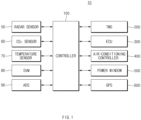
- FIG. 1 is a schematic view illustrating a vehicle according to an embodiment of the present disclosure.
- the vehicle 10 may include a radar sensor 50, a CO 2 sensor 60, a temperature sensor 70, a surround view monitor (SVM) 80, an automated driving system (ADS) 90, a controller 100, a telematics multimedia system (TMS) 200, an electronic control unit (ECU) 300, an air-conditioning controller 400, a power window 500, and a global positioning system (GPS) 600.
- the components of the vehicle 10 illustrated in FIG. 1 are illustrative, and at least some of the components may be omitted, or other components may be added, when necessary. Further, the components of the vehicle 10 may be implemented in software or hardware, or in a combination thereof.
- the radar sensor 50 is a device for monitoring a state of a person on a rear seat of the vehicle 10.
- the radar sensor 50 may radiate electromagnetic waves having a specific wavelength (e.g., ultra high frequency waves having a wavelength in the range of 10 cm to 100 cm) toward the rear seat of the vehicle 10, may receive reflected waves reflected from an object located on the rear seat, may measure the waveform of the reflected waves (e.g., a change in the intensity of the reflected waves over time), and may generate reflected-wave information that represents the measured waveform of the reflected waves.
- a specific wavelength e.g., ultra high frequency waves having a wavelength in the range of 10 cm to 100 cm
- the waveform of the reflected waves e.g., a change in the intensity of the reflected waves over time
- the CO 2 sensor 60 may measure the concentration of carbon dioxide contained in indoor air of the vehicle 10 and may generate CO 2 information.
- the temperature sensor 70 may measure the indoor temperature of the vehicle 10 and may generate temperature information.
- a humidity sensor for measuring the humidity of indoor air may be further included, in addition to the sensor that measures carbon dioxide or temperature.
- the SVM 80 may synthesize images of surroundings that are obtained from a plurality of cameras installed on the exterior of the vehicle 10 and may generate a surround view image seen from above the vehicle 10.
- the ADS 90 refers to a system that performs or assists with autonomous driving to a destination by using a sensor that is installed on the exterior of the vehicle 10 and that is capable of preventing a collision with an obstacle.
- the sensor capable of preventing the collision with the obstacle may be a sensor that senses the obstacle, measures the distance from the external object, and generates distance information, and the sensor may be, for example, radar, front/rear cameras, an ultrasonic sensor, or an infrared sensor.
- the scope of the present disclosure is not limited thereto.
- the controller 100 may determine whether an occupant on a rear seat is an adult or an infant, based on information collected from the various sensors. When the occupant is determined to be an infant, the controller 100 may discern risk factors and determine whether the current situation is a dangerous situation and may take countermeasures for the respective risk factors. To this end, the controller 100 may have the authority to control the other devices for the purpose of receiving information from the various sensors or performing required operations. Detailed operations of the controller 100 relevant thereto will be described below with reference to FIG. 2 and the following drawings.
- the controller 100 may be implemented with a separate ECU independent of the ECU 300, or a processor.
- the TMS 200 also called the telematics terminal, may communicate with a telematics center. Specifically, the TMS 200 may receive information such as weather information, map information, and the like from the telematics center and may transmit information such as notification of an emergency situation, a request for help, vehicle state information, and the like to the telematics center.
- information such as weather information, map information, and the like from the telematics center and may transmit information such as notification of an emergency situation, a request for help, vehicle state information, and the like to the telematics center.
- the ECU 300 is a device that controls the engine, the steering apparatus, and the automatic transmission of the vehicle 10.
- the ECU 300 may control the ignition, speed, and direction of the vehicle 10.
- the air-conditioning controller 400 may be a device that controls on/off, temperatures, and intensities of an air conditioner installed in the vehicle 10 and heating and cooling seats of a front or rear seat
- the power window 500 may control opening/closing of a window of the front or rear seat.
- the GPS 600 may generate GPS information by receiving a signal from a GPS satellite and calculating the current position of the vehicle 10.
- the vehicle 10 may further include a door sensor (not illustrated) that senses opening/closing of a front or rear door, and the controller 100 may receive, from the door sensor (not illustrated), information about whether the front or rear door is open or closed.
- a door sensor not illustrated
- the controller 100 may receive, from the door sensor (not illustrated), information about whether the front or rear door is open or closed.
- the components of the vehicle 10 illustrated in FIG. 1 may transmit and receive data therebetween through controller area network (CAN) communication for in-vehicle communication.
- CAN controller area network
- the CAN communication may classify the plurality of components into a plurality of categories.
- the plurality of components may belong to the same category or different categories.
- FIG. 2 is a schematic view illustrating an operating method of the vehicle of FIG. 1 .
- the vehicle 10 may determine whether an occupant on a rear seat is an adult or an infant, immediately after the ignition is turned off or within a predetermined period of time (e.g., 30 seconds) (S10).
- a predetermined period of time e.g. 30 seconds
- the vehicle 10 may collect temperature, humidity, weather information, and the like by using the various sensors and may determine what risk factors are present (S30).
- the vehicle 10 may take countermeasures for the respective risk factors (S40).
- the countermeasures may include a first step measure and a second step measure.
- the vehicle 10 may determine whether the second step measure is required, based on at least one of the battery level of the vehicle 10, the respiration rate of the infant, and the elapsed time.
- the second step measure may be taken in a stepwise manner.
- the second step measure may be an operation of moving the position of the vehicle 10 to enable other people to recognize the dangerous situation of the vehicle 10.
- the vehicle 10 may move to a position where the vehicle 10 impedes a movement of another vehicle in a parking lot, thereby enabling a driver of the other vehicle to recognize the dangerous situation of the vehicle 10.
- FIG. 3 is a flowchart illustrating a method for protecting a person left in the vehicle according to an embodiment of the present disclosure.
- FIG. 4 is a detailed flowchart illustrating step S 170 illustrated in FIG. 3 .
- FIG. 5 is a view illustrating an operation of the radar sensor illustrated in FIG. 1 .
- FIG. 6 is a view illustrating an example of distinguishing between an adult and an infant.
- FIG. 7 is a view illustrating another example of distinguishing between an adult and an infant.
- FIG. 8 is a table illustrating an example of a first step measure.
- FIG. 9 is a view illustrating an example of a second step measure.
- the controller 100 may activate the radar sensor 50 and may obtain reflected-wave information (S100).
- the radar sensor 50 may be installed in a roof panel disposed above a rear seat 700.
- the radar sensor 50 may radiate electromagnetic waves TR having a specific wavelength toward the rear seat 700, may receive reflected waves RF reflected from an object located on the rear seat 700, and may generate reflected-wave information.
- the reflected-wave information may include a frequency change depending on displacement and may include a change in the intensity of the reflected waves over time.
- the intensity of the reflected waves may represent the distance from the object, and the unit thereof may be decibel (dB).
- dB decibel
- the scope of the present disclosure is not limited thereto.
- the radar sensor 50 may radiate electromagnetic waves TR toward the rear seat 700, may receive reflected waves RF reflected from the baby or the person, and may generate reflected-wave information.
- the controller 100 may calculate the average respiration per minute of the person located on the rear seat 700 from the waveform of the reflected waves included in the reflected-wave information. Specifically, the controller 100 may extract peak points of the reflected-wave intensity for one minute and may calculate the number of times that the peak points are detected. Further, the controller 100 may calculate the average of the number of times that peak points are detected for a specific period of time (e.g., ten minutes) and may obtain and store the average respiration per minute of the person located on the rear seat 700.
- a specific period of time e.g., ten minutes
- the controller 100 may calculate the absolute height and the width for respiration of the person located on the rear seat 700 from the waveform of the reflected waves. Specifically, the controller 100 may calculate the average of peak points for a specific period of time (e.g., ten minutes) and may obtain and store the absolute height for respiration of the person located on the rear seat 700. The controller 100 may calculate the average of differences between peaks and troughs for a specific period of time and may obtain and store the width for respiration of the person located on the rear seat 700.
- a specific period of time e.g., ten minutes
- the controller 100 may determine whether the person located on the rear seat is an adult or an infant, based on the previously stored average respiration per minute of the person located on the rear seat or the previously stored absolute height and width of the respiration pattern detected from the person located on the rear seat (S120).
- FIG. 6 an example of distinguishing between an adult and an infant is illustrated. As illustrated in FIG. 6 , the average respiration per minute of an adult ranges 12 to 20, and the average respiration per minute of an infant ranges 18 to 41.9.
- the controller 100 may determine that the person on the rear seat is an infant. In contrast, when the previously stored average respiration per minute of the person located on the rear seat is less than the specific number of times (e.g., 18 times), the controller 100 may determine that the person on the rear seat is an adult.
- a specific number of times e.g. 18 times
- the controller 100 may determine that the person on the rear seat is an infant, when the previously stored absolute height and width for respiration of the person located on the rear seat are closer to the average absolute height H1 and the average width W1 for respiration of an infant than to the average absolute height H2 and the average width W2 for respiration of an adult.
- the controller 100 may determine that the person on the rear seat is an adult, when the previously stored absolute height and width for respiration of the person located on the rear seat are not closer to the average absolute height H1 and the average width W1 for respiration of an infant than to the average absolute height H2 and the average width W2 for respiration of an adult.
- the controller 100 may finally determine that the person on the rear seat is an infant, when both the condition in FIG. 6 and the condition in FIG. 7 are satisfied.
- the controller 100 may finally determine that the person on the rear seat is an infant, when at least one of the condition in FIG. 6 and the condition in FIG. 7 is satisfied.
- the controller 100 may execute basic radar passenger detection notification, and the method for protecting a person left in a vehicle may be ended.
- the basic radar passenger detection notification may be a measure for informing a driver or a passerby that the person (e.g., an adult, a pet, or the like - as provided herein, the term "person” also refers to any living being such as a pet) that is not an infant exists in the vehicle 10.
- Examples of the basic radar passenger detection notification may include operation of a klaxon (horn), lamp on/off, SMS and App notification to a user terminal registered in advance, and the like.
- the scope of the present disclosure is not limited thereto.
- the controller 100 may generate a warning to inform the fact that the infant exists in the vehicle 10 (S130).
- the controller 100 may control the klaxon (horn) to produce a sound in a preset pattern and size.
- the controller 100 may control the TMS 200 to transmit emergency situation notification to the telematics center to inform the fact that the infant exists in the vehicle 10, and the telematics center, which receives the emergency situation notification, may send SMS and App notification including the corresponding fact to the user terminal registered in advance.
- SMS may refer to a text message
- App notification may refer to push notification transferred through an application installed in the terminal.
- the controller 100 may output the warning for informing the fact that the infant exists in the vehicle 10, through a display device such as an audio, video, and navigation (AVN), a window screen, a spot lamp, or the like.
- a display device such as an audio, video, and navigation (AVN), a window screen, a spot lamp, or the like.
- the controller 100 may turn on and off lamps (e.g., headlamps, hazard lights, fog lamps, and the like) in a preset pattern and brightness to inform the fact that the infant exists in the vehicle 10.
- lamps e.g., headlamps, hazard lights, fog lamps, and the like
- the method for protecting a person left in the vehicle 10 may be ended because it is clear that the driver makes an attempt to rescue the infant from the vehicle 10.
- the controller 100 may determine a risk level that is classified as safety or danger, where the "danger" risk level indicates possible danger (e.g., serious injury or death) to a person trapped inside the vehicle if a current situation persists.
- Steps S150, S160, and S170 may be sequentially performed when it is not detected that the door of the vehicle 10 is opened within the predetermined period of time (e.g., one to five minutes). However, the controller 100 may consistently monitor whether the door of the vehicle 10 is opened. When it is detected that the door of the vehicle 10 is opened during the performance of step S150, S 160, or S 170, the controller 100 may immediately stop the current operation without threatening the safety of the infant and may not perform the subsequent operations.
- the predetermined period of time e.g., one to five minutes.
- the controller 100 may consistently monitor whether the door of the vehicle 10 is opened. When it is detected that the door of the vehicle 10 is opened during the performance of step S150, S 160, or S 170, the controller 100 may immediately stop the current operation without threatening the safety of the infant and may not perform the subsequent operations.
- the predetermined period of time (e.g., one to five minutes) may be set to specific time in advance, and the controller 100 may adjust the preset specific time with reference to CO 2 information of the CO 2 sensor 60, temperature information of the temperature sensor 70, or weather information collected through the TMS 200.
- the aim is to advance the time to take follow-up measures by reducing the predetermined period of time, in the case where the current indoor environment may threaten the survival of the infant (e.g., when the amount of sunshine exceeds a critical amount of sunshine or the current temperature is greater than or equal to a critical temperature).
- the controller 100 may determine the risk level, based on at least one of the elapsed time after the ignition is turned off, the current respiration per minute of the infant, and the indoor temperature.
- the controller 100 may determine the current risk level to be "danger", when the current respiration per minute of the infant that is measured based on the waveform of reflected waves received by the radar sensor 50 is 18 or less, or the indoor temperature measured by the temperature sensor 70 is 37 degrees Celsius or more, under the condition that the elapsed time after the ignition is turned off exceeds predetermined time (e.g., ten minutes).
- predetermined time e.g., ten minutes
- the controller 100 may determine the current risk level to be "safety", when the elapsed time after the ignition is turned off does not exceed the predetermined time (e.g., ten minutes), or when the elapsed time after the ignition is turned off exceeds the predetermined time (e.g., ten minutes), but the current respiration per minute of the infant that is measured based on the waveform of reflected waves received by the radar sensor 50 is 18 or more and the indoor temperature measured by the temperature sensor 70 is less than 37 degrees Celsius.
- the predetermined time e.g., ten minutes
- condition for determination of the risk level may be modified without any specific limitation, and the controller 100 may allow a user to set the risk level sensitivity in a stepwise manner depending on characteristics of the vehicle 10, the age of the infant, and the like, thereby preventing unnecessary malfunctions.
- step S140 may be performed again.
- the controller 100 may take follow-up measures for the safety of the infant.
- the controller 100 may take a first step measure (S172).
- the first step measure may be an operation of controlling the air-conditioning controller 400 and/or the power window 500.
- the controller 100 may collect information using the various sensors and may determine what risk factors are present The controller 100 may take first step measures appropriate for the respective risk factors. To this end, the controller 100 may store, in advance, critical values (e.g., a critical amount of sunshine, a critical temperature, a critical indoor temperature, a critical humidity, a critical CO 2 concentration, and the like) on the basis of which the risk factors are determined, and the controller 100 may determine the risk factors by comparing currently measured values and the critical values.
- critical values e.g., a critical amount of sunshine, a critical temperature, a critical indoor temperature, a critical humidity, a critical CO 2 concentration, and the like
- the first step measure is aimed at actively maintaining an indoor environment that does not interfere with the survival of the infant, such as maintaining appropriate indoor temperature.
- the controller 100 may collect weather information (e.g., excessive sunlight, sultriness, cold, or the like) from the telematics center through the TMS 200.
- the controller 100 may determine whether the current weather threatens the survival of the infant, based on the weather information.
- the controller 100 may control the air-conditioning controller 400 to operate the air conditioner at a specific intensity and temperature and appropriately maintain the indoor temperature and may control the power window 500 to close all the windows such that the indoor temperature is appropriately maintained.
- the controller 100 may collect the indoor temperature by using the temperature sensor 70. Based on the indoor temperature, the controller 100 may determine whether the current temperature is increased to a temperature that threatens the survival of the infant. When it is determined that the current temperature is increased to the temperature that threatens the survival of the infant (e.g., when the indoor temperature is greater than or equal to a critical indoor temperature), the controller 100 may control the air-conditioning controller 400 to operate the air conditioner at a specific intensity and temperature and appropriately maintain the indoor temperature and may control the power window 500 to close all the windows such that the indoor temperature is appropriately maintained.
- the controller 100 may collect the concentration of carbon dioxide contained in indoor air, by using the CO 2 sensor 60.
- the controller 100 may determine whether the current CO 2 concentration is increased to a concentration that threatens the survival of the infant. When it is determined that the current CO 2 concentration is increased to the concentration that threatens the survival of the infant (e.g., when the current CO 2 concentration is greater than or equal to a critical CO 2 concentration), the controller 100 may control the air-conditioning controller 400 to operate the air conditioner in an outdoor air circulation state and ventilate the vehicle 10.
- the controller 100 may collect the humidity of indoor air through the humidity sensor (not illustrated). The controller 100 may determine whether the current humidity is increased or decreased to a humidity that threatens the survival of the infant When it is determined that the current humidity is increased or decreased to the humidity that threatens the survival of the infant (e.g., when the current humidity is 80% or more, or 20% or less), the controller 100 may control the air-conditioning controller 400 to operate the air conditioner in an outdoor air circulation state to ventilate the vehicle 10 or to operate the air conditioner or a heater to adjust the indoor temperature and raise or lower the humidity.
- the controller 100 may determine whether a condition for a step shift is satisfied (S174).
- the step shift condition may be determined based on at least one of the battery level of the vehicle 10, the respiration rate of the infant, and the elapsed time after the ignition is turned off.
- the controller 100 may determine that the step shift condition is satisfied, when it is not detected that the door of the vehicle 10 is opened for more than a specific period of time (e.g., ten minutes, the specific period of time being varied depending on regulations or local or national circumstances), when it is difficult to continue to operate the air-conditioning controller 400 due to the lack of vehicle fuel or low battery, and/or when the respiration per minute of the infant is decreased to 10 or less.
- a specific period of time e.g., ten minutes, the specific period of time being varied depending on regulations or local or national circumstances
- the first step measure may continue, and the controller 100 may periodically determine whether the step shift condition is satisfied.
- the controller 100 may take a second step measure (S 176), and the second step measure may be an operation of moving the position of the vehicle 10 to enable other people to recognize the dangerous situation of the vehicle 10.
- a vehicle 900 in which an infant is left is parked in a parking lot together with a plurality of parked vehicles 910 as illustrated in (a) of FIG. 9 .
- the controller 100 of the vehicle 900 in which the infant is left may take a second step measure to move the vehicle 900 toward an obstacle ahead to obstruct the path of a proceeding vehicle 920 as illustrated in (b) of FIG. 9 , and the driver of the proceeding vehicle 920 may recognize a dangerous situation of the vehicle 900 in which the infant is left and may take a necessary measure.
- the controller 100 may determine that the vehicle 900 is located in the parking lot, when the vehicle 900 is determined to be in a garage of a house or a parking lot ahead of the house.
- the controller 100 may move the vehicle 900 at a predetermined speed (5 km/h) or less for the safety of the infant.
- the controller 100 may move the vehicle 900 while preventing a collision of the vehicle 900 with surrounding obstacles by using the ADS 90.
- the controller 100 may generate notification for informing people around the vehicle 900 of the dangerous situation after moving the vehicle 900 to an appropriate position.
- the notification may refer to an operation of producing a sound using the klaxon (horn) and/or turning on/off lamps (e.g., headlamps, hazard lights, fog lamps, and the like) in a preset pattern and brightness.
- the controller 100 may display text informing of the dangerous situation on a window of the vehicle 900 by using an OLED display, a projection display, or the like, thereby more effectively informing people around the vehicle 900 of the dangerous situation.
- the controller 100 may turn on all lights in the vehicle 900 and may display a warning screen informing of the dangerous situation on the AVN (not illustrated).
- the controller 100 may unlock doors of the vehicle 900 to help people around the vehicle 900 rescue the infant.
- the controller 100 may move the vehicle 900 to a close place (e.g., a fire station, a medical institution, a police station, a gas station, or the like) based on a high-definition map and position information of the GPS 600 by using an autonomous driving function of the vehicle 900.
- a close place e.g., a fire station, a medical institution, a police station, a gas station, or the like
- the controller 100 may perform control such that an operation of producing a sound using the klaxon (horn) and/or turning on/off the hazard lights is performed in parallel with the movement of the vehicle 900.
- the controller 100 may transmit emergency situation notification or a request for help that includes vehicle information (the current position, the battery level, indoor conditions of the vehicle, the current follow-up measure step, and the like) and state information of the occupant (the presence or absence of the infant, the respiration state of the infant, and the like), to the telematics center through the TMS 200 for the purpose of a rapid rescue of the infant.
- vehicle information the current position, the battery level, indoor conditions of the vehicle, the current follow-up measure step, and the like
- state information of the occupant the presence or absence of the infant, the respiration state of the infant, and the like
- the telematics center may transfer the state of the vehicle 900 and the request for help to an emergency rescue center (e.g., 119), based on the emergency situation notification or the request for help.
- an emergency rescue center e.g., 119
- the vehicle and the method for protecting a person left in a vehicle when an infant is left in the vehicle, may not only inform of the dangerous situation to the outside, but may also minimize a risk of death of the infant by detecting intemal/extemal states of the vehicle and a state of the infant and maintaining comfort in the indoor environment of the vehicle.
- the operations of the method or the algorithm described in connection with the embodiments disclosed herein may be embodied directly in hardware or a software module executed by a processor, or in a combination thereof.
- the software module may reside on a storage medium (that is, a memory and/or storage) such as a RAM, a flash memory, a ROM, an EPROM, an EEPROM, a register, a hard disk, a removable disk, or a CD-ROM.
- the exemplary storage medium may be coupled to the processor, and the processor may read information out of the storage medium and may record information in the storage medium.
- the storage medium may be integrated with the processor.
- the processor and the storage medium may reside in an application specific integrated circuit (ASIC).
- the ASIC may reside within a user terminal.
- the processor and the storage medium may reside in the user terminal as separate components.
- the vehicle and the method for protecting a person left in the vehicle, when the person is an infant may not only inform of the dangerous situation to the outside, but may also minimize a risk of death of the infant by detecting internal/external states of the vehicle and a state of the infant and maintaining comfort in the indoor environment of the vehicle.
- FIG. 1 A first figure.
Landscapes
- Engineering & Computer Science (AREA)
- Mechanical Engineering (AREA)
- Physics & Mathematics (AREA)
- Transportation (AREA)
- Aviation & Aerospace Engineering (AREA)
- Thermal Sciences (AREA)
- Radar, Positioning & Navigation (AREA)
- Remote Sensing (AREA)
- General Health & Medical Sciences (AREA)
- Health & Medical Sciences (AREA)
- General Physics & Mathematics (AREA)
- Computer Networks & Wireless Communication (AREA)
- Business, Economics & Management (AREA)
- Child & Adolescent Psychology (AREA)
- Emergency Management (AREA)
- Cardiology (AREA)
- Heart & Thoracic Surgery (AREA)
- Electromagnetism (AREA)
- Combustion & Propulsion (AREA)
- Chemical & Material Sciences (AREA)
- Automation & Control Theory (AREA)
- Human Computer Interaction (AREA)
- Emergency Alarm Devices (AREA)
Claims (15)
- Verfahren zum Schützen einer in einem Fahrzeug (10) zurückgelassenen Person, wobei das Verfahren umfasst:Bestimmen, ob sich die Person auf einem Rücksitz befindet, unter Verwendung einer Wellenform einer reflektierten Welle, die durch einen Radarsensor (50) generiert wird, nachdem eine Zündung des Fahrzeugs (10) ausgeschaltet wurde;Bestimmen eines Risikogrades, wenn bestimmt wird, dass sich die Person auf dem Rücksitz (700) befindet;Ergreifen einer Maßnahme eines ersten Schrittes, die einem Risikofaktor entspricht, wenn der Risikograd auf die Möglichkeit einer Gefährdung der Person hinweist;Bestimmen, dass eine Schrittverschiebungsbedingung erfüllt ist, wenn ein Klimaanlagen-Controller (400) aufgrund fehlenden Fahrzeugkraftstoffs oder fehlender Batterieleistung nicht weiter betrieben wird und/oder eine Tür länger als eine spezifische Zeitdauer nicht geöffnet wird, undDurchführen einer Maßnahme eines zweiten Schrittes, wenn die Schrittverschiebungsbedingung erfüllt ist,wobei die Maßnahme eines zweiten Schrittes ein Vorgang des Bewegens des Fahrzeugs zu einer Straße, auf der ein anderes Fahrzeug fährt, unter Verwendung einer elektronischen Steuereinheit (Electronic Control Unit, ECU) und eines automatisierten Fahrsystems (Automated Driving System, ADS) ist, wenn bestimmt wird, dass sich das Fahrzeug auf dem Parkplatz befindet.
- Verfahren nach Anspruch 1, des Weiteren umfassend:Bestimmen, ob die Person auf dem Rücksitz (700) ein Kleinkind ist, wenn bestimmt wird, dass sich die Person auf dem Rücksitz (700) befindet,wobei das Bestimmen, ob die Person auf dem Rücksitz (700) ein Kleinkind ist, umfasst:
Bestimmen, ob eine durchschnittliche Atmung pro Minute der Person auf dem Rücksitz (700), die anhand der Wellenform der reflektierten Welle berechnet wird, mindestens so groß wie eine spezifische Anzahl von Malen ist. - Verfahren nach Anspruch 1, des Weiteren umfassend:Bestimmen, ob die Person auf dem Rücksitz (700) ein Kleinkind ist, wenn bestimmt wird, dass sich die Person auf dem Rücksitz (700) befindet,wobei das Bestimmen, ob die Person auf dem Rücksitz (700) ein Kleinkind ist, umfasst:
Bestimmen, ob eine absolute Höhe und eine Breite für die Atmung der Person auf dem Rücksitz (700), die anhand der Wellenform der reflektierten Welle berechnet werden, ungefähr gleich einer durchschnittlichen absoluten Höhe und einer durchschnittlichen Breite für die Atmung des Säuglings sind. - Verfahren nach Anspruch 1, des Weiteren umfassend:
Berechnen und Speichern, im Voraus, einer durchschnittlichen Atmung pro Minute der Person auf dem Rücksitz (700) und einer absoluten Höhe und einer Breite für die Atmung der Person auf dem Rücksitz während der Fahrt des Fahrzeugs (10). - Verfahren nach Anspruch 1, wobei der Radarsensor (50) in einem Dachhimmel des Rücksitzes (700) installiert ist.
- Verfahren nach Anspruch 1, des Weiteren umfassend:Generieren, vor dem Bestimmen des Risikogrades, einer Warnung, um darüber zu informieren, dass sich ein Kleinkind in dem Fahrzeug (10) befindet, wenn eine Person auf dem Rücksitz (700) als das Kleinkind bestimmt wird,wobei die Warnung mindestens eines von Folgendem umfasst: Betätigung von Lampen, Anzeigen der Warnung auf einem Kombinationsinstrument oder einem Audio-, Video- und Navigations (AVN)-Gerät, Erzeugen eines Tons unter Verwendung eines Signalhorns und Senden einer Benachrichtigung an eine Telematik-Zentrale.
- Verfahren nach Anspruch 6, des Weiteren umfassend:
Bestimmen, ob eine Tür des Fahrzeugs (10) offen ist, nachdem die Warnung generiert wurde, wobei kein anschließender Vorgang durchgeführt wird, wenn detektiert wird, dass die Tür des Fahrzeugs (10) offen ist. - Verfahren nach Anspruch 1, wobei der Risikograd auf der Grundlage einer verstrichenen Zeit nach dem Ausschalten der Zündung und/oder einer momentanen Atmung pro Minute der Person, die ein Kleinkind ist, und/oder einer Innentemperatur bestimmt wird.
- Verfahren nach Anspruch 1, wobei die Maßnahme eines ersten Schrittes ein Vorgang des Steuerns des Klimaanlagen-Controllers (400) und/oder eines elektrischen Fensterhebers (500) ist.
- Verfahren nach Anspruch 1, wobei das Ergreifen der Maßnahme eines ersten Schrittes umfasst:Erfassen von Wetterinformationen einer Telematik-Zentrale;Bestimmen anhand der Wetterinformationen, ob das momentane Wetter das Überleben der Person, die ein Kleinkind ist, bedroht; undBetreiben einer Klimaanlage (400) mit einer spezifischen Intensität und Temperatur und Schließen eines Fensters des Fahrzeugs (10), wenn bestimmt wird, dass das momentane Wetter das Überleben des Kleinkindes bedroht.
- Verfahren nach Anspruch 1, wobei das Ergreifen der Maßnahme eines ersten Schrittes umfasst:Erfassen einer Innentemperatur unter Verwendung eines Temperatursensors (70);Bestimmen anhand der Innentemperatur, ob eine momentane Temperatur so ansteigt, dass das Überleben der Person, die ein Kleinkind ist, bedroht ist; undBetreiben einer Klimaanlage (400) mit einer spezifischen Intensität und Temperatur und Schließen eines Fensters des Fahrzeugs (10), wenn bestimmt wird, dass die momentane Temperatur auf die Temperatur angestiegen ist, die das Überleben des Kleinkindes bedroht.
- Verfahren nach Anspruch 1, wobei das Ergreifen der Maßnahme eines ersten Schrittes umfasst:Erfassen einer Kohlendioxidkonzentration in der Innenraumluft unter Verwendung eines CO2-Sensors (60);Bestimmen, ob eine momentane Kohlendioxidkonzentration so ansteigt, dass das Überleben der Person, die ein Kleinkind ist, bedroht ist; undBetreiben einer Klimaanlage (400) in einem Frischluftzirkulationszustand, wenn bestimmt wird, dass die momentane Kohlendioxidkonzentration auf die Konzentration angestiegen ist, die das Überleben des Kleinkindes bedroht.
- Verfahren nach Anspruch 1, wobei das Ergreifen der Maßnahme eines ersten Schrittes umfasst:Erfassen einer Feuchtigkeit von Innenraumluft unter Verwendung eines Feuchtigkeitssensors;Bestimmen, ob eine momentane Feuchtigkeit so angestiegen oder gesunken ist, dass das Überleben der Person, die ein Kleinkind ist, bedroht ist; undBetreiben einer Klimaanlage (400) in einem Frischluftzirkulationszustand und Betreiben der Klimaanlage oder einer Heizung, wenn bestimmt wird, dass die momentane Feuchtigkeit auf die Feuchtigkeit angestiegen oder gesunken ist, die das Überleben des Kleinkindes bedroht.
- Verfahren nach Anspruch 1, des Weiteren umfassend:
wobei die Schrittverschiebungsbedingung auf der Grundlage einer verbleibenden Kraftstoffmenge des Fahrzeugs (10) und/oder einer verbleibenden Ladungsmenge einer Batterie des Fahrzeugs (10) und/oder einer Atmungsrate eines Kleinkindes und/oder einer verstrichenen Zeit nach dem Ausschalten der Zündung bestimmt wird. - Fahrzeug (10) zum Schützen einer in dem Fahrzeug (10) zurückgelassenen Person, wobei das Fahrzeug (10) umfasst:einen Radarsensor (50), der dafür eingerichtet ist, eine elektromagnetische Welle in Richtung eines Rücksitzes (700) abzustrahlen und eine Änderung der Intensität einer reflektierten Welle zu messen, die von dem Rücksitz (700) reflektiert wird; undeinen Controller, der dafür eingerichtet ist, unter Verwendung einer Wellenform der reflektierten Welle nach dem Ausschalten einer Zündung des Fahrzeugs (10) zu bestimmen, ob die auf dem Rücksitz (700) befindliche Person ein Kleinkind ist; einen Risikograd zu bestimmen, wenn bestimmt wird, dass die Person auf dem Rücksitz (700) ein Kleinkind ist; eine Maßnahme eines ersten Schrittes entsprechend einem Risikofaktor zu ergreifen, wenn der Risikograd auf eine Möglichkeit einer Gefährdung der Person hinweist; zu bestimmen, dass eine Schrittverschiebungsbedingung erfüllt ist, wenn ein Klimaanlagen-Controller (400) aufgrund fehlenden Fahrzeugkraftstoffs oder fehlender Batterieleistung nicht weiter betrieben wird und/oder eine Tür nicht geöffnet wird; und eine Maßnahme eines zweiten Schrittes durchzuführen, wenn die Schrittverschiebungsbedingung länger als eine spezifische Zeitdauer erfüllt ist,wobei die Maßnahme eines zweiten Schrittes ein Vorgang des Bewegens des Fahrzeugs zu einer Straße, auf der ein anderes Fahrzeug fährt, unter Verwendung einer elektronischen Steuereinheit (Electronic Control Unit, ECU) und eines automatisierten Fahrsystems (Automated Driving System, ADS) ist, wenn bestimmt wird, dass sich das Fahrzeug auf dem Parkplatz befindet.
Applications Claiming Priority (1)
| Application Number | Priority Date | Filing Date | Title |
|---|---|---|---|
| KR1020190055045A KR102692323B1 (ko) | 2019-05-10 | 2019-05-10 | 차량 및 이의 생명 보호 조치 방법 |
Publications (2)
| Publication Number | Publication Date |
|---|---|
| EP3736786A1 EP3736786A1 (de) | 2020-11-11 |
| EP3736786B1 true EP3736786B1 (de) | 2024-07-24 |
Family
ID=68387188
Family Applications (1)
| Application Number | Title | Priority Date | Filing Date |
|---|---|---|---|
| EP19205773.5A Active EP3736786B1 (de) | 2019-05-10 | 2019-10-29 | Fahrzeug und verfahren zum schutz einer in einem fahrzeug zurückgelassenen person |
Country Status (4)
| Country | Link |
|---|---|
| US (1) | US10899359B2 (de) |
| EP (1) | EP3736786B1 (de) |
| KR (1) | KR102692323B1 (de) |
| CN (1) | CN111907453B (de) |
Families Citing this family (25)
| Publication number | Priority date | Publication date | Assignee | Title |
|---|---|---|---|---|
| JP7066645B2 (ja) * | 2019-01-23 | 2022-05-13 | 本田技研工業株式会社 | 移動体用制御装置 |
| JP2020117070A (ja) * | 2019-01-23 | 2020-08-06 | 本田技研工業株式会社 | 移動体用制御装置 |
| US11590934B2 (en) * | 2019-08-07 | 2023-02-28 | Keep Technologies, Inc. | Vehicular safety monitoring |
| WO2021181622A1 (ja) * | 2020-03-12 | 2021-09-16 | 日本電気株式会社 | 車両、車内放置防止装置、方法、及びコンピュータ可読媒体 |
| US11094183B1 (en) * | 2020-06-12 | 2021-08-17 | Donaldo Rex Mitogo | Rex cooling master |
| US12240376B2 (en) * | 2020-12-09 | 2025-03-04 | Florida Atlantic University Board Of Trustees | Active occupant status and vehicle operational status warning system and methods |
| CN116118661A (zh) * | 2021-01-18 | 2023-05-16 | 畅海峰 | 基于车联网的安全监控控制系统 |
| US12539863B2 (en) * | 2021-03-04 | 2026-02-03 | Ford Global Technologies, Llc | Enhanced occupant detection |
| CN113147591B (zh) * | 2021-04-12 | 2023-04-07 | 深圳市豪恩汽车电子装备股份有限公司 | 一种车内儿童监控方法 |
| CN113253258A (zh) * | 2021-04-26 | 2021-08-13 | 南京楚航科技有限公司 | 一种基于毫米波雷达检测车内活体的方法及装置 |
| US12012062B2 (en) * | 2021-06-07 | 2024-06-18 | Toyota Motor North America, Inc. | Radar detection of child car seat conditions in a vehicle |
| CN113844361B (zh) * | 2021-09-24 | 2023-09-05 | 阿波罗智联(北京)科技有限公司 | 提示方法、装置、电子设备、存储介质以及程序产品 |
| CN115973174B (zh) * | 2021-09-26 | 2025-12-02 | 梅赛德斯-奔驰集团股份公司 | 用于车辆的车厢智能健康管理的方法和设备 |
| CN113978354B (zh) * | 2021-10-13 | 2023-09-26 | 奇瑞汽车股份有限公司 | 一种车辆控制的方法、装置、设备及存储介质 |
| CN114274872B (zh) * | 2021-11-22 | 2024-05-31 | 江铃汽车股份有限公司 | 车内生命体征的预警方法、系统、可读存储介质及车辆 |
| US11769391B2 (en) | 2021-12-20 | 2023-09-26 | Veoneer Us Llc | In-cabin temperature monitoring for child presence detection applications |
| JP7759266B2 (ja) * | 2022-01-24 | 2025-10-23 | 株式会社Subaru | 車両用緊急救助要請システム |
| KR20230140751A (ko) * | 2022-03-30 | 2023-10-10 | 엘지이노텍 주식회사 | 레이더 모듈, 레이더 장치 및 이를 포함하는 차량용 감지 시스템 |
| KR20230141352A (ko) * | 2022-03-31 | 2023-10-10 | 엘지이노텍 주식회사 | 레이더 모듈, 레이더 장치 및 이를 포함하는 차량용 감지 시스템 |
| US20240017730A1 (en) * | 2022-07-12 | 2024-01-18 | Evelyn Shen | Child monitoring system inside a car |
| CN115179890A (zh) * | 2022-08-26 | 2022-10-14 | 润芯微科技(江苏)有限公司 | 一种基于智能传感器的呼吸监测系统及方法 |
| WO2024184262A1 (de) * | 2023-03-06 | 2024-09-12 | HELLA GmbH & Co. KGaA | Verfahren zur erkennung eines lebewesens, auswerteeinheit und fahrzeug |
| CN116945857B (zh) * | 2023-09-20 | 2023-12-29 | 安徽逸天科技有限公司 | 一种基于车辆防窒息的车内环境监测智能调节控制系统 |
| JP2025110934A (ja) * | 2024-01-17 | 2025-07-30 | 株式会社東海理化電機製作所 | 生体検知システム、処理装置、およびコンピュータプログラム |
| JP7677682B1 (ja) * | 2024-08-19 | 2025-05-15 | 株式会社エーワン | 室内異常検出方法、そのシステム及びプログラム |
Family Cites Families (20)
| Publication number | Priority date | Publication date | Assignee | Title |
|---|---|---|---|---|
| KR19990030384A (ko) * | 1997-09-30 | 1999-04-26 | 전주범 | 차량의 자동 환풍장치 및 그 제어방법 |
| US6922622B2 (en) * | 1999-06-03 | 2005-07-26 | Robert Bosch Corporation | Hot vehicle safety system and methods of preventing passenger entrapment and heat suffocation |
| CA2328034A1 (en) * | 1999-12-10 | 2001-06-10 | Timothy G. Killday | Safety compliant rear underride bumper |
| US20130201013A1 (en) * | 2007-12-14 | 2013-08-08 | Cars-N-Kids Llc | Systems and Methods for Notifying a Caregiver of the Condition of a Child in a Vehicular Child Safety Restraint |
| US20110121996A1 (en) * | 2009-11-23 | 2011-05-26 | Delphi Technologies, Inc. | Method and System for Detecting an Occupant Using Reflected Signals |
| UA102564C2 (uk) * | 2011-04-20 | 2013-07-25 | Виктор Георгиевич Небабин | Сингулярний спосіб забезпечення безаварійного руху транспортного засобу в аварійних ситуаціях |
| CN104627030A (zh) | 2013-11-13 | 2015-05-20 | 光宝科技股份有限公司 | 载具安全系统及应用于其上的安全侦测与处理方法 |
| EP3119639B1 (de) * | 2014-03-21 | 2020-02-26 | IEE International Electronics & Engineering S.A. | Verfahren und system zur detektion eines unbeaufsichtigten kindes |
| EP3034374B1 (de) * | 2014-12-19 | 2017-10-25 | Volvo Car Corporation | Fahrzeugsicherheitsanordnung, Fahrzeug und Verfahren zur Erhöhung der Sicherheit eines Fahrzeugs |
| JP2017181225A (ja) | 2016-03-30 | 2017-10-05 | 本田技研工業株式会社 | 乗員検知装置 |
| US9922471B2 (en) * | 2016-05-17 | 2018-03-20 | International Business Machines Corporation | Vehicle accident reporting system |
| US10308243B2 (en) | 2016-07-26 | 2019-06-04 | Ford Global Technologies, Llc | Vehicle remote park assist with occupant detection |
| WO2018035540A1 (en) * | 2016-08-19 | 2018-02-22 | Seth Campbell | Vehicle occupant detection system |
| US9847004B1 (en) * | 2016-09-02 | 2017-12-19 | Atieva, Inc. | Vehicle child detection and response system |
| LU93233B1 (en) * | 2016-09-23 | 2018-04-05 | Iee Sa | Car Interior Surveillance System with e-Call Functionality |
| US10346697B2 (en) * | 2016-12-21 | 2019-07-09 | Hyundai America Technical Center, Inc | Driver state monitoring using corneal reflection detection |
| EP3461664A1 (de) | 2017-09-28 | 2019-04-03 | Vestel Elektronik Sanayi ve Ticaret A.S. | System zur bestimmung und verwaltung einer klimaumgebung in einem geschlossenen fahrzeug |
| KR101870916B1 (ko) | 2017-11-15 | 2018-07-19 | (주)디 넷 | 차량 내 잔류승객 감지 및 경보 장치 |
| US10438479B1 (en) * | 2018-05-21 | 2019-10-08 | International Business Machines Corporation | Safety enhancement for persons under the care of others |
| US11747313B2 (en) * | 2018-08-22 | 2023-09-05 | Monica Hernandez | Methods and systems for detection of vehicle occupancy |
-
2019
- 2019-05-10 KR KR1020190055045A patent/KR102692323B1/ko active Active
- 2019-10-29 US US16/666,704 patent/US10899359B2/en active Active
- 2019-10-29 EP EP19205773.5A patent/EP3736786B1/de active Active
- 2019-11-14 CN CN201911110317.XA patent/CN111907453B/zh active Active
Also Published As
| Publication number | Publication date |
|---|---|
| CN111907453B (zh) | 2024-12-24 |
| CN111907453A (zh) | 2020-11-10 |
| US20200353940A1 (en) | 2020-11-12 |
| EP3736786A1 (de) | 2020-11-11 |
| US10899359B2 (en) | 2021-01-26 |
| KR20200130605A (ko) | 2020-11-19 |
| KR102692323B1 (ko) | 2024-08-08 |
Similar Documents
| Publication | Publication Date | Title |
|---|---|---|
| EP3736786B1 (de) | Fahrzeug und verfahren zum schutz einer in einem fahrzeug zurückgelassenen person | |
| EP3189993B1 (de) | Luftzirkulationssteuerungsvorrichtung für ein fahrzeug | |
| US10155520B2 (en) | Driver assistance apparatus and control method thereof | |
| US10296083B2 (en) | Driver assistance apparatus and method for controlling the same | |
| US9469176B2 (en) | System and method to detect an unattended occupant in a vehicle and take safety countermeasures | |
| CN105989749B (zh) | 用于优先化驾驶员警报的系统和方法 | |
| US9607454B1 (en) | System for distinguishing between traffic jam and parked vehicles | |
| JP2019051933A (ja) | 車両制御装置 | |
| CN105857172A (zh) | 一种车门开启时防撞方法及装置 | |
| US20250353493A1 (en) | Vehicle monitoring apparatus, vehicle comprising same and vehicle operating method | |
| US20240246547A1 (en) | Artificial intelligence-enabled alarm for detecting passengers locked in vehicle | |
| CN117565813A (zh) | 一种车辆预警方法、系统、车辆及存储介质 | |
| CN113561892B (zh) | 一种汽车开门智能防撞系统及方法 | |
| KR20170070566A (ko) | 차량 및 그 제어 방법 | |
| JP2018198071A (ja) | 車載用画像表示装置 | |
| KR20170044429A (ko) | 컨트롤 패드, 그를 가지는 차량 및 그 제어 방법 | |
| CN119459582A (zh) | 一种汽车生命体遗留监测方法 | |
| CN117605372A (zh) | 一种车辆开门防撞控制方法、装置、设备及介质 | |
| US20260057719A1 (en) | Methods, systems, and devices for automatic opening and closing of a garage door | |
| KR20230168218A (ko) | 변속기 및 그를 가지는 차량 | |
| JP2025157795A (ja) | 車両制御装置 | |
| KR20230033145A (ko) | 자율주행 차량의 보행자 경고 시스템 | |
| JP2022075859A (ja) | 車両制御装置及び車両 | |
| CN116811725A (zh) | 一种车门打开灯光提示控制系统及车辆 | |
| KR20220115689A (ko) | 자율주행 차량의 보행자 안전 시스템 |
Legal Events
| Date | Code | Title | Description |
|---|---|---|---|
| PUAI | Public reference made under article 153(3) epc to a published international application that has entered the european phase |
Free format text: ORIGINAL CODE: 0009012 |
|
| STAA | Information on the status of an ep patent application or granted ep patent |
Free format text: STATUS: THE APPLICATION HAS BEEN PUBLISHED |
|
| AK | Designated contracting states |
Kind code of ref document: A1 Designated state(s): AL AT BE BG CH CY CZ DE DK EE ES FI FR GB GR HR HU IE IS IT LI LT LU LV MC MK MT NL NO PL PT RO RS SE SI SK SM TR |
|
| AX | Request for extension of the european patent |
Extension state: BA ME |
|
| STAA | Information on the status of an ep patent application or granted ep patent |
Free format text: STATUS: REQUEST FOR EXAMINATION WAS MADE |
|
| 17P | Request for examination filed |
Effective date: 20210308 |
|
| RBV | Designated contracting states (corrected) |
Designated state(s): AL AT BE BG CH CY CZ DE DK EE ES FI FR GB GR HR HU IE IS IT LI LT LU LV MC MK MT NL NO PL PT RO RS SE SI SK SM TR |
|
| RAP3 | Party data changed (applicant data changed or rights of an application transferred) |
Owner name: HYUNDAI MOTOR COMPANY Owner name: KIA CORPORATION |
|
| STAA | Information on the status of an ep patent application or granted ep patent |
Free format text: STATUS: EXAMINATION IS IN PROGRESS |
|
| 17Q | First examination report despatched |
Effective date: 20220511 |
|
| P01 | Opt-out of the competence of the unified patent court (upc) registered |
Effective date: 20230420 |
|
| REG | Reference to a national code |
Ref country code: DE Ref legal event code: R079 Ref document number: 602019055618 Country of ref document: DE Free format text: PREVIOUS MAIN CLASS: G08B0021220000 Ipc: G08B0021240000 |
|
| GRAP | Despatch of communication of intention to grant a patent |
Free format text: ORIGINAL CODE: EPIDOSNIGR1 |
|
| STAA | Information on the status of an ep patent application or granted ep patent |
Free format text: STATUS: GRANT OF PATENT IS INTENDED |
|
| RIC1 | Information provided on ipc code assigned before grant |
Ipc: B60N 2/28 20060101ALI20240227BHEP Ipc: B60H 1/00 20060101ALI20240227BHEP Ipc: G08B 21/22 20060101ALI20240227BHEP Ipc: B60N 2/00 20060101ALI20240227BHEP Ipc: G08B 21/24 20060101AFI20240227BHEP |
|
| INTG | Intention to grant announced |
Effective date: 20240326 |
|
| GRAS | Grant fee paid |
Free format text: ORIGINAL CODE: EPIDOSNIGR3 |
|
| GRAA | (expected) grant |
Free format text: ORIGINAL CODE: 0009210 |
|
| STAA | Information on the status of an ep patent application or granted ep patent |
Free format text: STATUS: THE PATENT HAS BEEN GRANTED |
|
| AK | Designated contracting states |
Kind code of ref document: B1 Designated state(s): AL AT BE BG CH CY CZ DE DK EE ES FI FR GB GR HR HU IE IS IT LI LT LU LV MC MK MT NL NO PL PT RO RS SE SI SK SM TR |
|
| REG | Reference to a national code |
Ref country code: GB Ref legal event code: FG4D |
|
| REG | Reference to a national code |
Ref country code: CH Ref legal event code: EP |
|
| REG | Reference to a national code |
Ref country code: IE Ref legal event code: FG4D Ref country code: DE Ref legal event code: R096 Ref document number: 602019055618 Country of ref document: DE |
|
| REG | Reference to a national code |
Ref country code: LT Ref legal event code: MG9D |
|
| REG | Reference to a national code |
Ref country code: NL Ref legal event code: MP Effective date: 20240724 |
|
| PG25 | Lapsed in a contracting state [announced via postgrant information from national office to epo] |
Ref country code: PT Free format text: LAPSE BECAUSE OF FAILURE TO SUBMIT A TRANSLATION OF THE DESCRIPTION OR TO PAY THE FEE WITHIN THE PRESCRIBED TIME-LIMIT Effective date: 20241125 |
|
| REG | Reference to a national code |
Ref country code: AT Ref legal event code: MK05 Ref document number: 1707056 Country of ref document: AT Kind code of ref document: T Effective date: 20240724 |
|
| PG25 | Lapsed in a contracting state [announced via postgrant information from national office to epo] |
Ref country code: NL Free format text: LAPSE BECAUSE OF FAILURE TO SUBMIT A TRANSLATION OF THE DESCRIPTION OR TO PAY THE FEE WITHIN THE PRESCRIBED TIME-LIMIT Effective date: 20240724 |
|
| PG25 | Lapsed in a contracting state [announced via postgrant information from national office to epo] |
Ref country code: PT Free format text: LAPSE BECAUSE OF FAILURE TO SUBMIT A TRANSLATION OF THE DESCRIPTION OR TO PAY THE FEE WITHIN THE PRESCRIBED TIME-LIMIT Effective date: 20241125 Ref country code: NL Free format text: LAPSE BECAUSE OF FAILURE TO SUBMIT A TRANSLATION OF THE DESCRIPTION OR TO PAY THE FEE WITHIN THE PRESCRIBED TIME-LIMIT Effective date: 20240724 |
|
| PG25 | Lapsed in a contracting state [announced via postgrant information from national office to epo] |
Ref country code: NO Free format text: LAPSE BECAUSE OF FAILURE TO SUBMIT A TRANSLATION OF THE DESCRIPTION OR TO PAY THE FEE WITHIN THE PRESCRIBED TIME-LIMIT Effective date: 20241024 |
|
| PG25 | Lapsed in a contracting state [announced via postgrant information from national office to epo] |
Ref country code: PL Free format text: LAPSE BECAUSE OF FAILURE TO SUBMIT A TRANSLATION OF THE DESCRIPTION OR TO PAY THE FEE WITHIN THE PRESCRIBED TIME-LIMIT Effective date: 20240724 Ref country code: GR Free format text: LAPSE BECAUSE OF FAILURE TO SUBMIT A TRANSLATION OF THE DESCRIPTION OR TO PAY THE FEE WITHIN THE PRESCRIBED TIME-LIMIT Effective date: 20241025 Ref country code: FI Free format text: LAPSE BECAUSE OF FAILURE TO SUBMIT A TRANSLATION OF THE DESCRIPTION OR TO PAY THE FEE WITHIN THE PRESCRIBED TIME-LIMIT Effective date: 20240724 |
|
| PG25 | Lapsed in a contracting state [announced via postgrant information from national office to epo] |
Ref country code: BG Free format text: LAPSE BECAUSE OF FAILURE TO SUBMIT A TRANSLATION OF THE DESCRIPTION OR TO PAY THE FEE WITHIN THE PRESCRIBED TIME-LIMIT Effective date: 20240724 |
|
| PG25 | Lapsed in a contracting state [announced via postgrant information from national office to epo] |
Ref country code: LV Free format text: LAPSE BECAUSE OF FAILURE TO SUBMIT A TRANSLATION OF THE DESCRIPTION OR TO PAY THE FEE WITHIN THE PRESCRIBED TIME-LIMIT Effective date: 20240724 |
|
| PG25 | Lapsed in a contracting state [announced via postgrant information from national office to epo] |
Ref country code: AT Free format text: LAPSE BECAUSE OF FAILURE TO SUBMIT A TRANSLATION OF THE DESCRIPTION OR TO PAY THE FEE WITHIN THE PRESCRIBED TIME-LIMIT Effective date: 20240724 Ref country code: IS Free format text: LAPSE BECAUSE OF FAILURE TO SUBMIT A TRANSLATION OF THE DESCRIPTION OR TO PAY THE FEE WITHIN THE PRESCRIBED TIME-LIMIT Effective date: 20241124 |
|
| PG25 | Lapsed in a contracting state [announced via postgrant information from national office to epo] |
Ref country code: HR Free format text: LAPSE BECAUSE OF FAILURE TO SUBMIT A TRANSLATION OF THE DESCRIPTION OR TO PAY THE FEE WITHIN THE PRESCRIBED TIME-LIMIT Effective date: 20240724 |
|
| PG25 | Lapsed in a contracting state [announced via postgrant information from national office to epo] |
Ref country code: RS Free format text: LAPSE BECAUSE OF FAILURE TO SUBMIT A TRANSLATION OF THE DESCRIPTION OR TO PAY THE FEE WITHIN THE PRESCRIBED TIME-LIMIT Effective date: 20241024 Ref country code: ES Free format text: LAPSE BECAUSE OF FAILURE TO SUBMIT A TRANSLATION OF THE DESCRIPTION OR TO PAY THE FEE WITHIN THE PRESCRIBED TIME-LIMIT Effective date: 20240724 |
|
| PG25 | Lapsed in a contracting state [announced via postgrant information from national office to epo] |
Ref country code: RS Free format text: LAPSE BECAUSE OF FAILURE TO SUBMIT A TRANSLATION OF THE DESCRIPTION OR TO PAY THE FEE WITHIN THE PRESCRIBED TIME-LIMIT Effective date: 20241024 Ref country code: PL Free format text: LAPSE BECAUSE OF FAILURE TO SUBMIT A TRANSLATION OF THE DESCRIPTION OR TO PAY THE FEE WITHIN THE PRESCRIBED TIME-LIMIT Effective date: 20240724 Ref country code: NO Free format text: LAPSE BECAUSE OF FAILURE TO SUBMIT A TRANSLATION OF THE DESCRIPTION OR TO PAY THE FEE WITHIN THE PRESCRIBED TIME-LIMIT Effective date: 20241024 Ref country code: LV Free format text: LAPSE BECAUSE OF FAILURE TO SUBMIT A TRANSLATION OF THE DESCRIPTION OR TO PAY THE FEE WITHIN THE PRESCRIBED TIME-LIMIT Effective date: 20240724 Ref country code: IS Free format text: LAPSE BECAUSE OF FAILURE TO SUBMIT A TRANSLATION OF THE DESCRIPTION OR TO PAY THE FEE WITHIN THE PRESCRIBED TIME-LIMIT Effective date: 20241124 Ref country code: HR Free format text: LAPSE BECAUSE OF FAILURE TO SUBMIT A TRANSLATION OF THE DESCRIPTION OR TO PAY THE FEE WITHIN THE PRESCRIBED TIME-LIMIT Effective date: 20240724 Ref country code: GR Free format text: LAPSE BECAUSE OF FAILURE TO SUBMIT A TRANSLATION OF THE DESCRIPTION OR TO PAY THE FEE WITHIN THE PRESCRIBED TIME-LIMIT Effective date: 20241025 Ref country code: FI Free format text: LAPSE BECAUSE OF FAILURE TO SUBMIT A TRANSLATION OF THE DESCRIPTION OR TO PAY THE FEE WITHIN THE PRESCRIBED TIME-LIMIT Effective date: 20240724 Ref country code: ES Free format text: LAPSE BECAUSE OF FAILURE TO SUBMIT A TRANSLATION OF THE DESCRIPTION OR TO PAY THE FEE WITHIN THE PRESCRIBED TIME-LIMIT Effective date: 20240724 Ref country code: BG Free format text: LAPSE BECAUSE OF FAILURE TO SUBMIT A TRANSLATION OF THE DESCRIPTION OR TO PAY THE FEE WITHIN THE PRESCRIBED TIME-LIMIT Effective date: 20240724 Ref country code: AT Free format text: LAPSE BECAUSE OF FAILURE TO SUBMIT A TRANSLATION OF THE DESCRIPTION OR TO PAY THE FEE WITHIN THE PRESCRIBED TIME-LIMIT Effective date: 20240724 |
|
| PG25 | Lapsed in a contracting state [announced via postgrant information from national office to epo] |
Ref country code: SM Free format text: LAPSE BECAUSE OF FAILURE TO SUBMIT A TRANSLATION OF THE DESCRIPTION OR TO PAY THE FEE WITHIN THE PRESCRIBED TIME-LIMIT Effective date: 20240724 Ref country code: RO Free format text: LAPSE BECAUSE OF FAILURE TO SUBMIT A TRANSLATION OF THE DESCRIPTION OR TO PAY THE FEE WITHIN THE PRESCRIBED TIME-LIMIT Effective date: 20240724 Ref country code: DK Free format text: LAPSE BECAUSE OF FAILURE TO SUBMIT A TRANSLATION OF THE DESCRIPTION OR TO PAY THE FEE WITHIN THE PRESCRIBED TIME-LIMIT Effective date: 20240724 |
|
| PG25 | Lapsed in a contracting state [announced via postgrant information from national office to epo] |
Ref country code: EE Free format text: LAPSE BECAUSE OF FAILURE TO SUBMIT A TRANSLATION OF THE DESCRIPTION OR TO PAY THE FEE WITHIN THE PRESCRIBED TIME-LIMIT Effective date: 20240724 |
|
| PG25 | Lapsed in a contracting state [announced via postgrant information from national office to epo] |
Ref country code: CZ Free format text: LAPSE BECAUSE OF FAILURE TO SUBMIT A TRANSLATION OF THE DESCRIPTION OR TO PAY THE FEE WITHIN THE PRESCRIBED TIME-LIMIT Effective date: 20240724 |
|
| REG | Reference to a national code |
Ref country code: DE Ref legal event code: R097 Ref document number: 602019055618 Country of ref document: DE |
|
| PG25 | Lapsed in a contracting state [announced via postgrant information from national office to epo] |
Ref country code: SK Free format text: LAPSE BECAUSE OF FAILURE TO SUBMIT A TRANSLATION OF THE DESCRIPTION OR TO PAY THE FEE WITHIN THE PRESCRIBED TIME-LIMIT Effective date: 20240724 Ref country code: IT Free format text: LAPSE BECAUSE OF FAILURE TO SUBMIT A TRANSLATION OF THE DESCRIPTION OR TO PAY THE FEE WITHIN THE PRESCRIBED TIME-LIMIT Effective date: 20240724 |
|
| PLBE | No opposition filed within time limit |
Free format text: ORIGINAL CODE: 0009261 |
|
| STAA | Information on the status of an ep patent application or granted ep patent |
Free format text: STATUS: NO OPPOSITION FILED WITHIN TIME LIMIT |
|
| REG | Reference to a national code |
Ref country code: CH Ref legal event code: PL |
|
| GBPC | Gb: european patent ceased through non-payment of renewal fee |
Effective date: 20241029 |
|
| 26N | No opposition filed |
Effective date: 20250425 |
|
| PG25 | Lapsed in a contracting state [announced via postgrant information from national office to epo] |
Ref country code: MC Free format text: LAPSE BECAUSE OF FAILURE TO SUBMIT A TRANSLATION OF THE DESCRIPTION OR TO PAY THE FEE WITHIN THE PRESCRIBED TIME-LIMIT Effective date: 20240724 |
|
| PG25 | Lapsed in a contracting state [announced via postgrant information from national office to epo] |
Ref country code: GB Free format text: LAPSE BECAUSE OF NON-PAYMENT OF DUE FEES Effective date: 20241029 |
|
| PG25 | Lapsed in a contracting state [announced via postgrant information from national office to epo] |
Ref country code: BE Free format text: LAPSE BECAUSE OF NON-PAYMENT OF DUE FEES Effective date: 20241031 Ref country code: LU Free format text: LAPSE BECAUSE OF NON-PAYMENT OF DUE FEES Effective date: 20241029 |
|
| PG25 | Lapsed in a contracting state [announced via postgrant information from national office to epo] |
Ref country code: CH Free format text: LAPSE BECAUSE OF NON-PAYMENT OF DUE FEES Effective date: 20241031 |
|
| REG | Reference to a national code |
Ref country code: BE Ref legal event code: MM Effective date: 20241031 |
|
| PG25 | Lapsed in a contracting state [announced via postgrant information from national office to epo] |
Ref country code: SE Free format text: LAPSE BECAUSE OF FAILURE TO SUBMIT A TRANSLATION OF THE DESCRIPTION OR TO PAY THE FEE WITHIN THE PRESCRIBED TIME-LIMIT Effective date: 20240724 |
|
| PGFP | Annual fee paid to national office [announced via postgrant information from national office to epo] |
Ref country code: FR Payment date: 20250925 Year of fee payment: 7 |
|
| PG25 | Lapsed in a contracting state [announced via postgrant information from national office to epo] |
Ref country code: IE Free format text: LAPSE BECAUSE OF NON-PAYMENT OF DUE FEES Effective date: 20241029 |
|
| PGFP | Annual fee paid to national office [announced via postgrant information from national office to epo] |
Ref country code: DE Payment date: 20250922 Year of fee payment: 7 |
|
| PG25 | Lapsed in a contracting state [announced via postgrant information from national office to epo] |
Ref country code: HU Free format text: LAPSE BECAUSE OF FAILURE TO SUBMIT A TRANSLATION OF THE DESCRIPTION OR TO PAY THE FEE WITHIN THE PRESCRIBED TIME-LIMIT; INVALID AB INITIO Effective date: 20191029 |
|
| PG25 | Lapsed in a contracting state [announced via postgrant information from national office to epo] |
Ref country code: CY Free format text: LAPSE BECAUSE OF FAILURE TO SUBMIT A TRANSLATION OF THE DESCRIPTION OR TO PAY THE FEE WITHIN THE PRESCRIBED TIME-LIMIT; INVALID AB INITIO Effective date: 20191029 |