EP3719491A1 - Structure evaluation system, structure evaluation device, and structure evaluation method - Google Patents
Structure evaluation system, structure evaluation device, and structure evaluation method Download PDFInfo
- Publication number
- EP3719491A1 EP3719491A1 EP20175353.0A EP20175353A EP3719491A1 EP 3719491 A1 EP3719491 A1 EP 3719491A1 EP 20175353 A EP20175353 A EP 20175353A EP 3719491 A1 EP3719491 A1 EP 3719491A1
- Authority
- EP
- European Patent Office
- Prior art keywords
- elastic waves
- signal
- structure evaluation
- evaluator
- oft
- Prior art date
- Legal status (The legal status is an assumption and is not a legal conclusion. Google has not performed a legal analysis and makes no representation as to the accuracy of the status listed.)
- Pending
Links
Images




Classifications
-
- G—PHYSICS
- G01—MEASURING; TESTING
- G01N—INVESTIGATING OR ANALYSING MATERIALS BY DETERMINING THEIR CHEMICAL OR PHYSICAL PROPERTIES
- G01N29/00—Investigating or analysing materials by the use of ultrasonic, sonic or infrasonic waves; Visualisation of the interior of objects by transmitting ultrasonic or sonic waves through the object
- G01N29/14—Investigating or analysing materials by the use of ultrasonic, sonic or infrasonic waves; Visualisation of the interior of objects by transmitting ultrasonic or sonic waves through the object using acoustic emission techniques
-
- G—PHYSICS
- G01—MEASURING; TESTING
- G01N—INVESTIGATING OR ANALYSING MATERIALS BY DETERMINING THEIR CHEMICAL OR PHYSICAL PROPERTIES
- G01N29/00—Investigating or analysing materials by the use of ultrasonic, sonic or infrasonic waves; Visualisation of the interior of objects by transmitting ultrasonic or sonic waves through the object
- G01N29/04—Analysing solids
- G01N29/043—Analysing solids in the interior, e.g. by shear waves
-
- G—PHYSICS
- G01—MEASURING; TESTING
- G01N—INVESTIGATING OR ANALYSING MATERIALS BY DETERMINING THEIR CHEMICAL OR PHYSICAL PROPERTIES
- G01N29/00—Investigating or analysing materials by the use of ultrasonic, sonic or infrasonic waves; Visualisation of the interior of objects by transmitting ultrasonic or sonic waves through the object
- G01N29/04—Analysing solids
- G01N29/045—Analysing solids by imparting shocks to the workpiece and detecting the vibrations or the acoustic waves caused by the shocks
-
- G—PHYSICS
- G01—MEASURING; TESTING
- G01N—INVESTIGATING OR ANALYSING MATERIALS BY DETERMINING THEIR CHEMICAL OR PHYSICAL PROPERTIES
- G01N29/00—Investigating or analysing materials by the use of ultrasonic, sonic or infrasonic waves; Visualisation of the interior of objects by transmitting ultrasonic or sonic waves through the object
- G01N29/04—Analysing solids
- G01N29/06—Visualisation of the interior, e.g. acoustic microscopy
- G01N29/0654—Imaging
- G01N29/069—Defect imaging, localisation and sizing using, e.g. time of flight diffraction [TOFD], synthetic aperture focusing technique [SAFT], Amplituden-Laufzeit-Ortskurven [ALOK] technique
-
- G—PHYSICS
- G01—MEASURING; TESTING
- G01N—INVESTIGATING OR ANALYSING MATERIALS BY DETERMINING THEIR CHEMICAL OR PHYSICAL PROPERTIES
- G01N29/00—Investigating or analysing materials by the use of ultrasonic, sonic or infrasonic waves; Visualisation of the interior of objects by transmitting ultrasonic or sonic waves through the object
- G01N29/22—Details, e.g. general constructional or apparatus details
- G01N29/24—Probes
- G01N29/2437—Piezoelectric probes
-
- G—PHYSICS
- G01—MEASURING; TESTING
- G01N—INVESTIGATING OR ANALYSING MATERIALS BY DETERMINING THEIR CHEMICAL OR PHYSICAL PROPERTIES
- G01N29/00—Investigating or analysing materials by the use of ultrasonic, sonic or infrasonic waves; Visualisation of the interior of objects by transmitting ultrasonic or sonic waves through the object
- G01N29/22—Details, e.g. general constructional or apparatus details
- G01N29/24—Probes
- G01N29/2475—Embedded probes, i.e. probes incorporated in objects to be inspected
-
- G—PHYSICS
- G01—MEASURING; TESTING
- G01N—INVESTIGATING OR ANALYSING MATERIALS BY DETERMINING THEIR CHEMICAL OR PHYSICAL PROPERTIES
- G01N29/00—Investigating or analysing materials by the use of ultrasonic, sonic or infrasonic waves; Visualisation of the interior of objects by transmitting ultrasonic or sonic waves through the object
- G01N29/44—Processing the detected response signal, e.g. electronic circuits specially adapted therefor
- G01N29/4454—Signal recognition, e.g. specific values or portions, signal events, signatures
-
- G—PHYSICS
- G01—MEASURING; TESTING
- G01N—INVESTIGATING OR ANALYSING MATERIALS BY DETERMINING THEIR CHEMICAL OR PHYSICAL PROPERTIES
- G01N29/00—Investigating or analysing materials by the use of ultrasonic, sonic or infrasonic waves; Visualisation of the interior of objects by transmitting ultrasonic or sonic waves through the object
- G01N29/44—Processing the detected response signal, e.g. electronic circuits specially adapted therefor
- G01N29/4463—Signal correction, e.g. distance amplitude correction [DAC], distance gain size [DGS], noise filtering
-
- G—PHYSICS
- G01—MEASURING; TESTING
- G01N—INVESTIGATING OR ANALYSING MATERIALS BY DETERMINING THEIR CHEMICAL OR PHYSICAL PROPERTIES
- G01N2291/00—Indexing codes associated with group G01N29/00
- G01N2291/02—Indexing codes associated with the analysed material
- G01N2291/023—Solids
- G01N2291/0232—Glass, ceramics, concrete or stone
-
- G—PHYSICS
- G01—MEASURING; TESTING
- G01N—INVESTIGATING OR ANALYSING MATERIALS BY DETERMINING THEIR CHEMICAL OR PHYSICAL PROPERTIES
- G01N2291/00—Indexing codes associated with group G01N29/00
- G01N2291/02—Indexing codes associated with the analysed material
- G01N2291/025—Change of phase or condition
- G01N2291/0258—Structural degradation, e.g. fatigue of composites, ageing of oils
-
- G—PHYSICS
- G01—MEASURING; TESTING
- G01N—INVESTIGATING OR ANALYSING MATERIALS BY DETERMINING THEIR CHEMICAL OR PHYSICAL PROPERTIES
- G01N2291/00—Indexing codes associated with group G01N29/00
- G01N2291/02—Indexing codes associated with the analysed material
- G01N2291/028—Material parameters
- G01N2291/0289—Internal structure, e.g. defects, grain size, texture
-
- G—PHYSICS
- G01—MEASURING; TESTING
- G01N—INVESTIGATING OR ANALYSING MATERIALS BY DETERMINING THEIR CHEMICAL OR PHYSICAL PROPERTIES
- G01N2291/00—Indexing codes associated with group G01N29/00
- G01N2291/04—Wave modes and trajectories
- G01N2291/044—Internal reflections (echoes), e.g. on walls or defects
Definitions
- the present invention relates to a structure evaluation system, a structure evaluation apparatus, and a structure evaluation method.
- AE When load is applied to a concrete floor slab of a bridge due to traffic or the like, Acoustic Emission(A E) occurs due to crack propagation, friction, or the like in the floor slab.
- AE can be detected by installing an AE sensor on a surface of the floor slab.
- AE is an elastic wave generated as a fatigue crack ofa m ateriald evelops.
- a source location oft he elastic wave hereinafter referred to as "AE source" can be calculated from a difference in AE arrival time between the sensors.
- An objective of the present invention is to provide a structure evaluation system, a structure evaluation apparatus, and a structure evaluation method capable ofef ficiently evaluating a structure.
- a structure evaluation system includes a plurality of sensors, a position locator, and an evaluator.
- the sensors detect an elastic wave generated from a structure.
- the position locator derives a source distribution oft he elastic waves generated from the structure, caused by an impact on the structure.
- the evaluator evaluates a state of deterioration of the structure from characteristic parameters of the elastic waves in the source distribution.
- Fig. 1 is a view illustrating a system constitution of a structure evaluation system 100 according to an embodiment.
- the structure evaluation system 100 is used for evaluating the soundness of a structure.
- the terme valuation refers to determining a degree of soundness of a structure, or a state of deterioration of the structure, based on a standard or standards.
- a bridge is described as an example of a structure in the embodiment, a structure is not necessarily limited to a bridge.
- a structure may be any structure as long as an elastic wave is generated in the structure due to occurrence or development ofc racks or an external impact (e.g., rain, artificial rain, etc.).
- a lso a bridge is not limited to a structure constructed over a river or a valley, and includes various structures provided above the ground (e.g., an elevated bridge over a highway).
- the structure evaluation system 100 includes a plurality of acoustic emission (AE) sensors 10-1 to 10-n (n is an integer equalt o or greater than 2), a signal processor 11, and a structure evaluation apparatus 20.
- the signal processor 11 and the structure evaluation apparatus 20 are connected to be able to communicate via a wire or wirelessly. Further, in the description below, the AE sensors 10-1 to 10-n are referred to as an AE sensor 10 when not distinguished.
- the AE sensor 10 is installed in a structure.
- the AE sensor 10 is installed on a concrete floor slab 30 ofa b ridge.
- the AE sensor 10 has a piezoelectric element, detects an elastic wave (AE wave) generated by the structure, and converts the detected elastic wave into a voltage signal (AE source signal).
- the AE sensor 10 performs processing such as amplification and frequency limiting on the AE source signal and outputs the processing result to the signal processor 11.
- an acceleration sensor can be used.
- the acceleration sensor performs processing similar to the processing by the AE sensor 10 to generate a processed signal and output the processed signal to the signal processor 11.
- the thickness of a concrete slab is at least 15 cm.
- the signal processor 11 receives the AE source signal processed by the AE sensor 10 as an input.
- the signal processor 11 performs necessary signal processing such as noise removal and parameter extraction on the input AE source signal to extract an AE parameters including information on the elastic wave.
- the information on the elastic wave is, for example, information such as an amplitude, an energy, a rise time, a duration, a frequency, and a zero-crossing count number oft he AE source signal.
- the signal processor 11 outputs information based on the extracted AE parameters to the structure evaluation apparatus 20 as an AE signal.
- the AE signal output from the signal processor 11 includes information such as a sensor ID, an AE detection time, an AE source signal amplitude, an energy, a rise time, and a frequency.
- the amplitude oft he AE source signal is, for example, a value oft he maximum amplitude among elastic waves.
- the energy is, for example, a value obtained by time integration of squared amplitude at each time point.
- the definition ofen ergy is not limited to the above example, and may be, for example, one approximated by using an envelope curve of a waveform.
- the rise time is, for example, a time T1 until an elastic wave rises above a preset predetermined value from zero.
- the duration is, for example, an amount oft ime from the start oft he rise ofa n elastic wave until the amplitude becomes smaller than a preset value.
- the frequency is a frequency ofa n elastic wave.
- the zero-crossing count number is, for example, the number of times that an elastic wave crosses a reference line passing a zero value.
- the structure evaluation apparatus 20 includes a central processing unit (CPU), a memory, an auxiliary storage device or the like connected via a bus, and executes an evaluation program. B y executing the evaluation program, the structure evaluation apparatus 20 functions as an apparatus including a position locator 201, an evaluator 202, and a display 203. Further, all or some oft he functions oft he structure evaluation apparatus 20 may be realized by using hardware such as an application specific integrated circuit (ASIC), a programmable logic device (PLD), a field programmable gate array (FPGA), or the like. A lso, the evaluation programm ayb e recorded in a computer-readable recording medium.
- ASIC application specific integrated circuit
- PLD programmable logic device
- FPGA field programmable gate array
- the computer-readable recording medium is, for example, a portable medium such as a flexible disk, a magneto-opticald isk, a read-only memory (ROM), a compact disc (CD)-ROM or the like, or a storage device such as a hard disk embedded in a computer system.
- a portable medium such as a flexible disk, a magneto-opticald isk, a read-only memory (ROM), a compact disc (CD)-ROM or the like, or a storage device such as a hard disk embedded in a computer system.
- ROM read-only memory
- CD compact disc
- the position locator 201 receives an AE signal output from the signal processor 11 as an input.
- the position locator 201 pre-stores information on an installation position oft he AE sensor 10 in the structure (hereinafter referred to as "sensor position information") by associating the information to a sensor ID.
- the information on the installation position is, for example, latitude and longitude, or a distance in the horizontal direction and the verticaldi rection from a specific position on the structure, and the like.
- the position locator 201 locates a position of an AE source on the basis oft he information such as the sensor ID and the AE detection time included in the input AE signalan d the pre-stored sensor position information.
- the position locator 201 uses a plurality ofA E signals caused by an impact on the structure to locate the AE source.
- the impact on the structure is an impact generated due to colliding of numerous micro-objects.
- the plurality ofA E signals caused by an impact on the structure are signals which are obtained from elastic waves generated at the structure, where the elastic waves have been generated by impacts caused by collisions of numerous micro-objects to the structure.
- the numerous micro-objects are objects providing influence to the structure from outside oft he structure.
- F or example, the numerous micro-objects are objects generated by weather phenomena such as raindrops, hail and snow pellets.
- a lso the position locator 201 derives a source distribution by using the position location results.
- the source distribution represents the distribution of AE sources generated from the structure.
- the position locator 201 outputs the derived source distribution to the evaluator 202.
- the evaluator 202 receives the source distribution output from the position locator 201 as an input.
- the evaluator 202 evaluates the soundness oft he structure on the basis of the input source distribution. For example, the evaluator 202 evaluates a state of deterioration oft he structure from characteristic parameters oft he elastic waves in the source distribution.
- the characteristic parameters oft he elastic waves in the source distribution may be, but not limited to, a density oft he AE sources.
- the evaluator 202 makes the display 203 display the evaluation result.
- the first threshold value may be set in advance or may be appropriately set.
- the display 203 is an image display device such as a liquid crystal display or an organic electro luminescence (EL) display.
- the display 203 displays the evaluation result according to the control oft he evaluator 202.
- the display 203 may be an interface for connecting the image display device to the structure evaluation apparatus 20. In this case, the display 203 generates a video signal for displaying the evaluation result, and outputs the video signal to the image display device connected to the display 203.
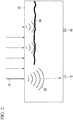
- Fig. 2 is a view illustrating a state ofp ropagation ofa n elastic wave due to rainfall.
- a raindrop 31 collides with a road surface 32
- an elastic wave 33 is generated at the collision position.
- the elastic wave 33 propagates through the interior oft he floor slab and also to a lower surface thereof.
- the elastic wave 33 that maintains a sufficient amplitude until reaching the AE sensor 10 installed at the lower surface is detected byth e AE sensor 10.
- the position locator 201 can identify an approximate collision position of the raindrop 31 by locating a position with respect to the elastic wave 33 generated by rain. In this way, an impact caused by collision of a micro-object is an impact applied to a surface (the road surface 32 in Fig. 2 ) opposite to the surface at which the AE sensor 10 is installed.
- the elastic wave 33 generated by the raindrop 31 colliding witht he road surface 32 is blocked by the crack, or bypasses or is attenuated by the crack. Therefore, iti s difficult for the elastic wave 33 having a sufficient amplitude to reach the AE sensor 10 located directly below the crack. Consequently, the position locator201 locates fewer AE sources in the area under the large horizontalc rack34. Collision oft he raindrops 31 against the road surface 32 due to rainfall occurs randomlyan d evenlywi th respect to the entire region.
- the elastic wave 33 is detected on the lower surface oft he floor slab without large damage, and AE sources are evenly located all over a region when the position location of the AE sources is performed.
- AE sources are evenly located all over a region when the position location of the AE sources is performed.
- the structure evaluation apparatus 20 in the embodiment evaluates the soundness of the structure on the basis of such assumption.
- Fig. 3 is a view illustrating a trend of the number of occurrences of elastic waves during a certain measurement period.
- the horizontal axis represents the time (hours) during the measurement period
- the vertical axis represents the number of hits.
- the number ofh its is the number of detected elastic waves.
- the number ofh its represents the number of detected elastic waves every3 0 minutes, for example.
- the number of hits from 0 hours to 120 hours in the measurement period is the number of detected elastic waves in the normals tate.
- the position locator 201 in the structure evaluation apparatus 20 derives the source distribution by using AE signals within a predetermined period including a time at which a large amount of elastic waves are detected (hereinafter referred to as "target time") as illustrated in Fig. 3 as the plurality of AE signals caused by the impact on the structure.
- target time a time at which a large amount of elastic waves are detected
- Whether a large amount of elastic waves is detected is determined on the basis of whether the number of elastic waves detected at a certain time is a second threshold value or larger. When the number of elastic waves detected ata certain time is the second threshold value or larger, it is determined that a large amount of elastic waves have been detected.
- the second threshold value may be set in advance or may be appropriately set.
- the predetermined period may be a predetermined period of time before and after a target time (for example, 5 minutes before and after the target time), or may be a period before the target time or a period after the target time when the target time is included in the predetermined period.
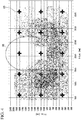
- Fig. 4 is a view illustrating an example of a source distribution derived using an AE signal within a predetermined period.
- the horizontalaxis and the vertical axis represent the length (mm)i n the horizontal direction and the length (mm) in the vertical direction from the specific position on the structure to be evaluated.
- a result ofl ocating AE sources using AE signals during about ten minutes during rainfall in Fig. 3 (e.g., about ten minutes including the time (reference numeral 35) at which a great number of elastic waves 35 are observed in the measurement period from 120 hours to 130 hours) is shown.
- the + mark in the figure indicates an installation position oft he AE sensor 10.
- the evaluator 202 evaluates a region in which the density oft he AE sources is less than the first threshold value (the region 36 in Fig. 4 ) as a region in which deterioration of the structure is occurring. Any region may be a target for evaluation oft he evaluator 202.
- the evaluator 202 may performe valuation for each region surrounded by four AE sensors 10, may performe valuation for each region surrounded by four or more AE sensors 10, may performe valuation for each region surrounded by three AE sensors 10, or may perform evaluation for each region having a designated range.
- Fig. 5 is a flowchart illustrating a flow ofa n evaluation process of the structure evaluation apparatus 20. The process in Fig. 5 is executed when the number of detected elastic waves is the second threshold value or larger. Further, it is assumed that an AE signal output from the signal processor 11 is accumulated in a buffer (not illustrated).
- the position locator 201 acquires an AE signal within a predetermined period from the buffer (not illustrated) (Step S101). That is, the position locator 201 obtains an AE signal within a predetermined period including the target time from the buffer (not illustrated).
- the position locator 201 locates positions oft he AE sources by using a pluralityof acqui red AE signals (Step S102). Then, the position locator 201 derives the source distribution on the basis of the position location results (Step S103).
- the position locator 201 outputs the generated source distribution to the evaluator 202.
- the evaluator 202 determines whether a region in which the densityof th e AE sources is less than the first threshold is present (Step S104). When a region in which the density of the AE sources is less than the first threshold value is present (YES to Step S104), the evaluator 202 evaluates the region in which the density is less than the first threshold value as a region in which deterioration of the structure is occurring (Step S105).
- the evaluator 202 evaluates that a region in which deterioration oft he structure is occurring is not present (Step S106).
- the evaluator 202 makes the display 203 display the evaluation result.
- the evaluator 202 displays the evaluation result by displaying a region in which deterioration is occurring in the source distribution in a formdi fferent from that of other regions.
- the form different from that of other regions may include coloring the region in which deterioration is occurring, surrounding the region in which deterioration is occurring by a circle, or marking the region in which deterioration is occurring using a letter.
- the display 203 displays the evaluation result according to the control oft he evaluator 202.
- the structure evaluation apparatus 20 derives a source distribution including a large amount ofA E sources. Then, on the basis of the source distribution, the structure evaluation apparatus 20 evaluates a region in which the density oft he AE sources is less than the first threshold value as a region in which the deterioration of the structure is occurring. In this way, by using data which is conventionally a source of noise, a structure can be efficiently evaluated.
- the structure evaluation apparatus 20 derives the source distribution by using the AE signal within a predetermined period including the target time as the AE signal caused by the impact on the structure. Conventionally, severalt ens ofh ours of measurement is required to perform the evaluation. In comparison witht his, according to the method using the structure evaluation apparatus 20, the required time is significantly shortened by using only the AE signal within the predetermined period including the target time, and the evaluation can be performed efficiently.
- the structure evaluation apparatus 20 may include only the evaluator 202, and the position locator 201 and the display 203 may be provided in separate housings.
- the evaluator 202 acquires the source distribution from another housing and evaluates the soundness oft he structure using the acquired source distribution. Then, the evaluator 202 outputs the evaluation result to the display 203 provided in another housing.
- the signal processor 11 may be provided in the structure evaluation apparatus 20. In this case, the signalprocess or 11 acquires an AE source signal processed by the AE sensor 10 directly from the AE sensor 10 or via a relay device (not illustrated).
- the structure evaluation system 100 may include a pluralityof signal processor s 11 and have a plurality of sensor units by the signal processor s 11 being connected to the AE sensors 10, respectively.
- the evaluator 202 may be configured to derive the source distribution by using the AE signal at the target time as the AE signal caused by an impact on the structure.
- the evaluator 202 mayo perate as an output controlu nit.
- the output controlu nitc ontrol s an output unit and outputs the evaluation result.
- the output unit includes the display 203, a communication unit, and a printing unit.
- the output controlu nitc ontrol s the communication unit and transmits the evaluation result to another device.
- the output control unit controls the printing unit and prints the evaluation result.
- the structure evaluation apparatus 20 may include some or all of the display 203, the communication unit, and the printing unit as the output unit and execute the above operations.
- the evaluator 202 may display the source distribution as a contour map on the display 203.
- a factor causing increase in the number of generated elastic waves is not necessarily limited to the above example (weather phenomenon). More precisely, the numerous micro-objects as the factor causing increase in the number of generated elastic waves are not necessarily limited to objects generated by weather phenomenon.
- the numerous micro-objects may be objects generated by water-sprinkling by a sprinkler vehicle or spraying or sprinkling chemicals, or by a device such as hammer for hitting. Other hitting may be hitting by chain drawing or byt apping.
- the structure evaluation apparatus 20 can control the measurement timing by using a source of elastic waves generated due to an impact generated by artificial actions such as hitting multiple times using a device or micro-objects such as water-sprinkling by a sprinkler vehicle or spraying or sprinkling chemicals. Therefore, diagnosis can be performed more efficiently. if a time of water-sprinkling by a sprinkler vehicle is in advance known, a user oft he structure evaluation system 100 starts up the structure evaluation system 100 at the time ofw ater-sprinkling by the sprinkler vehicle for evaluation oft he structure, there by controlling the measurement timing.
- the structure evaluation system 100 is at rest at normal times, and a trigger for notifying the activation timing may be input from outside in accordance with the timing ofg enerating elastic waves. I n this way, operation is possible with reduced power consumption.
- Figs. 6 and 7 are sequence diagrams illustrating a processing flow of the structure evaluation system 100.
- the AE sensor 10-1 is operating at the start of the processing and the AE sensor 10-2 is at rest. Being at rest does not mean that all functions oft he apparatus are paused, but means that only functions related to activation are operating.
- the AE sensor 10-1 detects an elastic wave (an AE wave) generated by the structure (Step S201).
- the AE sensor 10-1 converts the detected elastic wave into a voltage signal (an AE source signal), performs processing, such as amplification, frequency limiting, and the like, on the AE source signal, and outputs the processing result to the signal processor 11 (Step S202).
- the signal processor 11 performs necessary signal processing such as noise removal and parameter extraction on the input AE source signal (Step S203).
- the signal processor 11 outputs information based on the AE parameters extracted by performing signal processing to the structure evaluation apparatus 20 as an AE signal (Step S204).
- the processing from Step S201 to Step S204 is repeatedlye xecuted.
- the AE signal output from the signal processor 11 is accumulated in the buffer (not illustrated).
- Step S205 the position locator 201 detects that a sharp increase in the number of generated elastic waves has occurred when a difference between the number of elastic waves generated at the current time and the number of elastic waves generated at an immediately preceding time exceeds a third threshold value.
- the third threshold value may be set in advance or may be appropriately set.
- the position locator 201 notifies the signal processor 11 that a sharp increase in the number of generated elastic waves has been detected (Step S206).
- the signal processor 11 Upon receiving the notification from the position locator201, the signal processor 11 transmits an activation signal to the AE sensor 10-2 that is at rest (Step S207).
- the activation signal refers to a signal for instructing execution of activation processing.
- the AE sensor 10-2 Upon receiving the activation signal from the signalprocess or 11, the AE sensor 10-2 executes the activation processing (Step S208). As a result, the AE sensor 10-2 is operated from the state atr est.
- the AE sensor 10-1 detects an elastic wave (AE wave) generated by the structure (Step S209).
- the AE sensor 10-1 converts the detected elastic wave into a voltage signal (AE source signal), performs processing such as amplification and frequency limiting, on the AE source signal, and outputs the processing result to the signal processor 11 (Step S210).
- the signal processor 11 performs necessary signal processing such as noise removal and parameter extraction on the input AE source signal (Step S211).
- the signal processor 11 outputs information based on the AE parameters extracted by performing signal processing to the structure evaluation apparatus 20 as an AE signal (Step S212).
- the processing from Step S209 to Step S212 is repeatedlye xecuted.
- the AE signal output from the signal processor 11 is stored in the buffer (not illustrated).
- the AE sensor 10-2 detects an elastic wave (an AE wave) generated by the structure (Step S213).
- the AE sensor 10-2 converts the detected elastic wave into a voltage signal (an AE source signal), performs processing, such as amplification, frequency limiting, and the like, on the AE source signal, and outputs the processing result to the signal processor 11 (Step S214).
- the signal processor 11 performs necessary signal processing such as noise removal and parameter extraction on the input AE source signal (Step S215).
- the signal processor 11 outputs information based on the AE parameters extracted by performing signal processing to the structure evaluation apparatus 20 as an AE signal (Step S216).
- the processing from Step S213 to Step S216 is repeatedly executed.
- the AE signal output from the signal processor 11 is accumulated in the buffer (not illustrated).
- the position locator 201 acquires an AE signal within a predetermined period including the target time from the buffer (not illustrated). Using the acquired AE signal, the position locator 201 locates positions oft he AE sources (Step S217). Then, the position locator 201 derives the source distribution on the basis of the position location results (Step S218). The position locator 201 outputs the derived source distribution to the evaluator 202. The evaluator 202 performs evaluation using the source distribution output from the position locator 201 (Step S 219). The evaluation method is the same as the above-mentioned method and will thus be omitted. The evaluator 202 makes the display 203 displayth e evaluation result. The display 203 displays the evaluation result according to the controlof the evaluator 202 (Step S220).
- the AE sensor 10 may be activated when a micro-object is detected by a device such as a rain gauge, a camera, and a microphone. Also, for example, the AE sensor 10 may be activated at a time when an event due to an impact on a structure is expected based on weather information such as rainfall, temperature and humidity levels near a measurement region.
- a structure can be evaluated efficiently by having the plurality of AE sensors 10 configured to detect elastic waves generated from a structure, the signal processor 11 configured to perform signal processing on the elastic waves detected by the AE sensors 10 to output an AE signal, a position locator 201 configured to derive a source distribution by using an AE signal caused by an impact on the structure, and the evaluator 202 configured to evaluate a state of deterioration ofa predetermined region oft he structure from a density ofA E sources obtained on the basis of the source distribution.
Landscapes
- Physics & Mathematics (AREA)
- General Physics & Mathematics (AREA)
- Pathology (AREA)
- Life Sciences & Earth Sciences (AREA)
- Chemical & Material Sciences (AREA)
- Analytical Chemistry (AREA)
- Biochemistry (AREA)
- Health & Medical Sciences (AREA)
- Immunology (AREA)
- General Health & Medical Sciences (AREA)
- Acoustics & Sound (AREA)
- Engineering & Computer Science (AREA)
- Signal Processing (AREA)
- Investigating Or Analyzing Materials By The Use Of Ultrasonic Waves (AREA)
- Testing Of Devices, Machine Parts, Or Other Structures Thereof (AREA)
- Bridges Or Land Bridges (AREA)
Applications Claiming Priority (3)
| Application Number | Priority Date | Filing Date | Title |
|---|---|---|---|
| JP2016119306 | 2016-06-15 | ||
| PCT/JP2017/008824 WO2017217033A1 (ja) | 2016-06-15 | 2017-03-06 | 構造物評価システム、構造物評価装置及び構造物評価方法 |
| EP17707455.6A EP3290915B1 (en) | 2016-06-15 | 2017-03-06 | Structure evaluation system, structure evaluation device, and structure evaluation method |
Related Parent Applications (2)
| Application Number | Title | Priority Date | Filing Date |
|---|---|---|---|
| EP17707455.6A Division-Into EP3290915B1 (en) | 2016-06-15 | 2017-03-06 | Structure evaluation system, structure evaluation device, and structure evaluation method |
| EP17707455.6A Division EP3290915B1 (en) | 2016-06-15 | 2017-03-06 | Structure evaluation system, structure evaluation device, and structure evaluation method |
Publications (1)
| Publication Number | Publication Date |
|---|---|
| EP3719491A1 true EP3719491A1 (en) | 2020-10-07 |
Family
ID=60663675
Family Applications (3)
| Application Number | Title | Priority Date | Filing Date |
|---|---|---|---|
| EP20175353.0A Pending EP3719491A1 (en) | 2016-06-15 | 2017-03-06 | Structure evaluation system, structure evaluation device, and structure evaluation method |
| EP17707457.2A Active EP3293517B1 (en) | 2016-06-15 | 2017-03-06 | Structure evaluation system, structure evaluation device, and structure evaluation method |
| EP17707455.6A Active EP3290915B1 (en) | 2016-06-15 | 2017-03-06 | Structure evaluation system, structure evaluation device, and structure evaluation method |
Family Applications After (2)
| Application Number | Title | Priority Date | Filing Date |
|---|---|---|---|
| EP17707457.2A Active EP3293517B1 (en) | 2016-06-15 | 2017-03-06 | Structure evaluation system, structure evaluation device, and structure evaluation method |
| EP17707455.6A Active EP3290915B1 (en) | 2016-06-15 | 2017-03-06 | Structure evaluation system, structure evaluation device, and structure evaluation method |
Country Status (5)
| Country | Link |
|---|---|
| US (2) | US10613060B2 (https=) |
| EP (3) | EP3719491A1 (https=) |
| JP (3) | JP6386175B2 (https=) |
| CN (2) | CN107850577B (https=) |
| WO (2) | WO2017217034A1 (https=) |
Families Citing this family (24)
| Publication number | Priority date | Publication date | Assignee | Title |
|---|---|---|---|---|
| WO2017199544A1 (ja) | 2016-05-17 | 2017-11-23 | 株式会社東芝 | 構造物評価システム、構造物評価装置及び構造物評価方法 |
| WO2017217034A1 (ja) * | 2016-06-15 | 2017-12-21 | 株式会社東芝 | 構造物評価システム、構造物評価装置及び構造物評価方法 |
| US10801998B2 (en) * | 2017-03-13 | 2020-10-13 | University Of South Carolina | Identifying structural defect geometric features from acoustic emission waveforms |
| CN109642847B (zh) | 2017-06-21 | 2021-05-25 | 株式会社东芝 | 构造物评价系统以及构造物评价方法 |
| JP6756927B2 (ja) * | 2018-02-27 | 2020-09-16 | 株式会社東芝 | 構造物評価システム及び構造物評価方法 |
| CN112334765B (zh) * | 2018-06-22 | 2024-07-09 | 杰富意钢铁株式会社 | 蓄压器的寿命推定装置及蓄压器的寿命延长方法 |
| EP3851849A4 (en) | 2018-09-13 | 2022-05-04 | Kabushiki Kaisha Toshiba | STRUCTURE ASSESSMENT SYSTEM, STRUCTURE ASSESSMENT DEVICE AND STRUCTURE ASSESSMENT METHOD |
| CN109374748A (zh) * | 2018-10-30 | 2019-02-22 | 上海市特种设备监督检验技术研究院 | 声发射源时反定位成像方法 |
| CN110346452B (zh) * | 2019-07-26 | 2021-10-26 | 招商局重庆公路工程检测中心有限公司 | 一种混凝土结构浅表层质量快速检测方法 |
| JP7368240B2 (ja) * | 2020-01-08 | 2023-10-24 | 株式会社フジタ | 可搬型打撃装置 |
| JP7285797B2 (ja) * | 2020-02-28 | 2023-06-02 | 株式会社東芝 | 状態評価システム、状態評価装置及び状態評価方法 |
| JP7323698B2 (ja) * | 2020-07-16 | 2023-08-08 | 株式会社東芝 | 構造物評価システム、構造物評価装置及び構造物評価方法 |
| JP7362580B2 (ja) | 2020-09-16 | 2023-10-17 | 株式会社東芝 | 構造物評価方法、及び構造物評価システム |
| JP7480019B2 (ja) * | 2020-10-27 | 2024-05-09 | 株式会社東芝 | 車両情報推定システム、車両情報推定装置、車両情報推定方法及びコンピュータプログラム |
| JP7480086B2 (ja) * | 2021-03-22 | 2024-05-09 | 株式会社東芝 | 構造物評価システム、構造物評価装置及び構造物評価方法 |
| JP7577632B2 (ja) | 2021-09-14 | 2024-11-05 | 株式会社東芝 | 腐食判定システム及び腐食判定方法 |
| JP7508427B2 (ja) * | 2021-09-16 | 2024-07-01 | 株式会社東芝 | 構造物評価システム、構造物評価装置及び構造物評価方法 |
| JP7830114B2 (ja) | 2021-12-20 | 2026-03-16 | 株式会社東芝 | 構造物評価システム及び構造物評価方法 |
| CN115243192B (zh) * | 2022-06-30 | 2024-12-17 | 上海市信息技术研究中心 | 基于蓝牙数据耦合气压数据的楼层定位方法、装置及设备 |
| JP7771031B2 (ja) * | 2022-09-16 | 2025-11-17 | 株式会社東芝 | 構造物評価システム、信号処理装置、構造物評価方法及びコンピュータプログラム |
| US20240201220A1 (en) * | 2022-12-20 | 2024-06-20 | Schmidt Custom Floors, Inc. | Device for Detecting Impact on Flooring |
| KR102927523B1 (ko) * | 2023-02-13 | 2026-02-13 | 한국수력원자력 주식회사 | 탄성파를 이용하여 구조물의 공동을 탐사하는 방법 |
| JP7823000B2 (ja) * | 2023-07-19 | 2026-03-03 | 株式会社東芝 | 構造物評価システム、構造物評価方法及び構造物評価装置 |
| CN119682699A (zh) * | 2025-01-21 | 2025-03-25 | 珠海佑航科技有限公司 | 一种利用弹性波精准检测车身碰撞的装置和方法 |
Citations (6)
| Publication number | Priority date | Publication date | Assignee | Title |
|---|---|---|---|---|
| JP2004125721A (ja) | 2002-10-07 | 2004-04-22 | Railway Technical Res Inst | 2次起因のae音による構造物損傷度判定方法および装置 |
| CN102269736B (zh) * | 2011-07-08 | 2012-12-19 | 天津大学 | 罐底腐蚀声发射检测中声源分布区域的自动识别方法 |
| US20140067284A1 (en) * | 2002-06-11 | 2014-03-06 | Intelligent Technologies International, Inc. | Structural monitoring |
| US20140123758A1 (en) * | 2011-05-20 | 2014-05-08 | Hatch Ltd. | Furnace structural integrity monitoring systems and methods |
| US20160084803A1 (en) * | 2014-09-18 | 2016-03-24 | Kabushiki Kaisha Toshiba | Detection system and detection method |
| US20160139084A1 (en) * | 2014-11-18 | 2016-05-19 | Kabushiki Kaisha Toshiba | Signal processing apparatus, server, detection system, and signal processing method |
Family Cites Families (16)
| Publication number | Priority date | Publication date | Assignee | Title |
|---|---|---|---|---|
| US6919803B2 (en) * | 2002-06-11 | 2005-07-19 | Intelligent Technologies International Inc. | Low power remote asset monitoring |
| JP4188273B2 (ja) * | 2004-03-31 | 2008-11-26 | 太平洋セメント株式会社 | プレストレストコンクリートの緊張材の破断検出方法 |
| CN101071126A (zh) * | 2007-06-15 | 2007-11-14 | 哈尔滨工业大学 | 微小凸焊焊点质量的无损检测方法 |
| CN101561379B (zh) * | 2009-05-13 | 2011-06-29 | 清华大学 | 一种用于结构损伤检测的敲击扫描方法 |
| JP5541506B2 (ja) * | 2010-05-19 | 2014-07-09 | 清水建設株式会社 | 検査装置 |
| CN101907606A (zh) * | 2010-07-12 | 2010-12-08 | 哈尔滨工业大学深圳研究生院 | 一种超声波钢管混凝土柱质量检测方法 |
| CN102621237A (zh) * | 2012-03-12 | 2012-08-01 | 河海大学常州校区 | 大功率单脉冲超声信号发生器及其无损探伤的方法 |
| WO2014035786A2 (en) * | 2012-08-31 | 2014-03-06 | Board Of Regents, The University Of Texas System | Devices, systems, and methods for non-destructive testing of materials and structures |
| JP6171214B2 (ja) * | 2012-11-07 | 2017-08-02 | 飛島建設株式会社 | トモグラフィ解析を利用した構造物の非破壊検査システム |
| CN102944613B (zh) * | 2012-11-16 | 2015-04-01 | 中国科学院半导体研究所 | 一种光纤声发射检测与定位系统 |
| JP6189227B2 (ja) * | 2013-02-20 | 2017-08-30 | 株式会社東芝 | 超音波探傷装置およびその評価方法 |
| JP6095518B2 (ja) | 2013-08-05 | 2017-03-15 | 株式会社Ihi検査計測 | 複合材タンクのae試験装置と方法 |
| WO2015182079A1 (ja) * | 2014-05-29 | 2015-12-03 | 日本電気株式会社 | 検知システム、検知装置、検知方法及びコンピュータ読み取り可能記録媒体 |
| CN104266084A (zh) * | 2014-09-22 | 2015-01-07 | 天津大学 | 基于分布式光纤传感器的输油管道内检测器跟踪定位方法 |
| WO2017199544A1 (ja) | 2016-05-17 | 2017-11-23 | 株式会社東芝 | 構造物評価システム、構造物評価装置及び構造物評価方法 |
| WO2017217034A1 (ja) * | 2016-06-15 | 2017-12-21 | 株式会社東芝 | 構造物評価システム、構造物評価装置及び構造物評価方法 |
-
2017
- 2017-03-06 WO PCT/JP2017/008833 patent/WO2017217034A1/ja not_active Ceased
- 2017-03-06 WO PCT/JP2017/008824 patent/WO2017217033A1/ja not_active Ceased
- 2017-03-06 EP EP20175353.0A patent/EP3719491A1/en active Pending
- 2017-03-06 JP JP2017514715A patent/JP6386175B2/ja active Active
- 2017-03-06 CN CN201780000089.3A patent/CN107850577B/zh active Active
- 2017-03-06 JP JP2017514720A patent/JP6368039B2/ja active Active
- 2017-03-06 EP EP17707457.2A patent/EP3293517B1/en active Active
- 2017-03-06 CN CN201780000090.6A patent/CN107850578B/zh active Active
- 2017-03-06 EP EP17707455.6A patent/EP3290915B1/en active Active
- 2017-03-09 US US15/453,987 patent/US10613060B2/en active Active
- 2017-03-10 US US15/455,646 patent/US10345275B2/en active Active
-
2018
- 2018-07-04 JP JP2018127885A patent/JP6871201B2/ja not_active Expired - Fee Related
Patent Citations (6)
| Publication number | Priority date | Publication date | Assignee | Title |
|---|---|---|---|---|
| US20140067284A1 (en) * | 2002-06-11 | 2014-03-06 | Intelligent Technologies International, Inc. | Structural monitoring |
| JP2004125721A (ja) | 2002-10-07 | 2004-04-22 | Railway Technical Res Inst | 2次起因のae音による構造物損傷度判定方法および装置 |
| US20140123758A1 (en) * | 2011-05-20 | 2014-05-08 | Hatch Ltd. | Furnace structural integrity monitoring systems and methods |
| CN102269736B (zh) * | 2011-07-08 | 2012-12-19 | 天津大学 | 罐底腐蚀声发射检测中声源分布区域的自动识别方法 |
| US20160084803A1 (en) * | 2014-09-18 | 2016-03-24 | Kabushiki Kaisha Toshiba | Detection system and detection method |
| US20160139084A1 (en) * | 2014-11-18 | 2016-05-19 | Kabushiki Kaisha Toshiba | Signal processing apparatus, server, detection system, and signal processing method |
Also Published As
| Publication number | Publication date |
|---|---|
| US20170363586A1 (en) | 2017-12-21 |
| JP6871201B2 (ja) | 2021-05-12 |
| JP6386175B2 (ja) | 2018-09-05 |
| WO2017217033A1 (ja) | 2017-12-21 |
| CN107850578B (zh) | 2021-06-25 |
| EP3293517B1 (en) | 2025-02-26 |
| EP3290915A1 (en) | 2018-03-07 |
| EP3293517A4 (en) | 2018-08-01 |
| JPWO2017217033A1 (ja) | 2018-06-21 |
| EP3290915B1 (en) | 2020-07-15 |
| CN107850578A (zh) | 2018-03-27 |
| CN107850577A (zh) | 2018-03-27 |
| JP2018165725A (ja) | 2018-10-25 |
| JP6368039B2 (ja) | 2018-08-01 |
| US10345275B2 (en) | 2019-07-09 |
| CN107850577B (zh) | 2020-12-15 |
| EP3293517A1 (en) | 2018-03-14 |
| JPWO2017217034A1 (ja) | 2018-06-28 |
| WO2017217034A1 (ja) | 2017-12-21 |
| US20170363587A1 (en) | 2017-12-21 |
| EP3290915A4 (en) | 2018-07-25 |
| US10613060B2 (en) | 2020-04-07 |
Similar Documents
| Publication | Publication Date | Title |
|---|---|---|
| EP3719491A1 (en) | Structure evaluation system, structure evaluation device, and structure evaluation method | |
| US10648949B2 (en) | Structure evaluation system, structure evaluation apparatus, and structure evaluation method | |
| JP7222014B2 (ja) | 構造物評価システム、構造物評価装置及び構造物評価方法 | |
| US10883919B2 (en) | Structure evaluation system and structure evaluation method | |
| CN115389633A (zh) | 构造物评价系统以及构造物评价方法 |
Legal Events
| Date | Code | Title | Description |
|---|---|---|---|
| PUAI | Public reference made under article 153(3) epc to a published international application that has entered the european phase |
Free format text: ORIGINAL CODE: 0009012 |
|
| STAA | Information on the status of an ep patent application or granted ep patent |
Free format text: STATUS: REQUEST FOR EXAMINATION WAS MADE |
|
| 17P | Request for examination filed |
Effective date: 20200519 |
|
| AC | Divisional application: reference to earlier application |
Ref document number: 3290915 Country of ref document: EP Kind code of ref document: P |
|
| AK | Designated contracting states |
Kind code of ref document: A1 Designated state(s): AL AT BE BG CH CY CZ DE DK EE ES FI FR GB GR HR HU IE IS IT LI LT LU LV MC MK MT NL NO PL PT RO RS SE SI SK SM TR |
|
| STAA | Information on the status of an ep patent application or granted ep patent |
Free format text: STATUS: EXAMINATION IS IN PROGRESS |
|
| 17Q | First examination report despatched |
Effective date: 20220329 |