EP3707130B1 - Polyepoxidierte biphenyl verbindugen, deren herstellung und anwendungen - Google Patents
Polyepoxidierte biphenyl verbindugen, deren herstellung und anwendungen Download PDFInfo
- Publication number
- EP3707130B1 EP3707130B1 EP18812242.8A EP18812242A EP3707130B1 EP 3707130 B1 EP3707130 B1 EP 3707130B1 EP 18812242 A EP18812242 A EP 18812242A EP 3707130 B1 EP3707130 B1 EP 3707130B1
- Authority
- EP
- European Patent Office
- Prior art keywords
- formula
- functions
- divanillic
- alkylated
- epoxy
- Prior art date
- Legal status (The legal status is an assumption and is not a legal conclusion. Google has not performed a legal analysis and makes no representation as to the accuracy of the status listed.)
- Active
Links
Images


Classifications
-
- C—CHEMISTRY; METALLURGY
- C08—ORGANIC MACROMOLECULAR COMPOUNDS; THEIR PREPARATION OR CHEMICAL WORKING-UP; COMPOSITIONS BASED THEREON
- C08G—MACROMOLECULAR COMPOUNDS OBTAINED OTHERWISE THAN BY REACTIONS ONLY INVOLVING UNSATURATED CARBON-TO-CARBON BONDS
- C08G59/00—Polycondensates containing more than one epoxy group per molecule; Macromolecules obtained by polymerising compounds containing more than one epoxy group per molecule using curing agents or catalysts which react with the epoxy groups
- C08G59/18—Macromolecules obtained by polymerising compounds containing more than one epoxy group per molecule using curing agents or catalysts which react with the epoxy groups ; e.g. general methods of curing
- C08G59/20—Macromolecules obtained by polymerising compounds containing more than one epoxy group per molecule using curing agents or catalysts which react with the epoxy groups ; e.g. general methods of curing characterised by the epoxy compounds used
- C08G59/32—Epoxy compounds containing three or more epoxy groups
- C08G59/38—Epoxy compounds containing three or more epoxy groups together with di-epoxy compounds
-
- C—CHEMISTRY; METALLURGY
- C07—ORGANIC CHEMISTRY
- C07D—HETEROCYCLIC COMPOUNDS
- C07D303/00—Compounds containing three-membered rings having one oxygen atom as the only ring hetero atom
- C07D303/02—Compounds containing oxirane rings
- C07D303/12—Compounds containing oxirane rings with hydrocarbon radicals, substituted by singly or doubly bound oxygen atoms
- C07D303/18—Compounds containing oxirane rings with hydrocarbon radicals, substituted by singly or doubly bound oxygen atoms by etherified hydroxyl radicals
- C07D303/28—Ethers with hydroxy compounds containing oxirane rings
-
- C—CHEMISTRY; METALLURGY
- C07—ORGANIC CHEMISTRY
- C07D—HETEROCYCLIC COMPOUNDS
- C07D301/00—Preparation of oxiranes
- C07D301/27—Condensation of epihalohydrins or halohydrins with compounds containing active hydrogen atoms
- C07D301/28—Condensation of epihalohydrins or halohydrins with compounds containing active hydrogen atoms by reaction with hydroxyl radicals
-
- C—CHEMISTRY; METALLURGY
- C08—ORGANIC MACROMOLECULAR COMPOUNDS; THEIR PREPARATION OR CHEMICAL WORKING-UP; COMPOSITIONS BASED THEREON
- C08G—MACROMOLECULAR COMPOUNDS OBTAINED OTHERWISE THAN BY REACTIONS ONLY INVOLVING UNSATURATED CARBON-TO-CARBON BONDS
- C08G59/00—Polycondensates containing more than one epoxy group per molecule; Macromolecules obtained by polymerising compounds containing more than one epoxy group per molecule using curing agents or catalysts which react with the epoxy groups
- C08G59/18—Macromolecules obtained by polymerising compounds containing more than one epoxy group per molecule using curing agents or catalysts which react with the epoxy groups ; e.g. general methods of curing
- C08G59/20—Macromolecules obtained by polymerising compounds containing more than one epoxy group per molecule using curing agents or catalysts which react with the epoxy groups ; e.g. general methods of curing characterised by the epoxy compounds used
- C08G59/22—Di-epoxy compounds
- C08G59/24—Di-epoxy compounds carbocyclic
- C08G59/245—Di-epoxy compounds carbocyclic aromatic
-
- C—CHEMISTRY; METALLURGY
- C08—ORGANIC MACROMOLECULAR COMPOUNDS; THEIR PREPARATION OR CHEMICAL WORKING-UP; COMPOSITIONS BASED THEREON
- C08G—MACROMOLECULAR COMPOUNDS OBTAINED OTHERWISE THAN BY REACTIONS ONLY INVOLVING UNSATURATED CARBON-TO-CARBON BONDS
- C08G59/00—Polycondensates containing more than one epoxy group per molecule; Macromolecules obtained by polymerising compounds containing more than one epoxy group per molecule using curing agents or catalysts which react with the epoxy groups
- C08G59/18—Macromolecules obtained by polymerising compounds containing more than one epoxy group per molecule using curing agents or catalysts which react with the epoxy groups ; e.g. general methods of curing
- C08G59/20—Macromolecules obtained by polymerising compounds containing more than one epoxy group per molecule using curing agents or catalysts which react with the epoxy groups ; e.g. general methods of curing characterised by the epoxy compounds used
- C08G59/32—Epoxy compounds containing three or more epoxy groups
- C08G59/3218—Carbocyclic compounds
Definitions
- the main object of the present invention is a process for the preparation of pluriepoxidized biphenyl compounds (i.e. whose chemical formula contains at least 2 epoxy functions).
- pluriepoxidized biphenyl compounds i.e. whose chemical formula contains at least 2 epoxy functions.
- These compounds constitute monomers or prepolymers, of the epoxy resin type, thermosetting. They are particularly interesting in that they are perfectly suitable as precursors for obtaining polyepoxides (thermoset epoxy resins) having high mechanical properties and temperature resistance and in that, for many of them, they can be obtained , in addition to conventional synthesis routes (known in the field of petrochemicals), from biomass (from lignin) (we can then speak of biosourced products).
- BPA bisphenol-A
- Vanillin is a priori a very interesting candidate insofar as it consists of one of the rare aromatic, non-toxic compounds available industrially from biomass.
- vanillin and its derivatives as basic building blocks, of natural origin, of renewable polymers and in particular of epoxy resins, has thus been studied with great interest.
- vanillin-based cured epoxy resins exhibiting Tg between 80°C and 176°C, have been synthesized.
- R -O-Alk
- it advantageously consists of a lower -O-Alk group, said lower alkyl group comprising only 1 to 4 carbon atoms, or even very advantageously only 1 or 2 carbon atoms.
- R is a priori fixed by the nature of the starting products used.
- Each of the two main families is itself made up, according to the same logic, of subfamilies.
- the biphenyl compounds can be di-, tri- or tetra-epoxidized.
- R 3 groups of the compounds of formula (I) are thus not epoxidized (but alkylated), it is appropriate that their R 1 and R 2 groups be.
- biphenyl compounds obtained according to the process of the invention as precursors of polyepoxides (as monomers or prepolymers to polymerize (to crosslink) under the action of a hardener ), due to the presence of 2, 3 or 4 epoxy groups (capable of reacting with said hardener) in their formula.
- the presence of the two aromatic nuclei proved to be particularly interesting with reference to the mechanical properties and the temperature resistance of said polyepoxides and the presence of the Carbon-Carbon bond between said two aromatic nuclei proved to be surprisingly appropriate in reference to the level of residual coke after thermal degradation of said polyepoxides.
- the process when the process generates mixtures of at least two compounds of the invention (see below), it can include a separation step (conventional, and in particular by column chromatography) of said at least two compounds.
- vanillin (V), eugenol (EG) and isoeugenol (isoEG) are natural products and that therefore, a number of compounds of the invention, obtained from such natural products, are biosourced products.
- These products - vanillin, eugenol and isoeugenol dimer - as well as products with relatively similar formulas can also be obtained by conventional synthesis.
- Such products, having relatively similar formulas, are marketed, for example methyl vanillate, ethyl vanillin, etc.
- Such products are certainly also suitable for implementing the process as presently described.
- Examples 1, 4 and 7 of the application EP 3 002 333 respectively illustrate the preparation of divanillin (DV), methyl divanillate (example of DVE (divanillin ester) of Figure 1A ) and Grogénol (DEG).
- DV divanillin
- DVE divanillin ester
- dimers chosen from divanillin (DV), alkylated divanillin (DV'), divanillin esters (DVE) and alkylated divanillin esters (DVE') can be transformed into other dimers whose formula contains functions of alcohol, hydroxy and acid type, functions likely to be epoxidized later.
- dimers, with such epoxidizable functions, in addition to their phenolic (epoxidizable) -OH functions, are particularly interesting, in that they are potential precursors of compounds of formula (I) with three or four epoxy functions.
- DVE divanillin esters
- DVE' alkylated divanillin esters
- DVAc divanillic acid
- DVAc' alkylated divanillic acid
- this epoxidation step (which, to epoxidize several types of functions of the same dimer, can take place in several epoxidation “phases” (for example, epoxidation of -OH functions then epoxidation of at least a double bond)) as generally described above, we can, for all practical purposes, provide the following details, with reference to each dimer in question.
- Divanyl alcohol (DVA) and alkylated divanyl alcohol (DVA') are conveniently, in the context of the invention, epoxidized according to the first or second of the epoxidation methods presented above. There are respectively, for DVA, 2 epoxidizable phenolic -OH functions as well as two epoxidizable -CH 2 -OH functions and, for DVA', 2 epoxidizable -CH 2 -OH functions.
- DVA divanillic alcohol
- Divanillin (DV) has its two phenolic -OH functions capable of being epoxidized.
- Dimethoxyhydroquinone (DMHQ) and alkylated dimethoxyhydroquinone (DMHQ') are conveniently, in the context of the invention, epoxidized according to the first (reaction with epichlorohydrin (illustrated in Example 3 below) or equivalent (Cl- Z)) or the second (allylation (conventional or green, which introduces an allyl group) + epoxidation (properly speaking, oxidizing) of the epoxidation methods presented above.
- DMHQ 4 phenolic -OH functions epoxidizable
- DMHQ' 2 epoxidizable phenolic -OH functions.
- the inventors also showed that epoxidation with epichlorohydrin or equivalent could give mixtures of variable composition in poly(2,3,4)epoxidized DMHQ compounds, in function of the quantity of soda added and the duration of the reaction with said soda. In the present case, it is more difficult to control the composition of said mixtures. From said mixtures, it is however always possible to extract (in particular by chromatography) selectively for poly(2,3,4)epoxidized DMHQs. We understand here how the compounds of the invention of subfamily c, presented above, can be obtained.
- Divanillic acid (DVAc) and alkylated divanillic acid (DVAc') are conveniently, in the context of the invention, epoxidized according to the first (reaction with epichlorohydrin (illustrated in Example 4 below) or equivalent (Cl-Z)) or the second (allylation (conventional or green, which introduces an allyl group) + epoxidation (properly speaking, oxidizing) of the epoxidation methods presented above.
- DVAc 2 epoxidizable phenolic -OH functions as well as two epoxidizable -COOH functions
- DVAc' two epoxidizable -COOH functions.
- Valgenol (DEG) has 4 epoxidizable functions: 2 phenolic -OH functions as well as two double bonds. It can be poly(2)epoxidized according to the first of the epoxidation methods presented above (reaction with epichlorohydrin (illustrated in Example 5 below) or equivalent (Cl-Z)): its 2 functions - OH phenolics are then epoxidized. It can also be poly(3) or poly(4) epoxidized in two variants. According to a first variant, the epoxidized poly(2) obtained can itself be epoxidized according to the third epoxidation method above: this involves the oxidative epoxidation of at least one of its double bonds.
- this oxidative epoxidation can in fact be controlled to epoxidize a single double bond (partial epoxidation) or (advantageously) both double bonds (total epoxidation) (see also Example 5 below). Note incidentally that it is not excluded to invert the order of the two successive epoxidation reactions described above. According to a second variant, it is possible to implement the second of the epoxidation methods presented above (allylation (conventional or green, which introduces an allyl group) + epoxidation (properly speaking, oxidizing (partial or advantageously total)) directly on Valgénol.
- the dimer has four double bonds: the two original ones from Grogénol (DEG) and the two introduced by allylation.
- the oxidative epoxidation carried out on the dimer having its four double bonds then generates the poly(3,4)epoxidized DEG (the poly(3)epoxidized DEG (partial epoxidation) and/or the poly(4)epoxidized DEG (epoxidation total)).
- the pluriepoxide biphenyl compounds of formula (I) prepared according to the process described above can be incorporated into thermosetting epoxy resins. Said resins may also contain additives and/or diluent(s). It is recalled that said compounds of formula (I) - isolated or in a mixture - are particularly suitable as substitutes for DGEBA (see the introduction to this text as well as the examples below).
- These epoxy functions are, in a manner known per se, crosslinkable under the action of heat and in the presence of a hardener (crosslinking polymerization agent or (bifunctional) crosslinking agent).
- a hardener crosslinking polymerization agent or (bifunctional) crosslinking agent.
- Those skilled in the art know such agents, widely used with epoxy resins of the prior art (in particular those based on DGEBA).
- DDS diaminodiphenyl sulfone
- IPDA isophorone diamine
- dicyandiamide 4,4-methylene-bis (2-isopropyl-6-methylaniline) (in particular marketed by Loza Ltd , under the trade name Lonzacure ® M-MIPA), and 4,4'-methylene-bis(2,6-diisopropylamineaniline (in particular marketed by Loza Ltd, under the trade name Lonzacure ® M-DIPA).
- the vanillin (20 g) (the one used, marketed by the company Acros, was not biosourced. For all practical purposes, it is indicated that the biosourced one, marketed by the company Borregaard, could have been used) was solubilized in acetone (160 mL) and acetate buffer solution (1.5 L, prepared from 2.63 g of acetic acid and 8.4 g of sodium acetate). To the resulting mixture, laccase from Trametes Versicolor (170 mg) was added. To be recycled in active form, said laccase needs oxygen. The reaction medium was therefore left stirring with constant air bubbling for 24 hours. Divanillin was then recovered by filtration of the buffer solution on a Büchner filter. The filtrate was recovered and reused for further dimerization reactions.
- the product obtained was filtered, then dried in an oven, in order to remove all traces of solvent.
- the synthesis and purification operations were repeated. The yield was around 95% each time.
- the last step consisted of epoxidizing divanillic alcohol (DVA) with epichlorohydrin and led to obtaining mixtures of different polyglycidyl ethers of divanillic alcohol. It was implemented under different conditions to obtain different mixtures.
- DVA divanillic alcohol
- TEBAC tetrabutylammonium bromide
- dichloromethane (300 mL) was added to the reaction medium to precipitate the salts (NaCl).
- the liquid phases were separated from the reaction medium and the salts rinsed with 100 mL of DCM.
- the liquid phases were combined and the aqueous phase was extracted with 2x50 mL of DCM.
- the different organic phases were combined and washed with 100 mL of water.
- the organic phase was concentrated using a rotary evaporator and the epichlorohydrin was finally evaporated under vacuum.
- the output was quantitative.
- the proportion of di-, tri-, and tetra-epoxidized compounds was quantified by HPLC (high performance liquid chromatography).
- the device used was a SpectraSYSTEM ® , mounted on a Phenomenex 5 ⁇ C18 100A column.
- the detector used was a SpectraSYSTEM ® UV2000 system from Thermo Séparation Products.
- the analyzes were carried out with an eluent composed of acetonitrile and water in an isocratic proportion 50/50.
- the polyepoxides obtained were notably evaluated by their alpha transition temperature (it can be compared to a glass transition temperature. It was determined by DMA (Dynamic Mechanical Analysis)), by their residual coke rate after degradation at 900°C. (Char900; determined by TGA (ThermoGravimetric Analysis)) and by their Young's modulus. The results are shown in Table 1 below. Table 1 Polyepoxy precursor prepolymers Ta (°C) Char900 (%) Young's modulus (GPa) DGEBA 203 18 1.5 DiGEDVA 206 51 1.5 TriGEDVA 254 49 1.4 TetraGEDVA 312 48 1.8 TriGEDVA (25%) + TetraGEDVA (75%) 280 50 1.4
- the higher aromaticity of the polyepoxides of the invention strengthens their structure and leads to networks with T ⁇ of 206 to 312°C and Young's moduli of 1.4 to 1.8 GPa.
- the residual mass at 900°C is approximately 50% for the polyepoxides of the invention compared to only 18% for the polyepoxide of the prior art. This is very interesting as a high residual mass value indicates good flame retardancy properties of the materials. Flame tests were performed on various samples to verify this claim.
- the epoxies obtained from DGEBA in direct contact with the flame, burn and the combustion increases and spreads quickly throughout the sample. On the contrary, for the epoxies of the invention, combustion stops quickly due to the formation of a protective layer of coke on the surface of the materials.
- DDS diaminodiphenyl sulfone
- the polyepoxide was not successively prepared and then analyzed by DMA (to determine its Tg). It was generated, in small quantities (a few mg), during the implementation of differential scanning calorimetry (DSC), to determine its Tg.
- 0.5 g of divanillic acid was dissolved in 10 mL of epichlorohydrin.
- 0.05 g of tetrabutylammonium bromide (TEBAC) was added and the resulting mixture was stirred at 80 °C for 2 h.
- 5 mL of a solution of NaOH (5 M) (40 mmol) have were then added and the resulting new mixture was stirred at room temperature for 20 h.
- the product was extracted with dichloromethane and washed with water. Dichloromethane and epichlorohydrin were removed from the organic phase using a rotary evaporator.
- the tetraglycidyl ether of divanillic acid could be isolated by flash chromatography, using a gradient solvent of dichloromethane/methanol (from 99/1 to 90/10 (by volume) for 30 minutes). The yield was less than 50%. The synthesis implemented was not optimized.
- the spectra are respectively shown on the figures 8A And 8B .
- the spectra are respectively shown on the figures 10A And 10B .
- DDS diaminodiphenyl sulfone
- the polyepoxide was not successively prepared and then analyzed by DMA (to determine its Tg). It was generated, in small quantities (a few mg), during the implementation of differential scanning calorimetry (DSC), to determine its Tg.
- the spectra are respectively shown on the figures 13A And 13B .
- DDS diaminodiphenyl sulfone
- the polyepoxides were not successively prepared and then analyzed by DMA (for determination of its Tg). They were generated, in small quantities (a few mg), during the implementation of differential scanning calorimetry (DSC), for determination of their Tg.
Landscapes
- Chemical & Material Sciences (AREA)
- Organic Chemistry (AREA)
- Chemical Kinetics & Catalysis (AREA)
- Health & Medical Sciences (AREA)
- Medicinal Chemistry (AREA)
- Polymers & Plastics (AREA)
- Epoxy Compounds (AREA)
- Epoxy Resins (AREA)
Claims (14)
- Verfahren zur Herstellung einer pluriepoxidierten Biphenylverbindung mit der Formel (I) :
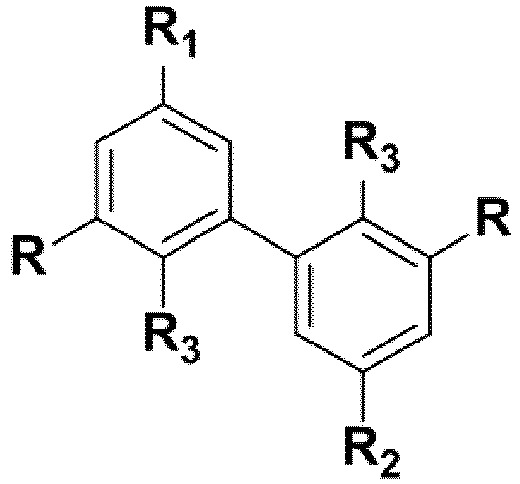 R = -O-Alk, wobei Alk eine lineare oder verzweigte Alkylgruppe mit 1 bis 6 Kohlenstoffatomen ist,R3 = -O-Z, wobei Z eine lineare oder verzweigte Alkylgruppe mit 2 bis 8, vorzugsweise 3 bis 8, Kohlenstoffatomen ist und eine Epoxyfunktion enthält, oder -O-Alk', wobei Alk' eine lineare oder verzweigte Alkylgruppe mit 1 bis 6 Kohlenstoffatomen ist; und :+ wenn R3 = -O-Z, dann,oder R1 und R2, die gleich oder verschieden sind, unabhängig voneinander ausgewählt sind aus -CH2 -OH und -CH2 -O-Z ;oder R1 = R2 =-CHO ;oder R1 und R2, die gleich oder verschieden sind, unabhängig voneinander aus -OH und -O-Z ausgewählt sind;oder R1 und R2, die gleich oder verschieden sind, unabhängig voneinander ausgewählt sind aus -COOH und -COO-Z,oder R1 und R2, die gleich oder verschieden sind, unabhängig voneinander ausgewählt sind aus -CH2-CH=CH2 und -CH2-Epoxy,oder R1 und R2, die gleich oder verschieden sind, unabhängig voneinander ausgewählt sind aus -CH=CH-CH3 und
 + wenn R3 = -O-Alk', dannR1 = R2 ist ausgewählt aus:
-CH2-O-Z,
-O-Z,
-COO-Z,
mit Z wie oben definiert unter Bezugnahme auf R3 = -O-Z,-CH2-Epoxy, und wobei das Verfahren umfasst:a) Bereitstellung eines Dimers, ausgewählt aus Divanillin, Divanillylalkohol, Dimethoxyhydrochinon, Divanillinsäure, Dieugenol, Isoeugenol-Dimer, wobei die Dimere mindestens zwei phenolische -OH-Funktionen und zwei -O-CH3-Funktionen aufweisen, und Analoga der Dimere, die die mindestens zwei phenolischen -OH-Funktionen und zwei -O-(C2-C6)Alkyl-Funktionen aufweisen;b) gegebenenfalls Alkylierung der phenolischen -OH-Funktionen eines Dimers, ausgewählt aus Divanillin, Divanillylalkohol, Divanillinsäure, Dieugenol, Isoeugenol-Dimer und deren Analoga, um das alkylierte Divanillin, den alkylierten Divanillylalkohol, die alkylierte Divanillinsäure, das alkylierte Dieugenol, das alkylierte Isoeugenol-Dimer und deren alkylierte Analoga zu erhalten; wobei auf die Alkylierung von Divanillin oder einem Analogon davon eine Oxidation folgt, um das alkylierte Di(C1-C6)alkoxyhydrochinon zu erhalten; undc1) in Abwesenheit einer solchen Alkylierung, die Epoxidierung der beiden phenolischen -OH-Funktionen von Divanillin oder einem Analogon davon, oder die Epoxidierung der zwei, drei oder sogar vier Funktionen, die am Biphenylring vorhanden sind und epoxidiert werden können, des Divanillin-Alkohols, des Dimethoxyhydrochinons, der Divanillinsäure, des Dieugenols, des Isoeugenol-Dimers oder eines Analogons davon; oderc2) im Anschluss an eine solche Alkylierung die Epoxidierung der beiden nicht alkylierten Funktionen, die noch am Biphenylring vorhanden sind, des alkylierten Divanillylalkohols, des alkylierten Di(C1-C6)alkoxyhydrochinons, der alkylierten Divanillinsäure, des alkylierten Dieugenols, des alkylierten Isoeugenol-Dimers oder eines Analogons davon;wobei das Dimer von Isoeugenol die folgende Formel aufweist:
- Verfahren nach Anspruch 1, wobei in Formel (I) R3 = -O-Z, wobei die Alkylgruppe Z linear ist und/oder, vorteilhafterweise und, die Epoxyfunktion am Ende der Kette enthält.
- Verfahren nach Anspruch 1 oder 2, wobei in Formel (I) R3 = -O-[CH2-]n-Epoxy, wobei n eine ganze Zahl von 0, vorteilhafterweise 1, bis 6, vorteilhafterweise mit 1 ≤ n ≤ 4 und sehr vorteilhafterweise mit n = 1 ist.
- Verfahren nach Anspruch 1, wobei die Verbindung der Formel (I) ausgewählt ist aus:- dem Diglycidylether von Divanillylalkohol der Formel :
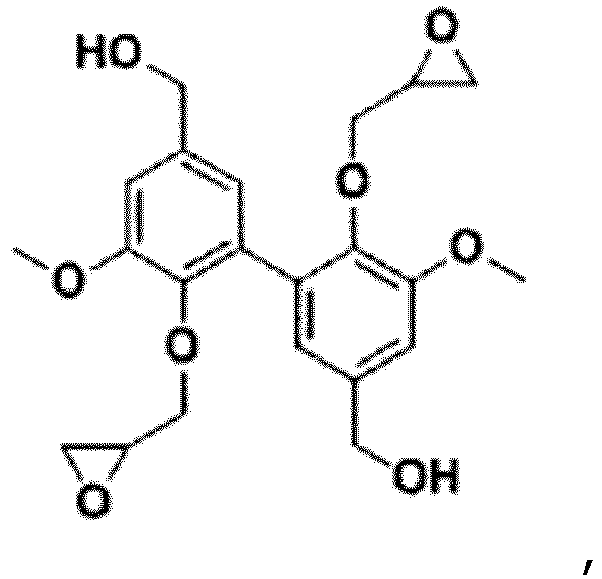 - dem Triglycidylether von Divanillylalkohol der Formel :
 - dem Tetraglycidylether von Divanillylalkohol der Formel :
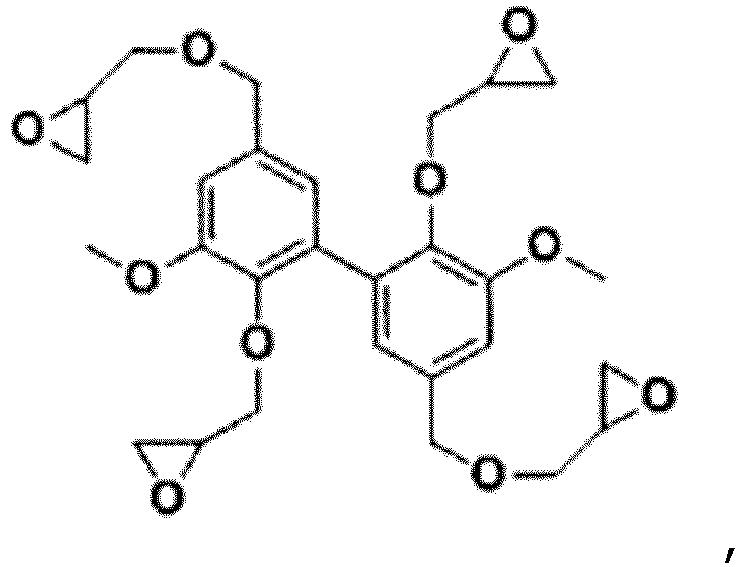 a) Bereitstellung von Divanillinalkohol ;b) die Epoxidation von zwei, drei oder vier phenolischen -OH-Funktionen von Divanillylalkohol.
 - Verfahren nach Anspruch 1, wobei die Verbindung der Formel (I) ist das Diglycidylether von Divanillin der Formel :
 a) die Bereitstellung von Divanillin ;b) die Epoxidation der beiden phenolischen -OH-Funktionen von Divanillin.
 - Verfahren nach Anspruch 1, wobei die Verbindung der Formel (I) ausgewählt ist aus :- dem Diglycidylether von Dimethoxyhydrochinon der Formel :
 - dem Triglycidylether von Dimethoxyhydrochinon der Formel :
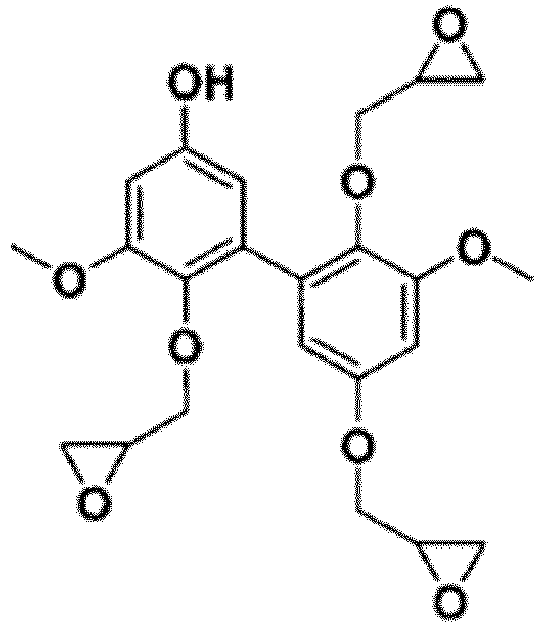 - dem Tetraglycidylether von Dimethoxyhydrochinon der Formel :
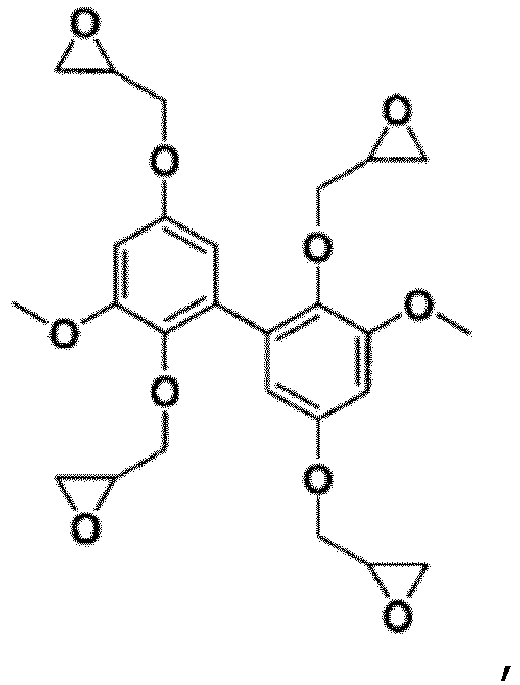 a) die Bereitstellung von Dimethoxyhydrochinon ;b) die Epoxidation von zwei, drei oder vier phenolischen -OH-Funktionen von Dimethoxyhydrochinon.
 - Verfahren nach Anspruch 1, wobei die Verbindung der Formel (I) ausgewählt ist aus :- dem Diglycidylether von Divanillinsäure der Formel :
 - dem Triglycidylether der Divanillinsäure der Formel :
 - dem Tetraglycidylether von Divanillinsäure der Formel :
 a) die Bereitstellung von Divanillinsäure ;b) die Epoxidation von zwei, drei oder vier phenolischen -OH-Funktionen der Divanillinsäure.
 - Verfahren nach Anspruch 1, wobei die Verbindung der Formel (I) ausgewählt ist aus :- dem Diglycidylether von Dieugenol der Formel :
 - dem Triglycidylether von Dieugenol der Formel :
 - dem Tetraglycidylether von Dieugenol der Formel :
 a) die Bereitstellung von Dieugenol ;b) die Epoxidation von zwei, drei oder vier phenolischen -OH-Funktionen von Dieugenol.
 - Verfahren nach Anspruch 1, wobei die Verbindung der Formel (I) ausgewählt ist aus einer Verbindung der Formel :
 a) die Bereitstellung von Isoeugenol-Dimer ;b) die Epoxidation von zwei, drei oder vier phenolischen -OH-Funktionen des Isoeugenol-Dimers der Formel :
- Verfahren nach Anspruch 1, wobei in Formel (I) R3 = -OAlk' und wobei R1 = R2 = -CH2-O-Z, -O-Z oder -COO-Z, wobei die Alkylgruppe Z linear ist und/oder, vorteilhafterweise und, die Epoxyfunktion am Ende der Kette enthält.
- Verfahren nach Anspruch 10, wobei in Formel (I) R1 = R2 = -CH2-O-[CH2-]n--Epoxy, -O-[CH2-]n-Epoxy oder -COO-[CH2-]n-Epoxy, wobei n eine ganze Zahl von 0, vorteilhaft von 1, bis 6 ist ; vorzugsweise in Formel (I) R1 = R2 = -CH2O-CH2-Epoxy , oder -O-CH2--Epoxy oder -COO-CH2-Epoxy.
- Verfahren nach einem der Ansprüche 1, 10 und 11, wobei in Formel (I) R3 = -OCH3.
- Verfahren nach Anspruch 1, wobei die Verbindung der Formel (I) ausgewählt ist aus :- dem Diglycidylether des methylierten Divanillylalkohols der Formel :
 - dem Diglycidylether der methylierten Divanillinsäure der Formel :
 - dem Diglycidylether von methyliertem Dimethoxyhydrochinon der Formel :
 - dem Diglycidylether von methyliertem Dieugenol der Formel :
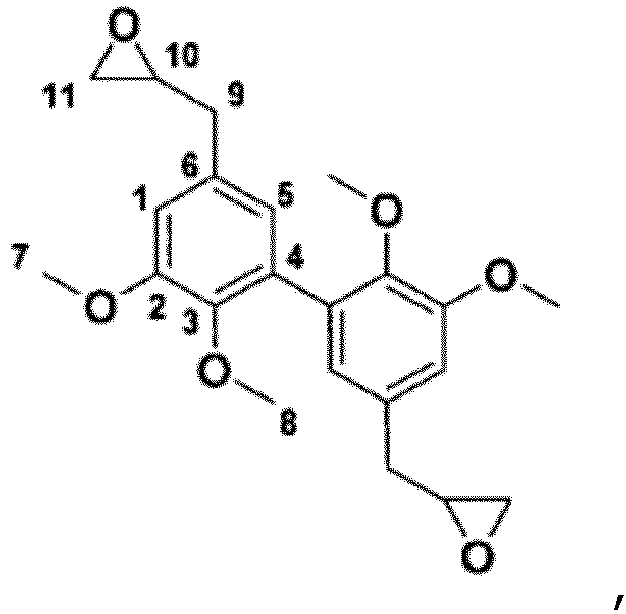 - dem Diglycidylether von methyliertem Isoeugenol-Dimers der Formel :
 Verfahren, das Folgendes umfasst:a) die Bereitstellung von Divanillylalkohol, Divanillinsäure, Dimethoxyhydrochinon, Dieugenol oder Isoeugenol-Dimer ;b) Methylierung der phenolischen -OH-Funktionen von Divanillylalkohol, Divanillinsäure, Dimethoxyhydrochinon, Dieugenol oder Isoeugenol-Dimer, um methylierten Divanillylalkohol, methylierte Divanillinsäure, methyliertes Dimethoxyhydrochinon, methyliertes Dieugenol oder methyliertes Isoeugenol-Dimer zu erhalten;c) die Epoxidation der beiden nicht alkylierten Funktionen, die noch am Biphenylring vorhanden sind, von methyliertem Divanillylalkohol, methylierter Divanillinsäure, methyliertem Dimethoxyhydrochinon, methyliertem Dieugenol oder methyliertem Isoeugenol-Dimer;wobei das Dimer von Isoeugenol die folgende Formel aufweist:
- Verfahren nach einem der Ansprüche 1 bis 13, dadurch gekennzeichnet, dass die Epoxidierung durchgeführt wird :- durch Reaktion mit einer Verbindung der Formel Cl-Z, in der Z eine lineare oder verzweigte Alkylgruppe mit 2 bis 8, vorzugsweise 3 bis 8, Kohlenstoffatomen ist und eine Epoxyfunktion enthält, wobei die Verbindung vorzugsweise aus Epichlorhydrin besteht, oder- durch Allylierung und anschließende oxidative Epoxidierung der eingeführten Doppelbindungen, oder- durch oxidative Epoxidation von mindestens einer vorhandenen Doppelbindung.
Applications Claiming Priority (2)
| Application Number | Priority Date | Filing Date | Title |
|---|---|---|---|
| FR1760451A FR3073223B1 (fr) | 2017-11-07 | 2017-11-07 | Composes biphenyles pluriepoxydes, preparation et utilisations |
| PCT/FR2018/052746 WO2019092359A1 (fr) | 2017-11-07 | 2018-11-07 | Composes biphenyle pluriepoxydes, preparation et utilisations |
Publications (3)
| Publication Number | Publication Date |
|---|---|
| EP3707130A1 EP3707130A1 (de) | 2020-09-16 |
| EP3707130C0 EP3707130C0 (de) | 2024-04-03 |
| EP3707130B1 true EP3707130B1 (de) | 2024-04-03 |
Family
ID=61802020
Family Applications (1)
| Application Number | Title | Priority Date | Filing Date |
|---|---|---|---|
| EP18812242.8A Active EP3707130B1 (de) | 2017-11-07 | 2018-11-07 | Polyepoxidierte biphenyl verbindugen, deren herstellung und anwendungen |
Country Status (5)
| Country | Link |
|---|---|
| US (1) | US11499002B2 (de) |
| EP (1) | EP3707130B1 (de) |
| ES (1) | ES2980229T3 (de) |
| FR (1) | FR3073223B1 (de) |
| WO (1) | WO2019092359A1 (de) |
Families Citing this family (8)
| Publication number | Priority date | Publication date | Assignee | Title |
|---|---|---|---|---|
| DE102020124025A1 (de) | 2020-09-15 | 2022-03-17 | Fraunhofer-Gesellschaft zur Förderung der angewandten Forschung eingetragener Verein | Verwendung von Dieugenol, Oligomeren und/oder Polymeren von Eugenol zur Stabilisierung von organischen Materialien, stabilisiertes organisches Material sowie Verfahren zur Stabilisierung von organischen Materialien |
| CN112142953B (zh) * | 2020-09-27 | 2024-12-13 | 南京工业大学 | 一种介电导热增强型生物基耐高温环氧树脂及其制备方法与应用 |
| CN113896694B (zh) * | 2021-11-16 | 2022-12-06 | 韦尔通(厦门)科技股份有限公司 | 一种多官能团杂化环氧化合物和光热双固化树脂组合物及其制备方法和应用 |
| CN116082628B (zh) * | 2022-12-26 | 2025-03-25 | 江西科技师范大学 | 一种生物基酚氧树脂及其制备方法与应用 |
| FR3156446B1 (fr) | 2023-12-07 | 2025-12-05 | Arianegroup Sas | résines thermodurcissables |
| CN118956309A (zh) * | 2024-07-29 | 2024-11-15 | 韦尔通科技股份有限公司 | 一种底部填充胶黏剂及其制备方法和应用 |
| CN119192102B (zh) * | 2024-08-16 | 2025-09-26 | 湖南大学 | 联香草醛基环氧树脂及其制备方法和应用 |
| CN121449495B (zh) * | 2026-01-08 | 2026-03-20 | 昆山亚香香料股份有限公司 | 一种采用丁香酚制备香兰素的方法 |
Citations (1)
| Publication number | Priority date | Publication date | Assignee | Title |
|---|---|---|---|---|
| US4256764A (en) * | 1978-11-15 | 1981-03-17 | Plc Pharmaceutical Licenses Co. Ltd. | Process for making derivatives of dimers of isoeugenol |
Family Cites Families (5)
| Publication number | Priority date | Publication date | Assignee | Title |
|---|---|---|---|---|
| CN103534289B (zh) * | 2011-05-13 | 2016-08-17 | 亨斯迈先进材料美国有限责任公司 | 具有高热稳定性和韧性的环氧树脂 |
| JP5942859B2 (ja) * | 2012-01-27 | 2016-06-29 | 信越化学工業株式会社 | シリコーン骨格含有高分子化合物、樹脂組成物、光硬化性ドライフィルム |
| JP6160775B2 (ja) * | 2014-07-02 | 2017-07-12 | Dic株式会社 | 電子材料用エポキシ樹脂組成物、その硬化物および電子部材 |
| EP3002333A1 (de) | 2014-10-03 | 2016-04-06 | Université de Bordeaux | Verfahren zur Herstellung von Biphenylverbindungen |
| JP6690335B2 (ja) * | 2016-03-17 | 2020-04-28 | 東洋インキScホールディングス株式会社 | 内部エポキシ化合物および熱硬化性組成物 |
-
2017
- 2017-11-07 FR FR1760451A patent/FR3073223B1/fr active Active
-
2018
- 2018-11-07 US US16/762,012 patent/US11499002B2/en active Active
- 2018-11-07 ES ES18812242T patent/ES2980229T3/es active Active
- 2018-11-07 WO PCT/FR2018/052746 patent/WO2019092359A1/fr not_active Ceased
- 2018-11-07 EP EP18812242.8A patent/EP3707130B1/de active Active
Patent Citations (1)
| Publication number | Priority date | Publication date | Assignee | Title |
|---|---|---|---|---|
| US4256764A (en) * | 1978-11-15 | 1981-03-17 | Plc Pharmaceutical Licenses Co. Ltd. | Process for making derivatives of dimers of isoeugenol |
Also Published As
| Publication number | Publication date |
|---|---|
| EP3707130C0 (de) | 2024-04-03 |
| FR3073223A1 (fr) | 2019-05-10 |
| ES2980229T3 (es) | 2024-09-30 |
| US11499002B2 (en) | 2022-11-15 |
| WO2019092359A1 (fr) | 2019-05-16 |
| EP3707130A1 (de) | 2020-09-16 |
| US20210403636A1 (en) | 2021-12-30 |
| FR3073223B1 (fr) | 2019-11-15 |
Similar Documents
| Publication | Publication Date | Title |
|---|---|---|
| EP3707130B1 (de) | Polyepoxidierte biphenyl verbindugen, deren herstellung und anwendungen | |
| EP3749637B1 (de) | Difunktionelle biphenylverbindungen, herstellung und verwendungen | |
| CN1332712A (zh) | 腰果酚的衍生物及其制备方法 | |
| JP5281012B2 (ja) | ネビボロールの調製方法 | |
| JP5778684B2 (ja) | ジビニルアレーンジオキシドの製造方法 | |
| FR2758557A1 (fr) | Compose ayant un groupe oxetanyle, son procede de preparation et composition de durcissement | |
| EP3247636B1 (de) | Verfahren zur herstellung eines ablativen harzes | |
| CN106632214A (zh) | 一种大麻酚类化合物的合成方法 | |
| Bogaschenko et al. | A practical synthesis of benzocrown ethers under phase-transfer catalysis conditions | |
| CN114450272B (zh) | 用于β-C–H官能化的配体激活β-C(sp3)–H内酯化 | |
| CN102659719B (zh) | 蒽结构四官能团环氧树脂及其制备方法 | |
| CN102858757B (zh) | 制备二乙烯基芳烃二氧化物的方法 | |
| Ko et al. | Synthesis of carbohydrates and related polyhydroxylated compounds employing asymmetric dihydroxylation. 1. An access to erythro-diols | |
| BE590947A (de) | ||
| TWI903446B (zh) | 形成環氧樹脂組合物之製程與分離製程 | |
| JP3307260B2 (ja) | オキセタニル基を有する化合物およびその製造方法 | |
| KR100296249B1 (ko) | 알파-글리콜-함유글리시딜에테르수지제조방법 | |
| FR2655342A1 (fr) | Nouveaux intermediaires, leur procede de preparation et leur utilisation pour la synthese des vitamines a et e. | |
| JP2013522317A (ja) | ジビニルアレーンジオキシドの製造方法 | |
| JPS63239238A (ja) | 光学的活性カルボニル化合物の製造法 | |
| JP4282292B2 (ja) | ヘキサン可溶性ヘキサフィリン | |
| Giles et al. | Syntheses of asymmetric 2-benzopyrans. The influence of aromatic halogen substituents on the intramolecular cyclisation of enantiopure tethered phenolic lactaldehydes | |
| JP6265479B2 (ja) | 3,3−ビス(4−ヒドロキシ−3−メトキシフェニル)−1−プロパノール及びその製造方法 | |
| RU2266907C9 (ru) | Способ получения тетраацетилдиформилгексаазаизовюрцитана | |
| Kosalka | Green resins from renewable resources |
Legal Events
| Date | Code | Title | Description |
|---|---|---|---|
| STAA | Information on the status of an ep patent application or granted ep patent |
Free format text: STATUS: UNKNOWN |
|
| STAA | Information on the status of an ep patent application or granted ep patent |
Free format text: STATUS: THE INTERNATIONAL PUBLICATION HAS BEEN MADE |
|
| PUAI | Public reference made under article 153(3) epc to a published international application that has entered the european phase |
Free format text: ORIGINAL CODE: 0009012 |
|
| STAA | Information on the status of an ep patent application or granted ep patent |
Free format text: STATUS: REQUEST FOR EXAMINATION WAS MADE |
|
| 17P | Request for examination filed |
Effective date: 20200505 |
|
| AK | Designated contracting states |
Kind code of ref document: A1 Designated state(s): AL AT BE BG CH CY CZ DE DK EE ES FI FR GB GR HR HU IE IS IT LI LT LU LV MC MK MT NL NO PL PT RO RS SE SI SK SM TR |
|
| AX | Request for extension of the european patent |
Extension state: BA ME |
|
| RIN1 | Information on inventor provided before grant (corrected) |
Inventor name: GRELIER, STEPHANE Inventor name: CRAMAIL, HENRI Inventor name: GRAU, ETIENNE Inventor name: DEFOORT, BRIGITTE Inventor name: SAVONNET, ETIENNE |
|
| DAV | Request for validation of the european patent (deleted) | ||
| DAX | Request for extension of the european patent (deleted) | ||
| STAA | Information on the status of an ep patent application or granted ep patent |
Free format text: STATUS: EXAMINATION IS IN PROGRESS |
|
| 17Q | First examination report despatched |
Effective date: 20210413 |
|
| RAP3 | Party data changed (applicant data changed or rights of an application transferred) |
Owner name: CENTRE NATIONAL DE LA RECHERCHE SCIENTIFIQUE Owner name: ARIANEGROUP SAS |
|
| GRAP | Despatch of communication of intention to grant a patent |
Free format text: ORIGINAL CODE: EPIDOSNIGR1 |
|
| STAA | Information on the status of an ep patent application or granted ep patent |
Free format text: STATUS: GRANT OF PATENT IS INTENDED |
|
| INTG | Intention to grant announced |
Effective date: 20231121 |
|
| GRAS | Grant fee paid |
Free format text: ORIGINAL CODE: EPIDOSNIGR3 |
|
| GRAA | (expected) grant |
Free format text: ORIGINAL CODE: 0009210 |
|
| STAA | Information on the status of an ep patent application or granted ep patent |
Free format text: STATUS: THE PATENT HAS BEEN GRANTED |
|
| AK | Designated contracting states |
Kind code of ref document: B1 Designated state(s): AL AT BE BG CH CY CZ DE DK EE ES FI FR GB GR HR HU IE IS IT LI LT LU LV MC MK MT NL NO PL PT RO RS SE SI SK SM TR |
|
| REG | Reference to a national code |
Ref country code: GB Ref legal event code: FG4D Free format text: NOT ENGLISH |
|
| REG | Reference to a national code |
Ref country code: CH Ref legal event code: EP |
|
| REG | Reference to a national code |
Ref country code: IE Ref legal event code: FG4D Free format text: LANGUAGE OF EP DOCUMENT: FRENCH |
|
| REG | Reference to a national code |
Ref country code: DE Ref legal event code: R096 Ref document number: 602018067592 Country of ref document: DE |
|
| U01 | Request for unitary effect filed |
Effective date: 20240403 |
|
| U07 | Unitary effect registered |
Designated state(s): AT BE BG DE DK EE FI FR IT LT LU LV MT NL PT SE SI Effective date: 20240503 |
|
| REG | Reference to a national code |
Ref country code: ES Ref legal event code: FG2A Ref document number: 2980229 Country of ref document: ES Kind code of ref document: T3 Effective date: 20240930 |
|
| PG25 | Lapsed in a contracting state [announced via postgrant information from national office to epo] |
Ref country code: IS Free format text: LAPSE BECAUSE OF FAILURE TO SUBMIT A TRANSLATION OF THE DESCRIPTION OR TO PAY THE FEE WITHIN THE PRESCRIBED TIME-LIMIT Effective date: 20240803 |
|
| PG25 | Lapsed in a contracting state [announced via postgrant information from national office to epo] |
Ref country code: HR Free format text: LAPSE BECAUSE OF FAILURE TO SUBMIT A TRANSLATION OF THE DESCRIPTION OR TO PAY THE FEE WITHIN THE PRESCRIBED TIME-LIMIT Effective date: 20240403 |
|
| PG25 | Lapsed in a contracting state [announced via postgrant information from national office to epo] |
Ref country code: GR Free format text: LAPSE BECAUSE OF FAILURE TO SUBMIT A TRANSLATION OF THE DESCRIPTION OR TO PAY THE FEE WITHIN THE PRESCRIBED TIME-LIMIT Effective date: 20240704 |
|
| PG25 | Lapsed in a contracting state [announced via postgrant information from national office to epo] |
Ref country code: CZ Free format text: LAPSE BECAUSE OF FAILURE TO SUBMIT A TRANSLATION OF THE DESCRIPTION OR TO PAY THE FEE WITHIN THE PRESCRIBED TIME-LIMIT Effective date: 20240403 |
|
| PG25 | Lapsed in a contracting state [announced via postgrant information from national office to epo] |
Ref country code: PL Free format text: LAPSE BECAUSE OF FAILURE TO SUBMIT A TRANSLATION OF THE DESCRIPTION OR TO PAY THE FEE WITHIN THE PRESCRIBED TIME-LIMIT Effective date: 20240403 |
|
| PG25 | Lapsed in a contracting state [announced via postgrant information from national office to epo] |
Ref country code: PL Free format text: LAPSE BECAUSE OF FAILURE TO SUBMIT A TRANSLATION OF THE DESCRIPTION OR TO PAY THE FEE WITHIN THE PRESCRIBED TIME-LIMIT Effective date: 20240403 Ref country code: NO Free format text: LAPSE BECAUSE OF FAILURE TO SUBMIT A TRANSLATION OF THE DESCRIPTION OR TO PAY THE FEE WITHIN THE PRESCRIBED TIME-LIMIT Effective date: 20240703 Ref country code: IS Free format text: LAPSE BECAUSE OF FAILURE TO SUBMIT A TRANSLATION OF THE DESCRIPTION OR TO PAY THE FEE WITHIN THE PRESCRIBED TIME-LIMIT Effective date: 20240803 Ref country code: HR Free format text: LAPSE BECAUSE OF FAILURE TO SUBMIT A TRANSLATION OF THE DESCRIPTION OR TO PAY THE FEE WITHIN THE PRESCRIBED TIME-LIMIT Effective date: 20240403 Ref country code: GR Free format text: LAPSE BECAUSE OF FAILURE TO SUBMIT A TRANSLATION OF THE DESCRIPTION OR TO PAY THE FEE WITHIN THE PRESCRIBED TIME-LIMIT Effective date: 20240704 Ref country code: CZ Free format text: LAPSE BECAUSE OF FAILURE TO SUBMIT A TRANSLATION OF THE DESCRIPTION OR TO PAY THE FEE WITHIN THE PRESCRIBED TIME-LIMIT Effective date: 20240403 Ref country code: RS Free format text: LAPSE BECAUSE OF FAILURE TO SUBMIT A TRANSLATION OF THE DESCRIPTION OR TO PAY THE FEE WITHIN THE PRESCRIBED TIME-LIMIT Effective date: 20240703 |
|
| U20 | Renewal fee for the european patent with unitary effect paid |
Year of fee payment: 7 Effective date: 20241126 |
|
| REG | Reference to a national code |
Ref country code: DE Ref legal event code: R097 Ref document number: 602018067592 Country of ref document: DE |
|
| PG25 | Lapsed in a contracting state [announced via postgrant information from national office to epo] |
Ref country code: RO Free format text: LAPSE BECAUSE OF FAILURE TO SUBMIT A TRANSLATION OF THE DESCRIPTION OR TO PAY THE FEE WITHIN THE PRESCRIBED TIME-LIMIT Effective date: 20240403 Ref country code: SK Free format text: LAPSE BECAUSE OF FAILURE TO SUBMIT A TRANSLATION OF THE DESCRIPTION OR TO PAY THE FEE WITHIN THE PRESCRIBED TIME-LIMIT Effective date: 20240403 |
|
| PG25 | Lapsed in a contracting state [announced via postgrant information from national office to epo] |
Ref country code: SM Free format text: LAPSE BECAUSE OF FAILURE TO SUBMIT A TRANSLATION OF THE DESCRIPTION OR TO PAY THE FEE WITHIN THE PRESCRIBED TIME-LIMIT Effective date: 20240403 |
|
| PG25 | Lapsed in a contracting state [announced via postgrant information from national office to epo] |
Ref country code: SM Free format text: LAPSE BECAUSE OF FAILURE TO SUBMIT A TRANSLATION OF THE DESCRIPTION OR TO PAY THE FEE WITHIN THE PRESCRIBED TIME-LIMIT Effective date: 20240403 Ref country code: SK Free format text: LAPSE BECAUSE OF FAILURE TO SUBMIT A TRANSLATION OF THE DESCRIPTION OR TO PAY THE FEE WITHIN THE PRESCRIBED TIME-LIMIT Effective date: 20240403 Ref country code: RO Free format text: LAPSE BECAUSE OF FAILURE TO SUBMIT A TRANSLATION OF THE DESCRIPTION OR TO PAY THE FEE WITHIN THE PRESCRIBED TIME-LIMIT Effective date: 20240403 |
|
| PLBE | No opposition filed within time limit |
Free format text: ORIGINAL CODE: 0009261 |
|
| STAA | Information on the status of an ep patent application or granted ep patent |
Free format text: STATUS: NO OPPOSITION FILED WITHIN TIME LIMIT |
|
| 26N | No opposition filed |
Effective date: 20250106 |
|
| REG | Reference to a national code |
Ref country code: CH Ref legal event code: PL |
|
| PG25 | Lapsed in a contracting state [announced via postgrant information from national office to epo] |
Ref country code: MC Free format text: LAPSE BECAUSE OF FAILURE TO SUBMIT A TRANSLATION OF THE DESCRIPTION OR TO PAY THE FEE WITHIN THE PRESCRIBED TIME-LIMIT Effective date: 20240403 |
|
| REG | Reference to a national code |
Ref country code: CH Ref legal event code: PL |
|
| PG25 | Lapsed in a contracting state [announced via postgrant information from national office to epo] |
Ref country code: CH Free format text: LAPSE BECAUSE OF NON-PAYMENT OF DUE FEES Effective date: 20241130 |
|
| PG25 | Lapsed in a contracting state [announced via postgrant information from national office to epo] |
Ref country code: IE Free format text: LAPSE BECAUSE OF NON-PAYMENT OF DUE FEES Effective date: 20241107 |
|
| U20 | Renewal fee for the european patent with unitary effect paid |
Year of fee payment: 8 Effective date: 20251127 |
|
| PGFP | Annual fee paid to national office [announced via postgrant information from national office to epo] |
Ref country code: GB Payment date: 20251121 Year of fee payment: 8 |
|
| PGFP | Annual fee paid to national office [announced via postgrant information from national office to epo] |
Ref country code: ES Payment date: 20251229 Year of fee payment: 8 |
|
| PG25 | Lapsed in a contracting state [announced via postgrant information from national office to epo] |
Ref country code: HU Free format text: LAPSE BECAUSE OF FAILURE TO SUBMIT A TRANSLATION OF THE DESCRIPTION OR TO PAY THE FEE WITHIN THE PRESCRIBED TIME-LIMIT; INVALID AB INITIO Effective date: 20181107 |
|
| PG25 | Lapsed in a contracting state [announced via postgrant information from national office to epo] |
Ref country code: CY Free format text: LAPSE BECAUSE OF FAILURE TO SUBMIT A TRANSLATION OF THE DESCRIPTION OR TO PAY THE FEE WITHIN THE PRESCRIBED TIME-LIMIT; INVALID AB INITIO Effective date: 20181107 |