EP3685915A1 - Silver catalyst for formaldehyde preparation - Google Patents
Silver catalyst for formaldehyde preparation Download PDFInfo
- Publication number
- EP3685915A1 EP3685915A1 EP20158463.8A EP20158463A EP3685915A1 EP 3685915 A1 EP3685915 A1 EP 3685915A1 EP 20158463 A EP20158463 A EP 20158463A EP 3685915 A1 EP3685915 A1 EP 3685915A1
- Authority
- EP
- European Patent Office
- Prior art keywords
- silver
- silver crystals
- crystals
- catalyst
- vol
- Prior art date
- Legal status (The legal status is an assumption and is not a legal conclusion. Google has not performed a legal analysis and makes no representation as to the accuracy of the status listed.)
- Pending
Links
Images

Classifications
-
- B—PERFORMING OPERATIONS; TRANSPORTING
- B01—PHYSICAL OR CHEMICAL PROCESSES OR APPARATUS IN GENERAL
- B01J—CHEMICAL OR PHYSICAL PROCESSES, e.g. CATALYSIS OR COLLOID CHEMISTRY; THEIR RELEVANT APPARATUS
- B01J37/00—Processes, in general, for preparing catalysts; Processes, in general, for activation of catalysts
- B01J37/02—Impregnation, coating or precipitation
- B01J37/0215—Coating
- B01J37/0219—Coating the coating containing organic compounds
-
- B—PERFORMING OPERATIONS; TRANSPORTING
- B01—PHYSICAL OR CHEMICAL PROCESSES OR APPARATUS IN GENERAL
- B01J—CHEMICAL OR PHYSICAL PROCESSES, e.g. CATALYSIS OR COLLOID CHEMISTRY; THEIR RELEVANT APPARATUS
- B01J23/00—Catalysts comprising metals or metal oxides or hydroxides, not provided for in group B01J21/00
- B01J23/38—Catalysts comprising metals or metal oxides or hydroxides, not provided for in group B01J21/00 of noble metals
- B01J23/48—Silver or gold
- B01J23/50—Silver
-
- B—PERFORMING OPERATIONS; TRANSPORTING
- B01—PHYSICAL OR CHEMICAL PROCESSES OR APPARATUS IN GENERAL
- B01J—CHEMICAL OR PHYSICAL PROCESSES, e.g. CATALYSIS OR COLLOID CHEMISTRY; THEIR RELEVANT APPARATUS
- B01J21/00—Catalysts comprising the elements, oxides, or hydroxides of magnesium, boron, aluminium, carbon, silicon, titanium, zirconium, or hafnium
- B01J21/02—Boron or aluminium; Oxides or hydroxides thereof
- B01J21/04—Alumina
-
- B—PERFORMING OPERATIONS; TRANSPORTING
- B01—PHYSICAL OR CHEMICAL PROCESSES OR APPARATUS IN GENERAL
- B01J—CHEMICAL OR PHYSICAL PROCESSES, e.g. CATALYSIS OR COLLOID CHEMISTRY; THEIR RELEVANT APPARATUS
- B01J21/00—Catalysts comprising the elements, oxides, or hydroxides of magnesium, boron, aluminium, carbon, silicon, titanium, zirconium, or hafnium
- B01J21/06—Silicon, titanium, zirconium or hafnium; Oxides or hydroxides thereof
-
- B—PERFORMING OPERATIONS; TRANSPORTING
- B01—PHYSICAL OR CHEMICAL PROCESSES OR APPARATUS IN GENERAL
- B01J—CHEMICAL OR PHYSICAL PROCESSES, e.g. CATALYSIS OR COLLOID CHEMISTRY; THEIR RELEVANT APPARATUS
- B01J21/00—Catalysts comprising the elements, oxides, or hydroxides of magnesium, boron, aluminium, carbon, silicon, titanium, zirconium, or hafnium
- B01J21/06—Silicon, titanium, zirconium or hafnium; Oxides or hydroxides thereof
- B01J21/063—Titanium; Oxides or hydroxides thereof
-
- B—PERFORMING OPERATIONS; TRANSPORTING
- B01—PHYSICAL OR CHEMICAL PROCESSES OR APPARATUS IN GENERAL
- B01J—CHEMICAL OR PHYSICAL PROCESSES, e.g. CATALYSIS OR COLLOID CHEMISTRY; THEIR RELEVANT APPARATUS
- B01J21/00—Catalysts comprising the elements, oxides, or hydroxides of magnesium, boron, aluminium, carbon, silicon, titanium, zirconium, or hafnium
- B01J21/06—Silicon, titanium, zirconium or hafnium; Oxides or hydroxides thereof
- B01J21/066—Zirconium or hafnium; Oxides or hydroxides thereof
-
- B—PERFORMING OPERATIONS; TRANSPORTING
- B01—PHYSICAL OR CHEMICAL PROCESSES OR APPARATUS IN GENERAL
- B01J—CHEMICAL OR PHYSICAL PROCESSES, e.g. CATALYSIS OR COLLOID CHEMISTRY; THEIR RELEVANT APPARATUS
- B01J35/00—Catalysts, in general, characterised by their form or physical properties
- B01J35/19—Catalysts containing parts with different compositions
-
- B—PERFORMING OPERATIONS; TRANSPORTING
- B01—PHYSICAL OR CHEMICAL PROCESSES OR APPARATUS IN GENERAL
- B01J—CHEMICAL OR PHYSICAL PROCESSES, e.g. CATALYSIS OR COLLOID CHEMISTRY; THEIR RELEVANT APPARATUS
- B01J35/00—Catalysts, in general, characterised by their form or physical properties
- B01J35/30—Catalysts, in general, characterised by their form or physical properties characterised by their physical properties
- B01J35/396—Distribution of the active metal ingredient
- B01J35/398—Egg yolk like
-
- B—PERFORMING OPERATIONS; TRANSPORTING
- B01—PHYSICAL OR CHEMICAL PROCESSES OR APPARATUS IN GENERAL
- B01J—CHEMICAL OR PHYSICAL PROCESSES, e.g. CATALYSIS OR COLLOID CHEMISTRY; THEIR RELEVANT APPARATUS
- B01J37/00—Processes, in general, for preparing catalysts; Processes, in general, for activation of catalysts
- B01J37/02—Impregnation, coating or precipitation
-
- B—PERFORMING OPERATIONS; TRANSPORTING
- B01—PHYSICAL OR CHEMICAL PROCESSES OR APPARATUS IN GENERAL
- B01J—CHEMICAL OR PHYSICAL PROCESSES, e.g. CATALYSIS OR COLLOID CHEMISTRY; THEIR RELEVANT APPARATUS
- B01J37/00—Processes, in general, for preparing catalysts; Processes, in general, for activation of catalysts
- B01J37/02—Impregnation, coating or precipitation
- B01J37/0215—Coating
- B01J37/0221—Coating of particles
-
- B—PERFORMING OPERATIONS; TRANSPORTING
- B01—PHYSICAL OR CHEMICAL PROCESSES OR APPARATUS IN GENERAL
- B01J—CHEMICAL OR PHYSICAL PROCESSES, e.g. CATALYSIS OR COLLOID CHEMISTRY; THEIR RELEVANT APPARATUS
- B01J37/00—Processes, in general, for preparing catalysts; Processes, in general, for activation of catalysts
- B01J37/02—Impregnation, coating or precipitation
- B01J37/0215—Coating
- B01J37/0225—Coating of metal substrates
-
- B—PERFORMING OPERATIONS; TRANSPORTING
- B01—PHYSICAL OR CHEMICAL PROCESSES OR APPARATUS IN GENERAL
- B01J—CHEMICAL OR PHYSICAL PROCESSES, e.g. CATALYSIS OR COLLOID CHEMISTRY; THEIR RELEVANT APPARATUS
- B01J37/00—Processes, in general, for preparing catalysts; Processes, in general, for activation of catalysts
- B01J37/02—Impregnation, coating or precipitation
- B01J37/03—Precipitation; Co-precipitation
- B01J37/036—Precipitation; Co-precipitation to form a gel or a cogel
-
- C—CHEMISTRY; METALLURGY
- C07—ORGANIC CHEMISTRY
- C07C—ACYCLIC OR CARBOCYCLIC COMPOUNDS
- C07C47/00—Compounds having —CHO groups
- C07C47/02—Saturated compounds having —CHO groups bound to acyclic carbon atoms or to hydrogen
- C07C47/04—Formaldehyde
Definitions
- the present invention relates to a process for producing coated silver catalysts.
- the invention further addresses the silver catalysts themselves and the advantageous use thereof in formaldehyde synthesis.
- Formaldehyde (FA) is one of the most important commodity chemicals; the production in the EU in 2002 was more than 3 million tonnes; double the amount is likely to have been produced worldwide (5.3 million tonnes (1989)) [ K. Weissermel, H.-J. Arpe, Industrielle Organische Chemie, VCH, 1994 ].
- FA is required especially for the production of various resins (phenol, melamine, etc.) and polymers. The synthesis proceeds virtually exclusively from methanol [ K. Weissermel, H.-J. Arpe, Industrielle Organische Chemie, VCH, 1994 ; M. Qian, M.A. Liauw, G. Emig, Appl. Catal.
- the partial oxidation is performed in two different processes with different catalysts.
- the main distinguishing features are firstly the different catalysts but secondly the observance of the explosion limits of MeOH in air.
- MeOH contents of > 37.5% by volume are employed.
- molybdate or FORMOX process Limus, Montecatini, Hiag/Lurgi, Perstorp/Reichsdorf, plant sizes: 20-30 kt/a of FA
- the process is conducted at MeOH contents of ⁇ 7% by volume.
- About 80% of all plants operate by the air deficiency or silver contact process; approx. 55% of FA production in Western Europe is based on the silver contact process [ M. Qian, M.A. Liauw, G. Emig, Appl. Catal. A: General, 238 (2003) 211 ; Catalysis from A to Z, VCH Wiley, 2000, p. 224].
- Partial oxidation by the air deficiency process is performed principally in two variants: (i) MeOH ballast process (e.g. Degussa, ICI) and (ii) the water ballast process (BASF). Whereas an incomplete conversion is achieved in the first process, in which only MeOH and air are used, a virtually full conversion can be achieved in the second process with additional metering of steam. It is normal to operate with an MeOH/H 2 O mixture of 60/40.
- MeOH ballast process e.g. Degussa, ICI
- BASF water ballast process
- other parameters such as space-time yield, speed of catalyst exchange and activity should not be adversely affected.
- step a) the silver crystals are contacted with a sol-gel solution of the elements in question.
- step a) is performed in a solvent comprising an organic solvent.
- the crystals can preferably also be introduced into a vessel/reactor which contains the sol-gel solution, optionally while stirring.
- the sol-gel solution is one in which alkoxides of the elements in question are dissolved in an organic matrix.
- the alkoxides may, as a result of hydrolysis, already be partly crosslinked and may therefore be present in colloidally dissolved form.
- specific additives can be added.
- the sol-gel solution is preferably used in the form of an organic medium.
- the solvents used are alcohols.
- Very particularly preferred solvents may be those selected from the group consisting of methanol, ethanol, n-propanol, isopropanol, n-butanol, isobutanol, sec-butanol, tert-butanol, n-pentanol and the bonding isomers thereof and the mixtures thereof. It is possible to add further organic solvents to the sol-gel solution, for example ethers.
- sol-gel solution selected is an alkoxide of the element in question in the corresponding alcohol as the organic solvent.
- very particularly preferred alkoxide compounds of the element in question are those selected from the group of the methoxides, ethoxides, propoxides, isopropoxides, n-butoxides, sec-butoxides, isobutoxides, tert-butoxides, n-propoxides or the bonding isomers thereof and mixtures thereof.
- the silver crystals are collected and thus freed of excess sol-gel solution.
- the collection can be performed by simple filtering, decanting or similar measures.
- excess solvent still adhering to the silver crystals is removed. This can be done in a simple manner by removing the solvent from the resulting silver crystals by evaporating it off under ambient conditions. Further measures are familiar to those skilled in the art.
- the solvent can also be removed in an accelerated manner by additional measures, for example application of a vacuum, exposure to a gas stream (air, nitrogen) and the like.
- the resulting silver crystals are heat treated at a temperature between 50°C and the melting point of silver.
- the heat treatment can be performed with application of a vacuum or in the presence of an oxidic atmosphere, advantageously air.
- the silver crystals thus obtained can be used for formaldehyde production in this form or optionally after further process measures as specified above.
- the invention therefore relates to silver crystals with a thin porous coating of oxidic material of the elements selected from the group consisting of aluminium, silicon, zirconium, tin, titanium and mixtures thereof, obtainable by the process according to the invention.
- Silver crystals for the formaldehyde synthesis must have a particular shape in order to be able to be used successfully as catalysts. They cannot be too small, since too little cavity otherwise remains between the individual crystals for the gases to be converted to flow through. Blockage of the catalyst bed would be the consequence. On the other hand, the particle sizes of the crystals should not become too great since an unfavourable ratio between expensive catalyst material and surface area is otherwise the result. It has been found to be advantageous when the mean particle size distribution is 0.15 to 2.5 mm, more preferably 0.5 to 2.0 mm and most preferably 0.5 to 1.0 mm.
- the coating of the silver crystals serves - as already indicated - to prevent the silver crystals from sintering together in the catalyst bed in the formaldehyde synthesis.
- the coating must have an appropriate thickness to be able to ensure this effect sufficiently.
- the coating should therefore as far as possible have a thickness of not less than 0.3 ⁇ m.
- the thickness of the coating should therefore be between 0.3 ⁇ m - 10 ⁇ m.
- a preferred thickness is 1.0 - 5.0 ⁇ m, more preferably 2.0 - 4.0 ⁇ m and most preferably around 3.0 ⁇ m.
- the coating consists of an oxidic material of the contemplated elements.
- a material is interpreted as being an inorganic compound which comprises the elements addressed, these being present bonded to one another via oxygen atoms within the entire material or at least in predominant portions.
- the oxidic material thus preferably comprises various types of SiO 2 , aluminium oxides (e.g. ⁇ -, ⁇ -, ⁇ -Al 2 O 3 , boehmite, etc.), TiO 2 , ZrO 2 , a mixture of oxides or mixed oxides of these compounds, for example various kinds of zeolites, SAPOs, perovskites, spinels and the like.
- the coating may also be present in the form of a ceramic.
- the inventive catalyst should advantageously have a particular bulk density. This should be between > 1700 and ⁇ 3800 g/l, preferably > 1700 and ⁇ 2400 g/l and most preferably between > 1700 and ⁇ 2000 g/l.
- the present invention also further relates to the use of the silver crystals coated in accordance with the invention as catalysts for formaldehyde preparation.
- the silver crystals should possess a purity of > 99.9%, preferably > 99.99%.
- the elements which may be present in ultrasmall amounts in the silver crystals have been found to be those selected from the group consisting of gold, bismuth, copper, iron, lead, palladium and platinum. The amounts of these elements are less than 100 ppm, preferably ⁇ 50 ppm and very preferably ⁇ 30 ppm.
- the coating of the silver crystals at least crucially delays sintering-together of the crystals during the formaldehyde synthesis.
- the crystals can also - when an exchange of the catalyst is planned - be removed from the reactor significantly more readily, since the caking of the crystals is less marked.
- the coating effectively imparts an exoskeleton to the silver crystals, which significantly prolongs the service life of the catalyst bed in the formaldehyde synthesis and hence counteracts frequent catalyst exchange. Since the exchange of the catalyst and the production shutdown that this causes concerns a majority of the costs of the formaldehyde production, the present invention helps to be able to perform the formaldehyde synthesis significantly less expensively.
- the Ag crystals are coated with a ceramic ⁇ -Al 2 O 3 layer by means of a colloidal boehmite (AlOOH) sol or of a polymeric Al 2 O 3 sol.
- AlOOH colloidal boehmite
- colloidal sols The characteristic feature of colloidal sols is dispersed ultrasmall particles in the region of 1 nm which statically repel one another owing to surface charges.
- aluminium tri-sec-butoxide ATTB
- 2-butanol aluminium tri-sec-butoxide
- the hydrolysis which takes place proceeds with a water excess.
- the 2-butanol which forms is subsequently distilled off.
- the conversion to the boehmite with simultaneous stabilization of the sol takes place as a result of boiling under reflux at 120°C.
- a clear sol which shimmers in a pale bluish colour is obtained.
- metal alkoxides likewise serve as the precursor material.
- the polymeric aluminium oxide sol is therefore likewise prepared from isopropanol-diluted aluminium tri-sec-butoxide (ATSB).
- ATTB isopropanol-diluted aluminium tri-sec-butoxide
- only a small amount of water is supplied here, which leads to partial hydrolysis and prevents the precipitation of the hydroxides.
- the partially hydrolyzed alkoxides condense with elimination of water to form polymers.
- Complete hydrolysis is prevented by adding complexing agents such as acetyl acetone. Stirring with exclusion of air and addition of nitric acid stabilizes the sol.
- a clear sol is formed.
- the sols obtained are used to coat the Ag crystals by means of dipping or spraying.
- N 2 and air/O 2 were metered in with MFCs (MultiFlowControllers), which had been calibrated beforehand by means of a soap film meter.
- MFCs MultiFlowControllers
- the gas streams were also measured later after passing through the unheated reactor.
- the liquid was metered in by means of an HPLC pump with an upstream degasser.
- the H 2 O/meOH mixtures were established via starting weights.
- To calculate the liquid volume to be metered in (ml/min), additive behaviour of the densities of the components was initially assumed for the density of the mixtures. After the testing had finished, the amount of liquid injected was checked with reference to the change in weight of the liquid reservoir. Accordingly, a correction of the amount of MeOH metered in was effected for the calculation of the MeOH conversion (X-MeOH), but also the percentages by volume of all feed components and the GHSV (GasHourlySpaceVelocity).
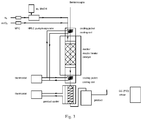
- the reactor used was an ALSINT 99.7 ceramic tube; external diameter 15 mm, internal diameter 10 mm, length 500 mm (from Haldenwanger Berlin (BTK - Buntenkötter Technische Keramik, Neuss)). Reactor inlet and outlet were kept at about 120°C by means of water cooling (cooling coils). The thermostat box (120°C) ensures that formaldehyde does not polymerize before the product stream is introduced into the condenser and into the collecting vessel for the product samples. The liquid reactant was evaporated at 120°C in an evaporator connected upstream of the reactor. The reactor temperature was regulated to the temperature desired in the catalyst bed, which was measured in the middle of the catalyst bed.
- the catalyst bed consisted in each case of 0.1 g of Ag catalyst of particle fraction 0.5-1 mm, mixed with 3 g of 1-1.4 mm white high-grade corundum (in analogy to [ M. Qian, M.A. Liauw, G. Emig, Appl. Catal. A: General, 238 (2003) 211 .]).
- the volume of the bed was 2.3 ml (basis of the GHSV calculation).
- Three catalyst specimens were tested: Cat. 1: "Pure silver" (Ag),
- Cat. 2 Ag modified with polymer-based aluminium oxide (aluminium hydroxide precursor - inventive) (Ag-P),
- Cat. 3 Ag modified with colloid-based aluminium oxide (aluminium sol precursor - inventive) (Ag-K).
- the gas chromatography analyses were effected with a Shimadzu GC 17A using an AT-Q 30 m ⁇ 0.32 mm capillary column and an FID with upstream methanizer. Specifically, the following conditions were employed: Injection volume 0.9 ⁇ l, split 40, linear velocity 30.9 cm/s, temperature program 6 min isothermal 120°C, 10 K/min to 200°C, hold time 1 min, 5 injections each per sample.
- the capillary GC column was operated at start temperature 120°C, in order to prevent polymerization of formaldehyde or methylal formation with MeOH.
- Figs 1 and 2 show the MeOH conversions and FA yields as a function of the reaction temperature and of the space velocity.
Landscapes
- Chemical & Material Sciences (AREA)
- Organic Chemistry (AREA)
- Engineering & Computer Science (AREA)
- Materials Engineering (AREA)
- Chemical Kinetics & Catalysis (AREA)
- Dispersion Chemistry (AREA)
- Catalysts (AREA)
- Organic Low-Molecular-Weight Compounds And Preparation Thereof (AREA)
- Low-Molecular Organic Synthesis Reactions Using Catalysts (AREA)
- Powder Metallurgy (AREA)
Applications Claiming Priority (3)
| Application Number | Priority Date | Filing Date | Title |
|---|---|---|---|
| DE102008045148A DE102008045148A1 (de) | 2008-09-01 | 2008-09-01 | Silberkatalysator zur Formaldehyd-Herstellung |
| PCT/EP2009/006170 WO2010022923A1 (en) | 2008-09-01 | 2009-08-26 | Silver catalyst for formaldehyde preparation |
| EP09778113.2A EP2321044B1 (en) | 2008-09-01 | 2009-08-26 | Coated silver particle catalyst for formaldehyde preparation |
Related Parent Applications (1)
| Application Number | Title | Priority Date | Filing Date |
|---|---|---|---|
| EP09778113.2A Division EP2321044B1 (en) | 2008-09-01 | 2009-08-26 | Coated silver particle catalyst for formaldehyde preparation |
Publications (1)
| Publication Number | Publication Date |
|---|---|
| EP3685915A1 true EP3685915A1 (en) | 2020-07-29 |
Family
ID=41259600
Family Applications (2)
| Application Number | Title | Priority Date | Filing Date |
|---|---|---|---|
| EP20158463.8A Pending EP3685915A1 (en) | 2008-09-01 | 2009-08-26 | Silver catalyst for formaldehyde preparation |
| EP09778113.2A Active EP2321044B1 (en) | 2008-09-01 | 2009-08-26 | Coated silver particle catalyst for formaldehyde preparation |
Family Applications After (1)
| Application Number | Title | Priority Date | Filing Date |
|---|---|---|---|
| EP09778113.2A Active EP2321044B1 (en) | 2008-09-01 | 2009-08-26 | Coated silver particle catalyst for formaldehyde preparation |
Country Status (14)
| Country | Link |
|---|---|
| US (1) | US8471071B2 (enExample) |
| EP (2) | EP3685915A1 (enExample) |
| JP (1) | JP5528450B2 (enExample) |
| KR (1) | KR101634082B1 (enExample) |
| CN (1) | CN102137716B (enExample) |
| AU (1) | AU2009287008B2 (enExample) |
| BR (1) | BRPI0918277B8 (enExample) |
| CA (1) | CA2735745C (enExample) |
| DE (1) | DE102008045148A1 (enExample) |
| ES (1) | ES2787550T3 (enExample) |
| MY (1) | MY153887A (enExample) |
| RU (1) | RU2503497C2 (enExample) |
| TW (1) | TWI436824B (enExample) |
| WO (1) | WO2010022923A1 (enExample) |
Families Citing this family (5)
| Publication number | Priority date | Publication date | Assignee | Title |
|---|---|---|---|---|
| DE102010040921A1 (de) | 2010-09-16 | 2012-03-22 | Basf Se | Verfahren zur Herstellung von Acrylsäure aus Methanol und Essigsäure |
| DE102010040923A1 (de) | 2010-09-16 | 2012-03-22 | Basf Se | Verfahren zur Herstellung von Acrylsäure aus Ethanol und Formaldehyd |
| WO2015148627A1 (en) | 2014-03-25 | 2015-10-01 | Tpc Group Llc | Catalyst for reduced nitrogen oxide (nox) emissions in an oxodehydrogenation process |
| CN105363320B (zh) * | 2015-11-10 | 2018-05-01 | 沭阳县金辉化工有限公司 | 一种新型高效脱醇甲醛吸收塔 |
| US10392333B2 (en) * | 2017-12-21 | 2019-08-27 | Purdue Research Foundation | Method of producing formaldehyde from methanol |
Citations (6)
| Publication number | Priority date | Publication date | Assignee | Title |
|---|---|---|---|---|
| WO2001030492A1 (en) | 1999-10-25 | 2001-05-03 | The University Of Queensland | Crystalline silver catalysts for methanol oxidation to formaldehyde |
| EP1110647A2 (en) * | 1999-12-22 | 2001-06-27 | Mitsui Mining and Smelting Co., Ltd | Paste to be fired for forming circuit board and method for preparing surface-modified silver powder |
| US6994948B2 (en) * | 2001-10-12 | 2006-02-07 | E.I. Du Pont De Nemours And Company, Inc. | Aqueous developable photoimageable thick film compositions |
| EP1696006A1 (en) * | 2005-02-28 | 2006-08-30 | Samsung SDI Germany GmbH | metal ink and substrate for a display and method for manufacturing the same |
| US20060192183A1 (en) * | 2005-02-28 | 2006-08-31 | Andreas Klyszcz | Metal ink, method of preparing the metal ink, substrate for display, and method of manufacturing the substrate |
| WO2007149883A1 (en) * | 2006-06-19 | 2007-12-27 | Cabot Corporation | Photovoltaic conductive features and processes for forming same |
Family Cites Families (15)
| Publication number | Priority date | Publication date | Assignee | Title |
|---|---|---|---|---|
| JPS5630064B2 (enExample) * | 1974-06-04 | 1981-07-13 | ||
| JPS5759637A (en) * | 1980-09-22 | 1982-04-10 | Suredoneajiatsuki Nii Nefutepe | Manufacture of carbonyl compound |
| US4330437A (en) * | 1980-11-05 | 1982-05-18 | Borden, Inc. | Supported silver catalyst and a process of preparing it |
| NL8502993A (nl) * | 1985-11-01 | 1987-06-01 | Dow Chemical Nederland | Zilverkatalysator, alsmede werkwijze voor de bereiding daarvan. |
| JP2508847B2 (ja) * | 1989-07-20 | 1996-06-19 | 株式会社ハイミラー | SiO2被膜が形成された銀コ―トガラスフレ―クの製造法 |
| US5948726A (en) * | 1994-12-07 | 1999-09-07 | Project Earth Industries, Inc. | Adsorbent and/or catalyst and binder system and method of making therefor |
| ES2148589T3 (es) * | 1995-12-28 | 2000-10-16 | Consejo Superior Investigacion | Revestimientos protectores producidos por sol-gel sobre reflectores de plata. |
| US20030166972A1 (en) * | 2002-02-20 | 2003-09-04 | Regents Of The University Of California Office Of Technology Licensing | Process for production of formaldehyde from dimethyl ether |
| US7226953B1 (en) | 2003-11-17 | 2007-06-05 | Los Alamos National Security, Llc | Nanocrystal/sol-gel nanocomposites |
| JP4149385B2 (ja) * | 2004-01-27 | 2008-09-10 | 三井金属鉱業株式会社 | 酸化アルミニウム被覆微粒銀粉およびその製造方法 |
| JP4478526B2 (ja) * | 2004-07-20 | 2010-06-09 | 大研化学工業株式会社 | 非合金金属粉末及び合金金属粉末の製造方法 |
| EP1676625A1 (en) * | 2004-12-28 | 2006-07-05 | Mitsubishi Denki Kabushiki Kaisha | Method and catalyst for the oxidative decomposition of formaldehyde gas |
| CA2591944A1 (en) | 2005-01-24 | 2006-07-27 | Cinvention Ag | Metal containing composite materials |
| FR2882746B1 (fr) | 2005-03-01 | 2007-04-27 | Commissariat Energie Atomique | Procede de preparation d'une solution sol-gel et utilisation de cette solution pour constituer un revetement pour proteger un substrat a surface metallique |
| KR20070095497A (ko) * | 2005-09-30 | 2007-10-01 | 삼성에스디아이 주식회사 | 전극 형성용 전도성 분체, 이의 제조방법, 이를 이용한플라즈마 디스플레이 패널의 전극 형성방법, 및 이를포함하는 플라즈마 디스플레이 패널 |
-
2008
- 2008-09-01 DE DE102008045148A patent/DE102008045148A1/de active Pending
-
2009
- 2009-08-17 TW TW098127604A patent/TWI436824B/zh active
- 2009-08-26 WO PCT/EP2009/006170 patent/WO2010022923A1/en not_active Ceased
- 2009-08-26 KR KR1020117007274A patent/KR101634082B1/ko active Active
- 2009-08-26 EP EP20158463.8A patent/EP3685915A1/en active Pending
- 2009-08-26 JP JP2011524246A patent/JP5528450B2/ja active Active
- 2009-08-26 CA CA2735745A patent/CA2735745C/en active Active
- 2009-08-26 CN CN2009801337397A patent/CN102137716B/zh not_active Expired - Fee Related
- 2009-08-26 RU RU2011112015/04A patent/RU2503497C2/ru active
- 2009-08-26 EP EP09778113.2A patent/EP2321044B1/en active Active
- 2009-08-26 BR BRPI0918277A patent/BRPI0918277B8/pt active IP Right Grant
- 2009-08-26 AU AU2009287008A patent/AU2009287008B2/en active Active
- 2009-08-26 ES ES09778113T patent/ES2787550T3/es active Active
- 2009-08-26 US US13/061,348 patent/US8471071B2/en active Active
- 2009-08-26 MY MYPI2011000725A patent/MY153887A/en unknown
Patent Citations (7)
| Publication number | Priority date | Publication date | Assignee | Title |
|---|---|---|---|---|
| WO2001030492A1 (en) | 1999-10-25 | 2001-05-03 | The University Of Queensland | Crystalline silver catalysts for methanol oxidation to formaldehyde |
| EP1110647A2 (en) * | 1999-12-22 | 2001-06-27 | Mitsui Mining and Smelting Co., Ltd | Paste to be fired for forming circuit board and method for preparing surface-modified silver powder |
| US6994948B2 (en) * | 2001-10-12 | 2006-02-07 | E.I. Du Pont De Nemours And Company, Inc. | Aqueous developable photoimageable thick film compositions |
| EP1696006A1 (en) * | 2005-02-28 | 2006-08-30 | Samsung SDI Germany GmbH | metal ink and substrate for a display and method for manufacturing the same |
| US20060192183A1 (en) * | 2005-02-28 | 2006-08-31 | Andreas Klyszcz | Metal ink, method of preparing the metal ink, substrate for display, and method of manufacturing the substrate |
| EP1696006B1 (en) * | 2005-02-28 | 2009-06-17 | Samsung SDI Germany GmbH | metal ink and substrate for a display and method for manufacturing the same |
| WO2007149883A1 (en) * | 2006-06-19 | 2007-12-27 | Cabot Corporation | Photovoltaic conductive features and processes for forming same |
Non-Patent Citations (5)
| Title |
|---|
| "Catalysis from A to Z", 2000, VCH WILEY, pages: 224 |
| H. BERNDTA. MARTINA. BRUCKNERE. SCHREIERD. MIILLERH. KOSSLICKG.-U. WOLFB. LUCKE, J. CATAL., vol. 191, 2000, pages 384 |
| K. WEISSERMELH.-J. ARPE: "Industrielle Organische Chemie", 1994, VCH |
| KAI MAN K. YUDAVID THOMPSETTSHIK CHI TSANG, CHEM. COMMUN., vol. 238, 2003, pages 1522 - 1523 |
| M. QIANM.A. LIAUWG. EMIG, APPL. CATAL. A: GENERAL, vol. 238, 2003, pages 211 |
Also Published As
| Publication number | Publication date |
|---|---|
| CA2735745C (en) | 2016-11-01 |
| TW201012543A (en) | 2010-04-01 |
| US20110201843A1 (en) | 2011-08-18 |
| MY153887A (en) | 2015-04-15 |
| ES2787550T3 (es) | 2020-10-16 |
| JP5528450B2 (ja) | 2014-06-25 |
| US8471071B2 (en) | 2013-06-25 |
| DE102008045148A1 (de) | 2010-03-04 |
| EP2321044A1 (en) | 2011-05-18 |
| BRPI0918277B1 (pt) | 2018-01-16 |
| CN102137716A (zh) | 2011-07-27 |
| KR101634082B1 (ko) | 2016-06-28 |
| CN102137716B (zh) | 2013-07-24 |
| JP2012501241A (ja) | 2012-01-19 |
| AU2009287008B2 (en) | 2014-10-02 |
| TWI436824B (zh) | 2014-05-11 |
| AU2009287008A1 (en) | 2010-03-04 |
| KR20110055705A (ko) | 2011-05-25 |
| BRPI0918277A2 (pt) | 2015-12-15 |
| BRPI0918277B8 (pt) | 2023-05-09 |
| RU2503497C2 (ru) | 2014-01-10 |
| RU2011112015A (ru) | 2012-10-10 |
| CA2735745A1 (en) | 2010-03-04 |
| EP2321044B1 (en) | 2020-02-26 |
| WO2010022923A1 (en) | 2010-03-04 |
Similar Documents
| Publication | Publication Date | Title |
|---|---|---|
| EP2321044B1 (en) | Coated silver particle catalyst for formaldehyde preparation | |
| RU2278731C2 (ru) | Катализатор селективного гидрирования ненасыщенных олефинов, способ получения и применения катализатора | |
| US8471075B2 (en) | Processes for making ethanol from acetic acid | |
| US9040443B2 (en) | Catalysts for making ethanol from acetic acid | |
| EP3142785B1 (en) | Process for the production of alkenols and use thereof for the production of 1,3-butadiene | |
| US8680317B2 (en) | Processes for making ethyl acetate from acetic acid | |
| CN102408305B (zh) | 酮与醇间催化转化的方法 | |
| CN111330586A (zh) | 新型乙炔化催化剂以及其制造方法 | |
| RU2692477C2 (ru) | Способ получения диенов | |
| WO2002098558A1 (en) | Catalyst for carboxylic ester production and process for producing carboxylic ester | |
| CN102470346A (zh) | 用于氧化脱氢或环氧化的负载型含贵金属催化剂 | |
| CA2482790A1 (en) | Zr02-based catalyst carrier and method for the production thereof | |
| EP4182075B1 (en) | Process and catalyst for oxidative esterication with mechanically strong and chemically resistant catalyst | |
| CN115121270B (zh) | 一种选择性加氢合成2-乙基己醛的催化剂及其应用方法 | |
| CN117839690A (zh) | 一种Pt基复合催化剂及其制备方法和应用 | |
| EP4667448A1 (en) | Method for preparing neopentyl glycol | |
| Mierczynski et al. | The effect of palladium and CeO2 on the catalytic and physicochemical properties of copper catalysts in methanol synthesis | |
| WO2026086093A1 (zh) | 一种制备乙酸乙烯酯的催化剂及其制备方法和应用 | |
| CN1354043A (zh) | 一种用于由合成气制备二碳含氧化合物的铑基催化剂 | |
| CN116157203A (zh) | 羧酸酯制造用催化剂和羧酸酯的制造方法 |
Legal Events
| Date | Code | Title | Description |
|---|---|---|---|
| PUAI | Public reference made under article 153(3) epc to a published international application that has entered the european phase |
Free format text: ORIGINAL CODE: 0009012 |
|
| STAA | Information on the status of an ep patent application or granted ep patent |
Free format text: STATUS: THE APPLICATION HAS BEEN PUBLISHED |
|
| AC | Divisional application: reference to earlier application |
Ref document number: 2321044 Country of ref document: EP Kind code of ref document: P |
|
| AK | Designated contracting states |
Kind code of ref document: A1 Designated state(s): AT BE BG CH CY CZ DE DK EE ES FI FR GB GR HR HU IE IS IT LI LT LU LV MC MK MT NL NO PL PT RO SE SI SK SM TR |
|
| STAA | Information on the status of an ep patent application or granted ep patent |
Free format text: STATUS: REQUEST FOR EXAMINATION WAS MADE |
|
| 17P | Request for examination filed |
Effective date: 20210129 |
|
| RBV | Designated contracting states (corrected) |
Designated state(s): AT BE BG CH CY CZ DE DK EE ES FI FR GB GR HR HU IE IS IT LI LT LU LV MC MK MT NL NO PL PT RO SE SI SK SM TR |
|
| RAP1 | Party data changed (applicant data changed or rights of an application transferred) |
Owner name: AGOSI AG |
|
| STAA | Information on the status of an ep patent application or granted ep patent |
Free format text: STATUS: EXAMINATION IS IN PROGRESS |
|
| 17Q | First examination report despatched |
Effective date: 20230616 |