EP3684824B1 - Process for gas-phase polymerization of olefins - Google Patents
Process for gas-phase polymerization of olefins Download PDFInfo
- Publication number
- EP3684824B1 EP3684824B1 EP18765906.5A EP18765906A EP3684824B1 EP 3684824 B1 EP3684824 B1 EP 3684824B1 EP 18765906 A EP18765906 A EP 18765906A EP 3684824 B1 EP3684824 B1 EP 3684824B1
- Authority
- EP
- European Patent Office
- Prior art keywords
- riser
- gas
- downcomer
- reactor
- process according
- Prior art date
- Legal status (The legal status is an assumption and is not a legal conclusion. Google has not performed a legal analysis and makes no representation as to the accuracy of the status listed.)
- Active
Links
Images
Classifications
-
- C—CHEMISTRY; METALLURGY
- C08—ORGANIC MACROMOLECULAR COMPOUNDS; THEIR PREPARATION OR CHEMICAL WORKING-UP; COMPOSITIONS BASED THEREON
- C08F—MACROMOLECULAR COMPOUNDS OBTAINED BY REACTIONS ONLY INVOLVING CARBON-TO-CARBON UNSATURATED BONDS
- C08F210/00—Copolymers of unsaturated aliphatic hydrocarbons having only one carbon-to-carbon double bond
- C08F210/04—Monomers containing three or four carbon atoms
- C08F210/06—Propene
-
- B—PERFORMING OPERATIONS; TRANSPORTING
- B01—PHYSICAL OR CHEMICAL PROCESSES OR APPARATUS IN GENERAL
- B01J—CHEMICAL OR PHYSICAL PROCESSES, e.g. CATALYSIS OR COLLOID CHEMISTRY; THEIR RELEVANT APPARATUS
- B01J8/00—Chemical or physical processes in general, conducted in the presence of fluids and solid particles; Apparatus for such processes
- B01J8/18—Chemical or physical processes in general, conducted in the presence of fluids and solid particles; Apparatus for such processes with fluidised particles
- B01J8/20—Chemical or physical processes in general, conducted in the presence of fluids and solid particles; Apparatus for such processes with fluidised particles with liquid as a fluidising medium
- B01J8/22—Chemical or physical processes in general, conducted in the presence of fluids and solid particles; Apparatus for such processes with fluidised particles with liquid as a fluidising medium gas being introduced into the liquid
- B01J8/224—Chemical or physical processes in general, conducted in the presence of fluids and solid particles; Apparatus for such processes with fluidised particles with liquid as a fluidising medium gas being introduced into the liquid the particles being subject to a circulatory movement
- B01J8/228—Chemical or physical processes in general, conducted in the presence of fluids and solid particles; Apparatus for such processes with fluidised particles with liquid as a fluidising medium gas being introduced into the liquid the particles being subject to a circulatory movement externally, i.e. the particles leaving the vessel and subsequently re-entering it
-
- B—PERFORMING OPERATIONS; TRANSPORTING
- B01—PHYSICAL OR CHEMICAL PROCESSES OR APPARATUS IN GENERAL
- B01J—CHEMICAL OR PHYSICAL PROCESSES, e.g. CATALYSIS OR COLLOID CHEMISTRY; THEIR RELEVANT APPARATUS
- B01J8/00—Chemical or physical processes in general, conducted in the presence of fluids and solid particles; Apparatus for such processes
- B01J8/18—Chemical or physical processes in general, conducted in the presence of fluids and solid particles; Apparatus for such processes with fluidised particles
- B01J8/24—Chemical or physical processes in general, conducted in the presence of fluids and solid particles; Apparatus for such processes with fluidised particles according to "fluidised-bed" technique
- B01J8/26—Chemical or physical processes in general, conducted in the presence of fluids and solid particles; Apparatus for such processes with fluidised particles according to "fluidised-bed" technique with two or more fluidised beds, e.g. reactor and regeneration installations
-
- C—CHEMISTRY; METALLURGY
- C08—ORGANIC MACROMOLECULAR COMPOUNDS; THEIR PREPARATION OR CHEMICAL WORKING-UP; COMPOSITIONS BASED THEREON
- C08F—MACROMOLECULAR COMPOUNDS OBTAINED BY REACTIONS ONLY INVOLVING CARBON-TO-CARBON UNSATURATED BONDS
- C08F10/00—Homopolymers and copolymers of unsaturated aliphatic hydrocarbons having only one carbon-to-carbon double bond
- C08F10/04—Monomers containing three or four carbon atoms
- C08F10/06—Propene
-
- C—CHEMISTRY; METALLURGY
- C08—ORGANIC MACROMOLECULAR COMPOUNDS; THEIR PREPARATION OR CHEMICAL WORKING-UP; COMPOSITIONS BASED THEREON
- C08F—MACROMOLECULAR COMPOUNDS OBTAINED BY REACTIONS ONLY INVOLVING CARBON-TO-CARBON UNSATURATED BONDS
- C08F110/00—Homopolymers of unsaturated aliphatic hydrocarbons having only one carbon-to-carbon double bond
- C08F110/04—Monomers containing three or four carbon atoms
- C08F110/06—Propene
-
- C—CHEMISTRY; METALLURGY
- C08—ORGANIC MACROMOLECULAR COMPOUNDS; THEIR PREPARATION OR CHEMICAL WORKING-UP; COMPOSITIONS BASED THEREON
- C08F—MACROMOLECULAR COMPOUNDS OBTAINED BY REACTIONS ONLY INVOLVING CARBON-TO-CARBON UNSATURATED BONDS
- C08F2/00—Processes of polymerisation
- C08F2/01—Processes of polymerisation characterised by special features of the polymerisation apparatus used
-
- C—CHEMISTRY; METALLURGY
- C08—ORGANIC MACROMOLECULAR COMPOUNDS; THEIR PREPARATION OR CHEMICAL WORKING-UP; COMPOSITIONS BASED THEREON
- C08F—MACROMOLECULAR COMPOUNDS OBTAINED BY REACTIONS ONLY INVOLVING CARBON-TO-CARBON UNSATURATED BONDS
- C08F2/00—Processes of polymerisation
- C08F2/34—Polymerisation in gaseous state
-
- C—CHEMISTRY; METALLURGY
- C08—ORGANIC MACROMOLECULAR COMPOUNDS; THEIR PREPARATION OR CHEMICAL WORKING-UP; COMPOSITIONS BASED THEREON
- C08F—MACROMOLECULAR COMPOUNDS OBTAINED BY REACTIONS ONLY INVOLVING CARBON-TO-CARBON UNSATURATED BONDS
- C08F4/00—Polymerisation catalysts
- C08F4/42—Metals; Metal hydrides; Metallo-organic compounds; Use thereof as catalyst precursors
- C08F4/44—Metals; Metal hydrides; Metallo-organic compounds; Use thereof as catalyst precursors selected from light metals, zinc, cadmium, mercury, copper, silver, gold, boron, gallium, indium, thallium, rare earths or actinides
- C08F4/60—Metals; Metal hydrides; Metallo-organic compounds; Use thereof as catalyst precursors selected from light metals, zinc, cadmium, mercury, copper, silver, gold, boron, gallium, indium, thallium, rare earths or actinides together with refractory metals, iron group metals, platinum group metals, manganese, rhenium technetium or compounds thereof
- C08F4/62—Refractory metals or compounds thereof
- C08F4/64—Titanium, zirconium, hafnium or compounds thereof
- C08F4/647—Catalysts containing a specific non-metal or metal-free compound
- C08F4/649—Catalysts containing a specific non-metal or metal-free compound organic
- C08F4/6491—Catalysts containing a specific non-metal or metal-free compound organic hydrocarbon
- C08F4/6492—Catalysts containing a specific non-metal or metal-free compound organic hydrocarbon containing aliphatic unsaturation
-
- C—CHEMISTRY; METALLURGY
- C08—ORGANIC MACROMOLECULAR COMPOUNDS; THEIR PREPARATION OR CHEMICAL WORKING-UP; COMPOSITIONS BASED THEREON
- C08F—MACROMOLECULAR COMPOUNDS OBTAINED BY REACTIONS ONLY INVOLVING CARBON-TO-CARBON UNSATURATED BONDS
- C08F4/00—Polymerisation catalysts
- C08F4/42—Metals; Metal hydrides; Metallo-organic compounds; Use thereof as catalyst precursors
- C08F4/44—Metals; Metal hydrides; Metallo-organic compounds; Use thereof as catalyst precursors selected from light metals, zinc, cadmium, mercury, copper, silver, gold, boron, gallium, indium, thallium, rare earths or actinides
- C08F4/60—Metals; Metal hydrides; Metallo-organic compounds; Use thereof as catalyst precursors selected from light metals, zinc, cadmium, mercury, copper, silver, gold, boron, gallium, indium, thallium, rare earths or actinides together with refractory metals, iron group metals, platinum group metals, manganese, rhenium technetium or compounds thereof
- C08F4/62—Refractory metals or compounds thereof
- C08F4/64—Titanium, zirconium, hafnium or compounds thereof
- C08F4/65—Pretreating the metal or compound covered by group C08F4/64 before the final contacting with the metal or compound covered by group C08F4/44
- C08F4/652—Pretreating with metals or metal-containing compounds
- C08F4/654—Pretreating with metals or metal-containing compounds with magnesium or compounds thereof
-
- C—CHEMISTRY; METALLURGY
- C08—ORGANIC MACROMOLECULAR COMPOUNDS; THEIR PREPARATION OR CHEMICAL WORKING-UP; COMPOSITIONS BASED THEREON
- C08F—MACROMOLECULAR COMPOUNDS OBTAINED BY REACTIONS ONLY INVOLVING CARBON-TO-CARBON UNSATURATED BONDS
- C08F4/00—Polymerisation catalysts
- C08F4/42—Metals; Metal hydrides; Metallo-organic compounds; Use thereof as catalyst precursors
- C08F4/44—Metals; Metal hydrides; Metallo-organic compounds; Use thereof as catalyst precursors selected from light metals, zinc, cadmium, mercury, copper, silver, gold, boron, gallium, indium, thallium, rare earths or actinides
- C08F4/60—Metals; Metal hydrides; Metallo-organic compounds; Use thereof as catalyst precursors selected from light metals, zinc, cadmium, mercury, copper, silver, gold, boron, gallium, indium, thallium, rare earths or actinides together with refractory metals, iron group metals, platinum group metals, manganese, rhenium technetium or compounds thereof
- C08F4/62—Refractory metals or compounds thereof
- C08F4/64—Titanium, zirconium, hafnium or compounds thereof
- C08F4/65—Pretreating the metal or compound covered by group C08F4/64 before the final contacting with the metal or compound covered by group C08F4/44
- C08F4/652—Pretreating with metals or metal-containing compounds
- C08F4/654—Pretreating with metals or metal-containing compounds with magnesium or compounds thereof
- C08F4/6543—Pretreating with metals or metal-containing compounds with magnesium or compounds thereof halides of magnesium
-
- B—PERFORMING OPERATIONS; TRANSPORTING
- B01—PHYSICAL OR CHEMICAL PROCESSES OR APPARATUS IN GENERAL
- B01J—CHEMICAL OR PHYSICAL PROCESSES, e.g. CATALYSIS OR COLLOID CHEMISTRY; THEIR RELEVANT APPARATUS
- B01J2208/00—Processes carried out in the presence of solid particles; Reactors therefor
- B01J2208/00008—Controlling the process
- B01J2208/00734—Controlling static charge
-
- B—PERFORMING OPERATIONS; TRANSPORTING
- B01—PHYSICAL OR CHEMICAL PROCESSES OR APPARATUS IN GENERAL
- B01J—CHEMICAL OR PHYSICAL PROCESSES, e.g. CATALYSIS OR COLLOID CHEMISTRY; THEIR RELEVANT APPARATUS
- B01J2208/00—Processes carried out in the presence of solid particles; Reactors therefor
- B01J2208/00796—Details of the reactor or of the particulate material
- B01J2208/00991—Disengagement zone in fluidised-bed reactors
-
- C—CHEMISTRY; METALLURGY
- C08—ORGANIC MACROMOLECULAR COMPOUNDS; THEIR PREPARATION OR CHEMICAL WORKING-UP; COMPOSITIONS BASED THEREON
- C08F—MACROMOLECULAR COMPOUNDS OBTAINED BY REACTIONS ONLY INVOLVING CARBON-TO-CARBON UNSATURATED BONDS
- C08F2410/00—Features related to the catalyst preparation, the catalyst use or to the deactivation of the catalyst
- C08F2410/02—Anti-static agent incorporated into the catalyst
-
- C—CHEMISTRY; METALLURGY
- C08—ORGANIC MACROMOLECULAR COMPOUNDS; THEIR PREPARATION OR CHEMICAL WORKING-UP; COMPOSITIONS BASED THEREON
- C08F—MACROMOLECULAR COMPOUNDS OBTAINED BY REACTIONS ONLY INVOLVING CARBON-TO-CARBON UNSATURATED BONDS
- C08F2500/00—Characteristics or properties of obtained polyolefins; Use thereof
- C08F2500/12—Melt flow index or melt flow ratio
-
- C—CHEMISTRY; METALLURGY
- C08—ORGANIC MACROMOLECULAR COMPOUNDS; THEIR PREPARATION OR CHEMICAL WORKING-UP; COMPOSITIONS BASED THEREON
- C08F—MACROMOLECULAR COMPOUNDS OBTAINED BY REACTIONS ONLY INVOLVING CARBON-TO-CARBON UNSATURATED BONDS
- C08F2500/00—Characteristics or properties of obtained polyolefins; Use thereof
- C08F2500/15—Isotactic
-
- C—CHEMISTRY; METALLURGY
- C08—ORGANIC MACROMOLECULAR COMPOUNDS; THEIR PREPARATION OR CHEMICAL WORKING-UP; COMPOSITIONS BASED THEREON
- C08F—MACROMOLECULAR COMPOUNDS OBTAINED BY REACTIONS ONLY INVOLVING CARBON-TO-CARBON UNSATURATED BONDS
- C08F2500/00—Characteristics or properties of obtained polyolefins; Use thereof
- C08F2500/17—Viscosity
Definitions
- the present disclosure relates to a gas-phase process for the polymerization of olefins.
- the present disclosure relates to a gas-phase process for the polymerization of ole-fins carried out in a reactor having two interconnected polymerization zones.
- a widely used technology for gas-phase polymerization processes is the fluidized bed technology.
- the polymer In fluidized bed gas-phase processes, the polymer is confined in a vertical cylindrical zone, the so-called polymer bed.
- the reaction gases exiting the reactor are taken up by a compressor, cooled and sent back, together with make-up monomers and appropriate quantities of hydrogen, to the bottom of the polymer bed through a distribution plate.
- Entrainment of solid from the gas exiting the reactor is limited by an appropriate design of the upper part of the reactor termed the "freeboard" (i.e. the space between the upper bed surface and the gas exit point) and, in some designs, by the interposition of cyclones in the gases exit line.
- the flow rate of the circulating gaseous monomers is set so as to assure a velocity within an adequate range above the minimum fluidization velocity and below the "transport velocity".
- the heat of reaction is removed exclusively by cooling the circulating gas.
- the composition of the gas-phase controls the composition of the polymer, while the reaction kinetics is controlled by the addition of inert gases.
- fluidized bed reactors approximate very closely to the ideal behavior of a "continuous stirred-tank reactor” (CSTR)
- CSTR continuous stirred-tank reactor
- the patent application US2011/184131A1 discloses the polymerization of olefins in a circulating gas phase reactor including a riser for contacting the catalyst and a first gas composition comprising an olefin to form a polyolefin and a downer for contacting the catalyst and a second gas composition comprising an olefin to form additional polyolefin, and a transport section for conveying the polymerization mixture from the downer to the riser.
- a gas-phase process for the olefin polymerization which represents a gas-phase technology alternative to the fluidized bed reactor technology, is disclosed in Applicant's earlier patent EP1012195B1 .
- This polymerization process called multizone circulating reactor (MZCR) is carried out in a gas-phase reactor having two interconnected polymerization zones.
- the polymer particles flow upwards through a first polymerization zone, denominated “riser”, under fast fluidization or transport conditions, leave said riser and enter a second polymerization zone, denominated "downcomer”, through which they flow in a densified form under the action of gravity.
- a continuous circulation of polymer is established between the riser and the downcomer.
- EP1012195B1 it is possible to obtain, within the polymerization apparatus disclosed therein, two polymerization zones with different composition by feeding a gas/liquid stream, denominated "barrier stream", to the upper part of the downcomer.
- the gas/liquid stream acts as a barrier to the gas phase coming from the riser, and is capable of establishing a net gas flow upward in the upper portion of the downcomer.
- the established flow of gas upward has the effect of preventing the gas mixture present in the riser from entering the downcomer.
- the polymerization process is particularly useful for preparing, in a single reactor, broad molecular weight olefin polymers and, particularly, multimodal olefin polymers, whereby the term "multimodal" refers to the modality of the molecular weight distribution.
- multimodal shall include bimodal.
- Such polymers can be obtained from polymerizing olefins in a cascade of two or more polymerization reactors or in different zones of a MZCR reactor under different reaction conditions.
- the "modality" indicates how many different polymerization conditions were utilized to prepare the polyolefin, independently of whether this modality of the molecular weight distribution can be recognized as separated maxima in a gel permeation chromatography (GPC) curve or not.
- the olefin polymer can also have a comonomer distribution.
- the average comonomer content of polymer chains with a higher molecular weight is higher than the average comonomer content of polymer chains with a lower molecular weight. It is however also possible to employ identical or very similar reaction conditions in all polymerization reactors of the reaction cascade and so prepare narrow molecular weight or monomodal olefin polymers.
- EP2281010A1 discloses a polymerization process carried out in a multizone circulating reactor (MZCR) wherein a gas recycle stream is withdrawn from the riser, subject to cooling below its dew point and then returned to the riser, the process being characterized in that the gas recycle stream is cooled at a temperature of 0.05-3°C below its dew point.
- MZCR multizone circulating reactor
- EP1720913A1 discloses a method for controlling the flowability of polymer particles flowing downward in a densified form inside a polymerization reactor, preferably a multizone circulating reactor (MZCR).
- MZCR multizone circulating reactor
- the international patent application WO2018/177701A1 discloses a process for the preparation of a heterophasic propylene polymer composition comprising a random propylene copolymer and an elastomeric propylene copolymer on a multizone circulating reactor (MZCR), wherein the concentration of comonomer in the downcomer is higher than in the riser, so that the random propylene copolymer is prepared in the riser and the elastomeric propylene copolymer is prepared in the downcomer.
- MZCR multizone circulating reactor
- a process for producing heterophasic propylene polymers in a multizone circulating reactor (MZCR) is described also in the international patent application WO2006/067052A1 .
- the operation stability of a MZCR and its production rate are affected by a variety of factors.
- the temperature profile along the downcomer plays an important role.
- the temperature profile is linked to the reactor temperature at the riser outlet, which is controlled via heat removal. That in turn defines the temperature of the upper part of the downcomer; therefore the downcomer bottom temperature will depend on the production rate and the solid circulation.
- High temperatures at any positions in the downcomer can jeopardize the operation of the reactor by fouling, sheeting and the ultimate blockage of the discharge valve(s), resulting in a shut down.
- the maximum acceptable temperature depends on the characteristics of the individual grades.
- the riser temperature is typically kept at least 5°C higher than the dew point of the reactor gas mixture at the MZCR operating pressure. At these conditions, for all products and at all production rates, the riser operates in dry mode.
- the polymer particles are transferred from the bottom of the riser to the downcomer by means of a gas flow with no presence of condensate.
- the present disclosure provides a process for the polymerization of olefins in gas phase carried out in a reactor having two interconnected polymerization zones, a first zone named the "riser” and a second zone named the “downcomer”, wherein the growing polymer particles:
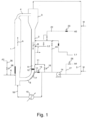
- Figure 1 depicts schematically a set-up of a gas-phase MZCR having two interconnected polymerization zones for carrying out the polymerization process of the present disclosure, without restricting the invention to the embodiments illustrated therein.
- the MZCR is operated at a pressure and a temperature such that an amount of liquid is present in the whole riser or in a significant portion of the riser.
- an amount of liquid is present from the bottom to a certain height of the riser, such as up to 75% of the height or up to 50% of the height, no liquid being present respectively above 75% or 50% of the height of the riser.
- an amount of liquid may also be present in the upper part of the downcomer.
- the pressure of operation of the MZCR is comprised between 5 and 40 bar-g, or between 10 and 35 bar-g, or still between 20 and 30 bar-g.
- the temperature of operation of the MZCR is comprised between 40 and 120 °C, or between 45 and 100 °C, or between 50 and 85 °C, or between 55 and 70 °C.
- the difference between the temperature of operation of the reactor and the dew point of the gas in the reactor is comprised between 0.5°C and 4°C, or between 1°C and 3°C.
- fast fluidization conditions are established by feeding a mixture of gas and liquid comprising one or more alpha-olefins at a velocity higher than the transport velocity of the polymer particles.
- the gas velocity within the riser is generally comprised between 0.5 and 15 m/s, preferably between 0.8 and 5 m/s.
- transport velocity and fast fluidization conditions are well known in the art; for a definition thereof, see, for example, " D. Geldart, Gas Fluidisation Technology, page 155 et seq., J. Wiley & Sons Ltd., 1986 ".
- the polymer particles flow under the action of gravity in a densified form, so that high values of density of the solid (mass of polymer per volume of reactor) are achieved, said density of solid approaching the bulk density of the polymer.
- a densified form of the polymer implies that the ratio between the mass of polymer particles and the reactor volume is higher than 80% of the "poured bulk density” of the obtained polymer.
- the "poured bulk density" of a polymer is a parameter well known to the person skilled in the art. In view of the above, it is clear that in the downcomer the polymer flows downward in a plug flow and only small quantities of gas are entrained with the polymer particles.
- the two interconnected polymerization zones can be operated in such a way that the fluid mixture coming from the riser is totally or partially prevented from entering the downcomer by introducing into the upper part of the downcomer a liquid and/or gas stream, denominated the "barrier stream", having a composition different from the gaseous mixture present in the riser. That way of operation can be achieved by placing one or more feeding lines for the barrier stream in the downcomer close to the upper limit of the volume occupied by the polymer particles flowing downward in a densified form.
- This liquid/gas mixture fed into the upper part of the downcomer partially replaces the fluid mixture entrained with the polymer particles entering the downcomer.
- the partial evaporation of the liquid in the barrier stream generates in the upper part of the downcomer a flow of gas, which moves counter-currently to the flow of descendent polymer, thus acting as a barrier to the fluid mixture coming from the riser and entrained among the polymer particles.
- the liquid/gas barrier fed to the upper part of the downcomer can be sprinkled over the surface of the polymer particles: the evaporation of the liquid will provide the required upward flow of gas.
- the feed of the barrier stream causes a difference in the concentrations of monomers and/or hydrogen (molecular weight regulator) inside the riser and the downcomer, so that a bimodal polymer can be produced.
- the reaction mixture comprises, besides the gaseous monomers, inert polymerization diluents and chain transfer agents, such as hydrogen, useful for regulating the molecular weight of the resulting polymeric chains.
- the polymerization diluents are preferably selected from C 2 -C 8 alkanes, preferably propane, isobutane, isopentane and hexane.
- Propane is preferably used as the polymerization diluent in the gas-phase polymerization of the invention, so that liquid propane is unavoidably contained in the barrier stream, which is fed to the upper part of the downcomer.
- the barrier steam comprises:
- compositions of barrier stream can be obtained from the condensation of a part of the fresh monomers and propane, said condensed part being fed to the upper part of the downcomer in a liquid form.
- the above compositions of the barrier stream derive from the condensation and/or distillation of part of a gaseous stream continuously recycled to the reactor having two interconnected polymerization zones.
- Additional liquid and/or gas of the composition can be fed along the downcomer at a point below the barrier stream.
- the recycle gas stream is generally withdrawn from a gas/solid separator placed downstream of the riser, cooled by passage through an external heat exchanger and then recycled to the bottom of the riser.
- the recycle gas stream comprises, besides the gaseous monomers, also the inert polymerization components, such as propane, and chain transfer agents, such as hydrogen.
- the composition of the barrier stream deriving from condensation and/or distillation of the gas recycle stream may be suitably adjusted by feeding liquid make-up monomers and propane before its introduction into the upper part of downcomer.
- Condensate is normally present at the cooler gas discharge because by removal of reaction heat part of the recirculation gas is condensed. However, this condensate is completely vaporized once it enters the riser bottom and is contacted with the hot recirculating solid flow from the downcomer bottom. This is not the case in the process of the present disclosure, operating at a riser temperature close to the dew point. After the gas flow is contacted with the hot recirculating solid flow, some condensate remains unvaporized and is entrained in the upper part of the riser in a three-phase flow regime.
- the maximum allowable operating temperature at the bottom of the downcomer depends mainly on the product structure; once that is known, the solid recirculation defines the maximum allowable production rate for the MZCR. As a consequence, a higher temperature difference between the riser and the downcomer bottom temperature can be translated into a higher throughput. Therefore it is evident that, once a proper maximum operating temperature is identified for a specific grade, higher delta T's and therefore higher production rates can be achieved in the downcomer simply by decreasing the riser (control) temperature of the reactor within a certain range from the dew point.
- the polymerization reactor shown in Figure 1 comprises a first polymerization zone 1 (riser), wherein the polymer particles flow upward under fast fluidization conditions along the direction of the arrow A and a second polymerization zone 2 (downcomer), wherein the polymer particles flow downward under the action of gravity along the direction of the arrow B.
- the upper portion of the riser 1 is connected to a solid/gas separator 3 by the interconnection section 4.
- the separator 3 removes the major part of the unreacted monomers from the polymer particles and the polymer withdrawn from the bottom of separator 3 enters the top portion of the downcomer 2.
- the separated unreacted monomers optionally together with polymerization diluents, such as propane, flow up to the top of separator 3 and are successively recycled to the bottom of the riser 1 via the recycle line 5.
- a mixture comprising one or more olefin monomers, hydrogen as the molecular weight regulator and propane as the polymerization diluent, is fed to the polymerization reactor via one or more lines M, which are suitably placed along the gas recycle line 5, according to the knowledge of the person skilled in the art.
- the catalyst components are continuously introduced into the riser 1 via line 6.
- the produced polymer can be discharged from the reactor via a line 7, which can be placed on the lower portion of the downcomer 2 so that, due to the packed flow of densified polymer, the quantity of gas entrained with the discharged polymer is minimized.
- a control valve not shown
- Additional polymer discharge lines can be placed in the bottom part of the downcomer (not shown).
- the polymerization reactor further comprises a transport section 8 connecting the bottom of downcomer 2 with the lower region of the riser 1.
- the bottom of the downcomer 2 converges into a slight restriction 9.
- a control valve 10 with an adjustable opening can be placed within the restriction 9.
- the flow rate (Fp) of polymer continuously circulated between the downcomer 2 and the riser 1 is adjusted by the level of opening of the control valve 10.
- the control valve 10 may be a mechanical valve, such as a butterfly valve, a ball valve, etc.
- a stream of dosing gas is fed into the lower part of the downcomer 2 by means of a line 11 placed at a short distance above the restriction 9.
- the dosing gas to be introduced through line 10 can be taken from the recycle line 5.
- the Fp of polymer particles circulated between downcomer 2 and riser 1 can be adjusted by varying the opening of the control valve 10 at the bottom of the downcomer and/or by varying the flow rate of the dosing gas entering the downcomer via line 11.
- the flow rate of dosing gas is adjusted by means of a control valve 18, which is suitably arranged on line 11.
- the transport section 8 is designed as a bend descending from the bottom of downcomer 2 up to the lower region of the riser 1. Furthermore, a carrier gas is introduced via line 12 at the inlet of the transport section 8. The flow rate of carrier gas is adjusted by means of a control valve 13, which is suitably arranged on line 12.
- the carrier gas can also be taken from the gas recycle line 5.
- the gas recycle stream of line 5 is first subjected to compression by means of a compressor 14 and a minor percentage of the recycle stream passes through line 12, thus entering the transport section 8 and diluting the solid phase of polymer flowing through the transport section 8.
- the major part of the recycle stream, downstream of the compressor 14, is subjected to cooling in a heat exchanger 15 and successively is introduced via line 16 at the bottom of the riser 1 at a high velocity, such as to ensure fast fluidization conditions in the polymer bed flowing along the riser 1.
- the carrier gas merges with the densified polymer coming from downcomer 2 at the inlet portion of transport section 8, after exiting the slits of the gas distribution grid 17.
- the gas distribution grid 17 is formed by a plurality of trays fixed to the transport section 8 in a way to form slits in the overlapping area of adjacent trays. A detailed description of the gas distribution grid 17 can be found in WO 2012/031986 .
- Hydrogen and the comonomer(s) ethylene and/or a C 4 -C 10 alpha-olefin are pre-dispersed either in the liquid monomer L1 and/or L2 as described above or, alternatively, in a fraction of recycle gas taken from recycle line 5 via line 24, and then fed to the reactor (flow rate A2, line 22 metered by one or more valves 23).
- flow rates of antistatic compositions may be fed into the reactor at the bottom of the riser (flow rate A3, line 25 metered by valve 26) or into the main gas recycle line 5 (flow rate A4, line 27 metered by valve 28).
- the polymerization reactor can be operated by properly adjusting the polymerization conditions and the concentration of monomers and hydrogen in the riser and in the downcomer, so as to tailor or tune the obtainable products.
- the fluid mixture entraining the polymer particles and coming from the riser can be partially or totally prevented from entering the downcomer, so as to polymerize different monomer compositions in the riser and the downcomer.
- This effect may be achieved by feeding a gaseous and/or liquid barrier stream through a line placed in the upper portion of the downcomer.
- the barrier stream should have a composition different from the fluid composition present in the riser.
- the flow rate of the barrier stream can be adjusted, so that an upward flow of gas counter-current to the flow of the polymer particles is generated, particularly at the top of the downcomer, thus acting as a barrier to the fluid mixture coming from the riser.
- an upward flow of gas counter-current to the flow of the polymer particles is generated, particularly at the top of the downcomer, thus acting as a barrier to the fluid mixture coming from the riser.
- Component (i) can be prepared by contacting a magnesium halide, a titanium compound having at least a Ti-halogen bond, and optionally an electron donor compound.
- the magnesium halide can be MgCl 2 in active form which is widely known from the patent literature as a support for Ziegler-Natta catalysts.
- the titanium compounds can be TiCl 4 or TiCl 3 .
- Ti-haloalcoholates of formula Ti(OR) n-y X y , where n is the valence of titanium, y is a number between 1 and n-1 X is halogen and R is a hydrocarbon radical having from 1 to 10 carbon atoms, can also be used.
- Still other solid catalyst components which may be used are single-site catalysts supported on a carrier, such as metallocene catalysts, comprising:
- the molar ratio of solid catalyst component to alkylaluminum compound introduced into the polymerization reactor is from 0.05 to 3, or from 0.1 to 2, or from 0.5 to 1.
- the catalysts may be optionally subjected to prepolymerization before being fed to the polymerization reactor.
- the prepolymerization occurs in a loop reactor.
- the prepolymerization of the catalyst system may be carried out at a low temperature, in a range of from 0°C to 60°C.
- additives, fillers and pigments commonly used in olefin polymers, may be added, such as nucleating agents, extension oils, mineral fillers, and other organic and inorganic pigments.
- inorganic fillers such as talc, calcium carbonate and mineral fillers also brings about an improvement to some mechanical properties, such as flexural modulus and HDT. Talc can also have a nucleating effect.
- the nucleating agents are added to the compositions of the present disclosure in quantities ranging from 0.05 to 2% by weight, more preferably from 0.1 to 1% by weight, with respect to the total weight, for example.
- the peak of the S ⁇ carbon (nomenclature according to " Monomer Sequence Distribution in Ethylene-Propylene Rubber Measured by 13C NMR. 3. Use of Reaction Probability Mode " C. J. Carman, R. A. Harrington and C. E. Wilkes, Macromolecules, 1977, 10, 536 ) was used as an internal reference at 29.9 ppm.
- the samples were dissolved in 1,1,2,2-tetrachloroethane-d2 at 120°C with a 8 % wt/v concentration. Each spectrum was acquired with a 90° pulse, with 15 seconds of delay between pulses and CPD to remove 1 H- 13 C coupling. 512 transients were stored in 32K data points using a spectral window of 9000 Hz.
- XS xylene-soluble fraction
- the Ziegler-Natta catalyst was prepared according to Example 5, lines 48-55, of the European Patent EP728769B1 .
- the solid catalyst component described above is contacted with aluminum-triethyl (TEAL) and with the dicyclopentyldimethoxysilane (D donor) under the conditions reported in Table 1.
- TEAL aluminum-triethyl
- D donor dicyclopentyldimethoxysilane
- the catalyst system is then subject to prepolymerization treatment at 20°C by maintaining it in suspension in liquid propylene for a residence time of 7 minutes before introducing it into the polymerization reactor.
- the polymerization was carried out in a MZCR, i . e . a polymerization reactor comprising two interconnected polymerization zones, a riser and a downcomer, as described in European Patent EP782587 .
- Propylene was polymerized to obtain a crystalline propylene homopolymer Hydrogen was used as molecular weight regulator. While in Example 1C the MZCR temperature is controlled at a typical value of 73°C, Example 1 was carried out at a much lower temperature of 68.5°C, only 1.5°C above the condensation point of the riser gas.
- the polymer particles exiting from the reactor were subjected to a steam treatment to remove the unreacted monomers and dried under a nitrogen flow.
- Example 1C While in Example 1C no condensate was present in the gas flowing through the riser after contact with the hot recirculating solid flow, for Example 1 it can be calculated that about 4% by weight of condensate was entrained in the upper part of the riser together with the solid particles. Nonetheless, both riser and downcomer operations were very stable throughout the experiment.
- the polymerization was carried out in a sequence of two gas-phase reactors: a first reactor being a MZCR and a second reactor being a fluidized-bed reactor.
- first reactor propylene was polymerized to obtain a crystalline polypropylene (matrix).
- the polymer obtained in the first reactor was continuously discharged via line 7, separated from the gas into a gas/solid separator and introduced in the second reactor.
- second reactor ethylene and propylene were copolymerized to obtain an amorphous rubber.
- the same product was prepared in the two examples, with the only difference that in Example 2 the MZCR temperature was controlled close to the condensation point of the riser gas (2°C above). In both reactors hydrogen was used as molecular weight regulator.
- the polymer particles exiting from the second reactor were subjected to a steam treatment to remove the unreacted monomers and dried under a nitrogen flow.
Landscapes
- Chemical & Material Sciences (AREA)
- Organic Chemistry (AREA)
- Chemical Kinetics & Catalysis (AREA)
- Health & Medical Sciences (AREA)
- Medicinal Chemistry (AREA)
- Polymers & Plastics (AREA)
- Engineering & Computer Science (AREA)
- Materials Engineering (AREA)
- Combustion & Propulsion (AREA)
- Polymerisation Methods In General (AREA)
- Addition Polymer Or Copolymer, Post-Treatments, Or Chemical Modifications (AREA)
Applications Claiming Priority (2)
| Application Number | Priority Date | Filing Date | Title |
|---|---|---|---|
| EP17192309 | 2017-09-21 | ||
| PCT/EP2018/074705 WO2019057595A1 (en) | 2017-09-21 | 2018-09-13 | PROCESS FOR THE GASEOUS POLYMERIZATION OF OLEFINS |
Publications (2)
| Publication Number | Publication Date |
|---|---|
| EP3684824A1 EP3684824A1 (en) | 2020-07-29 |
| EP3684824B1 true EP3684824B1 (en) | 2025-02-26 |
Family
ID=59955388
Family Applications (1)
| Application Number | Title | Priority Date | Filing Date |
|---|---|---|---|
| EP18765906.5A Active EP3684824B1 (en) | 2017-09-21 | 2018-09-13 | Process for gas-phase polymerization of olefins |
Country Status (10)
| Country | Link |
|---|---|
| US (1) | US11098143B2 (enExample) |
| EP (1) | EP3684824B1 (enExample) |
| JP (1) | JP6975861B2 (enExample) |
| KR (1) | KR102336485B1 (enExample) |
| CN (1) | CN111094360B (enExample) |
| AR (1) | AR112897A1 (enExample) |
| BR (1) | BR112020004713B8 (enExample) |
| RU (1) | RU2739304C1 (enExample) |
| SA (1) | SA520411541B1 (enExample) |
| WO (1) | WO2019057595A1 (enExample) |
Families Citing this family (1)
| Publication number | Priority date | Publication date | Assignee | Title |
|---|---|---|---|---|
| JP7608608B2 (ja) * | 2020-12-09 | 2025-01-06 | バーゼル・ポリオレフィン・ゲーエムベーハー | オレフィン気相重合用反応器 |
Citations (1)
| Publication number | Priority date | Publication date | Assignee | Title |
|---|---|---|---|---|
| EP0251100A2 (en) * | 1986-06-23 | 1988-01-07 | Union Carbide Corporation | Improving catalyst productivity in the polymerization of olefins |
Family Cites Families (19)
| Publication number | Priority date | Publication date | Assignee | Title |
|---|---|---|---|---|
| JPH0478626A (ja) * | 1990-07-13 | 1992-03-12 | Morisawa & Co Ltd | 自動車の停車時間計測表示装置 |
| IL117114A (en) | 1995-02-21 | 2000-02-17 | Montell North America Inc | Components and catalysts for the polymerization ofolefins |
| IT1275573B (it) | 1995-07-20 | 1997-08-07 | Spherilene Spa | Processo ed apparecchiatura per la pomimerizzazione in fase gas delle alfa-olefine |
| AU760115B2 (en) * | 1998-07-08 | 2003-05-08 | Montell Technology Company B.V. | Process and apparatus for the gas-phase polymerisation |
| JP2006502263A (ja) | 2002-10-09 | 2006-01-19 | バセル ポリオレフィン イタリア エス.アール.エス. | オレフィン類の気相触媒重合 |
| CN1229400C (zh) | 2003-09-18 | 2005-11-30 | 中国石油化工股份有限公司 | 用于烯烃聚合的催化剂组分及其催化剂 |
| RU2380379C2 (ru) * | 2004-03-03 | 2010-01-27 | Базелль Полиолефин Италия С.Р.Л. | Способ регулирования течения полимера в процессе полимеризации |
| US7071137B2 (en) | 2004-08-25 | 2006-07-04 | Novolen Technology Holdings, C.V. | Method of making a ziegler-natta catalyst |
| EP1827673B1 (en) * | 2004-12-20 | 2012-02-01 | Basell Poliolefine Italia S.r.l. | Process and apparatus for the polymerization of propylene |
| MX2009012580A (es) * | 2007-05-22 | 2009-12-08 | Basell Poliolefine Srl | Procedimiento para la preparacion de composiciones suaves de polimero de propileno. |
| JP5308797B2 (ja) | 2007-12-11 | 2013-10-09 | 住友化学株式会社 | オレフィン重合反応装置、ポリオレフィン製造システム、及び、ポリオレフィン製造方法 |
| US8198383B2 (en) * | 2007-12-21 | 2012-06-12 | Basell Poliolefine Italia, s.r.l. | Process for the gas-phase polymerization of olefins |
| US8148478B2 (en) * | 2008-05-27 | 2012-04-03 | Basell Poliolefine Italia S.R.L. | Process for the gas-phase polymerization of olefins |
| EP2346598B1 (en) * | 2008-10-15 | 2020-07-29 | Univation Technologies, LLC | Circulating fluidized bed reactor |
| BR112012005542B1 (pt) | 2009-09-11 | 2019-08-20 | Basell Poliolefine Italia S.R.L | Processo para polimerização em fase gasosa de olefinas |
| MY156361A (en) | 2009-12-21 | 2016-02-15 | Grace W R & Co | Gas-phase polymerization process having multiple flow regimes |
| US9073027B2 (en) | 2010-09-09 | 2015-07-07 | Basell Poliolefine Italia S.R.L. | Process and apparatus for the gas-phase polymerization of olefins |
| KR102379360B1 (ko) | 2014-09-11 | 2022-03-25 | 릴라이언스 인더스트리즈 리미티드 | 폴리에틸렌을 제조하기 위한 지글러-나타 촉매 조성물 |
| RU2733752C9 (ru) * | 2017-03-27 | 2020-11-24 | Базелл Полиолефин Италия С.Р.Л. | Способ газофазной полимеризации олефинов |
-
2018
- 2018-09-05 AR ARP180102529A patent/AR112897A1/es active IP Right Grant
- 2018-09-13 EP EP18765906.5A patent/EP3684824B1/en active Active
- 2018-09-13 BR BR112020004713A patent/BR112020004713B8/pt active Search and Examination
- 2018-09-13 RU RU2020112283A patent/RU2739304C1/ru active
- 2018-09-13 CN CN201880057521.7A patent/CN111094360B/zh active Active
- 2018-09-13 US US16/649,044 patent/US11098143B2/en active Active
- 2018-09-13 KR KR1020207009904A patent/KR102336485B1/ko active Active
- 2018-09-13 JP JP2020535310A patent/JP6975861B2/ja active Active
- 2018-09-13 WO PCT/EP2018/074705 patent/WO2019057595A1/en not_active Ceased
-
2020
- 2020-03-15 SA SA520411541A patent/SA520411541B1/ar unknown
Patent Citations (1)
| Publication number | Priority date | Publication date | Assignee | Title |
|---|---|---|---|---|
| EP0251100A2 (en) * | 1986-06-23 | 1988-01-07 | Union Carbide Corporation | Improving catalyst productivity in the polymerization of olefins |
Also Published As
| Publication number | Publication date |
|---|---|
| KR20200042951A (ko) | 2020-04-24 |
| AR112897A1 (es) | 2019-12-26 |
| KR102336485B1 (ko) | 2021-12-07 |
| CN111094360A (zh) | 2020-05-01 |
| JP6975861B2 (ja) | 2021-12-01 |
| SA520411541B1 (ar) | 2023-02-07 |
| US11098143B2 (en) | 2021-08-24 |
| US20200216588A1 (en) | 2020-07-09 |
| BR112020004713A2 (pt) | 2020-09-08 |
| EP3684824A1 (en) | 2020-07-29 |
| JP2020533477A (ja) | 2020-11-19 |
| CN111094360B (zh) | 2022-04-01 |
| RU2739304C1 (ru) | 2020-12-22 |
| WO2019057595A1 (en) | 2019-03-28 |
| BR112020004713B8 (pt) | 2023-10-31 |
| BR112020004713B1 (pt) | 2023-06-27 |
Similar Documents
| Publication | Publication Date | Title |
|---|---|---|
| EP3601376B1 (en) | Process for gas-phase polymerization of olefins | |
| EP2225022B1 (en) | Process for the gas-phase polymerization of olefins | |
| US7687588B2 (en) | Process for the gas-phase polymerization of olefins | |
| KR101822805B1 (ko) | 올레핀의 기체상 중합 방법 | |
| EP3394110B1 (en) | Olefin polymerization process in the presence of antistatic composition | |
| EP3684824B1 (en) | Process for gas-phase polymerization of olefins | |
| JP5501384B2 (ja) | 水平撹拌気相反応器で製造されるポリオレフィン材料の分子量分布の拡大法 | |
| WO2025068073A1 (en) | A gas-phase polymerization reactor and a process for preparing an olefin polymer | |
| CN121039175A (zh) | 烯烃聚合工艺 | |
| WO2010026091A1 (en) | Process for the gas-phase polymerization of olefins |
Legal Events
| Date | Code | Title | Description |
|---|---|---|---|
| STAA | Information on the status of an ep patent application or granted ep patent |
Free format text: STATUS: UNKNOWN |
|
| STAA | Information on the status of an ep patent application or granted ep patent |
Free format text: STATUS: THE INTERNATIONAL PUBLICATION HAS BEEN MADE |
|
| PUAI | Public reference made under article 153(3) epc to a published international application that has entered the european phase |
Free format text: ORIGINAL CODE: 0009012 |
|
| STAA | Information on the status of an ep patent application or granted ep patent |
Free format text: STATUS: REQUEST FOR EXAMINATION WAS MADE |
|
| 17P | Request for examination filed |
Effective date: 20200318 |
|
| AK | Designated contracting states |
Kind code of ref document: A1 Designated state(s): AL AT BE BG CH CY CZ DE DK EE ES FI FR GB GR HR HU IE IS IT LI LT LU LV MC MK MT NL NO PL PT RO RS SE SI SK SM TR |
|
| AX | Request for extension of the european patent |
Extension state: BA ME |
|
| DAV | Request for validation of the european patent (deleted) | ||
| DAX | Request for extension of the european patent (deleted) | ||
| STAA | Information on the status of an ep patent application or granted ep patent |
Free format text: STATUS: EXAMINATION IS IN PROGRESS |
|
| 17Q | First examination report despatched |
Effective date: 20220707 |
|
| P01 | Opt-out of the competence of the unified patent court (upc) registered |
Effective date: 20230414 |
|
| GRAP | Despatch of communication of intention to grant a patent |
Free format text: ORIGINAL CODE: EPIDOSNIGR1 |
|
| STAA | Information on the status of an ep patent application or granted ep patent |
Free format text: STATUS: GRANT OF PATENT IS INTENDED |
|
| INTG | Intention to grant announced |
Effective date: 20241011 |
|
| GRAS | Grant fee paid |
Free format text: ORIGINAL CODE: EPIDOSNIGR3 |
|
| GRAA | (expected) grant |
Free format text: ORIGINAL CODE: 0009210 |
|
| STAA | Information on the status of an ep patent application or granted ep patent |
Free format text: STATUS: THE PATENT HAS BEEN GRANTED |
|
| AK | Designated contracting states |
Kind code of ref document: B1 Designated state(s): AL AT BE BG CH CY CZ DE DK EE ES FI FR GB GR HR HU IE IS IT LI LT LU LV MC MK MT NL NO PL PT RO RS SE SI SK SM TR |
|
| REG | Reference to a national code |
Ref country code: GB Ref legal event code: FG4D |
|
| REG | Reference to a national code |
Ref country code: CH Ref legal event code: EP |
|
| REG | Reference to a national code |
Ref country code: DE Ref legal event code: R096 Ref document number: 602018079603 Country of ref document: DE |
|
| REG | Reference to a national code |
Ref country code: IE Ref legal event code: FG4D |
|
| REG | Reference to a national code |
Ref country code: NL Ref legal event code: MP Effective date: 20250226 |
|
| PG25 | Lapsed in a contracting state [announced via postgrant information from national office to epo] |
Ref country code: RS Free format text: LAPSE BECAUSE OF FAILURE TO SUBMIT A TRANSLATION OF THE DESCRIPTION OR TO PAY THE FEE WITHIN THE PRESCRIBED TIME-LIMIT Effective date: 20250526 |
|
| PG25 | Lapsed in a contracting state [announced via postgrant information from national office to epo] |
Ref country code: FI Free format text: LAPSE BECAUSE OF FAILURE TO SUBMIT A TRANSLATION OF THE DESCRIPTION OR TO PAY THE FEE WITHIN THE PRESCRIBED TIME-LIMIT Effective date: 20250226 |
|
| PG25 | Lapsed in a contracting state [announced via postgrant information from national office to epo] |
Ref country code: PL Free format text: LAPSE BECAUSE OF FAILURE TO SUBMIT A TRANSLATION OF THE DESCRIPTION OR TO PAY THE FEE WITHIN THE PRESCRIBED TIME-LIMIT Effective date: 20250226 |
|
| PG25 | Lapsed in a contracting state [announced via postgrant information from national office to epo] |
Ref country code: ES Free format text: LAPSE BECAUSE OF FAILURE TO SUBMIT A TRANSLATION OF THE DESCRIPTION OR TO PAY THE FEE WITHIN THE PRESCRIBED TIME-LIMIT Effective date: 20250226 |
|
| REG | Reference to a national code |
Ref country code: LT Ref legal event code: MG9D |
|
| PG25 | Lapsed in a contracting state [announced via postgrant information from national office to epo] |
Ref country code: IS Free format text: LAPSE BECAUSE OF FAILURE TO SUBMIT A TRANSLATION OF THE DESCRIPTION OR TO PAY THE FEE WITHIN THE PRESCRIBED TIME-LIMIT Effective date: 20250626 Ref country code: NO Free format text: LAPSE BECAUSE OF FAILURE TO SUBMIT A TRANSLATION OF THE DESCRIPTION OR TO PAY THE FEE WITHIN THE PRESCRIBED TIME-LIMIT Effective date: 20250526 |
|
| PG25 | Lapsed in a contracting state [announced via postgrant information from national office to epo] |
Ref country code: NL Free format text: LAPSE BECAUSE OF FAILURE TO SUBMIT A TRANSLATION OF THE DESCRIPTION OR TO PAY THE FEE WITHIN THE PRESCRIBED TIME-LIMIT Effective date: 20250226 |
|
| PG25 | Lapsed in a contracting state [announced via postgrant information from national office to epo] |
Ref country code: HR Free format text: LAPSE BECAUSE OF FAILURE TO SUBMIT A TRANSLATION OF THE DESCRIPTION OR TO PAY THE FEE WITHIN THE PRESCRIBED TIME-LIMIT Effective date: 20250226 |
|
| PG25 | Lapsed in a contracting state [announced via postgrant information from national office to epo] |
Ref country code: LV Free format text: LAPSE BECAUSE OF FAILURE TO SUBMIT A TRANSLATION OF THE DESCRIPTION OR TO PAY THE FEE WITHIN THE PRESCRIBED TIME-LIMIT Effective date: 20250226 Ref country code: PT Free format text: LAPSE BECAUSE OF FAILURE TO SUBMIT A TRANSLATION OF THE DESCRIPTION OR TO PAY THE FEE WITHIN THE PRESCRIBED TIME-LIMIT Effective date: 20250626 |
|
| PG25 | Lapsed in a contracting state [announced via postgrant information from national office to epo] |
Ref country code: GR Free format text: LAPSE BECAUSE OF FAILURE TO SUBMIT A TRANSLATION OF THE DESCRIPTION OR TO PAY THE FEE WITHIN THE PRESCRIBED TIME-LIMIT Effective date: 20250527 Ref country code: BG Free format text: LAPSE BECAUSE OF FAILURE TO SUBMIT A TRANSLATION OF THE DESCRIPTION OR TO PAY THE FEE WITHIN THE PRESCRIBED TIME-LIMIT Effective date: 20250226 |
|
| REG | Reference to a national code |
Ref country code: AT Ref legal event code: MK05 Ref document number: 1770573 Country of ref document: AT Kind code of ref document: T Effective date: 20250226 |
|
| PG25 | Lapsed in a contracting state [announced via postgrant information from national office to epo] |
Ref country code: SE Free format text: LAPSE BECAUSE OF FAILURE TO SUBMIT A TRANSLATION OF THE DESCRIPTION OR TO PAY THE FEE WITHIN THE PRESCRIBED TIME-LIMIT Effective date: 20250226 |
|
| PG25 | Lapsed in a contracting state [announced via postgrant information from national office to epo] |
Ref country code: SM Free format text: LAPSE BECAUSE OF FAILURE TO SUBMIT A TRANSLATION OF THE DESCRIPTION OR TO PAY THE FEE WITHIN THE PRESCRIBED TIME-LIMIT Effective date: 20250226 |
|
| PG25 | Lapsed in a contracting state [announced via postgrant information from national office to epo] |
Ref country code: DK Free format text: LAPSE BECAUSE OF FAILURE TO SUBMIT A TRANSLATION OF THE DESCRIPTION OR TO PAY THE FEE WITHIN THE PRESCRIBED TIME-LIMIT Effective date: 20250226 |
|
| PGFP | Annual fee paid to national office [announced via postgrant information from national office to epo] |
Ref country code: DE Payment date: 20250808 Year of fee payment: 8 |
|
| PG25 | Lapsed in a contracting state [announced via postgrant information from national office to epo] |
Ref country code: IT Free format text: LAPSE BECAUSE OF FAILURE TO SUBMIT A TRANSLATION OF THE DESCRIPTION OR TO PAY THE FEE WITHIN THE PRESCRIBED TIME-LIMIT Effective date: 20250226 |
|
| PGFP | Annual fee paid to national office [announced via postgrant information from national office to epo] |
Ref country code: BE Payment date: 20250812 Year of fee payment: 8 |
|
| PG25 | Lapsed in a contracting state [announced via postgrant information from national office to epo] |
Ref country code: AT Free format text: LAPSE BECAUSE OF FAILURE TO SUBMIT A TRANSLATION OF THE DESCRIPTION OR TO PAY THE FEE WITHIN THE PRESCRIBED TIME-LIMIT Effective date: 20250226 |
|
| PGFP | Annual fee paid to national office [announced via postgrant information from national office to epo] |
Ref country code: FR Payment date: 20250808 Year of fee payment: 8 |
|
| PG25 | Lapsed in a contracting state [announced via postgrant information from national office to epo] |
Ref country code: EE Free format text: LAPSE BECAUSE OF FAILURE TO SUBMIT A TRANSLATION OF THE DESCRIPTION OR TO PAY THE FEE WITHIN THE PRESCRIBED TIME-LIMIT Effective date: 20250226 Ref country code: CZ Free format text: LAPSE BECAUSE OF FAILURE TO SUBMIT A TRANSLATION OF THE DESCRIPTION OR TO PAY THE FEE WITHIN THE PRESCRIBED TIME-LIMIT Effective date: 20250226 |
|
| PG25 | Lapsed in a contracting state [announced via postgrant information from national office to epo] |
Ref country code: RO Free format text: LAPSE BECAUSE OF FAILURE TO SUBMIT A TRANSLATION OF THE DESCRIPTION OR TO PAY THE FEE WITHIN THE PRESCRIBED TIME-LIMIT Effective date: 20250226 |
|
| PG25 | Lapsed in a contracting state [announced via postgrant information from national office to epo] |
Ref country code: SK Free format text: LAPSE BECAUSE OF FAILURE TO SUBMIT A TRANSLATION OF THE DESCRIPTION OR TO PAY THE FEE WITHIN THE PRESCRIBED TIME-LIMIT Effective date: 20250226 |