EP3680966B1 - Aktives material für positivelektrode auf lithiumkobalt-basis, verfahren zu seiner herstellung, positive elektrode und sekundärbatterie dieses beinhaltend - Google Patents
Aktives material für positivelektrode auf lithiumkobalt-basis, verfahren zu seiner herstellung, positive elektrode und sekundärbatterie dieses beinhaltend Download PDFInfo
- Publication number
- EP3680966B1 EP3680966B1 EP18875428.7A EP18875428A EP3680966B1 EP 3680966 B1 EP3680966 B1 EP 3680966B1 EP 18875428 A EP18875428 A EP 18875428A EP 3680966 B1 EP3680966 B1 EP 3680966B1
- Authority
- EP
- European Patent Office
- Prior art keywords
- positive electrode
- lithium
- electrode active
- active material
- lithium cobalt
- Prior art date
- Legal status (The legal status is an assumption and is not a legal conclusion. Google has not performed a legal analysis and makes no representation as to the accuracy of the status listed.)
- Active
Links
Images

Classifications
-
- H—ELECTRICITY
- H01—ELECTRIC ELEMENTS
- H01M—PROCESSES OR MEANS, e.g. BATTERIES, FOR THE DIRECT CONVERSION OF CHEMICAL ENERGY INTO ELECTRICAL ENERGY
- H01M4/00—Electrodes
- H01M4/02—Electrodes composed of, or comprising, active material
- H01M4/36—Selection of substances as active materials, active masses, active liquids
- H01M4/362—Composites
- H01M4/366—Composites as layered products
-
- C—CHEMISTRY; METALLURGY
- C01—INORGANIC CHEMISTRY
- C01G—COMPOUNDS CONTAINING METALS NOT COVERED BY SUBCLASSES C01D OR C01F
- C01G51/00—Compounds of cobalt
- C01G51/40—Complex oxides containing cobalt and at least one other metal element
- C01G51/42—Complex oxides containing cobalt and at least one other metal element containing alkali metals, e.g. LiCoO2
-
- C—CHEMISTRY; METALLURGY
- C01—INORGANIC CHEMISTRY
- C01G—COMPOUNDS CONTAINING METALS NOT COVERED BY SUBCLASSES C01D OR C01F
- C01G51/00—Compounds of cobalt
- C01G51/40—Complex oxides containing cobalt and at least one other metal element
- C01G51/66—Complex oxides containing cobalt and at least one other metal element containing alkaline earth metals, e.g. SrCoO3
-
- H—ELECTRICITY
- H01—ELECTRIC ELEMENTS
- H01M—PROCESSES OR MEANS, e.g. BATTERIES, FOR THE DIRECT CONVERSION OF CHEMICAL ENERGY INTO ELECTRICAL ENERGY
- H01M10/00—Secondary cells; Manufacture thereof
- H01M10/05—Accumulators with non-aqueous electrolyte
- H01M10/052—Li-accumulators
-
- H—ELECTRICITY
- H01—ELECTRIC ELEMENTS
- H01M—PROCESSES OR MEANS, e.g. BATTERIES, FOR THE DIRECT CONVERSION OF CHEMICAL ENERGY INTO ELECTRICAL ENERGY
- H01M10/00—Secondary cells; Manufacture thereof
- H01M10/05—Accumulators with non-aqueous electrolyte
- H01M10/052—Li-accumulators
- H01M10/0525—Rocking-chair batteries, i.e. batteries with lithium insertion or intercalation in both electrodes; Lithium-ion batteries
-
- H—ELECTRICITY
- H01—ELECTRIC ELEMENTS
- H01M—PROCESSES OR MEANS, e.g. BATTERIES, FOR THE DIRECT CONVERSION OF CHEMICAL ENERGY INTO ELECTRICAL ENERGY
- H01M4/00—Electrodes
- H01M4/02—Electrodes composed of, or comprising, active material
- H01M4/04—Processes of manufacture in general
- H01M4/0471—Processes of manufacture in general involving thermal treatment, e.g. firing, sintering, backing particulate active material, thermal decomposition, pyrolysis
-
- H—ELECTRICITY
- H01—ELECTRIC ELEMENTS
- H01M—PROCESSES OR MEANS, e.g. BATTERIES, FOR THE DIRECT CONVERSION OF CHEMICAL ENERGY INTO ELECTRICAL ENERGY
- H01M4/00—Electrodes
- H01M4/02—Electrodes composed of, or comprising, active material
- H01M4/13—Electrodes for accumulators with non-aqueous electrolyte, e.g. for lithium-accumulators; Processes of manufacture thereof
- H01M4/139—Processes of manufacture
- H01M4/1391—Processes of manufacture of electrodes based on mixed oxides or hydroxides, or on mixtures of oxides or hydroxides, e.g. LiCoOx
-
- H—ELECTRICITY
- H01—ELECTRIC ELEMENTS
- H01M—PROCESSES OR MEANS, e.g. BATTERIES, FOR THE DIRECT CONVERSION OF CHEMICAL ENERGY INTO ELECTRICAL ENERGY
- H01M4/00—Electrodes
- H01M4/02—Electrodes composed of, or comprising, active material
- H01M4/36—Selection of substances as active materials, active masses, active liquids
- H01M4/48—Selection of substances as active materials, active masses, active liquids of inorganic oxides or hydroxides
- H01M4/485—Selection of substances as active materials, active masses, active liquids of inorganic oxides or hydroxides of mixed oxides or hydroxides for inserting or intercalating light metals, e.g. LiTi2O4 or LiTi2OxFy
-
- H—ELECTRICITY
- H01—ELECTRIC ELEMENTS
- H01M—PROCESSES OR MEANS, e.g. BATTERIES, FOR THE DIRECT CONVERSION OF CHEMICAL ENERGY INTO ELECTRICAL ENERGY
- H01M4/00—Electrodes
- H01M4/02—Electrodes composed of, or comprising, active material
- H01M4/36—Selection of substances as active materials, active masses, active liquids
- H01M4/48—Selection of substances as active materials, active masses, active liquids of inorganic oxides or hydroxides
- H01M4/52—Selection of substances as active materials, active masses, active liquids of inorganic oxides or hydroxides of nickel, cobalt or iron
- H01M4/525—Selection of substances as active materials, active masses, active liquids of inorganic oxides or hydroxides of nickel, cobalt or iron of mixed oxides or hydroxides containing iron, cobalt or nickel for inserting or intercalating light metals, e.g. LiNiO2, LiCoO2 or LiCoOxFy
-
- C—CHEMISTRY; METALLURGY
- C01—INORGANIC CHEMISTRY
- C01P—INDEXING SCHEME RELATING TO STRUCTURAL AND PHYSICAL ASPECTS OF SOLID INORGANIC COMPOUNDS
- C01P2002/00—Crystal-structural characteristics
- C01P2002/20—Two-dimensional structures
-
- C—CHEMISTRY; METALLURGY
- C01—INORGANIC CHEMISTRY
- C01P—INDEXING SCHEME RELATING TO STRUCTURAL AND PHYSICAL ASPECTS OF SOLID INORGANIC COMPOUNDS
- C01P2002/00—Crystal-structural characteristics
- C01P2002/20—Two-dimensional structures
- C01P2002/22—Two-dimensional structures layered hydroxide-type, e.g. of the hydrotalcite-type
-
- C—CHEMISTRY; METALLURGY
- C01—INORGANIC CHEMISTRY
- C01P—INDEXING SCHEME RELATING TO STRUCTURAL AND PHYSICAL ASPECTS OF SOLID INORGANIC COMPOUNDS
- C01P2002/00—Crystal-structural characteristics
- C01P2002/30—Three-dimensional structures
- C01P2002/32—Three-dimensional structures spinel-type (AB2O4)
-
- C—CHEMISTRY; METALLURGY
- C01—INORGANIC CHEMISTRY
- C01P—INDEXING SCHEME RELATING TO STRUCTURAL AND PHYSICAL ASPECTS OF SOLID INORGANIC COMPOUNDS
- C01P2002/00—Crystal-structural characteristics
- C01P2002/50—Solid solutions
- C01P2002/52—Solid solutions containing elements as dopants
-
- C—CHEMISTRY; METALLURGY
- C01—INORGANIC CHEMISTRY
- C01P—INDEXING SCHEME RELATING TO STRUCTURAL AND PHYSICAL ASPECTS OF SOLID INORGANIC COMPOUNDS
- C01P2002/00—Crystal-structural characteristics
- C01P2002/50—Solid solutions
- C01P2002/52—Solid solutions containing elements as dopants
- C01P2002/54—Solid solutions containing elements as dopants one element only
-
- C—CHEMISTRY; METALLURGY
- C01—INORGANIC CHEMISTRY
- C01P—INDEXING SCHEME RELATING TO STRUCTURAL AND PHYSICAL ASPECTS OF SOLID INORGANIC COMPOUNDS
- C01P2004/00—Particle morphology
- C01P2004/60—Particles characterised by their size
- C01P2004/61—Micrometer sized, i.e. from 1-100 micrometer
-
- C—CHEMISTRY; METALLURGY
- C01—INORGANIC CHEMISTRY
- C01P—INDEXING SCHEME RELATING TO STRUCTURAL AND PHYSICAL ASPECTS OF SOLID INORGANIC COMPOUNDS
- C01P2004/00—Particle morphology
- C01P2004/80—Particles consisting of a mixture of two or more inorganic phases
- C01P2004/82—Particles consisting of a mixture of two or more inorganic phases two phases having the same anion, e.g. both oxidic phases
- C01P2004/84—Particles consisting of a mixture of two or more inorganic phases two phases having the same anion, e.g. both oxidic phases one phase coated with the other
-
- C—CHEMISTRY; METALLURGY
- C01—INORGANIC CHEMISTRY
- C01P—INDEXING SCHEME RELATING TO STRUCTURAL AND PHYSICAL ASPECTS OF SOLID INORGANIC COMPOUNDS
- C01P2006/00—Physical properties of inorganic compounds
- C01P2006/40—Electric properties
-
- H—ELECTRICITY
- H01—ELECTRIC ELEMENTS
- H01M—PROCESSES OR MEANS, e.g. BATTERIES, FOR THE DIRECT CONVERSION OF CHEMICAL ENERGY INTO ELECTRICAL ENERGY
- H01M4/00—Electrodes
- H01M4/02—Electrodes composed of, or comprising, active material
- H01M2004/026—Electrodes composed of, or comprising, active material characterised by the polarity
- H01M2004/028—Positive electrodes
-
- Y—GENERAL TAGGING OF NEW TECHNOLOGICAL DEVELOPMENTS; GENERAL TAGGING OF CROSS-SECTIONAL TECHNOLOGIES SPANNING OVER SEVERAL SECTIONS OF THE IPC; TECHNICAL SUBJECTS COVERED BY FORMER USPC CROSS-REFERENCE ART COLLECTIONS [XRACs] AND DIGESTS
- Y02—TECHNOLOGIES OR APPLICATIONS FOR MITIGATION OR ADAPTATION AGAINST CLIMATE CHANGE
- Y02E—REDUCTION OF GREENHOUSE GAS [GHG] EMISSIONS, RELATED TO ENERGY GENERATION, TRANSMISSION OR DISTRIBUTION
- Y02E60/00—Enabling technologies; Technologies with a potential or indirect contribution to GHG emissions mitigation
- Y02E60/10—Energy storage using batteries
Definitions
- the present invention relates to a lithium cobalt-based positive electrode active material, a preparation method thereof, a positive electrode including the same, and a lithium secondary battery including the positive electrode, and more specifically, to a lithium cobalt-based positive electrode active material having excellent output properties and lifespan properties and capable of implementing excellent high-temperature storage properties by suppressing the generation of gas and cobalt elution even during a high-voltage driving of 4.45 V or greater, a preparation method thereof, a positive electrode including the same, and a lithium secondary battery including the positive electrode.
- lithium secondary batteries having high energy density and voltage, long cycle life, and low self-discharging rate have been commercialized and widely used.
- LiCoO 2 of a layered structure. LiCoO 2 is most widely used since the synthesis thereof is easily achieved and the electrochemical performance thereof, including lifespan properties, is excellent. However, due to the poor structural stability thereof, there is a limitation in applying LiCoO 2 to a high capacity battery technology.
- WO 2017/002057 A1 relates to a layered lithium metal oxide powder for a cathode material used in a rechargeable battery, the powder consisting of a core and an ion-conductive electron-insulating surface layer, the core having a layered crystal structure and the surface layer comprising a mixture of elements of the core material, oxides comprising either one or more elements of the group consisting of Mg, Ti and Al; and Li 3 PO 4 .
- EP 3 203 554 A1 describes a positive electrode active material including lithium cobalt oxide particles, which comprise lithium cobalt oxide having a Li/Co molar ratio of less than 1 in the particles.
- the crystal structure of the lithium defect portion is converted into a three-dimensional spinel-like structure to increase the moving speed of the lithium ions, thereby improving output properties and rate properties.
- the lithium cobalt-based positive electrode active material having a lithium defect portion has no problem when applied to a battery driven at a voltage of less than 4.45 V.
- the generation of gas and cobalt elution rapidly occur, so that lifespan properties and high-temperature storage properties are significantly deteriorated. Accordingly, it has been confirmed that it is impossible to apply the lithium cobalt-based positive electrode active material having a lithium defect portion to a battery driven at a voltage of 4.45 V or greater.
- An aspect of the present invention provides a lithium cobalt-based positive electrode active material capable of effectively suppressing the generation of gas and cobalt elution even during a high-voltage driving of 4.45 V or greater while having a lithium defect portion on the surface thereof.
- a lithium cobalt-based positive electrode active material including a core portion including a lithium cobalt-based oxide represented by Formula 1 below and a shell portion including a lithium cobalt-based oxide represented by Formula 2 below, wherein the lithium cobalt-based positive electrode active material includes 2500 ppm or more, preferably 3000 ppm or more of a doping element M based on the total weight of the positive electrode active material, and an inflection point does not appear in a voltage profile measured during charging/discharging a secondary battery including the lithium cobalt-based positive electrode active material.
- Formula 1 Li a Co 1-b M b O 2
- M is one or more selected from the group consisting of Al, Mg, W, Mo, Zr, Ti, Fe, V, Cr, Ba, Ca, Sr, and Nb, and 1 ⁇ a ⁇ 1.2 and 0.005 ⁇ b ⁇ 0.05;
- M is one or more selected from the group consisting of Al, Mg, W, Mo, Zr, Ti, Fe, V, Cr, Ba, Ca, Sr, and Nb, and 0.5 ⁇ x ⁇ 0.99and 0 ⁇ y ⁇ 0.001.
- the doping element M may be one or more selected from the group consisting of Al, Mg, Ca, Sr, Ba, Ti, and Zr.
- the doping element M may be one or more selected from Al and Mg.
- the doping element M may include a first doping element selected from the group consisting of Al, Mg, Ca, Sr, and Ba, and a combination thereof and a second doping element selected from the group consisting of Ti, and Zr, and a combination thereof.
- the lithium cobalt-based oxide represented by Formula 1 has a layered crystal structure
- the lithium cobalt-based oxide represented by Formula 2 below has a spinel-like crystal structure.
- a method for preparing a lithium cobalt-based positive electrode active material including a first step in which a core portion including a lithium cobalt-based oxide represented by Formula 1 below is formed by mixing a first cobalt raw material, a first lithium raw material, and a doping element M raw material, and then subjecting the mixture to a first heat treatment, and a second step in which a shell portion including a lithium cobalt-based oxide represented by Formula 2 below is formed by mixing the lithium cobalt-based oxide represented by Formula 1 and a second cobalt raw material, and then subjecting the mixture to a second heat treatment, wherein the doping element raw material includes one or more selected from the group consisting of Al, Mg, W, Mo, Zr, Ti, Fe, V, Cr, Ba, Ca, Sr, and Nb, and is mixed in an amount of 2500 ppm or more based on the total weight of the lithium cobalt-based positive electrode active material.
- the first cobalt raw material, the first lithium raw material, and the doping element M raw material are mixed in an amount such that the atomic ratio of Li/(Co+M) of the core portion is 1 to 1.2.
- a second lithium raw material may be further mixed in the second step, and at this time, it is preferable that the second cobalt raw material and the second lithium raw material are mixed in an amount such that the atomic ratio of Li/(Co+M) of the shell portion is 0.05 to less than 1.
- a positive electrode including the positive electrode active material according to the present invention and a lithium secondary battery including the positive electrode.
- a lithium cobalt-based positive electrode active material according to the present invention has a core portion including a doping element in a high concentration, thereby having excellent structural stability. Accordingly, even though a shell portion with a lithium defect is present, a phase transition to a monoclinic system does not appear during charging/discharging, and even during a high-voltage driving of 4.45 V or greater, the generation of gas and cobalt elution are suppressed, so that excellent lifespan properties and high-temperature storage properties are exhibited.
- the lithium cobalt-based positive electrode active material according to the present invention has a shell portion with a lithium defect having an atomic ratio of less than 1 on the surface thereof, thereby having excellent intercalation and de-intercalation of lithium on a particle surface, and thus, capacity properties, rate properties, and lifespan properties are excellent.
- a positive electrode active material according to the present invention is a lithium cobalt-based positive electrode active material including a core portion including a lithium cobalt-based oxide represented by Formula 1 below and a shell portion including a lithium cobalt-based oxide represented by Formula 2 below, wherein the lithium cobalt-based positive electrode active material includes 2500 ppm or more, preferably 3000 ppm or more of a doping element M based on the total weight of the positive electrode active material.
- Formula 1 Li a Co 1-b M b O 2
- M is one or more selected from the group consisting of Al, Mg, W, Mo, Zr, Ti, Fe, V, Cr, Ba, Ca, Sr, and Nb, and 1 ⁇ a ⁇ 1.2 and 0.005 ⁇ b ⁇ 0.05;
- M is one or more selected from the group consisting of Al, Mg, W, Mo, Zr, Ti, Fe, V, Cr, Ba, Ca, Sr, and Nb, and 0.5 ⁇ x ⁇ 0.99 and 0 ⁇ y ⁇ 0.001.
- the secondary battery including the above lithium cobalt-based positive electrode active material according to the present invention, an inflection point indicating a phase transition to a monoclinic system does not appear.
- the secondary battery may be a coin cell including a positive electrode having the positive electrode active material of the present invention and a lithium metal negative electrode.
- the lithium cobalt-based positive electrode active material according to the present invention has a shell portion with a lithium defect having a three-dimensional structure on the surface thereof, thereby having excellent intercalation and de-intercalation of lithium, and has a core portion including an excessive amount of doping element, thereby having improved structural stability, so that a phase transition to a monoclinic system does not appear during charging/discharging. Accordingly, even during a high-voltage driving of 4.45 V or greater, the generation of gas and cobalt elution are suppressed, so that excellent lifespan properties and high-temperature storage properties are exhibited.
- Lithium cobalt-based positive electrode active material Lithium cobalt-based positive electrode active material
- the positive electrode active material according to the present invention has a core-shell structure including a core portion and a shell portion.
- the shell portion refers to a region adjacent to the surface of a positive electrode active material particle
- the core portion refers to the remaining regions in the positive electrode active material particle except for the shell portion.
- the core portion includes a lithium cobalt-based oxide doped with a doping element M, and specifically, includes a lithium cobalt-based oxide represented by Formula 1 below. [Formula 1] Li a Co 1-b M b O 2
- M is one or more selected from the group consisting of Al, Mg, W, Mo, Zr, Ti, Fe, V, Cr, Ba, Ca, Sr, and Nb, preferably one or more selected from the group consisting of Al, Mg, Ca, Sr, Ba, Ti, and Zr, more preferably one or more selected from Al and Mg.
- the doping element M may include two or more elements different from each other.
- the doping element M may include a first doping element selected from the group consisting of Al, Mg, Ca, Sr, and Ba, and a combination thereof, and a second doping element selected from the group consisting of Ti and Zr, and a combination thereof.
- the structural stability may be further improved.
- the a represents the atomic ratio of lithium in the lithium cobalt-based oxide of Formula 1, and is 1 ⁇ a ⁇ 1.2, preferably 1 ⁇ a ⁇ 1.1.
- the b represents the atomic ratio of the doping element M in the lithium cobalt-based oxide of Formula 1, and is 0. 005 ⁇ b ⁇ 0.05, preferably 0.005 ⁇ b ⁇ 0.02.
- the structural stability of the positive electrode active material is improved, so that a phase transition to a monoclinic system does not appear during charging/discharging, and even during a high-voltage driving of 4.45 V or greater, the generation of gas and cobalt elution are suppressed.
- the shell portion includes a lithium cobalt-based oxide with a lithium defect having a ratio of the atomic number of lithium to the sum of the atomic numbers of Co and the doping element M, that is the atomic ratio of Li/(Co+M), of less than 1.
- the shell portion include a lithium cobalt-based oxide represented by Formula 2. [Formula 2] Li x Co 1-y M y O 2
- M is one or more selected from the group consisting of Al, Mg, W, Mo, Zr, Ti, Fe, V, Cr, Ba, Ca, Sr, and Nb, preferably one or more selected from the group consisting of Al, Mg, Ca, Sr, Ba, Ti, and Zr, more preferably one or more selected from Al and Mg.
- the doping element M may include two or more elements different from each other.
- the doping element M may include a first doping element selected from the group consisting of Al, Mg, Ca, Sr, and Ba, and a combination thereof, and a second doping element selected from the group consisting of Ti and Zr, and a combination thereof.
- the structural stability may be further improved.
- the x represents the atomic ratio of lithium in the lithium cobalt-based oxide of Formula 2, and is 0.5 ⁇ x ⁇ 0.99, preferably 0.55 ⁇ x ⁇ 0.99, more preferably 0.9 ⁇ x ⁇ 0.99.
- the lithium cobalt-based oxide of the shell portion has a three-dimensional crystal structure such as a spinel-like crystal structure, and thus, the moving speed of lithium ions in the shell portion increases, thereby improving output properties and rate properties.
- the y represents the atomic ratio of the doping element in the lithium cobalt-based oxide of Formula 2, and is 0 ⁇ y ⁇ 0.001. It is preferable that the lithium cobalt-based oxide forming the shell portion has fewer doping elements than the lithium cobalt-based oxide forming the core portion, or no doping element.
- the atomic ratio of the doping element included in the shell portion is out of the above range, a phase transition to a monoclinic system appears during charging/discharging, and the effect of suppressing the generation of gas and cobalt elution during a high-voltage driving of 4.45 V is insignificant.
- the lithium cobalt-based positive electrode active material according to the present invention includes the doping element M in an amount of 2500 ppm or more, preferably 3000 ppm or more, more preferably 3000 ppm to 5000 ppm.
- the content of the doping element in the positive electrode active material is less than 2500 ppm, a phase transition to a monoclinic system appears during charging/discharging, and the effect of suppressing the generation of gas and cobalt elution during a high-voltage driving of 4.45 V is insignificant.
- an inflection point at which a voltage profile is bent appears in the range of 4.1 V-4.2 V during an initial charging/discharging, which indicates that a phase transition to a monoclinic system has appeared in the lithium cobalt-based oxide during the charging/discharging.
- such inflection point does not appear in a charge/discharging voltage profile, which indicates there has been no phase transition to a monoclinic system.
- the ratio of the half diameter of the core portion to the thickness of the shell portion may be, for example, 1:0.01 to 1:0.1.
- the thickness of the shell portion may be 1-500 ⁇ m, or 10-450 ⁇ m.
- the lithium cobalt-based oxide represented by Formula 1 may have a layered crystal structure
- the lithium cobalt-based oxide represented by Formula 2 may have a spinel-like structure.
- the core portion and the shell portion have a structure as described above
- a positive electrode active material having excellent electrical properties as well as excellent structural stability may be implemented.
- the crystal structure of the lithium cobalt-based positive electrode active material may be determined by a typical crystal structure determination method, for example, a transmission electron microscopy, X-ray diffraction, and the like.
- the lithium cobalt-based oxide of the core portion and of the shell portion may each independently include lithium in a constant concentration regardless of the position, or may have a concentration gradient in which the concentration of lithium gradually increases from the surface of the active material particle to the center thereof.
- the concentration gradient slope of the lithium of the core portion and the shell portion may be the same or different from each other, or may be in the form of a primary function or a secondary function which varies depending on the thickness of the particle from the center of the active material particle.
- the concentration of lithium in the core portion and the shell portion of the positive electrode active material may be measured by various component analysis methods known in the art, for example X-ray photoelectron Spectroscopy (XPS), Transmission Electron Microscopy (TEM), Energy Disperive x-ray spectroscopy (EDS), Inductively Coupled Plasma-Atomic Emission Spectrometer (ICP-AES), Time of Flight Secondary Ion Mass Spectrometry (ToF-SIMS), and the like.
- XPS X-ray photoelectron Spectroscopy
- TEM Transmission Electron Microscopy
- EDS Energy Disperive x-ray spectroscopy
- ICP-AES Inductively Coupled Plasma-Atomic Emission Spectrometer
- ToF-SIMS Time of Flight Secondary Ion Mass Spectrometry
- the positive electrode active material according to the present invention may have an average particle diameter (D 50 ) of 3 um to 50 um, preferably 10 um to 50 um.
- D 50 average particle diameter of 3 um to 50 um, preferably 10 um to 50 um.
- an appropriate specific surface area and an appropriate positive electrode mixture density may be implemented.
- the average particle diameter (D 50 ) of the positive electrode active material refers to a particle diameter at 50% in a particle diameter distribution, and may be, for example, measured by a laser diffraction method.
- the positive electrode active material particles are dispersed in a dispersion medium, and then introduced to a commercially available laser diffraction particle size measurement device (for example, Microtrac MT 3000) to be irradiated with an ultrasonic wave of about 28 kHz to an output of 60W. Thereafter, the particle diameter may be measured at 50% in particle diameter distribution.
- a commercially available laser diffraction particle size measurement device for example, Microtrac MT 3000
- the positive electrode active material according to the present invention has excellent electrical properties due to the shell portion with a lithium defect, and has excellent stability even during a high-voltage driving of 4.45 V due to the core portion including a doping element in a high concentration. Therefore, the positive electrode active material according to the present invention may be usefully applied to a secondary battery driven at a high voltage of 4.45 V or greater.
- the method for preparing a lithium cobalt-based positive electrode active material includes (1) a first step in which a core portion including a lithium cobalt-based oxide represented by Formula 1 below is formed by mixing a first cobalt raw material, a first lithium raw material, and a doping element raw material, and then subjecting the mixture to a first heat treatment, and (2) a second step in which a shell portion including a lithium cobalt-based oxide represented by Formula 2 below is formed by mixing the lithium cobalt-based oxide represented by Formula 1 above and a second cobalt raw material, and then subjecting the mixture to a second heat treatment.
- a core portion is formed by mixing a first cobalt raw material, a first lithium raw material, and a doping element raw material, and then subjecting the mixture to a first heat treatment.
- the first cobalt raw material may be, for example, an oxide, a hydroxide, an oxyhydroxide, a halide, a nitrate, a carbonate, an acetate, an oxalate, a citrate, or a sulfate, and the like, all containing cobalt, more specifically Co(OH) 2 , Co 3 O 4 , CoOOH, Co(OCOCH 3 ) 2 ⁇ 4H 2 O, Co(NO 3 ) 2 ⁇ 6H 2 O, or CoSO 4 ⁇ 7H 2 O, and the like, and any one thereof or a mixture of two or more thereof may be used.
- the first lithium raw material may be, for example, an oxide, a hydroxide, an oxyhydroxide, a halide, a nitrate, a carbonate, an acetate, an oxalate, a citrate, or a sulfate, and the like, all containing lithium, more specifically Li 2 CO 3 , LiNO 3 , LiNO 2 , LiOH, LiOH ⁇ H 2 O, LiH, LiF, LiCl, LiBr, LiI, Li 2 O, Li 2 SO 4 , CH 3 COOLi, or Li 3 C 6 H 6 O 7 , and the like, all containing lithium, and any one thereof or a mixture of two or more thereof may be used.
- the doping element raw material may be one or more metals selected from the group consisting of Al, Mg, W, Mo, Zr, Ti, Fe, V, Cr, Ba, Ca, Sr, and Nb, or an oxide, a hydroxide, an oxyhydroxide, a halide, a nitrate, a carbonate an acetate, an oxalate, a citrate, or a sulfate, and the like, all containing the same. Any one thereof or a mixture of two or more thereof may be used.
- one or more metals selected from Al and Mg, or an oxide, a hydroxide, an oxyhydroxide, a halide, a nitrate, a carbonate, an acetate, an oxalate, a citrate, or a sulfate, all including the one or more metals are specifically preferable.
- the first cobalt raw material, the first lithium raw material, and the doping element M raw material may be mixed in an amount such that the atomic ratio of Li/(Co+M) of the core portion is 1 to 1.2, preferably 1 to 1.1.
- a core portion including a lithium cobalt-based oxide having a layered structure may be formed.
- the first cobalt raw material and the first lithium raw material may be introduced together at once, or may be introduced separately such that the Li/(Co+M) ratio is decreased over time.
- a core portion having a concentration gradient in which the concentration of lithium decreases from the center of the core portion to the surface thereof may be formed.
- the doping element raw material is mixed in an amount of 2500 ppm or more, preferably 3000 ppm or more, more preferably 3000 ppm to 5000 ppm, of a doping element M based on the total weight with a lithium cobalt-based positive electrode active material to be finally formed.
- the structural stability of the positive electrode active material is improved, so that a phase transition to a monoclinic system may be prevented during charging/discharging. Accordingly, even during a high-voltage driving of 4.45 V or greater, a battery having excellent lifespan properties may be implemented.
- the first heat treatment for the mixture of the raw materials may be performed in a temperature range of at 950°C to 1100°C, preferably 1000°C to 1060°C.
- the temperature of the first heat treatment satisfies the above range, the generation of unreacted raw material residues and side reactants is minimized, so that the deterioration of discharge capacity, cycle properties, and driving voltage may be prevented.
- the first heat treatment may be performed in the atmosphere or in an oxygen atmosphere, and the first heat treatment may be performed for 8-25 hours, preferably 12-18 hours.
- the duration of the first heat treatment satisfies the above range, the diffusion reaction between raw materials may be sufficiently achieved.
- the core portion including the lithium cobalt-based oxide represented by Formula 1 is formed.
- the detailed description of the lithium cobalt-based oxide represented by Formula 1 is the same as described above, and thus, a detailed description thereof will be omitted.
- a shell portion is formed by mixing the lithium cobalt-based oxide represented by Formula 1 which is formed through the first step and a second cobalt raw material, and then subjecting the mixture to a second heat treatment.
- lithium present on the surface of the lithium cobalt-based oxide represented by Formula 1 reacts with the second cobalt raw material during the heat treatment process to form a lithium cobalt-based oxide with a lithium defect having the Li/(Co+M) atomic ratio of less than 1.
- the second cobalt raw material may be, for example, an oxide, a hydroxide, an oxyhydroxide, a halide, a nitrate, a carbonate, an acetate, an oxalate, a citrate, or a sulfate, and the like, all containing cobalt, more specifically Co(OH) 2 , Co 3 O 4 , CoOOH, Co(OCOCH 3 ) 2 ⁇ 4H 2 O, Co(NO 3 ) 2 ⁇ 6H 2 O, or CoSO 4 ⁇ 7H 2 O, and the like, and any one thereof or a mixture of two or more thereof may be used.
- the second cobalt raw material may be the same as the first cobalt raw material, or may be different therefrom.
- a second lithium raw material may be further mixed, if necessary.
- the second cobalt raw material and the second lithium raw material may be mixed in an amount such that the atomic ratio of Li/(Co+M) of the shell portion is 0.50 to less than 1, preferably 0.55 to less than 1, more preferably 0.90 to 0.99.
- the second lithium raw material may be, for example, an oxide, a hydroxide, an oxyhydroxide, a halide, a nitrate, a carbonate, an acetate, an oxalate, a citrate, or a sulfate, and the like, all containing lithium, more specifically Li 2 CO 3 , LiNO 3 , LiNO 2 , LiOH, LiOH ⁇ H 2 O, LiH, LiF, LiCl, LiBr, LiI, Li 2 O, Li 2 SO 4 , CH 3 COOLi, or Li 3 C 6 H 6 O 7 , and the like, all containing lithium, and any one thereof or a mixture of two or more thereof may be used.
- the second lithium raw material may be the same as the first lithium raw material, or may be different therefrom.
- the second cobalt raw material and the second lithium raw material may be introduced together at once, or may be introduced separately such that the Li/(Co+M) ratio is decreased over time.
- a shell portion having a concentration gradient in which the concentration of lithium decreases from the center of the shell portion to the surface thereof may be formed.
- the second heat treatment may be performed in a temperature range of at 500°C to 1050°C, preferably 750°C to 1000°C.
- the lithium cobalt-based oxide of the shell portion may be formed to have a spinel-like structure.
- the second heat treatment temperature is less than 500°C, crystallization is not sufficiently achieved, so that the effect of improving the mobility of lithium ions may be insignificant.
- the second heat treatment temperature is greater than 1050°C, crystallization may be excessively achieved or Li is evaporated to formed an unstable structure.
- the second heat treatment may be performed in the atmosphere or in an oxygen atmosphere, and the second heat treatment may be performed for 5-25 hours, preferably 8-18 hours, preferably 8-12 hours.
- the duration of the second heat treatment satisfies the above range, a stable spinel-like crystal structure may be formed in the shell portion.
- the shell portion including the lithium cobalt-based oxide represented by Formula 2 is formed.
- the detailed description of the lithium cobalt-based oxide represented by Formula 2 is the same as described above, and thus, a detailed description thereof will be omitted.
- a positive electrode active material according to the present invention prepared as described above has a core portion including a doping element in a high concentration, thereby having excellent structural stability. Accordingly, even though a shell portion with a lithium defect is present, a phase transition to a monoclinic system does not appear during charging/discharging, and even during a high-voltage driving of 4.45 V or greater, the generation of gas and cobalt elution are suppressed. Also, since the shell portion of the lithium defect having a three-dimensional structure is included, the lithium ion moving speed is fast, so that excellent electrical properties may be exhibited.
- the positive electrode active material according to the present invention may be usefully used for manufacturing a positive electrode for a secondary battery.
- a positive electrode for a secondary battery according to the present invention includes a positive electrode current collector, and a positive electrode active material layer formed on the positive electrode current collector. At this time, the positive electrode active material layer includes the positive electrode active material according to the present invention.
- the positive electrode may be manufactured according to a typical manufacturing method of a positive electrode except that the positive electrode active material according to the present invention is used.
- the positive electrode may be manufactured by manufacturing a positive electrode mixture by dissolving or dispersing components constituting a positive electrode active material layer, which are a positive electrode active material, a conductive material and/or a binder, in a solvent, applying the mixture on at least one surface of a positive electrode current collector, followed by drying and then roll-pressing.
- the positive electrode may be manufactured by casting the positive electrode mixture on a separate support, and then laminating a film peeled off from the support on the positive electrode current collector.
- the positive electrode current collector is not particularly limited as long as it has conductivity without causing a chemical change in a battery.
- stainless steel, aluminum, nickel, titanium, fired carbon, or aluminum or stainless steel that is surface-treated with one of carbon, nickel, titanium, silver, and the like may be used.
- the positive electrode current collector may typically have a thickness of 3 um to 500 ⁇ m, and microscopic irregularities may be formed on the surface of the positive electrode current collector to improve the adhesion of the positive electrode active material.
- the positive electrode current collector may be used in various forms such as a film, a sheet, a foil, a net, a porous body, a foamed body, a non-woven body, and the like.
- the positive electrode active material is the positive electrode active material according to the present invention, and may be included in an amount of 80-99 wt%, more specifically 85-98 wt% based on the total weight of the positive electrode active material layer. When included in the above content range, excellent capacity properties may be exhibited.
- the conductive material is used to impart conductivity to an electrode, and any conductive material may be used without particular limitation as long as it has electronic conductivity without causing a chemical change in a battery to be constituted.
- Specific examples of the conductive material may include graphite such as natural graphite or artificial graphite; a carbon-based material such as carbon black, acetylene black, Ketjen black, channel black, furnace black, lamp black, thermal black, and carbon fiber; metal powder or metal fiber such as copper, nickel, aluminum, and silver; a conductive whisker such as a zinc oxide whisker and a potassium titanate whisker; a conductive metal oxide such as titanium oxide; or a conductive polymer such as a polyphenylene derivative, and any one thereof or a mixture of two or more thereof may be used.
- the conductive material may be included in an amount of 1 wt% to 30 wt% based on the total weight of the positive electrode active material layer.
- the binder serves to improve the bonding between positive electrode active material particles and the adhesion between the positive electrode active material and the current collector.
- the binder may include polyvinylidene fluoride (PVDF), a polyvinylidene fluoride-hexafluoropropylene copolymer (PVDF-co-HFP), polyvinyl alcohol, polyacrylonitrile, carboxymethyl cellulose (CMC), starch, hydroxypropyl cellulose, regenerated cellulose, polyvinylpyrrolidone, polytetrafluoroethylene, polyethylene, polypropylene, an ethylene-propylene-diene monomer (EPDM), a sulfonated EPDM, styrene-butadiene rubber (SBR), fluorine rubber, or various copolymers thereof, and any one thereof or a mixture of two or more thereof may be used.
- the binder may be included in an amount of 1 wt% to 30 wt% based on the total weight
- the solvent used for preparing the positive electrode mixture may be a solvent commonly used in the art.
- DMSO dimethyl sulfoxide
- NMP N-methylpyrrolidone
- acetone water, and the like
- the amount of the solvent to be used may be appropriately adjusted in consideration of the applying thickness, preparation yield, viscosity, and the like of a slurry.
- the secondary battery according to the present invention includes a positive electrode, a negative electrode disposed to face the positive electrode, a separator interposed between the positive electrode and the negative electrode, and an electrolyte.
- the positive electrode is the positive electrode according to the present invention described above.
- the secondary battery may further include a battery case for accommodating an electrode assembly composed of the positive electrode, the negative electrode, and the separator, and a sealing member for sealing the battery case, optionally.
- the negative electrode includes a negative electrode current collector and a negative electrode active material layer disposed on at least one surface of the negative electrode current collector.
- the negative electrode may be manufactured according to a typical manufacturing method of a negative electrode known in the art.
- the negative electrode may be manufactured by manufacturing a negative electrode mixture by dissolving or dispersing components constituting a negative electrode active material layer, which are a negative electrode active material, a conductive material and/or a binder, in a solvent, applying the mixture on at least one surface of a negative electrode current collector, followed by drying and then roll-pressing.
- the negative electrode current collector is not particularly limited as long as it has high conductivity without causing a chemical change in a battery.
- copper, stainless steel, aluminum, nickel, titanium, fired carbon, copper or stainless steel that is surface-treated with one of carbon, nickel, titanium, silver, and the like, an aluminum-cadmium alloy, and the like may be used.
- the negative electrode collector may typically have a thickness of 3 um to 500 ⁇ m, and as in the case of the positive electrode current collector, microscopic irregularities may be formed on a surface of the negative electrode current collector to improve the adhesion of a negative electrode active material.
- the negative electrode current collector may be used in various forms such as a film, a sheet, a foil, a net, a porous body, a foamed body, a non-woven body, and the like.
- a compound capable of reversible intercalation and de-intercalation of lithium may be used.
- a carbonaceous material such as artificial graphite, natural graphite, graphitized carbon fiber, and amorphous carbon
- a (semi)metal-based material alloyable with lithium such as Si, Al, Sn, Pb, Zn, Bi, In, Mg, Ga, Cd, a Si alloy, a Sn alloy, or an Al alloy
- a metal oxide which may be doped and undoped with lithium such as SiO v (0 ⁇ v ⁇ 2), SnO 2 , a vanadium oxide, and a lithium vanadium oxide
- a composite including the (semi)metal-based material and the carbonaceous material such as a Si-C composite or a Sn-C composite, and any one thereof or a mixture of two or more thereof may be used.
- a metallic lithium thin film may be used as the negative electrode active material.
- both low crystalline carbon and high crystalline carbon may be used as the carbon material.
- Typical examples of the low crystalline carbon may include soft carbon and hard carbon
- typical examples of the high crystalline carbon may include irregular, planar, flaky, spherical, or fibrous natural graphite or artificial graphite, Kish graphite, pyrolytic carbon, mesophase pitch-based carbon fiber, a meso-carbon microbead, a mesophase pitch, and high-temperature sintered carbon such as petroleum or a coal tar pitch derived coke.
- binder and the conductive material may be the same as those described above in the description of the positive electrode.
- the separator is to separate the negative electrode and the positive electrode and to provide a movement path for lithium ions.
- Any separator may be used without particular limitation as long as it is typically used as a separator in a secondary battery.
- a separator having high moisture-retention ability for an electrolyte as well as low resistance to the movement of electrolyte ions is preferable.
- a porous polymer film for example, a porous polymer film prepared from a polyolefin-based polymer, such as an ethylene homopolymer, a propylene homopolymer, an ethylene/butene copolymer, an ethylene/hexene copolymer, and an ethylene/methacrylate copolymer, or a laminated structure having two or more layers thereof may be used.
- a typical porous non-woven fabric for example, a non-woven fabric formed of glass fiber having a high melting point, or polyethylene terephthalate fiber, and the like may be used as the separator.
- a coated separator including a ceramic component or a polymer material may be used to secure heat resistance or mechanical strength, and may be used in a single-layered or a multi-layered structure, selectively.
- the electrolyte may be an organic liquid electrolyte, an inorganic liquid electrolyte, a solid polymer electrolyte, a gel-type polymer electrolyte, a solid inorganic electrolyte, a molten-type inorganic electrolyte, and the like, which may be used in the manufacturing of a secondary battery, but is not limited thereto.
- the electrolyte may include an organic solvent and a lithium salt.
- organic solvent may be used as the organic solvent without particular limitation as long as it may serve as a medium through which ions involved in an electrochemical reaction of the battery may move.
- an ester-based solvent such as methyl acetate, ethyl acetate, ⁇ -butyrolactone, and ⁇ -caprolactone
- an ether-based solvent such as dibutyl ether or tetrahydrofuran
- a ketone-based solvent such as cyclohexanone
- an aromatic hydrocarbon-based solvent such as benzene and fluorobenzene
- a carbonate-based solvent such as dimethyl carbonate (DMC), diethyl carbonate (DEC), methylethyl carbonate (MEC), ethylmethyl carbonate (EMC), ethylene carbonate (EC), and propylene carbonate (PC)
- an alcohol-based solvent such as ethyl alcohol and isopropyl alcohol
- nitriles such as R-CN (where R is
- a carbonate-based solvent is preferable, and a mixture of a cyclic carbonate (e.g., ethylene carbonate or propylene carbonate) having high ionic conductivity and high dielectric constant, which may increase charging/discharging performance of the battery, and a low-viscosity linear carbonate-based compound (e.g., ethylmethyl carbonate, dimethyl carbonate, or diethyl carbonate) is more preferable.
- a cyclic carbonate e.g., ethylene carbonate or propylene carbonate
- a low-viscosity linear carbonate-based compound e.g., ethylmethyl carbonate, dimethyl carbonate, or diethyl carbonate
- the cyclic carbonate and the chain carbonate are mixed in a volume ratio of about 1:1 to about 1:9, the performance of the electrolyte may be excellent.
- any compound may be used as the lithium salt without particular limitation as long as it may provide lithium ions used in a lithium secondary battery.
- LiCl, LiI, or LiB(C 2 O 4 ) 2 may be used as the lithium salt.
- the lithium salt may be used in a concentration range of 0.1 M to 2.0 M. When the concentration of the lithium salt is in the above range, the electrolyte has suitable conductivity and viscosity, thereby exhibiting excellent performance, and lithium ions may effectively move.
- one or more additives for example, a halo-alkylene carbonate-based compound such as difluoroethylene carbonate, pyridine, triethylphosphite, triethanolamine, cyclic ether, ethylenediamine, glyme, hexamethyl phosphoric triamide, a nitrobenzene derivative, sulfur, a quinone imine dye, N-substituted oxazolidinone, N,N-substituted imidazolidine, ethylene glycol dialkyl ether, an ammonium salt, pyrrole, 2-methoxy ethanol, or aluminum trichloride may further be included in addition to the above electrolyte components.
- the additive may be included in an amount of 0.1 wt% to 5 wt% based on the total weight of the electrolyte.
- a secondary battery including the positive electrode active material according to the present invention has excellent electrical properties and high-temperature storage properties, and thus, may be usefully applied to portable devices such as a mobile phone, a notebook computer, and a digital camera, and to electric cars such as a hybrid electric vehicle (HEV).
- the secondary battery according to the present invention may be used as a high-voltage battery of 4.45 V or greater.
- the secondary battery according to the present invention may be used as a unit cell of a battery module, and the battery module may be applied to a battery pack.
- the battery module or the battery pack may be used as a power source of at least one medium-and-large sized device such as a power tool; electric cars including an electric vehicle (EV), a hybrid electric vehicle (HEV), and a plug-in hybrid electric vehicle (PHEV); or a power storage system
- lithium cobalt-based positive electrode active material A having a shell portion including Li 0.6 CoO 2 formed on the surface of the Li 1.02 Co 0.994 Al 0.006 O 2 (core portion) .
- a lithium cobalt-based positive electrode active material B was prepared in the same manner as in Example 1 except that Li 1.02 Co 0.9932 Al 0.0068 O 2 (core portion) was prepared by mixing 0.443 parts by weight of Al 2 O 3 when preparing a core portion.
- a lithium cobalt-based positive electrode active material C was prepared in the same manner as in Example 1 except that Li 1.02 Co 0.9914 Al 0.0086 O 2 (core portion) was prepared by mixing 0.553 parts by weight of Al 2 O 3 when preparing a core portion.
- a lithium cobalt-based positive electrode active material D was prepared in the same manner as in Example 1 except that Li 1.02 Co 0.9983 Al 0.0017 O 2 (core portion) was prepared by mixing 0.111 parts by weight of Al 2 O 3 when preparing a core portion.
- a lithium cobalt-based positive electrode active material E was prepared in the same manner as in Example 1 except that Al 2 O 3 , which is a doping element raw material, was not used.
- a lithium cobalt-based positive electrode active material F having a shell portion including Li 0.6 CoO 2 formed on the surface of the LiCo 0.9912 Al 0.0068 Mg 0.003 O 2 (core portion) .
- Li 2 CO 3 powder Based on 100 parts by weight of the lithium cobalt-based oxide prepared as described above, 3.2 parts by weight of Li 2 CO 3 powder, 7.4 parts by weight of Co 3 O 4 powder, and 0.332 parts by weight of Al 2 O 3 were mixed, and then the mixture was subjected to a second heat treatment for 10 hours at 900°C to prepare a lithium cobalt-based positive electrode active material G having a shell portion including LiCo 0.9957 Al 0.0043 O 2 formed on the surface of the LiCoO 2 (core portion)
- the doping element content of the positive electrode active materials A-G prepared by Examples 1-4 and Comparative Examples 1-3 was measured by ICP analysis.
- the ICP analysis was performed using inductively coupled plasma light-emission spectrometer (ICP-OES; Optima 7300DV, PerkinElmer Co.). The measurement results are shown in Table 1 below. [Table 1] Doping element content (ppm) Example 1 3000 Example 2 4000 Example 3 5000 Example 4 8500 Comparative Example 1 1000 Comparative Example 2 0 Comparative Example 3 3 3000
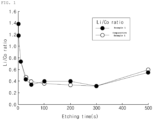
- the positive electrode active materials prepared by Example 1 and Comparative Example 1 were etched with argon gas, and the Li/Co atomic ratio of the shell portion was measured using X-ray photoelectronspectroscopy.
- FIG. 1 The measurement results are shown in FIG. 1 . Through FIG. 1 , it was confirmed that a lithium defect portion having a Li/Co atomic ratio of less than 1 was present on a surface portion of the positive electrode active material of Example 1 and Comparative Example 1.
- Coin cells Li metal negative electrode was used
- the positive electrode active materials which were prepared by Examples 1-4 and Comparative Examples 1-3, and then charged and discharged at room temperature (25°C) under conditions of 0.2 C/0.2 C to measure a voltage profile.
- the measurement results are shown in FIG. 2 .
- the positive electrode active materials respectively prepared in Examples 1-4 and Comparative Examples 1-3 were used to manufacture lithium secondary batteries.
- the positive electrode active material respectively prepared in Examples and Comparative Examples, carbon black as a conductive material, and PVdF as a binder were mixed in N-methylpyrrolidone, which is a solvent, at a weight ratio of 90:5:5 to prepare a positive electrode mixture (viscosity: 5000 mPa.s), and the mixture was applied on an aluminum current collector, dried, and roll-pressed to manufacture a positive electrode.
- N-methylpyrrolidone which is a solvent
- artificial graphite, mesocarbon microbead (MCMB), as a negative electrode active material, carbon black as a conductive material, and PVdF as a binder were mixed in N-methylpyrrolidone, which is a solvent, at a weight ratio of 85:10:5 to prepare a negative electrode mixture, and the mixture was applied on a copper current collector, dried, and roll-pressed to manufacture a negative electrode.
- N-methylpyrrolidone which is a solvent
- a porous polyethylene separator was interposed between the positive electrode and the negative electrode which were prepared as described above to prepare an electrode assembly, and then the electrode assembly was placed inside a battery case. Thereafter, an electrolyte was injected into the case to manufacture a coin cell. At this time, the electrolyte was prepared by dissolving lithium hexafluorophosphate having a concentration of 1.15 M in an organic solvent in which ethylene carbonate/dimethyl carbonate/ethylmethyl carbonate were mixed in a volume ratio of 3:4:3.
- the coin cells manufactured as described above was charged to 4.5 V. After the charging, the positive electrode was separated, and then washed with a dichloromethane (DCM) solution. Thereafter, the washed positive electrode was placed in a Nalgene bottle with 4 mL of an electrolyte. In order to prevent the electrolyte from being evaporated, the Nalgene bottle was completely sealed with a Parafilm and an aluminum pouch, and the sealed bottle was stored in a chamber at 60°C for 1 week and 3 weeks, respectively.
- DCM dichloromethane
- the positive electrode active material that may be present as a floating matter in the electrolyte was completely removed using a sealing paper filter to extract the electrolyte, and then the electrolyte was evaporated to measure the amount of cobalt present in the electrolyte (that is, the cobalt elution amount) by ICP analysis.
- the ICP analysis was performed using inductively coupled plasma light-emission spectrometer (ICP-OES; Optima 7300DV, PerkinElmer Co.).
- the cobalt elution amount of the lithium secondary batteries each prepared using the positive electrode active material of Examples 1-4 was significantly smaller than that of the lithium secondary batteries each prepared using the positive electrode active material of Comparative Examples 1-3. Also, it can be seen that as the high-temperature storage duration was longer, the difference in cobalt elution amount between Examples and Comparative Examples was greater.
Landscapes
- Chemical & Material Sciences (AREA)
- Electrochemistry (AREA)
- General Chemical & Material Sciences (AREA)
- Chemical Kinetics & Catalysis (AREA)
- Inorganic Chemistry (AREA)
- Organic Chemistry (AREA)
- Composite Materials (AREA)
- Engineering & Computer Science (AREA)
- Manufacturing & Machinery (AREA)
- Materials Engineering (AREA)
- Life Sciences & Earth Sciences (AREA)
- General Life Sciences & Earth Sciences (AREA)
- Geology (AREA)
- Battery Electrode And Active Subsutance (AREA)
- Inorganic Compounds Of Heavy Metals (AREA)
Claims (13)
- Lithium-Cobalt-basiertes Aktivmaterial für eine positive Elektrode, umfassend:einen Kernabschnitt, der ein durch nachstehende Formel 1 dargestelltes Lithium-Cobalt-basiertes Oxid enthält; undeinen Hüllenabschnitt, der ein durch nachstehende Formel 2 dargestelltes Lithium-Cobalt-basiertes Oxid enthält, worindas Lithium-Cobalt-basierte Aktivmaterial für eine positive Elektrode, bezogen auf das Gesamtgewicht des Aktivmaterials für eine positive Elektrode, 2500 ppm oder mehr eines Dotierungselements M umfasst, undkein Wendepunkt in einem Spannungsprofil auftritt, das während des Ladens/Entladens einer Sekundärbatterie, die das Lithium-Cobalt-basierte Aktivmaterial für eine positive Elektrode enthält, gemessen wird:
[Formel 1] LiaCo1-bMbO2
wobei, in Formel 1, M eines oder mehrere ist, ausgewählt aus der Gruppe, bestehend aus Al, Mg, W, Mo, Zr, Ti, Fe, V, Cr, Ba, Ca, Sr und Nb, und 1≤a≤1,2 und 0,005≤b≤0,05;
[Formel 2] LlxCo1-yMyO2
wobei, in Formel 2, M eines oder mehrere ist, ausgewählt aus der Gruppe, bestehend aus Al, Mg, W, Mo, Zr, Ti, Fe, V, Cr, Ba, Ca, Sr und Nb, und 0,5≤x≤0,99 und 0≤y≤0,001. - Lithium-Cobalt-basiertes Aktivmaterial für eine positive Elektrode gemäß Anspruch 1, worin das Dotierungselement M eines oder mehrere ist, ausgewählt aus der Gruppe, bestehend aus Al, Mg, Ca, Sr, Ba, Ti und Zr.
- Lithium-Cobalt-basiertes Aktivmaterial für eine positive Elektrode gemäß Anspruch 1, worin das Dotierungselement M ein erstes Dotierungselement, ausgewählt aus der Gruppe, bestehend aus Al, Mg, Ca, Sr und Ba und einer Kombination davon, und ein zweites Dotierungselement, ausgewählt aus der Gruppe, bestehend aus Ti und Zr und einer Kombination davon, umfasst.
- Lithium-Cobalt-basiertes Aktivmaterial für eine positive Elektrode gemäß Anspruch 1, worin das Dotierungselement M eines oder mehrere ist, ausgewählt aus Al und Mg.
- Lithium-Cobalt-basiertes Aktivmaterial für eine positive Elektrode gemäß Anspruch 1, worin das durch die obige Formel 1 dargestellte Lithium-Cobalt-basierte Oxid eine geschichtete Kristallstruktur aufweist und
das durch die obige Formel 2 dargestellte Lithium-Cobalt-basierte Oxid eine Spinell-artige Kristallstruktur aufweist. - Lithium-Cobalt-basiertes Aktivmaterial für eine positive Elektrode gemäß Anspruch 1, worin das Lithium-Cobalt-basierte Aktivmaterial für eine positive Elektrode, bezogen auf das Gesamtgewicht des Aktivmaterials für eine positive Elektrode, 3000 ppm oder mehr des Dotierungselements M enthält.
- Verfahren zur Herstellung eines Lithium-Cobalt-basierten Aktivmaterials für eine positive Elektrode, das Verfahren umfassend:einen ersten Schritt, in dem ein Kernabschnitt, der ein durch nachstehende Formel 1 dargestelltes Lithium-Cobalt-basiertes Oxid enthält, durch Mischen eines ersten Cobaltrohmaterials, eines ersten Lithiumrohmaterials und eines Rohmaterials eines Dotierungselements M, und einer ersten Wärmebehandlung des Gemischs, ausgebildet wird; undeinen zweiten Schritt, in dem ein Hüllenabschnitt, der ein durch nachstehende Formel 2 dargestelltes Lithium-Cobalt-basiertes Oxid enthält, durch Mischen des ersten durch Formel 1 dargestellten Cobaltrohmaterials und eines zweiten Cobaltrohmaterials, und einer zweiten Wärmebehandlung des Gemischs, ausgebildet wird, worindas Rohmaterial des Dotierungselements M eines oder mehrere umfasst, ausgewählt aus der Gruppe, bestehend aus Al, Mg, W, Mo, Zr, Ti, Fe, V, Cr, Ba, Ca, Sr und Nb, und, basierend auf dem Gesamtgewicht des Lithium-Cobalt-basierten Aktivmaterials für eine positive Elektrode, in einer Menge von 2500 ppm oder mehr eines Dotierungselements M, gemischt wird:
[Formel 1] LiaCo1-bMbO2
wobei, in Formel 1, M eines oder mehrere ist, ausgewählt aus der Gruppe, bestehend aus Al, Mg, W, Mo, Zr, Ti, Fe, V, Cr, Ba, Ca, Sr und Nb, und 1≤a≤1,2 und 0,005≤b≤0,05;
[Formel 2] LixCo1-yMyOz
wobei, in Formel 2, M eines oder mehrere ist, ausgewählt aus der Gruppe, bestehend aus Al, Mg, W, Mo, Zr, Ti, Fe, V, Cr, Ba, Ca, Sr und Nb, und 0,5≤x≤0,99 und 0≤y≤0,001. - Verfahren gemäß Anspruch 7, worin das erste Cobaltrohmaterial, das erste Lithiumrohmaterial und das Rohmaterial des Dotierungselements M im ersten Schritt in einer Menge gemischt werden, so dass das Atomverhältnis von Li/(Co+M) des Kernabschnitts 1 bis 1,2 beträgt.
- Verfahren gemäß Anspruch 7, worin im zweiten Schritt ferner ein zweites Lithiumrohmaterial gemischt wird.
- Verfahren gemäß Anspruch 9, worin das zweite Cobaltrohmaterial und das zweite Lithiumrohmaterial im zweiten Schritte in einer Menge gemischt werden, so dass das Atomverhältnis Li/(Co+M) des Hüllenabschnitts 0,50 bis weniger als 1 beträgt.
- Positive Elektrode, umfassend das Aktivmaterial für eine positive Elektrode gemäß einem der Ansprüche 1 bis 6.
- Lithiumsekundärbatterie, umfassend die positive Elektrode gemäß Anspruch 11.
- Lithiumsekundärbatterie gemäß Anspruch 12, worin die Betriebsspannung der Lithiumsekundärbatterie 4,45 V oder mehr beträgt.
Applications Claiming Priority (2)
| Application Number | Priority Date | Filing Date | Title |
|---|---|---|---|
| KR20170150921 | 2017-11-13 | ||
| PCT/KR2018/013822 WO2019093864A2 (ko) | 2017-11-13 | 2018-11-13 | 리튬 코발트계 양극 활물질, 그 제조방법, 이를 포함하는 양극 및 이차 전지 |
Publications (3)
| Publication Number | Publication Date |
|---|---|
| EP3680966A2 EP3680966A2 (de) | 2020-07-15 |
| EP3680966A4 EP3680966A4 (de) | 2020-12-09 |
| EP3680966B1 true EP3680966B1 (de) | 2024-09-25 |
Family
ID=66680467
Family Applications (1)
| Application Number | Title | Priority Date | Filing Date |
|---|---|---|---|
| EP18875428.7A Active EP3680966B1 (de) | 2017-11-13 | 2018-11-13 | Aktives material für positivelektrode auf lithiumkobalt-basis, verfahren zu seiner herstellung, positive elektrode und sekundärbatterie dieses beinhaltend |
Country Status (9)
| Country | Link |
|---|---|
| US (1) | US11476456B2 (de) |
| EP (1) | EP3680966B1 (de) |
| JP (1) | JP7062200B2 (de) |
| KR (1) | KR102295592B1 (de) |
| CN (1) | CN112204769B (de) |
| DE (1) | DE202018006948U1 (de) |
| ES (1) | ES2989030T3 (de) |
| HU (1) | HUE068604T2 (de) |
| PL (1) | PL3680966T3 (de) |
Families Citing this family (6)
| Publication number | Priority date | Publication date | Assignee | Title |
|---|---|---|---|---|
| KR102822600B1 (ko) * | 2021-09-03 | 2025-06-19 | 삼성에스디아이 주식회사 | 리튬이차전지용 리튬 코발트계 산화물, 그 제조방법 및 이를 포함한 양극을 함유한 리튬이차전지 |
| CN113707876B (zh) * | 2021-10-27 | 2022-02-08 | 英德市科恒新能源科技有限公司 | 一种倍率型钴酸锂正极材料及其制备方法和锂离子电池 |
| WO2023080752A1 (ko) * | 2021-11-08 | 2023-05-11 | 주식회사 엘지에너지솔루션 | 리튬 이차전지 |
| CN114497448A (zh) * | 2022-02-10 | 2022-05-13 | 珠海冠宇电池股份有限公司 | 极片、电池及电子设备 |
| CN114725367B (zh) * | 2022-04-22 | 2023-05-30 | 格林美(无锡)能源材料有限公司 | 一种钴酸锂正极材料及其制备方法和应用 |
| CN116005030B (zh) * | 2023-01-09 | 2024-10-01 | 杰瑞新能源科技有限公司 | 一种钴基复合材料、其制备方法及其应用 |
Family Cites Families (20)
| Publication number | Priority date | Publication date | Assignee | Title |
|---|---|---|---|---|
| KR100326444B1 (ko) * | 1999-11-23 | 2002-02-28 | 김순택 | 리튬 이차 전지 |
| JP4582579B2 (ja) * | 2004-12-07 | 2010-11-17 | Agcセイミケミカル株式会社 | リチウム二次電池用正極材料 |
| EP2162396A1 (de) | 2007-06-29 | 2010-03-17 | Umicore | Lithium-kobalt-oxid mit hoher dichte für akkus |
| JP2009129721A (ja) * | 2007-11-24 | 2009-06-11 | Sanyo Electric Co Ltd | 非水電解質二次電池 |
| KR101820617B1 (ko) | 2011-06-17 | 2018-01-22 | 유미코아 | 코어 물질의 원소와 하나 이상의 금속 산화물의 혼합물로 코팅된 리튬 금속 산화물 입자 |
| CN104919631B (zh) * | 2012-12-14 | 2019-08-02 | 尤米科尔公司 | 涂覆有内芯材料元素与一种或多种金属氧化物的混合物的锂金属氧化物颗粒 |
| KR101547919B1 (ko) | 2013-06-04 | 2015-09-02 | 주식회사 엘지화학 | 수명특성이 향상된 이차전지용 양극 활물질 및 이의 제조방법 |
| PL2835573T3 (pl) | 2013-08-06 | 2020-05-18 | Air Products And Chemicals, Inc. | Układ podnoszący osłonę regulatora butli |
| CN103500827B (zh) | 2013-10-11 | 2017-05-24 | 宁德新能源科技有限公司 | 锂离子电池及其多元正极材料、制备方法 |
| KR101777466B1 (ko) * | 2014-10-02 | 2017-09-11 | 주식회사 엘지화학 | 리튬 이차전지용 양극활물질, 이의 제조방법 및 이를 포함하는 리튬 이차전지 |
| KR101787199B1 (ko) | 2014-10-02 | 2017-10-18 | 주식회사 엘지화학 | 리튬 이차전지용 양극활물질, 이의 제조방법 및 이를 포함하는 리튬 이차전지 |
| KR101831019B1 (ko) * | 2014-10-02 | 2018-02-21 | 주식회사 엘지화학 | 리튬이차전지용 양극활물질, 이의 제조방법 및 이를 포함하는 리튬이차전지 |
| KR101762508B1 (ko) | 2014-10-02 | 2017-07-27 | 주식회사 엘지화학 | 리튬 이차전지용 양극활물질, 이의 제조방법 및 이를 포함하는 리튬 이차전지 |
| KR101913906B1 (ko) | 2015-06-17 | 2018-10-31 | 주식회사 엘지화학 | 이차전지용 양극활물질, 이의 제조방법 및 이를 포함하는 이차전지 |
| US10333140B2 (en) | 2015-07-02 | 2019-06-25 | Umicore | Cobalt-based lithium metal oxide cathode material |
| CN105047906B (zh) | 2015-08-21 | 2018-04-03 | 湖南杉杉能源科技股份有限公司 | 锂钴复合氧化物正极材料及其制备方法 |
| EP3425703B1 (de) | 2016-03-04 | 2019-09-11 | LG Chem, Ltd. | Kathodenaktivmaterial für eine sekundärbatterie, herstellungsverfahren dafür und sekundärbatterie damit |
| KR102565007B1 (ko) | 2016-03-11 | 2023-08-08 | 삼성에스디아이 주식회사 | 리튬 이차 전지용 양극 활물질, 이의 제조 방법 및 이를 포함하는 리튬 이차 전지 |
| CN105938917A (zh) * | 2016-07-01 | 2016-09-14 | 深圳市振华新材料股份有限公司 | 锂离子二次电池钴酸锂正极材料及其制法和应用 |
| CN106299319B (zh) * | 2016-11-07 | 2019-08-09 | 湖南杉杉能源科技股份有限公司 | 缺Li态材料包覆改性的锂离子电池正极材料的制备方法 |
-
2018
- 2018-11-13 PL PL18875428.7T patent/PL3680966T3/pl unknown
- 2018-11-13 US US16/756,073 patent/US11476456B2/en active Active
- 2018-11-13 KR KR1020180138703A patent/KR102295592B1/ko active Active
- 2018-11-13 DE DE202018006948.5U patent/DE202018006948U1/de active Active
- 2018-11-13 ES ES18875428T patent/ES2989030T3/es active Active
- 2018-11-13 JP JP2020520594A patent/JP7062200B2/ja active Active
- 2018-11-13 HU HUE18875428A patent/HUE068604T2/hu unknown
- 2018-11-13 EP EP18875428.7A patent/EP3680966B1/de active Active
- 2018-11-13 CN CN201880066910.6A patent/CN112204769B/zh active Active
Also Published As
| Publication number | Publication date |
|---|---|
| ES2989030T3 (es) | 2024-11-25 |
| EP3680966A4 (de) | 2020-12-09 |
| US11476456B2 (en) | 2022-10-18 |
| HUE068604T2 (hu) | 2025-01-28 |
| CN112204769A (zh) | 2021-01-08 |
| US20200259172A1 (en) | 2020-08-13 |
| KR102295592B1 (ko) | 2021-08-31 |
| JP7062200B2 (ja) | 2022-05-06 |
| DE202018006948U1 (de) | 2024-09-05 |
| EP3680966A2 (de) | 2020-07-15 |
| JP2020537308A (ja) | 2020-12-17 |
| KR20190054976A (ko) | 2019-05-22 |
| CN112204769B (zh) | 2024-09-27 |
| PL3680966T3 (pl) | 2025-01-07 |
Similar Documents
| Publication | Publication Date | Title |
|---|---|---|
| EP4228032B1 (de) | Positivelektrodenaktivmaterial für lithiumsekundärbatterie, herstellungsverfahren dafür und positivelektrode für lithiumsekundärbatterie und lithiumsekundärbatterie mit dem positivelektrodenaktivmaterial | |
| US12191484B2 (en) | Positive electrode material for lithium secondary battery, and positive electrode and lithium secondary battery including same | |
| EP3386009B1 (de) | Positivelektrodenaktivmaterial für sekundärbatterie, positivelektrode für sekundärbatterie damit und sekundärbatterie | |
| KR101758992B1 (ko) | 리튬 이차전지용 양극활물질, 이의 제조방법 및 이를 포함하는 리튬 이차전지 | |
| KR101777466B1 (ko) | 리튬 이차전지용 양극활물질, 이의 제조방법 및 이를 포함하는 리튬 이차전지 | |
| KR102268079B1 (ko) | 이차전지용 양극 활물질, 그 제조방법 및 이를 포함하는 리튬 이차전지 | |
| US20190372115A1 (en) | Positive electrode active material for secondary battery, and secondary battery including the same | |
| EP3680966B1 (de) | Aktives material für positivelektrode auf lithiumkobalt-basis, verfahren zu seiner herstellung, positive elektrode und sekundärbatterie dieses beinhaltend | |
| KR20160040117A (ko) | 리튬 이차전지용 양극활물질, 이의 제조방법 및 이를 포함하는 리튬 이차전지 | |
| KR102270119B1 (ko) | 이차전지용 양극 활물질의 제조방법 | |
| KR102534279B1 (ko) | 리튬 이차전지 | |
| US11837719B2 (en) | Lithium cobalt-based positive electrode active material, preparation method thereof, positive electrode including same, and secondary battery including positive electrode | |
| US11329286B2 (en) | Lithium cobalt-based positive electrode active material, preparation method thereof, positive electrode and secondary battery including the same | |
| KR20210118644A (ko) | 리튬 이차전지용 양극 활물질, 이의 제조방법, 이를 포함하는 리튬 이차전지용 양극 및 리튬 이차전지 | |
| EP4428949A1 (de) | Kathodenaktivmaterial für lithiumsekundärbatterie und verfahren zur herstellung davon | |
| KR20210034416A (ko) | 이차전지용 양극재의 제조방법 | |
| EP4501859A1 (de) | Positivelektrodenaktivmaterialvorläufer, verfahren zur herstellung eines positivelektrodenaktivmaterials damit und positivelektrodenaktivmaterial | |
| KR102821378B1 (ko) | 양극 활물질 전구체, 이의 제조 방법, 이를 이용한 양극 활물질의 제조 방법 및 양극 활물질 | |
| KR20230108571A (ko) | 리튬 이차전지용 양극 활물질 |
Legal Events
| Date | Code | Title | Description |
|---|---|---|---|
| STAA | Information on the status of an ep patent application or granted ep patent |
Free format text: STATUS: THE INTERNATIONAL PUBLICATION HAS BEEN MADE |
|
| PUAI | Public reference made under article 153(3) epc to a published international application that has entered the european phase |
Free format text: ORIGINAL CODE: 0009012 |
|
| STAA | Information on the status of an ep patent application or granted ep patent |
Free format text: STATUS: REQUEST FOR EXAMINATION WAS MADE |
|
| 17P | Request for examination filed |
Effective date: 20200409 |
|
| AK | Designated contracting states |
Kind code of ref document: A2 Designated state(s): AL AT BE BG CH CY CZ DE DK EE ES FI FR GB GR HR HU IE IS IT LI LT LU LV MC MK MT NL NO PL PT RO RS SE SI SK SM TR |
|
| AX | Request for extension of the european patent |
Extension state: BA ME |
|
| REG | Reference to a national code |
Ref country code: DE Ref legal event code: R079 Free format text: PREVIOUS MAIN CLASS: H01M0004360000 Ipc: C01G0051000000 Ref country code: DE Ref legal event code: R079 Ref document number: 602018074804 Country of ref document: DE Free format text: PREVIOUS MAIN CLASS: H01M0004360000 Ipc: C01G0051000000 |
|
| A4 | Supplementary search report drawn up and despatched |
Effective date: 20201110 |
|
| RIC1 | Information provided on ipc code assigned before grant |
Ipc: H01M 4/485 20100101ALI20201104BHEP Ipc: H01M 10/052 20100101ALI20201104BHEP Ipc: H01M 4/36 20060101ALI20201104BHEP Ipc: C01G 51/00 20060101AFI20201104BHEP Ipc: H01M 4/525 20100101ALI20201104BHEP |
|
| DAV | Request for validation of the european patent (deleted) | ||
| DAX | Request for extension of the european patent (deleted) | ||
| RAP1 | Party data changed (applicant data changed or rights of an application transferred) |
Owner name: LG ENERGY SOLUTION LTD. |
|
| RAP3 | Party data changed (applicant data changed or rights of an application transferred) |
Owner name: LG ENERGY SOLUTION, LTD. |
|
| GRAP | Despatch of communication of intention to grant a patent |
Free format text: ORIGINAL CODE: EPIDOSNIGR1 |
|
| STAA | Information on the status of an ep patent application or granted ep patent |
Free format text: STATUS: GRANT OF PATENT IS INTENDED |
|
| INTG | Intention to grant announced |
Effective date: 20240429 |
|
| GRAS | Grant fee paid |
Free format text: ORIGINAL CODE: EPIDOSNIGR3 |
|
| GRAA | (expected) grant |
Free format text: ORIGINAL CODE: 0009210 |
|
| STAA | Information on the status of an ep patent application or granted ep patent |
Free format text: STATUS: THE PATENT HAS BEEN GRANTED |
|
| P01 | Opt-out of the competence of the unified patent court (upc) registered |
Free format text: CASE NUMBER: APP_43526/2024 Effective date: 20240725 |
|
| AK | Designated contracting states |
Kind code of ref document: B1 Designated state(s): AL AT BE BG CH CY CZ DE DK EE ES FI FR GB GR HR HU IE IS IT LI LT LU LV MC MK MT NL NO PL PT RO RS SE SI SK SM TR |
|
| REG | Reference to a national code |
Ref country code: GB Ref legal event code: FG4D |
|
| REG | Reference to a national code |
Ref country code: CH Ref legal event code: EP |
|
| REG | Reference to a national code |
Ref country code: DE Ref legal event code: R096 Ref document number: 602018074804 Country of ref document: DE |
|
| REG | Reference to a national code |
Ref country code: IE Ref legal event code: FG4D Ref country code: NL Ref legal event code: FP |
|
| REG | Reference to a national code |
Ref country code: SE Ref legal event code: TRGR |
|
| REG | Reference to a national code |
Ref country code: ES Ref legal event code: FG2A Ref document number: 2989030 Country of ref document: ES Kind code of ref document: T3 Effective date: 20241125 |
|
| PGFP | Annual fee paid to national office [announced via postgrant information from national office to epo] |
Ref country code: DE Payment date: 20241121 Year of fee payment: 7 |
|
| REG | Reference to a national code |
Ref country code: LT Ref legal event code: MG9D |
|
| PG25 | Lapsed in a contracting state [announced via postgrant information from national office to epo] |
Ref country code: NO Free format text: LAPSE BECAUSE OF FAILURE TO SUBMIT A TRANSLATION OF THE DESCRIPTION OR TO PAY THE FEE WITHIN THE PRESCRIBED TIME-LIMIT Effective date: 20241225 |
|
| PG25 | Lapsed in a contracting state [announced via postgrant information from national office to epo] |
Ref country code: GR Free format text: LAPSE BECAUSE OF FAILURE TO SUBMIT A TRANSLATION OF THE DESCRIPTION OR TO PAY THE FEE WITHIN THE PRESCRIBED TIME-LIMIT Effective date: 20241226 Ref country code: FI Free format text: LAPSE BECAUSE OF FAILURE TO SUBMIT A TRANSLATION OF THE DESCRIPTION OR TO PAY THE FEE WITHIN THE PRESCRIBED TIME-LIMIT Effective date: 20240925 |
|
| PGFP | Annual fee paid to national office [announced via postgrant information from national office to epo] |
Ref country code: GB Payment date: 20241121 Year of fee payment: 7 |
|
| PG25 | Lapsed in a contracting state [announced via postgrant information from national office to epo] |
Ref country code: BG Free format text: LAPSE BECAUSE OF FAILURE TO SUBMIT A TRANSLATION OF THE DESCRIPTION OR TO PAY THE FEE WITHIN THE PRESCRIBED TIME-LIMIT Effective date: 20240925 |
|
| PGFP | Annual fee paid to national office [announced via postgrant information from national office to epo] |
Ref country code: FR Payment date: 20241121 Year of fee payment: 7 |
|
| PG25 | Lapsed in a contracting state [announced via postgrant information from national office to epo] |
Ref country code: LV Free format text: LAPSE BECAUSE OF FAILURE TO SUBMIT A TRANSLATION OF THE DESCRIPTION OR TO PAY THE FEE WITHIN THE PRESCRIBED TIME-LIMIT Effective date: 20240925 |
|
| PGFP | Annual fee paid to national office [announced via postgrant information from national office to epo] |
Ref country code: HU Payment date: 20241217 Year of fee payment: 7 |
|
| PG25 | Lapsed in a contracting state [announced via postgrant information from national office to epo] |
Ref country code: RS Free format text: LAPSE BECAUSE OF FAILURE TO SUBMIT A TRANSLATION OF THE DESCRIPTION OR TO PAY THE FEE WITHIN THE PRESCRIBED TIME-LIMIT Effective date: 20241225 |
|
| PGFP | Annual fee paid to national office [announced via postgrant information from national office to epo] |
Ref country code: IT Payment date: 20241125 Year of fee payment: 7 Ref country code: ES Payment date: 20241213 Year of fee payment: 7 |
|
| REG | Reference to a national code |
Ref country code: HU Ref legal event code: AG4A Ref document number: E068604 Country of ref document: HU |
|
| PGFP | Annual fee paid to national office [announced via postgrant information from national office to epo] |
Ref country code: SE Payment date: 20241106 Year of fee payment: 7 |
|
| PG25 | Lapsed in a contracting state [announced via postgrant information from national office to epo] |
Ref country code: RS Free format text: LAPSE BECAUSE OF FAILURE TO SUBMIT A TRANSLATION OF THE DESCRIPTION OR TO PAY THE FEE WITHIN THE PRESCRIBED TIME-LIMIT Effective date: 20241225 Ref country code: NO Free format text: LAPSE BECAUSE OF FAILURE TO SUBMIT A TRANSLATION OF THE DESCRIPTION OR TO PAY THE FEE WITHIN THE PRESCRIBED TIME-LIMIT Effective date: 20241225 Ref country code: LV Free format text: LAPSE BECAUSE OF FAILURE TO SUBMIT A TRANSLATION OF THE DESCRIPTION OR TO PAY THE FEE WITHIN THE PRESCRIBED TIME-LIMIT Effective date: 20240925 Ref country code: GR Free format text: LAPSE BECAUSE OF FAILURE TO SUBMIT A TRANSLATION OF THE DESCRIPTION OR TO PAY THE FEE WITHIN THE PRESCRIBED TIME-LIMIT Effective date: 20241226 Ref country code: FI Free format text: LAPSE BECAUSE OF FAILURE TO SUBMIT A TRANSLATION OF THE DESCRIPTION OR TO PAY THE FEE WITHIN THE PRESCRIBED TIME-LIMIT Effective date: 20240925 Ref country code: BG Free format text: LAPSE BECAUSE OF FAILURE TO SUBMIT A TRANSLATION OF THE DESCRIPTION OR TO PAY THE FEE WITHIN THE PRESCRIBED TIME-LIMIT Effective date: 20240925 |
|
| PGFP | Annual fee paid to national office [announced via postgrant information from national office to epo] |
Ref country code: TR Payment date: 20241105 Year of fee payment: 7 |
|
| REG | Reference to a national code |
Ref country code: AT Ref legal event code: MK05 Ref document number: 1726543 Country of ref document: AT Kind code of ref document: T Effective date: 20240925 |
|
| PG25 | Lapsed in a contracting state [announced via postgrant information from national office to epo] |
Ref country code: IS Free format text: LAPSE BECAUSE OF FAILURE TO SUBMIT A TRANSLATION OF THE DESCRIPTION OR TO PAY THE FEE WITHIN THE PRESCRIBED TIME-LIMIT Effective date: 20250125 Ref country code: PT Free format text: LAPSE BECAUSE OF FAILURE TO SUBMIT A TRANSLATION OF THE DESCRIPTION OR TO PAY THE FEE WITHIN THE PRESCRIBED TIME-LIMIT Effective date: 20250127 |
|
| PG25 | Lapsed in a contracting state [announced via postgrant information from national office to epo] |
Ref country code: SM Free format text: LAPSE BECAUSE OF FAILURE TO SUBMIT A TRANSLATION OF THE DESCRIPTION OR TO PAY THE FEE WITHIN THE PRESCRIBED TIME-LIMIT Effective date: 20240925 Ref country code: RO Free format text: LAPSE BECAUSE OF FAILURE TO SUBMIT A TRANSLATION OF THE DESCRIPTION OR TO PAY THE FEE WITHIN THE PRESCRIBED TIME-LIMIT Effective date: 20240925 |
|
| PG25 | Lapsed in a contracting state [announced via postgrant information from national office to epo] |
Ref country code: AT Free format text: LAPSE BECAUSE OF FAILURE TO SUBMIT A TRANSLATION OF THE DESCRIPTION OR TO PAY THE FEE WITHIN THE PRESCRIBED TIME-LIMIT Effective date: 20240925 Ref country code: EE Free format text: LAPSE BECAUSE OF FAILURE TO SUBMIT A TRANSLATION OF THE DESCRIPTION OR TO PAY THE FEE WITHIN THE PRESCRIBED TIME-LIMIT Effective date: 20240925 |
|
| PG25 | Lapsed in a contracting state [announced via postgrant information from national office to epo] |
Ref country code: CZ Free format text: LAPSE BECAUSE OF FAILURE TO SUBMIT A TRANSLATION OF THE DESCRIPTION OR TO PAY THE FEE WITHIN THE PRESCRIBED TIME-LIMIT Effective date: 20240925 |
|
| PGFP | Annual fee paid to national office [announced via postgrant information from national office to epo] |
Ref country code: PL Payment date: 20241106 Year of fee payment: 7 |
|
| PG25 | Lapsed in a contracting state [announced via postgrant information from national office to epo] |
Ref country code: SK Free format text: LAPSE BECAUSE OF FAILURE TO SUBMIT A TRANSLATION OF THE DESCRIPTION OR TO PAY THE FEE WITHIN THE PRESCRIBED TIME-LIMIT Effective date: 20240925 |
|
| REG | Reference to a national code |
Ref country code: DE Ref legal event code: R097 Ref document number: 602018074804 Country of ref document: DE |
|
| REG | Reference to a national code |
Ref country code: CH Ref legal event code: PL |
|
| PG25 | Lapsed in a contracting state [announced via postgrant information from national office to epo] |
Ref country code: MC Free format text: LAPSE BECAUSE OF FAILURE TO SUBMIT A TRANSLATION OF THE DESCRIPTION OR TO PAY THE FEE WITHIN THE PRESCRIBED TIME-LIMIT Effective date: 20240925 |
|
| PG25 | Lapsed in a contracting state [announced via postgrant information from national office to epo] |
Ref country code: DK Free format text: LAPSE BECAUSE OF FAILURE TO SUBMIT A TRANSLATION OF THE DESCRIPTION OR TO PAY THE FEE WITHIN THE PRESCRIBED TIME-LIMIT Effective date: 20240925 |
|
| PG25 | Lapsed in a contracting state [announced via postgrant information from national office to epo] |
Ref country code: LU Free format text: LAPSE BECAUSE OF NON-PAYMENT OF DUE FEES Effective date: 20241113 |
|
| PGFP | Annual fee paid to national office [announced via postgrant information from national office to epo] |
Ref country code: BE Payment date: 20250407 Year of fee payment: 7 |
|
| REG | Reference to a national code |
Ref country code: CH Ref legal event code: PL |
|
| PG25 | Lapsed in a contracting state [announced via postgrant information from national office to epo] |
Ref country code: CH Free format text: LAPSE BECAUSE OF NON-PAYMENT OF DUE FEES Effective date: 20241130 |
|
| PLBE | No opposition filed within time limit |
Free format text: ORIGINAL CODE: 0009261 |
|
| STAA | Information on the status of an ep patent application or granted ep patent |
Free format text: STATUS: NO OPPOSITION FILED WITHIN TIME LIMIT |
|
| 26N | No opposition filed |
Effective date: 20250626 |
|
| PG25 | Lapsed in a contracting state [announced via postgrant information from national office to epo] |
Ref country code: IE Free format text: LAPSE BECAUSE OF NON-PAYMENT OF DUE FEES Effective date: 20241113 |
|
| PGFP | Annual fee paid to national office [announced via postgrant information from national office to epo] |
Ref country code: NL Payment date: 20251020 Year of fee payment: 8 |