EP3674814A2 - Bilderzeugungsvorrichtung und vorrichtungskörper davon - Google Patents
Bilderzeugungsvorrichtung und vorrichtungskörper davon Download PDFInfo
- Publication number
- EP3674814A2 EP3674814A2 EP19218952.0A EP19218952A EP3674814A2 EP 3674814 A2 EP3674814 A2 EP 3674814A2 EP 19218952 A EP19218952 A EP 19218952A EP 3674814 A2 EP3674814 A2 EP 3674814A2
- Authority
- EP
- European Patent Office
- Prior art keywords
- cartridge
- unallowed
- attachment
- apparatus body
- target portion
- Prior art date
- Legal status (The legal status is an assumption and is not a legal conclusion. Google has not performed a legal analysis and makes no representation as to the accuracy of the status listed.)
- Granted
Links
Images











Classifications
-
- G—PHYSICS
- G03—PHOTOGRAPHY; CINEMATOGRAPHY; ANALOGOUS TECHNIQUES USING WAVES OTHER THAN OPTICAL WAVES; ELECTROGRAPHY; HOLOGRAPHY
- G03G—ELECTROGRAPHY; ELECTROPHOTOGRAPHY; MAGNETOGRAPHY
- G03G21/00—Arrangements not provided for by groups G03G13/00 - G03G19/00, e.g. cleaning, elimination of residual charge
- G03G21/16—Mechanical means for facilitating the maintenance of the apparatus, e.g. modular arrangements
- G03G21/18—Mechanical means for facilitating the maintenance of the apparatus, e.g. modular arrangements using a processing cartridge, whereby the process cartridge comprises at least two image processing means in a single unit
- G03G21/1839—Means for handling the process cartridge in the apparatus body
- G03G21/1842—Means for handling the process cartridge in the apparatus body for guiding and mounting the process cartridge, positioning, alignment, locks
-
- G—PHYSICS
- G03—PHOTOGRAPHY; CINEMATOGRAPHY; ANALOGOUS TECHNIQUES USING WAVES OTHER THAN OPTICAL WAVES; ELECTROGRAPHY; HOLOGRAPHY
- G03G—ELECTROGRAPHY; ELECTROPHOTOGRAPHY; MAGNETOGRAPHY
- G03G21/00—Arrangements not provided for by groups G03G13/00 - G03G19/00, e.g. cleaning, elimination of residual charge
- G03G21/16—Mechanical means for facilitating the maintenance of the apparatus, e.g. modular arrangements
- G03G21/1604—Arrangement or disposition of the entire apparatus
- G03G21/1619—Frame structures
-
- G—PHYSICS
- G03—PHOTOGRAPHY; CINEMATOGRAPHY; ANALOGOUS TECHNIQUES USING WAVES OTHER THAN OPTICAL WAVES; ELECTROGRAPHY; HOLOGRAPHY
- G03G—ELECTROGRAPHY; ELECTROPHOTOGRAPHY; MAGNETOGRAPHY
- G03G21/00—Arrangements not provided for by groups G03G13/00 - G03G19/00, e.g. cleaning, elimination of residual charge
- G03G21/16—Mechanical means for facilitating the maintenance of the apparatus, e.g. modular arrangements
- G03G21/18—Mechanical means for facilitating the maintenance of the apparatus, e.g. modular arrangements using a processing cartridge, whereby the process cartridge comprises at least two image processing means in a single unit
- G03G21/1839—Means for handling the process cartridge in the apparatus body
- G03G21/1842—Means for handling the process cartridge in the apparatus body for guiding and mounting the process cartridge, positioning, alignment, locks
- G03G21/1853—Means for handling the process cartridge in the apparatus body for guiding and mounting the process cartridge, positioning, alignment, locks the process cartridge being mounted perpendicular to the axis of the photosensitive member
-
- G—PHYSICS
- G03—PHOTOGRAPHY; CINEMATOGRAPHY; ANALOGOUS TECHNIQUES USING WAVES OTHER THAN OPTICAL WAVES; ELECTROGRAPHY; HOLOGRAPHY
- G03G—ELECTROGRAPHY; ELECTROPHOTOGRAPHY; MAGNETOGRAPHY
- G03G21/00—Arrangements not provided for by groups G03G13/00 - G03G19/00, e.g. cleaning, elimination of residual charge
- G03G21/16—Mechanical means for facilitating the maintenance of the apparatus, e.g. modular arrangements
- G03G21/18—Mechanical means for facilitating the maintenance of the apparatus, e.g. modular arrangements using a processing cartridge, whereby the process cartridge comprises at least two image processing means in a single unit
- G03G21/1875—Mechanical means for facilitating the maintenance of the apparatus, e.g. modular arrangements using a processing cartridge, whereby the process cartridge comprises at least two image processing means in a single unit provided with identifying means or means for storing process- or use parameters, e.g. lifetime of the cartridge
- G03G21/1896—Mechanical means for facilitating the maintenance of the apparatus, e.g. modular arrangements using a processing cartridge, whereby the process cartridge comprises at least two image processing means in a single unit provided with identifying means or means for storing process- or use parameters, e.g. lifetime of the cartridge mechanical or optical identification means, e.g. protrusions, bar codes
-
- G—PHYSICS
- G03—PHOTOGRAPHY; CINEMATOGRAPHY; ANALOGOUS TECHNIQUES USING WAVES OTHER THAN OPTICAL WAVES; ELECTROGRAPHY; HOLOGRAPHY
- G03G—ELECTROGRAPHY; ELECTROPHOTOGRAPHY; MAGNETOGRAPHY
- G03G2221/00—Processes not provided for by group G03G2215/00, e.g. cleaning or residual charge elimination
- G03G2221/16—Mechanical means for facilitating the maintenance of the apparatus, e.g. modular arrangements and complete machine concepts
- G03G2221/1651—Mechanical means for facilitating the maintenance of the apparatus, e.g. modular arrangements and complete machine concepts for connecting the different parts
- G03G2221/1654—Locks and means for positioning or alignment
-
- G—PHYSICS
- G03—PHOTOGRAPHY; CINEMATOGRAPHY; ANALOGOUS TECHNIQUES USING WAVES OTHER THAN OPTICAL WAVES; ELECTROGRAPHY; HOLOGRAPHY
- G03G—ELECTROGRAPHY; ELECTROPHOTOGRAPHY; MAGNETOGRAPHY
- G03G2221/00—Processes not provided for by group G03G2215/00, e.g. cleaning or residual charge elimination
- G03G2221/16—Mechanical means for facilitating the maintenance of the apparatus, e.g. modular arrangements and complete machine concepts
- G03G2221/18—Cartridge systems
- G03G2221/183—Process cartridge
- G03G2221/1884—Projections on process cartridge for guiding mounting thereof in main machine
Definitions
- the present invention relates to a cleaning apparatus that cleans an image bearing member that bears a developer, a cartridge having the cleaning apparatus and used in an electrophotographic image forming apparatus, and an electrophotographic image forming apparatus.
- An electrophotographic image forming apparatus forms an image on a recording medium using an electrophotographic image forming system, and examples thereof include an electrophotographic copying machine, an electrophotographic printer (an LED printer, a laser beam printer, and the like), a facsimile apparatus, and a word processor.
- a cartridge that is allowed or authorized to be attached to an apparatus body of an image forming apparatus may be attached to the apparatus body, and a cartridge that is not allowed or not authorized to be attached to the apparatus body may be attached to a cartridge attachment portion of the apparatus body of the image forming apparatus.
- a cartridge that is allowed to be attached to an apparatus body of an image forming apparatus is a cartridge of which the product model matches that of the image forming apparatus.
- an allowed cartridge a cartridge that is allowed to be attached to the body of the image forming apparatus
- an unallowed cartridge a cartridge that is not allowed to be attached to the body of the image forming apparatus
- Japanese Patent Application Publication No. 2014-66794 proposes a method for preventing an attachment error of the unallowed cartridge.
- a movable base provided near an opening of the apparatus body of the image forming apparatus cannot engage with a boss provided in the unallowed cartridge whereby an attachment error is prevented. That is, in the above-described configuration, an engagement portion is provided in the movable base so that the boss of an allowed cartridge engages with the movable base whereas the boss of an unallowed cartridge interferes with the movable base to prevent further insertion.
- Japanese Patent Application Publication No. 2014-66797 proposes a method for identifying whether the cartridge is allowed one or not.
- this method when a cartridge is inserted into an apparatus body, after a first abutting portion of the cartridge passes through a protruding direction of a movable member of the apparatus body, when a second abutting portion abuts on an abutting target portion of the movable member, the first abutting portion and a rotary member of the apparatus body are separated from each other. Moreover, when the second abutting portion is separated from the movable member, the first abutting portion can pass through a protruding direction of the rotary member and the cartridge can be inserted into the apparatus body.
- the present invention improves the conventional example and provides a technology capable of determining whether a cartridge is allowed to be attached to an image forming apparatus more reliably with a simple configuration.
- the image forming apparatus according to the present invention is an image forming apparatus as specified in claims 1 to 5.
- the apparatus body of the image forming apparatus according to the present invention is an apparatus body of an image forming apparatus as specified in claims 6 to 10.
- the image forming apparatus according to the present invention is an image forming apparatus as specified in claims 11 to 18.
- a cartridge and an image forming apparatus according to embodiments of the present invention will be described with reference to the drawings.
- a laser beam printer will be described as an example of an image forming apparatus
- a cartridge used in a laser beam printer will be described as an example of a cartridge.
- the components integrated as a cartridge are designed appropriately depending on an apparatus configuration or the like and are not limited to those components of the cartridge illustrated herein.
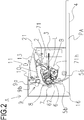
- FIG. 2 is a cross-sectional view of an image forming apparatus body A (hereinafter referred to as an "apparatus body A") of an electrophotographic image forming apparatus (hereinafter referred to as an image forming apparatus) according to Embodiment 1 of the present invention and a cartridge B as a first cartridge.
- FIG. 3 is a cross-sectional view of the cartridge B.
- the apparatus body A is a portion of a configuration of the image forming apparatus excluding the cartridge B.
- the image forming apparatus illustrated in FIG. 2 is a laser beam printer which uses an electrophotographic technology and in which the cartridge B can be detachably attachable to the apparatus body A.
- a sheet tray 4 that stacks a recording medium (a recording material) (hereinafter referred to as a "sheet PA”) serving as an image forming target is disposed under the cartridge B.
- a recording medium a recording material
- a pickup roller 5a, a feed roller pair 5b, a transfer guide 6, a transfer roller 7, a conveying guide 8, a fixing apparatus 9, a discharge roller pair 10, a discharge tray 11, and the like are disposed in the apparatus body A sequentially along a conveying direction D of the sheet PA.
- the fixing apparatus 9 includes a heating roller 9a and a pressure roller 9b.
- An electrophotographic photosensitive drum (hereinafter referred to as a photosensitive drum 62 or simply as a drum 62) is rotated on the basis of a print start signal at a predetermined peripheral velocity (a process speed) in a direction indicated by arrow R in FIGS. 2 and 3 .
- a charging roller (a charging member) 66 to which a bias voltage is applied comes into contact with an outer circumference of the drum 62 to uniformly charge the outer circumference of the drum 62.
- An exposure apparatus 3 outputs a laser beam L corresponding to image information.
- the laser beam L passes through a laser opening 71h provided in a cleaning frame body 71 of the cartridge B to scan and expose the outer circumference of the drum 62. In this way, an electrostatic latent image corresponding to the image information is formed on the outer circumference of the drum 62.
- toner T in a toner chamber 29 is stirred and conveyed by rotation of a conveying member (a stirring member) 43 and is delivered to a toner supply chamber 28.
- the toner T is borne on the surface of a developing roller (a developing sleeve) 32 by the magnetic force of a magnet roller (a stationary magnet) 34.
- the developing roller 32 is a developer bearing member that bears a developer (toner T) on the surface thereof in order to develop the latent image formed on the drum 62.
- the thickness of the toner T on a circumferential surface of a developing roller 32 as a developer bearing member is regulated while being triboelectrically charged by a developing blade 42.
- the toner T is supplied to the drum 62 according to the electrostatic latent image to develop the latent image. In this way, the latent image becomes visible as a toner image (a developer image).
- the drum 62 is an image bearing member that bears the latent image or an image (a toner image or a developer image) formed by toner on the surface thereof.
- a sheet material PA stored in a lower part of the apparatus body A is delivered from the sheet tray 4 with the aid of the pickup roller 5a and the feed roller pair 5b in synchronization with an output timing of the laser beam L.
- the sheet material PA passes through the transfer guide 6 and is conveyed to a transfer position between the drum 62 and the transfer roller 7. At this transfer position, the toner images are sequentially transferred from the drum 62 to the sheet material PA.
- the sheet material PA to which the toner image is transferred is separated from the drum 62 and is conveyed to the fixing apparatus 9 along the conveying guide 8.
- the sheet material PA passes through a nip portion between the heating roller 9a and the pressure roller 9b that form the fixing apparatus 9. At this nip portion, a pressurizing and heating process is performed and the toner image is fixed to the sheet material PA.
- the sheet material PA to which the toner image is fixed is conveyed up to the discharge roller pair 10 and is discharged to the discharge tray 11.
- a residual toner on the outer circumference of the drum 62 after a transfer operation is performed is removed by the cleaning blade 77 and is used again for an image forming process.
- the toner removed from the drum 62 is stored in a waste toner chamber 71b of the cleaning unit 60.
- the cleaning unit 60 is a unit having the photosensitive drum 62.
- the charging roller 66, the developing roller 32, the transfer roller 7, and the cleaning blade 77 are process means acting on the drum 62.
- FIG. 3 is a schematic cross-sectional view of the cartridge B
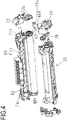
- FIGS. 4 and 5 are exploded perspective views for describing the configuration of the cartridge B.
- description of screws used for combining respective components will be omitted.
- the cartridge B includes a cleaning unit (a photosensitive member holding unit, a drum holding unit, an image bearing member holding unit, or a first unit) 60, a developing unit (a developer bearing member holding unit or a second unit) 20.
- a cleaning unit a photosensitive member holding unit, a drum holding unit, an image bearing member holding unit, or a first unit
- a developing unit a developer bearing member holding unit or a second unit
- a process cartridge is a member in which an electrophotographic photosensitive member and at least one of the process means acting on the photosensitive member are integrated as a cartridge so as to be detachably attachable to a body (an apparatus body) of an electrophotographic image forming apparatus.
- process means include charging means, developing means, and cleaning means.
- the cleaning unit 60 includes the drum 62, the charging roller 66, the cleaning member 77, and the cleaning frame body 71 supporting these members.
- the drum 62 is configured such that a driving-side drum flange 63 provided at a driving-side end of the drum 62 is rotatably supported by a hole 73a of a drum bearing 73.
- the drum bearing 73 and the cleaning frame body 71 can be also collectively referred to as a cleaning frame body.
- the drum 62 is configured such that a drum shaft 78 press-fitted to a hole 71c formed in the cleaning frame body 71 is rotatably supported by a hole (not illustrated) of a non-driving-side drum shaft.
- the drum flanges are bearing target portions that are rotatably supported by bearing portions.
- the charging roller 66 and the cleaning member 77 are disposed in contact with the outer circumference of the drum 62.
- the cleaning member 77 includes a rubber blade 77a which is a blade-shaped elastic member formed from rubber as an elastic member and a supporting member 77b supporting the rubber blade.
- the rubber blade 77a abuts on the drum 62 in a counter direction in relation to a rotation direction of the drum 62. That is, the rubber blade 77a abuts on the drum 62 so that a distal end thereof faces the upstream side in the rotation direction of the drum 62.
- the waste toner removed from the surface of the drum 62 by the cleaning member 77 is stored in a waste toner chamber 71b formed by the cleaning frame body 71 and the cleaning member 77.
- a scooping sheet 65 for preventing the waste toner from leaking from the cleaning frame body 71 is provided at an edge of the cleaning frame body 71 so as to abut on the drum 62.
- the charging roller 66 is rotatably attached to the cleaning unit 60 with a charging roller bearing 67 at both ends in the longitudinal direction of the cleaning frame body 71.
- the longitudinal direction (the longitudinal direction of the cartridge B) of the cleaning frame body 71 is approximately parallel to an extension direction (an axial direction) of a rotation axis of the drum 62. Therefore, hereinafter, a longitudinal direction or an axial direction means an axial direction of the drum 62 unless particularly stated.
- the charging roller 66 is in pressure-contact with the drum 62 in such a way that a charging roller bearing 67 is pressed toward the drum 62 by a biasing member 68.
- the charging roller 66 rotates following rotation of the drum 62.
- the developing unit 20 includes the developing roller 32, a developing container 23 that supports the developing roller 32, the developing blade 42, and the like.
- the developing roller 32 is attached to the developing container 23 so as to be rotatably by bearing members 26 ( FIG. 4 ) and 27 ( FIG. 5 ) provided at both ends of the developing roller 32.
- a magnet roller 34 is provided in the developing roller 32.
- a developing blade 42 for regulating the toner layer on the developing roller 32 is disposed in the developing unit 20.
- an interval holding member 38 is attached to both ends of the developing roller 32, and the interval holding member 38 and the drum 62 abut on each other whereby the developing roller 32 is held with a very small gap formed between the drum 62 and the developing roller 32.
- a blowoff prevention sheet 33 for preventing toner from leaking from the developing unit 20 is provided at an edge of a bottom member 22 so as to abut on the developing roller 32.
- the conveying member 43 is provided in the toner chamber 29 formed by the developing container 23 and the bottom member 22. The conveying member 43 stirs the toner stored in the toner chamber 29 and conveys the toner toward the toner supply chamber 28.
- the cartridge B is formed by combining the cleaning unit 60 and the developing unit 20.
- the center of a first developing supporting boss 26a of the bearing member 26 with respect to a first driving-side suspension hole 71i of the cleaning frame body 71 is aligned to match the center of a second developing supporting boss 27a of the bearing member 27 with respect to a second non-driving-side suspension hole 71j.
- the developing unit 20 is moved in a direction indicated by arrow G so that the first developing supporting boss 26a and the second developing supporting boss 27a are fitted to the first suspension hole 71i and the second suspension hole 71j, respectively. In this way, the developing unit 20 is connected so as to be movable in relation to the cleaning unit 60.
- the developing unit 20 is rotatably (turnably) connected to the cleaning unit 60. That is, the developing roller 32 is connected so as to move toward and away from the drum 62. After that, the drum bearing 73 is assembled with the cleaning unit 60 to form the cartridge B.
- a non-driving-side biasing member 46L ( FIG. 5 ) and a non-driving-side biasing member 46R ( FIG. 4 ) are formed of a compression spring.
- the driving-side biasing member 46L and the non-driving-side biasing member 46R biases the developing unit 20 toward the cleaning unit 60 whereby the developing roller 32 is reliably pressed toward the drum 62.
- the interval holding member 38 is attached to both ends of the developing roller 32. That is, the drum 62 and the developing roller 32 come into contact with each other with a predetermined contact pressure with the interval holding member 38 disposed therebetween whereby the developing roller 32 is held at a predetermined interval from the drum 62 and the relative positions thereof are determined.
- the interval between the drum 62 and the developing roller 32 is maintained constantly with high accuracy. In other words, it is required that a contact pressure when the drum 62 and the developing roller 32 come into contact with each other with the interval holding member 38 disposed therebetween is maintained stably.
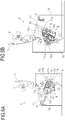
- FIG. 6A is a schematic cross-sectional view of a driving-side guide portion of the image forming apparatus A for describing attachment of the cartridge B
- FIG. 6B is a schematic cross-sectional view of a non-driving-side guide portion of the image forming apparatus A for describing attachment of the cartridge B
- FIG. 7A is a schematic cross-sectional view on the driving side of the image forming apparatus A for describing positioning of the cartridge B.
- FIG. 7B is a schematic cross-sectional view on the non-driving side of the image forming apparatus A for describing positioning of the cartridge B.
- FIG. 8A is a schematic cross-sectional view of the driving-side guide portion of the image forming apparatus A for describing attachment of the cartridge B
- FIG. 8B is a schematic cross-sectional view of the non-driving-side guide portion of the image forming apparatus A for describing attachment of the cartridge B.
- a first driving-side plate 15 has an upper guide rail 15g and a guide rail 15h as a guide
- a driving-side plate 16 has a guide rail 16d and a guide rail 16e.
- a drum bearing 73 provided on the driving side of the cartridge B has a rotation-stopping target portion 73c.
- An attachment direction of the cartridge B is a direction (see arrow C) substantially orthogonal to an axial line of the drum 62.
- the cleaning frame body 71 has a positioning target portion 71d and a rotation-stopping target portion 71g on the non-driving side in the longitudinal direction.
- a boss 73g and a rotation-stopping target portion 73c of the cartridge B are guided to an upper guide rail 15g and a guide rail 15h of the apparatus body A on the driving side of the cartridge B.
- a positioning target portion 71d and a rotation-stopping target portion 71g of the cartridge B are guided to a guide rail 16d and a guide rail 16e of the apparatus body A, respectively. In this way, the cartridge B is attached to the apparatus body A.
- the first driving-side plate 15 has an upper positioning portion 15a, a lower positioning portion 15b, an upper rotation-stopping portion 15c1, and a lower rotation-stopping portion 15c2 as a positioning portion.
- the non-driving-side plate 16 has a positioning portion 16a, an upper rotation-stopping portion 16cl, and a lower rotation-stopping portion 16c2.
- the drum bearing 73 has an upper positioning target portion (a first positioning target portion, a first projection, or a first bulging portion) 73d and a lower positioning target portion (a second positioning target portion, a second projection, or a second bulging portion) 73f.
- cartridge pressing members 1 and 2 are rotatably attached to both ends in the axial direction of the door 13.
- Cartridge pressing springs 19 and 21 are attached to both ends in the longitudinal direction of a front plate provided in the image forming apparatus A.
- the drum bearing 73 has a pressing target portion 73e as a biasing force receiving portion
- the cleaning frame body 71 has a pressing target portion 71o on the non-driving side (see FIGS. 3 and 6A to 7B ).
- the pressing target portions 73e and 71o of the cartridge B are pressed by the cartridge pressing members 1 and 2 biased by the cartridge pressing springs 19 and 21 of the apparatus body A (see FIGS. 7A and 7B ).
- the cartridge B and the drum 62 are positioned on the driving side.
- the positioning target portion 71d and the rotation-stopping target portion 71g of the cartridge B abut on the positioning portion 16a and the rotation-stopping portion 16c of the apparatus body A, respectively. In this way, the cartridge B and the drum 62 are positioned on the non-driving side.
- the configuration of the positioning means is not limited thereto.
- the positioning means may act directly on the upper positioning target portion 73d and the lower positioning target portion 73f on the driving side of the cartridge B and the positioning target portion 71d and the rotation-stopping target portion 71g on the non-driving side to fix the respective positioning portions.
- a cartridge attachment error prevention mechanism (an attachment error prevention system) will be described by way of examples of the cartridge B as a first cartridge (an allowed or authorized cartridge) that is allowed or authorized to be attached to the apparatus body A and cartridges E1 and E2 as a second cartridge (an unallowed or unauthorized cartridge) that is not allowed or not authorized to be attached to the apparatus body A.
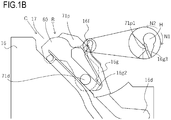
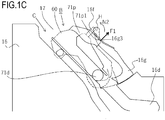
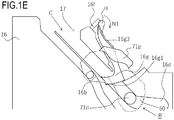
- FIGS. 1A to 1E are lateral cross-sectional views illustrating a process of attaching the cartridge B to the apparatus body A.
- FIGS. 1A to 1E are lateral cross-sectional views illustrating a process of attaching the cartridge B to the apparatus body A.
- the non-driving-side plate 16 and the cleaning unit 60 are illustrated.
- the cleaning unit 60 and a lever 16g are hatched in FIG. 1A so that the shapes of components are identified, the cleaning unit 60 and the lever 16g are not hatched in FIGS. 1B to 1E for the sake of convenience.
- FIG. 8A is a perspective view illustrating a state in which the cartridge B is attached to the apparatus body A
- FIGS. 8B and 8C are detailed partial views illustrating a state in which the cartridge B is attached to the apparatus body A.
- the non-driving-side plate 16 is illustrated for the apparatus body A.
- a rib 71p extending in a direction orthogonal to the longitudinal direction is provided at a non-driving-side end of the cleaning frame body 71.
- a first engagement portion 71p1 is provided on the downstream side in a cartridge insertion direction (a direction indicated by arrow C) of the rib 71p.
- a guide rail 16f as a first guide portion is provided in the non-driving-side plate 16.
- the guide rail 16f does not interfere with the rib 71p in the course of insertion of the cartridge B.
- the rib 71q cannot pass through the guide rail 16f. That is, the guide rail 16f regulates insertion (arrival at an attachment completion position) of the cartridge E2.
- the guide rail 16f has an inlet shape corresponding to an outer shape of the rib 71p (a first engagement portion 71p1) when seen in a direction of attaching the cartridge to the apparatus body A, and a regulating wall abutting on the rib 1q is formed around the inlet.
- the guide rail 16f and the surrounding structure thereof form a first guide portion of the present invention.
- the first guide portion and the engagement portion (the rib 71p and the rib 71q) provided in the cartridge B and E2 form a first identifying portion for identifying whether a cartridge to be attached to the apparatus body A is allowed one or not.
- a lever 16g as a movable member is provided in the non-driving-side plate 16.
- the lever 16g is configured to be able to swing about a shaft center H.
- the lever 16g is biased in a direction indicated by arrow N1 by the biasing force applied from a biasing member (not illustrated), and a regulating target surface 16g1 of the lever 16g comes into contact with a regulating surface 16b provided in the non-driving-side plate 16 whereby the position of the lever 16g is determined.
- a state in which the lever 16g blocks a guiding path of the positioning target portion 71d of the guide rail 16d (a second guide portion) is created (this is a first position or a regulation position).
- an engagement target portion 16g2 provided in the lever 16g is configured to regulate a positioning target portion 71d2 of the cartridge E1 from advancing through the guide rail 16d in an attachment direction (a direction indicated by arrow C) as will be described later.
- a movable member (the engagement target portion 16g2 of the lever 16g) at a regulation position and the positioning target portions 71d and 71d2 of a cartridge form a second identifying portion for identifying whether the cartridge that is to be attached to the apparatus body A is allowed one or not.
- a surface 16g3 as an engagement target portion with which the first engagement portion 71p1 engages is provided in the lever 16g.
- the engagement target portion 16g2 and the surface 16g3 are provided closer to the downstream side in the cartridge insertion direction than the guide rail 16f.
- the first engagement portion 71p1 comes into contact with the surface 16g3 after passing through the guide rail 16f.
- the positioning target portion 71d is closer to the upstream side in the insertion direction (the direction indicated by arrow C) than the engagement target portion 16g2 of the lever 16g.
- the engagement target portion 16g3 receives force F1 from the first engagement portion 71p1 provided in the cartridge B by the insertion force of the cartridge B.
- the lever 16g moves in a direction indicated by arrow N2 about the shaft center H while resisting the biasing force from a biasing member (not illustrated).
- a state in which the lever 16g is completely released without blocking the guiding path of the positioning target portion 71d of the guide rail 16d is created (this is a second position or a non-regulation position). That is, a state in which the positioning target portion 71d of the cartridge B is allowed to proceed toward the guide rail 16d.
- the positioning target portion 71d is disposed closer to the upstream side in the insertion direction (the direction indicated by arrow C) than a place where the lever 16g was at the first position.
- the lever 16g moves between the first position (the regulation position) and the second position (the non-regulation position) without making contact with the positioning target portion 71d in the course of inserting the cartridge B.
- FIG. 9 is a lateral cross-sectional view illustrating a state in which the cartridge E1 is inserted into the apparatus body A. Similarly to FIGS. 1A to 1E , only the non-driving-side plate 16 and the cleaning unit 60 are illustrated in FIG. 9 .
- a difference between the cartridge E1 and the cartridge B is that the cartridge E1 does not have a shape corresponding to the first engagement portion 71p1. Due to this, when the cartridge E1 is inserted into the image forming apparatus, the cartridge E1 can proceed in the direction indicated by arrow C without interfering with the guide rail 16f However, the cartridge E1 does not have a shape corresponding to the first engagement portion 71p1. Due to this, even when insertion of the cartridge E1 progresses, the cartridge E1 does not come into contact with the surface 16g3 of the lever 16g and a force that moves the lever 16g up to the second position (the non-regulation position) is not applied. Therefore, the lever 16g remains blocking the guide rail 16d (this is, the second position).
- the projection 16g4 is configured to abut on the positioning target portion 71d2 so that a force acting in a direction of resisting the biasing force acting on the lever 16g is not generated from the force F2 received from the positioning target portion 71d2 of the cartridge E1 (so that the force F2 does not include such a component force). At least the force F2 that the projection 16g4 receives from the positioning target portion 71d2 may act in the direction orthogonal to the movable direction of the engagement target portion 16g2 of the lever 16g.
- the projection 16g4 may be pressed from the positioning target portion 71d2 at such an angle that a force acting in a direction (a direction opposite to the direction toward the non-regulation position) along the turning direction of the lever 16g due to the biasing force is generated.
- a regulating surface 16k as a supporting portion that supports the lever 16g is provided in the non-driving-side plate 16 on a side (the downstream side in the insertion direction (the direction indicated by arrow C)) of the lever 16g opposite the engagement target portion 16g2 pressed from the positioning target portion 71d2.
- the lever 16g receives the force F2 from the positioning target portion 71d, and the lever 16g is deformed, deformation of the lever 16g in the direction of the force F2 can be regulated by the regulating surface 16k. Due to this, it is possible to prevent deformation and destruction of the lever 16g and to regulate insertion (arrival at an attachment completion position) of an unallowed cartridge reliably.
- the present invention is not limited to the configuration, but another configuration portion may be used and another configuration dedicated for the identifying portion may be provided.
- the lever 16g is at the first position.
- a second engagement portion 71p2 is provided on the upstream side in the insertion direction (the direction indicated by arrow C) of the rib 71p of the cartridge B.
- the second engagement portion 71p2 comes into contact with the surface 16g3 before the positioning target portion 71d comes into contact with the lever 16g.
- a force F3 is applied to the lever 16g with the second engagement portion 71p2 disposed therebetween by a removal force of the cartridge B. In this way, the lever 16g rotates about the shaft center H in the direction N2 and moves from the first position to the second position.
- a subsequent removal opening is reverse to the above-described attachment operation of the cartridge B, and the description thereof will be omitted.
- Embodiment 2 the components of Embodiment 2 the same as those of Embodiment 1 will be denoted by the same reference numerals.
- a longitudinal direction Y as a first direction matches a rotation axis direction of a photosensitive drum which is an image bearing member.
- a driving side a side to which a driving force is transmitted from an apparatus body of the image forming apparatus to the photosensitive drum
- the opposite side will be referred to as a non-driving side.
- FIG. 12 is a cross-sectional view of an image forming apparatus body 2A (hereinafter referred to as an "apparatus body 2A") of an electrophotographic image forming apparatus (hereinafter referred to as an image forming apparatus) according to Embodiment 2 of the present invention and a cartridge 2B as a first cartridge.
- FIG. 13 is a cross-sectional view of the cartridge 2B.
- the apparatus body 2A is a portion of a configuration of the image forming apparatus excluding the cartridge 2B.
- the image forming apparatus illustrated in FIG. 12 is a laser beam printer which uses an electrophotographic technology and in which the cartridge 2B can be detachably attachable to the apparatus body 2A.
- a sheet tray 4 that stacks a recording medium (a recording material) (hereinafter referred to as a "sheet P") serving as an image forming target is disposed under the cartridge 2B.
- a pickup roller 5a, a feed roller pair 5b, a transfer guide 6, a transfer roller 7, a conveying guide 8, a fixing apparatus 9, a discharge roller pair 10, a discharge tray 11, and the like are disposed in the apparatus body 2A sequentially along a conveying direction D of the sheet P.
- the fixing apparatus 9 includes a heating roller 9a and a pressure roller 9b.
- An electrophotographic photosensitive drum (hereinafter referred to as a photosensitive drum 262 or simply as a drum 262) is rotated on the basis of a print start signal at a predetermined peripheral velocity (a process speed) in a direction indicated by arrow R in FIGS. 12 and 13 .
- a charging roller (a charging member) 266 to which a bias voltage is applied comes into contact with an outer circumference of the drum 262 to uniformly charge the outer circumference of the drum 262.
- An exposure apparatus 3 outputs a laser beam L corresponding to image information.
- the laser beam L passes through a laser opening 271h provided in a cleaning frame body 271 of the cartridge 2B to scan and expose the outer circumference of the drum 262. In this way, an electrostatic latent image corresponding to the image information is formed on the outer circumference of the drum 262.
- toner T in a toner chamber 229 is stirred and conveyed by rotation of a conveying member (a stirring member) 243 and is delivered to a toner supply chamber 228.
- the toner T is borne on the surface of a developing roller (a developing sleeve) 232 by the magnetic force of a magnet roller (a stationary magnet) 234.
- the developing roller 232 is a developer bearing member that bears a developer (toner T) on the surface thereof in order to develop the latent image formed on the drum 262.
- the thickness of the toner T on a circumferential surface of a developing roller 232 as a developer bearing member is regulated while being triboelectrically charged by a developing blade 242.
- the toner T is supplied to the drum 262 according to the electrostatic latent image to develop the latent image. In this way, the latent image becomes visible as a toner image (a developer image).
- the drum 262 is an image bearing member that bears the latent image or an image (a toner image or a developer image) formed by toner on the surface thereof.
- a sheet material P stored in a lower part of the apparatus body 2A is delivered from the sheet tray 4 with the aid of the pickup roller 5a and the feed roller pair 5b in synchronization with an output timing of the laser beam L.
- the sheet material P passes through the transfer guide 6 and is conveyed to a transfer position between the drum 262 and the transfer roller 7. At this transfer position, the toner images are sequentially transferred from the drum 262 to the sheet material P.
- the sheet material P to which the toner image is transferred is separated from the drum 262 and is conveyed to the fixing apparatus 9 along the conveying guide 8.
- the sheet material P passes through a nip portion between the heating roller 9a and the pressure roller 9b that form the fixing apparatus 9. At this nip portion, a pressurizing and heating process is performed and the toner image is fixed to the sheet material P.
- the sheet material P to which the toner image is fixed is conveyed up to the discharge roller pair 10 and is discharged to the discharge tray 11.
- a residual toner on the outer circumference of the drum 262 after a transfer operation is performed is removed by the cleaning blade 277 and is used again for an image forming process.
- the toner removed from the drum 262 is stored in a waste toner chamber 271b of the cleaning unit 260.
- the cleaning unit 260 is a unit having the photosensitive drum 262.
- the charging roller 266, the developing roller 232, the transfer roller 7, and the cleaning blade 277 are process means acting on the drum 262.
- FIG. 13 is a schematic cross-sectional view of the cartridge 2B
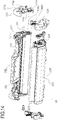
- FIGS. 14 and 15 are exploded perspective views for describing the configuration of the cartridge 2B.
- description of screws used for combining respective components will be omitted.
- the cartridge 2B includes a cleaning unit (a photosensitive member holding unit, a drum holding unit, an image bearing member holding unit, or a first unit) 260, a developing unit (a developer bearing member holding unit or a second unit) 220.
- a cleaning unit a photosensitive member holding unit, a drum holding unit, an image bearing member holding unit, or a first unit
- a developing unit a developer bearing member holding unit or a second unit
- a process cartridge is a member in which an electrophotographic photosensitive member and at least one of the process means acting on the photosensitive member are integrated as a cartridge so as to be detachably attachable to a body (an apparatus body) of an electrophotographic image forming apparatus.
- process means include charging means, developing means, and cleaning means.
- the cleaning unit 260 includes the drum 262, the charging roller 266, the cleaning member 277, and the cleaning frame body 271 supporting these members.
- the drum 262 is configured such that a driving-side drum flange 263 provided at a driving-side end of the drum 262 is rotatably supported by a hole 273a of a drum bearing 273.
- the drum bearing 273 and the cleaning frame body 271 can be also collectively referred to as a cleaning frame body.
- the drum 262 is configured such that a drum shaft 278 press-fitted to a hole 271c formed in the cleaning frame body 271 is rotatably supported by a hole (not illustrated) of a non-driving-side drum shaft.
- the drum flanges are bearing target portions that are rotatably supported by bearing portions.
- the charging roller 266 and the cleaning member 277 are disposed in contact with the outer circumference of the drum 262.
- the cleaning member 277 includes a rubber blade 277a which is a blade-shaped elastic member formed from rubber as an elastic member and a supporting member 277b supporting the rubber blade.
- the rubber blade 277a abuts on the drum 262 in a counter direction in relation to a rotation direction of the drum 262. That is, the rubber blade 277a abuts on the drum 262 so that a distal end thereof faces the upstream side in the rotation direction of the drum 262.
- the waste toner removed from the surface of the drum 262 by the cleaning member 277 is stored in a waste toner chamber 271b formed by the cleaning frame body 271 and the cleaning member 277.
- a scooping sheet 265 for preventing the waste toner from leaking from the cleaning frame body 271 is provided at an edge of the cleaning frame body 271 so as to abut on the drum 262.
- the charging roller 266 is rotatably attached to the cleaning unit 260 with a charging roller bearing 267 at both ends in the longitudinal direction of the cleaning frame body 271.
- the charging roller 266 is in pressure-contact with the drum 262 in such a way that a charging roller bearing 267 is pressed toward the drum 262 by a biasing member 268.
- the charging roller 266 rotates following rotation of the drum 262.
- the developing unit 220 includes the developing roller 232, a developing container 223 that supports the developing roller 232, the developing blade 242, and the like.
- the developing roller 232 is attached to the developing container 223 so as to be rotatably by bearing members 226 ( FIG. 14 ) and 227 ( FIG. 15 ) provided at both ends of the developing roller 232.
- a magnet roller 234 is provided in the developing roller 232.
- a developing blade 242 for regulating the toner layer on the developing roller 232 is disposed in the developing unit 220.
- an interval holding member 238 is attached to both ends of the developing roller 232, and the interval holding member 238 and the drum 262 abut on each other whereby the developing roller 232 is held with a very small gap formed between the drum 262 and the developing roller 232.
- a developing sheet member 233 for preventing toner from leaking from the developing unit 220 is provided at an edge of a bottom member 222 so as to abut on the developing roller 232.
- the conveying member 243 is provided in the toner chamber 229 formed by the developing container 223 and the bottom member 222. The conveying member 243 stirs the toner stored in the toner chamber 229 and conveys the toner toward the toner supply chamber 228.
- the cartridge 2B is formed by combining the cleaning unit 260 and the developing unit 220.
- the center of a first developing supporting boss 226a of the bearing member 226 with respect to a first driving-side suspension hole 271i of the cleaning frame body 271 is aligned to match the center of a second developing supporting boss 227a of the bearing member 227 with respect to a second non-driving-side suspension hole 271j.
- the developing unit 220 is moved in a direction indicated by arrow G so that the first developing supporting boss 226a and the second developing supporting boss 227a are fitted to the first suspension hole 271i and the second suspension hole 271j, respectively. In this way, the developing unit 220 is connected so as to be movable in relation to the cleaning unit 260.
- the developing unit 220 is rotatably (turnably) connected to the cleaning unit 260. That is, the developing roller 232 is connected so as to move toward and away from the drum 262. After that, the drum bearing 273 is assembled with the cleaning unit 260 to form the cartridge 2B.
- a non-driving-side biasing member 246L ( FIG. 15 ) and a non-driving-side biasing member 246R ( FIG. 14 ) are formed of a compression spring.
- the driving-side biasing member 246L and the non-driving-side biasing member 246R biases the developing unit 220 toward the cleaning unit 260 whereby the developing roller 232 is reliably pressed toward the drum 262.
- the interval holding member 238 is attached to both ends of the developing roller 232.
- the drum 262 and the developing roller 232 come into contact with each other with a predetermined contact pressure with the interval holding member 238 disposed therebetween whereby the developing roller 232 is held at a predetermined interval from the drum 262 and the relative positions thereof are determined.
- the interval between the drum 262 and the developing roller 232 is maintained constantly with high accuracy. In other words, it is required that a contact pressure when the drum 262 and the developing roller 232 come into contact with each other with the interval holding member 238 disposed therebetween is maintained stably.
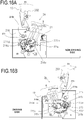
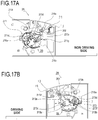
- FIGS. 16A, 16B , 17A, 17B , 11A, 11B, and 11C attachment of the cartridge 2B to the apparatus body 2A will be described in detail with reference to FIGS. 16A, 16B , 17A, 17B , 11A, 11B, and 11C .
- FIGS. 16A to 17B are explanatory diagrams (schematic cross-sectional views) illustrating an attachment portion of the apparatus body 2A to the cartridge 2B, in which FIGS. 16A and 17A illustrate a non-driving side and FIGS. 16B and 17B illustrate a driving side.
- FIGS. 11A to 11C are diagrams when the cartridge 2B is attached to the apparatus body 2A and are diagrams when seen from a side closer to a downstream side than the upstream side in the attachment direction C of the cartridge 2B.
- the door 13 for exposing and covering an attachment portion S of the cartridge 2B is provided in the apparatus body 2A.
- the door 13 is turned in a direction indicated by arrow R1 so that the attachment portion S of the cartridge 2B and an insertion opening 217 which is formed in the attachment portion S and is an inlet used for attaching the cartridge 2B are exposed.
- the attachment direction C the attachment direction orthogonal to the longitudinal direction Y.
- a non-driving-side guide 216 is provided on the non-driving side of the attachment portion S.
- the non-driving-side guide 216 has a non-driving-side upper guide 216d notched along the attachment direction C, a non-driving-side lower guide 216e, and a non-driving-side inner surface 216k opposing (facing) the attachment portion S.
- a driving-side guide 215 and a second guide rail 218 as a second identifying portion are provided on the driving side of the attachment portion S.
- the driving-side guide 215 and the second guide rail 218 have a driving-side guide portion 215d and a second guide portion 218a notched along the attachment direction C, respectively.
- the second guide rail 218 further has a driving-side inner surface 218c opposing (facing) the attachment portion S.
- a guiding target portion along which attachment to the apparatus body 2A is guided is provided in the cartridge 2B.
- an end surface 271k orthogonal to the longitudinal direction Y, a positioning target portion 271d (a third projection) as a third identification target portion protruding toward the outer side in the longitudinal direction Y from the end surface 271k, and a rotation-stopping target portion 271g are provided in the cleaning frame body 271.
- an end surface 273h orthogonal to the longitudinal direction Y, a rotation-stopping target portion 273c (a first projection) protruding toward the outer side in the longitudinal direction Y from the end surface 273h, and an identification target boss 273g (a second projection) as a second identification target portion are provided in the drum bearing 273.
- the positioning target portion 271d is guided to the non-driving-side upper guide 216d and the rotation-stopping target portion 271g is guided to the non-driving-side lower guide 216e.
- the identification target boss 273g is guided to the second guide portion 218a and the rotation-stopping target portion 273c is guided to the driving-side guide portion 215d.
- the cartridge 2B is attached to the apparatus body 2A along the determined attachment trajectory (the attachment direction C).
- the driving-side guide 215 has an upper positioning portion 215a, a lower positioning portion 215b, and a rotation-stopping portion 215c as a positioning portion.
- the non-driving-side guide 216 has a positioning portion 216a and a rotation-stopping portion 216c.
- the drum bearing 273 has an upper positioning target portion 273d and a lower positioning target portion 273f.
- cartridge pressing members 201 and 202 are rotatably attached to both ends in the axial direction of the door 13.
- the cartridge pressing springs 19, 21 are attached to both ends in the longitudinal direction Y of a front plate provided in the apparatus body 2A.
- the drum bearing 273 has a pressing target portion 273e as a biasing force receiving portion and the cleaning frame body 271 has a pressing target portion 271o on the non-driving side (see FIGS. 13 , 15 , 16A, 16B , 17A, and 17B ).
- the pressing target portions 273e and 271o of the cartridge 2B are pressed by the cartridge pressing members 201 and 202 biased by the cartridge pressing springs 19 and 21 of the apparatus body 2A (see FIGS. 17A and 17B ).
- the cartridge 2B and the drum 262 are positioned on the driving side.
- the positioning target portion 271d and the rotation-stopping target portion 271g of the cartridge 2B abut on the positioning portion 216a and the rotation-stopping portion 216c of the apparatus body 2A, respectively. In this way, the cartridge 2B and the drum 262 are positioned on the non-driving side.
- the configuration of the positioning means is not limited thereto.
- the positioning means may act directly on the positioning target portion 271d and the rotation-stopping target portion 271g on the driving side of the cartridge 2B and the positioning target portion 273d and the rotation-stopping target portion 273f on the non-driving side to fix the respective positioning portions.
- a cartridge attachment error prevention system will be described with reference to FIGS. 11A to 11C and 18A to 21 .
- the cartridge attachment error prevention system includes a first attachment error prevention mechanism provided on one end side (the non-driving side) in the longitudinal direction Y and a second attachment error prevention mechanism provided on the other end side (the driving side).
- the first attachment error prevention mechanism and the second attachment error prevention mechanism function independently, and a cartridge being allowed by both mechanisms can be attached to the apparatus body 2A (the details will be described later).
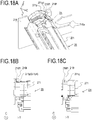
- FIG. 18A is an explanatory diagram of the apparatus body 2A and the cartridge 2B related to the first attachment error prevention mechanism
- FIG. 18B is an explanatory diagram of the apparatus body 2A and the cartridge 2B.
- a rib 271p as a first identification target portion extending in a direction (the up-down direction Z) orthogonal to both the longitudinal direction Y and the attachment direction C is provided at a non-driving-side end of the cleaning frame body 271.
- a first abutting portion 271p1 is provided on the upstream side in the cartridge attachment direction C of the rib 271p.
- a non-driving-side identification rail 216f as a first identifying portion is provided in the apparatus body 2A.
- a notch 216f1 (a first guide portion) is provided in the non-driving-side identification rail 216f at a position matching the rib 271p in the longitudinal direction Y of the cartridge 2B.
- a movable lever 216g as a first movable member is provided in the non-driving-side guide 216.
- the movable lever 216g is configured to be swingable about the shaft center H and is biased in the direction indicated by arrow N1 by a biasing member (not illustrated).
- the position of the movable lever 216g is determined in such a way that the regulating target surface 216g1 of the movable lever 216g comes into contact with the regulating surface 216b provided on the non-driving-side plate 216 (this is the first regulation position).
- a state in which the movable lever 216g blocks an attachment path (a guiding path) G1 of the positioning target portion 271d of the cartridge 2B by the non-driving-side upper guide 216d (a third guide portion) is created.
- an abutting surface 216g3 is provided in the movable lever 216g on a side closer to the downstream side in the attachment direction C of the cartridge 2B than the notch 216f1.
- the abutting surface 216g3 is a surface that crosses the attachment direction C and the direction (a tangential direction of a circle about the shaft center H) indicated by arrow N1 of the cartridge 2B and faces the direction indicated by arrow N1.
- a lever regulating portion 216g2 as a first movable portion is provided in the vicinity of the regulating target surface 216g1 of the movable lever 216g.
- the lever regulating portion 216g2 is a surface that crosses the attachment direction C of the cartridge 2B and faces the direction indicated by arrow N3.
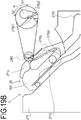
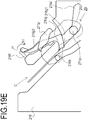
- FIGS. 19A to 19E are lateral cross-sectional views illustrating a process in which the cartridge 2B is attached to the apparatus body 2A.
- FIGS. 19A to 19E are lateral cross-sectional views illustrating a process in which the cartridge 2B is attached to the apparatus body 2A.
- the non-driving-side guide 216 and the cleaning unit 260 are illustrated.
- the cleaning unit 260 and the movable lever 216g are hatched in FIG. 19A so that the shapes of components are identified, no component is hatched in FIGS. 19B to 19E for the sake of convenience.
- the rib 271p passes through the notch 216f and enters the apparatus body 2A. Subsequently, when the cartridge 2B enters the apparatus body 2A, the first abutting portion 271p1 of the rib 271p abuts on the abutting surface 216g3 of the movable lever 216g before the positioning target portion 271d abuts on the lever regulating portion 216g2.
- the first abutting portion 271p1 applies a force F1 originating from the attachment force (the operating force of a user) of the cartridge 2B to the abutting surface 216g3.
- F1 the force originating from the attachment force (the operating force of a user) of the cartridge 2B
- the movable lever 216g is turned in the direction indicated by arrow N2 and the cartridge 2B can enter further into the apparatus body 2A.
- the lever regulating portion 216g2 also moves in the direction indicated by arrow N2 up to a first allowable position (a non-regulation position) at which the attachment path G1 (see FIG. 11B ) of the positioning target portion 271d of the cartridge 2B is released.
- the positioning target portion 271d passes through the lever regulating portion 216g2 in a state in which the rib 271p and the abutting surface 216g3 are in contact with each other.
- the cartridge 2B can be finally reached to an attachment completion position with respect to the apparatus body 2A, at which as described above, the positioning target portion 271d and the rotation-stopping target portion 271g illustrated in FIG. 17A abut on the positioning portion 216a and the rotation-stopping portion 216c of the apparatus body 2A, respectively.
- the cartridge 2B that is allowed to be attached to the apparatus body 2A is inserted, the rib 271p passes through the notch 216f1 to turn the movable lever 216g. In this way, the cartridge 2B can enter the apparatus body 2A while preventing the positioning target portion 271d from abutting on the lever regulating portion 216g2.
- the cartridge D1 has a rib 271q (as an unallowed identification target portion) at a different position in the longitudinal direction Y from the rib 271p of the cartridge 2B.
- the cartridge D1 since the position in the longitudinal direction of the rib 271q is different from that of the notch 216f1 of the non-driving-side identification rail 216f, the cartridge D1 cannot pass through the non-driving-side identification rail 216f. In this way, attachment of the cartridge D1 can be regulated.
- the notch 216f1 of the non-driving-side identification rail 216f has an inlet shape corresponding to an outer shape of the rib 271p of the cartridge 2B when seen in the attachment direction to the apparatus body 2A of the cartridge.
- a regulating wall abutting on the rib 271q of the cartridge D2 is formed around the inlet.
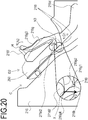
- FIG. 20 is a lateral cross-sectional view illustrating a state in which the cartridge D2 is attached to the apparatus body 2A. Similarly to FIGS. 19A to 19E , only the non-driving-side guide 216 and the cleaning unit 260 are illustrated.
- the cartridge D2 does not have the rib 271p of the cartridge 2B. Due to this, the cartridge D2 can proceed in the attachment direction C while preventing the cleaning frame body 271 from interfering with the non-driving-side identification rail 216f. However, if the cartridge D2 is inserted in this state, the cartridge D2 proceeds while the cleaning frame body 271 does not abut on the abutting surface 216g3. By doing so, in a state in which the movable lever 216g is at the first regulation position, the positioning target portion 271d2 as a third identification target portion of the cartridge D2 comes into contact with the lever regulating portion 216g2. In this way, a force F2 originating from the attachment force of the cartridge D2 is applied to the lever regulating portion 216g2 from the positioning target portion 271d2.
- third identification of whether the cartridge to be attached to the apparatus body 2A is allowed one or not is realized by the lever regulating portion 216g2 of the movable lever 216g as the third identifying portion and the positioning target portion 271d2 of the cartridge D2 as the third identification target portion.
- a projection 216g4 is provided at a distal end in the direction indicated by arrow N1 of the lever regulating portion 216g2, and the lever regulating portion 216g2 comes into contact with mainly the positioning target portion 271d2 of the cartridge D2 of the projection 216g4.
- the projection 216g4 is configured to abut on the positioning target portion 271d2 so that a force acting in the direction of resisting the biasing force acting on the movable lever 216g is not generated from the force F2 received from the positioning target portion 271d2 (so that the force F2 does not include such a component force).
- At least the force F2 that the projection 216g4 receives from the positioning target portion 271d2 may act in the direction orthogonal to the movable direction (the directions indicated by arrows N1 and N2) of the lever regulating portion 216g2 of the movable lever 216g.
- the projection 216g4 may be pressed from the positioning target portion 271d2 at such an angle that a force acting in a direction (a direction opposite to the direction toward the non-regulation position) along the turning direction of the movable lever 216g due to the biasing force is generated.
- a regulating surface 2161 as a supporting portion that supports the movable lever 216g is provided in the non-driving-side guide 216 on a side (the downstream side in the insertion direction (the direction indicated by arrow C)) of the movable lever 216g opposite the lever regulating portion 216g2 pressed from the positioning target portion 271d2.
- the movable lever 216g receives the force F2 from the positioning target portion 271d, and the movable lever 216g is deformed, deformation of the movable lever 216g in the direction of the force F2 can be regulated by the regulating surface 2161. Due to this, it is possible to prevent deformation and destruction of the movable lever 216g and to regulate insertion (arrival at an attachment completion position) of an unallowed cartridge reliably.
- the first attachment error prevention mechanism provided on one end side (a non-driving side) of a cartridge, it is possible to allow attachment of an allowed cartridge and regulate attachment of an unallowed cartridge (a first or second unallowed cartridge).
- the movable lever 216g is at the first regulation position when the cartridge 2B is in an attachment completion state.
- a second abutting portion 271p2 is provided on the upstream side in the insertion direction (the direction indicated by arrow C) of the rib 271p of the cartridge 2B.
- the second abutting portion 271p2 comes into contact with the abutting surface 216g3 before the positioning target portion 271d comes into contact with the movable lever 216g.
- a force F3 is applied to the movable lever 216g with the second abutting portion 271p2 disposed therebetween by a removal force of the cartridge 2B.
- the movable lever 216g rotates about the shaft center H in the direction indicated by arrow N2 and moves from the first regulation position to the first allowable position.
- a subsequent removal opening is reverse to the above-described attachment operation of the cartridge 2B, and the description thereof will be omitted.
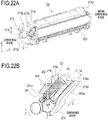
- FIG. 22A is an explanatory diagram of the second attachment error prevention mechanism of the cartridge 2B and FIG. 22B is an explanatory diagram of the second attachment error prevention mechanism of the apparatus body 2A.
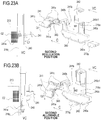
- FIGS. 23A and 23B are explanatory diagrams of the second attachment error prevention mechanism of the apparatus body 2A, in which some mechanisms are taken out.
- an abutting target portion 273f as a fourth identification target portion is provided in addition to the identification target boss 273g (the second identification target portion) and the rotation-stopping target portion 273c.
- the abutting target portion 273f is a portion provided integrally with a downstream-side end in the attachment direction C of the end surface 273h of the drum bearing 273 and has a surface vertical to the attachment direction C.
- the abutting target portion 273f passes through a place near a driving-side inner surface 218c illustrated in FIG. 22B similarly to the driving-side end surface 273h during attachment of the cartridge 2B.
- FIG. 22A On the driving side in the longitudinal direction Y of the cartridge 2B, an abutting target portion 273f as a fourth identification target portion is provided in addition to the identification target boss 273g (the second identification target portion) and the rotation-stopping target portion 273c.
- the abutting target portion 273f is a portion provided integrally with a downstream-side end in
- a distance in the up-down direction Z between the identification target boss 273g and the rotation-stopping target portion 273c is defined as a distance 73r
- a path through which the abutting target portion 273f passes is defined as an attachment trajectory G2 (a fourth guide portion) (see FIG. 22B ).
- a movable slider 240 and a movable cam 241 as a second movable member are provided on the driving side of the apparatus body 2A in addition to the driving-side guide 215 and the second guide rail 218 (the second identifying portion).
- the driving-side guide portion 215d is provided in the driving-side guide 215, and the second guide portion 218a is provided in the second guide rail 218.
- An interval between these guide portions in the up-down direction Z is defined as a distance 15r.
- the movable slider 240 is supported by the second guide rail 218 and is provided so as to be movable in the up-down direction Z of the cartridge 2B.
- the movable slider 240 is biased in a direction indicated by arrow M1 by a slider spring 242 which is a compression spring so as to block the second guide portion 218a.
- the movable slider 240 has an abutting surface 240a on the upstream side in the attachment direction C of the cartridge 2B so as to intersect the attachment direction C and the direction indicated by arrow M1 and face the upstream side in the attachment direction C.
- the movable slider 240 has a connecting portion 240b that operates the movable cam 241 on the downstream side in the attachment direction C of the cartridge 2B.
- the movable cam 241 is supported by the second guide rail 218 (see FIG. 22A ) on a side closer to the downstream side than the movable slider 240 in the attachment direction C of the cartridge 2B.
- the movable cam 241 includes a cam regulating portion 241a as a second movable portion (a fourth identifying portion), a supporting target portion 241c supported by the second guide rail 218 (see FIG. 22A ), and a connecting target portion 241b that receives an operating force from the movable slider 240.
- the movable cam 241 is supported so as to be able to turn about the supporting target portion 241c in a direction parallel to the attachment direction C and is movable between the second regulation position ( FIG. 23A ) and the second allowable position ( FIG. 23B ).
- the cam regulating portion 241a protrudes further from the driving-side inner surface 218c to block the attachment path G2 of the abutting target portion 273f.
- FIG. 23A the cam regulating portion 241a protrudes further from the driving-side inner surface 218c to block the attachment path G2 of the abutting target portion 273f.
- the cam regulating portion 241a does not protrude further from the driving-side inner surface 218c to release the attachment path G2 of the abutting target portion 273f. Furthermore, the movable cam 241 is biased by a cam spring 243 which is a torsion coil spring in the direction indicated by arrow Q2 (that is, so as to be at the second allowable position).
- the movable slider 240 moves in the direction indicated by arrow M1 by the biasing force of a slider spring 242.
- the connecting portion 240b presses the connecting target portion 241b in the direction indicated by arrow M1, whereby the movable cam 241 turns in the direction indicated by arrow Q1 while resisting against the biasing force of the cam spring 243.
- the movement in the direction M1 of the movable slider 240 is regulated when a boss 215e provided in the driving-side guide 215 fits into a guide 240c provided in the movable slider 240 to abut on a guide upper surface 240cl.
- the connecting portion 240b and the connecting target portion 241b are interlocked with each other whereby the positions of the movable cam 241 and the cam regulating portion 241a are determined (the second regulation position).
- biasing means biasing means
- the biasing means may be provided in either one of them and the movable slider 240 and the movable cam 241 may be connected by a link mechanism.
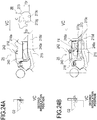
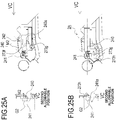
- FIGS. 24A to 25B are cross-sectional views for describing the process of attachment of the cartridge 2B and are views along arrow VC.
- the driving-side guide 215 and the drum bearing 273 are illustrated in a simplified manner.
- the arrow view VC is a view illustrating the state of the movable slider 240 and the movable cam 241 on a side closer to the downstream side than the upstream side in the attachment direction C of the cartridge 2B in the cross-sectional view.
- the distance 73r of the cartridge 2B is the same as the distance 15r of the apparatus body A. Due to this, when the cartridge 2B is attached to the apparatus body 2A, the cartridge 2B enters in the attachment direction C while the identification target boss 273g is guided to the second guide portion 218a and the rotation-stopping target portion 273c is guided to the driving-side guide portion 215d.
- the identification target boss 273g abuts on the abutting surface 240a of the slider 240.
- the identification target boss 273g applies a force F4 originating from the attachment force of the cartridge 2B to the abutting surface 240a.
- the movable slider 240 moves in the direction indicated by arrow M2 while resisting the biasing force of the slider spring 242 and the cartridge 2B can enter further into the apparatus body 2A.
- the movable cam 241 turns in the direction indicated by arrow Q2 with movement of the movable slider 240 and moves up to the second allowable position at which the attachment path G2 of the abutting target portion 273f of the cartridge 2B is released.
- the identification target boss 273g passes through the movable slider 240 in a state in which the movable slider 240 is moved in the direction indicated by arrow M2.
- the movable cam 241 starts turning in the direction indicated by arrow Q1 by the biasing force of the slider spring 242.
- the capacitance abutting portion 241d abuts on the driving-side end surface 273h of the drum bearing 273 whereby turning of the movable cam 241 stops.
- the cartridge 2B When the cartridge 2B is inserted further, the cartridge 2B reaches an attachment completion position illustrated in FIG. 27B as described above with respect to the apparatus body 2A. That is, the upper positioning target portion 273d, the lower positioning target portion 273f, and the rotation-stopping target portion 273c of the cartridge 2B abut on the upper positioning portion 215a, the lower positioning portion 215b, and the rotation-stopping portion 215c of the apparatus body 2A, respectively, whereby attachment is completed.
- the cartridge 2B that is allowed to be attached to the apparatus body 2A is inserted, the identification target boss 273g passes through the second guide portion 218a.
- the cam regulating portion 241a the movable cam 241
- the cartridge 2B can enter the apparatus body 2A while preventing the abutting target portion 273f from abutting on the cam regulating portion 241a.
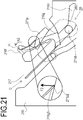
- FIGS. 26A and 26B are cross-sectional views for describing the process of attachment of the cartridge D3, in which the driving-side guide 215 of the apparatus body 2A and the drum bearing 274 of the cartridge D3 are illustrated in a simplified manner.
- the cartridge D3 is configured such that the distance 74r between an identification boss 274g and a rotation-stopping target portion 274c is narrow unlike the distance 73r of the cartridge 2B.
- the distance 74r is different from the distance 15r of the apparatus body. Therefore, as illustrated in FIG. 26B , the drum bearing 274 interferes with the driving-side guide 215 or the second guide rail 218 and the cartridge D3 cannot enter the attachment portion S. In this way, attachment of the cartridge D3 can be regulated.
- the second guide portion 218a of the second guide rail 218 has an inlet shape corresponding to the outer shape of the identification target boss 273g of the cartridge 2B when seen in the attachment direction of the cartridge to the apparatus body 2A.
- a regulating wall that abuts on the identification boss 274g of the cartridge D3 is formed around the inlet.
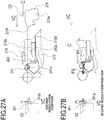
- FIGS. 27A and 27B are cross-sectional views for describing the process of attachment of the cartridge D4 and are views along arrow VC.
- the driving-side guide 215 of the apparatus body 2A and the drum bearing 275 of the cartridge D4 are illustrated in a simplified manner.
- the arrow view VC is a view illustrating the state of the movable slider 240 and the movable cam 241 on a side closer to the downstream side than the upstream side in the attachment direction C of the cartridge D4 in the cross-sectional view.
- the cartridge D4 includes the drum bearing 275 (having the rotation-stopping target portion 275c only) that does not have the identification target boss 273g of the cartridge 2B. Due to this, when the cartridge D4 is inserted in the attachment direction C, as illustrated in FIG. 27B , the cartridge D4 can proceed in the attachment direction C while preventing the drum bearing 275 from interfering with the driving-side guide 215 and the second guide rail 218. However, when the cartridge D4 is inserted in this state, the cartridge D4 enters while preventing the drum bearing 275 from abutting on the abutting surface 240a of the movable slider 240.
- the movable cam 241 Since the force F5 acts in a direction orthogonal to the moving direction of the movable cam 241 and the movement of the movable cam 241 is regulated by the movable slider 240, the movable cam 241 does not move in a state of blocking the attachment path G2. In this way, it is possible to regulate attachment of the cartridge D4.
- fourth identification of whether a cartridge that is to be attached to the apparatus body 2A is allowed one or not is realized by the cam regulating portion 241a as the fourth identifying portion and the abutting target portion 273f of the cartridge D4 as the fourth identification target portion.
- the cartridge 2B being allowed by both the first and second attachment error prevention mechanisms is allowed to be attached to the apparatus body 2A.
- a cartridge determined to be not allowed by either one of the first and second attachment error prevention mechanisms is regulated from being attached to the apparatus body 2A.
- the cartridges D1 to D4 are determined to correspond to either one of (i) the first unallowed case and (ii) the second unallowed case by either one of the attachment error prevention mechanisms, and attachment to the apparatus body 2A is regulated.
- the first unallowed case is a case in which attachment at a first attachment position on the uppermost side in the attachment path is regulated.
- the second unallowed case is a case in which, although a cartridge can pass through a first attachment position, attachment at a second attachment position closer to the upstream side than the attachment completion position is regulated, and the cartridge cannot reach the attachment completion position. Therefore, by performing identification individually at both ends in the longitudinal direction, it is possible to increase the number of allowed and unallowed identification patterns.
- a non-driving-side identification pattern (a combination of the first identifying portion and the first identification target portion) is arranged such that it is identified whether the positions in the longitudinal direction Y of a cartridge match each other.
- a driving-side identification pattern (a combination of the second identifying portion and the second identification target portion) is arranged such that it is identified whether the positions in the up-down direction Z of a cartridge match each other.
- the identification pattern is not limited to this configuration, but an arrangement direction of an identification pattern can be selected arbitrarily depending on an arrangement space of the attachment error prevention mechanism. As a result, a plurality of attachment error prevention mechanisms can be disposed in order to improve the space efficiency of the apparatus body 2A.
Landscapes
- Physics & Mathematics (AREA)
- General Physics & Mathematics (AREA)
- Engineering & Computer Science (AREA)
- Computer Vision & Pattern Recognition (AREA)
- Electrophotography Configuration And Component (AREA)
Priority Applications (1)
| Application Number | Priority Date | Filing Date | Title |
|---|---|---|---|
| EP24183212.0A EP4425269A3 (de) | 2018-12-28 | 2019-12-20 | Bilderzeugungsvorrichtung und vorrichtungskörper dafür |
Applications Claiming Priority (2)
| Application Number | Priority Date | Filing Date | Title |
|---|---|---|---|
| JP2018246942A JP7171429B2 (ja) | 2018-12-28 | 2018-12-28 | カートリッジの誤装着防止システム、画像形成装置、及びその装置本体 |
| JP2018246952A JP7229763B2 (ja) | 2018-12-28 | 2018-12-28 | カートリッジの誤装着防止システム、画像形成装置 |
Related Child Applications (2)
| Application Number | Title | Priority Date | Filing Date |
|---|---|---|---|
| EP24183212.0A Division EP4425269A3 (de) | 2018-12-28 | 2019-12-20 | Bilderzeugungsvorrichtung und vorrichtungskörper dafür |
| EP24183212.0A Division-Into EP4425269A3 (de) | 2018-12-28 | 2019-12-20 | Bilderzeugungsvorrichtung und vorrichtungskörper dafür |
Publications (3)
| Publication Number | Publication Date |
|---|---|
| EP3674814A2 true EP3674814A2 (de) | 2020-07-01 |
| EP3674814A3 EP3674814A3 (de) | 2020-10-21 |
| EP3674814B1 EP3674814B1 (de) | 2024-12-11 |
Family
ID=69005381
Family Applications (2)
| Application Number | Title | Priority Date | Filing Date |
|---|---|---|---|
| EP19218952.0A Active EP3674814B1 (de) | 2018-12-28 | 2019-12-20 | Bilderzeugungsvorrichtung und vorrichtungskörper davon |
| EP24183212.0A Pending EP4425269A3 (de) | 2018-12-28 | 2019-12-20 | Bilderzeugungsvorrichtung und vorrichtungskörper dafür |
Family Applications After (1)
| Application Number | Title | Priority Date | Filing Date |
|---|---|---|---|
| EP24183212.0A Pending EP4425269A3 (de) | 2018-12-28 | 2019-12-20 | Bilderzeugungsvorrichtung und vorrichtungskörper dafür |
Country Status (3)
| Country | Link |
|---|---|
| US (3) | US11048207B2 (de) |
| EP (2) | EP3674814B1 (de) |
| CN (2) | CN111381481B (de) |
Families Citing this family (8)
| Publication number | Priority date | Publication date | Assignee | Title |
|---|---|---|---|---|
| JP7139655B2 (ja) * | 2018-03-30 | 2022-09-21 | ブラザー工業株式会社 | ドラムユニット |
| CN113939664B (zh) | 2019-06-12 | 2024-12-03 | 佳能株式会社 | 盒、附件和安装套件 |
| EP4163729A4 (de) | 2020-06-08 | 2024-07-17 | Canon Kabushiki Kaisha | Tonerbehälter und bilderzeugungssystem |
| JP7693478B2 (ja) | 2021-09-16 | 2025-06-17 | キヤノン株式会社 | カートリッジ保護組立体 |
| JP7793472B2 (ja) | 2022-04-28 | 2026-01-05 | キヤノン株式会社 | カートリッジ、画像形成装置 |
| US12222674B2 (en) | 2022-06-24 | 2025-02-11 | Canon Kabushiki Kaisha | Cartridge, toner cartridge, and image forming apparatus |
| JP2024002825A (ja) * | 2022-06-24 | 2024-01-11 | キヤノン株式会社 | 画像形成装置 |
| JP2024002834A (ja) | 2022-06-24 | 2024-01-11 | キヤノン株式会社 | トナーカートリッジ |
Citations (2)
| Publication number | Priority date | Publication date | Assignee | Title |
|---|---|---|---|---|
| JP2014066797A (ja) | 2012-09-25 | 2014-04-17 | Canon Inc | 画像形成装置、カートリッジ、画像形成装置本体、及びカートリッジの誤挿入防止システム |
| JP2014066794A (ja) | 2012-09-25 | 2014-04-17 | Canon Inc | 画像形成装置、カートリッジ、画像形成装置本体、及びカートリッジの誤挿入防止システム |
Family Cites Families (20)
| Publication number | Priority date | Publication date | Assignee | Title |
|---|---|---|---|---|
| JP3102997B2 (ja) * | 1994-09-28 | 2000-10-23 | シャープ株式会社 | 画像形成装置 |
| US6301456B1 (en) | 2000-09-22 | 2001-10-09 | Lexmark International, Inc. | Method and apparatus for inserting a cartridge into an image forming apparatus |
| JP2002196647A (ja) * | 2000-12-22 | 2002-07-12 | Canon Inc | プロセスカートリッジ及び画像形成装置 |
| JP3970217B2 (ja) * | 2003-08-29 | 2007-09-05 | キヤノン株式会社 | 電子写真画像形成装置 |
| JP4667444B2 (ja) * | 2006-12-13 | 2011-04-13 | キヤノン株式会社 | 電子写真画像形成装置 |
| JP4366442B2 (ja) * | 2009-02-23 | 2009-11-18 | キヤノン株式会社 | プロセスカートリッジ及び電子写真画像形成装置 |
| US8687984B2 (en) * | 2010-10-15 | 2014-04-01 | Canon Kabushiki Kaisha | Image forming apparatus |
| JP5665470B2 (ja) | 2010-10-15 | 2015-02-04 | キヤノン株式会社 | 画像形成装置 |
| US20130330101A1 (en) * | 2012-06-07 | 2013-12-12 | Jesus Gonzalez | Device and Method For Modifying Device Housing |
| WO2014051156A1 (en) * | 2012-09-25 | 2014-04-03 | Canon Kabushiki Kaisha | Image forming apparatus, cartridge and image forming apparatus system |
| JP6056407B2 (ja) * | 2012-11-20 | 2017-01-11 | ブラザー工業株式会社 | 画像形成装置 |
| JP6312407B2 (ja) * | 2012-12-12 | 2018-04-18 | キヤノン株式会社 | 画像形成装置およびカートリッジ |
| JP6107615B2 (ja) * | 2013-11-18 | 2017-04-05 | ブラザー工業株式会社 | 画像形成システム |
| JP6351324B2 (ja) | 2014-03-24 | 2018-07-04 | キヤノン株式会社 | 画像形成装置の本体及び画像形成システム |
| JP6671884B2 (ja) | 2014-10-14 | 2020-03-25 | キヤノン株式会社 | 画像形成装置 |
| JP6562639B2 (ja) * | 2015-01-24 | 2019-08-21 | キヤノン株式会社 | カートリッジ及び画像形成装置 |
| JP6833402B2 (ja) * | 2015-10-14 | 2021-02-24 | キヤノン株式会社 | カートリッジ及び画像形成装置 |
| JP2018205519A (ja) * | 2017-06-02 | 2018-12-27 | キヤノン株式会社 | カートリッジユニット |
| JP6377209B2 (ja) | 2017-06-07 | 2018-08-22 | キヤノン株式会社 | カートリッジの誤挿入防止システム及び画像形成装置 |
| JP7229813B2 (ja) * | 2019-02-27 | 2023-02-28 | キヤノン株式会社 | 誤装着防止システム |
-
2019
- 2019-12-20 EP EP19218952.0A patent/EP3674814B1/de active Active
- 2019-12-20 EP EP24183212.0A patent/EP4425269A3/de active Pending
- 2019-12-27 US US16/728,191 patent/US11048207B2/en active Active
- 2019-12-27 CN CN201911372112.9A patent/CN111381481B/zh active Active
- 2019-12-27 CN CN202310546851.5A patent/CN116540511A/zh active Pending
-
2021
- 2021-05-20 US US17/325,329 patent/US11256209B2/en active Active
-
2022
- 2022-01-13 US US17/574,690 patent/US11669044B2/en active Active
Patent Citations (2)
| Publication number | Priority date | Publication date | Assignee | Title |
|---|---|---|---|---|
| JP2014066797A (ja) | 2012-09-25 | 2014-04-17 | Canon Inc | 画像形成装置、カートリッジ、画像形成装置本体、及びカートリッジの誤挿入防止システム |
| JP2014066794A (ja) | 2012-09-25 | 2014-04-17 | Canon Inc | 画像形成装置、カートリッジ、画像形成装置本体、及びカートリッジの誤挿入防止システム |
Also Published As
| Publication number | Publication date |
|---|---|
| CN111381481A (zh) | 2020-07-07 |
| EP3674814A3 (de) | 2020-10-21 |
| EP4425269A2 (de) | 2024-09-04 |
| US20220137551A1 (en) | 2022-05-05 |
| US11048207B2 (en) | 2021-06-29 |
| EP3674814B1 (de) | 2024-12-11 |
| US20210271203A1 (en) | 2021-09-02 |
| US11256209B2 (en) | 2022-02-22 |
| EP4425269A3 (de) | 2024-11-27 |
| CN116540511A (zh) | 2023-08-04 |
| US11669044B2 (en) | 2023-06-06 |
| CN111381481B (zh) | 2023-06-02 |
| US20200209803A1 (en) | 2020-07-02 |
Similar Documents
| Publication | Publication Date | Title |
|---|---|---|
| EP3674814B1 (de) | Bilderzeugungsvorrichtung und vorrichtungskörper davon | |
| KR102251926B1 (ko) | 화상형성장치의 본체에 장착가능한 현상 카트리지 | |
| US10459382B2 (en) | Image forming apparatus | |
| KR20210053866A (ko) | 화상형성장치의 본체에 장착가능한 현상 카트리지 | |
| JP7418109B2 (ja) | 画像形成装置 | |
| EP3239782B1 (de) | Entwicklungsvorrichtung und bilderzeugungseinrichtung | |
| CN101154074B (zh) | 显影剂盒及成像装置 | |
| JP6938166B2 (ja) | 画像形成装置 | |
| JP7076945B2 (ja) | 現像装置及び画像形成装置 | |
| US10802421B2 (en) | Image forming apparatus and developing apparatus | |
| JP2016133760A (ja) | 画像形成装置 | |
| EP3712708A1 (de) | System zur verhinderung von fehlmontagen | |
| JP2020194119A (ja) | 現像装置及びこれを用いた画像形成装置 | |
| JP7536920B2 (ja) | 画像形成装置 | |
| JP7106300B2 (ja) | 画像形成装置 | |
| JP2020106717A (ja) | カートリッジの誤装着防止システム、画像形成装置、及びその装置本体 | |
| JP5023847B2 (ja) | 現像剤カートリッジ及び画像形成装置 | |
| JP4576885B2 (ja) | 現像装置及び画像形成装置 | |
| KR20190038360A (ko) | 현상 장치 및 화상 형성 장치 | |
| JP2005331546A (ja) | 画像形成装置 | |
| JP2019053221A (ja) | 画像形成装置 | |
| JPH10104943A (ja) | 現像装置 | |
| HK40039855B (zh) | 调色剂盒、调色剂供给机构和闸板 |
Legal Events
| Date | Code | Title | Description |
|---|---|---|---|
| PUAI | Public reference made under article 153(3) epc to a published international application that has entered the european phase |
Free format text: ORIGINAL CODE: 0009012 |
|
| STAA | Information on the status of an ep patent application or granted ep patent |
Free format text: STATUS: THE APPLICATION HAS BEEN PUBLISHED |
|
| AK | Designated contracting states |
Kind code of ref document: A2 Designated state(s): AL AT BE BG CH CY CZ DE DK EE ES FI FR GB GR HR HU IE IS IT LI LT LU LV MC MK MT NL NO PL PT RO RS SE SI SK SM TR |
|
| AX | Request for extension of the european patent |
Extension state: BA ME |
|
| PUAL | Search report despatched |
Free format text: ORIGINAL CODE: 0009013 |
|
| AK | Designated contracting states |
Kind code of ref document: A3 Designated state(s): AL AT BE BG CH CY CZ DE DK EE ES FI FR GB GR HR HU IE IS IT LI LT LU LV MC MK MT NL NO PL PT RO RS SE SI SK SM TR |
|
| AX | Request for extension of the european patent |
Extension state: BA ME |
|
| RIC1 | Information provided on ipc code assigned before grant |
Ipc: G03G 21/18 20060101AFI20200916BHEP |
|
| STAA | Information on the status of an ep patent application or granted ep patent |
Free format text: STATUS: REQUEST FOR EXAMINATION WAS MADE |
|
| 17P | Request for examination filed |
Effective date: 20210421 |
|
| RBV | Designated contracting states (corrected) |
Designated state(s): AL AT BE BG CH CY CZ DE DK EE ES FI FR GB GR HR HU IE IS IT LI LT LU LV MC MK MT NL NO PL PT RO RS SE SI SK SM TR |
|
| STAA | Information on the status of an ep patent application or granted ep patent |
Free format text: STATUS: EXAMINATION IS IN PROGRESS |
|
| 17Q | First examination report despatched |
Effective date: 20220426 |
|
| GRAP | Despatch of communication of intention to grant a patent |
Free format text: ORIGINAL CODE: EPIDOSNIGR1 |
|
| STAA | Information on the status of an ep patent application or granted ep patent |
Free format text: STATUS: GRANT OF PATENT IS INTENDED |
|
| INTG | Intention to grant announced |
Effective date: 20240226 |
|
| GRAJ | Information related to disapproval of communication of intention to grant by the applicant or resumption of examination proceedings by the epo deleted |
Free format text: ORIGINAL CODE: EPIDOSDIGR1 |
|
| STAA | Information on the status of an ep patent application or granted ep patent |
Free format text: STATUS: EXAMINATION IS IN PROGRESS |
|
| GRAP | Despatch of communication of intention to grant a patent |
Free format text: ORIGINAL CODE: EPIDOSNIGR1 |
|
| STAA | Information on the status of an ep patent application or granted ep patent |
Free format text: STATUS: GRANT OF PATENT IS INTENDED |
|
| INTC | Intention to grant announced (deleted) | ||
| INTG | Intention to grant announced |
Effective date: 20240709 |
|
| GRAS | Grant fee paid |
Free format text: ORIGINAL CODE: EPIDOSNIGR3 |
|
| GRAA | (expected) grant |
Free format text: ORIGINAL CODE: 0009210 |
|
| STAA | Information on the status of an ep patent application or granted ep patent |
Free format text: STATUS: THE PATENT HAS BEEN GRANTED |
|
| AK | Designated contracting states |
Kind code of ref document: B1 Designated state(s): AL AT BE BG CH CY CZ DE DK EE ES FI FR GB GR HR HU IE IS IT LI LT LU LV MC MK MT NL NO PL PT RO RS SE SI SK SM TR |
|
| REG | Reference to a national code |
Ref country code: GB Ref legal event code: FG4D |
|
| REG | Reference to a national code |
Ref country code: CH Ref legal event code: EP |
|
| REG | Reference to a national code |
Ref country code: DE Ref legal event code: R096 Ref document number: 602019063317 Country of ref document: DE |
|
| REG | Reference to a national code |
Ref country code: IE Ref legal event code: FG4D |
|
| REG | Reference to a national code |
Ref country code: LT Ref legal event code: MG9D |
|
| PG25 | Lapsed in a contracting state [announced via postgrant information from national office to epo] |
Ref country code: HR Free format text: LAPSE BECAUSE OF FAILURE TO SUBMIT A TRANSLATION OF THE DESCRIPTION OR TO PAY THE FEE WITHIN THE PRESCRIBED TIME-LIMIT Effective date: 20241211 |
|
| PG25 | Lapsed in a contracting state [announced via postgrant information from national office to epo] |
Ref country code: FI Free format text: LAPSE BECAUSE OF FAILURE TO SUBMIT A TRANSLATION OF THE DESCRIPTION OR TO PAY THE FEE WITHIN THE PRESCRIBED TIME-LIMIT Effective date: 20241211 |
|
| PG25 | Lapsed in a contracting state [announced via postgrant information from national office to epo] |
Ref country code: BG Free format text: LAPSE BECAUSE OF FAILURE TO SUBMIT A TRANSLATION OF THE DESCRIPTION OR TO PAY THE FEE WITHIN THE PRESCRIBED TIME-LIMIT Effective date: 20241211 |
|
| REG | Reference to a national code |
Ref country code: NL Ref legal event code: MP Effective date: 20241211 |
|
| PG25 | Lapsed in a contracting state [announced via postgrant information from national office to epo] |
Ref country code: ES Free format text: LAPSE BECAUSE OF FAILURE TO SUBMIT A TRANSLATION OF THE DESCRIPTION OR TO PAY THE FEE WITHIN THE PRESCRIBED TIME-LIMIT Effective date: 20241211 |
|
| PG25 | Lapsed in a contracting state [announced via postgrant information from national office to epo] |
Ref country code: NO Free format text: LAPSE BECAUSE OF FAILURE TO SUBMIT A TRANSLATION OF THE DESCRIPTION OR TO PAY THE FEE WITHIN THE PRESCRIBED TIME-LIMIT Effective date: 20250311 |
|
| PG25 | Lapsed in a contracting state [announced via postgrant information from national office to epo] |
Ref country code: LV Free format text: LAPSE BECAUSE OF FAILURE TO SUBMIT A TRANSLATION OF THE DESCRIPTION OR TO PAY THE FEE WITHIN THE PRESCRIBED TIME-LIMIT Effective date: 20241211 Ref country code: GR Free format text: LAPSE BECAUSE OF FAILURE TO SUBMIT A TRANSLATION OF THE DESCRIPTION OR TO PAY THE FEE WITHIN THE PRESCRIBED TIME-LIMIT Effective date: 20250312 |
|
| PG25 | Lapsed in a contracting state [announced via postgrant information from national office to epo] |
Ref country code: RS Free format text: LAPSE BECAUSE OF FAILURE TO SUBMIT A TRANSLATION OF THE DESCRIPTION OR TO PAY THE FEE WITHIN THE PRESCRIBED TIME-LIMIT Effective date: 20250311 |
|
| PG25 | Lapsed in a contracting state [announced via postgrant information from national office to epo] |
Ref country code: NL Free format text: LAPSE BECAUSE OF FAILURE TO SUBMIT A TRANSLATION OF THE DESCRIPTION OR TO PAY THE FEE WITHIN THE PRESCRIBED TIME-LIMIT Effective date: 20241211 |
|
| REG | Reference to a national code |
Ref country code: AT Ref legal event code: MK05 Ref document number: 1750875 Country of ref document: AT Kind code of ref document: T Effective date: 20241211 |
|
| PG25 | Lapsed in a contracting state [announced via postgrant information from national office to epo] |
Ref country code: SM Free format text: LAPSE BECAUSE OF FAILURE TO SUBMIT A TRANSLATION OF THE DESCRIPTION OR TO PAY THE FEE WITHIN THE PRESCRIBED TIME-LIMIT Effective date: 20241211 |
|
| PG25 | Lapsed in a contracting state [announced via postgrant information from national office to epo] |
Ref country code: PL Free format text: LAPSE BECAUSE OF FAILURE TO SUBMIT A TRANSLATION OF THE DESCRIPTION OR TO PAY THE FEE WITHIN THE PRESCRIBED TIME-LIMIT Effective date: 20241211 |
|
| PG25 | Lapsed in a contracting state [announced via postgrant information from national office to epo] |
Ref country code: IS Free format text: LAPSE BECAUSE OF FAILURE TO SUBMIT A TRANSLATION OF THE DESCRIPTION OR TO PAY THE FEE WITHIN THE PRESCRIBED TIME-LIMIT Effective date: 20250411 |
|
| PG25 | Lapsed in a contracting state [announced via postgrant information from national office to epo] |
Ref country code: PT Free format text: LAPSE BECAUSE OF FAILURE TO SUBMIT A TRANSLATION OF THE DESCRIPTION OR TO PAY THE FEE WITHIN THE PRESCRIBED TIME-LIMIT Effective date: 20250411 |
|
| PG25 | Lapsed in a contracting state [announced via postgrant information from national office to epo] |
Ref country code: EE Free format text: LAPSE BECAUSE OF FAILURE TO SUBMIT A TRANSLATION OF THE DESCRIPTION OR TO PAY THE FEE WITHIN THE PRESCRIBED TIME-LIMIT Effective date: 20241211 |
|
| PG25 | Lapsed in a contracting state [announced via postgrant information from national office to epo] |
Ref country code: AT Free format text: LAPSE BECAUSE OF FAILURE TO SUBMIT A TRANSLATION OF THE DESCRIPTION OR TO PAY THE FEE WITHIN THE PRESCRIBED TIME-LIMIT Effective date: 20241211 Ref country code: RO Free format text: LAPSE BECAUSE OF FAILURE TO SUBMIT A TRANSLATION OF THE DESCRIPTION OR TO PAY THE FEE WITHIN THE PRESCRIBED TIME-LIMIT Effective date: 20241211 |
|
| PG25 | Lapsed in a contracting state [announced via postgrant information from national office to epo] |
Ref country code: SK Free format text: LAPSE BECAUSE OF FAILURE TO SUBMIT A TRANSLATION OF THE DESCRIPTION OR TO PAY THE FEE WITHIN THE PRESCRIBED TIME-LIMIT Effective date: 20241211 |
|
| PG25 | Lapsed in a contracting state [announced via postgrant information from national office to epo] |
Ref country code: CZ Free format text: LAPSE BECAUSE OF FAILURE TO SUBMIT A TRANSLATION OF THE DESCRIPTION OR TO PAY THE FEE WITHIN THE PRESCRIBED TIME-LIMIT Effective date: 20241211 |
|
| PG25 | Lapsed in a contracting state [announced via postgrant information from national office to epo] |
Ref country code: IT Free format text: LAPSE BECAUSE OF FAILURE TO SUBMIT A TRANSLATION OF THE DESCRIPTION OR TO PAY THE FEE WITHIN THE PRESCRIBED TIME-LIMIT Effective date: 20241211 |
|
| REG | Reference to a national code |
Ref country code: CH Ref legal event code: PL |
|
| PG25 | Lapsed in a contracting state [announced via postgrant information from national office to epo] |
Ref country code: LU Free format text: LAPSE BECAUSE OF NON-PAYMENT OF DUE FEES Effective date: 20241220 |
|
| PG25 | Lapsed in a contracting state [announced via postgrant information from national office to epo] |
Ref country code: SE Free format text: LAPSE BECAUSE OF FAILURE TO SUBMIT A TRANSLATION OF THE DESCRIPTION OR TO PAY THE FEE WITHIN THE PRESCRIBED TIME-LIMIT Effective date: 20241211 |
|
| REG | Reference to a national code |
Ref country code: DE Ref legal event code: R097 Ref document number: 602019063317 Country of ref document: DE |
|
| PG25 | Lapsed in a contracting state [announced via postgrant information from national office to epo] |
Ref country code: MC Free format text: LAPSE BECAUSE OF FAILURE TO SUBMIT A TRANSLATION OF THE DESCRIPTION OR TO PAY THE FEE WITHIN THE PRESCRIBED TIME-LIMIT Effective date: 20241211 |
|
| REG | Reference to a national code |
Ref country code: BE Ref legal event code: MM Effective date: 20241231 |
|
| PG25 | Lapsed in a contracting state [announced via postgrant information from national office to epo] |
Ref country code: DK Free format text: LAPSE BECAUSE OF FAILURE TO SUBMIT A TRANSLATION OF THE DESCRIPTION OR TO PAY THE FEE WITHIN THE PRESCRIBED TIME-LIMIT Effective date: 20241211 |
|
| PG25 | Lapsed in a contracting state [announced via postgrant information from national office to epo] |
Ref country code: BE Free format text: LAPSE BECAUSE OF NON-PAYMENT OF DUE FEES Effective date: 20241231 |
|
| PLBE | No opposition filed within time limit |
Free format text: ORIGINAL CODE: 0009261 |
|
| STAA | Information on the status of an ep patent application or granted ep patent |
Free format text: STATUS: NO OPPOSITION FILED WITHIN TIME LIMIT |
|
| PG25 | Lapsed in a contracting state [announced via postgrant information from national office to epo] |
Ref country code: CH Free format text: LAPSE BECAUSE OF NON-PAYMENT OF DUE FEES Effective date: 20241231 |
|
| PG25 | Lapsed in a contracting state [announced via postgrant information from national office to epo] |
Ref country code: IE Free format text: LAPSE BECAUSE OF NON-PAYMENT OF DUE FEES Effective date: 20241220 |
|
| 26N | No opposition filed |
Effective date: 20250912 |
|
| PGFP | Annual fee paid to national office [announced via postgrant information from national office to epo] |
Ref country code: DE Payment date: 20251126 Year of fee payment: 7 |
|
| PGFP | Annual fee paid to national office [announced via postgrant information from national office to epo] |
Ref country code: GB Payment date: 20251119 Year of fee payment: 7 |
|
| PGFP | Annual fee paid to national office [announced via postgrant information from national office to epo] |
Ref country code: FR Payment date: 20251119 Year of fee payment: 7 |