EP3663376B1 - Wasserabweisende zusammensetzung - Google Patents
Wasserabweisende zusammensetzung Download PDFInfo
- Publication number
- EP3663376B1 EP3663376B1 EP18840601.1A EP18840601A EP3663376B1 EP 3663376 B1 EP3663376 B1 EP 3663376B1 EP 18840601 A EP18840601 A EP 18840601A EP 3663376 B1 EP3663376 B1 EP 3663376B1
- Authority
- EP
- European Patent Office
- Prior art keywords
- monomer
- composition
- polymer
- group
- water
- Prior art date
- Legal status (The legal status is an assumption and is not a legal conclusion. Google has not performed a legal analysis and makes no representation as to the accuracy of the status listed.)
- Active
Links
Classifications
-
- C—CHEMISTRY; METALLURGY
- C09—DYES; PAINTS; POLISHES; NATURAL RESINS; ADHESIVES; COMPOSITIONS NOT OTHERWISE PROVIDED FOR; APPLICATIONS OF MATERIALS NOT OTHERWISE PROVIDED FOR
- C09D—COATING COMPOSITIONS, e.g. PAINTS, VARNISHES OR LACQUERS; FILLING PASTES; CHEMICAL PAINT OR INK REMOVERS; INKS; CORRECTING FLUIDS; WOODSTAINS; PASTES OR SOLIDS FOR COLOURING OR PRINTING; USE OF MATERIALS THEREFOR
- C09D133/00—Coating compositions based on homopolymers or copolymers of compounds having one or more unsaturated aliphatic radicals, each having only one carbon-to-carbon double bond, and at least one being terminated by only one carboxyl radical, or of salts, anhydrides, esters, amides, imides, or nitriles thereof; Coating compositions based on derivatives of such polymers
- C09D133/04—Homopolymers or copolymers of esters
- C09D133/14—Homopolymers or copolymers of esters of esters containing halogen, nitrogen, sulfur or oxygen atoms in addition to the carboxy oxygen
-
- C—CHEMISTRY; METALLURGY
- C08—ORGANIC MACROMOLECULAR COMPOUNDS; THEIR PREPARATION OR CHEMICAL WORKING-UP; COMPOSITIONS BASED THEREON
- C08F—MACROMOLECULAR COMPOUNDS OBTAINED BY REACTIONS ONLY INVOLVING CARBON-TO-CARBON UNSATURATED BONDS
- C08F220/00—Copolymers of compounds having one or more unsaturated aliphatic radicals, each having only one carbon-to-carbon double bond, and only one being terminated by only one carboxyl radical or a salt, anhydride ester, amide, imide or nitrile thereof
- C08F220/02—Monocarboxylic acids having less than ten carbon atoms; Derivatives thereof
- C08F220/10—Esters
- C08F220/34—Esters containing nitrogen, e.g. N,N-dimethylaminoethyl (meth)acrylate
- C08F220/36—Esters containing nitrogen, e.g. N,N-dimethylaminoethyl (meth)acrylate containing oxygen in addition to the carboxy oxygen, e.g. 2-N-morpholinoethyl (meth)acrylate or 2-isocyanatoethyl (meth)acrylate
-
- D—TEXTILES; PAPER
- D06—TREATMENT OF TEXTILES OR THE LIKE; LAUNDERING; FLEXIBLE MATERIALS NOT OTHERWISE PROVIDED FOR
- D06M—TREATMENT, NOT PROVIDED FOR ELSEWHERE IN CLASS D06, OF FIBRES, THREADS, YARNS, FABRICS, FEATHERS OR FIBROUS GOODS MADE FROM SUCH MATERIALS
- D06M15/00—Treating fibres, threads, yarns, fabrics, or fibrous goods made from such materials, with macromolecular compounds; Such treatment combined with mechanical treatment
- D06M15/19—Treating fibres, threads, yarns, fabrics, or fibrous goods made from such materials, with macromolecular compounds; Such treatment combined with mechanical treatment with synthetic macromolecular compounds
- D06M15/21—Macromolecular compounds obtained by reactions only involving carbon-to-carbon unsaturated bonds
- D06M15/263—Macromolecular compounds obtained by reactions only involving carbon-to-carbon unsaturated bonds of unsaturated carboxylic acids; Salts or esters thereof
- D06M15/267—Macromolecular compounds obtained by reactions only involving carbon-to-carbon unsaturated bonds of unsaturated carboxylic acids; Salts or esters thereof of unsaturated carboxylic esters having amino or quaternary ammonium groups
-
- B—PERFORMING OPERATIONS; TRANSPORTING
- B05—SPRAYING OR ATOMISING IN GENERAL; APPLYING FLUENT MATERIALS TO SURFACES, IN GENERAL
- B05D—PROCESSES FOR APPLYING FLUENT MATERIALS TO SURFACES, IN GENERAL
- B05D5/00—Processes for applying liquids or other fluent materials to surfaces to obtain special surface effects, finishes or structures
- B05D5/08—Processes for applying liquids or other fluent materials to surfaces to obtain special surface effects, finishes or structures to obtain an anti-friction or anti-adhesive surface
-
- C—CHEMISTRY; METALLURGY
- C08—ORGANIC MACROMOLECULAR COMPOUNDS; THEIR PREPARATION OR CHEMICAL WORKING-UP; COMPOSITIONS BASED THEREON
- C08F—MACROMOLECULAR COMPOUNDS OBTAINED BY REACTIONS ONLY INVOLVING CARBON-TO-CARBON UNSATURATED BONDS
- C08F214/00—Copolymers of compounds having one or more unsaturated aliphatic radicals, each having only one carbon-to-carbon double bond, and at least one being terminated by a halogen
- C08F214/02—Monomers containing chlorine
- C08F214/04—Monomers containing two carbon atoms
- C08F214/06—Vinyl chloride
-
- C—CHEMISTRY; METALLURGY
- C08—ORGANIC MACROMOLECULAR COMPOUNDS; THEIR PREPARATION OR CHEMICAL WORKING-UP; COMPOSITIONS BASED THEREON
- C08F—MACROMOLECULAR COMPOUNDS OBTAINED BY REACTIONS ONLY INVOLVING CARBON-TO-CARBON UNSATURATED BONDS
- C08F214/00—Copolymers of compounds having one or more unsaturated aliphatic radicals, each having only one carbon-to-carbon double bond, and at least one being terminated by a halogen
- C08F214/02—Monomers containing chlorine
- C08F214/04—Monomers containing two carbon atoms
- C08F214/08—Vinylidene chloride
-
- C—CHEMISTRY; METALLURGY
- C08—ORGANIC MACROMOLECULAR COMPOUNDS; THEIR PREPARATION OR CHEMICAL WORKING-UP; COMPOSITIONS BASED THEREON
- C08F—MACROMOLECULAR COMPOUNDS OBTAINED BY REACTIONS ONLY INVOLVING CARBON-TO-CARBON UNSATURATED BONDS
- C08F220/00—Copolymers of compounds having one or more unsaturated aliphatic radicals, each having only one carbon-to-carbon double bond, and only one being terminated by only one carboxyl radical or a salt, anhydride ester, amide, imide or nitrile thereof
- C08F220/02—Monocarboxylic acids having less than ten carbon atoms; Derivatives thereof
- C08F220/10—Esters
- C08F220/12—Esters of monohydric alcohols or phenols
- C08F220/16—Esters of monohydric alcohols or phenols of phenols or of alcohols containing two or more carbon atoms
- C08F220/18—Esters of monohydric alcohols or phenols of phenols or of alcohols containing two or more carbon atoms with acrylic or methacrylic acids
-
- C—CHEMISTRY; METALLURGY
- C08—ORGANIC MACROMOLECULAR COMPOUNDS; THEIR PREPARATION OR CHEMICAL WORKING-UP; COMPOSITIONS BASED THEREON
- C08F—MACROMOLECULAR COMPOUNDS OBTAINED BY REACTIONS ONLY INVOLVING CARBON-TO-CARBON UNSATURATED BONDS
- C08F220/00—Copolymers of compounds having one or more unsaturated aliphatic radicals, each having only one carbon-to-carbon double bond, and only one being terminated by only one carboxyl radical or a salt, anhydride ester, amide, imide or nitrile thereof
- C08F220/02—Monocarboxylic acids having less than ten carbon atoms; Derivatives thereof
- C08F220/10—Esters
- C08F220/34—Esters containing nitrogen, e.g. N,N-dimethylaminoethyl (meth)acrylate
- C08F220/343—Esters containing nitrogen, e.g. N,N-dimethylaminoethyl (meth)acrylate in the form of urethane links
- C08F220/346—Esters containing nitrogen, e.g. N,N-dimethylaminoethyl (meth)acrylate in the form of urethane links and further oxygen
-
- C—CHEMISTRY; METALLURGY
- C08—ORGANIC MACROMOLECULAR COMPOUNDS; THEIR PREPARATION OR CHEMICAL WORKING-UP; COMPOSITIONS BASED THEREON
- C08F—MACROMOLECULAR COMPOUNDS OBTAINED BY REACTIONS ONLY INVOLVING CARBON-TO-CARBON UNSATURATED BONDS
- C08F220/00—Copolymers of compounds having one or more unsaturated aliphatic radicals, each having only one carbon-to-carbon double bond, and only one being terminated by only one carboxyl radical or a salt, anhydride ester, amide, imide or nitrile thereof
- C08F220/02—Monocarboxylic acids having less than ten carbon atoms; Derivatives thereof
- C08F220/52—Amides or imides
- C08F220/54—Amides, e.g. N,N-dimethylacrylamide or N-isopropylacrylamide
- C08F220/58—Amides, e.g. N,N-dimethylacrylamide or N-isopropylacrylamide containing oxygen in addition to the carbonamido oxygen, e.g. N-methylolacrylamide, N-(meth)acryloylmorpholine
-
- C—CHEMISTRY; METALLURGY
- C08—ORGANIC MACROMOLECULAR COMPOUNDS; THEIR PREPARATION OR CHEMICAL WORKING-UP; COMPOSITIONS BASED THEREON
- C08J—WORKING-UP; GENERAL PROCESSES OF COMPOUNDING; AFTER-TREATMENT NOT COVERED BY SUBCLASSES C08B, C08C, C08F, C08G or C08H
- C08J3/00—Processes of treating or compounding macromolecular substances
- C08J3/02—Making solutions, dispersions, lattices or gels by other methods than by solution, emulsion or suspension polymerisation techniques
-
- C—CHEMISTRY; METALLURGY
- C08—ORGANIC MACROMOLECULAR COMPOUNDS; THEIR PREPARATION OR CHEMICAL WORKING-UP; COMPOSITIONS BASED THEREON
- C08L—COMPOSITIONS OF MACROMOLECULAR COMPOUNDS
- C08L33/00—Compositions of homopolymers or copolymers of compounds having one or more unsaturated aliphatic radicals, each having only one carbon-to-carbon double bond, and only one being terminated by only one carboxyl radical, or of salts, anhydrides, esters, amides, imides or nitriles thereof; Compositions of derivatives of such polymers
- C08L33/04—Homopolymers or copolymers of esters
-
- C—CHEMISTRY; METALLURGY
- C09—DYES; PAINTS; POLISHES; NATURAL RESINS; ADHESIVES; COMPOSITIONS NOT OTHERWISE PROVIDED FOR; APPLICATIONS OF MATERIALS NOT OTHERWISE PROVIDED FOR
- C09K—MATERIALS FOR MISCELLANEOUS APPLICATIONS, NOT PROVIDED FOR ELSEWHERE
- C09K3/00—Materials not provided for elsewhere
- C09K3/18—Materials not provided for elsewhere for application to surfaces to minimize adherence of ice, mist or water thereto; Thawing or antifreeze materials for application to surfaces
-
- D—TEXTILES; PAPER
- D06—TREATMENT OF TEXTILES OR THE LIKE; LAUNDERING; FLEXIBLE MATERIALS NOT OTHERWISE PROVIDED FOR
- D06M—TREATMENT, NOT PROVIDED FOR ELSEWHERE IN CLASS D06, OF FIBRES, THREADS, YARNS, FABRICS, FEATHERS OR FIBROUS GOODS MADE FROM SUCH MATERIALS
- D06M15/00—Treating fibres, threads, yarns, fabrics, or fibrous goods made from such materials, with macromolecular compounds; Such treatment combined with mechanical treatment
- D06M15/19—Treating fibres, threads, yarns, fabrics, or fibrous goods made from such materials, with macromolecular compounds; Such treatment combined with mechanical treatment with synthetic macromolecular compounds
- D06M15/21—Macromolecular compounds obtained by reactions only involving carbon-to-carbon unsaturated bonds
- D06M15/244—Macromolecular compounds obtained by reactions only involving carbon-to-carbon unsaturated bonds of halogenated hydrocarbons
- D06M15/248—Macromolecular compounds obtained by reactions only involving carbon-to-carbon unsaturated bonds of halogenated hydrocarbons containing chlorine
-
- D—TEXTILES; PAPER
- D06—TREATMENT OF TEXTILES OR THE LIKE; LAUNDERING; FLEXIBLE MATERIALS NOT OTHERWISE PROVIDED FOR
- D06M—TREATMENT, NOT PROVIDED FOR ELSEWHERE IN CLASS D06, OF FIBRES, THREADS, YARNS, FABRICS, FEATHERS OR FIBROUS GOODS MADE FROM SUCH MATERIALS
- D06M15/00—Treating fibres, threads, yarns, fabrics, or fibrous goods made from such materials, with macromolecular compounds; Such treatment combined with mechanical treatment
- D06M15/19—Treating fibres, threads, yarns, fabrics, or fibrous goods made from such materials, with macromolecular compounds; Such treatment combined with mechanical treatment with synthetic macromolecular compounds
- D06M15/21—Macromolecular compounds obtained by reactions only involving carbon-to-carbon unsaturated bonds
- D06M15/263—Macromolecular compounds obtained by reactions only involving carbon-to-carbon unsaturated bonds of unsaturated carboxylic acids; Salts or esters thereof
-
- D—TEXTILES; PAPER
- D06—TREATMENT OF TEXTILES OR THE LIKE; LAUNDERING; FLEXIBLE MATERIALS NOT OTHERWISE PROVIDED FOR
- D06M—TREATMENT, NOT PROVIDED FOR ELSEWHERE IN CLASS D06, OF FIBRES, THREADS, YARNS, FABRICS, FEATHERS OR FIBROUS GOODS MADE FROM SUCH MATERIALS
- D06M15/00—Treating fibres, threads, yarns, fabrics, or fibrous goods made from such materials, with macromolecular compounds; Such treatment combined with mechanical treatment
- D06M15/19—Treating fibres, threads, yarns, fabrics, or fibrous goods made from such materials, with macromolecular compounds; Such treatment combined with mechanical treatment with synthetic macromolecular compounds
- D06M15/21—Macromolecular compounds obtained by reactions only involving carbon-to-carbon unsaturated bonds
- D06M15/285—Macromolecular compounds obtained by reactions only involving carbon-to-carbon unsaturated bonds of unsaturated carboxylic acid amides or imides
-
- D—TEXTILES; PAPER
- D06—TREATMENT OF TEXTILES OR THE LIKE; LAUNDERING; FLEXIBLE MATERIALS NOT OTHERWISE PROVIDED FOR
- D06M—TREATMENT, NOT PROVIDED FOR ELSEWHERE IN CLASS D06, OF FIBRES, THREADS, YARNS, FABRICS, FEATHERS OR FIBROUS GOODS MADE FROM SUCH MATERIALS
- D06M2101/00—Chemical constitution of the fibres, threads, yarns, fabrics or fibrous goods made from such materials, to be treated
- D06M2101/16—Synthetic fibres, other than mineral fibres
- D06M2101/30—Synthetic polymers consisting of macromolecular compounds obtained otherwise than by reactions only involving carbon-to-carbon unsaturated bonds
- D06M2101/32—Polyesters
-
- D—TEXTILES; PAPER
- D06—TREATMENT OF TEXTILES OR THE LIKE; LAUNDERING; FLEXIBLE MATERIALS NOT OTHERWISE PROVIDED FOR
- D06M—TREATMENT, NOT PROVIDED FOR ELSEWHERE IN CLASS D06, OF FIBRES, THREADS, YARNS, FABRICS, FEATHERS OR FIBROUS GOODS MADE FROM SUCH MATERIALS
- D06M2101/00—Chemical constitution of the fibres, threads, yarns, fabrics or fibrous goods made from such materials, to be treated
- D06M2101/16—Synthetic fibres, other than mineral fibres
- D06M2101/30—Synthetic polymers consisting of macromolecular compounds obtained otherwise than by reactions only involving carbon-to-carbon unsaturated bonds
- D06M2101/34—Polyamides
-
- D—TEXTILES; PAPER
- D06—TREATMENT OF TEXTILES OR THE LIKE; LAUNDERING; FLEXIBLE MATERIALS NOT OTHERWISE PROVIDED FOR
- D06M—TREATMENT, NOT PROVIDED FOR ELSEWHERE IN CLASS D06, OF FIBRES, THREADS, YARNS, FABRICS, FEATHERS OR FIBROUS GOODS MADE FROM SUCH MATERIALS
- D06M2200/00—Functionality of the treatment composition and/or properties imparted to the textile material
- D06M2200/10—Repellency against liquids
- D06M2200/12—Hydrophobic properties
Definitions
- the present invention relates to a water-repellent composition.
- fluorine-containing water- and oil-repellent agents comprising a fluorine compound have been known. These water- and oil-repellent agents exhibit good water- and oil-repellency when used for a substrate such as textile products.
- telomers are used for various products having water- and oil-repellency and antifouling properties, such as foam fire extinguishers, care products, washing products, carpets, textile, paper and leather. There is the concern that fluorine-containing compounds are accumulated in the environment.
- JP-A-2006-328624 discloses a water-repellent agent comprising a fluorine-free polymer comprising, as a monomer unit, a (meth)acrylic acid ester having 12 or more carbon atoms in the ester moiety, wherein the proportion of the (meth)acrylic acid ester is 80-100% by mass, based on the total amount of the monomer unit constituting the fluorine-free polymer.
- This water-repellent agent however, has poor water-repellency.
- WO 2015/076347 JP-A_2013-241865 discloses a surface treatment agent comprising a fluorine-free polymer made of a long chain (meth)acrylate ester monomer and an amidoamine surfactant.
- WO 2015/080026 JP-A-2013-241980 discloses a surface treatment agent comprising a long chain (meth)acrylate ester monomer and a (meth)acrylate monomer containing a cyclic hydrocarbon group. A fluoroalkyl group-containing monomer is not used in these surface treatment agents.
- JP-A-2016-183347 discloses a surface treatment agent containing (1) a fluorine-containing polymer having (a) a repeating unit derived from a monomer which is ⁇ -chloroacrylate having a fluoroalkyl group, and (b) a repeating derived from non-fluorine monomer; and (2) a cationic surfactant added after the polymerization of the fluorine-containing polymer.
- EP-A-3 757 187 ( WO 2019/163570 ), which is a post-published document under Article 54(3) EPC, concerns a surface treatment agent comprising (A) a water- and oil-repellent polymer having 30-100 wt.%, based on the polymer, of repeating units derived from at least one water- and oil-repellent monomer selected from (A1) fluorine-containing monomers and (A2) fluorine-free monomers having a C 7-40 -hydrocarbon group, (B) a silicone polymer of the formula (R 53 ) 3 Si-O-[-Si(R 51 ) 2 -O-] a -[-Si(R 51 )(R 52 )-O-] b -Si(R 53 ) 3 wherein R 51 is H, C 1-20 -alkyl, C 6-20 -aryl or C 1-4 -alkoxy, R 52 is a saturated C 23-40 -hydrocarbon group, R 53 is H, C 1-20
- An object of the present invention is to provide a water-repellent composition which gives good water-repellency and which does not comprise a fluoroalkyl group-containing monomer, preferably a fluorine-containing monomer.
- the present invention relates to a composition, which is a water-repellent composition comprising:
- the water-repellent composition of the present invention (also referred to as “the present composition” hereinafter) does not use a fluoroalkyl group-containing monomer, and thus is without the concern of accumulation of fluorine-containing compounds in the environment.
- the present composition gives excellent water-repellency to a substrate.
- the present composition has good stability, i.e., stability of emulsion.
- the present composition has excellent durability (in particular, washing durability) of water- and oil-repellency (in particular, water-repellency).
- the present composition also has excellent processing stability in the treatment with the water-repellent agent.
- the water-repellent composition comprises (1) a polymer and (2) a liquid medium.
- the water-repellent composition may also comprise (3) a surfactant.
- the polymer in the present invention is a polymer which does not have a fluoroalkyl group. It is preferable that the present polymer is a fluorine-free polymer which does not have a fluorine atom.
- the polymer has a repeating unit derived from an amide group-containing monomer (a).
- the polymer may further have a repeating unit derived from a polymerizable monomer other than the amide group-containing monomer (a), preferably a fluorine-free polymerizable monomer other than the monomer (a).
- the polymerizable monomer other than the monomer (a) may be a fluorine-free non-crosslinkable monomer or a fluorine-free crosslinkable monomer.
- Examples of the chain or cyclic C 1-40 -hydrocarbon group include a linear or branched, saturated or unsaturated (e.g., ethylenically unsaturated) aliphatic C 1-40 -hydrocarbon group, a saturated or unsaturated (e.g., ethylenically unsaturated) C 4-40 -cycloaliphatic group, an aromatic C 6-40 -hydrocarbon group, and an aromatic aliphatic C 7-40 -hydrocarbon group.
- Q is a linear or branched, saturated or unsaturated (e.g., ethylenically unsaturated) aliphatic C 1-40 -hydrocarbon group, a saturated or unsaturated (e.g., ethylenically unsaturated) C 4-40 -cycloaliphatic group, an aromatic C 6-40 -hydrocarbon group
- the fluorine-free crosslinkable monomer is as described later.
- Examples of the polymerizable monomer other than the monomer (a) are as follows:
- the polymer may have a fluorine atom, but it is preferable that the polymer does not have a fluorine atom. In other words, it is preferable that the polymer is a fluorine-free polymer, and all monomers are a fluorine-free monomer.
- the amide group-containing monomer is a compound represented by the formula: wherein R 1 is an organic residue having an ethylenically unsaturated polymerizable group, R 2 is a C 7-30 -hydrocarbon group, and R 3 is a C 1-5 -hydrocarbon group.
- the amide group-containing monomer does not have a fluoroalkyl group.
- R 1 is an organic residue having an ethylenically unsaturated polymerizable group, and is not limited as long as it has a double bond between carbon atoms.
- R 1 may also have various organic groups in addition to the ethylenically unsaturated polymerizable group. Examples of the various organic groups include an organic group such as a chain hydrocarbon, a cyclic hydrocarbon, a polyoxyalkylene group and a polysiloxane group. These organic groups may be substituted with various substituents.
- R 2 is a C 7-30 -hydrocarbon group and examples include a chain hydrocarbon and a cyclic hydrocarbon. Among them, the chain hydrocarbon is preferred, and a linear saturated hydrocarbon group is particularly preferred. The number of carbon atoms of R 2 is 7-30, preferably 11-27, and particularly preferably 15-23.
- R 3 is a C 1-5 -hydrocarbon group. It may be linear or branched, may have an unsaturated bond, and is preferably linear. The number of carbon atoms of R 3 is preferably 2-4, and particularly preferably 2. It is preferable that R 3 is alkylene.
- the amide group-containing monomer may be a monomer wherein R 2 is a single type (e.g., only a compound wherein R 2 has 17 carbon atoms), or a monomer wherein a plurality of R 2 are combined (e.g., a mixture of a compound wherein R 2 has 17 carbon atoms and a compound wherein R 2 has 15 carbon atoms).
- amide group-containing monomer examples include palmitic acid amide ethyl (meth)acrylate, stearic acid amide ethyl (meth)acrylate, behenic acid amide ethyl (meth)acrylate, myristic acid amide ethyl (meth)acrylate, lauric acid amide ethyl (meth)acrylate, isostearic acid ethylamide (meth)acrylate, oleic acid ethylamide (meth)acrylate, tert-butylcyclohexyl caproic acid amide ethyl (meth)acrylate, adamantanecarboxylic acid ethylamide (meth)acrylate, naphthalenecarboxylic acid amide ethyl (meth)acrylate, anthracenecarboxylic acid amide ethyl (meth)acrylate, palmitic acid amide propyl (meth)
- the amide group-containing monomer is stearic acid amide ethyl (meth)acrylate.
- the amide group-containing monomer may be a mixture containing stearic acid amide ethyl (meth)acrylate.
- the amount of stearic acid amide ethyl (meth)acrylate in the mixture containing stearic acid amide ethyl (meth)acrylate may be, for example 55-99 wt.%, preferably 60-85 wt.%, and further preferably 65-80 wt.%, based on the total weight of the amide group-containing monomer.
- the rest of the monomers may be, for example, palmitic acid amide ethyl (meth)acrylate.
- the polymer may have a repeating unit derived from another acrylate ester monomer.
- the polymer may have a repeating unit derived from at least one monomer selected from the monomers (b1) and (b2).
- the polymer may have a repeating unit derived from an acrylate ester monomer containing an aliphatic hydrocarbon group.
- the acrylate ester monomer containing an aliphatic hydrocarbon group is a (meth)acrylate ester (i.e., acrylate or methacrylate).
- the acrylate ester monomer containing an aliphatic hydrocarbon group does not have a fluoroalkyl group.
- the acrylate ester monomer containing an aliphatic hydrocarbon group may have a fluorine atom, but it is preferable that the acrylate ester monomer containing an aliphatic hydrocarbon group does not have a fluorine atom.
- a 12 is a linear or branched hydrocarbon group.
- the linear or branched hydrocarbon group may be particularly a linear hydrocarbon group.
- the linear or branched hydrocarbon group has 1-40, for example, 10-40, and preferably 18-40 carbon atoms.
- the linear or branched hydrocarbon group preferably has 18-28 carbon atoms, particularly 18 or 22 carbon atoms. It is preferable that the linear or branched hydrocarbon group is usually a saturated aliphatic hydrocarbon group, particularly alkyl.
- acrylate ester monomer containing an aliphatic hydrocarbon group examples include lauryl (meth)acrylate, cetyl (meth)acrylate, stearyl (meth)acrylate and behenyl (meth)acrylate.
- the polymer may have a repeating unit derived from an acrylate ester monomer containing a cyclic hydrocarbon group.
- the acrylate ester monomer containing a cyclic hydrocarbon group is a monomer whose homopolymer has a high glass transition temperature (for example, ⁇ 50°C, in particular, ⁇ 80°C).
- the acrylate ester monomer containing a cyclic hydrocarbon group does not have a fluoroalkyl group.
- the acrylate ester monomer containing a cyclic hydrocarbon group may have a fluorine atom, but it is preferable that the acrylate ester monomer containing a cyclic hydrocarbon group does not have a fluorine atom.
- a 21 examples include H, methyl, Cl, Br, I, F, CN and CF 3 . It is preferable that A 21 is Cl.
- a 22 is a cyclic hydrocarbon group which may have a chain group (e.g., a linear or branched hydrocarbon group).
- the cyclic hydrocarbon group include a saturated or unsaturated monocyclic group, polycyclic group, or bridged ring group. It is preferable that the cyclic hydrocarbon group is saturated.
- the number of carbon atoms of the cyclic hydrocarbon group is 4-40, and preferably 6-20.
- Examples of the cyclic hydrocarbon group include a cycloaliphatic group having 4-20, particularly 5-12 carbon atoms, an aromatic group having 6-20 carbon atoms, and an aromatic aliphatic group having 7-20 carbon atoms.
- the number of carbon atoms of the cyclic hydrocarbon group is ⁇ 15, and for example, preferably ⁇ 12. It is preferable that the cyclic hydrocarbon group is a saturated cycloaliphatic group. Specific examples of the cyclic hydrocarbon group include cyclohexyl, t-butylcyclohexyl, isobornyl, dicyclopentanyl and dicyclopentenyl.
- acrylate ester monomer containing a cyclic hydrocarbon group examples include cyclohexyl acrylate, t-butylcyclohexyl acrylate, benzyl acrylate, isobornyl acrylate, dicyclopentanyl acrylate, dicyclopentenyl acrylate; and cyclohexyl methacrylate, t-butylcyclohexyl methacrylate, benzyl methacrylate, isobornyl methacrylate, dicyclopentanyl methacrylate and dicyclopentenyl methacrylate.
- the presence of the acrylate ester monomer containing a cyclic hydrocarbon group improves processing stability and water-repellency.
- the polymer may have a repeating unit derived from a fluorine-free crosslinkable monomer.
- the fluorine-free crosslinkable monomer is a monomer which does not have a fluorine atom.
- the fluorine-free crosslinkable monomer may be a compound having at least two reactive groups and/or ethylenic carbon-carbon double bonds (preferably, a (meth)acrylate group), and having no fluorine.
- the fluorine-free crosslinkable monomer may be a compound having at least two ethylenic carbon-carbon double bonds (preferably, a (meth)acrylate group), or a compound having at least one ethylenic carbon-carbon double bond and at least one reactive group. Examples of the reactive group include hydroxyl, epoxy, chloromethyl, blocked isocyanate, amino and carboxyl.
- the fluorine-free crosslinkable monomer may be mono(meth)acrylate, di(meth)acrylate or mono(meth)acrylamide having a reactive group.
- the fluorine-free crosslinkable monomer may be di(meth)acrylate.
- fluorine-free crosslinkable monomer is a vinyl monomer having a hydroxyl group.
- fluorine-free crosslinkable monomer examples include diacetone (meth)acrylamide, N-methylol (meth)acrylamide, hydroxyethyl (meth)acrylamide, hydroxymethyl (meth)acrylate, hydroxyethyl (meth)acrylate, 2,3-dihydroxypropyl (meth)acrylate, 3-chloro-2-hydroxypropyl (meth)acrylate, 2-acetoacetoxy ethyl (meth)acrylate, butadiene, isoprene, chloroprene, vinyl monochloroacetate, vinyl methacrylate, glycidyl (meth)acrylate, 1,4-butanediol di(meth)acrylate, 1,6-hexanediol di(meth)acrylate, 1,9-nonanediol di(meth)acrylate and neopentyl glycol di(meth)acrylate, but are not limited thereto.
- the presence of the fluorine-free crosslinkable monomer improves washing durability provided by the polymer.
- the copolymer may have a repeating unit derived from a halogenated olefin monomer.
- the halogenated olefin monomer does not have a fluorine atom.
- the halogenated olefin monomer is an C 2-20 -olefin substituted with 1-10 Cl, Br or I. It is preferable that the halogenated olefin monomer is a chlorinated C 2-20 -olefin, particularly a C 2-5 -olefin having 1-5 chlorine atoms.
- Preferred examples of the halogenated olefin monomer include halogenated vinyl such as vinyl chloride, vinyl bromide and vinyl iodide, and halogenated vinylidene such as vinylidene chloride, vinylidene bromide and vinylidene iodide. Vinyl chloride is preferred because water-repellency (particularly durability of water-repellency) is increased.
- the presence of the halogenated olefin increases washing durability provided by the polymer.
- Another monomer (e) other than the monomers (a)-(d), for example, a fluorine-free non-crosslinkable monomer, may also be used.
- Examples of the other monomer include ethylene, vinyl acetate, acrylonitrile, styrene, polyethylene glycol (meth)acrylate, polypropylene glycol (meth)acrylate, methoxypolyethylene glycol (meth)acrylate, methoxypolypropylene glycol (meth)acrylate and vinyl alkyl ether.
- the other monomer is not limited to these examples.
- (meth)acrylate means acrylate or methacrylate
- (meth)acrylamide means acrylamide or methacrylamide
- Each of the monomers (a)-(e) may be a single type or a mixture of two or more.
- the amount of the monomer (a) is 2-100 wt.%, based on the polymer.
- the lower limit of the amount of the monomer (a) may be 3 wt.%, for example, 5 wt.%, particularly 10 wt.%, and especially 15 wt.%, based on the polymer.
- the lower limit of the amount of the monomer (a) may be 20 wt.%, for example, 25 wt.%, particularly 30 wt.%, and especially 40 wt.% or 50 wt.%, based on the polymer.
- the upper limit of the amount of the monomer (a) may be 95 wt.%, for example, 80 wt.%, 75 wt.%, or 70 wt.%, based on the polymer.
- the amount of the repeating unit (b) may be 0-2,000 parts by weight (pbw), preferably 0-200 pbw, more preferably 1-100 pbw, and for example, 5-80 pbw;
- the amount of each of the monomers (b1) and (b2) may be 0-150 pbw, preferably 1-100 pbw, and for example 2-50, based on 100 pbw of the monomer (a).
- a ratio of (b): (c): (d): (e) may be 0-80 wt.%: 0-10 wt.%: 0-40 wt.%: 0-20 wt.%, for example, 3-75 wt.%: 0.5-5 wt.%: 2-30 wt.%: 0-10 wt.%, particularly 10-70 wt.%: 0.8-3 wt.%: 5-25 wt.%: 0-5 wt.%, based on the polymer.
- a number average molecular weight (Mn) of the polymer may be usually 1,000-1,000,000, for example, 5,000-500,000, and particularly 3,000-200,000.
- the number average molecular weight (Mn) of the polymer is usually measured by GPC (gel permeation chromatography).
- monomers are polymerized to give a water-repellent composition in which polymer is dispersed or dissolved in a liquid medium.
- the monomers used in the present invention are as follows:
- the monomer (e) may be used.
- the monomer (b) may be at least one of the monomers (b1) and (b2).
- the water-repellent composition comprises a liquid medium.
- the liquid medium is water, an organic solvent, or a mixture of water and an organic solvent.
- the water-repellent composition is usually a solution or a dispersion.
- the solution means a solution of polymer dissolved in an organic solvent.
- the dispersion means an aqueous dispersion of polymer dispersed in an aqueous medium (water, or a mixture of water and an organic solvent).
- organic solvent examples include esters (e.g., C 2-30 -esters, more specifically, ethyl acetate, butyl acetate), ketones (e.g., C 2-30 -ketones, more specifically, methyl ethyl ketone, diisobutyl ketone), alcohols (e.g., C 1-30 -alcohols, more specifically, isopropyl alcohol), aromatic solvents (e.g., toluene and xylene), and petroleum solvents (e.g., C 5-10 -alkanes, more specifically naphtha, kerosene).
- esters e.g., C 2-30 -esters, more specifically, ethyl acetate, butyl acetate
- ketones e.g., C 2-30 -ketones, more specifically, methyl ethyl ketone, diisobutyl ketone
- alcohols e.g., C 1-30 -
- the liquid medium may be water alone or a mixture of water and a water-compatible organic solvent.
- the amount of the organic solvent may be 30 wt.% or less, for example, 10 wt.% or less, and preferably 0.1 wt.% or more, based on the liquid medium. It is preferable that the liquid medium is water alone.
- the water-repellent composition when in the form of an aqueous dispersion, the composition contains a surfactant.
- the surfactant includes a nonionic surfactant. Furthermore, it is preferable that the surfactant comprises at least one surfactant selected from a cationic surfactant, an anionic surfactant and an amphoteric surfactant. The use of the nonionic surfactant and the cationic surfactant in combination is preferred.
- nonionic surfactant examples include ethers, esters, ester ethers, alkanolamides, polyhydric alcohols and amine oxides.
- ethers examples include compounds having an oxyalkylene group, preferably a polyoxyethylene group.
- esters examples include esters of alcohol and fatty acid.
- examples of the alcohols include 1- 6-hydric (in particular, 2- 5-hydric) alcohols having 1-50 (in particular, 10-30) carbon atoms, such as aliphatic alcohols.
- examples of the fatty acids include saturated or unsaturated fatty acids having 2-50, in particular, 5-30 carbon atoms.
- ester ethers examples include a compound with alkylene oxide (in particular, ethylene oxide) added to an ester of alcohol and fatty acid.
- alkylene oxide in particular, ethylene oxide
- the alcohols include monohydric to hexahydric (in particular, dihydric to pentahydric) alcohols having 1-50 (in particular, 3-30) carbon atoms, such as aliphatic alcohols.
- the fatty acids include saturated or unsaturated fatty acids having 2-50, in particular, 5-30 carbon atoms.
- alkanolamides include those formed of fatty acid and alkanolamine.
- Alkanolamide may be monoalkanolamide or dialkanolamide.
- fatty acids include saturated or unsaturated fatty acids having 2-50, in particular, 5-30 carbon atoms.
- Alkanolamine may be alkanol having 1-3 amino groups and 1-5 hydroxyl groups and having 2-50, in particular, 5-30 carbon atoms.
- Polyhydric alcohol may be a 2- 5-hydric alcohol having 10-30 carbon atoms.
- Amine oxide may be an oxide (having, for example, 5-50 carbon atoms) of amine (secondary amine, or preferably tertiary amine).
- the nonionic surfactant is a nonionic surfactant having an oxyalkylene group (preferably polyoxyethylene group). It is preferable that the number of carbon atoms of the alkylene group in the oxyalkylene group is 2-10. It is preferable that the number of oxyalkylene groups in a molecule of nonionic surfactant is usually 2-100.
- the nonionic surfactant is selected from ether, ester, ester ether, alkanolamide, polyhydric alcohol and amine oxide, and the nonionic surfactant has an oxyalkylene group.
- the nonionic surfactant may be, for example, an alkylene oxide adduct of a linear and/or branched aliphatic (saturated and/or unsaturated) group, a linear and/or branched fatty acid (saturated and/or unsaturated) polyalkylene glycol ester, a polyoxyethylene (POE)/ polyoxypropylene (POP) copolymer (random copolymer or block copolymer), and an alkylene oxide adduct of acetylene glycol.
- POE polyoxyethylene
- POP polyoxypropylene
- portion of the alkylene oxide adduct and the portion of polyalkylene glycol has a structure of polyoxyethylene (POE), polyoxypropylene (POP) or a POE/POP copolymer (either a random copolymer or a block copolymer) are preferred.
- POE polyoxyethylene
- POP polyoxypropylene
- POE/POP copolymer either a random copolymer or a block copolymer
- the nonionic surfactant has a structure without an aromatic group, in consideration of environmental problems (e.g., biodegradability, environmental hormone).
- the nonionic surfactant may be a compound of the formula: R 1 O-(CH 2 CH 2 O) p -(R 2 O) q -R 3
- R 1 has 8-20, particularly 10-18 carbon atoms.
- Preferred examples of R 1 include lauryl, tridecyl and oleyl.
- R 2 examples include propylene and butylene.
- p may be a number of ⁇ 3 (e.g., 5-200).
- q may be a number of ⁇ 2 (e.g., 5-200).
- -(R 2 O) q - may form a polyoxyalkylene chain.
- the nonionic surfactant may be polyoxyethylene alkylene alkyl ether having, at the center, a hydrophilic polyoxyethylene chain and a hydrophobic oxyalkylene chain (in particular, polyoxyalkylene chain).
- hydrophobic oxyalkylene chain include oxypropylene chain, oxybutylene chain and styrene chain. Of them, oxypropylene chain is preferred.
- nonionic surfactants include a condensation product of ethylene oxide and hexylphenol, isooctylphenol, hexadecanol, oleic acid, alkane (C 12 -C 16 )thiol, sorbitan monofatty acid (C 7 -C 19 ) or alkyl (C 12 -C 18 )amine.
- the ratio of the polyoxyethylene block may be 5-80 wt.%, for example, 30-75 wt.%, and in particular, 40-70 wt.%, based on the molecular weight of the nonionic surfactant (copolymer).
- the average molecular weight of the nonionic surfactant is usually 300-5,000, for example, 500-3,000.
- the nonionic surfactant may be a single type or a mixture of two or more.
- the cationic surfactant is a compound which does not have an amide group.
- the cationic surfactant may be an amine salt, a quaternary ammonium salt, or an oxyethylene adduct ammonium salt.
- Specific examples of the cationic surfactant include, but not limited to, amine salt surfactants such as an alkylamine salt, an amino alcohol fatty acid derivative, a polyamine fatty acid derivative and imidazoline, and quaternary ammonium salt surfactants such as alkyltrimethylammonium salt, dialkyldimethylammonium salt, alkyldimethylbenzylammonium salt, pyridinium salt, alkylisoquinolinium salt and benzethonium chloride.
- Preferred examples of the cationic surfactant include: R 21 -N + (-R 22 )(-R 23 )(-R 24 )X -
- R 21 -R 24 include alkyl (e.g., methyl, butyl, stearyl and palmityl).
- X include halogen (e.g., Cl) and acid (e.g., hydrochloric acid, acetic acid).
- the cationic surfactant is preferably monoalkyltrimethylammonium salt (wherein alkyl is C 4-30- -alkyl).
- the cationic surfactant is an ammonium salt.
- the cationic surfactant may be an ammonium salt of the formula: R 1 p - N + R 2 q X -
- cationic surfactant examples include dodecyltrimethylammonium acetate, trimethyltetradecylammonium chloride, hexadecyltrimethylammonium bromide, trimethyloctadecylammonium chloride, (dodecylmethylbenzyl)trimethylammonium chloride, benzyldodecyldimethylammonium chloride, methyldodecyldi(hydropolyoxyethylene)ammonium chloride, benzyldodecyldi(hydropolyoxyethylene)ammonium chloride and N-[2-(diethylamino)ethyl]oleamide hydrochloride.
- amphoteric surfactant examples include alanines, imidazolinium betaines, amide betaines and acetic acid betaines, which are specifically lauryl betaine, stearyl betaine, lauryl carboxymethyl hydroxyethyl imidazolinium betaine, lauryl dimethylaminoacetic acid betaine, and fatty acid amide propyldimethylaminoacetic acid betaine.
- the amount of the cationic surfactant may be 5 wt.% or more, preferably 10 wt.% or more, and more preferably 20 wt.% or more, based on the total amount of the surfactants.
- the weight ratio of the nonionic surfactant and the cationic surfactant is preferably (95:5)-(20:80), and more preferably (85:15)-(40:60).
- the amount of the cationic surfactant may be 0.05-10 pbw, and for example, 0.1-8 pbw, based on 100 pbw of the polymer.
- the total amount of the surfactants may be 0.1-20 pbw, and for example, 0.2-10 pbw, based on 100 pbw of the polymer.
- the present composition may contain (4) an additive, in addition to the fluorine-containing polymer (1), the liquid medium (2), and if necessary, (3) the surfactant.
- Examples of the additive (4) include other water-repellent agents, oil-repellent agents, drying rate modifiers, cross-linking agents, film forming auxiliaries, compatibilizers, surfactants, anti-freezing agents, viscosity modifiers, ultraviolet absorbers, antioxidants, pH adjusters, defoaming agents, feeling modifiers, slippage modifiers, anti-static agents, hydrophilizing agents, antibacterial agents, antiseptics, insecticides, fragrances and flame retardants.
- the additive (4) may be a fluorine-containing polymer.
- the present composition may contain the above-mentioned fluorine-free polymer alone as a polymer (an active ingredient), while the composition may also contain a fluorine-containing polymer in addition to the above-mentioned fluorine-free polymer.
- a fluorine-containing polymer in addition to the above-mentioned fluorine-free polymer.
- particles made of the fluorine-free polymer and particles made of the fluorine-containing polymer are present separately in a water-repellent composition (in particular, an aqueous emulsion). More specifically, it is preferable that the fluorine-free polymer and the fluorine-containing polymer are produced separately, and then the fluorine-free polymer and the fluorine-containing polymer are mixed.
- an emulsion (in particular, an aqueous emulsion) of a fluorine-free polymer and an emulsion (in particular, an aqueous emulsion) of a fluorine-containing polymer are produced separately, and then the emulsion of a fluorine-free polymer and the emulsion of a fluorine-containing polymer are mixed.
- the fluorine-containing polymer has a repeating unit derived from a fluorine-containing monomer.
- the number of carbon atoms of the Rf group is 1-6, particularly 4-6, and especially 6.
- the fluorine-containing polymer may also have a repeating unit derived from at least one fluorine-free monomer selected from a halogenated olefin monomer, a fluorine-free non-crosslinkable monomer and a fluorine-free crosslinkable monomer.
- the halogenated olefin monomer is C 2-20 -olefin substituted with 1-10 Cl, Br or I.
- Specific examples of the halogenated olefin monomer include halogenated vinyl such as vinyl chloride, vinyl bromide, vinyl iodide and halogenated vinylidene such as vinylidene chloride, vinylidene bromide and vinylidene iodide.
- the fluorine-free crosslinkable monomer may be a compound having at least two carbon-carbon double bonds (e.g., a (meth)acrylic group), or a compound having at least one carbon-carbon double bond and at least one reactive group.
- a weight ratio of the fluorine-free polymer to the fluorine-containing polymer in the water-repellent composition may be (100:0)-(10:90), for example, (90:10)-(20:80), and preferably (80:20)-(30:70).
- Each of the fluorine-free polymer and the fluorine-containing polymer may be a single polymer, or may be a combination of two or more polymers.
- the properties in particular, water-repellency
- the properties equal to or higher than those provided by the fluorine-free polymer alone can be obtained.
- the polymers in the present invention may be produced by any usual polymerization method. Furthermore, conditions of polymerization reaction may be optionally selected.
- Such polymerization method includes a solution polymerization, a suspension polymerization and an emulsion polymerization. The emulsion polymerization is preferred.
- the method for producing the polymer is not limited.
- the polymer is produced by the solution polymerization and then the solvent is removed and a surfactant and water are added thereto to give an aqueous emulsion.
- a method may be used, in which a monomer is dissolved in an organic solvent in the presence of a polymerization initiator and after substitution with nitrogen, the solution is heated and stirred at 30-120°C for 1-10 hours.
- the polymerization initiator include azobisisobutyronitrile, benzoyl peroxide, di-t-butyl peroxide, lauryl peroxide, cumene hydroperoxide, t-butyl peroxypivalate and diisopropyl peroxydicarbonate.
- the polymerization initiator may be used in an amount of 0.01-20 pbw, for example, 0.01-10 pbw, based on 100 pbw of the monomer.
- the organic solvent is inert to monomers and dissolves them.
- the organic solvent may include esters (e.g., C 2-30 -esters, such as ethyl acetate and butyl acetate), ketones (e.g., C 2-30 -ketones such as methyl ethyl ketone and diisobutyl ketone), and alcohols (e.g., C 1-30 -alcohols, such as isopropyl alcohol).
- organic solvent examples include acetone, chloroform, HCHC225, isopropyl alcohol, pentane, hexane, heptane, octane, cyclohexane, benzene, toluene, xylene, petroleum ether, tetrahydrofuran, 1,4-dioxane, methyl ethyl ketone, methyl isobutyl ketone, diisobutyl ketone, ethyl acetate, butyl acetate, 1,1,2,2-tetrachloroethane, 1,1,1-trichloroethane, trichloroethylene, perchloroethylene, tetrachlorodifluoroethane and trichlorotrifluoroethane.
- the organic solvent may be used in an amount of 10-2,000 pbw, for example, 50-1,000 pbw, based on 100 pbw of total of the mono
- emulsion polymerization a method may be used, in which the monomer is emulsified in water in the presence of a polymerization initiator and an emulsifier and after substitution with nitrogen, the emulsion is stirred at 50-80°C for 1-10 hours to perform polymerization.
- the method can use a water-soluble polymerization initiator such as benzoyl peroxide, lauroyl peroxide, t-butyl perbenzoate, 1-hydroxycyclohexyl hydroperoxide, 3-carboxypropionyl peroxide, acetyl peroxide, azobisisobutylamidine-dihydrochloride, azobisisobutyronitrile, sodium peroxide, potassium persulfate and ammonium persulfate, or an oil-soluble polymerization initiator such as azobisisobutyronitrile, benzoyl peroxide, di-t-butyl peroxide, lauryl peroxide, cumene hydroperoxide, t-butyl peroxypivalate, and diisopropyl peroxydicarbonate.
- the polymerization initiator may be used in an amount of 0.01-10 pbw based on 100 pbw of the monomer.
- an aqueous dispersion of polymer having excellent standing stability it is desirable that monomers are formed into fine particles in water and then polymerized using an emulsification apparatus such as a high pressure homogenizer or an ultrasonic homogenizer, which can produce a high crushing energy.
- an emulsification apparatus such as a high pressure homogenizer or an ultrasonic homogenizer, which can produce a high crushing energy.
- various anionic, cationic or nonionic emulsifiers may be used as an emulsifier, in an amount of 0.5-20 pbw, based on 100 pbw of the monomer. It is preferable to use an anionic and/or a nonionic and/or a cationic emulsifier.
- a compatibilizer capable of thoroughly compatibilizing those monomers, for example, a water-soluble organic solvent or a low molecular weight monomer, is preferably added. Addition of the compatibilizer improves emulsifiability and copolymerizability.
- water-soluble organic solvent examples include acetone, methyl ethyl ketone, ethyl acetate, propylene glycol, dipropylene glycol monomethyl ether, dipropylene glycol, tripropylene glycol and ethanol.
- the water-soluble organic solvent may be used in an amount of 1-50 pbw, for example, 10-40 pbw, based on 100 pbw of water.
- the low molecular weight monomer include methyl methacrylate, glycidyl methacrylate and 2,2,2-trifluoroethyl methacrylate.
- the low molecular weight monomer may be used in an amount of 1-50 pbw, for example, 10-40 pbw, based on 100 pbw of total of the monomer.
- a chain transfer agent may be used in polymerization.
- the molecular weight of the polymer can be changed depending on the amount to be used of the chain transfer agent.
- the chain transfer agent include mercaptan group-containing compounds (in particular, alkyl mercaptan, for example, having 1-30 carbon atoms) such as lauryl mercaptan, thioglycol and thioglycerol, and inorganic salts such as sodium hypophosphite and sodium bisulfite.
- the chain transfer agent may be used in an amount of 0.01-10 pbw, for example, 0.1-5 pbw, based on 100 pbw of total of the monomer.
- the present composition may be in the form of a solution, an emulsion (in particular, an aqueous dispersion) or an aerosol, and a solution or an aqueous dispersion is preferred.
- the water-repellent composition comprises a polymer (an active ingredient of the water-repellent composition) and a medium (in particular, a liquid medium, for example, an organic solvent and/or water).
- a medium in particular, a liquid medium, for example, an organic solvent and/or water.
- the amount of the medium may be 5-99.9 wt.%, in particular, 10-80 wt.%, based on the water-repellent composition.
- the concentration of the polymer may be 0.01-95 wt.%, and for example, 5-50 wt.%, in the water-repellent composition.
- the present composition may be used as an external treatment agent (surface treatment agent) or an internal treatment agent.
- the composition When the present composition is in the form of the external treatment agent, the composition may be applied to a substrate to be treated by a conventionally known method.
- the composition can be used in a method wherein the water-repellent composition is diluted by dispersing in an organic solvent or water, and the resultant is applied to the surface of the substrate to be treated by a known process such as dip coating, spray coating or foam coating, and dried.
- the composition may be applied to the substrate together with a suitable cross-linking agent (e.g., a blocked isocyanate) and cured.
- a suitable cross-linking agent e.g., a blocked isocyanate
- an insecticide, a softening agent, an antibacterial agent, a flame retardant, an anti-static agent, a coating fixative, or a wrinkle-resistant agent may be added to the present composition to be used in combination.
- concentration of the polymer in a treatment liquid to be brought into contact with the substrate may be 0.01-10 wt.% (in the case of, in particular, dip coating), and for example, 0.05-10 wt.%.
- Examples of the substrate to be treated with the treatment agent composition include textile products, stone materials, filters (e.g., electrostatic filters), dust masks, parts of fuel cells (e.g., gas diffusion electrodes and gas diffusion backings), glass, paper, wood, leather, fur, asbestos, bricks, cement, metal, oxide, ceramic products, plastic, coated surfaces and plaster.
- Examples of the textile product include various items.
- the textile product examples include animal and plant natural fibers such as cotton, hemp, wool and silk, synthetic fibers such as polyamide, polyester, polyvinyl alcohol, polyacrylonitrile, polyvinyl chloride and polypropylene, semi-synthetic fibers such as rayon and acetate, inorganic fibers such as glass fiber, carbon fiber and asbestos fiber, and a mixed fiber thereof.
- animal and plant natural fibers such as cotton, hemp, wool and silk
- synthetic fibers such as polyamide, polyester, polyvinyl alcohol, polyacrylonitrile, polyvinyl chloride and polypropylene
- semi-synthetic fibers such as rayon and acetate
- inorganic fibers such as glass fiber, carbon fiber and asbestos fiber, and a mixed fiber thereof.
- Textile products may be in the form of e.g. fiber or fabric.
- the present composition may also be used as a soil resistant agent, a peeling agent, or a release agent (e.g., an internal release agent or an external release agent).
- a release agent e.g., an internal release agent or an external release agent.
- the surface of a substrate for example, can be easily peeled off of another surface (another surface of the substrate, or the surface of another substrate).
- the polymer may be applied to a fibrous substrate (e.g., a textile product) by any known method for treating a textile product with liquid.
- a fibrous substrate e.g., a textile product
- the fabric may be dipped in a solution, or a solution may be applied to or sprayed on the fabric.
- the textile product treated is dried and preferably heated at, for example, 100-200°C for water-repellency to be exhibited.
- the polymer may be applied to the textile product in a cleaning method.
- the polymer may be applied to the textile product, for example, during washing or in a dry cleaning method.
- the textile product to be treated is typically a fabric, including a woven fabric, a knitted fabric and a non-woven fabric, a fabric in the form of clothing, and a carpet.
- the textile product may also be a fiber, a yarn or an intermediate textile product (e.g., a sliver or a roving).
- Materials of the textile product may be a natural fiber (e.g., cotton or wool), a chemical fiber (e.g., viscose rayon or lyocell), or a synthetic fiber (e.g., polyester, polyamide or acrylic fiber), or may be a mixture of fibers (e.g., a mixture of the natural fiber and the synthetic fiber). It is preferable that the textile product is the carpet.
- the fibrous substrate may also be a leather.
- an aqueous solution or an aqueous emulsion of the polymer produced may be applied to the leather at various stages of leather processing, for example, in the period of wetting processing of the leather or finishing of the leather.
- the fibrous substrate may be paper.
- the polymer produced may be applied to the paper which has been previously prepared, or may be applied to the paper at various stages of paper making, for example, in the period of drying of paper.
- the “treatment” means application of the treatment agent to the substrate to be treated by, for example, dipping, spraying, or coating.
- the treatment allows the polymer, which is the active ingredient of the treatment agent, to penetrate into the inside of the substrate and/or to adhere to the surface of the substrate.
- the water-repellent composition when the water-repellent composition is in the form of the internal treatment agent, the water-repellency can be given to a resin, for example a thermoplastic resin, by adding the composition to the resin.
- a resin for example a thermoplastic resin
- the water-repellent composition may be used when producing a molded article of the resin.
- the liquid medium is removed from a liquid (a solution or a dispersion) comprising the polymer to give the polymer.
- a liquid a solution or a dispersion
- the dispersion of the polymer an aqueous dispersion or a dispersion in an organic solvent
- the resultant is dried to give the polymer.
- a molded article can be produced by, for example, a method comprising preparing a resin composition by mixing the resin and the polymer and molding the resin composition. It is preferable that a molded article is produced by melting and kneading by using, for example, an extruder.
- thermoplastic resin and the polymer are compatible in a molten state. Kneading can be performed by a conventionally known method using, for example, a single screw extruder, a twin screw extruder or a roll.
- the resin composition obtained as described above is e.g. extrusion-molded, injection-molded, compression-molded, blow-molded, or molded by a press.
- the resin composition is molded into molded articles of various shapes.
- the resulting molded article may be further heated in, for example, an oven or a drying furnace after molding processing.
- the molded article may have a single layer or multilayers of 2-10 layers, and for example, 3-5 layers.
- the molded article can be used for the application in which a thermoplastic resin is used, more specifically, an application in which the resin preferably offers high convenience of wiping off stains and excellent scratch resistance.
- Examples of the application of the molded article include automobiles (exterior and interior parts) (e.g., bumpers, instrumental panels, door trims), household electric appliances (e.g., washing machines, refrigerators)(including housings, doors, trays and vegetable compartment containers in refrigerators), various cases, building materials (interior materials and parts) (e.g., handrails, wall papers, tables, chairs, toilet sheets and sheet covers, bath tubs), electronic appliances (e.g., housings of smartphones), drainage ditches, pipes, tableware, floor materials, gasoline tanks, fuel hoses and OA equipments.
- automobile interior parts, interior parts of household electric appliances and building materials are more preferred.
- part(s), %, or ratio(s) mean part(s) by weight, wt.%, or weight ratio(s), unless otherwise noted.
- a treatment liquid having a solid concentration of 1.5% was prepared, and a test fabric was prepared by dipping a piece of fabric in the test solution, then putting it through a mangle, and heat-treating at 160°C for 2 minutes, and water-repellency of the test fabric was evaluated. Water-repellency of the fabric treated thus was evaluated, based on the spray test according to JIS-L-1092 (AATCC-22). The result is described as water-repellency No. as shown in the following table. A higher score indicates a higher level of water-repellency. Water-repellency No.
- a dispersion of the polymer is diluted with hard water B (hardness 16: calcium chloride 1.9425 g, magnesium chloride 0.3975 g, sodium sulfate 4.63 g/ water 10 L) so that the solid concentration is 5 wt.% to prepare 1,000 g of a diluted liquid.
- the diluted liquid is placed in a pad whose temperature can be adjusted to 40°C.
- a polyester fabric having a width of 20 cm and a length of 80 cm in a loop is continuously treated through a mangle at a mangle pressure of 0.4 MPa for 1 hour.
- the gum up ratio is determined by the following equation.
- a gum up ratio of less than 4% shows suppression of gum up (good processing stability).
- a 200 cc four-neck flask equipped with a nitrogen introducing tube, a thermometer, a stirring rod and a reflux tube was charged with 40 g of C18SHA, 0.04 g of lauryl mercaptan and 56 g of toluene, and the mixture was stirred in nitrogen stream at room temperature for 30 minutes. Subsequently, a solution prepared by dissolving 0.4 g of AIBN (azobisisobutyronitrile) in 4 g of toluene was added thereto, and the temperature of the mixture was increased to 80°C and polymerization reaction was performed for 8 hours. After the polymerization, toluene was additionally added thereto to prepare a toluene solution having a solid concentration of 20%.
- AIBN azobisisobutyronitrile
- Polymerization was performed with the ingredients shown in Table 1 in the same manner as in Production Example 1. After the polymerization, the resultant was diluted with toluene to prepare a toluene solution having a solid concentration of 20%.
- Polymerization was performed with the ingredients shown in Table 1 in the same manner as in Production Example 1. After the polymerization, the resultant was diluted with toluene to prepare a toluene solution having a solid concentration of 20%.
- the emulsified dispersion was transferred to a 500 cc four-neck flask equipped with a nitrogen introducing tube, a thermometer, a stirring rod and a reflux tube, and after substitution with nitrogen, the flask was charged with 0.1 g of lauryl mercaptan and the mixture was stirred. Then, 0.6 g of 2,2-azobis(2-amidinopropane) dihydrochloride was further added thereto, and the mixture was heated to 60°C and reacted for 4 hours to give an aqueous dispersion of the polymer. Subsequently, pure water was added thereto to prepare an aqueous dispersion having a solid concentration of 20%.
- Polymerization was performed with the ingredients shown in Table 2 in the same manner as in Production Example 8. After the polymerization, the resultant was diluted with pure water to prepare an aqueous dispersion having a solid concentration of 20%.
- the emulsified dispersion was transferred to a 500 ml autoclave, and after substitution with nitrogen, 0.2 g of lauryl mercaptan and 20 g of vinyl chloride were fed thereinto. 1 g of 2,2-azobis(2-amidinopropane) dihydrochloride was further added thereto, and the mixture was heated to 60°C and reacted for 4 hours to give an aqueous dispersion of the polymer. The dispersion was further diluted with pure water to prepare an aqueous dispersion having a solid concentration of 20%.
- the toluene solution 1 having a solid concentration of 20% prepared in Production Example 1 was further diluted with toluene to prepare a treatment liquid having a solid concentration of 1.5%.
- a piece of polyester fabric (gray) and a piece of nylon fabric (black) were dipped in the treatment liquid, and then lightly dehydrated by a centrifugal dehydrator for 10 minutes.
- the wet pick up was 65% (polyester fabric) and 40% (nylon fabric).
- the fabric treated thus was put through a pin tenter at 170°C for 1 minute, dried and cured.
- the fabric treated thus was dried at room temperature overnight, and further heat-treated by putting it through the pin tenter at 170°C for 1 minute.
- the water-repellency of the test fabrics treated as described above was evaluated based on the water-repellency test by the spray test according to JIS L-1092. The results of water-repellency are shown in Table 3.
- the toluene solutions 2-7 having a solid concentration of 20% prepared in Production Examples 2-7 were diluted with toluene in the same manner as in Test Example 1 (solid concentration 1.5%), and fabric was treated and the water-repellency test was performed in the same manner as in Test Example 1. The results are shown in Table 3.
- the toluene solutions having a solid concentration of 20% prepared in Comparative Production Examples 1 and 2 were diluted with toluene in the same manner as in Test Example 1 so that the solid concentration was 1.5%, and the fabric was treated and the water-repellency test was performed in the same manner as in Test Example 1. The results are shown in Table 3.
- the aqueous dispersion 8 having a solid concentration of 20% prepared in Production Example 8 was further diluted with tap water to prepare a treatment liquid having a solid concentration of 1.5%.
- a piece of polyester fabric (gray) and a piece of nylon fabric (black) were dipped in the treatment liquid, and then were squeezed through a mangle.
- the wet pick up was 55% (polyester fabric) and 35% (nylon fabric).
- the fabric treated thus was put through a pin tenter at 170°C for 1 minute, dried and cured.
- aqueous dispersions having a solid concentration of 20% prepared in Production Examples 9-16 were diluted with tap water in the same manner as in Test Example 8 so that the solid concentration was 1.5% to prepare a treatment liquid. Fabric was treated with this treatment liquid and the water-repellency test was performed in the same manner as in Test Example 8. The results are shown in Table 4.
- aqueous dispersions having a solid concentration of 20% prepared in Comparative Production Examples 3-5 were diluted with tap water in the same manner as in Test Example 8 so that the solid concentration was 1.5% to prepare a treatment liquid. Fabric was treated with the treatment liquid and the water-repellency test was performed in the same manner as in Test Example 8. The results are shown in Table 4.
- Test Ex. 1 Test Ex. 2 Test Ex. 3 Test Ex. 4 Test Ex. 5 Test Ex. 6 Test Ex. 7 Com. Test Ex. 1 Com. Test Ex. 2 Water-repellency Polyester fabric (gray) 100 100 100 100 90-100 90-100 100 80 80 Nylon fabric (black) 100 90-100 100 90-100 90-100 90-100 70 80 Table 4 Test Ex. 8 Test Ex. 9 Test Ex. 10 Test Ex. 11 Test Ex. 12 Test Ex. 13 Test Ex. 14 Test Ex. 15 Test Ex. 16 Com. Test Ex. 3 Com. Test Ex. 4 Com. Test Ex.
- the present composition can be used as an external treatment agent (surface treatment agent) or an internal treatment agent.
- the treatment agent can be suitably used for substrates such as textile products and masonry, and gives excellent water-repellency to the substrate.
Landscapes
- Chemical & Material Sciences (AREA)
- Chemical Kinetics & Catalysis (AREA)
- Organic Chemistry (AREA)
- Health & Medical Sciences (AREA)
- Engineering & Computer Science (AREA)
- Medicinal Chemistry (AREA)
- Polymers & Plastics (AREA)
- Textile Engineering (AREA)
- Materials Engineering (AREA)
- Combustion & Propulsion (AREA)
- Life Sciences & Earth Sciences (AREA)
- Wood Science & Technology (AREA)
- Dispersion Chemistry (AREA)
- Emergency Medicine (AREA)
- Addition Polymer Or Copolymer, Post-Treatments, Or Chemical Modifications (AREA)
- Materials Applied To Surfaces To Minimize Adherence Of Mist Or Water (AREA)
- Treatments For Attaching Organic Compounds To Fibrous Goods (AREA)
Claims (12)
- Zusammensetzung, die eine wasserabweisende Zusammensetzung ist, umfassend:(1) ein Polymer, das basierend auf dem Polymer 2-100 Gew.-% Wiederholungseinheiten umfasst, die von einem Amidgruppen-haltigen Monomer (a) der folgenden Formel abgeleitet ist:
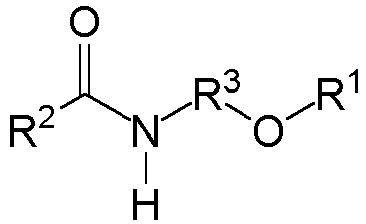 (2) ein wässriges Medium.
 - Zusammensetzung gemäß Anspruch 1, worin R1 -C(=O)CR11=CH2 ist, worin R11 H oder Methyl ist.
- Zusammensetzung gemäß Anspruch 1 oder 2, worin das Polymer (1) ferner eine Wiederholungseinheit umfasst, die von einem polymerisierbaren Monomer abgeleitet ist, das sich vom Monomer (a) unterscheidet und eine Verbindung der folgenden Formel ist:
CH2=CA-T
worinA H, Cl, Br, I oder Methyl ist,T H, Cl, Br, I, kettenförmige oder cyclische C1-40-Kohlenwassterstoffgruppenatome oder eine kettenförmige oder cyclische C2-41-organische Gruppe mit einer Esterbindung ist. - Zusammensetzung gemäß Anspruch 3, worin das polymerisierbare Monomer, das anders als Monomer (a) ist, mindestens eines von einem Acrylatestermonomer (b), einem fluorfreien vernetzbaren Monomer (c) und einem halogenierten Olefin (d) ist.
- Zusammensetzung gemäß Anspruch 4, worin das Acrylatestermonomer (b) mindestens eines von einem Acrylatestermonomer (b1), das eine aliphatische Kohlenwasserstoffgruppe enthält, und einem Acrylatestermonomer (b2), das eine cyclische Kohlenwasserstoffgruppe enthält, ist.
- Zusammensetzung gemäß Anspruch 4, worin das fluorfreie vernetzbare Monomer (c) eine Verbindung ist, die mindestens zwei ethylenisch ungesättigte Doppelbindungen oder mindestens eine ethylenisch ungesättigte Doppelbindung und mindestens eine reaktive Gruppe umfasst.
- Zusammensetzung gemäß Anspruch 4, worin das halogenierte Olefinmonomer (d) mindestens eines von Vinylchlorid und Vinylidenchlorid ist.
- Zusammensetzung gemäß einem der Ansprüche 4-7, worin das Polymer, basierend auf 100 Gewichtsteilen (pwb - "parts by weight) des Monomers (a), 0-200 pbw der Wiederholungseinheiten (b), 0-50 pbw der Wiederholungseinheiten (c) und 0-100 pbw der Wiederholungseinheiten (d) enthält.
- Zusammensetzung gemäß einem der Ansprüche 1-8, worin das wässrige Medium (2) Wasser, ein organisches Lösungsmittel oder ein Gemisch davon ist.
- Zusammensetzung gemäß einem der Ansprüche 1-9, die ein externes Behandlungsmittel oder ein internes Behandlungsmittel ist.
- Verfahren zur Behandlung eines Substrats, umfassend das Behandeln des Substrats mit der Zusammensetzung gemäß einem der Ansprüche 1-10.
- Verfahren zur Herstellung eines behandelten Textilprodukts, umfassend das Behandeln eines Textilprodukts mit der Zusammensetzung gemäß einem der Ansprüche 1-10.
Applications Claiming Priority (2)
| Application Number | Priority Date | Filing Date | Title |
|---|---|---|---|
| JP2017148242 | 2017-07-31 | ||
| PCT/JP2018/026572 WO2019026593A1 (ja) | 2017-07-31 | 2018-07-13 | 撥水剤組成物 |
Publications (3)
| Publication Number | Publication Date |
|---|---|
| EP3663376A1 EP3663376A1 (de) | 2020-06-10 |
| EP3663376A4 EP3663376A4 (de) | 2021-05-05 |
| EP3663376B1 true EP3663376B1 (de) | 2024-05-29 |
Family
ID=65233796
Family Applications (1)
| Application Number | Title | Priority Date | Filing Date |
|---|---|---|---|
| EP18840601.1A Active EP3663376B1 (de) | 2017-07-31 | 2018-07-13 | Wasserabweisende zusammensetzung |
Country Status (7)
| Country | Link |
|---|---|
| US (1) | US11041038B2 (de) |
| EP (1) | EP3663376B1 (de) |
| JP (1) | JP6870093B2 (de) |
| KR (1) | KR102257148B1 (de) |
| CN (1) | CN111032816B (de) |
| TW (1) | TWI748118B (de) |
| WO (1) | WO2019026593A1 (de) |
Families Citing this family (12)
| Publication number | Priority date | Publication date | Assignee | Title |
|---|---|---|---|---|
| CN113412323B (zh) | 2019-02-08 | 2024-04-09 | 大金工业株式会社 | 拨水剂组合物 |
| US11932712B2 (en) | 2019-10-08 | 2024-03-19 | Daikin Industries, Ltd. | Method of treating substrate |
| JP7555355B2 (ja) * | 2019-12-24 | 2024-09-24 | 三井化学株式会社 | 撥水剤組成物、撥水剤組成物の製造方法、および、繊維製品 |
| WO2021132170A1 (ja) | 2019-12-24 | 2021-07-01 | 三井化学株式会社 | ポリウレタン樹脂組成物、撥剤、繊維撥水剤および防汚コート剤 |
| KR102757214B1 (ko) | 2020-06-03 | 2025-01-21 | 메이세이 카가쿠고교 가부시키가이샤 | 발수제 조성물, 키트, 발수성 섬유 제품 및 그 제조 방법 |
| WO2022102568A1 (ja) * | 2020-11-11 | 2022-05-19 | ダイキン工業株式会社 | 共重合体 |
| JP7231873B2 (ja) | 2021-03-31 | 2023-03-02 | ダイキン工業株式会社 | 水素結合部位含有耐油性化合物 |
| NL2027946B1 (en) * | 2021-04-08 | 2022-10-20 | Lamoral Holding B V | Method for conferring durable water repellence to woven or non-woven fabric and water repellent composition |
| TWI849382B (zh) * | 2022-02-21 | 2024-07-21 | 穎利科技股份有限公司 | 基材表面親水處理之方法及具親水改質表面之基材 |
| CN119278243A (zh) | 2022-06-02 | 2025-01-07 | 明成化学工业株式会社 | 耐油剂组合物及耐油制品 |
| JPWO2024058204A1 (de) * | 2022-09-14 | 2024-03-21 | ||
| CN119998423A (zh) * | 2022-11-09 | 2025-05-13 | 大金工业株式会社 | 拨剂 |
Family Cites Families (17)
| Publication number | Priority date | Publication date | Assignee | Title |
|---|---|---|---|---|
| US3498958A (en) * | 1968-06-27 | 1970-03-03 | Nat Starch Chem Corp | Water-and oil repellency agents |
| JPS5133240B2 (de) * | 1972-12-20 | 1976-09-18 | ||
| US5225480A (en) * | 1990-03-21 | 1993-07-06 | Minnesota Mining And Manufacturing Company | Water-borne low adhesion backsize and release coating compositions, methods of making the compositions, and sheet materials coated therewith |
| CA2037319A1 (en) * | 1990-03-21 | 1991-09-22 | Chi-Ming Tseng | Water-borne acrylic low adhesion backsize and release coating compositions, methods of making the compositions, and sheet materials coated therewith |
| JP4996875B2 (ja) | 2005-04-28 | 2012-08-08 | 日華化学株式会社 | 撥水剤、撥水加工方法及び撥水性繊維製品 |
| US7652112B2 (en) * | 2005-07-06 | 2010-01-26 | E.I. Du Pont De Nemours And Company | Polymeric extenders for surface effects |
| JP5439743B2 (ja) * | 2007-10-11 | 2014-03-12 | ユニマテック株式会社 | 撥水撥油剤 |
| WO2010131652A1 (ja) * | 2009-05-12 | 2010-11-18 | ダイキン工業株式会社 | 転写シートおよびその製造方法 |
| JP5789090B2 (ja) * | 2010-07-30 | 2015-10-07 | 日華化学株式会社 | 撥水撥油剤組成物、機能性繊維製品及び機能性繊維製品の製造方法 |
| JP2013241865A (ja) | 2012-05-18 | 2013-12-05 | Miyuki Tokida | 地熱発電装置 |
| JP5945455B2 (ja) | 2012-05-18 | 2016-07-05 | 株式会社ツバキE&M | ディスクタイプ軸継手及びディスクユニット |
| WO2015080026A1 (ja) | 2013-11-22 | 2015-06-04 | ダイキン工業株式会社 | 表面処理剤 |
| JP5811257B2 (ja) | 2013-11-22 | 2015-11-11 | ダイキン工業株式会社 | 水系エマルション表面処理剤 |
| JP5880668B2 (ja) * | 2013-11-22 | 2016-03-09 | ダイキン工業株式会社 | 水系表面処理剤 |
| CN106319965A (zh) * | 2015-06-26 | 2017-01-11 | 大金工业株式会社 | 表面处理剂组合物 |
| JP6249048B2 (ja) * | 2016-06-07 | 2017-12-20 | ダイキン工業株式会社 | 表面処理剤およびその製造方法 |
| KR102513179B1 (ko) | 2018-02-20 | 2023-03-24 | 다이킨 고교 가부시키가이샤 | 표면 처리제 |
-
2018
- 2018-07-13 WO PCT/JP2018/026572 patent/WO2019026593A1/ja not_active Ceased
- 2018-07-13 KR KR1020207002709A patent/KR102257148B1/ko active Active
- 2018-07-13 CN CN201880049366.4A patent/CN111032816B/zh active Active
- 2018-07-13 EP EP18840601.1A patent/EP3663376B1/de active Active
- 2018-07-13 JP JP2019534013A patent/JP6870093B2/ja active Active
- 2018-07-13 US US16/635,048 patent/US11041038B2/en active Active
- 2018-07-24 TW TW107125512A patent/TWI748118B/zh active
Also Published As
| Publication number | Publication date |
|---|---|
| US20200239613A1 (en) | 2020-07-30 |
| KR102257148B1 (ko) | 2021-05-26 |
| EP3663376A4 (de) | 2021-05-05 |
| TW201917193A (zh) | 2019-05-01 |
| WO2019026593A1 (ja) | 2019-02-07 |
| US11041038B2 (en) | 2021-06-22 |
| CN111032816A (zh) | 2020-04-17 |
| KR20200023436A (ko) | 2020-03-04 |
| TWI748118B (zh) | 2021-12-01 |
| CN111032816B (zh) | 2023-02-28 |
| EP3663376A1 (de) | 2020-06-10 |
| JPWO2019026593A1 (ja) | 2020-08-13 |
| JP6870093B2 (ja) | 2021-05-12 |
Similar Documents
| Publication | Publication Date | Title |
|---|---|---|
| US11041038B2 (en) | Water repellent composition | |
| CN105745272B (zh) | 水系乳液表面处理剂 | |
| CN105765025B (zh) | 水系表面处理剂 | |
| CN105764980B (zh) | 表面处理剂 | |
| JP6737417B1 (ja) | 撥水剤組成物 | |
| JP6680017B2 (ja) | 表面処理剤 | |
| JP2019026747A (ja) | 撥水剤組成物 | |
| JP6727865B2 (ja) | 共重合体および表面処理剤 | |
| JP6915651B2 (ja) | 撥水性重合体および撥水剤組成物 | |
| EP3919672A1 (de) | Wasserabweisender weichmacher | |
| EP3865524A1 (de) | Fluorhaltiges polymer und oberflächenbehandlungsmittel | |
| JP2019026746A (ja) | 撥水剤組成物 | |
| JP2017066325A (ja) | 表面処理剤 |
Legal Events
| Date | Code | Title | Description |
|---|---|---|---|
| STAA | Information on the status of an ep patent application or granted ep patent |
Free format text: STATUS: THE INTERNATIONAL PUBLICATION HAS BEEN MADE |
|
| PUAI | Public reference made under article 153(3) epc to a published international application that has entered the european phase |
Free format text: ORIGINAL CODE: 0009012 |
|
| STAA | Information on the status of an ep patent application or granted ep patent |
Free format text: STATUS: REQUEST FOR EXAMINATION WAS MADE |
|
| 17P | Request for examination filed |
Effective date: 20200130 |
|
| AK | Designated contracting states |
Kind code of ref document: A1 Designated state(s): AL AT BE BG CH CY CZ DE DK EE ES FI FR GB GR HR HU IE IS IT LI LT LU LV MC MK MT NL NO PL PT RO RS SE SI SK SM TR |
|
| AX | Request for extension of the european patent |
Extension state: BA ME |
|
| DAV | Request for validation of the european patent (deleted) | ||
| DAX | Request for extension of the european patent (deleted) | ||
| A4 | Supplementary search report drawn up and despatched |
Effective date: 20210408 |
|
| RIC1 | Information provided on ipc code assigned before grant |
Ipc: C09K 3/18 20060101AFI20210331BHEP Ipc: C08F 20/36 20060101ALI20210331BHEP Ipc: C08L 27/04 20060101ALI20210331BHEP Ipc: C08L 33/14 20060101ALI20210331BHEP Ipc: D06M 15/244 20060101ALI20210331BHEP Ipc: D06M 15/248 20060101ALI20210331BHEP Ipc: D06M 15/263 20060101ALI20210331BHEP Ipc: D06M 15/285 20060101ALI20210331BHEP Ipc: B05D 3/02 20060101ALI20210331BHEP Ipc: C08F 20/00 20060101ALI20210331BHEP Ipc: C08F 222/02 20060101ALI20210331BHEP Ipc: C08K 3/18 20060101ALI20210331BHEP Ipc: C08L 27/00 20060101ALI20210331BHEP Ipc: C08L 33/00 20060101ALI20210331BHEP Ipc: D06M 15/00 20060101ALI20210331BHEP |
|
| RAP3 | Party data changed (applicant data changed or rights of an application transferred) |
Owner name: NOF CORPORATION Owner name: DAIKIN INDUSTRIES, LTD. |
|
| STAA | Information on the status of an ep patent application or granted ep patent |
Free format text: STATUS: EXAMINATION IS IN PROGRESS |
|
| 17Q | First examination report despatched |
Effective date: 20230213 |
|
| P01 | Opt-out of the competence of the unified patent court (upc) registered |
Effective date: 20230525 |
|
| GRAP | Despatch of communication of intention to grant a patent |
Free format text: ORIGINAL CODE: EPIDOSNIGR1 |
|
| STAA | Information on the status of an ep patent application or granted ep patent |
Free format text: STATUS: GRANT OF PATENT IS INTENDED |
|
| INTG | Intention to grant announced |
Effective date: 20231219 |
|
| GRAS | Grant fee paid |
Free format text: ORIGINAL CODE: EPIDOSNIGR3 |
|
| GRAA | (expected) grant |
Free format text: ORIGINAL CODE: 0009210 |
|
| STAA | Information on the status of an ep patent application or granted ep patent |
Free format text: STATUS: THE PATENT HAS BEEN GRANTED |
|
| AK | Designated contracting states |
Kind code of ref document: B1 Designated state(s): AL AT BE BG CH CY CZ DE DK EE ES FI FR GB GR HR HU IE IS IT LI LT LU LV MC MK MT NL NO PL PT RO RS SE SI SK SM TR |
|
| REG | Reference to a national code |
Ref country code: CH Ref legal event code: EP |
|
| REG | Reference to a national code |
Ref country code: IE Ref legal event code: FG4D |
|
| REG | Reference to a national code |
Ref country code: DE Ref legal event code: R096 Ref document number: 602018070151 Country of ref document: DE |
|
| REG | Reference to a national code |
Ref country code: LT Ref legal event code: MG9D |
|
| REG | Reference to a national code |
Ref country code: NL Ref legal event code: MP Effective date: 20240529 |
|
| PG25 | Lapsed in a contracting state [announced via postgrant information from national office to epo] |
Ref country code: IS Free format text: LAPSE BECAUSE OF FAILURE TO SUBMIT A TRANSLATION OF THE DESCRIPTION OR TO PAY THE FEE WITHIN THE PRESCRIBED TIME-LIMIT Effective date: 20240929 |
|
| PG25 | Lapsed in a contracting state [announced via postgrant information from national office to epo] |
Ref country code: BG Free format text: LAPSE BECAUSE OF FAILURE TO SUBMIT A TRANSLATION OF THE DESCRIPTION OR TO PAY THE FEE WITHIN THE PRESCRIBED TIME-LIMIT Effective date: 20240529 |
|
| PG25 | Lapsed in a contracting state [announced via postgrant information from national office to epo] |
Ref country code: HR Free format text: LAPSE BECAUSE OF FAILURE TO SUBMIT A TRANSLATION OF THE DESCRIPTION OR TO PAY THE FEE WITHIN THE PRESCRIBED TIME-LIMIT Effective date: 20240529 Ref country code: FI Free format text: LAPSE BECAUSE OF FAILURE TO SUBMIT A TRANSLATION OF THE DESCRIPTION OR TO PAY THE FEE WITHIN THE PRESCRIBED TIME-LIMIT Effective date: 20240529 |
|
| PG25 | Lapsed in a contracting state [announced via postgrant information from national office to epo] |
Ref country code: GR Free format text: LAPSE BECAUSE OF FAILURE TO SUBMIT A TRANSLATION OF THE DESCRIPTION OR TO PAY THE FEE WITHIN THE PRESCRIBED TIME-LIMIT Effective date: 20240830 |
|
| REG | Reference to a national code |
Ref country code: AT Ref legal event code: MK05 Ref document number: 1690631 Country of ref document: AT Kind code of ref document: T Effective date: 20240529 |
|
| PG25 | Lapsed in a contracting state [announced via postgrant information from national office to epo] |
Ref country code: ES Free format text: LAPSE BECAUSE OF FAILURE TO SUBMIT A TRANSLATION OF THE DESCRIPTION OR TO PAY THE FEE WITHIN THE PRESCRIBED TIME-LIMIT Effective date: 20240529 |
|
| PG25 | Lapsed in a contracting state [announced via postgrant information from national office to epo] |
Ref country code: AT Free format text: LAPSE BECAUSE OF FAILURE TO SUBMIT A TRANSLATION OF THE DESCRIPTION OR TO PAY THE FEE WITHIN THE PRESCRIBED TIME-LIMIT Effective date: 20240529 |
|
| PG25 | Lapsed in a contracting state [announced via postgrant information from national office to epo] |
Ref country code: PL Free format text: LAPSE BECAUSE OF FAILURE TO SUBMIT A TRANSLATION OF THE DESCRIPTION OR TO PAY THE FEE WITHIN THE PRESCRIBED TIME-LIMIT Effective date: 20240529 |
|
| PG25 | Lapsed in a contracting state [announced via postgrant information from national office to epo] |
Ref country code: LV Free format text: LAPSE BECAUSE OF FAILURE TO SUBMIT A TRANSLATION OF THE DESCRIPTION OR TO PAY THE FEE WITHIN THE PRESCRIBED TIME-LIMIT Effective date: 20240529 |
|
| PG25 | Lapsed in a contracting state [announced via postgrant information from national office to epo] |
Ref country code: PL Free format text: LAPSE BECAUSE OF FAILURE TO SUBMIT A TRANSLATION OF THE DESCRIPTION OR TO PAY THE FEE WITHIN THE PRESCRIBED TIME-LIMIT Effective date: 20240529 Ref country code: NO Free format text: LAPSE BECAUSE OF FAILURE TO SUBMIT A TRANSLATION OF THE DESCRIPTION OR TO PAY THE FEE WITHIN THE PRESCRIBED TIME-LIMIT Effective date: 20240829 Ref country code: LV Free format text: LAPSE BECAUSE OF FAILURE TO SUBMIT A TRANSLATION OF THE DESCRIPTION OR TO PAY THE FEE WITHIN THE PRESCRIBED TIME-LIMIT Effective date: 20240529 Ref country code: IS Free format text: LAPSE BECAUSE OF FAILURE TO SUBMIT A TRANSLATION OF THE DESCRIPTION OR TO PAY THE FEE WITHIN THE PRESCRIBED TIME-LIMIT Effective date: 20240929 Ref country code: HR Free format text: LAPSE BECAUSE OF FAILURE TO SUBMIT A TRANSLATION OF THE DESCRIPTION OR TO PAY THE FEE WITHIN THE PRESCRIBED TIME-LIMIT Effective date: 20240529 Ref country code: GR Free format text: LAPSE BECAUSE OF FAILURE TO SUBMIT A TRANSLATION OF THE DESCRIPTION OR TO PAY THE FEE WITHIN THE PRESCRIBED TIME-LIMIT Effective date: 20240830 Ref country code: FI Free format text: LAPSE BECAUSE OF FAILURE TO SUBMIT A TRANSLATION OF THE DESCRIPTION OR TO PAY THE FEE WITHIN THE PRESCRIBED TIME-LIMIT Effective date: 20240529 Ref country code: ES Free format text: LAPSE BECAUSE OF FAILURE TO SUBMIT A TRANSLATION OF THE DESCRIPTION OR TO PAY THE FEE WITHIN THE PRESCRIBED TIME-LIMIT Effective date: 20240529 Ref country code: BG Free format text: LAPSE BECAUSE OF FAILURE TO SUBMIT A TRANSLATION OF THE DESCRIPTION OR TO PAY THE FEE WITHIN THE PRESCRIBED TIME-LIMIT Effective date: 20240529 Ref country code: AT Free format text: LAPSE BECAUSE OF FAILURE TO SUBMIT A TRANSLATION OF THE DESCRIPTION OR TO PAY THE FEE WITHIN THE PRESCRIBED TIME-LIMIT Effective date: 20240529 Ref country code: RS Free format text: LAPSE BECAUSE OF FAILURE TO SUBMIT A TRANSLATION OF THE DESCRIPTION OR TO PAY THE FEE WITHIN THE PRESCRIBED TIME-LIMIT Effective date: 20240829 |
|
| PG25 | Lapsed in a contracting state [announced via postgrant information from national office to epo] |
Ref country code: NL Free format text: LAPSE BECAUSE OF FAILURE TO SUBMIT A TRANSLATION OF THE DESCRIPTION OR TO PAY THE FEE WITHIN THE PRESCRIBED TIME-LIMIT Effective date: 20240529 |
|
| PG25 | Lapsed in a contracting state [announced via postgrant information from national office to epo] |
Ref country code: NL Free format text: LAPSE BECAUSE OF FAILURE TO SUBMIT A TRANSLATION OF THE DESCRIPTION OR TO PAY THE FEE WITHIN THE PRESCRIBED TIME-LIMIT Effective date: 20240529 |
|
| PG25 | Lapsed in a contracting state [announced via postgrant information from national office to epo] |
Ref country code: DK Free format text: LAPSE BECAUSE OF FAILURE TO SUBMIT A TRANSLATION OF THE DESCRIPTION OR TO PAY THE FEE WITHIN THE PRESCRIBED TIME-LIMIT Effective date: 20240529 |
|
| PG25 | Lapsed in a contracting state [announced via postgrant information from national office to epo] |
Ref country code: EE Free format text: LAPSE BECAUSE OF FAILURE TO SUBMIT A TRANSLATION OF THE DESCRIPTION OR TO PAY THE FEE WITHIN THE PRESCRIBED TIME-LIMIT Effective date: 20240529 |
|
| PG25 | Lapsed in a contracting state [announced via postgrant information from national office to epo] |
Ref country code: CZ Free format text: LAPSE BECAUSE OF FAILURE TO SUBMIT A TRANSLATION OF THE DESCRIPTION OR TO PAY THE FEE WITHIN THE PRESCRIBED TIME-LIMIT Effective date: 20240529 |
|
| PG25 | Lapsed in a contracting state [announced via postgrant information from national office to epo] |
Ref country code: RO Free format text: LAPSE BECAUSE OF FAILURE TO SUBMIT A TRANSLATION OF THE DESCRIPTION OR TO PAY THE FEE WITHIN THE PRESCRIBED TIME-LIMIT Effective date: 20240529 Ref country code: SK Free format text: LAPSE BECAUSE OF FAILURE TO SUBMIT A TRANSLATION OF THE DESCRIPTION OR TO PAY THE FEE WITHIN THE PRESCRIBED TIME-LIMIT Effective date: 20240529 |
|
| PG25 | Lapsed in a contracting state [announced via postgrant information from national office to epo] |
Ref country code: SM Free format text: LAPSE BECAUSE OF FAILURE TO SUBMIT A TRANSLATION OF THE DESCRIPTION OR TO PAY THE FEE WITHIN THE PRESCRIBED TIME-LIMIT Effective date: 20240529 |
|
| PG25 | Lapsed in a contracting state [announced via postgrant information from national office to epo] |
Ref country code: SM Free format text: LAPSE BECAUSE OF FAILURE TO SUBMIT A TRANSLATION OF THE DESCRIPTION OR TO PAY THE FEE WITHIN THE PRESCRIBED TIME-LIMIT Effective date: 20240529 Ref country code: SK Free format text: LAPSE BECAUSE OF FAILURE TO SUBMIT A TRANSLATION OF THE DESCRIPTION OR TO PAY THE FEE WITHIN THE PRESCRIBED TIME-LIMIT Effective date: 20240529 Ref country code: RO Free format text: LAPSE BECAUSE OF FAILURE TO SUBMIT A TRANSLATION OF THE DESCRIPTION OR TO PAY THE FEE WITHIN THE PRESCRIBED TIME-LIMIT Effective date: 20240529 Ref country code: EE Free format text: LAPSE BECAUSE OF FAILURE TO SUBMIT A TRANSLATION OF THE DESCRIPTION OR TO PAY THE FEE WITHIN THE PRESCRIBED TIME-LIMIT Effective date: 20240529 Ref country code: DK Free format text: LAPSE BECAUSE OF FAILURE TO SUBMIT A TRANSLATION OF THE DESCRIPTION OR TO PAY THE FEE WITHIN THE PRESCRIBED TIME-LIMIT Effective date: 20240529 Ref country code: CZ Free format text: LAPSE BECAUSE OF FAILURE TO SUBMIT A TRANSLATION OF THE DESCRIPTION OR TO PAY THE FEE WITHIN THE PRESCRIBED TIME-LIMIT Effective date: 20240529 |
|
| PG25 | Lapsed in a contracting state [announced via postgrant information from national office to epo] |
Ref country code: MC Free format text: LAPSE BECAUSE OF FAILURE TO SUBMIT A TRANSLATION OF THE DESCRIPTION OR TO PAY THE FEE WITHIN THE PRESCRIBED TIME-LIMIT Effective date: 20240529 |
|
| REG | Reference to a national code |
Ref country code: CH Ref legal event code: PL |
|
| REG | Reference to a national code |
Ref country code: DE Ref legal event code: R097 Ref document number: 602018070151 Country of ref document: DE |
|
| PG25 | Lapsed in a contracting state [announced via postgrant information from national office to epo] |
Ref country code: LU Free format text: LAPSE BECAUSE OF NON-PAYMENT OF DUE FEES Effective date: 20240713 |
|
| PG25 | Lapsed in a contracting state [announced via postgrant information from national office to epo] |
Ref country code: LU Free format text: LAPSE BECAUSE OF NON-PAYMENT OF DUE FEES Effective date: 20240713 |
|
| PLBE | No opposition filed within time limit |
Free format text: ORIGINAL CODE: 0009261 |
|
| STAA | Information on the status of an ep patent application or granted ep patent |
Free format text: STATUS: NO OPPOSITION FILED WITHIN TIME LIMIT |
|
| PG25 | Lapsed in a contracting state [announced via postgrant information from national office to epo] |
Ref country code: SI Free format text: LAPSE BECAUSE OF FAILURE TO SUBMIT A TRANSLATION OF THE DESCRIPTION OR TO PAY THE FEE WITHIN THE PRESCRIBED TIME-LIMIT Effective date: 20240529 Ref country code: CH Free format text: LAPSE BECAUSE OF NON-PAYMENT OF DUE FEES Effective date: 20240731 Ref country code: BE Free format text: LAPSE BECAUSE OF NON-PAYMENT OF DUE FEES Effective date: 20240731 |
|
| 26N | No opposition filed |
Effective date: 20250303 |
|
| REG | Reference to a national code |
Ref country code: BE Ref legal event code: MM Effective date: 20240731 |
|
| PG25 | Lapsed in a contracting state [announced via postgrant information from national office to epo] |
Ref country code: IE Free format text: LAPSE BECAUSE OF NON-PAYMENT OF DUE FEES Effective date: 20240713 |
|
| PG25 | Lapsed in a contracting state [announced via postgrant information from national office to epo] |
Ref country code: SE Free format text: LAPSE BECAUSE OF FAILURE TO SUBMIT A TRANSLATION OF THE DESCRIPTION OR TO PAY THE FEE WITHIN THE PRESCRIBED TIME-LIMIT Effective date: 20240529 |
|
| PGFP | Annual fee paid to national office [announced via postgrant information from national office to epo] |
Ref country code: DE Payment date: 20250722 Year of fee payment: 8 |
|
| PGFP | Annual fee paid to national office [announced via postgrant information from national office to epo] |
Ref country code: IT Payment date: 20250724 Year of fee payment: 8 |
|
| PGFP | Annual fee paid to national office [announced via postgrant information from national office to epo] |
Ref country code: GB Payment date: 20250722 Year of fee payment: 8 |
|
| PGFP | Annual fee paid to national office [announced via postgrant information from national office to epo] |
Ref country code: FR Payment date: 20250725 Year of fee payment: 8 |
|
| PG25 | Lapsed in a contracting state [announced via postgrant information from national office to epo] |
Ref country code: PT Free format text: LAPSE BECAUSE OF NON-PAYMENT OF DUE FEES Effective date: 20240529 |
|
| PG25 | Lapsed in a contracting state [announced via postgrant information from national office to epo] |
Ref country code: CY Free format text: LAPSE BECAUSE OF FAILURE TO SUBMIT A TRANSLATION OF THE DESCRIPTION OR TO PAY THE FEE WITHIN THE PRESCRIBED TIME-LIMIT; INVALID AB INITIO Effective date: 20180713 |
|
| PG25 | Lapsed in a contracting state [announced via postgrant information from national office to epo] |
Ref country code: HU Free format text: LAPSE BECAUSE OF FAILURE TO SUBMIT A TRANSLATION OF THE DESCRIPTION OR TO PAY THE FEE WITHIN THE PRESCRIBED TIME-LIMIT; INVALID AB INITIO Effective date: 20180713 |