EP3630698B1 - Wässrige bindemittelzusammensetzung - Google Patents
Wässrige bindemittelzusammensetzung Download PDFInfo
- Publication number
- EP3630698B1 EP3630698B1 EP18725937.9A EP18725937A EP3630698B1 EP 3630698 B1 EP3630698 B1 EP 3630698B1 EP 18725937 A EP18725937 A EP 18725937A EP 3630698 B1 EP3630698 B1 EP 3630698B1
- Authority
- EP
- European Patent Office
- Prior art keywords
- aqueous bonding
- saccharide
- bonding composition
- present
- aqueous
- Prior art date
- Legal status (The legal status is an assumption and is not a legal conclusion. Google has not performed a legal analysis and makes no representation as to the accuracy of the status listed.)
- Active
Links
Images


Classifications
-
- C—CHEMISTRY; METALLURGY
- C04—CEMENTS; CONCRETE; ARTIFICIAL STONE; CERAMICS; REFRACTORIES
- C04B—LIME, MAGNESIA; SLAG; CEMENTS; COMPOSITIONS THEREOF, e.g. MORTARS, CONCRETE OR LIKE BUILDING MATERIALS; ARTIFICIAL STONE; CERAMICS; REFRACTORIES; TREATMENT OF NATURAL STONE
- C04B26/00—Compositions of mortars, concrete or artificial stone, containing only organic binders, e.g. polymer or resin concrete
- C04B26/02—Macromolecular compounds
- C04B26/28—Polysaccharides or derivatives thereof
-
- C—CHEMISTRY; METALLURGY
- C08—ORGANIC MACROMOLECULAR COMPOUNDS; THEIR PREPARATION OR CHEMICAL WORKING-UP; COMPOSITIONS BASED THEREON
- C08K—Use of inorganic or non-macromolecular organic substances as compounding ingredients
- C08K3/00—Use of inorganic substances as compounding ingredients
- C08K3/18—Oxygen-containing compounds, e.g. metal carbonyls
- C08K3/20—Oxides; Hydroxides
- C08K3/22—Oxides; Hydroxides of metals
-
- C—CHEMISTRY; METALLURGY
- C08—ORGANIC MACROMOLECULAR COMPOUNDS; THEIR PREPARATION OR CHEMICAL WORKING-UP; COMPOSITIONS BASED THEREON
- C08K—Use of inorganic or non-macromolecular organic substances as compounding ingredients
- C08K5/00—Use of organic ingredients
- C08K5/16—Nitrogen-containing compounds
- C08K5/17—Amines; Quaternary ammonium compounds
-
- C—CHEMISTRY; METALLURGY
- C09—DYES; PAINTS; POLISHES; NATURAL RESINS; ADHESIVES; COMPOSITIONS NOT OTHERWISE PROVIDED FOR; APPLICATIONS OF MATERIALS NOT OTHERWISE PROVIDED FOR
- C09J—ADHESIVES; NON-MECHANICAL ASPECTS OF ADHESIVE PROCESSES IN GENERAL; ADHESIVE PROCESSES NOT PROVIDED FOR ELSEWHERE; USE OF MATERIALS AS ADHESIVES
- C09J105/00—Adhesives based on polysaccharides or on their derivatives, not provided for in groups C09J101/00 or C09J103/00
-
- C—CHEMISTRY; METALLURGY
- C09—DYES; PAINTS; POLISHES; NATURAL RESINS; ADHESIVES; COMPOSITIONS NOT OTHERWISE PROVIDED FOR; APPLICATIONS OF MATERIALS NOT OTHERWISE PROVIDED FOR
- C09J—ADHESIVES; NON-MECHANICAL ASPECTS OF ADHESIVE PROCESSES IN GENERAL; ADHESIVE PROCESSES NOT PROVIDED FOR ELSEWHERE; USE OF MATERIALS AS ADHESIVES
- C09J11/00—Features of adhesives not provided for in group C09J9/00, e.g. additives
-
- C—CHEMISTRY; METALLURGY
- C04—CEMENTS; CONCRETE; ARTIFICIAL STONE; CERAMICS; REFRACTORIES
- C04B—LIME, MAGNESIA; SLAG; CEMENTS; COMPOSITIONS THEREOF, e.g. MORTARS, CONCRETE OR LIKE BUILDING MATERIALS; ARTIFICIAL STONE; CERAMICS; REFRACTORIES; TREATMENT OF NATURAL STONE
- C04B2111/00—Mortars, concrete or artificial stone or mixtures to prepare them, characterised by specific function, property or use
- C04B2111/00474—Uses not provided for elsewhere in C04B2111/00
- C04B2111/00637—Uses not provided for elsewhere in C04B2111/00 as glue or binder for uniting building or structural materials
-
- C—CHEMISTRY; METALLURGY
- C04—CEMENTS; CONCRETE; ARTIFICIAL STONE; CERAMICS; REFRACTORIES
- C04B—LIME, MAGNESIA; SLAG; CEMENTS; COMPOSITIONS THEREOF, e.g. MORTARS, CONCRETE OR LIKE BUILDING MATERIALS; ARTIFICIAL STONE; CERAMICS; REFRACTORIES; TREATMENT OF NATURAL STONE
- C04B2111/00—Mortars, concrete or artificial stone or mixtures to prepare them, characterised by specific function, property or use
- C04B2111/52—Sound-insulating materials
Definitions
- the present invention relates to an aqueous bonding composition capable of producing an aqueous adhesive, and a molded body (or molded article) which is producible by using the aqueous bonding composition.
- a phenol resin composition has hitherto been employed as a composition to be used for production of molded bodies such as insulating materials, soundproofing materials, and wood board products by using inorganic fibers such as glass wool, rock wool, and ceramic fiber, because the phenol resin composition has excellent performances such as mechanical strength, and low cost.
- the composition is adhered to the inorganic fibers, and the inorganic fibers with the composition is molded into a shape of the objective molded body, and then the composition is cured by heating to obtain the objective molded article.
- Patent Literatures 1 to 3 disclose, as the composition using no formaldehyde, a composition which contains a saccharide as a main component and is mixed with a polycarboxylic acid ammonium salt or an inorganic acid ammonium salt.
- Patent Literature 1 discloses a formaldehyde-free sizing agent composition for mineral fiber, comprising at least one non-reducing saccharide, at least one inorganic acid ammonium salt, additives, and water (see Patent Literature 1, claim 1, etc.).
- Patent Literature 2 discloses a method for producing an insulating or soundproof fiber glass product, wherein the method comprises a step of spraying a formaldehyde-free aqueous binder solution onto a fiber mat, the aqueous binder solution contains a Maillard reaction product, and the Maillard reaction product is selected from (i) an amine reaction product composed of a polycarboxylic acid ammonium salt and (ii) one or more carbohydrate reaction products including one or more reducing saccharides (see Patent Literature 2, claims 1 to 5, etc.).
- Patent Literature 3 discloses a binder composition comprising a non-reducing saccharide, an unsaturated monocarboxylic acid salt, and an inorganic acid ammonium salt (see Patent Literature 3, claim 1, etc.).
- Patent Literature 3 discloses that this binder composition is adhered to inorganic fibers and the inorganic fibers are aggregated to obtain an aggregate, and then the aggregate is molded into a predetermined shape corresponding to a desired molded body, followed by thermally curing the binder composition and further cooling the binder composition to obtain the molded body (see Patent Literature 3, claim 10, [0057] to [0067], etc.).
- KR 101 595 275 B1 discloses an environmentally friendly binder composition including a saccharide, water, ammonia, ammonium persulfate which is applied on glass fibers or glass wool.
- US 2008/020948 A1 discloses a composition comprising maltodextrin, which is a saccharide, ammonium sulfate and hydrogen peroxide.
- WO 2017/072186 A1 describes a curable binder composition for a fibrous product comprising a monosaccharide and free radical initiators such as hydrogen peroxide or peroxodisulfate.
- compositions of Patent Literature 1 to 3 are preferable because of being formaldehyde-free.
- compositions of Patent Literatures 1 to 3 sometimes decrease production efficiency of the inorganic fiber molded article and wood-based molded article because of low curing rate.
- the molded article thus produced sometimes easily absorbs moisture in air, thus requiring an improvement in water resistance.
- the present invention has been made and an object thereof is to provide a formaldehyde-free aqueous bonding composition which can contribute to an improvement in mechanical properties such as strength and elastic modulus of a molded article, compared to a formaldehyde-containing phenol resin composition, and is to provide a molded article obtained by using the aqueous bonding composition.
- an aqueous bonding composition can be obtained by modifying a saccharide with a radical initiator, which composition contributes to an improvement in mechanical properties of a molded article even if formaldehyde is not included. Furthermore, they have found that, when a saccharide is modified with a radical initiator in the presence of an amine, the aqueous bonding composition thus obtained achieves an increased curing rate and is useful for efficient production of a molded article, so that not only mechanical properties of the molded article are improved, but also water resistance is improved to a higher level. Thus, the present invention has been completed.
- the aqueous bonding composition according to the embodiments of the present invention comprises (A) a modified saccharide which is a product of (a) a saccharide and (b) a radical initiator, so that the curing rate increases, thus making it possible to contribute to efficient production of a coated or sprayed material. Furthermore, when (a) a saccharide is reacted with (b) a radical initiator in the presence of (c) an amine to produce (A) a modified saccharide, the curing rate of the aqueous bonding composition of the present invention further increases.
- a material coated or sprayed with the aqueous bonding composition of the present invention is processed, molded and cured, tensile strength and tensile elastic modulus of a thus obtained molded article (molded body or molded product) are improved and water resistance of the molded article is improved, thus allowing the molded article to hardly absorb moisture in air.
- the aqueous bonding composition of the present invention is useful for production of various molded articles and is most suitable for production of a molded article comprising a inorganic fiber and a molded article comprising a wood-based material.
- An aqueous bonding composition of the present invention comprises (A) a modified saccharide.
- the modified saccharide (A) is a product in which a chemical structure of (a) a saccharide is modified with (b) a radical initiator (in an aqueous medium, if necessary).
- the saccharide (a) can take two structures, for example, a linear (open chain) structure having a hydroxy group and a carbonyl group (aldehyde or ketone) and a cyclic structure of a cyclic acetal (or ketal) incorporating its own hydroxy group.
- the modified saccharide (A) comprises a compound having further increased molecular weight obtainable by ring-opening and converting the cyclic acetal structure of the saccharide (a) into a linear structure by using (b) the radical initiator.
- the "(a) saccharide” as used herein is generally called a saccharide and is not particularly limited as long as the objective aqueous bonding composition of the present invention can be obtained.
- Examples of the saccharide (a) comprise monosaccharide, disaccharide, trisaccharide, tetrasaccharide, polysaccharide, and other oligosacc-charides.
- disaccharide examples include sucrose, lactose, maltose, trehalose, turanose, and cellobiose.
- trisaccharide examples include raffinose, melezitose, maltotriose, and 1-kestose (GF2).
- tetrasaccharide examples include acarbose, stachyose, and nystose (GF3).
- polysaccharide examples include glycogen, starch (amylose, amylopectin, etc.), cellulose, dextrin, glucan, N-acetylglucosamine, chitin, and inulin (including fructofuranosylnystose: GF4).
- oligosaccharides examples include fructooligosaccharide, galac-tooligosaccharide, and mannan oligosaccharide.
- saccharides can be used alone or in combination.
- the "(a) saccharide” preferably comprises a structure based on (or derived from) sucrose.
- the sucrose is a saccharide formed by combining glucose and fructose, and the glucose and fructose are produced when the saccharide is hydrolyzed.
- the aqueous bonding composition of the present invention is excellent in mechanical properties such as tensile strength and tensile elastic modulus when the saccharide (a) comprises the sucrose.
- the saccharide (a) can further comprise, for example, sugar syrup.
- sugar syrup means syrup prepared by removing dietary fibers and impurities from a sugar raw material such as sugarcane, sugar beet, sugar maple, and Palmyra palm, or means a viscous liquid (a molasses) obtainable when sugar is purified from a raw material, which viscous liquid also comprises a component other than sugar.
- the sugar syrup comprises, for example, waste molasses, ice molasses, white honey, caramel, crude saccharide, sugar solution, and juices of the sugar raw material (sugarcane, sugar beet, sugar maple, and Palmyra palm).
- the sugar syrup preferably comprises at least one selected from waste molasses, ice molasses, and crude saccharide.
- the radical initiator refers to a compound which can generate radicals under a mild reaction condition so as to allow a radical reaction to proceed.
- Radicals mean atoms, molecules or ions having unpaired electrons. Radicals are generally called free radicals.
- the radical initiator is not particularly limited as long as the object of the present invention is not impaired, and comprises, for example, an azo compound and a peroxide.
- Specific examples thereof include 2,2'-azobisbutyronitrile (AIBN).
- the peroxide is roughly classified into an organic peroxide, an inorganic peroxide, and hydrogen peroxide.
- the organic peroxide is a compound comprising a peroxide structure (-O-O-) and typically comprises, for example, benzyl peroxide.
- the inorganic peroxide is a compound comprising peroxide ion (O 2 2- ), and specific examples thereof comprise ammonium persulfate, sodium persulfate, potassium persulfate, and the like.
- the hydrogen peroxide is a compound represented by the chemical formula H 2 O 2 .
- the radical initiator (b) preferably comprises a peroxide in the present invention.
- the amine (c) as used herein is a generic term comprising ammonia and amines.
- Ammonia is an inorganic compound whose molecular formula is represented by NH 3 and is a gas which is colorless at normal temperature and normal pressure.
- the amine is a generic term of a compound in which a hydrogen atom of ammonia is substituted with a substituent such as a hydrocarbon group and an aromatic group.
- the amine is a primary amine when one hydrogen atom is substituted, a secondary amine when two hydrogen atoms are substituted, or a tertiary amine when three hydrogen atoms are substituted.
- a substituent is combined with the tertiary amine to form a quaternary ammonium cation.
- the amine is roughly classified into an aliphatic amine, an aromatic amine, and a heterocyclic amine.
- aliphatic amine examples include methylamine, dimethylamine, trimethylamine, ethylamine, diethylamine, triethylamine, ethylenediamine, triethanolamine, hexamethylenediamine, and the like.
- aromatic amine examples include aniline, phenethylamine, toluidine, catecholamine, and the like.
- heterocyclic amine examples include pyrrolidine, piperazine, piperidine, morpholine, pyrrole, pyrazole, imidazole, pyridine, pyridazine, pyrimidine, oxazole, thiazole, and the like.
- the amine (c) preferably comprises ammonia.
- the amine (c) comprises ammonia, mechanical properties (tensile strength, tensile elastic modulus) of a molded article comprising a cured material of the aqueous bonding composition are improved.
- the aqueous bonding composition of the present invention preferably comprises (B) an inorganic acid salt.
- the curing rate of the aqueous bonding composition of the present invention increases, thus making it possible to improve mechanical properties such as tensile strength and tensile elastic modulus of a molded article.
- the inorganic acid salt (8) as used herein is not particularly limited as long as the object of the present invention is not impaired, and the inorganic acid salt (8) comprises an inorganic acid ammonium salt.
- the aqueous bonding composition of the present invention achieves more excellent curing rate, thus making it possible to further improve mechanical properties such as tensile strength and tensile elastic modulus of a molded article.
- the "(B) inorganic acid ammonium salt” is generally called an ammonium salt of an inorganic acid and is not particularly limited as long as the objective aqueous bonding composition of the present invention is obtainable.
- examples of the "inorganic acid ammonium salt” include ammonium sulfate, ammonium hydrogen sulfate, ammonium halide (for example, ammonium chloride, ammonium fluoride, ammonium bromide, ammonium iodide, etc.), ammonium phosphate, ammonium hydrogen phosphate, and ammonium dihydrogen phosphate.
- ammonium sulfate for example, ammonium chloride, ammonium fluoride, ammonium bromide, ammonium iodide, etc.
- ammonium phosphate ammonium hydrogen phosphate
- ammonium dihydrogen phosphate ammonium dihydrogen phosphate
- the "inorganic acid ammonium salt” is preferably at least one selected from ammonium sulfate, ammonium chloride, ammonium hydrogen phosphate, and ammonium dihydrogen phosphate.
- the aqueous bonding composition of the present invention has more excellent curability, thus making it possible to further improve physical properties (mechanical properties such as tensile strength and tensile elastic modulus) of a molded article.
- the “inorganic acid ammonium salt(s)" can be used alone or in combination.
- the inorganic acid salt (B) can comprise an inorganic acid metal salt, and can comprise at least one selected from potassium salts, calcium salts, sodium salts, and magnesium salts.
- organic acid metal salt examples include:
- the "inorganic acid metal salt” comprises at least one selected from potassium sulfate, potassium chloride, calcium sulfate, calcium chloride, sodium sulfate, sodium chloride, magnesium sulfate, and magnesium chloride.
- the "inorganic acid metal salt” comprises at least one selected from potassium sulfate, potassium chloride, calcium sulfate, calcium chloride, sodium sulfate, sodium chloride, magnesium sulfate, and magnesium chloride
- a molded article produced by using the aqueous bonding composition of the present invention can be cured by heating and pressurizing at a lower temperature for a shorter time, thus making it possible to further increase tensile strength and tensile elastic modulus.
- the "inorganic acid metal salt” comprises most preferably magnesium chloride.
- the molded article produced by using the aqueous bonding composition of the present invention can be cured by heating and pressurizing at a lower temperature for a shorter time, thus making it possible to further increase the tensile strength and the tensile elastic modulus.
- the amount of the inorganic acid salt (B) is preferably in a range of 1.5 to 15.0 parts by weight, and particularly preferably 1.5 to 4.5 parts by weight, based on 100 parts by weight (in terms of the solid content) of the total weight of the components (A) and (B).
- the aqueous bonding composition of the present invention is excellent in balance between curing rate and water resistance, and tensile strength and tensile elastic modulus of a molded article of the present invention are improved and the water resistance thereof is also improved, thus allowing the molded article to hardly absorb moisture in air.
- the aqueous bonding composition according to the present invention has a form in which the above-mentioned components (A) and (B) and other components are dissolved or dispersed in water (form of a solution, a suspension, or a dispersion), and is applied onto various materials (for example, inorganic fiber, wood-based material), a base material, an adherend, and the like, is molded and then cured.
- water as used herein is generally called “water” and is not particularly limited as long as the objective aqueous bonding composition of the present invention is obtainable. Examples thereof can include distilled water, deionized water, pure water, tap water, and industrial water.
- the amount of the water comprised in the aqueous bonding composition according to embodiments of the present invention is not particularly limited and is appropriately selected according to the components (A) to (B) to be used as well as optional components and additives as long as the objective aqueous bonding composition of the present invention is obtainable.
- the aqueous bonding composition according to the present invention is in a form of a solution, a suspension, or a dispersion, so that it is easy to apply or spray onto various materials (for example, inorganic fiber, wood-based material), a base material, an adherend, and the like. Furthermore, the aqueous bonding composition according to the present invention is excellent in protection of the earth environment, and protection of the work environment of workers because no organic solvent is preferably used.
- the aqueous bonding composition according to embodiments of the present invention can comprise other components.
- the component include a storage stabilizer, a mechanical property improving agent, a thickener, a preservative, a mildew-proofing agent, a rust preventive, and a dispersion stabilizer.
- Examples of the storage stabilizer include polycarboxylic acids such as citric acid, malic acid, tartaric acid, succinic acid, erythorobic acid, and the like.
- Examples of the mechanical property improving agent include vinyl-based polymerizable monomers having reactivity in the side chain, such as (meth)acrylic acid, maleic acid, (meth)acrylamide, acrylonitrile, hydroxyethyl (meth)acrylate, furfuryl alcohol, glycidyl (meth)acrylate, and the like.
- the thickener is used to prevent the viscosity of the composition from decreasing in the case of pressurizing and heating and is not particularly limited as long as the objective aqueous bonding composition of the present invention is obtainable.
- the thickener is classified, for example, into an organic thickener and an inorganic thickener.
- Examples of the inorganic thickener can include clay, talc, silica, and the like.
- Examples of the organic thickener can include natural thickeners such as carboxymethyl cellulose, vegetable flours such as wheat flour, cornstarch, top-grade rice flour, walnut flour and coconut flour, and synthetic thickeners such as polyvinyl alcohol and polyvinylpyrrolidone, and the like.
- thickeners can be used alone or in combination.
- a method for producing an aqueous bonding composition of the present invention comprises a step (i):
- the method for producing an aqueous bonding composition of the present invention comprises a step (ii): (ii) a step of reacting (a) a saccharide with (b) a radical initiator in the presence of (c) an amine to produce (A) a modified saccharide.
- the method for producing an aqueous bonding composition of the present invention further comprises the following step (iii): (iii) a step of mixing (A) the modified saccharide with an inorganic acid salt.
- the method for producing an aqueous bonding composition of the present invention comprises the step (iii), tensile strength and tensile elastic modulus of a molded article can be further improved.
- the aqueous bonding composition according to embodiments of the present invention can be produced by adding the above-mentioned components (A) to (B), water and, if necessary, other component(s), followed by stirring.
- Examples of materials obtained by using the aqueous bonding composition of the present invention include molded articles obtained by molding materials such as inorganic fiber, calcium silicate, gypsum, rock wool, concrete, cement, mortar, and slate into various forms (plate, block, etc.).
- Examples of the inorganic fiber include, but are not limited to, rock wool, stone wool, mineral wool, glass wool, mineral glass wool, and the like.
- an inorganic fiber molded article is preferably produced by using these inorganic fibers alone or in combination.
- the glass wool or rock wool is preferably used as the inorganic fiber.
- the present invention in addition to the inorganic fiber molded article, it is possible to provide a molded article such as a wood-based material and a mold by molding woods (wood chips, wood materials, etc.), molding sand, and the like by using the aqueous bonding composition according to the present embodiments.
- the wood-based material according to the present invention may be a mixture of an aqueous bonding composition according to embodiments of the present invention and a wood-based element (raw material) (for example, fibers of wood-based or herbaceous plants, small pieces and veneers, etc.).
- the wood-based material is produced by applying or spraying the aqueous bonding composition according to embodiments of the present invention onto a wood-based element, and heating the wood-based element, leading to bonding of the wood-based element, followed by molding.
- wood-based element examples include sawn boards, veneers, wood-based strands, wood-based chips, wood-based fibers and vegetable fibers, and the like obtainable, for example, by grinding woods.
- wood-based material examples include, for example, laminated woods, plywoods, particle boards, fiber boards, medium density fiberboard (MDF), and the like obtainable by bonding the wood-based element using an adhesive.
- MDF medium density fiberboard
- aqueous bonding composition according to embodiments of the present invention can be used to bond various adherends (for example, inorganic fibers, papers, wood-based fibers, plywoods, etc.).
- adherends for example, inorganic fibers, papers, wood-based fibers, plywoods, etc.
- the coating method is preferably a method of impregnating an inorganic fiber with the aqueous bonding composition, a method of spraying the aqueous bonding composition onto an inorganic fiber or wood-based elements using a spray and the like, or a method of coating the aqueous bonding composition using a roll and the like.
- the molding pressure is preferably in a range of 0.5 to 6.0 MPa. If the molding pressure is 6.0 MPa or less, the molded article is scarcely degraded since too large pressure is not applied. If the molding pressure is 0.5 MPa or more, it is possible to satisfactorily bond constituent elements of the molded article.
- the molding temperature is preferably in a range of 140 to 230°C, more preferably 140 to 200°C, and particularly preferably 140 to 180°C. If the molding temperature is 230°C or lower, the temperature is not too high, low energy consumption is achieved, and also the molded article is scarcely degraded. If the molding temperature is 140°C or higher, the bonding can proceed within an appropriate time.
- the molding time is preferably in a range of 3 to 10 minutes, more preferably 3 to 9 minutes, and particularly preferably 3 to 7 minutes. If the molding time is 10 minutes or less, low energy consumption is achieved because the molding time is not too long, and also the molded article is scarcely degraded. If the molding time is 3 minutes or more, an appropriate bonding time is secured, thus making it possible to secure appropriate bonding.
- the molded article thus obtained in the above-mentioned manner can be used for various applications, for example, building materials, furniture, etc., like a conventional molded article.
- reaction vessel was equipped with a stirring blade, a condenser, and a thermometer, the reaction vessel was immersed in a hot bath at a temperature of 95°C, and then the mixture was stirred and heated to dissolve the sucrose (a-1).
- the aqueous solution of the modified saccharide included the radical initiator, and the solid component concentration (or solid content) was 68.0% by weight.
- the solid component concentration is calculated based on the total amount of the modified saccharide (A-1) and the ammonium persulfate (b-1) dissolved in the aqueous solution.
- modified saccharides were produced by a method which was the same as that for producing the modified saccharide (A-1), except that each of radical initiator solutions (38% by weight) was prepared based on each of the compositions shown in Table 1.
- a modified saccharide (A-6) was produced by a method which was the same as that for producing the modified saccharide (A-1), except that a radical initiator solution was prepared with an aqueous 33% hydrogen peroxide based on the composition shown in Table 1.
- Each of the infrared absorption spectra (IR) of (A) the modified saccharides and (a) the saccharides was measured by a reflection method (diamond crystal cell) using an infrared spectrophotometer (manufactured by Thermo Scientific, model name: Nicolet380).
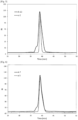
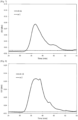
- Each of the molecular-weight distribution curves of (A) the modified saccharides and (a) the saccharides was measured by a GPC system (manufactured by Waters Corporation, model name: Alliance e2695).
- An "RI” (Waters 2417) and a “UV” (Waters 2487) were used as detectors, and a coupled column of Ultra hydrogel 500 and Ultra hydrogel 250 manufactured by Waters Corporation was used as a GPC column.
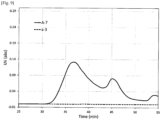
- a sample (each of (A) the modified saccharides and (a) the saccharides) was dissolved in the buffer and the buffer was allowed to flow in the column at a temperature of 40°C, at a flow rate of 0.8 ml/min, and then a molecular-weight distribution curve was measured (a molecular-weight distribution curve obtained by using an RI detector is referred to as an "RI chart”, and a molecular-weight distribution curve obtained by using a UV detector is referred to as a "UV chart").
- the modified saccharide (A-11) comprises compounds having further increased molecular weight, which compounds were obtainable by plenty of sucrose being divided into two parts and being recombined.
- each of the UV charts of (A) the modified saccharides a broad peak was observed.
- This fact means existence of a chemical structure capable of absorbing UV, such as a carbonyl group, a vinyl group, and a conjugated structure, and also means that each of (A) the modified saccharides comprising the chemical structure has a molecular weight in a wide range.
- each of the positions of the peak tops of the UV charts of (A) the modified saccharides is compared to each of those of the RI charts of (a) the saccharides, each of the positions of the peak tops of the UV charts of (A) the modified saccharides exists at higher molecular weight side, which indicates existence of a compound having a higher molecular weight.
- such high molecular weight compound has a chemical structure, for example, an aldehyde group and a carbonyl group which is produced by oxidizing a hydroxyl group, acetal, and ketal of (a) the saccharides.
- the total amount of the solid content of the components (A-1) and (B-1) was 100 parts by weight and the amount of water was 100 parts by weight.
- the numerical value of the component (A-1) shown in Table 3 indicates the solid content only.
- each solid component concentration (or solid content) was adjusted to 33% by weight to obtain each sample composition for evaluation.
- the sample composition (0.5 ml) was uniformly applied onto a glass fiber filter (Whatman, product name: GF/A) having a weight of about 0.05 g cut into a square shape in size of 30 mm ⁇ 30 mm.
- the sample composition on the glass fiber filter was dried at 105°C for 30 minutes and then left to stand in an oven at 190°C for 15 minutes to obtain a specimen (after treatment at 190°C).
- the specimen (after the treatment at 190°C) was immersed in 50 ml of water at normal temperature for 24 hours and then dried at 130°C for 1 hour to obtain a specimen (after water immersion treatment). After the immersion in water, a ratio (Equation 1) of the adhesive existing in the specimen was determined, an elution rate (Equation 2) of the adhesive to the water having immersed the same was also determined, and then water resistance was evaluated.
- Ratio of adhesive existing in specimen [specimen after water immersion treatment - weight of glass fiber filter] / [specimen after treatment at 190°C - weight of glass fiber filter]
- Elution rate % 1 ⁇ ratio of adhesive existing in specimen ⁇ 100
- each solid component concentration (or solid content) was adjusted to 33% by weight to obtain each sample composition for evaluation.
- the sample composition (1.0 ml) was uniformly applied onto a glass fiber filter (Whatman, product name: GF/A) having a weight of about 0.10 g cut into a rectangular shape in size of 20 mm ⁇ 100 mm.
- the sample composition on the glass fiber filter was dried at 105°C for 30 minutes and then left to stand in an oven at 190°C for 15 minutes to obtain a specimen.
- the specimen was placed in a thermo-hygrostat (23°C, humidity of 50%) and left to stand for 2 hours, and then a tensile test was performed.
- a tensile tester model 5585, manufactured by Instron Corporation, a tensile strength and a tensile elastic modulus were measured at a tensile speed of 25.4 mm/min.
- the tensile strength was defined as a breaking strength (maximum strength) value.
- the evaluation criteria of the tensile strength (23°C, humidity of 50%) are as follows.
- the tensile elastic modulus was determined from the gradient of the strain amount of 0.1% excluding the slack of the specimen.
- the evaluation criteria of the tensile elastic modulus (23°C, humidity of 50%) are as follows.
- each of the aqueous bonding compositions of Examples 1 to 20 comprises (A) a modified saccharide, each of the curing rate is high.
- each of (A) the modified saccharides was produced in the presence of (c) an amine, thus proving that the curing rate is more increased.
- each of the glass fiber molded articles of Examples 1 to 20 is satisfactory in all tensile strength, tensile elastic modulus, and water resistance.
- each of the glass fiber molded articles of Examples 11 to 20 achieves low elution rate and is extremely excellent in water resistance.
- each of the aqueous bonding compositions of Comparative Examples 1 to 7 does not comprise (A) a modified saccharide, thus proving that the curing rate is significantly low, and production efficiency of a molded article is decreased.
- Each of the glass fiber molded articles of Comparative Examples 1 to 7 is inferior in all tensile strength, tensile elastic modulus, and water resistance, compared to the molded articles of Examples.
- the present invention provides an aqueous bonding composition.
- the aqueous bonding composition according to the present invention is used when wood-based elements and inorganic fibers such as glass fibers are molded.
Landscapes
- Chemical & Material Sciences (AREA)
- Organic Chemistry (AREA)
- Engineering & Computer Science (AREA)
- Ceramic Engineering (AREA)
- Materials Engineering (AREA)
- Structural Engineering (AREA)
- Health & Medical Sciences (AREA)
- Chemical Kinetics & Catalysis (AREA)
- Medicinal Chemistry (AREA)
- Polymers & Plastics (AREA)
- Adhesives Or Adhesive Processes (AREA)
- Reinforced Plastic Materials (AREA)
- Compositions Of Macromolecular Compounds (AREA)
Claims (3)
- Wässrige Verklebungszusammensetzung, umfassend: (A) ein modifiziertes Saccharid, das ein Produkt aus (a) einem Saccharid und (b) einem Radikalinitiator ist; und (B) ein anorganisches Säuresalz, wobei das anorganische Säuresalz (B) ein anorganisches Säureammoniumsalz umfasst.
- Wässrige Verklebungszusammensetzung nach Anspruch 1, ferner umfassend eine Struktur basierend auf (c) einem Amin.
- Geformtes Erzeugnis, umfassend ein gehärtetes Material der wässrigen Verklebungszusammensetzung nach Anspruch 1 oder 2.
Applications Claiming Priority (2)
| Application Number | Priority Date | Filing Date | Title |
|---|---|---|---|
| JP2017105732A JP6580626B2 (ja) | 2017-05-29 | 2017-05-29 | 水系接着用組成物 |
| PCT/JP2018/017522 WO2018221117A1 (en) | 2017-05-29 | 2018-05-02 | Aqueous bonding composition |
Publications (2)
| Publication Number | Publication Date |
|---|---|
| EP3630698A1 EP3630698A1 (de) | 2020-04-08 |
| EP3630698B1 true EP3630698B1 (de) | 2024-11-27 |
Family
ID=62200502
Family Applications (1)
| Application Number | Title | Priority Date | Filing Date |
|---|---|---|---|
| EP18725937.9A Active EP3630698B1 (de) | 2017-05-29 | 2018-05-02 | Wässrige bindemittelzusammensetzung |
Country Status (10)
| Country | Link |
|---|---|
| US (1) | US11485883B2 (de) |
| EP (1) | EP3630698B1 (de) |
| JP (1) | JP6580626B2 (de) |
| KR (1) | KR102649058B1 (de) |
| CN (1) | CN110678430A (de) |
| DK (1) | DK3630698T3 (de) |
| FI (1) | FI3630698T3 (de) |
| PL (1) | PL3630698T3 (de) |
| RU (1) | RU2766982C2 (de) |
| WO (1) | WO2018221117A1 (de) |
Families Citing this family (5)
| Publication number | Priority date | Publication date | Assignee | Title |
|---|---|---|---|---|
| JP7239304B2 (ja) * | 2018-11-27 | 2023-03-14 | ヘンケルジャパン株式会社 | 水系接着剤 |
| JP6701456B1 (ja) * | 2019-06-03 | 2020-05-27 | ニチアス株式会社 | バインダー組成物、成形体、成形体の製造方法及びバインダー硬化物 |
| KR102084422B1 (ko) * | 2019-10-10 | 2020-03-04 | 방승용 | 식물의 섬유질로 이루어진 성형체의 제조방법. |
| GB201919346D0 (en) * | 2019-12-27 | 2020-02-05 | Knauf Insulation Ltd | Composite products |
| JP2021161596A (ja) * | 2020-03-31 | 2021-10-11 | 群栄化学工業株式会社 | 無機繊維用バインダー組成物及び無機繊維製品 |
Family Cites Families (28)
| Publication number | Priority date | Publication date | Assignee | Title |
|---|---|---|---|---|
| JPS5931901B2 (ja) | 1976-04-23 | 1984-08-04 | 株式会社東芝 | 広帯域フエ−ズ・ロツクト・ル−プ回路 |
| JPS5448701A (en) | 1977-09-24 | 1979-04-17 | Masakata Suwauchi | Method of recovering methyl bromide |
| DE2942251C2 (de) * | 1979-10-19 | 1988-11-10 | Maizena Gmbh, 2000 Hamburg | Verfahren zur Herstellung von Stärkeleimen |
| JPH01162894A (ja) * | 1987-12-18 | 1989-06-27 | Sanyo Kokusaku Pulp Co Ltd | 紙用塗被液組成物 |
| JP2863960B2 (ja) * | 1991-12-13 | 1999-03-03 | 日本コーンスターチ株式会社 | 糊液の調製方法及び糊液用調合品 |
| DE4221381C1 (de) * | 1992-07-02 | 1994-02-10 | Stockhausen Chem Fab Gmbh | Pfropf-Copolymerisate von ungesättigten Monomeren und Zuckern, Verfahren zu ihrer Herstellung und ihre Verwendung |
| JPH0827695A (ja) * | 1994-07-11 | 1996-01-30 | New Oji Paper Co Ltd | 塗被紙の製造方法 |
| JPH1077301A (ja) * | 1996-09-02 | 1998-03-24 | Mitsubishi Gas Chem Co Inc | 過酸化水素を用いたポリカルボン酸型多糖類の製造方法 |
| WO2000012746A1 (en) * | 1998-08-31 | 2000-03-09 | Penford Corporation | Improved enzyme thinned starches |
| US7727945B2 (en) * | 2005-07-15 | 2010-06-01 | Akzo Nobel N.V. | Modified polysaccharides |
| EP2574641A3 (de) * | 2005-07-26 | 2016-06-15 | Knauf Insulation GmbH | Bindemittel und damit hergestellte Materialien |
| US8674021B2 (en) * | 2006-07-21 | 2014-03-18 | Akzo Nobel N.V. | Sulfonated graft copolymers |
| GB0715100D0 (en) * | 2007-08-03 | 2007-09-12 | Knauf Insulation Ltd | Binders |
| JP5236012B2 (ja) | 2007-12-21 | 2013-07-17 | アクゾ ノーベル ナムローゼ フェンノートシャップ | 熱硬化性多糖 |
| WO2011022668A1 (en) * | 2009-08-20 | 2011-02-24 | Georgia-Pacific Chemicals Llc | Modified binders for making fiberglass products |
| EP2582766A1 (de) * | 2010-06-16 | 2013-04-24 | Cargill, Incorporated | Stärkebasierte zusammensetzungen als latexersatz |
| US8507666B2 (en) | 2010-08-24 | 2013-08-13 | Corn Products Development, Inc. | Modification of carbohydrates using continuous generation of hydroxyl radicals |
| FR2968008B1 (fr) | 2010-11-30 | 2014-01-31 | Saint Gobain Isover | Composition d'encollage pour fibres, notamment minerales, comprenant un sucre non reducteur et un sel d'ammonium d'acide inorganique, et produits resultants. |
| US20140135428A1 (en) * | 2011-06-22 | 2014-05-15 | Akzo Nobel Chemicals International B.V. | Polymerizate Comprising a Macromonomer |
| FR2978768B1 (fr) | 2011-08-05 | 2014-11-28 | Saint Gobain Isover | Composition d'encollage pour laine minerale a base de saccharide reducteur et de saccharide hydrogene, et produits isolants obtenus |
| BR112015002416B1 (pt) * | 2012-08-03 | 2021-09-21 | Ecolab Usa Inc | Composição detergente sólida |
| CN104152085A (zh) * | 2013-05-14 | 2014-11-19 | 金东纸业(江苏)股份有限公司 | 胶粘剂及其制备方法 |
| WO2015072437A1 (ja) * | 2013-11-12 | 2015-05-21 | 国立大学法人京都大学 | 木質材料用の接着剤組成物 |
| FR3019815B1 (fr) * | 2014-04-15 | 2016-05-06 | Saint Gobain Isover | Composition d'encollage a base de saccharide non reducteur et de saccharide hydrogene, et produits isolants obtenus. |
| KR101595275B1 (ko) * | 2015-06-01 | 2016-02-18 | 벽산페인트 주식회사 | 친환경 단열재용 바인더 조성물 및 그의 제조방법 |
| JP6603509B2 (ja) * | 2015-08-05 | 2019-11-06 | ヘンケルジャパン株式会社 | 水系接着用組成物 |
| GB201519188D0 (en) * | 2015-10-30 | 2015-12-16 | Knauf Insulation Ltd | Improved binder compositions and uses thereof |
| JP6062099B1 (ja) | 2016-09-30 | 2017-01-18 | ニチアス株式会社 | バインダー組成物、成形体、成形体の製造方法 |
-
2017
- 2017-05-29 JP JP2017105732A patent/JP6580626B2/ja active Active
-
2018
- 2018-05-02 RU RU2019144063A patent/RU2766982C2/ru active
- 2018-05-02 PL PL18725937.9T patent/PL3630698T3/pl unknown
- 2018-05-02 FI FIEP18725937.9T patent/FI3630698T3/fi active
- 2018-05-02 EP EP18725937.9A patent/EP3630698B1/de active Active
- 2018-05-02 DK DK18725937.9T patent/DK3630698T3/da active
- 2018-05-02 CN CN201880035718.0A patent/CN110678430A/zh active Pending
- 2018-05-02 KR KR1020197038527A patent/KR102649058B1/ko active Active
- 2018-05-02 WO PCT/JP2018/017522 patent/WO2018221117A1/en not_active Ceased
-
2019
- 2019-11-25 US US16/693,736 patent/US11485883B2/en active Active
Also Published As
| Publication number | Publication date |
|---|---|
| US11485883B2 (en) | 2022-11-01 |
| FI3630698T3 (fi) | 2025-01-08 |
| DK3630698T3 (da) | 2025-02-24 |
| EP3630698A1 (de) | 2020-04-08 |
| KR20200012940A (ko) | 2020-02-05 |
| PL3630698T3 (pl) | 2025-03-17 |
| RU2019144063A (ru) | 2021-06-30 |
| JP2018199793A (ja) | 2018-12-20 |
| RU2766982C2 (ru) | 2022-03-16 |
| US20200199416A1 (en) | 2020-06-25 |
| JP6580626B2 (ja) | 2019-09-25 |
| RU2019144063A3 (de) | 2021-09-01 |
| KR102649058B1 (ko) | 2024-03-20 |
| WO2018221117A1 (en) | 2018-12-06 |
| CN110678430A (zh) | 2020-01-10 |
Similar Documents
| Publication | Publication Date | Title |
|---|---|---|
| US11485883B2 (en) | Aqueous bonding composition | |
| CN108699410B (zh) | 含水粘接组合物 | |
| RU2665053C2 (ru) | Связующие вещества и соответствующие продукты | |
| AU2016373761B2 (en) | Aqueous bonding composition | |
| US10947426B2 (en) | Aqueous bonding composition | |
| EP3878881A2 (de) | Bindemittel | |
| US11326079B2 (en) | Aqueous bonding composition | |
| JP7239304B2 (ja) | 水系接着剤 | |
| JP7021157B2 (ja) | 水系接着用組成物の製造方法 | |
| WO2020110988A1 (en) | Aqueous adhesive | |
| JPWO2020246055A1 (ja) | バインダー組成物、成形体、成形体の製造方法及びバインダー硬化物 | |
| JP2020196866A (ja) | バインダー組成物、成形体、成形体の製造方法及びバインダー硬化物 |
Legal Events
| Date | Code | Title | Description |
|---|---|---|---|
| STAA | Information on the status of an ep patent application or granted ep patent |
Free format text: STATUS: UNKNOWN |
|
| STAA | Information on the status of an ep patent application or granted ep patent |
Free format text: STATUS: THE INTERNATIONAL PUBLICATION HAS BEEN MADE |
|
| PUAI | Public reference made under article 153(3) epc to a published international application that has entered the european phase |
Free format text: ORIGINAL CODE: 0009012 |
|
| STAA | Information on the status of an ep patent application or granted ep patent |
Free format text: STATUS: REQUEST FOR EXAMINATION WAS MADE |
|
| 17P | Request for examination filed |
Effective date: 20191111 |
|
| AK | Designated contracting states |
Kind code of ref document: A1 Designated state(s): AL AT BE BG CH CY CZ DE DK EE ES FI FR GB GR HR HU IE IS IT LI LT LU LV MC MK MT NL NO PL PT RO RS SE SI SK SM TR |
|
| AX | Request for extension of the european patent |
Extension state: BA ME |
|
| DAV | Request for validation of the european patent (deleted) | ||
| DAX | Request for extension of the european patent (deleted) | ||
| STAA | Information on the status of an ep patent application or granted ep patent |
Free format text: STATUS: EXAMINATION IS IN PROGRESS |
|
| 17Q | First examination report despatched |
Effective date: 20230511 |
|
| P01 | Opt-out of the competence of the unified patent court (upc) registered |
Effective date: 20230530 |
|
| GRAP | Despatch of communication of intention to grant a patent |
Free format text: ORIGINAL CODE: EPIDOSNIGR1 |
|
| STAA | Information on the status of an ep patent application or granted ep patent |
Free format text: STATUS: GRANT OF PATENT IS INTENDED |
|
| RIC1 | Information provided on ipc code assigned before grant |
Ipc: C04B 111/52 20060101ALI20240613BHEP Ipc: C04B 111/00 20060101ALI20240613BHEP Ipc: C09J 105/00 20060101ALI20240613BHEP Ipc: C04B 14/42 20060101ALI20240613BHEP Ipc: C04B 26/28 20060101AFI20240613BHEP |
|
| INTG | Intention to grant announced |
Effective date: 20240626 |
|
| GRAS | Grant fee paid |
Free format text: ORIGINAL CODE: EPIDOSNIGR3 |
|
| GRAA | (expected) grant |
Free format text: ORIGINAL CODE: 0009210 |
|
| STAA | Information on the status of an ep patent application or granted ep patent |
Free format text: STATUS: THE PATENT HAS BEEN GRANTED |
|
| AK | Designated contracting states |
Kind code of ref document: B1 Designated state(s): AL AT BE BG CH CY CZ DE DK EE ES FI FR GB GR HR HU IE IS IT LI LT LU LV MC MK MT NL NO PL PT RO RS SE SI SK SM TR |
|
| REG | Reference to a national code |
Ref country code: GB Ref legal event code: FG4D |
|
| REG | Reference to a national code |
Ref country code: CH Ref legal event code: EP |
|
| REG | Reference to a national code |
Ref country code: IE Ref legal event code: FG4D |
|
| REG | Reference to a national code |
Ref country code: DE Ref legal event code: R096 Ref document number: 602018076947 Country of ref document: DE |
|
| REG | Reference to a national code |
Ref country code: FI Ref legal event code: FGE |
|
| REG | Reference to a national code |
Ref country code: SE Ref legal event code: TRGR |
|
| REG | Reference to a national code |
Ref country code: DK Ref legal event code: T3 Effective date: 20250218 |
|
| REG | Reference to a national code |
Ref country code: LT Ref legal event code: MG9D |
|
| REG | Reference to a national code |
Ref country code: NL Ref legal event code: MP Effective date: 20241127 |
|
| PG25 | Lapsed in a contracting state [announced via postgrant information from national office to epo] |
Ref country code: PT Free format text: LAPSE BECAUSE OF FAILURE TO SUBMIT A TRANSLATION OF THE DESCRIPTION OR TO PAY THE FEE WITHIN THE PRESCRIBED TIME-LIMIT Effective date: 20250327 Ref country code: IS Free format text: LAPSE BECAUSE OF FAILURE TO SUBMIT A TRANSLATION OF THE DESCRIPTION OR TO PAY THE FEE WITHIN THE PRESCRIBED TIME-LIMIT Effective date: 20250327 Ref country code: HR Free format text: LAPSE BECAUSE OF FAILURE TO SUBMIT A TRANSLATION OF THE DESCRIPTION OR TO PAY THE FEE WITHIN THE PRESCRIBED TIME-LIMIT Effective date: 20241127 |
|
| PG25 | Lapsed in a contracting state [announced via postgrant information from national office to epo] |
Ref country code: NL Free format text: LAPSE BECAUSE OF FAILURE TO SUBMIT A TRANSLATION OF THE DESCRIPTION OR TO PAY THE FEE WITHIN THE PRESCRIBED TIME-LIMIT Effective date: 20241127 |
|
| REG | Reference to a national code |
Ref country code: AT Ref legal event code: MK05 Ref document number: 1745594 Country of ref document: AT Kind code of ref document: T Effective date: 20241127 |
|
| PG25 | Lapsed in a contracting state [announced via postgrant information from national office to epo] |
Ref country code: BG Free format text: LAPSE BECAUSE OF FAILURE TO SUBMIT A TRANSLATION OF THE DESCRIPTION OR TO PAY THE FEE WITHIN THE PRESCRIBED TIME-LIMIT Effective date: 20241127 |
|
| PG25 | Lapsed in a contracting state [announced via postgrant information from national office to epo] |
Ref country code: ES Free format text: LAPSE BECAUSE OF FAILURE TO SUBMIT A TRANSLATION OF THE DESCRIPTION OR TO PAY THE FEE WITHIN THE PRESCRIBED TIME-LIMIT Effective date: 20241127 |
|
| PG25 | Lapsed in a contracting state [announced via postgrant information from national office to epo] |
Ref country code: GR Free format text: LAPSE BECAUSE OF FAILURE TO SUBMIT A TRANSLATION OF THE DESCRIPTION OR TO PAY THE FEE WITHIN THE PRESCRIBED TIME-LIMIT Effective date: 20250228 Ref country code: LV Free format text: LAPSE BECAUSE OF FAILURE TO SUBMIT A TRANSLATION OF THE DESCRIPTION OR TO PAY THE FEE WITHIN THE PRESCRIBED TIME-LIMIT Effective date: 20241127 Ref country code: AT Free format text: LAPSE BECAUSE OF FAILURE TO SUBMIT A TRANSLATION OF THE DESCRIPTION OR TO PAY THE FEE WITHIN THE PRESCRIBED TIME-LIMIT Effective date: 20241127 |
|
| PG25 | Lapsed in a contracting state [announced via postgrant information from national office to epo] |
Ref country code: RS Free format text: LAPSE BECAUSE OF FAILURE TO SUBMIT A TRANSLATION OF THE DESCRIPTION OR TO PAY THE FEE WITHIN THE PRESCRIBED TIME-LIMIT Effective date: 20250227 |
|
| PG25 | Lapsed in a contracting state [announced via postgrant information from national office to epo] |
Ref country code: SM Free format text: LAPSE BECAUSE OF FAILURE TO SUBMIT A TRANSLATION OF THE DESCRIPTION OR TO PAY THE FEE WITHIN THE PRESCRIBED TIME-LIMIT Effective date: 20241127 |
|
| PGFP | Annual fee paid to national office [announced via postgrant information from national office to epo] |
Ref country code: FI Payment date: 20250526 Year of fee payment: 8 |
|
| PGFP | Annual fee paid to national office [announced via postgrant information from national office to epo] |
Ref country code: PL Payment date: 20250424 Year of fee payment: 8 Ref country code: DE Payment date: 20250521 Year of fee payment: 8 |
|
| PGFP | Annual fee paid to national office [announced via postgrant information from national office to epo] |
Ref country code: DK Payment date: 20250526 Year of fee payment: 8 |
|
| PGFP | Annual fee paid to national office [announced via postgrant information from national office to epo] |
Ref country code: NO Payment date: 20250523 Year of fee payment: 8 |
|
| PG25 | Lapsed in a contracting state [announced via postgrant information from national office to epo] |
Ref country code: EE Free format text: LAPSE BECAUSE OF FAILURE TO SUBMIT A TRANSLATION OF THE DESCRIPTION OR TO PAY THE FEE WITHIN THE PRESCRIBED TIME-LIMIT Effective date: 20241127 |
|
| PGFP | Annual fee paid to national office [announced via postgrant information from national office to epo] |
Ref country code: FR Payment date: 20250528 Year of fee payment: 8 |
|
| PG25 | Lapsed in a contracting state [announced via postgrant information from national office to epo] |
Ref country code: RO Free format text: LAPSE BECAUSE OF FAILURE TO SUBMIT A TRANSLATION OF THE DESCRIPTION OR TO PAY THE FEE WITHIN THE PRESCRIBED TIME-LIMIT Effective date: 20241127 |
|
| PG25 | Lapsed in a contracting state [announced via postgrant information from national office to epo] |
Ref country code: SK Free format text: LAPSE BECAUSE OF FAILURE TO SUBMIT A TRANSLATION OF THE DESCRIPTION OR TO PAY THE FEE WITHIN THE PRESCRIBED TIME-LIMIT Effective date: 20241127 |
|
| PG25 | Lapsed in a contracting state [announced via postgrant information from national office to epo] |
Ref country code: CZ Free format text: LAPSE BECAUSE OF FAILURE TO SUBMIT A TRANSLATION OF THE DESCRIPTION OR TO PAY THE FEE WITHIN THE PRESCRIBED TIME-LIMIT Effective date: 20241127 |
|
| PG25 | Lapsed in a contracting state [announced via postgrant information from national office to epo] |
Ref country code: IT Free format text: LAPSE BECAUSE OF FAILURE TO SUBMIT A TRANSLATION OF THE DESCRIPTION OR TO PAY THE FEE WITHIN THE PRESCRIBED TIME-LIMIT Effective date: 20241127 |
|
| PGFP | Annual fee paid to national office [announced via postgrant information from national office to epo] |
Ref country code: SE Payment date: 20250521 Year of fee payment: 8 |
|
| REG | Reference to a national code |
Ref country code: DE Ref legal event code: R097 Ref document number: 602018076947 Country of ref document: DE |
|
| PLBE | No opposition filed within time limit |
Free format text: ORIGINAL CODE: 0009261 |
|
| STAA | Information on the status of an ep patent application or granted ep patent |
Free format text: STATUS: NO OPPOSITION FILED WITHIN TIME LIMIT |
|
| REG | Reference to a national code |
Ref country code: CH Ref legal event code: L10 Free format text: ST27 STATUS EVENT CODE: U-0-0-L10-L00 (AS PROVIDED BY THE NATIONAL OFFICE) Effective date: 20251008 |
|
| 26N | No opposition filed |
Effective date: 20250828 |
|
| REG | Reference to a national code |
Ref country code: CH Ref legal event code: H13 Free format text: ST27 STATUS EVENT CODE: U-0-0-H10-H13 (AS PROVIDED BY THE NATIONAL OFFICE) Effective date: 20251223 |
|
| PG25 | Lapsed in a contracting state [announced via postgrant information from national office to epo] |
Ref country code: LU Free format text: LAPSE BECAUSE OF NON-PAYMENT OF DUE FEES Effective date: 20250502 |
|
| PG25 | Lapsed in a contracting state [announced via postgrant information from national office to epo] |
Ref country code: CH Free format text: LAPSE BECAUSE OF NON-PAYMENT OF DUE FEES Effective date: 20250531 |
|
| GBPC | Gb: european patent ceased through non-payment of renewal fee |
Effective date: 20250502 |
|
| PG25 | Lapsed in a contracting state [announced via postgrant information from national office to epo] |
Ref country code: MC Free format text: LAPSE BECAUSE OF FAILURE TO SUBMIT A TRANSLATION OF THE DESCRIPTION OR TO PAY THE FEE WITHIN THE PRESCRIBED TIME-LIMIT Effective date: 20241127 |