EP3593785B1 - Dentale zusammensetzung - Google Patents
Dentale zusammensetzung Download PDFInfo
- Publication number
- EP3593785B1 EP3593785B1 EP18763635.2A EP18763635A EP3593785B1 EP 3593785 B1 EP3593785 B1 EP 3593785B1 EP 18763635 A EP18763635 A EP 18763635A EP 3593785 B1 EP3593785 B1 EP 3593785B1
- Authority
- EP
- European Patent Office
- Prior art keywords
- weight
- parts
- cement
- dental composition
- preparation example
- Prior art date
- Legal status (The legal status is an assumption and is not a legal conclusion. Google has not performed a legal analysis and makes no representation as to the accuracy of the status listed.)
- Active
Links
Images






Classifications
-
- A—HUMAN NECESSITIES
- A61—MEDICAL OR VETERINARY SCIENCE; HYGIENE
- A61K—PREPARATIONS FOR MEDICAL, DENTAL OR TOILETRY PURPOSES
- A61K6/00—Preparations for dentistry
- A61K6/80—Preparations for artificial teeth, for filling teeth or for capping teeth
- A61K6/831—Preparations for artificial teeth, for filling teeth or for capping teeth comprising non-metallic elements or compounds thereof, e.g. carbon
- A61K6/836—Glass
-
- A—HUMAN NECESSITIES
- A61—MEDICAL OR VETERINARY SCIENCE; HYGIENE
- A61K—PREPARATIONS FOR MEDICAL, DENTAL OR TOILETRY PURPOSES
- A61K6/00—Preparations for dentistry
- A61K6/50—Preparations specially adapted for dental root treatment
- A61K6/54—Filling; Sealing
-
- A—HUMAN NECESSITIES
- A61—MEDICAL OR VETERINARY SCIENCE; HYGIENE
- A61K—PREPARATIONS FOR MEDICAL, DENTAL OR TOILETRY PURPOSES
- A61K6/00—Preparations for dentistry
- A61K6/70—Preparations for dentistry comprising inorganic additives
- A61K6/71—Fillers
- A61K6/76—Fillers comprising silicon-containing compounds
-
- A—HUMAN NECESSITIES
- A61—MEDICAL OR VETERINARY SCIENCE; HYGIENE
- A61K—PREPARATIONS FOR MEDICAL, DENTAL OR TOILETRY PURPOSES
- A61K6/00—Preparations for dentistry
- A61K6/80—Preparations for artificial teeth, for filling teeth or for capping teeth
- A61K6/849—Preparations for artificial teeth, for filling teeth or for capping teeth comprising inorganic cements
-
- A—HUMAN NECESSITIES
- A61—MEDICAL OR VETERINARY SCIENCE; HYGIENE
- A61K—PREPARATIONS FOR MEDICAL, DENTAL OR TOILETRY PURPOSES
- A61K6/00—Preparations for dentistry
- A61K6/80—Preparations for artificial teeth, for filling teeth or for capping teeth
- A61K6/849—Preparations for artificial teeth, for filling teeth or for capping teeth comprising inorganic cements
- A61K6/851—Portland cements
-
- A—HUMAN NECESSITIES
- A61—MEDICAL OR VETERINARY SCIENCE; HYGIENE
- A61K—PREPARATIONS FOR MEDICAL, DENTAL OR TOILETRY PURPOSES
- A61K6/00—Preparations for dentistry
- A61K6/80—Preparations for artificial teeth, for filling teeth or for capping teeth
- A61K6/849—Preparations for artificial teeth, for filling teeth or for capping teeth comprising inorganic cements
- A61K6/86—Al-cements
Definitions
- the present invention relates to a dental composition, more particularly to a dental hydraulic composition including hydraulic cement and a non-aqueous liquid.
- Tooth enamel begins due to acids generated through the decomposition of sugar components by bacteria living in the oral cavity to thus cause tooth decay, which is referred to as dental caries.
- dental caries When dental caries are confined to the enamel, little pain is experienced, but when the caries progress to the dentin or pulp, severe pain may result.
- root-canal treatment for eliminating the pulp in the root canal has to be performed.
- root-canal treatment it is necessary to fill the empty space in the root canal to suppress the occurrence of secondary infection, Gutta-percha and a sealer being the most widely used materials for filling the empty space in the root canal.
- Gutta-percha which is a very safe material for use in living bodies, has been used for a long time, but is a solid material and thus has to be loaded using heat and pressure, making it difficult to completely fill the convoluted root canal therewith.
- various ointment-type sealers have also been used to offset the disadvantages of Gutta-percha.
- sealers used to date include resin, zinc oxide, calcium hydroxide, silicone and the like, but have defects of low biosafety or poor adhesion to a tooth structure or Gutta-percha.
- MTA Mineral trioxide aggregate
- Mahmoud Torabinejad a professor at the University of Roma Linda in the USA, and has come to be widely used as a dental composition because it is composed of tooth-like components.
- MTA is composed of Portland cement and bismuth oxide, which is a radiopaque agent.
- Portland cement comprises dicalcium silicate, tricalcium silicate, tricalcium aluminate, and tricalcium aluminoferrite, and has the property of curing upon contact with water.
- Calcium silicate is formed into calcium silicate hydrate gel upon contact with water, and furthermore, calcium hydroxide may be formed as a byproduct thereof, thus exhibiting a high pH. Due to the high pH thereof, antibacterial effects are manifested in the oral cavity.
- MTA is advantageous because of antibacterial effects and tooth-like components, as described above.
- the powder which is used by being mixed with water, begins to react at the time of mixing with water, and thus has the disadvantages of a short working time of less than 5 min and a long curing time of about 4 hr.
- MTA is problematic in that it appears grayish due to the ferrite component and thus the tooth may be colored, and also in that there is a need to use an additional carrier when applied to a narrow root canal.
- KR 2015 0144028 discloses a dental clinic filler derived from a Portland cement clinker.
- KR 2010 0037979 discloses a premixed cement paste for use in dental applications, which comprises calcium silicate compounds and an anhydrous liquid carrier.
- the present invention is intended to provide a dental composition.
- the present invention is intended to provide a dental hydraulic composition, which is easy to use and is improved from the aspects of aesthetic appearance, curability and biocompatibility.
- An aspect of the present invention provides a dental composition, comprising:
- the silicon (Si)-doped tricalcium aluminate (3CaO ⁇ Al 2 O 3 ) is doped with silicon (Si) in an amount of 0.5 to 15 wt%.
- the dental composition may further comprise at least one of a radiopaque agent, a calcium phosphate compound, and a curing modifier.
- the dental composition may include 100 parts by weight of the cement; 10 to 100 parts by weight of the non-aqueous liquid; and at least one of 20 to 200 parts by weight of the radiopaque agent, 1 to 30 parts by weight of the calcium phosphate compound and 0.1 to 20 parts by weight of the curing modifier.
- the cement may be configured such that a weight ratio (D:M) of a weight sum (D, D1 + D2) of the first domain (D1) and the second domain (D2) to a weight of the matrix (M) is 99:1 to 70:30.
- the cement may be a hydraulic material prepared by reacting a mixture comprising calcium oxide, silicon dioxide, and aluminum oxide through heat treatment.
- the non-aqueous liquid may include at least one selected from among ethanol, propanol, vegetable fat and oil, animal fat and oil, ethylene glycol, propylene glycol, polyethylene glycol, polypropylene glycol, and glycerin, and preferably includes polypropylene glycol, because polypropylene glycol has high biocompatibility compared to polyethylene glycol.
- polypropylene glycol is included as the non-aqueous liquid
- another non-aqueous liquid other than polypropylene glycol may be further included.
- the calcium phosphate compound may include at least one selected from among calcium phosphate, dicalcium phosphate, tricalcium phosphate, tetracalcium phosphate, hydroxyapatite, apatite, octacalcium phosphate, biphasic calcium phosphate, amorphous calcium phosphate, casein phosphopeptide-amorphous calcium phosphate, and bioactive glass.
- the calcium phosphate compound may be bioactive glass.
- the bioactive glass may be represented by Chemical Formula 1 below. [Chemical Formula 1] (SiO 2 ) x (Na 2 O) y (CaO) z (P 2 O 5 ) w
- x, y, z, and w are numbers of moles, 30 ⁇ x ⁇ 70, 0 ⁇ y ⁇ 40, 10 ⁇ z ⁇ 50, and 1 ⁇ w ⁇ 10.
- the radiopaque agent may include at least one selected from among zinc oxide, barium sulfate, zirconium oxide, bismuth oxide, barium oxide, iodoform, tantalum oxide, and calcium tungstate.
- the curing modifier may include at least one selected from among calcium sulfate dihydrate, calcium sulfate hemihydrate, calcium chloride, and calcium formate.
- the dental composition may further comprise a viscosity modifier.
- the amount of the viscosity modifier may be 0.1 to 20 parts by weight.
- the viscosity modifier may include at least one selected from among cellulose, a cellulose derivative, xanthan gum, polyvinyl alcohol, polyacrylic acid, and polyvinylpyrrolidone.
- the dental composition may be in a paste form.
- a dental material may be obtained through hydraulic treatment of the above dental composition.
- a method of preparing a dental composition comprising manufacturing cement and preparing a composition including the cement and a non-aqueous liquid.
- the cement may include a first domain including alite, a second domain including belite, and a matrix located between one or more selected from the group consisting of the first domain and the second domain and configured to include silicon (Si)-atom-doped tricalcium aluminate (3CaO ⁇ Al 2 O 3 ).
- composition may further comprise at least one of a radiopaque agent and a calcium-phosphate-based compound.
- manufacturing the cement may be performed by reacting a mixture comprising calcium oxide, silicon dioxide, and aluminum oxide through heat treatment.
- a dental hydraulic composition is provided.
- the dental hydraulic composition is provided in the form of a single ointment-type composition and is thus easy to use and is improved from the aspects of aesthetic appearance, curability and biocompatibility.
- a dental hydraulic composition is described below.
- An aspect of the present invention pertains to a dental composition, comprising cement and a non-aqueous liquid, in which the cement includes a first domain including alite, a second domain including belite, and a matrix located between one or more selected from the group consisting of the first domain and the second domain wherein the matrix includes silicon (Si)-atom-doped tricalcium aluminate (3CaO ⁇ Al 2 O 3 ).
- the silicon (Si)-doped tricalcium aluminate (3CaO ⁇ Al 2 O 3 ) is doped with silicon (Si) in an amount of 0.5 to 15 wt%, preferably 1 to 10 wt%, and more preferably 2 to 5 wt%.
- the firing temperature of the cement having the domain and matrix structure falls in the range of 1200°C to 1550°C, preferably 1300°C to 1500°C, and more preferably 1400°C to 1500°C. If the firing temperature thereof is lower than 1200°C, belite is mainly formed, rather than alite, undesirably lowering the strength of the cement. On the other hand, if the firing temperature thereof is higher than 1550°C, alite may be formed, but alite, among the components of the cement, may decompose during firing, undesirably lowering the strength of the cement.
- the heating rate required to reach the firing temperature of the cement having the domain and matrix structure is 1 °C/min to 20 °C/min, and preferably 2 °C/min to 10 °C/min. If the heating rate required to reach the firing temperature thereof is less than 1 °C/min, the time becomes excessively prolonged, undesirably lowering productivity. On the other hand, if the heating rate required to reach the firing temperature thereof exceeds 20 °C/min, the reaction time between the mixed materials is not sufficient and some materials are left behind and thus the cement strength is lowered, which is undesirable.
- the firing time in the temperature range for forming the cement having the domain and matrix structure falls in the range of 0.5 hr to 24 hr, and preferably 1 hr to 12 hr. If the firing time is less than 0.5 hr, the reaction time between the mixed materials is not sufficient and some materials are left behind and thus the cement strength is lowered, which is undesirable. On the other hand, if the firing time exceeds 24 hr, excessive energy consumption is required, thus negating economic benefits, which is undesirable.
- the non-aqueous liquid may include at least one selected from among ethanol, propanol, vegetable fat and oil, animal fat and oil, ethylene glycol, propylene glycol, polyethylene glycol, polypropylene glycol, and glycerin.
- the non-aqueous liquid is preferably contained in an amount of 10 to 100 parts by weight based on 100 parts by weight of the cement.
- the calcium phosphate may include at least one selected from among calcium phosphate, dicalcium phosphate, tricalcium phosphate, tetracalcium phosphate, hydroxyapatite, apatite, octacalcium phosphate, biphasic calcium phosphate, amorphous calcium phosphate, casein phosphopeptide-amorphous calcium phosphate, and bioactive glass.
- the calcium phosphate compound may be bioactive glass.
- the bioactive glass may be represented by Chemical Formula 1 below. [Chemical Formula 1] (SiO 2 ) x (Na 2 O) y (CaO) z (P 2 O 5 ) w
- x, y, z, and w are numbers of moles, 30 ⁇ x ⁇ 70, 0 ⁇ y ⁇ 40, 10 ⁇ z ⁇ 50, and 1 ⁇ w ⁇ 10.
- Calcium hydroxide generated as a byproduct during hydraulic treatment of the cement, is dissolved in saliva in the oral cavity to thus increase the pH and exhibit an antibacterial effect. Also, it reacts with calcium phosphate to give hydroxyapatite, which is a component of the teeth.
- the calcium phosphate is preferably used in an amount of 1 to 30 parts by weight based on 100 parts by weight of the cement.
- the dental composition may include a radiopaque agent in order to confirm the results of treatment.
- the radiopaque agent may include at least one selected from among zinc oxide, barium sulfate, zirconium oxide, bismuth oxide, barium oxide, iodoform, tantalum oxide, and calcium tungstate.
- the radiopaque agent is preferably used in an amount of 20 to 200 parts by weight based on 100 parts by weight of the cement.
- the dental composition may further include a viscosity modifier.
- the viscosity modifier may include at least one selected from among cellulose, a cellulose derivative, xanthan gum, polyvinyl alcohol, polyacrylic acid, and polyvinylpyrrolidone.
- the viscosity modifier is preferably used in an amount of 0.1 to 20 parts by weight based on 100 parts by weight of the cement.
- the dental composition may further include a curing modifier.
- the curing modifier may include at least one selected from among calcium sulfate dihydrate, calcium sulfate hemihydrate, calcium chloride, and calcium formate.
- the curing modifier is preferably used in an amount of 0.1 to 20 parts by weight based on 100 parts by weight of the cement.
- Described but not claimed is a dental material obtained through hydraulic treatment of the dental composition of the present invention.
- a method of preparing a dental composition comprising manufacturing cement and preparing a composition comprising the cement and a non-aqueous liquid.
- the cement may include a first domain including alite, a second domain including belite, and a matrix located between one or more selected from the group consisting of the first domain and the second domain and configured to include silicon (Si)-atom-doped tricalcium aluminate (3CaO ⁇ Al 2 O 3 ).
- composition may further include at least one of a radiopaque agent and a calcium-phosphate-based compound.
- the cement may be manufactured by subjecting a mixture comprising calcium oxide, silicon dioxide, and aluminum oxide to reaction through heat treatment and firing.
- the ceramic balls were removed, and the resulting mixture was formed into a hollow cylinder in order to achieve a totally uniform reaction, placed in a platinum crucible, fired in a firing furnace at 1,500°C for 1 hr 30 min, immediately taken out of the firing furnace, and rapidly cooled to 25°C for 10 min using a cooling fan in an ambient atmosphere.
- the rapidly cooled cement was primarily pulverized to a size of 1 mm or less under dry conditions, and 1/5 of the volume of a ceramic bottle was filled with the primarily pulverized cement, and ceramic balls having sizes of 10 mm, 5 mm and 1 mm at a predetermined ratio were placed in 1/5 of the volume of the bottle, followed by pulverization for 24 hr.
- the ceramic bottle and the ceramic balls were used after drying at 105°C for 24 hr or more.
- the pulverized materials were sieved to an average particle size of 10 ⁇ m or less, yielding a cement powder.
- the phase of the powder thus obtained was analyzed using a D/max 2200V/PC, available from Rigaku, Japan.
- the cement of Preparation Example 2 was manufactured in the same manner as in Preparation Example 1, with the exception that 137 parts by weight of calcium oxide, 45 parts by weight of silicon dioxide and 18 parts by weight of aluminum oxide were used, in lieu of using 141.5 parts by weight of calcium oxide, 51.7 parts by weight of silicon dioxide, 2.1 parts by weight of aluminum oxide, 0.7 parts by weight of iron oxide, and 0.6 parts by weight of magnesium oxide as in Preparation Example 1.
- phase analysis of the cement of Preparation Example 2 was performed in the same manner as the phase analysis of the cement of Preparation Example 1.
- the cement of Preparation Example 3 was manufactured in the same manner as in Preparation Example 1, with the exception that 141 parts by weight of calcium oxide, 45 parts by weight of silicon dioxide and 14 parts by weight of aluminum oxide were used, in lieu of using 141.5 parts by weight of calcium oxide, 51.7 parts by weight of silicon dioxide, 2.1 parts by weight of aluminum oxide, 0.7 parts by weight of iron oxide, and 0.6 parts by weight of magnesium oxide as in Preparation Example 1.
- phase analysis of the powder of Preparation Example 3 was performed in the same manner as the phase analysis of the powder of Preparation Example 1.
- the ceramic balls were removed, and the resulting mixture was formed into a hollow cylinder in order to achieve a totally uniform reaction, placed in a platinum crucible, fired in a firing furnace at 1,500°C for 1 hr 30 min, immediately taken out of the firing furnace, and rapidly cooled to 25°C for 10 min using a cooling fan in an ambient atmosphere.
- the rapidly cooled cement was pulverized under the same pulverization conditions as in Preparation Example 1, and the cement powder of Preparation Example 4 was further mixed with 1.3 parts by weight of silicon dioxide and 4.5 parts by weight of aluminum oxide.
- the mixed powder was analyzed in the same manner as in Example 1.
- the cement of Comparative Preparation Example 1 was manufactured in the same manner as in Preparation Example 1, with the exception that 141 parts by weight of calcium oxide and 50.4 parts by weight of silicon dioxide were used, in lieu of using 141.5 parts by weight of calcium oxide, 51.7 parts by weight of silicon dioxide, 2.1 parts by weight of aluminum oxide, 0.7 parts by weight of iron oxide, and 0.6 parts by weight of magnesium oxide as in Preparation Example 1.
- phase analysis of the cement of Comparative Preparation Example 1 was performed in the same manner as the phase analysis of the cement of Preparation Example 1.
- the cement of Comparative Preparation Example 2 was manufactured in the same manner as in Preparation Example 1, with the exception that 151 parts by weight of calcium oxide and 60 parts by weight of silicon dioxide were used and firing at 1,600°C and then air cooling were performed, in lieu of using 141.5 parts by weight of calcium oxide, 51.7 parts by weight of silicon dioxide, 2.1 parts by weight of aluminum oxide, 0.7 parts by weight of iron oxide, and 0.6 parts by weight of magnesium oxide, firing at 1,500°C and then rapid cooling as in Preparation Example 1.
- phase analysis of the cement of Comparative Preparation Example 2 was performed in the same manner as the phase analysis of the cement of Preparation Example 1.
- the cement of Comparative Preparation Example 3 was manufactured in the same manner as in Preparation Example 1, with the exception that 118.8 parts by weight of calcium oxide, 49 parts by weight of silicon dioxide, 10.75 parts by weight of boehmite (aluminum oxide) and 4.61 parts by weight of ferrite oxide (iron oxide) were used and firing at 1,550°C and then air cooling were performed, in lieu of using 141.5 parts by weight of calcium oxide, 51.7 parts by weight of silicon dioxide, 2.1 parts by weight of aluminum oxide, 0.7 parts by weight of iron oxide, and 0.6 parts by weight of magnesium oxide, firing at 1,500°C and then rapid cooling as in Preparation Example 1.
- phase analysis of the cement of Comparative Preparation Example 3 was performed in the same manner as the phase analysis of the cement of Preparation Example 1.
- the cement of Comparative Preparation Example 4 was manufactured in the same manner as in Preparation Example 1, with the exception that 137 parts by weight of calcium oxide, 45 parts by weight of silicon dioxide and 18 parts by weight of aluminum oxide were used and air cooling was performed, in lieu of using 141.5 parts by weight of calcium oxide, 51.7 parts by weight of silicon dioxide, 2.1 parts by weight of aluminum oxide, 0.7 parts by weight of iron oxide, and 0.6 parts by weight of magnesium oxide and rapid cooling to 25°C for 10 min using a cooling fan in an ambient atmosphere as in Preparation Example 1.
- phase analysis of the cement of Comparative Preparation Example 4 was performed in the same manner as the phase analysis of the cement of Preparation Example 1.
- Table 1 below shows the components and amounts of the cement, the firing temperature and the cooling process in Preparation Examples 1 to 4 and Comparative Preparation Examples 1 to 4.
- a dental hydraulic composition was prepared in the same manner as in Example 1, with the exception that the cement manufactured in Preparation Example 3 was used in lieu of the cement manufactured in Preparation Example 2.
- a dental hydraulic composition was prepared in the same manner as in Example 1, with the exception that 50 parts by weight of the cement manufactured in Preparation Example 2 and 2 parts by weight of bioactive glass ((SiO 2 ) 9 (Na 2 O) 5 (CaO) 5 (P 2 O 5 ) 1 ) were used, in lieu of 52 parts by weight of the cement manufactured in Preparation Example 2.
- a dental hydraulic composition was prepared in the same manner as in Example 3, with the exception that 60 parts by weight of the cement manufactured in Preparation Example 2 and 10 parts by weight of polypropylene glycol were used, in lieu of 50 parts by weight of the cement manufactured in Preparation Example 2 and 20 parts by weight of polypropylene glycol.
- a dental hydraulic composition was prepared in the same manner as in Example 1, with the exception that 62 parts by weight of the cement manufactured in Preparation Example 2 and 10 parts by weight of polypropylene glycol were used, in lieu of 52 parts by weight of the cement manufactured in Preparation Example 2 and 20 parts by weight of polypropylene glycol.
- a dental hydraulic composition was prepared in the same manner as in Example 1, with the exception that 52 parts by weight of the cement manufactured in Preparation Example 4 was used, in lieu of 52 parts by weight of the cement manufactured in Preparation Example 2.
- a dental hydraulic composition was prepared in the same manner as in Example 4, with the exception that 60 parts by weight of the cement manufactured in Preparation Example 2 and 2 parts by weight of tricalcium phosphate were used, in lieu of 60 parts by weight of the cement manufactured in Preparation Example 2 and 2 parts by weight of bioactive glass ((SiO 2 ) 9 (Na 2 O) 5 (CaO) 5 (P 2 O 5 ) 1 ).
- a dental hydraulic composition was prepared in the same manner as in Example 1, with the exception that the ordinary Portland cement manufactured in Preparation Example 1 was used, in lieu of the cement manufactured in Preparation Example 2.
- a dental hydraulic composition was prepared in the same manner as in Example 1, with the exception that the cement manufactured in Comparative Preparation Example 2 was used, in lieu of the cement manufactured in Preparation Example 2.
- a dental hydraulic composition was prepared in the same manner as in Example 1, with the exception that the cement manufactured in Comparative Preparation Example 3 was used, in lieu of the cement manufactured in Preparation Example 2.
- a dental hydraulic composition was prepared in the same manner as in Example 2, with the exception that 52 parts by weight of the cement manufactured in Comparative Preparation Example 4 was used, in lieu of the cement manufactured in Preparation Example 2.
- a dental hydraulic composition was prepared in the same manner as in Example 1, with the exception that the cement manufactured in Comparative Preparation Example 1 was used, in lieu of the cement manufactured in Preparation Example 2.
- Table 2 shows the components and amounts of the dental hydraulic compositions of Examples 1 to 7 and Comparative Examples 1 to 5.
- Prepar ation Exampl e 1 Prepar ation Exampl e 2
- Prepar ation Exampl e 3 Prepar ation Exampl e 4 Compar ative Prepar ation Exampl e 1 Compar ative Prepar ation Exampl e 2 Compar ative Prepar ation Exampl e 3 Compar ative Prepar ation Exampl e 4
- Trica lcium phosp hate Polypro pylene glycol Zirco nium oxide Calci um sulfa te dihyd rate Bioac five glass
- Test Example 1 Evaluation of flowability and compressive strength of dental composition
- Table 3 below shows the results of evaluation of flowability and compressive strength of the dental compositions of Examples 1 to 7 and Comparative Examples 1 to 5.
- two glass plates having a size of 40 mm (width) x 40 mm (length), a thickness of about 5 mm and a weight of about 20 g were prepared.
- 0.05 ⁇ 0.005 ml of the dental composition was placed on the center of one of the glass plates and covered with the other glass plate, to which a weight of 120 ⁇ 2 g was then applied for 10 min. After 10 min, the spread size of the dental composition was measured and measurement values in which the difference between maximum and minimum values was less than 1 mm were recorded, determined three times and averaged.
- the compressive strength of the dental composition was determined in a manner in which a gypsum mold having a cavity with a diameter of 4 mm and a height of 6 mm was stored in a constant-temperature and constant-humidity chamber at a temperature of 37 ⁇ 1°C and a humidity of 95%, the cavity thereof was filled with the sample in the constant-temperature and constant-humidity chamber, and the sample was separated from the mold after 1 day, 7 days, 14 days, and 28 days, followed by testing under a force of 100 N at a speed of 1 mm/min using a UTM (Universal Testing Machine), measurement five times and averaging.
- UTM Universal Testing Machine
- the flowability varied depending on the amount of cement in the dental composition, and in Examples 1, 2 and 3, the amount of cement in the dental composition was smaller than that in Examples 4, 5 and 7, and thus high flowability was exhibited.
- the dental composition having high flowability may be used as a sealer, and the dental composition having low flowability may be used for repair.
- the dental composition of Example 4 exhibited the highest compressive strength, and the dental compositions of Examples 5 and 7 showed high compressive strength compared to the examples prepared under other conditions.
- Test Example 2-1 Cement including silicon-doped matrix according to the present invention
- FIG. 1 shows the result of SEM-EDS of the cross-section of the cement manufactured in Preparation Example 2.
- FIG. 1 individual examples of portions corresponding to a first domain, a second domain, and a matrix were represented as A1, A2, and A3, respectively.
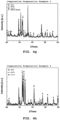
- FIGS. 4a to 4h show the results of X-ray diffraction (XRD) of the cement of each of Preparation Examples 1 to 4 and Comparative Preparation Examples 1 to 4.
- Table 4 below shows the weights of elements of the compositions of the first domain A1, the second domain A2, and the matrix A3 in the cement of Preparation Example 2, as represented in FIG. 1 . [Table 4] Classification FIG.
- the rectangular alite domain, the circular belite domain, and the silicon-doped tricalcium aluminate matrix were distributed. Based on the results of EDS, the domains and the matrix were confirmed to be composed of calcium, silicon, aluminum and oxygen atoms.
- the cement manufactured in Preparation Example 2 was confirmed to include the alite domain, the belite domain and the matrix.
- Si and Al were observed to be distributed in the matrix, and the matrix was observed to be a silicon-doped tricalcium aluminate matrix configured such that aluminum of tricalcium aluminate was substituted with silicon.
- the cement of each of Comparative Preparation Example 3 and Preparation Example 4 was confirmed to include the alite domain, the belite domain, the matrix and silicon oxide.
- silicon oxide was formed in a separate phase, without forming the silicon-doped tricalcium aluminate matrix in which aluminum of tricalcium aluminate was substituted with silicon.
- Test Example 2-2 Shape of mixture after firing process depending on firing temperature
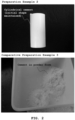
- FIG. 2 shows the image of the cement after the process of firing the mixture prepared in each of Preparation Example 2 and Comparative Preparation Example 3.
- the shape of the mixture after firing varied depending on the temperature at which the mixture was fired.
- Test Example 2-3 Internal image of cement depending on cooling conditions
- FIG. 3 shows internal images of the cement (rapid cooling) manufactured in Preparation Example 2 of the present invention and of the cement (air cooling) manufactured in Comparative Preparation Example 4.
- the internal shape of the cement manufactured in Preparation Example 2 was different from that of the cement manufactured in Comparative Preparation Example 4.
- Test Example 2-4 X-ray diffraction (XRD) analysis
- FIGS. 4a to 4d and FIGS. 4e to 4h show the results of X-ray diffraction (XRD) of the cement of each of Preparation Examples 1 to 4 and Comparative Preparation Examples 1 to 4.
- XRD X-ray diffraction
- the cement manufactured in Preparation Example 1 was confirmed to include the alite domain, the belite domain and the matrix phase.
- the cement of each of Preparation Examples 2 and 3 was confirmed to include the alite domain, the belite domain and the matrix phase.
- the alite domain, the belite domain, and the matrix were formed using the composition of Preparation Example 2, the proportions of distribution of which were as follows: about 58 vol% of the alite domain, about 18 vol% of the belite domain and about 24 vol% of the matrix.
- the specific proportions thereof were as follows: 84.2 parts by weight of calcium oxide and 30.0 parts by weight of silicon dioxide participated in the formation of the alite domain, 23.0 parts by weight of calcium oxide and 12.4 parts by weight of silicon dioxide participated in the formation of the belite domain, and 29.7 parts by weight of calcium oxide and 18 parts by weight of aluminum oxide participated in the formation of the matrix structure.
- 2.1 parts by weight of silicon dioxide remained. If silicon dioxide not participating in the structure formation is present alone, the peak for silicon dioxide is observed upon XRD. As shown in the results of FIG.
- the cement manufactured in Preparation Example 4 appeared to have the alite domain and the belite domain, in which some added silicon dioxide and aluminum oxide phases were observed.
- the cement manufactured in Comparative Preparation Example 1 appeared to have the alite domain and a small amount of the belite domain.
- the cement manufactured in Comparative Preparation Example 3 appeared to have the silicon dioxide phase, in addition to the alite domain, the belite domain and the matrix structure, due to the high firing temperature and the low cooling rate. Furthermore, the belite structure was observed as the main peak, and the amount of the alite domain structure was reduced. Also, based on the results of XRD, the presence of silicon dioxide was deemed to be because silicon resulting from the decomposition of the alite domain or not participating in the structure formation binds to oxygen and is thus provided in the form of stable silicon dioxide, which is observed through XRD. The presence of stable silicon dioxide makes it difficult to dope the matrix structure with silicon, and thus it can be confirmed that the silicon-doped tricalcium aluminate was absent from the matrix of Comparative Preparation Example 3.
- a gypsum mold having a cavity with a diameter of 10 mm and a height of 1 mm was stored in a constant-temperature and constant-humidity chamber at a temperature of 37 ⁇ 1°C and a humidity of 95%, and the cavity thereof was filled with the sample in the constant-temperature and constant-humidity chamber.
- a Gilmore needle having a weight of 100 ⁇ 5 g and a tip diameter of 2 ⁇ 0.1 mm was placed on the surface of the sample for 15 sec, which was repeated until no mark caused thereby was observed with the naked eye.
- the time at which no mark was observed was determined to be the curing time, and was measured three times and averaged. The results are shown in Table 5 below. [Table 5] No. Curing time Example 1 18 min 30 sec Example 2 30 min 15 sec Example 3 18 min Example 4 15 min 10 sec Example 5 17 min Example 7 20 min Comparative Example 1 150 min Comparative Example 2 40 min 50 sec Comparative Example 3 170 min Comparative Example 4 35 min 20 sec Comparative Example 5 23 min 20 sec
- FIG. 5 is a graph showing the results of measurement of pH over time in Test Example 3 regarding the composition of Example 3
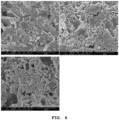
- FIG. 6 shows SEM images over time after curing of the composition of Example 3 according to the present invention
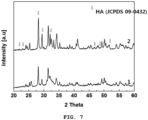
- FIGS. 7(1) and ( 2 ) show the results of XRD of the sample surface 4 weeks after curing of the compositions of Examples 1 and 3 according to the present invention.
- a mold having a diameter of 10 ⁇ 2 mm and a height of 2 ⁇ 1 mm was filled with the sample of Example 3 to afford a test specimen, which was then placed in 20 ml of distilled water, and the pH thereof was measured over time.
- Test Example 5 Evaluation of ability to form hydroxyapatite
- the prepared solution was placed in a 1 L volumetric flask, distilled water was added to the 1 L marking line of the flask, and the flask was placed in a water bath so that the solution temperature was decreased to less than 20°C. When the temperature became less than 20°C, distilled water was added to the 1 L marking line of the flask.
- a mold having a diameter of 10 ⁇ 2 mm and a height of 2 ⁇ 1 mm was filled with the sample of each of Examples 1 and 3 to give a test specimen, the surface area (Sa) of which was then calculated.
- the calculated volume of SBF was placed in a plastic vessel with a lid. Heat was applied until the temperature of the SBF was 36.5°C, and the test specimen was placed therein. Here, the test specimen has to be completely immersed in SBF.
- the SBF containing the test specimen therein was stored at 36.5°C, and the test specimen was periodically taken out and washed with water.
- the washed test specimen was dried in a desiccator at room temperature. The surface of the dried test specimen was observed through SEM and XRD.
- the dental cement according to the present invention exhibited significantly increased ability to form hydroxyapatite when containing bioactive glass.
- Test Example 6 Clinical test for root-canal filling
- a syringe for use in root-canal treatment was filled with the dental composition of Example 3 of the present invention so as to prevent foaming and was equipped with a dispensing tip so that the root canal was filled therewith.
- a microleak may develop and secondary caries attributable to tooth bacteria may occur.
- the extent to which the root canal was filled with the composition of Example 3 was confirmed through radiometry, indicating that fine portions were efficiently filled. Moreover, good radiopacity of the composition is helpful in obtaining information after treatment.
- a dental composition may be a single ointment-type composition comprising cement, a non-aqueous liquid, a radiopaque agent and calcium phosphate, and is thus easy to use and can be improved from the aspects of aesthetic appearance, curability and biocompatibility.
Landscapes
- Health & Medical Sciences (AREA)
- Oral & Maxillofacial Surgery (AREA)
- Life Sciences & Earth Sciences (AREA)
- Epidemiology (AREA)
- Animal Behavior & Ethology (AREA)
- General Health & Medical Sciences (AREA)
- Public Health (AREA)
- Veterinary Medicine (AREA)
- Plastic & Reconstructive Surgery (AREA)
- Inorganic Chemistry (AREA)
- Chemical & Material Sciences (AREA)
- Dental Preparations (AREA)
- Glass Compositions (AREA)
Claims (13)
- Eine Dentalzusammensetzung, umfassend:Zement; undeine nicht-wässrige Flüssigkeit,wobei der Zement enthält:eine erste Domäne, die Alit enthält;eine zweite Domäne, die Belit enthält; undeine Matrix, die angeordnet ist zwischen einer oder mehreren, ausgewählt aus der Gruppe bestehend aus der ersten Domäne und der zweiten Domäne, wobei die Matrix mit Silizium (Si)-Atomen dotiertes Tricalciumaluminat (3CaO·Al2O3) enthält.
- Dentalzusammensetzung nach Anspruch 1, wobei in dem mit Siliziumatomen dotierten Tricalciumaluminat ein Teil der Aluminiumatome des Tricalciumaluminats (3CaO·Al2O3) durch ein Siliziumatom ersetzt ist.
- Dentalzusammensetzung nach Anspruch 1, wobei das Silizium (Si)-dotierte Tricalciumaluminat (3CaO·Al2O3) mit Silizium (Si) in einer Menge von 0,5 bis 15 Gew.-% dotiert ist.
- Dentalzusammensetzung nach Anspruch 1, wobei die Dentalzusammensetzung des Weiteren mindestens eines von einem röntgenopaken Mittel, einer Calciumphosphatverbindung und einem Aushärtungsmodifizierungsmittel umfasst,
wobei das Aushärtungsmodifizierungsmittel mindestens eines, ausgewählt aus Calciumsulfat-Dihydrat, Calciumsulfat-Halbhydrat, Calciumchlorid und Calciumformiat, enthält. - Dentalzusammensetzung nach Anspruch 4, wobei die Dentalzusammensetzung umfasst:100 Gew.-Teile des Zements;10 bis 100 Gewichtsteile der nicht-wässrigen Flüssigkeit; undmindestens eines aus 20 bis 200 Gewichtsteile des röntgenopaken Mittels, 1 bis 30 Gewichtsteile der Calciumphosphatverbindung und 0,1 bis 20 Gewichtsteile des Aushärtungsmodifizierungsmittels.
- Dentalzusammensetzung nach Anspruch 1, wobei die nicht-wässrige Flüssigkeit mindestens eines, ausgewählt aus Ethanol, Propanol, pflanzliches Fett und Öl, tierisches Fett und Öl, Ethylenglykol, Propylenglykol, Polyethylenglykol, Polypropylenglykol und Glycerin, enthält.
- Dentalzusammensetzung nach Anspruch 6, wobei die nicht-wässrige Flüssigkeit Polypropylenglykol enthält.
- Dentalzusammensetzung nach Anspruch 1, wobei die nichtwässrige Flüssigkeit Polypropylenglykol enthält und außerdem mindestens eines, ausgewählt aus Ethanol, Propanol, pflanzliches Fett und Öl, tierisches Fett und Öl, Ethylenglykol, Propylenglykol, Polyethylenglykol und Glycerin, enthält.
- Dentalzusammensetzung nach Anspruch 4, wobei die Calciumphosphatverbindung mindestens eines, ausgewählt aus Calciumphosphat, Dicalciumphosphat, Tricalciumphosphat, Tetracalciumphosphat, Hydroxyapatit, Apatit, Octacalciumphosphat, biphasischem Calciumphosphat, amorphem Calciumphosphat, Caseinphosphopeptidamorphem Calciumphosphat und bioaktivem Glas, enthält.
- Dentalzusammensetzung nach Anspruch 9, wobei die Calciumphosphatverbindung bioaktives Glas ist.
- Dentalzusammensetzung nach Anspruch 10, wobei das bioaktive Glas durch die nachstehende chemische Formel 1 dargestellt wird:
[Chemische Formel 1] (SiO2)x(Na2O)y(CaO)z(P2O5)w
wobei in der chemischen Formel 1 x, y, z und w Molzahlen sind, und 30≤x≤70, 0≤y≤40, 10≤z≤50 und 1≤w≤10 gilt. - Dentalzusammensetzung nach Anspruch 4, wobei das röntgenopake Mittel mindestens eines, ausgewählt aus Zinkoxid, Bariumsulfat, Zirkoniumoxid, Wismutoxid, Bariumoxid, Jodoform, Tantaloxid und Calciumwolframat, enthält.
- Dentalzusammensetzung nach Anspruch 5, wobei die Dentalzusammensetzung des Weiteren 0,1 bis 20 Gewichtsteile eines Viskositätsmodifizierungsmittels umfasst, wobei das Viskositätsmodifizierungsmittel mindestens eines, ausgewählt aus Cellulose, einem Cellulosederivat, Xanthangummi, Polyvinylalkohol, Polyacrylsäure und Polyvinylpyrrolidon, enthält.
Applications Claiming Priority (2)
| Application Number | Priority Date | Filing Date | Title |
|---|---|---|---|
| KR20170028689 | 2017-03-07 | ||
| PCT/KR2018/002598 WO2018164436A1 (ko) | 2017-03-07 | 2018-03-05 | 치과용 조성물 및 그의 제조방법 |
Publications (3)
| Publication Number | Publication Date |
|---|---|
| EP3593785A1 EP3593785A1 (de) | 2020-01-15 |
| EP3593785A4 EP3593785A4 (de) | 2021-01-13 |
| EP3593785B1 true EP3593785B1 (de) | 2023-07-26 |
Family
ID=63447722
Family Applications (1)
| Application Number | Title | Priority Date | Filing Date |
|---|---|---|---|
| EP18763635.2A Active EP3593785B1 (de) | 2017-03-07 | 2018-03-05 | Dentale zusammensetzung |
Country Status (7)
| Country | Link |
|---|---|
| US (1) | US20200009021A1 (de) |
| EP (1) | EP3593785B1 (de) |
| JP (1) | JP7008987B2 (de) |
| KR (1) | KR101898702B1 (de) |
| CN (1) | CN110446483A (de) |
| RU (1) | RU2771163C2 (de) |
| WO (1) | WO2018164436A1 (de) |
Families Citing this family (6)
| Publication number | Priority date | Publication date | Assignee | Title |
|---|---|---|---|---|
| KR101956859B1 (ko) * | 2018-09-06 | 2019-03-11 | (주) 베리콤 | 근관 충전재 조성물 및 그의 제조방법 |
| US11752072B2 (en) * | 2019-03-11 | 2023-09-12 | University Of Utah Research Foundation | Quick set cements for dental pulp capping and related methods of use |
| KR102317901B1 (ko) * | 2019-07-04 | 2021-10-27 | 주식회사 다이아덴트 | 치과용 근관 충전 시멘트 조성물 및 그의 제조방법 |
| CN111631833A (zh) * | 2020-06-23 | 2020-09-08 | 山东建筑大学 | 一种3d打印多涂层抗菌牙齿的制造方法 |
| US20220202659A1 (en) * | 2020-12-29 | 2022-06-30 | Angelus Indústria De Produtos Odontológicos S/a | Medical and Dental Bioceramic Composition for Temporary Use |
| CN114099352B (zh) * | 2021-10-28 | 2023-06-16 | 常州大学 | 一种抗溃散硅钙基根管充填糊剂及其制备方法和应用 |
Family Cites Families (13)
| Publication number | Priority date | Publication date | Assignee | Title |
|---|---|---|---|---|
| RU2197940C1 (ru) * | 2001-08-09 | 2003-02-10 | Общество с ограниченной ответственностью "Радуга-Р" | Материал для пломбирования корневых каналов зуба |
| CN1988923B (zh) * | 2004-04-27 | 2012-10-03 | 凯丰有限责任公司 | 骨替代组合物及其使用方法 |
| JP5046577B2 (ja) * | 2006-07-19 | 2012-10-10 | 株式会社ジーシーデンタルプロダクツ | 歯科用組成物 |
| BRPI0721954B1 (pt) * | 2007-08-23 | 2016-03-29 | Doxa Ab | sistema de cimento dental |
| WO2009038191A1 (ja) * | 2007-09-20 | 2009-03-26 | Kyushu University, National University Corporation | 硬化性組成物 |
| KR20100037979A (ko) * | 2008-10-02 | 2010-04-12 | 이노베이티브 바이오세라믹스 인코퍼레이티드 | 미리 혼합된 시멘트 페이스트 및 시멘트 특성 물질 제조방법 |
| BRPI1001878B1 (pt) * | 2010-01-25 | 2017-03-28 | Angelus Ind De Produtos Odontologicos S/A | composição odontológica compreendendo uma fonte de cálcio |
| JP2013053075A (ja) * | 2011-09-01 | 2013-03-21 | Gc Corp | 歯科用セメント組成物 |
| US20160324738A1 (en) * | 2013-06-10 | 2016-11-10 | The Procter & Gamble Company | Oral Compositions Containing Stannous |
| KR101615622B1 (ko) * | 2014-02-25 | 2016-04-26 | 주식회사 마루치 | 단일 페이스트형 치과용 수경성 충전재 조성물 |
| CN103876944B (zh) * | 2014-03-28 | 2016-05-25 | 北京固琦健康科技有限公司 | 一种牙科用窝沟封闭剂 |
| KR101599229B1 (ko) * | 2014-04-03 | 2016-03-03 | 전남대학교산학협력단 | 치과용 시멘트 조성물 및 이의 제조방법 |
| KR20150144028A (ko) * | 2014-06-16 | 2015-12-24 | 드림소재(주) | 치과용 충전재 |
-
2018
- 2018-03-05 JP JP2019548442A patent/JP7008987B2/ja active Active
- 2018-03-05 RU RU2019131264A patent/RU2771163C2/ru active
- 2018-03-05 WO PCT/KR2018/002598 patent/WO2018164436A1/ko not_active Ceased
- 2018-03-05 KR KR1020180025847A patent/KR101898702B1/ko active Active
- 2018-03-05 CN CN201880016498.7A patent/CN110446483A/zh active Pending
- 2018-03-05 EP EP18763635.2A patent/EP3593785B1/de active Active
- 2018-03-05 US US16/490,799 patent/US20200009021A1/en not_active Abandoned
Also Published As
| Publication number | Publication date |
|---|---|
| RU2019131264A3 (de) | 2021-06-21 |
| RU2771163C2 (ru) | 2022-04-27 |
| WO2018164436A1 (ko) | 2018-09-13 |
| EP3593785A1 (de) | 2020-01-15 |
| JP2020510676A (ja) | 2020-04-09 |
| CN110446483A (zh) | 2019-11-12 |
| JP7008987B2 (ja) | 2022-02-10 |
| KR101898702B1 (ko) | 2018-09-13 |
| EP3593785A4 (de) | 2021-01-13 |
| US20200009021A1 (en) | 2020-01-09 |
| RU2019131264A (ru) | 2021-04-07 |
Similar Documents
| Publication | Publication Date | Title |
|---|---|---|
| EP3593785A1 (de) | Dentale zusammensetzung und herstellungsverfahren dafür | |
| Parreira et al. | Calcium aluminate cement-based compositions for biomaterial applications | |
| Oliveira et al. | Bioactivity of calcium aluminate endodontic cement | |
| JP4647603B2 (ja) | 歯科用セメントや関連した骨セメントに使用するホスホシリケートスラリーを得るための方法と製造物 | |
| EP3111913B1 (de) | Hydraulisch abbindende dentale füllstoffzusammensetzung aus einer einzelnen paste | |
| EP1945233B1 (de) | Doppelphasen-zement-vorläufersysteme zur knochenreparatur | |
| US20220117855A2 (en) | Dental composition and preparation method therefor | |
| CN112843341A (zh) | 一种可注射性硅酸钙基自固化生物陶瓷、制备方法及其应用 | |
| US11964030B2 (en) | Root canal filler composition and method for preparing same | |
| US9445973B2 (en) | Dental filling composition comprising zirconia powder | |
| Dahinten et al. | Evaluation of baghdadite (Ca3ZrSi2O9) cements for the application as novel endodontic filling materials | |
| Sadhasivam et al. | Synthesis of partial stabilized cement–gypsum as new dental retrograde filling material | |
| Kazuz et al. | α-Tricalcium phosphate/fluorapatite-based cement–Promising dental root canal filling material | |
| JPH078548A (ja) | 硬化性生体用粉材 | |
| JPH0513901B2 (de) | ||
| JP7165610B2 (ja) | 歯科用ケイ酸塩-リン酸塩系ガラス材料 | |
| JP2742814B2 (ja) | 根管充填材 | |
| Medri et al. | Doped calcium–aluminium–phosphate cements for biomedical applications | |
| Megasari et al. | The evaluation of setting time and ftir spectroscopy of carbonate apatite cement as endodontic sealer | |
| JP2754245B2 (ja) | 根管充填材 | |
| KR102910225B1 (ko) | 치과용 근관 충전재 조성물 및 이의 제조방법 | |
| Bilvinaite et al. | A laboratory study to assess the physico-chemical properties of hydraulic calcium silicate-based sealer modified with hydroxyapatite | |
| KR20210056818A (ko) | 단일 페이스트형 치과용 근관 충전재 조성물 | |
| US20240197575A1 (en) | Premixed barium silicate cement for dental and medical applications, and methods of use | |
| US20250032367A1 (en) | Barium silicate cement for dental and medical applications, and methods of use |
Legal Events
| Date | Code | Title | Description |
|---|---|---|---|
| STAA | Information on the status of an ep patent application or granted ep patent |
Free format text: STATUS: THE INTERNATIONAL PUBLICATION HAS BEEN MADE |
|
| PUAI | Public reference made under article 153(3) epc to a published international application that has entered the european phase |
Free format text: ORIGINAL CODE: 0009012 |
|
| STAA | Information on the status of an ep patent application or granted ep patent |
Free format text: STATUS: REQUEST FOR EXAMINATION WAS MADE |
|
| 17P | Request for examination filed |
Effective date: 20190814 |
|
| AK | Designated contracting states |
Kind code of ref document: A1 Designated state(s): AL AT BE BG CH CY CZ DE DK EE ES FI FR GB GR HR HU IE IS IT LI LT LU LV MC MK MT NL NO PL PT RO RS SE SI SK SM TR |
|
| AX | Request for extension of the european patent |
Extension state: BA ME |
|
| DAV | Request for validation of the european patent (deleted) | ||
| DAX | Request for extension of the european patent (deleted) | ||
| RIC1 | Information provided on ipc code assigned before grant |
Ipc: A61K 6/851 20200101AFI20201110BHEP Ipc: A61K 6/54 20200101ALI20201110BHEP |
|
| A4 | Supplementary search report drawn up and despatched |
Effective date: 20201211 |
|
| RIC1 | Information provided on ipc code assigned before grant |
Ipc: A61K 6/54 20200101ALI20201207BHEP Ipc: A61K 6/851 20200101AFI20201207BHEP |
|
| REG | Reference to a national code |
Ref country code: DE Ref legal event code: R079 Free format text: PREVIOUS MAIN CLASS: A61K0006060000 Ipc: A61K0006851000 Ref document number: 602018054086 Country of ref document: DE |
|
| GRAP | Despatch of communication of intention to grant a patent |
Free format text: ORIGINAL CODE: EPIDOSNIGR1 |
|
| STAA | Information on the status of an ep patent application or granted ep patent |
Free format text: STATUS: GRANT OF PATENT IS INTENDED |
|
| RIC1 | Information provided on ipc code assigned before grant |
Ipc: A61K 6/836 20200101ALI20230201BHEP Ipc: A61K 6/849 20200101ALI20230201BHEP Ipc: A61K 6/54 20200101ALI20230201BHEP Ipc: A61K 6/851 20200101AFI20230201BHEP |
|
| INTG | Intention to grant announced |
Effective date: 20230214 |
|
| GRAS | Grant fee paid |
Free format text: ORIGINAL CODE: EPIDOSNIGR3 |
|
| P01 | Opt-out of the competence of the unified patent court (upc) registered |
Effective date: 20230413 |
|
| GRAA | (expected) grant |
Free format text: ORIGINAL CODE: 0009210 |
|
| STAA | Information on the status of an ep patent application or granted ep patent |
Free format text: STATUS: THE PATENT HAS BEEN GRANTED |
|
| AK | Designated contracting states |
Kind code of ref document: B1 Designated state(s): AL AT BE BG CH CY CZ DE DK EE ES FI FR GB GR HR HU IE IS IT LI LT LU LV MC MK MT NL NO PL PT RO RS SE SI SK SM TR |
|
| REG | Reference to a national code |
Ref country code: CH Ref legal event code: EP |
|
| REG | Reference to a national code |
Ref country code: IE Ref legal event code: FG4D |
|
| REG | Reference to a national code |
Ref country code: DE Ref legal event code: R096 Ref document number: 602018054086 Country of ref document: DE |
|
| REG | Reference to a national code |
Ref country code: LT Ref legal event code: MG9D |
|
| REG | Reference to a national code |
Ref country code: NL Ref legal event code: MP Effective date: 20230726 |
|
| REG | Reference to a national code |
Ref country code: AT Ref legal event code: MK05 Ref document number: 1591120 Country of ref document: AT Kind code of ref document: T Effective date: 20230726 |
|
| PG25 | Lapsed in a contracting state [announced via postgrant information from national office to epo] |
Ref country code: NL Free format text: LAPSE BECAUSE OF FAILURE TO SUBMIT A TRANSLATION OF THE DESCRIPTION OR TO PAY THE FEE WITHIN THE PRESCRIBED TIME-LIMIT Effective date: 20230726 |
|
| PG25 | Lapsed in a contracting state [announced via postgrant information from national office to epo] |
Ref country code: GR Free format text: LAPSE BECAUSE OF FAILURE TO SUBMIT A TRANSLATION OF THE DESCRIPTION OR TO PAY THE FEE WITHIN THE PRESCRIBED TIME-LIMIT Effective date: 20231027 |
|
| PG25 | Lapsed in a contracting state [announced via postgrant information from national office to epo] |
Ref country code: IS Free format text: LAPSE BECAUSE OF FAILURE TO SUBMIT A TRANSLATION OF THE DESCRIPTION OR TO PAY THE FEE WITHIN THE PRESCRIBED TIME-LIMIT Effective date: 20231126 |
|
| PG25 | Lapsed in a contracting state [announced via postgrant information from national office to epo] |
Ref country code: SE Free format text: LAPSE BECAUSE OF FAILURE TO SUBMIT A TRANSLATION OF THE DESCRIPTION OR TO PAY THE FEE WITHIN THE PRESCRIBED TIME-LIMIT Effective date: 20230726 Ref country code: RS Free format text: LAPSE BECAUSE OF FAILURE TO SUBMIT A TRANSLATION OF THE DESCRIPTION OR TO PAY THE FEE WITHIN THE PRESCRIBED TIME-LIMIT Effective date: 20230726 Ref country code: PT Free format text: LAPSE BECAUSE OF FAILURE TO SUBMIT A TRANSLATION OF THE DESCRIPTION OR TO PAY THE FEE WITHIN THE PRESCRIBED TIME-LIMIT Effective date: 20231127 Ref country code: NO Free format text: LAPSE BECAUSE OF FAILURE TO SUBMIT A TRANSLATION OF THE DESCRIPTION OR TO PAY THE FEE WITHIN THE PRESCRIBED TIME-LIMIT Effective date: 20231026 Ref country code: LV Free format text: LAPSE BECAUSE OF FAILURE TO SUBMIT A TRANSLATION OF THE DESCRIPTION OR TO PAY THE FEE WITHIN THE PRESCRIBED TIME-LIMIT Effective date: 20230726 Ref country code: LT Free format text: LAPSE BECAUSE OF FAILURE TO SUBMIT A TRANSLATION OF THE DESCRIPTION OR TO PAY THE FEE WITHIN THE PRESCRIBED TIME-LIMIT Effective date: 20230726 Ref country code: IS Free format text: LAPSE BECAUSE OF FAILURE TO SUBMIT A TRANSLATION OF THE DESCRIPTION OR TO PAY THE FEE WITHIN THE PRESCRIBED TIME-LIMIT Effective date: 20231126 Ref country code: HR Free format text: LAPSE BECAUSE OF FAILURE TO SUBMIT A TRANSLATION OF THE DESCRIPTION OR TO PAY THE FEE WITHIN THE PRESCRIBED TIME-LIMIT Effective date: 20230726 Ref country code: GR Free format text: LAPSE BECAUSE OF FAILURE TO SUBMIT A TRANSLATION OF THE DESCRIPTION OR TO PAY THE FEE WITHIN THE PRESCRIBED TIME-LIMIT Effective date: 20231027 Ref country code: FI Free format text: LAPSE BECAUSE OF FAILURE TO SUBMIT A TRANSLATION OF THE DESCRIPTION OR TO PAY THE FEE WITHIN THE PRESCRIBED TIME-LIMIT Effective date: 20230726 Ref country code: AT Free format text: LAPSE BECAUSE OF FAILURE TO SUBMIT A TRANSLATION OF THE DESCRIPTION OR TO PAY THE FEE WITHIN THE PRESCRIBED TIME-LIMIT Effective date: 20230726 |
|
| PG25 | Lapsed in a contracting state [announced via postgrant information from national office to epo] |
Ref country code: PL Free format text: LAPSE BECAUSE OF FAILURE TO SUBMIT A TRANSLATION OF THE DESCRIPTION OR TO PAY THE FEE WITHIN THE PRESCRIBED TIME-LIMIT Effective date: 20230726 |
|
| PG25 | Lapsed in a contracting state [announced via postgrant information from national office to epo] |
Ref country code: ES Free format text: LAPSE BECAUSE OF FAILURE TO SUBMIT A TRANSLATION OF THE DESCRIPTION OR TO PAY THE FEE WITHIN THE PRESCRIBED TIME-LIMIT Effective date: 20230726 |
|
| REG | Reference to a national code |
Ref country code: DE Ref legal event code: R097 Ref document number: 602018054086 Country of ref document: DE |
|
| PG25 | Lapsed in a contracting state [announced via postgrant information from national office to epo] |
Ref country code: SM Free format text: LAPSE BECAUSE OF FAILURE TO SUBMIT A TRANSLATION OF THE DESCRIPTION OR TO PAY THE FEE WITHIN THE PRESCRIBED TIME-LIMIT Effective date: 20230726 Ref country code: RO Free format text: LAPSE BECAUSE OF FAILURE TO SUBMIT A TRANSLATION OF THE DESCRIPTION OR TO PAY THE FEE WITHIN THE PRESCRIBED TIME-LIMIT Effective date: 20230726 Ref country code: ES Free format text: LAPSE BECAUSE OF FAILURE TO SUBMIT A TRANSLATION OF THE DESCRIPTION OR TO PAY THE FEE WITHIN THE PRESCRIBED TIME-LIMIT Effective date: 20230726 Ref country code: EE Free format text: LAPSE BECAUSE OF FAILURE TO SUBMIT A TRANSLATION OF THE DESCRIPTION OR TO PAY THE FEE WITHIN THE PRESCRIBED TIME-LIMIT Effective date: 20230726 Ref country code: DK Free format text: LAPSE BECAUSE OF FAILURE TO SUBMIT A TRANSLATION OF THE DESCRIPTION OR TO PAY THE FEE WITHIN THE PRESCRIBED TIME-LIMIT Effective date: 20230726 Ref country code: CZ Free format text: LAPSE BECAUSE OF FAILURE TO SUBMIT A TRANSLATION OF THE DESCRIPTION OR TO PAY THE FEE WITHIN THE PRESCRIBED TIME-LIMIT Effective date: 20230726 Ref country code: SK Free format text: LAPSE BECAUSE OF FAILURE TO SUBMIT A TRANSLATION OF THE DESCRIPTION OR TO PAY THE FEE WITHIN THE PRESCRIBED TIME-LIMIT Effective date: 20230726 |
|
| PG25 | Lapsed in a contracting state [announced via postgrant information from national office to epo] |
Ref country code: IT Free format text: LAPSE BECAUSE OF FAILURE TO SUBMIT A TRANSLATION OF THE DESCRIPTION OR TO PAY THE FEE WITHIN THE PRESCRIBED TIME-LIMIT Effective date: 20230726 |
|
| PLBE | No opposition filed within time limit |
Free format text: ORIGINAL CODE: 0009261 |
|
| STAA | Information on the status of an ep patent application or granted ep patent |
Free format text: STATUS: NO OPPOSITION FILED WITHIN TIME LIMIT |
|
| 26N | No opposition filed |
Effective date: 20240429 |
|
| PG25 | Lapsed in a contracting state [announced via postgrant information from national office to epo] |
Ref country code: SI Free format text: LAPSE BECAUSE OF FAILURE TO SUBMIT A TRANSLATION OF THE DESCRIPTION OR TO PAY THE FEE WITHIN THE PRESCRIBED TIME-LIMIT Effective date: 20230726 |
|
| REG | Reference to a national code |
Ref country code: CH Ref legal event code: PL |
|
| PG25 | Lapsed in a contracting state [announced via postgrant information from national office to epo] |
Ref country code: BG Free format text: LAPSE BECAUSE OF FAILURE TO SUBMIT A TRANSLATION OF THE DESCRIPTION OR TO PAY THE FEE WITHIN THE PRESCRIBED TIME-LIMIT Effective date: 20230726 |
|
| PG25 | Lapsed in a contracting state [announced via postgrant information from national office to epo] |
Ref country code: LU Free format text: LAPSE BECAUSE OF NON-PAYMENT OF DUE FEES Effective date: 20240305 |
|
| PG25 | Lapsed in a contracting state [announced via postgrant information from national office to epo] |
Ref country code: MC Free format text: LAPSE BECAUSE OF FAILURE TO SUBMIT A TRANSLATION OF THE DESCRIPTION OR TO PAY THE FEE WITHIN THE PRESCRIBED TIME-LIMIT Effective date: 20230726 |
|
| PG25 | Lapsed in a contracting state [announced via postgrant information from national office to epo] |
Ref country code: MC Free format text: LAPSE BECAUSE OF FAILURE TO SUBMIT A TRANSLATION OF THE DESCRIPTION OR TO PAY THE FEE WITHIN THE PRESCRIBED TIME-LIMIT Effective date: 20230726 Ref country code: LU Free format text: LAPSE BECAUSE OF NON-PAYMENT OF DUE FEES Effective date: 20240305 Ref country code: BG Free format text: LAPSE BECAUSE OF FAILURE TO SUBMIT A TRANSLATION OF THE DESCRIPTION OR TO PAY THE FEE WITHIN THE PRESCRIBED TIME-LIMIT Effective date: 20230726 |
|
| REG | Reference to a national code |
Ref country code: BE Ref legal event code: MM Effective date: 20240331 |
|
| PG25 | Lapsed in a contracting state [announced via postgrant information from national office to epo] |
Ref country code: BE Free format text: LAPSE BECAUSE OF NON-PAYMENT OF DUE FEES Effective date: 20240331 |
|
| PG25 | Lapsed in a contracting state [announced via postgrant information from national office to epo] |
Ref country code: IE Free format text: LAPSE BECAUSE OF NON-PAYMENT OF DUE FEES Effective date: 20240305 |
|
| PG25 | Lapsed in a contracting state [announced via postgrant information from national office to epo] |
Ref country code: IE Free format text: LAPSE BECAUSE OF NON-PAYMENT OF DUE FEES Effective date: 20240305 Ref country code: BE Free format text: LAPSE BECAUSE OF NON-PAYMENT OF DUE FEES Effective date: 20240331 Ref country code: CH Free format text: LAPSE BECAUSE OF NON-PAYMENT OF DUE FEES Effective date: 20240331 |
|
| PGFP | Annual fee paid to national office [announced via postgrant information from national office to epo] |
Ref country code: DE Payment date: 20250328 Year of fee payment: 8 |
|
| PG25 | Lapsed in a contracting state [announced via postgrant information from national office to epo] |
Ref country code: CY Free format text: LAPSE BECAUSE OF FAILURE TO SUBMIT A TRANSLATION OF THE DESCRIPTION OR TO PAY THE FEE WITHIN THE PRESCRIBED TIME-LIMIT; INVALID AB INITIO Effective date: 20180305 |
|
| PG25 | Lapsed in a contracting state [announced via postgrant information from national office to epo] |
Ref country code: HU Free format text: LAPSE BECAUSE OF FAILURE TO SUBMIT A TRANSLATION OF THE DESCRIPTION OR TO PAY THE FEE WITHIN THE PRESCRIBED TIME-LIMIT; INVALID AB INITIO Effective date: 20180305 |
|
| PG25 | Lapsed in a contracting state [announced via postgrant information from national office to epo] |
Ref country code: TR Free format text: LAPSE BECAUSE OF FAILURE TO SUBMIT A TRANSLATION OF THE DESCRIPTION OR TO PAY THE FEE WITHIN THE PRESCRIBED TIME-LIMIT Effective date: 20230726 |
|
| PGFP | Annual fee paid to national office [announced via postgrant information from national office to epo] |
Ref country code: GB Payment date: 20260324 Year of fee payment: 9 |
|
| PGFP | Annual fee paid to national office [announced via postgrant information from national office to epo] |
Ref country code: FR Payment date: 20260320 Year of fee payment: 9 |