EP3587102B1 - Funktionales laminat und herstellungsverfahren dafür - Google Patents
Funktionales laminat und herstellungsverfahren dafür Download PDFInfo
- Publication number
- EP3587102B1 EP3587102B1 EP18775920.4A EP18775920A EP3587102B1 EP 3587102 B1 EP3587102 B1 EP 3587102B1 EP 18775920 A EP18775920 A EP 18775920A EP 3587102 B1 EP3587102 B1 EP 3587102B1
- Authority
- EP
- European Patent Office
- Prior art keywords
- layer
- porous
- intermediate layer
- functional laminate
- nonwoven fabric
- Prior art date
- Legal status (The legal status is an assumption and is not a legal conclusion. Google has not performed a legal analysis and makes no representation as to the accuracy of the status listed.)
- Active
Links
Images

Classifications
-
- B—PERFORMING OPERATIONS; TRANSPORTING
- B32—LAYERED PRODUCTS
- B32B—LAYERED PRODUCTS, i.e. PRODUCTS BUILT-UP OF STRATA OF FLAT OR NON-FLAT, e.g. CELLULAR OR HONEYCOMB, FORM
- B32B5/00—Layered products characterised by the non- homogeneity or physical structure, i.e. comprising a fibrous, filamentary, particulate or foam layer; Layered products characterised by having a layer differing constitutionally or physically in different parts
- B32B5/22—Layered products characterised by the non- homogeneity or physical structure, i.e. comprising a fibrous, filamentary, particulate or foam layer; Layered products characterised by having a layer differing constitutionally or physically in different parts characterised by the presence of two or more layers which are next to each other and are fibrous, filamentary, formed of particles or foamed
- B32B5/24—Layered products characterised by the non- homogeneity or physical structure, i.e. comprising a fibrous, filamentary, particulate or foam layer; Layered products characterised by having a layer differing constitutionally or physically in different parts characterised by the presence of two or more layers which are next to each other and are fibrous, filamentary, formed of particles or foamed one layer being a fibrous or filamentary layer
- B32B5/245—Layered products characterised by the non- homogeneity or physical structure, i.e. comprising a fibrous, filamentary, particulate or foam layer; Layered products characterised by having a layer differing constitutionally or physically in different parts characterised by the presence of two or more layers which are next to each other and are fibrous, filamentary, formed of particles or foamed one layer being a fibrous or filamentary layer another layer next to it being a foam layer
-
- G—PHYSICS
- G10—MUSICAL INSTRUMENTS; ACOUSTICS
- G10K—SOUND-PRODUCING DEVICES; METHODS OR DEVICES FOR PROTECTING AGAINST, OR FOR DAMPING, NOISE OR OTHER ACOUSTIC WAVES IN GENERAL; ACOUSTICS NOT OTHERWISE PROVIDED FOR
- G10K11/00—Methods or devices for transmitting, conducting or directing sound in general; Methods or devices for protecting against, or for damping, noise or other acoustic waves in general
- G10K11/16—Methods or devices for protecting against, or for damping, noise or other acoustic waves in general
- G10K11/162—Selection of materials
- G10K11/168—Plural layers of different materials, e.g. sandwiches
-
- B—PERFORMING OPERATIONS; TRANSPORTING
- B29—WORKING OF PLASTICS; WORKING OF SUBSTANCES IN A PLASTIC STATE IN GENERAL
- B29C—SHAPING OR JOINING OF PLASTICS; SHAPING OF MATERIAL IN A PLASTIC STATE, NOT OTHERWISE PROVIDED FOR; AFTER-TREATMENT OF THE SHAPED PRODUCTS, e.g. REPAIRING
- B29C44/00—Shaping by internal pressure generated in the material, e.g. swelling or foaming ; Producing porous or cellular expanded plastics articles
- B29C44/02—Shaping by internal pressure generated in the material, e.g. swelling or foaming ; Producing porous or cellular expanded plastics articles for articles of definite length, i.e. discrete articles
- B29C44/12—Incorporating or moulding on preformed parts, e.g. inserts or reinforcements
- B29C44/14—Incorporating or moulding on preformed parts, e.g. inserts or reinforcements the preformed part being a lining
-
- B—PERFORMING OPERATIONS; TRANSPORTING
- B32—LAYERED PRODUCTS
- B32B—LAYERED PRODUCTS, i.e. PRODUCTS BUILT-UP OF STRATA OF FLAT OR NON-FLAT, e.g. CELLULAR OR HONEYCOMB, FORM
- B32B37/00—Methods or apparatus for laminating, e.g. by curing or by ultrasonic bonding
- B32B37/02—Methods or apparatus for laminating, e.g. by curing or by ultrasonic bonding characterised by a sequence of laminating steps, e.g. by adding new layers at consecutive laminating stations
-
- B—PERFORMING OPERATIONS; TRANSPORTING
- B32—LAYERED PRODUCTS
- B32B—LAYERED PRODUCTS, i.e. PRODUCTS BUILT-UP OF STRATA OF FLAT OR NON-FLAT, e.g. CELLULAR OR HONEYCOMB, FORM
- B32B37/00—Methods or apparatus for laminating, e.g. by curing or by ultrasonic bonding
- B32B37/14—Methods or apparatus for laminating, e.g. by curing or by ultrasonic bonding characterised by the properties of the layers
- B32B37/15—Methods or apparatus for laminating, e.g. by curing or by ultrasonic bonding characterised by the properties of the layers with at least one layer being manufactured and immediately laminated before reaching its stable state, e.g. in which a layer is extruded and laminated while in semi-molten state
-
- B—PERFORMING OPERATIONS; TRANSPORTING
- B32—LAYERED PRODUCTS
- B32B—LAYERED PRODUCTS, i.e. PRODUCTS BUILT-UP OF STRATA OF FLAT OR NON-FLAT, e.g. CELLULAR OR HONEYCOMB, FORM
- B32B5/00—Layered products characterised by the non- homogeneity or physical structure, i.e. comprising a fibrous, filamentary, particulate or foam layer; Layered products characterised by having a layer differing constitutionally or physically in different parts
- B32B5/02—Layered products characterised by the non- homogeneity or physical structure, i.e. comprising a fibrous, filamentary, particulate or foam layer; Layered products characterised by having a layer differing constitutionally or physically in different parts characterised by structural features of a fibrous or filamentary layer
- B32B5/022—Non-woven fabric
-
- B—PERFORMING OPERATIONS; TRANSPORTING
- B32—LAYERED PRODUCTS
- B32B—LAYERED PRODUCTS, i.e. PRODUCTS BUILT-UP OF STRATA OF FLAT OR NON-FLAT, e.g. CELLULAR OR HONEYCOMB, FORM
- B32B5/00—Layered products characterised by the non- homogeneity or physical structure, i.e. comprising a fibrous, filamentary, particulate or foam layer; Layered products characterised by having a layer differing constitutionally or physically in different parts
- B32B5/14—Layered products characterised by the non- homogeneity or physical structure, i.e. comprising a fibrous, filamentary, particulate or foam layer; Layered products characterised by having a layer differing constitutionally or physically in different parts characterised by a layer differing constitutionally or physically in different parts, e.g. denser near its faces
- B32B5/147—Layered products characterised by the non- homogeneity or physical structure, i.e. comprising a fibrous, filamentary, particulate or foam layer; Layered products characterised by having a layer differing constitutionally or physically in different parts characterised by a layer differing constitutionally or physically in different parts, e.g. denser near its faces by treatment of the layer
-
- B—PERFORMING OPERATIONS; TRANSPORTING
- B32—LAYERED PRODUCTS
- B32B—LAYERED PRODUCTS, i.e. PRODUCTS BUILT-UP OF STRATA OF FLAT OR NON-FLAT, e.g. CELLULAR OR HONEYCOMB, FORM
- B32B5/00—Layered products characterised by the non- homogeneity or physical structure, i.e. comprising a fibrous, filamentary, particulate or foam layer; Layered products characterised by having a layer differing constitutionally or physically in different parts
- B32B5/18—Layered products characterised by the non- homogeneity or physical structure, i.e. comprising a fibrous, filamentary, particulate or foam layer; Layered products characterised by having a layer differing constitutionally or physically in different parts characterised by features of a layer of foamed material
-
- B—PERFORMING OPERATIONS; TRANSPORTING
- B32—LAYERED PRODUCTS
- B32B—LAYERED PRODUCTS, i.e. PRODUCTS BUILT-UP OF STRATA OF FLAT OR NON-FLAT, e.g. CELLULAR OR HONEYCOMB, FORM
- B32B5/00—Layered products characterised by the non- homogeneity or physical structure, i.e. comprising a fibrous, filamentary, particulate or foam layer; Layered products characterised by having a layer differing constitutionally or physically in different parts
- B32B5/18—Layered products characterised by the non- homogeneity or physical structure, i.e. comprising a fibrous, filamentary, particulate or foam layer; Layered products characterised by having a layer differing constitutionally or physically in different parts characterised by features of a layer of foamed material
- B32B5/20—Layered products characterised by the non- homogeneity or physical structure, i.e. comprising a fibrous, filamentary, particulate or foam layer; Layered products characterised by having a layer differing constitutionally or physically in different parts characterised by features of a layer of foamed material foamed in situ
-
- B—PERFORMING OPERATIONS; TRANSPORTING
- B32—LAYERED PRODUCTS
- B32B—LAYERED PRODUCTS, i.e. PRODUCTS BUILT-UP OF STRATA OF FLAT OR NON-FLAT, e.g. CELLULAR OR HONEYCOMB, FORM
- B32B5/00—Layered products characterised by the non- homogeneity or physical structure, i.e. comprising a fibrous, filamentary, particulate or foam layer; Layered products characterised by having a layer differing constitutionally or physically in different parts
- B32B5/22—Layered products characterised by the non- homogeneity or physical structure, i.e. comprising a fibrous, filamentary, particulate or foam layer; Layered products characterised by having a layer differing constitutionally or physically in different parts characterised by the presence of two or more layers which are next to each other and are fibrous, filamentary, formed of particles or foamed
- B32B5/24—Layered products characterised by the non- homogeneity or physical structure, i.e. comprising a fibrous, filamentary, particulate or foam layer; Layered products characterised by having a layer differing constitutionally or physically in different parts characterised by the presence of two or more layers which are next to each other and are fibrous, filamentary, formed of particles or foamed one layer being a fibrous or filamentary layer
-
- B—PERFORMING OPERATIONS; TRANSPORTING
- B32—LAYERED PRODUCTS
- B32B—LAYERED PRODUCTS, i.e. PRODUCTS BUILT-UP OF STRATA OF FLAT OR NON-FLAT, e.g. CELLULAR OR HONEYCOMB, FORM
- B32B5/00—Layered products characterised by the non- homogeneity or physical structure, i.e. comprising a fibrous, filamentary, particulate or foam layer; Layered products characterised by having a layer differing constitutionally or physically in different parts
- B32B5/22—Layered products characterised by the non- homogeneity or physical structure, i.e. comprising a fibrous, filamentary, particulate or foam layer; Layered products characterised by having a layer differing constitutionally or physically in different parts characterised by the presence of two or more layers which are next to each other and are fibrous, filamentary, formed of particles or foamed
- B32B5/24—Layered products characterised by the non- homogeneity or physical structure, i.e. comprising a fibrous, filamentary, particulate or foam layer; Layered products characterised by having a layer differing constitutionally or physically in different parts characterised by the presence of two or more layers which are next to each other and are fibrous, filamentary, formed of particles or foamed one layer being a fibrous or filamentary layer
- B32B5/26—Layered products characterised by the non- homogeneity or physical structure, i.e. comprising a fibrous, filamentary, particulate or foam layer; Layered products characterised by having a layer differing constitutionally or physically in different parts characterised by the presence of two or more layers which are next to each other and are fibrous, filamentary, formed of particles or foamed one layer being a fibrous or filamentary layer another layer next to it also being fibrous or filamentary
-
- B—PERFORMING OPERATIONS; TRANSPORTING
- B32—LAYERED PRODUCTS
- B32B—LAYERED PRODUCTS, i.e. PRODUCTS BUILT-UP OF STRATA OF FLAT OR NON-FLAT, e.g. CELLULAR OR HONEYCOMB, FORM
- B32B5/00—Layered products characterised by the non- homogeneity or physical structure, i.e. comprising a fibrous, filamentary, particulate or foam layer; Layered products characterised by having a layer differing constitutionally or physically in different parts
- B32B5/22—Layered products characterised by the non- homogeneity or physical structure, i.e. comprising a fibrous, filamentary, particulate or foam layer; Layered products characterised by having a layer differing constitutionally or physically in different parts characterised by the presence of two or more layers which are next to each other and are fibrous, filamentary, formed of particles or foamed
- B32B5/32—Layered products characterised by the non- homogeneity or physical structure, i.e. comprising a fibrous, filamentary, particulate or foam layer; Layered products characterised by having a layer differing constitutionally or physically in different parts characterised by the presence of two or more layers which are next to each other and are fibrous, filamentary, formed of particles or foamed at least two layers being foamed and next to each other
-
- B—PERFORMING OPERATIONS; TRANSPORTING
- B32—LAYERED PRODUCTS
- B32B—LAYERED PRODUCTS, i.e. PRODUCTS BUILT-UP OF STRATA OF FLAT OR NON-FLAT, e.g. CELLULAR OR HONEYCOMB, FORM
- B32B7/00—Layered products characterised by the relation between layers; Layered products characterised by the relative orientation of features between layers, or by the relative values of a measurable parameter between layers, i.e. products comprising layers having different physical, chemical or physicochemical properties; Layered products characterised by the interconnection of layers
- B32B7/02—Physical, chemical or physicochemical properties
-
- B—PERFORMING OPERATIONS; TRANSPORTING
- B32—LAYERED PRODUCTS
- B32B—LAYERED PRODUCTS, i.e. PRODUCTS BUILT-UP OF STRATA OF FLAT OR NON-FLAT, e.g. CELLULAR OR HONEYCOMB, FORM
- B32B7/00—Layered products characterised by the relation between layers; Layered products characterised by the relative orientation of features between layers, or by the relative values of a measurable parameter between layers, i.e. products comprising layers having different physical, chemical or physicochemical properties; Layered products characterised by the interconnection of layers
- B32B7/04—Interconnection of layers
- B32B7/12—Interconnection of layers using interposed adhesives or interposed materials with bonding properties
-
- B—PERFORMING OPERATIONS; TRANSPORTING
- B60—VEHICLES IN GENERAL
- B60R—VEHICLES, VEHICLE FITTINGS, OR VEHICLE PARTS, NOT OTHERWISE PROVIDED FOR
- B60R13/00—Elements for body-finishing, identifying, or decorating; Arrangements or adaptations for advertising purposes
- B60R13/08—Insulating elements, e.g. for sound insulation
-
- B—PERFORMING OPERATIONS; TRANSPORTING
- B32—LAYERED PRODUCTS
- B32B—LAYERED PRODUCTS, i.e. PRODUCTS BUILT-UP OF STRATA OF FLAT OR NON-FLAT, e.g. CELLULAR OR HONEYCOMB, FORM
- B32B2250/00—Layers arrangement
- B32B2250/03—3 layers
-
- B—PERFORMING OPERATIONS; TRANSPORTING
- B32—LAYERED PRODUCTS
- B32B—LAYERED PRODUCTS, i.e. PRODUCTS BUILT-UP OF STRATA OF FLAT OR NON-FLAT, e.g. CELLULAR OR HONEYCOMB, FORM
- B32B2260/00—Layered product comprising an impregnated, embedded, or bonded layer wherein the layer comprises an impregnation, embedding, or binder material
- B32B2260/02—Composition of the impregnated, bonded or embedded layer
- B32B2260/021—Fibrous or filamentary layer
- B32B2260/023—Two or more layers
-
- B—PERFORMING OPERATIONS; TRANSPORTING
- B32—LAYERED PRODUCTS
- B32B—LAYERED PRODUCTS, i.e. PRODUCTS BUILT-UP OF STRATA OF FLAT OR NON-FLAT, e.g. CELLULAR OR HONEYCOMB, FORM
- B32B2260/00—Layered product comprising an impregnated, embedded, or bonded layer wherein the layer comprises an impregnation, embedding, or binder material
- B32B2260/04—Impregnation, embedding, or binder material
- B32B2260/046—Synthetic resin
-
- B—PERFORMING OPERATIONS; TRANSPORTING
- B32—LAYERED PRODUCTS
- B32B—LAYERED PRODUCTS, i.e. PRODUCTS BUILT-UP OF STRATA OF FLAT OR NON-FLAT, e.g. CELLULAR OR HONEYCOMB, FORM
- B32B2262/00—Composition or structural features of fibres which form a fibrous or filamentary layer or are present as additives
- B32B2262/02—Synthetic macromolecular fibres
- B32B2262/0276—Polyester fibres
- B32B2262/0284—Polyethylene terephthalate [PET] or polybutylene terephthalate [PBT]
-
- B—PERFORMING OPERATIONS; TRANSPORTING
- B32—LAYERED PRODUCTS
- B32B—LAYERED PRODUCTS, i.e. PRODUCTS BUILT-UP OF STRATA OF FLAT OR NON-FLAT, e.g. CELLULAR OR HONEYCOMB, FORM
- B32B2262/00—Composition or structural features of fibres which form a fibrous or filamentary layer or are present as additives
- B32B2262/10—Inorganic fibres
- B32B2262/101—Glass fibres
-
- B—PERFORMING OPERATIONS; TRANSPORTING
- B32—LAYERED PRODUCTS
- B32B—LAYERED PRODUCTS, i.e. PRODUCTS BUILT-UP OF STRATA OF FLAT OR NON-FLAT, e.g. CELLULAR OR HONEYCOMB, FORM
- B32B2266/00—Composition of foam
- B32B2266/02—Organic
- B32B2266/0214—Materials belonging to B32B27/00
- B32B2266/0221—Vinyl resin
- B32B2266/0235—Vinyl halide, e.g. PVC, PVDC, PVF, PVDF
-
- B—PERFORMING OPERATIONS; TRANSPORTING
- B32—LAYERED PRODUCTS
- B32B—LAYERED PRODUCTS, i.e. PRODUCTS BUILT-UP OF STRATA OF FLAT OR NON-FLAT, e.g. CELLULAR OR HONEYCOMB, FORM
- B32B2266/00—Composition of foam
- B32B2266/02—Organic
- B32B2266/0214—Materials belonging to B32B27/00
- B32B2266/025—Polyolefin
-
- B—PERFORMING OPERATIONS; TRANSPORTING
- B32—LAYERED PRODUCTS
- B32B—LAYERED PRODUCTS, i.e. PRODUCTS BUILT-UP OF STRATA OF FLAT OR NON-FLAT, e.g. CELLULAR OR HONEYCOMB, FORM
- B32B2266/00—Composition of foam
- B32B2266/02—Organic
- B32B2266/0214—Materials belonging to B32B27/00
- B32B2266/0264—Polyester
-
- B—PERFORMING OPERATIONS; TRANSPORTING
- B32—LAYERED PRODUCTS
- B32B—LAYERED PRODUCTS, i.e. PRODUCTS BUILT-UP OF STRATA OF FLAT OR NON-FLAT, e.g. CELLULAR OR HONEYCOMB, FORM
- B32B2266/00—Composition of foam
- B32B2266/02—Organic
- B32B2266/0214—Materials belonging to B32B27/00
- B32B2266/0278—Polyurethane
-
- B—PERFORMING OPERATIONS; TRANSPORTING
- B32—LAYERED PRODUCTS
- B32B—LAYERED PRODUCTS, i.e. PRODUCTS BUILT-UP OF STRATA OF FLAT OR NON-FLAT, e.g. CELLULAR OR HONEYCOMB, FORM
- B32B2266/00—Composition of foam
- B32B2266/04—Inorganic
- B32B2266/057—Silicon-containing material, e.g. glass
-
- B—PERFORMING OPERATIONS; TRANSPORTING
- B32—LAYERED PRODUCTS
- B32B—LAYERED PRODUCTS, i.e. PRODUCTS BUILT-UP OF STRATA OF FLAT OR NON-FLAT, e.g. CELLULAR OR HONEYCOMB, FORM
- B32B2266/00—Composition of foam
- B32B2266/06—Open cell foam
-
- B—PERFORMING OPERATIONS; TRANSPORTING
- B32—LAYERED PRODUCTS
- B32B—LAYERED PRODUCTS, i.e. PRODUCTS BUILT-UP OF STRATA OF FLAT OR NON-FLAT, e.g. CELLULAR OR HONEYCOMB, FORM
- B32B2266/00—Composition of foam
- B32B2266/08—Closed cell foam
-
- B—PERFORMING OPERATIONS; TRANSPORTING
- B32—LAYERED PRODUCTS
- B32B—LAYERED PRODUCTS, i.e. PRODUCTS BUILT-UP OF STRATA OF FLAT OR NON-FLAT, e.g. CELLULAR OR HONEYCOMB, FORM
- B32B2266/00—Composition of foam
- B32B2266/10—Composition of foam characterised by the foam pores
- B32B2266/102—Nanopores, i.e. with average diameter smaller than 0.1 µm
-
- B—PERFORMING OPERATIONS; TRANSPORTING
- B32—LAYERED PRODUCTS
- B32B—LAYERED PRODUCTS, i.e. PRODUCTS BUILT-UP OF STRATA OF FLAT OR NON-FLAT, e.g. CELLULAR OR HONEYCOMB, FORM
- B32B2266/00—Composition of foam
- B32B2266/10—Composition of foam characterised by the foam pores
- B32B2266/104—Micropores, i.e. with average diameter in the range from 0.1 µm to 0.1 mm
-
- B—PERFORMING OPERATIONS; TRANSPORTING
- B32—LAYERED PRODUCTS
- B32B—LAYERED PRODUCTS, i.e. PRODUCTS BUILT-UP OF STRATA OF FLAT OR NON-FLAT, e.g. CELLULAR OR HONEYCOMB, FORM
- B32B2305/00—Condition, form or state of the layers or laminate
- B32B2305/02—Cellular or porous
- B32B2305/022—Foam
-
- B—PERFORMING OPERATIONS; TRANSPORTING
- B32—LAYERED PRODUCTS
- B32B—LAYERED PRODUCTS, i.e. PRODUCTS BUILT-UP OF STRATA OF FLAT OR NON-FLAT, e.g. CELLULAR OR HONEYCOMB, FORM
- B32B2305/00—Condition, form or state of the layers or laminate
- B32B2305/10—Fibres of continuous length
- B32B2305/20—Fibres of continuous length in the form of a non-woven mat
-
- B—PERFORMING OPERATIONS; TRANSPORTING
- B32—LAYERED PRODUCTS
- B32B—LAYERED PRODUCTS, i.e. PRODUCTS BUILT-UP OF STRATA OF FLAT OR NON-FLAT, e.g. CELLULAR OR HONEYCOMB, FORM
- B32B2307/00—Properties of the layers or laminate
- B32B2307/10—Properties of the layers or laminate having particular acoustical properties
- B32B2307/102—Insulating
-
- B—PERFORMING OPERATIONS; TRANSPORTING
- B32—LAYERED PRODUCTS
- B32B—LAYERED PRODUCTS, i.e. PRODUCTS BUILT-UP OF STRATA OF FLAT OR NON-FLAT, e.g. CELLULAR OR HONEYCOMB, FORM
- B32B2307/00—Properties of the layers or laminate
- B32B2307/30—Properties of the layers or laminate having particular thermal properties
- B32B2307/304—Insulating
-
- B—PERFORMING OPERATIONS; TRANSPORTING
- B32—LAYERED PRODUCTS
- B32B—LAYERED PRODUCTS, i.e. PRODUCTS BUILT-UP OF STRATA OF FLAT OR NON-FLAT, e.g. CELLULAR OR HONEYCOMB, FORM
- B32B2307/00—Properties of the layers or laminate
- B32B2307/50—Properties of the layers or laminate having particular mechanical properties
- B32B2307/56—Damping, energy absorption
-
- B—PERFORMING OPERATIONS; TRANSPORTING
- B32—LAYERED PRODUCTS
- B32B—LAYERED PRODUCTS, i.e. PRODUCTS BUILT-UP OF STRATA OF FLAT OR NON-FLAT, e.g. CELLULAR OR HONEYCOMB, FORM
- B32B2307/00—Properties of the layers or laminate
- B32B2307/70—Other properties
- B32B2307/732—Dimensional properties
-
- B—PERFORMING OPERATIONS; TRANSPORTING
- B32—LAYERED PRODUCTS
- B32B—LAYERED PRODUCTS, i.e. PRODUCTS BUILT-UP OF STRATA OF FLAT OR NON-FLAT, e.g. CELLULAR OR HONEYCOMB, FORM
- B32B2315/00—Other materials containing non-metallic inorganic compounds not provided for in groups B32B2311/00 - B32B2313/04
- B32B2315/08—Glass
- B32B2315/085—Glass fiber cloth or fabric
-
- B—PERFORMING OPERATIONS; TRANSPORTING
- B32—LAYERED PRODUCTS
- B32B—LAYERED PRODUCTS, i.e. PRODUCTS BUILT-UP OF STRATA OF FLAT OR NON-FLAT, e.g. CELLULAR OR HONEYCOMB, FORM
- B32B2367/00—Polyesters, e.g. PET, i.e. polyethylene terephthalate
-
- B—PERFORMING OPERATIONS; TRANSPORTING
- B32—LAYERED PRODUCTS
- B32B—LAYERED PRODUCTS, i.e. PRODUCTS BUILT-UP OF STRATA OF FLAT OR NON-FLAT, e.g. CELLULAR OR HONEYCOMB, FORM
- B32B2375/00—Polyureas; Polyurethanes
-
- B—PERFORMING OPERATIONS; TRANSPORTING
- B32—LAYERED PRODUCTS
- B32B—LAYERED PRODUCTS, i.e. PRODUCTS BUILT-UP OF STRATA OF FLAT OR NON-FLAT, e.g. CELLULAR OR HONEYCOMB, FORM
- B32B2410/00—Agriculture-related articles
-
- B—PERFORMING OPERATIONS; TRANSPORTING
- B32—LAYERED PRODUCTS
- B32B—LAYERED PRODUCTS, i.e. PRODUCTS BUILT-UP OF STRATA OF FLAT OR NON-FLAT, e.g. CELLULAR OR HONEYCOMB, FORM
- B32B2605/00—Vehicles
-
- B—PERFORMING OPERATIONS; TRANSPORTING
- B32—LAYERED PRODUCTS
- B32B—LAYERED PRODUCTS, i.e. PRODUCTS BUILT-UP OF STRATA OF FLAT OR NON-FLAT, e.g. CELLULAR OR HONEYCOMB, FORM
- B32B2605/00—Vehicles
- B32B2605/08—Cars
-
- B—PERFORMING OPERATIONS; TRANSPORTING
- B32—LAYERED PRODUCTS
- B32B—LAYERED PRODUCTS, i.e. PRODUCTS BUILT-UP OF STRATA OF FLAT OR NON-FLAT, e.g. CELLULAR OR HONEYCOMB, FORM
- B32B2605/00—Vehicles
- B32B2605/10—Trains
Definitions
- the present disclosure relates to a functional laminate and a production method therefor.
- a urethane foam or a fiber nonwoven fabric is used alone, for example.
- an integrally foamed product including a latex foam thin layer directly applied to the inner surface of a fabric and a main body foam directly injected onto the inner surface, foamed, and cured as an integral foamed product such as a head rest, a seat, a seat back, or an arm rest ( WO 93/03904 ).
- the latex foam thin layer is mechanically connected to fibers on the inner surface of the fabric so as to embrace them in a region near the fabric to form a connected region and forms an air-permeable skin substantially preventing a main body foam raw liquid from entering on the outside.
- a foamed molded body in which a sheet member is integrated with the outer surface of a foamed molded main body as a foamed molded body such as a chair or cushion ( JP 2011-148204 A ).
- the sheet member includes a laminate of a stretched porous film and a nonwoven fabric and has properties to allow gas to pass therethrough and to block liquid.
- US 5 460 873 A shows a cover material for an integrally foamed article, comprising a gas permeable fabric and a first layer of latex foam having one side thereof bonded to the back surface of said gas permeable fabric, said latex foam having mechanical open cells which are formed in an internal part thereof and communicating with each other from end to end, a second layer of latex foam formed on the other side of said first layer of latex foam, said second layer of latex foam having holes communicating with some of said mechanical open cells and being smaller in size than said mechanical open cells, said second layer of latex foam having a skin layer formed thereon, said skin layer having holes communicating with some of said holes of said second layer of latex foam and presenting a foam barrier surface which serves to guide a foamable mixture to be injected onto said barrier surface as a body foam of said article, such that said first and second layers of latex foam, said skin and said foam body are gas permeable.
- US 2006/021823 A1 shows a noise isolation sheet characterized in that it comprises an optional number of closed-cell foamed layer, open-cell foamed layer and fibered noise absorbing material, wherein said closed-cell foamed layer, open-cell foamed layer and fibered noise absorbing material are laminated in an optional order.
- JP H06 171002 A shows the use of a reinforcing base fabric for a soft polyurethane foam in-mold foamed molded product obtained by integrally laminating two kinds of nonwoven fabrics specified in wt. basis and voids.
- a bulky nonwoven fabric layer with a wt. basis of 30-300g/m 2 and voids of 90-94% contributes to urethane barrier properties.
- a dense nonwoven fabric layer with a wt. basis of 20-100g/m 2 and voids of 87-91% has proper voids in order to obtain proper fluffing on the contact surface with foamed urethane and proper impregnation properties and barrier properties therein and contributes to the compatibility of impregnation function and barrier properties.
- Both layers are integrally laminated to form a reinforcing base fabric for a foamed molded product.
- the inventor of the present disclosure has applied the techniques about the foamed product or the foamed molded body to a cover member of powertrain members, for example, to find a new problem of insufficiently obtaining sound absorbability.
- the present disclosure relates to a functional laminate according to claim 1, the functional laminate including a porous intermediate layer having air permeability laminated between a porous surface layer and a resin foamed layer, the porous intermediate layer being a fiber nonwoven fabric, the resin foamed layer being a polymer foamed layer selected from the group consisting of a polyurethane foamed layer, a polyolefin foamed layer, a polyester foamed layer, a silicone foamed layer, and a polyvinyl chloride foamed layer, a contact angle ⁇ m of the porous intermediate layer relative to a foaming resin forming the resin foamed layer being 20° or less.
- the contact angle ⁇ m of the porous intermediate layer relative to the foaming resin is smaller than a contact angle ⁇ s of the porous surface layer relative to the foaming resin, wherein the contact angle ⁇ m of the porous intermediate layer relative to the foaming resin refers to a contact angle of the foaming resin on a plane having a surface with a composition equivalent to that of the material forming the porous intermediate layer, wherein the contact angle ⁇ s of the porous surface layer relative to the foaming resin refers to a contact angle of the foaming resin on a plane having a surface with a composition equivalent to that of the material forming the porous surface layer.
- the contact angles ⁇ m and ⁇ s are represented by values measured by dropping propylene glycol monomethyl ether (PGM) onto a test piece, and measuring a contact angle after 30 seconds.
- the test piece is a flat plate having a surface with a composition equivalent to that of the material forming the porous intermediate layer or the porous surface layer, and wherein the surface roughness of the flat plate is 1.6 ⁇ m or less in terms of Ra.
- the contact angle ⁇ m of the porous intermediate layer relative to the foaming resin and the contact angle ⁇ s of the porous surface layer relative to the foaming resin satisfy a relational expression below: 3 ° ⁇ ⁇ s ⁇ ⁇ m ⁇ 20 °
- the porous intermediate layer is more likely to cause a capillary phenomenon than the porous surface layer is owing to the affinity.
- the contact angle ⁇ m of the porous intermediate layer relative to the foaming resin is 1° to 15°.
- the porous intermediate layer has an average void ratio of 60 to 95%.
- the porous intermediate layer has a thickness of 0.1 to 2 mm.
- the porous intermediate layer is a fiber nonwoven fabric.
- the porous intermediate layer is a nonwoven fabric of organic fibers selected from the group consisting of polyester-based fibers.
- fibers forming the fiber nonwoven fabric of the porous intermediate layer have an average fiber diameter of 0.005 to 50 ⁇ m.
- the contact angle ⁇ s of the porous surface layer relative to the foaming resin is 5° to 30°.
- the porous surface layer has an average void ratio of 80 to 99.5%.
- the porous surface layer has a thickness of 1 to 50 mm.
- the porous surface layer is a fiber nonwoven fabric.
- the porous surface layer is a nonwoven fabric of inorganic fibers.
- fibers forming the fiber nonwoven fabric of the porous surface layer has an average fiber diameter of 0.005 to 50 ⁇ m.
- the resin foamed layer has an average void diameter of 0.04 to 800 ⁇ m.
- the porous surface layer includes, at a position facing the porous intermediate layer, a mixed layer part of the resin foamed layer and the porous surface layer.
- the mixed layer part has a thickness of 0.2 to 1.7 mm.
- the mixed layer part has an average void diameter of 60 to 200 ⁇ m.
- the mixed layer part has an average void ratio of 50 to 90%.
- the functional laminate is used as a sound absorbing material, a thermal insulating material, and/or a damping material.
- the functional laminate is placed and used such that the resin foamed layer is in contact with a heat source and/or a sound source or is placed and used such that the porous surface layer faces a heat source and/or a sound source in a noncontact manner.
- the functional laminate is used as a cover member for powertrain members including an engine and a transmission of an automobile.
- the present disclosure further relates to a production method for the functional laminate according to claim 19.
- a functional laminate of the present disclosure is more excellent in sound absorbability.
- the functional laminate of the present disclosure is more excellent also in thermal insulating properties.
- the functional laminate of the present disclosure is more excellent also in damping properties.
- a functional laminate of the present disclosure relates to a laminate including at least sound absorbability; the functionality includes at least a piece of performance among sound absorbability, thermal insulating properties, damping properties, and the like.
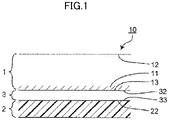
- this functional laminate 10 of the present disclosure includes a specific porous intermediate layer 3 laminated between a porous surface layer 1 and a resin foamed layer 2, in which the porous surface layer 1, the resin foamed layer 2, and the porous intermediate layer 3 are connected and integrated together.
- the specific porous intermediate layer 3 has affinity to a foaming resin (a raw liquid) forming the resin foamed layer 2, and is thus likely to cause a capillary phenomenon and preferably more likely to cause the capillary phenomenon than the porous surface layer 1 is owing to the affinity. Consequently, before the foaming of the foaming resin (the raw liquid) forming the resin foamed layer 2, the porous intermediate layer 3 is likely to hold the foaming resin.
- the porous intermediate layer 3 moderately hinders the movement (impregnation) of the foaming resin into the porous surface layer 1 before foaming, and upon start of foaming, the foaming resin held by the porous intermediate layer 3 foams while permeating the porous surface layer 1. It is conceivable that, consequently, the amount of impregnation of the foaming resin into the porous surface layer 1 is moderately reduced, the foaming resin sufficiently foams, and thus sufficiently improving sound absorbability, thermal insulating properties, and damping properties (especially sound absorbability).
- FIG. 1 illustrates a schematic sectional view of the functional laminate of the present disclosure.
- the foaming resin forming the resin foamed layer 2 refers to a foaming resin (a raw liquid) used as a raw material of the resin foamed layer 2.
- the foaming resin is a mixture of a polyol compound and an isocyanate compound.
- the foaming resin may contain additives such as a foaming agent and a foam stabilizer.
- the capillary phenomenon refers to a physical phenomenon about the behavior of the foaming resin (liquid) within voids of the porous intermediate layer 3 and the porous surface layer 1.
- the likelihood of the occurrence of the capillary phenomenon can be controlled by adjusting the affinity to the foaming resin included in the porous intermediate layer 3 and the porous surface layer 1. Specifically, the higher the affinity becomes, the more the capillary phenomenon is likely to occur.
- the porous intermediate layer 3 has air permeability.
- the "air permeability" of the porous intermediate layer 3 is a characteristic exchangeable with “liquid permeability,” that is, refers to a characteristic through which the porous intermediate layer 3 enables the foaming resin (liquid) to moderately pass therethrough during production of the functional laminate.
- the porous intermediate layer 3 has such air permeability, thus achieving integration of the porous surface layer 1, the resin foamed layer 2, and the porous intermediate layer 3.
- the air permeability of the porous intermediate layer 3 is specifically such air permeability that a mixed layer part 11 described below can be formed.
- the porous intermediate layer 3 has an affinity to the foaming resin forming the resin foamed layer 2 (hereinafter, may be referred to simply as "affinity"). That the porous intermediate layer 3 has the affinity means that surfaces of voids of the porous intermediate layer 3 are likely to become compatible or likely to become wet with the foaming resin.
- a contact angle ⁇ m of the porous intermediate layer 3 relative to the foaming resin (hereinafter, may be referred to simply as "a contact angle ⁇ m”) is normally 20° or less, preferably 1° to 20°, more preferably 1° to 15°, and even more preferably 1° to 10° in view of the likelihood of the occurrence of the capillary phenomenon in the porous intermediate layer and further improvement in the sound absorbability, the thermal insulating properties, and the damping properties of the functional laminate.
- the porous intermediate layer 3 has such affinity, and thus the porous intermediate layer 3 is likely to hold the foaming resin by the capillary phenomenon.
- the higher the affinity of the porous intermediate layer 3 becomes the smaller the contact angle ⁇ m of the porous intermediate layer 3 becomes.
- the lower the affinity of the porous intermediate layer 3 becomes the larger the contact angle ⁇ m of the porous intermediate layer 3 becomes.
- the contact angle ⁇ m of the porous intermediate layer 3 relative to the foaming resin refers to a contact angle of the foaming resin on a plane having a surface with a composition equivalent to that of the material forming the porous intermediate layer.
- the affinity of the porous intermediate layer 3 is preferably higher than the affinity of the porous surface layer 1 in view of the likelihood of the occurrence of the capillary phenomenon in the porous intermediate layer and further improvement in the sound absorbability, the thermal insulating properties, and the damping properties of the functional laminate.
- the fact that the affinity of the porous intermediate layer 3 is higher than the affinity of the porous surface layer 1 means that the contact angle ⁇ m of the porous intermediate layer 3 relative to the foaming resin is smaller than a contact angle ⁇ s of the porous surface layer 1 relative to the foaming resin (hereinafter, may be referred to simply as "a contact angle ⁇ s").
- the contact angle ⁇ m(°) of the porous intermediate layer 3 relative to the foaming resin and the contact angle ⁇ s(°) of the porous surface layer 1 relative to the foaming resin preferably satisfy Relational Expression (p1) below, more preferably satisfy Relational Expression (p2) below, even more preferably satisfy Relational Expression (p3) below, and most preferably satisfy Relational Expression (p4) below in view of the likelihood of the occurrence of the capillary phenomenon in the porous intermediate layer and further improvement in the sound absorbability, the thermal insulating properties, and the damping properties of the functional laminate.
- the contact angles ( ⁇ m and ⁇ s) of the porous intermediate layer and the porous surface layer relative to the foaming resin are represented by values measured by the method below.
- the material forming the porous intermediate layer is a fiber nonwoven fabric.
- the following exemplifies specific examples of the fiber nonwoven fabric intrinsically having the affinity without any treatment.
- affinity treatment for imparting the affinity may be performed on the porous intermediate layer, and the one to which the affinity has been imparted may be used as the porous intermediate layer.
- ⁇ shown together with specific examples below is a contact angle that a certain material intrinsically shows without any treatment and refers to a contact angle relative to the foaming resin measured by the method described above.
- the fiber nonwoven fabric of the porous intermediate layer may be a nonwoven fabric of a fiber blend of organic fibers and inorganic fibers.
- Examples of the fiber nonwoven fabric of the porous intermediate layer that can be used with the affinity treatment performed thereon include nonwoven fabrics of organic fibers and/or inorganic fibers described below exemplified as a fiber nonwoven fabric of the porous surface layer.
- the porous intermediate layer is a fiber nonwoven fabric, preferably a nonwoven fabric of PET fibers and/or alumina fibers, and more preferably a nonwoven fabric of PET fibers in view of further improvement in the sound absorbability, the thermal insulating properties, and the damping properties of the functional laminate.
- the porous intermediate layer 3 may have the affinity at least on a side facing the porous surface layer and preferably has the affinity in its entirety.
- An average void ratio Rm (%) of the porous intermediate layer and an average void ratio Rs (%) of the porous surface layer preferably satisfy Relational Expression (x1) below, more preferably satisfy Relational Expression (x2) below, even more preferably satisfy Relational Expression (x3) below, and still even more preferably satisfy Relational Expression (x4) below in view of the likelihood of the occurrence of the capillary phenomenon in the porous intermediate layer and further improvement in the sound absorbability, the thermal insulating properties, and the damping properties of the functional laminate.
- Relational Expression (x1) below, more preferably satisfy Relational Expression (x2) below, even more preferably satisfy Relational Expression (x3) below, and still even more preferably satisfy Relational Expression (x4) below in view of the likelihood of the occurrence of the capillary phenomenon in the porous intermediate layer and further improvement in the sound absorbability, the thermal insulating properties, and the damping properties of the functional laminate.
- the average void ratio Rm of the porous intermediate layer is normally 60 to 95% and preferably 65 to 90% in view of the likelihood of the occurrence of the capillary phenomenon in the porous intermediate layer and further improvement in the sound absorbability, the thermal insulating properties, and the damping properties of the functional laminate.
- the average void ratio of the porous intermediate layer when the porous intermediate layer is a fiber nonwoven fabric, refers to the volume ratio of voids formed among fibers, that is, the volume ratio of inter-fiber voids and is represented by a ratio measured by the method below.
- the nonwoven fabric of the porous intermediate layer impregnated with the foaming resin is cut out of the functional laminate, and the foaming resin is dissolved with an organic solvent that dissolves only the foaming resin among the fibers and the foaming resin which form the nonwoven fabric to obtain the fiber nonwoven fabric alone.
- the volume ratio of voids in this fiber nonwoven fabric is calculated, and this value is converted into the volume ratio of voids when the thickness in the fiber nonwoven fabric is the thickness of the porous intermediate layer described below in the functional laminate.
- the volume ratio of voids can be calculated from the volume and mass of the fiber nonwoven fabric and properties such as the specific gravity of a fiber material. In the present specification, measurement of mass was performed using an electronic balance (AE160 manufactured by Mettler).
- the volume ratio of voids can also be calculated from the volume of the fiber nonwoven fabric and the void volume of the fiber nonwoven fabric measured by a method such as computer tomography, an immersion method, a water evaporation method, a suspension method, a mercury penetration method, or a gas adsorption method.
- the nonwoven fabric of the porous intermediate layer impregnated with the foaming resin is cut out of the functional laminate, the volume of the nonwoven fabric and the void volume of the nonwoven fabric measured by a method such as computer tomography, an immersion method, a water evaporation method, a suspension method, a mercury penetration method, or a gas adsorption method are obtained, and then the fiber material is dissolved with a solvent that dissolves only the fiber material among the fibers and the foaming resin which form the nonwoven fabric to obtain the foaming resin alone.
- Avoid volume in this foaming resin is measured by a method similar to the above, the void volume of the nonwoven fabric is calculated from the volume of the nonwoven fabric - the void volume of the foaming resin + the void volume of the nonwoven fabric, and from this value and the volume of the nonwoven fabric, the volume ratio of voids in the fiber nonwoven fabric can be calculated.
- the average void ratio of the porous intermediate layer the value measured from the functional laminate as described above is used; even when measured from a material for use in production (foaming molding), a similar measured value is obtained. That is to say, the average void ratio of the porous intermediate layer can be calculated from the volume and mass of the porous intermediate layer material for use in production (foaming molding) and properties such as the specific gravity of the fibers or the polymer of the porous intermediate layer material. In the present specification, measurement of mass was performed using an electronic balance (AE160 manufactured by Mettler).
- the average void ratio of the porous intermediate layer can be calculated from the volume of the porous intermediate layer material and the void volume of the porous intermediate layer material measured by a method such as computer tomography, an immersion method, a water evaporation method, a suspension method, a mercury penetration method, or a gas adsorption method.
- the average void ratio of the porous intermediate layer can also be calculated by measuring, in an optical or electron micrograph of a perpendicular section of the porous intermediate layer material, the ratios of the area of air bubbles relative to the entire area at 100 random places to determine an average.
- the thickness of the porous intermediate layer is normally 0.1 to 2 mm and preferably 0.2 to 1 mm in view of the likelihood of the occurrence of the capillary phenomenon in the porous intermediate layer and further improvement in the sound absorbability, the thermal insulating properties, and the damping properties of the functional laminate.
- the thickness of the porous intermediate layer is a thickness from an interface 32 of the porous intermediate layer 3 with the porous surface layer 1 to an interface 33 thereof with the resin foamed layer 2 and is represented by a thickness measured by the method below. In an optical micrograph of a perpendicular section of the functional laminate, thicknesses are measured at 100 random places to determine an average.
- the thickness of the porous intermediate layer the value measured from the functional laminate as described above is used; even when measured from a material for use in production (foaming molding), a similar measured value is obtained. That is to say, in an optical micrograph of a perpendicular section of the porous intermediate layer material for use in production (foaming molding), thicknesses are measured at 100 random places to determine an average. Alternatively, thicknesses of the porous intermediate layer material are measured with an instrument such as a film thickness meter, a displacement meter, or a vernier caliper to determine an average.
- the average fiber diameter and the average fiber length of fibers forming the fiber nonwoven fabric are not limited to particular values so long as the porous intermediate layer is more likely to cause the capillary phenomenon than the porous surface layer is.
- the average fiber diameter is normally 0.005 to 50 ⁇ m and preferably 0.1 to 20 ⁇ m in view of the likelihood of the occurrence of the capillary phenomenon in the porous intermediate layer and further improvement in the sound absorbability, the thermal insulating properties, and the damping properties of the functional laminate.
- the average fiber length is normally not less than the thickness of the porous intermediate layer material and preferably 20 mm or more in view of the likelihood of the occurrence of the capillary phenomenon in the porous intermediate layer and further improvement in the sound absorbability, the thermal insulating properties, and the damping properties of the functional laminate.
- the average fiber diameter of the fibers in the fiber nonwoven fabric of the porous intermediate layer is represented by an average diameter measured by the method below.
- the nonwoven fabric of the porous intermediate layer impregnated with the foaming resin is cut out of the functional laminate, and in an optical or electron micrograph of a perpendicular section of the sample, the diameters of 100 random fibers are measured to obtain an average.
- the average fiber length of the fibers in the fiber nonwoven fabric of the porous intermediate layer is represented by an average measured by the method below.
- the nonwoven fabric of the porous intermediate layer impregnated with the foaming resin is cut out of the functional laminate, and the foaming resin is dissolved with an organic solvent that dissolves only the foaming resin among the fibers and the foaming resin which form the nonwoven fabric.
- the lengths of 100 random fibers are measured from the nonwoven fabric in which the foaming resin has been dissolved to determine an average.
- the inside of the nonwoven fabric is rendered into a three-dimensional image by a method such as computer tomography (CT), and the lengths of 100 random fibers are measured to determine an average.
- CT computer tomography
- the values measured from the functional laminate as described above are used; even when measured from a material for use in production (foaming molding), similar measured values are obtained. That is to say, for the average fiber diameter of fibers of a fiber nonwoven fabric for use in production (foaming molding), in an optical or electron micrograph of a perpendicular section of the nonwoven fabric, the diameters of 100 random fibers are measured to determine an average. For the average fiber length of the fibers of the fiber nonwoven fabric for use in production (foaming molding), the lengths of 100 random fibers are measured to determine an average. Alternatively, the inside of the nonwoven fabric is rendered into a three-dimensional image by a method such as computer tomography (CT), and the lengths of 100 random fibers are measured to determine an average.
- CT computer tomography
- the basis weight of the fiber nonwoven fabric is not limited to a particular value so long as the porous intermediate layer is more likely to cause the capillary phenomenon than the porous surface layer is, and is normally 5 to 500 g/m 2 and preferably 10 to 300 g/m 2 in view of the likelihood of the occurrence of the capillary phenomenon in the porous intermediate layer and further improvement in the sound absorbability, the thermal insulating properties, and the damping properties of the functional laminate.
- the basis weight of the fiber nonwoven fabric of the porous intermediate layer is represented by a value measured by the method below.
- the nonwoven fabric of the porous intermediate layer impregnated with the foaming resin is cut out of the functional laminate, and the foaming resin is dissolved with an organic solvent that dissolves only the foaming resin among the fibers and the foaming resin which form the nonwoven fabric to obtain the fiber nonwoven fabric alone.
- the basis weight can be calculated from the area and mass of the fiber nonwoven fabric. In the present specification, measurement of mass was performed using an electronic balance (AE160 manufactured by Mettler).
- the nonwoven fabric of the porous intermediate layer impregnated with the foaming resin is cut out of the functional laminate, the fiber material is dissolved with a solvent that dissolves only the fiber material among the fibers and the foaming resin which form the nonwoven fabric to obtain a solution of the fiber material.
- a liquid content of this solution of the fiber material is evaporated, then the mass of the fiber material in a solid content is calculated from the mass of the solid content after evaporation, and the basis weight can be calculated from the area of the nonwoven fabric and the mass of the fiber material.
- the basis weight of the fiber nonwoven fabric the value measured from the functional laminate as described above is used; even when measured from a material for use in production (foaming molding), a similar measured value is obtained. That is to say, the basis weight can be calculated from the area and mass of the fiber nonwoven fabric for use in production (foaming molding). In the present specification, measurement of mass was performed using an electronic balance (AE160 manufactured by Mettler).
- the material forming the porous surface layer 1 is not limited to a particular material so long as it has porosity and may be a fiber nonwoven fabric or a polymer foam, for example.
- the porous surface layer 1 may have or does not necessarily have an affinity to the foaming resin.
- the porous surface layer 1 preferably has a less affinity to the foaming resin than the porous intermediate layer in view of the likelihood of the occurrence of the capillary phenomenon in the porous intermediate layer and further improvement in the sound absorbability, the thermal insulating properties, and the damping properties of the functional laminate.
- the fact that the porous surface layer 1 has the affinity less than the porous intermediate layer means that the contact angle ⁇ s of the porous surface layer 1 relative to the foaming resin is larger than the contact angle ⁇ m of the porous intermediate layer relative to the foaming resin.
- the porous surface layer 1 preferably has the relation of " ⁇ s - ⁇ m" described above relative to the porous intermediate layer.
- the contact angle ⁇ s of the porous surface layer 1 relative to the foaming resin is normally 1° or more, preferably 1° to 90°, more preferably 5° to 90°, even more preferably 5° to 30°, and most preferably 8° to 30° in view of the likelihood of the occurrence of the capillary phenomenon in the porous intermediate layer and further improvement in the sound absorbability, the thermal insulating properties, and the damping properties of the functional laminate.
- the contact angle ⁇ s of the porous surface layer 1 relative to the foaming resin refers to a contact angle of the foaming resin on a plane having a surface with a composition equivalent to that of the material forming the porous surface layer.
- the following exemplifies specific examples of the fiber nonwoven fabric and the polymer foam as the material forming the porous surface layer 1.
- surface treatment that increases or decreases a contact angle before and after treatment may be performed on the porous surface layer, and the one having a controlled contact angle may be used as the porous surface layer.
- ⁇ shown together with specific examples below is a contact angle that a certain material intrinsically shows without any treatment and refers to a contact angle relative to the foaming resin measured by the method described above.
- Examples of the surface treatment include non-affinity treatment that increases a contact angle by application of a solution of a fluorine atom-containing resin (e.g., a fluorine atom-containing polymer) or a silicone group-containing resin.
- the fiber nonwoven fabric of the porous intermediate layer may be a nonwoven fabric of a fiber blend of organic fibers and inorganic fibers.
- polymer foam of the porous surface layer one having an open-cell structure or a closed-cell structure is used.
- the porous surface layer is preferably a fiber nonwoven fabric, more preferably a nonwoven fabric of inorganic fibers or organic fibers, and even more preferably a nonwoven fabric of glass fibers in view of further improvement in the sound absorbability, the thermal insulating properties, and the damping properties of the functional laminate.
- the average void ratio Rs of the porous surface layer is normally 80 to 99.5% and preferably 90 to 99% in view of the likelihood of the occurrence of the capillary phenomenon in the porous intermediate layer and further improvement in the sound absorbability, the thermal insulating properties, and the damping properties of the functional laminate.
- the average void ratio of the porous surface layer when the porous surface layer is a fiber nonwoven fabric, refers to the volume ratio of voids formed among fibers, that is, the volume ratio of inter-fiber voids and is represented by a ratio measured by the method below.
- the nonwoven fabric of a porous surface layer part that is not impregnated with the foaming resin is cut out of the functional laminate.
- the volume ratio of voids in this fiber nonwoven fabric is calculated, and this value is converted into the volume ratio of voids when the thickness in the fiber nonwoven fabric is the thickness of the porous surface layer described below in the functional laminate.
- the volume ratio of voids can be calculated from the volume and mass of the fiber nonwoven fabric and properties such as the specific gravity of the fibers.
- volume ratio of voids can also be calculated from the volume of the fiber nonwoven fabric and the void volume of the fiber nonwoven fabric measured by a method such as computer tomography, an immersion method, a water evaporation method, a suspension method, a mercury penetration method, or a gas adsorption method.
- the average void ratio of the porous surface layer when the porous surface layer is a polymer foam, refers to the volume ratio of air bubbles in the polymer that the polymer foam as the porous surface layer intrinsically has and is represented by a ratio measured by the method below.
- the average void ratio of the porous surface layer can be calculated by cutting the polymer foam of the porous surface layer part that is not impregnated with the foaming resin out of the functional laminate and, in an optical or electron micrograph of a perpendicular section of the sample, measuring the ratios of the area of air bubbles relative to the entire area at 100 random places to determine an average.
- the average void ratio of the porous surface layer For the average void ratio of the porous surface layer, the value measured from the functional laminate as described above is used; even when measured from a material for use in production (foaming molding), a similar measured value is obtained. That is to say, the average void ratio of the porous surface layer can be calculated from the volume and mass of the porous surface layer material for use in production (foaming molding) and properties such as the specific gravity of the fibers or the polymer of the porous surface layer material. In the present specification, measurement of mass was performed using an electronic balance (AE160 manufactured by Mettler).
- AE160 electronic balance
- the average void ratio of the porous surface layer can also be calculated from the volume of the porous surface layer material and the void volume of the porous surface layer material measured by a method such as computer tomography, an immersion method, a water evaporation method, a suspension method, a mercury penetration method, or a gas adsorption method.
- the average void ratio of the porous surface layer can also be calculated by measuring, in an optical or electron micrograph of a perpendicular section of the porous surface layer material, the ratios of the area of air bubbles relative to the entire area at 100 random places to determine an average.
- the thickness of the porous surface layer is normally 1 to 50 mm and preferably 2 to 30 mm in view of the likelihood of the occurrence of the capillary phenomenon in the porous intermediate layer and further improvement in the sound absorbability, the thermal insulating properties, and the damping properties of the functional laminate.
- the thickness of the porous surface layer is a thickness including a mixed layer part described below, is a thickness from the outer surface 12 of the porous surface layer 1 to an interface 13 thereof with the porous intermediate layer 3, and is represented by a thickness measured by the method below. In an optical micrograph of a perpendicular section of the functional laminate, thicknesses are measured at 100 random places to determine an average.
- the thickness of the porous surface layer the value measured from the functional laminate as described above is used; even when measured from a material for use in production (foaming molding), a similar measured value is obtained. That is to say, in an optical micrograph of a perpendicular section of the porous surface layer material for use in production (foaming molding), thicknesses are measured at 100 random places to determine an average. Alternatively, thicknesses of the porous surface layer material are measured with an instrument such as a film thickness meter, a displacement meter, or a vernier caliper to determine an average.
- the average fiber diameter and the average fiber length of fibers forming the fiber nonwoven fabric are not limited to particular values so long as the porous intermediate layer is more likely to cause the capillary phenomenon than the porous surface layer is.
- the average fiber diameter is normally 0.005 to 50 ⁇ m, preferably 0.1 to 20 ⁇ m, and more preferably 1 to 5 ⁇ m in view of the likelihood of the occurrence of the capillary phenomenon in the porous intermediate layer and further improvement in the sound absorbability, the thermal insulating properties, and the damping properties of the functional laminate.
- the average fiber length is normally 2 mm or more and preferably 20 mm or more in view of the likelihood of the occurrence of the capillary phenomenon in the porous intermediate layer and further improvement in the sound absorbability, the thermal insulating properties, and the damping properties of the functional laminate.
- the average fiber diameter of the fibers in the fiber nonwoven fabric of the porous surface layer is represented by an average diameter measured by the method below.
- the nonwoven fabric of the porous surface layer part that is not impregnated with the foaming resin is cut out of the functional laminate, and in an optical or electron micrograph of a perpendicular section of the sample, the diameters of 100 random fibers are measured to determine an average.
- the average fiber length of the fibers in the fiber nonwoven fabric of the porous surface layer is represented by an average measured by the method below.
- the nonwoven fabric of the porous surface layer part that is not impregnated with the foaming resin is cut out of the functional laminate, and the lengths of 100 random fibers are measured from the nonwoven fabric to determine an average.
- the inside of the nonwoven fabric is rendered into a three-dimensional image by a method such as computer tomography (CT), and the lengths of 100 random fibers are measured to determine an average.
- CT computer tomography
- the values measured from the functional laminate as described above are used; even when measured from a material for use in production (foaming molding), similar measured values are obtained. That is to say, for the average fiber diameter of fibers of a fiber nonwoven fabric for use in production (foaming molding), in an optical or electron micrograph of a perpendicular section of the nonwoven fabric, the diameters of 100 random fibers are measured to determine an average. For the average fiber length of the fibers of the fiber nonwoven fabric for use in production (foaming molding), the lengths of 100 random fibers are measured to determine an average. Alternatively, the inside of the nonwoven fabric is rendered into a three-dimensional image by a method such as CT, and the lengths of 100 random fibers are measured to determine an average.
- the basis weight of the fiber nonwoven fabric is not limited to a particular value so long as the porous intermediate layer is more likely to cause the capillary phenomenon than the porous surface layer is, and is normally 50 to 6,000 g/m 2 and preferably 100 to 3,000 g/m 2 in view of the likelihood of the occurrence of the capillary phenomenon in the porous intermediate layer and further improvement in the sound absorbability, the thermal insulating properties, and the damping properties of the functional laminate.
- the basis weight of the fiber nonwoven fabric of the porous surface layer is represented by a value measured by the method below.
- the nonwoven fabric of the porous surface layer part that is not impregnated with the foaming resin is cut out of the functional laminate, and the basis weight can be calculated from the area and mass of the nonwoven fabric.
- measurement of mass was performed using an electronic balance (AE160 manufactured by Mettler).
- the basis weight of the fiber nonwoven fabric the value measured from the functional laminate as described above is used; even when measured from a material for use in production (foaming molding), a similar measured value is obtained. That is to say, the basis weight can be calculated from the area and mass of the fiber nonwoven fabric for use in production (foaming molding). In the present specification, measurement of mass was performed using an electronic balance (AE160 manufactured by Mettler).
- the resin foamed layer 2 is a foamed layer of a polymer.
- the polymer foamed layer is selected from the group including a polyurethane foamed layer; a polyolefin foamed layer such as a polyethylene foamed layer and a polypropylene foamed layer; a polyester foamed layer such as a PET foamed layer; a silicone foamed layer; and a polyvinyl chloride foamed layer.
- the resin foamed layer is preferably a polyurethane foamed layer in view of further improvement in the sound absorbability, the thermal insulating properties, and the damping properties of the functional laminate.
- An average void diameter Df of the resin foamed layer which is not limited to a particular diameter, may be within a range of 0.04 to 800 ⁇ m, for example, especially 10 to 600 ⁇ m in accordance with the frequency of a sound to be absorbed.
- the smaller the average void diameter Df of the resin foamed layer becomes within the above range the lower the frequency of the sound to be absorbed becomes.
- the average void diameter Df of the resin foamed layer is 50 to 500 ⁇ m, especially 100 to 300 ⁇ m, for example, sounds with a frequency of 1,000 to 4,000 Hz are effectively absorbed. Such sound absorption is suitable when the functional laminate is used in cover member use for automobile powertrain members.
- the average void diameter Df of the resin foamed layer refers to the diameter of air bubbles in the polymer and is represented by an average diameter measured by the method below.
- the resin foamed layer is cut out of the functional laminate, and in an optical or electron micrograph of a parallel section of the sample, the diameters of 100 random air bubbles are measured to determine an average.
- An average void ratio Rf of the resin foamed layer is normally 60 to 98% and preferably 80 to 95% in view of the likelihood of the occurrence of the capillary phenomenon in the porous intermediate layer and further improvement in the sound absorbability, the thermal insulating properties, and the damping properties of the functional laminate.
- the average void ratio of the resin foamed layer refers to the volume ratio of air bubbles in the polymer and is represented by a ratio measured by the method below.
- the resin foamed layer is cut out of the functional laminate, and in an optical or electron micrograph of a perpendicular section of the resin foamed material, the ratios of the area of air bubbles relative to the entire area are measured at 100 random places to determine an average.
- the average void ratio of the resin foamed layer can also be calculated from the volume and mass of the resin foamed material and properties such as the specific gravity of the polymer. In the present specification, measurement of mass was performed using an electronic balance (AE160 manufactured by Mettler).
- the average void ratio of the resin foamed layer can also be calculated from the volume of the resin foamed material and the void volume of the resin foamed material measured by a method such as computer tomography, an immersion method, a water evaporation method, a suspension method, a mercury penetration method, or a gas adsorption method.
- the thickness of the resin foamed layer is normally 1 to 100 mm and preferably 2 to 30 mm in view of the likelihood of the occurrence of the capillary phenomenon in the porous intermediate layer and further improvement in the sound absorbability, the thermal insulating properties, and the damping properties of the functional laminate.
- the thickness of the resin foamed layer is a thickness in a substantially perpendicular direction to the outer surface 12 of the porous surface layer 1, is a thickness to an interface 22 of the resin foamed layer 2 with the porous intermediate layer 3, and is represented by a thickness measured by the method below. In an optical micrograph of a perpendicular section of the functional laminate, thicknesses are measured at 100 random places to determine an average.
- the functional laminate 10 of the present disclose includes the mixed layer part 11 between the porous intermediate layer 3 and the porous surface layer 1.
- the porous surface layer 1 includes the mixed layer part 11 at a position facing the porous intermediate layer 3. More specifically, part of the porous surface layer 1 facing the porous intermediate layer 3 is transformed into the mixed layer part 11; in other words, the mixed layer part 11 is generated in the part within the porous surface layer 1 facing the porous intermediate layer 3.
- the mixed layer part increases the rigidity of the functional laminate.
- the mixed layer part is a composite layer of the resin foamed layer and the porous surface layer formed between the porous intermediate layer and the porous surface layer.
- the mixed layer part is specifically a layer formed by the foaming resin forming the resin foamed layer permeating the porous surface layer, foamed, and cured and, in other words, is a layer in which the material forming the porous surface layer and the material forming the resin foamed layer coexist.
- air bubbles by the foaming resin are formed.
- An average void diameter Dx of the mixed layer part which is not limited to a particular diameter, may be within a range of 0.04 to 800 ⁇ m, for example, especially 10 to 500 ⁇ m in accordance with the frequency of the sound to be absorbed.
- the smaller the average void diameter Dx of the mixed layer part becomes within the above range the lower the frequency of the sound to be absorbed becomes.
- the average void diameter Dx of the mixed layer part is 50 to 250 ⁇ m, especially 60 to 200 ⁇ m, for example, sounds with a frequency of 1,000 to 4,000 Hz are effectively absorbed. Such sound absorption is suitable when the functional laminate is used in cover member use for automobile powertrain members.
- the average void diameter Dx of the mixed layer part refers to the diameter of air bubbles in the resin (polymer) formed within the voids of the porous surface layer before the permeation of the foaming resin and is represented by an average diameter measured by the method below.
- the diameters (the largest diameters) of 100 random air bubbles are measured to determine an average.
- the 100 random air bubbles refer to 100 random air bubbles formed by the foaming of the foaming resin, and the air bubbles and the air bubbles that the polymer foam as the porous surface layer intrinsically has can be easily discriminated from each other by a difference in brightness or the like around the air bubbles.
- the average diameter can also be calculated by cutting the mixed layer part out of the functional laminate and measuring the distribution of the diameter of voids in this mixed layer part by a method such as a mercury penetration method or a gas adsorption method.
- An average void ratio Rx of the mixed layer part is normally 30 to 95% and preferably 50 to 90% in view of further improvement in the sound absorbability, the thermal insulating properties, and the damping properties of the functional laminate.
- the average void ratio of the mixed layer part refers to the volume ratio of air bubbles in the resin (polymer) formed within the voids of the porous surface layer before the permeation of the foaming resin and is represented by a ratio measured by the method below.
- the ratios of the area of air bubbles relative to the entire area are measured at 100 random places to determine an average.
- the area of air bubbles is the area of air bubbles in the resin (polymer) formed by the foaming of the foaming resin within the voids of the porous surface layer; when the porous surface layer is a polymer foam, the air bubbles and the air bubbles that the polymer foam intrinsically has can be easily discriminated from each other by a difference in brightness or the like around the air bubbles.
- the mixed layer part is cut out of the functional laminate, and the average void ratio of the mixed layer part can be calculated from the volume and mass of the mixed layer part and properties such as the specific gravity of the polymer.
- the average void ratio of the mixed layer part can also be calculated from the volume of the mixed layer part and the void volume of the mixed layer part measured by a method such as computer tomography, an immersion method, a water evaporation method, a suspension method, a mercury penetration method, or a gas adsorption method.
- the thickness of the mixed layer part is normally 0.05 to 3 mm, preferably 0.1 to 2 mm, and more preferably 0.2 to 1.7 mm in view of further improvement in sound absorbability, thermal insulating properties, and damping properties (especially sound absorbability) in cover member use for automobile powertrain members.
- the thickness of the mixed layer part refers to a thickness in a substantially perpendicular direction to the outer surface 12 of the porous surface layer 1, is a thickness from an interface 13 of the porous surface layer 1 with the porous intermediate layer 3 to a region within the porous surface layer 1 that is not impregnated with the foaming resin, and is represented by a thickness measured by the method below.
- thicknesses are measured at 100 random places to determine an average. In the optical or electron micrograph, that the porous surface layer 1 is impregnated with the foaming resin or is not impregnated therewith can be easily discriminated from each other by the presence or absence of the foaming resin within voids of the porous surface layer 1.
- the functional laminate of the present disclosure can be produced by a production method including a lamination base forming process and a foaming molding process below.
- the porous surface layer 1 and the porous intermediate layer 3 are laminated together to obtain a lamination base 40.
- the lamination may be performed by simply placing another layer on one layer; in view of the handleability of the lamination base, the porous surface layer 1 and the porous intermediate layer 3 are preferably bonded to each other.
- the method of bonding is not limited to a particular method so long as connection between the porous surface layer 1 and the porous intermediate layer 3 is achieved; a method using an adhesive may be employed, for example.
- the bonding may be achieved at part of a contact face between the porous surface layer 1 and the porous intermediate layer 3 or achieved across the entire contact face.
- the bonding is preferably achieved at part of the contact face between the porous surface layer 1 and the porous intermediate layer 3 in view of further improvement in sound absorbability, thermal insulating properties, and damping properties (especially sound absorbability) in cover member use for automobile powertrain members.
- porous surface layer 1 and the porous intermediate layer 3 the respective materials described above can be used, which are commercially available.
- the porous surface layer 1 and the porous intermediate layer 3 are each a fiber nonwoven fabric in particular, certain fibers adjusted to desired properties and formed by a known method of forming such as heat press molding or needle punching (a sheet-shaped material) can be used.
- FIG. 2A foaming molding is performed within a mold 50.
- the mold 50 normally includes an upper mold 51 and a lower mold 52.
- FIG. 2A illustrates a schematic sectional view of the mold and the inside thereof for illustrating a foaming preparation stage of the foaming molding process.
- the foaming molding is performed on the side of the porous intermediate layer 3 of the lamination base 40 using a foaming resin 20 as a raw material forming the resin foamed layer 2.
- Performing the foaming molding on the side facing the porous intermediate layer 3 of the lamination base 40 means that the foaming molding is performed with the foaming resin 20 and the lamination base 40 placed such that the resin foamed layer 2 will be formed on the side of the porous intermediate layer 3 of the lamination base 40.
- the foaming resin 20 is injected onto a molding face 520 of the lower mold 52, and then the lamination base 40 is placed on the foaming resin 20 so as to bring the porous intermediate layer 3 into contact with the foaming resin 20.
- the lamination base 40 may be placed on the upper mold 51 so as to bring the porous intermediate layer 3 into contact with the foaming resin 20.
- the upper mold 51 is closed as illustrated in FIG. 2B , and upon start of foaming, the foaming resin 20 expands to fill a cavity between the upper mold 51 and the lower mold 52, and the resin foamed layer 2 is formed.
- the molded body is removed from the mold to obtain a functional laminate in which the porous surface layer 1, the resin foamed layer 2, and the porous intermediate layer 3 are integrated together.
- FIG. 2B illustrates a schematic sectional view of the mold and the inside thereof for illustrating a foaming stage of the foaming molding process.
- the foaming resin 20 is a raw material of the resin foamed layer; when the resin foamed layer is a polyurethane foamed layer, for example, a mixture of a polyol compound and an isocyanate compound is used for the foaming resin 20.
- the foaming resin 20 may contain additives such as a foaming agent and a foam stabilizer.
- Foaming conditions are determined as appropriate in accordance with the type of the foaming resin 20; the mold 50 may be heated and/or the inside of the mold 50 may be pressurized or decompressed, for example.
- the functional laminate 10 of the present disclosure is excellent in sound absorbability, thermal insulating properties, and damping properties (especially sound absorbability) and is thus useful as sound absorbing materials, thermal insulating materials, and/or damping materials (especially sound absorbing materials).
- Examples of fields in which the functional laminate 10 of the present disclosure is useful include engine-equipped machines such as vehicles (such as automobiles, trucks, buses, and trains) and agricultural machines (such as mowers and cultivators).
- the functional laminate 10 of the present disclosure When the functional laminate 10 of the present disclosure is used as a sound absorbing thermal insulating material in an engine-equipped machine, for example, it is specifically used as a cover member for powertrain members including an engine and a transmission. In this situation, the functional laminate 10 is more specifically used as a cover member surrounding the powertrain members partially or collectively.
- the functional laminate 10 is placed and used such that the resin foamed layer 2 is in contact with the powertrain members.
- the functional laminate 10 is used such that the porous surface layer 1 faces a sound source and/or a heat source in a noncontact manner, that is, such that the engine and the transmission are placed at a position facing the porous surface layer 1.
- a glass plate with a composition equivalent to that of the glass wool was used for measurement of a contact angle of glass wool.
- a PET nonwoven fabric a PET plate with a composition equivalent to that of the PET nonwoven fabric was used for measurement of a contact angle of an alumina nonwoven fabric.
- an alumina plate with a composition equivalent to that of the alumina nonwoven fabric was used for measurement of a contact angle of an alumina nonwoven fabric.
- a PP plate with a composition equivalent to that of the PP nonwoven fabric was used for measurement of a contact angle of a PP nonwoven fabric.
- the surface roughness of the plates for use in measurement of the contact angle was in common 1.6 ⁇ m or less in terms of Ra.
- a normal incident sound absorption coefficient was measured using a sound tube with an inner diameter of 40 mm in a measurement frequency range of from 200 Hz to 4,800 Hz (1/3 octave band) (in conformity with JIS A 1405-2 and ISO 10534-2) to calculate an average normal incident sound absorption coefficient for 1,000 Hz to 4,000 Hz.
- a cut in a cylindrical shape with a diameter of 40 mm out of a functional laminate obtained in each of examples and comparative examples was used.
- the functional laminate as the sample to be measured was placed so as to make a sound incident from the porous surface layer 1. Evaluation was performed based on an increase from a sound absorption coefficient in comparative examples using the same porous surface layer without using the porous intermediate layer.
- thermal conductivity measurement apparatus HFM 436/3/1 Lambda manufactured by Netzsch at a measurement temperature of 30°C, the thermal conductivity of the functional laminate in the thickness direction was measured based on JIS A 1412-2 Part 2: Heat flow meter method.
- a raw material of a polyurethane foam in Table 1 was mixed with a mixer as the foaming resin 20 and was injected onto the molding face 520 of the lower mold 52 as illustrated in FIG. 2A .
- the lamination base 40 was placed on the foaming resin 20 so as to bring the porous intermediate layer 3 into contact with the foaming resin 20.
- the upper mold 51 was closed as illustrated in FIG. 2B , and upon start of foaming, the foaming resin 20 expanded to fill the cavity (dimensions: 100 mm ⁇ 100 mm ⁇ 25 mm) between the upper mold 51 and the lower mold 52, and the resin foamed layer 2 was formed.
- the mold 50 was cooled, then the molded body was removed from the mold to obtain a functional laminate in which the porous surface layer 1, the resin foamed layer 2, and the porous intermediate layer 3 are integrated together.
- the lamination base forming process and the foaming molding process were performed by a method similar to that of Example 1 except that Glass Wool B with an average fiber diameter of about 3.5 ⁇ m that had been heat press molded to have an average void ratio and a thickness listed in Table 1 was used as the porous surface layer 1 and that the porous intermediate layer 3 in Table 1 was used.
- the lamination base forming process and the foaming molding process were performed by a method similar to that of Example 1 except that the porous surface layer was used alone in place of the lamination base without using the porous intermediate layer.
- the functional laminate of the present disclosure is useful as sound absorbing materials, thermal insulating materials, and/or damping materials in the field of engine-equipped machines such as vehicles (such as automobiles, trucks, buses, and trains) and agricultural machines (such as mowers and cultivators).
- engine-equipped machines such as vehicles (such as automobiles, trucks, buses, and trains) and agricultural machines (such as mowers and cultivators).
Landscapes
- Engineering & Computer Science (AREA)
- Textile Engineering (AREA)
- Physics & Mathematics (AREA)
- Acoustics & Sound (AREA)
- Mechanical Engineering (AREA)
- Multimedia (AREA)
- Laminated Bodies (AREA)
- Molding Of Porous Articles (AREA)
- Vehicle Interior And Exterior Ornaments, Soundproofing, And Insulation (AREA)
- Casting Or Compression Moulding Of Plastics Or The Like (AREA)
- Soundproofing, Sound Blocking, And Sound Damping (AREA)
Claims (18)
- Funktionelles Laminat (10) mit einer Luftdurchlässigkeit aufweisenden porösen Zwischenschicht (3), die zwischen eine poröse Oberflächenschicht (1) und eine geschäumte Harzschicht (2) laminiert ist,bei dem die poröse Zwischenschicht (3) ein Faservliesstoff ist,die geschäumte Harzschicht (2) eine geschäumte Polymerschicht ist, die aus der Gruppe bestehend aus einer geschäumten Polyurethanschicht, einer geschäumten Polyolefinschicht, einer geschäumten Polyesterschicht, einer geschäumten Silikonschicht und einer geschäumten Polyvinylchloridschicht ausgewählt ist,ein Kontaktwinkel θm der porösen Zwischenschicht (3) relativ zu einem Schaumharz (20), das die geschäumte Harzschicht (2) bildet, 20° oder weniger ist, wobei der Kontaktwinkel θm der porösen Zwischenschicht (3) relativ zu dem Schaumharz (20) kleiner als ein Kontaktwinkel θs der porösen Oberflächenschicht (1) relativ zu dem Schaumharz (20) ist, wobeider Kontaktwinkel θm der porösen Zwischenschicht (3) relativ zu dem Schaumharz (20) sich auf einen Kontaktwinkel des Schaumharzes (20) auf einer Ebene bezieht, die eine Oberfläche mit einer Zusammensetzung aufweist, die der des Materials entspricht, das die poröse Zwischenschicht (3) bildet, wobeider Kontaktwinkel θs der porösen Oberflächenschicht (1) relativ zu dem Schaumharz (20) sich auf einen Kontaktwinkel des Schaumharzes (20) auf einer Ebene bezieht, die eine Oberfläche mit einer Zusammensetzung aufweist, die der des Materials entspricht, das die poröse Oberflächenschicht (1) bildet, wobeidie Kontaktwinkel θm und θs von Werten dargestellt werden, die durch Auftropfen von Propylenglycolmonomethylether (PGM) auf ein Teststück und Messen eines Kontaktwinkels nach 30 Sekunden gemessen werden, wobeidas Teststück eine flache Platte ist, die ein Oberfläche mit einer Zusammensetzung aufweist, die der des Materials entspricht, das die poröse Zwischenschicht (3) oder die poröse Oberflächenschicht (1) bildet, und wobeidie Oberflächenrauheit der flachen Platte 1,6 µm oder weniger, ausgedrückt in Ra, ist.
- Funktionelles Laminat (10) nach Anspruch 1, wobei
ein durchschnittlicher Hohlraumanteil Rm der porösen Zwischenschicht (3) und ein durchschnittlicher Hohlraumanteil Rs der porösen Oberflächenschicht (1) einen relationalen Ausdruck unten erfüllen:
- Funktionelles Laminat (10) nach Anspruch 1 oder 2, wobei die poröse Zwischenschicht (3) einen durchschnittlichen Hohlraumanteil von 60 bis 95 % aufweist.
- Funktionelles Laminat (10) nach einem der Ansprüche 1 bis 3, wobei
die poröse Zwischenschicht (3) eine Dicke von 0,1 bis 2 mm aufweist, gemessen gemäß dem in der Beschreibung beschriebenen Verfahren. - Funktionelles Laminat (10) nach einem der Ansprüche 1 bis 4, wobei der Kontaktwinkel θm der porösen Zwischenschicht (3) relativ zu dem Schaumharz (20) 1° bis 20° ist, vorzugsweise 1° bis 15° und mehr vorzugsweise 1° bis 10°.
- Funktionelles Laminat (10) nach einem der Ansprüche 1 bis 5, wobei
die poröse Zwischenschicht (3) ein Vliesstoff aus organischen Fasern ist, die aus der Gruppe bestehend aus Fasern auf Polyesterbasis ausgewählt sind. - Funktionelles Laminat (10) nach einem der vorhergehenden Ansprüche, wobei
Fasern, die den Faservliesstoff der porösen Zwischenschicht (3) bilden, einen durchschnittlichen Faserdurchmesser von 0,005 bis 50 µm aufweisen. - Funktionelles Laminat (10) nach einem der Ansprüche 1 bis 7, wobei die poröse Oberflächenschicht (1) einen durchschnittlichen Hohlraumanteil von 80 bis 99,5 % aufweist.
- Funktionelles Laminat (10) nach einem der Ansprüche 1 bis 8, wobei
die poröse Oberflächenschicht (1) eine Dicke von 1 bis 50 mm, gemessen gemäß dem in der Beschreibung beschriebenen Verfahren, aufweist. - Funktionelles Laminat (10) nach einem der Ansprüche 1 bis 9, wobei
die poröse Oberflächenschicht (1) ein Faservliesstoff ist, vorzugsweise ein Vliesstoff aus anorganischen Fasern. - Funktionelles Laminat (10) nach Anspruch 10, wobei
Fasern, die den Faservliesstoff der porösen Oberflächenschicht (1) bilden, einen durchschnittlichen Faserdurchmesser von 0,005 bis 50 µm aufweisen. - Funktionelles Laminat (10) nach einem der Ansprüche 1 bis 11, wobei der Kontaktwinkel θm der porösen Zwischenschicht (3) relativ zu dem Schaumharz (20) und der Kontaktwinkel θs der porösen Oberflächenschicht (1) relativ zu dem Schaumharz (20) den folgenden relationalen Ausdruck erfüllen:


- Funktionelles Laminat (10) nach einem der Ansprüche 1 bis 12, wobei die geschäumte Harzschicht (2) einen durchschnittlichen Hohlraumdurchmesser von 0,04 bis 800 µm aufweist.
- Funktionelles Laminat (10) nach einem der Ansprüche 1 bis 13, wobei
die poröse Oberflächenschicht (1) an einer der porösen Zwischenschicht (3) gegenüberliegenden Position einen Mischschichtteil (11) der geschäumten Harzschicht (2) und der porösen Oberflächenschicht (1) beinhaltet. - Funktionelles Laminat (10) nach Anspruch 14, wobei
der Mischschichtteil (11) eine Dicke von 0,2 bis 1,7 mm aufweist, gemessen gemäß dem in der Beschreibung beschriebenen Verfahren. - Funktionelles Laminat (10) nach Anspruch 14 oder 15, wobei der Mischschichtteil (11) einen durchschnittlichen Hohlraumdurchmesser von 60 bis 200 µm aufweist.
- Funktionelles Laminat (10) nach einem der Ansprüche 14 bis 16, wobei
der Mischschichtteil (11) einen durchschnittlichen Hohlraumanteil von 50 bis 90 % aufweist. - Herstellungsverfahren für ein funktionelles Laminat (10) mit einer Luftdurchlässigkeit aufweisenden porösen Zwischenschicht (3), die zwischen eine poröse Oberflächenschicht (1) und eine geschäumte Harzschicht (2) laminiert ist,
bei dem die poröse Zwischenschicht (3) ein Faservliesstoff ist, wobei das Herstellungsverfahren umfasst:Laminieren einer porösen Oberflächenschicht (1) und einer porösen Zwischenschicht (3) miteinander, um eine Laminationsbasis (40) zu erhalten; undDurchführen von verschäumendem Formen eines Schaumharzes (20), das eine geschäumte Harzschicht (2) auf einer Seite bildet, die der porösen Zwischenschicht (3) der Laminationsbasis (40) im Inneren einer Form (50) gegenüberliegt.
Applications Claiming Priority (2)
| Application Number | Priority Date | Filing Date | Title |
|---|---|---|---|
| JP2017072518A JP6500930B2 (ja) | 2017-03-31 | 2017-03-31 | 機能性積層体およびその製造方法 |
| PCT/JP2018/005547 WO2018179978A1 (ja) | 2017-03-31 | 2018-02-16 | 機能性積層体およびその製造方法 |
Publications (3)
| Publication Number | Publication Date |
|---|---|
| EP3587102A1 EP3587102A1 (de) | 2020-01-01 |
| EP3587102A4 EP3587102A4 (de) | 2020-03-18 |
| EP3587102B1 true EP3587102B1 (de) | 2022-07-27 |
Family
ID=63675000
Family Applications (1)
| Application Number | Title | Priority Date | Filing Date |
|---|---|---|---|
| EP18775920.4A Active EP3587102B1 (de) | 2017-03-31 | 2018-02-16 | Funktionales laminat und herstellungsverfahren dafür |
Country Status (5)
| Country | Link |
|---|---|
| US (1) | US11535005B2 (de) |
| EP (1) | EP3587102B1 (de) |
| JP (1) | JP6500930B2 (de) |
| CN (1) | CN110475662B (de) |
| WO (1) | WO2018179978A1 (de) |
Families Citing this family (2)
| Publication number | Priority date | Publication date | Assignee | Title |
|---|---|---|---|---|
| JP6500929B2 (ja) * | 2017-03-31 | 2019-04-17 | マツダ株式会社 | 機能性積層体およびその製造方法 |
| US20250303770A1 (en) * | 2024-03-26 | 2025-10-02 | Xerox Corporation | System and method for preserving inkjet operational status during long periods of printhead inactivity |
Family Cites Families (19)
| Publication number | Priority date | Publication date | Assignee | Title |
|---|---|---|---|---|
| JP2976394B2 (ja) * | 1990-10-03 | 1999-11-10 | 三井化学株式会社 | 発泡成形品用補強材 |
| EP0555476B1 (de) | 1991-08-27 | 1996-11-06 | Namba Press Works Co., Ltd. | Oberflächenstoff rückseitig mit latexschaum beschichtet und dessen verwendung an einem eingebauten produkt |
| JP2990207B2 (ja) * | 1992-12-11 | 1999-12-13 | 東洋紡績株式会社 | ウレタン発泡成形用補強基布とその製造方法及び製品 |
| JP3446349B2 (ja) * | 1994-11-18 | 2003-09-16 | 松下電工株式会社 | 積層不織布、その積層不織布を用いた電気カーペット、及びその積層不織布の製造方法 |
| JP4122092B2 (ja) * | 1998-08-26 | 2008-07-23 | 旭化成せんい株式会社 | 発泡成型用補強材基布 |
| JP4589554B2 (ja) * | 2001-03-21 | 2010-12-01 | ユニチカ株式会社 | 積層不織布および不織布補強ウレタンフォーム |
| US6855743B1 (en) * | 2001-10-29 | 2005-02-15 | Nanosystems Research, Inc. | Reinforced, laminated, impregnated, and composite-like materials as crosslinked polyvinyl alcohol hydrogel structures |
| JP2005144060A (ja) * | 2003-11-19 | 2005-06-09 | Toyo Tire & Rubber Co Ltd | シート用パッド |
| JP2005288873A (ja) * | 2004-03-31 | 2005-10-20 | Nippon Petrochemicals Co Ltd | ウレタン樹脂発泡成形に用いられる補強材および該補強材を有するウレタン発泡成形品 |
| JP2006039379A (ja) * | 2004-07-29 | 2006-02-09 | Nishikawa Rubber Co Ltd | 遮音性シート |
| EP1847383A1 (de) * | 2006-04-21 | 2007-10-24 | Rieter Technologies AG | Akustischer Verbundkörper und Leichtverkleidungselement mit einer Zweitschale, das einen derartigen Verbundkörper enthält |
| JP5459838B2 (ja) * | 2009-09-18 | 2014-04-02 | ニチアス株式会社 | 防音カバー及びその製造方法 |
| JP5634074B2 (ja) | 2010-01-22 | 2014-12-03 | 東海興業株式会社 | 発泡成形体及びその発泡成形方法並びに発泡成形体用のシート材 |
| KR101269207B1 (ko) * | 2010-01-25 | 2013-05-31 | 에스케이이노베이션 주식회사 | 내열성이 우수한 다층 다공막 |
| FR2979308B1 (fr) * | 2011-08-24 | 2013-09-27 | Faurecia Automotive Ind | Ensemble d'insonorisation, notamment pour un vehicule automobile |
| US9314995B2 (en) * | 2013-03-15 | 2016-04-19 | National Nonwovens Inc. | Composites comprising nonwoven structures and foam |
| WO2014157080A1 (ja) * | 2013-03-27 | 2014-10-02 | 株式会社クラレ | ポリビニルブチラール繊維及びそれを含有する繊維集合体 |
| DE102013104715A1 (de) * | 2013-05-07 | 2014-11-13 | Johann Borgers GmbH | Hinterschäumbares Akustikelement eines Kraftfahrzeugkarosserieverkleidungsbauteils |
| JP6186629B2 (ja) * | 2014-01-20 | 2017-08-30 | 名古屋油化株式会社 | 吸音性内装材 |
-
2017
- 2017-03-31 JP JP2017072518A patent/JP6500930B2/ja active Active
-
2018
- 2018-02-16 WO PCT/JP2018/005547 patent/WO2018179978A1/ja not_active Ceased
- 2018-02-16 US US16/498,335 patent/US11535005B2/en active Active
- 2018-02-16 EP EP18775920.4A patent/EP3587102B1/de active Active
- 2018-02-16 CN CN201880021647.9A patent/CN110475662B/zh active Active
Also Published As
| Publication number | Publication date |
|---|---|
| JP2018171821A (ja) | 2018-11-08 |
| US20200023610A1 (en) | 2020-01-23 |
| CN110475662A (zh) | 2019-11-19 |
| EP3587102A1 (de) | 2020-01-01 |
| US11535005B2 (en) | 2022-12-27 |
| JP6500930B2 (ja) | 2019-04-17 |
| EP3587102A4 (de) | 2020-03-18 |
| WO2018179978A1 (ja) | 2018-10-04 |
| CN110475662B (zh) | 2021-09-07 |
Similar Documents
| Publication | Publication Date | Title |
|---|---|---|
| EP3603951B1 (de) | Funktionales laminat und herstellungsverfahren dafür | |
| US4769278A (en) | Resilient multi layered member incorporating skin layer, foam layer cushion layer and core, and method of manufacture thereof | |
| EP2937858B1 (de) | Dash-pad für ein fahrzeug | |
| EP3587102B1 (de) | Funktionales laminat und herstellungsverfahren dafür | |
| KR102029924B1 (ko) | 자동차용 인슐레이션의 제조방법 및 그 인슐레이션 | |
| KR101874882B1 (ko) | 자동차의 인슐레이션용 폴리우레탄 폼 시트의 제조방법, 인슐레이션 제조방법 및 그 인슐레이션 | |
| AU2002343969B2 (en) | Floor laying material, piece mat, and arranging structure thereof | |
| JP2020013007A (ja) | 吸遮音材とその製造方法 | |
| JP6693459B2 (ja) | 機能性積層体およびその製造方法 | |
| EP3115192B1 (de) | Mehrschichtige armaturenbrettisolationsplatte mit hervorragender formbarkeit und schallabsorptionsleistung | |
| EP1574326A1 (de) | Laminiertes oberflächenhautmaterial und laminat fürinnenmaterial | |
| JP7328353B2 (ja) | 多層吸音材 | |
| JP6589924B2 (ja) | 機能性積層体およびその製造方法 | |
| EP3673768B1 (de) | Fahrzeugsitzkern und sitzpolster | |
| JP2002306274A (ja) | シートクッションパッド及びその製造方法 | |
| JP2018171822A (ja) | 機能性積層体およびその製造方法 | |
| KR102328692B1 (ko) | 저중량 열가소성 폴리에틸렌 차음코팅을 이용한 자동차용 플로어 카펫 및 그 제조방법 | |
| JP7351429B1 (ja) | 吸音材及び車両部材 | |
| JP2007176363A (ja) | 吸音材及び吸音シート | |
| JP7696744B2 (ja) | 多孔質吸音材及びその製造方法、並びに、吸音方法 | |
| JP2019084910A (ja) | 乗物用内装芯材、および、これを用いた乗物用内装材 | |
| KR100774769B1 (ko) | 차량용 플로우카페트 |
Legal Events
| Date | Code | Title | Description |
|---|---|---|---|
| STAA | Information on the status of an ep patent application or granted ep patent |
Free format text: STATUS: THE INTERNATIONAL PUBLICATION HAS BEEN MADE |
|
| PUAI | Public reference made under article 153(3) epc to a published international application that has entered the european phase |
Free format text: ORIGINAL CODE: 0009012 |
|
| STAA | Information on the status of an ep patent application or granted ep patent |
Free format text: STATUS: REQUEST FOR EXAMINATION WAS MADE |
|
| 17P | Request for examination filed |
Effective date: 20190926 |
|
| AK | Designated contracting states |
Kind code of ref document: A1 Designated state(s): AL AT BE BG CH CY CZ DE DK EE ES FI FR GB GR HR HU IE IS IT LI LT LU LV MC MK MT NL NO PL PT RO RS SE SI SK SM TR |
|
| AX | Request for extension of the european patent |
Extension state: BA ME |
|
| A4 | Supplementary search report drawn up and despatched |
Effective date: 20200218 |
|
| RIC1 | Information provided on ipc code assigned before grant |
Ipc: B32B 5/24 20060101ALI20200212BHEP Ipc: B60R 13/08 20060101ALI20200212BHEP Ipc: B29C 39/10 20060101ALI20200212BHEP Ipc: B29L 31/30 20060101ALI20200212BHEP Ipc: B32B 5/02 20060101ALI20200212BHEP Ipc: B32B 5/18 20060101ALI20200212BHEP Ipc: B32B 5/26 20060101ALI20200212BHEP Ipc: B32B 7/02 20190101ALI20200212BHEP Ipc: B32B 5/32 20060101AFI20200212BHEP Ipc: B29K 105/04 20060101ALI20200212BHEP Ipc: B32B 7/12 20060101ALI20200212BHEP Ipc: B32B 5/14 20060101ALI20200212BHEP Ipc: G10K 11/16 20060101ALI20200212BHEP Ipc: B32B 5/20 20060101ALI20200212BHEP |
|
| DAV | Request for validation of the european patent (deleted) | ||
| DAX | Request for extension of the european patent (deleted) | ||
| STAA | Information on the status of an ep patent application or granted ep patent |
Free format text: STATUS: EXAMINATION IS IN PROGRESS |
|
| 17Q | First examination report despatched |
Effective date: 20201002 |
|
| GRAP | Despatch of communication of intention to grant a patent |
Free format text: ORIGINAL CODE: EPIDOSNIGR1 |
|
| STAA | Information on the status of an ep patent application or granted ep patent |
Free format text: STATUS: GRANT OF PATENT IS INTENDED |
|
| INTG | Intention to grant announced |
Effective date: 20220329 |
|
| GRAS | Grant fee paid |
Free format text: ORIGINAL CODE: EPIDOSNIGR3 |
|
| GRAA | (expected) grant |
Free format text: ORIGINAL CODE: 0009210 |
|
| STAA | Information on the status of an ep patent application or granted ep patent |
Free format text: STATUS: THE PATENT HAS BEEN GRANTED |
|
| AK | Designated contracting states |
Kind code of ref document: B1 Designated state(s): AL AT BE BG CH CY CZ DE DK EE ES FI FR GB GR HR HU IE IS IT LI LT LU LV MC MK MT NL NO PL PT RO RS SE SI SK SM TR |
|
| REG | Reference to a national code |
Ref country code: CH Ref legal event code: EP |
|
| REG | Reference to a national code |
Ref country code: DE Ref legal event code: R096 Ref document number: 602018038499 Country of ref document: DE |
|
| REG | Reference to a national code |
Ref country code: AT Ref legal event code: REF Ref document number: 1506815 Country of ref document: AT Kind code of ref document: T Effective date: 20220815 |
|
| REG | Reference to a national code |
Ref country code: IE Ref legal event code: FG4D |
|
| REG | Reference to a national code |
Ref country code: LT Ref legal event code: MG9D |
|
| REG | Reference to a national code |
Ref country code: NL Ref legal event code: MP Effective date: 20220727 |
|
| PG25 | Lapsed in a contracting state [announced via postgrant information from national office to epo] |
Ref country code: SE Free format text: LAPSE BECAUSE OF FAILURE TO SUBMIT A TRANSLATION OF THE DESCRIPTION OR TO PAY THE FEE WITHIN THE PRESCRIBED TIME-LIMIT Effective date: 20220727 Ref country code: RS Free format text: LAPSE BECAUSE OF FAILURE TO SUBMIT A TRANSLATION OF THE DESCRIPTION OR TO PAY THE FEE WITHIN THE PRESCRIBED TIME-LIMIT Effective date: 20220727 Ref country code: PT Free format text: LAPSE BECAUSE OF FAILURE TO SUBMIT A TRANSLATION OF THE DESCRIPTION OR TO PAY THE FEE WITHIN THE PRESCRIBED TIME-LIMIT Effective date: 20221128 Ref country code: NO Free format text: LAPSE BECAUSE OF FAILURE TO SUBMIT A TRANSLATION OF THE DESCRIPTION OR TO PAY THE FEE WITHIN THE PRESCRIBED TIME-LIMIT Effective date: 20221027 Ref country code: NL Free format text: LAPSE BECAUSE OF FAILURE TO SUBMIT A TRANSLATION OF THE DESCRIPTION OR TO PAY THE FEE WITHIN THE PRESCRIBED TIME-LIMIT Effective date: 20220727 Ref country code: LV Free format text: LAPSE BECAUSE OF FAILURE TO SUBMIT A TRANSLATION OF THE DESCRIPTION OR TO PAY THE FEE WITHIN THE PRESCRIBED TIME-LIMIT Effective date: 20220727 Ref country code: LT Free format text: LAPSE BECAUSE OF FAILURE TO SUBMIT A TRANSLATION OF THE DESCRIPTION OR TO PAY THE FEE WITHIN THE PRESCRIBED TIME-LIMIT Effective date: 20220727 Ref country code: FI Free format text: LAPSE BECAUSE OF FAILURE TO SUBMIT A TRANSLATION OF THE DESCRIPTION OR TO PAY THE FEE WITHIN THE PRESCRIBED TIME-LIMIT Effective date: 20220727 Ref country code: ES Free format text: LAPSE BECAUSE OF FAILURE TO SUBMIT A TRANSLATION OF THE DESCRIPTION OR TO PAY THE FEE WITHIN THE PRESCRIBED TIME-LIMIT Effective date: 20220727 |
|
| REG | Reference to a national code |
Ref country code: AT Ref legal event code: MK05 Ref document number: 1506815 Country of ref document: AT Kind code of ref document: T Effective date: 20220727 |
|
| PG25 | Lapsed in a contracting state [announced via postgrant information from national office to epo] |
Ref country code: PL Free format text: LAPSE BECAUSE OF FAILURE TO SUBMIT A TRANSLATION OF THE DESCRIPTION OR TO PAY THE FEE WITHIN THE PRESCRIBED TIME-LIMIT Effective date: 20220727 Ref country code: IS Free format text: LAPSE BECAUSE OF FAILURE TO SUBMIT A TRANSLATION OF THE DESCRIPTION OR TO PAY THE FEE WITHIN THE PRESCRIBED TIME-LIMIT Effective date: 20221127 Ref country code: HR Free format text: LAPSE BECAUSE OF FAILURE TO SUBMIT A TRANSLATION OF THE DESCRIPTION OR TO PAY THE FEE WITHIN THE PRESCRIBED TIME-LIMIT Effective date: 20220727 Ref country code: GR Free format text: LAPSE BECAUSE OF FAILURE TO SUBMIT A TRANSLATION OF THE DESCRIPTION OR TO PAY THE FEE WITHIN THE PRESCRIBED TIME-LIMIT Effective date: 20221028 |
|
| PG25 | Lapsed in a contracting state [announced via postgrant information from national office to epo] |
Ref country code: SM Free format text: LAPSE BECAUSE OF FAILURE TO SUBMIT A TRANSLATION OF THE DESCRIPTION OR TO PAY THE FEE WITHIN THE PRESCRIBED TIME-LIMIT Effective date: 20220727 Ref country code: RO Free format text: LAPSE BECAUSE OF FAILURE TO SUBMIT A TRANSLATION OF THE DESCRIPTION OR TO PAY THE FEE WITHIN THE PRESCRIBED TIME-LIMIT Effective date: 20220727 Ref country code: DK Free format text: LAPSE BECAUSE OF FAILURE TO SUBMIT A TRANSLATION OF THE DESCRIPTION OR TO PAY THE FEE WITHIN THE PRESCRIBED TIME-LIMIT Effective date: 20220727 Ref country code: CZ Free format text: LAPSE BECAUSE OF FAILURE TO SUBMIT A TRANSLATION OF THE DESCRIPTION OR TO PAY THE FEE WITHIN THE PRESCRIBED TIME-LIMIT Effective date: 20220727 Ref country code: AT Free format text: LAPSE BECAUSE OF FAILURE TO SUBMIT A TRANSLATION OF THE DESCRIPTION OR TO PAY THE FEE WITHIN THE PRESCRIBED TIME-LIMIT Effective date: 20220727 |
|
| REG | Reference to a national code |
Ref country code: DE Ref legal event code: R097 Ref document number: 602018038499 Country of ref document: DE |
|
| PG25 | Lapsed in a contracting state [announced via postgrant information from national office to epo] |
Ref country code: SK Free format text: LAPSE BECAUSE OF FAILURE TO SUBMIT A TRANSLATION OF THE DESCRIPTION OR TO PAY THE FEE WITHIN THE PRESCRIBED TIME-LIMIT Effective date: 20220727 Ref country code: EE Free format text: LAPSE BECAUSE OF FAILURE TO SUBMIT A TRANSLATION OF THE DESCRIPTION OR TO PAY THE FEE WITHIN THE PRESCRIBED TIME-LIMIT Effective date: 20220727 |
|
| PLBE | No opposition filed within time limit |
Free format text: ORIGINAL CODE: 0009261 |
|
| STAA | Information on the status of an ep patent application or granted ep patent |
Free format text: STATUS: NO OPPOSITION FILED WITHIN TIME LIMIT |
|
| PG25 | Lapsed in a contracting state [announced via postgrant information from national office to epo] |
Ref country code: AL Free format text: LAPSE BECAUSE OF FAILURE TO SUBMIT A TRANSLATION OF THE DESCRIPTION OR TO PAY THE FEE WITHIN THE PRESCRIBED TIME-LIMIT Effective date: 20220727 |
|
| 26N | No opposition filed |
Effective date: 20230502 |
|
| PG25 | Lapsed in a contracting state [announced via postgrant information from national office to epo] |
Ref country code: SI Free format text: LAPSE BECAUSE OF FAILURE TO SUBMIT A TRANSLATION OF THE DESCRIPTION OR TO PAY THE FEE WITHIN THE PRESCRIBED TIME-LIMIT Effective date: 20220727 |
|
| PG25 | Lapsed in a contracting state [announced via postgrant information from national office to epo] |
Ref country code: MC Free format text: LAPSE BECAUSE OF FAILURE TO SUBMIT A TRANSLATION OF THE DESCRIPTION OR TO PAY THE FEE WITHIN THE PRESCRIBED TIME-LIMIT Effective date: 20220727 |
|
| REG | Reference to a national code |
Ref country code: CH Ref legal event code: PL |
|
| REG | Reference to a national code |
Ref country code: BE Ref legal event code: MM Effective date: 20230228 |
|
| GBPC | Gb: european patent ceased through non-payment of renewal fee |
Effective date: 20230216 |
|
| PG25 | Lapsed in a contracting state [announced via postgrant information from national office to epo] |
Ref country code: LU Free format text: LAPSE BECAUSE OF NON-PAYMENT OF DUE FEES Effective date: 20230216 Ref country code: LI Free format text: LAPSE BECAUSE OF NON-PAYMENT OF DUE FEES Effective date: 20230228 Ref country code: CH Free format text: LAPSE BECAUSE OF NON-PAYMENT OF DUE FEES Effective date: 20230228 |
|
| REG | Reference to a national code |
Ref country code: IE Ref legal event code: MM4A |
|
| PG25 | Lapsed in a contracting state [announced via postgrant information from national office to epo] |
Ref country code: GB Free format text: LAPSE BECAUSE OF NON-PAYMENT OF DUE FEES Effective date: 20230216 |
|
| PG25 | Lapsed in a contracting state [announced via postgrant information from national office to epo] |
Ref country code: IE Free format text: LAPSE BECAUSE OF NON-PAYMENT OF DUE FEES Effective date: 20230216 Ref country code: GB Free format text: LAPSE BECAUSE OF NON-PAYMENT OF DUE FEES Effective date: 20230216 Ref country code: FR Free format text: LAPSE BECAUSE OF NON-PAYMENT OF DUE FEES Effective date: 20230228 |
|
| PG25 | Lapsed in a contracting state [announced via postgrant information from national office to epo] |
Ref country code: BE Free format text: LAPSE BECAUSE OF NON-PAYMENT OF DUE FEES Effective date: 20230228 |
|
| PG25 | Lapsed in a contracting state [announced via postgrant information from national office to epo] |
Ref country code: IT Free format text: LAPSE BECAUSE OF FAILURE TO SUBMIT A TRANSLATION OF THE DESCRIPTION OR TO PAY THE FEE WITHIN THE PRESCRIBED TIME-LIMIT Effective date: 20220727 |
|
| PG25 | Lapsed in a contracting state [announced via postgrant information from national office to epo] |
Ref country code: BG Free format text: LAPSE BECAUSE OF FAILURE TO SUBMIT A TRANSLATION OF THE DESCRIPTION OR TO PAY THE FEE WITHIN THE PRESCRIBED TIME-LIMIT Effective date: 20220727 |
|
| PG25 | Lapsed in a contracting state [announced via postgrant information from national office to epo] |
Ref country code: BG Free format text: LAPSE BECAUSE OF FAILURE TO SUBMIT A TRANSLATION OF THE DESCRIPTION OR TO PAY THE FEE WITHIN THE PRESCRIBED TIME-LIMIT Effective date: 20220727 |
|
| PG25 | Lapsed in a contracting state [announced via postgrant information from national office to epo] |
Ref country code: CY Free format text: LAPSE BECAUSE OF FAILURE TO SUBMIT A TRANSLATION OF THE DESCRIPTION OR TO PAY THE FEE WITHIN THE PRESCRIBED TIME-LIMIT; INVALID AB INITIO Effective date: 20180216 |
|
| PG25 | Lapsed in a contracting state [announced via postgrant information from national office to epo] |
Ref country code: HU Free format text: LAPSE BECAUSE OF FAILURE TO SUBMIT A TRANSLATION OF THE DESCRIPTION OR TO PAY THE FEE WITHIN THE PRESCRIBED TIME-LIMIT; INVALID AB INITIO Effective date: 20180216 |
|
| PG25 | Lapsed in a contracting state [announced via postgrant information from national office to epo] |
Ref country code: TR Free format text: LAPSE BECAUSE OF FAILURE TO SUBMIT A TRANSLATION OF THE DESCRIPTION OR TO PAY THE FEE WITHIN THE PRESCRIBED TIME-LIMIT Effective date: 20220727 |
|
| PGFP | Annual fee paid to national office [announced via postgrant information from national office to epo] |
Ref country code: DE Payment date: 20251230 Year of fee payment: 9 |