EP3580793B1 - Mit polymeren gepfropfte siliciumpartikel - Google Patents
Mit polymeren gepfropfte siliciumpartikel Download PDFInfo
- Publication number
- EP3580793B1 EP3580793B1 EP17704005.2A EP17704005A EP3580793B1 EP 3580793 B1 EP3580793 B1 EP 3580793B1 EP 17704005 A EP17704005 A EP 17704005A EP 3580793 B1 EP3580793 B1 EP 3580793B1
- Authority
- EP
- European Patent Office
- Prior art keywords
- silicon particles
- polymer
- grafted
- weight
- anode
- Prior art date
- Legal status (The legal status is an assumption and is not a legal conclusion. Google has not performed a legal analysis and makes no representation as to the accuracy of the status listed.)
- Active
Links
Classifications
-
- H—ELECTRICITY
- H01—ELECTRIC ELEMENTS
- H01M—PROCESSES OR MEANS, e.g. BATTERIES, FOR THE DIRECT CONVERSION OF CHEMICAL ENERGY INTO ELECTRICAL ENERGY
- H01M4/00—Electrodes
- H01M4/02—Electrodes composed of, or comprising, active material
- H01M4/04—Processes of manufacture in general
- H01M4/0471—Processes of manufacture in general involving thermal treatment, e.g. firing, sintering, backing particulate active material, thermal decomposition, pyrolysis
-
- H—ELECTRICITY
- H01—ELECTRIC ELEMENTS
- H01M—PROCESSES OR MEANS, e.g. BATTERIES, FOR THE DIRECT CONVERSION OF CHEMICAL ENERGY INTO ELECTRICAL ENERGY
- H01M4/00—Electrodes
- H01M4/02—Electrodes composed of, or comprising, active material
- H01M4/36—Selection of substances as active materials, active masses, active liquids
- H01M4/60—Selection of substances as active materials, active masses, active liquids of organic compounds
- H01M4/602—Polymers
- H01M4/604—Polymers containing aliphatic main chain polymers
-
- H—ELECTRICITY
- H01—ELECTRIC ELEMENTS
- H01M—PROCESSES OR MEANS, e.g. BATTERIES, FOR THE DIRECT CONVERSION OF CHEMICAL ENERGY INTO ELECTRICAL ENERGY
- H01M10/00—Secondary cells; Manufacture thereof
- H01M10/05—Accumulators with non-aqueous electrolyte
- H01M10/052—Li-accumulators
-
- H—ELECTRICITY
- H01—ELECTRIC ELEMENTS
- H01M—PROCESSES OR MEANS, e.g. BATTERIES, FOR THE DIRECT CONVERSION OF CHEMICAL ENERGY INTO ELECTRICAL ENERGY
- H01M10/00—Secondary cells; Manufacture thereof
- H01M10/05—Accumulators with non-aqueous electrolyte
- H01M10/052—Li-accumulators
- H01M10/0525—Rocking-chair batteries, i.e. batteries with lithium insertion or intercalation in both electrodes; Lithium-ion batteries
-
- H—ELECTRICITY
- H01—ELECTRIC ELEMENTS
- H01M—PROCESSES OR MEANS, e.g. BATTERIES, FOR THE DIRECT CONVERSION OF CHEMICAL ENERGY INTO ELECTRICAL ENERGY
- H01M4/00—Electrodes
- H01M4/02—Electrodes composed of, or comprising, active material
- H01M4/13—Electrodes for accumulators with non-aqueous electrolyte, e.g. for lithium-accumulators; Processes of manufacture thereof
- H01M4/134—Electrodes based on metals, Si or alloys
-
- H—ELECTRICITY
- H01—ELECTRIC ELEMENTS
- H01M—PROCESSES OR MEANS, e.g. BATTERIES, FOR THE DIRECT CONVERSION OF CHEMICAL ENERGY INTO ELECTRICAL ENERGY
- H01M4/00—Electrodes
- H01M4/02—Electrodes composed of, or comprising, active material
- H01M4/13—Electrodes for accumulators with non-aqueous electrolyte, e.g. for lithium-accumulators; Processes of manufacture thereof
- H01M4/137—Electrodes based on electro-active polymers
-
- H—ELECTRICITY
- H01—ELECTRIC ELEMENTS
- H01M—PROCESSES OR MEANS, e.g. BATTERIES, FOR THE DIRECT CONVERSION OF CHEMICAL ENERGY INTO ELECTRICAL ENERGY
- H01M4/00—Electrodes
- H01M4/02—Electrodes composed of, or comprising, active material
- H01M4/13—Electrodes for accumulators with non-aqueous electrolyte, e.g. for lithium-accumulators; Processes of manufacture thereof
- H01M4/139—Processes of manufacture
- H01M4/1395—Processes of manufacture of electrodes based on metals, Si or alloys
-
- H—ELECTRICITY
- H01—ELECTRIC ELEMENTS
- H01M—PROCESSES OR MEANS, e.g. BATTERIES, FOR THE DIRECT CONVERSION OF CHEMICAL ENERGY INTO ELECTRICAL ENERGY
- H01M4/00—Electrodes
- H01M4/02—Electrodes composed of, or comprising, active material
- H01M4/36—Selection of substances as active materials, active masses, active liquids
- H01M4/362—Composites
-
- H—ELECTRICITY
- H01—ELECTRIC ELEMENTS
- H01M—PROCESSES OR MEANS, e.g. BATTERIES, FOR THE DIRECT CONVERSION OF CHEMICAL ENERGY INTO ELECTRICAL ENERGY
- H01M4/00—Electrodes
- H01M4/02—Electrodes composed of, or comprising, active material
- H01M4/36—Selection of substances as active materials, active masses, active liquids
- H01M4/38—Selection of substances as active materials, active masses, active liquids of elements or alloys
- H01M4/386—Silicon or alloys based on silicon
-
- H—ELECTRICITY
- H01—ELECTRIC ELEMENTS
- H01M—PROCESSES OR MEANS, e.g. BATTERIES, FOR THE DIRECT CONVERSION OF CHEMICAL ENERGY INTO ELECTRICAL ENERGY
- H01M4/00—Electrodes
- H01M4/02—Electrodes composed of, or comprising, active material
- H01M4/62—Selection of inactive substances as ingredients for active masses, e.g. binders, fillers
-
- H—ELECTRICITY
- H01—ELECTRIC ELEMENTS
- H01M—PROCESSES OR MEANS, e.g. BATTERIES, FOR THE DIRECT CONVERSION OF CHEMICAL ENERGY INTO ELECTRICAL ENERGY
- H01M4/00—Electrodes
- H01M4/02—Electrodes composed of, or comprising, active material
- H01M4/62—Selection of inactive substances as ingredients for active masses, e.g. binders, fillers
- H01M4/624—Electric conductive fillers
- H01M4/625—Carbon or graphite
-
- H—ELECTRICITY
- H01—ELECTRIC ELEMENTS
- H01M—PROCESSES OR MEANS, e.g. BATTERIES, FOR THE DIRECT CONVERSION OF CHEMICAL ENERGY INTO ELECTRICAL ENERGY
- H01M4/00—Electrodes
- H01M4/02—Electrodes composed of, or comprising, active material
- H01M2004/026—Electrodes composed of, or comprising, active material characterised by the polarity
- H01M2004/027—Negative electrodes
-
- Y—GENERAL TAGGING OF NEW TECHNOLOGICAL DEVELOPMENTS; GENERAL TAGGING OF CROSS-SECTIONAL TECHNOLOGIES SPANNING OVER SEVERAL SECTIONS OF THE IPC; TECHNICAL SUBJECTS COVERED BY FORMER USPC CROSS-REFERENCE ART COLLECTIONS [XRACs] AND DIGESTS
- Y02—TECHNOLOGIES OR APPLICATIONS FOR MITIGATION OR ADAPTATION AGAINST CLIMATE CHANGE
- Y02E—REDUCTION OF GREENHOUSE GAS [GHG] EMISSIONS, RELATED TO ENERGY GENERATION, TRANSMISSION OR DISTRIBUTION
- Y02E60/00—Enabling technologies; Technologies with a potential or indirect contribution to GHG emissions mitigation
- Y02E60/10—Energy storage using batteries
-
- Y—GENERAL TAGGING OF NEW TECHNOLOGICAL DEVELOPMENTS; GENERAL TAGGING OF CROSS-SECTIONAL TECHNOLOGIES SPANNING OVER SEVERAL SECTIONS OF THE IPC; TECHNICAL SUBJECTS COVERED BY FORMER USPC CROSS-REFERENCE ART COLLECTIONS [XRACs] AND DIGESTS
- Y02—TECHNOLOGIES OR APPLICATIONS FOR MITIGATION OR ADAPTATION AGAINST CLIMATE CHANGE
- Y02P—CLIMATE CHANGE MITIGATION TECHNOLOGIES IN THE PRODUCTION OR PROCESSING OF GOODS
- Y02P70/00—Climate change mitigation technologies in the production process for final industrial or consumer products
- Y02P70/50—Manufacturing or production processes characterised by the final manufactured product
Definitions
- the invention relates to silicon particles grafted with polymers, methods for grafting silicon particles with polymers, and the use of silicon particles grafted with polymers in anode materials for lithium-ion batteries.
- Rechargeable lithium-ion batteries are the practical electrochemical energy storage devices with the highest gravimetric energy densities.
- Silicon (4200 mAh / g) has a particularly high theoretical material capacity and is therefore particularly suitable as an active material for anodes of lithium-ion batteries.
- Anodes are produced using anode inks, in which the individual components of the anode material are dispersed in a solvent.
- water is mostly used as the solvent for economic and ecological reasons.
- the surface of silicon is very reactive with water and is oxidized on contact with water to form silicon oxides and hydrogen.
- the hydrogen release leads to considerable difficulties in processing the anode inks.
- such inks can result in inhomogeneous electrode coatings due to entrapped gas bubbles.
- the formation of hydrogen requires complex safety measures.
- An undesirable oxidation of silicon ultimately also leads to a reduction in the proportion of elemental silicon in the anode, which reduces the capacity of the lithium-ion battery.
- silicon-containing electrode active materials undergo extreme volume changes of up to approximately 300% during charging or discharging with lithium. This change in volume leads to a strong mechanical stress on the active material and the entire electrode structure, which leads to a loss of electrical contact through electrochemical grinding and thus to destruction of the electrode with loss of capacity. Furthermore, the surface of the silicon anode material used reacts with constituents of the electrolyte with continuous formation of passivating protective layers (Solid Electrolyte Interphase; SEI), which leads to an irreversible loss of mobile lithium.
- SEI Solid Electrolyte Interphase
- Lithium ion batteries with anode materials containing silicon particles are for example from the EP1313158 known.
- the silicon particles of the EP1313158 have average particle sizes from 100 to 500 nm. Larger particles are in the EP1313158 considered to be disadvantageous for the Coulomb efficiency of corresponding batteries.
- the silicon particles in EP1313158 subjected to a specific oxidative treatment with oxygen-containing gases after their production by means of grinding, or alternatively the surface of the silicon particles was coated with polymers.
- ethylenically unsaturated monomers were polymerized in the presence of the silicon particles. Unfunctionalized alkenes, such as 1-decenes or 1-octene, were used as monomers.
- the surface of the silicon particles was coated with water-soluble polymers.
- the WO13175241 describes silicon particles coated with polymers carrying carboxylate or sulfonate groups, with the essential requirement that the polymers are not soluble in NMP.
- the coating was done by mixing the silicon particles with aqueous solutions of the polymers and then drying.
- the surface coating obtainable in this way is not washable during aqueous processing, which can lead to considerable oxidation of the surface of the silicon particles.
- the US2016093879 discloses composite particles for lithium-ion batteries based on aggregated silicon particles average particle sizes from 1 to 500 nm, the surface of which is covered with (meth) acrylic polymers and crystalline, carbon-based nanosheet.
- the US2016164081 core-shell composite particles can be removed, the core of which consists of aggregated silicon particles with average particle sizes of 1 to 500 nm, and the shell of which is based on carbon.
- the surface of silicon particles was first silanized with functionalized, alkoxy-substituted silanes. Polymerization was carried out in the presence of the silicon particles treated in this way, for example using acrylonitrile, acrylic or phenolic resin. The polymers were then carbonized.
- the composite particles obtained in this way were smaller than 1 ⁇ m, existed in an aggregated form and were used for the production of lithium-ion batteries.
- it is imperative that the polymers can be converted into a carbon layer by heating.
- the task was to provide silicon particles which, when used in aqueous ink formulations for the production of anodes for lithium ion batteries, lead to little or no hydrogen formation, in particular no foaming of aqueous ink formulations or poor pumpability of the inks, and
- the advantageous incorporation of the highest possible silicon content into the anodes should be possible and the anode coatings should be as homogeneous as possible.
- the task should preferably also be solved for ink formulations with neutral pH values.
- an improvement in the electrochemical performance of corresponding lithium ion batteries with anodes containing silicon particles should also be achieved.
- the invention relates to silicon grafted with polymers, the silicon particles having average particle sizes (d 50 ) of 1 to 8 ⁇ m and the polymers of the polymer-grafted silicon particles are bonded to the silicon particles in a wash-stable manner in an aqueous medium.
- the invention furthermore relates to silicon grafted with polymers, obtainable by the process according to the invention.
- the polymer-grafted silicon particles are also referred to below as grafted silicon particles.
- the polymers are generally attached to the silicon particles via one or more covalent bonds.
- the polymers are bonded to the silicon particles via Si-C bonds. Such a connection is accessible using the method according to the invention.
- the silicon particles are merely coated with polymers without any covalent bond between silicon particles and polymers, or there is an unstable or insufficient bond, such as silylester bonds between silicon particles and polymers, as used, for example, in the condensation of silicon particles and the like Polymers bearing hydroxyl or carboxy groups can be formed.
- the volume-weighted particle size distribution of the silicon particles has diameter percentiles d 50 of preferably 1 ⁇ m to 8.0 ⁇ m, more preferably 2 ⁇ m to 7.0 ⁇ m, even more preferably 3 ⁇ m to 6.0 ⁇ m and particularly preferably 4 ⁇ m to 5.0 ⁇ m.
- the volume-weighted particle size distribution of the silicon particles has diameter percentiles d 10 of preferably 0.5 ⁇ m to 10 ⁇ m, particularly preferably 0.5 ⁇ m to 5.0 ⁇ m and most preferably 0.5 ⁇ m to 3.0 ⁇ m.
- the volume-weighted particle size distribution of the silicon particles has diameter percentiles d 90 of preferably 2.0 ⁇ m to 20.0 ⁇ m, particularly preferably 3.0 to 15.0 ⁇ m and most preferably 5.0 ⁇ m to 10.0 ⁇ m.
- the volume-weighted particle size distribution of the silicon particles has a width d 90 -d 10 of preferably ⁇ 20.0 ⁇ m, more preferably 15 15.0 ⁇ m, even more preferably 12 12.0 ⁇ m, particularly preferably 10 10.0 ⁇ m and most preferably ⁇ 7.0 ⁇ m.
- the volume-weighted particle size distribution of the silicon particles can be determined by static laser scattering using the Mie model with the Horiba LA 950 measuring device with alcohols, such as ethanol or isopropanol, or preferably water as the dispersing medium for the silicon particles.
- the silicon particles are preferably not agglomerated, particularly preferably not aggregated.
- Aggregated means that spherical or largely spherical primary particles, such as those initially formed in gas phase processes in the production of the silicon particles, have grown together to form aggregates.
- the aggregation of primary particles can occur, for example, during the production of the silicon particles in gas phase processes.
- Such aggregates can form agglomerates in the further course of the reaction.
- Are agglomerates a loose aggregation of aggregates.
- Agglomerates can easily be broken down again into the aggregates using the kneading and dispersing processes that are typically used. With these methods, aggregates cannot be broken down into the primary particles or only to a small extent.
- the BET surface areas of the silicon particles are preferably 0.2 to 30.0 m 2 / g, particularly preferably 0.5 to 20.0 m 2 / g and most preferably 1.0 to 15.0 m 2 / g.
- the BET surface area is determined in accordance with DIN 66131 (with nitrogen).
- the silicon particles are preferably in splintery grain shapes.
- the silicon particles have a sphericity of preferably 0.3 ⁇ ⁇ 0,9 0.9, particularly preferably 0.5 ⁇ ⁇ 0,8 0.85 and most preferably 0.65 ⁇ ⁇ 0,8 0.85.
- the sphericity ⁇ is the ratio of the surface of a sphere of the same volume to the actual surface of a body (definition by Wadell). For example, sphericity can be determined from conventional SEM images.
- the silicon particles are preferably based on elemental silicon.
- elemental silicon is high-purity, polycrystalline silicon, with a small proportion of foreign atoms (such as B, P, As), specifically silicon doped with foreign atoms (such as B, P, As), but also silicon from metallurgical processing, which elemental contamination (such as Fe, Al, Ca, Cu, Zr, Sn, Co, Ni, Cr, Ti, C) can be understood.
- the stoichiometry of the oxide SiO x is preferably in the range 0 ⁇ x ⁇ 1.3. If the silicon particles contain a silicon oxide with a higher stoichiometry, then its layer thickness on the surface is preferably less than 10 nm.
- the stoichiometry of the alloy M y Si is preferably in the range 0 ⁇ y ⁇ 5.
- the silicon particles can optionally be prelithiated.
- the stoichiometry of the alloy Li z Si is preferably in the range 0 ⁇ z ⁇ 2.2.
- Silicon particles which contain, 80 mol% silicon and / or 20 20 mol% foreign atoms, very particularly preferably 10 10 mol% foreign atoms, are particularly preferred.
- the surface of the silicon particles can optionally be partially or at least partially or largely covered by an oxide layer or Si-OH groups.
- Other customary inorganic and organic groups can also be attached to the surface of the silicon particles.
- silicon particles which carry ethylenically unsaturated silane groups c) on the surface silicon particles can also be used, the surface of which is completely covered with an oxide layer and / or with Si-OH groups.
- silicon particles bearing Si-H groups a) or organic functional groups b) on the surface silicon particles are preferably used, the surface of which is not completely covered with an oxide layer and / or with Si-OH groups.
- silicon particles are generally used which have a) Si — H groups, b) organic functional groups selected from the group comprising alkanes and aromatics, or preferably c) ethylenically unsaturated silane groups.
- Organic functional groups generally contain one or more carbon atoms.
- the Groups a) to c) are generally linked to the silicon particles via covalent bonds and are freely accessible on the surface of the silicon particles and are not embedded in the silicon particles or in any oxide layer.
- Silicon particles with functional groups a) or b) can be obtained, for example, by dry or wet grinding processes.
- wet grinding processes can be carried out, for example, in planetary ball mills, jet mills, such as counter-jet or impact mills, or agitator ball mills.
- dispersions of silicon particles in one or more organic liquids are generally used.
- Hydrocarbons, esters or, in particular, alcohols are preferred as organic liquids.
- the alcohols preferably contain 1 to 7 and particularly preferably 2 to 5 carbon atoms. Examples of alcohols are methanol, ethanol, propanol and butanol. Ethanol and 2-propanol are preferred.
- Hydrocarbons preferably contain 5 to 10 and particularly preferably 6 to 8 carbon atoms.
- hydrocarbons can be aliphatic or aromatic.
- hydrocarbons examples include toluene, mesitylene and heptane.
- Esters are generally esters of carboxylic acids and alkyl alcohols, such as ethyl acetate.
- Hydrocarbons, in particular toluene, mesitylene and heptane, are particularly preferred.
- Preferred organic liquids contain less than 5 % By weight of water, particularly preferably less than 1% by weight and most preferably no water.
- Dry grinding processes can be carried out, for example, in jet mills, ball mills or impact mills.
- the grinding gas or the atmosphere in the dry grinding process preferably contains nitrogen, noble gases or other inert gases.
- the grinding gas can contain proportions of water and / or organic liquids, in particular those listed above for wet grinding processes.
- the impurities usually present in industrial or industrial gases, such as residual moisture, may also be sufficient to introduce groups a) and / or b) into the silicon particles.
- the other characteristic parameters or properties of the silicon particles used according to the invention can also be represented in a manner known per se using the grinding method.
- Silicon particles, to the surface of which ethylenically unsaturated silane groups c) are attached, can be obtained, for example, by silanizing silicon particles with one or more ethylenically unsaturated silanes which are substituted by one or more hydrolytically removable groups.
- hydrolytically removable groups are alkoxy and halogen, such as chlorine, groups.
- silanes substituted by hydrolytically removable groups are also referred to below as silanes.
- the silicon particles produced by dry or wet grinding processes can be used.
- the surface of the silicon particles generally undergoes oxidation.
- the surface of the silicon particles is usually also with an oxide layer of SiOx and / or Si-OH groups occupied, as already indicated above.
- Such SiOx or Si-OH groups can be used, for example, to bond silane groups to the silicon particles by condensation reactions with the silanes substituted with hydrolytically cleavable groups with the liberation of the hydrolytically cleavable groups.
- silanes which carry one or more groups (OR 3 ), preferably exclusively one or more groups (OR 3 ), as radicals X; that is, ethylenically unsaturated, alkoxysilanes are preferred.
- silanes are ⁇ -acrylic or ⁇ -methacryloxypropyltri (alkoxy) silanes, ⁇ -methacryloxymethyltri (alkoxy) silanes, ⁇ -methacryloxypropylmethyldi (alkoxy) silanes; Vinylsilanes such as vinylalkyldi (alkoxy) silanes and vinyltri (alkoxy) silanes, it being possible to use, for example, methoxy, ethoxy, methoxyethylene, ethoxyethylene, methoxypropylene glycol ether or ethoxypropylene glycol ether residues as alkoxy groups.
- silanes are 3-methacryloxypropyltrimethoxysilane, 3-methacryloxypropylmethyldimethoxysilane, vinyltrimethoxysilane, vinylmethyldimethoxysilane, vinyltriethoxysilane, vinylmethyldiethoxysilane, vinyltripropoxysilane, vinyltriisoxysiloxysilane, methoxysiloxysilane, Vinyltributoxysilane, vinyltriacetoxysilane, methacryloxymethyltrimethoxysilane, 3-methacryloxypropyl-tris (2-methoxyethoxy) silane, Vinyltrichorsilan, vinylmethyldichlorosilane, vinyltris (2-methoxyethoxy) silane, Allylvinyltrimethoxysilan, allyltriacetoxysilane, vinyldimethylmethoxysilane, vinyldimethylethoxysilane, vinylmethyldiacetoxysilane, vinyldimethylacetoxys
- silanes are vinyltrimethoxysilane, vinylmethyldimethoxysilane, vinyltriethoxysilane, vinylmethyldiethoxysilane, vinyltris (2-methoxyethoxy) silane, methacryloxypropyl-tris (2-methoxyethoxy) silane, 3-methacryloxypropyltrimethoxymethoxysiloxymiloxymethoxysiloxymiloxymethoxysiloxymiloxymiloxymiloxymiloxymiloxymiloxymiloxymiloxymiloxymiloxymiloxymiloxymiloxymiloxymiloxymiloxysiloxymiloxysiloxymiloxysiloxymiloxysiloxymiloxysiloxymiloxysiloxymiloxysiloxymiloxysiloxymiloxysiloxymiloxysiloxymiloxysiloxymiloxysiloxymiloxysiloxymiloxysiloxymiloxysiloxymiloxysil
- Examples of (meth) acrylamido-alkylsilanes are: 3- (meth) acrylamido-propyltrimethoxysilane, 3- (meth) acrylamido-propyltriethoxysilane.
- the silanes are preferably used in an amount of 0.2 to 25% by weight, particularly preferably 0.5 to 10% by weight, in each case based on the total weight of the silicon particles.
- the silanes and the silicon particles can be reacted in pure substance or preferably in a solvent.
- Suitable solvents are, for example, the organic liquids mentioned above for the wet grinding process.
- the solvents preferably contain less than 1% by weight water, more preferably less than 0.1% by weight water and most preferably no water.
- One or more acids are preferably added to the reaction mixture, for example inorganic or preferably organic acids.
- Lewis acids or Bronsted acids can be used.
- inorganic acids are sulfuric acid, hydrochloric acid or carbonic acid.
- organic acids are sulfonic acids, especially toluenesulfonic acid.
- Preferably 0.05 to 5 wt .-% acids are used, based on the total weight of the silanes.
- the silanization takes place at temperatures of preferably 20 ° C. and 105 ° C., particularly preferably 25 ° C. and 80 ° C. and most preferably 30 ° C. and 60 ° C.
- the presence of groups a), b) or c) on the surface of the silicon particles can be detected, for example, by means of conventional, surface-sensitive IR spectroscopy.
- the silicon particles with groups b) or c) on the surface have a carbon content of preferably 0.03 to 2% by weight, particularly preferably 0.05 to 1% by weight and most preferably 0.06 to 0.5% by weight , based on the total weight of the silicon particles (determination method: elementary analysis).
- Silicon particles are preferably used which carry ethylenically unsaturated silane groups c) on the surface.
- Ethylenically unsaturated monomers suitable for the polymerization for grafting the silicon particles can, for example, be selected from the group comprising vinyl esters, (meth) acrylic acid esters, vinyl aromatics, olefins, 1,3-dienes, vinyl halides and ethylenically unsaturated carboxylic acids, the monomers, nomers optionally can carry further functional groups.
- ethylenically unsaturated carboxylic acids are acrylic acid, methacrylic acid, fumaric acid and maleic acid.
- vinyl esters of carboxylic acids with 2 to 18 C atoms such as vinyl acetate, vinyl propionate, vinyl butyrate, vinyl 2-ethylhexanoate, vinyl laurate, 1-methyl vinyl acetate, vinyl pivalate and vinyl esters of ⁇ -branched monocarboxylic acids with 9 to 11 C atoms, are suitable, for example VeoVa9® or VeoVa10® (trade name of the company Resolution).
- Suitable acrylic acid esters or methacrylic acid esters are, for example, esters of unbranched or branched alcohols having 1 to 22 C atoms, in particular 1 to 15 C atoms.
- Preferred methacrylic acid esters or acrylic acid esters are methyl acrylate, methyl methacrylate, ethyl acrylate, ethyl methacrylate, n-butyl acrylate, n-butyl methacrylate. Methyl acrylate, methyl methacrylate and n-butyl acrylate are particularly preferred.
- Preferred vinyl aromatics are styrene, methylstyrene, vinyltoluene and vinylpyridine.
- the preferred vinyl halide is vinyl chloride.
- the preferred olefin with at least 3 carbon atoms is propylene and the preferred dienes are 1,3-butadiene and isoprene.
- Crosslinking monomers can also be used, such as, for example, monomers carrying hydroxyl groups, such as (meth) acrylic acid hydroxyalkyl esters, in particular hydroxyethyl, hydroxypropyl or hydroxybutyl acrylate or methacrylate; Amino functional monomers such as 2-dimethylaminoethyl methacrylate (DMAEMA), 3-dimethylaminopropyl methacrylamide (DMAPMA); epoxy-functional monomers, such as glycidyl methacrylate, glycidyl acrylate, allyl glycidyl ether, vinyl glycidyl ether; polyethylenically unsaturated monomers, such as ethylene glycol dimethacrylate, divinyl adipate, diallyl maleate, allyl methacrylate or triallyl cyanurate.
- hydroxyl groups such as (meth) acrylic acid hydroxyalkyl esters, in particular hydroxyethyl,
- ethylenically unsaturated monomers with further functional groups are also ethylenically unsaturated carboxamides and nitriles, such as acrylamide and acrylonitrile; Polyethers with ethylenically unsaturated groups, such as polyethylene glycol methacrylate; Monomers bearing carbonate groups, such as vinylene carbonate.
- Preferred monomers are acrylic acid, methacrylic acid, vinylene carbonate, methyl methacrylate, styrene, functionalized styrene derivatives and vinyl pyridine.
- Dimethylaminoethyl methacrylate, hydroxyethyl methacrylate, ethylene glycol dimethacrylate, glycidyl methacrylate and polyethylene glycol methacrylate are also preferred.
- Homo- and copolymers of ethylenically unsaturated carboxylic acids are particularly preferred.
- Preferred copolymers are based on (meth) acrylic acid and 0.1 to 50% by weight, particularly preferably 0.5 to 30% by weight and most preferably 1 to 10% by weight of one or more additional ethylenically unsaturated monomers, based on the total weight of the copolymers.
- Further preferred copolymers are based on (meth) acrylic acid and 30 to 80% by weight, particularly preferably 40 to 70% by weight and most preferably 50 to 60% by weight of one or more additional ethylenically unsaturated monomers, in particular vinylene carbonate, based on the total weight of the copolymers.
- the additional ethylenically unsaturated monomers are preferably the above-mentioned or preferred ethylenically unsaturated monomers other than (meth) acrylic acid.
- the polymerization of the ethylenically unsaturated monomers in the presence of silicon particles can take place in bulk or in a dispersant.
- Suitable dispersants are, for example, the organic liquids or inorganic liquids such as water mentioned above for the wet grinding process.
- Preferred dispersants are toluene, ethyl acetate, ethanol or water.
- the monomers are preferably soluble in the dispersant.
- the silicon particles are preferably wettable by the dispersant.
- Suitable radical initiators are, for example, peroxides, such as t-butylperoxy-2-ethylhexanoate, t-butylperoxypivalate, t-butylperoxyneodecanoate, t-amylperoxypivalate, di- (2-ethylhexyl) peroxydicarbonate, 1,1-bis (t-butylperoxy) -3,3 , 5-trimethylcyclohexane, di- (4-t-butylcyclohexyl) peroxydicarbonate and especially dibenzoyl peroxide; Azo initiators such as azobisisobutyronitrile.
- peroxides such as t-butylperoxy-2-ethylhexanoate, t-butylperoxypivalate, t-butylperoxyneodecanoate, t-amylperoxypivalate, di- (2-ethylhex
- the initiators are generally used in an amount of 0.005 to 10% by weight, preferably 0.05 to 5% by weight and particularly preferably 0.1 to 3% by weight, in each case based on the total weight of the ethylenically unsaturated monomers .
- the polymerization can be carried out, for example, in a stirred vessel or a pressure vessel.
- the reaction temperature for the polymerization is preferably 20 ° C to 180 ° C, particularly preferably 60 ° C to 120 ° C and most preferably 80 ° C to 100 ° C.
- the pressure is, for example, in the range from 1 bar to 6 bar.
- the polymerization can be carried out with presentation of all or individual components of the polymerization mixture, or with partial delivery and replenishment of all or individual components of the polymerization mixture, or according to the metering process without presentation.
- the polymerization is carried out up to a solids content of preferably 2% to 95%, more preferably 5% to 80%, particularly preferably 10% to 50% and even more preferably 15% to 30%.
- the grafted silicon particles thus obtained can be separated off by sedimentation or, preferably, centrifugation.
- drying can also be carried out, for example by means of fluidized-bed drying, freeze-drying, thermal drying, vacuum drying, contact drying, convection drying or spray drying.
- the grafted silicon particles can be separated from unreacted monomers, by-products or, in particular, from free polymers by one or preferably several washing steps.
- Free polymers are polymers that are not grafted onto the silicon particles.
- Suitable solvents for the washing steps are, for example, the organic liquids or inorganic liquids such as water mentioned above for the wet grinding process.
- Polar aprotic solvents such as dimethylformamide (DMF), dimethyl sulfoxide (DMSO) or acetone can also be used.
- Preferred solvents are toluene, acetone, ethyl acetate, ethanol or water.
- One or more solvents in which the free polymers are soluble and / or the grafted silicon particles are preferably dispersible are preferably selected for the washing steps.
- Soluble means that the free polymers are preferably ⁇ 1% by weight and particularly preferably ⁇ 5% by weight soluble in the solvent under normal conditions (23/50) according to DIN50014.
- solvent can be washed several times with the same solvent. It is preferably washed several times in succession with different solvents; for example one or more times with non-polar solvents, such as toluene, and / or one or more times with protic solvents, such as alcohols, and / or one or more times with polar-aprotic solvents, such as acetone, and / or one or more times with inorganic solvents such as water.
- non-polar solvents such as toluene
- protic solvents such as alcohols
- polar-aprotic solvents such as acetone
- inorganic solvents such as water.
- the washing can be carried out at temperatures of, for example, 15 ° C. to 80 ° C., preferably 20 ° C. to 60 ° C. and particularly preferably 20 ° C. to 40 ° C.
- the grafted silicon particles can be separated from the washing solutions, for example by sedimentation or, preferably, centrifugation. Drying can be done, for example Fluidized bed drying, freeze drying, thermal drying, vacuum drying, contact drying, convection drying or spray drying.
- Washing steps are preferably repeated until no more is washed out of the product containing the grafted silicon particles. This can be determined, for example, by the fact that the solvent last used for a washing step does not produce a residue after being concentrated to dryness. Alternatively, washing can be carried out until the product used for washing and the product isolated and dried after washing and containing the grafted silicon particles have the same weight. Washing is preferably carried out until the carbon content of the product used for washing and of the product isolated and dried after washing and containing the grafted silicon particles differ by ⁇ 0.05% by weight (determination method: elementary analysis).
- the grafted silicon particles are preferably redispersible, especially in water.
- the polymers of the grafted silicon particles are bonded to the silicon particles in a wash-stable manner in an aqueous medium.
- the attachment according to the invention manifests itself, for example, in that the grafted silicon particles release no or essentially no polymers after redispersion in water.
- the wash-stable binding of the polymers to the silicon particles in an aqueous medium can be characterized, for example, in that after washing the grafted silicon particles with water at pH 7 and 20 ° C. and then separating off the water, for example by centrifugation or filtration, and then drying the grafted silicon particles ⁇ 99% by weight of grafted silicon particles are reisolated, based on the dry weight of the grafted silicon particles used to determine the washing stability.
- the grafted silicon particles treated in this way preferably contain 99 99% by weight of carbon, based on the Carbon content of the grafted silicon particles used to determine wash-off stability (determination method: elementary analysis). Before the wash-off stability is determined, the grafted silicon particles obtained by polymerization are preferably subjected to the washing steps described above.
- the grafted silicon particles are preferably not agglomerated, particularly preferably not aggregated.
- the degree of aggregation of the grafted silicon particles is preferably 20 20%, particularly preferably 10 10% and most preferably in particular ⁇ 5% (determination method described below).
- the volume-weighted particle size distribution of the grafted silicon particles has diameter percentiles d 50 of preferably 700 nm to 10 ⁇ m, more preferably 1 ⁇ m to 8.0 ⁇ m, even more preferably 2 ⁇ m to 7.0 ⁇ m, particularly preferably 3 ⁇ m to 6.0 ⁇ m and most preferably 4 ⁇ m to 5.0 ⁇ m.
- the volume-weighted particle size distribution of the grafted silicon particles has a width d 90 -d 10 of preferably 20 20.0 ⁇ m, more preferably 15 15.0 ⁇ m, even more preferably 12 12.0 ⁇ m, particularly preferably 10 10.0 ⁇ m and most preferably ⁇ 7.0 ⁇ m.
- the volume-weighted particle size distribution of the grafted silicon particles can be determined by static laser scattering using the Mie model with the Horiba LA 950 measuring device with alcohols, such as ethanol or isopropanol, or preferably water as the dispersing medium for the redispersible silicon particles.
- the BET surface areas of the grafted silicon particles are preferably 0.2 to 30.0 m 2 / g, particularly preferably 0.5 to 20.0 m 2 / g and most preferably 1.0 to 15.0 m 2 / g.
- the BET surface area is determined in accordance with DIN 66131 (with nitrogen).
- the grafted silicon particles are preferably in splintered grain shapes.
- the redispersible particles from step b) have a sphericity of preferably 0.3 ⁇ ⁇ 0,9 0.9, particularly preferably 0.5 ⁇ ⁇ 0,8 0.85 and most preferably 0.65 ⁇ ⁇ 0,8 0.85.
- the sphericity ⁇ is the ratio of the surface of a sphere of the same volume to the actual surface of a body (definition by Wadell). For example, sphericity can be determined from conventional SEM images.
- the grafted silicon particles are based on preferably 80 to 99.7% by weight, more preferably 90 to 99.5% by weight, particularly preferably 95 to 99.2% by weight and most preferably 95 to 98.5% by weight of silicon, each based on the total weight of the grafted silicon particles (determination method: elementary analysis).
- the grafted silicon particles have a carbon content of preferably 0.2 to 10% by weight, based on the total weight of the grafted silicon particles (determination method: elementary analysis).
- the grafted silicon particles are based on preferably 0.3 to 20% by weight, more preferably 0.5 to 10% by weight, particularly preferably 0.8 to 5% by weight and most preferably 1.5 to 5% by weight of polymers, each based on the total weight of the grafted silicon particles.
- the composition of the grafted silicon particles is accessible, for example, by means of the elemental analysis described below.
- the polymer content can be calculated, for example, from the measured carbon content of the grafted silicon particles and the carbon content of the grafted polymer. To do this, the measured carbon content of the grafted silicon particles is divided by the carbon content of the grafted polymers.
- the invention further relates to aqueous ink formulations comprising one or more binders, optionally graphite, optionally one or more further electrically conductive components and optionally one or more additives, characterized in that silicon particles grafted according to the invention are present.
- the invention furthermore relates to anode materials for lithium-ion batteries containing one or more binders, optionally graphite, optionally one or more further electrically conductive components and optionally one or more additives, characterized in that one or more silicon particles grafted according to the invention are present.
- Preferred formulations for the anode material of the lithium-ion batteries preferably contain 5 to 95% by weight, in particular 60 to 85% by weight, of grafted silicon particles; 0 to 40% by weight, in particular 0 to 20% by weight, of further electrically conductive components; 0 to 80% by weight, in particular 5 to 30% by weight of graphite; 0 to 25% by weight, preferably 1 to 20% by weight, particularly preferably 5 to 15% by weight of binder; and optionally 0 to 80% by weight, in particular 0.1 to 5% by weight of additives; the details in% by weight refer to the total weight of the anode material and the proportions of all components of the anode material add up to 100% by weight.
- the proportion of graphite particles and other electrically conductive components is at least 10% by weight, based on the total weight of the anode material.
- the anode ink has a pH of preferably 5.5 to 8.5 and particularly preferably 6.5 to 7.5 (determined at 20 ° C., for example using the pH meter from WTW pH 340i with SenTix RJD probe).
- the invention furthermore relates to lithium-ion batteries comprising a cathode, an anode, a separator and an electrolyte, characterized in that the anode is based on the aforementioned anode material according to the invention.
- the starting materials commonly used for this purpose can be used to produce the anode materials and lithium-ion batteries according to the invention and the usual methods for producing the anode materials and lithium-ion batteries can be used, such as in the patent application with the application number DE 102015215415.7 described.
- the invention further relates to lithium-ion batteries comprising a cathode, an anode, a separator and an electrolyte, characterized in that the anode is based on the aforementioned anode material according to the invention; and the anode material of the fully charged lithium-ion battery is only partially lithiated.
- the present invention further relates to methods for charging lithium-ion batteries comprising a cathode, an anode, a separator and an electrolyte, characterized in that the anode is based on the aforementioned anode material according to the invention; and the anode material is only partially lithiated when the lithium-ion battery is fully charged.
- Another object of the invention is the use of the anode materials according to the invention in lithium-ion batteries, which are configured such that the anode materials are only partially lithiated in the fully charged state of the lithium-ion batteries.
- the anode material in particular the silicon particles, is only partially lithiated in the fully charged lithium-ion battery.
- Fully charged denotes the state of the battery in which the anode material of the battery has its highest load of lithium.
- Partial lithiation of the anode material means that the maximum lithium absorption capacity of the silicon particles in the anode material is not exhausted.
- the maximum lithium absorption capacity of the silicon particles generally corresponds to the formula Li 4.4 Si and is therefore 4.4 lithium atoms per silicon atom. This corresponds to a maximum specific capacity of 4200 mAh per gram of silicon.
- the ratio of the lithium atoms to the silicon atoms in the anode of a lithium-ion battery can be set, for example, via the electrical charge flow.
- the degree of lithiation of the anode material or of the silicon particles contained in the anode material is proportional to the electrical charge that has flowed.
- the capacity of the anode material for lithium is not fully used when charging the lithium-ion battery. This results in a partial lithiation of the anode.
- the Li / Si ratio of a lithium-ion battery is set by the cell balancing.
- the lithium-ion batteries are designed in such a way that the lithium absorption capacity of the anode is preferably greater than the lithium discharge capacity of the cathode. This means that the lithium capacity of the anode is not fully exhausted in the fully charged battery, i.e. that the anode material is only partially lithiated.
- the Li / Si ratio in the anode material in the fully charged state of the lithium-ion battery is preferably 2,2 2.2, particularly preferably 1,9 1.98 and most preferably 1,7 1.76.
- the Li / Si ratio in the anode material in the fully charged state of the lithium-ion battery is preferably 0,2 0.22, particularly preferably 0,4 0.44 and most preferably 0,6 0.66.
- the capacity of the silicon of the anode material of the lithium-ion battery is preferably used to ⁇ 50%, particularly preferably to 45 45% and most preferably to 40 40%, based on a capacity of 4200 mAh per gram of silicon.
- the anode is loaded with preferably 1500 1500 mAh / g, particularly preferably 14 1400 mAh / g and most preferably 13 1300 mAh / g, based on the mass of the anode.
- the anode is preferably loaded with at least 600 mAh / g, particularly preferably 700 700 mAh / g and most preferably 800 800 mAh / g, based on the mass of the anode. This information preferably refers to the fully charged lithium-ion battery.
- the degree of lithiation of silicon or the utilization of the capacity of silicon for lithium can be determined, for example, as in the patent application with the application number DE 102015215415.7 described on page 11, line 4 to page 12, line 25, in particular using the formula for the use of Si capacity ⁇ mentioned there and the additional information under the headings "Determination the delithiation capacity ⁇ "and” determination of the Si weight fraction ⁇ Si "(" incorporated by reference ").
- the silicon particles grafted according to the invention are washable, in particular in an aqueous medium.
- the polymers are unexpectedly stably attached to the grafted silicon particles and are not washed off from the grafted silicon particles in an aqueous medium.
- the products according to the invention are advantageously in the form of particles. Even non-aggregated grafted silicon particles are accessible.
- the silicon particles grafted according to the invention are advantageously stable even in aqueous ink formulations for anodes of lithium-ion batteries and, surprisingly, have little or no tendency toward hydrogen formation under such conditions.
- the reactivity of the surface of the silicon particles is therefore reduced dramatically in the particles according to the invention. This enables processing without foaming of the aqueous ink formulation and the production of particularly homogeneous or gas bubble-free anodes.
- anodes according to the invention show better electrochemical performance.
- a further improvement in the cycle stability of the lithium ion batteries can be achieved if the batteries are operated under partial load.
- the particle distribution was measured by static laser scattering using the Mie model with a Horiba LA 950 in a highly diluted suspension in water or ethanol carried out.
- the specified average particle sizes are volume weighted.
- the C contents were determined using a Leco CS 230 analyzer, and a Leco TCH-600 analyzer was used to determine the O and N contents.
- a sample of the polymer-coated particles obtained after drying was freed of oversize> 20 ⁇ m by wet sieving with an AS 200 basic sieving machine (Retsch GmbH) with water on stainless steel sieves.
- the sieve residue was dried and weighed, and the sieve residue was determined to be> 20 ⁇ m.
- the determination of the hydrogen content in the gas phase was carried out by means of GC measurement. It was detected via thermal conductivity detection. The hydrogen content was stated in volume percent of the gas phase. Other gases detected were oxygen, nitrogen and argon.
- the silicon powder was produced by grinding a coarse Si grit from the production of solar silicon in a fluidized bed jet mill (Netzsch-Condux CGS16 with 90 m 3 / h nitrogen at 7 bar as grinding gas).
- the SEM image of the dry Si dust in FIG. 2 shows that the sample consisted of individual, non-aggregated, splinter-shaped particles.
- the O content of the particles was 0.23%.
- the suspension obtained was degassed and flooded with argon. 40 mg of AIBN were added as initiator and the suspension obtained was heated at 80 ° C. for 1 h. After the reaction solution had cooled, the particles were separated from the supernatant by centrifugation and excess monomer and free polymer were removed by repeated washing with ethanol, water and acetone. The particles obtained were dried in vacuo at 60 ° C.
- the polyacrylic acid was bonded to the silicon particles in a wash-stable manner, in particular in an aqueous medium.
- the product obtained had an O content of 0.72% and a C content of 0.53%. This corresponds to a polymer content of 1.1% by weight and a calculated average layer thickness of the polymer of 14 nm.
- the sieve residue> 20 ⁇ m was less than 1%.
- the H 2 content in the gas phase is 0.00% by volume.
- the suspension obtained was degassed and flooded with argon. 80 mg of AIBN were added as an initiator and the suspension obtained was heated to 80 ° C. for 1 h. After the reaction solution had cooled, the particles were separated from the supernatant by centrifugation and excess monomer and free polymer were removed by repeated washing with ethanol, water and acetone. The particles obtained were dried in vacuo at 60 ° C.
- the copolymer was bonded to the silicon particles in a wash-stable manner, in particular in an aqueous medium.
- the product obtained had an O content of 0.75% and a C content of 0.46%. This corresponds to a polymer content of 1.0% by weight and a calculated average layer thickness of the polymer of 12 nm.
- the sieve residue> 20 ⁇ m was less than 1%.
- the H 2 content in the gas phase is 0.00% by volume.
- the dispersion was applied to a copper foil with a thickness of 0.030 mm (Schlenk Metallfolien, SE-Cu58) using a film pulling frame with a 0.08 mm gap height (Erichsen, model 360).
- the anode coating produced in this way was then dried for 60 min at 80 ° C. and 1 bar air pressure.
- the average weight per unit area of the dry anode coating from Example 5 with the particles from Example 3 was 2.97 mg / cm 2 and the coating density was 0.99 g / cm 3 .
- the average weight per unit area of the dry anode coating from Example 6 with the particles from Example 4 was 2.73 mg / cm 2 and the coating density was 0.93 g / cm 3 .
- Example 6 was carried out identically to Example 5, with the only difference that the silicon particles from Example 4 were used instead of the silicon particles from Example 3.
- Example 7 (Example 7):
- the electrochemical investigations were carried out on a button cell (type CR2032, Hohsen Corp.) in a 2-electrode arrangement.
- a glass fiber filter paper (Whatman, GD Type D) impregnated with 120 ⁇ l of electrolyte served as a separator (Dm 16 mm).
- the electrolyte used consisted of a 1.0 molar solution of lithium hexafluorophosphate in a 3: 7 (v / v) mixture of fluoroethylene carbonate and ethyl methyl carbonate, which was mixed with 2.0 wt .-% vinylene carbonate.
- the cell was built in a glove box ( ⁇ 1 ppm H 2 O, O 2 ), the water content in the dry matter of all components used was below 20 ppm.
- the electrochemical testing was carried out at 20 ° C.
- the cell was charged using the cc / cv method (constant current / constant voltage) with a constant current of 5 mA / g (corresponds to C / 25) in the first cycle and 60 mA / g (corresponds to C / 2) in the subsequent cycles Cycles and after reaching the voltage limit of 4.2 V with constant voltage until the current falls below 1.2 mA / g (corresponds to C / 100) or 15 mA / g (corresponds to C / 8).
- the cell was discharged using the cc method (constant current) with a constant current of 5 mA / g (corresponds to C / 25) in the first cycle and 60 mA / g (corresponds to C / 2) in the subsequent cycles until the voltage limit was reached of 3.0 V.
- the specific current selected was based on the weight of the coating of the positive electrode.
- Example 8 was carried out identically to Example 7, with the only difference that the electrode coating from Example 6 was used instead of the electrode coating from Example 5.
- An anode was produced analogously to Example 5 using the silicon particles from Example 1.
- the average weight per unit area of the anode coating produced in this way was 2.94 mg / cm 2 and the coating density was 1.0 g / cm 3 .
- Lithium-ion battery with the anode from comparative example 9 Lithium-ion battery with the anode from comparative example 9:
- the lithium-ion batteries from Examples 7 and 8 surprisingly show a more stable electrochemical behavior compared to the lithium-ion battery of Comparative Example 10.
- the particles obtained had a C content of 0.64% and an O content of 23.5%.
Landscapes
- Chemical & Material Sciences (AREA)
- Chemical Kinetics & Catalysis (AREA)
- Electrochemistry (AREA)
- General Chemical & Material Sciences (AREA)
- Engineering & Computer Science (AREA)
- Materials Engineering (AREA)
- Manufacturing & Machinery (AREA)
- Composite Materials (AREA)
- Battery Electrode And Active Subsutance (AREA)
- Silicon Compounds (AREA)
- Secondary Cells (AREA)
Description
- Die Erfindung betrifft mit Polymeren gepfropfte Siliciumpartikel, Verfahren zur Pfropfung von Siliciumpartikeln mit Polymeren und den Einsatz der mit Polymeren gepfropften Siliciumpartikel in Anodenmaterialien für Lithium-Ionen-Batterien.
- Wiederaufladbare Lithiumionen-Batterien sind heute die praxistauglichen elektrochemischen Energiespeicher mit den höchsten gravimetrischen Energiedichten. Eine besonders hohe theoretische Materialkapazität weist Silicium (4200 mAh/g) auf und ist deswegen als Aktivmaterial für Anoden von Lithiumionen-Batterien besonders geeignet. Die Herstellung von Anoden erfolgt über Anodentinten, in denen die einzelnen Bestandteile des Anodenmaterials in einem Lösungsmittel dispergiert sind. Im industriellen Maßstab wird als Lösungsmittel hierfür aus ökonomischen und ökologischen Gründen zumeist Wasser eingesetzt. Die Oberfläche von Silicium ist jedoch gegenüber Wasser sehr reaktiv und wird bei Wasserkontakt oxidiert unter Bildung von Siliciumoxiden und Wasserstoff. Die Wasserstofffreisetzung führt in der Verarbeitung der Anodentinten zu erheblichen Schwierigkeiten. Beispielsweise können solche Tinten auf Grund eingeschlossener Gasblasen inhomogene Elektrodenbeschichtungen ergeben. Zudem macht die Wasserstoffbildung aufwändige sicherheitstechnische Schutzmaßnahmen erforderlich. Eine unerwünschte Oxidation von Silicium führt letztlich auch zur Verringerung des Anteils an elementarem Silicium in der Anode, was die Kapazität der Lithiumionen-Batterie reduziert.
- Nachteiligerweise erleiden Silicium enthaltende Elektrodenaktivmaterialien beim Laden bzw. Entladen mit Lithium extreme Volumenänderungen von bis ungefähr 300%. Durch diese Volumenänderung kommt es zu einer starken mechanischen Beanspruchung des Aktivmaterials und der gesamten Elektrodenstruktur, die durch elektrochemisches Mahlen zu einem Verlust der elektrischen Kontaktierung und damit zur Zerstörung der Elektrode unter Kapazitätsverlust führt. Weiterhin reagiert die Oberfläche des eingesetzten Silicium-Anodenmaterials mit Bestandteilen des Elektrolyten unter kontinuierlicher Bildung passivierender Schutzschichten (Solid Electrolyte Interphase; SEI), was zu einem irreversiblen Verlust an mobilem Lithium führt.
- Lithiumionen-Batterien mit Siliciumpartikel enthaltenden Anodenmaterialien sind beispielsweise aus der
EP1313158 bekannt. Die Siliciumpartikel derEP1313158 haben durchschnittliche Partikelgrößen von 100 bis 500 nm. Größere Partikel werden in derEP1313158 als nachteilig für die Coulomb-Effizienz entsprechender Batterien erachtet. Zum Schutz vor unkontrollierter Oxidation wurden die Siliciumpartikel inEP1313158 nach ihrer Herstellung mittels Mahlung einer gezielten oxidativen Behandlung mit Sauerstoff-haltigen Gasen unterzogen oder alternativ wurde die Oberfläche der Siliciumpartikel mit Polymeren belegt. In einer Variante wurden ethylenisch ungesättigte Monomere in Gegenwart der Siliciumpartikel polymerisiert. Als Monomere kamen unfunktionalisierte Alkene, wie 1-Decene oder 1-Octen, zum Einsatz. In einer weiteren Variante wurde die Oberfläche der Siliciumpartikel mit wasserlöslichen Polymeren beschichtet. Durch eigene Austestungen wurde festgestellt, dass eine abwaschstabile Anbindung der Polymere an die Oberfläche der Siliciumpartikel durch ein bloßes Beschichten nicht erreicht wird. Das Einbetten der Siliciumpartikel in Polymere von unfunktionalisierte Alkenen kann schließlich zu Anodenbeschichtungen führen, die inhomogen sind. - Die
WO13175241 - Die
US2016093879 offenbart Kompositpartikel für Lithium-Ionen-Batterien basierend auf aggregierten Siliciumpartikeln mit durchschnittlichen Partikelgrößen von 1 bis 500 nm, deren Oberfläche mit (Meth)acryl-Polymeren und kristallinem, kohlenstoffbasiertem Nanosheet belegt ist. - Der
US2016164081 sind Kern-Schale-Kompositpartikel entnehmbar, deren Kern aus aggregierten Siliciumpartikeln mit durchschnittlichen Partikelgrößen von 1 bis 500 nm besteht, und deren Schale auf Kohlenstoff basiert. Zu deren Herstellung wurde zunächst die Oberfläche von Siliciumpartikeln mit funktionalisierten, Alkoxy-substituierten Silanen silanisiert. In Gegenwart der so behandelten Siliciumpartikel wurde polymerisiert, beispielsweise mit Acrylnitril, Acryl- oder Phenolharz. Anschließend wurden die Polymere carbonisiert. Die so erhaltenen Kompositpartikel waren kleiner als 1 µm, lagen in aggregierter Form vor und wurden zur Herstellung von Lithium-Ionen-Batterien eingesetzt. FürUS2016164081 ist es zwingend, dass die Polymere durch Erhitzen in eine Kohlenstoffschicht umgewandelt werden können. - Vor diesem Hintergrund bestand die Aufgabe in der Bereitstellung von Siliciumpartikeln, die bei Einsatz in wässrigen Tintenformulierungen zur Herstellung von Anoden für Lithiumionen-Batterien zu keiner oder einer möglichst geringen Wasserstoffbildung führen, insbesondere kein Aufschäumen von wässrigen Tintenformulierungen oder keine schlechte Pumpbarkeit der Tinten bewirken, und zudem das vorteilhafte Einbringen möglichst hoher Siliciumanteile in die Anoden ermöglichen sowie möglichst homogene Anodenbeschichtungen ergeben sollen. Die Aufgabe sollte vorzugsweise auch für Tintenformulierungen mit neutralen pH-Werten gelöst werden. Darüber hinaus sollte nach Möglichkeit auch eine Verbesserung der elektrochemischen Performance entsprechender Lithiumionen-Batterien mit Siliciumpartikel enthaltenden Anoden erreicht werden.
- Gegenstand der Erfindung sind mit Polymeren gepfropfte Siliciumpartikel, wobei die Siliciumpartikel durchschnittliche Partikelgrößen (d50) von 1 bis 8 µm haben und
die Polymere der Polymer gepfropften Siliciumpartikel in wässrigem Medium abwaschstabil an die Siliciumpartikel angebunden sind. - Ein weiterer Gegenstand der Erfindung sind Verfahren zur Herstellung der mit Polymeren gepfropften Siliciumpartikel, indem ein oder mehrere ethylenisch ungesättigte Monomere in Gegenwart von Siliciumpartikeln mit durchschnittlichen Partikelgrößen (d50) von 1 bis 8 µm mittels radikalisch initiierter Polymerisation polymerisiert werden, wobei die Oberfläche der zur Polymerisation eingesetzten Siliciumpartikel ein oder mehrere funktionelle Gruppen trägt ausgewählt aus der Gruppe umfassend
- a) Si-H-Gruppen,
- b) organische funktionelle Gruppen ausgewählt aus der Gruppe umfassend Alkane und Aromaten, und
- c) ethylenisch ungesättigte Silan-Gruppen.
- Ein weiterer Gegenstand der Erfindung sind mit Polymeren gepfropfte Siliciumpartikel erhältlich nach dem erfindungsgemäßen Verfahren.
- Die Polymer gepfropften Siliciumpartikeln werden im Folgenden auch abgekürzt als gepfropfte Siliciumpartikel bezeichnet.
- In den gepfropften Siliciumpartikeln sind die Polymere allgemein über ein oder mehrere kovalente Bindungen an die Siliciumpartikel angebunden. Ohne an eine Theorie gebunden zu sein, kann angenommen werden, dass bei den erfindungsgemäß gepfropften Siliciumpartikeln die Polymere über Si-C-Bindungen an die Siliciumpartikel angebunden sind. Eine solche Anbindung ist nach den erfindungsgemäßen Verfahren zugänglich. In herkömmlichen Produkten dagegen sind die Siliciumpartikel bloß mit Polymeren beschichtet ohne jegliche kovalente Bindung zwischen Siliciumpartikeln und Polymeren, oder es liegt eine instabile oder unzureichende Anbindung vor, wie Silylesterbindungen zwischen Siliciumpartikeln und Polymeren, wie sie beispielsweise bei der Kondensation von Siliciumpartikeln und entsprechenden Hydroxy- oder Carboxy-Gruppen tragenden Polymeren entstehen können.
- Die volumengewichtete Partikelgrößenverteilung der Siliciumpartikel weist Durchmesser-Perzentile d50 von vorzugsweise 1 µm bis 8,0 µm, mehr bevorzugt 2 µm bis 7,0 µm, noch mehr bevorzugt 3 µm bis 6,0 µm und besonders bevorzugt 4 µm bis 5,0 µm auf.
- Die volumengewichtete Partikelgrößenverteilung der Siliciumpartikel weist Durchmesser-Perzentile d10 von vorzugsweise 0,5 µm bis 10 µm, besonders bevorzugt 0,5 µm bis 5,0 µm und am meisten bevorzugt 0,5 µm bis 3,0 µm auf.
- Die volumengewichtete Partikelgrößenverteilung der Siliciumpartikel weist Durchmesser-Perzentile d90 von vorzugsweise 2,0 µm bis 20,0 µm, besonders bevorzugt 3,0 bis 15,0 µm und am meisten bevorzugt 5,0 µm bis 10,0 µm auf.
- Die volumengewichtete Partikelgrößenverteilung der Siliciumpartikel hat eine Breite d90-d10 von vorzugsweise ≤ 20,0 µm, mehr bevorzugt ≤ 15,0 µm, noch mehr bevorzugt ≤ 12,0 µm, besonders bevorzugt ≤ 10,0 µm und am meisten bevorzugt ≤ 7,0 µm.
- Die volumengewichtete Partikelgrößenverteilung der Siliciumpartikel ist bestimmbar durch statische Laserstreuung unter Anwendung des Mie-Modells mit dem Messgerät Horiba LA 950 mit Alkoholen, wie beispielsweise Ethanol oder Isopropanol, oder vorzugsweise Wasser als Dispergiermedium für die Siliciumpartikel.
- Die Siliciumpartikel sind vorzugsweise nicht agglomeriert, besonders bevorzugt nicht aggregiert. Aggregiert bedeutet, dass sphärische oder weitestgehend sphärische Primärpartikel, wie sie beispielsweise zunächst in Gasphasenprozessen bei der Herstellung der Siliciumpartikel gebildet werden, zu Aggregaten zusammengewachsen sind. Die Aggregierung von Primärpartikeln kann beispielsweise während der Herstellung der Siliciumpartikel in Gasphasenprozessen auftreten. Solche Aggregate können im weiteren Reaktionsverlauf Agglomerate bilden. Agglomerate sind eine lose Zusammenballung von Aggregaten. Agglomerate können mit typischerweise eingesetzten Knet- und Dispergierverfahren leicht wieder in die Aggregate aufgespalten werden. Aggregate lassen sich mit diesen Verfahren nicht oder nur in geringem Umfang in die Primärpartikel zerlegen. Aggregate und Agglomerate haben auf Grund ihrer Entstehung zwangsläufig ganz andere Sphärizitäten und Kornformen als die bevorzugten Siliciumpartikel. Das Vorliegen von Siliciumpartikeln in Form von Aggregaten oder Agglomeraten kann beispielsweise mittels herkömmlicher Raster-Elektronen-Mikroskopie (REM) sichtbar gemacht werden. Statische Lichtstreuungsmethoden zur Bestimmung der Teilchengrößenverteilungen oder Partikeldurchmessern von Siliciumpartikeln können dagegen nicht zwischen Aggregaten oder Agglomeraten unterscheiden.
- Die BET-Oberflächen der Siliciumpartikel betragen vorzugsweise 0,2 bis 30,0 m2/g, besonders bevorzugt 0,5 bis 20,0 m2/g und am meisten bevorzugt 1,0 bis 15,0 m2/g. Die BET-Oberfläche wird gemäß DIN 66131 (mit Stickstoff) bestimmt.
- Die Siliciumpartikel liegen vorzugsweise in splittrigen Kornformen vor. Die Siliciumpartikel haben eine Sphärizität von vorzugsweise 0,3 ≤ ψ ≤ 0,9, besonders bevorzugt 0,5 ≤ ψ ≤ 0,85 und am meisten bevorzugt 0,65 ≤ ψ ≤ 0,85. Die Sphärizität ψ ist das Verhältnis aus der Oberfläche einer Kugel gleichen Volumens zur tatsächlichen Oberfläche eines Körpers (Definition von Wadell). Sphärizitäten können beispielsweise aus herkömmlichen REM-Aufnahmen ermittelt werden.
- Die Siliciumpartikel basieren vorzugsweise auf elementarem Silicium. Unter elementarem Silicium ist hochreines, polykristallines Silicium, mit geringem Anteil an Fremdatomen (wie beispielsweise B, P, As), gezielt mit Fremdatomen dotiertes Silicium (wie beispielsweise B, P, As), aber auch Silicium aus metallurgischer Verarbeitung, welches elementare Verunreinigung (wie beispielsweise Fe, Al, Ca, Cu, Zr, Sn, Co, Ni, Cr, Ti, C) aufweisen kann, zu verstehen.
- Falls die Siliciumpartikel ein Siliciumoxid enthalten, dann liegt die Stöchiometrie des Oxids SiOx bevorzugt im Bereich 0 < x < 1,3. Falls die Siliciumpartikel ein Siliciumoxid mit höherer Stöchiometrie enthalten, dann ist dessen Schichtdicke auf der Oberfläche bevorzugt kleiner als 10 nm.
- Wenn die Siliciumpartikel mit einem Alkalimetall M legiert sind, dann liegt die Stöchiometrie der Legierung MySi bevorzugt im Bereich 0 < y < 5. Die Siliciumpartikel können gegebenenfalls prälithiiert sein. Für den Fall, dass die Siliciumpartikel mit Lithium legiert sind, liegt die Stöchiometrie der Legierung LizSi bevorzugt im Bereich 0 < z < 2,2.
- Besonders bevorzugt sind Siliciumpartikel, die ≥ 80 Mol% Silicium und/oder ≤ 20 Mol% Fremdatome, ganz besonders bevorzugt ≤ 10 Mol% Fremdatome enthalten.
- Die Oberfläche der Siliciumpartikel kann gegebenenfalls teilweise oder zumindest teilweise oder weitgehend durch eine Oxidschicht oder Si-OH-Gruppen abgedeckt sein. An die Oberfläche der Siliciumpartikel können auch sonstige übliche anorganische und organische Gruppen angebunden sein. Zur Herstellung von Siliciumpartikeln, die auf der Oberfläche ethylenisch ungesättigte Silan-Gruppen c) tragen, können auch Siliciumpartikel eingesetzt werden, deren Oberfläche vollständig mit einer Oxidschicht und/oder mit Si-OH-Gruppen abgedeckt ist. Zur Herstellung von Siliciumpartikeln, die auf der Oberfläche Si-H-Gruppen a) oder organische funktionelle Gruppen b) tragen, werden vorzugsweise Siliciumpartikel eingesetzt, deren Oberfläche nicht vollständig mit einer Oxidschicht und/oder mit Si-OH-Gruppen abgedeckt ist.
- Im erfindungsgemäßen Verfahren finden allgemein Siliciumpartikel Einsatz, die auf der Oberfläche a) Si-H-Gruppen, b) organische funktionelle Gruppen ausgewählt aus der Gruppe umfassend Alkane und Aromaten, oder vorzugsweise c) ethylenisch ungesättigte Silan-Gruppen tragen. Organische funktionelle Gruppen enthalten allgemein ein oder mehrere Kohlenstoffatome. Die Gruppen a) bis c) sind allgemein über kovalente Bindungen an die Siliciumpartikel angebunden und sind an der Oberfläche der Siliciumpartikel frei zugänglich und nicht eingebettet in die Siliciumpartikel oder in eine etwaige Oxidschicht.
- Siliciumpartikel mit funktionellen Gruppen a) oder b) sind beispielsweise durch Trocken- oder Nassmahlverfahren erhältlich.
- Beim Mahlen von Silicium entstehen aktive Metalloberflächen, die sehr reaktiv gegenüber den Flüssigkeiten der Mahldispersionen sind. So können Moleküle dieser Flüssigkeiten über Additionsreaktionen an die Oberfläche der Siliciumpartikel gebunden werden. Beispielsweise können mit Mahldispersionen, die Alkohole (R-OH) oder Kohlenwasserstoffe (R-H) enthalten, Siliciumpartikel erhalten werden, die an der Oberfläche Si-OR und Si-H-Bindungen beziehungsweise Si-R und Si-H-Bindungen tragen. Durch das Mahlen können also Siliciumpartikel erhalten werden, die Si-H-Bindungen und Si-R-Bindungen mit R als Alkoxy-, Alkyl oder Aryl-Rest haben.
- Nassmahlverfahren können beispielsweise in Planetenkugelmühlen, Strahlmühlen, wie Gegenstrahl oder Prallmühlen, oder Rührwerkskugelmühlen durchgeführt werden. In Nassmahlverfahren werden im Allgemeinen Dispersionen von Siliciumpartikeln in einer oder mehreren organischen Flüssigkeiten eingesetzt. Als organische Flüssigkeiten sind Kohlenwasserstoffe, Ester oder insbesondere Alkohole bevorzugt. Die Alkohole enthalten vorzugsweise 1 bis 7 und besonders bevorzugt 2 bis 5 Kohlenstoffatome. Beispiele für Alkohole sind Methanol, Ethanol, Propanol und Butanol. Bevorzugt sind Ethanol und 2-Propanol. Kohlenwasserstoffe enthalten vorzugsweise 5 bis 10 und besonders bevorzugt 6 bis 8 Kohlenstoffatome. Kohlenwasserstoffe können beispielsweise aliphatisch oder aromatisch sein. Beispiele für Kohlenwasserstoffe sind Toluol, Mesitylen und Heptan. Bei Estern handelt es sich im Allgemeinen um Ester von Carbonsäuren und Alkylalkoholen, wie beispielsweise Ethylacetat. Besonders bevorzugt sind Kohlenwasserstoffe, insbesondere Toluol, Mesitylen und Heptan. Bevorzugte organische Flüssigkeiten enthalten weniger als 5 Gew.-% Wasser, besonders bevorzugt weniger als 1 Gew.-% und am meisten bevorzugt kein Wasser.
- Trockenmahlverfahren können beispielsweise in Strahlmühlen, Kugelmühlen oder Schlagmühlen durchgeführt werden. Das Mahlgas oder die Atmosphäre beim Trockenmahlverfahren enthält vorzugsweise Stickstoff, Edelgase oder sonstige Inertgase. Des Weiteren kann das Mahlgas Anteile an Wasser und/oder organischen Flüssigkeiten enthalten, insbesondere solche, die weiter oben für Nassmahlverfahren aufgeführt sind. Zum Einbringen der Gruppen a) und/oder b) in die Siliciumpartikel können aber auch die in industriellen oder technischen Gasen üblicherweise enthaltenen Verunreinigungen, wie Restfeuchte, hinreichend sein.
- Auch die weiteren kennzeichnenden Parameter oder Eigenschaften der erfindungsgemäß eingesetzten Siliciumpartikel, wie deren durchschnittliche Partikelgrößen, können mit den Mahlverfahren in an sich bekannter Weise dargestellt werden.
- Siliciumpartikel, an deren Oberfläche ethylenisch ungesättigte Silan-Gruppen c) angebunden sind, sind beispielsweise erhältlich durch Silanisieren von Siliciumpartikeln mit einem oder mehreren ethylenisch ungesättigten Silanen, die mit einer oder mehreren hydrolytisch abspaltbaren Gruppen substituiert sind. Beispiele für hydrolytisch abspaltbare Gruppen sind Alkoxy- und Halogen-, wie Chlor-, Gruppen.
- Die ethylenisch ungesättigten, mit hydrolytisch abspaltbaren Gruppen substituierten Silane werden im Folgenden auch abgekürzt als Silane bezeichnet.
- Für das Silanisieren können beispielsweise die nach Trocken- oder Nassmahlverfahren hergestellten Siliciumpartikel eingesetzt werden. In Folge dieser Herstellung oder beispielsweise auf Kontakt mit Umgebungsluft unter Normalbedingungen erfährt die Oberfläche der Siliciumpartikel im Allgemeinen eine Oxidation. Deswegen ist die Oberfläche der Siliciumpartikel üblicherweise auch mit einer Oxidschicht SiOx und/oder Si-OH-Gruppen belegt, wie weiter oben schon angegeben. Über solche SiOx oder Si-OH-Gruppen können beispielsweise durch Kondensationsreaktionen mit den mit hydrolytisch abspaltbaren Gruppen substituierten Silanen unter Freisetzung der hydrolytisch abspaltbaren Gruppen Silangruppen an die Siliciumpartikel angebunden werden.
- Geeignete Silane sind beispielsweise ethylenisch ungesättigte Siliciumverbindungen der allgemeinen Formel R1SiR2 0-2X1-3, wobei
R1 die Bedeutung CH2=CR4 - (CH2)0-1 oder CH2=CR4CO2 (CH2)1-3 hat,
R2 die Bedeutung C1- bis C12-Alkylrest, vorzugsweise C1 bis C3-Alkylrest, insbesondere bevorzugt CH3 hat,
X für (OR3), Acetoxy oder Halogen, vorzugsweise Cl, steht, R3 ein unverzweigter oder verzweigter, gegebenenfalls substituierter Alkylrest mit 1 bis 12 C-Atomen, vorzugsweise 1 bis 3 C-Atomen, ist oder ein Acylrest mit 2 bis 12 C-Atomen ist, wobei
R3 gegebenenfalls durch eine Ethergruppe unterbrochen sein kann, und
R4 für H oder CH3 steht. - Bevorzugt sind Silane, die als Reste X ein oder mehrere Gruppen (OR3), vorzugsweise ausschließlich ein oder mehrere Gruppen (OR3) tragen; das heißt, ethylenisch ungesättigte, Alkoxy-Silane sind bevorzugt.
- Beispiele für Silane sind γ-Acryl- bzw. γ-Methacryloxypropyltri-(alkoxy)silane, α-Methacryloxymethyltri(alkoxy)silane, γ-Methacryloxypropyl-methyldi(alkoxy)silane; Vinylsilane wie Vinylalkyldi(alkoxy)silane und Vinyltri(alkoxy)silane, wobei als Alkoxygruppen beispielsweise Methoxy-, Ethoxy-, Methoxyethylen, Ethoxyethylen-, Methoxypropylenglykolether- bzw. Ethoxypropylenglykolether-Reste eingesetzt werden können.
- Beispiele für bevorzugte Silane sind 3-Methacryloxypropyltrimethoxysilan, 3-Methacryloxypropylmethyldimethoxysilan, Vinyltrimethoxysilan, Vinylmethyldimethoxysilan, Vinyltriethoxysilan, Vinylmethyldiethoxysilan, Vinyltripropoxysilan, Vinyltriisopropoxysilan, Vinyltris-(1-methoxy)-isopropoxysilan, Vinyltributoxysilan, Vinyltriacetoxysilan, Methacryloxymethyltrimethoxysilan, 3-Methacryloxypropyl-tris(2-methoxyethoxy)-silan, Vinyltrichorsilan, Vinylmethyldichlorsilan, Vinyltris-(2-methoxyethoxy)silan, Allylvinyltrimethoxysilan, Allyltriacetoxysilan, Vinyldimethylmethoxysilan, Vinyldimethylethoxysilan, Vinylmethyldiacetoxysilan, Vinyldimethylacetoxysilan.
- Als Silane werden am meisten bevorzugt Vinyltrimethoxysilan, Vinylmethyldimethoxysilan, Vinyltriethoxysilan, Vinylmethyldiethoxysilan, , Vinyltris-(2-methoxyethoxy)silan, Methacryloxypropyl-tris(2-methoxyethoxy)silan, 3-Methacryloxypropyltrimethoxysilan, 3-Methacryloxypropylmethyldimethoxysilan und Methacryloxymethyltrimethoxysilan sowie deren Gemische.
- Geeignete Silane sind auch Silan-Gruppen enthaltene (Meth)acrylamide, der allgemeinen Formel CH2=CR5-CO-NR5-R6-SiR7 n(X)3-n, wobei n= 0 bis 2, R5 für H oder CH3 steht, R6 eine AlkylenGruppe mit 1 bis 5 C-Atomen oder eine bivalente organische Gruppe, in welcher die Kohlenstoffkette durch ein O- oder N-Atom unterbrochen wird, ist, und
R7 die Bedeutung C1- bis C12-Alkylrest, vorzugsweise C1 bis C3-Alkylrest, insbesondere bevorzugt CH3 hat. Beispiele für (Meth)acrylamido-alkylsilane sind: 3-(Meth)acrylamido-propyltrimethoxysilan, 3-(Meth)acrylamido-propyltriethoxysilan. - Die Silane werden vorzugsweise in einer Menge von 0,2 bis 25 Gew.-%, besonders bevorzugt 0,5 bis 10 Gew.-% eingesetzt, jeweils bezogen auf das Gesamtgewicht der Siliciumpartikel.
- Die Silane und die Siliciumpartikel können in Reinsubstanz oder vorzugsweise in einem Lösungsmittel umgesetzt werden. Als Lösungsmittel eignen sich beispielsweise die weiter oben für die Nassmahlverfahren genannten organischen Flüssigkeiten. Die Lösungsmittel enthalten vorzugsweise weniger als 1 Gew.-% Wasser, besonders bevorzugt weniger als 0,1 Gew.-% Wasser und am meisten bevorzugt kein Wasser.
- Der Reaktionsmischung werden vorzugsweise ein oder mehrere Säuren zugesetzt, beispielsweise anorganische oder vorzugsweise organische Säuren. Es können Lewis-Säuren oder Brönsted-Säuren Einsatz finden. Beispiele für anorganische Säuren sind Schwefelsäure, Salzsäure oder Kohlensäure. Beispiele für organische Säuren sind Sulfonsäuren, insbesondere Toluolsulfonsäure. Vorzugsweise werden 0,05 bis 5 Gew.-% Säuren eingesetzt, bezogen auf das Gesamtgewicht der Silane.
- Die Silanisierung erfolgt bei Temperaturen von vorzugsweise 20°C und 105°C, besonders bevorzugt 25°C und 80°C und am meisten bevorzugt 30°C und 60°C.
- Das Vorhandensein von Gruppen a), b) oder c) auf der Oberfläche der Siliciumpartikel kann beispielsweise mittels herkömmlicher, oberflächensensitiver IR-Spektroskopie nachgewiesen werden.
- Die Siliciumpartikel mit Gruppen b) oder c) auf der Oberfläche haben einen Kohlenstoffgehalt von vorzugsweise 0,03 bis 2 Gew.%, besonders bevorzugt 0,05 bis 1 Gew.% und am meisten bevorzugt 0,06 bis 0,5 Gew.%, bezogen auf das Gesamtgewicht der Siliciumpartikel (Bestimmungsmethode: Elementaranalyse).
- Bevorzugt werden Siliciumpartikel eingesetzt, die auf der Oberfläche ethylenisch ungesättigte Silan-Gruppen c) tragen.
- Für die Polymerisation zur Pfropfung der Siliciumpartikel geeignete ethylenisch ungesättigte Monomere können beispielsweise ausgewählt werden aus der Gruppe umfassend Vinylester, (Meth)-acrylsäureester, Vinylaromaten, Olefine, 1,3-Diene, Vinylhalogenide und ethylenisch ungesättigte Carbonsäuren, wobei die Mo-, nomere gegebenenfalls weitere funktionelle Gruppen tragen können.
- Beispiele für ethylenisch ungesättigte Carbonsäuren sind Acrylsäure, Methacrylsäure, Fumarsäure und Maleinsäure.
- Geeignet sind beispielsweise Vinylester von Carbonsäuren mit 2 bis 18 C-Atomen, wie Vinylacetat, Vinylpropionat, Vinylbutyrat, Vinyl-2-ethylhexanoat, Vinyllaurat, 1-Methylvinylacetat, Vinylpivalat und Vinylester von α-verzweigten Monocarbonsäuren mit 9 bis 11 C-Atomen, beispielsweise VeoVa9® oder VeoVa10® (Handelsnamen der Firma Resolution).
- Geeignete Acrylsäureester oder Methacrylsäureester sind beispielsweise Ester von unverzweigten oder verzweigten Alkoholen mit 1 bis 22 C-Atomen, insbesondere 1 bis 15 C-Atomen. Bevorzugte Methacrylsäureester oder Acrylsäureester sind Methylacrylat, Methylmethacrylat, Ethylacrylat, Ethylmethacrylat, n-Butylacrylat, n-Butylmethacrylat. Besonders bevorzugt sind Methylacrylat, Methylmethacrylat, n-Butylacrylat.
- Als Vinylaromaten bevorzugt sind Styrol, Methylstyrol, Vinyltoluol und Vinylpyridin. Bevorzugtes Vinylhalogenid ist Vinylchlorid. Bevorzugtes Olefin mit mindestens 3 C-Atomen ist Propylen und die bevorzugten Diene sind 1,3-Butadien und Isopren.
- Es können auch vernetzende Monomere eingesetzt werden, wie beispielsweise Hydroxy-Gruppen tragende Monomere, wie (Meth)Acrylsäurehydroxyalkylester, insbesondere Hydroxyethyl-, Hydroxypropyl- oder Hydroxybutylacrylat oder -methacrylat; Amino-funktionelle Monomere, wie 2-Dimethylaminoethylmethacrylat(DMAEMA), 3-Dimethylaminopropylmethacrylamid (DMAPMA); epoxidfunktionelle Monomere, wie Glycidylmethacrylat, Glycidylacrylat, Allylglycidether, Vinylglycidether; mehrfach ethylenisch ungesättigte Monomere, wie Ethylenglykoldimethacrylat, Divinyladipat, Diallylmaleat, Allylmethacrylat oder Triallylcyanurat.
- Weitere Beispiele für ethylenisch ungesättigte Monomere mit weiteren funktionellen Gruppen sind auch ethylenisch ungesättigte Carbonsäureamide und -nitrile, wie Acrylamid und Acrylnitril; Polyether mit ethylenisch ungesättigten Gruppen, wie Polyethylenglykolmethacrylat; Carbonat-Gruppen tragende Monomere, wie Vinylencarbonat.
- Bevorzugte Monomere sind Acrylsäure, Methacrylsäure, Vinylencarbonat, Methylmethacrylat, Styrol, funktionalisierte StyrolDerivate und Vinylpyridin. Bevorzugt sind auch Dimethylaminoethylmethacrylat, Hydroxyethylmethacrylat, Ethylenglykoldimethacrylat, Glycidylmethacrylat und Polyethylenglykolmethacrylat.
- Besonders bevorzugt sind Homo- und Copolymere von ethylenisch ungesättigten Carbonsäuren, vorzugsweise der Fumarsäure, der Maleinsäure, insbesondere der Methacrylsäure und mehr bevorzugt der Acrylsäure. Bevorzugte Copolymere basieren auf (Meth)Acrylsäure und 0,1 bis 50 Gew.-%, besonders bevorzugt 0,5 bis 30 Gew.-% und am meisten bevorzugt 1 bis 10 Gew.-% an einem oder mehreren zusätzlichen ethylenisch ungesättigten Monomeren, bezogen auf das Gesamtgewicht der Copolymere. Weitere bevorzugte Copolymere basieren auf (Meth)Acrylsäure und 30 bis 80 Gew.-%, besonders bevorzugt 40 bis 70 Gew.-% und am meisten bevorzugt 50 bis 60 Gew.-% an einem oder mehreren zusätzlichen ethylenisch ungesättigten Monomeren, insbesondere Vinylencarbonat, bezogen auf das Gesamtgewicht der Copolymere. Bei den zusätzlichen ethylenisch ungesättigten Monomeren handelt es sich vorzugsweise um die oben aufgeführten oder bevorzugten, von (Meth)Acrylsäure verschiedenen ethylenisch ungesättigten Monomeren. Solche Monomerkombinationen ergeben überraschenderweise besonders vorteilhafte, homogene Elektrodenbeschichtung und führen zu einer verbesserten elektrochemischen Performance entsprechender Batterien.
- Die Polymerisation der ethylenisch ungesättigten Monomere in Gegenwart von Siliciumpartikeln kann in Substanz oder in einem Dispergiermittel erfolgen.
- Als Dispergiermittel eignen sich beispielsweise die weiter oben für die Nassmahlverfahren genannten organischen Flüssigkeiten oder anorganische Flüssigkeiten, wie Wasser. Bevorzugte Dispergiermittel sind Toluol, Ethylacetat, Ethanol oder Wasser. Die Monomere sind im Dispergiermittel vorzugsweise löslich. Die Siliciumpartikel sind durch das Dispergiermittel vorzugsweise benetzbar.
- Geeignete Radikalinitiatoren sind beispielsweise Peroxide, wie t-Butylperoxy-2-ethylhexanoat, t-Butylperoxypivalat, t-Butylperoxyneodecanoat, t-Amylperoxypivalat, Di-(2-ethylhexyl)peroxydicarbonat, 1,1-Bis(t-Butylperoxy)-3,3,5-trimethylcyclohexan, Di-(4-t-Butylcyclohexyl)peroxydicarbonat und insbesondere Dibenzoylperoxid; Azoinitiatoren, wie Azobisisobutyronitril. Die Initiatoren werden im Allgemeinen in einer Menge von 0,005 bis 10 Gew.-%, bevorzugt 0,05 bis 5 Gew.-% und besonders bevorzugt 0,1 bis 3 Gew.-%, jeweils bezogen auf Gesamtgewicht der ethylenisch ungesättigten Monomere, eingesetzt.
- Die Polymerisation kann beispielsweise in einem Rührgefäß oder einem Druckkessel durchgeführt werden. Die Reaktionstemperatur für die Polymerisation beträgt vorzugsweise 20°C bis 180°C, besonders bevorzugt 60°C bis 120°C und am meisten bevorzugt 80°C bis 100°C. Der Druck liegt beispielsweise im Bereich von 1 bar bis 6 bar. Die Polymerisation kann unter Vorlage aller oder einzelner Bestandteile des Polymerisationsgemisches, oder unter teilweiser Vorlage und Nachdosierung aller oder einzelner Bestandteile des Polymerisationsgemisches, oder nach dem Dosierverfahren ohne Vorlage durchgeführt werden.
- Bei Polymerisation in einem Dispergiermittel wird die Polymerisation bis zu einem Festgehalt von vorzugsweise 2% bis 95%, mehr bevorzugt 5% bis 80%, besonders bevorzugt 10% bis 50% und noch mehr bevorzugt 15% bis 30% durchgeführt.
- Bei Polymerisation in einem Dispergiermittel können die so erhaltenen gepfropften Siliciumpartikel durch Sedimentation oder vorzugsweise Zentrifugation abgetrennt werden. Alternativ kann auch getrocknet werden, beispielsweise mittels Wirbelschichttrocknung, Gefriertrocknung, thermischer Trocknung, Trocknung im Vakuum, Kontakttrocknung, Konvektionstrocknung oder mittels Sprühtrocknung.
- Zur Reinigung können die gepfropften Siliciumpartikel durch ein oder vorzugsweise mehrere Waschschritte getrennt werden von nicht umgesetzten Monomeren, Beiprodukten oder insbesondere von freien Polymeren. Freie Polymere sind Polymere, die nicht auf die Siliciumpartikel gepfropft sind.
- Als Lösungsmittel für die Waschschritte eignen sich beispielsweise die weiter oben für die Nassmahlverfahren genannten organischen Flüssigkeiten oder anorganische Flüssigkeiten, wie Wasser. Es können auch polar-aprotische Lösungsmittel eingesetzt werden, wie Dimethylformamid (DMF), Dimethylsulfoxid (DMSO) oder Aceton. Bevorzugte Lösungsmittel sind Toluol, Aceton, Ethylacetat, Ethanol oder Wasser.
- Vorzugsweise werden für die Waschschritte ein oder mehrere Lösungsmittel gewählt, in denen die freien Polymere löslich und/oder die gepfropften Siliciumpartikel vorzugsweise dispergierbar sind. Löslich bedeutet, dass die freien Polymere im Lösungsmittel unter Normalbedingungen (23/50) nach DIN50014 zu vorzugsweise ≥ 1 Gew.-% und besonders bevorzugt ≥ 5 Gew.-% löslich sind.
- Es kann mehrere Male mit demselben Lösungsmittel gewaschen werden. Vorzugsweise wird mehrere Male nacheinander mit unterschiedlichen Lösungsmitteln gewaschen; beispielsweise ein oder mehrere Male mit unpolaren Lösungsmitteln, wie Toluol, und/oder ein oder mehrere Male mit protischen Lösungsmitteln, wie Alkoholen, und/oder ein oder mehrere Male mit polar-aprotischen Lösungsmitteln, wie Aceton, und/oder ein oder mehrere Male mit anorganischen Lösungsmitteln, wie Wasser.
- Das Waschen kann bei Temperaturen von beispielsweise 15°C bis 80°C, vorzugsweise 20°C bis 60°C und besonders bevorzugt 20°C bis 40°C durchgeführt werden.
- Die gepfropften Siliciumpartikel können von den Waschlösungen beispielsweise durch Sedimentation oder vorzugsweise Zentrifugation abgetrennt werden. Ein Trocknen kann beispielsweise mittels Wirbelschichttrocknung, Gefriertrocknung, thermischer Trocknung, Trocknung im Vakuum, Kontakttrocknung, Konvektionstrocknung oder mittels Sprühtrocknung erfolgen.
- Waschschritte werden vorzugsweise so oft wiederholt, bis aus dem Produkt enthaltend die gepfropften Siliciumpartikel nichts mehr herausgewaschen wird. Dies kann beispielsweise dadurch festgestellt werden, dass das zuletzt für einen Waschritt eingesetzte Lösungsmittel nach Einengen zur Trockene keinen Rückstand ergibt. Alternativ kann so oft gewaschen werden, bis das zum Waschen eingesetzte Produkt und das nach dem Waschen isolierte und getrocknete Produkt enthaltend die gepfropften Siliciumpartikel dasselbe Gewicht aufweisen. Bevorzugt wird so oft gewaschen werden, bis sich der Kohlenstoffgehalt des zum Waschen eingesetzten Produkts und des nach dem Waschen isolierten und getrockneten Produkts enthaltend die gepfropften Siliciumpartikel um ≤ 0,05 Gew.-% unterscheiden (Bestimmungsmethode: Elementaranalyse).
- Die gepfropften Siliciumpartikel sind vorzugsweise redispergierbar, insbesondere in Wasser.
- Die Polymere der gepfropften Siliciumpartikel sind in wässrigem Medium abwaschstabil an die Siliciumpartikel angebunden. Die erfindungsgemäße Anbindung manifestiert sich beispielsweise dadurch, dass die gepfropften Siliciumpartikel nach Redispergierung in Wasser keine oder im Wesentlichen keine Polymere freisetzen. Die abwaschstabile Anbindung der Polymere an die Siliciumpartikel in wässrigem Medium kann beispielsweise dadurch charakterisiert werden, dass nach Waschen der gepfropften Siliciumpartikel mit Wasser bei pH 7 und 20°C und anschließendem Abtrennen des Wassers, beispielsweise über Zentrifugation oder Filtration, sowie anschließendem Trocknen der gepfropften Siliciumpartikel ≥ 99 Gew.-% gepfropfte Siliciumpartikel reisoliert werden, bezogen auf das Trockengewicht der zur Ermittlung der Abwaschstabilität eingesetzten gepfropften Siliciumpartikel. Die so behandelten gepfropften Siliciumpartikel enthalten vorzugsweise ≥ 99 Gew.-% Kohlenstoff, bezogen auf den Kohlenstoffgehalt der zur Ermittlung der Abwaschstabilität eingesetzten gepfropften Siliciumpartikel (Bestimmungsmethode: Elementaranalyse). Vor Ermittlung der Abwaschstabilität werden die mittels Polymerisation erhaltenen gepfropften Siliciumpartikel vorzugsweise den weiter oben beschriebenen Waschschritten unterworfen.
- Die gepfropften Siliciumpartikel sind vorzugsweise nicht agglomeriert, besonders bevorzugt nicht aggregiert. Der Aggregationsgrad der gepfropften Siliciumpartikel ist vorzugsweise ≤ 20%, besonders bevorzugt ≤ 10% und am meisten bevorzugt insbesondere ≤ 5% (Bestimmungsmethode weiter unten beschrieben).
- Die volumengewichtete Partikelgrößenverteilung der gepfropften Siliciumpartikel weist Durchmesser-Perzentile d50 von vorzugsweise 700 nm bis 10 µm, mehr bevorzugt 1 µm bis 8,0 µm, noch mehr bevorzugt 2 µm bis 7,0 µm, besonders bevorzugt 3 µm bis 6,0 µm und am meisten bevorzugt 4 µm bis 5,0 µm auf.
- Die volumengewichtete Partikelgrößenverteilung der gepfropften Siliciumpartikel hat eine Breite d90-d10 von vorzugsweise ≤ 20,0 µm, mehr bevorzugt ≤ 15,0 µm, noch mehr bevorzugt ≤ 12,0 µm, besonders bevorzugt ≤ 10,0 µm und am meisten bevorzugt ≤ 7,0 µm.
- Die volumengewichtete Partikelgrößenverteilung der gepfropften Siliciumpartikel ist bestimmbar durch statische Laserstreuung unter Anwendung des Mie-Modells mit dem Messgerät Horiba LA 950 mit Alkoholen, wie beispielsweise Ethanol oder Isopropanol, oder vorzugsweise Wasser als Dispergiermedium für die redispergierbaren Siliciumpartikel.
- Die BET-Oberflächen der gepfropften Siliciumpartikel betragen vorzugsweise 0,2 bis 30,0 m2/g, besonders bevorzugt 0,5 bis 20,0 m2/g und am meisten bevorzugt 1,0 bis 15,0 m2/g. Die BET-Oberfläche wird gemäß DIN 66131 (mit Stickstoff) bestimmt.
- Die gepfropften Siliciumpartikel liegen vorzugsweise in splittrigen Kornformen vor. Die redispergierbaren Partikel aus Schritt b) haben eine Sphärizität von vorzugsweise 0,3 ≤ ψ ≤ 0,9, besonders bevorzugt 0,5 ≤ ψ ≤ 0,85 und am meisten bevorzugt 0,65 ≤ ψ ≤ 0,85. Die Sphärizität ψ ist das Verhältnis aus der Oberfläche einer Kugel gleichen Volumens zur tatsächlichen Oberfläche eines Körpers (Definition von Wadell). Sphärizitäten können beispielsweise aus herkömmlichen REM-Aufnahmen ermittelt werden.
- Die gepfropften Siliciumpartikel basieren auf vorzugsweise 80 bis 99,7 Gew. %, mehr bevorzugt 90 bis 99,5 Gew.%, besonders bevorzugt 95 bis 99,2 Gew.% und am meisten bevorzugt 95 bis 98,5 Gew.% Silicium, jeweils bezogen auf das Gesamtgewicht der gepfropften Siliciumpartikel (Bestimmungsmethode: Elementaranalyse) .
- Die gepfropften Siliciumpartikel haben einen Kohlenstoffgehalt von vorzugsweise 0,2 bis 10 Gew.%, bezogen auf das Gesamtgewicht der gepfropften Siliciumpartikel (Bestimmungsmethode: Elementaranalyse).
- Die gepfropften Siliciumpartikel basieren auf vorzugsweise 0,3 bis 20 Gew.%, mehr bevorzugt 0,5 bis 10 Gew.%, besonders bevorzugt 0,8 bis 5 Gew.% und am meisten bevorzugt 1,5 bis 5 Gew.% Polymeren, jeweils bezogen auf das Gesamtgewicht der gepfropften Siliciumpartikel. Die Zusammensetzung der gepfropften Siliciumpartikel ist beispielsweise mittels der weiter unten beschriebenen Elementaranalyse zugänglich. Der Polymeranteil kann beispielsweise aus dem gemessenen Kohlenstoffanteil der gepfropften Siliciumpartikel und dem Kohlenstoffanteil des aufgepfropften Polymers berechnet werden. Dazu wird der gemessene Kohlenstoffanteil der gepfropften Siliciumpartikel durch den Kohlenstoffanteil der aufgepfropften Polymere dividiert.
- Die mittlere Dicke der Schicht aus aufgepfropften Polymeren auf den Siliciumpartikeln liegt bevorzugt zwischen 1 und 200 nm, besonders bevorzugt zwischen 5 und 100 nm, am meisten bevorzugt zwischen 10 und 50 nm. Die mittlere Schichtdicke ist über folgende Formel zugänglich:
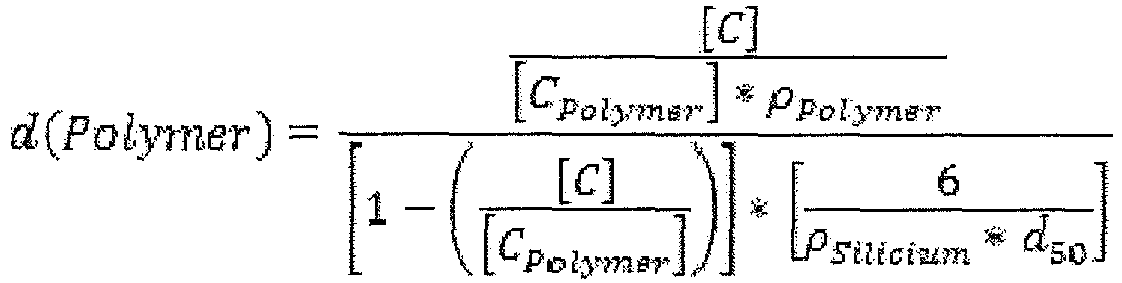
- worin die einzelnen Parameter folgende Bedeutung haben: d(Polymer): mittlere Schichtdicke des Polymers;
- [C]: Kohlenstoffanteil des gepfropften Siliciumpartikels, bestimmt durch Elementaranalyse;
- [CPolymer] : Kohlenstoffanteil des Polymers, bestimmt durch Elementaranalyse;
- ρPolymer: Dichte des Polymers, bestimmt durch Gaspyknometrie gemäß DIN 66137-2;
- ρSilicium: Dichte des Siliciums (2,3 g/cm3);
- d50: Mittelwert der Partikelgrößenverteilung der Siliciumpartikel, bestimmt durch Lichtstreuung;
Die Dichte von Polyacrylsäure beträgt beispielsweise 1,4 g/cm3. - Ein weiterer Gegenstand der Erfindung sind wässrige Tintenformulierungen enthaltend ein oder mehrere Bindemittel, gegebenenfalls Graphit, gegebenenfalls eine oder mehrere weitere elektrisch leitende Komponenten und gegebenenfalls ein oder mehrere Additive, dadurch gekennzeichnet, dass erfindungsgemäß gepfropfte Siliciumpartikel enthalten sind.
- Ein weiterer Gegenstand der Erfindung sind Anodenmaterialien für Lithium-Ionen-Batterien enthaltend ein oder mehrere Bindemittel, gegebenenfalls Graphit, gegebenenfalls eine oder mehrere weitere elektrisch leitende Komponenten und gegebenenfalls ein oder mehrere Additive, dadurch gekennzeichnet, dass ein oder mehrere erfindungsgemäß gepfropfte Siliciumpartikel enthalten sind.
- Bevorzugte Rezepturen für das Anodenmaterial der Lithium-Ionen-Batterien enthalten vorzugsweise 5 bis 95 Gew.-%, insbesondere 60 bis 85 Gew.-% gepfropfte Siliciumpartikel; 0 bis 40 Gew.-%, insbesondere 0 bis 20 Gew.-% weitere elektrisch leitende Komponenten; 0 bis 80 Gew.-%, insbesondere 5 bis 30 Gew.-% Graphit; 0 bis 25 Gew.-%, vorzugsweise 1 bis 20 Gew.-%, besonders bevorzugt 5 bis 15 Gew.-% Bindemittel; und gegebenenfalls 0 bis 80 Gew.-%, insbesondere 0,1 bis 5 Gew.-% Additive; wobei sich die Angaben in Gew.-% auf das Gesamtgewicht des Anodenmaterials beziehen und sich die Anteile aller Bestandteile des Anodenmaterials auf 100 Gew.-% aufsummieren.
- In einer bevorzugten Rezeptur für das Anodenmaterial ist der Anteil von Graphitpartikeln und weiteren elektrisch leitenden Komponenten in Summe mindestens 10 Gew.-%, bezogen auf das Gesamtgewicht des Anodenmaterials.
- Die Anodentinte weist einen pH-Wert auf von vorzugsweise 5,5 bis 8,5 und besonders bevorzugt 6,5 bis 7,5 (bestimmt bei 20°C, beispielsweise mit dem pH-Meter von WTW pH 340i mit Sonde SenTix RJD).
- Ein weiterer Gegenstand der Erfindung sind Lithium-Ionen-Batterien umfassend eine Kathode, eine Anode, einen Separator und einen Elektrolyt, dadurch gekennzeichnet, dass die Anode auf dem vorgenannten, erfindungsgemäßen Anodenmaterial basiert.
- Neben den erfindungsgemäßen, gepfropften Siliciumpartikeln können zur Herstellung der erfindungsgemäßen Anodenmaterialien und Lithium-Ionen-Batterien die hierfür gängigen Ausgangsmaterialien eingesetzt werden und die hierfür üblichen Verfahren zur Herstellung der Anodenmaterialien und Lithium-Ionen-Batterien Anwendung finden, wie beispielsweise in der Patentanmeldung mit der Anmeldenummer
DE 102015215415.7 beschrieben. - Ein weiterer Gegenstand der Erfindung sind Lithium-Ionen-Batterien umfassend eine Kathode, eine Anode, einen Separator und einen Elektrolyt, dadurch gekennzeichnet, dass die Anode auf dem vorgenannten, erfindungsgemäßen Anodenmaterial basiert; und das Anodenmaterial der vollständig geladenen Lithium-Ionen-Batterie nur teilweise lithiiert ist.
- Ein weiterer Gegenstand der vorliegenden Erfindung sind Verfahren zum Beladen von Lithium-Ionen-Batterien umfassend eine Kathode, eine Anode, einen Separator und einen Elektrolyt, dadurch gekennzeichnet, dass die Anode auf dem vorgenannten, erfindungsgemäßen Anodenmaterial basiert; und das Anodenmaterial beim vollständigen Laden der Lithium-Ionen-Batterie nur teilweise lithiiert wird.
- Ein weiterer Gegenstand der Erfindung ist die Verwendung der erfindungsgemäßen Anodenmaterialien in Lithium-Ionen-Batterien, die so konfiguriert sind, dass die Anodenmaterialien im vollständig geladenen Zustand der Lithium-Ionen-Batterien nur teilweise lithiiert sind.
- Bevorzugt ist also, dass das Anodenmaterial, insbesondere die Siliciumpartikel, in der vollständig geladenen Lithium-Ionen-Batterie nur teilweise lithiiert ist. Vollständig geladen bezeichnet den Zustand der Batterie, in dem das Anodenmaterial der Batterie ihre höchste Beladung an Lithium aufweist. Teilweise Lithiierung des Anodenmaterials bedeutet, dass das maximale Lithiumaufnahmevermögen der Siliciumpartikel im Anodenmaterial nicht ausgeschöpft wird. Das maximale Lithiumaufnahmevermögen der Siliciumpartikel entspricht allgemein der Formel Li4.4Si und beträgt somit 4,4 Lithiumatome pro Siliciumatom. Dies entspricht einer maximalen spezifischen Kapazität von 4200 mAh pro Gramm Silicium.
- Das Verhältnis der Lithiumatome zu den Siliciumatomen in der Anode einer Lithium-Ionen-Batterie (Li/Si-Verhältnis) kann beispielsweise über den elektrischen Ladungsfluss eingestellt werden. Der Lithiierungsgrad des Anodenmaterials beziehungsweise der im Anodenmaterial enthaltenen Siliciumpartikel ist proportional zur geflossenen elektrischen Ladung. Bei dieser Variante wird beim Laden der Lithium-Ionen-Batterie die Kapazität des Anodenmaterials für Lithium nicht voll ausgeschöpft. Dies resultiert in einer teilweisen Lithiierung der Anode.
- Bei einer alternativen, bevorzugten Variante wird das Li/Si-Verhältnis einer Lithium-Ionen-Batterie durch das Zellbalancing eingestellt. Hierbei werden die Lithium-Ionen-Batterien so ausgelegt, dass das Lithiumaufnahmevermögen der Anode vorzugsweise größer ist als das Lithiumabgabevermögen der Kathode. Dies führt dazu, dass in der vollständig geladenen Batterie das Lithiumaufnahmevermögen der Anode nicht voll ausgeschöpft ist, d.h. dass das Anodenmaterial nur teilweise lithiiert ist.
- Bei der erfindungsgemäßen teilweisen Lithiierung beträgt das Li/Si-Verhältnis im Anodenmaterial im vollständig geladenen Zustand der Lithium-Ionen-Batterie vorzugsweise ≤ 2,2, besonders bevorzugt ≤ 1,98 und am meisten bevorzugt ≤ 1,76. Das Li/Si-Verhältnis im Anodenmaterial im vollständig geladenen Zustand der Lithium-Ionen-Batterie ist vorzugsweise ≥ 0,22, besonders bevorzugt ≥ 0,44 und am meisten bevorzugt ≥ 0,66.
- Die Kapazität des Siliciums des Anodenmaterials der Lithium-Ionen-Batterie wird vorzugsweise zu ≤ 50%, besonders bevorzugt zu ≤ 45% und am meisten bevorzugt zu ≤ 40% genutzt, bezogen auf eine Kapazität von 4200 mAh pro Gramm Silicium.
- Die Anode wird mit vorzugsweise ≤ 1500 mAh/g, besonders bevorzugt ≤ 1400 mAh/g und am meisten bevorzugt ≤ 1300 mAh/g beladen, bezogen auf die Masse der Anode. Die Anode wird bevorzugt mit mindestens 600 mAh/g, besonders bevorzugt ≥ 700 mAh/g und am meisten bevorzugt ≥ 800 mAh/g beladen, bezogen auf die Masse der Anode. Diese Angaben beziehen sich vorzugsweise auf die vollständig geladene Lithium-Ionen-Batterie.
- Der Lithiierungsgrad von Silicium beziehungsweise die Ausnutzung der Kapazität von Silicium für Lithium (Si-Kapazitätsnutzung α) kann beispielsweise bestimmt werden, wie in der Patentanmeldung mit der Anmeldenummer
DE 102015215415.7 auf Seite 11, Zeile 4 bis Seite 12, Zeile 25 beschrieben, insbesondere an Hand der dort genannten Formel für die Si-Kapazitätsnutzung α und den ergänzenden Angaben unter den Überschriften "Bestimmung der Delithiierungs-Kapazität β" und "Bestimmung des Si-Gewichtsanteils ωSi" ("incorporated by reference"). - Überraschenderweise sind die erfindungsgemäß gepfropften Siliciumpartikel abwaschstabil, insbesondere in wässrigem Medium. Die Polymere sind an die gepfropften Siliciumpartikel unerwartet stabil angebunden und werden in wässrigem Medium nicht von den gepfropften Siliciumpartikeln abgewaschen. Vorteilhafterweise liegen die erfindungsgemäßen Produkte in Form von Partikeln vor. Es sind sogar nicht-aggregierte gepfropfte Siliciumpartikel zugänglich.
- Die erfindungsgemäß gepfropften Siliciumpartikel sind vorteilhafterweise auch in wässrigen Tintenformulierungen für Anoden von Lithiumionen-Batterien stabil und neigen unter solchen Bedingungen überraschenderweise wenig oder gar nicht zur Wasserstoffbildung. Die Reaktivität der Oberfläche der Siliciumpartikel ist in den erfindungsgemäßen Partikeln also dramatisch gesenkt. Dies ermöglicht eine Verarbeitung ohne ein Aufschäumen der wässrigen Tintenformulierung und die Herstellung von besonders homogenen bzw. Gasblasen-freien Anoden.
- Zudem zeigen erfindungsgemäße Anoden eine bessere elektrochemische Performance. Eine weitere Verbesserung der Zyklenstabilität der Lithiumionen-Batterien kann erreicht werden, wenn die Batterien unter Teilbeladung betrieben werden.
- Die nachfolgenden Beispiele dienen zur weiteren Erläuterung der Erfindung:
Folgende analytische Methoden und Geräte wurden zur Charakterisierung eingesetzt: - Die Messung der Partikelverteilung wurde durch statische Laserstreuung unter Anwendung des Mie-Modells mit einem Horiba LA 950 in einer stark verdünnten Suspension in Wasser oder Ethanol durchgeführt. Die angegebenen mittleren Partikelgrößen sind volumengewichtet.
- Die C-Gehalte wurden mit einem Leco CS 230 Analysator ermittelt, zur Bestimmung von O- und N-Gehalten wurde ein Leco TCH-600 Analysator eingesetzt.
- Eine Probe der nach der Trocknung erhaltenen polymerbeschichteten Partikel wurde durch Nassiebung mit einer Siebmaschine AS 200 basic (Retsch GmbH) mit Wasser an Edelstahlsieben von Überkorn > 20 µm befreit. Der Siebrückstand wurde getrocknet und ausgewogen und so der Siebrückstand > 20 µm bestimmt.
- Es wurden 50 mg (für Bestimmung bei 80°C) oder 100 mg (für Bestimmung bei 40°C) der Probe in ein GC-Headspace Gläschen (22 ml) eingewogen und mit 5 ml eines wässrigen Li-Acetat Puffers (pH 7; 0,1 M) versetzt, das Gläschen verschlossen und unter Rühren für für 30 Minuten in einem Aluminiumblock auf 80°C erhitzt.
- Die Bestimmung des Wasserstoffgehalts in der Gasphase wurde mittels GC-Messung durchgeführt. Detektiert wurde über Wärmeleitfähigkeitsdetektion. Die Angabe des Wasserstoffanteils erfolgte in Volumenprozent der Gasphase. Weitere detektierte Gase waren Sauerstoff, Stickstoff und Argon.
- Das Siliciumpulver wurde durch Mahlung eines groben Si-Splitts aus der Produktion von Solarsilicium in einer Fließbettstrahlmühle (Netzsch-Condux CGS16 mit 90 m3/h Stickstoff bei 7 bar als Mahlgas) hergestellt.
- Partikelgrößenverteilung der so erhaltenen Siliciumpartikel (bestimmt mit Ethanol als Dispergiermittel): d10 = 2,23 µm, d50 = 4,48 µm und d90 = 7,78 µm und von Breite (d90-d10) von 5,5 µm.
- Die REM-Aufnahme des trockenen Si-Staubs in Fig. 2 zeigt, dass die Probe aus einzelnen, nicht aggregierten, splitterförmigen Partikeln bestand.
- Der O-Gehalt der Partikel betrug 0,23 %.
- Die Gasentwicklung, bestimmt durch Rühren von Si-Partikeln (50 mg) in 5 ml eines 0,1 M Li-Acetat (pH 7) in einem HGC Headspace-Vial (Gesamtvolumen 22 ml), bei 80°C für 30 Min und Bestimmung der H2-Menge im Gasraum lieferte 4,36 Vol.-% Wasserstoff.
- Es wurden 25 g Si-Partikel aus Beispiel 1 in 200 ml Toluol vorgelegt und 2,5 g 3-(Trimethoxysilyl)-propylmethacrylat zugegeben, entgast, p-Toluolsulfonsäure (50 mg) zugegeben und für 3 h bei 40°C gerührt. Anschließend wurde die Reaktionslösung zentrifugiert, der Niederschlag mit Toluol sowie Ethanol gewaschen und bei 60°C im Vakuum getrocknet. Die erhaltenen Partikel wiesen einen Kohlenstoffgehalt von 0,07 Gew.-% auf und wurden direkt in weiteren Umsetzungen eingesetzt.
- Es wurden 10 g der Si-Partikel aus Beispiel 2 in 100 ml Toluol suspendiert und 2 g Acrylsäure zugegeben.
- Die erhaltene Suspension wurde entgast und mit Argon geflutet. Es wurden 40 mg AIBN als Initiator zugegeben und die erhaltene Suspension für 1h auf 80°C erhitzt. Nach Abkühlen der Reaktionslösung wurden die Partikel durch Zentrifugation vom Überstand abgetrennt und durch wiederholte Waschungen mit Ethanol, Wasser und Aceton von überschüssigem Monomer und freiem Polymer befreit. Die erhaltenen Partikel wurden im Vakuum bei 60°C getrocknet.
- Im so erhaltenen Produkt war die Polyacrylsäure abwaschstabil an die Siliciumpartikel angebunden, insbesondere in wässrigem Medium.
- Das erhaltene Produkt wies einen O-Gehalt von 0,72 % sowie einen C-Gehalt von 0,53 %. Dies entspricht einem Polymergehalt von 1,1 Gew.-% und einer rechnerischen mittleren Schichtdicke des Polymers von 14 nm.
- Die Messung der Partikelverteilung am dabei gewonnenen Produkt durch statische Laserstreuung unter Anwendung des Mie-Modells mit einem Horiba LA 950 in einer stark verdünnten Suspension in Wasser ergab d10 = 2,30 µm, d50 = 4,73 µm und d90 = 7,98 µm sowie eine Breite (d90-d10) von 5,68 µm auf.
- Der Siebrückstand > 20 µm war kleiner 1 %.
- Der H2-Gehalt in der Gasphase beträgt 0,00 Vol.-%.
- Es wurden 10 g der Si-Partikel aus Beispiel 2 in 100 ml Toluol suspendiert und 5,5 g Vinylencarbonat und 4,5 g Acrylsäure zugegeben.
- Die erhaltene Suspension wurde entgast und mit Argon geflutet. Es wurden 80 mg AIBN als Initiator zugegeben und die erhaltene Suspension für 1h auf 80°C erhitzt. Nach Abkühlen der Reaktionslösung wurden die Partikel durch Zentrifugation vom Überstand abgetrennt und durch wiederholte Waschungen mit Ethanol, Wasser und Aceton von überschüssigem Monomer und freiem Polymer befreit. Die erhaltenen Partikel wurden im Vakuum bei 60°C getrocknet.
- Im so erhaltenen Produkt war das Copolymer abwaschstabil an die Siliciumpartikel angebunden, insbesondere in wässrigem Medium. Das erhaltene Produkt wies einen O-Gehalt von 0,75 % sowie einen C-Gehalt von 0,46 %. Dies entspricht einem Polymergehalt von 1,0 Gew.-% und einer rechnerischen mittleren Schichtdicke des Polymers von 12 nm.
- Die Messung der Partikelverteilung am dabei gewonnenen Produkt durch statische Laserstreuung unter Anwendung des Mie-Modells mit einem Horiba LA 950 in einer stark verdünnten Suspension in Wasser ergab d10 = 2,34 µm, d50 = 4,77 µm und d90 = 8,06 µm sowie eine Breite (d90-d10) von 5,72 µm auf.
- Der Siebrückstand > 20 µm war kleiner 1 %.
- Der H2-Gehalt in der Gasphase beträgt 0,00 Vol.-%.
- 29,709 g bei 85° C bis zur Gewichtskonstanz getrockneter Polyacrylsäure und 756,60 g deionisiertes Wasser wurden mittels Schüttler (290 l/min) für ca. 2,5 h bis zur vollständigen Lösung der Polyacrylsäure bewegt. Zu der Lösung wurde Lithiumhydroxid Monohydrat portionsweise hinzugegeben, bis der pH-Wert bei 7,0 lag (gemessen mit pH-Meter WTW pH 340i und Sonde SenTix RJD). Die Lösung wurde anschließend mittels Schüttler weitere 4 h durchmischt.
- 7,00 g der Siliciumpartikel aus Beispiel 3 wurden dann in 12,50 g der neutralisierten Polyacrylsäure-Lösung und 5,10 g deionisiertem Wasser mittels Dissolver bei einer Umlaufgeschwindigkeit von 4,5 m/s für 5 min und von 12 m/s für 30 min unter Kühlung bei 20°C dispergiert. Nach Zugabe von 2,50 g Graphit (I-merys, KS6L C) wurde dann weitere 30 min bei einer Umlaufgeschwindigkeit von 12 m/s gerührt. Nach Entgasen wurde die Dispersion mittels eines Filmziehrahmens mit 0,08 mm Spalthöhe (Erichsen, Modell 360) auf eine Kupferfolie mit Dicke von 0,030 mm (Schlenk Metallfolien, SE-Cu58) aufgebracht. Die so hergestellte Anodenbeschichtung wurde anschließend 60 min bei 80°C und 1 bar Luftdruck getrocknet.
- Das mittlere Flächengewicht der trockenen Anodenbeschichtung aus Beispiel 5 mit den Partikeln aus Beispiel 3 betrug 2,97 mg/cm2 und die Beschichtungsdichte 0,99 g/cm3. Das mittlere Flächengewicht der trockenen Anodenbeschichtung aus Beispiel 6 mit den Partikeln aus Beispiel 4 betrug 2,73 mg/cm2 und die Beschichtungsdichte 0,93 g/cm3.
- Beispiel 6 wurde identisch ausgeführt wie Beispiel 5, mit dem einzigen Unterschied, dass die Siliciumpartikel aus Beispiel 4 an Stelle der Siliciumpartikel aus Beispiel 3 eingesetzt wurden.
- Die elektrochemischen Untersuchungen wurden an einer Knopfzelle (Typ CR2032, Hohsen Corp.) in 2-Elektroden-Anordnung durchgeführt. Die Elektrodenbeschichtung aus Beispiel 5 wurde als Gegenelektrode bzw. negative Elektrode (Dm = 15 mm) eingesetzt, eine Beschichtung auf Basis von Lithium-Nickel-Mangan-Kobaltoxid 6:2:2 mit Gehalt von 94,0 % und mittlerem Flächengewicht von 14,8 mg/cm2 als Arbeitselektrode bzw. positive Elektrode (Dm = 15 mm) verwendet. Ein mit 120 µl Elektrolyt getränktes, Glasfaser-Filterpapier (Whatman, GD Type D) diente als Separator (Dm = 16 mm). Der verwendete Elektrolyt bestand aus einer 1,0-molaren Lösung von Lithiumhexafluorophosphat in einem 3:7 (v/v) Gemisch von Fluorethylencarbonat und Ethylmethylcarbonat, welche mit 2,0 Gew.-% Vinylencarbonat versetzt war. Der Bau der Zelle erfolgte in einer Glovebox (< 1 ppm H2O, O2), der Wassergehalt in der Trockenmasse aller verwendeten Komponenten lag unterhalb von 20 ppm.
- Die elektrochemische Testung wurde bei 20°C durchgeführt. Das Laden der Zelle erfolgte im cc/cv-Verfahren (constant current / constant voltage) mit konstantem Strom von 5 mA/g (entspricht C/25) im ersten Zyklus und von 60 mA/g (entspricht C/2) in den darauffolgenden Zyklen und nach Erreichen der Spannungsgrenze von 4,2 V mit konstanter Spannung bis Unterschreiten eines Stroms von 1,2 mA/g (entspricht C/100) bzw. 15 mA/g (entspricht C/8). Das Entladen der Zelle erfolgte im cc-Verfahren (constant current) mit konstantem Strom von 5 mA/g (entspricht C/25) im ersten Zyklus und von 60 mA/g (entspricht C/2) in den darauffolgenden Zyklen bis Erreichen der Spannungsgrenze von 3,0 V. Der gewählte spezifische Strom bezog sich auf das Gewicht der Beschichtung der positiven Elektrode.
- Beispiel 8 wurde identisch ausgeführt wie Beispiel 7, mit dem einzigen Unterschied, dass die Elektrodenbeschichtung aus Beispiel 6 an Stelle der Elektrodenbeschichtung aus Beispiel 5 eingesetzt wurde.
- Mit den Siliciumpartikeln aus Beispiel 1 wurde analog zu Beispiel 5 eine Anode hergestellt. Das mittlere Flächengewicht der so hergestellten Anodenbeschichtung betrug 2,94 mg/cm2 und die Beschichtungsdichte 1,0 g/cm3.
- Die Anode mit den nicht beschichteten Siliciumpartikeln aus Vergleichsbeispiel 9 wurde wie in Beispiel 7 beschrieben getestet.
- Auf Grund der Rezeptierung in den (Vergleichs)Beispielen 7, 8 und 10 wurde die Lithium-Ionen-Batterie durch Zellbalancing unter Teil-Lithiierung der Anode betrieben. In Tabelle 1 sind die Austestungsergebnisse von Beispiel 7 und 8 sowie dem Vergleichsbeispiel 10 zusammengefasst.
Tabelle 1: Austestungsergebnisse der (Vergleichs)Beispiele 7, 8 und 10: (V) Bsp. Polymer gepfropftes Silicium Entladekapazität nach Zyklus 1 [mAh/cm2] Zyklenzahl mit ≥ 80% Kapazitätserhalt 7 Ja 2,05 213 8 Ja 2,02 218 10 Nein 2,03 187 - Die Lithium-Ionen-Batterien aus Beispiel 7 und 8 zeigen im Vergleich zur Lithium-Ionen-Batterie des Vergleichsbeispiels 10 überraschenderweise ein stabileres elektrochemisches Verhalten.
- In 500 ml Wasser wurden 0,65 g Natriumhydroxid gelöst, mit 1,365 g Polyacrylsäure versetzt und bis zum Erhalt einer klaren Lösung gerührt. Der pH Wert der Lösung betrug 6,0.
- 250 ml dieser Lösung wurden mit 25 g Si-Partikeln aus Beispiel 1 versetzt und bei 25°C für 30 Minuten gerührt. Anschließend wurde das Lösungsmittel bei 150°C entfernt und die Partikel bei 80°C im Vollvakuum nachgetrocknet.
- Die erhaltenen Partikel wiesen einen C-Gehalt von 0,64 % sowie einen O-Gehalt von 23,5 % auf.
- 5 g der erhaltenen, beschichteten Partikel wurden mit Wasser gewaschen. Dadurch wurde die gesamte Beschichtung entfernt (festgestellt durch Bestimmung des C-Gehaltes der Si-Partikel). Die Waschstabilität ist somit negativ.
Claims (19)
- Mit Polymeren gepfropfte Siliciumpartikel, wobei die Siliciumpartikel durchschnittliche Partikelgrößen d50 von 1 µm bis 8 µm haben und die Polymere der mit Polymeren gepfropften Siliciumpartikel in wässrigem Medium abwaschstabil an die Siliciumpartikel angebunden sind und die Partikelgrößen durch statische Laserstreuung, wie in der Anmeldung beschrieben, bestimmt werden.
- Mit Polymeren gepfropfte Siliciumpartikel gemäß Anspruch 1, dadurch gekennzeichnet, dass die Siliciumpartikel auf elementarem Silicium basieren.
- Mit Polymeren gepfropfte Siliciumpartikel gemäß Anspruch 1 oder 2, dadurch gekennzeichnet, dass die Siliciumpartikel durchschnittliche Partikelgrößen d50 von 3 µm bis 6 µm haben.
- Verfahren zur Herstellung der mit Polymeren gepfropften Siliciumpartikel aus Anspruch 1 bis 3, indem ein oder mehrere ethylenisch ungesättigte Monomere in Gegenwart von Siliciumpartikeln mit durchschnittlichen Partikelgrößen von 1 µm bis 8 µm mittels radikalisch initiierter Polymerisation polymerisiert werden, wobei die Oberfläche der eingesetzten Siliciumpartikel ein oder mehrere funktionelle Gruppen trägt ausgewählt aus der Gruppe umfassend a) Si-H-Gruppen, b) organische funktionelle Gruppen ausgewählt aus der Gruppe umfassend Alkane und Aromaten und c) ethylenisch ungesättigte Silan-Gruppen.
- Verfahren zur Herstellung der mit Polymeren gepfropften Siliciumpartikel gemäß Anspruch 4, dadurch gekennzeichnet, dass die Siliciumpartikel mit den Si-H-Gruppen a) und/oder den organischen funktionellen Gruppen b) erhältlich sind durch Mahlen von Siliciumpartikeln nach Trocken- oder Nassmahlverfahren und
die Siliciumpartikel mit den ethylenisch ungesättigten Silan-Gruppen c) erhältlich sind durch Silanisieren von Siliciumpartikeln mit einem oder mehreren ethylenisch ungesättigten Silanen, die mit einer oder mehreren hydrolytisch abspaltbaren Gruppen substituiert sind. - Verfahren zur Herstellung der mit Polymeren gepfropften Siliciumpartikel gemäß Anspruch 4 oder 5, dadurch gekennzeichnet, dass die Siliciumpartikel, die auf der Oberfläche organische funktionelle Gruppen b) und/oder ethylenisch ungesättigte Silan-Gruppen c) tragen, einen Kohlenstoffgehalt von 0,03 bis 2 Gew.% haben, bezogen auf das Gesamtgewicht der Siliciumpartikel.
- Verfahren zur Herstellung der mit Polymeren gepfropften Siliciumpartikel gemäß Anspruch 4 bis 6, dadurch gekennzeichnet, dass die ethylenisch ungesättigten Monomere für die radikalisch initiierte Polymerisation ausgewählt werden aus der Gruppe umfassend Acrylsäure, Methacrylsäure, Vinylencarbonat, Methylmethacrylat, Styrol, funktionalisierte Styrol-Derivate, Vinylpyridin, Dimethylaminoethylmethacrylat, Hydroxyethylmethacrylat, Ethylenglykoldimethacrylat, Glycidylmethacrylat und Polyethylenglykolmethacrylat.
- Mit Polymeren gepfropfte Siliciumpartikel erhältlich nach den Verfahren gemäß Anspruch 4 bis 7.
- Mit Polymeren gepfropfte Siliciumpartikel gemäß der Ansprüche 1 bis 3 oder 8, dadurch gekennzeichnet, dass die abwaschstabile Anbindung der Polymere an die Siliciumpartikel in wässrigem Medium sich dadurch auszeichnet, dass nach Waschen der mit Polymeren gepfropften Siliciumpartikel mit Wasser bei pH 7 und 20°C und anschließendem Abtrennen des Wassers sowie anschließendem Trocknen der mit Polymeren gepfropften Siliciumpartikel ≥ 99 Gew.-% mit Polymeren gepfropfte Siliciumpartikel reisoliert werden, bezogen auf das Trockengewicht der zur Ermittlung der abwaschstabilen Anbindung eingesetzten mit Polymeren gepfropften Siliciumpartikel.
- Mit Polymeren gepfropfte Siliciumpartikel gemäß der Ansprüche 1 bis 3 oder 8 bis 9, dadurch gekennzeichnet, dass die mit Polymeren gepfropften Siliciumpartikel nicht aggregiert sind.
- Mit Polymeren gepfropfte Siliciumpartikel gemäß der Ansprüche 1 bis 3 oder 8 bis 10, dadurch gekennzeichnet, dass die mit Polymeren gepfropften Siliciumpartikel zu 0,3 bis 20 Gew.% auf Polymeren basieren, bezogen auf das Gesamtgewicht der mit Polymeren gepfropften Siliciumpartikel.
- Mit Polymeren gepfropfte Siliciumpartikel gemäß der Ansprüche 1 bis 3 oder 8 bis 11, dadurch gekennzeichnet, dass die mit Polymeren gepfropften Siliciumpartikel zu 80 bis 99,7 Gew.% auf Silicium basieren, bezogen auf das Gesamtgewicht der mit Polymeren gepfropften Siliciumpartikel.
- Mit Polymeren gepfropfte Siliciumpartikel gemäß der Ansprüche 1 bis 3 oder 8 bis 12, dadurch gekennzeichnet, dass die mit Polymeren gepfropften Siliciumpartikel einen Kohlenstoffgehalt von 0,2 bis 10 Gew.% haben, bezogen auf das Gesamtgewicht der mit Polymeren gepfropften Siliciumpartikel.
- Anodenmaterialien für Lithium-Ionen-Batterien enthaltend ein oder mehrere Bindemittel, gegebenenfalls Graphit, gegebenenfalls eine oder mehrere weitere elektrisch leitende Komponenten und gegebenenfalls ein oder mehrere Additive, dadurch gekennzeichnet, dass ein oder mehrere mit Polymeren gepfropfte Siliciumpartikel aus Anspruch 1 bis 3 oder 8 bis 13 enthalten sind.
- Lithium-Ionen-Batterien umfassend eine Kathode, eine Anode, einen Separator und einen Elektrolyt, dadurch gekennzeichnet, dass die Anode auf einem Anodenmaterial basiert, das ein oder mehrere mit Polymeren gepfropfte Siliciumpartikel aus Anspruch 1 bis 3 oder 8 bis 13 enthält.
- Lithium-Ionen-Batterien gemäß Anspruch 15, dadurch gekennzeichnet, dass das Anodenmaterial in der vollständig geladenen Lithium-Ionen-Batterie nur teilweise lithiiert.
- Lithium-Ionen-Batterien gemäß Anspruch 16, dadurch gekennzeichnet, dass die Anode in der vollständig geladenen Lithium-Ionen-Batterie mit 600 bis 1500 mAh/g beladen ist, bezogen auf die Masse der Anode.
- Lithium-Ionen-Batterien gemäß Anspruch 16 oder 17, dadurch gekennzeichnet, dass im vollständig geladenen Zustand der Lithium-Ionen-Batterie das Verhältnis der Lithiumatome zu den Siliciumatomen im Anodenmaterial ≤ 2,2 beträgt.
- Lithium-Ionen-Batterien gemäß Anspruch 16 bis 18, dadurch gekennzeichnet, dass die Kapazität des Siliciums des Anodenmaterials der Lithium-Ionen-Batterie zu ≤ 50% genutzt wird, bezogen auf die maximale Kapazität von 4200 mAh pro Gramm Silicium.
Applications Claiming Priority (1)
| Application Number | Priority Date | Filing Date | Title |
|---|---|---|---|
| PCT/EP2017/052878 WO2018145749A1 (de) | 2017-02-09 | 2017-02-09 | Mit polymeren gepfropfte siliciumpartikel |
Publications (2)
| Publication Number | Publication Date |
|---|---|
| EP3580793A1 EP3580793A1 (de) | 2019-12-18 |
| EP3580793B1 true EP3580793B1 (de) | 2020-04-29 |
Family
ID=57995218
Family Applications (1)
| Application Number | Title | Priority Date | Filing Date |
|---|---|---|---|
| EP17704005.2A Active EP3580793B1 (de) | 2017-02-09 | 2017-02-09 | Mit polymeren gepfropfte siliciumpartikel |
Country Status (6)
| Country | Link |
|---|---|
| US (1) | US11158855B2 (de) |
| EP (1) | EP3580793B1 (de) |
| JP (1) | JP2020507192A (de) |
| KR (1) | KR20190101468A (de) |
| CN (1) | CN110326135B (de) |
| WO (1) | WO2018145749A1 (de) |
Families Citing this family (5)
| Publication number | Priority date | Publication date | Assignee | Title |
|---|---|---|---|---|
| JP7395919B2 (ja) * | 2019-03-18 | 2023-12-12 | 東ソー株式会社 | ポリマー被覆シリコン粒子 |
| DE102019135702A1 (de) * | 2019-12-23 | 2021-06-24 | Schott Ag | Festkörperlithiumionenleitermaterialien, Pulver aus Festkörperionenleitermaterialien und Verfahren zu deren Herstellung |
| CN112289984A (zh) * | 2020-09-22 | 2021-01-29 | 合肥国轩高科动力能源有限公司 | 一种改性硅负极材料及其制备方法、应用 |
| CN115548275B (zh) * | 2021-06-29 | 2025-05-13 | 比亚迪股份有限公司 | 锂电池及其制备方法、充电方法和动力车辆 |
| CN114361391B (zh) * | 2021-12-29 | 2023-07-28 | 苏州大学 | 一种聚合物修饰纳米硅负极材料及其制备方法和应用 |
Family Cites Families (16)
| Publication number | Priority date | Publication date | Assignee | Title |
|---|---|---|---|---|
| US20070241303A1 (en) * | 1999-08-31 | 2007-10-18 | General Electric Company | Thermally conductive composition and method for preparing the same |
| EP1313158A3 (de) | 2001-11-20 | 2004-09-08 | Canon Kabushiki Kaisha | Elektrodenmaterial für wiederaufladbare Lithium-Batterie, solches Material enthaltende Elektrode, wiederaufladbare Lithium-Batterie mit dieser Elektrode und Herstellungsverfahren dafür |
| US7790316B2 (en) * | 2004-03-26 | 2010-09-07 | Shin-Etsu Chemical Co., Ltd. | Silicon composite particles, preparation thereof, and negative electrode material for non-aqueous electrolyte secondary cell |
| DE102011004361A1 (de) * | 2011-02-18 | 2012-08-23 | Wacker Chemie Ag | Modifizierte Kompositartikel |
| JP2012254899A (ja) * | 2011-06-09 | 2012-12-27 | Masstech:Kk | シリコン二次粒子及びその製造方法 |
| CN103165870B (zh) * | 2011-12-13 | 2016-03-16 | 上海杉杉科技有限公司 | 一种硅基复合材料、锂离子电池及其制备方法和应用 |
| GB2502345B (en) | 2012-05-25 | 2017-03-15 | Nexeon Ltd | Composite material |
| CN103474666B (zh) | 2013-07-23 | 2016-03-02 | 江苏华东锂电技术研究院有限公司 | 锂离子电池负极活性材料的制备方法 |
| CN103682286B (zh) * | 2013-12-18 | 2015-09-02 | 南京毕汉特威高分子材料有限公司 | 硅/高分子复合微球及锂离子电池用硅碳复合负极材料及其制备方法 |
| KR20140034879A (ko) * | 2014-01-27 | 2014-03-20 | 포항공과대학교 산학협력단 | 표면 처리된 실리콘 나노입자를 이용한 음극 활성물질 및 리튬 이차전지 |
| US9564639B2 (en) * | 2014-02-12 | 2017-02-07 | GM Global Technology Operations LLC | High performance silicon electrodes having improved interfacial adhesion between binder and silicon |
| TW201533960A (zh) * | 2014-02-21 | 2015-09-01 | Long Time Tech Co Ltd | 碳矽複合電極材料及其製備方法 |
| EP2919298B1 (de) * | 2014-03-12 | 2017-08-23 | Belenos Clean Power Holding AG | Si/C-Kompositanoden für Lithium-Ionen-Batterien mit anhaltender hoher Kapazität pro Flächeneinheit |
| KR102287812B1 (ko) | 2014-09-26 | 2021-08-09 | 삼성전자주식회사 | 음극 활물질 및 이를 채용한 리튬 전지, 및 상기 음극 활물질의 제조방법 |
| CN104409687B (zh) * | 2014-11-27 | 2016-08-17 | 江西先材纳米纤维科技有限公司 | 一步法火焰浸泡热处理改性硅电极 |
| DE102015215415A1 (de) | 2015-08-12 | 2017-02-16 | Wacker Chemie Ag | Siliciumpartikel enthaltende Anodenmaterialien für Lithium-Ionen-Batterien |
-
2017
- 2017-02-09 KR KR1020197023465A patent/KR20190101468A/ko not_active Withdrawn
- 2017-02-09 US US16/484,823 patent/US11158855B2/en active Active
- 2017-02-09 CN CN201780086140.7A patent/CN110326135B/zh active Active
- 2017-02-09 WO PCT/EP2017/052878 patent/WO2018145749A1/de not_active Ceased
- 2017-02-09 EP EP17704005.2A patent/EP3580793B1/de active Active
- 2017-02-09 JP JP2019543033A patent/JP2020507192A/ja not_active Withdrawn
Non-Patent Citations (1)
| Title |
|---|
| None * |
Also Published As
| Publication number | Publication date |
|---|---|
| US11158855B2 (en) | 2021-10-26 |
| US20200028173A1 (en) | 2020-01-23 |
| WO2018145749A1 (de) | 2018-08-16 |
| KR20190101468A (ko) | 2019-08-30 |
| CN110326135A (zh) | 2019-10-11 |
| CN110326135B (zh) | 2022-10-04 |
| JP2020507192A (ja) | 2020-03-05 |
| EP3580793A1 (de) | 2019-12-18 |
Similar Documents
| Publication | Publication Date | Title |
|---|---|---|
| EP3335262B1 (de) | Siliciumpartikel enthaltende anodenmaterialien für lithium-ionen-batterien | |
| EP3580793B1 (de) | Mit polymeren gepfropfte siliciumpartikel | |
| EP3545572B1 (de) | Kern-schale-kompositpartikel für anodenmaterialien von lithium-ionen-batterien | |
| EP3011621B1 (de) | Elektrodenmaterial und dessen verwendung in lithium-ionen-batterien | |
| EP3535793B1 (de) | Kohlenstoff-beschichtete siliciumpartikel für lithiumionen-batterien | |
| EP3417500B1 (de) | Kern-schale-kompositpartikel | |
| EP3027690B1 (de) | Verfahren zum zerkleinern von silicium | |
| EP3424097B1 (de) | Verfahren zur verarbeitung von elektrodenmaterialien für batterien | |
| WO2020069728A1 (de) | Silizium-partikel mit speziefischem chlor-gehalt als anodenaktivmaterial für lithium-ionen-batterien | |
| KR20230069158A (ko) | 양극 재료, 양극 시트 및 배터리 | |
| EP3580796A1 (de) | Siliciumpartikel für anodenmaterialien von lithium-ionen-batterien | |
| EP3807214B1 (de) | Thermische behandlung von siliziumpartikeln | |
| EP4131464A1 (de) | Zusammensetzung für elektrochemische elementfunktionsschicht, funktionsschicht für elektrochemisches element, laminat für elektrochemisches element und elektrochemisches element | |
| CN118610395B (zh) | 正极材料及电池 | |
| WO2021164846A1 (de) | Anodenaktivmaterialien für lithium-ionen-batterien | |
| EP3507844A1 (de) | Anoden von lithium-ionen-batterien | |
| EP3580794A1 (de) | Redispergierbare partikel basierend auf siliciumpartikeln und polymeren | |
| EP4176472B1 (de) | Verfahren zur herstellung von kohlenstoff-beschichteten siliciumpartikel für lithiumionen- batterien | |
| EP3532432A1 (de) | Verfahren zum modifizieren von siliziumpartikeln |
Legal Events
| Date | Code | Title | Description |
|---|---|---|---|
| STAA | Information on the status of an ep patent application or granted ep patent |
Free format text: STATUS: UNKNOWN |
|
| STAA | Information on the status of an ep patent application or granted ep patent |
Free format text: STATUS: THE INTERNATIONAL PUBLICATION HAS BEEN MADE |
|
| PUAI | Public reference made under article 153(3) epc to a published international application that has entered the european phase |
Free format text: ORIGINAL CODE: 0009012 |
|
| STAA | Information on the status of an ep patent application or granted ep patent |
Free format text: STATUS: REQUEST FOR EXAMINATION WAS MADE |
|
| 17P | Request for examination filed |
Effective date: 20190723 |
|
| AK | Designated contracting states |
Kind code of ref document: A1 Designated state(s): AL AT BE BG CH CY CZ DE DK EE ES FI FR GB GR HR HU IE IS IT LI LT LU LV MC MK MT NL NO PL PT RO RS SE SI SK SM TR |
|
| AX | Request for extension of the european patent |
Extension state: BA ME |
|
| GRAP | Despatch of communication of intention to grant a patent |
Free format text: ORIGINAL CODE: EPIDOSNIGR1 |
|
| STAA | Information on the status of an ep patent application or granted ep patent |
Free format text: STATUS: GRANT OF PATENT IS INTENDED |
|
| DAV | Request for validation of the european patent (deleted) | ||
| DAX | Request for extension of the european patent (deleted) | ||
| INTG | Intention to grant announced |
Effective date: 20200108 |
|
| RIN1 | Information on inventor provided before grant (corrected) |
Inventor name: JANTKE, DOMINIK Inventor name: HAUFE, STEFAN Inventor name: STOHRER, JUERGEN |
|
| GRAS | Grant fee paid |
Free format text: ORIGINAL CODE: EPIDOSNIGR3 |
|
| GRAA | (expected) grant |
Free format text: ORIGINAL CODE: 0009210 |
|
| STAA | Information on the status of an ep patent application or granted ep patent |
Free format text: STATUS: THE PATENT HAS BEEN GRANTED |
|
| AK | Designated contracting states |
Kind code of ref document: B1 Designated state(s): AL AT BE BG CH CY CZ DE DK EE ES FI FR GB GR HR HU IE IS IT LI LT LU LV MC MK MT NL NO PL PT RO RS SE SI SK SM TR |
|
| REG | Reference to a national code |
Ref country code: GB Ref legal event code: FG4D Free format text: NOT ENGLISH |
|
| REG | Reference to a national code |
Ref country code: CH Ref legal event code: EP |
|
| REG | Reference to a national code |
Ref country code: AT Ref legal event code: REF Ref document number: 1264648 Country of ref document: AT Kind code of ref document: T Effective date: 20200515 |
|
| REG | Reference to a national code |
Ref country code: DE Ref legal event code: R096 Ref document number: 502017004981 Country of ref document: DE |
|
| REG | Reference to a national code |
Ref country code: IE Ref legal event code: FG4D Free format text: LANGUAGE OF EP DOCUMENT: GERMAN |
|
| REG | Reference to a national code |
Ref country code: NL Ref legal event code: MP Effective date: 20200429 |
|
| REG | Reference to a national code |
Ref country code: LT Ref legal event code: MG4D |
|
| PG25 | Lapsed in a contracting state [announced via postgrant information from national office to epo] |
Ref country code: NO Free format text: LAPSE BECAUSE OF FAILURE TO SUBMIT A TRANSLATION OF THE DESCRIPTION OR TO PAY THE FEE WITHIN THE PRESCRIBED TIME-LIMIT Effective date: 20200729 Ref country code: PT Free format text: LAPSE BECAUSE OF FAILURE TO SUBMIT A TRANSLATION OF THE DESCRIPTION OR TO PAY THE FEE WITHIN THE PRESCRIBED TIME-LIMIT Effective date: 20200831 Ref country code: SE Free format text: LAPSE BECAUSE OF FAILURE TO SUBMIT A TRANSLATION OF THE DESCRIPTION OR TO PAY THE FEE WITHIN THE PRESCRIBED TIME-LIMIT Effective date: 20200429 Ref country code: IS Free format text: LAPSE BECAUSE OF FAILURE TO SUBMIT A TRANSLATION OF THE DESCRIPTION OR TO PAY THE FEE WITHIN THE PRESCRIBED TIME-LIMIT Effective date: 20200829 Ref country code: GR Free format text: LAPSE BECAUSE OF FAILURE TO SUBMIT A TRANSLATION OF THE DESCRIPTION OR TO PAY THE FEE WITHIN THE PRESCRIBED TIME-LIMIT Effective date: 20200730 Ref country code: LT Free format text: LAPSE BECAUSE OF FAILURE TO SUBMIT A TRANSLATION OF THE DESCRIPTION OR TO PAY THE FEE WITHIN THE PRESCRIBED TIME-LIMIT Effective date: 20200429 Ref country code: FI Free format text: LAPSE BECAUSE OF FAILURE TO SUBMIT A TRANSLATION OF THE DESCRIPTION OR TO PAY THE FEE WITHIN THE PRESCRIBED TIME-LIMIT Effective date: 20200429 |
|
| PG25 | Lapsed in a contracting state [announced via postgrant information from national office to epo] |
Ref country code: LV Free format text: LAPSE BECAUSE OF FAILURE TO SUBMIT A TRANSLATION OF THE DESCRIPTION OR TO PAY THE FEE WITHIN THE PRESCRIBED TIME-LIMIT Effective date: 20200429 Ref country code: BG Free format text: LAPSE BECAUSE OF FAILURE TO SUBMIT A TRANSLATION OF THE DESCRIPTION OR TO PAY THE FEE WITHIN THE PRESCRIBED TIME-LIMIT Effective date: 20200729 Ref country code: RS Free format text: LAPSE BECAUSE OF FAILURE TO SUBMIT A TRANSLATION OF THE DESCRIPTION OR TO PAY THE FEE WITHIN THE PRESCRIBED TIME-LIMIT Effective date: 20200429 Ref country code: HR Free format text: LAPSE BECAUSE OF FAILURE TO SUBMIT A TRANSLATION OF THE DESCRIPTION OR TO PAY THE FEE WITHIN THE PRESCRIBED TIME-LIMIT Effective date: 20200429 |
|
| PG25 | Lapsed in a contracting state [announced via postgrant information from national office to epo] |
Ref country code: AL Free format text: LAPSE BECAUSE OF FAILURE TO SUBMIT A TRANSLATION OF THE DESCRIPTION OR TO PAY THE FEE WITHIN THE PRESCRIBED TIME-LIMIT Effective date: 20200429 Ref country code: NL Free format text: LAPSE BECAUSE OF FAILURE TO SUBMIT A TRANSLATION OF THE DESCRIPTION OR TO PAY THE FEE WITHIN THE PRESCRIBED TIME-LIMIT Effective date: 20200429 |
|
| PG25 | Lapsed in a contracting state [announced via postgrant information from national office to epo] |
Ref country code: DK Free format text: LAPSE BECAUSE OF FAILURE TO SUBMIT A TRANSLATION OF THE DESCRIPTION OR TO PAY THE FEE WITHIN THE PRESCRIBED TIME-LIMIT Effective date: 20200429 Ref country code: EE Free format text: LAPSE BECAUSE OF FAILURE TO SUBMIT A TRANSLATION OF THE DESCRIPTION OR TO PAY THE FEE WITHIN THE PRESCRIBED TIME-LIMIT Effective date: 20200429 Ref country code: SM Free format text: LAPSE BECAUSE OF FAILURE TO SUBMIT A TRANSLATION OF THE DESCRIPTION OR TO PAY THE FEE WITHIN THE PRESCRIBED TIME-LIMIT Effective date: 20200429 Ref country code: CZ Free format text: LAPSE BECAUSE OF FAILURE TO SUBMIT A TRANSLATION OF THE DESCRIPTION OR TO PAY THE FEE WITHIN THE PRESCRIBED TIME-LIMIT Effective date: 20200429 Ref country code: RO Free format text: LAPSE BECAUSE OF FAILURE TO SUBMIT A TRANSLATION OF THE DESCRIPTION OR TO PAY THE FEE WITHIN THE PRESCRIBED TIME-LIMIT Effective date: 20200429 Ref country code: IT Free format text: LAPSE BECAUSE OF FAILURE TO SUBMIT A TRANSLATION OF THE DESCRIPTION OR TO PAY THE FEE WITHIN THE PRESCRIBED TIME-LIMIT Effective date: 20200429 Ref country code: ES Free format text: LAPSE BECAUSE OF FAILURE TO SUBMIT A TRANSLATION OF THE DESCRIPTION OR TO PAY THE FEE WITHIN THE PRESCRIBED TIME-LIMIT Effective date: 20200429 |
|
| REG | Reference to a national code |
Ref country code: DE Ref legal event code: R097 Ref document number: 502017004981 Country of ref document: DE |
|
| PG25 | Lapsed in a contracting state [announced via postgrant information from national office to epo] |
Ref country code: PL Free format text: LAPSE BECAUSE OF FAILURE TO SUBMIT A TRANSLATION OF THE DESCRIPTION OR TO PAY THE FEE WITHIN THE PRESCRIBED TIME-LIMIT Effective date: 20200429 Ref country code: SK Free format text: LAPSE BECAUSE OF FAILURE TO SUBMIT A TRANSLATION OF THE DESCRIPTION OR TO PAY THE FEE WITHIN THE PRESCRIBED TIME-LIMIT Effective date: 20200429 |
|
| PLBE | No opposition filed within time limit |
Free format text: ORIGINAL CODE: 0009261 |
|
| STAA | Information on the status of an ep patent application or granted ep patent |
Free format text: STATUS: NO OPPOSITION FILED WITHIN TIME LIMIT |
|
| 26N | No opposition filed |
Effective date: 20210201 |
|
| PG25 | Lapsed in a contracting state [announced via postgrant information from national office to epo] |
Ref country code: MC Free format text: LAPSE BECAUSE OF FAILURE TO SUBMIT A TRANSLATION OF THE DESCRIPTION OR TO PAY THE FEE WITHIN THE PRESCRIBED TIME-LIMIT Effective date: 20200429 |
|
| GBPC | Gb: european patent ceased through non-payment of renewal fee |
Effective date: 20210209 |
|
| REG | Reference to a national code |
Ref country code: BE Ref legal event code: MM Effective date: 20210228 |
|
| PG25 | Lapsed in a contracting state [announced via postgrant information from national office to epo] |
Ref country code: LU Free format text: LAPSE BECAUSE OF NON-PAYMENT OF DUE FEES Effective date: 20210209 Ref country code: LI Free format text: LAPSE BECAUSE OF NON-PAYMENT OF DUE FEES Effective date: 20210228 Ref country code: CH Free format text: LAPSE BECAUSE OF NON-PAYMENT OF DUE FEES Effective date: 20210228 |
|
| PG25 | Lapsed in a contracting state [announced via postgrant information from national office to epo] |
Ref country code: IE Free format text: LAPSE BECAUSE OF NON-PAYMENT OF DUE FEES Effective date: 20210209 Ref country code: FR Free format text: LAPSE BECAUSE OF NON-PAYMENT OF DUE FEES Effective date: 20210228 Ref country code: GB Free format text: LAPSE BECAUSE OF NON-PAYMENT OF DUE FEES Effective date: 20210209 |
|
| PG25 | Lapsed in a contracting state [announced via postgrant information from national office to epo] |
Ref country code: BE Free format text: LAPSE BECAUSE OF NON-PAYMENT OF DUE FEES Effective date: 20210228 |
|
| REG | Reference to a national code |
Ref country code: AT Ref legal event code: MM01 Ref document number: 1264648 Country of ref document: AT Kind code of ref document: T Effective date: 20220209 |
|
| PG25 | Lapsed in a contracting state [announced via postgrant information from national office to epo] |
Ref country code: AT Free format text: LAPSE BECAUSE OF NON-PAYMENT OF DUE FEES Effective date: 20220209 |
|
| P01 | Opt-out of the competence of the unified patent court (upc) registered |
Effective date: 20230502 |
|
| PG25 | Lapsed in a contracting state [announced via postgrant information from national office to epo] |
Ref country code: CY Free format text: LAPSE BECAUSE OF FAILURE TO SUBMIT A TRANSLATION OF THE DESCRIPTION OR TO PAY THE FEE WITHIN THE PRESCRIBED TIME-LIMIT Effective date: 20200429 |
|
| PG25 | Lapsed in a contracting state [announced via postgrant information from national office to epo] |
Ref country code: HU Free format text: LAPSE BECAUSE OF FAILURE TO SUBMIT A TRANSLATION OF THE DESCRIPTION OR TO PAY THE FEE WITHIN THE PRESCRIBED TIME-LIMIT; INVALID AB INITIO Effective date: 20170209 |
|
| PG25 | Lapsed in a contracting state [announced via postgrant information from national office to epo] |
Ref country code: SI Free format text: LAPSE BECAUSE OF FAILURE TO SUBMIT A TRANSLATION OF THE DESCRIPTION OR TO PAY THE FEE WITHIN THE PRESCRIBED TIME-LIMIT Effective date: 20200429 |
|
| PG25 | Lapsed in a contracting state [announced via postgrant information from national office to epo] |
Ref country code: MK Free format text: LAPSE BECAUSE OF FAILURE TO SUBMIT A TRANSLATION OF THE DESCRIPTION OR TO PAY THE FEE WITHIN THE PRESCRIBED TIME-LIMIT Effective date: 20200429 |
|
| REG | Reference to a national code |
Ref country code: DE Ref legal event code: R081 Ref document number: 502017004981 Country of ref document: DE Owner name: WACKER CHEMIE AG, DE Free format text: FORMER OWNER: WACKER CHEMIE AG, 81737 MUENCHEN, DE |
|
| PG25 | Lapsed in a contracting state [announced via postgrant information from national office to epo] |
Ref country code: MT Free format text: LAPSE BECAUSE OF FAILURE TO SUBMIT A TRANSLATION OF THE DESCRIPTION OR TO PAY THE FEE WITHIN THE PRESCRIBED TIME-LIMIT Effective date: 20200429 |
|
| PGFP | Annual fee paid to national office [announced via postgrant information from national office to epo] |
Ref country code: DE Payment date: 20250218 Year of fee payment: 9 |
|
| PG25 | Lapsed in a contracting state [announced via postgrant information from national office to epo] |
Ref country code: TR Free format text: LAPSE BECAUSE OF FAILURE TO SUBMIT A TRANSLATION OF THE DESCRIPTION OR TO PAY THE FEE WITHIN THE PRESCRIBED TIME-LIMIT Effective date: 20200429 |