EP3579966B1 - Sorbent composition and method of making - Google Patents
Sorbent composition and method of making Download PDFInfo
- Publication number
- EP3579966B1 EP3579966B1 EP18751411.2A EP18751411A EP3579966B1 EP 3579966 B1 EP3579966 B1 EP 3579966B1 EP 18751411 A EP18751411 A EP 18751411A EP 3579966 B1 EP3579966 B1 EP 3579966B1
- Authority
- EP
- European Patent Office
- Prior art keywords
- activated carbon
- water
- zirconium
- composition
- carbon porous
- Prior art date
- Legal status (The legal status is an assumption and is not a legal conclusion. Google has not performed a legal analysis and makes no representation as to the accuracy of the status listed.)
- Active
Links
Images


Classifications
-
- B—PERFORMING OPERATIONS; TRANSPORTING
- B01—PHYSICAL OR CHEMICAL PROCESSES OR APPARATUS IN GENERAL
- B01J—CHEMICAL OR PHYSICAL PROCESSES, e.g. CATALYSIS OR COLLOID CHEMISTRY; THEIR RELEVANT APPARATUS
- B01J20/00—Solid sorbent compositions or filter aid compositions; Sorbents for chromatography; Processes for preparing, regenerating or reactivating thereof
- B01J20/02—Solid sorbent compositions or filter aid compositions; Sorbents for chromatography; Processes for preparing, regenerating or reactivating thereof comprising inorganic material
- B01J20/20—Solid sorbent compositions or filter aid compositions; Sorbents for chromatography; Processes for preparing, regenerating or reactivating thereof comprising inorganic material comprising free carbon; comprising carbon obtained by carbonising processes
-
- B—PERFORMING OPERATIONS; TRANSPORTING
- B01—PHYSICAL OR CHEMICAL PROCESSES OR APPARATUS IN GENERAL
- B01J—CHEMICAL OR PHYSICAL PROCESSES, e.g. CATALYSIS OR COLLOID CHEMISTRY; THEIR RELEVANT APPARATUS
- B01J20/00—Solid sorbent compositions or filter aid compositions; Sorbents for chromatography; Processes for preparing, regenerating or reactivating thereof
- B01J20/02—Solid sorbent compositions or filter aid compositions; Sorbents for chromatography; Processes for preparing, regenerating or reactivating thereof comprising inorganic material
- B01J20/06—Solid sorbent compositions or filter aid compositions; Sorbents for chromatography; Processes for preparing, regenerating or reactivating thereof comprising inorganic material comprising oxides or hydroxides of metals not provided for in group B01J20/04
-
- B—PERFORMING OPERATIONS; TRANSPORTING
- B01—PHYSICAL OR CHEMICAL PROCESSES OR APPARATUS IN GENERAL
- B01J—CHEMICAL OR PHYSICAL PROCESSES, e.g. CATALYSIS OR COLLOID CHEMISTRY; THEIR RELEVANT APPARATUS
- B01J20/00—Solid sorbent compositions or filter aid compositions; Sorbents for chromatography; Processes for preparing, regenerating or reactivating thereof
- B01J20/28—Solid sorbent compositions or filter aid compositions; Sorbents for chromatography; Processes for preparing, regenerating or reactivating thereof characterised by their form or physical properties
- B01J20/28014—Solid sorbent compositions or filter aid compositions; Sorbents for chromatography; Processes for preparing, regenerating or reactivating thereof characterised by their form or physical properties characterised by their form
- B01J20/28016—Particle form
-
- B—PERFORMING OPERATIONS; TRANSPORTING
- B01—PHYSICAL OR CHEMICAL PROCESSES OR APPARATUS IN GENERAL
- B01J—CHEMICAL OR PHYSICAL PROCESSES, e.g. CATALYSIS OR COLLOID CHEMISTRY; THEIR RELEVANT APPARATUS
- B01J20/00—Solid sorbent compositions or filter aid compositions; Sorbents for chromatography; Processes for preparing, regenerating or reactivating thereof
- B01J20/28—Solid sorbent compositions or filter aid compositions; Sorbents for chromatography; Processes for preparing, regenerating or reactivating thereof characterised by their form or physical properties
- B01J20/28054—Solid sorbent compositions or filter aid compositions; Sorbents for chromatography; Processes for preparing, regenerating or reactivating thereof characterised by their form or physical properties characterised by their surface properties or porosity
-
- B—PERFORMING OPERATIONS; TRANSPORTING
- B01—PHYSICAL OR CHEMICAL PROCESSES OR APPARATUS IN GENERAL
- B01J—CHEMICAL OR PHYSICAL PROCESSES, e.g. CATALYSIS OR COLLOID CHEMISTRY; THEIR RELEVANT APPARATUS
- B01J20/00—Solid sorbent compositions or filter aid compositions; Sorbents for chromatography; Processes for preparing, regenerating or reactivating thereof
- B01J20/30—Processes for preparing, regenerating, or reactivating
- B01J20/3078—Thermal treatment, e.g. calcining or pyrolizing
-
- B—PERFORMING OPERATIONS; TRANSPORTING
- B01—PHYSICAL OR CHEMICAL PROCESSES OR APPARATUS IN GENERAL
- B01J—CHEMICAL OR PHYSICAL PROCESSES, e.g. CATALYSIS OR COLLOID CHEMISTRY; THEIR RELEVANT APPARATUS
- B01J20/00—Solid sorbent compositions or filter aid compositions; Sorbents for chromatography; Processes for preparing, regenerating or reactivating thereof
- B01J20/30—Processes for preparing, regenerating, or reactivating
- B01J20/32—Impregnating or coating ; Solid sorbent compositions obtained from processes involving impregnating or coating
- B01J20/3202—Impregnating or coating ; Solid sorbent compositions obtained from processes involving impregnating or coating characterised by the carrier, support or substrate used for impregnation or coating
- B01J20/3204—Inorganic carriers, supports or substrates
-
- B—PERFORMING OPERATIONS; TRANSPORTING
- B01—PHYSICAL OR CHEMICAL PROCESSES OR APPARATUS IN GENERAL
- B01J—CHEMICAL OR PHYSICAL PROCESSES, e.g. CATALYSIS OR COLLOID CHEMISTRY; THEIR RELEVANT APPARATUS
- B01J20/00—Solid sorbent compositions or filter aid compositions; Sorbents for chromatography; Processes for preparing, regenerating or reactivating thereof
- B01J20/30—Processes for preparing, regenerating, or reactivating
- B01J20/32—Impregnating or coating ; Solid sorbent compositions obtained from processes involving impregnating or coating
- B01J20/3231—Impregnating or coating ; Solid sorbent compositions obtained from processes involving impregnating or coating characterised by the coating or impregnating layer
- B01J20/3234—Inorganic material layers
- B01J20/3236—Inorganic material layers containing metal, other than zeolites, e.g. oxides, hydroxides, sulphides or salts
-
- B—PERFORMING OPERATIONS; TRANSPORTING
- B01—PHYSICAL OR CHEMICAL PROCESSES OR APPARATUS IN GENERAL
- B01J—CHEMICAL OR PHYSICAL PROCESSES, e.g. CATALYSIS OR COLLOID CHEMISTRY; THEIR RELEVANT APPARATUS
- B01J20/00—Solid sorbent compositions or filter aid compositions; Sorbents for chromatography; Processes for preparing, regenerating or reactivating thereof
- B01J20/30—Processes for preparing, regenerating, or reactivating
- B01J20/32—Impregnating or coating ; Solid sorbent compositions obtained from processes involving impregnating or coating
- B01J20/3291—Characterised by the shape of the carrier, the coating or the obtained coated product
- B01J20/3293—Coatings on a core, the core being particle or fiber shaped, e.g. encapsulated particles, coated fibers
-
- C—CHEMISTRY; METALLURGY
- C02—TREATMENT OF WATER, WASTE WATER, SEWAGE, OR SLUDGE
- C02F—TREATMENT OF WATER, WASTE WATER, SEWAGE, OR SLUDGE
- C02F1/00—Treatment of water, waste water, or sewage
- C02F1/28—Treatment of water, waste water, or sewage by sorption
- C02F1/288—Treatment of water, waste water, or sewage by sorption using composite sorbents, e.g. coated, impregnated, multi-layered
-
- C—CHEMISTRY; METALLURGY
- C02—TREATMENT OF WATER, WASTE WATER, SEWAGE, OR SLUDGE
- C02F—TREATMENT OF WATER, WASTE WATER, SEWAGE, OR SLUDGE
- C02F1/00—Treatment of water, waste water, or sewage
- C02F1/50—Treatment of water, waste water, or sewage by addition or application of a germicide or by oligodynamic treatment
-
- C—CHEMISTRY; METALLURGY
- C02—TREATMENT OF WATER, WASTE WATER, SEWAGE, OR SLUDGE
- C02F—TREATMENT OF WATER, WASTE WATER, SEWAGE, OR SLUDGE
- C02F1/00—Treatment of water, waste water, or sewage
- C02F1/001—Processes for the treatment of water whereby the filtration technique is of importance
-
- C—CHEMISTRY; METALLURGY
- C02—TREATMENT OF WATER, WASTE WATER, SEWAGE, OR SLUDGE
- C02F—TREATMENT OF WATER, WASTE WATER, SEWAGE, OR SLUDGE
- C02F1/00—Treatment of water, waste water, or sewage
- C02F1/28—Treatment of water, waste water, or sewage by sorption
- C02F1/281—Treatment of water, waste water, or sewage by sorption using inorganic sorbents
-
- C—CHEMISTRY; METALLURGY
- C02—TREATMENT OF WATER, WASTE WATER, SEWAGE, OR SLUDGE
- C02F—TREATMENT OF WATER, WASTE WATER, SEWAGE, OR SLUDGE
- C02F1/00—Treatment of water, waste water, or sewage
- C02F1/28—Treatment of water, waste water, or sewage by sorption
- C02F1/283—Treatment of water, waste water, or sewage by sorption using coal, charred products, or inorganic mixtures containing them
-
- C—CHEMISTRY; METALLURGY
- C02—TREATMENT OF WATER, WASTE WATER, SEWAGE, OR SLUDGE
- C02F—TREATMENT OF WATER, WASTE WATER, SEWAGE, OR SLUDGE
- C02F1/00—Treatment of water, waste water, or sewage
- C02F1/30—Treatment of water, waste water, or sewage by irradiation
- C02F1/32—Treatment of water, waste water, or sewage by irradiation with ultraviolet light
-
- C—CHEMISTRY; METALLURGY
- C02—TREATMENT OF WATER, WASTE WATER, SEWAGE, OR SLUDGE
- C02F—TREATMENT OF WATER, WASTE WATER, SEWAGE, OR SLUDGE
- C02F1/00—Treatment of water, waste water, or sewage
- C02F1/38—Treatment of water, waste water, or sewage by centrifugal separation
-
- C—CHEMISTRY; METALLURGY
- C02—TREATMENT OF WATER, WASTE WATER, SEWAGE, OR SLUDGE
- C02F—TREATMENT OF WATER, WASTE WATER, SEWAGE, OR SLUDGE
- C02F1/00—Treatment of water, waste water, or sewage
- C02F1/52—Treatment of water, waste water, or sewage by flocculation or precipitation of suspended impurities
-
- C—CHEMISTRY; METALLURGY
- C02—TREATMENT OF WATER, WASTE WATER, SEWAGE, OR SLUDGE
- C02F—TREATMENT OF WATER, WASTE WATER, SEWAGE, OR SLUDGE
- C02F1/00—Treatment of water, waste water, or sewage
- C02F1/66—Treatment of water, waste water, or sewage by neutralisation; pH adjustment
-
- C—CHEMISTRY; METALLURGY
- C02—TREATMENT OF WATER, WASTE WATER, SEWAGE, OR SLUDGE
- C02F—TREATMENT OF WATER, WASTE WATER, SEWAGE, OR SLUDGE
- C02F1/00—Treatment of water, waste water, or sewage
- C02F1/72—Treatment of water, waste water, or sewage by oxidation
- C02F1/76—Treatment of water, waste water, or sewage by oxidation with halogens or compounds of halogens
-
- C—CHEMISTRY; METALLURGY
- C02—TREATMENT OF WATER, WASTE WATER, SEWAGE, OR SLUDGE
- C02F—TREATMENT OF WATER, WASTE WATER, SEWAGE, OR SLUDGE
- C02F1/00—Treatment of water, waste water, or sewage
- C02F1/72—Treatment of water, waste water, or sewage by oxidation
- C02F1/78—Treatment of water, waste water, or sewage by oxidation with ozone
-
- C—CHEMISTRY; METALLURGY
- C02—TREATMENT OF WATER, WASTE WATER, SEWAGE, OR SLUDGE
- C02F—TREATMENT OF WATER, WASTE WATER, SEWAGE, OR SLUDGE
- C02F2303/00—Specific treatment goals
- C02F2303/04—Disinfection
Definitions
- the present invention relates to a composition for water purification, a method of making the composition, a method for purifying water, and a water treatment apparatus.
- Activated carbon and other sorbents are commonly used in the drinking water industry for the removal of a variety of contaminants including chlorinated and halogenated organic compounds, trihalomethanes, adsorbable organic halogens (AOX), volatile organic compounds (VOCs), odorous materials, colored contaminants, compounds for biological treatment systems, aromatics, pesticides, and the like.
- the purification is accomplished by direct contact of the contaminated water with the sorbent.
- the various contaminants which are present in the water are adsorbed within the porous structure of the adsorbent material, which traps and holds the contaminants for later desorption and/or disposal.
- Activated carbon is the most common sorbent that is employed for this purpose, because it is effective at absorbing a wide variety of contaminants.
- activated carbon sorbents While this process is effective at removing the most common contaminants present in drinking water sources most commercially available activated carbon sorbents contain low levels of undesirable metals such as arsenic, antimony, and aluminum in amounts of parts per million (ppm).
- the metals originate from the source of the activated carbon, whether from coal-based activated carbon that includes the metals, or from waste organic matter that was grown on contaminated land or exposed to contaminated air or water.
- metals When metals are present in the activated carbon, they can leach into drinking water in the form of soluble oxy-anions during the start-up of a liquid phase treatment process, at parts per billion (ppb) levels. While small, these amounts are still undesirable.
- the prior art has attempted to solve the problem by subjecting the activated carbon sorbents to a separate post-activation acid washing step. While these methods can effectively reduce metals leaching, the results are inconsistent and vary with the composition of the activated carbon feedstock.
- US 6,824,690 B1 discloses zirconium-modified materials for selective adsorption and removal of aqueous arsenic.
- US 2005/150835 A1 discloses adsorbents for removing heavy metals and methods for producing and using the same.
- US 2004/089608 A1 discloses adsorbents for removing heavy metals and methods for producing and using the same.
- US 4,474,853 discloses a sorbent comprising spherical particles of activated carbon depositing non-crystalline compound of zirconium and a process for preparing thereof.
- the object of the present invention is to prevent the contamination of drinking water by various organic contaminants, as well as avoiding the contamination of the water by leaching of metals and other elements present in the sorbents used to treat the water. This object is solved by providing the subject matter set out in the appended claims, as described in detail hereinbelow.
- the term "about” means plus or minus 10% of the numerical value of the number with which it is being used. Therefore, about 50% means in the range of 45%-55%.
- the term "may” means that the later described element can either be present or that it can be excluded.
- describing that the sorbent may include an additive means that the additive can be included, or that the additive can be excluded.
- a water purification sorbent with low leaching of arsenic and antimony ions, where said sorbent is formed by depositing oxides and/or hydroxides on or within the sorbent is described herein.
- the term "depositing" or “deposition” in the context of the oxides and/or hydroxides on the sorbents of the present invention means that the oxides and/or hydroxides are added to the surface and/or interior of the sorbent, by any process.
- Depositing or deposition processes may include but are not limited to processes where the oxides and/or hydroxides are added to the sorbent by precipitation, where dissolved metals, oxides, and hydroxides are impregnated in or on the sorbent.
- the oxides and/or hydroxides are those of zirconium which are known to capture leaching arsenic, antimony, or other metals ions before they are carried away with the bulk water.
- the oxides and/or hydroxides of zirconium capture any leaching arsenic and antimony ions before they are carried away with the bulk water. When blended with an untreated virgin sorbent, this sorbent has been shown to capture the majority of arsenic and antimony leached from the virgin carbon as well.
- the present invention also provides a method for making said zirconium oxide and/or hydroxide impregnated product and blends thereof.
- the sorbents described herein may be for use in water purification and other processes where leaching of metals such as arsenic and antimony can be problematic.
- the sorbent may be a metal oxide containing sorbent having zirconium oxide as a metal oxide associated with a surface of the sorbent. Blends of metal oxide containing sorbents with untreated sorbents and filters, filter beds, and other apparatuses including metal oxide containing sorbents are also described herein.
- the sorbent is activated carbon.
- the sorbent is an activated carbon porous sorbent particulate formed from bituminous coal, sub-bituminous coal, lignite coal, anthracite coal, peat, nut shells, pits, coconut, babassu nut, macadamia nut, dende nut, peach pit, cherry pit, olive pit, walnut shell, wood, bagasse, rice hulls, corn husks, wheat hulls, or combinations thereof.
- the sorbent may have a mean particle diameter (MPD) of about 4 mm or less.
- the sorbent may have a MPD about 4 mm to about 0.1 mm, about 4.5 mm to about 1.0 mm, about 4.0 ⁇ m to about 1.5 mm, about 3.5 mm to about 2.0 ⁇ m, or any individual value or range encompassed by these values.
- the pore geometry of the sorbent may vary, and the sorbent may have a distribution of pores including macropores (greater than 50 nm diameter), mesopores (2 nm to 50 nm diameter), and micropores (less than 2 nm diameter).
- the pore distribution may affect the types of materials that can be adsorbed by the sorbent.
- the sorbent may have a wide pore distribution indicating that the pores of each activated carbon particle have various sizes, and these are capable of adsorbing a wide range of compounds that correspond to the various pore geometries contained within the activated carbon.
- the pore geometries may be selected to selectively adsorb certain compounds which are expected to be found in the water to be treated.
- the sorbent and pore geometries may be selected to adsorb compounds which are deleterious and which are commonly found in drinking water. These compounds include various organic compounds that cause taste and odor and/or color problems, synthetic organic chemicals from upstream discharges or runoff, organic precursor compounds that react with disinfectants, the by-products of disinfection, and natural organic compounds that have little toxicological importance.
- the sorbent composition and its pore geometries should be selected not only to account for the compounds for which it is desired to remove, but also to account for other compounds which may nonetheless be adsorbed, as these tend to compete for adsorption sites with the compounds which are to be adsorbed.
- the activated carbon may have a moisture content of from about 0.1% to about 35%, about 2% to about 30%, about 4% to about 35% or any individual value or range encompassed by these ranges.
- the moisture content may be the result of residual moisture from an impregnation process. For example, after impregnating, the activated carbon may be dried to a particular moisture level.
- the amount of metal oxide or metal hydroxide associated with a surface of the sorbent may vary.
- the sorbent may contain about 0.1 wt.% to about 10 wt.% metal oxide or metal hydroxide.
- the sorbent may contain about 0.2 wt.% to about 7 wt.%, about 0.3 wt.% to about 5 wt.% or about 0.5 wt.% to about 2.5 wt.% metal oxide or metal hydroxide or any range or individual amount encompassed by these ranges.
- the metal oxide or metal hydroxide containing sorbent may have about 1 wt.% metal oxide associated with a surface of the sorbent.
- the metal oxide or metal hydroxide may be attached or adhered or otherwise deposited to the surface of the sorbent by an electrostatic interaction, Van der Waals forces, adsorption, or deposition. Further, the sorbent may be within the pores of the sorbent. Herein, at least one of a zirconium oxide or zirconium hydroxide is deposited within the pores of the activated carbon porous sorbent particulate.
- the term "contact pH” means the pH water measured after immersion of a sample in about 100 mL of the water for a period of time.
- the period of time can be from about 5 minutes to about 30 minutes.
- the period of time for measuring the contact pH may be 5 minutes; may be 15 minutes; may be 30 minutes.
- the contact pH of the composition comprising the activated carbon porous sorbent particulate and the at least one of a zirconium oxide or zirconium hydroxide that is deposited within the pores of the activated carbon porous sorbent particulate is from about 5.5 to about 8.0, e.g., from about 6.5 to about 8.0. For all of these, the values can be measured after 5, 15, or 30 minutes of immersion.
- the sorbent produced in the manner of the present invention may exhibit a ten-fold reduction in arsenic, antimony, and aluminum leaching when compared to conventional sorbents that have been neutralized after acid washing and which exhibit a contact pH of about 9 to about 11.
- the sorbents of the present invention may exhibit reduced leaching of metals and other transition elements such as arsenic, antimony, and aluminum when immersed in water.
- the sorbents described above may be useful for use in water purification systems, and in particular, water purification systems that are used for purification of drinking water.
- the treatments of the present invention are also useful because they enable the selection of a wider variety of sorbent feedstocks without the possibility of leaching metals into water that is to be treated.
- the method may include the step of impregnating a sorbent with a metal oxide such as, for example, any acidic solution of zirconium oxide, including but not limited to zirconyl chloride, zirconium sulfate, zirconium nitrate, zirconium phosphate, or analogs or combinations thereof.
- a metal oxide such as, for example, any acidic solution of zirconium oxide, including but not limited to zirconyl chloride, zirconium sulfate, zirconium nitrate, zirconium phosphate, or analogs or combinations thereof.
- methods include impregnating activated carbon with zirconium oxide by contacting the activated carbon with a dilute solution of zirconyl chloride.
- the zirconium oxide may precipitate from this mixture into the pores of the activated carbon because the solution is inherently acidic and the pores of the sorbent, particularly activated carbon, are inherently basic.
- the impregnated sorbent which has deposited metal oxides or hydroxides may be subjected to a thermal treatment such as drying and/or calcining by heating.
- the thermal treatment may be performed at about ambient temperature, for example, about 23°C to about 1200°C.
- the thermal treatment may be performed at about 50°C, about 80°C, about 100°C, about 150°C, about 200°C, about 250°C, about 300°C, 350°C, about 400°C, about 450°C, about 500°C, about 550°C, about 600°C, about 650°C, about 700°C, about 750°C, about 800°C, about 850°C, about 900°C, about 950°C, about 1000°C, about 1050°C, about 1100°C, about 1150°C, about 1200°C, or any range made of any two of those values.
- the above temperature ranges are contemplated as producing effective activity in metal oxide and metal hydroxide impregnated sorbents, particularly activated carbon with included oxides and hydroxides of zirconium.
- the thermal treatment using the above temperatures and temperature ranges may be performed under air, or it may be performed under an inert atmosphere, or it may be performed under a reducing atmosphere, or it may be performed under combinations of those.
- the inert atmosphere may be nitrogen, or any inert gas such as argon, helium, neon, krypton, xenon, and radon.
- Reducing gases or atmospheres may include gases such as hydrogen, carbon monoxide, and combinations thereof. It is noted that at higher temperatures, inert gases and/or reducing atmospheres are contemplated to avoid oxidation of the underlying sorbent, particularly if that sorbent is carbon.
- the temperature at which inert and/or reducing atmospheres are employed is about 400°C, about 450°C, about 500°C, about 550°C, about 600°C, about 650°C, about 700°C, about 750°C, about 800°C, or any range that is formed from the combination of those with an upper bound of about 800°C, about 850°C, about 900°C, about 950°C, about 1000°C, about 1050°C, about 1100°C, about 1150°C, or about 1200°C.
- reducing and/or inert gases may be used in temperature ranges from about 400°C to about 1200°C or about 500°C to about 1200°C or about 600°C to about 1200°C.
- High temperature calcination occurs above 600°C in either an inert or reducing atmosphere. Such embodiments are not limited to a particular temperature and can be carried out at any temperature from about 80°C to about 800°C. Effective activity has been shown in activated carbon that has been treated at about 80°C, about 150°C, about 250°C, about 300°C, about 400°C, about 500°C, about 600°C, about 700°C, and about 800°C. The activity may also be produced by treatment in ranges that are formed from any two of these endpoints, such as about 400°C to about 800°C or about 80°C to about 400°C.
- the methods may include a step of activating or reactivating a sorbent material, such as a carbonaceous sorbent material, before impregnating the sorbent.
- Activation can be carried out by any activation means known in the art including steam and chemical activation processes, and combinations of those processes.
- the sorbent that is formed of a carbonaceous material may be exposed to an oxidizing agent such as carbon dioxide, oxygen, or steam at temperatures above 250°C, for example, about 600°C to about 1200°C.
- the carbonaceous material may be calcined at temperatures of from about 600°C to about 900°C, in an inert atmosphere with gases like argon or nitrogen.
- the carbonaceous material may be combined with an acid, strong base, or a salt such as phosphoric acid, potassium hydroxide, sodium hydroxide, calcium chloride, and zinc chloride and then subjected to temperatures of about 450°C to about 900°C.
- an acid, strong base, or a salt such as phosphoric acid, potassium hydroxide, sodium hydroxide, calcium chloride, and zinc chloride and then subjected to temperatures of about 450°C to about 900°C.
- the methods may include a step of washing the activated carbon in an acid solution prior to impregnation of the sorbent.
- Acid washing may be carried out using any acid known in the art including, for example, hydrochloric acid, sulfuric acid, nitric acid, acetic acid, citric acid, maleic acid, fumaric acid, mono-basic organic acid, di-basic organic acid, formic acid, and the like, and can be carried out in a solution of about 1% to about 3% acid.
- washing in acid is carried out in a vessel.
- the activated carbon may be washed for any amount of time.
- washing can be carried out from about 1 hour to about 16 hours, about 2 hours to about 10 hours, about 3 hours to about 8 hours, or any individual time or time period encompassed by these ranges.
- the step of acid washing is performed prior to the step or steps of oxide and/or hydroxide deposition on the sorbent.
- the method may include the step of neutralizing the pH of the acid washed activated carbon prior to impregnation of the sorbent.
- Neutralization can be carried out by contacting the acid washed activated carbon with a basic solution including a base such as, for example, sodium hydroxide, sodium carbonate, sodium bicarbonate, potassium hydroxide, potassium carbonate, potassium bicarbonate, and the like and combinations thereof. Contacting can be carried out by immersing the activated carbon in the basic solution, and contacting may include spraying or flowing the solution onto or over the acid washed activated carbon.
- Neutralization may be carried out by water washing the acid washed activated carbon, and water washing can be carried out by immersing the activated carbon in water or spraying or flowing water over the activated carbon.
- the methods may exclude the step of neutralizing.
- the methods may include rinsing the activated carbon in water after neutralization prior to impregnation of the sorbent.
- Rinsing can be carried out by any means including, for example, immersion, spraying, or flowing water over the neutralized activated carbon. Rinsing may be carried out until the rinse water has a pH of about 1.0 to about 3.0.
- the pH of the rinse water can be determined by measuring the pH after the water has contacted the activated carbon and has reached an ion concentration equilibrium with the neutralized activated carbon.
- the method may include the steps of drying the activated carbon.
- the activated carbon can be removed from the vessel and dried under atmospheric conditions in air at either ambient or elevated temperature.
- the activated carbon can be dried by heating. Further, drying may be carried out under vacuum.
- the activated carbon may be dried completely to a residual moisture level of about 0.1% to about 1%.
- the activated carbon may be dried to a residual moisture level of about 1% to about 20%, about 2% to about 17%, about 4% to about 15% or any individual value or range encompassed by these ranges.
- the activated carbon prepared by these methods will have a contact pH of about 5.5 to about 8.0, or any individual value or range encompassed by these values.
- Contact pH can be determined by contacting the dried activated carbon with purified and de-ionized water and after an amount of time, for example, about 5 minutes to about 10 minutes, determining the pH of the water.
- virgin activated carbon or activated carbon that has been acid washed and rinsed until the rinse water is about neutral i.e., pH of about 7.0
- the activated carbons described above and prepared by the method described above have a contact pH that is significantly lower than the contact pH of virgin activated carbon or activated carbon that has been washed to a neutral rinse water pH, yet the activated carbon provides significantly reduced leaching of arsenic, antimony, or other metals that can contaminate water.
- the methods may further include the step of mixing the metal oxide containing sorbent with untreated sorbent.
- activated carbon prepared by the method described above can be combined with activate carbon that is untreated, or that has been acid washed, neutralized, and/or rinsed, but does not contain metal oxides.
- the resulting composition therefore, includes a mixture of metal oxide containing activated carbon and non-metal oxide containing activated carbon.
- compositions including a mixture may exhibit substantially the same reduced metal leaching as compositions including only metal oxide containing activated carbon.
- the mixtures may include any ratio of metal oxide containing activated carbon to non-metal oxide containing activated carbon.
- the ratio of metal oxide containing activated carbon to non-metal oxide containing activated carbon may be 1:1, 2:1, 3:1, 4:1, 5:1, and the like or 1:2, 1:3, 1:4, 1:5, and the like.
- the mixtures may be about 100% metal oxide containing activated carbon to about 10% metal oxide containing activated carbon or less, and the mixtures may be about 90% to about 20%, about 80% to about 25%, about 75% to about 30%, or about 50% metal oxide containing activated carbon or any percentage or range encompassed by these ranges.
- Filters and methods for purifying water using the metal oxide containing activated carbons described above are also disclosed. Such embodiments are not limited to particular types of filters.
- the filter may be water filter for consumer use, or the filter may be a commercial water filter for use at, for example, an industrial or municipal water treatment plant.
- the consumer filters may have any design and may at least include a housing, including a compartment configured to hold granulated activated carbon and allow water to flow over the activated carbon.
- Such filters may include various additional components such as, for example, screens or other means for holding the activated carbon in the compartment or additional purification devices such as filtration membranes and the like.
- the housing may include various components necessary to allow the filter to be integrated into a device such as a pitcher or bottle device in which water flows from one compartment to another and passes through the filter during transfer, a device that attaches to a water line or faucet that cause water to pass through the filter before being expelled from the faucet or otherwise delivered to a water dispensing device.
- the filter may include an inlet port for introducing water into the filter and an outlet port for dispensing the filtered or treated water from the filter.
- the filter may include a removable connecting means to connect to a water source such as a sink pipe, hose, tube fittings, faucet, water fountain and the like at the inlet port.
- the filter may include a filter housing having an elongated envelope composed of an inert plastic material such as polyethylene, polypropylene, polyvinylchloride, polytetrafluoroethylene, or any combination thereof disposed within the filter housing for retaining the low contact pH activated carbon or mixture of low contact pH activated carbon and neutral activated carbon.
- the filter housing and the envelope can be spaced from one another, and a particulate filter such as, for example, filter paper may be disposed within the space to retain dust associated with the activated carbon. Additional adsorbents, such as, carbon cloth may be disposed within the space.
- the filter may include a perforated plate, slotted grate, mesh grill, screen, or other means for securing the envelope within the housing while allowing free flow of fluid through the housing.
- Commercial or municipal water treatment devices may include larger filter devices or tanks designed to attach to large high flow water pipes that provide beds positioned to receive water from a natural source during treatment. Such devices are well known in the art and the metal oxide containing activated carbon can be included in any such device. Beds or tanks including granular activated carbon can be positioned at various places along the flow path of the treatment plant, and granular metal oxide containing activated carbon as described above can be used by any one or all of these beds or tanks. The water may be contacted with powdered activated carbon at one or more place in the treatment path, and the powdered activated carbon may be metal oxide containing activated carbon.
- the granulated or powdered metal oxide containing activated carbon can be metal oxide containing activated carbon and can be used alone or in a mixture of metal oxide containing activated carbon and non-metal oxide containing activated carbon.
- the treatment devices and facilities may include various additional tanks and components, such as, for example, equalization basins, clarifiers, biological treatment basins or tanks, sand filtration devices, membrane filtration devices, and the like and combinations thereof.
- the step of contacting can be carried out by any means including, for example, flowing water over a bed of metal oxide containing activated carbon or mixture of metal oxide containing activated carbon and non-metal oxide containing activated carbon, introducing water onto a filter including metal oxide containing activated carbon or a mixture of metal oxide containing activated carbon and non-metal oxide containing activated carbon, introducing activated carbon having metal oxide containing activated carbon or mixture of metal oxide containing activated carbon and non-metal oxide containing into a container for holding water, and the like, and such means for contacting can be combined.
- the method may include additional steps.
- methods for purifying water may include the steps of filtering the water using, for example, a screen or sand filter before, after, or both before and after contacting with metal oxide containing activated carbon or mixture of metal oxide containing activated carbon and non-metal oxide containing to remove particulates.
- the methods may include the step of disinfecting the water to remove biological contaminants such as bacteria or other microorganisms, and the methods may include the step of introducing a disinfectant into the water.
- the methods may include the step of clarifying the water, adjusting the pH of the water, and the like and combinations thereof.
- the objective of this process is to impregnate activated carbon with zirconium oxide in order to reduce or eliminate metals leaching.
- zirconium oxide is precipitated into the pores of the activated carbon.
- the solution of zirconyl chloride is applied in a dilute form, with a moisture content of about 10-30%.
- zirconyl chloride includes but is not limited to any of the various permutations of zirconium oxides and hydroxides which are water soluble derivatives of zirconium.
- Zirconyl chloride is known by those of skill in the art to have the formula [Zr 4 (OH) 8 (H 2 O) 16 ]Cl 8 (H 2 O) 12 or is sometimes written as ZrOCl 2 * 8H 2 O or referred to as zirconyl chloride octahydrate.
- Zirconyl chloride is typically produced by hydrolysis of zirconium tetrachloride and/or treating zirconium oxide with hydrochloric acid.
- the sorbent was submerged in deionized water for a period of time ranging from 1 to 24 hours, followed by filtration to remove the sorbent and analysis of the extract water for metals by methods such as inductively-coupled plasma (ICP) or ICP-Mass Spectrometry (ICP-MS).
- ICP inductively-coupled plasma
- ICP-MS ICP-Mass Spectrometry
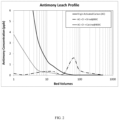
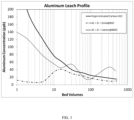
- the sorbent was loaded into a column and contacted with an extraction water containing 50 ⁇ 5 ppm total dissolved solids, 0.5 ⁇ 0.05 ppm free chlorine and having neutral pH. Eight to ten bed volumes of extraction water is pumped through the sorbent then held static for 24 ⁇ 1 hours. After the required hold time, the column effluent was sampled, the procedure was repeated two more times to generate a composite water samples. The water samples were then analyzed for metals by ICP or ICP-MS.
- FIG. 1-3 show metals leaching profiles for accelerated column tests simulating the first 500 bed volumes of operation.
- the zirconium content of the sorbent following the impregnation process was determined by Proton Induced X-ray Emission (PIXE) analysis.
- PIXE analysis does not quantify the full amount of zirconium because PIXE is a surface analysis technique and does not report zirconium that is embedded within the sorbent.
- Table 3 shows data for the tested value by PIXE and the theoretical value based on the amount of chemical added to the sorbent. The value determined by PIXE was approximately 50% of the theoretical value. While not accurate relative to the theoretical value, the difference between the two levels of ZrO 2 impregnation is accurate when compared to the feedstock.
- Blending a virgin activated carbon with a ZrO 2 impregnated activated carbon decreased metals leaching by an amount significantly greater than that predicted by a mathematical average.
- Table 4 shows data for a virgin activated carbon feedstock, a 1 wt.% ZrO 2 impregnated activated carbon, and a 50:50 blend of the two. The activated carbons were blended by riffling. The data demonstrates that precipitated zirconium oxide is not only effective on the impregnated carbon but acts on metals in the process stream that may leach from other sources. In addition to reducing metals leaching, the addition of acidic zirconyl chloride followed by drying lowers the pH of the activated carbon to near neutral.
- the impregnation of virgin activated carbon with ZrO 2 as described herein was more effective at reducing leachable metals than a dry mixture of the virgin carbon and the chemical zirconium oxide.
- two pairs of ZrO 2 -containing activated carbon samples were prepared. Within each pair, one sample was an admixture of dry ZrO 2 powder and activated carbon, while the other sample was impregnated with zirconyl chloride to target the same ZrO 2 loading on a dry basis. The two pairs represent intentionally different final zirconium contents, 0.5 wt.% and 1.0 wt.% (as ZrO 2 ).
- Table 6 shows the results of the dynamic leaching test for virgin activated carbon feedstock, as well as the two pairs of treated activated carbon feedstocks described above in Examples 1 and 2.
- the data in Table 6 shows that the treatment with zirconia in the manner described resulted in a 800-3400% advantage in suppressing the base activated carbon's tendency to leach arsenic or antimony relative to activated carbon that was not treated.
Landscapes
- Chemical & Material Sciences (AREA)
- Organic Chemistry (AREA)
- Analytical Chemistry (AREA)
- Chemical Kinetics & Catalysis (AREA)
- Inorganic Chemistry (AREA)
- Engineering & Computer Science (AREA)
- Life Sciences & Earth Sciences (AREA)
- Hydrology & Water Resources (AREA)
- Environmental & Geological Engineering (AREA)
- Water Supply & Treatment (AREA)
- Physics & Mathematics (AREA)
- Thermal Sciences (AREA)
- Health & Medical Sciences (AREA)
- Toxicology (AREA)
- Solid-Sorbent Or Filter-Aiding Compositions (AREA)
- Water Treatment By Sorption (AREA)
- Physical Water Treatments (AREA)
- Treatment Of Water By Oxidation Or Reduction (AREA)
- Mechanical Engineering (AREA)
Applications Claiming Priority (2)
| Application Number | Priority Date | Filing Date | Title |
|---|---|---|---|
| US201762457482P | 2017-02-10 | 2017-02-10 | |
| PCT/US2018/017833 WO2018148664A1 (en) | 2017-02-10 | 2018-02-12 | Sorbent and method of making |
Publications (4)
| Publication Number | Publication Date |
|---|---|
| EP3579966A1 EP3579966A1 (en) | 2019-12-18 |
| EP3579966A4 EP3579966A4 (en) | 2020-12-02 |
| EP3579966B1 true EP3579966B1 (en) | 2024-12-11 |
| EP3579966C0 EP3579966C0 (en) | 2024-12-11 |
Family
ID=63106637
Family Applications (1)
| Application Number | Title | Priority Date | Filing Date |
|---|---|---|---|
| EP18751411.2A Active EP3579966B1 (en) | 2017-02-10 | 2018-02-12 | Sorbent composition and method of making |
Country Status (7)
| Country | Link |
|---|---|
| US (2) | US11975305B2 (enExample) |
| EP (1) | EP3579966B1 (enExample) |
| JP (1) | JP7262393B2 (enExample) |
| KR (1) | KR102590630B1 (enExample) |
| CN (1) | CN110290865A (enExample) |
| MX (3) | MX2019009487A (enExample) |
| WO (1) | WO2018148664A1 (enExample) |
Families Citing this family (8)
| Publication number | Priority date | Publication date | Assignee | Title |
|---|---|---|---|---|
| CN111298767A (zh) * | 2020-02-17 | 2020-06-19 | 安徽工业大学 | 一种吸附重金属离子用生物质基炭材料、制备方法及应用 |
| CA3172060A1 (en) * | 2020-03-06 | 2021-09-10 | Uti Limited Partnership | Removal of silica and total organic carbon from wastewater |
| CN112058232B (zh) * | 2020-09-21 | 2021-10-22 | 河南大学 | 一种二氧化锰修饰活性炭复合吸附剂及其制备方法和在除砷中的应用 |
| CN114477554A (zh) * | 2022-03-01 | 2022-05-13 | 合肥九号线传媒科技有限公司 | 基于铁-钛复合氧化物的废水处理方法 |
| TW202408658A (zh) * | 2022-05-19 | 2024-03-01 | 新加坡商阿瓦克科技私人有限公司 | 長保質期吸附劑盒 |
| KR102553695B1 (ko) * | 2022-12-14 | 2023-07-07 | 강원대학교 산학협력단 | 이중층수산화물이 결합된 복합 흡착제의 제조방법 및 이에 따라 제조된 중금속 제거 효율이 향상된 흡착제 |
| CN116078351B (zh) * | 2023-01-13 | 2024-07-19 | 深圳玉衡环境科技有限公司 | 一种室内空气处理药剂的制备方法及室内空气处理药剂 |
| CN117566845A (zh) * | 2024-01-17 | 2024-02-20 | 中国农业科学院农业环境与可持续发展研究所 | 一种处理有机废液的方法 |
Family Cites Families (58)
| Publication number | Priority date | Publication date | Assignee | Title |
|---|---|---|---|---|
| CA955035A (en) | 1970-02-05 | 1974-09-24 | Osaka Soda Co. | Treatment process for removal of metals and treating agent therefor |
| US3833508A (en) | 1971-04-27 | 1974-09-03 | Itt | Gas removal method and composition |
| US4331639A (en) | 1981-03-11 | 1982-05-25 | Union Oil Company Of California | Process for removing SOx and NOx compounds from gas streams |
| JPS5834039A (ja) | 1981-08-24 | 1983-02-28 | Agency Of Ind Science & Technol | 酸化ジルコニウムを含む吸着剤の製造方法 |
| JPS5976536A (ja) * | 1982-10-22 | 1984-05-01 | Kureha Chem Ind Co Ltd | 収着剤およびその製造法 |
| JPS5976535A (ja) * | 1982-10-22 | 1984-05-01 | Kureha Chem Ind Co Ltd | 収着剤およびその製造法 |
| JPS62286539A (ja) * | 1986-06-05 | 1987-12-12 | Johoku Kagaku Kogyo Kk | リン酸イオン吸着剤およびその製造方法 |
| JPH0297414A (ja) | 1988-10-01 | 1990-04-10 | Kansai Coke & Chem Co Ltd | 高品質活性炭の製造法 |
| US5202301A (en) | 1989-11-22 | 1993-04-13 | Calgon Carbon Corporation | Product/process/application for removal of mercury from liquid hydrocarbon |
| US5322778A (en) | 1991-10-31 | 1994-06-21 | Genencor International, Inc. | Liquefaction of granular starch slurries using an antioxidant with alpha amylase |
| US5348755A (en) | 1992-03-04 | 1994-09-20 | Calgon Carbon Corporation | Extension of edible oil lifetime using activated carbons |
| US6186939B1 (en) | 1993-10-07 | 2001-02-13 | Keith E. Forrester | Method for stabilizing heavy metal in a material or waste |
| US5726118A (en) | 1995-08-08 | 1998-03-10 | Norit Americas, Inc. | Activated carbon for separation of fluids by adsorption and method for its preparation |
| US7014825B2 (en) * | 1996-04-10 | 2006-03-21 | Catalytic Solutions, Inc. | Perovskite-type metal oxide compounds and methods of making and using thereof |
| JPH10165826A (ja) * | 1996-07-05 | 1998-06-23 | Tosoh Corp | イオン交換体、その製造方法及びそれを用いた多価陰イオンの除去方法 |
| US5948265A (en) * | 1996-07-05 | 1999-09-07 | Tosoh Corporation | Ion-exchanger, process for production thereof, and process for removal of multiply charged anions employing the ion-exchanger |
| US5754002A (en) | 1996-11-05 | 1998-05-19 | General Electric Company | Antioxidant control of leachable mercury in fluorescent lamps |
| US5821682A (en) | 1997-01-31 | 1998-10-13 | General Electric Company | Method for incorporating anti-oxidants within a fluorescent lamp's base shell |
| JP3044293B2 (ja) * | 1997-07-03 | 2000-05-22 | 工業技術院長 | 結晶性含水酸化ジルコニウム担持多孔性吸着材の製造方法 |
| US6599856B1 (en) | 1999-10-21 | 2003-07-29 | Tennex Corporation | Formed activated carbon and process for producing the same |
| FR2804426B1 (fr) * | 2000-01-27 | 2002-03-01 | Centre Nat Rech Scient | Materiau composite comprenant du charbon actif et du graphite expanse |
| US8439989B2 (en) | 2000-06-26 | 2013-05-14 | ADA-ES, Inc. | Additives for mercury oxidation in coal-fired power plants |
| US6827874B2 (en) | 2000-06-27 | 2004-12-07 | The Procter & Gamble Co. | Water treatment compositions |
| US6740406B2 (en) * | 2000-12-15 | 2004-05-25 | Kimberly-Clark Worldwide, Inc. | Coated activated carbon |
| US20030038084A1 (en) * | 2001-08-23 | 2003-02-27 | The Procter & Gamble Company | Water filters and processes for using the same |
| US7429551B2 (en) | 2001-08-27 | 2008-09-30 | Calgon Carbon Corporation | Adsorbents for removing heavy metals |
| US6914034B2 (en) * | 2001-08-27 | 2005-07-05 | Calgon Carbon Corporation | Adsorbents for removing heavy metals and methods for producing and using the same |
| EP1572811A4 (en) | 2002-04-04 | 2007-05-30 | Mt2 Llc | SURFACE TREATMENT FOR THE STABILIZATION OF HEAVY METALS |
| US6824690B1 (en) * | 2002-10-11 | 2004-11-30 | Sandia Corporation | Zirconium-modified materials for selective adsorption and removal of aqueous arsenic |
| US20060076229A1 (en) | 2003-01-13 | 2006-04-13 | Mazyck David W | Magnetic activated carbon and the removal of contaminants from a fluid streams |
| CA2518351C (en) | 2003-03-06 | 2011-11-08 | University Of Florida Research Foundation, Incorporated | Method and a composite for mercury capture from fluid streams |
| KR100483694B1 (ko) | 2003-03-10 | 2005-04-19 | 효림산업주식회사 | 분말 활성탄을 이용한 흡착 반응장치 및 방법 |
| US7361209B1 (en) | 2003-04-03 | 2008-04-22 | Ada Environmental Solutions, Llc | Apparatus and process for preparing sorbents for mercury control at the point of use |
| US7435286B2 (en) | 2004-08-30 | 2008-10-14 | Energy & Environmental Research Center Foundation | Sorbents for the oxidation and removal of mercury |
| US9321002B2 (en) | 2003-06-03 | 2016-04-26 | Alstom Technology Ltd | Removal of mercury emissions |
| US8069797B2 (en) | 2003-06-03 | 2011-12-06 | Alstom Technology Ltd. | Control of mercury emissions from solid fuel combustion |
| US6848374B2 (en) | 2003-06-03 | 2005-02-01 | Alstom Technology Ltd | Control of mercury emissions from solid fuel combustion |
| PL1866057T3 (pl) | 2005-03-17 | 2022-05-16 | Nox Ii International, Ltd. | Redukcja emisji rtęci ze spalania węgla |
| US7858061B2 (en) | 2005-12-15 | 2010-12-28 | The United States Of America As Represented By The Administrator Of The United States Environmental Protection Agency | Compositions and methods for removing mercury from mercury-containing fluids |
| US8057576B1 (en) | 2008-06-10 | 2011-11-15 | Calgon Carbon Corporation | Enhanced adsorbents and methods for mercury removal |
| US8691166B2 (en) | 2008-01-08 | 2014-04-08 | Carbonxt Group Limited | System and method for activating carbonaceous material |
| US20090172998A1 (en) | 2008-01-08 | 2009-07-09 | Carbonxt Group Limited | System and method for refining carbonaceous material |
| US9121606B2 (en) | 2008-02-19 | 2015-09-01 | Srivats Srinivasachar | Method of manufacturing carbon-rich product and co-products |
| US8263524B1 (en) | 2009-05-11 | 2012-09-11 | Nei, Corp. | Environmentally benign sorbents for removing mercury from flue gas |
| US20100307968A1 (en) | 2009-06-09 | 2010-12-09 | Kx Technologies Llc | Activated carbon water filter with reduced leachable arsenic and method for making the same |
| EP2482970B1 (en) | 2009-09-28 | 2018-08-08 | Calgon Carbon Corporation | Sorbent formulation for removal of mercury from flue gas |
| WO2011072196A2 (en) * | 2009-12-10 | 2011-06-16 | University Of Delaware | Filtration media coated with zero-valent metals, process of making, and use |
| US8524179B2 (en) | 2010-10-25 | 2013-09-03 | ADA-ES, Inc. | Hot-side method and system |
| RU2531303C2 (ru) | 2010-04-07 | 2014-10-20 | Калгон Карбон Корпорейшн | Способы отделения ртути от топочного газа |
| US8496739B2 (en) | 2010-08-30 | 2013-07-30 | Corning Incorporated | Organic antioxidant based filtration apparatus and method |
| GB2487760B (en) * | 2011-02-03 | 2015-11-18 | Univ Surrey | Composite adsorbent material |
| US9539538B2 (en) | 2011-10-28 | 2017-01-10 | Ada Carbon Solutions, Llc | Multi-functional composition of matter for rapid removal of mercury from a flue gas |
| US9302246B2 (en) * | 2012-04-25 | 2016-04-05 | Calgon Carbon Corporation | Mitigating leaching of arsenic and antimony from activated carbon |
| US20130330257A1 (en) | 2012-06-11 | 2013-12-12 | Calgon Carbon Corporation | Sorbents for removal of mercury |
| CN104797324B (zh) | 2012-11-26 | 2018-09-14 | 艺康美国股份有限公司 | 汞排放的控制 |
| KR20160021788A (ko) | 2013-06-19 | 2016-02-26 | 칼곤 카본 코포레이션 | 활성탄으로부터의 중금속 침출을 경감시키는 방법 |
| US9308493B2 (en) | 2013-08-16 | 2016-04-12 | ADA-ES, Inc. | Method to reduce mercury, acid gas, and particulate emissions |
| CN106040177B (zh) * | 2016-07-20 | 2018-10-16 | 华侨大学 | 一种用于去除水中硫酸根的改性活性炭及其制备方法 |
-
2018
- 2018-02-12 WO PCT/US2018/017833 patent/WO2018148664A1/en not_active Ceased
- 2018-02-12 JP JP2019543088A patent/JP7262393B2/ja active Active
- 2018-02-12 EP EP18751411.2A patent/EP3579966B1/en active Active
- 2018-02-12 KR KR1020197026732A patent/KR102590630B1/ko active Active
- 2018-02-12 MX MX2019009487A patent/MX2019009487A/es unknown
- 2018-02-12 US US15/894,431 patent/US11975305B2/en active Active
- 2018-02-12 CN CN201880011341.5A patent/CN110290865A/zh active Pending
-
2019
- 2019-08-08 MX MX2024013475A patent/MX2024013475A/es unknown
- 2019-08-08 MX MX2024013473A patent/MX2024013473A/es unknown
-
2024
- 2024-04-05 US US18/628,058 patent/US20240269647A1/en active Pending
Also Published As
| Publication number | Publication date |
|---|---|
| JP2020506049A (ja) | 2020-02-27 |
| KR102590630B1 (ko) | 2023-10-20 |
| MX2024013473A (es) | 2024-12-06 |
| CN110290865A (zh) | 2019-09-27 |
| US11975305B2 (en) | 2024-05-07 |
| WO2018148664A1 (en) | 2018-08-16 |
| MX2024013475A (es) | 2024-12-06 |
| EP3579966C0 (en) | 2024-12-11 |
| JP7262393B2 (ja) | 2023-04-21 |
| CA3053282A1 (en) | 2018-08-16 |
| KR20190120247A (ko) | 2019-10-23 |
| EP3579966A1 (en) | 2019-12-18 |
| US20240269647A1 (en) | 2024-08-15 |
| US20180229213A1 (en) | 2018-08-16 |
| EP3579966A4 (en) | 2020-12-02 |
| MX2019009487A (es) | 2019-11-05 |
Similar Documents
| Publication | Publication Date | Title |
|---|---|---|
| US20240269647A1 (en) | Sorbent and method of making | |
| KR102958547B1 (ko) | 화학적 수착제 산화 방법 및 이로부터 제조된 수착제 | |
| US4430226A (en) | Method and apparatus for producing ultrapure water | |
| CN104411633B (zh) | 减少砷和锑从活性炭的浸滤 | |
| CA2680402C (en) | Arsenic adsorbing composition and methods of use | |
| JPS60147287A (ja) | 飲料水改質剤 | |
| KR20160132076A (ko) | 비소 제거 특성이 뛰어난 세륨(iv) 산화물 | |
| Wahab et al. | A novel approach to remove ofloxacin antibiotic from industrial effluent using magnetic carbon nanocomposite prepared from sawdust of Dalbergia sissoo by batch and membrane hybrid technology | |
| WO2010144175A1 (en) | Activated carbon water filter with reduced leachable arsenic and method for making the same | |
| CA3053282C (en) | Sorbent and method of making | |
| HK40014285A (en) | Sorbent and method of making | |
| JPH11511687A (ja) | 酸接触強化吸着剤粒子ならびにその製造および使用方法 | |
| HK1262113A1 (en) | Mitigating leaching of arsenic and antimony from activated carbon | |
| US20240238753A1 (en) | Adsorbent that contains potassium hydroxide and potassium carbonate, and related methods and devices | |
| CA3090276C (en) | Chemical sorbent oxidation method and sorbents made therefrom | |
| DE2453549A1 (de) | Verfahren zur entfernung von geruchsstoffen aus gasen | |
| JP4517700B2 (ja) | 浄水器 | |
| US20080073289A1 (en) | Carbon pre-treatment for the stabilization of ph in water treatment | |
| JPH06190275A (ja) | 金属化合物の吸着除去材 | |
| JP2003053146A (ja) | 揮発性有機ハロゲン化合物含有ガスの処理方法 |
Legal Events
| Date | Code | Title | Description |
|---|---|---|---|
| STAA | Information on the status of an ep patent application or granted ep patent |
Free format text: STATUS: THE INTERNATIONAL PUBLICATION HAS BEEN MADE |
|
| PUAI | Public reference made under article 153(3) epc to a published international application that has entered the european phase |
Free format text: ORIGINAL CODE: 0009012 |
|
| STAA | Information on the status of an ep patent application or granted ep patent |
Free format text: STATUS: REQUEST FOR EXAMINATION WAS MADE |
|
| 17P | Request for examination filed |
Effective date: 20190814 |
|
| AK | Designated contracting states |
Kind code of ref document: A1 Designated state(s): AL AT BE BG CH CY CZ DE DK EE ES FI FR GB GR HR HU IE IS IT LI LT LU LV MC MK MT NL NO PL PT RO RS SE SI SK SM TR |
|
| AX | Request for extension of the european patent |
Extension state: BA ME |
|
| DAV | Request for validation of the european patent (deleted) | ||
| DAX | Request for extension of the european patent (deleted) | ||
| A4 | Supplementary search report drawn up and despatched |
Effective date: 20201030 |
|
| RIC1 | Information provided on ipc code assigned before grant |
Ipc: B01J 20/06 20060101AFI20201026BHEP Ipc: B01J 20/30 20060101ALI20201026BHEP Ipc: C02F 1/76 20060101ALI20201026BHEP Ipc: B01J 20/20 20060101ALI20201026BHEP Ipc: B01J 20/32 20060101ALI20201026BHEP Ipc: C02F 1/28 20060101ALI20201026BHEP |
|
| STAA | Information on the status of an ep patent application or granted ep patent |
Free format text: STATUS: EXAMINATION IS IN PROGRESS |
|
| 17Q | First examination report despatched |
Effective date: 20220411 |
|
| GRAP | Despatch of communication of intention to grant a patent |
Free format text: ORIGINAL CODE: EPIDOSNIGR1 |
|
| STAA | Information on the status of an ep patent application or granted ep patent |
Free format text: STATUS: GRANT OF PATENT IS INTENDED |
|
| INTG | Intention to grant announced |
Effective date: 20240704 |
|
| GRAS | Grant fee paid |
Free format text: ORIGINAL CODE: EPIDOSNIGR3 |
|
| GRAA | (expected) grant |
Free format text: ORIGINAL CODE: 0009210 |
|
| STAA | Information on the status of an ep patent application or granted ep patent |
Free format text: STATUS: THE PATENT HAS BEEN GRANTED |
|
| AK | Designated contracting states |
Kind code of ref document: B1 Designated state(s): AL AT BE BG CH CY CZ DE DK EE ES FI FR GB GR HR HU IE IS IT LI LT LU LV MC MK MT NL NO PL PT RO RS SE SI SK SM TR |
|
| REG | Reference to a national code |
Ref country code: GB Ref legal event code: FG4D |
|
| REG | Reference to a national code |
Ref country code: CH Ref legal event code: EP |
|
| REG | Reference to a national code |
Ref country code: DE Ref legal event code: R096 Ref document number: 602018077501 Country of ref document: DE |
|
| REG | Reference to a national code |
Ref country code: IE Ref legal event code: FG4D |
|
| U01 | Request for unitary effect filed |
Effective date: 20241212 |
|
| U07 | Unitary effect registered |
Designated state(s): AT BE BG DE DK EE FI FR IT LT LU LV MT NL PT RO SE SI Effective date: 20241220 |
|
| U20 | Renewal fee for the european patent with unitary effect paid |
Year of fee payment: 8 Effective date: 20250121 |
|
| PG25 | Lapsed in a contracting state [announced via postgrant information from national office to epo] |
Ref country code: HR Free format text: LAPSE BECAUSE OF FAILURE TO SUBMIT A TRANSLATION OF THE DESCRIPTION OR TO PAY THE FEE WITHIN THE PRESCRIBED TIME-LIMIT Effective date: 20241211 |
|
| PG25 | Lapsed in a contracting state [announced via postgrant information from national office to epo] |
Ref country code: ES Free format text: LAPSE BECAUSE OF FAILURE TO SUBMIT A TRANSLATION OF THE DESCRIPTION OR TO PAY THE FEE WITHIN THE PRESCRIBED TIME-LIMIT Effective date: 20241211 |
|
| PG25 | Lapsed in a contracting state [announced via postgrant information from national office to epo] |
Ref country code: NO Free format text: LAPSE BECAUSE OF FAILURE TO SUBMIT A TRANSLATION OF THE DESCRIPTION OR TO PAY THE FEE WITHIN THE PRESCRIBED TIME-LIMIT Effective date: 20250311 |
|
| PG25 | Lapsed in a contracting state [announced via postgrant information from national office to epo] |
Ref country code: GR Free format text: LAPSE BECAUSE OF FAILURE TO SUBMIT A TRANSLATION OF THE DESCRIPTION OR TO PAY THE FEE WITHIN THE PRESCRIBED TIME-LIMIT Effective date: 20250312 |
|
| PG25 | Lapsed in a contracting state [announced via postgrant information from national office to epo] |
Ref country code: RS Free format text: LAPSE BECAUSE OF FAILURE TO SUBMIT A TRANSLATION OF THE DESCRIPTION OR TO PAY THE FEE WITHIN THE PRESCRIBED TIME-LIMIT Effective date: 20250311 |
|
| PG25 | Lapsed in a contracting state [announced via postgrant information from national office to epo] |
Ref country code: SM Free format text: LAPSE BECAUSE OF FAILURE TO SUBMIT A TRANSLATION OF THE DESCRIPTION OR TO PAY THE FEE WITHIN THE PRESCRIBED TIME-LIMIT Effective date: 20241211 |
|
| PG25 | Lapsed in a contracting state [announced via postgrant information from national office to epo] |
Ref country code: PL Free format text: LAPSE BECAUSE OF FAILURE TO SUBMIT A TRANSLATION OF THE DESCRIPTION OR TO PAY THE FEE WITHIN THE PRESCRIBED TIME-LIMIT Effective date: 20241211 |
|
| PG25 | Lapsed in a contracting state [announced via postgrant information from national office to epo] |
Ref country code: IS Free format text: LAPSE BECAUSE OF FAILURE TO SUBMIT A TRANSLATION OF THE DESCRIPTION OR TO PAY THE FEE WITHIN THE PRESCRIBED TIME-LIMIT Effective date: 20250411 |
|
| PG25 | Lapsed in a contracting state [announced via postgrant information from national office to epo] |
Ref country code: SK Free format text: LAPSE BECAUSE OF FAILURE TO SUBMIT A TRANSLATION OF THE DESCRIPTION OR TO PAY THE FEE WITHIN THE PRESCRIBED TIME-LIMIT Effective date: 20241211 |
|
| PG25 | Lapsed in a contracting state [announced via postgrant information from national office to epo] |
Ref country code: CZ Free format text: LAPSE BECAUSE OF FAILURE TO SUBMIT A TRANSLATION OF THE DESCRIPTION OR TO PAY THE FEE WITHIN THE PRESCRIBED TIME-LIMIT Effective date: 20241211 |
|
| PG25 | Lapsed in a contracting state [announced via postgrant information from national office to epo] |
Ref country code: MC Free format text: LAPSE BECAUSE OF FAILURE TO SUBMIT A TRANSLATION OF THE DESCRIPTION OR TO PAY THE FEE WITHIN THE PRESCRIBED TIME-LIMIT Effective date: 20241211 |
|
| REG | Reference to a national code |
Ref country code: CH Ref legal event code: PL |
|
| PLBE | No opposition filed within time limit |
Free format text: ORIGINAL CODE: 0009261 |
|
| STAA | Information on the status of an ep patent application or granted ep patent |
Free format text: STATUS: NO OPPOSITION FILED WITHIN TIME LIMIT |
|
| PG25 | Lapsed in a contracting state [announced via postgrant information from national office to epo] |
Ref country code: CH Free format text: LAPSE BECAUSE OF NON-PAYMENT OF DUE FEES Effective date: 20250228 |
|
| 26N | No opposition filed |
Effective date: 20250912 |
|
| PG25 | Lapsed in a contracting state [announced via postgrant information from national office to epo] |
Ref country code: IE Free format text: LAPSE BECAUSE OF NON-PAYMENT OF DUE FEES Effective date: 20250212 |
|
| U20 | Renewal fee for the european patent with unitary effect paid |
Year of fee payment: 9 Effective date: 20260121 |
|
| PGFP | Annual fee paid to national office [announced via postgrant information from national office to epo] |
Ref country code: GB Payment date: 20260121 Year of fee payment: 9 |
|
| PG25 | Lapsed in a contracting state [announced via postgrant information from national office to epo] |
Ref country code: CY Free format text: LAPSE BECAUSE OF FAILURE TO SUBMIT A TRANSLATION OF THE DESCRIPTION OR TO PAY THE FEE WITHIN THE PRESCRIBED TIME-LIMIT Effective date: 20241211 |
|
| PG25 | Lapsed in a contracting state [announced via postgrant information from national office to epo] |
Ref country code: TR Free format text: LAPSE BECAUSE OF FAILURE TO SUBMIT A TRANSLATION OF THE DESCRIPTION OR TO PAY THE FEE WITHIN THE PRESCRIBED TIME-LIMIT Effective date: 20241211 |