EP3578619B1 - Klebstoffzusammensetzung, verfahren zur herstellung einer klebstoffzusammensetzung, verbindungsverfahren unter verwendung der klebstoffzusammensetzung und struktur mit darauf befestigter klebstoffzusammensetzung - Google Patents
Klebstoffzusammensetzung, verfahren zur herstellung einer klebstoffzusammensetzung, verbindungsverfahren unter verwendung der klebstoffzusammensetzung und struktur mit darauf befestigter klebstoffzusammensetzung Download PDFInfo
- Publication number
- EP3578619B1 EP3578619B1 EP17895071.3A EP17895071A EP3578619B1 EP 3578619 B1 EP3578619 B1 EP 3578619B1 EP 17895071 A EP17895071 A EP 17895071A EP 3578619 B1 EP3578619 B1 EP 3578619B1
- Authority
- EP
- European Patent Office
- Prior art keywords
- adhesive composition
- pack
- tannic acid
- group
- composition according
- Prior art date
- Legal status (The legal status is an assumption and is not a legal conclusion. Google has not performed a legal analysis and makes no representation as to the accuracy of the status listed.)
- Active
Links
- 239000000853 adhesive Substances 0.000 title claims description 175
- 230000001070 adhesive effect Effects 0.000 title claims description 175
- 239000000203 mixture Substances 0.000 title claims description 82
- 238000000034 method Methods 0.000 title claims description 21
- 230000008569 process Effects 0.000 title claims description 8
- LRBQNJMCXXYXIU-NRMVVENXSA-N tannic acid Chemical class OC1=C(O)C(O)=CC(C(=O)OC=2C(=C(O)C=C(C=2)C(=O)OC[C@@H]2[C@H]([C@H](OC(=O)C=3C=C(OC(=O)C=4C=C(O)C(O)=C(O)C=4)C(O)=C(O)C=3)[C@@H](OC(=O)C=3C=C(OC(=O)C=4C=C(O)C(O)=C(O)C=4)C(O)=C(O)C=3)[C@@H](OC(=O)C=3C=C(OC(=O)C=4C=C(O)C(O)=C(O)C=4)C(O)=C(O)C=3)O2)OC(=O)C=2C=C(OC(=O)C=3C=C(O)C(O)=C(O)C=3)C(O)=C(O)C=2)O)=C1 LRBQNJMCXXYXIU-NRMVVENXSA-N 0.000 claims description 109
- TUSDEZXZIZRFGC-UHFFFAOYSA-N 1-O-galloyl-3,6-(R)-HHDP-beta-D-glucose Natural products OC1C(O2)COC(=O)C3=CC(O)=C(O)C(O)=C3C3=C(O)C(O)=C(O)C=C3C(=O)OC1C(O)C2OC(=O)C1=CC(O)=C(O)C(O)=C1 TUSDEZXZIZRFGC-UHFFFAOYSA-N 0.000 claims description 66
- 239000001263 FEMA 3042 Substances 0.000 claims description 66
- LRBQNJMCXXYXIU-PPKXGCFTSA-N Penta-digallate-beta-D-glucose Natural products OC1=C(O)C(O)=CC(C(=O)OC=2C(=C(O)C=C(C=2)C(=O)OC[C@@H]2[C@H]([C@H](OC(=O)C=3C=C(OC(=O)C=4C=C(O)C(O)=C(O)C=4)C(O)=C(O)C=3)[C@@H](OC(=O)C=3C=C(OC(=O)C=4C=C(O)C(O)=C(O)C=4)C(O)=C(O)C=3)[C@H](OC(=O)C=3C=C(OC(=O)C=4C=C(O)C(O)=C(O)C=4)C(O)=C(O)C=3)O2)OC(=O)C=2C=C(OC(=O)C=3C=C(O)C(O)=C(O)C=3)C(O)=C(O)C=2)O)=C1 LRBQNJMCXXYXIU-PPKXGCFTSA-N 0.000 claims description 66
- 235000015523 tannic acid Nutrition 0.000 claims description 66
- 229920002258 tannic acid Polymers 0.000 claims description 66
- 229940033123 tannic acid Drugs 0.000 claims description 66
- WYURNTSHIVDZCO-UHFFFAOYSA-N Tetrahydrofuran Chemical compound C1CCOC1 WYURNTSHIVDZCO-UHFFFAOYSA-N 0.000 claims description 62
- 239000005057 Hexamethylene diisocyanate Substances 0.000 claims description 48
- RRAMGCGOFNQTLD-UHFFFAOYSA-N hexamethylene diisocyanate Chemical compound O=C=NCCCCCCN=C=O RRAMGCGOFNQTLD-UHFFFAOYSA-N 0.000 claims description 48
- 238000010438 heat treatment Methods 0.000 claims description 44
- YLQBMQCUIZJEEH-UHFFFAOYSA-N Furan Chemical group C=1C=COC=1 YLQBMQCUIZJEEH-UHFFFAOYSA-N 0.000 claims description 37
- 150000002430 hydrocarbons Chemical class 0.000 claims description 34
- 239000000945 filler Substances 0.000 claims description 30
- 239000002904 solvent Substances 0.000 claims description 29
- GKIPXFAANLTWBM-UHFFFAOYSA-N epibromohydrin Chemical compound BrCC1CO1 GKIPXFAANLTWBM-UHFFFAOYSA-N 0.000 claims description 28
- 239000004215 Carbon black (E152) Substances 0.000 claims description 25
- 229930195733 hydrocarbon Natural products 0.000 claims description 25
- 125000003700 epoxy group Chemical group 0.000 claims description 19
- 150000001875 compounds Chemical class 0.000 claims description 15
- 125000002887 hydroxy group Chemical group [H]O* 0.000 claims description 14
- IQPQWNKOIGAROB-UHFFFAOYSA-N isocyanate group Chemical group [N-]=C=O IQPQWNKOIGAROB-UHFFFAOYSA-N 0.000 claims description 9
- 239000007788 liquid Substances 0.000 claims description 9
- 238000007151 ring opening polymerisation reaction Methods 0.000 claims description 8
- 238000002156 mixing Methods 0.000 claims description 7
- 125000004435 hydrogen atom Chemical group [H]* 0.000 claims description 5
- OVBFMUAFNIIQAL-UHFFFAOYSA-N 1,4-diisocyanatobutane Chemical compound O=C=NCCCCN=C=O OVBFMUAFNIIQAL-UHFFFAOYSA-N 0.000 claims description 4
- OIFAHDAXIUURLN-UHFFFAOYSA-N 2-(fluoromethyl)oxirane Chemical compound FCC1CO1 OIFAHDAXIUURLN-UHFFFAOYSA-N 0.000 claims description 4
- AGIBHMPYXXPGAX-UHFFFAOYSA-N 2-(iodomethyl)oxirane Chemical compound ICC1CO1 AGIBHMPYXXPGAX-UHFFFAOYSA-N 0.000 claims description 4
- JWUJQDFVADABEY-UHFFFAOYSA-N 2-methyltetrahydrofuran Chemical compound CC1CCCO1 JWUJQDFVADABEY-UHFFFAOYSA-N 0.000 claims description 4
- BRLQWZUYTZBJKN-UHFFFAOYSA-N Epichlorohydrin Chemical compound ClCC1CO1 BRLQWZUYTZBJKN-UHFFFAOYSA-N 0.000 claims description 4
- 125000003118 aryl group Chemical group 0.000 claims description 4
- WHNBDXQTMPYBAT-UHFFFAOYSA-N 2-butyloxirane Chemical compound CCCCC1CO1 WHNBDXQTMPYBAT-UHFFFAOYSA-N 0.000 claims description 3
- NJWSNNWLBMSXQR-UHFFFAOYSA-N 2-hexyloxirane Chemical compound CCCCCCC1CO1 NJWSNNWLBMSXQR-UHFFFAOYSA-N 0.000 claims description 3
- AAMHBRRZYSORSH-UHFFFAOYSA-N 2-octyloxirane Chemical compound CCCCCCCCC1CO1 AAMHBRRZYSORSH-UHFFFAOYSA-N 0.000 claims description 3
- UPMLOUAZCHDJJD-UHFFFAOYSA-N 4,4'-Diphenylmethane Diisocyanate Chemical compound C1=CC(N=C=O)=CC=C1CC1=CC=C(N=C=O)C=C1 UPMLOUAZCHDJJD-UHFFFAOYSA-N 0.000 claims description 3
- 239000005058 Isophorone diisocyanate Substances 0.000 claims description 3
- GOOHAUXETOMSMM-UHFFFAOYSA-N Propylene oxide Chemical compound CC1CO1 GOOHAUXETOMSMM-UHFFFAOYSA-N 0.000 claims description 3
- NIMLQBUJDJZYEJ-UHFFFAOYSA-N isophorone diisocyanate Chemical compound CC1(C)CC(N=C=O)CC(C)(CN=C=O)C1 NIMLQBUJDJZYEJ-UHFFFAOYSA-N 0.000 claims description 3
- 125000001183 hydrocarbyl group Chemical group 0.000 claims 6
- 239000003292 glue Substances 0.000 description 28
- 239000000463 material Substances 0.000 description 24
- 239000011248 coating agent Substances 0.000 description 19
- 238000000576 coating method Methods 0.000 description 19
- RTZKZFJDLAIYFH-UHFFFAOYSA-N Diethyl ether Chemical compound CCOCC RTZKZFJDLAIYFH-UHFFFAOYSA-N 0.000 description 15
- VTYYLEPIZMXCLO-UHFFFAOYSA-L Calcium carbonate Chemical compound [Ca+2].[O-]C([O-])=O VTYYLEPIZMXCLO-UHFFFAOYSA-L 0.000 description 14
- 238000006243 chemical reaction Methods 0.000 description 14
- 238000010586 diagram Methods 0.000 description 14
- 239000011521 glass Substances 0.000 description 14
- 229920006254 polymer film Polymers 0.000 description 14
- 229910052782 aluminium Inorganic materials 0.000 description 13
- XAGFODPZIPBFFR-UHFFFAOYSA-N aluminium Chemical compound [Al] XAGFODPZIPBFFR-UHFFFAOYSA-N 0.000 description 13
- WTEOIRVLGSZEPR-UHFFFAOYSA-N boron trifluoride Chemical compound FB(F)F WTEOIRVLGSZEPR-UHFFFAOYSA-N 0.000 description 13
- 239000007789 gas Substances 0.000 description 13
- 239000000758 substrate Substances 0.000 description 13
- QGZKDVFQNNGYKY-UHFFFAOYSA-N Ammonia Chemical compound N QGZKDVFQNNGYKY-UHFFFAOYSA-N 0.000 description 12
- PEDCQBHIVMGVHV-UHFFFAOYSA-N Glycerine Chemical compound OCC(O)CO PEDCQBHIVMGVHV-UHFFFAOYSA-N 0.000 description 12
- 229910052751 metal Inorganic materials 0.000 description 12
- 239000002184 metal Substances 0.000 description 12
- 238000012360 testing method Methods 0.000 description 12
- 229910015900 BF3 Inorganic materials 0.000 description 11
- 230000000844 anti-bacterial effect Effects 0.000 description 10
- 230000001954 sterilising effect Effects 0.000 description 9
- XKRFYHLGVUSROY-UHFFFAOYSA-N Argon Chemical compound [Ar] XKRFYHLGVUSROY-UHFFFAOYSA-N 0.000 description 8
- 239000003054 catalyst Substances 0.000 description 8
- 230000009477 glass transition Effects 0.000 description 8
- 229910000019 calcium carbonate Inorganic materials 0.000 description 7
- 230000007797 corrosion Effects 0.000 description 7
- 238000005260 corrosion Methods 0.000 description 7
- 238000005259 measurement Methods 0.000 description 7
- 238000006116 polymerization reaction Methods 0.000 description 7
- 238000001179 sorption measurement Methods 0.000 description 7
- 239000002023 wood Substances 0.000 description 7
- 241000894006 Bacteria Species 0.000 description 6
- 230000009102 absorption Effects 0.000 description 6
- 238000010521 absorption reaction Methods 0.000 description 6
- -1 acryl Chemical group 0.000 description 6
- 230000000052 comparative effect Effects 0.000 description 6
- 238000004519 manufacturing process Methods 0.000 description 6
- 239000000126 substance Substances 0.000 description 6
- CZDYPVPMEAXLPK-UHFFFAOYSA-N tetramethylsilane Chemical compound C[Si](C)(C)C CZDYPVPMEAXLPK-UHFFFAOYSA-N 0.000 description 6
- 230000002411 adverse Effects 0.000 description 5
- 239000010949 copper Substances 0.000 description 5
- 230000009931 harmful effect Effects 0.000 description 5
- 229910052739 hydrogen Inorganic materials 0.000 description 5
- 239000001257 hydrogen Substances 0.000 description 5
- 150000002739 metals Chemical class 0.000 description 5
- 239000000047 product Substances 0.000 description 5
- 238000003756 stirring Methods 0.000 description 5
- CSCPPACGZOOCGX-UHFFFAOYSA-N Acetone Chemical compound CC(C)=O CSCPPACGZOOCGX-UHFFFAOYSA-N 0.000 description 4
- 239000004971 Cross linker Substances 0.000 description 4
- 239000004593 Epoxy Substances 0.000 description 4
- LFQSCWFLJHTTHZ-UHFFFAOYSA-N Ethanol Chemical compound CCO LFQSCWFLJHTTHZ-UHFFFAOYSA-N 0.000 description 4
- 238000005033 Fourier transform infrared spectroscopy Methods 0.000 description 4
- 241000282414 Homo sapiens Species 0.000 description 4
- 239000002202 Polyethylene glycol Substances 0.000 description 4
- 229910052786 argon Inorganic materials 0.000 description 4
- 230000015572 biosynthetic process Effects 0.000 description 4
- 238000001035 drying Methods 0.000 description 4
- 230000000694 effects Effects 0.000 description 4
- 239000004615 ingredient Substances 0.000 description 4
- JEIPFZHSYJVQDO-UHFFFAOYSA-N iron(III) oxide Inorganic materials O=[Fe]O[Fe]=O JEIPFZHSYJVQDO-UHFFFAOYSA-N 0.000 description 4
- VLKZOEOYAKHREP-UHFFFAOYSA-N n-Hexane Chemical compound CCCCCC VLKZOEOYAKHREP-UHFFFAOYSA-N 0.000 description 4
- 229920001223 polyethylene glycol Polymers 0.000 description 4
- 238000003380 quartz crystal microbalance Methods 0.000 description 4
- RYGMFSIKBFXOCR-UHFFFAOYSA-N Copper Chemical compound [Cu] RYGMFSIKBFXOCR-UHFFFAOYSA-N 0.000 description 3
- 241000588724 Escherichia coli Species 0.000 description 3
- 239000002841 Lewis acid Substances 0.000 description 3
- ZMXDDKWLCZADIW-UHFFFAOYSA-N N,N-Dimethylformamide Chemical compound CN(C)C=O ZMXDDKWLCZADIW-UHFFFAOYSA-N 0.000 description 3
- YXFVVABEGXRONW-UHFFFAOYSA-N Toluene Chemical compound CC1=CC=CC=C1 YXFVVABEGXRONW-UHFFFAOYSA-N 0.000 description 3
- 230000009471 action Effects 0.000 description 3
- IISBACLAFKSPIT-UHFFFAOYSA-N bisphenol A Chemical compound C=1C=C(O)C=CC=1C(C)(C)C1=CC=C(O)C=C1 IISBACLAFKSPIT-UHFFFAOYSA-N 0.000 description 3
- 229910052802 copper Inorganic materials 0.000 description 3
- 150000007517 lewis acids Chemical class 0.000 description 3
- 229920000642 polymer Polymers 0.000 description 3
- 238000000425 proton nuclear magnetic resonance spectrum Methods 0.000 description 3
- 229910001220 stainless steel Inorganic materials 0.000 description 3
- 239000010935 stainless steel Substances 0.000 description 3
- 238000002411 thermogravimetry Methods 0.000 description 3
- 238000005406 washing Methods 0.000 description 3
- 230000004580 weight loss Effects 0.000 description 3
- 238000005160 1H NMR spectroscopy Methods 0.000 description 2
- 238000001157 Fourier transform infrared spectrum Methods 0.000 description 2
- UFHFLCQGNIYNRP-UHFFFAOYSA-N Hydrogen Chemical compound [H][H] UFHFLCQGNIYNRP-UHFFFAOYSA-N 0.000 description 2
- 230000000274 adsorptive effect Effects 0.000 description 2
- 230000001580 bacterial effect Effects 0.000 description 2
- 230000008901 benefit Effects 0.000 description 2
- 230000015556 catabolic process Effects 0.000 description 2
- 239000007795 chemical reaction product Substances 0.000 description 2
- 238000004140 cleaning Methods 0.000 description 2
- 238000006731 degradation reaction Methods 0.000 description 2
- 239000003599 detergent Substances 0.000 description 2
- 229910052805 deuterium Inorganic materials 0.000 description 2
- 125000000118 dimethyl group Chemical group [H]C([H])([H])* 0.000 description 2
- LNTHITQWFMADLM-UHFFFAOYSA-N gallic acid Chemical compound OC(=O)C1=CC(O)=C(O)C(O)=C1 LNTHITQWFMADLM-UHFFFAOYSA-N 0.000 description 2
- 238000010559 graft polymerization reaction Methods 0.000 description 2
- 230000036541 health Effects 0.000 description 2
- 229920001461 hydrolysable tannin Polymers 0.000 description 2
- 230000007062 hydrolysis Effects 0.000 description 2
- 238000006460 hydrolysis reaction Methods 0.000 description 2
- 230000001965 increasing effect Effects 0.000 description 2
- 239000003999 initiator Substances 0.000 description 2
- 230000007246 mechanism Effects 0.000 description 2
- 239000012046 mixed solvent Substances 0.000 description 2
- 229910000069 nitrogen hydride Inorganic materials 0.000 description 2
- 150000008442 polyphenolic compounds Chemical class 0.000 description 2
- 235000013824 polyphenols Nutrition 0.000 description 2
- 238000001556 precipitation Methods 0.000 description 2
- 238000002360 preparation method Methods 0.000 description 2
- 238000010926 purge Methods 0.000 description 2
- 229920006395 saturated elastomer Polymers 0.000 description 2
- 238000001228 spectrum Methods 0.000 description 2
- 238000003786 synthesis reaction Methods 0.000 description 2
- 229920001864 tannin Polymers 0.000 description 2
- 239000001648 tannin Substances 0.000 description 2
- 235000018553 tannin Nutrition 0.000 description 2
- 238000005979 thermal decomposition reaction Methods 0.000 description 2
- XLYOFNOQVPJJNP-UHFFFAOYSA-N water Substances O XLYOFNOQVPJJNP-UHFFFAOYSA-N 0.000 description 2
- XKZQKPRCPNGNFR-UHFFFAOYSA-N 2-(3-hydroxyphenyl)phenol Chemical compound OC1=CC=CC(C=2C(=CC=CC=2)O)=C1 XKZQKPRCPNGNFR-UHFFFAOYSA-N 0.000 description 1
- VHUUQVKOLVNVRT-UHFFFAOYSA-N Ammonium hydroxide Chemical compound [NH4+].[OH-] VHUUQVKOLVNVRT-UHFFFAOYSA-N 0.000 description 1
- 229920003043 Cellulose fiber Polymers 0.000 description 1
- 229920001651 Cyanoacrylate Polymers 0.000 description 1
- AFSDNFLWKVMVRB-UHFFFAOYSA-N Ellagic acid Chemical compound OC1=C(O)C(OC2=O)=C3C4=C2C=C(O)C(O)=C4OC(=O)C3=C1 AFSDNFLWKVMVRB-UHFFFAOYSA-N 0.000 description 1
- ATJXMQHAMYVHRX-CPCISQLKSA-N Ellagic acid Natural products OC1=C(O)[C@H]2OC(=O)c3cc(O)c(O)c4OC(=O)C(=C1)[C@H]2c34 ATJXMQHAMYVHRX-CPCISQLKSA-N 0.000 description 1
- 229920002079 Ellagic acid Polymers 0.000 description 1
- 102000004190 Enzymes Human genes 0.000 description 1
- 108090000790 Enzymes Proteins 0.000 description 1
- OEIJRRGCTVHYTH-UHFFFAOYSA-N Favan-3-ol Chemical group OC1CC2=CC=CC=C2OC1C1=CC=CC=C1 OEIJRRGCTVHYTH-UHFFFAOYSA-N 0.000 description 1
- 102000009123 Fibrin Human genes 0.000 description 1
- 108010073385 Fibrin Proteins 0.000 description 1
- BWGVNKXGVNDBDI-UHFFFAOYSA-N Fibrin monomer Chemical compound CNC(=O)CNC(=O)CN BWGVNKXGVNDBDI-UHFFFAOYSA-N 0.000 description 1
- WQZGKKKJIJFFOK-GASJEMHNSA-N Glucose Natural products OC[C@H]1OC(O)[C@H](O)[C@@H](O)[C@@H]1O WQZGKKKJIJFFOK-GASJEMHNSA-N 0.000 description 1
- MWCLLHOVUTZFKS-UHFFFAOYSA-N Methyl cyanoacrylate Chemical compound COC(=O)C(=C)C#N MWCLLHOVUTZFKS-UHFFFAOYSA-N 0.000 description 1
- 238000005481 NMR spectroscopy Methods 0.000 description 1
- 229910000831 Steel Inorganic materials 0.000 description 1
- BZHJMEDXRYGGRV-UHFFFAOYSA-N Vinyl chloride Chemical compound ClC=C BZHJMEDXRYGGRV-UHFFFAOYSA-N 0.000 description 1
- UKLDJPRMSDWDSL-UHFFFAOYSA-L [dibutyl(dodecanoyloxy)stannyl] dodecanoate Chemical compound CCCCCCCCCCCC(=O)O[Sn](CCCC)(CCCC)OC(=O)CCCCCCCCCCC UKLDJPRMSDWDSL-UHFFFAOYSA-L 0.000 description 1
- 239000002253 acid Substances 0.000 description 1
- 150000007513 acids Chemical class 0.000 description 1
- 239000002313 adhesive film Substances 0.000 description 1
- 238000013019 agitation Methods 0.000 description 1
- 150000001298 alcohols Chemical class 0.000 description 1
- 125000001931 aliphatic group Chemical group 0.000 description 1
- PNEYBMLMFCGWSK-UHFFFAOYSA-N aluminium oxide Inorganic materials [O-2].[O-2].[O-2].[Al+3].[Al+3] PNEYBMLMFCGWSK-UHFFFAOYSA-N 0.000 description 1
- 235000011114 ammonium hydroxide Nutrition 0.000 description 1
- 238000004458 analytical method Methods 0.000 description 1
- 230000008859 change Effects 0.000 description 1
- 229920002770 condensed tannin Polymers 0.000 description 1
- 239000011231 conductive filler Substances 0.000 description 1
- 238000001816 cooling Methods 0.000 description 1
- 238000005336 cracking Methods 0.000 description 1
- 238000004132 cross linking Methods 0.000 description 1
- 239000013078 crystal Substances 0.000 description 1
- 230000003247 decreasing effect Effects 0.000 description 1
- 230000007812 deficiency Effects 0.000 description 1
- 230000018044 dehydration Effects 0.000 description 1
- 238000006297 dehydration reaction Methods 0.000 description 1
- 238000011161 development Methods 0.000 description 1
- 239000012975 dibutyltin dilaurate Substances 0.000 description 1
- 235000004132 ellagic acid Nutrition 0.000 description 1
- 229960002852 ellagic acid Drugs 0.000 description 1
- 230000002708 enhancing effect Effects 0.000 description 1
- 239000003822 epoxy resin Substances 0.000 description 1
- 150000002148 esters Chemical group 0.000 description 1
- 229950003499 fibrin Drugs 0.000 description 1
- 238000005243 fluidization Methods 0.000 description 1
- 235000004515 gallic acid Nutrition 0.000 description 1
- 229940074391 gallic acid Drugs 0.000 description 1
- 239000003365 glass fiber Substances 0.000 description 1
- 239000008103 glucose Substances 0.000 description 1
- 125000002791 glucosyl group Chemical group C1([C@H](O)[C@@H](O)[C@H](O)[C@H](O1)CO)* 0.000 description 1
- PCHJSUWPFVWCPO-UHFFFAOYSA-N gold Chemical compound [Au] PCHJSUWPFVWCPO-UHFFFAOYSA-N 0.000 description 1
- 229910052737 gold Inorganic materials 0.000 description 1
- 239000010931 gold Substances 0.000 description 1
- LNEPOXFFQSENCJ-UHFFFAOYSA-N haloperidol Chemical compound C1CC(O)(C=2C=CC(Cl)=CC=2)CCN1CCCC(=O)C1=CC=C(F)C=C1 LNEPOXFFQSENCJ-UHFFFAOYSA-N 0.000 description 1
- 230000005802 health problem Effects 0.000 description 1
- 230000006872 improvement Effects 0.000 description 1
- 230000000977 initiatory effect Effects 0.000 description 1
- XEEYBQQBJWHFJM-UHFFFAOYSA-N iron Substances [Fe] XEEYBQQBJWHFJM-UHFFFAOYSA-N 0.000 description 1
- 229910052742 iron Inorganic materials 0.000 description 1
- 229910021645 metal ion Inorganic materials 0.000 description 1
- 229910044991 metal oxide Inorganic materials 0.000 description 1
- 150000004706 metal oxides Chemical class 0.000 description 1
- FAARLWTXUUQFSN-UHFFFAOYSA-N methylellagic acid Natural products O1C(=O)C2=CC(O)=C(O)C3=C2C2=C1C(OC)=C(O)C=C2C(=O)O3 FAARLWTXUUQFSN-UHFFFAOYSA-N 0.000 description 1
- 125000000325 methylidene group Chemical group [H]C([H])=* 0.000 description 1
- 238000012544 monitoring process Methods 0.000 description 1
- 239000000178 monomer Substances 0.000 description 1
- 150000002989 phenols Chemical class 0.000 description 1
- 229920000647 polyepoxide Polymers 0.000 description 1
- 239000000843 powder Substances 0.000 description 1
- 230000035484 reaction time Effects 0.000 description 1
- 230000009257 reactivity Effects 0.000 description 1
- 230000009467 reduction Effects 0.000 description 1
- 229910052709 silver Inorganic materials 0.000 description 1
- 239000004332 silver Substances 0.000 description 1
- 239000010959 steel Substances 0.000 description 1
- 238000012916 structural analysis Methods 0.000 description 1
- 125000001424 substituent group Chemical group 0.000 description 1
- 238000006467 substitution reaction Methods 0.000 description 1
- 230000008961 swelling Effects 0.000 description 1
- 229920003051 synthetic elastomer Polymers 0.000 description 1
- 239000005061 synthetic rubber Substances 0.000 description 1
- 229920002803 thermoplastic polyurethane Polymers 0.000 description 1
Images




Classifications
-
- C—CHEMISTRY; METALLURGY
- C08—ORGANIC MACROMOLECULAR COMPOUNDS; THEIR PREPARATION OR CHEMICAL WORKING-UP; COMPOSITIONS BASED THEREON
- C08G—MACROMOLECULAR COMPOUNDS OBTAINED OTHERWISE THAN BY REACTIONS ONLY INVOLVING UNSATURATED CARBON-TO-CARBON BONDS
- C08G18/00—Polymeric products of isocyanates or isothiocyanates
- C08G18/06—Polymeric products of isocyanates or isothiocyanates with compounds having active hydrogen
- C08G18/70—Polymeric products of isocyanates or isothiocyanates with compounds having active hydrogen characterised by the isocyanates or isothiocyanates used
- C08G18/72—Polyisocyanates or polyisothiocyanates
- C08G18/73—Polyisocyanates or polyisothiocyanates acyclic
-
- C—CHEMISTRY; METALLURGY
- C08—ORGANIC MACROMOLECULAR COMPOUNDS; THEIR PREPARATION OR CHEMICAL WORKING-UP; COMPOSITIONS BASED THEREON
- C08G—MACROMOLECULAR COMPOUNDS OBTAINED OTHERWISE THAN BY REACTIONS ONLY INVOLVING UNSATURATED CARBON-TO-CARBON BONDS
- C08G18/00—Polymeric products of isocyanates or isothiocyanates
- C08G18/06—Polymeric products of isocyanates or isothiocyanates with compounds having active hydrogen
- C08G18/28—Polymeric products of isocyanates or isothiocyanates with compounds having active hydrogen characterised by the compounds used containing active hydrogen
- C08G18/40—High-molecular-weight compounds
- C08G18/64—Macromolecular compounds not provided for by groups C08G18/42 - C08G18/63
- C08G18/6492—Lignin containing materials; Wood resins; Wood tars; Derivatives thereof
-
- C—CHEMISTRY; METALLURGY
- C08—ORGANIC MACROMOLECULAR COMPOUNDS; THEIR PREPARATION OR CHEMICAL WORKING-UP; COMPOSITIONS BASED THEREON
- C08G—MACROMOLECULAR COMPOUNDS OBTAINED OTHERWISE THAN BY REACTIONS ONLY INVOLVING UNSATURATED CARBON-TO-CARBON BONDS
- C08G18/00—Polymeric products of isocyanates or isothiocyanates
- C08G18/06—Polymeric products of isocyanates or isothiocyanates with compounds having active hydrogen
- C08G18/70—Polymeric products of isocyanates or isothiocyanates with compounds having active hydrogen characterised by the isocyanates or isothiocyanates used
- C08G18/72—Polyisocyanates or polyisothiocyanates
- C08G18/74—Polyisocyanates or polyisothiocyanates cyclic
- C08G18/75—Polyisocyanates or polyisothiocyanates cyclic cycloaliphatic
- C08G18/751—Polyisocyanates or polyisothiocyanates cyclic cycloaliphatic containing only one cycloaliphatic ring
- C08G18/752—Polyisocyanates or polyisothiocyanates cyclic cycloaliphatic containing only one cycloaliphatic ring containing at least one isocyanate or isothiocyanate group linked to the cycloaliphatic ring by means of an aliphatic group
- C08G18/753—Polyisocyanates or polyisothiocyanates cyclic cycloaliphatic containing only one cycloaliphatic ring containing at least one isocyanate or isothiocyanate group linked to the cycloaliphatic ring by means of an aliphatic group containing one isocyanate or isothiocyanate group linked to the cycloaliphatic ring by means of an aliphatic group having a primary carbon atom next to the isocyanate or isothiocyanate group
- C08G18/755—Polyisocyanates or polyisothiocyanates cyclic cycloaliphatic containing only one cycloaliphatic ring containing at least one isocyanate or isothiocyanate group linked to the cycloaliphatic ring by means of an aliphatic group containing one isocyanate or isothiocyanate group linked to the cycloaliphatic ring by means of an aliphatic group having a primary carbon atom next to the isocyanate or isothiocyanate group and at least one isocyanate or isothiocyanate group linked to a secondary carbon atom of the cycloaliphatic ring, e.g. isophorone diisocyanate
-
- C—CHEMISTRY; METALLURGY
- C08—ORGANIC MACROMOLECULAR COMPOUNDS; THEIR PREPARATION OR CHEMICAL WORKING-UP; COMPOSITIONS BASED THEREON
- C08G—MACROMOLECULAR COMPOUNDS OBTAINED OTHERWISE THAN BY REACTIONS ONLY INVOLVING UNSATURATED CARBON-TO-CARBON BONDS
- C08G18/00—Polymeric products of isocyanates or isothiocyanates
- C08G18/06—Polymeric products of isocyanates or isothiocyanates with compounds having active hydrogen
- C08G18/70—Polymeric products of isocyanates or isothiocyanates with compounds having active hydrogen characterised by the isocyanates or isothiocyanates used
- C08G18/72—Polyisocyanates or polyisothiocyanates
- C08G18/74—Polyisocyanates or polyisothiocyanates cyclic
- C08G18/76—Polyisocyanates or polyisothiocyanates cyclic aromatic
- C08G18/7657—Polyisocyanates or polyisothiocyanates cyclic aromatic containing two or more aromatic rings
-
- C—CHEMISTRY; METALLURGY
- C09—DYES; PAINTS; POLISHES; NATURAL RESINS; ADHESIVES; COMPOSITIONS NOT OTHERWISE PROVIDED FOR; APPLICATIONS OF MATERIALS NOT OTHERWISE PROVIDED FOR
- C09J—ADHESIVES; NON-MECHANICAL ASPECTS OF ADHESIVE PROCESSES IN GENERAL; ADHESIVE PROCESSES NOT PROVIDED FOR ELSEWHERE; USE OF MATERIALS AS ADHESIVES
- C09J175/00—Adhesives based on polyureas or polyurethanes; Adhesives based on derivatives of such polymers
- C09J175/04—Polyurethanes
-
- C—CHEMISTRY; METALLURGY
- C09—DYES; PAINTS; POLISHES; NATURAL RESINS; ADHESIVES; COMPOSITIONS NOT OTHERWISE PROVIDED FOR; APPLICATIONS OF MATERIALS NOT OTHERWISE PROVIDED FOR
- C09J—ADHESIVES; NON-MECHANICAL ASPECTS OF ADHESIVE PROCESSES IN GENERAL; ADHESIVE PROCESSES NOT PROVIDED FOR ELSEWHERE; USE OF MATERIALS AS ADHESIVES
- C09J175/00—Adhesives based on polyureas or polyurethanes; Adhesives based on derivatives of such polymers
- C09J175/04—Polyurethanes
- C09J175/08—Polyurethanes from polyethers
-
- C—CHEMISTRY; METALLURGY
- C09—DYES; PAINTS; POLISHES; NATURAL RESINS; ADHESIVES; COMPOSITIONS NOT OTHERWISE PROVIDED FOR; APPLICATIONS OF MATERIALS NOT OTHERWISE PROVIDED FOR
- C09J—ADHESIVES; NON-MECHANICAL ASPECTS OF ADHESIVE PROCESSES IN GENERAL; ADHESIVE PROCESSES NOT PROVIDED FOR ELSEWHERE; USE OF MATERIALS AS ADHESIVES
- C09J199/00—Adhesives based on natural macromolecular compounds or on derivatives thereof, not provided for in groups C09J101/00 -C09J107/00 or C09J189/00 - C09J197/00
-
- C—CHEMISTRY; METALLURGY
- C09—DYES; PAINTS; POLISHES; NATURAL RESINS; ADHESIVES; COMPOSITIONS NOT OTHERWISE PROVIDED FOR; APPLICATIONS OF MATERIALS NOT OTHERWISE PROVIDED FOR
- C09J—ADHESIVES; NON-MECHANICAL ASPECTS OF ADHESIVE PROCESSES IN GENERAL; ADHESIVE PROCESSES NOT PROVIDED FOR ELSEWHERE; USE OF MATERIALS AS ADHESIVES
- C09J7/00—Adhesives in the form of films or foils
- C09J7/30—Adhesives in the form of films or foils characterised by the adhesive composition
- C09J7/35—Heat-activated
-
- C—CHEMISTRY; METALLURGY
- C08—ORGANIC MACROMOLECULAR COMPOUNDS; THEIR PREPARATION OR CHEMICAL WORKING-UP; COMPOSITIONS BASED THEREON
- C08K—Use of inorganic or non-macromolecular organic substances as compounding ingredients
- C08K3/00—Use of inorganic substances as compounding ingredients
- C08K3/02—Elements
- C08K3/08—Metals
- C08K2003/0806—Silver
-
- C—CHEMISTRY; METALLURGY
- C08—ORGANIC MACROMOLECULAR COMPOUNDS; THEIR PREPARATION OR CHEMICAL WORKING-UP; COMPOSITIONS BASED THEREON
- C08K—Use of inorganic or non-macromolecular organic substances as compounding ingredients
- C08K3/00—Use of inorganic substances as compounding ingredients
- C08K3/18—Oxygen-containing compounds, e.g. metal carbonyls
- C08K3/24—Acids; Salts thereof
- C08K3/26—Carbonates; Bicarbonates
- C08K2003/265—Calcium, strontium or barium carbonate
-
- C—CHEMISTRY; METALLURGY
- C08—ORGANIC MACROMOLECULAR COMPOUNDS; THEIR PREPARATION OR CHEMICAL WORKING-UP; COMPOSITIONS BASED THEREON
- C08K—Use of inorganic or non-macromolecular organic substances as compounding ingredients
- C08K2201/00—Specific properties of additives
- C08K2201/001—Conductive additives
-
- C—CHEMISTRY; METALLURGY
- C08—ORGANIC MACROMOLECULAR COMPOUNDS; THEIR PREPARATION OR CHEMICAL WORKING-UP; COMPOSITIONS BASED THEREON
- C08K—Use of inorganic or non-macromolecular organic substances as compounding ingredients
- C08K2201/00—Specific properties of additives
- C08K2201/002—Physical properties
- C08K2201/005—Additives being defined by their particle size in general
-
- C—CHEMISTRY; METALLURGY
- C08—ORGANIC MACROMOLECULAR COMPOUNDS; THEIR PREPARATION OR CHEMICAL WORKING-UP; COMPOSITIONS BASED THEREON
- C08K—Use of inorganic or non-macromolecular organic substances as compounding ingredients
- C08K3/00—Use of inorganic substances as compounding ingredients
- C08K3/01—Use of inorganic substances as compounding ingredients characterized by their specific function
- C08K3/013—Fillers, pigments or reinforcing additives
-
- C—CHEMISTRY; METALLURGY
- C08—ORGANIC MACROMOLECULAR COMPOUNDS; THEIR PREPARATION OR CHEMICAL WORKING-UP; COMPOSITIONS BASED THEREON
- C08K—Use of inorganic or non-macromolecular organic substances as compounding ingredients
- C08K3/00—Use of inorganic substances as compounding ingredients
- C08K3/02—Elements
- C08K3/08—Metals
-
- C—CHEMISTRY; METALLURGY
- C08—ORGANIC MACROMOLECULAR COMPOUNDS; THEIR PREPARATION OR CHEMICAL WORKING-UP; COMPOSITIONS BASED THEREON
- C08K—Use of inorganic or non-macromolecular organic substances as compounding ingredients
- C08K3/00—Use of inorganic substances as compounding ingredients
- C08K3/18—Oxygen-containing compounds, e.g. metal carbonyls
- C08K3/24—Acids; Salts thereof
- C08K3/26—Carbonates; Bicarbonates
-
- C—CHEMISTRY; METALLURGY
- C08—ORGANIC MACROMOLECULAR COMPOUNDS; THEIR PREPARATION OR CHEMICAL WORKING-UP; COMPOSITIONS BASED THEREON
- C08K—Use of inorganic or non-macromolecular organic substances as compounding ingredients
- C08K5/00—Use of organic ingredients
- C08K5/04—Oxygen-containing compounds
- C08K5/15—Heterocyclic compounds having oxygen in the ring
- C08K5/151—Heterocyclic compounds having oxygen in the ring having one oxygen atom in the ring
- C08K5/1515—Three-membered rings
-
- C—CHEMISTRY; METALLURGY
- C08—ORGANIC MACROMOLECULAR COMPOUNDS; THEIR PREPARATION OR CHEMICAL WORKING-UP; COMPOSITIONS BASED THEREON
- C08K—Use of inorganic or non-macromolecular organic substances as compounding ingredients
- C08K5/00—Use of organic ingredients
- C08K5/04—Oxygen-containing compounds
- C08K5/15—Heterocyclic compounds having oxygen in the ring
- C08K5/151—Heterocyclic compounds having oxygen in the ring having one oxygen atom in the ring
- C08K5/1535—Five-membered rings
-
- C—CHEMISTRY; METALLURGY
- C08—ORGANIC MACROMOLECULAR COMPOUNDS; THEIR PREPARATION OR CHEMICAL WORKING-UP; COMPOSITIONS BASED THEREON
- C08K—Use of inorganic or non-macromolecular organic substances as compounding ingredients
- C08K7/00—Use of ingredients characterised by shape
- C08K7/02—Fibres or whiskers
- C08K7/04—Fibres or whiskers inorganic
- C08K7/14—Glass
Definitions
- the present invention relates to an adhesive composition, a process of producing the adhesive composition, a bonding method using the adhesive composition, and a structure having the adhesive composition applied thereon.
- a variety of currently available adhesives include those based on epoxy, acryl, cyanoacrylate, synthetic rubber and vinyl chloride, urethane resin-based adhesives, fibrin adhesives, among which the synthetic type has various problems, as already indicated.
- the epoxy-based adhesives are widely used because of having a strong adhesive force in spite of their relative inexpensiveness; however, they give rise to health problems.
- TAPE polyethylene glycol
- Patent Publication 1 JP(A) 8-92540
- the adhesive formed of a TA/PEG mixture has a relatively high adhesive force when used in medical applications, it has a poor adhesive force when used as a general-purpose adhesive for metals, woods, glasses, steel sheets or the like.
- a typical measure of the adhesive force used in general-purpose applications is a tensile shear strength of at least 1 MPa as set forth in Non-Patent Publication 4 as an example. Note here that the "tensile shear strength" refers to the strength of an adhesive.
- An object of the present invention is to provide a solution to the above-mentioned problem by the provision of an adhesive composition that is produced on the basis of a naturally occurring material less likely to have adverse influences on health with a strong tensile shear strength of at least 1 MPa relative to a variety of adherends such as metals, woods and glasses.
- a two-pack adhesive composition that is based on a naturally occurring material less likely to have any adverse influence on the human body and has a necessary and sufficient adhesive force relative to general-purpose adherends such as metals, woods and glasses and a process of producing that adhesive composition. It is also possible to provide a structure including an exposed surface having bactericidal, sterilizing and harmful gas-adsorbing actions.
- the adhesive composition of the invention is a two-pack adhesive composition containing a first pack and a second pack.
- the first pack contains a tannic acid derivative in which a hydrogen atom in at least some hydroxyl group of tannic acid is substituted by a chain hydrocarbon group having at least one hydroxyl group, wherein the chain hydrocarbon group is derived from a chain hydrocarbon including an epoxy group subjected to ring-opening polymerization in a solvent including a compound having a furan ring
- the second pack contains a hydrocarbon having at least twoisocyanate groups or its derivative.
- Tannins are a comprehensive term for plant components that yield polyvalent phenols by way of hydrolysis, and generally broken down into hydrolysable tannin in which gallic acid or ellagic acid is ester bonded to glucose or the like and which is susceptible of hydrolysis with acids or enzymes, and condensed tannin in which a compound having a flavanol skeleton is polymerized. Even with either one of tannins or their mixtures, it may be possible to prepare (derivatize) the tannic acid derivatives considered to have the advantages of the invention.
- the hydrolysable tannin is preferred; for instance, products containing as a main component a tannic acid (often referred to as TA for short) expressed by the following formula (A1) are derivatized.
- the substituent by which a hydrogen atom in at least some hydroxyl group of tannic acid is substituted is a chain hydrocarbon group having at least one hydroxyl group.
- the chain hydrocarbon group is derived from a chain hydrocarbon including an epoxy group subjected to ring-opening polymerization in a solvent including a compound having a furan ring such as a tetrahydrofuran (THF) having the following formula (A2) or 2-methyltetrahydrofuran having the following formula (A3); preferably a compound including an epoxy group comprising a three-membered ring.
- THF tetrahydrofuran
- A3 2-methyltetrahydrofuran having the following formula
- the number of carbons in the chain hydrocarbon group bonded to an epoxy group is preferably no less than 1 to no greater than 8.
- A4 stands for propylene oxide
- A5 for 1,2-epoxyhexane
- A6 for 1,2-epoxyoctane
- A7 for 1,2-epoxydecane
- A8 for epibromohydrin (EPBH)
- A9 for epichlorohydrin
- EPCH epifluorohydrin
- EPIH epiiodohydrin
- the molar ratio between tannic acid and the chain hydrocarbon group is preferably no less than 1:1 (i.e., one or more chain hydrocarbon groups per TA1) to no greater than 1:50, and more preferably no less than 1:15 to no greater than 1:20.
- 1:1 i.e., one or more chain hydrocarbon groups per TA1
- the molar ratio between tannic acid and the chain hydrocarbon group is preferably no less than 1:1 (i.e., one or more chain hydrocarbon groups per TA1) to no greater than 1:50, and more preferably no less than 1:15 to no greater than 1:20.
- a molar ratio of no less than 1:1 there is an adhesive force manifesting itself, and at a molar ratio of no less than 1:15 to no greater than 1:20, there is the adhesive force getting much stronger.
- a molar ratio of greater than 1:50 on the other hand, there may likely a problem arising: fluidization takes place, resulting in no manifestation of any adhesive force.
- the following formula (A12) stands for one example of the tannic acid derivative substituted by the chain hydrocarbon group.
- a compound having a furan ring such as THF or 2-methyltetrahydrofuran as at least one of solvents, there will then be a tannic acid derivative synthesized in which the hydrogen of the terminal hydroxyl group of tannic acid is substituted.
- the second pack contains a hydrocarbon having at least two isocyanate groups or its derivative, preferably a linear or chain hydrocarbon or hydrocarbon derivative having at least two isocyanate groups.
- the number of carbons in the hydrocarbon or hydrocarbon derivative is no less than 2 to no greater than 64, preferably no less than 2 to no greater than 5. If the number of carbons is within the above-mentioned range, there is then an effect obtained: an increase in the adhesive strength after the reaction.
- the hydrocarbon having at least 2isocyanate groups or its derivative may typically be a compound represented by the following formulae (A13) to (A16).
- A13 stands for hexamethylene diisocyanate (HDI)
- A14 for tetramethylene diisocyanate (TDI)
- A15 for diphenylmethane diisocyanate
- A16 for isophorone diisocyanate.
- the first and second packs are respectively dissolved in a solvent to obtain a two-pack adhesive.
- the solvents used for the first and second packs are not necessarily be the same, they should preferably be the same because of good compatibility and identical volatility.
- THF is preferable for the solvents, other solvents such as dimethylformamide or alcohols may be used.
- Such a mixed solvent is characterized in that it is easy to adjust its volatilization speed to a given value.
- the use of the single solvent is characterized in that management becomes easy upon production.
- the adhesive composition may further contain a filler thereby making the adhesive strength stronger.
- the filler may include calcium carbonate (CaCO 3 ), glass fibers, cellulose fibers, and an electrically conductive filler such as silver.
- the size of the filler is preferably no less than 1 ⁇ m to no greater than 100 ⁇ m.
- the amount of the filler to be added is preferably no less than 10% by weight to no greater than 50% by weight per the total weight of the first and second packs for the purpose of increasing the adhesive strength. In an amount of greater than 80% by weight, on the other hand, the adhesive force may possibly go down considerably.
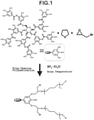
- the tannic acid derivative that is the first pack of the invention may be produced by stirring and mixing tannic acid (TA) with the above-mentioned chain hydrocarbon containing an epoxy group such as EPBH in a THF solvent, causing a ring-opening polymerization reaction to take place with Lewis acid as a catalyst (see Fig. 1 ).
- the Lewis acid used may be a boron trifluoride/diethyl ether complex (BF 3 ⁇ Et 2 O).
- the reaction time is preferably no less than 6 hours to no greater than 18 hours, typically 18 hours. For less than 6 hours, the reaction may possibly fail to proceed well, resulting in lower yields, and for longer than 18 hours, the reaction may be saturated, resulting in a time loss.
- the thus produced tannic acid derivative has a structure wherein the hydrogen in the hydroxyl group of the terminal region of tannic acid is substituted by the chain hydrocarbon.
- This substitution is often associated with graft reactions attributable to a reactivity difference between the chain hydrocarbon containing an epoxy group and the THF solvent while the chain hydrocarbon group derived from EPBH or the like and having at least one hydroxyl group acts as an initiator.
- This graft chain is mainly composed of polytetra-hydrofuran (poly-THF) (see Fig. 1 ).
- poly-THF polytetra-hydrofuran
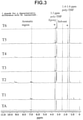
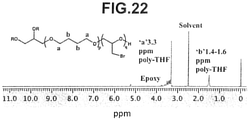
- THF plays an important role not only as a solvent but also as what forms part of the tannic acid derivative. This is confirmed by way of NMR (Nuclear Magnetic Resonance), as described in a production example.
- the hydrocarbon having two or more isocyanate groups or its derivative that is the second pack of the invention, and the solvent may be commercially available.
- commercially available HDI and THF may be used as the second pack and solvent, respectively.
- the first and second packs are fully mixed together with the solvent to prepare a liquid mixture. Then, the liquid mixture is applied on adherends as by coating, after which they are brought in close contact with each other and heat treated for bonding.
- the second pack is provided for mixing in an amount of no less than 5% by weight to no greater than 50% by weight, preferably no less than 25% by weight to no greater than 45% by weight, and more preferably no less than 30% by weight to no greater than 40% by weight per the total weight of the first and second packs.
- the heat treatment is carried out at temperatures of preferably no less than 23°C to no greater than 200°C, more preferably no less than 23°C to no greater than 150°C, and most preferably no less than 80°C to no greater than 150°C.
- the polymerization reaction between the first pack: tannic acid derivative and the second pack: the hydrocarbon having two or more isocyanate groups or its derivative may proceed to bring about an adhesive force in the resulting polymer film, but its bonding speed is badly slow and, hence, not preferable in view of bonding efficiency.
- the adhesive force becomes especially strong.
- the above-mentioned polymer film is likely to break down thermally. This thermal decomposition can start from a temperature of greater than 150°C; so the heat treatment temperature is preferably set at no greater than 150°C.
- the heat treatment time is preferably no shorter than 30 minutes to no longer than 60 minutes at the heat treatment temperature of 80°C. In shorter than 30 minutes, the polymerization reaction proceeds only insufficiently, sometimes resulting in poor adhesive force, and in longer than 60 minutes, the polymerization reaction is saturated ending up with time losses.
- the adhesive force would appear to result from the hydrogen bond by the hydroxyl group of the tannic acid derivative, and the polymerization (covalent bonding) of the tannic acid derivative and the hydrocarbon having two or more isocyanate groups and being rich in flexibility.
- the adhesive composition of the invention lends itself to the bonding of a variety of members such as metal/metal, wood/wood, glass/glass, metal/glass, metal/wood and wood/glass, and has a strong adhesive force relative to SUS in particular. This would appear to be due to, in addition to the polymerization of the film, the occurrence of hydrogen bonding to metal oxides and coordinate bonding of the polyphenol forming the tannic acid derivative to metal ions in general, and iron ions in particular (see Fig. 2 ).
- Tannic acid has a rust-preventive action, so when the adhesive composition of the invention is applied to a metal, the metal surface having the adhesive applied thereon is less susceptible to rust and degradation by corrosion, making sure bonding that is enhanced in terms of stability with time.
- tannic acid has an anticorrosion action on woods by way of its antibacterial action. For this reason, even when the adhesive composition of the invention is applied to a wood, the bonded surface is less susceptible to degradation by corrosion, making sure bonding that is enhanced in terms of stability with time.
- the application of the adhesive composition of the invention is not limited to adhesives. If the liquid mixture of the first and second packs - the ingredients of the adhesive composition according to the invention - is applied to at least one portion of the surface of a substrate comprising a material susceptible to corrosion by bacteria or metal to form a polymer film, it is then possible to protect the substrate against corrosion by bacteria. Likewise, if the first and second packs - the ingredients of the adhesive composition according to the invention - are mixed together and then applied to at least an area of the exposed portion of a structure, it is then possible to give bactericidal/sterilizing actions and corrosion resistance to the applied portion of the structure. It is thus possible to give bactericidal/sterilizing actions and corrosion resistance to that structure.
- the polymer film formed by mixing together the first and second packs that are the ingredients of the adhesive composition according to the invention has a function of adsorbing harmful gases such as ammonia gas, amine compounds, aldehyde compounds and thiol compounds.
- the first and second packs - the ingredients of the adhesive composition according to the invention - are mixed together and then applied to at least an area of the exposed portion of a structure, for instance, a wall surface portion, it then converts that structure to a functional structure capable of adsorbing harmful gases thereby making the cleanness of the atmosphere.
- the tannic acid derivative was prepared as the first pack using tannic acid (TA), epibromohydrin (EPBH), tetrahydrofuran (THF) also acting as a solvent and a boron trifluoride /diethyl ether complex (BF 3 ⁇ Et 2 O) as a catalyst.
- TA tannic acid
- EPBH epibromohydrin
- THF tetrahydrofuran
- BF 3 ⁇ Et 2 O boron trifluoride /diethyl ether complex
- TA and EPBH were first mixed together in the solvent THF, to which the catalyst BF 3 ⁇ Et 2 O was then added for ring-opening polymerization reaction at room temperature.
- the amount of TA was 1.16 mmol; the amount of THF was 245 mmol; and EPBH was used in six amounts between 0 mmol and 34.8 mmol (30 eq. relative to TA).
- BF 3 ⁇ Et 2 O was added to EPBH in an amount of 0.7 mol%.
- T1 six tannic acid derivatives were called T1 at the time when the amount of EPBH was 0 mmol (0 eq.
- Table 1 Name Tannic Acid (TA) Epibromohydrin (EPBH) Tetrahydrofuran (THF) T1 1.16 mmol 0 mmol; 0 eq. 245 mmol T2 1.16 mmol 5.8 mmol; 5 eq. 245 mmol T3 1.16 mmol 11.6 mmol; 10 eq. 245 mmol T4 1.16 mmol 17.4 mmol; 15 eq. 245 mmol T5 1.16 mmol 23.2 mmol; 20 eq. 245 mmol T6 1.16 mmol 34.8 mmol; 30 eq. 245 mmol
- an injector was used to add the above-mentioned given amount of EPBH, followed by further addition as a catalyst of BF 3 ⁇ Et 2 O in an amount of 0.7 mol% relative to the epibromohvdrin used.
- the flask was rotated at room temperature (23°C) for 18 hours while stirring was carried out for reaction.
- TA and the prepared tannic acid derivatives T1 to T5 were analyzed with the use of FTIR (Fourier Transform Infrared Spectroscopy).
- FT-IR6100 JASCO Corporation was used as the measuring equipment, and samples were measured in the form of KBr pallets.
- hexamethylene diisocyanate (HDI) was obtained as the second pack from Wako Pure Chemical Industries, Ltd. and used for mixing with the aforesaid tannic acid derivatives T1 to T6 to prepare adhesive compositions whose adhesion capability was estimated in Example 1.
- THF as the solvent and T5 as the first pack were mixed with HDI as the second pack in predetermined amounts (% by weight) set out in Table 2 to prepare adhesive composition Glues 1 to 4 dissolved in the solvent. Their adhesion capability was estimated in Example 1.
- Table 2 Name T5 (% by weight) HDI (% by weight) Solvent Glue 1 75 25 THF Glue 2 66 33 THF Glue 3 60 40 THF Glue 4 50 50 THF
- Example 1 an adhesive composition (glue) was prepared using the first pack prepared in the aforesaid exemplary production example, and then estimated in terms of its adhesive force (strength). Hexamethylene diisocyanate (HDI) was obtained from Wako Pure Chemical Industries, Ltd. and used as the second pack of the adhesive composition.
- HDI Hexamethylene diisocyanate
- the adherends used herein was an aluminum plate.
- a commercially available aluminum plate was cut into 8 cm ⁇ 2.5 cm ⁇ 0.1 cm, and cleaned pursuant to ASTM (American Society for Testing Materials) D2651 standard protocol cleaning before use. After this cleaning, the plate was fully dried, immediately followed by adhesion testing.
- the adhesion testing was carried out using Autograph AG-X Plus (Shimadzu Corporation) for the estimation of adhesive force (tensile shear strength) on a 10000 N load cell.
- the crosshead speed was set at 2 mm/min, and the overlapping area of the bonded surfaces was set at 25 mm ⁇ 10 mm.
- JIS K 6850 JIS K 6850, according to which an adhesive (composition dissolved in a solvent) was coated on the members to be bonded, and they were brought in close contact with each other on the overlapping area such that there was an adhesive thickness of about 2 mm obtained, followed by a heat treatment at 80°C for 1 hour.
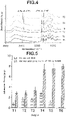
- Fig. 5 shows the results of adhesive force estimation where the aforesaid TA derivatives T1 to T6 were used as the first pack of the adhesive composition and the addition of 33% by weight of the second pack HDI was compared with no addition of the second pack HDI. It is to be understood that the adhesive force is expressed in terms of a simple mean value of five measurements, and that an error bar is indicative of the then standard deviation ⁇ . This will hold for the measurements and error bars in the following estimations.
- the combined use of the first and second packs made the adhesive force much higher as compared with the single use of the first pack.
- T5 and T6 prepared by adding at least 15 eq. (molar ratio of 1:15) of EPBH to TA, the resultant adhesive force was at least twice as high as that of HDI-added T1, T2, and T3 in which the amount of EPBH added to TA was no greater than 10 eq.
- the addition of 33% by weight of HDI to T4 yielded 7.36 ⁇ 0.96 MPa; the addition of 33% by weight of HDI to T5 yielded 7.5 ⁇ 1.0 MPa; and the addition of 33% by weight of HDI to T6 yielded 7.9 ⁇ 0.38 MPa, a value about 100 times as strong as that obtained by the single use of T6.
- the addition of 33% by weight of HDI to T3 yielded 3.3 ⁇ 0.7 MPa. Referring here to the single use of the first pack, T4 yielded the strongest adhesive force, but that adhesive force was as low as 2.75 ⁇ 0.2 MPa.
- the aforesaid TA derivative/HDI mixture was studied for its solubility in THF before and after the heat treatment. Consequently, it has been found that before a heat treatment at 80°C, that mixture is well soluble in THF, but it remains completely insoluble in THF after the heat treatment at 80°C, meaning that as a result of the heat treatment at 80°C in the presence of HDI, the covalent bonding of the TA derivative occurs, leaving the TA derivative insoluble in the solvent.
- FTIR6100 was used as the measuring equipment.
- a sample contained TA derivative T5 and HDI in a weight ratio of 66:33, and was measured before and after a heat treatment at 80°C for 45 minutes.
- thermogravimetric analysis was carried out using TG/DTA6200 (SII) where an aluminum pan was used as a sample holder and alumina (Al 2 O 3 ) powders were used as a reference, with a heating speed of 10°C/min.
- T5 was thermally decomposed from about 100°C to 230°C with a weight loss of about 10%, and then decreased considerably in weight with about 230°C as an inflection point.
- the sample containing 33% by weight of HDI added to T5 did not break down thermally up to 150°C with no or little weight loss.
- the sample weight at 200°C was maintained at about 80% before the heating. From this result it has been found that the heat resistance is improved by the crosslink effect, and that the upper limit to the heat treatment temperature for the adhesive composition comprising a TA derivative T5/HDI mixture is 200°C, preferably 150°C.
- adhesive compositions Glue 1 to Glue 4 were prepared by mixing the first pack tannic acid derivative T5 with the second pack HDI in such predetermined % by weights set out in Table 2 and dissolving the mixture in a solvent THF, and the adhesive force of them relative to an aluminum substrate was estimated. The heat treatment was carried out at 80°C for 1 hour.
- the amount of HDI added is given in terms of % by weight relative to the total weight of the first and second packs.
- the addition of HDI ensures that the adhesive force is stronger as compared with no addition of HDI (0% by weight), and the adhesive force reached a maximum (7.5 ⁇ 1.0 MPa) at 33% by weight (Glue 2) and went down as the amount of HDI was greater than that.
- the addition of no less than 5% by weight to no greater that 50% by weight of the second pack HDI made the adhesive force at least twice as strong as in the case of no addition of HDI, and the addition of no less than 30% by weight to no greater than 40% by weight of HDI yielded an adhesive force of about 7 MPa, about seven times as strong as in the case of no addition of HDI.
- the heat treatment temperature was set at room temperature (23°C), 40°C, 60°C, 80°C, and 100°C; an application substrate was made of aluminum; and the heat treatment time was set at 1 hour.
- the heat treatment time was set at 15 minutes, 30 minutes, 45 minutes, and 60 minutes; an application substrate was made of aluminum; and the heat treatment temperature was set at 80°C.
- the addition of fillers is generally well-known in the adhesive field to obtain high strength and a high degree of cure at reduced material costs.
- the effect of the filler was examined using Glue 2 as a basic adhesive composition, CaCO 3 as the filler, and aluminum as an application substrate.
- the filler has an average diameter of 13 ⁇ m.
- the amount of the filler to be added was set at 0% by weight, 10% by weight, 20% by weight, 30% by weight, 40% by weight, and 50% by weight relative to the total weight of the first and second packs.
- the heat treatment was carried out at 80°C for 30 minutes.
- the maximum adhesive force of 14.71 ⁇ 1.9 MPa was obtained at the time when the amount of the filler added was 10% by weight. This value is about twice as large as 7.5 ⁇ 1 MPa at the time when no filler is added. As the amount of the filler added exceeded 10% by weight, the lower the adhesive force tended to be, but the adhesive force at the time when the filler was added in an amount of 50% by weight was 10.38 ⁇ 2.02 MPa significantly higher than that obtained with no addition of the filler.
- the addition of the CaCO 3 filler because of being cheap, would appear to be effective for both adhesive force enhancements and material cost reductions.
- the materials (adherends) used here were wood, glass, stainless steel (SUS304(2B)), copper (Cu), and aluminum (Al).
- Glue 2 was used as the adhesive composition, and the heat treatment was carried out at 80°C for 1 hour.
- Lauan veneer cut to an even size of 0.3 cmX25 cm ⁇ 100 cm was used for wood.
- TA is known to form a complex of a tridentate coordination with Fe 3+ .
- SUS304(2B) because of containing Fe 3+ , would appear to yield a particularly strong adhesive force in combination with coordinate bonding with Fe 3+ .
- the addition of the filler yielded an adhesive force on a level similar to or greater than the adhesive force obtained with no addition of the filler. Especially when aluminum materials were bonded together, the addition of the filler yielded an adhesive force about twice as large. When SUS and SUS were bonded together, the addition of the filler yielded an adhesive force of as strong as 17 ⁇ 0.5 MPa.
- a coating film (adhesive film) comprising an adhesive made up of the tannic acid derivative was examined through a comparison with that obtained using tannic acid (TA). Note here that T5 was used as the tannic acid derivative.
- a commercially available glass plate was used as the substrate, and after the glass plate was cleaned of surface dirt with use of a liquid detergent, it was immersed successively in ethanol, n-hexane and acetone for ultrasonic washing. Drying was then carried out at room temperature (23°C), immediately followed by formation of a coating film thereon.
- the coating film was formed by dropwise addition of a solution of TA and T5 with tetrahydrofuran as a solvent to a glass substrate and carrying out heat treatment at 80°C for 45 minutes.
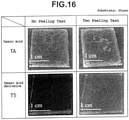
- the estimation of the coating film was made through observations of film morphologies (cracking, creasing, peeling, etc.) upon coating on the substrate and observations of film morphologies after 10 peeling tests using a Scotch (registered trademark) tape. Note here that this peeling test was conducted according to the JIS Z 1522 Adhesion Test.
- the surface morphology of the coating film obtained using TA was found to have cracks and creases whereas the surface morphology of the coating film obtained using T5 was found to be homogeneous and free of any crack or crease.
- the coating film obtained using TA was found to be peeled or swollen whereas the coating film obtained using T5 was found to be uniform and free of peeling or swelling. Note here that the thickness of the coating film was approximately 100 ⁇ m.
- the coating film obtained using TA would appear to be brittle yet rigid by way of a number of hard aromatic rings and hydrogen bonds within and without the molecule, whereas the coating film obtained using T5 would appear to be flexible, stable and uniform because flexible THF is added to it.
- Adhesives having flexibility make tough yet pliable adhesion possible; the adhesive of the invention is preferable in this sense too.
- Example 2 reference is made to the results of experimentation and estimation of polymer films formed using the adhesive composition of the invention with respect to bactericidal and sterilizing actions on E. coli.
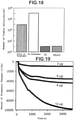
- a T5 film sample was formed by coating T5 on a glass substrate followed by peeling; a Glue 2 film sample was formed by forming a coating film comprising Glue 2 followed by peeling; and a reference film sample was formed of a film with nothing coated on it. Then, each film was brought into contact with a culture mass incubated with E. coli to make estimation of its bactericidal action on E. coli. Details of how to estimate were pursuant to JIS 2801: Film Testing, and the time of contact of each film with the culture mass was 24 hours. The results are shown in Fig. 18 . Note here that the "prior-to-treatment" stands for the number of bacteria in the culture mass (the number of bacterial colonies).
- the bactericidal and sterilizing capabilities of the sample provided with a coating comprising Glue 2 were equivalent to those of TA derivative T5, and even with a coating film obtained by polymerization of T5 added with HDI, the bactericidal and sterilizing capabilities of the TA derivatives were kept intact.
- the polymer film formed of the adhesive composition of the invention would have high-enough bactericidal and sterilizing capabilities.
- Example 3 reference is made to the results of experimentation and estimation of adsorption of ammonia gas (NH 3 gas) by a polymer film formed using the adhesive composition of the invention.
- the adsorptive performance of ammonia gas by the adhesive of the invention was examined by the QCM (Quartz Crystal Microbalance) method.
- a Glue 2 solution Three (3) mg, 6 mg, 8 mg, and 12 mg of a Glue 2 solution were cast on the gold electrode of the QCM, and then heat treated at 80°C for 2 hours to form a polymer film. Thereafter, the polymer film was placed in a vessel filled up with ammonia water and tightly sealed up to expose it to ammonia gas in a room temperature (23°C) environment while monitoring changes-with-time in a crystal oscillator's frequency change ⁇ f. The results are shown in Fig. 19 .
- the amount of Glue 2 and the amount of adsorption of ammonia gas are nearly proportional.
- the amount of Glue 2 cast and the thickness of the polymer film formed of Glue 2 are proportional, the adsorption of ammonia gas could have taken place mainly at a bulk portion of this polymer film.
- gas adsorption often takes place at an interface, but as long as this polymer film is concerned, gas adsorption occurs at the bulk portion.
- this polymer film accordingly, it is possible to achieve effective adsorption of harmful gases such as ammonia gas, and by making this polymer film thicker, it is possible to achieve adsorption of much more gases.
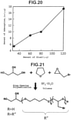
- Comparative Example 1 the importance of tannic acid (tannic acid derivative) in the adhesion function was checked out. For this purpose, estimation was made of the adhesive force of a two-pack material using GPTHF (Gl-poly(EPBH-co-THF) synthesized out of glycerol, THF and EPBH as the first pack and HDI as the second pack.
- GPTHF Gl-poly(EPBH-co-THF) synthesized out of glycerol, THF and EPBH as the first pack
- HDI as the second pack.
- GPTHF in which the tannic acid derivative of the invention is replaced by glycerol, is synthesized by ring-opening polymerization reaction with Lewis acid as a catalyst as is the case with the synthesis scheme for the first pack of the invention. See Fig. 21 .
- GPTHF was synthesized in the following procedure.
- TMS tetramethylsilane
- the weight ratio between GPTHF and HDI was set at 3:1 and 2:1 as shown in Table 3, and the respective adhesives were called Glue 11 and Glue 12.
- Table 3 Name Polymer Composition Ratio Polymer: Crosslinker (w/w) Adhesive Force (MPa) Glue 11 GPTHF 3:1 No greater than the measurement lower limit Glue 12 GPTHF 2:1 No greater than the measurement lower limit
- a number of reactive groups contribute to a good deal of high-speed crosslinking yielding a strong adhesive force, and the tannic acid derivative brings about a tradeoff between suitable rigidity and flexibility; so the adhesive of the invention makes it possible to achieve tough adhesion.
- an adhesive composition that is produced out of a naturally occurring material considered less likely to have adverse influences on the human body and has a necessary and sufficient adhesive force of at least 1 MPa as well as a bonding method using that adhesive composition.
- This adhesive composition has general versatility because of having a high adhesive force for a variety of materials such as metals, glasses and woods.
- this adhesive composition is capable of preventing rust and killing and sterilizing bacteria because of containing tannic acid. This prevents a bonded surface from getting corroded by rust and bacteria and breaking down with the elapse of time. It is thus possible to provide an adhesive composition that keeps safe and stable-with-time adhesive capability and can be used for general purposes with a necessary and sufficient adhesive force, having expectations for broader applications.
Landscapes
- Chemical & Material Sciences (AREA)
- Organic Chemistry (AREA)
- Health & Medical Sciences (AREA)
- Chemical Kinetics & Catalysis (AREA)
- Medicinal Chemistry (AREA)
- Polymers & Plastics (AREA)
- Life Sciences & Earth Sciences (AREA)
- Engineering & Computer Science (AREA)
- Materials Engineering (AREA)
- Wood Science & Technology (AREA)
- Adhesives Or Adhesive Processes (AREA)
- Polyethers (AREA)
- Polyurethanes Or Polyureas (AREA)
Claims (14)
- Eine Klebstoffzusammensetzung, umfassend mindestens eine erste Packung und eine zweite Packung, wobei:die erste Packung ein Gerbsäurederivat enthält, in welchem ein Wasserstoffatom in mindestens einigen Hydroxylgruppen der Gerbsäure durch eine Kettenkohlenwasserstoffgruppe mit mindestens einer Hydroxylgruppe substituiert ist,wobei die Kettenkohlenwasserstoffgruppe von einem Kettenkohlenwasserstoff abgeleitet ist, der eine Epoxygruppe beinhaltet, die einer Ringöffnungspolymerisation in einem Lösungsmittel, das eine Verbindung mit einem Furanring beinhaltet, unterzogen wurde, unddie zweite Packung einen Kohlenwasserstoff mit mindestens zwei Isocyanatgruppen oder dessen Derivat enthält.
- Die Klebstoffzusammensetzung nach Anspruch 1, wobei die Kettenkohlenwasserstoffgruppe von einer Verbindung mit einer Epoxygruppe, die einen dreigliedrigen Ring umfasst, abgeleitet ist.
- Die Klebstoffzusammensetzung nach Anspruch 2, wobei die Verbindung mit einer Epoxygruppe eine oder mehrere, ausgewählt aus der Gruppe bestehend aus Propylenoxid, 1,2-Epoxyhexan, 1,2-Epoxyoctan, 1,2-Epoxydecan, Epibromhydrin, Epichlorhydrin, Epifluorhydrin und Epiiodhydrin, ist.
- Die Klebstoffzusammensetzung nach einem der Ansprüche 1 bis 3, wobei die Verbindung mit einem Furanring Tetrahydrofuran oder 2-Methyltetrahydrofuran ist.
- Die Klebstoffzusammensetzung nach einem der Ansprüche 1 bis 4, wobei die zweite Packung eine oder mehrere, ausgewählt aus der Gruppe bestehend aus Hexamethylendiisocyanat, Tetramethylendiisocyanat, Diphenylmethandiisocyanat und Isophorondiisocyanat, ist.
- Die Klebstoffzusammensetzung nach einem der Ansprüche 1 bis 4 oder 5, wobei in dem Gerbsäurederivat ein Wasserstoffatom in einigen Hydroxylgruppen, die sich in einem endständigen aromatischen Ring der Gerbsäure befinden, durch die Kettenkohlenwasserstoffgruppe substituiert ist.
- Die Klebstoffzusammensetzung nach einem der Ansprüche 1 bis 4, 5 oder 6, umfassend die erste Packung, die zweite Packung und einen Füllstoff.
- Ein Verfahren zur Herstellung einer Klebstoffzusammensetzung, die mindestens eine erste Packung und eine zweite Packung beinhaltet, umfassend:einen ersten Schritt des Bereitstellens von Gerbsäure und eines Kettenkohlenwasserstoffs mit einer Epoxygruppe;einen Schritt des Herstellens der ersten Packung durch Zusammenmischen der Gerbsäure und des Kettenkohlenwasserstoffs mit einer Epoxygruppe in einem Lösungsmittel, das eine Verbindung mit einem Furanring enthält, um die Gerbsäure mit dem Kettenkohlenwasserstoff mit einer Epoxygruppe umzusetzen, wodurch ein Gerbsäurederivat gebildet wird, in welchem ein Wasserstoffatom in mindestens einigen Hydroxylgruppen der Gerbsäure durch eine Kettenkohlenwasserstoffgruppe mit mindestens einer Hydroxylgruppe substituiert ist, wobei die Kettenkohlenwasserstoffgruppe von dem Kettenkohlenwasserstoff, der einer Ringöffnungspolymerisation unterzogen wurde, abgeleitet ist; undeinen Schritt des Bereitstellens der zweiten Packung, die einen Kohlenwasserstoff mit mindestens zwei Isocyanatgruppen oder dessen Derivat enthält.
- Das Verfahren zur Herstellung einer Klebstoffzusammensetzung nach Anspruch 8, wobei der Kettenkohlenwasserstoff mit einer Epoxygruppe eine Verbindung mit einer Epoxygruppe, die einen dreigliedrigen Ring umfasst, ist.
- Das Verfahren zur Herstellung einer Klebstoffzusammensetzung nach Anspruch 9, wobei die Verbindung mit einer Epoxygruppe, die einen dreigliedrigen Ring umfasst, eine oder mehrere, ausgewählt aus der Gruppe bestehend aus Propylenoxid, 1,2-Epoxyhexan, 1,2-Epoxyoctan, 1,2-Epoxydecan, Epibromhydrin, Epichlorhydrin, Epifluorhydrin und Epiiodhydrin, ist.
- Das Verfahren zur Herstellung einer Klebstoffzusammensetzung nach einem der Ansprüche 8, 9 oder 10, wobei die Verbindung mit einem Furanring Tetrahydrofuran oder 2-Methyltetrahydrofuran ist.
- Das Verfahren zur Herstellung einer Klebstoffzusammensetzung nach Anspruch 8, wobei der Kohlenwasserstoff mit mindestens zwei Isocyanatgruppen oder das Kohlenwasserstoffderivat in der zweiten Packung eines oder mehrere, ausgewählt aus der Gruppe bestehend aus Hexamethylendiisocyanat, Tetramethylendiisocyanat, Diphenylmethandiisocyanat und Isophorondiisocyanat, ist.
- Ein Verbindungsverfahren, beinhaltend:einen Schritt des Herstellens eines flüssigen Gemischs durch Zusammenmischen der ersten und der zweiten Packung der Klebstoffzusammensetzung nach einem der Ansprüche 1 bis 7 mit einem Lösungsmittel,einen Schritt des Aufbringens des flüssigen Gemischs auf eine Klebefläche undeinen Schritt des Durchführens einer Wärmebehandlung,wobei eine Menge der zweiten Packung nicht weniger als 5 Gew.-% bis nicht mehr als 50 Gew.-%, bezogen auf ein Gesamtgewicht der ersten und der zweiten Packung, beträgt.
- Eine Struktur, wobei ein Gemisch der ersten und der zweiten Packung der Klebstoffzusammensetzung nach einem der Ansprüche 1 bis 4 oder 5 bis 7 auf mindestens einen Teil einer freiliegenden Oberfläche derselben aufgebracht ist.
Applications Claiming Priority (3)
| Application Number | Priority Date | Filing Date | Title |
|---|---|---|---|
| JP2017016323 | 2017-01-31 | ||
| JP2017197389 | 2017-10-11 | ||
| PCT/JP2017/045712 WO2018142793A1 (ja) | 2017-01-31 | 2017-12-20 | 接着剤組成物、その接着剤組成物の製造方法、その接着剤組成物を用いた接着方法、及びその接着剤組成物が被着された構造物 |
Publications (3)
| Publication Number | Publication Date |
|---|---|
| EP3578619A1 EP3578619A1 (de) | 2019-12-11 |
| EP3578619A4 EP3578619A4 (de) | 2020-09-09 |
| EP3578619B1 true EP3578619B1 (de) | 2022-03-23 |
Family
ID=63039539
Family Applications (1)
| Application Number | Title | Priority Date | Filing Date |
|---|---|---|---|
| EP17895071.3A Active EP3578619B1 (de) | 2017-01-31 | 2017-12-20 | Klebstoffzusammensetzung, verfahren zur herstellung einer klebstoffzusammensetzung, verbindungsverfahren unter verwendung der klebstoffzusammensetzung und struktur mit darauf befestigter klebstoffzusammensetzung |
Country Status (4)
| Country | Link |
|---|---|
| US (1) | US11634617B2 (de) |
| EP (1) | EP3578619B1 (de) |
| JP (1) | JP6840399B2 (de) |
| WO (1) | WO2018142793A1 (de) |
Families Citing this family (7)
| Publication number | Priority date | Publication date | Assignee | Title |
|---|---|---|---|---|
| TW202217859A (zh) * | 2020-09-10 | 2022-05-01 | 日商互應化學工業股份有限公司 | 導電性糊劑及導電膜 |
| EP4261040A4 (de) * | 2020-12-11 | 2024-09-18 | National Institute for Materials Science | Laminat und verpackungskörper oder behälter |
| JP7160298B1 (ja) * | 2020-12-11 | 2022-10-25 | 国立研究開発法人物質・材料研究機構 | 水性コーティング剤、積層体、及び、包装体又は容器 |
| CN117642473A (zh) * | 2021-07-16 | 2024-03-01 | 国立研究开发法人物质·材料研究机构 | 抗病毒性涂覆剂、抗病毒剂、层叠体和包装体或容器 |
| JP2023023880A (ja) * | 2021-08-06 | 2023-02-16 | Basf Inoacポリウレタン株式会社 | ポリウレタンフォーム |
| CN114681657B (zh) * | 2022-04-19 | 2023-02-17 | 南方医科大学 | 具有预防疤痕生成功能的可降解抗氧化胶黏剂及其制备方法和应用 |
| CN121226682B (zh) * | 2025-12-02 | 2026-04-21 | 惠安宇信金刚石工具有限公司 | 生物基环氧树脂的制备方法及其在金刚石清洁垫中的应用 |
Family Cites Families (10)
| Publication number | Priority date | Publication date | Assignee | Title |
|---|---|---|---|---|
| JPH0892540A (ja) * | 1994-09-27 | 1996-04-09 | Sekisui Chem Co Ltd | ウレタン系水性接着剤組成物 |
| DE10333958A1 (de) * | 2002-08-01 | 2004-02-12 | Henkel Kgaa | Polyurethanzusammensetzungen mit verbesserten Hafteigenschaften |
| JP2004307362A (ja) * | 2003-04-03 | 2004-11-04 | Wakayama Prefecture | 水不溶性タンニン誘導体およびその製造方法 |
| JP2010043236A (ja) * | 2008-07-17 | 2010-02-25 | Sekisui Chem Co Ltd | タンニン系接着剤、及びそれを用いた木質系複合材料 |
| JP2010241855A (ja) * | 2009-04-01 | 2010-10-28 | Hitachi Ltd | エポキシ樹脂組成物 |
| JP5390250B2 (ja) * | 2009-04-24 | 2014-01-15 | パナソニック株式会社 | 植物由来組成物とその硬化物 |
| JP5555520B2 (ja) * | 2009-10-27 | 2014-07-23 | パナソニック株式会社 | 植物由来接着剤と植物由来組成物および木質複合材料 |
| BR112014032019A2 (pt) * | 2012-08-27 | 2017-06-27 | Dow Global Technologies Llc | adesivo, método para fazer um adesivo de epóxi e kit |
| US20170321061A1 (en) | 2014-11-11 | 2017-11-09 | National Institute For Materials Science | Film-forming composition containing tannic acid derivatives |
| US10400145B2 (en) * | 2015-06-18 | 2019-09-03 | Dow Global Technologies Llc | Latent two-part polyurethane adhesives cured with infrared radiation |
-
2017
- 2017-12-20 EP EP17895071.3A patent/EP3578619B1/de active Active
- 2017-12-20 JP JP2018565982A patent/JP6840399B2/ja active Active
- 2017-12-20 WO PCT/JP2017/045712 patent/WO2018142793A1/ja not_active Ceased
- 2017-12-20 US US16/478,369 patent/US11634617B2/en active Active
Also Published As
| Publication number | Publication date |
|---|---|
| JPWO2018142793A1 (ja) | 2019-11-14 |
| US11634617B2 (en) | 2023-04-25 |
| JP6840399B2 (ja) | 2021-03-10 |
| EP3578619A4 (de) | 2020-09-09 |
| US20200190378A1 (en) | 2020-06-18 |
| WO2018142793A1 (ja) | 2018-08-09 |
| EP3578619A1 (de) | 2019-12-11 |
Similar Documents
| Publication | Publication Date | Title |
|---|---|---|
| US11634617B2 (en) | Adhesive composition, a process of producing the adhesive composition, a bonding method using the adhesive composition, and a structure having the adhesive composition applied thereon | |
| US11629220B2 (en) | Renewable furan based amine curing agents for epoxy thermoset | |
| TWI589623B (zh) | 聚半縮醛胺及聚六氫三嗪的製備方法 | |
| EP2231743B1 (de) | Härtbare benzoxazinmakromonomere, ihre herstellung und gehärtete produkte davon | |
| JPS6261053B2 (de) | ||
| Roos et al. | Activated anionic ring-opening polymerization for the synthesis of reversibly cross-linkable poly (propylene oxide) based on furan/maleimide chemistry | |
| EP2917259B1 (de) | Diglycidylether von 2-phenyl-1,3-propandiol-derivaten und deren oligomere als härtbare epoxidharze | |
| EP3467037B1 (de) | Folienzusammensetzung mit tanninsäurederivat und verfahren zur herstellung dieser folienzusammensetzung | |
| EP0177444A2 (de) | Addukte auf Toluoldiaminbasis als Härter für Epoxid- und Urethanharze | |
| Rokicki et al. | Epoxy resin modified by aliphatic cyclic carbonates | |
| US9650542B2 (en) | Use of polypropyleneimine as curing agent for epoxide resins | |
| EP1848754B1 (de) | Aminhärtende epoxidharzzusammensetzungen mit einem lacton mit geringer schwindung | |
| Gaina et al. | Novel thermally-reversible epoxy-urethane networks | |
| JP6821576B2 (ja) | 低モノマー積層接着 | |
| KR20150100775A (ko) | 포름알데히드/co2 코폴리머의 제조방법 | |
| EP3774971A1 (de) | Polyurethanbasierte zusammensetzung | |
| JPS6321690B2 (de) | ||
| EP0301706A2 (de) | Aromatische Amidoamine | |
| JP2019501240A (ja) | ポリウレタンの硬化方法 | |
| EP3935100B1 (de) | Neuartige expandierbare copolymere | |
| Ku et al. | Synthesis of polyimides containing pyridine or triazole moiety to improve their adhesion to sputter-deposited copper | |
| JP2011213869A (ja) | 新規エポキシ樹脂、その製造方法、エポキシ樹脂組成物及び硬化物 | |
| WO2022011544A1 (en) | Polyol compounds and adhesive compositions prepared with same | |
| EP3770199B1 (de) | Polyetherpolyol mit niedrigem gehalt an cyclischen oligomeren | |
| KR20180090863A (ko) | 아민이미드 조성물 |
Legal Events
| Date | Code | Title | Description |
|---|---|---|---|
| STAA | Information on the status of an ep patent application or granted ep patent |
Free format text: STATUS: THE INTERNATIONAL PUBLICATION HAS BEEN MADE |
|
| PUAI | Public reference made under article 153(3) epc to a published international application that has entered the european phase |
Free format text: ORIGINAL CODE: 0009012 |
|
| STAA | Information on the status of an ep patent application or granted ep patent |
Free format text: STATUS: REQUEST FOR EXAMINATION WAS MADE |
|
| 17P | Request for examination filed |
Effective date: 20190812 |
|
| AK | Designated contracting states |
Kind code of ref document: A1 Designated state(s): AL AT BE BG CH CY CZ DE DK EE ES FI FR GB GR HR HU IE IS IT LI LT LU LV MC MK MT NL NO PL PT RO RS SE SI SK SM TR |
|
| AX | Request for extension of the european patent |
Extension state: BA ME |
|
| DAV | Request for validation of the european patent (deleted) | ||
| DAX | Request for extension of the european patent (deleted) | ||
| A4 | Supplementary search report drawn up and despatched |
Effective date: 20200806 |
|
| RIC1 | Information provided on ipc code assigned before grant |
Ipc: C09J 175/04 20060101AFI20200731BHEP Ipc: C09J 175/08 20060101ALI20200731BHEP Ipc: C09J 199/00 20060101ALI20200731BHEP Ipc: C08G 18/64 20060101ALI20200731BHEP Ipc: C08G 18/73 20060101ALI20200731BHEP |
|
| STAA | Information on the status of an ep patent application or granted ep patent |
Free format text: STATUS: EXAMINATION IS IN PROGRESS |
|
| 17Q | First examination report despatched |
Effective date: 20210315 |
|
| GRAP | Despatch of communication of intention to grant a patent |
Free format text: ORIGINAL CODE: EPIDOSNIGR1 |
|
| STAA | Information on the status of an ep patent application or granted ep patent |
Free format text: STATUS: GRANT OF PATENT IS INTENDED |
|
| INTG | Intention to grant announced |
Effective date: 20211118 |
|
| RIN1 | Information on inventor provided before grant (corrected) |
Inventor name: PAYRA, DEBABRATA Inventor name: DAS, SANDIP Inventor name: NAITO, MASANOBU |
|
| GRAS | Grant fee paid |
Free format text: ORIGINAL CODE: EPIDOSNIGR3 |
|
| GRAA | (expected) grant |
Free format text: ORIGINAL CODE: 0009210 |
|
| STAA | Information on the status of an ep patent application or granted ep patent |
Free format text: STATUS: THE PATENT HAS BEEN GRANTED |
|
| AK | Designated contracting states |
Kind code of ref document: B1 Designated state(s): AL AT BE BG CH CY CZ DE DK EE ES FI FR GB GR HR HU IE IS IT LI LT LU LV MC MK MT NL NO PL PT RO RS SE SI SK SM TR |
|
| REG | Reference to a national code |
Ref country code: GB Ref legal event code: FG4D |
|
| REG | Reference to a national code |
Ref country code: CH Ref legal event code: EP |
|
| REG | Reference to a national code |
Ref country code: IE Ref legal event code: FG4D |
|
| REG | Reference to a national code |
Ref country code: DE Ref legal event code: R096 Ref document number: 602017055078 Country of ref document: DE |
|
| REG | Reference to a national code |
Ref country code: AT Ref legal event code: REF Ref document number: 1477431 Country of ref document: AT Kind code of ref document: T Effective date: 20220415 |
|
| REG | Reference to a national code |
Ref country code: LT Ref legal event code: MG9D |
|
| REG | Reference to a national code |
Ref country code: NL Ref legal event code: MP Effective date: 20220323 |
|
| PG25 | Lapsed in a contracting state [announced via postgrant information from national office to epo] |
Ref country code: SE Free format text: LAPSE BECAUSE OF FAILURE TO SUBMIT A TRANSLATION OF THE DESCRIPTION OR TO PAY THE FEE WITHIN THE PRESCRIBED TIME-LIMIT Effective date: 20220323 Ref country code: RS Free format text: LAPSE BECAUSE OF FAILURE TO SUBMIT A TRANSLATION OF THE DESCRIPTION OR TO PAY THE FEE WITHIN THE PRESCRIBED TIME-LIMIT Effective date: 20220323 Ref country code: NO Free format text: LAPSE BECAUSE OF FAILURE TO SUBMIT A TRANSLATION OF THE DESCRIPTION OR TO PAY THE FEE WITHIN THE PRESCRIBED TIME-LIMIT Effective date: 20220623 Ref country code: LT Free format text: LAPSE BECAUSE OF FAILURE TO SUBMIT A TRANSLATION OF THE DESCRIPTION OR TO PAY THE FEE WITHIN THE PRESCRIBED TIME-LIMIT Effective date: 20220323 Ref country code: HR Free format text: LAPSE BECAUSE OF FAILURE TO SUBMIT A TRANSLATION OF THE DESCRIPTION OR TO PAY THE FEE WITHIN THE PRESCRIBED TIME-LIMIT Effective date: 20220323 Ref country code: BG Free format text: LAPSE BECAUSE OF FAILURE TO SUBMIT A TRANSLATION OF THE DESCRIPTION OR TO PAY THE FEE WITHIN THE PRESCRIBED TIME-LIMIT Effective date: 20220623 |
|
| REG | Reference to a national code |
Ref country code: AT Ref legal event code: MK05 Ref document number: 1477431 Country of ref document: AT Kind code of ref document: T Effective date: 20220323 |
|
| PG25 | Lapsed in a contracting state [announced via postgrant information from national office to epo] |
Ref country code: LV Free format text: LAPSE BECAUSE OF FAILURE TO SUBMIT A TRANSLATION OF THE DESCRIPTION OR TO PAY THE FEE WITHIN THE PRESCRIBED TIME-LIMIT Effective date: 20220323 Ref country code: GR Free format text: LAPSE BECAUSE OF FAILURE TO SUBMIT A TRANSLATION OF THE DESCRIPTION OR TO PAY THE FEE WITHIN THE PRESCRIBED TIME-LIMIT Effective date: 20220624 Ref country code: FI Free format text: LAPSE BECAUSE OF FAILURE TO SUBMIT A TRANSLATION OF THE DESCRIPTION OR TO PAY THE FEE WITHIN THE PRESCRIBED TIME-LIMIT Effective date: 20220323 |
|
| PG25 | Lapsed in a contracting state [announced via postgrant information from national office to epo] |
Ref country code: NL Free format text: LAPSE BECAUSE OF FAILURE TO SUBMIT A TRANSLATION OF THE DESCRIPTION OR TO PAY THE FEE WITHIN THE PRESCRIBED TIME-LIMIT Effective date: 20220323 |
|
| PG25 | Lapsed in a contracting state [announced via postgrant information from national office to epo] |
Ref country code: SM Free format text: LAPSE BECAUSE OF FAILURE TO SUBMIT A TRANSLATION OF THE DESCRIPTION OR TO PAY THE FEE WITHIN THE PRESCRIBED TIME-LIMIT Effective date: 20220323 Ref country code: SK Free format text: LAPSE BECAUSE OF FAILURE TO SUBMIT A TRANSLATION OF THE DESCRIPTION OR TO PAY THE FEE WITHIN THE PRESCRIBED TIME-LIMIT Effective date: 20220323 Ref country code: RO Free format text: LAPSE BECAUSE OF FAILURE TO SUBMIT A TRANSLATION OF THE DESCRIPTION OR TO PAY THE FEE WITHIN THE PRESCRIBED TIME-LIMIT Effective date: 20220323 Ref country code: PT Free format text: LAPSE BECAUSE OF FAILURE TO SUBMIT A TRANSLATION OF THE DESCRIPTION OR TO PAY THE FEE WITHIN THE PRESCRIBED TIME-LIMIT Effective date: 20220725 Ref country code: ES Free format text: LAPSE BECAUSE OF FAILURE TO SUBMIT A TRANSLATION OF THE DESCRIPTION OR TO PAY THE FEE WITHIN THE PRESCRIBED TIME-LIMIT Effective date: 20220323 Ref country code: EE Free format text: LAPSE BECAUSE OF FAILURE TO SUBMIT A TRANSLATION OF THE DESCRIPTION OR TO PAY THE FEE WITHIN THE PRESCRIBED TIME-LIMIT Effective date: 20220323 Ref country code: CZ Free format text: LAPSE BECAUSE OF FAILURE TO SUBMIT A TRANSLATION OF THE DESCRIPTION OR TO PAY THE FEE WITHIN THE PRESCRIBED TIME-LIMIT Effective date: 20220323 Ref country code: AT Free format text: LAPSE BECAUSE OF FAILURE TO SUBMIT A TRANSLATION OF THE DESCRIPTION OR TO PAY THE FEE WITHIN THE PRESCRIBED TIME-LIMIT Effective date: 20220323 |
|
| PG25 | Lapsed in a contracting state [announced via postgrant information from national office to epo] |
Ref country code: PL Free format text: LAPSE BECAUSE OF FAILURE TO SUBMIT A TRANSLATION OF THE DESCRIPTION OR TO PAY THE FEE WITHIN THE PRESCRIBED TIME-LIMIT Effective date: 20220323 Ref country code: IS Free format text: LAPSE BECAUSE OF FAILURE TO SUBMIT A TRANSLATION OF THE DESCRIPTION OR TO PAY THE FEE WITHIN THE PRESCRIBED TIME-LIMIT Effective date: 20220723 Ref country code: AL Free format text: LAPSE BECAUSE OF FAILURE TO SUBMIT A TRANSLATION OF THE DESCRIPTION OR TO PAY THE FEE WITHIN THE PRESCRIBED TIME-LIMIT Effective date: 20220323 |
|
| REG | Reference to a national code |
Ref country code: DE Ref legal event code: R097 Ref document number: 602017055078 Country of ref document: DE |
|
| PLBE | No opposition filed within time limit |
Free format text: ORIGINAL CODE: 0009261 |
|
| STAA | Information on the status of an ep patent application or granted ep patent |
Free format text: STATUS: NO OPPOSITION FILED WITHIN TIME LIMIT |
|
| PG25 | Lapsed in a contracting state [announced via postgrant information from national office to epo] |
Ref country code: DK Free format text: LAPSE BECAUSE OF FAILURE TO SUBMIT A TRANSLATION OF THE DESCRIPTION OR TO PAY THE FEE WITHIN THE PRESCRIBED TIME-LIMIT Effective date: 20220323 |
|
| 26N | No opposition filed |
Effective date: 20230102 |
|
| PG25 | Lapsed in a contracting state [announced via postgrant information from national office to epo] |
Ref country code: SI Free format text: LAPSE BECAUSE OF FAILURE TO SUBMIT A TRANSLATION OF THE DESCRIPTION OR TO PAY THE FEE WITHIN THE PRESCRIBED TIME-LIMIT Effective date: 20220323 |
|
| PG25 | Lapsed in a contracting state [announced via postgrant information from national office to epo] |
Ref country code: IT Free format text: LAPSE BECAUSE OF FAILURE TO SUBMIT A TRANSLATION OF THE DESCRIPTION OR TO PAY THE FEE WITHIN THE PRESCRIBED TIME-LIMIT Effective date: 20220323 |
|
| REG | Reference to a national code |
Ref country code: CH Ref legal event code: PL |
|
| GBPC | Gb: european patent ceased through non-payment of renewal fee |
Effective date: 20221220 |
|
| REG | Reference to a national code |
Ref country code: BE Ref legal event code: MM Effective date: 20221231 |
|
| PG25 | Lapsed in a contracting state [announced via postgrant information from national office to epo] |
Ref country code: LU Free format text: LAPSE BECAUSE OF NON-PAYMENT OF DUE FEES Effective date: 20221220 |
|
| PG25 | Lapsed in a contracting state [announced via postgrant information from national office to epo] |
Ref country code: LI Free format text: LAPSE BECAUSE OF NON-PAYMENT OF DUE FEES Effective date: 20221231 Ref country code: IE Free format text: LAPSE BECAUSE OF NON-PAYMENT OF DUE FEES Effective date: 20221220 Ref country code: GB Free format text: LAPSE BECAUSE OF NON-PAYMENT OF DUE FEES Effective date: 20221220 Ref country code: CH Free format text: LAPSE BECAUSE OF NON-PAYMENT OF DUE FEES Effective date: 20221231 |
|
| PG25 | Lapsed in a contracting state [announced via postgrant information from national office to epo] |
Ref country code: BE Free format text: LAPSE BECAUSE OF NON-PAYMENT OF DUE FEES Effective date: 20221231 |
|
| PG25 | Lapsed in a contracting state [announced via postgrant information from national office to epo] |
Ref country code: HU Free format text: LAPSE BECAUSE OF FAILURE TO SUBMIT A TRANSLATION OF THE DESCRIPTION OR TO PAY THE FEE WITHIN THE PRESCRIBED TIME-LIMIT; INVALID AB INITIO Effective date: 20171220 |
|
| PG25 | Lapsed in a contracting state [announced via postgrant information from national office to epo] |
Ref country code: CY Free format text: LAPSE BECAUSE OF FAILURE TO SUBMIT A TRANSLATION OF THE DESCRIPTION OR TO PAY THE FEE WITHIN THE PRESCRIBED TIME-LIMIT Effective date: 20220323 |
|
| PG25 | Lapsed in a contracting state [announced via postgrant information from national office to epo] |
Ref country code: MK Free format text: LAPSE BECAUSE OF FAILURE TO SUBMIT A TRANSLATION OF THE DESCRIPTION OR TO PAY THE FEE WITHIN THE PRESCRIBED TIME-LIMIT Effective date: 20220323 |
|
| PG25 | Lapsed in a contracting state [announced via postgrant information from national office to epo] |
Ref country code: MC Free format text: LAPSE BECAUSE OF FAILURE TO SUBMIT A TRANSLATION OF THE DESCRIPTION OR TO PAY THE FEE WITHIN THE PRESCRIBED TIME-LIMIT Effective date: 20220323 |
|
| PG25 | Lapsed in a contracting state [announced via postgrant information from national office to epo] |
Ref country code: TR Free format text: LAPSE BECAUSE OF FAILURE TO SUBMIT A TRANSLATION OF THE DESCRIPTION OR TO PAY THE FEE WITHIN THE PRESCRIBED TIME-LIMIT Effective date: 20220323 Ref country code: MC Free format text: LAPSE BECAUSE OF FAILURE TO SUBMIT A TRANSLATION OF THE DESCRIPTION OR TO PAY THE FEE WITHIN THE PRESCRIBED TIME-LIMIT Effective date: 20220323 |
|
| PG25 | Lapsed in a contracting state [announced via postgrant information from national office to epo] |
Ref country code: MT Free format text: LAPSE BECAUSE OF FAILURE TO SUBMIT A TRANSLATION OF THE DESCRIPTION OR TO PAY THE FEE WITHIN THE PRESCRIBED TIME-LIMIT Effective date: 20220323 |
|
| PGFP | Annual fee paid to national office [announced via postgrant information from national office to epo] |
Ref country code: FR Payment date: 20241206 Year of fee payment: 8 |
|
| PGFP | Annual fee paid to national office [announced via postgrant information from national office to epo] |
Ref country code: DE Payment date: 20241230 Year of fee payment: 8 |