EP3569631A1 - Schnell härtende epoxysysteme - Google Patents
Schnell härtende epoxysysteme Download PDFInfo
- Publication number
- EP3569631A1 EP3569631A1 EP19174659.3A EP19174659A EP3569631A1 EP 3569631 A1 EP3569631 A1 EP 3569631A1 EP 19174659 A EP19174659 A EP 19174659A EP 3569631 A1 EP3569631 A1 EP 3569631A1
- Authority
- EP
- European Patent Office
- Prior art keywords
- sup
- radicals
- composition according
- sub
- amines
- Prior art date
- Legal status (The legal status is an assumption and is not a legal conclusion. Google has not performed a legal analysis and makes no representation as to the accuracy of the status listed.)
- Granted
Links
Classifications
-
- C—CHEMISTRY; METALLURGY
- C08—ORGANIC MACROMOLECULAR COMPOUNDS; THEIR PREPARATION OR CHEMICAL WORKING-UP; COMPOSITIONS BASED THEREON
- C08G—MACROMOLECULAR COMPOUNDS OBTAINED OTHERWISE THAN BY REACTIONS ONLY INVOLVING UNSATURATED CARBON-TO-CARBON BONDS
- C08G59/00—Polycondensates containing more than one epoxy group per molecule; Macromolecules obtained by polymerising compounds containing more than one epoxy group per molecule using curing agents or catalysts which react with the epoxy groups
- C08G59/18—Macromolecules obtained by polymerising compounds containing more than one epoxy group per molecule using curing agents or catalysts which react with the epoxy groups ; e.g. general methods of curing
- C08G59/40—Macromolecules obtained by polymerising compounds containing more than one epoxy group per molecule using curing agents or catalysts which react with the epoxy groups ; e.g. general methods of curing characterised by the curing agents used
- C08G59/50—Amines
- C08G59/5046—Amines heterocyclic
- C08G59/5053—Amines heterocyclic containing only nitrogen as a heteroatom
- C08G59/508—Amines heterocyclic containing only nitrogen as a heteroatom having three nitrogen atoms in the ring
- C08G59/5086—Triazines; Melamines; Guanamines
-
- C—CHEMISTRY; METALLURGY
- C08—ORGANIC MACROMOLECULAR COMPOUNDS; THEIR PREPARATION OR CHEMICAL WORKING-UP; COMPOSITIONS BASED THEREON
- C08G—MACROMOLECULAR COMPOUNDS OBTAINED OTHERWISE THAN BY REACTIONS ONLY INVOLVING UNSATURATED CARBON-TO-CARBON BONDS
- C08G59/00—Polycondensates containing more than one epoxy group per molecule; Macromolecules obtained by polymerising compounds containing more than one epoxy group per molecule using curing agents or catalysts which react with the epoxy groups
- C08G59/18—Macromolecules obtained by polymerising compounds containing more than one epoxy group per molecule using curing agents or catalysts which react with the epoxy groups ; e.g. general methods of curing
- C08G59/40—Macromolecules obtained by polymerising compounds containing more than one epoxy group per molecule using curing agents or catalysts which react with the epoxy groups ; e.g. general methods of curing characterised by the curing agents used
- C08G59/50—Amines
- C08G59/5046—Amines heterocyclic
-
- C—CHEMISTRY; METALLURGY
- C08—ORGANIC MACROMOLECULAR COMPOUNDS; THEIR PREPARATION OR CHEMICAL WORKING-UP; COMPOSITIONS BASED THEREON
- C08G—MACROMOLECULAR COMPOUNDS OBTAINED OTHERWISE THAN BY REACTIONS ONLY INVOLVING UNSATURATED CARBON-TO-CARBON BONDS
- C08G59/00—Polycondensates containing more than one epoxy group per molecule; Macromolecules obtained by polymerising compounds containing more than one epoxy group per molecule using curing agents or catalysts which react with the epoxy groups
- C08G59/18—Macromolecules obtained by polymerising compounds containing more than one epoxy group per molecule using curing agents or catalysts which react with the epoxy groups ; e.g. general methods of curing
- C08G59/20—Macromolecules obtained by polymerising compounds containing more than one epoxy group per molecule using curing agents or catalysts which react with the epoxy groups ; e.g. general methods of curing characterised by the epoxy compounds used
- C08G59/22—Di-epoxy compounds
-
- C—CHEMISTRY; METALLURGY
- C08—ORGANIC MACROMOLECULAR COMPOUNDS; THEIR PREPARATION OR CHEMICAL WORKING-UP; COMPOSITIONS BASED THEREON
- C08G—MACROMOLECULAR COMPOUNDS OBTAINED OTHERWISE THAN BY REACTIONS ONLY INVOLVING UNSATURATED CARBON-TO-CARBON BONDS
- C08G59/00—Polycondensates containing more than one epoxy group per molecule; Macromolecules obtained by polymerising compounds containing more than one epoxy group per molecule using curing agents or catalysts which react with the epoxy groups
- C08G59/18—Macromolecules obtained by polymerising compounds containing more than one epoxy group per molecule using curing agents or catalysts which react with the epoxy groups ; e.g. general methods of curing
- C08G59/20—Macromolecules obtained by polymerising compounds containing more than one epoxy group per molecule using curing agents or catalysts which react with the epoxy groups ; e.g. general methods of curing characterised by the epoxy compounds used
- C08G59/22—Di-epoxy compounds
- C08G59/24—Di-epoxy compounds carbocyclic
- C08G59/245—Di-epoxy compounds carbocyclic aromatic
-
- C—CHEMISTRY; METALLURGY
- C08—ORGANIC MACROMOLECULAR COMPOUNDS; THEIR PREPARATION OR CHEMICAL WORKING-UP; COMPOSITIONS BASED THEREON
- C08G—MACROMOLECULAR COMPOUNDS OBTAINED OTHERWISE THAN BY REACTIONS ONLY INVOLVING UNSATURATED CARBON-TO-CARBON BONDS
- C08G59/00—Polycondensates containing more than one epoxy group per molecule; Macromolecules obtained by polymerising compounds containing more than one epoxy group per molecule using curing agents or catalysts which react with the epoxy groups
- C08G59/18—Macromolecules obtained by polymerising compounds containing more than one epoxy group per molecule using curing agents or catalysts which react with the epoxy groups ; e.g. general methods of curing
- C08G59/20—Macromolecules obtained by polymerising compounds containing more than one epoxy group per molecule using curing agents or catalysts which react with the epoxy groups ; e.g. general methods of curing characterised by the epoxy compounds used
- C08G59/22—Di-epoxy compounds
- C08G59/28—Di-epoxy compounds containing acyclic nitrogen atoms
-
- C—CHEMISTRY; METALLURGY
- C08—ORGANIC MACROMOLECULAR COMPOUNDS; THEIR PREPARATION OR CHEMICAL WORKING-UP; COMPOSITIONS BASED THEREON
- C08G—MACROMOLECULAR COMPOUNDS OBTAINED OTHERWISE THAN BY REACTIONS ONLY INVOLVING UNSATURATED CARBON-TO-CARBON BONDS
- C08G59/00—Polycondensates containing more than one epoxy group per molecule; Macromolecules obtained by polymerising compounds containing more than one epoxy group per molecule using curing agents or catalysts which react with the epoxy groups
- C08G59/18—Macromolecules obtained by polymerising compounds containing more than one epoxy group per molecule using curing agents or catalysts which react with the epoxy groups ; e.g. general methods of curing
- C08G59/40—Macromolecules obtained by polymerising compounds containing more than one epoxy group per molecule using curing agents or catalysts which react with the epoxy groups ; e.g. general methods of curing characterised by the curing agents used
- C08G59/50—Amines
- C08G59/5046—Amines heterocyclic
- C08G59/5053—Amines heterocyclic containing only nitrogen as a heteroatom
- C08G59/506—Amines heterocyclic containing only nitrogen as a heteroatom having one nitrogen atom in the ring
-
- C—CHEMISTRY; METALLURGY
- C08—ORGANIC MACROMOLECULAR COMPOUNDS; THEIR PREPARATION OR CHEMICAL WORKING-UP; COMPOSITIONS BASED THEREON
- C08G—MACROMOLECULAR COMPOUNDS OBTAINED OTHERWISE THAN BY REACTIONS ONLY INVOLVING UNSATURATED CARBON-TO-CARBON BONDS
- C08G59/00—Polycondensates containing more than one epoxy group per molecule; Macromolecules obtained by polymerising compounds containing more than one epoxy group per molecule using curing agents or catalysts which react with the epoxy groups
- C08G59/18—Macromolecules obtained by polymerising compounds containing more than one epoxy group per molecule using curing agents or catalysts which react with the epoxy groups ; e.g. general methods of curing
- C08G59/40—Macromolecules obtained by polymerising compounds containing more than one epoxy group per molecule using curing agents or catalysts which react with the epoxy groups ; e.g. general methods of curing characterised by the curing agents used
- C08G59/50—Amines
- C08G59/5046—Amines heterocyclic
- C08G59/5053—Amines heterocyclic containing only nitrogen as a heteroatom
- C08G59/5073—Amines heterocyclic containing only nitrogen as a heteroatom having two nitrogen atoms in the ring
-
- C—CHEMISTRY; METALLURGY
- C08—ORGANIC MACROMOLECULAR COMPOUNDS; THEIR PREPARATION OR CHEMICAL WORKING-UP; COMPOSITIONS BASED THEREON
- C08G—MACROMOLECULAR COMPOUNDS OBTAINED OTHERWISE THAN BY REACTIONS ONLY INVOLVING UNSATURATED CARBON-TO-CARBON BONDS
- C08G59/00—Polycondensates containing more than one epoxy group per molecule; Macromolecules obtained by polymerising compounds containing more than one epoxy group per molecule using curing agents or catalysts which react with the epoxy groups
- C08G59/18—Macromolecules obtained by polymerising compounds containing more than one epoxy group per molecule using curing agents or catalysts which react with the epoxy groups ; e.g. general methods of curing
- C08G59/40—Macromolecules obtained by polymerising compounds containing more than one epoxy group per molecule using curing agents or catalysts which react with the epoxy groups ; e.g. general methods of curing characterised by the curing agents used
- C08G59/50—Amines
- C08G59/56—Amines together with other curing agents
- C08G59/58—Amines together with other curing agents with polycarboxylic acids or with anhydrides, halides, or low-molecular-weight esters thereof
-
- C—CHEMISTRY; METALLURGY
- C08—ORGANIC MACROMOLECULAR COMPOUNDS; THEIR PREPARATION OR CHEMICAL WORKING-UP; COMPOSITIONS BASED THEREON
- C08G—MACROMOLECULAR COMPOUNDS OBTAINED OTHERWISE THAN BY REACTIONS ONLY INVOLVING UNSATURATED CARBON-TO-CARBON BONDS
- C08G59/00—Polycondensates containing more than one epoxy group per molecule; Macromolecules obtained by polymerising compounds containing more than one epoxy group per molecule using curing agents or catalysts which react with the epoxy groups
- C08G59/18—Macromolecules obtained by polymerising compounds containing more than one epoxy group per molecule using curing agents or catalysts which react with the epoxy groups ; e.g. general methods of curing
- C08G59/68—Macromolecules obtained by polymerising compounds containing more than one epoxy group per molecule using curing agents or catalysts which react with the epoxy groups ; e.g. general methods of curing characterised by the catalysts used
-
- C—CHEMISTRY; METALLURGY
- C08—ORGANIC MACROMOLECULAR COMPOUNDS; THEIR PREPARATION OR CHEMICAL WORKING-UP; COMPOSITIONS BASED THEREON
- C08G—MACROMOLECULAR COMPOUNDS OBTAINED OTHERWISE THAN BY REACTIONS ONLY INVOLVING UNSATURATED CARBON-TO-CARBON BONDS
- C08G59/00—Polycondensates containing more than one epoxy group per molecule; Macromolecules obtained by polymerising compounds containing more than one epoxy group per molecule using curing agents or catalysts which react with the epoxy groups
- C08G59/18—Macromolecules obtained by polymerising compounds containing more than one epoxy group per molecule using curing agents or catalysts which react with the epoxy groups ; e.g. general methods of curing
- C08G59/68—Macromolecules obtained by polymerising compounds containing more than one epoxy group per molecule using curing agents or catalysts which react with the epoxy groups ; e.g. general methods of curing characterised by the catalysts used
- C08G59/686—Macromolecules obtained by polymerising compounds containing more than one epoxy group per molecule using curing agents or catalysts which react with the epoxy groups ; e.g. general methods of curing characterised by the catalysts used containing nitrogen
-
- C—CHEMISTRY; METALLURGY
- C08—ORGANIC MACROMOLECULAR COMPOUNDS; THEIR PREPARATION OR CHEMICAL WORKING-UP; COMPOSITIONS BASED THEREON
- C08L—COMPOSITIONS OF MACROMOLECULAR COMPOUNDS
- C08L63/00—Compositions of epoxy resins; Compositions of derivatives of epoxy resins
-
- C—CHEMISTRY; METALLURGY
- C09—DYES; PAINTS; POLISHES; NATURAL RESINS; ADHESIVES; COMPOSITIONS NOT OTHERWISE PROVIDED FOR; APPLICATIONS OF MATERIALS NOT OTHERWISE PROVIDED FOR
- C09D—COATING COMPOSITIONS, e.g. PAINTS, VARNISHES OR LACQUERS; FILLING PASTES; CHEMICAL PAINT OR INK REMOVERS; INKS; CORRECTING FLUIDS; WOODSTAINS; PASTES OR SOLIDS FOR COLOURING OR PRINTING; USE OF MATERIALS THEREFOR
- C09D163/00—Coating compositions based on epoxy resins; Coating compositions based on derivatives of epoxy resins
-
- C—CHEMISTRY; METALLURGY
- C09—DYES; PAINTS; POLISHES; NATURAL RESINS; ADHESIVES; COMPOSITIONS NOT OTHERWISE PROVIDED FOR; APPLICATIONS OF MATERIALS NOT OTHERWISE PROVIDED FOR
- C09J—ADHESIVES; NON-MECHANICAL ASPECTS OF ADHESIVE PROCESSES IN GENERAL; ADHESIVE PROCESSES NOT PROVIDED FOR ELSEWHERE; USE OF MATERIALS AS ADHESIVES
- C09J163/00—Adhesives based on epoxy resins; Adhesives based on derivatives of epoxy resins
-
- C—CHEMISTRY; METALLURGY
- C08—ORGANIC MACROMOLECULAR COMPOUNDS; THEIR PREPARATION OR CHEMICAL WORKING-UP; COMPOSITIONS BASED THEREON
- C08G—MACROMOLECULAR COMPOUNDS OBTAINED OTHERWISE THAN BY REACTIONS ONLY INVOLVING UNSATURATED CARBON-TO-CARBON BONDS
- C08G59/00—Polycondensates containing more than one epoxy group per molecule; Macromolecules obtained by polymerising compounds containing more than one epoxy group per molecule using curing agents or catalysts which react with the epoxy groups
- C08G59/18—Macromolecules obtained by polymerising compounds containing more than one epoxy group per molecule using curing agents or catalysts which react with the epoxy groups ; e.g. general methods of curing
- C08G59/40—Macromolecules obtained by polymerising compounds containing more than one epoxy group per molecule using curing agents or catalysts which react with the epoxy groups ; e.g. general methods of curing characterised by the curing agents used
- C08G59/50—Amines
- C08G59/5026—Amines cycloaliphatic
-
- C—CHEMISTRY; METALLURGY
- C08—ORGANIC MACROMOLECULAR COMPOUNDS; THEIR PREPARATION OR CHEMICAL WORKING-UP; COMPOSITIONS BASED THEREON
- C08G—MACROMOLECULAR COMPOUNDS OBTAINED OTHERWISE THAN BY REACTIONS ONLY INVOLVING UNSATURATED CARBON-TO-CARBON BONDS
- C08G59/00—Polycondensates containing more than one epoxy group per molecule; Macromolecules obtained by polymerising compounds containing more than one epoxy group per molecule using curing agents or catalysts which react with the epoxy groups
- C08G59/18—Macromolecules obtained by polymerising compounds containing more than one epoxy group per molecule using curing agents or catalysts which react with the epoxy groups ; e.g. general methods of curing
- C08G59/40—Macromolecules obtained by polymerising compounds containing more than one epoxy group per molecule using curing agents or catalysts which react with the epoxy groups ; e.g. general methods of curing characterised by the curing agents used
- C08G59/50—Amines
- C08G59/5033—Amines aromatic
-
- C—CHEMISTRY; METALLURGY
- C08—ORGANIC MACROMOLECULAR COMPOUNDS; THEIR PREPARATION OR CHEMICAL WORKING-UP; COMPOSITIONS BASED THEREON
- C08K—Use of inorganic or non-macromolecular organic substances as compounding ingredients
- C08K5/00—Use of organic ingredients
- C08K5/16—Nitrogen-containing compounds
- C08K5/17—Amines; Quaternary ammonium compounds
- C08K5/19—Quaternary ammonium compounds
-
- C—CHEMISTRY; METALLURGY
- C08—ORGANIC MACROMOLECULAR COMPOUNDS; THEIR PREPARATION OR CHEMICAL WORKING-UP; COMPOSITIONS BASED THEREON
- C08K—Use of inorganic or non-macromolecular organic substances as compounding ingredients
- C08K5/00—Use of organic ingredients
- C08K5/49—Phosphorus-containing compounds
- C08K5/50—Phosphorus bound to carbon only
Definitions
- the present invention relates to compositions comprising at least one epoxy resin, at least one cyclic amine and a salt of a strong Bronsted acid.
- Epoxy resins especially those made from bisphenol A and epichlorohydrin, are known raw materials for the production of high quality cast resins, coatings, composites and adhesives.
- Polyamine-cured aromatic epoxy resins have good chemical and solvent resistance, good adhesion to many substrates.
- Catalysts can be used to accelerate the curing of epoxy-amine coating systems ( US 3,492,269 A . US 5,470,896 A . GB 1,105,772 A ).
- WO 96/09352 A1 disclose the catalyzed cure of epoxy resins with various amines.
- Cyclic amines show advantages in epoxy curing.
- US 8,951,619 B2 and US 9,006,385 B2 disclose, among other things, the catalyst-free curing of epoxy resins with N-substituted piperazines.
- CN 106905816 A .
- CN 106833261 A JP H08-113876 A .
- CA 2 165 585 A1 and US 3,055,901A disclose the catalyst-free cure of epoxy resins with aminoethylpiperazine.
- US 8,980,979 B2 discloses the curing of an epoxy resin with, inter alia, a cyclic diamine selected from piperazine or homopiperazine, optionally in the presence of a catalyst.
- EP 0 969 030 A1 discloses epoxy / amine coating systems whose amine component is an aliphatic amine.
- the compositions may comprise a catalyst.
- the curing agent used is aminoethylpiperazine.
- US 4,775,734 A discloses the curing of epoxy resins with aminoethylpiperazine using catalytic amounts of tetrafluoroborate or hexafluorophosphate salts of various amines.
- Comparative Examples (Example 2) further disclose the attempt to cure epoxy resins with aminoethylpiperazine in the presence of lithium tetrafluoroborate. In the ratio of epoxy groups: NH groups used, however, no reaction takes place.
- epoxy resin is cured with aminoethylpiperazine in the presence of imidazoline.
- the imidazoline used has the disadvantage that it is not storage-stable in the presence of moist materials and tends to yellow.
- EP 3 255 078 A1 discloses epoxy resin compositions comprising at least one epoxy compound, 2- (2,2,6,6-tetramethylpiperidin-4-yl) propane-1,3-diamine, and optionally a catalyst, which may be, inter alia, an inorganic salt.
- WO 2017/074810 A1 discloses compositions comprising an epoxy resin, a polyether amine, and another amine curing agent, which may include an imidazole or imidazoline, and a metal triflate catalyst.
- compositions of the prior art have in common that they do not cure at all, too slowly or only at high temperatures.
- Component a) is at least one epoxy resin. In principle, all epoxy compounds are suitable for this purpose.
- Suitable epoxy compounds are z. In EP 675 185 A2 described. There are a variety of known compounds which contain more than one epoxide group, preferably two epoxide groups, per molecule. These epoxy compounds may be both saturated and unsaturated and aliphatic, cycloaliphatic, aromatic or heterocyclic and also have hydroxyl groups. They may furthermore contain those substituents which do not cause any interfering side reactions under the mixing or reaction conditions, for example alkyl or aryl substituents or ether groups.
- Preferred epoxide compounds are glycidyl ethers which are derived from polyhydric phenols, in particular bisphenols and novolaks, and their molecular weights, based on the number of epoxide groups ME ("epoxy equivalent weights", "EV value”), between 100 and 1500 g / val, but in particular between 150 and 250 g / val.
- ME epoxide groups
- epoxide compounds are derived from resorcinol, hydroquinone, 2,2-bis (4-hydroxyphenyl) propane (bisphenol A), isomer mixtures of dihydroxydiphenylmethane (bisphenol F), 4,4'-dihydroxydiphenylcyclohexane, 4,4'-dihydroxy 3,3'-dimethyldiphenylpropane, 4,4'-dihydroxydiphenyl, 4,4'-dihydroxybenzophenone, bis (4-hydroxyphenyl) -1,1-ethane, bis (4-hydroxyphenyl) -1,1-isobutane, 2,2-bis- (4-hydroxy-tert-butylphenyl) -propane, bis (2-hydroxynaphthyl) -methane, 1,5-dihydroxynaphthalene, tris- (4-hydroxyphenyl) -methane, bis- (4-hydroxyphenyl ) ether, bis (4-hydroxyphenyl) sulf
- polyglycidyl ethers of polyalcohols can be used, such as. Ethanediol 1,2-diglycidyl ether, 1,2-propanediol diglycidyl ether, 1,3-di-glycidyl diglycidyl ether, butanediol diglycidyl ether, pentanediol diglycidyl ether (also neopentyl glycol diglycidyl ether), hexanediol diglycidyl ether, diethylene glycol diglycidyl ether, dipropylene glycol diglycidyl ether, higher polyoxyalkylene glycol diglycidyl ethers, such as.
- oxalkylated polyols such as glycerine, trimethylolprop
- component A) are preferably: poly (N-glycidyl) compounds which are obtainable by dehydrohalogenation of the reaction products of epichlorohydrin and amines such as aniline, n-butylamine, bis (4-aminophenyl) methane, m-xylylenediamine or bis (4-methylaminophenyl) methane.
- the poly (N-glycidyl) compounds also include triglycidyl isocyanurate, triglycidylurazole and their oligomers, N, N'-diglycidyl derivatives of cycloalkylene ureas and diglycidyl derivatives of hydantoins.
- Polyglycidyl esters of polycarboxylic acids which are obtained by the reaction of epichlorohydrin or similar epoxy compounds with an aliphatic, cycloaliphatic or aromatic polycarboxylic acid such as oxalic acid, succinic acid, adipic acid, glutaric acid, phthalic acid, terephthalic acid, tetrahydrophthalic acid, hexahydrophthalic acid, 2,6- Naphthalenedicarboxylic acid and higher Dicarbonkladylester, such as. As dimerized or trimerized linolenic acid receives. Examples are adipic acid diglycidyl ester, phthalic acid diglycidyl ester and hexahydrophthalic acid diglycidyl ester.
- glycidyl esters of unsaturated carboxylic acids and epoxidized esters of unsaturated alcohols or unsaturated carboxylic acids.
- polyglycidyl ethers small amounts of monoepoxides such as. Methyl glycidyl ether, butyl glycidyl ether, allyl glycidyl ether, ethylhexyl glycidyl ether, long chain aliphatic glycidyl ethers, such as. B.
- Cetylglycidylether and Stearylglycidylether monoglycidyl ether of a higher isomeric alcohol mixture, glycidyl ether of a mixture of C12 to C13 alcohols, Phenylglycidylether, Kresylglycidylethers, pt-Butylphenylglycidylethers, p-Octylphenylglycidylether, p-Phenylphenylglycidylether, glycidyl ethers of an alkoxylated lauryl alcohol and monoepoxides such as epoxidized monounsaturated hydrocarbons ( Butylene, cyclohexene, styrene oxide) in mass fractions up to 30 wt .-%, preferably 10 to 20 wt .-%, based on the mass of the polyglycidyl ethers mitver Listet.
- Suitable epoxy compounds are preferably glycidyl ethers and glycidyl esters, aliphatic epoxides, diglycidyl ethers based on bisphenol A and / or bisphenol F and glycidyl methacrylates.
- epoxides examples include triglycidyl isocyanurate (TGIC, trade name ARALDIT 810, Huntsman), mixtures of terephthalic acid diglycidyl ester and trimellitic triglycidyl ester (trade name ARALDIT PT 910 and 912, Huntsman), glycidyl ester of versatic acid (trade name CARDURA E10, Shell), 3,4-epoxycyclohexylmethyl 3 ', 4'-epoxycyclohexanecarboxylate (ECC), ethylhexyl glycidyl ether, butyl glycidyl ether, pentaerythritol tetraglycidyl ether, (trade name POLYPOX R 16, UPPC AG), as well as other polypoxy types with free epoxy groups.
- TGIC triglycidyl isocyanurate
- epoxy resins are polyepoxides based on bisphenol A diglycidyl ether, bisphenol F diglycidyl ether, 4,4'-methylenebis [N, N-bis (2,3-epoxypropyl) aniline], hexanediol diglycidyl ether, butanediol diglycidyl ether, trimethylolpropane triglycidyl ether, 1, 2,3-propanetriol triglycidyl ether, pentaerythritol tetraglycidyl ether and hexahydrophthalic acid diglycidyl ester.
- cyclic amines b) are in principle all compounds in question, which have as NH carrier exactly one cyclic, ie, ring-containing, NH group and at least one non-ring primary or secondary amino group.
- the amines used according to the invention may of course still have tertiary amino groups which are not reactive.
- the cyclic amines are saturated or partially unsaturated with respect to the ring shown in formula (I). Corresponding amines react faster than corresponding aromatic amines and imidazolines. Optional other rings present in the cyclic amine may not only be saturated or unsaturated, but also aromatic.
- Preferred cyclic amines are saturated relative to the ring shown in formula (I).
- R 1 , R 2 , R 3 and R 4 H
- the carbon atoms adjacent to the ring-shaped amino group are unsubstituted in total at at least one point.
- Corresponding amines react faster than amines in which all four radicals R 1 , R 2 , R 3 and R 4 ⁇ H.
- at least two, more preferably at least three, most preferably all of the radicals R 1 , R 2 , R 3 and R 4 H.
- a 1 , A 2 and A 3 are independently alkylene or alkenylene radicals. These can in turn carry organic radicals.
- Have the alkylene / or alkenylene, and even one or more organic residues can in each case two organic radicals selected from organic radicals of alkylene and / or alkenylene radicals and 5 to each other or one or possibly present organic radicals R 1 to R several form further rings.
- the indices x, y and z can, depending on their membership in the remainder of A 1 , A 2 and A 3 , also preferably be indices x 1 , y 1 and z 1 , x 2 , y 2 and z 2 and x 3 , y 3 and z 3 are called.
- X has a chain length of 2 to 15 atoms.
- the sum of all x, 1 ⁇ 2 x y and z and m, o, q and s is preferably between 2 and 15, more preferably between 2 and 8, even more preferably between 2 and 5 and completely more preferably a value between 2 and 4.
- the amines of the formula (I) are (optionally bi- / poly) cyclic compounds, since both carbon atoms adjacent to the amino group are bonded on both sides to the substituted (hetero) alkylene radical of the formula (II).
- the resulting compounds are saturated heteroalkyl ring systems having one NH group.
- Preferred compounds are pyrrolidines, piperidines and azepanes.
- Preferred compounds are simply N-substituted pyrazolidines, simply N-substituted imidazolidines, oxazolidines, thiazolidines, mono-N-substituted piperazines, morpholines, thiomorpholines, mono-N-substituted diazepanes, oxazepanes and thiazepanes.
- compounds with three heteroatoms in the cycle can also be used.
- Particularly preferred is the group of triazinanes and triazepanes.
- these compounds may be bridged, e.g. in the most preferred group of compounds of 1,3,6-triazabicyclo [4.2.1] nonanes.
- the radicals R 1 , R 2 , R 3 , R 4 , R 5 , R 6 , R 7 , R 8 , R 9 , R 10 , R 11 and R 12 may be organic radicals.
- Preferred organic radicals are alkyl, alkenyl, alkynyl, aryl or aralkyl radicals. These may be heteratomsubstituiert within their chain and / or carry substituents.
- Preferred organic radicals are alkyl, alkenyl, alkynyl, aryl or aralkyl radicals which contain, within the chain, one or more ether, carboxy, amino, amido, urea, carbamate, carbonate, amidino or guanidino groups can carry.
- preferred organic radicals may contain one or more substituents selected from organic radicals, optionally with ether, carboxy, amino, amido, urea, carbamate, carbonate, amidino or guanidino groups, which may also be substituted by hydroxyl, Nitrile or halogen radicals may be substituted or themselves hydroxy, nitrile or halogen radicals may be.
- Preferred compounds of the formula (I) are aminoethylpiperazine (AEP, 1- (2-aminoethyl) piperazine), 1- (3-aminopropyl) piperazine, 1-imidazolidinethanamine, imidazolidine-N-propanamine, ⁇ -methyl-1-piperazinethanamine, 2,6-dimethyl-1-piperazinethanamine, 2-amino-1- (piperazin-1-yl) -ethanone, 4- (2-aminoethyl) piperidine, 3- (2-aminoethyl) piperidine and 2- (2-aminoethyl ) piperidine.
- AEP aminoethylpiperazine
- 1- (3-aminopropyl) piperazine 1-imidazolidinethanamine, imidazolidine-N-propanamine, ⁇ -methyl-1-piperazinethanamine, 2,6-dimethyl-1-piperazinethanamine, 2-amino-1- (piperazin-1-yl)
- the compounds of the formula (I) can also be used in a mixture.
- compositions of the invention further contain at least one salt of a strong Bronsted acid with a counterion selected from metal ions, metal-containing ions, phosphonium ions and unsubstituted ammonium ions.
- Corresponding salts serve as catalyst.
- a strong acid is to be understood as meaning an acid whose pKs value (or, in the case of polybasic acids, its pKs value of the first protolysis stage) is less than or equal to 2.
- the pKs of the corresponding acid is less than or equal to -2.
- the pKa of the strong acid is between 2 and -9.0, more preferably between -2 and -9.0.
- the pKs is defined as the negative decadic logarithm of the equilibrium constant Ks and is a measure of the strength of an acid. The smaller a pKs value, the stronger the acidity. The pKs value is determined as in FG Bordwell, "Equilibrium Acidities in Dimethyl Sulfoxide Solution", Acc. Chem. Res. 1988, 21, 456-463 disclosed.
- Preferred salts are the corresponding salts of the strong acids summarized in the first column in Table 1 below: Table 1: acid pK S value Reference, if not disclosed in Bordwell oxalic acid 1.5 Bayer Walter, Textbook of Organic Chemistry, 21st Edition, Hirzelverlag 1988, p. 324 p-toluenesulfonic acid 0.7 Römpp Lexikon Chemie, 10th edition, Georg Thieme Verlag, Stuttgart, New York, 1999, p. 4580-1 , trifluoroacetic 0.2 Bayer Walter, Textbook of Organic Chemistry, 21st Edition, Hirzelverlag 1988, p.
- the counterions of these strong acids are selected from metal ions, metal-containing ions, phosphonium ions and unsubstituted ammonium ions.
- Preferred metal ions are alkaline earth metal cations, especially beryllium, magnesium, calcium, strontium and barium ions, as well as lithium and zirconium ions.
- Metal-containing ions are ions that contain at least one metal but are not pure metal ions. They are preferably metal compound ions, such as. B. tetraphenylstibonium ions.
- the counterions may also be ammonium ions (NH 4 + ) or optionally alkylated and / or arylated phosphonium ions. Very particular preference is given to ammonium ions.
- Preferred salts of strong acids are calcium nitrate, magnesium bromide, zirconium (IV) chloride, indium chloride, bismuth chloride, copper tetrafluoroborate, calcium oxalate, lithium bromide and magnesium nitrate.
- Preferred salts of strong acids are alkaline earth halides, including in particular magnesium bromide.
- salts i. Salts with a solubility of at least 10 g / l in benzyl alcohol at 20 ° C. Salts such as calcium sulfate or barium sulfate are thus less preferred.
- compositions according to the invention may furthermore preferably comprise d) amines not covered by formula (I) and / or e) other auxiliaries or additives.
- amines d) are preferably di- or polyamines. These may be monomeric, oligomeric and / or polymeric compounds. Preferred monomeric and oligomeric compounds are selected from the group consisting of diamines, triamines and tetramines.
- the amine group of the di- or polyamines d) may be attached to a primary, secondary or tertiary carbon atom, preferably to a primary or secondary carbon atom. It is also possible to use mixtures of di- and / or polyamines as component d).
- the ratio of the epoxy groups of the epoxy resin to the sum of all NH groups of all amines is 0.5: 1 to 1.5: 1, preferably 0.8: 1 to 1.2: 1, most preferably 0.9: 1 to 1.1 to 1.
- All amines mean cyclic amines of the formula (I) and amines d) not covered by formula (I).
- a corresponding reaction has the advantage that it increases the crosslinking density and the molecular weight, and thus improves the mechanical properties, chemical resistance and scratch resistance. In addition, no unreacted constituents remain in the coating, which can either undergo undesirable side reactions, migrate out of the coating or at least reduce the heat resistance as a plasticizer.
- Preferred further auxiliaries and adjuvants e) may be the compounds customary in epoxychemia.
- Preferred auxiliaries and additives e) are pigments, solvents, leveling agents, modifiers, such as. As benzyl alcohol or nonylphenol, degassing agents, matting agents, reactive diluents, and conventional catalysts such as salicylic acid.
- no further amines d) not falling under the formula (I) are used.
- no further conventional catalysts are used, i. the possible auxiliaries and additives are limited to pigments, solvents, leveling agents, modifiers, degassing agents, matting agents and reactive diluents.
- the weight percent of the amines b) is based on the total mass of the amines b) and d) at least 10 wt .-%, more preferably at least 30%, most preferably at least 50% and more preferably at least 70%.
- the invention furthermore relates to a process for preparing a composition according to the invention, in which at least one epoxy resin a), at least one cyclic amine b) and at least one salt of a strong acid c) are mixed with one another.
- the invention furthermore relates to the use of the compositions according to the invention as casting resin, coating composition, composite or adhesive or as a constituent thereof.
Landscapes
- Chemical & Material Sciences (AREA)
- Organic Chemistry (AREA)
- Health & Medical Sciences (AREA)
- Chemical Kinetics & Catalysis (AREA)
- Medicinal Chemistry (AREA)
- Polymers & Plastics (AREA)
- Life Sciences & Earth Sciences (AREA)
- Engineering & Computer Science (AREA)
- Materials Engineering (AREA)
- Wood Science & Technology (AREA)
- Epoxy Resins (AREA)
- Paints Or Removers (AREA)
- Adhesives Or Adhesive Processes (AREA)
Abstract
Description
- Gegenstand der vorliegenden Erfindung sind Zusammensetzungen umfassend mindestens ein Epoxyharz, mindestens ein cyclisches Amin und ein Salz einer starken Brönstedt-Säure.
- Epoxidharze, insbesondere solche, die aus Bisphenol A und Epichlorhydrin hergestellt werden, sind bekannte Rohstoffe für die Herstellung von qualitativ hochwertigen Gießharzen, Beschichtungsmassen, Kompositen und Klebstoffen. Mit Polyaminen gehärtete aromatische Epoxidharze besitzen neben guter Chemikalien- und Lösungsmittelbeständigkeit eine gute Haftfestigkeit auf vielen Untergründen.
- Zur Beschleunigung der Härtung von Epoxy-Amin-Beschichtungssystemen können Katalysatoren eingesetzt werden (
US 3,492,269 A ,US 5,470,896 A ,GB 1,105,772 A -
EP 0 083 813 A1 ,EP 2 957 584 A1 ,US 5,441,000 A ,US 5,629,380 A ,WO 96/09352 A1 - Cyclische Amine zeigen Vorteile bei der Epoxyhärtung.
US 8,951,619 B2 undUS 9,006,385 B2 -
CN 106905816 A ,CN 106833261 A ,JP H08-113876 A DE 1 954 701 A1 ,CA 2 165 585 A1 undUS 3,055,901 A offenbaren die katalysatorfreie Härtung von Epoxyharzen mit Aminoethylpiperazin. -
US 8,980,979 B2 offenbart die Härtung eines Epoxyharzes mit u.a. einem cyclischen Diamin ausgewählt aus Piperazin oder Homopiperazin ggf. in Gegenwart eines Katalysators. -
EP 0 969 030 A1 offenbart Epoxy/Amin-Beschichtungssysteme, deren Aminkomponente ein aliphatisches Amin ist. Die Zusammensetzungen können einen Katalysator aufweisen. In den Beispielen wird als Härter Aminoethylpiperazin eingesetzt. -
US 4,775,734 A offenbart die Härtung von Epoxyharzen mit Aminoethylpiperazin unter Verwendung katalytischer Mengen von Tetrafluoroborat- oder Hexafluorophosphat-Salzen verschiedener Amine. In Vergleichsbeispielen (Beispiel 2) wird weiterhin der Versuch der Härtung von Epoxyharzen mit Aminoethylpiperazin in Gegenwart von Lithiumtetrafluoroborat offenbart. Bei dem eingesetzten Verhältnis von Epoxygruppen : NH-Gruppen erfolgt jedoch keine Umsetzung. Weiterhin wird in einem Vergleichsbeispiel (bei Beispiel 9) Epoxyharz mit Aminoethylpiperazin in Gegenwart von Imidazolin gehärtet. Das eingesetzte Imidazolin hat jedoch den Nachteil, dass es in Gegenwart feuchter Materialien nicht lagerstabil ist und zur Vergilbung neigt. -
EP 3 255 078 A1 offenbart Epoxidharzzusammensetzungen umfassend mindestens eine Epoxidverbindung, 2-(2,2,6,6-tetramethylpiperidin-4-yl)propan-1,3-diamin, und optional einen Katalysator, bei dem es sich unter anderem um ein anorganisches Salz handeln kann. -
WO 2017/074810 A1 offenbart Zusammensetzungen umfassend ein Epoxyharz, ein Polyetheramin und einen weiteren Aminhärter, bei dem es sich unter anderem um ein Imidazol oder Imidazolin handeln kann, sowie einen Metalltriflat-Katalysator. - Den Zusammensetzungen des Standes der Technik ist gemein, dass sie gar nicht, zu langsam oder nur bei hohen Temperaturen aushärten.
- Für viele Anwendungen ist es jedoch wichtig, dass eine Oberflächenhärtung oder die vollständige Durchhärtung besonders schnell oder aber bei niedrigen Temperaturen abläuft. Ersteres kann die Produktivität erhöhen oder aber den nächsten Verarbeitungsschritt beschleunigen. Letzteres ist vor allem in kalten Gegenden wichtig, um beispielsweise Schiffe oder Pipelines mit einem Korrosionsschutzüberzug zu versehen, so dass dort auch im Winter weitergearbeitet werden kann.
- Es stellt sich vorliegend somit die Aufgabe Epoxysysteme bereitzustellen, die unter gleichen Bedingungen deutlich schneller reagieren als die bisher bekannten Formulierungen. Auch stellt sich die Aufgabe, Epoxyformulierungen bereitzustellen, die bei Temperaturen deutlich unterhalb von Raumtemperatur schneller als bislang möglich an- bzw. aushärten.
- Diese sich vorliegend stellenden Aufgaben werden gelöst durch die erfindungsgemäßen Zusammensetzungen umfassend
- a) mindestens ein Epoxyharz,
- b) mindestens ein cyclisches Amin der Formel (I)

- R1 bis R4 für H oder organischen Rest steht,
o mit der Maßgabe, dass mindestens einer der Reste R1, R2, R3 und R4 = H ist, und -
X=-(Y1)m-(A1)n-(Y2)o-(A2)p-(Y3)q-(A3)r-(Y4)s- (II)
wobei unabhängig von einander- o m, n, o, p, q, r und s = 0 oder 1,
- o A1, A2, A3 = Alkylen- oder Alkenylenrest und
- o Y1, Y2, Y3, Y4 = NR5, PR5, O oder S, mit R5 unabhängig voneinander = organischer Rest,
- o wobei jeweils zwei organische Reste ausgewählt aus R1 bis R5 und ggf. anwesenden Resten der Alkylen- und/oder Alkenylenreste A1, A2, A3 auch einen oder mehrere weitere Ringe bilden können,
- mit der Maßgabe, dass mindestens einer der vorhandenen Reste ausgewählt aus R1 bis R5 und ggf. anwesenden Resten der Alkylen- und/oder Alkenylenreste A1, A2, A3 mit mindestens einer Gruppe -NHR6 oder -NH2 substituiert ist, wobei R6 = organischer Rest, und
- R1 bis R4 für H oder organischen Rest steht,
- c) mindestens ein Salz einer starken Brönstedt-Säure mit einem Gegenion ausgewählt aus Metallionen, Metall-haltigen Ionen, Phosphoniumionen und unsubstituierten Ammoniumionen,
- Bei der Komponente a) handelt es sich um mindestens ein Epoxyharz. Prinzipiell sind dafür alle Epoxidverbindungen geeignet.
- Geeignete Epoxidverbindungen werden z. B. in
EP 675 185 A2 - Bevorzugte Epoxidverbindungen sind dabei Glycidylether, die sich von mehrwertigen Phenolen, insbesondere Bisphenolen sowie Novolaken ableiten und deren Molmassen bezogen auf die Anzahl der Epoxidgruppen ME ("Epoxidäquivalentgewichte", "EV-Wert") zwischen 100 und 1500 g/val, insbesondere jedoch zwischen 150 und 250 g/val, liegen.
- Besonders bevorzugte Epoxidverbindungen leiten sich ab von Resorcin, Hydrochinon, 2,2-Bis-(4-hydroxyphenyl)-propan (Bisphenol A), Isomerengemischen des Dihydroxydiphenylmethans (Bisphenol F), 4,4'-Dihydroxydiphenylcyclohexan, 4,4'-Dihydroxy-3,3'-dimethyldiphenylpropan,4,4'-Dihydroxydiphenyl, 4,4'-Dihydroxybenzophenon, Bis-(4-hydroxyphenyl)-1,1-ethan, Bis-(4-hydroxyphenyl)-1,1-isobutan, 2,2-Bis-(4-hydroxy-tert.butylphenyl)-propan, Bis-(2-hydroxynaphthyl)-methan, 1,5-Dihydroxynaphthalin, Tris-(4-hydroxyphenyl)-methan, Bis-(4-hydroxyphenyl)-ether, Bis-(4-hydroxyphenyl)-sulfon, sowie den Chlorierungs- und Bromierungsprodukten der vorstehend genannten Verbindungen (wie beispielsweise TetrabromBisphenol A).
- Ganz besonders bevorzugt werden flüssige Diglycidylether auf Basis von Bisphenol A und Bisphenol F mit einem Epoxidäquivalentgewicht von 150 bis 200 g/val eingesetzt.
- Bevorzugt können auch Polyglycidylether von Polyalkoholen verwendet werden, wie z. B. Ethandiol-1,2-diglycidylether, Propandiol-1,2-diglycidylether, Propandiol-1,3-diglycidylether, Butandioldiglycidylether, Pentandioldiglycidylether (auch Neopentylglykoldiglycidylether), Hexandioldiglycidylether, Diethylenglykoldiglycidylether, Dipropylenglykoldiglycidylether, höhere Polyoxyalkylenglykoldiglycidylether, wie z. B. höhere Polyoxyethylenglykoldiglycidylether und glykoldiglycidylether, Mischpolyoxyethylen-propylenglykoldiglycidylether, Polyoxytetramethylenglykoldiglycidylether, Polyglycidylether des Glycerins, des 1,2,6-Hexantriols, Trimethylolpropans, Trimethylolethans, Pentaerythrits, Sorbitols, Polyglycidylether von oxalkylierten Polyolen (wie z. B. des Glycerins, Trimethylolpropans, Pentaerythrits u. a.), Diglydicylether des Cyclohexandimethanols, Bis-(4-hydroxycyclohexyl)methans und 2,2-Bis-(4-hydroxy-cyclohexyl)propans, Polyglycidylether des Rizinusöls, Triglycidyltris-(2-hydroxy-äthyl)-isocyanurat.
- Weiterhin kommen bevorzugt als Komponente A) in Frage: Poly-(N-glycidyl) Verbindungen, die erhältlich sind durch Dehydrohalogenierung der Reaktionsprodukte von Epichlorhydrin und Aminen wie Anilin, n-Butylamin, Bis-(4-aminophenyl)methan, m-Xylylendiamin oder Bis-(4-methylaminophenyl)methan. Zu den Poly-(N-glycidyl)-Verbindungen zählen aber auch Triglycidylisocyanurat, Triglycidylurazol sowie deren Oligomere, N,N'-Diglycidylderivate von Cycloalkylenharnstoffen und Diglycidylderivate von Hydantoinen.
- Weiterhin können bevorzugt auch Polyglycidylester von Polycarbonsäuren eingesetzt werden, die man durch die Umsetzung von Epichlorhydrin oder ähnlichen Epoxyverbindungen mit einer aliphatischen, cycloaliphatischen oder aromatischen Polycarbonsäure, wie Oxalsäure, Bernsteinsäure, Adipinsäure, Glutarsäure, Phthalsäure, Terephthalsäure, Tetrahydrophthalsäure, Hexahydrophthalsäure, 2,6-Naphthalindicarbonsäure und höhere Dicarbonsäurediglycidylester, wie z. B. dimerisierte bzw. trimerisierte Linolensäure, erhält. Beispiele sind Adipinsäurediglycidylester, Phthalsäurediglycidylester und Hexahydrophthalsäurediglycidylester.
- Weiterhin seien bevorzugt genannt Glycidylester ungesättigter Carbonsäuren und epoxidierte Ester von ungesättigten Alkoholen bzw. ungesättigten Carbonsäuren. Zusätzlich zu den Polyglycidylethern können geringe Mengen von Monoepoxiden wie z. B. Methylglycidylether, Butylglycidylether, Allylglycidylether, Äthylhexylglycidylether, langkettige aliphatische Glycidylether, wie z. B. Cetylglycidylether und Stearylglycidylether, Monoglycidylether eines höheren isomeren Alkoholgemisches, Glycidylether einer Mischung von C12 bis C13 Alkoholen, Phenylglycidylether, Kresylglycidylether, p-t-Butylphenylglycidylethers, p-Octylphenylglycidylether, p-Phenylphenylglycidylether, Glycidylether eines oxalkylierten Laurylalkohols sowie Monoepoxide wie beispielsweise epoxidierte einfach ungesättigte Kohlenwasserstoffe (Butylen-, Cyclohexen-, Styroloxid) in Massenanteilen bis zu 30 Gew.-%, vorzugsweise 10 bis 20 Gew.-%, bezogen auf die Masse der Polyglycidylether mitverwendet werden.
- Eine ausführliche Aufzählung der geeigneten Epoxyverbindungen findet sich in dem Handbuch "Epoxidverbindungen und Epoxidharze" von A. M. Paquin, Springer Verlag, Berlin 1958, Kapitel IV, und in Lee Neville "Handbook of Epoxy Resins", 1967, Chapter 2.
- Als Epoxyverbindungen kommen dabei bevorzugt Glycidylether und Glycidylester, aliphatische Epoxide, Diglycidylether auf Basis Bisphenol A und / oder Bisphenol F und Glycidylmethacrylate in Frage. Beispiele für solche Epoxide sind auch Triglycidylisocyanurat (TGIC, Handelsname ARALDIT 810, Huntsman), Gemische aus Terephthalsäurediglycidylester und Trimelitsäuretriglycidylester (Handelsname ARALDIT PT 910 und 912, Huntsman), Glycidylester der Versaticsäure (Handelsname CARDURA E10, Shell), 3,4-Epoxycyclohexylmethyl-3',4'-epoxycyclohexancarboxylat (ECC), Ethylhexylglycidylether, Butylglycidylether, Pentaerythrittetraglycidylether, (Handelsname POLYPOX R 16, UPPC AG) sowie andere Polypoxtypen mit freien Epoxygruppen.
- Es können auch Mischungen der genannten Epoxyverbindungen eingesetzt werden.
- Besonders bevorzugte Epoxyharze sind Polyepoxide auf Basis von Bisphenol A-diglycidylether, Bisphenol F-diglycidylether, 4,4'-Methylen-bis[N,N-bis(2,3-epoxypropyl)anilin], Hexandioldiglycidylether, Butandioldiglycidylether, Trimethylolpropantriglycidylether, 1,2,3-Propantrioltriglycidylether, Pentaerythrit-tetraglycidylether und Hexahydrophthalsäurediglycidylester.
- Bevorzugt werden Mischungen der vorgenannten Epoxyverbindungen als Komponente A) eingesetzt.
- Als cyclische Amine b) kommen prinzipiell alle Verbindungen in Frage, die als NH-Träger genau eine cyclische, d.h. ringständige, NH-Gruppe sowie mindestens eine nicht-ringständige primäre oder sekundäre Aminogruppe aufweisen. Darüber hinaus können die erfindungsgemäß eingesetzten Amine jedoch natürlich noch tertiäre Aminogruppen aufweisen, die nicht reaktiv sind.
- Die Amine b) weisen die Formel (I) auf
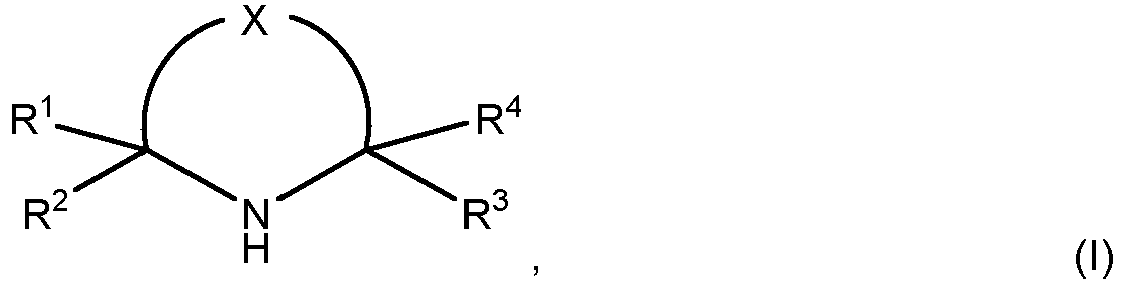
- R1 bis R4 für H oder organischen Rest steht,
- mit der Maßgabe, dass mindestens einer der Reste R1, R2, R3 und R4 = H ist, und
-
X=-(Y1)m-(A1)n-(Y2)o-(A2)p-(Y3)q-(A3)r-(Y4)s- (II)
wobei unabhängig von einander- m, n, o, p, q, r und s = 0 oder 1,
- A1, A2, A3 = Alkylen- oder Alkenylenrest und
- Y1, Y2, Y3, Y4 = NR5, PR5, O oder S, wobei R5 = organischer Rest,
- wobei jeweils zwei organische Reste ausgewählt aus R1 bis R5 und ggf. anwesenden Resten der Alkylen- und/oder Alkenylenreste A1, A2, A3 auch einen oder mehrere weitere Ringe bilden können,
- Die cyclischen Amine sind in Bezug auf den dargestellten Ring in Formel (I) gesättigt oder zum Teil ungesättigt. Entsprechende Amine reagieren schneller als entsprechende aromatische Amine und Imidazoline. Optional weitere anwesende Ringe im cyclischen Amin können nicht nur gesättigt oder ungesättigt, sondern auch aromatisch sein.
- Bevorzugte cyclische Amine sind in Bezug auf den dargestellten Ring in Formel (I) gesättigt.
- Die der ringständigen Aminogruppe benachbarten Kohlenstoffatome sind, da mindestens einer der Reste R1, R2, R3 und R4 = H ist, in Summe an mindestens einer Stelle unsubstituiert. Entsprechende Amine reagieren schneller als Amine, bei denen alle vier Reste R1, R2, R3 und R4 ≠ H sind. Bevorzugt sind mindestens zwei, weiter bevorzugt mindestens drei, ganz besonders bevorzugt alle der Reste R1, R2, R3 und R4 = H.
- Im Rest X sind, wenn vorhanden, A1, A2 und A3 unabhängig voneinander Alkylen- oder Alkenylenreste. Diese können wiederum organische Reste tragen. Weisen die Alkylen- und/oder Alkenylenreste selbst einen oder mehrere organische Reste auf, können jeweils zwei organische Reste ausgewählt aus den organischen Resten der Alkylen- und/oder Alkenylenreste auch miteinander oder mit ggf. vorhandenen organischen Resten R1 bis R5 einen oder mehrere weitere Ringe bilden.
- Bevorzugt weisen A1, A2 und A3, jeweils, wenn vorhanden, unabhängig voneinander die Formel (III) auf,
-(CR7R8)x-(CR9=CR10)y-(CR11R12)z- (III)
in der unabhängig von einander - R7, R8, R9, R10, R11 und R12 = H oder organischer Rest und
- 1 ≤ x + y + z ≤ 7
- Die Indices x, y und z können entsprechend Ihrer Zugehörigkeit zum Rest A1, A2 und A3 bevorzugt auch als Indices x1, y1 und z1, als x2, y2 und z2 und als x3, y3 und z3 bezeichnet werden.
- Bevorzugt weist X eine Kettenlänge von 2 bis 15 Atomen auf. Bevorzugt beträgt somit die Summe aus allen x, ½·y und z sowie aus m, o, q und s einen Wert zwischen 2 und 15, weiter bevorzugt einen Wert zwischen 2 und 8, noch weiter bevorzugt einen Wert zwischen 2 und 5 und ganz besonders bevorzugt einen Wert zwischen 2 und 4. Anders ausgedrückt, ist bevorzugt 2 ≤ m + o + q + s + x1 + ½·y1 + z1 + x2 + ½·y2 + z2 + x3 + ½·y3 + z3 ≤ 15. Weiter bevorzugt ist 2 ≤ m + o + q + s + x1 + ½·y1 + z1 + x2 + ½·y2 + z2 + x3 + ½·y3 + z3 ≤ 8, weiter bevorzugt 2 ≤ m + o + q + s + x1 + ½·y1 + z1 + x2 + ½·y2 + z2 + x3 + ½·y3 + z3 ≤ 5, ganz besonders bevorzugt 2 ≤ m + o + q + s + x1 + ½·y1 + z1 + x2 + ½·y2 + z2 + x3 + ½·y3 + z3 ≤ 4.
- Bei den Aminen der Formel (I) handelt es sich um (ggf. bi-/poly)cyclische Verbindungen, da beide zur Aminogruppe benachbarten Kohlenstoffatome beidseitig an den substituierten (Hetero)Alkylenrest der Formel (II) angebunden sind.
- Weiter bevorzugt weist Formel (I) neben dem Stickstoffatom der ringständigen NH-Gruppe maximal ein weiteres Heteroatom im Zyklus auf, d.h. X hat bevorzugt die Formel (IIa)
X=-(CR7R8)x-(Y)o-(CR11R12)z- (IIa)
mit - x und z = 0, 1, 2, 3, 4, 5, 6 oder 7,
- o = 0 oder 1,
- 2 ≤ x + o + z ≤ 15
- R7, R8, R11, R12 = H oder organischer Rest und
- Y = NR5, PR5, O oder S, wobei R5 = organischer Rest.
- Entsprechend gilt dann, dass in Formel (I) jeweils zwei organische Reste ausgewählt aus R1 bis R8, R11 und R12 auch einen oder mehrere weitere Ringe bilden können, mit der Maßgabe, dass mindestens einer der vorhandenen Reste ausgewählt aus R1 bis R8, R11 und R12 mit mindestens einer Gruppe -NHR6 oder -NH2 substituiert ist, wobei R6 = organischer Rest.
- Im bevorzugten Falle von x = 2 - 4 und o und z = 0 handelt es sich bei den resultierenden Verbindungen um gesättigte Heteroalkyl-Ringsysteme mit eine NH-Gruppe. Bevorzugte Verbindungen sind Pyrrolidine, Piperidine und Azepane. Im bevorzugten Falle von x = 1 - 3, o = 1 und z = 0 - 2 handelt es sich um gesättigte Heteroalkyl-Ringsysteme mit einer NH-Gruppe und einem weiteren Heteroatom im Zyklus, das nicht Teil einer weiteren cyclischen NH-Gruppe ist. Bevorzugte Verbindungen sind einfach N-substituierte Pyrazolidine, einfach N-substituierte Imidazolidine, Oxazolidine, Thiazolidine, einfach N-substituierte Piperazine, Morpholine, Thiomorpholine, einfach N-substituierte Diazepane, Oxazepane und Thiazepane. Bevorzugt ist in Formel (IIa) somit x = 1 - 4, o = 0 oder 1 und z = 0 - 2.
- Es können jedoch auch Verbindungen mit drei Heteroatomen im Zyklus eingesetzt werden. Bevorzugt ist insbesondere die Gruppe der Triazinane und der Triazepane. Insbesondere diese Verbindungen können verbrückt vorliegen, wie z.B. bei der besonders bevorzugten Gruppe an Verbindungen der 1,3,6-Triazabicyclo[4.2.1]nonane.
- Die Reste R1, R2, R3, R4, R5, R6, R7, R8, R9, R10, R11 und R12 können organische Reste sein. Bevorzugte organische Reste sind Alkyl-, Alkenyl-, Alkinyl-, Aryl- oder Aralkylreste. Diese können innerhalb ihrer Kette heteratomsubstituiert sein und/oder Substituenten tragen. Bevorzugte organische Reste sind Alkyl-, Alkenyl-, Alkinyl-, Aryl- oder Aralkylreste, die innerhalb der Kette eine oder mehrere Ether-, Carboxy-, Amino-, Amido-, Harnstoff-, Carbamat-, Carbonat-, Amidino- oder Guanidinogruppen tragen können. Weiterhin können bevorzugte organische Reste einen oder mehrere Substituenten ausgewählt aus organischen Resten, optional mit Ether-, Carboxy-, Amino-, Amido-, Harnstoff-, Carbamat-, Carbonat-, Amidino- oder Guanidinogruppen, die ggf. auch mit Hydroxy-, Nitril- oder Halogenresten substituiert sein oder selbst Hydroxy-, Nitril- oder Halogenreste sein können.
- Bevorzugte Verbindungen der Formel (I) sind Aminoethylpiperazin (AEP, 1-(2-Aminoethyl)-piperazin), 1-(3-Aminopropyl)piperazin, 1-Imidazolidinethanamin, Imidazolidin-N-propanamin, α-Methyl-1-piperazinethanamin, 2,6-Dimethyl-1-piperazinethanamin, 2-Amino-1-(piperazin-1-yl)-ethanon, 4-(2-Aminoethyl)piperidin, 3-(2-Aminoethyl)piperidin und 2-(2-Aminoethyl)piperidin.
- Die Verbindungen der Formel (I) können auch in Mischung eingesetzt werden.
- Die erfindungsgemäßen Zusammensetzungen enthalten weiterhin mindestens ein Salz einer starken Brönstedt-Säure mit einem Gegenion ausgewählt aus Metallionen, Metall-haltigen Ionen, Phosphoniumionen und unsubstituierten Ammoniumionen. Entsprechende Salze dienen als Katalysator. Unter einer solchen starken Säure ist vorliegend eine Säure zu verstehen, deren pKs-Wert (bzw. im Falle mehrprotoniger Säuren deren pKs-Wert der ersten Protolysationsstufe) kleiner oder gleich 2 ist. Bevorzugt ist der pKs der korrespondierenden Säure kleiner oder gleich -2. Bevorzugt beträgt der pKs-Wert der starken Säure zwischen 2 und -9,0, besonders bevorzugt zwischen -2 und -9,0.
- Der pKs ist definiert als der negative dekadische Logarithmus der Gleichgewichtskonstante Ks und gilt als Maß für die Stärke einer Säure. Je kleiner ein pKs-Wert, desto stärker die Säure. Der pKs-Wert wird bestimmt wie in F.G. Bordwell, "Equilibrium Acidities in Dimethylsulfoxide Solution", Acc. Chem. Res. 1988, 21, 456-463 offenbart.
- Bevorzugte Salze sind die entsprechenden Salze der in der folgenden Tabelle 1 in der ersten Spalte zusammengefassten starken Säuren:
Tabelle 1: Säure pKS-Wert Literaturstelle, falls nicht in Bordwell offenbart Oxalsäure 1,5 Bayer Walter, Lehrbuch der organischen Chemie, 21. Auflage, Hirzelverlag 1988, S. 324 p-Toluolsulfonsäure 0,7 Römpp Lexikon Chemie, 10. Auflage, Georg Thieme Verlag, Stuttgart, New York, Verlag 1999, S. 4580-1. Trifluoressigsäure 0,2 Bayer Walter, Lehrbuch der organischen Chemie, 21. Auflage, Hirzelverlag 1988, S. 272 Tetrafluorborsäure -0,4 e-EROS Encyclopedia of Reagents for Organic Synthesis, Pages1-4, Conference; General Review; Online Computer File, 2001 Salpetersäure -1,4 Hollemann Wiberg, Lehrbuch der anorganischen Chemie, 91.-100 Auflage, Walter der Gruyter Verlag, Berlin, New York, 1985, S. 603. Schwefelsäure -3 Römpp, Lexikon Chemie, 9. Auflage, Georg Thieme Verlag, Stuttgart, New York 1991, S. 3459. Salzsäure -8 Bromwasserstoffsäure -9 - Die Gegenionen dieser starken Säuren sind ausgewählt aus Metallionen, Metall-haltigen Ionen, Phosphoniumionen und unsubstituierten Ammoniumionen. Bevorzugte Metallionen sind Erdalkalimetallkationen, insbesondere Beryllium-, Magnesium-, Calcium-, Strontium- und Barium-Ionen, sowie Lithium- und Zirkoniumionen.
- Metall-haltige Ionen sind Ionen, die mindestens ein Metall enthalten, aber keine reinen Metallionen sind. Bevorzugt handelt es sich um Metallverbindungsionen, wie z. B. Tetraphenylstiboniumionen.
- Auch können die Gegenionen Ammoniumionen (NH4 +) oder ggf. alkylierte und/oder arylierte Phosphoniumionen sein. Ganz besonders bevorzugt sind Ammoniumionen.
- Bevorzugte Salze starker Säuren sind Calciumnitrat, Magnesiumbromid, Zirkonium(IV)chlorid, Indiumchlorid, Bismutchlorid, Kupfertetrafluoroborat, Calciumoxalat, Lithiumbromid und Magnesiumnitrat.
- Bevorzugte Salze starker Säuren sind Erdalkalihalogenide, darunter insbesondere Magnesiumbromid.
- Bevorzugt sind in organischen Medien (z. B. Benzylalkohol) gut lösliche Salze, d.h. Salze mit einer Löslichkeit von mindestens 10 g/l in Benzylalkohol bei 20 °C. Salze wie Calciumsulfat oder Bariumsulfat sind somit weniger bevorzugt.
- Bevorzugt können die erfindungsgemäßen Zusammensetzungen weiterhin d) nicht unter die Formel (I) fallende Amine und/oder e) weitere Hilfs- oder Zusatzstoffe aufweisen.
- Nicht unter die Formel (I) fallende Amine d) sind bevorzugt Di- oder Polyamine. Diese können monomere, oligomere und/oder polymere Verbindungen sein. Bevorzugte monomere und oligomere Verbindungen sind ausgewählt aus der Gruppe bestehend aus Diaminen, Triaminen und Tetraminen. Die Amingruppe der Di- oder Polyamine d) kann an ein primäres, sekundäres oder tertiäres Kohlenstoffatom angebunden sein, bevorzugt an ein primäres oder sekundäres Kohlenstoffatom. Es können auch Mischungen von Di- und/oder Polyaminen als Komponente d) eingesetzt werden.
- Als Komponente d) können bevorzugt die folgenden Amine allein oder in Mischungen eingesetzt werden:
- aliphatische Amine, insbesondere Polyalkylenpolyamine, bevorzugt ausgewählt aus 1,2-Ethylendiamin, 1,2-Propylendiamin, 1,3-Propylendiamin, 1,2-Butylendiamin, 1,3-Butylendiamin, 1,4-Butylendiamin, 2-(Ethylamino)ethylamin, 3-(Methylamino)propylamin, Diethylentriamin, Triethylentetramin, Pentaethylenhexamin, Trimethylhexamethylendiamin, 2,2,4-Trimethylhexamethylendiamin, 2,4,4-Trimethylhexamethylendiamin, 2-Methyl-pentandiamin, Hexamethylendiamin, N-(2-Aminoethyl)-1,2-ethandiamin, N-(3-Aminopropyl)-1,3-propandiamin, N,N"-1,2-Ethandiylbis-(1,3-propandiamin), Dipropylentriamin, Adipinsäuredihydrazid und Hydrazin;
- Oxyalkylenpolyamine, bevorzugt ausgewählt aus Polyoxypropylendiamin und Polyoxypropylentriamin (z. B. Jeffamine® D-230, Jeffamine® D-400, Jeffamine® T-403, Jeffamine® T-5000), 1,13-Diamino-4,7,10-trioxatridecan, 4,7-Dioxadecan-1,10-diamin;
- cycloaliphatische Amine, bevorzugt ausgewählt aus Isophorondiamin (3,5,5-Trimethyl-3-aminomethyl-cyclohexylamin), 4,4'-Diaminodicyclohexylmethan, 2,4'-Diaminodicyclohexylmethan und 2,2'-Diaminodicyclohexylmethan allein oder in Mischungen der Isomeren, 3,3'-Dimethyl-4,4'-diamino-dicyclohexylmethan, N-Cyclohexyl-1,3-propandiamin, 1,2-Diaminocyclohexan, 3-(Cyclohexylamino)propylamin, TCD-Diamin (3(4), 8(9)-Bis(aminomethyl)-tricyclo[5.2.1.02,6]decan), 4-Methylcyclohexan-1,3-diamin
- araliphatische Amine, bevorzugt Xylylendiamine;
- aromatische Amine, bevorzugt Phenylendiamine, insbesondere 1,3-Phenylendiamin und 1,4-Phenylendiamin, und 4,4'-Diaminodiphenylmethan, 2,4'-Diaminodiphenylmethan, 2,2'-Diaminodiphenylmethan, ggf. allein oder in Mischungen der Isomeren;
- Addukthärter, insbesondere Umsetzungsprodukte von Epoxidverbindungen, insbesondere Glycidylether des Bisphenol A und F, mit überschüssigem Amin;
- Polyamidoaminhärter, insbesondere durch Kondensation von Mono- und Polycarbonsäuren mit Polyaminen erhaltene Polyamidoaminhärter, ganz insbesondere durch Kondensation von Dimerfettsäuren mit Polyalkylenpolyaminen;
- Mannichbasenhärter, insbesondere durch Umsetzung von ein- oder mehrwertigen Phenolen mit Aldehyden, insbesondere Formaldehyd, und Polyaminen, Mannichbasenhärter; und
- Mannichbasen, insbesondere auf Basis von Phenol und/oder Resorcin, Formaldehyd und m-Xylylendiamin sowie N-Aminoethylpiperazin und Abmischungen von N-Aminoethylpiperazin mit Nonylphenol und/oder Benzylalkohol, Phenalkamine, die in einer Mannichreaktion aus Cardanolen, Aldehyden und Aminen gewonnen werden.
- Es können auch Mischungen der vorab genannten Di- oder Polyamine als Komponente d) eingesetzt werden.
- Das Verhältnis der Epoxy-Gruppen des Epoxyharzes zu der Summe aller NH-Gruppen aller Amine beträgt 0,5 : 1 bis 1,5 : 1, bevorzugt 0,8 : 1 bis 1,2 : 1, ganz besonders bevorzugt 0,9 : 1 bis 1,1 zu 1. Unter "allen Aminen" sind dabei cyclische Amine der Formel (I) sowie die nicht unter Formel (I) fallenden Amine d) zu verstehen. Eine entsprechende Umsetzung hat den Vorteil, dass dadurch die Vernetzungsdichte und die Molmasse steigen, und damit die mechanischen Eigenschaften, die Chemikalienbeständigkeit und die Kratzfestigkeit verbessert werden. Außerdem bleiben keine unreagierten Bestandteile in der Beschichtung übrig, die entweder unerwünschte Nebenreaktionen eingehen können, aus der Beschichtung heraus migrieren oder aber zumindest als Weichmacher die Wärmeformbeständigkeit herabsetzen.
- Bevorzugte weitere Hilfs- und Zuschlagsstoffe e) können die in der Epoxychemie üblichen Verbindungen sein. Bevorzugte Hilfs- und Zuschlagsstoffe e) sind Pigmente, Lösemittel, Verlaufsmittel, Modifikatoren, wie z. B. Benzylalkohol oder Nonylphenol, Entgasungsmittel, Mattierungsmittel, Reaktivverdünner, sowie herkömmliche Katalysatoren, wie Salizylsäure.
- In einer bevorzugten Ausführungsform werden keine weiteren nicht unter die Formel (I) fallenden Amine d) eingesetzt. In einer bevorzugten Ausführungsform werden keine weiteren herkömmlichen Katalysatoren eingesetzt, d.h. die möglichen Hilfs- und Zuschlagsstoffe sind beschränkt auf Pigmente, Lösemittel, Verlaufsmittel, Modifikatoren, Entgasungsmittel, Mattierungsmittel und Reaktivverdünner.
- Die Zusammensetzung der Komponenten a) bis e) in der erfindungsgemäßen Zusammensetzung beträgt bevorzugt die folgenden Gewichtsprozentanteile, bezogen auf die Gesamtmasse der Zusammensetzung:
- a) Epoxyharz 30 - 95 %
- b) cyclisches Amin 1 - 50 %
- c) Salz der starken Säure 0,001 - 5 %,
bevorzugt 0,1 - 3 %, - d) weiteres Amin 0 - 48 % und
- e) weitere Hilfs- oder Zusatzstoffe 0 - 48 %.
- Bevorzugt beträgt weiterhin der Gewichtsprozentanteil der Amine b) bezogen auf die Gesamtmasse der Amine b) und d) mindestens 10 Gew.-%, besonders bevorzugt mindestens 30%, ganz besonders bevorzugt mindestens 50 % und noch bevorzugter mindestens 70 %.
- Gegenstand der Erfindung ist weiterhin ein Verfahren zur Herstellung einer erfindungsgemäßen Zusammensetzung, bei dem mindestens ein Epoxyharz a), mindestens ein cyclisches Amin b) und mindestens ein Salz einer starken Säure c) miteinander vermischt wird.
- Gegenstand der Erfindung ist weiterhin die Verwendung der erfindungsgemäßen Zusammensetzungen als Gießharz, Beschichtungsmasse, Komposit oder Klebstoff oder als Bestandteil davon.
- Zum Nachweis der besonderen Reaktivität der beanspruchten Katalysatoren werden zunächst Modellversuche miteinander verglichen. Dazu gibt man jeweils 0,025 Mol (3,75 g) des 1,2-Epoxy-3-phenoxypropans in eine Mischung aus 22,68 g Toluol (Lösemittel) und 2,08 g Tetradecan (interner Standard). Dazu werden 0,025 Mol (2,13 g) Piperidin zugegeben und 0,06 g des jeweiligen Katalysators. Sofort nach der Mischung wird ein GC angefertigt und der Gehalt an 1,2-Epoxy-3-phenoxypropan mit dem Gehalt des Tetradecans verglichen. Nach 4 h bei Raumtemperatur wird mittels einer GC-Untersuchung der Restgehalt an 1,2-Epoxy-3-phenoxypropan (EP) ermittelt (kalibriert durch den internen Standard Tetradecan). Dabei ergeben sich folgende Resultate:
Vergleich der Katalysatoren Katalysator % EP in der 0-Probe % EP nach 4 Stunden bei RT 1* Kein Katalysator 97 93 2* Dibutylzinndilaurat 99 93 3* Diazabicyclononan (DBN) 97 95 4* Diazabicycloundecan (DBU) 96 93 5* Diazabicyclooctan (DABCO) 94 93 6* Zinkacetylacetonat 94 90 7* Tetrabutylammoniumtribromid 91 87 8* Bismuthneodecanoat 91 88 9* Titantetrabutylat 95 94 10* Salicylsäure 93 90 11* Phenol 97 85 12 Calciumnitrat 93 36 13 Magnesiumbromid 91 28 14 Indiumchlorid 94 35 15 Bismuthchlorid 94 43 16 Kupfertetrafluorborat 93 33 17 Calciumoxalat 94 38 18 Zirconium(IV)chlorid 89 33 19 Lithiumbromid 95 34 20 Magnesiumnitrat 98 33 21 Calciumbromid 98 79 * Nicht erfindungsgemäße Vergleichsversuche - 12,2 g Bisphenol A diglycidylether (Epikote 828, Hexion), 2,8 g Aminoethylpiperazin (AEP, Aldrich) und 0,25 g Calciumnitrat (gelöst in 0,25 ml Ethanol, Accelerator 3130, Huntsman) wurden gut miteinander vermischt und dann sofort einer DSC Messung (Mettler-Toledo, 10 K/min) unterworfen. Gemessen wurde ein exothermer Peak mit einem Onset von 47 °C und einem Maximum von 85 °C.
- 12,2 g Bisphenol A diglycidylether (Epikote 828, Hexion) und 2,8 g Aminoethylpiperazin (AEP, Aldrich) wurden gut miteinander vermischt und dann sofort einer DSC Messung (Mettler-Toledo, 10 K/min) unterworfen. Gemessen wurde ein exothermer Peak mit einem Onset von 61 °C und einem Maximum von 97 °C.
Claims (16)
- Zusammensetzung umfassenda) mindestens ein Epoxyharz,b) mindestens ein cyclisches Amin der Formel (I) in der
 - R1 bis R4 für H oder organischen Rest steht,- mit der Maßgabe, dass mindestens einer der Reste R1, R2, R3 und R4 = H ist, und-
X = -(Y1)m-(A1)n-(Y2)o-(A2)p-(Y3)q-(A3)r-(Y4)s- (II)
wobei unabhängig von einander- m, n, o, p, q, r und s = 0 oder 1,- A1, A2, A3 = Alkylen- oder Alkenylenrest und- Y1, Y2, Y3, Y4 = NR5, PR5, O oder S, wobei R5 unabhängig voneinander = organischer Rest,- wobei jeweils zwei organische Reste ausgewählt aus R1 bis R5 und ggf. anwesenden Resten der Alkylen- und/oder Alkenylenreste A1, A2, A3 auch einen oder mehrere weitere Ringe bilden können,- mit der Maßgabe, dass mindestens einer der vorhandenen Reste ausgewählt aus R1 bis R5 und ggf. anwesenden Resten der Alkylen- und/oder Alkenylenreste A1, A2, A3 mit mindestens einer Gruppe -NHR6 oder -NH2 substituiert ist, wobei R6 = organischer Rest, undc) mindestens ein Salz einer starken Brönstedt-Säure mit einem Gegenion ausgewählt aus Metallionen, Metall-haltigen Ionen, Phosphoniumionen und unsubstituierten Ammoniumionen,wobei das Verhältnis der Epoxy-Gruppen des Epoxyharzes zu der Summe aller NH-Gruppen aller Amine 0,5 : 1 bis 1,5 : 1 beträgt. - Zusammensetzung nach Anspruch 1,
dadurch gekennzeichnet, dass
das mindestens eine Epoxyharz ein Polyepoxid auf Basis von Bisphenol A-diglycidylether, Bisphenol F-diglycidylether, 4,4'-Methylen-bis[N,N-bis(2,3-epoxypropyl)anilin], Hexandioldiglycidylether, Butandioldiglycidylether, Trimethylolpropantriglycidylether, 1,2,3-Propantrioltriglycidylether, Pentaerythrit-tetraglycidylether und Hexahydrophthalsäurediglycidylester ist. - Zusammensetzung nach Anspruch 1 oder 2,
dadurch gekennzeichnet, dass
in Formel (I) mindestens zwei der Reste R1, R2, R3 und R4 = H sind. - Zusammensetzung nach einem der vorhergehenden Ansprüche,
dadurch gekennzeichnet, dass
A1, A2 und A3 unabhängig voneinander die Formel (III) aufweisen
-(CR7R8)x-(CR9=CR10)y-(CR11R12)z- (III)
in der unabhängig von einander- R7, R8, R9, R10, R11 und R12 = H oder organischer Rest und- 1 ≤ x + y + z ≤ 7ist. - Zusammensetzung nach einem der vorhergehenden Ansprüche,
dadurch gekennzeichnet, dass
X in Formel (II) eine Kettenlänge von 2 bis 15 Atomen aufweist.. - Zusammensetzung nach einem der vorhergehenden Ansprüche,
dadurch gekennzeichnet, dass
X die Formel (IIa)
X = -(CR7R8)x-(Y)o-(CR11R12)z- (IIa)
mit- x und z = 0, 1, 2, 3, 4, 5, 6 oder 7,- o = 0 oder 1,- 2 ≤ x + o + z ≤ 15- R7, R8, R11, R12 = H oder organischer Rest und- Y = NR5, PR5, O oder S, wobei R5 = organischer Rest,hat. - Zusammensetzung nach Anspruch 6,
dadurch gekennzeichnet, dass
x = 1, 2, 3 oder 4, o = 0 oder 1 und z = 0, 1 oder 2. - Zusammensetzung nach einem der Ansprüche 1 - 5,
dadurch gekennzeichnet, dass
das cyclische Amin der Formel (I) ein Triazinan oder Triazepan ist. - Zusammensetzung nach einem der vorhergehenden Ansprüche,
dadurch gekennzeichnet, dass
das mindestens eine cyclische Amin der Formel (I) ausgewählt ist aus der Gruppe bestehend aus 1-(2-Aminoethyl)piperazin, 1-(3-Aminopropyl)piperazin, 1-Imidazolidinethanamin, Imidazolidin-N-propanamin, α-Methyl-1-piperazinethanamin, 2,6-Dimethyl-1-piperazinethanamin, 2-Amino-1-(piperazin-1-yl)ethanon, 4-(2-Aminoethyl)piperidin, 3-(2-Aminoethyl)piperidin und 2-(2-Aminoethyl)piperidin. - Zusammensetzung nach einem der vorhergehenden Ansprüche,
dadurch gekennzeichnet, dass
das Salz einer starken Säure ein Erdalkalimetall-, Lithium-, Zirkonium-, Phosphonium- oder unsubstituiertes Ammoniumsalz ist. - Zusammensetzung nach einem der vorhergehenden Ansprüche,
dadurch gekennzeichnet, dass sie weiterhind) nicht unter die Formel (I) fallende Amine und/odere) weitere Hilfs- oder Zusatzstoffe aufweist. - Zusammensetzung nach Anspruch 11,
dadurch gekennzeichnet, dass
die nicht unter die Formel (I) fallenden Amine d) ausgewählt sind aus- aliphatischen Aminen,- Oxyalkylenpolyaminen- Cycloaliphatischen Aminen,- Araliphatischen Aminen,- Aromatischen Aminen- Addukthärtern,- Polyamidoaminhärtern- Mannichbasenhärtern und- Mannichbasen. - Zusammensetzung nach einem der Ansprüche 11 oder 12,
dadurch gekennzeichnet, dass
die Zusammensetzung die Komponenten a) bis e) in den folgenden Gewichtsprozentanteilen, bezogen auf die Gesamtmasse der Zusammensetzung aufweist:a) Epoxyharz 30 - 95 %b) cyclisches Amin 1 - 50 %c) Salz der starken Säure 0,001 - 5 %d) weiteres Amin 0 - 48 % unde) weitere Hilfs- oder Zusatzstoffe 0 - 48 %. - Zusammensetzung nach einem der Ansprüche 11 - 13,
dadurch gekennzeichnet, dass
der Gewichtsprozentanteil der Amine b) bezogen auf die Gesamtmasse der Amine b) und d) mindestens 10 Gew.-% beträgt. - Verfahren zur Herstellung einer Zusammensetzung nach einem der der vorhergehenden Ansprüche 1 - 14,
dadurch gekennzeichnet, dass mindestens ein Epoxyharz a), mindestens ein cyclisches Amin b) und mindestens ein Salz einer starken Brönstedt-Säure c) miteinander vermischt werden. - Verwendung einer Zusammensetzung nach einem der Ansprüche 1 -14 als Gießharz, Beschichtungsmasse, Komposit oder Klebstoff oder als Bestandteil davon.
Applications Claiming Priority (1)
| Application Number | Priority Date | Filing Date | Title |
|---|---|---|---|
| EP18172949 | 2018-05-17 |
Publications (2)
| Publication Number | Publication Date |
|---|---|
| EP3569631A1 true EP3569631A1 (de) | 2019-11-20 |
| EP3569631B1 EP3569631B1 (de) | 2022-07-13 |
Family
ID=62217770
Family Applications (1)
| Application Number | Title | Priority Date | Filing Date |
|---|---|---|---|
| EP19174659.3A Active EP3569631B1 (de) | 2018-05-17 | 2019-05-15 | Schnell härtende epoxysysteme |
Country Status (5)
| Country | Link |
|---|---|
| US (1) | US11359048B2 (de) |
| EP (1) | EP3569631B1 (de) |
| JP (1) | JP7411339B2 (de) |
| KR (1) | KR20190132247A (de) |
| CN (1) | CN110498903A (de) |
Cited By (2)
| Publication number | Priority date | Publication date | Assignee | Title |
|---|---|---|---|---|
| EP3981817A1 (de) | 2020-10-12 | 2022-04-13 | Evonik Operations GmbH | Zusammensetzungen umfassend brönstedtsäuren und monoamine |
| US11453744B2 (en) | 2019-10-15 | 2022-09-27 | Evonik Operations Gmbh | Compositions consisting of BrØnsted acids and monoamines |
Families Citing this family (10)
| Publication number | Priority date | Publication date | Assignee | Title |
|---|---|---|---|---|
| US11286335B2 (en) | 2018-05-17 | 2022-03-29 | Evonik Operations Gmbh | Fast-curing epoxy systems |
| EP3569629B1 (de) * | 2018-05-17 | 2022-07-06 | Evonik Operations GmbH | Schnell härtende epoxysysteme |
| EP3569630B1 (de) * | 2018-05-17 | 2022-08-03 | Evonik Operations GmbH | Schnell härtende epoxysysteme |
| EP3666810B1 (de) | 2018-12-13 | 2023-02-08 | Evonik Operations GmbH | Wasserarme hydrophilierungsmittel und ihr einsatz in wässrigen dispersionen |
| EP3838592A1 (de) | 2019-12-17 | 2021-06-23 | Evonik Operations GmbH | Zusammensetzung enthaltend polyester für die generative fertigung |
| EP3882294A1 (de) * | 2020-03-18 | 2021-09-22 | Hilti Aktiengesellschaft | Härterzusammensetzung auf basis von diaminomethylcyclohexan und 1,3-cyclo-hexan-bis(methylamin) für eine epoxidharzmasse, epoxidharzmasse und mehrkomponenten-epoxidharzsystem |
| US20230257511A1 (en) * | 2020-07-10 | 2023-08-17 | Evonik Operations Gmbh | Epoxy-amine adduct |
| CN111748079A (zh) * | 2020-07-14 | 2020-10-09 | 道生天合材料科技(上海)股份有限公司 | 一种可快速固化的固化剂及使用该固化剂的环氧树脂系统 |
| CN114456756A (zh) * | 2022-01-17 | 2022-05-10 | 惠州市飞世尔实业有限公司 | 一种环氧树脂底部填充胶 |
| CN116425955A (zh) * | 2023-04-12 | 2023-07-14 | 浙江工业大学 | 一种基于尼龙6副产品的环氧热固性体系材料及其制备方法 |
Citations (21)
| Publication number | Priority date | Publication date | Assignee | Title |
|---|---|---|---|---|
| US3055901A (en) | 1961-05-18 | 1962-09-25 | Jefferson Chem Co Inc | Preparation of aminoethylpiperazine |
| GB1105772A (en) | 1964-03-26 | 1968-03-13 | Dynamit Nobel Ag | Process for hardening polyepoxides |
| DE1954701A1 (de) | 1969-10-30 | 1971-05-06 | Ney Gyl Labor Kg | Verfahren zur Aushaertung von Epoxyharzen |
| EP0083813A1 (de) | 1981-12-14 | 1983-07-20 | Shell Internationale Researchmaatschappij B.V. | Reaktionsspritzgiessverfahren mit Epoxydharzzusammensetzungen |
| US4775734A (en) | 1987-08-12 | 1988-10-04 | Ashland Oil, Inc. | Non-nucleophilic acid salts of amines as cure accelerators |
| EP0604363A2 (de) * | 1992-12-22 | 1994-06-29 | Ciba-Geigy Ag | Lagerstabile Lösungen von Beschleunigersystemen für Epoxydharze |
| US5441000A (en) | 1994-04-28 | 1995-08-15 | Vatsky; Joel | Secondary air distribution system for a furnace |
| EP0675185A2 (de) | 1994-03-28 | 1995-10-04 | Hoechst Aktiengesellschaft | Elastische, Amin-modifizierte Epoxidharz-Zusammensetzung |
| WO1996009352A1 (en) | 1994-09-19 | 1996-03-28 | Minnesota Mining And Manufacturing Company | Epoxy adhesive composition |
| JPH08113876A (ja) | 1994-10-19 | 1996-05-07 | Toray Ind Inc | 炭素繊維およびその製造方法 |
| CA2165585A1 (en) | 1994-12-19 | 1996-06-20 | Kenneth Bruce Fogh | Method for the prevention of cathodic disbondment |
| US5629380A (en) | 1994-09-19 | 1997-05-13 | Minnesota Mining And Manufacturing Company | Epoxy adhesive composition comprising a calcium salt and mannich base |
| EP0969030A1 (de) | 1998-06-05 | 2000-01-05 | Basf Corporation | Epoxyd-Amin Beschichtungszusammensetzungen |
| US8951619B2 (en) | 2010-09-01 | 2015-02-10 | Dow Global Technologies Llc | Elastomeric insulation materials and the use thereof in subsea applications |
| US8980979B2 (en) | 2009-03-17 | 2015-03-17 | Dow Global Technologies Llc | Curable compositions containing cyclic diamine and cured products therefrom |
| US9006385B2 (en) | 2010-09-01 | 2015-04-14 | Dow Global Technologies Llc | Elastomeric epoxy materials and the use thereof |
| EP2957584A1 (de) | 2014-06-17 | 2015-12-23 | 3M Innovative Properties Company | Schnellhärtende Epoxyhaftmittelzusammensetzungen |
| WO2017074810A1 (en) | 2015-10-29 | 2017-05-04 | 3M Innovative Properties Company | Rapid curing and high thixotropy epoxy adhesive compostions |
| CN106833261A (zh) | 2016-12-28 | 2017-06-13 | 安徽燎原电器设备制造有限公司 | 一种耐热耐腐蚀配电柜外壳用环氧涂料 |
| CN106905816A (zh) | 2017-03-06 | 2017-06-30 | 华东理工大学 | 超疏水疏油涂料及其制备方法和使用方法 |
| EP3255078A1 (de) | 2016-06-10 | 2017-12-13 | Evonik Degussa GmbH | Epoxidharz-zusammensetzung enthaltend 2-(2,2,6,6-tetramethylpiperidin-4-yl)propan-1,3-diamin als härter |
Family Cites Families (62)
| Publication number | Priority date | Publication date | Assignee | Title |
|---|---|---|---|---|
| NL173809B (nl) * | 1951-11-17 | Rca Corp | Beeldopneeminrichting met kleurcodeerstrookfilterstelsel. | |
| US2928794A (en) | 1956-12-05 | 1960-03-15 | Devoe & Raynolds Co Inc | Curing of polyepoxides |
| US2965609A (en) * | 1958-06-30 | 1960-12-20 | Shell Oil Co | Process for curing polyepoxides and resulting products |
| US3277049A (en) | 1961-03-13 | 1966-10-04 | Air Prod & Chem | Curing epoxy resins with diaza-aromatic tertiary amines |
| US3649589A (en) | 1970-05-01 | 1972-03-14 | Witco Chemical Corp | Coating compositions containing coal tar distillate extender resin and an epoxy ether resin |
| JPS5226280B2 (de) * | 1973-05-15 | 1977-07-13 | ||
| JPS5028599A (de) * | 1973-07-16 | 1975-03-24 | ||
| GB1500206A (en) * | 1975-10-23 | 1978-02-08 | Ciba Geigy Ag | Compositions for curing epoxide resins |
| JPS56139105A (en) * | 1980-04-01 | 1981-10-30 | Nippon Shokubai Kagaku Kogyo Co Ltd | Semipermeable composite membrane and its manufacture |
| DE3852206D1 (de) | 1987-05-13 | 1995-01-12 | Ciba Geigy Ag | Heissverschäumbares, heisshärtendes Epoxidharzgemisch. |
| US4757125A (en) * | 1987-07-08 | 1988-07-12 | Ashland Oil, Inc. | Bicyclic amide acetal-based cure accelerators for amine curing of epoxy compositions |
| EP0553887A2 (de) * | 1988-02-12 | 1993-08-04 | The Dow Chemical Company | Katalysatoren und diese enthaltende Epoxyharz-Zusammensetzungen |
| US4910050A (en) * | 1988-08-04 | 1990-03-20 | Hughes Aircraft Company | Method and composition for providing electrostatic discharge protection for spacecraft |
| EP0675182B1 (de) | 1994-04-01 | 1997-07-16 | Toagosei Co., Ltd. | Wässrige, fluorhaltige Anstrichzusammensetzung und Herstellungsverfahren |
| US5707702A (en) | 1994-12-14 | 1998-01-13 | Brady, Jr.; Robert F. | Epoxy pipelining composition and method of manufacture |
| DE19512316A1 (de) | 1995-04-01 | 1996-10-02 | Hoechst Ag | Härtungsmittel für elastische Epoxidharz-Systeme |
| DE59704012D1 (de) * | 1997-04-16 | 2001-08-16 | Vantico Gmbh & Co Kg | Härtbare Mischungen aus Glycidylverbindungen, aminischen Härtern und heterocyclischen Beschleunigern |
| GB2332202A (en) | 1997-12-09 | 1999-06-16 | Courtaulds Coatings | Curable epoxy resin compositions |
| US6787579B2 (en) | 2001-05-02 | 2004-09-07 | L&L Products, Inc. | Two-component (epoxy/amine) structural foam-in-place material |
| US7473715B2 (en) | 2001-05-02 | 2009-01-06 | Zephyros, Inc. | Two component (epoxy/amine) structural foam-in-place material |
| US7132501B2 (en) | 2002-03-01 | 2006-11-07 | Mitsui Chemicals, Inc. | Polymerizable composition containing novel cyclic sulfur compound and resin obtained by curing the polymerizable composition |
| DE10302298A1 (de) | 2003-01-22 | 2004-08-05 | Henkel Kgaa | Hitzehärtbare, thermisch expandierbare Zusammensetzung mit hohem Expansionsgrad |
| CN101001929B (zh) | 2004-08-10 | 2010-09-08 | 中国涂料株式会社 | 高固体分防蚀涂料组合物及高固体分快速固化性防蚀涂料组合物、船舶等的涂装方法、得到的高固体分防蚀涂膜及高固体分快速固化防蚀涂膜、以这些涂膜被覆的涂装船舶及水中结构物 |
| ATE456596T1 (de) | 2007-11-14 | 2010-02-15 | Sika Technology Ag | Hitzehärtende epoxidharzzusammensetzung enthaltend nichtaromatische harnstoffe als beschleuniger |
| WO2010011710A2 (en) | 2008-07-23 | 2010-01-28 | 3M Innovative Properties Company | Two-part epoxy-based structural adhesives |
| DE102009028019A1 (de) | 2009-02-04 | 2010-08-05 | Evonik Degussa Gmbh | Härtbare Zusammensetzungen auf Basis von Epoxidharzen und hetero-poly-cyclischen Polyaminen |
| US9840588B2 (en) | 2009-12-18 | 2017-12-12 | Hexion Inc. | Epoxy resin curing compositions and epoxy resin systems including same |
| JP5462099B2 (ja) | 2010-07-27 | 2014-04-02 | 富士フイルム株式会社 | レーザー彫刻用樹脂組成物、レーザー彫刻用レリーフ印刷版原版及びその製造方法、並びに、レリーフ印刷版及びその製版方法 |
| US9309381B2 (en) | 2011-06-24 | 2016-04-12 | Air Products And Chemicals, Inc. | Epoxy resin compositions using solvated solids |
| US9346911B2 (en) | 2011-12-01 | 2016-05-24 | Blue Cube Ip Llc | Liquid accelerator composition for hardeners |
| US9938436B2 (en) * | 2012-10-10 | 2018-04-10 | Huntsman Advanced Materials Americas Llc | UV resistant epoxy structural adhesive |
| US9567480B2 (en) | 2012-10-24 | 2017-02-14 | Blue Cube Ip Llc | Ambient cure weatherable coatings |
| DE102012223387A1 (de) | 2012-12-17 | 2014-06-18 | Evonik Industries Ag | Verwendung von substituierten Benzylalkoholen in reaktiven Epoxy-Systemen |
| HUE050020T2 (hu) | 2012-12-21 | 2020-11-30 | Redexim Handel En Exploitatie Mij B V | Talajmegmunkáló szerkezet talajfelületek megmunkálására, valamint eljárás talajfelületek megmunkálására |
| US9994671B2 (en) | 2013-02-06 | 2018-06-12 | Evonik Degussa Gmbh | Curable composition with high fracture toughness |
| US9862798B2 (en) | 2013-09-30 | 2018-01-09 | Evonik Degussa Gmbh | Epoxy liquid curing agent compositions |
| CN103604856B (zh) | 2013-11-15 | 2015-11-25 | 深圳市华星光电技术有限公司 | 一种混酸溶液的电位滴定方法 |
| EP3091135A1 (de) | 2015-05-04 | 2016-11-09 | Evonik Degussa GmbH | Bewehrungsstab, verfahren zur herstellung und verwendung |
| ES2750306T3 (es) | 2015-12-11 | 2020-03-25 | Univ California | Formulaciones de resina epoxídica latentes para procesos de impregnación de líquido para la producción de materiales compuestos fibrosos |
| KR20180116366A (ko) | 2016-02-22 | 2018-10-24 | 에보닉 데구사 게엠베하 | 벤질화 마니히 염기 경화제, 조성물, 및 방법 |
| EP3255035B1 (de) | 2016-06-10 | 2018-09-19 | Evonik Degussa GmbH | 2-(3,3,5-trimethylcyclohexyl)propan-1,3-diamin, ein verfahren zu dessen herstellung und verwendung |
| EP3255079B1 (de) | 2016-06-10 | 2018-08-15 | Evonik Degussa GmbH | Epoxidharz-zusammensetzung enthaltend 2-(3,3,5-trimethylcyclohexyl)propan-1,3-diamin als härter |
| ES2702751T3 (es) | 2016-06-10 | 2019-03-05 | Evonik Degussa Gmbh | 2-(3-(aminometil)-3,5,5-trimetilciclohexil)propan-1,3-diamina, un procedimiento de preparación y uso |
| EP3255080B1 (de) | 2016-06-10 | 2018-08-15 | Evonik Degussa GmbH | Epoxidharz-zusammensetzung enthaltend 2-(3-(aminomethyl)-3,5,5-trimethylcyclohexyl)propan-1,3-diamin (am-cpda) als härter |
| EP3255039B1 (de) | 2016-06-10 | 2018-12-12 | Evonik Degussa GmbH | Verfahren zur herstellung von 2-(2,2,6,6-tetramethylpiperidin-4-yl)propan-1,3-diamin |
| EP3260436B1 (de) | 2016-06-23 | 2019-12-18 | Evonik Operations GmbH | Armierter baustein aus gasbeton |
| EP3263616B8 (de) | 2016-06-27 | 2020-01-15 | Evonik Operations GmbH | Alkoxysilan-funktionalisierte allophanat-haltige beschichtungsmittel |
| EP3263618A1 (de) | 2016-06-27 | 2018-01-03 | Evonik Degussa GmbH | Alkoxysilan-funktionalisierte allophanate |
| JP6921134B2 (ja) | 2016-06-27 | 2021-08-18 | エボニック オペレーションズ ゲーエムベーハー | 室温イオン液体硬化剤 |
| ES2880621T3 (es) | 2016-12-02 | 2021-11-25 | Evonik Degussa Gmbh | Productos preimpregnados de poliuretano 1K estables al almacenamiento y cuerpos moldeados a partir de la composición de poliuretano producidos a partir de estos |
| US10093159B1 (en) | 2017-03-29 | 2018-10-09 | Honda Motor Co., Ltd. | Flexible tonneau cover assembly |
| EP3401344B1 (de) | 2017-05-09 | 2020-04-08 | Evonik Operations GmbH | Verfahren zur herstellung von trimeren und/oder oligomeren von diisocyanaten |
| CN108047649A (zh) | 2017-12-05 | 2018-05-18 | 中国船舶重工集团公司第七二五研究所 | 一种低密度浅海固体浮力材料及其制备方法 |
| EP3546466B1 (de) | 2018-03-28 | 2020-12-02 | Evonik Operations GmbH | Verfahren zur herstellung alkoxysilangruppen-haltiger isocyanate |
| EP3546468B1 (de) | 2018-03-28 | 2020-08-12 | Evonik Operations GmbH | Verfahren zur herstellung alkoxysilangruppen-haltiger isocyanate |
| ES2820247T3 (es) | 2018-03-28 | 2021-04-20 | Evonik Degussa Gmbh | Procedimiento para la producción de isocianatos que contienen grupos alcoxisilano |
| PL3546465T3 (pl) | 2018-03-28 | 2021-03-22 | Evonik Operations Gmbh | Sposób wytwarzania izocyjanianów zawierających grupy alkoksysilanowe |
| US11286335B2 (en) * | 2018-05-17 | 2022-03-29 | Evonik Operations Gmbh | Fast-curing epoxy systems |
| EP3569630B1 (de) * | 2018-05-17 | 2022-08-03 | Evonik Operations GmbH | Schnell härtende epoxysysteme |
| EP3569629B1 (de) * | 2018-05-17 | 2022-07-06 | Evonik Operations GmbH | Schnell härtende epoxysysteme |
| US11326017B2 (en) | 2018-09-10 | 2022-05-10 | Evonik Operations Gmbh | Tin-free catalysis of silane-functional polyurethane crosslinkers |
| EP3660069B1 (de) | 2018-11-29 | 2024-01-03 | Evonik Operations GmbH | Schnell härtende epoxysysteme |
-
2019
- 2019-05-10 US US16/408,725 patent/US11359048B2/en active Active
- 2019-05-15 EP EP19174659.3A patent/EP3569631B1/de active Active
- 2019-05-16 KR KR1020190057272A patent/KR20190132247A/ko not_active Ceased
- 2019-05-16 CN CN201910406039.6A patent/CN110498903A/zh active Pending
- 2019-05-17 JP JP2019093868A patent/JP7411339B2/ja active Active
Patent Citations (23)
| Publication number | Priority date | Publication date | Assignee | Title |
|---|---|---|---|---|
| US3055901A (en) | 1961-05-18 | 1962-09-25 | Jefferson Chem Co Inc | Preparation of aminoethylpiperazine |
| GB1105772A (en) | 1964-03-26 | 1968-03-13 | Dynamit Nobel Ag | Process for hardening polyepoxides |
| US3492269A (en) | 1964-03-26 | 1970-01-27 | Dynamit Nobel Ag | Epoxy resin hardening process using inorganic metal salt accelerators |
| DE1954701A1 (de) | 1969-10-30 | 1971-05-06 | Ney Gyl Labor Kg | Verfahren zur Aushaertung von Epoxyharzen |
| EP0083813A1 (de) | 1981-12-14 | 1983-07-20 | Shell Internationale Researchmaatschappij B.V. | Reaktionsspritzgiessverfahren mit Epoxydharzzusammensetzungen |
| US4775734A (en) | 1987-08-12 | 1988-10-04 | Ashland Oil, Inc. | Non-nucleophilic acid salts of amines as cure accelerators |
| EP0604363A2 (de) * | 1992-12-22 | 1994-06-29 | Ciba-Geigy Ag | Lagerstabile Lösungen von Beschleunigersystemen für Epoxydharze |
| US5470896A (en) | 1992-12-22 | 1995-11-28 | Ciba-Geigy Corporation | Storage-stable solutions of accelerator systems |
| EP0675185A2 (de) | 1994-03-28 | 1995-10-04 | Hoechst Aktiengesellschaft | Elastische, Amin-modifizierte Epoxidharz-Zusammensetzung |
| US5441000A (en) | 1994-04-28 | 1995-08-15 | Vatsky; Joel | Secondary air distribution system for a furnace |
| WO1996009352A1 (en) | 1994-09-19 | 1996-03-28 | Minnesota Mining And Manufacturing Company | Epoxy adhesive composition |
| US5629380A (en) | 1994-09-19 | 1997-05-13 | Minnesota Mining And Manufacturing Company | Epoxy adhesive composition comprising a calcium salt and mannich base |
| JPH08113876A (ja) | 1994-10-19 | 1996-05-07 | Toray Ind Inc | 炭素繊維およびその製造方法 |
| CA2165585A1 (en) | 1994-12-19 | 1996-06-20 | Kenneth Bruce Fogh | Method for the prevention of cathodic disbondment |
| EP0969030A1 (de) | 1998-06-05 | 2000-01-05 | Basf Corporation | Epoxyd-Amin Beschichtungszusammensetzungen |
| US8980979B2 (en) | 2009-03-17 | 2015-03-17 | Dow Global Technologies Llc | Curable compositions containing cyclic diamine and cured products therefrom |
| US8951619B2 (en) | 2010-09-01 | 2015-02-10 | Dow Global Technologies Llc | Elastomeric insulation materials and the use thereof in subsea applications |
| US9006385B2 (en) | 2010-09-01 | 2015-04-14 | Dow Global Technologies Llc | Elastomeric epoxy materials and the use thereof |
| EP2957584A1 (de) | 2014-06-17 | 2015-12-23 | 3M Innovative Properties Company | Schnellhärtende Epoxyhaftmittelzusammensetzungen |
| WO2017074810A1 (en) | 2015-10-29 | 2017-05-04 | 3M Innovative Properties Company | Rapid curing and high thixotropy epoxy adhesive compostions |
| EP3255078A1 (de) | 2016-06-10 | 2017-12-13 | Evonik Degussa GmbH | Epoxidharz-zusammensetzung enthaltend 2-(2,2,6,6-tetramethylpiperidin-4-yl)propan-1,3-diamin als härter |
| CN106833261A (zh) | 2016-12-28 | 2017-06-13 | 安徽燎原电器设备制造有限公司 | 一种耐热耐腐蚀配电柜外壳用环氧涂料 |
| CN106905816A (zh) | 2017-03-06 | 2017-06-30 | 华东理工大学 | 超疏水疏油涂料及其制备方法和使用方法 |
Non-Patent Citations (3)
| Title |
|---|
| A. M. PAQUIN: "Epoxidverbindungen und Epoxidharze", 1958, SPRINGER VERLAG |
| F.G. BORDWELL: "Equilibrium Acidities in Dimethylsulfoxide Solution", ACC. CHEM. RES., vol. 21, 1988, pages 456 - 463, XP008149704, DOI: doi:10.1021/ar00156a004 |
| LEE NEVILLE: "Handbook of Epoxy Resins", 1967 |
Cited By (2)
| Publication number | Priority date | Publication date | Assignee | Title |
|---|---|---|---|---|
| US11453744B2 (en) | 2019-10-15 | 2022-09-27 | Evonik Operations Gmbh | Compositions consisting of BrØnsted acids and monoamines |
| EP3981817A1 (de) | 2020-10-12 | 2022-04-13 | Evonik Operations GmbH | Zusammensetzungen umfassend brönstedtsäuren und monoamine |
Also Published As
| Publication number | Publication date |
|---|---|
| CN110498903A (zh) | 2019-11-26 |
| KR20190132247A (ko) | 2019-11-27 |
| US11359048B2 (en) | 2022-06-14 |
| EP3569631B1 (de) | 2022-07-13 |
| JP7411339B2 (ja) | 2024-01-11 |
| JP2019199609A (ja) | 2019-11-21 |
| US20190352451A1 (en) | 2019-11-21 |
Similar Documents
| Publication | Publication Date | Title |
|---|---|---|
| EP3569631B1 (de) | Schnell härtende epoxysysteme | |
| EP3569632B1 (de) | Schnell härtende epoxysysteme | |
| EP3569630B1 (de) | Schnell härtende epoxysysteme | |
| EP3569629B1 (de) | Schnell härtende epoxysysteme | |
| EP3660069B1 (de) | Schnell härtende epoxysysteme | |
| EP2158248B1 (de) | Katalysator für die härtung von epoxiden | |
| EP3255078B1 (de) | Epoxidharz-zusammensetzung enthaltend 2-(2,2,6,6-tetramethylpiperidin-4-yl)propan-1,3-diamin als härter | |
| DE4410785A1 (de) | Amin-modifizierte Epoxidharz-Zusammensetzung | |
| EP0177444B1 (de) | Addukte auf Toluoldiaminbasis als Härter für Epoxid- und Urethanharze | |
| EP2158249B1 (de) | Katalysator für die härtung von epoxiden | |
| EP3255079A1 (de) | Epoxidharz-zusammensetzung enthaltend 2-(3,3,5-trimethylcyclohexyl)propan-1,3-diamin als härter | |
| EP3255080A1 (de) | Epoxidharz-zusammensetzung enthaltend 2-(3-(aminomethyl)-3,5,5-trimethylcyclohexyl)propan-1,3-diamin (am-cpda) als härter | |
| WO2015158684A1 (de) | Mischung aus cyanoalkyliertem polyamin und beschleuniger als latenter härter für epoxidharze | |
| DE69914779T2 (de) | Epoxy-härtungsmittel aus phenol-aldehyd das mit polyamin reagiert hat | |
| WO2008152004A1 (de) | Katalysator für die härtung von epoxiden | |
| EP2764033B1 (de) | Epoxidharz-zusammensetzungen, enthaltend ein 2-oxo-[1,3]dioxolanderivat | |
| DE2640409C2 (de) | Epoxidharz-Härter-Mischungen zur Herstellung von Formkörpern und Überzügen | |
| EP3981817B1 (de) | Zusammensetzungen umfassend brönstedtsäuren und monoamine | |
| CH484222A (de) | Härtbare Gemische aus Polyepoxiden und Amino-alkyl-piperazinen |
Legal Events
| Date | Code | Title | Description |
|---|---|---|---|
| PUAI | Public reference made under article 153(3) epc to a published international application that has entered the european phase |
Free format text: ORIGINAL CODE: 0009012 |
|
| STAA | Information on the status of an ep patent application or granted ep patent |
Free format text: STATUS: REQUEST FOR EXAMINATION WAS MADE |
|
| 17P | Request for examination filed |
Effective date: 20190515 |
|
| AK | Designated contracting states |
Kind code of ref document: A1 Designated state(s): AL AT BE BG CH CY CZ DE DK EE ES FI FR GB GR HR HU IE IS IT LI LT LU LV MC MK MT NL NO PL PT RO RS SE SI SK SM TR |
|
| AX | Request for extension of the european patent |
Extension state: BA ME |
|
| RAP1 | Party data changed (applicant data changed or rights of an application transferred) |
Owner name: EVONIK OPERATIONS GMBH |
|
| STAA | Information on the status of an ep patent application or granted ep patent |
Free format text: STATUS: EXAMINATION IS IN PROGRESS |
|
| 17Q | First examination report despatched |
Effective date: 20200316 |
|
| GRAP | Despatch of communication of intention to grant a patent |
Free format text: ORIGINAL CODE: EPIDOSNIGR1 |
|
| STAA | Information on the status of an ep patent application or granted ep patent |
Free format text: STATUS: GRANT OF PATENT IS INTENDED |
|
| INTG | Intention to grant announced |
Effective date: 20220429 |
|
| GRAS | Grant fee paid |
Free format text: ORIGINAL CODE: EPIDOSNIGR3 |
|
| GRAA | (expected) grant |
Free format text: ORIGINAL CODE: 0009210 |
|
| STAA | Information on the status of an ep patent application or granted ep patent |
Free format text: STATUS: THE PATENT HAS BEEN GRANTED |
|
| AK | Designated contracting states |
Kind code of ref document: B1 Designated state(s): AL AT BE BG CH CY CZ DE DK EE ES FI FR GB GR HR HU IE IS IT LI LT LU LV MC MK MT NL NO PL PT RO RS SE SI SK SM TR |
|
| REG | Reference to a national code |
Ref country code: CH Ref legal event code: EP |
|
| REG | Reference to a national code |
Ref country code: DE Ref legal event code: R096 Ref document number: 502019004942 Country of ref document: DE |
|
| REG | Reference to a national code |
Ref country code: AT Ref legal event code: REF Ref document number: 1504260 Country of ref document: AT Kind code of ref document: T Effective date: 20220815 |
|
| REG | Reference to a national code |
Ref country code: IE Ref legal event code: FG4D Free format text: LANGUAGE OF EP DOCUMENT: GERMAN |
|
| REG | Reference to a national code |
Ref country code: LT Ref legal event code: MG9D |
|
| REG | Reference to a national code |
Ref country code: NL Ref legal event code: MP Effective date: 20220713 |
|
| PG25 | Lapsed in a contracting state [announced via postgrant information from national office to epo] |
Ref country code: SE Free format text: LAPSE BECAUSE OF FAILURE TO SUBMIT A TRANSLATION OF THE DESCRIPTION OR TO PAY THE FEE WITHIN THE PRESCRIBED TIME-LIMIT Effective date: 20220713 Ref country code: RS Free format text: LAPSE BECAUSE OF FAILURE TO SUBMIT A TRANSLATION OF THE DESCRIPTION OR TO PAY THE FEE WITHIN THE PRESCRIBED TIME-LIMIT Effective date: 20220713 Ref country code: PT Free format text: LAPSE BECAUSE OF FAILURE TO SUBMIT A TRANSLATION OF THE DESCRIPTION OR TO PAY THE FEE WITHIN THE PRESCRIBED TIME-LIMIT Effective date: 20221114 Ref country code: NO Free format text: LAPSE BECAUSE OF FAILURE TO SUBMIT A TRANSLATION OF THE DESCRIPTION OR TO PAY THE FEE WITHIN THE PRESCRIBED TIME-LIMIT Effective date: 20221013 Ref country code: NL Free format text: LAPSE BECAUSE OF FAILURE TO SUBMIT A TRANSLATION OF THE DESCRIPTION OR TO PAY THE FEE WITHIN THE PRESCRIBED TIME-LIMIT Effective date: 20220713 Ref country code: LV Free format text: LAPSE BECAUSE OF FAILURE TO SUBMIT A TRANSLATION OF THE DESCRIPTION OR TO PAY THE FEE WITHIN THE PRESCRIBED TIME-LIMIT Effective date: 20220713 Ref country code: LT Free format text: LAPSE BECAUSE OF FAILURE TO SUBMIT A TRANSLATION OF THE DESCRIPTION OR TO PAY THE FEE WITHIN THE PRESCRIBED TIME-LIMIT Effective date: 20220713 Ref country code: FI Free format text: LAPSE BECAUSE OF FAILURE TO SUBMIT A TRANSLATION OF THE DESCRIPTION OR TO PAY THE FEE WITHIN THE PRESCRIBED TIME-LIMIT Effective date: 20220713 Ref country code: ES Free format text: LAPSE BECAUSE OF FAILURE TO SUBMIT A TRANSLATION OF THE DESCRIPTION OR TO PAY THE FEE WITHIN THE PRESCRIBED TIME-LIMIT Effective date: 20220713 |
|
| PG25 | Lapsed in a contracting state [announced via postgrant information from national office to epo] |
Ref country code: PL Free format text: LAPSE BECAUSE OF FAILURE TO SUBMIT A TRANSLATION OF THE DESCRIPTION OR TO PAY THE FEE WITHIN THE PRESCRIBED TIME-LIMIT Effective date: 20220713 Ref country code: IS Free format text: LAPSE BECAUSE OF FAILURE TO SUBMIT A TRANSLATION OF THE DESCRIPTION OR TO PAY THE FEE WITHIN THE PRESCRIBED TIME-LIMIT Effective date: 20221113 Ref country code: HR Free format text: LAPSE BECAUSE OF FAILURE TO SUBMIT A TRANSLATION OF THE DESCRIPTION OR TO PAY THE FEE WITHIN THE PRESCRIBED TIME-LIMIT Effective date: 20220713 Ref country code: GR Free format text: LAPSE BECAUSE OF FAILURE TO SUBMIT A TRANSLATION OF THE DESCRIPTION OR TO PAY THE FEE WITHIN THE PRESCRIBED TIME-LIMIT Effective date: 20221014 |
|
| REG | Reference to a national code |
Ref country code: DE Ref legal event code: R097 Ref document number: 502019004942 Country of ref document: DE |
|
| PG25 | Lapsed in a contracting state [announced via postgrant information from national office to epo] |
Ref country code: SM Free format text: LAPSE BECAUSE OF FAILURE TO SUBMIT A TRANSLATION OF THE DESCRIPTION OR TO PAY THE FEE WITHIN THE PRESCRIBED TIME-LIMIT Effective date: 20220713 Ref country code: RO Free format text: LAPSE BECAUSE OF FAILURE TO SUBMIT A TRANSLATION OF THE DESCRIPTION OR TO PAY THE FEE WITHIN THE PRESCRIBED TIME-LIMIT Effective date: 20220713 Ref country code: DK Free format text: LAPSE BECAUSE OF FAILURE TO SUBMIT A TRANSLATION OF THE DESCRIPTION OR TO PAY THE FEE WITHIN THE PRESCRIBED TIME-LIMIT Effective date: 20220713 Ref country code: CZ Free format text: LAPSE BECAUSE OF FAILURE TO SUBMIT A TRANSLATION OF THE DESCRIPTION OR TO PAY THE FEE WITHIN THE PRESCRIBED TIME-LIMIT Effective date: 20220713 |
|
| PLBE | No opposition filed within time limit |
Free format text: ORIGINAL CODE: 0009261 |
|
| STAA | Information on the status of an ep patent application or granted ep patent |
Free format text: STATUS: NO OPPOSITION FILED WITHIN TIME LIMIT |
|
| PG25 | Lapsed in a contracting state [announced via postgrant information from national office to epo] |
Ref country code: SK Free format text: LAPSE BECAUSE OF FAILURE TO SUBMIT A TRANSLATION OF THE DESCRIPTION OR TO PAY THE FEE WITHIN THE PRESCRIBED TIME-LIMIT Effective date: 20220713 Ref country code: EE Free format text: LAPSE BECAUSE OF FAILURE TO SUBMIT A TRANSLATION OF THE DESCRIPTION OR TO PAY THE FEE WITHIN THE PRESCRIBED TIME-LIMIT Effective date: 20220713 |
|
| 26N | No opposition filed |
Effective date: 20230414 |
|
| P01 | Opt-out of the competence of the unified patent court (upc) registered |
Effective date: 20230524 |
|
| PG25 | Lapsed in a contracting state [announced via postgrant information from national office to epo] |
Ref country code: AL Free format text: LAPSE BECAUSE OF FAILURE TO SUBMIT A TRANSLATION OF THE DESCRIPTION OR TO PAY THE FEE WITHIN THE PRESCRIBED TIME-LIMIT Effective date: 20220713 |
|
| PGFP | Annual fee paid to national office [announced via postgrant information from national office to epo] |
Ref country code: IT Payment date: 20230526 Year of fee payment: 5 Ref country code: FR Payment date: 20230526 Year of fee payment: 5 Ref country code: DE Payment date: 20230519 Year of fee payment: 5 |
|
| PG25 | Lapsed in a contracting state [announced via postgrant information from national office to epo] |
Ref country code: SI Free format text: LAPSE BECAUSE OF FAILURE TO SUBMIT A TRANSLATION OF THE DESCRIPTION OR TO PAY THE FEE WITHIN THE PRESCRIBED TIME-LIMIT Effective date: 20220713 |
|
| PGFP | Annual fee paid to national office [announced via postgrant information from national office to epo] |
Ref country code: GB Payment date: 20230524 Year of fee payment: 5 |
|
| REG | Reference to a national code |
Ref country code: CH Ref legal event code: PL |
|
| PG25 | Lapsed in a contracting state [announced via postgrant information from national office to epo] |
Ref country code: MC Free format text: LAPSE BECAUSE OF FAILURE TO SUBMIT A TRANSLATION OF THE DESCRIPTION OR TO PAY THE FEE WITHIN THE PRESCRIBED TIME-LIMIT Effective date: 20220713 |
|
| REG | Reference to a national code |
Ref country code: BE Ref legal event code: MM Effective date: 20230531 |
|
| PG25 | Lapsed in a contracting state [announced via postgrant information from national office to epo] |
Ref country code: MC Free format text: LAPSE BECAUSE OF FAILURE TO SUBMIT A TRANSLATION OF THE DESCRIPTION OR TO PAY THE FEE WITHIN THE PRESCRIBED TIME-LIMIT Effective date: 20220713 Ref country code: LU Free format text: LAPSE BECAUSE OF NON-PAYMENT OF DUE FEES Effective date: 20230515 Ref country code: LI Free format text: LAPSE BECAUSE OF NON-PAYMENT OF DUE FEES Effective date: 20230531 Ref country code: CH Free format text: LAPSE BECAUSE OF NON-PAYMENT OF DUE FEES Effective date: 20230531 |
|
| REG | Reference to a national code |
Ref country code: IE Ref legal event code: MM4A |
|
| PG25 | Lapsed in a contracting state [announced via postgrant information from national office to epo] |
Ref country code: IE Free format text: LAPSE BECAUSE OF NON-PAYMENT OF DUE FEES Effective date: 20230515 |
|
| PG25 | Lapsed in a contracting state [announced via postgrant information from national office to epo] |
Ref country code: IE Free format text: LAPSE BECAUSE OF NON-PAYMENT OF DUE FEES Effective date: 20230515 |
|
| PG25 | Lapsed in a contracting state [announced via postgrant information from national office to epo] |
Ref country code: BE Free format text: LAPSE BECAUSE OF NON-PAYMENT OF DUE FEES Effective date: 20230531 |
|
| PG25 | Lapsed in a contracting state [announced via postgrant information from national office to epo] |
Ref country code: BG Free format text: LAPSE BECAUSE OF FAILURE TO SUBMIT A TRANSLATION OF THE DESCRIPTION OR TO PAY THE FEE WITHIN THE PRESCRIBED TIME-LIMIT Effective date: 20220713 |
|
| PG25 | Lapsed in a contracting state [announced via postgrant information from national office to epo] |
Ref country code: BG Free format text: LAPSE BECAUSE OF FAILURE TO SUBMIT A TRANSLATION OF THE DESCRIPTION OR TO PAY THE FEE WITHIN THE PRESCRIBED TIME-LIMIT Effective date: 20220713 |
|
| REG | Reference to a national code |
Ref country code: DE Ref legal event code: R119 Ref document number: 502019004942 Country of ref document: DE |
|
| GBPC | Gb: european patent ceased through non-payment of renewal fee |
Effective date: 20240515 |
|
| PG25 | Lapsed in a contracting state [announced via postgrant information from national office to epo] |
Ref country code: DE Free format text: LAPSE BECAUSE OF NON-PAYMENT OF DUE FEES Effective date: 20241203 |
|
| PG25 | Lapsed in a contracting state [announced via postgrant information from national office to epo] |
Ref country code: FR Free format text: LAPSE BECAUSE OF NON-PAYMENT OF DUE FEES Effective date: 20240531 |
|
| PG25 | Lapsed in a contracting state [announced via postgrant information from national office to epo] |
Ref country code: GB Free format text: LAPSE BECAUSE OF NON-PAYMENT OF DUE FEES Effective date: 20240515 Ref country code: IT Free format text: LAPSE BECAUSE OF NON-PAYMENT OF DUE FEES Effective date: 20240515 |
|
| REG | Reference to a national code |
Ref country code: AT Ref legal event code: MM01 Ref document number: 1504260 Country of ref document: AT Kind code of ref document: T Effective date: 20240515 |
|
| PG25 | Lapsed in a contracting state [announced via postgrant information from national office to epo] |
Ref country code: AT Free format text: LAPSE BECAUSE OF NON-PAYMENT OF DUE FEES Effective date: 20240515 |
|
| PG25 | Lapsed in a contracting state [announced via postgrant information from national office to epo] |
Ref country code: CY Free format text: LAPSE BECAUSE OF FAILURE TO SUBMIT A TRANSLATION OF THE DESCRIPTION OR TO PAY THE FEE WITHIN THE PRESCRIBED TIME-LIMIT; INVALID AB INITIO Effective date: 20190515 |
|
| PG25 | Lapsed in a contracting state [announced via postgrant information from national office to epo] |
Ref country code: HU Free format text: LAPSE BECAUSE OF FAILURE TO SUBMIT A TRANSLATION OF THE DESCRIPTION OR TO PAY THE FEE WITHIN THE PRESCRIBED TIME-LIMIT; INVALID AB INITIO Effective date: 20190515 |
|
| PG25 | Lapsed in a contracting state [announced via postgrant information from national office to epo] |
Ref country code: TR Free format text: LAPSE BECAUSE OF FAILURE TO SUBMIT A TRANSLATION OF THE DESCRIPTION OR TO PAY THE FEE WITHIN THE PRESCRIBED TIME-LIMIT Effective date: 20220713 |