EP3565897B1 - Optimized strategy for exon skipping modifications using crispr/cas9 with triple guide sequences - Google Patents
Optimized strategy for exon skipping modifications using crispr/cas9 with triple guide sequences Download PDFInfo
- Publication number
- EP3565897B1 EP3565897B1 EP18704637.0A EP18704637A EP3565897B1 EP 3565897 B1 EP3565897 B1 EP 3565897B1 EP 18704637 A EP18704637 A EP 18704637A EP 3565897 B1 EP3565897 B1 EP 3565897B1
- Authority
- EP
- European Patent Office
- Prior art keywords
- promoter
- sequence
- sequence encoding
- grna
- seq
- Prior art date
- Legal status (The legal status is an assumption and is not a legal conclusion. Google has not performed a legal analysis and makes no representation as to the accuracy of the status listed.)
- Active
Links
Images






Classifications
-
- A—HUMAN NECESSITIES
- A61—MEDICAL OR VETERINARY SCIENCE; HYGIENE
- A61K—PREPARATIONS FOR MEDICAL, DENTAL OR TOILETRY PURPOSES
- A61K48/00—Medicinal preparations containing genetic material which is inserted into cells of the living body to treat genetic diseases; Gene therapy
-
- A—HUMAN NECESSITIES
- A61—MEDICAL OR VETERINARY SCIENCE; HYGIENE
- A61P—SPECIFIC THERAPEUTIC ACTIVITY OF CHEMICAL COMPOUNDS OR MEDICINAL PREPARATIONS
- A61P21/00—Drugs for disorders of the muscular or neuromuscular system
- A61P21/04—Drugs for disorders of the muscular or neuromuscular system for myasthenia gravis
-
- C—CHEMISTRY; METALLURGY
- C07—ORGANIC CHEMISTRY
- C07K—PEPTIDES
- C07K14/00—Peptides having more than 20 amino acids; Gastrins; Somatostatins; Melanotropins; Derivatives thereof
- C07K14/435—Peptides having more than 20 amino acids; Gastrins; Somatostatins; Melanotropins; Derivatives thereof from animals; from humans
- C07K14/46—Peptides having more than 20 amino acids; Gastrins; Somatostatins; Melanotropins; Derivatives thereof from animals; from humans from vertebrates
- C07K14/47—Peptides having more than 20 amino acids; Gastrins; Somatostatins; Melanotropins; Derivatives thereof from animals; from humans from vertebrates from mammals
- C07K14/4701—Peptides having more than 20 amino acids; Gastrins; Somatostatins; Melanotropins; Derivatives thereof from animals; from humans from vertebrates from mammals not used
- C07K14/4707—Muscular dystrophy
- C07K14/4708—Duchenne dystrophy
-
- C—CHEMISTRY; METALLURGY
- C12—BIOCHEMISTRY; BEER; SPIRITS; WINE; VINEGAR; MICROBIOLOGY; ENZYMOLOGY; MUTATION OR GENETIC ENGINEERING
- C12N—MICROORGANISMS OR ENZYMES; COMPOSITIONS THEREOF; PROPAGATING, PRESERVING, OR MAINTAINING MICROORGANISMS; MUTATION OR GENETIC ENGINEERING; CULTURE MEDIA
- C12N15/00—Mutation or genetic engineering; DNA or RNA concerning genetic engineering, vectors, e.g. plasmids, or their isolation, preparation or purification; Use of hosts therefor
- C12N15/09—Recombinant DNA-technology
- C12N15/10—Processes for the isolation, preparation or purification of DNA or RNA
- C12N15/102—Mutagenizing nucleic acids
-
- C—CHEMISTRY; METALLURGY
- C12—BIOCHEMISTRY; BEER; SPIRITS; WINE; VINEGAR; MICROBIOLOGY; ENZYMOLOGY; MUTATION OR GENETIC ENGINEERING
- C12N—MICROORGANISMS OR ENZYMES; COMPOSITIONS THEREOF; PROPAGATING, PRESERVING, OR MAINTAINING MICROORGANISMS; MUTATION OR GENETIC ENGINEERING; CULTURE MEDIA
- C12N15/00—Mutation or genetic engineering; DNA or RNA concerning genetic engineering, vectors, e.g. plasmids, or their isolation, preparation or purification; Use of hosts therefor
- C12N15/09—Recombinant DNA-technology
- C12N15/11—DNA or RNA fragments; Modified forms thereof; Non-coding nucleic acids having a biological activity
- C12N15/113—Non-coding nucleic acids modulating the expression of genes, e.g. antisense oligonucleotides; Antisense DNA or RNA; Triplex- forming oligonucleotides; Catalytic nucleic acids, e.g. ribozymes; Nucleic acids used in co-suppression or gene silencing
-
- C—CHEMISTRY; METALLURGY
- C12—BIOCHEMISTRY; BEER; SPIRITS; WINE; VINEGAR; MICROBIOLOGY; ENZYMOLOGY; MUTATION OR GENETIC ENGINEERING
- C12N—MICROORGANISMS OR ENZYMES; COMPOSITIONS THEREOF; PROPAGATING, PRESERVING, OR MAINTAINING MICROORGANISMS; MUTATION OR GENETIC ENGINEERING; CULTURE MEDIA
- C12N15/00—Mutation or genetic engineering; DNA or RNA concerning genetic engineering, vectors, e.g. plasmids, or their isolation, preparation or purification; Use of hosts therefor
- C12N15/09—Recombinant DNA-technology
- C12N15/63—Introduction of foreign genetic material using vectors; Vectors; Use of hosts therefor; Regulation of expression
- C12N15/79—Vectors or expression systems specially adapted for eukaryotic hosts
- C12N15/85—Vectors or expression systems specially adapted for eukaryotic hosts for animal cells
- C12N15/86—Viral vectors
-
- C—CHEMISTRY; METALLURGY
- C12—BIOCHEMISTRY; BEER; SPIRITS; WINE; VINEGAR; MICROBIOLOGY; ENZYMOLOGY; MUTATION OR GENETIC ENGINEERING
- C12N—MICROORGANISMS OR ENZYMES; COMPOSITIONS THEREOF; PROPAGATING, PRESERVING, OR MAINTAINING MICROORGANISMS; MUTATION OR GENETIC ENGINEERING; CULTURE MEDIA
- C12N15/00—Mutation or genetic engineering; DNA or RNA concerning genetic engineering, vectors, e.g. plasmids, or their isolation, preparation or purification; Use of hosts therefor
- C12N15/09—Recombinant DNA-technology
- C12N15/87—Introduction of foreign genetic material using processes not otherwise provided for, e.g. co-transformation
- C12N15/90—Stable introduction of foreign DNA into chromosome
- C12N15/902—Stable introduction of foreign DNA into chromosome using homologous recombination
- C12N15/907—Stable introduction of foreign DNA into chromosome using homologous recombination in mammalian cells
-
- C—CHEMISTRY; METALLURGY
- C12—BIOCHEMISTRY; BEER; SPIRITS; WINE; VINEGAR; MICROBIOLOGY; ENZYMOLOGY; MUTATION OR GENETIC ENGINEERING
- C12N—MICROORGANISMS OR ENZYMES; COMPOSITIONS THEREOF; PROPAGATING, PRESERVING, OR MAINTAINING MICROORGANISMS; MUTATION OR GENETIC ENGINEERING; CULTURE MEDIA
- C12N5/00—Undifferentiated human, animal or plant cells, e.g. cell lines; Tissues; Cultivation or maintenance thereof; Culture media therefor
- C12N5/06—Animal cells or tissues; Human cells or tissues
- C12N5/0602—Vertebrate cells
- C12N5/0652—Cells of skeletal and connective tissues; Mesenchyme
- C12N5/0657—Cardiomyocytes; Heart cells
-
- C—CHEMISTRY; METALLURGY
- C12—BIOCHEMISTRY; BEER; SPIRITS; WINE; VINEGAR; MICROBIOLOGY; ENZYMOLOGY; MUTATION OR GENETIC ENGINEERING
- C12N—MICROORGANISMS OR ENZYMES; COMPOSITIONS THEREOF; PROPAGATING, PRESERVING, OR MAINTAINING MICROORGANISMS; MUTATION OR GENETIC ENGINEERING; CULTURE MEDIA
- C12N5/00—Undifferentiated human, animal or plant cells, e.g. cell lines; Tissues; Cultivation or maintenance thereof; Culture media therefor
- C12N5/06—Animal cells or tissues; Human cells or tissues
- C12N5/0602—Vertebrate cells
- C12N5/0652—Cells of skeletal and connective tissues; Mesenchyme
- C12N5/0658—Skeletal muscle cells, e.g. myocytes, myotubes, myoblasts
- C12N5/0659—Satellite cells
-
- C—CHEMISTRY; METALLURGY
- C12—BIOCHEMISTRY; BEER; SPIRITS; WINE; VINEGAR; MICROBIOLOGY; ENZYMOLOGY; MUTATION OR GENETIC ENGINEERING
- C12N—MICROORGANISMS OR ENZYMES; COMPOSITIONS THEREOF; PROPAGATING, PRESERVING, OR MAINTAINING MICROORGANISMS; MUTATION OR GENETIC ENGINEERING; CULTURE MEDIA
- C12N5/00—Undifferentiated human, animal or plant cells, e.g. cell lines; Tissues; Cultivation or maintenance thereof; Culture media therefor
- C12N5/06—Animal cells or tissues; Human cells or tissues
- C12N5/0602—Vertebrate cells
- C12N5/0652—Cells of skeletal and connective tissues; Mesenchyme
- C12N5/066—Tenocytes; Tendons, Ligaments
-
- C—CHEMISTRY; METALLURGY
- C12—BIOCHEMISTRY; BEER; SPIRITS; WINE; VINEGAR; MICROBIOLOGY; ENZYMOLOGY; MUTATION OR GENETIC ENGINEERING
- C12N—MICROORGANISMS OR ENZYMES; COMPOSITIONS THEREOF; PROPAGATING, PRESERVING, OR MAINTAINING MICROORGANISMS; MUTATION OR GENETIC ENGINEERING; CULTURE MEDIA
- C12N5/00—Undifferentiated human, animal or plant cells, e.g. cell lines; Tissues; Cultivation or maintenance thereof; Culture media therefor
- C12N5/06—Animal cells or tissues; Human cells or tissues
- C12N5/0602—Vertebrate cells
- C12N5/0652—Cells of skeletal and connective tissues; Mesenchyme
- C12N5/0661—Smooth muscle cells
-
- C—CHEMISTRY; METALLURGY
- C12—BIOCHEMISTRY; BEER; SPIRITS; WINE; VINEGAR; MICROBIOLOGY; ENZYMOLOGY; MUTATION OR GENETIC ENGINEERING
- C12N—MICROORGANISMS OR ENZYMES; COMPOSITIONS THEREOF; PROPAGATING, PRESERVING, OR MAINTAINING MICROORGANISMS; MUTATION OR GENETIC ENGINEERING; CULTURE MEDIA
- C12N5/00—Undifferentiated human, animal or plant cells, e.g. cell lines; Tissues; Cultivation or maintenance thereof; Culture media therefor
- C12N5/06—Animal cells or tissues; Human cells or tissues
- C12N5/0602—Vertebrate cells
- C12N5/0696—Artificially induced pluripotent stem cells, e.g. iPS
-
- C—CHEMISTRY; METALLURGY
- C12—BIOCHEMISTRY; BEER; SPIRITS; WINE; VINEGAR; MICROBIOLOGY; ENZYMOLOGY; MUTATION OR GENETIC ENGINEERING
- C12N—MICROORGANISMS OR ENZYMES; COMPOSITIONS THEREOF; PROPAGATING, PRESERVING, OR MAINTAINING MICROORGANISMS; MUTATION OR GENETIC ENGINEERING; CULTURE MEDIA
- C12N9/00—Enzymes; Proenzymes; Compositions thereof; Processes for preparing, activating, inhibiting, separating or purifying enzymes
- C12N9/14—Hydrolases (3)
- C12N9/16—Hydrolases (3) acting on ester bonds (3.1)
- C12N9/22—Ribonucleases [RNase]; Deoxyribonucleases [DNase]
-
- A—HUMAN NECESSITIES
- A61—MEDICAL OR VETERINARY SCIENCE; HYGIENE
- A61P—SPECIFIC THERAPEUTIC ACTIVITY OF CHEMICAL COMPOUNDS OR MEDICINAL PREPARATIONS
- A61P21/00—Drugs for disorders of the muscular or neuromuscular system
-
- C—CHEMISTRY; METALLURGY
- C12—BIOCHEMISTRY; BEER; SPIRITS; WINE; VINEGAR; MICROBIOLOGY; ENZYMOLOGY; MUTATION OR GENETIC ENGINEERING
- C12N—MICROORGANISMS OR ENZYMES; COMPOSITIONS THEREOF; PROPAGATING, PRESERVING, OR MAINTAINING MICROORGANISMS; MUTATION OR GENETIC ENGINEERING; CULTURE MEDIA
- C12N2310/00—Structure or type of the nucleic acid
- C12N2310/10—Type of nucleic acid
- C12N2310/20—Type of nucleic acid involving clustered regularly interspaced short palindromic repeats [CRISPR]
-
- C—CHEMISTRY; METALLURGY
- C12—BIOCHEMISTRY; BEER; SPIRITS; WINE; VINEGAR; MICROBIOLOGY; ENZYMOLOGY; MUTATION OR GENETIC ENGINEERING
- C12N—MICROORGANISMS OR ENZYMES; COMPOSITIONS THEREOF; PROPAGATING, PRESERVING, OR MAINTAINING MICROORGANISMS; MUTATION OR GENETIC ENGINEERING; CULTURE MEDIA
- C12N2320/00—Applications; Uses
- C12N2320/30—Special therapeutic applications
- C12N2320/33—Alteration of splicing
-
- C—CHEMISTRY; METALLURGY
- C12—BIOCHEMISTRY; BEER; SPIRITS; WINE; VINEGAR; MICROBIOLOGY; ENZYMOLOGY; MUTATION OR GENETIC ENGINEERING
- C12N—MICROORGANISMS OR ENZYMES; COMPOSITIONS THEREOF; PROPAGATING, PRESERVING, OR MAINTAINING MICROORGANISMS; MUTATION OR GENETIC ENGINEERING; CULTURE MEDIA
- C12N2330/00—Production
- C12N2330/50—Biochemical production, i.e. in a transformed host cell
- C12N2330/51—Specially adapted vectors
-
- C—CHEMISTRY; METALLURGY
- C12—BIOCHEMISTRY; BEER; SPIRITS; WINE; VINEGAR; MICROBIOLOGY; ENZYMOLOGY; MUTATION OR GENETIC ENGINEERING
- C12N—MICROORGANISMS OR ENZYMES; COMPOSITIONS THEREOF; PROPAGATING, PRESERVING, OR MAINTAINING MICROORGANISMS; MUTATION OR GENETIC ENGINEERING; CULTURE MEDIA
- C12N2510/00—Genetically modified cells
-
- C—CHEMISTRY; METALLURGY
- C12—BIOCHEMISTRY; BEER; SPIRITS; WINE; VINEGAR; MICROBIOLOGY; ENZYMOLOGY; MUTATION OR GENETIC ENGINEERING
- C12N—MICROORGANISMS OR ENZYMES; COMPOSITIONS THEREOF; PROPAGATING, PRESERVING, OR MAINTAINING MICROORGANISMS; MUTATION OR GENETIC ENGINEERING; CULTURE MEDIA
- C12N2750/00—MICROORGANISMS OR ENZYMES; COMPOSITIONS THEREOF; PROPAGATING, PRESERVING, OR MAINTAINING MICROORGANISMS; MUTATION OR GENETIC ENGINEERING; CULTURE MEDIA ssDNA viruses
- C12N2750/00011—Details
- C12N2750/14011—Parvoviridae
- C12N2750/14111—Dependovirus, e.g. adenoassociated viruses
- C12N2750/14141—Use of virus, viral particle or viral elements as a vector
- C12N2750/14143—Use of virus, viral particle or viral elements as a vector viral genome or elements thereof as genetic vector
-
- C—CHEMISTRY; METALLURGY
- C12—BIOCHEMISTRY; BEER; SPIRITS; WINE; VINEGAR; MICROBIOLOGY; ENZYMOLOGY; MUTATION OR GENETIC ENGINEERING
- C12N—MICROORGANISMS OR ENZYMES; COMPOSITIONS THEREOF; PROPAGATING, PRESERVING, OR MAINTAINING MICROORGANISMS; MUTATION OR GENETIC ENGINEERING; CULTURE MEDIA
- C12N2800/00—Nucleic acids vectors
- C12N2800/90—Vectors containing a transposable element
Definitions
- the present disclosure relates to the fields of molecular biology, medicine and genetics. More particularly, the disclosure relates to compositions and uses thereof for genome editing to correct mutations in vivo using an exon-skipping approach.
- DMD Muscular dystrophies
- DMD Duchenne muscular dystrophy
- DMD Duchenne muscular dystrophy
- the disease is caused by mutations in the gene encoding dystrophin ( DMD ), a large intracellular protein that links the dystroglycan complex at the cell surface with the underlying cytoskeleton, thereby maintaining integrity of the muscle cell membrane during contraction. Mutations in the dystrophin gene result in loss of expression of dystrophin, causing muscle membrane fragility and progressive muscle wasting.
- WO 2014/197748A2 was published on 11 December 2014 and describes Clustered Regularly Interspaced Short Palindromic Repeats (CRISPR)/CRISPR-associated (Cas) 9-based system related compositions and methods of using said CRISPR/Cas9-based system related compositions for altering gene expression and genome engineering, as well as compositions and methods of using said compositions for altering gene expression and genome engineering in muscle, such as skeletal muscle and cardiac muscle.
- CRISPR Clustered Regularly Interspaced Short Palindromic Repeats
- Cas CRISPR-associated
- the present inventors recently used clustered regularly interspaced short palindromic repeat/Cas9 (CRISPR/Cas9)-mediated genome editing to correct the dystrophin gene (DMD) mutation in postnatal mdx mice, a model for DMD.
- CRISPR/Cas9 clustered regularly interspaced short palindromic repeat/Cas9
- DMD dystrophin gene
- AAV-mediated delivery of gene-editing components successfully removed the mutant genomic sequence by exon skipping in the cardiac and skeletal muscle cells of mdx mice.
- AAV9 delivery Using different modes of AAV9 delivery, the inventors restored dystrophin protein expression in cardiac and skeletal muscle of mdx mice.
- the mdx mouse model and the correction exon 23 using AAV delivery of myoediting machinery has been useful to show proof-of concept of exon skipping approach using several cuts in the genomic region encompassing the mutation in vivo.
- more efficient and safe approaches to genome editing and DMD would provide a more powerful means to intervene in this disease.
- the present invention provides a nucleic acid comprising a sequence encoding a first DMD guide RNA targeting a first genomic target sequence, a sequence encoding a second DMD guide RNA targeting a second genomic target sequence, a sequence encoding a third DMD guide RNA targeting a third genomic target sequence, a first promoter wherein the first promoter drives expression of the sequence encoding the first DMD guide RNA, a second promoter wherein the second promoter drives expression of the sequence encoding the second DMD guide RNA, and a third promoter wherein the third promoter drives expression of the sequence encoding the third DMD guide RNA, wherein the first genomic target sequence, the second genomic target sequence and the third genomic sequence each comprise a dystrophin splice acceptor site, and wherein the sequence encoding the first DMD guide RNA, the sequence encoding the second DMD guide RNA genomic, and the sequence encoding the third DMD guide RNA target sequence are identical.
- the first genomic target sequence, the second genomic target sequence, and the third genomic target sequence are also identical.
- the sequence encoding the first promoter and the sequence encoding the second promoter are identical.
- the sequence encoding the first promoter and the sequence encoding the second promoter not identical.
- the sequence encoding the first promoter and the sequence encoding the second promoter share at least 50%, 60%, 70%, 80%, 90%, or 95% sequence identity.
- at least two of the sequences encoding the first promoter, the sequence encoding the second promoter, and the sequence encoding the third promoter are identical.
- At least two of the sequence encoding the first promoter, the sequence encoding the second promoter, and the sequence encoding the third promoter are not identical. In some embodiments, at least two of the sequences encoding the first promoter, the sequence encoding the second promoter, and the sequence encoding the third promoter share at least 50%, 60%, 70%, 80%, 90%, or 95% sequence identity.
- the nucleic acid further comprises a sequence encoding a fourth DMD guide RNA targeting a fourth genomic target sequence, and a sequence encoding a fourth promoter, wherein the fourth promoter drives expression of the fourth sequence encoding a DMD guide RNA, wherein the fourth genomic target sequence comprises a dystrophin splice acceptor site.
- the fourth genomic target sequence comprises a dystrophin splice acceptor site.
- at least two of the sequence encoding the first promoter, the sequence encoding the second promoter, the sequence encoding the third promoter, and the sequence encoding the fourth promoter are identical.
- At least two of the sequence encoding the first promoter, the sequence encoding the second promoter, the sequence encoding the third promoter, and the sequence encoding the fourth promoter are not identical. In some embodiments, at least two of the sequence encoding the first promoter, the sequence encoding the second promoter, the sequence encoding the third promoter, and the sequence encoding the fourth promoter share at least 50%, 60%, 70%, 80%, 90%, or 95% sequence identity. In some embodiments, the first genomic target sequence, the second genomic target sequence, the third genomic target sequence, and the fourth genomic target sequence are identical. In some embodiments, the fourth genomic target sequence is not identical to the the first genomic target sequence, the second genomic target sequence, and the third genomic target sequence.
- the fourth genomic target sequence shares at least 50%, 60%, 70%, 80%, 90%, or 95% sequence identity with the first genomic target sequence, the second genomic target sequence, and the third genomic target sequence. In some embodiments, the fourth genomic target sequence is complementary to the first genomic target sequence, the second genomic target sequence, and the third genomic target sequence.
- the nucleic acid further comprises a sequence encoding a fifth DMD guide RNA targeting a fifth genomic target sequence, and a sequence encoding a fifth promoter, wherein the fifth promoter drives expression of the sequence encoding the fifth DMD guide RNA, wherein the fifth genomic target sequence comprises a dystrophin splice acceptor site.
- At least two of the sequence encoding the first promoter, the sequence encoding the second promoter, the sequence encoding the third promoter, the sequence encoding the fourth promoter, and the sequence encoding the fifth promoter are identical. In some embodiments, at least two of the sequence encoding the first promoter, the sequence encoding the second promoter, the sequence encoding the third promoter, the sequence encoding the fourth promoter, and the sequence encoding the fifth promoter are not identical.
- At least two of the sequence encoding the first promoter, the sequence encoding the second promoter, the sequence encoding the third promoter, the sequence encoding the fourth promoter, and the sequence encoding the fifth promoter share at least 50%, 60%, 70%, 80%, 90%, or 95% sequence identity.
- either or both of the fourth genomic target sequence, and the fifth genomic target sequence are identical to the first genomic target sequence, the second genomic target sequence, and the third genomic target sequence.
- either or both of the fourth genomic target sequence, and the fifth genomic target sequence are not identical to the first genomic target sequence, the second genomic target sequence, and the third genomic target sequence.
- either or both of the fourth genomic target sequence, and the fifth genomic target sequence share at least 50%, 60%, 70%, 80%, 90%, or 95% sequence identity with the first genomic target sequence, the second genomic target sequence, and the third genomic target sequence. In some embodiments, either or both of the fourth genomic target sequence, and the fifth genomic target sequence, are complementary to the first genomic target sequence, the second genomic target sequence, and the third genomic target sequence.
- the nucleic acid further comprises at least one sequence encoding an additional DMD guide RNA targeting a genomic target sequence, and at least one additional promoter, wherein the additional promoter drives expression of the sequence encoding the additional DMD guide RNA, wherein the additional genomic target sequence comprises a dystrophin splice acceptor site.
- the dystrophin splice acceptor site comprises the 5' splice acceptor site of exon 51.
- the sequence encoding the first promoter or the sequence encoding the second promoter comprises a sequence encoding a constitutive promoter.
- the first promoter or the second promoter comprises a constitutive promoter.
- at least one of the sequence encoding the first promoter, the sequence encoding the second promoter, the sequence encoding the third promoter, the sequence encoding the fourth promoter, and the sequence encoding the fifth promoter comprises a sequence encoding a constitutive promoter.
- At least one of the first promoter, the second promoter, the third promoter, the fourth promoter, and the fifth promoter comprises a constitutive promoter.
- the sequence encoding the first promoter or the sequence encoding the second promoter comprises a sequence encoding an inducible promoter.
- at least one of the first promoter, the second promoter, the third promoter, the fourth promoter, and the fifth promoter comprises an inducible promoter.
- the sequence encoding the first promoter or the sequence encoding the second promoter comprises a sequence encoding a cell-type specific promoter.
- At least one of the sequence encoding the first promoter, the sequence encoding the second promoter, the sequence encoding the third promoter, the sequence encoding the fourth promoter, and the sequence encoding the fifth promoter comprises a cell-type specific promoter.
- the cell type specific promoter comprises a muscle-specific promoter.
- the sequence encoding the first promoter or the sequence encoding the second promoter comprises a sequence encoding a U6 promoter, an H1 promoter, or a 7SK promoter.
- At least one of the sequence encoding the first promoter, the sequence encoding the second promoter, the sequence encoding the third promoter, the sequence encoding the fourth promoter, and the sequence encoding the fifth promoter comprises a U6 promoter, an H1 promoter, or a 7SK promoter. In some embodiments, at least one of the sequences encoding the first promoter, the sequence encoding the second promoter, the sequence encoding the third promoter, the sequence encoding the fourth promoter, and the sequence encoding the fifth promoter comprises a U6 promoter.
- At least one of the sequences encoding the first promoter, the sequence encoding the second promoter, the sequence encoding the third promoter, the sequence encoding the fourth promoter, and the sequence encoding the fifth promoter comprises an H1 promoter. In some embodiments, at least one of the sequences encoding the first promoter, the sequence encoding the second promoter, the sequence encoding the third promoter, the sequence encoding the fourth promoter, and the sequence encoding the fifth promoter comprises a 7SK promoter.
- the sequence encoding the first DMD guide RNA, the sequence encoding the second DMD guide RNA, and sequence encoding the third DMD guide RNA are identical, and in some embodiments, the 5' splice acceptor site comprises a 5' splice acceptor site of exon 51.
- the sequence encoding the first promoter comprises a sequence encoding a U6 promoter
- the sequence encoding the second promoter comprises a sequence encoding an H1 promoter
- the sequence encoding the third promoter comprises a 7SK promoter.
- the nucleic acid comprises a DNA sequence. In some embodiments, the nucleic acid comprises an RNA sequence.
- the nucleic acid further comprises one or more sequences encoding an inverted terminal repeat (ITR). In some embodiments, the nucleic acid further comprises a sequence encoding a 5' inverted terminal repeat (ITR) and a sequence encoding a 3' ITR. In some embodiments, the sequence encoding the 5' inverted terminal repeat (ITR) or the sequence encoding a 3' ITR comprises a sequence isolated or derived from an adeno-associated virus (AAV). In some embodiments, the sequence encoding the 5' inverted terminal repeat (ITR) or the sequence encoding a 3' ITR comprises a sequence isolated or derived from an adeno-associated virus (AAV) of serotype 2 (AAV2).
- AAV adeno-associated virus
- the sequence encoding the 5' inverted terminal repeat (ITR) and the sequence encoding a 3' ITR comprises a sequence isolated or derived from an AAV2. In some embodiments, the sequence encoding the 5' inverted terminal repeat (ITR) or the sequence encoding a 3' ITR comprises a sequence isolated or derived from an adeno-associated virus (AAV) of serotype 4 (AAV4). In some embodiments, the sequence encoding the 5' inverted terminal repeat (ITR) and the sequence encoding a 3' ITR comprises a sequence isolated or derived from an AAV4.
- the sequence encoding the 5' inverted terminal repeat (ITR) or the sequence encoding a 3' ITR comprises or consists of 145 nucleotides. In some embodiments, the sequence encoding the 5' inverted terminal repeat (ITR) or the sequence encoding a 3' ITR comprises or consists of 115 nucleotides. In some embodiments, the sequence encoding the 5' inverted terminal repeat (ITR) or the sequence encoding a 3' ITR comprises or consists of 141 nucleotides.
- the nucleic acid further comprises a polyadenosine (poly A) sequence. In some embodiments, the poly A sequence is a mini poly A sequence.
- the sequence encoding the first DMD guide RNA or the sequence encoding the second DMD guide RNA comprises the sequence of any one of SEQ ID NOs. 60-382, 706-708 and 712-789.
- the sequence encoding the first DMD guide RNA, the sequence encoding the second DMD guide RNA, and the sequence encoding the third DMD guide RNA each comprises the sequence of SEQ ID NO. 714.
- the nucleic acid of the present invention may also be provided in the form of a vector comprising a nucleic acid comprising a sequence encoding a first DMD guide RNA targeting a first genomic target sequence, a sequence encoding a second DMD guide RNA targeting a second genomic target sequence, a sequence encoding a third DMD guide RNA targeting a third genomic target sequence, a first promoter wherein the first promoter drives expression of the sequence encoding the first DMD guide RNA, a second promoter wherein the first promoter drives expression of the sequence encoding the second DMD guide RNA, and a third promoter wherein the third promoter drives expression of the sequence encoding the third DMD guide RNA, wherein the first genomic target sequence, the second genomic target sequence and the third genomic target sequence each comprise a dystrophin splice acceptor site, and wherein the sequence encoding the first DMD guide RNA, the sequence encoding the second DMD guide RNA genomic, and the sequence encoding the third DMD guide
- the vector further comprises a sequence encoding an inverted terminal repeat of a transposable element.
- the transposable element is a transposon.
- the transposon is a Tn7 transposon.
- the vector is a non-viral vector.
- the non-viral vector is a plasmid.
- the vector is a viral vector.
- the viral vector is an adeno-associated viral (AAV) vector.
- the AAV vector is replication-defective or conditionally replication defective.
- the AAV vector is a recombinant AAV vector.
- the AAV vector comprises a sequence isolated or derived from an AAV vector of serotype 1 (AAV1), 2 (AAV2), 3 (AAV3), 4 (AAV4), 5 (AAV5), 6 (AAV6), 7 (AAV7), 8 (AAV8), 9 (AAV9), 10 (AAV10), 11 (AAV11) or any combination thereof.
- the AAV vector comprises a sequence isolated or derived from an AAV vector of serotype 9 (AAV9).
- the AAV vector comprises a sequence isolated or derived from an AAV vector of serotype 2 (AAV2).
- the AAV vector comprises a sequence isolated or derived from an AAV2 and a sequence isolated or derived from an AAV9. In some embodiments, the AAV vector comprises a sequence isolated or derived from an AAV4 and a sequence isolated or derived from an AAV9. In some embodiments, the vector is optimized for expression in mammalian cells. In some embodiments, the vector is optimized for expression in human cells. In some embodiments, the vector comprises the sequence of SEQ ID NO. 914, SEQ ID NO. 915, SEQ ID NO. 916, or SEQ ID NO. 917.
- nucleic acid comprising a sequence encoding a promoter and a sequence encoding a Cas9 or a nuclease domain thereof, wherein the sequence encoding the promoter comprises a sequence encoding a muscle-specific promoter.
- the sequence encoding the muscle-specific promoter comprises a sequence encoding a CK8 promoter.
- the sequence encoding the muscle-specific promoter comprises a sequence encoding a CK8e promoter.
- the sequence encoding the Cas9 or the nuclease domain thereof is isolated or derived from a sequence encoding an S.
- the sequence encoding the Cas9 or the nuclease domain thereof is isolated or derived from a sequence encoding S. aureus Cas9 or a nuclease domain thereof. In some embodiments of the present disclosure, the sequence encoding the Cas9 or the nuclease domain thereof is codon optimized for expression in a mammal. In some embodiments of the present disclosure, the sequence encoding the Cas9 or the nuclease domain thereof is codon optimized for expression in a human. In some embodiments of the present disclosure, the nucleic acid further comprises a polyA sequence.
- the polyA sequence is a mini polyA sequence.
- the nucleic acid further comprises one or more sequences encoding an inverted terminal repeat (ITR).
- the nucleic acid further comprises a sequence encoding a 5' inverted terminal repeat (ITR) and a sequence encoding a 3' ITR.
- the sequence encoding the 5' inverted terminal repeat (ITR) or the sequence encoding a 3' ITR comprises a sequence isolated or derived from an adeno-associated virus (AAV).
- AAV adeno-associated virus
- the sequence encoding the 5' inverted terminal repeat (ITR) or the sequence encoding a 3' ITR comprises a sequence isolated or derived from an adeno-associated virus (AAV) of serotype 2 (AAV2).
- the sequence encoding the 5' inverted terminal repeat (ITR) and the sequence encoding a 3' ITR comprises a sequence isolated or derived from an AAV2.
- the sequence encoding the 5' inverted terminal repeat (ITR) or the sequence encoding a 3' ITR comprises a sequence isolated or derived from an adeno-associated virus (AAV) of serotype 4 (AAV4).
- the sequence encoding the 5' inverted terminal repeat (ITR) and the sequence encoding a 3' ITR comprises a sequence isolated or derived from an AAV4. In some embodiments of the present disclosure, the sequence encoding the 5' inverted terminal repeat (ITR) or the sequence encoding a 3' ITR comprises or consists of 145 nucleotides, 115 nucleotides, or 141 nucleotides. In some embodiments of the present disclosure, the nucleic acid further comprises a nuclear localization signal. In some embodiments of the present disclosure, the nucleic acid is optimized for expression in mammalian cells. In some embodiments of the present disclosure, the nucleic acid is optimized for expression in human cells.
- a vector comprising a nucleic acid comprising a sequence encoding a promoter and a sequence encoding a Cas9 or a nuclease domain thereof, wherein the sequence encoding the promoter comprises a sequence encoding a muscle-specific promoter such as the CK8 or CK8e promoter.
- the vector further comprises a sequence encoding an inverted terminal repeat (ITR) of a transposable element.
- the transposable element is a transposon.
- the transposon is a Tn7 transposon.
- the vector further comprises a sequence encoding a 5' ITR of a T7 transposon and a sequence encoding a 3' ITR of a T7 transposon.
- the vector is a non-viral vector.
- the non-viral vector is a plasmid.
- the vector is a viral vector.
- the viral vector is an adeno-associated viral (AAV) vector.
- the AAV vector is replication-defective or conditionally replication defective.
- the AAV vector is a recombinant AAV vector.
- the AAV vector comprises a sequence isolated or derived from an AAV vector of serotype 1 (AAV1), 2 (AAV2), 3 (AAV3), 4 (AAV4), 5 (AAV5), 6 (AAV6), 7 (AAV7), 8 (AAV8), 9 (AAV9), 10 (AAV10), 11 (AAV11) or any combination thereof.
- the AAV vector comprises a sequence isolated or derived from an AAV vector of serotype 9 (AAV9).
- the AAV vector comprises a sequence isolated or derived from an AAV vector of serotype 2 (AAV2).
- the AAV vector comprises a sequence isolated or derived from an AAV2 and a sequence isolated or derived from an AAV9. In some embodiments of the present disclosure, the AAV vector comprises a sequence isolated or derived from an AAV vector of serotype 4 (AAV4). In some embodiments of the present disclosure, the AAV vector comprises a sequence isolated or derived from an AAV4 and a sequence isolated or derived from an AAV9. In some embodiments of the present disclosure, wherein the vector is optimized for expression in mammalian cells. In some embodiments of the present disclosure, the vector is optimized for expression in human cells. In some embodiments of the present disclosure, the vector comprises the nucleic acid sequence of SEQ ID NO. 899, SEQ ID NO. 900, SEQ ID NO. 901, or SEQ ID NO. 902.
- the nucleic acids of the present invention, and/or the other nucleic acids as disclosed herein may be present in is a cell that comprises one or more said nucleic acids.
- the cell is a human cell.
- the cell is a muscle cell or satellite cell.
- the cell is an induced pluripotent stem (iPS) cell.
- nucleic acids of the present invention may be provided in the form of a composition comprising one or more of said nucleic acids.
- the composition further comprises a pharmaceutically acceptable carrier.
- nucleic acids of the present invention may be provided in the form of a composition that comprises a cell comprising one or more of said nucleic acids.
- the composition further comprises a pharmaceutically acceptable carrier.
- nucleic acids of the present invention may also be provided in the form of a composition that comprises one or more vectors, wherein the one or more vectors comprise said nucleic acids.
- the composition further comprises a pharmaceutically acceptable carrier.
- the nucleic acids of the present invention, and/or the other nucleic acids as disclosed herein may be provided in a cell comprising a composition comprising one or more vectors, wherein the one or more vectors comprise said nucleic acids.
- the cell is a human cell.
- the cell is a muscle cell or satellite cell.
- the cell is an induced pluripotent stem (iPS) cell.
- the nucleic acids of the present invention may be presented in a composition that comprises (i) a first nucleic acid sequence comprising a sequence encoding a first DMD guide RNA targeting a first genomic target sequence, a sequence encoding a second DMD guide RNA targeting a second genomic target sequence, a sequence encoding a third DMD guide RNA targeting a third genomic target sequence, a first promoter wherein the first promoter drives expression of the sequence encoding the first DMD guide RNA, a second promoter wherein the first promoter drives expression of the sequence encoding the second DMD guide RNA, and a third promoter wherein the first promoter drives expression of the sequence encoding the third DMD guide RNA, wherein the first genomic target sequence, the second genomic target sequence and the third genomic target sequence each comprise a dystrophin splice acceptor, wherein the sequence encoding the first DMD guide RNA, the sequence encoding the second DMD guide RNA genomic, and the sequence encoding the third D
- the nucleic acids of the present invention may be presented in a composition that comprises (i) a first vector comprising a nucleic acid sequence comprising a sequence encoding a first DMD guide RNA targeting a first genomic target sequence, a sequence encoding a second DMD guide RNA targeting a second genomic target sequence, a sequence encoding a third DMD guide RNA targeting a third genomic target sequence, a first promoter wherein the first promoter drives expression of the sequence encoding the first DMD guide RNA, a second promoter wherein the second promoter drives expression of the sequence encoding the second DMD guide RNA, and a third promoter wherein the third promoter drives expression of the sequence encoding the third DMD guide RNA, wherein the first genomic target sequence, the second genomic target sequence, and the third genomic target sequence each comprise a dystrophin splice acceptor, wherein the sequence encoding the first DMD guide RNA, the sequence encoding the second DMD guide RNA genomic, and the sequence
- the nucleic acids of the present invention may be for use in a method for correcting a dystrophin defect, the method comprising contacting a cell with one or more compositions of the disclosure under conditions suitable for expression of the first DMD guide RNA, the second DMD guide RNA, the third DMD guide RNA and the Cas9 protein or a nuclease domain thereof, wherein at least one of first DMD guide RNA, the second DMD guide RNA or the third DMD guide RNA forms a complex with the Cas9 protein or the nuclease domain thereof to form at least one DMD guide RNA-Cas9 complex, wherein the at least one DMD guide RNA-Cas9 complex disrupts a dystrophin splice site and induces selective skipping of a DMD exon.
- the nucleic acids of the present invention may be for use in a method for correcting a dystrophin defect, the method comprising contacting a cell with one or more compositions of the disclosure under conditions suitable for expression of the first DMD guide RNA, the second DMD guide RNA, the third DMD guide RNA and the Cas9 protein or a nuclease domain thereof, wherein at least one of first DMD guide RNA, the second DMD guide RNA or the third DMD guide RNA forms a complex with the Cas9 protein or the nuclease domain thereof to form at least one DMD guide RNA-Cas9 complex, wherein the at least one DMD guide RNA-Cas9 complex induces a reframing of a dystrophin reading frame.
- the reframing of a dystrophin reading frame induces an insertion.
- the insertion comprises or consists of a single adenosine nucleotide.
- the nucleic acids of the present invention may be for use in a method for inducing selective skipping of a DMD exon, the method comprising contacting a cell with one or more compositions of the disclosure under conditions suitable for expression of the first DMD guide RNA, the second DMD guide RNA, the third DMD guide RNA and the Cas9 protein or a nuclease domain thereof, wherein at least one of first DMD guide RNA, the second DMD guide RNA, or the third DMD guide RNA forms a complex with the Cas9 protein or the nuclease domain thereof to form at least one DMD guide RNA-Cas9 complex, wherein the at least one DMD guide RNA-Cas9 complex disrupts a dystrophin splice site and induces selective skipping of a DMD exon.
- the nucleic acids of the present invention may be for use in a method for inducing a reframing event in the dystrophin reading frame, the method comprising contacting a cell with one or more compositions of the disclosure under conditions suitable for expression of the first DMD guide RNA, the second DMD guide RNA, the third DMD guide RNA and the Cas9 protein or a nuclease domain thereof, wherein at least one of first DMD guide RNA, the second DMD guide RNA or the third DMD guide RNA forms a complex with the Cas9 protein or the nuclease domain thereof to form at least one DMD guide RNA-Cas9 complex, wherein the at least one DMD guide RNA-Cas9 complex disrupts a dystrophin splice site and induces selective skipping of a DMD exon.
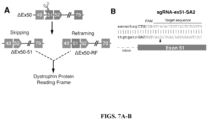
- the at least one DMD guide RNA-Cas9 complex disrupts a dystrophin splice site and induces selective skipping of exon 51 of a human DMD gene
- the nucleic acids of the present invention may be for use in a method of treating muscular dystrophy in a subject in need thereof comprising administering to the subject a therapeutically effective amount of one or more compositions of the disclosure.
- the composition is administered locally.
- the composition is administered directly to a muscle tissue.
- the composition is administered by an intramuscular infusion or injection.
- the muscle tissue comprises a tibialis anterior tissue, a quadriceps tissue, a soleus tissue, a diaphragm tissue, or a heart tissue.
- the composition is administered by an intracardiac injection.
- the composition is administered systemically.
- the composition is administered by an intravenous infusion or injection.
- the subject following administration of the composition, the subject exhibits normal dystrophin-positive myofibers, and mosaic dystrophin-positive myofibers containing centralized nuclei, or a combination thereof.
- the subject following administration of the composition, the subject exhibits an emergence or an increase in a level of abundance of normal dystrophin-positive myofibers when compared to an absence or a level of abundance of normal dystrophin-positive myofibers prior to administration of the composition.
- the subject following administration of the composition, the subject exhibits an emergence or an increase in a level of abundance of mosaic dystrophin-positive myofibers containing centralized nuclei when compared to an absence or an level of abundance of mosaic dystrophin-positive myofibers containing centralized nuclei prior to administration of the composition.
- the subject following administration of the composition, the subject exhibits a decreased serum CK level when compared to a serum CK level prior to administration of the composition.
- the subject following administration of the composition, the subject exhibits improved grip strength when compared to a grip strength prior to administration of the composition.
- the subject is a neonate, an infant, a child, a young adult, or an adult.
- the subject has muscular dystrophy. In some embodiments, the subject is a genetic carrier for muscular dystrophy. In some embodiments, the subject is male. In some embodiments, the subject is female. In some embodiments, the subject appears to be asymptomatic and wherein a genetic diagnosis reveals a mutation in one or both copies of a DMD gene that impairs function of the DMD gene product. In some embodiments, the subject presents an early sign or symptom of muscular dystrophy. In some embodiments, the early sign or symptom of muscular dystrophy comprises loss of muscle mass or proximal muscle weakness.
- the loss of muscle mass or proximal muscle weakness occurs in one or both leg(s) and/or a pelvis, followed by one or more upper body muscle(s).
- the early sign or symptom of muscular dystrophy further comprises pseudohypertrophy, low endurance, difficulty standing, difficulty walking, difficulty ascending a staircase or a combination thereof.
- the subject presents a progressive sign or symptom of muscular dystrophy.
- the progressive sign or symptom of muscular dystrophy comprises muscle tissue wasting, replacement of muscle tissue with fat, or replacement of muscle tissue with fibrotic tissue.
- the subject presents a later sign or symptom of muscular dystrophy.
- the later sign or symptom of muscular dystrophy comprises abnormal bone development, curvature of the spine, loss of movement, and paralysis.
- the subject presents a neurological sign or symptom of muscular dystrophy.
- the neurological sign or symptom of muscular dystrophy comprises intellectual impairment and paralysis.
- administration of the composition occurs prior to the subject presenting one or more progressive, later or neurological signs or symptoms of muscular dystrophy.
- the subject is less than 10 years old, less than 5 years old, or less than 2 years old.
- the nucleic acids of the present invention may be provided for the use of a therapeutically-effective amount of one or more compositions comprising said nucleic acids for treating muscular dystrophy in a subject in need thereof.
- the term "about” is used to indicate that a value includes the inherent variation of error for the device, for the method being employed to determine the value, or that exists among the study subjects. Such an inherent variation may be a variation of ⁇ 10% of the stated value.
- nucleotide sequences are listed in the 5' to 3' direction, and amino acid sequences are listed in the N-terminal to C-terminal direction, unless indicated otherwise.
- DMD is a new mutation syndrome with more than 4,000 independent mutations that have been identified in humans (world-wide web at dmd.nl).
- the majority of patient mutations include deletions that cluster in a hotspot, and thus a therapeutic approach for skipping certain exon applies to large group of patients.
- the rationale of the exon skipping approach is based on the genetic difference between DMD and Becker muscular dystrophy (BMD) patients.
- BMD Becker muscular dystrophy
- DMD patients the reading frame of dystrophin mRNA is disrupted resulting in prematurely truncated, non-functional dystrophin proteins.
- BMD patients have mutations in the DMD gene that maintain the reading frame allowing the production of internally deleted, but partially functional dystrophins leading to much milder disease symptoms compared to DMD patients.
- the present invention provides a nucleic acid comprises a sequence encoding a first DMD guide RNA targeting a first genomic target sequence, a sequence encoding a second DMD guide RNA targeting a second genomic target sequence, a sequence encoding a third DMD guide RNA targeting a third genomic target sequence, a first promoter wherein the first promoter drives expression of the sequence encoding the first DMD guide RNA, a second promoter wherein the second promoter drives expression of the sequence encoding the second DMD guide RNA, and a third promoter wherein the third promoter drives expression of the sequence encoding the third DMD guide RNA, wherein the first genomic target sequence, the second genomic target sequence and the third genomic sequence each comprise a dystrophin splice acceptor site, and wherein the sequence encoding the first DMD guide RNA, the sequence encoding the second DMD guide RNA genomic, and the sequence encoding the third DMD guide RNA target sequence are identical.
- nucleic acids of the present invention may be presented in the form of compositions and may be for use in methods for treating DMD.
- nucleic acids of the present invention may be provided in the form of an AAV construct, wherein the AAV construct comprises a nucleic acid encoding three promoters that each drive expression of a DMD guide RNA.
- Duchenne muscular dystrophy is a recessive X-linked form of muscular dystrophy, affecting around 1 in 5000 boys, which results in muscle degeneration and premature death.
- the disorder is caused by a mutation in the gene dystrophin (see GenBank Accession NO. NC_000023.11), located on the human X chromosome, which codes for the protein dystrophin (GenBank Accession No. AAA53189; SEQ ID NO: 5), the sequence of which is reproduced below:
- dystrophin mRNA contains 79 exons.
- Dystrophin mRNA is known to be alternatively spliced, resulting in various isoforms.
- Exemplary dystrophin isoforms are listed in Table 1.
- transcript Dp427c is expressed predominantly in neurons of the cortex and the CA regions of the hippocampus. It uses a unique promoter/exon 1 located about 130 kb upstream of the Dp427m transcript promoter. The transcript includes the common exon 2 of transcript Dp427m and has a similar length of 14 kb.
- the Dp427c isoform contains a unique N-terminal MED sequence, instead of the MLWWEEVEDCY sequence (SEQ ID NO: 949) of isoform Dp427m.
- the remainder of isoform Dp427c is identical to isoform Dp427m.
- Dystrophin Dp427m isoform NM_004006.2 8 NP_003997.1 9
- Transcript Variant transcript Dp427m encodes the main dystrophin protein found in muscle.
- exon 1 encodes a unique N-terminal MLWWEEVEDCY (SEQ ID NO: 949) aa sequence.
- transcript Dp427p1 initiates from a unique promoter/exon 1 located in what corresponds to the first intron of transcript Dp427m.
- the transcript adds the common exon 2 of Dp427m and has a similar length (14 kb).
- the Dp427p 1 isoform replaces the MLWWEEVEDCY (SEQ ID NO: 949) -start of Dp427m with a unique N-terminal MSEVSSD (SEQ ID NO: 950) aa sequence.
- Dystrophin Dp260-1 isoform NM _ 004011.3 12 NP_004002.2 13 Transcript Variant: transcript Dp260-1 uses exons 30-79, and originates from a promoter/exon 1 sequence located in intron 29 of the dystrophin gene. As a result, Dp260-1 contains a 95 bp exon 1 encoding a unique N-terminal 16 aa MTEIILLIFFPAYFLN-sequence (SEQ ID NO: 951) that replaces amino acids 1-1357 of the full-length dystrophin product (Dp427m isoform).
- Dystrophin Dp260-2 isoform NM_004012.3 14 NP_004003.1 15 Transcript Variant: transcript Dp260-2 uses exons 30-79, starting from a promoter/exon 1 sequence located in intron 29 of the dystrophin gene that is alternatively spliced and lacks N-terminal amino acids 1-1357 of the full length dystrophin (Dp427m isoform). The Dp260-2 transcript encodes a unique N-terminal MSARKLRNLSYKK sequence (SEQ ID NO: 952). Dystrophin Dp140 isoform NM_004013.2 16 NP_004004.1 17 Transcript Variant: Dp140 transcripts use exons 45-79, starting at a promoter/exon 1 located in intron 44.
- Dp 140 transcripts have a long (1 kb) 5' UTR since translation is initiated in exon 51 (corresponding to aa 2461 of dystrophin).
- this transcript contains all of the exons.
- the Dp116 isoform contains a unique N-terminal MLHRKTYHVK aa sequence (SEQ ID NO: 953), instead of aa 1-2739 of dystrophin. Differential splicing produces several Dp116-subtypes.
- the Dp116 isoform is also known as S-dystrophin or apo-dystrophin-2.
- the short coding sequence is in-frame with the consecutive dystrophin sequence from exon 63.
- Differential splicing of exons 71 and 78 produces at least four Dp71 isoforms. Of these, this transcript (Dp71) includes both exons 71 and 78.
- Dp71 transcripts use exons 63-79 with a novel 80- to 100-nt exon containing an ATG start site for a new coding sequence of 17 nt.
- the short coding sequence is in-frame with the consecutive dystrophin sequence from exon 63.
- Dp71 transcripts use exons 63-79 with a novel 80- to 100-nt exon containing an ATG start site for a new coding sequence of 17 nt.
- the short coding sequence is in-frame with the consecutive dystrophin sequence from exon 63.
- Dp71 transcripts use exons 63-79 with a novel 80- to 100-nt exon containing an ATG start site for a new coding sequence of 17 nt. The short coding sequence is in-frame with the consecutive dystrophin sequence from exon 63.
- Differential splicing of exons 71 and 78 produces at least four Dp71 isoforms.
- transcript Dp40 uses exons 63-70.
- the 5' UTR and encoded first 7 aa are identical to that in transcript Dp71, but the stop codon lies at the splice junction of the exon/intron 70.
- the 3' UTR includes nt from intron 70 which includes an alternative polyadenylation site.
- the Dp40 isoform lacks the normal C-terminal end of full-length dystrophin (aa 3409-3685).
- Dp140 transcripts use exons 45-79, starting at a promoter/exon 1 located in intron 44. Dp 140 transcripts have a long (1 kb) 5' UTR since translation is initiated in exon 51 (corresponding to aa 2461 of dystrophin). In addition to the alternative promoter and exon 1, differential splicing of exons 71-74 and 78 produces at least five Dp 140 isoforms. Of these, this transcript (Dp140c) lacks exons 71-74.
- Dystrophin Dp 140b isoform NM_004021.2 32 NP_004012.1 33 Transcript Variant: Dp140 transcripts use exons 45-79, starting at a promoter/exon 1 located in intron 44. Dp 140 transcripts have a long (1 kb) 5' UTR since translation is initiated in exon 51 (corresponding to aa 2461 of dystrophin). In addition to the alternative promoter and exon 1, differential splicing of exons 71-74 and 78 produces at least five Dp 140 isoforms. Of these, this transcript (Dp 140b) lacks exon 78 and encodes a protein with a unique C-terminus.
- Dystrophin Dp 140ab isoform NM_004022.2 34 NP_004013.1 35 Transcript Variant: Dp140 transcripts use exons 45-79, starting at a promoter/exon 1 located in intron 44. Dp 140 transcripts have a long (1 kb) 5' UTR since translation is initiated in exon 51 (corresponding to aa 2461 of dystrophin). In addition to the alternative promoter and exon 1, differential splicing of exons 71-74 and 78 produces at least five Dp 140 isoforms. Of these, this transcript (Dp140ab) lacks exons 71 and 78 and encodes a protein with a unique C-terminus.
- Dystrophin Dp 140bc isoform NM_004023.2 36 NP_004014.1 37 Transcript Variant: Dp140 transcripts use exons 45-79, starting at a promoter/exon 1 located in intron 44. Dp 140 transcripts have a long (1 kb) 5' UTR since translation is initiated in exon 51 (corresponding to aa 2461 of dystrophin). In addition to the alternative promoter and exon 1, differential splicing of exons 71-74 and 78 produces at least five Dp 140 isoforms. Of these, this transcript (Dp140bc) lacks exons 71-74 and 78 and encodes a protein with a unique C-terminus.
- the murine dystrophin protein has the following amino acid sequence (Uniprot Accession No. P11531, SEQ. ID. NO: 869):
- Dystrophin is an important component within muscle tissue that provides structural stability to the dystroglycan complex (DGC) of the cell membrane. While both sexes can carry the mutation, females are rarely affected with the skeletal muscle form of the disease.
- DGC dystroglycan complex
- Mutations vary in nature and frequency. Large genetic deletions are found in about 60-70% of cases, large duplications are found in about 10% of cases, and point mutants or other small changes account for about 15-30% of cases. Bladen et al. (2015), who examined some 7000 mutations, catalogued a total of 5,682 large mutations (80% of total mutations), of which 4,894 (86%) were deletions (1 exon or larger) and 784 (14%) were duplications (1 exon or larger). There were 1,445 small mutations (smaller than 1 exon, 20% of all mutations), of which 358 (25%) were small deletions and 132 (9%) small insertions, while 199 (14%) affected the splice sites.
- Symptoms usually appear in boys between the ages of 2 and 3 and may be visible in early infancy. Even though symptoms do not appear until early infancy, laboratory testing can identify children who carry the active mutation at birth. Progressive proximal muscle weakness of the legs and pelvis associated with loss of muscle mass is observed first. Eventually this weakness spreads to the arms, neck, and other areas. Early signs may include pseudohypertrophy (enlargement of calf and deltoid muscles), low endurance, and difficulties in standing unaided or inability to ascend staircases. As the condition progresses, muscle tissue experiences wasting and is eventually replaced by fat and fibrotic tissue (fibrosis). By age 10, braces may be required to aid in walking but most patients are wheelchair dependent by age 12.
- Later symptoms may include abnormal bone development that lead to skeletal deformities, including curvature of the spine. Due to progressive deterioration of muscle, loss of movement occurs, eventually leading to paralysis. Intellectual impairment may or may not be present but if present, does not progressively worsen as the child ages. The average life expectancy for males afflicted with DMD is around 25.
- Duchenne muscular dystrophy a progressive neuromuscular disorder
- Muscle weakness also occurs later, in the arms, neck, and other areas. Calves are often enlarged. Symptoms usually appear before age 6 and may appear in early infancy. Other physical symptoms are:
- a positive Gowers' sign reflects the more severe impairment of the lower extremities muscles. The child helps himself to get up with upper extremities: first by rising to stand on his arms and knees, and then "walking" his hands up his legs to stand upright. Affected children usually tire more easily and have less overall strength than their peers. Creatine kinase (CPK-MM) levels in the bloodstream are extremely high. An electromyography (EMG) shows that weakness is caused by destruction of muscle tissue rather than by damage to nerves. Genetic testing can reveal genetic errors in the Xp21 gene. A muscle biopsy (immunohistochemistry or immunoblotting) or genetic test (blood test) confirms the absence of dystrophin, although improvements in genetic testing often make this unnecessary.
- DMD patients may suffer from:
- Duchenne muscular dystrophy is caused by a mutation of the dystrophin gene at locus Xp21, located on the short arm of the X chromosome.
- Dystrophin is responsible for connecting the cytoskeleton of each muscle fiber to the underlying basal lamina (extracellular matrix), through a protein complex containing many subunits. The absence of dystrophin permits excess calcium to penetrate the sarcolemma (the cell membrane). Alterations in calcium and signaling pathways cause water to enter into the mitochondria, which then burst.
- mitochondrial dysfunction gives rise to an amplification of stress-induced cytosolic calcium signals and an amplification of stress-induced reactive-oxygen species (ROS) production.
- ROS reactive-oxygen species
- DMD is inherited in an X-linked recessive pattern.
- Females will typically be carriers for the disease while males will be affected.
- a female carrier will be unaware they carry a mutation until they have an affected son.
- the son of a carrier mother has a 50% chance of inheriting the defective gene from his mother.
- the daughter of a carrier mother has a 50% chance of being a carrier and a 50% chance of having two normal copies of the gene.
- an unaffected father will either pass a normal Y to his son or a normal X to his daughter.
- Female carriers of an X-linked recessive condition such as DMD, can show symptoms depending on their pattern of X-inactivation.
- Duchenne muscular dystrophy can be detected with about 95% accuracy by genetic studies performed during pregnancy.
- DNA test The muscle-specific isoform of the dystrophin gene is composed of 79 exons, and DNA testing and analysis can usually identify the specific type of mutation of the exon or exons that are affected. DNA testing confirms the diagnosis in most cases.
- DMD is carried by an X-linked recessive gene. Males have only one X chromosome, so one copy of the mutated gene will cause DMD. Fathers cannot pass X-linked traits on to their sons, so the mutation is transmitted by the mother.
- Prenatal tests can tell whether their unborn child has the most common mutations. There are many mutations responsible for DMD, and some have not been identified, so genetic testing only works when family members with DMD have a mutation that has been identified.
- fetal sex Prior to invasive testing, determination of the fetal sex is important; while males are sometimes affected by this X-linked disease, female DMD is extremely rare. This can be achieved by ultrasound scan at 16 weeks or more recently by free fetal DNA testing. Chorion villus sampling (CVS) can be done at 11-14 weeks, and has a 1% risk of miscarriage. Amniocentesis can be done after 15 weeks, and has a 0.5% risk of miscarriage. Fetal blood sampling can be done at about 18 weeks. Another option in the case of unclear genetic test results is fetal muscle biopsy.
- CVS Chorion villus sampling
- Treatment is generally aimed at controlling the onset of symptoms to maximize the quality of life, and may include the following:
- treatment is initiated in the presymptomatic stage of the disease. In some embodiments, treatment is initiated in the early ambulatory stage. In some embodiments, treatment is initiated in the late ambulatory stage. In embodiments, treatment is initiated during the early non-ambulatory stage. In embodiments, treatment is initiated during the late non-ambulatory stage.
- Duchenne muscular dystrophy is a progressive disease which eventually affects all voluntary muscles and involves the heart and breathing muscles in later stages. The life expectancy is currently estimated to be around 25, but this varies from patient to patient. Recent advancements in medicine are extending the lives of those afflicted.
- the Muscular Dystrophy Campaign which is a leading UK charity focusing on all muscle disease, states that "with high standards of medical care young men with Duchenne muscular dystrophy are often living well into their 30s.”
- ILM intrinsic laryngeal muscles
- ILM have a calcium regulation system profile suggestive of a better ability to handle calcium changes in comparison to other muscles, and this may provide a mechanistic insight for their unique pathophysiological properties.
- the ILM may facilitate the development of novel strategies for the prevention and treatment of muscle wasting in a variety of clinical scenarios.
- Limb Girdle Muscular Dystrophy Limb-girdle muscular dystrophy (LGMD) or Erb's muscular dystrophy is a genetically and clinically heterogeneous group of rare muscular dystrophies. It is characterized by progressive muscle wasting which affects predominantly hip and shoulder muscles. LGMD has an autosomal pattern of inheritance and currently has no known cure.
- the symptoms of an individual with Limb-girdle muscular dystrophy (LGMD) generally has difficulty walking, going both up and down stairs and raising from a chair. Difficulty bending over and falling on a regular basis are also common. Difficulty lifting certain objects is also a common presentation of LGMD as well as difficulty holding your arms out or above your head. Eventually the ability to walk/run deteriorates.
- the disease inevitably gets worse over time, although progression is more rapid in some patients than others. Eventually the disease can affect other muscles such as the ones located in the face. The disease commonly leads to dependence on a wheelchair within years of symptom onset, but there is high inter-patient variability, with some patients maintaining mobility.
- the muscle weakness is generally symmetric, proximal, and slowly progressive. In most cases, pain is not present with LGMD, and mental function is not affected. LGMD can begin in childhood, adolescence, young adulthood or even later, the age of onset is usually between 10 and 30. Both genders are affected equally, when limb-girdle muscular dystrophy begins in childhood the progression appears to be faster and the disease more disabling. When the disorder begins in adolescence or adulthood the disease is generally not as severe and progresses more slowly. There is no sensory neuropathy or autonomic or visceral dysfunction at presentation.
- LGMD In terms of the genetics of LGMD is an inherited disorder, though it may be inherited as a dominant or recessive genetic defect. The result of the defect is that the muscles cannot properly form certain proteins needed for normal muscle function. Several different proteins can be affected, and the specific protein that is absent or defective identifies the specific type of muscular dystrophy. Among the proteins affected in LGMD are ⁇ , ⁇ , ⁇ and ⁇ sarcoglycans. The sarcoglycanopathies could be possibly amenable to gene therapy.
- Dysferlinopathy is an autosomal recessive neuromuscular disorder caused by a deficiency of functional dysferlin protein due to mutations in the dysferlin gene.
- Dysferlinopathy is characterized by progressive muscle wasting and is most often clinically diagnosed as Limb-girdle muscular dystrophy type 2B (LGMD2B) or Miyoshi muscular dystrophy 1 (MMD1; a type of distal muscular dystrophy), depending on the initial pattern of muscle involvement at diagnosis.
- LGMD2B Limb-girdle muscular dystrophy type 2B
- MMD1 Miyoshi muscular dystrophy 1
- Dysferlinopathy is a rare disease, the exact incidence of which has not yet been determined.
- dysferlinopathy usually manifest in early adulthood between the ages of 16 and 25 and primarily affect the skeletal muscle of the limbs and the limb girdles (hips and shoulders), leaving critical muscles such as the heart and diaphragm largely unaffected.
- the majority of dysferlinopathy patients become non-ambulant within 10-20 years of diagnosis, but life expectancy is normal. There is a large amount of variability in the age of onset and progression of the disease.
- LGMD2B and MMD1 are both caused by dysferlin deficiency
- a diagnosis of LGMD2B is given when weakness initially presents in the proximal muscles (thighs and upper arms) while a diagnosis of MMD1 is given when weakness initially presents in the distal muscles (calves and lower arms).
- weakness eventually progresses to include both distal and proximal muscles.
- Both LGMD2B and MMD1 are very difficult to diagnose, and patients are often misdiagnosed many times before they are successfully diagnosed with dysferlinopathy.
- LGMD2B and Miyoshi myopathy 1 are the confirmed diagnosis only when mutations in the dysferlin gene can be detected. It is essential that patients receive a genetic diagnosis for participation in clinical studies and trials specific to dysferlinopathy.
- the Jain Foundation is a non-profit family organization (www.jain-foundation.org) that helps patients with limb girdle muscular dystrophy to achieve a genetic diagnosis by organizing testing and covering the cost.
- Titin Myopathy is a protein that, in humans, is encoded by the TTN gene. Titin is a giant protein, greater than 1 ⁇ m in length, that functions as a molecular spring which is responsible for the passive elasticity of muscle. It is composed of 244 individually folded protein domains connected by unstructured peptide sequences. These domains unfold when the protein is stretched and refold when the tension is removed.
- Titin is important in the contraction of striated muscle tissues. It connects the Z line to the M line in the sarcomere. The protein contributes to force transmission at the Z line and resting tension in the I band region. It limits the range of motion of the sarcomere in tension, thus contributing to the passive stiffness of muscle. Variations in the sequence of titin between different types of muscle (e.g., cardiac or skeletal) have been correlated with differences in the mechanical properties of these muscles.
- Titin is a large abundant protein of striated muscle. Titin's primary functions are to stabilize the thick filament, center it between the thin filaments, prevent overstretching of the sarcomere, and to recoil the sarcomere like a spring after it is stretched. An N-terminal Z-disc region and a C-terminal M-line region bind to the Z-line and M-line of the sarcomere, respectively, so that a single titin molecule spans half the length of a sarcomere. Titin also contains binding sites for muscle-associated proteins so it serves as an adhesion template for the assembly of contractile machinery in muscle cells. It has also been identified as a structural protein for chromosomes.
- Truncating mutations in dilated cardiomyopathy patients are most commonly found in the A region; although truncations in the upstream I region might be expected to prevent translation of the A region entirely, alternative splicing creates some transcripts that do not encounter the premature stop codon, ameliorating its effect. Autoantibodies to titin are produced in patients with the autoimmune disease scleroderma.
- Central core disease caused by mutation in ryanodine receptor (mutation with pseudoexons).
- Central core disease also known as central core myopathy, is an autosomal dominant congenital myopathy (inborn muscle disorder). It was first described by Shy and Magee in 1956. It is characterized by the appearance of the myofibril under the microscope.
- Symptoms may be present at birth or may appear at any stage of life. There appears to be a growing number of people who do not become symptomatic until adulthood to middle age. While generally not progressive, again there appears to be a growing number of people who do experience a slow clinically significant progression of symptomatology. These cases may hypothetically be due to the large number of gene mutations of ryanodine receptor malfunction, and with continued research may in fact be found to be clinical variants.
- the diagnosis is made on the combination of typical symptoms and the appearance on biopsy (tissue sample) from muscle.
- biopsy tissue sample
- the name derives from the typical appearance of the biopsy on light microscopy, where the muscle cells have cores that are devoid of mitochondria and specific enzymes. Respiratory insufficiency develops in a small proportion of cases. Creatine kinase and electromyography (EMG) tend to be normal.
- Myotonic Dystrophy is a long term genetic disorder that affects muscle function. Symptoms include gradually worsening muscle loss and weakness. Muscles often contract and are unable to relax. Other symptoms may include cataracts, intellectual disability, and heart conduction problems. In men there may be early balding and an inability to have children.
- Myotonic dystrophy is an autosomal-dominant disorder which is typically inherited from a person's parents. There are two main types: type 1 (DM1) due to mutations in the DMPK gene and type 2 (DM2) due to mutations in the CNBP gene. The disorder generally worsens in each generation. A type of DM1 may be apparent at birth. DM2 is generally milder. They are types of muscular dystrophy. Diagnosis is confirmed by genetic testing.
- Treatments may include braces or wheelchairs, pacemakers, and non-invasive positive pressure ventilation.
- the medications mexiletine or carbamazepine are occasionally helpful. Pain if it occurs may be treated with tricyclic antidepressants and nonsteroidal anti-inflammatory drugs (NSAIDs).
- NSAIDs nonsteroidal anti-inflammatory drugs
- Myotonic dystrophy affects more than 1 in 8,000 people worldwide. While myotonic dystrophy can occur at any age, onset is typically in the 20s and 30s. It is the most common form of muscular dystrophy that begins in adulthood. It was first described in 1909 with the underlying cause of type 1 determined in 1992.
- DM1 symptoms for DM2 include problems with executive function (e.g., organization, concentration, word-finding) and hypersomnia. Conduction abnormalities are more common in DM1 than DM2, but all people are advised to have an annual ECG. Both types are also associated with insulin resistance. Myotonic dystrophy may have a cortical cataract with a blue dot appearance, or a posterior subcapsular cataract.
- DM2 is generally milder than DM1, with generally fewer DM2 people requiring assistive devices than DM1 people.
- the severe congenital form that affects babies in DM1 has not been found in DM2 and the early onset of symptoms is rarely noted to appear in younger people in the medical literature.
- DM Symptoms may appear at any time from infancy to adulthood. DM causes general weakness, usually beginning in the muscles of the hands, feet, neck, or face. It slowly progresses to involve other muscle groups, including the heart. DM affects a wide variety of other organ systems as well.
- Myotonic dystrophy is a genetic condition which is inherited in an autosomal dominant pattern and thus will be passed along to 50% of a carrier's offspring, on average.
- Myotonic dystrophy is one of several known trinucleotide repeat disorders. Certain areas of DNA have repeated sequences of two or three nucleotides.
- DM Myotonic dystrophy
- congenital myotonic dystrophy may appear in newborns of mothers who have DM.
- Congenital myotonic dystrophy can also be inherited via the paternal gene, although it is said to be relatively rare. Congenital means that the condition is present from birth.
- DMPK myotonic dystrophy protein kinase
- DM1 cytosine-thymine-guanine
- CCG cytosine-thymine-guanine
- DMPK alleles with greater than 37 repeats are unstable and additional trinucleotide repeats may be inserted during cell division in mitosis and meiosis. Consequently, the children of individuals with premutations or mutations inherit DMPK alleles which are longer than their parents and therefore are more likely to be affected or display an earlier onset and greater severity of the condition, a phenomenon known as anticipation. Interestingly, paternal transmission of the condition is very uncommon, possibly due to selection pressures against sperm with expanded repeats, but anticipation tends to be less severe than in cases of maternal inheritance.
- RNA from the expanded trinucleotide repeat region forms intranucleoplasmic hairpin loops due to the extensive hydrogen bonding between C-G base pairs, and it has been demonstrated that these sequester the splicing regulator MBNL1 to form distinctive foci by labelling it with GFP and a probe oligonucleotide with the red-fluorescent dye Cyanine5 (Cy5).
- DM2 is caused by a defect of the ZNF9 gene on chromosome 3.
- the specific defect is a repeat of the cytosine-cytosine-thymine-guanosine (CCTG) tetranucleotide in the ZNF9 gene. As it involves the repeat of four nucleotides, it is not a trinucleotide repeat disorder, but rather a tetranucleotide repeat disorder.
- the repeat expansion for DM2 is much larger than for DM1, ranging from 75 to over 11,000 repeats. Unlike in DM1, the size of the repeated DNA expansion in DM2 does not appear to make a difference in the age of onset or disease severity. Anticipation appears to be less significant in DM2 and most current reviews only report mild anticipation as a feature of DM2.
- Friedreich's ataxia is an autosomal recessive inherited disease that causes progressive damage to the nervous system. It manifests in initial symptoms of poor coordination such as gait disturbance; it can also lead to scoliosis, heart disease and diabetes, but does not affect cognitive function. The disease progresses until a wheelchair is required for mobility. Its incidence in the general population is roughly 1 in 50,000.
- the ataxia of Friedreich's ataxia results from the degeneration of nervous tissue in the spinal cord, in particular sensory neurons essential (through connections with the cerebellum) for directing muscle movement of the arms and legs.
- the spinal cord becomes thinner and nerve cells lose some of their myelin sheath (the insulating covering on some nerve cells that helps conduct nerve impulses).
- Symptoms typically begin sometime between the ages of 5 to 15 years, but in Late Onset FA may occur in the 20s or 30s. Symptoms include any combination, but not necessarily all, of muscle weakness in the arms and legs, loss of coordination, vision impairment, hearing impairment, slurred speech, curvature of the spine, high plantar arches (pes cavus deformity of the foot), diabetes (about 20% of people with Friedreich's ataxia develop carbohydrate intolerance and 10% develop diabetes mellitus) and heart disorders (e.g., atrial fibrillation, and resultant tachycardia (fast heart rate) and hypertrophic cardiomyopathy).
- atrial fibrillation e.g., atrial fibrillation, and resultant tachycardia (fast heart rate) and hypertrophic cardiomyopathy.
- cerebellar signs such as nystagmus, fast saccadic eye movements, truncal ataxia, dysarthria, dysmetria; lower motor neuron lesions, such as absent deep tendon reflexes; pyramidal signs such as extensor plantar responses, and distal weakness are commonly found; dorsal column aspects, such as loss of vibratory and proprioceptive sensation occurs.
- Cerbellar signs such as nystagmus, fast saccadic eye movements, truncal ataxia, dysarthria, dysmetria
- lower motor neuron lesions such as absent deep tendon reflexes
- pyramidal signs such as extensor plantar responses, and distal weakness are commonly found
- dorsal column aspects such as loss of vibratory and proprioceptive sensation occurs.
- Cardiac involvement occurs in 91% of patients, including cardiomegaly (up to dilated cardiomyopathy), symmetrical hypertrophy, heart murmurs, and conduction defects.
- Median age of death is
- Friedreich's ataxia is an autosomal recessive disorder that occurs when the FXN gene contains amplified intronic GAA repeats (an example of trinucleotide repeat expansion).
- the FXN gene encodes the protein frataxin.
- GAA repeat expansion causes frataxin levels to be reduced.
- Frataxin is an iron-binding protein responsible for forming iron-sulphur clusters.
- mitochondrial iron overload which can cause damage to many proteins.
- the exact role of frataxin in normal physiology remains unclear.
- the gene is located on chromosome 9.
- the mutant gene contains expanded GAA triplet repeats in the first intron; in a few pedigrees, point mutations have been detected. Because the defect is located in an intron (which is removed from the mRNA transcript between transcription and translation), this mutation does not result in the production of abnormal frataxin proteins. Instead, the mutation causes gene silencing (i.e., the mutation decreases the transcription of the gene) through induction of a heterochromatin structure in a manner similar to position-effect variegation.
- Huntington's disease also known as Huntington's chorea
- Huntington's disease is an inherited disorder that results in death of brain cells.
- the earliest symptoms are often subtle problems with mood or mental abilities. A general lack of coordination and an unsteady gait often follow.
- Mental abilities generally decline into dementia.
- the specific symptoms vary somewhat between people. Symptoms usually begin between 30 and 50 years of age, but can start at any age. The disease may develop earlier in life in each successive generation. About 8% of cases start before the age of 20 years and typically present with symptoms more similar to Parkinson's disease. People with HD often underestimate the degree of their problems.
- HD is typically inherited from a person's parents with 10% of cases due to a new mutation.
- the disease is caused by an autosomal dominant mutation in either of an individual's two copies of a gene called Huntingtin. This means a child of an affected person typically has a 50% chance of inheriting the disease.
- the Huntingtin gene provides the genetic information for a protein that is also called "huntingtin.”
- Expansion of CAG (cytosine-adenine-guanine) triplet repeats in the gene coding for the Huntingtin protein results in an abnormal protein, which gradually damages cells in the brain, through mechanisms that are not fully understood.
- Diagnosis is by genetic testing, which can occur at any point in time regardless of whether or not symptoms are present. This fact raises several ethical debates: the age at which an individual is considered mature enough to choose testing; whether parents have the right to have their children tested; and managing confidentiality and disclosure of test results.
- HD high-time care
- Treatments can relieve some symptoms and in some improve quality of life.
- the best evidence for treatment of the movement problems is with tetrabenazine.
- HD affects about 4 to 15 in 100,000 people of European descent. It is rare among Japanese and occurs at an unknown rate in Africa. The disease affects men and women equally. Complications such as pneumonia, heart disease, and physical injury from falls reduce life expectancy. Suicide is the cause of death in about 9% of cases. Death typically occurs fifteen to twenty years from when the disease was first detected.
- Huntington's disease most commonly become noticeable between the ages of 35 and 44 years, but they can begin at any age from infancy to old age. In the early stages, there are subtle changes in personality, cognition, and physical skills. The physical symptoms are usually the first to be noticed, as cognitive and behavioral symptoms are generally not severe enough to be recognized on their own at the earlier stages. Almost everyone with Huntington's disease eventually exhibits similar physical symptoms, but the onset, progression and extent of cognitive and behavioral symptoms vary significantly between individuals.
- the most characteristic initial physical symptoms are jerky, random, and uncontrollable movements called chorea. Chorea may be initially exhibited as general restlessness, small unintentionally initiated or uncompleted motions, lack of coordination, or slowed saccadic eye movements. These minor motor abnormalities usually precede more obvious signs of motor dysfunction by at least three years. The clear appearance of symptoms such as rigidity, writhing motions or abnormal posturing appear as the disorder progresses. These are signs that the system in the brain that is responsible for movement has been affected. Psychomotor functions become increasingly impaired, such that any action that requires muscle control is affected. Common consequences are physical instability, abnormal facial expression, and difficulties chewing, swallowing, and speaking. Eating difficulties commonly cause weight loss and may lead to malnutrition. Sleep disturbances are also associated symptoms. Juvenile HD differs from these symptoms in that it generally progresses faster and chorea is exhibited briefly, if at all, with rigidity being the dominant symptom. Seizures are also a common symptom of this form of HD.
- Cognitive abilities are progressively impaired. Especially affected are executive functions which include planning, cognitive flexibility, abstract thinking, rule acquisition, initiation of appropriate actions, and inhibition of inappropriate actions. As the disease progresses, memory deficits tend to appear. Reported impairments range from short-term memory deficits to long-term memory difficulties, including deficits in episodic (memory of one's life), procedural (memory of the body of how to perform an activity) and working memory. Cognitive problems tend to worsen over time, ultimately leading to dementia. This pattern of deficits has been called a subcortical dementia syndrome to distinguish it from the typical effects of cortical dementias, e.g., Alzheimer's disease.
- Reported neuropsychiatric manifestations are anxiety, depression, a reduced display of emotions (blunted affect), egocentrism, aggression, and compulsive behavior, the latter of which can cause or worsen addictions, including alcoholism, gambling, and hypersexuality. Difficulties in recognizing other people's negative expressions have also been observed. The prevalence of these symptoms is highly variable between studies, with estimated rates for lifetime prevalence of psychiatric disorders between 33% and 76%. For many sufferers and their families, these symptoms are among the most distressing aspects of the disease, often affecting daily functioning and constituting reason for institutionalization. Suicidal thoughts and suicide attempts are more common than in the general population. Often individuals have reduced awareness of chorea, cognitive and emotional impairments.
- Mutant Huntingtin is expressed throughout the body and associated with abnormalities in peripheral tissues that are directly caused by such expression outside the brain. These abnormalities include muscle atrophy, cardiac failure, impaired glucose tolerance, weight loss, osteoporosis, and testicular atrophy.
- HTT Huntingtin gene
- HTT protein Huntingtin
- IT15 stands for 'interesting transcript 15'.
- mHTT mutant Huntingtin protein
- the Huntington's disease mutation is genetically dominant and almost fully penetrant: mutation of either of a person's HTT alleles causes the disease. It is not inherited according to sex, but the length of the repeated section of the gene and hence its severity can be influenced by the sex of the affected parent.
- HD is one of several trinucleotide repeat disorders which are caused by the length of a repeated section of a gene exceeding a normal range.
- the HTT gene is located on the short arm of chromosome 4 at 4p16.3.
- HTT contains a sequence of three DNA bases-cytosine-adenine-guanine (CAG)-repeated multiple times (i.e., ... CAGCAGCAG 7), known as a trinucleotide repeat.
- CAG is the 3-letter genetic code (codon) for the amino acid glutamine, so a series of them results in the production of a chain of glutamine known as a polyglutamine tract (or polyQ tract), and the repeated part of the gene, the PolyQ region.
- mutant huntingtin increases the decay rate of certain types of neurons. Regions of the brain have differing amounts and reliance on these types of neurons, and are affected accordingly.
- the number of CAG repeats is related to how much this process is affected, and accounts for about 60% of the variation of the age of the onset of symptoms. The remaining variation is attributed to environment and other genes that modify the mechanism of HD.
- HD has full penetrance and can occur under the age of 20, when it is then referred to as juvenile HD, akinetic-rigid, or Westphal variant HD. This accounts for about 7% of HD carriers.
- Ataxia telangiectasia Ataxia-telangiectasia (AT or A-T), also referred to as ataxia-telangiectasia syndrome or Louis-Bar syndrome, is a rare, neurodegenerative, autosomal recessive disease causing severe disability. Ataxia refers to poor coordination and telangiectasia to small dilated blood vessels, both of which are hallmarks of the disease.
- A-T affects many parts of the body. It impairs certain areas of the brain including the cerebellum, causing difficulty with movement and coordination. It weakens the immune system, causing a predisposition to infection. It prevents repair of broken DNA, increasing the risk of cancer.
- Symptoms most often first appear in early childhood (the toddler stage) when children begin to walk. Though they usually start walking at a normal age, they wobble or sway when walking, standing still or sitting, and may appear almost as if they are drunk. In late pre-school and early school age, they develop difficulty moving their eyes in a natural manner from one place to the next (oculomotor apraxia). They develop slurred or distorted speech, and swallowing problems. Some have an increased number of respiratory tract infections (ear infections, sinusitis, bronchitis, and pneumonia). Because not all children develop in the same manner or at the same rate, it may be some years before A-T is properly diagnosed. Most children with A-T have stable neurologic symptoms for the first 4-5 years of life, but begin to show increasing problems in early school years.
- A-T is caused by a defect in the ATM gene, which is responsible for managing the cell's response to multiple forms of stress including double-strand breaks in DNA.
- the protein produced by the ATM gene recognizes that there is a break in DNA, recruits other proteins to fix the break, and stops the cell from making new DNA until the repair is complete.
- ATM ATM serine/threonine kinase or ataxia-telangiectasia mutated gene, which was cloned in 1995.
- ATM is located on human chromosome 11 (1 1q22.3) and is made up of 69 exons spread across 150kb of genomic DNA.
- A-T autosomal recessive.
- Each parent is a carrier, meaning that they have one normal copy of the A-T gene (ATM) and one copy which is mutated.
- A-T occurs if a child inherits the mutated A-T gene from each parent, so in a family with two carrier parents, there is 1 chance in 4 that a child born to the parents will have the disorder.
- Prenatal diagnosis (and carrier detection) can be carried out in families if the errors (mutation) in an affected child's two ATM genes have been identified. The process of getting this done can be complicated and, as it requires time, should be arranged before conception.
- Carriers of A-T such as the parents of a person with A-T, have one mutated copy of the ATM gene and one normal copy. They are generally healthy, but there is an increased risk of breast cancer in women. This finding has been confirmed in a variety of different ways, and is the subject of current research. Standard surveillance (including monthly breast self-exams and mammography at the usual schedule for age) is recommended, unless additional tests are indicated because the individual has other risk factors (e.g., family history of breast cancer).
- Neurofibromatosis (NF) is a group of three conditions in which tumors grow in the nervous system. The three types are neurofibromatosis type 1 (NF 1), neurofibromatosis type 2 (NF2), and schwannomatosis.
- NF1 symptoms include light brown spots on the skin, freckles in the armpit and groin, small bumps within nerves, and scoliosis.
- NF2 there may be hearing loss, cataracts at a young age, balance problems, flesh colored skin flaps, and muscle wasting.
- the tumors are generally non-cancerous.
- the cause is a genetic mutation in certain genes. In half of cases these are inherited from a person's parents while in the rest they occur during early development.
- the tumors involve supporting cells in the nervous system rather than the neurons.
- NF1 the tumors are neurofibromas (tumors of the peripheral nerves) while in NF2 and schwannomatosis tumors of Schwann cells are more common.
- Diagnosis is typically based on the signs and symptoms and occasionally supported by genetic testing.
- a cochlear implant or auditory brainstem implant may help some who have hearing loss.
- NF 1 and 1 in 25,000 have NF2.
- Males and females are affected equally frequently.
- NF1 symptom are often present at birth and otherwise develop before 10 years of age. While the condition typically worsens with time most people with NF1 have a normal life expectancy.
- NF2 symptoms may not become apparent until early adulthood. NF2 increases the risk of early death. Descriptions of the condition occur as far back as the 1st century.
- Neurofibromatosis in early life may cause learning and behavior problems - about 60% of children who have NF 1 have a mild form of difficulty in school.
- the individual might have are the following: six or more light brown dermatological spots ("café-au-lait spots"), at least two neurofibromas, at least two growths on the eye's iris, and abnormal growth of the spine (scoliosis).
- Neurofibromatosis is an autosomal dominant disorder, which means only one copy of the affected gene is needed for the disorder to develop. Therefore, if only one parent has neurofibromatosis, his or her children have a 50% chance of developing the condition as well. The affected child could have mild NF 1 even though inherited from a parent with a severe form of the disorder.
- neurofibromatosis type I is characterized by nerve tissue growth into tumors (neurofibromas) that may be benign and may cause serious damage by compressing nerves and other tissues.
- Neurofibromatosis type II exhibits bilateral acoustic neuromas (tumors of the vestibulocochlear nerve or cranial nerve 8 (CN VIII) also known as schwannoma), often leading to hearing loss.
- Centrosomal protein of 290 kDa is a protein that in humans is encoded by the CEP290 gene.
- CEP290 is located on the Q arm of chromosome 12.
- the gene CEP290 is a centrosomal protein that plays an important role in centrosome and cilia development. This gene is vital in the formation of the primary cilium, a small antenna-like projections of the cell membrane that plays an important role in the photoreceptors at the back of the retina (which detect light and color) and in the kidney, brain, and many other organs of the body.
- Knocking down levels of the CEP290 gene transcript resulted in dramatic suppression of ciliogenesis in retinal pigment epithelial cells in culture, proving just how important CEP290 is to cilia formation.
- CEP290 has been shown to play a critical regulatory and structural role in primary cilium formation. Recent studies have implicated CEP290 as a microtubule and membrane binding protein that might serve as a structural link between the microtubule core of the cilium and the overlying ciliary membrane. Disruption of CEP290's microtubule binding domain in the rd16 mouse model of CEP290 disease has been shown to result in rapid and dramatic retinal degeneration, demonstrating the importance of CEP290 microtubule binding in disease. The role of CEP290 in promoting ciliogensis is inhibited both by auto-regulatory domains found at either end of the CEP290 protein and through CEP290's interaction with the inhibitory protein CP110.
- This gene encodes a protein with 13 putative coiled-coil domains, a region with homology to SMC chromosome segregation ATPases, six KID motifs, three tropomyosin homology domains and an ATP/GTP binding site motif A.
- the protein is localized to the centrosome and cilia and has sites for N-glycosylation, tyrosine sulfation, phosphorylation, N-myristoylation, and amidation.
- a mutation in this gene leads to infant and child blindness, a disease known as Leber Congenital Amaurosis.
- 35 different mutations in CEP290 are responsible for causing LCA.
- Other mutations in CEP290 have also been identified in causing Meckel Syndrome and Joubert Syndrome, a few among many syndromes.
- a defective CEP290 gene is usually the cause of these disorders due to abnormal cilia. It is unknown how one mutation in a gene can cause so many different types of syndromes, particularly many of which affect the Central Nervous System.
- CRISPRs (clustered regularly interspaced short palindromic repeats) are DNA loci containing short repetitions of base sequences. Each repetition is followed by short segments of "spacer DNA” from previous exposures to a virus.
- CRISPRs are found in approximately 40% of sequenced eubacteria genomes and 90% of sequenced archaea. CRISPRs are often associated with Cas genes that code for proteins related to CRISPRs.
- the CRISPR/Cas system is a prokaryotic immune system that confers resistance to foreign genetic elements such as plasmids and phages and provides a form of acquired immunity. CRISPR spacers recognize and silence these exogenous genetic elements like RNAi in eukaryotic organisms.
- CRISPR repeats range in size from 24 to 48 base pairs. They usually show some dyad symmetry, implying the formation of a secondary structure such as a hairpin, but are not truly palindromic. Repeats are separated by spacers of similar length. Some CRISPR spacer sequences exactly match sequences from plasmids and phages, although some spacers match the prokaryote's genome (self-targeting spacers). New spacers can be added rapidly in response to phage infection.
- CRISPR-associated ( cas ) genes are often associated with CRISPR repeat-spacer arrays.
- Cas protein families As of 2013, more than forty different Cas protein families had been described. Of these protein families, Cas1 appears to be ubiquitous among different CRISPR/Cas systems. Particular combinations of cas genes and repeat structures have been used to define 8 CRISPR subtypes (Ecoli, Ypest, Nmeni, Dvulg, Tneap, Hmari, Apern, and Mtube), some of which are associated with an additional gene module encoding repeat-associated mysterious proteins (RAMPs). More than one CRISPR subtype may occur in a single genome. The sporadic distribution of the CRISPR/Cas subtypes suggests that the system is subject to horizontal gene transfer during microbial evolution.
- Exogenous DNA is apparently processed by proteins encoded by Cas genes into small elements ( ⁇ 30 base pairs in length), which are then somehow inserted into the CRISPR locus near the leader sequence.
- RNAs from the CRISPR loci are constitutively expressed and are processed by Cas proteins to small RNAs composed of individual, exogenously-derived sequence elements with a flanking repeat sequence. The RNAs guide other Cas proteins to silence exogenous genetic elements at the RNA or DNA level.
- Evidence suggests functional diversity among CRISPR subtypes.
- the Cse (Cas subtype Ecoli ) proteins (called CasA-E in E. coli ) form a functional complex, Cascade, that processes CRISPR RNA transcripts into spacer-repeat units that Cascade retains.
- Cas6 processes the CRISPR transcripts.
- CRISPR-based phage inactivation in E. coli requires Cascade and Cas3, but not Cas1 and Cas2.
- the Cmr (Cas RAMP module) proteins found in Pyrococcus furiosus and other prokaryotes form a functional complex with small CRISPR RNAs that recognizes and cleaves complementary target RNAs.
- RNA-guided CRISPR enzymes are classified as type V restriction enzymes.
- Cas9 is a nuclease, an enzyme specialized for cutting DNA, with two active cutting sites, one for each strand of the double helix. The team demonstrated that they could disable one or both sites while preserving Cas9's ability to locate its target DNA. Jinek et al. (2012) combined tracrRNA and spacer RNA into a "single-guide RNA" molecule that, mixed with Cas9, can find and cut the correct DNA targets and such synthetic guide RNAs are used for gene editing.
- Cas9 proteins are highly enriched in pathogenic and commensal bacteria. CRISPR/Cas-mediated gene regulation may contribute to the regulation of endogenous bacterial genes, particularly during bacterial interaction with eukaryotic hosts.
- Cas protein Cas9 of Francisella novicida uses a unique, small, CRISPR/Cas-associated RNA (scaRNA) to repress an endogenous transcript encoding a bacterial lipoprotein that is critical for F. novicida to dampen host response and promote virulence.
- scaRNA CRISPR/Cas-associated RNA
- CRISPR/Cas are separated into three classes.
- Class 1 uses several Cas proteins together with the CRISPR RNAs (crRNA) to build a functional endonuclease.
- Class 2 CRISPR systems use a single Cas protein with a crRNA.
- Cpfl has been recently identified as a Class II, Type V CRISPR/Cas systems containing a 1,300 amino acid protein. See also U.S. Patent Publication 2014/0068797 .
- CRISPR/Cpfl Clustered Regularly Interspaced Short Palindromic Repeats from Prevotella and Francisella 1 or CRISPR/Cpfl is a DNA-editing technology which shares some similarities with the CRISPR/Cas9 system.
- Cpfl is an RNA-guided endonuclease of a class II CRISPR/Cas system. This acquired immune mechanism is found in Prevotella and Francisella bacteria. It prevents genetic damage from viruses.
- Cpfl genes are associated with the CRISPR locus, coding for an endonuclease that use a guide RNA to find and cleave viral DNA.
- Cpfl is a smaller and simpler endonuclease than Cas9, overcoming some of the CRISPR/Cas9 system limitations.
- Cpfl appears in many bacterial species.
- the ultimate Cpfl endonuclease that was developed into a tool for genome editing was taken from one of the first 16 species known to harbor it.
- the Cpfl is a Cpfl enzyme from Lachnospiraceae (species ND2006, UniProt Accession No. A0A182DWE3; SEQ ID NO: 871), having the sequence set forth below: 1201 KAEDEKLDKV KIAISNKEWL EYAQTSVK
- the Cpfl is codon optimized for expression in mammalian cells. In some embodiments, the Cpfl is codon optimized for expression in human cells or mouse cells.
- the Cpfl locus contains a mixed alpha/beta domain, a RuvC-I followed by a helical region, a RuvC-II and a zinc finger-like domain.
- the Cpfl protein has a RuvC-like endonuclease domain that is similar to the RuvC domain of Cas9. Furthermore, Cpfl does not have a HNH endonuclease domain, and the N-terminal of Cpfl does not have the alpha-helical recognition lobe of Cas9.
- Cpfl CRISPR-Cas domain architecture shows that Cpfl is functionally unique, being classified as Class 2, type V CRISPR system.
- the Cpfl loci encode Cas1, Cas2 and Cas4 proteins more similar to types I and III than from type II systems.
- Database searches suggest the abundance of Cpfl-family proteins in many bacterial species.
- Cpfl does not require a tracrRNA, therefore, only crRNA is required. This benefits genome editing because Cpfl is not only smaller than Cas9, but also it has a smaller sgRNA molecule (proximately half as many nucleotides as Cas9).
- the Cpfl-crRNA complex cleaves target DNA or RNA by identification of a protospacer adjacent motif 5'-YTN-3' (where "Y” is a pyrimidine and “N” is any nucleobase) or 5'-TTN-3', in contrast to the G-rich PAM targeted by Cas9. After identification of PAM, Cpfl introduces a sticky-end-like DNA double- stranded break of 4 or 5 nucleotides overhang.
- the CRISPR/Cpfl system consist of a Cpfl enzyme and a guide RNA that finds and positions the complex at the correct spot on the double helix to cleave target DNA.
- CRISPR/Cpfl systems activity has three stages:
- Cas9 requires a short RNA to direct the recognition of DNA targets. Though Cas9 preferentially interrogates DNA sequences containing a PAM sequence NGG it can bind here without a protospacer target. However, the Cas9-gRNA complex requires a close match to the gRNA to create a double strand break. CRISPR sequences in bacteria are expressed in multiple RNAs and then processed to create guide strands for RNA. Because Eukaryotic systems lack some of the proteins required to process CRISPR RNAs the synthetic construct gRNA was created to combine the essential pieces of RNA for Cas9 targeting into a single RNA expressed with the RNA polymerase type III promoter U6. Synthetic gRNAs are slightly over 100bp at the minimum length and contain a portion which is targets the 20 protospacer nucleotides immediately preceding the PAM sequence NGG; gRNAs do not contain a PAM sequence.
- the gRNA targets a site within a wildtype dystrophin gene. In some embodiments, the gRNA targets a site within a mutant dystrophin gene. In some embodiments, the gRNA targets a dystrophin intron. In some embodiments, the gRNA targets a dystrophin exon. In some embodiments, the gRNA targets a site in a dystrophin exon that is expressed and is present in one or more of the dystrophin isoforms shown in Table 1. In embodiments, the gRNA targets a dystrophin splice site. In some embodiments, the gRNA targets a splice donor site on the dystrophin gene. In accordance with the present invention, the first, second and third gRNA each target a splice acceptor site on the dystrophin gene.
- the guide RNA targets a mutant DMD exon. In some embodiments, the mutant exon is exon 23 or 51. In some embodiments, the guide RNA targets at least one of exons 1, 23, 41, 44, 46, 47, 48, 49, 50, 51, 52, 53, 54, or 55 of the dystrophin gene. In embodiments, the guide RNA targets at least one of introns 44, 45, 50, 51, 52, 53, 54, or 55 of the dystrophin gene. In preferred embodiments, the first, second and third guide RNAs are designed to induce skipping of exon 51 or exon 23. In embodiments, the first, second and third gRNAs are targeted to a splice acceptor site of exon 51 or exon 23.
- gRNAs of the disclosure comprise a sequence that is complementary to a target sequence within a coding sequence or a non-coding sequence corresponding to the DMD gene, and, therefore, hybridize to the target sequence.
- gRNAs for Cpfl comprise a single crRNA containing a direct repeat scaffold sequence followed by 24 nucleotides of guide sequence.
- a "guide" sequence of the crRNA comprises a sequence of the gRNA that is complementary to a target sequence.
- crRNA of the disclosure comprises a sequence of the gRNA that is not complementary to a target sequence.
- "Scaffold" sequences of the disclosure link the gRNA to the Cpfl polypeptide.
- "Scaffold" sequences of the disclosure are not equivalent to a tracrRNA sequence of a gRNA-Cas9 construct.
- a nucleic acid may comprise three or more sequences encoding a DMD gRNA, wherein the first, second and third DMD gRNAs target a first, second and third genomic target sequence, respectively, wherein the first second and third genomic target sequence each comprise a dystrophin splice acceptor site and wherein the sequences encoding the first, second and third DMD gRNAs are identical.
- a nucleic acid may comprise 3, 4, 5, 6, 7, 8, 9, 10, 11, 12, 13, 14, 15, 16, 17, 18, 19, 20 sequences encoding a gRNA. In some embodiments, all of the sequences encode the same gRNA.
- the fourth and any subsequent gRNA sequences may encode different gRNAs to the first, second and third DMD gRNAs.
- at least 3 of the sequences encode the same gRNA, for example at least 4, 5, 6, 7, 8, 9, 10, 11, 12, 13, 14, 15, 16, 17, 18, 19, or 20 of the sequences encode the same gRNA.
- Cas9 requires two RNA molecules to cut DNA while Cpfl needs one.
- the proteins also cut DNA at different places, offering researchers more options when selecting an editing site.
- Cas9 cuts both strands in a DNA molecule at the same position, leaving behind 'blunt' ends.
- Cpfl leaves one strand longer than the other, creating 'sticky' ends that are easier to work with.
- Cpfl appears to be more able to insert new sequences at the cut site, compared to Cas9.
- the CRISPR/Cas9 system can efficiently disable genes, it is challenging to insert genes or generate a knock-in.
- Cpfl lacks tracrRNA, utilizes a T-rich PAM and cleaves DNA via a staggered DNA DSB.
- Cpfl recognizes different PAMs, enabling new targeting possibilities, creates 4-5 nt long sticky ends, instead of blunt ends produced by Cas9, enhancing the efficiency of genetic insertions and specificity during NHEJ or HDR, and cuts target DNA further away from PAM, further away from the Cas9 cutting site, enabling new possibilities for cleaving the DNA.
- the first step in editing the DMD gene using CRISPR/Cpfl or CRISPR/Cas9 is to identify the genomic target sequence.
- the genomic target for the gRNAs of the disclosure can be any ⁇ 24 nucleotide DNA sequence, provided that the sequence is unique compared to the rest of the genome, although for the purposes of the claimed invention the first, second, and third genomic target sequence each comprise a dystrophin splice acceptor site, and the sequences encoding the first, second, and third DMD gRNAs are identical.
- the genomic target sequence corresponds to a sequence within exon 51, exon 45, exon 44, exon 53, exon 46, exon 52, exon 50, exon 43, exon 6, exon 7, exon 8, and/or exon 55 of the human dystrophin gene.
- the genomic target sequence is a 5' or 3' splice site of exon 51, exon 45, exon 44, exon 53, exon 46, exon 52, exon 50, exon 43, exon 6, exon 7, exon 8, and/or exon 55 of the human dystrophin gene.
- the genomic target sequence corresponds to a sequence within an intron immediately upstream or downstream of exon 51, exon 45, exon 44, exon 53, exon 46, exon 52, exon 50, exon 43, exon 6, exon 7, exon 8, and/or exon 55 of the human dystrophin gene.
- Exemplary genomic target sequences can be found in Tables 6, 8, 10, 12, and 14.
- the next step in editing the DMD gene is to identify all Protospacer Adjacent Motif (PAM) sequences within the genetic region to be targeted.
- the target sequence must be immediately upstream of a PAM. Once all possible PAM sequences and putative target sites have been identified, the next step is to choose which site is likely to result in the most efficient on-target cleavage.
- the gRNA targeting sequence needs to match the target sequence, and the gRNA targeting sequence must not match additional sites within the genome.
- the gRNA targeting sequence has perfect homology to the target with no homology elsewhere in the genome. In some embodiments, a given gRNA targeting sequence will have additional sites throughout the genome where partial homology exists.
- off-targets sites are called “off-targets” and should be considered when designing a gRNA.
- off-target sites are not cleaved as efficiently when mismatches occur near the PAM sequence, so gRNAs with no homology or those with mismatches close to the PAM sequence will have the highest specificity.
- on-target activity factors that maximize cleavage of the desired target sequence (on-target activity) must be considered. It is known to those of skill in the art that two gRNA targeting sequences, each having 100% homology to the target DNA may not result in equivalent cleavage efficiency. In fact, cleavage efficiency may increase or decrease depending upon the specific nucleotides within the selected target sequence.
- the next step is to synthesize and clone desired gRNAs.
- Targeting oligos can be synthesized, annealed, and inserted into plasmids containing the gRNA scaffold using standard restriction-ligation cloning. However, the exact cloning strategy will depend on the gRNA vector that is chosen.
- the gRNAs for Cpf1 are notably simpler than the gRNAs for Cas9, and only consist of a single crRNA containing direct repeat scaffold sequence followed by ⁇ 24 nucleotides of guide sequence.
- Each gRNA should then be validated in one or more target cell lines.
- the genomic target region may be amplified using PCR and sequenced according to methods known to those of skill in the art.
- gene editing may be performed in vitro or ex vivo.
- cells are contacted in vitro or ex vivo with a Cas9 or a Cpfl and the first, second and third gRNAs that each targets a dystrophin splice acceptor site.
- the cells are contacted with one or more nucleic acids encoding the Cas9 or Cpfl and the guide RNAs.
- the one or more nucleic acids are introduced into the cells using, for example, lipofection or electroporation.
- zygotes may be injected with one or more nucleic acids encoding Cas9 or Cpfl and the gRNAs that targets a dystrophin splice acceptor site. The zygotes may subsequently be injected into a host.
- the Cas9 or Cpfl is provided on a vector.
- the vector contains a Cas9 derived from S. pyogenes (SpCas9, SEQ ID NO. 872).
- the vector contains a Cas9 derived from S. aureus (SaCas9, SEQ ID NO. 873).
- the vector contains a Cpfl sequence derived from a Lachnospiraceae bacterium. See, for example, Uniprot Accession No. A0A182DWE3; SEQ ID NO. 871.
- the vector contains a Cpfl sequence derived from an Acidaminococcus bacterium. See, for example, Uniprot Accession No.
- the Cas9 or Cpfl sequence is codon optimized for expression in human cells or mouse cells.
- the vector further contains a sequence encoding a fluorescent protein, such as GFP, which allows Cas 9 or Cpfl-expressing cells to be sorted using fluorescence activated cell sorting (FACS).
- FACS fluorescence activated cell sorting
- the vector is a viral vector such as an adeno-associated viral vector.
- the first, second and third gRNAs are provided on a vector.
- the vector is a viral vector such as an adeno-associated viral vector.
- the Cas9 or Cpfl and the guide RNAs are provided on the same vector. In embodiments, the Cas9 or Cpfl and the guide RNAs are provided on different vectors.
- the cells are additionally contacted with a single-stranded DMD oligonucleotide to effect homology directed repair.
- small INDELs restore the protein reading frame of dystrophin ("reframing" strategy).
- the cells may be contacted with a single gRNA.
- a splice donor or splice acceptor site is disrupted, which results in exon skipping and restoration of the protein reading frame (“exon skipping" strategy).
- exon skipping strategy the cells may be contacted with two or more gRNAs.
- Efficiency of in vitro or ex vivo Cas9 or Cpfl-mediated DNA cleavage may be assessed using techniques known to those of skill in the art, such as the T7 E1 assay.
- Restoration of DMD expression may be confirmed using techniques known to those of skill in the art, such as RT-PCR, western blotting, and immunocytochemistry.
- the nucleic acids of the present invention may be useful for in vitro or ex vivo gene editing that is performed in a muscle or satellite cell.
- gene editing is performed in iPSC or iCM cells.
- the iPSC cells are differentiated after gene editing.
- the iPSC cells may be differentiated into a muscle cell or a satellite cell after editing.
- the iPSC cells are differentiated into cardiac muscle cells, skeletal muscle cells, or smooth muscle cells.
- the iPSC cells are differentiated into cardiomyocytes. iPSC cells may be induced to differentiate according to methods known to those of skill in the art.
- contacting the cell with the Cas9 or the Cpfl and the gRNAs restores dystrophin expression.
- cells which have been edited in vitro or ex vivo, or cells derived therefrom show levels of dystrophin protein that is comparable to wildtype cells.
- the edited cells, or cells derived therefrom express dystrophin at a level that is 50%, 60%, 70%, 80%, 90%, 95% or any percentage in between of wildtype dystrophin expression levels.
- the cells which have been edited in vitro or ex vivo, or cells derived therefrom have a mitochondrial number that is comparable to that of wildtype cells.
- the edited cells, or cells derived therefrom have 50%, 60%, 70%, 80%, 90%, 95% or any percentage in between as many mitochondria as wildtype cells.
- the edited cells, or cells derived therefrom show an increase in oxygen consumption rate (OCR) compared to non-edited cells at baseline.
- OCR oxygen consumption rate
- RNA polymerase III (also called Pol III) transcribes DNA to synthesize ribosomal 5S rRNA, tRNA and other small RNAs.
- the genes transcribed by RNA Pol III fall in the category of "housekeeping" genes whose expression is required in all cell types and most environmental conditions. Therefore, the regulation of Pol III transcription is primarily tied to the regulation of cell growth and the cell cycle, thus requiring fewer regulatory proteins than RNA polymerase II. Under stress conditions however, the protein Maf1 represses Pol III activity.
- initiation requiring construction of the RNA polymerase complex on the gene's promoter
- elongation the synthesis of the RNA transcript
- termination the finishing of RNA transcription and disassembly of the RNA polymerase complex.
- Promoters under the control of RNA Pol III include those for ribosomal 5S rRNA, tRNA and few other small RNAs such as U6 spliceosomal RNA, RNase P and RNase MRP RNA, 7SL RNA (the RNA component of the signal recognition particles), Vault RNAs, Y RNA, SINEs (short interspersed repetitive elements), 7SK RNA, two microRNAs, several small nucleolar RNAs and several few regulatory antisense RNAs
- expression cassettes are employed to express a transcription factor product, either for subsequent purification and delivery to a cell/subject, or for use directly in a genetic-based delivery approach.
- expression vectors which contain one or more nucleic acids encoding Cas9 or Cpfl and at least the first, second and third DMD guide RNAs that target a dystrophin splice acceptor site, wherein the sequences encoding the first, second and third DMD guide RNAs are identical.
- a nucleic acid encoding Cas9 or Cpfl and a nucleic acid encoding at least the first, second and third guide RNAs are provided on the same vector.
- a nucleic acid encoding Cas9 or Cpfl and a nucleic acid encoding least the first, second and third guide RNAs are provided on separate vectors.
- Expression requires that appropriate signals be provided in the vectors, and include various regulatory elements such as enhancers/promoters from both viral and mammalian sources that drive expression of the genes of interest in cells. Elements designed to optimize messenger RNA stability and translatability in host cells also are defined. The conditions for the use of a number of dominant drug selection markers for establishing permanent, stable cell clones expressing the products are also provided, as is an element that links expression of the drug selection markers to expression of the polypeptide.
- various regulatory elements such as enhancers/promoters from both viral and mammalian sources that drive expression of the genes of interest in cells.
- Elements designed to optimize messenger RNA stability and translatability in host cells also are defined.
- the conditions for the use of a number of dominant drug selection markers for establishing permanent, stable cell clones expressing the products are also provided, as is an element that links expression of the drug selection markers to expression of the polypeptide.
- expression cassette is meant to include any type of genetic construct containing a nucleic acid coding for a gene product in which part or all of the nucleic acid encoding sequence is capable of being transcribed and translated, i.e., is under the control of a promoter.
- a “promoter” refers to a DNA sequence recognized by the synthetic machinery of the cell, or introduced synthetic machinery, required to initiate the specific transcription of a gene.
- under transcriptional control means that the promoter is in the correct location and orientation in relation to the nucleic acid to control RNA polymerase initiation and expression of the gene.
- An “expression vector” is meant to include expression cassettes comprised in a genetic construct that is capable of replication, and thus including one or more of origins of replication, transcription termination signals, poly-A regions, selectable markers, and multipurpose cloning sites.
- promoter will be used here to refer to a group of transcriptional control modules that are clustered around the initiation site for RNA polymerase II.
- Much of the thinking about how promoters are organized derives from analyses of several viral promoters, including those for the HSV thymidine kinase ( tk ) and SV40 early transcription units. These studies, augmented by more recent work, have shown that promoters are composed of discrete functional modules, each consisting of approximately 7-20 bp of DNA, and containing one or more recognition sites for transcriptional activator or repressor proteins.
- At least one module in each promoter functions to position the start site for RNA synthesis.
- the best known example of this is the TATA box, but in some promoters lacking a TATA box, such as the promoter for the mammalian terminal deoxynucleotidyl transferase gene and the promoter for the SV40 late genes, a discrete element overlying the start site itself helps to fix the place of initiation.
- the Cas9 or Cpfl constructs of the disclosure are expressed by a muscle-cell specific promoter.
- This muscle-cell specific promoter may be constitutively active or may be an inducible promoter.
- promoter elements regulate the frequency of transcriptional initiation. Typically, these are located in the region 30-110 bp upstream of the start site, although a number of promoters have recently been shown to contain functional elements downstream of the start site as well.
- the spacing between promoter elements frequently is flexible, so that promoter function is preserved when elements are inverted or moved relative to one another. In the tk promoter, the spacing between promoter elements can be increased to 50 bp apart before activity begins to decline. Depending on the promoter, it appears that individual elements can function either co-operatively or independently to activate transcription.
- viral promotes such as the human cytomegalovirus (CMV) immediate early gene promoter, the SV40 early promoter, the Rous sarcoma virus long terminal repeat, rat insulin promoter and glyceraldehyde-3-phosphate dehydrogenase can be used to obtain high-level expression of the coding sequence of interest.
- CMV human cytomegalovirus
- SV40 early promoter the Rous sarcoma virus long terminal repeat
- rat insulin promoter and glyceraldehyde-3-phosphate dehydrogenase
- glyceraldehyde-3-phosphate dehydrogenase can be used to obtain high-level expression of the coding sequence of interest.
- the use of other viral or mammalian cellular or bacterial phage promoters which are well-known in the art to achieve expression of a coding sequence of interest is contemplated as well, provided that the levels of expression are sufficient for a given purpose.
- a promoter with well-
- Enhancers are genetic elements that increase transcription from a promoter located at a distant position on the same molecule of DNA. Enhancers are organized much like promoters. That is, they are composed of many individual elements, each of which binds to one or more transcriptional proteins. The basic distinction between enhancers and promoters is operational. An enhancer region as a whole must be able to stimulate transcription at a distance; this need not be true of a promoter region or its component elements. On the other hand, a promoter must have one or more elements that direct initiation of RNA synthesis at a particular site and in a particular orientation, whereas enhancers lack these specificities. Promoters and enhancers are often overlapping and contiguous, often seeming to have a very similar modular organization.
- Eukaryotic cells can support cytoplasmic transcription from certain bacterial promoters if the appropriate bacterial polymerase is provided, either as part of the delivery complex or as an additional genetic expression construct.
- the promoter and/or enhancer may be, for example, immunoglobulin light chain, immunoglobulin heavy chain, T-cell receptor, HLA DQ a and/or DQ ⁇ , ⁇ -interferon, interleukin-2, interleukin-2 receptor, MHC class II 5, MHC class II HLA-Dra, ⁇ -Actin, muscle creatine kinase (MCK), prealbumin (transthyretin), elastase I, metallothionein (MTII), collagenase, albumin, ⁇ -fetoprotein, t-globin, ⁇ -globin, c-fos, c-HA-ras, insulin, neural cell adhesion molecule (NCAM), ⁇ 1 -antitrypain, H2B (TH2B) histone, mouse and/or type I collagen, glucose-regulated proteins (GRP94 and GRP78), rat growth hormone, human serum amyloid A (SAA), troponin I (TN I), platelet-
- inducible elements may be used.
- the inducible element is, for example, MTII, MMTV (mouse mammary tumor virus), ⁇ -interferon, adenovirus 5 E2, collagenase, stromelysin, SV40, murine MX gene, GRP78 gene, ⁇ -2-macroglobulin, vimentin, MHC class I gene H-2 ⁇ b, HSP70, proliferin, tumor necrosis factor, and/or thyroid stimulating hormone ⁇ gene.
- the inducer is phorbol ester (TFA), heavy metals, glucocorticoids, poly(rI)x, poly(rc), ElA, phorbol ester (TPA), interferon, Newcastle Disease Virus, A23187, IL-6, serum, interferon, SV40 large T antigen, PMA, and/or thyroid hormone.
- TFA phorbol ester
- Any of the inducible elements described herein may be used with any of the inducers described herein.
- muscle specific promoters include the myosin light chain-2 promoter, the ⁇ -actin promoter, the troponin 1 promoter; the Na + /Ca 2+ exchanger promoter, the dystrophin promoter, the ⁇ 7 integrin promoter, the brain natriuretic peptide promoter and the ⁇ B-crystallin/small heat shock protein promoter, ⁇ -myosin heavy chain promoter and the ANF promoter.
- the muscle specific promoter is the CK8 promoter.
- the CK8 promoter has the following sequence (SEQ ID NO. 874): 421 GCACAGACAG ACACTCAGGA GCCAGCCAGC
- the muscle-cell cell specific promoter is a variant of the CK8 promoter, called CK8e.
- the CK8e promoter has the following sequence (SEQ ID NO. 875): 421 TCAGGAGCCA GCCAGC
- a cDNA insert where a cDNA insert is employed, one will typically desire to include a polyadenylation signal to effect proper polyadenylation of the gene transcript.
- Any polyadenylation sequence may be employed such as human growth hormone and SV40 polyadenylation signals.
- a terminator Also contemplated as an element of the expression cassette is a terminator. These elements can serve to enhance message levels and to minimize read through from the cassette into other sequences.
- a 2A-like self-cleaving domain from the insect virus Thosea asigna (TaV 2A peptide)(SEQ ID NO. 876, EGRGSLLTCGDVEENPGP) is used.
- These 2A-like domains have been shown to function across eukaryotes and cause cleavage of amino acids to occur co-translationally within the 2A-like peptide domain. Therefore, inclusion of TaV 2A peptide allows the expression of multiple proteins from a single mRNA transcript. Importantly, the domain of TaV when tested in eukaryotic systems has shown greater than 99% cleavage activity.
- 2A-like peptides include, but are not limited to, equine rhinitis A virus (ERAV) 2A peptide (SEQ ID NO. 877; QCTNYALLKLAGDVESNPGP), porcine teschovirus-1 (PTV1) 2A peptide (SEQ ID NO. 878; ATNFSLLKQAGDVEENPGP) and foot and mouth disease virus (FMDV) 2A peptide (SEQ ID NO. 879; PVKQLLNFDLLKLAGDVESNPGP) or modified versions thereof.
- EAV equine rhinitis A virus
- PTV1 porcine teschovirus-1
- FMDV foot and mouth disease virus
- the 2A peptide is used to express a reporter and a Cas9 or a Cpfl simultaneously.
- the reporter may be, for example, GFP.
- Non-cleaving peptides that may be used include, but are not limited to nuclear inclusion protein a (Nia) protease, a P1 protease, a 3C protease, a L protease, a 3C-like protease, or modified versions thereof.
- Nia nuclear inclusion protein a
- P1 protease a P1 protease
- 3C protease a 3C protease
- L protease a 3C-like protease
- modified versions thereof include, but are not limited to nuclear inclusion protein a (Nia) protease, a P1 protease, a 3C protease, a L protease, a 3C-like protease, or modified versions thereof.
- the expression construct comprises a virus or engineered construct derived from a viral genome.
- These have a relatively low capacity for foreign DNA sequences and have a restricted host spectrum.
- their oncogenic potential and cytopathic effects in permissive cells raise safety concerns. They can accommodate only up to 8 kB of foreign genetic material but can be readily introduced in a variety of cell lines and laboratory animals.
- adenovirus expression vector is meant to include those constructs containing adenovirus sequences sufficient to (a) support packaging of the construct and (b) to express an antisense polynucleotide that has been cloned therein. In this context, expression does not require that the gene product be synthesized.
- the expression vector comprises a genetically engineered form of adenovirus.
- retrovirus the adenoviral infection of host cells does not result in chromosomal integration because adenoviral DNA can replicate in an episomal manner without potential genotoxicity.
- adenoviruses are structurally stable, and no genome rearrangement has been detected after extensive amplification. Adenovirus can infect virtually all epithelial cells regardless of their cell cycle stage. So far, adenoviral infection appears to be linked only to mild disease such as acute respiratory disease in humans.
- Adenovirus is particularly suitable for use as a gene transfer vector because of its mid-sized genome, ease of manipulation, high titer, wide target cell range and high infectivity. Both ends of the viral genome contain 100-200 base pair inverted repeats (ITRs), which are cis elements necessary for viral DNA replication and packaging.
- ITRs inverted repeats
- the early (E) and late (L) regions of the genome contain different transcription units that are divided by the onset of viral DNA replication.
- the E1 region (E1A and E1B) encodes proteins responsible for the regulation of transcription of the viral genome and a few cellular genes.
- the expression of the E2 region results in the synthesis of the proteins for viral DNA replication. These proteins are involved in DNA replication, late gene expression and host cell shut-off.
- the products of the late genes are expressed only after significant processing of a single primary transcript issued by the major late promoter (MLP).
- MLP major late promoter
- the MLP (located at 16.8 m.u.) is particularly efficient during the late phase of infection, and all the mRNAs issued from this promoter possess a 5 -tripartite leader (TPL) sequence which makes them preferred mRNAs for translation.
- TPL 5 -tripartite leader
- recombinant adenovirus is generated from homologous recombination between shuttle vector and provirus vector. Due to the possible recombination between two proviral vectors, wild-type adenovirus may be generated from this process. Therefore, it is critical to isolate a single clone of virus from an individual plaque and examine its genomic structure.
- adenovirus vectors which are replication deficient, depend on a unique helper cell line, designated 293, which was transformed from human embryonic kidney cells by Ad5 DNA fragments and constitutively expresses E1 proteins. Since the E3 region is dispensable from the adenovirus genome, the current adenovirus vectors, with the help of 293 cells, carry foreign DNA in either the E1, the D3 or both regions. In nature, adenovirus can package approximately 105% of the wild-type genome, providing capacity for about 2 extra kb of DNA.
- the maximum capacity of the current adenovirus vector is under 7.5 kb, or about 15% of the total length of the vector. More than 80% of the adenovirus viral genome remains in the vector backbone and is the source of vector-borne cytotoxicity. Also, the replication deficiency of the E1-deleted virus is incomplete.
- Helper cell lines may be derived from human cells such as human embryonic kidney cells, muscle cells, hematopoietic cells or other human embryonic mesenchymal or epithelial cells.
- the helper cells may be derived from the cells of other mammalian species that are permissive for human adenovirus. Such cells include, e.g., Vero cells or other monkey embryonic mesenchymal or epithelial cells.
- the preferred helper cell line is 293.
- the adenoviruses of the disclosure are replication defective, or at least conditionally replication defective.
- the adenovirus may be of any of the 42 different known serotypes or subgroups A-F.
- Adenovirus type 5 of subgroup C is the preferred starting material in order to obtain the conditional replication-defective adenovirus vector for use in the present disclosure.
- the typical vector according to the present disclosure is replication defective and will not have an adenovirus E1 region.
- the position of insertion of the construct within the adenovirus sequences is not critical.
- the polynucleotide encoding the gene of interest may also be inserted in lieu of the deleted E3 region in E3 replacement vectors, or in the E4 region where a helper cell line or helper virus complements the E4 defect.
- Adenovirus is easy to grow and manipulate and exhibits broad host range in vitro and in vivo. This group of viruses can be obtained in high titers, e.g. , 10 9 -10 12 plaque-forming units per ml, and they are highly infective. The life cycle of adenovirus does not require integration into the host cell genome. The foreign genes delivered by adenovirus vectors are episomal and, therefore, have low genotoxicity to host cells. No side effects have been reported in studies of vaccination with wild-type adenovirus, demonstrating their safety and therapeutic potential as in vivo gene transfer vectors.
- Adenovirus vectors have been used in eukaryotic gene expression and vaccine development. Animal studies suggested that recombinant adenovirus could be used for gene therapy. Studies in administering recombinant adenovirus to different tissues include trachea instillation, muscle injection, peripheral intravenous injections and stereotactic inoculation into the brain.
- the retroviruses are a group of single-stranded RNA viruses characterized by an ability to convert their RNA to double-stranded DNA in infected cells by a process of reverse-transcription.
- the resulting DNA then stably integrates into cellular chromosomes as a provirus and directs synthesis of viral proteins.
- the integration results in the retention of the viral gene sequences in the recipient cell and its descendants.
- the retroviral genome contains three genes, gag, pol, and env that code for capsid proteins, polymerase enzyme, and envelope components, respectively.
- a sequence found upstream from the gag gene contains a signal for packaging of the genome into virions.
- Two long terminal repeat (LTR) sequences are present at the 5' and 3' ends of the viral genome. These contain strong promoter and enhancer sequences and are also required for integration in the host cell genome.
- a nucleic acid encoding a gene of interest is inserted into the viral genome in the place of certain viral sequences to produce a virus that is replication-defective.
- a packaging cell line containing the gag, pol, and env genes but without the LTR and packaging components is constructed.
- the packaging sequence allows the RNA transcript of the recombinant plasmid to be packaged into viral particles, which are then secreted into the culture media.
- the media containing the recombinant retroviruses is then collected, optionally concentrated, and used for gene transfer.
- Retroviral vectors are able to infect a broad variety of cell types. However, integration and stable expression require the division of host cells.
- a different approach to targeting of recombinant retroviruses may be used, in which biotinylated antibodies against a retroviral envelope protein and against a specific cell receptor are used.
- the antibodies are coupled via the biotin components by using streptavidin.
- streptavidin Using antibodies against major histocompatibility complex class I and class II antigens, it has been demonstrated the infection of a variety of human cells that bore those surface antigens with an ecotropic virus in vitro (Roux et al., 1989).
- retrovirus vectors usually integrate into random sites in the cell genome. This can lead to insertional mutagenesis through the interruption of host genes or through the insertion of viral regulatory sequences that can interfere with the function of flanking genes.
- Another concern with the use of defective retrovirus vectors is the potential appearance of wild-type replication-competent virus in the packaging cells. This can result from recombination events in which the intact- sequence from the recombinant virus inserts upstream from the gag, pol, env sequence integrated in the host cell genome.
- new packaging cell lines are now available that should greatly decrease the likelihood of recombination (see, for example, Markowitz et al., 1988; Hersdorffer et al., 1990).
- viral vectors may be employed as expression constructs in the present disclosure.
- Vectors derived from viruses such as vaccinia virus adeno-associated virus (AAV) and herpesviruses may be employed. They offer several attractive features for various mammalian cells.
- AAV vaccinia virus adeno-associated virus
- herpesviruses may be employed. They offer several attractive features for various mammalian cells.
- the AAV vector is replication-defective or conditionally replication defective. In embodiments, the AAV vector is a recombinant AAV vector. In some embodiments, the AAV vector comprises a sequence isolated or derived from an AAV vector of serotype AAV1, AAV2, AAV3, AAV4, AAV5, AAV6, AAV7, AAV8, AAV9, AAV10, AAV11 or any combination thereof.
- a single viral vector is used to deliver a nucleic acid encoding a Cas9 or a Cpfl and a nucleic acid of the present invention comprising at least the first, second and third DMD gRNAs to a cell.
- Cas9 or Cpfl is provided to a cell using a first viral vector and a nucleic acid of the present invention comprising at least the first, second and third DMD gRNAs is provided to the cell using a second viral vector.
- a single viral vector is used to deliver a nucleic acid encoding Cas9 or Cpfl and a nucleic acid of the present invention comprising at least the first, second and third DMD gRNAs to a cell.
- Cas9 or Cpfl is provided to a cell using a first viral vector and a nucleic acid of the present invention comprising at least the first, second and third DMD gRNAs is provided to the cell using a second viral vector.
- the expression construct In order to effect expression of sense or antisense gene constructs, the expression construct must be delivered into a cell.
- human iPSCs or human iCMs of the disclosure may be derived from a cultured stem cell line, an adult stem cell, a placental stem cell, or from another source of adult or embryonic stem cells that does not require the destruction of a human embryo. Delivery to a cell may be accomplished in vitro, as in laboratory procedures for transforming cells lines, or in vivo or ex vivo , as in the treatment of certain disease states. One mechanism for delivery is via viral infection where the expression construct is encapsidated in an infectious viral particle.
- Non-viral methods for the transfer of expression constructs into cultured mammalian cells include calcium phosphate precipitation, DEAE-dextran, electroporation, direct microinjection, DNA-loaded liposomes and lipofectamine-DNA complexes, cell sonication, gene bombardment using high velocity microprojectiles, and receptor-mediated transfection. Some of these techniques may be successfully adapted for in vivo or ex vivo use.
- the nucleic acid encoding the gene of interest may be positioned and expressed at different sites.
- the nucleic acid encoding the gene may be stably integrated into the genome of the cell. This integration may be in the cognate location and orientation via homologous recombination (gene replacement) or it may be integrated in a random, non-specific location (gene augmentation).
- the nucleic acid may be stably maintained in the cell as a separate, episomal segment of DNA. Such nucleic acid segments or "episomes" encode sequences sufficient to permit maintenance and replication independent of or in synchronization with the host cell cycle. How the expression construct is delivered to a cell and where in the cell the nucleic acid remains is dependent on the type of expression construct employed.
- the expression construct may simply consist of naked recombinant DNA or plasmids. Transfer of the construct may be performed by any of the methods mentioned above which physically or chemically permeabilize the cell membrane. This is particularly applicable for transfer in vitro but it may be applied to in vivo use as well.
- Dubensky et al. (1984) successfully injected polyomavirus DNA in the form of calcium phosphate precipitates into liver and spleen of adult and newborn mice demonstrating active viral replication and acute infection. Benvenisty and Neshif (1986) also demonstrated that direct intraperitoneal injection of calcium phosphate-precipitated plasmids results in expression of the transfected genes. DNA encoding a gene of interest may also be transferred in a similar manner in vivo and express the gene product.
- a naked DNA expression construct into cells may involve particle bombardment.
- This method depends on the ability to accelerate DNA-coated microprojectiles to a high velocity allowing them to pierce cell membranes and enter cells without killing them.
- Several devices for accelerating small particles have been developed. One such device relies on a high voltage discharge to generate an electrical current, which in turn provides the motive force.
- the microprojectiles used have consisted of biologically inert substances such as tungsten or gold beads.
- the expression construct is delivered directly to the liver, skin, and/or muscle tissue of a subject. This may require surgical exposure of the tissue or cells, to eliminate any intervening tissue between the gun and the target organ, i.e. , ex vivo treatment. Again, DNA encoding a particular gene may be delivered via this method and still be incorporated by the present disclosure.
- the expression construct may be entrapped in a liposome.
- Liposomes are vesicular structures characterized by a phospholipid bilayer membrane and an inner aqueous medium. Multilamellar liposomes have multiple lipid layers separated by aqueous medium. They form spontaneously when phospholipids are suspended in an excess of aqueous solution. The lipid components undergo self-rearrangement before the formation of closed structures and entrap water and dissolved solutes between the lipid bilayers. Also contemplated are lipofectamine-DNA complexes.
- Liposome-mediated nucleic acid delivery and expression of foreign DNA in vitro has been very successful.
- a reagent known as Lipofectamine 2000 TM is widely used and commercially available.
- the liposome may be complexed with a hemagglutinating virus (HVJ) to facilitate fusion with the cell membrane and promote cell entry of liposome-encapsulated DNA.
- HVJ hemagglutinating virus
- the liposome may be complexed or employed in conjunction with nuclear non-histone chromosomal proteins (HMG-1).
- HMG-1 nuclear non-histone chromosomal proteins
- the liposome may be complexed or employed in conjunction with both HVJ and HMG-1.
- receptor-mediated delivery vehicles which can be employed to deliver a nucleic acid encoding a particular gene into cells. These take advantage of the selective uptake of macromolecules by receptor-mediated endocytosis in almost all eukaryotic cells. Because of the cell type-specific distribution of various receptors, the delivery can be highly specific.
- Receptor-mediated gene targeting vehicles generally consist of two components: a cell receptor-specific ligand and a DNA-binding agent.
- ligands have been used for receptor-mediated gene transfer. The most extensively characterized ligands are asialoorosomucoid (ASOR) and transferrin.
- ASOR asialoorosomucoid
- transferrin transferrin.
- EGF epidermal growth factor
- a Cas9 may be packaged into an AAV vector.
- the AAV vector is a wildtype AAV vector.
- the AAV vector contains one or more mutations.
- the AAV vector is isolated or derived from an AAV vector of serotype AAV1, AAV2, AAV3, AAV4, AAV5, AAV6, AAV7, AAV8, AAV9, AAV10, AAV1 1 or any combination thereof.
- Exemplary AAV-Cas9 vectors contain two ITR (inverted terminal repeat) sequences which flank a central sequence region comprising the Cas9 sequence.
- the ITRs are isolated or derived from an AAV vector of serotype AAV1, AAV2, AAV3, AAV4, AAV5, AAV6, AAV7, AAV8, AAV9, AAV10, AAV11 or any combination thereof.
- the ITRs comprise or consist of full-length and/or wildtype sequences for an AAV serotype.
- the ITRs comprise or consist of truncated sequences for an AAV serotype.
- the ITRs comprise or consist of elongated sequences for an AAV serotype.
- the ITRs comprise or consist of sequences comprising a sequence variation compared to a wildtype sequence for the same AAV serotype.
- the sequence variation comprises one or more of a substitution, deletion, insertion, inversion, or transposition.
- the ITRs comprise or consist of at least 100, 101, 102, 103, 104, 105, 106, 107, 108, 109, 110, 111, 112, 113, 114, 115, 116, 117, 118, 119, 120, 121, 122, 123, 124, 125, 126, 127, 128, 129, 130, 131, 132, 133, 134, 135, 136, 137, 138, 139, 140, 141, 142, 143, 144, 145, 146, 147, 148, 149 or 150 base pairs.
- the ITRs comprise or consist of 100, 101, 102, 103, 104, 105, 106, 107, 108, 109, 110, 111, 112, 113, 114, 115, 116, 117, 118, 119, 120, 121, 122, 123, 124, 125, 126, 127, 128, 129, 130, 131, 132, 133, 134, 135, 136, 137, 138, 139, 140, 141, 142, 143, 144, 145, 146, 147, 148, 149 or 150 base pairs.
- the ITRs have a length of 110 ⁇ 10 base pairs.
- the ITRs have a length of 120 ⁇ 10 base pairs. In some embodiments, the ITRs have a length of 130 ⁇ 10 base pairs. In some embodiments, the ITRs have a length of 140 ⁇ 10 base pairs. In some embodiments, the ITRs have a length of 150 ⁇ 10 base pairs. In some embodiments, the ITRs have a length of 115, 145, or 141 base pairs. In some embodiments, the ITRs have a sequence selected from SEQ. ID. NO: 880, SEQ ID NO: 881, SEQ ID NO; 882, SEQ ID NO: 883 and SEQ ID. NO: 946.
- the AAV-Cas9 vector may contain one or more nuclear localization signals (NLS). In some embodiments, the AAV-Cas9 vector contains 1, 2, 3, 4, or 5 nuclear localization signals.
- Exemplary NLS include the c-myc NLS (SEQ ID NO: 884), the SV40 NLS (SEQ ID NO: 885), the hnRNPAI M9 NLS (SEQ ID NO: 886), the nucleoplasmin NLS (SEQ ID NO: 887), the sequence RMRKFKNKGKDTAELRRRRVEVSVELRKAKKDEQILKRRNV (SEQ ID NO: 888) of the IBB domain from importin-alpha, the sequences VSRKRPRP (SEQ ID NO: 889) and PPKKARED (SEQ ID NO: 890) of the myoma T protein, the sequence PQPKKKPL (SEQ ID NO: 891) of human p53, the sequence SALIKKKKKMAP (SEQ ID NO: 892) of
- nuclear localization signals include bipartite nuclear localization sequences such as the sequence KRKGDEVDGVDEVAKKKSKK (SEQ ID NO: 897) of the human poly(ADP-ribose) polymerase or the sequence RKCLQAGMNLEARKTKK (SEQ ID NO: 898) of the steroid hormone receptors (human) glucocorticoid.
- the AAV-Cas9 vector may comprise additional elements to facilitate packaging of the vector and expression of the Cas9.
- the AAV-Cas9 vector may comprise a polyA sequence.
- the polyA sequence may be a mini-polyA sequence.
- the AAV-CAs9 vector may comprise a transposable element.
- the AAV-Cas9 vector may comprise a regulator element.
- the regulator element is an activator or a repressor.
- the AAV-Cas9 may contain one or more promoters.
- the one or more promoters drive expression of the Cas9.
- the one or more promoters are muscle-specific promoters.
- Exemplary muscle-specific promoters include myosin light chain-2 promoter, the ⁇ -actin promoter, the troponin 1 promoter, the Na+/Ca2+ exchanger promoter, the dystrophin promoter, the ⁇ 7 integrin promoter, the brain natriuretic peptide promoter, the ⁇ B-crystallin/small heat shock protein promoter, ⁇ -myosin heavy chain promoter, the ANF promoter, the CK8 promoter and the CK8e promoter.
- the AAV-Cas9 vector may be optimized for production in yeast, bacteria, insect cells, or mammalian cells. In some embodiments, the AAV-Cas9 vector may be optimized for expression in human cells. In some embodiments, the AAV-Cas9 vector may be optimized for expression in a bacculovirus expression system.
- the AAV-Cas9 vector comprises a sequence selected from SEQ ID NO: 899, SEQ ID NO: 900, SEQ ID NO: 901, or SEQ ID NO: 902, as shown in Table 4.
- Table 4 Exemplary gene editing constructs (from ITR to ITR for delivery via AAV vector) SE Q ID NO: Sequence 899 900 901 902
- the construct comprises or consists of a promoter and a nuclease.
- the construct comprises or consists of an CK8e promoter and a Cas9 nuclease.
- the construct comprises or consists of an CK8e promoter and a Cas9 nuclease isolated or derived from Staphylococcus pyogenes ("SpCas9").
- the CK8e promoter comprises or consists of a nucleotide sequence of TGCCCATGTAAGGAGGCAAGGCCTGGGGACACCCGAGATGCCTGGTTATAATTA ACCCAGACATGTGGCTGCCCCCCCCCCCAACACCTGCTGCCTCTAAAAATAAC CCTGCATGCCATGTTCCCGGCGAAGGGCCAGCTGTCCCCCGCCAGCTAGACTCAG CACTTAGTTTAGGAACCAGTGAGCAAGTCAGCCCTTGGGGCAGCCCATACAAGG CCATGGGGCTGGGCAAGCTGCACGCCTGGGTCCGGGGTGGGCACGGTGCCCGGG CAACGAGCTGAAAGCTCATCTGCTCTCAGGGGCCCCTCCCTGGGGACAGCCCCTC CTGGCTAGTCACACCCTGTAGGCTCCTCTATATAACCCAGGGGCACAGGGGCTGC CCTCATTCTACCACCACCTCCACAGCACAGACAGACACTCAGGAGCCAGCCAGC (SEQ ID NO: 875).
- the SpCas9 nuclease comprises or consists of a nucleotide sequence of GACAAGAAGTACAGCATCGGCCTGGACATCGGCACCAACTCTGTGGGCTGGGCC GTGATCACCGACGAGTACAAGGTGCCCAGCAAGAAATTCAAGGTGCTGGGCAAC ACCGACCGGCACAGCATCAAGAAGAACCTGATCGGAGCCCTGCTGTTCGACAGC GGCGAAACAGCCGAGGCCACCCGGCTGAAGAGAACCGCCAGAAGAAGATACAC CAGACGGAAGAACCGGATCTGCTATCTGCAAGAGATCTTCAGCAACGAGATGGC CAAGGTGGACGACAGCTTCTTCCACAGACTGGAAGAGTCCTTCCTGGTGGAAGA GGATAAGAAGCACGAGCGGCACCCCATCTTCGGCAACATCGTGGACGAGGTGGC CTACCACGAGAAGTACCCCACCATCTACCACCTGAGAAAGAAACTGGTGGACAG CACCGACAAGGCCGACCTGCGGCTGATGTGGGGCT
- the construct comprising a promoter and a nuclease further comprises at least two inverted terminal repeat (ITR) sequences. In some embodiments, the construct comprising a promoter and a nuclease further comprises at least two ITR sequences from isolated or derived from an AAV of serotype 2 (AAV2).
- ITR inverted terminal repeat
- the construct comprising a promoter and a nuclease further comprises at least two ITR sequences, wherein the first ITR sequence comprises or consists of a nucleotide sequence of CCTGCAGGCAGCTGCGCGCTCGCTCGCTCACTGAGGCCGCCCGGGCAAAGCCCG GGCGTCGGGCGACCTTTGGTCGCCCGGCCTCAGTGAGCGAGCGAGCGCGCAGAG AGGGAGTGGCCAACTCCATCACTAGGGGTTCCT (SEQ ID NO: 881) and the second ITR sequence comprises or consist of a nucleotide sequence of AGGAACCCCTAGTGATGGAGTTGGCCACTCCCTCTCTGCGCTCGCTCGCTCAC TGAGGCCGGGCGACCAAAGGTCGCCCGACGCCCGGGCTTTGCCCGGGCGGCCTC AGTGAGCGAGCGAGCGCGCAGCTGCCTGCAGG (SEQ ID NO: 882).
- the construct comprises or consists of, from 5' to 3' a first ITR, a sequence encoding a promoter, a sequence encoding a nuclease and a second ITR. In some embodiments, the construct comprises or consists of, from 5' to 3' a first AAV2 ITR, a sequence encoding an CK8e promoter, a sequence encoding a SpCas9 nuclease and a second AAV2 ITR. In some embodiments, the construct comprising or consisting of, from 5' to 3' a first ITR, a sequence encoding a promoter, a sequence encoding a nuclease and a second ITR, further comprises a poly A sequence.
- the polyA sequence comprises or consists of a minipolyA sequence.
- Exemplary minipolyA sequences of the disclosure comprise or consist of a nucleotide sequence of TAGCAATAAAGGATCGTTTATTTTCATTGGAAGCGTGTGTTGGTTTTTTGATCAGG CGCG (SEQ ID NO: 903).
- the construct comprises or consists of, from 5' to 3' a first ITR, a sequence encoding a promoter, a sequence encoding a nuclease, a poly A sequence and a second ITR.
- the construct comprises or consists of, from 5' to 3' a first ITR, a sequence encoding a promoter, a sequence encoding a nuclease, a minipoly A sequence and a second ITR.
- the construct comprises or consists of, from 5' to 3' a first AAV2 ITR, a sequence encoding an CK8e promoter, a sequence encoding a SpCas9 nuclease, a minipoly A sequence and a second AAV2 ITR.
- the construct comprising, from 5' to 3' a first ITR, a sequence encoding a promoter, a sequence encoding a nuclease, a poly A sequence and a second ITR, further comprises at least one nuclear localization signal.
- the construct comprising, from 5' to 3' a first ITR, a sequence encoding a promoter, a sequence encoding a nuclease, a poly A sequence and a second ITR further comprises at least two nuclear localization signals.
- Exemplary nuclear localization signals of the disclosure comprise or consist of a nucleotide sequence of AAGCGTCCTGCTGCTACTAAGAAAGCTGGTCAAGCTAAGAAAAAGAAA (SEQ ID NO.
- the construct comprises or consists of, from 5' to 3' a first ITR, a sequence encoding a promoter, a sequence encoding a first nuclear localization signal, a sequence encoding a nuclease, a poly A sequence and a second ITR.
- the construct comprises or consists of, from 5' to 3' a first ITR, a sequence encoding a promoter, a sequence encoding a first nuclear localization signal, a sequence encoding a nuclease, a sequence encoding a second nuclear localization signal, a poly A sequence and a second ITR.
- the construct comprises or consists of, from 5' to 3' a first AAV2 ITR, a sequence encoding a CK8e promoter, a nuclear localization signal having a sequence of SEQ ID NO: 885, a sequence encoding a SpCas9 nuclease, a minipoly A sequence and a second AAV2 ITR.
- the construct comprises or consists of, from 5' to 3' a first AAV2 ITR, a sequence encoding a CK8e promoter, a sequence encoding a SpCas9 nuclease, a nuclear localization signal having a sequence of SEQ ID NO: 887, a minipoly A sequence and a second AAV2 ITR.
- the construct comprises or consists of, from 5' to 3' a first AAV2 ITR, a sequence encoding a CK8e promoter, a nuclear localization signal having a sequence of SEQ ID NO.
- the construct comprising, from 5' to 3' a first ITR, a sequence encoding a promoter, a sequence encoding a first nuclear localization signal, a sequence encoding a nuclease, a sequence encoding a second nuclear localization signal, a poly A sequence and a second ITR, further comprises a stop codon.
- the stop codon may have a sequence of TAG (SEQ ID NO. 904), TAA (SEQ ID NO.
- the construct comprises or consists of, from 5' to 3' a first ITR, a sequence encoding a promoter, a sequence encoding a first nuclear localization signal, a sequence encoding a nuclease, a sequence encoding a second nuclear localization signal, a stop codon, a poly A sequence and a second ITR.
- the construct comprises or consists of, from 5' to 3' a first AAV2 ITR, a sequence encoding a CK8e promoter, a nuclear localization signal having a sequence of SEQ ID NO: 885, a sequence encoding a SpCas9 nuclease, a stop codon, a minipoly A sequence and a second AAV2 ITR.
- the construct comprises or consists of, from 5' to 3' a first AAV2 ITR, a sequence encoding an CK8e promoter, a sequence encoding a SpCas9 nuclease, a nuclear localization signal having a sequence of SEQ ID NO: 887, a stop codon, a minipoly A sequence and a second AAV2 ITR.
- the construct comprises or consists of, from 5' to 3' a first AAV2 ITR, a sequence encoding an CK8e promoter, a nuclear localization signal having a sequence of SEQ ID NO.
- the construct comprising or consisting of, from 5' to 3' a first ITR, a sequence encoding a promoter, a sequence encoding a first nuclear localization signal, a sequence encoding a nuclease, a sequence encoding a second nuclear localization signal, a stop codon, a poly A sequence and a second ITR, further comprises transposable element inverted repeats.
- Exemplary transposable element inverted repeats of the disclosure comprise or consist of a nucleotide sequence of TGTGGGCGGACAAAATAGTTGGGAACTGGGAGGGGTGGAAATGGAGTTTTTAAG GATTATTTAGGGAAGAGTGACAAAATAGATGGGAACTGGGTGTAGCGTCGTAAG CTAATACGAAAATTAAAAATGACAAAATAGTTTGGAACTAGATTTCACTTATCTG GTT (SEQ ID NO.
- the construct comprises or consists of, from 5' to 3' a first transposable element inverted repeat, a first ITR, a sequence encoding a promoter, a sequence encoding a first nuclear localization signal, a sequence encoding a nuclease, a sequence encoding a second nuclear localization signal, a stop codon, a poly A sequence, a second ITR, and a second transposable element inverted repeat.
- the construct comprises or consists of, from 5' to 3' a first transposable element inverted repeat having a sequence of SEQ ID NO.
- a first AAV2 ITR a sequence encoding a CK8e promoter, a nuclear localization signal having a sequence of SEQ ID NO. 885, a sequence encoding a SpCas9 nuclease, a nuclear localization signal having a sequence of SEQ ID NO: 887, a stop codon a minipoly A sequence, a second AAV2 ITR, and a second transposable element inverted repeat having a sequence of SEQ ID NO. 908.
- the construct comprising or consisting of, from 5' to 3 ', a first transposable element inverted repeat, a first ITR, a sequence encoding a promoter, a sequence encoding a first nuclear localization signal, a sequence encoding a nuclease, a sequence encoding a second nuclear localization signal, a stop codon, a poly A sequence, a second ITR, and a second transposable element inverted repeat, further comprises a regulatory sequence.
- Exemplary regulatory sequences of the disclosure comprise or consist of a nucleotide sequence of CATGCAAGCTGTAGCCAACCACTAGAACTATAGCTAGAGTCCTGGGCGAACAAA CGATGCTCGCCTTCCAGAAAACCGAGGATGCGAACCACTTCATCCGGGGTCAGC ACCACCGGCAAGCGCCGCGACGGCCGAGGTCTTCCGATCTCCTGAAGCCAGGGC AGATCCGTGCACAGCACCTTGCCGTAGAAGAACAGCAAGGCCGCCAATGCCTGA CGATGCGTGGAGACCGAAACCTTGCGCTCGTTCGCCAGCCAGGACAGAAATGCC TCGACTTCGCTGCTGCCCAAGGTTGCCGGGTGACGCACACCGTGGAAACGGATG AAGGCACGAACCCAGTTGACATAAGCCTGTTCGGTTCGTAAACTGTAATGCAAGT AGCGTATGCGCTCACGCAACTGGTCCAGAACCTTGACCGAACGCAGCGGTGGTA ACGGCAGTGGCGGTTCATGGCTTGTGGTA ACGGCAGTG
- the construct comprises or consists of, from 5' to 3' a first transposable element inverted repeat, a first ITR, a sequence encoding a promoter, a sequence encoding a first nuclear localization signal, a sequence encoding a nuclease, a sequence encoding a second nuclear localization signal, a stop codon, a poly A sequence, a second ITR, a regulatory sequence and a second transposable element inverted repeat.
- the construct comprises or consists of, from 5' to 3' a first transposable element inverted repeat having a sequence of SEQ ID NO.
- the construct may further comprise one or more spacer sequences.
- Exemplary spacer sequences of the disclosure have length from 1-1500 nucleotides, inclusive of all ranges therebetween.
- the spacer sequences may be located either 5' to or 3' to an ITR, a promoter, a nuclear localization sequence, a nuclease, a stop codon, a polyA sequence, a transposable element inverted repeat, and/or a regulator element.
- the construct may have a sequence comprising or consisting of SEQ ID NO: 899, SEQ ID NO: 900, SEQ ID NO: 901, or SEQ ID NO: 902.
- a nucleic acid of the present invention comprising sequences encoding at least the first, second and third DMD gRNAs may be packaged into an AAV vector.
- at least a sequence encoding the first DMD gRNA, a sequence encoding the second DMD gRNA, a sequence encoding the third DMD gRNA, and a fourth sequence encoding a gRNA may be packaged into an AAV vector.
- At least a sequence encoding the first DMD gRNA, a sequence encoding the second gRNA, a sequence encoding the third D gRNA, a fourth sequence encoding a gRNA, and a fifth sequence encoding a gRNA may be packaged into an AAV vector.
- a plurality of sequences encoding a gRNA, including at least the first, second and third DMD gRNAs of the nucleic acid of the present invention, are packaged into an AAV vector.
- 3, 4, 5, 6, 7, 8, 9, 10, 11, 12, 13, 14, 15, 16, 17, 18, 19, or 20 sequences encoding a gRNA may be packaged into an AAV vector.
- each additional sequence encoding a gRNA is different.
- at least 3, 4, 5, 6, 7, 8, 9, 10, 11, 12, 13, 14, 15, 16, 17, 18, 19, or 20 of the sequences encoding a gRNA are the same, and at least the first, second and third DMD gRNAs of the nucleic acid of the present invention are identical.
- all of the sequence encoding a gRNA are the same.
- the AAV vector is a wildtype AAV vector. In some embodiments, the AAV vector contains one or more mutations. In some embodiments, the AAV vector is isolated or derived from an AAV vector of serotype AAV1, AAV2, AAV3, AAV4, AAV5, AAV6, AAV7, AAV8, AAV9, AAV10, AAV11 or any combination thereof.
- Exemplary AAV-sgRNA vectors contain two ITR (inverted terminal repeat) sequences which flank a central sequence region comprising the sgRNA sequences.
- the ITRs are isolated or derived from an AAV vector of serotype AAV1, AAV2, AAV3, AAV4, AAV5, AAV6, AAV7, AAV8, AAV9, AAV10, AAV11 or any combination thereof.
- the ITRs are isolated or derived from an AAV vector of a first serotype and a sequence encoding a capsid protein of the AAV-sgRNA vector is isolated or derived from an AAV vector of a second serotype.
- the first serotype and the second serotype are the same.
- the first serotype and the second serotype are not the same.
- the first serotype is AAV1, AAV2, AAV3, AAV4, AAV5, AAV6, AAV7, AAV8, AAV9, AAV10, or AAV11.
- the second serotype is AAV1, AAV2, AAV3, AAV4, AAV5, AAV6, AAV7, AAV8, AAV9, AAV10, or AAV11.
- the first serotype is AAV2 and the second serotype is AAV1, AAV2, AAV3, AAV4, AAV5, AAV6, AAV7, AAV8, AAV9, AAV10, or AAV11.
- the first serotype is AAV2 and the second serotype is AAV9.
- Exemplary AAV-sgRNA vectors contain two ITR (inverted terminal repeat) sequences which flank a central sequence region comprising the gRNA sequences.
- the ITRs are isolated or derived from an AAV vector of serotype AAV1, AAV2, AAV3, AAV4, AAV5, AAV6, AAV7, AAV8, AAV9, AAV10, AAV11 or any combination thereof.
- a first ITR is isolated or derived from an AAV vector of a first serotype
- a second ITR is isolated or derived from an AAV vector of a second serotype
- a sequence encoding a capsid protein of the AAV-sgRNA vector is isolated or derived from an AAV vector of a third serotype.
- the first serotype and the second serotype are the same. In some embodiments, the first serotype and the second serotype are not the same. In some embodiments, the first serotype, the second serotype, and the third serotype are the same. In some embodiments, the first serotype, the second serotype, and the third serotype are not the same. In some embodiments, the first serotype is AAV1, AAV2, AAV3, AAV4, AAV5, AAV6, AAV7, AAV8, AAV9, AAV10, or AAV11. In some embodiments, the second serotype is AAV1, AAV2, AAV3, AAV4, AAV5, AAV6, AAV7, AAV8, AAV9, AAV10, or AAV11.
- the third serotype is AAV1, AAV2, AAV3, AAV4, AAV5, AAV6, AAV7, AAV8, AAV9, AAV10, or AAV11.
- the first serotype is AAV2, the second serotype is AAV4 and the third serotype is AAV1, AAV2, AAV3, AAV4, AAV5, AAV6, AAV7, AAV8, AAV9, AAV10, or AAV11.
- the first serotype is AAV2, the second serotype is AAV4 and the third serotype is AAV9.
- Exemplary AAV-sgRNA vectors contain two ITR (inverted terminal repeat) sequences which flank a central sequence region comprising the sgRNA sequences.
- the ITRs are isolated or derived from an AAV vector of serotype AAV1, AAV2, AAV3, AAV4, AAV5, AAV6, AAV7, AAV8, AAV9, AAV10, AAV11 or any combination thereof.
- the ITRs comprise or consist of full-length and/or wildtype sequences for an AAV serotype.
- the ITRs comprise or consist of truncated sequences for an AAV serotype.
- the ITRs comprise or consist of elongated sequences for an AAV serotype.
- the ITRs comprise or consist of sequences comprising a sequence variation compared to a wildtype sequence for the same AAV serotype.
- the sequence variation comprises one or more of a substitution, deletion, insertion, inversion, or transposition.
- the ITRs comprise or consist of at least 100, 101, 102, 103, 104, 105, 106, 107, 108, 109, 110, 111, 112, 113, 114, 115, 116, 117, 118, 119, 120, 121, 122, 123, 124, 125, 126, 127, 128, 129, 130, 131, 132, 133, 134, 135, 136, 137, 138, 139, 140, 141, 142, 143, 144, 145, 146, 147, 148, 149 or 150 base pairs.
- the ITRs comprise or consist of 100, 101, 102, 103, 104, 105, 106, 107, 108, 109, 110, 111, 112, 113, 114, 115, 116, 117, 118, 119, 120, 121, 122, 123, 124, 125, 126, 127, 128, 129, 130, 131, 132, 133, 134, 135, 136, 137, 138, 139, 140, 141, 142, 143, 144, 145, 146, 147, 148, 149 or 150 base pairs.
- the ITRs have a length of 110 ⁇ 10 base pairs.
- the ITRs have a length of 120 ⁇ 10 base pairs. In some embodiments, the ITRs have a length of 130 ⁇ 10 base pairs. In some embodiments, the ITRs have a length of 140 ⁇ 10 base pairs. In some embodiments, the ITRs have a length of 150 ⁇ 10 base pairs. In some embodiments, the ITRs have a length of 115, 145, or 141 base pairs. In some embodiments, the ITRs have a sequence selected from SEQ ID NO: 880, SEQ ID NO: 881, SEQ ID NO: 882, or SEQ ID NO: 883.
- the AAV-sgRNA vector may comprise additional elements to facilitate packaging of the vector and expression of the sgRNA.
- the AAV-sgRNA vector may comprise a transposable element.
- the AAV-sgRNA vector may comprise a regulatory element.
- the regulatory element comprises an activator or a repressor.
- the AAV-sgRNA sequence may comprise a non-functional or "stuffer" sequence. Exemplary stuffer sequences of the disclosure may have some (a non-zero percentage of) identity or homology to a genomic sequence of a mammal (including a human).
- exemplary stuffer sequences of the disclosure may have no identify or homology to a genomic sequence of a mammal (including a human).
- Exemplary stuffer sequences of the disclosure may comprise or consist of naturally occurring non-coding sequences or sequences that are neither transcribed nor translated following administration of the AAV vector to a subject.
- the AAV-sgRNA vector may be optimized for production in yeast, bacteria, insect cells, or mammalian cells. In some embodiments, the AAV-sgRNA vector may be optimized for expression in human cells. In some embodiments, the AAV-Cas9 vector may be optimized for expression in a bacculovirus expression system.
- the AAV-sgRNA vector comprises at least one promoter. In some embodiments, the AAV-sgRNA vector comprises at least two promoters. In some embodiments, the AAV-sgRNA vector comprises at least three promoters. In some embodiments, the AAV-sgRNA vector comprises at least four promoters. In some embodiments, the AAV-sgRNA vector comprises at least five promoters.
- promoters include, for example, immunoglobulin light chain, immunoglobulin heavy chain, T-cell receptor, HLA DQ a and/or DQ ⁇ , ⁇ -interferon, interleukin-2, interleukin-2 receptor, MHC class II 5, MHC class II HLA-Dra, ⁇ -Actin, muscle creatine kinase (MCK), prealbumin (transthyretin), elastase I, metallothionein (MTII), collagenase, albumin, ⁇ -fetoprotein, t-globin, ⁇ -globin, c-fos, c-HA-ras, insulin, neural cell adhesion molecule (NCAM), ⁇ 1 -antitrypain, H2B (TH2B) histone, mouse and/or type I collagen, glucose-regulated proteins (GRP94 and GRP78), rat growth hormone, human serum amyloid A (SAA), troponin I (TN I), platelet-derived growth factor (PD
- the AAV vector comprises a nucleic acid of the present invention in which comprises a first sequence encoding a first DMD gRNA targeting a first genomic target sequence, a second sequence encoding a second DMD gRNA targeting a second genomic target sequence, a third sequence encoding a third DMD gRNA targeting a third genomic target sequence, a first promoter that drives expression of the first sequence encoding the first DMD gRNA, a second promoter that drives expression of the second sequence encoding the second DMD gRNA, and a third promoter that drives expression of the third sequence encoding the second DMD gRNA, wherein the first genomic target sequence, the second genomic target sequence and the third genomic sequence each comprise a dystrophin splice acceptor site, and wherein the sequence encoding the first DMD guide RNA, the sequence encoding the second DMD guide RNA genomic, and the sequence encoding the third DMD guide RNA target sequence are identical.
- the first and second promoters are the same. In some embodiments, the first and second promoters are different. In some embodiments, the first and second promoters are selected from the H1 promoter, the U6 promoter, and the 7SK promoter.
- the first, second, and third promoters are the same. In some embodiments, each of the first, second, and third promoters are different. In some embodiments, the first, second, and third promoters are selected from the H1 promoter, the U6 promoter, and the 7SK promoter. In some embodiments, the first promoter is the U6 promoter. In some embodiments, the second promoter is the H1 promoter. In some embodiments, the third promoter is the 7SK promoter. In some embodiments, the first promoter is the U6 promoter, the second promoter is the H1 promoter, and the third promoter is the 7SK promoter.
- the AAV vector comprises a nucleic acid of the present invention in which comprises a first sequence encoding a first DMD gRNA targeting a first genomic target sequence, a second sequence encoding a second DMD gRNA targeting a second genomic target sequence, a third sequence encoding a third DMD gRNA targeting a third genomic target sequence, and a fourth sequence encoding a fourth gRNA, a first promoter that drives expression of the first sequence encoding athe first DMD gRNA, a second promoter that drives expression of the second sequence encoding the second DMD gRNA, a third promoter that drives expression of the third sequence encoding the third DMD gRNA, and a fourth promoter that drives expression of the fourth sequence encoding a gRNA, wherein the first genomic target sequence, the second genomic target sequence and the third genomic sequence each comprise a dystrophin splice acceptor site, and wherein the sequence encoding the first DMD guide RNA, the sequence encoding the second
- first, second, third, and fourth promoters are the same. In some embodiments, each of the first, second, third, and fourth promoters are different. In some embodiments, each of the first, second, third and fourth promoters are selected from the H1 promoter, the U6 promoter, and the 7SK promoter. In some embodiments, the first sequence encoding a gRNA, the second sequence encoding a gRNA, the third sequence encoding a gRNA, and the fourth sequence encoding a gRNA are identical. In some embodiments, the fourth sequence encoding the fourth gRNA is not identical to the first, second and third sequences encoding the first, second and third DMD gRNAs, respectively.
- the AAV vector comprises a nucleic acid of the present invention in which comprises a first sequence encoding the first DMD gRNA targeting a first genomic target sequence , a second sequence encoding the second DMD gRNA targeting a second genomic target sequence, a third sequence encoding the third DMD gRNA targeting a third genomic target sequence, a fourth sequence encoding a fourth gRNA, and a fifth sequence encoding a fifth gRNA, a first promoter that drives expression of the first sequence encoding the first DMD gRNA, a second promoter that drives expression of the second sequence encoding the second DMD gRNA, a third promoter drives expression of the third sequence encoding the third DMD gRNA, a fourth promoter drives expression of the fourth sequence encoding the fourth gRNA, and a fifth promoter drives expression of the fifth sequence encoding the fifth gRNA, wherein the first genomic target sequence, the second genomic target sequence and the third genomic sequence each comprise a dystrophin s
- first, second, third, fourth, and fifth promoters are the same. In some embodiments, each of the first, second, third, fourth, and fifth promoters are different. In some embodiments, each of the first, second, third, and fourth promoters are different. In some embodiments, each of the first, second, third, fourth and fifth promoters are selected from the H1 promoter, the U6 promoter, and the 7SK promoter. In some embodiments, the first sequence encoding the first DMD gRNA, the second sequence encoding the second DMD gRNA, the third sequence encoding the third DMD gRNA, the fourth sequence encoding the fourth gRNA, and the fifth sequence encoding the fifth gRNA are identical.
- the fourth sequence encoding the fourth gRNA, and/or the fifth sequence encoding the fifth gRNA are not identical to the first sequence encoding the first DMD gRNA, the second sequence encoding the second DMD gRNA, and the third sequence encoding the third DMD gRNA.
- the AAV-sgRNA vector comprises a sequence selected from SEQ ID NO: 910, SEQ ID NO: 911, SEQ ID NO: 912, or SEQ ID NO: 913. In some embodiments, the AAV-sgRNA vector comprises a sequence selected from SEQ ID NO: 914, SEQ ID NO: 915, SEQ ID NO: 916, or SEQ ID NO: 917. In some embodiments, the AAV-sgRNA vector comprises a sequence selected from SEQ ID NO: 918, SEQ ID NO: 919, SEQ ID NO: 920, or SEQ ID NO: 921. Exemplary AAV-sgRNA vectors are provided in Table 5. Table 5. Exemplary AAV-sgRNA vectors. SE Q ID NO. Sequence 910 918 914 911 919 915 912 920 916 913 921 917
- the construct comprises or consists of a first promoter, a first sequence encoding a gRNA, a second promoter, and a second sequence encoding a gRNA, a third promoter, and a third sequence encoding a gRNA.
- the sequence encoding the gRNA is CACTAGAGTAACAGTCTGAC (SEQ ID NO. 708).
- the sequence encoding the gRNA is CACCAGAGTAACAGTCTGAG (SEQ ID NO. 714).
- the construct comprises, from 5' to 3', a first promoter, the sequence encoding a gRNA of SEQ ID NO. 708, a second promoter, a second sequence encoding a gRNA of SEQ ID NO. 708, a third promoter, and a third sequence encoding a gRNA of SEQ ID NO. 708.
- the construct comprises, from 5' to 3', a first promoter, the sequence encoding a gRNA of SEQ ID NO. 714, a second promoter, a second sequence encoding a gRNA of SEQ ID NO. 714, a third promoter, and a third sequence encoding a gRNA of SEQ ID NO. 714.
- Exemplary promoters of the disclosure include the U6 promoter having a sequence of CGAGTCCAACACCCGTGGGAATCCCATGGGCACCATGGCCCCTCGCTCCAAAAA TGCTTTCGCGTCGCGCAGACACTGCTCGGTAGTTTCGGGGATCAGCGTTTGAGTA AGAGCCCGCGTCTGAACCCTCCGCGCCGCCCCGGCCCCAGTGGAAAGACGCGCA GGCAAAACGCACCACGTGACGGAGCGTGACCGCGCGCCGAGCGCGCGCCAAGGT CGGGCAGGAAGAGGGCCTATTTCCCATGATTCCTTCATATTTGCATATACGATAC AAGGCTGTTAGAGATAATTAGAATTAATTTGACTGTAAACACAAAGATATTA GTACAAAATACGTGACGTAGAAAGTAATAATTTCTTGGGTAGTTTGCAGTTAA AATTATGTTTTAAAATGGACTATCATATGCTTACCGTAACTTGAAAGTATTTCGAT TTCTTGGCTTTATATATCTTGTGGAAAGGACGAAA (SEQ
- the first, second, and third promoter are each individually selected from the U6 promoter (SEQ ID NO: 922), the H1 promoter (SEQ ID NO: 923), and the 7SK promoter (SEQ ID NO: 924). In some embodiments, the first, second, and third promoter are each individually selected from the U6 promoter (SEQ ID NO: 922), and the H1 promoter (SEQ ID NO: 923). In some embodiments, the construct comprises, from 5' to 3', a U6 promoter, a first sequence encoding a gRNA, a H1 promoter, a second sequence encoding a gRNA, a 7SK promoter, and a third sequence encoding a gRNA.
- the construct comprises, from 5' to 3', the U6 promoter, the sequence encoding a gRNA of SEQ ID NO: 708, the H1 promoter, a second sequence encoding a gRNA of SEQ ID NO: 708, the 7SK promoter, and a third sequence encoding a gRNA of SEQ ID NO: 708.
- the construct comprises, from 5' to 3', the U6 promoter, the sequence encoding a gRNA of SEQ ID NO: 714, the H1 promoter, a second sequence encoding a gRNA of SEQ ID NO: 714, the 7SK promoter, and a third sequence encoding a gRNA of SEQ ID NO: 714.
- the construct comprising a first promoter, a first sequence encoding a gRNA, a second promoter, and a second sequence encoding a gRNA, a third promoter, and a third sequence encoding a gRNA further comprises at least two inverted terminal repeat (ITR) sequences.
- the construct comprising a first promoter, a first sequence encoding a gRNA, a second promoter, and a second sequence encoding a gRNA, a third promoter, and a third sequence encoding a gRNA further comprises at least two ITR sequences isolated or derived from an AAV of serotype 2 (AAV2).
- the construct comprising a first promoter, a first sequence encoding a gRNA, a second promoter, and a second sequence encoding a gRNA, a third promoter, and a third sequence encoding a gRNA further comprises at least two ITR sequences, wherein the first ITR sequence is isolated or derived from an AAV of serotype 4 (AAV4) and the second ITR sequence is isolated or derived from an AAV of serotype 2 (AAV2).
- AAV4 AAV of serotype 4
- AAV2 AAV of serotype 2
- ITR sequences are CCTGCAGGCAGCTGCGCGCTCGCTCGCTCACTGAGGCCGCCCGGGCAAAGCCCG GGCGTCGGGCGACCTTTGGTCGCCCGGCCTCAGTGAGCGAGCGAGCGCGCAGAG AGGGAGTGGCCAACTCCATCACTAGGGGTTCCT (SEQ ID NO: 881), CCACTCCCTCTATGCGCTCGCTCACTCACTCGGCCCTGGAGACCAAAGGTCTC CAGACTGCCGGCCTCTGGCCGGCAGGGCCGAGTGAGTGAGCGAGCGCGCATAGA GGGAGTGGGTACCTCCATCATCTAGGTTTGCC (SEQ ID NO.
- the construct comprises or consists of, from 5' to 3', a first ITR, a first promoter, a first sequence encoding a gRNA, a second promoter, and a second sequence encoding a gRNA, a third promoter, a third sequence encoding a gRNA, and a second ITR.
- the construct comprises or consists of, from 5' to 3', a first ITR, a U6 promoter, a first sequence encoding a gRNA, a H1 promoter, and a second sequence encoding a gRNA, a 7SK promoter, a third sequence encoding a gRNA, and a second ITR.
- the construct comprises or consists of, from 5' to 3', a first ITR, a first promoter, the sequence encoding a gRNA of SEQ ID NO: 708, a second promoter, and the sequence encoding a gRNA of SEQ ID NO: 708, a third promoter, the sequence encoding a gRNA of SEQ ID NO: 708, and a second ITR.
- the construct comprises or consists of, from 5' to 3', a first ITR, a first promoter, the sequence encoding a gRNA of SEQ ID NO: 714, a second promoter, and the sequence encoding a gRNA of SEQ ID NO: 714, a third promoter, the sequence encoding a gRNA of SEQ ID NO: 714, and a second ITR.
- the construct comprises or consists of, from 5' to 3', a first ITR, a U6, the sequence encoding a gRNA of SEQ ID NO: 708, a H1 promoter, and the sequence encoding a gRNA of SEQ ID NO: 708, a 7SK promoter, the sequence encoding a gRNA of SEQ ID NO: 708, and a second ITR.
- the construct comprises or consists of, from 5' to 3', a first ITR, a U6, the sequence encoding a gRNA of SEQ ID NO: 714, a H1 promoter, and the sequence encoding a gRNA of SEQ ID NO: 714, a 7SK promoter, the sequence encoding a gRNA of SEQ ID NO: 714, and a second ITR.
- the construct comprising, from 5' to 3' a first ITR, a first promoter, a first sequence encoding a gRNA, a second promoter, and a second sequence encoding a gRNA, a third promoter, a third sequence encoding a gRNA, and a second ITR, further comprises a poly A sequence.
- the polyA sequence comprises or consists of a minipolyA sequence.
- Exemplary minipolyA sequences of the disclosure comprise or consist of a nucleotide sequence of TAGCAATAAAGGATCGTTTATTTTCATTGGAAGCGTGTGTTGGTTTTTTGATCAGG CGCG (SEQ ID NO: 903).
- the construct comprises or consists of, from 5' to 3', a first ITR, a first promoter, a first sequence encoding a gRNA, a second promoter, and a second sequence encoding s gRNA, a third promoter, a third sequence encoding a gRNA, a minipolyA sequence, and a second ITR.
- the construct comprises or consists of, from 5' to 3' a first ITR, the U6 promoter, a first sequence encoding a gRNA, the H1 promoter, a second sequence encoding a gRNA, the 7SK promoter, a third sequence encoding a gRNA, a minipolyA sequence, and a second ITR.
- the construct comprises or consists of, from 5' to 3' a first ITR, a first promoter, the sequence encoding a gRNA of SEQ ID NO: 708, a second promoter, the sequence encoding a gRNA of SEQ ID NO: 708, a third promoter, the sequence encoding a gRNA of SEQ ID NO: 708, a minipolyA sequence, and a second ITR.
- the construct comprises or consists of, from 5' to 3' a first ITR, a first promoter, the sequence encoding a gRNA of SEQ ID NO: 714, a second promoter, the sequence encoding a gRNA of SEQ ID NO.
- the construct comprises or consists of, from 5' to 3' a first ITR, the U6 promoter, the sequence encoding a gRNA of SEQ ID NO: 708, the H1 promoter, the sequence encoding a gRNA of SEQ ID NO: 708, the 7SK promoter, the sequence encoding a gRNA of SEQ ID NO: 708, a minipolyA sequence, and a second ITR.
- the construct comprises or consists of, from 5' to 3' a first ITR, the U6 promoter, the sequence encoding a gRNA of SEQ ID NO: 714, the H1 promoter, the sequence encoding a gRNA of SEQ ID NO: 714, the 7SK promoter, the sequence encoding a gRNA of SEQ ID NO: 714, a minipolyA sequence, and a second ITR.
- the construct comprising, from 5' to 3' a first ITR, a first promoter, a first sequence encoding a gRNA, a second promoter, and a second sequence encoding a gRNA, a third promoter, a third sequence encoding a gRNA, a minipolyA sequence, and a second ITR further comprises transposable element inverted repeats.
- Exemplary transposable element inverted repeats of the disclosure comprise or consist of a nucleotide sequence of TGTGGGCGGACAAAATAGTTGGGAACTGGGAGGGGTGGAAATGGAGTTTTTAAG GATTATTTAGGGAAGAGTGACAAAATAGATGGGAACTGGGTGTAGCGTCGTAAG CTAATACGAAAATTAAAAATGACAAAATAGTTTGGAACTAGATTTCACTTATCTG GTT (SEQ ID NO: 907) and/or a nucleotide sequence of GAATATAGTCTTTACCATGCCCTTGGCCACGCCCCTCTTTAATACGACGGGCAAT TTGCACTTCAGAAAATGAAGAGTTTGCTTTAGCCATAACAAAAGTCCAGTATGCT TTTTCACAGCATAACTGGACTGATTTCAGTTTACAACTATTCTGTCTAGTTTAAGA CTTTATTGTCATAGTTTAGATCTATTTTGTTCAGTTTAAGACTTTATTGTCCGCCCA CA (SEQ ID NO: 908).
- the construct comprises or consists of, from 5' to 3', a first transposable element inverted repeat, a first ITR, a first promoter, a first sequence encoding a gRNA, a second promoter, a second sequence encoding a gRNA, a third promoter, a third sequence encoding a gRNA, a minipolyA sequence, a second ITR, and a second transposable element inverted repeat.
- the construct comprises or consists of, from 5' to 3', a first transposable element inverted repeat, a first ITR, the U6 promoter, a first sequence encoding a gRNA, the H1 promoter, a second sequence encoding a gRNA, the 7SK promoter, a third sequence encoding a gRNA, a minipolyA sequence, a second ITR, and a second transposable element inverted repeat.
- the construct comprises or consists of, from 5' to 3', a first transposable element inverted repeat, a first ITR, a first promoter, the sequence encoding a gRNA of SEQ ID NO: 708, a second promoter, the sequence encoding a gRNA of SEQ ID NO: 708, a third promoter, the sequence encoding a gRNA of SEQ ID NO: 708, a minipolyA sequence, a second ITR, and a second transposable element inverted repeat.
- the construct comprises or consists of, from 5' to 3', a first transposable element inverted repeat, a first ITR, a first promoter, the sequence encoding a gRNA of SEQ ID NO: 714, a second promoter, the sequence encoding a gRNA of SEQ ID NO: 714, a third promoter, the sequence encoding a gRNA of SEQ ID NO: 714, a minipolyA sequence, a second ITR, and a second transposable element inverted repeat.
- the construct comprises or consists of, from 5' to 3', a first transposable element inverted repeat, a first ITR, the U6 promoter, the sequence encoding a gRNA of SEQ ID NO: 708, the H1 promoter, the sequence encoding a gRNA of SEQ ID NO: 708, the 7SK promoter, the sequence encoding a gRNA of SEQ ID NO: 708, a minipolyA sequence, a second ITR, and a second transposable element inverted repeat.
- the construct comprises or consists of, from 5' to 3', a first transposable element inverted repeat, a first ITR, the U6 promoter, the sequence encoding a gRNA of SEQ ID NO: 714, the H1 promoter, the sequence encoding a gRNA of SEQ ID NO: 714, the 7SK promoter, the sequence encoding a gRNA of SEQ ID NO: 714, a minipolyA sequence, a second ITR, and a second transposable element inverted repeat.
- the construct comprising a first transposable element inverted repeat, a first ITR, a first promoter, a first sequence encoding a gRNA, a second promoter, a second sequence encoding a gRNA, a third promoter, a third sequence encoding a gRNA, a minipolyA sequence, a second ITR, a second transposable element inverted repeat, further comprises a regulatory sequence.
- Exemplary regulatory sequences of the disclosure comprise or consist of a nucleotide sequence of CATGCAAGCTGTAGCCAACCACTAGAACTATAGCTAGAGTCCTGGGCGAACAAA CGATGCTCGCCTTCCAGAAAACCGAGGATGCGAACCACTTCATCCGGGGTCAGC ACCACCGGCAAGCGCCGCGACGGCCGAGGTCTTCCGATCTCCTGAAGCCAGGGC AGATCCGTGCACAGCACCTTGCCGTAGAAGAACAGCAAGGCCGCCAATGCCTGA CGATGCGTGGAGACCGAAACCTTGCGCTCGTTCGCCAGCCAGGACAGAAATGCC TCGACTTCGCTGCTGCCCAAGGTTGCCGGGTGACGCACACCGTGGAAACGGATG AAGGCACGAACCCAGTTGACATAAGCCTGTTCGGTTCGTAAACTGTAATGCAAGT AGCGTATGCGCTCACGCAACTGGTCCAGAACCTTGACCGAACGCAGCGGTGGTA ACGGCAGTGGCGGTTCATGGCTTGTGGTA ACGGCAGTG
- the construct comprises or consists of, from 5' to 3' a first transposable element inverted repeat, a first ITR, a first promoter, a first sequence encoding a gRNA, a second promoter, a second sequence encoding a gRNA, a third promoter, a third sequence encoding a gRNA, a minipolyA sequence, a second ITR, a regulatory sequence, and a second transposable element inverted repeat.
- the construct comprises or consists of, from 5' to 3' a first transposable element inverted repeat, a first ITR, the U6 promoter, a first sequence encoding a gRNA, the H1 promoter, a second sequence encoding a gRNA, the 7SK promoter, a third sequence encoding a gRNA, a minipolyA sequence, a second ITR, a regulatory sequence, and a second transposable element inverted repeat.
- the construct comprises or consists of, from 5' to 3' a first transposable element inverted repeat, a first ITR, a first promoter, the sequence encoding a gRNA of SEQ ID NO: 708, a second promoter, the sequence encoding a gRNA of SEQ ID NO: 708, a third promoter, the sequence encoding a gRNA of SEQ ID NO: 708, a minipolyA sequence, a second ITR, a regulatory sequence, and a second transposable element inverted repeat.
- the construct comprises or consists of, from 5' to 3' a first transposable element inverted repeat, a first ITR, a first promoter, the sequence encoding a gRNA of SEQ ID NO: 714, a second promoter, the sequence encoding a gRNA of SEQ ID NO: 714, a third promoter, the sequence encoding a gRNA of SEQ ID NO: 714, a minipolyA sequence, a second ITR, a regulatory sequence, and a second transposable element inverted repeat.
- the construct comprises or consists of, from 5' to 3' a first transposable element inverted repeat, a first ITR, the U6 promoter, the sequence encoding a gRNA of SEQ ID NO: 708, the H1 promoter, the sequence encoding a gRNA of SEQ ID NO. 708, the 7SK promoter, the sequence encoding a gRNA of SEQ ID NO: 708, a minipolyA sequence, a second ITR, a regulatory sequence, and a second transposable element inverted repeat.
- the construct comprises or consists of, from 5' to 3' a first transposable element inverted repeat, a first ITR, the U6 promoter, a sequence encoding a gRNA of SEQ ID NO: 714, the H1 promoter, a sequence encoding a gRNA of SEQ ID NO: 714, the 7SK promoter, a sequence encoding a gRNA of SEQ ID NO: 714, a minipolyA sequence, a second ITR, a regulatory sequence, and a second transposable element inverted repeat
- the construct comprising a first ITR, a first promoter, a first sequence encoding a gRNA, a second promoter, and a second sequence encoding a gRNA, a third promoter, a third sequence encoding a gRNA, a minipolyA sequence, and a second ITR, further comprises a stuffer sequence.
- the construct comprises or consists of, from 5' to 3' a first ITR, the U6 promoter, a first sequence encoding a gRNA, the H1 promoter, a second sequence encoding a gRNA, the 7SK promoter, a third sequence encoding a gRNA, a stuffer sequence, a minipolyA sequence, and a second ITR.
- the construct comprises or consists of, from 5' to 3' a first ITR, a first promoter, the sequence encoding a gRNA of SEQ ID NO: 708, a second promoter, the sequence encoding a gRNA of SEQ ID NO: 708, a third promoter, the sequence encoding a gRNA of SEQ ID NO: 708, a stuffer sequence a minipolyA sequence, and a second ITR.
- the construct comprises or consists of, from 5' to 3' a first ITR, a first promoter, the sequence encoding a gRNA of SEQ ID NO: 714, a second promoter, the sequence encoding a gRNA of SEQ ID NO: 714, a third promoter, the sequence encoding a gRNA of SEQ ID NO. 714, a stuffer sequence, a minipolyA sequence, and a second ITR.
- the construct comprises or consists of, from 5' to 3' a first ITR, the U6 promoter, the sequence encoding a gRNA of SEQ ID NO: 708, the H1 promoter, the sequence encoding a gRNA of SEQ ID NO: 708, the 7SK promoter, the sequence encoding a gRNA of SEQ ID NO: 708, a stuffer sequence, a minipolyA sequence, and a second ITR.
- the construct comprises or consists of, from 5' to 3' a first ITR, the U6 promoter, the sequence encoding a gRNA of SEQ ID NO: 714, the H1 promoter, the sequence encoding a gRNA of SEQ ID NO: 714, the 7SK promoter, the sequence encoding a gRNA of SEQ ID NO: 714, a stuffer sequence, a minipolyA sequence, and a second ITR
- the construct comprises or consists of, from 5' to 3' a first transposable element inverted repeat, a first ITR, a first promoter, a first sequence encoding a gRNA, a second promoter, a second sequence encoding a gRNA, a third promoter, a third sequence encoding a gRNA, a stuffer sequence, a minipolyA sequence, a second ITR, a regulatory sequence, and a second transposable element inverted repeat.
- the construct comprises or consists of, from 5' to 3' a first transposable element inverted repeat, a first ITR, the U6 promoter, a first sequence encoding a gRNA, the H1 promoter, a second sequence encoding a gRNA, the 7SK promoter, a third sequence encoding a gRNA, a stuffer sequence, a minipolyA sequence, a second ITR, a regulatory sequence, and a second transposable element inverted repeat.
- the construct comprises or consists of, from 5' to 3' a first transposable element inverted repeat, a first ITR, a first promoter, the sequence encoding a gRNA of SEQ ID NO: 708, a second promoter, the sequence encoding a gRNA of SEQ ID NO: 708, a third promoter, the sequence encoding a gRNA of SEQ ID NO: 708, a stuffer sequence, a minipolyA sequence, a second ITR, a regulatory sequence, and a second transposable element inverted repeat.
- the construct comprises or consists of, from 5' to 3' a first transposable element inverted repeat, a first ITR, a first promoter, the sequence encoding a gRNA of SEQ ID NO: 714, a second promoter, the sequence encoding a gRNA of SEQ ID NO: 714, a third promoter, the sequence encoding a gRNA of SEQ ID NO: 714, a stuffer sequence, a minipolyA sequence, a second ITR, a regulatory sequence, and a second transposable element inverted repeat.
- the construct comprises or consists of, from 5' to 3' a first transposable element inverted repeat, a first ITR, the U6 promoter, the sequence encoding a gRNA of SEQ ID NO: 708, the H1 promoter, the sequence encoding a gRNA of SEQ ID NO: 708, the 7SK promoter, the sequence encoding a gRNA of SEQ ID NO: 708, a stuffer sequence, a minipolyA sequence, a second ITR, a regulatory sequence, and a second transposable element inverted repeat.
- the construct comprises or consists of, from 5' to 3' a first transposable element inverted repeat, a first ITR, the U6 promoter, a sequence encoding a gRNA of SEQ ID NO: 714, the H1 promoter, a sequence encoding a gRNA of SEQ ID NO: 714, the 7SK promoter, a sequence encoding a gRNA of SEQ ID NO: 714, a stuffer sequence, a minipolyA sequence, a second ITR, a regulatory sequence, and a second transposable element inverted repeat.
- the construct may further comprise one or more spacer sequences.
- Exemplary spacer sequences of the disclosure have length from 1-1500 nucleotides, inclusive of all ranges therebetween.
- the spacer sequences may be located at a position that is 5' to or 3' to an ITR, a promoter, a sequence encoding a gRNA, a polyA sequence, a transposable element inverted repeat, a stuffer sequence, and/or a regulator element.
- compositions are prepared in a form appropriate for the intended application. Generally, this entails preparing compositions that are essentially free of pyrogens, as well as other impurities that could be harmful to humans or animals.
- Aqueous compositions of the present disclosure comprise an effective amount of the drug, vector or proteins, dissolved or dispersed in a pharmaceutically acceptable carrier or aqueous medium.
- pharmaceutically acceptable carrier includes solvents, buffers, solutions, dispersion media, coatings, antibacterial and antifungal agents, isotonic and absorption delaying agents and the like acceptable for use in formulating pharmaceuticals, such as pharmaceuticals suitable for administration to humans.
- the active compositions of the present disclosure may include classic pharmaceutical preparations. Administration of these compositions according to the present disclosure may be via any common route so long as the target tissue is available via that route, but generally including systemic administration. This includes oral, nasal, or buccal. Alternatively, administration may be by intradermal, subcutaneous, intramuscular, intraperitoneal or intravenous injection, or by direct injection into muscle tissue. Such compositions would normally be administered as pharmaceutically acceptable compositions, as described supra.
- the active compounds may also be administered parenterally or intraperitoneally.
- solutions of the active compounds as free base or pharmacologically acceptable salts can be prepared in water suitably mixed with a surfactant, such as hydroxypropylcellulose.
- Dispersions can also be prepared in glycerol, liquid polyethylene glycols, and mixtures thereof and in oils. Under ordinary conditions of storage and use, these preparations generally contain a preservative to prevent the growth of microorganisms.
- the pharmaceutical forms suitable for injectable use include, for example, sterile aqueous solutions or dispersions and sterile powders for the extemporaneous preparation of sterile injectable solutions or dispersions.
- these preparations are sterile and fluid to the extent that easy injectability exists.
- Preparations should be stable under the conditions of manufacture and storage and should be preserved against the contaminating action of microorganisms, such as bacteria and fungi.
- Appropriate solvents or dispersion media may contain, for example, water, ethanol, polyol (for example, glycerol, propylene glycol, and liquid polyethylene glycol, and the like), suitable mixtures thereof, and vegetable oils.
- the proper fluidity can be maintained, for example, by the use of a coating, such as lecithin, by the maintenance of the required particle size in the case of dispersion and by the use of surfactants.
- a coating such as lecithin
- surfactants for example, sodium sulfate, sodium sulfate, sodium sulfate, sodium sulfate, sodium sulfate, sodium sulfate, sodium sulfate, sodium sorbic acid, thimerosal, and the like.
- isotonic agents for example, sugars or sodium chloride.
- Prolonged absorption of the injectable compositions can be brought about by the use in the compositions of agents delaying absorption, for example, aluminum monostearate and gelatin.
- Sterile injectable solutions may be prepared by incorporating the active compounds in an appropriate amount into a solvent along with any other ingredients (for example as enumerated above) as desired, followed by filtered sterilization.
- dispersions are prepared by incorporating the various sterilized active ingredients into a sterile vehicle which contains the basic dispersion medium and the desired other ingredients, e.g., as enumerated above.
- the preferred methods of preparation include vacuum-drying and freeze-drying techniques which yield a powder of the active ingredient(s) plus any additional desired ingredient from a previously sterile-filtered solution thereof.
- compositions of the present disclosure are formulated in a neutral or salt form.
- Pharmaceutically-acceptable salts include, for example, acid addition salts (formed with the free amino groups of the protein) derived from inorganic acids (e.g. , hydrochloric or phosphoric acids, or from organic acids ( e.g. , acetic, oxalic, tartaric, mandelic, and the like. Salts formed with the free carboxyl groups of the protein can also be derived from inorganic bases (e.g., sodium, potassium, ammonium, calcium, or ferric hydroxides) or from organic bases (e.g., isopropylamine, trimethylamine, histidine, procaine) and the like.
- inorganic acids e.g. , hydrochloric or phosphoric acids
- organic acids e.g. , acetic, oxalic, tartaric, mandelic, and the like.
- Salts formed with the free carboxyl groups of the protein can
- solutions are preferably administered in a manner compatible with the dosage formulation and in such amount as is therapeutically effective.
- the formulations may easily be administered in a variety of dosage forms such as injectable solutions, drug release capsules and the like.
- aqueous solution for example, the solution generally is suitably buffered and the liquid diluent first rendered isotonic for example with sufficient saline or glucose.
- aqueous solutions may be used, for example, for intravenous, intramuscular, subcutaneous and intraperitoneal administration.
- sterile aqueous media are employed as is known to those of skill in the art, particularly in light of the present disclosure.
- a single dose may be dissolved in 1 ml of isotonic NaCl solution and either added to 1000 ml of hypodermoclysis fluid or injected at the proposed site of infusion, (see for example, " Remington's Pharmaceutical Sciences” 15th Edition, pages 1035-1038 and 1570-1580 ).
- Some variation in dosage will necessarily occur depending on the condition of the subject being treated.
- the person responsible for administration will, in any event, determine the appropriate dose for the individual subject.
- preparations should meet sterility, pyrogenicity, general safety and purity standards as required by FDA Office of Biologics standards.
- the Cas9 or Cpf1 and gRNAs described herein may be delivered to the patient using adoptive cell transfer (ACT).
- adoptive cell transfer one or more expression constructs are provided ex vivo to cells which have originated from the patient (autologous) or from one or more individual(s) other than the patient (allogeneic). The cells are subsequently introduced or reintroduced into the patient.
- one or more nucleic acids encoding Cas9 or Cpf1 and a guide RNA that targets a dystrophin splice site are provided to a cell ex vivo before the cell is introduced or reintroduced to a patient.
- Table 8 Genomic target sites for sgRNA in mouse Dmd Exon 51 ID sgRNA Strand Target site SEQ ID NO: PAM Ex51-SA1 3' AGAGTAACAGTCTGACTGG 706 CAG Ex51-SD 5' GAAATGATCATCAAACAGA 707 AGG Ex51-SA-2 3' CACTAGAGTAACAGTCTGAC 708 TGG
- Table 9 gRNA sequences targeting mouse Dmd Exon 51 ID sgRNA Strand Target site SEQ ID NO: PAM Ex51-SA1 3' CCAGUCAGACUGUUACUCU 709 CAG Ex51-SD 5' UCUGUUUGAUGAUCAUUUC 710 AGG Ex51-SA-2 3' GUCAGACUGUUACUCUAGUG 711 TGG
- Table 10 Genomic target sequences for sgRNAs targeting human Dmd Exon 51 ID sgRNA Strand Target site SEQ ID NO: PAM Ex51-SA 3' AGAGTAACAGTCTGAGTAG 712 GAG Ex51-SD 5' GA
- T7 promoter sequence was added to the sgRNA template by PCR using the following primers: Dmd exon 50_T7-F1: GAATTGTAATACGACTCACTATAGGAATGATGAGTGAAGTTATAT (SEQ ID NO: 930); Dmd exon 50_T7-F2: GAATTGTAATACGACTCACTATAGGGTTTGTTCAAAAGCGTGGCT (SEQ ID NO: 931); Dmd exon 50_T7-Rv: AAAAGCACCGACTCGGTGCCAC (SEQ ID NO: 932).
- the gel purified PCR products were used as template for in vitro transcription using the MEGAshortscript T7 Kit (Life Technologies).
- sgRNA were purified by MEGAclear kit (Life Technologies) and eluted with nuclease-free water (Ambion). The concentration of guide RNA was measured by a NanoDrop instrument (Thermo Scientific).
- Genotyping of ⁇ Ex50 Mice ⁇ Ex50 mice were genotyped using primers encompassing the targeted region: Geno50-F: 5'-GGATTGACTGAAATGATGGCCAAGG-3' (SEQ ID NO: 937); Geno50-R: 5'-CTGCCACGATTACTCTGCTTCCAG-3' (SEQ ID NO: 938).
- Tail biopsies were digested in 100 ⁇ L of 25-mM NaOH, 0.2-mM EDTA (pH 12) for 20 min at 95 °C. Tails were briefly centrifuged followed by addition of 100 ⁇ L of 40-mM Tris•HCl (pH 5) and mixed to homogenize. Two microliters of this reaction was used for subsequent PCR reactions with the primers below, followed by gel electrophoresis.
- Plasmids The pSpCas9(BB)-2A-GFP (PX458) plasmid containing the human codon optimized SpCas9 gene with 2A-EGFP and the backbone of sgRNA was purchased from Addgene (Plasmid #48138).
- AAV TRIPSR plasmids were obtained from Dr. Dirk Grimm (Heidelberg University Hospital). Cloning of sgRNA was done using a BbsI site.
- pGL3-CK8e plasmid was obtained from Dr. Stephen Hauschka (Department of Biochemistry, University of Washington, Seattle, USA).
- AAV-miniCMV-Cas9-shortPolyA plasmid was obtained from Dr.
- AAV-miniCMV-Cas9-short-PolyA was digested with PacI and NheI enzyme to remove the miniCMV promoter.
- CK8 promoter was amplified from pGL3-CK8e plasmid using primers containing PacI and NheI site sequence and cloned into digested vector to generate AAV-CK8-Cas9-shortPolyA plasmid.
- Dmd exon 51 guide RNAs were defined using crispr.mit.edu. Guide sequences were cloned into Addgene plasmid #42230 (6), a gift from Feng Zhang, using the following primers: Dmd exon 51_F1: 5'-CACCGAGAGTAACAGTCTGACTGG -3' (SEQ ID NO: 942); Dmd exon 51_R1: 5'-AAACGTCAGACTGTTACTCTAGTGC-3' (SEQ ID NO: 943); Dmd exon 51_F2: 5'-CACCGCACTAGAGTAACAGTCTGAC -3' (SEQ ID NO: 944); Dmd exon 51_R2: 5'-AAACCCAGTCAGACTGTTACTCTC -3' (SEQ ID NO: 945). Guide sequences were tested in culture using 10T1/2 cells before cloning into the AAV backbone.
- Triplicate sgRNA assembly in AAV backbone using Golden Gate system The assembly of the AAV TRISPR backbone cloning system relies on two consecutive steps of Golden Gate Assembly. First step assembly of gRNA into donor plasmid. Annealing of oligonucleotides is performed by heating a reaction containing 2.5 ⁇ l of each oligo (0.5 ⁇ M), 5 ⁇ l NEBuffer 2 (NEB) and 40 ⁇ E ddH 2 O to 95 °C for 5 minutes using heating block.
- Second step is that three of these donor plasmids driving expression of one sgRNA under transcriptional control of U6, H1 or 7SK promoter are pooled in a second Golden Gate assembly along with a recipient plasmid that carries AAV ITRs.
- the assembly reaction will contain all four plasmids: donor plasmid-#1-U6-sgRNA, donor plasmid-#2-H1-sgRNA, donor plasmid-#3-7SK-sgRNA and recipient plasmid containing the ITR.
- Digest with BbsI will generate unique overhangs for each fragment (U6, H1, 7SK, recipient backbone). During the ligation procedure, these overhangs anneal a circularized plasmid is only obtained, when the three cassettes match each other.
- Serum creatine kinase (CK) measurement Mouse serum CK was measured by the Metabolic Phenotyping Core at UT Southwestern Medical Center. Blood was collected from the submandibular vein and serum CK level was measured by VITROS Chemistry 7 Products CK Slides to quantitatively measure CK activity using VITROS 250 Chemistry System.
- Intra-muscular (IM) injections were performed in 1 month old ⁇ E50 MD dogs under ventilated general anaesthesia. One single injection was performed at 4 different sites of the left cranial tibialis muscle. All dogs received premedication of an opiate (buprenorphine), perioperative antibiosis and 4 days of postoperative analgesia (carprofen). Two affected dogs received rAAV-mixed with myoediting components, AAV-Cas9 and AAV-sgRNA-ex51, which were prepared in lactated Ringer's solution to a final concentration of 1E13vg per injected muscle.
- opiate buprenorphine
- carprofen postoperative analgesia
- a humanized model of DMD The most common hot spot mutation region in DMD patients is the region between exon 45 to 51, and skipping of exon 51 could be used to treat the largest group (13-14%) of patients.
- the inventors generated a mouse model that mimics the human "hot spot" region by deleting exon 50 using the CRISPR/Cas9 system directed by 2 sgRNAs ( FIG. 1A ). The deletion of exon 50 was confirmed by DNA sequencing ( FIG. 1B ). Deletion of exon 50 placed the dystrophin gene out of frame leading to the absence of dystrophin protein in skeletal muscle and heart ( FIGS. 1C-E ).
- mice lacking exon 50 showed pronounced dystrophic muscle changes by 2 months of age ( FIG. 1E ).
- Serum analysis of delta-exon 50 mice showed a significant increase in creatine kinase (CK) levels, indicative of muscle damage ( FIG. 1F ).
- CK creatine kinase
- S. pyogenes Cas9 requires NAG/NGG as a PAM sequence to generate a double-strand DNA break.
- the universal splice acceptor and donor sites of exons contain NAG or NGG ( FIG. 3B ). Therefore, to correct the reading frame and dystrophin expression in the ⁇ Ex50 mouse model, the inventors generated sgRNA that targeted splice acceptor and donor sites of exon 51 to delete it, thereby recreating the in-frame dystrophin protein.
- the inventors To test whether the sgRNA guides were able to efficiently cut, the inventors first evaluated their effectiveness in mouse and human cell lines ( FIG. 5 ).
- the inventors compared 2 different strategies: (1) double-guide strategy in which one copy of a first sgRNA targeting splice acceptor site (sgRNA-SA) and one copy of a second sgRNA targeting donor acceptor site (sgRNA-SD), were cloned into the rAAV9-sgRNA vector; (2) triplicate strategy in which the inventors cloned 3 copies of the same sgRNA (sgRNA-SA) into the rAAV9-sgRNA vector ( FIG. 3C ). Expression of each copy of sgRNA-SA was driven by a different RNA promoter (U6, H1 and 7SK).
- the inventors generated AAV-Cas9 using an AAV-Cas9 vector (CK8-Cas9-shortPolyA), which employs a CK8 promoter to drive expression of the humanized SpCas9 specifically in skeletal muscle and heart tissues.
- AAV-Cas9 vector CK8-Cas9-shortPolyA
- IM intra-muscular
- muscle tissues were analyzed.
- RT-PCR of RNA from ⁇ Ex50 mice injected with AAV-Tri-SA and AAV-SA+SD showed that deletion of exon 51 ( ⁇ Ex50-51) allowed splicing from exon 49 to 52 ( FIG. 2A , lower band). Sequencing of RT-PCR products of the ⁇ Ex50-51 band confirmed that exon 49 spliced to exon 52 ( FIG.
- RT-PCR analysis showed that a single cut strategy using a triplicate version of sgRNA-SA (AAV-Tri-SA) is as efficient as using two sgRNAs - sgRNA-SA and sgRNA-SD (AAV-SA+SD).
- Hematoxylin and eosin (H&E) staining of muscle showed that histopathologic hallmarks of muscular dystrophy, such as necrotic myofibers, were diminished in TA muscle at 3-weeks post-AAV delivery ( FIG. 4A ).
- Quantitative analysis of the distribution of myofiber areas showed a clear increase in fiber size for both AAV-Tri-SA and AAV-SA-SD treated muscles compared to ⁇ Ex50 muscles ( FIG. 4B ).
- AAV-Tri-SA treated muscles revealed a higher decrease in the frequency of small fibers ( ⁇ 500 ⁇ m) compared to AAV-SA+SD treated muscles.
- S. pyogenes Cas9 guided by sgRNAs binds to the targeted genomic locus next to a PAM and generates a double-strand DNA break (DSB) 3 nucleotides preceding the PAM sequence.
- DSB double-strand DNA break
- the inventors designed a second sgRNA triple guide construct (sgRNA-ex51-SA2), targeting a region adjacent to the exon 51 splice acceptor site.
- This gRNA uses a PAM sequence 3 nucleotides further into the exon in order to generate the DSB close to the splice acceptor site for exon 51 ( FIG. 7A-FIG. 7B ).
- the DNA cutting activity of Cas9 coupled with sgRNA-ex51-SA2 was evaluated in 10T1/2 mouse fibroblasts using the mismatch-specific T7 endonuclease I (T7E1) assay ( FIG. 8A ).
- T7E1 mismatch-specific T7 endonuclease I
- genomic deep-sequencing analysis was performed. The sequencing analysis revealed that 9.3% of mutations contained a single adenosine (A) insertion located 3 nucleotides 3' of the PAM sequence. In addition, 7.3% of mutations contained deletions covering the splice acceptor site and a highly-predicted exonic splicing enhancer site for exon 51 ( FIG. 8B ).
- the sgRNA-ex51-SA2 corresponds to a highly conserved region of the Dmd gene ( FIGS. 8C-D ), and the inventors tested the ability of Cas9 and human sgRNA-51 to cut the human Dmd locus in 293 T cells.
- the T7E1 assay revealed clear cleavage at the predicted site ( FIG. 8E ).
- sequence analysis revealed that Cas9 coupled with human sgRNA-ex51-SA2 generated the same adenosine (A) insertion and a different range of deletions around the cleavage site ( FIG. 8F ).
- adeno-associated virus 9 (AAV9) was used, which displays preferential tropism for these tissues.
- AAV9-Cas9 vector (CK8e-Cas9-shortPolyA) was employed, which contains a muscle-specific CK regulatory cassette, referred to as the CK8e promoter, which is highly specific for expression in muscle and heart ( FIG. 9A ).
- CK8e-Cas9-shortPolyA a muscle-specific CK regulatory cassette, referred to as the CK8e promoter, which is highly specific for expression in muscle and heart.
- this 436 bp muscle-specific cassette and the 4101 bp Cas9 cDNA are within the packaging limit of AAV9.
- Expression of each sgRNA was driven by one of three RNA polymerase III promoters (U6, H1 and 7SK) ( FIG. 9B ).
- the sgRNA-ex51-SA2 was delivered to mice in triple copy (AAV-Tri-SA2), along with a Cas9 (AAV-Cas9), by intra-muscular (IM) injection. Following the injection, muscle tissues were analyzed. In vivo targeting efficiency was estimated by RT-PCR with primers for sequences in exons 48 and 53 and the T7E1 assay for the targeted genomic regions. To investigate whether efficient target cleavage was achieved, the inventors amplified a 771 bp region spanning the target site and analyzed it using the T7EI assay ( FIG. 10A ).
- RT-PCR products of RNA from muscle of ⁇ Ex50 mice injected intramuscularly with AAV9-Cas9 and AAV9-sgRNA-51 showed that deletion of exon 51 ( ⁇ Ex50-51) allowed splicing from exon 49 to 52 ( FIG. 11A , lower band).
- RT-PCR products of the ⁇ Ex50-51 band it was confirmed that exon 49 was spliced to exon 52.
- RT-PCR amplification products from 4 samples were directly subjected to topoisomerase-based thymidine to adenosine (TOPO-TA) cloning without gel purification, then sequenced.
- TOPO-TA adenosine
- sequence analysis of 40 clones from each sample showed that in addition to exon 51-skipped cDNA products ( ⁇ Ex50-51) identified in 15% of sequenced clones, ⁇ Ex50 mice injected with AAV9-Cas9 and AAV9-sgRNA-51 showed a high frequency of reframing events.
- 63% contained a single nucleotide insertion in the sequence of exon 51 ( FIGS. 11 B-C ). The most dominant insertion mutation seen was an A insertion.
- the A insertion was indistinguishable in size from non-edited cDNA products, so deep-sequencing analysis was performed to determine the abundance of this insertion compared to other small insertions.
- Deep-sequencing of the upper band containing the non-edited cDNA product and reframed cDNA products indicated that 69.22% of total reads contained reframed cDNA products with an A insertion, 17.71% contained non-edited cDNA product, and the rest contained small deletions and insertions ( FIG. 11D ).
- the deep-sequencing analysis of uninjected ⁇ Ex50 mice confirmed that the A insertion is a result of Cas9-generated editing.
- dystrophin immunostaining of muscle cryosections from ⁇ Ex50 mice injected with AAV-Tri-SA2 revealed significantly higher numbers of dystrophin-positive fibers with an average of 99% restoration of normal fibers ( FIG. 12A , FIG. 13 ).
- Western blot analysis confirmed the restoration of dystrophin expression in skeletal muscle. ( FIG. 12C, FIG. 12D ).
- Hematoxylin and eosin (H&E) staining of muscle showed that histopathologic hallmarks of muscular dystrophy, such as necrotic myofibers, were corrected in TA muscle at 3-weeks post-AAV delivery ( FIG. 12B and FIG. 14 ).
- This method using a distinct sgRNA design, represents a major advance in efficiency of DMD correction with direct applicability to the patients with the most common dystrophin mutations.
- RNA polymerase III promoter U6 or H1 or 7SK
- U6, H1 and 7SK three RNA polymerase III promoters
- U6 promoter AAV9-U6-sgRNA-51-SA2
- H1 promoter AAV9-H1-sgRNA-51-SA2
- the 7SK promoter AAV9-7SK-sgRNA-51-SA2
- Triple-sgRNA-51-SA2 triple copy
- IM intra-muscular
- dystrophin immunostaining of muscle cryosections from ⁇ Ex50 mice injected with AAV9-Triple-sgRNA-51-SA2 revealed significantly higher numbers of dystrophin-positive fibers with an average of 95% restoration of normal fibers compared to ⁇ Ex50 mice injected with AAV9-U6-sgRNA-51-SA2, AAV-H1-sgRNA-51-SA2 and AAV-7SK-sgRNA-51-SA2 with an average of 70%; 40% and 50% restoration of normal fibers respectively ( FIGS. 15B ).
- Grip strength testing also showed a significant increase in muscle strength of ⁇ Ex50 mice at 4 weeks postintraperitoneal AAV9 injection compared to ⁇ Ex50 control mice (wildtype control 92.6 ⁇ 1.63; ⁇ Ex50 control 50.5 ⁇ 1.85; ⁇ Ex50-AAV9-sgRNA-51 79.7 ⁇ 2.63) ( FIG. 18A ). Consistently, AAV9-sgRNA-51-SA2 gene-edited ⁇ Ex50 mice also showed significant reductions in serum CK concentrations compared to ⁇ Ex50 control mice ( FIG. 18B ).
- the inventors used sgRNA (sgRNA-ex51-SA2) targeting the same genomic locus of the splice acceptor region.
- the sgRNA-ex51-SA2 sequence is highly conserved.
- the target sequences of the mouse sgRNA-ex51-SA2 and the dog sgRNA-ex51-SA2 differ only by one single nucleotide (Table 4).
- the inventors delivered the sgRNA-Dex51-SA2 in triple copy (AAV-D-Tri-SA2). Following intra-muscular (IM) injection of 1 month old dogs with AAVs, muscle tissues were analyzed.
- IM intra-muscular
- dystrophin immunostaining of muscle cryosections from ⁇ Ex50 mice injected with AAV-Tri-SA2 revealed significantly higher numbers of dystrophin-positive fibers ( FIG. 19 ).
- Western blot analysis confirmed the restoration of dystrophin expression in skeletal muscle ( FIG. 20 ).
- Hematoxylin and eosin (H&E) staining of muscle showed that histopathologic hallmarks of muscular dystrophy, such as necrotic myofibers, were diminished in cranial tibialis muscle at 6-weeks post-AAV delivery ( FIG. 21 ).
- This method using a distinct sgRNA design, represents a major advance in efficiency of DMD correction with direct applicability to the patients with the most common dystrophin mutations.
- compositions and/or methods disclosed herein can be made and executed without undue experimentation in light of the present disclosure. While the compositions and methods of this disclosure have been described in terms of preferred embodiments, it will be apparent to those of skill in the art that variations may be applied to the compositions and/or methods and in the steps or in the sequence of steps of the method described herein. More specifically, it will be apparent that certain agents which are both chemically and physiologically related may be substituted for the agents described herein while the same or similar results would be achieved.
Landscapes
- Health & Medical Sciences (AREA)
- Life Sciences & Earth Sciences (AREA)
- Engineering & Computer Science (AREA)
- Genetics & Genomics (AREA)
- Chemical & Material Sciences (AREA)
- Organic Chemistry (AREA)
- Biomedical Technology (AREA)
- Zoology (AREA)
- Bioinformatics & Cheminformatics (AREA)
- Wood Science & Technology (AREA)
- Biotechnology (AREA)
- General Engineering & Computer Science (AREA)
- General Health & Medical Sciences (AREA)
- Molecular Biology (AREA)
- Biochemistry (AREA)
- Microbiology (AREA)
- Biophysics (AREA)
- Medicinal Chemistry (AREA)
- Physics & Mathematics (AREA)
- Cell Biology (AREA)
- Plant Pathology (AREA)
- Rheumatology (AREA)
- Veterinary Medicine (AREA)
- Public Health (AREA)
- Animal Behavior & Ethology (AREA)
- Pharmacology & Pharmacy (AREA)
- Orthopedic Medicine & Surgery (AREA)
- Gastroenterology & Hepatology (AREA)
- Proteomics, Peptides & Aminoacids (AREA)
- Toxicology (AREA)
- Physical Education & Sports Medicine (AREA)
- Chemical Kinetics & Catalysis (AREA)
- Neurology (AREA)
- General Chemical & Material Sciences (AREA)
- Nuclear Medicine, Radiotherapy & Molecular Imaging (AREA)
- Transplantation (AREA)
- Developmental Biology & Embryology (AREA)
- Mycology (AREA)
- Virology (AREA)
- Crystallography & Structural Chemistry (AREA)
Applications Claiming Priority (4)
| Application Number | Priority Date | Filing Date | Title |
|---|---|---|---|
| US201762442606P | 2017-01-05 | 2017-01-05 | |
| US201762544449P | 2017-08-11 | 2017-08-11 | |
| US201762596298P | 2017-12-08 | 2017-12-08 | |
| PCT/US2018/012558 WO2018129296A1 (en) | 2017-01-05 | 2018-01-05 | Optimized strategy for exon skipping modifications using crispr/cas9 with triple guide sequences |
Publications (2)
| Publication Number | Publication Date |
|---|---|
| EP3565897A1 EP3565897A1 (en) | 2019-11-13 |
| EP3565897B1 true EP3565897B1 (en) | 2024-12-11 |
Family
ID=61193018
Family Applications (1)
| Application Number | Title | Priority Date | Filing Date |
|---|---|---|---|
| EP18704637.0A Active EP3565897B1 (en) | 2017-01-05 | 2018-01-05 | Optimized strategy for exon skipping modifications using crispr/cas9 with triple guide sequences |
Country Status (22)
| Country | Link |
|---|---|
| US (1) | US20190338311A1 (enExample) |
| EP (1) | EP3565897B1 (enExample) |
| JP (1) | JP2020503869A (enExample) |
| KR (1) | KR102606174B1 (enExample) |
| CN (1) | CN110506115A (enExample) |
| AU (1) | AU2018205521A1 (enExample) |
| BR (1) | BR112019013962A2 (enExample) |
| CA (1) | CA3048635A1 (enExample) |
| CL (1) | CL2019001882A1 (enExample) |
| CO (1) | CO2019008181A2 (enExample) |
| CR (1) | CR20190326A (enExample) |
| DK (1) | DK3565897T3 (enExample) |
| DO (1) | DOP2019000179A (enExample) |
| EC (1) | ECSP19056408A (enExample) |
| IL (1) | IL267786A (enExample) |
| JO (1) | JOP20190166A1 (enExample) |
| MA (1) | MA47239A (enExample) |
| MX (1) | MX2019008064A (enExample) |
| PE (1) | PE20191357A1 (enExample) |
| PH (1) | PH12019501561A1 (enExample) |
| SG (1) | SG11201906147VA (enExample) |
| WO (1) | WO2018129296A1 (enExample) |
Families Citing this family (39)
| Publication number | Priority date | Publication date | Assignee | Title |
|---|---|---|---|---|
| EP2841572B1 (en) | 2012-04-27 | 2019-06-19 | Duke University | Genetic correction of mutated genes |
| US9828582B2 (en) | 2013-03-19 | 2017-11-28 | Duke University | Compositions and methods for the induction and tuning of gene expression |
| US10676726B2 (en) | 2015-02-09 | 2020-06-09 | Duke University | Compositions and methods for epigenome editing |
| WO2017066497A2 (en) | 2015-10-13 | 2017-04-20 | Duke University | Genome engineering with type i crispr systems in eukaryotic cells |
| US12214054B2 (en) | 2015-11-30 | 2025-02-04 | Duke University | Therapeutic targets for the correction of the human dystrophin gene by gene editing and methods of use |
| EP3443081A4 (en) | 2016-04-13 | 2019-10-30 | Duke University | CRISPR / CAS9-BASED REPRESSORS FOR IN VIVO SHUT-OFF OF GEN-TARGETS AND METHOD OF USE |
| JP7490211B2 (ja) | 2016-07-19 | 2024-05-27 | デューク ユニバーシティ | Cpf1に基づくゲノム編集の治療適用 |
| CN110892069B (zh) * | 2017-03-30 | 2024-02-09 | 国立大学法人京都大学 | 基于基因组编辑的外显子跳跃诱导方法 |
| EP3735462A1 (en) * | 2018-01-05 | 2020-11-11 | The Board of Regents of The University of Texas System | Therapeutic crispr/cas9 compositions and methods of use |
| US12509492B2 (en) | 2018-01-19 | 2025-12-30 | Duke University | Genome engineering with CRISPR-Cas systems in eukaryotes |
| WO2019246480A1 (en) * | 2018-06-21 | 2019-12-26 | The Board Of Regents Of The University Of Texas System | Correction of dystrophin exon 43, exon 45, or exon 52 deletions in duchenne muscular dystrophy |
| US12018087B2 (en) | 2018-08-02 | 2024-06-25 | Dyne Therapeutics, Inc. | Muscle-targeting complexes comprising an anti-transferrin receptor antibody linked to an oligonucleotide and methods of delivering oligonucleotide to a subject |
| US11168141B2 (en) | 2018-08-02 | 2021-11-09 | Dyne Therapeutics, Inc. | Muscle targeting complexes and uses thereof for treating dystrophinopathies |
| WO2020028832A1 (en) | 2018-08-02 | 2020-02-06 | Dyne Therapeutics, Inc. | Muscle targeting complexes and uses thereof for treating dystrophinopathies |
| EP3830259A4 (en) | 2018-08-02 | 2022-05-04 | Dyne Therapeutics, Inc. | MUSCLE TARGETED COMPLEXES AND THEIR USES IN THE TREATMENT OF FACIOSCAPULOHUMERAL MUSCULAR DYSTROPHY |
| WO2020122104A1 (ja) * | 2018-12-11 | 2020-06-18 | 国立大学法人京都大学 | ゲノムdnaに欠失を誘導する方法 |
| WO2020142714A1 (en) * | 2019-01-04 | 2020-07-09 | Exonics Therapeutics, Inc. | Aav expression cassette and aav vectors comprising the same |
| WO2020181264A1 (en) | 2019-03-07 | 2020-09-10 | The Trustees Of Columbia University In The City Of New York | Rna-guided dna integration using tn7-like transposons |
| WO2020210214A1 (en) * | 2019-04-12 | 2020-10-15 | The Regents Of The University Of California | Compositions and methods for modifying dystrophin genes |
| JP7881154B2 (ja) * | 2019-04-12 | 2026-06-29 | デューク ユニバーシティ | ジストロフィン機能を修復するためのCRISPR/Casをベースにした塩基編集組成物 |
| TWI887234B (zh) | 2019-04-14 | 2025-06-21 | 美國公爵大學 | 治療杜興氏(duchenne)肌肉失養症之大型突變熱點之aav載體介導之刪除 |
| EP3966327A1 (en) | 2019-05-08 | 2022-03-16 | Vertex Pharmaceuticals Incorporated | Crispr/cas all-in-two vector systems for treatment of dmd |
| KR102264115B1 (ko) * | 2019-05-10 | 2021-06-14 | 한국과학기술연구원 | 무-운반체 다중 CRISPR/Cas 9 유전자 편집 복합체 및 그의 용도 |
| RU2722934C1 (ru) | 2019-06-11 | 2020-06-05 | Автономная некоммерческая образовательная организация высшего образования Сколковский институт науки и технологий | Средство разрезания днк на основе cas9 белка из бактерии pasteurella pneumotropica |
| CN110499333A (zh) * | 2019-08-01 | 2019-11-26 | 广州德赫生物科技有限公司 | 用于修复dmd基因突变的核酸序列及系统 |
| US20240091379A1 (en) * | 2019-10-11 | 2024-03-21 | Yale University | Compositions and methods for upregulating isoforms of dystrophin as therapy for duchenne muscular dystrophy (dmd) |
| CN114846146B (zh) * | 2019-10-29 | 2024-04-12 | 基恩科雷有限责任公司 | 用于增加CRISPR/Cas12f1系统的效率的工程化引导RNA及其用途 |
| FI4103214T3 (fi) * | 2020-02-13 | 2026-07-03 | Tenaya Therapeutics Inc | Geeniterapian vektorit sydänsairauden hoitoon |
| CN111172191B (zh) * | 2020-02-21 | 2020-12-22 | 浙江大学 | 一种高效基因敲除载体及其应用 |
| EP4125349A4 (en) * | 2020-04-27 | 2024-07-10 | Duke University | GENE EDITING OF SATELLITE CELLS IN VIVO USING AAV VECTORS ENCODING MUSCLE-SPECIFIC PROMOTERS |
| US11771776B2 (en) | 2021-07-09 | 2023-10-03 | Dyne Therapeutics, Inc. | Muscle targeting complexes and uses thereof for treating dystrophinopathies |
| US11969475B2 (en) | 2021-07-09 | 2024-04-30 | Dyne Therapeutics, Inc. | Muscle targeting complexes and uses thereof for treating facioscapulohumeral muscular dystrophy |
| US11638761B2 (en) | 2021-07-09 | 2023-05-02 | Dyne Therapeutics, Inc. | Muscle targeting complexes and uses thereof for treating Facioscapulohumeral muscular dystrophy |
| CN115011598A (zh) * | 2020-09-02 | 2022-09-06 | 西湖大学 | 杜氏肌营养不良症相关的外显子剪接增强子、sgRNA、基因编辑工具及应用 |
| CA3193753A1 (en) * | 2020-09-09 | 2022-03-17 | Vertex Pharmaceuticals Incorporated | Compositions and methods for treatment of duchenne muscular dystrophy |
| WO2023283623A1 (en) | 2021-07-09 | 2023-01-12 | Dyne Therapeutics, Inc. | Muscle targeting complexes and formulations for treating dystrophinopathies |
| EP4479536A1 (en) * | 2022-02-17 | 2024-12-25 | The Board Of Regents Of The University Of Texas System | Crispr/spcas9 variant and methods for enhanced correcton of duchenne muscular dystrophy mutations |
| WO2023172116A1 (ko) * | 2022-03-10 | 2023-09-14 | 주식회사 진코어 | 듀센 근이영양증 치료를 위한 유전자 편집 시스템 및 이를 이용한 질병 치료 방법 |
| CN115820642B (zh) * | 2022-11-11 | 2023-10-10 | 昆明理工大学 | 一种用于治疗杜氏肌营养不良症的CRISPR-Cas9系统 |
Family Cites Families (12)
| Publication number | Priority date | Publication date | Assignee | Title |
|---|---|---|---|---|
| EP1737966B1 (en) * | 2004-04-02 | 2012-05-09 | Board of Regents, The University of Texas System | Cancer specific promoters |
| ES2728782T3 (es) | 2012-05-25 | 2019-10-28 | Univ California | Métodos y composiciones para la modificación de ADN objetivo dirigida por ARN y para la modulación de la transcripción dirigida por ARN |
| WO2014197748A2 (en) * | 2013-06-05 | 2014-12-11 | Duke University | Rna-guided gene editing and gene regulation |
| AU2015229299A1 (en) * | 2014-03-12 | 2016-09-22 | Precision Biosciences, Inc. | Dystrophin gene exon deletion using engineered nucleases |
| US20160058889A1 (en) * | 2014-08-11 | 2016-03-03 | The Board Of Regents Of The University Of Texas System | Prevention of muscular dystrophy by crispr/cas9-mediated gene editing |
| WO2016089866A1 (en) * | 2014-12-01 | 2016-06-09 | President And Fellows Of Harvard College | Rna-guided systems for in vivo gene editing |
| WO2016115543A2 (en) * | 2015-01-16 | 2016-07-21 | University Of Washington | Novel micro-dystrophins and related methods of use |
| CN107787367B (zh) * | 2015-04-06 | 2021-10-26 | 里兰斯坦福初级大学理事会 | 用于crispr/cas介导的基因调控的化学修饰的引导rna |
| US11104897B2 (en) * | 2015-04-27 | 2021-08-31 | Genethon | Compositions and methods for the treatment of nucleotide repeat expansion disorders |
| EP4279084B1 (en) * | 2015-10-28 | 2025-06-11 | Vertex Pharmaceuticals Inc. | Materials and methods for treatment of duchenne muscular dystrophy |
| US12214054B2 (en) * | 2015-11-30 | 2025-02-04 | Duke University | Therapeutic targets for the correction of the human dystrophin gene by gene editing and methods of use |
| US20170362635A1 (en) * | 2016-06-20 | 2017-12-21 | University Of Washington | Muscle-specific crispr/cas9 editing of genes |
-
2017
- 2017-06-16 JO JOP/2019/0166A patent/JOP20190166A1/ar unknown
-
2018
- 2018-01-05 KR KR1020197022753A patent/KR102606174B1/ko active Active
- 2018-01-05 CR CR20190326A patent/CR20190326A/es unknown
- 2018-01-05 PE PE2019001384A patent/PE20191357A1/es unknown
- 2018-01-05 SG SG11201906147VA patent/SG11201906147VA/en unknown
- 2018-01-05 EP EP18704637.0A patent/EP3565897B1/en active Active
- 2018-01-05 MA MA047239A patent/MA47239A/fr unknown
- 2018-01-05 MX MX2019008064A patent/MX2019008064A/es unknown
- 2018-01-05 JP JP2019536508A patent/JP2020503869A/ja active Pending
- 2018-01-05 CA CA3048635A patent/CA3048635A1/en active Pending
- 2018-01-05 CN CN201880010288.7A patent/CN110506115A/zh active Pending
- 2018-01-05 DK DK18704637.0T patent/DK3565897T3/da active
- 2018-01-05 AU AU2018205521A patent/AU2018205521A1/en not_active Abandoned
- 2018-01-05 US US16/476,137 patent/US20190338311A1/en not_active Abandoned
- 2018-01-05 WO PCT/US2018/012558 patent/WO2018129296A1/en not_active Ceased
- 2018-01-05 BR BR112019013962-1A patent/BR112019013962A2/pt not_active IP Right Cessation
-
2019
- 2019-07-02 IL IL267786A patent/IL267786A/en unknown
- 2019-07-02 PH PH12019501561A patent/PH12019501561A1/en unknown
- 2019-07-05 CL CL2019001882A patent/CL2019001882A1/es unknown
- 2019-07-05 DO DO2019000179A patent/DOP2019000179A/es unknown
- 2019-07-29 CO CO2019008181A patent/CO2019008181A2/es unknown
- 2019-08-06 EC ECSENADI201956408A patent/ECSP19056408A/es unknown
Also Published As
| Publication number | Publication date |
|---|---|
| EP3565897A1 (en) | 2019-11-13 |
| DOP2019000179A (es) | 2019-11-15 |
| CL2019001882A1 (es) | 2019-10-04 |
| IL267786A (en) | 2019-09-26 |
| WO2018129296A1 (en) | 2018-07-12 |
| JP2020503869A (ja) | 2020-02-06 |
| CR20190326A (es) | 2019-10-02 |
| MX2019008064A (es) | 2020-07-20 |
| KR20190100967A (ko) | 2019-08-29 |
| KR102606174B1 (ko) | 2023-11-27 |
| ECSP19056408A (es) | 2019-09-30 |
| CA3048635A1 (en) | 2018-07-12 |
| JOP20190166A1 (ar) | 2019-07-02 |
| CO2019008181A2 (es) | 2019-10-31 |
| MA47239A (fr) | 2019-11-13 |
| DK3565897T3 (da) | 2025-02-10 |
| PE20191357A1 (es) | 2019-10-01 |
| SG11201906147VA (en) | 2019-08-27 |
| US20190338311A1 (en) | 2019-11-07 |
| PH12019501561A1 (en) | 2019-09-09 |
| CN110506115A (zh) | 2019-11-26 |
| BR112019013962A2 (pt) | 2020-02-11 |
| AU2018205521A1 (en) | 2019-07-18 |
Similar Documents
| Publication | Publication Date | Title |
|---|---|---|
| US20190338311A1 (en) | Optimized strategy for exon skipping modifications using crispr/cas9 with triple guide sequences | |
| JP7197617B2 (ja) | Crispr/cas9媒介遺伝子編集による筋ジストロフィーの予防 | |
| US20190364862A1 (en) | Dmd reporter models containing humanized duchenne muscular dystrophy mutations | |
| US20200046854A1 (en) | Prevention of muscular dystrophy by crispr/cpf1-mediated gene editing | |
| US20200370042A1 (en) | Compositions and methods for correcting dystrophin mutations in human cardiomyocytes | |
| US20200260698A1 (en) | Exon deletion correction of duchenne muscular dystrophy mutations in the dystrophin actin binding domain 1 using crispr genome editing | |
| US20210261962A1 (en) | Correction of dystrophin exon 43, exon 45, or exon 52 deletions in duchenne muscular dystrophy | |
| WO2019136216A1 (en) | Therapeutic crispr/cas9 compositions and methods of use | |
| US20250179450A1 (en) | CRISPR/SpCas9 VARIANT AND METHODS FOR ENHANCED CORRECTION OF DUCHENNE MUSCULAR DYSTROPHY MUTATIONS | |
| OA20296A (en) | Optimized strategy for exon skipping modifications using CRISPR/CAS9 with triple guide sequences. |
Legal Events
| Date | Code | Title | Description |
|---|---|---|---|
| STAA | Information on the status of an ep patent application or granted ep patent |
Free format text: STATUS: UNKNOWN |
|
| STAA | Information on the status of an ep patent application or granted ep patent |
Free format text: STATUS: THE INTERNATIONAL PUBLICATION HAS BEEN MADE |
|
| PUAI | Public reference made under article 153(3) epc to a published international application that has entered the european phase |
Free format text: ORIGINAL CODE: 0009012 |
|
| STAA | Information on the status of an ep patent application or granted ep patent |
Free format text: STATUS: REQUEST FOR EXAMINATION WAS MADE |
|
| 17P | Request for examination filed |
Effective date: 20190805 |
|
| AK | Designated contracting states |
Kind code of ref document: A1 Designated state(s): AL AT BE BG CH CY CZ DE DK EE ES FI FR GB GR HR HU IE IS IT LI LT LU LV MC MK MT NL NO PL PT RO RS SE SI SK SM TR |
|
| AX | Request for extension of the european patent |
Extension state: BA ME |
|
| DAX | Request for extension of the european patent (deleted) | ||
| REG | Reference to a national code |
Ref country code: HK Ref legal event code: DE Ref document number: 40016016 Country of ref document: HK |
|
| STAA | Information on the status of an ep patent application or granted ep patent |
Free format text: STATUS: EXAMINATION IS IN PROGRESS |
|
| 17Q | First examination report despatched |
Effective date: 20201019 |
|
| GRAP | Despatch of communication of intention to grant a patent |
Free format text: ORIGINAL CODE: EPIDOSNIGR1 |
|
| STAA | Information on the status of an ep patent application or granted ep patent |
Free format text: STATUS: GRANT OF PATENT IS INTENDED |
|
| RIC1 | Information provided on ipc code assigned before grant |
Ipc: A61P 21/00 20060101ALI20240611BHEP Ipc: C12N 15/113 20100101AFI20240611BHEP |
|
| INTG | Intention to grant announced |
Effective date: 20240702 |
|
| RIN1 | Information on inventor provided before grant (corrected) |
Inventor name: OLSON, ERIC Inventor name: AMOASII, LEONELA |
|
| GRAS | Grant fee paid |
Free format text: ORIGINAL CODE: EPIDOSNIGR3 |
|
| GRAA | (expected) grant |
Free format text: ORIGINAL CODE: 0009210 |
|
| STAA | Information on the status of an ep patent application or granted ep patent |
Free format text: STATUS: THE PATENT HAS BEEN GRANTED |
|
| AK | Designated contracting states |
Kind code of ref document: B1 Designated state(s): AL AT BE BG CH CY CZ DE DK EE ES FI FR GB GR HR HU IE IS IT LI LT LU LV MC MK MT NL NO PL PT RO RS SE SI SK SM TR |
|
| REG | Reference to a national code |
Ref country code: GB Ref legal event code: FG4D |
|
| REG | Reference to a national code |
Ref country code: CH Ref legal event code: EP |
|
| REG | Reference to a national code |
Ref country code: IE Ref legal event code: FG4D |
|
| REG | Reference to a national code |
Ref country code: DE Ref legal event code: R096 Ref document number: 602018077469 Country of ref document: DE |
|
| REG | Reference to a national code |
Ref country code: DK Ref legal event code: T3 Effective date: 20250207 |
|
| REG | Reference to a national code |
Ref country code: NL Ref legal event code: FP |
|
| P01 | Opt-out of the competence of the unified patent court (upc) registered |
Free format text: CASE NUMBER: APP_4270/2025 Effective date: 20250127 |
|
| PGFP | Annual fee paid to national office [announced via postgrant information from national office to epo] |
Ref country code: NL Payment date: 20250204 Year of fee payment: 8 |
|
| REG | Reference to a national code |
Ref country code: LT Ref legal event code: MG9D |
|
| PG25 | Lapsed in a contracting state [announced via postgrant information from national office to epo] |
Ref country code: HR Free format text: LAPSE BECAUSE OF FAILURE TO SUBMIT A TRANSLATION OF THE DESCRIPTION OR TO PAY THE FEE WITHIN THE PRESCRIBED TIME-LIMIT Effective date: 20241211 |
|
| PGFP | Annual fee paid to national office [announced via postgrant information from national office to epo] |
Ref country code: DE Payment date: 20250218 Year of fee payment: 8 |
|
| PG25 | Lapsed in a contracting state [announced via postgrant information from national office to epo] |
Ref country code: FI Free format text: LAPSE BECAUSE OF FAILURE TO SUBMIT A TRANSLATION OF THE DESCRIPTION OR TO PAY THE FEE WITHIN THE PRESCRIBED TIME-LIMIT Effective date: 20241211 |
|
| PGFP | Annual fee paid to national office [announced via postgrant information from national office to epo] |
Ref country code: DK Payment date: 20250129 Year of fee payment: 8 |
|
| PG25 | Lapsed in a contracting state [announced via postgrant information from national office to epo] |
Ref country code: BG Free format text: LAPSE BECAUSE OF FAILURE TO SUBMIT A TRANSLATION OF THE DESCRIPTION OR TO PAY THE FEE WITHIN THE PRESCRIBED TIME-LIMIT Effective date: 20241211 |
|
| PG25 | Lapsed in a contracting state [announced via postgrant information from national office to epo] |
Ref country code: ES Free format text: LAPSE BECAUSE OF FAILURE TO SUBMIT A TRANSLATION OF THE DESCRIPTION OR TO PAY THE FEE WITHIN THE PRESCRIBED TIME-LIMIT Effective date: 20241211 |
|
| PGFP | Annual fee paid to national office [announced via postgrant information from national office to epo] |
Ref country code: IE Payment date: 20250108 Year of fee payment: 8 |
|
| PG25 | Lapsed in a contracting state [announced via postgrant information from national office to epo] |
Ref country code: NO Free format text: LAPSE BECAUSE OF FAILURE TO SUBMIT A TRANSLATION OF THE DESCRIPTION OR TO PAY THE FEE WITHIN THE PRESCRIBED TIME-LIMIT Effective date: 20250311 |
|
| PG25 | Lapsed in a contracting state [announced via postgrant information from national office to epo] |
Ref country code: LV Free format text: LAPSE BECAUSE OF FAILURE TO SUBMIT A TRANSLATION OF THE DESCRIPTION OR TO PAY THE FEE WITHIN THE PRESCRIBED TIME-LIMIT Effective date: 20241211 Ref country code: GR Free format text: LAPSE BECAUSE OF FAILURE TO SUBMIT A TRANSLATION OF THE DESCRIPTION OR TO PAY THE FEE WITHIN THE PRESCRIBED TIME-LIMIT Effective date: 20250312 |
|
| PGFP | Annual fee paid to national office [announced via postgrant information from national office to epo] |
Ref country code: CH Payment date: 20250201 Year of fee payment: 8 |
|
| PGFP | Annual fee paid to national office [announced via postgrant information from national office to epo] |
Ref country code: FR Payment date: 20250123 Year of fee payment: 8 |
|
| PGFP | Annual fee paid to national office [announced via postgrant information from national office to epo] |
Ref country code: GB Payment date: 20250106 Year of fee payment: 8 |
|
| PG25 | Lapsed in a contracting state [announced via postgrant information from national office to epo] |
Ref country code: RS Free format text: LAPSE BECAUSE OF FAILURE TO SUBMIT A TRANSLATION OF THE DESCRIPTION OR TO PAY THE FEE WITHIN THE PRESCRIBED TIME-LIMIT Effective date: 20250311 |
|
| REG | Reference to a national code |
Ref country code: AT Ref legal event code: MK05 Ref document number: 1750406 Country of ref document: AT Kind code of ref document: T Effective date: 20241211 |
|
| PG25 | Lapsed in a contracting state [announced via postgrant information from national office to epo] |
Ref country code: SM Free format text: LAPSE BECAUSE OF FAILURE TO SUBMIT A TRANSLATION OF THE DESCRIPTION OR TO PAY THE FEE WITHIN THE PRESCRIBED TIME-LIMIT Effective date: 20241211 |
|
| PG25 | Lapsed in a contracting state [announced via postgrant information from national office to epo] |
Ref country code: PL Free format text: LAPSE BECAUSE OF FAILURE TO SUBMIT A TRANSLATION OF THE DESCRIPTION OR TO PAY THE FEE WITHIN THE PRESCRIBED TIME-LIMIT Effective date: 20241211 |
|
| PG25 | Lapsed in a contracting state [announced via postgrant information from national office to epo] |
Ref country code: IS Free format text: LAPSE BECAUSE OF FAILURE TO SUBMIT A TRANSLATION OF THE DESCRIPTION OR TO PAY THE FEE WITHIN THE PRESCRIBED TIME-LIMIT Effective date: 20250411 |
|
| VS25 | Lapsed in a validation state [announced via postgrant information from nat. office to epo] |
Ref country code: MD Free format text: LAPSE BECAUSE OF FAILURE TO SUBMIT A TRANSLATION OF THE DESCRIPTION OR TO PAY THE FEE WITHIN THE PRESCRIBED TIME-LIMIT Effective date: 20241211 |
|
| PG25 | Lapsed in a contracting state [announced via postgrant information from national office to epo] |
Ref country code: PT Free format text: LAPSE BECAUSE OF FAILURE TO SUBMIT A TRANSLATION OF THE DESCRIPTION OR TO PAY THE FEE WITHIN THE PRESCRIBED TIME-LIMIT Effective date: 20250411 |
|
| PG25 | Lapsed in a contracting state [announced via postgrant information from national office to epo] |
Ref country code: EE Free format text: LAPSE BECAUSE OF FAILURE TO SUBMIT A TRANSLATION OF THE DESCRIPTION OR TO PAY THE FEE WITHIN THE PRESCRIBED TIME-LIMIT Effective date: 20241211 |
|
| PG25 | Lapsed in a contracting state [announced via postgrant information from national office to epo] |
Ref country code: RO Free format text: LAPSE BECAUSE OF FAILURE TO SUBMIT A TRANSLATION OF THE DESCRIPTION OR TO PAY THE FEE WITHIN THE PRESCRIBED TIME-LIMIT Effective date: 20241211 Ref country code: AT Free format text: LAPSE BECAUSE OF FAILURE TO SUBMIT A TRANSLATION OF THE DESCRIPTION OR TO PAY THE FEE WITHIN THE PRESCRIBED TIME-LIMIT Effective date: 20241211 |
|
| PG25 | Lapsed in a contracting state [announced via postgrant information from national office to epo] |
Ref country code: SK Free format text: LAPSE BECAUSE OF FAILURE TO SUBMIT A TRANSLATION OF THE DESCRIPTION OR TO PAY THE FEE WITHIN THE PRESCRIBED TIME-LIMIT Effective date: 20241211 |
|
| PG25 | Lapsed in a contracting state [announced via postgrant information from national office to epo] |
Ref country code: CZ Free format text: LAPSE BECAUSE OF FAILURE TO SUBMIT A TRANSLATION OF THE DESCRIPTION OR TO PAY THE FEE WITHIN THE PRESCRIBED TIME-LIMIT Effective date: 20241211 |
|
| PG25 | Lapsed in a contracting state [announced via postgrant information from national office to epo] |
Ref country code: IT Free format text: LAPSE BECAUSE OF FAILURE TO SUBMIT A TRANSLATION OF THE DESCRIPTION OR TO PAY THE FEE WITHIN THE PRESCRIBED TIME-LIMIT Effective date: 20241211 |
|
| PG25 | Lapsed in a contracting state [announced via postgrant information from national office to epo] |
Ref country code: SE Free format text: LAPSE BECAUSE OF FAILURE TO SUBMIT A TRANSLATION OF THE DESCRIPTION OR TO PAY THE FEE WITHIN THE PRESCRIBED TIME-LIMIT Effective date: 20241211 |
|
| REG | Reference to a national code |
Ref country code: DE Ref legal event code: R097 Ref document number: 602018077469 Country of ref document: DE |
|
| PG25 | Lapsed in a contracting state [announced via postgrant information from national office to epo] |
Ref country code: MC Free format text: LAPSE BECAUSE OF FAILURE TO SUBMIT A TRANSLATION OF THE DESCRIPTION OR TO PAY THE FEE WITHIN THE PRESCRIBED TIME-LIMIT Effective date: 20241211 Ref country code: LU Free format text: LAPSE BECAUSE OF NON-PAYMENT OF DUE FEES Effective date: 20250105 |
|
| PG25 | Lapsed in a contracting state [announced via postgrant information from national office to epo] |
Ref country code: BE Free format text: LAPSE BECAUSE OF NON-PAYMENT OF DUE FEES Effective date: 20250131 |
|
| PLBE | No opposition filed within time limit |
Free format text: ORIGINAL CODE: 0009261 |
|
| STAA | Information on the status of an ep patent application or granted ep patent |
Free format text: STATUS: NO OPPOSITION FILED WITHIN TIME LIMIT |
|
| REG | Reference to a national code |
Ref country code: BE Ref legal event code: MM Effective date: 20250131 |
|
| 26N | No opposition filed |
Effective date: 20250912 |
|
| VS25 | Lapsed in a validation state [announced via postgrant information from nat. office to epo] |
Ref country code: MA Free format text: FAILURE TO ELECT DOMICILE IN THE NATIONAL COUNTRY Effective date: 20250312 |
|
| VS25 | Lapsed in a validation state [announced via postgrant information from nat. office to epo] |
Ref country code: MA Free format text: LAPSE BECAUSE OF FAILURE TO SUBMIT A TRANSLATION OF THE DESCRIPTION OR TO PAY THE FEE WITHIN THE PRESCRIBED TIME-LIMIT Effective date: 20241211 |
|
| PG25 | Lapsed in a contracting state [announced via postgrant information from national office to epo] |
Ref country code: CY Free format text: LAPSE BECAUSE OF FAILURE TO SUBMIT A TRANSLATION OF THE DESCRIPTION OR TO PAY THE FEE WITHIN THE PRESCRIBED TIME-LIMIT Effective date: 20241211 |
|
| PG25 | Lapsed in a contracting state [announced via postgrant information from national office to epo] |
Ref country code: TR Free format text: LAPSE BECAUSE OF FAILURE TO SUBMIT A TRANSLATION OF THE DESCRIPTION OR TO PAY THE FEE WITHIN THE PRESCRIBED TIME-LIMIT Effective date: 20241211 |
|
| PG25 | Lapsed in a contracting state [announced via postgrant information from national office to epo] |
Ref country code: LT Free format text: LAPSE BECAUSE OF FAILURE TO SUBMIT A TRANSLATION OF THE DESCRIPTION OR TO PAY THE FEE WITHIN THE PRESCRIBED TIME-LIMIT Effective date: 20241211 |
|
| REG | Reference to a national code |
Ref country code: HK Ref legal event code: WD Ref document number: 40016016 Country of ref document: HK |