EP3560871B1 - Fahrgastfrustrationsreduktion für aufzugssystem - Google Patents
Fahrgastfrustrationsreduktion für aufzugssystem Download PDFInfo
- Publication number
- EP3560871B1 EP3560871B1 EP19170310.7A EP19170310A EP3560871B1 EP 3560871 B1 EP3560871 B1 EP 3560871B1 EP 19170310 A EP19170310 A EP 19170310A EP 3560871 B1 EP3560871 B1 EP 3560871B1
- Authority
- EP
- European Patent Office
- Prior art keywords
- frustration
- elevator
- passenger
- factors
- elevator system
- Prior art date
- Legal status (The legal status is an assumption and is not a legal conclusion. Google has not performed a legal analysis and makes no representation as to the accuracy of the status listed.)
- Not-in-force
Links
Images



Classifications
-
- B—PERFORMING OPERATIONS; TRANSPORTING
- B66—HOISTING; LIFTING; HAULING
- B66B—ELEVATORS; ESCALATORS OR MOVING WALKWAYS
- B66B1/00—Control systems of elevators in general
- B66B1/34—Details, e.g. call counting devices, data transmission from car to control system, devices giving information to the control system
- B66B1/46—Adaptations of switches or switchgear
- B66B1/468—Call registering systems
-
- B—PERFORMING OPERATIONS; TRANSPORTING
- B66—HOISTING; LIFTING; HAULING
- B66B—ELEVATORS; ESCALATORS OR MOVING WALKWAYS
- B66B1/00—Control systems of elevators in general
- B66B1/24—Control systems with regulation, i.e. with retroactive action, for influencing travelling speed, acceleration, or deceleration
- B66B1/2408—Control systems with regulation, i.e. with retroactive action, for influencing travelling speed, acceleration, or deceleration where the allocation of a call to an elevator car is of importance, i.e. by means of a supervisory or group controller
-
- B—PERFORMING OPERATIONS; TRANSPORTING
- B66—HOISTING; LIFTING; HAULING
- B66B—ELEVATORS; ESCALATORS OR MOVING WALKWAYS
- B66B1/00—Control systems of elevators in general
- B66B1/24—Control systems with regulation, i.e. with retroactive action, for influencing travelling speed, acceleration, or deceleration
- B66B1/28—Control systems with regulation, i.e. with retroactive action, for influencing travelling speed, acceleration, or deceleration electrical
-
- B—PERFORMING OPERATIONS; TRANSPORTING
- B66—HOISTING; LIFTING; HAULING
- B66B—ELEVATORS; ESCALATORS OR MOVING WALKWAYS
- B66B1/00—Control systems of elevators in general
- B66B1/34—Details, e.g. call counting devices, data transmission from car to control system, devices giving information to the control system
- B66B1/3415—Control system configuration and the data transmission or communication within the control system
- B66B1/3446—Data transmission or communication within the control system
-
- B—PERFORMING OPERATIONS; TRANSPORTING
- B66—HOISTING; LIFTING; HAULING
- B66B—ELEVATORS; ESCALATORS OR MOVING WALKWAYS
- B66B5/00—Applications of checking, fault-correcting, or safety devices in elevators
- B66B5/0006—Monitoring devices or performance analysers
- B66B5/0012—Devices monitoring the users of the elevator system
-
- B—PERFORMING OPERATIONS; TRANSPORTING
- B66—HOISTING; LIFTING; HAULING
- B66B—ELEVATORS; ESCALATORS OR MOVING WALKWAYS
- B66B2201/00—Aspects of control systems of elevators
- B66B2201/20—Details of the evaluation method for the allocation of a call to an elevator car
- B66B2201/211—Waiting time, i.e. response time
-
- B—PERFORMING OPERATIONS; TRANSPORTING
- B66—HOISTING; LIFTING; HAULING
- B66B—ELEVATORS; ESCALATORS OR MOVING WALKWAYS
- B66B2201/00—Aspects of control systems of elevators
- B66B2201/20—Details of the evaluation method for the allocation of a call to an elevator car
- B66B2201/222—Taking into account the number of passengers present in the elevator car to be allocated
-
- B—PERFORMING OPERATIONS; TRANSPORTING
- B66—HOISTING; LIFTING; HAULING
- B66B—ELEVATORS; ESCALATORS OR MOVING WALKWAYS
- B66B2201/00—Aspects of control systems of elevators
- B66B2201/20—Details of the evaluation method for the allocation of a call to an elevator car
- B66B2201/223—Taking into account the separation of passengers or groups
-
- B—PERFORMING OPERATIONS; TRANSPORTING
- B66—HOISTING; LIFTING; HAULING
- B66B—ELEVATORS; ESCALATORS OR MOVING WALKWAYS
- B66B2201/00—Aspects of control systems of elevators
- B66B2201/40—Details of the change of control mode
- B66B2201/401—Details of the change of control mode by time of the day
-
- B—PERFORMING OPERATIONS; TRANSPORTING
- B66—HOISTING; LIFTING; HAULING
- B66B—ELEVATORS; ESCALATORS OR MOVING WALKWAYS
- B66B2201/00—Aspects of control systems of elevators
- B66B2201/40—Details of the change of control mode
- B66B2201/402—Details of the change of control mode by historical, statistical or predicted traffic data, e.g. by learning
-
- B—PERFORMING OPERATIONS; TRANSPORTING
- B66—HOISTING; LIFTING; HAULING
- B66B—ELEVATORS; ESCALATORS OR MOVING WALKWAYS
- B66B2201/00—Aspects of control systems of elevators
- B66B2201/40—Details of the change of control mode
- B66B2201/46—Switches or switchgear
- B66B2201/4607—Call registering systems
- B66B2201/4661—Call registering systems for priority users
- B66B2201/4669—Call registering systems for priority users using passenger condition detectors
Definitions
- the subject matter disclosed herein generally relates to elevator systems and, more particularly, to elevator systems configured to reduce passenger frustration.
- elevator dispatching algorithms aim to reduce the average waiting time for passengers.
- Passengers may have different preferences such as where to wait, with whom to travel, etc.
- passengers cannot provide this feedback, so elevator dispatching cannot be customized for a specific passenger based on their preferences.
- US 2017/0362054 discloses an electrical or electromechanical installation including a computer for determining facial characteristics from a person's face data, categorizing the facial characteristics into at least one predefined emotion category, and generating a control signal corresponding to the at least one predefined emotion category.
- a method of controlling an elevator system includes the steps recited in claim 1.
- Further embodiments may include ranking the one or more frustration factors from more frustrating to less frustrating.
- Further embodiments may include ranking the one or more preferences from most likely to reduce frustration to least likely to reduce frustration.
- Further embodiments may include controlling operation of the elevator system to reduce total frustration of a group of passengers during interaction with the elevator system.
- Further embodiments may include wherein the one or more frustration factors comprise internal frustration factors and external elevator factors.
- inventions may include wherein the internal frustration factors comprise one or more of conditions within the elevator car, wait time for the elevator car, number of other passengers in the elevator car, number of stops during travel and overall travel time.
- Further embodiments may include wherein the external frustration factors include local traffic, local weather, time of day and day of week.
- an elevator system includes an elevator car located within an elevator shaft; at least one sensor; an elevator controller arranged to control travel of the elevator car; and a computing system in communication with the at least one sensor and the elevator controller, wherein the computing system is configured to implement steps as recited in claim 8.
- controller is configured to implement ranking the one or more frustration factors from more frustrating to less frustrating.
- controller is configured to implement ranking the one or more preferences from most likely to reduce frustration to least likely to reduce frustration.
- controller is configured to implement controlling operation of the elevator system to reduce total frustration of a group of passengers during interaction with the elevator system.
- Further embodiments may include wherein the one or more frustration factors comprise internal frustration factors and external elevator factors.
- inventions may include wherein the internal frustration factors comprise one or more of conditions within the elevator car, wait time for the elevator car, number of other passengers in the elevator car, number of stops during travel and overall travel time.
- Further embodiments may include wherein the external frustration factors include local traffic, local weather, time of day and day of week.
- a computer program product for controlling an elevator system comprising a non-transitory computer readable storage medium having program instructions embodied therewith, the program instructions executable by a processor to cause the processor to implement operations as recited in claim 15.
- inventions of the present disclosure include elevator systems configured to operate and/or adjust functionality in response to passenger frustration.
- Technical effects of the present disclosure also include elevator systems configured to learn frustration factors for passengers.
- FIG. 1 is a perspective view of an elevator system 101 including an elevator car 103, a counterweight 105, a roping 107, a guide rail 109, a machine 111, a position encoder 113, and an elevator controller 115.
- the elevator car 103 and counterweight 105 are connected to each other by the roping 107.
- the roping 107 may include or be configured as, for example, ropes, steel cables, and/or coated-steel belts.
- the counterweight 105 is configured to balance a load of the elevator car 103 and is configured to facilitate movement of the elevator car 103 concurrently and in an opposite direction with respect to the counterweight 105 within an elevator shaft 117 and along the guide rail 109.
- the roping 107 engages the machine 111, which is part of an overhead structure of the elevator system 101.
- the machine 111 is configured to control movement between the elevator car 103 and the counterweight 105.
- the position encoder 113 may be mounted on an upper sheave of a speed-governor system 119 and may be configured to provide position signals related to a position of the elevator car 103 within the elevator shaft 117. In other embodiments, the position encoder 113 may be directly mounted to a moving component of the machine 111, or may be located in other positions and/or configurations as known in the art.
- the elevator controller 115 is located, as shown, in a controller room 121 of the elevator shaft 117 and is configured to control the operation of the elevator system 101, and particularly the elevator car 103.
- the elevator controller 115 may provide drive signals to the machine 111 to control the acceleration, deceleration, leveling, stopping, etc. of the elevator car 103.
- the elevator controller 115 may also be configured to receive position signals from the position encoder 113.
- the elevator car 103 may stop at one or more landings 125 as controlled by the elevator controller 115.
- the elevator controller 115 can be located and/or configured in other locations or positions within the elevator system 101.
- the elevator controller 115 can be configured to control conditions within the elevator car 103, including, but not limited to, lighting, display screens, music, spoken audio words, temperature in the car, etc.
- the machine 111 may include a motor or similar driving mechanism.
- the machine 111 is configured to include an electrically driven motor.
- the power supply for the motor may be any power source, including a power grid, which, in combination with other components, is supplied to the motor.
- a roping system elevator systems that employ other methods and mechanisms of moving an elevator car within an elevator shaft may employ embodiments of the present disclosure.
- FIG. 1 is merely a non-limiting example presented for illustrative and explanatory purposes.
- Embodiments provided herein are directed to apparatuses, systems, and methods related to learning preferences for a passenger and providing elevator service in response to preferences for that passenger.
- Elevator systems of the present disclosure can include computing systems to generate instructions to take certain actions or responses, store certain operating mode information, store user profiles, enable control or communication, etc.
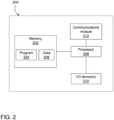
- the computing system 200 may be a stand-alone system (e.g., a server) or configured as part of the elevator controller 115 shown in FIG. 1 .
- the computing system 200 includes a memory 202 which may store executable instructions and/or data.
- the executable instructions may be stored or organized in any manner and at any level of abstraction, such as in connection with one or more applications, processes, routines, procedures, methods, etc.
- the computing system 200 may incorporate computing algorithms that are arranged to enable transmission of all collected sensing or video data to an elevator control system.
- predetermined or relevant meta-data can be transmitted to the elevator control system, with such embodiments requiring less bandwidth, digital memory, and/or power.
- predetermined or relevant meta-data can be transmitted to the elevator control system, with such embodiments requiring less bandwidth, digital memory, and/or power.
- at least a portion of the instructions are shown in FIG. 2 as being associated with a program 204.
- the memory 202 may store data 206.
- the data 206 may include profile or registration data, elevator car data, a device identifier, or any other type(s) of data as will be appreciated by those of skill in the art.
- the instructions stored in the memory 202 may be executed by one or more processors, such as a processor 208.
- the processor 208 may be operative on the data 206.
- the processor 208 may be coupled to one or more input/output (I/O) devices 210.
- the I/O device(s) 210 may include one or more of a keyboard or keypad, a touchscreen or touch panel, a display screen, a microphone, a speaker, a mouse, a button, a remote control, a joystick, a printer, a telephone or mobile device (e.g., a smartphone), a sensor, video, etc.
- the I/O device(s) 210 may be configured to provide an interface to allow a user to interact with the computing system 200.
- the I/O device(s) 210 may support a graphical user interface (GUI) and/or voice-to-text capabilities.
- GUI graphical user interface
- the components of the computing system 200 may be operably and/or communicably connected by one or more buses.
- the computing system 200 may further include other features or components as known in the art.
- the computing system 200 may include one or more transceivers and/or devices configured to transmit and/or receive information or data from sources external to the computing system 200.
- the computing system 200 may be configured to receive information over a network (wired or wireless).
- the information received over the network may be stored in the memory 202 (e.g. as data 206) and/or may be processed and/or employed by one or more programs or applications (e.g., program 204).
- the computing system 200 includes a communications module 212 that can include various communications components for transmitting and/or receiving information and/or data over a variety of networks.
- the computing system 200 may be used to execute or perform embodiments and/or processes described herein.
- the computing system 200 when configured as part of an elevator control system, may be used to receive commands and/or instructions, and may further be configured to control operation of and/or features of an elevator car.
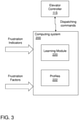
- FIG. 3 depicts data flows to and from the computing system 200 in an example embodiment.
- the computing system 200 receives frustration indicators for a passenger and frustration factors.
- the computing system 200 executes a learning module 220 that accumulates the frustration indicators and frustration factors and determines preferences for the passenger.
- the learning module 220 may be implemented by processor 208 executing a program 204 in memory 202 ( FIG. 2 ).
- the preferences for the passenger are then stored in a profile 222 for that passenger.
- the profiles 222 may be stored as data 206 in memory 202 ( FIG. 2 ).
- the preferences are accessed and used to control elevator service for that passenger by the control system 200 sending dispatching commands to the elevator controller 115.
- FIG. 4 depicts a learning phase process during which the computing system 20 learns preferences for a passenger to reduce passenger frustration, in an example embodiment.
- the process begins at 300 where the computing system 200 identifies a passenger accessing the elevator system 100.
- the identity of the passenger may be determined using a variety of techniques including (a) identifying the passenger through a mobile device carried by the passenger, (b) identifying the passenger through cameras and face recognition software, (c) identifying the passenger based on biometric measurements such as a fingerprint (when pressing elevator call button) or iris recognition and (d) identifying the passenger by an identification medium (e.g., badge with RFID, magnetic stripe, etc.).
- an identification medium e.g., badge with RFID, magnetic stripe, etc.
- FIG. 5 depicts an elevator lobby in an example embodiment including systems for detecting passenger frustration indicators.
- a passenger device 510 such as a smartphone or wearable, can monitor passenger physiological information (e.g., heart rate, body temperature, breathing, sweating, gait, etc.).
- passenger physiological information e.g., heart rate, body temperature, breathing, sweating, gait, etc.
- detected passenger physiological state information and/or user data can be sent from the user device 510 to the computing system 200 (e.g., automatically, upon request from the elevator system, or pushed from the user device).
- a sensor 520 may also detect frustration indicators for the passenger.
- optical sensors, video cameras, microphones, thermal sensors, radar technologies, etc. can be used to detect the presence of passengers near or within an elevator car and can measure frustration indicators for the passenger.
- a camera for example, may capture facial expressions/body language (e.g., discomfort, frequently looking at lantern, watch, frequently pressing call button, etc.). If the user device 510 includes a camera, the computing system 200 may evaluate images taken on the user device 510 to provide a frustration indicator for the passenger (e.g., angry facial expression in a selfie).
- a biometric sensor may obtain frustration indicators for the passenger through passenger interaction with the biometric sensor. In FIG.
- the hall call panel 530 (or other fixture such as a destination call kiosk) includes a biometric sensor 540 that may detect or measure characteristics from the passenger's hand (e.g., heart rate, body temp, etc.). Biometric sensor 540 may also be used to identify the passenger (e.g., through fingerprint analysis).
- biometric sensor 540 may detect or measure characteristics from the passenger's hand (e.g., heart rate, body temp, etc.). Biometric sensor 540 may also be used to identify the passenger (e.g., through fingerprint analysis).
- FIG. 5 Although the sensors in FIG. 5 are shown in an elevator lobby, similar sensors may be used inside the elevator car 103 and at each landing of the elevator system 100. Thus, frustration indicators for the passenger may be collected while the passenger is waiting for elevator service, while the passenger is traveling in the elevator car and when the passenger exits the elevator car.
- the frustration factors may include elevator frustration factors, which refers to frustration factors experienced as a result of using the elevator system 100.
- elevator frustration factors include wait time for an elevator car, number of other passengers in an elevator car, number of stops during travel, overall travel time (includes waiting time and travel time). Elevator frustration factors may also include conditions in the elevator car such as lighting, music, temperature, etc.
- the frustration factors may include external frustration factors, such as current local weather, current local traffic, day of week, time of day, etc. These external frustration factors may be obtained by the computing system 200 via a network connection to an external source of such factors (e.g., linking to a server providing local traffic and local weather via an RSS feed).
- the computing system 200 executes the learning module 220 to correlate the frustration indicators for the passenger with the frustration factors to determine how the frustration factors affect the frustration indicators for the passenger.
- the learning module 220 may use a variety of techniques to correlate the frustration indicators for the passenger with the frustration factors. For example, the learning module 220 may implement a Bayesian network to identify probabilistic relationships between the frustration indicators for the passenger with the frustration factors. Other methods used by learning module 220 may include neural networks, decision trees and association rules. The learning module 220 may also rank the frustration factors (or combinations of frustration factors) from most frustrating for the passenger to least frustrating to the passenger.
- the learning module 220 may also learn (e.g., enrich) a first passenger profile based on other passenger's frustration profiles that are similar to the first passenger profile by, for example, using recommender system methods such as content based, collaborative filtering, demography recommender or knowledge based recommender.
- recommender system methods such as content based, collaborative filtering, demography recommender or knowledge based recommender.
- a user profile 222 for that passenger can be updated with preferences at 308. These preferences are then used in controlling the elevator system in response to a call from that passenger. As a simple example, a passenger may exhibit high frustration indicators whenever there are four or more other passengers in the elevator car with the passenger or whenever elevator occupancy exceeds a percentage (e.g., 60%) of total capacity. From this information, the learning module 220 creates a preference in the user profile 222 for that passenger that the number of other passengers should be less than four, when possible.
- a percentage e.g. 60%
- the correlation between the frustration indicators for the passenger and the frustration factors may indicate that on Monday mornings the number of other passengers causes the most frustration, whereas on Friday afternoons the number of stops during transit causes the most frustration.
- the preferences may be considered proportionally related to the frustration factors, such that a frustration factor causing a high frustration indicator is associated with a strong preference.
- the preferences may also be ranked, from most likely to reduce frustration to least likely to reduce frustration, based upon the correlation between the frustration factors and frustration indicators for the passenger.
- the preferences in a user profile may include a wide variety of factors including reducing time waiting, reducing total travel time, reducing number of stops, reducing number of other passengers, elevator car lighting, elevator car music, elevator car temperature, etc. Embodiments are not limited to the preferences provided as examples in this disclosure. Similarly, the frustration indicators and frustration factors may include a wide variety of items. Embodiments are not limited to the frustration indicators and frustration factors provided as examples in this disclosure.
- the learning phase of FIG. 4 may be employed over a period of time such as weeks or months.
- a user's profile may be initialized with preferences that have been learned from other users and linked with their demographics, corporate affiliations, etc.
- the learning phase can also be reinitiated if the passenger appears to experience frustration levels that increase over time.
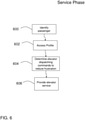
- FIG. 6 depicts a service phase process during which the computing system 200 applies the preferences to reduce passenger frustration, in an example embodiment.
- the process begins at 600 where a passenger is identified. This may be performed using the same techniques as described with reference to block 300 of FIG. 4 . If a passenger cannot be identified (e.g., a visitor to an office building), the elevator system will provide default elevator service and attempt to satisfy default preferences.
- the passenger's user profile is accessed to retrieve preferences for that passenger.
- the preferences may be ranked from most likely to reduce frustration to least likely to reduce frustration.
- the computing system 200 determines elevator dispatching commands for this passenger in order to satisfy the preferences, and therefore reduce (or minimize) passenger frustration.
- the elevator dispatching commands may include control of travel of the elevator car and control of conditions in the elevator car (e.g., lighting, sound, temperature, etc.).
- the computing system 200 obtains preferences from the user profiles of each passenger and determines the elevator dispatching commands that reduces the total frustration experienced by the group of passengers. This may be performed using data optimization techniques to locate a global minimum of total frustration for all passengers, rather than a local minimum for a single passenger.
- the computing system 200 provides the elevator dispatching commands to the elevator controller 115. It is understood, as noted above, that the computing system 200 and elevator controller 115 may be implemented by the same device.
- the elevator controller 115 then assigns one or more elevator cars 103 to the one or more passengers who have made calls (e.g., hall or destination) to the elevator system.
- the elevator controller 115 may also control conditions within the elevator car 103, including, but not limited to, lighting, display screens, music, spoken audio words, temperature in the car, etc.
- embodiments of the present disclosure provide elevator systems that improve the passenger experience via personalized, automated, non-intrusive learning of individual preferences.
- embodiments can be in the form of processor-implemented processes and devices for practicing those processes, such as a processor.
- Embodiments can also be in the form of computer program code containing instructions embodied in tangible media, such as network cloud storage, SD cards, flash drives, floppy diskettes, CD ROMs, hard drives, or any other computer-readable storage medium, wherein, when the computer program code is loaded into and executed by a computer, the computer becomes a device for practicing the embodiments.
- Embodiments can also be in the form of computer program code, for example, whether stored in a storage medium, loaded into and/or executed by a computer, or transmitted over some transmission medium, loaded into and/or executed by a computer, or transmitted over some transmission medium, such as over electrical wiring or cabling, through fiber optics, or via electromagnetic radiation, wherein, when the computer program code is loaded into an executed by a computer, the computer becomes a device for practicing the embodiments.
- the computer program code segments configure the microprocessor to create specific logic circuits.
- various functions or acts may take place at a given location and/or in connection with the operation of one or more apparatuses, systems, or devices. For example, in some embodiments, a portion of a given function or act may be performed at a first device or location, and the remainder of the function or act may be performed at one or more additional devices or locations. Further, one of ordinary skill in the art will appreciate that the steps described in conjunction with the illustrative figures may be performed in other than the recited order, and that one or more steps illustrated may be optional.
Landscapes
- Engineering & Computer Science (AREA)
- Automation & Control Theory (AREA)
- Computer Networks & Wireless Communication (AREA)
- Elevator Control (AREA)
- Indicating And Signalling Devices For Elevators (AREA)
Claims (15)
- Verfahren zum Steuern eines Aufzugssystems (101), wobei das Verfahren die Verwendung eines Computersystems (200) umfasst zum:Identifizieren eines Fahrgastes (300);Erfassen eines oder mehrerer Frustrationsindikatoren des Fahrgastes während der Benutzung des Aufzugssystems durch den Fahrgast (302);Erfassen eines oder mehrerer Frustrationsfaktoren (304);Korrelieren des einen oder der mehreren Frustrationsfaktoren mit dem einen oder den mehreren Frustrationsindikatoren, um eine oder mehrere Präferenzen für den Fahrgast zu erzeugen (306);Erzeugen eines Profils für den Fahrgast in Reaktion auf die Korrelation, wobei das Profil die eine oder mehreren Präferenzen (308) beinhaltet; undSteuern des Betriebs des Aufzugssystems in Reaktion auf die eine oder mehreren Präferenzen, um die Frustration des Fahrgastes während einer Interaktion mit dem Aufzugssystem zu reduzieren (604, 606).
- Verfahren nach Anspruch 1, ferner umfassend die Verwendung des Computersystems (200) zum:
Einstufen des einen oder der mehreren Frustrationsfaktoren von mehr frustrierend bis weniger frustrierend. - Verfahren nach Anspruch 1 oder 2, ferner umfassend die Verwendung des Computersystems (200) zum:
Einstufen der einen oder mehreren Präferenzen von am wahrscheinlichsten zur Reduzierung von Frustration bis am wenigsten wahrscheinlich zur Reduzierung von Frustration. - Verfahren nach einem vorstehenden Anspruch, ferner umfassend die Verwendung des Computersystems (200) zum:
Steuern des Betriebs des Aufzugssystems, um die Gesamtfrustration einer Gruppe von Fahrgästen während der Interaktion mit dem Aufzugssystem zu reduzieren. - Verfahren nach einem vorstehenden Anspruch, wobei:
der eine oder die mehreren Frustrationsfaktoren interne Frustrationsfaktoren und externe Aufzugsfaktoren umfassen. - Verfahren nach Anspruch 5, wobei:
die internen Frustrationsfaktoren eine oder mehrere Bedingungen innerhalb der Aufzugskabine (103), die Wartezeit auf die Aufzugskabine, die Anzahl der anderen Fahrgäste in der Aufzugskabine, die Anzahl der Stopps während der Fahrt und die Gesamtfahrzeit umfassen. - Verfahren nach Anspruch 5 oder 6, wobei:
die externen Frustrationsfaktoren den lokalen Verkehr, das lokale Wetter, die Tageszeit und den Wochentag beinhalten. - Aufzugsystem (101), umfassend:eine Aufzugskabine (103), die sich in einem Aufzugsschacht (117) befindet;mindestens einen Sensor (520);eine Aufzugsteuerung (115), die so angeordnet ist, dass sie die Fahrt der Aufzugskabine steuert; undein Computersystem (200), das mit dem mindestens einen Sensor und der Aufzugssteuerung kommuniziert, wobei das Computersystem so konfiguriert ist, dass es Folgendes implementiert:
Identifizieren eines Fahrgastes (300); Erfassen eines oder mehrerer Frustrationsindikatoren des Fahrgastes während der Benutzung des Aufzugssystems durch den Fahrgast (304); dadurch gekennzeichnet, dass das Computersystem so konfiguriert ist, dass es Folgendes implementiert:Erfassen eines oder mehrerer Frustrationsfaktoren des Fahrgastes (302);Korrelieren des einen oder der mehreren Frustrationsfaktoren mit dem einen oder den mehreren Frustrationsindikatoren, um eine oder mehrere Präferenzen für den Fahrgast zu erzeugen (306);Erzeugen eines Profils für den Fahrgast in Reaktion auf die Korrelation, wobei das Profil die eine oder mehreren Präferenzen (308) beinhaltet; undSteuern des Betriebs des Aufzugssystems in Reaktion auf die eine oder mehreren Präferenzen, um die Frustration des Fahrgastes während einer Interaktion mit dem Aufzugssystem zu reduzieren (604, 606). - Aufzugsystem (101) nach Anspruch 8, wobei:
die Steuerung (115) so konfiguriert ist, dass sie eine Einstufung des einen oder der mehreren Frustrationsfaktoren von mehr frustrierend bis weniger frustrierend implementiert. - Aufzugsystem (101) nach Anspruch 8 oder 9, wobei:
die Steuerung (115) so konfiguriert ist, dass sie eine Einstufung der einen oder mehreren Präferenzen von am wahrscheinlichsten zur Reduzierung von Frustration bis am wenigsten wahrscheinlich zur Reduzierung von Frustration implementiert. - Aufzugsystem (101) nach einem der Ansprüche 8-10, wobei:
die Steuerung (115) so konfiguriert ist, dass sie eine Steuerung des Betriebs des Aufzugssystems implementiert, um die Gesamtfrustration einer Gruppe von Fahrgästen während der Interaktion mit dem Aufzugssystem zu reduzieren. - Aufzugsystem (101) nach einem der Ansprüche 8-11, wobei:
der eine oder die mehreren Frustrationsfaktoren interne Frustrationsfaktoren und externe Aufzugsfaktoren umfassen. - Aufzugsystem (101) nach Anspruch 12, wobei:
die internen Frustrationsfaktoren eine oder mehrere Bedingungen innerhalb der Aufzugskabine (103), die Wartezeit auf die Aufzugskabine, die Anzahl der anderen Fahrgäste in der Aufzugskabine, die Anzahl der Stopps während der Fahrt und die Gesamtfahrzeit umfassen. - Aufzugsystem (101) nach Anspruch 12 oder 13, wobei:
die externen Frustrationsfaktoren den lokalen Verkehr, das lokale Wetter, die Tageszeit und den Wochentag beinhalten. - Computerprogrammprodukt zum Steuern eines Aufzugssystems, wobei das Computerprogrammprodukt ein nichttransitorisches, computerlesbares Speichermedium umfasst, das darin verkörperte Programmanweisungen aufweist, wobei die Programmanweisungen durch einen Prozessor des Computersystems (200), das in einem Aufzugssystem nach Anspruch 8 umfasst ist, ausgeführt werden können, um den Prozessor zu veranlassen, Vorgänge zu implementieren, die Folgendes umfassen:Identifizieren eines Fahrgastes (300);Erfassen eines oder mehrerer Frustrationsindikatoren des Fahrgastes während der Benutzung des Aufzugssystems durch den Fahrgast (302);Erfassen eines oder mehrerer Frustrationsfaktoren (304);Korrelieren des einen oder der mehreren Frustrationsfaktoren mit dem einen oder den mehreren Frustrationsindikatoren, um eine oder mehrere Präferenzen für den Fahrgast zu erzeugen (306);Erzeugen eines Profils für den Fahrgast in Reaktion auf die Korrelation, wobei das Profil die eine oder mehreren Präferenzen (308) beinhaltet; undSteuern des Betriebs des Aufzugssystems in Reaktion auf die eine oder mehreren Präferenzen, um die Frustration des Fahrgastes während einer Interaktion mit dem Aufzugssystem zu reduzieren (604, 606).
Applications Claiming Priority (1)
| Application Number | Priority Date | Filing Date | Title |
|---|---|---|---|
| US15/963,320 US11040851B2 (en) | 2018-04-26 | 2018-04-26 | Elevator system passenger frustration reduction |
Publications (2)
| Publication Number | Publication Date |
|---|---|
| EP3560871A1 EP3560871A1 (de) | 2019-10-30 |
| EP3560871B1 true EP3560871B1 (de) | 2022-02-09 |
Family
ID=66239928
Family Applications (1)
| Application Number | Title | Priority Date | Filing Date |
|---|---|---|---|
| EP19170310.7A Not-in-force EP3560871B1 (de) | 2018-04-26 | 2019-04-18 | Fahrgastfrustrationsreduktion für aufzugssystem |
Country Status (3)
| Country | Link |
|---|---|
| US (1) | US11040851B2 (de) |
| EP (1) | EP3560871B1 (de) |
| CN (1) | CN110407041A (de) |
Families Citing this family (8)
| Publication number | Priority date | Publication date | Assignee | Title |
|---|---|---|---|---|
| US11040851B2 (en) * | 2018-04-26 | 2021-06-22 | Otis Elevator Company | Elevator system passenger frustration reduction |
| US11332340B2 (en) * | 2018-08-28 | 2022-05-17 | Tk Elevator Innovation And Operations Gmbh | Elevator control and user interface system |
| CN112830354A (zh) * | 2019-11-22 | 2021-05-25 | 富泰华工业(深圳)有限公司 | 基于区块链系统的电梯调度系统、装置、方法及存储介质 |
| TWI735085B (zh) * | 2019-11-22 | 2021-08-01 | 鴻海精密工業股份有限公司 | 基於區塊鏈系統之電梯調度系統、裝置、方法及存儲介質 |
| CN115427334A (zh) * | 2020-04-24 | 2022-12-02 | 通力股份公司 | 操作电梯系统的方法和电梯系统 |
| US20230401195A1 (en) * | 2022-06-14 | 2023-12-14 | Otis Elevator Company | Elevator system configured for storing and sharing elevator trips |
| JP7500838B1 (ja) | 2023-07-13 | 2024-06-17 | 東芝エレベータ株式会社 | エレベータの運転制御調整装置 |
| CN117068893B (zh) * | 2023-09-19 | 2026-01-30 | 上海三菱电梯有限公司 | 电梯控制系统及电梯控制方法 |
Family Cites Families (32)
| Publication number | Priority date | Publication date | Assignee | Title |
|---|---|---|---|---|
| JP2574842B2 (ja) * | 1988-01-29 | 1997-01-22 | 株式会社日立製作所 | エレベーターの群管理制御装置 |
| US5307903A (en) * | 1988-01-29 | 1994-05-03 | Hitachi, Ltd. | Method and system of controlling elevators and method and apparatus of inputting requests to the control system |
| JP2003330400A (ja) * | 2002-03-01 | 2003-11-19 | Inventio Ag | エレベータ設備におけるマルチメディアコンテンツ提示の手順、システムおよびコンピュータプログラム製品 |
| US7912720B1 (en) * | 2005-07-20 | 2011-03-22 | At&T Intellectual Property Ii, L.P. | System and method for building emotional machines |
| US8487772B1 (en) | 2008-12-14 | 2013-07-16 | Brian William Higgins | System and method for communicating information |
| JP5440080B2 (ja) | 2009-10-02 | 2014-03-12 | ソニー株式会社 | 行動パターン解析システム、携帯端末、行動パターン解析方法、及びプログラム |
| US9642536B2 (en) | 2010-06-07 | 2017-05-09 | Affectiva, Inc. | Mental state analysis using heart rate collection based on video imagery |
| TW201220216A (en) * | 2010-11-15 | 2012-05-16 | Hon Hai Prec Ind Co Ltd | System and method for detecting human emotion and appeasing human emotion |
| CN102009879A (zh) | 2010-11-18 | 2011-04-13 | 无锡中星微电子有限公司 | 电梯自动按键控制系统、方法和人脸模型训练系统、方法 |
| JP2012121690A (ja) * | 2010-12-08 | 2012-06-28 | Mitsubishi Electric Building Techno Service Co Ltd | エレベータシステム |
| US8364395B2 (en) * | 2010-12-14 | 2013-01-29 | International Business Machines Corporation | Human emotion metrics for navigation plans and maps |
| KR101359410B1 (ko) | 2011-01-07 | 2014-02-06 | 엠파이어 테크놀로지 디벨롭먼트 엘엘씨 | 유저 인터페이스를 통한 불만의 정량화 |
| US8880200B2 (en) * | 2012-05-04 | 2014-11-04 | Inventio Ag | Associating user preferences with elevator activity |
| JP2013234050A (ja) | 2012-05-10 | 2013-11-21 | Mitsubishi Electric Corp | エレベータ制御装置およびエレベータ制御方法 |
| US9299084B2 (en) | 2012-11-28 | 2016-03-29 | Wal-Mart Stores, Inc. | Detecting customer dissatisfaction using biometric data |
| EP3011521B1 (de) | 2013-05-20 | 2023-12-20 | Otis Elevator Company | Auf mobiler anwendung basierender versand |
| US9449218B2 (en) | 2014-10-16 | 2016-09-20 | Software Ag Usa, Inc. | Large venue surveillance and reaction systems and methods using dynamically analyzed emotional input |
| CN107000982B (zh) * | 2014-12-03 | 2020-06-09 | 因温特奥股份公司 | 与电梯交替交互的系统和方法 |
| US9485838B2 (en) * | 2014-12-12 | 2016-11-01 | Osram Sylvania Inc. | Lighting system for contained environments |
| CN107000959B (zh) | 2014-12-12 | 2020-07-03 | 奥的斯电梯公司 | 电梯路线选择系统 |
| US9957132B2 (en) * | 2015-02-04 | 2018-05-01 | Thyssenkrupp Elevator Ag | Elevator control systems |
| US9896305B2 (en) | 2015-05-07 | 2018-02-20 | International Business Machines Corporation | Personalized elevator dispatch |
| US9610510B2 (en) * | 2015-07-21 | 2017-04-04 | Disney Enterprises, Inc. | Sensing and managing vehicle behavior based on occupant awareness |
| CN205328387U (zh) | 2015-12-16 | 2016-06-22 | 苏州大学 | 一种基于人脸识别和智能推荐的电梯控制系统 |
| US10683189B2 (en) | 2016-06-23 | 2020-06-16 | Intel Corporation | Contextual awareness-based elevator management |
| US9945679B2 (en) | 2016-06-27 | 2018-04-17 | International Business Machines Corporation | Personalized travel routes to reduce stress |
| CN106315319B (zh) | 2016-09-23 | 2018-05-15 | 日立楼宇技术(广州)有限公司 | 一种电梯智能预调度方法及系统 |
| WO2018075463A1 (en) * | 2016-10-17 | 2018-04-26 | Otis Elevator Company | Elevator systems and methods of controlling elevators responsive to detected passenger states |
| CN106682090B (zh) | 2016-11-29 | 2020-05-15 | 上海智臻智能网络科技股份有限公司 | 主动交互实现装置、方法及智能语音交互设备 |
| US10547917B2 (en) * | 2017-05-12 | 2020-01-28 | Otis Elevator Company | Ride quality mobile terminal device application |
| US10674199B2 (en) * | 2017-08-28 | 2020-06-02 | Otis Elevator Company | Media content selection for passengers |
| US11040851B2 (en) * | 2018-04-26 | 2021-06-22 | Otis Elevator Company | Elevator system passenger frustration reduction |
-
2018
- 2018-04-26 US US15/963,320 patent/US11040851B2/en active Active
-
2019
- 2019-04-18 EP EP19170310.7A patent/EP3560871B1/de not_active Not-in-force
- 2019-04-25 CN CN201910338373.2A patent/CN110407041A/zh active Pending
Non-Patent Citations (1)
| Title |
|---|
| None * |
Also Published As
| Publication number | Publication date |
|---|---|
| CN110407041A (zh) | 2019-11-05 |
| US11040851B2 (en) | 2021-06-22 |
| US20190330011A1 (en) | 2019-10-31 |
| EP3560871A1 (de) | 2019-10-30 |
Similar Documents
| Publication | Publication Date | Title |
|---|---|---|
| EP3560871B1 (de) | Fahrgastfrustrationsreduktion für aufzugssystem | |
| US11498802B2 (en) | Elevator systems and methods of controlling elevators responsive to detected passenger states | |
| AU2021200009B2 (en) | System and method for alternatively interacting with elevators | |
| EP3041775B1 (de) | Aufzugbedienfeld mit gesichtserkennung | |
| EP3581533A1 (de) | Aufzugsplanungssysteme und verfahren zum betrieb | |
| US20190002234A1 (en) | Elevator control apparatus and elevator control method | |
| EP3543919A1 (de) | Servicewerkzeug mit erfassung und wiedergabe | |
| CN112551287A (zh) | 电梯控制装置,电梯系统和电梯控制方法 | |
| WO2019060110A1 (en) | SYSTEM FOR MONITORING AND CONTROLLING ELEVATOR TRAFFIC | |
| CN114890258B (zh) | 一种电梯智能速度控制方法和系统 | |
| US20200055691A1 (en) | Last-minute hall call request to a departing cab using gesture | |
| JP7327560B1 (ja) | エレベータの群管理システム | |
| US20200130997A1 (en) | Elevator service request using user device with filtered destination floor selection | |
| CN111891888B (zh) | 自调谐门定时参数 | |
| CN112573314B (zh) | 处理输送系统中的服务请求 | |
| JP7577877B1 (ja) | エレベータ管理装置、エレベータ管理方法およびプログラム | |
| JP2025024991A (ja) | エレベーターシステム及びエレベーター制御方法 | |
| HK1235380A1 (en) | System and method for alternatively interacting with elevators |
Legal Events
| Date | Code | Title | Description |
|---|---|---|---|
| PUAI | Public reference made under article 153(3) epc to a published international application that has entered the european phase |
Free format text: ORIGINAL CODE: 0009012 |
|
| STAA | Information on the status of an ep patent application or granted ep patent |
Free format text: STATUS: THE APPLICATION HAS BEEN PUBLISHED |
|
| AK | Designated contracting states |
Kind code of ref document: A1 Designated state(s): AL AT BE BG CH CY CZ DE DK EE ES FI FR GB GR HR HU IE IS IT LI LT LU LV MC MK MT NL NO PL PT RO RS SE SI SK SM TR |
|
| AX | Request for extension of the european patent |
Extension state: BA ME |
|
| STAA | Information on the status of an ep patent application or granted ep patent |
Free format text: STATUS: REQUEST FOR EXAMINATION WAS MADE |
|
| 17P | Request for examination filed |
Effective date: 20200430 |
|
| RBV | Designated contracting states (corrected) |
Designated state(s): AL AT BE BG CH CY CZ DE DK EE ES FI FR GB GR HR HU IE IS IT LI LT LU LV MC MK MT NL NO PL PT RO RS SE SI SK SM TR |
|
| GRAP | Despatch of communication of intention to grant a patent |
Free format text: ORIGINAL CODE: EPIDOSNIGR1 |
|
| STAA | Information on the status of an ep patent application or granted ep patent |
Free format text: STATUS: GRANT OF PATENT IS INTENDED |
|
| INTG | Intention to grant announced |
Effective date: 20210204 |
|
| GRAJ | Information related to disapproval of communication of intention to grant by the applicant or resumption of examination proceedings by the epo deleted |
Free format text: ORIGINAL CODE: EPIDOSDIGR1 |
|
| STAA | Information on the status of an ep patent application or granted ep patent |
Free format text: STATUS: REQUEST FOR EXAMINATION WAS MADE |
|
| INTC | Intention to grant announced (deleted) | ||
| GRAP | Despatch of communication of intention to grant a patent |
Free format text: ORIGINAL CODE: EPIDOSNIGR1 |
|
| STAA | Information on the status of an ep patent application or granted ep patent |
Free format text: STATUS: GRANT OF PATENT IS INTENDED |
|
| INTG | Intention to grant announced |
Effective date: 20210823 |
|
| GRAS | Grant fee paid |
Free format text: ORIGINAL CODE: EPIDOSNIGR3 |
|
| GRAA | (expected) grant |
Free format text: ORIGINAL CODE: 0009210 |
|
| STAA | Information on the status of an ep patent application or granted ep patent |
Free format text: STATUS: THE PATENT HAS BEEN GRANTED |
|
| AK | Designated contracting states |
Kind code of ref document: B1 Designated state(s): AL AT BE BG CH CY CZ DE DK EE ES FI FR GB GR HR HU IE IS IT LI LT LU LV MC MK MT NL NO PL PT RO RS SE SI SK SM TR |
|
| REG | Reference to a national code |
Ref country code: GB Ref legal event code: FG4D |
|
| REG | Reference to a national code |
Ref country code: CH Ref legal event code: EP Ref country code: AT Ref legal event code: REF Ref document number: 1467404 Country of ref document: AT Kind code of ref document: T Effective date: 20220215 |
|
| REG | Reference to a national code |
Ref country code: IE Ref legal event code: FG4D |
|
| REG | Reference to a national code |
Ref country code: DE Ref legal event code: R096 Ref document number: 602019011403 Country of ref document: DE |
|
| REG | Reference to a national code |
Ref country code: LT Ref legal event code: MG9D |
|
| REG | Reference to a national code |
Ref country code: NL Ref legal event code: MP Effective date: 20220209 |
|
| REG | Reference to a national code |
Ref country code: AT Ref legal event code: MK05 Ref document number: 1467404 Country of ref document: AT Kind code of ref document: T Effective date: 20220209 |
|
| PG25 | Lapsed in a contracting state [announced via postgrant information from national office to epo] |
Ref country code: SE Free format text: LAPSE BECAUSE OF FAILURE TO SUBMIT A TRANSLATION OF THE DESCRIPTION OR TO PAY THE FEE WITHIN THE PRESCRIBED TIME-LIMIT Effective date: 20220209 Ref country code: RS Free format text: LAPSE BECAUSE OF FAILURE TO SUBMIT A TRANSLATION OF THE DESCRIPTION OR TO PAY THE FEE WITHIN THE PRESCRIBED TIME-LIMIT Effective date: 20220209 Ref country code: PT Free format text: LAPSE BECAUSE OF FAILURE TO SUBMIT A TRANSLATION OF THE DESCRIPTION OR TO PAY THE FEE WITHIN THE PRESCRIBED TIME-LIMIT Effective date: 20220609 Ref country code: NO Free format text: LAPSE BECAUSE OF FAILURE TO SUBMIT A TRANSLATION OF THE DESCRIPTION OR TO PAY THE FEE WITHIN THE PRESCRIBED TIME-LIMIT Effective date: 20220509 Ref country code: NL Free format text: LAPSE BECAUSE OF FAILURE TO SUBMIT A TRANSLATION OF THE DESCRIPTION OR TO PAY THE FEE WITHIN THE PRESCRIBED TIME-LIMIT Effective date: 20220209 Ref country code: LT Free format text: LAPSE BECAUSE OF FAILURE TO SUBMIT A TRANSLATION OF THE DESCRIPTION OR TO PAY THE FEE WITHIN THE PRESCRIBED TIME-LIMIT Effective date: 20220209 Ref country code: HR Free format text: LAPSE BECAUSE OF FAILURE TO SUBMIT A TRANSLATION OF THE DESCRIPTION OR TO PAY THE FEE WITHIN THE PRESCRIBED TIME-LIMIT Effective date: 20220209 Ref country code: ES Free format text: LAPSE BECAUSE OF FAILURE TO SUBMIT A TRANSLATION OF THE DESCRIPTION OR TO PAY THE FEE WITHIN THE PRESCRIBED TIME-LIMIT Effective date: 20220209 Ref country code: BG Free format text: LAPSE BECAUSE OF FAILURE TO SUBMIT A TRANSLATION OF THE DESCRIPTION OR TO PAY THE FEE WITHIN THE PRESCRIBED TIME-LIMIT Effective date: 20220509 |
|
| PG25 | Lapsed in a contracting state [announced via postgrant information from national office to epo] |
Ref country code: PL Free format text: LAPSE BECAUSE OF FAILURE TO SUBMIT A TRANSLATION OF THE DESCRIPTION OR TO PAY THE FEE WITHIN THE PRESCRIBED TIME-LIMIT Effective date: 20220209 Ref country code: LV Free format text: LAPSE BECAUSE OF FAILURE TO SUBMIT A TRANSLATION OF THE DESCRIPTION OR TO PAY THE FEE WITHIN THE PRESCRIBED TIME-LIMIT Effective date: 20220209 Ref country code: GR Free format text: LAPSE BECAUSE OF FAILURE TO SUBMIT A TRANSLATION OF THE DESCRIPTION OR TO PAY THE FEE WITHIN THE PRESCRIBED TIME-LIMIT Effective date: 20220510 Ref country code: FI Free format text: LAPSE BECAUSE OF FAILURE TO SUBMIT A TRANSLATION OF THE DESCRIPTION OR TO PAY THE FEE WITHIN THE PRESCRIBED TIME-LIMIT Effective date: 20220209 Ref country code: AT Free format text: LAPSE BECAUSE OF FAILURE TO SUBMIT A TRANSLATION OF THE DESCRIPTION OR TO PAY THE FEE WITHIN THE PRESCRIBED TIME-LIMIT Effective date: 20220209 |
|
| PG25 | Lapsed in a contracting state [announced via postgrant information from national office to epo] |
Ref country code: IS Free format text: LAPSE BECAUSE OF FAILURE TO SUBMIT A TRANSLATION OF THE DESCRIPTION OR TO PAY THE FEE WITHIN THE PRESCRIBED TIME-LIMIT Effective date: 20220609 |
|
| PG25 | Lapsed in a contracting state [announced via postgrant information from national office to epo] |
Ref country code: SM Free format text: LAPSE BECAUSE OF FAILURE TO SUBMIT A TRANSLATION OF THE DESCRIPTION OR TO PAY THE FEE WITHIN THE PRESCRIBED TIME-LIMIT Effective date: 20220209 Ref country code: SK Free format text: LAPSE BECAUSE OF FAILURE TO SUBMIT A TRANSLATION OF THE DESCRIPTION OR TO PAY THE FEE WITHIN THE PRESCRIBED TIME-LIMIT Effective date: 20220209 Ref country code: RO Free format text: LAPSE BECAUSE OF FAILURE TO SUBMIT A TRANSLATION OF THE DESCRIPTION OR TO PAY THE FEE WITHIN THE PRESCRIBED TIME-LIMIT Effective date: 20220209 Ref country code: EE Free format text: LAPSE BECAUSE OF FAILURE TO SUBMIT A TRANSLATION OF THE DESCRIPTION OR TO PAY THE FEE WITHIN THE PRESCRIBED TIME-LIMIT Effective date: 20220209 Ref country code: DK Free format text: LAPSE BECAUSE OF FAILURE TO SUBMIT A TRANSLATION OF THE DESCRIPTION OR TO PAY THE FEE WITHIN THE PRESCRIBED TIME-LIMIT Effective date: 20220209 Ref country code: CZ Free format text: LAPSE BECAUSE OF FAILURE TO SUBMIT A TRANSLATION OF THE DESCRIPTION OR TO PAY THE FEE WITHIN THE PRESCRIBED TIME-LIMIT Effective date: 20220209 |
|
| REG | Reference to a national code |
Ref country code: DE Ref legal event code: R097 Ref document number: 602019011403 Country of ref document: DE |
|
| PG25 | Lapsed in a contracting state [announced via postgrant information from national office to epo] |
Ref country code: AL Free format text: LAPSE BECAUSE OF FAILURE TO SUBMIT A TRANSLATION OF THE DESCRIPTION OR TO PAY THE FEE WITHIN THE PRESCRIBED TIME-LIMIT Effective date: 20220209 |
|
| REG | Reference to a national code |
Ref country code: CH Ref legal event code: PL |
|
| PLBE | No opposition filed within time limit |
Free format text: ORIGINAL CODE: 0009261 |
|
| STAA | Information on the status of an ep patent application or granted ep patent |
Free format text: STATUS: NO OPPOSITION FILED WITHIN TIME LIMIT |
|
| REG | Reference to a national code |
Ref country code: BE Ref legal event code: MM Effective date: 20220430 |
|
| 26N | No opposition filed |
Effective date: 20221110 |
|
| PG25 | Lapsed in a contracting state [announced via postgrant information from national office to epo] |
Ref country code: MC Free format text: LAPSE BECAUSE OF FAILURE TO SUBMIT A TRANSLATION OF THE DESCRIPTION OR TO PAY THE FEE WITHIN THE PRESCRIBED TIME-LIMIT Effective date: 20220209 Ref country code: LU Free format text: LAPSE BECAUSE OF NON-PAYMENT OF DUE FEES Effective date: 20220418 Ref country code: LI Free format text: LAPSE BECAUSE OF NON-PAYMENT OF DUE FEES Effective date: 20220430 Ref country code: CH Free format text: LAPSE BECAUSE OF NON-PAYMENT OF DUE FEES Effective date: 20220430 |
|
| PG25 | Lapsed in a contracting state [announced via postgrant information from national office to epo] |
Ref country code: SI Free format text: LAPSE BECAUSE OF FAILURE TO SUBMIT A TRANSLATION OF THE DESCRIPTION OR TO PAY THE FEE WITHIN THE PRESCRIBED TIME-LIMIT Effective date: 20220209 Ref country code: BE Free format text: LAPSE BECAUSE OF NON-PAYMENT OF DUE FEES Effective date: 20220430 |
|
| PG25 | Lapsed in a contracting state [announced via postgrant information from national office to epo] |
Ref country code: IE Free format text: LAPSE BECAUSE OF NON-PAYMENT OF DUE FEES Effective date: 20220418 |
|
| PG25 | Lapsed in a contracting state [announced via postgrant information from national office to epo] |
Ref country code: IT Free format text: LAPSE BECAUSE OF FAILURE TO SUBMIT A TRANSLATION OF THE DESCRIPTION OR TO PAY THE FEE WITHIN THE PRESCRIBED TIME-LIMIT Effective date: 20220209 |
|
| GBPC | Gb: european patent ceased through non-payment of renewal fee |
Effective date: 20230418 |
|
| PG25 | Lapsed in a contracting state [announced via postgrant information from national office to epo] |
Ref country code: GB Free format text: LAPSE BECAUSE OF NON-PAYMENT OF DUE FEES Effective date: 20230418 |
|
| PG25 | Lapsed in a contracting state [announced via postgrant information from national office to epo] |
Ref country code: GB Free format text: LAPSE BECAUSE OF NON-PAYMENT OF DUE FEES Effective date: 20230418 |
|
| PG25 | Lapsed in a contracting state [announced via postgrant information from national office to epo] |
Ref country code: HU Free format text: LAPSE BECAUSE OF FAILURE TO SUBMIT A TRANSLATION OF THE DESCRIPTION OR TO PAY THE FEE WITHIN THE PRESCRIBED TIME-LIMIT; INVALID AB INITIO Effective date: 20190418 |
|
| PG25 | Lapsed in a contracting state [announced via postgrant information from national office to epo] |
Ref country code: MK Free format text: LAPSE BECAUSE OF FAILURE TO SUBMIT A TRANSLATION OF THE DESCRIPTION OR TO PAY THE FEE WITHIN THE PRESCRIBED TIME-LIMIT Effective date: 20220209 Ref country code: CY Free format text: LAPSE BECAUSE OF FAILURE TO SUBMIT A TRANSLATION OF THE DESCRIPTION OR TO PAY THE FEE WITHIN THE PRESCRIBED TIME-LIMIT Effective date: 20220209 |
|
| PGFP | Annual fee paid to national office [announced via postgrant information from national office to epo] |
Ref country code: FR Payment date: 20240320 Year of fee payment: 6 |
|
| PG25 | Lapsed in a contracting state [announced via postgrant information from national office to epo] |
Ref country code: TR Free format text: LAPSE BECAUSE OF FAILURE TO SUBMIT A TRANSLATION OF THE DESCRIPTION OR TO PAY THE FEE WITHIN THE PRESCRIBED TIME-LIMIT Effective date: 20220209 |
|
| PGFP | Annual fee paid to national office [announced via postgrant information from national office to epo] |
Ref country code: DE Payment date: 20240320 Year of fee payment: 6 |
|
| PG25 | Lapsed in a contracting state [announced via postgrant information from national office to epo] |
Ref country code: MT Free format text: LAPSE BECAUSE OF FAILURE TO SUBMIT A TRANSLATION OF THE DESCRIPTION OR TO PAY THE FEE WITHIN THE PRESCRIBED TIME-LIMIT Effective date: 20220209 |
|
| REG | Reference to a national code |
Ref country code: DE Ref legal event code: R119 Ref document number: 602019011403 Country of ref document: DE |
|
| PG25 | Lapsed in a contracting state [announced via postgrant information from national office to epo] |
Ref country code: DE Free format text: LAPSE BECAUSE OF NON-PAYMENT OF DUE FEES Effective date: 20251104 |
|
| PG25 | Lapsed in a contracting state [announced via postgrant information from national office to epo] |
Ref country code: FR Free format text: LAPSE BECAUSE OF NON-PAYMENT OF DUE FEES Effective date: 20250430 |