EP3556714B1 - Commutateur de commande permettant d'opérer une grue - Google Patents
Commutateur de commande permettant d'opérer une grue Download PDFInfo
- Publication number
- EP3556714B1 EP3556714B1 EP19169574.1A EP19169574A EP3556714B1 EP 3556714 B1 EP3556714 B1 EP 3556714B1 EP 19169574 A EP19169574 A EP 19169574A EP 3556714 B1 EP3556714 B1 EP 3556714B1
- Authority
- EP
- European Patent Office
- Prior art keywords
- control panel
- housing
- control
- control switch
- area
- Prior art date
- Legal status (The legal status is an assumption and is not a legal conclusion. Google has not performed a legal analysis and makes no representation as to the accuracy of the status listed.)
- Active
Links
Images


Classifications
-
- B—PERFORMING OPERATIONS; TRANSPORTING
- B66—HOISTING; LIFTING; HAULING
- B66C—CRANES; LOAD-ENGAGING ELEMENTS OR DEVICES FOR CRANES, CAPSTANS, WINCHES, OR TACKLES
- B66C13/00—Other constructional features or details
- B66C13/52—Details of compartments for driving engines or motors or of operator's stands or cabins
- B66C13/54—Operator's stands or cabins
- B66C13/56—Arrangements of handles or pedals
Definitions
- the invention relates to a control switch for operating a crane according to the preamble of claim 1.
- Such a control switch is known from the brochure "CLX CHAIN HOIST - CRANE FOR EVERYDAY LIFTING" from Konecranes.
- This control switch is designed as a wired pendant control switch and comprises an elongated housing extending in its longitudinal direction.
- Several operating elements are arranged on a front side of the housing in order to control various functions of a crane which can be connected to the control switch.
- four control elements designed in the form of buttons and intended for crane and trolley travel are combined in a cruciform arrangement to form a substantially diamond-shaped first control panel.
- this cruciform arrangement there is a second control panel with two further button-shaped control elements, which are provided to control a lifting mechanism for lifting and lowering a load.
- the controls for the hoist are arranged one behind the other in the longitudinal direction of the housing and in this respect vertically one above the other.
- a third control panel is provided, above which an emergency stop button with an actuation direction oriented perpendicular to the front is arranged.
- the opposite longitudinal sides of the housing which delimit the front, have a parallel course to one another in the area of the first control panel and, in the area of the second and third control panel, in addition to the emergency stop button, their otherwise constant distance only in the area of the second control panel and in the area between the first and the second control panel is reduced.
- the long sides of the housing in the area of the second control panel jump back relative to their course in the area of the first and third control panel and the emergency stop button and in this respect towards one another, the transitions of the long sides between the first and second control panel each having an oblique course exhibit.
- control switch for operating a crane is known, the control elements arranged on its housing are arranged in pairs next to one another and in a row with one another with respect to the longitudinal direction of the housing.
- the object of the invention is to further develop a generic control switch such that it has improved ergonomic properties for particularly comfortable and safe crane operation.
- a control switch for operating a crane which comprises a housing extending in a longitudinal direction, on the front side delimited by two longitudinal sides of which a first control panel with at least one control element is arranged, in particular for controlling at least one drive for horizontal crane movements, whereby on the Front of the housing, a second control panel with an emergency stop button and a third control panel with two controls, in particular for controlling vertical crane movements, are arranged, in terms of its ergonomic properties for a particularly comfortable and safe crane operation by improving that the long sides in the area of the first control panel have a curve that is biconvex to one another in the longitudinal direction of the housing and thus, in particular, curved outward.
- the correspondingly biconvex curved longitudinal sides in the area of the first control panel viewed in the longitudinal direction of the housing, extend away from the longitudinal direction and then again towards the longitudinal direction.
- the first control panel can be diamond-shaped in particular.
- the first control panel comprises at least two control elements which are arranged one above the other along a longitudinal axis of the first control panel running parallel to the longitudinal direction of the housing and / or alongside one another along a transverse axis of the first control panel running transverse to the longitudinal direction of the housing.
- a vertex of each of these - from the outside, convex and in this respect biconvex to each other - curved, in particular rounded, sections of the long sides is located at the level of the at least one control element or at the level of the control elements arranged alongside one another along the transverse axis and / or at the level of the between the transverse axis extending along the longitudinal axis of the control elements.
- the apexes are consequently at the level of the corners of the diamond-shaped first control panel opposite one another in the transverse direction of the housing.
- the first control panel can also be reached particularly well by the thumb of the hand of a person operating the control switch in the area below the biconvex course of the long sides.
- the first control panel is designed in particular in such a way that up to four control elements for horizontal crane movements or for controlling the at least one drive for the horizontal crane movements, in particular a crane travel and / or trolley travel of the crane, cross-shaped on the, in particular diamond-shaped, first control panel within the control panel can be arranged.
- each control element of the first control panel - as will be described in more detail with reference to the figures - is arranged in a corner of an imaginary rhombus of the diamond-shaped first control panel, the intersecting diagonals of this rhombus of the longitudinal axis and transverse axis of the correspond to the first control panel, of which the longitudinal axis is parallel and the transverse axis is corresponding are aligned transversely to the longitudinal direction of the control switch or its housing.
- the first control panel has only one control element for horizontal crane movements or for controlling the crane travel and / or trolley travel or associated drives
- the multifunctional control element in particular can thus also be arranged centrally between the long sides and in particular on an intersection of the diagonals of the imaginary diamond. In this case, however, no control elements are arranged in the corners of the imaginary diamond.
- the control switch or its housing including the courses of the long sides, the arrangement of the control panels and the associated control elements, has a mirror-symmetrical shape with respect to an imaginary plane that is perpendicular to the front and contains the longitudinal axis direction of the control switch or its housing. Due to the mirror symmetry, the control switch can be gripped and held comfortably and securely by left-handed and right-handed people in the same way.
- a second control panel with an emergency stop button and a third control panel with two control elements are provided on the front of the housing between the long sides.
- the control elements of the third control panel can preferably be used to control a drive for vertical crane movements, in particular a hoist, of a crane that can be connected to the control switch.
- the first control panel is preferably arranged between the second control panel and the third control panel.
- the third control element preferably comprises two control elements for a lifting mechanism of the crane, which are arranged one behind the other in relation to the longitudinal direction of the control switch or its housing.
- This configuration makes it possible to operate a crane in a particularly ergonomic and at the same time particularly intuitive manner, as a result of which safety in crane operation can be further increased.
- the control elements of all control panels are preferably designed as buttons, in particular as push buttons.
- the long sides of the housing also have a biconvex curve in the longitudinal direction of the housing in the area of the second control panel.
- the longitudinal sides in the region of the second control panel viewed in the longitudinal direction of the housing, also extend away from the longitudinal direction and then again towards the longitudinal direction.
- the long sides in the area of the second control panel thus have a convex shape when viewed from the outside, just as the sections of the long sides in the area of the first control panel have a convex shape.
- a radius of curvature of the convex shape in the area of the second control panel is preferably greater than a radius of curvature of the convex shape in the area of the first control panel.
- the ergonomic properties of the control switch according to the invention are further optimized by these convex or round and, in particular, curved profiles of the long sides, seen from the outside.
- a rear side of the housing of the control switch opposite the front side has a profiled contour in the area of the first control panel and / or in the area of the third control panel.
- the profiled contour can particularly advantageously have at least one projection which is raised compared to the rear.
- the projection which preferably extends perpendicular to the longitudinal direction of the control switch, is provided so that a person operating the control switch can place the index finder of one of his hands on it at least in sections. In this way, an ergonomically advantageous position of the control switch in the hand can be brought about, in which the thumb of the respective hand can comfortably reach the respective, in particular the first or third, control panel and actuate the operating elements there.
- the control switch can also be supported in an advantageous manner in particular on a section of the middle finger in the encompassed state. Without the correspondingly profiled contour or Otherwise, the operator would have to apply an increased holding force in order to prevent the control switch from sliding through the hand, which would also impair the accessibility of the respective control panel.
- the first control panel and the third control panel are arranged together in a recess that recesses relative to the front of the housing.
- the arrangement of the first and third control panel in this recess has the advantage that the control elements contained do not protrude beyond the contour of the control switch or the front of its housing, as a result of which sticking to the control elements and any associated incorrect operation can be effectively avoided.
- the arrangement of the two control panels together in a recess also has the effect of advantageously enhancing their visual and / or haptic emphasis.
- the housing has a constriction on its long sides.
- the constriction is arranged in a particularly advantageous manner between the biconvex curves.
- the constriction can be located in particular in the area between the first and second control panel or in the area of the first control panel and preferably at the level of an operating element of the first control panel provided for the "crane travel forward" function.
- the constriction is then located between the two convex profiles seen from the outside in the area between the first and second control panels or in the area of the first control panel and in particular in the area of the control element for the "forward crane travel" function.
- the first convex course of the long sides of the housing in the area of the first control panel seen from the outside therefore changes directly into the second convex course of the long sides of the housing in the area of the second control panel seen from the outside.
- the two biconvex curves to each other in the region of the constriction preferably without a possible concave curve, merge directly and in this respect in particular in a kink-like manner.
- the constriction thus resembles a striking notch, which leads to an advantageous enhancement of the visual and / or haptic highlighting of the individual control panels.
- the housing has a first section, which can preferably include the third and at least partially also the first control panel, and a second section which adjoins the first section in the longitudinal direction and preferably the second Control panel can include.
- the first section and the second section are angled so that they enclose an angle between them.
- the two sections of the housing are angled around an imaginary axis running parallel to the transverse axis, so that its front side, preferably also its rear side, is curved in itself.
- the first section of the housing opposite the upper end is always inclined with respect to a vertical direction even in the free-hanging state, which simplifies gripping the control switch.
- control switch or its housing can be provided with a soft coating at least in some areas.
- the coating serving as a soft coating is preferably produced by applying a multi-component lacquer to the housing.
- the primary goal here is improved contact with the hand of a person operating the control switch, which hand encompasses the housing.
- the at least one projection can be rounded off towards the long sides.
- the rounding enables a transition from the projection into the long sides of the housing that is as seamless as possible, which further increases the ergonomics due to the absence of otherwise disruptive and / or unpleasant protruding corners of the projection.
- the rounded design of the at least one projection also allows the control switch to be placed in a section of a finger, in particular the index finger, with the rounded projection.
- the housing is naturally enlarged compared to the surrounding sections, which can be perceived as advantageous, in particular in the case of a large hand of a person operating the control switch. Even with this type of handling, the at least one protrusion provides exact haptic feedback regarding the correct position within the operator's hand.
- the projections also serve to transmit tensile forces from the operator to the crane, which can be initiated via the control switch and the control line. In addition, the projections allow the operator to "hold" on the control switch and thereby carry the crane with him.
- the housing can have two projections spaced apart from one another with respect to its longitudinal direction.
- a first projection can be arranged at the level of an area that faces the third control panel and is located below two control elements of the first control panel that are arranged alongside one another along the transverse axis, while a second projection at the level of a lower area of the third that faces away from the first control panel Control panel is located.
- the distance between the two projections can be selected such that the section of the housing located between the two projections is gripped by the ring and middle fingers of one hand, while the index finger is placed above the first projection.
- the first projection serves as an orientation aid for the operator to operate the first control panel, while the second projection represents an orientation aid for the third control panel.
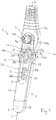
- the Figure 1 shows a perspective view of the front 2a and a longitudinal side 2d of a control switch 1 according to the invention for operating a crane.
- the crane not shown in more detail here, can in particular be an overhead crane, for example in the form of a gantry crane.
- the control switch 1 is recognizable as a manual control switch in the form of a pendant control switch and for this purpose comprises an elongated housing 2 extending in its longitudinal direction L, which is usually associated with the control switch at its with reference to the illustration of FIG Figure 1 Control line arranged or can be arranged at the upper end for connection to a crane cannot be seen here.
- the housing 2 is profiled on the long side, that is to say on its opposite long sides 2c, 2d, in particular by a first, from the outside, a convex course 13a of the long sides 2c, 2d, which is located in the region of a first control panel 3 arranged on the front 2a with reference to the longitudinal direction L of the control switch 1 extends away from the longitudinal direction L and then again towards the longitudinal direction L.
- the two opposite longitudinal sides 2c, 2d have a biconvex curve 13a with respect to one another.
- the control switch 1, or the longitudinal sides 2c, 2d of its housing 2 has a second convex course 13b, seen from the outside, in the region of a second control panel 4 likewise arranged on the front side 2a.
- the two opposite longitudinal sides 2c, 2d in this area are also equipped with a biconvex curve 13b.
- the two convex courses 13a, 13b, seen from the outside, can be seen separated from one another by a constriction 11.
- the housing 2 of the control switch 1 has a further third control panel 5 on its front side 2a, the first control panel 3 being arranged between the second control panel 4 and the third control panel 5.
- control switch 1 also has a profiled contour on its rear side 2b, or on the rear side 2b of its housing 2.
- the profiled contour forms an ergonomically optimized gripping area between the longitudinal ends 2e, 2f of the control switch 1, or its housing 2.
- the control switch 1 can be operated by the hand of a person (not shown here) who operates the control switch 1 can be comfortably gripped and held to control elements 3a 3d; 4a; 5a, 5b of the control panels 3, 4, 5 can be reached and operated, in particular with the thumb.
- a crane travel By operating the controls 3a 3d; 4a; 5a, 5b, numerous functions of a crane can be controlled, for example a crane travel, a trolley travel as well as lifting and lowering a hoist of the crane or its load-carrying means.
- the crane in particular including its crane girder, is moved along crane rails by means of crane trolleys which, in the case of a bridge crane, are fastened to the opposite ends of the crane girder.
- a crane trolley is moved together with the hoist carried by the crane trolley along the crane girder by means of a trolley trolley.
- the directions of travel of the crane run and the trolley run are perpendicular to each other, the crane run transversely, in particular at right angles, to the longitudinal extension of the crane girder and the trolley travel along the longitudinal extension of the crane girder.
- the actuation of the control elements of the control switch 1 causes the generation of corresponding control signals for the respective function.
- the control signals are then sent to the crane or its control in order to trigger the respective function, for example by correspondingly controlling the associated drive of the crane trolley, trolley trolley or hoisting gear and thereby executing the desired movement.
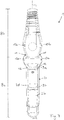
- the control switch 1, or its housing 2 includes the control panels 3, 4, 5 and the arrangement of the control elements 3a 3d; 4a; 5a, 5b have a mirror-symmetrical shape with respect to a plane that is perpendicular to the plane of the drawing Figures 3 and 4th or the front side 2a and includes the longitudinal direction L of the control switch 1, or its housing 2. This does not apply to some of the respective control elements 3a 3d; 4a; 5a, 5b assigned different symbols and labels. Due to the mirror symmetry, the control switch 1 can be gripped and held comfortably and securely by left-handers and right-handers in the same way.
- the housing 2 there is sufficient space in the housing 2 to hold components (not shown) such as one preferably rechargeable battery, mechanical and electrical parts of the control elements and a control circuit for generating, processing and transmitting, that is to say sending and receiving, of control signals for the control of the crane.
- the control circuit 1 can be connected to the control of the crane via a control line (not shown in more detail) in order to enable a wired signal transmission.
- the housing 2 can be connected to the control line at its front end 2e or is already connected. The first end 2e faces away from the body of an operator while he is holding the control switch 1 for operating a crane in his hand.
- the control switch 1 is thus connected to the control of the crane by means of the control line and thereby and is thus designed as a so-called pendant control switch.
- the control elements 3a 3d are visible; 4a; 5a, 5b of the control switch 1 grouped in the three spaced apart control panels 3, 4, 5 and on the in the Figures 1 and 3rd Front side 2a of the control switch 1, or its housing 2, shown is arranged in an ergonomically particularly advantageous manner in the manner explained below:
- the three control panels 3, 4, 5 are along the longitudinal direction L of the control switch 1 or the housing 2 between its two longitudinal ends, the upper first end 2e and an opposite lower second end 2f, next to each other and with respect to the usual handling of the control switch 1 positioned one above the other.
- the second control panel 4 provided in the area of the first end 2e of the housing 2 comprises an operating element in the form of a pushbutton, which represents an emergency stop button 4a.
- the control element or the emergency stop button 4a is preferably arranged in a strikingly outstanding manner, so that a particularly rapid and panic-proof triggering of an emergency stop is possible.
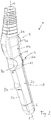
- the emergency stop button 4a in the present case protrudes from the front 2a of the housing 2, so that it can be quickly grasped and operated (see also Figures 2 and 5 ).
- the first control panel 3 is arranged on the front side 2a
- Control element in the form of a button 3a for the function "crane travel forward" of a crane trolley an control element in the form of a button 3b for the function “crane travel backward” of a crane trolley, an control element in the form of a button 3c for the function “trolley travel right” of a trolley carriage and comprises an operating element in the form of a button 3d for the function "trolley travel left” of a trolley.
- the round or circular and equally dimensioned control elements 3a 3d are arranged in a star shape.
- the control switch 1 has a recess on the front side 2a in the housing wall, the base of which essentially corresponds to the diamond spanned by the diagonals.
- the control elements 3a 3d are arranged in the corners of the diamond-shaped depression with a small radial distance from the housing wall delimiting the depression. The corners of the depression or the base are rounded off accordingly.
- the sides or edges of the imaginary diamond also have rounded indentations facing inwards.
- the control elements 3a, 3b arranged along a longitudinal axis x of the first control panel 3 running parallel to the longitudinal direction L of the housing 2 are in this respect located in end regions of the first diagonal aligned parallel to the longitudinal direction L of the housing 2.
- the control elements 3c, 3d arranged along a transverse axis y of the first control panel 3 running transversely to the longitudinal direction L of the housing 2 are located in end regions of the second diagonal oriented at right angles to the first diagonal.
- the operating elements 3a, 3d are thus arranged approximately in a cross shape and / or in a diamond shape, so that this can be seen in FIGS Figures 1 and 3rd shown, essentially diamond-shaped first control panel 3 in the region of the recess of the housing 2.
- the diagonals running coaxially to the longitudinal axis x and transverse axis y are of unequal length, so that the imaginary rhombus, or the base area of the depression, represents a rectangle or parallelogram with corresponding rounded corners and correspondingly rounded edges.
- the recess is open towards the third control panel 5 in the direction of the second end 2f below the button 3b.
- the first control panel 3 and the third control panel 5 are thus arranged together in a continuous depression.
- the third control panel 5 is positioned on the side of the first control panel 3 facing the second end 2f of the housing 2.
- the control panel 5 comprises, as operating elements, a key 5a for the "lifting" function of a lifting mechanism and - at a distance therefrom in the direction of the second end 2f - a key 5b for the "lowering" function of a lifting mechanism.
- the controls 5a, 5b for a hoist are arranged centered along an imaginary straight line that is aligned parallel to the longitudinal direction L of the housing 2 and in particular in alignment with the first diagonal or longitudinal axis x of the second control panel 4.
- control elements 5a, 5b are also round or circular and have the same dimensions and are arranged in the elongated recess in the housing wall, which the control panel 3 traverses without interruption and is formed on the front side 2a.
- the longitudinal end of the depression is rounded.
- the radius of the rounding is selected such that the housing walls delimiting the recess are also so far away from the operating element 5b that there is sufficient space for its manual actuation.
- the longitudinal end of the depression is also designed such that the thumb of an operator's hand, which comes from the lower second end 2f, slides along the front 2a of the control switch 1, over a slope G, which in particular has a flatter slope compared to the rest of the depression has, is led into the recess and to the third control panel 5.
- All six control elements 3a, 3d are preferably; 5a, 5b of the two aforementioned first and second control panels 3, 5 have the same dimensions and in particular are designed as single-stage or multi-stage pushbuttons. A continuous formation of the push buttons is also conceivable.
- the aforementioned controls 3a 3d; 4a; 5a, 5b or the vicinity of the control elements 3a 3d; 4a; 5a, 5b on the front side 2a can be provided with symbols and / or inscriptions which are only shown here by way of example and are therefore not restricted to them, and which relate to the function of the respective operating element 3a 3d; 4a; 5a, 5b. Further details on the shape and arrangement of the control panels 3 5 and the associated control elements 3a 3d; 4a; 5a, 5b are shown in the figures.
- the contour of the control switch 1 or the housing 2 and the previously The control panels 35 described are ergonomically advantageously coordinated with one another as described below in terms of their shape and arrangement.
- the housing 2 of the control switch 1 has a shape profiled in the longitudinal direction L between its two longitudinal ends 2e, 2f, which preferably comprises two immediately successive biconvex curves 13a, 13b of the longitudinal sides 2c, 2d and a constriction 11 located between them .
- the convex courses 13a, 13b of the housing 2 of the control switch 1 seen from the outside are wider than in the constriction 11.
- the longitudinal sides extend 2c, 2d first away from the longitudinal direction L and then again towards the longitudinal direction L in the direction of the second end 2f.
- the second control panel 4 is arranged between the long sides 2c, 2d, which have the biconvex curves 13b.
- the constriction 11 then adjoins these convex curves 13b when viewed from the outside (see in particular Figure 3 ).
- the long sides 2c, 2d transition from a biconvex curve 13b to the next biconvex curve 13a in the sense of a bend or kink.
- the first convex course 13a seen from the outside is followed by a straight course of the longitudinal sides 2c, 2d which extend parallel to one another.
- the transition or course 12 between the first biconvex curve 13a and the straight course towards the second end 2f of the control switch 1 is biconcavely curved and thus differs in shape from the abrupt transition of the kink-shaped constriction 11 between the first biconvex curve Course 13a and the second biconvex course 13b.
- the biconcavely curved course 12 of the transition represents a less hard or a gentler transition between the two courses.
- the control switch 1 this construction makes it wider in the area of the first control panel 3 and the second control panel 4 than in the area of the third control panel 5.
- a rear 2b of the control switch 1 is in the Figures 2 as well as 4 and with regard to their contour in Figure 5 shown.
- the course of the long sides 2c, 2d along the rear 2b essentially corresponds to the course of the long sides 2c, 2d along the front 2a.
- the rear 2b is essentially continuous and flat from the lower second end 2f to the area of the first control panel 3, which of course can also have a rounded shape.
- the rear side 2b has in particular no recesses recessed relative to it, but rather comprises two projections 9a, 9b raised relative to the rear side 2b.
- a first of these projections 9a is accordingly arranged on the rear 2b in relation to the longitudinal direction L of the control switch 1 in the region of the first control panel 3.
- the first projection 9a thus lies opposite the first control panel 3, in particular the control element 3b.
- the first projection 9a lies at the level of the control element 3b, which is located in the direction of the second end or longitudinal end 2f below the two control elements 3c, 3d arranged alongside the transverse axis y.
- the second of the two rear projections 9b is arranged in the corresponding area of the third control panel 5, in particular on the rear in an area opposite the key 5b and / or the lower area of the third control panel 5 facing away from the first control panel 3.
- the profiled contour of the projections 9a and 9b extends perpendicularly away from the rear 2b and in particular between the two longitudinal sides 2c, 2d, so that, for example, an index finger of an operator's hand holding the control switch can be intuitively placed. With sufficient profiling, which extends in particular over the entire width of the back 2b, an ergonomically advantageous constrained position of an operator's hand can be achieved.
- the housing 2 can be composed of two shell-shaped housing halves.
- one housing half comprises the front side 2a and at least part of the long sides 2c, 2d and the other housing half comprises the rear side 2b and a second part of the Long sides 2c, 2d.
- the housing 2 or the housing shells can, for example, have a plastic material that is dimensionally stable at room temperature and can be produced in particular by means of a plastic injection molding process.
- a flexible kink protection of the connected or connectable control line encloses the two housing shells.
- a second end part 6 is attached to the second longitudinal end 2f, so that the housing 2 closes at the end at the longitudinal end 2f as a separate part in the manner of a cap and can be snapped together with both housing shells.
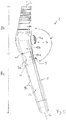
- FIG. 5 it is also shown that the front side 2a and the rear side 2b extend flat and parallel to one another from the lower longitudinal end 2f to the upper projection 9a.
- the rear side 2b Above the upper, first projection 9a, the rear side 2b is bulge-shaped or, seen from the outside, is convex and therefore no longer parallel to the front side 2a in this region.
- a lower first section 8a of the control switch 1, comprising the first and third control panels 3, 5 extends below the constriction 11 to the lower end 2f or the end part 6.
- An upper second section 8b, comprising the second control panel 4 extends from of the connected or connectable control line up to the constriction 11. It can be seen that the two sections 8a, 8b are angled to one another, enclosing an angle W between them.
- FIG. 6 Another embodiment is in the Figure 6 shown. Analogous to Figure 1 show the Figure 6 the control switch 1 in a perspective view with its front 2a and one of its long sides 2d. The only difference to Figure 1 is that the first control panel 3 does not include four control elements 3a 3d, but only the two control elements arranged next to one another in the transverse direction y for the functions "trolley travel right” 3c and “trolley travel left” 3d. In the embodiment according to Figure 6 the control elements for the functions "crane travel forward" and “crane travel backward” are omitted, as a result of which the intended positions within the control panel 3 accordingly do not have such control elements 3a, 3b. Otherwise, this applies to the previous embodiment according to FIGS Figures 1 to 5 Said analogously for the embodiment according to Figure 6 .
- control switch 1 or its housing 2 at least partially or completely, in particular on its outside and in particular in the gripping area on the back 2b and the long sides 2c, 2d, is provided with a so-called soft coating, that is to say with a coating which is softer than the housing 2.
- a so-called soft coating that is to say with a coating which is softer than the housing 2.
- multi-component coatings are suitable for producing such a soft coating. Lacquers, especially so-called Polysoft lacquers.
Landscapes
- Engineering & Computer Science (AREA)
- Mechanical Engineering (AREA)
- Mechanical Control Devices (AREA)
Claims (11)
- Commutateur de commande (1) destiné à faire fonctionner une grue, ledit commutateur comprenant un boîtier (2) qui s'étend dans une direction longitudinale (L) et dont le côté avant (2a), délimité par deux côtés longitudinaux opposés (2c, 2d), comporte un premier panneau de commande (3) pourvu d'au moins un élément de commande (3a, 3b, 3c, 3d), destiné notamment à commander des mouvements horizontaux de la grue, le côté avant (2a) du boîtier (2) comportant un deuxième panneau de commande (4) pourvu d'un bouton d'arrêt d'urgence (4a) et un troisième panneau de commande (5) pourvu de deux éléments de commande (5a, 5b), destinés notamment à commander des mouvements verticaux de la grue, caractérisé en ce que les côtés longitudinaux (2c, 2d) présentent, dans la région du premier panneau de commande (3), une allure (13a) incurvée l'un par rapport à l'autre de manière biconvexe dans la direction longitudinale (L) du boîtier (2).
- Commutateur de commande (1) selon la revendication 1, caractérisé en ce que le premier panneau de commande (3) comprend au moins deux éléments de commande (3a, 3b, 3c, 3d) qui sont disposés l'un au-dessus de l'autre le long de l'axe longitudinal (x) du premier panneau de commande (3) qui s'étend parallèlement à la direction longitudinale (L) du boîtier (2) et/ou côte à côte le long d'un axe transversal (y) du premier panneau de commande (3) qui s'étend transversalement à la direction longitudinale (L) du boîtier (2), le premier panneau de commande (3) étant notamment en forme de losange.
- Commutateur de commande (1) selon la revendication 1 ou 2, caractérisé en ce que le premier panneau de commande (3) par rapport à la direction longitudinale (L) du boîtier (2) est disposé entre le deuxième panneau de commande (4) et le troisième panneau de commande (5).
- Commutateur de commande (1) selon la revendication 3, caractérisé en ce que les côtés longitudinaux (2c, 2d) du boîtier (2) présente, dans la région du deuxième panneau de commande (4), une allure (13b) incurvée de manière biconvexe l'un par rapport à l'autre dans la direction longitudinale (L) du boîtier (2).
- Commutateur de commande (1) selon l'une des revendications précédentes, caractérisé en ce qu'un côté arrière (2b) du boîtier (2), qui est opposé au côté avant (2a), présente, dans la région du premier panneau de commande (3) et/ou dans la région du troisième panneau de commande (5), un contour profilé, pourvu notamment d'au moins une saillie (9a, 9b) surélevée par rapport au côté arrière (2b).
- Commutateur de commande (1) selon l'une des revendications précédentes, caractérisé en ce que le premier panneau de commande (3) et le troisième panneau de commande (5) sont disposés conjointement dans un évidement en retrait par rapport au côté avant (2a).
- Commutateur de commande (1) selon l'une des revendications précédentes, caractérisé en ce que le boîtier (2) présente un rétrécissement (11) de ses côtés longitudinaux (2c, 2d) qui est disposé entre les allures (13a, 13b) incurvées de manière biconvexe l'un par rapport à l'autre, en particulier dans la région située entre le premier et le deuxième panneau de commande (3, 4) ou dans la région du premier panneau de commande (3) et de préférence dans la région d'un élément de commande (3a) du premier panneau de commande (3) qui est prévu pour la fonction « déplacement de la grue vers l'avant ».
- Commutateur de commande (1) selon l'une des revendications précédentes, caractérisé en ce que le boîtier (2) comporte une première portion (8a) et une deuxième portion (8b), se raccordement à la première portion (8a) dans la direction longitudinale (L), la première portion (8a) et la deuxième portion (8b) du boîtier (2) étant inclinées l'une par rapport à l'autre en formant un angle (W).
- Commutateur de commande (1) selon l'une des revendications précédentes, caractérisé en ce que le boîtier (2) est au moins par endroits pourvu d'un revêtement souple.
- Commutateur de commande (1) selon l'une des revendications 5 à 9, caractérisé en ce que l''au moins une saillie (9a, 9b) est arrondie en direction des côtés longitudinaux (2c, 2d).
- Commutateur de commande (1) selon l'une des revendications 5 à 10, caractérisé par deux saillies (9a, 9b) espacées l'une de l'autre par rapport à la direction longitudinale (L) du boîtier (2), une première saillie (9a) étant placée à hauteur d'une région du premier panneau de commande (3) qui est dirigée vers le troisième panneau de commande (5) et qui est placée au-dessous de deux éléments de commande disposés l'un à côté de l'autre le long de l'axe transversal (y) et une deuxième saillie (9b) étant placée à hauteur d'une région inférieure du troisième panneau de commande (5) qui est opposée au premier panneau de commande (3).
Applications Claiming Priority (1)
| Application Number | Priority Date | Filing Date | Title |
|---|---|---|---|
| DE102018109109.5A DE102018109109A1 (de) | 2018-04-17 | 2018-04-17 | Steuerschalter zur Bedienung eines Krans |
Publications (2)
| Publication Number | Publication Date |
|---|---|
| EP3556714A1 EP3556714A1 (fr) | 2019-10-23 |
| EP3556714B1 true EP3556714B1 (fr) | 2020-04-08 |
Family
ID=66217801
Family Applications (1)
| Application Number | Title | Priority Date | Filing Date |
|---|---|---|---|
| EP19169574.1A Active EP3556714B1 (fr) | 2018-04-17 | 2019-04-16 | Commutateur de commande permettant d'opérer une grue |
Country Status (4)
| Country | Link |
|---|---|
| EP (1) | EP3556714B1 (fr) |
| CN (1) | CN209507435U (fr) |
| DE (1) | DE102018109109A1 (fr) |
| ES (1) | ES2798145T3 (fr) |
Family Cites Families (4)
| Publication number | Priority date | Publication date | Assignee | Title |
|---|---|---|---|---|
| DE2756103C3 (de) * | 1977-12-16 | 1980-11-20 | Mannesmann Demag Ag, 4100 Duisburg | Hängeschalter |
| FR2640608A1 (fr) * | 1988-12-21 | 1990-06-22 | Mannesmann Ag | |
| DE4234542A1 (de) * | 1992-10-14 | 1994-04-21 | Buehne Werner Abus Kg | Hängetaster |
| DE102006012471B4 (de) | 2006-03-18 | 2010-08-26 | Demag Cranes & Components Gmbh | Verfahren und System zur drahtlosen Übertragung von Steuerungsbefehlen für eine Steuerung eines Hebezeugs |
-
2018
- 2018-04-17 DE DE102018109109.5A patent/DE102018109109A1/de not_active Withdrawn
- 2018-06-14 CN CN201820924578.XU patent/CN209507435U/zh active Active
-
2019
- 2019-04-16 ES ES19169574T patent/ES2798145T3/es active Active
- 2019-04-16 EP EP19169574.1A patent/EP3556714B1/fr active Active
Non-Patent Citations (1)
| Title |
|---|
| None * |
Also Published As
| Publication number | Publication date |
|---|---|
| EP3556714A1 (fr) | 2019-10-23 |
| CN209507435U (zh) | 2019-10-18 |
| ES2798145T3 (es) | 2020-12-09 |
| DE102018109109A1 (de) | 2019-10-17 |
Similar Documents
| Publication | Publication Date | Title |
|---|---|---|
| EP3533076B1 (fr) | Commutateur de machine-outil | |
| DE10041590B4 (de) | Lenkrad | |
| EP3620584A1 (fr) | Élément de commande pour une commande à distance comprenant un capteur d'activation pourvue de zone de détection modifiable efficace | |
| DE2214530B2 (de) | Elektrozug | |
| EP2138445B1 (fr) | Console de commande pour un chariot de manutention | |
| DE4206515C1 (fr) | ||
| DE202017105701U1 (de) | Funkfernsteuergerät zur Funkfernsteuerung einer Maschine, insbesondere eines Kranes | |
| EP2880503B1 (fr) | Élément de commande manuell speciallement pour engin | |
| EP0592795A1 (fr) | Bouton-poussoir suspendu | |
| EP3556714A1 (fr) | Commutateur de commande permettant d'opérer une grue | |
| DE19601694A1 (de) | Deichsel für ein Flurförderzeug | |
| DE4229674C2 (de) | Hebezeug mit einer Hubvorrichtung | |
| DE3044847A1 (de) | Eingabeeinheit fuer einen bordcomputer eines kraffahrzeugs | |
| DE19747660A1 (de) | Haptische Handhabe zur Betätigung von Türen, Klappen und dergleichen | |
| DE4215547C2 (de) | Kombidrehgriff zur Zweihandbedienung zwangsgeführter Flurförderzeuge | |
| DE4309670A1 (de) | Bediengerät einer Rufanlage | |
| DE3126699C2 (de) | Hängeschalter | |
| DE2222063A1 (de) | Steuervorrichtung fuer hubgeraete | |
| DE102004040457A1 (de) | Flurförderzeug mit ergonomisch angeordneten Bedienelementen | |
| EP1775254A2 (fr) | Panneau de commande pour un chariot de manutention avec une commande pour le pouce du type joystick | |
| DE19642994A1 (de) | Multifunktionssteuerknüppel | |
| EP3009325B1 (fr) | Volant pour chariot de manutention dote d'un poste de travail du conducteur | |
| EP0059999B1 (fr) | Système de commande pour dispositif mobile dans l'espace | |
| DE10058021A1 (de) | Aufzug mit einer an einem Mast verfahrbaren Plattform | |
| DE1128302B (de) | Anordnung der Betaetigungseinrichtungen eines Fahrstaplers |
Legal Events
| Date | Code | Title | Description |
|---|---|---|---|
| PUAI | Public reference made under article 153(3) epc to a published international application that has entered the european phase |
Free format text: ORIGINAL CODE: 0009012 |
|
| STAA | Information on the status of an ep patent application or granted ep patent |
Free format text: STATUS: THE APPLICATION HAS BEEN PUBLISHED |
|
| AK | Designated contracting states |
Kind code of ref document: A1 Designated state(s): AL AT BE BG CH CY CZ DE DK EE ES FI FR GB GR HR HU IE IS IT LI LT LU LV MC MK MT NL NO PL PT RO RS SE SI SK SM TR |
|
| AX | Request for extension of the european patent |
Extension state: BA ME |
|
| STAA | Information on the status of an ep patent application or granted ep patent |
Free format text: STATUS: REQUEST FOR EXAMINATION WAS MADE |
|
| 17P | Request for examination filed |
Effective date: 20191106 |
|
| GRAP | Despatch of communication of intention to grant a patent |
Free format text: ORIGINAL CODE: EPIDOSNIGR1 |
|
| RBV | Designated contracting states (corrected) |
Designated state(s): AL AT BE BG CH CY CZ DE DK EE ES FI FR GB GR HR HU IE IS IT LI LT LU LV MC MK MT NL NO PL PT RO RS SE SI SK SM TR |
|
| STAA | Information on the status of an ep patent application or granted ep patent |
Free format text: STATUS: GRANT OF PATENT IS INTENDED |
|
| RIC1 | Information provided on ipc code assigned before grant |
Ipc: B66C 13/56 20060101AFI20191127BHEP |
|
| INTG | Intention to grant announced |
Effective date: 20191212 |
|
| GRAS | Grant fee paid |
Free format text: ORIGINAL CODE: EPIDOSNIGR3 |
|
| GRAA | (expected) grant |
Free format text: ORIGINAL CODE: 0009210 |
|
| STAA | Information on the status of an ep patent application or granted ep patent |
Free format text: STATUS: THE PATENT HAS BEEN GRANTED |
|
| AK | Designated contracting states |
Kind code of ref document: B1 Designated state(s): AL AT BE BG CH CY CZ DE DK EE ES FI FR GB GR HR HU IE IS IT LI LT LU LV MC MK MT NL NO PL PT RO RS SE SI SK SM TR |
|
| REG | Reference to a national code |
Ref country code: CH Ref legal event code: EP Ref country code: AT Ref legal event code: REF Ref document number: 1254124 Country of ref document: AT Kind code of ref document: T Effective date: 20200415 |
|
| REG | Reference to a national code |
Ref country code: DE Ref legal event code: R096 Ref document number: 502019000022 Country of ref document: DE |
|
| REG | Reference to a national code |
Ref country code: IE Ref legal event code: FG4D Free format text: LANGUAGE OF EP DOCUMENT: GERMAN |
|
| REG | Reference to a national code |
Ref country code: FI Ref legal event code: FGE |
|
| REG | Reference to a national code |
Ref country code: NL Ref legal event code: MP Effective date: 20200408 |
|
| REG | Reference to a national code |
Ref country code: LT Ref legal event code: MG4D |
|
| PG25 | Lapsed in a contracting state [announced via postgrant information from national office to epo] |
Ref country code: NO Free format text: LAPSE BECAUSE OF FAILURE TO SUBMIT A TRANSLATION OF THE DESCRIPTION OR TO PAY THE FEE WITHIN THE PRESCRIBED TIME-LIMIT Effective date: 20200708 Ref country code: IS Free format text: LAPSE BECAUSE OF FAILURE TO SUBMIT A TRANSLATION OF THE DESCRIPTION OR TO PAY THE FEE WITHIN THE PRESCRIBED TIME-LIMIT Effective date: 20200808 Ref country code: NL Free format text: LAPSE BECAUSE OF FAILURE TO SUBMIT A TRANSLATION OF THE DESCRIPTION OR TO PAY THE FEE WITHIN THE PRESCRIBED TIME-LIMIT Effective date: 20200408 Ref country code: SE Free format text: LAPSE BECAUSE OF FAILURE TO SUBMIT A TRANSLATION OF THE DESCRIPTION OR TO PAY THE FEE WITHIN THE PRESCRIBED TIME-LIMIT Effective date: 20200408 Ref country code: GR Free format text: LAPSE BECAUSE OF FAILURE TO SUBMIT A TRANSLATION OF THE DESCRIPTION OR TO PAY THE FEE WITHIN THE PRESCRIBED TIME-LIMIT Effective date: 20200709 Ref country code: LT Free format text: LAPSE BECAUSE OF FAILURE TO SUBMIT A TRANSLATION OF THE DESCRIPTION OR TO PAY THE FEE WITHIN THE PRESCRIBED TIME-LIMIT Effective date: 20200408 Ref country code: PT Free format text: LAPSE BECAUSE OF FAILURE TO SUBMIT A TRANSLATION OF THE DESCRIPTION OR TO PAY THE FEE WITHIN THE PRESCRIBED TIME-LIMIT Effective date: 20200817 |
|
| PG25 | Lapsed in a contracting state [announced via postgrant information from national office to epo] |
Ref country code: BG Free format text: LAPSE BECAUSE OF FAILURE TO SUBMIT A TRANSLATION OF THE DESCRIPTION OR TO PAY THE FEE WITHIN THE PRESCRIBED TIME-LIMIT Effective date: 20200708 Ref country code: RS Free format text: LAPSE BECAUSE OF FAILURE TO SUBMIT A TRANSLATION OF THE DESCRIPTION OR TO PAY THE FEE WITHIN THE PRESCRIBED TIME-LIMIT Effective date: 20200408 Ref country code: LV Free format text: LAPSE BECAUSE OF FAILURE TO SUBMIT A TRANSLATION OF THE DESCRIPTION OR TO PAY THE FEE WITHIN THE PRESCRIBED TIME-LIMIT Effective date: 20200408 Ref country code: HR Free format text: LAPSE BECAUSE OF FAILURE TO SUBMIT A TRANSLATION OF THE DESCRIPTION OR TO PAY THE FEE WITHIN THE PRESCRIBED TIME-LIMIT Effective date: 20200408 |
|
| REG | Reference to a national code |
Ref country code: ES Ref legal event code: FG2A Ref document number: 2798145 Country of ref document: ES Kind code of ref document: T3 Effective date: 20201209 |
|
| PG25 | Lapsed in a contracting state [announced via postgrant information from national office to epo] |
Ref country code: AL Free format text: LAPSE BECAUSE OF FAILURE TO SUBMIT A TRANSLATION OF THE DESCRIPTION OR TO PAY THE FEE WITHIN THE PRESCRIBED TIME-LIMIT Effective date: 20200408 |
|
| REG | Reference to a national code |
Ref country code: DE Ref legal event code: R097 Ref document number: 502019000022 Country of ref document: DE |
|
| PG25 | Lapsed in a contracting state [announced via postgrant information from national office to epo] |
Ref country code: DK Free format text: LAPSE BECAUSE OF FAILURE TO SUBMIT A TRANSLATION OF THE DESCRIPTION OR TO PAY THE FEE WITHIN THE PRESCRIBED TIME-LIMIT Effective date: 20200408 Ref country code: EE Free format text: LAPSE BECAUSE OF FAILURE TO SUBMIT A TRANSLATION OF THE DESCRIPTION OR TO PAY THE FEE WITHIN THE PRESCRIBED TIME-LIMIT Effective date: 20200408 Ref country code: SM Free format text: LAPSE BECAUSE OF FAILURE TO SUBMIT A TRANSLATION OF THE DESCRIPTION OR TO PAY THE FEE WITHIN THE PRESCRIBED TIME-LIMIT Effective date: 20200408 Ref country code: RO Free format text: LAPSE BECAUSE OF FAILURE TO SUBMIT A TRANSLATION OF THE DESCRIPTION OR TO PAY THE FEE WITHIN THE PRESCRIBED TIME-LIMIT Effective date: 20200408 Ref country code: CZ Free format text: LAPSE BECAUSE OF FAILURE TO SUBMIT A TRANSLATION OF THE DESCRIPTION OR TO PAY THE FEE WITHIN THE PRESCRIBED TIME-LIMIT Effective date: 20200408 Ref country code: MC Free format text: LAPSE BECAUSE OF FAILURE TO SUBMIT A TRANSLATION OF THE DESCRIPTION OR TO PAY THE FEE WITHIN THE PRESCRIBED TIME-LIMIT Effective date: 20200408 |
|
| PLBE | No opposition filed within time limit |
Free format text: ORIGINAL CODE: 0009261 |
|
| STAA | Information on the status of an ep patent application or granted ep patent |
Free format text: STATUS: NO OPPOSITION FILED WITHIN TIME LIMIT |
|
| PG25 | Lapsed in a contracting state [announced via postgrant information from national office to epo] |
Ref country code: PL Free format text: LAPSE BECAUSE OF FAILURE TO SUBMIT A TRANSLATION OF THE DESCRIPTION OR TO PAY THE FEE WITHIN THE PRESCRIBED TIME-LIMIT Effective date: 20200408 Ref country code: SK Free format text: LAPSE BECAUSE OF FAILURE TO SUBMIT A TRANSLATION OF THE DESCRIPTION OR TO PAY THE FEE WITHIN THE PRESCRIBED TIME-LIMIT Effective date: 20200408 |
|
| 26N | No opposition filed |
Effective date: 20210112 |
|
| PG25 | Lapsed in a contracting state [announced via postgrant information from national office to epo] |
Ref country code: LU Free format text: LAPSE BECAUSE OF NON-PAYMENT OF DUE FEES Effective date: 20210416 |
|
| REG | Reference to a national code |
Ref country code: BE Ref legal event code: MM Effective date: 20210430 |
|
| PG25 | Lapsed in a contracting state [announced via postgrant information from national office to epo] |
Ref country code: IE Free format text: LAPSE BECAUSE OF NON-PAYMENT OF DUE FEES Effective date: 20210416 |
|
| PG25 | Lapsed in a contracting state [announced via postgrant information from national office to epo] |
Ref country code: TR Free format text: LAPSE BECAUSE OF FAILURE TO SUBMIT A TRANSLATION OF THE DESCRIPTION OR TO PAY THE FEE WITHIN THE PRESCRIBED TIME-LIMIT Effective date: 20200408 |
|
| PG25 | Lapsed in a contracting state [announced via postgrant information from national office to epo] |
Ref country code: BE Free format text: LAPSE BECAUSE OF NON-PAYMENT OF DUE FEES Effective date: 20210430 |
|
| REG | Reference to a national code |
Ref country code: CH Ref legal event code: PL |
|
| PG25 | Lapsed in a contracting state [announced via postgrant information from national office to epo] |
Ref country code: CH Free format text: LAPSE BECAUSE OF NON-PAYMENT OF DUE FEES Effective date: 20220430 Ref country code: LI Free format text: LAPSE BECAUSE OF NON-PAYMENT OF DUE FEES Effective date: 20220430 |
|
| P01 | Opt-out of the competence of the unified patent court (upc) registered |
Effective date: 20230428 |
|
| PG25 | Lapsed in a contracting state [announced via postgrant information from national office to epo] |
Ref country code: CY Free format text: LAPSE BECAUSE OF FAILURE TO SUBMIT A TRANSLATION OF THE DESCRIPTION OR TO PAY THE FEE WITHIN THE PRESCRIBED TIME-LIMIT Effective date: 20200408 |
|
| PG25 | Lapsed in a contracting state [announced via postgrant information from national office to epo] |
Ref country code: SI Free format text: LAPSE BECAUSE OF FAILURE TO SUBMIT A TRANSLATION OF THE DESCRIPTION OR TO PAY THE FEE WITHIN THE PRESCRIBED TIME-LIMIT Effective date: 20200408 |
|
| PG25 | Lapsed in a contracting state [announced via postgrant information from national office to epo] |
Ref country code: MK Free format text: LAPSE BECAUSE OF FAILURE TO SUBMIT A TRANSLATION OF THE DESCRIPTION OR TO PAY THE FEE WITHIN THE PRESCRIBED TIME-LIMIT Effective date: 20200408 |
|
| PG25 | Lapsed in a contracting state [announced via postgrant information from national office to epo] |
Ref country code: MT Free format text: LAPSE BECAUSE OF FAILURE TO SUBMIT A TRANSLATION OF THE DESCRIPTION OR TO PAY THE FEE WITHIN THE PRESCRIBED TIME-LIMIT Effective date: 20200408 |
|
| REG | Reference to a national code |
Ref country code: AT Ref legal event code: MM01 Ref document number: 1254124 Country of ref document: AT Kind code of ref document: T Effective date: 20240416 |
|
| PGFP | Annual fee paid to national office [announced via postgrant information from national office to epo] |
Ref country code: FI Payment date: 20250417 Year of fee payment: 7 |
|
| PGFP | Annual fee paid to national office [announced via postgrant information from national office to epo] |
Ref country code: DE Payment date: 20250417 Year of fee payment: 7 |
|
| PGFP | Annual fee paid to national office [announced via postgrant information from national office to epo] |
Ref country code: ES Payment date: 20250519 Year of fee payment: 7 |
|
| PGFP | Annual fee paid to national office [announced via postgrant information from national office to epo] |
Ref country code: IT Payment date: 20250430 Year of fee payment: 7 |
|
| PGFP | Annual fee paid to national office [announced via postgrant information from national office to epo] |
Ref country code: FR Payment date: 20250422 Year of fee payment: 7 |
|
| PG25 | Lapsed in a contracting state [announced via postgrant information from national office to epo] |
Ref country code: AT Free format text: LAPSE BECAUSE OF NON-PAYMENT OF DUE FEES Effective date: 20240416 |
|
| PGFP | Annual fee paid to national office [announced via postgrant information from national office to epo] |
Ref country code: GB Payment date: 20260324 Year of fee payment: 8 |
|
| PGFP | Annual fee paid to national office [announced via postgrant information from national office to epo] |
Ref country code: AT Payment date: 20260410 Year of fee payment: 5 |