EP3552744B1 - Dispositif et procédé de traitement par chanfreinage d'une pièce à usiner - Google Patents
Dispositif et procédé de traitement par chanfreinage d'une pièce à usiner Download PDFInfo
- Publication number
- EP3552744B1 EP3552744B1 EP19164586.0A EP19164586A EP3552744B1 EP 3552744 B1 EP3552744 B1 EP 3552744B1 EP 19164586 A EP19164586 A EP 19164586A EP 3552744 B1 EP3552744 B1 EP 3552744B1
- Authority
- EP
- European Patent Office
- Prior art keywords
- workpiece
- axis
- machining
- chamfer
- linear axis
- Prior art date
- Legal status (The legal status is an assumption and is not a legal conclusion. Google has not performed a legal analysis and makes no representation as to the accuracy of the status listed.)
- Active
Links
Images




Classifications
-
- B—PERFORMING OPERATIONS; TRANSPORTING
- B23—MACHINE TOOLS; METAL-WORKING NOT OTHERWISE PROVIDED FOR
- B23F—MAKING GEARS OR TOOTHED RACKS
- B23F19/00—Finishing gear teeth by other tools than those used for manufacturing gear teeth
- B23F19/10—Chamfering the end edges of gear teeth
-
- B—PERFORMING OPERATIONS; TRANSPORTING
- B23—MACHINE TOOLS; METAL-WORKING NOT OTHERWISE PROVIDED FOR
- B23F—MAKING GEARS OR TOOTHED RACKS
- B23F19/00—Finishing gear teeth by other tools than those used for manufacturing gear teeth
- B23F19/10—Chamfering the end edges of gear teeth
- B23F19/102—Chamfering the end edges of gear teeth by milling
- B23F19/105—Chamfering the end edges of gear teeth by milling the tool being an end mill
-
- B—PERFORMING OPERATIONS; TRANSPORTING
- B23—MACHINE TOOLS; METAL-WORKING NOT OTHERWISE PROVIDED FOR
- B23F—MAKING GEARS OR TOOTHED RACKS
- B23F23/00—Accessories or equipment combined with or arranged in, or specially designed to form part of, gear-cutting machines
- B23F23/006—Equipment for synchronising movement of cutting tool and workpiece, the cutting tool and workpiece not being mechanically coupled
Definitions
- the present invention relates to a device for chamfering a toothed workpiece, with a workpiece spindle with a workpiece holder mounted so as to be rotatable about a rotation axis for holding the workpiece, a tool spindle with a tool holder mounted so as to be rotatable about a rotation axis for holding an end mill, wherein the tool spindle can be moved relative to the workpiece holder via at least one linear axis of the device, and a control with a processing function which, for chamfering a toothed workpiece, rotates the workpiece held in the workpiece holder by controlling the workpiece spindle, while an end mill held in the tool holder engages the edge to be machined.
- Such a device is known from the DE 20 2012 008 601 U1
- the end mill used there has a truncated cone-shaped tool head and is moved from above or below to the respective edge of the toothed workpiece in order to chamfer it.
- the tool spindle is moved over at least one movement axis of the device in such a way that the The end mill, which is held in the tool holder, is guided in a controlled manner along the contour of the edge of the workpiece to be machined, while the workpiece is rotated about its axis of rotation.
- the device for chamfering is arranged on the back of a machine tool on which the gearing is produced, and thus allows chamfering of the workpiece in the same clamping in which the gearing was produced.
- the DE 20 2012 008 601 U1 However, the known device for chamfering can only be used on easily accessible gear edges. Furthermore, the speed at which the chamfering can be carried out is limited and the end mill is subject to high wear.
- the DE 10 2009 020 771 A1 also describes the chamfering of a workpiece using an end mill. However, here a 6-axis industrial robot is used to move the tool spindle.
- printed matter EP 3 012 056 A1 shows a device according to the preamble of claim 1.
- printed matter DE 10 2013 003 804 A1 shows a device for chamfering using a grinding wheel whose grinding surface is curved, with the radii of curvature being smaller than half a division of the workpiece.
- the rotation speed of the workpiece is adjusted to the profile of the front edge in order to achieve a uniform feed rate.
- a device for chamfering is known under the name "Gratomat", in which a finger milling cutter with a cylindrical surface is used, which rests on the tooth edge under pre-tension and therefore follows the contour of the edge when the workpiece rotates.
- the tool spindle is pivotally mounted for this purpose and is held against the edge by a spring. pre-stressed.
- the Gratomat process results in large fluctuations in the chamfer size and shape from the tooth tip to the tooth root. Furthermore, the speed of the process is low and the end mill is subject to high wear.
- the object of the present invention is therefore to provide an improved device for chamfering.
- the present invention comprises a device for chamfering a toothed workpiece, with a workpiece spindle with a workpiece holder mounted so as to be rotatable about a rotation axis for holding the workpiece, a tool spindle with a tool holder mounted so as to be rotatable about a rotation axis for holding an end mill, wherein the tool spindle can be moved relative to the workpiece holder via at least one linear axis of the device, and a controller with a processing function which, for chamfering a toothed workpiece, rotates the workpiece held in the workpiece holder by controlling the workpiece spindle, while an end mill held in the tool holder engages the edge to be machined.
- the processing function varies the rotational speed of the workpiece during the chamfering.
- the machining function varies the rotational speed across a tooth gap, i.e. different areas of a tooth gap are machined at different rotational speeds of the workpiece.
- a tooth gap is preferably understood to be an area formed by two opposing tooth flanks, the tooth base in between and half of the adjacent tooth heads. Tooth flanks are understood to be the active areas of the toothing designed to roll on another toothing. In the case of involute toothing, the tooth flanks correspond to the involute areas of the toothing.
- the rotational speed of the workpiece across the tooth gap fluctuates by more than 30% of the maximum value, more preferably by more than 60% of the maximum value.
- the machining function uses the same speed profile of the rotational speed for each tooth gap. The variation in speed is therefore repeated for each tooth gap of the tooth edge to be machined.
- the machining function varies the rotational speed across a tooth gap such that the cutting volume of the end mill per unit of time and/or the relative speed between the edge and the end mill across the tooth gap does not fluctuate by more than 30% of the maximum value, preferably by no more than 15% of the maximum value.
- the machining function varies the rotational speed of the workpiece over at least one tooth flank, i.e. different rotational speeds are used in different areas of a tooth flank.
- the machining function varies the rotational speed of the workpiece across a tooth gap such that a left tooth flank is machined at a different rotational speed and/or rotational acceleration than a right tooth flank.
- the average, minimum and/or maximum rotational speed and/or rotational acceleration for one tooth flank can be greater than for the other tooth flank.
- the rotational speed of the workpiece on the left and right flanks differs by more than 10% of the larger value, more preferably by more than 30% of the larger value.
- the machining function varies the rotational speed across a tooth gap so that a left tooth flank is machined with a rotational speed profile that is not symmetrical to the rotational speed profile used on the right tooth flank.
- This takes into account the special requirements when chamfering helical gears.
- a rotational speed profile that is different for the left and right flanks can also be used for straight gears.
- the gearing itself can be symmetrical or asymmetrical on the left and right flanks.
- the machining function varies the rotational speed across a tooth gap such that the workpiece is worked on with a greater rotational acceleration in the area of the tooth root than on at least one and preferably on both tooth flanks.
- the average, minimum and/or maximum rotational acceleration in the area of the tooth root can be greater than on at least one and preferably on both tooth flanks. preferably on both tooth flanks.
- the area of the tooth root can be used in particular to accelerate from a first rotational speed, which is used for chamfering the root end of one flank, to another rotational speed, which is used for chamfering the root end of the other flank.
- the machining function varies the rotational speed across a tooth gap such that the workpiece is worked on at a higher rotational speed and/or rotational acceleration in the area of the tooth tip than on at least one and preferably on both tooth flanks and/or in the area of the tooth root.
- the average, minimum and/or maximum rotational speed and/or rotational acceleration in the area of the tooth tip can be higher than on at least one and preferably on both tooth flanks and/or in the area of the tooth root.
- the rotational acceleration in the sense of the present invention can also be a negative acceleration, whereby the above information preferably refers to the respective absolute value of the acceleration.
- the processing function can comprise one or more processing modes which implement one or more of the above-mentioned possibilities for variation individually or in combination.
- the workpiece is machined in the same direction of rotation across the entire tooth gap and thus the entire tooth edge. Furthermore, in many cases the rotational speed will not drop to zero.
- the editing function therefore comprises an editing mode in which the entire Tooth gap and thus the entire tooth edge is worked with the same direction of rotation of the workpiece and/or the rotational speed does not drop to zero.
- the machining function changes the direction of rotation of the workpiece when passing through a tooth gap.
- the inventors of the present invention have recognized that this is necessary for machining some geometries.
- the machining function therefore comprises a machining mode in which the direction of rotation of the workpiece changes when passing through a tooth gap.
- the machining function can have a machining mode in which the rotational speed drops to zero when passing through a tooth gap.
- this can be done as part of the change in the direction of rotation.
- the rotational speed remains at zero for a certain period of time. This can be advantageous even without a subsequent change in the direction of rotation of the workpiece in order to enable a relative movement of the end mill to the workpiece when the workpiece is stationary.
- the processing function can comprise one or more of the above-mentioned processing modes. If several processing modes are provided, the processing function preferably has a selection function, in particular as part of the operator guidance.
- the tool spindle can be moved relative to the workpiece holder via at least one movement axis of the device, in particular via at least one and preferably several linear axes.
- the present invention can be used in a first variant in a device in which the end mill rests on the tooth edge under pre-tension and therefore follows the contour of the edge when the workpiece rotates, in particular without a movement of the tool spindle relative to the workpiece spindle controlled by drives of the device.
- the tool spindle is preferably pivotally mounted and pre-tensioned against the edge by a spring, in particular as is known from the Gratomat method.
- a considerable advantage results from varying the rotational speed of the workpiece.
- the one or more linear axes can be used to initially move the end mill towards the gearing.
- the tool spindle can be moved relative to the workpiece holder via at least one movement axis of the device, wherein the machining function for chamfering a toothed workpiece held in the workpiece holder moves the tool spindle via the at least one movement axis relative to the workpiece spindle such that a finger milling cutter held in the tool holder is guided in a controlled manner along the contour of an edge of the workpiece to be machined while the workpiece is rotated about its axis of rotation.
- This controlled movement of the tool spindle is preferably synchronized with the rotation of the workpiece.
- control commands and/or a predetermined contour can be stored in a memory of the control system, on the basis of which a corresponding control of the movement axes of the device, in particular via a control of the workpiece spindle and the at least one movement axis with which the tool spindle can be moved relative to the workpiece spindle, takes place such that the end mill follows the predetermined contour.
- the tool spindle can be moved via a first linear axis X in a direction perpendicular to the axis of rotation of the workpiece holder and/or via a second linear axis Z parallel to the axis of rotation of the workpiece holder.
- these axes can be used for the initial positioning of the end mill to the edge, but can no longer be moved during the machining of an edge.
- the machining function controls the tool spindle via the first linear axis X and/or the second linear axis Z in such a way that a finger milling cutter received in the tool holder is guided in a controlled manner along the contour of an edge of the workpiece to be machined, while the workpiece is rotated about its axis of rotation.
- control is carried out in such a way that the end mill is guided along the contour in a controlled manner at least over a partial area of the tooth gap by a superposition of a movement of the first linear axis X and the second linear axis Z.
- control can be such that the end mill is guided along the contour when passing through a tooth gap by a movement of both the first linear axis X and the second linear axis Z.
- the travel movements by the first linear axis X and the second linear axis Z do not have to take place at short intervals.
- the relative movement between the tool spindle and the workpiece spindle during the chamfering of an edge can take place exclusively via one or both of these axes.
- other movement axes of the device can also be used to guide the end mill held in the tool holder in a controlled manner along the contour of the edge of the workpiece to be machined, in particular one or more swivel axes.
- the machining function is designed such that it controls the tool spindle via the first linear axis X and/or the second linear axis Z so that different axial areas of the lateral surface of a milling cutter accommodated in the tool holder come into engagement with the edge of the workpiece to be machined. This distributes the wear over the length of the milling cutter. This is preferably done by a travel movement through the second linear axis Z.
- the machining function is designed such that the tool holder is guided along the contour of the edge to be machined, at least over partial areas of a tooth gap, only via the second linear axis Z and not via the first linear axis X, and/or is guided along the contour of the edge to be machined only via the first linear axis X and not via the second linear axis Z.
- the travel movement via the first linear axis X has the advantage that machining is also possible with interfering contours that are very close to the edge.
- the travel movement via the second linear axis Z has the advantage that wear can be distributed over the length of the end mill.
- the relative movement between the tool spindle and the workpiece spindle during the chamfering of an edge can take place exclusively via the first linear axis X or the second linear axis Z, at least over partial areas of a tooth gap, i.e. no other axes of the machining head are moved.
- other movement axes of the device can also be used in order to guide the end mill held in the tool holder in a controlled manner along the contour of the edge of the workpiece to be machined, in particular one or more swivel axes.
- the machining function is designed for use with a finger milling cutter with a cylindrical outer surface or a conical outer surface with a cone angle of less than 20°, preferably less than 10°.
- the end mill can have a rounded head. This can be used to machine the tooth root if necessary. However, to ensure even wear, it is preferable to work only with the conical or cylindrical surface.
- the machining function works with an alignment of the tool holder, through which a finger milling cutter held in the tool holder runs from the tool holder through the tooth gap to the edge of the toothing that it is machining. This allows the edge to be machined even when there are interfering contours.
- the present invention therefore comprises a device for chamfering a toothed workpiece, with a workpiece spindle with a workpiece holder mounted so as to be rotatable about an axis of rotation for receiving the workpiece, a tool spindle with a tool holder mounted so as to be rotatable about an axis of rotation for receiving an end mill, wherein the tool spindle can be moved relative to the workpiece holder via a first linear axis X in a direction perpendicular to the axis of rotation of the workpiece holder and/or via a second linear axis Z parallel to the axis of rotation of the workpiece holder, and a controller with a machining function which, for chamfering a toothed workpiece received in the workpiece holder, moves the tool spindle via the first linear axis X and/or the second linear axis Z relative to the workpiece spindle in such a way that an end mill received in the tool
- the second aspect is characterized in that the machining function controls the tool spindle via the first linear axis X and/or the second linear axis Z in such a way that different axial areas of the lateral surface of a milling cutter accommodated in the tool holder come into engagement with the edge of the workpiece to be machined. the wear is distributed over the axial length of the end mill. This is preferably done by a travel movement through the second linear axis Z.
- the machining function is designed such that the position of the tool spindle relative to the workpiece holder is changed via the second linear axis Z in order to allow different axial regions of the lateral surface of a finger milling cutter held in the tool holder to engage with the edge of the workpiece to be machined.
- This change in position via the second linear axis Z can take place during the machining of a tooth edge and in particular over a tooth gap, and/or during the machining of different tooth edges of a workpiece and/or during the machining of the same tooth edge of several identical workpieces in successive steps.
- the machining function is designed such that the tool holder is guided along the contour of the edge to be machined, at least over partial areas of a tooth gap, only via the second linear axis Z and not via the first linear axis X.
- the relative movement between the tool spindle and the workpiece spindle during the chamfering of an edge can take place exclusively via the second linear axis Z, at least over partial areas of a tooth gap, i.e. no other axes of the machining head are moved.
- other movement axes of the device can also be used in order to guide the end mill held in the tool holder in a controlled manner along the contour of the edge of the workpiece to be machined, in particular one or more swivel axes.
- the machining function is designed for use with an end mill with a cylindrical outer surface or a conical outer surface with a cone angle of less than 20°, preferably less than 10°. This allows the machining of edges that are difficult to access due to interfering contours and/or the distribution of wear over the axial length of the end mill.
- the end mill can have a rounded head. This can be used to machine the tooth root if necessary. However, to ensure even wear, it is preferable to work only with the conical or cylindrical surface.
- the machining function is designed such that the tool holder is aligned such that a finger milling cutter held in the tool holder runs from the tool holder through the tooth gap to the edge of the gearing that it is machining.
- this can be a machining mode of the machining function.
- the machining function is designed such that a finger milling cutter held in the tool holder only protrudes with its tip beyond the end face of the workpiece whose edge with the gearing is being machined by the finger milling cutter.
- the individual variants of the second aspect can each be used individually and independently of one another and are independently the subject of the present invention. However, at least two of the variants are preferably combined with one another, more preferably three variants, more preferably all variants.
- the tool spindle is not pivoted when passing through a tooth gap. If a pivot axis is present over which the tool spindle can be pivoted, this can, however, be used for the initial alignment of the end mill relative to the workpiece.
- the tool spindle can be pivoted about a first pivot axis A or A2.
- the machining function is designed such that it pivots the tool spindle about the first pivot axis A or A2 when passing through a tooth gap in order to reduce variations in the angle of the chamfer across the tooth gap measured in a plane perpendicular to the tooth flank.
- the first pivot axis A runs perpendicular to the rotation axis of the workpiece holder and/or parallel to the first linear axis X.
- first pivot axis A2 can run in a plane which is perpendicular to the first linear axis X.
- the present invention comprises a device for chamfering a toothed workpiece, with a workpiece spindle with a workpiece holder mounted so as to be rotatable about an axis of rotation for receiving the workpiece, a tool spindle with a tool holder mounted so as to be rotatable about an axis of rotation for receiving an end mill, wherein the tool spindle can be moved relative to the workpiece holder via a first linear axis X in a direction perpendicular to the axis of rotation of the workpiece holder and via a second linear axis Z parallel to the axis of rotation of the workpiece holder, and a controller with a processing function which, for chamfering a toothed workpiece received in the workpiece holder, moves the tool spindle via the first linear axis X and/or the second linear axis Z relative to the workpiece spindle in such a way that an end mill received in the tool holder is guided in
- the third linear axis enables simplified and/or more uniform chamfering, especially of helical gears.
- the third linear axis can be used in particular to position the end mill for machining an edge of the gearing in a zero position relative to the gearing, in which the end mill is arranged centrally in the tooth gap, wherein the contact point between the end mill and the edge to be machined is laterally displaced relative to a plane which runs through the axis of rotation of the workpiece holder parallel to the first linear axis X.
- the movement of the end mill to follow the contour of the edge can then take place without a movement of the third linear axis Y or V.
- the third linear axis Y or V can also be used to follow the contour of the edge during the chamfering of an edge.
- the tool spindle for chamfering is arranged via the third linear axis Y or V in such a way that the axis of rotation of the tool holder does not intersect the axis of rotation of the workpiece holder and preferably runs skewed to it.
- the machining function is designed so that no chamfer or a smaller chamfer is produced in the area of the tooth root than on the tooth flank. In particular, this is done by appropriately controlling the movement axes of the gear cutting machine, via which the end mill is moved in a controlled manner along the contour of the edge.
- This procedure takes into account the fact that in order to produce a larger chamfer in the area of the tooth root, a finger milling cutter with a correspondingly small radius must be used, since the tooth root usually has a very small radius.
- end mills with a diameter larger than the diameter of the tooth root can be used without causing the end mill to collide with a tooth flank when machining the edge of the tooth root.
- the tool spindle can be pivoted via a second pivot axis A2, which is perpendicular is aligned with its axis of rotation and runs in a plane that is perpendicular to the first linear axis X.
- the second pivot axis A2 can be provided in addition to or instead of the first pivot axis A.
- the second swivel axis A2 allows the adjustment of the chamfer angle and/or the machining of upper and lower edges of a gear.
- the tool spindle can be pivoted via the second pivot axis A2 from a first machining position for machining a lower edge of the workpiece into a second machining position for machining an upper edge.
- the second pivot axis A2 allows pivoting of the axis of rotation of the tool holder in a plane in which the first pivot axis A runs.
- the second swivel axis A2 can be an adjusting axis.
- the machining positions can be defined by stops, in particular adjustable stops.
- the second swivel axis A2 is an NC axis.
- the second swivel axis A2 can also be used during chamfering in order to move the end mill along the edge to be machined in a controlled manner and can be used in particular to influence the chamfer angle.
- the at least one movement axis and/or the first linear axis and/or the second linear axis Z and/or the third linear axis Y or V and/or the first pivot axis A are NC axes.
- the device comprises a threading sensor.
- a threading sensor This makes it possible to determine the position of the tooth gaps and/or tooth tips of the gearing and from this to make the correct assignment between the end mill and the gearing.
- it can be a contactless threading sensor, for example an inductive sensor.
- the threading sensor is arranged on a machining head which can be moved over at least one axis of movement and also carries the tool spindle.
- the at least one axis of movement can therefore be used both to position the threading sensor and the end mill relative to the gear teeth.
- the tool spindle is arranged pivotably on the machining head, which carries the threading sensor, via a second pivot axis A2, so that the tool spindle can be pivoted into a neutral position by the machining function, while the gearing is measured by the threading sensor.
- the processing function is designed in such a way that a chamfer is only created in partial areas of the second edge. In particular, those areas of the edge in which there is not enough material available to create a chamfer can be left out during chamfering.
- the end mill can therefore also be used for gearing of shafts where the tooth base essentially corresponds to the radius of the shaft and therefore there is no tooth edge in this area. Since the end mill is guided along the tooth edge using NC control while the workpiece is rotated, only the tooth tips and the tooth flanks can be chamfered, for example, leaving the tooth base out.
- control comprises a function for entering a parameter of the desired chamfer shape and/or a function for determining the chamfer shape from one or more parameters of the gap contour of the gearing which is to be chamfered.
- the chamfer shape parameter may be a chamfer width and/or a chamfer depth and/or a chamfer angle and/or a symmetry property.
- the one or more parameters of the gap contour of the gearing can be one or more parameters that can be entered via a function for setting up the gearing process with which the gearing is created. This means that no CAD model of the gearing and/or chamfer is necessary.
- the chamfer shape is determined based on the entered chamfer shape parameter and one or more gap contour parameters.
- control comprises an input function via which a desired chamfer shape can be specified, wherein the control further comprises a calculation function via which an achievable chamfer shape is determined on the basis of the desired chamfer shape.
- the calculation function can carry out a compensation calculation which determines the parameters of the chamfering process in such a way that a distance function which measures the distance of the achievable chamfer shape from the desired chamfer shape is minimized.
- a desired chamfer shape can be specified, in which the chamfer width and/or the chamfer depth and/or the chamfer angle varies across the tooth gap.
- control comprises a display function which graphically displays the desired bevel shape and the achievable bevel shape in order to enable a visual comparison of the two bevel shapes, and/or a display function for displaying the deviation between the desired bevel shape and the achievable bevel shape.
- the machining function implements an automatic chamfering of one or more edges of the gear teeth of a workpiece and preferably a plurality of identical workpieces.
- control of the device is preferably programmed such that the devices according to the invention automatically carry out the steps described above with regard to their mode of operation and/or application, and/or automatically carry out the methods described below.
- the control system comprises in particular a microprocessor and a memory in which a control program for controlling the device is stored, which is processed by the microprocessor.
- the present invention firstly protects a device as described in more detail above, which is suitable for receiving a milling cutter in the tool holder and for carrying out the applications described above.
- the device has a control which enables the use of such tools for chamfering an edge.
- the present invention also includes a device as described above, in which a milling cutter is accommodated in the tool holder.
- the device can be a stand-alone beveling machine.
- the device according to the invention is a chamfering machine integrated into a gear machining center.
- the present invention further relates to a gear cutting center with a device as described above, a gear cutting machine and a workpiece changer.
- the gear cutting machine is preferably a gear shaping machine or a gear skiving machine or a gear milling machine.
- the gear cutting and chamfering of the workpieces in the gear cutting center preferably take place parallel to the cycle time.
- workpieces that have been cut by the gear cutting machine are transported via the workpiece changer to the device according to the present invention for chamfering in order to be chamfered, while the next workpiece is already being cut on the gear cutting machine.
- Chamfering of the workpiece between a roughing step and a finishing step is also conceivable, for which the workpiece is preferably moved from the gear cutting machine to the device according to the invention and back again.
- the workpiece changer is a ring automation, wherein furthermore preferably the device according to the invention for chamfering and the gear cutting machine are arranged at different angular positions of the ring automation.
- the gear cutting machine and the device according to the invention have separate workpiece holders.
- the workpiece changer changes a workpiece after the gear cutting process of the gear cutting machine from the workpiece holder there to the workpiece holder of the device according to the invention for chamfering.
- the gear cutting center can also have several workpiece holders in which the workpieces remain for gear cutting and chamfering.
- the workpiece holders are preferably moved from the gear cutting machine to the device according to the invention and/or vice versa.
- the workpiece changer is preferably used to place workpieces from an external transport line or other processing stations onto the workpiece holder or workpiece holders and to remove them from them.
- the device according to the invention can also be designed as a separate stand-alone machine. This preferably receives toothed workpieces from a transport line and/or automation in order to chamfer them. The correspondingly processed workpieces are then preferably passed on to a transport line and/or automation again.
- the present invention further comprises a method according to claim 14 for chamfering an edge of a toothed workpiece by means of a device as described above.
- the tool spindle is moved via the at least one linear axis relative to the workpiece spindle in such a way that a finger milling cutter held in the tool holder is guided in a controlled manner along the contour of an edge of the workpiece to be machined, while the workpiece is rotated about its axis of rotation.
- Chamfering is preferably carried out as described in more detail above.
- the method and the device according to the invention can be used both for machining an edge of an external gear and for machining an edge of an internal gear.
- the workpiece can be a gear with only one toothing.
- Such workpieces can also be chamfered using a chamfer-cut process.
- this requires an expensive tool that is specially adapted to the toothing.
- the present invention allows flexible chamfering of essentially any geometry.
- the method and the device according to the invention can be used both for machining an edge of an involute gear and for machining an edge of a non-evolute gear.
- the method according to the invention and the device according to the invention are preferably used for chamfering a workpiece with multiple teeth or other interfering contours.
- the method according to the invention and the device according to the invention can be used for machining at least one edge located next to an interfering contour, in particular an edge of a multiple toothing.
- the size of the chamfer can vary across the tooth gap, taking into account the allowance of subsequent processes.
- the chamfer size over the tooth gap and in particular the tooth height can be designed differently so that after a subsequent process in which any flank allowance remaining during chamfering is removed, the size of the chamfer on the finished workpiece is the same everywhere.
- the removal over the tooth gap and in particular the tooth flank can be of different sizes, which is taken into account by creating a chamfer of different sizes.
- the subsequent process can, for example, be hard finishing, in particular by grinding.
- a chamfer is produced in a first processing step, wherein the first chamfer is measured and correction values are determined therefrom, which are taken into account in a second processing step.
- the first machining step is carried out on a first workpiece and the second machining step on a second workpiece.
- the chamfer can be manufactured to its full depth and measured and the machining can be corrected for the subsequent workpiece.
- the first processing step and the second processing step are carried out on the same workpiece, whereby the first chamfer does not yet have the desired depth and is then milled to the full depth in the second processing step.
- This procedure is particularly interesting for expensive workpieces, e.g. for larger workpieces or for very small batch sizes.
- control of the device can have an input function via which the measured values can be entered and/or transmitted to the control, wherein a calculation function of the control determines the correction values.
- the invention describes a method for deburring or chamfering a gear with a finger milling cutter.
- the gears can be straight or helical spur gears, which can be either cylindrical or conical (bevel gearing).
- the gears can be both symmetrical and asymmetrical, i.e. the profile angles of the left and right flanks can, but do not have to, be different.
- the profiles of the gears can be chosen arbitrarily, in particular as involute.
- the gears can be designed as external gears or as internal gears.
- the end mills can be cylindrical or conical.
- the process described below differs from the process on which the Gratomat ® is based in that, while in the Gratomat ® the milling cutter is pressed against the gear teeth by a spring force, in the process presented here the exact movement kinematics are calculated and these are implemented by the machine. This allows a predetermined chamfer to be created.
- the implementation of the movement kinematics is preferably carried out by the NC axes of the machine.
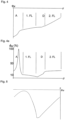
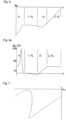
- the speed of the table rotation in the method proposed here is not constant, in contrast to the Gratomat ® method (see Fig. 4 and 6 ), but varies across the tooth gap.
- the direction of rotation of the milling cutter can be freely selected.
- coordinates are used here for generalized, not necessarily independent coordinates.
- the rotation axis of a gear always coincides with the z-axis in its rest system.
- This kinematic chain serves first of all to mathematically describe the invention described here.
- the calculation of the coordinates A 1 , ... , A N S can be done by means of a coordinate transformation.
- Fig. 1a and b show an embodiment of a working space of a gear cutting machine with a movement apparatus present there, the coordinate axes of which correspond to those used in the definition of the kinematic chain.
- Rotation axis B3 of the tool holder - ⁇ T angle of rotation of the tool.
- Second swivel axis A2 - ⁇ angle of attack of the milling cutter to the gear.
- first swivel axis A - ⁇ Axis crossing angle between the rotation axis of the milling cutter and the rotation axis of the gear (z-axis).
- Third linear axis Y or V - y T Amount of translation of the cutter from the center of the gear.
- First linear axis X - d Distance of the cutter from the center of the toothing.
- Second linear axis Z - z T Amount of translation of the milling cutter along the rotation axis of the workpiece.
- Rotation axis C2 of the workpiece holder - ⁇ W angle of rotation of the workpiece.
- the tool here the end mill
- a gap see Fig. 2
- the tool is fed into a gap (see Fig. 2 ) and generally moves along one or more of the axes given by the parameters ⁇ , ⁇ , y T , d, z T and ⁇ W .
- the rotation axis of the tool is inclined (generally skewed) to the rotation axis of the workpiece.
- curves on the bevel e.g. the beginning and the end of the bevel, can be specified as general smooth Jordan curves.
- the curves generally do not have to lie in a frontal cutting plane (see Fig. 11 for a possible defined beginning of a chamfer).
- workpieces that do not have a flat front side can also be accepted.
- Possible workpieces can be Fig. 12 can be considered.
- the forms of the front face shown in the top row can be chamfered using both the Gratomat ® method and the method presented here.
- the tooth flanks are shown with front faces that are beveled or stepped from the pitch circle as an example.
- the Gratomat ® method cannot machine such workpieces, whereas the method presented here can chamfer this workpiece.
- the Jordan curve is selected accordingly for this purpose.
- the start of the chamfer so that a chamfer of the same height is created over the entire flank width.
- a curve could be chosen as a shift of the non-flat front side downwards by a defined amount.
- the width of the chamfer can also be selected so that after chamfering, a width that changes across the tooth gap is obtained, but which is designed with regard to the removal in subsequent processes so that the finished workpiece has a chamfer of the same height across the entire tooth gap.
- the relations are structured as follows: three equations for the point equality and one equation for the tangential contact. This means that four free variables are required to solve the system of equations consisting of the four equations. For the first contact, these are the two variables that parameterize the surface of the milling cutter, the angle of rotation of the tool ⁇ W , and another parameter, e.g. the cutter height z T . These relations can be formulated and solved for a discrete number of points on the curve, for example. This gives the required parameters as a function of the position of the point on the chamfer.
- the chamfer can now be specified very freely.
- the chamfer angle can be specified along the gap contour.
- the milling cutter can be used universally, as the chamfer shape is generated by the machining kinematics.
- the chamfer shape is essentially only limited by the diameter of the milling cutter, as if this is chosen to be too large in comparison to the gearing, collisions will occur, particularly in the tooth root, which must be avoided.
- a smooth Jordan curve can be specified and the chamfer can be defined implicitly by choosing the parameters ⁇ , ⁇ , y T and optionally the displacement z T or the distance d.
- This curve also does not have to lie in a frontal plane. A possible example is in Fig. 11 to see.
- the chamfer can be symmetrical (see Fig. 8 ) or asymmetrical (see Fig. 10 ) can be selected.
- the implicitly defined chamfer can be determined using a material removal simulation from the previously determined kinematics and the tool.
- this material removal simulation the geometry of the milling cutter and the path of movement of the milling cutter relative to the gearing are taken into account and the final contour of the gearing and thus also of the chamfer is determined based on the unmachined geometry.
- Such material removal simulations are known for various machining processes.
- the invention also provides that the control of the device has a function for entering a parameter of the desired bevel shape.
- This parameter of the bevel shape can be, for example, a bevel width and/or a bevel depth and/or a bevel angle and/or a symmetry property.
- the control system comprises a function for determining the chamfer shape from one or more parameters of the gap contour of the gearing that is to be chamfered.
- these would include the profile angle(s), the helix angle, the tooth thickness and the shape of the tooth root and, if applicable, the shape of a tip edge break.
- it can be one or more parameters that are already available in the control system from the submission of the gearing process with which the gearing is to be chamfered. is generated, or which can be entered via a function for setting up the gear cutting process.
- the chamfer shape is determined based on the entered chamfer shape parameter and one or more gap contour parameters.
- This variant of the invention is characterized by the fact that only a few parameters need to be entered in addition to those already entered in the control system to define the gearing, which simplifies work preparation. A connection to an external computer system and data transfer from an external computer system are also not necessary.
- An extended form of the invention provides that the chamfer width and/or the chamfer depth and/or the chamfer angle can be specifically changed via the profile of the gearing and the control preferably provides a corresponding input function. For example, it can be entered that the chamfer angle in the area of the head of the gearing is larger than in the area of the root of the gearing.
- the most general form of defining the chamfer is that it is transferred digitally to the control system, for example via a 2D or 3D data format.
- control system can determine the kinematics that best approximates the bevel or even produces it exactly, at least in theory. How good the approximation is will depend on the variant of the invention used.
- the invention provides a control which determines the parameters ⁇ , ⁇ , y T in such a way that the bevel is approximated as closely as possible. This determination is preferably carried out via a compensation calculation which determines the parameters in such a way that a distance function which measures the distance of the achievable bevel from the desired bevel is minimized.
- a simple distance function here would be a sum of the distance squares from a discrete number of points of the achieved contour 82 to the desired curve.
- the parameters essentially have the following effect on the chamfer shape: ⁇ increases or decreases the chamfer angle along the tooth contour, ⁇ and y T each increase the chamfer angle on one flank and decreases it on the other and cause a change in the chamfer angle from tip to toe, ⁇ W increases the chamfer width on one flank and decreases it on the other.
- ⁇ increases or decreases the chamfer angle along the tooth contour
- ⁇ and y T each increase the chamfer angle on one flank and decreases it on the other and cause a change in the chamfer angle from tip to toe
- ⁇ W increases the chamfer width on one flank and decreases it on the other.
- the control preferably has a display function which graphically represents the desired bevel shape and the theoretically achievable bevel shape in order to enable a visual comparison of the two bevel shapes, and/or a display function for representing the deviation between the desired bevel shape and the theoretically achievable bevel shape.
- the milling cutter is moved along the curve that parameterizes the profile line at a constant feed rate.
- the distance that results from the traveled curve is referred to here as the milling progress ⁇ .
- the rotational speed and the rotational acceleration are greatest in the area of the tooth tips. Furthermore, the two flanks are machined at a different rotational speed. In the area of the tooth root, a corresponding change in the rotational speed is made from one flank to the other, so that a greater rotational acceleration is achieved here than on the flanks.
- the rotational speed can also vary within one or both flanks.
- Another special case of the general case would be to specify a smooth Jordan curve on the chamfer (e.g. the start of the chamfer) as in the first special case, but this time the parameters z T , ⁇ , ⁇ and y T are fixed and only the kinematics are calculated, which is how d must be moved to produce the chamfer.
- the advantage of this method is that chamfers can also be made in places that only allow little space in the z direction. This method is also preferably used for these problematic conditions because, in contrast to the first special case, the milling cutter would only be loaded in one area.
- Another special case is the combination of the two previous special cases. Neither z T nor d is fixed.
- a smooth Jordan curve is specified on the chamfer (e.g. the start of the chamfer)
- the parameters ⁇ , ⁇ and y T are fixed, but now five instead of just four variables must be used to solve the system of equations. This means that an underdetermined system of equations must be solved. It is therefore necessary here to specify an additional condition (this could be an exact position of the contact point on the milling cutter) or to carry out a compensation calculation, whereby the milling cutter load can be distributed over the entire milling cutter. Since this uses a larger area of the milling cutter, this leads to a longer milling cutter service life.
- the displacement d can be determined so that the cutter only protrudes a fixed amount beyond the root circle radius.
- the displacement z T can be selected so that there is no collision with the collar in the critical area, but in the non-critical area the wear is distributed as far as possible over the entire cutter length. For this reason, d is mainly used in the critical area, but d is left constant in the non-critical area and z T is used.
- Another special case is chamfering internal gears. In special cases, it is necessary to work across the table center. This may be necessary if the gear cannot be reached directly at one end.
- these collisions can also be prevented by using a ball milling cutter whose diameter is smaller than the diameter of the root rounding.
- a possible correction would be the desired displacement of a chamfer in the axial direction. This means that a desired correction affects the y T value.
- a desired correction affects the y T value.
- This principle can also be applied to the remaining parameters ⁇ , ⁇ , and d .
- the influences on the chamfer shape in particular the symmetry of the chamfer, the axial position of the chamfer, the chamfer angle and the course of the chamfer angle over the entire gap, can be determined for all of these parameters. If the influences are known, the parameters can be determined in such a way that the desired chamfer shape is achieved.
- the corrections described here may be necessary if, for example, the geometry of the end mill does not exactly match that assumed in the calculation. This can be caused, for example, by inaccurate measurement of the end mill and/or by wear.
- the corrections described here may be necessary alternatively or additionally if, for example, the relative position of the end mill to the gear does not exactly correspond to that assumed in the calculation. This can be caused, for example, by inaccurate measurement of the device and/or by non-compensated or insufficiently compensated heat transfer of the device and/or by imprecise centering of the end mill in the gear.
- the required corrections can be entered via the control system, transferred digitally to the machine or determined from a measurement of the chamfer achieved and a subsequent target-actual comparison.
- the measurement can take place either in the device or on an external measuring machine. Measuring in the machine offers the advantage that the process can be set up and corrections determined fully automatically if the measured values are transferred directly to the control system.
- the variant of the invention which does not provide for the movement of all available axes during chamfering has the advantage, compared to a variant in which all axes are moved, that not all axes have to be designed as NC axes or at least do not have to be suitable for being moved during chamfering. This allows a device to be designed more cost-effectively.
- Fig. 1a and 1b show a possible embodiment of a device according to the invention for chamfering a toothed workpiece 5.
- the device has a workpiece spindle 1 with a workpiece holder 2 that is rotatably mounted about a rotation axis C2 for receiving the workpiece 5.
- the device also has a tool spindle 3 with a tool holder 4 that is rotatably mounted on a rotation axis B3 for receiving a finger milling cutter 6.
- the workpiece spindle 1 is arranged on a machine bed 7, which is connected to a machine stand or machine frame 8, on which a machining head 9 is arranged, which carries the tool spindle 3.
- the machining head 9 and/or the tool spindle 3 arranged on the machining head 9 can be moved relative to the workpiece spindle 1 over several machine axes.
- the axis configuration in the example is selected as follows:
- the machining head can be moved via a first linear axis X in a direction perpendicular to the axis of rotation C2 of the workpiece holder 2. This allows the end mill to be moved towards the workpiece in a plane perpendicular to the axis of rotation of the workpiece spindle.
- the machining head can be moved via a second linear axis Z in a direction parallel to the rotation axis C2 of the workpiece holder 2. This allows the end mill to be moved in the axial direction relative to the workpiece 5.
- a first pivot axis A is also provided, which runs parallel to the first linear axis X and allows pivoting of the machining head 9.
- a third linear axis Y is provided, which allows the machining head to be moved in a direction perpendicular to the first linear axis X and the second linear axis Z.
- a third linear axis V could also be used, which is arranged between the machining head and the first pivot axis A and can therefore be pivoted via the first pivot axis A.
- the third linear axis Y or V allow the end mill 6 to be moved relative to a plane which runs through the rotation axis C2 of the workpiece holder parallel to the X-axis, and thus a lateral movement relative to the center of the workpiece 5.
- a second pivot axis A2 is provided, via which the tool spindle 3 is pivotably arranged on the machining head 9.
- the second pivot axis A2 runs perpendicular to the first pivot axis A and preferably intersects it.
- the second pivot axis A2 can be used to adjust the angle of attack of the end mill 6 relative to the gear teeth of the workpiece.
- the second swivel axis A2 allows the angle of the end mill 6 to be adjusted relative to the rotation axis C2 of the workpiece holder and thus the bevel angle for machining.
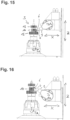
- the second swivel axis A2 also allows the end mill to be moved from a first swivel position, as shown in Fig. 15 shown, and which serves to machine a lower edge, into a second pivot position, as shown in Fig. 16 shown, and which serves to machine an upper edge.
- the end mill can also be pivoted into a neutral position, as shown in Fig. 13 and 14 shown, and in which the end mill has been pivoted away from the workpiece.
- the rotation axis D1 of the workpiece holder 2, the first linear axis X and the second linear axis Z are all NC axes.
- the third linear axis Y and V as well as the first swivel axis A are also NC axes.
- the rotary axis B3 of the tool holder 4 does not have to be designed as an NC axis, since it only serves the non-synchronized drive of the end mill 6.
- the second pivot axis A2 can be designed as an adjusting axis.
- the positions of the pivot axis A2 can be defined manually or via stops, for example.
- the second swivel axis A2 can also be designed as an NC axis. This allows the above-mentioned positions to be flexibly approached for machining different edges, the angle of attack of the milling cutter to be flexibly adjusted during chamfering, and the angle of attack to be varied across the tooth gap if necessary.
- Threading sensors 10 and 11 are also arranged on the processing head 9.
- the threading sensor 10 is used to measure external gears
- the threading sensor 11 the measurement of internal gears.
- a machining head will only have one of the two sensors.
- a non-contact sensor, in particular an inductive sensor, is preferably used as the threading sensor.
- Fig. 13 the measurement of a workpiece 5 with external gearing is shown using the threading sensor 10.
- the tool spindle 3 is pivoted into a neutral position via the second pivot axis A2.
- the threading sensor 10 is moved towards the gearing and the workpiece is rotated via the rotation axis C2.
- the threading sensor detects the position of the teeth or tooth grooves during the rotational movement. By detecting the position of the teeth or tooth grooves, the end mill can then be positioned in the correct position relative to the tooth gap during the subsequent chamfering machining.
- Fig. 14 shows the measurement of a workpiece 5' with internal gearing.
- the threading sensor has a sensor arm 12 for this purpose, which extends into the internal gearing.
- two sensor arms 12 and 12' are provided, aligned in opposite directions, in order to enable measurement of internal gearing from both above and below.
- the chamfering of the already in Fig. 1a, 1b and 13 The workpiece 5 shown with an external toothing by the device according to the invention is shown in Fig. 15 and 16 shown.
- the workpiece 5 has several gears 13, 14 and 15.
- the chamfering of the middle gear 14 is particularly problematic, since the two outer gears 13 and 15 form interference contours which must be taken into account during the chamfering.
- the end mill 6 is therefore positioned in such a way that it runs from the tool holder 4 through the tooth gap to the contact point with the edge of the gear to be machined. Therefore, only the tip of the end mill 6 protrudes over the respective front side of the gear to be machined. This also allows gears such as the internal gear 14 with interfering edges arranged very close to the respective front edge.
- Fig. 15 shows the chamfering of a lower edge of the middle gearing of the workpiece 5.
- the tool spindle with the end mill 6 was pivoted into a lower machining position via the second pivot axis A2.
- the angle of the chamfer is set via the pivot position of the tool spindle 3 using the second pivot axis A2.
- the first linear axis X is preferably used exclusively or almost exclusively to machine the lower edge in order to move the end mill along the tooth edge in a controlled manner, and a movement via the second linear axis Z is completely or largely dispensed with.
- This allows the entire tooth edge to be chamfered via a front area of the end mill 6, so that the end mill with its tip only protrudes slightly over the corresponding lower front edge of the middle gear 14.
- this procedure has the disadvantage that the entire length of the end mill is not used for gear machining, so that the wear is concentrated in the front area of the end mill.
- Fig. 16 shows the chamfering of an upper edge of the middle gear 14.
- the tool spindle with the end mill 6 was pivoted via the second pivot axis A2 into an upper machining position in which the end mill 6 rests on the upper edge.
- the chamfer angle can be adjusted via the second pivot axis A2.
- the end mill 6 Since there is more space available above the upper edge, the end mill 6 is moved exclusively or predominantly along the second linear axis Z along the tooth edge. This has the advantage that different axial areas of the lateral surface of the end mill are used for chamfering, so that the wear can be evenly distributed over the end mill.
- a travel movement along the X-axis can either be omitted completely, or both the first linear axis X and the second linear axis Z can be used to generate the travel movement.
- the first linear axis X is used predominantly for machining the tooth roots
- the second linear axis Z is used predominantly for machining the tooth flanks. This takes into account the fact that there is an additional interference contour in the area of the tooth roots due to the proximity to the shaft of the workpiece. When machining the tooth flanks, however, the distance to the shaft is greater, so that the second linear axis Z can be used predominantly here.
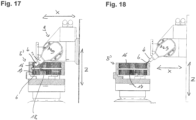
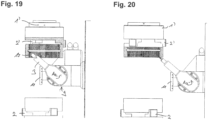
- Fig. 17 to 20 show the chamfering of a workpiece with internal gearing.
- the workpiece 5' has several gears 16 and 17.
- a collar 18 is provided between the upper internal gearing 16 and the lower internal gearing 17.
- the chamfering of the inner edges of the upper gearing 16 and the lower gearing 17 is particularly problematic due to the poor accessibility and the interference contours.
- Fig. 17 shows the chamfering of the lower edge of the upper internal gearing 16.
- the machining head 9 with the tool spindle 4 was moved into a position above the gearing by means of the first linear axis X.
- the end mill 6 therefore runs diagonally from above into the gearing and rests on the lower edge of the internal gearing 16.
- the end mill with the workpiece spindle 4 is in the lower machining position, which is reached via the second swivel axis A2.
- the second linear axis Z is used to move the end mill in the axial direction into the internal gearing.
- the movement of the end mill along the contour of the edge during chamfering preferably takes place mainly or exclusively via the first linear axis X.
- Fig. 18 shows the chamfering of an upper edge of the upper gearing 16.
- the end mill 6 runs from the tool holder 4 from the front side of the gearing into the gearing, so that the tip of the end mill is arranged within the gearing. Since no interfering contours need to be taken into account here, the end mill 6 can be moved exclusively or predominantly via the second linear axis Z along the contour of the tooth edge during the chamfering.
- Fig. 19 and 20 show the chamfering of the lower toothing 17 of the internally toothed workpiece 5'. Since at least the upper edge of the lower toothing 17 cannot be machined from the top of the toothing, a second workpiece spindle 1' with a corresponding second workpiece holder 2' is provided.
- the two workpiece spindles are arranged coaxially and can be moved towards each other in the axial direction so that a workpiece held in the first workpiece holder 2 can be gripped by gripping jaws of the second workpiece holder 2'.
- the first workpiece holder 2 then releases the workpiece so that it is now held in the second workpiece holder 2'.
- the second workpiece holder 2' is arranged or can be arranged in such a way that the machining head 9 with the tool spindle 3 can be moved under the workpiece 5'.
- At least one of the two workpiece holders can be moved axially in the direction of the rotation axis D1.
- the threading sensor 11 can be used for this in the same way as in Fig. 14 for the lower arm, except that now the threading sensor engages the gearing from below.
- the rotational speed of the workpiece 5 about the rotational axis C2 is varied during the chamfering machining.
- the rotation of the workpiece takes place at a speed that varies across the tooth gap.
- chamfering a tooth flank it is used at a lower rotational speed than when chamfering a tooth root and/or tooth tip. This allows the cutting volume per unit of time to be influenced and preferably kept as constant as possible.
- Such a variation of the rotational speed of the workpiece is independent of the guidance of the end mill via NC axes of the gear cutting machine along the contour of the edge, and could therefore also be used, for example, in a process that corresponds to the Gratomat process known from the state of the art, ie in which the end mill rests on the tooth edge under spring load.
- particular advantages arise from the variation of the rotation speed in combination with the controlled guidance of the end mill via the NC axes of the machine along the tooth edge, as this enables considerably higher processing speeds.
- the third linear axis Y or V is also used according to the invention in order to position the end mill 6 relative to the tooth gap.
- the machining head 9 is moved out of the center of the gearing of the workpiece via the Y or V axis.
- the rotation axis B3 of the tool spindle therefore no longer intersects the rotation axis C2 of the workpiece spindle.
- the machining head is arranged in such a way that the A axis no longer intersects the rotation axis D1 of the workpiece spindle, but runs past it at a distance.
- the rotation axis B3 of the tool spindle 3 preferably no longer intersects the first swivel axis A.
- the third linear axis Y or V for positioning the end mill 6 relative to the gearing makes it possible, particularly in the case of helical gears, to achieve a symmetrical chamfer on the left and right flank with fewer travel movements during chamfering.
- the third linear axis Y or V can be used exclusively for positioning the end mill in a fixed position for chamfering.
- the position along the third linear axis can also be varied during chamfering, and in particular across the tooth gap.
- the first swivel axis A and the second swivel axis A2 can also be used either only for one-time positioning of the end mill relative to the tooth edge or can be used for gear cutting to guide the end mill along the tooth edge. If necessary, one of the two swivel axes or even both swivel axes can be dispensed with.
- a finger milling cutter with a cylindrical or conical outer surface or envelope surface is preferably used as the end milling cutter.
- the cone angle is preferably less than 20°, in particular less than 10°.
- a cone is advantageous in order to be able to machine a tooth gap with the smaller diameter of the finger milling cutter, but to increase the stability of the finger milling cutter in the other areas due to the larger diameter.
- All of the described procedures are preferably made available by one or more processing functions of the control system of the device and are used automatically by the device for chamfering one and preferably for machining a large number of identical workpieces.
Landscapes
- Engineering & Computer Science (AREA)
- Mechanical Engineering (AREA)
- Gear Processing (AREA)
- Milling Processes (AREA)
Claims (15)
- Dispositif d'usinage par chanfreinage d'une pièce dentée (5), comportantune broche porte-pièce (1) dotée d'une fixation de pièce (2) montée rotative autour d'un axe de rotation (C2) pour recevoir la pièce,une broche porte-outil (3) dotée d'un logement d'outil (4) monté rotatif autour d'un axe de rotation (B3) pour recevoir une fraise à queue (6), la broche porte-outil pouvant être déplacée par rapport à la fixation de pièce sur au moins un axe linéaire (X) du dispositif, etune commande dotée d'une fonction d'usinage qui tourne la pièce reçue dans la fixation de pièce pour l'usinage par chanfreinage d'une pièce dentée en commandant la broche porte-pièce pendant qu'une fraise à queue reçue dans le logement d'outil attaque l'arête à usiner,caractérisé en ce quela fonction d'usinage varie la vitesse de rotation de la pièce (5) pendant l'usinage par chanfreinage de telle manière qu'un flanc de dent gauche (1.FL) est usiné avec une autre vitesse de rotation et/ou accélération de rotation qu'un flanc de dent droit (2.FL) et/ou est usiné avec un profil de vitesse de rotation de la pièce qui n'est pas symétrique au profil de vitesse de rotation utilisé sur le flanc de dent droit.
- Dispositif selon la revendication 1, dans lequel la fonction d'usinage varie la vitesse de rotation sur un entredent, la fonction d'usinage utilisant de préférence le même profil de vitesse de la vitesse de rotation pour chaque entredent, la fonction d'usinage variant la vitesse de rotation sur un entredent de préférence de telle manière que le volume de coupe de la fraise à queue par unité de temps et/ou la vitesse relative entre l'arête et la fraise à queue ne fluctuent pas de plus de 30 % de la valeur maximale sur l'entredent et/ou la fonction d'usinage variant la vitesse de rotation sur un entredent de telle manière que, dans la zone du pied de la dent, le travail se fait avec une accélération de rotation de la pièce plus élevée que sur au moins un et de préférence les deux flancs de dent.
- Dispositif selon la revendication 1 ou 2, dans lequel la fonction d'usinage modifie le sens de rotation de la pièce lors de la traversée d'un entredent.
- Dispositif selon l'une des revendications précédentes, dans lequel la fonction d'usinage pour l'usinage par chanfreinage d'une pièce dentée reçue dans la fixation de pièce déplace la broche porte-outil par rapport à la broche porte-pièce sur l'au moins un axe linéaire de telle manière qu'une fraise à queue reçue dans le logement d'outil est guidée de manière commandée le long du contour d'une arête à usiner de la pièce pendant que la pièce est tournée autour de son axe de rotation.
- Dispositif selon l'une des revendications précédentes, dans lequel la broche porte-outil peut être déplacée sur un premier axe linéaire X dans une direction perpendiculaire à l'axe de rotation de la fixation de pièce et/ou sur un deuxième axe linéaire Z parallèle à l'axe de rotation de la fixation de pièce, la fonction d'usinage commandant de préférence la broche porte-outil sur le premier axe linéaire X et/ou le deuxième axe linéaire Z de telle manière qu'une fraise à queue reçue dans le logement d'outil est guidée de manière commandée le long du contour d'une arête à usiner de la pièce pendant que la pièce est tournée autour de son axe de rotation, la fraise à queue étant de préférence guidée, au moins sur une partie de l'entredent, de manière commandée le long du contour par un forçage d'un mouvement du premier axe linéaire X et du deuxième axe linéaire Z et/ou la fraise à queue étant de préférence guidée, lors de la traversée d'un entredent, de manière commandée le long du contour aussi bien par un mouvement du premier axe linéaire X que du deuxième axe linéaire Z.
- Dispositif selon l'une des revendications précédentes, dans lequel la broche porte-outil peut être déplacée sur un premier axe linéaire X dans une direction perpendiculaire à l'axe de rotation de la fixation de pièce et sur un deuxième axe linéaire Z parallèle à l'axe de rotation de la fixation de pièce, la fonction d'usinage commandant la broche porte-outil sur le premier axe linéaire X et/ou le deuxième axe linéaire Z de telle manière qu'une fraise à queue reçue dans le logement d'outil est guidée de manière commandée le long du contour d'une arête à usiner de la pièce, la fonction d'usinage commandant la broche porte-outil sur le premier axe linéaire X et/ou le deuxième axe linéaire Z de telle manière que différentes zones axiales de la surface latérale d'une fraise à queue reçue dans le logement d'outil viennent en prise avec l'arête à usiner de la pièce et/ou le logement d'outil étant guidé, au moins sur certaines zones d'un entredent, de manière commandée le long du contour de l'arête à usiner, uniquement sur le deuxième axe linéaire Z ou uniquement sur le premier axe linéaire X et pas sur l'autre axe linéaire respectif.
- Dispositif selon l'une des revendications précédentes, dans lequel la fonction d'usinage est conçue pour l'utilisation d'une fraise à queue dotée d'une surface latérale cylindrique ou d'une surface latérale conique avec un angle de cône inférieur à 20°, de préférence inférieur à 10°, et/ou dans lequel la fonction d'usinage travaille avec une orientation du logement d'outil avec laquelle une fraise à queue reçue dans le logement d'outil s'étend à partir du logement d'outil à travers l'entredent jusqu'à l'arête de la denture qu'elle usine.
- Dispositif selon l'une des revendications précédentes, dans lequel la broche porte-outil peut être déplacée par rapport à la fixation de pièce sur un premier axe linéaire X dans une direction perpendiculaire à l'axe de rotation de la fixation de pièce et/ou sur un deuxième axe linéaire Z parallèle à l'axe de rotation de la fixation de pièce, la fonction d'usinage déplaçant, pour l'usinage par chanfreinage d'une pièce dentée reçue dans la fixation de pièce, la broche porte-outil par rapport à la broche porte-pièce sur le premier axe linéaire X et/ou le deuxième axe linéaire Z de telle manière qu'une fraise à queue reçue dans le logement d'outil est guidée de manière commandée le long du contour d'une arête à usiner de la pièce pendant que la pièce est tournée autour de son axe de rotation, la fonction d'usinage étant de préférence conçue pour l'utilisation d'une fraise à queue dotée d'une surface latérale cylindrique ou d'une surface latérale conique avec un angle de cône inférieur à 20°, de préférence inférieur à 10°,
dans lequel la fonction d'usinage commande la broche porte-outil sur le premier axe linéaire X et/ou le deuxième axe linéaire Z de telle manière que différentes zones axiales de la surface latérale d'une fraise à queue reçue dans le logement d'outil viennent en prise avec l'arête à usiner de la pièce, et/ou que la fonction d'usinage travaille avec une orientation du logement d'outil avec laquelle une fraise à queue reçue dans le logement d'outil s'étend à partir du logement d'outil à travers l'entredent jusqu'à l'arête de la denture qu'elle usine. - Dispositif selon l'une des revendications précédentes, dans lequel la broche porte-outil n'est pas pivotée lors de la traversée d'un entredent, et/ou dans lequel la broche porte-outil peut être pivotée autour d'un premier axe de pivotement A et/ou A2, la fonction d'usinage pivotant de préférence la broche porte-outil sur le premier axe de pivotement A et/ou A2 lors de la traversée d'un entredent pour diminuer des variations d'un angle du chanfrein, mesuré dans un plan coupant perpendiculairement le flanc de dent, sur l'entredent, et/ou dans lequel le premier axe de pivotement A s'étend de préférence perpendiculairement à l'axe de rotation de la fixation de pièce et/ou parallèlement au premier axe linéaire X.
- Dispositif selon l'une des revendications précédentes, dans lequel la broche porte-outil peut être déplacée par rapport à la fixation de pièce sur un premier axe linéaire X dans une direction perpendiculaire à l'axe de rotation de la fixation de pièce et sur un deuxième axe linéaire Z parallèlement à l'axe de rotation de la fixation de pièce, etdans lequel la fonction d'usinage déplace, pour l'usinage par chanfreinage d'une pièce dentée reçue dans la fixation de pièce, la broche porte-outil par rapport à la broche porte-pièce sur le premier axe linéaire X et/ou le deuxième axe linéaire Z de telle manière qu'une fraise à queue reçue dans le logement d'outil est guidée de manière commandée le long du contour d'une arête à usiner de la pièce pendant que la pièce est tournée autour de son axe de rotation,dans lequel la broche porte-outil peut être déplacée sur un troisième axe linéaire Y ou V qui s'étend dans un plan qui est perpendiculaire au premier axe linéaire X, la broche porte-outil étant de préférence agencée pour l'usinage par chanfreinage sur le troisième axe linéaire Y ou V de telle manière que l'axe de rotation du logement d'outil ne coupe pas l'axe de rotation de la fixation de pièce et s'étend de préférence de manière inclinée par rapport à celui-ci.
- Dispositif selon l'une des revendications précédentes, dans lequel la broche porte-outil peut être pivotée sur un deuxième axe de pivotement A2 qui est orienté perpendiculairement à son axe de rotation et s'étend dans un plan qui est perpendiculaire au premier axe linéaire X, le deuxième axe de pivotement A2 étant de préférence un axe de positionnement ou un axe CN et/ou dans lequel la broche porte-outil peut être pivotée, sur le deuxième axe de pivotement A2, d'une première position d'usinage pour l'usinage d'une arête inférieure de la pièce à une deuxième position d'usinage pour l'usinage d'une arête supérieure, et/ou dans lequel le deuxième axe de pivotement A2 permet un pivotement de l'axe de rotation du logement d'outil dans un plan dans lequel s'étend le premier axe de pivotement A.
- Dispositif selon l'une des revendications précédentes, dans lequel la commande comprend une fonction pour la saisie d'un paramètre de la forme de chanfrein souhaitée et/ou une fonction pour la détermination de la forme de chanfrein à partir d'un ou de plusieurs paramètres du contour de l'entredent de la denture qui doit être chanfreinée, le ou les plusieurs paramètres du contour de l'entredent de la denture étant un ou plusieurs paramètres qui peuvent être saisis par le biais d'une fonction pour le réglage du processus de taille des engrenages avec lequel la denture est générée, la forme de chanfrein étant de préférence déterminée à l'aide du paramètre saisi de la forme de chanfrein et du ou des plusieurs paramètres du contour de l'entredent.
- Dispositif selon l'une des revendications précédentes, dans lequel la commande comprend une fonction de saisie par le biais de laquelle une forme de chanfrein souhaitée peut être prédéfinie, en particulier une forme de chanfrein souhaitée pour laquelle la largeur de chanfrein et/ou la profondeur de chanfrein et/ou l'angle de chanfrein varient sur l'entredent, la commande comprenant en outre une fonction de calcul par le biais de laquelle une forme de chanfrein réalisable est déterminée sur la base de la forme de chanfrein souhaitée, la commande comprenant de préférence une fonction d'affichage qui représente graphiquement la forme de chanfrein souhaitée ainsi que la forme de chanfrein réalisable pour permettre ainsi une comparaison optique des deux formes de chanfrein, et/ou une fonction d'affichage pour la représentation de la divergence entre la forme de chanfrein souhaitée et la forme de chanfrein réalisable.
- Procédé d'usinage par chanfreinage d'une arête d'une pièce dentée au moyen d'un dispositif selon l'une des revendications précédentes, dans lequel, pour l'usinage par chanfreinage d'une pièce dentée reçue dans la fixation de pièce, la broche porte-outil est de préférence déplacée par rapport à la broche porte-pièce sur l'au moins un axe linéaire de telle manière qu'une fraise à queue reçue dans le logement d'outil est guidée de manière commandée le long du contour d'une arête à usiner de la pièce pendant que la pièce est tournée autour de son axe de rotation.
- Procédé selon la revendication 14, dans lequel, dans une première étape d'usinage, un chanfrein est généré, le premier chanfrein étant mesuré et des valeurs de correction, lesquelles sont prises en compte dans une deuxième étape d'usinage, étant déterminées à partir de cette mesure, la première étape d'usinage étant de préférence effectuée sur une première pièce et la deuxième étape d'usinage sur une deuxième pièce ou la première étape d'usinage et la deuxième étape d'usinage étant de préférence effectuées sur la même pièce, le premier chanfrein ne présentant pas encore la profondeur souhaitée et étant ensuite chanfreiné sur toute sa profondeur dans la deuxième étape d'usinage.
Priority Applications (1)
| Application Number | Priority Date | Filing Date | Title |
|---|---|---|---|
| EP25151995.5A EP4545231A3 (fr) | 2018-04-11 | 2019-03-22 | Dispositif de chanfreinage d'une pièce |
Applications Claiming Priority (1)
| Application Number | Priority Date | Filing Date | Title |
|---|---|---|---|
| DE102018108632.6A DE102018108632A1 (de) | 2018-04-11 | 2018-04-11 | Vorrichtung zur Anfasbearbeitung eines Werkstücks |
Related Child Applications (2)
| Application Number | Title | Priority Date | Filing Date |
|---|---|---|---|
| EP25151995.5A Division EP4545231A3 (fr) | 2018-04-11 | 2019-03-22 | Dispositif de chanfreinage d'une pièce |
| EP25151995.5A Division-Into EP4545231A3 (fr) | 2018-04-11 | 2019-03-22 | Dispositif de chanfreinage d'une pièce |
Publications (2)
| Publication Number | Publication Date |
|---|---|
| EP3552744A1 EP3552744A1 (fr) | 2019-10-16 |
| EP3552744B1 true EP3552744B1 (fr) | 2025-02-19 |
Family
ID=65904315
Family Applications (2)
| Application Number | Title | Priority Date | Filing Date |
|---|---|---|---|
| EP25151995.5A Pending EP4545231A3 (fr) | 2018-04-11 | 2019-03-22 | Dispositif de chanfreinage d'une pièce |
| EP19164586.0A Active EP3552744B1 (fr) | 2018-04-11 | 2019-03-22 | Dispositif et procédé de traitement par chanfreinage d'une pièce à usiner |
Family Applications Before (1)
| Application Number | Title | Priority Date | Filing Date |
|---|---|---|---|
| EP25151995.5A Pending EP4545231A3 (fr) | 2018-04-11 | 2019-03-22 | Dispositif de chanfreinage d'une pièce |
Country Status (8)
| Country | Link |
|---|---|
| US (1) | US11980957B2 (fr) |
| EP (2) | EP4545231A3 (fr) |
| JP (1) | JP7058240B2 (fr) |
| CN (1) | CN110355426B (fr) |
| DE (1) | DE102018108632A1 (fr) |
| FI (1) | FI3552744T3 (fr) |
| HU (1) | HUE071458T2 (fr) |
| PL (1) | PL3552744T3 (fr) |
Families Citing this family (15)
| Publication number | Priority date | Publication date | Assignee | Title |
|---|---|---|---|---|
| DE102017112416A1 (de) * | 2017-06-06 | 2018-12-06 | Liebherr-Verzahntechnik Gmbh | Vorrichtung und Verfahren zum Anfasen eines innenverzahnten Werkstücks |
| DE102017112450A1 (de) | 2017-06-06 | 2018-12-06 | Liebherr-Verzahntechnik Gmbh | Vorrichtung und Verfahren zum Anfasen eines innenverzahnten Werkstücks |
| DE102020001428A1 (de) | 2020-03-05 | 2021-09-09 | Gleason-Pfauter Maschinenfabrik Gmbh | Verfahren zur Zahnkantenbearbeitung |
| CN112332611B (zh) * | 2020-09-30 | 2022-05-03 | 株洲壹星科技股份有限公司 | 一种电动机槽楔定位及切割方法 |
| DE102021105099A1 (de) * | 2021-03-03 | 2022-09-08 | Maher Sabbagh | Zahnradbearbeitungsmaschine und Verfahren zum Herstellen eines Zahnrades |
| DE102021002704A1 (de) | 2021-05-25 | 2021-07-29 | Gleason-Pfauter Maschinenfabrik Gmbh | Verfahren zur verzahnungsbearbeitung, insbesondere zur zahnkantenbearbeitung |
| CN113305369B (zh) * | 2021-05-28 | 2022-10-21 | 湖南中大创远数控装备有限公司 | 螺旋锥齿轮机床及螺旋锥齿轮倒棱方法 |
| CN114019908B (zh) * | 2021-10-27 | 2024-04-12 | 南京工业大学 | 一种螺旋锥齿轮齿廓弧面倒棱控制方法 |
| CN114850586A (zh) * | 2022-06-13 | 2022-08-05 | 南京工大数控科技有限公司 | 一种定倾角主轴极坐标倒角方法 |
| JP2024011835A (ja) * | 2022-07-15 | 2024-01-25 | 株式会社不二越 | 複合加工機 |
| DE102022004131A1 (de) | 2022-11-07 | 2024-05-08 | Gleason-Pfauter Maschinenfabrik Gmbh | Verfahren zur verzahnungsbearbeitung mit darauffolgendem anfasen |
| DE102023210085B3 (de) * | 2023-10-13 | 2025-01-23 | Renk Gmbh | Verfahren und System zum Erstellen einer Zahnfußkontur |
| DE102023135391A1 (de) * | 2023-12-15 | 2025-06-18 | Liebherr-Verzahntechnik Gmbh | Vorrichtung zur Anfasbearbeitung |
| DE102024104116A1 (de) * | 2024-02-14 | 2025-08-14 | Gleason-Pfauter Maschinenfabrik Gmbh | Verfahren zum Anfasen einer Zahnkante einer Werkstückverzahnung |
| CN119525580B (zh) * | 2024-10-22 | 2025-10-03 | 中国航发南方工业有限公司 | 一种用于外花键齿顶型面的倒圆加工方法 |
Citations (1)
| Publication number | Priority date | Publication date | Assignee | Title |
|---|---|---|---|---|
| DE102013015240A1 (de) * | 2013-03-28 | 2014-10-02 | Liebherr-Verzahntechnik Gmbh | Vorrichtung und Verfahren zum Anfasen eines Werkstücks |
Family Cites Families (30)
| Publication number | Priority date | Publication date | Assignee | Title |
|---|---|---|---|---|
| US1219481A (en) * | 1915-05-24 | 1917-03-20 | Lars August Peterson | Method of chamfering the teeth of gears. |
| CH530845A (de) * | 1970-11-03 | 1972-11-30 | Oerlikon Buehrle Ag | Vorrichtung zum Läppen von zwei Zahnrädern |
| FR2292550A1 (fr) * | 1974-11-28 | 1976-06-25 | Peugeot & Renault | Dispositif d'ebavurage et de chanfreinage de dentures de roues d'engrenage |
| DE3000295A1 (de) * | 1980-01-05 | 1981-07-09 | Präwema Präzisionswerkzeugmaschinenfabrik KG Maschinenkontor GmbH & Co, 3440 Eschwege | Fraesmaschine zum bearbeiten von zahnkanten |
| SU952483A1 (ru) * | 1981-01-04 | 1982-08-23 | Всесоюзный Научно-Исследовательский Инструментальный Институт | Способ бочкообразного закруглени торцев зубьев пр мозубых зубчатых колес,переключаемых осевым перемещением |
| JPS61152320A (ja) * | 1985-06-06 | 1986-07-11 | Howa Mach Ltd | 数値制御歯車面取盤 |
| JPS6234721A (ja) * | 1985-08-08 | 1987-02-14 | Howa Mach Ltd | 数値制御歯車面取盤 |
| KR870002069B1 (ko) * | 1985-08-27 | 1987-12-03 | 금성전선 주식회사 | 기어 이빨자동 모떼기 장치(Gear Tooth Chamfering Machine) |
| SU1395434A1 (ru) * | 1986-10-17 | 1988-05-15 | Витебское Специальное Конструкторское Бюро Зубообрабатывающих,Шлифовальных И Заточных Станков | Способ образовани фаски по торцу зуба зубчатого колеса |
| SU1634404A1 (ru) * | 1987-12-11 | 1991-03-15 | Новополоцкий Политехнический Институт Им.Ленинского Комсомола Белоруссии | Способ зубозакруглени колес и станок дл его осуществлени |
| DE4134925C1 (en) * | 1991-10-23 | 1992-11-05 | Praewema Werkzeugmaschinenfabrik Gmbh, 3440 Eschwege, De | Gear wheel machining fixture - has two cutter spindles with cutter head moving at angles |
| DE19701267A1 (de) | 1997-01-16 | 1998-07-23 | Werner Hermann Wera Werke | Werkzeugmaschine zum Abdachen der Stirnseiten der Zähne von Zahnrädern oder dergleichen |
| US7377731B1 (en) * | 2002-12-05 | 2008-05-27 | Arvin Joseph L | Chamfering cutting tool or grinding wheel and method of making and use thereof |
| DE202007016740U1 (de) * | 2006-12-02 | 2008-03-13 | Maschinenfabrik Rausch Gmbh & Co. Kg | Vorrichtung zum Entgraten eines Werkstücks |
| DE102009020771C9 (de) | 2009-05-06 | 2018-11-08 | Kadia Produktion Gmbh + Co. | Bearbeitungsvorrichtung und Bearbeitungsverfahren zur spanabtragenden Bearbeitung komplex gekrümmter Werkstückkanten an Werkstücken |
| JP5988872B2 (ja) * | 2009-09-25 | 2016-09-07 | ザ グリーソン ワークス | 歯車の面取りおよび(または)バリ取りをする装置 |
| DE202009015537U1 (de) * | 2009-11-17 | 2010-02-04 | Maschinenfabrik Rausch Gmbh & Co. Kg | Werkzeug |
| DE102011050498B4 (de) * | 2011-05-19 | 2024-02-15 | Profilator Gmbh & Co. Kg | Werkzeugmaschine zur Stirnkantenabdachung von Zahnrädern |
| DE102012018358A1 (de) * | 2012-08-20 | 2014-02-20 | Liebherr-Verzahntechnik Gmbh | Werkzeuganordnung |
| DE202012008601U1 (de) | 2012-09-10 | 2012-12-12 | Klingelnberg Gmbh | Werkzeugmaschine mit Anfas- und/oder Entgratvorrichtung |
| DE102013003804B4 (de) * | 2013-03-05 | 2015-02-26 | Emag Holding Gmbh | Verfahren und Vorrichtung zum Entgraten und Anfasen verzahnter Werkstücke |
| DE202013009805U1 (de) * | 2013-03-28 | 2014-01-10 | Liebherr-Verzahntechnik Gmbh | Vorrichtung zum Anfasen eines Werkstücks |
| DE102014008475B4 (de) * | 2014-06-05 | 2023-02-23 | Gleason-Pfauter Maschinenfabrik Gmbh | Verfahren zum Bearbeiten eines Werkstücks, Werkzeuganordnung und Verzahnungsmaschine |
| DE102014218082B4 (de) * | 2014-09-10 | 2016-11-10 | Felsomat Gmbh & Co. Kg | Vorrichtung zur Wälzschälbearbeitung eines Werkstücks zur Fertigung einer Fase und zugehöriges Betriebsverfahren |
| DE102014014132A1 (de) * | 2014-09-30 | 2016-05-25 | Liebherr-Verzahntechnik Gmbh | Verfahren und Vorrichtung zum Anfasen und Entgraten verzahnter Werkstücke |
| DE102015104242A1 (de) * | 2015-03-20 | 2016-09-22 | Profilator Gmbh & Co. Kg | Verzahnungsverfahren mit Zahnnachbearbeitung |
| DE102015012603A1 (de) * | 2015-09-28 | 2017-03-30 | Liebherr-Verzahntechnik Gmbh | Verfahren zum Entgraten eines Zahnradrohlings |
| CN105665839A (zh) * | 2016-03-11 | 2016-06-15 | 天津精诚机床股份有限公司 | 一种立式螺旋锥齿轮倒棱机 |
| CN105834528A (zh) * | 2016-04-27 | 2016-08-10 | 太仓宝达齿条有限公司 | 一种齿轮倒角设备 |
| JP6794868B2 (ja) * | 2017-02-20 | 2020-12-02 | アイシン精機株式会社 | 複合歯切加工装置 |
-
2018
- 2018-04-11 DE DE102018108632.6A patent/DE102018108632A1/de active Pending
-
2019
- 2019-03-15 JP JP2019048256A patent/JP7058240B2/ja active Active
- 2019-03-22 EP EP25151995.5A patent/EP4545231A3/fr active Pending
- 2019-03-22 EP EP19164586.0A patent/EP3552744B1/fr active Active
- 2019-03-22 FI FIEP19164586.0T patent/FI3552744T3/fi active
- 2019-03-22 HU HUE19164586A patent/HUE071458T2/hu unknown
- 2019-03-22 PL PL19164586.0T patent/PL3552744T3/pl unknown
- 2019-04-10 US US16/380,617 patent/US11980957B2/en active Active
- 2019-04-11 CN CN201910289326.3A patent/CN110355426B/zh active Active
Patent Citations (1)
| Publication number | Priority date | Publication date | Assignee | Title |
|---|---|---|---|---|
| DE102013015240A1 (de) * | 2013-03-28 | 2014-10-02 | Liebherr-Verzahntechnik Gmbh | Vorrichtung und Verfahren zum Anfasen eines Werkstücks |
Also Published As
| Publication number | Publication date |
|---|---|
| EP3552744A1 (fr) | 2019-10-16 |
| HUE071458T2 (hu) | 2025-08-28 |
| EP4545231A2 (fr) | 2025-04-30 |
| DE102018108632A1 (de) | 2019-10-17 |
| US20190314911A1 (en) | 2019-10-17 |
| JP2019206071A (ja) | 2019-12-05 |
| CN110355426B (zh) | 2024-06-18 |
| FI3552744T3 (fi) | 2025-03-24 |
| EP4545231A3 (fr) | 2025-08-13 |
| US11980957B2 (en) | 2024-05-14 |
| JP7058240B2 (ja) | 2022-04-21 |
| PL3552744T3 (pl) | 2025-07-07 |
| CN110355426A (zh) | 2019-10-22 |
Similar Documents
| Publication | Publication Date | Title |
|---|---|---|
| EP3552744B1 (fr) | Dispositif et procédé de traitement par chanfreinage d'une pièce à usiner | |
| EP3724598B1 (fr) | Procédé et dispositif de mesure d'un outil pour l'usinage par génération | |
| EP2385885B1 (fr) | Dispositif et procédé pour tailler des dents dans des pièces et jeu d'outils correspondant | |
| EP2221693B1 (fr) | Procédé et dispositif de production de données de commande destinées à commander un outil sur une machine-outil comportant au moins 5 axes | |
| EP3147060B1 (fr) | Procede d'ebavurage d'une ebauche d'engrenage et dispositif pour la mise en oeuvre d'un tel procédé | |
| EP3230001B1 (fr) | Procédé de traitement d'une denture, ensemble d'outil et machine à denture | |
| EP2314404B1 (fr) | Procédé de traitement précis et dur des flancs de dents d'une roue dentée | |
| EP3120960B1 (fr) | Procede de retraitement d'une roue conique dans la zone d'une tete de dent, machine de traitement de roues coniques | |
| EP2823924A2 (fr) | Machine à dresser double | |
| EP1319457B1 (fr) | Procédé d'usinage de roues dentées essentiellement cylindriques à denture intérieure ou extérieure | |
| EP1947538B1 (fr) | Procédé de commande d'un outil mobile, dispositif d'introduction tout comme machine de traitement | |
| DE112019002459T5 (de) | Verfahren zur Werkstückbearbeitung und Maschine zur Werkstückbearbeitung | |
| EP3139229A2 (fr) | Procede d'ajustement d'un outil | |
| EP3139226A2 (fr) | Procede d'ajustement d'un outil | |
| EP3584025A1 (fr) | Procédé de rectification topologique de denture par génération d'une pièce de roue dentée et machine de rectification dotée d'une commande de rectification topologique de denture par génération d'une pièce de roue dentée | |
| EP3139231A2 (fr) | Procede de fabrication d'une piece dentee comprenant une geometrie de surface modifiee | |
| EP3118699A2 (fr) | Procede de fabrication d'une piece dentee comprenant une geometrie de surface modifiee | |
| DE2307493B2 (de) | Steuereinrichtung an einer Zahnflankenschleifmaschine zum Herstellen von Zahnflanken mit Korrektur in Breiten- und Höhenrichtung | |
| DE102012201732B4 (de) | Numerisch gesteuerte Werkzeugmaschine und Verfahren zum Steuern eines automatischen rotatorischen Ausrichtvorgangs eines Zahnrads an der Werkzeugmaschine | |
| EP2420906B1 (fr) | Procédé et dispositif de production de données de commande pour la formation d'une dent d'une denture à renvoi à l'aide d'un traitement par fraisage d'une pièce usinée sur une machine-outil | |
| EP3139230A2 (fr) | Procede de fabrication d'une piece dentee comprenant une geometrie de surface modifiee | |
| DE3142843A1 (de) | Verfahren zum erzeugen balliger zahnflanken an einem verzahnten werkstueck, und dafuer geeignete maschine | |
| EP3139228A2 (fr) | Procede de fabrication d'une ou plusieurs pieces a usiner | |
| EP4246256A1 (fr) | Usinage de pièces à vitesse optimisée de rotation de broche en fonction d'un point de coupe | |
| EP4066974A1 (fr) | Procédé de création de différences de hauteur sur les flancs de dent d'une pièce à denture interne |
Legal Events
| Date | Code | Title | Description |
|---|---|---|---|
| PUAI | Public reference made under article 153(3) epc to a published international application that has entered the european phase |
Free format text: ORIGINAL CODE: 0009012 |
|
| STAA | Information on the status of an ep patent application or granted ep patent |
Free format text: STATUS: THE APPLICATION HAS BEEN PUBLISHED |
|
| AK | Designated contracting states |
Kind code of ref document: A1 Designated state(s): AL AT BE BG CH CY CZ DE DK EE ES FI FR GB GR HR HU IE IS IT LI LT LU LV MC MK MT NL NO PL PT RO RS SE SI SK SM TR |
|
| AX | Request for extension of the european patent |
Extension state: BA ME |
|
| STAA | Information on the status of an ep patent application or granted ep patent |
Free format text: STATUS: REQUEST FOR EXAMINATION WAS MADE |
|
| 17P | Request for examination filed |
Effective date: 20200415 |
|
| STAA | Information on the status of an ep patent application or granted ep patent |
Free format text: STATUS: EXAMINATION IS IN PROGRESS |
|
| 17Q | First examination report despatched |
Effective date: 20220419 |
|
| RIC1 | Information provided on ipc code assigned before grant |
Ipc: B23F 23/00 20060101ALI20240828BHEP Ipc: B23F 19/10 20060101AFI20240828BHEP |
|
| GRAP | Despatch of communication of intention to grant a patent |
Free format text: ORIGINAL CODE: EPIDOSNIGR1 |
|
| STAA | Information on the status of an ep patent application or granted ep patent |
Free format text: STATUS: GRANT OF PATENT IS INTENDED |
|
| INTG | Intention to grant announced |
Effective date: 20241011 |
|
| GRAS | Grant fee paid |
Free format text: ORIGINAL CODE: EPIDOSNIGR3 |
|
| GRAA | (expected) grant |
Free format text: ORIGINAL CODE: 0009210 |
|
| STAA | Information on the status of an ep patent application or granted ep patent |
Free format text: STATUS: THE PATENT HAS BEEN GRANTED |
|
| AK | Designated contracting states |
Kind code of ref document: B1 Designated state(s): AL AT BE BG CH CY CZ DE DK EE ES FI FR GB GR HR HU IE IS IT LI LT LU LV MC MK MT NL NO PL PT RO RS SE SI SK SM TR |
|
| P01 | Opt-out of the competence of the unified patent court (upc) registered |
Free format text: CASE NUMBER: APP_2338/2025 Effective date: 20250114 |
|
| REG | Reference to a national code |
Ref country code: GB Ref legal event code: FG4D Free format text: NOT ENGLISH |
|
| REG | Reference to a national code |
Ref country code: CH Ref legal event code: EP |
|
| REG | Reference to a national code |
Ref country code: IE Ref legal event code: FG4D Free format text: LANGUAGE OF EP DOCUMENT: GERMAN |
|
| REG | Reference to a national code |
Ref country code: DE Ref legal event code: R096 Ref document number: 502019012939 Country of ref document: DE |
|
| REG | Reference to a national code |
Ref country code: FI Ref legal event code: FGE |
|
| PGFP | Annual fee paid to national office [announced via postgrant information from national office to epo] |
Ref country code: DE Payment date: 20250331 Year of fee payment: 7 |
|
| PGFP | Annual fee paid to national office [announced via postgrant information from national office to epo] |
Ref country code: FI Payment date: 20250329 Year of fee payment: 7 |
|
| PGFP | Annual fee paid to national office [announced via postgrant information from national office to epo] |
Ref country code: AT Payment date: 20250321 Year of fee payment: 7 |
|
| PGFP | Annual fee paid to national office [announced via postgrant information from national office to epo] |
Ref country code: FR Payment date: 20250326 Year of fee payment: 7 Ref country code: CZ Payment date: 20250226 Year of fee payment: 7 |
|
| PGFP | Annual fee paid to national office [announced via postgrant information from national office to epo] |
Ref country code: GB Payment date: 20250322 Year of fee payment: 7 |
|
| REG | Reference to a national code |
Ref country code: NL Ref legal event code: MP Effective date: 20250219 |
|
| PG25 | Lapsed in a contracting state [announced via postgrant information from national office to epo] |
Ref country code: RS Free format text: LAPSE BECAUSE OF FAILURE TO SUBMIT A TRANSLATION OF THE DESCRIPTION OR TO PAY THE FEE WITHIN THE PRESCRIBED TIME-LIMIT Effective date: 20250519 |
|
| PGFP | Annual fee paid to national office [announced via postgrant information from national office to epo] |
Ref country code: PL Payment date: 20250225 Year of fee payment: 7 |
|
| PG25 | Lapsed in a contracting state [announced via postgrant information from national office to epo] |
Ref country code: ES Free format text: LAPSE BECAUSE OF FAILURE TO SUBMIT A TRANSLATION OF THE DESCRIPTION OR TO PAY THE FEE WITHIN THE PRESCRIBED TIME-LIMIT Effective date: 20250219 |
|
| REG | Reference to a national code |
Ref country code: LT Ref legal event code: MG9D |
|
| PG25 | Lapsed in a contracting state [announced via postgrant information from national office to epo] |
Ref country code: IS Free format text: LAPSE BECAUSE OF FAILURE TO SUBMIT A TRANSLATION OF THE DESCRIPTION OR TO PAY THE FEE WITHIN THE PRESCRIBED TIME-LIMIT Effective date: 20250619 Ref country code: NO Free format text: LAPSE BECAUSE OF FAILURE TO SUBMIT A TRANSLATION OF THE DESCRIPTION OR TO PAY THE FEE WITHIN THE PRESCRIBED TIME-LIMIT Effective date: 20250519 |
|
| PG25 | Lapsed in a contracting state [announced via postgrant information from national office to epo] |
Ref country code: NL Free format text: LAPSE BECAUSE OF FAILURE TO SUBMIT A TRANSLATION OF THE DESCRIPTION OR TO PAY THE FEE WITHIN THE PRESCRIBED TIME-LIMIT Effective date: 20250219 |
|
| PGFP | Annual fee paid to national office [announced via postgrant information from national office to epo] |
Ref country code: IT Payment date: 20250327 Year of fee payment: 7 |
|
| PG25 | Lapsed in a contracting state [announced via postgrant information from national office to epo] |
Ref country code: HR Free format text: LAPSE BECAUSE OF FAILURE TO SUBMIT A TRANSLATION OF THE DESCRIPTION OR TO PAY THE FEE WITHIN THE PRESCRIBED TIME-LIMIT Effective date: 20250219 |
|
| PG25 | Lapsed in a contracting state [announced via postgrant information from national office to epo] |
Ref country code: LV Free format text: LAPSE BECAUSE OF FAILURE TO SUBMIT A TRANSLATION OF THE DESCRIPTION OR TO PAY THE FEE WITHIN THE PRESCRIBED TIME-LIMIT Effective date: 20250219 Ref country code: PT Free format text: LAPSE BECAUSE OF FAILURE TO SUBMIT A TRANSLATION OF THE DESCRIPTION OR TO PAY THE FEE WITHIN THE PRESCRIBED TIME-LIMIT Effective date: 20250620 |
|
| PG25 | Lapsed in a contracting state [announced via postgrant information from national office to epo] |
Ref country code: GR Free format text: LAPSE BECAUSE OF FAILURE TO SUBMIT A TRANSLATION OF THE DESCRIPTION OR TO PAY THE FEE WITHIN THE PRESCRIBED TIME-LIMIT Effective date: 20250520 Ref country code: BG Free format text: LAPSE BECAUSE OF FAILURE TO SUBMIT A TRANSLATION OF THE DESCRIPTION OR TO PAY THE FEE WITHIN THE PRESCRIBED TIME-LIMIT Effective date: 20250219 |
|
| PGFP | Annual fee paid to national office [announced via postgrant information from national office to epo] |
Ref country code: CH Payment date: 20250401 Year of fee payment: 7 |
|
| PGFP | Annual fee paid to national office [announced via postgrant information from national office to epo] |
Ref country code: TR Payment date: 20250410 Year of fee payment: 7 |
|
| PGFP | Annual fee paid to national office [announced via postgrant information from national office to epo] |
Ref country code: HU Payment date: 20250312 Year of fee payment: 7 |
|
| REG | Reference to a national code |
Ref country code: HU Ref legal event code: AG4A Ref document number: E071458 Country of ref document: HU |
|
| PG25 | Lapsed in a contracting state [announced via postgrant information from national office to epo] |
Ref country code: SE Free format text: LAPSE BECAUSE OF FAILURE TO SUBMIT A TRANSLATION OF THE DESCRIPTION OR TO PAY THE FEE WITHIN THE PRESCRIBED TIME-LIMIT Effective date: 20250219 |
|
| PG25 | Lapsed in a contracting state [announced via postgrant information from national office to epo] |
Ref country code: SM Free format text: LAPSE BECAUSE OF FAILURE TO SUBMIT A TRANSLATION OF THE DESCRIPTION OR TO PAY THE FEE WITHIN THE PRESCRIBED TIME-LIMIT Effective date: 20250219 |
|
| PG25 | Lapsed in a contracting state [announced via postgrant information from national office to epo] |
Ref country code: DK Free format text: LAPSE BECAUSE OF FAILURE TO SUBMIT A TRANSLATION OF THE DESCRIPTION OR TO PAY THE FEE WITHIN THE PRESCRIBED TIME-LIMIT Effective date: 20250219 |
|
| PG25 | Lapsed in a contracting state [announced via postgrant information from national office to epo] |
Ref country code: EE Free format text: LAPSE BECAUSE OF FAILURE TO SUBMIT A TRANSLATION OF THE DESCRIPTION OR TO PAY THE FEE WITHIN THE PRESCRIBED TIME-LIMIT Effective date: 20250219 |
|
| PG25 | Lapsed in a contracting state [announced via postgrant information from national office to epo] |
Ref country code: RO Free format text: LAPSE BECAUSE OF FAILURE TO SUBMIT A TRANSLATION OF THE DESCRIPTION OR TO PAY THE FEE WITHIN THE PRESCRIBED TIME-LIMIT Effective date: 20250219 |
|
| PG25 | Lapsed in a contracting state [announced via postgrant information from national office to epo] |
Ref country code: SK Free format text: LAPSE BECAUSE OF FAILURE TO SUBMIT A TRANSLATION OF THE DESCRIPTION OR TO PAY THE FEE WITHIN THE PRESCRIBED TIME-LIMIT Effective date: 20250219 |
|
| PG25 | Lapsed in a contracting state [announced via postgrant information from national office to epo] |
Ref country code: LU Free format text: LAPSE BECAUSE OF NON-PAYMENT OF DUE FEES Effective date: 20250322 |
|
| REG | Reference to a national code |
Ref country code: DE Ref legal event code: R097 Ref document number: 502019012939 Country of ref document: DE |
|
| REG | Reference to a national code |
Ref country code: BE Ref legal event code: MM Effective date: 20250331 |
|
| PG25 | Lapsed in a contracting state [announced via postgrant information from national office to epo] |
Ref country code: MC Free format text: LAPSE BECAUSE OF FAILURE TO SUBMIT A TRANSLATION OF THE DESCRIPTION OR TO PAY THE FEE WITHIN THE PRESCRIBED TIME-LIMIT Effective date: 20250219 |
|
| PLBE | No opposition filed within time limit |
Free format text: ORIGINAL CODE: 0009261 |
|
| STAA | Information on the status of an ep patent application or granted ep patent |
Free format text: STATUS: NO OPPOSITION FILED WITHIN TIME LIMIT |
|
| PG25 | Lapsed in a contracting state [announced via postgrant information from national office to epo] |
Ref country code: BE Free format text: LAPSE BECAUSE OF NON-PAYMENT OF DUE FEES Effective date: 20250331 |
|
| PG25 | Lapsed in a contracting state [announced via postgrant information from national office to epo] |
Ref country code: IE Free format text: LAPSE BECAUSE OF NON-PAYMENT OF DUE FEES Effective date: 20250322 |
|
| 26N | No opposition filed |
Effective date: 20251120 |