EP3552691A1 - Dispositif et procédé de déionisation d'un fluide comportant des ions dissous, en particulier de l'eau - Google Patents
Dispositif et procédé de déionisation d'un fluide comportant des ions dissous, en particulier de l'eau Download PDFInfo
- Publication number
- EP3552691A1 EP3552691A1 EP19151873.7A EP19151873A EP3552691A1 EP 3552691 A1 EP3552691 A1 EP 3552691A1 EP 19151873 A EP19151873 A EP 19151873A EP 3552691 A1 EP3552691 A1 EP 3552691A1
- Authority
- EP
- European Patent Office
- Prior art keywords
- fluid
- production phase
- concentrate
- deionization module
- deionization
- Prior art date
- Legal status (The legal status is an assumption and is not a legal conclusion. Google has not performed a legal analysis and makes no representation as to the accuracy of the status listed.)
- Granted
Links
Images
Classifications
-
- C—CHEMISTRY; METALLURGY
- C02—TREATMENT OF WATER, WASTE WATER, SEWAGE, OR SLUDGE
- C02F—TREATMENT OF WATER, WASTE WATER, SEWAGE, OR SLUDGE
- C02F1/00—Treatment of water, waste water, or sewage
- C02F1/46—Treatment of water, waste water, or sewage by electrochemical methods
- C02F1/469—Treatment of water, waste water, or sewage by electrochemical methods by electrochemical separation, e.g. by electro-osmosis, electrodialysis, electrophoresis
- C02F1/4691—Capacitive deionisation
-
- B—PERFORMING OPERATIONS; TRANSPORTING
- B01—PHYSICAL OR CHEMICAL PROCESSES OR APPARATUS IN GENERAL
- B01D—SEPARATION
- B01D61/00—Processes of separation using semi-permeable membranes, e.g. dialysis, osmosis or ultrafiltration; Apparatus, accessories or auxiliary operations specially adapted therefor
- B01D61/42—Electrodialysis; Electro-osmosis ; Electro-ultrafiltration; Membrane capacitive deionization
- B01D61/422—Electrodialysis
-
- B—PERFORMING OPERATIONS; TRANSPORTING
- B01—PHYSICAL OR CHEMICAL PROCESSES OR APPARATUS IN GENERAL
- B01D—SEPARATION
- B01D61/00—Processes of separation using semi-permeable membranes, e.g. dialysis, osmosis or ultrafiltration; Apparatus, accessories or auxiliary operations specially adapted therefor
- B01D61/42—Electrodialysis; Electro-osmosis ; Electro-ultrafiltration; Membrane capacitive deionization
- B01D61/428—Membrane capacitive deionization
-
- B—PERFORMING OPERATIONS; TRANSPORTING
- B01—PHYSICAL OR CHEMICAL PROCESSES OR APPARATUS IN GENERAL
- B01D—SEPARATION
- B01D61/00—Processes of separation using semi-permeable membranes, e.g. dialysis, osmosis or ultrafiltration; Apparatus, accessories or auxiliary operations specially adapted therefor
- B01D61/42—Electrodialysis; Electro-osmosis ; Electro-ultrafiltration; Membrane capacitive deionization
- B01D61/44—Ion-selective electrodialysis
- B01D61/46—Apparatus therefor
- B01D61/48—Apparatus therefor having one or more compartments filled with ion-exchange material, e.g. electrodeionisation
-
- C—CHEMISTRY; METALLURGY
- C02—TREATMENT OF WATER, WASTE WATER, SEWAGE, OR SLUDGE
- C02F—TREATMENT OF WATER, WASTE WATER, SEWAGE, OR SLUDGE
- C02F1/00—Treatment of water, waste water, or sewage
- C02F1/46—Treatment of water, waste water, or sewage by electrochemical methods
- C02F1/469—Treatment of water, waste water, or sewage by electrochemical methods by electrochemical separation, e.g. by electro-osmosis, electrodialysis, electrophoresis
- C02F1/4693—Treatment of water, waste water, or sewage by electrochemical methods by electrochemical separation, e.g. by electro-osmosis, electrodialysis, electrophoresis electrodialysis
- C02F1/4695—Treatment of water, waste water, or sewage by electrochemical methods by electrochemical separation, e.g. by electro-osmosis, electrodialysis, electrophoresis electrodialysis electrodeionisation
-
- B—PERFORMING OPERATIONS; TRANSPORTING
- B01—PHYSICAL OR CHEMICAL PROCESSES OR APPARATUS IN GENERAL
- B01D—SEPARATION
- B01D2311/00—Details relating to membrane separation process operations and control
- B01D2311/06—Specific process operations in the permeate stream
-
- B—PERFORMING OPERATIONS; TRANSPORTING
- B01—PHYSICAL OR CHEMICAL PROCESSES OR APPARATUS IN GENERAL
- B01D—SEPARATION
- B01D2311/00—Details relating to membrane separation process operations and control
- B01D2311/25—Recirculation, recycling or bypass, e.g. recirculation of concentrate into the feed
-
- B—PERFORMING OPERATIONS; TRANSPORTING
- B01—PHYSICAL OR CHEMICAL PROCESSES OR APPARATUS IN GENERAL
- B01D—SEPARATION
- B01D2311/00—Details relating to membrane separation process operations and control
- B01D2311/26—Further operations combined with membrane separation processes
- B01D2311/2623—Ion-Exchange
-
- B—PERFORMING OPERATIONS; TRANSPORTING
- B01—PHYSICAL OR CHEMICAL PROCESSES OR APPARATUS IN GENERAL
- B01D—SEPARATION
- B01D2311/00—Details relating to membrane separation process operations and control
- B01D2311/26—Further operations combined with membrane separation processes
- B01D2311/2626—Absorption or adsorption
-
- B—PERFORMING OPERATIONS; TRANSPORTING
- B01—PHYSICAL OR CHEMICAL PROCESSES OR APPARATUS IN GENERAL
- B01D—SEPARATION
- B01D2313/00—Details relating to membrane modules or apparatus
- B01D2313/30—Specific dilution or de-ionizing chambers
-
- C—CHEMISTRY; METALLURGY
- C02—TREATMENT OF WATER, WASTE WATER, SEWAGE, OR SLUDGE
- C02F—TREATMENT OF WATER, WASTE WATER, SEWAGE, OR SLUDGE
- C02F2209/00—Controlling or monitoring parameters in water treatment
- C02F2209/05—Conductivity or salinity
-
- C—CHEMISTRY; METALLURGY
- C02—TREATMENT OF WATER, WASTE WATER, SEWAGE, OR SLUDGE
- C02F—TREATMENT OF WATER, WASTE WATER, SEWAGE, OR SLUDGE
- C02F2209/00—Controlling or monitoring parameters in water treatment
- C02F2209/05—Conductivity or salinity
- C02F2209/055—Hardness
-
- C—CHEMISTRY; METALLURGY
- C02—TREATMENT OF WATER, WASTE WATER, SEWAGE, OR SLUDGE
- C02F—TREATMENT OF WATER, WASTE WATER, SEWAGE, OR SLUDGE
- C02F2209/00—Controlling or monitoring parameters in water treatment
- C02F2209/42—Liquid level
-
- C—CHEMISTRY; METALLURGY
- C02—TREATMENT OF WATER, WASTE WATER, SEWAGE, OR SLUDGE
- C02F—TREATMENT OF WATER, WASTE WATER, SEWAGE, OR SLUDGE
- C02F2303/00—Specific treatment goals
- C02F2303/16—Regeneration of sorbents, filters
-
- C—CHEMISTRY; METALLURGY
- C02—TREATMENT OF WATER, WASTE WATER, SEWAGE, OR SLUDGE
- C02F—TREATMENT OF WATER, WASTE WATER, SEWAGE, OR SLUDGE
- C02F2307/00—Location of water treatment or water treatment device
- C02F2307/12—Location of water treatment or water treatment device as part of household appliances such as dishwashers, laundry washing machines or vacuum cleaners
-
- C—CHEMISTRY; METALLURGY
- C02—TREATMENT OF WATER, WASTE WATER, SEWAGE, OR SLUDGE
- C02F—TREATMENT OF WATER, WASTE WATER, SEWAGE, OR SLUDGE
- C02F5/00—Softening water; Preventing scale; Adding scale preventatives or scale removers to water, e.g. adding sequestering agents
- C02F5/08—Treatment of water with complexing chemicals or other solubilising agents for softening, scale prevention or scale removal, e.g. adding sequestering agents
- C02F5/10—Treatment of water with complexing chemicals or other solubilising agents for softening, scale prevention or scale removal, e.g. adding sequestering agents using organic substances
Definitions
- the invention relates to a device for the deionization of a fluid with ions dissolved therein, in particular for the electrochemical deionization of water, according to the preamble of claim 1.
- the invention further relates to a method for the deionization of a fluid, in particular for the electrochemical deionization of water, according to the preamble of Claim 7.
- Electrodeionization is a combination of ion exchange and electrodialysis in which the fluid to be demineralized (bpsw, water with ions dissolved therein) is fed to an electrodeionization module (EDI module) to remove the fluid (s) dissolved in the fluid from the fluid to remove.
- EDI electrodeionization
- CDI capacitive deionization
- MCDI membrane-capacitive deionization
- the fluid flows continuously into the Elektrodenionisationsmodul and therein perpendicular to an applied in the module electric field through chambers, each bounded by an anion exchange membrane and a cation exchange membrane and filled with a mixed bed ion exchanger.
- the electric field leads to a charge migration of the dissolved ions to the respective electrode.
- the ion exchange membranes thereby allow the passage of anions, while preventing cations from penetrating, and vice versa.
- concentrate formation (diffusion of ions through ion exchange membranes) takes place during diluate production, with the concentrate produced during diluate production being immediately removed or stored in concentrate chambers of the electrodialysis cell.
- the fluid to be deionized is carried out between two electrodes (anode and cathode), via which an electrical potential difference is applied.
- Anions dissolved in the fluid migrate due to the potential difference to the positively poled anode and cations dissolved in the fluid migrate to the negatively poled cathode.
- electrodes can be formed from a porous material, for example porous carbon, and the ions (anions or cations) accumulate in the pores of the respective electrodes.
- membrane-capacitive deionization ion exchange membranes are arranged on the electrodes. At the cathode is a cation exchange membrane and at the anode an anion exchange membrane is arranged.
- the ions accumulate on the ion exchange membranes or electrodes during a dilute production phase in which the anode is positively poled and the cathode is negatively poled, whereby the ions are removed from the fluid.
- the freed from the ionic fluid is removed as a diluate.
- the polarity of the electrodes is reversed during a regeneration or concentrate production phase, whereby the ions adhering to the electrodes or the ion exchange membranes detach and are dissolved in the fluid flowing through the module during the concentrate production phase.
- a concentrate of the fluid having a high concentration of ions dissolved therein is produced during the concentrate production phase, while the electrodes or the ion exchange membranes are regenerated for subsequent diluate production phases.
- the concentrate of the fluid having a high concentration of the ions dissolved therein, produced in the electrodeionization or capacitive deionization processes during the concentrate production phase, is discharged as scrap.
- the fluid contained in the discarded concentrate can not be used to produce a diluate and therefore reduces the yield of the deionization process.
- the effluent from the deionization cell When the measured salt concentration is below the set lower set point, the effluent from the deionization cell is removed as dilute (fully deionized) water, and if the measured salt concentration is above the set upper setpoint, the effluent from the deionization cell is rejected and discharged as effluent ,
- the yield of deionization ie the proportion of the supplied feedwater stream, which could be completely deionized (according to the specification of the lower target value of the salt concentration)
- the yield of deionization ie the proportion of the supplied feedwater stream, which could be completely deionized (according to the specification of the lower target value of the salt concentration)
- the capacitive deionization cell is regenerated, a substantial amount of concentrate is produced which must be rejected as scrap and is not available as a diluate, because during the concentrate production phase water is passed into the deionization cell and there salted to the concentrate.
- the object of the invention is to further improve the yield in an apparatus and a method for deionizing a fluid with ions dissolved therein.
- the device according to the invention comprises at least one deionization module, which is operable for deionization of a fluid with dissolved ions in a diluate production phase and for regeneration in a concentrate production phase, and a supply device for introducing a feed stream of the fluid into the deionization module and a discharge device for discharging the at least partially deionized Fluids from the deionization module as Diluatstrom or as recycling stream.
- the apparatus further comprises a controller adapted to discharge the deionized fluid from the deionization module as a dilute stream in the dilute production phase when the deionized fluid meets a predetermined quality level or else only partially deionized fluid from the deionization module is recycled as recycling stream back into the deionization module so that the only partially deionized fluid in the deionization module can be further deionized.
- the apparatus further comprises a buffer connected to the deionization module, into which the recycling stream is passed and intermediately stored, wherein the control device of the apparatus according to the invention is set up such that it at least substantially discharges the deionization module for regeneration in the concentrate production phase Fluid in the Deionisationsmodul operates.
- At least substantially no flow of the deionization module through the fluid takes place during the concentrate production phase in which the deionization module is regenerated.
- the concentrate production phase therefore, at least substantially only the volume of the fluid is in the deionization module which was already contained in the deionization module at the beginning of the concentrate production phase.
- This volume of fluid is salted out during the concentrate production phase by detaching the ions deposited on the electrodes or membranes of the deionization module by applying an electrical voltage of opposite polarity compared to the polarity of the electrodes during the dilute production phase and in the volume of the fluid which is in the deionization module during the concentrate production phase.
- a highly concentrated concentrate is generated during the concentrate production phase in the deionization module, which can be discharged after completion of the concentration production phase as rejects (wastewater) and, for example, directed into a drainage channel.
- the volume of the concentrate formed during the concentrate production phase corresponds at least substantially only to the volume of the fluid which was already in the deionization module at the beginning of the concentrate production phase.
- the concentrate production phase at least substantially no further fluid is introduced into the deionization module. Due to the small volume of the concentrate formed in the deionization module during the concentrate production phase, the yield of the completely or largely deionized fluid is markedly increased.
- the buffer has a much larger storage volume compared to the Deionisationsmodul.
- the Aufhahmevolumen the buffer is by a factor between 10 and 2000 greater than the receiving volume of Deionisationsmoduls.
- the ratio of the Aufhahmevolumen the buffer and the deionization module is between 100 and 1000.
- a volume of the fluid in the buffer is passed into the deionization module, which corresponds to the uptake volume (capacity) of the deionization module.
- the volume of fluid used to remove the concentrate from the deionization module is expediently recycled to the intermediate diluent production phase in the concentrate production phase, and from there to the deionization module, so that this volume of the fluid is deionized in the subsequent diluate production phase in the deionization module and depleted Diluatstrom can be removed from the Deionisationsmodul.
- the fluid in the deionization module can be deionized by means of electrolytic, electrodialytic, capacitive or membrane-capacitive processes during the diluate production phase by removing the ions dissolved in the fluid from the deionization module Fluid, for example, by adsorption to electrodes or ion exchange membranes of Deionisationsmoduls be removed.
- a deionization module is correspondingly provided, in which an electrolytic, electrodialytic, capacitive or membrane-capacitive deionization process can be carried out.
- the deionization module can be, for example, an electrodeionization module (EDI), a capacitive deionization module (CDI) or a membrane-capacitive deionization module (MCDI) and contain at least one deionization cell.
- EDI electrodeionization module
- CDI capacitive deionization module
- MCDI membrane-capacitive deionization module
- EDI electrodeionization module
- CDI capacitive deionization module
- MCDI membrane-capacitive deionization module
- the deionized fluid in this case a promotion of the fluid in a cycle (recycle operation), i. in the diluate production phase, the deionized fluid is removed from the deionization module as a diluate stream when the deionized fluid meets a given quality level and otherwise recirculated back into the deionization module as a recycle stream.
- the given quality value may be, for example, a nominal value for the conductivity (conductance) and / or the total salt concentration and / or the hardness of the fluid (expressed by dH or the content of hardness-forming ions, in particular calcium and magnesium ions ) and / or the concentration of at least one ion dissolved in the fluid (and in particular the hardness-forming ions, such as calcium and magnesium ions) act.
- the only partially deionized fluid is removed from the deionization module as a recycling stream, passed into the buffer and returned from there to the deionization module to remove the residual content of the ions dissolved in the fluid and to completely de-ionize the fluid.
- a complete deionization to be achieved is defined by the given quality value.
- the device expediently contains a measuring device, for example a conductivity sensor, a device for detecting the pH and / or the redox potential and / or the hardness of the fluid or a sensor for detecting the total salt concentration or the concentration of at least one dissolved in the fluid ions.
- the measured value detected by the measuring device is compared in the control device with the predetermined quality value in order to determine whether the quality value is met and to control whether the fluid is discharged as Diluatstrom or as a recycling stream from the Deionisationsmodul.
- the removal of the diluate stream preferably takes place only as long as the predetermined quality value is maintained and until a predetermined mean volume level in the buffer is undershot.
- the diluate stream can be fed to a diluate tank and stored therein for later use or fed directly to a use of the diluate.
- the diluate stream is preferably removed from the deionization module in batch mode during the diluate production phase and stored in a diluate tank or fed directly to a use of the diluate.
- Efficient removal of the fluid which has been sown in the deionization module during the concentrate production phase as a concentrate stream can be achieved if fluid is passed from the intermediate storage, preferably in stages, into the deionization module during or after the concentrate production phase.
- the concentrate salted up in the deionization module during the concentrate production phase is displaced and thereby removed from the deionization module.
- the introduction of the fluid into the deionization module is effected by gravity, by arranging the intermediate store above the deionization module.
- the fluid can also be conveyed by means of a pump from the buffer into the deionization module.
- concentrate formation takes place already during diluate production.
- the concentrate formed during the diluate production phase is first temporarily stored in concentrate chambers of the deionization module and removed only during regeneration.
- Concentrate production phase is understood to be the phase in which the cached concentrate is removed as concentrate stream for regeneration of the electrodialysis cell (s).
- CDI capacitive deionization module
- MCDI membrane-capacitive deionization module
- the discharged after completion of the concentrate production phase concentrate stream can be passed as waste (wastewater) in a spout or fed to a conditioning.
- the removal of the concentrate stream from the deionization module is carried out expediently by displacement of fluid from the buffer and until a predetermined lower volume level is reached in the buffer.
- the yield can be optimized and it is ensured that only as little fluid as possible from the intermediate store, which has already been partially deionized, is discarded as scrap and can no longer be used to produce diluate.
- a new diluate production phase can be started again, in which the level of the (already partially deionized) fluid in the buffer is refilled to an upper volume level.
- a conditioning agent acts as a complexing agent for metal ions or - atoms and / or for hardness-forming ions, in particular calcium and magnesium ions.
- the conditioning agent complexes the metal ions or atoms and / or the hardness-forming ions and prevents the hardness-forming ions from precipitating as lime or from the metallic ions or atoms being able to accumulate in the deionization module and thereby contaminate it, for example Lime deposits or by corrosion.
- the conditioning agent is preferably an acidic, aqueous solution which contains in particular organic acids, such as, for example, citric and / or lactic acid, and / or complexing agents, in particular for the complex formation of calcium and magnesium ions.
- organic acids such as, for example, citric and / or lactic acid
- complexing agents in particular for the complex formation of calcium and magnesium ions.
- Such conditioning agents are available, for example, as rinse aids for dishwashers and are available at low cost.
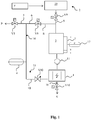
- FIG. 1 a first embodiment of a device according to the invention for the deionization of a fluid with ions dissolved therein is shown with reference to a flow chart. It is assumed below that the device is used for the deionization of water. However, the device may also be used in a similar manner to remove ions from other fluids.
- the device comprises a feed device 2 for supplying a feed stream F of the water to be deionized.
- the feed stream F is expediently first supplied to a treatment device 19, in which the water is treated by softening.
- the pre-treatment device 19 is designed so that a full softening of the water can take place.
- the treatment device 19 may be, for example, a water softener with ion exchangers or a reverse osmosis system.
- sodium salts sodium chloride, sulfate, nitrate, - bicarbonate
- These salts have very high solubilities.
- the yields obtainable by the process according to the invention are determined by the corresponding solubility limits of these salts.
- the device further comprises a line circuit 14, which is connected via a supply line 9 with a valve V9 arranged therein with the supply device 2.
- a Deionisationsmodul 1 a discharge device 15, a buffer 3 and (optionally) a pump 11 are arranged.
- the prepared water coming from the supply device 2 is introduced via the supply line 9 as a feed stream F with open valve V9 in the line circuit 14 and flows there first in the buffer 3 and downstream of the buffer 3 in the Deionisationsmodul 1.
- the feed stream F of the water thereby promoted by the pump 11.
- the water is at least partially deionized by the remaining ions that still in the already treated (especially fully softened) water are removed by electrochemical means from the water.
- EDI electrodeionization
- CDI capacitive Deionisationsmodul
- MCDI membramkapazitives Deionisationsmodul
- the outlet of the deionization module 1 is connected to a discharge device 15.
- the discharge device 15 contains a first discharge line 10, which is part of the line circuit 14, and a second discharge line 16, which leads away from the line circuit 14.
- a valve V10 and a measuring device 4 are arranged in the first discharge line 10.
- a valve V16 is arranged in the second discharge line 16.
- the first discharge line 10 serves for the removal of a diluate stream P and a recycling stream R.
- the second discharge line 16 is used for the removal of a concentrate stream K.
- the measuring device 4 can also be connected via a branch line to the first discharge line 10.
- the measuring device 4 is a measuring device for detecting one or more parameters of the at least partially deionized water in the deionization module 1.
- the measuring device 4 may in particular be a measuring device for detecting the conductivity (conductance) of the water. In the following it is assumed that the measuring device 4 detects the conductivity of the water.
- the measuring device 4 other parameters of the water capture, such as the total salt concentration, the pH, the redox potential, the hardness of the water and / or the concentration of at least one dissolved in water ion.
- the first discharge line 10 of the discharge device 15 branches off at a branching point into a diluate line 5 and a recycling line 6, wherein the recycling line 6 is part of the line circuit 14 and leads away the diluate line 5 from the line circuit 14.
- a valve V5 and V6 is arranged in each case.
- the diluate line 5 serves to discharge a diluate stream P from the line circuit 14.
- the recycling line 6 serves to return a recycling stream R through the line circuit 14 to the intermediate store 3.
- the measuring device 4 is coupled to a control device (not illustrated here) of the device and transmits the detected measured value or the measured values to the control device.
- the control device controls, depending on the measured value or the measured values, the position of the valves V5, V6, V9, V10 and V16.
- the buffer 3 is used for temporarily storing only partially deionized water.
- the buffer 3 has, compared to the Deionisationsmodul 1 on a much larger recording volume.
- the uptake volume of the deionization module 1 is preferably in the range from 170 to 1500 ml.
- the uptake volume of the deionization module 1 is thus substantially smaller than the uptake volume of the buffer 3 and is preferably within the range from 0.05% to 10%, preferably in the range of 0.1% to 1.0% of the receiving volume of the buffer 3.
- a feed stream F is fed from the supply device 2 via the line 9 with the valve V9 open into the temporary store 3 until it has been filled to an upper volume level a.
- the water is introduced into the deionization module 1 during a diluate production phase and is at least partially deionized therein.
- an electrical voltage is applied to the electrodes of the deionization module 1 (for example a CDI module or a MCDI module) during the diluate production phase, the anode being positive and the cathode being negatively polarized.
- the at least partially deionized water in the deionization module 1 is conducted into the first discharge line 10 of the discharge device 15 when the valve V10 is open and the valve V16 is closed.
- the measuring device 4 detects the conductivity (conductance) of the introduced water and transmits the detected measured value to the control device.
- the control device compares the measured value (conductivity of the water) detected by the measuring device 4 with a predetermined desired value for the conductivity. When the measured values detected by the measuring device 4 are below the predetermined nominal value of the conductivity, the water is discharged as diluate flow P from the line circuit 14 with the valve V5 open and the valve V6 closed, and either a diluate tank not shown here or directly using the deionized water Diluate fed.
- the only partially deionized water is conducted via the recycling line 6 through the recycling circuit 14 to the intermediate store 3 with the valve V5 closed and the valve V6 open, and temporarily stored therein.
- the buffer 3 has a level measurement 17, which detects the volume level 7 of the water stored in the buffer 3.
- the level measurement 17 is coupled to the control device and forwards the detected volume level 7 of the water in the buffer 3 to the control device.
- the (partially deionized) water fed into the intermediate storage 3 as recycling stream R is introduced into the deionization module 1 either by the pump 11 or by gravity, if necessary several times in the circulation, where a (further) deionization of the already partially deionized Water takes place until the conductivity of the water has detected by the measuring device 4 measured value, which is below the predetermined setpoint.
- the water is considered to be completely deionized and is discharged from the discharge circuit 15 via the diluate line 5 from the line circuit 14 as diluate stream P.
- the volume of the water in the buffer 3 is lowered from the upper level a to a middle level b.
- the corresponding difference volume (Va-Vb) thus corresponds to the (pumped-out) diluate volume.
- a limit value of an average volume level b is predetermined in the control device and the delivery of the diluate flow P takes place only until the predetermined limit value of the mean volume level b has fallen below.
- the promotion is turned off.
- the line circuit 14 via the feeding device 2 again a feed stream F of processed, in particular fully softened water, fed to the buffer 3 to replenish the upper volume level a.
- the water present in it after replenishment of the buffer 3 is then circulated again in the recycling mode, if necessary several times, in the line circuit 14 and deionized in the deionization module 1 until the predetermined nominal value for the conductivity is undershot.
- the valves V10, V5, V6, V9 and V16 are closed in a concentrate production phase and the deionization module 1 is operated with reversed polarity of the electrodes in comparison to the diluate production phase.
- the ions deposited on the electrodes and / or ion exchange membranes of the deionization module 1 during the dilute production phase dissolve, for example by electro-desorption, and diffuse into the water which is in the deionization module during the concentrate production phase.
- no water is passed into the deionization module 1.
- the removal of the concentrate from the deionization module 1 is expediently carried out until the concentrate has been completely removed from the deionization module 1.
- the volume level of the water is lowered in the buffer 3, in particular from the middle level b to a lower level c.
- the level difference Vb-Vc corresponds to the Aufhahmevolumen the Deionisations owned 1 and the volume of the concentrate generated during the concentrate formation phase.
- the valve V16 is closed.
- a new diluate production phase can be initiated by opening the valve V16 and opening the valves 10 and V6 and operating the deionization module 1 again in reverse polarity of the electrodes, ie with positively polarized anode and negatively polarized cathode becomes.
- the water which has been used for discharging the concentrate from the deionization module 1 is first partially deionized in the deionization module 1 and recycled via the line circuit 14 as recycling stream R back into the buffer 3 and from there to the deionization module 1 for further deionization.
- Va is the upper volume level
- Vb is the mean volume level
- Vc is the lower volume level.
- the concentrate removal system (removal line 16) has the lowest possible volume and low pressure difference.
- the described yield control via a level regulation of the buffer 3 allows a simple and flexible adjustment of the yield of different salt concentrations (or solubility limits) of the feedwater (feed flow F) over the upper volume level Va and the mean volume level Vb (possibly also over the lower Volume level Vc).
- the (controllable) volume of the diluate production phase which results from the difference between the upper volume level Va and the mean volume level Vb, (ie Va-Vb), ultimately determines the concentration in the chambers and / or at the electrodes of the deionization module 1 (Formula ( 3)).
- Vb-Vc volume difference of volume levels b and c (middle and lower levels) Vb-Vc becomes equal to or only slightly greater than the volume of equipment (uptake volume) of deionization module 1 (eg, a CDI module or MCDI module , each with a plurality of cells) and chosen to be significantly smaller than the volume of the buffer 3.
- deionization module 1 eg, a CDI module or MCDI module , each with a plurality of cells
- the volume difference of the volume levels b and c (middle and lower level) Vb-Vc also provides at least part of the volume of the discharge line 16 in addition to the volume of the device (holding volume) of the deionization module 1.
- deposits can be avoided by highly oversaturated concentrates when the concentrate is removed immediately after the deionization module, in particular at valve V16.
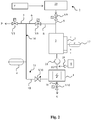
- FIG. 2 a second embodiment of a device according to the invention for the deionization of a fluid with ions dissolved therein is shown with reference to a flow chart.
- This embodiment of the invention is particularly suitable for use in dishwashers for the salt-free deionization of dishwashing water.
- the one for this used device essentially corresponds to the device of FIG. 1 and additionally contains a metering device 8 with which a conditioning agent is metered into the deionization module 1 during and / or after the concentrate production phase in order to prevent precipitations in the concentrate formed during the concentrate production phase in the deionization module 1.
- the conditioning agent acts as a complexing agent for metal ions or atoms and / or for hardness-forming ions, in particular calcium and magnesium ions and carbonate ions.
- the conditioning agent is an acidic, aqueous solution containing in particular organic acids, such as citric and / or lactic acid and / or complexing agents, in particular for the complexation of calcium and magnesium ions.
- the conditioning agent is metered during and / or after a concentrate production phase by means of the metering device 8 at a metering point 19 in the line circuit 14.
- a metering pump 18 is provided, which pumps the conditioning agent from a storage container to the metering point 19.
- the metering point 19 is preferably located upstream of the deionization module 1, as in FIG FIG. 2 shown.
- the addition of the conditioning agent in the Deionisationsmodul 1 prevents metal ions and hardness-forming ions precipitate as salts and accumulate in Deionisationsmodul 1 and this can contaminate it.
- the embodiment of FIG. 2 is particularly suitable for use in dishwashers, because here a rinse aid is metered into the dishwashing water in order to improve the drying of the dishes in the dishwasher, and this from time to time a rinse aid, eg. As an aqueous solution, in a reservoir of Dishwasher is added.
- a rinse aid eg. As an aqueous solution, in a reservoir of Dishwasher is added.
- the deionization module 1 is preferably designed as an MCDI module.
- a conditioning agent for example a rinse aid
- the metered volume of the conditioning agent must be taken into account in the buffer 3 in the level control 7.
- a conditioning agent for example a rinse aid
- the device according to the invention and the method according to the invention can also be used for other applications, such as e.g. for the deionization of swimming pool water.
Landscapes
- Engineering & Computer Science (AREA)
- Water Supply & Treatment (AREA)
- Chemical & Material Sciences (AREA)
- Chemical Kinetics & Catalysis (AREA)
- Health & Medical Sciences (AREA)
- Life Sciences & Earth Sciences (AREA)
- Urology & Nephrology (AREA)
- Analytical Chemistry (AREA)
- Molecular Biology (AREA)
- Electrochemistry (AREA)
- General Chemical & Material Sciences (AREA)
- Hydrology & Water Resources (AREA)
- Environmental & Geological Engineering (AREA)
- Organic Chemistry (AREA)
- Water Treatment By Electricity Or Magnetism (AREA)
Applications Claiming Priority (1)
| Application Number | Priority Date | Filing Date | Title |
|---|---|---|---|
| DE102018108339.4A DE102018108339B4 (de) | 2018-04-09 | 2018-04-09 | Vorrichtung und Verfahren zur Deionisation eines Fluids mit darin gelösten Ionen, insbesondere von Wasser |
Publications (2)
| Publication Number | Publication Date |
|---|---|
| EP3552691A1 true EP3552691A1 (fr) | 2019-10-16 |
| EP3552691B1 EP3552691B1 (fr) | 2020-11-25 |
Family
ID=65275931
Family Applications (1)
| Application Number | Title | Priority Date | Filing Date |
|---|---|---|---|
| EP19151873.7A Active EP3552691B1 (fr) | 2018-04-09 | 2019-01-15 | Dispositif et procédé de déionisation d'un fluide comportant des ions dissous, en particulier de l'eau |
Country Status (2)
| Country | Link |
|---|---|
| EP (1) | EP3552691B1 (fr) |
| DE (1) | DE102018108339B4 (fr) |
Citations (3)
| Publication number | Priority date | Publication date | Assignee | Title |
|---|---|---|---|---|
| US20120298153A1 (en) * | 2010-02-08 | 2012-11-29 | Enpar Technologies Inc. | Washing appliance with dedicated water-softener |
| DE102012212638A1 (de) * | 2012-07-18 | 2014-05-22 | Premark Feg L.L.C. | Spülmaschine sowie Verfahren zum Betreiben einer Spülmaschine |
| CN106830227A (zh) * | 2017-03-01 | 2017-06-13 | 河海大学 | 一种循环处理的膜电容去离子装置及处理方法 |
Family Cites Families (4)
| Publication number | Priority date | Publication date | Assignee | Title |
|---|---|---|---|---|
| AT395969B (de) * | 1991-12-04 | 1993-04-26 | Sgp Va Energie Umwelt | Verfahren zur aufbereitung von wasser oder abwasser, insbesondere zur nitratreduzierung |
| KR101947994B1 (ko) * | 2011-05-25 | 2019-02-14 | 코웨이 주식회사 | 수처리 기기 |
| MX350683B (es) | 2011-08-04 | 2017-09-13 | Unilever Nv | Un dispositivo y proceso para recuperacion mejorada de agua deionizada. |
| GB201617347D0 (en) * | 2016-10-13 | 2016-11-30 | VWS (UK) Limited | Method and apparatus for providing ultrapure water |
-
2018
- 2018-04-09 DE DE102018108339.4A patent/DE102018108339B4/de active Active
-
2019
- 2019-01-15 EP EP19151873.7A patent/EP3552691B1/fr active Active
Patent Citations (3)
| Publication number | Priority date | Publication date | Assignee | Title |
|---|---|---|---|---|
| US20120298153A1 (en) * | 2010-02-08 | 2012-11-29 | Enpar Technologies Inc. | Washing appliance with dedicated water-softener |
| DE102012212638A1 (de) * | 2012-07-18 | 2014-05-22 | Premark Feg L.L.C. | Spülmaschine sowie Verfahren zum Betreiben einer Spülmaschine |
| CN106830227A (zh) * | 2017-03-01 | 2017-06-13 | 河海大学 | 一种循环处理的膜电容去离子装置及处理方法 |
Also Published As
| Publication number | Publication date |
|---|---|
| DE102018108339B4 (de) | 2022-01-20 |
| EP3552691B1 (fr) | 2020-11-25 |
| DE102018108339A1 (de) | 2019-10-10 |
Similar Documents
| Publication | Publication Date | Title |
|---|---|---|
| DE69720310T2 (de) | Vorrichtung und Verfahren zur Reinigung einer Flüssigkeit mittels Elektrodeionisation | |
| DE69727114T2 (de) | Methode und Apparat zur Verhinderung von Kesselsteinbildung bei der Produktion von deionisiertem Wasser | |
| DE112012004983T5 (de) | Verfahren zum Regenerieren einer Beschichtungsflüssigkeit,Beschichtungsverfahren und Beschichtungsvorrichtung | |
| DE10240350B4 (de) | Vorrichtung und Verfahren zum Regenerieren eines stromlosen Metallabscheidebades | |
| DE20210562U1 (de) | Vorrichtung zur automatischen Reinigung einer Reaktorkammer in einer Wasseraufbereitungsanlage | |
| DE2115687B2 (de) | Verfahren zur kontinuierlichen aufbereitung von bei der galvanischen oder stromlosen metallabscheidung anfallenden waschwaessern durch elektrodialyse | |
| DE19752111C1 (de) | Verfahren und Vorrichtung zur Wasserteilentsalzung | |
| DE202022101699U1 (de) | Vorrichtung zur Erfassung der Härte von Wasser | |
| DE202018101907U1 (de) | Vorrichtung zur Deionisation eines Fluids mit darin gelösten Ionen, insbesondere von Wasser | |
| EP3552691B1 (fr) | Dispositif et procédé de déionisation d'un fluide comportant des ions dissous, en particulier de l'eau | |
| DE102016109771B4 (de) | Verfahren zum Reinigen einer Kunststoffoberfläche | |
| CH642033A5 (en) | Process and equipment for the treatment of waste waters containing heavy metals | |
| DE4405741C1 (de) | Verfahren zur elektrolytischen Abscheidung von Metallen aus Elektrolyten mit Prozeßorganik | |
| WO2007115530A1 (fr) | Procédé d'électrodésionisation pour la préparation lors du traitement de surface chimique et/ou électrochimique d'eaux de lavage contenant des métaux | |
| DE102016109965B4 (de) | Spülmaschine sowie Verfahren zum Betreiben einer Spülmaschine | |
| WO2023186539A1 (fr) | Procédé de détermination de la dureté de l'eau et dispositif de détection de la dureté de l'eau | |
| DE102004038693B4 (de) | Vorrichtung und Verfahren zur Entfernung von Fremdstoffen aus Prozesslösungen und Verfahren zur Regenerierung eines Kationenaustauschers | |
| DE202022101701U1 (de) | Wasserbehandlungsanlage | |
| DE10322120A1 (de) | Verfahren und Vorrichtungen zur Verlängerung der Nutzungsdauer einer Prozesslösung für die chemisch-reduktive Metallbeschichtung | |
| DE102021128696A1 (de) | Vorrichtung zur Desinfektion, insbesondere einer Enthärtungsanlage sowie Verfahren zu deren Betrieb | |
| EP1382573A1 (fr) | Dispositif de nettoyage automatique d'une cellule d'un réacteur d'une installation de traitement de l'eau | |
| DE3233283C2 (de) | Verfahren und Vorrichtung zur Reinigung von Industriewässern oder dergleichen mittels einer elektrodialytischen Dosierung von H↑+↑-Ionen | |
| DE2534918C3 (de) | Vorrichtung zum Elektrotauchlackieren | |
| DE2009007A1 (fr) | ||
| DE102022107575A1 (de) | Wasserbehandlungsanlage und Verfahren zum Betrieb einer Wasserbehandlungsanlage |
Legal Events
| Date | Code | Title | Description |
|---|---|---|---|
| PUAI | Public reference made under article 153(3) epc to a published international application that has entered the european phase |
Free format text: ORIGINAL CODE: 0009012 |
|
| STAA | Information on the status of an ep patent application or granted ep patent |
Free format text: STATUS: THE APPLICATION HAS BEEN PUBLISHED |
|
| AK | Designated contracting states |
Kind code of ref document: A1 Designated state(s): AL AT BE BG CH CY CZ DE DK EE ES FI FR GB GR HR HU IE IS IT LI LT LU LV MC MK MT NL NO PL PT RO RS SE SI SK SM TR |
|
| AX | Request for extension of the european patent |
Extension state: BA ME |
|
| STAA | Information on the status of an ep patent application or granted ep patent |
Free format text: STATUS: REQUEST FOR EXAMINATION WAS MADE |
|
| 17P | Request for examination filed |
Effective date: 20200416 |
|
| RBV | Designated contracting states (corrected) |
Designated state(s): AL AT BE BG CH CY CZ DE DK EE ES FI FR GB GR HR HU IE IS IT LI LT LU LV MC MK MT NL NO PL PT RO RS SE SI SK SM TR |
|
| GRAP | Despatch of communication of intention to grant a patent |
Free format text: ORIGINAL CODE: EPIDOSNIGR1 |
|
| STAA | Information on the status of an ep patent application or granted ep patent |
Free format text: STATUS: GRANT OF PATENT IS INTENDED |
|
| RIC1 | Information provided on ipc code assigned before grant |
Ipc: B01D 61/42 20060101AFI20200622BHEP Ipc: C02F 5/10 20060101ALN20200622BHEP Ipc: C02F 1/469 20060101ALI20200622BHEP |
|
| RIC1 | Information provided on ipc code assigned before grant |
Ipc: B01D 61/42 20060101AFI20200706BHEP Ipc: C02F 5/10 20060101ALN20200706BHEP Ipc: C02F 1/469 20060101ALI20200706BHEP |
|
| INTG | Intention to grant announced |
Effective date: 20200729 |
|
| GRAJ | Information related to disapproval of communication of intention to grant by the applicant or resumption of examination proceedings by the epo deleted |
Free format text: ORIGINAL CODE: EPIDOSDIGR1 |
|
| STAA | Information on the status of an ep patent application or granted ep patent |
Free format text: STATUS: REQUEST FOR EXAMINATION WAS MADE |
|
| GRAP | Despatch of communication of intention to grant a patent |
Free format text: ORIGINAL CODE: EPIDOSNIGR1 |
|
| STAA | Information on the status of an ep patent application or granted ep patent |
Free format text: STATUS: GRANT OF PATENT IS INTENDED |
|
| GRAS | Grant fee paid |
Free format text: ORIGINAL CODE: EPIDOSNIGR3 |
|
| GRAA | (expected) grant |
Free format text: ORIGINAL CODE: 0009210 |
|
| STAA | Information on the status of an ep patent application or granted ep patent |
Free format text: STATUS: THE PATENT HAS BEEN GRANTED |
|
| INTC | Intention to grant announced (deleted) | ||
| RIC1 | Information provided on ipc code assigned before grant |
Ipc: C02F 5/10 20060101ALN20200930BHEP Ipc: C02F 1/469 20060101ALI20200930BHEP Ipc: B01D 61/42 20060101AFI20200930BHEP |
|
| INTG | Intention to grant announced |
Effective date: 20201019 |
|
| AK | Designated contracting states |
Kind code of ref document: B1 Designated state(s): AL AT BE BG CH CY CZ DE DK EE ES FI FR GB GR HR HU IE IS IT LI LT LU LV MC MK MT NL NO PL PT RO RS SE SI SK SM TR |
|
| RAP1 | Party data changed (applicant data changed or rights of an application transferred) |
Owner name: GRUENBECK WASSERAUFBEREITUNG GMBH |
|
| REG | Reference to a national code |
Ref country code: GB Ref legal event code: FG4D Free format text: NOT ENGLISH |
|
| REG | Reference to a national code |
Ref country code: CH Ref legal event code: EP |
|
| REG | Reference to a national code |
Ref country code: CH Ref legal event code: NV Representative=s name: LUCHS AND PARTNER AG PATENTANWAELTE, CH Ref country code: AT Ref legal event code: REF Ref document number: 1337645 Country of ref document: AT Kind code of ref document: T Effective date: 20201215 |
|
| REG | Reference to a national code |
Ref country code: DE Ref legal event code: R096 Ref document number: 502019000429 Country of ref document: DE |
|
| REG | Reference to a national code |
Ref country code: IE Ref legal event code: FG4D Free format text: LANGUAGE OF EP DOCUMENT: GERMAN |
|
| REG | Reference to a national code |
Ref country code: NL Ref legal event code: FP |
|
| PG25 | Lapsed in a contracting state [announced via postgrant information from national office to epo] |
Ref country code: FI Free format text: LAPSE BECAUSE OF FAILURE TO SUBMIT A TRANSLATION OF THE DESCRIPTION OR TO PAY THE FEE WITHIN THE PRESCRIBED TIME-LIMIT Effective date: 20201125 Ref country code: RS Free format text: LAPSE BECAUSE OF FAILURE TO SUBMIT A TRANSLATION OF THE DESCRIPTION OR TO PAY THE FEE WITHIN THE PRESCRIBED TIME-LIMIT Effective date: 20201125 Ref country code: PT Free format text: LAPSE BECAUSE OF FAILURE TO SUBMIT A TRANSLATION OF THE DESCRIPTION OR TO PAY THE FEE WITHIN THE PRESCRIBED TIME-LIMIT Effective date: 20210325 Ref country code: NO Free format text: LAPSE BECAUSE OF FAILURE TO SUBMIT A TRANSLATION OF THE DESCRIPTION OR TO PAY THE FEE WITHIN THE PRESCRIBED TIME-LIMIT Effective date: 20210225 Ref country code: GR Free format text: LAPSE BECAUSE OF FAILURE TO SUBMIT A TRANSLATION OF THE DESCRIPTION OR TO PAY THE FEE WITHIN THE PRESCRIBED TIME-LIMIT Effective date: 20210226 |
|
| PG25 | Lapsed in a contracting state [announced via postgrant information from national office to epo] |
Ref country code: BG Free format text: LAPSE BECAUSE OF FAILURE TO SUBMIT A TRANSLATION OF THE DESCRIPTION OR TO PAY THE FEE WITHIN THE PRESCRIBED TIME-LIMIT Effective date: 20210225 Ref country code: IS Free format text: LAPSE BECAUSE OF FAILURE TO SUBMIT A TRANSLATION OF THE DESCRIPTION OR TO PAY THE FEE WITHIN THE PRESCRIBED TIME-LIMIT Effective date: 20210325 Ref country code: LV Free format text: LAPSE BECAUSE OF FAILURE TO SUBMIT A TRANSLATION OF THE DESCRIPTION OR TO PAY THE FEE WITHIN THE PRESCRIBED TIME-LIMIT Effective date: 20201125 Ref country code: PL Free format text: LAPSE BECAUSE OF FAILURE TO SUBMIT A TRANSLATION OF THE DESCRIPTION OR TO PAY THE FEE WITHIN THE PRESCRIBED TIME-LIMIT Effective date: 20201125 Ref country code: SE Free format text: LAPSE BECAUSE OF FAILURE TO SUBMIT A TRANSLATION OF THE DESCRIPTION OR TO PAY THE FEE WITHIN THE PRESCRIBED TIME-LIMIT Effective date: 20201125 |
|
| REG | Reference to a national code |
Ref country code: LT Ref legal event code: MG9D |
|
| PG25 | Lapsed in a contracting state [announced via postgrant information from national office to epo] |
Ref country code: HR Free format text: LAPSE BECAUSE OF FAILURE TO SUBMIT A TRANSLATION OF THE DESCRIPTION OR TO PAY THE FEE WITHIN THE PRESCRIBED TIME-LIMIT Effective date: 20201125 |
|
| PG25 | Lapsed in a contracting state [announced via postgrant information from national office to epo] |
Ref country code: LT Free format text: LAPSE BECAUSE OF FAILURE TO SUBMIT A TRANSLATION OF THE DESCRIPTION OR TO PAY THE FEE WITHIN THE PRESCRIBED TIME-LIMIT Effective date: 20201125 Ref country code: RO Free format text: LAPSE BECAUSE OF FAILURE TO SUBMIT A TRANSLATION OF THE DESCRIPTION OR TO PAY THE FEE WITHIN THE PRESCRIBED TIME-LIMIT Effective date: 20201125 Ref country code: SK Free format text: LAPSE BECAUSE OF FAILURE TO SUBMIT A TRANSLATION OF THE DESCRIPTION OR TO PAY THE FEE WITHIN THE PRESCRIBED TIME-LIMIT Effective date: 20201125 Ref country code: SM Free format text: LAPSE BECAUSE OF FAILURE TO SUBMIT A TRANSLATION OF THE DESCRIPTION OR TO PAY THE FEE WITHIN THE PRESCRIBED TIME-LIMIT Effective date: 20201125 Ref country code: CZ Free format text: LAPSE BECAUSE OF FAILURE TO SUBMIT A TRANSLATION OF THE DESCRIPTION OR TO PAY THE FEE WITHIN THE PRESCRIBED TIME-LIMIT Effective date: 20201125 Ref country code: EE Free format text: LAPSE BECAUSE OF FAILURE TO SUBMIT A TRANSLATION OF THE DESCRIPTION OR TO PAY THE FEE WITHIN THE PRESCRIBED TIME-LIMIT Effective date: 20201125 |
|
| REG | Reference to a national code |
Ref country code: DE Ref legal event code: R097 Ref document number: 502019000429 Country of ref document: DE |
|
| PG25 | Lapsed in a contracting state [announced via postgrant information from national office to epo] |
Ref country code: DK Free format text: LAPSE BECAUSE OF FAILURE TO SUBMIT A TRANSLATION OF THE DESCRIPTION OR TO PAY THE FEE WITHIN THE PRESCRIBED TIME-LIMIT Effective date: 20201125 Ref country code: MC Free format text: LAPSE BECAUSE OF FAILURE TO SUBMIT A TRANSLATION OF THE DESCRIPTION OR TO PAY THE FEE WITHIN THE PRESCRIBED TIME-LIMIT Effective date: 20201125 |
|
| PG25 | Lapsed in a contracting state [announced via postgrant information from national office to epo] |
Ref country code: LU Free format text: LAPSE BECAUSE OF NON-PAYMENT OF DUE FEES Effective date: 20210115 |
|
| PLBE | No opposition filed within time limit |
Free format text: ORIGINAL CODE: 0009261 |
|
| STAA | Information on the status of an ep patent application or granted ep patent |
Free format text: STATUS: NO OPPOSITION FILED WITHIN TIME LIMIT |
|
| PG25 | Lapsed in a contracting state [announced via postgrant information from national office to epo] |
Ref country code: FR Free format text: LAPSE BECAUSE OF NON-PAYMENT OF DUE FEES Effective date: 20210125 Ref country code: AL Free format text: LAPSE BECAUSE OF FAILURE TO SUBMIT A TRANSLATION OF THE DESCRIPTION OR TO PAY THE FEE WITHIN THE PRESCRIBED TIME-LIMIT Effective date: 20201125 |
|
| 26N | No opposition filed |
Effective date: 20210826 |
|
| PG25 | Lapsed in a contracting state [announced via postgrant information from national office to epo] |
Ref country code: SI Free format text: LAPSE BECAUSE OF FAILURE TO SUBMIT A TRANSLATION OF THE DESCRIPTION OR TO PAY THE FEE WITHIN THE PRESCRIBED TIME-LIMIT Effective date: 20201125 |
|
| PG25 | Lapsed in a contracting state [announced via postgrant information from national office to epo] |
Ref country code: ES Free format text: LAPSE BECAUSE OF FAILURE TO SUBMIT A TRANSLATION OF THE DESCRIPTION OR TO PAY THE FEE WITHIN THE PRESCRIBED TIME-LIMIT Effective date: 20201125 Ref country code: IE Free format text: LAPSE BECAUSE OF NON-PAYMENT OF DUE FEES Effective date: 20210115 |
|
| PGFP | Annual fee paid to national office [announced via postgrant information from national office to epo] |
Ref country code: DE Payment date: 20220308 Year of fee payment: 4 |
|
| PG25 | Lapsed in a contracting state [announced via postgrant information from national office to epo] |
Ref country code: IS Free format text: LAPSE BECAUSE OF FAILURE TO SUBMIT A TRANSLATION OF THE DESCRIPTION OR TO PAY THE FEE WITHIN THE PRESCRIBED TIME-LIMIT Effective date: 20210325 |
|
| PG25 | Lapsed in a contracting state [announced via postgrant information from national office to epo] |
Ref country code: CY Free format text: LAPSE BECAUSE OF FAILURE TO SUBMIT A TRANSLATION OF THE DESCRIPTION OR TO PAY THE FEE WITHIN THE PRESCRIBED TIME-LIMIT Effective date: 20201125 |
|
| PG25 | Lapsed in a contracting state [announced via postgrant information from national office to epo] |
Ref country code: HU Free format text: LAPSE BECAUSE OF FAILURE TO SUBMIT A TRANSLATION OF THE DESCRIPTION OR TO PAY THE FEE WITHIN THE PRESCRIBED TIME-LIMIT; INVALID AB INITIO Effective date: 20190115 |
|
| REG | Reference to a national code |
Ref country code: DE Ref legal event code: R119 Ref document number: 502019000429 Country of ref document: DE |
|
| GBPC | Gb: european patent ceased through non-payment of renewal fee |
Effective date: 20230115 |
|
| PG25 | Lapsed in a contracting state [announced via postgrant information from national office to epo] |
Ref country code: GB Free format text: LAPSE BECAUSE OF NON-PAYMENT OF DUE FEES Effective date: 20230115 Ref country code: DE Free format text: LAPSE BECAUSE OF NON-PAYMENT OF DUE FEES Effective date: 20230801 |
|
| PG25 | Lapsed in a contracting state [announced via postgrant information from national office to epo] |
Ref country code: MK Free format text: LAPSE BECAUSE OF FAILURE TO SUBMIT A TRANSLATION OF THE DESCRIPTION OR TO PAY THE FEE WITHIN THE PRESCRIBED TIME-LIMIT Effective date: 20201125 |
|
| PG25 | Lapsed in a contracting state [announced via postgrant information from national office to epo] |
Ref country code: MT Free format text: LAPSE BECAUSE OF FAILURE TO SUBMIT A TRANSLATION OF THE DESCRIPTION OR TO PAY THE FEE WITHIN THE PRESCRIBED TIME-LIMIT Effective date: 20201125 |
|
| REG | Reference to a national code |
Ref country code: NL Ref legal event code: PD Owner name: GRUENBECK AG; DE Free format text: DETAILS ASSIGNMENT: CHANGE OF OWNER(S), CHANGE OF LEGAL ENTITY; FORMER OWNER NAME: GRUENBECK WASSERAUFBEREITUNG GMBH Effective date: 20241205 |
|
| REG | Reference to a national code |
Ref country code: BE Ref legal event code: PD Owner name: GRUENBECK AG; DE Free format text: DETAILS ASSIGNMENT: CHANGE OF OWNER(S), CHANGE OF LEGAL ENTITY; FORMER OWNER NAME: GRUENBECK WASSERAUFBEREITUNG GMBH Effective date: 20241121 |
|
| PGFP | Annual fee paid to national office [announced via postgrant information from national office to epo] |
Ref country code: NL Payment date: 20250122 Year of fee payment: 7 |
|
| REG | Reference to a national code |
Ref country code: AT Ref legal event code: HC Ref document number: 1337645 Country of ref document: AT Kind code of ref document: T Owner name: GRUENBECK AG, DE Effective date: 20250120 |
|
| PGFP | Annual fee paid to national office [announced via postgrant information from national office to epo] |
Ref country code: AT Payment date: 20250120 Year of fee payment: 7 Ref country code: CH Payment date: 20250201 Year of fee payment: 7 Ref country code: BE Payment date: 20250121 Year of fee payment: 7 |
|
| PGFP | Annual fee paid to national office [announced via postgrant information from national office to epo] |
Ref country code: IT Payment date: 20250131 Year of fee payment: 7 |
|
| PG25 | Lapsed in a contracting state [announced via postgrant information from national office to epo] |
Ref country code: TR Free format text: LAPSE BECAUSE OF FAILURE TO SUBMIT A TRANSLATION OF THE DESCRIPTION OR TO PAY THE FEE WITHIN THE PRESCRIBED TIME-LIMIT Effective date: 20201125 |
|
| REG | Reference to a national code |
Ref country code: CH Ref legal event code: R18 Free format text: ST27 STATUS EVENT CODE: U-0-0-R10-R18 (AS PROVIDED BY THE NATIONAL OFFICE) Effective date: 20260217 |