EP3551548B1 - Vorrichtungen zur überwachung der lebensmittelfrische - Google Patents
Vorrichtungen zur überwachung der lebensmittelfrische Download PDFInfo
- Publication number
- EP3551548B1 EP3551548B1 EP17884792.7A EP17884792A EP3551548B1 EP 3551548 B1 EP3551548 B1 EP 3551548B1 EP 17884792 A EP17884792 A EP 17884792A EP 3551548 B1 EP3551548 B1 EP 3551548B1
- Authority
- EP
- European Patent Office
- Prior art keywords
- food
- indicator
- red
- sample
- chamber
- Prior art date
- Legal status (The legal status is an assumption and is not a legal conclusion. Google has not performed a legal analysis and makes no representation as to the accuracy of the status listed.)
- Active
Links
Images










Classifications
-
- G—PHYSICS
- G01—MEASURING; TESTING
- G01N—INVESTIGATING OR ANALYSING MATERIALS BY DETERMINING THEIR CHEMICAL OR PHYSICAL PROPERTIES
- G01N21/00—Investigating or analysing materials by the use of optical means, i.e. using sub-millimetre waves, infrared, visible or ultraviolet light
- G01N21/75—Systems in which material is subjected to a chemical reaction, the progress or the result of the reaction being investigated
- G01N21/77—Systems in which material is subjected to a chemical reaction, the progress or the result of the reaction being investigated by observing the effect on a chemical indicator
- G01N21/78—Systems in which material is subjected to a chemical reaction, the progress or the result of the reaction being investigated by observing the effect on a chemical indicator producing a change of colour
-
- B—PERFORMING OPERATIONS; TRANSPORTING
- B65—CONVEYING; PACKING; STORING; HANDLING THIN OR FILAMENTARY MATERIAL
- B65D—CONTAINERS FOR STORAGE OR TRANSPORT OF ARTICLES OR MATERIALS, e.g. BAGS, BARRELS, BOTTLES, BOXES, CANS, CARTONS, CRATES, DRUMS, JARS, TANKS, HOPPERS, FORWARDING CONTAINERS; ACCESSORIES, CLOSURES, OR FITTINGS THEREFOR; PACKAGING ELEMENTS; PACKAGES
- B65D25/00—Details of other kinds or types of rigid or semi-rigid containers
- B65D25/54—Inspection openings or windows
-
- B—PERFORMING OPERATIONS; TRANSPORTING
- B65—CONVEYING; PACKING; STORING; HANDLING THIN OR FILAMENTARY MATERIAL
- B65D—CONTAINERS FOR STORAGE OR TRANSPORT OF ARTICLES OR MATERIALS, e.g. BAGS, BARRELS, BOTTLES, BOXES, CANS, CARTONS, CRATES, DRUMS, JARS, TANKS, HOPPERS, FORWARDING CONTAINERS; ACCESSORIES, CLOSURES, OR FITTINGS THEREFOR; PACKAGING ELEMENTS; PACKAGES
- B65D79/00—Kinds or details of packages, not otherwise provided for
- B65D79/02—Arrangements or devices for indicating incorrect storage or transport
-
- B—PERFORMING OPERATIONS; TRANSPORTING
- B65—CONVEYING; PACKING; STORING; HANDLING THIN OR FILAMENTARY MATERIAL
- B65D—CONTAINERS FOR STORAGE OR TRANSPORT OF ARTICLES OR MATERIALS, e.g. BAGS, BARRELS, BOTTLES, BOXES, CANS, CARTONS, CRATES, DRUMS, JARS, TANKS, HOPPERS, FORWARDING CONTAINERS; ACCESSORIES, CLOSURES, OR FITTINGS THEREFOR; PACKAGING ELEMENTS; PACKAGES
- B65D85/00—Containers, packaging elements or packages, specially adapted for particular articles or materials
- B65D85/70—Containers, packaging elements or packages, specially adapted for particular articles or materials for materials not otherwise provided for
- B65D85/72—Containers, packaging elements or packages, specially adapted for particular articles or materials for materials not otherwise provided for for edible or potable liquids, semiliquids, or plastic or pasty materials
- B65D85/80—Containers, packaging elements or packages, specially adapted for particular articles or materials for materials not otherwise provided for for edible or potable liquids, semiliquids, or plastic or pasty materials for milk
-
- C—CHEMISTRY; METALLURGY
- C12—BIOCHEMISTRY; BEER; SPIRITS; WINE; VINEGAR; MICROBIOLOGY; ENZYMOLOGY; MUTATION OR GENETIC ENGINEERING
- C12Q—MEASURING OR TESTING PROCESSES INVOLVING ENZYMES, NUCLEIC ACIDS OR MICROORGANISMS; COMPOSITIONS OR TEST PAPERS THEREFOR; PROCESSES OF PREPARING SUCH COMPOSITIONS; CONDITION-RESPONSIVE CONTROL IN MICROBIOLOGICAL OR ENZYMOLOGICAL PROCESSES
- C12Q1/00—Measuring or testing processes involving enzymes, nucleic acids or microorganisms; Compositions therefor; Processes of preparing such compositions
- C12Q1/02—Measuring or testing processes involving enzymes, nucleic acids or microorganisms; Compositions therefor; Processes of preparing such compositions involving viable microorganisms
- C12Q1/04—Determining presence or kind of microorganism; Use of selective media for testing antibiotics or bacteriocides; Compositions containing a chemical indicator therefor
-
- G—PHYSICS
- G01—MEASURING; TESTING
- G01N—INVESTIGATING OR ANALYSING MATERIALS BY DETERMINING THEIR CHEMICAL OR PHYSICAL PROPERTIES
- G01N21/00—Investigating or analysing materials by the use of optical means, i.e. using sub-millimetre waves, infrared, visible or ultraviolet light
- G01N21/75—Systems in which material is subjected to a chemical reaction, the progress or the result of the reaction being investigated
- G01N21/77—Systems in which material is subjected to a chemical reaction, the progress or the result of the reaction being investigated by observing the effect on a chemical indicator
- G01N21/78—Systems in which material is subjected to a chemical reaction, the progress or the result of the reaction being investigated by observing the effect on a chemical indicator producing a change of colour
- G01N21/80—Indicating pH value
-
- G—PHYSICS
- G01—MEASURING; TESTING
- G01N—INVESTIGATING OR ANALYSING MATERIALS BY DETERMINING THEIR CHEMICAL OR PHYSICAL PROPERTIES
- G01N31/00—Investigating or analysing non-biological materials by the use of the chemical methods specified in the subgroup; Apparatus specially adapted for such methods
- G01N31/22—Investigating or analysing non-biological materials by the use of the chemical methods specified in the subgroup; Apparatus specially adapted for such methods using chemical indicators
- G01N31/221—Investigating or analysing non-biological materials by the use of the chemical methods specified in the subgroup; Apparatus specially adapted for such methods using chemical indicators for investigating pH value
-
- G—PHYSICS
- G01—MEASURING; TESTING
- G01N—INVESTIGATING OR ANALYSING MATERIALS BY DETERMINING THEIR CHEMICAL OR PHYSICAL PROPERTIES
- G01N33/00—Investigating or analysing materials by specific methods not covered by groups G01N1/00 - G01N31/00
- G01N33/02—Food
- G01N33/04—Dairy products
-
- B—PERFORMING OPERATIONS; TRANSPORTING
- B65—CONVEYING; PACKING; STORING; HANDLING THIN OR FILAMENTARY MATERIAL
- B65D—CONTAINERS FOR STORAGE OR TRANSPORT OF ARTICLES OR MATERIALS, e.g. BAGS, BARRELS, BOTTLES, BOXES, CANS, CARTONS, CRATES, DRUMS, JARS, TANKS, HOPPERS, FORWARDING CONTAINERS; ACCESSORIES, CLOSURES, OR FITTINGS THEREFOR; PACKAGING ELEMENTS; PACKAGES
- B65D2203/00—Decoration means, markings, information elements, contents indicators
- B65D2203/12—Audible, olfactory or visual signalling means
-
- G—PHYSICS
- G01—MEASURING; TESTING
- G01N—INVESTIGATING OR ANALYSING MATERIALS BY DETERMINING THEIR CHEMICAL OR PHYSICAL PROPERTIES
- G01N33/00—Investigating or analysing materials by specific methods not covered by groups G01N1/00 - G01N31/00
- G01N33/02—Food
- G01N33/12—Meat; Fish
Definitions
- the present invention provides devices for real-time, continuous, detection of spoilage and freshness of food products.
- Food products especially, those containing substantial amounts of proteins and/or sugars and/or fats, spoil over time due to the growth of microbes, such as lactobacteria, yeasts and fungi.
- Food storage devices are commonly used to protect food products during storage, under various conditions, in order to maintain food freshness.
- Cavallo et al. J. Food Eng., 136:48-55, 2014 disclose a modified polypropylene film containing methylene blue, for use in packaging of food products, such as, milk.
- DE 10 2004 019 427 A1 discloses an indicator, which includes lactic acid strips and is attached to a food container or an opening area of a food container The lactic acid strips indicate the current condition of the food based on pH value measurement made on the food.
- US 6,723,285 B2 discloses a system for retail packaging of a food product indicating to a consumer a status of a quality of the food product.
- the system comprises: (a) a container having a first compartment containing a first portion of the food product for consumption by the consumer and a second compartment containing a second portion of the food product; and (b) an indicator, said indicator mixed with the portion of the food product in said second compartment.
- the indicator may be capable of indicating a change in pH.
- US 2006/0057022 A1 also discloses a label that includes food quality indicators and that can be affixed inside a clear food packaging or outside a breathable or gas-permeable food packaging and read by anyone to determine the quality of the packaged food.
- WO 2014/102556 A1 discloses a container with an indicating device.
- the indicating device comprises an indicator fixed to an inner wall of the container.
- the indicator is arranged so as to provide an intermediate space part between the indicator and the inner wall of the container.
- US 2008/286148 A1 discloses an indicator which may be used as an indicator for detecting spoilage of a food liquid product such as milk, sold in a container.
- a separate compartment, within or attached to the container and visible from the outside may contain a small volume of the liquid and an indicator of the invention, designed to expose the substrate when the pH drops below a predetermined value, is immersed inside the compartment.
- the present invention provides a food storage device as defined in appended claim 1.
- Particular embodiments of the present invention are defined in the appended dependent claims.
- the scope of the invention is solely defined and restricted by the appended claims.
- the food storage device disclosed herein constantly provides a real-time accurate and visible indication of the freshness (and/or spoilage) of the food contained therein.
- a consumer can easily determine, based on the indication, whether the food product is fresh.
- the indication is afforded by an indicator composition containing a solvent and a sample of the food product, which is maintained and stored at the exact same environmental storage conditions (e.g. temperature, storage period) under which the food product (from which said sample is derived) is maintained and stored.
- the indication provided by the indicator composition within the device disclosed herein is not obscured by the contents of the food product even when the food sample and the food product are of substantially similar contents.
- the food sample within the at least one chamber is diluted to 1% to 50% compared to the food product within the storage device.
- the at least chamber is a fluid and gas impervious three-dimensional structure.
- the at least one chamber is attached to the device.
- the device comprises at least one food packaging, container, wherein said at least one food packaging contains the food product.
- the at least one chamber comprises a transparent window, such that at least a portion of said chamber is being externally viewable through the transparent window.
- At least one indicator is selected from bacterial indicators, redox indicators and pH indicators.
- At least one indicator is a pH indicator.
- At least one indicator is a bacterial indicator.
- the indicator changes color upon a change of pH smaller than 0.1 pH unit
- the at least one bacterial indicator is devoid of quaternary ammonium salts and quaternary ammonium moieties.
- the at least one bacterial indicator provides a detectable indication in the presence of a bacterial population above a pre-determined threshold.
- the composition comprises a plurality of indicators.
- the at least one indicator is selected from bromothymol blue, cresol red, phenol red, methyl red, bromocresol blue, indigo carmine, carmoisine red, tartrazine, bromocresol green, bromophenol blue and methyl orange.
- the composition further comprises at least one transition metal moiety.
- the at least one chamber further comprises a solvent, preferably an aqueous solvent.
- the membrane is a porous membrane.
- the membrane is impermeable to particles having an average size distribution above 10 nm.
- the membrane is impermeable to water insoluble organic colloidal materials.
- the membrane is impermeable to fatty acids and proteins.
- the membrane comprises pores having an average size within the range of 0.01 microns to 1 micron.
- the membrane is having a porosity from 10% to 80%.
- the plurality of compartments comprises first and second compartments, the first compartment comprises the food sample, and the second compartment comprises a filtered portion of the food sample.
- the second compartment comprises a transparent window, such that at least a portion of said compartment is being externally viewable through the transparent window.
- the sample of said food product within the at least one chamber is diluted compared to the food product within the storage device.
- the at least one bacterial indicator is not anti-bacterial.
- the bacterial indicator provides a detectable indication in the presence of a bacterial population above a pre-determined threshold.
- the at least one transition metal moiety comprises Cr(III).
- a dye selected from indigo carmine, tartrazine, carmoisine red and combinations thereof as a food quality indicator.
- the devices of the invention may be implemented in at least one food packaging containing a food product, such as milk cartons, cheese or yogurt containers, cans of food products and the like.
- a food product such as milk cartons, cheese or yogurt containers, cans of food products and the like.
- the devices may also be used for detecting food spoilage in commercial containers, which contain a batch of food containers, including, for example meat containers and containers of dairy products.
- diluted refers to a difference in contents, such as, concentration, between the food sample and to the food product, such that, the concentration of certain components in the food sample is relatively lower compared to their concentration in the food sample. In some embodiments, diluted refers to dilution within the range of 0.01% to 90%.
- 0.01% dilution refers to 0.01 w/w or w/v or v/v in the food sample compared to 100 w/w or w/v or v/v in the food product, of a given component.
- 0.01% dilution may refer to w/w ratio or v/v ratio among others.
- the dilution may be obtained by adding a pre-determined amount of diluent (solvent) to the food sample, thereby obtaining the desired dilution.
- the diluent may refer to the solvent used in the at least one chamber of a food storage device of the invention, and may include an aqueous solution.
- the chamber comprises a food sample, an indicator composition and a solvent.
- the solvent is an aqueous solvent.
- aqueous solvent includes water or a mixture of water and organic solvent, so long that the amount of organic solvent is relatively low, e.g. less than 5%, or less than 1%.
- the food sample within the chamber is diluted to 0.1% to 75% compared to the food product within the storage device. In some embodiments, the food sample within the chamber is diluted to 1% to 50% compared to the food product within the storage device. In some embodiments, the food sample within the chamber is diluted to 5% to 30% compared to the food product within the storage device.
- the device further comprises at least one food packaging containing a food product.
- the term 'food packaging' as used herein is interchangeable with any food packaging, including, but not limited to, paper containers such as those used for packaging milk, paperboard coated with a waterproof plastic, generally polyethylene, containers made of glass, polymers and metal among other materials that may be suitable for food packaging.
- the device comprises a plurality of food packagings, each food packaging comprises food product.
- the at least one chamber is attached to the device.
- the at least one chamber is attached to the at least one food packaging within the device.
- the device comprises a plurality of food packagings, wherein at least one chamber is attached to at least one food packaging of said plurality of food packagings.
- the device comprises a plurality of food packagings, wherein at least one chamber is attached to each food packaging of said plurality of food packagings.
- the at least one chamber comprises a first wall and a second wall, said first wall is facing a wall of the device.
- said first wall and the wall of the device form a mutual wall, which is a single wall mutual to the device and the at least one chamber.
- the contents of the at least one chamber is visible. In some embodiments, a color change of the contents of the at least one chamber is visible.
- the at least one chamber is impervious to gases and liquids.
- the at least one chamber is impervious to light.
- the at least one chamber is impervious to air.
- the at least one chamber is impervious to aqueous solutions.
- the chamber is made of the same material as the device.
- the thermal conductivity and permeability of the materials forming the chamber and the food storage device are similar.
- the temperature, humidity and/or any other condition associated with storage of the food product have essentially similar effect(s) on the food storage device and the chamber, such that, the food sample and the food product, from which it is obtained, are maintained and stored at the exact same conditions.
- the at least one chamber is made of materials impermeable to gases. In some embodiments, the at least one chamber is made of materials impermeable to liquids. In some embodiments, the materials are having thermal conductivity such that the food sample within the at least one chamber is sensing the same temperatures as the food product stored in the storage device.
- the at least one chamber is made of a material comprising glass, rubber, polymers, gas impermeable polymers, liquid impermeable polymer, gas and liquid impermeable polymers, metals, paperboard coated with a waterproof polymer, such as, polyethylene, and combinations thereof.
- some indicators may oxidize in the presence of oxygen from the air.
- An impervious chamber may enable separation and, optionally, isolation of the indicator composition from the environment outside the chamber, and thus provide more credible indication as to the freshness or spoilage of the food sample.
- An additional credibility of the indication may result from placing the chamber in substantially similar environmental storage conditions, such as storage temperature or duration of storage, to the environmental storage conditions of the food product within the food storage device, such that the food sample in the chamber spoils at the same rate as the food product in the food storage device.
- the at least one chamber may be attached to any part of the food storage device, at any direction, including, but not limited to, any wall of the food storage device, top, bottom and/or sides, it may be attached to an opening of the food storage device (e.g. a cap), inside the food storage device and/or outside the food storage device.
- the at least one chamber may be attached to any part of the at least one food package within the food storage device.
- the at least one chamber is attached to a wall of the food storage device.
- the wall of the food storage device is thermally conductive.
- Attachment is interchangeable with the terms “bound”, “linked” “connected”, “stitched” and the like. Attachment may be achieved by any method known in the art, such as, by the use of magnets, threads and adhesives, including, but not limited to, biocompatible adhesives.
- attachment between the at least one chamber and the food storage device may be reversible.
- attachment between the at least one chamber and the food storage device may be irreversible.
- the at least one chamber is attached to a wall of the food storage device at least along the perimeter edges of the first wall of the at least one chamber. In some embodiments, the at least one chamber is glued to a wall of the food storage device by an adhesive. In some embodiments, the adhesive is a non-toxic adhesive. In some embodiments, the at least one chamber is fastened to a wall of the food storage device. In some embodiments, the at least one chamber is clipped to a wall of the food storage device.
- At least one of the first wall and second wall comprises a transparent window, such that at least a portion of the content of said at least one chamber being externally viewable through the transparent window.
- the transparent window is formed from a transparent material.
- the transparent material comprises glass or a transparent polymer.
- the transparent window is a glass transparent window.
- the transparent window is a polymeric transparent window.
- the composition comprising the at least one indicator is printed on the transparent window.
- the at least one chamber may comprise an indicator printed onto a substrate.
- the substrate may be part of the chamber, e.g. a wall of the chamber.
- the indicator composition may be printed on one or more walls of the chamber.
- the indicator composition may be printed on one or more walls of the food storage device and/or on one or more walls of the at least one container within the food storage device and/or on the food product.
- the chamber may be a substrate comprising a print of the food sample and a print of the indicator, thereby forming a printed substrate.
- the printed substrate is covered with an impermeable material.
- the device comprises an opening covered reversibly with a cap, wherein the indicator and the food sample are printed on the cap.
- the composition comprising the at least one indicator is printed on the food product.
- the composition comprising at least one indicator is printed on a wall of the at least one chamber. In some embodiments, the composition comprising at least one indicator is printed on the external wall of said at least one chamber. In some embodiments, the composition comprising the at least one indicator is printed on the second wall of said at least one chamber.
- the composition comprising the at least one indicator is printed on the mutual wall, namely, the wall shared between the device and the at least one chamber.
- the indicator creates a visible mark when the indicator is visible.
- the indicator is printed to form a visible mark when the indicator is visible.
- the mark may be in the shape of a word, such as, 'spoiled' or 'S' or thump down or 'X' or red line(s), when the indication corresponds to a spoiled food product, otherwise, i.e. when the food product is fresh, the mark is invisible, and, optionally, a mark indicating freshness may become visible.
- the mark may be in the shape of the word 'Fresh' or has the shape of thump up or the shape of a 'v' mark or green line(s), when the indication corresponds to a fresh food product, otherwise, i.e. when the food product is spoiled, the mark may be invisible, and, optionally, a mark indicating spoilage may become visible.
- the indicator composition is not chemically incorporated within the material forming the food storage device, or the material forming the at least one food packaging. In some embodiments, the indicator composition is not part of the formulation forming the food storage device, or the material forming the at least one food packaging.
- the at least one indicator is selected from a group consisting of bacterial indicators, for example redox indicators and pH indicators. In some embodiments, the at least one indicator is selected from bacterial indicators and pH indicators. In some embodiments, the at least one indicator is a bacterial indicator. In some embodiments the at least one indicator is a pH indicator.
- the indicator changes color at a rate proportional to the concentration of microbes and/or to the change in pH.
- indicator refers to any substance capable of changing color with a change in a property in its environment. Changing color also includes, without limitation, losing color, for example, when a colored indicator becomes white, colorless or substantially transparent; and gaining color, for example, when a white, colorless or substantially transparent indicator becomes colored.
- Environmental properties may include for example, pH and amount of bacterial population. Therefore, pH indicators and bacterial indicators are preferable examples of materials used as indicators in the devices of the current invention. As a change in the pH of food products may be caused when a threshold amount of bacteria, or bacterial by-products (e.g. nitrates, nitrites, sulfur and sulfates) are produced, there may be an overlap between bacterial indicators and pH indicators.
- Especially preferred indicators are colored conjugated organic molecules, which change their color in response to a change in pH, which leads to alternation in the pi conjugation of the indicator molecule; and colored conjugated organic molecules, which change their color in response to an enzymatic or bacterial reaction, which leads to alternation in the pi conjugation of the indicator molecule.
- the indicator changes color upon a change of pH smaller than 1 pH unit, smaller than 0.1 pH unit, or smaller than 0.05 pH unit.
- the indicator changes color upon a change of pH smaller than 0.1 pH units, within the pH region of 5 to 7. In some embodiments, the indicator changes color upon a change of pH smaller than 0.1 pH units, within the pH region of 6 to 7.
- the indicator changes color upon a change of pH smaller than 0.05 pH units, within the pH region of 5 to 7. In some embodiments, the indicator changes color upon a change of pH smaller than 0.05 pH units, within the pH region of 6 to 7.
- bacteria may or may not be harmful
- the waste products of bacteria may be unpleasant to taste or may even be harmful.
- the pH indicator provides a detectable mark within any pH applicable to the indication of freshness or spoilage of food products. In some embodiments, the pH indicator provides a detectable mark within a pH range of 3.0 to 9.0. In some embodiments, the pH indicator provides a detectable mark within a pH range of 4.0 to 9.0. In some embodiments, the pH indicator provides a detectable mark within a pH range of 5.0 to 9.0. In some embodiments, the pH indicator provides a detectable mark within a pH range of 8.0 to 9.0. In some embodiments, the pH indicator provides a detectable mark within a pH range of 7.5 to 8.0. In some embodiments, the pH indicator provides a detectable mark within a pH range of 7.0 to 7.5.
- the pH indicator provides a detectable mark within a pH range of 6.3 to 7.0. In some embodiments, the pH indicator provides a detectable mark within a pH range of 5.7 to 6.3. In some embodiments, the pH indicator provides a detectable mark within a pH range of 5.0 to 5.7.
- the bacterial indicator provides a detectable indication in the presence of an amount of bacteria above a certain threshold.
- the threshold as determined by the United States Food and Drug Administration (FDA) which promotes adherence to a food spoilage safety standard of approximately 10 million colony forming units per gram, or CFU/g. Accordingly, food products with measured bacterial levels above the FDA standard are considered unsafe for consumption and should therefore be immediately discarded.
- FDA United States Food and Drug Administration
- the bacterial indicator provides a detectable indication in the presence of compounds associated with the presence of an amount of bacteria above a certain threshold.
- bacterial indicators are not anti-bacterial materials.
- the compounds are the result of bacterial decomposition of the food product.
- the compounds are carboxylic acids. In some embodiments, the compounds comprise lactic acid and/or butyric acid. In some embodiments, the compounds are amines, nitrates, nitrites, sulfur and/or sulfates.
- the bacterial population comprises lactobacteria.
- the bacterial population comprises psychrotrophic bacteria.
- Psychrotrophic bacteria usually account for more than 90% of the total microbial population in cooled raw milk.
- the optimal metabolic activity of psychrotrophic bacteria is expressed at temperatures between 20 to 30°C, yet, they can grow and multiply at low temperatures through an enrichment of polyunsaturated fatty acid in their membrane lipids.
- Paenibacillus is a spore-forming bacterium that is found in spoiled milk. It is responsible for spoiling milk and causes curdling as well. Paenibacillus also contributes to off flavors in a variety of other foods. Paenibacillus may withstand the extreme conditions of pasteurization and subsequent cooling in its spore state, allowing it to survive in milk and other foods.
- the microbe population comprises fungi.
- the fungi comprise Saccharomyces cerevisiae and/or Hansenula anomala.
- the microbe population comprises yeast.
- the at least one bacterial indicator is selected from the group consisting of methyl red, methyl orange, bromophenol blue, indigo carmine, carmoisine red, tartrazine, bromocresol green and combinations thereof.
- the composition of the at least one indicator includes an active ingredient that is adapted to change color within a defined color range that is dependent upon the concentration of compounds associated with food spoilage.
- the at least one indicator is a colorimetric indicator.
- colorimetric indicator refers to an indicator capable of changing color, including the change from colored to colorless (e.g. white), in response to sensing, e.g. interacting with, compounds characteristic of spoiled food.
- the colorimetric indicator may provide a color indication which includes any one or more of a first color indicating freshness (e.g. green), a second color indicating spoilage (e.g. red) and a third color indicating that the food product is about to be spoiled (e.g. yellow).
- a first color indicating freshness e.g. green
- a second color indicating spoilage e.g. red
- a third color indicating that the food product is about to be spoiled e.g. yellow.
- the latter may provide a specific date, or time window, during which the food product is still fresh but by after the specified date, or by the end of the time window, the food product will be considered spoiled.
- the detectable indication may include any one or more of the following indications: an indication of freshness, an indication of spoilage and a warning indication.
- the latter may be an alert, some time prior to spoilage, e.g. a few days before the food product is spoiled, thereby providing the user an indication of the time remains until the food product losses its freshness and/or becomes spoiled.
- the detectable indication is a colored detectable indication. In some embodiments, the detectable indication comprises a change in color within the visual spectrum.
- the food storage device further comprises a transparent window, thus enabling a vision of the detectable indication.
- the at least one indicator provides a detectable indication at temperatures below 30°C.
- the at least one indicator is provided in a concentration such that it changes its color in response to spoilage of the food sample. In some embodiments, the at least one indicator is provided in a concentration such that it enables bacterial reproduction. In some embodiments, the concentration of the at least one indicator is the ratio between the number of moles of the at least one indicator and the volume of the at least one chamber. In some embodiments, the concentration of the at least one indicator is the ratio between the number of moles of the at least one indicator and the volume of the food sample. It is to be understood that when the food sample is water-based, such as in the cases of milk and soft cheese products, an indicator may be mixed with a food sample, such that the total volume of the indicator-food sample solution remains substantially unchanged.
- the food storage devices disclosed herein make use of pre-determined, specific, indicator(s) concentrations, thereby providing highly accurate color-based determination of food quality and thus, determination of the food spoilage time point.
- the at least one indicator is in a concentration within the range of 10 -10 to 10 -6 mol/ml. In some embodiments, the at least one indicator is provided in a concentration within the range of 2 ⁇ 10 -9 to 8 ⁇ 10 -7 mol/ml. In some embodiments, the at least one indicator is provided in a concentration within the range of 5 ⁇ 10 -9 to 1 ⁇ 10 -8 mol/ml. In some embodiments, the at least one indicator is provided in a concentration within the range of 2 ⁇ 10 -9 to 1 ⁇ 10 -8 mol/ml. In some embodiments, the at least one indicator is provided in a concentration within the range of 2 ⁇ 10 -8 to 1.5 ⁇ 10 -7 mol/ml.
- the at least one indicator is provided in a concentration in the range of 1.2 ⁇ 10 -7 to 8 ⁇ 10 -7 mol/ml. In some embodiments, the at least one indicator is present at a concentration in the range of 2 ⁇ 10 -9 to 1.5 ⁇ 10 -8 mol/ml.
- the composition within the chamber comprises a plurality of indicators. In some embodiments, the composition comprises two indicators. In some embodiments, the composition comprises a plurality of pH indicators. In some embodiments, the composition comprises two pH indicators. In some embodiments, the composition comprises a plurality of bacterial indicators. In some embodiments, the composition comprises two bacterial indicators. In some embodiments, the composition comprises at least one pH indicator and at least one bacterial indicator. In some embodiments, the composition comprises one pH indicator and one bacterial indicator.
- the device comprises a plurality of chambers, each comprising a sample of said food product and a composition comprising at least one indicator.
- the at least one chamber further comprises at least one transition metal.
- the at least one chamber comprises an indicator composition, a food sample and at least one transition metal.
- the composition comprises at least one transition metal in addition to the at least one indicator.
- the at least one transition metal is a non-toxic transition metal.
- the at least one transition metal is non-antibacterial transition metal, also referred hereinafter as a microbe-compatible transition metal.
- non-antibacterial refers to materials which do not affect (e.g. are not significantly harmful) to microorganisms, such as, bacteria and fungi.
- the transition metal comprises one or more metals.
- each of said one or more transition metals is selected from the group consisting of chromium, including Cr(III) and Cr(II), manganese, scandium, titanium, vanadium, iron, including Fe(II) and Fe(III), cobalt, nickel, copper, zinc and mixtures thereof.
- the transition metal is selected from the group consisting of chromium, manganese, iron, copper and mixtures thereof. Each possibility is a separate embodiment of the invention.
- the transition metal has an oxidation state selected from II and III. In some embodiments, the transition metal comprises chromium. In some embodiments, the transition metal comprises Cr(III).
- the at least one indicator comprises an azo dye.
- the at least one indicator is selected from the group consisting of azo dyes, indole dyes, anthraquinone dyes, phenol dyes, cresol dyes, thymol dyes, xylenol dyes, phenazine dyes and any combinations thereof.
- at least one indicator is selected from the group consisting of bromothymol blue, cresol red, phenol red, methyl red, indigo carmine, carmoisine red, tartrazine, bromocresol purple, alizarin, chlorophenol red, bromocresol green, bromophenol blue, bromoxylenol blue, neutral red and methyl orange.
- Table 1 provides pH transition range in aqueous environment of several indicators.
- Indicator aqueous pH transition range color change CAS Cresol Red 7.2-8.8 yellow to reddish purple 1733-12-6 Alizarin 5.5-6.8 yellow to violet 72-48-0 Bromocresol Purple 5.2-6.8 yellow to purple 115-40-2 Chlorophenol Red 5.2-8.8 yellow to red 4430-20-0 Nitrazine Yellow 6.0-7.2 yellow to bright blue 5423-07-4 Bromothymol Blue 6.0-7.6 yellow to blue 34722-90-2 Bromoxylenol Blue 6.0-7.6 yellow to blue 40070-59-5 Neutral Red 6.8-8.0 red to yellow 553-24--9 Phenol Red 6.8-8.2 yellow to red 34487-61-1
- At least one indicator is selected from the group consisting of methyl red, methyl orange, bromophenol blue, indigo carmine, carmoisine red, tartrazine and bromocresol green. Each possibility is a separate embodiment of the invention.
- the at least one indicator is biocompatible. In some embodiments, the at least one indicator is non-antibacterial (microbe compatible). In some embodiments, the at least one indicator is devoid of quaternary amines and quaternary amine moieties. In some embodiments, the at least one indicator is devoid of quaternary ammonium salts and quaternary ammonium moieties.
- the at least one indicator may be a bacterial indicator, namely, an indicator that is sensitive to the contents of bacteria, then the at least one indicator should be devoid of quaternary ammonium salts which are biocides. Accordingly, methylene blue may have an anti-bacterial activity and as such will not have the desired effect as an indicator for use in the device disclosed herein.
- the food sample is present in the chamber in an amount sufficient to cause a detectable indication by the at least one indicator. In some embodiments, the relative amounts of the food sample and the at least one indicator in the chamber are such that a detectable indication is caused by the at least one indicator.
- the at least one chamber includes a solvent.
- the at least one chamber comprises an aqueous solvent.
- the aqueous solvent is an acidic aqueous solvent.
- the aqueous solvent is a basic aqueous solvent.
- the aqueous solvent and a portion of the food product form a food sample in the form of solution or a suspension.
- the solution or suspension may have a pH within a range where the pH indicator is capable to provide a detectable indication corresponding to the freshness and/or spoilage of the food product.
- an aqueous solvent having a pH of about 7.7-8 may be used in order to adjust the pH of food sample: aqueous solvent mixture to a pH higher than the indicator point of color change.
- the composition comprising the at least one indicator comprises a solvent, such that the at least one indicator is dissolved therein.
- the solvent is an aqueous solvent comprising water as the main component.
- the solvent comprises water and ethanol.
- the solvent comprises water and less than 0.5% ethanol.
- the solvent comprises water and less than 0.05% ethanol.
- the solvent comprises water and less than 0.01% ethanol.
- the food sample in the chamber is diluted to at least 0.1% relative to the food product.
- the sample is diluted such that the contents of insoluble substances within the food sample is at least 0.1% compared to the contents of insoluble substances within the food product. In some embodiments, the sample is diluted such that the contents of fatty acids and/or proteins in the food sample is at least 0.1% compared to the contents of fatty acids and/or proteins in the food product.
- the dilution does not affect the pH of the food sample, and it is identical to the pH of the food product prior to dilution.
- the pH of the food product is similar to the pH of the food sample.
- dilution may improve the visibility of the indication provided by the indicator.
- aqueous solvent which has about the same pH of the food product, is not expected to influence the pH of the mixture of food sample within the chamber.
- the dilution does not affect the electrolyte contents of the food sample, and it is essentially similar to the electrolyte contents of the food product prior to dilution.
- dilution is performed at the time of adding a portion of the food product to the chamber, thereby creating a diluted food sample.
- a diluted food sample is obtained by adding a portion of the food product to the chamber, wherein the chamber includes a solvent in the appropriate amount which is required for forming the desired dilution.
- dilution is performed prior to adding the food sample to the chamber.
- the at least one chamber comprising a plurality of compartments comprising first and second compartments, separated from one another by a membrane, the first compartment comprises the sample of said food product, and the second compartment comprises a filtered portion of said sample.
- membrane as used herein, is interchangeable with the term “separator” and refers to a component that separates between compartments within the chamber(s) disclosed herein.
- the membrane may separate one or more components of the food sample (derived from the food product) from other components thereof.
- the membrane may act as a filter through which a portion of the food sample is transported from one compartment of the chamber to another, where the one compartment or the other includes the indicator composition.
- the membrane is a porous membrane.
- the membrane is impermeable to water insoluble colloidal materials. In some embodiments, the membrane is impermeable to water insoluble organic colloidal materials.
- the at least two compartments comprise a first compartment and a second compartment.
- the food sample may be initially added to the first compartment and allowed to diffuse through the membrane, such that, the second compartment receives a filtered portion of the food sample.
- the first compartment comprises the food sample and the second compartment comprises a filtered portion of the food sample.
- each compartment further comprises the composition comprising the at least one indicator.
- the second compartment comprises the composition comprising the at least one indicator.
- composition comprising the at least one indicator may be present in all compartments, and not necessarily only in the second compartment.
- the membrane is configured to separate the first compartment from the second compartment.
- the membrane is configured to filter the food sample, enabling transition, e.g. by active flow or spontaneous diffusion, of a portion of the food sample from the first compartment to the second compartment.
- the membrane is impermeable to at least some components of the food sample, thereby preventing, hindering or slowing down passage of said components from the first compartment to the second compartment.
- the membrane is intended to filter out (of the second compartment) at least a portion of the food sample, by preventing passage, through the membrane, from the first compartment to the second compartment.
- the portion of the food sample may include compounds that may mask, or otherwise interfere, viewing the color indication provided by the indicator.
- the second compartment which includes the at least one indicator, is visible to a user and the first compartment is invisible to the user (e.g. consumer).
- the membrane By filtering out compounds that cause turbidity and mask the vision of the indicator or the color change, the membrane allows a clearer detection of the freshness and/or spoilage of the food product.
- compounds which may be filtered out from a sample of milk products include casein, a particulate compound usually comprising particles having an average particle size distribution within the range of about 100 nm.
- consumer refers to any person, including, but not limited to, customers, manufacturers and distributers among others.
- the membrane is impermeable to water insoluble colloidal compounds. In some embodiments, the membrane is impermeable to fatty acids, and/or proteins. In some embodiments, the membrane is impermeable to molecules having a molecular weight of at least 500 gr/mol. In some embodiments, the membrane is impermeable to molecules having a molecular weight of at least 2,000 gr/mol.
- the membrane is porous with pores having an average size in a range of 0.01 microns to 1 micron. In some embodiments, the membrane is porous with pores having an average size in a range of 1 microns to 4 microns. In some embodiments, the membrane is porous with pores having an average size in a range of 4 microns to 10 microns. In some embodiments, the membrane is porous with pores having an average size in a range of 10 microns to 100 microns. In some embodiments, the membrane is porous with pores having an average size of at least 100 nanometers.
- the membrane is a porous membrane having a thickness from about 10 microns to about 600 microns. In some embodiments, the membrane is a porous membrane having a thickness from about 10 microns to about 200 microns. In some embodiments, the porous membrane has a thickness from about 25 microns to about 100 microns. In some embodiments, the porous membrane has a thickness of at most 100 microns. In some embodiments, the porous membrane has a thickness of at least 25 microns.
- the porous membrane has a porosity of from about 10 percent to about 80 percent. In some embodiments, the porous membrane has a porosity of from about 30 percent to about 60 percent. In some embodiments, the porous membrane has a porosity of from about 40 percent to about 50 percent.
- the term "about” refers to a range of values ⁇ 20%, or ⁇ 10% of a specified value.
- the phrase "having a thickness from about 10 microns to about 600 microns” includes ⁇ 20% of both 10 microns and 600 microns.
- the membrane is made of a material selected from the group consisting of metals, polymers and ceramics. In some embodiments, the membrane is made of a polymer. In some embodiments, the polymer is selected from the group consisting of polyethylene, polypropylene, polytetrafluoroethylene, cellulose acetate, nitrocellulose, polysulfone, polyether sulfone, polyacrilonitrile, polyamide, polyimide, polyvinylidene fluoride, polyvinylchloride, and combinations thereof. Each possibility is a separate embodiment of the invention. In some embodiments, the polymer comprises polypropylene. In some embodiments, the membrane is an ion exchange membrane. In some embodiments, the membrane is a proton exchange membrane or an alkaline anion exchange membrane.
- the food storage device may include a plurality of chambers, each comprising a sample of said food product and a composition comprising at least one indicator. It is to be understood that each of the plurality of chambers may be similar to other chambers of the plurality of chambers, or it may be different.
- the plurality of chambers may include chamber(s) comprising a diluted food sample, and/or chamber(s) comprising at least two compartments, separated from one another by a membrane, and/ or chamber(s) comprising bacterial indicators, as disclosed herein.
- the indicator provide an indication as a results of reduction of an internal double bond.
- At least one bacterial indicator is selected from the group consisting of azo dyes, indole dyes, cresol dyes and any combination thereof. Each possibility is a separate embodiment of the invention.
- the at least one bacterial indicator is selected from the group consisting of methyl red, methyl orange, bromophenol blue, indigo carmine, carmoisine red, tartrazine, bromocresol green and combinations thereof.
- a food quality indicator selected from indigo carmine, tartrazine, carmoisine red and combinations thereof.
- a food quality indicator consisting of indigo carmine.
- a food quality indicator consisting of methyl orange.
- a food quality indicator comprising methyl orange.
- a food quality indicator consisting of methyl orange.
- use of methyl orange for detecting microorganisms in a food product.
- the microorganisms comprise bacteria.
- the use of methyl orange is for detecting the presence of bacteria, or compounds related to bacteria, in food products.
- the use of methyl orange is for detecting spoilage of food products.
- the indication provided by methyl orange in the devices and methods disclosed herein is not limited to it known range of 3.1 to 4.4 pH. Rather, the indication provided by methyl orange in the devices and methods disclosed herein is effective at higher pH values of about 6 to 7.
- a food quality indicator consisting of methyl red.
- a food quality indicator comprising methyl red.
- a food quality indicator consisting of methyl red.
- use of methyl red for detecting microorganisms in a food product.
- the microorganisms comprise bacteria.
- the use of methyl red is for detecting the presence of bacteria, or compounds related to bacteria, in food products.
- the use of methyl red is for detecting spoilage of food products.
- the indication provided by methyl red in the devices and methods disclosed herein is not limited to it known range of 4.4 to 6.2 pH. Rather, the indication provided by methyl red in the devices and methods disclosed herein is effective at higher pH values of above 6.2.
- a food quality indicator consisting bromophenol blue.
- a food quality indicator comprising bromophenol blue.
- a food quality indicator consisting of bromophenol blue.
- use of bromophenol blue for detecting microorganisms in a food product.
- the microorganisms comprise bacteria.
- the use of bromophenol blue is for detecting the presence of bacteria, or compounds related to bacteria, in food products.
- the use of bromophenol blue is for detecting spoilage of food products.
- the indication provided by bromophenol blue in the devices and methods disclosed herein is not limited to it known range of 3.0 to 4.6 pH. Rather, the indication provided by bromophenol blue in the devices and methods disclosed herein is effective at higher pH values of about 6 to 7.
- a food quality indicator comprising tartrazine.
- a food quality indicator consisting of tartrazine.
- use of tartrazine for detecting microorganisms in a food product.
- the microorganisms comprise bacteria.
- the use of tartrazine is for detecting the presence of bacteria, or compounds related to bacteria, in food products.
- the use of tartrazine is for detecting spoilage of food products.
- a food quality indicator comprising carmoisine red. In some embodiments, there is provided a food quality indicator consisting of carmoisine red. In some embodiments, there is provide use of carmoisine red for detecting microorganisms in a food product. In some embodiments, the microorganisms comprise bacteria. In some embodiments, the use of carmoisine red is for detecting the presence of bacteria, or compounds related to bacteria, in food products. In some embodiments, the use of carmoisine red is for detecting spoilage of food products.
- carmoisine red also known as azorubine, carmoisine, Food Red 3, Azorubin S, Brillantcarmoisin O, Acid Red 14, or C.I. 14720
- carmoisine red is disclosed herein for the first time, as a food quality indicator.
- a food quality indicator comprising bromocresol green. In some embodiments, there is provided a food quality indicator consisting of bromocresol green. In some embodiments, there is provide use of bromocresol green for detecting microorganisms in a food product. In some embodiments, the microorganisms comprise bacteria. In some embodiments, the use of bromocresol green is for detecting the presence of bacteria, or compounds related to bacteria, in food products. In some embodiments, the use of bromocresol green is for detecting spoilage of food products. Surprisingly, the indication provided by bromocresol green in the devices and methods disclosed herein is not limited to it known range of 3.8 to 5.4 pH. Rather, the indication provided by bromocresol green in the devices and methods disclosed herein is effective at higher pH values of about 6 to 7.
- the loss in color may be attributed to an intramolecular proton shift between the sulfate and hydroxyl groups of the carmoisine red molecule.
- the bacterial indicator comprises an azo dye.
- the at least one bacterial indicator comprises a plurality of indicators.
- the composition comprising at least one bacterial indicator further comprises a composition comprising a transition metal.
- the transition metal may be a salt of the transition metal comprising the transition metal and a counter ion.
- the combination of bacterial indicator and the composition comprising a transition metal is not anti-bacterial.
- the transition metal is selected from the group consisting of chromium, manganese, scandium, titanium, vanadium, iron, cobalt, nickel, copper, zinc and mixtures thereof. In some embodiments, the transition metal is selected from the group consisting of chromium, manganese, iron, copper and mixtures thereof. In some embodiments the transition metal comprises chromium. In some embodiments, the transition metal comprises Cr(III).
- a spoilage of the food product results in an increase in acidity and in bacterial population.
- the food product comprises a dairy product.
- the dairy product is selected from the group consisting of milk, cheese, flavored milk, sour cream, yogurt, cream, smoothies, kefir, milkshake, ice cream, butter and combinations thereof.
- the food product comprises milk.
- the dairy product comprises cheese.
- the dairy product comprises cottage cheese.
- the dairy product comprises yogurt.
- the food product comprises a meat product. In some embodiments, the meat product comprises poultry meat.
- the detection occurs after a frozen food products has been defrosted and remains when said food product is frozen, again.
- the devices and methods disclosed herein are useful for detecting food spoilage even in frozen food products.
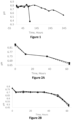
- FIG. 1 shows the pH over time of the milk sample stored 4°C (triangles) and the milk sample stored 18°C (squares). As freshness decreases over time, the pH values respectively decrease. It can be seen that the pH measurements of the milk sample stored at 18°C sharply decreased after 95h, indicating a rapid spoilage, while the milk sample stored at 4°C remained fresh for a longer period, and the spoilage was slower.
- Example 2A Correlation between the rate of spoilage of small and large milk samples
- Example 2B Correlation between the rate of spoilage of small and large samples containing milk and indigo carmine
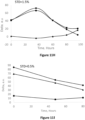
- Figure 2B shows the pH over time of the 0.5ml milk samples (dashed line, squares), 1.5ml milk samples set A (dashed line, triangles), 1.5ml milk samples set B (dashed line, no marker) and 50ml milk samples (solid line, circles).
- the correlation coefficients (calculated using Microsoft ® Excel ® ) between the graph lines were 0.993 or higher. The results thus indicate that the rate of spoilage of a small food sample (such as the food sample in the at least one chamber) and a large food sample (e.g. the food product in the device from which the food sample has been derived) are similar.
- bromothymol blue is a pH sensitive indicator, which changes its color from blue above pH 7.6 to yellow below pH 6.0.
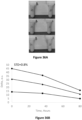
- Figure 3A is showing a photograph of the fresh milk sample with bromothymol blue (left) and a photograph of the spoiled milk sample with bromothymol blue (right). There is no visually discernible change in color between the two samples, as it seems that the natural turbidity of the milk samples masks the color change provided by the indicator upon change of the milk quality from fresh to spoiled.
- Example 4 Quality indication of whole milk using bromothymol blue in a two-compartment tube
- Figure 4 presents photographs of milk samples placed in Eppendorf tubes, each having two compartments, top and bottom, separated from one another by a separating membrane. The photographs show fresh samples (top left and top right photographs) and spoiled samples (bottom left and bottom right photographs).
- Example 5 Quality indication of whole milk using cresol red in a two-compartment tube
- cresol red is a pH sensitive indicator, which changes its color from red above pH 8.8 to yellow below pH 7.2.
- the tubes were divided into two compartments by polypropylene thin separating membrane (25-100 ⁇ m thickness). The pore size of such membranes ranges from hundreds nanometers to several microns.
- the tube was constructed such that a portion of the milk samples are diffuse through the membrane, to the bottom compartment. That portion, which was separated from the masking factors in the milk samples, e.g. concentrated colloid of proteins, fats and hydrocarbons, remained substantially clear.
- Figure 6 is showing photographs of Eppendorfs divided into two compartments, by a separating membrane, containing cresol red solution and fresh milk (top left and top right), or milk in a transition phase (i.e. after some storage time) (middle left and middle right) or spoiled milk (bottom left and bottom right).
- the indication of a sample that is not spoiled, but is not considered fresh may be referred to as a transition state during which the milk is edible and there are no indications of spoilage, namely, no bad smell or phase separation (even when the milk sample is mixed with hot water).
- the transition stage is characterized by a small decrease in pH, e.g. the pH may change from 6.84 to 6.86, or from 6.72 to 6.76.
- the pH change from fresh to transition was within the following ranges of from 6.82 to 6.84 or from 6.69 to 6.70 for most samples at room temperature, but it is still absolutely acceptable.
- FIG. 8A shows the transparency (in percentage) of milk samples in wavelengths ranging from 300 to 700 nm for whole milk (squares), 2-fold diluted milk (diamonds), 5-fold diluted milk (circles), 10-fold diluted milk (X) and 20-fold diluted milk (triangles).
- Figure 8B is an enlargement of Figure 8A in the range of -0.15% and 0.6% transparency, in which the trend lines of whole milk (squares), 2-fold diluted milk (diamonds) and 5-fold diluted milk (circles) are sufficiently separate from one another.
- the result indicate that, while samples of milk diluted up to 5-fold with water, showed no substantial increase in transparency and remained turbid, samples of milk diluted by 10 to 20 fold, showed significant increase in transparency, most prominent in wavelengths of 600 to 700 nm.
- Example 7 Correlation between pH of diluted milk and whole milk during spoilage
- Example 8 Quality indication of diluted milk using methyl red
- methyl red changes from red below pH 4.4 to yellow above pH 6.2.
- the experimental set up included the use of an aqueous solution for dilution, adjusting the initial pH to 7.16. Since the masking factors in the milk samples, e.g. concentrated colloid of proteins, fatty acids and hydrocarbons, were diluted, the color indication provided by indicator was visible and clear.
- Figure 10A is showing photographs of diluted (1:10) samples of fresh (top left and top right) and spoiled milk (bottom left and bottom right) mixed with methyl red indicator solution.
- Example 9A Quality indication of whole milk using bacterial indicators
- Example 3 most pH indicators fail to distinguish fresh milk samples from spoiled ones, unless diluted or filtered through a membrane, due to the turbidity of the milk.
- Example 8 indicated that other than pH sensing by pH indicators, a direct monitoring of milk spoilage can be achieved through sensing the growth of bacterial population. It was further shown that methyl red, which loses its yellow color in the presence of bacteria, may be used as an appropriate quality and freshness indicator in diluted food products although it does not function as a pH indicator in a pH relevant to milk spoilage suggesting using indications based on the changes in bacterial presence or in the amount of compounds related to the presence of bacteria. As a result, experiments were carried out with whole milk using indicators which are sensitive to the presence of bacteria, which in its turn indicate the spoilage of milk.
- indigo carmine is a pH sensitive indicator, which changes its color from yellow above pH 13.0 to blue below pH 11.4.
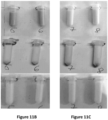
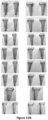
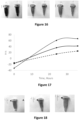
- the sample - indicator mixture was blue at the preparation, when the milk was fresh ( Fig. 11B , top). During spoilage the samples were colorless (white; Fig. 11B , middle and bottom, respectively).
- the visually distinct change in color from blue in fresh milk to white in spoiled milk shows the feasibility of indigo carmine as an indicator for food quality with no need to use dilution or separation of the food sample from the indicator.
- the reduction of this bond is known to be caused by bacterial action, therefore the disappearance for the blue color from the indigo carmine solution indicated the spoilage of the milk directly through indicating bacterial action, rather than a pH change, which typically follows a growth in bacterial population.
- carmoisine red serve as a dye, and specifically as a red food colorant.
- the sample - indicator mixture was pink at the preparation, when the milk was fresh ( Fig. 11C , top). During spoilage (middle photographs) and when spoiled (bottom photographs), the milk samples were colorless.
- the reduction of this bond is known to be caused by bacterial action, therefore the disappearance of the pink color from the carmoisine red solution was due to the presence of bacteria, or bacterial action (rather than a pH change that typically follows growth in bacterial population).
- the reduction of this bond is known to be caused by bacterial action, therefore the disappearance of the yellow color from the tartrazine solution corresponds to bacterial action (rather than to a pH change, which typically follows a growth in bacterial population).
- the visual change in color from pink in fresh milk to white (colorless) in spoiled milk is showing the feasibility of bromocresol green to serve as an indicator for food quality without the need to perform dilutions or to filter out interfering substances.
- the results bolster the findings that methyl red indicator is suitable for spoilage detection or for monitoring quality of whole milk samples.
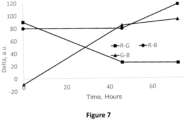
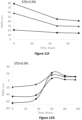
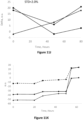
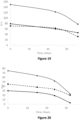
- the results corresponding to indigo carmine as an indicator are presented in Figure 11G , which show that in Red-Blue (squares), Green-Blue (triangles) and Red-Green (circles) color ranges there is a significant change upon the spoilage of the milk samples.
- the results bolster the findings that indigo carmine indicator is suitable for spoilage detection or for monitoring quality of whole milk samples.
- the results corresponding to carmoisine red as an indicator are presented in Figure 11H , which shows that in Red-Blue (squares), Green-Blue (triangles) and Red-Green (circles) color ranges there is a significant change upon the spoilage of the milk.
- Example 2B Small (0.5 ml), medium (1.5 ml) and large (50 ml) milk samples were prepared as described in Example 2B by combining 500 ml row milk and 6 gr of 0.02% indigo carmine aqueous solution at 4°C. The concentrations of indicator within the samples were in the range of 2 ⁇ 10 -8 to 1.5 ⁇ 10 -7 mol/ml.
- Figure 11M depicts the measured pH during spoilage vs. RGB reflection in Red-Blue (dashed line, triangles), Green-Blue (dashed line, squares) and Red-Green (solid line, circles) upon the spoilage of the milk samples.
- the visually distinct change in color from blue in fresh milk to white in spoiled milk shows the feasibility of bacterial indicators, e.g. indigo carmine, as food quality indicators with no need to use dilution or separation of the food sample from the indicator.
- bacterial indicators e.g. indigo carmine
- Example 9 pH indicators fail to distinguish fresh milk samples from spoiled ones, due to the turbidity of the milk.
- turbidity can be overcome by monitoring growth of bacterial population rather than pH, preferably with indicator that are non-antibacterial, and moreover that perform a color change by reduction of an internal bond.
- Example 11 Quality indication of chicken breast using bacterial indicators
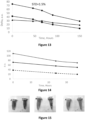
- the sample - indicator mixture was orange at the preparation, when the chicken breast was fresh ( Fig. 15 , left photograph). Over time the orange color gradually faded as seen after 24h at 24°C ( Fig. 15 , middle photograph) and after 36h at 24°C ( Fig. 15 , right photograph).
- the visually distinct change in color from blue in fresh chicken breast to discoloration in spoiled chicken breast shows the feasibility of indigo carmine as an indicator for food quality with no need to use dilution or separation of the food sample from the indicator.
- Example 12 Quality indication of cottage cheese using bacterial indicators
- Cottage cheese samples were mixed with methyl red as a quality indicator, in order to demonstrate that bacterial indicators arc effective in a wide pH range.
- concentrations of methyl red within the samples were in the range of 1.2 ⁇ 10 -7 to 8 ⁇ 10 -7 mol/ml.
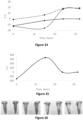
- the experiment was conducted for 32h at 24°C. Photographs and RGB measurements were taken at 0h, 15h, 24h and 36h. The result are given in Figure 20 , which shows that in Red-Blue (dashed line, triangles), Green-Blue (dashed line, squares) and Red-Green (solid line, circles) color ranges there is a change upon the spoilage of the cottage cheese samples.
- Figure 21 shows that the product of Red-Blue x Green-Blue x Red-Green also shows a significant change upon the spoilage of the cottage cheese samples. These changes indicate that indicators, such as methyl red, are suitable for detection or monitoring spoilage of products having varied textures.
- the sample - indicator mixture was orange at the preparation, when the cottage cheese was fresh ( Fig. 22 , left photograph). Over time the orange color gradually faded as seen after 15h at 24°C (second photograph from left), after 24h at 24°C (second photograph from right) and after 32h at 24°C (right photograph).
- the visually distinct change in color from blue in fresh cottage cheese to discoloration in spoiled cottage cheese shows the feasibility of indicators, such as indigo carmine to indicate food quality with no need to use dilution or separation of the food sample from the indicator.
- the visually distinct change in color from blue in fresh cottage cheese to discoloration in spoiled cottage cheese shows the feasibility of bromophenol blue as an indicator for food quality with no need to use dilution or separation of the food sample from the indicator.
- the visually distinct change in color from pink in fresh cottage cheese to discoloration in spoiled cottage cheese shows the feasibility of carmoisine red as an indicator for food quality with no need to use dilution or separation of the food sample from the indicator.
- Example 13 Quality indication of whole milk using combinations of bacterial indicators
- indicators which change their color in response to an increase in bacterial population allow distinction of fresh milk samples from spoiled ones despite the masking effect of the turbidity of the milk. It was of interest to determine whether combinations of more than a single indicator can serve for monitoring the quality of food products.
- Example 14 Quality indication of whole milk using combinations of bacterial indicators and transition metals
- Example 15 controlling the point of color change during spoilage
- Samples of whole milk and x10 diluted milk were prepared from the same batch of raw milk in 50 ml tubes. Each sample was added one indicator as follows: Sample 1 of whole milk with indigo carmine indicator having an indicator concentration of 2.78 ⁇ 10 -8 mol/ml (WM1-IC); Sample 2 of whole milk with indigo carmine indicator having an indicator concentration of 7.13 ⁇ 10 -8 mol/ml (WM3-IC); Sample 3 of whole milk with methyl red indicator having an indicator concentration of 1.46 ⁇ 10 -8 mol/ml (WM5-MR); Sample 4 of x10 diluted milk with indigo carmine indicator having an indicator concentration of 1.5 ⁇ 10 -8 mol/ml (M10-2-IC); Sample 5 of x10 diluted milk with indigo carmine indicator having an indicator concentration of 8 ⁇ 10 -9 mol/ml (M10-1-IC); and Sample 6 of x10 diluted milk with Bromocresol Green having an indicator concentration of 2 ⁇ 10 -9 mol/ml (M10-5-BC).
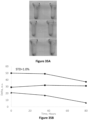
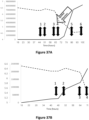
- the concentrations of indicators within samples 4-6 were in the range of 2 ⁇ 10 -9 - 1.5 ⁇ 10 -8 mol/ml. All samples were kept at 20°C and monitored for pH, bacterial count and color change. The results are given in Figure 37A , which shows total bacteria counting (solid line) and pH (dashed line) in the milk samples during spoilage as a function of monitoring time. Double sided arrows indicate the time points, in which color changes occurred in the indicator solutions according to the notations of Samples 1 through 6 above. The diagonal arrow indicated the point of time, in which phase separation occurred during the milk spoilage process. A significant correlation was witnessed between the initial indicator concentration and the total bacterial counting in the same samples (R 2 ⁇ 0.982).
- Figure 37B is the section of the graph of Figure 37A , which focuses on spoilage period (hours 16-70).
- Example 16 Correlation of pH and total bacteria count between indicator and whole milk
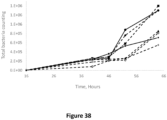
- Figure 38 shows the bacterial count of whole milk samples with no indicator (solid line, circles), with indigo carmine set I (dashed line, diamonds), with indigo carmine set II (dashed line, squares) and with methyl red (dashed line, triangles); and of x10 diluted milk samples with indigo carmine set III (dashed line, squares with X marks), with indigo carmine set IV (dashed line, "+” marks) and bromocresol Green (solid line, squares).
- R 2 correlations of bacteria count in milk/indicator samples vs. bacteria count in. whole milk were calculated using Microsoft ® Excel ® .
- the results indicate that the presence of indicators does not substantially influence the reproduction of bacteria.
- these indicators may be used as a part of the two part apparatus disclosed herein, in which, according to some embodiments, the diluted food product becomes spoiled at about the same rate of the food sample to be monitored.
Landscapes
- Chemical & Material Sciences (AREA)
- Life Sciences & Earth Sciences (AREA)
- Engineering & Computer Science (AREA)
- Health & Medical Sciences (AREA)
- Physics & Mathematics (AREA)
- Analytical Chemistry (AREA)
- Biochemistry (AREA)
- General Health & Medical Sciences (AREA)
- Immunology (AREA)
- General Physics & Mathematics (AREA)
- Pathology (AREA)
- Organic Chemistry (AREA)
- Food Science & Technology (AREA)
- Mechanical Engineering (AREA)
- Plasma & Fusion (AREA)
- Chemical Kinetics & Catalysis (AREA)
- Zoology (AREA)
- Proteomics, Peptides & Aminoacids (AREA)
- Wood Science & Technology (AREA)
- Biophysics (AREA)
- Molecular Biology (AREA)
- Medicinal Chemistry (AREA)
- Biotechnology (AREA)
- Microbiology (AREA)
- Toxicology (AREA)
- Bioinformatics & Cheminformatics (AREA)
- General Engineering & Computer Science (AREA)
- Genetics & Genomics (AREA)
- Measuring Or Testing Involving Enzymes Or Micro-Organisms (AREA)
- Investigating Or Analysing Materials By The Use Of Chemical Reactions (AREA)
- Apparatus Associated With Microorganisms And Enzymes (AREA)
Claims (16)
- Lebensmittellagerungsvorrichtung, welche umfasst:(a) mindestens eine Lebensmittelverpackung, die ein Lebensmittelprodukt enthält; und(b) mindestens eine Kammer, die eine Probe des Lebensmittelprodukts und eine Zusammensetzung enthält, die mindestens einen Indikator und ein Lösungsmittel umfasst,worin die mindestens eine Kammer eine flüssigkeits- und gasundurchlässige dreidimensionale Struktur ist und worin die mindestens eine Kammer im Wesentlichen ähnlichen Umgebungslagerungsbedingungen, wie der Lagertemperatur oder der Lagerungsdauer, unterliegt wie die Umgebungslagerungsbedingungen des Lebensmittelprodukts in der Lebensmittellagerungsvorrichtung, so dass die Lebensmittelprobe in der Kammer mit der gleichen Geschwindigkeit verdirbt wie das Lebensmittelprodukt in der Vorrichtung.
- Lebensmittellagerungsvorrichtung nach Anspruch 1, worin die mindestens eine Kammer an der Lebensmittelverpackung angebracht ist.
- Lebensmittellagerungsvorrichtung nach Anspruch 1, worin mindestens ein Indikator ausgewählt ist unter bakteriellen Indikatoren, Redox-Indikatoren und pH-Indikatoren.
- Lebensmittellagerungsvorrichtung nach Anspruch 3, worin mindestens ein Indikator ein pH-Indikator ist.
- Lebensmittellagerungsvorrichtung nach Anspruch 1, worin der mindestens eine Indikator ausgewählt ist aus Bromthymolblau, Kresolrot, Phenolrot, Methylrot, Bromkresolblau, Indigokarmin, Carmoisinrot, Tartrazin, Bromkresolgrün und Methylorange.
- Lebensmittellagerungsvorrichtung nach Anspruch 1, worin das Lebensmittelprodukt ein Milchprodukt umfasst.
- Lebensmittellagerungsvorrichtung nach Anspruch 1,worin die Lebensmittelprobe in der Kammer im Vergleich zu dem Lebensmittelprodukt in der mindestens einen Lebensmittelverpackung verdünnt ist; oderworin die mindestens eine Kammer mehrere Kammern umfasst, die eine erste und eine zweite Kammer umfassen, die durch eine Membran voneinander getrennt sind, worin die erste Kammer die Probe des Lebensmittelprodukts umfasst und die zweite Kammer einen gefilterten Teil der Probe umfasst; oderworin die mindestens eine Kammer eine Probe des Lebensmittelprodukts und eine Zusammensetzung umfasst, die mindestens einen bakteriellen Indikator enthält.
- Lebensmittellagerungsvorrichtung nach Anspruch 7, worin das mindestens eine Element mehrere Kammern umfasst, die eine erste und eine zweite Kammer umfassen, die durch eine Membran voneinander getrennt sind, und worin die Membran für Partikel mit einer durchschnittlichen Größenverteilung über 10 nm undurchlässig ist.
- Lebensmittellagerungsvorrichtung nach Anspruch 7, worin das mindestens eine Element mehrere Fächer umfasst, die erste und zweite Fächer umfassen, die durch eine Membran voneinander getrennt sind, und worin die Membran Poren mit einer durchschnittlichen Größe im Bereich von 0,01 Mikrometer bis 1 Mikrometer umfasst.
- Lebensmittellagerungsvorrichtung nach Anspruch 7, worin die Lebensmittelprobe des Lebensmittelprodukts in der mindestens einen Kammer im Vergleich zu dem Lebensmittelprodukt in der mindestens einen Lebensmittelverpackung verdünnt ist.
- Lebensmittellagerungsvorrichtung nach Anspruch 7, worin das mindestens eine Element eine Probe des Lebensmittelprodukts und eine Zusammensetzung umfasst, die mindestens einen bakteriellen Indikator umfasst, und worin mindestens ein bakterieller Indikator eine Anzeige bei Reduktion einer internen Doppelbindung, ausgewählt unter einer N=N-Bindung und einer C=C-Bindung, liefert.
- Lebensmittellagerungsvorrichtung nach Anspruch 7, worin das mindestens eine Element eine Probe des Lebensmittelprodukts und eine Zusammensetzung umfasst, die mindestens einen bakteriellen Indikator umfasst, und worin der mindestens eine bakterielle Indikator frei von quaternären Ammoniumsalzen und quaternären Aminresten ist.
- Lebensmittellagerungsvorrichtung nach Anspruch 7, worin das mindestens eine Element eine Probe des Lebensmittelprodukts und eine Zusammensetzung umfasst, die mindestens einen bakteriellen Indikator umfasst, und worin mindestens ein bakterieller Indikator ausgewählt ist aus der Gruppe bestehend aus Methylrot, Indigokarmin, Carmoisinrot, Tartrazin, Bromkresolgrün und Kombinationen davon.
- Lebensmittellagerungsvorrichtung nach Anspruch 1, worin die mindestens eine Kammer ein transparentes Fenster umfasst, so dass mindestens ein Teil der Kammer von außen durch das transparente Fenster sichtbar ist.
- Lebensmittellagerungsvorrichtung nach Anspruch 1, worin die Zusammensetzung ferner mindestens eine Übergangsmetallkomponente umfasst.
- Lebensmittellagerungsvorrichtung nach Anspruch 15, worin die Übergangsmetallkomponente Cr(III) umfasst.
Applications Claiming Priority (2)
| Application Number | Priority Date | Filing Date | Title |
|---|---|---|---|
| US201662435864P | 2016-12-19 | 2016-12-19 | |
| PCT/IL2017/051355 WO2018116294A1 (en) | 2016-12-19 | 2017-12-17 | Devices for monitoring food freshness and methods of using same |
Publications (4)
| Publication Number | Publication Date |
|---|---|
| EP3551548A1 EP3551548A1 (de) | 2019-10-16 |
| EP3551548A4 EP3551548A4 (de) | 2020-07-22 |
| EP3551548B1 true EP3551548B1 (de) | 2024-12-25 |
| EP3551548C0 EP3551548C0 (de) | 2024-12-25 |
Family
ID=62626010
Family Applications (1)
| Application Number | Title | Priority Date | Filing Date |
|---|---|---|---|
| EP17884792.7A Active EP3551548B1 (de) | 2016-12-19 | 2017-12-17 | Vorrichtungen zur überwachung der lebensmittelfrische |
Country Status (8)
| Country | Link |
|---|---|
| US (1) | US10899504B2 (de) |
| EP (1) | EP3551548B1 (de) |
| CN (1) | CN110088013B (de) |
| AU (1) | AU2017383549A1 (de) |
| CA (1) | CA3046121A1 (de) |
| ES (1) | ES3009740T3 (de) |
| IL (1) | IL266956B (de) |
| WO (1) | WO2018116294A1 (de) |
Families Citing this family (13)
| Publication number | Priority date | Publication date | Assignee | Title |
|---|---|---|---|---|
| WO2020033263A1 (en) | 2018-08-07 | 2020-02-13 | Narula Poonam | Apparatus for microbial activity detection and inventory management, and process thereof |
| US12174168B2 (en) | 2018-10-25 | 2024-12-24 | Poonam NARULA | Apparatus for microbial activity detection and inventory management, and process thereof |
| IT201900004741A1 (it) * | 2019-03-29 | 2020-09-29 | Paolo Quadrelli | Sensori per la valutazione della qualità di prodotti alimentari a base di carne |
| CN110702258B (zh) * | 2019-11-04 | 2020-10-20 | 长春职业技术学院 | 用于食品冷链安全监测的温敏型乳液指示剂的制备方法 |
| TWI717104B (zh) * | 2019-11-15 | 2021-01-21 | 台灣奈米碳素股份有限公司 | 產品標籤、提供生鮮食品即時資訊的系統及方法 |
| TWI729684B (zh) * | 2020-01-21 | 2021-06-01 | 台灣奈米碳素股份有限公司 | 一種基於風味以管理、交易生鮮食品的系統及方法 |
| CN111638210B (zh) * | 2020-06-09 | 2022-06-21 | 渤海大学 | 用于指示海水鱼新鲜度的基于阳极铝氧化膜比色阵列传感标签的制备方法及其应用 |
| CN112180053A (zh) * | 2020-10-23 | 2021-01-05 | 周路明 | 一种离子交换膜流体食品质量检测方法 |
| US20220194679A1 (en) * | 2020-12-23 | 2022-06-23 | Sage Products, Llc | Modified atmosphere packaging for sealed compartments |
| CN112669694B (zh) * | 2020-12-23 | 2022-08-30 | 荆楚理工学院 | 一种通用型双向指示新鲜度标签的制备方法及灵敏度调控方法 |
| CN113252652B (zh) * | 2021-05-12 | 2023-03-24 | 东北林业大学 | 一种用于监测生鱼片新鲜度的精准指示膜的制备方法 |
| WO2023112035A1 (en) * | 2021-12-16 | 2023-06-22 | Do-Bio Ltd | Indicator device and system and uses thereof for detecting food spoilage |
| CN116446110B (zh) * | 2023-05-05 | 2026-02-03 | 成都大学 | 一种肉类保鲜和新鲜度可视化双重功效的纳米智能指示膜及其制备方法 |
Citations (1)
| Publication number | Priority date | Publication date | Assignee | Title |
|---|---|---|---|---|
| US20080286148A1 (en) * | 2007-05-14 | 2008-11-20 | Chen Itay Shlomo | Ph indicator |
Family Cites Families (47)
| Publication number | Priority date | Publication date | Assignee | Title |
|---|---|---|---|---|
| US3102418A (en) | 1956-06-18 | 1963-09-03 | Univ California | Method for testing for polymorphonuclear leukocytes |
| US3494770A (en) | 1966-07-19 | 1970-02-10 | Caravan Prod Co Inc | Yeast leavened bread dough composition and process of manufacture |
| DE2122294C3 (de) | 1971-05-05 | 1979-08-16 | Boehringer Mannheim Gmbh, 6800 Mannheim | Verfahren zur Gewinnung von Creatininamidohydrolase |
| DE2251576A1 (de) | 1972-10-20 | 1974-05-02 | Alpenhof Kaesewerk Paul Eberle | Schmelzkaesezubereitung bzw. kaesezubereitung |
| US4003709A (en) | 1975-10-02 | 1977-01-18 | Visual Spoilage Indicator Company | Visual spoilage indicator for food containers |
| US4280011A (en) | 1977-01-21 | 1981-07-21 | Hercules Incorporated | Aldehyde generators and foodstuffs containing such generators |
| EP0134798B1 (de) | 1983-01-28 | 1988-06-08 | Dairy And Food Labs, Inc. | Konservierungsmittelzusatz für eine auf Zusammensetzung zu testende Milchprobe und Verfahren zum Aussondern von Milchproben unter Verwendung desselben |
| JPH01154462U (de) * | 1988-04-14 | 1989-10-24 | ||
| US5094761A (en) | 1989-04-12 | 1992-03-10 | The Procter & Gamble Company | Treatment of fabric with perfume/cyclodextrin complexes |
| US5330773A (en) | 1989-08-29 | 1994-07-19 | Bongrain S.A. | Process for making cheese or a cheese-related specialty |
| US5219838A (en) | 1990-07-09 | 1993-06-15 | Morinaga Milk Industry Co., Ltd. | Method for inhibiting tyrosinase activity in treatment of skin |
| US6495368B1 (en) | 1996-11-05 | 2002-12-17 | Grouptek, Inc. | Methods and devices for detecting microbial spoilage in food products |
| EP0890835A1 (de) | 1997-07-09 | 1999-01-13 | Franke, Michael, Dr. | Indikator und Verfahren zur Erfassung von saurer Milch, die in einem dichten Behälter enthalten ist |
| IL121985A (en) | 1997-10-14 | 2000-11-21 | Carmel Avi | Milk product package |
| US6756069B2 (en) | 1999-05-18 | 2004-06-29 | Nestec S.A. | System and method for dispensing a liquid beverage concentrate |
| JP4292644B2 (ja) | 1999-09-09 | 2009-07-08 | 不二製油株式会社 | ゲルの製造法 |
| WO2001071318A1 (en) * | 2000-03-21 | 2001-09-27 | The Board Of Trustees Of The University Of Illinois | Colorimetric artificial nose having an array of dyes and method for artificial olfaction |
| US20020119233A1 (en) | 2000-12-15 | 2002-08-29 | Huang An Shun | Cookies with improved shelf life and process for preparing them |
| US6372220B1 (en) | 2001-02-05 | 2002-04-16 | Kavita Shukla | Fenugreek impregnated material for the preservation of perishable substances |
| KR100431536B1 (ko) | 2001-02-14 | 2004-05-20 | 박상규 | pH변화를 이용한 식품 품질 식별표시계 |
| US6723285B2 (en) * | 2001-04-11 | 2004-04-20 | Natali Chen | Food freshness indicator |
| KR20030096077A (ko) | 2002-06-15 | 2003-12-24 | 박상규 | 식품의 신선도 표시기 |
| US20060121165A1 (en) | 2002-09-16 | 2006-06-08 | Morris Roger J | Food freshness sensor |
| UA74848C2 (en) | 2003-05-12 | 2006-02-15 | Ruslan Stanislavovych Baksalov | Indicator for determining quality of a food product in polymeric package |
| JP4202193B2 (ja) | 2003-06-06 | 2008-12-24 | 森永乳業株式会社 | 密封包材、包装容器および包装体 |
| WO2005080964A1 (en) | 2004-02-13 | 2005-09-01 | Peters Daniel F | Food product condition indicator label |
| DE102004019427A1 (de) * | 2004-04-19 | 2005-11-03 | Karda Projektentwicklung Und Beratung Ohg | In Verpackungen integrierter oder angebrachter Frischetester auf Basis der pH-Wert-Messung für Lebensmittel |
| CA2587033A1 (en) * | 2004-09-13 | 2006-03-23 | Food Quality Sensor International, Inc. | Food quality indicator |
| FI20050809A7 (fi) | 2005-08-09 | 2007-02-10 | Valtion Teknillinen Tutkimuskeskus | Värikoostumus, happi- ja/tai pH-indikaattori ja pakkaus |
| IES20060034A2 (en) | 2006-01-16 | 2007-07-25 | Aisling Judge | A biological food contamination indicator |
| KR100859131B1 (ko) | 2006-05-04 | 2008-09-23 | 대한민국 | 우유의 신선도 판별용 근적외선 분광 분석 시스템 |
| RU2332010C1 (ru) | 2006-11-07 | 2008-08-27 | Государственное образовательное учреждение высшего профессионального образования Воронежская государственная технологическая академия | Способ производства хлеба повышенной биологической ценности с композитной смесью |
| US8557539B2 (en) * | 2006-11-10 | 2013-10-15 | Biolumix Inc. | Optical method and device for the detection and enumeration of microorganisms |
| CN201555823U (zh) | 2009-12-10 | 2010-08-18 | 长春工业大学 | 一种鲜奶奶质综合指标快速检测仪 |
| CN201683694U (zh) | 2010-05-12 | 2010-12-29 | 胡松柏 | 新型奶锅 |
| US20120107191A1 (en) | 2010-10-12 | 2012-05-03 | Strahle James R | Food quality indicator |
| JP5779348B2 (ja) | 2010-12-27 | 2015-09-16 | 日油株式会社 | 酸性液状栄養組成物 |
| CN102174437B (zh) | 2011-01-25 | 2012-10-24 | 北京农学院 | 一种德氏乳杆菌乳酸亚种及其抗单增李斯特菌细菌素的制备方法 |
| CA2849804C (en) | 2011-09-28 | 2019-07-16 | Power Fit S.R.L. | Measurement of lactic acid in biological fluids |
| US8211715B1 (en) * | 2011-11-15 | 2012-07-03 | Harrogate Holdings, Ltd. Co. | Consumer food testing device providing remote monitoring |
| CN202891414U (zh) | 2012-11-09 | 2013-04-24 | 闫凤波 | 显示牛奶新鲜程度的牛奶壶 |
| WO2014102556A1 (en) | 2012-12-27 | 2014-07-03 | Ideapool Kft. | Container with an indicating device |
| CN103529034B (zh) | 2013-10-12 | 2016-05-04 | 食曰(上海)生物科技有限公司 | 鉴别牛奶新鲜度的方法 |
| WO2015101992A2 (en) | 2014-01-03 | 2015-07-09 | Verifood, Ltd. | Spectrometry systems, methods, and applications |
| EP3100031A4 (de) | 2014-01-27 | 2017-09-20 | Jp Laboratories, Inc. | Anzeigevorrichtungen auf basis von seitlicher diffusion von einer mobilen phase durch eine nichtporöse stationäre phase |
| CN104443858A (zh) | 2014-11-19 | 2015-03-25 | 柳州航盛科技有限公司 | 牛奶保鲜容器 |
| CN104570828A (zh) | 2014-11-19 | 2015-04-29 | 柳州航盛科技有限公司 | 牛奶保鲜装置 |
-
2017
- 2017-12-17 CA CA3046121A patent/CA3046121A1/en active Pending
- 2017-12-17 WO PCT/IL2017/051355 patent/WO2018116294A1/en not_active Ceased
- 2017-12-17 CN CN201780078547.5A patent/CN110088013B/zh active Active
- 2017-12-17 AU AU2017383549A patent/AU2017383549A1/en not_active Abandoned
- 2017-12-17 US US16/466,257 patent/US10899504B2/en active Active
- 2017-12-17 ES ES17884792T patent/ES3009740T3/es active Active
- 2017-12-17 EP EP17884792.7A patent/EP3551548B1/de active Active
-
2019
- 2019-05-28 IL IL266956A patent/IL266956B/en active IP Right Grant
Patent Citations (1)
| Publication number | Priority date | Publication date | Assignee | Title |
|---|---|---|---|---|
| US20080286148A1 (en) * | 2007-05-14 | 2008-11-20 | Chen Itay Shlomo | Ph indicator |
Also Published As
| Publication number | Publication date |
|---|---|
| IL266956B (en) | 2020-01-30 |
| AU2017383549A1 (en) | 2019-07-25 |
| ES3009740T3 (en) | 2025-03-31 |
| EP3551548A4 (de) | 2020-07-22 |
| CN110088013B (zh) | 2022-03-18 |
| US10899504B2 (en) | 2021-01-26 |
| IL266956A (en) | 2019-06-30 |
| CN110088013A (zh) | 2019-08-02 |
| WO2018116294A1 (en) | 2018-06-28 |
| US20200062456A1 (en) | 2020-02-27 |
| CA3046121A1 (en) | 2018-06-28 |
| EP3551548A1 (de) | 2019-10-16 |
| EP3551548C0 (de) | 2024-12-25 |
Similar Documents
| Publication | Publication Date | Title |
|---|---|---|
| US10899504B2 (en) | Devices for monitoring food freshness and methods of using same | |
| US6495368B1 (en) | Methods and devices for detecting microbial spoilage in food products | |
| US8425996B2 (en) | Indicators for detecting the presence of metabolic byproducts from microorganisms | |
| US20060057022A1 (en) | Food quality indicator | |
| JP5575252B2 (ja) | ポリマー複合材料、その製造方法および使用、食品包装物品、医療器具、二酸化炭素センサ又はインジケータ、アンモニアセンサ又はインジケータ、並びに、酸素センサ又はインジケータ | |
| US10338048B2 (en) | Food freshness indicator ink and method for the manufacture of a food freshness indicator ink | |
| US6723285B2 (en) | Food freshness indicator | |
| US20230127982A1 (en) | Indicator film | |
| TWI354788B (de) | ||
| Hong et al. | Development of color indicators for kimchi packaging | |
| WO1998020337A1 (en) | Methods and devices for detecting spoilage in food products | |
| WO2005103285A2 (en) | Systems and methods for indicating oxidation of consumer products | |
| KR102440885B1 (ko) | 색변이 고분자를 이용한 온도 이력 측정용 알지네이트 필름 제조법 | |
| PL241122B1 (pl) | Sposób pakowania sera w atmosferze ochronnej | |
| JP4338909B2 (ja) | 大腸菌群の検出法並びに検出キット | |
| WO2020021053A1 (de) | Dosimeter-material für ammoniak und/oder amine, dessen herstellung und verwendung | |
| Raman | Studies on the Development of an On-package Colorimetric Freshness Indicator for Khoa | |
| DESHWAL | MASTER OF TECHNOLOGY IN DAIRY TECHNOLOGY | |
| HK1226806A1 (en) | Food freshness indicator ink and method for the manufacture of a food freshness indicator ink | |
| LANI | DEVELOPMENT OF A PAPER BASED COLORIMETRIC KIT FOR SPOILAGE DETECTION OF CHHENAPODA |
Legal Events
| Date | Code | Title | Description |
|---|---|---|---|
| STAA | Information on the status of an ep patent application or granted ep patent |
Free format text: STATUS: THE INTERNATIONAL PUBLICATION HAS BEEN MADE |
|
| PUAI | Public reference made under article 153(3) epc to a published international application that has entered the european phase |
Free format text: ORIGINAL CODE: 0009012 |
|
| STAA | Information on the status of an ep patent application or granted ep patent |
Free format text: STATUS: REQUEST FOR EXAMINATION WAS MADE |
|
| 17P | Request for examination filed |
Effective date: 20190709 |
|
| AK | Designated contracting states |
Kind code of ref document: A1 Designated state(s): AL AT BE BG CH CY CZ DE DK EE ES FI FR GB GR HR HU IE IS IT LI LT LU LV MC MK MT NL NO PL PT RO RS SE SI SK SM TR |
|
| AX | Request for extension of the european patent |
Extension state: BA ME |
|
| DAV | Request for validation of the european patent (deleted) | ||
| DAX | Request for extension of the european patent (deleted) | ||
| A4 | Supplementary search report drawn up and despatched |
Effective date: 20200619 |
|
| RIC1 | Information provided on ipc code assigned before grant |
Ipc: B65D 79/02 20060101ALN20200615BHEP Ipc: B65D 85/80 20060101ALN20200615BHEP Ipc: G01N 33/04 20060101ALN20200615BHEP Ipc: G01N 31/22 20060101ALI20200615BHEP Ipc: C12Q 1/04 20060101ALI20200615BHEP Ipc: G01N 21/80 20060101AFI20200615BHEP |
|
| STAA | Information on the status of an ep patent application or granted ep patent |
Free format text: STATUS: EXAMINATION IS IN PROGRESS |
|
| 17Q | First examination report despatched |
Effective date: 20220628 |
|
| REG | Reference to a national code |
Ref country code: DE Ref legal event code: R079 Free format text: PREVIOUS MAIN CLASS: B65D0079020000 Ipc: G01N0021800000 Ref document number: 602017087004 Country of ref document: DE |
|
| GRAP | Despatch of communication of intention to grant a patent |
Free format text: ORIGINAL CODE: EPIDOSNIGR1 |
|
| STAA | Information on the status of an ep patent application or granted ep patent |
Free format text: STATUS: GRANT OF PATENT IS INTENDED |
|
| RIC1 | Information provided on ipc code assigned before grant |
Ipc: B65D 79/02 20060101ALN20240603BHEP Ipc: B65D 85/80 20060101ALN20240603BHEP Ipc: G01N 33/04 20060101ALN20240603BHEP Ipc: C12Q 1/04 20060101ALI20240603BHEP Ipc: G01N 31/22 20060101ALI20240603BHEP Ipc: G01N 21/80 20060101AFI20240603BHEP |
|
| INTG | Intention to grant announced |
Effective date: 20240620 |
|
| GRAS | Grant fee paid |
Free format text: ORIGINAL CODE: EPIDOSNIGR3 |
|
| GRAA | (expected) grant |
Free format text: ORIGINAL CODE: 0009210 |
|
| STAA | Information on the status of an ep patent application or granted ep patent |
Free format text: STATUS: THE PATENT HAS BEEN GRANTED |
|
| AK | Designated contracting states |
Kind code of ref document: B1 Designated state(s): AL AT BE BG CH CY CZ DE DK EE ES FI FR GB GR HR HU IE IS IT LI LT LU LV MC MK MT NL NO PL PT RO RS SE SI SK SM TR |
|
| REG | Reference to a national code |
Ref country code: GB Ref legal event code: FG4D |
|
| REG | Reference to a national code |
Ref country code: CH Ref legal event code: EP |
|
| REG | Reference to a national code |
Ref country code: IE Ref legal event code: FG4D |
|
| REG | Reference to a national code |
Ref country code: DE Ref legal event code: R096 Ref document number: 602017087004 Country of ref document: DE |
|
| U01 | Request for unitary effect filed |
Effective date: 20250117 |
|
| U07 | Unitary effect registered |
Designated state(s): AT BE BG DE DK EE FI FR IT LT LU LV MT NL PT RO SE SI Effective date: 20250124 |
|
| REG | Reference to a national code |
Ref country code: ES Ref legal event code: FG2A Ref document number: 3009740 Country of ref document: ES Kind code of ref document: T3 Effective date: 20250331 |
|
| PG25 | Lapsed in a contracting state [announced via postgrant information from national office to epo] |
Ref country code: HR Free format text: LAPSE BECAUSE OF FAILURE TO SUBMIT A TRANSLATION OF THE DESCRIPTION OR TO PAY THE FEE WITHIN THE PRESCRIBED TIME-LIMIT Effective date: 20241225 |
|
| PG25 | Lapsed in a contracting state [announced via postgrant information from national office to epo] |
Ref country code: NO Free format text: LAPSE BECAUSE OF FAILURE TO SUBMIT A TRANSLATION OF THE DESCRIPTION OR TO PAY THE FEE WITHIN THE PRESCRIBED TIME-LIMIT Effective date: 20250325 |
|
| PG25 | Lapsed in a contracting state [announced via postgrant information from national office to epo] |
Ref country code: GR Free format text: LAPSE BECAUSE OF FAILURE TO SUBMIT A TRANSLATION OF THE DESCRIPTION OR TO PAY THE FEE WITHIN THE PRESCRIBED TIME-LIMIT Effective date: 20250326 |
|
| PG25 | Lapsed in a contracting state [announced via postgrant information from national office to epo] |
Ref country code: RS Free format text: LAPSE BECAUSE OF FAILURE TO SUBMIT A TRANSLATION OF THE DESCRIPTION OR TO PAY THE FEE WITHIN THE PRESCRIBED TIME-LIMIT Effective date: 20250325 |
|
| PG25 | Lapsed in a contracting state [announced via postgrant information from national office to epo] |
Ref country code: SM Free format text: LAPSE BECAUSE OF FAILURE TO SUBMIT A TRANSLATION OF THE DESCRIPTION OR TO PAY THE FEE WITHIN THE PRESCRIBED TIME-LIMIT Effective date: 20241225 |
|
| PG25 | Lapsed in a contracting state [announced via postgrant information from national office to epo] |
Ref country code: PL Free format text: LAPSE BECAUSE OF FAILURE TO SUBMIT A TRANSLATION OF THE DESCRIPTION OR TO PAY THE FEE WITHIN THE PRESCRIBED TIME-LIMIT Effective date: 20241225 |
|
| PG25 | Lapsed in a contracting state [announced via postgrant information from national office to epo] |
Ref country code: IS Free format text: LAPSE BECAUSE OF FAILURE TO SUBMIT A TRANSLATION OF THE DESCRIPTION OR TO PAY THE FEE WITHIN THE PRESCRIBED TIME-LIMIT Effective date: 20250425 |
|
| PG25 | Lapsed in a contracting state [announced via postgrant information from national office to epo] |
Ref country code: SK Free format text: LAPSE BECAUSE OF FAILURE TO SUBMIT A TRANSLATION OF THE DESCRIPTION OR TO PAY THE FEE WITHIN THE PRESCRIBED TIME-LIMIT Effective date: 20241225 |
|
| PG25 | Lapsed in a contracting state [announced via postgrant information from national office to epo] |
Ref country code: CZ Free format text: LAPSE BECAUSE OF FAILURE TO SUBMIT A TRANSLATION OF THE DESCRIPTION OR TO PAY THE FEE WITHIN THE PRESCRIBED TIME-LIMIT Effective date: 20241225 |
|
| PLBE | No opposition filed within time limit |
Free format text: ORIGINAL CODE: 0009261 |
|
| STAA | Information on the status of an ep patent application or granted ep patent |
Free format text: STATUS: NO OPPOSITION FILED WITHIN TIME LIMIT |
|
| 26N | No opposition filed |
Effective date: 20250926 |
|
| PGFP | Annual fee paid to national office [announced via postgrant information from national office to epo] |
Ref country code: GB Payment date: 20251210 Year of fee payment: 9 |
|
| U20 | Renewal fee for the european patent with unitary effect paid |
Year of fee payment: 9 Effective date: 20251215 |
|
| PGFP | Annual fee paid to national office [announced via postgrant information from national office to epo] |
Ref country code: ES Payment date: 20260119 Year of fee payment: 9 |