EP3550151A1 - Verbrennungsluftgebläse - Google Patents
Verbrennungsluftgebläse Download PDFInfo
- Publication number
- EP3550151A1 EP3550151A1 EP19166497.8A EP19166497A EP3550151A1 EP 3550151 A1 EP3550151 A1 EP 3550151A1 EP 19166497 A EP19166497 A EP 19166497A EP 3550151 A1 EP3550151 A1 EP 3550151A1
- Authority
- EP
- European Patent Office
- Prior art keywords
- housing
- blower
- combustion air
- flow space
- air flow
- Prior art date
- Legal status (The legal status is an assumption and is not a legal conclusion. Google has not performed a legal analysis and makes no representation as to the accuracy of the status listed.)
- Granted
Links
Images
Classifications
-
- F—MECHANICAL ENGINEERING; LIGHTING; HEATING; WEAPONS; BLASTING
- F04—POSITIVE - DISPLACEMENT MACHINES FOR LIQUIDS; PUMPS FOR LIQUIDS OR ELASTIC FLUIDS
- F04D—NON-POSITIVE-DISPLACEMENT PUMPS
- F04D23/00—Other rotary non-positive-displacement pumps
- F04D23/008—Regenerative pumps
-
- B—PERFORMING OPERATIONS; TRANSPORTING
- B60—VEHICLES IN GENERAL
- B60H—ARRANGEMENTS OF HEATING, COOLING, VENTILATING OR OTHER AIR-TREATING DEVICES SPECIALLY ADAPTED FOR PASSENGER OR GOODS SPACES OF VEHICLES
- B60H1/00—Heating, cooling or ventilating devices
- B60H1/22—Heating, cooling or ventilating devices the heat source being other than the propulsion plant
-
- F—MECHANICAL ENGINEERING; LIGHTING; HEATING; WEAPONS; BLASTING
- F04—POSITIVE - DISPLACEMENT MACHINES FOR LIQUIDS; PUMPS FOR LIQUIDS OR ELASTIC FLUIDS
- F04D—NON-POSITIVE-DISPLACEMENT PUMPS
- F04D25/00—Pumping installations or systems
- F04D25/02—Units comprising pumps and their driving means
- F04D25/08—Units comprising pumps and their driving means the working fluid being air, e.g. for ventilation
-
- F—MECHANICAL ENGINEERING; LIGHTING; HEATING; WEAPONS; BLASTING
- F04—POSITIVE - DISPLACEMENT MACHINES FOR LIQUIDS; PUMPS FOR LIQUIDS OR ELASTIC FLUIDS
- F04D—NON-POSITIVE-DISPLACEMENT PUMPS
- F04D29/00—Details, component parts, or accessories
- F04D29/40—Casings; Connections of working fluid
- F04D29/403—Casings; Connections of working fluid especially adapted for elastic fluid pumps
-
- F—MECHANICAL ENGINEERING; LIGHTING; HEATING; WEAPONS; BLASTING
- F04—POSITIVE - DISPLACEMENT MACHINES FOR LIQUIDS; PUMPS FOR LIQUIDS OR ELASTIC FLUIDS
- F04D—NON-POSITIVE-DISPLACEMENT PUMPS
- F04D29/00—Details, component parts, or accessories
- F04D29/66—Combating cavitation, whirls, noise, vibration or the like; Balancing
- F04D29/661—Combating cavitation, whirls, noise, vibration or the like; Balancing especially adapted for elastic fluid pumps
- F04D29/663—Sound attenuation
-
- F—MECHANICAL ENGINEERING; LIGHTING; HEATING; WEAPONS; BLASTING
- F24—HEATING; RANGES; VENTILATING
- F24H—FLUID HEATERS, e.g. WATER OR AIR HEATERS, HAVING HEAT-GENERATING MEANS, e.g. HEAT PUMPS, IN GENERAL
- F24H3/00—Air heaters
- F24H3/02—Air heaters with forced circulation
- F24H3/04—Air heaters with forced circulation the air being in direct contact with the heating medium, e.g. electric heating element
Definitions
- the present invention relates to a combustion air blower, in particular a combustion air blower constructed as a side channel blower, which can be used in a fuel-operated vehicle heater to convey the air required for combustion toward a combustion chamber.
- Such a combustion air blower comprises a blower housing which is generally constructed of metal material, wherein an air flow space through which air can be conveyed is formed in the blower housing and air flowing via at least one inlet opening into the air flow space flows to a conveyor region comprising a conveyor wheel rotatable about an axis of rotation.
- the delivery wheel is covered by a housing cover carried on the blower housing.
- the blower housing comprises a bottom wall, and the conveyor region comprises in the bottom wall of the blower housing an open to the outside of the air flow space outside, the axis of rotation annular surrounding and covered by the feed wheel conveyor channel.
- the air flow space bounded by the bottom wall and a peripheral wall is open via at least one outlet opening to the conveying channel.
- a combustion air blower for a fuel-powered vehicle heater, comprising a fan housing, wherein on the blower housing a through-flow of air to be conveyed air flow space is formed and at least one inlet opening into the air flow space flowing air to a on an axis of rotation rotatable conveying wheel comprising conveying region flows, wherein the fan housing comprises a bottom wall and the conveying region in the bottom wall of the fan housing to one from the air flow space the outer side facing open, the rotational axis surrounding annular and covered by the feed wheel conveyor channel, wherein the air flow space via at least one outlet opening to the conveyor channel is open, wherein on the blower housing a conveyor wheel overlapping and with the fan housing a constructiveradabilityraum limiting housing cover is supported, further comprising a circumferential wall surrounding the air flow space, wherein at least a part of the peripheral wall is formed on the housing cover.
- the provision of at least a part of the peripheral wall on the housing cover makes it possible to construct this part of the peripheral wall with the material of the housing cover, generally plastic material, while in particular the region providing the bottom wall, that is to say substantially the fan housing optionally with a further part of the peripheral wall, can be constructed, for example, of metal material and thus allows the required especially in the region of the conveyor channel, high-precision manufacturing.
- a first part of the peripheral wall is formed on the fan housing and a second part of the peripheral wall is formed on the housing cover.
- mechanically and thermally more stable material that is, for example, metal material.
- the peripheral wall may, for example, have a substantially rectangular cross-sectional geometry provided with four partial circumferential walls, and one of the partial peripheral walls may be provided on the fan housing, while three of the partial peripheral walls may be provided on the housing cover.
- the blower housing may include a motor housing portion having a peripheral wall and a bottom wall at least partially surrounded by the air flow space.
- a closing element terminating the air flow space be provided on an end region of the peripheral wall facing away from the bottom wall of the fan housing, and that the closing element is constructed with plastic material.
- a sealing element sealing the conveyor wheel receiving space in the region of the abutment of the housing cover to the bottom wall can be arranged.
- the sealing element may be arranged surrounding the conveyor channel in an annular manner on an outer side of the bottom wall of the fan housing.
- At least one hydrocarbon storage element is arranged in the air flow space.
- at least one hydrocarbon storage element can be constructed with active carbonaceous material.
- the blower housing may be constructed with metal material, preferably aluminum or an aluminum alloy, while the housing cover may be constructed with plastic material, preferably polyamide material, for reasons of reduced weight.
- the blower housing can be produced in a metal die-casting process.
- the housing cover may be produced by a plastic injection molding process, preferably a MuCell® injection molding process.
- the invention further relates to a fuel-operated vehicle heating device, comprising a burner region, a liquid fuel to the burner region-promoting fuel pump and a combustion air blower constructed according to the invention.
- the burner region is supported on the first part of the peripheral wall.
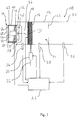
- the Fig. 1 shows in a schematic representation of the structure of a generally designated 10 fuel-driven vehicle heater.
- the vehicle heating device 10 comprises a burner region 12 with a combustion chamber 14 formed in a combustion chamber housing a porous evaporator medium 16 is provided at a combustion chamber 14 as a bottom burner evaporator burner, which may be formed, for example, as metal mesh, Metallgewirk, foamed ceramic or the like ,
- the porous evaporator medium 16 may be associated with an electrically energizable heater 18.
- the fuel required for combustion is introduced into the porous evaporator medium 16 via a fuel line 22 by means of a fuel pump 20, for example a metering pump.
- the liquid fuel is distributed in the evaporator medium 16 by capillary action and is discharged as fuel vapor, ie in gaseous state, into the combustion chamber 14.
- the combustion air required for the combustion is conveyed to the combustion chamber 14 by a combustion air blower, generally designated 24.
- the combustion air discharged from the combustion air blower 24 passes into a space 26 generally indicated as a plenum upstream of the combustion chamber 14 and enters the combustion chamber 14 via a peripheral wall defining the combustion chamber 14 and / or an air introduction port provided at the bottom portion.
- the mixture of combustion air and fuel formed in the combustion chamber 14 is ignited, for example, by an electrically energizable ignition device 28, such as glow plug.
- the exhaust gases produced during combustion leave the combustion chamber 14 via a flame cover 29 and flow along a flame tube 30 in the direction of a heat exchanger region, not shown.
- the vehicle heater 10 further includes a drive assembly, generally designated 32. This controls the operation of the fuel pump 20 and the combustion air blower 24 and also the electrically energizable heater 18.
- the drive arrangement 32 of various sensors, such. B. a pressure sensor 34 and a temperature sensor 36, for the operation of the vehicle heater 10 relevant information is supplied.
- the combustion air blower 24 is generally constructed as a so-called side channel blower in such a fuel-powered vehicle heater 10. It comprises a fan housing 38 having a bottom wall 42 which, together with a peripheral wall 40, defines an air flow space 44. On the Air flow space 44 passes the combustion air to be conveyed in the direction of the combustion chamber 14 to an annular conveying channel 46 formed in the bottom wall 42. This is covered at an outer side of the bottom wall 42 facing away from the air flow space 44 by a conveying wheel 48 which is only shown in principle and rotatable about a rotation axis D. In the conveying operation, the air conveyed along the conveying channel 46 by the conveying action of the rotating conveying wheel 48 enters the chamber 26 and via this into the combustion chamber 14.
- the air to be conveyed to the burner area 12 has passed into the air flow space 44.
- the air leaves the air flow space 44 surrounding the rotation axis D and enters the conveying channel 46.
- the air flow space 44 is thus upstream of the delivery channel 46th
- a motor housing portion 54 is provided on the blower housing 38. This comprises a peripheral wall and a bottom wall provided on the end of the peripheral wall facing away from the bottom wall 42 of the fan housing 38. It should be noted that the peripheral wall of the motor housing portion may be formed together with the bottom wall 42 and, as explained below, a part of the peripheral wall 40 of the blower housing 38 as an integral component, in particular metal casting, for example made of aluminum or an aluminum alloy.
- the bottom wall of the motor housing portion after insertion of the fan motor in the surrounding of the peripheral wall of the motor housing portion 54 volume region at the axial end, axially relative to a rotation axis of a rotor shaft of the fan motor or the axis of rotation D of the delivery wheel 48, the peripheral wall of the motor housing portion, for example by screwing, latching or the like.
- a terminating element is provided. This can via a plurality of locking tabs on corresponding locking projections on the Peripheral wall 40 are locked.
- the drive arrangement 32 or at least a part thereof, for.
- the driving of the fan motor serving part be provided, wherein for example via an engaging in the air flow space 44 plug-in area an electrical connection to the blower motor can be made.
- liquid fuel ie hydrocarbon
- hydrocarbon storage elements 62, 64 may be provided in the air flow space, for example adjacent to the peripheral wall 40, the bottom wall 42 and the closing element 60. These may be constructed with active carbonaceous material and may be included, for example, as one or more blocks of material in the air flow space 44.
- combustion air blower 24 The structure of the combustion air blower 24 will be described below with reference to FIGS Fig. 2 described in detail.
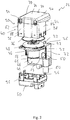
- the Fig. 2 shows the combustion air blower 24 in an exploded view.
- a central component is the fan housing 38 with the bottom wall 42 provided thereon as an integral component. This or the delivery channel 46 formed therein is covered by the delivery wheel 48.
- At the air flow space 42 oriented side of the bottom wall 42 of the motor housing portion 54 is provided with its peripheral wall 66 and a bottom wall 68 to be attached thereto. At least the peripheral wall 66 may also form an integral part of the blower housing 38.
- Fig. 2 also a generally designated 70 housing cover.
- This covers a conveying region 72 of the combustion air blower 24.
- the conveying region 62 substantially comprises the conveying wheel 48 and the conveying channel 46 covered therefrom.
- the housing cover 70 provides a hood region 74 which substantially covers the bottom wall 42 and closes the conveying region 72.
- a ring-like sealing element 76 can be positioned between the bottom wall 42 and the housing cover 70 surrounding the conveying wheel 48 or the conveying channel 46.
- peripheral wall 40 which together with the bottom wall 42 and the end member 60 bounds the air flow space 44 includes in the illustrated embodiment, two parts.
- a first part 78 of the rotary axis D surrounding or extending in the direction of the rotation axis D peripheral wall 40 forms an integral part of the blower housing 48 and extends from the bottom wall 42 on the side remote from the feed wheel 48 side thereof.
- an air supply channel 80 is formed, which is open via the inlet opening 50 to the air flow space 44.
- a second part 82 of the peripheral wall 40 is formed on the housing cover 70. This second part 82 together with the first part 80 completely surrounds the air flow space 44 in the circumferential direction.
- the peripheral wall 40 is provided with a total of four partial peripheral walls 84, 86, 88, 90.
- the partial peripheral wall 44 substantially provides the first portion 78 of the peripheral wall 40 and thus forms an integral part of the fan housing 38.
- the partial peripheral walls 86, 88, 90 provide substantially the second portion 82 of the peripheral wall 40 and together with the hood portion 74 an integral part of the housing cover 70th
- the housing cover 70 may for example be attached to the fan housing 38 that integrally formed on the fan housing 38 locking members 92 are positioned engaging detent openings 94 on the housing cover 70 and thus retain the bond between the housing cover 70 and blower housing 38 by positive engagement.
- the partial peripheral walls 86, 90 then connect to the partial circumferential wall 84.
- groove-like recesses 40 may be provided in the first part 78 of the peripheral wall, into which circumferential edge regions of the partial circumferential walls 86, 90 are positioned in an engaging manner.
- latching projections 98 can be positioned engaging, so as to ensure a positive cohesion generated by positive engagement.
- one or more hydrocarbon storage elements may be positioned within the air flow space 44 prior to attaching the end member 60.
- a plastic material can be used, so a polyamide material, which is reinforced with a glass fiber content of 30%.
- a corresponding building material can also be used for the closing element 60.
- the housing cover 70 and the closing element 60 can be produced in an injection molding process.
- the MuCell® method can be used, in which due to the formation of a microcellular core, a very good acoustic attenuation can be achieved.
- the blower housing 38 is made of a metal material, such as z. As aluminum or an aluminum alloy. It is preferably provided that on the first part 78 of the peripheral wall 40, so the partial peripheral wall 84, at the side remote from the air flow edge 44 outside of the burner region 12 of the in Fig. 2 arranged in a principled manner vehicle heater 10 is disposed or mounted. Thus, this leading to a stronger thermal and mechanical stress burner area via a less sensitive component of this material is connected to the combustion air blower 24.
- the above-described combustion air blower in particular with regard to the configuration of the peripheral wall can of course be varied.
- the entire peripheral wall could be provided on the housing cover 74 and thus made of plastic material.
- the fan housing would then essentially still comprise the bottom wall to be inserted into the housing cover and the motor housing area provided thereon.
- a part of the partial circumferential walls 86, 90 of the second part of the peripheral wall 40 may be provided by the first part 78, ie the partial peripheral wall 84 and thus provided as part of the blower housing 38.
Landscapes
- Engineering & Computer Science (AREA)
- Mechanical Engineering (AREA)
- General Engineering & Computer Science (AREA)
- Physics & Mathematics (AREA)
- Thermal Sciences (AREA)
- Chemical & Material Sciences (AREA)
- Combustion & Propulsion (AREA)
- Structures Of Non-Positive Displacement Pumps (AREA)
- Air-Conditioning For Vehicles (AREA)
Abstract
Description
- Die vorliegende Erfindung betrifft ein Verbrennungsluftgebläse, insbesondere ein als Seitenkanalgebläse aufgebautes Verbrennungsluftgebläse, das in einem brennstoffbetriebenen Fahrzeugheizgerät dazu genutzt werden kann, die für die Verbrennung erforderliche Luft in Richtung zu einer Brennkammer zu fördern.
- Ein derartiges Verbrennungsluftgebläse umfasst ein im Allgemeinen aus Metallmaterial aufgebautes Gebläsegehäuse, wobei in dem Gebläsegehäuse ein von zu fördernder Verbrennungsluft durchströmbarer Luftströmungsraum gebildet ist und über wenigstens eine Eintrittsöffnung in den Luftströmungsraum strömende Luft zu einem ein um eine Drehachse drehbares Förderrad umfassenden Förderbereich strömt. Das Förderrad ist durch einen an dem Gebläsegehäuse getragenen Gehäusedeckel überdeckt. Das Gebläsegehäuse umfasst eine Bodenwand, und der Förderbereich umfasst in der Bodenwand des Gebläsegehäuses einen zu einer vom Luftströmungsraum abgewandten Außenseite offenen, die Drehachse ringartig umgebenden und von dem Förderrad überdeckten Förderkanal. Der von der Bodenwand und einer Umfangswand umgrenzte Luftströmungsraum ist über wenigstens eine Austrittsöffnung zu dem Förderkanal offen.
- Es ist die Aufgabe der vorliegenden Erfindung, ein Verbrennungsluftgebläse, insbesondere Seitenkanalgebläse, für ein brennstoffbetriebenes Fahrzeugheizgerät mit verringertem Gewicht bereitzustellen.
- Erfindungsgemäß wird diese Aufgabe gelöst durch ein Verbrennungsluftgebläse, insbesondere Seitenkanalgebläse, für ein brennstoffbetriebenes Fahrzeugheizgerät, umfassend ein Gebläsegehäuse, wobei an dem Gebläsegehäuse ein von zu fördernder Verbrennungsluft durchströmbarer Luftströmungsraum gebildet ist und über wenigstens eine Eintrittsöffnung in den Luftströmungsraum strömende Luft zu einem ein um eine Drehachse drehbares Förderrad umfassenden Förderbereich strömt, wobei das Gebläsegehäuse eine Bodenwand umfasst und der Förderbereich in der Bodenwand des Gebläsegehäuses einen zu einer vom Luftströmungsraum abgewandten Außenseite offenen, die Drehachse ringartig umgebenden und von dem Förderrad überdeckten Förderkanal umfasst, wobei der Luftströmungsraum über wenigstens eine Austrittsöffnung zu dem Förderkanal offen ist, wobei an dem Gebläsegehäuse ein das Förderrad überdeckender und mit dem Gebläsegehäuse einen Förderradaufnahmeraum begrenzender Gehäusedeckel getragen ist, ferner umfassend eine den Luftströmungsraum umgebende Umfangswand, wobei wenigstens ein Teil der Umfangswand an dem Gehäusedeckel ausgebildet ist.
- Das Bereitstellen zumindest eines Teils der Umfangswand an dem Gehäusedeckel ermöglicht es, diesen Teil der Umfangswand mit dem Material des Gehäusedeckels, im Allgemeinen Kunststoffmaterial, aufzubauen, während insbesondere der die Bodenwand bereitstellende Bereich, also im wesentlichen das Gebläsegehäuse gegebenenfalls mit einem weiteren Teil der Umfangswand, beispielsweise aus Metallmaterial aufgebaut werden kann und somit die insbesondere im Bereich des Förderkanals erforderliche, hochpräzise Fertigung ermöglicht.
- Beispielsweise kann vorgesehen sein, dass ein erster Teil der Umfangswand an dem Gebläsegehäuse ausgebildet ist und ein zweiter Teil der Umfangswand an dem Gehäusedeckel ausgebildet ist. Somit wird es möglich, beispielsweise den Teil der Umfangswand, an welchem ein Brennerbereich eines Fahrzeugheizgeräts anzubringen ist, mit mechanisch und thermisch stabilerem Material, also beispielsweise Metallmaterial, aufzubauen.
- Die Umfangswand kann beispielsweise eine im Wesentlichen rechteckige mit vier Teil-Umfangswänden bereitgestellte Querschnittsgeometrie aufweist, und an dem Gebläsegehäuse kann eine der Teil-Umfangswände vorgesehen sein, während an dem Gehäusedeckel drei der Teil-Umfangswände vorgesehen sein können.
- Zur Zufuhr von Verbrennungsluft in den Luftströmungsraum wird vorgeschlagen, dass an dem ersten Teil der Umfangswand ein zu dem Luftströmungsraum führender und über die wenigstens eine Eintrittsöffnung zu diesem offener Luftzuführkanal vorgesehen ist.
- Ferner kann für einen kompakten, eine geringe Anzahl an Bauteilen erfordernden Aufbau das Gebläsegehäuse einen wenigstens bereichsweise von dem Luftströmungsraum umgebenen Motorgehäusebereich mit einer Umfangswand und einer Bodenwand aufweisen.
- Zum Abschluss des Luftströmungsraum an der von der Bodenwand entfernten Seite der Umfangswand wird vorgeschlagen, dass an einem von der Bodenwand des Gebläsegehäuses abgewandten Endbereich der Umfangswand ein den Luftströmungsraum abschließendes Abschlusselement vorgesehen ist, und dass das Abschlusselement mit Kunststoffmaterial aufgebaut ist.
- Um Luftleckagen und auch den Austritt von gasförmigem Kohlenwasserstoff zu vermeiden, kann zwischen dem Gehäusedeckel und der Bodenwand des Gebläsegehäuses ein den Förderradaufnahmeraum im Bereich der Angrenzung des Gehäusedeckels an die Bodenwand dicht abschließendes Dichtelement angeordnet sein.
- Beispielsweise kann das Dichtelement den Förderkanal ringartig umgebend an einer Außenseite der Bodenwand des Gebläsegehäuses angeordnet sein.
- Um eine weiter erhöhte Sicherheit gegen den Austritt von gasförmigem Kohlenwasserstoff bereitzustellen, wird vorgeschlagen, dass in dem Luftströmungsraum wenigstens ein Kohlenwasserstoffspeicherelement angeordnet ist. Beispielsweise kann wenigstens ein Kohlenwasserstoffspeicherelement mit aktivkohlehaltigem Material aufgebaut sein.
- Wie bereits voranstehend ausgeführt, kann aus Stabilitätsgründen und aus Gründen der präzisen Fertigung das Gebläsegehäuse mit Metallmaterial, vorzugsweise Aluminium oder einer Aluminiumlegierung, aufgebaut sein, während der Gehäusedeckel aus Gründen des geringeren Gewichts mit Kunststoffmaterial, vorzugsweise Polyamidmaterial, aufgebaut sein kann.
- Dabei kann beispielsweise das Gebläsegehäuse in einem Metall-Druckgussverfahren hergestellt sein. Der Gehäusedeckel kann in einem Kunststoff-Spritzgussverfahren, vorzugsweise einem MuCell®-Spritzgussverfahren, hergestellt sein.
- Die Erfindung betrifft ferner ein brennstoffbetriebenes Fahrzeugheizgerät, umfassend einen Brennerbereich, eine flüssigen Brennstoff zu dem Brennerbereich fördernde Brennstoffpumpe sowie ein erfindungsgemäß aufgebautes Verbrennungsluftgebläse.
- Dabei ist vorzugsweise vorgesehen, dass der Brennerbereich an dem ersten Teil der Umfangswand getragen ist.
- Die vorliegende Erfindung wird nachfolgend mit Bezug auf die beiliegenden Figuren detailliert beschrieben. Es zeigt:
- Fig. 1
- eine prinzipielle Darstellung eines brennstoffbetriebenen Fahrzeugheizgeräts mit einem Verbrennungsluftgebläse;
- Fig. 2
- ein gemäß den Prinzipien der vorliegenden Erfindung aufgebautes Verbrennungsluftgebläse in perspektivischer Explosionsdarstellung.
- Die
Fig. 1 zeigt in prinzipieller Darstellung den Aufbau eines allgemein mit 10 bezeichneten brennstoffbetriebenen Fahrzeugheizgeräts. Das Fahrzeugheizgerät 10 umfasst einen Brennerbereich 12 mit einer in einem Brennkammergehäuse ausgebildeten Brennkammer 14. An einem die Brennkammer 14 begrenzenden Bodenbereich ist bei Aufbau des Brennerbereichs 12 als Verdampferbrenner ein poröses Verdampfermedium 16 vorgesehen, welches beispielsweise als Metallgeflecht, Metallgewirk, Schaumkeramik oder dergleichen ausgebildet sein kann. Zur Abstützung der Brennstoffverdampfung kann dem porösen Verdampfermedium 16 eine elektrisch erregbare Heizeinrichtung 18 zugeordnet sein. Der für die Verbrennung erforderliche Brennstoff wird vermittels einer Brennstoffpumpe 20, beispielsweise Dosierpumpe, über eine Brennstoffleitung 22 in das poröse Verdampfermedium 16 eingeleitet. Der flüssige Brennstoff verteilt sich in dem Verdampfermedium 16 durch Kapillarförderwirkung und wird als Brennstoffdampf, also in gasförmigem Aggregatzustand, in die Brennkammer 14 abgegeben. - Die für die Verbrennung erforderliche Verbrennungsluft wird durch ein allgemein mit 24 bezeichnetes Verbrennungsluftgebläse zur Brennkammer 14 gefördert. Die von dem Verbrennungsluftgebläse 24 abgegebene Verbrennungsluft gelangt in einen allgemein als Plenum bezeichneten Raum 26 stromaufwärts der Brennkammer 14 und tritt über mehrere beispielsweise in einer die Brennkammer 14 begrenzenden Umfangswandung oder/und einem an dem Bodenbereich vorgesehenen Lufteinleitstutzen in die Brennkammer 14 ein. Das in der Brennkammer 14 gebildete Gemisch aus Verbrennungsluft und Brennstoff wird beispielsweise durch ein elektrisch erregbares Zündorgan 28, beispielsweise Glühstift, gezündet. Die bei der Verbrennung entstehenden Abgase verlassen die Brennkammer 14 über eine Flammblende 29 und strömen entlang eines Flammrohrs 30 in Richtung auf einen nicht dargestellten Wärmetauscherbereich zu.
- Das Fahrzeugheizgerät 10 weist ferner eine allgemein mit 32 bezeichnete Ansteueranordnung auf. Diese steuert den Betrieb der Brennstoffpumpe 20 und des Verbrennungsluftgebläses 24 sowie auch der elektrisch erregbaren Heizeinrichtung 18. Hierzu können der Ansteueranordnung 32 von verschiedenen Sensoren, wie z. B. einem Drucksensor 34 und einem Temperatursensor 36, für den Betrieb des Fahrzeugheizgeräts 10 relevante Informationen zugeführt werden.
- Es ist darauf hinzuweisen, dass der grundsätzliche Aufbau des Fahrzeugheizgeräts 10 vorangehend anhand eines Beispiels dargestellt wurde und in verschiedensten Aspekten von den dargestellten und vorangehend beschriebenem Aufbau abweichen kann.
- Das Verbrennungsluftgebläse 24 ist bei einem derartigen brennstoffbetriebenen Fahrzeugheizgerät 10 allgemein als so genanntes Seitenkanalgebläse aufgebaut. Es umfasst ein Gebläsegehäuse 38 mit einer Bodenwand 42, die zusammen mit einer Umfangswand 40 einen Luftströmungsraum 44 begrenzt. Über den Luftströmungsraum 44 gelangt die in Richtung Brennkammer 14 zu fördernde Verbrennungsluft zu einem in der Bodenwand 42 ausgebildeten, ringförmigen Förderkanal 46. Dieser ist an einer vom Luftströmungsraum 44 abgewandten Außenseite der Bodenwand 42 von einem nur prinzipiell dargestellten, um eine Drehachse D drehbaren Förderrad 48 überdeckt. Im Förderbetrieb tritt die durch die Förderwirkung des rotierenden Förderrads 48 entlang des Förderkanals 46 geförderte Luft in den Raum 26 und über diesen in die Brennkammer 14 ein.
- Über eine Eintrittsöffnung 50 gelangten die zum Brennerbereich 12 zu fördernde Luft in den Luftströmungsraum 44. Über eine Austrittsöffnung 52 verlässt die Luft den die Drehachse D umgebenden Luftströmungsraum 44 und tritt in den Förderkanal 46 ein. Der Luftströmungsraum 44 liegt somit stromaufwärts bezüglich des Förderkanals 46.
- Zur Aufnahme eines das Förderrad 48 antreibenden Gebläsemotors, welcher im allgemeinen als Elektromotor ausgebildet ist, ist an dem Gebläsegehäuse 38 ein Motorgehäusebereich 54 vorgesehen. Dieser umfasst eine Umfangswand sowie eine an dem von der Bodenwand 42 des Gebläsegehäuses 38 abgewandten Ende der Umfangswand vorgesehene Bodenwand. Es ist darauf hinzuweisen, dass die Umfangswand des Motorgehäusebereichs zusammen mit der Bodenwand 42 und wie nachfolgend erläutert, einem Teil der Umfangswand 40 des Gebläsegehäuses 38 als ein integrales Bauteil, insbesondere Metallgussteil, beispielsweise aus Aluminium oder einer Aluminiumlegierung ausgebildet sein kann. Die Bodenwand des Motorgehäusebereichs kann nach Einsetzen des Gebläsemotors in den von der Umfangswand des Motorgehäusebereichs 54 umgebenden Volumenbereich am axialen Ende, axial bezogen auf eine Drehachse einer Rotorwelle des Gebläsemotors bzw. die Drehachse D des Förderrads 48, der Umfangswandung des Motorgehäusebereichs beispielsweise durch Verschraubung, Verrastung oder dergleichen festgelegt werden.
- Um den Luftströmungsraum 44 auch an dem von der Bodenwand 42 abgewandten Endbereich der Umfangswand 40 des Gebläsegehäuses 38 abzuschließen, ist ein allgemein mit 60 bezeichnetes Abschlusselement vorgesehen. Dieses kann über eine Mehrzahl von Rastlaschen an entsprechenden Rastvorsprüngen an der Umfangswand 40 verrastet werden. Am Abschlusselement 60 kann die Ansteueranordnung 32 oder zumindest ein Teil derselben, z. B. der der Ansteuerung des Gebläsemotors dienende Teil, vorgesehen sein, wobei beispielsweise über einen in den Luftströmungsraum 44 eingreifenden Steckbereich eine elektrische Verbindung zu dem Gebläsemotor hergestellt werden kann.
- Bei deaktiviertem Fahrzeugheizgerät 10 und in dem porösen Verdampfermedium 16 noch gespeichertem, flüssigem Brennstoff, also Kohlenwasserstoff, besteht grundsätzlich die Möglichkeit, dass, beispielsweise durch die noch vorhandene Restwärme unterstützt, Brennstoff abdampft und über den an sich zur Einleitung von Verbrennungsluft in die Brennkammer 14 vorgesehenen Strömungsweg in das Verbrennungsluftgebläse 24 und somit insbesondere auch den Bereich des Luftströmungsraums 44 gelangt. Derartiger in gasförmigem Aggregatzustand dann vorliegender Brennstoff bzw. Kohlenwasserstoff könnte über den Lufteinleitstutzen 52 zur Umgebung hin austreten. Um dies zu verhindern, können im Luftströmungsraum, beispielsweise anliegend an der Umfangswand 40, der Bodenwand 42 bzw. dem Abschlusselement 60 Kohlenwasserstoffspeicherelemente 62, 64 vorgesehen sein. Diese können mit aktivkohlehaltigem Material aufgebaut sein und können beispielsweise als ein oder mehrere Materialblöcke im Luftströmungsraum 44 aufgenommen sein.
- Der Aufbau des Verbrennungsluftgebläses 24 wird nachfolgend mit Bezug auf die
Fig. 2 detailliert beschrieben. - Die
Fig. 2 zeigt das Verbrennungsluftgebläse 24 in Explosionsdarstellung. Einen zentralen Bestandteil bildet das Gebläsegehäuse 38 mit der daran als integraler Bestandteil vorgesehenen Bodenwand 42. Diese bzw. der darin ausgebildete Förderkanal 46 ist vom Förderrad 48 überdeckt. An der zum Luftströmungsraum 42 orientierten Seite der Bodenwand 42 ist der Motorgehäusebereich 54 mit seiner Umfangswand 66 und einer daran anzubringenden Bodenwand 68 vorgesehen. Zumindest die Umfangswand 66 kann ebenfalls einen integralen Bestandteil des Gebläsegehäuses 38 bilden. - Zu erkennen ist in
Fig. 2 auch ein allgemein mit 70 bezeichneter Gehäusedeckel. Dieser überdeckt einen Förderbereich 72 des Verbrennungsluftgebläses 24. Der Förderbereich 62 umfasst im Wesentlichen das Förderrad 48 und den davon überdeckten Förderkanal 46. Der Gehäusedeckel 70 stellt einen Haubenbereich 74 bereit, der im Wesentlichen die Bodenwand 42 überdeckt und den Förderbereich 72 abschließt. Um hier einen gasdichten Abschluss zu erreichen, kann ein ringartiges Dichtelement 76 das Förderrad 48 bzw. den Förderkanal 46 umgebend zwischen der Bodenwand 42 und dem Gehäusedeckel 70 positioniert werden. - Die vorangehend mit Bezug auf die
Fig. 1 bereits in prinzipieller Weise angesprochene Umfangswand 40, welche zusammen mit der Bodenwand 42 und dem Abschlusselement 60 den Luftströmungsraum 44 umgrenzt, umfasst im dargestellten Ausgestaltungsbeispiel zwei Teile. Ein erster Teil 78 der die Drehachse D umgebenden bzw. sich in Richtung der Drehachse D erstreckenden Umfangswand 40 bildet einen integralen Bestandteil des Gebläsegehäuses 48 und erstreckt sich von der Bodenwand 42 an der vom Förderrad 48 abgewandten Seite derselben. An diesem ersten Teil 78 der Umfangswand 40 ist ein Luftzuführkanal 80 gebildet, welcher über die Eintrittsöffnung 50 zum Luftströmungsraum 44 offen ist. - An dem Gehäusedeckel 70 ist ein zweiter Teil 82 der Umfangswand 40 gebildet. Dieser zweite Teil 82 umgibt zusammen mit dem ersten Teil 80 den Luftströmungsraum 44 in Umfangsrichtung vollständig.
- Bei der in
Fig. 2 dargestellten Ausgestaltung, bei welcher die Umfangswand 40 eine im Wesentlichen rechteckige, beispielsweise quadratische, Querschnittsgeometrie aufweist, ist die Umfangswand 40 mit insgesamt vier Teil-Umfangswänden 84, 86, 88, 90 bereitgestellt. Die Teil-Umfangswand 44 stellt im Wesentlichen den ersten Teil 78 der Umfangswand 40 bereit und bildet somit einen integralen Bestandteil des Gebläsegehäuses 38. Die Teil-Umfangswände 86, 88, 90 stellen im Wesentlichen den zweiten Teil 82 der Umfangswand 40 bereit und bilden zusammen mit dem Haubenbereich 74 einen integralen Bestandteil des Gehäusedeckels 70. - Der Gehäusedeckel 70 kann beispielsweise dadurch am Gebläsegehäuse 38 angebracht werden, dass am Gebläsegehäuse 38 integral angeformte Rastorgane 92 in zugehörige Rastöffnungen 94 am Gehäusedeckel 70 eingreifend positioniert werden und somit durch Formschluss den Verbund zwischen Gehäusedeckel 70 und Gebläsegehäuse 38 beibehalten. In diesem Zustand schließen dann die Teil-Umfangswände 86, 90 an die Teil-Umfangswand 84 an. Um hier einen im Wesentlichen gasdichten Anschluss zu erreichen, können im ersten Teil 78 der Umfangswand 40 nutartige Aussparungen vorgesehen sein, in welche Umfangsrandbereiche der Teil-Umfangswände 86, 90 eingreifend positioniert werden. Nach Anbringung des Gehäusedeckels 70 am Gebläsegehäuse 38 kann dann das Abschlusselement 60 montiert werden. Dieses weist die bereits angesprochenen Rastlaschen 96 auf, in welche am zweiten Teil 82 der Umfangswand 40 vorgesehene Rastvorsprünge 98 eingreifend positioniert werden können, um auch somit einen durch Formschluss generierten festen Zusammenhalt zu gewährleisten. Es ist darauf hinzuweisen, dass beispielsweise vor dem Anbringen des Abschlusselements 60 ein oder mehrere Kohlenwasserstoffspeicherelemente im Inneren des Luftströmungsraums 44 positioniert werden können.
- Mit dem erfindungsgemäßen Aufbau eines Verbrennungsluftgebläses und dem Vorsehen wenigstens eines Teils der Umfangswand 40 am Gehäusedeckel 70 wird es möglich, eine deutliche Gewichtseinsparung zu erreichen, da ein wesentlicher Teil der Umfangswand 40 nicht mehr aus dem schwereren Aufbaumaterial des Gebläsegehäuses 38, also nicht mehr mit Metallmaterial aufgebaut ist, sondern mit dem leichteren Aufbaumaterial des Gehäusedeckels 70, also einem Kunststoffmaterial. Als besonders geeignetes Kunststoffmaterial kann Polyamidmaterial, wie z. B. PA6 GF30, eingesetzt werden, also ein Polyamidmaterial, das mit einem Glasfaseranteil von 30 % verstärkt ist. Ein entsprechendes Aufbaumaterial kann auch für das Abschlusselement 60 verwendet werden. Der Gehäusedeckel 70 bzw. das Abschlusselement 60 können dabei in einem Spritzgussverfahren hergestellt werden. Als besonders vorteilhaft kann hier das MuCell®-Verfahren verwendet werden, bei welchem aufgrund des Bildens eines mikrozellularen Kerns eine sehr gute akustische Dämpfung erreicht werden kann. Das Gebläsegehäuse 38 wird in einem Druckgussverfahren aus Metallmaterial, wie z. B. Aluminium oder einer Aluminiumlegierung, aufgebaut. Dabei ist vorzugsweise vorgesehen, dass an dem ersten Teil 78 der Umfangswand 40, also der Teil-Umfangswand 84, an der vom Luftströmungsrand 44 abgewandten Außenseite der Brennerbereich 12 des in
Fig. 2 in prinzipieller Art und Weise dargestellten Fahrzeugheizgeräts 10 angeordnet bzw. angebracht wird. Somit ist dieser zu einer stärkeren thermischen und mechanischen Belastung führende Brennerbereich über ein diesbezüglich weniger empfindliches Bauteil aus Metallmaterial an das Verbrennungsluftgebläse 24 angebunden. - Es sei abschließend darauf hingewiesen, dass das vorangehend beschriebene Verbrennungsluftgebläse insbesondere hinsichtlich der Ausgestaltung der Umfangswand selbstverständlich variiert werden kann. So könnte beispielsweise die gesamte Umfangswand am Gehäusedeckel 74 und somit aus Kunststoffmaterial bereitgestellt sein. Das Gebläsegehäuse würde dann im Wesentlichen noch die in den Gehäusedeckel einzusetzende Bodenwand und den daran vorgesehenen Motorgehäusebereich umfassen. Bei einer weiteren alternativen Ausgestaltungsart könnte beispielsweise ein Teil der Teil-Umfangswände 86, 90 des zweiten Teils der Umfangswand 40 sich vom ersten Teil 78, also der Teil-Umfangswand 84 erstreckend und somit als Bestandteil des Gebläsegehäuses 38 bereitgestellt sein.
Claims (14)
- Verbrennungsluftgebläse, insbesondere Seitenkanalgebläse, für ein brennstoffbetriebenes Fahrzeugheizgerät, umfassend ein Gebläsegehäuse (38), wobei an dem Gebläsegehäuse (38) ein von zu fördernder Verbrennungsluft durchströmbarer Luftströmungsraum (44) gebildet ist und über wenigstens eine Eintrittsöffnung (50) in den Luftströmungsraum (44) strömende Luft zu einem ein um eine Drehachse (D) drehbares Förderrad (48) umfassenden Förderbereich (72) strömt, wobei das Gebläsegehäuse (38) eine Bodenwand (42) umfasst und der Förderbereich (72) in der Bodenwand (42) des Gebläsegehäuses (38) einen zu einer vom Luftströmungsraum (44) abgewandten Außenseite offenen, die Drehachse ringartig umgebenden und von dem Förderrad (48) überdeckten Förderkanal (46) umfasst, wobei der Luftströmungsraum (44) über wenigstens eine Austrittsöffnung (52) zu dem Förderkanal (46) offen ist, wobei an dem Gebläsegehäuse (38) ein das Förderrad (48) überdeckender und mit dem Gebläsegehäuse (38) einen Förderradaufnahmeraum begrenzender Gehäusedeckel (70) getragen ist, ferner umfassend eine den Luftströmungsraum (44) umgebende Umfangswand (40), wobei wenigstens ein Teil der Umfangswand (40) an dem Gehäusedeckel (70) ausgebildet ist.
- Verbrennungsluftgebläse nach Anspruch 1, dadurch gekennzeichnet, dass ein erster Teil (78) der Umfangswand (40) an dem Gebläsegehäuse (38) ausgebildet ist und ein zweiter Teil (82) der Umfangswand (40) an dem Gehäusedeckel (70) ausgebildet ist.
- Verbrennungsluftgebläse nach einem der vorangehenden Ansprüche, dadurch gekennzeichnet, dass die Umfangswand (40) eine im Wesentlichen rechteckige mit vier Teil-Umfangswänden (84, 86, 88, 90) bereitgestellte Querschnittsgeometrie aufweist, und dass an dem Gebläsegehäuse (38) eine der Teil-Umfangswände (84, 86, 88, 90) vorgesehen ist und an dem Gehäusedeckel (70) drei der Teil-Umfangswände (84, 86, 88, 90) vorgesehen sind.
- Verbrennungsluftgebläse nach einem der vorangehenden Ansprüche, dadurch gekennzeichnet, dass in dem ersten Teil (78) der Umfangswand (40) ein zu dem Luftströmungsraum (44) führender und über die wenigstens eine Eintrittsöffnung (50) zu diesem offener Luftzuführkanal (80) vorgesehen ist.
- Verbrennungsluftgebläse nach einem der vorangehenden Ansprüche, dadurch gekennzeichnet, dass das Gebläsegehäuse (38) einen wenigstens bereichsweise von dem Luftströmungsraum (44) umgebenen Motorgehäusebereich (54) mit einer Umfangswand (66) und einer Bodenwand (68) aufweist.
- Verbrennungsluftgebläse nach einem der vorangehenden Ansprüche, dadurch gekennzeichnet, dass an einem von der Bodenwand (42) des Gebläsegehäuses (38) abgewandten Endbereich der Umfangswand (40) ein den Luftströmungsraum (44) abschließendes Abschlusselement (60) vorgesehen ist, und dass das Abschlusselement (60) mit Kunststoffmaterial aufgebaut ist.
- Verbrennungsluftgebläse nach einem der vorangehenden Ansprüche, dadurch gekennzeichnet, dass zwischen dem Gehäusedeckel (70) und der Bodenwand (42) des Gebläsegehäuses (38) ein den Förderradaufnahmeraum im Bereich der Angrenzung des Gehäusedeckels (70) an die Bodenwand (42) dicht abschließendes Dichtelement (76) angeordnet ist.
- Verbrennungsluftgebläse nach Anspruch 7, dadurch gekennzeichnet, dass das Dichtelement (76) den Förderkanal (46) ringartig umgebend an einer Außenseite der Bodenwand (42) des Gebläsegehäuses (38) angeordnet ist.
- Verbrennungsluftgebläse einen der vorangehenden Ansprüche, dadurch gekennzeichnet, dass in dem Luftströmungsraum (44) wenigstens ein Kohlenwasserstoffspeicherelement (62, 64) angeordnet ist.
- Verbrennungsluftgebläse nach Anspruch 9, dadurch gekennzeichnet, dass wenigstens ein Kohlenwasserstoffspeicherelement (62, 64) mit aktivkohlehaltigem Material aufgebaut ist.
- Verbrennungsluftgebläse nach einem der vorangehenden Ansprüche, dadurch gekennzeichnet, dass das Gebläsegehäuse (38) mit Metallmaterial, vorzugsweise Aluminium oder einer Aluminiumlegierung, aufgebaut ist, und dass der Gehäusedeckel (70) mit Kunststoffmaterial, vorzugsweise Polyamidmaterial, aufgebaut ist.
- Verbrennungsluftgebläse nach Anspruch 1 oder 2, dadurch gekennzeichnet, dass das Gebläsegehäuse (38) in einem Metall-Druckgussverfahren hergestellt ist, oder/und dass der Gehäusedeckel (70) in einem Kunststoff-Spritzgussverfahren, vorzugsweise einem MuCell®-Spritzgussverfahren, hergestellt ist.
- Brennstoffbetriebenes Fahrzeugheizgerät, umfassend einen Brennerbereich (12), eine flüssigen Brennstoff zu dem Brennerbereich (12) fördernde Brennstoffpumpe (20) sowie ein Verbrennungsluftgebläse (24) nach einem der vorangehenden Ansprüche.
- Brennstoffbetriebenes Fahrzeugheizgerät nach Anspruch 13, sofern auf Anspruch 2 rückbezogen, dadurch gekennzeichnet, dass der Brennerbereich (12) an dem ersten Teil (78) der Umfangswand (40) getragen ist.
Applications Claiming Priority (1)
| Application Number | Priority Date | Filing Date | Title |
|---|---|---|---|
| DE102018107953.2A DE102018107953A1 (de) | 2018-04-04 | 2018-04-04 | Verbrennungsluftgebläse |
Publications (2)
| Publication Number | Publication Date |
|---|---|
| EP3550151A1 true EP3550151A1 (de) | 2019-10-09 |
| EP3550151B1 EP3550151B1 (de) | 2022-09-14 |
Family
ID=66049044
Family Applications (1)
| Application Number | Title | Priority Date | Filing Date |
|---|---|---|---|
| EP19166497.8A Active EP3550151B1 (de) | 2018-04-04 | 2019-04-01 | Verbrennungsluftgebläse |
Country Status (5)
| Country | Link |
|---|---|
| EP (1) | EP3550151B1 (de) |
| CN (1) | CN110341435B (de) |
| DE (1) | DE102018107953A1 (de) |
| PL (1) | PL3550151T3 (de) |
| RU (1) | RU2711443C1 (de) |
Citations (4)
| Publication number | Priority date | Publication date | Assignee | Title |
|---|---|---|---|---|
| US3360193A (en) * | 1965-12-29 | 1967-12-26 | Rotron Mfg Co | Regenerative compressors with integral mufflers |
| DE4029041A1 (de) * | 1989-09-14 | 1991-04-11 | Zexel Corp | Geblaese |
| DE102012213598B3 (de) * | 2012-08-01 | 2013-11-14 | Eberspächer Climate Control Systems GmbH & Co. KG | Gebläse, insbesondere Verbrennungsluftgebläse für ein Fahrzeugheizgerät |
| DE102016109994A1 (de) * | 2016-05-31 | 2017-11-30 | Eberspächer Climate Control Systems GmbH & Co. KG | Seitenkanalgebläse, insbesondere für ein Fahrzeugheizgerät |
Family Cites Families (6)
| Publication number | Priority date | Publication date | Assignee | Title |
|---|---|---|---|---|
| DE19909507C1 (de) * | 1999-03-04 | 2000-11-16 | Temic Auto Electr Motors Gmbh | Radialgebläse, insbesondere für Heizungs- und Klimaanlagen |
| DE10110560B4 (de) * | 2001-03-05 | 2009-11-26 | Webasto Ag | Fahrzeug-Heizgerät |
| DE102010041139B4 (de) * | 2010-09-21 | 2018-03-29 | Eberspächer Climate Control Systems GmbH & Co. KG | Seitenkanalgebläse für ein Fahrzeugheizgerät |
| DE102015102340B4 (de) * | 2015-02-19 | 2022-02-03 | Eberspächer Climate Control Systems GmbH | Gebläsegehäuse, insbesondere für ein Verbrennungsluftgebläse eines Fahrzeugheizgeräts |
| DE102016117408B4 (de) * | 2016-09-15 | 2020-11-26 | Eberspächer Climate Control Systems GmbH | Brennkammerbaugruppe für ein brennstoffbetriebenes Fahrzeugheizgerät |
| DE102017114762A1 (de) * | 2017-07-03 | 2019-01-03 | Eberspächer Climate Control Systems GmbH & Co. KG | Trägeranordnung |
-
2018
- 2018-04-04 DE DE102018107953.2A patent/DE102018107953A1/de not_active Ceased
-
2019
- 2019-03-26 CN CN201910229744.3A patent/CN110341435B/zh active Active
- 2019-04-01 PL PL19166497.8T patent/PL3550151T3/pl unknown
- 2019-04-01 EP EP19166497.8A patent/EP3550151B1/de active Active
- 2019-04-03 RU RU2019109732A patent/RU2711443C1/ru active
Patent Citations (4)
| Publication number | Priority date | Publication date | Assignee | Title |
|---|---|---|---|---|
| US3360193A (en) * | 1965-12-29 | 1967-12-26 | Rotron Mfg Co | Regenerative compressors with integral mufflers |
| DE4029041A1 (de) * | 1989-09-14 | 1991-04-11 | Zexel Corp | Geblaese |
| DE102012213598B3 (de) * | 2012-08-01 | 2013-11-14 | Eberspächer Climate Control Systems GmbH & Co. KG | Gebläse, insbesondere Verbrennungsluftgebläse für ein Fahrzeugheizgerät |
| DE102016109994A1 (de) * | 2016-05-31 | 2017-11-30 | Eberspächer Climate Control Systems GmbH & Co. KG | Seitenkanalgebläse, insbesondere für ein Fahrzeugheizgerät |
Also Published As
| Publication number | Publication date |
|---|---|
| DE102018107953A1 (de) | 2019-10-10 |
| CN110341435B (zh) | 2023-02-03 |
| EP3550151B1 (de) | 2022-09-14 |
| CN110341435A (zh) | 2019-10-18 |
| PL3550151T3 (pl) | 2023-01-30 |
| RU2711443C1 (ru) | 2020-01-17 |
Similar Documents
| Publication | Publication Date | Title |
|---|---|---|
| DE4410820A1 (de) | Zusatzluft-Zuführgerät für eine Verbrennungsmaschine und Gaserwärmungsgerät für dieses | |
| EP3401594B1 (de) | Fahrzeugheizgerät | |
| DE102017125783B4 (de) | Fahrzeugheizgerät | |
| EP3611432B1 (de) | Fahrzeugheizgerät | |
| EP3534010B1 (de) | Verbrennungsluftgebläse | |
| EP3252315B1 (de) | Seitenkanalgebläse, insbesondere für ein fahrzeugheizgerät | |
| DE10255361B3 (de) | Brennkammerbaugruppe für ein Heizgerät, insbesondere Fahrzeugheizgerät | |
| EP3550151B1 (de) | Verbrennungsluftgebläse | |
| DE102011084868B4 (de) | Verdampferbrenner, insbesondere für ein Fahrzeugheizgerät | |
| EP1839921B1 (de) | Fahrzeugheizgerät | |
| EP4155513B1 (de) | Abgasführungsgehäuse | |
| DE19504180C2 (de) | Heizgerät für insbesondere Fahrzeuge | |
| DE19546130A1 (de) | Verdampfungsbrenner eines motorunabhängigen Fahrzeugheizgeräts | |
| DE102009021493B4 (de) | Fahrzeugheizgerät und Verfahren zum Betreiben eines Fahrzeugheizgerätes | |
| EP1867922B1 (de) | Verdampferbaugruppe für einen Verdampferbrenner, insbesondere für eine Fahrzeugheizung oder eine Gebäudeheizung | |
| EP1927489B1 (de) | Fahrzeugheizgerät | |
| CH615494A5 (de) | ||
| EP2012058A2 (de) | Fahrzeugheizgerät | |
| EP1925477B1 (de) | Fahrzeugheizgerät | |
| DE102017108151B4 (de) | Verbrennungsluftgebläse und Fahrzeugheizgerät mit einem derartigen Verbrennungsluftgebläse | |
| DE102020106881A1 (de) | Brennkammerbaugruppe für ein brennstoffbetriebenes Fahrzeugheizgerät | |
| DE10207953B4 (de) | Heizgerät, insbesondere für ein Fahrzeug | |
| EP2026001B1 (de) | Zündlufteinlassanordnung für eine Brennkammerbaugruppe eines brennstoffbetriebenen Heizgerätes, insbesondere Fahrzeugheizgerät | |
| EP1482242B1 (de) | Brennkammeranordnung | |
| EP1788305A1 (de) | Brennkammerbaugruppe für einen Verdampferbrenner |
Legal Events
| Date | Code | Title | Description |
|---|---|---|---|
| PUAI | Public reference made under article 153(3) epc to a published international application that has entered the european phase |
Free format text: ORIGINAL CODE: 0009012 |
|
| STAA | Information on the status of an ep patent application or granted ep patent |
Free format text: STATUS: THE APPLICATION HAS BEEN PUBLISHED |
|
| AK | Designated contracting states |
Kind code of ref document: A1 Designated state(s): AL AT BE BG CH CY CZ DE DK EE ES FI FR GB GR HR HU IE IS IT LI LT LU LV MC MK MT NL NO PL PT RO RS SE SI SK SM TR |
|
| AX | Request for extension of the european patent |
Extension state: BA ME |
|
| STAA | Information on the status of an ep patent application or granted ep patent |
Free format text: STATUS: REQUEST FOR EXAMINATION WAS MADE |
|
| 17P | Request for examination filed |
Effective date: 20200409 |
|
| RBV | Designated contracting states (corrected) |
Designated state(s): AL AT BE BG CH CY CZ DE DK EE ES FI FR GB GR HR HU IE IS IT LI LT LU LV MC MK MT NL NO PL PT RO RS SE SI SK SM TR |
|
| RAP1 | Party data changed (applicant data changed or rights of an application transferred) |
Owner name: EBERSPAECHER CLIMATE CONTROL SYSTEMS GMBH |
|
| GRAP | Despatch of communication of intention to grant a patent |
Free format text: ORIGINAL CODE: EPIDOSNIGR1 |
|
| STAA | Information on the status of an ep patent application or granted ep patent |
Free format text: STATUS: GRANT OF PATENT IS INTENDED |
|
| INTG | Intention to grant announced |
Effective date: 20220623 |
|
| GRAS | Grant fee paid |
Free format text: ORIGINAL CODE: EPIDOSNIGR3 |
|
| GRAA | (expected) grant |
Free format text: ORIGINAL CODE: 0009210 |
|
| STAA | Information on the status of an ep patent application or granted ep patent |
Free format text: STATUS: THE PATENT HAS BEEN GRANTED |
|
| AK | Designated contracting states |
Kind code of ref document: B1 Designated state(s): AL AT BE BG CH CY CZ DE DK EE ES FI FR GB GR HR HU IE IS IT LI LT LU LV MC MK MT NL NO PL PT RO RS SE SI SK SM TR |
|
| REG | Reference to a national code |
Ref country code: GB Ref legal event code: FG4D Free format text: NOT ENGLISH |
|
| REG | Reference to a national code |
Ref country code: CH Ref legal event code: EP |
|
| REG | Reference to a national code |
Ref country code: DE Ref legal event code: R096 Ref document number: 502019005640 Country of ref document: DE |
|
| REG | Reference to a national code |
Ref country code: IE Ref legal event code: FG4D Free format text: LANGUAGE OF EP DOCUMENT: GERMAN |
|
| REG | Reference to a national code |
Ref country code: AT Ref legal event code: REF Ref document number: 1518845 Country of ref document: AT Kind code of ref document: T Effective date: 20221015 |
|
| REG | Reference to a national code |
Ref country code: LT Ref legal event code: MG9D |
|
| REG | Reference to a national code |
Ref country code: NL Ref legal event code: MP Effective date: 20220914 |
|
| PG25 | Lapsed in a contracting state [announced via postgrant information from national office to epo] |
Ref country code: SE Free format text: LAPSE BECAUSE OF FAILURE TO SUBMIT A TRANSLATION OF THE DESCRIPTION OR TO PAY THE FEE WITHIN THE PRESCRIBED TIME-LIMIT Effective date: 20220914 Ref country code: RS Free format text: LAPSE BECAUSE OF FAILURE TO SUBMIT A TRANSLATION OF THE DESCRIPTION OR TO PAY THE FEE WITHIN THE PRESCRIBED TIME-LIMIT Effective date: 20220914 Ref country code: NO Free format text: LAPSE BECAUSE OF FAILURE TO SUBMIT A TRANSLATION OF THE DESCRIPTION OR TO PAY THE FEE WITHIN THE PRESCRIBED TIME-LIMIT Effective date: 20221214 Ref country code: LV Free format text: LAPSE BECAUSE OF FAILURE TO SUBMIT A TRANSLATION OF THE DESCRIPTION OR TO PAY THE FEE WITHIN THE PRESCRIBED TIME-LIMIT Effective date: 20220914 Ref country code: LT Free format text: LAPSE BECAUSE OF FAILURE TO SUBMIT A TRANSLATION OF THE DESCRIPTION OR TO PAY THE FEE WITHIN THE PRESCRIBED TIME-LIMIT Effective date: 20220914 Ref country code: FI Free format text: LAPSE BECAUSE OF FAILURE TO SUBMIT A TRANSLATION OF THE DESCRIPTION OR TO PAY THE FEE WITHIN THE PRESCRIBED TIME-LIMIT Effective date: 20220914 |
|
| PG25 | Lapsed in a contracting state [announced via postgrant information from national office to epo] |
Ref country code: HR Free format text: LAPSE BECAUSE OF FAILURE TO SUBMIT A TRANSLATION OF THE DESCRIPTION OR TO PAY THE FEE WITHIN THE PRESCRIBED TIME-LIMIT Effective date: 20220914 Ref country code: GR Free format text: LAPSE BECAUSE OF FAILURE TO SUBMIT A TRANSLATION OF THE DESCRIPTION OR TO PAY THE FEE WITHIN THE PRESCRIBED TIME-LIMIT Effective date: 20221215 |
|
| PG25 | Lapsed in a contracting state [announced via postgrant information from national office to epo] |
Ref country code: SM Free format text: LAPSE BECAUSE OF FAILURE TO SUBMIT A TRANSLATION OF THE DESCRIPTION OR TO PAY THE FEE WITHIN THE PRESCRIBED TIME-LIMIT Effective date: 20220914 Ref country code: RO Free format text: LAPSE BECAUSE OF FAILURE TO SUBMIT A TRANSLATION OF THE DESCRIPTION OR TO PAY THE FEE WITHIN THE PRESCRIBED TIME-LIMIT Effective date: 20220914 Ref country code: PT Free format text: LAPSE BECAUSE OF FAILURE TO SUBMIT A TRANSLATION OF THE DESCRIPTION OR TO PAY THE FEE WITHIN THE PRESCRIBED TIME-LIMIT Effective date: 20230116 Ref country code: ES Free format text: LAPSE BECAUSE OF FAILURE TO SUBMIT A TRANSLATION OF THE DESCRIPTION OR TO PAY THE FEE WITHIN THE PRESCRIBED TIME-LIMIT Effective date: 20220914 |
|
| PG25 | Lapsed in a contracting state [announced via postgrant information from national office to epo] |
Ref country code: SK Free format text: LAPSE BECAUSE OF FAILURE TO SUBMIT A TRANSLATION OF THE DESCRIPTION OR TO PAY THE FEE WITHIN THE PRESCRIBED TIME-LIMIT Effective date: 20220914 Ref country code: IS Free format text: LAPSE BECAUSE OF FAILURE TO SUBMIT A TRANSLATION OF THE DESCRIPTION OR TO PAY THE FEE WITHIN THE PRESCRIBED TIME-LIMIT Effective date: 20230114 Ref country code: EE Free format text: LAPSE BECAUSE OF FAILURE TO SUBMIT A TRANSLATION OF THE DESCRIPTION OR TO PAY THE FEE WITHIN THE PRESCRIBED TIME-LIMIT Effective date: 20220914 |
|
| REG | Reference to a national code |
Ref country code: DE Ref legal event code: R097 Ref document number: 502019005640 Country of ref document: DE |
|
| PG25 | Lapsed in a contracting state [announced via postgrant information from national office to epo] |
Ref country code: NL Free format text: LAPSE BECAUSE OF FAILURE TO SUBMIT A TRANSLATION OF THE DESCRIPTION OR TO PAY THE FEE WITHIN THE PRESCRIBED TIME-LIMIT Effective date: 20220914 Ref country code: AL Free format text: LAPSE BECAUSE OF FAILURE TO SUBMIT A TRANSLATION OF THE DESCRIPTION OR TO PAY THE FEE WITHIN THE PRESCRIBED TIME-LIMIT Effective date: 20220914 |
|
| PLBE | No opposition filed within time limit |
Free format text: ORIGINAL CODE: 0009261 |
|
| STAA | Information on the status of an ep patent application or granted ep patent |
Free format text: STATUS: NO OPPOSITION FILED WITHIN TIME LIMIT |
|
| PG25 | Lapsed in a contracting state [announced via postgrant information from national office to epo] |
Ref country code: DK Free format text: LAPSE BECAUSE OF FAILURE TO SUBMIT A TRANSLATION OF THE DESCRIPTION OR TO PAY THE FEE WITHIN THE PRESCRIBED TIME-LIMIT Effective date: 20220914 |
|
| 26N | No opposition filed |
Effective date: 20230615 |
|
| PG25 | Lapsed in a contracting state [announced via postgrant information from national office to epo] |
Ref country code: SI Free format text: LAPSE BECAUSE OF FAILURE TO SUBMIT A TRANSLATION OF THE DESCRIPTION OR TO PAY THE FEE WITHIN THE PRESCRIBED TIME-LIMIT Effective date: 20220914 |
|
| REG | Reference to a national code |
Ref country code: CH Ref legal event code: PL |
|
| GBPC | Gb: european patent ceased through non-payment of renewal fee |
Effective date: 20230401 |
|
| PG25 | Lapsed in a contracting state [announced via postgrant information from national office to epo] |
Ref country code: LU Free format text: LAPSE BECAUSE OF NON-PAYMENT OF DUE FEES Effective date: 20230401 |
|
| REG | Reference to a national code |
Ref country code: BE Ref legal event code: MM Effective date: 20230430 |
|
| PG25 | Lapsed in a contracting state [announced via postgrant information from national office to epo] |
Ref country code: MC Free format text: LAPSE BECAUSE OF FAILURE TO SUBMIT A TRANSLATION OF THE DESCRIPTION OR TO PAY THE FEE WITHIN THE PRESCRIBED TIME-LIMIT Effective date: 20220914 |
|
| PG25 | Lapsed in a contracting state [announced via postgrant information from national office to epo] |
Ref country code: GB Free format text: LAPSE BECAUSE OF NON-PAYMENT OF DUE FEES Effective date: 20230401 |
|
| PG25 | Lapsed in a contracting state [announced via postgrant information from national office to epo] |
Ref country code: MC Free format text: LAPSE BECAUSE OF FAILURE TO SUBMIT A TRANSLATION OF THE DESCRIPTION OR TO PAY THE FEE WITHIN THE PRESCRIBED TIME-LIMIT Effective date: 20220914 Ref country code: LI Free format text: LAPSE BECAUSE OF NON-PAYMENT OF DUE FEES Effective date: 20230430 Ref country code: GB Free format text: LAPSE BECAUSE OF NON-PAYMENT OF DUE FEES Effective date: 20230401 Ref country code: CH Free format text: LAPSE BECAUSE OF NON-PAYMENT OF DUE FEES Effective date: 20230430 |
|
| REG | Reference to a national code |
Ref country code: IE Ref legal event code: MM4A |
|
| PG25 | Lapsed in a contracting state [announced via postgrant information from national office to epo] |
Ref country code: BE Free format text: LAPSE BECAUSE OF NON-PAYMENT OF DUE FEES Effective date: 20230430 |
|
| PG25 | Lapsed in a contracting state [announced via postgrant information from national office to epo] |
Ref country code: IE Free format text: LAPSE BECAUSE OF NON-PAYMENT OF DUE FEES Effective date: 20230401 |
|
| PG25 | Lapsed in a contracting state [announced via postgrant information from national office to epo] |
Ref country code: IE Free format text: LAPSE BECAUSE OF NON-PAYMENT OF DUE FEES Effective date: 20230401 |
|
| PG25 | Lapsed in a contracting state [announced via postgrant information from national office to epo] |
Ref country code: IT Free format text: LAPSE BECAUSE OF FAILURE TO SUBMIT A TRANSLATION OF THE DESCRIPTION OR TO PAY THE FEE WITHIN THE PRESCRIBED TIME-LIMIT Effective date: 20220914 |
|
| PG25 | Lapsed in a contracting state [announced via postgrant information from national office to epo] |
Ref country code: BG Free format text: LAPSE BECAUSE OF FAILURE TO SUBMIT A TRANSLATION OF THE DESCRIPTION OR TO PAY THE FEE WITHIN THE PRESCRIBED TIME-LIMIT Effective date: 20220914 |
|
| PG25 | Lapsed in a contracting state [announced via postgrant information from national office to epo] |
Ref country code: BG Free format text: LAPSE BECAUSE OF FAILURE TO SUBMIT A TRANSLATION OF THE DESCRIPTION OR TO PAY THE FEE WITHIN THE PRESCRIBED TIME-LIMIT Effective date: 20220914 |
|
| REG | Reference to a national code |
Ref country code: AT Ref legal event code: MM01 Ref document number: 1518845 Country of ref document: AT Kind code of ref document: T Effective date: 20240401 |
|
| PGFP | Annual fee paid to national office [announced via postgrant information from national office to epo] |
Ref country code: DE Payment date: 20250417 Year of fee payment: 7 |
|
| PGFP | Annual fee paid to national office [announced via postgrant information from national office to epo] |
Ref country code: FR Payment date: 20250422 Year of fee payment: 7 |
|
| PG25 | Lapsed in a contracting state [announced via postgrant information from national office to epo] |
Ref country code: AT Free format text: LAPSE BECAUSE OF NON-PAYMENT OF DUE FEES Effective date: 20240401 |
|
| PG25 | Lapsed in a contracting state [announced via postgrant information from national office to epo] |
Ref country code: CY Free format text: LAPSE BECAUSE OF FAILURE TO SUBMIT A TRANSLATION OF THE DESCRIPTION OR TO PAY THE FEE WITHIN THE PRESCRIBED TIME-LIMIT; INVALID AB INITIO Effective date: 20190401 |
|
| PG25 | Lapsed in a contracting state [announced via postgrant information from national office to epo] |
Ref country code: HU Free format text: LAPSE BECAUSE OF FAILURE TO SUBMIT A TRANSLATION OF THE DESCRIPTION OR TO PAY THE FEE WITHIN THE PRESCRIBED TIME-LIMIT; INVALID AB INITIO Effective date: 20190401 |
|
| PG25 | Lapsed in a contracting state [announced via postgrant information from national office to epo] |
Ref country code: TR Free format text: LAPSE BECAUSE OF FAILURE TO SUBMIT A TRANSLATION OF THE DESCRIPTION OR TO PAY THE FEE WITHIN THE PRESCRIBED TIME-LIMIT Effective date: 20220914 |
|
| PGFP | Annual fee paid to national office [announced via postgrant information from national office to epo] |
Ref country code: AT Payment date: 20260410 Year of fee payment: 5 |
|
| PGFP | Annual fee paid to national office [announced via postgrant information from national office to epo] |
Ref country code: CZ Payment date: 20260319 Year of fee payment: 8 |
|
| PGFP | Annual fee paid to national office [announced via postgrant information from national office to epo] |
Ref country code: PL Payment date: 20260319 Year of fee payment: 8 |