EP3546151B1 - Dispositif de soins personnels - Google Patents
Dispositif de soins personnels Download PDFInfo
- Publication number
- EP3546151B1 EP3546151B1 EP18164343.8A EP18164343A EP3546151B1 EP 3546151 B1 EP3546151 B1 EP 3546151B1 EP 18164343 A EP18164343 A EP 18164343A EP 3546151 B1 EP3546151 B1 EP 3546151B1
- Authority
- EP
- European Patent Office
- Prior art keywords
- personal care
- detecting
- detector
- detected
- care device
- Prior art date
- Legal status (The legal status is an assumption and is not a legal conclusion. Google has not performed a legal analysis and makes no representation as to the accuracy of the status listed.)
- Active
Links
Images



Classifications
-
- B—PERFORMING OPERATIONS; TRANSPORTING
- B26—HAND CUTTING TOOLS; CUTTING; SEVERING
- B26B—HAND-HELD CUTTING TOOLS NOT OTHERWISE PROVIDED FOR
- B26B19/00—Clippers or shavers operating with a plurality of cutting edges, e.g. hair clippers, dry shavers
- B26B19/38—Details of, or accessories for, hair clippers, or dry shavers, e.g. housings, casings, grips, guards
- B26B19/3873—Electric features; Charging; Computing devices
- B26B19/388—Sensors; Control
-
- B—PERFORMING OPERATIONS; TRANSPORTING
- B26—HAND CUTTING TOOLS; CUTTING; SEVERING
- B26B—HAND-HELD CUTTING TOOLS NOT OTHERWISE PROVIDED FOR
- B26B19/00—Clippers or shavers operating with a plurality of cutting edges, e.g. hair clippers, dry shavers
- B26B19/02—Clippers or shavers operating with a plurality of cutting edges, e.g. hair clippers, dry shavers of the reciprocating-cutter type
- B26B19/04—Cutting heads therefor; Cutters therefor; Securing equipment thereof
- B26B19/046—Cutters being movable in the cutting head
-
- B—PERFORMING OPERATIONS; TRANSPORTING
- B26—HAND CUTTING TOOLS; CUTTING; SEVERING
- B26B—HAND-HELD CUTTING TOOLS NOT OTHERWISE PROVIDED FOR
- B26B19/00—Clippers or shavers operating with a plurality of cutting edges, e.g. hair clippers, dry shavers
- B26B19/02—Clippers or shavers operating with a plurality of cutting edges, e.g. hair clippers, dry shavers of the reciprocating-cutter type
- B26B19/04—Cutting heads therefor; Cutters therefor; Securing equipment thereof
- B26B19/048—Complete cutting head being movable
-
- B—PERFORMING OPERATIONS; TRANSPORTING
- B26—HAND CUTTING TOOLS; CUTTING; SEVERING
- B26B—HAND-HELD CUTTING TOOLS NOT OTHERWISE PROVIDED FOR
- B26B19/00—Clippers or shavers operating with a plurality of cutting edges, e.g. hair clippers, dry shavers
- B26B19/02—Clippers or shavers operating with a plurality of cutting edges, e.g. hair clippers, dry shavers of the reciprocating-cutter type
- B26B19/04—Cutting heads therefor; Cutters therefor; Securing equipment thereof
- B26B19/10—Cutting heads therefor; Cutters therefor; Securing equipment thereof involving two or more different types of reciprocating cutting elements, e.g. a pair of toothed shearing elements combined with a pair of perforated cutting elements or a combined toothed and perforated cutting assembly
-
- B—PERFORMING OPERATIONS; TRANSPORTING
- B26—HAND CUTTING TOOLS; CUTTING; SEVERING
- B26B—HAND-HELD CUTTING TOOLS NOT OTHERWISE PROVIDED FOR
- B26B19/00—Clippers or shavers operating with a plurality of cutting edges, e.g. hair clippers, dry shavers
- B26B19/28—Drive layout for hair clippers or dry shavers, e.g. providing for electromotive drive
- B26B19/282—Motors without a rotating central drive shaft, e.g. linear motors
-
- B—PERFORMING OPERATIONS; TRANSPORTING
- B26—HAND CUTTING TOOLS; CUTTING; SEVERING
- B26B—HAND-HELD CUTTING TOOLS NOT OTHERWISE PROVIDED FOR
- B26B19/00—Clippers or shavers operating with a plurality of cutting edges, e.g. hair clippers, dry shavers
- B26B19/38—Details of, or accessories for, hair clippers, or dry shavers, e.g. housings, casings, grips, guards
- B26B19/40—Lubricating
-
- B—PERFORMING OPERATIONS; TRANSPORTING
- B26—HAND CUTTING TOOLS; CUTTING; SEVERING
- B26B—HAND-HELD CUTTING TOOLS NOT OTHERWISE PROVIDED FOR
- B26B19/00—Clippers or shavers operating with a plurality of cutting edges, e.g. hair clippers, dry shavers
- B26B19/38—Details of, or accessories for, hair clippers, or dry shavers, e.g. housings, casings, grips, guards
- B26B19/46—Details of, or accessories for, hair clippers, or dry shavers, e.g. housings, casings, grips, guards providing for illuminating the area to be shaved or clipped
Definitions
- the present invention relates to a personal care device, in particular skin treatment device such as electric shaver, comprising an elongated handle for manually moving the personal care device along a body surface, a working head attached to said handle for effecting a personal care treatment to said body surface, at least one detector for detecting at least one user's behaviour parameter characterizing the user's behaviour during the personal care treatment, and an adjusting mechanism for adjusting at least one working parameter of the working head in response to the detected behavioural parameter.
- skin treatment device such as electric shaver
- an adjusting mechanism for adjusting at least one working parameter of the working head in response to the detected behavioural parameter.
- such personal care device may be a hair removing device such as an epilator or a shaver, wherein such shaver may be an electric shaver comprising at least one cutter unit and, a drive unit for driving said at least one cutter unit.
- the invention also relates to a method of controlling such personal care device.
- Electric shavers usually have one or more cutter elements driven by an electric drive unit in an oscillating manner where the cutter elements reciprocate under a shearfoil, wherein such cutter elements or undercutters may have an elongated shape and may reciprocate along their longitudinal axis.
- Other types of electric shavers use rotatory cutter elements which may be driven in an oscillating or a continuous manner.
- Said electric drive unit may include an electric motor or an electric-type linear motor, wherein the drive unit may include a drive train having elements such as an elongated drive transmitter for transmitting the driving motion of the motor to the cutter element, wherein the motor may be received within the handle portion of the shaver or in the alternative, in the shaver head thereof.
- the shaver may not operate in its optimum range.
- the working head with the cutter elements may be pressed against the skin too strongly, or the shaver may be held at an orientation preventing the working head's shear foils from full contact with the skin, even if the working head is pivotably supported to compensate for some angular displacement.
- a shaver's drive units are sometimes operable in different operation modes, wherein for example the cutter speed or oscillation frequency may be varied to increase shaving efficiency in a fast mode or highspeed mode, or in the alternative, to avoid skin irritation in a sensitive mode.
- other operation modes may be offered and may include a long-hair cutting mode, wherein a long-hair cutter may be activated and/or moved into a projecting position to allow easier cutting of long hairs.
- shavers also include self-adjustment functions.
- the shaver head may be pivotably supported to pivot about one or two pivot axes extending transverse to the longitudinal axis of the handle so the working surface of the shaver head may stay in full contact to the skin contour even when the handle is held at a "wrong" orientation.
- the cutter elements may dive into the shaver head structure so as to compensate for excessive forces pressing the shaver head against the skin.
- the adjustment can be automatic.
- existing devices that attempt this do not deliver an optimal result.
- the level of shave pressure that leads to skin irritation varies between users and can vary for the same user between days.
- a shaver that reacts in a pre-determined way to a certain leivel of shave pressure in order to avoid skin irritation will react too early for some users and too late for others.
- the high complexity of a shave makes it difficult to find the optimum setting of the adjustable components.
- the quality of the overall shave result and experience depends on the summation of many different interacting shaving parameters, e.g. closeness, skin comfort, time of shave, gliding, skin experience, feeling of control, accuracy of beard contours, etc.
- These shaving parameters are in turn influenced by the combination of multiple parameters, which again have their own complex interactions.
- Document EP 0 720 523 B1 discloses an electric shaving apparatus which allows for adjusting the height over which the cutter elements project from the shaver head surface, adjusting the pretensioning force of the cutter blades against which pretensioning force the cutter blades may dive, and adjusting the motor speed so as to balance shaving performance and skin irritation.
- Said adjustable parameters i.e. cutter height, pretensioning force and motor speed, are automatically controlled in response to a plurality of detected working parameters including measured skin contact force and an acoustic signal measured by a microphone which signal is assumed to indicate a number of hairs cut by the cutter.
- the control uses fuzzy logic to balance the influence of the different input signals indicative of the different working parameters, the achieved self-adjustment of the shaver is still insufficient in terms of fitting different user's needs and different user's preferences.
- WO 2007/033729 Al discloses an electric hair removal device adjusting the motor speed and thus cutter speed in response to the velocity at which the hair removal device is moved along the user's skin which velocity is measured by means of a rotational sensor.
- the shaver includes a memory in which velocity detected in the past is stored so as to start a hair removal session with a motor speed in line with the stored velocity detected in the past.
- Document WO 2015/067498 A1 discloses a hair cutting device, wherein a position identifier including cameras identifies the position of the hair cutter relative to the body part to be treated, wherein a feedback module gives feedback to indicate the desired path and the desired angle of orientation of the cutter relative to the body part.
- document WO 2017/062326 A1 describes a personal care device linked to a smartphone and a computer system via a network so as to monitor device usage. More particularly, working time is monitored to indicate when a replacement part such as a razor cartridge needs to be replaced, wherein determination of working time includes adjustment of the sensor settings such as the minimum duration for counting a shaver stroke.
- document WO 2017/032547 A1 discloses a shaving device giving a user shaving instructions acoustically and/or visually, wherein such shaving instructions such as "user gentle pressure only” or “use sensitive speed setting” are given based on usage data such as pressure data and/or motion data measured by the shaving device. It is also suggested to take into account usage data history to select the appropriate instruction from a stored list of instructions.
- EP 1549468 B1 describes a shaver which detects proper contact of the shear foils with the skin to be shaved, wherein it is mentioned that such contact may be detected by means of an inductive sensor, a capacitance sensor or an optical sensor which may include a light barrier immediately above the shear foil. It is suggested to automatically vary the position of the shaver head relative to the handle by means of an actuator for pivoting or tilting the shaver head, when there is improper contact to the skin.
- a more particular objective underlying the invention is to provide for an improved self-adjustment of the personal care device to the user.
- a further objective underlying the invention is to provide for an improved personal care device automatically modifying at least one of its adjustment functions so that less adaption from the user to the product is necessary.
- a still further objective underlying the invention is to provide for an improved method of controlling a personal care device to achieve better self-adjusting to different behaviour and preferences of different users.
- the personal care device includes a calibration device for calibrating the relation between the adjustment of the at least one working parameter by the adjusting mechanism to the detected behavioural parameter in response to the historical data of the detected behavioural and/or another parameter as well as current values thereof.
- the calibration device may include a microprocessor which runs an algorithm as set forth hereinbelow. Said microprocessor is provided on a PCB inside the handle of the personal care device. Alternatively, the algorithm may be provided in an external device as e.g. a smartphone or cloud server.
- the adjustment mechanism may be calibrated to consider a current value of the behavioural parameter at an upper limit of the aforementioned, determined range or above said range to be at a high level and/or a current value in the middle of said range to be an average level value and/or a current value at a lower limit of said range or even below said lower limit to be a low-level value of said behavioural parameter. Due to such calibration, the adjustment mechanism may adjust the working parameter in a way fitting better the individual user's needs.
- a first user may handle the personal care device with a skin contact pressure ranging from 2 to 4 N so, by means of the aforementioned calibration device, the adjustment mechanism may learn to consider 2 N to be a low pressure for this user, whereas 4 N would be a high pressure.
- the adjustment mechansim would learn 2 N is a high pressure, whereas 1 N is a low pressure.
- the adjustment mechanism may set the working parameter to a high level, when the detected behavioural parameter reaches 4 N for the first user, and to a low level when the skin contact pressure reaches 2 N for said first user, whereas the working parameter could be set to a high-level setting when 2 N are detected for a second user.
- the historical data used by the calibration device for calibrating the adjustment device do not have to be historical data of the same behavioural parameter on the basis of which the adjustment device adjusts the at least one working parameter of the personal care device, but the calibration device may consider other parameters and the historical data thereof to calibrate the adjustment device.
- the calibration device may take into account historical data of an air humidity sensor or another environmental sensor. Based on a change in air humidity, for example, 2 N skin contact pressure might be considered low pressure for a particular user in a dry room, whereas in a damp room for example after a shower 2 N skin contact pressure might now be considered to be high pressure for said particular user.
- the historical data used by the calibration device for calibrating the adjustment device may be data continuously or repeatedly detected during each regular personal treatment session.
- the calibration device may take into account historical data coming from a database of multiple users in which database historical data of the aforementioned behavioural parameter and/or another parameter detected during personal treatment sessions of multiple users were stored. Use of such historical database may enlarge the basis for calibration.
- the personal care device may have a pivotable suspension of its working head to allow for pivoting of the working head or part of the working head relative to the handle about at least one axis
- the adjustment mechanism is configured to adjust the pivoting stiffness of the working head's suspension and/or the resistance and/or unwillingness of the working head against pivoting movements so as to give the personal care device a more aggressive, performance-oriented handling on the one hand and a more comfortable, smoother handling on the other hand, depending on the user's behaviour.
- the adjustment mechanism may vary the torque and/or force necessary to pivot the working head relative to the handle and/or to achieve a certain pivot angle of the working head deviating from a neutral or otherwise predetermined default position relative to the handle thereof.
- the adjustment mechanism may be configured to adjust the angular pivoting range of the working head to allow a larger or smaller maximum angular displacement.
- the personal care device will give a more aggressive, performance-oriented feeling to the user when the maximum available pivoting angle is smaller, whereas a more comfortable, smoother feeling is provided with a larger maximum pivoting angle.
- Such adjustment of the pivoting stiffness and/or the angular pivoting range of the working head may be automatically controlled in response to at least one behavioural parameter selected from the group of parameters comprising skin contact pressure of one or more working elements or the entire working head, velocity at which the personal care device is moved along a body portion to be treated, frequency of strokes, angular orientation of the personal care device relative to the gravitational field and position of fingers gripping the handle and position of the working head relative to the body to be treated.
- pivoting stiffness of the working head may be adjusted in response to skin pressure with which the working head is pressed against the skin of a user, wherein such skin pressure can be detected by a suitable skin pressure sensor.
- the adjustment mechanism may increase the pivoting stiffness.
- the adjustment mechanism may increase pivoting stiffness in response to an increase in velocity and/or stroke frequency as detected by a corresponding sensor.
- the adjustment mechanism may increase pivoting stiffness when a change of the finger grip position on the handle is detected and/or a change of the angular orientation of the handle and/or angular rotation of the handle is detected what indicates the user is adapting to the device, when, for example, a user is shaving a neck portion.
- a user will rotate the shaver around the longitudinal axis of the handle and change the finger grip position such that the shaver's front side points away from the user. Additionally, the user then rotates the shaver around an axis parallel to the swivel axis of the shaver head. Based on detection of such behavioural parameters, the adjustment mechanism may increase the pivoting stiffness and or reduce the pivoting range.
- the personal care device offers comfortable ways of self-adapting to different preferences and behaviour of different users.
- the personal care device is provided with a calibration device. More particularly, the personal care device includes a calibration device for calibrating the relation between the detected behavioural parameter/s and the at least one adjustment signal for adjusting the working parameter in response to historical data of the detected behavioural parameter and/or another parameter detected during a current and/or previous treatment sessions.
- the calibration device may be configured to calibrate the relation between the adjustment of at least one working parameter by the adjusting mechanism to the detected behavioural parameter in response to the history of the detected behavioural parameter as well as current values thereof.
- the adjustment mechanism may be calibrated to consider a current value of the behavioural parameter at an upper limit of the aforementioned, determined range or above said range to be at a high level and/or a current value in the middle of said range to be an average level value and/or a current value at a lower limit of said range or even below said lower limit to be a low-level value of said behavioural parameter. Due to such calibration, the adjustment mechanism may adjust the working parameter in a way fitting better the individual user's needs.
- the controller for controlling the pivoting stiffness may be calibrated to issue a stiffness setting signal indicative of average stiffness when the detected force corresponds to an average value range of the detected forces of the user history, and/or low stiffness when the detected force corresponds to a low value range of the detected forces of the user history, and/or high stiffness when the detected force corresponds to a high value range of the detected forces of the user history.
- the calibration device may change or reset the calculation rule or set of calculation rules so, after calibration, the same behavioural input signals do no longer result in the same actuation of the adjustment actuator.
- Fuzzy logic models used in the prior art may provide for different output calculation functions for different subranges of a continuous variable and may provide for multiple membership function to determine the output depending on membership of an input to a certain subrange or membership of a plurality of inputs to a certain combination of subranges.
- the rule of calculation of the output is predetermined and is not modified so the output of the fuzzy logic is always the same for such given combination of input signals.
- the calibration of the personal care device described herein indeed modifies the calculation rule so the output control signal may become different although the behavioural input signal to which the calibration is applied is the same.
- a first user may handle the personal care device with a skin contact pressure ranging from 2 to 4 N so, by means of the aforementioned calibration device, the adjustment mechanism may learn to consider 2 N to be a low pressure for this user, whereas 4 N would be a high pressure.
- the adjustment mechansim would learn 2 N is a high pressure, whereas 1 N is a low pressure.
- the adjustment mechanism may set the working parameter to a high level, when the detected behavioural parameter reaches 4 N for the first user, and to a low level when the skin contact pressure reaches 2 N for said first user, whereas the working parameter could be set to a high-level setting when 2 N are detected for a second user.
- a further specific example of when the calibration might be carried out is when it is recognized that the device is being used by a different user e.g. by detecting very different behavioural to usual.
- the calibration device may recalibrate the adjustment device back to the default / factory setting assuming that it has already modified the setting for the first user.
- the calibration device includes an adaptive controller for adaptively controlling the adjustment device in response to the at least one detected behavioural parameter to provide for different self-adjustments for different behavioural parameters within the range of the values of the detected behavioural parameter of the user history thereof.
- the working parameters which may be adjusted by the adjustment mechanism may comprise different physical settings and/or functions of the device affecting the personal care treatment, such as a mechanical setting or mechanical function of the working head and/or of the working tool and/or of a drive unit or drive train of the device. More particularly, a working parameter changing the way the personal care treatment is applied, can be adjusted.
- Such mechanical settings or functions may include the moveability of the working head relative to the handle and/or the operation of one or more working tools such as a long-hair cutter and the positions thereof relative to other tools, and/or the temperature of a cooling/heating element for cooling/heating the skin, and/or the operation of a lubricant applicator for applying a lubricant to the body portion to be treated.
- Such working parameters which are adapted may be characteristic of functional properties of the personal care device and may include at least one of the following: height of different cutting elements and/or non-cutting elements, e.g. guard, combs, etc., relative to each other, blade frequency, blade amplitude, floating force of individual cutting elements, force needed to swivel / tilt head, ratio between area of cutting parts to area of non-cutting parts in terms of e.g. head frame in contact with user's skin, skin tensioning elements, 3D angle of head relative to body, height of head relative to body, foil hole size and/or pattern, shaver head vibrations, handle vibrations.
- height of different cutting elements and/or non-cutting elements e.g. guard, combs, etc.
- the personal care device may have a pivotable suspension of its working head to allow for pivoting of the working head relative to the handle about at least one axis
- the adjustment mechanism is configured to adjust the pivoting stiffness of the working head's suspension and/or the resistance and/or unwillingness of the working head against pivoting movements so as to give the personal care device a more aggressive, performance-oriented handling on the one hand and a more comfortable, smoother handling on the other hand, depending on the user's behaviour.
- the adjustment mechanism may vary the torque and/or force necessary to pivot the working head relative to the handle and/or to achieve a certain pivot angle of the working head deviating from a neutral position thereof.
- the adjustment mechanism may be configured to adjust the angular pivoting range of the working head to allow a larger or smaller maximum angular displacement.
- the personal care device will give a more aggressive, performance-oriented feeling to the user when the maximum available pivoting angle is smaller, whereas a more comfortable, smoother feeling is provided with a larger maximum pivoting angle.
- Such adjustment of the pivoting stiffness and/or the angular pivoting range of the working head may be automatically controlled in response to at least one behavioural parameter selected from the group of parameters comprising skin contact pressure, velocity at which the personal care device is moved along a body portion to be treated, frequency of strokes, angular orientation of the personal care device relative to the gravitational field and position of fingers gripping the handle and position of the working head relative to the body to be treated.
- pivoting stiffness of the working head may be adjusted in response to skin pressure with which the working head is pressed against the skin of a user, wherein such skin pressure can be detected by a suitable skin pressure sensor.
- the adjustment mechanism may increase the pivoting stiffness.
- the adjustment mechanism may increase pivoting stiffness in response to an increase in velocity and/or stroke frequency as detected by a corresponding sensor.
- the adjustment mechanism may increase or decrease pivoting stiffness when a change of the finger grip position on the handle is detected and/or a change of the angular orientation of the handle and/or angular rotation of the handle is detected what indicates the user is adapting to the device, when, for example, a user is shaving a neck portion.
- a user will rotate the shaver around the longitudinal axis of the handle and change the finger grip position such that the shaver's front side points away from the user. Additionally, the user then rotates the shaver around an axis parallel to the swivel axis of the shaver head. Based on detection of such behavioural parameters, the adjustment mechanism may increase the pivoting stiffness and or reduce the pivoting range.
- pivoting stiffness may be adjusted in response to other parameters such as environmental parameters.
- at least one environmental detector may detect air humidity and/or air temperature, wherein the pivoting stiffness may be adjusted in response to detected air humidity and/or air temperature.
- the pivoting stiffness may be adjusted in response to a physiological parameter of the user which may be detected by a suitable physiological detector.
- a physiological parameter of the user which may be detected by a suitable physiological detector.
- density and/or length of hairs on a skin portion to be shaved may be detected by a visual or optical sensor such as a camera.
- skin moisture or skin oiliness may be detected to adjust one of the aforementioned working parameters such as pivoting stiffness.
- a database of one or more known user adaptions may be used to identify when the particular user is adapting his behaviour to the shaver, optionally also including typical adaptions for known physiological and/or climatic conditions, wherein such data base may be based on large-scale consumer research and/or may receive updates during the lifetime of the product.
- the control unit of the personal care device may compare the individually detected parameters to data from the database to find out if the detected data indicates normal, average behaviour and/or normal/average parameters and/or represent a adaptive behaviour.
- adjustment of the personal care device also may be achieved on the basis of data collected from the user himself/herself.
- the device may include input means such as a touchscreen to input a user's preferences.
- a display device may include at least one display field which is used for displaying information relative to setting choices as well as information relative to other aspects of the shaver such as the aforementioned charging level, shaving time, cleaning status or wear and tear status.
- display field may be configured to display pictograms such as a cascade or row of display points in terms of for example a row of LEDs or a single LED.
- audio output means may output audible signals such as speech to communication the information to the user.
- a display such as a touch display and/or other communication means may be provided on a cleaning and/or loading station configured to receive and/or be connected to the electric shaver so as to charge the shaver's battery and/or clean the shaver, wherein a fluid may be applied to the shaver head to clean the shaver.
- a cleaning and/or charging station may include a display device and/or an audio output device or another communicator configured to communicate with the electric shaver at least when the shaver is docked into the station so as to display and/or input the aforementioned information.
- Such communication means provided on the personal care device itself and/or an auxiliary station thereof, also may be configured to allow for inputting of an override function to enable the user to set and/or modify and/or use a different device functional property from that determined by the calibration device.
- the communication means may be configured to allow a user for selecting different operation modes. For example, a sport mode or a comfort mode may be chosen so as to influence how quickly the self-modifications take place.
- a start up mode may be provided every time the device is touched and / or powered on as a functional signal to the user to welcome same or to indicate its abilities or its readiness.
- This functional signal may be e.g. a motorized swivel of the shaver head from a first position into a second position, a motor sound, a light or display signal.
- the shaver 1 may have a shaver housing forming a handle 2 for holding the shaver, which handle may have different shapes such as - roughly speaking - a substantially cylindrical shape or box shape or bone shape allowing for economically grabbing the shaver.
- a shaver head 3 is attached to the handle, wherein the shaver head 3 may be slewably supported about one or more slewing axes.
- the shaver head 3 includes at least one cutter unit 4 which may include a cutter element or undercutter reciprocating under a shearfoil.
- the shaver head 3 may also include a long hair cutter 8 as it is shown by Fig. 1 .
- a drive unit 5 may include a motor that can be received within the handle 2 and can be connected to the cutter unit 4 and the long hair cutter 8 by means of a transmitter or drive train extending from the motor to the cutter unit.
- an ON-OFF switch or power switch 17 may be arranged at the handle 2.
- the drive unit 5 may be started and switched off again.
- the shaver 1 further includes a display 18 which may be provided on the handle 2, for example on a front side thereof.
- a display 18 may be a touch display device allowing individual setting preferences to be input.
- the shaver 1 may include further input elements 7 in terms of, for example, a touchbutton 16 which may be positioned in the neighborhood of the power switch 17.
- adjustment device 6 which may change mechanical settings and/or operational settings of the shaver such as the pivoting stiffness of the shaver head 3 and the position and/or operation of the long-hair cutter 8 as will be described in detail.
- adjustment device 6 may include one or more adjustment actuators such as electric motors or electric actors or actors of other types using other forms of energy such as magnetic actors.
- adjustment actuators may be controlled by a control unit 80, wherein such control unit 80 may include an electronic control unit, in particular a microcontroller working on the basis of software stored in a memory.
- control unit 80 may take into account different treatment parameters which are detected during operation of the shaver 1 by a plurality of detectors.
- control unit 80 also may be responsive to a history of the values of detected parameters of the current shaving session and/or a previous shaving session, as will be described in greater detail.
- Such detectors may include in particular a force detector 41 for detecting the force with which the working head 3 is pressed onto the body surface 30.
- force detector 41 may include various sensing means such as a sensor measuring diving of the working head 3 towards the handle 2, a sensor measuring bending stresses in the handle or a sensor measuring torque and/or load of a motor driving the working tools which are all representative of contact pressure.
- control unit 80 may vary the pivot stiffness of the shaver head 3, for example.
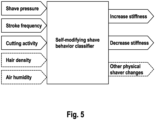
- a calibration device 60 may calibrate the relation between the pivoting stiffness and the detected force, as it is illustrated by Fig. 5 . Otherwise a user applying always a rather high force just would get high pivoting stiffness, whereas another user usually applying only a slight force would get only low pivoting stiffness. To avoid such undesired situation, the calibration device 60 may take into account the user history of the detected force values. More particularly, an adaptive controller 61 may vary the algorithm in terms of, for example, a curve representing the relation between the pivoting stiffness t and the amount of force.
- the adaptive controller 61 may change a basic curve to a curve setting stiffness high only for higher force values.
- the curve may be varied to provide for higher stiffness already for lower forces.
- aforementioned calibration device 60 may provide for calibration of the control functions of such other treatment parameters in an analogous way.
- detectors More particularly, the following detectors may be provided:
- the shaver 1 further may be provided with a detecting unit for detecting or measuring other parameters relevant to the treatment, wherein such detecting unit may include a voltage and/or current detector for detecting power consumption of the drive unit during shaving and/or a time measurement means for measuring shaving time, for example.
- a detecting unit for detecting or measuring other parameters relevant to the treatment, wherein such detecting unit may include a voltage and/or current detector for detecting power consumption of the drive unit during shaving and/or a time measurement means for measuring shaving time, for example.
- Said control unit 80 may include a micro controller 21 which may receive signals indicative of the aforementioned parameters and may analyse such signals to determine the treatment parameters mentioned above, wherein the adjustment device 6 may be controlled by the micro controller 21 to adjust any of the mentioned working parameters.
- the device may be adjusted in different ways, wherein several examples comprise the following:
- a dry electric shaver cuts the beard hairs best when shaving against the grain. Users typically know this, however they find it difficult to do so in the neck area and in particular flat lying hairs on the neck and make shaving here even more difficult.
- a user will typically rotate his shaver 1 around it's longitudinal axis (D) and change his grip such that the shavers front side points away from him. Additionally, the user then rotates the shaver around an axis (H) that is parallel to the swivel axis, as shown by Fig. 2 .
- the shaver 1 recognizes this typically adapting behaviour by means of comparing current sensor data with historical data thereof. For example, the shaver compares the current values of these measured behavioural parameters with average / typical values during previous shaves and identifies that these values are markedly different. This can be achieved by multiple different combinations of different sensors.
- the use of an accelerometer and a gyroscope may be advantageous.
- the use of optical sensors, such as cameras, would be an alternative.
- this may optionally further be supported by the use of physiological and/or climatic data.
- the calibration device Based on usage and optionally physiological and/or climatic data from a high number of users and optionally the use of machine learning, the calibration device knows which typical data from the accelerometer and gyroscope and/or this type of deviance from typical past behaviours of this user indicate this behaviour. Then, when this particular different-from-typical behaviour is identified, a servo-motor increases the preload of the spring (G) that connects head 3 and handle 2 to increase the stiffness of the shaver neck i.e. pivoting stiffness of the head 3 and reduce swiveling of the shaver head 3.
- G spring
- the shaver head 3 which is movable relative to the shaver handle 2 with at least one degree of freedom e.g. in terms of rotation of shaver head 3 with respect to a rotation axis (herein called swivel axis (C)) that oriented orthogonally to the shaver handle's longitudinal axis (D)), wherein the shaver handle 2 is equipped with an accelerometer sensor (E) and a gyroscope.
- the accelerometer (E) is set up in a way to determine the spatial orientation and movement of the shaver 1 in relation to the surrounding gravitational field.
- the gyroscope is set up to determine twisting of the shaver 1 about its longitudinal axis.
- the relative movement of shaver head 3 to the handle 2 is controlled by an actuator (F), in this case a servomotor, which is set up to adjust the preload of a spring (G) that connects the shaver handle 2 to the shaver head 3.
- an actuator in this case a servomotor, which is set up to adjust the preload of a spring (G) that connects the shaver handle 2 to the shaver head 3.
- G a spring
- a camera system may also be included that identifies the location of flat lying hairs.
- findings such as numerical data from consumer research may be taken into account for adjusting the shaver.
- the shaver 1 may collect shave data from a particular user, so learns what his typical behaviour is (e.g each man naturally presses the shaver with his own individual pressure against the skin) and can identify when his behaviour varies from this.
- the shaver head 3 may be mounted so that it can swivel or tilt relative to the handle 2.
- a flexible shaving head 3 gives freedom how to hold the device, while enabling good adaptation to different face regions.
- the shaving head 3 can follow the different contours of checks, neck and jawline. This also ensures that for as much of the time as possible the complete cutting element area is in contact with the skin independent of the angle at which the user holds the shaver (within a certain range). This ensures maximum cutting area contact with the face brings the advantages of better efficiency (a quicker shave) and better skin comfort as the pressing force is spread over a larger area leading to lower pressure on the skin.
- a typical reaction to these situations is that users will adapt how they hold the shaver 1 in their hand. They change the angle of their hand and the shaver 1 so that the shaver handle 2 lies at an extreme angle such that the head 3 cannot swivel any further. However this is unergonomic and extra effort.
- the current solution typically offered for these issues is a manual lock for the shaving head which can be activated.
- the consumer can decide between the flexible and the locked settings, however this can be inconvenient, is an extra step (again more effort) and consumers often try other alternatives (e.g. holding the head with their fingers).
- there may be automatically adapting the force that resists the swivel movement based on behavioural detection e.g. detects shaving pressure, detects direction and speed of movements, detects angle of shaver handle, detects which cutting elements have contact to the skin.
- the algorithm that controls the swivel stiffness may modify itself based on the typical behaviour of this particular user that it detects over time.
- the shaver 1 with a swivel head 3 is equipped with pressure sensor 41 and a sensor 43 that detects directions and speed of motion.
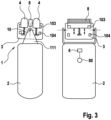
- One or more cutting elements 4 are spring loaded and carry small magnets 103, cf. Fig. 3 . The higher the shaving pressure, the more the cutting elements 4 are pressed down. This movement is tracked via hall sensors 104 under each cutting element.
- the hall sensors are connected to the electronic control unit 80 on the internal PCB of the shaver. Mounted on the PCB may be an accelerometer to detect acceleration of all three, two or one axes of the device.
- the electronic control unit 80 receives the signals of the hall sensors 104 and the accelerometer .
- a mathematic function translates the signals into pressure and movement data. E.g. the consumer starts to apply higher shaving pressure than typical the cutting elements 4 are moving deeper into the shaving head 3. Or the movements are faster and shorter.
- the electronic control unit 80 receives these untypical signals from the hall sensors 104 and the accelerometer and translates it to untypical pressure and movement values. These values are compared with a given matrix of values in real time within the control unit 80 and evaluated to generate the assigned signal for the actuator 113. In this example the spring 112 will be pulled to set a specific stiffness of the swing head 3.
- the algorithm Based on previous usage (e.g. other phases in the same shave and/or previous shaves), the algorithm adjusts the e.g. pressure ranges that are considered to be "low", “medium” or "high. E.g. for a man who typically shaves with a pressure of 1-2 N, the shaver would learn to consider 2N to be a high pressure for this user, whereas for a man who typically shaves with a pressure of 3-5 N, the shaver would learn to consider 2N to be low pressure for this user.
- the self-modifying phase of the algorithm starts with the beginning of the first shave:
- the electronic of the shaver creates medium values. The more shaves are done, the accurate are the stored typical range.
- the shaver body may contain a drive motor 5 and a battery 109.
- the swing head 3 is mounted on an axis 110 which is mounted on a holder 2 of the shaver body.
- asymmetric shaving pressure is applied to the shaving system - means more pressure F1 on one of the both foils than F2 on the other - a torque occurs and the shaving head swings around its axis (10) to align on facial contours.
- the counterforce of the swinging head is minimized to ensure a good adaptation of the shaving system even when low pressure is applied.
- a pulling spring 112 is mounted between the lower end of the head and the shaver body. The spring sets the force to swing the head. The stronger the spring is set the harder the head can swing.
- An actuator 113 is attached to the shaver body and holds the end of the spring. It can set the pre-load of the spring 112 by changing the length of the spring. In neutral actuator position the spring has the lowest pre-load and the swing head can swing very easy. At max. actuation the spring is pulled tight and the shaving head needs more shaving pressure to get moved. The consumer feels a more stiff and rigid system.
- the actuator can set the spring load step-less between min. and max. actuation position.
- the user may be requested to enter data directly e.g. via a smart phone or another device or directly into the shaver in order to provide the algorithm with additional data.
- This may be a one time input e.g. after purchase or be requested on a regular basis wherein such input may be effected, for example, by voice and voice recognition.
- This input can then be used to assess, e.g.:
- the user may be requested to provide feedback about his shave over time.
- the algorithm can assess which of the modifications it made to the shaver were successful and further optimize how it reacts.
- the data from multiple users can then optionally be collected and used to further refine the algorithm.
- feedback and/or instructions may also be given to the user.
- feedback and/or instructions may also be given to the user.
- the algorithm defining the adjustment of the shaver may be a self-modifying classifier (e.g. a neural network).
- the outputs of the sensors e.g. shave pressure, stroke frequency, cutting activity
- further parameters like physiological information from sensors/ data entry (e.g. hair density) and/or climate data from sensors (e.g. air humidity)
- the signals are processed and combined by a number of differentiating nodes and compared to historical data of the signals.
- the classifier decides if the current shaving behavior, optionally combined with further parameters named above in this paragraph, requires increasing or decreasing of the shaver head retention spring preload and thus a firmer or less firm feel of the shaving system on the skin.
- the classifier To initially define the classifier, it is trained using labelled shave behavior data of a large number of test shaves in advance (factory level) wherein both real time and historical data may be used. The system then is able to adjust itself more detailed to the user by learning his specific user behavior and optionally further parameters (user-at-home level) and his reactions to the adjustments made by the system and/or by updating the classifier with a further trained version from a web-based source (cloud level). For the latter, data of many different users and shaves is collected to enlarge the training dataset. Training in this context means that the links between differentiation nodes are adjusted, weighted or added/deleted systematically and automatically in order to improve the classifier performance.
- high air humidity leads to sticky skin which means that the frictional forces between skin and shaving foils/trimmers are increased.
- an additional air humidity sensor and in particular the change in this parameter compared to historical values of this parameter could be used in order that the algorithm can identify the appropriate shaver adjustment for this specific situation, such as increasing the stiffness of the shaver neck (spring pre-load) to reduce the uncontrolled swiveling of the head caused by the stick-slip.
Landscapes
- Life Sciences & Earth Sciences (AREA)
- Forests & Forestry (AREA)
- Engineering & Computer Science (AREA)
- Mechanical Engineering (AREA)
- Dry Shavers And Clippers (AREA)
Claims (11)
- Dispositif de soins personnels, en particulier un dispositif d'élimination de poils tel qu'un rasoir électrique, comprenant une poignée allongée (2) permettant de déplacer manuellement le dispositif de soins personnels le long d'une surface corporelle, une tête fonctionnelle (3) fixée à ladite poignée (2) permettant de réaliser un traitement de soins personnels sur ladite surface corporelle, au moins un détecteur (41 à 56) permettant de détecter au moins un paramètre comportemental indiquant le comportement d'un utilisateur pendant la manipulation du dispositif de soins personnels lorsqu'il réalise le traitement de soins personnels, et un dispositif d'ajustement (6) permettant d'ajuster au moins un paramètre fonctionnel du dispositif de soins personnels en réponse au paramètre comportemental détecté, dans lequel un dispositif d'étalonnage (60) est fourni pour étalonner le dispositif d'ajustement (6) en fonction de données historiques des données comportementales et/ou historiques au moins uniques d'un autre paramètre détecté pendant une session de traitement actuelle et/ou une session de traitement précédente caractérisé en ce que ledit dispositif d'étalonnage (60) comporte un dispositif de commande adaptatif (61) permettant de commander de manière adaptative le dispositif d'ajustement (6) en réponse à l'au moins un paramètre comportemental détecté pour fournir différents ajustements pour différents paramètres comportementaux au sein de la plage des valeurs des paramètres comportementaux détectés des données historiques de ceux-ci.
- Dispositif de soins personnels selon les revendications précédentes, dans lequel ledit dispositif d'étalonnage (60) est configuré pour étalonner ledit dispositif d'ajustement (6) de façon continue ou répétée pendant la réalisation d'un traitement de soins personnels par le dispositif de soins personnels et/ou pendant le fonctionnement de l'actionneur d'ajustement (AA).
- Dispositif de soins personnels selon l'une des revendications précédentes, dans lequel le dispositif d'ajustement (6) est configuré pour ajuster au moins un des paramètres fonctionnels suivants du dispositif de soins personnels : rigidité de pivotement et/ou rigidité d'inclinaison de la tête fonctionnelle (3), position et/ou fonctionnement d'un organe de coupe pour poils longs (8) et/ou d'un organe de coupe pour poils courts, température d'un dispositif de refroidissement/chauffage et fonctionnement d'un applicateur de lubrifiant, hauteur et/ou position de différents éléments coupants et non coupants les uns par rapport aux autres, rigidité de flottement et/ou distance de flottement de l'élément de travail pour accomplir le dispositif de soins personnels, rigidité d'inclinaison et/ou rigidité de pivotement d'éléments fonctionnels, en réponse à un signal d'au moins un des détecteurs suivants :- un détecteur tactile (42) permettant de détecter un contact de la tête fonctionnelle (3) avec le corps d'un utilisateur,- un détecteur de vitesse et/ou d'accélération (43) permettant de détecter la vitesse et/ou l'accélération du dispositif de soins personnels,- un détecteur de rotation (44) permettant de détecter une rotation et/ou une orientation du dispositif de soins personnels dans trois, deux ou une dimensions,- un détecteur de vitesse de course et/ou de longueur de course (48) permettant de détecter une vitesse de course et/ou une longueur de course,- un détecteur de densité de courses (49) permettant de détecter le nombre de courses sur une zone prédéterminée de la partie de corps à traiter,- un détecteur de distance (50) permettant de détecter la distance du dispositif de soins personnels (1) et/ou de l'utilisateur par rapport à un miroir,- un détecteur (51) permettant de détecter des pauses dans le traitement de soins personnels,- un capteur d'angle (52) permettant de détecter un changement d'angle de la tête fonctionnelle (3) par rapport au visage d'un utilisateur et/ou un changement d'angle de la poignée (2) par rapport au visage d'un utilisateur et/ou un changement d'angle d'une poignée (2) par rapport à la main ou au bras d'un utilisateur,- un détecteur de préhension (53) permettant de détecter un changement du type de préhension telle que les doigts sur la poignée (2),- un détecteur de contact (54) permettant de détecter une aire de contact entre la tête de rasoir (3) et le visage de l'utilisateur et/ou un changement de ladite aire de contact,- un détecteur de poils (55) permettant de détecter une densité de poils et/ou une longueur de poils,- un détecteur environnemental (56) permettant de détecter l'humidité de l'air et/ou la température de l'air,- un détecteur de déplacement (45) permettant de détecter un déplacement linéaire et/ou de rotation de la tête fonctionnelle (3) par rapport à la poignée 2,- un détecteur d'activité de coupe (46) permettant de détecter une activité de coupe du dispositif de soins personnels,- un détecteur de position de tondeuse (47) permettant de détecter une position d'une tondeuse à poils moyens et/ou longs,- un détecteur de force de contact (41) permettant de détecter la force avec laquelle la tête fonctionnelle (3) est pressée contre la peau d'un utilisateur.- un capteur d'humidité de peau permettant de capter l'humidité de la peau,- un capteur de caractère huileux de peau permettant de capter le caractère huileux de la peau.
- Dispositif de soins personnels selon le préambule de la revendication 1 ou l'une quelconque des revendications précédentes, dans lequel la tête fonctionnelle (3) est supportée de façon pivotante par rapport à la poignée (2) autour d'au moins un axe de pivotement (110), dans lequel le dispositif d'ajustement (6) est configuré pour ajuster une rigidité de pivotement de la tête fonctionnelle (3) autour dudit au moins un axe de pivotement (110) en réponse à l'au moins un paramètre comportemental détecté.
- Dispositif de soins personnels selon la revendication précédente, dans lequel un détecteur de force de contact (41) permettant de détecter la force avec laquelle la tête fonctionnelle (3) est pressée contre la peau des utilisateurs, dans lequel le dispositif d'ajustement (6) est configuré pour augmenter la rigidité de pivotement de la tête fonctionnelle (3) lorsque la pression de contact de peau détectée atteint ou dépasse une valeur prédéterminée.
- Dispositif de soins personnels selon l'une des revendications précédentes en combinaison avec la revendication 4, dans lequel un détecteur de préhension est fourni pour détecter un type de préhension de la poignée (2) et/ou une position de doigts sur la poignée (2), dans lequel le dispositif d'ajustement (6) est configuré pour ajuster la rigidité de pivotement de la tête fonctionnelle (3) en réponse au type détecté de préhension et/ou à la position détectée de doigts sur la poignée (2).
- Dispositif de soins personnels selon l'une quelconque des revendications précédentes en combinaison avec la revendication 5, dans lequel un détecteur d'orientation angulaire est fourni pour détecter une orientation angulaire d'un axe longitudinal de la poignée (2) par rapport à un champ gravitationnel et/ou une rotation angulaire de la poignée (2), dans lequel le dispositif d'ajustement (6) est configuré pour ajuster la rigidité de pivotement de la tête fonctionnelle (3) en réponse à l'orientation angulaire détectée et/ou à la rotation angulaire détectée de la poignée (2).
- Dispositif de soins personnels selon l'une quelconque des revendications précédentes en combinaison avec la revendication 5, dans lequel un détecteur environnemental est fourni pour détecter un paramètre environnemental choisi dans le groupe de température de l'air, humidité de l'air, humidité de la peau et caractère huileux de la peau, dans lequel le dispositif d'ajustement (6) est configuré pour ajuster la rigidité de pivotement et/ou la rigidité d'inclinaison de la tête fonctionnelle (3) en réponse au paramètre environnemental détecté.
- Dispositif de soins personnels selon l'une quelconque des revendications précédentes en combinaison avec la revendication 5, dans lequel un détecteur de poils (55) est fourni pour détecter une densité de poils et/ou une longueur de poils sur une partie de corps à traiter, dans lequel le dispositif d'ajustement (6) est configuré pour ajuster la rigidité de pivotement de la tête fonctionnelle (2) en réponse à la densité de poils détectée et/ou à la longueur de poils détectée.
- Dispositif de soins personnels selon l'une quelconque des revendications précédentes, dans lequel le dispositif d'ajustement (6) comporte au moins un actionneur permettant d'ajuster au moins un paramètre fonctionnel, ledit actionneur étant commandé par une unité de commande électronique (80) en réponse à un paramètre détecté.
- Procédé permettant de commander un dispositif de soins personnels, comprenant une poignée allongée (2) permettant de déplacer manuellement le dispositif de soins personnels le long d'une surface corporelle et une tête fonctionnelle (3) fixée à ladite poignée (2) permettant de réaliser un traitement de soins personnels sur ladite surface corporelle, ledit procédé comprenant les étapes suivantes : détection d'au moins un paramètre comportemental indiquant le comportement d'un utilisateur pendant la manipulation du dispositif de soins personnels, et ajustement d'au moins un paramètre fonctionnel du dispositif de soins personnels en réponse au paramètre comportemental détecté, et étalonnage du dispositif d'ajustement (6) en fonction de données historiques des données comportementales et/ou historiques au moins uniques d'un autre paramètre détecté pendantune session de traitement actuelle et/ou une session de traitement précédente dans lequel ledit étalonnage comporte un dispositif de commande adaptatif (61) permettant de commander de manière adaptative le dispositif d'ajustement (6) en réponse à l'au moins un paramètre comportemental détecté pour fournir différents ajustements pour différents paramètres comportementaux au sein de la plage des valeurs des paramètres comportementaux détectés des données historiques de ceux-ci.
Priority Applications (4)
| Application Number | Priority Date | Filing Date | Title |
|---|---|---|---|
| EP18164343.8A EP3546151B1 (fr) | 2018-03-27 | 2018-03-27 | Dispositif de soins personnels |
| JP2019052818A JP6928024B2 (ja) | 2018-03-27 | 2019-03-20 | パーソナルケアデバイス |
| US16/364,731 US11548177B2 (en) | 2018-03-27 | 2019-03-26 | Personal care device |
| CN201910234943.3A CN110303532B (zh) | 2018-03-27 | 2019-03-27 | 个人护理装置 |
Applications Claiming Priority (1)
| Application Number | Priority Date | Filing Date | Title |
|---|---|---|---|
| EP18164343.8A EP3546151B1 (fr) | 2018-03-27 | 2018-03-27 | Dispositif de soins personnels |
Publications (2)
| Publication Number | Publication Date |
|---|---|
| EP3546151A1 EP3546151A1 (fr) | 2019-10-02 |
| EP3546151B1 true EP3546151B1 (fr) | 2025-04-30 |
Family
ID=61827650
Family Applications (1)
| Application Number | Title | Priority Date | Filing Date |
|---|---|---|---|
| EP18164343.8A Active EP3546151B1 (fr) | 2018-03-27 | 2018-03-27 | Dispositif de soins personnels |
Country Status (4)
| Country | Link |
|---|---|
| US (1) | US11548177B2 (fr) |
| EP (1) | EP3546151B1 (fr) |
| JP (1) | JP6928024B2 (fr) |
| CN (1) | CN110303532B (fr) |
Families Citing this family (23)
| Publication number | Priority date | Publication date | Assignee | Title |
|---|---|---|---|---|
| USD912898S1 (en) * | 2017-12-08 | 2021-03-09 | Braun Gmbh | Epilator |
| EP3546150B1 (fr) | 2018-03-27 | 2021-10-27 | Braun GmbH | Dispositif de soins personnels |
| EP3546148B1 (fr) | 2018-03-27 | 2022-01-12 | Braun GmbH | Dispositif de soins personnels |
| EP3546149B1 (fr) | 2018-03-27 | 2021-05-12 | Braun GmbH | Dispositif d'épilation |
| EP3546151B1 (fr) | 2018-03-27 | 2025-04-30 | Braun GmbH | Dispositif de soins personnels |
| EP3769644A1 (fr) * | 2019-07-25 | 2021-01-27 | Koninklijke Philips N.V. | Dispositif de traitement de la peau et procédé de commande d'un dispositif de traitement de la peau |
| US11697215B2 (en) * | 2019-09-19 | 2023-07-11 | Carefusion 2200, Inc. | Surgical hair clippers and vacuum apparatuses including sensing and feedback devices |
| US12142983B2 (en) * | 2020-06-29 | 2024-11-12 | Wahl Clipper Corporation | Hair clipper pivot motor designed for battery power |
| US11673282B2 (en) * | 2020-07-02 | 2023-06-13 | The Gillette Company Llc | Sensor-based shaving systems and methods of analyzing a user's shave event for determining a unique threshold value of the user |
| JP7641562B2 (ja) * | 2021-02-04 | 2025-03-07 | パナソニックIpマネジメント株式会社 | 毛切断用理美容機器および理美容システム |
| EP4039426A1 (fr) | 2021-02-09 | 2022-08-10 | Koninklijke Philips N.V. | Détermination des paramètres de fonctionnement de dispositifs de coupe de cheveux |
| JP7576773B2 (ja) * | 2021-02-16 | 2024-11-01 | パナソニックIpマネジメント株式会社 | 電気かみそり |
| JP7668446B2 (ja) * | 2021-02-16 | 2025-04-25 | パナソニックIpマネジメント株式会社 | 電気かみそり |
| JP7641534B2 (ja) * | 2021-02-16 | 2025-03-07 | パナソニックIpマネジメント株式会社 | 電気かみそり |
| EP4063088A1 (fr) * | 2021-03-26 | 2022-09-28 | Koninklijke Philips N.V. | Détection de cheveux dans un système de coupe de cheveux |
| EP4337434A4 (fr) * | 2021-05-14 | 2025-04-23 | Sunbeam Products, Inc. | Tondeuses à cheveux |
| EP4124422B1 (fr) * | 2021-07-29 | 2025-12-10 | Braun GmbH | Dispositif de soins personnels |
| EP4147833A1 (fr) * | 2021-09-09 | 2023-03-15 | Koninklijke Philips N.V. | Unité de rasage et rasoir électrique la comprenant |
| CN113858275B (zh) * | 2021-10-28 | 2025-09-02 | 浙江海顺电工有限公司 | 一种修剪刀头 |
| JP2023144697A (ja) * | 2022-03-28 | 2023-10-11 | パナソニックIpマネジメント株式会社 | 刃ユニットおよび電気かみそり |
| CN117381864B (zh) * | 2023-09-18 | 2026-02-03 | 利民(番禺南沙)电器发展有限公司 | 一种毛发切割器 |
| CN120522468A (zh) * | 2024-02-20 | 2025-08-22 | 北京小米移动软件有限公司 | 测试系统、方法、装置和存储介质 |
| CN120567007B (zh) * | 2025-07-29 | 2025-10-28 | 深圳市新博电科技开发有限公司 | 一种理发器的电机控制方法、装置及系统 |
Family Cites Families (121)
| Publication number | Priority date | Publication date | Assignee | Title |
|---|---|---|---|---|
| JPS5737472A (en) | 1980-08-13 | 1982-03-01 | Matsushita Electric Works Ltd | Oscillating device for reciprocating electric razor |
| JPS5877445A (ja) | 1981-11-04 | 1983-05-10 | Mitsutoyo Mfg Co Ltd | 砥石ヘツド |
| JPS5877445U (ja) | 1981-11-20 | 1983-05-25 | 住友金属工業株式会社 | ノズル噴射圧測定具 |
| JPS59184778U (ja) | 1983-05-25 | 1984-12-08 | フイリツプス工業振興株式会社 | 自動動作電気ひげそり器 |
| DE3726354A1 (de) | 1987-08-07 | 1989-02-16 | Braun Ag | Elektrischer rasierapparat mit scherkopfsteuerung |
| DE3843936C1 (fr) | 1988-12-24 | 1990-05-31 | Braun Ag, 6000 Frankfurt, De | |
| CN1018016B (zh) | 1990-05-14 | 1992-08-26 | 何积顺 | 立式多用锅炉 |
| JPH04195302A (ja) * | 1990-11-27 | 1992-07-15 | Matsushita Electric Ind Co Ltd | 適応制御装置 |
| US5189792A (en) | 1990-12-20 | 1993-03-02 | Matsushita Electric Works, Ltd. | Reciprocatory electric shaver |
| DE4128219A1 (de) | 1991-08-26 | 1993-03-04 | Braun Ag | Rasierapparat |
| JPH0686873A (ja) | 1992-09-09 | 1994-03-29 | Sanyo Electric Co Ltd | 電気かみそり |
| JPH06335575A (ja) | 1993-05-28 | 1994-12-06 | Tokyo Electric Co Ltd | 電気かみそり |
| ES2122594T3 (es) | 1994-06-01 | 1998-12-16 | Koninkl Philips Electronics Nv | Aparato de afeitar con una unidad de corte electricamente ajustable. |
| JPH08152902A (ja) * | 1994-11-30 | 1996-06-11 | Hitachi Ltd | 適応処理装置 |
| JP3682997B2 (ja) | 1995-01-11 | 2005-08-17 | 株式会社泉精器製作所 | 電気かみそり |
| JP3716353B2 (ja) | 1995-07-31 | 2005-11-16 | 九州日立マクセル株式会社 | ロータリ式電気かみそり |
| JPH09101804A (ja) * | 1995-10-03 | 1997-04-15 | Daikin Ind Ltd | 適応制御システムにおけるパラメータ設定方法 |
| DE19612089A1 (de) | 1996-03-27 | 1997-10-02 | Braun Ag | Elektrischer Rasierapparat oder damit zusammenwirkendes Gerät und Anordnung zur Auswertung von Informationen |
| EP0918599B1 (fr) | 1997-02-19 | 2003-04-23 | Koninklijke Philips Electronics N.V. | Appareil de rasage |
| US8533960B1 (en) * | 1999-07-12 | 2013-09-17 | Dan Barish | Electrical devices, particularly electrical shavers, having magnetically coupled drives, and adapters therefor |
| IL131536A0 (en) | 1999-08-23 | 2001-01-28 | Ultra Cure Ltd | Method and apparatus for hair removal |
| ATE236765T1 (de) | 1999-11-25 | 2003-04-15 | Matsushita Electric Works Ltd | Trockenrasierer mit höhenverstellbarem scherkopf |
| EP1165294B1 (fr) | 2000-01-24 | 2003-06-04 | Koninklijke Philips Electronics N.V. | Appareil electrique a main destine aux soins personnels ou utilisable comme outil |
| US6497043B1 (en) | 2000-10-13 | 2002-12-24 | Sarcos, L.C. | Intelligent shaver |
| ITBO20010225A1 (it) | 2001-04-17 | 2002-10-17 | Gd Spa | Unita' di alimentazione di sigarette in una macchina impacchettatrici |
| GB0109444D0 (en) | 2001-04-17 | 2001-06-06 | Unilever Plc | Toothbrush usage monitoring system |
| JP4151292B2 (ja) | 2001-04-27 | 2008-09-17 | 松下電工株式会社 | ローション供給機能付き除毛装置 |
| EP1444073B1 (fr) | 2001-11-15 | 2005-09-07 | Matsushita Electric Works, Ltd. | Rasoir a sec avec tete de rasage a bascule |
| JP4396094B2 (ja) | 2002-05-30 | 2010-01-13 | パナソニック電工株式会社 | 電気かみそり |
| US20040098862A1 (en) | 2002-08-21 | 2004-05-27 | Eveready Battery Company, Inc. | Razor system having razor sensors |
| US8627573B2 (en) | 2002-10-05 | 2014-01-14 | Braun Gmbh | Hair-removing device |
| DE10246519A1 (de) | 2002-10-05 | 2004-04-15 | Braun Gmbh | Haarentfernungsgerät |
| US6826835B1 (en) | 2003-09-05 | 2004-12-07 | Raymond Electric (China) Ltd. | Electric shaver |
| JP3900159B2 (ja) | 2004-01-27 | 2007-04-04 | 松下電工株式会社 | 電気かみそり |
| DE102004028487B4 (de) | 2004-06-11 | 2018-11-15 | Mahle Gmbh | Verfahren zur Herstellung verschleissfester Flanken für einen Trapezring für Verbrennungsmotoren |
| JP4552646B2 (ja) | 2004-12-16 | 2010-09-29 | パナソニック電工株式会社 | 除毛装置 |
| JP4793805B2 (ja) | 2005-03-18 | 2011-10-12 | 九州日立マクセル株式会社 | 電気かみそり |
| DE102005045713A1 (de) | 2005-09-24 | 2007-03-29 | Braun Gmbh | Elektrisches Haarentfernungsgerät |
| JP2007151925A (ja) | 2005-12-07 | 2007-06-21 | Izumi Products Co | ロータリー式電気かみそり |
| US8164461B2 (en) | 2005-12-30 | 2012-04-24 | Healthsense, Inc. | Monitoring task performance |
| DE102006004675A1 (de) * | 2006-02-02 | 2007-08-09 | Braun Gmbh | Elektrisch betriebener Rasierer |
| JP2007319339A (ja) | 2006-05-31 | 2007-12-13 | Izumi Products Co | ロータリー式電気かみそり |
| DE102006030947A1 (de) | 2006-07-05 | 2008-01-10 | Braun Gmbh | Elektrischer Trockenrasierapparat |
| US20080034591A1 (en) | 2006-08-08 | 2008-02-14 | Kam Fai Fung | Shaver with swivel head |
| JP4969947B2 (ja) | 2006-08-11 | 2012-07-04 | 株式会社泉精器製作所 | 往復式電気かみそり |
| US7673972B2 (en) | 2007-01-08 | 2010-03-09 | Lexmark International, Inc. | Micro-fluid ejection devices, methods for making micro-fluid ejection heads, and micro-fluid ejection head having high resistance thin film heaters |
| JP4883581B2 (ja) | 2007-06-12 | 2012-02-22 | 九州日立マクセル株式会社 | 電気かみそり |
| US9486864B2 (en) | 2007-07-03 | 2016-11-08 | Milwaukee Electric Tool Corporation | Pipe cutter |
| US20090056141A1 (en) | 2007-08-28 | 2009-03-05 | Eveready Battery Company, Inc. | Shaving implement and method for using same |
| US20090119923A1 (en) | 2007-09-17 | 2009-05-14 | Robert Anthony Hart | Sensor For A Razor |
| FI20085488A0 (fi) | 2008-05-23 | 2008-05-23 | Pump & Brush Finland Oy | Älykäs hammasharjamonitorointilaite |
| CN101621400A (zh) | 2008-06-30 | 2010-01-06 | 中兴通讯股份有限公司 | 一种历史性能数据采集方法及性能数据采集系统 |
| DE102008031132A1 (de) | 2008-07-01 | 2010-01-07 | Braun Gmbh | Elektrisches Kleingerät zum Entfernen von Haaren |
| EP2189198B1 (fr) | 2008-11-20 | 2017-06-21 | Braun GmbH | Appareil de soin du corps à usage personnel |
| US20100186234A1 (en) | 2009-01-28 | 2010-07-29 | Yehuda Binder | Electric shaver with imaging capability |
| CN102348544B (zh) | 2009-03-09 | 2014-12-03 | 皇家飞利浦电子股份有限公司 | 具有改善的轮廓紧贴的剃须设备 |
| JP2010227223A (ja) | 2009-03-26 | 2010-10-14 | Panasonic Electric Works Co Ltd | 電気かみそり |
| JP2010227224A (ja) | 2009-03-26 | 2010-10-14 | Panasonic Electric Works Co Ltd | 電気かみそり |
| CA2763243C (fr) | 2009-05-28 | 2016-10-25 | Koninklijke Philips Electronics N.V. | Agencement de pivotement |
| EP2329928B1 (fr) | 2009-12-04 | 2012-07-04 | Braun GmbH | Dispositif pour couper les cheveux à fonctionnement électrique |
| DE102010023681B4 (de) | 2010-06-14 | 2016-02-04 | Stephan Kohlhof | Haarentfernungsgerät |
| CN202106393U (zh) | 2011-05-09 | 2012-01-11 | 张大 | 电推剪限位梳的位置调节结构 |
| ES2476276T3 (es) | 2011-07-25 | 2014-07-14 | Braun Gmbh | Dispositivo de higiene personal |
| WO2013096572A1 (fr) | 2011-12-21 | 2013-06-27 | Krenik Matthew W | Système de coupe de cheveux automatisé et son procédé de fonctionnement |
| WO2013111139A1 (fr) | 2012-01-26 | 2013-08-01 | Slender Medical Ltd. | Dispositif de traitement de la peau par ultrasons équipé d'une fonction d'épilation |
| JP6113825B2 (ja) | 2012-03-22 | 2017-04-12 | コーニンクレッカ フィリップス エヌ ヴェKoninklijke Philips N.V. | 適応可能な面を持つシェーバ |
| US8938885B2 (en) | 2012-05-01 | 2015-01-27 | The Gillette Company | Razor handle with a rotatable portion |
| EP2933072B1 (fr) * | 2012-12-13 | 2020-08-12 | Panasonic Intellectual Property Management Co., Ltd. | Rasoir électrique |
| KR20140094336A (ko) | 2013-01-22 | 2014-07-30 | 삼성전자주식회사 | 사용자 감정 추출이 가능한 전자기기 및 전자기기의 사용자 감정 추출방법 |
| CN203197960U (zh) | 2013-04-03 | 2013-09-18 | 天津工业大学 | 一种磁耦合谐振式无线供电剃须刀 |
| US20150020658A1 (en) * | 2013-07-17 | 2015-01-22 | Hasam Eljaouhari | Facial hair shaver with built-in facial hair pattern guides |
| JP5990663B2 (ja) | 2013-05-16 | 2016-09-14 | コーニンクレッカ フィリップス エヌ ヴェKoninklijke Philips N.V. | 枢動可能なシェービングユニットを持つシェービングヘッド |
| US10349733B2 (en) | 2013-06-19 | 2019-07-16 | Kolibree | Toothbrush system with sensors for a dental hygiene monitoring system |
| CN105899337B (zh) | 2013-11-06 | 2019-05-03 | 皇家飞利浦有限公司 | 用于处理身体部分的系统和方法 |
| EP3065918B2 (fr) | 2013-11-06 | 2021-09-29 | Koninklijke Philips N.V. | Système et procédé pour traiter une partie d'un corps |
| RU2665443C2 (ru) | 2013-11-06 | 2018-08-29 | Конинклейке Филипс Н.В. | Система и способ управления движениями пользователя во время процедуры бритья |
| DE102014001163A1 (de) | 2014-01-31 | 2015-08-06 | Arnulf Deinzer | Zahnreinigungssystem zur Unterweisung und Überwachung von Zahnputztechniken |
| RU2690733C2 (ru) | 2014-04-29 | 2019-06-05 | Конинклейке Филипс Н.В. | Устройство для обработки части тела человека |
| EP2962815A1 (fr) | 2014-07-02 | 2016-01-06 | The Gillette Company | Blocage de pivotement de rasoir |
| WO2016041929A1 (fr) | 2014-09-18 | 2016-03-24 | Koninklijke Philips N.V. | Peigne à espacement réglable, commande de réglage, et appareil de coupe de cheveux |
| WO2016046142A1 (fr) | 2014-09-26 | 2016-03-31 | Koninklijke Philips N.V. | Dispositif de rasage pour poils de la peau |
| JP6395303B2 (ja) | 2014-10-15 | 2018-09-26 | マクセルホールディングス株式会社 | 電気かみそり |
| US20160167241A1 (en) | 2014-12-10 | 2016-06-16 | Haggai Goldfarb | Intelligent shaving system having sensors |
| CN204431302U (zh) | 2014-12-10 | 2015-07-01 | 东莞市罗曼罗兰电器科技有限公司 | 一种球形浮动的剃须刀头结构 |
| CN106998869B (zh) | 2014-12-11 | 2020-06-26 | 皇家飞利浦有限公司 | 皮肤处理设备 |
| CN107107354B (zh) | 2014-12-18 | 2019-07-05 | 皇家飞利浦有限公司 | 毛发去除设备 |
| US9969093B2 (en) | 2014-12-23 | 2018-05-15 | Braun Gmbh | Dry shaver |
| EP3253541B1 (fr) | 2015-02-04 | 2018-06-20 | Koninklijke Philips N.V. | Tête de coupe et appareil de coupe de cheveux |
| CA2985287C (fr) | 2015-05-13 | 2021-11-02 | Kolibree | Systeme de brosse a dents dote d'un magnetometre pour assurer la surveillance de l'hygiene dentaire |
| CN107921650B (zh) * | 2015-08-24 | 2021-02-05 | 皇家飞利浦有限公司 | 用于剃刮设备的最佳使用的分阶段建议 |
| US10298471B2 (en) * | 2015-10-05 | 2019-05-21 | The Gillette Company Llc | Systems and methods for providing device usage data |
| US20170097758A1 (en) | 2015-10-05 | 2017-04-06 | The Gillette Company | Systems and methods for device tuning |
| EP3183993B1 (fr) | 2015-12-22 | 2018-08-15 | Braun GmbH | Épilateur |
| US20170232624A1 (en) | 2016-02-12 | 2017-08-17 | The King Of Shaves Company Limited | Shaving System |
| RU2738074C2 (ru) | 2016-03-14 | 2020-12-07 | Колибри | Система гигиены ротовой полости с визуальным распознаванием для контроля соблюдения правил чистки зубов |
| ES2849748T3 (es) | 2016-06-30 | 2021-08-20 | Braun Gmbh | Dispositivo de depilación que mide la fuerza de contacto y que comprende una unidad de retroalimentación |
| BR112019003640B1 (pt) | 2016-08-22 | 2023-05-02 | Kolibree SAS | Sistema de higiene bucal para monitoramento de conformidade e sistema de teleodontologia |
| CN106407935A (zh) | 2016-09-21 | 2017-02-15 | 俞大海 | 基于人脸图像和眼动注视信息的心理测试方法 |
| CN106621280B (zh) | 2016-12-09 | 2019-05-03 | 深圳未网科技有限公司 | 运动统计系统及应用于该运动统计系统的通信方法 |
| CN106778618A (zh) | 2016-12-16 | 2017-05-31 | 合肥寰景信息技术有限公司 | 一种疲劳驾驶监控预警系统 |
| JP6667162B2 (ja) * | 2017-02-24 | 2020-03-18 | パナソニックIpマネジメント株式会社 | 携帯型理美容装置 |
| US11276011B2 (en) | 2017-04-10 | 2022-03-15 | International Business Machines Corporation | Self-managed adaptable models for prediction systems |
| EP3401065A1 (fr) | 2017-05-11 | 2018-11-14 | Koninklijke Philips N.V. | Procédé et appareil de fourniture de rétroaction concernant le mouvement d'un rasoir rotatif effectué par un utilisateur |
| CN107243905A (zh) | 2017-06-28 | 2017-10-13 | 重庆柚瓣科技有限公司 | 基于养老机器人的情绪自适应系统 |
| CN110662637B (zh) | 2017-06-29 | 2023-02-28 | 比克维奥莱克斯公司 | 剃须刀和用于检测剃刮特性的方法 |
| EP3427910B1 (fr) | 2017-07-14 | 2020-08-19 | Braun GmbH | Procédé pour déterminer le comportement de durée d'un processus de moteur cyclique lors de le utilisation d'un dispositif d'épilation électrique et dispositif d'élimination de poils |
| CN107682178A (zh) | 2017-08-30 | 2018-02-09 | 国信优易数据有限公司 | 一种移动用户上网操作行为预测方法和装置 |
| EP3450120B1 (fr) | 2017-08-30 | 2021-12-15 | Braun GmbH | Dispositif de soins personnels |
| CN107414902A (zh) | 2017-09-09 | 2017-12-01 | 佛山市盈之创广告策划有限公司 | 一种新型便携剃须装置 |
| ES2795030T3 (es) | 2017-09-22 | 2020-11-20 | Braun Gmbh | Dispositivo de higiene personal |
| CN107627329A (zh) | 2017-10-23 | 2018-01-26 | 扬州市生态科技新城杭集中小企业服务中心有限公司 | 基于蓝牙控制的酒店共享剃须刀 |
| CN107718059B (zh) * | 2017-10-31 | 2019-11-15 | 北京小米移动软件有限公司 | 毛发修理设备的控制方法及装置、毛发修理设备 |
| US20190224867A1 (en) | 2018-01-19 | 2019-07-25 | The Gillette Company Llc | Method for generating user feedback information from a shave event and user profile data |
| US20190224869A1 (en) | 2018-01-19 | 2019-07-25 | The Gillette Company Llc | Shaving appliance including a notification circuit for communicating cumulative shave event information |
| US10647011B2 (en) | 2018-01-19 | 2020-05-12 | The Gillette Company Llc | Networked shaving appliance system |
| EP3546151B1 (fr) | 2018-03-27 | 2025-04-30 | Braun GmbH | Dispositif de soins personnels |
| EP3546148B1 (fr) | 2018-03-27 | 2022-01-12 | Braun GmbH | Dispositif de soins personnels |
| EP3546153B1 (fr) | 2018-03-27 | 2021-05-12 | Braun GmbH | Dispositif de soins personnels |
| EP3546150B1 (fr) | 2018-03-27 | 2021-10-27 | Braun GmbH | Dispositif de soins personnels |
| EP3546152B1 (fr) | 2018-03-27 | 2021-04-21 | Braun GmbH | Appareil d'épilation |
| EP3546149B1 (fr) | 2018-03-27 | 2021-05-12 | Braun GmbH | Dispositif d'épilation |
-
2018
- 2018-03-27 EP EP18164343.8A patent/EP3546151B1/fr active Active
-
2019
- 2019-03-20 JP JP2019052818A patent/JP6928024B2/ja active Active
- 2019-03-26 US US16/364,731 patent/US11548177B2/en active Active
- 2019-03-27 CN CN201910234943.3A patent/CN110303532B/zh active Active
Also Published As
| Publication number | Publication date |
|---|---|
| JP6928024B2 (ja) | 2021-09-01 |
| US11548177B2 (en) | 2023-01-10 |
| CN110303532B (zh) | 2021-10-29 |
| US20190299436A1 (en) | 2019-10-03 |
| CN110303532A (zh) | 2019-10-08 |
| JP2019171049A (ja) | 2019-10-10 |
| EP3546151A1 (fr) | 2019-10-02 |
Similar Documents
| Publication | Publication Date | Title |
|---|---|---|
| US11548177B2 (en) | Personal care device | |
| US11027442B2 (en) | Personal care device | |
| EP3546153B1 (fr) | Dispositif de soins personnels | |
| US11097437B2 (en) | Personal care device | |
| EP3546152B1 (fr) | Appareil d'épilation | |
| CN105899336B (zh) | 用于处理身体部分的系统和方法 | |
| JP2026004499A (ja) | パーソナルケアデバイス | |
| EP3166760B1 (fr) | Dispositif de tondeuse à cheveux | |
| US20150020658A1 (en) | Facial hair shaver with built-in facial hair pattern guides | |
| JP2019171048A (ja) | 体毛除去装置 | |
| JP7617061B2 (ja) | パーソナルケア装置 | |
| JP7617062B2 (ja) | パーソナルケアデバイス | |
| CN201095124Y (zh) | 头部倾角可调节的电动剃须刀 | |
| JP2022119354A (ja) | 毛切断用理美容機器および理美容システム |
Legal Events
| Date | Code | Title | Description |
|---|---|---|---|
| PUAI | Public reference made under article 153(3) epc to a published international application that has entered the european phase |
Free format text: ORIGINAL CODE: 0009012 |
|
| STAA | Information on the status of an ep patent application or granted ep patent |
Free format text: STATUS: THE APPLICATION HAS BEEN PUBLISHED |
|
| AK | Designated contracting states |
Kind code of ref document: A1 Designated state(s): AL AT BE BG CH CY CZ DE DK EE ES FI FR GB GR HR HU IE IS IT LI LT LU LV MC MK MT NL NO PL PT RO RS SE SI SK SM TR |
|
| AX | Request for extension of the european patent |
Extension state: BA ME |
|
| STAA | Information on the status of an ep patent application or granted ep patent |
Free format text: STATUS: REQUEST FOR EXAMINATION WAS MADE |
|
| 17P | Request for examination filed |
Effective date: 20200602 |
|
| RBV | Designated contracting states (corrected) |
Designated state(s): AL AT BE BG CH CY CZ DE DK EE ES FI FR GB GR HR HU IE IS IT LI LT LU LV MC MK MT NL NO PL PT RO RS SE SI SK SM TR |
|
| GRAP | Despatch of communication of intention to grant a patent |
Free format text: ORIGINAL CODE: EPIDOSNIGR1 |
|
| STAA | Information on the status of an ep patent application or granted ep patent |
Free format text: STATUS: GRANT OF PATENT IS INTENDED |
|
| INTG | Intention to grant announced |
Effective date: 20240328 |
|
| GRAJ | Information related to disapproval of communication of intention to grant by the applicant or resumption of examination proceedings by the epo deleted |
Free format text: ORIGINAL CODE: EPIDOSDIGR1 |
|
| STAA | Information on the status of an ep patent application or granted ep patent |
Free format text: STATUS: REQUEST FOR EXAMINATION WAS MADE |
|
| INTC | Intention to grant announced (deleted) | ||
| P01 | Opt-out of the competence of the unified patent court (upc) registered |
Free format text: CASE NUMBER: UPC_APP_410062/2023 Effective date: 20230430 |
|
| GRAP | Despatch of communication of intention to grant a patent |
Free format text: ORIGINAL CODE: EPIDOSNIGR1 |
|
| STAA | Information on the status of an ep patent application or granted ep patent |
Free format text: STATUS: GRANT OF PATENT IS INTENDED |
|
| INTG | Intention to grant announced |
Effective date: 20241205 |
|
| RIN1 | Information on inventor provided before grant (corrected) |
Inventor name: ZIMMERMANN, LUCY ABIGAIL Inventor name: WEINKAUFF, JOHANNES JULIAN Inventor name: NEYER, CHRISTIAN Inventor name: FUERST, STEFAN Inventor name: FUELLGRABE, MARTIN LUDWIG WOLFGANG |
|
| GRAS | Grant fee paid |
Free format text: ORIGINAL CODE: EPIDOSNIGR3 |
|
| GRAA | (expected) grant |
Free format text: ORIGINAL CODE: 0009210 |
|
| STAA | Information on the status of an ep patent application or granted ep patent |
Free format text: STATUS: THE PATENT HAS BEEN GRANTED |
|
| AK | Designated contracting states |
Kind code of ref document: B1 Designated state(s): AL AT BE BG CH CY CZ DE DK EE ES FI FR GB GR HR HU IE IS IT LI LT LU LV MC MK MT NL NO PL PT RO RS SE SI SK SM TR |
|
| REG | Reference to a national code |
Ref country code: CH Ref legal event code: EP Ref country code: GB Ref legal event code: FG4D |
|
| REG | Reference to a national code |
Ref country code: IE Ref legal event code: FG4D |
|
| REG | Reference to a national code |
Ref country code: DE Ref legal event code: R096 Ref document number: 602018081458 Country of ref document: DE |
|
| REG | Reference to a national code |
Ref country code: NL Ref legal event code: FP |
|
| REG | Reference to a national code |
Ref country code: AT Ref legal event code: MK05 Ref document number: 1789628 Country of ref document: AT Kind code of ref document: T Effective date: 20250430 |
|
| PG25 | Lapsed in a contracting state [announced via postgrant information from national office to epo] |
Ref country code: FI Free format text: LAPSE BECAUSE OF FAILURE TO SUBMIT A TRANSLATION OF THE DESCRIPTION OR TO PAY THE FEE WITHIN THE PRESCRIBED TIME-LIMIT Effective date: 20250430 Ref country code: ES Free format text: LAPSE BECAUSE OF FAILURE TO SUBMIT A TRANSLATION OF THE DESCRIPTION OR TO PAY THE FEE WITHIN THE PRESCRIBED TIME-LIMIT Effective date: 20250430 Ref country code: PT Free format text: LAPSE BECAUSE OF FAILURE TO SUBMIT A TRANSLATION OF THE DESCRIPTION OR TO PAY THE FEE WITHIN THE PRESCRIBED TIME-LIMIT Effective date: 20250901 |
|
| REG | Reference to a national code |
Ref country code: LT Ref legal event code: MG9D |
|
| PG25 | Lapsed in a contracting state [announced via postgrant information from national office to epo] |
Ref country code: GR Free format text: LAPSE BECAUSE OF FAILURE TO SUBMIT A TRANSLATION OF THE DESCRIPTION OR TO PAY THE FEE WITHIN THE PRESCRIBED TIME-LIMIT Effective date: 20250731 Ref country code: NO Free format text: LAPSE BECAUSE OF FAILURE TO SUBMIT A TRANSLATION OF THE DESCRIPTION OR TO PAY THE FEE WITHIN THE PRESCRIBED TIME-LIMIT Effective date: 20250730 |
|
| PG25 | Lapsed in a contracting state [announced via postgrant information from national office to epo] |
Ref country code: PL Free format text: LAPSE BECAUSE OF FAILURE TO SUBMIT A TRANSLATION OF THE DESCRIPTION OR TO PAY THE FEE WITHIN THE PRESCRIBED TIME-LIMIT Effective date: 20250430 |
|
| PG25 | Lapsed in a contracting state [announced via postgrant information from national office to epo] |
Ref country code: BG Free format text: LAPSE BECAUSE OF FAILURE TO SUBMIT A TRANSLATION OF THE DESCRIPTION OR TO PAY THE FEE WITHIN THE PRESCRIBED TIME-LIMIT Effective date: 20250430 |
|
| PG25 | Lapsed in a contracting state [announced via postgrant information from national office to epo] |
Ref country code: HR Free format text: LAPSE BECAUSE OF FAILURE TO SUBMIT A TRANSLATION OF THE DESCRIPTION OR TO PAY THE FEE WITHIN THE PRESCRIBED TIME-LIMIT Effective date: 20250430 |
|
| PG25 | Lapsed in a contracting state [announced via postgrant information from national office to epo] |
Ref country code: AT Free format text: LAPSE BECAUSE OF FAILURE TO SUBMIT A TRANSLATION OF THE DESCRIPTION OR TO PAY THE FEE WITHIN THE PRESCRIBED TIME-LIMIT Effective date: 20250430 |
|
| PG25 | Lapsed in a contracting state [announced via postgrant information from national office to epo] |
Ref country code: RS Free format text: LAPSE BECAUSE OF FAILURE TO SUBMIT A TRANSLATION OF THE DESCRIPTION OR TO PAY THE FEE WITHIN THE PRESCRIBED TIME-LIMIT Effective date: 20250731 |
|
| PG25 | Lapsed in a contracting state [announced via postgrant information from national office to epo] |
Ref country code: IS Free format text: LAPSE BECAUSE OF FAILURE TO SUBMIT A TRANSLATION OF THE DESCRIPTION OR TO PAY THE FEE WITHIN THE PRESCRIBED TIME-LIMIT Effective date: 20250830 |
|
| PG25 | Lapsed in a contracting state [announced via postgrant information from national office to epo] |
Ref country code: LV Free format text: LAPSE BECAUSE OF FAILURE TO SUBMIT A TRANSLATION OF THE DESCRIPTION OR TO PAY THE FEE WITHIN THE PRESCRIBED TIME-LIMIT Effective date: 20250430 |
|
| PG25 | Lapsed in a contracting state [announced via postgrant information from national office to epo] |
Ref country code: DK Free format text: LAPSE BECAUSE OF FAILURE TO SUBMIT A TRANSLATION OF THE DESCRIPTION OR TO PAY THE FEE WITHIN THE PRESCRIBED TIME-LIMIT Effective date: 20250430 Ref country code: SM Free format text: LAPSE BECAUSE OF FAILURE TO SUBMIT A TRANSLATION OF THE DESCRIPTION OR TO PAY THE FEE WITHIN THE PRESCRIBED TIME-LIMIT Effective date: 20250430 |
|
| PG25 | Lapsed in a contracting state [announced via postgrant information from national office to epo] |
Ref country code: CZ Free format text: LAPSE BECAUSE OF FAILURE TO SUBMIT A TRANSLATION OF THE DESCRIPTION OR TO PAY THE FEE WITHIN THE PRESCRIBED TIME-LIMIT Effective date: 20250430 |
|
| PG25 | Lapsed in a contracting state [announced via postgrant information from national office to epo] |
Ref country code: EE Free format text: LAPSE BECAUSE OF FAILURE TO SUBMIT A TRANSLATION OF THE DESCRIPTION OR TO PAY THE FEE WITHIN THE PRESCRIBED TIME-LIMIT Effective date: 20250430 |
|
| PG25 | Lapsed in a contracting state [announced via postgrant information from national office to epo] |
Ref country code: RO Free format text: LAPSE BECAUSE OF FAILURE TO SUBMIT A TRANSLATION OF THE DESCRIPTION OR TO PAY THE FEE WITHIN THE PRESCRIBED TIME-LIMIT Effective date: 20250430 Ref country code: SK Free format text: LAPSE BECAUSE OF FAILURE TO SUBMIT A TRANSLATION OF THE DESCRIPTION OR TO PAY THE FEE WITHIN THE PRESCRIBED TIME-LIMIT Effective date: 20250430 |
|
| PG25 | Lapsed in a contracting state [announced via postgrant information from national office to epo] |
Ref country code: IT Free format text: LAPSE BECAUSE OF FAILURE TO SUBMIT A TRANSLATION OF THE DESCRIPTION OR TO PAY THE FEE WITHIN THE PRESCRIBED TIME-LIMIT Effective date: 20250430 |
|
| REG | Reference to a national code |
Ref country code: DE Ref legal event code: R097 Ref document number: 602018081458 Country of ref document: DE |
|
| PLBE | No opposition filed within time limit |
Free format text: ORIGINAL CODE: 0009261 |
|
| STAA | Information on the status of an ep patent application or granted ep patent |
Free format text: STATUS: NO OPPOSITION FILED WITHIN TIME LIMIT |
|
| REG | Reference to a national code |
Ref country code: CH Ref legal event code: L10 Free format text: ST27 STATUS EVENT CODE: U-0-0-L10-L00 (AS PROVIDED BY THE NATIONAL OFFICE) Effective date: 20260311 |
|
| PGFP | Annual fee paid to national office [announced via postgrant information from national office to epo] |
Ref country code: NL Payment date: 20260213 Year of fee payment: 9 |