EP3534815B1 - Devices for puncturing tissue - Google Patents
Devices for puncturing tissue Download PDFInfo
- Publication number
- EP3534815B1 EP3534815B1 EP17868016.1A EP17868016A EP3534815B1 EP 3534815 B1 EP3534815 B1 EP 3534815B1 EP 17868016 A EP17868016 A EP 17868016A EP 3534815 B1 EP3534815 B1 EP 3534815B1
- Authority
- EP
- European Patent Office
- Prior art keywords
- assembly
- supporting member
- puncturing
- dilator
- wire
- Prior art date
- Legal status (The legal status is an assumption and is not a legal conclusion. Google has not performed a legal analysis and makes no representation as to the accuracy of the status listed.)
- Active
Links
Images






Classifications
-
- A—HUMAN NECESSITIES
- A61—MEDICAL OR VETERINARY SCIENCE; HYGIENE
- A61B—DIAGNOSIS; SURGERY; IDENTIFICATION
- A61B17/00—Surgical instruments, devices or methods
- A61B17/32—Surgical cutting instruments
- A61B17/3205—Excision instruments
-
- A—HUMAN NECESSITIES
- A61—MEDICAL OR VETERINARY SCIENCE; HYGIENE
- A61B—DIAGNOSIS; SURGERY; IDENTIFICATION
- A61B17/00—Surgical instruments, devices or methods
- A61B17/34—Trocars; Puncturing needles
- A61B17/3417—Details of tips or shafts, e.g. grooves, expandable, bendable; Multiple coaxial sliding cannulas, e.g. for dilating
-
- A—HUMAN NECESSITIES
- A61—MEDICAL OR VETERINARY SCIENCE; HYGIENE
- A61B—DIAGNOSIS; SURGERY; IDENTIFICATION
- A61B17/00—Surgical instruments, devices or methods
- A61B17/34—Trocars; Puncturing needles
- A61B17/3478—Endoscopic needles, e.g. for infusion
-
- A—HUMAN NECESSITIES
- A61—MEDICAL OR VETERINARY SCIENCE; HYGIENE
- A61B—DIAGNOSIS; SURGERY; IDENTIFICATION
- A61B18/00—Surgical instruments, devices or methods for transferring non-mechanical forms of energy to or from the body
- A61B18/04—Surgical instruments, devices or methods for transferring non-mechanical forms of energy to or from the body by heating
- A61B18/12—Surgical instruments, devices or methods for transferring non-mechanical forms of energy to or from the body by heating by passing a current through the tissue to be heated, e.g. high-frequency current
- A61B18/14—Probes or electrodes therefor
- A61B18/1492—Probes or electrodes therefor having a flexible, catheter-like structure, e.g. for heart ablation
-
- A—HUMAN NECESSITIES
- A61—MEDICAL OR VETERINARY SCIENCE; HYGIENE
- A61B—DIAGNOSIS; SURGERY; IDENTIFICATION
- A61B90/00—Instruments, implements or accessories specially adapted for surgery or diagnosis and not covered by any of the groups A61B1/00 - A61B50/00, e.g. for luxation treatment or for protecting wound edges
- A61B90/39—Markers, e.g. radio-opaque or breast lesions markers
-
- A—HUMAN NECESSITIES
- A61—MEDICAL OR VETERINARY SCIENCE; HYGIENE
- A61B—DIAGNOSIS; SURGERY; IDENTIFICATION
- A61B17/00—Surgical instruments, devices or methods
- A61B17/00234—Surgical instruments, devices or methods for minimally invasive surgery
- A61B2017/00238—Type of minimally invasive operation
- A61B2017/00243—Type of minimally invasive operation cardiac
- A61B2017/00247—Making holes in the wall of the heart, e.g. laser Myocardial revascularization
-
- A—HUMAN NECESSITIES
- A61—MEDICAL OR VETERINARY SCIENCE; HYGIENE
- A61B—DIAGNOSIS; SURGERY; IDENTIFICATION
- A61B17/00—Surgical instruments, devices or methods
- A61B17/00234—Surgical instruments, devices or methods for minimally invasive surgery
- A61B2017/00238—Type of minimally invasive operation
- A61B2017/00243—Type of minimally invasive operation cardiac
- A61B2017/00247—Making holes in the wall of the heart, e.g. laser Myocardial revascularization
- A61B2017/00252—Making holes in the wall of the heart, e.g. laser Myocardial revascularization for by-pass connections, i.e. connections from heart chamber to blood vessel or from blood vessel to blood vessel
-
- A—HUMAN NECESSITIES
- A61—MEDICAL OR VETERINARY SCIENCE; HYGIENE
- A61B—DIAGNOSIS; SURGERY; IDENTIFICATION
- A61B17/00—Surgical instruments, devices or methods
- A61B17/00234—Surgical instruments, devices or methods for minimally invasive surgery
- A61B2017/00292—Surgical instruments, devices or methods for minimally invasive surgery mounted on or guided by flexible, e.g. catheter-like, means
- A61B2017/003—Steerable
- A61B2017/00318—Steering mechanisms
- A61B2017/00331—Steering mechanisms with preformed bends
-
- A—HUMAN NECESSITIES
- A61—MEDICAL OR VETERINARY SCIENCE; HYGIENE
- A61B—DIAGNOSIS; SURGERY; IDENTIFICATION
- A61B17/00—Surgical instruments, devices or methods
- A61B17/22—Implements for squeezing-off ulcers or the like on inner organs of the body; Implements for scraping-out cavities of body organs, e.g. bones; for invasive removal or destruction of calculus using mechanical vibrations; for removing obstructions in blood vessels, not otherwise provided for
- A61B2017/22038—Implements for squeezing-off ulcers or the like on inner organs of the body; Implements for scraping-out cavities of body organs, e.g. bones; for invasive removal or destruction of calculus using mechanical vibrations; for removing obstructions in blood vessels, not otherwise provided for with a guide wire
- A61B2017/22042—Details of the tip of the guide wire
- A61B2017/22044—Details of the tip of the guide wire with a pointed tip
-
- A—HUMAN NECESSITIES
- A61—MEDICAL OR VETERINARY SCIENCE; HYGIENE
- A61B—DIAGNOSIS; SURGERY; IDENTIFICATION
- A61B18/00—Surgical instruments, devices or methods for transferring non-mechanical forms of energy to or from the body
- A61B2018/00315—Surgical instruments, devices or methods for transferring non-mechanical forms of energy to or from the body for treatment of particular body parts
- A61B2018/00345—Vascular system
- A61B2018/00351—Heart
-
- A—HUMAN NECESSITIES
- A61—MEDICAL OR VETERINARY SCIENCE; HYGIENE
- A61B—DIAGNOSIS; SURGERY; IDENTIFICATION
- A61B18/00—Surgical instruments, devices or methods for transferring non-mechanical forms of energy to or from the body
- A61B2018/00315—Surgical instruments, devices or methods for transferring non-mechanical forms of energy to or from the body for treatment of particular body parts
- A61B2018/00345—Vascular system
- A61B2018/00351—Heart
- A61B2018/00357—Endocardium
-
- A—HUMAN NECESSITIES
- A61—MEDICAL OR VETERINARY SCIENCE; HYGIENE
- A61B—DIAGNOSIS; SURGERY; IDENTIFICATION
- A61B18/00—Surgical instruments, devices or methods for transferring non-mechanical forms of energy to or from the body
- A61B2018/00571—Surgical instruments, devices or methods for transferring non-mechanical forms of energy to or from the body for achieving a particular surgical effect
- A61B2018/00601—Cutting
-
- A—HUMAN NECESSITIES
- A61—MEDICAL OR VETERINARY SCIENCE; HYGIENE
- A61B—DIAGNOSIS; SURGERY; IDENTIFICATION
- A61B18/00—Surgical instruments, devices or methods for transferring non-mechanical forms of energy to or from the body
- A61B2018/00636—Sensing and controlling the application of energy
- A61B2018/00773—Sensed parameters
- A61B2018/00839—Bioelectrical parameters, e.g. ECG, EEG
-
- A—HUMAN NECESSITIES
- A61—MEDICAL OR VETERINARY SCIENCE; HYGIENE
- A61B—DIAGNOSIS; SURGERY; IDENTIFICATION
- A61B18/00—Surgical instruments, devices or methods for transferring non-mechanical forms of energy to or from the body
- A61B18/04—Surgical instruments, devices or methods for transferring non-mechanical forms of energy to or from the body by heating
- A61B18/12—Surgical instruments, devices or methods for transferring non-mechanical forms of energy to or from the body by heating by passing a current through the tissue to be heated, e.g. high-frequency current
- A61B18/14—Probes or electrodes therefor
- A61B2018/1405—Electrodes having a specific shape
- A61B2018/144—Wire
-
- A—HUMAN NECESSITIES
- A61—MEDICAL OR VETERINARY SCIENCE; HYGIENE
- A61B—DIAGNOSIS; SURGERY; IDENTIFICATION
- A61B90/00—Instruments, implements or accessories specially adapted for surgery or diagnosis and not covered by any of the groups A61B1/00 - A61B50/00, e.g. for luxation treatment or for protecting wound edges
- A61B90/08—Accessories or related features not otherwise provided for
- A61B2090/0801—Prevention of accidental cutting or pricking
- A61B2090/08021—Prevention of accidental cutting or pricking of the patient or his organs
-
- A—HUMAN NECESSITIES
- A61—MEDICAL OR VETERINARY SCIENCE; HYGIENE
- A61B—DIAGNOSIS; SURGERY; IDENTIFICATION
- A61B90/00—Instruments, implements or accessories specially adapted for surgery or diagnosis and not covered by any of the groups A61B1/00 - A61B50/00, e.g. for luxation treatment or for protecting wound edges
- A61B90/39—Markers, e.g. radio-opaque or breast lesions markers
- A61B2090/3966—Radiopaque markers visible in an X-ray image
-
- A—HUMAN NECESSITIES
- A61—MEDICAL OR VETERINARY SCIENCE; HYGIENE
- A61M—DEVICES FOR INTRODUCING MEDIA INTO, OR ONTO, THE BODY; DEVICES FOR TRANSDUCING BODY MEDIA OR FOR TAKING MEDIA FROM THE BODY; DEVICES FOR PRODUCING OR ENDING SLEEP OR STUPOR
- A61M29/00—Dilators with or without means for introducing media, e.g. remedies
Definitions
- the disclosure relates to systems and methods for creating a puncture in tissue. More specifically, the disclosure relates to systems and methods for creating a puncture using an assembly including a puncture device and a supporting member.
- US 2016/0175009A1 discloses a device and method for facilitating efficient and repeatable puncturing of a tissue site while allowing vascular access from various access sites of a patient's body.
- US 2011/0087261A1 discloses a device and method for performing a transseptal puncture.
- EP 3064246A1 discloses a transseptal puncture apparatus for performing a transseptal puncture.
- US 2012/0109079A1 discloses the device and method for endocardial device placement, specifically using a telescoping catheter delivery system.
- an assembly for puncturing tissue comprising: a substantially flexible puncture device for puncturing tissue; and a supporting member comprising a reinforcing member, the reinforcing member being shapeable and configured to provide sufficient stiffness to the substantially flexible puncturing device to enable sufficient force transmission to a distal end of the assembly and , wherein the substantially flexible puncture device is capable of being selectively insertable within the supporting member to be selectively usable in co-operation therewith during a portion of a procedure for puncturing tissue and wherein the substantially flexible puncture device is usable independently therefrom during another portion of the procedure, in order to puncture tissue and while facilitating exchange and positioning.
- the substantially flexible puncture device comprises an energy delivery device that is operable to deliver energy in order to puncture tissue.
- the supporting member comprises a reinforced dilator, the dilator comprising one or more polymer layers substantially surrounding the reinforcing member.
- the reinforcing member comprises a hypo-tube.
- the one or more polymer layers comprise an inner polymer layer and an outer polymer layer.
- the reinforcing member is located between the inner polymer layer and the outer polymer layer.
- the supporting member provides sufficient stiffness to the substantially flexible puncturing device when the substantially flexible puncturing device is inserted therein to enable torque to be transmitted to a distal end of the assembly.
- the supporting member is shapeable to enable it to be removed from the substantially flexible puncture device to enable a curve of the supporting member to be re-shaped and to be reinserted therewith, in order to optimize the position of the assembly against a target tissue site.
- the supporting member comprises a supporting member radiopaque marker.
- the supporting member radiopaque marker comprises a radiopaque coil embedded within one or more polymer layers at a distal tip thereof.
- the substantially flexible puncturing device comprises: a device radiopaque marker at a distal end thereof; and wherein the device radiopaque marker is configured to co-operate with the supporting member radiopaque marker to indicate a relative position of the substantially flexible puncturing device.
- the assembly comprises: a first configuration, where the substantially flexible puncturing device is positionable within the supporting member such that the device radiopaque marker is in alignment with the supporting member radiopaque marker; and a second configuration, where the substantially flexible puncturing device is advanceable within the supporting member such that the device radiopaque marker is substantially out of alignment with the supporting member radiopaque marker; wherein misalignment of the device radiopaque marker with the supporting member radiopaque marker indicates positioning of an energy delivery portion of the substantially flexible puncturing device beyond the supporting member for positioning against a target tissue site for puncture of tissue.
- the substantially flexible puncturing device comprises an RF guidewire comprising a distal electrode tip.
- the RF guidewire comprises a pigtail wire.
- Access may be obtained (specifically to the right atrium of the heart) from a superior approach (by gaining access to the heart from an access point above the heart, for example from the jugular vein through the superior vena cava), or alternatively access may be obtained from the femoral or inferior approach (by gaining access to the heart from an access point below the heart, for example from the femoral vein through the inferior vena cava).
- a puncture device is utilized in order to puncture through tissue for example across a septum of the heart to gain access from the right atrium into the left atrium of the heart.
- transseptal procedures for example some that use the inferior approach to gain access to the heart, use a needle in order to carry out a transseptal puncture.
- Certain limitations may be associated with the use of needles or other rigid devices for carrying out a transseptal puncture procedure.
- These limitations may include one or more of: (1) need for a separate exchange wire to gain access to the SVC resulting in multiple device exchanges on the right side; (2) the use of a needle may require multiple device exchanges in order to complete the procedure; (3) difficulty in correcting placement of the puncture device after insertion within the right atrium if the target location on the fossa is missed; (4) there may be a lack of repeatability for certain aspects of the procedure for completing the puncture in an effective and timely manner; (5) the puncture device may not provide sufficient atraumacity and may result in excessive force being applied to puncture tissue resulting in damage to tissue; (6) possible risk of trauma to the structures within the left atrium following puncture due to the force of advancement; (7) there may be a lack of adequate anchoring after puncture to maintain access; (8) need for an additional exchange on the left side requiring removal of the puncture device and advancement of another wire (such as a pigtail wire) to facilitate anchoring; and/or (9) trackability to allow additional devices to be tracked over the wire once in the
- the device may not be sufficiently atraumatic to minimize the risk of damage to tissue, and the mechanical needle does not provide adequate anchoring after puncture.
- the RF needle may require multiple device exchanges, and there may be lack of repeatability for one or more steps in the procedure, leading to increased procedural time and/or inefficiency. Furthermore, the RF needle may not provide adequate anchoring after puncture.
- the present inventors have discovered systems and methods that provide an RF wire and devices for supporting the same, in order to facilitate a transseptal puncture, for example using the inferior approach.
- the systems and methods attempt to overcome limitations associated with conventional transseptal systems that utilize needles in order to complete the transseptal puncture procedure.
- Some such conventional transseptal procedures that require the use of a needle use the inferior approach to gain access to the heart, in order to carry out the transseptal puncture.
- Such mechanical needles provide a sharp tip in order to puncture tissue.
- Such mechanical needles may have several limitations which may include one or more of: (1) the sharp mechanical needle may not provide sufficient artramaticity and may result in excessive force being applied to puncture tissue resulting in damage to tissue; (2) possibly risk of trauma to the structures within the left atrium following puncture due to the force of advancement (3) need for an additional exchange on the left side requiring removal of the needle and advancement of another wire (such as a pigtail wire) to facilitate anchoring, and/or trackability to allow additional devices to be tracked over the wire once in left side
- Inventors of the present invention have developed various embodiments of a system and method that involves providing, in one broad aspect, a puncture device having two components: (1) a separate puncturing component or member and (2) a substantially rigid and/or stiff supporting member that is that is removable or independent from the puncturing component or member, allowing the supporting member to be used selectively with the puncturing device.
- the (1) separate puncturing component or member comprises a substantially flexible tissue puncturing component or member.
- the separate substantially flexible tissue puncturing component or member may be substantially atraumatic.
- the separate substantially flexible tissue puncturing component or member may have a relatively sharp component such as a relatively sharp distal tip component.
- the Inventors of the present invention have developed a system that involves providing a stiff energy-based puncture device having two components: (1) a flexible [atraumatic] energy based puncturing device or member such as a radiofrequency (RF) wire and (2) a stiff supporting member such as a reinforcing member, that is removable or independent from the flexible energy based puncturing device.
- a stiff energy-based puncture device having two components: (1) a flexible [atraumatic] energy based puncturing device or member such as a radiofrequency (RF) wire and (2) a stiff supporting member such as a reinforcing member, that is removable or independent from the flexible energy based puncturing device.
- RF radiofrequency
- a assembly including a decoupled needle assembly comprising: a (1) a substantially flexible tissue puncturing member or component for puncturing tissue (which may additionally be substantially atraumatic), and (2) a substantially stiff needle shaft for supporting the puncturing member that is selectively usable with it.
- the needle shaft is substantially rigid to provide force transmission capabilities but lacks tissue puncturing capabilities (in other words the needle shaft is still sufficiently atraumatic so as not to puncture tissue).
- some embodiments of the present invention include separating the components of an puncture device into two independently operable components that form an assembly and thereby provide two separate and independent functionalities, (i) that of puncturing tissue with a substantially flexible and/or atraumatic component (such as a flexible energy delivery device but not limited thereto) and (ii) that of supporting the substantially atraumatic puncturing component using a substantially stiff or rigid needle shaft.
- a substantially flexible and/or atraumatic component such as a flexible energy delivery device but not limited thereto
- a substantially stiff or rigid needle shaft Such embodiments provide one or more advantages not previously realized or realizable using existing systems.
- the advantages may include one or more of: (i) providing a substantially flexible and/or atraumatic puncture device (such as an energy delivery puncture device) while (ii) providing a substantially rigid supporting member such as a rigid needle shaft for supporting the substantially atraumatic puncture device:
- the system of the present invention provides several advantages corresponding to the aforementioned problems where providing a substantially flexible atraumatic puncture device such as an RF wire in combination with a separate or independent support member such as a substantially rigid needle shaft or a reinforcing member (for example that forms a substantially rigid needle shaft) that is selectively usable with the substantially flexible atraumatic puncture device, provides the following advantages:
- the substantially flexible tissue puncturing component or member is selectively usable with the substantially rigid supporting member.
- selectively usable refers to the substantially flexible energy based puncturing device being capable of being detachably usable or selectively insertable within or detachably coupled to the supporting member in order to be used with the supporting member during a portion of the procedure and being removable, detachable or retractable from the supporting member, or otherwise usable independently from the supporting member during another portion of the procedure.
- embodiments of the present invention comprise a needle assembly for puncturing tissue and enhancing procedural efficiency by facilitating exchange and positioning, the needle assembly comprising: a puncture device for puncturing tissue; and a supporting member for supporting the puncture device; Wherein the puncture device is capable of being insertable within the supporting member and being selectively usable in co-operation therewith during a portion of a procedure for puncturing tissue and wherein the puncture device is usable independently therefrom during another portion of the procedure.
- embodiments of the present invention comprise an assembly for puncturing tissue, the assembly comprising: a substantially flexible puncture device for puncturing tissue; and a supporting member for supporting the substantially flexible puncturing device; Wherein the substantially flexible puncture device is capable of being selectively insertable within the supporting member to be selectively usable in co-operation therewith during a portion of a procedure for puncturing tissue and wherein the substantially flexible puncture device is usable independently therefrom during another portion of the procedure, in order to puncture tissue while facilitating exchange and positioning.
- embodiments of the present invention comprise an assembly for puncturing tissue, the assembly comprising: a substantially flexible energy delivery puncture device for puncturing tissue via delivery of energy; and a supporting member for supporting the substantially flexible energy delivery puncture device; Wherein the substantially flexible energy delivery puncture device is capable of being selectively insertable within the supporting member to be selectively usable in co-operation therewith during a portion of a procedure for puncturing tissue and wherein the substantially flexible energy delivery puncture device is usable independently therefrom during another portion of the procedure, in order to facilitate exchange and positioning while providing substantially atraumatic puncture of tissue.
- embodiments of the present invention comprise a needle assembly for puncturing tissue, the needle assembly comprising: a flexible puncture device for puncturing tissue; and a stiffening member for supporting the puncture device; Wherein the puncture device is capable of being selectively usable in co-operation with the stiffening member during a portion of the procedure and wherein the puncture device is usable independently therefrom during another portion of the procedure, in order to puncture tissue and to enhance procedural efficiency by facilitating exchange and positioning.
- embodiments comprise a method for puncturing tissue, the method comprising the steps of: (i) accessing a region of tissue within a patient's body by advancing a device into the region of tissue; and (ii) positioning a device at a target tissue site in the region of tissue by tracking a supporting member over the device to support the device to advance the device towards a target tissue site in order to position the device at the target tissue site for puncturing; wherein the steps of accessing and positioning are performed using the same device, wherein the device is usable without the supporting member during the step of accessing and wherein the device is usable with the supporting member during the step of positioning.
- embodiments comprises a method for puncturing tissue, the method comprising the steps of: (i) accessing a region of tissue within a patient's body using an access device; and (ii) positioning a device at a target tissue site in the region of tissue by tracking a supporting member along with the device along a path defined by the access device to support the device to advance the device towards a target tissue site in order to position the device at the target tissue site for puncturing; wherein the steps of accessing and positioning are performed using separate devices, wherein step of accessing is performed without the supporting member and wherein the device is usable with the supporting member during the step of positioning.
- embodiments comprises a method for puncturing tissue, the method comprising the steps of: advancing a flexible puncture device into a region of tissue; advancing a sheath and a supporting member over the flexible puncture device into the region of tissue; withdrawing the flexible puncture device into the supporting member; positioning the flexible puncture device, the sheath and the supporting member as an assembly at a target tissue site in the region of tissue; tenting with the supporting member; advancing the flexible puncture device to puncture position; puncturing and advancing flexible puncture device; and crossing the sheath and dilator over the flexible puncture device.
- embodiments comprise a method for carrying out a transseptal puncture, comprising the steps of: advancing an RF guidewire into a superior vena cava; advancing a sheath and dilator over the RF guidewire into the superior vena cava; withdrawing the RF guidewire into the dilator; dropping down from the superior vena cava into a heart to find the fossa; tenting with the dilator; advancing the RF guidewire to puncture position; puncturing using the RF guidewire and advancing the RF guidewire; and crossing the sheath and dilator over the RF guidewire.
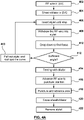
- An example method for carrying out a transseptal puncture comprises the steps of: advancing an RF guidewire into a superior vena cava; advancing a sheath and dilator over the RF guidewire into the superior vena cava; inserting a stylet in the dilator until it reaches a stop; withdrawing the RF guidewire into the stylet; dropping down from the superior vena cava into a heart to find the fossa; tenting with the dilator; advancing RF wire to puncture position; puncturing and advancing RF wire; crossing the sheath and dilator over the RF wire; and removing the stylet.
- An example method for carrying out a transseptal puncture comprises: advancing a J-wire into the superior vena cava; advancing a sheath and dilator over the wire into the superior vena cava; removing the J-wire; inserting a needle assembly comprising a stylet and RF guidewire within the dilator at a two finger position; dropping down from the superior vena cava into a heart to find a fossa; tenting with the dilator; advancing needle assembly to puncture position; puncturing and advancing the needle assembly until a stop within the dilator; holding the position and unlocking the RF guidewire; advancing the RF guidewire to anchor; crossing the sheath and dilator over the RF guidewire; and removing the stylet.
- the device comprises a flexible energy based puncture device, wherein substantially all of the steps are performed using the flexible energy based puncture device.
- the device comprises a flexible RF guidewire and wherein substantially all of the steps are performed using the flexible RF guidewire.
- the device comprises a flexible mechanical guidewire having a relatively sharp distal tip wherein substantially all of the steps are performed using the flexible mechanical guidewire.
- some embodiments of the system provides a two part assembly comprising a flexible RF component and a rigid support member to enhance the utility of the system.
- the rigid member such as a reinforcing member is provided separate from and removable from the flexible RF component such as an RF wire and as such can be introduced independently from the flexible RF wire.
- the RF wire can be used independently from the reinforcing member when required - initial advancement of the flexible RF wire in the absence of the reinforcing member removes the need for a separate exchange wire to be used for initial access into the (superior vena cava) SVC.
- the reinforcing member can then be used selectively - the reinforcing member can be advanced into the SVC to provide adequate force transmission to facilitate the drop down procedure to locate the fossa. If the initial pass at locating the fossa is unsuccessful the two part assembly enables partial removal or withdrawal of the rigid support member to enable the RF wire to be repositioned.
- the rigid support member may then be re-advanced or re-positioned to provide the adequate stiffness and force transmission to repeat the drop down procedure to locate the fossa and to provide adequate support to facilitate puncture using the RF wire and to facilitate crossing with the RF wire.
- the rigid support member facilitates the transseptal puncture using the RF wire, and functions to additionally facilitate crossing into the left side after the puncture is completed.
- the reinforcing member may be removed thereafter leaving the flexible RF within the left side of the heart.
- the flexible RF wire is usable independently from the reinforcing member to facilitate anchoring, facilitate tracking, to minimize left side exchanges to minimize risk of embolisms, and to minimize the risk of trauma.
- the reinforcing member can be introduced selectively for a portion of the procedure that requires stiffness and can be removed thereafter (either partially or completely) in order to facilitate the remainder of the procedure.
- the reinforcing component since the reinforcing component is provided separately from the flexible RF wire, the reinforcing component may be re-advanced or reinserted, as desired to complete aspects of the procedure.
- RF wire Details of the RF wire are disclosed in application number PCT/IB2013/060287 and publication number WO2015019132 .
- the details provided herein below include several embodiments of a supporting member usable with a puncture device such as the RF guidewire disclosed in the referenced application.
- an assembly for puncturing tissue, where the assembly comprises a substantially flexible puncturing device (that is substantially atraumatic such as an energy based puncturing device) for puncturing tissue via delivery of energy.
- the assembly additionally comprises a supporting member for supporting the substantially flexible puncturing device such as a rigid needle shaft.
- the supporting member comprises a reinforcing member (which may form the needle shaft).
- the supporting member is operable to be selectively usable with the substantially flexible puncturing device and is detachable or removable therefrom.
- the substantially flexible puncturing device is operable independently from the supporting member to puncture tissue.
- the substantially flexible puncturing device is an energy based device for delivering energy to puncture tissue.
- the substantially flexible energy based puncturing device is selectively usable in co-operation with the substantially rigid supporting member during a portion of the procedure. Additionally the substantially flexible energy based puncturing device is usable independently from the supporting member during another portion of the procedure.
- the supporting member is removable from the substantially flexible energy based puncturing device during a portion of the procedure, to enable the substantially flexible energy based puncturing device to be used separately therefrom.
- the assembly enables the substantially flexible energy based puncturing device to be usable independently from the supporting member during a portion of the procedure and to be usable in co-operation with during a portion of the procedure.
- This facilitates exchange by allowing the flexible energy based puncture device to be used for puncturing tissue and as an exchange wire, facilitating exchange and additionally provides the advantage of providing an atraumatic tip for puncturing tissue, as the substantially flexible energy based puncturing is substantially atraumatic.
- the decoupling of the energy delivery portion of the assembly from the supporting member additionally enables the supporting member to be removed if the flexible energy based puncturing device is not positioned at the desired target location, enabling the substantially flexible energy based puncturing device to be repositioned to enable the supporting member to be re-advanced over the substantially flexible energy based puncturing device to facilitate positioning of the energy delivery portion of the flexible puncturing device against the desired target tissue location and may additionally reducing procedure complexity and enhance procedural efficiency.
- the present invention provides an assembly 100 for puncturing tissue such as for creating a transseptal puncture through a septum of a heart, where the assembly provides a tissue puncture or puncturing device 110, and a separate supporting member 130 that is selectively usable with the tissue puncture device 110 for supporting the puncture device 110.
- the puncture device 110 is capable of being selectively usable in co-operation with the supporting member 130 during one or more portions or steps of the procedure and the puncture device 110 is usable independently therefrom during another one or more portions or steps of the procedure, in order to puncture tissue.
- providing a separate puncture device 110 and a supporting member 130 for selective therewith additionally enhances procedural efficiency by facilitating exchange and positioning.
- an assembly 100 for puncturing tissue comprising a substantially flexible puncture device 112 as discussed further herein below, for puncturing tissue and a supporting member 130 for supporting the substantially flexible puncturing device.
- the substantially flexible puncture device 112 similar to the embodiment discussed herein above, is capable of being selectively insertable within the supporting member 130 to be selectively usable in co-operation therewith during a portion of the procedure and wherein the substantially flexible puncture device 112 is usable independently therefrom during another portion of the procedure, in order to puncture tissue and to facilitate exchange and positioning.
- the substantially flexible puncture device 112 comprises an energy delivery device that is operable to deliver energy in order to puncture tissue.
- the supporting member 130 comprises a reinforcing member 34.
- the assembly 100 comprises a needle assembly for puncturing tissue, where the needle assembly comprises the puncture device 110 and the supporting member 130.
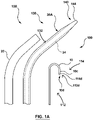
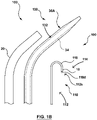
- the puncture device comprises a substantially flexible puncture device 112, as shown in Fig. 1A and 1B .
- the puncture device 110 comprises a substantially atraumatic distal tip 112d, wherein the puncture device 110 is substantially atraumatic.
- the puncture device 110 comprises an energy based puncture device 114 such as a substantially flexible energy based puncture device 114 that has an energy delivery portion or component 114d at the distal tip thereof for delivering energy in order to puncture tissue.
- the puncture device 110 comprises a flexible (radiofrequency) RF guidewire 10 that has a distal electrode tip 10d for delivering radiofrequency energy in order to puncture tissue.
- the RF guidewire 10 is a flexible wire which is generally electrically insulated save for selected distal regions such as the distal electrode tip 10d.
- the puncture device comprises a mechanical puncture device 118.
- the mechanical puncture device 118 comprises a relatively sharp distal tip 118d for puncturing tissue.
- the supporting member comprises a reinforcing member.
- the supporting member 130 comprises a needle shaft 132 comprising the reinforcing member 34 for supporting the puncture device 110.
- the needle shaft 132 may provide or has properties of a mechanical needle.
- the reinforcing member [such as a metal hypo-tube] with one or more polymer layers is structured to form a needle shaft 132.
- the assembly 100 such as a needle assembly comprises an RF wire and a separate reinforced member.
- some embodiments of the present invention provided herein below are described with respect to an RF guidewire, but some such embodiment described herein may also be with other puncture devices such as a mechanical puncture device such as a mechanical guidewire.
- an RF guidewire may provide advantages not found in other puncture devices such as a mechanical guidewire.
- Supporting Member comprising a needle shaft/reinforced dilator
- embodiments of the present invention provide an assembly 100 for puncturing tissue
- the assembly 100 comprises a substantially flexible energy based (or energy delivery) puncture device 114 for puncturing tissue via delivery of energy and a supporting member 130 for supporting the substantially flexible energy delivery puncture device 114.
- the substantially flexible energy delivery puncture device 114 is capable of being selectively insertable within the supporting member 130 to be selectively usable in co-operation therewith during a portion of the procedure and wherein the substantially flexible energy delivery puncture device 114 is usable independently therefrom during another portion of the procedure, in order to facilitate exchange and positioning while providing substantially atraumatic puncture of tissue.
- the supporting member 130 comprises a reinforcing member 34.
- the assembly 100 comprises a substantially flexible energy delivery puncture device or component 114 that is provided separately from and is operable independently from a supporting member 130.
- the flexible energy delivery puncture device or component 114 (also referred to as a flexible energy based delivery device or a flexible energy delivery puncturing device) comprises a radiofrequency (RF) guidewire 10
- the separate supporting member 130 comprises needle shaft 132 comprising a reinforcing member 34 and one or more polymer layers 38 forming a polymer shaft 39 of the dilator 30A, where the reinforcing member 34 is substantially surrounded by the one or more polymer layers.
- the RF guidewire 10 comprises an electrode for delivering radiofrequency energy.
- the RF guidewire 10 has a distal electrode tip 10d for delivering radiofrequency energy in order to puncture tissue.
- the distal electrode tip 10d is substantially atraumatic to reduce the pressure exerted on the tissue.
- the distal electrode tip of the RF guidewire 10 comprises a substantially dome-shaped electrode tip that is substantially atraumatic to reduce the pressure exerted on the tissue.
- the RF guidewire 10 may comprise a cylinder as shown by reference number 10c with a hemispherical electrode tip 10d which in some examples may form a cap that is formed distal to and adjacent to the cylinder 10c.
- the electrode tip 10d may be defined by a dome on top of the cylinder 10c, such as a substantially full round dome.
- the outer diameter of the dome may substantially match the outer diameter of the cylinder 10c. This may help provide a substantially atraumatic distal interface with the tissue to minimize risk of trauma and/or injury at the desired target tissue site.
- the dome shaped distal electrode tip 10d of the RF guidewire 10 may reduce the amount of pressure that is exerted by the distal tip on the tissue to make the tip more atraumatic, so a force exerted by the distal tip is spread over a larger area.
- the RF guidewire 10 is provided as a 0.035" wire.
- the assembly additionally comprises a sheath 10 and a supporting member comprising a reinforced dilator such as dilator 30A that are usable with the flexible RF wire, where the dilator 30A comprises the reinforcing member 34 and one or more polymer layers 38 defining a polymer shaft 39 of dilator 30A, where the reinforcing member 34 is substantially surrounded by the one or more polymer layers 38.
- a reinforced dilator such as dilator 30A that are usable with the flexible RF wire
- the dilator 30A comprises the reinforcing member 34 and one or more polymer layers 38 defining a polymer shaft 39 of dilator 30A, where the reinforcing member 34 is substantially surrounded by the one or more polymer layers 38.
- an assembly 100 is provided for puncturing tissue, where the supporting member 130 comprises a needle shaft 132 where the needle shaft 132 comprises the reinforcing member 34 and one or more polymer layers 38, where the reinforcing member 34 is substantially surrounded by the one or more polymer layers 38.
- the needle shaft 132 is provided within the dilator 30A.
- the supporting member comprises a needle shaft 132 that is provided as a part of or defined by the dilator 30A, wherein the needle shaft 132 is embedded in or surrounded by one or more polymer layers 38 of the dilator 130.
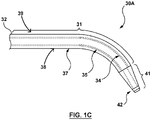
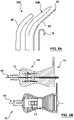
- Fig. 1C illustrates a supporting member 130 that comprises a reinforced dilator 30A having the needle shaft 132, where the supporting member 130 is provided separately from the substantially flexible tissue puncturing device or member 112, such as an energy based tissue puncturing device 114 such as an RF guidewire 10.
- the needle shaft 132 is provided as a part of or in other words is defined by the dilator 30A.
- needle shaft 132 (and thus the dilator 30A defining the supporting member 130) is provided as a non-puncturing component for supporting the tissue puncturing device or member.
- the dilator 30A comprising the needle shaft 132 comprises a proximal portion 31 that terminates at a distal tip 41.
- the reinforcing member 34 provides sufficient rigidity that is substantially similar to that of a rigid needle.
- a dilator shaft 32 extends along the proximal portion 31 and comprises the reinforcing member 34.
- the reinforcing member 34 is substantially surrounded by the one or more polymer layers 38.
- the reinforcing member 34 is embedded within the one or more polymer layers 38 which comprise an inner polymer layer and an outer polymer layer.
- the inner and outer polymer layers comprise inner and outer tubular members 35, 37 of the dilator shaft 32.
- substantially surrounded may be taken to mean that the reinforcing member 34 is substantially surrounded on its outside or its exterior by the one or more polymer layers 38 that form a polymer shaft 39 (forming the dilator shaft 32) around the reinforcing member 34.
- the dilator 30A may additionally include a radiopaque marker 42 at the distal tip 41.
- the reinforcing member 34 comprises a hypo-tube such as a metal hypotube.
- the reinforcing member 34 comprises a stainless steel hypotube and the inner and outer tubular members 35, 37 comprise HDPE.
- Hypo-tube defines an inner lumen of the supporting member
- the reinforcing member 34 such as the stainless steel hypo-tube, extends longitudinally within the one or more polymer layers, for example, within the inner and outer tubular members 35, 37, as shown in Fig. 1C .
- the reinforcing member 34 [for example a hypotube] defines an inner lumen of the supporting member 130.
- the one or more polymer layers 38 comprise an inner polymer layer and an outer polymer layer, which in some examples may comprise inner and outer tubular members 35, 37.
- the reinforcing member 34 is substantially surrounded by the one or more polymer layers 38 along its exterior, as noted above.
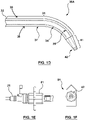
- the reinforcing member 34 is substantially surrounded by the one or more polymer layers 38 such that the reinforcing member 34 is located between the inner polymer layer and an inner polymer layer, for example, as defined by the inner and outer tubular members 35, 37 shown in Fig. 1D (in some examples, the hypo-tube is located between or sandwiched between two layers of polymer.
- the reinforcing member 34 is substantially surrounded by and embedded within both the inner and outer polymer layers. In other words the reinforcing member 34 is sandwiched or located between the inner and outer polymer layers 38 and thus the polymer shaft 39 that forms the dilator shaft 32.
- the inner and outer tubular members 35, 37 comprise high density polyethylene (HDPE).
- the sheath 10 comprises a standard transseptal sheath, the needle shaft 132 (provided as a part of or defined by the dilator 30A) comprising a reinforcing member 34 as described herein above and the RF guidewire or RF wire is provided as a 0.035" wire.
- the RF wire comprises a J-tip wire or in alternate examples the RF wire comprises a pigtail wire.
- the reinforcing member 34 comprises a distal end 34D and a proximal end 34P, where the reinforcing member 34 extends within an inner lumen of the dilator 30A, as shown in Fig. 1C .
- the assembly 100 provides a substantially gapless interface at the junction between the reinforcing member at the distal and proximal ends and the one or more polymer layers.
- the reinforcing member 34 is secured within the one or more polymer layers 38 forming the polymer shaft 39 of the dilator 30A. In one such example, with reference now to Figs.
- the reinforcing member 34 is substantially affixed at its distal and proximal ends (in other words the reinforcing member distal and the reinforcing member proximal end) to the one or more polymer layers 38 of the dilator 30A to provide a substantially gapless interface at the junction between the reinforcing member 34 at the distal and proximal ends and the one or more polymer layers 38 reinforcing member.
- the drawings show the interface at the distal end of the reinforcing member 34. A similar interface is provided at a proximal end of the reinforcing member 34.
- the reinforcing member 34 is substantially sealed at its distal and proximal ends (in other words at the reinforcing member distal end and the reinforcing member proximal end) to the one or more polymer layers 38 of the dilator 30A.
- this may prevent blood or other liquid from getting between the reinforcing member 34 and the polymer shaft 39.
- Supporting member providing force transmission/torque
- the supporting member 130 provides sufficient stiffness to the puncturing device such as the RF wire to enable sufficient force transmission to enable force to be transmitted to a distal end of the assembly 100.
- the supporting member 130 provides sufficient stiffness to the puncturing device to enable torque to be transmitted to a distal end of the assembly.
- the reinforcing member 34 provides sufficient stiffness to the supporting member 130 to enable sufficient force transmission to enable force to be transmitted to a distal end of the assembly 100. More specifically, the reinforcing member 34 provides sufficient stiffness to the assembly 100 such that the substantially flexible puncturing device 112 (such as a substantially flexible energy based puncture device 114 such as an RF wire 10) together with the supporting member 130 is capable of sufficient force transmission to enable force to be transmitted to a distal end of the assembly 100 (and thus allows force to be transmitted to a distal end of the substantially flexible puncturing device 112).
- the substantially flexible puncturing device 112 such as a substantially flexible energy based puncture device 114 such as an RF wire
- the reinforcing member 34 is capable of imparting force transmission capabilities to the substantially flexible RF wire 10, which when used together with the supporting member 130 is capable of force transmission to enable force to be transmitted to a distal end of the assembly 100, for example for engaging tissue at a target tissue site.
- the reinforcing member 34 functions as a force transmitting portion of the assembly 100.
- the assembly 100 further comprises a sheath 20, as shown in Fig. 1A , where the sheath 20 is usable with the supporting member 130, to provide stiffness to the assembly 100 to facilitate force to be transmitted to a distal end of the assembly 100.
- the reinforcing member 34 provides sufficient stiffness to enable torque to be transmitted to a distal end of the assembly 100.
- the reinforcing member 34 provides sufficient stiffness to the assembly, wherein the substantially flexible puncturing device 112 such as a substantially flexible energy based puncturing device 114 together with supporting member 130 provides sufficient stiffness to the assembly 100 to enable torque to be transmitted to a distal end of the assembly 100 (and thus allows torque to be transmitted to a distal end of the substantially flexible puncturing device 112).
- Some such embodiments of the present invention facilitate transseptal puncture, where the reinforcing member 34 provides sufficient stiffness to the assembly 100 to enable sufficient force transmission for engaging a desired tissue site (such as the septum of the heart).
- the supporting member 130 provides the substantially flexible puncture device 112 with force transmission capabilities where the substantially flexible puncture device 112 is capable of force transmission when in use with the supporting member 130.
- the assembly 100 further comprises a sheath 20, as shown in Fig. 1A , where the sheath 20 is usable with the supporting member 130, to provide stiffness to the assembly 100 to enable torque to be transmitted to a distal end of the assembly 100.
- the sheath 20 may be coupled to the dilator 30A which enables force and/or torque transmission using one or more of the components [i.e., the sheath 20 or the dilator 30A.].
- the user may not have to manipulate the sheath 20 and the dilator 30A (the user may just manipulate the sheath 20 or the dilator 30A) and the RF guidewire 10 follows the guidance and/or direction of the sheath 20 and/or the dilator 30A.
- the sheath 20 has some contribution to the overall torque.
- torqueing the sheath 20 and/or the dilator 30A enables the reinforcing member 34 to be torqued therewith.
- the force transmitting portion of the assembly 100 has a force transmitting portion flexural rigidity of at least about 0.0085 Nm 2 , for example about 0.0115Nm 2 .
- the force transmitting portion of the assembly is the supporting member 130 that has a stiffness or rigidity with a flexural rigidity value of at least about 0.0115Nm 2 to enable sufficient force transmission to enable force to be transmitted to a distal end of the assembly 100.
- the supporting member has a flexural rigidity of about 0.0085 Nm 2 to about 0.0145 Nm 2 .
- the supporting member 130 is the reinforced dilator 30A that has a flexural rigidity of at least about 0.0085 Nm 2 , for example about 0.0115 Nm 2 .
- the reinforced dilator 30A has a flexural rigidity about 0.0085 Nm 2 to about 0.0145 Nm 2 .
- the reinforced dilator 30A is the reinforced dilator 30A as provided in Example 1, for example as provided with respect to Figs. 2A-2G .
- the supporting member 130 functions to impart rigidity or stiffness to the assembly 100 including the puncture device such as a substantially flexible puncture device, to provide force transmission capabilities to the assembly including the puncture device such as a substantially flexible puncture device.
- the flexural rigidity values provided for the supporting member 130 are also usable for Examples 2 and 3 provided herein with respect to Figs. 4A-4G , and Figs 6A-6H .
- the force transmitting portion of the assembly is the supporting member 130 that is the reinforcing member that comprises the stylet.
- the stylet has a stiffness or rigidity with a flexural rigidity value of at least about 0.008Nm 2 , for example about 0.015 Nm 2 to enable sufficient force transmission to enable force to be transmitted to a distal end of the assembly 100.
- the supporting member has a flexural rigidity of about 0.008 Nm 2 to about 0.024 Nm 2 .
- a distal portion of the puncture device such as a substantially flexible puncture device has a distal portion or distal region flexural rigidity.
- a substantially flexible RF guidewire 10 is provided, where the substantially flexible RF guidewire 10 has a distal portion [including along the distal electrode tip 10d] where the RF guidewire 10 has a distal portion stiffness defined by a flexural rigidity of at least about 3.57 ⁇ 10 -6 Nm 2 , for example about 4.76 ⁇ 10 -6 Nm 2 .
- RF guidewire 10 has a distal portion stiffness or rigidity with a flexural rigidity of between about 3.57 ⁇ 10 -6 Nm 2 to about 5.95 ⁇ 10 -6 Nm 2 .
- the distal region of the RF guidewire 10 is tapered down from a proximal region of the RF guidewire 10, over about 12cm-15cm. In other words, the distal portion of the RF guidewire 10 has a length of between about 12cm to about 15cm. In some such examples, the distal portion of the RF guidewire 10 is the thinnest point of the RF guidewire 10.
- the substantially flexible RF guidewire 10 has a proximal portion with a proximal portion flexural rigidity of less than about 0.00179Nm 2 , for example about 0.00143 Nm 2 . In some embodiments of the present invention, RF guidewire 10 has a proximal portion stiffness or rigidity with a flexural rigidity of between about 0.00107Nm 2 to about 0.00179Nm 2 .
- the substantially flexible puncture device comprises an RF guidewire 10 has a flexural rigidity of between about 2.0 ⁇ 10 -6 to about 1.4 ⁇ 10 -3 Nm 2 .
- the RF guidewire 10 has a wire diameter that is between about 0.127 mm to about 0.635 mm.
- the reinforcing member 34 is shapeable to enable the supporting member 130 (for example comprising a needle shaft 132 as provided as a part of or defined by a reinforced dilator 30A) to be removed from the substantially flexible energy delivery puncturing device 110 (such as the RF wire 10) to enable a curve of the supporting member 130 be re-shaped to be reinserted therewith, in order to optimize the position of the assembly 100 against a target tissue site, such as the fossa of the septum of the heart.
- a target tissue site such as the fossa of the septum of the heart.
- the supporting member 130 is shapeable to enable it to be removed from the puncture device (such as substantially flexible puncture device 114 such as an RF guidewire 10) to enable a curve of the supporting member 130 be re-shaped to be reinserted therewith, in order to optimize the position of the assembly 100 against a target tissue site.
- the reinforcing member 34 additionally provides shapeability, and enables the reinforcing member 34 and thus the supporting member 130 to be shapeable.
- the reinforcing member 34 is shapeable enable the supporting member 130 (that includes the reinforcing member 34) to be removed from the substantially flexible puncture device (such as an RF guidewire) to enable a curve of the supporting member be re-shaped to be reinserted therewith, in order to optimize the position of the assembly 100 against a target tissue site, such as the septum of the heart.
- the substantially flexible puncture device such as an RF guidewire
- the supporting member 130 comprises a reinforcing member 34 that is provided within the reinforced dilator 30A (such as within a needle shaft 132 of the reinforced dilator 30A), and as such imparts shape-ability to the dilator 30A.
- the supporting member 130 comprises a stylet 60 that is provided separately from the dilator 30A (as described in examples described further herein below and imparts shapeabiltiy to the assembly 100).
- the stylet 60 functions to impart a desired curvature and stiffness to the assembly 100 when in use with the assembly 100.
- the stylet 60 is removable from the assembly and can be re-shaped and re-inserted into the assembly 100 to provide a desired curvature to the assembly 100.
- assembly 100 comprises a sheath 20 as shown in Fig. 1A for use a sheath for use with the reinforced dilator 30a for use therewith during a portion of the procedure.
- the assembly 100 comprises a locking mechanism to enable axial and rotational coupling of the dilator 30A with the sheath 20 for a portion of the procedure.
- the locking mechanism enables co-operative engagement between the sheath 20 and dilator 30A to provide rotational and axial coupling. This may help minimize the risk of rotational misalignment between the sheath 20 and dilator 30A and thus may reduce the risk of confusion resulting from the misalignment.
- the supporting member 130 comprising a needle shaft 132 (as provided as part of or defined by) dilator 30A comprises a dilator hub 51 that is operable to be coupled to the sheath hub 21 for a portion of the procedure.
- a locking mechanism is provided where the dilator hub 51 comprises one or more keys 52 for co-operatively engaging with corresponding features (such as key receiving features) on the sheath hub 21 that enable axial and rotational locking with the sheath 20.
- a locking mechanism is provided to enable axial and rotational coupling of the dilator with the sheath for a portion of the procedure.
- a steerable sheath is provided, where the steerable sheath 20 may be an 8Fr steerable sheath. Alternatively, an 8.5Fr steerable sheath 20 may be provided. In some such examples, the steerable sheath 20 may be provided with different curvatures. In a specific example, steerable sheaths 20 may be provided in different curvatures, specifically at angles of: 37, 45, 55, 90, or 135 degrees. In a specific instance of this example, the sheath tubing comprises an inner PTFE liner, a braid and a Pebax outer jacket.
- a supporting member 130 comprising a needle shaft 132 (for example, provided as a part of or defined by) an 8 Fr dilator 30A is provided that is compatible with an 8Fr Sheath.
- supporting member 130 comprising the needle shaft 132 may be provided as a part of, or defined by an 8.5Fr dilator 30A may be provided that is compatible with an 8Fr steerable sheath 20.
- the supporting member 130 comprising the needle shaft 132 (for example as provided as a part of or defined by dilator 30A) may be provided with a 50 degree or 86 degree curvature.
- materials may include HDPE and a metal hypotube that forms the reinforcing member 34.
- the RF wire comprises a 0.035" OD wire and may be a J-tip wire or a pigtail wire. In a specific instance of this example, the wire may comprise a stainless steel core with a PTFE coating.
- the supporting member 130 comprises one or more radiopaque markers such as a supporting member radiopaque marker 42.
- the assembly 100 provides a supporting member 130 (for example comprising a needle shaft 132 as provided as a part of or defined by a reinforced dilator 30A), comprises a radiopaque marker 42, such as at the distal tip of the supporting member 130.
- the supporting member 130 comprises a radiopaque marker 42 embedded within the polymer of the distal tip thereof, as shown.
- the radiopaque marker 42 comprises a radiopaque coil 142 embedded within the polymer of the supporting member 130 (for example comprising a needle shaft 132 as provided as a part of or defined by a reinforced dilator 30A) such as within the one or more polymer layers 38 (forming the polymer shaft 39 which in turn forms the dilator shaft 32), for example, at a distal tip thereof (of the supporting member 130).
- the radiopaque coil 142 is embedded within the one or more polymer layers such that the one or more polymer layers extend distally beyond the radiopaque coil 42.
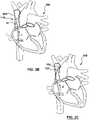
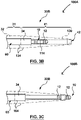
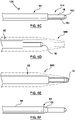
- a substantially flexible energy based puncturing device 114 is provided (such as an RF guidewire) that comprises one or more device side radiopaque markers (or in other words one or more device radiopaque markers) at a distal end of thereof, for example, as shown in Figs. 3B and 3C .
- the supporting member 130 also comprises a supporting member radiopaque marker at the distal end of the supporting member 130 (as shown in Figs. 1C and ID). In some such embodiments, similar to the embodiments shown in Figs.
- the one or more device radiopaque markers 12 are configured to co-operate with the supporting member radiopaque marker 42 to indicate the relative position of the substantially flexible energy based puncturing device 114 (such as an RF guidewire 10).
- the examples shown in Figs. 3B and 3C illustrate a dilator 30B that is provided separately from a stylet 64.
- the stylet 64 may be a reinforcing member 34 that is provided within a dilator 30A.
- the assembly 100 comprises an initial configuration 100A, where the substantially flexible energy based puncturing device 114 (such as an RF guidewire 10) is positionable within the supporting member 130 such that the one or more device radiopaque markers 12 are not in alignment with the supporting member 130 radiopaque marker 42, as shown in Fig. 3A .
- multiple radiopaque markers may be visible under imaging, including the one or more device radiopaque markers 12 and the supporting member radiopaque marker 42.
- the assembly 100 comprises a first configuration 100B, as shown in Fig. 3B where the substantially flexible energy based puncturing device 114 (such as an RF guidewire 10) is positionable within the supporting member 130 such that the one or more device radiopaque markers 12 are in alignment with the supporting member 130 radiopaque marker 42, as shown in Fig. 3B .
- a single radiopaque marker may be visible under imaging [including the one or more device radiopaque markers 12 and the supporting member radiopaque marker 42 that may be arranged in close proximity to one another].
- the assembly 100 additionally has a second configuration 100B, where the substantially flexible energy based puncturing device 114 (such as an RF guidewire 10) is positionable/advanceable within the supporting member 130 such that the one or more device radiopaque markers 12 are substantially not in alignment or misaligned with the supporting member radiopaque marker 42.
- the misalignment of the one or more device radiopaque markers 12 with the supporting member radiopaque marker 42 indicates positioning of an energy delivery portion 114d of the flexible energy based puncturing device 114 (such as an RF electrode tip 10d of an RF guidewire 10) beyond the supporting member (for example distal to the distal tip or end of the supporting member 130) for positioning against a target tissue site for puncture of tissue.
- multiple radiopaque markers may be visible under imaging [including the one or more device radiopaque markers 12 and the supporting member radiopaque marker 42, where the one or more device radiopaque markers 12 are positioned distally to the supporting member radiopaque marker 42, indicating that the distal electrode tip 10d is positioned against a target tissue site (such as the septum of the heart) for puncturing the tissue.
- a target tissue site such as the septum of the heart
- the sheath 20, and dilator 30A as well as the reinforcing member 34 are all radiopaque, and have radiopaque properties to enable them to visible under imaging.
- one or more of the sheath 20, dilator 30A, and reinforcing member 34, such as a metal hypo-tube comprise radiopaque materials in addition to radiopaque markers [42].
- the reinforcing member 34 such as a metal shaft or hypotube is also radiopaque.
- polymers forming the sheath 20 and/or the dilator 30A may comprise polymer radiopaque filler such as barium sulfate 20% so there is contrast with the one or more markers [12, 42] at the distal tip.
- this may provide visibility under imaging and may additionally provide contrast with the one or more markers [42, 12] which may allow the user to see the dilator 30A in comparison to the RF guidewire 10 under imaging, to see whether the RF guidewire 10 is positioned in or outside the dilator 30A [i.e., whether the distal segment of the RF guidewire 10 is distal to the dilator 30A.
- the supporting member 130 comprises a substantially blunt distal tip or edge 143, as shown in Fig. 1A , in order to provide a substantially atraumatic distal tip 143, while providing the advantages of a substantially rigid or stiff supporting member 130 (such as by providing the reinforcing member 34) therein.
- a reinforced dilator 30A is provided, with reference again to Fig. 1A .
- the dilator 30A in some instances comprises a substantially blunt distal tip or edge 144 in order to provide a substantially atraumatic distal tip 144.
- the reinforced dilator 30A comprises a substantially thick distal wall along the distal tip 144 where the distal tip 144 is defined by a substantially rounded distal tip edge.
- the dilator 30A provides advantages of a dilator by providing a substantially atraumatic distal tip and additionally a tapered profile at the distal tip to provide ease of trackability and crossing while providing advantages associated with providing a substantially rigid body by providing a substantially rigid component (such as a reinforcing member 34 therein) in addition to enabling use of an RF guidewire 10 for one or more of positioning, tracking devices, puncturing and anchoring.
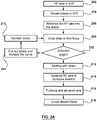
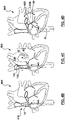
- an overall method/workflow is provided that illustrates a method of carrying out a transseptal puncture procedure using an assembly 100, as described herein above.
- the method disclosed herein provides one or more advantages associated with an assembly comprising an energy delivery component that is provided separately from the rigid component. Details of the method are provided herein below.
- a method for puncturing tissue comprises the step of: [1] accessing a region of tissue within a patient's body by advancing a device (such as a puncture device 110 such as an RF guidewire 10) into the region of tissue, as shown in Fig. 2B .
- the method of puncturing a region of tissue comprises a method of carrying out a transseptal puncture where the step of accessing the region of tissue comprises advancing the device (such as the puncture device 110) into the superior vena cava (SVC) 501 adjacent a heart 500 of the patient.
- SVC superior vena cava
- the method for puncturing tissue additionally comprises the step of: [3] positioning a device at a target tissue site in the region of tissue, as shown in Fig. 2D , by for example: [2] first tracking a supporting member 130 (such as reinforced dilator 30A) over the puncture device 110 to support the device (such as puncture device 110) as shown in Fig. 2C, to [3 ] enable advancement of the device (such as a puncture device 110) towards a target tissue site in order to position the device at the target tissue site for puncturing, as shown in Fig. 2D .
- a supporting member 130 such as reinforced dilator 30A
- the step of positioning the puncture device 110 at the target tissue site comprises performing [3] a drop down from the superior vena cava (SVC) into the heart 500 of the patient to locate a fossa ovalis (or in other words fossa) 504 along a septum 502 of the heart 500, by first for example (2) tracking or advancing a supporting member 130 (such as a dilator 30A) over the device (such as a puncture device 110) into the SVC to (3) facilitate the drop down to position the puncture device 110 at the fossa 504.
- SVC superior vena cava
- the steps of accessing [1], as shown in Fig. 2B and positioning [3], as shown in Fig. 2D are performed using the same device such as a puncture device 110, wherein the puncture device 110 is usable without the supporting member 130 during the step of accessing [1] and wherein the device is usable with the supporting member 130 during the step of positioning [3].
- the steps of accessing and positioning are performed using a puncture device 110.
- the method additionally comprises: [4] a step of puncturing through the target tissue site using a device (such as the puncture device 110) after the step of positioning [3] as shown in Fig. 2D .
- the supporting member 130 supports the device (such as puncture device 110) during puncturing [4] where the steps of accessing [1], positioning [3] and puncturing [4] are performed using the same device.
- the step [4] of puncturing through the target tissue site comprises the step [4] of puncturing through the fossa 504 to gain access to a left side of the heart 500.
- This enables one or more devices of the assembly 100, such as the supporting member 130 (such as dilator 30A) and sheath 20 of the assembly 100 to be tracked over the RF guidewire 10 into the left side of the heart.
- the steps of accessing, positioning, and puncturing are performed using a puncture device 110.
- the method additionally comprises a step of anchoring, as shown in Fig. 2E , where the step of anchoring is performed using a device (such as the puncture device 110) after the step of puncturing [4] through the target tissue site, to maintain access through the target tissue site to the other side of the target tissue site, to allow one or more additional device [such as sheath 20 and the supporting member 130 comprising the dilator 30A] to be tracked over the device (such as the puncture device 110) to the other side of the target tissue site, as shown in Fig. 2F , where the steps of accessing, positioning, puncturing and anchoring are performed using the same device.
- a device such as the puncture device 110
- additional device such as sheath 20 and the supporting member 130 comprising the dilator 30A
- the puncture device 110 such as the RF guidewire 10 may be left to maintain access to the left side of the heart, as shown in Fig. 2G .
- the supporting member 130 for example comprising the dilator 30A may be removed or retracted to allow anchoring using the RF guidewire 10.
- the RF guidewire 10 functions as a rail to guide one more devices to the left side of the heart.
- the RF guidewire 10 provides a substantially stiff rail to guide the one or more devices to left side of the heart while being substantially atraumatic to minimize damage to the tissue.
- the step of anchoring to maintain access through the target tissue site comprises advancing the device (such as the puncture device 110) through the fossa to the left side of the heat to maintain access to the left side of the heart.
- the step additionally comprises a step of removing the supporting member 130 [such as dilator 30A] and leaving the puncture device 110 [such as RF guidewire 10] to maintain access to the region of tissue such as the left side of the heart.
- the step of anchoring comprises removing the supporting member 130 comprising the dilator 30A to enable anchoring by allowing the RF guidewire 10 to remain positioned to maintain access to the eft side of the heart.
- the sheath 20 may additionally be removed as well.
- the steps of accessing, positioning, puncturing and anchoring are performed using a puncture device.
- the device comprises a flexible puncture device 112 where one or more of the steps of accessing, positioning, puncturing and anchoring are performed using the flexible puncture device 112. In some such examples, each of the steps of accessing, positioning, puncturing and anchoring are substantially performed using the flexible puncture device 112.
- the device comprises a substantially flexible guidewire (such as a mechanical guidewire 118 or an RF guidewire 10) where one or more of the steps of accessing, positioning, puncturing and anchoring are performed using the substantially flexible guidewire(such as a mechanical guidewire 118 or an RF guidewire 10).
- a substantially flexible guidewire such as a mechanical guidewire 118 or an RF guidewire 10
- each of the steps of accessing, positioning, puncturing and anchoring are substantially performed using substantially flexible guidewire (such as a mechanical guidewire 118 or an RF guidewire 10).
- the device comprises a flexible energy based puncture device 114 where one or more of the steps of accessing, positioning, puncturing and anchoring the steps are performed using the flexible energy based puncture device 114. In some such examples, each of the steps of accessing, positioning, puncturing and anchoring are substantially performed substantially using flexible energy based puncture device 114.
- the device comprises a flexible RF guidewire 10 and wherein one or more of the steps of accessing, positioning, puncturing and anchoring are performed using the flexible RF guidewire 10. In some such examples, each of the steps of accessing, positioning, puncturing and anchoring are substantially performed substantially using flexible the flexible RF guidewire 10.
- the device comprises a flexible mechanical guidewire 118 having a relatively sharp distal tip 118d wherein one or more of the steps of accessing, positioning, puncturing and anchoring are performed using the flexible mechanical guidewire 118.
- each of the steps of accessing, positioning, puncturing and anchoring are substantially performed substantially using flexible mechanical guidewire 118.
- the method further comprises repeating the steps of accessing [1], shown in Fig. 2B , and positioning [3] as shown in Fig. 2D , until the device (such as the puncture device 110) is positioned at the desired target tissue site prior to the step of puncturing [4], as shown in Fig. 2E .
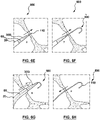
- repeating the step of positioning [3] as shown in Fig 2D further comprises reshaping a curvature of the supporting member 130 after removing the supporting member 130, and re-tracking [2] the supporting member 130 over the device, as shown in Fig. 2C (such as the puncture device 110 that has been re-positioned [1] within the SVC as shown in Fig. 2B ), prior to repeating the step of positioning as shown in Fig. 2D , which in the example shown comprises a drop-down procedure to find the fossa 504.
- the supporting member 130 comprises a reinforcing member 34, where the step of positioning is performed using the reinforcing member 34.
- the method comprises reshaping the supporting member 130 (such as the reinforced dilator 30A). In some such examples, the method comprises pulling the dilator element or dilator 30A out and reshaping it. In other examples, comprises pulling both the dilator element 30A and the sheath 20out and reshaping it.
- Supporting member comprises reinforced dilator
- re-shaping is performed using the supporting member 130 comprising a reinforced dilator 30A where the reinforced dilator 30A comprises the reinforcing member 34, where the step of positioning is performed using the reinforced dilator 30A that can be re-shaped.
- Supporting member comprises a stylet
- the step of re-shaping can be performed using the supporting member 130 comprising a stylet 60 wherein the stylet 60 is the reinforcing member 34, and the step of positioning is performed using the stylet 60.
- the stylet element 60 can be taken out and reshaped. In other examples, the stylet element 60 along with the sheath 20 and/or dilator 30B may be pulled out and re-shaped to see what the net shape might be and then can be re-inserted therein.
- the step of positioning is performed using a flexible RF guidewire 10.
- the steps of positioning, and puncturing are performed using a flexible RF guidewire 10.
- the steps of positioning, puncturing, and anchoring are performed using a flexible RF guidewire 10.
- a mapping system as provided below may be used to visualize the steps of positioning, and anchoring.
- the step of accessing may additionally be performed using the RF guidewire 10.
- a mapping system as provided below may be used to visualize the flexible RF guidewire 10 using a mapping system during the steps of accessing positioning, and anchoring.
- the method further comprises the step of visualizing the flexible RF guidewire 10 using a mapping system during the steps of accessing and positioning.
- embodiments of the present invention provide a mapping system that is usable to visualize an RF guidewire 10 during a method of puncturing tissue during one or more of the steps of accessing, positioning, and anchoring.
- the mapping device comprises an electro-anatomical mapping system where the electro-anatomical mapping system may be magnetic or impedance based to create virtual volumes.
- the electro-anatomical mapping system is usable with other echocardiographic imaging modalities, which may be ultrasound.
- the echocardiographic imaging modalities may be used as an overlay in maps, in other words they may be used provide additional information to the mapping system.
- the echocardiographic imaging modalities may comprise intracardiac cardiography or TEE echorcardiographic
- the method involves switching between a mapping mode that is used for each of the steps of accessing, positioning, and anchoring and the puncture mode that is used for the step of puncturing.
- the method of mapping the RF guidewire 10 to visualize using an imaging modality may be usable with a flexible wire with an electrode which may or may not deliver energy which may be used for recording purposive. In some cases it may be a passive electrode for recording purposes.
- the mapping system is usable with an active electrode such as the distal electrode tip 10d of the RF guidewire 10.
- the recording and mapping properties of a mapping system are usable with a guidewire having a passive electrode or an active electrode.
- the wire may comprise a puncturing means or a means to puncture tissue.
- the wire may comprise a mechanical guidewire 118 that may have a sharp distal tip 118d for puncturing tissue.
- the reinforcing member is the stylet 60 that is usable independently from the substantially flexible energy based puncture device 114 such as an RF wire 10.
- a method for carrying out a transseptal puncture comprising: (i) Advancing the RF wire into the superior vena cava, as shown in Fig. 2B , (ii)advancing the sheath and dilator over the wire into the superior vena cava, as shown in Fig. 2C ; (iii)withdrawing the RF wire into the dilator, as shown in Fig. 2D ; (iv) drop down from the SVC into the heart to find the fossa, as additionally shown in Fig.
- a method for carrying out a transseptal puncture procedure using an assembly 100 comprising a flexible RF wire 10, a sheath 20, and a dilator 30A, the method comprises the following steps: at step 202, [1] advancing the RF wire into the superior vena cava (SVC) to gain access, as additionally illustrated in Figure 2B .
- SVC superior vena cava
- providing the energy delivery component (flexible RF wire) separately from the reinforcing member allows the energy delivery component to be used as an access wire.
- the dilator 30A can be advanced later, allowing the flexible RF wire to provide access to the SVC without the use of an additional access wire. This may help reduce the number of steps and streamline the procedure, and as such may reduce procedural time and complexity.
- the method additionally comprises the following steps: at step 204, [2] advancing the sheath 20 and dilator 30A combination over the flexible RF wire into the SVC.
- the flexible RF wire 10 functions as an access wire and enables the sheath 20 and dilator 30A (for example as an assembly) to be tracked over the flexible RF wire 10 into the SVC as shown in Fig. 2C .
- the method additionally provides: at step 206, withdrawing the RF wire into the dilator 30A and step 208, [3] performing a drop down from the SVC into the heart to locate the fossa, as shown in Fig. 2D for carrying out the step of positioning the assembly 100.
- having the reinforced member 34 (within the dilator 30A) as separate from and operable independently form the flexible RF wire provides the additional advantage of allowing the drop down to be repeated if the fossa is missed in the first pass.
- the dilator 30A (and thus the reinforcing member 34) may be partially removed or retracted along with the sheath 20 and the flexible RF wire 10 may be re-advanced into the SVC.
- the sheath 20 and the dilator 30 may then be re-advanced over the flexible RF wire 10, as shown in Fig. 2C and the drop down may be repeated to allow the RF wire 10 to engage the fossa.
- This may help reduce procedural time and increase safety as an additional exchange is not required. Adding an additional exchange may add more time and add unnecessary risk. Thus, procedural time and risk may be reduced with the current embodiments where the energy delivery component and the rigid component are decoupled.
- the reinforcing member 34 [within the dilator 30A] provides the additional advantage of providing sufficient stiffness to the assembly 100 to facilitate the drop down, at step 208. As such the reinforcing member 34 enables sufficient force transmission and torque to allow the assembly 100 to engage the septum, as illustrated in Fig. 2D .
- the method further comprises: at step 212 tenting with the dilator 30A, with reference to Fig. 2D .
- the reinforcing member 34 provides sufficient stiffness to the assembly 100 to enable force to be imparted to the distal end of the assembly 100, thus enabling tenting with the dilator 30A.
- having the reinforcing member 34 within the dilator 30A allows it to be removed and re-shaped to allow for optimizing the position against the fossa.
- the physician may assess whether the angle of the dilator 30A and/or the assembly 100 is sufficient. If the angle is not deemed to be sufficient, at step 211, the physician may pull out the dilator 30A and reshape the curve. The dilator may be then be reinserted as indicated by step 213. The procedure then may be repeated starting at step 210, and a drop down may be performed again using the assembly 100. Once the fossa has been located, the physician may proceed with the step of tenting with the dilator, at step 212.
- the method additionally comprises the steps of: at step 214, advancing RF wire 10 to puncture position and at step 216 [4] puncturing and advancing RF wire 10, as shown in Fig. 2E .
- the advancement of the RF wire 10 into the left side of the heart 500 enables anchoring of the RF wire 10 on the left side of the heart to maintain access to the left side of the heart.
- the flexible RF wire 10 may provide the additional advantage of allowing the operator to push hard without injury as the flexible RF wire is more flexible.
- the method additionally comprises: at step 218, [5] crossing the sheath and dilator over the RF wire 10, as additionally shown in Fig. 2F .
- the flexible RF wire 10 may additionally protect the open end of the sheath 20/dilator 30A so it does not push hard into the tissue.
- the sheath 20 and dilator 30A may then be removed.
- energy delivery component is provided as a flexible RF wire 10 that is separate from a stiff component such as a reinforcing member 34 [provided within the dilator 30A], where the reinforcing member 34 [with the dilator 30A] is separable from and removable from the flexible RF wire 10.
- a stiff component such as a reinforcing member 34 [provided within the dilator 30A]
- the reinforcing member 34 [with the dilator 30A] is separable from and removable from the flexible RF wire 10.
- the RF wire may be positioned within the left superior pulmonary vein for anchoring. This may enable the RF wire to maintain access into the left atrium, allowing removal of the reinforcing member 34[along with dilator 30A to facilitate exchange of devices into the left atrium using the flexible RF wire. This may additionally reduce an additional exchange of the left side as it may eliminate the need for the physician to advance another wire after puncture to maintain access on the left side for tracking additional devices into the left side. An additional benefit of minimizing exchanges on the left side, in addition to reducing procedural time and the number of steps required, is minimizing risk of infection, embolisms and stroke.
- the RF wire 10 may have a pigtail curve at the distal end.
- the RF wire 10 may be used to anchor in the pulmonary vein.
- the former method of anchoring in the left atrium may provide additional advantages not found in the latter method.
- a method for puncturing tissue comprising the steps of: advancing a flexible puncture device 112 into a region of tissue; advancing a sheath 20 and supporting member 130 over the flexible puncture device 112 into the region of tissue; withdrawing the flexible puncture device into the supporting member 130; positioning the assembly 100 at a target tissue site in the region of tissue; tenting with the supporting member 130; advancing the flexible puncture device 112 to puncture position; puncturing and advancing flexible puncture device 112; and crossing the sheath 20 and dilator 30A over the flexible puncture device.
- the method of puncturing tissue comprises a method for carrying out a transseptal puncture, wherein the region of tissue comprises the superior vena cava.
- the flexible puncture device comprises an RF guidewire 10 and the supporting member comprises a reinforced dilator 30A.
- Some such embodiments comprise a method for carrying out a transseptal puncture, comprising the steps of: advancing the RF guidewire into the superior vena cava; advancing a sheath and dilator over the RF guidewire into the superior vena cava; withdrawing the RF guidewire into the dilator; dropping down from the superior vena cava into the heart to find the fossa; tenting with the dilator; advancing the RF guidewire to puncture position; puncturing using the RF guidewire and advancing the RF guidewire; and crossing the sheath and dilator over the RF wire.
- embodiments of the present invention provides an assembly 300, as shown in Fig. 3A , for puncturing tissue (such as creating a transseptal puncture through a septum of a heart).
- the assembly 300 provides a puncture device such as a substantially flexible energy delivery puncture device 114 for puncturing tissue via delivery of energy (such as flexible RF guidewire 10 and a a supporting member for supporting the substantially flexible energy delivery puncture device, such as a separate reinforcing member 34.
- the supporting member comprises a reinforcing member 34.
- the substantially flexible energy delivery puncture device 114 (such as RF guidewire 10) is capable of being selectively insertable within the supporting member 130 to be selectively usable in co-operation therewith during a portion of the procedure and wherein the substantially flexible energy delivery puncture device 114 (such as RF guidewire 10) is usable independently therefrom during another portion of the procedure, in order to facilitate exchange and positioning while providing substantially atraumatic puncture of tissue.
- the assembly 300 comprises a flexible energy delivery component 114 that is provided separately from and is operable independently from a supporting member.
- the flexible energy delivery component comprises an RF wire 10
- the separate supporting member 130 comprises a stylet 60 that defines a reinforcing member 34.
- the supporting member 130 is the reinforcing member 34 that is provided as a stylet 60 that is usable independently from a puncture device 110 such as a flexible puncture device 112.
- the supporting member 130 is defined by the reinforcing member 34, where in one example, the reinforcing member 34 comprises the stylet 60.
- the assembly 300 additionally comprises a sheath 20 and a dilator 30B that are usable with the flexible RF wire 10.
- the reinforcing member 64 is also provided separately from and removable from the dilator 30B which can be provided as a flexible dilator.
- Some such examples comprise a dilator 30B that is usable with the supporting member 130 to form a supporting member assembly 134 for selective use there-with during a portion of the procedure, as shown in Fig. 3B .
- the supporting member 130 comprises a stylet 60 defining the reinforcing member 34.
- a dilator 30B is provided that is usable with the stylet 60 for selective use there-with to form a stylet assembly 164, as shown in Fig. 3C .
- the puncture device 110 comprises a substantially flexible energy based puncture device 114.
- the substantially flexible energy based puncture device 114 comprises a flexible RF guidewire or wire 10.
- the RF guidewire 10 is capable of being selectively usable in co-operation with the stylet 60 (for example by being selectively being coupled thereto) during a portion of the procedure, and the RF guidewire 10 is usable independently from the stylet 60 during another portion of the procedure. Where selective use of the RF guidewire 10 in conjunction with the stylet, as well as without the stylet 60, facilitates puncture of tissue.
- the assembly 300 provides a supporting member 130 that is shapeable to enable it to be removed from the puncture device 110 (such as a flexible tissue puncture device 112, for e.g. a substantially flexible energy based tissue puncture device 114) to enable a curve of the supporting member 130 be re-shaped to be reinserted therewith.
- the puncture device 110 such as a flexible tissue puncture device 112, for e.g. a substantially flexible energy based tissue puncture device 112
- the re-shaped supporting member 130 is re-insertable with and/or usable with the substantially flexible energy based tissue puncture device 114 and/or one or more other components of the assembly 300 such as dilator 30B and/or sheath 20), in order to optimize the position of the assembly 300 against a target tissue site to facilitate puncture (such as a fossa of the heart to facilitate a transseptal puncture).
- a target tissue site such as a fossa of the heart to facilitate a transseptal puncture.
- the stylet 60 is shapeable to enable the stylet 60 to be removed from the substantially flexible puncture device to enable a curve of the stylet 60 be re-shaped to be reinserted therewith, in order to optimize the position of the assembly against a target tissue site.
- the stylet 60 is removable from the one or more components or member of the assembly 300 to be re-shaped to be re-inserted therewith to position the assembly 300 at the target tissue site.
- Figs. 3B and 3C Details of the stylet 60 defining the reinforcing member 34 in use with a dilator 30B and flexible RF wire 10 are shown in Figs. 3B and 3C . More specifically, Figs. 3B and 3C , illustrate a dilator 30B which in some examples is a flexible dilator such as a standard transseptal dilator without having a reinforcing member embedded therein or in other words separately from the dilator 30B, the dilator 30B comprising a proximal portion 31 that terminates at a distal tip 41. In some examples, the dilator 30B may additionally include a radiopaque marker 42 at the distal tip 41.
- a radiopaque marker 42 at the distal tip 41.
- the dilator 30B comprises a dilator shaft 32 that extends along the proximal portion 31.
- assembly 300 provides a reinforcing member or component 34 defined by stylet 60 that is provided separately from the dilator 30B, and functions as a removable reinforcing member that is removable from the dilator 30B.
- the reinforcing member 34 is provided separately from and is removable from both the flexible RF wire 10 and the dilator 30B.
- Fig. 3B shows the assembly 300 in position for a drop down
- Fig. 3C shows the assembly 300 in position for arcing to enable the transseptal puncture.
- the stylet 60 is provided as a substantially atraumatic stylet 68, as shown in Fig. 5F to prevent damage to the dilator 30A that it is inserted in.
- the stylet 68 comprises a tapered distal tip 69 to prevent and/or help minimize skiving and to provide a smoother feel for the user upon insertion into a dilator during use.
- the stylet 60 is made substantially atraumatic by providing a lubricous coating 67 on the stylet 60 in order to prevent and/or help minimize skiving and to provide a smoother feel for the user upon insertion into a dilator during use.
- the lubricous coating 67 comprises a PTFE coating.
- the PTFE coating may be spray coated onto the stylet 60 or it may be provided as a heat shield.
- the assembly 300 comprises a substantially flexible energy based puncturing device 114 (such as the RF guidewire 10) that comprises one or more device radiopaque markers 12 at a distal end of thereof.
- the supporting member assembly comprises one or more supporting assembly radiopaque markers 42 at the distal end of a supporting member assembly 134 (for example comprising a separate reinforcing member 34 such as a stylet 60 and a puncture device 110 such as a substantially flexible energy based puncturing device 114.
- the supporting assembly radiopaque marker 42 is provided on the dilator 30B of the supporting member assembly 134.
- the one or more device radiopaque markers 12 are configured to co-operate with the supporting assembly radiopaque marker 42 to indicate the relative position of the substantially flexible energy based puncturing device 114.
- the assembly 300 comprises an initial configuration 100A, where the substantially flexible energy based puncturing device 114 (such as an RF guidewire 10) is positionable within the supporting member assembly 134 such that the one or more device radiopaque markers 12 are not in alignment with the supporting assembly radiopaque marker 42, as shown in Fig. 3A .
- multiple radiopaque markers may be visible under imaging, including the one or more device radiopaque markers 12 and the supporting member radiopaque marker 42.
- the assembly 300 additionally has a first configuration 100B, where the substantially flexible energy based puncturing device 114 is positionable within the supporting member assembly 134 such that the one or more device radiopaque markers12 are in alignment with the supporting assembly radiopaque marker 42.
- a single radiopaque marker may be visible under imaging [including the one or more device radiopaque markers 12 and the supporting member radiopaque marker 42 that may be arranged in close proximity to one another].
- the assembly 300 additionally has a second configuration 100B, where the substantially flexible energy based puncturing device 114 (such as RF guidewire 10) is positionable/advanceable within the supporting member assembly 134 such that the one or more device radiopaque markers 12 are substantially not in alignment/misaligned with the supporting assembly radiopaque marker 42.
- the substantially flexible energy based puncturing device 114 such as RF guidewire 10
- the misalignment of the one or more device radiopaque markers 12 with the supporting assembly radiopaque marker 42 indicates positioning of an energy delivery portion 114 (such as electrode distal tip 10d or also referred to as distal electrode tip 10d) of the flexible energy based puncturing device 114 (such as an RF guidewire 10) beyond the supporting member assembly 134 (for example distal to the distal tip or end of the supporting member 130) for positioning against a target tissue site for puncture of tissue.
- an energy delivery portion 114 such as electrode distal tip 10d or also referred to as distal electrode tip 10d
- the flexible energy based puncturing device 114 such as an RF guidewire
- multiple radiopaque markers may be visible under imaging , including the one or more device radiopaque markers 12 and the supporting member radiopaque marker 42, where the one or more device radiopaque markers 12 are positioned distally to the supporting member radiopaque marker 42, indicating that the distal electrode tip 10d is positioned against a target tissue site (such as the septum of the heart) for puncturing the tissue.
- a target tissue site such as the septum of the heart
- one or members or components of the assembly 300 may be radiopaque to facilitate visualization of the assembly 300.
- the sheath 20 and/or the dilator 30B comprise a radiopaque polymer and the stylet 60 (for example comprising a metal shaft) is radiopaque.
- the stylet 60, sheath 20 and/or the dilator 30B are all radiopaque and thus have radiopaque properties.
- the polymers forming the sheath 20 and/or dilator 30B comprise radiopaque filler such as barium sulfate 20% to provide contrast with the one or more markers 12, 42 at the distal tip, in order to allow the user to see the sheath 20 and/or the dilator 30B in comparison to the RF guidewire 10.
- the present configuration may enhance visibility and may allow the user to assertain when the RF guidewire 10 (more specifically the electrode distal tip 10d of the RF guidewire 10) is positioned inside or whether it extends outside or beyond the distal tip of the dilator 30B.
- the sheath 20 comprises a standard transseptal sheath
- the dilator 30B comprises a standard flexible dilator and the flexible RF wire 10 is provided as an 0.035" wire.
- the flexible RF wire 10 may be J-tip wire or a pigtail wire.
- the dilator 30 comprises HDPE.
- the dilator 30 defines an inner diameter that is sufficient to accommodate the stylet 60.
- the stylet 60 that defines the reinforcing member 34 comprises a hypo-tube such as a metal hypo-tube.
- the stylet 60 comprises a metal hypo-tube that comprises a stainless steel hypotube.
- the stainless steel hypo-tube has an ID of greater than about 0.035".
- the steerable sheath 20 may be an 8 French (Fr) steerable sheath.
- an 8.5Fr steerable sheath 20 may be provided.
- the steerable sheath 20 may be provided with different curvatures.
- steerable sheaths 20 may be provided in different curvatures, specifically at angles of: 37, 45, 55, 90, or 135 degrees.
- the sheath tubing comprises an inner PTFE liner, a braid and a Pebax outer jacket.
- an 8 French (Fr) dilator 30B is provided that is compatible with an 8 French (Fr) Sheath.
- an 8.5 (Fr) dilator 30B may be provided that is compatible with an 8 French (Fr) steerable sheath 20.
- Some such dilators may be provided with a 64 degree curvature and an HDPE shaft.
- the stylet 60 may be provided as a metal hypotube. In one such instance, the stylet 60 may have an ID of greater than about 0.038" and an OD that is less than about 0.060".
- the dilator 30A may be provided with a 50 degree or 86 degree curvature.
- materials may include HDPE and a metal hypotube that forms the reinforcing member 34.
- the RF wire 10 comprises a 0.035" OD wire and may be a J-tip wire or a pigtail wire.
- the RF wire 10 may comprise a stainless steel core with a PTFE coating.
- a method for puncturing tissue comprises the step of: [1] accessing a region of tissue within a patient's body by advancing a device (such as a puncture device 110 such as an RF guidewire 10) into the region of tissue, as shown in Fig. 4B .
- the method of puncturing a region of tissue comprises a method of carrying out a transseptal puncture where the step of accessing the region of tissue comprises advancing the device (such as the puncture device 110) into the superior vena cava (SVC) 501 adjacent a heart 500 of the patient, as shown in Fig. 4B
- the method for puncturing tissue additionally comprises the step of: [4] positioning a device at a target tissue site in the region of tissue, as shown in Fig. 4D , by for example: [3] first tracking a supporting member 130 over the puncture device 110 to support the device (such as puncture device 110) as shown in Fig. 4C, to [4 ] enable advancement of the device (such as a puncture device 110) towards a target tissue site in order to position the device at the target tissue site for puncturing, as shown in Fig. 4D .
- the step of positioning the puncture device 110 at the target tissue site comprises performing [4] a drop down from the superior vena cava (SVC) into the heart 500 of the patient to locate a fossa ovalis (or fossa) 504 along a septum 502 of the heart 500, by first for example (3) tracking or advancing a supporting member 130 (such as a stylet) over the device (such as a puncture device 110) into the SVC to (3) facilitate the drop down procedure, as shown in Fig. 4D , to position the puncture device 110 at the fossa. For example, this involves dropping down the assembly 300 from the superior vena cava into the heart to find the fossa.
- SVC superior vena cava
- the step of positioning [4] is performed by first for example additionally comprises a step of advancing [2] a sheath 20 and dilator 30B over the device (such as RF guidewire 10) into the superior vena cava, prior to tracking and advancing a supporting member 130 which may comprise inserting a stylet 60 in the dilator 30B [for example until it reaches a stop], as shown in Fig 4C .
- the step of positioning [4] is performed after a step of withdrawing the RF guidewire into the stylet 60.
- the steps of accessing [1], as shown in Fig. 4B and positioning [4], as shown in Fig. 4D are performed using the same device such as a puncture device 110, wherein the puncture device 110 is usable without the supporting member 130 [comprising the stylet 60] during the step of accessing [1] and wherein the device is usable with the supporting member 130 [comprising the stylet 60] during the step of positioning [4].
- the steps of accessing and positioning are performed using a puncture device 110 [such as an RF guidewire 10].
- the method additionally comprises: a step of puncturing[5] through the target tissue site using a device (such as the puncture device 110) after the step of positioning [4] as shown in Fig. 4D .
- the supporting member 130 [comprising the stylet 60] supports the device (such as puncture device 110) during puncturing [5] where the steps of accessing [1], positioning [4] and puncturing [5] are performed using the same device.
- the step [5] of puncturing through the target tissue site comprises the step [5] of puncturing through the fossa 504 to gain access to a left side of the heart 500.
- This enables one or more devices of the assembly 100, such as the supporting member 130 (such as dilator 30A) and sheath 20 of the assembly 100 to be tracked over the RF guidewire 10 into the left side of the heart.
- the a step of puncturing [5] is performed by first advancing the device (such as the RF guidewire 10) and tenting with the dilator 30B, as shown in Fig. 4D , to enable the RF guidewire 10 to be advanced to the puncture position, in order to the puncture the septum 502 at the fossa 504.
- the steps of accessing, positioning, and puncturing are performed using a puncture device 110.
- the method additionally comprises a step of anchoring [6], as shown in Fig. 4E , where the step of anchoring is performed using a device (such as the puncture device 110) after the step of puncturing [5] through the target tissue site, to maintain access through the target tissue site to the other side of the target tissue site, to allow one or more additional device [such as sheath 20 and the dilator 30B] to be advanced or tracked over the device (such as the puncture device 110, for example an RF guidewire 10) in order to allow crossing of the sheath 20 and dilator 30B to the other side of the target tissue site, for example into the left side of the heart, as shown in Fig.
- a device such as the puncture device 110
- the RF guidewire 10 may be left to maintain access to the left side of the heart as shown in Fig. 4G .
- the RF guidewire 10 functions as a rail to guide one more devices to the left side of the heart.
- the RF guidewire 10 provides a substantially stiff rail to guide the one or more devices to left side of the heart while being substantially atraumatic to minimize damage to the tissue.
- the step of anchoring to maintain access through the target tissue site comprises advancing the device (such as the puncture device 110) through the fossa to the left side of the heat to maintain access to the left side of the heart.
- the step of anchoring additionally comprises removing the stylet 60 to enable anchoring by allowing the RF guidewire 10 to remain positioned to maintain access to the eft side of the heart.
- the sheath 20 and/or the dilator 30B may additionally be removed as well.
- the steps of accessing, positioning, puncturing and anchoring are performed substantially using the wire such as the RF guidewire and the removable stylet 60.
- the steps of accessing, positioning, puncturing and anchoring are performed using a puncture device (such as a wire comprising an RF guidewire 10) and a removable stylet 60
- the device comprises a flexible puncture device 112 where one or more of the steps of accessing, positioning, puncturing and anchoring are performed using the flexible puncture device 112. In some such examples, each of the steps of accessing, positioning, puncturing and anchoring are substantially performed using the flexible puncture device 112.
- the device comprises a substantially flexible guidewire (such as a mechanical guidewire 118 or an RF guidewire 10) where one or more of the steps of accessing, positioning, puncturing and anchoring are performed using the substantially flexible guidewire(such as a mechanical guidewire 118 or an RF guidewire 10).
- a substantially flexible guidewire such as a mechanical guidewire 118 or an RF guidewire 10
- each of the steps of accessing, positioning, puncturing and anchoring are substantially performed using substantially flexible guidewire (such as a mechanical guidewire 118 or an RF guidewire 10).
- the device comprises a flexible energy based puncture device 114 where one or more of the steps of accessing, positioning, puncturing and anchoring the steps are performed using the flexible energy based puncture device 114. In some such examples, each of the steps of accessing, positioning, puncturing and anchoring are substantially performed substantially using flexible energy based puncture device 114.
- the device comprises a flexible RF guidewire 10 and wherein one or more of the steps of accessing, positioning, puncturing and anchoring are performed using the flexible RF guidewire 10. In some such examples, each of the steps of accessing, positioning, puncturing and anchoring are substantially performed substantially using flexible the flexible RF guidewire 10.
- the device comprises a flexible mechanical guidewire 118 having a relatively sharp distal tip 118d wherein one or more of the steps of accessing, positioning, puncturing and anchoring are performed using the flexible mechanical guidewire 118.
- each of the steps of accessing, positioning, puncturing and anchoring are substantially performed substantially using flexible mechanical guidewire 118.
- the method further comprises repeating the steps of accessing [1], shown in Fig. 4B , and positioning [4] as shown in Fig. 4D , until the device (such as the puncture device 110) is positioned at the desired target tissue site prior to the step of puncturing [5], as shown in Fig. 4E .
- repeating the step of positioning [4] as shown in Fig 4D further comprises reshaping a curvature of the supporting member 130 after removing the supporting member 130 [stylet 60], and re- tracking [3] the supporting member 130 [stylet 60] over the device, as shown in Fig. 4C (such as the puncture device 110 that has been re-positioned [1] within the SVC as shown in Fig. 4B ), prior to repeating the step of positioning as shown in Fig. 4D , which in the example shown comprises a drop-down procedure to find the fossa 504.
- the supporting member 130 comprises the stylet 60, where the step of positioning is performed using the stylet 60.
- the method comprises reshaping the supporting member 130 (by pulling the stylet 60 out and re-shaping it).
- Supporting member comprises a stylet
- the step of re-shaping can be performed using the supporting member 130 comprising a stylet 60 wherein the stylet 60 is the reinforcing member 34, and the step of positioning is performed using the stylet 60.
- the stylet element 60 can be taken out and reshaped. In other examples, the stylet element 60 along with the sheath 20 and/or dilator 30B may be pulled out and re-shaped to see what the net shape might be and then can be re-inserted therein.
- an overall method/workflow is provided that illustrates a method of carrying out a transseptal puncture procedure using an assembly 300, as described above.
- the method disclosed herein provides one or more advantages associated with an assembly comprising an energy delivery component that is provided separately from the rigid component. Details of the method are provided herein below.
- a method for carrying out a transseptal puncture comprising: (i) Advancing the RF wire into the superior vena cava, (ii)advancing the sheath and dilator over the wire into the superior vena cava; (iii)inserting the stylet in the dilator until it reaches a stop; (iv) withdrawing the RF wire into the stylet; (v) dropping down from the SVC into the heart to find the fossa; (vi) tenting with the dilator; (vii) advancing RF wire to puncture position; (viii) puncturing and advancing RF wire; and (ix) crossing the sheath and dilator over the RF wire; and (x) remove stylet.
- a method for carrying out a transseptal puncture procedure using an assembly 100 comprising a flexible RF wire 10 or RF guidewire 10, a sheath 20, a standard transseptal dilator 30B, and a stylet 60, the method comprises the following steps: at step 402, [1] advancing the RF wire into the superior vena cava (SVC) to gain access, as additionally illustrated in Figure 4B .
- SVC superior vena cava
- providing the energy delivery component flexible RF wire 10) separately from the reinforcing member 34, allows the energy delivery component to be used as an access wire or starter wire.
- the stylet 60 defining the reinforcing member 34 can be advanced later, allowing the flexible RF wire 10 to provide access to the SVC without the use of an additional access wire. This may help reduce the number of steps and streamline the procedure, and as such may reduce procedural time and complexity.
- the method additionally comprises the following steps: [2] at step 404, advancing the sheath 20 and flexible dilator 30B combination over the flexible RF wire into the SVC.
- the flexible RF wire 10 functions as an access wire and enables the sheath 20 and dilator 30B (for example as an assembly) to be tracked over the flexible RF wire 10 into the SVC as shown in Fig. 4C .
- a standard transseptal dilator 30B may be provided without an embedded reinforcing member. This may help allow the initial track up of the sheath 20 and dilator 30B to provide a similar feel to the physician as a standard transseptal.
- the method additionally provides an additional step: at step 406, [3] inserting the stylet 60 until a stop within the dilator 30B is reached.
- step 408 withdrawing the RF wire into the dilator 30B and step 410, providing a step of positioning the assembly 300 by [4] performing a drop down from the SVC into the heart to locate the fossa, as shown in Fig. 4D , in order to position the assembly 300 at the target tissue site such as the fossa 504 along the septum 502 of the heart 500.
- the reinforcing member 34 [defined by the stylet 60] provides sufficient stiffness to the assembly 100 to facilitate the drop down. As such the reinforcing member 34 enables sufficient force transmission and torque to allow the assembly 100 to engage the septum 502, as illustrated in Figure 4D .
- having the reinforced member 34 (as defined by the stylet 60) as separate from and operable independently form the flexible RF wire 10 may additionally assist with repeatability if one or more steps in the procedure need to be repeated. If the initial placement of the flexible RF wire 10 against the septum 502 is not adequate after the drop down, the sheath 20 and dilator 30B along with the stylet 60 [and thus the reinforcing member 34] may be partially removed or partially withdrawn and the flexible RF wire 10 may be repositioned within the superior vena cava (SVC).
- SVC superior vena cava
- the sheath 20, dilator 30B and the stylet 60 [and thus the reinforcing member 34] may be re-advanced over the RF wire 10 to provide adequate force transmission and torque to reposition the RF wire 10 against the septum in a drop down, as shown in Fig. 4D , to locate the fossa 504 prior to RF delivery, for example during the step of positioning the assembly 300 at the target tissue site such as the fossa 504.
- the reinforcing member 34 and RF wire 10 may help minimize device exchanges by reducing the need for reinserting an exchange wire. This may help reduce procedural time and enhance safety by eliminating an exchange. Thus, procedural time and risk may be reduced with the current embodiments where the energy delivery component and the rigid component are decoupled.
- a removable reinforcing member is provided in that the stylet 60 and thus reinforcing member 34, is removable from and separable from the dilator 30B.
- a removable stiffening element by way of a removable stylet 60 allows the stylet to impart different curvatures.
- a variable system is provided where the location of the stylet 60 within the dilator 30B may be adjusted to leverage a more preferential location for positioning against the dilator 30B against the fossa 504. Additionally the stylet 60 may be re-shapeable allowing and may be pulled out and manually reshaped.
- the physician may assess whether the angle of the stylet 60 and/or the assembly 300 is sufficient at step 412, prior to tenting. If the angle is not deemed to be sufficient, the physician may pull out the stylet 60 and reshape the curve, at step 422. The procedure then may be repeated starting at step 406 to step 412.
- the method further comprises: at step 414 tenting with the dilator 30B, with reference to Fig. 4D .
- the reinforcing member 34 provides sufficient stiffness to the assembly 100 to enable force to be imparted to the distal end of the assembly 100, thus enabling tenting with the dilator 30B.
- the method additionally comprises the steps of: at step 416, advancing RF wire 10 to puncture position and at step 416 [5] puncturing and advancing RF wire 10, as shown in Fig. 4E to enable the RF wire 10 to puncture through the septum 502, at the fossa 504, to access the left side of the heart, thereby providing a step of anchoring using the RF wire 10.
- the RF wire 10 thus positioned functions as an anchor to maintain access to the left side of the heart after puncturing.
- the flexible RF wire 10 may provide the additional advantage of allowing the operator to push hard without injury as the flexible RF wire 10 is more flexible.
- the method additionally comprises: at step 420, [6] crossing the sheath 10 and dilator 30B with the stylet 60 therein over the RF wire 10, as additionally shown in Fig. 4F .
- the flexible RF wire 10 may additionally protect the open end of the sheath 20/dilator 30B so it does not push hard into the tissue.
- the sheath 20 and dilator 30 as well as the stylet 60 [and thus the reinforcing member 34 defined thereby] may then be removed.
- energy delivery component is provided as a flexible RF wire 10 that is separate from a stiff component such as a reinforcing member 34 [as provided by stylet 60], where the stylet 60 is separable from and removable from the flexible RF wire 10.
- a stiff component such as a reinforcing member 34 [as provided by stylet 60]
- the reinforcing member 34 may be removable after transseptal puncture and access, providing a step [7] allowing the flexible RF wire 10 to remain positioned within the left atrium which allows for immediate anchoring of the flexible RF wire 10 within the left atrium, for example as shown in Fig. 4G .
- the RF wire 10 may be positioned within the left superior pulmonary vein for anchoring.
- the present embodiment also provides an additional benefit of minimizing risk of infection, embolisms and stroke by minimizing exchanges on the left side, in addition to reducing procedural time and the number of steps required.
- An example method may be provided for carrying out a transseptal puncture, the method comprising: advancing an RF guidewire into the superior vena cava; advancing a sheath and dilator over the RF guidewire into the superior vena cava; inserting a stylet in the dilator until it reaches a stop; withdrawing the RF guidewire into the stylet; dropping down from the superior vena cava into the heart to find the fossa; tenting with the dilator; advancing RF wire to puncture position; puncturing and advancing RF wire; crossing the sheath and dilator over the RF wire; and removing the stylet.
- an assembly 302 for creating a transseptal puncture through a septum of a heart Similar to examples described herein above, the assembly 302 provides a flexible RF wire and a separate reinforcing member.
- the assembly 302 is similar to assembly 300 described previously and comprises a flexible energy delivery component that is provided separately from and is operable independently from a supporting member.
- assembly 302 is provided as an example of assembly 300.
- the assembly 302 comprises: an RF wire 10, a stylet 60 defining a reinforcing member 34, a sheath 10 and a standard transseptal dilator 30B, details of which are described herein above.
- the reinforcing member 34 is also provided separately from and removable from the dilator 30B as well as the flexible RF wire 10.
- the assembly 302 further comprises a locking feature 75 to allow the flexible energy based puncturing device 114 (such as RF guidewire 10) to be coupled to the reinforcing member 34 (such as stylet 60) to form a needle assembly 136 to allow the flexible energy based puncturing device 114 (such as RF guidewire 10) to be selectively usable with the reinforcing member 34, to provide feel of a needle while enabling use of an RF guidewire.
- a locking feature 75 to allow the flexible energy based puncturing device 114 (such as RF guidewire 10) to be coupled to the reinforcing member 34 (such as stylet 60) to form a needle assembly 136 to allow the flexible energy based puncturing device 114 (such as RF guidewire 10) to be selectively usable with the reinforcing member 34, to provide feel of a needle while enabling use of an RF guidewire.
- the locking feature 75 of the assembly 302 enables the RF guidewire 10 to be coupled to the stylet 60 to allow the RF guidewire 10 to be selectively usable with the stylet 60, to provide the feel of a needle while enable use of an RF guidewire 10.
- the locking feature 75 may enable the wire (such as the RF guidewire 10) and the stylet 60 to be axially locked such that the wire and stylet 60 may be moved back and forth together.
- the locking feature 75 may additionally provide rotational locking.
- the example presented herein provides a means of locking the flexible RF wire 10 and the reinforcing member 34 which allows the combination to provide the feel of a rigid RF needle while enabling the use of an RF wire 10.
- the combination provides the advantages provided herein above of a decoupled energy delivery system where a flexible energy delivery component such as the RF wire 10 is provided separately from a supporting member 130 such as a reinforcing member 34.
- the stylet 60 comprises a locking handle 71 that is operable to be coupled to the flexible RF wire 10 along its proximal portion for a part of the procedure.
- the locking handle 71 comprises locking arms 73 that may be spring biased to allow the locking arms to engage with and lock the RF wire 10 to the stylet 60 in position, thus defining the locking feature 75.
- the stylet 60 and/or the RF wire 10 additionally comprises a marker band 62 to facilitate the relative positioning of the stylet 60/RF wire 10 prior to locking. As such, the stylet handle 71 locks onto the flexible RF wire 10 for alignment.
- Figs. 5C, 5D and 5E illustrate details of the assembly 302 in use in accordance with various steps of the procedure. More specifically, Fig. 5C illustrates a flexible RF wire 10 positioned within the stylet 60, which in one example, is configured to be assembled and locked outside of the patient. In another example, the stylet 60 and the RF wire 10 may be locked once positioned inside the patient's body.
- Fig. 5D illustrates the coupled RF wire 10 and stylet 60 assembly, positioned within the dilator 30B for the drop down position which is referred to as a two finger position.
- Fig. 5E illustrates a stylet 20, RF wire 10 assembly positioned within the dilator 30B in the arcing position.
- the steerable sheath 20 may be an 8Fr steerable sheath.
- an 8.5Fr steerable sheath 20 may be provided.
- the steerable sheath 20 may be provided with different curvatures.
- steerable sheaths 20 may be provided in different curvatures, specifically at angles of: 37, 45, 55, 90, or 135 degrees.
- the sheath tubing comprises an inner PTFE liner, a braid and a Pebax outer jacket.
- an 8 Fr dilator 30B is provided that is compatible with an 8Fr Sheath.
- an 8.5 Fr dilator 30B may be provided that is compatible with an 8 Fr steerable sheath 20.
- Some such dilators may be provided with a 64 degree curvature and an HDPE shaft.
- the stylet 60 may be provided as a metal hypotube. In one such instance, the stylet 60 may have an ID of greater than about 0.038" and an OD that is less than about 0.060".
- the dilator 30B may be provided with a 50 degree or 86 degree curvature.
- materials may include HDPE and a metal hypotube that forms the reinforcing member 34.
- the RF wire10 comprises a 0.035" OD wire and may be a J-tip wire or a pigtail wire. In a specific instance of this example, the RF wire 10 wire may comprise a stainless steel core with a PTFE coating.
- a method for puncturing tissue comprises the step of: [1] accessing a region of tissue within a patient's body by advancing a device (such as a J-wire 101) into the region of tissue, as shown in Fig. 6B .
- the method of puncturing a region of tissue comprises a method of carrying out a transseptal puncture where the step of accessing the region of tissue comprises advancing the device (such as a J-wire 101) into the superior vena cava (SVC) 501 adjacent a heart 500 of the patient, as shown in Fig. 6B .
- SVC superior vena cava
- the method for puncturing tissue additionally comprises the step of: [5] positioning a device at a target tissue site in the region of tissue, as shown in Fig. 6D , by for example by first: [2] advancing a sheath 20 and dilator 30B over the wire (such as a J-wire 101) into the superior vena cava and [3] removing the J-wire; and [4] advancing or tracking a supporting member 130 [comprising a stylet 60] within the dilator. More specifically, the step of [4] advancing or tracking the supporting member comprises a step of [4] inserting a needle assembly within the dilator 30B (for example at a two finger position) within the dilator.
- the needle assembly comprising a stylet 60 and puncture device 110 such as an RF guidewire 10.
- the needle assembly comprises a locking feature to lock the RF guidewire 10 to the stylet 60.
- the stylet 60 functions to support the device (such as puncture device 110) as shown in Fig. 6C, to [5 ] enable advancement of the device (such as a puncture device 110) towards a target tissue site in order to position the device at the target tissue site for puncturing, as shown in Fig. 6D .
- the step of positioning the puncture device 110 at the target tissue site comprises performing [5] a drop down from the superior vena cava (SVC) into the heart 500 of the patient to locate a fossa ovalis (or fossa) 504 along a septum 502 of the heart 500. For example, this involves dropping down the assembly 300 from the superior vena cava into the heart to find the fossa.
- SVC superior vena cava
- a step of withdrawing the RF guidewire into the stylet 60 may not be needed as when the RF guidewire 10 and the stylet 60 are inserted within the dilator 30B in their locked position, the RF guidewire 10 is seated within the dilator 30B.
- a J-wire is provided and used for the step accessing a region of tissue within a patient's body; and an RF wire 10 is provided and used (which for example is provided as a needle assembly that has an RF wire 10 coupled to a stylet 60) for the step of positioning a device at a target tissue site in the region of tissue by tracking a supporting member (for example as provided as a stylet 60) along with the device (provided as an RF wire 10)] to support the device (such as the RF wire 10) to advance the device (such as the RF wire 10) towards a target tissue site in order to position the device at the target tissue site for puncturing.
- a supporting member for example as provided as a stylet 60
- the device provided as an RF wire 10
- the steps of accessing and positioning are performed using different or separate devices (e.g. a J- wire and an RF wire 10, respectively, where the step of accessing is performed without the supporting member (such as stylet 60) and wherein the device (such as an RF wire 10) is usable with the supporting member (such as stylet 60) during the step of positioning.
- devices e.g. a J- wire and an RF wire 10, respectively, where the step of accessing is performed without the supporting member (such as stylet 60) and wherein the device (such as an RF wire 10) is usable with the supporting member (such as stylet 60) during the step of positioning.
- the method additionally comprises: [5] a step of puncturing through the target tissue site using a device (such as the puncture device 110) after the step of positioning [5] as shown in Fig. 6D .
- the step [5] of puncturing through the target tissue site comprises the step [5] of puncturing through the fossa 504 to gain access to a left side of the heart 500.
- the step of puncturing [5] is performed by first tenting with the dilator 30B, advancing needle assembly to puncture position, and puncturing and advancing the needle assembly until a stop within the dilator 30B, as shown in Fig. 6E , to enable the RF guidewire 10 to be advanced to the puncture position, in order to the puncture the septum 502 at the fossa 504.
- the steps of positioning, and puncturing are performed using a puncture device 110.
- the method additionally comprises a step of anchoring [6], as shown in Fig. 6F , where the step of anchoring is performed using a device (such as the puncture device 110) after the step of puncturing [5] through the target tissue site, to maintain access through the target tissue site to the other side of the target tissue site, to allow one or more additional device [such as sheath 20 and the dilator 30B] to be advanced or tracked over the device (such as the puncture device 110, for example an RF guidewire 10) in order to allow crossing of the sheath 20 and dilator 30B to the other side of the target tissue site, for example into the left side of the heart, as shown in Fig. 6G , where the steps of positioning, puncturing and anchoring are performed using the same device.
- a device such as the puncture device 110
- the step of anchoring as shown in Fig. 6F is performed by first holding the position of the assembly including the needle assembly and unlocking the RF guidewire from the stylet 60 and advancing the RF guidewire to anchor.
- the method additionally comprises crossing the sheath 20 and dilator 30B over the RF guidewire 10, and removing the stylet 60 as shown in Fig. 6G .
- the step of anchoring to maintain access through the target tissue site comprises advancing the device (such as the puncture device 110) through the fossa to the left side of the heat to maintain access to the left side of the heart.
- the step of anchoring additionally comprises removing the stylet 60 to enable anchoring by allowing the RF guidewire 10 to remain positioned to maintain access to the eft side of the heart.
- the sheath 20 and/or the dilator 30B may additionally be removed as well.
- the steps of accessing, positioning, puncturing and anchoring are performed substantially using the wire such as the RF guidewire and the removable stylet 60.
- the puncture device 110 can be left to maintain access to the left side of the heart as shown in Fig. 6H .
- the RF guidewire 10 functions as a rail to guide one more devices to the left side of the heart.
- the RF guidewire 10 provides a substantially stiff rail to guide the one or more devices to left side of the heart while being substantially atraumatic to minimize damage to the tissue.
- the steps of positioning, puncturing and anchoring are performed using a puncture device (such as a wire comprising an RF guidewire 10) and a removable stylet 60 of the needle assembly.
- a puncture device such as a wire comprising an RF guidewire 10
- the device comprises a flexible puncture device 112 where one or more of the steps of positioning, puncturing and anchoring are performed using the flexible puncture device 112. In some such examples, each of the steps of positioning, puncturing and anchoring are substantially performed using the flexible puncture device 112.
- the device comprises a substantially flexible guidewire (such as a mechanical guidewire 118 or an RF guidewire 10) where one or more of the steps of positioning, puncturing and anchoring are performed using the substantially flexible guidewire (such as a mechanical guidewire 118 or an RF guidewire 10).
- a substantially flexible guidewire such as a mechanical guidewire 118 or an RF guidewire 10
- each of the steps of positioning, puncturing and anchoring are substantially performed using substantially flexible guidewire (such as a mechanical guidewire 118 or an RF guidewire 10).
- the device comprises a flexible energy based puncture device 114 where one or more of the steps of positioning, puncturing and anchoring the steps are performed using the flexible energy based puncture device 114. In some such examples, each of the steps of positioning, puncturing and anchoring are substantially performed substantially using flexible energy based puncture device 114.
- the device comprises a flexible RF guidewire 10 and wherein one or more of the steps of positioning, puncturing and anchoring are performed using the flexible RF guidewire 10. In some such examples, each of the steps of positioning, puncturing and anchoring are substantially performed substantially using flexible the flexible RF guidewire 10.
- the device comprises a flexible mechanical guidewire 118 having a relatively sharp distal tip 118d wherein one or more of the steps of positioning, puncturing and anchoring are performed using the flexible mechanical guidewire 118. In some such examples, each of the steps of positioning, puncturing and anchoring are substantially performed substantially using flexible mechanical guidewire 118.
- the method further comprises repeating the steps of accessing [1], shown in Fig. 6B , and positioning [5] as shown in Fig. 8D, until the device (such as the puncture device 110) is positioned at the desired target tissue site prior to the step of puncturing [5], as shown in Fig. 6E .
- repeating the step of positioning [4] as shown in Fig 6D further comprises reshaping a curvature of the stylet 60, and re-tracking [4] the stylet 60 as part of the needle assembly [stylet 60 coupled to puncture device] over the device, as shown in Fig. 6C (such as the puncture device 110 that has been re-positioned [1] within the SVC as shown in Fig. 6B ), prior to repeating the step of positioning as shown in Fig. 4D , which in the example shown comprises a drop-down procedure to find the fossa 504.
- the supporting member 130 comprises the stylet 60, where the step of positioning is performed using the stylet 60.
- the method comprises reshaping the supporting member 130 (by pulling the stylet 60 out and re-shaping it) and for example, by unlocking it from the needle assembly.
- Supporting member comprises a stylet
- the step of re-shaping can be performed the stylet 60 is the reinforcing member 34, and the step of positioning is performed using the stylet 60.
- the stylet element 60 can be taken out and reshaped. In other examples, the stylet element 60 along with the sheath 20 and/or dilator 30B may be pulled out and re-shaped to see what the net shape might be and then can be re-inserted therein.
- Fig. 6A illustrates an overall method/workflow for a method of carrying out a transseptal puncture procedure using the assembly 302, as described above.
- the method disclosed herein provides one or more advantages associated with an assembly comprising an energy delivery component that is provided separately from the rigid component. Details of the method are provided herein below.
- a method for carrying out a transseptal puncture comprising: (i) Advancing a J-wire into the superior vena cava, (ii)advancing the sheath and dilator over the wire into the superior vena cava; (iii) removing the J-wire; (iv) inserting the stylet/wire assembly within the dilator for the two finger position; (v) dropping down from the SVC into the heart to find the fossa; (vi) tenting with the dilator; (vii) advancing stylet/RF wire assembly to puncture position; (viii) puncturing and advancing the stylet/RF wire assembly until the stop within the dilator; (ix) hold position and unlock RF wire; (x) advance wire to anchor; (xi) crossing the sheath and dilator over the RF wire; and (xii) remove stylet.
- a method for carrying out a transseptal puncture procedure using an assembly 302 comprising a flexible RF wire 10, a sheath 20, a standard transseptal dilator 30B, and a stylet 60, the method comprises the following steps: at step 602, assembling stylet and RF wire 10 outside the patient and locking them together; At step 604, [1] advancing the J-wire into the superior vena cava (SVC) to gain access, as additionally illustrated in Figure 6B .
- the method additionally comprises the following steps: at step 606, [2] advancing the sheath 20 and flexible dilator 30B combination over the J-wire into the SVC, as shown in Fig.
- the method additionally provides an additional step: at step 608, [4] inserting the stylet 60/RF wire 10 assembly 302 to a two finger position, as additionally shown in Fig. 6C .
- the method additionally comprises: at step 610, [5] performing a drop down from the SVC into the heart 500 to locate the fossa, as shown in Fig. 6D .
- the stylet 60 defines the reinforcing member 34 and provides sufficient stiffness to the assembly 302 to facilitate the drop down.
- dilator 30B is provided as a standard transseptal dilator 30B. In other embodiments the dilator 30B may be softer or more flexible (or in other words less rigid) than a standard transseptal dilator 30B.
- the reinforcing member 34 enables sufficient force transmission and torque to allow the assembly 100 to engage the septum, as illustrated in Figure 6D .
- having the reinforced member 34 (as defined by the stylet 60) as separate from and operable independently form the flexible RF wire 10 may additionally assist with repeatability of aspects of the procedure, if one or more steps in the procedure need to be repeated.
- the sheath 20 and dilator 30B along with the stylet 60 may be removed partially or partially retracted and the flexible RF wire 10 may be repositioned within the superior vena cava (SVC) and the drop down procedure may be repeated after re-advancement of the sheath 20/dilator 30B and the stylet 60 may be re-advanced over the RF wire 10 as outlined above.
- SVC superior vena cava
- a removable reinforcing member is provided in that the stylet 60, and thus reinforcing member 34, is removable from and separable from the dilator 30B.
- a removable stiffening element by way of a removable stylet 60 may allow the stylet to impart different curvatures.
- a variable system is provided where the location of the stylet 60 within the dilator 30B may be adjusted to leverage a more preferential location for positioning against the dilator 30B against the fossa.
- the stylet 60 may be re-shapeable allowing and may be pulled out and manually reshaped.
- the physician may assess whether the angle of the stylet 60 and/or the assembly 300 is sufficient at step 612, prior to tenting. If the angle is not deemed to be sufficient, the physician may pull out the stylet 60 and reshape the curve, at step 613. The procedure then may be repeated starting at step 608 to step 612.
- the method further comprises: at step 614 tenting with the dilator 30B.
- the reinforcing member 34 provides sufficient stiffness to the assembly 100 to enable force to be imparted to the distal end of the assembly 100, thus enabling tenting with the dilator 30B.
- the method additionally comprises the steps of: at step 616, advancing RF wire 10/ stylet 60 assembly to puncture position and at step 618, [6] puncturing and advancing RF wire10/stylet 60 assembly until the stop within the dilator 30B, as shown in Fig. 6E .
- the flexible RF wire 10 may provide the additional advantage of allowing the operator to push hard without injury as the flexible RF wire 10 is more flexible.
- the method may additionally comprise: at step 620, holding the position and unlocking the RF wire 10 from the RF wire 10/stylet 60 assembly, and advancing RF wire 10 to anchor as shown in Fig. 6F .
- the stylet 60 is provided that may facilitate streamlining the procedure.
- the energy delivery component is provided as a flexible RF wire 10, where the stylet 60 is separable from and removable from the flexible RF wire 10. This provides the additional advantage, in that the RF wire 10 may be advanced independently from the stiffening component, to the left side.
- the step of [7] positioning of the RF wire 10 and advancement on the left side may provide similar advantages as outlined above for example 2, including anchoring, enhanced safety, minimizing exchanges on the left side, and to facilitate trackability of additional devices.
- the method additionally comprises the steps of: [8] crossing with the sheath 20/dilator 30B [and stylet 60] on the left side 624 and removing or retracting the stylet at step 626.
- the stylet 60 may cross over to the left side together with the sheath 20 and dilator 30B.
- the stylet 60 may stay on the right side of the heart while facilitating the sheath 20/ dilator 30B to cross through to the left side of the heart. This may provide additional advantages (such as providing atraumaticity during crossing and while maintaining access to the left side) not found in a method where the stylet 60 may cross over to the left side.
- the removable reinforcement may be used in conjunction with but separately from a sheath 20/dilator 30B assembly forming a reinforced support member that is usable in conjunction with the RF wire 10 to facilitate force transmission and torque to ensure engagement with the septum and to facilitate location of the fossa during the drop down procedure.
- the removable reinforcement [such as stylet 60] may be unlocked from the RF wire 10 removed from the sheath/dilator assembly thereafter leaving the RF wire 10 and in some examples, the sheath and/or dilator to remain positioned within left atrium to facilitate additional device exchanges.
- the needle assembly comprises a puncture device 110 flexible puncture device 112 (such as an RF guidewire 10 or a mechanical guidewire 118) for puncturing tissue and a stiffening member (such as a supporting member 130 such as dilator 30A or a reinforcing member 34 such as a stylet 60) for supporting the puncture device, with reference to Fig. 1A , 1B and 3B-3C .
- the puncture device is capable of being selectively usable in co-operation with the stiffening member during a portion of the procedure and wherein the puncture device is usable independently therefrom during another portion of the procedure, in order to puncture tissue and to enhance procedural efficiency by facilitating exchange and positioning.
- the needle assembly comprises a flexible puncture device 112 that comprises a mechanical puncture device 118.
- the substantially flexible puncture device 112 comprises an energy based puncture device 114.
- the needle assembly provides a substantially flexible puncture device 112 that comprises a substantially atraumatic tip (such as RF guidewire 10).
- the substantially flexible puncture device comprises a relatively sharp (distal) tip 118d.
- the stiffening member comprises a reinforcing member 34.
- embodiments of the present invention provide a transseptal system to facilitate a transseptal puncture procedure utilizing the inferior approach.
- the system involves converting a stiff energy based puncture device into: (i) a flexible energy delivery component for delivering RF energy such as an RF wire for puncturing using RF and (ii) a separate supporting member such as a reinforcing member for imparting structural and mechanical support to the assembly and to provide sufficient torque transfer to enable the RF wire to engage the septum and to facilitate advancement across the puncture site.
- the systems of the present provide an RF wire and a reinforcing member that are separate from and removable from one another to overcome the limitations associated with prior art needle based systems.
- the systems of the present invention provide a work flow that may reduce the number device exchanges, facilitate repeatability, provide adequate anchoring and enhance safety.
- the system of the present invention provides a decoupled system that functionally decouples the energy delivery component and provides a flexible energy delivery component while providing structural support through a separate reinforcing member.
- the reinforcing member is advanceable over the RF wire after positioning of the RF wire allowing the RF wire to function as an exchange wire to help eliminate the need for a separate exchange wire for gaining access into the heart.
- the system enables a reduction in the number of device exchanges on the right side by using a flexible energy delivery component such an RF wire that provides exchange capabilities.
- the reinforcing member may be advanced selectively when stiffness is required to complete aspects of the procedure for imparting structural and mechanical support to the assembly and to provide sufficient torque transfer to locate the fossa to enable the RF wire to engage the septum to create the puncture and to facilitate advancement/crossing to the left side after puncture.
- the reinforcing member is separate from the RF wire and additionally provides the advantage of allowing repositioning of the RF wire within the SVC to facilitate a repeat drop down procedure if necessary. More specifically, the reinforcing member can be removed partially or withdrawn partially while maintaining the RF wire within the right side of the heart. This eliminates exchange by eliminating the need for reinserting an exchange wire, reducing procedural time and complexity.
- the RF wire can be repositioned within the SVC enabling the reinforcing member to be re-advanced over the RF wire to repeat the drop down procedure and to facilitate crossing after puncture.
- the system enables removal of the reinforcement member after puncture, enabling the energy delivery member, the RF wire to remain within the left atrium to facilitate anchoring within the left atrium, trackability and to provide safety while advancing into the left side.
- some examples provide a method for carrying out a transseptal puncture, the method comprising: Advancing a J-wire into the superior vena cava; advancing a sheath and dilator over the wire into the superior vena cava; removing the J-wire; inserting a needle assembly comprising a stylet and RF guidewire within the dilator at a two finger position; dropping down from the superior vena cava into the heart to find the fossa; tenting with the dilator; advancing needle assembly to puncture position; puncturing and advancing the needle assembly until a stop within the dilator; holding the position and unlocking the RF guidewire; advancing the RF guidewire to anchor; crossing the sheath and dilator over the RF guidewire; and removing the stylet.
- the system provides a work flow that may reduce the number device exchanges, facilitate repeatability, provide adequate anchoring and enhance safety.
Landscapes
- Health & Medical Sciences (AREA)
- Life Sciences & Earth Sciences (AREA)
- Surgery (AREA)
- Engineering & Computer Science (AREA)
- Biomedical Technology (AREA)
- Heart & Thoracic Surgery (AREA)
- Animal Behavior & Ethology (AREA)
- General Health & Medical Sciences (AREA)
- Public Health (AREA)
- Veterinary Medicine (AREA)
- Medical Informatics (AREA)
- Nuclear Medicine, Radiotherapy & Molecular Imaging (AREA)
- Molecular Biology (AREA)
- Pathology (AREA)
- Oral & Maxillofacial Surgery (AREA)
- Hematology (AREA)
- Anesthesiology (AREA)
- Cardiology (AREA)
- Physics & Mathematics (AREA)
- Plasma & Fusion (AREA)
- Otolaryngology (AREA)
- Surgical Instruments (AREA)
- Materials For Medical Uses (AREA)
- Media Introduction/Drainage Providing Device (AREA)
- Prostheses (AREA)
Priority Applications (1)
| Application Number | Priority Date | Filing Date | Title |
|---|---|---|---|
| EP22203980.2A EP4144316A1 (en) | 2016-11-01 | 2017-10-31 | Devices for puncturing tissue |
Applications Claiming Priority (2)
| Application Number | Priority Date | Filing Date | Title |
|---|---|---|---|
| US201662415913P | 2016-11-01 | 2016-11-01 | |
| PCT/IB2017/056777 WO2018083599A1 (en) | 2016-11-01 | 2017-10-31 | Methods and devices for puncturing tissue |
Related Child Applications (1)
| Application Number | Title | Priority Date | Filing Date |
|---|---|---|---|
| EP22203980.2A Division EP4144316A1 (en) | 2016-11-01 | 2017-10-31 | Devices for puncturing tissue |
Publications (3)
| Publication Number | Publication Date |
|---|---|
| EP3534815A1 EP3534815A1 (en) | 2019-09-11 |
| EP3534815A4 EP3534815A4 (en) | 2020-07-08 |
| EP3534815B1 true EP3534815B1 (en) | 2022-11-09 |
Family
ID=62075903
Family Applications (2)
| Application Number | Title | Priority Date | Filing Date |
|---|---|---|---|
| EP17868016.1A Active EP3534815B1 (en) | 2016-11-01 | 2017-10-31 | Devices for puncturing tissue |
| EP22203980.2A Pending EP4144316A1 (en) | 2016-11-01 | 2017-10-31 | Devices for puncturing tissue |
Family Applications After (1)
| Application Number | Title | Priority Date | Filing Date |
|---|---|---|---|
| EP22203980.2A Pending EP4144316A1 (en) | 2016-11-01 | 2017-10-31 | Devices for puncturing tissue |
Country Status (8)
| Country | Link |
|---|---|
| US (2) | US12207836B2 (enExample) |
| EP (2) | EP3534815B1 (enExample) |
| JP (3) | JP2019536532A (enExample) |
| CN (1) | CN110114027B (enExample) |
| AU (2) | AU2017354078B2 (enExample) |
| CA (1) | CA3042354A1 (enExample) |
| ES (1) | ES2933683T3 (enExample) |
| WO (1) | WO2018083599A1 (enExample) |
Families Citing this family (26)
| Publication number | Priority date | Publication date | Assignee | Title |
|---|---|---|---|---|
| US12207836B2 (en) * | 2016-11-01 | 2025-01-28 | Boston Scientific Medical Device Limited | Methods and devices for puncturing tissue |
| EP3630257A4 (en) | 2017-05-26 | 2021-03-17 | Piper Access, LLC | DEVICES, SYSTEMS AND METHODS FOR LAYING A CATHETER |
| WO2019215618A1 (en) | 2018-05-08 | 2019-11-14 | Baylis Medical Company Inc. | Methods and devices for puncturing tissue |
| US11779390B2 (en) | 2018-12-26 | 2023-10-10 | Biosense Webster (Israel) Ltd. | Pericardium catheter including camera for guiding cutting through pericardium |
| US20200353215A1 (en) * | 2019-05-06 | 2020-11-12 | Baylis Medical Company Inc. | System and Methods for Left Atrial Access |
| US20210045773A1 (en) * | 2019-08-14 | 2021-02-18 | Ethicon, Inc. | Transseptal sheath with anchoring coil for controlled left atrial access |
| CN114568015A (zh) | 2019-08-22 | 2022-05-31 | 爱德华兹生命科学公司 | 穿刺针 |
| US12016619B2 (en) * | 2020-05-14 | 2024-06-25 | Circa Scientific, Inc. | Transseptal crossing system for single pass large bore access |
| CN115942910A (zh) * | 2020-06-18 | 2023-04-07 | 波士顿科学医疗设备有限公司 | 用于柔性医疗组件的支撑组件 |
| WO2021255643A1 (en) * | 2020-06-18 | 2021-12-23 | Baylis Medical Company Inc. | Energy-emitting devices for elongated medical assembly |
| US12343042B2 (en) * | 2020-07-16 | 2025-07-01 | Boston Scientific Medical Device Limited | Pericardial puncture device and method |
| CN116157174A (zh) * | 2020-07-20 | 2023-05-23 | 波士顿科学医疗设备有限公司 | 混合式经中隔扩张器及其使用方法 |
| WO2022034441A1 (en) | 2020-08-12 | 2022-02-17 | Baylis Medical Company Inc. | System of medical devices and method for pericardial puncture |
| EP4203828A4 (en) | 2020-08-25 | 2024-09-18 | Cross Vascular, Inc. | TRANSSEPTAL CROSSING SYSTEM |
| CN116390692A (zh) * | 2020-10-15 | 2023-07-04 | 波士顿科学医疗设备有限公司 | 具有自动切断的电外科设备 |
| CN116847797A (zh) * | 2021-01-14 | 2023-10-03 | 波士顿科学医疗设备有限公司 | 医用扩张器以及用于医用扩张的系统、方法和套件 |
| CN114052826B (zh) * | 2021-12-03 | 2023-05-26 | 上海玮琅医疗科技有限公司 | 一种扩张器组件 |
| US20230380890A1 (en) * | 2022-05-26 | 2023-11-30 | Biosense Webster (Israel) Ltd. | Transseptal tissue puncture apparatuses, systems, and methods |
| AU2023415276A1 (en) * | 2022-12-28 | 2025-07-10 | Atraverse Medical, Inc. | Methods, systems, and apparatuses for perforating tissue structures |
| CN120641162A (zh) * | 2023-02-01 | 2025-09-12 | 波士顿科学医学有限公司 | 用于扩张器的旋转锁 |
| WO2024206217A1 (en) * | 2023-03-27 | 2024-10-03 | Boston Scientific Scimed, Inc. | Passive steerable dilator |
| WO2024238801A1 (en) * | 2023-05-17 | 2024-11-21 | Merit Medical Systems, Inc. | Pigtail dilator system |
| WO2024251731A1 (en) * | 2023-06-09 | 2024-12-12 | Boston Scientific Medical Device Limited | Electroanatomical mapping enabled dilator and sheath with electrical coupling |
| US20240407835A1 (en) * | 2023-06-09 | 2024-12-12 | Boston Scientific Scimed, Inc. | Layered core insulated guidewire |
| US20250127563A1 (en) * | 2023-10-19 | 2025-04-24 | Boston Scientific Medical Device Limited | Flexible radiopaque catheter tip that can withstand rf energy |
| CN118648974B (zh) * | 2024-08-19 | 2025-02-11 | 绍兴梅奥心磁医疗科技有限公司 | 一种射频穿刺装置及系统 |
Family Cites Families (315)
| Publication number | Priority date | Publication date | Assignee | Title |
|---|---|---|---|---|
| US175254A (en) | 1876-03-28 | Improvement in game apparatus | ||
| US827626A (en) | 1905-02-15 | 1906-07-31 | Alexis F Gillet | Game apparatus. |
| US848711A (en) | 1906-06-28 | 1907-04-02 | Daniel Weaver | Game apparatus. |
| US1072954A (en) | 1913-03-29 | 1913-09-09 | Frank B Junn | Game apparatus. |
| US1279654A (en) | 1916-04-14 | 1918-09-24 | Horace M Charlesworth | Game apparatus. |
| US1918094A (en) | 1931-04-04 | 1933-07-11 | Demetrius G Geekas | Game device |
| US2021989A (en) | 1931-12-08 | 1935-11-26 | Master Matthew J De | Ball tossing game |
| US1996986A (en) | 1932-05-13 | 1935-04-09 | Weinberg Alexander | Game apparatus |
| US2146636A (en) | 1937-01-09 | 1939-02-07 | Walter F Lipchow | Baseball game |
| US3429574A (en) | 1965-08-12 | 1969-02-25 | Charles L Williams | Game with ball-receiving spaced divider members |
| US3448739A (en) | 1966-08-22 | 1969-06-10 | Edwards Lab Inc | Double lumen diagnostic balloon catheter |
| US3575415A (en) | 1968-05-17 | 1971-04-20 | Franklin G Fulp | Pocketed ball-receiving target |
| US3595239A (en) | 1969-04-04 | 1971-07-27 | Roy A Petersen | Catheter with electrical cutting means |
| US4129129A (en) | 1977-03-18 | 1978-12-12 | Sarns, Inc. | Venous return catheter and a method of using the same |
| US4244362A (en) | 1978-11-29 | 1981-01-13 | Anderson Charles C | Endotracheal tube control device |
| US4401124A (en) | 1981-08-13 | 1983-08-30 | Technicare Corporation | Reflection enhancement of a biopsy needle |
| US4682596A (en) | 1984-05-22 | 1987-07-28 | Cordis Corporation | Electrosurgical catheter and method for vascular applications |
| US4669467A (en) | 1985-03-22 | 1987-06-02 | Massachusetts Institute Of Technology | Mode mixer for a laser catheter |
| US4639252A (en) | 1985-04-05 | 1987-01-27 | Research Medical, Inc. | Venous return catheter |
| US4790809A (en) | 1985-08-29 | 1988-12-13 | Medical Engineering Corporation | Ureteral stent |
| US4641649A (en) | 1985-10-30 | 1987-02-10 | Rca Corporation | Method and apparatus for high frequency catheter ablation |
| US4790311A (en) | 1986-06-03 | 1988-12-13 | Ruiz Oscar F | Radio frequency angioplasty catheter system |
| EP0393021A1 (en) | 1986-09-12 | 1990-10-24 | Oral Roberts University | Radio frequency surgical tool |
| US4793350A (en) | 1987-01-06 | 1988-12-27 | Advanced Cardiovascular Systems, Inc. | Liquid filled low profile dilatation catheter |
| US5211183A (en) | 1987-05-13 | 1993-05-18 | Wilson Bruce C | Steerable memory alloy guide wires |
| US4807620A (en) | 1987-05-22 | 1989-02-28 | Advanced Interventional Systems, Inc. | Apparatus for thermal angioplasty |
| US4863441A (en) | 1987-07-17 | 1989-09-05 | Minnesota Mining And Manufacturing Company | Venous return catheter |
| US4840622A (en) | 1987-10-06 | 1989-06-20 | Menlo Care, Inc. | Kink resistant catheter |
| US4832048A (en) | 1987-10-29 | 1989-05-23 | Cordis Corporation | Suction ablation catheter |
| US4884567A (en) | 1987-12-03 | 1989-12-05 | Dimed Inc. | Method for transvenous implantation of objects into the pericardial space of patients |
| US4998933A (en) | 1988-06-10 | 1991-03-12 | Advanced Angioplasty Products, Inc. | Thermal angioplasty catheter and method |
| US4896671A (en) | 1988-08-01 | 1990-01-30 | C. R. Bard, Inc. | Catheter with contoured ablation electrode |
| US4977897A (en) | 1988-08-17 | 1990-12-18 | Robert Hurwitz | Amniocentesis needle with improved sonographic visibility |
| EP0356573B1 (en) | 1988-09-02 | 1994-12-07 | Nihon Kohden Corporation | Stimulating heart inspection apparatus |
| US5507751A (en) | 1988-11-09 | 1996-04-16 | Cook Pacemaker Corporation | Locally flexible dilator sheath |
| US5230349A (en) | 1988-11-25 | 1993-07-27 | Sensor Electronics, Inc. | Electrical heating catheter |
| US5904679A (en) | 1989-01-18 | 1999-05-18 | Applied Medical Resources Corporation | Catheter with electrosurgical cutter |
| US5081997A (en) | 1989-03-09 | 1992-01-21 | Vance Products Incorporated | Echogenic devices, material and method |
| US4928693A (en) | 1989-03-13 | 1990-05-29 | Schneider (Usa), Inc. | Pressure monitor catheter |
| US4960410A (en) | 1989-03-31 | 1990-10-02 | Cordis Corporation | Flexible tubular member for catheter construction |
| US4936281A (en) | 1989-04-13 | 1990-06-26 | Everest Medical Corporation | Ultrasonically enhanced RF ablation catheter |
| US5098431A (en) | 1989-04-13 | 1992-03-24 | Everest Medical Corporation | RF ablation catheter |
| US5006119A (en) | 1989-05-25 | 1991-04-09 | Engineering & Research Associates, Inc. | Hollow core coaxial catheter |
| US5047026A (en) | 1989-09-29 | 1991-09-10 | Everest Medical Corporation | Electrosurgical implement for tunneling through tissue |
| US5916210A (en) | 1990-01-26 | 1999-06-29 | Intraluminal Therapeutics, Inc. | Catheter for laser treatment of atherosclerotic plaque and other tissue abnormalities |
| US5154724A (en) | 1990-05-14 | 1992-10-13 | Andrews Winston A | Atherectomy catheter |
| US5201756A (en) | 1990-06-20 | 1993-04-13 | Danforth Biomedical, Inc. | Radially-expandable tubular elements for use in the construction of medical devices |
| US5364393A (en) | 1990-07-02 | 1994-11-15 | Heart Technology, Inc. | Tissue dissipative recanalization catheter |
| JP2830440B2 (ja) | 1990-09-21 | 1998-12-02 | 東洋紡績株式会社 | カニューレ |
| US5112048A (en) | 1990-11-05 | 1992-05-12 | Kienle Robert N | Garage roof party game |
| US5599347A (en) | 1991-02-13 | 1997-02-04 | Applied Medical Resources Corporation | Surgical trocar with cutoff circuit |
| US5209741A (en) | 1991-07-08 | 1993-05-11 | Endomedix Corporation | Surgical access device having variable post-insertion cross-sectional geometry |
| US5380304A (en) | 1991-08-07 | 1995-01-10 | Cook Incorporated | Flexible, kink-resistant, introducer sheath and method of manufacture |
| US5605162A (en) | 1991-10-15 | 1997-02-25 | Advanced Cardiovascular Systems, Inc. | Method for using a variable stiffness guidewire |
| US5683366A (en) | 1992-01-07 | 1997-11-04 | Arthrocare Corporation | System and method for electrosurgical tissue canalization |
| US6179824B1 (en) | 1993-05-10 | 2001-01-30 | Arthrocare Corporation | System and methods for electrosurgical restenosis of body lumens |
| US6142992A (en) | 1993-05-10 | 2000-11-07 | Arthrocare Corporation | Power supply for limiting power in electrosurgery |
| US6277112B1 (en) | 1996-07-16 | 2001-08-21 | Arthrocare Corporation | Methods for electrosurgical spine surgery |
| WO1993013718A1 (en) | 1992-01-21 | 1993-07-22 | Valleylab, Inc. | Electrosurgical control for a trocar |
| IL100721A (en) | 1992-01-21 | 1996-12-05 | Milo Simcha | Punch for opening passages between two compartments |
| US5699796A (en) | 1993-01-29 | 1997-12-23 | Cardima, Inc. | High resolution intravascular signal detection |
| US5221256A (en) | 1992-02-10 | 1993-06-22 | Mahurkar Sakharam D | Multiple-lumen catheter |
| US5327905A (en) | 1992-02-14 | 1994-07-12 | Boaz Avitall | Biplanar deflectable catheter for arrhythmogenic tissue ablation |
| US5281216A (en) | 1992-03-31 | 1994-01-25 | Valleylab, Inc. | Electrosurgical bipolar treating apparatus |
| US5540681A (en) | 1992-04-10 | 1996-07-30 | Medtronic Cardiorhythm | Method and system for radiofrequency ablation of tissue |
| US5318525A (en) | 1992-04-10 | 1994-06-07 | Medtronic Cardiorhythm | Steerable electrode catheter |
| AU4026793A (en) | 1992-04-10 | 1993-11-18 | Cardiorhythm | Shapable handle for steerable electrode catheter |
| US5300068A (en) | 1992-04-21 | 1994-04-05 | St. Jude Medical, Inc. | Electrosurgical apparatus |
| US5300069A (en) | 1992-08-12 | 1994-04-05 | Daniel Hunsberger | Electrosurgical apparatus for laparoscopic procedures and method of use |
| US5667488A (en) | 1992-08-12 | 1997-09-16 | Vidamed, Inc. | Transurethral needle ablation device and method for the treatment of the prostate |
| US5490859A (en) | 1992-11-13 | 1996-02-13 | Scimed Life Systems, Inc. | Expandable intravascular occlusion material removal devices and methods of use |
| US5706809A (en) | 1993-01-29 | 1998-01-13 | Cardima, Inc. | Method and system for using multiple intravascular sensing devices to detect electrical activity |
| US6346074B1 (en) | 1993-02-22 | 2002-02-12 | Heartport, Inc. | Devices for less invasive intracardiac interventions |
| US6233491B1 (en) | 1993-03-16 | 2001-05-15 | Ep Technologies, Inc. | Cardiac mapping and ablation systems |
| US5531715A (en) | 1993-05-12 | 1996-07-02 | Target Therapeutics, Inc. | Lubricious catheters |
| US5571088A (en) | 1993-07-01 | 1996-11-05 | Boston Scientific Corporation | Ablation catheters |
| US5545200A (en) | 1993-07-20 | 1996-08-13 | Medtronic Cardiorhythm | Steerable electrophysiology catheter |
| US5372596A (en) | 1993-07-27 | 1994-12-13 | Valleylab Inc. | Apparatus for leakage control and method for its use |
| DE4428914C2 (de) | 1993-08-18 | 2000-09-28 | Scimed Life Systems Inc | Dünnwandiger mehrschichtiger Katheter |
| US5490521A (en) | 1993-08-31 | 1996-02-13 | Medtronic, Inc. | Ultrasound biopsy needle |
| US5425382A (en) | 1993-09-14 | 1995-06-20 | University Of Washington | Apparatus and method for locating a medical tube in the body of a patient |
| US5555618A (en) | 1993-10-12 | 1996-09-17 | Arrow International Investment Corp. | Method of making electrode-carrying catheter |
| US5673695A (en) | 1995-08-02 | 1997-10-07 | Ep Technologies, Inc. | Methods for locating and ablating accessory pathways in the heart |
| US5497774A (en) | 1993-11-03 | 1996-03-12 | Daig Corporation | Guiding introducer for left atrium |
| US5575766A (en) | 1993-11-03 | 1996-11-19 | Daig Corporation | Process for the nonsurgical mapping and treatment of atrial arrhythmia using catheters guided by shaped guiding introducers |
| US5536267A (en) | 1993-11-08 | 1996-07-16 | Zomed International | Multiple electrode ablation apparatus |
| US5658282A (en) | 1994-01-18 | 1997-08-19 | Endovascular, Inc. | Apparatus for in situ saphenous vein bypass and less-invasive varicose vein treatment |
| US6009877A (en) | 1994-06-24 | 2000-01-04 | Edwards; Stuart D. | Method for treating a sphincter |
| US6302898B1 (en) | 1994-06-24 | 2001-10-16 | Advanced Closure Systems, Inc. | Devices for sealing punctures in body vessels |
| US5921957A (en) | 1994-07-12 | 1999-07-13 | Scimed Life Systems, Inc. | Intravascular dilation catheter |
| US5967976A (en) | 1994-08-19 | 1999-10-19 | Novoste Corporation | Apparatus and methods for procedures related to the electrophysiology of the heart |
| US6017340A (en) | 1994-10-03 | 2000-01-25 | Wiltek Medical Inc. | Pre-curved wire guided papillotome having a shape memory tip for controlled bending and orientation |
| US5779688A (en) | 1994-10-28 | 1998-07-14 | Intella Interventional Systems, Inc. | Low profile balloon-on-a-wire catheter with shapeable and/or deflectable tip and method |
| US5830214A (en) | 1994-11-08 | 1998-11-03 | Heartport, Inc. | Fluid-evacuating electrosurgical device |
| US5624430A (en) | 1994-11-28 | 1997-04-29 | Eton; Darwin | Magnetic device to assist transcorporeal guidewire placement |
| US5766135A (en) | 1995-03-08 | 1998-06-16 | Terwilliger; Richard A. | Echogenic needle tip |
| US5720744A (en) | 1995-06-06 | 1998-02-24 | Valleylab Inc | Control system for neurosurgery |
| US6117131A (en) | 1995-06-09 | 2000-09-12 | Engineering & Research Associates, Inc. | Multi-electrode probe for thermal ablation |
| US5849011A (en) | 1995-06-19 | 1998-12-15 | Vidamed, Inc. | Medical device with trigger actuation assembly |
| US6607529B1 (en) | 1995-06-19 | 2003-08-19 | Medtronic Vidamed, Inc. | Electrosurgical device |
| US6293942B1 (en) | 1995-06-23 | 2001-09-25 | Gyrus Medical Limited | Electrosurgical generator method |
| US6156031A (en) | 1995-08-09 | 2000-12-05 | Eclipse Surgical Technologies | Transmyocardial revascularization using radiofrequency energy |
| EP0868146B1 (en) | 1995-10-06 | 2004-02-25 | Cordis Webster, Inc. | Split tip electrode catheter |
| US6283983B1 (en) | 1995-10-13 | 2001-09-04 | Transvascular, Inc. | Percutaneous in-situ coronary bypass method and apparatus |
| US5944023A (en) | 1995-12-07 | 1999-08-31 | Sims Deltec, Inc. | Systems and methods for determining the location of an implanted device including a magnet |
| US6709444B1 (en) | 1996-02-02 | 2004-03-23 | Transvascular, Inc. | Methods for bypassing total or near-total obstructions in arteries or other anatomical conduits |
| JPH09215753A (ja) | 1996-02-08 | 1997-08-19 | Schneider Usa Inc | チタン合金製自己拡張型ステント |
| US6053904A (en) | 1996-04-05 | 2000-04-25 | Robert M. Scribner | Thin wall catheter introducer system |
| US5617878A (en) | 1996-05-31 | 1997-04-08 | Taheri; Syde A. | Stent and method for treatment of aortic occlusive disease |
| US5741249A (en) | 1996-10-16 | 1998-04-21 | Fidus Medical Technology Corporation | Anchoring tip assembly for microwave ablation catheter |
| US5893848A (en) | 1996-10-24 | 1999-04-13 | Plc Medical Systems, Inc. | Gauging system for monitoring channel depth in percutaneous endocardial revascularization |
| US5893885A (en) | 1996-11-01 | 1999-04-13 | Cordis Webster, Inc. | Multi-electrode ablation catheter |
| US7229413B2 (en) | 1996-11-06 | 2007-06-12 | Angiotech Biocoatings Corp. | Echogenic coatings with overcoat |
| EP1011458A2 (en) | 1996-11-08 | 2000-06-28 | Russell A. Houser | Percutaneous bypass graft and securing system |
| EP0886535B1 (en) | 1996-11-27 | 2006-08-09 | Cook Vascular TM Incorporated | Radio frequency dilator sheath |
| US6030380A (en) | 1996-12-09 | 2000-02-29 | Bsc Northwest Technology Center, Inc. | Radio frequency transmyocardial revascularization |
| US6155264A (en) | 1997-03-06 | 2000-12-05 | Scimed Life Systems, Inc. | Percutaneous bypass by tunneling through vessel wall |
| US5851210A (en) | 1997-03-21 | 1998-12-22 | Torossian; Richard | Stent delivery system and method |
| US5885227A (en) | 1997-03-25 | 1999-03-23 | Radius Medical Technologies, Inc. | Flexible guidewire with radiopaque plastic tip |
| US6007555A (en) | 1997-04-25 | 1999-12-28 | Surgical Design Corp | Ultrasonic needle for surgical emulsification |
| US6855143B2 (en) | 1997-06-13 | 2005-02-15 | Arthrocare Corporation | Electrosurgical systems and methods for recanalization of occluded body lumens |
| US6565562B1 (en) | 1997-06-27 | 2003-05-20 | Baylis Medical Company Inc. | Method for the radio frequency perforation and the enlargement of a body tissue |
| US6500174B1 (en) | 1997-07-08 | 2002-12-31 | Atrionix, Inc. | Circumferential ablation device assembly and methods of use and manufacture providing an ablative circumferential band along an expandable member |
| US6869431B2 (en) | 1997-07-08 | 2005-03-22 | Atrionix, Inc. | Medical device with sensor cooperating with expandable member |
| US6048349A (en) | 1997-07-09 | 2000-04-11 | Intraluminal Therapeutics, Inc. | Systems and methods for guiding a medical instrument through a body |
| US6013072A (en) | 1997-07-09 | 2000-01-11 | Intraluminal Therapeutics, Inc. | Systems and methods for steering a catheter through body tissue |
| US6056747A (en) | 1997-08-04 | 2000-05-02 | Gynecare, Inc. | Apparatus and method for treatment of body tissues |
| US6015414A (en) | 1997-08-29 | 2000-01-18 | Stereotaxis, Inc. | Method and apparatus for magnetically controlling motion direction of a mechanically pushed catheter |
| US5964757A (en) | 1997-09-05 | 1999-10-12 | Cordis Webster, Inc. | Steerable direct myocardial revascularization catheter |
| US6508754B1 (en) | 1997-09-23 | 2003-01-21 | Interventional Therapies | Source wire for radiation treatment |
| US6106520A (en) | 1997-09-30 | 2000-08-22 | Hearten Medical, Inc. | Endocardial device for producing reversible damage to heart tissue |
| US6193676B1 (en) | 1997-10-03 | 2001-02-27 | Intraluminal Therapeutics, Inc. | Guide wire assembly |
| US5951482A (en) | 1997-10-03 | 1999-09-14 | Intraluminal Therapeutics, Inc. | Assemblies and methods for advancing a guide wire through body tissue |
| US6842639B1 (en) | 1997-10-03 | 2005-01-11 | Intraluminal Therapeutics, Inc. | Method and apparatus for determining neovascular flow through tissue in a vessel |
| US6296615B1 (en) | 1999-03-05 | 2001-10-02 | Data Sciences International, Inc. | Catheter with physiological sensor |
| US6304769B1 (en) | 1997-10-16 | 2001-10-16 | The Regents Of The University Of California | Magnetically directable remote guidance systems, and methods of use thereof |
| US6053870A (en) | 1997-11-08 | 2000-04-25 | Angiodynamics, Inc. | Ultrasonic visible surgical needle |
| US6530923B1 (en) | 1998-02-10 | 2003-03-11 | Artemis Medical, Inc. | Tissue removal methods and apparatus |
| US6146380A (en) | 1998-01-09 | 2000-11-14 | Radionics, Inc. | Bent tip electrical surgical probe |
| US6295990B1 (en) | 1998-02-03 | 2001-10-02 | Salient Interventional Systems, Inc. | Methods and systems for treating ischemia |
| US6093185A (en) | 1998-03-05 | 2000-07-25 | Scimed Life Systems, Inc. | Expandable PMR device and method |
| US6179827B1 (en) | 1998-03-16 | 2001-01-30 | Chase Medical | Catheter having integral expandable/collapsible lumen |
| US6450989B2 (en) | 1998-04-27 | 2002-09-17 | Artemis Medical, Inc. | Dilating and support apparatus with disease inhibitors and methods for use |
| US6171305B1 (en) | 1998-05-05 | 2001-01-09 | Cardiac Pacemakers, Inc. | RF ablation apparatus and method having high output impedance drivers |
| US6315777B1 (en) | 1998-07-07 | 2001-11-13 | Medtronic, Inc. | Method and apparatus for creating a virtual electrode used for the ablation of tissue |
| US6106515A (en) | 1998-08-13 | 2000-08-22 | Intraluminal Therapeutics, Inc. | Expandable laser catheter |
| US6385472B1 (en) | 1999-09-10 | 2002-05-07 | Stereotaxis, Inc. | Magnetically navigable telescoping catheter and method of navigating telescoping catheter |
| AU6279299A (en) | 1998-10-02 | 2000-04-26 | Stereotaxis, Inc. | Magnetically navigable and/or controllable device for removing material from body lumens and cavities |
| US6428551B1 (en) | 1999-03-30 | 2002-08-06 | Stereotaxis, Inc. | Magnetically navigable and/or controllable device for removing material from body lumens and cavities |
| US7901400B2 (en) | 1998-10-23 | 2011-03-08 | Covidien Ag | Method and system for controlling output of RF medical generator |
| EP1127355B1 (en) | 1998-11-06 | 2006-03-01 | GE Healthcare Limited | Products and methods for brachytherapy |
| US6475222B1 (en) | 1998-11-06 | 2002-11-05 | St. Jude Medical Atg, Inc. | Minimally invasive revascularization apparatus and methods |
| US6245054B1 (en) | 1998-11-09 | 2001-06-12 | Kristine B. Fuimaono | Guiding sheath exchange system |
| KR20010040761A (ko) | 1998-12-09 | 2001-05-15 | 쿡 인코포레이티드 | 중공의 만곡형 초탄성 의료용 니들 |
| US20010051790A1 (en) * | 1998-12-16 | 2001-12-13 | Parker Fred T. | Finishing technique for a guiding catheter |
| JP4674969B2 (ja) * | 1998-12-16 | 2011-04-20 | クック インコーポレイテッド | ガイドカテーテル |
| US6228076B1 (en) | 1999-01-09 | 2001-05-08 | Intraluminal Therapeutics, Inc. | System and method for controlling tissue ablation |
| US7449019B2 (en) | 1999-01-25 | 2008-11-11 | Smith & Nephew, Inc. | Intervertebral decompression |
| US6210408B1 (en) | 1999-02-24 | 2001-04-03 | Scimed Life Systems, Inc. | Guide wire system for RF recanalization of vascular blockages |
| US6217575B1 (en) | 1999-02-24 | 2001-04-17 | Scimed Life Systems, Inc. | PMR catheter |
| US20020022836A1 (en) | 1999-03-05 | 2002-02-21 | Gyrus Medical Limited | Electrosurgery system |
| US6193715B1 (en) | 1999-03-19 | 2001-02-27 | Medical Scientific, Inc. | Device for converting a mechanical cutting device to an electrosurgical cutting device |
| US6911026B1 (en) | 1999-07-12 | 2005-06-28 | Stereotaxis, Inc. | Magnetically guided atherectomy |
| US6702811B2 (en) | 1999-04-05 | 2004-03-09 | Medtronic, Inc. | Ablation catheter assembly with radially decreasing helix and method of use |
| US20040044350A1 (en) | 1999-04-09 | 2004-03-04 | Evalve, Inc. | Steerable access sheath and methods of use |
| US6270476B1 (en) * | 1999-04-23 | 2001-08-07 | Cryocath Technologies, Inc. | Catheter |
| US6758830B1 (en) | 1999-05-11 | 2004-07-06 | Atrionix, Inc. | Catheter positioning system |
| US6292678B1 (en) | 1999-05-13 | 2001-09-18 | Stereotaxis, Inc. | Method of magnetically navigating medical devices with magnetic fields and gradients, and medical devices adapted therefor |
| US6626899B2 (en) | 1999-06-25 | 2003-09-30 | Nidus Medical, Llc | Apparatus and methods for treating tissue |
| US6712812B2 (en) | 1999-08-05 | 2004-03-30 | Broncus Technologies, Inc. | Devices for creating collateral channels |
| JP2003506132A (ja) | 1999-08-05 | 2003-02-18 | ブロンカス テクノロジーズ, インコーポレイテッド | 肺中に側副チャネルを作製するための方法およびデバイス |
| US6702804B1 (en) | 1999-10-04 | 2004-03-09 | Stereotaxis, Inc. | Method for safely and efficiently navigating magnetic devices in the body |
| US6639999B1 (en) | 1999-11-04 | 2003-10-28 | Eastman Kodak Company | Apparatus for assessing overall quality of hardcopy images |
| US6395002B1 (en) | 2000-01-18 | 2002-05-28 | Alan G. Ellman | Electrosurgical instrument for ear surgery |
| US7041101B2 (en) | 1999-12-27 | 2006-05-09 | Neothermia Corporation | Electrosurgical accessing of tissue with controlled collateral thermal phenomena |
| US6328699B1 (en) | 2000-01-11 | 2001-12-11 | Cedars-Sinai Medical Center | Permanently implantable system and method for detecting, diagnosing and treating congestive heart failure |
| US6394976B1 (en) | 2000-01-31 | 2002-05-28 | Intraluminal Therapeutics, Inc. | Catheter for controlling the advancement of a guide wire |
| US6752800B1 (en) | 2000-02-18 | 2004-06-22 | Intraluminal Therapeutics Inc. | Catheter handle for controlling the advancement of a guide wire |
| US7300436B2 (en) | 2000-02-22 | 2007-11-27 | Rhytec Limited | Tissue resurfacing |
| US6562049B1 (en) | 2000-03-01 | 2003-05-13 | Cook Vascular Incorporated | Medical introducer apparatus |
| US8048070B2 (en) | 2000-03-06 | 2011-11-01 | Salient Surgical Technologies, Inc. | Fluid-assisted medical devices, systems and methods |
| US6293945B1 (en) | 2000-03-06 | 2001-09-25 | Everest Medical Corporation | Electrosurgical instrument with suction capability |
| US6650923B1 (en) | 2000-04-13 | 2003-11-18 | Ev3 Sunnyvale, Inc. | Method for accessing the left atrium of the heart by locating the fossa ovalis |
| US7056294B2 (en) | 2000-04-13 | 2006-06-06 | Ev3 Sunnyvale, Inc | Method and apparatus for accessing the left atrial appendage |
| US6475214B1 (en) | 2000-05-01 | 2002-11-05 | Biosense Webster, Inc. | Catheter with enhanced ablation electrode |
| GB0011568D0 (en) | 2000-05-15 | 2000-06-28 | Nycomed Amersham Plc | Grooved medical devices |
| GB0011581D0 (en) | 2000-05-15 | 2000-07-05 | Nycomed Amersham Plc | Grooved brachytherapy |
| US20040073243A1 (en) | 2000-06-29 | 2004-04-15 | Concentric Medical, Inc., A Delaware Corporation | Systems, methods and devices for removing obstructions from a blood vessel |
| US7771422B2 (en) | 2002-06-06 | 2010-08-10 | Nuortho Surgical, Inc. | Methods and devices for electrosurgery |
| US6524303B1 (en) | 2000-09-08 | 2003-02-25 | Stereotaxis, Inc. | Variable stiffness magnetic catheter |
| US6662034B2 (en) | 2000-11-15 | 2003-12-09 | Stereotaxis, Inc. | Magnetically guidable electrophysiology catheter |
| US6847849B2 (en) | 2000-11-15 | 2005-01-25 | Medtronic, Inc. | Minimally invasive apparatus for implanting a sacral stimulation lead |
| US6820614B2 (en) | 2000-12-02 | 2004-11-23 | The Bonutti 2003 Trust -A | Tracheal intubination |
| US6554827B2 (en) | 2000-12-11 | 2003-04-29 | Scimed Life Systems, Inc. | Radio frequency ablation system |
| US20020103430A1 (en) | 2001-01-29 | 2002-08-01 | Hastings Roger N. | Catheter navigation within an MR imaging device |
| US7766894B2 (en) | 2001-02-15 | 2010-08-03 | Hansen Medical, Inc. | Coaxial catheter system |
| US6666862B2 (en) | 2001-03-01 | 2003-12-23 | Cardiac Pacemakers, Inc. | Radio frequency ablation system and method linking energy delivery with fluid flow |
| US7824401B2 (en) | 2004-10-08 | 2010-11-02 | Intuitive Surgical Operations, Inc. | Robotic tool with wristed monopolar electrosurgical end effectors |
| US6663627B2 (en) | 2001-04-26 | 2003-12-16 | Medtronic, Inc. | Ablation system and method of use |
| US6723052B2 (en) | 2001-06-07 | 2004-04-20 | Stanley L. Mills | Echogenic medical device |
| US6923804B2 (en) | 2001-07-12 | 2005-08-02 | Neothermia Corporation | Electrosurgical generator |
| US6860856B2 (en) | 2002-01-11 | 2005-03-01 | Scimed Life Systems, Inc. | Echogenic surface for enhanced ultasonic visibility |
| US20080275439A1 (en) | 2002-01-25 | 2008-11-06 | David Francischelli | Cardiac ablation and electrical interface system and instrument |
| US6814733B2 (en) | 2002-01-31 | 2004-11-09 | Biosense, Inc. | Radio frequency pulmonary vein isolation |
| US7618430B2 (en) | 2002-02-28 | 2009-11-17 | Biosense Webster, Inc. | Retractable dilator needle |
| US20030171642A1 (en) * | 2002-03-05 | 2003-09-11 | Schock Robert B. | Intra-aortic balloon catheter having a releasable guide wire |
| US20030225392A1 (en) | 2002-05-31 | 2003-12-04 | Kimberly-Clark Worldwide, Inc. | Low profile transpyloric jejunostomy system and method to enable |
| US6852109B2 (en) | 2002-06-11 | 2005-02-08 | Intraluminal Therapeutics, Inc. | Radio frequency guide wire assembly with optical coherence reflectometry guidance |
| US6887237B2 (en) | 2002-07-22 | 2005-05-03 | Medtronic, Inc. | Method for treating tissue with a wet electrode and apparatus for using same |
| EP1542587B1 (en) | 2002-08-24 | 2011-04-27 | St. Jude Medical, Atrial Fibrillation Division, Inc. | Method and apparatus for locating the fossa ovalis and performing transseptal puncture |
| US7422571B2 (en) | 2002-08-29 | 2008-09-09 | Medical Components, Inc. | Releasably locking dilator and sheath assembly |
| US6951554B2 (en) | 2002-12-16 | 2005-10-04 | Intraluminal Therapeutics Inc. | Deflecting catheter |
| US20040133130A1 (en) | 2003-01-06 | 2004-07-08 | Ferry Steven J. | Magnetically navigable medical guidewire |
| US7819866B2 (en) | 2003-01-21 | 2010-10-26 | St. Jude Medical, Atrial Fibrillation Division, Inc. | Ablation catheter and electrode |
| US7947040B2 (en) | 2003-01-21 | 2011-05-24 | Baylis Medical Company Inc | Method of surgical perforation via the delivery of energy |
| US7112197B2 (en) | 2003-01-21 | 2006-09-26 | Baylis Medical Company Inc. | Surgical device with pressure monitoring ability |
| US10493259B2 (en) | 2003-01-21 | 2019-12-03 | Baylis Medical Company Inc. | Medical apparatus for fluid communication |
| US8192425B2 (en) | 2006-09-29 | 2012-06-05 | Baylis Medical Company Inc. | Radiofrequency perforation apparatus |
| US7828796B2 (en) | 2003-01-21 | 2010-11-09 | Baylis Medical Company Inc. | Method for creating a channel through an occlusion and apparatus therefor |
| US7048733B2 (en) | 2003-09-19 | 2006-05-23 | Baylis Medical Company Inc. | Surgical perforation device with curve |
| US8092450B2 (en) | 2003-01-21 | 2012-01-10 | Baylis Medical Company Inc. | Magnetically guidable energy delivery apparatus and method of using same |
| US20040147950A1 (en) | 2003-01-24 | 2004-07-29 | Mueller Richard L. | Atraumatic dilator for human mammary duct |
| JP4076019B2 (ja) | 2003-03-11 | 2008-04-16 | 株式会社日本エム・ディ・エム | 生体組織処理用電極棒 |
| US7303533B2 (en) | 2003-04-10 | 2007-12-04 | Intraluminal Therapeutics, Inc. | Shapeable intraluminal device and method therefor |
| US20040230188A1 (en) | 2003-05-12 | 2004-11-18 | Iulian Cioanta | Treatment catheters with thermally insulated regions |
| US6980843B2 (en) | 2003-05-21 | 2005-12-27 | Stereotaxis, Inc. | Electrophysiology catheter |
| CA2542280A1 (en) | 2003-11-06 | 2005-05-26 | Nmt Medical, Inc. | Transseptal puncture apparatus |
| WO2005062948A2 (en) | 2003-12-23 | 2005-07-14 | Medical Components, Inc. | Graduated sheath and dilator assembly |
| US7320695B2 (en) * | 2003-12-31 | 2008-01-22 | Biosense Webster, Inc. | Safe septal needle and method for its use |
| US7955331B2 (en) | 2004-03-12 | 2011-06-07 | Ethicon Endo-Surgery, Inc. | Electrosurgical instrument and method of use |
| US7678081B2 (en) | 2004-07-12 | 2010-03-16 | Pacesetter, Inc. | Methods and devices for transseptal access |
| US7422589B2 (en) | 2004-08-17 | 2008-09-09 | Encision, Inc. | System and method for performing an electrosurgical procedure |
| US20060135962A1 (en) | 2004-09-09 | 2006-06-22 | Kick George F | Expandable trans-septal sheath |
| WO2006031541A1 (en) | 2004-09-09 | 2006-03-23 | Vnus Medical Technologies, Inc. | Methods and apparatus for treatment of hollow anatomical structures |
| US9713730B2 (en) | 2004-09-10 | 2017-07-25 | Boston Scientific Scimed, Inc. | Apparatus and method for treatment of in-stent restenosis |
| US9326756B2 (en) * | 2006-05-17 | 2016-05-03 | St. Jude Medical, Atrial Fibrillation Division, Inc. | Transseptal catheterization assembly and methods |
| US8029470B2 (en) | 2004-09-30 | 2011-10-04 | Pacesetter, Inc. | Transmembrane access systems and methods |
| US20060079787A1 (en) | 2004-09-30 | 2006-04-13 | Whiting James S | Transmembrane access systems and methods |
| US7335197B2 (en) | 2004-10-13 | 2008-02-26 | Medtronic, Inc. | Transurethral needle ablation system with flexible catheter tip |
| US8656928B2 (en) | 2004-10-14 | 2014-02-25 | Cook Medical Technologies Llc | Echogenic medical device and method of forming echogenic surface |
| WO2006049970A2 (en) | 2004-10-27 | 2006-05-11 | Yuval Carmel | Radio-frequency device for passivation of vascular plaque and method of using same |
| US8617152B2 (en) | 2004-11-15 | 2013-12-31 | Medtronic Ablation Frontiers Llc | Ablation system with feedback |
| US7918795B2 (en) | 2005-02-02 | 2011-04-05 | Gynesonics, Inc. | Method and device for uterine fibroid treatment |
| US8007440B2 (en) | 2005-02-08 | 2011-08-30 | Volcano Corporation | Apparatus and methods for low-cost intravascular ultrasound imaging and for crossing severe vascular occlusions |
| DE602006019063D1 (de) | 2005-03-03 | 2011-02-03 | Atrial Fibrillation Division Inc | Vorrichtung zur auffindung der fossa ovalis mittels erzeugung einer virtuellen fossa ovalis und durchführung einer transseptalen punktur |
| US7699846B2 (en) | 2005-03-04 | 2010-04-20 | Gyrus Ent L.L.C. | Surgical instrument and method |
| US20060241586A1 (en) | 2005-04-22 | 2006-10-26 | Wilk Patent, Llc | Intra-abdominal medical device and associated method |
| US20060247672A1 (en) | 2005-04-27 | 2006-11-02 | Vidlund Robert M | Devices and methods for pericardial access |
| US7857810B2 (en) | 2006-05-16 | 2010-12-28 | St. Jude Medical, Atrial Fibrillation Division, Inc. | Ablation electrode assembly and methods for improved control of temperature and minimization of coagulation and tissue damage |
| US8257323B2 (en) | 2005-08-03 | 2012-09-04 | Medtronic, Inc. | Cannula system and method |
| US20070118099A1 (en) | 2005-08-15 | 2007-05-24 | Trout Hugh H Iii | Method and apparatus for endovascular graft cutting |
| US8142470B2 (en) | 2005-12-01 | 2012-03-27 | Atritech, Inc. | Method for accessing the left atrial appendage with a balloon-tipped transeptal sheath |
| US20100168567A1 (en) | 2005-12-15 | 2010-07-01 | Galil Medical Ltd. | Apparatus for Protecting a Cavity Wall During Ablation of Tissue Near the Cavity |
| US9345509B2 (en) | 2006-02-22 | 2016-05-24 | Baylis Medical Company Inc. | Guide-wire dilation device for facilitation of lesion crossing |
| CN102018570B (zh) * | 2006-02-24 | 2013-05-08 | 泰尔茂株式会社 | 未闭卵圆孔闭合装置 |
| US20070208256A1 (en) | 2006-03-03 | 2007-09-06 | Medtronic Vascular, Inc. | Multiple Branch Tubular Prosthesis and Methods |
| US20070225681A1 (en) | 2006-03-21 | 2007-09-27 | Medtronic Vascular | Catheter Having a Selectively Formable Distal Section |
| US7651492B2 (en) | 2006-04-24 | 2010-01-26 | Covidien Ag | Arc based adaptive control system for an electrosurgical unit |
| US8103356B2 (en) | 2006-05-23 | 2012-01-24 | Vertech, Inc. | High frequency epidural neuromodulation catheter without needle for effectuating RF treatment |
| US20080039865A1 (en) | 2006-08-08 | 2008-02-14 | Maasal Shaher | Maasal cervical dilator |
| US20080042360A1 (en) | 2006-08-15 | 2008-02-21 | Veikley Aaron M | Hybrid bag toss and card game |
| US8048071B2 (en) | 2006-09-29 | 2011-11-01 | Baylis Medical Company Inc | Method for creating a channel through a foreign material |
| US7963960B2 (en) | 2006-11-07 | 2011-06-21 | Medtronic Vascular, Inc. | Cutting radio frequency catheter for creating fenestrations in graft cloth |
| US7682360B2 (en) | 2006-12-07 | 2010-03-23 | Tyco Healthcare Group Lp | Bipolar tissue debrider and method |
| US8473030B2 (en) | 2007-01-12 | 2013-06-25 | Medtronic Vascular, Inc. | Vessel position and configuration imaging apparatus and methods |
| US7922696B2 (en) * | 2007-01-24 | 2011-04-12 | Access Scientific, Inc. | Access device |
| US7673881B2 (en) | 2007-01-29 | 2010-03-09 | Sapo U.S.A. Corp. | Target game |
| WO2008121888A1 (en) | 2007-03-30 | 2008-10-09 | Onset Medical Corporation | Expandable trans-septal sheath |
| US20090105742A1 (en) | 2007-10-19 | 2009-04-23 | Pressure Products Medical Supplies Inc. | Transseptal guidewire |
| US8500697B2 (en) * | 2007-10-19 | 2013-08-06 | Pressure Products Medical Supplies, Inc. | Transseptal guidewire |
| WO2009061860A1 (en) | 2007-11-05 | 2009-05-14 | Stereotaxis, Inc. | Magnetically guided energy delivery apparatus |
| US20090125097A1 (en) * | 2007-11-13 | 2009-05-14 | Medtronic Vascular, Inc. | Device and Method for Stent Graft Fenestration in Situ |
| US20090177114A1 (en) | 2007-12-13 | 2009-07-09 | Yem Chin | Echogenic needle aspiration device |
| WO2009112062A1 (en) * | 2008-03-11 | 2009-09-17 | Umc Utrecht Holding B.V. | Device and method for transseptal puncturing |
| US8292885B2 (en) | 2008-04-21 | 2012-10-23 | Medtronic Vascular, Inc. | Family of electrodes for use in performing in situ fenestration using a plasma RF catheter |
| US8454632B2 (en) * | 2008-05-12 | 2013-06-04 | Xlumena, Inc. | Tissue anchor for securing tissue layers |
| WO2010012023A1 (en) | 2008-07-29 | 2010-02-04 | Coco Research Pty Ltd | An echogenic medical needle |
| US8403896B2 (en) | 2008-08-29 | 2013-03-26 | AUST Development, LLC | Apparatus and methods for making coated liners and tubular devices including such liners |
| US20100125282A1 (en) | 2008-11-14 | 2010-05-20 | Medtronic Vascular, Inc. | Robotically Steered RF Catheter |
| US8388549B2 (en) | 2008-12-29 | 2013-03-05 | St. Jude Medical, Atrial Fibrillation Division, Inc. | Anatomical thermal sensing device and method |
| US9521993B2 (en) | 2008-12-30 | 2016-12-20 | Boston Scientific Scimed, Inc. | Echogenic enhancement for a needle |
| US8900193B2 (en) * | 2008-12-31 | 2014-12-02 | St. Jude Medical, Atrial Fibrillation Division, Inc. | Fast-acting or rotating transseptal needle |
| US20100179632A1 (en) | 2009-01-12 | 2010-07-15 | Medtronic Vascular, Inc. | Robotic Fenestration Device Having Impedance Measurement |
| US20100194047A1 (en) | 2009-02-05 | 2010-08-05 | Sauerwine Dean N | Weighted bag toss game |
| US9980818B2 (en) | 2009-03-31 | 2018-05-29 | Edwards Lifesciences Corporation | Prosthetic heart valve system with positioning markers |
| JP5683568B2 (ja) * | 2009-04-02 | 2015-03-11 | スパイン ビュー, インコーポレイテッド | 低侵襲性椎間板切除術 |
| AU2010284405B2 (en) | 2009-08-19 | 2014-07-24 | Cook Medical Technologies Llc | Echogenic electrosurgical device |
| US8308723B2 (en) * | 2009-10-09 | 2012-11-13 | Coaptus Medical Corporation | Tissue-penetrating guidewires with shaped tips, and associated systems and methods |
| US8480592B2 (en) | 2009-12-23 | 2013-07-09 | C. R. Bard, Inc. | Biopsy probe mechanism having multiple echogenic features |
| US20110190763A1 (en) | 2010-01-29 | 2011-08-04 | Medtronic, Inc. | Needle Design for Recording Monophasic Action Potential and Delivery of Therapy |
| US9095684B2 (en) | 2010-02-09 | 2015-08-04 | Joaquin Martinez-Arraras | Bidirectional introducer catheter |
| WO2011109792A1 (en) | 2010-03-04 | 2011-09-09 | Ovalis, Inc. | Methods, devices, and systems for accessing a hollow organ |
| JP2011206179A (ja) | 2010-03-29 | 2011-10-20 | Fuji Systems Corp | 胃瘻造設法用器具及び胃瘻造設法 |
| WO2011140535A1 (en) * | 2010-05-07 | 2011-11-10 | Entellus Medical, Inc. | Sinus balloon dilation catheters and sinus surgury tools |
| US9072872B2 (en) | 2010-10-29 | 2015-07-07 | Medtronic, Inc. | Telescoping catheter delivery system for left heart endocardial device placement |
| US20120220866A1 (en) | 2010-12-31 | 2012-08-30 | Volcano Corporation | Deep Vein Thrombosis Therapeutic Methods Using Therapeutic Inflatable Devices and Systems |
| US20120265055A1 (en) | 2011-04-15 | 2012-10-18 | Melsheimer Jeffry S | Tubular feeding device having shapeable distal end |
| CN202300672U (zh) | 2011-10-26 | 2012-07-04 | 德尔福(上海)动力推进系统有限公司 | 集成进气压力传感器的电喷控制装置 |
| CA2854593C (en) | 2011-11-04 | 2019-07-16 | Caymus Medical, Inc. | Systems and methods for percutaneous intravascular access and guidewire placement |
| US8747428B2 (en) | 2012-01-12 | 2014-06-10 | Fischell Innovations, Llc | Carotid sheath with entry and tracking rapid exchange dilators and method of use |
| US20130184551A1 (en) | 2012-01-13 | 2013-07-18 | Jude V. Paganelli | Neuromonitoring dilator |
| US9821145B2 (en) * | 2012-03-23 | 2017-11-21 | Pressure Products Medical Supplies Inc. | Transseptal puncture apparatus and method for using the same |
| US8961550B2 (en) | 2012-04-17 | 2015-02-24 | Indian Wells Medical, Inc. | Steerable endoluminal punch |
| US20150133989A1 (en) * | 2012-04-20 | 2015-05-14 | Inceptus Medical, Llc | Expandable occlusion devices and methods of use |
| US20140296769A1 (en) | 2013-03-28 | 2014-10-02 | Silk Road Medical, Inc. | Methods and Systems for Establishing Retrograde Carotid Arterial Blood Flow |
| CA2911661C (en) * | 2013-05-08 | 2021-06-01 | Clph, Llc | Catheters and dilators for trans-septal procedures and methods for making and using them |
| JP6795396B2 (ja) | 2013-08-07 | 2020-12-02 | ベイリス メディカル カンパニー インコーポレイテッドBaylis Medical Company Inc. | 組織を穿刺する方法およびデバイス |
| AU2014321368B2 (en) | 2013-09-19 | 2017-10-26 | W.L. Gore & Associates, Inc. | Dilator systems and methods |
| US9820761B2 (en) | 2014-03-21 | 2017-11-21 | Route 92 Medical, Inc. | Rapid aspiration thrombectomy system and method |
| US9919112B2 (en) * | 2014-06-30 | 2018-03-20 | Elwha Llc | Active lubrication of penetrating devices |
| EP3191164A4 (en) * | 2014-09-12 | 2018-08-15 | X-Rhythm, LLC | Multi-electrode mapping catheter |
| WO2018081239A1 (en) | 2016-10-25 | 2018-05-03 | Gittard Shaun David | Vascular anchoring introducer sheath |
| US12207836B2 (en) * | 2016-11-01 | 2025-01-28 | Boston Scientific Medical Device Limited | Methods and devices for puncturing tissue |
| US11339579B1 (en) | 2017-05-17 | 2022-05-24 | Kenneth W Stearns | Electrically powered pool vacuum cleaner |
| JP2019017875A (ja) | 2017-07-20 | 2019-02-07 | テルモ株式会社 | イントロデューサー用シース、およびイントロデューサー |
-
2017
- 2017-10-31 US US16/346,404 patent/US12207836B2/en active Active
- 2017-10-31 AU AU2017354078A patent/AU2017354078B2/en active Active
- 2017-10-31 CA CA3042354A patent/CA3042354A1/en active Pending
- 2017-10-31 CN CN201780081271.6A patent/CN110114027B/zh active Active
- 2017-10-31 EP EP17868016.1A patent/EP3534815B1/en active Active
- 2017-10-31 WO PCT/IB2017/056777 patent/WO2018083599A1/en not_active Ceased
- 2017-10-31 EP EP22203980.2A patent/EP4144316A1/en active Pending
- 2017-10-31 ES ES17868016T patent/ES2933683T3/es active Active
- 2017-10-31 JP JP2019523866A patent/JP2019536532A/ja active Pending
-
2022
- 2022-07-28 JP JP2022120173A patent/JP7699087B2/ja active Active
-
2023
- 2023-08-11 AU AU2023214362A patent/AU2023214362B2/en not_active Expired - Fee Related
-
2024
- 2024-12-31 US US19/007,300 patent/US20250127537A1/en active Pending
-
2025
- 2025-04-07 JP JP2025062900A patent/JP2025106415A/ja active Pending
Also Published As
| Publication number | Publication date |
|---|---|
| US20250127537A1 (en) | 2025-04-24 |
| ES2933683T3 (es) | 2023-02-13 |
| EP3534815A1 (en) | 2019-09-11 |
| EP4144316A1 (en) | 2023-03-08 |
| JP2025106415A (ja) | 2025-07-15 |
| AU2023214362B2 (en) | 2025-01-30 |
| CN110114027B (zh) | 2022-09-06 |
| CN110114027A (zh) | 2019-08-09 |
| JP7699087B2 (ja) | 2025-06-26 |
| CA3042354A1 (en) | 2018-05-11 |
| AU2017354078A1 (en) | 2019-05-23 |
| EP3534815A4 (en) | 2020-07-08 |
| US20200060710A1 (en) | 2020-02-27 |
| AU2023214362A1 (en) | 2023-08-31 |
| JP2019536532A (ja) | 2019-12-19 |
| WO2018083599A1 (en) | 2018-05-11 |
| AU2017354078B2 (en) | 2023-05-11 |
| JP2022153554A (ja) | 2022-10-12 |
| CN115486948A (zh) | 2022-12-20 |
| US12207836B2 (en) | 2025-01-28 |
Similar Documents
| Publication | Publication Date | Title |
|---|---|---|
| EP3534815B1 (en) | Devices for puncturing tissue | |
| EP3790487B1 (en) | Devices for puncturing tissue | |
| US20210275246A1 (en) | Methods and Devices for Puncturing Tissue | |
| US11986209B2 (en) | Methods and devices for creation of communication between aorta and left atrium | |
| US20230285074A1 (en) | Medical devices and methods for carrying out a medical procedure | |
| CN115486948B (zh) | 一种医用扩张器 | |
| WO2025259883A1 (en) | Extraction devices and methods of extracting implanted medical devices |
Legal Events
| Date | Code | Title | Description |
|---|---|---|---|
| STAA | Information on the status of an ep patent application or granted ep patent |
Free format text: STATUS: THE INTERNATIONAL PUBLICATION HAS BEEN MADE |
|
| PUAI | Public reference made under article 153(3) epc to a published international application that has entered the european phase |
Free format text: ORIGINAL CODE: 0009012 |
|
| STAA | Information on the status of an ep patent application or granted ep patent |
Free format text: STATUS: REQUEST FOR EXAMINATION WAS MADE |
|
| 17P | Request for examination filed |
Effective date: 20190530 |
|
| AK | Designated contracting states |
Kind code of ref document: A1 Designated state(s): AL AT BE BG CH CY CZ DE DK EE ES FI FR GB GR HR HU IE IS IT LI LT LU LV MC MK MT NL NO PL PT RO RS SE SI SK SM TR |
|
| AX | Request for extension of the european patent |
Extension state: BA ME |
|
| RIN1 | Information on inventor provided before grant (corrected) |
Inventor name: KLEIN, JAMES Inventor name: URBANSKI, JOHN PAUL Inventor name: GODARA, NEIL Inventor name: REES, DAVID Inventor name: DICICCO, MATTHEW Inventor name: UHM, YUN |
|
| DAV | Request for validation of the european patent (deleted) | ||
| DAX | Request for extension of the european patent (deleted) | ||
| A4 | Supplementary search report drawn up and despatched |
Effective date: 20200608 |
|
| RIC1 | Information provided on ipc code assigned before grant |
Ipc: A61B 17/22 20060101ALI20200602BHEP Ipc: A61B 17/3205 20060101ALI20200602BHEP Ipc: A61B 18/00 20060101ALI20200602BHEP Ipc: A61B 18/14 20060101ALI20200602BHEP Ipc: A61B 18/18 20060101AFI20200602BHEP Ipc: A61B 90/00 20160101ALI20200602BHEP Ipc: A61B 17/34 20060101ALI20200602BHEP Ipc: A61B 17/00 20060101ALI20200602BHEP Ipc: A61M 29/00 20060101ALI20200602BHEP |
|
| STAA | Information on the status of an ep patent application or granted ep patent |
Free format text: STATUS: EXAMINATION IS IN PROGRESS |
|
| 17Q | First examination report despatched |
Effective date: 20210708 |
|
| GRAP | Despatch of communication of intention to grant a patent |
Free format text: ORIGINAL CODE: EPIDOSNIGR1 |
|
| STAA | Information on the status of an ep patent application or granted ep patent |
Free format text: STATUS: GRANT OF PATENT IS INTENDED |
|
| INTG | Intention to grant announced |
Effective date: 20220601 |
|
| RAP1 | Party data changed (applicant data changed or rights of an application transferred) |
Owner name: BOSTON SCIENTIFIC MEDICAL DEVICE LIMITED |
|
| GRAS | Grant fee paid |
Free format text: ORIGINAL CODE: EPIDOSNIGR3 |
|
| GRAA | (expected) grant |
Free format text: ORIGINAL CODE: 0009210 |
|
| STAA | Information on the status of an ep patent application or granted ep patent |
Free format text: STATUS: THE PATENT HAS BEEN GRANTED |
|
| AK | Designated contracting states |
Kind code of ref document: B1 Designated state(s): AL AT BE BG CH CY CZ DE DK EE ES FI FR GB GR HR HU IE IS IT LI LT LU LV MC MK MT NL NO PL PT RO RS SE SI SK SM TR |
|
| REG | Reference to a national code |
Ref country code: GB Ref legal event code: FG4D |
|
| REG | Reference to a national code |
Ref country code: CH Ref legal event code: EP Ref country code: AT Ref legal event code: REF Ref document number: 1529854 Country of ref document: AT Kind code of ref document: T Effective date: 20221115 |
|
| REG | Reference to a national code |
Ref country code: DE Ref legal event code: R096 Ref document number: 602017063619 Country of ref document: DE |
|
| REG | Reference to a national code |
Ref country code: NL Ref legal event code: FP Ref country code: IE Ref legal event code: FG4D |
|
| REG | Reference to a national code |
Ref country code: ES Ref legal event code: FG2A Ref document number: 2933683 Country of ref document: ES Kind code of ref document: T3 Effective date: 20230213 |
|
| REG | Reference to a national code |
Ref country code: LT Ref legal event code: MG9D |
|
| REG | Reference to a national code |
Ref country code: AT Ref legal event code: MK05 Ref document number: 1529854 Country of ref document: AT Kind code of ref document: T Effective date: 20221109 |
|
| PG25 | Lapsed in a contracting state [announced via postgrant information from national office to epo] |
Ref country code: SE Free format text: LAPSE BECAUSE OF FAILURE TO SUBMIT A TRANSLATION OF THE DESCRIPTION OR TO PAY THE FEE WITHIN THE PRESCRIBED TIME-LIMIT Effective date: 20221109 Ref country code: PT Free format text: LAPSE BECAUSE OF FAILURE TO SUBMIT A TRANSLATION OF THE DESCRIPTION OR TO PAY THE FEE WITHIN THE PRESCRIBED TIME-LIMIT Effective date: 20230309 Ref country code: NO Free format text: LAPSE BECAUSE OF FAILURE TO SUBMIT A TRANSLATION OF THE DESCRIPTION OR TO PAY THE FEE WITHIN THE PRESCRIBED TIME-LIMIT Effective date: 20230209 Ref country code: LT Free format text: LAPSE BECAUSE OF FAILURE TO SUBMIT A TRANSLATION OF THE DESCRIPTION OR TO PAY THE FEE WITHIN THE PRESCRIBED TIME-LIMIT Effective date: 20221109 Ref country code: FI Free format text: LAPSE BECAUSE OF FAILURE TO SUBMIT A TRANSLATION OF THE DESCRIPTION OR TO PAY THE FEE WITHIN THE PRESCRIBED TIME-LIMIT Effective date: 20221109 Ref country code: AT Free format text: LAPSE BECAUSE OF FAILURE TO SUBMIT A TRANSLATION OF THE DESCRIPTION OR TO PAY THE FEE WITHIN THE PRESCRIBED TIME-LIMIT Effective date: 20221109 |
|
| PG25 | Lapsed in a contracting state [announced via postgrant information from national office to epo] |
Ref country code: RS Free format text: LAPSE BECAUSE OF FAILURE TO SUBMIT A TRANSLATION OF THE DESCRIPTION OR TO PAY THE FEE WITHIN THE PRESCRIBED TIME-LIMIT Effective date: 20221109 Ref country code: PL Free format text: LAPSE BECAUSE OF FAILURE TO SUBMIT A TRANSLATION OF THE DESCRIPTION OR TO PAY THE FEE WITHIN THE PRESCRIBED TIME-LIMIT Effective date: 20221109 Ref country code: LV Free format text: LAPSE BECAUSE OF FAILURE TO SUBMIT A TRANSLATION OF THE DESCRIPTION OR TO PAY THE FEE WITHIN THE PRESCRIBED TIME-LIMIT Effective date: 20221109 Ref country code: IS Free format text: LAPSE BECAUSE OF FAILURE TO SUBMIT A TRANSLATION OF THE DESCRIPTION OR TO PAY THE FEE WITHIN THE PRESCRIBED TIME-LIMIT Effective date: 20230309 Ref country code: HR Free format text: LAPSE BECAUSE OF FAILURE TO SUBMIT A TRANSLATION OF THE DESCRIPTION OR TO PAY THE FEE WITHIN THE PRESCRIBED TIME-LIMIT Effective date: 20221109 Ref country code: GR Free format text: LAPSE BECAUSE OF FAILURE TO SUBMIT A TRANSLATION OF THE DESCRIPTION OR TO PAY THE FEE WITHIN THE PRESCRIBED TIME-LIMIT Effective date: 20230210 |
|
| P01 | Opt-out of the competence of the unified patent court (upc) registered |
Effective date: 20230522 |
|
| PG25 | Lapsed in a contracting state [announced via postgrant information from national office to epo] |
Ref country code: SM Free format text: LAPSE BECAUSE OF FAILURE TO SUBMIT A TRANSLATION OF THE DESCRIPTION OR TO PAY THE FEE WITHIN THE PRESCRIBED TIME-LIMIT Effective date: 20221109 Ref country code: RO Free format text: LAPSE BECAUSE OF FAILURE TO SUBMIT A TRANSLATION OF THE DESCRIPTION OR TO PAY THE FEE WITHIN THE PRESCRIBED TIME-LIMIT Effective date: 20221109 Ref country code: EE Free format text: LAPSE BECAUSE OF FAILURE TO SUBMIT A TRANSLATION OF THE DESCRIPTION OR TO PAY THE FEE WITHIN THE PRESCRIBED TIME-LIMIT Effective date: 20221109 Ref country code: DK Free format text: LAPSE BECAUSE OF FAILURE TO SUBMIT A TRANSLATION OF THE DESCRIPTION OR TO PAY THE FEE WITHIN THE PRESCRIBED TIME-LIMIT Effective date: 20221109 Ref country code: CZ Free format text: LAPSE BECAUSE OF FAILURE TO SUBMIT A TRANSLATION OF THE DESCRIPTION OR TO PAY THE FEE WITHIN THE PRESCRIBED TIME-LIMIT Effective date: 20221109 |
|
| REG | Reference to a national code |
Ref country code: DE Ref legal event code: R097 Ref document number: 602017063619 Country of ref document: DE |
|
| PG25 | Lapsed in a contracting state [announced via postgrant information from national office to epo] |
Ref country code: SK Free format text: LAPSE BECAUSE OF FAILURE TO SUBMIT A TRANSLATION OF THE DESCRIPTION OR TO PAY THE FEE WITHIN THE PRESCRIBED TIME-LIMIT Effective date: 20221109 Ref country code: AL Free format text: LAPSE BECAUSE OF FAILURE TO SUBMIT A TRANSLATION OF THE DESCRIPTION OR TO PAY THE FEE WITHIN THE PRESCRIBED TIME-LIMIT Effective date: 20221109 |
|
| PLBE | No opposition filed within time limit |
Free format text: ORIGINAL CODE: 0009261 |
|
| STAA | Information on the status of an ep patent application or granted ep patent |
Free format text: STATUS: NO OPPOSITION FILED WITHIN TIME LIMIT |
|
| 26N | No opposition filed |
Effective date: 20230810 |
|
| PGFP | Annual fee paid to national office [announced via postgrant information from national office to epo] |
Ref country code: IE Payment date: 20230808 Year of fee payment: 7 |
|
| PG25 | Lapsed in a contracting state [announced via postgrant information from national office to epo] |
Ref country code: SI Free format text: LAPSE BECAUSE OF FAILURE TO SUBMIT A TRANSLATION OF THE DESCRIPTION OR TO PAY THE FEE WITHIN THE PRESCRIBED TIME-LIMIT Effective date: 20221109 |
|
| PG25 | Lapsed in a contracting state [announced via postgrant information from national office to epo] |
Ref country code: MC Free format text: LAPSE BECAUSE OF FAILURE TO SUBMIT A TRANSLATION OF THE DESCRIPTION OR TO PAY THE FEE WITHIN THE PRESCRIBED TIME-LIMIT Effective date: 20221109 |
|
| PG25 | Lapsed in a contracting state [announced via postgrant information from national office to epo] |
Ref country code: LU Free format text: LAPSE BECAUSE OF NON-PAYMENT OF DUE FEES Effective date: 20231031 |
|
| PG25 | Lapsed in a contracting state [announced via postgrant information from national office to epo] |
Ref country code: LU Free format text: LAPSE BECAUSE OF NON-PAYMENT OF DUE FEES Effective date: 20231031 |
|
| PGFP | Annual fee paid to national office [announced via postgrant information from national office to epo] |
Ref country code: BE Payment date: 20240919 Year of fee payment: 8 |
|
| PGFP | Annual fee paid to national office [announced via postgrant information from national office to epo] |
Ref country code: FR Payment date: 20240919 Year of fee payment: 8 |
|
| PGFP | Annual fee paid to national office [announced via postgrant information from national office to epo] |
Ref country code: IT Payment date: 20240919 Year of fee payment: 8 |
|
| PG25 | Lapsed in a contracting state [announced via postgrant information from national office to epo] |
Ref country code: BG Free format text: LAPSE BECAUSE OF FAILURE TO SUBMIT A TRANSLATION OF THE DESCRIPTION OR TO PAY THE FEE WITHIN THE PRESCRIBED TIME-LIMIT Effective date: 20221109 |
|
| PG25 | Lapsed in a contracting state [announced via postgrant information from national office to epo] |
Ref country code: BG Free format text: LAPSE BECAUSE OF FAILURE TO SUBMIT A TRANSLATION OF THE DESCRIPTION OR TO PAY THE FEE WITHIN THE PRESCRIBED TIME-LIMIT Effective date: 20221109 |
|
| PGFP | Annual fee paid to national office [announced via postgrant information from national office to epo] |
Ref country code: DE Payment date: 20240919 Year of fee payment: 8 |
|
| PGFP | Annual fee paid to national office [announced via postgrant information from national office to epo] |
Ref country code: ES Payment date: 20241104 Year of fee payment: 8 |
|
| PGFP | Annual fee paid to national office [announced via postgrant information from national office to epo] |
Ref country code: CH Payment date: 20241101 Year of fee payment: 8 |
|
| PG25 | Lapsed in a contracting state [announced via postgrant information from national office to epo] |
Ref country code: CY Free format text: LAPSE BECAUSE OF FAILURE TO SUBMIT A TRANSLATION OF THE DESCRIPTION OR TO PAY THE FEE WITHIN THE PRESCRIBED TIME-LIMIT; INVALID AB INITIO Effective date: 20171031 |
|
| PG25 | Lapsed in a contracting state [announced via postgrant information from national office to epo] |
Ref country code: HU Free format text: LAPSE BECAUSE OF FAILURE TO SUBMIT A TRANSLATION OF THE DESCRIPTION OR TO PAY THE FEE WITHIN THE PRESCRIBED TIME-LIMIT; INVALID AB INITIO Effective date: 20171031 |
|
| PGFP | Annual fee paid to national office [announced via postgrant information from national office to epo] |
Ref country code: NL Payment date: 20250923 Year of fee payment: 9 |
|
| PGFP | Annual fee paid to national office [announced via postgrant information from national office to epo] |
Ref country code: GB Payment date: 20250923 Year of fee payment: 9 |