EP3521314B1 - Conjugues anticorps-medicament et leur utilisation en therapie - Google Patents
Conjugues anticorps-medicament et leur utilisation en therapie Download PDFInfo
- Publication number
- EP3521314B1 EP3521314B1 EP19164117.4A EP19164117A EP3521314B1 EP 3521314 B1 EP3521314 B1 EP 3521314B1 EP 19164117 A EP19164117 A EP 19164117A EP 3521314 B1 EP3521314 B1 EP 3521314B1
- Authority
- EP
- European Patent Office
- Prior art keywords
- antibody
- cancer
- chosen
- val
- cit
- Prior art date
- Legal status (The legal status is an assumption and is not a legal conclusion. Google has not performed a legal analysis and makes no representation as to the accuracy of the status listed.)
- Active
Links
- 0 C[C@]1*CCCC1 Chemical compound C[C@]1*CCCC1 0.000 description 3
- PVWBDEFJJRSZGZ-CVDCTZTESA-N CC(C)[C@@H](C(N[C@@H](CCCNC(N)=O)C(Nc1ccc(CO)cc1)=O)=O)NC(CCCCCN(C(C(Br)=C1Br)=O)C1=O)=O Chemical compound CC(C)[C@@H](C(N[C@@H](CCCNC(N)=O)C(Nc1ccc(CO)cc1)=O)=O)NC(CCCCCN(C(C(Br)=C1Br)=O)C1=O)=O PVWBDEFJJRSZGZ-CVDCTZTESA-N 0.000 description 1
- UXPLSGLXXJNQPC-YTMVLYRLSA-N CC(C)[C@@H](C(N[C@@H](CCCNC(N)=O)C(Nc1ccc(CO)cc1)=O)=O)NC(CCCCCNC(c1cc(CBr)cc(CBr)c1)=O)=O Chemical compound CC(C)[C@@H](C(N[C@@H](CCCNC(N)=O)C(Nc1ccc(CO)cc1)=O)=O)NC(CCCCCNC(c1cc(CBr)cc(CBr)c1)=O)=O UXPLSGLXXJNQPC-YTMVLYRLSA-N 0.000 description 1
- HUVBFPTZLBVBAA-GRGLKWHDSA-N CC[C@H](C)C([C@@H](CC(N(CCC1)[C@@H]1[C@@H]([C@@H](C)C(N[C@H](C)[C@H](c1ccccc1)O)=O)OC)=O)OC)N(C)C(C(C(C)C)NC([C@H](C(C)C)N(C)C(OCc(cc1)ccc1NC([C@H](CCCNC(N)=O)NC([C@H](C(C)C)NC(CCCCCN(C(C(Br)=C1Br)=O)C1=O)=O)=O)=O)=O)=O)=O Chemical compound CC[C@H](C)C([C@@H](CC(N(CCC1)[C@@H]1[C@@H]([C@@H](C)C(N[C@H](C)[C@H](c1ccccc1)O)=O)OC)=O)OC)N(C)C(C(C(C)C)NC([C@H](C(C)C)N(C)C(OCc(cc1)ccc1NC([C@H](CCCNC(N)=O)NC([C@H](C(C)C)NC(CCCCCN(C(C(Br)=C1Br)=O)C1=O)=O)=O)=O)=O)=O)=O HUVBFPTZLBVBAA-GRGLKWHDSA-N 0.000 description 1
Images






Classifications
-
- A—HUMAN NECESSITIES
- A61—MEDICAL OR VETERINARY SCIENCE; HYGIENE
- A61K—PREPARATIONS FOR MEDICAL, DENTAL OR TOILETRY PURPOSES
- A61K47/00—Medicinal preparations characterised by the non-active ingredients used, e.g. carriers or inert additives; Targeting or modifying agents chemically bound to the active ingredient
- A61K47/50—Medicinal preparations characterised by the non-active ingredients used, e.g. carriers or inert additives; Targeting or modifying agents chemically bound to the active ingredient the non-active ingredient being chemically bound to the active ingredient, e.g. polymer-drug conjugates
- A61K47/51—Medicinal preparations characterised by the non-active ingredients used, e.g. carriers or inert additives; Targeting or modifying agents chemically bound to the active ingredient the non-active ingredient being chemically bound to the active ingredient, e.g. polymer-drug conjugates the non-active ingredient being a modifying agent
- A61K47/62—Medicinal preparations characterised by the non-active ingredients used, e.g. carriers or inert additives; Targeting or modifying agents chemically bound to the active ingredient the non-active ingredient being chemically bound to the active ingredient, e.g. polymer-drug conjugates the non-active ingredient being a modifying agent the modifying agent being a protein, peptide or polyamino acid
- A61K47/65—Peptidic linkers, binders or spacers, e.g. peptidic enzyme-labile linkers
-
- A—HUMAN NECESSITIES
- A61—MEDICAL OR VETERINARY SCIENCE; HYGIENE
- A61K—PREPARATIONS FOR MEDICAL, DENTAL OR TOILETRY PURPOSES
- A61K47/00—Medicinal preparations characterised by the non-active ingredients used, e.g. carriers or inert additives; Targeting or modifying agents chemically bound to the active ingredient
- A61K47/50—Medicinal preparations characterised by the non-active ingredients used, e.g. carriers or inert additives; Targeting or modifying agents chemically bound to the active ingredient the non-active ingredient being chemically bound to the active ingredient, e.g. polymer-drug conjugates
- A61K47/51—Medicinal preparations characterised by the non-active ingredients used, e.g. carriers or inert additives; Targeting or modifying agents chemically bound to the active ingredient the non-active ingredient being chemically bound to the active ingredient, e.g. polymer-drug conjugates the non-active ingredient being a modifying agent
- A61K47/68—Medicinal preparations characterised by the non-active ingredients used, e.g. carriers or inert additives; Targeting or modifying agents chemically bound to the active ingredient the non-active ingredient being chemically bound to the active ingredient, e.g. polymer-drug conjugates the non-active ingredient being a modifying agent the modifying agent being an antibody, an immunoglobulin or a fragment thereof, e.g. an Fc-fragment
- A61K47/6835—Medicinal preparations characterised by the non-active ingredients used, e.g. carriers or inert additives; Targeting or modifying agents chemically bound to the active ingredient the non-active ingredient being chemically bound to the active ingredient, e.g. polymer-drug conjugates the non-active ingredient being a modifying agent the modifying agent being an antibody, an immunoglobulin or a fragment thereof, e.g. an Fc-fragment the modifying agent being an antibody or an immunoglobulin bearing at least one antigen-binding site
- A61K47/6849—Medicinal preparations characterised by the non-active ingredients used, e.g. carriers or inert additives; Targeting or modifying agents chemically bound to the active ingredient the non-active ingredient being chemically bound to the active ingredient, e.g. polymer-drug conjugates the non-active ingredient being a modifying agent the modifying agent being an antibody, an immunoglobulin or a fragment thereof, e.g. an Fc-fragment the modifying agent being an antibody or an immunoglobulin bearing at least one antigen-binding site the antibody targeting a receptor, a cell surface antigen or a cell surface determinant
-
- A—HUMAN NECESSITIES
- A61—MEDICAL OR VETERINARY SCIENCE; HYGIENE
- A61K—PREPARATIONS FOR MEDICAL, DENTAL OR TOILETRY PURPOSES
- A61K47/00—Medicinal preparations characterised by the non-active ingredients used, e.g. carriers or inert additives; Targeting or modifying agents chemically bound to the active ingredient
- A61K47/50—Medicinal preparations characterised by the non-active ingredients used, e.g. carriers or inert additives; Targeting or modifying agents chemically bound to the active ingredient the non-active ingredient being chemically bound to the active ingredient, e.g. polymer-drug conjugates
- A61K47/51—Medicinal preparations characterised by the non-active ingredients used, e.g. carriers or inert additives; Targeting or modifying agents chemically bound to the active ingredient the non-active ingredient being chemically bound to the active ingredient, e.g. polymer-drug conjugates the non-active ingredient being a modifying agent
- A61K47/68—Medicinal preparations characterised by the non-active ingredients used, e.g. carriers or inert additives; Targeting or modifying agents chemically bound to the active ingredient the non-active ingredient being chemically bound to the active ingredient, e.g. polymer-drug conjugates the non-active ingredient being a modifying agent the modifying agent being an antibody, an immunoglobulin or a fragment thereof, e.g. an Fc-fragment
- A61K47/6835—Medicinal preparations characterised by the non-active ingredients used, e.g. carriers or inert additives; Targeting or modifying agents chemically bound to the active ingredient the non-active ingredient being chemically bound to the active ingredient, e.g. polymer-drug conjugates the non-active ingredient being a modifying agent the modifying agent being an antibody, an immunoglobulin or a fragment thereof, e.g. an Fc-fragment the modifying agent being an antibody or an immunoglobulin bearing at least one antigen-binding site
- A61K47/6851—Medicinal preparations characterised by the non-active ingredients used, e.g. carriers or inert additives; Targeting or modifying agents chemically bound to the active ingredient the non-active ingredient being chemically bound to the active ingredient, e.g. polymer-drug conjugates the non-active ingredient being a modifying agent the modifying agent being an antibody, an immunoglobulin or a fragment thereof, e.g. an Fc-fragment the modifying agent being an antibody or an immunoglobulin bearing at least one antigen-binding site the antibody targeting a determinant of a tumour cell
-
- A—HUMAN NECESSITIES
- A61—MEDICAL OR VETERINARY SCIENCE; HYGIENE
- A61K—PREPARATIONS FOR MEDICAL, DENTAL OR TOILETRY PURPOSES
- A61K47/00—Medicinal preparations characterised by the non-active ingredients used, e.g. carriers or inert additives; Targeting or modifying agents chemically bound to the active ingredient
- A61K47/50—Medicinal preparations characterised by the non-active ingredients used, e.g. carriers or inert additives; Targeting or modifying agents chemically bound to the active ingredient the non-active ingredient being chemically bound to the active ingredient, e.g. polymer-drug conjugates
- A61K47/51—Medicinal preparations characterised by the non-active ingredients used, e.g. carriers or inert additives; Targeting or modifying agents chemically bound to the active ingredient the non-active ingredient being chemically bound to the active ingredient, e.g. polymer-drug conjugates the non-active ingredient being a modifying agent
- A61K47/68—Medicinal preparations characterised by the non-active ingredients used, e.g. carriers or inert additives; Targeting or modifying agents chemically bound to the active ingredient the non-active ingredient being chemically bound to the active ingredient, e.g. polymer-drug conjugates the non-active ingredient being a modifying agent the modifying agent being an antibody, an immunoglobulin or a fragment thereof, e.g. an Fc-fragment
- A61K47/6835—Medicinal preparations characterised by the non-active ingredients used, e.g. carriers or inert additives; Targeting or modifying agents chemically bound to the active ingredient the non-active ingredient being chemically bound to the active ingredient, e.g. polymer-drug conjugates the non-active ingredient being a modifying agent the modifying agent being an antibody, an immunoglobulin or a fragment thereof, e.g. an Fc-fragment the modifying agent being an antibody or an immunoglobulin bearing at least one antigen-binding site
- A61K47/6871—Medicinal preparations characterised by the non-active ingredients used, e.g. carriers or inert additives; Targeting or modifying agents chemically bound to the active ingredient the non-active ingredient being chemically bound to the active ingredient, e.g. polymer-drug conjugates the non-active ingredient being a modifying agent the modifying agent being an antibody, an immunoglobulin or a fragment thereof, e.g. an Fc-fragment the modifying agent being an antibody or an immunoglobulin bearing at least one antigen-binding site the antibody targeting an enzyme
-
- A—HUMAN NECESSITIES
- A61—MEDICAL OR VETERINARY SCIENCE; HYGIENE
- A61K—PREPARATIONS FOR MEDICAL, DENTAL OR TOILETRY PURPOSES
- A61K47/00—Medicinal preparations characterised by the non-active ingredients used, e.g. carriers or inert additives; Targeting or modifying agents chemically bound to the active ingredient
- A61K47/50—Medicinal preparations characterised by the non-active ingredients used, e.g. carriers or inert additives; Targeting or modifying agents chemically bound to the active ingredient the non-active ingredient being chemically bound to the active ingredient, e.g. polymer-drug conjugates
- A61K47/51—Medicinal preparations characterised by the non-active ingredients used, e.g. carriers or inert additives; Targeting or modifying agents chemically bound to the active ingredient the non-active ingredient being chemically bound to the active ingredient, e.g. polymer-drug conjugates the non-active ingredient being a modifying agent
- A61K47/68—Medicinal preparations characterised by the non-active ingredients used, e.g. carriers or inert additives; Targeting or modifying agents chemically bound to the active ingredient the non-active ingredient being chemically bound to the active ingredient, e.g. polymer-drug conjugates the non-active ingredient being a modifying agent the modifying agent being an antibody, an immunoglobulin or a fragment thereof, e.g. an Fc-fragment
- A61K47/6889—Conjugates wherein the antibody being the modifying agent and wherein the linker, binder or spacer confers particular properties to the conjugates, e.g. peptidic enzyme-labile linkers or acid-labile linkers, providing for an acid-labile immuno conjugate wherein the drug may be released from its antibody conjugated part in an acidic, e.g. tumoural or environment
-
- A—HUMAN NECESSITIES
- A61—MEDICAL OR VETERINARY SCIENCE; HYGIENE
- A61K—PREPARATIONS FOR MEDICAL, DENTAL OR TOILETRY PURPOSES
- A61K49/00—Preparations for testing in vivo
-
- A—HUMAN NECESSITIES
- A61—MEDICAL OR VETERINARY SCIENCE; HYGIENE
- A61K—PREPARATIONS FOR MEDICAL, DENTAL OR TOILETRY PURPOSES
- A61K51/00—Preparations containing radioactive substances for use in therapy or testing in vivo
- A61K51/02—Preparations containing radioactive substances for use in therapy or testing in vivo characterised by the carrier, i.e. characterised by the agent or material covalently linked or complexing the radioactive nucleus
-
- A—HUMAN NECESSITIES
- A61—MEDICAL OR VETERINARY SCIENCE; HYGIENE
- A61P—SPECIFIC THERAPEUTIC ACTIVITY OF CHEMICAL COMPOUNDS OR MEDICINAL PREPARATIONS
- A61P1/00—Drugs for disorders of the alimentary tract or the digestive system
- A61P1/04—Drugs for disorders of the alimentary tract or the digestive system for ulcers, gastritis or reflux esophagitis, e.g. antacids, inhibitors of acid secretion, mucosal protectants
-
- A—HUMAN NECESSITIES
- A61—MEDICAL OR VETERINARY SCIENCE; HYGIENE
- A61P—SPECIFIC THERAPEUTIC ACTIVITY OF CHEMICAL COMPOUNDS OR MEDICINAL PREPARATIONS
- A61P17/00—Drugs for dermatological disorders
- A61P17/06—Antipsoriatics
-
- A—HUMAN NECESSITIES
- A61—MEDICAL OR VETERINARY SCIENCE; HYGIENE
- A61P—SPECIFIC THERAPEUTIC ACTIVITY OF CHEMICAL COMPOUNDS OR MEDICINAL PREPARATIONS
- A61P19/00—Drugs for skeletal disorders
- A61P19/02—Drugs for skeletal disorders for joint disorders, e.g. arthritis, arthrosis
-
- A—HUMAN NECESSITIES
- A61—MEDICAL OR VETERINARY SCIENCE; HYGIENE
- A61P—SPECIFIC THERAPEUTIC ACTIVITY OF CHEMICAL COMPOUNDS OR MEDICINAL PREPARATIONS
- A61P29/00—Non-central analgesic, antipyretic or antiinflammatory agents, e.g. antirheumatic agents; Non-steroidal antiinflammatory drugs [NSAID]
-
- A—HUMAN NECESSITIES
- A61—MEDICAL OR VETERINARY SCIENCE; HYGIENE
- A61P—SPECIFIC THERAPEUTIC ACTIVITY OF CHEMICAL COMPOUNDS OR MEDICINAL PREPARATIONS
- A61P35/00—Antineoplastic agents
-
- A—HUMAN NECESSITIES
- A61—MEDICAL OR VETERINARY SCIENCE; HYGIENE
- A61P—SPECIFIC THERAPEUTIC ACTIVITY OF CHEMICAL COMPOUNDS OR MEDICINAL PREPARATIONS
- A61P35/00—Antineoplastic agents
- A61P35/02—Antineoplastic agents specific for leukemia
-
- A—HUMAN NECESSITIES
- A61—MEDICAL OR VETERINARY SCIENCE; HYGIENE
- A61P—SPECIFIC THERAPEUTIC ACTIVITY OF CHEMICAL COMPOUNDS OR MEDICINAL PREPARATIONS
- A61P37/00—Drugs for immunological or allergic disorders
-
- A—HUMAN NECESSITIES
- A61—MEDICAL OR VETERINARY SCIENCE; HYGIENE
- A61P—SPECIFIC THERAPEUTIC ACTIVITY OF CHEMICAL COMPOUNDS OR MEDICINAL PREPARATIONS
- A61P37/00—Drugs for immunological or allergic disorders
- A61P37/02—Immunomodulators
-
- A—HUMAN NECESSITIES
- A61—MEDICAL OR VETERINARY SCIENCE; HYGIENE
- A61P—SPECIFIC THERAPEUTIC ACTIVITY OF CHEMICAL COMPOUNDS OR MEDICINAL PREPARATIONS
- A61P37/00—Drugs for immunological or allergic disorders
- A61P37/02—Immunomodulators
- A61P37/06—Immunosuppressants, e.g. drugs for graft rejection
-
- A—HUMAN NECESSITIES
- A61—MEDICAL OR VETERINARY SCIENCE; HYGIENE
- A61P—SPECIFIC THERAPEUTIC ACTIVITY OF CHEMICAL COMPOUNDS OR MEDICINAL PREPARATIONS
- A61P7/00—Drugs for disorders of the blood or the extracellular fluid
- A61P7/04—Antihaemorrhagics; Procoagulants; Haemostatic agents; Antifibrinolytic agents
-
- C—CHEMISTRY; METALLURGY
- C07—ORGANIC CHEMISTRY
- C07D—HETEROCYCLIC COMPOUNDS
- C07D207/00—Heterocyclic compounds containing five-membered rings not condensed with other rings, with one nitrogen atom as the only ring hetero atom
- C07D207/02—Heterocyclic compounds containing five-membered rings not condensed with other rings, with one nitrogen atom as the only ring hetero atom with only hydrogen or carbon atoms directly attached to the ring nitrogen atom
- C07D207/44—Heterocyclic compounds containing five-membered rings not condensed with other rings, with one nitrogen atom as the only ring hetero atom with only hydrogen or carbon atoms directly attached to the ring nitrogen atom having three double bonds between ring members or between ring members and non-ring members
- C07D207/444—Heterocyclic compounds containing five-membered rings not condensed with other rings, with one nitrogen atom as the only ring hetero atom with only hydrogen or carbon atoms directly attached to the ring nitrogen atom having three double bonds between ring members or between ring members and non-ring members having two doubly-bound oxygen atoms directly attached in positions 2 and 5
- C07D207/456—Heterocyclic compounds containing five-membered rings not condensed with other rings, with one nitrogen atom as the only ring hetero atom with only hydrogen or carbon atoms directly attached to the ring nitrogen atom having three double bonds between ring members or between ring members and non-ring members having two doubly-bound oxygen atoms directly attached in positions 2 and 5 with hetero atoms or with carbon atoms having three bonds to hetero atoms with at the most one bond to halogen, e.g. ester or nitrile radicals, directly attached to other ring carbon atoms
-
- C—CHEMISTRY; METALLURGY
- C07—ORGANIC CHEMISTRY
- C07K—PEPTIDES
- C07K16/00—Immunoglobulins [IG], e.g. monoclonal or polyclonal antibodies
- C07K16/18—Immunoglobulins [IG], e.g. monoclonal or polyclonal antibodies against material from animals or humans
- C07K16/28—Immunoglobulins [IG], e.g. monoclonal or polyclonal antibodies against material from animals or humans against receptors, cell surface antigens or cell surface determinants
- C07K16/2887—Immunoglobulins [IG], e.g. monoclonal or polyclonal antibodies against material from animals or humans against receptors, cell surface antigens or cell surface determinants against CD20
-
- C—CHEMISTRY; METALLURGY
- C07—ORGANIC CHEMISTRY
- C07K—PEPTIDES
- C07K16/00—Immunoglobulins [IG], e.g. monoclonal or polyclonal antibodies
- C07K16/18—Immunoglobulins [IG], e.g. monoclonal or polyclonal antibodies against material from animals or humans
- C07K16/32—Immunoglobulins [IG], e.g. monoclonal or polyclonal antibodies against material from animals or humans against translation products of oncogenes
-
- C—CHEMISTRY; METALLURGY
- C07—ORGANIC CHEMISTRY
- C07K—PEPTIDES
- C07K16/00—Immunoglobulins [IG], e.g. monoclonal or polyclonal antibodies
- C07K16/40—Immunoglobulins [IG], e.g. monoclonal or polyclonal antibodies against enzymes
-
- C—CHEMISTRY; METALLURGY
- C12—BIOCHEMISTRY; BEER; SPIRITS; WINE; VINEGAR; MICROBIOLOGY; ENZYMOLOGY; MUTATION OR GENETIC ENGINEERING
- C12N—MICROORGANISMS OR ENZYMES; COMPOSITIONS THEREOF; PROPAGATING, PRESERVING, OR MAINTAINING MICROORGANISMS; MUTATION OR GENETIC ENGINEERING; CULTURE MEDIA
- C12N9/00—Enzymes; Proenzymes; Compositions thereof; Processes for preparing, activating, inhibiting, separating or purifying enzymes
- C12N9/10—Transferases (2.)
- C12N9/1048—Glycosyltransferases (2.4)
- C12N9/1077—Pentosyltransferases (2.4.2)
-
- C—CHEMISTRY; METALLURGY
- C12—BIOCHEMISTRY; BEER; SPIRITS; WINE; VINEGAR; MICROBIOLOGY; ENZYMOLOGY; MUTATION OR GENETIC ENGINEERING
- C12N—MICROORGANISMS OR ENZYMES; COMPOSITIONS THEREOF; PROPAGATING, PRESERVING, OR MAINTAINING MICROORGANISMS; MUTATION OR GENETIC ENGINEERING; CULTURE MEDIA
- C12N9/00—Enzymes; Proenzymes; Compositions thereof; Processes for preparing, activating, inhibiting, separating or purifying enzymes
- C12N9/14—Hydrolases (3)
- C12N9/24—Hydrolases (3) acting on glycosyl compounds (3.2)
-
- C—CHEMISTRY; METALLURGY
- C12—BIOCHEMISTRY; BEER; SPIRITS; WINE; VINEGAR; MICROBIOLOGY; ENZYMOLOGY; MUTATION OR GENETIC ENGINEERING
- C12N—MICROORGANISMS OR ENZYMES; COMPOSITIONS THEREOF; PROPAGATING, PRESERVING, OR MAINTAINING MICROORGANISMS; MUTATION OR GENETIC ENGINEERING; CULTURE MEDIA
- C12N9/00—Enzymes; Proenzymes; Compositions thereof; Processes for preparing, activating, inhibiting, separating or purifying enzymes
- C12N9/14—Hydrolases (3)
- C12N9/24—Hydrolases (3) acting on glycosyl compounds (3.2)
- C12N9/2497—Hydrolases (3) acting on glycosyl compounds (3.2) hydrolysing N- glycosyl compounds (3.2.2)
-
- C—CHEMISTRY; METALLURGY
- C12—BIOCHEMISTRY; BEER; SPIRITS; WINE; VINEGAR; MICROBIOLOGY; ENZYMOLOGY; MUTATION OR GENETIC ENGINEERING
- C12Y—ENZYMES
- C12Y204/00—Glycosyltransferases (2.4)
- C12Y204/02—Pentosyltransferases (2.4.2)
- C12Y204/02036—NAD(+)--diphthamide ADP-ribosyltransferase (2.4.2.36)
-
- C—CHEMISTRY; METALLURGY
- C12—BIOCHEMISTRY; BEER; SPIRITS; WINE; VINEGAR; MICROBIOLOGY; ENZYMOLOGY; MUTATION OR GENETIC ENGINEERING
- C12Y—ENZYMES
- C12Y302/00—Hydrolases acting on glycosyl compounds, i.e. glycosylases (3.2)
-
- C—CHEMISTRY; METALLURGY
- C12—BIOCHEMISTRY; BEER; SPIRITS; WINE; VINEGAR; MICROBIOLOGY; ENZYMOLOGY; MUTATION OR GENETIC ENGINEERING
- C12Y—ENZYMES
- C12Y302/00—Hydrolases acting on glycosyl compounds, i.e. glycosylases (3.2)
- C12Y302/02—Hydrolases acting on glycosyl compounds, i.e. glycosylases (3.2) hydrolysing N-glycosyl compounds (3.2.2)
- C12Y302/02022—Hydrolases acting on glycosyl compounds, i.e. glycosylases (3.2) hydrolysing N-glycosyl compounds (3.2.2) rRNA N-glycosylase (3.2.2.22)
Definitions
- the present invention relates to antibody-drug conjugates and their use in therapy, in particular in anti-cancer or anti-inflammatory therapy.
- the present invention also relates to constructs useful as a linker, composed of a linker head and a linker body.
- the present invention also relates to a process for the preparation of linkers and antibody-drug conjugates.
- An antibody-drug conjugate is a new form of drug, especially used as an anticancer with targeted action.
- the therapeutic antibody binds to one or more cell types depending on its specificity and typically releases a cytotoxic agent into cells.
- An antibody-drug conjugate provides a means of selectively delivering a cytotoxic agent. This engineering therefore makes it possible to combine the specificity of targeting by the antibodies with new powerful effector functions by the agents which are conjugated to them.
- the product that binds the antibody and the drug is called a binding agent or linker. It can be grafted onto the antibody via at least one of the eight cysteines forming the 4 inter-chain disulfide bridges or onto at least one of the eight lysines.
- DAR Drug-Antibody Ratio
- the antibody After binding to its target antigen, the antibody is internalized in the cell by endocytosis mediated by receptors.
- the vesicles fuse with lysosomes where the cytotoxic molecule is released from the antibody via different mechanisms.
- the active cytotoxic agent then acts directly on the cell by inducing its death and sometimes on neighboring cancer cells by transport or diffusion in the environment.
- the antibody is therefore mainly used as a vector and brings the cytotoxic agent into the cell.
- cytotoxic agent is intended to mean a molecule capable of inhibiting or preventing the function of a cell.
- the cytotoxic agent attached to the antibody is a prodrug which becomes active in the tumor cell after release (Jaracz et al. 2005).
- the activity of the free molecule must be sufficient to kill the cancer cell, even at low concentration.
- antibody-drug conjugates have a notable drawback, in that they are more complex and have a heterogeneous structure compared to the corresponding original antibody.
- the attachment of a cytotoxic agent via a linker significantly influences the pharmacokinetics and pharmacodynamics of the antibody (PK-PD) and therefore the therapeutic index.
- the antibody-drug conjugates preferentially have an average DAR equal to 4 for optimal activity, but this ratio can vary from 1 to 13, knowing that for a DAR there can exist a population of distinct entities.
- the technical problem which emerges from the prior art lies in the fact of obtaining a technological means making it possible to graft in a controlled manner an agent. cytotoxic without modification of the sequence of the antibody of interest, a technological means adaptable to any antibody.
- P is a protein comprising at least one disulfide bridge and t represents an integer from 1 to 15, preferably from 1 to 6 and 13.
- nucleofuge is understood to mean any ion or substituent having the capacity to detach from a molecule.
- the salts are chosen from the group comprising alkaline salts, in particular sodium or potassium, lithium, magnesium, calcium and barium salts, ammonium salts, amine salts, amino alcohol salts such as triethanolamine or monoethanolamine.
- the carboxylic acid esters are preferably formed with linear or branched alkyls having 1 to 6 carbon atoms, preferably tert-butyl.
- the amide formed with butanimide is preferred.
- terminal reactive function is understood to mean any atom or group of atoms allowing one or more molecular assemblies by conventional organic chemistry or combinatorial chemistry.
- the leaving group Z can be selected from the group comprising para nitro or para cyano phenyloxy.
- the leaving group Z is one of the radicals: or a chlorine atom.
- III, or IIIa or IIIb comprises the radical (AA) n 5 , which is such that n 5 is equal to 1, 2, 3, 4 or 5, and AA is a pair of amino acids, said amino acids being chosen from the group consisting of: a valine, a citrulline, a phenylalanine, a lysine, an aspartic acid, a methionine, an asparagine, a proline, an isoleucine, an alanine, an arginine, a glycine or a glutamic acid.
- n 5 is equal to 2 or 3, preferably 2 and (AA) n 5 is a pair of amino acids chosen from: a valine and a citrulline, or a phenylalanine and a lysine, or a valine and an alanine, or a valine and an aspartic acid, or a lysine and a methionine, or a lysine and a asparagine, or proline and isoleucine, or proline and lysine, or lysine and methionine, or lysine and asparagine, or valine and lysine, or alanine and lysine, or phenylalanine and lysine , or two phenylalanines and a lysine, or an alanine, or a phenylalanine and a lysine, or two arginines, or a lysine and an arginine, or a lysine
- the product corresponding to formula III, or IIIa, or IIIb comprises an element K which represents a site for cleavage by an enzyme chosen from enzymes of cathepsin B, cathepsin C, cathepsin D, enzymes chosen from plasmin, a lysosomal protease, a lysosomal enzyme, or urokinase plasminogen activator (uPA), elastase, proteinase 3, cathepsin G.
- uPA urokinase plasminogen activator
- K can also represent a cleavage recognition site by an enzyme of matrix metalloproteinase (MMP) type.
- MMP matrix metalloproteinase
- the matrix metalloproteinase (MMP) type enzyme is preferably chosen from collagenases 1, 2 and 3 (MMP-1, MMP-8, MMP-13), gelatinases A and B (MMP-2 and MMP -9), stromelysins 1 and 2 (MMP-3 and MMP-10), matrilysins 1, 2 and 3 (MMP-7, MMP-26, MMP-11), macrophage emastase elastase (MMP-12 ), membrane MMPs (MMP-14, MMP-15, MMP-16 MMP-17, MMP-24 and MMP-25), enamelysine (MMP-20), CA-MMP (MMP-23), l epilysin (MMP-18) and PSMA.
- MMP-1, MMP-8, MMP-13 gelatinases A and B
- K can also represent a site for recognition of cleavage by an esterase, a carboxylesterase, alkaline phosphatases, proteases, peptidases, cathepsins, glucosidase, galactosidase, ⁇ -D-galactosidase, induronidase, ⁇ - glucuronidase, mannosidase, N -acetyl-D-glucosaminidase or by N -acetyl-D-galactosaminidase.
- cleavage site is understood to mean the position where the cleavage of the peptide chain by an enzyme takes place, for example the Valine-Citrulline site, the above K cleavage sites or the above. position where enzymatic recognition takes place.
- cytotoxic drug is understood to mean any natural or synthetic molecule capable of inhibiting or preventing cell function.
- cytotoxic also means the property that a chemical or biological agent, of altering cells, possibly to the point of destroying them.
- the drug M is a drug chosen from any compound having obtained Marketing Authorization and which is used in anti-cancer or anti-inflammatory therapy, any molecule under clinical evaluation in anti-cancer therapy. -cancerous or anti-inflammatory.
- the drug M will be chosen, for example, from paclitaxel (Taxol®) or docetaxel (Taxotere®) or one of its derivatives, topotecan, bortezomib, daunorubicin, daunorubicin analogues, vincristine, mitomycin C, retinoic acid, methotrexate, l 'ilomedine, aspirin, IMIDs, lenalidomide, pomalidomide.
- the drug is M is selected from the group consisting of duocarmycin and its analogues, dolastatins, combretastatin, calicheamicin, N-acetyl- ⁇ -calicheamycin (CMC), a calicheamycin derivative, maytansine and its analogues, DM-I, auristatin E, auristatin EB (AEB), auristatin EFP (AEFP), monomethyl auristatin E (MMAE), monomethyl d ' auristatin F (MMAF), tubulysin, disorazole, epothilones, echinomycin, estramustine, cemadotine, eleutherobin, methopterin, actinomycin, mitomycin A, camptothecin, a derivative of camptothecin, SN38, maytansine, a maytansinoid derivative, DM1, DM4, TK1, amanitin
- the drug M is selected from pseudomonas exotoxin (PE), deBouganin, Bouganin, diphtheria toxin (DT) and ricin.
- the product according to the invention corresponds to formula IB2 below: as defined above.
- the P protein comprising at least one disulfide bridge is selected from an agonist or an antagonist, an antibody or an antibody fragment, a fusion protein comprising an antibody or a fragment of antibody, albumin, or peptide.
- agonist is understood to mean any molecule which, by binding specifically to a given cellular receptor, triggers the same effects as the natural ligand.
- antagonist is understood to mean any molecule which, by binding specifically to a given cellular receptor, can thus block the action of the endogenous ligand by opposing the binding of the ligand to its receptor.
- antibody also commonly called “immunoglobulin”
- immunoglobulin is understood to mean a heterotetramer consisting of two heavy chains of approximately 50-70 kDa each (called the H chains for Heavy) and of two light chains of approximately 25 kDa each (called the L chains for Light), linked together by intra- and inter-chain disulfide bridges.
- Each chain consists, in the N-terminal position, of a region or variable domain, called VL for the light chain, VH for the heavy chain, and in the C-terminal position, of a constant region, consisting of a single domain called CL for the light chain and three or four domains called CH1, CH2, CH3, CH4, for the heavy chain.
- antibody fragment is understood to mean any part of an immunoglobulin obtained by enzymatic digestion or obtained by bioproduction.
- the antibody according to the present invention may be a chimeric, humanized or human, monospecific or bispecific monoclonal antibody.
- chimeric antibody is intended to mean an antibody in which the sequences of the variable regions of the light chains and of the heavy chains belong to a different species from that of the sequences of the constant regions of the light chains and of the heavy chains.
- sequences of the variable regions of the heavy and light chains are preferably of murine origin, while the sequences of the constant regions of the heavy and light chains belong to a non-murine species.
- sequences of the constant regions of the heavy and light chains belong to a non-murine species.
- all species of non-murine mammals are likely to be used, and in particular man, monkey, suidae, bovidae, equidae, felidae, canidae or even birds, this list not being exhaustive.
- the chimeric antibodies according to the invention contain sequences of constant regions of heavy and light chains of human origin and sequences of variable regions of heavy and light chains of murine origin.
- humanized antibody is meant an antibody of which all or part of the sequences of the regions involved in the recognition of the antigen (the hypervariable regions or CDR: Complementarity Determining Region) and sometimes certain amino acids of the FR regions (Framework regions)). are of non-human origin while the sequences of constant regions and variable regions not involved in the recognition of the antigen are of human origin.
- human antibody is meant an antibody containing only human sequences, both for the variable and constant regions of the light chains and for the variable and constant regions of the heavy chains.
- the P protein can be an antibody fragment.
- This antibody fragment is selected from the group consisting of: Fab, F (ab) '2, Fc, F'c, pFc', ScFv, Fv, Fd, Fabc, diabody, minibody, ScFv-Fc or ScFv-Fv .
- Fab fragments fragment antigen binding
- Fc fragment fragment antigen binding
- Enzymatic digestion of immunoglobulins by pepsin generates an F (ab ') 2 fragment and an Fc fragment split into several peptides.
- F (ab ') 2 is formed from two Fab' fragments linked by inter-chain disulfide bridges.
- the Fab parts consist of the variable regions and the CH1 and CL domains, while the Fc region consists of the two globular domains CH2 and CH3 (and CH4 when it is present).
- the Fab 'fragment consists of the Fab region and a hinge region.
- Fab'-SH refers to a Fab 'fragment in which the cysteine residue of the hinge region carries a free thiol group ( Carter et al., Nature BioTechnology 10: 163-167 (1992 )).
- the Fv fragment is composed of the VH and VL domains linked by disulfide bridges. It is the smallest fragment retaining the activity of binding to the antigen.
- the Fd fragment is formed from the VH and CH1 domains.
- the scFv single chain Fragment variable
- the structure is stabilized by a short flexible peptide arm, called a linker, which is placed between the two domains.
- the ScFv fragment can be linked to an Fc fragment to give a ScFv-Fc or an Fv fragment to give a ScFv-Fv.
- diabody can be used. They can have multiple valences and specificities.
- the term "valent” denotes the presence of a specified number of antigen binding sites in an antibody molecule.
- the term “diabody” is intended to mean a dimer of scFv, said diabody being bivalent, mono or bispecific depending on whether it binds two identical or different antigens.
- the Fab, Fv and scFv fragments are monovalent and monospecific.
- minibody is understood to mean a fragment composed of a light chain, of a heavy chain linked to a CH3 group.
- the antibody or the antibody fragment is directed against a tumor or inflammation antigen.
- the antibody or the antibody fragment is directed against one of the antigens of the differentiation cluster (CD), the identification number of which varies between CD1a and CD363; in this list, the following CDs are preferred: CD1a, CD363, CD3, CD4, CD13, CD19, CD20, CD21, CD22, CD25, CD30, CD31, CD33, CD34, CD37, CD39, CD40, CD44, CD47, CD52, CD56, CD66e, CD70, CD72, CD73, CD74, CD79, CD79b, CD80, CD86, CD117, CD138, CD194, CD205, CD227 or CD248.
- CD antigens of the differentiation cluster
- the antibody or the antibody fragment can also be directed against one of the antigens chosen from the list formed by the following: CA125, G250, GD2, HLA-DR ⁇ , MUC1, VEGF, VEGFA, VEGF-R1 / 2, TRAIL-R2 (DR5), EpCAM, GPIIb, GPIIIa, TNF alpha, TNFR, TNT, Lewis Y, EGFR, HER-2, HER-3, HER-3 MM-111, HER-4, homodimer or heterodimer between members of the erbbn family (n between 1 and 4), AXL, Protein F, IgE-Fc, VEGF-A, integrin ⁇ 4, integrin ⁇ 4 ⁇ 7, integrin ⁇ V, C5, IL-6R, IL-6R ⁇ , IL12, IL15, IL18, IL23, IL-1 ⁇ , IL-1, TPO-R, GPNMB, PSMA, PSA, PAP, PSM, integrin
- the products of formula IA1 to IA5 of the preparation process according to the description are attached to the P protein on at least one of its disulfide bonds by a nucleophilic substitution reaction, typically in a phosphate buffer, in the presence of TCEP.
- the products of formula IB2 are used in the treatment of a tumor, in particular colorectal cancer, hepatocarcinoma, lung cancer, pancreatic cancer, non-inflammatory lung cancer.
- the products of formula IB2 are used in the treatment of an inflammatory or autoimmune disease, in particular transplant rejection, rheumatoid arthritis, Crohn's disease, psoriasis, multiple sclerosis, periodic syndromes associated with cryopyrin, thrombocytopenic purpura.
- an inflammatory or autoimmune disease in particular transplant rejection, rheumatoid arthritis, Crohn's disease, psoriasis, multiple sclerosis, periodic syndromes associated with cryopyrin, thrombocytopenic purpura.
- the valine (1.09 g, 9.31 mmol, 1 eq) is dissolved in 20 ml of water then 20 ml of dioxane and NaHCO 3 (1.56 g, 18.62 mmol, 2 eq) are added.
- the medium is cooled to 0 ° C. then the Fmoc-Cl (2.65 g, 10.24 mmol, 1.1 eq) is inserted and the reaction is left for 1 hour at 0 ° C. and then stirred overnight at room temperature.
- L-citrulline (84 mg, 0.481 mmol, 1.05 eq) and NaHCO 3 (40 mg, 0.481 mmol, 1.05 eq) are dissolved in 1.2 mL of water and a solution of Fmoc-Val-OSu (200 mg, 0.458 mmol, 1 eq) in 1.2 mL of DME is introduced therein.
- 1.2 mL of THF are added and the medium is stirred for 21 h.
- 2.3 mL of 15% citric acid are added and the medium precipitates; it is extracted with a 10% iPrOH / AcOEt mixture (3 ⁇ 3 mL).
- Fmoc-Val-Cit-PAB-OH (298 mg, 0.495 mmol, 1 eq) is dissolved in 4 mL of DMF and 1 mL of piperidine is added. After 1 hour of reaction, the medium is evaporated. The viscous solid obtained is triturated with DCM to give a beige solid after filtration (189 mg, 100%).
- Example 2 Maleimide derivative as a bioconjugation leader (not covered by the present invention)
- the aqueous phase is extracted with AcOEt (3 x 20 mL) and the combined organic phases are washed with 40 mL of a sodium thiosulfate solution, dried over MgSO 4 , and coevaporated with toluene.
- the brown residue obtained is purified by flash chromatography from 0 to 40% AcOEt in cyclohexane to give a yellow solid (237 mg, 68%).
- 6- (3,4-dibromomaleimido) hexanoic acid (178 mg, 0.482 mmol, 1 eq) and HATU (238 mg, 0.627 mmol, 1.3 eq) are dissolved in 2.2 mL of anhydrous DMF then the 2,6-lutidine (73 ⁇ L, 0.627 mmol, 1.3 eq) is added. The medium is stirred for 1 hour then the dipeptide (183 mg, 0.482 mmol, 1 eq) is added and the reaction is left with stirring overnight. 1.6 mL of 1 M HCl are then added and the aqueous phase is extracted twice with AcOEt.
- 6- (3,4-dibromomaleimido) hexanamide-Val-Cit-PAB-OH (42 mg, 57.5 ⁇ mol, 1 eq) is dissolved in 0.85 mL of anhydrous pyridine.
- PNPOCOCl 35 mg, 172.5 ⁇ mol, 3 eq
- 0.6 mL of anhydrous DCM then added to the solution of 6- (3,4-dibromomaleimido) hexanamide-Val-Cit-PAB-OH in the pyridine at 0 ° C. After 1 hour there is no more starting product.
- the pyridine is coevaporated three times with toluene then the residue is purified by column chromatography with a DCM / MeOH eluent gradient from 15/1 to 8/2 to give an orange solid (5.9 mg, 11%).
- the product is used directly for grafting onto the molecule of interest (i.e. drug, fluorochrome, etc.).
- Example 3 Benzene derivative as a bioconjugation head
- Methyl 3,5-bis (bromomethyl) benzoate (1.00g, 6.09 mmol, 1 eq) is dissolved in anhydrous CCl 4 (25mL) and the mixture is heated to reflux.
- the NBS (2.38 g, 13.40 mmol, 2.2 eq) is added in five equal portions for 8 h followed by the addition of a few milligrams of Bz 2 O 2 .
- the mixture is stirred overnight and then filtered.
- the filtrate is washed with water (50 mL), a saturated solution of NaHCO 3 (25 mL) and brine (30 mL).
- the organic layer is dried over MgSO 4 and evaporated.
- the acid (0.2 mmol) is dissolved in anhydrous DMF (1 mL) under argon, to which HATU (1.2 eq) and 2,6-lutidine (1.3 eq) are added at room temperature.
- the reaction mixture is stirred for 15 to 40 min at room temperature, then a solution of amine (1.0 eq) in DMF (1mL) is added, and the mixture is stirred until the end of the reaction (typically 4 hours). at room temperature under argon.
- the mixture is diluted by adding 15% citric acid solution and EtOAc, then filtered.
- the filtrate is extracted three times with EtOac, washed with saturated solutions of NaCl and NaHCO 3 .
- the organic layer is dried (MgSO 4 ) and evaporated under reduced pressure.
- the crude product is purified by flash chromatography to give the desired amide.
- the alcohol is dissolved in anhydrous ACN under argon, then the PBr3 is added and the reaction mixture is heated at 60 ° C under argon for 16 h. After cooling, the reaction mixture is diluted with water, and extracted three times with EtOAc. The combined organic layers are washed with brine and dried over MgSO 4 . Evaporation of the solvent under reduced pressure gave the corresponding desired brominated compound.
- Compound 12 is prepared from 11 (50 mg, 0.20 mmol) by General Procedure 2 to give 12 (41 mg, 54%) as a white solid.
- Compound 13 is prepared from 12 (215 mg, 0.58 mmol) by General Procedure 1 to give 13 (160 mg, 77%) as an electrostatic white solid.
- Compound 14 is prepared from 13 (20 mg, 0.006 mmol) by General Procedure 3 to give 14 (24 mg, quantitative) as an off-white solid.
- Compound 15 is prepared from 14 (124 mg, 0.29 mmol) by General Procedure 2 to give 15 (30 mg, 13%) as a beige solid.
- Example 4 Pyridine derivative as a bioconjugation head
- Methylisonicotinate (2.12 mL, 18 mmol) is dissolved under argon in a mixture of MeOH / H2O: 1/1 (40 mL), then H 2 SO 4 (78 ⁇ l) is added and the mixture is stirred for 30 min. Then ammonium persulfate (32 g, 144 mmol) and iron chloride tetrahydrate (0.89 g, 4.5 mmol) are carefully added at 0 ° C and the mixture is heated to 50 ° C throughout. night. After cooling the reaction mixture, the suspension is filtered and the solid is washed with a small amount of EtOAc. The filtrate is concentrated under reduced pressure until the removal of MeOH is complete.
- the medium is made basic with Na 2 CO 3 and is then extracted with EtOAc. The organic layer is dried over MgSO 4 , filtered and concentrated under reduced pressure. The crude product is purified by Flash chromatography in a DCM gradient of 10% MeOH in DCM to give 16 as a dark brown solid (0.54g, 15%).
- Compound 17 is prepared from 16 (120 mg, 061 mmol) by General Procedure 3 to give 17 (141 mg, 72%) as a light pink solid.
- Compound 19 is prepared from 18 (260 mg, 0.84 mmol) by General Procedure 2 to give 19 (218 mg, 59%) as a yellow solid.
- Compound 20 is prepared from 19 (216 mg, 0.50 mmol) by General Procedure 1 to give 20 (201 mg, 96%) as an off-white solid.
- the acid 20 (70 mg, 0.17 mmol) is dissolved in anhydrous CH 2 Cl 2 (2.1 mL) and to this mixture is successively added DMAP in catalytic quantities, p -nitrophenol (30 mg, 1.3 eq) and DCC (45 mg, 1.3 eq).
- the reaction mixture is stirred for 16 hours at room temperature under an argon atmosphere, then filtered.
- the filtrate was concentrated under reduced pressure and the crude product was purified by flash chromatography in a gradient of 40% cyclohexane EtOAc in cyclohexane to give 21 as a pale yellow solid (56 mg, 62%).
- the product is checked by 1 HNMR and is used directly for the next step.
- Trastuzumab is reduced and then modified according to general procedure 4, using the non-cleavable 3,4-dibromomaleimide linker 7 at 37 ° C for 1 hour:
- a solution of TCEP (20eq) in PBS buffer is added to a solution of trastuzumab.
- a fraction is taken for analysis in order to confirm the breaking of the disulfide bridges.
- the mixture is stirred for 15 minutes, then a solution of 6- (3,4-dibromomaleimido) hexanoic Acid (20 eq) in DMSO is added.
- the reaction mixture is left under stirring for 30 minutes, then analyzed by RP-HPLC ( figure 5 ).
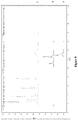
- a MALDI-TOF mass analysis ( figure 2 ) makes it possible to confirm that the reaction mixture (green) contains 89% of the species resulting from the grafting of 4 6- (3,4-dibromomaleimido) hexanoic Acid linkers on the antibody, the grafting average is 4.0.
- Trastuzumab is reduced and then modified according to general procedure 4, using the cleavable linker 8 3,4-dibromomaleimide at 35 ° C for 1 hour:
- a solution of TCEP (20eq) in PBS buffer is added to a solution of trastuzumab.
- the mixture is stirred for 15 minutes, then a solution of 6- (3,4-dibromomaleimido) hexanamide-Val-Cit-PAB-OH (20 eq) in DMSO is added.
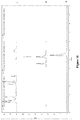
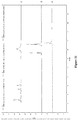
- the reaction mixture is left stirring for 30 minutes, then after purification on a PD-10 column to remove the chemical reagents, the mixture is analyzed by RP-HPLC ( figure 6 ), and by HIC-HPLC ( figure 3 ).
- Linker 26 is synthesized in a manner similar to that of WO2013132268 , for comparison purposes between the reconstruction of the disulfide bridges using the dibromomaleimide linker 8 or the dithiophenylmaleimide linker 26.
- Trastuzumab is reduced and then modified according to general procedure 4, using the cleavable linker 8 3,4-dithiophenylmaleimide at 41 ° C for 48h:
- reaction mixture is then analyzed by RP-HPLC ( figure 7 ).
- Trastuzumab is reduced and modified according to General Procedure 4, using the non-cleavable linker 20 hexanoic acid 6- (2,6-bis (bromomethyl) isonicotinamido) at 41 ° C for 24h:
- reaction mixture is then analyzed by RP-HPLC ( figure 8 ).
- Trastuzumab is reduced and then modified according to general procedure 4, using the 22 cleavable linker 6- (2,6-bis (bromomethyl) isonicotinamido) hexanamide-Val-Cit-PAB-OH at 41 ° C for 24 h:
- reaction mixture is then analyzed by RP-HPLC ( figure 9 ).
- Trastuzumab is reduced and then modified according to general procedure 4, using the cleavable linker 15 6- (3,5-bis (bromomethyl) benzamido) hexanamide-Val-Cit-PAB-OH at 41 ° C for 72h:
- reaction mixture is then analyzed by RP-HPLC ( figure 10 ).
- Rituximab is reduced and then modified according to general procedure 4, using non-cleavable linker 7 at 37 ° C for 1 hour:
- reaction mixture is then analyzed by RP-HPLC ( figure 11 ).
- Trastuzumab is reduced and then modified according to general procedure 4, using the cleavable 9-MMAE linker 6- (3,4-dibromomaleimido) hexanamide-Val-Cit-PAB-MMAE at 37 ° C for 24 hours: The reaction mixture is then analyzed by RP-HPLC ( figure 12 ).
- the ADCs were analyzed under denaturing and reducing conditions, with an AERIS WIDEPORE 3.6 ⁇ M XB-C8 column (250 x 4.6 mm). The flow rate was 1 mL / min, the oven temperature 80 ° C, with an injection quantity of 20 ⁇ L per sample.
- the ADCs were analyzed under non-denaturing conditions, with a TOSOH BIOSCIENCE 2.5 ⁇ M T SKgel butyl-NPR column (100 x 4.6 mm). The flow rate was 1 mL / min, the oven temperature 80 ° C, with an injection quantity of 30 ⁇ L per sample. Concerning the elution method with two solvents: A: 1.5 M (NH 4 ) 2 SO 4 in 50 mM PBS phosphate buffer (pH 7) and B: 50 mM PBS phosphate buffer mixture / i PrOH: 80/20. The method was as follows: a linear gradient of 44 min from 0% B to 80% B, then a linear gradient of 1 min from 80 to 0% B, then 0% B isocratic for 10 min.
Landscapes
- Health & Medical Sciences (AREA)
- Chemical & Material Sciences (AREA)
- Life Sciences & Earth Sciences (AREA)
- Organic Chemistry (AREA)
- General Health & Medical Sciences (AREA)
- Engineering & Computer Science (AREA)
- Bioinformatics & Cheminformatics (AREA)
- Medicinal Chemistry (AREA)
- Animal Behavior & Ethology (AREA)
- Public Health (AREA)
- Veterinary Medicine (AREA)
- Immunology (AREA)
- Pharmacology & Pharmacy (AREA)
- Genetics & Genomics (AREA)
- Wood Science & Technology (AREA)
- Zoology (AREA)
- Biochemistry (AREA)
- Molecular Biology (AREA)
- Epidemiology (AREA)
- General Chemical & Material Sciences (AREA)
- Nuclear Medicine, Radiotherapy & Molecular Imaging (AREA)
- Chemical Kinetics & Catalysis (AREA)
- General Engineering & Computer Science (AREA)
- Biomedical Technology (AREA)
- Biotechnology (AREA)
- Microbiology (AREA)
- Proteomics, Peptides & Aminoacids (AREA)
- Biophysics (AREA)
- Oncology (AREA)
- Cell Biology (AREA)
- Rheumatology (AREA)
- Hematology (AREA)
- Optics & Photonics (AREA)
- Physics & Mathematics (AREA)
- Dermatology (AREA)
- Physical Education & Sports Medicine (AREA)
- Orthopedic Medicine & Surgery (AREA)
- Pain & Pain Management (AREA)
- Diabetes (AREA)
- Transplantation (AREA)
Description
- La présente invention concerne des conjugués anticorps-médicament et leur utilisation en thérapie, notamment en thérapie anti-cancéreuse ou anti-inflammatoire. La présente invention concerne également des produits de synthèses utiles comme linker, composés d'une tête de linker et d'un corps de linker. La présente invention concerne également un procédé de préparation des linkers et des conjugués anticorps-médicament.
- Un conjugué anticorps-médicament est une nouvelle forme de médicament, notamment utilisé comme anticancéreux ayant une action ciblée. L'anticorps thérapeutique se lie à un ou plusieurs types cellulaires en fonction de sa spécificité et libère classiquement dans les cellules, un agent cytotoxique.
- Un conjugué anticorps-médicament constitue un moyen de délivrance sélective d'un agent cytotoxique. Cette ingénierie permet donc de combiner la spécificité du ciblage par les anticorps avec de nouvelles fonctions effectrices puissantes par les agents qui leur sont conjugués.
- A ce jour, plus de 20 conjugués anticorps-médicaments sont en développement (Senter, P. D. et al. Annu. Rev. Med. 2013, 64, 15-29).
- La structure générale d'un conjugué anticorps-médicament est celle décrite sur la
figure 1 . - Le produit liant l'anticorps et le médicament est appelé agent de liaison ou linker. Il peut être greffé sur l'anticorps via l'une au moins des huit cystéines formant les 4 ponts disulfure inter-chaînes ou sur l'une au moins des huit lysines.
- Le nombre de molécules de médicaments greffées sur l'anticorps détermine un ratio appelé Drug-Antibody Ratio (DAR).
- Après fixation sur son antigène cible, l'anticorps est internalisé dans la cellule par endocytose médiée par des récepteurs. Les vésicules fusionnent avec des lysosomes où la molécule cytotoxique est libérée de l'anticorps via différents mécanismes. L'agent cytotoxique actif agit ensuite directement sur la cellule en induisant sa mort et parfois sur les cellules cancéreuses voisines par transport ou diffusion dans l'environnement.
- L'anticorps est donc principalement utilisé comme vecteur et apporte l'agent cytotoxique dans la cellule.
- On entend par « agent cytotoxique », une molécule capable d'inhiber ou d'empêcher la fonction d'une cellule.
- L'agent cytotoxique fixé à l'anticorps est une prodrogue qui devient active dans la cellule tumorale après libération (Jaracz et al. 2005). L'activité de la molécule libre doit être suffisante pour tuer la cellule cancéreuse, même à faible concentration.
- Malgré leur succès grandissant, les conjugués anticorps-médicaments présentent un inconvénient notable, du fait qu'ils sont plus complexes et ont une structure hétérogène comparé à l'anticorps original correspondant. L'attachement d'un agent cytotoxique par l'intermédiaire d'un linker influence significativement la pharmacocinétique et la pharmacodynamique de l'anticorps (PK-PD) et donc l'index thérapeutique.
- Les conjugués anticorps-médicaments ont préférentiellement un DAR moyen égal à 4 pour une activité optimale mais ce ratio peut varier de 1 à 13, sachant que pour un DAR il peut exister une population d'entités distinctes.
- Beaucoup de chercheurs travaillent sur cette hétérogénéité. Des essais visant à modifier la séquence de l'anticorps, par introduction d'acides aminés naturels ou non naturels, ont été menées (Mallet, W. et al. Nat. Biotechnol. 2008, 26, 925-932 et Schultz, P. G. et al. Proc. Natl. Acad. Sci. 2012, 109, 16101-16106). Néanmoins, cette méthode présente un désavantage, celui de devoir être transposée pour chaque anticorps d'intérêt, ce qui nécessite un travail conséquent sur l'anticorps de départ.
- En conséquence, le problème technique qui se dégage de l'art antérieur réside dans le fait d'obtenir un moyen technologique permettant de greffer de manière contrôlée un agent cytotoxique sans modification de la séquence de l'anticorps d'intérêt, un moyen technologique adaptable à n'importe quel anticorps.
- La présente invention repose sur un produit caractérisé en ce qu'il répond à la formule I choisie parmi les formules IB2 et IA2:


le groupe :


- X est Br ou I,
- dans la triade d'atomes (T,Y,Z) chacun de ces atomes représente indépendamment des deux autres atomes, un atome de carbone ou d'azote, en particulier T est un atome d'azote et Y et Z représentent CH,
- X3 est un oxygène ou une simple liaison
- s est égal à 1, 2 ou 3
- r est égal à 0, 1 ou 2
- étant entendu que la somme r+s est égale à 3
- n2 est un entier égal à 1, 2 ou 3 et n3 est un entier égal à 1, 2 ou 3 - L-M est un radical dans lequel, L représente un corps de linker et M est un médicament cytotoxique choisi parmi un agent chimiothérapeutique ou une toxine,
- P est une protéine comprenant au moins un pont disulfure et
- t représente un entier de 1 à 15,
- ainsi que les dérivés de la ou des fonctions acides carboxyliques choisis parmi les sels, les esters ou les amides.
- P est une protéine comprenant au moins un pont disulfure et t représente un entier de 1 à 15, de préférence de 1 à 6 et 13.
- Au sens de la présente description, on entend par « nucléofuge », tout ion ou substituant ayant la capacité de se détacher d'une molécule.
- Les sels sont choisis dans le groupe comprenant les sels alcalins, notamment de sodium ou de potassium, les sels de lithium, de magnésium, calcium et baryum, les sels d'ammonium, les sels d'amines, les sels d'aminoalcools tels la triéthanolamine ou la monoéthanolamine.
- Les esters d'acide carboxylique sont formés de préférence avec les alkyls linéaires ou ramifiés ayant de 1 à 6 atomes de carbone, de préférence le tert-butyle.
- Parmi les amides d'acide carboxylique, l'amide formée avec le butanimide est préféré.
- Au sens de la présente description, on entend par « fonction réactive terminale », tout atome ou groupe d'atomes permettant un ou plusieurs assemblages moléculaires par chimie organique classique ou chimie combinatoire.
- Dans un autre mode de réalisation particulier de l'invention, le produit selon l'invention comprend un corps de linker L répondant à la formule générale III, IIIa ou IIIb ci-dessous :


- dans lesquelles K représente un radical (AA)n
5 représentant une succession de n5 acides aminés identiques ou différents, naturels ou non naturels ou K représente un site de clivage reconnu par une enzyme ou K représente un radical hydrazino éventuellement couplé au radical (AA)n5 , - soit K représente un groupe saccharide choisi de préférence parmi un acide bêta-glucuronique ou un bêta-D-galactose ou un beta-D-glucose ou un alpha-D-mannose ou un N-acétyl-D-glucosaminyle ou un N-acétyl-D-galactosaminyle, un D-glucuronyle, un L-iduronyle, un D-glucopyranosyle, un D-galactopyranosyle, un D-mannopyranosyle ou L-fucopyranosyle.
- X représente un hydrogène ou un groupement NO2,
- A représente de préférence un atome d'hydrogène,
- Y représente un enchaînement

- Z représente un groupe partant, et n5 représente un entier de 1 à 6.
- Le groupe partant Z peut être choisi dans le groupe comprenant le para nitro ou para cyano phényloxy. De préférence, le groupe partant Z est l'un des radicaux :

- Dans un autre mode de réalisation de l'invention, le produit répondant à la formule générale
- III, ou IIIa ou IIIb comprend le radical (AA)n
5 , lequel est tel que n5 est égal à 1, 2, 3, 4 ou 5, et AA est un couple d'acides aminés, lesdits acides aminés étant choisi dans le groupe constitué de : une valine, une citrulline, une phénylalanine, une lysine, un acide aspartique, une méthionine, une asparagine, une proline, une isoleucine, une alanine, une arginine, une glycine ou un acide glutamique. - Dans un mode de réalisation préféré, n5 est égal à 2 ou 3, de préférence 2 et (AA)n
5 est un couple d'acides aminés choisi parmi : une valine et une citrulline, ou une phénylalanine et une lysine, ou une valine et une alanine, ou une valine et un acide aspartique, ou une lysine et une méthionine, ou une lysine et une asparagine, ou une proline et une isoleucine, ou une proline et une lysine, ou une lysine et une méthionine, ou une lysine et une asparagine, ou une valine et une lysine, ou une alanine et une lysine, ou une phénylalanine et une lysine, ou deux phénylalanines et une lysine, ou une alanine, ou une phénylalanine et une lysine, ou deux arginines, ou une lysine et une arginine, ou un acide glutamique, ou une glycine et une arginine, ou deux glycines et une arginine. - Dans un mode particulier de réalisation de l'invention, le produit répondant à la formule III, ou IIIa, ou IIIb, comprend un élément K qui représente un site de clivage par une enzyme choisie parmi les enzymes de type cathepsine B, cathepsine C, cathepsine D, les enzymes choisies parmi la plasmine, une protéase lysosomale, une enzyme lysosomale, ou l'urokinase plasminogen activator (uPA), élastase, protéinase 3, cathepsine G.
- K peut aussi représenter un site de reconnaissance de clivage par une enzyme de type métalloprotéinase matricielle (MMP). Dans ce cas, l'enzyme type métalloprotéinase matricielle (MMP) est choisie de préférence parmi les collagénases 1, 2 et 3 (MMP-1, MMP-8, MMP-13), les gélatinases A et B (MMP-2 et MMP-9), les stromélysines 1 et 2 (MMP-3 et MMP-10), les matrilysines 1, 2 et 3 (MMP-7, MMP-26, MMP-11), l'émastase élastase des macrophages (MMP-12), les MMP membranaires (MMP-14, MMP-15, MMP-16 MMP-17, MMP-24 et MMP-25), l'énamélysine (MMP-20), la CA-MMP (MMP-23), l'épilysine (MMP-18) et la PSMA.
- K peut également représenter un site de reconnaissance de clivage par une estérase, une carboxylestérase, les alkalines phosphatases, les protéases, les peptidases, les cathepsines, la glucosidase, la galactosidase, la β-D-galactosidase, l'induronidase, la β-glucuronidase, la mannosidase, la N-acétyl-D-glucosaminidase ou par la N-acétyl-D-galactosaminidase.
- Dans le cadre de la présente invention, on entend par « site de clivage », la position où a lieu la coupure de la chaîne peptidique par une enzyme, par exemple le site Valine-Citrulline, les sites de clivage K ci-dessus ou la position où a lieu la reconnaissance enzymatique.
- Au sens de la présente description, on entend par « médicament cytotoxique », toute molécule naturelle ou de synthèse, capable d'inhiber ou d'empêcher la fonction des cellules. On entend également par « cytotoxique », la propriété qu'un agent chimique ou biologique, d'altérer des cellules, éventuellement jusqu'à les détruire.
- Dans un mode de réalisation particulier de l'invention, le médicament M est un médicament choisi parmi tout composé ayant obtenu une AMM et qui est utilisé en thérapie anti-cancéreuse ou anti-inflammatoire, toute molécule en cours d'évaluation clinique en thérapie anti-cancéreuse ou anti-inflammatoire. Le médicament M sera choisi par exemple parmi le paclitaxel (Taxol®) ou le docetaxel (Taxotère®) ou l'un de ses dérivés, le topotecan, le bortezomib, la daunorubicine, les analogues de daunorubicine, la vincristine, la mitomycine C, l'acide rétinoïque, le méthotrexate, l'ilomédine, l'aspirine, un IMIDs, le lénalidomide, le pomalidomide.
- Dans un autre mode de réalisation particulier de l'invention, le médicament est M est sélectionné dans le groupe constitué de la duocarmycine et ses analogues, les dolastatines, la combretastatine, la calichéamicine, la N-acétyl-γ-calichéamycine (CMC), un dérivé de calichéamycine, la maytansine et ses analogues, DM-I, l'auristatine E, l'auristatine EB (AEB), l'auristatine EFP (AEFP), la monométhyle d'auristatine E (MMAE), la monométhyle d'auristatine F (MMAF), la tubulysine, le disorazole, les epothilones, l'echinomycine, l'estramustine, la cemadotine, l'eleutherobine, la methopterine, l'actinomycine, la mitomycin A, la camptothécine, un dérivé de la camptothécine, le SN38, la maytansine, un dérivé de type maytansinoïde, le DM1, le DM4, le TK1, l'amanitin, une pyrrolobenzodiazépine, un dimère de pyrrolobenzodiazépine, une pyrrolopyridodiazépine, un dimère de pyrrolopyridodiazépine, un intercalant de l'ADN, un inhibiteur d'histone deacetylase, ou un inhibiteur de tyrosine kinase.
- Dans un autre mode de réalisation particulier de l'invention, le médicament M est sélectionné parmi l'exotoxine de pseudomonas (PE), la deBouganin, la Bouganin, la toxine diphtérique (DT) et la ricine.
- Dans un autre mode de réalisation particulier de l'invention, le produit selon l'invention répond à la formule IB2 ci-dessous :

- Dans un mode particulier de réalisation de l'invention, la protéine P comprenant au moins un pont disulfure est sélectionnée parmi un agoniste ou un antagoniste, un anticorps ou un fragment d'anticorps, une protéine de fusion comportant un anticorps ou un fragment d'anticorps, une albumine ou un peptide.
- On entend par « agoniste », toute molécule qui en se liant spécifiquement à un récepteur cellulaire donné, déclenche les mêmes effets que le ligand naturel.
- On entend par « antagoniste », toute molécule qui en se liant spécifiquement à un récepteur cellulaire donné, peut ainsi bloquer l'action du ligand endogène en s'opposant à la liaison du ligand à son récepteur.
- On entend par « anticorps », également couramment appelé « immunoglobuline », un hétérotétramère constitué de deux chaînes lourdes d'environ 50-70 kDa chacune (dites les chaînes H pour Heavy) et de deux chaînes légères d'environ 25 kDa chacune (dites les chaînes L pour Light), liées entre elles par des ponts disulfures intra et intercaténaires. Chaque chaîne est constituée, en position N-terminale, d'une région ou domaine variable, dit VL pour la chaîne légère, VH pour la chaîne lourde, et en position C-terminale, d'une région constante, constitué d'un seul domaine dit CL pour la chaîne légère et de trois ou quatre domaines nommés CH1, CH2, CH3, CH4, pour la chaîne lourde.
- On entend par « fragment d'anticorps », toute partie d'une immunoglobuline obtenue par digestion enzymatique ou obtenue par bioproduction.
- L'anticorps selon la présente invention peut-être un anticorps monoclonal chimérique, humanisé ou humain, monospécifique ou bispécifique.
- Par « anticorps chimérique », on entend un anticorps dont les séquences des régions variables des chaînes légères et des chaînes lourdes appartiennent à une espèce différente de celle des séquences de régions constantes des chaînes légères et des chaînes lourdes.
- Aux fins de l'invention, les séquences des régions variables des chaînes lourdes et légères sont préférentiellement d'origine murine tandis que les séquences des régions constantes des chaînes lourdes et légères appartiennent à une espèce non-murine. A cet égard, pour les régions constantes, toutes les espèces de mammifères non-murins sont susceptibles d'être utilisées, et en particulier l'homme, le singe, les suidés, les bovidés, les équidés, les félidés, les canidés ou encore les oiseaux, cette liste n'étant pas exhaustive.
- De façon préférée, les anticorps chimériques selon l'invention contiennent des séquences de régions constantes des chaînes lourdes et légères d'origine humaine et les séquences de régions variables des chaînes lourdes et légères d'origine murine.
- Par « anticorps humanisé », on entend un anticorps dont tout ou partie des séquences des régions impliquées dans la reconnaissance de l'antigène (les régions hypervariables ou CDR : Complementarity Determining Region) et parfois certains acides aminés des régions FR (régions Framework)) sont d'origine non-humaine tandis que les séquences des régions constantes et des régions variables non-impliquées dans la reconnaissance de l'antigène sont d'origine humaine.
- Par «anticorps humain», on entend un anticorps contenant uniquement des séquences humaines, aussi bien pour les régions variables et constantes des chaînes légères que pour les régions variables et constantes des chaînes lourdes.
- Dans un autre mode de réalisation particulier de l'invention, la protéine P peut être un fragment d'anticorps. Ce fragment d'anticorps est sélectionné parmi le groupe constitué de : Fab, F(ab)'2, Fc, F'c, pFc', ScFv, Fv, Fd, Fabc, diabody, minibody, ScFv-Fc ou ScFv-Fv.
- La digestion enzymatique des immunoglobulines par la papaïne génère deux fragments identiques, qu'on appelle les fragments Fab (Fragment antigen binding), et un fragment Fc (Fragment cristallisable).
- La digestion enzymatique des immunoglobulines par la pepsine génère un fragment F(ab')2 et un fragment Fc scindé en plusieurs peptides.
- F(ab')2 est formé de deux fragments Fab' liés par des ponts disulfures intercaténaires.
- Les parties Fab sont constituées des régions variables et des domaines CH1 et CL, tandis que la région Fc est constituée des deux domaines globulaires CH2 et CH3 (et CH4 quand il est présent).
- Le fragment Fab' est constitué de la région Fab et d'une région charnière. Fab'-SH fait référence à un fragment Fab' dans lequel le résidu cystéine de la région charnière porte un groupe thiol libre (Carter et al., Nature BioTechnology 10:163-167 (1992)). Le fragment Fv est composé des domaines VH et VL liés par des ponts disulfures. C'est le plus petit fragment conservant l'activité de liaison à l'antigène.
- Le fragment Fd est formé des domaines VH et CH1.
- Les fragments « F'c », « pFc' », et « Fabc » sont définis dans les
figures 5A à 5C . - Le scFv (single chain Fragment variable) est un fragment issu de l'ingénierie des protéines qui est constitué uniquement des domaines variables VH et VL. La structure est stabilisée par un court bras peptidique flexible, appelé linker, qui est placé entre les deux domaines.
- Le fragment ScFv peut être lié à un fragment Fc pour donner un ScFv-Fc ou un fragment Fv pour donner un ScFv-Fv.
- Si on réduit la taille du peptide de liaison, de nouvelles contraintes stériques apparaissent entre les scFv, les domaines VH et VL ne peuvent plus s'associer en une structure fonctionnelle et on obtient des structures multimériques (dimérique : « diabody », trimérique : « triabody » et tétramérique : « tétrabody »).
- Dans le cadre de la présente invention, les diabody peuvent être utilisés. Ils peuvent avoir des valences et des spécificités multiples.
- Le terme « valent » dénote la présence d'un nombre déterminé de sites de liaison à l'antigène dans une molécule d'anticorps.
- Le terme « spécifique » fait référence aux types différents d'antigènes pouvant se lier sur le même anticorps.
- Ainsi, dans la présente invention, on entend par « diabody » un dimère de scFv, ledit diabody étant bivalent, mono ou bispécifique selon qu'il fixe deux antigènes identiques ou différents. Les fragments Fab, Fv et scFv sont monovalents et monospécifiques.
- On entend par « minibody », un fragment composé d'une chaine légère, d'une chaine lourde lié à un groupement CH3.
- Dans le cadre de la présente invention, l'anticorps ou le fragment d'anticorps est dirigé contre un antigène de tumeur ou d'inflammation.
- Dans un mode de réalisation particulier de l'invention, l'anticorps ou le fragment d'anticorps est dirigé contre l'un des antigènes du cluster de différentiation (CD), dont le numéro d'identification varie entre le CD1a et le CD363 ; dans cette liste, les CD suivants sont préférés : CD1a, CD363, CD3, CD4, CD13, CD19, CD20, CD21, CD22, CD25, CD30, CD31, CD33, CD34, CD37, CD39, CD40, CD44, CD47, CD52, CD56, CD66e, CD70, CD72, CD73, CD74, CD79, CD79b, CD80, CD86, CD117, CD138, CD194, CD205, CD227 ou CD248. L'anticorps ou le fragment d'anticorps peut également être dirigé contre l'un des antigènes choisis dans la liste formée par les suivants : CA125, G250, GD2, HLA-DRβ, MUC1, VEGF, VEGFA, VEGF-R1/2, TRAIL-R2 (DR5), EpCAM, GPIIb, GPIIIa, TNF alpha, TNFR, TNT, Lewis Y, EGFR, HER-2, HER-3, HER-3 MM-111, HER-4, homodimère ou hétérodimère entre des membres de la famille erbbn (n entre 1 et 4), AXL, Protéine F, IgE-Fc, VEGF-A, intégrine α4, intégrine α4β7, intégrine αV, C5, IL-6R, IL-6Rα, IL12, IL15, IL18, IL23, IL-1β, IL-1, TPO-R, GPNMB, PSMA, PSA, PAP, PSM, intégrine αv, Cripto, TACSTD2 (TROP2 ou EGP1), CEA, Folate receptor 1, Mucin 16, Endothelin Receptor ETB, STEAP1, SLC44A4 (AGS-5), Nectin 4, AGS-16, Guanylyl cyclase C, Mucin 1, EGFRvIII, Mesothelin, IL2R, A33, Can, VEGF-B, VEGF-C, VEGF-D, VEGF-E, VEGFR-1, VEGFR-2, VEGFR-3, TGFβ, TGFβR, FGF, FGF8b, FGFR, PDGF, PDGFR, PDGFRα, PDGFRβ, Ang-1, Ang-2, intégrine, αvβ3, αvβ5, α3β1, α6β4, α2β1, anti-intégrine α4, RANK-L, BLyS, c-MET, DR, DR10, TCRαβ, ICOS, CTLA-4, CAIX (MN), EphA2, CA6, CA6 de l'ovaire, CA6 cervical, CA6 du sein, angiopoiétine-2, Cripto, ENPP3, Mesothelin, FOLR1, Nectin-4, TIM-1, Muc-16, Tissue Factor, LIV-1, GM2, α 5 integrin, TLR-7, PD-1, AFP, CA125 (MUC16), Sialyl LewisY, CAMPATH-1, HLA-DR, anti-idiotype, carcinoembryonic antigen (CEA), TAG-72, Folate-binding protein, A33, G250, gangliosides (incluant GD2, GD3, GM2), LeY, collagen 4 (collagen IV), collagen 18 (collagen XVIII), SC6, CA-125, CA19-9, p185HER2, de2-7 EGFR, Fibroblast activation protein (FAP), Tenascin, metalloproteinases, Endosialin, Carbonic anhydrase, Galectin 9, Aldolase A, eIFγ4, Tyrosinase, Galectin 4, HERKV-K10, p53, NY-LU-12, Restin, NY-CO-38, MAGE-1, MAGE-4a, SSX2, NY-ESO-1, SCP-1, HGFR, PTK 7, CCK-4, PDGFR, PTP-LAR, CDCP1, CADM1, IGSF4, Lu, BCAM, CEACAM6, JAM-A, PTGFRN (CD9P-1), MCAM, MUC18, MCP, EMMPRIN, TfR, TRAILR2, C1qR, hTERT, Survivin, MDM2, CYP1B1, Melan-A, MART-1, MART-2, Melanosomal proteins, gp100, neo-PAP, CDC27, MAGEs, WT1, MUM-1, MUM-2, MUM-3, BRAF, TPI, fibronectin, K-ras, β-catenin, CDK4, caspase-8, p14ARF, p16INK4a, TGFβRII, bcr-abl, SYT-SSX, TRP-1, TRP-2, GnT-V, tyrosinase, FGF5, TEL-AML1, Proteinase 3, HER2/neu, AFP, MUC-1, EBV-EBNA, HTLV-1 tax, HPV16-E7, mutated HLA-A2, HA1, SART3, GnT-V, CEACAM5, AGS-16, GPNMB, ESAT-6, RANK, CanAg, fibrin, TF, PRAME, CA19-9, CA50, CA125, CA195, CAM17.1/WGA, AFP, β2-MG DU-PAN2, HE4, b-2 microglobulin, transferrin, transthyretin, ApoA1, TROP-2, CTLA-4, GITR, PD-1, PD-L1, c-KIT, CD11b-CD18 integrin heterodimer, DNA/Histon H1, Folate, EpCAM, Tenascin-c, ECM (proteoglycan ou fibronectin), fibrinogen, SV40 large T antigen, SC6-Ag, SC-Ag, DR4 (death receptor 4), DR5, ESA, mucin, hPAM4, hRS7, HLA-DR, CCR4, MTX1, MTX2, PECAM, thrombomoduline Tn, cathepsin D, TYRO-3, MER. L'anticorps ou le fragment d'anticorps peut également être dirigé contre un complexe PF4/héparine.
- La description concerne également un procédé de préparation des produits de formules I, caractérisés en ce que, si désiré, l'on fait agir un produit de formule IA3

formule IA3 dans laquelle : - X est Br ou I, ou un groupe


- A représente ou bien un radical aryle ou cycloalkyle, lesdits radicaux aryles ou cycloalkyles étant carbocycliques ou hétérocycliques,
- ou bien A représente un groupe
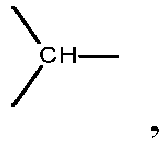


- X1 est un C=O ou un groupe NH ou une simple liaison
- X2 est un groupe NH ou un C=O ou une simple liaison
- X3 est un oxygène ou une simple liaison s est égal à 1, 2 ou 3
- r est égal à 0, 1 ou 2
- étant entendu que la somme r+s est égale à 3
- n1 est un entier égal à 0 ou 1 ; n2 est un entier égal à 1, 2 ou 3 et n3 est un entier égal à 1, 2 ou 3,
- n4 est un entier égal à 1, 2, 3, ou 4,
- Les produits de formules IA1 à IA5 correspondant aux produits de formule IA que, si désiré, l'on fait réagir avec un produit de formule P, P étant une protéine comprenant au moins un pont disulfure et t représente un entier de 1 à 15, de préférence de 1 à 6 et 13, pour obtenir un produit de formule (IB) :

- un radical - L qui représente un corps de linker comportant une fonction réactive terminale,
- un groupe fluorophore - FL utilisé en diagnostique ou analyse, impliquant une détection de fluorescence choisi de préférence parmi la rhodamine ou l'un de ses dérivés, de préférence la rhodamine B, l'isocyanate de fluorescéine (FITC), une Cy Dye choisie de préférence parmi Cy5, Cy5.5, Cy7, une Alexa fluor Dye choisie de préférence parmi Alexa Fluor 647, 700 ou 750, le Texas Red, le Nile Blue A, l'allophycocyanin (APC) et ses conjugués avec d'autres fluorochromes notamment ceux précédemment cités, la phycoerythrin (PE) et ses conjugués avec d'autres fluorochromes notamment ceux précédemment cités,
- un radical R* radioactif qui contient de préférence
soit un ligand bifonctionnel, éventuellement bimodal, choisi de préférence parmi les dérivés de DOTA, DTPA, C-DOTA, NODAGA, NETA, C-NETA, DEPA, C-DEPA, TETA, TE2A, HYNIC, DAT, MAMA,
soit un ligand bifonctionnel choisi de préférence parmi l'un des chélateurs acycliques de la liste constituée par EDTA, CyEDTA, EDTMP, DTPMP, DTPA, CyDTPA, Cy2DTPA, DTPA-MA, DTPA-BA, BOPA,
soit un ligand bifonctionnel choisi de préférence parmi l'un des chélateurs macrocycliques de la liste constituée par DOTA, TRITA, TETA, DOTA-MA, DO3A-HP, DOTMA, DOTA-pNB, DOTP, DOTMP, DOTEP, DOTMPE, F-DOTPME, DOTPP, DOTBzP, DOTA-monoamide, p-NCS-DOTA, p-NCS-PADOTA, BAT, DO3TMP-Monoamide, p-NCS-TRITA, NOTA, CHX-A"-DTPA,
soit un chélateur bifonctionnel de type cationique, anionique, neutre ou clivable,
soit un radionucléide choisi de préférence parmi 67Cu, 64Cu, 90Y, 109 Pd, 111Ag, 149Pm, 153Sm, 166Ho, 177Lu, 186Re, 188Re, 99mTc, 67Ga, 68Ga, 111In, 90Y, 177Lu, 186Re, 188Re, 197Au, 198Au, 199Au, 105Rh, 165Ho, 166Ho, 161Tb, 149Pm, 44Sc, 47Sc, 70As, 71As, 72As, 73As, 74As, 76As, 77As, 212Pb, 212Bi, 213Bi, 225Ac, 117mSn, 67Ga, 201Tl, 123I, 131I, 160Gd, 148Nd, 89Sr, 211At, - un médicament cytotoxique M choisi parmi un agent chimiothérapeutique ou une toxine, en particulier la monométhyle d'auristatine E ou la monométhyle d'auristatine F,
- un radical - L-M, dans lequel L et M ont la signification précédente.
- En particulier, les produits de formule IA1 à IA5 du procédé de préparation selon la description sont attachés à la protéine P sur un au moins de ses ponts disulfure par une réaction de substitution nucléophile, typiquement dans un tampon phosphate, en présence de TCEP.
- Dans un mode particulier de réalisation de l'invention, les produits de formule IB2 sont utilisés dans le traitement d'une tumeur notamment le cancer colorectal, l'hépatocarcinome, un cancer du poumon, le cancer du pancréas, le cancer du poumon non à petites cellules, le cancer du poumon à petites cellules, le cancer colorectal, le cancer colorectal K-RAS muté, un cancer du sein, le cancer du sein triple-négatif, le cancer du sein métastatique, le cancer du foie, le cancer tête et cou, la maladie de Castleman, le cancer de la thyroïde, le médulloblastome, le glioblastome multiforme, le gliome, le sarcome, l'astrocytome anaplastique, le cancer du rein, le cancer de l'estomac, l'ascite maligne, le cancer de la prostate (métastatique ou non), les tumeurs solides, la leucémie aiguë myéloïde, la leucémie lymphocytaire chronique, le mélanome, le myélome, le myélome multiple, les lymphomes, le lymphome du manteau, le lymphome hodgkinien, le lymphome non-hodgkinien, le lymphome folliculaire.
- Dans un autre mode particulier de réalisation de l'invention, les produits de formule IB2 sont utilisés dans le traitement d'une maladie inflammatoire ou auto-immune notamment le rejet de greffe, la polyarthrite rhumatoïde, la maladie de Crohn, le psoriasis, la sclérose en plaques, les syndromes périodiques associés à la cryopyrine, le purpura thrombopénique.
- La description concerne également un procédé de préparation des produits de formule IB tels que définis ci-dessus, caractérisé en ce que l'on fait agir un produit de formule IA

- X est Br ou I, ou un groupe
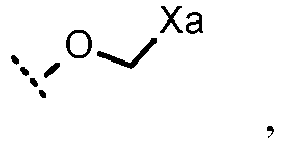

- A représente ou bien un radical aryle ou cycloalkyle, lesdits radicaux aryles ou cycloalkyles étant carbocycliques ou hétérocycliques,
- ou bien A représente un groupe


- X1 est un C=O ou un groupe NH ou une simple liaison
- X2 est un groupe NH ou un C=O une simple liaison
- X3 est un oxygène ou une simple liaison
- s est égal à 1, 2 ou 3
- r est égal à 0, 1 ou 2
étant entendu que la somme r+s est égale à 3 - n1 est un entier égal à 0 ou 1 ; n2 est un entier égal à 1, 2 ou 3 et n3 est un entier égal à 1, 2 ou 3,
- n4 est un entier égal à 1, 2, 3 ou 4,
- W représente
- un radical - L qui représente un corps de linker comportant une fonction réactive terminale,
- un groupe fluorophore - FL utilisé en diagnostique ou analyse, impliquant une détection de fluorescence choisi de préférence parmi la rhodamine ou l'un de ses dérivés, de préférence la rhodamine B, l'isocyanate de fluorescéine (FITC), une Cy Dye choisie de préférence parmi Cy5, Cy5.5, Cy7, une Alexa fluor Dye choisie de préférence parmi Alexa Fluor 647, 700 ou 750, le Texas Red, le Nile Blue A, l'allophycocyanin (APC) et ses conjugués avec d'autres fluorochromes notamment ceux précédemment cités, la phycoerythrin (PE) et ses conjugués avec d'autres fluorochromes notamment ceux précédemment cités,
- un radical R* radioactif qui contient de préférence,
soit un ligand bifonctionnel, éventuellement bimodal, choisi de préférence parmi les dérivés de DOTA, DTPA, C-DOTA, NODAGA, NETA, C-NETA, DEPA, C-DEPA, TETA, TE2A, HYNIC, DAT, MAMA ;
soit un ligand bifonctionnel choisi de préférence parmi l'un des chélateurs acycliques de la liste constituée par EDTA, CyEDTA, EDTMP, DTPMP, DTPA, CyDTPA, Cy2DTPA, DTPA-MA, DTPA-BA, BOPA ;
soit un ligand bifonctionnel choisi de préférence parmi l'un des chélateurs macrocycliques de la liste constituée par DOTA, TRITA, TETA, DOTA-MA, DO3A-HP, DOTMA, DOTA-pNB, DOTP, DOTMP, DOTEP, DOTMPE, F-DOTPME, DOTPP, DOTBzP, DOTA-monoamide, p-NCS-DOTA, p-NCS-PADOTA, BAT, DO3TMP-Monoamide, p-NCS-TRITA, NOTA, CHX-A"-DTPA ;
soit un chélateur bifonctionnel de type cationique, anionique, neutre ou clivable ;
soit un radionucléide choisi de préférence parmi 67Cu, 64Cu, 90Y, 109Pd, 111Ag, 149Pm, 153Sm, 166Ho, 177Lu, 186Re, 188Re, 99mTc, 67Ga, 68Ga, 111In, 90Y, 177Lu, 186Re, 188Re, 197Au, 198Au, 199Au, 105Rh, 165Ho, 166Ho, 161Tb, 149Pm, 44Sc, 47Sc, 70As, 71As, 72As, 73As, 74As, 76As, 77As, 212Pb, 212Bi, 213Bi, 225Ac, 117mSn, 67Ga, 201Tl, 123I, 131I, 160Gd, 148Nd, 89Sr, 211At, - un médicament cytotoxique M choisi parmi un agent chimiothérapeutique ou une toxine, en particulier la monométhyle d'auristatine E ou la monométhyle d'auristatine F,
- un radical - L-M dans lequel, L et M ont la signification précédente,


avec un produit de formule P, dans laquelle P est une protéine comprenant au moins un pont disulfure, pour obtenir un produit de formule (IB) :
-
- La
figure 1 présente la structure générale d'un conjugué anticorps-médicament.
Les sites classiques de modification sont les suivants :- 4 lysines
Moyenne de 4 résidus modifiés parmi les 8 résidus accessibles pour modification parmi 80, par conséquent nombreuses espèces de D.A.R. - 4 ponts disulfures
Le D.A.R moyen est d'environ 4 avec des modifications classiques. - 4 lysines
- La
figure 2 présente l'analyse par spectrométrie de masse MALDI-TOF du trastuzumab (pic à 74095 et pics indiqués par les flèches en pointillés) et du trastuzumab greffé reconstruit par le linker (espaceur) acide 6-(3,4-dibromomaleimido)hexanoïque (pic à 74846 et pics indiqués par les flèches pleines).
Cette analyse permet de confirmer que le mélange réactionnel (pic à 74095) contient à 89 % l'espèce résultant du greffage de 4 linkers d'acide 6-(3,4-dibromomaleimido)hexanoïque sur l'anticorps, la moyenne de greffage est 4.0 :Calcul de la répartition des différentes espèces par déconvolution du pic principal (pic à 74846) :

- La
figure 3 présente le chromatogramme HIC-HPLC de l'anticorps trastuzumab 24 purifié et reconstruit après réduction par le TCEP puis ajout du linker 6-(3,4-dibromomaleimido)hexanamide-Val-Cit-PAB-OH.
Une petite quantité de DAR=0 demeure (confirmation des résultats MALDI-TOF) et DAR=4 est l'espèce principale. - Les
figures 4A à 4C présentent la nomenclature des différentes fractions d'anticorps.- La
figure 4A présente les fragments d'Ig1 obtenus après digestion à la papaïne (Fc et F'c) ou la pepsine (Fc' = pepF'c). - La
figure 4B présente les fragments Fabc, Fd, Fv et scFv. - La
figure 4C présente la structure des anticorps chimériques et humanisés.
- La
- La
figure 5 présente le chromatogramme RP-HPLC de l'anticorps trastuzumab-(maldiBr-linker7)4 24 obtenu dans l'exemple 5.2.- A : trastuzumab.
- B : anticorps réduit par le TCEP : les chaines lourdes et légères de trastuzumab sont séparées due à la nature dénaturante de l'analyse RP-HPLC.
- C : trastuzumab 24 reconstruit (mélange réactionnel brut) : un seul pic est observé, la preuve que les ponts entre les chaînes ont été reconstruits par le linker 7 acide hexanoïque 6-(3,4-dibromomaleimido).
- La
figure 6 présente l'analyse RP-HPLC du trastuzumab-(maldiBr-linker8)4 25 obtenu dans l'exemple 5.3.- A : trastuzumab natif.
- B : trastuzumab réduit par TCEP.
- C : trastuzumab 25 reconstruit par le linker 8 6-(3,4-dibromomaleimido)hexanamide-Val-Cit-PAB-OH.
- La
figure 7 présente l'analyse RP-HPLC du trastuzumab-(maldiSPh-linker26)4 27 obtenu dans l'exemple 5.4.- A : trastuzumab natif.
- B : trastuzumab réduit par le TCEP.
- C : trastuzumab 27 reconstruit par le linker 26 6-(3,4-dithiophenylmaleimido)hexanamide-Val-Cit-PAB-OH.
- La
figure 8 présente l'analyse RP-HPLC du trastuzumab-(PydiMediBr-linker20)4 28 obtenu dans l'exemple 5.5.- A : trastuzumab natif.
- B : trastuzumab réduit par le TCEP.
- C : trastuzumab 28 par le linker 20 acide hexanoique 6-(2,6-bis(bromomethyl)isonicotinamido).
- La
figure 9 présente l'analyse RP-HPLC du trastuzumab-(PydiMediBr-linker22)4 29 obtenu dans l'exemple 5.6.- A : trastuzumab natif.
- B : trastuzumab réduit par le TCEP.
- C : trastuzumab 29 par le linker acide 22 6-(2,6-bis(bromomethyl)isonicotinamido)hexanamide-Val-Cit-PAB-OH.
- La
figure 10 présente l'analyse RP-HPLC du trastuzumab-(PhdiMediBr-linker15)4 30 obtenu dans l'exemple 5.7.- A : trastuzumab natif.
- B : trastuzumab réduit par le TCEP.
- C : Trastuzamab 30 partiellement reconstruit par le linker 15 acide 6-(2,6-bis(bromomethyl)benzamido)hexanamide-Val-Cit-PAB-OH.
- La
figure 11 présente l'analyse RP-HPLC du rituximab-(maldiBr-linker7)4 31 obtenu dans l'exemple 5.8.- A : rituximab natif.
- B : rituximab réduit par le TCEP.
- C : rituximab 31 reconstruit par le linker 7 acide hexanoique 6-(3,4-dibromomaleimido).
- La
figure 12 présente l'analyse RP-HPLC du trastuzumab-(maldiBr-linker9-MMAE)4 32 obtenu dans l'exemple 5.9.- A : trastuzumab natif.
- B : trastuzumab réduit par le TCEP.
- C : trastuzumab 32 reconstruit par le linker 9-MMAE 6-(3,4-dibromomaleimido)hexanamide-Val-Cit-PAB-MMAE.
-

- La valine (1,09 g, 9,31 mmol, 1éq) est dissoute dans 20 mL d'eau puis 20 mL de dioxane et NaHCO3 (1,56 g, 18,62 mmol, 2 éq) sont ajoutés. Le milieu est refroidi à 0°C puis le Fmoc-Cl (2,65 g, 10,24 mmol, 1,1 éq) est inséré et la réaction est laissée 1h à 0°C puis agitée la nuit à température ambiante. Le lendemain, le milieu réactionnel est acidifié jusqu'à pH=2 avec une solution de HCl 1 M puis extrait avec AcOEt (3 x 60 mL). Après évaporation sous vide, l'huile jaune obtenue est purifiée par chromatographie flash de 0 à 40% d'AcOEt dans le cyclohexane. Un solide blanc est obtenu (2,23 g, 71%).
- 1H NMR (300 MHz, CDCl3) : δ(ppm) 7,78-7,29 (m, 8H ; Ar Fmoc), 5,25 (d, J= 9,0 Hz, 1H ; CONH Val), 4,43 (d, J= 7,0 Hz, 2H ; CH 2 Fmoc), 4,37 (dd, J= 4,5 Hz, J= 9,0 Hz, 1H ; H α Val), 4,24 (t, J= 7,0 Hz, 1H ; CH Fmoc), 2,29-2,23 (m, 1H ; H β Val), 1,02, 0,96 (2d, J= 7,0 Hz, 6H ; CH 3 Val)
- 13C NMR (75 MHz, CDCl3) : δ(ppm) 176,50 (1C, COOH), 156,48 (1C, C=O Fmoc), 143,85, 141,47 (4C, C-Ar Fmoc), 127,89, 127,23, 125,21, 120,16 (8C, CH-Ar Fmoc), 67,27 (1C, CH2 Fmoc), 58,93 (1C, Cα Val), 47,32 (1C, CH Fmoc), 31,15 (1C, Cβ Val), 19,17, 17,59 (2C, CH3 Val)
- Le Fmoc-Val-OH (735 mg, 2,17 mmol, 1 éq) et la N-hydroxysuccinimide (375 mg, 3,26 mmol, 1,5 éq) sont dissous dans 5,5 mL de THF. La DCC (448 mg, 2,17 mmol, 1 éq) est ajoutée à 0°C et la réaction est agitée pendant 2h à cette température. Le milieu est ensuite filtré sur fritté et le solide est lavé- au THF (3 x 3 mL). La phase organique est séchée sur MgSO4 et évaporée sous vide puis purifiée par chromatographie flash de 0 à 40% d'AcOEt dans le cyclohexane pour donner une gomme incolore (865 mg, 91%).
- HRMS : m/z calculé : 437,10671 [M + H]+, trouvé: 437,17074.
- 1H NMR (300 MHz, CDCl3) : δ(ppm) 7,78-7,29 (m, 8H ; Ar Fmoc), 5,28 (d, J= 9,0 Hz, 1H ; CONH Val), 4,69 (dd, J= 5,0 Hz, J= 9,0 Hz, 1H ; H α Val), 4,45 (d, J= 7,0 Hz, 2H ; CH 2 Fmoc), 4,24 (t, J= 7,0 Hz, 1H ; CH Fmoc), 2,84 (s, 4H ; NCOCH 2), 2,40-2,29 (m, 1H ; H β Val), 1,07, 1,05 (2d, J= 7,0 Hz, 6H ; CH 3 Val)
- 13C NMR (75 MHz, CDCl3) : δ(ppm) 168,72, 167,87 (3C, C=O Su, C=O Val), 155,97 (1C, C=O Fmoc), 143,94, 143,72, 141,42 (4C, C-Ar Fmoc), 127,85, 127,23, 125,17, 120,10 (8C, CH-Ar Fmoc), 67,35 (1C, CH2 Fmoc), 57,60 (1C, Cα Val), 47,25 (1C, CH Fmoc), 31,75 (1C, Cβ Val), 25,69 (2C, CH 2C(O)NO), 18,82, 17,41 (2C, CH3 Val)
- La L-citrulline (84 mg, 0,481 mmol, 1,05 éq) et NaHCO3 (40 mg, 0,481 mmol, 1,05 éq) sont dissous dans 1,2 mL d'eau et une solution de Fmoc-Val-OSu (200 mg, 0,458 mmol, 1 éq) dans 1,2 mL de DME y est introduite. Pour améliorer la solubilité, 1,2 mL de THF sont ajoutés et le milieu est agité pendant 21h. 2,3 mL d'acide citrique 15% sont ajoutés et le milieu précipite ; il est extrait avec un mélange 10% iPrOH/AcOEt (3 x 3 mL). Les phases organiques réunies sont lavées avec une solution de NaCl (2 x 4,5 mL), séchées sur MgSO4 puis évaporées. Quand le solide blanc obtenu est bien sec, il est lavé avec de l'éther pour donner un solide blanc électrostatique (140 mg, 62%).
- HRMS: m/z calculé: 497,26142 [M + H]+, trouvé: 497,23945.
- 1H NMR (300 MHz, DMSO-d6 ) : δ(ppm) 12,50 (br s, 1H ; COOH), 8,17 (d, J= 7,5 Hz, 1H ; CONH Cit), 7,88-7,27 (m, 9H ; Ar Fmoc, CONH Val), 5,91 (t, J= 5,5 Hz, 1H ; NH Cit), 5,36 (s, 2H ; NH 2 Cit), 4,25-4,07 (m, 4H ; CH 2 Fmoc, CH Fmoc, H α Cit), 3,89 (dd, J= 7,0 Hz, J= 9,0 Hz, 1H ; H α Val), 2,94-2,88 (m, 2H ; NCH 2 Cit), 1,97-1,88 (m, 1H ; H β Val), 1,70-1,31 (m, 4H ; CH 2 Cit), 0,86, 0,82 (2d, J= 7,0 Hz, 6H ; CH 3 Val)
- 13C NMR (75 MHz, DMSO-d6 ): δ(ppm) 173,45, 171,31 (2C, COOH, C=O Val), 158,76 (1C, NH2CO Cit), 156,07 (1C, C=O Fmoc), 143,95, 143,80, 140,72 (4C, C-Ar Fmoc), 127,67, 127,09, 125,43, 120,11 (8C, CH-Ar Fmoc), 65,69 (1C, CH2 Fmoc), 59,83 (1C, Cα Val), 51,90 (1C, Cα Cit), 46,69 (1C, CH Fmoc), 38,76 (1C, NCH 2 Cit), 30,56 (1C, Cβ Val), 28,38, 26,71 (2C, CH2 Cit), 19,19, 18,24 (2C, CH3 Val)
- Fmoc-Val-Cit-OH (518 mg, 1,04 mmol, 1 éq) et le p-aminobenzyl alcohol (256 mg, 2,08 mmol, 2 éq) sont dissous dans 18 mL de DCM/MeOH 2/1 et l'EEDQ (514 mg, 2,08 mmol, 2 éq) est ajouté. Le milieu est agité pendant 15h dans le noir à température ambiante. Les solvants sont évaporés, et le solide jaune obtenu est trituré avec de l'éther. La suspension est passée aux ultrasons pendant 5 min et laissée reposer 30 min. Elle est ensuite filtrée et le solide est rincé plusieurs fois à l'éther pour donner une poudre jaune (559 mg, 89%).
- HRMS: m/z calculé: 601,85499 [M + H]+, trouvé: 602,29758.
- 1H NMR (300 MHz, DMSO-d6 ) : δ(ppm) 9,97 (s, 1H ; NH PAB), 8,10 (d, J= 7,0 Hz, 1H ; CONH Cit), 7,87-7,18 (m, 13H ; Ar Fmoc, Ar PAB, CONH Val), 5,95 (br t, J= 5,5 Hz, 1H ; NH Cit), 5,40 (s, 2H ; NH 2 Cit), 5,09 (t, J= 5,5 Hz, 1H ; OH PAB), 5,39 (d, J= 5,5 Hz, 1H ; CH 2 PAB), 4,27-4,19 (m, 4H ; CH 2 Fmoc, CH Fmoc, H α Cit), 3,89 (dd, J= 8,0 Hz, J= 8,0 Hz, 1H ; H α Val), 3,03-2,84 (m, 2H ; NCH 2 Cit), 1,98-1,92 (m, 1H ; H β Val), 1,69-1,27 (m, 4H ; CH 2 Cit), 0,84, 0,82 (2d, J= 7,0 Hz, 6H ; CH 3 Val)
- 13C NMR (75 MHz, DMSO-d6 ) : δ(ppm) 171,30, 170,43 (2C, C=O Cit, C=O Val), 158,94 (1C, NH2CO Cit), 156,17 (1C, C=O Fmoc), 143,94, 143,81, 140,75 (4C, C-Ar Fmoc), 137,55, 137,48 (2C, C-Ar PAB), 127,70, 127,13, 125,40, 120,14 (8C, CH-Ar Fmoc), 126,98, 118,91 (4C, CH-Ar PAB), 65,73 (1C, CH2 Fmoc), 62,63 (1C, CH2 PAB), 60,14 (1C, Cα Val), 53,11 (1C, Cα Cit), 46,72 (1C, CH Fmoc), 38,96 (1C, NCH 2 Cit), 30,48 (1C, Cβ Val), 29,57, 26,81 (2C, CH2 Cit), 19,26, 18,31 (2C, CH3 Val)
- Fmoc-Val-Cit-PAB-OH (298 mg, 0,495 mmol, 1 éq) est dissous dans 4 mL de DMF et 1 mL de pipéridine est ajouté. Après 1h de réaction le milieu est évaporé. Le solide visqueux obtenu est trituré avec du DCM pour donner un solide beige après filtration (189 mg, 100%).
- HRMS: m/z calculé: 601,85499 [M + H]+, trouvé: 602,29758.
- 1H NMR (300 MHz, DMSO-d6 ) : δ(ppm) 10,04 (s, 1H ; NH PAB), 8,16 (d, J= 7,5 Hz, 1H ; CONH Cit), 7,52, 7,22 (2d, J= 8,5 Hz, 4H ; Ar PAB), 5,97 (br t, J= 5,5 Hz, 1H ; NH Cit), 5,40 (s, 2H ; NH 2 Cit), 5,10 (br t, J= 5,5 Hz, 1H ; OH PAB), 4,46-4,40 (m, 3H ; CH 2 PAB, H α Cit), 3,52-3,18 (NH 2 Val, eau), 3,05-2,87 (m, 3H ; H α Val, NCH 2 Cit), 1,95-1,89 (m, 1H ; H β Val), 1,71-1,28 (m, 4H ; CH 2 Cit), 0,87, 0,77 (2d, J= 7,0 Hz, 6H ; CH 3 Val)
- 13C NMR (75 MHz, DMSO-d6 ) : δ(ppm) 170,48 (2C, C=O Cit, C=O Val), 158,86 (1C, NH2CO Cit), 137,52, 137,43 (2C, C-Ar PAB), 126,94, 118,95 (4C, CH-Ar PAB), 62,59 (1C, CH2 PAB), 59,50 (1C, Cα Val), 52,53 (1C, Cα Cit), 38,08 (1C, NCH 2 Cit), 31,25 (1C, Cβ Val), 30,10, 26,70 (2C, CH2 Cit), 19,46, 16,96 (2C, CH3 Val)
-

- L'anhydride maléique (1,50 g, 15,25 mmol, 1éq) et l'acide 6-aminocaproïque (2,00 g, 15,25 mmol, 1 éq) sont agités sous argon dans 15 mL d'acide acétique. Le milieu réactionnel est chauffé à reflux et agité pendant une nuit. Le lendemain, le mélange est devenu orange. L'acide acétique est coévaporé trois fois avec 75 mL de toluène et une huile visqueuse orangée est obtenue ; elle est reprise dans 150 mL de DCM puis lavée avec 150 mL d'eau. La phase aqueuse est réextraite (2 x 150 mL) et les phases organiques réunies sont séchées sur MgSO4 puis évaporées sous vide pour donner un solide orangé (2,60 g, 81%).
- HRMS: m/z calculé: 216,95765 [M + H]+, trouvé: 217,09071.
- 1H NMR (300 MHz, CDCl3) : δ(ppm) 6,69 (s, 2H ; CH=CH), 3,51 (t, J= 7,0 Hz, 2H ; NCH 2), 2,34 (t, J= 7,5 Hz, 2H ; CH 2COOH), 1,70-1,55 (m, 4H ; NCH2CH 2CH2CH 2), 1,38-1,28 (m, 2H ; NCH2CH2CH 2)
- 13C NMR (75 MHz, CDCl3) : δ(ppm) 179,53 (1C, COOH), 171,00 (2C, C=O MC), 134,21 (2C, CH=CH), 37,71 (1C, NCH2), 33,86 (1C, CH 2COOH), 28,30 (1C, NCH2CH 2), 26,24 (1C, NCH2CH2CH 2), 24,21 (1C, CH 2CH2COOH)
- L'acide maleimidohexanoique (200 mg, 0,947 mmol, 1 éq) et l'acétate de sodium (117 mg, 1,421 mmol, 1,5 éq) sont introduits dans un tube mis sous argon et 2,9 mL d'acide acétique sont ajoutés. Du dibrome (0,07 mL, 1,421 mmol, 1,5 éq) est introduit à 0°C, le tube est scellé puis chauffé à reflux pendant 4h. Le milieu est ensuite laissé revenir à température ambiante et 16 mL d'eau glacée sont ajoutés. La phase aqueuse est extraite à l'AcOEt (3 x 20 mL) et les phases organiques réunies sont lavées avec 40 mL d'une solution de thiosulfate de sodium, séchées sur MgSO4, et coévaporées au toluène. Le résidu marron obtenu est purifié par chromatographie flash de 0 à 40% d'AcOEt dans le cyclohexane pour donner un solide jaune (237 mg, 68%).
- HRMS: m/z calculé: 368,47706 [M + H]+, trouvé: 367,91255
- 1H NMR (300 MHz, CDCl3) : δ(ppm) 3,62 (t, J= 7,0 Hz, 2H ; NCH 2), 2,36 (t, J= 7,5 Hz, 2H ; CH 2COOH), 1,72-1,59 (m, 4H ; NCH2CH 2CH2CH 2), 1,42-1,31 (m, 2H ; NCH2CH2CH 2)
- 13C NMR (75 MHz, CDCl3) : δ(ppm) 178,18 (1C, COOH), 164,10 (2C, C=O MC), 129,50 (2C, C=C), 39,63 (1C, NCH2), 33,60 (1C, CH 2COOH), 28,25 (1C, NCH2CH 2), 26,16 (1C, NCH2CH2CH 2), 24,17 (1C, CH 2CH2COOH)
- L'acide 6-(3,4-dibromomaleimido)hexanoïque (178 mg, 0,482 mmol, 1 éq) et du HATU (238 mg, 0,627 mmol, 1,3 éq) sont dissous dans 2,2 mL de DMF anhydre puis la 2,6-lutidine (73 µL, 0,627 mmol, 1,3 éq) est ajoutée. Le milieu est agité pendant 1h puis le dipeptide (183 mg, 0,482 mmol, 1 éq) est ajoutée et la réaction est laissée la nuit sous agitation. 1,6 mL de HCl 1 M sont ensuite ajoutés et la phase aqueuse est extraite deux fois avec de l'AcOEt. Les phases organiques réunies sont lavées trois fois avec une solution de NaCl saturée, puis évaporées. Le résidu obtenu est purifié par chromatographie sur colonne de gel de silice avec un gradient d'éluant DCM/MeOH de 15/1 à 9/1 pour donner un solide jaune (84 mg, 24%).
- HRMS: m/z calculé: 729,15941 [M + H]+, trouvé: 729,12412.
- 1H NMR (300 MHz, DMSO-d6 ) : δ(ppm) 9,91 (s, 1H ; NH PAB), 8,08 (d, J= 8,0 Hz, 1H ; CONH Cit), 7,83 (d, J= 8,5 Hz, 1H ; CONH Val), 7,54, 7,22 (2d, J= 8,5 Hz, 4H ; Ar PAB), 5,98 (br t, J= 5,5 Hz, 1H ; NH Cit), 5,42 (s, 2H ; NH 2 Cit), 5,15-5,07 (m, 1H ; OH PAB), 4,42-4,33 (m, 3H ; CH 2 PAB, H α Cit), 4,19 (dd, J= 7,0 Hz, J= 8,5 Hz, 1H ; H α Val), 3,46-3,27 (NCH 2 MC, eau), 3,05-2,89 (m, 2H ; NCH 2 Cit), 2,23-2,08 (m, 2H ; CH 2CO MC), 2,01-1,91 (m, 1H ; H β Val), 1,73-1,16 (m, 10H ; CH 2 Cit, NCH2CH 2CH 2CH 2), 0,85, 0,81 (2d, J= 7,0 Hz, 6H ; CH 3 Val)
- 13C NMR (75 MHz, DMSO-d6 ) : δ(ppm) 172,33, 171,28, 170,39, 163,13 (5C, C=O Cit, C=O Val, C=O MC), 158,92 (1C, NH2CO Cit), 137,54, 137,42 (2C, C-Ar PAB), 132,30 (2C, C=C), 126,94, 118,86 (4C, CH-Ar PAB), 62,60 (1C, CH2 PAB), 57,61 (1C, Cα Val), 53,08 (1C, Cα Cit), 38,96 (1C, NCH2 MC), 38,68 (1C, NCH 2 Cit), 34,94 (1C, CH 2CO MC), 30,39 (1C, Cβ Val), 29,39, 27,55, 26,78, 25,70, 24,91 (5C, NCH2CH 2CH 2CH 2, CH 2 Cit), 19,26, 18,18 (2C, CH3 Val)
- Le 6-(3,4-dibromomaleimido)hexanamide-Val-Cit-PAB-OH (42 mg, 57,5 µmol, 1 éq) est dissout dans 0,85 mL de pyridine anhydre. Le PNPOCOCl (35 mg, 172,5 µmol, 3 éq) est dissout dans 0,6 mL de DCM anhydre puis ajouté à la solution du 6-(3,4-dibromomaleimido)hexanamide-Val-Cit-PAB-OH dans la pyridine à 0°C. Au bout d'1h il n'y a plus de produit de départ. La pyridine est coévaporé trois fois au toluène puis le résidu est purifié par chromatographie sur colonne avec un gradient d'éluant DCM/MeOH de 15/1 à 8/2 pour donner un solide orangé (5,9 mg, 11%).
- Le produit est utilisé directement pour greffage sur la molécule d'intérêt (c'est-à-dire le médicament, le fluorochrome, etc).
- Le 6-(3,4-dibromomaleimido)hexanamide-Val-Cit-PAB-OCOOPNP (9,0 mg, 10 µmol, 1 éq) est dissout sous argon à 25°C dans 1 mL de mélange anhydre DMF / pyridine : 4/1. A cette solution sont successivement ajoutés la DIPEA (1,4 µL, 1,2 éq), le HOBt (1,83 mg, 1 éq) et la MMAE (7,2 mg, 10 µmol), 1éq). Le mélange est laissé sous agitation pendant 24 h (suivi HPLC) et le brut réactionnel est purifié par HPLC semi-préparative pour fournir le linker 9-MMAE (4,3 mg, 29%) sous forme de solide jaune, dont la conformité est vérifiée par spectroscopie de masse.
-

- Le méthyle 3,5-bis (bromomethyl) benzoate (1.00g, 6.09 mmol, 1 eq) est dissout dans du CCl4 anhydre (25mL) et le mélange est chauffé à reflux. Le NBS (2.38 g, 13.40 mmol, 2.2 eq) est ajouté en cinq portions égales pendant 8h suivi par l'addition de quelques milligrammes de Bz2O2. Le mélange est agité toute la nuit et ensuite filtré. Le filtrat est lavé avec de l'eau (50 mL), une solution saturée de NaHCO3 (25 mL) et de la saumure (30 mL). La couche organique est séchée sur du MgSO4 et évaporée. Le résidu est dissout dans 25 ml de THF anhydre et du phosphite de diéthyle (1.7 mL, 13.40 mmol, 2.2 eq) et de la DIPEA anhydre (2.3 mL, 13.40 mmol, 2.2 eq) est ajoutée à 0°C. Le mélange est ensuite agité à température ambiante pendant deux jours. Il est évaporé et 50 mL d'eau glacée sont ajoutés et extraits avec de l'éther (3 x 25 mL). Les couches organiques combinées sont lavées avec une solution de 1M HCL (25 mL), de la saumure (25 mL) et sont séchées sur du MgSO4. L'évaporation du solvant sous pression réduite a donné un résidu qui est purifié par chromatographie flash dans un gradient de cyclohexane à 5% d'ETOAc dans le cyclohexane pour donner 10 sous forme d'un solide blanc (0.83 g, 42%).
- 1H NMR (300 MHz, CDCl3): δ(ppm) 8,00 (d, J= 2,0 Hz, 2H; H-2, H-6), 7,62 (t, J= 2,0 Hz, 1H; H-4), 4,50 (s, 4H; CH 2Br), 3,94 (s, 3H; COCH 3).
- 13C NMR (75 MHz, CDCl3): δ(ppm) 166,07 (1C, COO), 139,09 (2C, C-3, C-5), 134,00 (1C, CH-4), 131,55 (1C, C-1), 130,18 (2C, CH-2, CH-6), 52,57 (1C, OCH3), 31,99 (2C, CH 2Br).
- L'ester (1 mmol) est dissout dans du THF (20 mL) et du LiOH est ajouté (2.5 eq). Le mélange réactionnel est agité à température ambiante jusqu'au terme de la réaction (généralement de 3 h, vérifié par un suivi CCM). Ensuite, 1M de HCl est ajouté jusqu'à ce que le pH de la solution devienne acide (pH=2), et le mélange est extrait avec du EtOAc (3 x 25 mL). Les couches organiques combinées sont séchées sur du MgSO4. L'évaporation du solvant sous pression réduite permet d'obtenir l'acide correspondant.
- L'acide (0.2 mmol) est dissout dans du DMF anhydre (1 mL) sous argon, à qui de l'HATU (1.2 eq) et de la 2,6-lutidine (1.3 eq) sont ajoutés à température ambiante. Le mélange réactionnel est agité de 15 à 40 min à température ambiante, ensuite une solution d'amine (1.0 eq) dans du DMF (1mL) est ajoutée, et le mélange est agité jusqu'au terme de la réaction (typiquement 4 heures) à température ambiante sous argon. Ensuite le mélange est dilué par l'addition d'une solution d'acide citrique 15% et du EtOAc, puis filtré. Le filtrat est extrait trois fois avec du EtOac, lavé avec des solutions saturées de NaCl et NaHCO3. La couche organique est séchée (MgSO4) et évaporée sous pression réduite. Le produit brut est purifié par chromatographie flash pour donner l'amide souhaité.
- L'alcool est dissout dans du ACN anhydre sous argon, ensuite le PBr3 est ajouté et le mélange réactionnel est chauffé à 60°C sous argon pendant 16 h. Après refroidissement, le mélange réactionnel est dilué avec de l'eau, et extrait trois fois avec de l'EtOAc. Les couches organiques combinées sont lavées avec de la saumure et séchées sur du MgSO4. L'évaporation du solvant sous pression réduite a donné le composé bromé correspondant désiré.
- Le composé 11 est préparé à partir de 10 (317 mg, 0.98 mmol) par la procédure générale 1 pour donner 11 (160 mg, 66%) sous forme d'un solide blanc.
- 1H NMR (300 MHz, CDCl3) : δ(ppm) 8,21 - 7,97 (m, 2H, H arom), 7.69 (d, J = 2,0 Hz, 1H, H arom), 4.64 (d, J = 3,0 Hz, 2H, CH 2OH), 4,53 (d, J = 3,0 Hz, 2H, CH 2Br).
- 13C NMR (75 MHz, CDCl3): δ(ppm) 170,10 (1C, COO), 139,34 (1C, C-5), 137,86 (1C, C-3), 134,91 (1C, CH-4), 134,45 (1C, C-1), 130,71 (1C, C-2), 130,28 (1C, C-3), 45,10 (1C, CH2OH), 31,81 (1C, CH2Br).
- Le composé 12 est préparé à partir de 11 (50 mg, 0.20 mmol) par la procédure générale 2 pour donner 12 (41 mg, 54%) sous forme d'un solide blanc.
- 1H NMR (300 MHz, CDCl3) : δ(ppm) 7.78 - 7.50 (m, 3H, H arom), 6.35 (s, 1H, NH), 4.60 (d, J = 3.1 Hz, 2H, CH 2OH), 4.49 (d, J = 3.1 Hz, 2H, CH 2Br), 3.66 (s, 3H, CH 3), 3.47 (dd, J = 13.0, 6.9 Hz, 2H, CH 2-5), 2.34 (t, J = 7.3 Hz, 2H, CH 2-1), 1.78 - 1.54 (m, 4H, CH 2-2, CH 2-3), 1.52 - 1.33 (m, 2H, CH 2-4).
- 13C NMR (75 MHz, CDCl3): δ(ppm) 174.28 (1C, COO), 166.53 (1C, CONH), 139.08 (1C, CAr -5), 138.75 (1C, CAr -3), 136.08 (1C, CAr -1), 131.98 (1C, CAr -2), 127.62 (1C, CAr -2), 127.17 (1C, CAr -6), 51.71 (1C, CH2OH), 45.36 (1C, CH-5), 39.90 (1C, CH-1), 33.88 (1C, CH2Br), 32.19 (1C, CH3), 29.21 (1C, CH-2), 26.40 (1C, CH-3), 24.37 (1C, CH-4).
- Le composé 13 est préparé à partir de 12 (215 mg, 0.58 mmol) par la procédure générale 1 pour donner 13 (160 mg, 77%) sous forme d'un solide blanc électrostatique.
- HRMS : m/z calculé : 356,0576 [M + H]+, trouvé : 356,0578.
- 1H NMR (300 MHz, DMSO-d6 ): δ(ppm) 12,0 (bs, 1H, COOH), 8,57 (t, J = 5,5 Hz, 1H, NH), 7,92 - 7,61 (m, 3H, H arom), 4,90 - 4,67 (m, 4H, CH 2Br, CH 2OH), 3,24 (dd, J = 12,8, 6,8 Hz, 2H, CH 2-5), 2,21 (t, J = 7,3 Hz, 2H, CH 2-1), 1,62 - 1,42 (m, 4H, CH 2 -2, CH 2-3), 1,40 - 1.23 (m, 2H, CH 2-4).
- 13C NMR (75 MHz, CDCl3): δ(ppm) 174,50 (1C, COO), 165,21 (1C, CONH), 138,35 (1C, CAr -5), 135,60 (1C, CAr -3), 133,92 (1C, CAr-1), 131,59 (1C, CAr -2), 127,58 (1C, CAr -6), 45,48 (1C, CH2OH), 39,15 (1C, CH-5), 33,62 (2C, CH-1, CH 2Br), 28,81 (1C, CH-2), 26,05 (1C, CH-3), 24,27 (1C, CH-4).
- Le composé 14 est préparé à partir de 13 (20 mg, 0.006 mmol) par la procédure générale 3 pour donner 14 (24 mg, quantitatif) sous forme d'un solide blanc cassé.
- HRMS : m/z calculé : 419,9732 [M + H]+, trouvé : 419,9808.
- 1H NMR (300 MHz, DMSO-d6 ): δ(ppm) 11.8 (bs, 1H, COOH), 8.57 (s, 1H, NH), 7.92 - 7.62 (m, 3H, H arom), 4.78 (dd, J = 20.8, 3.3 Hz, 4H, 2 x CH 2Br), 3.32 - 3.06 (m, 2H+water, CH 2-5), 2.21 (t, J = 7.3 Hz, 2H, CH 2-1), 1.65 - 1.41 (m, 4H, CH 2-2, CH 2-3), 1.40 - 1.23 (m, 2H, CH 2-4).
- 13C NMR (75 MHz, DMSO-d6 ): δ(ppm) 174.50 (1C, COO), 165.21 (1C, CONH), 138.37 (1C, CAr -5), 135.58 (1C, CAr -3), 132.00 (1C, CAr -1), 131.58 (1C, CAr -2), 127.58 (1C, CAr -6), 45.57 (1C, CH2OH), 39.08 (1C, CH-5), 33.73 (3C, CH-1, CH 2Br), 28.89 (1C, CH-2), 26.04 (1C, CH-3), 24.32 (1C, CH-4).
- Le composé 15 est préparé à partir de 14 (124 mg, 0.29 mmol) par la procédure générale 2 pour donner 15 (30 mg, 13%) sous forme d'un solide beige.
- HRMS : m/z calculé : 781,1846 [M + H]+, trouvé : 781,1907.
- 1H NMR (300 MHz, DMSO-d6 ): δ(ppm) 9,95 (s, 1H, NH PAB), 8,71 - 8,50 (m, 1H, CONH Cit), 8,10 (d, J= 7,5 Hz, 1H, CONH Val), 8,04 - 7,55 (m, 3H, H arom), 7,55, 7,22 (2d, J= 8,5 Hz, 4H, Ar PAB), 6,06 (t, J = 5,6 Hz, 1H, NH Cit), 5,45 (br s, 2H, NH 2 Cit), 5,12 (br s, 1H, OH PAB), 4,82 (s, 4H, 2 x CH 2Br), 4,46 - 4,32 (m, 3H, CH 2 PAB, H α Cit), 4,26 - 4,13 (m, 1H, H α Val), 3,24 (dd, J = 12,8, 6,6 Hz, CH 2-5), 3,10 - 2,84 (m, 2H, NCH 2 Cit), 2,29 - 2,07 (m, 2H, CH 2-1), 1,97 (dq, J = 13,7, 6,6 Hz, 1H, H β Val), 1,80-1,05 (m, 10H, CH 2CH 2 Cit, NCH2CH 2CH 2CH 2), 0,83 (dd, J = 8,9, 7,0 Hz, 6H, CH 3 Val).
- 13C NMR (75 MHz, DMSO-d6 ): δ(ppm) 172,44, 171,29, 170,42, 165,18, 165,02, 158,94, 151,89, 151,12, 139,24, 138,32, 138,28, 137,56, 137,41, 135,59, 135,45, 134,46, 133,79, 132,58, 131,55, 129,41, 128,86, 128,73, 128,60, 127,59, 126,92, 121,31, 120,73, 118,86, 81,78, 62,60, 57,67, 53,08, 48,61, 45,49, 45,36, 38,56, 35,17, 30,37, 29,36, 28,86, 26,79, 26,19, 25,23, 19,26, 18,23.
-

- Le méthylisonicotinate (2,12 mL, 18 mmol) est dissout sous argon dans un mélange de MeOH/H2O : 1/1 (40 mL), ensuite le H2SO4 (78 µl) est ajouté est le mélange est agité pendant 30 min. Ensuite, le persulfate d'ammonium (32 g, 144 mmol) et le chlorure de fer tétrahydraté (0,89 g, 4,5 mmol) sont ajoutés avec précaution à 0°C et le mélange est chauffé à 50 °C toute la nuit. Après refroidissement du mélange réactionnel, la suspension est filtrée et le solide est lavé avec une petite quantité d'EtOAc. Le filtrat est concentré sous pression réduite jusqu'à ce que l'élimination du MeOH soit complète. Le milieu est rendu basique avec du Na2CO3 et est ensuite extrait avec du EtOAc. La couche organique est séchée sur du MgSO4, filtrée et concentrée sous pression réduite. Le produit brut est purifié par chromatographie flash dans un gradient DCM de 10% de MeOH dans le DCM pour donner 16 sous forme d'un solide marron foncé (0,54g, 15%).
- 1H NMR (300 MHz, CDCl3) : δ(ppm) 7,82 (s, 2H, H arom), 4,88 (s, 4H, CH 2OH), 3,98 (s, 3H, CH 3).
- 13C NMR (75 MHz, CDCl3): δ(ppm) 165,57 (1C, COOCH3), 160,00 (1C, C-1), 150,47 (2C, C-3, C-5), 118,77 (2C, C-2, C-6), 64,54 (2C, CH2OH), 52,98 (1C, CH3).
- Le composé 17 est préparé à partir de 16 (120 mg, 061 mmol) par la procédure générale 3 pour donner 17 (141 mg, 72%) sous forme d'un solide rose clair.
- 1H NMR (300 MHz, CDCl3): δ(ppm) 7,92 (s, 2H, H arom), 4,58 (s, 4H, CH 2Br), 3,98 (s, 3H, CH 3).
- 13C NMR (75 MHz, CDCl3): δ(ppm) 164,8 (1C, COOCH3), 158,0 (1C, C-1), 139,8 (2C, C-3, C-5), 122,3 (2C, C-2, C-6), 53,0 (1C, CH3), 32,8 (2C, CH2Br).
- Le composé 18 est préparé à partir de 17 (137 mg, 0.42 mmol) par la procédure générale 1 pour donner 18 (133 mg, quantitatif) sous forme d'un solide orange.
- HRMS : m/z calculé : 307,88441 [M + H]+, trouvé : 307,8917.
- 1H NMR (300 MHz, DMSO-d6 ): δ(ppm) 7,92 (s, 2H, H arom), 4,79 (s, 4H, CH 2Br), 3,35 (s, 3H, CH 3).
- 13C NMR (75 MHz, DMSO-d6 ) : δ(ppm) 165,9 (1C, COOCH3), 158,6 (1C, C-1), 141,0 (2C, C-3, C-5), 122,7 (2C, C-2, C-6), 34,3 (2C, CH2Br).
- Le composé 19 est préparé à partir de 18 (260 mg, 0,84 mmol) par la procédure générale 2 pour donner 19 (218 mg, 59 %) sous forme d'un solide jaune.
- HRMS : m/z calculé : 434,9841 [M + H]+, trouvé : 434,9906.
- 1H NMR (300 MHz, CDCl3) : δ(ppm) 7,70 (s, 2H, H arom), 6,41 (s, 1H, NH), 4,58 (s, 4H, CH 2Br), 3,69 (s, 3H, OCH 3), 3,50 (dd, J = 13,5, 7,0 Hz, 2H, CH 2-5), 2,36 (t, J = 7,0 Hz, 2H, CH 2-1), 1,68 (dq, J = 13,5, 7,0 Hz, 4H, CH 2-2, CH 2-4), 1,54 - 1,34 (m, 2H, CH 2-3).
- 13C NMR (75 MHz, CDCl3): δ(ppm) 173,1 (1C, COOCH3), 157,8 (1C, CONH), 155,0 (2Cpyridine, C-4, C-6), 120,3 (2Cpyridine, C-3, C-5), 51,7 (1C, CH3), 39,8 (1C, CH2-5), 33,6 (1C, CH2-1), 32,9 (2C, CH2Br), 28,8 (1C, CH2-4), 26,1 (1C, CH2-3), 24,0 (1C, CH2-2).
- Le composé 20 est préparé à partir de 19 (216 mg, 0,50 mmol) par la procédure générale 1 pour donner 20 (201 mg, 96%) sous forme d'un solide blanc cassé.
- HRMS : m/z calculé : 420,9684 [M + H]+, trouvé : 420,9748.
- 1H NMR (300 MHz, DMSO-d6 ) : δ(ppm) 12,01 (s, 1H, COOH), 8,83 (t, J = 6.2 Hz, 1H, NH), 7,84 (s, 2H, H arom), 4,74 (s, 4H, CH 2Br), 3.,6 (dd, J = 12,6, 6,2 Hz, 2H, CH 2-5), 2,21 (t, J = 7,3 Hz, 2H, CH 2-1), 1,67-1,43 (m, 4H, CH 2 -2, CH 2-4), 1,54 - 1,34 (dd, J = 8,2, 4,6 Hz, 2H, CH 2-3).
- 13C NMR (75 MHz, DMSO-d6 ) : δ(ppm) 174,9 (1C, COOH), 164,3 (1C, CONH), 158,0 (2Cpyridine, C-CH2Br), 144,6 (1Cpyridine, C-CONH), 121,3 (2Cpyridine, CH), 39,5 (1C, CH2-5), 34,6 (2C, CH2Br), 34,0 (1C, CH2-1), 29,0 (1C, CH2-4), 26,4 (1C, CH2-3), 24,7 (1C, CH2-2).
- Sous argon à température ambiante, l'acide 20 (70 mg, 0.17 mmol) est dissout dans du CH2Cl2 anhydre (2.1 mL) et à ce mélange on ajoute successivement du DMAP dans des quantités catalytiques, du p-nitrophénol (30 mg, 1.3 eq) et du DCC (45 mg, 1.3 eq). Le mélange réactionnel est agité pendant 16 heures à température ambiante sous une atmosphère d'argon, puis ensuite filtré. Le filtrat est concentré sous pression réduite et le produit brut est purifié par chromatographie flash dans un gradient de cyclohexane à 40% de EtOAc dans le cyclohexane pour donner 21 sous forme d'un solide jaune pâle (56 mg, 62%). Le produit est vérifié par 1HNMR et est utilisé directement pour l'étape suivante.
- HRMS : m/z calculé : 541,9848 [M + M]+, trouvé : 541,9918.
- 1H NMR (300 MHz, CDCl3) : δ(ppm) 8,34 - 8,21 (m, 2H, Harom PNP), 7,67 (s, 2H, H arom pyridine), 7,35 - 7,18 (m, 2H, H arom PNP), 6,29 (s, 1H, NH), 4,56 (s, 4H, CH 2Br), 3,52 (dd, J = 13,0, 7,0 Hz, 1H, CH 2-5), 2,66 (t, J = 7,0 Hz, 1H, CH 2-1), 1,91 - 1,45 (m, 6H, CH 2 -2, CH 2-3, CH 2-4).
- 4-nitrophényl 6-(2,6-bis(bromomethyl)isonicotinamdo)hexanoate 21 (56 mg, 0,10 mmol) est dissout dans 2,0 mL de DMF sous une atmosphère d'argon à température ambiante. Après 5 min, le H-Val-Cit-PAB-OH (20 mg, 0,05 mmol) est ajouté, et le mélange réactionnel est agité pendant 5 h. Le DMF est ensuite éliminé par lyophilisation, et le produit brut est purifié par chromatographie flash dans un gradient DCM à 10% de MeOH dans le DCM pour donner 22 sous forme d'un solide jaune pâle (8.5 mg, 20%). Le produit est vérifié par 1HNMR et est utilisé directement pour l'étape suivante.
- HRMS : m/z calculé : 781.1798 [M + M]+, trouvé : 782.1873.
- 1H NMR (300 MHz, DMSO-d6 ): δ(ppm) 9,90 (s, 1H, NH PAB), 8,83 (d, J= 5,7 Hz, 1H, CONH Cit), 8,07 (d, J= 7,5 Hz, 1H, CONH Val), 7,84 (s, 4H, 2CH pyridine), 7,54, 7,22 (2d, J= 8,5 Hz, 4H, Ar PAB), 5,98 (br t, J= 5,7 Hz, 1H, NH Cit), 5,42 (br s, 2H, NH 2 Cit), 5,11 (br s, 1H, OH PAB), 4,73 (s, 4H, 2 x CH 2Br), 4,48-4,31 (m, 3H, CH 2 PAB, H α Cit), 4,19 (dd, J= 7,0 Hz, J= 8,5 Hz, 1H, H α Val), 3,48-3,12 (water, CH 2-5), 3,06-2,89 (m, 2H, NCH 2 Cit), 2,18 (dd, J = 14,5, 6,5 Hz, 2H, CH 2-1), 2,04-1,86 (m, 1H, H β Val), 1,79-1,21 (m, 10H, CH 2CH 2 Cit, NCH2CH 2CH 2CH 2), 0,83 (dd, J = 8,9, 6,8 Hz, 6H, CH 3 Val).
- Sous une atmosphère d'argon à 0°C, SOCl2 (1,22 mL, 16,7 mmol) est lentement ajouté à du MeOH (10 ml) et le mélange réactionnel est agité pendant 20 min. A cette solution à 0°C est ajouté l'acide 6-aminocaproique (1,00 g, 7,6 mmol), et le mélange est agité pendant 3,5 h. Les volatils sont éliminés sous pression réduite, et le résidu est recristallisé dans un mélange heptane / EtOAc / MeOH pour atteindre l'ester désiré 23 (1,36 g) dans un rendement quantitatif.
- 1H NMR (300 MHz, CDCl3) : δ(ppm) 7,84 (s, 1H, NH), 3,58 (s, 3H, OCH 3), 2,85 - 2,65 (m, 2H, CH 2-1), 2,30 (t, J = 7,3 Hz, 2H, CH 2-1), 1,65 - 1,36 (m, 4H, CH2 -2, CH 2-4), 1,31 (ddd, J = 11,9, 7,3, 2,3 Hz, 2H, CH 2-3).
- Une solution de l'anticorps désiré est prise. Les ponts disulfures interchaînes sont réduits par le TCEP (vérifié par RP-HPLC), ensuite une solution du linker approprié est ajoutée. Après un temps de réaction approprié (la disparition des chaines légères et lourdes et la reconstruction des ponts disulfures sont suivies par RP-HPLC), l'anticorps brut modifié est purifié sur colonnes de Sephadex PD-10.

- Le trastuzumab est réduit puis modifié selon la procédure générale 4, en utilisant le linker 7 non clivable 3,4-dibromomaleimide à 37°C pendant 1h :

- Une solution de TCEP (20éq) dans un tampon PBS est ajoutée à une solution de trastuzumab. Une fraction est prélévée pour analyse afin de confirmer la rupture des ponts disulfures. Le mélange est agité pendant 15 minutes, puis une solution de 6-(3,4-dibromomaleimido)hexanoic Acid (20 éq) dans le DMSO est ajouté. Le mélange réactionnel est laissé sous agitation 30 minutes, puis analysé par RP-HPLC (
figure 5 ).
Une analyse de masse MALDI-TOF (figure 2 ) permet de confirmer que le mélange réactionnel (vert) contient à 89 % l'espèce résultant du greffage de 4 linkers 6-(3,4-dibromomaleimido)hexanoic Acid sur l'anticorps, la moyenne de greffage est 4.0. - Le Trastuzumab est réduit puis modifié selon la procédure générale 4, en utilisant le linker 8 clivable 3,4-dibromomaleimide à 35°C pendant 1h :

- Une solution de TCEP (20éq) dans un tampon PBS est ajoutée à une solution de trastuzumab. Le mélange est agité pendant 15 minutes, puis une solution de 6-(3,4-dibromomaleimido)hexanamide-Val-Cit-PAB-OH (20 éq) dans le DMSO est ajoutée. Le mélange réactionnel est laissé sous agitation 30 minutes, puis après purification sur colonne PD-10 pour supprimer les réactifs chimiques, le mélange est analysé par RP-HPLC (
figure 6 ), et par HIC-HPLC (figure 3 ). - Le linker 26 est synthétisé d'une manière similaire à celle de
WO2013132268 , à des fins de comparaison entre la reconstruction des ponts disulfures en utilisant le linker 8 dibromomaleimide ou le linker 26 dithiophenylmaleimide.
Le trastuzumab est réduit puis modifié selon la procédure générale 4, en utilisant le linker 8 clivable 3,4-dithiophenylmaleimide à 41°C pendant 48h :
- Le mélange réactionnel est ensuite analysé par RP-HPLC (
figure 7 ). - Le trastuzumab est réduit puis modifié selon la procédure générale 4, en utilisant le linker 20 non clivable acide hexanoique 6-(2,6-bis(bromomethyl)isonicotinamido) à 41°C pendant 24h :

- Le mélange réactionnel est ensuite analysé par RP-HPLC (
figure 8 ). - Le trastuzumab est réduit puis modifié selon la procédure générale 4, en utilisant le linker 22 clivable 6-(2,6-bis(bromomethyl)isonicotinamido)hexanamide-Val-Cit-PAB-OH à 41 °C pendant 24 h :

- Le mélange réactionnel est ensuite analysé par RP-HPLC (
figure 9 ). - Le trastuzumab est réduit puis modifié selon la procédure générale 4, en utilisant le linker clivable 15 6-(3,5-bis(bromomethyl)benzamido)hexanamide-Val-Cit-PAB-OH à 41°C pendant 72h :

- Le mélange réactionnel est ensuite analysé par RP-HPLC (
figure 10 ). - Le rituximab est réduit puis modifié selon la procédure générale 4, en utilisant le linker non clivable 7 à 37°C pendant 1h :

- Le mélange réactionnel est ensuite analysé par RP-HPLC (
figure 11 ). - Le trastuzumab est réduit puis modifié selon la procédure générale 4, en utilisant le linker 9-MMAE clivable 6-(3,4-dibromomaleimido)hexanamide-Val-Cit-PAB-MMAE à 37°C pendant 24h :

figure 12 ). - Les ADC ont été analysés dans des conditions dénaturantes et réductrices, avec une colonne AERIS WIDEPORE 3,6 µM XB-C8 (250 x 4,6 mm). Le débit était de 1 mL/min, la température du four de 80°C, avec une quantité d'injection de 20 µL par échantillon. Concernant la méthode d'élution : avec deux solvants : A était 0.05% acide trifluoroacétique dans l'eau et B : 0.04% acide trifluoroacétique dans l'acétonitrile. La méthode était la suivante: 25% B isocratique pendant 3 min, un gradient linéaire de 25 min de 25 à 50% B, un gradient linéaire de 2 min de 50 à 95% B, un gradient linéaire de 1 min de 95 à 25% B, puis 25% B isocratique pendant 8 min.
- Les ADC ont été analysés dans des conditions non-dénaturantes, avec une colonne TOSOH BIOSCIENCE 2,5 µM T SKgel butyl-NPR (100 x 4,6 mm). Le débit était de 1 mL/min, la température du four de 80°C, avec une quantité d'injection de 30 µL par échantillon. Concernant la méthode d'élution avec deux solvants : A : 1,5 M (NH4)2SO4 dans un tampon phosphate PBS 50 mM (pH 7) et B : mélange tampon phosphate PBS 50 mM / iPrOH : 80/20. La méthode était la suivante : un gradient linéaire de 44 min de 0 % B à 80 % B, puis un gradient linéaire de 1 min de 80 à 0% B, puis 0 % B isocratique pendant 10 min.

H2N - M, ou HO - M dans laquelle M représente un médicament cytotoxique choisi parmi un agent chimiothérapeutique ou une toxine, pour obtenir un produit de formule IA2 :


Claims (9)
- Produit caractérisé en ce qu'il répond à la formule I choisie parmi les formules IB2 et IA2:


le groupe :


 X est Br ou I,dans la triade d'atomes (T,Y,Z) chacun de ces atomes représente indépendamment des deux autres atomes, un atome de carbone ou d'azote, en particulier T est un atome d'azote et Y et Z représentent CH,X3 est un oxygène ou une simple liaisons est égal à 1, 2 ou 3r est égal à 0, 1 ou 2étant entendu que la somme r+s est égale à 3n2 est un entier égal à 1, 2 ou 3 et n3 est un entier égal à 1, 2 ou 3 - L-M est un radical dans lequel, L représente un corps de linker et M est un médicament cytotoxique choisi parmi un agent chimiothérapeutique ou une toxine,P est une protéine comprenant au moins un pont disulfure ett représente un entier de 1 à 15,ainsi que les dérivés de la ou des fonctions acides carboxyliques choisis parmi les sels, les esters ou les amides.
 - Produit selon la revendication 1, dans lequel le médicament M est sélectionné dans le groupe constitué de la duocarmycine et ses analogues, les dolastatines, la combretastatine, la calichéamicine, la N-acétyl-γ-calichéamycine (CMC), un dérivé de calichéamycine, la maytansine et ses analogues, DM-I, l'auristatine E, l'auristatine EB (AEB), l'auristatine EFP (AEFP), la monométhyle d'auristatine E (MMAE), la monométhyle d'auristatine F (MMAF), la tubulysine, le disorazole, les epothilones, le Paclitaxel, le docetaxel, le Topotecan, l'echinomycine, l'estramustine, la cemadotine, l'eleutherobine, la methopterine, l'actinomycine, la daunorubicine, les conjugués de daunorubicine, la mitomycine C, la mitomycin A, la vincristine, l'acide rétinoïque, la camptothécine, un dérivé de la camptothécine, le SN38, la maytansine, un dérivé de type maytansinoïde, le DM1, le DM4, le TK1, l'amanitin, une pyrrolobenzodiazépine, un dimère de pyrrolobenzodiazépine, le méthotrexate, l'ilomédine, l'aspirine, un IMIDs, le lénalidomide, le pomalidomide ou le médicament M est une toxine choisie parmi l'exotoxine de pseudomonas (PE), la deBouganin, la Bouganin, la toxine diphtérique (DT) et la ricine.
- Produit selon la revendication 1 répondant à la formule (IB2).

- Produit selon l'une des revendications précédentes dans lequel la protéine P comprenant au moins un pont disulfure, est un anticorps ou un fragment d'anticorps, une protéine de fusion comportant un anticorps ou un fragment d'anticorps, une albumine, ou un peptide.
- Produit selon la revendication 4 dans lequel l'anticorps est un anticorps monoclonal chimérique, humanisé ou humain, monospécifique ou bispécifique, une protéine de fusion comportant un anticorps ou un fragment d'anticorps choisi parmi le groupe constitué de: Fab, F(ab)'2, Fc, F'c, pFc', ScFv, Fv, Fd, Fabc, diabody, minibody, ScFv-Fc ou ScFv-Fv.
- Produit selon la revendication 4 ou 5, dans lequel l'anticorps ou le fragment d'anticorps est dirigé contre un antigène de tumeur ou d'inflammation, l'anticorps ou le fragment d'anticorps étant dirigé
soit contre l'un des antigènes du cluster de différentiation (CD), dont le numéro d'identification varie entre le CD1a et le CD363 et de préférence est choisi parmi CD3, CD4, CD13, CD19, CD20, CD21, CD22, CD25, CD30, CD31, CD33, CD34, CD37, CD39, CD40, CD44, CD47, CD52, CD56, CD66e, CD70, CD72, CD73, CD74, CD79, CD79b, CD80, CD86, CD117, CD138, CD194, CD205, CD227 ou CD248
soit l'anticorps ou le fragment d'anticorps est dirigé contre l'un des antigènes choisis dans la liste formée par CA125, G250, GD2, HLA-DRβ, MUC1, VEGF, VEGFA, VEGF-R1/2, TRAIL-R2 (DR5), EpCAM, GPIIb, GPIIIa, TNF alpha, TNFR, TNT, Lewis Y, EGFR, HER-2, HER-3, HER-3 MM-111, HER-4, homodimère ou hétérodimère entre des membres de la famille erbbn, n étant un entier compris entre 1 et 4, AXL, Protéine F, IgE-Fc, VEGF-A, intégrine 4, intégrine alpha4beta7, intégrine alphaV, C5, IL-6R, IL-6Ralpha, IL12, IL15, IL18, IL23, IL-lbeta, IL-1, TPO-R, GPNMB, PSMA, PSA, PAP, PSM, intégrine alphav, Cripto, TACSTD2 (TROP2 ou EGP1), CEA, Folate receptor 1, Mucin 16, Endothelin Receptor ETB, STEAP1, SLC44A4 (AGS-5), Nectin 4, AGS-16, Guanylyl cyclase C, Mucin 1, EGFRvIII, Mesothelin, IL2R, A33, Can, VEGF-B, VEGF-C, VEGF-D, VEGF-E, VEGFR-1, VEGFR-2, VEGFR-3, TGFbeta, TGFbetaR, FGF, FGF8b, FGFR, PDGF, PDGFR, PDGFRalpha, PDGFRbeta, Ang-1, Ang-2, intégrine, α2β1, alpha-v-beta3, alpha-v-beta5, alpha3beta1, alpha6beta4, alpha2beta1, anti-intégrine alpha4, RANK-L, BLyS, c-MET, DR, DR10, TCRalpha,beta, ICOS, CTLA-4, CAIX (MN), EphA2, CA6, CA6 de l'ovaire, CA6 cervical, CA6 du sein, angiopoiétine-2, Cripto, ENPP3, Mesothelin, FOLR1, Nectin-4, TIM-1, Muc-16, Tissue Factor, LIV-1, GM2, alpha5 integrin, TLR-7, PD-1, AFP, CA125 (MUC16), Sialyl LewisY, CAMPATH-1, HLA-DR, anti-idiotype, carcinoembryonic antigen (CEA), TAG-72, Folate-binding protein, A33, G250, gangliosides (incluant GD2, GD3, GM2), LeY, collagen 4 (collagen IV), collagen 18 (collagen XVIII), SC6, CA-125, CA19-9, p185HER2, de2-7 EGFR, Fibroblast activation protein (FAP), Tenascin, metalloproteinases, Endosialin, Carbonic anhydrase, Galectin 9, Aldolase A, eIFgamma4, Tyrosinase, Galectin 4, HERKV-K10, p53, NY-LU-12, Restin, NY-CO-38, MAGE-1, MAGE-4a, SSX2, NY-ESO-1, SCP-1, HGFR, PTK 7, CCK-4, PDGFR, PTP-LAR, CDCP1, CADM1, IGSF4, Lu, BCAM, CEACAM6, JAM-A, PTGFRN (CD9P-1), MCAM, MUC18, MCP, EMMPRIN, TfR, TRAILR2, C1qR, hTERT, Survivin, MDM2, CYP1B1, Melan-A, MART-1, MART-2, Melanosomal proteins, gp100, neo-PAP, CDC27, MAGEs, WT1, MUM-1, MUM-2, MUM-3, BRAF, TPI, fibronectin, K-ras, beta-catenin, CDK4, caspase-8, p14ARF, p16INK4a, TGFβRII, bcr-abl, SYT-SSX, TRP-1, TRP-2, GnT-V, tyrosinase, FGF5, TEL-AML1, Proteinase 3, HER2/neu, AFP, MUC-1, EBV-EBNA, HTLV-1 tax, HPV16-E7, mutated HLA-A2, HA1, SART3, GnT-V, CEACAM5, AGS-16, GPNMB, ESAT-6, RANK, CanAg, fibrin, TF, PRAME, CA19-9, CA50, CA125, CA195, CAM17.1/WGA, AFP, beta-MG, DU-PAN2, HE4, b-2 microglobulin, transferrin, transthyretin, ApoA1, TROP-2, CTLA-4, GITR, PD-1, PD-L1, c-KIT, CD11b-CD18 integrin heterodimer, DNA/Histon H1, Folate, EpCAM, Tenascin-c, ECM (proteoglycan ou fibronectin), fibrinogen, SV40 large T antigen, SC6-Ag, SC-Ag, DR4 (death receptor 4), DR5, ESA, mucin, hPAM4, hRS7, HLA-DR, ou CCR4, l'antigène de formule générale MTX1, MTX2, PECAM, thrombomoduline, Tn, cathepsin D, TYRO-3, MER
soit l'anticorps ou le fragment d'anticorps est dirigé contre un complexe PF4/héparine. - Produits de formule IB2 selon la revendication 1 pour leur utilisation dans le traitement d'une tumeur notamment le cancer colorectal, l'hépatocarcinome, un cancer du poumon, le cancer du pancréas, le cancer du poumon non à petites cellules, le cancer du poumon à petites cellules, le cancer colorectal, le cancer colorectal K-RAS muté, un cancer du sein, le cancer du sein triple-négatif, le cancer du sein métastatique, le cancer du foie, le cancer tête et cou, la maladie de Castleman, le cancer de la thyroïde, le médulloblastome, le glioblastome multiforme, le gliome, le sarcome, l'astrocytome anaplastique, le cancer du rein, le cancer de l'estomac, l'ascite maligne, le cancer de la prostate (métastatique ou non), les tumeurs solides, la leucémie aiguë myéloïde, la leucémie lymphocytaire chronique, le mélanome, le myélome, le myélome multiple les lymphomes, le lymphome du manteau, le lymphome hodgkinien, le lymphome non-hodgkinien, le lymphome folliculaire ou pour leur utilisation dans le traitement d'une maladie inflammatoire ou auto-immune notamment le rejet de greffe, la polyarthrite rhumatoïde, la maladie de Crohn, le psoriasis, la sclérose en plaques, les syndromes périodiques associés à la cryopyrine, le purpura thrombopénique.
- Produit selon l'une des revendications précédentes dans lequel les dérivés de la ou des fonctions acides carboxyliques est l'amide formée avec le butanimide.
- Produit selon l'une des revendications précédentes dans lequel M est la monométhyle d'auristatine E ou la monométhyle d'auristine F.
Priority Applications (1)
| Application Number | Priority Date | Filing Date | Title |
|---|---|---|---|
| EP20215378.9A EP3825304A1 (fr) | 2013-07-11 | 2014-07-11 | Conjugués anticorps-médicament et leur utilisation en thérapie |
Applications Claiming Priority (3)
| Application Number | Priority Date | Filing Date | Title |
|---|---|---|---|
| FR1356837A FR3008408B1 (fr) | 2013-07-11 | 2013-07-11 | Nouveaux conjugues anticorps-medicament et leur utilisation en therapie |
| PCT/FR2014/051802 WO2015004400A1 (fr) | 2013-07-11 | 2014-07-11 | Nouveaux conjugués anticorps-médicament et leur utilisation en thérapie |
| EP14745210.6A EP3019202A1 (fr) | 2013-07-11 | 2014-07-11 | Nouveaux conjugués anticorps-médicament et leur utilisation en thérapie |
Related Parent Applications (1)
| Application Number | Title | Priority Date | Filing Date |
|---|---|---|---|
| EP14745210.6A Division EP3019202A1 (fr) | 2013-07-11 | 2014-07-11 | Nouveaux conjugués anticorps-médicament et leur utilisation en thérapie |
Related Child Applications (2)
| Application Number | Title | Priority Date | Filing Date |
|---|---|---|---|
| EP20215378.9A Division-Into EP3825304A1 (fr) | 2013-07-11 | 2014-07-11 | Conjugués anticorps-médicament et leur utilisation en thérapie |
| EP20215378.9A Division EP3825304A1 (fr) | 2013-07-11 | 2014-07-11 | Conjugués anticorps-médicament et leur utilisation en thérapie |
Publications (2)
| Publication Number | Publication Date |
|---|---|
| EP3521314A1 EP3521314A1 (fr) | 2019-08-07 |
| EP3521314B1 true EP3521314B1 (fr) | 2021-02-24 |
Family
ID=49998315
Family Applications (3)
| Application Number | Title | Priority Date | Filing Date |
|---|---|---|---|
| EP19164117.4A Active EP3521314B1 (fr) | 2013-07-11 | 2014-07-11 | Conjugues anticorps-medicament et leur utilisation en therapie |
| EP20215378.9A Pending EP3825304A1 (fr) | 2013-07-11 | 2014-07-11 | Conjugués anticorps-médicament et leur utilisation en thérapie |
| EP14745210.6A Withdrawn EP3019202A1 (fr) | 2013-07-11 | 2014-07-11 | Nouveaux conjugués anticorps-médicament et leur utilisation en thérapie |
Family Applications After (2)
| Application Number | Title | Priority Date | Filing Date |
|---|---|---|---|
| EP20215378.9A Pending EP3825304A1 (fr) | 2013-07-11 | 2014-07-11 | Conjugués anticorps-médicament et leur utilisation en thérapie |
| EP14745210.6A Withdrawn EP3019202A1 (fr) | 2013-07-11 | 2014-07-11 | Nouveaux conjugués anticorps-médicament et leur utilisation en thérapie |
Country Status (8)
| Country | Link |
|---|---|
| US (2) | US10307488B2 (fr) |
| EP (3) | EP3521314B1 (fr) |
| JP (1) | JP6533222B2 (fr) |
| CN (1) | CN105592859B (fr) |
| CA (1) | CA2917544C (fr) |
| ES (1) | ES2874857T3 (fr) |
| FR (1) | FR3008408B1 (fr) |
| WO (1) | WO2015004400A1 (fr) |
Families Citing this family (47)
| Publication number | Priority date | Publication date | Assignee | Title |
|---|---|---|---|---|
| WO2014197866A1 (fr) | 2013-06-06 | 2014-12-11 | Igenica Biotherapeutics, Inc. | Anticorps modifiés et composés associés, compositions et procédés d'utilisation |
| FR3008408B1 (fr) * | 2013-07-11 | 2018-03-09 | Mc Saf | Nouveaux conjugues anticorps-medicament et leur utilisation en therapie |
| EP3119768B1 (fr) * | 2014-03-16 | 2019-07-31 | Hadasit Medical Research Services And Development Ltd. | Dérivés 1h-pyrrole-2,5-dione substitués 3,4-bromo ou -sulfonate en tant qu'inhibiteurs de déiodinase type iii (dio3) pour le traitement des dépressions et du cancer |
| DK3148579T3 (da) | 2014-05-28 | 2021-03-08 | Agenus Inc | Anti-gitr antistoffer og fremgangsmåder til anvendelse deraf |
| EP3209334A2 (fr) * | 2014-10-20 | 2017-08-30 | Igenica Biotherapeutics, Inc. | Nouveaux conjugués anticorps-médicament et composés, compositions et procédés d'utilisation s'y rapportant |
| CN108112254B (zh) | 2015-03-13 | 2022-01-28 | 西托姆克斯治疗公司 | 抗-pdl1抗体、可活化的抗-pdl1抗体、及其使用方法 |
| CA2991976A1 (fr) | 2015-07-13 | 2017-01-19 | Cytomx Therapeutics, Inc. | Anticorps anti-pd-1, anticorps anti-pd-1 activables, et leurs procedes d'utilisation |
| HUE057906T2 (hu) | 2015-08-14 | 2022-07-28 | Remegen Biosciences Inc | Kovalens kötõcsoportok ellenanyag-hatóanyag konjugátumokban és eljárások elõállításukra és alkalmazásukra |
| SG10201912984WA (en) | 2015-12-02 | 2020-03-30 | Agenus Inc | Antibodies and methods of use thereof |
| MX2018015684A (es) * | 2016-06-17 | 2019-08-29 | Magenta Therapeutics Inc | Composiciones y metodos para el agotamiento de celulas cd117. |
| KR20230082055A (ko) | 2016-06-17 | 2023-06-08 | 마젠타 테라퓨틱스 인코포레이티드 | 세포의 고갈을 위한 조성물 및 방법 |
| CN108066772B (zh) * | 2016-11-14 | 2021-07-13 | 中国科学院上海药物研究所 | 靶向tacstd2的抗体与药物偶联体(adc)分子 |
| IL324632A (en) | 2016-12-01 | 2026-01-01 | Regeneron Pharma | Radiolabeled anti-PD-L1 antibodies for immuno-PET imaging |
| IL268058B2 (en) | 2017-01-20 | 2023-09-01 | Magenta Therapeutics Inc | Compositions and methods for depleting cd137 plus cells |
| CN110650974B (zh) | 2017-02-10 | 2024-04-19 | 瑞泽恩制药公司 | 用于免疫-pet成像的放射性标记的抗-lag3抗体 |
| KR20210125094A (ko) * | 2017-04-06 | 2021-10-15 | 항저우 디에이씨 바이오테크 씨오, 엘티디 | 비스-링키지를 사용한 세포독성 약물의 접합 |
| KR20190137847A (ko) * | 2017-04-20 | 2019-12-11 | 에이디씨 테라퓨틱스 에스에이 | 항-cd25 항체-약물 접합체와의 병용 요법 |
| BR112019025188A2 (pt) | 2017-06-01 | 2020-06-23 | Cytomx Therapeutics, Inc. | Anticorpos anti-pdl1 ativáveis e métodos de uso dos mesmos |
| WO2018237173A1 (fr) | 2017-06-22 | 2018-12-27 | Novartis Ag | Molécules d'anticorps dirigées contre cd73 et utilisations correspondantes |
| MY197688A (en) | 2017-07-24 | 2023-07-05 | Regeneron Pharma | Anti-cd8 antibodies and uses thereof |
| WO2019075472A1 (fr) * | 2017-10-13 | 2019-04-18 | A&G Pharmaceutical, Inc. | Anticorps monoclonaux et conjugués dirigés contre l'inhibiteur du récepteur de la prostaglandine f2 et leurs utilisations |
| US10882915B2 (en) | 2017-10-24 | 2021-01-05 | Magenta Therapeutics, Inc. | Compositions and methods for the depletion of CD117+ cells |
| EP3700568A4 (fr) * | 2017-10-24 | 2021-11-10 | Magenta Therapeutics, Inc. | Compositions et procédés pour la déplétion des cellules cd117+ |
| WO2019108900A1 (fr) | 2017-11-30 | 2019-06-06 | Novartis Ag | Récepteur d'antigène chimérique ciblant le bcma et ses utilisations |
| AU2019265019B2 (en) | 2018-05-11 | 2025-11-06 | Beam Therapeutics Inc. | Methods of substituting pathogenic amino acids using programmable base editor systems |
| UY38247A (es) | 2018-05-30 | 2019-12-31 | Novartis Ag | Anticuerpos frente a entpd2, terapias de combinación y métodos de uso de los anticuerpos y las terapias de combinación |
| US11666671B2 (en) | 2018-06-01 | 2023-06-06 | Northwestern University | Spatial mapping of kidney functions |
| AU2019277029C1 (en) | 2018-06-01 | 2024-01-04 | Novartis Ag | Binding molecules against BCMA and uses thereof |
| CN109053862A (zh) * | 2018-08-07 | 2018-12-21 | 复旦大学附属肿瘤医院 | 靶向PD-L1的多肽衍生物及其99mTc配合物的制备和应用 |
| KR20210083282A (ko) * | 2018-12-17 | 2021-07-06 | 레메젠 코, 리미티드 | 항체-약물 컨쥬게이트에 사용하기 위한 커넥터 및 커넥터의 적용 |
| FR3096259B1 (fr) * | 2019-05-20 | 2023-12-15 | Mc Saf | conjugués anticorps-médicament et leur utilisation en thérapie |
| JP7750828B2 (ja) | 2019-09-16 | 2025-10-07 | リジェネロン・ファーマシューティカルズ・インコーポレイテッド | 免疫pet撮像のための放射標識されたmet結合タンパク質 |
| JP2022548881A (ja) | 2019-09-18 | 2022-11-22 | ノバルティス アーゲー | Entpd2抗体、組合せ療法並びに抗体及び組合せ療法を使用する方法 |
| FR3101541B1 (fr) * | 2019-10-04 | 2021-10-22 | Mc Saf | conjugués anticorps-médicament et leur utilisation en thérapie |
| JP7827624B2 (ja) * | 2019-12-16 | 2026-03-10 | 江蘇恒瑞医薬股▲ふん▼有限公司 | 抗cea抗体-エキサテカン類似体複合体及びその医薬用途 |
| FR3107648B1 (fr) * | 2020-02-27 | 2022-03-18 | Mc Saf | conjugués anticorps-médicament anti-CD56 et leur utilisation en thérapie |
| FR3112547B1 (fr) * | 2020-07-20 | 2023-01-20 | Mc Saf | Composés capables de se lier à des protéines et conjugués obtenus à partir de ces composés |
| WO2022051414A1 (fr) * | 2020-09-02 | 2022-03-10 | Mayo Foundation For Medical Education And Research | Complexes anticorps-nanoparticules et leurs procédés de fabrication et méthodes d'utilisation |
| EP4240491A1 (fr) | 2020-11-06 | 2023-09-13 | Novartis AG | Molécules de liaison à cd19 et utilisations associées |
| FR3125965B1 (fr) * | 2021-08-05 | 2024-06-21 | Mc Saf | Conjugués anticorps-médicament |
| AU2022335573C1 (en) * | 2021-08-27 | 2026-02-19 | CSPC Megalith Biopharmaceutical Co., Ltd. | Anti-nectin-4 antibody, drug conjugate, and preparation method therefor and use thereof |
| CN114853899B (zh) * | 2021-11-02 | 2024-05-28 | 北京华奥玄德生物医药科技有限公司 | 一种il-12和il-18变体的融合蛋白及其制备方法和用途 |
| FR3131835B1 (fr) | 2022-01-17 | 2025-11-21 | Mc Saf | Procédé de préparation de conjugués anticorps-médicament |
| FR3131836B1 (fr) | 2022-01-17 | 2025-05-23 | Mc Saf | Conjugués anticorps-médicament pour utilisation thérapeutique |
| WO2024232668A1 (fr) * | 2023-05-09 | 2024-11-14 | 세종대학교산학협력단 | Anticorps monoclonal anti-ptgfrn et son utilisation |
| WO2024235125A1 (fr) * | 2023-05-12 | 2024-11-21 | 四川科伦博泰生物医药股份有限公司 | Conjugué anticorps-médicament, son procédé de préparation et son utilisation |
| WO2024236156A1 (fr) | 2023-05-17 | 2024-11-21 | Institut National de la Santé et de la Recherche Médicale | Anticorps anti-cathepsine d |
Family Cites Families (11)
| Publication number | Priority date | Publication date | Assignee | Title |
|---|---|---|---|---|
| CH617320A5 (en) * | 1975-09-30 | 1980-05-30 | Ciba Geigy Ag | Microbicidal composition. |
| DE3738591A1 (de) * | 1987-11-13 | 1989-05-24 | Bayer Ag | N-substituierte dichlormaleinimide |
| DE19843873A1 (de) * | 1998-09-25 | 2000-03-30 | Univ Halle Wittenberg | Verfahren zur Bestimmung von Proteaseaktivitäten auf Zelloberflächen |
| US20070134243A1 (en) | 2004-12-01 | 2007-06-14 | Gazzard Lewis J | Antibody drug conjugates and methods |
| US7750116B1 (en) | 2006-02-18 | 2010-07-06 | Seattle Genetics, Inc. | Antibody drug conjugate metabolites |
| SI2032606T1 (sl) * | 2006-05-30 | 2014-02-28 | Genentech, Inc. | Protitelesa in imunokonjugati in njihove uporabe |
| WO2007140371A2 (fr) | 2006-05-30 | 2007-12-06 | Genentech, Inc. | Anticorps et immuno-conjugués, et leurs utilisations |
| US20120308584A1 (en) * | 2011-05-08 | 2012-12-06 | Legochem Biosciences, Inc. | Protein-active agent conjugates and method for preparing the same |
| AU2012348017A1 (en) * | 2011-12-05 | 2014-07-03 | Igenica Biotherapeutics, Inc. | Antibody-drug conjugates and related compounds, compositions, and methods |
| WO2013132268A1 (fr) * | 2012-03-09 | 2013-09-12 | Ucl Business Plc | Modification chimique d'anticorps |
| FR3008408B1 (fr) * | 2013-07-11 | 2018-03-09 | Mc Saf | Nouveaux conjugues anticorps-medicament et leur utilisation en therapie |
-
2013
- 2013-07-11 FR FR1356837A patent/FR3008408B1/fr active Active
-
2014
- 2014-07-11 WO PCT/FR2014/051802 patent/WO2015004400A1/fr not_active Ceased
- 2014-07-11 US US14/904,353 patent/US10307488B2/en active Active
- 2014-07-11 CA CA2917544A patent/CA2917544C/fr active Active
- 2014-07-11 JP JP2016524881A patent/JP6533222B2/ja active Active
- 2014-07-11 CN CN201480039685.9A patent/CN105592859B/zh active Active
- 2014-07-11 EP EP19164117.4A patent/EP3521314B1/fr active Active
- 2014-07-11 ES ES19164117T patent/ES2874857T3/es active Active
- 2014-07-11 EP EP20215378.9A patent/EP3825304A1/fr active Pending
- 2014-07-11 EP EP14745210.6A patent/EP3019202A1/fr not_active Withdrawn
-
2019
- 2019-04-11 US US16/381,803 patent/US11278627B2/en active Active
Non-Patent Citations (1)
| Title |
|---|
| None * |
Also Published As
| Publication number | Publication date |
|---|---|
| JP6533222B2 (ja) | 2019-06-19 |
| CN105592859A (zh) | 2016-05-18 |
| WO2015004400A1 (fr) | 2015-01-15 |
| JP2016531094A (ja) | 2016-10-06 |
| FR3008408A1 (fr) | 2015-01-16 |
| US20190365914A1 (en) | 2019-12-05 |
| US11278627B2 (en) | 2022-03-22 |
| CN105592859B (zh) | 2021-08-20 |
| FR3008408B1 (fr) | 2018-03-09 |
| EP3521314A1 (fr) | 2019-08-07 |
| EP3825304A1 (fr) | 2021-05-26 |
| US20160151515A1 (en) | 2016-06-02 |
| CA2917544C (fr) | 2022-08-16 |
| ES2874857T3 (es) | 2021-11-05 |
| CA2917544A1 (fr) | 2015-01-15 |
| EP3019202A1 (fr) | 2016-05-18 |
| US10307488B2 (en) | 2019-06-04 |
Similar Documents
| Publication | Publication Date | Title |
|---|---|---|
| CA2917544C (fr) | Nouveaux conjugues anticorps-medicament et leur utilisation en therapie | |
| JP7083935B2 (ja) | 新規アマトキシン-抗体コンジュゲート | |
| JP7014856B2 (ja) | 自己安定化リンカー結合体 | |
| JP7402807B2 (ja) | グリピカン3抗体およびそのコンジュゲート | |
| EP3474901B1 (fr) | Tétrazine clivable utilisée dans l'activation de médicaments bio-orthogonaux | |
| TWI680765B (zh) | 自行穩定之接合劑共軛物 | |
| JP5993940B2 (ja) | 生体直交型薬物活性化 | |
| JP3373849B2 (ja) | 3価および4価の単一特異性抗原結合性タンパク質 | |
| EP2916872B1 (fr) | Etiquettes de reconnaissance pour la conjugaison à médiation par la tgase | |
| JPH08507517A (ja) | 酸解裂性化合物、それらの調製及び二価の酸不安定性架橋剤としての利用 | |
| JP2014515040A5 (fr) | ||
| KR20240100413A (ko) | 인(v) 및 약물 모이어티를 포함하는 접합체 | |
| WO2020234541A1 (fr) | Conjugues anticorps-medicament et leur utilisation en therapie | |
| US20240342303A1 (en) | Sulfatase-Cleavable Linkers for Antibody-Drug Conjugates | |
| TW202412762A (zh) | 奧瑞他汀衍生物及其結合物 | |
| FR3131836A1 (fr) | Conjugués anticorps-médicament pour utilisation thérapeutique | |
| EP3829647A1 (fr) | Lieurs et conjugués | |
| Dovgan | Antibody conjugates: integrated approach towards selective, stable and controllable bioconjugation | |
| FR3131835A1 (fr) | Procédé de préparation de conjugués anticorps-médicament |
Legal Events
| Date | Code | Title | Description |
|---|---|---|---|
| PUAI | Public reference made under article 153(3) epc to a published international application that has entered the european phase |
Free format text: ORIGINAL CODE: 0009012 |
|
| STAA | Information on the status of an ep patent application or granted ep patent |
Free format text: STATUS: REQUEST FOR EXAMINATION WAS MADE |
|
| 17P | Request for examination filed |
Effective date: 20190320 |
|
| AC | Divisional application: reference to earlier application |
Ref document number: 3019202 Country of ref document: EP Kind code of ref document: P |
|
| AK | Designated contracting states |
Kind code of ref document: A1 Designated state(s): AL AT BE BG CH CY CZ DE DK EE ES FI FR GB GR HR HU IE IS IT LI LT LU LV MC MK MT NL NO PL PT RO RS SE SI SK SM TR |
|
| RAP1 | Party data changed (applicant data changed or rights of an application transferred) |
Owner name: UNIVERSITE DE TOURS FRANCOIS RABELAIS |
|
| RAP1 | Party data changed (applicant data changed or rights of an application transferred) |
Owner name: UNIVERSITE DE TOURS |
|
| RAP1 | Party data changed (applicant data changed or rights of an application transferred) |
Owner name: MCSAF |
|
| STAA | Information on the status of an ep patent application or granted ep patent |
Free format text: STATUS: EXAMINATION IS IN PROGRESS |
|
| 17Q | First examination report despatched |
Effective date: 20200804 |
|
| GRAP | Despatch of communication of intention to grant a patent |
Free format text: ORIGINAL CODE: EPIDOSNIGR1 |
|
| STAA | Information on the status of an ep patent application or granted ep patent |
Free format text: STATUS: GRANT OF PATENT IS INTENDED |
|
| INTG | Intention to grant announced |
Effective date: 20201118 |
|
| GRAS | Grant fee paid |
Free format text: ORIGINAL CODE: EPIDOSNIGR3 |
|
| GRAA | (expected) grant |
Free format text: ORIGINAL CODE: 0009210 |
|
| STAA | Information on the status of an ep patent application or granted ep patent |
Free format text: STATUS: THE PATENT HAS BEEN GRANTED |
|
| AC | Divisional application: reference to earlier application |
Ref document number: 3019202 Country of ref document: EP Kind code of ref document: P |
|
| AK | Designated contracting states |
Kind code of ref document: B1 Designated state(s): AL AT BE BG CH CY CZ DE DK EE ES FI FR GB GR HR HU IE IS IT LI LT LU LV MC MK MT NL NO PL PT RO RS SE SI SK SM TR |
|
| REG | Reference to a national code |
Ref country code: CH Ref legal event code: EP |
|
| REG | Reference to a national code |
Ref country code: DE Ref legal event code: R096 Ref document number: 602014075298 Country of ref document: DE |
|
| REG | Reference to a national code |
Ref country code: AT Ref legal event code: REF Ref document number: 1364332 Country of ref document: AT Kind code of ref document: T Effective date: 20210315 |
|
| REG | Reference to a national code |
Ref country code: IE Ref legal event code: FG4D Free format text: LANGUAGE OF EP DOCUMENT: FRENCH |
|
| REG | Reference to a national code |
Ref country code: CH Ref legal event code: NV Representative=s name: BOVARD AG PATENT- UND MARKENANWAELTE, CH |
|
| REG | Reference to a national code |
Ref country code: NL Ref legal event code: FP |
|
| REG | Reference to a national code |
Ref country code: SE Ref legal event code: TRGR |
|
| REG | Reference to a national code |
Ref country code: LT Ref legal event code: MG9D |
|
| PG25 | Lapsed in a contracting state [announced via postgrant information from national office to epo] |
Ref country code: BG Free format text: LAPSE BECAUSE OF FAILURE TO SUBMIT A TRANSLATION OF THE DESCRIPTION OR TO PAY THE FEE WITHIN THE PRESCRIBED TIME-LIMIT Effective date: 20210524 Ref country code: HR Free format text: LAPSE BECAUSE OF FAILURE TO SUBMIT A TRANSLATION OF THE DESCRIPTION OR TO PAY THE FEE WITHIN THE PRESCRIBED TIME-LIMIT Effective date: 20210224 Ref country code: GR Free format text: LAPSE BECAUSE OF FAILURE TO SUBMIT A TRANSLATION OF THE DESCRIPTION OR TO PAY THE FEE WITHIN THE PRESCRIBED TIME-LIMIT Effective date: 20210525 Ref country code: FI Free format text: LAPSE BECAUSE OF FAILURE TO SUBMIT A TRANSLATION OF THE DESCRIPTION OR TO PAY THE FEE WITHIN THE PRESCRIBED TIME-LIMIT Effective date: 20210224 Ref country code: PT Free format text: LAPSE BECAUSE OF FAILURE TO SUBMIT A TRANSLATION OF THE DESCRIPTION OR TO PAY THE FEE WITHIN THE PRESCRIBED TIME-LIMIT Effective date: 20210624 Ref country code: NO Free format text: LAPSE BECAUSE OF FAILURE TO SUBMIT A TRANSLATION OF THE DESCRIPTION OR TO PAY THE FEE WITHIN THE PRESCRIBED TIME-LIMIT Effective date: 20210524 Ref country code: LT Free format text: LAPSE BECAUSE OF FAILURE TO SUBMIT A TRANSLATION OF THE DESCRIPTION OR TO PAY THE FEE WITHIN THE PRESCRIBED TIME-LIMIT Effective date: 20210224 |
|
| REG | Reference to a national code |
Ref country code: AT Ref legal event code: MK05 Ref document number: 1364332 Country of ref document: AT Kind code of ref document: T Effective date: 20210224 |
|
| PG25 | Lapsed in a contracting state [announced via postgrant information from national office to epo] |
Ref country code: RS Free format text: LAPSE BECAUSE OF FAILURE TO SUBMIT A TRANSLATION OF THE DESCRIPTION OR TO PAY THE FEE WITHIN THE PRESCRIBED TIME-LIMIT Effective date: 20210224 Ref country code: PL Free format text: LAPSE BECAUSE OF FAILURE TO SUBMIT A TRANSLATION OF THE DESCRIPTION OR TO PAY THE FEE WITHIN THE PRESCRIBED TIME-LIMIT Effective date: 20210224 Ref country code: LV Free format text: LAPSE BECAUSE OF FAILURE TO SUBMIT A TRANSLATION OF THE DESCRIPTION OR TO PAY THE FEE WITHIN THE PRESCRIBED TIME-LIMIT Effective date: 20210224 |
|
| PG25 | Lapsed in a contracting state [announced via postgrant information from national office to epo] |
Ref country code: IS Free format text: LAPSE BECAUSE OF FAILURE TO SUBMIT A TRANSLATION OF THE DESCRIPTION OR TO PAY THE FEE WITHIN THE PRESCRIBED TIME-LIMIT Effective date: 20210624 |
|
| PG25 | Lapsed in a contracting state [announced via postgrant information from national office to epo] |
Ref country code: SM Free format text: LAPSE BECAUSE OF FAILURE TO SUBMIT A TRANSLATION OF THE DESCRIPTION OR TO PAY THE FEE WITHIN THE PRESCRIBED TIME-LIMIT Effective date: 20210224 Ref country code: AT Free format text: LAPSE BECAUSE OF FAILURE TO SUBMIT A TRANSLATION OF THE DESCRIPTION OR TO PAY THE FEE WITHIN THE PRESCRIBED TIME-LIMIT Effective date: 20210224 Ref country code: CZ Free format text: LAPSE BECAUSE OF FAILURE TO SUBMIT A TRANSLATION OF THE DESCRIPTION OR TO PAY THE FEE WITHIN THE PRESCRIBED TIME-LIMIT Effective date: 20210224 Ref country code: EE Free format text: LAPSE BECAUSE OF FAILURE TO SUBMIT A TRANSLATION OF THE DESCRIPTION OR TO PAY THE FEE WITHIN THE PRESCRIBED TIME-LIMIT Effective date: 20210224 |
|
| REG | Reference to a national code |
Ref country code: ES Ref legal event code: FG2A Ref document number: 2874857 Country of ref document: ES Kind code of ref document: T3 Effective date: 20211105 |
|
| REG | Reference to a national code |
Ref country code: DE Ref legal event code: R097 Ref document number: 602014075298 Country of ref document: DE |
|
| PG25 | Lapsed in a contracting state [announced via postgrant information from national office to epo] |
Ref country code: SK Free format text: LAPSE BECAUSE OF FAILURE TO SUBMIT A TRANSLATION OF THE DESCRIPTION OR TO PAY THE FEE WITHIN THE PRESCRIBED TIME-LIMIT Effective date: 20210224 Ref country code: RO Free format text: LAPSE BECAUSE OF FAILURE TO SUBMIT A TRANSLATION OF THE DESCRIPTION OR TO PAY THE FEE WITHIN THE PRESCRIBED TIME-LIMIT Effective date: 20210224 Ref country code: DK Free format text: LAPSE BECAUSE OF FAILURE TO SUBMIT A TRANSLATION OF THE DESCRIPTION OR TO PAY THE FEE WITHIN THE PRESCRIBED TIME-LIMIT Effective date: 20210224 |
|
| PLBE | No opposition filed within time limit |
Free format text: ORIGINAL CODE: 0009261 |
|
| STAA | Information on the status of an ep patent application or granted ep patent |
Free format text: STATUS: NO OPPOSITION FILED WITHIN TIME LIMIT |
|
| PG25 | Lapsed in a contracting state [announced via postgrant information from national office to epo] |
Ref country code: AL Free format text: LAPSE BECAUSE OF FAILURE TO SUBMIT A TRANSLATION OF THE DESCRIPTION OR TO PAY THE FEE WITHIN THE PRESCRIBED TIME-LIMIT Effective date: 20210224 |
|
| 26N | No opposition filed |
Effective date: 20211125 |
|
| PG25 | Lapsed in a contracting state [announced via postgrant information from national office to epo] |
Ref country code: SI Free format text: LAPSE BECAUSE OF FAILURE TO SUBMIT A TRANSLATION OF THE DESCRIPTION OR TO PAY THE FEE WITHIN THE PRESCRIBED TIME-LIMIT Effective date: 20210224 |
|
| PG25 | Lapsed in a contracting state [announced via postgrant information from national office to epo] |
Ref country code: MC Free format text: LAPSE BECAUSE OF FAILURE TO SUBMIT A TRANSLATION OF THE DESCRIPTION OR TO PAY THE FEE WITHIN THE PRESCRIBED TIME-LIMIT Effective date: 20210224 |
|
| PG25 | Lapsed in a contracting state [announced via postgrant information from national office to epo] |
Ref country code: IS Free format text: LAPSE BECAUSE OF FAILURE TO SUBMIT A TRANSLATION OF THE DESCRIPTION OR TO PAY THE FEE WITHIN THE PRESCRIBED TIME-LIMIT Effective date: 20210624 Ref country code: LU Free format text: LAPSE BECAUSE OF NON-PAYMENT OF DUE FEES Effective date: 20210711 |
|
| REG | Reference to a national code |
Ref country code: DE Ref legal event code: R082 Ref document number: 602014075298 Country of ref document: DE Representative=s name: CBDL PATENTANWAELTE GBR, DE Ref country code: DE Ref legal event code: R082 Ref document number: 602014075298 Country of ref document: DE Representative=s name: CBDL PATENTANWAELTE EGBR, DE |
|
| PG25 | Lapsed in a contracting state [announced via postgrant information from national office to epo] |
Ref country code: CY Free format text: LAPSE BECAUSE OF FAILURE TO SUBMIT A TRANSLATION OF THE DESCRIPTION OR TO PAY THE FEE WITHIN THE PRESCRIBED TIME-LIMIT Effective date: 20210224 |
|
| PG25 | Lapsed in a contracting state [announced via postgrant information from national office to epo] |
Ref country code: HU Free format text: LAPSE BECAUSE OF FAILURE TO SUBMIT A TRANSLATION OF THE DESCRIPTION OR TO PAY THE FEE WITHIN THE PRESCRIBED TIME-LIMIT; INVALID AB INITIO Effective date: 20140711 |
|
| PG25 | Lapsed in a contracting state [announced via postgrant information from national office to epo] |
Ref country code: MK Free format text: LAPSE BECAUSE OF FAILURE TO SUBMIT A TRANSLATION OF THE DESCRIPTION OR TO PAY THE FEE WITHIN THE PRESCRIBED TIME-LIMIT Effective date: 20210224 |
|
| PG25 | Lapsed in a contracting state [announced via postgrant information from national office to epo] |
Ref country code: TR Free format text: LAPSE BECAUSE OF FAILURE TO SUBMIT A TRANSLATION OF THE DESCRIPTION OR TO PAY THE FEE WITHIN THE PRESCRIBED TIME-LIMIT Effective date: 20210224 |
|
| PG25 | Lapsed in a contracting state [announced via postgrant information from national office to epo] |
Ref country code: MT Free format text: LAPSE BECAUSE OF FAILURE TO SUBMIT A TRANSLATION OF THE DESCRIPTION OR TO PAY THE FEE WITHIN THE PRESCRIBED TIME-LIMIT Effective date: 20210224 |
|
| PGFP | Annual fee paid to national office [announced via postgrant information from national office to epo] |
Ref country code: NL Payment date: 20250731 Year of fee payment: 12 |
|
| PGFP | Annual fee paid to national office [announced via postgrant information from national office to epo] |
Ref country code: ES Payment date: 20250812 Year of fee payment: 12 |
|
| PGFP | Annual fee paid to national office [announced via postgrant information from national office to epo] |
Ref country code: DE Payment date: 20250812 Year of fee payment: 12 |
|
| PGFP | Annual fee paid to national office [announced via postgrant information from national office to epo] |
Ref country code: IT Payment date: 20250730 Year of fee payment: 12 |
|
| PGFP | Annual fee paid to national office [announced via postgrant information from national office to epo] |
Ref country code: BE Payment date: 20250731 Year of fee payment: 12 Ref country code: GB Payment date: 20250826 Year of fee payment: 12 |
|
| PGFP | Annual fee paid to national office [announced via postgrant information from national office to epo] |
Ref country code: FR Payment date: 20250729 Year of fee payment: 12 |
|
| PGFP | Annual fee paid to national office [announced via postgrant information from national office to epo] |
Ref country code: SE Payment date: 20250730 Year of fee payment: 12 Ref country code: CH Payment date: 20250826 Year of fee payment: 12 |
|
| PGFP | Annual fee paid to national office [announced via postgrant information from national office to epo] |
Ref country code: IE Payment date: 20250730 Year of fee payment: 12 |